
A English
Replication Questions in English
Class 12 Biology · Molecular Basis of Inheritance · Replication
236+
Questions
English
Language
100%
With Solutions
Showing 50 of 236 questions in English
151
MediumMCQ
Which enzymes join the discontinuously synthesized $DNA$ fragments?
A
Helicase
B
Gyrase
C
Ligase
D
Polymerase
Solution
(C) During $DNA$ replication, the lagging strand is synthesized in short, discontinuous segments known as Okazaki fragments.
These fragments are synthesized in the $5' \rightarrow 3'$ direction.
$DNA$ ligase is the enzyme responsible for joining these Okazaki fragments together by catalyzing the formation of a phosphodiester bond between the $3'-OH$ end of one fragment and the $5'-phosphate$ end of the adjacent fragment.
Therefore, the correct option is $C$.
These fragments are synthesized in the $5' \rightarrow 3'$ direction.
$DNA$ ligase is the enzyme responsible for joining these Okazaki fragments together by catalyzing the formation of a phosphodiester bond between the $3'-OH$ end of one fragment and the $5'-phosphate$ end of the adjacent fragment.
Therefore, the correct option is $C$.
0 likes
View Solution152
MediumMCQ
Where does the replication of $DNA$ begin?
A
Promoter
B
Operator
C
Origin of replication
D
Both $A$ and $C$
Solution
(C) The replication of $DNA$ begins at a specific sequence of nucleotides known as the $Origin$ $of$ $replication$ $(ori)$.
This is the site where the replication machinery,such as $DNA$ polymerase,binds to initiate the process of $DNA$ synthesis.
Promoters are involved in the initiation of transcription,not replication.
Therefore,the correct answer is $C$.
This is the site where the replication machinery,such as $DNA$ polymerase,binds to initiate the process of $DNA$ synthesis.
Promoters are involved in the initiation of transcription,not replication.
Therefore,the correct answer is $C$.
0 likes
View Solution153
MediumMCQ
On which template strand of $DNA$ does continuous replication occur?
A
$5' \rightarrow 3'$
B
$3' \rightarrow 5'$
C
$3' \rightarrow 3'$
D
$5' \rightarrow 5'$
Solution
(B) During $DNA$ replication,the two strands of the double helix are antiparallel.
$DNA$ polymerase can only synthesize new $DNA$ in the $5' \rightarrow 3'$ direction.
Because the strands are antiparallel,one strand runs in the $3' \rightarrow 5'$ direction relative to the replication fork,allowing the enzyme to synthesize a new strand continuously.
This strand is known as the leading strand.
Therefore,continuous replication occurs on the template strand that has a $3' \rightarrow 5'$ polarity.
$DNA$ polymerase can only synthesize new $DNA$ in the $5' \rightarrow 3'$ direction.
Because the strands are antiparallel,one strand runs in the $3' \rightarrow 5'$ direction relative to the replication fork,allowing the enzyme to synthesize a new strand continuously.
This strand is known as the leading strand.
Therefore,continuous replication occurs on the template strand that has a $3' \rightarrow 5'$ polarity.
0 likes
View Solution154
EasyMCQ
What is the full form of $SSBP$?
A
Single Stranded Binding Protein
B
Similar Stretch Binding Protein
C
Small Size Binding Protein
D
Small Sequence Banding Protein
Solution
(A) The full form of $SSBP$ is $Single$ $Stranded$ $Binding$ $Protein$.
These proteins play a crucial role in $DNA$ replication by binding to single-stranded $DNA$ to prevent the strands from re-annealing or forming secondary structures,thereby keeping the template accessible for $DNA$ polymerase.
These proteins play a crucial role in $DNA$ replication by binding to single-stranded $DNA$ to prevent the strands from re-annealing or forming secondary structures,thereby keeping the template accessible for $DNA$ polymerase.
0 likes
View Solution155
EasyMCQ
Which bonds does helicase break in $DNA$?
A
Phosphodiester bonds
B
Hydrogen bonds
C
Phosphoester bonds
D
$N-$glycosidic bonds
Solution
(B) Helicase is an enzyme involved in $DNA$ replication. Its primary function is to unwind the $DNA$ double helix by breaking the hydrogen bonds between the complementary nitrogenous bases (adenine-thymine and guanine-cytosine). This separation creates the replication fork,allowing the $DNA$ polymerase to access the template strands.
0 likes
View Solution156
EasyMCQ
By what other name is $Gyrase$ known?
A
Polymerase
B
Ligase
C
Transferase
D
Topoisomerase
Solution
(D) $DNA$ $Gyrase$ is a specific type of enzyme that belongs to the class of $Topoisomerases$.
It is primarily found in prokaryotes and is responsible for introducing negative supercoils into $DNA$ by breaking and rejoining both strands of the $DNA$ molecule.
Therefore,$Gyrase$ is functionally classified as $Topoisomerase$ $II$.
It is primarily found in prokaryotes and is responsible for introducing negative supercoils into $DNA$ by breaking and rejoining both strands of the $DNA$ molecule.
Therefore,$Gyrase$ is functionally classified as $Topoisomerase$ $II$.
0 likes
View Solution157
EasyMCQ
Which bond does $DNA$ helicase break in $DNA$?
A
Hydrogen bond
B
Phosphodiester bond
C
$N$-glycosidic bond
D
Van der Waals bond
Solution
(A) $DNA$ helicase is an enzyme that plays a crucial role in $DNA$ replication.
It unwinds the $DNA$ double helix by breaking the hydrogen bonds between the complementary nitrogenous bases ($A=T$ and $G \equiv C$).
By breaking these hydrogen bonds, the enzyme separates the two strands of the $DNA$ molecule, creating a replication fork.
It unwinds the $DNA$ double helix by breaking the hydrogen bonds between the complementary nitrogenous bases ($A=T$ and $G \equiv C$).
By breaking these hydrogen bonds, the enzyme separates the two strands of the $DNA$ molecule, creating a replication fork.
0 likes
View Solution158
EasyMCQ
During which process are Okazaki fragments formed?
A
Translation
B
Transcription
C
Replication
D
$PCR$
Solution
(C) Okazaki fragments are short,newly synthesized $DNA$ fragments that are formed on the lagging template strand during $DNA$ replication.
During replication,$DNA$ polymerase can only synthesize $DNA$ in the $5' \rightarrow 3'$ direction.
Since the two strands of the $DNA$ double helix are antiparallel,one strand (the leading strand) is synthesized continuously,while the other strand (the lagging strand) is synthesized discontinuously in short segments known as Okazaki fragments.
During replication,$DNA$ polymerase can only synthesize $DNA$ in the $5' \rightarrow 3'$ direction.
Since the two strands of the $DNA$ double helix are antiparallel,one strand (the leading strand) is synthesized continuously,while the other strand (the lagging strand) is synthesized discontinuously in short segments known as Okazaki fragments.
0 likes
View Solution159
EasyMCQ
Which enzyme is responsible for the synthesis of small $RNA$ fragments during $DNA$ replication?
A
Helicase
B
$DNA$ Polymerase
C
Primase
D
Reverse Transcriptase
Solution
(C) During $DNA$ replication,the enzyme $DNA$ polymerase cannot initiate the synthesis of a new $DNA$ strand on its own.
It requires a short segment of $RNA$ to act as a starting point,known as an $RNA$ primer.
The enzyme responsible for synthesizing these short $RNA$ primers is called $Primase$ (a type of $RNA$ polymerase).
Once the $RNA$ primer is placed,$DNA$ polymerase can add $DNA$ nucleotides to the $3'$ end of the primer.
It requires a short segment of $RNA$ to act as a starting point,known as an $RNA$ primer.
The enzyme responsible for synthesizing these short $RNA$ primers is called $Primase$ (a type of $RNA$ polymerase).
Once the $RNA$ primer is placed,$DNA$ polymerase can add $DNA$ nucleotides to the $3'$ end of the primer.
0 likes
View Solution160
EasyMCQ
Choose the correct option for $Reverse \text{ } Transcriptase$.
A
$DNA$-dependent $DNA$ polymerase
B
$DNA$-dependent $RNA$ polymerase
C
$RNA$-dependent $RNA$ polymerase
D
$RNA$-dependent $DNA$ polymerase
Solution
(D) $Reverse \text{ } Transcriptase$ is an enzyme that catalyzes the synthesis of $DNA$ from an $RNA$ template.
Since the enzyme uses $RNA$ as a template to synthesize $DNA$, it is classified as an $RNA$-dependent $DNA$ polymerase.
This enzyme is commonly found in retroviruses, such as $HIV$, allowing them to integrate their genetic material into the host genome.
Since the enzyme uses $RNA$ as a template to synthesize $DNA$, it is classified as an $RNA$-dependent $DNA$ polymerase.
This enzyme is commonly found in retroviruses, such as $HIV$, allowing them to integrate their genetic material into the host genome.
0 likes
View Solution161
MediumMCQ
Which enzyme catalyzes the process of reverse transcription?
A
$RNA$ polymerase
B
Synthetase
C
Reverse transcriptase
D
Both $A$ and $B$
Solution
(C) Reverse transcription is the process of synthesizing $DNA$ from an $RNA$ template.
This process is catalyzed by the enzyme known as reverse transcriptase.
This enzyme is commonly found in retroviruses,such as $HIV$,allowing them to integrate their viral genetic material into the host cell's genome.
Therefore,the correct option is $C$.
This process is catalyzed by the enzyme known as reverse transcriptase.
This enzyme is commonly found in retroviruses,such as $HIV$,allowing them to integrate their viral genetic material into the host cell's genome.
Therefore,the correct option is $C$.
0 likes
View Solution162
EasyMCQ
Primase is a type of ...........
A
$DNA$ polymerase
B
$RNA$ polymerase
C
Reverse transcriptase
D
All of the above
Solution
(B) Primase is a specialized type of $RNA$ polymerase enzyme.
It is responsible for synthesizing short $RNA$ primers that are complementary to the $DNA$ template strand.
These $RNA$ primers provide the necessary $3'-OH$ group required by $DNA$ polymerase to initiate the process of $DNA$ replication.
It is responsible for synthesizing short $RNA$ primers that are complementary to the $DNA$ template strand.
These $RNA$ primers provide the necessary $3'-OH$ group required by $DNA$ polymerase to initiate the process of $DNA$ replication.
0 likes
View Solution163
MediumMCQ
Which enzyme is responsible for removing the $RNA$ primer during $DNA$ replication?
A
$DNA$ Polymerase $I$
B
Primase
C
Helicase
D
Gyrase
Solution
(A) During $DNA$ replication, the $RNA$ primer is synthesized by the enzyme Primase.
Once the $DNA$ strand is synthesized, the $RNA$ primer must be removed to ensure the continuity of the $DNA$ molecule.
In prokaryotes, $DNA$ Polymerase $I$ possesses $5' \to 3'$ exonuclease activity, which allows it to remove the $RNA$ primer and replace it with $DNA$ nucleotides.
Therefore, $DNA$ Polymerase $I$ is the enzyme responsible for this process.
Once the $DNA$ strand is synthesized, the $RNA$ primer must be removed to ensure the continuity of the $DNA$ molecule.
In prokaryotes, $DNA$ Polymerase $I$ possesses $5' \to 3'$ exonuclease activity, which allows it to remove the $RNA$ primer and replace it with $DNA$ nucleotides.
Therefore, $DNA$ Polymerase $I$ is the enzyme responsible for this process.
0 likes
View Solution164
MediumMCQ
Choose the correct option regarding the origin of replication $(ori)$.
A
Initiation of replication
B
Termination of replication
C
Sequence on $RNA$
D
Initiation of transcription
Solution
(A) The origin of replication $(ori)$ is a specific $DNA$ sequence in a genome at which replication is initiated.
It is the site where the replication machinery ($DNA$ polymerase and other proteins) binds to start the process of $DNA$ replication.
Therefore,it is responsible for the initiation of replication.
It is the site where the replication machinery ($DNA$ polymerase and other proteins) binds to start the process of $DNA$ replication.
Therefore,it is responsible for the initiation of replication.
0 likes
View Solution165
MediumMCQ
Select the appropriate option regarding a primer.
A
Mononucleotide
B
Dinucleotide
C
Oligonucleotide
D
Polynucleotide
Solution
(C) primer is a short,single-stranded sequence of nucleic acids (usually $RNA$ or $DNA$) that serves as a starting point for $DNA$ synthesis.
In molecular biology,primers are typically short sequences of nucleotides,usually ranging from $18$ to $25$ nucleotides in length.
Because they consist of a small number of nucleotides,they are classified as oligonucleotides.
Therefore,the correct option is $C$.
In molecular biology,primers are typically short sequences of nucleotides,usually ranging from $18$ to $25$ nucleotides in length.
Because they consist of a small number of nucleotides,they are classified as oligonucleotides.
Therefore,the correct option is $C$.
0 likes
View Solution166
EasyMCQ
$E. coli$ has only $4.6 \times 10^{6}$ base pairs and completes the process of replication within $18$ minutes; then the average rate of polymerisation is approximately
A
$1000$ base pairs/second
B
$2000$ base pairs/second
C
$3000$ base pairs/second
D
$4000$ base pairs/second
Solution
(B) The total number of base pairs in $E. coli$ is $4.6 \times 10^{6}$ bp.
The time taken for replication is $18$ minutes.
Convert the time into seconds: $18 \text{ minutes} = 18 \times 60 \text{ seconds} = 1080 \text{ seconds}$.
The average rate of polymerisation is calculated as: $\text{Total base pairs} / \text{Total time in seconds}$.
Rate $= (4.6 \times 10^{6}) / 1080 \approx 4259 \text{ base pairs/second}$.
Rounding to the nearest standard value provided in the context of biological replication rates,the average rate is approximately $2000$ base pairs/second (as per $NCERT$ textbook data for $E. coli$ replication).
The time taken for replication is $18$ minutes.
Convert the time into seconds: $18 \text{ minutes} = 18 \times 60 \text{ seconds} = 1080 \text{ seconds}$.
The average rate of polymerisation is calculated as: $\text{Total base pairs} / \text{Total time in seconds}$.
Rate $= (4.6 \times 10^{6}) / 1080 \approx 4259 \text{ base pairs/second}$.
Rounding to the nearest standard value provided in the context of biological replication rates,the average rate is approximately $2000$ base pairs/second (as per $NCERT$ textbook data for $E. coli$ replication).
0 likes
View Solution167
MediumMCQ
$DNA$ polymerase links nucleotides by forming which type of bond?
A
Phosphodiester bond
B
Hydrogen bond
C
Glycosidic bond
D
Ester bond
Solution
(A) During $DNA$ replication, the enzyme $DNA$ polymerase catalyzes the formation of a phosphodiester bond between the $3'-OH$ group of the existing nucleotide and the $5'-phosphate$ group of the incoming nucleotide. This bond links the nucleotides together to form the sugar-phosphate backbone of the $DNA$ strand.
0 likes
View Solution168
MediumMCQ
In Meselson and Stahl's experiments,heavy $DNA$ was distinguished from normal $DNA$ by centrifugation in
A
$CsOH$ gradient
B
$^{14}NH_4Cl$
C
$^{15}NH_4Cl$
D
$CsCl$ gradient
Solution
(D) In the experiment conducted by Meselson and Stahl to prove semi-conservative $DNA$ replication,they used $E. coli$ grown in a medium containing $^{15}N$ (a heavy isotope of nitrogen) as the only nitrogen source for many generations.
This resulted in the incorporation of $^{15}N$ into the newly synthesized $DNA$ (heavy $DNA$).
Subsequently,these cells were transferred to a medium with normal $^{14}NH_4Cl$.
To distinguish between heavy $DNA$ $(^{15}N-DNA)$ and normal $DNA$ $(^{14}N-DNA)$,they performed density gradient centrifugation using a $CsCl$ (caesium chloride) gradient.
The $CsCl$ gradient allows $DNA$ molecules to separate based on their buoyant density,where heavier molecules settle at a different position compared to lighter ones.
This resulted in the incorporation of $^{15}N$ into the newly synthesized $DNA$ (heavy $DNA$).
Subsequently,these cells were transferred to a medium with normal $^{14}NH_4Cl$.
To distinguish between heavy $DNA$ $(^{15}N-DNA)$ and normal $DNA$ $(^{14}N-DNA)$,they performed density gradient centrifugation using a $CsCl$ (caesium chloride) gradient.
The $CsCl$ gradient allows $DNA$ molecules to separate based on their buoyant density,where heavier molecules settle at a different position compared to lighter ones.
0 likes
View Solution169
MediumMCQ
Leading strand during $DNA$ replication is formed
A
continuously
B
in short segments
C
first
D
ahead of replication
Solution
(A) The leading strand during $DNA$ replication is synthesized continuously in the $5^{\prime}-3^{\prime}$ direction. This occurs because the $DNA$ polymerase enzyme adds nucleotides to the $3^{\prime}$ end of the growing strand as the replication fork opens.
0 likes
View Solution170
MediumMCQ
$DNA$ replication is
A
conservative and discontinuous.
B
semi-conservative and semi-discontinuous.
C
semi-conservative and fully discontinuous.
D
dispersive
Solution
(B) $DNA$ replication is the process by which a double-stranded $DNA$ molecule is copied to produce two identical $DNA$ molecules.
In $DNA$ replication, each new daughter molecule consists of one original parent strand and one newly synthesized strand, which is why it is called semi-conservative.
Furthermore, because $DNA$ polymerase can only synthesize $DNA$ in the $5' \to 3'$ direction, one strand (the leading strand) is synthesized continuously, while the other (the lagging strand) is synthesized in short fragments called Okazaki fragments, making the process semi-discontinuous.
In $DNA$ replication, each new daughter molecule consists of one original parent strand and one newly synthesized strand, which is why it is called semi-conservative.
Furthermore, because $DNA$ polymerase can only synthesize $DNA$ in the $5' \to 3'$ direction, one strand (the leading strand) is synthesized continuously, while the other (the lagging strand) is synthesized in short fragments called Okazaki fragments, making the process semi-discontinuous.
0 likes
View Solution171
MediumMCQ
Which of the following statements is correct about $DNA$ polymerase?
A
$DNA$ polymerase can synthesize $mRNA$ in the $3' \to 5'$ direction.
B
$DNA$ polymerase can synthesize $DNA$ in the $5' \to 3'$ direction.
C
$DNA$ polymerase can synthesize $mRNA$ in the $5' \to 3'$ direction.
D
$DNA$ polymerase can synthesize $DNA$ in the $3' \to 5'$ direction.
Solution
(B) $DNA$ polymerase is an enzyme involved in the replication and repair of $DNA$.
It synthesizes new $DNA$ strands using a $DNA$ template exclusively in the $5' \to 3'$ direction.
It synthesizes new $DNA$ strands using a $DNA$ template exclusively in the $5' \to 3'$ direction.
0 likes
View Solution172
MediumMCQ
$15 \,N$ labeled $Escherichia \,coli$ is allowed to grow in a $14 \,N$ medium. The two strands of the $DNA$ molecule of the first generation bacteria have:
A
different density and do not resemble their parent $DNA$.
B
different density but resemble their parent $DNA$.
C
same density and resemble their parent $DNA$.
D
same density but do not resemble their parent $DNA$.
Solution
(A) Meselson and Stahl $(1958)$ cultured $Escherichia \,coli$ bacteria in a medium containing $15 \,N$ (heavy isotope).
After several generations,both strands of their $DNA$ contained $15 \,N$.
When these bacteria were transferred to a medium containing $14 \,N$ (light isotope),the $DNA$ extracted from the first generation of bacteria showed an intermediate density.
This is because each $DNA$ molecule consisted of one heavy parental strand $(15 \,N)$ and one newly synthesized light strand $(14 \,N)$.
Therefore,the two strands have different densities and do not resemble the parent $DNA$ (which was entirely $15 \,N$).
This experiment provided evidence for the semi-conservative mode of $DNA$ replication.
After several generations,both strands of their $DNA$ contained $15 \,N$.
When these bacteria were transferred to a medium containing $14 \,N$ (light isotope),the $DNA$ extracted from the first generation of bacteria showed an intermediate density.
This is because each $DNA$ molecule consisted of one heavy parental strand $(15 \,N)$ and one newly synthesized light strand $(14 \,N)$.
Therefore,the two strands have different densities and do not resemble the parent $DNA$ (which was entirely $15 \,N$).
This experiment provided evidence for the semi-conservative mode of $DNA$ replication.
0 likes
View Solution173
MediumMCQ
$DNA$ replication is semi-conservative as
A
only non-parental strand acts as a template.
B
both strands of the new molecule are synthesized $de \text{ } novo$.
C
one of the strands in each new molecule is parental and the other is new.
D
daughter strands are dispersive.
Solution
(C) Replication is the process of forming an exact copy of the $DNA$ molecule.
According to the semi-conservative method of $DNA$ replication, the two strands of the parental $DNA$ molecule separate.
Each parental strand then acts as a template for the synthesis of a new complementary strand.
After the completion of replication, each resulting $DNA$ molecule consists of one original parental strand and one newly synthesized strand.
Therefore, this method is called semi-conservative because half of the original $DNA$ is conserved in each new molecule.
According to the semi-conservative method of $DNA$ replication, the two strands of the parental $DNA$ molecule separate.
Each parental strand then acts as a template for the synthesis of a new complementary strand.
After the completion of replication, each resulting $DNA$ molecule consists of one original parental strand and one newly synthesized strand.
Therefore, this method is called semi-conservative because half of the original $DNA$ is conserved in each new molecule.
0 likes
View Solution174
MediumMCQ
Consider the process that a cell uses to replicate its double strand $DNA$ to make copies for daughter cells. Which statement describes the $DNA$ in daughter cells?
A
The double helix in one daughter cell consists of two strands that were originally in the parent cell,while the double helix in the other daughter cell consists of two newly made strands.
B
The two strands of the double helices in both daughter cells consist of segments of new and parental $DNA$.
C
The double helices in each daughter cell consists of one parental strand and one newly made strand.
D
None of the above.
Solution
(C) The process of $DNA$ replication is described as semi-conservative.
In this process,the two strands of the parental $DNA$ double helix separate,and each strand acts as a template for the synthesis of a new complementary strand.
As a result,each of the two daughter $DNA$ molecules formed consists of one original (parental) strand and one newly synthesized strand.
Therefore,the correct description is that the double helices in each daughter cell consist of one parental strand and one newly made strand.
In this process,the two strands of the parental $DNA$ double helix separate,and each strand acts as a template for the synthesis of a new complementary strand.
As a result,each of the two daughter $DNA$ molecules formed consists of one original (parental) strand and one newly synthesized strand.
Therefore,the correct description is that the double helices in each daughter cell consist of one parental strand and one newly made strand.
0 likes
View Solution175
MediumMCQ
The Okazaki fragments in $DNA$ chain:
A
result in transcription.
B
polymerize in the $3' \to 5'$ direction and form replication fork.
C
prove semi-conservative nature of $DNA$ replication.
D
polymerize in the $5' \to 3'$ direction and explain $5' \to 3'$ $DNA$ replication.
Solution
(D) During $DNA$ replication, the two strands of the double helix are antiparallel. One strand is synthesized continuously (leading strand), while the other is synthesized discontinuously in short segments known as Okazaki fragments.
These fragments are synthesized by $DNA$ polymerase in the $5' \to 3'$ direction, matching the polarity of the template strand that runs in the $3' \to 5'$ direction.
Since $DNA$ polymerase can only add nucleotides to the $3'$ end, the lagging strand must be synthesized in small, discontinuous pieces that are later joined by $DNA$ ligase.
Thus, Okazaki fragments polymerize in the $5' \to 3'$ direction and explain the discontinuous nature of $DNA$ replication.
These fragments are synthesized by $DNA$ polymerase in the $5' \to 3'$ direction, matching the polarity of the template strand that runs in the $3' \to 5'$ direction.
Since $DNA$ polymerase can only add nucleotides to the $3'$ end, the lagging strand must be synthesized in small, discontinuous pieces that are later joined by $DNA$ ligase.
Thus, Okazaki fragments polymerize in the $5' \to 3'$ direction and explain the discontinuous nature of $DNA$ replication.
0 likes
View Solution176
EasyMCQ
Which of the following processes is related to reverse transcription?
A
$DNA$ dependent $DNA$ synthesis
B
$RNA$ dependent $DNA$ synthesis
C
$DNA$ dependent $RNA$ synthesis
D
$RNA$ dependent polypeptide synthesis
Solution
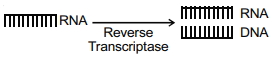
(B) Reverse transcription is a process in which genetic information flows from $RNA$ to $DNA$.
This process is catalyzed by the enzyme reverse transcriptase.
Since the synthesis of $DNA$ occurs using $RNA$ as a template,it is known as $RNA$ dependent $DNA$ synthesis.
This process is catalyzed by the enzyme reverse transcriptase.
Since the synthesis of $DNA$ occurs using $RNA$ as a template,it is known as $RNA$ dependent $DNA$ synthesis.
0 likes
View Solution177
EasyMCQ
Which plant was used by Taylor to prove semiconservative replication at the chromosomal level?
A
Haematoxylon
B
Vicia faba
C
Trillium
D
Ophioglossum
Solution
(B) In $1958$, $J$. Herbert Taylor and his colleagues conducted experiments on the root meristem cells of $Vicia \text{ } faba$ (fava bean) to demonstrate semiconservative $DNA$ replication at the chromosomal level.
They used radioactive thymidine to detect the distribution of newly synthesized $DNA$ in the chromosomes.
The results showed that the $DNA$ in chromosomes also replicates in a semiconservative manner, similar to the findings of Meselson and Stahl in $E. \text{ } coli$.
They used radioactive thymidine to detect the distribution of newly synthesized $DNA$ in the chromosomes.
The results showed that the $DNA$ in chromosomes also replicates in a semiconservative manner, similar to the findings of Meselson and Stahl in $E. \text{ } coli$.
0 likes
View Solution178
MediumMCQ
Unwinding of $DNA$ creates tension which is released by enzyme:
A
Helicase
B
Topoisomerase
C
Primase
D
Ligase
Solution
(B) During $DNA$ replication,the enzyme $Helicase$ unwinds the double helix,which creates torsional strain or supercoiling ahead of the replication fork. The enzyme $Topoisomerase$ (specifically $DNA$ $Gyrase$ in prokaryotes) relieves this twisting stress by cutting,rotating,and resealing the $DNA$ strands.
0 likes
View Solution179
MediumMCQ
During the polymerization of deoxyribonucleoside triphosphates in bacteria,which of the following enzymes is mainly required?
A
$DNA$ dependent $RNA$ polymerase
B
$DNA$ dependent $DNA$ polymerase
C
$RNA$ dependent $DNA$ polymerase
D
$DNA$ gyrase
Solution
(B) In bacteria,the process of $DNA$ replication involves the polymerization of deoxyribonucleoside triphosphates.
This process is catalyzed by $DNA$ polymerase $III$,which is a $DNA$ dependent $DNA$ polymerase.
It reads the template $DNA$ strand and adds complementary nucleotides to the growing $DNA$ chain.
Therefore,the correct enzyme is $DNA$ dependent $DNA$ polymerase.
This process is catalyzed by $DNA$ polymerase $III$,which is a $DNA$ dependent $DNA$ polymerase.
It reads the template $DNA$ strand and adds complementary nucleotides to the growing $DNA$ chain.
Therefore,the correct enzyme is $DNA$ dependent $DNA$ polymerase.
0 likes
View Solution180
EasyMCQ
$DNA$ polymerases catalyse polymerisation in:
A
Ribonucleotides
B
$5^{\prime} \rightarrow 3^{\prime}$ direction
C
$3^{\prime} \rightarrow 5^{\prime}$ direction
D
Deoxyribonucleosides
Solution
(B) $DNA$ polymerases are enzymes that synthesize $DNA$ molecules from deoxyribonucleotides,which are the building blocks of $DNA$.
These enzymes can only add nucleotides to the $3^{\prime}$ end of a growing $DNA$ strand.
Therefore,the polymerization of $DNA$ always occurs in the $5^{\prime} \rightarrow 3^{\prime}$ direction.
These enzymes can only add nucleotides to the $3^{\prime}$ end of a growing $DNA$ strand.
Therefore,the polymerization of $DNA$ always occurs in the $5^{\prime} \rightarrow 3^{\prime}$ direction.
0 likes
View Solution181
MediumMCQ
During $DNA$ replication,which of the following does not act as a substrate?
A
$dATP$
B
$dCTP$
C
$dUTP$
D
$dGTP$
Solution
(C) During $DNA$ replication,deoxyribonucleoside triphosphates $(dNTPs)$ serve as substrates for the polymerization process.
These include $dATP$ (deoxyadenosine triphosphate),$dGTP$ (deoxyguanosine triphosphate),$dCTP$ (deoxycytidine triphosphate),and $dTTP$ (deoxythymidine triphosphate).
$dUTP$ (deoxyuridine triphosphate) is not used as a substrate in $DNA$ replication because $DNA$ contains thymine $(T)$ instead of uracil $(U)$.
Therefore,$dUTP$ does not act as a substrate for $DNA$ polymerase.
These include $dATP$ (deoxyadenosine triphosphate),$dGTP$ (deoxyguanosine triphosphate),$dCTP$ (deoxycytidine triphosphate),and $dTTP$ (deoxythymidine triphosphate).
$dUTP$ (deoxyuridine triphosphate) is not used as a substrate in $DNA$ replication because $DNA$ contains thymine $(T)$ instead of uracil $(U)$.
Therefore,$dUTP$ does not act as a substrate for $DNA$ polymerase.
0 likes
View Solution182
EasyMCQ
How many types of $DNA$ polymerases are present in bacteria?
A
Five
B
Three
C
Two
D
One
Solution
(B) In bacteria,specifically in $E. coli$,there are three main types of $DNA$ polymerases involved in $DNA$ replication:
$1$. $DNA$ Polymerase $I$: Primarily involved in $DNA$ repair and the removal of $RNA$ primers.
$2$. $DNA$ Polymerase $II$: Primarily involved in $DNA$ repair.
$3$. $DNA$ Polymerase $III$: The primary enzyme responsible for $DNA$ replication (synthesis of the new strand).
$1$. $DNA$ Polymerase $I$: Primarily involved in $DNA$ repair and the removal of $RNA$ primers.
$2$. $DNA$ Polymerase $II$: Primarily involved in $DNA$ repair.
$3$. $DNA$ Polymerase $III$: The primary enzyme responsible for $DNA$ replication (synthesis of the new strand).
0 likes
View Solution183
MediumMCQ
Synthesis of leading and lagging strand require
A
Single primer
B
Single and many primers respectively
C
Many and single primers respectively
D
Many primers
Solution
(B) Leading strand synthesis occurs continuously in the $5^{\prime} \rightarrow 3^{\prime}$ direction towards the replication fork,requiring only a single primer at the start.
Lagging strand synthesis occurs discontinuously in the form of Okazaki fragments in the $5^{\prime} \rightarrow 3^{\prime}$ direction away from the replication fork,requiring multiple primers for each fragment.
Lagging strand synthesis occurs discontinuously in the form of Okazaki fragments in the $5^{\prime} \rightarrow 3^{\prime}$ direction away from the replication fork,requiring multiple primers for each fragment.
0 likes
View Solution184
MediumMCQ
For the strand separation and stabilisation during $DNA$ replication,which of the following set of enzymes and proteins are required?
A
$SSBP$,gyrase,primase
B
Topoisomerase,helicase,ligase
C
Gyrase,ligase,primase
D
Topoisomerase,helicase,$SSBP$
Solution
(D) During $DNA$ replication,the following components are essential for strand separation and stabilization:
$1$. Topoisomerase: This enzyme relieves the torsional strain (supercoiling) generated ahead of the replication fork.
$2$. Helicase: This enzyme breaks the hydrogen bonds between the nitrogenous bases to unwind the $DNA$ double helix.
$3$. $SSBP$ (Single-Strand Binding Protein): These proteins bind to the separated single strands of $DNA$ to prevent them from re-annealing or forming secondary structures,thereby stabilizing the template strands.
$1$. Topoisomerase: This enzyme relieves the torsional strain (supercoiling) generated ahead of the replication fork.
$2$. Helicase: This enzyme breaks the hydrogen bonds between the nitrogenous bases to unwind the $DNA$ double helix.
$3$. $SSBP$ (Single-Strand Binding Protein): These proteins bind to the separated single strands of $DNA$ to prevent them from re-annealing or forming secondary structures,thereby stabilizing the template strands.
0 likes
View Solution185
MediumMCQ
The $DNA$ strand showing replication using Okazaki fragments also shows
A
Continuous growth in $5^{\prime} \rightarrow 3^{\prime}$ direction
B
Discontinuous growth on $5^{\prime} \rightarrow 3^{\prime}$ parental strand
C
Discontinuous growth on $3^{\prime} \rightarrow 5^{\prime}$ parental strand
D
Involvement of one primer only
Solution
(B) During $DNA$ replication,the two strands of the double helix are antiparallel. One strand runs in the $3^{\prime} \rightarrow 5^{\prime}$ direction,while the other runs in the $5^{\prime} \rightarrow 3^{\prime}$ direction.
$DNA$ polymerase can only synthesize $DNA$ in the $5^{\prime} \rightarrow 3^{\prime}$ direction.
On the template strand with $3^{\prime} \rightarrow 5^{\prime}$ polarity,replication is continuous (leading strand).
On the template strand with $5^{\prime} \rightarrow 3^{\prime}$ polarity,replication occurs in short segments known as Okazaki fragments,which are later joined by $DNA$ ligase. This is called the lagging strand.
Therefore,the strand showing replication using Okazaki fragments (the lagging strand) is synthesized on the parental template strand that has $5^{\prime} \rightarrow 3^{\prime}$ polarity.
$DNA$ polymerase can only synthesize $DNA$ in the $5^{\prime} \rightarrow 3^{\prime}$ direction.
On the template strand with $3^{\prime} \rightarrow 5^{\prime}$ polarity,replication is continuous (leading strand).
On the template strand with $5^{\prime} \rightarrow 3^{\prime}$ polarity,replication occurs in short segments known as Okazaki fragments,which are later joined by $DNA$ ligase. This is called the lagging strand.
Therefore,the strand showing replication using Okazaki fragments (the lagging strand) is synthesized on the parental template strand that has $5^{\prime} \rightarrow 3^{\prime}$ polarity.
0 likes
View Solution186
MediumMCQ
$A$: Kornberg enzyme is associated with the removal of primers and thymine dimers.
$R$: $DNA$ polymerase $I$ performs exonuclease activity in $5^{\prime} \rightarrow 3^{\prime}$ and $3^{\prime} \rightarrow 5^{\prime}$ directions.
$R$: $DNA$ polymerase $I$ performs exonuclease activity in $5^{\prime} \rightarrow 3^{\prime}$ and $3^{\prime} \rightarrow 5^{\prime}$ directions.
A
Assertion and Reason both are correct and Reason is the correct explanation of Assertion.
B
Assertion and Reason both are correct but Reason is not the correct explanation of Assertion.
C
Assertion is correct,but Reason is incorrect.
D
Both Assertion and Reason are incorrect.
Solution
(A) The Kornberg enzyme is $DNA$ polymerase $I$.
It plays a crucial role in $DNA$ replication by removing $RNA$ primers using its $5^{\prime} \rightarrow 3^{\prime}$ exonuclease activity and filling the gaps with $DNA$ nucleotides.
It also possesses $3^{\prime} \rightarrow 5^{\prime}$ exonuclease activity,which is responsible for proofreading (removing mismatched bases).
Therefore,both the Assertion and the Reason are correct,and the Reason correctly explains why the Kornberg enzyme is associated with primer removal.
It plays a crucial role in $DNA$ replication by removing $RNA$ primers using its $5^{\prime} \rightarrow 3^{\prime}$ exonuclease activity and filling the gaps with $DNA$ nucleotides.
It also possesses $3^{\prime} \rightarrow 5^{\prime}$ exonuclease activity,which is responsible for proofreading (removing mismatched bases).
Therefore,both the Assertion and the Reason are correct,and the Reason correctly explains why the Kornberg enzyme is associated with primer removal.
0 likes
View Solution187
EasyMCQ
$DNA$ gyrase,the enzyme that participates in the process of $DNA$ replication,is a type of:
A
$DNA$ ligase
B
$DNA$ polymerase
C
$DNA$ topoisomerase
D
Reverse transcriptase
Solution
(C) $DNA$ gyrase is a specific type of $DNA$ topoisomerase (specifically topoisomerase $II$).
During $DNA$ replication,the two strands of the $DNA$ double helix are unwound by helicase.
This unwinding creates positive supercoiling (tension) ahead of the replication fork.
$DNA$ gyrase acts to relieve this torsional strain by introducing negative supercoils,thereby preventing the $DNA$ from becoming overwound and allowing replication to proceed efficiently.
During $DNA$ replication,the two strands of the $DNA$ double helix are unwound by helicase.
This unwinding creates positive supercoiling (tension) ahead of the replication fork.
$DNA$ gyrase acts to relieve this torsional strain by introducing negative supercoils,thereby preventing the $DNA$ from becoming overwound and allowing replication to proceed efficiently.
0 likes
View Solution188
MediumMCQ
Which of the following enzymes has been incorrectly matched with their function?
A
Ligase - Molecular glue
B
Endonuclease - Chemical scalpel
C
$DNA$ polymerase - Joins nucleosides
D
$RNA$ polymerase - Joins nucleotides
Solution
(C) $DNA$ polymerase is incorrectly matched because it does not join nucleosides.
$DNA$ polymerase is an enzyme that catalyzes the polymerization of deoxyribonucleotides into a $DNA$ strand.
It adds nucleotides to the $3'$ end of a growing $DNA$ chain,complementary to the template strand.
Therefore,the correct function is joining nucleotides,not nucleosides.
$DNA$ polymerase is an enzyme that catalyzes the polymerization of deoxyribonucleotides into a $DNA$ strand.
It adds nucleotides to the $3'$ end of a growing $DNA$ chain,complementary to the template strand.
Therefore,the correct function is joining nucleotides,not nucleosides.
0 likes
View Solution189
MediumMCQ
Ten $E. coli$ cells with $^{15}N$-dsDNA are incubated in a medium containing $^{14}N$ nucleotides. After $60$ minutes, how many $E. coli$ cells will have $DNA$ totally free from $^{15}N$ (in $cells$)?
A
$40$
B
$60$
C
$80$
D
$20$
Solution
(B) $E. coli$ replicates every $20$ minutes. In $60$ minutes, the cells will undergo $3$ rounds of replication $(60/20 = 3)$.
Starting with $10$ cells, the total number of cells after $3$ generations is $10 \times 2^3 = 80$ cells.
In $DNA$ replication, each strand acts as a template. After $3$ generations, the number of $DNA$ molecules containing the original $^{15}N$ strand is $20$ (since only $2$ strands of the original $10$ cells' $DNA$ are conserved in the hybrid form across generations).
Total $DNA$ molecules = $80 \times 2 = 160$.
$DNA$ molecules with $^{15}N$ = $20$ (as $10$ cells $\times$ $2$ strands = $20$ original strands).
$DNA$ molecules totally free from $^{15}N$ = $160 - 20 = 140$.
Since each cell contains $2$ $DNA$ strands, the number of cells with $DNA$ totally free from $^{15}N$ is $140 / 2 = 70$. However, looking at the standard calculation for this specific problem type: After $n$ generations, the number of cells with only $^{14}N$ $DNA$ is $N(2^n - 2)$.
For $N=10$ and $n=3$: $10 \times (2^3 - 2) = 10 \times (8 - 2) = 10 \times 6 = 60$ cells.
Starting with $10$ cells, the total number of cells after $3$ generations is $10 \times 2^3 = 80$ cells.
In $DNA$ replication, each strand acts as a template. After $3$ generations, the number of $DNA$ molecules containing the original $^{15}N$ strand is $20$ (since only $2$ strands of the original $10$ cells' $DNA$ are conserved in the hybrid form across generations).
Total $DNA$ molecules = $80 \times 2 = 160$.
$DNA$ molecules with $^{15}N$ = $20$ (as $10$ cells $\times$ $2$ strands = $20$ original strands).
$DNA$ molecules totally free from $^{15}N$ = $160 - 20 = 140$.
Since each cell contains $2$ $DNA$ strands, the number of cells with $DNA$ totally free from $^{15}N$ is $140 / 2 = 70$. However, looking at the standard calculation for this specific problem type: After $n$ generations, the number of cells with only $^{14}N$ $DNA$ is $N(2^n - 2)$.
For $N=10$ and $n=3$: $10 \times (2^3 - 2) = 10 \times (8 - 2) = 10 \times 6 = 60$ cells.
0 likes
View Solution190
MediumMCQ
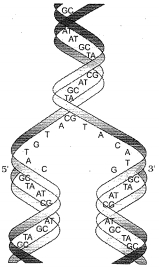
Identify the given model.
A
Watson and Crick's conservative $DNA$ replication model
B
Watson and Crick's semi-conservative $DNA$ replication model
C
Watson and Crick's semi-conservative $DNA$ transcription model
D
Watson and Crick's conservative $DNA$ transcription model
Solution
(B) The provided image illustrates the process of $DNA$ replication where the two strands of the parental $DNA$ molecule separate,and each strand acts as a template for the synthesis of a new complementary strand.
This mechanism results in two $DNA$ molecules,each consisting of one original (parental) strand and one newly synthesized strand.
This mode of replication is known as semi-conservative replication,as proposed by Watson and Crick based on their $DNA$ structure model.
Therefore,the correct option is $B$.
This mechanism results in two $DNA$ molecules,each consisting of one original (parental) strand and one newly synthesized strand.
This mode of replication is known as semi-conservative replication,as proposed by Watson and Crick based on their $DNA$ structure model.
Therefore,the correct option is $B$.
0 likes
View Solution191
EasyMCQ
Match the following columns:
| Column-$I$ (Enzyme) | Column-$II$ (Function) |
| $P$. $DNA$ Polymerase | $I$. Synthesizes $DNA$ strand |
| $Q$. $DNA$ Helicase | $II$. Breaks $H$-bonds of $DNA$ strands |
| $R$. $DNA$ Ligase | $III$. Joins $DNA$ fragments |
A
$(P-II), (Q-I), (R-III)$
B
$(P-III), (Q-II), (R-I)$
C
$(P-I), (Q-II), (R-III)$
D
$(P-II), (Q-III), (R-I)$
Solution
(C) $P$. $DNA$ Polymerase is responsible for the polymerization of nucleotides, i.e., synthesizing a new $DNA$ strand $(P-I)$.
$Q$. $DNA$ Helicase unwinds the $DNA$ double helix by breaking the hydrogen bonds between the nitrogenous bases $(Q-II)$.
$R$. $DNA$ Ligase acts as a molecular glue that joins the $DNA$ fragments (Okazaki fragments) together $(R-III)$.
Therefore, the correct matching is $(P-I), (Q-II), (R-III)$.
$Q$. $DNA$ Helicase unwinds the $DNA$ double helix by breaking the hydrogen bonds between the nitrogenous bases $(Q-II)$.
$R$. $DNA$ Ligase acts as a molecular glue that joins the $DNA$ fragments (Okazaki fragments) together $(R-III)$.
Therefore, the correct matching is $(P-I), (Q-II), (R-III)$.
0 likes
View Solution192
MediumMCQ
Select the correct option for a eukaryotic cell regarding the origin of replication and the number of replication forks.
A
Many $\quad$ Many
B
One $\quad$ One
C
One $\quad$ Many
D
Many $\quad$ One
Solution
(A) In eukaryotic cells,$DNA$ replication is a complex process that occurs during the $S$-phase of the cell cycle.
Due to the large size of eukaryotic genomes,replication does not start at a single point.
Instead,there are multiple origins of replication along the $DNA$ molecule to ensure that replication is completed in a timely manner.
At each origin of replication,the $DNA$ strands separate to form a replication bubble,which contains two replication forks moving in opposite directions.
Therefore,since there are many origins of replication,there are also many replication forks present simultaneously in a eukaryotic cell.
Due to the large size of eukaryotic genomes,replication does not start at a single point.
Instead,there are multiple origins of replication along the $DNA$ molecule to ensure that replication is completed in a timely manner.
At each origin of replication,the $DNA$ strands separate to form a replication bubble,which contains two replication forks moving in opposite directions.
Therefore,since there are many origins of replication,there are also many replication forks present simultaneously in a eukaryotic cell.
0 likes
View Solution193
MediumMCQ
Which of the following diagrams correctly represents the process of $DNA$ replication at the replication fork?
A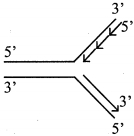
B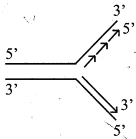
C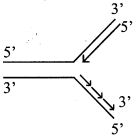
D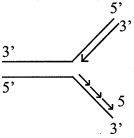
Solution
(C) $DNA$ replication occurs in the $5' \rightarrow 3'$ direction. The two strands of the $DNA$ double helix are antiparallel. At the replication fork,one strand (the leading strand) is synthesized continuously in the $5' \rightarrow 3'$ direction towards the replication fork. The other strand (the lagging strand) is synthesized discontinuously in the $5' \rightarrow 3'$ direction away from the replication fork,forming Okazaki fragments. In the provided options,Diagram $C$ correctly shows the template strands with $5'$ and $3'$ ends and the synthesis of new strands in the $5' \rightarrow 3'$ direction,where the top strand is synthesized continuously and the bottom strand is synthesized discontinuously.
0 likes
View Solution194
MediumMCQ
Bacteria containing $^{15}N-DNA$ are grown in a medium containing $^{14}NH_4Cl$ for $80$ minutes. What will be the proportion of $DNA$?
A
$1$ heavy : $1$ light : $1$ hybrid
B
$0$ heavy : $7$ light : $1$ hybrid
C
$2$ heavy : $7$ light : $1$ hybrid
D
$0$ heavy : $1$ light : $1$ hybrid
Solution
(B) The replication of $DNA$ is semi-conservative.
Starting with $1$ molecule of $^{15}N-DNA$ (heavy),after each generation of $20$ minutes,the number of $DNA$ molecules doubles.
$80$ minutes corresponds to $80/20 = 4$ generations.
Total $DNA$ molecules after $4$ generations = $2^4 = 16$.
In semi-conservative replication,only $2$ molecules will be hybrid $(^{15}N-^{14}N)$ and the remaining $(16 - 2) = 14$ molecules will be light $(^{14}N-^{14}N)$.
Ratio of heavy : light : hybrid = $0 : 14 : 2$.
Simplifying the ratio by dividing by $2$,we get $0 : 7 : 1$.
Thus,there are $0$ heavy,$7$ light,and $1$ hybrid $DNA$ molecules.
Starting with $1$ molecule of $^{15}N-DNA$ (heavy),after each generation of $20$ minutes,the number of $DNA$ molecules doubles.
$80$ minutes corresponds to $80/20 = 4$ generations.
Total $DNA$ molecules after $4$ generations = $2^4 = 16$.
In semi-conservative replication,only $2$ molecules will be hybrid $(^{15}N-^{14}N)$ and the remaining $(16 - 2) = 14$ molecules will be light $(^{14}N-^{14}N)$.
Ratio of heavy : light : hybrid = $0 : 14 : 2$.
Simplifying the ratio by dividing by $2$,we get $0 : 7 : 1$.
Thus,there are $0$ heavy,$7$ light,and $1$ hybrid $DNA$ molecules.
0 likes
View Solution195
MediumMCQ
What does the experiment of Matthew Meselson and Franklin Stahl suggest?
A
$RNA$ acts as the genetic material.
B
$DNA$ acts as the genetic material.
C
The synthesis of $RNA$ is semi-conservative.
D
The synthesis of $DNA$ is semi-conservative.
Solution
(D) Matthew Meselson and Franklin Stahl performed an experiment in $1958$ using $E. coli$ to prove the mode of $DNA$ replication.
They used heavy isotope $^{15}N$ and light isotope $^{14}N$ to label the $DNA$ strands.
After several generations,they observed that the $DNA$ molecules contained one heavy strand and one light strand,which confirmed that $DNA$ replication is semi-conservative,meaning each new $DNA$ molecule consists of one parental strand and one newly synthesized strand.
They used heavy isotope $^{15}N$ and light isotope $^{14}N$ to label the $DNA$ strands.
After several generations,they observed that the $DNA$ molecules contained one heavy strand and one light strand,which confirmed that $DNA$ replication is semi-conservative,meaning each new $DNA$ molecule consists of one parental strand and one newly synthesized strand.
0 likes
View Solution196
EasyMCQ
Taylor and his colleagues proved that $DNA$ in chromosomes also replicates semi-conservatively. Which organism did they use for this experiment?
A
Human
B
Vicia faba
C
Bacteria
D
Bacteriophage
Solution
(B) Taylor and his colleagues $(1958)$ performed experiments on $Vicia$ $faba$ (fava beans) to prove that $DNA$ in chromosomes replicates semi-conservatively. They used radioactive thymidine to detect the distribution of newly synthesized $DNA$ in the chromosomes.
0 likes
View Solution197
MediumMCQ
The monomer of $DNA$ is deoxyribonucleotide. However,why is deoxyribonucleoside triphosphate used at the enzymatic site?
A
Acts as a substrate and provides energy
B
Provides energy only
C
Acts as a substrate only
D
None of the above
Solution
(A) During $DNA$ replication,the enzyme $DNA$ polymerase requires deoxyribonucleoside triphosphates $(dNTPs)$ as substrates.
These molecules serve two primary functions:
$1$. They act as the building blocks (monomers) for the synthesis of the new $DNA$ strand.
$2$. The hydrolysis of the two terminal phosphate groups (pyrophosphate) provides the necessary energy for the polymerization reaction to occur,making the process thermodynamically favorable.
These molecules serve two primary functions:
$1$. They act as the building blocks (monomers) for the synthesis of the new $DNA$ strand.
$2$. The hydrolysis of the two terminal phosphate groups (pyrophosphate) provides the necessary energy for the polymerization reaction to occur,making the process thermodynamically favorable.
0 likes
View Solution198
MediumMCQ
New $DNA$ synthesis occurs in the $P$ direction,and the $DNA$ polymerase enzyme reads the template in the $Q$ direction.
$\quad \quad \quad \quad P \quad \quad \quad \quad \quad Q$
$\quad \quad \quad \quad P \quad \quad \quad \quad \quad Q$
A
$3^{\prime} \rightarrow 5^{\prime} \quad \quad 3^{\prime} \rightarrow 5^{\prime}$
B
$5^{\prime} \rightarrow 3^{\prime} \quad \quad 5^{\prime} \rightarrow 3^{\prime}$
C
$3^{\prime} \rightarrow 5^{\prime} \quad \quad 5^{\prime} \rightarrow 3^{\prime}$
D
$5^{\prime} \rightarrow 3^{\prime} \quad \quad 3^{\prime} \rightarrow 5^{\prime}$
Solution
(D) The synthesis of a new $DNA$ strand by $DNA$ polymerase always occurs in the $5^{\prime} \rightarrow 3^{\prime}$ direction because the enzyme can only add nucleotides to the $3^{\prime}-OH$ end of the growing strand.
To synthesize this strand,the $DNA$ polymerase enzyme must read the template strand in the opposite direction,which is $3^{\prime} \rightarrow 5^{\prime}$.
Therefore,$P$ is $5^{\prime} \rightarrow 3^{\prime}$ and $Q$ is $3^{\prime} \rightarrow 5^{\prime}$.
To synthesize this strand,the $DNA$ polymerase enzyme must read the template strand in the opposite direction,which is $3^{\prime} \rightarrow 5^{\prime}$.
Therefore,$P$ is $5^{\prime} \rightarrow 3^{\prime}$ and $Q$ is $3^{\prime} \rightarrow 5^{\prime}$.
0 likes
View Solution199
MediumMCQ
Select the incorrect option from the following.
A
$DNA$ polymerase can initiate replication by itself.
B
The sequence of $DNA$ where replication starts is called the origin of replication.
C
Plasmids have an origin of replication.
D
Polyploidy occurs due to the failure of cell division after $DNA$ replication.
Solution
(A) $DNA$ polymerase is an enzyme that requires a primer to initiate the synthesis of a new $DNA$ strand. It cannot start the replication process on its own because it requires a free $3'-OH$ end to add nucleotides. Therefore,option $A$ is incorrect. The origin of replication is the specific sequence where replication begins,which is true. Plasmids are extrachromosomal $DNA$ molecules that contain an origin of replication,allowing them to replicate independently. Polyploidy is a condition where an organism has more than two sets of chromosomes,often resulting from the failure of cytokinesis (cell division) after $DNA$ replication.
0 likes
View Solution200
MediumMCQ
Identify the enzymes that synthesize $DNA$ from $RNA$.
A
Reverse transcriptase
B
Transcriptase
C
$RNA$-dependent $DNA$ polymerase
D
Both $A$ and $C$
Solution
(D) The process of synthesizing $DNA$ from an $RNA$ template is known as reverse transcription.
This process is catalyzed by the enzyme reverse transcriptase.
Since this enzyme uses $RNA$ as a template to synthesize a complementary $DNA$ strand,it is also referred to as $RNA$-dependent $DNA$ polymerase.
Therefore,both terms refer to the same enzyme.
This process is catalyzed by the enzyme reverse transcriptase.
Since this enzyme uses $RNA$ as a template to synthesize a complementary $DNA$ strand,it is also referred to as $RNA$-dependent $DNA$ polymerase.
Therefore,both terms refer to the same enzyme.
0 likes
View SolutionMolecular Basis of Inheritance — Replication · Frequently Asked Questions
1Are these Molecular Basis of Inheritance questions useful for JEE and NEET?
Yes. All questions in this section are mapped to JEE Main and NEET exam patterns. Previous year questions from JEE Main, NEET, GUJCET and state-level exams are included with full solutions.
2Can I switch to Hindi or Gujarati for these questions?
Yes. Use the language tabs in the hero section or the sidebar to view the same questions and solutions in English, Hindi or Gujarati.
3How do I generate a question paper from this subtopic?
Use the Vedclass Exam Paper Generator — select the chapter and subtopic, set difficulty, and generate Sets A, B, C, D automatically. First 3 chapters of every subject are free.
Vedclass Products
For Students
Vedclass Test Series
Mock tests in real JEE/NEET style with performance analysis. 5-day free trial.
Start Free TrialFor Teachers
Exam Paper Generator
Generate Set A/B/C/D papers from this chapter in 2 minutes. 3 chapters free.
Try FreeFor Institutes
Online Exam Module
Live online exams with unlimited students, 360° analytics & white-label branding.
See DemoFor Teachers & Institutes
Generate a Molecular Basis of Inheritance Exam Paper in 2 Minutes
Select subtopic & difficulty — Sets A, B, C, D auto-generated with No Repeat logic.
First 3 chapters of every subject are free — no payment required.