
A English
Mix Example-Molecular Basis of Inheritance Questions in English
Class 12 Biology · Molecular Basis of Inheritance · Mix Example-Molecular Basis of Inheritance
124+
Questions
English
Language
100%
With Solutions
Showing 50 of 124 questions in English
51
MediumMCQ
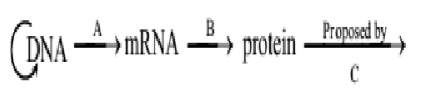
The diagram shows an important concept in the genetic implication of $DNA$. Fill in the blanks $A$ to $C$.
A
$A$ - Transcription,$B$ - Translation,$C$ - Francis Crick
B
$A$ - Translation,$B$ - Extension,$C$ - Rosalind Franklin
C
$A$ - Transcription,$B$ - Replication,$C$ - James Watson
D
$A$ - Translation,$B$ - Transcription,$C$ - Ervin Chargaff
Solution
(A) The correct answer is $A$.
The expression of genetic material occurs normally through the production of proteins. This involves two consecutive steps: transcription and translation.
$1$. Transcription $(A)$: The $DNA$ codes for the production of messenger $RNA$ $(mRNA)$.
$2$. Translation $(B)$: The $mRNA$ carries coded information to ribosomes,which read this information and use it for protein synthesis.
$3$. Central Dogma $(C)$: $F.H.C.$ Crick described this unidirectional flow of information in $1958$ as the 'central dogma of molecular biology'.
The expression of genetic material occurs normally through the production of proteins. This involves two consecutive steps: transcription and translation.
$1$. Transcription $(A)$: The $DNA$ codes for the production of messenger $RNA$ $(mRNA)$.
$2$. Translation $(B)$: The $mRNA$ carries coded information to ribosomes,which read this information and use it for protein synthesis.
$3$. Central Dogma $(C)$: $F.H.C.$ Crick described this unidirectional flow of information in $1958$ as the 'central dogma of molecular biology'.
0 likes
View Solution52
MediumMCQ
The figure illustrates an important concept in the genetic implication of $DNA$. Fill in the blanks $A, B$,and $C$.

A
$A$-Maurice Wilkins,$B$-Transcription,$C$-Translation
B
$A$-James Watson,$B$-Replication,$C$-Extension
C
$A$-Erwin Chargaff,$B$-Translation,$C$-Replication
D
$A$-Francis Crick,$B$-Translation,$C$-Transcription
Solution
(D) The correct answer is $(d)$.
The figure represents the 'Central Dogma' of molecular biology,which describes the unidirectional flow of genetic information.
$1$. $C$ represents Transcription: This is the process where $DNA$ is used as a template to synthesize $mRNA$.
$2$. $B$ represents Translation: This is the process where the information present in $mRNA$ is used to synthesize proteins at the ribosomes.
$3$. $A$ represents Francis Crick: The concept of the 'Central Dogma' was proposed by Francis Crick in $1958$.
The figure represents the 'Central Dogma' of molecular biology,which describes the unidirectional flow of genetic information.
$1$. $C$ represents Transcription: This is the process where $DNA$ is used as a template to synthesize $mRNA$.
$2$. $B$ represents Translation: This is the process where the information present in $mRNA$ is used to synthesize proteins at the ribosomes.
$3$. $A$ represents Francis Crick: The concept of the 'Central Dogma' was proposed by Francis Crick in $1958$.
0 likes
View Solution53
MediumMCQ
Which one of the following statements about the particular entity is true?
A
Centromere is found in animal cells,which produces aster during cell division.
B
The gene for producing insulin is present in every body cell.
C
Nucleosome is formed of nucleotides.
D
$DNA$ consists of core of eight histones.
Solution
(B) is the correct statement.
$1$. The gene for producing insulin is present in every somatic cell of the body because all cells originate from the zygote via mitosis and contain the same genetic information. However,it is only expressed in the beta cells of the pancreas.
$2$. Centrioles (not centromeres) are found in animal cells and produce asters during cell division.
$3$. $A$ nucleosome consists of a core of eight histone proteins wrapped by $DNA$,not nucleotides.
$4$. $DNA$ is a polymer of nucleotides,not a structure consisting of a core of eight histones.
$1$. The gene for producing insulin is present in every somatic cell of the body because all cells originate from the zygote via mitosis and contain the same genetic information. However,it is only expressed in the beta cells of the pancreas.
$2$. Centrioles (not centromeres) are found in animal cells and produce asters during cell division.
$3$. $A$ nucleosome consists of a core of eight histone proteins wrapped by $DNA$,not nucleotides.
$4$. $DNA$ is a polymer of nucleotides,not a structure consisting of a core of eight histones.
0 likes
View Solution54
MediumMCQ
Which of the following figures correctly represents the replication fork formed during $DNA$ replication?
A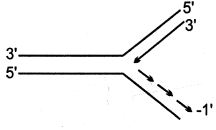
B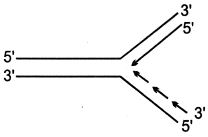
C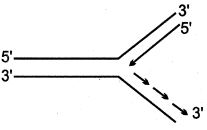
D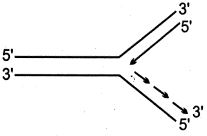
Solution
(C) During $DNA$ replication,the two strands of the $DNA$ double helix separate to form a replication fork. The enzyme $DNA$ polymerase synthesizes new strands only in the $5' \rightarrow 3'$ direction.
$1$. The template strand with $3' \rightarrow 5'$ polarity allows for continuous synthesis of the leading strand in the $5' \rightarrow 3'$ direction towards the replication fork.
$2$. The template strand with $5' \rightarrow 3'$ polarity results in the discontinuous synthesis of the lagging strand (Okazaki fragments) in the $5' \rightarrow 3'$ direction away from the replication fork.
$3$. In option $C$,the template strand has $5'$ at the top and $3'$ at the bottom. The top strand $(5' \rightarrow 3')$ acts as the template for the lagging strand,and the bottom strand $(3' \rightarrow 5')$ acts as the template for the leading strand. This orientation correctly depicts the $5' \rightarrow 3'$ synthesis of new $DNA$ strands.
$1$. The template strand with $3' \rightarrow 5'$ polarity allows for continuous synthesis of the leading strand in the $5' \rightarrow 3'$ direction towards the replication fork.
$2$. The template strand with $5' \rightarrow 3'$ polarity results in the discontinuous synthesis of the lagging strand (Okazaki fragments) in the $5' \rightarrow 3'$ direction away from the replication fork.
$3$. In option $C$,the template strand has $5'$ at the top and $3'$ at the bottom. The top strand $(5' \rightarrow 3')$ acts as the template for the lagging strand,and the bottom strand $(3' \rightarrow 5')$ acts as the template for the leading strand. This orientation correctly depicts the $5' \rightarrow 3'$ synthesis of new $DNA$ strands.
0 likes
View Solution55
MediumMCQ
Study the given figure of a nucleosome and select the option that correctly identifies the parts $A, B$ and $C$.
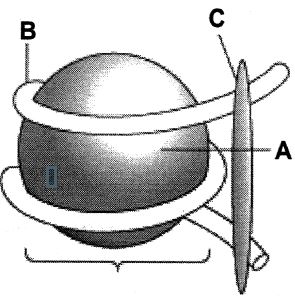
A
$DNA$ ; Histone octamer ; $H_1$ histone
B
Histone ; $H_1$ histone ; $DNA$ octamer
C
Histone octamer ; $DNA$ ; $H_1$ histone
D
$DNA$ ; $H_1$ histone ; Histone octamer
Solution
(C) In the structure of a nucleosome:
$A$ points to the core particle,which is the Histone octamer (composed of two molecules each of $H2A, H2B, H3$,and $H4$).
$B$ points to the $DNA$ molecule that wraps around the histone octamer.
$C$ points to the $H_1$ histone,which binds to the $DNA$ where it enters and leaves the nucleosome,helping to stabilize the structure.
Therefore,the correct identification is $A$ = Histone octamer,$B$ = $DNA$,and $C$ = $H_1$ histone.
$A$ points to the core particle,which is the Histone octamer (composed of two molecules each of $H2A, H2B, H3$,and $H4$).
$B$ points to the $DNA$ molecule that wraps around the histone octamer.
$C$ points to the $H_1$ histone,which binds to the $DNA$ where it enters and leaves the nucleosome,helping to stabilize the structure.
Therefore,the correct identification is $A$ = Histone octamer,$B$ = $DNA$,and $C$ = $H_1$ histone.
0 likes
View Solution56
MediumMCQ
Match the following:
| Column-$I$ | Column-$II$ |
|---|---|
| $(1)$ Ligase | $(p)$ Segment of $DNA$ |
| $(2)$ $RNA$ polymerase + Rho factor | $(q)$ Replication |
| $(3)$ $RNA$ polymerase | $(r)$ Termination |
| $(4)$ Cistron | $(s)$ Elongation |
A
$(1-p), (2-q), (3-r), (4-s)$
B
$(1-q), (2-r), (3-s), (4-p)$
C
$(1-r), (2-p), (3-q), (4-s)$
D
$(1-s), (2-q), (3-p), (4-r)$
Solution
(B) The correct matches are as follows:
$(1)$ Ligase: It is an enzyme used to join $DNA$ fragments,which is a crucial step in $DNA$ replication. Thus,$(1-q)$.
$(2)$ $RNA$ polymerase + Rho factor: The Rho factor is a protein that helps in the termination of transcription in prokaryotes. Thus,$(2-r)$.
$(3)$ $RNA$ polymerase: This enzyme is responsible for the elongation of the $RNA$ chain during transcription. Thus,$(3-s)$.
$(4)$ Cistron: $A$ cistron is a segment of $DNA$ that codes for a polypeptide. Thus,$(4-p)$.
Therefore,the correct matching is $(1-q), (2-r), (3-s), (4-p)$.
$(1)$ Ligase: It is an enzyme used to join $DNA$ fragments,which is a crucial step in $DNA$ replication. Thus,$(1-q)$.
$(2)$ $RNA$ polymerase + Rho factor: The Rho factor is a protein that helps in the termination of transcription in prokaryotes. Thus,$(2-r)$.
$(3)$ $RNA$ polymerase: This enzyme is responsible for the elongation of the $RNA$ chain during transcription. Thus,$(3-s)$.
$(4)$ Cistron: $A$ cistron is a segment of $DNA$ that codes for a polypeptide. Thus,$(4-p)$.
Therefore,the correct matching is $(1-q), (2-r), (3-s), (4-p)$.
0 likes
View Solution57
MediumMCQ
By using the diagram,select the correct option for $X$ and $Y$.
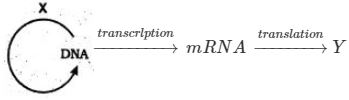
A
Replication,Protein
B
Cell division,Protein
C
Replication,Amino acid
D
$t-RNA$,$r-RNA$
Solution
(A) The given diagram represents the Central Dogma of molecular biology.
$1$. The process of forming $DNA$ from $DNA$ is called Replication,which is represented by $X$.
$2$. The process of forming $mRNA$ from $DNA$ is called Transcription.
$3$. The process of forming a Protein from $mRNA$ is called Translation,which results in the formation of $Y$ (Protein).
Therefore,$X$ is Replication and $Y$ is Protein.
$1$. The process of forming $DNA$ from $DNA$ is called Replication,which is represented by $X$.
$2$. The process of forming $mRNA$ from $DNA$ is called Transcription.
$3$. The process of forming a Protein from $mRNA$ is called Translation,which results in the formation of $Y$ (Protein).
Therefore,$X$ is Replication and $Y$ is Protein.
0 likes
View Solution58
MediumMCQ
The eukaryotic genome is different from the prokaryotic genome because . . . . . . .
A
$DNA$ in prokaryotes is associated with histones.
B
Repetitive sequences are present in eukaryotes.
C
Genes in eukaryotes are organized as operons.
D
$DNA$ in prokaryotes is circular and single-stranded.
Solution
(B) The eukaryotic genome differs from the prokaryotic genome in several ways. One key difference is the presence of repetitive $DNA$ sequences in eukaryotes,which are largely absent or very rare in prokaryotes.
Regarding the other options:
$A$ is incorrect because histones are characteristic of eukaryotic $DNA$,not prokaryotic.
$C$ is incorrect because operons are a characteristic feature of prokaryotic gene regulation,not eukaryotic.
$D$ is incorrect because prokaryotic $DNA$ is circular but double-stranded,not single-stranded.
Regarding the other options:
$A$ is incorrect because histones are characteristic of eukaryotic $DNA$,not prokaryotic.
$C$ is incorrect because operons are a characteristic feature of prokaryotic gene regulation,not eukaryotic.
$D$ is incorrect because prokaryotic $DNA$ is circular but double-stranded,not single-stranded.
0 likes
View Solution59
MediumMCQ
The alternative valence states of $DNA$ bases in $A=T$ and $G=C$ pairs are known as:
A
Tautomeric shifts
B
Transition mutations
C
Frameshift mutations
D
Point mutations
Solution
(A) Tautomeric shifts are spontaneous changes in the molecular structure of nitrogenous bases in $DNA$.
These shifts involve the migration of a hydrogen atom,which changes the base from its standard keto form to an imino or enol form.
These alternative valence states allow for rare,incorrect base pairing (e.g.,$A$ pairing with $C$ instead of $T$),which can lead to mutations during $DNA$ replication.
These shifts involve the migration of a hydrogen atom,which changes the base from its standard keto form to an imino or enol form.
These alternative valence states allow for rare,incorrect base pairing (e.g.,$A$ pairing with $C$ instead of $T$),which can lead to mutations during $DNA$ replication.
0 likes
View Solution60
EasyMCQ
The $1$ gene $1$ enzyme relationship was first established in .......... .
A
Neurospora crassa
B
Salmonella typhimurium
C
Escherichia coli
D
Diplococcus pneumoniae
Solution
(A) The $1$ gene $1$ enzyme hypothesis was proposed by George Beadle and Edward Tatum in $1941$.
They conducted experiments on the bread mold $Neurospora$ $crassa$.
By inducing mutations using $X$-rays, they observed that specific mutations led to the loss of specific enzymatic activities, thereby proving that each gene is responsible for the synthesis of a specific enzyme.
They conducted experiments on the bread mold $Neurospora$ $crassa$.
By inducing mutations using $X$-rays, they observed that specific mutations led to the loss of specific enzymatic activities, thereby proving that each gene is responsible for the synthesis of a specific enzyme.
0 likes
View Solution61
MediumMCQ
The figure shows an important concept of $DNA$ implication. Fill in the blanks from $A$ to $C$.

A
$A$ - Translation,$B$ - Growth,$C$ - Rosalind Franklin
B
$A$ - Transcription,$B$ - Replication,$C$ - James Watson
C
$A$ - Translation,$B$ - Transcription,$C$ - Erwin Chargaff
D
$A$ - Transcription,$B$ - Translation,$C$ - Francis Crick
Solution
(D) The given figure represents the Central Dogma of molecular biology.
$1$. The process of formation of $mRNA$ from $DNA$ is called Transcription $(A)$.
$2$. The process of formation of protein from $mRNA$ is called Translation $(B)$.
$3$. The concept of Central Dogma was proposed by Francis Crick $(C)$.
$1$. The process of formation of $mRNA$ from $DNA$ is called Transcription $(A)$.
$2$. The process of formation of protein from $mRNA$ is called Translation $(B)$.
$3$. The concept of Central Dogma was proposed by Francis Crick $(C)$.
0 likes
View Solution62
MediumMCQ
Which of the following pairs is $NOT$ correctly matched?
A
Transcription $\to$ Writing information from $DNA$ to $RNA$
B
Translation $\to$ Using information on $mRNA$ to synthesize proteins
C
Repressor protein $\to$ Binds to the operator to prevent enzyme synthesis
D
Operon $\to$ Structural genes,operator,and promoter
Solution
(NONE) All the given options are correctly matched definitions in the context of molecular biology:
$1$. Transcription is the process of copying genetic information from one strand of $DNA$ into $RNA$.
$2$. Translation is the process of polymerization of amino acids to form a polypeptide based on the sequence of codons on $mRNA$.
$3$. $A$ repressor protein binds to the operator region of an operon to prevent the transcription of structural genes,thereby stopping enzyme synthesis.
$4$. An operon consists of a polycistronic structural gene regulated by a common promoter and regulatory genes (including the operator).
Since all options are correct,there is no incorrect pair provided in the list.
$1$. Transcription is the process of copying genetic information from one strand of $DNA$ into $RNA$.
$2$. Translation is the process of polymerization of amino acids to form a polypeptide based on the sequence of codons on $mRNA$.
$3$. $A$ repressor protein binds to the operator region of an operon to prevent the transcription of structural genes,thereby stopping enzyme synthesis.
$4$. An operon consists of a polycistronic structural gene regulated by a common promoter and regulatory genes (including the operator).
Since all options are correct,there is no incorrect pair provided in the list.
0 likes
View Solution63
MediumMCQ
The $T_4$ bacteriophage $rII$ mutant strain fails to lyse $E. coli$. However,when two strains $rII^X$ and $rII^Y$ are mixed,they lyse $E. coli$. What is the possible reason for this?
A
The bacteriophage undergoes transformation into an uncoordinated form.
B
No mutation occurs in them.
C
Both strains have the same cistron.
D
Both strains have different cistrons.
Solution
(D) This experiment is based on the complementation test performed by Seymour Benzer.
$1$. The $rII$ mutants of $T_4$ bacteriophage are unable to grow on $E. coli$ strain $K$.
$2$. When two different $rII$ mutants are introduced into the same $E. coli$ cell,they can complement each other if the mutations are in different functional units (cistrons).
$3$. If the mutations are in different cistrons,the functional protein missing in one mutant is provided by the other,allowing the phage to replicate and lyse the host cell.
$4$. Therefore,the lysis occurs because the two strains have mutations in different cistrons,which complement each other to restore the wild-type function.
$1$. The $rII$ mutants of $T_4$ bacteriophage are unable to grow on $E. coli$ strain $K$.
$2$. When two different $rII$ mutants are introduced into the same $E. coli$ cell,they can complement each other if the mutations are in different functional units (cistrons).
$3$. If the mutations are in different cistrons,the functional protein missing in one mutant is provided by the other,allowing the phage to replicate and lyse the host cell.
$4$. Therefore,the lysis occurs because the two strains have mutations in different cistrons,which complement each other to restore the wild-type function.
0 likes
View Solution64
EasyMCQ
The given figure shows the structure of a nucleosome with its parts labelled as $A, B$ and $C$. Identify $A, B$ and $C$.
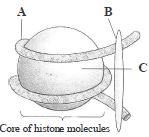
A
$A - DNA$; $B - H_1$ histone; $C -$ Histone octamer
B
$A - H_1$ histone; $B - DNA$; $C -$ Histone octamer
C
$A -$ Histone octamer; $B - RNA$; $C - H_1$ histone
D
$A - RNA$; $B - H_1$ histone; $C -$ Histone octamer
Solution
(A) nucleosome is the basic structural unit of eukaryotic chromatin,which consists of a segment of $DNA$ wrapped around a core of histone proteins.
In the provided figure:
$A$ represents the $DNA$ molecule that wraps around the histone core.
$B$ represents the $H_1$ histone protein,which binds to the $DNA$ where it enters and leaves the nucleosome.
$C$ represents the histone octamer,which is the core complex consisting of two molecules each of four histone proteins ($H2A, H2B, H3,$ and $H4$).
Therefore,the correct identification is $A - DNA, B - H_1$ histone,and $C -$ Histone octamer.
In the provided figure:
$A$ represents the $DNA$ molecule that wraps around the histone core.
$B$ represents the $H_1$ histone protein,which binds to the $DNA$ where it enters and leaves the nucleosome.
$C$ represents the histone octamer,which is the core complex consisting of two molecules each of four histone proteins ($H2A, H2B, H3,$ and $H4$).
Therefore,the correct identification is $A - DNA, B - H_1$ histone,and $C -$ Histone octamer.
0 likes
View Solution65
MediumMCQ
Assertion : Histones are basic proteins of major importance in packaging of eukaryotic $DNA$. $DNA$ and histones comprise chromatin forming the bulk of eukaryotic chromosome.
Reason : Histones are of five major types $H_1, H_2A, H_2B, H_3$ and $H_4$.
Reason : Histones are of five major types $H_1, H_2A, H_2B, H_3$ and $H_4$.
A
If both Assertion and Reason are correct and the Reason is a correct explanation of the Assertion.
B
If both Assertion and Reason are correct but Reason is not a correct explanation of the Assertion.
C
If the Assertion is correct but Reason is incorrect.
D
If both the Assertion and Reason are incorrect.
Solution
(B) Histones are basic proteins found in eukaryotic chromosomes,which are rich in positively charged amino acids like lysine and arginine.
These proteins are essential for the packaging of negatively charged $DNA$ into chromatin.
There are five major types of histone proteins: $H_1, H_2A, H_2B, H_3$,and $H_4$.
While both the Assertion and the Reason are scientifically correct statements,the Reason describes the types of histones but does not directly explain why they are important for packaging (which involves their basic nature and charge).
Therefore,the Reason is not the correct explanation for the Assertion.
These proteins are essential for the packaging of negatively charged $DNA$ into chromatin.
There are five major types of histone proteins: $H_1, H_2A, H_2B, H_3$,and $H_4$.
While both the Assertion and the Reason are scientifically correct statements,the Reason describes the types of histones but does not directly explain why they are important for packaging (which involves their basic nature and charge).
Therefore,the Reason is not the correct explanation for the Assertion.
0 likes
View Solution66
Medium
Differentiate between the following:
$(a)$ Repetitive $DNA$ and Satellite $DNA$
$(b)$ $mRNA$ and $tRNA$
$(c)$ Template strand and Coding strand
$(a)$ Repetitive $DNA$ and Satellite $DNA$
$(b)$ $mRNA$ and $tRNA$
$(c)$ Template strand and Coding strand
Solution
(N/A) Repetitive $DNA$ and Satellite $DNA$
$(b)$ $mRNA$ and $tRNA$
$(c)$ Template strand and Coding strand
| Repetitive $DNA$ | Satellite $DNA$ |
|---|---|
| $DNA$ sequences that contain small segments repeated many times in the genome. | $A$ subset of repetitive $DNA$ consisting of highly repetitive sequences that form distinct bands during density gradient centrifugation. |
$(b)$ $mRNA$ and $tRNA$
| No. | $mRNA$ (Messenger $RNA$) | $tRNA$ (Transfer $RNA$) |
|---|---|---|
| $1.$ | Acts as a template that carries genetic information from $DNA$ for protein synthesis. | Acts as an adaptor molecule that carries specific amino acids to the ribosome during translation. |
| $2.$ | It is a linear molecule. | It has a characteristic clover-leaf secondary structure (or $L$-shape $3D$ structure). |
$(c)$ Template strand and Coding strand
| No. | Template Strand | Coding Strand |
|---|---|---|
| $1.$ | Acts as a template for $RNA$ synthesis; its sequence is complementary to the $mRNA$. | Does not act as a template; its sequence is identical to the $mRNA$ (except $U$ replaces $T$). |
| $2.$ | It runs in the $3' \to 5'$ direction. | It runs in the $5' \to 3'$ direction. |
0 likes
View Solution67
Difficult
Briefly describe the following:
$(a)$ Transcription
$(b)$ Polymorphism
$(c)$ Translation
$(d)$ Bioinformatics
$(a)$ Transcription
$(b)$ Polymorphism
$(c)$ Translation
$(d)$ Bioinformatics
Solution
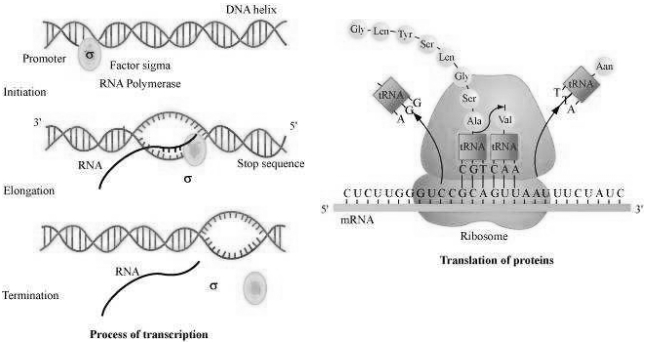
(N/A) Transcription: Transcription is the process of synthesizing $RNA$ from a $DNA$ template. $A$ segment of $DNA$ is copied into $mRNA$. The process starts at the promoter region and terminates at the terminator region. The segment of $DNA$ between these two is the transcription unit. It requires $RNA$ polymerase,$DNA$ template,ribonucleotides,and cofactors like $Mg^{2+}$. The three stages are Initiation,Elongation,and Termination. $DNA$-dependent $RNA$ polymerase and initiation factor $(\sigma)$ bind to the promoter. The enzyme unwinds the $DNA$ and uses the template strand to synthesize $mRNA$ using nucleoside triphosphates. Upon reaching the terminator,the $mRNA$ and enzyme are released,aided by the termination factor $(\rho)$.
$(b)$ Polymorphism: Polymorphism is a form of genetic variation where distinct nucleotide sequences exist at a particular site in a $DNA$ molecule. This heritable mutation occurs at a high frequency in a population. It arises due to mutations in somatic or germ cells. Germ cell mutations are transmitted to offspring,leading to accumulation of variations,which is crucial for evolution and speciation.
$(c)$ Translation: Translation is the process of polymerizing amino acids to form a polypeptide chain. The triplet sequence of base pairs in $mRNA$ defines the order of amino acids. It involves Initiation,Elongation,and Termination. $tRNA$ is charged using $ATP$. The small ribosomal subunit binds to $mRNA$ at the start codon $(AUG)$,followed by the large subunit. During elongation,the ribosome moves along $mRNA$,and amino acids brought by $tRNA$ are linked by peptide bonds. When the ribosome reaches a $STOP$ codon ($UAA, UAG,$ or $UGA$),translation terminates,and the polypeptide chain is released.
$(d)$ Bioinformatics: Bioinformatics is the application of computational and statistical techniques to molecular biology. It addresses problems in managing and analyzing biological data. It developed significantly after the Human Genome Project $(HGP)$ to manage the massive data generated. It involves creating biological databases and developing algorithms to predict protein structures,functions,and analyze relationships between sequences.
$(b)$ Polymorphism: Polymorphism is a form of genetic variation where distinct nucleotide sequences exist at a particular site in a $DNA$ molecule. This heritable mutation occurs at a high frequency in a population. It arises due to mutations in somatic or germ cells. Germ cell mutations are transmitted to offspring,leading to accumulation of variations,which is crucial for evolution and speciation.
$(c)$ Translation: Translation is the process of polymerizing amino acids to form a polypeptide chain. The triplet sequence of base pairs in $mRNA$ defines the order of amino acids. It involves Initiation,Elongation,and Termination. $tRNA$ is charged using $ATP$. The small ribosomal subunit binds to $mRNA$ at the start codon $(AUG)$,followed by the large subunit. During elongation,the ribosome moves along $mRNA$,and amino acids brought by $tRNA$ are linked by peptide bonds. When the ribosome reaches a $STOP$ codon ($UAA, UAG,$ or $UGA$),translation terminates,and the polypeptide chain is released.
$(d)$ Bioinformatics: Bioinformatics is the application of computational and statistical techniques to molecular biology. It addresses problems in managing and analyzing biological data. It developed significantly after the Human Genome Project $(HGP)$ to manage the massive data generated. It involves creating biological databases and developing algorithms to predict protein structures,functions,and analyze relationships between sequences.
0 likes
View Solution68
Medium
Explain the Central Dogma in molecular biology.
Solution
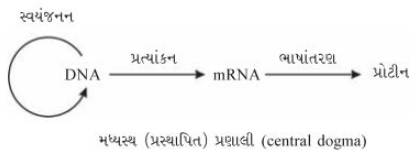
(N/A) The Central Dogma of molecular biology was proposed by Francis Crick.
It states that the flow of genetic information occurs in the direction: $DNA \to mRNA \to$ Protein.
$1$. Replication: $DNA$ makes a copy of itself.
$2$. Transcription: $DNA$ is transcribed into $mRNA$.
$3$. Translation: $mRNA$ is translated into a protein sequence.
It states that the flow of genetic information occurs in the direction: $DNA \to mRNA \to$ Protein.
$1$. Replication: $DNA$ makes a copy of itself.
$2$. Transcription: $DNA$ is transcribed into $mRNA$.
$3$. Translation: $mRNA$ is translated into a protein sequence.
0 likes
View Solution69
Medium
Distinguish between: $m-RNA$ and $t-RNA$.
Solution
(N/A)
| $m-RNA$ | $t-RNA$ |
|---|---|
| $(1)$ It carries the genetic information for protein synthesis from the nucleus to the cytoplasm. | $(1)$ It binds to specific amino acids and transports them to the ribosome surface. |
| $(2)$ Numerous $m-RNA$ units are active in the cell at different times based on gene expression. | $(2)$ There are $61$ types of $t-RNA$ possible for transporting $20$ types of amino acids (corresponding to $61$ codons). |
| $(3)$ $m-RNA$ undergoes degradation after completing its function. | $(3)$ $t-RNA$ molecules are generally stable and do not undergo degradation easily. |
| $(4)$ The sequence of nucleotides in $m-RNA$ determines the sequence and position of amino acids in the protein structure. | $(4)$ Each $t-RNA$ carries a specific type of amino acid unit. |
0 likes
View Solution70
Medium
Define/Explain the following:
$1.$ Nucleotide
$2.$ Central Dogma
$1.$ Nucleotide
$2.$ Central Dogma
Solution
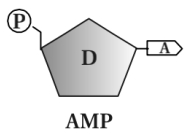
(N/A) $1.$ Nucleotide: $A$ nucleotide is formed when a phosphate group is linked to the $5'-OH$ group of a nucleoside through a phosphoester linkage.
$2.$ Central Dogma: The genetic information flows from $DNA$ to $mRNA$ through transcription, which is then translated into protein synthesis. The flow is represented as: $DNA \rightarrow mRNA \rightarrow \text{Protein}$.
$2.$ Central Dogma: The genetic information flows from $DNA$ to $mRNA$ through transcription, which is then translated into protein synthesis. The flow is represented as: $DNA \rightarrow mRNA \rightarrow \text{Protein}$.
0 likes
View Solution71
Medium
Explain the following terms:
$1.$ Leading strand - Lagging strand
$2.$ $t-RNA$ - $m-RNA$
$3.$ Monocistronic - Polycistronic
$1.$ Leading strand - Lagging strand
$2.$ $t-RNA$ - $m-RNA$
$3.$ Monocistronic - Polycistronic
Solution
(N/A) Leading strand: During $DNA$ replication,the strand synthesized continuously in the $5^{\prime} \rightarrow 3^{\prime}$ direction on the template strand with $3^{\prime} \rightarrow 5^{\prime}$ polarity is called the leading strand.
Lagging strand: The strand synthesized discontinuously in the form of short fragments (Okazaki fragments) in the $5^{\prime} \rightarrow 3^{\prime}$ direction is called the lagging strand.
$t-RNA$: It acts as an adapter molecule that carries specific amino acids to the ribosome during protein synthesis.
$m-RNA$: It carries the genetic information from $DNA$ to the ribosome for protein synthesis.
Monocistronic: $A$ structural gene that codes for a single polypeptide chain,typically found in eukaryotes.
Polycistronic: $A$ structural gene that codes for multiple polypeptide chains,typically found in prokaryotes.
Lagging strand: The strand synthesized discontinuously in the form of short fragments (Okazaki fragments) in the $5^{\prime} \rightarrow 3^{\prime}$ direction is called the lagging strand.
$t-RNA$: It acts as an adapter molecule that carries specific amino acids to the ribosome during protein synthesis.
$m-RNA$: It carries the genetic information from $DNA$ to the ribosome for protein synthesis.
Monocistronic: $A$ structural gene that codes for a single polypeptide chain,typically found in eukaryotes.
Polycistronic: $A$ structural gene that codes for multiple polypeptide chains,typically found in prokaryotes.
0 likes
View Solution72
Medium
Explain the role of the following scientists:
$1.$ Avery, MacLeod, and McCarty $(1933-44)$
$2.$ Matthew Meselson and Franklin Stahl $(1958)$
$1.$ Avery, MacLeod, and McCarty $(1933-44)$
$2.$ Matthew Meselson and Franklin Stahl $(1958)$
Solution
(N/A) $1.$ Oswald Avery, Colin MacLeod, and Maclyn McCarty $(1933-44)$: They worked to determine the biochemical nature of the 'transforming principle' in Griffith's experiment. They discovered that $DNA$ is the genetic material, not protein or $RNA$, by using enzymes like DNase, RNase, and protease.
$2.$ Matthew Meselson and Franklin Stahl $(1958)$: They performed an experiment using $E. coli$ grown in a medium containing $^{15}N$ (heavy nitrogen) and then transferred to $^{14}N$ (light nitrogen). Their results proved that $DNA$ replication is semi-conservative.
$2.$ Matthew Meselson and Franklin Stahl $(1958)$: They performed an experiment using $E. coli$ grown in a medium containing $^{15}N$ (heavy nitrogen) and then transferred to $^{14}N$ (light nitrogen). Their results proved that $DNA$ replication is semi-conservative.
0 likes
View Solution73
Medium
What is central dogma and describe the packing of $DNA$ helix?
Solution
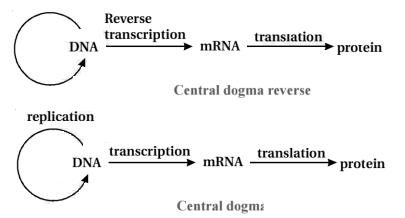
(N/A) Francis Crick proposed the Central Dogma in molecular biology, which states that genetic information flows from $DNA \to RNA \to$ protein.
In some viruses, the flow of information is in the reverse direction, that is, from $RNA$ to $DNA$.
Taking the distance between two consecutive base pairs as $0.34 \, nm$ $(0.34 \times 10^{-9} \, m)$, if the length of the $DNA$ double helix in a typical mammalian cell is calculated (by multiplying the total number of $bp$ with the distance between two consecutive $bp$, i.e., $6.6 \times 10^9 \, bp \times 0.34 \times 10^{-9} \, m/bp$), it is approximately $2.2 \, meters$.
This length is far greater than the dimension of a typical nucleus (approximately $10^{-6} \, m$).
In prokaryotes, such as $E. coli$, although they do not have a defined nucleus, the $DNA$ is not scattered throughout the cell. $DNA$ (being negatively charged) is held with some proteins (that have positive charges) in a region termed as 'nucleoid'. The $DNA$ in the nucleoid is organized in large loops held by proteins.
In eukaryotes, this organization is much more complex. There is a set of positively charged, basic proteins called histones. A protein acquires charge depending upon the abundance of amino acid residues with charged side chains. Histones are rich in the basic amino acid residues lysines and arginines. Both these amino acid residues carry positive charges in their side chains.
In some viruses, the flow of information is in the reverse direction, that is, from $RNA$ to $DNA$.
Taking the distance between two consecutive base pairs as $0.34 \, nm$ $(0.34 \times 10^{-9} \, m)$, if the length of the $DNA$ double helix in a typical mammalian cell is calculated (by multiplying the total number of $bp$ with the distance between two consecutive $bp$, i.e., $6.6 \times 10^9 \, bp \times 0.34 \times 10^{-9} \, m/bp$), it is approximately $2.2 \, meters$.
This length is far greater than the dimension of a typical nucleus (approximately $10^{-6} \, m$).
In prokaryotes, such as $E. coli$, although they do not have a defined nucleus, the $DNA$ is not scattered throughout the cell. $DNA$ (being negatively charged) is held with some proteins (that have positive charges) in a region termed as 'nucleoid'. The $DNA$ in the nucleoid is organized in large loops held by proteins.
In eukaryotes, this organization is much more complex. There is a set of positively charged, basic proteins called histones. A protein acquires charge depending upon the abundance of amino acid residues with charged side chains. Histones are rich in the basic amino acid residues lysines and arginines. Both these amino acid residues carry positive charges in their side chains.
0 likes
View Solution74
Medium
Write a comparative note on the properties of $DNA$ and $RNA$.
Solution
(N/A) From the Hershey-Chase experiment,it became an established fact that $DNA$ acts as the genetic material.
However,it subsequently became clear that in some viruses,$RNA$ is the genetic material (e.g.,Tobacco Mosaic Virus,$QB$ bacteriophage,etc.).
$A$ molecule that acts as genetic material must fulfill the following criteria:
$(i)$ It should be able to generate its replica (Replication).
$(ii)$ It should be chemically and structurally stable.
$(iii)$ It should provide the scope for slow changes (mutation) required for evolution.
$(iv)$ It should be able to express itself in the form of 'Mendelian Characters'.
Comparing these requirements:
- Due to the rule of base pairing and complementarity,both nucleic acids ($DNA$ and $RNA$) have the ability to direct their duplication.
- Proteins fail to fulfill the first criterion.
- Stability: Genetic material must be stable enough not to change with different stages of the life cycle,age,or physiology. Griffith's experiment showed that heat did not destroy the properties of the genetic material $(DNA)$.
- Chemical Stability: In $RNA$,the $2'-OH$ group present at every nucleotide is a reactive group,making $RNA$ labile and easily degradable. $RNA$ is also catalytic,hence more reactive.
- $DNA$ is chemically less reactive and structurally more stable than $RNA$. The presence of thymine instead of uracil also confers additional stability to $DNA$.
- Mutation: Both $DNA$ and $RNA$ can mutate. $RNA$ being unstable,mutates at a faster rate. Consequently,viruses with $RNA$ genomes evolve faster.
- Expression: $RNA$ can directly code for protein synthesis,whereas $DNA$ depends on $RNA$ for protein synthesis. The protein-synthesizing machinery has evolved around $RNA$.
Conclusion: Both can function as genetic material,but $DNA$ is preferred for the storage of genetic information due to its stability,while $RNA$ is better for the transmission of genetic information.
However,it subsequently became clear that in some viruses,$RNA$ is the genetic material (e.g.,Tobacco Mosaic Virus,$QB$ bacteriophage,etc.).
$A$ molecule that acts as genetic material must fulfill the following criteria:
$(i)$ It should be able to generate its replica (Replication).
$(ii)$ It should be chemically and structurally stable.
$(iii)$ It should provide the scope for slow changes (mutation) required for evolution.
$(iv)$ It should be able to express itself in the form of 'Mendelian Characters'.
Comparing these requirements:
- Due to the rule of base pairing and complementarity,both nucleic acids ($DNA$ and $RNA$) have the ability to direct their duplication.
- Proteins fail to fulfill the first criterion.
- Stability: Genetic material must be stable enough not to change with different stages of the life cycle,age,or physiology. Griffith's experiment showed that heat did not destroy the properties of the genetic material $(DNA)$.
- Chemical Stability: In $RNA$,the $2'-OH$ group present at every nucleotide is a reactive group,making $RNA$ labile and easily degradable. $RNA$ is also catalytic,hence more reactive.
- $DNA$ is chemically less reactive and structurally more stable than $RNA$. The presence of thymine instead of uracil also confers additional stability to $DNA$.
- Mutation: Both $DNA$ and $RNA$ can mutate. $RNA$ being unstable,mutates at a faster rate. Consequently,viruses with $RNA$ genomes evolve faster.
- Expression: $RNA$ can directly code for protein synthesis,whereas $DNA$ depends on $RNA$ for protein synthesis. The protein-synthesizing machinery has evolved around $RNA$.
Conclusion: Both can function as genetic material,but $DNA$ is preferred for the storage of genetic information due to its stability,while $RNA$ is better for the transmission of genetic information.
0 likes
View Solution75
Medium
Match the columns.
| Column-$I$ | Column-$II$ |
| $(a)$ Splicing | $(1)$ Lac Operon |
| $(b)$ Okazaki fragments | $(2)$ Lagging strands |
| $(c)$ Jacob and Monod | $(3)$ Lactose |
| $(d)$ Inducer | $(4)$ Removal of introns |
Solution
$(A)$ The correct matches are as follows:
$(a)$ Splicing refers to the process of removing introns and joining exons in pre-mRNA, which corresponds to $(4)$.
$(b)$ Okazaki fragments are short $DNA$ sequences synthesized discontinuously on the lagging strand during $DNA$ replication, which corresponds to $(2)$.
$(c)$ Jacob and Monod were the scientists who proposed the operon model, specifically the Lac Operon, which corresponds to $(1)$.
$(d)$ An inducer is a molecule that regulates gene expression by binding to a repressor protein; in the Lac Operon, lactose acts as the inducer, which corresponds to $(3)$.
Therefore, the correct matching is $(a-4, b-2, c-1, d-3)$.
$(a)$ Splicing refers to the process of removing introns and joining exons in pre-mRNA, which corresponds to $(4)$.
$(b)$ Okazaki fragments are short $DNA$ sequences synthesized discontinuously on the lagging strand during $DNA$ replication, which corresponds to $(2)$.
$(c)$ Jacob and Monod were the scientists who proposed the operon model, specifically the Lac Operon, which corresponds to $(1)$.
$(d)$ An inducer is a molecule that regulates gene expression by binding to a repressor protein; in the Lac Operon, lactose acts as the inducer, which corresponds to $(3)$.
Therefore, the correct matching is $(a-4, b-2, c-1, d-3)$.
0 likes
View Solution76
Easy
Define the following terms: Replication fork and Transcription.
Solution
(N/A) $1$. Replication fork: For long $DNA$ molecules,since the two strands of $DNA$ cannot be separated in their entire length,the replication occurs within a small opening of the $DNA$ helix,which is referred to as the replication fork.
$2$. Transcription: The process of copying genetic information from one strand of the $DNA$ into $RNA$ is termed as transcription.
$2$. Transcription: The process of copying genetic information from one strand of the $DNA$ into $RNA$ is termed as transcription.
0 likes
View Solution77
MediumMCQ
Which of the following is $NOT$ associated with the study of genetics?
A
The phenomenon of inheritance of parental traits by offspring
B
The variation of offspring from their parents
C
The synthesis of $RNA$ from $DNA$ and protein from $RNA$
D
Both $A$ and $B$
Solution
(C) Genetics is the branch of biology that deals with the study of heredity and variation.
$1$. Heredity (Inheritance) is the process by which traits are passed from parents to offspring.
$2$. Variation is the degree by which progeny differ from their parents.
$3$. The synthesis of $RNA$ from $DNA$ (transcription) and protein from $RNA$ (translation) is part of the 'Central Dogma' of molecular biology,which explains how genetic information flows within a cell.
While genetics encompasses the study of genes and their expression,the specific process of $DNA$ to $RNA$ to protein synthesis is categorized under 'Molecular Biology' or 'Gene Expression',whereas the core definition of genetics focuses on inheritance and variation. Therefore,option $C$ is the least directly associated with the classical definition of genetics provided in the context of inheritance and variation.
$1$. Heredity (Inheritance) is the process by which traits are passed from parents to offspring.
$2$. Variation is the degree by which progeny differ from their parents.
$3$. The synthesis of $RNA$ from $DNA$ (transcription) and protein from $RNA$ (translation) is part of the 'Central Dogma' of molecular biology,which explains how genetic information flows within a cell.
While genetics encompasses the study of genes and their expression,the specific process of $DNA$ to $RNA$ to protein synthesis is categorized under 'Molecular Biology' or 'Gene Expression',whereas the core definition of genetics focuses on inheritance and variation. Therefore,option $C$ is the least directly associated with the classical definition of genetics provided in the context of inheritance and variation.
0 likes
View Solution78
DifficultMCQ
In sickle-cell anemia,what is the sequence of the defective nitrogen base on the $DNA$ strand that does not act as a template?
A
$GAG$
B
$GTG$
C
$CTC$
D
$CAC$
Solution
(B) Sickle-cell anemia is caused by a point mutation in the $\beta$-globin gene of hemoglobin.
In the normal gene,the template strand has the sequence $CTC$,which codes for $GAG$ in mRNA,resulting in the amino acid Glutamic acid.
In the mutated gene,the $CTC$ sequence on the template strand changes to $CAC$.
Consequently,the non-template (coding) strand,which carries the same sequence as the mRNA (except $T$ instead of $U$),changes from $GAG$ to $GTG$.
Therefore,the defective sequence on the non-template strand is $GTG$.
In the normal gene,the template strand has the sequence $CTC$,which codes for $GAG$ in mRNA,resulting in the amino acid Glutamic acid.
In the mutated gene,the $CTC$ sequence on the template strand changes to $CAC$.
Consequently,the non-template (coding) strand,which carries the same sequence as the mRNA (except $T$ instead of $U$),changes from $GAG$ to $GTG$.
Therefore,the defective sequence on the non-template strand is $GTG$.
0 likes
View Solution79
MediumMCQ
In which of the following is the flow of genetic information in the reverse direction?
A
Viruses
B
Bacteria
C
Plants
D
Animals
Solution
(A) The central dogma of molecular biology states that genetic information flows from $DNA \rightarrow RNA \rightarrow \text{Protein}$.
In certain viruses, specifically retroviruses like $HIV$, the enzyme reverse transcriptase is present.
This enzyme allows the flow of genetic information from $RNA$ back to $DNA$, a process known as reverse transcription.
Therefore, the flow of genetic information in the reverse direction occurs in viruses.
In certain viruses, specifically retroviruses like $HIV$, the enzyme reverse transcriptase is present.
This enzyme allows the flow of genetic information from $RNA$ back to $DNA$, a process known as reverse transcription.
Therefore, the flow of genetic information in the reverse direction occurs in viruses.
0 likes
View Solution80
MediumMCQ
In which process is nucleic acid synthesized from nucleic acid?
A
Replication
B
Transcription
C
Translation
D
$A$ and $B$
Solution
(D) Replication is the process in which $DNA$ is synthesized from a $DNA$ template.
Transcription is the process in which $RNA$ is synthesized from a $DNA$ template.
In both processes,a nucleic acid (template) is used to synthesize another nucleic acid (new strand).
Therefore,the correct answer is both $A$ and $B$.
Transcription is the process in which $RNA$ is synthesized from a $DNA$ template.
In both processes,a nucleic acid (template) is used to synthesize another nucleic acid (new strand).
Therefore,the correct answer is both $A$ and $B$.
0 likes
View Solution81
MediumMCQ
Match the following columns:
| Column-$I$ | Column-$II$ |
| $(W)$ Griffith | $(1)$ $DNA$ is the genetic material |
| $(X)$ Avery,MacLeod | $(2)$ Semiconservative replication |
| $(Y)$ Meselson-Stahl | $(3)$ Transforming principle |
| $(Z)$ Hershey and Chase | $(4)$ Transformation inhibited by $DNase$ |
A
$W-1, X-3, Y-2, Z-4$
B
$W-3, X-4, Y-2, Z-1$
C
$W-4, X-3, Y-2, Z-1$
D
$W-1, X-2, Y-4, Z-3$
Solution
(B) The correct matches are as follows:
$(W)$ Griffith: Proposed the 'Transforming Principle' through his experiments on $Streptococcus$ $pneumoniae$ $(3)$.
$(X)$ Avery,MacLeod,and McCarty: Demonstrated that $DNase$ inhibits the transformation process,proving that $DNA$ is the transforming substance $(4)$.
$(Y)$ Meselson-Stahl: Provided experimental evidence for the semiconservative mode of $DNA$ replication $(2)$.
$(Z)$ Hershey and Chase: Used bacteriophages to prove that $DNA$ is the genetic material $(1)$.
Thus,the correct sequence is $W-3, X-4, Y-2, Z-1$.
$(W)$ Griffith: Proposed the 'Transforming Principle' through his experiments on $Streptococcus$ $pneumoniae$ $(3)$.
$(X)$ Avery,MacLeod,and McCarty: Demonstrated that $DNase$ inhibits the transformation process,proving that $DNA$ is the transforming substance $(4)$.
$(Y)$ Meselson-Stahl: Provided experimental evidence for the semiconservative mode of $DNA$ replication $(2)$.
$(Z)$ Hershey and Chase: Used bacteriophages to prove that $DNA$ is the genetic material $(1)$.
Thus,the correct sequence is $W-3, X-4, Y-2, Z-1$.
0 likes
View Solution82
MediumMCQ
Match the enzymes in List-$I$ with their functions in List-$II$:
| List-$I$ | List-$II$ |
| $(a)$ Helicase | $(i)$ $DNA$-dependent $DNA$ synthesis |
| $(b)$ Ribonuclease | $(ii)$ Digestion of $RNA$ |
| $(c)$ Reverse transcriptase | $(iii)$ Breaking hydrogen bonds between $DNA$ strands |
| $(d)$ $DNA$ polymerase | $(iv)$ $RNA$-dependent $DNA$ synthesis |
A
$a-iii, b-ii, c-i, d-iv$
B
$a-iii, b-ii, c-iv, d-i$
C
$a-ii, b-iii, c-i, d-iv$
D
$a-i, b-iv, c-iii, d-ii$
Solution
(B) The correct matches are as follows:
$(a)$ Helicase: This enzyme is responsible for unwinding the $DNA$ double helix by breaking the hydrogen bonds between the nitrogenous bases, matching with $(iii)$.
$(b)$ Ribonuclease: This enzyme specifically catalyzes the degradation or digestion of $RNA$ molecules, matching with $(ii)$.
$(c)$ Reverse transcriptase: This enzyme synthesizes $DNA$ using an $RNA$ template, a process known as reverse transcription, matching with $(iv)$.
$(d)$ $DNA$ polymerase: This enzyme is responsible for synthesizing a new $DNA$ strand using an existing $DNA$ template, matching with $(i)$.
Therefore, the correct sequence is $a-iii, b-ii, c-iv, d-i$.
$(a)$ Helicase: This enzyme is responsible for unwinding the $DNA$ double helix by breaking the hydrogen bonds between the nitrogenous bases, matching with $(iii)$.
$(b)$ Ribonuclease: This enzyme specifically catalyzes the degradation or digestion of $RNA$ molecules, matching with $(ii)$.
$(c)$ Reverse transcriptase: This enzyme synthesizes $DNA$ using an $RNA$ template, a process known as reverse transcription, matching with $(iv)$.
$(d)$ $DNA$ polymerase: This enzyme is responsible for synthesizing a new $DNA$ strand using an existing $DNA$ template, matching with $(i)$.
Therefore, the correct sequence is $a-iii, b-ii, c-iv, d-i$.
0 likes
View Solution83
MediumMCQ
Match the following columns:
| Column-$I$ | Column-$II$ | Column-$III$ |
| $(1) \ 1952$ | $(a)$ Watson and Crick | $(i)$ Double helix model of $DNA$ |
| $(2) \ 1928$ | $(b)$ Friedrich Miescher | $(ii)$ Proof that $DNA$ is genetic material |
| $(3) \ 1869$ | $(c)$ Griffith | $(iii)$ Nuclein |
| $(4) \ 1953$ | $(d)$ Hershey and Chase | $(iv)$ Transforming principle |
A
$1-a-ii, 2-c-iii, 3-d-i, 4-b-iv$
B
$1-c-iv, 2-d-i, 3-a-iii, 4-b-i$
C
$1-b-ii, 2-a-ii, 3-c-i, 4-d-iv$
D
$1-d-ii, 2-c-iv, 3-b-iii, 4-a-i$
Solution
(D) The correct matches are as follows:
$1$. $1952$: Hershey and Chase $(d)$ proved that $DNA$ is the genetic material $(ii)$.
$2$. $1928$: Griffith $(c)$ proposed the transforming principle $(iv)$.
$3$. $1869$: Friedrich Miescher $(b)$ identified $DNA$ and named it Nuclein $(iii)$.
$4$. $1953$: Watson and Crick $(a)$ proposed the double helix model of $DNA$ $(i)$.
Thus, the correct sequence is $1-d-ii, 2-c-iv, 3-b-iii, 4-a-i$.
$1$. $1952$: Hershey and Chase $(d)$ proved that $DNA$ is the genetic material $(ii)$.
$2$. $1928$: Griffith $(c)$ proposed the transforming principle $(iv)$.
$3$. $1869$: Friedrich Miescher $(b)$ identified $DNA$ and named it Nuclein $(iii)$.
$4$. $1953$: Watson and Crick $(a)$ proposed the double helix model of $DNA$ $(i)$.
Thus, the correct sequence is $1-d-ii, 2-c-iv, 3-b-iii, 4-a-i$.
0 likes
View Solution84
EasyMCQ
Match the following columns:
| Column-$I$ | Column-$II$ |
| $(p)$ $AUG$ | $(a)$ Transposons |
| $(q)$ $UGA$ | $(b)$ Jacob and Monod |
| $(r)$ Jumping genes | $(c)$ Termination codon |
| $(s)$ Operon model | $(d)$ Methionine |
A
$p-d, q-c, r-b, s-a$
B
$p-d, q-c, r-a, s-b$
C
$p-c, q-b, r-a, s-d$
D
$p-a, q-c, r-b, s-d$
Solution
(B) $(p) AUG$ is the start codon which codes for the amino acid Methionine $(d)$.
$(q) UGA$ is one of the three stop or termination codons $(c)$.
$(r)$ Jumping genes are also known as Transposons $(a)$.
$(s)$ The Operon model was proposed by Jacob and Monod $(b)$.
Therefore, the correct matching is $p-d, q-c, r-a, s-b$.
$(q) UGA$ is one of the three stop or termination codons $(c)$.
$(r)$ Jumping genes are also known as Transposons $(a)$.
$(s)$ The Operon model was proposed by Jacob and Monod $(b)$.
Therefore, the correct matching is $p-d, q-c, r-a, s-b$.
0 likes
View Solution85
MediumMCQ
Match the following columns:
| Column-$I$ | Column-$II$ |
| $(a)$ Exon | $(I)$ Non-coding sequence |
| $(b)$ Intron | $(II)$ Coding sequence |
| $(c)$ Genetic code | $(III)$ Nucleosome |
| $(d)$ $DNA$ packaging | $(IV)$ Nirenberg,Khorana and Matthaei |
A
$a-II, b-I, c-IV, d-III$
B
$a-III, b-I, c-II, d-IV$
C
$a-II, b-I, c-III, d-IV$
D
$a-I, b-II, c-III, d-IV$
Solution
(A) The correct matching is as follows:
$(a)$ Exon: These are the coding sequences in a gene that appear in mature $RNA$. Hence,$(a-II)$.
$(b)$ Intron: These are the non-coding sequences that are removed during $RNA$ splicing. Hence,$(b-I)$.
$(c)$ Genetic code: The deciphering of the genetic code was significantly contributed to by Nirenberg,Khorana,and Matthaei. Hence,$(c-IV)$.
$(d)$ $DNA$ packaging: $DNA$ is packaged into structures called nucleosomes in eukaryotes. Hence,$(d-III)$.
Therefore,the correct sequence is $a-II, b-I, c-IV, d-III$.
$(a)$ Exon: These are the coding sequences in a gene that appear in mature $RNA$. Hence,$(a-II)$.
$(b)$ Intron: These are the non-coding sequences that are removed during $RNA$ splicing. Hence,$(b-I)$.
$(c)$ Genetic code: The deciphering of the genetic code was significantly contributed to by Nirenberg,Khorana,and Matthaei. Hence,$(c-IV)$.
$(d)$ $DNA$ packaging: $DNA$ is packaged into structures called nucleosomes in eukaryotes. Hence,$(d-III)$.
Therefore,the correct sequence is $a-II, b-I, c-IV, d-III$.
0 likes
View Solution86
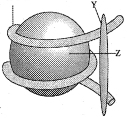
MediumMCQ
What does the figure shown above represent?
A
Nucleoid
B
Nucleosome
C
Chromatin
D
Histone octamer
Solution
(B) The figure shows a segment of $DNA$ wrapped around a histone protein core. This structure is known as a nucleosome.
In this diagram,'$Z$' represents the histone octamer (a complex of eight histone proteins),and '$Y$' represents the '$H1$' histone protein that helps in stabilizing the $DNA$ wrapping.
In this diagram,'$Z$' represents the histone octamer (a complex of eight histone proteins),and '$Y$' represents the '$H1$' histone protein that helps in stabilizing the $DNA$ wrapping.
0 likes
View Solution87
MediumMCQ
What does $Y$ represent in the given figure?
A
$H_1$ histone
B
$DNA$
C
Histone octamer
D
$H_2$ histone
Solution
(A) The given figure represents a nucleosome,which is the basic unit of $DNA$ packaging in eukaryotes.
In this structure,the negatively charged $DNA$ is wrapped around a positively charged histone octamer (labeled as $Z$).
The histone octamer consists of two molecules each of four histone proteins $(H_2A, H_2B, H_3, H_4)$.
The $H_1$ histone (labeled as $Y$) binds to the $DNA$ where it enters and leaves the nucleosome,helping to stabilize the structure.
In this structure,the negatively charged $DNA$ is wrapped around a positively charged histone octamer (labeled as $Z$).
The histone octamer consists of two molecules each of four histone proteins $(H_2A, H_2B, H_3, H_4)$.
The $H_1$ histone (labeled as $Y$) binds to the $DNA$ where it enters and leaves the nucleosome,helping to stabilize the structure.
0 likes
View Solution88
MediumMCQ
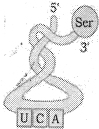
Identify the structure shown in the figure.
A
$m-RNA$
B
$r-RNA$
C
$t-RNA$
D
$DNA$
Solution
(C) The figure represents the clover-leaf model of $t-RNA$ (transfer $RNA$).
It shows the $5'$ and $3'$ ends,an amino acid attachment site (carrying Serine,$Ser$),and an anticodon loop with the sequence $UCA$.
It shows the $5'$ and $3'$ ends,an amino acid attachment site (carrying Serine,$Ser$),and an anticodon loop with the sequence $UCA$.
0 likes
View Solution89
EasyMCQ
$A$ complete set of chromosomes or cell genes inherited as a unit from a parent is known as
A
Genome
B
Genotype
C
Karyotype
D
Chromosomes
Solution
(A) The correct answer is Genome.
$A$ complete set of chromosomes or the haploid number of chromosomes present in a gamete is referred to as the genome. It represents the entire genetic material inherited from one parent through a gamete.
$A$ complete set of chromosomes or the haploid number of chromosomes present in a gamete is referred to as the genome. It represents the entire genetic material inherited from one parent through a gamete.
0 likes
View Solution90
MediumMCQ
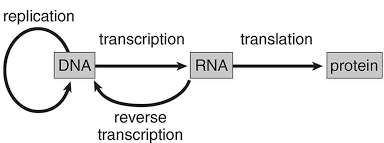
The information flow or central dogma of modern biology is:
A
$RNA \rightarrow Proteins \rightarrow DNA$
B
$DNA \rightarrow RNA \rightarrow RNA$
C
$RNA \rightarrow DNA \rightarrow Proteins$
D
$DNA \rightarrow RNA \rightarrow Proteins$
Solution
(D) The term 'Central Dogma' was proposed by Francis Crick in $1958$. It describes the unidirectional flow of genetic information from $DNA$ to $RNA$ and then to proteins (polypeptides). The process of $DNA$ to $RNA$ is called transcription,and the process of $RNA$ to protein is called translation.
0 likes
View Solution91
MediumMCQ
How many of the given statements $(i-iv)$ is/are correct?
$i.$ In transcription,adenosine pairs with uracil.
$ii.$ Regulation of lac operon by repressor is referred to as positive regulation.
$iii.$ The human genome has approximately $50,000$ genes.
$iv.$ Haemophilia is a sex-linked recessive disease.
$i.$ In transcription,adenosine pairs with uracil.
$ii.$ Regulation of lac operon by repressor is referred to as positive regulation.
$iii.$ The human genome has approximately $50,000$ genes.
$iv.$ Haemophilia is a sex-linked recessive disease.
A
Two
B
Three
C
Four
D
One
Solution
(A) Statement $(i)$ is correct: During transcription,adenosine $(A)$ pairs with uracil $(U)$ in $RNA$.
Statement $(ii)$ is incorrect: Regulation of the $lac$ operon by a repressor is referred to as negative regulation,as the repressor protein binds to the operator to inhibit transcription.
Statement $(iii)$ is incorrect: The human genome contains approximately $20,000-25,000$ genes,not $50,000$.
Statement $(iv)$ is correct: Haemophilia is a well-known sex-linked recessive disorder.
Therefore,statements $(i)$ and $(iv)$ are correct. The total number of correct statements is $2$.
Statement $(ii)$ is incorrect: Regulation of the $lac$ operon by a repressor is referred to as negative regulation,as the repressor protein binds to the operator to inhibit transcription.
Statement $(iii)$ is incorrect: The human genome contains approximately $20,000-25,000$ genes,not $50,000$.
Statement $(iv)$ is correct: Haemophilia is a well-known sex-linked recessive disorder.
Therefore,statements $(i)$ and $(iv)$ are correct. The total number of correct statements is $2$.
0 likes
View Solution92
MediumMCQ
Mutations which alter nucleotide sequence within a gene are called
A
frame shift mutations
B
base pair substitutions
C
both $(a)$ and $(b)$
D
none of these
Solution
(C) In frame shift mutation,the reading frame of the base sequence shifts laterally either in the forward direction due to the addition of one or more nucleotides or in the backward direction due to the deletion of one or more nucleotides.
In base pair substitution,a single base pair is replaced by another,which also results in a change of the nucleotide sequence.
Since both processes alter the nucleotide sequence within a gene,the correct answer is both $(a)$ and $(b)$.
In base pair substitution,a single base pair is replaced by another,which also results in a change of the nucleotide sequence.
Since both processes alter the nucleotide sequence within a gene,the correct answer is both $(a)$ and $(b)$.
0 likes
View Solution93
MediumMCQ
Mark the correct match.
A
Catalytic $RNA$ in bacteria - $16S$ $rRNA$ and $23S$ $rRNA$ as ribozyme.
B
$Val$ operon - Found in eukaryotes.
C
Sanger method - Determination of amino acid sequences in proteins only.
D
$VNTR$ - Intron.
Solution
(A) $16S$ $rRNA$ and $23S$ $rRNA$ are components of the bacterial ribosome. Specifically,$23S$ $rRNA$ acts as a ribozyme (peptidyl transferase) in bacteria,which catalyzes the formation of peptide bonds during protein synthesis.
$Val$ operon does not exist; operons are characteristic of prokaryotes,not eukaryotes.
Sanger method is primarily used for $DNA$ sequencing,not protein sequencing.
$VNTR$ stands for Variable Number Tandem Repeats,which are repetitive $DNA$ sequences found in the genome,not specifically introns.
$Val$ operon does not exist; operons are characteristic of prokaryotes,not eukaryotes.
Sanger method is primarily used for $DNA$ sequencing,not protein sequencing.
$VNTR$ stands for Variable Number Tandem Repeats,which are repetitive $DNA$ sequences found in the genome,not specifically introns.
0 likes
View Solution94
MediumMCQ
$A$ : $5S$ $rRNA$ and surrounding protein complex provides binding site of $tRNA$.
$R$ : $tRNA$ is soluble $RNA$ with unusual bases.
$R$ : $tRNA$ is soluble $RNA$ with unusual bases.
A
Assertion and Reason both are correct and Reason is the correct explanation of Assertion.
B
Assertion and Reason both are correct but Reason is not the correct explanation of Assertion.
C
Assertion is correct,but Reason is incorrect.
D
Both Assertion and Reason are incorrect.
Solution
(C) The Assertion is incorrect because the $5S$ $rRNA$ is a component of the large ribosomal subunit ($60S$ in eukaryotes or $50S$ in prokaryotes),but it does not specifically provide the binding site for $tRNA$. The $tRNA$ binding sites ($A$,$P$,and $E$ sites) are formed by the complex structure of $rRNA$ and ribosomal proteins within the ribosome,not specifically by the $5S$ $rRNA$ alone.
The Reason is correct. $tRNA$ (transfer $RNA$) is indeed known as soluble $RNA$ $(sRNA)$ because it remains in the supernatant after centrifugation. It also contains unusual or modified bases such as pseudouridine,dihydrouridine,and methylguanosine,which are characteristic of its structure.
The Reason is correct. $tRNA$ (transfer $RNA$) is indeed known as soluble $RNA$ $(sRNA)$ because it remains in the supernatant after centrifugation. It also contains unusual or modified bases such as pseudouridine,dihydrouridine,and methylguanosine,which are characteristic of its structure.
0 likes
View Solution95
MediumMCQ
$A$: Teminism is the unidirectional flow of information.
$R$: It requires $DNA$-dependent $RNA$ polymerase enzyme.
$R$: It requires $DNA$-dependent $RNA$ polymerase enzyme.
A
Assertion and Reason both are correct and Reason is the correct explanation of Assertion.
B
Assertion and Reason both are correct but Reason is not the correct explanation of Assertion.
C
Assertion is correct,but Reason is incorrect.
D
Both Assertion and Reason are incorrect.
Solution
(D) Teminism,also known as reverse transcription,refers to the synthesis of $DNA$ from an $RNA$ template. This process is catalyzed by the enzyme reverse transcriptase ($RNA$-dependent $DNA$ polymerase),not $DNA$-dependent $RNA$ polymerase.
Since Teminism involves the flow of information from $RNA$ to $DNA$,it contradicts the central dogma's concept of unidirectional flow $(DNA \rightarrow RNA \rightarrow Protein)$.
Therefore,the Assertion is incorrect because Teminism represents a deviation from the standard unidirectional flow,and the Reason is incorrect because it cites the wrong enzyme.
Since Teminism involves the flow of information from $RNA$ to $DNA$,it contradicts the central dogma's concept of unidirectional flow $(DNA \rightarrow RNA \rightarrow Protein)$.
Therefore,the Assertion is incorrect because Teminism represents a deviation from the standard unidirectional flow,and the Reason is incorrect because it cites the wrong enzyme.
0 likes
View Solution96
MediumMCQ
The complete flow chart of the Central Dogma is:

A
$(a)-$Replication; $(b)-$Transcription; $(c)-$Translation; $(d)-$Protein
B
$(a)-$Transformation; $(b)-$Replication; $(c)-$Transcription; $(d)-$Translation
C
$(a)-$Replication; $(b)-$Transcription; $(c)-$Transformation; $(d)-$Protein
D
$(a)-$Translation; $(b)-$Transformation; $(c)-$Replication; $(d)-$Protein
Solution
(A) The Central Dogma of molecular biology describes the flow of genetic information within a biological system.
$1$. $(a)$ represents Replication,where $DNA$ makes a copy of itself.
$2$. $(b)$ represents Transcription,where $DNA$ is used to synthesize $mRNA$.
$3$. $(c)$ represents Translation,where $mRNA$ is used to synthesize a polypeptide chain or Protein $(d)$.
Therefore,the correct sequence is $(a)-$Replication,$(b)-$Transcription,$(c)-$Translation,$(d)-$Protein.
$1$. $(a)$ represents Replication,where $DNA$ makes a copy of itself.
$2$. $(b)$ represents Transcription,where $DNA$ is used to synthesize $mRNA$.
$3$. $(c)$ represents Translation,where $mRNA$ is used to synthesize a polypeptide chain or Protein $(d)$.
Therefore,the correct sequence is $(a)-$Replication,$(b)-$Transcription,$(c)-$Translation,$(d)-$Protein.
0 likes
View Solution97
MediumMCQ
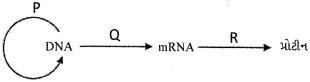
The central dogma of molecular biology is shown below. Identify the processes $P, Q,$ and $R$.
A
$P$: Replication,$Q$: Transcription,$R$: Translation
B
$P$: Replication,$Q$: Translation,$R$: Transcription
C
$P$: Translation,$Q$: Replication,$R$: Transcription
D
$P$: Transcription,$Q$: Translation,$R$: Replication
Solution
(A) The central dogma of molecular biology describes the flow of genetic information within a biological system.
$1$. $P$ represents the process where $DNA$ makes a copy of itself,which is known as Replication.
$2$. $Q$ represents the process where $DNA$ is used to synthesize $mRNA$,which is known as Transcription.
$3$. $R$ represents the process where $mRNA$ is used to synthesize a protein,which is known as Translation.
Therefore,the correct sequence is $P$: Replication,$Q$: Transcription,$R$: Translation.
$1$. $P$ represents the process where $DNA$ makes a copy of itself,which is known as Replication.
$2$. $Q$ represents the process where $DNA$ is used to synthesize $mRNA$,which is known as Transcription.
$3$. $R$ represents the process where $mRNA$ is used to synthesize a protein,which is known as Translation.
Therefore,the correct sequence is $P$: Replication,$Q$: Transcription,$R$: Translation.
0 likes
View Solution98
MediumMCQ
For protein synthesis,$P$ can directly code,while each nucleotide of $Q$ has a $2'-OH$ group in its sugar. Identify $P$ and $Q$.
$\quad\quad P\quad Q$
$\quad\quad P\quad Q$
A
$RNA\quad RNA$
B
$RNA \quad DNA$
C
$DNA \quad RNA$
D
$DNA \quad DNA$
Solution
(A) $1$. In the process of protein synthesis,$mRNA$ (messenger $RNA$) acts as the direct template that carries the genetic code for translation into amino acids.
$2$. The sugar component of $RNA$ nucleotides is ribose,which contains a hydroxyl group $(-OH)$ at the $2'$ position of the sugar ring.
$3$. In contrast,$DNA$ contains deoxyribose sugar,which lacks the $2'-OH$ group (it has only a hydrogen atom at the $2'$ position).
$4$. Therefore,$P$ is $RNA$ and $Q$ is $RNA$.
$2$. The sugar component of $RNA$ nucleotides is ribose,which contains a hydroxyl group $(-OH)$ at the $2'$ position of the sugar ring.
$3$. In contrast,$DNA$ contains deoxyribose sugar,which lacks the $2'-OH$ group (it has only a hydrogen atom at the $2'$ position).
$4$. Therefore,$P$ is $RNA$ and $Q$ is $RNA$.
0 likes
View Solution99
MediumMCQ
How many of the following statements are correct?
$I - RNA$ is formed from $DNA$ by the process of transcription.
$II - DNA$ is more stable than $RNA$.
$III - RNA$ acts as a catalyst (enzyme) in some biochemical reactions.
$IV - DNA$ is resistant to mutations due to its double-helical structure and the presence of complementary strands that allow for repair mechanisms.
$I - RNA$ is formed from $DNA$ by the process of transcription.
$II - DNA$ is more stable than $RNA$.
$III - RNA$ acts as a catalyst (enzyme) in some biochemical reactions.
$IV - DNA$ is resistant to mutations due to its double-helical structure and the presence of complementary strands that allow for repair mechanisms.
A
$1$
B
$2$
C
$3$
D
$4$
Solution
(D) Statement $I$ is correct: $RNA$ is synthesized from $DNA$ through the process of transcription.
Statement $II$ is correct: $DNA$ is more stable than $RNA$ because $RNA$ has a $2'-OH$ group on the ribose sugar,which makes it more reactive and susceptible to hydrolysis.
Statement $III$ is correct: $RNA$ can act as a catalyst (ribozyme) in certain biochemical reactions,such as in the ribosome during protein synthesis.
Statement $IV$ is correct: $DNA$ is more stable and resistant to mutations because of its double-helical structure and the presence of complementary strands,which provide a template for repair mechanisms.
Since all four statements are correct,the answer is $4$.
Statement $II$ is correct: $DNA$ is more stable than $RNA$ because $RNA$ has a $2'-OH$ group on the ribose sugar,which makes it more reactive and susceptible to hydrolysis.
Statement $III$ is correct: $RNA$ can act as a catalyst (ribozyme) in certain biochemical reactions,such as in the ribosome during protein synthesis.
Statement $IV$ is correct: $DNA$ is more stable and resistant to mutations because of its double-helical structure and the presence of complementary strands,which provide a template for repair mechanisms.
Since all four statements are correct,the answer is $4$.
0 likes
View Solution100
MediumMCQ
Select the correct statement from the following.
A
Nucleic acid is the genetic material in all living organisms.
B
$DNA$ must be in pure form to be cut by restriction enzymes.
C
The structure of $DNA$ contains four types of nucleotides.
D
All of the above.
Solution
(D) $1$. Nucleic acids ($DNA$ or $RNA$) serve as the genetic material in all living organisms.
$2$. In recombinant $DNA$ technology,the $DNA$ must be in a pure form,free from other macromolecules like proteins,$RNA$,polysaccharides,and lipids,to be effectively cleaved by restriction endonucleases.
$3$. The $DNA$ molecule is composed of four types of nucleotides,which differ based on their nitrogenous bases ($Adenine$,$Guanine$,$Cytosine$,and $Thymine$).
Since all the given statements are scientifically correct,the correct option is $D$.
$2$. In recombinant $DNA$ technology,the $DNA$ must be in a pure form,free from other macromolecules like proteins,$RNA$,polysaccharides,and lipids,to be effectively cleaved by restriction endonucleases.
$3$. The $DNA$ molecule is composed of four types of nucleotides,which differ based on their nitrogenous bases ($Adenine$,$Guanine$,$Cytosine$,and $Thymine$).
Since all the given statements are scientifically correct,the correct option is $D$.
0 likes
View SolutionMolecular Basis of Inheritance — Mix Example-Molecular Basis of Inheritance · Frequently Asked Questions
1Are these Molecular Basis of Inheritance questions useful for JEE and NEET?
Yes. All questions in this section are mapped to JEE Main and NEET exam patterns. Previous year questions from JEE Main, NEET, GUJCET and state-level exams are included with full solutions.
2Can I switch to Hindi or Gujarati for these questions?
Yes. Use the language tabs in the hero section or the sidebar to view the same questions and solutions in English, Hindi or Gujarati.
3How do I generate a question paper from this subtopic?
Use the Vedclass Exam Paper Generator — select the chapter and subtopic, set difficulty, and generate Sets A, B, C, D automatically. First 3 chapters of every subject are free.
Vedclass Products
For Students
Vedclass Test Series
Mock tests in real JEE/NEET style with performance analysis. 5-day free trial.
Start Free TrialFor Teachers
Exam Paper Generator
Generate Set A/B/C/D papers from this chapter in 2 minutes. 3 chapters free.
Try FreeFor Institutes
Online Exam Module
Live online exams with unlimited students, 360° analytics & white-label branding.
See DemoFor Teachers & Institutes
Generate a Molecular Basis of Inheritance Exam Paper in 2 Minutes
Select subtopic & difficulty — Sets A, B, C, D auto-generated with No Repeat logic.
First 3 chapters of every subject are free — no payment required.