
A English
DNA Fingerprinting Questions in English
Class 12 Biology · Molecular Basis of Inheritance · DNA Fingerprinting
133+
Questions
English
Language
100%
With Solutions
Showing 50 of 133 questions in English
51
EasyMCQ
Select the appropriate option for $DNA$ fingerprinting.
A
Repetitive $DNA$
B
Protein
C
Peptide
D
$RNA$
Solution
(A) $DNA$ fingerprinting involves identifying differences in specific regions of $DNA$ sequence called repetitive $DNA$.
These sequences show high degree of polymorphism and are used as the basis for $DNA$ fingerprinting.
Therefore,repetitive $DNA$ is the correct option.
These sequences show high degree of polymorphism and are used as the basis for $DNA$ fingerprinting.
Therefore,repetitive $DNA$ is the correct option.
0 likes
View Solution52
MediumMCQ
On what basis is satellite $DNA$ $NOT$ classified?
A
Base composition
B
Length of segments
C
Number of repetitive units
D
Nucleotide sequence
Solution
(D) Satellite $DNA$ is classified based on the base composition ($A:T$ rich vs $G:C$ rich),the length of the segment,and the number of repetitive units. The nucleotide sequence itself is not a primary criterion for the classification of satellite $DNA$ into its various categories (like microsatellites or minisatellites); rather,these categories are defined by the length and repetition patterns of the sequences.
0 likes
View Solution53
MediumMCQ
What is $VNTR$?
A
Minisatellite
B
Microsatellite
C
$RNA$
D
Gene
Solution
(A) $VNTR$ stands for Variable Number Tandem Repeats.
These are short nucleotide sequences that are repeated in tandem in the genome.
$VNTR$s are classified as minisatellites because their repeat units are typically $10-60$ base pairs long.
They are highly polymorphic and are widely used in $DNA$ fingerprinting.
These are short nucleotide sequences that are repeated in tandem in the genome.
$VNTR$s are classified as minisatellites because their repeat units are typically $10-60$ base pairs long.
They are highly polymorphic and are widely used in $DNA$ fingerprinting.
0 likes
View Solution54
MediumMCQ
What is the full form of $VNTR$?
A
Vital Number of Tandem Repeats
B
Variable Natural Tandem Repeats
C
Variable Number of Tandem Repeats
D
Variable Number of Transcription
Solution
(C) $VNTR$ stands for Variable Number of Tandem Repeats.
These are short nucleotide sequences that are repeated in tandem in the genome.
The number of repeats varies from person to person,which makes them highly useful in $DNA$ fingerprinting and forensic analysis.
These are short nucleotide sequences that are repeated in tandem in the genome.
The number of repeats varies from person to person,which makes them highly useful in $DNA$ fingerprinting and forensic analysis.
0 likes
View Solution55
MediumMCQ
Which of the following sequences do not code for any polypeptide?
A
Minisatellite
B
Microsatellite
C
$VNTR$
D
All of the above
Solution
(D) In the human genome,a large portion of $DNA$ consists of repetitive sequences that do not code for any proteins or polypeptides.
These are known as repetitive $DNA$ or satellite $DNA$.
$VNTR$ ($Variable$ $Number$ $of$ $Tandem$ $Repeats$) are a type of minisatellite $DNA$.
Both minisatellites and microsatellites are non-coding repetitive sequences used in $DNA$ fingerprinting.
Therefore,all the given options represent non-coding sequences.
These are known as repetitive $DNA$ or satellite $DNA$.
$VNTR$ ($Variable$ $Number$ $of$ $Tandem$ $Repeats$) are a type of minisatellite $DNA$.
Both minisatellites and microsatellites are non-coding repetitive sequences used in $DNA$ fingerprinting.
Therefore,all the given options represent non-coding sequences.
0 likes
View Solution56
MediumMCQ
The basis of $DNA$ fingerprinting is .............
A
Similarity of repetitive $DNA$
B
Similarity of genes
C
Polymorphism of repetitive $DNA$
D
Similarity of $RNA$
Solution
(C) $DNA$ fingerprinting relies on the identification of differences in specific regions of $DNA$ sequences.
These regions are known as repetitive $DNA$,which are non-coding sequences that repeat many times.
These sequences show a high degree of variation between individuals,a phenomenon known as $DNA$ polymorphism.
Because these variations are unique to each individual (except in identical twins),they serve as the fundamental basis for $DNA$ fingerprinting.
These regions are known as repetitive $DNA$,which are non-coding sequences that repeat many times.
These sequences show a high degree of variation between individuals,a phenomenon known as $DNA$ polymorphism.
Because these variations are unique to each individual (except in identical twins),they serve as the fundamental basis for $DNA$ fingerprinting.
0 likes
View Solution57
MediumMCQ
Which of the following is not useful for $DNA$ fingerprinting?
A
Skin
B
Bone cells
C
$RBC$ (Red Blood Cells)
D
Saliva
Solution
(C) $DNA$ fingerprinting requires nucleated cells to extract genomic $DNA$.
$RBC$s (Red Blood Cells) in humans are enucleated (they lack a nucleus and $DNA$) at maturity.
Therefore,$RBC$s cannot be used for $DNA$ fingerprinting.
Other options like skin cells,bone cells,and saliva contain nucleated cells from which $DNA$ can be isolated.
$RBC$s (Red Blood Cells) in humans are enucleated (they lack a nucleus and $DNA$) at maturity.
Therefore,$RBC$s cannot be used for $DNA$ fingerprinting.
Other options like skin cells,bone cells,and saliva contain nucleated cells from which $DNA$ can be isolated.
0 likes
View Solution58
EasyMCQ
Who developed $DNA$ fingerprinting?
A
Jacob and Monod
B
Alec Jeffreys
C
Har Gobind Khorana
D
Griffith
Solution
(B) $DNA$ fingerprinting is a technique used to identify individuals based on their unique $DNA$ sequences. It was developed by Sir Alec Jeffreys in $1984$ at the University of Leicester. The technique relies on the analysis of variable number tandem repeats $(VNTRs)$,which are specific regions of $DNA$ that vary significantly between individuals.
0 likes
View Solution59
MediumMCQ
What is used in $DNA$ fingerprinting?
A
Radiolabeled $STR$ probe
B
Radiolabeled $VNTR$ probe
C
Radiolabeled $SSR$ probe
D
None of these
Solution
(B) $DNA$ fingerprinting involves identifying differences in specific regions of $DNA$ sequence called repetitive $DNA$.
These sequences show high degree of polymorphism and are referred to as $Variable$ $Number$ $Tandem$ $Repeats$ $(VNTRs)$.
In the process of $DNA$ fingerprinting,these $VNTRs$ are separated by gel electrophoresis and transferred to synthetic membranes (Southern blotting).
Hybridization is then performed using a radiolabeled $VNTR$ probe to detect these specific sequences,which creates a unique pattern of bands.
These sequences show high degree of polymorphism and are referred to as $Variable$ $Number$ $Tandem$ $Repeats$ $(VNTRs)$.
In the process of $DNA$ fingerprinting,these $VNTRs$ are separated by gel electrophoresis and transferred to synthetic membranes (Southern blotting).
Hybridization is then performed using a radiolabeled $VNTR$ probe to detect these specific sequences,which creates a unique pattern of bands.
0 likes
View Solution60
MediumMCQ
What is the size range of $VNTR$?
A
$0.1$ to $20 \, bp$
B
$0.1$ to $10 \, bp$
C
$1.0$ to $20 \, kb$
D
$0.1$ to $20 \, kb$
Solution
(D) $VNTR$ stands for Variable Number Tandem Repeats. These are short nucleotide sequences that are repeated in tandem. The size of $VNTR$ varies in size from $0.1$ to $20 \, kb$ (kilobases). These sequences are highly polymorphic and form the basis of $DNA$ fingerprinting.
0 likes
View Solution61
MediumMCQ
The sensitivity of $DNA$ fingerprinting can be increased by the use of:
A
$PCR$
B
Restriction enzymes
C
$RNA$ polymerase
D
Cloning
Solution
(A) The sensitivity of $DNA$ fingerprinting is significantly increased by the use of the Polymerase Chain Reaction $(PCR)$.
$PCR$ allows for the amplification of even minute amounts of $DNA$ found at a crime scene or in a biological sample into millions of copies.
This amplification makes it possible to perform $DNA$ fingerprinting analysis even when the initial $DNA$ sample is very small or degraded.
$PCR$ allows for the amplification of even minute amounts of $DNA$ found at a crime scene or in a biological sample into millions of copies.
This amplification makes it possible to perform $DNA$ fingerprinting analysis even when the initial $DNA$ sample is very small or degraded.
0 likes
View Solution62
MediumMCQ
Select the option that shows the correct sequence of the $DNA$ fingerprinting process.
$(i)$ Isolation of $DNA$
$(ii)$ Hybridization using labeled $VNTR$ probe
$(iii)$ Transfer of $DNA$ fragments to nylon membrane
$(iv)$ Separation of $DNA$ fragments by electrophoresis
$(v)$ Autoradiography
$(vi)$ Digestion of $DNA$ by restriction endonucleases
$(i)$ Isolation of $DNA$
$(ii)$ Hybridization using labeled $VNTR$ probe
$(iii)$ Transfer of $DNA$ fragments to nylon membrane
$(iv)$ Separation of $DNA$ fragments by electrophoresis
$(v)$ Autoradiography
$(vi)$ Digestion of $DNA$ by restriction endonucleases
A
$i \rightarrow ii \rightarrow iii \rightarrow vi \rightarrow v \rightarrow iv$
B
$i \rightarrow iii \rightarrow ii \rightarrow vi \rightarrow iv \rightarrow v$
C
$vi \rightarrow v \rightarrow iv \rightarrow iii \rightarrow ii \rightarrow i$
D
$i \rightarrow vi \rightarrow iv \rightarrow iii \rightarrow ii \rightarrow v$
Solution
(D) The correct sequence of steps in $DNA$ fingerprinting is as follows:
$1$. Isolation of $DNA$ $(i)$
$2$. Digestion of $DNA$ by restriction endonucleases $(vi)$
$3$. Separation of $DNA$ fragments by electrophoresis $(iv)$
$4$. Transfer of $DNA$ fragments to a nylon membrane (Southern blotting) $(iii)$
$5$. Hybridization using labeled $VNTR$ probe $(ii)$
$6$. Detection of hybridized $DNA$ fragments by autoradiography $(v)$
Therefore,the correct sequence is $i \rightarrow vi \rightarrow iv \rightarrow iii \rightarrow ii \rightarrow v$.
$1$. Isolation of $DNA$ $(i)$
$2$. Digestion of $DNA$ by restriction endonucleases $(vi)$
$3$. Separation of $DNA$ fragments by electrophoresis $(iv)$
$4$. Transfer of $DNA$ fragments to a nylon membrane (Southern blotting) $(iii)$
$5$. Hybridization using labeled $VNTR$ probe $(ii)$
$6$. Detection of hybridized $DNA$ fragments by autoradiography $(v)$
Therefore,the correct sequence is $i \rightarrow vi \rightarrow iv \rightarrow iii \rightarrow ii \rightarrow v$.
0 likes
View Solution63
MediumMCQ
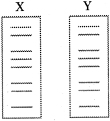
Whose $DNA$ fingerprint could be represented in the figure?
A
Monozygotic twins
B
Dizygotic twins
C
Father-son
D
Mother-son
Solution
(A) In the provided figure,the $DNA$ fingerprint patterns for individuals $X$ and $Y$ are identical.
$DNA$ fingerprinting is a technique used to identify individuals based on their unique genetic makeup.
Monozygotic (identical) twins are derived from a single fertilized egg (zygote) that splits into two,resulting in individuals with identical genetic material.
Therefore,they exhibit identical $DNA$ fingerprint patterns.
Dizygotic twins,parents,and children have different genetic compositions and will show distinct $DNA$ fingerprint patterns.
$DNA$ fingerprinting is a technique used to identify individuals based on their unique genetic makeup.
Monozygotic (identical) twins are derived from a single fertilized egg (zygote) that splits into two,resulting in individuals with identical genetic material.
Therefore,they exhibit identical $DNA$ fingerprint patterns.
Dizygotic twins,parents,and children have different genetic compositions and will show distinct $DNA$ fingerprint patterns.
0 likes
View Solution64
MediumMCQ
Which technique is used for $DNA$ fingerprinting?
A
Western blot hybridization
B
Northern blot hybridization
C
Southern blot hybridization
D
Eastern blot hybridization
Solution
(C) $DNA$ fingerprinting involves the analysis of $DNA$ fragments to identify individuals.
The process includes the following steps:
$1$. Isolation of $DNA$.
$2$. Digestion of $DNA$ by restriction endonucleases.
$3$. Separation of $DNA$ fragments by gel electrophoresis.
$4$. Transferring (blotting) of separated $DNA$ fragments to synthetic membranes,such as nitrocellulose or nylon. This specific technique of transferring $DNA$ to a membrane is known as Southern blotting.
$5$. Hybridization using labeled $VNTR$ probe.
$6$. Detection of hybridized $DNA$ fragments by autoradiography.
Therefore,Southern blot hybridization is the correct technique used in $DNA$ fingerprinting.
The process includes the following steps:
$1$. Isolation of $DNA$.
$2$. Digestion of $DNA$ by restriction endonucleases.
$3$. Separation of $DNA$ fragments by gel electrophoresis.
$4$. Transferring (blotting) of separated $DNA$ fragments to synthetic membranes,such as nitrocellulose or nylon. This specific technique of transferring $DNA$ to a membrane is known as Southern blotting.
$5$. Hybridization using labeled $VNTR$ probe.
$6$. Detection of hybridized $DNA$ fragments by autoradiography.
Therefore,Southern blot hybridization is the correct technique used in $DNA$ fingerprinting.
0 likes
View Solution65
MediumMCQ
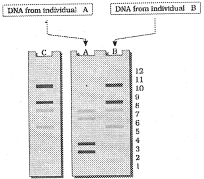
Identify the given figure.
A
Translation
B
$DNA$ fingerprinting
C
Elution
D
Human Genome Project
Solution
(B) The provided figure shows the banding pattern obtained after performing gel electrophoresis on $DNA$ samples from different individuals ($A$,$B$,and $C$).
This technique is used to compare $DNA$ profiles,which is the fundamental principle of $DNA$ fingerprinting.
$DNA$ fingerprinting involves identifying differences in specific $DNA$ sequences,which appear as distinct bands on an electrophoresis gel.
Therefore,the figure represents $DNA$ fingerprinting.
This technique is used to compare $DNA$ profiles,which is the fundamental principle of $DNA$ fingerprinting.
$DNA$ fingerprinting involves identifying differences in specific $DNA$ sequences,which appear as distinct bands on an electrophoresis gel.
Therefore,the figure represents $DNA$ fingerprinting.
0 likes
View Solution66
MediumMCQ
Which technique is used to identify the binding of a radioactive probe with its complementary $DNA$ in a clone of cells?
A
Autobiography
B
Autopsy
C
Autoradiography
D
Autolysis
Solution
(C) The technique used to identify the binding of a radioactive probe with its complementary $DNA$ is known as Autoradiography.
In this process,a radioactive probe (a single-stranded $DNA$ or $RNA$ tagged with a radioactive isotope) is allowed to hybridize with its complementary sequence on a membrane.
After hybridization,the membrane is exposed to an $X$-ray film.
The radioactive probe emits radiation that exposes the film,creating a dark spot or band where the probe has bound to the target $DNA$.
This allows researchers to detect the presence and location of specific $DNA$ sequences.
In this process,a radioactive probe (a single-stranded $DNA$ or $RNA$ tagged with a radioactive isotope) is allowed to hybridize with its complementary sequence on a membrane.
After hybridization,the membrane is exposed to an $X$-ray film.
The radioactive probe emits radiation that exposes the film,creating a dark spot or band where the probe has bound to the target $DNA$.
This allows researchers to detect the presence and location of specific $DNA$ sequences.
0 likes
View Solution67
EasyMCQ
Which is the basis of genetic mapping of human genome as well as $DNA$ fingerprinting?
A
Polymorphism in $RNA$ sequence
B
Polymorphism in $DNA$ sequence
C
Single nucleotide polymorphism
D
Polymorphism in $hnRNA$ sequence
Solution
(B) Polymorphism in $DNA$ sequence is the fundamental basis for both genetic mapping of the human genome and $DNA$ fingerprinting.
Genetic polymorphism refers to the occurrence of genetic variations at a specific locus in a population,which allows researchers to identify individuals and map genes.
Genetic polymorphism refers to the occurrence of genetic variations at a specific locus in a population,which allows researchers to identify individuals and map genes.
0 likes
View Solution68
MediumMCQ
Who discovered $DNA$ fingerprinting?
A
Alec Jeffreys
B
Jacques Monod
C
Herbert Boyer
D
Stanley Cohen
Solution
(A) $DNA$ fingerprinting is a widely used modern-day technique in the field of forensic science.
It is used to establish a correlation between biological evidence obtained from a crime scene and a potential suspect.
This technique was first developed and described by Sir Alec Jeffreys in $1984$.
It is used to establish a correlation between biological evidence obtained from a crime scene and a potential suspect.
This technique was first developed and described by Sir Alec Jeffreys in $1984$.
0 likes
View Solution69
MediumMCQ
Allelic sequence variations where more than one variant (allele) at a locus in a human population with a frequency greater than $0.01$ is referred to as
A
Incomplete dominance
B
Multiple allelism
C
$SNP$
D
$DNA$ polymorphism
Solution
(D) Allelic sequence variation has traditionally been described as a $DNA$ polymorphism if more than one variant (allele) at a locus occurs in a human population with a frequency greater than $0.01$.
In simple terms,if an inheritable mutation is observed in a population at high frequency,it is referred to as $DNA$ polymorphism.
$SNP$ (Single Nucleotide Polymorphism) is a specific type of $DNA$ polymorphism,but the general definition provided in the question refers to $DNA$ polymorphism.
In simple terms,if an inheritable mutation is observed in a population at high frequency,it is referred to as $DNA$ polymorphism.
$SNP$ (Single Nucleotide Polymorphism) is a specific type of $DNA$ polymorphism,but the general definition provided in the question refers to $DNA$ polymorphism.
0 likes
View Solution70
MediumMCQ
Satellite $DNA$:
A
is classified into many categories such as microsatellites,minisatellites,etc.,based on base composition,length of segments,and number of repetitive units.
B
normally does not code for any protein.
C
shows polymorphism.
D
All of the above.
Solution
(D) Satellite $DNA$ is a portion of $DNA$ consisting of short,repeating sequences of nucleotide pairs,typically found near the centromere region.
It normally does not code for any protein.
It shows high levels of polymorphism,which is the basis for $DNA$ fingerprinting.
It is classified into various categories such as microsatellites and minisatellites based on the base composition,the length of the segment,and the number of repetitive units.
It normally does not code for any protein.
It shows high levels of polymorphism,which is the basis for $DNA$ fingerprinting.
It is classified into various categories such as microsatellites and minisatellites based on the base composition,the length of the segment,and the number of repetitive units.
0 likes
View Solution71
MediumMCQ
Which process is used for amplification or multiplication of $DNA$ for fingerprinting?
A
Polymerase chain reaction $(PCR)$
B
Nesslerisation
C
Southern blotting
D
Northern blotting
Solution
(A) Polymerase chain reaction $(PCR)$ is a technique used for the amplification (making multiple copies) of specific $DNA$ segments.
It allows for the enzymatic replication of $DNA$ in vitro without the need for living organisms like $E. coli$ or yeast.
In the context of $DNA$ fingerprinting,$PCR$ is essential to amplify small amounts of $DNA$ found at a crime scene or in biological samples to a quantity sufficient for analysis.
It is also widely used in medical diagnostics,genetic research,and paternity testing.
It allows for the enzymatic replication of $DNA$ in vitro without the need for living organisms like $E. coli$ or yeast.
In the context of $DNA$ fingerprinting,$PCR$ is essential to amplify small amounts of $DNA$ found at a crime scene or in biological samples to a quantity sufficient for analysis.
It is also widely used in medical diagnostics,genetic research,and paternity testing.
0 likes
View Solution72
MediumMCQ
Polymorphism in $DNA$ sequence
A
is the basis of genetic mapping of human genome.
B
arises due to mutation.
C
is the basis of $DNA$ fingerprinting.
D
All of the above
Solution
(D) Polymorphism in $DNA$ sequence refers to the variation at the genetic level.
It arises due to mutations,which are heritable changes in the $DNA$ sequence.
These variations serve as the foundation for genetic mapping of the human genome.
Additionally,polymorphism is the fundamental basis for $DNA$ fingerprinting techniques,which allow for the identification of individuals based on their unique genetic profiles.
It arises due to mutations,which are heritable changes in the $DNA$ sequence.
These variations serve as the foundation for genetic mapping of the human genome.
Additionally,polymorphism is the fundamental basis for $DNA$ fingerprinting techniques,which allow for the identification of individuals based on their unique genetic profiles.
0 likes
View Solution73
MediumMCQ
$VNTRs$ are
A
Variable Number of Tandem Repeats.
B
Very Narrow Tandem Repeats.
C
Variable Non-cistronic Transposon Repeats.
D
Valuable Non-cistronic Transposon Regions.
Solution
(A) $VNTRs$ stands for Variable Number of Tandem Repeats.
In the human genome,there are specific regions where short nucleotide sequences are arranged in tandem repeats.
The number of these repeats varies from person to person,which makes them highly polymorphic.
These repeats are inherited from parents and are used as genetic markers in $DNA$ fingerprinting for personal identification.
In the human genome,there are specific regions where short nucleotide sequences are arranged in tandem repeats.
The number of these repeats varies from person to person,which makes them highly polymorphic.
These repeats are inherited from parents and are used as genetic markers in $DNA$ fingerprinting for personal identification.
0 likes
View Solution74
MediumMCQ
Which of the following statements forms the basis of $DNA$ fingerprinting?
A
The relative proportions of purines and pyrimidines in $DNA$.
B
Satellite $DNA$ occurring as highly repeated short $DNA$ segments.
C
The relative difference in the $DNA$ occurrence in blood,skin and saliva.
D
The relative amount of $DNA$ in the ridges and grooves of the fingerprints.
Solution
(B) $DNA$ fingerprinting is a technique used to identify individuals by analyzing specific regions of their $DNA$.
It relies on the presence of satellite $DNA$,which consists of highly repetitive,non-coding sequences of $DNA$ known as Variable Number Tandem Repeats $(VNTRs)$.
These $VNTRs$ show a high degree of polymorphism,meaning they vary significantly between individuals,making them unique to each person (except identical twins).
By comparing these specific repetitive segments,scientists can establish biological relationships,identify pathogens,or solve criminal cases.
It relies on the presence of satellite $DNA$,which consists of highly repetitive,non-coding sequences of $DNA$ known as Variable Number Tandem Repeats $(VNTRs)$.
These $VNTRs$ show a high degree of polymorphism,meaning they vary significantly between individuals,making them unique to each person (except identical twins).
By comparing these specific repetitive segments,scientists can establish biological relationships,identify pathogens,or solve criminal cases.
0 likes
View Solution75
MediumMCQ
Which of the following statements is incorrect?
A
$VNTR$ belong to a class of mini-satellite $DNA$.
B
$DNA$ sequencing works on the principle developed by $F. Sanger$.
C
$HGP$ was coordinated by the $US$ Department of Energy and the National Institutes of Health.
D
$DNA$ fingerprinting involves identifying similarities in repetitive $DNA$.
Solution
(D) $DNA$ fingerprinting involves identifying differences in repetitive $DNA$,not similarities. Since the $DNA$ from every tissue of an individual shows the same degree of polymorphism,it becomes a very useful identification tool in forensic applications.
0 likes
View Solution76
MediumMCQ
Each individual has a unique $DNA$ fingerprint as individuals differ in
A
number of minisatellites on chromosome.
B
location of minisatellites on chromosome.
C
size of minisatellites on chromosome.
D
All of the above
Solution
(D) Minisatellites are short nucleotide sequences that are repeated in tandem.
These sequences are inherently unstable and show a high degree of polymorphism due to mutations.
Because the number,location,and size of these minisatellite repeats vary significantly between individuals,they form the basis of $DNA$ fingerprinting.
Therefore,each individual possesses a unique $DNA$ profile.
These sequences are inherently unstable and show a high degree of polymorphism due to mutations.
Because the number,location,and size of these minisatellite repeats vary significantly between individuals,they form the basis of $DNA$ fingerprinting.
Therefore,each individual possesses a unique $DNA$ profile.
0 likes
View Solution77
MediumMCQ
$DNA$ fingerprinting using Variable Number Tandem Repeats $(VNTRs)$ is based on the observation that
A
every individual has unique alleles at each $VNTR$ locus.
B
the $DNA$ of $VNTR$ loci is more stable than that of loci which code for proteins.
C
$VNTR$ sequences show little variability.
D
$VNTR$ loci are highly polymorphic.
Solution
(D) The technique of $DNA$ fingerprinting was initially developed by Alec Jeffreys.
He used satellite $DNA$ as a probe that shows a high degree of polymorphism.
$DNA$ fingerprinting using Variable Number Tandem Repeats $(VNTRs)$ is based on the observation that $VNTR$ loci are highly polymorphic,meaning they show significant variation in the number of repeats among different individuals.
He used satellite $DNA$ as a probe that shows a high degree of polymorphism.
$DNA$ fingerprinting using Variable Number Tandem Repeats $(VNTRs)$ is based on the observation that $VNTR$ loci are highly polymorphic,meaning they show significant variation in the number of repeats among different individuals.
0 likes
View Solution78
MediumMCQ
Mark the correct one (w.r.t. application of $DNA$ fingerprinting).
A
Forensic science
B
Determining the population diversity
C
Determining the genetic diversity
D
More than one option is correct
Solution
(D) $DNA$ fingerprinting is a technique used to identify individuals based on their unique $DNA$ sequences.
Its applications include:
$1$. Forensic science: Used in criminal investigations to identify suspects or victims.
$2$. Determining genetic diversity: Used in evolutionary biology and conservation genetics to study the variation within and between populations.
Since both forensic science and determining genetic diversity are valid applications,the correct choice is $D$.
Its applications include:
$1$. Forensic science: Used in criminal investigations to identify suspects or victims.
$2$. Determining genetic diversity: Used in evolutionary biology and conservation genetics to study the variation within and between populations.
Since both forensic science and determining genetic diversity are valid applications,the correct choice is $D$.
0 likes
View Solution79
MediumMCQ
In the technique of $DNA$ fingerprinting,digestion of $DNA$ is followed by:
A
Electrophoresis
B
Hybridisation
C
Denaturation
D
Southern blotting
Solution
(A) The technique of $DNA$ fingerprinting involves several steps: isolation of $DNA$,digestion of $DNA$ by restriction endonucleases,separation of $DNA$ fragments by gel electrophoresis,transferring (blotting) of separated $DNA$ fragments to synthetic membranes (like nitrocellulose or nylon),hybridization using labeled $VNTR$ probe,and detection of hybridized $DNA$ fragments by autoradiography.
Therefore,after the digestion of $DNA$ by restriction enzymes,the next step is the separation of these fragments based on their size using gel electrophoresis.
Therefore,after the digestion of $DNA$ by restriction enzymes,the next step is the separation of these fragments based on their size using gel electrophoresis.
0 likes
View Solution80
MediumMCQ
Read the following statements:
$A.$ Variation at genetic level arises due to mutations.
$B.$ The technique of $DNA$ fingerprinting was initially developed by Alec Jeffreys.
$A.$ Variation at genetic level arises due to mutations.
$B.$ The technique of $DNA$ fingerprinting was initially developed by Alec Jeffreys.
A
Only $(B)$ is correct
B
Both $(A)$ and $(B)$ are correct
C
Only $(A)$ is correct
D
Both $(A)$ and $(B)$ are incorrect
Solution
(B) Statement $A$ is correct: Genetic variation within a population is primarily caused by mutations,which are changes in the nucleotide sequence of the genome.
Statement $B$ is correct: The technique of $DNA$ fingerprinting (or $DNA$ profiling) was indeed developed by Sir Alec Jeffreys in $1984$ at the University of Leicester.
Since both statements are factually accurate,the correct option is $(B)$.
Statement $B$ is correct: The technique of $DNA$ fingerprinting (or $DNA$ profiling) was indeed developed by Sir Alec Jeffreys in $1984$ at the University of Leicester.
Since both statements are factually accurate,the correct option is $(B)$.
0 likes
View Solution81
MediumMCQ
In $DNA$ fingerprinting,detection of hybridised $DNA$ fragments is possible by
A
Electrophoresis
B
Blotting
C
Autoradiography
D
Centrifugation
Solution
(C) In $DNA$ fingerprinting,the $DNA$ fragments are separated by gel electrophoresis and transferred to a synthetic membrane (nylon or nitrocellulose) through a process called Southern blotting.
Hybridisation is then performed using a radioactive $DNA$ probe that binds to complementary sequences.
The detection of these hybridised $DNA$ fragments on the membrane is achieved by exposing the membrane to $X$-ray film,a technique known as autoradiography.
Hybridisation is then performed using a radioactive $DNA$ probe that binds to complementary sequences.
The detection of these hybridised $DNA$ fragments on the membrane is achieved by exposing the membrane to $X$-ray film,a technique known as autoradiography.
0 likes
View Solution82
MediumMCQ
When the genomes of two people are cut using the same restriction enzyme,the length and number of fragments obtained are different; this is called:
A
$PCR$
B
$RFLP$
C
$EST$
D
Northern blotting
Solution
(B) $RFLP$ stands for Restriction Fragment Length Polymorphism.
It is a technique that exploits variations in homologous $DNA$ sequences.
When the genomes of two individuals are digested with the same restriction endonuclease,the resulting $DNA$ fragments vary in length due to differences in the distribution of restriction sites,which is known as polymorphism.
It is a technique that exploits variations in homologous $DNA$ sequences.
When the genomes of two individuals are digested with the same restriction endonuclease,the resulting $DNA$ fragments vary in length due to differences in the distribution of restriction sites,which is known as polymorphism.
0 likes
View Solution83
MediumMCQ
Which of the following does not code for any proteins?
A
Micro-satellites
B
Exons
C
Mini-satellites
D
More than one option is correct
Solution
(D) Exons are the coding sequences of a gene that are transcribed into $mRNA$ and translated into proteins.
Micro-satellites and Mini-satellites are types of repetitive $DNA$ sequences found in the non-coding regions of the genome.
These sequences do not code for any proteins and are often used in $DNA$ fingerprinting.
Therefore,both Micro-satellites and Mini-satellites do not code for proteins,making option $D$ the correct choice.
Micro-satellites and Mini-satellites are types of repetitive $DNA$ sequences found in the non-coding regions of the genome.
These sequences do not code for any proteins and are often used in $DNA$ fingerprinting.
Therefore,both Micro-satellites and Mini-satellites do not code for proteins,making option $D$ the correct choice.
0 likes
View Solution84
EasyMCQ
In which step of $DNA$ profiling,nitrocellulose membrane is used?
A
Denaturation
B
Autoradiography
C
Blotting
D
$DNA$ amplification
Solution
(C) In $DNA$ profiling,the process of transferring separated $DNA$ fragments from an agarose gel onto a synthetic membrane,such as nitrocellulose or nylon,is known as Southern Blotting. This step is essential to immobilize the $DNA$ fragments so they can be hybridized with radioactive probes.
0 likes
View Solution85
MediumMCQ
Repetitive sequences are stretches of $DNA$ with repeated bases many times in a genome, but
$(a)$ These sequences are of no transcriptional function
$(b)$ These are associated with euchromatin region
$(c)$ These help to identify a person on the basis of their $DNA$ specificity
$(a)$ These sequences are of no transcriptional function
$(b)$ These are associated with euchromatin region
$(c)$ These help to identify a person on the basis of their $DNA$ specificity
A
All are correct
B
Only $(b)$ is incorrect
C
Both $(a)$ and $(b)$ are correct
D
Both $(b)$ and $(c)$ are incorrect
Solution
(B) Repetitive sequences are stretches of $DNA$ where a few nucleotide sequences are repeated many times.
Statement $(a)$ is correct: These sequences generally do not code for any proteins and have no known transcriptional function.
Statement $(b)$ is incorrect: Repetitive sequences are primarily found in heterochromatin regions, not euchromatin. Heterochromatin is highly condensed and transcriptionally inactive.
Statement $(c)$ is correct: These sequences form the basis of $DNA$ fingerprinting, which helps in identifying individuals based on their unique $DNA$ profiles.
Since $(b)$ is the only incorrect statement, option $(b)$ is the correct answer.
Statement $(a)$ is correct: These sequences generally do not code for any proteins and have no known transcriptional function.
Statement $(b)$ is incorrect: Repetitive sequences are primarily found in heterochromatin regions, not euchromatin. Heterochromatin is highly condensed and transcriptionally inactive.
Statement $(c)$ is correct: These sequences form the basis of $DNA$ fingerprinting, which helps in identifying individuals based on their unique $DNA$ profiles.
Since $(b)$ is the only incorrect statement, option $(b)$ is the correct answer.
0 likes
View Solution86
EasyMCQ
Microsatellites consist of simple sequences of repeated:
A
$11-60\; bp$
B
$1-6\; bp$
C
$10\; bp$
D
$50\; bp$
Solution
(B) Microsatellites are a type of variable number tandem repeat $(VNTR)$ that consist of very short $DNA$ sequences,typically $1-6\; bp$ in length,which are repeated multiple times in the genome. These are highly polymorphic and are widely used in $DNA$ fingerprinting.
0 likes
View Solution87
MediumMCQ
$A$: In $DNA$ fingerprinting,hybridization is done with molecular probes.
$R$: Molecular probes are small $DNA$ segments synthesized in the laboratory with a known sequence that recognize complementary sequences in $DNA$.
$R$: Molecular probes are small $DNA$ segments synthesized in the laboratory with a known sequence that recognize complementary sequences in $DNA$.
A
Assertion and Reason both are correct and Reason is the correct explanation of Assertion.
B
Assertion and Reason both are correct but Reason is not the correct explanation of Assertion.
C
Assertion is correct,but Reason is incorrect.
D
Both Assertion and Reason are incorrect.
Solution
(C) Assertion $(A)$ is correct because in $DNA$ fingerprinting,$DNA$ fragments are hybridized with radioactive $DNA$ probes (molecular probes) to detect specific sequences.
Reason $(R)$ is incorrect because molecular probes are designed to recognize complementary sequences in $DNA$,not $RNA$,in the context of $DNA$ fingerprinting. Furthermore,the probe is a single-stranded $DNA$ segment.
Reason $(R)$ is incorrect because molecular probes are designed to recognize complementary sequences in $DNA$,not $RNA$,in the context of $DNA$ fingerprinting. Furthermore,the probe is a single-stranded $DNA$ segment.
0 likes
View Solution88
MediumMCQ
$A$: Unknown $DNA$ after hybridization with $VNTR$ probe,the autoradiogram gives many bands of differing sizes in $DNA$ profiling.
$R$: These bands represent the $DNA$ fingerprint of the organism.
$R$: These bands represent the $DNA$ fingerprint of the organism.
A
Assertion and Reason both are correct and Reason is the correct explanation of Assertion.
B
Assertion and Reason both are correct but Reason is not the correct explanation of Assertion.
C
Assertion is correct,but Reason is incorrect.
D
Both Assertion and Reason are incorrect.
Solution
(A) In $DNA$ fingerprinting,the $DNA$ is digested with restriction enzymes and separated by gel electrophoresis. After blotting,the $DNA$ fragments are hybridized with $VNTR$ (Variable Number Tandem Repeat) probes. The resulting autoradiogram shows a pattern of bands of varying sizes,which is unique to an individual. This specific pattern of bands is referred to as the $DNA$ fingerprint of the organism. Therefore,both the Assertion and the Reason are correct,and the Reason provides the correct explanation for the Assertion.
0 likes
View Solution89
MediumMCQ
Matching sequence of $DNA$ between two evidences,one of the criminal with the suspect is known as:
A
$DNA$ fingerprinting
B
$DNA$ amplification
C
Gene mapping
D
$DNA$ resolution
Solution
(A) $DNA$ fingerprinting is a technique used to identify and compare the genetic material of individuals.
It involves analyzing specific regions of $DNA$ known as variable number tandem repeats $(VNTRs)$.
Since the pattern of these repeats is unique to every individual (except identical twins),comparing the $DNA$ profile from a crime scene evidence with that of a suspect allows forensic scientists to determine if they match,thereby identifying the perpetrator.
It involves analyzing specific regions of $DNA$ known as variable number tandem repeats $(VNTRs)$.
Since the pattern of these repeats is unique to every individual (except identical twins),comparing the $DNA$ profile from a crime scene evidence with that of a suspect allows forensic scientists to determine if they match,thereby identifying the perpetrator.
0 likes
View Solution90
MediumMCQ
The process that preserves the distribution of $DNA$ fragments in the gel while creating a replica on the filter is one of the following:
A
Directed sequencing of $BAC$ counting
B
Random shotgun sequencing
C
Electrophoresis
D
Southern blotting
Solution
(D) Southern blotting is a technique used for the detection of a specific $DNA$ sequence in $DNA$ samples.
In this process,$DNA$ fragments are first separated by gel electrophoresis based on their size.
After separation,the $DNA$ fragments are transferred from the gel onto a nitrocellulose or nylon membrane (filter) while maintaining the same distribution pattern as they had in the gel.
This replica on the filter allows for further analysis,such as hybridization with a labeled probe.
In this process,$DNA$ fragments are first separated by gel electrophoresis based on their size.
After separation,the $DNA$ fragments are transferred from the gel onto a nitrocellulose or nylon membrane (filter) while maintaining the same distribution pattern as they had in the gel.
This replica on the filter allows for further analysis,such as hybridization with a labeled probe.
0 likes
View Solution91
MediumMCQ
The commonly used $DNA$ fingerprinting technique in forensic studies is simply a method involving
A
Southern blotting
B
Northern blotting
C
Eastern blotting
D
Western blotting
Solution
(A) The technique of $DNA$ fingerprinting relies on the analysis of $DNA$ fragments. The method commonly used for the detection of specific $DNA$ sequences in a complex sample is known as Southern blotting.
Developed by $E.M. Southern$ in $1975$,this technique involves the transfer of electrophoretically separated $DNA$ fragments to a membrane filter and the subsequent detection of specific sequences by hybridization with a labeled probe.
In forensic studies,Southern blotting is a fundamental tool used to identify individuals by analyzing variable number tandem repeats $(VNTRs)$ or other polymorphic $DNA$ markers.
Northern blotting is used for $RNA$ detection,while Western blotting is used for protein detection. Therefore,Southern blotting is the correct technique for $DNA$ analysis.
Developed by $E.M. Southern$ in $1975$,this technique involves the transfer of electrophoretically separated $DNA$ fragments to a membrane filter and the subsequent detection of specific sequences by hybridization with a labeled probe.
In forensic studies,Southern blotting is a fundamental tool used to identify individuals by analyzing variable number tandem repeats $(VNTRs)$ or other polymorphic $DNA$ markers.
Northern blotting is used for $RNA$ detection,while Western blotting is used for protein detection. Therefore,Southern blotting is the correct technique for $DNA$ analysis.
0 likes
View Solution92
MediumMCQ
In $DNA$ fingerprinting,which of the following is true?
A
$VNTR$ is used as probes
B
Specific metabolic genes are used as probes
C
Housekeeping or luxury genes are used as probes
D
All of the above
Solution
(A) $DNA$ fingerprinting involves identifying differences in specific regions of $DNA$ sequence called repetitive $DNA$.
$VNTR$ ($Variable$ $Number$ $Tandem$ $Repeats$) are short nucleotide repeats that vary in number from person to person.
In $DNA$ fingerprinting,these $VNTR$ sequences are used as probes to hybridize with the $DNA$ fragments separated by gel electrophoresis.
Therefore,$VNTR$ is the correct choice as it provides the unique pattern for identification.
$VNTR$ ($Variable$ $Number$ $Tandem$ $Repeats$) are short nucleotide repeats that vary in number from person to person.
In $DNA$ fingerprinting,these $VNTR$ sequences are used as probes to hybridize with the $DNA$ fragments separated by gel electrophoresis.
Therefore,$VNTR$ is the correct choice as it provides the unique pattern for identification.
0 likes
View Solution93
MediumMCQ
In Northern blotting,$RNAs$ are separated by gel electrophoresis and the $RNA$ bands are transferred onto a membrane of:
A
Diazobenzyloxymethyl
B
Diazobenzene
C
Diazobromine
D
None of the above
Solution
(A) Northern blotting is a technique used in molecular biology to study gene expression by detection of $RNA$ (or isolated $mRNA$) in a sample.
In this process,$RNA$ molecules are first separated by size using gel electrophoresis.
After separation,the $RNA$ bands are transferred from the gel onto a solid support membrane,typically made of nitrocellulose or nylon.
Among the given options,$Diazobenzyloxymethyl$ $(DBM)$ paper is a specialized membrane used for the covalent attachment of nucleic acids,specifically used in Northern blotting to immobilize $RNA$ molecules.
Therefore,the correct option is $A$.
In this process,$RNA$ molecules are first separated by size using gel electrophoresis.
After separation,the $RNA$ bands are transferred from the gel onto a solid support membrane,typically made of nitrocellulose or nylon.
Among the given options,$Diazobenzyloxymethyl$ $(DBM)$ paper is a specialized membrane used for the covalent attachment of nucleic acids,specifically used in Northern blotting to immobilize $RNA$ molecules.
Therefore,the correct option is $A$.
0 likes
View Solution94
MediumMCQ
Satellite $DNA$ is a useful tool in:
A
Organ transplantation
B
Sex determination
C
Forensic science
D
Genetic engineering
Solution
(C) Satellite $DNA$ consists of highly repetitive sequences of $DNA$ that do not code for proteins.
These sequences show high levels of polymorphism,meaning they vary significantly between individuals.
This property is the basis of $DNA$ fingerprinting,which is a crucial technique used in forensic science to identify individuals,solve crimes,and determine paternity.
These sequences show high levels of polymorphism,meaning they vary significantly between individuals.
This property is the basis of $DNA$ fingerprinting,which is a crucial technique used in forensic science to identify individuals,solve crimes,and determine paternity.
0 likes
View Solution95
EasyMCQ
$DNA$ fingerprinting technique was discovered by
A
Wilmut
B
$A$ Jeffreys
C
Ethoven
D
Kary Mullis
Solution
(B) $DNA$ fingerprinting technique was discovered by $A$ Jeffreys in $1984$.
It is a modern molecular technique that compares sets of $DNA$ by identifying specific,identical sequences of nucleotides known as variable number tandem repeats $(VNTRs)$.
This technique is widely used in forensic science for criminal investigations,paternity testing,and identifying genetic relationships.
It is a modern molecular technique that compares sets of $DNA$ by identifying specific,identical sequences of nucleotides known as variable number tandem repeats $(VNTRs)$.
This technique is widely used in forensic science for criminal investigations,paternity testing,and identifying genetic relationships.
0 likes
View Solution96
MediumMCQ
$A$ technology,which has found immense use in solving cases of disputed parentage,is
A
Polymerase chain reaction
B
$DNA$ fingerprinting
C
Monoclonal antibody production
D
Recombinant $DNA$ technology
Solution
(B) $DNA$ fingerprinting is a technique that has found immense use in solving cases of disputed parentage and forensic investigations.
It involves the analysis of $VNTR$ (Variable Number Tandem Repeats) or satellite $DNA$ sequences.
Since every individual has a unique pattern of these repeats,$DNA$ samples obtained from blood,hair,or other biological materials can be compared to establish biological relationships or identify individuals.
It involves the analysis of $VNTR$ (Variable Number Tandem Repeats) or satellite $DNA$ sequences.
Since every individual has a unique pattern of these repeats,$DNA$ samples obtained from blood,hair,or other biological materials can be compared to establish biological relationships or identify individuals.
0 likes
View Solution97
MediumMCQ
Probes,used in $DNA$ fingerprinting,are initially
A
Single stranded $RNA$
B
Mini satellite
C
$19$ base long oligonucleotide
D
All of the above
Solution
(B) In $DNA$ fingerprinting,probes are specific sequences of single-stranded $DNA$ that are labeled with radioactive isotopes. These probes are typically derived from minisatellite or microsatellite $DNA$ sequences,which are highly polymorphic regions in the genome. They are designed to hybridize with complementary sequences on the $DNA$ fragments separated during the process.
0 likes
View Solution98
EasyMCQ
The basis of $DNA$ fingerprinting is:
A
The double helix
B
Errors in base sequence
C
Polymorphism in sequence
D
$DNA$ replication
Solution
(C) $DNA$ fingerprinting relies on the identification of differences in specific regions of $DNA$ sequences known as $DNA$ polymorphism. These variations in the nucleotide sequence are unique to every individual (except identical twins) and serve as the fundamental basis for identifying individuals through $DNA$ profiling.
0 likes
View Solution99
MediumMCQ
Which one of the following techniques has helped to solve many mysteries involving murders,robberies and rapes?
A
Gene splicing
B
Computer technology
C
$DNA$ fingerprinting
D
Gene cloning
Solution
(C) $DNA$ fingerprinting is a modern technique that compares sets of $DNA$ by locating identical sequences of nucleotides.
It is widely used in forensic science to solve many mysteries involving crimes such as murders,robberies,and rapes by matching biological samples found at crime scenes with suspects.
It is widely used in forensic science to solve many mysteries involving crimes such as murders,robberies,and rapes by matching biological samples found at crime scenes with suspects.
0 likes
View Solution100
EasyMCQ
Automated $DNA$ sequencers work on the principle of the method developed by
A
Erwin Chargaff
B
Maurice Wilkins
C
Frederick Sanger
D
Francis Crick
Solution
(C) Automated $DNA$ sequencers are based on the chain termination method,which is also known as the dideoxy method. This method was developed by Frederick Sanger in $1977$. It involves the use of dideoxynucleotide triphosphates $(ddNTPs)$ to terminate $DNA$ synthesis at specific bases,allowing for the determination of the nucleotide sequence.
0 likes
View SolutionMolecular Basis of Inheritance — DNA Fingerprinting · Frequently Asked Questions
1Are these Molecular Basis of Inheritance questions useful for JEE and NEET?
Yes. All questions in this section are mapped to JEE Main and NEET exam patterns. Previous year questions from JEE Main, NEET, GUJCET and state-level exams are included with full solutions.
2Can I switch to Hindi or Gujarati for these questions?
Yes. Use the language tabs in the hero section or the sidebar to view the same questions and solutions in English, Hindi or Gujarati.
3How do I generate a question paper from this subtopic?
Use the Vedclass Exam Paper Generator — select the chapter and subtopic, set difficulty, and generate Sets A, B, C, D automatically. First 3 chapters of every subject are free.
Vedclass Products
For Students
Vedclass Test Series
Mock tests in real JEE/NEET style with performance analysis. 5-day free trial.
Start Free TrialFor Teachers
Exam Paper Generator
Generate Set A/B/C/D papers from this chapter in 2 minutes. 3 chapters free.
Try FreeFor Institutes
Online Exam Module
Live online exams with unlimited students, 360° analytics & white-label branding.
See DemoFor Teachers & Institutes
Generate a Molecular Basis of Inheritance Exam Paper in 2 Minutes
Select subtopic & difficulty — Sets A, B, C, D auto-generated with No Repeat logic.
First 3 chapters of every subject are free — no payment required.