
A English
Mix Examples- Evolution Questions in English
Class 12 Biology · Evolution · Mix Examples- Evolution
110+
Questions
English
Language
100%
With Solutions
Showing 50 of 110 questions in English
51
MediumMCQ
The $Malay$ $Archipelago$ stands for:
A
$A$ group of islands visited by Wallace
B
$A$ research paper on evolution written by Wallace
C
$A$ research paper on ecology written by Wallace
D
$A$ group of organisms studied by Wallace
Solution
(A) The $Malay$ $Archipelago$ is a geographical region consisting of a vast group of islands located between mainland Southeast Asia and Australia. Alfred Russel Wallace,a British naturalist,spent several years (from $1854$ to $1862$) exploring this region. His extensive observations of the biodiversity in these islands led him to formulate his independent theory of evolution by natural selection,which he famously presented alongside Charles Darwin. Therefore,the term refers to the geographical location of his field studies.
0 likes
View Solution52
MediumMCQ
During evolution,which of the following plants lost its chlorophyll?
A
Neem
B
Opuntia
C
Cuscuta
D
Orchid
Solution
(C) Cuscuta,commonly known as dodder,is a parasitic plant that has evolved to lose its chlorophyll.
Because it derives its nutrition directly from the host plant through specialized structures called haustoria,it no longer requires photosynthesis to survive.
This is a classic example of parasitic adaptation in plants.
Because it derives its nutrition directly from the host plant through specialized structures called haustoria,it no longer requires photosynthesis to survive.
This is a classic example of parasitic adaptation in plants.
0 likes
View Solution53
MediumMCQ
Parallelism is defined as:
A
Adaptive radiation
B
Adaptive radiation in more divergent species
C
Divergent evolution in more divergent species
D
Divergent evolution in closely related species
Solution
(D) Parallel evolution (Parallelism) occurs when two independent species evolve together at the same time in the same environment and acquire similar characteristics. It is typically observed in closely related species that have diverged from a common ancestor but continue to evolve similar traits due to similar selective pressures. Therefore,it represents a form of divergent evolution occurring in closely related species.
0 likes
View Solution54
MediumMCQ
Which two geographical regions are separated by high mountains?
A
Oriental and Australian
B
Palaearctic and Oriental
C
Nearctic and Palaearctic
D
Neotropical and Ethiopian
Solution
(B) The $Palaearctic$ and $Oriental$ realms are separated by the high mountain ranges of the $Himalayas$. These mountains act as a significant physical barrier that prevents the migration and intermingling of species between these two distinct biogeographical regions.
0 likes
View Solution55
MediumMCQ
What is common between whales,seals,and sharks?
A
Seasonal migration
B
Thick subcutaneous layer of fat
C
Convergent evolution
D
Homeothermy
Solution
(B) Whales,seals,and sharks are distantly related organisms that have evolved similar adaptations to survive in an aquatic environment.
Whales and seals are mammals,while sharks are cartilaginous fish.
Despite their different evolutionary origins,they all possess a thick subcutaneous layer of fat (blubber) to insulate their bodies against the cold water and to provide buoyancy.
This is an example of convergent evolution,where different species develop similar traits due to similar environmental pressures.
Whales and seals are mammals,while sharks are cartilaginous fish.
Despite their different evolutionary origins,they all possess a thick subcutaneous layer of fat (blubber) to insulate their bodies against the cold water and to provide buoyancy.
This is an example of convergent evolution,where different species develop similar traits due to similar environmental pressures.
0 likes
View Solution56
MediumMCQ
Which of the following pairs of scientists and their proposed theories is correctly matched?
A
Weismann - Theory of Continuity of Germplasm
B
Pasteur - Inheritance of Acquired Characters
C
De Vries - Natural Selection
D
Mendel - Pangenesis Theory
Solution
(A) The correct match is $A$. August Weismann proposed the 'Theory of Continuity of Germplasm',which states that germ cells (germplasm) are continuous and independent of the somatic cells (somatoplasm).
$B$ is incorrect because the 'Inheritance of Acquired Characters' was proposed by Lamarck.
$C$ is incorrect because 'Natural Selection' was proposed by Darwin and Wallace,while De Vries proposed the 'Mutation Theory'.
$D$ is incorrect because the 'Pangenesis Theory' was proposed by Darwin.
$B$ is incorrect because the 'Inheritance of Acquired Characters' was proposed by Lamarck.
$C$ is incorrect because 'Natural Selection' was proposed by Darwin and Wallace,while De Vries proposed the 'Mutation Theory'.
$D$ is incorrect because the 'Pangenesis Theory' was proposed by Darwin.
0 likes
View Solution57
MediumMCQ
Which of the following options provides a correct example of convergent and divergent evolution,respectively? (Convergent Evolution - Divergent Evolution)
A
Eye of octopus and mammals - Bones of forelimbs of vertebrates
B
Thorns of Bougainvillea and tendrils of Cucurbita - Wings of butterflies and wings of birds
C
Bones of forelimbs of vertebrates - Wings of butterflies and wings of birds
D
Thorns of Bougainvillea and tendrils of Cucurbita - Eye of octopus and mammals
Solution
(D) Convergent evolution refers to the development of similar structures in unrelated organisms due to similar environmental pressures,such as the eyes of an octopus and mammals.
Divergent evolution refers to the development of different structures from a common ancestral form,such as the bones of the forelimbs of vertebrates (homologous organs) or the thorns of Bougainvillea and tendrils of Cucurbita.
Therefore,the correct pair is: Convergent Evolution (Eye of octopus and mammals) - Divergent Evolution (Thorns of Bougainvillea and tendrils of Cucurbita).
Divergent evolution refers to the development of different structures from a common ancestral form,such as the bones of the forelimbs of vertebrates (homologous organs) or the thorns of Bougainvillea and tendrils of Cucurbita.
Therefore,the correct pair is: Convergent Evolution (Eye of octopus and mammals) - Divergent Evolution (Thorns of Bougainvillea and tendrils of Cucurbita).
0 likes
View Solution58
MediumMCQ
Which of the following cannot be explained by Lamarckism?
A
Absence of limbs in snakes
B
Long neck of giraffe
C
Degeneration of visual apparatus in cave dwellers
D
Dull progeny of Nobel laureate
Solution
(D) According to Lamarck's theory of inheritance of acquired characters,traits developed during an organism's lifetime due to use and disuse of organs or environmental influence are passed on to the next generation.
Lamarckism suggests that if an individual acquires a trait (like intelligence or physical changes),it should be inherited by their offspring.
However,the observation that highly intelligent individuals (like Nobel laureates) can have offspring with average or lower intelligence contradicts the idea that acquired intellectual traits are inherited.
Therefore,the dull progeny of a Nobel laureate cannot be explained by Lamarckism.
Lamarckism suggests that if an individual acquires a trait (like intelligence or physical changes),it should be inherited by their offspring.
However,the observation that highly intelligent individuals (like Nobel laureates) can have offspring with average or lower intelligence contradicts the idea that acquired intellectual traits are inherited.
Therefore,the dull progeny of a Nobel laureate cannot be explained by Lamarckism.
0 likes
View Solution59
MediumMCQ
Assertion: From an evolutionary point of view,the human gestation period is believed to be shortening.
Reason: One major evolutionary trend in humans has been the larger head undergoing a relatively faster growth rate in the foetal stage.
Reason: One major evolutionary trend in humans has been the larger head undergoing a relatively faster growth rate in the foetal stage.
A
If both Assertion and Reason are correct and the Reason is a correct explanation of the Assertion.
B
If both Assertion and Reason are correct but Reason is not a correct explanation of the Assertion.
C
If the Assertion is correct but Reason is incorrect.
D
If both the Assertion and Reason are incorrect.
Solution
(D) The Assertion is incorrect because there is no scientific evidence suggesting that the human gestation period is shortening from an evolutionary perspective. The gestation period is biologically fixed to ensure the complete development of the foetus.
The Reason is correct. $A$ significant evolutionary trend in humans is the development of a larger brain (encephalization),which requires a faster growth rate of the head during the foetal stage to accommodate the increased cranial capacity.
Since the Assertion is false and the Reason is true,the correct option is $D$.
The Reason is correct. $A$ significant evolutionary trend in humans is the development of a larger brain (encephalization),which requires a faster growth rate of the head during the foetal stage to accommodate the increased cranial capacity.
Since the Assertion is false and the Reason is true,the correct option is $D$.
0 likes
View Solution60
MediumMCQ
Assertion : Human ancestors never used their tails and so the tail expressing gene has disappeared in them.
Reason : Lamarck's theory of evolution is popularly called theory of continuity of germ plasm.
Reason : Lamarck's theory of evolution is popularly called theory of continuity of germ plasm.
A
If both Assertion and Reason are correct and the Reason is a correct explanation of the Assertion.
B
If both Assertion and Reason are correct but Reason is not a correct explanation of the Assertion.
C
If the Assertion is correct but Reason is incorrect.
D
If both the Assertion and Reason are incorrect.
Solution
(D) The Assertion is incorrect because the tail-expressing genes have not completely disappeared; humans possess vestigial structures like the coccyx (tailbone),which are remnants of ancestral tails. Furthermore,genes are not lost simply due to disuse.
The Reason is incorrect because Lamarck's theory is known as the 'Theory of Inheritance of Acquired Characters'. The 'Theory of Continuity of Germ Plasm' was proposed by August Weismann,which specifically refuted Lamarckism by stating that changes in somatic cells are not inherited.
The Reason is incorrect because Lamarck's theory is known as the 'Theory of Inheritance of Acquired Characters'. The 'Theory of Continuity of Germ Plasm' was proposed by August Weismann,which specifically refuted Lamarckism by stating that changes in somatic cells are not inherited.
0 likes
View Solution61
MediumMCQ
Assertion: Leaf butterfly and stick insect show mimicry to dodge their enemies.
Reason: Mimicry is a method to acquire body colour blending with the surroundings.
Reason: Mimicry is a method to acquire body colour blending with the surroundings.
A
If both Assertion and Reason are correct and the Reason is a correct explanation of the Assertion.
B
If both Assertion and Reason are correct but Reason is not a correct explanation of the Assertion.
C
If the Assertion is correct but Reason is incorrect.
D
If both the Assertion and Reason are incorrect.
Solution
(C) The Assertion is correct because leaf butterflies and stick insects exhibit mimicry and camouflage to protect themselves from predators.
The Reason is incorrect because the definition provided describes 'camouflage' (or crypsis),not 'mimicry'.
Mimicry is a phenomenon where an organism resembles another organism (the model) to gain protection or advantage,whereas camouflage is the ability to blend into the background environment to avoid detection.
The Reason is incorrect because the definition provided describes 'camouflage' (or crypsis),not 'mimicry'.
Mimicry is a phenomenon where an organism resembles another organism (the model) to gain protection or advantage,whereas camouflage is the ability to blend into the background environment to avoid detection.
0 likes
View Solution62
Difficult
List $10$ modern-day animals and,using internet resources,link them to a corresponding ancient fossil. Name both.
Solution
(N/A) The modern-day animals and their corresponding ancient fossil ancestors are listed in the table below:
| $1$. Modern Animal | $2$. Ancient Fossil |
| Man | Ramapithecus |
| Horse | Eohippus |
| Dog | Leptocyon |
| Camel | Protylopus |
| Elephant | Moeritherium |
| Whale | Protocetus |
| Fish | Arandaspis |
| Tetrapods | Ichthyostega |
| Bat | Archaeonycteris |
| Giraffe | Palaeotragus |
0 likes
View Solution63
EasyMCQ
Define and explain divergent evolution,convergent evolution,and mutation.
A
Divergent evolution: Common ancestry,different functions.
B
Convergent evolution: Different ancestry,similar functions.
C
Mutation: Sudden heritable change in $DNA$.
D
All of the above.
Solution
(D) $1$. Divergent Evolution: This occurs when species with a common ancestor evolve different traits due to adaptation to different environments,resulting in homologous structures.
$2$. Convergent Evolution: This occurs when unrelated species evolve similar traits because they adapt to similar environments or ecological niches,resulting in analogous structures.
$3$. Mutation: This is a sudden,stable,and heritable change in the nucleotide sequence of the $DNA$ of an organism,which serves as a primary source of genetic variation.
$2$. Convergent Evolution: This occurs when unrelated species evolve similar traits because they adapt to similar environments or ecological niches,resulting in analogous structures.
$3$. Mutation: This is a sudden,stable,and heritable change in the nucleotide sequence of the $DNA$ of an organism,which serves as a primary source of genetic variation.
0 likes
View Solution64
Medium
The number and kinds of organisms are not constant. How do you explain this statement?
Solution
(N/A) The population of any organism cannot remain constant over time. In some generations,the population may increase due to favorable environmental conditions. Conversely,in other generations,the population may decrease due to unfavorable conditions or resource limitations.
Furthermore,the kinds of organisms cannot remain constant because evolution is a continuous,never-ending process. Throughout geological time,new species originate through speciation,while older species may become extinct due to their inability to adapt to changing environments.
For example,the population of mosquitoes is very high during warm and humid weather,whereas they are rarely seen during extreme summer or winter conditions.
Furthermore,the kinds of organisms cannot remain constant because evolution is a continuous,never-ending process. Throughout geological time,new species originate through speciation,while older species may become extinct due to their inability to adapt to changing environments.
For example,the population of mosquitoes is very high during warm and humid weather,whereas they are rarely seen during extreme summer or winter conditions.
0 likes
View Solution65
MediumMCQ
Match the scientists with their respective contributions: Hugo de Vries,Hardy-Weinberg,and Ernst Haeckel.
A
Hugo de Vries: Mutation theory; Hardy-Weinberg: Allele frequency stability; Ernst Haeckel: Recapitulation theory.
B
Hugo de Vries: Recapitulation theory; Hardy-Weinberg: Mutation theory; Ernst Haeckel: Allele frequency stability.
C
Hugo de Vries: Allele frequency stability; Hardy-Weinberg: Recapitulation theory; Ernst Haeckel: Mutation theory.
D
Hugo de Vries: Mutation theory; Hardy-Weinberg: Recapitulation theory; Ernst Haeckel: Allele frequency stability.
Solution
(A) Hugo de Vries proposed the mutation theory,which states that evolution occurs through large,sudden,and random mutations.
Hardy-Weinberg principle states that allele frequencies in a population remain constant from generation to generation in the absence of evolutionary forces.
Ernst Haeckel proposed the recapitulation theory (biogenetic law),which states that 'ontogeny repeats phylogeny',meaning an organism's development stages reflect its evolutionary history.
Hardy-Weinberg principle states that allele frequencies in a population remain constant from generation to generation in the absence of evolutionary forces.
Ernst Haeckel proposed the recapitulation theory (biogenetic law),which states that 'ontogeny repeats phylogeny',meaning an organism's development stages reflect its evolutionary history.
0 likes
View Solution66
Medium
Scientists believe that evolution is gradual. However,extinction,which is a part of the evolutionary story,is often 'sudden' and 'abrupt' and also group-specific. Comment on whether a natural disaster can be the cause of the extinction of species.
Solution
(N/A) Natural disasters,such as earthquakes,volcanic eruptions,or asteroid impacts,can indeed cause the extinction of species.
Throughout the long history of life on Earth,there have been five major episodes of mass extinction.
The sudden extinction of the highly successful dinosaurs during the $Cretaceous$ period of the $Mesozoic$ era is a prime example. This event is widely believed to have been caused either by the impact of an iridium-rich meteorite or by rapid global cooling.
Throughout the long history of life on Earth,there have been five major episodes of mass extinction.
The sudden extinction of the highly successful dinosaurs during the $Cretaceous$ period of the $Mesozoic$ era is a prime example. This event is widely believed to have been caused either by the impact of an iridium-rich meteorite or by rapid global cooling.
0 likes
View Solution67
Medium
Gene flow occurs through generations. Gene flow can occur across language barriers in humans. If we have a technique of measuring specific allele frequencies in different populations of the world,can we not predict human migratory patterns in pre-history and history? Do you agree or disagree? Provide an explanation for your answer.
Solution
(A) Yes,$I$ agree. Gene flow occurs through generations.
- By studying specific allele frequencies,human migratory patterns in prehistory and history can be predicted.
Studies have used specific genes,chromosomes,and mitochondrial $DNA$ to trace the evolutionary history and migratory patterns of humans. This approach is exemplified by projects such as the $Human$ $Genographic$ $Project$.
- By studying specific allele frequencies,human migratory patterns in prehistory and history can be predicted.
Studies have used specific genes,chromosomes,and mitochondrial $DNA$ to trace the evolutionary history and migratory patterns of humans. This approach is exemplified by projects such as the $Human$ $Genographic$ $Project$.
0 likes
View Solution68
MediumMCQ
Which of the following refer to correct example$(s)$ of organisms which have evolved due to changes in environment brought about by anthropogenic action?
A
Only $(d)$
B
Only $(a)$
C
$(a)$ and $(c)$
D
$(b), (c)$ and $(d)$
Solution
(D) Anthropogenic action refers to human-induced changes in the environment that drive evolution.
$(b)$ Herbicide-resistant weeds evolve due to the excessive use of herbicides.
$(c)$ Drug-resistant eukaryotes (like pathogens) evolve due to the overuse of medicines.
$(d)$ Man-created breeds of domesticated animals like dogs are the result of artificial selection by humans.
Darwin's Finches $(a)$ are an example of adaptive radiation driven by natural environmental factors,not anthropogenic action.
Therefore,$(b), (c),$ and $(d)$ are correct examples.
$(b)$ Herbicide-resistant weeds evolve due to the excessive use of herbicides.
$(c)$ Drug-resistant eukaryotes (like pathogens) evolve due to the overuse of medicines.
$(d)$ Man-created breeds of domesticated animals like dogs are the result of artificial selection by humans.
Darwin's Finches $(a)$ are an example of adaptive radiation driven by natural environmental factors,not anthropogenic action.
Therefore,$(b), (c),$ and $(d)$ are correct examples.
0 likes
View Solution69
Easy
Match the columns:
| Column-$I$ | Column-$II$ |
|---|---|
| $(1)$ Mutation | $(a)$ Change in population allele frequencies due to chance alone. |
| $(2)$ Gene flow | $(b)$ Difference in survival and reproduction. |
| $(3)$ Natural selection | $(c)$ Immigration,emigration change allele frequencies. |
| $(4)$ Genetic drift | $(d)$ Source of new alleles. |
Solution
(D) $(1) - (d)$: Mutation is the process that introduces new genetic variations or alleles into a population.
$(2) - (c)$: Gene flow refers to the movement of alleles into or out of a population due to the migration (immigration or emigration) of individuals.
$(3) - (b)$: Natural selection is the process where organisms better adapted to their environment tend to survive and produce more offspring,leading to differences in survival and reproduction.
$(4) - (a)$: Genetic drift is the change in the frequency of an existing gene variant (allele) in a population due to random chance events.
$(2) - (c)$: Gene flow refers to the movement of alleles into or out of a population due to the migration (immigration or emigration) of individuals.
$(3) - (b)$: Natural selection is the process where organisms better adapted to their environment tend to survive and produce more offspring,leading to differences in survival and reproduction.
$(4) - (a)$: Genetic drift is the change in the frequency of an existing gene variant (allele) in a population due to random chance events.
0 likes
View Solution70
Easy
Match the columns:
| Column-$I$ | Column-$II$ |
|---|---|
| $(1)$ Human embryos have gill | $(a)$ Chemical evolution |
| $(2)$ Oparin and Haldane | $(b)$ Simulation experiment |
| $(3)$ Miller and Urey | $(c)$ Wings of bird and butterfly |
| $(4)$ Analogous organ | $(d)$ Ontogeny repeats phylogeny |
Solution
(A) The correct matches are as follows:
- $(1)$ Human embryos have gill slits,which is a concept related to Ernst Haeckel's theory that 'Ontogeny repeats phylogeny' $(1-d)$.
- $(2)$ Oparin and Haldane proposed the theory of 'Chemical evolution' $(2-a)$.
- $(3)$ Miller and Urey conducted a 'Simulation experiment' to test the Oparin-Haldane hypothesis $(3-b)$.
- $(4)$ 'Analogous organs' are structures that perform similar functions but have different evolutionary origins,such as the wings of a bird and a butterfly $(4-c)$.
Therefore,the correct sequence is $(1-d), (2-a), (3-b), (4-c)$.
- $(1)$ Human embryos have gill slits,which is a concept related to Ernst Haeckel's theory that 'Ontogeny repeats phylogeny' $(1-d)$.
- $(2)$ Oparin and Haldane proposed the theory of 'Chemical evolution' $(2-a)$.
- $(3)$ Miller and Urey conducted a 'Simulation experiment' to test the Oparin-Haldane hypothesis $(3-b)$.
- $(4)$ 'Analogous organs' are structures that perform similar functions but have different evolutionary origins,such as the wings of a bird and a butterfly $(4-c)$.
Therefore,the correct sequence is $(1-d), (2-a), (3-b), (4-c)$.
0 likes
View Solution71
Medium
Match the columns:
| Column-$I$ | Column-$II$ |
| $(1)$ Charles Darwin | $(a)$ Mutation theory |
| $(2)$ Lamarck | $(b)$ Germ plasm theory |
| $(3)$ Hugo de Vries | $(c)$ Philosophie Zoologique |
| $(4)$ Ernst Haeckel | $(d)$ The Origin of Species |
| $(5)$ August Weismann | $(e)$ Biogenetic law |
| - | $(f)$ Essay on Population |
Solution
(A) The correct matches are as follows:
$(1)$ Charles Darwin wrote the famous book 'The Origin of Species' $(d)$.
$(2)$ Lamarck authored the book 'Philosophie Zoologique' $(c)$.
$(3)$ Hugo de Vries proposed the 'Mutation theory' $(a)$.
$(4)$ Ernst Haeckel proposed the 'Biogenetic law' $(e)$.
$(5)$ August Weismann proposed the 'Germ plasm theory' $(b)$.
Therefore, the correct sequence is $(1-d, 2-c, 3-a, 4-e, 5-b)$.
$(1)$ Charles Darwin wrote the famous book 'The Origin of Species' $(d)$.
$(2)$ Lamarck authored the book 'Philosophie Zoologique' $(c)$.
$(3)$ Hugo de Vries proposed the 'Mutation theory' $(a)$.
$(4)$ Ernst Haeckel proposed the 'Biogenetic law' $(e)$.
$(5)$ August Weismann proposed the 'Germ plasm theory' $(b)$.
Therefore, the correct sequence is $(1-d, 2-c, 3-a, 4-e, 5-b)$.
0 likes
View Solution72
MediumMCQ
Which animals have evolved from reptiles?
A
Birds
B
Mammals
C
Amphibians
D
Both $A$ and $B$
Solution
(D) According to evolutionary biology,both birds and mammals have evolved from reptilian ancestors. Birds are considered to have evolved from theropod dinosaurs,while mammals evolved from synapsid reptiles (mammal-like reptiles). Therefore,both $A$ and $B$ are correct.
0 likes
View Solution73
MediumMCQ
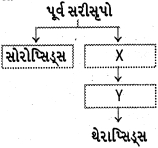
Select the correct option for $X$ and $Y$ in the chart shown below.
[Chart Structure: Primitive Reptiles -> (Sauropsids,$X$); $X$ -> $Y$; $Y$ -> Therapsids]
[Chart Structure: Primitive Reptiles -> (Sauropsids,$X$); $X$ -> $Y$; $Y$ -> Therapsids]
A
$X-$ Synapsids,$Y-$ Pelycosaurs
B
$X-$ Synapsids,$Y-$ Thecodonts
C
$X-$ Thecodonts,$Y-$ Synapsids
D
$X-$ Thecodonts,$Y-$ Pelycosaurs
Solution
(A) According to the evolutionary history of reptiles,primitive reptiles diverged into two main lineages: Sauropsids and Synapsids.
From the Synapsids,Pelycosaurs evolved.
From the Pelycosaurs,Therapsids evolved.
Therefore,in the given chart,$X$ represents Synapsids and $Y$ represents Pelycosaurs.
From the Synapsids,Pelycosaurs evolved.
From the Pelycosaurs,Therapsids evolved.
Therefore,in the given chart,$X$ represents Synapsids and $Y$ represents Pelycosaurs.
0 likes
View Solution74
MediumMCQ
Match the following columns:
| Column-$I$ | Column-$II$ |
| $(a)$ Darwin | $(i)$ Finches |
| $(b)$ Hugo de Vries | $(ii)$ Dead yeast |
| $(c)$ Pasteur | $(iii)$ Evening primrose |
A
$a-iii, b-ii, c-i$
B
$a-i, b-ii, c-iii$
C
$a-i, b-iii, c-ii$
D
$a-ii, b-i, c-iii$
Solution
(C) The correct matches are as follows:
$(a)$ Darwin: Charles Darwin observed finches in the Galapagos Islands, which provided evidence for natural selection. Thus, $(a-i)$.
$(b)$ Hugo de Vries: He proposed the mutation theory of evolution based on his work on the evening primrose (Oenothera lamarckiana). Thus, $(b-iii)$.
$(c)$ Pasteur: Louis Pasteur performed experiments using killed yeast to disprove the theory of spontaneous generation. Thus, $(c-ii)$.
Therefore, the correct sequence is $(a-i, b-iii, c-ii)$.
$(a)$ Darwin: Charles Darwin observed finches in the Galapagos Islands, which provided evidence for natural selection. Thus, $(a-i)$.
$(b)$ Hugo de Vries: He proposed the mutation theory of evolution based on his work on the evening primrose (Oenothera lamarckiana). Thus, $(b-iii)$.
$(c)$ Pasteur: Louis Pasteur performed experiments using killed yeast to disprove the theory of spontaneous generation. Thus, $(c-ii)$.
Therefore, the correct sequence is $(a-i, b-iii, c-ii)$.
0 likes
View Solution75
MediumMCQ
Match the following columns:
| List-$I$ | List-$II$ |
| $(a)$ Hugo de Vries | $(i)$ Natural Selection |
| $(b)$ Hardy-Weinberg | $(ii)$ Saltation |
| $(c)$ Darwin | $(iii)$ $(p+q)^2 = 1$ |
| $(d)$ Lamarck | $(iv)$ Acquired Characters |
A
$a-iii, b-i, c-ii, d-iv$
B
$a-ii, b-iii, c-i, d-iv$
C
$a-ii, b-iv, c-i, d-iii$
D
$a-i, b-ii, c-iii, d-iv$
Solution
(B) The correct matches are as follows:
$(a)$ Hugo de Vries proposed the mutation theory of evolution,which describes large,sudden changes in the population known as Saltation $(ii)$.
$(b)$ The Hardy-Weinberg principle explains population genetics using the equation $(p+q)^2 = p^2 + 2pq + q^2 = 1$ $(iii)$.
$(c)$ Charles Darwin proposed the theory of Natural Selection $(i)$ as the mechanism for evolution.
$(d)$ Jean-Baptiste Lamarck proposed the theory of Inheritance of Acquired Characters $(iv)$.
Therefore,the correct sequence is $a-ii, b-iii, c-i, d-iv$.
$(a)$ Hugo de Vries proposed the mutation theory of evolution,which describes large,sudden changes in the population known as Saltation $(ii)$.
$(b)$ The Hardy-Weinberg principle explains population genetics using the equation $(p+q)^2 = p^2 + 2pq + q^2 = 1$ $(iii)$.
$(c)$ Charles Darwin proposed the theory of Natural Selection $(i)$ as the mechanism for evolution.
$(d)$ Jean-Baptiste Lamarck proposed the theory of Inheritance of Acquired Characters $(iv)$.
Therefore,the correct sequence is $a-ii, b-iii, c-i, d-iv$.
0 likes
View Solution76
MediumMCQ
Match the following columns:
| List-$I$ | List-$II$ |
| $(W)$ Placental mammals and Australian marsupials | $(i)$ Adaptive radiation |
| $(X)$ Darwin's finches | $(ii)$ Convergent evolution |
| $(Y)$ Giraffe | $(iii)$ Divergent evolution |
| $(Z)$ Forelimbs of whale and bat | $(iv)$ Lamarckism |
A
$W-ii, X-i, Y-iv, Z-iii$
B
$W-iii, X-iv, Y-ii, Z-i$
C
$W-i, X-ii, Y-iii, Z-iv$
D
$W-ii, X-iii, Y-i, Z-iv$
Solution
(A) The correct matching is as follows:
$(W)$ Placental mammals and Australian marsupials represent convergent evolution because they evolved similar traits independently in similar habitats.
$(X)$ Darwin's finches are a classic example of adaptive radiation,where different species evolved from a common ancestor.
$(Y)$ The long neck of a giraffe is a classic example used to explain Lamarckism (theory of inheritance of acquired characters).
$(Z)$ Forelimbs of whale and bat are homologous organs,which indicate divergent evolution (common ancestry).
Thus,the correct sequence is $W-ii, X-i, Y-iv, Z-iii$.
$(W)$ Placental mammals and Australian marsupials represent convergent evolution because they evolved similar traits independently in similar habitats.
$(X)$ Darwin's finches are a classic example of adaptive radiation,where different species evolved from a common ancestor.
$(Y)$ The long neck of a giraffe is a classic example used to explain Lamarckism (theory of inheritance of acquired characters).
$(Z)$ Forelimbs of whale and bat are homologous organs,which indicate divergent evolution (common ancestry).
Thus,the correct sequence is $W-ii, X-i, Y-iv, Z-iii$.
0 likes
View Solution77
MediumMCQ
Match the following columns:
| List-$I$ | List-$II$ |
| $(a)$ Oparin and Haldane | $(i)$ Analogy |
| $(b)$ Haeckel | $(ii)$ Simulation of primitive Earth conditions |
| $(c)$ Miller | $(iii)$ Chemical evolution |
| $(d)$ Wings of bird and butterfly | $(iv)$ Embryological support for evolution |
A
$a-iii, b-iv, c-ii, d-i$
B
$a-ii, b-iii, c-iv, d-i$
C
$a-ii, b-iii, c-i, d-iv$
D
$a-iii, b-ii, c-i, d-iv$
Solution
$(a)$ Oparin and Haldane proposed the theory of chemical evolution, which suggests that life originated from non-living organic molecules.
$(b)$ Haeckel proposed the biogenetic law, providing embryological support for evolution.
$(c)$ Miller conducted an experiment simulating primitive Earth conditions to test the chemical evolution theory.
$(d)$ Wings of birds and butterflies are analogous organs, as they perform similar functions but have different structural origins.
Therefore, the correct matching is $a-iii, b-iv, c-ii, d-i$.
$(b)$ Haeckel proposed the biogenetic law, providing embryological support for evolution.
$(c)$ Miller conducted an experiment simulating primitive Earth conditions to test the chemical evolution theory.
$(d)$ Wings of birds and butterflies are analogous organs, as they perform similar functions but have different structural origins.
Therefore, the correct matching is $a-iii, b-iv, c-ii, d-i$.
0 likes
View Solution78
MediumMCQ
Select the incorrect statement.
A
Amphibians evolved from lobe-finned fish.
B
The class Amphibia includes frogs and toads.
C
Reptiles evolved from amphibians.
D
Reptiles dominated the Earth for about $200$ million years.
Solution
(B) $1$. According to evolutionary history,lobe-finned fish (like Coelacanths) are considered the ancestors of the first amphibians.
$2$. Amphibians evolved into reptiles. Reptiles were the first vertebrates to be fully adapted to life on land.
$3$. Reptiles dominated the Earth for a long period,approximately $200$ million years,before the rise of mammals.
$4$. The statement 'The class Amphibia includes frogs and toads' is a biological fact,but in the context of evolutionary history questions,the statement 'Reptiles dominated the Earth for about $200$ million years' is often cited as the period of the Mesozoic Era. However,the statement 'Amphibians evolved from lobe-finned fish' is correct. The statement 'Reptiles evolved from amphibians' is correct. The statement 'Reptiles dominated the Earth for about $200$ million years' is historically accurate. Therefore,the statement 'The class Amphibia includes frogs and toads' is technically correct as a classification fact,but if we look for the incorrect statement regarding evolutionary history,we must re-evaluate. Actually,the statement 'Reptiles dominated the Earth for about $200$ million years' is the most accurate description of the Mesozoic era. The statement 'The class Amphibia includes frogs and toads' is a general classification fact,but in some contexts,it is considered the 'incorrect' choice if the question specifically targets evolutionary milestones.
$2$. Amphibians evolved into reptiles. Reptiles were the first vertebrates to be fully adapted to life on land.
$3$. Reptiles dominated the Earth for a long period,approximately $200$ million years,before the rise of mammals.
$4$. The statement 'The class Amphibia includes frogs and toads' is a biological fact,but in the context of evolutionary history questions,the statement 'Reptiles dominated the Earth for about $200$ million years' is often cited as the period of the Mesozoic Era. However,the statement 'Amphibians evolved from lobe-finned fish' is correct. The statement 'Reptiles evolved from amphibians' is correct. The statement 'Reptiles dominated the Earth for about $200$ million years' is historically accurate. Therefore,the statement 'The class Amphibia includes frogs and toads' is technically correct as a classification fact,but if we look for the incorrect statement regarding evolutionary history,we must re-evaluate. Actually,the statement 'Reptiles dominated the Earth for about $200$ million years' is the most accurate description of the Mesozoic era. The statement 'The class Amphibia includes frogs and toads' is a general classification fact,but in some contexts,it is considered the 'incorrect' choice if the question specifically targets evolutionary milestones.
0 likes
View Solution79
MediumMCQ
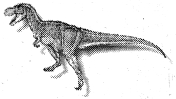
Identify the figure given below:
A
Pteranodon
B
Tyrannosaurus
C
Brachiosaurus
D
Crocodilian
Solution
(B) The figure shows a large,bipedal dinosaur with a massive skull and small forelimbs,which is characteristic of the genus $Tyrannosaurus$.
$Tyrannosaurus$ is a well-known theropod dinosaur that lived during the Late Cretaceous period.
Other options like $Pteranodon$ (a pterosaur),$Brachiosaurus$ (a sauropod),and $Crocodilian$ (a group of reptiles) do not match the morphological features shown in the image.
$Tyrannosaurus$ is a well-known theropod dinosaur that lived during the Late Cretaceous period.
Other options like $Pteranodon$ (a pterosaur),$Brachiosaurus$ (a sauropod),and $Crocodilian$ (a group of reptiles) do not match the morphological features shown in the image.
0 likes
View Solution80
MediumMCQ
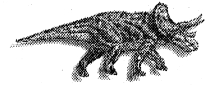
Identify the animal shown in the figure.
A
Triceratops
B
Tyrannosaurus
C
Archaeopteryx
D
Stegosaurus
Solution
(A) The animal shown in the figure is a $Triceratops$. $Triceratops$ is a genus of herbivorous ceratopsid dinosaur that lived during the late Cretaceous period. It is easily identified by its large bony frill and three horns on its face.
0 likes
View Solution81
MediumMCQ
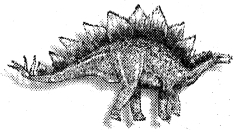
What is the name of the animal shown in the figure?
A
Stegosaurus
B
Pteranodon
C
Brachiosaurus
D
Archaeopteryx
Solution
(A) The animal shown in the figure is a $Stegosaurus$.
$Stegosaurus$ is a genus of herbivorous thyreophoran dinosaur that lived during the Late Jurassic period.
It is easily identified by its distinctive double row of kite-shaped plates along its back and the spikes on its tail.
Therefore,the correct option is $A$.
$Stegosaurus$ is a genus of herbivorous thyreophoran dinosaur that lived during the Late Jurassic period.
It is easily identified by its distinctive double row of kite-shaped plates along its back and the spikes on its tail.
Therefore,the correct option is $A$.
0 likes
View Solution82
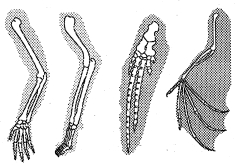
MediumMCQ
What type of evolution is shown in the figure?
A
Convergent evolution
B
Divergent evolution
C
Chemical evolution
D
Abiotic evolution
Solution
(B) The figure shows the forelimbs of various mammals (human,cheetah,whale,and bat).
These structures have similar anatomical patterns (humerus,radius,ulna,carpals,metacarpals,and phalanges) indicating a common ancestry,but they have evolved to perform different functions due to adaptation to different environments.
This phenomenon is known as homology,and it is a result of divergent evolution.
These structures have similar anatomical patterns (humerus,radius,ulna,carpals,metacarpals,and phalanges) indicating a common ancestry,but they have evolved to perform different functions due to adaptation to different environments.
This phenomenon is known as homology,and it is a result of divergent evolution.
0 likes
View Solution83
EasyMCQ
Galapagos islands are located in
A
Indian ocean
B
Pacific ocean
C
Atlantic ocean
D
Arabian ocean
Solution
(B) The Galapagos Islands consist of $14$ main islands and numerous smaller islands,which lie on the equator about $960 \, km$ off the west coast of South America in the Pacific Ocean.
These islands are volcanic in origin and are often referred to as a 'living laboratory of evolution' due to the unique biodiversity observed by Charles Darwin.
These islands are volcanic in origin and are often referred to as a 'living laboratory of evolution' due to the unique biodiversity observed by Charles Darwin.
0 likes
View Solution84
MediumMCQ
First dinosaurs and first egg-laying mammals originated in which period?
A
Jurassic period
B
Triassic period
C
Permian period
D
Cambrian period
Solution
(B) The evolutionary history of life indicates that the $Triassic$ period,which occurred approximately $251$ to $201$ million years ago,was a significant time for terrestrial vertebrates.
During the $Triassic$ period,the first dinosaurs appeared,and the first egg-laying mammals also evolved.
Therefore,the correct answer is the $Triassic$ period.
During the $Triassic$ period,the first dinosaurs appeared,and the first egg-laying mammals also evolved.
Therefore,the correct answer is the $Triassic$ period.
0 likes
View Solution85
MediumMCQ
The present concept of evolution is known as
A
Neo-Darwinism theory of evolution
B
Synthetic theory of evolution
C
Modern concept theory of evolution
D
All of the above
Solution
(D) The present concept of evolution is a modified form of Darwin's theory of natural selection,often referred to as $Neo-Darwinism$.
According to this theory,only genetic variations (mutations) are inherited,unlike the broader view of variations held by Darwin.
Thus,the modern concept of evolution is a synthesis of Darwin's theory of natural selection and Hugo de Vries's mutation theory,along with contributions from population genetics. This is also widely known as the $Synthetic$ $theory$ $of$ $evolution$ or $Modern$ $Synthetic$ $theory$.
According to this theory,only genetic variations (mutations) are inherited,unlike the broader view of variations held by Darwin.
Thus,the modern concept of evolution is a synthesis of Darwin's theory of natural selection and Hugo de Vries's mutation theory,along with contributions from population genetics. This is also widely known as the $Synthetic$ $theory$ $of$ $evolution$ or $Modern$ $Synthetic$ $theory$.
0 likes
View Solution86
EasyMCQ
The Jurassic period of the Mesozoic era is characterized by:
A
Gymnosperms are dominant plants and first birds appear
B
Radiation of reptiles and origin of mammals like reptiles
C
Dinosaurs become extinct and angiosperms appear
D
Flowering plants and first dinosaurs appear
Solution
(A) The Jurassic period is the second geological period of the Mesozoic era.
During this period,gymnosperms were the dominant flora,including ferns,cycads,Ginkgo,and conifers.
Among animals,reptiles dominated the vertebrates,and the first flying reptiles,known as pterosaurs,appeared.
Furthermore,the first primitive bird,Archaeopteryx,also made its appearance during this time.
During this period,gymnosperms were the dominant flora,including ferns,cycads,Ginkgo,and conifers.
Among animals,reptiles dominated the vertebrates,and the first flying reptiles,known as pterosaurs,appeared.
Furthermore,the first primitive bird,Archaeopteryx,also made its appearance during this time.
0 likes
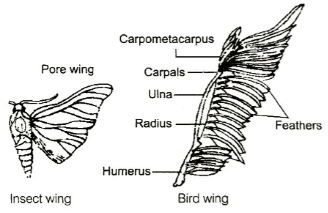
View Solution87
MediumMCQ
Which of the following are the wrong statements?
$I.$ Organs which are different in basic structure and origin but perform similar functions are called analogous organs.
$II.$ Organs with different basic structure and origin but perform similar functions are called homologous organs.
$III.$ Homologous organs lead to convergent evolution.
$IV.$ Analogous organs lead to divergent evolution.
The correct combination is:
$I.$ Organs which are different in basic structure and origin but perform similar functions are called analogous organs.
$II.$ Organs with different basic structure and origin but perform similar functions are called homologous organs.
$III.$ Homologous organs lead to convergent evolution.
$IV.$ Analogous organs lead to divergent evolution.
The correct combination is:
A
$I, III$ and $IV$
B
$I, IV$ and $III$
C
$I$ and $II$
D
$II, III$ and $IV$
Solution
(D) The wrong statements are $II, III,$ and $IV$.
$I.$ Correct: Analogous organs have different basic structure and origin but perform similar functions.
$II.$ Wrong: Organs with different basic structure and origin but performing similar functions are called analogous organs,not homologous organs.
$III.$ Wrong: Homologous organs result from divergent evolution,where structures with a common origin adapt to different functions.
$IV.$ Wrong: Analogous organs result from convergent evolution,where different structures adapt to perform similar functions due to similar environmental pressures.
Therefore,statements $II, III,$ and $IV$ are incorrect.
$I.$ Correct: Analogous organs have different basic structure and origin but perform similar functions.
$II.$ Wrong: Organs with different basic structure and origin but performing similar functions are called analogous organs,not homologous organs.
$III.$ Wrong: Homologous organs result from divergent evolution,where structures with a common origin adapt to different functions.
$IV.$ Wrong: Analogous organs result from convergent evolution,where different structures adapt to perform similar functions due to similar environmental pressures.
Therefore,statements $II, III,$ and $IV$ are incorrect.
0 likes
View Solution88
MediumMCQ
The greatest evolutionary change enabling land vertebrates to be completely free from the water habitat was the development of:
A
Four legs
B
Four-chambered heart
C
Lungs
D
Shelled eggs and internal fertilization
Solution
(D) The most significant evolutionary adaptation that allowed vertebrates to transition from an aquatic environment to a fully terrestrial one was the development of the amniotic egg (shelled egg) and internal fertilization.
$1$. Shelled eggs (amniotic eggs) provide a self-contained aquatic environment for the developing embryo,protecting it from desiccation and mechanical injury without the need for water.
$2$. Internal fertilization ensures that the sperm and egg meet within the female's body,eliminating the requirement for an external water medium for gamete fusion.
These adaptations are characteristic of amniotes (reptiles,birds,and mammals),which are fully independent of water for reproduction.
$1$. Shelled eggs (amniotic eggs) provide a self-contained aquatic environment for the developing embryo,protecting it from desiccation and mechanical injury without the need for water.
$2$. Internal fertilization ensures that the sperm and egg meet within the female's body,eliminating the requirement for an external water medium for gamete fusion.
These adaptations are characteristic of amniotes (reptiles,birds,and mammals),which are fully independent of water for reproduction.
0 likes
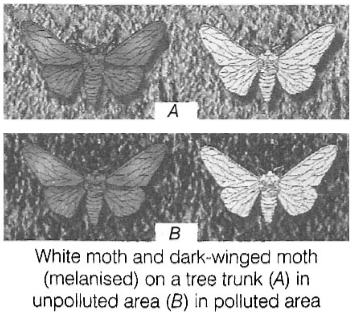
View Solution89
MediumMCQ
Mark the correct statements:
$I.$ Fitness of individuals means reproductive fitness.
$II.$ Homology in vertebrate brain indicates common ancestry.
$III.$ Theory of acquired characters was given by de Vries.
$IV.$ After industrialization,the white moth did not survive due to predators.
The correct option is:
$I.$ Fitness of individuals means reproductive fitness.
$II.$ Homology in vertebrate brain indicates common ancestry.
$III.$ Theory of acquired characters was given by de Vries.
$IV.$ After industrialization,the white moth did not survive due to predators.
The correct option is:
A
$I, II$ and $III$
B
$I, III$ and $IV$
C
$II, III$ and $IV$
D
$I, II$ and $IV$
Solution
(D) Statement $I$ is correct: In evolutionary biology,fitness refers to the reproductive success of an individual.
Statement $II$ is correct: Homology in the brains of vertebrates (e.g.,forebrain,midbrain,hindbrain) suggests a common evolutionary origin.
Statement $III$ is incorrect: The theory of inheritance of acquired characters was proposed by Jean-Baptiste Lamarck,not Hugo de Vries. Hugo de Vries proposed the mutation theory of evolution.
Statement $IV$ is correct: Industrial melanism in Biston betularia shows that after industrialization,tree trunks became dark due to soot. White-winged moths became more visible to predators and were eaten,while dark-winged moths survived.
Therefore,statements $I, II,$ and $IV$ are correct.
Statement $II$ is correct: Homology in the brains of vertebrates (e.g.,forebrain,midbrain,hindbrain) suggests a common evolutionary origin.
Statement $III$ is incorrect: The theory of inheritance of acquired characters was proposed by Jean-Baptiste Lamarck,not Hugo de Vries. Hugo de Vries proposed the mutation theory of evolution.
Statement $IV$ is correct: Industrial melanism in Biston betularia shows that after industrialization,tree trunks became dark due to soot. White-winged moths became more visible to predators and were eaten,while dark-winged moths survived.
Therefore,statements $I, II,$ and $IV$ are correct.
0 likes
View Solution90
MediumMCQ
Which of the following is an incorrect match?
A
Devonian period - Age of fishes
B
Carboniferous period - Age of amphibians
C
Ordovician period - Age of invertebrates
D
Cretaceous period - Age of reptiles
Solution
(D) The $Cretaceous$ period is part of the $Mesozoic$ era,which is known as the 'Age of Reptiles'. However,the term 'Age of Reptiles' specifically refers to the entire $Mesozoic$ era (which includes the $Triassic$,$Jurassic$,and $Cretaceous$ periods). Among the given options,the $Cretaceous$ period is often associated with the peak of dinosaurs,but the $Mesozoic$ era as a whole is the 'Age of Reptiles'. In many standard biological contexts,the $Cretaceous$ period is specifically noted for the dominance of dinosaurs,but the $Mesozoic$ era is the broader classification. Given the options,$D$ is the most appropriate answer as the $Mesozoic$ era is the 'Age of Reptiles'.
0 likes
View Solution91
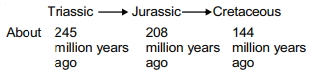
MediumMCQ
Which of the following arrangements of periods of the Mesozoic era gives a correct sequence from the earliest to the latest?
A
Jurassic,Triassic,Cretaceous
B
Triassic,Jurassic,Cretaceous
C
Permian,Jurassic,Triassic
D
Devonian,Permian,Jurassic
Solution
(B) The Mesozoic era is divided into three periods: Triassic,Jurassic,and Cretaceous.
According to the geological time scale,the Triassic period began about $245$ million years ago,followed by the Jurassic period about $208$ million years ago,and the Cretaceous period about $144$ million years ago.
Therefore,the correct chronological sequence from the earliest to the latest is Triassic $\rightarrow$ Jurassic $\rightarrow$ Cretaceous.
According to the geological time scale,the Triassic period began about $245$ million years ago,followed by the Jurassic period about $208$ million years ago,and the Cretaceous period about $144$ million years ago.
Therefore,the correct chronological sequence from the earliest to the latest is Triassic $\rightarrow$ Jurassic $\rightarrow$ Cretaceous.
0 likes
View Solution92
MediumMCQ
The Permian period,during which the first most modern orders of insects appeared,occurred approximately
A
$80$ million years ago
B
$150$ million years ago
C
$280$ million years ago
D
$550$ million years ago
Solution
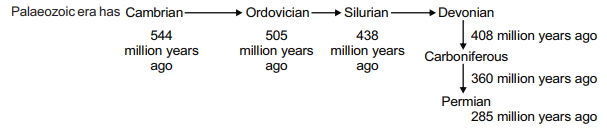
(C) The geological time scale indicates that the Permian period occurred approximately $285$ million years ago.
Among the given options,$280$ million years ago is the closest approximation to the timeline of the Permian period.
Therefore,the correct option is $C$.
Among the given options,$280$ million years ago is the closest approximation to the timeline of the Permian period.
Therefore,the correct option is $C$.
0 likes
View Solution93
EasyMCQ
Pelycosaurs and Therapsids were
A
Sauropsids
B
Synapsids
C
Sphenopsids
D
Dinosaurs
Solution
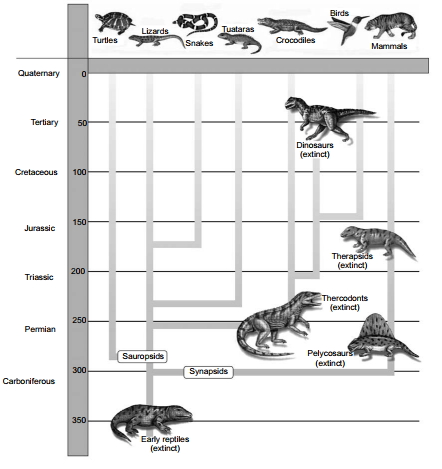
(B) Based on the provided evolutionary tree diagram,the lineage that leads to mammals branches off from the $Synapsids$.
Both Pelycosaurs and Therapsids are shown as extinct groups belonging to the $Synapsid$ lineage.
Therefore,Pelycosaurs and Therapsids were $Synapsids$.
Both Pelycosaurs and Therapsids are shown as extinct groups belonging to the $Synapsid$ lineage.
Therefore,Pelycosaurs and Therapsids were $Synapsids$.
0 likes
View Solution94
EasyMCQ
An evolutionary trend in which there is general degeneration and loss of organs is known as:
A
Progressive
B
Vestigial
C
Retrogressive
D
Stasigenesis
Solution
(C) Evolutionary trends can be classified based on the complexity of the organisms over time.
$1$. Progressive evolution involves the development of more complex and specialized structures from simpler ones.
$2$. Retrogressive evolution (or degeneration) is an evolutionary trend characterized by the simplification of body structure,general degeneration,and the loss of complex organs,often seen in parasitic organisms.
$3$. Stasigenesis refers to a state where there is little or no evolutionary change over a long period.
Therefore,the correct term for the degeneration and loss of organs is retrogressive evolution.
$1$. Progressive evolution involves the development of more complex and specialized structures from simpler ones.
$2$. Retrogressive evolution (or degeneration) is an evolutionary trend characterized by the simplification of body structure,general degeneration,and the loss of complex organs,often seen in parasitic organisms.
$3$. Stasigenesis refers to a state where there is little or no evolutionary change over a long period.
Therefore,the correct term for the degeneration and loss of organs is retrogressive evolution.
0 likes
View Solution95
MediumMCQ
$A$: Mesozoic is the era of dinosaurs,but they suddenly disappeared from the earth.
$R$: Dinosaurs may have changed into birds or climatic changes killed them.
$R$: Dinosaurs may have changed into birds or climatic changes killed them.
A
Assertion and Reason both are correct and Reason is the correct explanation of Assertion.
B
Assertion and Reason both are correct but Reason is not the correct explanation of Assertion.
C
Assertion is correct,but Reason is incorrect.
D
Both Assertion and Reason are incorrect.
Solution
(A) The Mesozoic era is indeed known as the 'Age of Reptiles' or the era of dinosaurs. They dominated the earth during this period and suddenly disappeared approximately $65$ million years ago.
Scientific theories suggest that their extinction was likely caused by drastic climatic changes,such as the impact of a large asteroid or volcanic activity,which altered the environment significantly.
While some evolutionary biologists propose that modern birds evolved from small theropod dinosaurs,this evolutionary transition is not the reason for their sudden mass extinction.
Therefore,both the Assertion and the Reason are factually correct statements,and the Reason provides a plausible explanation for their disappearance.
Scientific theories suggest that their extinction was likely caused by drastic climatic changes,such as the impact of a large asteroid or volcanic activity,which altered the environment significantly.
While some evolutionary biologists propose that modern birds evolved from small theropod dinosaurs,this evolutionary transition is not the reason for their sudden mass extinction.
Therefore,both the Assertion and the Reason are factually correct statements,and the Reason provides a plausible explanation for their disappearance.
0 likes
View Solution96
MediumMCQ
$A$: $Lycaenops$ is a connecting link between reptiles and mammals.
$R$: In the $Permian$ period,there was an origin of mammal-like reptiles.
$R$: In the $Permian$ period,there was an origin of mammal-like reptiles.
A
Assertion and Reason both are correct and Reason is the correct explanation of Assertion.
B
Assertion and Reason both are correct but Reason is not the correct explanation of Assertion.
C
Assertion is correct,but Reason is incorrect.
D
Both Assertion and Reason are incorrect.
Solution
(A) $Lycaenops$ is a genus of gorgonopsid therapsids that lived during the $Permian$ period.
These organisms are considered mammal-like reptiles (synapsids) because they exhibit transitional features between basal reptiles and true mammals.
The $Permian$ period is indeed the time when these mammal-like reptiles (therapsids) originated and diversified.
Therefore,the Reason correctly explains the evolutionary context of the Assertion.
These organisms are considered mammal-like reptiles (synapsids) because they exhibit transitional features between basal reptiles and true mammals.
The $Permian$ period is indeed the time when these mammal-like reptiles (therapsids) originated and diversified.
Therefore,the Reason correctly explains the evolutionary context of the Assertion.
0 likes
View Solution97
MediumMCQ
Match List $- I$ with List $- II.$
Choose the correct answer from the options given below.
| List $- I$ | List $- II$ |
|---|---|
| $(a)$ Adaptive radiation | $(i)$ Selection of resistant varieties due to excessive use of herbicides and pesticides |
| $(b)$ Convergent evolution | $(ii)$ Bones of forelimbs in Man and Whale |
| $(c)$ Divergent evolution | $(iii)$ Wings of Butterfly and Bird |
| $(d)$ Evolution by anthropogenic action | $(iv)$ Darwin Finches |
Choose the correct answer from the options given below.
A
$(a)-(iv), (b)-(iii), (c)-(ii), (d)-(i)$
B
$(a)-(iii), (b)-(ii), (c)-(i), (d)-(iv)$
C
$(a)-(ii), (b)-(i), (c)-(iv), (d)-(iii)$
D
$(a)-(i), (b)-(iv), (c)-(iii), (d)-(ii)$
Solution
(A) Adaptive radiation refers to the process of evolution of different species in a given geographical area starting from a point and literally radiating to other areas of geography (habitats),e.g.,Darwin's Finches $(iv)$.
$(b)$ Convergent evolution occurs when different structures evolve for the same function and have similar appearance,e.g.,wings of butterfly and bird $(iii)$.
$(c)$ Divergent evolution occurs when structures have the same origin but perform different functions (homologous organs),e.g.,bones of forelimbs in man and whale $(ii)$.
$(d)$ Evolution by anthropogenic action refers to changes in species due to human activities,such as the selection of resistant varieties due to excessive use of herbicides and pesticides $(i)$.
Therefore,the correct match is $(a)-(iv), (b)-(iii), (c)-(ii), (d)-(i)$.
$(b)$ Convergent evolution occurs when different structures evolve for the same function and have similar appearance,e.g.,wings of butterfly and bird $(iii)$.
$(c)$ Divergent evolution occurs when structures have the same origin but perform different functions (homologous organs),e.g.,bones of forelimbs in man and whale $(ii)$.
$(d)$ Evolution by anthropogenic action refers to changes in species due to human activities,such as the selection of resistant varieties due to excessive use of herbicides and pesticides $(i)$.
Therefore,the correct match is $(a)-(iv), (b)-(iii), (c)-(ii), (d)-(i)$.
0 likes
View Solution98
MediumMCQ
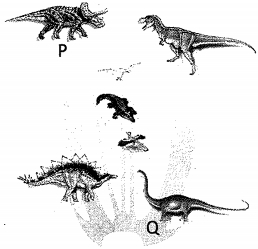
The phylogenetic tree of dinosaurs is given below. What do $P$ and $Q$ represent?
A
Triceratops,Brachiosaurus
B
Stegosaurus,Tyrannosaurus
C
Tyrannosaurus,Stegosaurus
D
Brachiosaurus,Triceratops
Solution
(A) Based on the provided phylogenetic tree of dinosaurs:
$1$. The organism labeled $P$ is a $Triceratops$,which is a well-known herbivorous ceratopsid dinosaur.
$2$. The organism labeled $Q$ is a $Brachiosaurus$,which is a large herbivorous sauropod dinosaur.
$3$. Therefore,$P$ represents $Triceratops$ and $Q$ represents $Brachiosaurus$.
$4$. Comparing this with the given options,option $A$ is the correct choice.
$1$. The organism labeled $P$ is a $Triceratops$,which is a well-known herbivorous ceratopsid dinosaur.
$2$. The organism labeled $Q$ is a $Brachiosaurus$,which is a large herbivorous sauropod dinosaur.
$3$. Therefore,$P$ represents $Triceratops$ and $Q$ represents $Brachiosaurus$.
$4$. Comparing this with the given options,option $A$ is the correct choice.
0 likes
View Solution99
MediumMCQ
Select the correct option for the wings of a butterfly and the wings of a bird.
A
Divergent evolution,Analogous organs
B
Convergent evolution,Analogous organs
C
Convergent evolution,Homologous organs
D
Divergent evolution,Homologous organs
Solution
(B) The wings of a butterfly and the wings of a bird perform the same function, which is flying, but they have different anatomical structures and embryonic origins.
Organs that perform similar functions but have different structural origins are known as $Analogous$ $organs$.
This phenomenon, where different species evolve similar traits independently to adapt to similar environmental pressures, is known as $Convergent$ $evolution$.
Organs that perform similar functions but have different structural origins are known as $Analogous$ $organs$.
This phenomenon, where different species evolve similar traits independently to adapt to similar environmental pressures, is known as $Convergent$ $evolution$.
0 likes
View Solution100
MediumMCQ
About $200$ million years ago,some land reptiles went back into water to evolve into fish-like reptiles. These reptiles were known as:
A
$200$ million,Ichthyosaurs
B
$65$ million,Ichthyosaurs
C
$200$ million,Tyrannosaurus rex
D
$65$ million,Tyrannosaurus rex
Solution
(A) According to the evolutionary history of life on Earth,about $200$ million years ago,some land-dwelling reptiles returned to the water to evolve into fish-like reptiles.
These specific reptiles are known as Ichthyosaurs.
Tyrannosaurus rex was a large land-dwelling dinosaur that existed much later,around $65$ million years ago.
Therefore,the correct option is $A$.
These specific reptiles are known as Ichthyosaurs.
Tyrannosaurus rex was a large land-dwelling dinosaur that existed much later,around $65$ million years ago.
Therefore,the correct option is $A$.
0 likes
View SolutionEvolution — Mix Examples- Evolution · Frequently Asked Questions
1Are these Evolution questions useful for JEE and NEET?
Yes. All questions in this section are mapped to JEE Main and NEET exam patterns. Previous year questions from JEE Main, NEET, GUJCET and state-level exams are included with full solutions.
2Can I switch to Hindi or Gujarati for these questions?
Yes. Use the language tabs in the hero section or the sidebar to view the same questions and solutions in English, Hindi or Gujarati.
3How do I generate a question paper from this subtopic?
Use the Vedclass Exam Paper Generator — select the chapter and subtopic, set difficulty, and generate Sets A, B, C, D automatically. First 3 chapters of every subject are free.
Vedclass Products
For Students
Vedclass Test Series
Mock tests in real JEE/NEET style with performance analysis. 5-day free trial.
Start Free TrialFor Teachers
Exam Paper Generator
Generate Set A/B/C/D papers from this chapter in 2 minutes. 3 chapters free.
Try FreeFor Institutes
Online Exam Module
Live online exams with unlimited students, 360° analytics & white-label branding.
See DemoFor Teachers & Institutes
Generate a Evolution Exam Paper in 2 Minutes
Select subtopic & difficulty — Sets A, B, C, D auto-generated with No Repeat logic.
First 3 chapters of every subject are free — no payment required.