
A English
Mix Examples- Evolution Questions in English
Class 12 Biology · Evolution · Mix Examples- Evolution
110+
Questions
English
Language
100%
With Solutions
Showing 50 of 110 questions in English
1
EasyMCQ
The evolutionary history of a particular group of organisms is called
A
Phylogeny
B
Ontogeny
C
Heredity
D
None of the above
Solution
(A) Phylogeny refers to the evolutionary history and development of a species or a group of organisms.
It focuses on the ancestral relationships and the lineage of organisms over time.
Ontogeny refers to the developmental history of an individual organism.
Heredity refers to the transmission of genetic characteristics from parents to offspring.
Therefore,the correct term for the evolutionary history of a group is Phylogeny.
It focuses on the ancestral relationships and the lineage of organisms over time.
Ontogeny refers to the developmental history of an individual organism.
Heredity refers to the transmission of genetic characteristics from parents to offspring.
Therefore,the correct term for the evolutionary history of a group is Phylogeny.
0 likes
View Solution2
MediumMCQ
Two morphologically similar populations are intersterile. They belong to
A
One species
B
Two biospecies
C
Two sibling species
D
None of the above
Solution
(C) The correct answer is $C$.
Sibling species are defined as populations that are morphologically identical or very similar but are reproductively isolated,meaning they are intersterile.
Because they cannot interbreed,they are classified as distinct species despite their physical resemblance.
Sibling species are defined as populations that are morphologically identical or very similar but are reproductively isolated,meaning they are intersterile.
Because they cannot interbreed,they are classified as distinct species despite their physical resemblance.
0 likes
View Solution3
MediumMCQ
What is common between a moth,a frog,and a mosquito?
A
The body is clearly differentiated into head,thorax,and abdomen.
B
The life history is carried out in water.
C
The skin acts as the main respiratory organ.
D
Their larvae feed on a food different from that of the adult.
Solution
(D) In the life cycle of moths,frogs,and mosquitoes,the process of metamorphosis occurs. $A$ common biological feature among these organisms is that their larval stages (caterpillar in moths,tadpole in frogs,and wriggler in mosquitoes) occupy a different ecological niche and feed on different food sources compared to their respective adult forms. This reduces intraspecific competition for resources.
0 likes
View Solution4
EasyMCQ
Neoteny is found in
A
Tadpole
B
Salamander
C
Hyla
D
Axolotl
Solution
(D) Neoteny is the phenomenon where an organism retains its larval characteristics throughout its adult life,including the ability to reproduce sexually.
In the case of the $Ambystoma$ $mexicanum$,commonly known as the $Axolotl$,the organism remains in its aquatic larval form throughout its entire life cycle,even after reaching sexual maturity.
Therefore,$Axolotl$ is the classic example of neoteny.
In the case of the $Ambystoma$ $mexicanum$,commonly known as the $Axolotl$,the organism remains in its aquatic larval form throughout its entire life cycle,even after reaching sexual maturity.
Therefore,$Axolotl$ is the classic example of neoteny.
0 likes
View Solution5
MediumMCQ
Cleidoic egg is an adaptation for
A
Aerial life
B
Marine life
C
Aquatic life
D
Terrestrial life
Solution
(D) cleidoic egg is a shelled egg that is impermeable to water but permeable to gases.
This adaptation allows the embryo to develop in a dry environment without drying out.
Therefore,the cleidoic egg is a significant evolutionary adaptation for terrestrial life,as it allows animals like reptiles and birds to reproduce away from water bodies.
This adaptation allows the embryo to develop in a dry environment without drying out.
Therefore,the cleidoic egg is a significant evolutionary adaptation for terrestrial life,as it allows animals like reptiles and birds to reproduce away from water bodies.
0 likes
View Solution6
MediumMCQ
Normally,gametes are disease-free in human beings or even in other animals because:
A
Germs cannot attack the gametes
B
Gametes are immune to diseases
C
The germplasm is segregated very early and is not subjected to diseases from which the somatic cells may suffer
D
None of the above
Solution
(C) The concept of germplasm segregation,proposed by August Weismann,suggests that the germ cells (which give rise to gametes) are separated from the somatic cells (body cells) very early during embryonic development.
Because the germ cells are sequestered and protected from the metabolic and environmental stresses that affect somatic cells,they remain largely unaffected by the diseases or mutations that might accumulate in the somatic tissues of the organism.
Therefore,the germplasm remains protected,ensuring that gametes are generally free from the diseases affecting the somatic body.
Because the germ cells are sequestered and protected from the metabolic and environmental stresses that affect somatic cells,they remain largely unaffected by the diseases or mutations that might accumulate in the somatic tissues of the organism.
Therefore,the germplasm remains protected,ensuring that gametes are generally free from the diseases affecting the somatic body.
0 likes
View Solution7
MediumMCQ
The greatest evolutionary change enabling land vertebrates to be completely free from water was the development of
A
Four legs
B
Lungs
C
Shelled eggs and internal fertilization
D
Four chambered heart
Solution
(C) The transition of vertebrates from water to land required adaptations to prevent desiccation and ensure successful reproduction without an aquatic environment.
$1$. The development of internal fertilization allowed gametes to meet within the female body,protecting them from the external environment.
$2$. The evolution of the amniotic egg (shelled egg) provided a self-contained aquatic environment for the developing embryo,preventing it from drying out on land.
These two adaptations together allowed reptiles to colonize terrestrial habitats completely,making them independent of water for their life cycle.
$1$. The development of internal fertilization allowed gametes to meet within the female body,protecting them from the external environment.
$2$. The evolution of the amniotic egg (shelled egg) provided a self-contained aquatic environment for the developing embryo,preventing it from drying out on land.
These two adaptations together allowed reptiles to colonize terrestrial habitats completely,making them independent of water for their life cycle.
0 likes
View Solution8
EasyMCQ
$A$ species that is produced by the loss or disappearance of a few characters found in its parents is termed as:
A
Progressive species
B
Retrogressive species
C
Successive species
D
Digressive species
Solution
(D) The term used for a species produced by the loss or disappearance of certain characters present in the parent species is known as a $Digressive$ species.
In evolutionary biology,this refers to a process where the new species exhibits a reduction in complexity or the loss of specific traits compared to its ancestors.
In evolutionary biology,this refers to a process where the new species exhibits a reduction in complexity or the loss of specific traits compared to its ancestors.
0 likes
View Solution9
EasyMCQ
Which one of the following scientists is not related to organic evolution?
A
Erasmus Darwin
B
Charles Darwin
C
Darlington
D
$T.R. Malthus$
Solution
(C) $Erasmus Darwin$ was the grandfather of $Charles Darwin$ and proposed early ideas on evolution.
$Charles Darwin$ is the father of the theory of natural selection.
$T.R. Malthus$ wrote an essay on population, which significantly influenced $Charles Darwin$'s theory of natural selection.
$Darlington$ is a scientist primarily known for his work in cytogenetics and chromosome studies, not organic evolution.
$Charles Darwin$ is the father of the theory of natural selection.
$T.R. Malthus$ wrote an essay on population, which significantly influenced $Charles Darwin$'s theory of natural selection.
$Darlington$ is a scientist primarily known for his work in cytogenetics and chromosome studies, not organic evolution.
0 likes
View Solution10
EasyMCQ
The pioneers in the field of 'organic evolution' are
A
Karl Landsteiner,Hugo de Vries,Malthus
B
Darwin,Hugo de Vries,Lamarck,Huxley
C
Lamarck,Karl Landsteiner,Malthus,De Vries
D
Darwin,Lamarck,Karl Landsteiner,De Vries
Solution
(B) is the correct answer.
$1$. Charles Darwin proposed the theory of Natural Selection.
$2$. Hugo de Vries proposed the Mutation Theory of evolution.
$3$. Jean-Baptiste Lamarck proposed the theory of inheritance of acquired characters.
$4$. Julian Huxley contributed significantly to the Modern Synthetic Theory of evolution and famously described birds as 'glorified reptiles'.
$1$. Charles Darwin proposed the theory of Natural Selection.
$2$. Hugo de Vries proposed the Mutation Theory of evolution.
$3$. Jean-Baptiste Lamarck proposed the theory of inheritance of acquired characters.
$4$. Julian Huxley contributed significantly to the Modern Synthetic Theory of evolution and famously described birds as 'glorified reptiles'.
0 likes
View Solution11
MediumMCQ
Which one of the following is known as the age of amphibians,fishes,and invertebrates?
A
Archaeozoic era
B
Proterozoic era
C
Palaeozoic era
D
Mesozoic era
Solution
(C) The $Palaeozoic$ era is known as the age of ancient life.
It is divided into several periods,including the $Cambrian$,$Ordovician$,$Silurian$,$Devonian$,$Carboniferous$,and $Permian$.
During this era,invertebrates flourished in the $Cambrian$ and $Ordovician$ periods.
Fishes became dominant during the $Devonian$ period,which is often called the 'Age of Fishes'.
Amphibians evolved and became prominent during the $Carboniferous$ period.
Therefore,the $Palaeozoic$ era is collectively recognized as the age of invertebrates,fishes,and amphibians.
It is divided into several periods,including the $Cambrian$,$Ordovician$,$Silurian$,$Devonian$,$Carboniferous$,and $Permian$.
During this era,invertebrates flourished in the $Cambrian$ and $Ordovician$ periods.
Fishes became dominant during the $Devonian$ period,which is often called the 'Age of Fishes'.
Amphibians evolved and became prominent during the $Carboniferous$ period.
Therefore,the $Palaeozoic$ era is collectively recognized as the age of invertebrates,fishes,and amphibians.
0 likes
View Solution12
MediumMCQ
Which one of the following is not a true fossil?
A
Placoderm
B
Limulus
C
Archaeopteryx
D
Therapsid
Solution
(B) $Limulus$ is a living fossil,not a true fossil. $A$ true fossil refers to the preserved remains or traces of an organism that lived in the past and is now extinct. $Limulus$ (King Crab) is an extant (living) arthropod that has remained relatively unchanged for millions of years,often referred to as a 'living fossil' rather than an extinct fossil.
0 likes
View Solution13
MediumMCQ
The splint bone of the present-day horse is a vestige of which digit?
A
Fourth toe
B
First toe
C
Second and fourth toes
D
Third toe
Solution
(C) In the evolution of the horse,the ancestral forms had multiple digits. Over time,as the horse adapted to life on open grasslands,there was a reduction in the number of digits. The modern horse $(Equus)$ has only one functional digit,which is the third digit. The splint bones found on either side of the cannon bone in the modern horse are the vestigial remnants of the second and fourth digits.
0 likes
View Solution14
MediumMCQ
Similarity developed in distantly related groups as an adaptation to the same function is called
A
Convergent evolution
B
Connecting link
C
Missing link
D
Divergent evolution
Solution
(A) Convergent evolution is the process where organisms that are not closely related independently evolve similar traits as a result of having to adapt to similar environments or ecological niches.
This phenomenon occurs when different species perform the same function,leading to the development of analogous structures.
For example,the wings of butterflies and birds are analogous structures that evolved independently for flight,representing convergent evolution.
This phenomenon occurs when different species perform the same function,leading to the development of analogous structures.
For example,the wings of butterflies and birds are analogous structures that evolved independently for flight,representing convergent evolution.
0 likes
View Solution15
MediumMCQ
Two zoogeographical regions separated by high mountain ranges are
A
Palaearctic and Oriental
B
Oriental and Australian
C
Nearctic and Palaearctic
D
Neotropical and Ethiopian
Solution
(A) The $Himalayan$ mountain ranges act as a significant geographical barrier that separates the $Palaearctic$ and $Oriental$ zoogeographical regions.
These high mountain ranges prevent the free movement of fauna between the two regions, leading to distinct evolutionary paths for the species found in each area.
These high mountain ranges prevent the free movement of fauna between the two regions, leading to distinct evolutionary paths for the species found in each area.
0 likes
View Solution16
MediumMCQ
Select the mismatched pair.
A
$Lamarck$ – Species are not immutable
B
$Allopatric$ – Separated by space
C
$Darwin$ finches – Like $Galapagos$
D
$Hugo$ $de$ $Vries$ – Evolution is discontinuous
Solution
(C) The correct answer is $C$.
$Darwin$ finches are a classic example of adaptive radiation observed by $Charles$ $Darwin$ in the $Galapagos$ Islands.
The option '$Darwin$ finches – Like $Galapagos$' is vague and does not represent a scientific concept or a specific relationship like the others,making it the mismatched pair.
$Lamarck$ proposed that species are not immutable (they change over time).
$Allopatric$ speciation refers to speciation occurring when populations are separated by geographical space.
$Hugo$ $de$ $Vries$ proposed the mutation theory,which states that evolution is a discontinuous process caused by large mutations.
$Darwin$ finches are a classic example of adaptive radiation observed by $Charles$ $Darwin$ in the $Galapagos$ Islands.
The option '$Darwin$ finches – Like $Galapagos$' is vague and does not represent a scientific concept or a specific relationship like the others,making it the mismatched pair.
$Lamarck$ proposed that species are not immutable (they change over time).
$Allopatric$ speciation refers to speciation occurring when populations are separated by geographical space.
$Hugo$ $de$ $Vries$ proposed the mutation theory,which states that evolution is a discontinuous process caused by large mutations.
0 likes
View Solution17
MediumMCQ
Darwinian theory was unable to explain:
A
The significance of minute variations
B
Presence of vestigial or useless organs
C
The presence of over-specialized organs
D
All of the above
Solution
(D) Darwin's theory of natural selection,while revolutionary,had several limitations.
$1$. It could not explain the origin of variations or the mechanism of inheritance (as the work of Mendel was not known at that time).
$2$. It failed to explain the significance of small or minute variations that do not provide an immediate survival advantage.
$3$. It could not explain the presence of vestigial organs,which are reduced or non-functional in the current organism.
$4$. It also could not account for the evolution of over-specialized organs (like the massive antlers of the Irish deer) that might seem detrimental to survival.
Therefore,all the given options represent aspects that Darwinian theory could not adequately explain.
$1$. It could not explain the origin of variations or the mechanism of inheritance (as the work of Mendel was not known at that time).
$2$. It failed to explain the significance of small or minute variations that do not provide an immediate survival advantage.
$3$. It could not explain the presence of vestigial organs,which are reduced or non-functional in the current organism.
$4$. It also could not account for the evolution of over-specialized organs (like the massive antlers of the Irish deer) that might seem detrimental to survival.
Therefore,all the given options represent aspects that Darwinian theory could not adequately explain.
0 likes
View Solution18
MediumMCQ
Neo-Darwinism or the synthetic theory of evolution is based upon:
A
Variation appeared in the structure and physiology of organisms due to haphazard mutations
B
High death rate and formation of sub-species
C
Mutation and gene combination
D
All the above
Solution
(D) Neo-Darwinism,also known as the synthetic theory of evolution,integrates Darwin's theory of natural selection with the principles of genetics.
It explains evolution as the result of changes in allele frequencies within a population.
The key factors contributing to this theory include:
$1$. Genetic variations arising from mutations (haphazard changes in $DNA$).
$2$. Recombination of genes during sexual reproduction.
$3$. Natural selection acting on these variations.
$4$. Reproductive isolation leading to the formation of new species.
Since all the provided options describe factors that contribute to the synthetic theory of evolution,the correct answer is $D$.
It explains evolution as the result of changes in allele frequencies within a population.
The key factors contributing to this theory include:
$1$. Genetic variations arising from mutations (haphazard changes in $DNA$).
$2$. Recombination of genes during sexual reproduction.
$3$. Natural selection acting on these variations.
$4$. Reproductive isolation leading to the formation of new species.
Since all the provided options describe factors that contribute to the synthetic theory of evolution,the correct answer is $D$.
0 likes
View Solution19
EasyMCQ
The term 'phyletic evolution' was proposed by
A
Lamarck
B
Mayer
C
Darwin
D
None of these
Solution
(D) The term 'phyletic evolution' (also known as anagenesis) refers to the process of gradual evolutionary change within a single lineage over time,without branching or speciation.
This concept is often associated with the work of $E. Mayr$ (often spelled $Mayer$ in some texts) in the context of evolutionary biology and the synthetic theory of evolution.
Since none of the options $A$,$B$,or $C$ are universally credited with coining this specific term in the context of standard evolutionary literature (as it is a concept developed through the synthesis of multiple evolutionary biologists),the correct answer is $D$.
This concept is often associated with the work of $E. Mayr$ (often spelled $Mayer$ in some texts) in the context of evolutionary biology and the synthetic theory of evolution.
Since none of the options $A$,$B$,or $C$ are universally credited with coining this specific term in the context of standard evolutionary literature (as it is a concept developed through the synthesis of multiple evolutionary biologists),the correct answer is $D$.
0 likes
View Solution20
MediumMCQ
In recent years,$DNA$ sequences (nucleotide sequence) of $mt-DNA$ and $Y$-chromosomes were considered for the study of human evolution,because
A
They can be studied from the samples of fossil remains
B
They are small,and therefore,easy to study
C
They are uniparental in origin and do not take part in recombination
D
Their structure is known in greater detail
Solution
(C) $mt-DNA$ (mitochondrial $DNA$) is inherited maternally,and the $Y$-chromosome is inherited paternally. Because they are uniparental in origin,they do not undergo recombination during sexual reproduction. This lack of recombination allows scientists to trace lineage and evolutionary history accurately over many generations without the genetic shuffling that occurs in autosomal $DNA$.
0 likes
View Solution21
EasyMCQ
Which of the following statements is correct regarding the history of life on Earth?
A
$99\%$ of species that have ever existed are now extinct.
B
$25\%$ of species that have ever existed are now extinct.
C
$40\%$ of species that have ever existed are now extinct.
D
$30\%$ of species that have ever existed are now extinct.
Solution
(A) According to evolutionary biology and paleontological records,it is estimated that more than $99\%$ of all species that have ever lived on Earth have gone extinct. This high rate of extinction is a natural part of the evolutionary process,occurring throughout geological time.
0 likes
View Solution22
MediumMCQ
The closely related,morphologically similar,sympatric populations that are reproductively isolated are designated as
A
Clines
B
Demes
C
Clones
D
Sibling species
Solution
(D) Sibling species (also known as cryptic species) are two or more species that are morphologically indistinguishable or very similar but are reproductively isolated from each other.
These populations often occupy the same geographical area (sympatric) and are closely related in terms of evolutionary history.
Therefore,the correct term for such populations is sibling species.
These populations often occupy the same geographical area (sympatric) and are closely related in terms of evolutionary history.
Therefore,the correct term for such populations is sibling species.
0 likes
View Solution23
MediumMCQ
The cause of mimicry is:
A
Isolation
B
Attack
C
Protection
D
Both $(b)$ and $(c)$
Solution
(D) Mimicry is an evolved resemblance between an organism and another object,often an organism of another species.
$1$. Protective mimicry: Animals imitate other animals,plants,or natural objects to protect themselves from predators.
$2$. Aggressive mimicry: Predatory animals mimic natural objects or other organisms so that their prey becomes confused,allowing the predator to attack or catch them easily.
Since mimicry serves both the purpose of protection from predators and facilitating the attack on prey,the correct answer is both $(b)$ and $(c)$.
$1$. Protective mimicry: Animals imitate other animals,plants,or natural objects to protect themselves from predators.
$2$. Aggressive mimicry: Predatory animals mimic natural objects or other organisms so that their prey becomes confused,allowing the predator to attack or catch them easily.
Since mimicry serves both the purpose of protection from predators and facilitating the attack on prey,the correct answer is both $(b)$ and $(c)$.
0 likes
View Solution24
MediumMCQ
Closely related,morphologically similar sympatric populations,but reproductively isolated,are designated as
A
Clones
B
Demes
C
Clines
D
Sibling species
Solution
(D) The correct answer is $D$. Sibling species (also known as cryptic species) are defined as two or more species that are morphologically indistinguishable or very similar but are reproductively isolated from each other. They occupy the same geographical area (sympatric) and share a very recent common ancestor.
0 likes
View Solution25
EasyMCQ
The first flying animal on Earth was .......
A
Insect
B
Bird
C
Reptile
D
Mammal
Solution
(A) The first animals to evolve the ability to fly were insects. Fossil evidence indicates that insects developed wings and the capability of flight during the Carboniferous period,long before the evolution of flying reptiles (pterosaurs),birds,or bats.
0 likes
View Solution26
MediumMCQ
The cause of aging in mammals,including humans,is:
A
Adverse changes in the environment
B
Interaction between genetic factors and the environment
C
Mutation and stress
D
All of the above
Solution
(D) Aging,or senescence,is a complex biological process that is not caused by a single factor.
It results from a combination of:
$1$. Genetic factors: Specific genes influence the lifespan and cellular repair mechanisms.
$2$. Environmental factors: Exposure to radiation,toxins,and lifestyle choices impact cellular health.
$3$. Interaction: The interplay between an individual's genetic makeup and their environment leads to the accumulation of cellular damage over time,such as mutations and oxidative stress,which ultimately results in aging.
Therefore,all the listed factors contribute to the process of aging.
It results from a combination of:
$1$. Genetic factors: Specific genes influence the lifespan and cellular repair mechanisms.
$2$. Environmental factors: Exposure to radiation,toxins,and lifestyle choices impact cellular health.
$3$. Interaction: The interplay between an individual's genetic makeup and their environment leads to the accumulation of cellular damage over time,such as mutations and oxidative stress,which ultimately results in aging.
Therefore,all the listed factors contribute to the process of aging.
0 likes
View Solution27
MediumMCQ
Cleidoic eggs are an adaptation for which of the following?
A
Aquatic life
B
Marine life
C
Terrestrial life
D
Aerial life
Solution
(C) Cleidoic eggs are shelled eggs that are adapted for terrestrial life.
These eggs possess a protective,semi-permeable shell that prevents desiccation (drying out) while allowing for gas exchange.
This adaptation allowed reptiles,birds,and monotremes to reproduce away from water,which is a key requirement for life on land.
These eggs possess a protective,semi-permeable shell that prevents desiccation (drying out) while allowing for gas exchange.
This adaptation allowed reptiles,birds,and monotremes to reproduce away from water,which is a key requirement for life on land.
0 likes
View Solution28
MediumMCQ
........ is the largest land reptile.
A
Pelycosaurs
B
Calotes
C
Tyrannosaurus
D
Bogaras
Solution
(C) The $Tyrannosaurus$ $rex$ is widely recognized as one of the largest and most formidable land-dwelling reptiles (dinosaurs) that ever lived. It reached lengths of up to $12-13$ meters and weighed several tons. While other reptiles existed,$Tyrannosaurus$ represents the peak of terrestrial reptilian size in the fossil record.
0 likes
View Solution29
MediumMCQ
From which ancestral groups did birds and mammals evolve?
A
Eocene and Oligocene periods
B
Silurian and Devonian periods
C
Carboniferous and Permian periods
D
Jurassic and Triassic periods
Solution
(D) Birds evolved from reptiles during the Jurassic period. Mammals evolved from synapsid reptiles (therapsids) during the Triassic period. Among the given options,the evolutionary timeline for these groups is best associated with the Mesozoic era,specifically the Jurassic and Triassic periods.
0 likes
View Solution30
MediumMCQ
Which of the following scientists is correctly matched with the theory proposed by them?
A
De Vries - Natural Selection
B
Mendel - Pangenesis Theory
C
Weismann - Continuity of Germplasm Theory
D
Pasteur - Inheritance of Acquired Characters
Solution
(C) The correct match is $C$.
$1$. Hugo de Vries proposed the Mutation Theory,not Natural Selection (which was proposed by Darwin and Wallace).
$2$. Mendel proposed the Laws of Inheritance,while Pangenesis Theory was proposed by Charles Darwin.
$3$. August Weismann proposed the Continuity of Germplasm Theory,which states that germ cells are distinct from somatic cells and carry the hereditary information.
$4$. Louis Pasteur is known for his experiments on biogenesis and germ theory,not the inheritance of acquired characters (which was proposed by Lamarck).
$1$. Hugo de Vries proposed the Mutation Theory,not Natural Selection (which was proposed by Darwin and Wallace).
$2$. Mendel proposed the Laws of Inheritance,while Pangenesis Theory was proposed by Charles Darwin.
$3$. August Weismann proposed the Continuity of Germplasm Theory,which states that germ cells are distinct from somatic cells and carry the hereditary information.
$4$. Louis Pasteur is known for his experiments on biogenesis and germ theory,not the inheritance of acquired characters (which was proposed by Lamarck).
0 likes
View Solution31
MediumMCQ
Which of the following statements is true?
A
Stem cells are specialized types of cells.
B
There is no evidence of gill slits during mammalian embryogenesis.
C
All plant and animal cells are totipotent.
D
Ontogeny recapitulates phylogeny.
Solution
(D) The statement '$Ontogeny$ $recapitulates$ $phylogeny$' is known as the $Biogenetic$ $Law$ or $Haeckel's$ $Law$ of $Recapitulation$.
It suggests that the developmental stages of an individual organism (ontogeny) reflect the evolutionary history of its species (phylogeny).
Option $A$ is incorrect because stem cells are undifferentiated,not specialized.
Option $B$ is incorrect because mammalian embryos do show vestigial gill slits during early development.
Option $C$ is incorrect because only certain cells (like zygotes or meristematic cells) are totipotent,not all cells.
It suggests that the developmental stages of an individual organism (ontogeny) reflect the evolutionary history of its species (phylogeny).
Option $A$ is incorrect because stem cells are undifferentiated,not specialized.
Option $B$ is incorrect because mammalian embryos do show vestigial gill slits during early development.
Option $C$ is incorrect because only certain cells (like zygotes or meristematic cells) are totipotent,not all cells.
0 likes
View Solution32
MediumMCQ
Charles Darwin was influenced by the writings of which of the following?
A
All of the above
B
Alfred Russel Wallace
C
Charles Lyell
D
Thomas Malthus
Solution
(A) Charles Darwin was significantly influenced by two major intellectual sources while formulating his theory of natural selection.
$1$. Thomas Malthus: His essay on 'Population' provided Darwin with the concept that populations grow geometrically while resources grow arithmetically,leading to a struggle for existence.
$2$. Charles Lyell: His book 'Principles of Geology' provided Darwin with the idea of uniformitarianism,suggesting that the Earth is very old and has been shaped by slow,continuous processes.
Since both Malthus and Lyell influenced Darwin's thinking,and Wallace independently arrived at similar conclusions,the most appropriate answer in the context of historical influence on his theory is 'All of the above'.
$1$. Thomas Malthus: His essay on 'Population' provided Darwin with the concept that populations grow geometrically while resources grow arithmetically,leading to a struggle for existence.
$2$. Charles Lyell: His book 'Principles of Geology' provided Darwin with the idea of uniformitarianism,suggesting that the Earth is very old and has been shaped by slow,continuous processes.
Since both Malthus and Lyell influenced Darwin's thinking,and Wallace independently arrived at similar conclusions,the most appropriate answer in the context of historical influence on his theory is 'All of the above'.
0 likes
View Solution33
EasyMCQ
The $Mesozoic$ era is also known as the:
A
Golden Age of Amphibians
B
Golden Age of Reptiles
C
Golden Age of Mammals
D
Golden Age of Birds
Solution
(B) The $Mesozoic$ era, which lasted from approximately $252$ to $66$ million years ago, is famously known as the $Golden$ $Age$ $of$ $Reptiles$.
During this era, reptiles were the dominant terrestrial vertebrates, including dinosaurs, pterosaurs, and marine reptiles like ichthyosaurs and plesiosaurs.
While mammals and birds first appeared during this era, they did not reach their peak diversity until the subsequent $Cenozoic$ era.
During this era, reptiles were the dominant terrestrial vertebrates, including dinosaurs, pterosaurs, and marine reptiles like ichthyosaurs and plesiosaurs.
While mammals and birds first appeared during this era, they did not reach their peak diversity until the subsequent $Cenozoic$ era.
0 likes
View Solution34
MediumMCQ
Select the incorrect statement$(s)$.
A
Natural selection is based on heritable variations and the production of a large number of offspring through reproduction.
B
During the establishment of natural selection,many organisms acquire values other than the mean character value.
C
$500$ million years ago,invertebrates were formed and were active.
D
Reptiles lay thick-shelled eggs that do not dry up in the sun unlike those of amphibians.
Solution
(C) Statement $C$ is incorrect. According to the geological time scale,invertebrates were formed and active approximately $500$ million years ago,but the statement implies a specific evolutionary event that is often cited as $500$ million years ago for the origin of invertebrates,whereas the fossil record suggests they appeared earlier (around $540$ million years ago during the Cambrian explosion). However,in the context of standard biology textbooks,the statement regarding $500$ million years ago is often considered inaccurate or misleading compared to the established timeline of the Cambrian period. Statements $A$,$B$,and $D$ are scientifically accurate descriptions of evolutionary processes and biological adaptations.
0 likes
View Solution35
EasyMCQ
Who proposed the Germ Plasm Theory?
A
Hertwig
B
$O$. Hertwig
C
Huxley
D
Weismann
Solution
(D) The Germ Plasm Theory was proposed by August Weismann in $1892$. According to this theory,multicellular organisms consist of two types of cells: germ cells (which contain the germ plasm and are responsible for inheritance) and somatic cells (which form the body of the organism). The germ plasm is passed from generation to generation,while somatic cells do not contribute to the next generation's genetic makeup.
0 likes
View Solution36
MediumMCQ
Identify the correct statement from the given options.
A
Fitness is the end result of the ability to adapt and be selected by nature.
B
All mammals except whales and camels have seven cervical vertebrae.
C
Mutation is random and directional.
D
Darwinian variations are small and directionless.
Solution
(A) $1$. Fitness,according to Darwin,refers to reproductive fitness. It is the end result of the ability to adapt and be selected by nature.
$2$. All mammals,including whales and camels,have seven cervical vertebrae. This is a conserved trait in mammals.
$3$. Mutations are random and directionless,not directional.
$4$. Darwinian variations are small and directional,not directionless. Therefore,option $A$ is the correct statement.
$2$. All mammals,including whales and camels,have seven cervical vertebrae. This is a conserved trait in mammals.
$3$. Mutations are random and directionless,not directional.
$4$. Darwinian variations are small and directional,not directionless. Therefore,option $A$ is the correct statement.
0 likes
View Solution37
MediumMCQ
Long-term adaptation is helpful in which of the following?
A
Evolution
B
Survival
C
Both $(A)$ and $(B)$
D
None of these
Solution
(C) Adaptation refers to the process by which an organism becomes better suited to its environment.
Long-term adaptations are heritable traits that accumulate in a population over generations.
These adaptations are fundamental to the process of evolution,as they lead to the development of new species.
Simultaneously,these traits enhance an organism's ability to survive and reproduce in its specific habitat.
Therefore,long-term adaptation is helpful in both evolution and survival.
Long-term adaptations are heritable traits that accumulate in a population over generations.
These adaptations are fundamental to the process of evolution,as they lead to the development of new species.
Simultaneously,these traits enhance an organism's ability to survive and reproduce in its specific habitat.
Therefore,long-term adaptation is helpful in both evolution and survival.
0 likes
View Solution38
EasyMCQ
Which of the following represents the correct evolutionary sequence of the heart?
A
Fish,Reptiles,Amphibians,Birds
B
Fish,Birds,Reptiles,Amphibians
C
Fish,Amphibians,Reptiles,Birds
D
Birds,Reptiles,Fish,Amphibians
Solution
(C) The evolutionary sequence of the heart reflects the increasing complexity of the circulatory system:
$1$. Fish: Have a $2$-chambered heart (one atrium and one ventricle).
$2$. Amphibians: Have a $3$-chambered heart (two atria and one ventricle).
$3$. Reptiles: Generally have a $3$-chambered heart (with a partially divided ventricle),except for crocodiles which have a $4$-chambered heart.
$4$. Birds and Mammals: Have a $4$-chambered heart (two atria and two ventricles) for complete separation of oxygenated and deoxygenated blood.
Thus,the correct sequence is Fish $\rightarrow$ Amphibians $\rightarrow$ Reptiles $\rightarrow$ Birds.
$1$. Fish: Have a $2$-chambered heart (one atrium and one ventricle).
$2$. Amphibians: Have a $3$-chambered heart (two atria and one ventricle).
$3$. Reptiles: Generally have a $3$-chambered heart (with a partially divided ventricle),except for crocodiles which have a $4$-chambered heart.
$4$. Birds and Mammals: Have a $4$-chambered heart (two atria and two ventricles) for complete separation of oxygenated and deoxygenated blood.
Thus,the correct sequence is Fish $\rightarrow$ Amphibians $\rightarrow$ Reptiles $\rightarrow$ Birds.
0 likes
View Solution39
EasyMCQ
Which of the following options represents the correct sequence of animals based on the evolution of the heart?
A
Shark $\rightarrow$ Salamander $\rightarrow$ Chameleon $\rightarrow$ Crocodile
B
Salamander $\rightarrow$ Shark $\rightarrow$ Chameleon $\rightarrow$ Crocodile
C
Chameleon $\rightarrow$ Salamander $\rightarrow$ Shark $\rightarrow$ Crocodile
D
Chameleon $\rightarrow$ Salamander $\rightarrow$ Crocodile $\rightarrow$ Shark
Solution
(A) The evolution of the heart shows a transition from simpler to more complex structures:
$1$. Shark (Fish): Possesses a $2$-chambered heart (one atrium and one ventricle).
$2$. Salamander (Amphibian): Possesses a $3$-chambered heart (two atria and one ventricle).
$3$. Chameleon (Reptile): Possesses an incompletely $4$-chambered heart (two atria and a partially divided ventricle).
$4$. Crocodile (Reptile): Possesses a $4$-chambered heart (two atria and two ventricles),which is more advanced than other reptiles.
Therefore,the correct evolutionary sequence is Shark $\rightarrow$ Salamander $\rightarrow$ Chameleon $\rightarrow$ Crocodile.
$1$. Shark (Fish): Possesses a $2$-chambered heart (one atrium and one ventricle).
$2$. Salamander (Amphibian): Possesses a $3$-chambered heart (two atria and one ventricle).
$3$. Chameleon (Reptile): Possesses an incompletely $4$-chambered heart (two atria and a partially divided ventricle).
$4$. Crocodile (Reptile): Possesses a $4$-chambered heart (two atria and two ventricles),which is more advanced than other reptiles.
Therefore,the correct evolutionary sequence is Shark $\rightarrow$ Salamander $\rightarrow$ Chameleon $\rightarrow$ Crocodile.
0 likes
View Solution40
EasyMCQ
Which of the following sequences of animals is correct with respect to the evolution of the ear?
A
Seahorse $\rightarrow$ Frog $\rightarrow$ Lizard $\rightarrow$ Bat
B
Salamander $\rightarrow$ Shark $\rightarrow$ Chameleon $\rightarrow$ Dolphin
C
Ray-fish $\rightarrow$ Shark $\rightarrow$ Salamander $\rightarrow$ Platypus $\rightarrow$ Pigeon
D
Dolphin $\rightarrow$ Shark $\rightarrow$ Salamander $\rightarrow$ Platypus
Solution
(A) The evolution of the ear progressed from aquatic to terrestrial vertebrates.
$1$. Fish (like Seahorse,Shark,Ray-fish) possess only an internal ear for balance and hearing.
$2$. Amphibians (like Frog,Salamander) developed a middle ear with a tympanum to detect sound vibrations in air.
$3$. Reptiles (like Lizard,Chameleon) have a more developed middle ear.
$4$. Mammals (like Bat,Dolphin,Platypus) and Birds (like Pigeon) possess a complex ear structure including the external ear (pinna) and three ossicles in the middle ear.
Option $A$ represents a logical evolutionary progression: Fish (Seahorse) $\rightarrow$ Amphibian (Frog) $\rightarrow$ Reptile (Lizard) $\rightarrow$ Mammal (Bat).
$1$. Fish (like Seahorse,Shark,Ray-fish) possess only an internal ear for balance and hearing.
$2$. Amphibians (like Frog,Salamander) developed a middle ear with a tympanum to detect sound vibrations in air.
$3$. Reptiles (like Lizard,Chameleon) have a more developed middle ear.
$4$. Mammals (like Bat,Dolphin,Platypus) and Birds (like Pigeon) possess a complex ear structure including the external ear (pinna) and three ossicles in the middle ear.
Option $A$ represents a logical evolutionary progression: Fish (Seahorse) $\rightarrow$ Amphibian (Frog) $\rightarrow$ Reptile (Lizard) $\rightarrow$ Mammal (Bat).
0 likes
View Solution41
MediumMCQ
Assertion $A$: Organisms show variations to adapt and utilize the environment to the maximum extent.
Reason $R$: Variations lead to the formation of new species.
Which option is correct for Assertion $A$ and Reason $R$?
Reason $R$: Variations lead to the formation of new species.
Which option is correct for Assertion $A$ and Reason $R$?
A
$A$ and $R$ are both true and $R$ is the correct explanation of $A$.
B
$A$ and $R$ are both true but $R$ is not the correct explanation of $A$.
C
$A$ is true and $R$ is false.
D
$A$ is false and $R$ is true.
Solution
(B) Assertion $A$ is true because organisms develop variations through evolutionary processes to better adapt to their specific niches and utilize available resources efficiently.
Reason $R$ is also true because the accumulation of variations over generations can lead to speciation,which is the formation of new species.
However,the reason $R$ describes the long-term evolutionary consequence of variations,whereas the assertion $A$ describes the immediate functional benefit of variations for adaptation. Thus,$R$ is not the direct explanation for the mechanism described in $A$.
Reason $R$ is also true because the accumulation of variations over generations can lead to speciation,which is the formation of new species.
However,the reason $R$ describes the long-term evolutionary consequence of variations,whereas the assertion $A$ describes the immediate functional benefit of variations for adaptation. Thus,$R$ is not the direct explanation for the mechanism described in $A$.
0 likes
View Solution42
MediumMCQ
Identify the correct statement from the given options.
A
Fitness is the end result of the ability to adapt and get selected by nature.
B
All mammals,except whales and camels,have seven cervical vertebrae.
C
Mutations are random and directional.
D
Darwinian variations are small and directional.
Solution
(A) $1$. Fitness is defined as the reproductive success of an organism,which is the end result of its ability to adapt and be selected by nature. Thus,option $A$ is correct.
$2$. All mammals,including whales and camels,possess seven cervical vertebrae. Therefore,option $B$ is incorrect.
$3$. Mutations are random and non-directional,not directional. Therefore,option $C$ is incorrect.
$4$. According to Darwin,variations are small and directional (in the sense of accumulation),but the theory specifically emphasizes that variations are small and random,not strictly directional in the modern sense. However,option $A$ is the most scientifically accurate statement regarding evolutionary biology.
$2$. All mammals,including whales and camels,possess seven cervical vertebrae. Therefore,option $B$ is incorrect.
$3$. Mutations are random and non-directional,not directional. Therefore,option $C$ is incorrect.
$4$. According to Darwin,variations are small and directional (in the sense of accumulation),but the theory specifically emphasizes that variations are small and random,not strictly directional in the modern sense. However,option $A$ is the most scientifically accurate statement regarding evolutionary biology.
0 likes
View Solution43
MediumMCQ
Which one of the following is not a living fossil?
A
Peripatus
B
King crab
C
Sphenodon
D
Archaeopteryx
Solution
(D) : $A$ living fossil is a term for any living species (or clade) of organism that closely resembles species otherwise known only from fossils and has no close living relatives. These species have survived major extinction events and generally retain low taxonomic diversity.
Some examples of living fossils in animals include the coelacanth,coral (polyp),Crocodylia (crocodiles,gavials,and alligators),horseshoe crab $(Limulus \ polyphemus)$,monotremes (platypus and echidna),and the purple frog $(Nasikabatrachus \ sahyadrensis)$.
$Archaeopteryx$ is the earliest and most primitive known bird to date. It lived in the Jurassic Period around $150-155$ million years ago. It possessed feathers and wings but also had teeth and a skeleton similar to a small carnivorous dinosaur; therefore,it exhibited both bird and theropod dinosaur features. $Archaeopteryx$ is a powerful piece of evidence showing that birds evolved from dinosaurs and is considered an extinct transitional fossil,not a living fossil.
Some examples of living fossils in animals include the coelacanth,coral (polyp),Crocodylia (crocodiles,gavials,and alligators),horseshoe crab $(Limulus \ polyphemus)$,monotremes (platypus and echidna),and the purple frog $(Nasikabatrachus \ sahyadrensis)$.
$Archaeopteryx$ is the earliest and most primitive known bird to date. It lived in the Jurassic Period around $150-155$ million years ago. It possessed feathers and wings but also had teeth and a skeleton similar to a small carnivorous dinosaur; therefore,it exhibited both bird and theropod dinosaur features. $Archaeopteryx$ is a powerful piece of evidence showing that birds evolved from dinosaurs and is considered an extinct transitional fossil,not a living fossil.
0 likes
View Solution44
MediumMCQ
The process by which organisms with different evolutionary history evolve similar phenotypic adaptations in response to a common environmental challenge,is called
A
non-random evolution
B
adaptive radiation
C
natural selection
D
convergent evolution
Solution
(D) : Convergent evolution is the development of superficially similar structures in unrelated organisms,usually because the organisms live in the same kind of environment.
Examples are the wings of insects and birds and the streamlined bodies of whales and fish.
One can say that it is the similar habitat that has resulted in the selection of similar adaptive features in different groups of organisms,but toward the same function.
An example of convergent evolution is the similar nature of the flight/wings of insects,birds,pterosaurs,and bats.
All four serve the same function and are similar in structure,but each evolved independently.
Some species of the lens of eyes also evolved independently in various animals.
Examples are the wings of insects and birds and the streamlined bodies of whales and fish.
One can say that it is the similar habitat that has resulted in the selection of similar adaptive features in different groups of organisms,but toward the same function.
An example of convergent evolution is the similar nature of the flight/wings of insects,birds,pterosaurs,and bats.
All four serve the same function and are similar in structure,but each evolved independently.
Some species of the lens of eyes also evolved independently in various animals.
0 likes
View Solution45
MediumMCQ
Which one of the following options gives one correct example each of convergent evolution and divergent evolution?
A
Eyes of octopus $\rightarrow$ Bones of forelimbs of mammals and vertebrates
B
Thorns of Bougainvillea and tendrils of Cucurbita $\rightarrow$ Wings of butterflies and birds
C
Bones of forelimbs of vertebrates $\rightarrow$ Wings of butterfly and birds
D
Thorns of Bougainvillea and tendrils of Cucurbita $\rightarrow$ Eyes of octopus and mammals
Solution
(D) Convergent evolution refers to the development of similar adaptive functional structures in unrelated groups of organisms,which is known as analogy. Examples include the wings of butterflies and birds,the eyes of octopuses and mammals,and the flippers of penguins and dolphins.
Divergent evolution involves the development of different functional structures along different directions due to adaptations to different needs from a common ancestral form. $A$ classic example is the forelimbs of vertebrates (e.g.,whales,bats,cheetahs,and humans). Although these limbs perform different functions,they share a similar anatomical structure (homology). Therefore,the correct pair is: Thorns of Bougainvillea and tendrils of Cucurbita (divergent) $\rightarrow$ Eyes of octopus and mammals (convergent).
Divergent evolution involves the development of different functional structures along different directions due to adaptations to different needs from a common ancestral form. $A$ classic example is the forelimbs of vertebrates (e.g.,whales,bats,cheetahs,and humans). Although these limbs perform different functions,they share a similar anatomical structure (homology). Therefore,the correct pair is: Thorns of Bougainvillea and tendrils of Cucurbita (divergent) $\rightarrow$ Eyes of octopus and mammals (convergent).
0 likes
View Solution46
MediumMCQ
Given below are four statements $(A-D)$ each with one or two blanks. Select the option which correctly fills up the blanks in two statements.
Statements:
$(A)$ Wings of butterfly and birds look alike and are the results of $ . . . . . . (i) . . . . . . $ evolution.
$(B)$ Miller showed that $CH_4, H_2, NH_3$ and $ . . . . . . (i) . . . . . . $ when exposed to electric discharge in a flask resulted in formation of $ . . . . . . (ii) . . . . . . $.
$(C)$ Vermiform appendix is a $ . . . . . . (i) . . . . . . $ organ and an $ . . . . . . (ii) . . . . . . $ evidence of evolution.
$(D)$ According to Darwin,evolution took place due to $ . . . . . . (i) . . . . . . $ and $ . . . . . . (ii) . . . . . . $ of the fittest.
Statements:
$(A)$ Wings of butterfly and birds look alike and are the results of $ . . . . . . (i) . . . . . . $ evolution.
$(B)$ Miller showed that $CH_4, H_2, NH_3$ and $ . . . . . . (i) . . . . . . $ when exposed to electric discharge in a flask resulted in formation of $ . . . . . . (ii) . . . . . . $.
$(C)$ Vermiform appendix is a $ . . . . . . (i) . . . . . . $ organ and an $ . . . . . . (ii) . . . . . . $ evidence of evolution.
$(D)$ According to Darwin,evolution took place due to $ . . . . . . (i) . . . . . . $ and $ . . . . . . (ii) . . . . . . $ of the fittest.
A
$(D)-(i)$ small variations,$(ii)$ survival,$(A)-(i)$ convergent
B
$(A)-(i)$ convergent,$(B)-(i)$ oxygen,$(ii)$ nucleosides
C
$(B)-(i)$ water vapour,$(ii)$ amino acids,$(C)-(i)$ rudimentary,$(ii)$ anatomical
D
$(C)-(i)$ vestigial,$(ii)$ anatomical,$(D)-(i)$ mutations,$(ii)$ multiplication
Solution
(C) Wings of butterfly and birds are analogous organs,which are the result of convergent evolution.
$(B)$ Miller's experiment used $CH_4, H_2, NH_3$ and water vapour $(H_2O)$ to produce amino acids.
$(C)$ Vermiform appendix is a vestigial organ and serves as an anatomical evidence of evolution.
$(D)$ According to Darwin,evolution occurred due to small variations and survival of the fittest.
Comparing these with the options,option $(C)$ correctly fills the blanks for statements $(B)$ and $(C)$.
$(B)$ Miller's experiment used $CH_4, H_2, NH_3$ and water vapour $(H_2O)$ to produce amino acids.
$(C)$ Vermiform appendix is a vestigial organ and serves as an anatomical evidence of evolution.
$(D)$ According to Darwin,evolution occurred due to small variations and survival of the fittest.
Comparing these with the options,option $(C)$ correctly fills the blanks for statements $(B)$ and $(C)$.
0 likes
View Solution47
MediumMCQ
The $Jurassic$ period of the $Mesozoic$ era is characterized by:
A
Flowering plants and first dinosaurs appear.
B
Gymnosperms are dominant plants and first birds appear.
C
Radiation of reptiles and origin of mammal-like reptiles.
D
Dinosaurs become extinct and angiosperms appear.
Solution
(B) The $Jurassic$ period of the $Mesozoic$ era is characterized by the dominance of gymnosperms (such as conifers,cycads,and ferns) and the appearance of the first birds (e.g.,$Archaeopteryx$).
Therefore,option $B$ is the correct answer.
Therefore,option $B$ is the correct answer.
0 likes
View Solution48
EasyMCQ
Choose the correct pair.
A
Darwin - Evening primrose
B
De Vries - Finch bird
C
Lamarck - Acquired characters
D
Miller - Blue green algae
Solution
(C) The correct pair is $C$. Jean-Baptiste Lamarck proposed the theory of inheritance of acquired characters.
$A$ is incorrect because Darwin is associated with the theory of natural selection, while Hugo de Vries worked on the evening primrose $(Oenothera \, lamarckiana)$.
$B$ is incorrect because Darwin is associated with the study of finches in the Galapagos Islands.
$D$ is incorrect because Miller is famous for his experiment on the origin of life (chemical evolution) using $CH_4, NH_3, H_2$ and $H_2O$.
$A$ is incorrect because Darwin is associated with the theory of natural selection, while Hugo de Vries worked on the evening primrose $(Oenothera \, lamarckiana)$.
$B$ is incorrect because Darwin is associated with the study of finches in the Galapagos Islands.
$D$ is incorrect because Miller is famous for his experiment on the origin of life (chemical evolution) using $CH_4, NH_3, H_2$ and $H_2O$.
0 likes
View Solution49
EasyMCQ
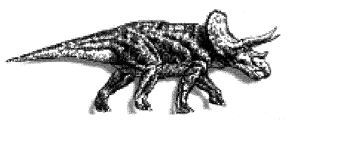
Identify the dinosaur shown in the figure.
A
Triceratops
B
Tyrannosaurus
C
Stegosaurus
D
Brachiosaurus
Solution
(A) The figure shows a dinosaur with three horns on its head and a large bony frill,which are the characteristic features of a Triceratops.
Therefore,the correct option is $A$.
Therefore,the correct option is $A$.
0 likes
View Solution50
MediumMCQ
Which of the following statements is false for $Tyrannosaurus$ $rex$?
A
Dagger-like teeth
B
Biggest dinosaur
C
$30$ feet in height
D
Land reptiles
Solution
(C) $Tyrannosaurus$ $rex$ was a large carnivorous dinosaur that lived during the Late Cretaceous period.
$1$. It possessed massive,dagger-like teeth for hunting.
$2$. It was a land reptile.
$3$. It reached a height of approximately $20$ feet,not $30$ feet.
$4$. While it was one of the largest known theropods,the term 'biggest' is often debated in paleontology as other dinosaurs like $Spinosaurus$ or $Argentinosaurus$ were larger in different dimensions. However,the most factually incorrect statement regarding its physical dimensions in this context is the height of $30$ feet.
$1$. It possessed massive,dagger-like teeth for hunting.
$2$. It was a land reptile.
$3$. It reached a height of approximately $20$ feet,not $30$ feet.
$4$. While it was one of the largest known theropods,the term 'biggest' is often debated in paleontology as other dinosaurs like $Spinosaurus$ or $Argentinosaurus$ were larger in different dimensions. However,the most factually incorrect statement regarding its physical dimensions in this context is the height of $30$ feet.
0 likes
View SolutionEvolution — Mix Examples- Evolution · Frequently Asked Questions
1Are these Evolution questions useful for JEE and NEET?
Yes. All questions in this section are mapped to JEE Main and NEET exam patterns. Previous year questions from JEE Main, NEET, GUJCET and state-level exams are included with full solutions.
2Can I switch to Hindi or Gujarati for these questions?
Yes. Use the language tabs in the hero section or the sidebar to view the same questions and solutions in English, Hindi or Gujarati.
3How do I generate a question paper from this subtopic?
Use the Vedclass Exam Paper Generator — select the chapter and subtopic, set difficulty, and generate Sets A, B, C, D automatically. First 3 chapters of every subject are free.
Vedclass Products
For Students
Vedclass Test Series
Mock tests in real JEE/NEET style with performance analysis. 5-day free trial.
Start Free TrialFor Teachers
Exam Paper Generator
Generate Set A/B/C/D papers from this chapter in 2 minutes. 3 chapters free.
Try FreeFor Institutes
Online Exam Module
Live online exams with unlimited students, 360° analytics & white-label branding.
See DemoFor Teachers & Institutes
Generate a Evolution Exam Paper in 2 Minutes
Select subtopic & difficulty — Sets A, B, C, D auto-generated with No Repeat logic.
First 3 chapters of every subject are free — no payment required.