
A English
Mechanism of Evolution Questions in English
Class 12 Biology · Evolution · Mechanism of Evolution
327+
Questions
English
Language
100%
With Solutions
Showing 49 of 327 questions in English
201
MediumMCQ
Which of the following are correct examples of evolution by anthropogenic action?
A
Only $(a)$
B
$(a)$ and $(c)$
C
$(b), (c)$ and $(d)$
D
Only $(d)$
Solution
(C) Evolution by anthropogenic action refers to changes in organisms due to human activities.
$(b)$ Herbicide-resistant weeds: These evolve due to the excessive use of herbicides.
$(c)$ Drug-resistant eukaryotes: These evolve due to the misuse or overuse of medicines/antibiotics.
$(d)$ Man-created domesticated breeds like dogs: These are the result of artificial selection performed by humans.
$(a)$ Darwin's finches on the Galapagos Islands are an example of natural selection (adaptive radiation),not anthropogenic action.
Therefore,$(b), (c),$ and $(d)$ are correct examples.
$(b)$ Herbicide-resistant weeds: These evolve due to the excessive use of herbicides.
$(c)$ Drug-resistant eukaryotes: These evolve due to the misuse or overuse of medicines/antibiotics.
$(d)$ Man-created domesticated breeds like dogs: These are the result of artificial selection performed by humans.
$(a)$ Darwin's finches on the Galapagos Islands are an example of natural selection (adaptive radiation),not anthropogenic action.
Therefore,$(b), (c),$ and $(d)$ are correct examples.
0 likes
View Solution202
Medium
Describe the theory of natural selection. Who proposed this theory?
Solution
(N/A) Charles Darwin conducted a sea voyage around the world between $1831-1836$ on the ship $HMS$ Beagle.
During this period,Darwin explored the flora and fauna of various continents and islands.
Based on his observations,he concluded the following: $(i)$ There has been a gradual evolution of life forms,with new forms arising at different periods in Earth's history. $(ii)$ Varying degrees of similarities exist between existing life forms and those that lived millions of years ago. $(iii)$ Populations of all organisms possess variations in characteristics,which help them adapt better to their environment. Characteristics that enable some individuals to survive better in natural conditions (food,climate,physical factors) allow them to outbreed others (survival of the fittest).
Thus,fitness,according to Darwin,refers ultimately to reproductive fitness.
Such fit individuals leave more progeny than others.
Consequently,organisms that are better adapted will survive more in nature and be selected by nature. This is called natural selection.
Branching descent (e.g.,Darwin's finches) and natural selection are the two key concepts of the Darwinian theory of evolution.
Alfred Wallace,a naturalist who worked in the Malay Archipelago,reached similar conclusions to Darwin.
Thus,they both jointly proposed the theory of 'Natural Selection' in $1858$.
It is based on the following factual observations: $(a)$ Natural resources are limited. $(b)$ Population sizes are stable except for seasonal fluctuations. $(c)$ Members of a population possess varying characteristics; no two members are identical,even if they appear superficially similar. $(d)$ Variations are generally inherited. $(e)$ Population size involves two facts: theoretically,it grows exponentially if everyone reproduces maximally,but in reality,population size is limited due to competition among individuals for resources.
Those that are better adapted survive and reproduce at the expense of those that are less adapted to the environment.
During this period,Darwin explored the flora and fauna of various continents and islands.
Based on his observations,he concluded the following: $(i)$ There has been a gradual evolution of life forms,with new forms arising at different periods in Earth's history. $(ii)$ Varying degrees of similarities exist between existing life forms and those that lived millions of years ago. $(iii)$ Populations of all organisms possess variations in characteristics,which help them adapt better to their environment. Characteristics that enable some individuals to survive better in natural conditions (food,climate,physical factors) allow them to outbreed others (survival of the fittest).
Thus,fitness,according to Darwin,refers ultimately to reproductive fitness.
Such fit individuals leave more progeny than others.
Consequently,organisms that are better adapted will survive more in nature and be selected by nature. This is called natural selection.
Branching descent (e.g.,Darwin's finches) and natural selection are the two key concepts of the Darwinian theory of evolution.
Alfred Wallace,a naturalist who worked in the Malay Archipelago,reached similar conclusions to Darwin.
Thus,they both jointly proposed the theory of 'Natural Selection' in $1858$.
It is based on the following factual observations: $(a)$ Natural resources are limited. $(b)$ Population sizes are stable except for seasonal fluctuations. $(c)$ Members of a population possess varying characteristics; no two members are identical,even if they appear superficially similar. $(d)$ Variations are generally inherited. $(e)$ Population size involves two facts: theoretically,it grows exponentially if everyone reproduces maximally,but in reality,population size is limited due to competition among individuals for resources.
Those that are better adapted survive and reproduce at the expense of those that are less adapted to the environment.
0 likes
View Solution203
Easy
Who proposed the mutation theory of evolution? Explain it.
Solution
(N/A) In $1901$,Hugo de Vries carried out experiments on the evening primrose plant ($Oenothera$ $lamarckiana$) and proposed the mutation theory of evolution.
This theory states that evolution occurs due to sudden,large differences (mutations) in a population.
He believed that mutation is the primary cause of evolution,rather than the minor heritable variations that Darwin discussed.
Mutations are random and directionless,whereas Darwinian variations are small and directional.
For Darwin,evolution was a gradual process,while de Vries believed that mutation caused speciation,which he termed as saltation (single-step large mutation).
Later studies in population genetics provided further clarity on these mechanisms.
This theory states that evolution occurs due to sudden,large differences (mutations) in a population.
He believed that mutation is the primary cause of evolution,rather than the minor heritable variations that Darwin discussed.
Mutations are random and directionless,whereas Darwinian variations are small and directional.
For Darwin,evolution was a gradual process,while de Vries believed that mutation caused speciation,which he termed as saltation (single-step large mutation).
Later studies in population genetics provided further clarity on these mechanisms.
0 likes
View Solution204
Medium
Differentiate between Lamarckism,Darwinism,and Mutation Theory.
Solution
(N/A)
| Properties | Lamarckism,Darwinism,and Mutation Theory Comparison |
|---|---|
| $(a)$ Vital force | Lamarckism believes in an internal vital force for size increase. Darwinism and Mutation Theory do not believe in any internal vital force. |
| $(b)$ Conscious Reaction | Lamarckism suggests animals react consciously to environmental changes. Darwinism and Mutation Theory do not involve conscious reactions in evolution. |
| $(c)$ Appetency | Lamarckism considers desires (appetency) as a force for modification. Darwinism and Mutation Theory do not consider appetency as a factor. |
| $(d)$ Use and disuse | Lamarckism emphasizes the use and disuse of organs. Darwinism and Mutation Theory are silent regarding the use and disuse of organs. |
0 likes
View Solution205
Easy
Give scientific reasons: Genetic drift is much more likely to change allele frequencies in a small population rather than a large population.
Solution
(N/A) In a large population,the effect of chance events on allele frequencies is negligible because the large number of individuals buffers against random fluctuations.
However,in a small population,the number of individuals carrying a specific allele is low.
Therefore,random chance events (such as accidents,natural disasters,or sampling errors) can significantly increase,decrease,or even completely eliminate certain alleles from the gene pool,leading to a rapid change in allele frequencies.
However,in a small population,the number of individuals carrying a specific allele is low.
Therefore,random chance events (such as accidents,natural disasters,or sampling errors) can significantly increase,decrease,or even completely eliminate certain alleles from the gene pool,leading to a rapid change in allele frequencies.
0 likes
View Solution206
Medium
Define the following terms: $Genetic \ drift$ and $Gene \ migration$ $(Gene \ flow)$.
Solution
(N/A) $Genetic \ drift$ refers to the random change in allele frequencies in a population due to chance events,independent of whether the traits are useful or harmful. This often occurs when a small section of a population is isolated,migrates,or dies due to a natural calamity,leading to a shift in the genetic makeup of the remaining population.
$Gene \ migration$ $(Gene \ flow)$ occurs when individuals from one population migrate into another and interbreed with the members of the local population. This process introduces new alleles into the local gene pool of the host population,thereby altering the allele frequencies.
$Gene \ migration$ $(Gene \ flow)$ occurs when individuals from one population migrate into another and interbreed with the members of the local population. This process introduces new alleles into the local gene pool of the host population,thereby altering the allele frequencies.
0 likes
View Solution207
Easy
Definition / Explanation: $Saltation$.
Solution
(N/A) Saltation refers to single-step large mutations that lead to speciation and evolution. This concept was proposed by Hugo de Vries,who believed that evolution is caused by sudden,large,and heritable changes (mutations) in a population,rather than small,directional variations as proposed by Darwin.
0 likes
View Solution208
MediumMCQ
According to $Darwin$,fitness refers to .....
A
Nutritional fitness
B
Reproductive fitness
C
Natural fitness
D
Habitat fitness
Solution
(B) According to $Darwin$,fitness is ultimately based on the ability of an organism to survive and reproduce in its environment.
$Darwinian$ fitness is defined as the relative ability of an organism to pass on its genes to the next generation.
Therefore,it is referred to as reproductive fitness,as those who are more fit leave more offspring.
$Darwinian$ fitness is defined as the relative ability of an organism to pass on its genes to the next generation.
Therefore,it is referred to as reproductive fitness,as those who are more fit leave more offspring.
0 likes
View Solution209
MediumMCQ
In the $1850$s,before industrialization in England,which type of moth was more abundant?
A
Melanized moths
B
White-winged moths
C
Dark-winged moths
D
Red-winged moths
Solution
(B) Before industrialization in England (around the $1850$s),the tree trunks were covered with white-colored lichens.
In this environment,the white-winged moths (Biston betularia) were better camouflaged against predators compared to the dark-winged (melanized) moths.
Therefore,the population of white-winged moths was significantly higher than that of the dark-winged moths.
This is a classic example of natural selection.
In this environment,the white-winged moths (Biston betularia) were better camouflaged against predators compared to the dark-winged (melanized) moths.
Therefore,the population of white-winged moths was significantly higher than that of the dark-winged moths.
This is a classic example of natural selection.
0 likes
View Solution210
MediumMCQ
Select the correct pair regarding the population of moths in the $1920$s.
A
Before industrialization - White-winged moths
B
Before industrialization - Melanized moths
C
After industrialization - Melanized moths
D
After industrialization - White-winged moths
Solution
(C) In England,before industrialization in the $1850$s,there were more white-winged moths on trees than dark-winged (melanized) moths because the white lichens on tree trunks provided camouflage for the white-winged moths.
After industrialization,the tree trunks became dark due to smoke and soot,which killed the lichens.
This change favored the dark-winged (melanized) moths as they could hide better against the soot-covered bark,while the white-winged moths were easily spotted and eaten by predators.
By the $1920$s,the population of melanized moths had significantly increased compared to the white-winged variety due to this selective advantage.
After industrialization,the tree trunks became dark due to smoke and soot,which killed the lichens.
This change favored the dark-winged (melanized) moths as they could hide better against the soot-covered bark,while the white-winged moths were easily spotted and eaten by predators.
By the $1920$s,the population of melanized moths had significantly increased compared to the white-winged variety due to this selective advantage.
0 likes
View Solution211
MediumMCQ
How do predators identify moths in the context of industrial melanism?
A
Contrasting background
B
Similar background
C
Lichens
D
Natural selection
Solution
(A) In the case of industrial melanism,before industrialization,the tree trunks were covered with white-colored lichens. The white-winged moths were able to camouflage against these lichens,making them less visible to predators. However,after industrialization,the tree trunks became dark due to soot and smoke,and lichens died. This created a 'contrasting background' for the light-colored moths,making them easily visible and identifiable to predators,while the dark-colored (melanic) moths were better camouflaged.
0 likes
View Solution212
MediumMCQ
Through which process were moths able to survive?
A
Migration
B
Camouflage
C
Sterility
D
Color loss
Solution
(B) The survival of moths, specifically the peppered moth $(Biston \text{ betularia})$, is a classic example of natural selection. Before industrialization, light-colored moths were better camouflaged against light-colored lichens on tree trunks. After industrialization, soot darkened the trees, making dark-colored moths better camouflaged against predators. This process of blending into the environment to avoid predation is known as camouflage.
0 likes
View Solution213
MediumMCQ
As a result of the excessive use of herbicides and pesticides,which types of varieties were selected in a short period?
A
Sensitive
B
Endangered
C
Resistant
D
Extinct
Solution
(C) The excessive use of herbicides and pesticides creates a strong selective pressure on populations of weeds and insects.
Individuals that possess natural genetic variations conferring resistance to these chemicals survive and reproduce.
Over a short period,these resistant individuals pass on their genes to the next generation,leading to the rapid selection of resistant varieties.
This is a classic example of anthropogenic action leading to evolution by natural selection.
Individuals that possess natural genetic variations conferring resistance to these chemicals survive and reproduce.
Over a short period,these resistant individuals pass on their genes to the next generation,leading to the rapid selection of resistant varieties.
This is a classic example of anthropogenic action leading to evolution by natural selection.
0 likes
View Solution214
MediumMCQ
The core essence of Darwinism regarding evolution is ........ .
A
Chemical evolution
B
Artificial selection
C
Natural selection
D
Mutation
Solution
(C) The core essence of Darwinism, as proposed by Charles Darwin, is the theory of $Natural \text{ } selection$.
According to this theory, individuals with traits better suited to their environment are more likely to survive and reproduce, passing these advantageous traits to the next generation.
This process leads to the gradual adaptation and evolution of populations over time.
According to this theory, individuals with traits better suited to their environment are more likely to survive and reproduce, passing these advantageous traits to the next generation.
This process leads to the gradual adaptation and evolution of populations over time.
0 likes
View Solution215
MediumMCQ
In which of the following organisms is the rate of appearance of new forms the highest?
A
$E. coli$
B
Fish
C
Human
D
Pangolin
Solution
(A) The rate of appearance of new forms (evolutionary change) is directly proportional to the generation time and the frequency of reproduction.
$E. coli$ is a bacterium with a very short generation time (approximately $20$ minutes).
Because bacteria reproduce rapidly and have a high mutation rate per generation,they can evolve and show new forms much faster than complex multicellular organisms like fish,humans,or pangolins.
Therefore,$E. coli$ exhibits the highest rate of appearance of new forms among the given options.
$E. coli$ is a bacterium with a very short generation time (approximately $20$ minutes).
Because bacteria reproduce rapidly and have a high mutation rate per generation,they can evolve and show new forms much faster than complex multicellular organisms like fish,humans,or pangolins.
Therefore,$E. coli$ exhibits the highest rate of appearance of new forms among the given options.
0 likes
View Solution216
MediumMCQ
Natural selection is based on which of the following?
A
Paleontological evidence
B
Embryological evidence
C
Anatomical structure of organs
D
Observations
Solution
(D) Natural selection,as proposed by Charles Darwin,is primarily based on observable facts and phenomena in nature.
$1$. Darwin observed that individuals within a population exhibit variations.
$2$. He noted that resources are limited,leading to a struggle for existence.
$3$. Individuals with advantageous variations are more likely to survive and reproduce,a process known as differential reproduction.
$4$. These observations of natural phenomena form the foundation of the theory of natural selection.
$1$. Darwin observed that individuals within a population exhibit variations.
$2$. He noted that resources are limited,leading to a struggle for existence.
$3$. Individuals with advantageous variations are more likely to survive and reproduce,a process known as differential reproduction.
$4$. These observations of natural phenomena form the foundation of the theory of natural selection.
0 likes
View Solution217
MediumMCQ
Who stated that variations which are heritable and which make resource utilization better for few will enable only those to reproduce and leave more progeny?
A
Hugo de Vries
B
Oparin
C
Lamarck
D
Darwin
Solution
(D) Charles Darwin,in his theory of natural selection,proposed that individuals with heritable variations that allow for better resource utilization are more likely to survive and reproduce. This process leads to these individuals leaving more progeny in the next generation,which is the core mechanism of natural selection.
0 likes
View Solution218
MediumMCQ
Who proposed the idea of mutations based on his work on plants?
A
Mendel
B
Hugo de Vries
C
Darwin
D
Weinberg
Solution
(B) Hugo de Vries proposed the mutation theory based on his work on the evening primrose $(Oenothera \, lamarckiana)$.
He believed that evolution is a saltatory process, meaning it occurs through large, sudden, and heritable variations called mutations.
Unlike Darwin's theory of gradual accumulation of small variations, de Vries emphasized that mutations are the primary cause of evolution.
He believed that evolution is a saltatory process, meaning it occurs through large, sudden, and heritable variations called mutations.
Unlike Darwin's theory of gradual accumulation of small variations, de Vries emphasized that mutations are the primary cause of evolution.
0 likes
View Solution219
MediumMCQ
What causes a sudden large change in a population?
A
Recombination
B
Adaptive radiation
C
Mutation
D
Natural selection
Solution
(C) According to Hugo de Vries,evolution is caused by sudden large mutations,which he called saltation (single-step large mutation).
While natural selection and recombination contribute to gradual changes,sudden and significant changes in the genetic makeup of a population are attributed to mutations.
While natural selection and recombination contribute to gradual changes,sudden and significant changes in the genetic makeup of a population are attributed to mutations.
0 likes
View Solution220
MediumMCQ
Choose the correct option for the variations suggested by Darwin.
A
Random and directionless
B
Small and directional
C
Small and directionless
D
Random and directional
Solution
(B) Charles Darwin,in his theory of natural selection,proposed that variations within a population are small and directional. He believed that these small,heritable variations accumulate over generations,leading to evolutionary change in a specific direction favored by natural selection. In contrast,Hugo de Vries proposed that mutations (variations) are large,random,and directionless.
0 likes
View Solution221
MediumMCQ
Saltation refers to . . . . . . .
A
Single step large mutation
B
Recombination
C
New species
D
Natural selection
Solution
(A) Saltation is a term coined by Hugo de Vries to describe the mechanism of evolution through large,sudden,and discontinuous variations.
These variations are known as mutations.
Unlike Darwin's theory of gradual evolution,saltation suggests that new species arise from a single step of large mutation.
Therefore,saltation refers to a single step large mutation.
These variations are known as mutations.
Unlike Darwin's theory of gradual evolution,saltation suggests that new species arise from a single step of large mutation.
Therefore,saltation refers to a single step large mutation.
0 likes
View Solution222
MediumMCQ
Select the appropriate option for $Saltation$.
A
Thomas Malthus
B
Lamarck
C
Hugo de Vries
D
Darwin
Solution
(C) The term $Saltation$ refers to single-step large mutations.
$Hugo \ de \ Vries$ proposed the mutation theory of evolution based on his work on the evening primrose $(Oenothera \ lamarckiana)$.
He believed that evolution is a discontinuous process caused by large,sudden mutations,which he termed $Saltation$.
$Hugo \ de \ Vries$ proposed the mutation theory of evolution based on his work on the evening primrose $(Oenothera \ lamarckiana)$.
He believed that evolution is a discontinuous process caused by large,sudden mutations,which he termed $Saltation$.
0 likes
View Solution223
MediumMCQ
What is it called when a part of a population migrates repeatedly to another population?
A
Gene flow
B
Genetic drift
C
Recombination
D
Founder effect
Solution
(A) When migration of a section of population to another place and population occurs,gene frequencies change in the original as well as in the new population. New genes/alleles are added to the new population and these are lost from the old population. There would be gene flow if this gene migration happens multiple times. If the same change occurs by chance,it is called genetic drift.
0 likes
View Solution224
MediumMCQ
Select the correct option for gene flow.
A
New alleles/genes are added to the new population and removed from the old population.
B
Genetic equilibrium is maintained in the new population and alleles are removed from the old population.
C
Alleles/genes are added to the new population and genetic equilibrium is maintained in the old population.
D
Alleles are removed from the new population and alleles are added to the old population.
Solution
(A) Gene flow refers to the movement of alleles or genes from one population to another.
When individuals migrate from one population to another,they carry their alleles with them.
As a result,these alleles are added to the gene pool of the new population and are simultaneously removed from the gene pool of the original (old) population.
This process changes the allele frequencies in both populations,thereby affecting the genetic equilibrium.
When individuals migrate from one population to another,they carry their alleles with them.
As a result,these alleles are added to the gene pool of the new population and are simultaneously removed from the gene pool of the original (old) population.
This process changes the allele frequencies in both populations,thereby affecting the genetic equilibrium.
0 likes
View Solution225
MediumMCQ
Select the appropriate option for the founder effect.
A
Recombination
B
Constant gene pool
C
Genetic drift in a small founder population
D
Mutation
Solution
(C) The founder effect occurs when a small group of individuals breaks off from a larger population to establish a new colony.
Because the new population is small,the allele frequencies in the new group may differ significantly from the original population due to random sampling error.
This phenomenon is a specific type of genetic drift,where the change in allele frequency is due to chance events in a small population.
Therefore,the founder effect is associated with genetic drift in a small founder population.
Because the new population is small,the allele frequencies in the new group may differ significantly from the original population due to random sampling error.
This phenomenon is a specific type of genetic drift,where the change in allele frequency is due to chance events in a small population.
Therefore,the founder effect is associated with genetic drift in a small founder population.
0 likes
View Solution226
MediumMCQ
Identify the incorrect statement.
A
Hugo de Vries proposed the idea of mutations based on his work on evening primrose.
B
Mutations are small and directional.
C
For Darwin, evolution is a gradual process.
D
Mendel provided information about factors that can be inherited.
Solution
(B) The incorrect statement is that mutations are small and directional. According to Hugo de Vries, mutations are large, sudden, and random (non-directional) changes in the genetic material. In contrast, Darwinian variations are small and directional, leading to gradual evolution. Hugo de Vries's work on evening primrose $(Oenothera \text{ lamarckiana})$ led to the Mutation Theory, which emphasizes that evolution is a saltatory (discontinuous) process, not a gradual one.
0 likes
View Solution227
MediumMCQ
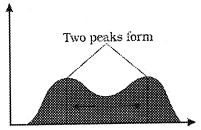
Select the appropriate option for the given figure.
A
Stabilizing
B
Directional
C
Disruptive
D
All of the above
Solution
(C) The provided figure shows a population distribution where the extreme phenotypes are favored over the intermediate phenotype,leading to the formation of two peaks.
This type of natural selection is known as disruptive selection.
In disruptive selection,the intermediate phenotype is selected against,while both extremes are favored,resulting in a bimodal distribution curve.
This type of natural selection is known as disruptive selection.
In disruptive selection,the intermediate phenotype is selected against,while both extremes are favored,resulting in a bimodal distribution curve.
0 likes
View Solution228
EasyMCQ
Genetic drift is also known as ........
A
Hardy-Weinberg effect
B
Hardy effect
C
Weinberg effect
D
Sewall Wright effect
Solution
(D) Genetic drift refers to the random fluctuations in allele frequencies in a population over generations due to chance events.
It is named after the American biologist Sewall Wright,who extensively studied and described this phenomenon.
Therefore,genetic drift is also known as the $Sewall \ Wright \ effect$.
It is named after the American biologist Sewall Wright,who extensively studied and described this phenomenon.
Therefore,genetic drift is also known as the $Sewall \ Wright \ effect$.
0 likes
View Solution229
MediumMCQ
Which characteristic is responsible for an organism to survive in the environment,enable reproduction,and maintain genetic stability?
A
Adaptation
B
Migration
C
Regulation
D
All of the above
Solution
(A) Adaptation is the evolutionary process whereby an organism becomes better suited to its habitat. It involves morphological,physiological,or behavioral changes that allow an organism to survive and reproduce in its environment. These adaptations are genetically fixed over generations,thereby contributing to the genetic stability of the population in a specific environment. While migration and regulation are strategies used by organisms to cope with environmental changes,adaptation is the fundamental characteristic that ensures long-term survival and evolutionary success.
0 likes
View Solution230
MediumMCQ
Which of the following is an effective force in biological evolution?
A
Interspecific competition
B
Competition
C
Antibiosis
D
Commensalism
Solution
(A) Biological evolution is significantly influenced by interactions between species. Among the given options, $Competition$ (specifically $Interspecific \text{ } competition$) is considered a potent force in evolution. It drives natural selection by forcing species to adapt, specialize, or occupy different niches to avoid extinction, thereby leading to evolutionary divergence and the development of new traits.
0 likes
View Solution231
MediumMCQ
The peppered moth $(Biston \text{ } betularia)$, the black-coloured form became dominant over the light-coloured form of moth in England during the industrial revolution. This is an example of
A
Appearance of the darker-coloured individuals due to very poor sunlight
B
Protective mimicry
C
Inheritance of darker colour character acquired due to the darker environment
D
Natural selection whereby the darker forms were selected
Solution
(D) Industrial melanism is an adaptation where the moths living in industrial areas developed melanin pigments to match their body to the black soot (smoke) covered surroundings.
Before industrialisation, the light-coloured moths were well-camouflaged against the whitish lichens on tree barks, making them less visible to predatory birds.
After industrialisation, the tree barks became covered with black soot, making the light-coloured moths highly visible and easily preyed upon by birds.
Conversely, the dark-coloured (melanic) moths were better camouflaged against the soot-covered barks, allowing them to survive and reproduce.
This process, where the environment selects for the better-adapted phenotype, is a classic example of natural selection.
Before industrialisation, the light-coloured moths were well-camouflaged against the whitish lichens on tree barks, making them less visible to predatory birds.
After industrialisation, the tree barks became covered with black soot, making the light-coloured moths highly visible and easily preyed upon by birds.
Conversely, the dark-coloured (melanic) moths were better camouflaged against the soot-covered barks, allowing them to survive and reproduce.
This process, where the environment selects for the better-adapted phenotype, is a classic example of natural selection.
0 likes
View Solution232
MediumMCQ
In a gene pool,along with beneficial mutations,those mutations also exist which are damaging to an individual. It has been found that these mutations are often not eliminated from the population because:
$I.$ They have survival value.
$II.$ They are acquired.
$III.$ They are recessive and carried by heterozygous individuals.
$IV.$ They show genetic drift.
Choose the incorrect option$(s)$ regarding why these mutations persist in the gene pool.
$I.$ They have survival value.
$II.$ They are acquired.
$III.$ They are recessive and carried by heterozygous individuals.
$IV.$ They show genetic drift.
Choose the incorrect option$(s)$ regarding why these mutations persist in the gene pool.
A
$I$ and $III$
B
$I$ and $II$
C
$II$ and $IV$
D
Only $III$
Solution
(B) Harmful mutations are not eliminated from the gene pool primarily because most of them are recessive.
In a diploid population,these recessive alleles are masked in the heterozygous state $(Aa)$,where the dominant allele $(A)$ expresses the normal phenotype,thus protecting the individual from the harmful effects of the recessive mutation $(a)$.
Since the mutation is not expressed in the phenotype of the heterozygote,it is not subjected to natural selection,allowing it to persist in the gene pool.
Statements $I$,$II$,and $IV$ do not explain the persistence of harmful recessive mutations in the gene pool. Therefore,$I$ and $II$ are incorrect explanations.
In a diploid population,these recessive alleles are masked in the heterozygous state $(Aa)$,where the dominant allele $(A)$ expresses the normal phenotype,thus protecting the individual from the harmful effects of the recessive mutation $(a)$.
Since the mutation is not expressed in the phenotype of the heterozygote,it is not subjected to natural selection,allowing it to persist in the gene pool.
Statements $I$,$II$,and $IV$ do not explain the persistence of harmful recessive mutations in the gene pool. Therefore,$I$ and $II$ are incorrect explanations.
0 likes
View Solution233
EasyMCQ
'Population tends to increase geometrically,while food supply increases arithmetically'. This concept was put forward by
A
$TR$ Malthus
B
Stuart Mill
C
Charles Darwin
D
Adam Smith
Solution
(A) The concept that 'population tends to increase geometrically,while food supply increases arithmetically' was proposed by $TR$ Malthus. This observation significantly influenced Charles Darwin's theory of natural selection,as it highlights the struggle for existence due to limited resources.
0 likes
View Solution234
MediumMCQ
Evolution that shifts the allele frequency in a consistent direction is called?
A
Directional evolution
B
Disruptive evolution
C
Molecular evolution
D
All of these
Solution
(A) The correct answer is Directional evolution.
Natural selection processes are categorized as follows:
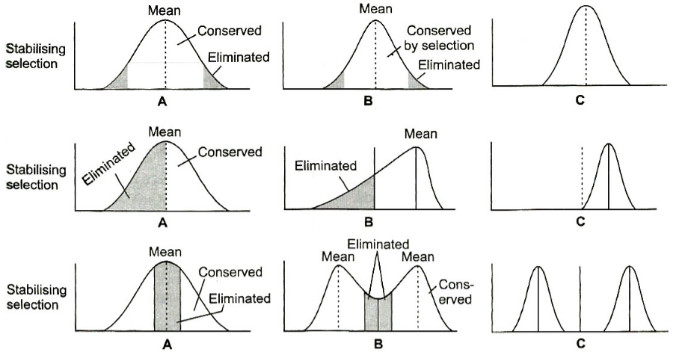
$(i)$ Stabilizing Selection (Balancing selection): This type of selection favors average-sized individuals while eliminating small and large-sized individuals. It reduces variation and does not promote evolutionary changes. It maintains the mean value from generation to generation. The graphical curve of the population remains bell-shaped.
$(ii)$ Directional Selection (Progressive selection): In this selection,the population changes towards one particular direction. This type of selection favors either small or large-sized individuals,and more individuals of that type will be present in the new generation. The mean size of the population shifts.
$(iii)$ Disruptive Selection (Diversifying selection): This type of selection favors both small-sized and large-sized individuals. It eliminates most of the members with mean expression,producing two peaks in the distribution of the trait,which may lead to the development of two different populations. This kind of selection is the opposite of stabilizing selection and is rare in nature but is very important in bringing about evolutionary changes.
Natural selection processes are categorized as follows:
$(i)$ Stabilizing Selection (Balancing selection): This type of selection favors average-sized individuals while eliminating small and large-sized individuals. It reduces variation and does not promote evolutionary changes. It maintains the mean value from generation to generation. The graphical curve of the population remains bell-shaped.
$(ii)$ Directional Selection (Progressive selection): In this selection,the population changes towards one particular direction. This type of selection favors either small or large-sized individuals,and more individuals of that type will be present in the new generation. The mean size of the population shifts.
$(iii)$ Disruptive Selection (Diversifying selection): This type of selection favors both small-sized and large-sized individuals. It eliminates most of the members with mean expression,producing two peaks in the distribution of the trait,which may lead to the development of two different populations. This kind of selection is the opposite of stabilizing selection and is rare in nature but is very important in bringing about evolutionary changes.
0 likes
View Solution235
MediumMCQ
Hugo de Vries's experimental organism was
A
Fruit fly
B
China rose plant
C
Four $O$'clock plant
D
Evening primrose
Solution
(D) Hugo de Vries conducted his experiments on $Oenothera$ $lamarckiana$ (Evening primrose).
He observed that when the plant was self-pollinated and its seeds were allowed to grow, the majority of $F_1$ plants were similar to the parents, but a few were significantly different.
Based on these experiments, Hugo de Vries proposed the Mutation Theory, suggesting that new types of inherited characters may appear suddenly without any previous indication of their presence in the population.
He observed that when the plant was self-pollinated and its seeds were allowed to grow, the majority of $F_1$ plants were similar to the parents, but a few were significantly different.
Based on these experiments, Hugo de Vries proposed the Mutation Theory, suggesting that new types of inherited characters may appear suddenly without any previous indication of their presence in the population.
0 likes
View Solution236
MediumMCQ
Saltation stands for
A
Single step large mutation
B
Single step small mutation
C
Double step small mutation
D
Double step large mutation
Solution
(A) Saltation refers to a single-step large mutation.
Hugo de Vries proposed that evolution is caused by large,sudden mutations rather than the minor,heritable variations suggested by Darwin.
Mutations are random and directionless,whereas Darwinian variations are small and directional.
The term 'saltation' specifically describes these single-step large mutations,which can lead to the formation of new species.
Hugo de Vries proposed that evolution is caused by large,sudden mutations rather than the minor,heritable variations suggested by Darwin.
Mutations are random and directionless,whereas Darwinian variations are small and directional.
The term 'saltation' specifically describes these single-step large mutations,which can lead to the formation of new species.
0 likes
View Solution237
MediumMCQ
Identify the phenomenon in which a new set of population is formed from the existing population due to an excessive change in the allele frequency.
A
Founder effect
B
Evolutionary effect
C
Bottle-neck effect
D
None of the above
Solution
(A) The phenomenon described is the $Founder \text{ effect}$.
When a small group of individuals from a larger population migrates to a new, isolated geographical area, the allele frequencies in this new group may differ significantly from the original population due to genetic drift.
These original individuals are referred to as $founders$, and the resulting change in the genetic makeup of the new population is known as the $Founder \text{ effect}$.
Over time, this can lead to the formation of a distinct species.
When a small group of individuals from a larger population migrates to a new, isolated geographical area, the allele frequencies in this new group may differ significantly from the original population due to genetic drift.
These original individuals are referred to as $founders$, and the resulting change in the genetic makeup of the new population is known as the $Founder \text{ effect}$.
Over time, this can lead to the formation of a distinct species.
0 likes
View Solution238
EasyMCQ
The theory of random genetic drift was proposed by
A
Sewall Wright
B
Hardy-Weinberg
C
$RA$ Fisher
D
Mayer
Solution
(A) Sewall Green Wright was an American geneticist known for his influential work on evolutionary theory.
The theory of random genetic drift was proposed by him.
Genetic drift or allelic drift is the change in the frequency of a gene variant (allele) in a population due to random sampling.
The effect of genetic drift is larger in small populations and smaller in large populations.
The theory of random genetic drift was proposed by him.
Genetic drift or allelic drift is the change in the frequency of a gene variant (allele) in a population due to random sampling.
The effect of genetic drift is larger in small populations and smaller in large populations.
0 likes
View Solution239
MediumMCQ
The phenomenon of industrial melanism demonstrates:
A
Reproductive isolation
B
Induced mutation
C
Natural selection
D
Geographical isolation
Solution
(C) The phenomenon of industrial melanism is a classic example of natural selection. In $19^{th}$ century England,before industrialization,white-winged moths were more abundant than dark-winged moths because they were camouflaged against light-colored lichens on tree trunks. After industrialization,soot covered the trees,making the dark-winged moths better adapted to survive predation by birds. This differential survival and reproduction based on environmental changes is the essence of natural selection.
0 likes
View Solution240
EasyMCQ
The phrase 'Survival of the Fittest' was used by
A
Hugo de Vries
B
Charles Darwin
C
Herbert Spencer
D
Jean Baptiste Lamarck
Solution
(C) Herbert Spencer $(1820-1903)$ coined the phrase 'survival of the fittest' to describe the mechanism of natural selection.
According to this concept,in the struggle for existence,only those individuals survive that possess the most advantageous variations.
While Charles Darwin popularized the theory of natural selection,the specific terminology 'survival of the fittest' was introduced by Herbert Spencer.
According to this concept,in the struggle for existence,only those individuals survive that possess the most advantageous variations.
While Charles Darwin popularized the theory of natural selection,the specific terminology 'survival of the fittest' was introduced by Herbert Spencer.
0 likes
View Solution241
MediumMCQ
According to Darwin's theory of evolution,differences between species occur due to:
A
The disuse of body structures
B
The transmission of acquired characteristics
C
Natural selection
D
Mutagenic agents
Solution
(C) Darwin's theory of evolution,known as the theory of natural selection,proposes that individuals with traits better suited to their environment are more likely to survive and reproduce. Over generations,this process of natural selection leads to the accumulation of favorable variations,resulting in the divergence and differences observed between species.
0 likes
View Solution242
MediumMCQ
Evolution is not continuous. It is a jerky and a discontinuous process. This is the punch line of
A
Natural selection theory of evolution
B
Theory of acquired character
C
Mutational theory of evolution
D
Synthetic theory of evolution
Solution
(C) Hugo de Vries $(1901)$ proposed the mutation theory of evolution.
This theory states that evolution is a jerky and discontinuous process where new species arise suddenly due to large,heritable mutations,which act as the raw material for evolution.
This theory states that evolution is a jerky and discontinuous process where new species arise suddenly due to large,heritable mutations,which act as the raw material for evolution.
0 likes
View Solution243
EasyMCQ
Industrial melanism was highlighted by
A
Mimosa pudica
B
Triticum aestivum
C
Biston betularia
D
Rock python
Solution
(C) Industrial melanism is a term used to describe the evolutionary process in which darker individuals come to predominate over lighter individuals as a result of natural selection following the industrial revolution.
Before $1848$,almost every individual of the peppered moth ($Biston$ $betularia$) captured in Great Britain had light-coloured wings with black specklings.
In $1848$,a black form of the moth was recorded in Manchester,and by $1895$,$98\%$ of the peppered moth population in Manchester was black.
This black melanic form arose due to a recurring random mutation,which provided a survival advantage in soot-covered environments.
Before $1848$,almost every individual of the peppered moth ($Biston$ $betularia$) captured in Great Britain had light-coloured wings with black specklings.
In $1848$,a black form of the moth was recorded in Manchester,and by $1895$,$98\%$ of the peppered moth population in Manchester was black.
This black melanic form arose due to a recurring random mutation,which provided a survival advantage in soot-covered environments.
0 likes
View Solution244
MediumMCQ
The idea of natural selection as the fundamental process of evolutionary changes was reached:
A
By Alfred Russell Wallace in $1901$
B
Independently by Charles Darwin and Alfred Russell Wallace in $1859$
C
Independently by Charles Darwin and Alfred Russell Wallace in $1900$
D
By Charles Darwin in $1866$
Solution
(B) In $1831$,Charles Darwin accepted an unpaid post of naturalist on the survey ship $HMS$ Beagle,which spent five years at sea charting the east coast of South America,leading him to develop the theory of natural selection.
Alfred Russell Wallace had travelled widely in South America,Malaya,and the Eastern Indian archipelago and arrived at the same conclusions as Darwin regarding natural selection.
In $1858$,Wallace wrote an essay outlining his theory and sent it to Darwin. This stimulated Darwin,and in July $1858$,both presented papers on their ideas at a meeting of the Linnean Society in London.
Subsequently,in $1859$,Darwin published his landmark book,'On the Origin of Species by Means of Natural Selection'.
Alfred Russell Wallace had travelled widely in South America,Malaya,and the Eastern Indian archipelago and arrived at the same conclusions as Darwin regarding natural selection.
In $1858$,Wallace wrote an essay outlining his theory and sent it to Darwin. This stimulated Darwin,and in July $1858$,both presented papers on their ideas at a meeting of the Linnean Society in London.
Subsequently,in $1859$,Darwin published his landmark book,'On the Origin of Species by Means of Natural Selection'.
0 likes
View Solution245
MediumMCQ
Which of the following examples of variation is not important from an evolutionary standpoint?
A
Genetic differences between individual organisms comprising the population
B
Inherited differences between individual organisms comprising the population
C
Both $(A)$ and $(B)$
D
Differences due to diet,health,age,and accident that have no effect on an individual's ability to survive and reproduce
Solution
(D) Evolutionary changes are based on variations that are heritable and can be passed on to the next generation.
Differences arising from diet,health,age,or accidents are somatic (acquired) variations.
These changes do not affect the organism's genetic material $(DNA)$.
Therefore,they are not transmitted to offspring and are not significant from an evolutionary standpoint.
Differences arising from diet,health,age,or accidents are somatic (acquired) variations.
These changes do not affect the organism's genetic material $(DNA)$.
Therefore,they are not transmitted to offspring and are not significant from an evolutionary standpoint.
0 likes
View Solution246
MediumMCQ
The sequence of events in geographic speciation is most likely to be
A
Genetic divergence $\rightarrow$ geographic barrier $\rightarrow$ reproductive isolation
B
Geographic barrier $\rightarrow$ genetic divergence $\rightarrow$ reproductive isolation
C
Reproductive isolation $\rightarrow$ genetic divergence $\rightarrow$ geographic barrier
D
Geographic barrier $\rightarrow$ reproductive isolation $\rightarrow$ genetic divergence
Solution
(B) Geographic speciation (allopatric speciation) follows this sequence:
$1$. Geographic barrier: $A$ physical barrier separates a population into two groups.
$2$. Genetic divergence: Due to different environmental pressures and mutations,the two groups accumulate genetic differences over time.
$3$. Reproductive isolation: Eventually,the genetic differences become so significant that the two groups can no longer interbreed,leading to the formation of new species.
Thus,the correct sequence is: Geographic barrier $\rightarrow$ Genetic divergence $\rightarrow$ Reproductive isolation.
$1$. Geographic barrier: $A$ physical barrier separates a population into two groups.
$2$. Genetic divergence: Due to different environmental pressures and mutations,the two groups accumulate genetic differences over time.
$3$. Reproductive isolation: Eventually,the genetic differences become so significant that the two groups can no longer interbreed,leading to the formation of new species.
Thus,the correct sequence is: Geographic barrier $\rightarrow$ Genetic divergence $\rightarrow$ Reproductive isolation.
0 likes
View Solution247
MediumMCQ
The best description of natural selection is
A
The survival of the fittest
B
The struggle for existence
C
The reproductive success of the members of a population best adapted to the environment
D
$A$ change in the proportion of variation within a population
Solution
(C) Natural selection is a process where organisms better adapted to their environment tend to survive and produce more offspring.
This reproductive success leads to the passing on of advantageous traits to the next generation.
Therefore,the most accurate description of natural selection is the reproductive success of the members of a population that are best adapted to their environment.
This reproductive success leads to the passing on of advantageous traits to the next generation.
Therefore,the most accurate description of natural selection is the reproductive success of the members of a population that are best adapted to their environment.
0 likes
View Solution248
MediumMCQ
$I.$ Use and disuse of organs
$II.$ Inheritance of acquired characters
$III.$ Branching descent
$IV.$ Natural selection
$V.$ Mutation
$VI.$ Reproductive isolation
The two key concepts of Darwinism from the given options are
$II.$ Inheritance of acquired characters
$III.$ Branching descent
$IV.$ Natural selection
$V.$ Mutation
$VI.$ Reproductive isolation
The two key concepts of Darwinism from the given options are
A
$I$ and $II$
B
$III$ and $IV$
C
$V$ and $VI$
D
$IV$ and $VI$
Solution
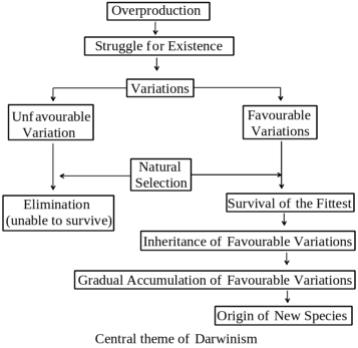
(B) The two key concepts of Darwinism are Branching Descent and Natural Selection.
$1.$ Branching Descent: Darwin proposed that all life forms share common ancestry,and evolution occurs through the branching of lineages.
$2.$ Natural Selection: This is the mechanism by which organisms better adapted to their environment tend to survive and produce more offspring.
$I$ and $II$ (Use and disuse of organs,Inheritance of acquired characters) are associated with Lamarckism.
$V$ (Mutation) is associated with Hugo de Vries' Mutation Theory.
$VI$ (Reproductive isolation) is a key concept of the Modern Synthetic Theory of evolution.
$1.$ Branching Descent: Darwin proposed that all life forms share common ancestry,and evolution occurs through the branching of lineages.
$2.$ Natural Selection: This is the mechanism by which organisms better adapted to their environment tend to survive and produce more offspring.
$I$ and $II$ (Use and disuse of organs,Inheritance of acquired characters) are associated with Lamarckism.
$V$ (Mutation) is associated with Hugo de Vries' Mutation Theory.
$VI$ (Reproductive isolation) is a key concept of the Modern Synthetic Theory of evolution.
0 likes
View Solution249
MediumMCQ
Darwin judged the fitness of an individual by
A
Ability to defend itself
B
Strategy to obtain food
C
Number of offsprings
D
Dominance over other individuals
Solution
(C) According to Darwin,fitness is ultimately defined by reproductive success.
Darwin realized that in a population facing intense competition,variations that favor survival in a specific environment increase an individual's ability to reproduce and leave fertile offspring.
Individuals with favorable variations are more likely to survive and pass their traits to the next generation.
Therefore,the 'survival of the fittest' is essentially the selection and proliferation of organisms that are most suitably adapted to their environment,measured by their contribution to the gene pool of the next generation,i.e.,the number of offspring produced.
Darwin realized that in a population facing intense competition,variations that favor survival in a specific environment increase an individual's ability to reproduce and leave fertile offspring.
Individuals with favorable variations are more likely to survive and pass their traits to the next generation.
Therefore,the 'survival of the fittest' is essentially the selection and proliferation of organisms that are most suitably adapted to their environment,measured by their contribution to the gene pool of the next generation,i.e.,the number of offspring produced.
0 likes
View SolutionEvolution — Mechanism of Evolution · Frequently Asked Questions
1Are these Evolution questions useful for JEE and NEET?
Yes. All questions in this section are mapped to JEE Main and NEET exam patterns. Previous year questions from JEE Main, NEET, GUJCET and state-level exams are included with full solutions.
2Can I switch to Hindi or Gujarati for these questions?
Yes. Use the language tabs in the hero section or the sidebar to view the same questions and solutions in English, Hindi or Gujarati.
3How do I generate a question paper from this subtopic?
Use the Vedclass Exam Paper Generator — select the chapter and subtopic, set difficulty, and generate Sets A, B, C, D automatically. First 3 chapters of every subject are free.
Vedclass Products
For Students
Vedclass Test Series
Mock tests in real JEE/NEET style with performance analysis. 5-day free trial.
Start Free TrialFor Teachers
Exam Paper Generator
Generate Set A/B/C/D papers from this chapter in 2 minutes. 3 chapters free.
Try FreeFor Institutes
Online Exam Module
Live online exams with unlimited students, 360° analytics & white-label branding.
See DemoFor Teachers & Institutes
Generate a Evolution Exam Paper in 2 Minutes
Select subtopic & difficulty — Sets A, B, C, D auto-generated with No Repeat logic.
First 3 chapters of every subject are free — no payment required.