
A English
Mechanism of Evolution Questions in English
Class 12 Biology · Evolution · Mechanism of Evolution
327+
Questions
English
Language
100%
With Solutions
Showing 27 of 327 questions in English
301
EasyMCQ
Given below are two statements.
Statement $I$ - In disruptive natural selection,individuals acquire peripheral character value at both the ends of the distribution curve.
Statement $II$ - Industrial melanism is an example of disruptive selection.
In the light of the above statements,select the correct option given below:
Statement $I$ - In disruptive natural selection,individuals acquire peripheral character value at both the ends of the distribution curve.
Statement $II$ - Industrial melanism is an example of disruptive selection.
In the light of the above statements,select the correct option given below:
A
Both statement $I$ and statement $II$ are correct.
B
Both statement $I$ and statement $II$ are incorrect.
C
Statement $I$ is correct but statement $II$ is incorrect.
D
Statement $I$ is incorrect but statement $II$ is correct.
Solution
(C) Statement $I$ is correct because disruptive selection favors individuals at both extremes of the phenotypic range,leading to a bimodal distribution curve.
Statement $II$ is incorrect because industrial melanism is a classic example of directional selection,where one extreme phenotype is favored over the other due to environmental changes (e.g.,soot-covered trees favoring dark-colored moths).
Therefore,statement $I$ is correct and statement $II$ is incorrect.
Statement $II$ is incorrect because industrial melanism is a classic example of directional selection,where one extreme phenotype is favored over the other due to environmental changes (e.g.,soot-covered trees favoring dark-colored moths).
Therefore,statement $I$ is correct and statement $II$ is incorrect.
0 likes
View Solution302
EasyMCQ
Due to specific mating behaviour,the members of a population do not mate in . . . . . . type of isolation.
A
ecological
B
temporal
C
ethological
D
mechanical
Solution
(C) Ethological isolation,also known as behavioral isolation,occurs when two species or populations do not interbreed because they have different mating rituals,courtship displays,or specific mating behaviors.
Since the question specifies that mating does not occur due to specific mating behavior,the correct answer is ethological isolation.
$A$. Ecological isolation involves differences in habitat.
$B$. Temporal isolation involves differences in the timing of breeding.
$D$. Mechanical isolation involves physical incompatibility of reproductive organs.
Since the question specifies that mating does not occur due to specific mating behavior,the correct answer is ethological isolation.
$A$. Ecological isolation involves differences in habitat.
$B$. Temporal isolation involves differences in the timing of breeding.
$D$. Mechanical isolation involves physical incompatibility of reproductive organs.
0 likes
View Solution303
EasyMCQ
Given below are two statements.
Statement $I$ - According to Darwin,the gradual,inheritable variations over a long period of time lead to speciation.
Statement $II$ - According to Hugo de Vries,mutations are the cause of variations.
In the light of above statements,select the correct option given below:
Statement $I$ - According to Darwin,the gradual,inheritable variations over a long period of time lead to speciation.
Statement $II$ - According to Hugo de Vries,mutations are the cause of variations.
In the light of above statements,select the correct option given below:
A
Both statement $I$ and statement $II$ are correct.
B
Both statement $I$ and statement $II$ are incorrect.
C
Statement $I$ is correct but statement $II$ is incorrect.
D
Statement $I$ is incorrect but statement $II$ is correct.
Solution
(A) Statement $I$ is correct: Charles Darwin proposed that evolution occurs through natural selection acting on small,gradual,and inheritable variations that accumulate over a long period,eventually leading to the formation of new species (speciation).
Statement $II$ is correct: Hugo de Vries proposed the Mutation Theory,suggesting that large,sudden,and inheritable changes (mutations) are the primary cause of variations and evolution,rather than small,gradual changes.
Statement $II$ is correct: Hugo de Vries proposed the Mutation Theory,suggesting that large,sudden,and inheritable changes (mutations) are the primary cause of variations and evolution,rather than small,gradual changes.
0 likes
View Solution304
EasyMCQ
The process of natural selection was named as survival of the fittest by . . . . . . .
A
Charles Darwin
B
Hugo de Vries
C
$H$. Spencer
D
Stanley Miller
Solution
(C) The phrase 'survival of the fittest' was coined by the British philosopher and scientist $H. Spencer$ (Herbert Spencer).
Although Charles Darwin proposed the theory of natural selection,he adopted the term 'survival of the fittest' in later editions of his book 'On the Origin of Species' to describe the mechanism of natural selection,acknowledging Spencer's contribution.
Although Charles Darwin proposed the theory of natural selection,he adopted the term 'survival of the fittest' in later editions of his book 'On the Origin of Species' to describe the mechanism of natural selection,acknowledging Spencer's contribution.
0 likes
View Solution305
EasyMCQ
Which one of the following is a cause of sympatric speciation?
A
Creeping glaciers
B
Development of mountains
C
Migration of individuals
D
Reproductive isolation
Solution
(D) Sympatric speciation is the process through which new species evolve from a single ancestral species while inhabiting the same geographic region.
Unlike allopatric speciation,which is driven by physical barriers like mountains or glaciers,sympatric speciation occurs due to reproductive isolation.
This isolation can arise from mechanisms such as polyploidy (common in plants),behavioral changes,or temporal differences in mating,which prevent gene flow between populations despite living in the same area.
Therefore,reproductive isolation is the fundamental cause of sympatric speciation.
Unlike allopatric speciation,which is driven by physical barriers like mountains or glaciers,sympatric speciation occurs due to reproductive isolation.
This isolation can arise from mechanisms such as polyploidy (common in plants),behavioral changes,or temporal differences in mating,which prevent gene flow between populations despite living in the same area.
Therefore,reproductive isolation is the fundamental cause of sympatric speciation.
0 likes
View Solution306
EasyMCQ
Which one of the following is $NOT$ a character of disruptive natural selection?
A
More number of individuals acquire peripheral value at ends of distribution curve.
B
Two peaks are formed in distribution of traits.
C
It tends to favour the intermediate forms.
D
Nature selects extreme phenotypes.
Solution
(C) In disruptive natural selection,extreme phenotypes are selected,and intermediate forms are eliminated.
Stabilizing natural selection is the type that favours intermediate forms,while disruptive selection favours both extremes.
Stabilizing natural selection is the type that favours intermediate forms,while disruptive selection favours both extremes.
0 likes
View Solution307
EasyMCQ
Given below are the two statements.
Statement $I$: Directional isolation favours the intermediate forms and eliminates both phenotypic extremes.
Statement $II$: In directional isolation,more individuals acquire a value other than the mean character value.
In the light of the above statements,choose the correct answer from the options given below:
Statement $I$: Directional isolation favours the intermediate forms and eliminates both phenotypic extremes.
Statement $II$: In directional isolation,more individuals acquire a value other than the mean character value.
In the light of the above statements,choose the correct answer from the options given below:
A
Both statement $I$ and statement $II$ are correct.
B
Both statement $I$ and statement $II$ are incorrect.
C
Statement $I$ is correct but statement $II$ is incorrect.
D
Statement $I$ is incorrect but statement $II$ is correct.
Solution
(D) Directional natural selection acts to eliminate one of the extremes of the phenotypic range and favour the other,e.g.,systematic shift in population traits due to environmental changes.
Stabilizing natural selection tends to favour the intermediate forms and eliminate both phenotypic extremes,e.g.,birth weight in human infants.
Statement $I$ is incorrect because it describes stabilizing selection,not directional selection.
Statement $II$ is correct because directional selection shifts the population mean towards one of the extreme values.
Stabilizing natural selection tends to favour the intermediate forms and eliminate both phenotypic extremes,e.g.,birth weight in human infants.
Statement $I$ is incorrect because it describes stabilizing selection,not directional selection.
Statement $II$ is correct because directional selection shifts the population mean towards one of the extreme values.
0 likes
View Solution308
EasyMCQ
Which one of the following is $INCORRECT$ with respect to genetic drift?
A
It is any alteration in allele frequency.
B
It occurs in a population by pure chance.
C
They are random or directionless.
D
Effect of genetic drift has no significance in small populations.
Solution
(D) Genetic drift refers to the change in allele frequency of a population due to random sampling of organisms.
It occurs by pure chance and is directionless.
Genetic drift has a significant impact on small populations because random fluctuations in allele frequencies can lead to the fixation or loss of alleles more rapidly than in large populations.
Therefore,the statement that it has no significance in small populations is incorrect.
It occurs by pure chance and is directionless.
Genetic drift has a significant impact on small populations because random fluctuations in allele frequencies can lead to the fixation or loss of alleles more rapidly than in large populations.
Therefore,the statement that it has no significance in small populations is incorrect.
0 likes
View Solution309
EasyMCQ
Which one of the following is correct with respect to Allopatric speciation?
A
There is no geographical isolation
B
Mutations are helpful in allopatric speciation
C
Species have evolved due to reproductive isolation
D
Mode of evolution in this type of speciation is called adaptive radiation
Solution
(B) Allopatric speciation occurs when a biological population becomes geographically isolated from the parent population,leading to the evolution of new species.
$1$. Geographical isolation is a prerequisite for allopatric speciation.
$2$. Mutations,along with natural selection and genetic drift,play a crucial role in the divergence of the isolated populations.
$3$. While reproductive isolation eventually occurs,it is the result of the geographical barrier preventing gene flow.
$4$. Adaptive radiation is a specific type of evolution where many species evolve from a single ancestor in a short time,often associated with allopatric speciation,but the most direct statement regarding the mechanism of allopatric speciation is that mutations contribute to the genetic divergence of these separated groups.
$1$. Geographical isolation is a prerequisite for allopatric speciation.
$2$. Mutations,along with natural selection and genetic drift,play a crucial role in the divergence of the isolated populations.
$3$. While reproductive isolation eventually occurs,it is the result of the geographical barrier preventing gene flow.
$4$. Adaptive radiation is a specific type of evolution where many species evolve from a single ancestor in a short time,often associated with allopatric speciation,but the most direct statement regarding the mechanism of allopatric speciation is that mutations contribute to the genetic divergence of these separated groups.
0 likes
View Solution310
EasyMCQ
Which one of the following is $NOT$ the main postulate of Darwinism?
A
Struggle for existence
B
Prodigality
C
Arrival of the fittest
D
Organic variation
Solution
(C) Darwinism,or the theory of natural selection,is based on several key postulates:
$1$. Overproduction (Prodigality): Organisms produce more offspring than can survive.
$2$. Struggle for existence: Due to limited resources,individuals compete for survival.
$3$. Variations: Individuals within a population exhibit variations.
$4$. Survival of the fittest: Individuals with advantageous variations are more likely to survive and reproduce.
The term 'Arrival of the fittest' is not a postulate of Darwinism. Darwin explained the 'Survival of the fittest' but did not explain the origin or 'arrival' of these variations,which was later addressed by Hugo de Vries through the mutation theory. Therefore,option $C$ is the correct answer.
$1$. Overproduction (Prodigality): Organisms produce more offspring than can survive.
$2$. Struggle for existence: Due to limited resources,individuals compete for survival.
$3$. Variations: Individuals within a population exhibit variations.
$4$. Survival of the fittest: Individuals with advantageous variations are more likely to survive and reproduce.
The term 'Arrival of the fittest' is not a postulate of Darwinism. Darwin explained the 'Survival of the fittest' but did not explain the origin or 'arrival' of these variations,which was later addressed by Hugo de Vries through the mutation theory. Therefore,option $C$ is the correct answer.
0 likes
View Solution311
EasyMCQ
The germplasm theory was proposed by . . . . . . .
A
Stanley Miller
B
Carl Woese
C
Charles Darwin
D
August Weismann
Solution
(D) The germplasm theory was proposed by $August \text{ } Weismann$ in $1892$.
According to this theory, the body of an organism is divided into two types of protoplasm: $somatoplasm$ and $germplasm$.
$Somatoplasm$ constitutes the body cells and is not inherited by the offspring.
$Germplasm$ constitutes the reproductive cells (gametes) and is passed from one generation to the next, serving as the physical basis of inheritance.
According to this theory, the body of an organism is divided into two types of protoplasm: $somatoplasm$ and $germplasm$.
$Somatoplasm$ constitutes the body cells and is not inherited by the offspring.
$Germplasm$ constitutes the reproductive cells (gametes) and is passed from one generation to the next, serving as the physical basis of inheritance.
0 likes
View Solution312
EasyMCQ
Given below are two statements regarding evolution.
Statement-$I$: Natural selection is the establishment of a phenotypic trait in changing environmental conditions.
Statement-$II$: Natural selection encourages those genes or traits that ensure highest degree of adaptive efficiency between population and its environment.
In the light of above statements, choose the most appropriate answer from the options given below.
Statement-$I$: Natural selection is the establishment of a phenotypic trait in changing environmental conditions.
Statement-$II$: Natural selection encourages those genes or traits that ensure highest degree of adaptive efficiency between population and its environment.
In the light of above statements, choose the most appropriate answer from the options given below.
A
Both Statement-$I$ and Statement-$II$ are correct.
B
Statement-$I$ is incorrect but Statement-$II$ is correct.
C
Statement-$I$ is correct but Statement-$II$ is incorrect.
D
Both Statement-$I$ and Statement-$II$ are incorrect.
Solution
(A) Statement-$I$ is correct. Natural selection acts on phenotypes, favoring traits that provide a survival or reproductive advantage in a changing environment.
Statement-$II$ is correct. The core principle of natural selection is the differential survival and reproduction of individuals based on their fitness, which maximizes the adaptive efficiency of a population within its specific environment.
Therefore, both statements are scientifically accurate descriptions of the mechanism of evolution by natural selection.
Statement-$II$ is correct. The core principle of natural selection is the differential survival and reproduction of individuals based on their fitness, which maximizes the adaptive efficiency of a population within its specific environment.
Therefore, both statements are scientifically accurate descriptions of the mechanism of evolution by natural selection.
0 likes
View Solution313
EasyMCQ
Given below are two statements regarding evolution.
$Statement-I$: Isolation is the separation of a population of a particular species into smaller units, which prevents interbreeding between them.
$Statement-II$: Due to isolating mechanisms, divergence and speciation do not occur.
In the light of the above statements, choose the most appropriate answer from the options given below.
$Statement-I$: Isolation is the separation of a population of a particular species into smaller units, which prevents interbreeding between them.
$Statement-II$: Due to isolating mechanisms, divergence and speciation do not occur.
In the light of the above statements, choose the most appropriate answer from the options given below.
A
Both $Statement-I$ and $Statement-II$ are correct.
B
$Statement-I$ is correct but $Statement-II$ is incorrect.
C
Both $Statement-I$ and $Statement-II$ are incorrect.
D
$Statement-I$ is incorrect but $Statement-II$ is correct.
Solution
(B) $Statement-I$ is correct because isolation restricts gene flow between populations, preventing interbreeding.
$Statement-II$ is incorrect because isolating mechanisms are actually the primary drivers of divergence and speciation. By preventing gene flow, populations accumulate independent genetic variations, which eventually leads to the formation of new species.
$Statement-II$ is incorrect because isolating mechanisms are actually the primary drivers of divergence and speciation. By preventing gene flow, populations accumulate independent genetic variations, which eventually leads to the formation of new species.
0 likes
View Solution314
EasyMCQ
Given below are two statements.
Statement-$I$: Elimination of particular alleles from a population due to natural disasters is called genetic drift.
Statement-$II$: Sudden temporary heritable change in the gene is called point mutation.
In the light of above statements,choose the most appropriate answer from the options given below:
Statement-$I$: Elimination of particular alleles from a population due to natural disasters is called genetic drift.
Statement-$II$: Sudden temporary heritable change in the gene is called point mutation.
In the light of above statements,choose the most appropriate answer from the options given below:
A
Statement-$I$ is correct but Statement-$II$ is incorrect.
B
Both Statement-$I$ and Statement-$II$ are incorrect.
C
Both Statement-$I$ and Statement-$II$ are correct.
D
Statement-$I$ is incorrect but Statement-$II$ is correct.
Solution
(A) Statement-$I$ is correct: Genetic drift refers to the change in allele frequency in a population due to chance events,such as natural disasters (bottleneck effect),which can lead to the elimination of specific alleles.
Statement-$II$ is incorrect: $A$ point mutation is a change in a single base pair of $DNA$. It is not defined as 'temporary'; mutations are generally permanent changes in the genetic material that can be inherited.
Statement-$II$ is incorrect: $A$ point mutation is a change in a single base pair of $DNA$. It is not defined as 'temporary'; mutations are generally permanent changes in the genetic material that can be inherited.
0 likes
View Solution315
EasyMCQ
Given below are two statements regarding evolution.
$Statement-I$: Selection against harmful mutation leads to a mutation balance.
$Statement-II$: In mutation balance, the allele frequency of harmful recessives keep on changing generation after generation.
In the light of above statements, choose the most appropriate answer from the options given below:
$Statement-I$: Selection against harmful mutation leads to a mutation balance.
$Statement-II$: In mutation balance, the allele frequency of harmful recessives keep on changing generation after generation.
In the light of above statements, choose the most appropriate answer from the options given below:
A
$Statement-I$ is correct but $Statement-II$ is incorrect.
B
Both $Statement-I$ and $Statement-II$ are correct.
C
Both $Statement-I$ and $Statement-II$ are incorrect.
D
$Statement-I$ is incorrect but $Statement-II$ is correct.
Solution
(A) $Statement-I$ is correct because mutation-selection balance occurs when the rate at which a harmful mutation is introduced by mutation is equal to the rate at which it is removed by natural selection.
$Statement-II$ is incorrect because, at mutation-selection balance, the allele frequency of harmful recessive alleles reaches an equilibrium state and does not change significantly from one generation to the next.
$Statement-II$ is incorrect because, at mutation-selection balance, the allele frequency of harmful recessive alleles reaches an equilibrium state and does not change significantly from one generation to the next.
0 likes
View Solution316
EasyMCQ
Sewall Wright effect is . . . . . . .
A
transfer of genes between populations
B
exchange of genetic material between communities
C
any alteration in allele frequency of a natural population by pure chance
D
changes in chemical makes up of a gene
Solution
(C) The Sewall Wright effect is another name for $Genetic \ Drift$.
Genetic drift refers to the random fluctuations in allele frequencies in a population over generations due to chance events,rather than natural selection.
It is particularly significant in small populations where random sampling errors can lead to the loss of certain alleles or the fixation of others.
Therefore,it is defined as any alteration in allele frequency of a natural population by pure chance.
Genetic drift refers to the random fluctuations in allele frequencies in a population over generations due to chance events,rather than natural selection.
It is particularly significant in small populations where random sampling errors can lead to the loss of certain alleles or the fixation of others.
Therefore,it is defined as any alteration in allele frequency of a natural population by pure chance.
0 likes
View Solution317
EasyMCQ
An elephant produces six young ones in its life span of $100$ years. If this continues,then,in $750$ years,$19$ million elephants will be produced. It is $NOT$ possible in reality mainly due to . . . . . . .
A
prodigality
B
mutation
C
competition
D
mutualism
Solution
(A) Prodigality refers to the excessive production of offspring. In the given scenario,if an elephant produces six young ones in its lifespan of $100$ years,it implies a theoretical reproductive potential. However,this is not sustainable in reality due to limited resources,environmental constraints,and competition for resources among individuals. The concept of 'prodigality of reproduction' is a key observation in Darwinian evolution,which suggests that while organisms have the potential to produce many offspring,environmental resistance (including competition) keeps the population in check.
0 likes
View Solution318
EasyMCQ
When members of a population attain sexual maturity at different times preventing inter-breeding,it is termed as . . . . . . isolation.
A
seasonal
B
mechanical
C
habitat
D
ethological
Solution
(A) Seasonal isolation,also known as temporal isolation,occurs when two populations of the same species reproduce at different times of the year or day.
Because their breeding seasons do not overlap,they cannot interbreed,which acts as a pre-zygotic reproductive barrier.
Mechanical isolation refers to physical incompatibility of reproductive organs.
Habitat isolation occurs when species live in the same area but occupy different niches or habitats.
Ethological isolation (behavioral isolation) occurs due to differences in mating rituals or signals.
Because their breeding seasons do not overlap,they cannot interbreed,which acts as a pre-zygotic reproductive barrier.
Mechanical isolation refers to physical incompatibility of reproductive organs.
Habitat isolation occurs when species live in the same area but occupy different niches or habitats.
Ethological isolation (behavioral isolation) occurs due to differences in mating rituals or signals.
0 likes
View Solution319
EasyMCQ
The diagram given below represents the operation of natural selection on different traits. Choose the correct option.
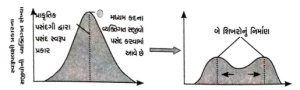
A
Disruptive
B
Directional
C
Stabilising
D
Stabilising and Directional both
Solution
(A) The provided diagram shows a population where individuals with extreme phenotypes are favored over those with intermediate phenotypes,leading to the formation of two peaks. This process is known as Disruptive selection. In this type of natural selection,the intermediate trait is selected against,while both extreme traits are favored,resulting in a bimodal distribution.
0 likes
View Solution320
EasyMCQ
Single step,large mutation is known as saltation. This statement is given by . . . . . . .
A
Darwin
B
Thomas Malthus
C
Hugo de Vries
D
Lamarck
Solution
(C) The concept of saltation was proposed by Hugo de Vries. He defined saltation as a single-step,large mutation that leads to speciation. Unlike Darwin's theory of gradual evolution through small variations,de Vries emphasized that evolution occurs through sudden,discontinuous variations or mutations.
0 likes
View Solution321
EasyMCQ
In the diagrammatic representation of the operation of natural selection,two peaks are formed. This condition shows the effect of . . . . . . .
A
Directional
B
Stabilising
C
Disruptive
D
Destructive
Solution
(C) The correct answer is $C$.
Natural selection can lead to three different outcomes based on the distribution of traits in a population:
$1$. Stabilising selection: The mean value of the trait is favoured,resulting in a single,narrower peak.
$2$. Directional selection: One extreme phenotype is favoured,shifting the peak in one direction.
$3$. Disruptive selection: Both extreme phenotypes are favoured over the intermediate phenotype,resulting in the formation of two peaks in the distribution graph.
Therefore,the formation of two peaks indicates the effect of disruptive selection.
Natural selection can lead to three different outcomes based on the distribution of traits in a population:
$1$. Stabilising selection: The mean value of the trait is favoured,resulting in a single,narrower peak.
$2$. Directional selection: One extreme phenotype is favoured,shifting the peak in one direction.
$3$. Disruptive selection: Both extreme phenotypes are favoured over the intermediate phenotype,resulting in the formation of two peaks in the distribution graph.
Therefore,the formation of two peaks indicates the effect of disruptive selection.
0 likes
View Solution322
EasyMCQ
Find the mismatch from the following pairs.
A
Divergent evolution - Thorn of Bougainvillea and tendril of Cucurbita
B
Adaptive radiation - Australian marsupials
C
Natural selection - Industrial melanism
D
Genetic drift frequency - Constant gene
Solution
(D) is the mismatch: Genetic drift - Constant gene.
Genetic drift refers to the random fluctuation in the frequencies of alleles in the gene pool of a finite population due to chance events.
It occurs over a few generations.
If the change in allele frequencies is very drastic,it can lead to the formation of new species.
Therefore,genetic drift does not maintain a constant gene frequency; rather,it causes unpredictable changes in it.
Genetic drift refers to the random fluctuation in the frequencies of alleles in the gene pool of a finite population due to chance events.
It occurs over a few generations.
If the change in allele frequencies is very drastic,it can lead to the formation of new species.
Therefore,genetic drift does not maintain a constant gene frequency; rather,it causes unpredictable changes in it.
0 likes
View Solution323
EasyMCQ
By the statement 'Survival of the Fittest', Darwin meant that . . . . . .
A
the strongest of all species survives
B
the most intelligent of the species survives
C
the cleverest of the species survives
D
the most adaptable of the species to changes survives
Solution
(D) is the correct answer.
By the statement "Survival of the Fittest," Darwin meant that the individuals of a species that are best adapted to their environment, through favorable variations and advantageous traits, are more likely to survive and reproduce in the struggle for existence.
By the statement "Survival of the Fittest," Darwin meant that the individuals of a species that are best adapted to their environment, through favorable variations and advantageous traits, are more likely to survive and reproduce in the struggle for existence.
0 likes
View Solution324
EasyMCQ
In a population of plants,some were extremely tall,and the remaining were extremely dwarf. No plants of the population showed intermediate height. The type of operation of natural selection in the above case is
A
disruptive
B
balancing
C
directional
D
stabilising
Solution
(A) The correct answer is $A$ (disruptive).
Natural selection can lead to three main outcomes:
$1$. Stabilising selection: In this,more individuals acquire the mean character value,reducing variation.
$2$. Directional selection: In this,more individuals acquire values other than the mean character value,shifting the population towards one extreme.
$3$. Disruptive selection: In this,more individuals acquire peripheral character values at both ends of the distribution curve,while the intermediate (mean) individuals are selected against. Since the population shows only extreme tall and extreme dwarf plants with no intermediate forms,it is a clear case of disruptive selection.
Natural selection can lead to three main outcomes:
$1$. Stabilising selection: In this,more individuals acquire the mean character value,reducing variation.
$2$. Directional selection: In this,more individuals acquire values other than the mean character value,shifting the population towards one extreme.
$3$. Disruptive selection: In this,more individuals acquire peripheral character values at both ends of the distribution curve,while the intermediate (mean) individuals are selected against. Since the population shows only extreme tall and extreme dwarf plants with no intermediate forms,it is a clear case of disruptive selection.
0 likes
View Solution325
EasyMCQ
When a change in the gene frequency of population occurs by chance,it is called . . . . . .
A
Genetic recombination
B
Genetic drift
C
Founder effect
D
Gene migration
Solution
(B) Genetic drift is defined as the change in the frequency of an existing gene variant (allele) in a population due to random sampling of organisms.
It occurs by chance and is more pronounced in small populations.
Unlike natural selection,which is a non-random process,genetic drift is a stochastic (random) process.
Therefore,the correct answer is Genetic drift.
It occurs by chance and is more pronounced in small populations.
Unlike natural selection,which is a non-random process,genetic drift is a stochastic (random) process.
Therefore,the correct answer is Genetic drift.
0 likes
View Solution326
EasyMCQ
Which of the following natural processes is likely to hasten organic evolution?
A
Overproduction
B
Favourable environment
C
Reproductive isolation
D
Abundant genotypic variations
Solution
(D) Organic evolution is the process of gradual change in the inherited characteristics of biological populations over successive generations.
$1$. $Abundant$ $genotypic$ $variations$ provide the raw material for evolution.
$2$. Natural selection acts upon these variations, favoring those that are better adapted to the environment.
$3$. While reproductive isolation is crucial for speciation, the presence of abundant genotypic variations is the fundamental requirement that accelerates the rate at which evolution can occur by providing more options for natural selection to act upon.
$4$. Therefore, abundant genotypic variations are the primary driver that hastens the process of organic evolution.
$1$. $Abundant$ $genotypic$ $variations$ provide the raw material for evolution.
$2$. Natural selection acts upon these variations, favoring those that are better adapted to the environment.
$3$. While reproductive isolation is crucial for speciation, the presence of abundant genotypic variations is the fundamental requirement that accelerates the rate at which evolution can occur by providing more options for natural selection to act upon.
$4$. Therefore, abundant genotypic variations are the primary driver that hastens the process of organic evolution.
0 likes
View Solution327
MediumMCQ
In natural selection,more individuals acquire value other than the mean character value,which indicates . . . . . . .
A
Directional
B
Disruptive
C
Stabilising Directional both
D
Stabilising
Solution
(A) Natural selection outcomes are classified as follows:
$(1)$ Stabilizing selection: More individuals acquire the mean character value.
$(2)$ Directional selection: More individuals acquire a value other than the mean character value in one specific direction.
$(3)$ Disruptive selection: More individuals acquire peripheral character values at both ends of the distribution curve.
Therefore,when more individuals acquire a value other than the mean character value,it indicates Directional selection.
$(1)$ Stabilizing selection: More individuals acquire the mean character value.
$(2)$ Directional selection: More individuals acquire a value other than the mean character value in one specific direction.
$(3)$ Disruptive selection: More individuals acquire peripheral character values at both ends of the distribution curve.
Therefore,when more individuals acquire a value other than the mean character value,it indicates Directional selection.
0 likes
View SolutionEvolution — Mechanism of Evolution · Frequently Asked Questions
1Are these Evolution questions useful for JEE and NEET?
Yes. All questions in this section are mapped to JEE Main and NEET exam patterns. Previous year questions from JEE Main, NEET, GUJCET and state-level exams are included with full solutions.
2Can I switch to Hindi or Gujarati for these questions?
Yes. Use the language tabs in the hero section or the sidebar to view the same questions and solutions in English, Hindi or Gujarati.
3How do I generate a question paper from this subtopic?
Use the Vedclass Exam Paper Generator — select the chapter and subtopic, set difficulty, and generate Sets A, B, C, D automatically. First 3 chapters of every subject are free.
Vedclass Products
For Students
Vedclass Test Series
Mock tests in real JEE/NEET style with performance analysis. 5-day free trial.
Start Free TrialFor Teachers
Exam Paper Generator
Generate Set A/B/C/D papers from this chapter in 2 minutes. 3 chapters free.
Try FreeFor Institutes
Online Exam Module
Live online exams with unlimited students, 360° analytics & white-label branding.
See DemoFor Teachers & Institutes
Generate a Evolution Exam Paper in 2 Minutes
Select subtopic & difficulty — Sets A, B, C, D auto-generated with No Repeat logic.
First 3 chapters of every subject are free — no payment required.