
A English
Mechanism of Evolution Questions in English
Class 12 Biology · Evolution · Mechanism of Evolution
327+
Questions
English
Language
100%
With Solutions
Showing 50 of 327 questions in English
251
MediumMCQ
Identify the phenomenon in which the members of a species do not interbreed with the members of other species or the same species.
A
Habitat isolation
B
Geographical isolation
C
Temporal isolation
D
Reproductive isolation
Solution
(D) The phenomenon in which members of a species are prevented from interbreeding with members of other species or even within the same species due to various biological or behavioral barriers is known as $Reproductive \text{ } isolation$.
This mechanism ensures that gene flow between populations is restricted, which is a fundamental process in speciation.
It is important to note that the criterion of $Reproductive \text{ } isolation$ cannot be applied to asexual organisms, as they do not reproduce sexually.
This mechanism ensures that gene flow between populations is restricted, which is a fundamental process in speciation.
It is important to note that the criterion of $Reproductive \text{ } isolation$ cannot be applied to asexual organisms, as they do not reproduce sexually.
0 likes
View Solution252
MediumMCQ
The natural selection that acts against change in the form and keeps the population constant through time is
A
Directional
B
Disruptive
C
Not acting
D
Stabilizing
Solution
(D) Stabilizing selection is a type of natural selection that favors the average phenotype and acts against extreme variations.
It operates in environments that remain relatively constant over time.
By eliminating extreme phenotypes,it reduces genetic variance and maintains the population's characteristics,keeping it genetically constant.
It operates in environments that remain relatively constant over time.
By eliminating extreme phenotypes,it reduces genetic variance and maintains the population's characteristics,keeping it genetically constant.
0 likes
View Solution253
MediumMCQ
In a random mating population in equilibrium,which of the following brings about a change in gene frequency in a non-directional manner?
A
Selection
B
Migration
C
Mutation
D
Random drift
Solution
(D) According to the $Hardy-Weinberg$ principle,allele frequencies in a population are stable and remain constant from generation to generation in the absence of evolutionary forces.
$Random \ genetic \ drift$ refers to the change in allele frequencies due to chance events in a small population.
Unlike $Selection$ (which is directional),$Mutation$ (which is often directional or specific),or $Migration$ (which introduces specific alleles),$Random \ drift$ causes fluctuations in allele frequencies that are random and non-directional.
Therefore,$Random \ drift$ is the factor that brings about a change in gene frequency in a non-directional manner.
$Random \ genetic \ drift$ refers to the change in allele frequencies due to chance events in a small population.
Unlike $Selection$ (which is directional),$Mutation$ (which is often directional or specific),or $Migration$ (which introduces specific alleles),$Random \ drift$ causes fluctuations in allele frequencies that are random and non-directional.
Therefore,$Random \ drift$ is the factor that brings about a change in gene frequency in a non-directional manner.
0 likes
View Solution254
MediumMCQ
$XX$ is a type of selection process in evolution. $XX$ promotes population changes in one particular direction. $XX$ favours small or large-sized individuals,and the mean size of the population changes in $XX$. Identify $XX$.
A
Stabilizing selection
B
Directional selection
C
Disruptive selection
D
None of these
Solution
(B) The correct answer is Directional selection.
Natural selection processes are categorized as follows:
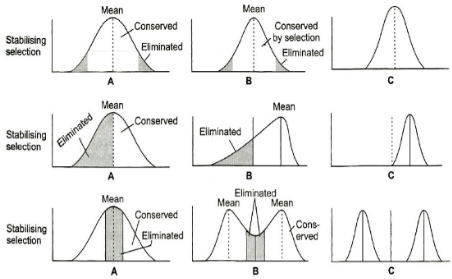
$(i)$ Stabilizing Selection (Balancing selection): This type of selection favours average-sized individuals while eliminating small and large-sized individuals. It reduces variation and,therefore,does not promote evolutionary changes. It maintains the mean value from generation to generation. The graphical curve of the population is bell-shaped.
$(ii)$ Directional Selection (Progressive Selection): In this selection,the population changes towards one particular direction. This type of selection favours either small or large-sized individuals,and more individuals of that type will be present in the new generation. Consequently,the mean size of the population changes.
$(iii)$ Disruptive Selection (Diversifying selection): This type of selection favours both small-sized and large-sized individuals. It eliminates most of the members with mean expression,producing two peaks in the distribution of the trait,which may lead to the development of two different populations. This kind of selection is the opposite of stabilizing selection and is rare in nature but is very important in bringing about evolutionary changes.
Natural selection processes are categorized as follows:
$(i)$ Stabilizing Selection (Balancing selection): This type of selection favours average-sized individuals while eliminating small and large-sized individuals. It reduces variation and,therefore,does not promote evolutionary changes. It maintains the mean value from generation to generation. The graphical curve of the population is bell-shaped.
$(ii)$ Directional Selection (Progressive Selection): In this selection,the population changes towards one particular direction. This type of selection favours either small or large-sized individuals,and more individuals of that type will be present in the new generation. Consequently,the mean size of the population changes.
$(iii)$ Disruptive Selection (Diversifying selection): This type of selection favours both small-sized and large-sized individuals. It eliminates most of the members with mean expression,producing two peaks in the distribution of the trait,which may lead to the development of two different populations. This kind of selection is the opposite of stabilizing selection and is rare in nature but is very important in bringing about evolutionary changes.
0 likes
View Solution255
MediumMCQ
'$A$ brief reduction in size of a population,due to natural calamities,usually leads to random genetic drift'. For this statement,identify the correct example from the following.
A
Human population of Pitcairn island
B
Polydactylic dwarfs in Amish population
C
Long-necked giraffe
D
Industrial melanism
Solution
(B) The phenomenon where a population's size is drastically reduced due to natural disasters,leading to a change in allele frequencies by chance,is known as the bottleneck effect,a type of genetic drift.
In the case of the Amish population of Lancaster,$USA$,a small group of founders (some of whom carried the gene for polydactyly) established the community.
Due to the small size of the initial population and subsequent isolation,the frequency of the polydactyly allele became significantly higher than in the general population,which is a classic example of genetic drift (specifically the founder effect,often associated with bottleneck events in population history).
In the case of the Amish population of Lancaster,$USA$,a small group of founders (some of whom carried the gene for polydactyly) established the community.
Due to the small size of the initial population and subsequent isolation,the frequency of the polydactyly allele became significantly higher than in the general population,which is a classic example of genetic drift (specifically the founder effect,often associated with bottleneck events in population history).
0 likes
View Solution256
MediumMCQ
Darwinian fitness can be estimated by
A
How long different individuals in a population survive
B
Number of offspring produced by different individuals in a population
C
Individuals having a large size in a population
D
Species recovering after mass extinction
Solution
(B) Darwinian fitness is defined as the ability of an organism to survive and reproduce in a given environment.
It is quantitatively measured by the reproductive success of an individual,which is the number of offspring produced by different individuals in a population.
Organisms that possess favorable variations in accordance with their environment are better adapted and,therefore,produce more offspring compared to those that do not possess such variations.
It is quantitatively measured by the reproductive success of an individual,which is the number of offspring produced by different individuals in a population.
Organisms that possess favorable variations in accordance with their environment are better adapted and,therefore,produce more offspring compared to those that do not possess such variations.
0 likes
View Solution257
MediumMCQ
Select the incorrect statements:
$I.$ Natural selection is essential for evolution.
$II.$ Natural selection does not include variations.
$III.$ The concept of natural selection was given by Hugo de Vries.
$IV.$ Mutation is a sudden inheritable change.
$V.$ The synthetic theory is also called the Neo-Darwinism theory of evolution.
$I.$ Natural selection is essential for evolution.
$II.$ Natural selection does not include variations.
$III.$ The concept of natural selection was given by Hugo de Vries.
$IV.$ Mutation is a sudden inheritable change.
$V.$ The synthetic theory is also called the Neo-Darwinism theory of evolution.
A
$I, II$ and $III$
B
$II, III$ and $IV$
C
$III, IV$ and $V$
D
$II$ and $III$
Solution
(D) Statement $I$ is correct: Natural selection is a fundamental mechanism of evolution.
Statement $II$ is incorrect: Natural selection acts upon the variations present in a population.
Statement $III$ is incorrect: The concept of natural selection was proposed by Charles Darwin,whereas Hugo de Vries proposed the Mutation Theory.
Statement $IV$ is correct: Mutations are sudden,stable,and inheritable changes in the genetic material.
Statement $V$ is correct: The Modern Synthetic Theory of evolution is often referred to as Neo-Darwinism.
Therefore,the incorrect statements are $II$ and $III$.
Statement $II$ is incorrect: Natural selection acts upon the variations present in a population.
Statement $III$ is incorrect: The concept of natural selection was proposed by Charles Darwin,whereas Hugo de Vries proposed the Mutation Theory.
Statement $IV$ is correct: Mutations are sudden,stable,and inheritable changes in the genetic material.
Statement $V$ is correct: The Modern Synthetic Theory of evolution is often referred to as Neo-Darwinism.
Therefore,the incorrect statements are $II$ and $III$.
0 likes
View Solution258
MediumMCQ
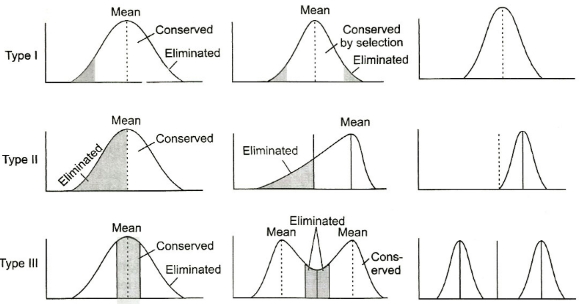
Name the type of natural selection depicted in the given diagram (Type $I$,Type $II$ and Type $III$).
A
Disruptive,Directional,Stabilising
B
Directional,Disruptive,Stabilising
C
Stabilising,Directional,Disruptive
D
Stabilising,Disruptive,Directional
Solution
(C) Based on the provided diagram:
Type $I$ represents Stabilising Selection: This type of selection favours average-sized individuals and eliminates extreme phenotypes. It reduces variation and maintains the mean value from generation to generation.
Type $II$ represents Directional Selection: In this selection,the population changes towards one particular direction. It favours individuals at one extreme of the phenotypic range,causing the mean size of the population to shift.
Type $III$ represents Disruptive Selection: This type of selection favours both small-sized and large-sized individuals at the extremes,while eliminating the members with the mean expression. This leads to two peaks in the distribution of the trait.
Therefore,the correct sequence is Stabilising,Directional,Disruptive.
Type $I$ represents Stabilising Selection: This type of selection favours average-sized individuals and eliminates extreme phenotypes. It reduces variation and maintains the mean value from generation to generation.
Type $II$ represents Directional Selection: In this selection,the population changes towards one particular direction. It favours individuals at one extreme of the phenotypic range,causing the mean size of the population to shift.
Type $III$ represents Disruptive Selection: This type of selection favours both small-sized and large-sized individuals at the extremes,while eliminating the members with the mean expression. This leads to two peaks in the distribution of the trait.
Therefore,the correct sequence is Stabilising,Directional,Disruptive.
0 likes
View Solution259
MediumMCQ
Which of the following does not illustrate the phenomenon of natural selection?
A
Industrial melanism
B
Herbicide resistant weeds
C
Artificial breeding
D
Antibiotic resistant microbes
Solution
(C) Natural selection is a process where organisms better adapted to their environment tend to survive and produce more offspring.
$A$,$B$,and $D$ are examples of natural selection occurring in response to environmental changes (pollution,herbicides,and antibiotics).
$C$,Artificial breeding,is a process where humans deliberately select and breed organisms with specific traits,which is an example of artificial selection,not natural selection.
$A$,$B$,and $D$ are examples of natural selection occurring in response to environmental changes (pollution,herbicides,and antibiotics).
$C$,Artificial breeding,is a process where humans deliberately select and breed organisms with specific traits,which is an example of artificial selection,not natural selection.
0 likes
View Solution260
MediumMCQ
If gene migration happens multiple times,it would lead to
A
Mutation
B
Gene flow
C
Chemical evolution
D
Genetic drift
Solution
(B) Gene migration refers to the movement of alleles into or out of a population due to the migration of individuals. When this process occurs multiple times,it results in gene flow,which changes the allele frequencies in the population.
0 likes
View Solution261
MediumMCQ
Natural selection in which more individuals acquire peripheral character values at both ends of the distribution curve is:
A
Stabilising natural selection
B
Disruptive natural selection
C
Directional natural selection
D
The curve never shows the formation of two peaks
Solution
(B) In natural selection,there are three main types based on the distribution of phenotypes:
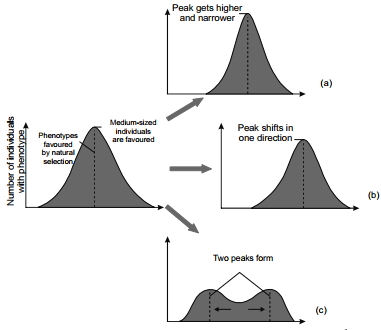
$1$. Stabilising selection: The mean phenotype is favoured,and the peak becomes higher and narrower.
$2$. Directional selection: Individuals at one extreme are favoured,causing the peak to shift in one direction.
$3$. Disruptive selection: Individuals at both peripheral ends (extremes) of the distribution curve are favoured over the mean phenotype. This results in the formation of two peaks in the distribution curve.
Therefore,the correct option is $B$.
$1$. Stabilising selection: The mean phenotype is favoured,and the peak becomes higher and narrower.
$2$. Directional selection: Individuals at one extreme are favoured,causing the peak to shift in one direction.
$3$. Disruptive selection: Individuals at both peripheral ends (extremes) of the distribution curve are favoured over the mean phenotype. This results in the formation of two peaks in the distribution curve.
Therefore,the correct option is $B$.
0 likes
View Solution262
MediumMCQ
Which of the following scientists believed in the concept of natural selection like Darwin?
A
Lamarck
B
$S.L.$ Miller
C
Alfred Wallace
D
Haldane
Solution
(C) Alfred Russel Wallace was a naturalist who independently proposed the theory of evolution through natural selection. He conducted extensive field research in the Malay Archipelago and reached conclusions similar to those of Charles Darwin at the same time.
0 likes
View Solution263
MediumMCQ
The Darwinian variations are
A
Small and directionless
B
Random and directional
C
Small and directional
D
Random and directionless
Solution
(C) Darwinian variations are considered to be small and directional.
According to Charles Darwin,natural selection acts on these small,continuous variations,leading to evolutionary change in a specific direction over time.
In contrast,Hugo de Vries proposed that mutations are large,sudden,and random (directionless),which he termed 'saltation'.
According to Charles Darwin,natural selection acts on these small,continuous variations,leading to evolutionary change in a specific direction over time.
In contrast,Hugo de Vries proposed that mutations are large,sudden,and random (directionless),which he termed 'saltation'.
0 likes
View Solution264
MediumMCQ
Natural selection leads to the directional change when:
A
More individuals acquire mean character value in the distribution curve.
B
More individuals acquire peripheral character value of both ends of distribution curve.
C
More individuals acquire value other than the mean character value at any one end of distribution curve.
D
No individual acquires the peripheral character value.
Solution
(C) Natural selection can lead to three different types of changes in the distribution of traits in a population:
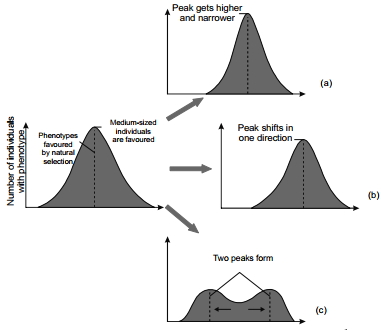
$1$. Stabilizing selection: More individuals acquire the mean character value,making the peak higher and narrower.
$2$. Directional selection: More individuals acquire a value other than the mean character value at any one end of the distribution curve,causing the peak to shift in one direction.
$3$. Disruptive selection: More individuals acquire peripheral character values at both ends of the distribution curve,leading to the formation of two peaks.
Therefore,directional change occurs when more individuals acquire a value other than the mean character value at any one end of the distribution curve.
$1$. Stabilizing selection: More individuals acquire the mean character value,making the peak higher and narrower.
$2$. Directional selection: More individuals acquire a value other than the mean character value at any one end of the distribution curve,causing the peak to shift in one direction.
$3$. Disruptive selection: More individuals acquire peripheral character values at both ends of the distribution curve,leading to the formation of two peaks.
Therefore,directional change occurs when more individuals acquire a value other than the mean character value at any one end of the distribution curve.
0 likes
View Solution265
MediumMCQ
$A$: Mutations are non-directional.
$R$: Darwin's small variations are directional.
$R$: Darwin's small variations are directional.
A
Assertion and Reason both are correct and Reason is the correct explanation of Assertion.
B
Assertion and Reason both are correct but Reason is not the correct explanation of Assertion.
C
Assertion is correct,but Reason is incorrect.
D
Both Assertion and Reason are incorrect.
Solution
(B) According to the $Hugo \ de \ Vries$ mutation theory,mutations are random and non-directional.
In contrast,$Charles \ Darwin$ proposed that evolution occurs through small,continuous,and directional variations that provide a survival advantage.
Therefore,both the Assertion and the Reason are correct,but the Reason does not explain the mechanism of mutations mentioned in the Assertion.
In contrast,$Charles \ Darwin$ proposed that evolution occurs through small,continuous,and directional variations that provide a survival advantage.
Therefore,both the Assertion and the Reason are correct,but the Reason does not explain the mechanism of mutations mentioned in the Assertion.
0 likes
View Solution266
DifficultMCQ
$A$: Due to the bottleneck effect,among the survivors,certain alleles may be overrepresented,some may be underrepresented,and some alleles may be totally eliminated.
$R$: The path of extinction of a species cannot be reversed due to the bottleneck effect.
$R$: The path of extinction of a species cannot be reversed due to the bottleneck effect.
A
Assertion and Reason both are correct and Reason is the correct explanation of Assertion.
B
Assertion and Reason both are correct but Reason is not the correct explanation of Assertion.
C
Assertion is correct,but Reason is incorrect.
D
Both Assertion and Reason are incorrect.
Solution
(C) The bottleneck effect is a sharp reduction in the size of a population due to environmental events or human activities,which results in a significant decrease in genetic variability.
Because the survivors represent only a small,random sample of the original population,certain alleles may become overrepresented,underrepresented,or completely lost (eliminated) from the gene pool.
This loss of genetic diversity makes the population more vulnerable to extinction,but the statement that the path of extinction cannot be reversed 'due to the bottleneck effect' is scientifically inaccurate.
Extinction is an irreversible process by definition,regardless of the bottleneck effect,and the bottleneck effect itself describes a change in allele frequencies,not the impossibility of recovery or the definition of extinction.
Therefore,the Assertion is correct,but the Reason is incorrect.
Because the survivors represent only a small,random sample of the original population,certain alleles may become overrepresented,underrepresented,or completely lost (eliminated) from the gene pool.
This loss of genetic diversity makes the population more vulnerable to extinction,but the statement that the path of extinction cannot be reversed 'due to the bottleneck effect' is scientifically inaccurate.
Extinction is an irreversible process by definition,regardless of the bottleneck effect,and the bottleneck effect itself describes a change in allele frequencies,not the impossibility of recovery or the definition of extinction.
Therefore,the Assertion is correct,but the Reason is incorrect.
0 likes
View Solution267
MediumMCQ
$A$: $A$ single large mutation called saltation can produce new species.
$R$: Mutations are directional.
$R$: Mutations are directional.
A
Assertion and Reason both are correct and Reason is the correct explanation of Assertion.
B
Assertion and Reason both are correct but Reason is not the correct explanation of Assertion.
C
Assertion is correct,but Reason is incorrect.
D
Both Assertion and Reason are incorrect.
Solution
(C) The Assertion is correct because Hugo de Vries proposed the mutation theory,stating that large,sudden,and heritable changes (saltation) can lead to speciation.
The Reason is incorrect because mutations are random and non-directional,meaning they do not occur in a specific direction to achieve a goal; rather,natural selection acts upon these random variations.
The Reason is incorrect because mutations are random and non-directional,meaning they do not occur in a specific direction to achieve a goal; rather,natural selection acts upon these random variations.
0 likes
View Solution268
EasyMCQ
Who stated that human population grows geometrically?
A
Malthus
B
Darwin
C
Cannon
D
Lamarck
Solution
(A) Thomas Malthus proposed the theory that human population grows in a geometric progression $(1, 2, 4, 8, 16, \ldots)$,whereas the food supply increases only in an arithmetic progression $(1, 2, 3, 4, \ldots)$.
This discrepancy leads to a struggle for existence,which is a fundamental concept in evolutionary biology.
This discrepancy leads to a struggle for existence,which is a fundamental concept in evolutionary biology.
0 likes
View Solution269
EasyMCQ
Gloger's rule is related to the:
A
Colour
B
Extremities
C
Narrow wing
D
Size
Solution
(A) Gloger's Rule states that in warm-blooded animals (endotherms),including humans,pigmentation is lighter in colder and drier areas,while it tends to be darker (yellow-brown to red in arid climates and black in humid,hot areas) in warmer and more humid environments. Thus,it is primarily related to the colour of the organism.
0 likes
View Solution270
MediumMCQ
Genetic drift operates in
A
Small isolated population
B
Large isolated population
C
Fast reproductive population
D
Slow reproductive population
Solution
(A) Genetic drift refers to the random change in allele frequencies in a population over generations. It has a significant impact on small,isolated populations because chance events can cause certain alleles to become fixed or lost more easily than in large populations,where the effects of genetic drift are buffered by the large number of individuals.
0 likes
View Solution271
MediumMCQ
When Darwin spoke of the struggle for existence and survival of the fittest in nature,he was convinced that
A
Intraspecific competition is a potent force in organic evolution
B
Interspecific competition is a potent force in organic evolution
C
Intensive reproduction is the potent force in organic evolution
D
Intensive predation is the potent force in organic evolution
Solution
(B) Darwin's theory of natural selection emphasizes that individuals with variations that provide an advantage in the struggle for existence are more likely to survive and reproduce.
Interspecific competition refers to the competition between individuals of different species for the same limited resources.
Darwin observed that this competition acts as a significant selective pressure,driving the process of organic evolution by favoring those individuals that are better adapted to their environment.
Interspecific competition refers to the competition between individuals of different species for the same limited resources.
Darwin observed that this competition acts as a significant selective pressure,driving the process of organic evolution by favoring those individuals that are better adapted to their environment.
0 likes
View Solution272
MediumMCQ
Natural selection operates at
A
Organismal level
B
Population level
C
Community level
D
Ecosystem level
Solution
(B) Natural selection is a mechanism of evolution that acts on the variation present within a population. It favors individuals with traits that increase their fitness in a specific environment,leading to changes in allele frequencies over generations. Therefore,natural selection operates at the population level.
0 likes
View Solution273
EasyMCQ
When two related populations occupy geographically or spatially separate areas,they are called
A
Allopatric population
B
Quantum population
C
Saltational population
D
Parapatric population
Solution
(A) When two related populations occupy geographically or spatially separate areas,they are called allopatric populations. The term 'allopatric' is derived from the Greek words 'allos' (other) and 'patra' (homeland),referring to populations that are separated by a physical or geographical barrier.
0 likes
View Solution274
MediumMCQ
Which of the following factors causes a population to experience the founder effect?
A
Natural selection
B
Genetic recombination
C
Genetic drift
D
Mutation
Solution
(C) The founder effect is a phenomenon that occurs when a small group of individuals breaks off from a larger population to establish a new colony.
Because the new group is small,it does not possess the full genetic diversity of the original population.
This change in allele frequencies due to chance events in a small population is a specific type of $Genetic \ drift$.
Therefore,$Genetic \ drift$ is the primary factor responsible for the founder effect.
Because the new group is small,it does not possess the full genetic diversity of the original population.
This change in allele frequencies due to chance events in a small population is a specific type of $Genetic \ drift$.
Therefore,$Genetic \ drift$ is the primary factor responsible for the founder effect.
2 likes
View Solution275
EasyMCQ
What was the major contribution of the scientist August Weismann?
A
Proposed the theory of natural selection.
B
Proposed the theory of continuity of germplasm.
C
Proposed the theory of inheritance of acquired characters.
D
Proposed the theory of mutation.
Solution
(B) August Weismann provided the strongest opposition to Lamarck's theory of the inheritance of acquired characters. In $1892$,he proposed the 'Theory of Continuity of Germplasm',which states that germplasm (reproductive cells) is continuous from generation to generation,while somatoplasm (body cells) is not inherited. This effectively disproved the idea that changes acquired by the body during an organism's lifetime could be passed on to offspring.
0 likes
View Solution276
MediumMCQ
Define the term 'Gene Pool'.
A
The total number of individuals in a population.
B
The sum total of all genes and their alleles present in a population at a given time.
C
The process of gene mutation in a species.
D
The movement of genes from one population to another.
Solution
(B) The gene pool is defined as the sum total of all genes and their alleles present in a population at a given time. It represents the complete set of genetic information available within a breeding population of a particular species.
0 likes
View Solution277
MediumMCQ
Natural selection where more individuals acquire specific character value other than the mean character value,leads to:
A
Directional change
B
Disruptive change
C
Random change
D
Stabilising change
Solution
(A) In natural selection,when more individuals acquire a value other than the mean character value,the population shifts towards one extreme. This is known as Directional selection or Directional change.
$1$. Stabilising selection: Individuals with mean character values are favoured.
$2$. Directional selection: Individuals at one extreme of the character range are favoured,causing the mean to shift.
$3$. Disruptive selection: Individuals at both extremes of the character range are favoured,leading to two peaks in the distribution.
$1$. Stabilising selection: Individuals with mean character values are favoured.
$2$. Directional selection: Individuals at one extreme of the character range are favoured,causing the mean to shift.
$3$. Disruptive selection: Individuals at both extremes of the character range are favoured,leading to two peaks in the distribution.
0 likes
View Solution278
MediumMCQ
According to $Darwin$,fitness refers to .........
A
Health fitness
B
Reproductive fitness
C
Organisms that can prey more
D
All of the above
Solution
(B) According to $Darwin$,fitness is ultimately defined as reproductive fitness. $Darwinian$ fitness refers to the ability of an organism to survive and reproduce in a given environment. An organism that produces more offspring that survive to reproductive age is considered more 'fit' in evolutionary terms.
0 likes
View Solution279
MediumMCQ
Observations from England support evolution by natural selection. Before industrialization, $P$ moths were more abundant on trees, whereas after industrialization, $Q$ moths were more abundant. Identify $Q$.
A
White-winged moths
B
Dark-winged moths
C
White-winged moths (for $P$) and Dark-winged moths (for $Q$)
D
Dark-winged moths (for $P$) and White-winged moths (for $Q$)
Solution
(B) The phenomenon described is industrial melanism, observed in the peppered moth $(Biston \text{ betularia})$.
Before industrialization, the tree trunks were covered with white-colored lichens. Therefore, white-winged moths were better camouflaged against predators and were more abundant $(P = \text{White-winged moths})$.
After industrialization, the tree trunks became dark due to soot and smoke, and lichens died. Dark-winged moths (melanic form) were better camouflaged in this environment and became more abundant $(Q = \text{Dark-winged moths})$.
Thus, the correct option is $B$.
Before industrialization, the tree trunks were covered with white-colored lichens. Therefore, white-winged moths were better camouflaged against predators and were more abundant $(P = \text{White-winged moths})$.
After industrialization, the tree trunks became dark due to soot and smoke, and lichens died. Dark-winged moths (melanic form) were better camouflaged in this environment and became more abundant $(Q = \text{Dark-winged moths})$.
Thus, the correct option is $B$.
0 likes
View Solution280
MediumMCQ
Similarities observed in organisms with different genotypes are due to .......... .
A
Microevolution
B
Macroevolution
C
Divergent evolution
D
Convergent evolution
Solution
(D) Convergent evolution is the process whereby organisms not closely related independently evolve similar traits as a result of having to adapt to similar environments or ecological niches.
When different organisms (different genotypes) inhabit the same environment,they often develop similar adaptive features to survive,which is known as convergent evolution.
Examples include the wings of butterflies and birds,or the flippers of dolphins and penguins.
Therefore,the correct answer is $D$.
When different organisms (different genotypes) inhabit the same environment,they often develop similar adaptive features to survive,which is known as convergent evolution.
Examples include the wings of butterflies and birds,or the flippers of dolphins and penguins.
Therefore,the correct answer is $D$.
0 likes
View Solution281
DifficultMCQ
Arrange the events of Darwinism in the correct sequence.
$I -$ Natural selection
$II -$ Variations and their inheritance
$III -$ Survival of the fittest
$IV -$ Struggle for existence
$I -$ Natural selection
$II -$ Variations and their inheritance
$III -$ Survival of the fittest
$IV -$ Struggle for existence
A
$I, II, III, IV$
B
$II, III, I, IV$
C
$III, IV, I, II$
D
$IV, II, III, I$
Solution
(D) According to Darwin's theory of evolution,the sequence of events is as follows:
$1$. $IV -$ Struggle for existence: Due to limited resources and high reproductive rates,organisms compete for survival.
$2$. $II -$ Variations and their inheritance: Individuals within a population show variations,and those that are heritable are passed to the next generation.
$3$. $III -$ Survival of the fittest: Individuals with advantageous variations are better adapted to the environment and survive.
$4$. $I -$ Natural selection: Nature selects these fit individuals,leading to the accumulation of favorable traits over generations.
Therefore,the correct sequence is $IV, II, III, I$.
$1$. $IV -$ Struggle for existence: Due to limited resources and high reproductive rates,organisms compete for survival.
$2$. $II -$ Variations and their inheritance: Individuals within a population show variations,and those that are heritable are passed to the next generation.
$3$. $III -$ Survival of the fittest: Individuals with advantageous variations are better adapted to the environment and survive.
$4$. $I -$ Natural selection: Nature selects these fit individuals,leading to the accumulation of favorable traits over generations.
Therefore,the correct sequence is $IV, II, III, I$.
0 likes
View Solution282
MediumMCQ
The two key concepts of Darwinian theory of evolution are:
A
$I, II$
B
$I, III$
C
$II, III$
D
$I, IV$
Solution
(B) The two key concepts of the Darwinian theory of evolution are Natural Selection and Branching Descent.
$1$. Natural Selection: This is the process where organisms better adapted to their environment tend to survive and produce more offspring.
$2$. Branching Descent: This concept explains that different species originate from common ancestors through a process of divergence and adaptation.
Therefore,the correct combination is $I$ and $III$.
$1$. Natural Selection: This is the process where organisms better adapted to their environment tend to survive and produce more offspring.
$2$. Branching Descent: This concept explains that different species originate from common ancestors through a process of divergence and adaptation.
Therefore,the correct combination is $I$ and $III$.
0 likes
View Solution283
MediumMCQ
The work of ......... on population influenced Darwin.
A
Alfred Wallace
B
Lamarck
C
Thomas Malthus
D
Hugo de Vries
Solution
(C) Charles Darwin was significantly influenced by the essay written by Thomas Malthus titled 'An Essay on the Principle of Population'.
Thomas Malthus proposed that populations tend to increase geometrically,while food resources increase only arithmetically.
This leads to a struggle for existence due to limited resources,which became a cornerstone of Darwin's theory of Natural Selection.
Thomas Malthus proposed that populations tend to increase geometrically,while food resources increase only arithmetically.
This leads to a struggle for existence due to limited resources,which became a cornerstone of Darwin's theory of Natural Selection.
0 likes
View Solution284
EasyMCQ
The theory proposed by Hugo de Vries is called .......
A
Natural Selection
B
Mutation Theory
C
Theory of Inheritance of Acquired Characters
D
Special Creation Theory
Solution
(B) Hugo de Vries worked on evening primrose $(Oenothera \text{ } lamarckiana)$ and proposed the Mutation Theory of evolution.
He believed that evolution is a saltatory process, meaning it occurs through large, sudden, and discontinuous variations called mutations, rather than small, directional changes as proposed by Darwin.
He believed that evolution is a saltatory process, meaning it occurs through large, sudden, and discontinuous variations called mutations, rather than small, directional changes as proposed by Darwin.
0 likes
View Solution285
EasyMCQ
Hugo de Vries worked on which organism?
A
Finch birds
B
Humans
C
Garden peas
D
Evening primrose
Solution
(D) Hugo de Vries proposed the mutation theory of evolution. He conducted his experiments on the plant species $Oenothera$ $\text{lamarckiana}$, commonly known as the $Evening$ $\text{primrose}$. Through his observations, he concluded that mutations are the raw material for evolution.
0 likes
View Solution286
MediumMCQ
According to Hugo de Vries, mutations are ..........
A
small and directional
B
small and directionless
C
random and directional
D
random and directionless
Solution
(D) Hugo de Vries, in his mutation theory, proposed that evolution is a saltatory process, which means it occurs through large, sudden, and discontinuous variations.
He described these mutations as being $random$ and $directionless$, unlike the small, directional variations proposed by Darwin.
He described these mutations as being $random$ and $directionless$, unlike the small, directional variations proposed by Darwin.
0 likes
View Solution287
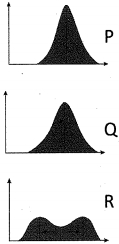
MediumMCQ
The diagram below shows the process of natural selection. Choose the correct option for $P, Q$ and $R$.
A
Stabilizing,Disruptive,Directional
B
Directional,Disruptive,Stabilizing
C
Disruptive,Directional,Stabilizing
D
Stabilizing,Directional,Disruptive
Solution
(D) Natural selection can lead to three types of changes in the distribution of traits in a population:
$1$. $P$ represents Stabilizing selection,where the mean phenotype is favored and the extremes are selected against,resulting in a narrower distribution curve.
$2$. $Q$ represents Directional selection,where one extreme phenotype is favored,causing the entire curve to shift in one direction.
$3$. $R$ represents Disruptive selection,where both extreme phenotypes are favored over the intermediate phenotype,resulting in a bimodal distribution curve.
Therefore,the correct sequence is $P$ = Stabilizing,$Q$ = Directional,$R$ = Disruptive.
$1$. $P$ represents Stabilizing selection,where the mean phenotype is favored and the extremes are selected against,resulting in a narrower distribution curve.
$2$. $Q$ represents Directional selection,where one extreme phenotype is favored,causing the entire curve to shift in one direction.
$3$. $R$ represents Disruptive selection,where both extreme phenotypes are favored over the intermediate phenotype,resulting in a bimodal distribution curve.
Therefore,the correct sequence is $P$ = Stabilizing,$Q$ = Directional,$R$ = Disruptive.
0 likes
View Solution288
MediumMCQ
Identify $P, Q,$ and $R$ in the following descriptions of natural selection types:
$P -$ More individuals acquire peripheral character values at both ends of the distribution curve.
$Q -$ More individuals acquire mean character value.
$R -$ More individuals acquire value other than the mean character value.
$\quad\quad P \quad\quad\quad Q\quad\quad\quad R$
$P -$ More individuals acquire peripheral character values at both ends of the distribution curve.
$Q -$ More individuals acquire mean character value.
$R -$ More individuals acquire value other than the mean character value.
$\quad\quad P \quad\quad\quad Q\quad\quad\quad R$
A
Stabilizing,Directional,Disruptive
B
Disruptive,Stabilizing,Directional
C
Directional,Stabilizing,Disruptive
D
Disruptive,Directional,Stabilizing
Solution
(B) Natural selection can lead to three different outcomes based on the distribution of traits in a population:
$1.$ $P$ refers to Disruptive selection, where individuals at both extremes of the distribution curve are favored, leading to two peaks.
$2.$ $Q$ refers to Stabilizing selection, where the mean character value is favored, resulting in a narrower distribution curve.
$3.$ $R$ refers to Directional selection, where individuals at one extreme of the distribution curve are favored, causing the peak to shift in one direction.
Therefore, the correct sequence is $P = \text{Disruptive}$, $Q = \text{Stabilizing}$, $R = \text{Directional}$.
$1.$ $P$ refers to Disruptive selection, where individuals at both extremes of the distribution curve are favored, leading to two peaks.
$2.$ $Q$ refers to Stabilizing selection, where the mean character value is favored, resulting in a narrower distribution curve.
$3.$ $R$ refers to Directional selection, where individuals at one extreme of the distribution curve are favored, causing the peak to shift in one direction.
Therefore, the correct sequence is $P = \text{Disruptive}$, $Q = \text{Stabilizing}$, $R = \text{Directional}$.
0 likes
View Solution289
MediumMCQ
Which of the following is the most important factor for speciation?
A
Reproductive isolation
B
Seasonal isolation
C
Behavioral isolation
D
Acquired traits
Solution
(A) Speciation is the evolutionary process by which populations evolve to become distinct species.
Reproductive isolation is considered the most critical factor in this process.
It prevents two different populations from interbreeding,thereby ensuring that gene flow between them is restricted or stopped.
This allows the populations to accumulate independent genetic changes over time,eventually leading to the formation of new species.
While seasonal and behavioral isolations are types of reproductive isolation,reproductive isolation as a whole is the fundamental mechanism required for speciation.
Reproductive isolation is considered the most critical factor in this process.
It prevents two different populations from interbreeding,thereby ensuring that gene flow between them is restricted or stopped.
This allows the populations to accumulate independent genetic changes over time,eventually leading to the formation of new species.
While seasonal and behavioral isolations are types of reproductive isolation,reproductive isolation as a whole is the fundamental mechanism required for speciation.
0 likes
View Solution290
EasyMCQ
If changes in a population occur by chance,it is called .....
A
Founder effect
B
Natural selection
C
Genetic drift
D
Reproductive isolation
Solution
(C) Genetic drift refers to the random fluctuations in allele frequencies in a population over generations due to chance events. Unlike natural selection,which is a non-random process,genetic drift is purely stochastic and has a more significant impact on small populations. Therefore,changes in a population occurring by chance are termed as genetic drift.
0 likes
View Solution291
MediumMCQ
Genetic drift does not apply to:
A
Small populations
B
Large populations
C
Genetic recombination
D
Gene flow
Solution
(B) Genetic drift refers to the change in the frequency of an existing gene variant (allele) in a population due to random sampling of organisms.
It is a significant evolutionary force in small populations where chance events can drastically alter allele frequencies.
In large populations,the effect of genetic drift is negligible because the random fluctuations in allele frequencies tend to cancel each other out,making the population more stable.
Therefore,genetic drift does not significantly apply to large populations.
It is a significant evolutionary force in small populations where chance events can drastically alter allele frequencies.
In large populations,the effect of genetic drift is negligible because the random fluctuations in allele frequencies tend to cancel each other out,making the population more stable.
Therefore,genetic drift does not significantly apply to large populations.
0 likes
View Solution292
MediumMCQ
Darwinian fitness refers to .........
A
Maximum reproductive fitness
B
Fitness for long life
C
Fitness of high $r$ value
D
$A$ and $C$
Solution
(D) Darwinian fitness is defined as the ability of an organism to survive and reproduce in a given environment.
It is measured by the reproductive success of an organism,which is often represented by the intrinsic rate of natural increase $(r)$.
Therefore,a higher $r$ value indicates higher reproductive fitness.
Since both maximum reproductive fitness and high $r$ value describe the same biological concept in the context of evolution,the correct answer is $D$.
It is measured by the reproductive success of an organism,which is often represented by the intrinsic rate of natural increase $(r)$.
Therefore,a higher $r$ value indicates higher reproductive fitness.
Since both maximum reproductive fitness and high $r$ value describe the same biological concept in the context of evolution,the correct answer is $D$.
0 likes
View Solution293
MediumMCQ
Select the correct statement regarding mutation theory of evolution.
A
This theory was proposed by Alfred Wallace
B
Variations are small directional changes
C
Single step large mutation is a cause of speciation
D
Large differences due to mutations arise gradually in a population
Solution
(C) The mutation theory of evolution was proposed by Hugo de Vries.
According to this theory,evolution is a discontinuous process caused by large,sudden,and heritable changes called mutations.
These mutations are random and directionless,unlike the small directional variations proposed by Darwin.
Speciation occurs due to a single step large mutation,which is also known as saltation.
Therefore,the correct statement is that a single step large mutation is a cause of speciation.
According to this theory,evolution is a discontinuous process caused by large,sudden,and heritable changes called mutations.
These mutations are random and directionless,unlike the small directional variations proposed by Darwin.
Speciation occurs due to a single step large mutation,which is also known as saltation.
Therefore,the correct statement is that a single step large mutation is a cause of speciation.
0 likes
View Solution294
MediumMCQ
Evolution is a stochastic process based on $:-$
A
Chance events in nature
B
Chance mutation in organisms
C
Both $1$ and $2$
D
Evolution is not a stochastic process
Solution
(C) Evolution is considered a stochastic process because it is not a deterministic or predictable phenomenon.
It is based on two primary factors:
$1$. Chance events in nature: Environmental changes or catastrophic events that occur randomly and affect population survival.
$2$. Chance mutations in organisms: Genetic variations arise due to random mutations in the $DNA$,which provide the raw material for natural selection.
Therefore,both factors contribute to the unpredictable nature of evolutionary change.
It is based on two primary factors:
$1$. Chance events in nature: Environmental changes or catastrophic events that occur randomly and affect population survival.
$2$. Chance mutations in organisms: Genetic variations arise due to random mutations in the $DNA$,which provide the raw material for natural selection.
Therefore,both factors contribute to the unpredictable nature of evolutionary change.
0 likes
View Solution295
EasyMCQ
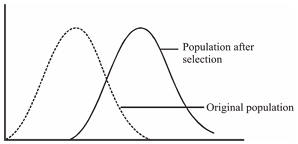
Identify the type of natural selection shown in the below-mentioned diagrammatic representation:-
A
Stabilizing selection
B
Directional selection
C
Cyclic selection
D
Disruptive selection
Solution
(B) The diagram shows a shift in the peak of the population curve from its original position to a new position after natural selection.
This indicates that individuals at one extreme of the phenotypic range are being favored over others,causing the entire population mean to shift in that direction.
This type of natural selection is known as directional selection.
In stabilizing selection,the peak remains in the same position but becomes narrower.
In disruptive selection,the curve splits into two peaks,favoring both extremes over the intermediate phenotype.
This indicates that individuals at one extreme of the phenotypic range are being favored over others,causing the entire population mean to shift in that direction.
This type of natural selection is known as directional selection.
In stabilizing selection,the peak remains in the same position but becomes narrower.
In disruptive selection,the curve splits into two peaks,favoring both extremes over the intermediate phenotype.
0 likes
View Solution296
MediumMCQ
Statement-$I$: The fitness according to Darwin,refers ultimately and only to reproductive fitness.
Statement-$II$: Those who are better fit in the environment leave less progeny than others.
Statement-$II$: Those who are better fit in the environment leave less progeny than others.
A
Statement $I$ and $II$ both are correct
B
Statement $I$ and $II$ both are incorrect
C
Only statement $I$ is correct
D
Only statement $II$ is correct
Solution
(C) According to Darwinian theory,fitness is defined as the ability of an organism to survive and reproduce in a given environment.
Darwinian fitness is ultimately and only related to reproductive fitness,meaning the number of offspring an individual contributes to the next generation.
Therefore,Statement-$I$ is correct.
Individuals that are better fit in an environment are better adapted to survive and reproduce,thus they leave more progeny,not less,compared to others.
Therefore,Statement-$II$ is incorrect.
Darwinian fitness is ultimately and only related to reproductive fitness,meaning the number of offspring an individual contributes to the next generation.
Therefore,Statement-$I$ is correct.
Individuals that are better fit in an environment are better adapted to survive and reproduce,thus they leave more progeny,not less,compared to others.
Therefore,Statement-$II$ is incorrect.
0 likes
View Solution297
MediumMCQ
The essence of Darwinian theory about evolution is $.....$ .
A
Genetic drift
B
Natural selection
C
Mutation
D
Recombination
Solution
(B) The core of Charles Darwin's theory of evolution is $Natural \ selection$.
Darwin proposed that individuals with variations that are better suited to their environment are more likely to survive and reproduce,a process he termed $Natural \ selection$.
Over generations,these advantageous traits become more common in the population,leading to evolutionary change.
While $Mutation$,$Recombination$,and $Genetic \ drift$ are factors that contribute to evolution,they are part of the modern synthetic theory of evolution,not the original Darwinian theory.
Darwin proposed that individuals with variations that are better suited to their environment are more likely to survive and reproduce,a process he termed $Natural \ selection$.
Over generations,these advantageous traits become more common in the population,leading to evolutionary change.
While $Mutation$,$Recombination$,and $Genetic \ drift$ are factors that contribute to evolution,they are part of the modern synthetic theory of evolution,not the original Darwinian theory.
0 likes
View Solution298
EasyMCQ
'Mutation causes evolution' is believed by $:-$
A
Darwin
B
Lamarck
C
Mendel
D
Hugo de Vries
Solution
(D) Hugo de Vries proposed the Mutation Theory of evolution.
He believed that evolution is a saltatory process,meaning it occurs through large,sudden,and discontinuous variations called mutations.
Unlike Darwin,who emphasized small,gradual variations,de Vries argued that mutations are the primary source of new species.
He believed that evolution is a saltatory process,meaning it occurs through large,sudden,and discontinuous variations called mutations.
Unlike Darwin,who emphasized small,gradual variations,de Vries argued that mutations are the primary source of new species.
0 likes
View Solution299
EasyMCQ
Following are sex ratios obtained from a given area. Which one will show an evolutionary stable strategy between males and females respectively?
A
$1000$: $1000$
B
$1015$: $1000$
C
$1000$: $1015$
D
$1000$: $800$
Solution
(A) An evolutionary stable strategy $(ESS)$ is a strategy which,if adopted by a population in a given environment,cannot be invaded by any alternative strategy that is initially rare.
In sexual reproduction,a sex ratio of $1:1$ (equal number of males and females) is considered the most common $ESS$.
This is because,in most species,each offspring requires an equal investment from both parents,and a $1:1$ ratio maximizes the reproductive success of both sexes.
Among the given options,$1000: 1000$ represents a $1:1$ ratio,which is the most stable evolutionary strategy.
In sexual reproduction,a sex ratio of $1:1$ (equal number of males and females) is considered the most common $ESS$.
This is because,in most species,each offspring requires an equal investment from both parents,and a $1:1$ ratio maximizes the reproductive success of both sexes.
Among the given options,$1000: 1000$ represents a $1:1$ ratio,which is the most stable evolutionary strategy.
0 likes
View Solution300
EasyMCQ
Genetic drift occurs due to . . . . . . .
A
Natural selection
B
Sudden elimination of particular allele
C
Continuous gene movement
D
Mutation
Solution
(B) Genetic drift is defined as the random change in allele frequencies in a population over generations.
It is particularly significant in small populations where chance events can lead to the sudden elimination or reduction of specific alleles,thereby altering the genetic makeup of the population.
It is particularly significant in small populations where chance events can lead to the sudden elimination or reduction of specific alleles,thereby altering the genetic makeup of the population.
0 likes
View SolutionEvolution — Mechanism of Evolution · Frequently Asked Questions
1Are these Evolution questions useful for JEE and NEET?
Yes. All questions in this section are mapped to JEE Main and NEET exam patterns. Previous year questions from JEE Main, NEET, GUJCET and state-level exams are included with full solutions.
2Can I switch to Hindi or Gujarati for these questions?
Yes. Use the language tabs in the hero section or the sidebar to view the same questions and solutions in English, Hindi or Gujarati.
3How do I generate a question paper from this subtopic?
Use the Vedclass Exam Paper Generator — select the chapter and subtopic, set difficulty, and generate Sets A, B, C, D automatically. First 3 chapters of every subject are free.
Vedclass Products
For Students
Vedclass Test Series
Mock tests in real JEE/NEET style with performance analysis. 5-day free trial.
Start Free TrialFor Teachers
Exam Paper Generator
Generate Set A/B/C/D papers from this chapter in 2 minutes. 3 chapters free.
Try FreeFor Institutes
Online Exam Module
Live online exams with unlimited students, 360° analytics & white-label branding.
See DemoFor Teachers & Institutes
Generate a Evolution Exam Paper in 2 Minutes
Select subtopic & difficulty — Sets A, B, C, D auto-generated with No Repeat logic.
First 3 chapters of every subject are free — no payment required.