
A English
Mechanism of Evolution Questions in English
Class 12 Biology · Evolution · Mechanism of Evolution
327+
Questions
English
Language
100%
With Solutions
Showing 49 of 327 questions in English
151
EasyMCQ
Who proposed the theory of continuity of germplasm?
A
de Vries
B
Weismann
C
Darwin
D
Lamarck
Solution
(B) The theory of continuity of germplasm was proposed by August Weismann.
According to this theory,the germplasm (reproductive cells) is passed from generation to generation,while the somatoplasm (body cells) is not inherited.
This theory effectively refuted the inheritance of acquired characters proposed by Lamarck.
According to this theory,the germplasm (reproductive cells) is passed from generation to generation,while the somatoplasm (body cells) is not inherited.
This theory effectively refuted the inheritance of acquired characters proposed by Lamarck.
0 likes
View Solution152
MediumMCQ
What is genetic drift a change in?
A
Gene frequency in the same generation
B
Appearance of recessive genes
C
Gene frequency from one generation to the next
D
None of the above
Solution
(C) Genetic drift is defined as the change in the frequency of an existing gene variant (allele) in a population due to random sampling of organisms.
It occurs when chance events cause allele frequencies to fluctuate unpredictably from one generation to the next.
Unlike natural selection,which is adaptive,genetic drift is a stochastic (random) process that can lead to the loss of alleles or the fixation of others,especially in small populations.
It occurs when chance events cause allele frequencies to fluctuate unpredictably from one generation to the next.
Unlike natural selection,which is adaptive,genetic drift is a stochastic (random) process that can lead to the loss of alleles or the fixation of others,especially in small populations.
0 likes
View Solution153
MediumMCQ
The theory of natural selection is based on which of the following?
A
Contribution of the environment to evolution
B
Natural selection acts on favorable variations
C
Genetic variations result from changes in the gene pool
D
None of the above
Solution
(B) The theory of natural selection,proposed by $Charles \ Darwin$,is primarily based on the observation that individuals within a population exhibit variations.
Some of these variations are heritable and provide a survival or reproductive advantage in a given environment.
Natural selection acts on these favorable variations,allowing individuals possessing them to survive and reproduce more successfully than others.
Over generations,this leads to the accumulation of these advantageous traits in the population,which is the core mechanism of evolution.
Some of these variations are heritable and provide a survival or reproductive advantage in a given environment.
Natural selection acts on these favorable variations,allowing individuals possessing them to survive and reproduce more successfully than others.
Over generations,this leads to the accumulation of these advantageous traits in the population,which is the core mechanism of evolution.
0 likes
View Solution154
MediumMCQ
The frequency of traits increases when they are ........
A
Recessive
B
Dominant
C
Inherited
D
Accepted
Solution
(B) In the context of evolutionary biology and natural selection,traits that provide a survival or reproductive advantage tend to increase in frequency within a population over generations. These traits are typically expressed as dominant traits in the phenotype,allowing them to be selected for by environmental pressures. Therefore,when traits are dominant,they are more likely to be expressed and passed on,leading to an increase in their frequency.
0 likes
View Solution155
MediumMCQ
Genetic drift is observed only in which of the following?
A
Small populations
B
Large populations
C
Mendelian populations
D
Island populations
Solution
(A) Genetic drift refers to the change in the frequency of an existing gene variant (allele) in a population due to random sampling of organisms.
It is a stochastic process that has a significant impact on the gene pool of small populations.
In large populations,the effects of genetic drift are negligible because the random fluctuations in allele frequencies tend to cancel each other out over time.
Therefore,genetic drift is primarily observed and has a pronounced effect in small populations.
It is a stochastic process that has a significant impact on the gene pool of small populations.
In large populations,the effects of genetic drift are negligible because the random fluctuations in allele frequencies tend to cancel each other out over time.
Therefore,genetic drift is primarily observed and has a pronounced effect in small populations.
0 likes
View Solution156
MediumMCQ
Genetic drift operates in which of the following?
A
Small isolated populations
B
Large isolated populations
C
Fast breeding populations
D
Slow breeding populations
Solution
(A) Genetic drift refers to the change in the frequency of an existing gene variant (allele) in a population due to random sampling of organisms.
It is a stochastic process that has a much more significant impact on small populations compared to large ones.
In small isolated populations,chance events can lead to the loss of alleles or the fixation of others,significantly altering the genetic makeup of the population over generations.
Therefore,genetic drift is most effective and observable in small isolated populations.
It is a stochastic process that has a much more significant impact on small populations compared to large ones.
In small isolated populations,chance events can lead to the loss of alleles or the fixation of others,significantly altering the genetic makeup of the population over generations.
Therefore,genetic drift is most effective and observable in small isolated populations.
0 likes
View Solution157
MediumMCQ
Which of the following sequences was proposed by Darwin and Wallace for biological evolution?
A
Variations,Natural selection,Overproduction of offspring,Constancy of population size
B
Overproduction of offspring,Variations,Constancy of population size,Natural selection
C
Variations,Constancy of population size,Overproduction of offspring,Natural selection
D
Overproduction of offspring,Constancy of population size,Variations,Natural selection
Solution
(D) The theory of natural selection proposed by Darwin and Wallace follows a logical sequence:
$1$. Overproduction of offspring: All organisms have a high reproductive potential.
$2$. Constancy of population size: Despite high reproductive rates,the population size of a species remains relatively constant due to limited resources.
$3$. Variations: Individuals within a population exhibit variations.
$4$. Natural selection: Individuals with favorable variations survive and reproduce,leading to evolution.
Therefore,the correct sequence is: Overproduction of offspring $\rightarrow$ Constancy of population size $\rightarrow$ Variations $\rightarrow$ Natural selection.
$1$. Overproduction of offspring: All organisms have a high reproductive potential.
$2$. Constancy of population size: Despite high reproductive rates,the population size of a species remains relatively constant due to limited resources.
$3$. Variations: Individuals within a population exhibit variations.
$4$. Natural selection: Individuals with favorable variations survive and reproduce,leading to evolution.
Therefore,the correct sequence is: Overproduction of offspring $\rightarrow$ Constancy of population size $\rightarrow$ Variations $\rightarrow$ Natural selection.
0 likes
View Solution158
MediumMCQ
In a population,random genetic drift is typically the result of which of the following?
A
Large population size
B
Organisms with high genetic variation
C
Inbreeding in a population
D
Constant mutation rate
Solution
(C) Genetic drift refers to the change in the frequency of an existing gene variant (allele) in a population due to random sampling of organisms.
It is most pronounced in small populations where chance events can significantly alter allele frequencies.
Inbreeding,which is the mating of closely related individuals,often occurs in small,isolated populations and exacerbates the effects of genetic drift by reducing genetic diversity and increasing homozygosity.
Therefore,inbreeding is a key factor associated with the occurrence and impact of genetic drift in a population.
It is most pronounced in small populations where chance events can significantly alter allele frequencies.
Inbreeding,which is the mating of closely related individuals,often occurs in small,isolated populations and exacerbates the effects of genetic drift by reducing genetic diversity and increasing homozygosity.
Therefore,inbreeding is a key factor associated with the occurrence and impact of genetic drift in a population.
0 likes
View Solution159
MediumMCQ
Industrial melanism is an example of what?
A
Protective adaptation of skin against ultraviolet radiation
B
Drug resistance
C
Darkening of skin due to industrial smoke
D
Protective resemblance with the surroundings
Solution
(D) Industrial melanism is a classic example of natural selection in action.
During the Industrial Revolution in England,the tree trunks became dark due to soot and smoke from factories.
The light-colored moths (Biston betularia) were easily spotted by predators on these dark trunks,while the dark-colored (melanic) moths were camouflaged.
This provided the dark-colored moths with a survival advantage,allowing them to reproduce more successfully.
Therefore,industrial melanism is an example of protective resemblance with the surroundings,which helps the organism survive in its environment.
During the Industrial Revolution in England,the tree trunks became dark due to soot and smoke from factories.
The light-colored moths (Biston betularia) were easily spotted by predators on these dark trunks,while the dark-colored (melanic) moths were camouflaged.
This provided the dark-colored moths with a survival advantage,allowing them to reproduce more successfully.
Therefore,industrial melanism is an example of protective resemblance with the surroundings,which helps the organism survive in its environment.
0 likes
View Solution160
MediumMCQ
Which of the following was $NOT$ considered a part of Darwin's theory of natural selection in organic evolution?
A
Discontinuous variations
B
Parasites and predators as natural enemies
C
Survival of the fittest
D
Struggle for existence
Solution
(A) Darwin's theory of natural selection is primarily based on the concepts of 'Struggle for existence','Survival of the fittest',and 'Variations'.
Darwin believed that variations are small,directional,and continuous.
He did not consider 'Discontinuous variations' (mutations) as a part of his theory,as the concept of mutation was later introduced by Hugo de Vries.
Darwin believed that variations are small,directional,and continuous.
He did not consider 'Discontinuous variations' (mutations) as a part of his theory,as the concept of mutation was later introduced by Hugo de Vries.
0 likes
View Solution161
MediumMCQ
Which of the following phenomena supports Darwin's theory of natural selection in organic evolution?
A
Development of transgenic animals
B
Production of Dolly the sheep by cloning
C
Prevalence of pesticide-resistant insects
D
Development of organs from stem cells for organ transplantation
Solution
(C) Darwin's theory of natural selection states that individuals with favorable variations are better adapted to their environment and have a higher chance of survival and reproduction.
In the case of pesticide-resistant insects,the application of pesticides acts as a selective pressure.
Insects that possess a random mutation conferring resistance to the pesticide survive,while others die.
These resistant insects then reproduce and pass the resistance gene to their offspring.
Over generations,the population of resistant insects increases,which is a classic example of natural selection in action.
In the case of pesticide-resistant insects,the application of pesticides acts as a selective pressure.
Insects that possess a random mutation conferring resistance to the pesticide survive,while others die.
These resistant insects then reproduce and pass the resistance gene to their offspring.
Over generations,the population of resistant insects increases,which is a classic example of natural selection in action.
0 likes
View Solution162
MediumMCQ
Which technique is used to prove that antibiotic-resistant bacterial mutants are pre-existing and not induced by the environment?
A
Replica plating
B
Serial dilution
C
Southern blotting
D
$PCR$ amplification
Solution
(A) The experiment used to prove that antibiotic-resistant bacterial mutants are pre-existing and not induced by the environment is the $Replica \ plating$ technique.
This experiment was performed by $Joshua \ Lederberg$ and $Esther \ Lederberg$.
In this process,a master plate containing bacterial colonies is pressed onto a velvet-covered block and then transferred to a new plate containing an antibiotic (like streptomycin).
The colonies that grow on the antibiotic plate correspond exactly to the positions of the colonies on the master plate,proving that the resistance was already present in the population before exposure to the antibiotic.
This experiment was performed by $Joshua \ Lederberg$ and $Esther \ Lederberg$.
In this process,a master plate containing bacterial colonies is pressed onto a velvet-covered block and then transferred to a new plate containing an antibiotic (like streptomycin).
The colonies that grow on the antibiotic plate correspond exactly to the positions of the colonies on the master plate,proving that the resistance was already present in the population before exposure to the antibiotic.
0 likes
View Solution163
EasyMCQ
Hugo de Vries's mutation theory of organic evolution was proposed while working on:
A
Pisum sativum
B
Drosophila melanogaster
C
Oenothera lamarckiana
D
Althaea rosea
Solution
(C) Hugo de Vries, a Dutch botanist, proposed the mutation theory of evolution in $1901$. He conducted his experiments on the evening primrose, scientifically known as $Oenothera$ $lamarckiana$. He observed sudden, heritable changes in the phenotype of these plants, which he termed as 'mutations'. Unlike Darwin's theory, which emphasized small, continuous variations, de Vries proposed that evolution is a saltatory process caused by large, discontinuous variations (mutations).
0 likes
View Solution164
MediumMCQ
Which of the following is a result of geographical isolation?
A
No changes in the animals of the separated region
B
Prevention of speciation
C
Speciation through reproductive isolation
D
Random production of new species
Solution
(C) Geographical isolation refers to the physical separation of populations of a species by barriers such as mountains,rivers,or oceans.
When populations are geographically isolated,they cannot interbreed.
Over time,due to different environmental pressures and genetic drift,these populations accumulate distinct genetic variations.
Eventually,these genetic differences become significant enough that even if the populations were to come into contact again,they would be unable to interbreed.
This process leads to reproductive isolation,which is a key mechanism in the formation of new species,known as speciation.
When populations are geographically isolated,they cannot interbreed.
Over time,due to different environmental pressures and genetic drift,these populations accumulate distinct genetic variations.
Eventually,these genetic differences become significant enough that even if the populations were to come into contact again,they would be unable to interbreed.
This process leads to reproductive isolation,which is a key mechanism in the formation of new species,known as speciation.
0 likes
View Solution165
MediumMCQ
Select the correct statement from the given options.
A
Darwinian variations are small and directionless.
B
Fitness is the ability to adapt and be selected by nature.
C
All mammals except whales and camels have seven cervical vertebrae.
D
Mutations are random and directional.
Solution
(B) The correct statement is that fitness is the ability to adapt and be selected by nature.
According to Darwin,fitness is the ultimate measure of an organism's success in an environment,defined by its ability to survive and reproduce,which leads to natural selection.
Option $A$ is incorrect because Darwinian variations are small and directional.
Option $C$ is incorrect because almost all mammals,including whales and camels,have seven cervical vertebrae.
Option $D$ is incorrect because mutations are random and directionless.
According to Darwin,fitness is the ultimate measure of an organism's success in an environment,defined by its ability to survive and reproduce,which leads to natural selection.
Option $A$ is incorrect because Darwinian variations are small and directional.
Option $C$ is incorrect because almost all mammals,including whales and camels,have seven cervical vertebrae.
Option $D$ is incorrect because mutations are random and directionless.
0 likes
View Solution166
MediumMCQ
In the case of the peppered moth $(Biston \text{ } betularia)$, the dark-colored form became more prevalent than the light-colored form in England during the Industrial Revolution. This is an example of:
A
Natural selection where the dark color was favored.
B
The organism appearing dark due to low sunlight.
C
Protective mimicry.
D
Acquisition of the dark-colored trait due to the dark environment.
Solution
(A) During the Industrial Revolution in England, the soot from factories darkened the tree trunks. The light-colored moths, which were previously camouflaged against lichen-covered trees, became easily visible to predators. The dark-colored (melanic) moths, however, gained a survival advantage as they were better camouflaged against the soot-covered trees. This process, where individuals with advantageous traits survive and reproduce more successfully, is a classic example of $Natural \text{ } Selection$.
0 likes
View Solution167
MediumMCQ
What is the process called in which organisms with different evolutionary histories evolve similar phenotypic adaptations in response to a common environment?
A
Natural selection
B
Convergent evolution
C
Divergent evolution
D
Adaptive radiation
Solution
(B) Convergent evolution is the process where organisms that are not closely related independently evolve similar traits as a result of having to adapt to similar environments or ecological niches.
For example,the wings of butterflies and birds,or the flippers of dolphins and penguins,represent analogous structures that evolved through convergent evolution.
For example,the wings of butterflies and birds,or the flippers of dolphins and penguins,represent analogous structures that evolved through convergent evolution.
0 likes
View Solution168
EasyMCQ
What is the phenomenon called when variation in gene frequency in a population occurs by chance rather than by natural selection?
A
Gene flow
B
Genetic drift
C
Random mating
D
Genetic load
Solution
(B) Genetic drift is defined as the change in the frequency of an existing gene variant (allele) in a population due to random sampling of organisms. Unlike natural selection,which is a non-random process,genetic drift occurs by chance. It is particularly significant in small populations,where random events can lead to the loss of certain alleles or the fixation of others,regardless of their adaptive value.
0 likes
View Solution169
MediumMCQ
According to Darwinism,what is organic evolution?
A
Intraspecific competition
B
Interspecific competition
C
Competition between closely related species
D
Reduction in food intake capacity in a species due to interfering species
Solution
(A) According to Darwinism,organic evolution is primarily driven by natural selection,which is fueled by the struggle for existence.
Intraspecific competition (competition between individuals of the same species) is a crucial component of this struggle because individuals of the same species have identical requirements for food,space,and mates.
This intense competition leads to the survival of the fittest,which is the core mechanism of Darwinian evolution.
Intraspecific competition (competition between individuals of the same species) is a crucial component of this struggle because individuals of the same species have identical requirements for food,space,and mates.
This intense competition leads to the survival of the fittest,which is the core mechanism of Darwinian evolution.
0 likes
View Solution170
MediumMCQ
Industrial melanism is an example of which of the following?
A
Neo-Darwinism
B
Natural selection
C
Mutation
D
Neo-Lamarckism
Solution
(B) Industrial melanism is a classic example of natural selection. Before industrialization in England,white-winged moths were more abundant on trees because they could camouflage against the light-colored lichens. After industrialization,the trees became covered in soot,making the light-colored moths easily visible to predators. Consequently,the dark-winged (melanic) moths had a survival advantage and were selected by nature to reproduce,leading to an increase in their population. This process demonstrates how environmental changes drive natural selection.
0 likes
View Solution171
MediumMCQ
When is genetic drift operative?
A
Small isolated population
B
Large isolated population
C
Non-reproductive population
D
Slow reproductive population
Solution
(A) Genetic drift refers to the change in allele frequencies in a population due to chance events.
It is most significant in small,isolated populations where random fluctuations can lead to the loss or fixation of alleles.
In large populations,these random changes are buffered by the large number of individuals,making the effect of genetic drift negligible.
Therefore,genetic drift is highly operative in small isolated populations.
It is most significant in small,isolated populations where random fluctuations can lead to the loss or fixation of alleles.
In large populations,these random changes are buffered by the large number of individuals,making the effect of genetic drift negligible.
Therefore,genetic drift is highly operative in small isolated populations.
0 likes
View Solution172
MediumMCQ
What does artificial selection in high-milk-yielding cows indicate?
A
Stabilizing selection that stabilizes this trait in the population.
B
Directional selection that pushes the mean of the trait in one direction.
C
Disruptive selection that splits the population into two, one high-yielding and one low-yielding.
D
Stabilizing selection followed by disruptive selection that splits the population into high-yielding cows.
Solution
(B) Artificial selection for high milk yield in cows is an example of $Directional \text{ } Selection$.
In this process, breeders select individuals with the desired trait (high milk yield) to reproduce.
Over generations, this shifts the mean value of the trait in the population toward the desired extreme, which is the high-yielding end of the spectrum.
Therefore, it pushes the mean of the trait in one specific direction.
In this process, breeders select individuals with the desired trait (high milk yield) to reproduce.
Over generations, this shifts the mean value of the trait in the population toward the desired extreme, which is the high-yielding end of the spectrum.
Therefore, it pushes the mean of the trait in one specific direction.
0 likes
View Solution173
MediumMCQ
What is the possible reason for the development of resistance in pests against crop-destroying agents?
A
Random mutation
B
Genetic recombination
C
Directed mutation
D
Acquired genetic changes
Solution
(A) The development of resistance in pests against chemical pesticides or biological control agents is primarily due to $Random \text{ } mutation$.
When a large population of pests is exposed to a control agent, most individuals die.
However, due to random mutations occurring in the population, some individuals may possess a genetic variation that confers resistance.
These resistant individuals survive and reproduce, passing the resistance gene to their offspring, leading to a population that is resistant to the agent.
When a large population of pests is exposed to a control agent, most individuals die.
However, due to random mutations occurring in the population, some individuals may possess a genetic variation that confers resistance.
These resistant individuals survive and reproduce, passing the resistance gene to their offspring, leading to a population that is resistant to the agent.
0 likes
View Solution174
MediumMCQ
According to Hugo de Vries,the mechanism of evolution is
A
Minor mutations
B
Saltation
C
Phenotypic variations
D
Multiple step mutations
Solution
(B) Hugo de Vries proposed the Mutation Theory of evolution.
He believed that evolution is a discontinuous process caused by large,sudden,and heritable changes in the genetic material,which he termed as mutations.
He specifically used the term $Saltation$ to describe these single-step large mutations that lead to speciation.
Therefore,according to Hugo de Vries,the mechanism of evolution is $Saltation$.
He believed that evolution is a discontinuous process caused by large,sudden,and heritable changes in the genetic material,which he termed as mutations.
He specifically used the term $Saltation$ to describe these single-step large mutations that lead to speciation.
Therefore,according to Hugo de Vries,the mechanism of evolution is $Saltation$.
0 likes
View Solution175
MediumMCQ
Variations caused by mutation,as proposed by Hugo de Vries,are
A
random and directional
B
random and directionless
C
small and directional
D
small and directionless
Solution
(B) Hugo de Vries proposed the Mutation Theory of evolution.
According to him,evolution is a saltatory process,meaning it occurs through large,sudden,and discontinuous variations.
These mutations are random and directionless,unlike the small and directional variations proposed by Darwin in his theory of natural selection.
According to him,evolution is a saltatory process,meaning it occurs through large,sudden,and discontinuous variations.
These mutations are random and directionless,unlike the small and directional variations proposed by Darwin in his theory of natural selection.
0 likes
View Solution176
DifficultMCQ
In a species,the weight of newborn ranges from $2$ to $5 \; kg$. $97 \%$ of the newborns with an average weight between $3$ to $3.3 \; kg$ survive,whereas $99 \%$ of the infants born with weights from $2$ to $2.5 \; kg$ or $4.5$ to $5 \; kg$ die. Which type of selection process is taking place?
A
Directional Selection
B
Stabilizing Selection
C
Disruptive Selection
D
Cyclical Selection
Solution
(B) Stabilizing selection is a type of natural selection in which the population mean stabilizes on a particular non-extreme trait value.
In this case,the newborns with an average weight ($3$ to $3.3 \; kg$) have a high survival rate $(97 \%)$,while those with extreme weights (very low: $2$ to $2.5 \; kg$ or very high: $4.5$ to $5 \; kg$) have a very high mortality rate $(99 \%)$.
Since the selection process favors the intermediate phenotype and eliminates the extreme phenotypes,it is known as Stabilizing Selection.
In this case,the newborns with an average weight ($3$ to $3.3 \; kg$) have a high survival rate $(97 \%)$,while those with extreme weights (very low: $2$ to $2.5 \; kg$ or very high: $4.5$ to $5 \; kg$) have a very high mortality rate $(99 \%)$.
Since the selection process favors the intermediate phenotype and eliminates the extreme phenotypes,it is known as Stabilizing Selection.
0 likes
View Solution177
MediumMCQ
Gene pool is referred to
A
the genetic drift caused in a population
B
aggregate of all genes and their alleles in a population.
C
deletion of non essential genes.
D
induce cell division
Solution
(B) Gene pool is defined as the sum total of all genes and their alleles present in a population at a given time.
It represents the complete set of genetic information available to the individuals of a population.
These genes are passed from one generation to the next through gametes.
The frequency of these alleles within the gene pool determines the genetic structure of the population.
It represents the complete set of genetic information available to the individuals of a population.
These genes are passed from one generation to the next through gametes.
The frequency of these alleles within the gene pool determines the genetic structure of the population.
0 likes
View Solution178
MediumMCQ
Assertion : Natural selection is the outcome of difference in survival and reproduction among individuals that show variation in one or more traits.
Reason : Adaptive forms of a given trait tend to become more common; less adaptive ones become less common or disappear.
Reason : Adaptive forms of a given trait tend to become more common; less adaptive ones become less common or disappear.
A
If both Assertion and Reason are correct and the Reason is a correct explanation of the Assertion.
B
If both Assertion and Reason are correct but Reason is not a correct explanation of the Assertion.
C
If the Assertion is correct but Reason is incorrect.
D
If both the Assertion and Reason are incorrect.
Solution
(A) Natural selection is the process by which individuals with favorable variations are better adapted to their environment,leading to higher survival and reproductive success.
This differential survival and reproduction result in the propagation of advantageous traits within a population.
Adaptive forms of a trait provide a survival advantage,allowing those individuals to reproduce more effectively,thus increasing the frequency of these traits in subsequent generations.
Conversely,less adaptive forms are selected against,leading to their decline or eventual disappearance from the population.
Therefore,the Reason correctly explains the mechanism behind the Assertion.
This differential survival and reproduction result in the propagation of advantageous traits within a population.
Adaptive forms of a trait provide a survival advantage,allowing those individuals to reproduce more effectively,thus increasing the frequency of these traits in subsequent generations.
Conversely,less adaptive forms are selected against,leading to their decline or eventual disappearance from the population.
Therefore,the Reason correctly explains the mechanism behind the Assertion.
0 likes
View Solution179
Difficult
Explain antibiotic resistance observed in bacteria in light of Darwinian selection theory.
Solution
(N/A) Darwinian selection theory states that individuals with favourable variations are better adapted than individuals with less favourable variations.
Nature selects individuals with useful variations because these individuals are better evolved to survive in the existing environment.
An example of such selection is antibiotic resistance in bacteria.
When a bacterial population is grown on an agar plate containing the antibiotic penicillin,the colonies that are sensitive to penicillin die,whereas one or a few bacterial colonies that possess resistance to penicillin survive.
This survival occurs because these specific bacteria underwent a chance mutation,which resulted in the evolution of a gene that confers resistance to the penicillin drug.
Consequently,the resistant bacteria multiply quickly compared to the non-resistant (sensitive) bacteria,thereby increasing their population.
Thus,the advantage of one individual over others helps in the struggle for existence,illustrating the process of natural selection.
Nature selects individuals with useful variations because these individuals are better evolved to survive in the existing environment.
An example of such selection is antibiotic resistance in bacteria.
When a bacterial population is grown on an agar plate containing the antibiotic penicillin,the colonies that are sensitive to penicillin die,whereas one or a few bacterial colonies that possess resistance to penicillin survive.
This survival occurs because these specific bacteria underwent a chance mutation,which resulted in the evolution of a gene that confers resistance to the penicillin drug.
Consequently,the resistant bacteria multiply quickly compared to the non-resistant (sensitive) bacteria,thereby increasing their population.
Thus,the advantage of one individual over others helps in the struggle for existence,illustrating the process of natural selection.
0 likes
View Solution180
MediumMCQ
Explain the example of insect resistance to pesticides as an instance of natural selection.
A
It is an example of artificial selection.
B
It is an example of evolution by anthropogenic action.
C
It is an example of genetic drift.
D
It is an example of adaptive radiation.
Solution
(B) The excessive use of herbicides and pesticides has resulted in the selection of resistant varieties in a very short period of time.
This phenomenon is also observed in microorganisms against which we use antibiotics or drugs.
Consequently,resistant organisms or cells appear in a very short time,i.e.,within months or years,rather than centuries.
These are examples of evolution by anthropogenic action,which also indicates that evolution is not a directed process in the sense of determinism.
It is a stochastic process based on chance events in nature and chance mutations in organisms.
This phenomenon is also observed in microorganisms against which we use antibiotics or drugs.
Consequently,resistant organisms or cells appear in a very short time,i.e.,within months or years,rather than centuries.
These are examples of evolution by anthropogenic action,which also indicates that evolution is not a directed process in the sense of determinism.
It is a stochastic process based on chance events in nature and chance mutations in organisms.
0 likes
View Solution181
MediumMCQ
Evolution is a process or the result of a process. Explain this statement.
A
Evolution is a stochastic process based on chance events in nature.
B
Evolution is a directed process driven by conscious selection.
C
Evolution is a result of a process that occurs in a single generation.
D
Evolution is a process of rapid mutation only.
Solution
(A) Evolution is considered both a process and the result of a process.
$1$. As a process: It refers to the continuous,ongoing changes in the genetic composition of a population over successive generations,driven by mechanisms like natural selection,mutation,genetic drift,and gene flow.
$2$. As a result: It refers to the outcome of these cumulative changes,which leads to the adaptation of organisms to their environment and the emergence of new species (speciation) over geological time.
Therefore,evolution is a stochastic process based on chance events in nature and chance mutations in the organisms.
$1$. As a process: It refers to the continuous,ongoing changes in the genetic composition of a population over successive generations,driven by mechanisms like natural selection,mutation,genetic drift,and gene flow.
$2$. As a result: It refers to the outcome of these cumulative changes,which leads to the adaptation of organisms to their environment and the emergence of new species (speciation) over geological time.
Therefore,evolution is a stochastic process based on chance events in nature and chance mutations in the organisms.
0 likes
View Solution182
Medium
State Darwin's view on the role of variations in evolution.
Solution
(N/A) Darwin was influenced by Thomas Malthus's work on populations. Natural selection is based on certain observations that are factual. For example,natural resources are limited,population size is stable (except for seasonal fluctuations),members of a population vary in characteristics even though they look superficially similar (in fact,no two individuals are identical),and most of these variations are heritable.
If these facts are true,and if every organism reproduces at its maximum rate,the population would theoretically grow exponentially (as seen in bacterial growth). Since it is a fact that population size is limited,it implies that there is competition for resources. Some individuals survived and thrived at the cost of others,while some could not.
Darwin's novelty and brilliant insight was this: He asserted that variations which are heritable and make resource utilization better for an individual (making them better adapted to their habitat) enable only those individuals to reproduce and leave more progeny. Hence,over many generations,those survivors will produce more offspring and cause a change in the characteristics of the population,eventually resulting in the evolution of a new form.
If these facts are true,and if every organism reproduces at its maximum rate,the population would theoretically grow exponentially (as seen in bacterial growth). Since it is a fact that population size is limited,it implies that there is competition for resources. Some individuals survived and thrived at the cost of others,while some could not.
Darwin's novelty and brilliant insight was this: He asserted that variations which are heritable and make resource utilization better for an individual (making them better adapted to their habitat) enable only those individuals to reproduce and leave more progeny. Hence,over many generations,those survivors will produce more offspring and cause a change in the characteristics of the population,eventually resulting in the evolution of a new form.
0 likes
View Solution183
Medium
Present the views regarding the origin of variation and speciation.
Solution
(N/A) Mendel had mentioned about heritable factors influencing phenotype. Darwin either ignored these observations or kept silent about them. In the first decade of the $20^{th}$ century,Hugo de Vries,based on his work on the evening primrose,brought forth the idea of mutations—large differences arising suddenly in a population.
He believed that it is mutation which causes evolution and not the minor variations (heritable) that Darwin talked about. Mutations are random and directionless,while Darwinian variations are small and directional. Evolution for Darwin was a gradual process,whereas according to de Vries,mutation is the cause of speciation and he termed it as $Saltation$ (single-step large mutation).
He believed that it is mutation which causes evolution and not the minor variations (heritable) that Darwin talked about. Mutations are random and directionless,while Darwinian variations are small and directional. Evolution for Darwin was a gradual process,whereas according to de Vries,mutation is the cause of speciation and he termed it as $Saltation$ (single-step large mutation).
0 likes
View Solution184
Medium
What is founder effect?
Solution
(N/A) Five factors are known to affect $Hardy-Weinberg$ equilibrium: gene migration or gene flow,genetic drift,mutation,genetic recombination,and natural selection.
When a section of a population migrates to a new location,the gene frequencies change in both the original and the new population.
New genes or alleles are added to the new population and are lost from the original population.
If this gene migration happens multiple times,it results in gene flow.
If the change in allele frequency occurs by chance,it is called genetic drift.
Sometimes,the change in allele frequency in the new sample of the population is so significant that they evolve into a different species.
The original drifted population that establishes this new colony is known as the founders,and this phenomenon is called the $founder \ effect$.
When a section of a population migrates to a new location,the gene frequencies change in both the original and the new population.
New genes or alleles are added to the new population and are lost from the original population.
If this gene migration happens multiple times,it results in gene flow.
If the change in allele frequency occurs by chance,it is called genetic drift.
Sometimes,the change in allele frequency in the new sample of the population is so significant that they evolve into a different species.
The original drifted population that establishes this new colony is known as the founders,and this phenomenon is called the $founder \ effect$.
0 likes
View Solution185
Medium
State the factors affecting the process of speciation.
Solution
(N/A) Experiments on microorganisms show that pre-existing advantageous mutations,when selected,result in new phenotypes. Over a few generations,this leads to speciation.
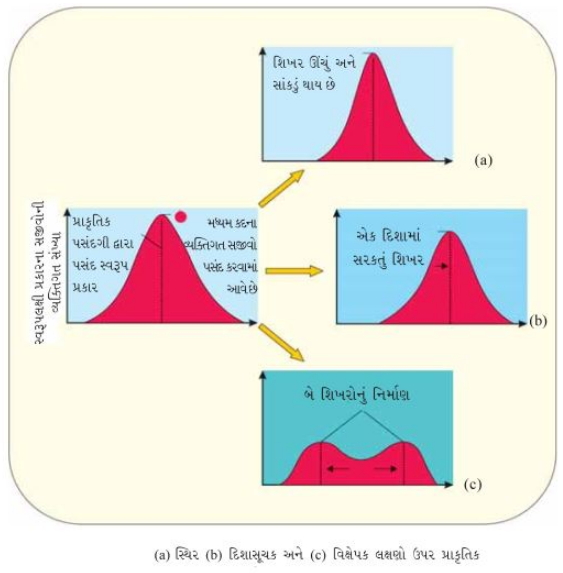
Natural selection is a process in which heritable variations enable survival,lead to higher reproductive success,and result in the production of a large number of offspring. Logical analysis suggests that variations caused by mutation,gene flow,genetic drift,or recombination during gametogenesis result in changes in the frequency of genes and alleles in future generations.
Through natural selection,organisms increase their reproductive success and become established as a new population. Natural selection leads to three types of evolutionary changes:
$1$. Stabilizing selection: Where many individuals acquire the mean character value.
$2$. Directional change: Where many individuals acquire values other than the mean character value.
$3$. Disruptive evolution: Where more individuals acquire peripheral character values at both ends of the distribution curve.
Natural selection is a process in which heritable variations enable survival,lead to higher reproductive success,and result in the production of a large number of offspring. Logical analysis suggests that variations caused by mutation,gene flow,genetic drift,or recombination during gametogenesis result in changes in the frequency of genes and alleles in future generations.
Through natural selection,organisms increase their reproductive success and become established as a new population. Natural selection leads to three types of evolutionary changes:
$1$. Stabilizing selection: Where many individuals acquire the mean character value.
$2$. Directional change: Where many individuals acquire values other than the mean character value.
$3$. Disruptive evolution: Where more individuals acquire peripheral character values at both ends of the distribution curve.
0 likes
View Solution186
Easy
Distinguish between: Natural Selection and Inheritance of Acquired Characters.
Solution
(N/A) The differences between Natural Selection and Inheritance of Acquired Characters are as follows:
$1$. Natural Selection (Darwinism): This theory states that individuals with favorable variations are better adapted to their environment and have a higher chance of survival and reproduction. These variations are heritable and accumulate over generations.
$2$. Inheritance of Acquired Characters (Lamarckism): This theory suggests that characters acquired by an organism during its lifetime due to use or disuse of organs are passed on to the next generation. This hypothesis has been scientifically disproven as somatic changes are not inherited.
$1$. Natural Selection (Darwinism): This theory states that individuals with favorable variations are better adapted to their environment and have a higher chance of survival and reproduction. These variations are heritable and accumulate over generations.
$2$. Inheritance of Acquired Characters (Lamarckism): This theory suggests that characters acquired by an organism during its lifetime due to use or disuse of organs are passed on to the next generation. This hypothesis has been scientifically disproven as somatic changes are not inherited.
0 likes
View Solution187
Easy
Explain the terms: $(i)$ Saltation and $(ii)$ Founder effect.
Solution
(N/A) $(i)$ Saltation: According to Hugo de Vries,evolution is caused by large,sudden,and heritable mutations,which he termed as saltation (single-step large mutation).
$(ii)$ Founder effect: When a small group of individuals from a large population migrates to a new habitat or becomes isolated,the allele frequencies in the new population differ from the original population. This change in allele frequency due to genetic drift is known as the founder effect.
$(ii)$ Founder effect: When a small group of individuals from a large population migrates to a new habitat or becomes isolated,the allele frequencies in the new population differ from the original population. This change in allele frequency due to genetic drift is known as the founder effect.
0 likes
View Solution188
Easy
Define and explain the following terms: Variation and Survival of the Fittest.
Solution
(N/A) $1$. Variation: Variation refers to the differences in characteristics or traits among individuals of the same species. These variations can be morphological,physiological,or behavioral. They arise due to genetic recombination during sexual reproduction,mutations,and environmental factors. Variations are the raw material for evolution as they provide the basis for natural selection.
$2$. Survival of the Fittest: This is a core concept of Darwinian natural selection. It states that individuals who are better adapted to their environment are more likely to survive and reproduce. 'Fitness' in this context refers to reproductive success,not just physical strength. Those who survive pass on their advantageous traits to the next generation,leading to evolutionary change over time.
$2$. Survival of the Fittest: This is a core concept of Darwinian natural selection. It states that individuals who are better adapted to their environment are more likely to survive and reproduce. 'Fitness' in this context refers to reproductive success,not just physical strength. Those who survive pass on their advantageous traits to the next generation,leading to evolutionary change over time.
0 likes
View Solution189
MediumMCQ
What is founder effect?
A
$A$ process where a large population migrates to a new area.
B
$A$ change in allele frequency that occurs when a small group of a population becomes isolated from the original population.
C
The process of natural selection acting on a stable population.
D
The random mutation of genes in a large population.
Solution
(B) The founder effect occurs when a small group of individuals breaks off from a larger population to establish a new colony in a different habitat.
Because this small group (the founders) carries only a fraction of the total genetic diversity of the original population,the allele frequencies in the new population differ significantly from the original population.
Over time,this genetic drift leads to variations and can eventually result in the formation of a new species.
An example of this is the evolution of Darwin's finches on the Galapagos Islands,which originated from a few birds that migrated from the mainland.
Because this small group (the founders) carries only a fraction of the total genetic diversity of the original population,the allele frequencies in the new population differ significantly from the original population.
Over time,this genetic drift leads to variations and can eventually result in the formation of a new species.
An example of this is the evolution of Darwin's finches on the Galapagos Islands,which originated from a few birds that migrated from the mainland.
0 likes
View Solution190
Medium
While creation and presence of variation is directionless,natural selection is directional as it is in the context of adaptation. Comment.
Solution
(N/A) Variation arises in sexually reproducing populations due to processes like crossing over during meiosis,random fusion of gametes,and genetic recombination.
Factors such as the random arrangement of bivalents,hybridization,exposure to mutagens,and genetic drift also contribute to the creation of variation,which is essentially random and directionless.
However,natural selection acts as a filter where the environment determines which variations are advantageous for survival and reproduction.
Because the environment imposes specific pressures,natural selection is directional,favoring traits that enhance adaptation to those specific conditions.
Consequently,over time,populations become better adapted to their environment,increasing their overall fitness.
Factors such as the random arrangement of bivalents,hybridization,exposure to mutagens,and genetic drift also contribute to the creation of variation,which is essentially random and directionless.
However,natural selection acts as a filter where the environment determines which variations are advantageous for survival and reproduction.
Because the environment imposes specific pressures,natural selection is directional,favoring traits that enhance adaptation to those specific conditions.
Consequently,over time,populations become better adapted to their environment,increasing their overall fitness.
0 likes
View Solution191
Medium
Comment on the statement that 'evolution and natural selection are end result or consequence of some other processes but themselves are not processes'.
Solution
(N/A) The statement highlights that evolution and natural selection are emergent phenomena resulting from fundamental biological mechanisms.
$1$. Living organisms exhibit a high tendency for rapid reproduction,which leads to an exponential increase in population size.
$2$. However,environmental resources such as food,space,and ecological niches are limited.
$3$. This creates intense interspecific and intraspecific competition for survival.
$4$. Within a population,individuals develop variations due to genetic mutations,gene flow,and genetic recombination during sexual reproduction.
$5$. This results in a heterogeneous population where individuals possess different traits.
$6$. Natural selection acts upon this existing heterogeneity,favoring individuals with advantageous traits that enhance their survival and reproductive success.
$7$. Over generations,the differential reproduction of these individuals leads to changes in allele frequencies,which is the essence of evolution.
Therefore,evolution and natural selection are not independent processes but are the cumulative outcomes of reproduction,competition,variation,and differential survival.
$1$. Living organisms exhibit a high tendency for rapid reproduction,which leads to an exponential increase in population size.
$2$. However,environmental resources such as food,space,and ecological niches are limited.
$3$. This creates intense interspecific and intraspecific competition for survival.
$4$. Within a population,individuals develop variations due to genetic mutations,gene flow,and genetic recombination during sexual reproduction.
$5$. This results in a heterogeneous population where individuals possess different traits.
$6$. Natural selection acts upon this existing heterogeneity,favoring individuals with advantageous traits that enhance their survival and reproductive success.
$7$. Over generations,the differential reproduction of these individuals leads to changes in allele frequencies,which is the essence of evolution.
Therefore,evolution and natural selection are not independent processes but are the cumulative outcomes of reproduction,competition,variation,and differential survival.
0 likes
View Solution192
Medium
State and explain any three factors affecting allele frequency in populations.
Solution
(N/A) $(i)$ Gene migration or gene flow: It involves either emigration or immigration. When a section of a population migrates to another place and population,gene frequencies change in the original as well as in the new population. New genes/alleles are added to the new population and these are lost from the old population. There would be a gene flow if this gene migration happens multiple times.
$(ii)$ Genetic drift: If the same change occurs by chance,it is called genetic drift. Sometimes the change in allele frequency is so different in the new sample of population that they become a different species. The original drifted population becomes founders and the effect is called founder effect.
$(iii)$ Mutation: These are sudden,large,spontaneous,and inheritable changes in the genetic material. Microbial experiments show that pre-existing advantageous mutations when selected will result in the observation of new phenotypes. Over a few generations,this would result in speciation. Natural selection is a process in which heritable variations enabling better survival allow organisms to reproduce and leave a greater number of progeny. Mutations introduce new genes and alleles into the gene pool.
$(ii)$ Genetic drift: If the same change occurs by chance,it is called genetic drift. Sometimes the change in allele frequency is so different in the new sample of population that they become a different species. The original drifted population becomes founders and the effect is called founder effect.
$(iii)$ Mutation: These are sudden,large,spontaneous,and inheritable changes in the genetic material. Microbial experiments show that pre-existing advantageous mutations when selected will result in the observation of new phenotypes. Over a few generations,this would result in speciation. Natural selection is a process in which heritable variations enabling better survival allow organisms to reproduce and leave a greater number of progeny. Mutations introduce new genes and alleles into the gene pool.
0 likes
View Solution193
Medium
"Migration may enhance or blur the effects of selection". Comment.
Solution
(N/A) Migration, also known as gene flow, involves the movement of individuals from one population to another.
When individuals migrate, they carry their alleles with them, which alters the gene frequencies in both the source and the recipient populations.
If the migrating individuals possess traits that are favored by the environment in the new location, migration can enhance the effects of natural selection by increasing the frequency of beneficial alleles.
Conversely, if the migrating individuals introduce alleles that are less fit or counteract the current selective pressures, migration can blur or mask the effects of selection by introducing genetic variation that opposes the adaptive trend.
Over time, repeated gene flow can prevent populations from diverging or, if the change is significant enough, it may contribute to speciation.
When individuals migrate, they carry their alleles with them, which alters the gene frequencies in both the source and the recipient populations.
If the migrating individuals possess traits that are favored by the environment in the new location, migration can enhance the effects of natural selection by increasing the frequency of beneficial alleles.
Conversely, if the migrating individuals introduce alleles that are less fit or counteract the current selective pressures, migration can blur or mask the effects of selection by introducing genetic variation that opposes the adaptive trend.
Over time, repeated gene flow can prevent populations from diverging or, if the change is significant enough, it may contribute to speciation.
0 likes
View Solution194
Medium
When we say 'survival of the fittest',does it mean that $(a)$ those which are fit only survive,or $(b)$ those that survive are called fit? Comment.
Solution
(B) The phrase 'survival of the fittest' refers to the process of natural selection. It does not mean that only those who are already 'fit' survive. Instead,it means that individuals who possess advantageous traits that allow them to survive and reproduce successfully in their specific environment are considered 'fit'. Therefore,fitness is a measure of reproductive success in a given environment,and those who survive and leave more offspring are the ones defined as 'fit'.
0 likes
View Solution195
Medium
You have studied the story of Peppered moths in England. Had the industries been removed, what impact would it have had on the moth population? Discuss.
Solution
(A) In the population of the Peppered moth $(Biston \text{ } betularia)$, two variants existed: the light-colored (grey) and the dark-colored (melanic/black).
Before industrialization $(1850)$, the light-colored moths were prevalent because they blended well with the lichen-covered tree trunks, providing effective camouflage against predators.
The dark-colored moths were easily spotted and preyed upon, keeping their numbers very low.
With industrialization $(1920)$, tree trunks became covered with black soot, which killed the lichens. This provided better camouflage for the dark-colored variant, leading to an increase in their population.
If the industries had been removed, the environment would have gradually returned to its pre-industrial state (lichens would have regrown). Consequently, the dark-colored moths would have lost their camouflage advantage, become more visible to predators, and their population would have declined, while the light-colored moths would have regained their selective advantage.
Before industrialization $(1850)$, the light-colored moths were prevalent because they blended well with the lichen-covered tree trunks, providing effective camouflage against predators.
The dark-colored moths were easily spotted and preyed upon, keeping their numbers very low.
With industrialization $(1920)$, tree trunks became covered with black soot, which killed the lichens. This provided better camouflage for the dark-colored variant, leading to an increase in their population.
If the industries had been removed, the environment would have gradually returned to its pre-industrial state (lichens would have regrown). Consequently, the dark-colored moths would have lost their camouflage advantage, become more visible to predators, and their population would have declined, while the light-colored moths would have regained their selective advantage.
0 likes
View Solution196
Medium
What are the key concepts in the evolution theory of Darwin?
Solution
(N/A) The essence of Darwinian theory about evolution is Natural selection.
$(i)$ Rapid multiplication: Organisms have a high reproductive potential.
$(ii)$ Limited food and space: Resources are finite,leading to competition.
$(iii)$ Struggle for existence: Individuals compete for limited resources.
$(iv)$ Variations: Individuals within a population exhibit variations.
$(v)$ Survival of the fittest: Individuals with advantageous variations are more likely to survive and reproduce.
$(vi)$ Natural selection: Nature selects those individuals that are better adapted to their environment.
$(vii)$ Speciation: Over time,these accumulated variations lead to the formation of new species.
Branching descent and natural selection are the two key concepts of the Darwinian Theory of Evolution.
$(i)$ Rapid multiplication: Organisms have a high reproductive potential.
$(ii)$ Limited food and space: Resources are finite,leading to competition.
$(iii)$ Struggle for existence: Individuals compete for limited resources.
$(iv)$ Variations: Individuals within a population exhibit variations.
$(v)$ Survival of the fittest: Individuals with advantageous variations are more likely to survive and reproduce.
$(vi)$ Natural selection: Nature selects those individuals that are better adapted to their environment.
$(vii)$ Speciation: Over time,these accumulated variations lead to the formation of new species.
Branching descent and natural selection are the two key concepts of the Darwinian Theory of Evolution.
0 likes
View Solution197
Medium
Had Darwin been aware of Mendel's work,would he have been able to explain the origin of variations? Discuss.
Solution
(N/A) Even though Mendel (commonly called the $Father$ of $Genetics$) had discussed inheritable 'factors' influencing phenotype,Darwin either ignored these observations or remained silent.
Darwin would have been able to explain the origin of variations if he had integrated Mendel's principles.
Darwin asserted that variations,which are heritable and improve resource utilization (making organisms better adapted to their habitat),enable only those individuals to reproduce and leave more progeny.
Although $Darwinism$ explains the 'survival of the fittest',it does not explain the 'arrival of the fittest'.
Darwin could not explain the mechanism for the inheritance of continuous useful variations from one generation to the next.
However,Mendel explained that the inheritance of characters is particulate and that every character is controlled by a pair of factors (now called $Alleles$).
Therefore,if Darwin had been aware of $Mendelism$,he could have explained the origin of variations and their mode of inheritance.
Darwin would have been able to explain the origin of variations if he had integrated Mendel's principles.
Darwin asserted that variations,which are heritable and improve resource utilization (making organisms better adapted to their habitat),enable only those individuals to reproduce and leave more progeny.
Although $Darwinism$ explains the 'survival of the fittest',it does not explain the 'arrival of the fittest'.
Darwin could not explain the mechanism for the inheritance of continuous useful variations from one generation to the next.
However,Mendel explained that the inheritance of characters is particulate and that every character is controlled by a pair of factors (now called $Alleles$).
Therefore,if Darwin had been aware of $Mendelism$,he could have explained the origin of variations and their mode of inheritance.
0 likes
View Solution198
Medium
Discuss natural selection and artificial selection. What are the implications of the latter on the process of evolution?
Solution
(N/A) Natural selection is the process by which individuals with favorable traits are more likely to survive and reproduce in a given environment. It is the primary mechanism of evolution,driving the adaptation of populations over generations.
Artificial selection (or selective breeding) is the process by which humans intentionally breed plants or animals for specific desirable traits. Examples include the breeding of dogs,pigeons,or high-yielding cattle.
The implications of artificial selection on evolution are significant:
$1$. It accelerates the rate of phenotypic change compared to natural selection.
$2$. It can lead to the development of new varieties or breeds within a short period.
$3$. It demonstrates that traits are heritable and that populations can change over time,providing experimental evidence for the principles of evolution.
$4$. However,it often reduces genetic diversity within the selected population,making them more susceptible to diseases or environmental changes.
Artificial selection (or selective breeding) is the process by which humans intentionally breed plants or animals for specific desirable traits. Examples include the breeding of dogs,pigeons,or high-yielding cattle.
The implications of artificial selection on evolution are significant:
$1$. It accelerates the rate of phenotypic change compared to natural selection.
$2$. It can lead to the development of new varieties or breeds within a short period.
$3$. It demonstrates that traits are heritable and that populations can change over time,providing experimental evidence for the principles of evolution.
$4$. However,it often reduces genetic diversity within the selected population,making them more susceptible to diseases or environmental changes.
0 likes
View Solution199
Medium
What is artificial selection? Do you think it affects the process of natural selection? How?
Solution
(N/A) Artificial selection is a process in the breeding of organisms where humans selectively breed individuals that possess specific desirable traits.
Natural selection is the process whereby organisms better adapted to their environment tend to survive and produce more offspring.
Artificial selection does affect natural selection. While natural selection is driven by environmental pressures such as predators,climate,and resource availability,artificial selection is driven by human intervention.
By selecting specific traits,humans alter the gene pool of a population,which can reduce genetic diversity and make the organisms less adapted to natural environmental changes,thereby influencing the trajectory of natural selection.
Natural selection is the process whereby organisms better adapted to their environment tend to survive and produce more offspring.
Artificial selection does affect natural selection. While natural selection is driven by environmental pressures such as predators,climate,and resource availability,artificial selection is driven by human intervention.
By selecting specific traits,humans alter the gene pool of a population,which can reduce genetic diversity and make the organisms less adapted to natural environmental changes,thereby influencing the trajectory of natural selection.
0 likes
View SolutionEvolution — Mechanism of Evolution · Frequently Asked Questions
1Are these Evolution questions useful for JEE and NEET?
Yes. All questions in this section are mapped to JEE Main and NEET exam patterns. Previous year questions from JEE Main, NEET, GUJCET and state-level exams are included with full solutions.
2Can I switch to Hindi or Gujarati for these questions?
Yes. Use the language tabs in the hero section or the sidebar to view the same questions and solutions in English, Hindi or Gujarati.
3How do I generate a question paper from this subtopic?
Use the Vedclass Exam Paper Generator — select the chapter and subtopic, set difficulty, and generate Sets A, B, C, D automatically. First 3 chapters of every subject are free.
Vedclass Products
For Students
Vedclass Test Series
Mock tests in real JEE/NEET style with performance analysis. 5-day free trial.
Start Free TrialFor Teachers
Exam Paper Generator
Generate Set A/B/C/D papers from this chapter in 2 minutes. 3 chapters free.
Try FreeFor Institutes
Online Exam Module
Live online exams with unlimited students, 360° analytics & white-label branding.
See DemoFor Teachers & Institutes
Generate a Evolution Exam Paper in 2 Minutes
Select subtopic & difficulty — Sets A, B, C, D auto-generated with No Repeat logic.
First 3 chapters of every subject are free — no payment required.