
A English
Tools of recombinant DNA technology Questions in English
Class 12 Biology · Biotechnology Principals and Process · Tools of recombinant DNA technology
564+
Questions
English
Language
100%
With Solutions
Showing 50 of 564 questions in English
351
MediumMCQ
The characteristics of a molecular probe are
$I.$ very long molecule
$II.$ double-stranded
$III.$ $DNA$ or $RNA$
$IV.$ complementary to a part of the desired gene
The correct pair is
$I.$ very long molecule
$II.$ double-stranded
$III.$ $DNA$ or $RNA$
$IV.$ complementary to a part of the desired gene
The correct pair is
A
$I$ and $II$
B
$II$ and $III$
C
$III$ and $IV$
D
$IV$ and $I$
Solution
(C) molecular probe is a short,single-stranded segment of $DNA$ or $RNA$ that is radioactively labeled (e.g.,with $P^{32}$).
It typically consists of $20-40$ nucleotides.
The probe is designed to be complementary to a specific sequence within the desired gene,allowing it to hybridize with the target sequence for identification.
Therefore,statements $III$ and $IV$ are correct.
It typically consists of $20-40$ nucleotides.
The probe is designed to be complementary to a specific sequence within the desired gene,allowing it to hybridize with the target sequence for identification.
Therefore,statements $III$ and $IV$ are correct.
0 likes
View Solution352
MediumMCQ
An antibiotic resistance gene in a vector usually helps in the selection of
A
Competent cells
B
Transformed cells
C
Recombinant cells
D
Both $(b)$ and $(c)$
Solution
(D) In recombinant $DNA$ technology,a vector contains an antibiotic resistance gene (selectable marker) that allows for the identification and elimination of non-transformants.
When a foreign $DNA$ fragment is inserted into the vector,it often disrupts the antibiotic resistance gene (insertional inactivation).
This allows researchers to distinguish between transformed cells (those that have taken up the plasmid) and non-transformed cells,and further distinguish between recombinant cells (those containing the foreign $DNA$) and non-recombinant cells (those containing the original vector).
When a foreign $DNA$ fragment is inserted into the vector,it often disrupts the antibiotic resistance gene (insertional inactivation).
This allows researchers to distinguish between transformed cells (those that have taken up the plasmid) and non-transformed cells,and further distinguish between recombinant cells (those containing the foreign $DNA$) and non-recombinant cells (those containing the original vector).
0 likes
View Solution353
EasyMCQ
Western blotting technique was developed by:
A
Alwin
B
Edwin
C
Towbin
D
Thomas
Solution
(C) The Western blotting technique,also known as protein immunoblotting,was developed by $Harry \ Towbin$,$Theophil \ Staehelin$,and $Julian \ Gordon$ in $1979$.
This technique is used to detect specific proteins in a sample of tissue homogenate or extract.
It involves the transfer of proteins from a gel to a membrane,followed by detection using antibodies specific to the target protein.
Therefore,the correct answer is $Towbin$.
This technique is used to detect specific proteins in a sample of tissue homogenate or extract.
It involves the transfer of proteins from a gel to a membrane,followed by detection using antibodies specific to the target protein.
Therefore,the correct answer is $Towbin$.
0 likes
View Solution354
EasyMCQ
Ability of a cell to absorb foreign $DNA$ is:
A
Sexduction
B
Competence
C
Hfr
D
Transduction
Solution
(B) The ability of a cell to take up foreign $DNA$ from its environment is known as $Competence$.
$Competence$ is a physiological state that allows a bacterial cell to undergo transformation,which is the process of horizontal gene transfer where exogenous genetic material is taken up by the cell.
$Sexduction$ refers to the transfer of chromosomal genes by an $F'$ factor.
$Hfr$ stands for High frequency of recombination,which is a bacterium with a conjugative plasmid integrated into its main chromosomal $DNA$.
$Transduction$ is the process by which foreign $DNA$ is introduced into a cell by a virus or viral vector.
$Competence$ is a physiological state that allows a bacterial cell to undergo transformation,which is the process of horizontal gene transfer where exogenous genetic material is taken up by the cell.
$Sexduction$ refers to the transfer of chromosomal genes by an $F'$ factor.
$Hfr$ stands for High frequency of recombination,which is a bacterium with a conjugative plasmid integrated into its main chromosomal $DNA$.
$Transduction$ is the process by which foreign $DNA$ is introduced into a cell by a virus or viral vector.
0 likes
View Solution355
MediumMCQ
Recombinant $DNA$ has an integrated fragment of:
A
Antibiotic resistant gene
B
Disease resistant gene
C
Allergy resistant gene
D
All of these
Solution
(A) Recombinant $DNA$ is formed by inserting a foreign $DNA$ fragment into a vector. In many cloning vectors,the foreign $DNA$ is inserted at specific restriction sites located within the antibiotic resistance genes. This insertion results in the insertional inactivation of the antibiotic resistance gene,which is a crucial step in identifying recombinant colonies.
0 likes
View Solution356
MediumMCQ
Which one is a true statement regarding $DNA$ polymerase used in polymerase chain reaction?
A
$DNA$ polymerase is responsible for $DNA$ synthesis
B
It is isolated from Protozoa
C
It serves as a selectable marker
D
It is used to ligate introduced $DNA$ in recipient plant cell
Solution
(A) $DNA$ polymerase,which is stable at high temperatures $(>90^{\circ}C)$,is required to carry out the synthesis of new $DNA$ strands during the extension phase of $PCR$.
$DNA$ polymerases like $Taq$ polymerase are generally used in $PCR$ reactions.
$Taq$ polymerase is isolated from a thermophilic bacterium called $Thermus$ $aquaticus$.
$DNA$ polymerases like $Taq$ polymerase are generally used in $PCR$ reactions.
$Taq$ polymerase is isolated from a thermophilic bacterium called $Thermus$ $aquaticus$.
0 likes
View Solution357
EasyMCQ
Which of the following is associated with genetic engineering?
A
Plastids
B
Plasmids
C
Mutations
D
Hybrid vigour
Solution
(B) Genetic engineering,also known as recombinant $DNA$ technology,involves the manipulation of genetic material to produce desired traits.
Plasmids are small,circular,double-stranded $DNA$ molecules that are distinct from a cell's chromosomal $DNA$.
In genetic engineering,plasmids are extensively used as vectors to carry foreign genes into host cells (such as $E. coli$) for cloning or expression.
Therefore,plasmids are essential tools in genetic engineering.
Plasmids are small,circular,double-stranded $DNA$ molecules that are distinct from a cell's chromosomal $DNA$.
In genetic engineering,plasmids are extensively used as vectors to carry foreign genes into host cells (such as $E. coli$) for cloning or expression.
Therefore,plasmids are essential tools in genetic engineering.
0 likes
View Solution358
MediumMCQ
Which of the following is known as a natural genetic engineer?
A
Bacillus subtilis
B
Pseudomonas spp.
C
Escherichia coli
D
Agrobacterium tumefaciens
Solution
(D) $Agrobacterium$ $tumefaciens$ is a soil bacterium that acts as a natural genetic engineer because it can transfer a piece of $DNA$ known as $T-DNA$ into the host plant cells,causing them to produce compounds that the bacterium can use. This ability to naturally transform plant cells is widely exploited in biotechnology to introduce foreign genes into plants.
0 likes
View Solution359
MediumMCQ
Which of the following is not correctly matched for the organism and its cell wall degrading enzyme?
A
Plant cells-Cellulase
B
Algae-Methylase
C
Fungi-Chitinase
D
Bacteria-Lysozyme
Solution
(B) In recombinant $DNA$ technology,specific enzymes are used to break down cell walls to release $DNA$.
$1$. Plant cells have cell walls made of cellulose,which is degraded by the enzyme $Cellulase$.
$2$. Fungi have cell walls made of chitin,which is degraded by the enzyme $Chitinase$.
$3$. Bacteria have cell walls made of peptidoglycan,which is degraded by the enzyme $Lysozyme$.
$4$. Algae cell walls are primarily composed of cellulose,galactans,and mannans. $Methylase$ is an enzyme involved in $DNA$ methylation,not in cell wall degradation. Therefore,the pair $Algae-Methylase$ is incorrectly matched.
$1$. Plant cells have cell walls made of cellulose,which is degraded by the enzyme $Cellulase$.
$2$. Fungi have cell walls made of chitin,which is degraded by the enzyme $Chitinase$.
$3$. Bacteria have cell walls made of peptidoglycan,which is degraded by the enzyme $Lysozyme$.
$4$. Algae cell walls are primarily composed of cellulose,galactans,and mannans. $Methylase$ is an enzyme involved in $DNA$ methylation,not in cell wall degradation. Therefore,the pair $Algae-Methylase$ is incorrectly matched.
0 likes
View Solution360
MediumMCQ
Which of the following has popularized the $PCR$ (polymerase chain reaction)?
A
Easy availability of $DNA$ template
B
Availability of synthetic primers
C
Availability of cheap deoxyribonucleotides
D
Availability of thermostable $DNA$ polymerase
Solution
(D) The popularity and success of $PCR$ (polymerase chain reaction) are primarily due to the availability of thermostable $DNA$ polymerase.
During the $PCR$ process,the reaction mixture is heated to high temperatures $(>90^{\circ} C)$ to denature the double-stranded $DNA$.
Standard $DNA$ polymerases would denature and become inactive at these temperatures.
Therefore,a thermostable $DNA$ polymerase,such as $Taq$ polymerase (isolated from the bacterium $Thermus$ $aquaticus$),is essential as it remains active even after repeated heating cycles.
During the $PCR$ process,the reaction mixture is heated to high temperatures $(>90^{\circ} C)$ to denature the double-stranded $DNA$.
Standard $DNA$ polymerases would denature and become inactive at these temperatures.
Therefore,a thermostable $DNA$ polymerase,such as $Taq$ polymerase (isolated from the bacterium $Thermus$ $aquaticus$),is essential as it remains active even after repeated heating cycles.
0 likes
View Solution361
EasyMCQ
$pBR322$ was the first artificial cloning vector developed in $...A...$ by $...B...$ and $...C...$ from $E. coli$ plasmid. Here $A, B$ and $C$ can be:
A
$A-1976, B-Boliver, C-Rodriquez$
B
$A-1975, B-Tiselius, C-Rodriquez$
C
$A-1977, B-Boliver, C-Rodriquez$
D
$A-1978, B-HO Smith, C-KW Wileox$
Solution
(C) $pBR322$ was the first artificial cloning vector constructed in $1977$ by Boliver and Rodriquez.
It is widely used in gene cloning experiments.
In the name $pBR322$:
$p$ denotes that it is a plasmid.
$BR$ stands for Boliver and Rodriquez,the scientists who constructed this plasmid.
$322$ is a number assigned to distinguish this specific plasmid from others developed in the same laboratory.
It is widely used in gene cloning experiments.
In the name $pBR322$:
$p$ denotes that it is a plasmid.
$BR$ stands for Boliver and Rodriquez,the scientists who constructed this plasmid.
$322$ is a number assigned to distinguish this specific plasmid from others developed in the same laboratory.
0 likes
View Solution362
MediumMCQ
The enzymes commonly used in genetic engineering are:
A
Restriction endonuclease and polymerase
B
Endonuclease and ligase
C
Restriction endonuclease and ligase
D
Ligase and polymerase
Solution
(C) In genetic engineering,$Restriction$ $endonucleases$ are used to cut $DNA$ at specific recognition sequences,while $DNA$ $ligase$ is used to join the $DNA$ fragments together. Therefore,these two enzymes are fundamental tools in recombinant $DNA$ technology.
0 likes
View Solution363
MediumMCQ
The key tools required for the recombinant $DNA$ technology are:
$I.$ Enzymes
$II.$ $RNA$ primer
$III.$ $DNA$ probe
$IV.$ Vectors
$V.$ Host organisms
Select the correct option.
$I.$ Enzymes
$II.$ $RNA$ primer
$III.$ $DNA$ probe
$IV.$ Vectors
$V.$ Host organisms
Select the correct option.
A
$I, II$ and $III$
B
$I, IV$ and $V$
C
$I, II, III$ and $V$
D
$I, II, III, IV$ and $V$
Solution
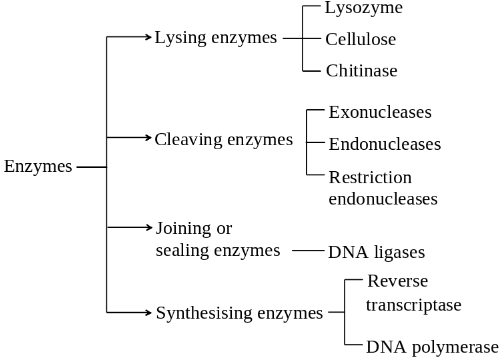
(B) The key tools required for recombinant $DNA$ technology include:
$1$. Enzymes (such as restriction endonucleases,$DNA$ ligases,etc.)
$2$. Cloning vectors (to carry the foreign $DNA$ into the host)
$3$. Competent host organisms (to receive the recombinant $DNA$)
$RNA$ primers are specifically used in the Polymerase Chain Reaction $(PCR)$ technique,and $DNA$ probes are used for the detection of specific $DNA$ sequences,but they are not considered the fundamental 'key tools' for the basic construction of recombinant $DNA$ molecules in the same category as enzymes,vectors,and host organisms. Therefore,the correct combination is $I, IV$ and $V$.
$1$. Enzymes (such as restriction endonucleases,$DNA$ ligases,etc.)
$2$. Cloning vectors (to carry the foreign $DNA$ into the host)
$3$. Competent host organisms (to receive the recombinant $DNA$)
$RNA$ primers are specifically used in the Polymerase Chain Reaction $(PCR)$ technique,and $DNA$ probes are used for the detection of specific $DNA$ sequences,but they are not considered the fundamental 'key tools' for the basic construction of recombinant $DNA$ molecules in the same category as enzymes,vectors,and host organisms. Therefore,the correct combination is $I, IV$ and $V$.
0 likes
View Solution364
MediumMCQ
Match the correct pair:
A
$RNA$ Polymerase - $RNA$ primer
B
Respiration - Lysosome
C
Restriction enzyme - Genetic engineering
D
Central dogma - $DNA$ structure
Solution
(C) $RNA$ polymerase is an enzyme involved in the process of transcription,where $RNA$ is synthesized from a $DNA$ template. It is not directly involved in the synthesis of $RNA$ primers (which is done by primase).
Respiration occurs in the mitochondria,not the lysosome.
Restriction enzymes are essential tools in genetic engineering used to cut $DNA$ at specific recognition sequences.
The Central Dogma describes the flow of genetic information from $DNA$ to $RNA$ to protein,not just the structure of $DNA$.
Respiration occurs in the mitochondria,not the lysosome.
Restriction enzymes are essential tools in genetic engineering used to cut $DNA$ at specific recognition sequences.
The Central Dogma describes the flow of genetic information from $DNA$ to $RNA$ to protein,not just the structure of $DNA$.
0 likes
View Solution365
MediumMCQ
Plasmids are suitable vectors for gene cloning because
A
These are small circular $DNA$ molecules,which can integrate with host chromosomal $DNA$
B
These are small circular $DNA$ molecules with their own replication origin site
C
These can shuttle between prokaryotic and eukaryotic cells
D
These often carry antibiotic resistance genes
Solution
(B) Plasmids are extrachromosomal,self-replicating,circular $DNA$ molecules found in bacteria.
They are suitable as cloning vectors because they possess an origin of replication ($ori$ site),which allows them to replicate independently of the host chromosomal $DNA$.
This independent replication ensures that the inserted gene of interest is copied multiple times within the host cell.
They are suitable as cloning vectors because they possess an origin of replication ($ori$ site),which allows them to replicate independently of the host chromosomal $DNA$.
This independent replication ensures that the inserted gene of interest is copied multiple times within the host cell.
0 likes
View Solution366
EasyMCQ
Restriction enzymes were discovered by
A
Alexander Fleming
B
Waksman
C
Berg
D
Smith,Nathan and Arber
Solution
(D) Restriction enzymes are known as molecular knives or molecular scissors and are used to cut $DNA$ at specific sites. These enzymes were first discovered by $Smith$, $Nathan$, and $Arber$ in the year $1970$.
0 likes
View Solution367
MediumMCQ
During 'gene cloning',which is called a gene taxi?
A
Vaccine
B
Plasmid
C
Bacteria
D
Protozoa
Solution
(B) During gene cloning,a plasmid is referred to as a gene taxi or vector.
Molecular biologists insert the desired gene into the plasmid $DNA$.
This recombinant plasmid is then introduced into a host cell,such as a living bacterium,to replicate the gene.
Molecular biologists insert the desired gene into the plasmid $DNA$.
This recombinant plasmid is then introduced into a host cell,such as a living bacterium,to replicate the gene.
0 likes
View Solution368
MediumMCQ
The most thoroughly studied of the known bacteria-plant interaction is the:
A
Plant growth simulation by phosphate-solubilising bacteria
B
Cyanobacterial symbiosis with some aquatic ferns
C
Gall formation on certain angiosperms by Agrobacterium
D
Nodulation of Sesbania stems by nitrogen fixing bacteria
Solution
(C) $Agrobacterium \text{ } tumefaciens$ contains a tumor-inducing $(Ti)$ plasmid, which causes the formation of crown gall tumors in infected plants.
This interaction is the most thoroughly studied because scientists have successfully modified the $Ti$ plasmid to act as a cloning vector.
By removing the tumor-causing genes and replacing them with genes of interest, it has become a fundamental tool in plant genetic engineering to transfer foreign $DNA$ into host plants.
This interaction is the most thoroughly studied because scientists have successfully modified the $Ti$ plasmid to act as a cloning vector.
By removing the tumor-causing genes and replacing them with genes of interest, it has become a fundamental tool in plant genetic engineering to transfer foreign $DNA$ into host plants.
0 likes
View Solution369
MediumMCQ
The $DNA$ used as a carrier for transferring a fragment of foreign $DNA$ into a suitable host is called
A
Cloning vector
B
Vehicle $DNA$
C
Gene carrier
D
All of these
Solution
(D) cloning vector is a small piece of $DNA$ taken from any organism into which a foreign $DNA$ fragment can be inserted for cloning purposes.
These vectors act as carriers to transport foreign genetic material into a host cell.
They are also commonly referred to as vehicle $DNA$ or gene carriers because they facilitate the transfer and replication of the inserted $DNA$ within the host organism.
Therefore,all the given terms are used to describe the same biological tool.
These vectors act as carriers to transport foreign genetic material into a host cell.
They are also commonly referred to as vehicle $DNA$ or gene carriers because they facilitate the transfer and replication of the inserted $DNA$ within the host organism.
Therefore,all the given terms are used to describe the same biological tool.
0 likes
View Solution370
MediumMCQ
In recombinant $DNA$ technique,the term vector refers to a
A
Donor $DNA$,it is identified and picked up through electrophoresis
B
Plasmid,transfers $DNA$ into living cell
C
Collection of entire genome in form of plasmid
D
Enzyme,cuts the $DNA$ at specific sites
Solution
(B) vector is a $DNA$ molecule used as a vehicle to artificially carry foreign genetic material into another cell,where it can be replicated and/or expressed.
Plasmids and bacteriophages are the most commonly used vectors in recombinant $DNA$ technology because they have the ability to replicate within bacterial cells independent of the control of chromosomal $DNA$.
Plasmids and bacteriophages are the most commonly used vectors in recombinant $DNA$ technology because they have the ability to replicate within bacterial cells independent of the control of chromosomal $DNA$.
0 likes
View Solution371
EasyMCQ
Who discovered that restriction enzymes have the capability of cutting $DNA$ strands in a particular fashion,which left what has become known as 'sticky ends' on the strands?
A
Ramdeo Mishra
B
Stanley Cohen
C
Herbert Boyer
D
James $D$. Watson
Solution
(C) Herbert Boyer discovered that restriction enzymes have the capability of cutting $DNA$ strands in a particular fashion,which left what has become known as 'sticky ends' on the strands. This discovery was fundamental to the development of recombinant $DNA$ technology.
0 likes
View Solution372
MediumMCQ
Agarose is extracted from
A
Sea weeds
B
Blue-green algae
C
Ephedra
D
Sargassam
Solution
(A) Agarose is a natural polysaccharide extracted from sea weeds (specifically red algae like Gelidium and Gracilaria).
In the process of gel electrophoresis,$DNA$ fragments are separated based on their size as they move through the pores of the agarose gel matrix under an electric field.
In the process of gel electrophoresis,$DNA$ fragments are separated based on their size as they move through the pores of the agarose gel matrix under an electric field.
0 likes
View Solution373
MediumMCQ
In gel electrophoresis,the sample $DNA$ is cut into fragments by
A
Restriction endonucleases
B
Exonuclease
C
Endonuclease
D
Anhydro $L-$galactose
Solution
(A) In gel electrophoresis,the process of separating $DNA$ fragments requires the $DNA$ to be cut into smaller pieces first.
This cutting process is performed by specific enzymes known as restriction endonucleases.
These enzymes recognize specific palindromic nucleotide sequences in the $DNA$ molecule and cleave the phosphodiester bonds at or near these sites,resulting in fragments of varying lengths that can then be separated by gel electrophoresis.
This cutting process is performed by specific enzymes known as restriction endonucleases.
These enzymes recognize specific palindromic nucleotide sequences in the $DNA$ molecule and cleave the phosphodiester bonds at or near these sites,resulting in fragments of varying lengths that can then be separated by gel electrophoresis.
0 likes
View Solution374
MediumMCQ
Due to the chloramphenicol resistance gene,one is able to select a transformed cell in the presence of chloramphenicol. The chloramphenicol resistance gene in this case is called:
A
Origin of replication
B
Selectable marker
C
Cloning sites
D
Insertional inactivation
Solution
(B) In recombinant $DNA$ technology,a selectable marker is a gene introduced into a cell that confers a trait suitable for artificial selection.
It allows the identification and elimination of non-transformants and selectively permits the growth of the transformants.
Since the chloramphenicol resistance gene allows for the selection of transformed cells in the presence of the antibiotic chloramphenicol,it functions as a selectable marker.
It allows the identification and elimination of non-transformants and selectively permits the growth of the transformants.
Since the chloramphenicol resistance gene allows for the selection of transformed cells in the presence of the antibiotic chloramphenicol,it functions as a selectable marker.
0 likes
View Solution375
MediumMCQ
The $...A...$ are the $DNA$ molecules that can carry a foreign $...B...$ segment into the host cell. Here $A$ and $B$ refer to:
A
$(A)-$ $Vector$,$(B)-$ $RNA$
B
$(A)-$ $Vector$,$(B)-$ $DNA$
C
$(A)-$ $Gene$,$(B)-$ $RNA$
D
$(A)-$ $Gene$,$(B)-$ $DNA$
Solution
(B) In recombinant $DNA$ technology,vectors are $DNA$ molecules used as vehicles to carry a particular foreign $DNA$ segment into the host cell.
$A$ refers to $Vector$ (e.g.,plasmids or bacteriophages).
$B$ refers to $DNA$ (the gene of interest).
Therefore,the correct option is $(B)$.
$A$ refers to $Vector$ (e.g.,plasmids or bacteriophages).
$B$ refers to $DNA$ (the gene of interest).
Therefore,the correct option is $(B)$.
0 likes
View Solution376
MediumMCQ
Restriction enzymes may be used for:
A
Making recombinant $DNA$
B
Gene mapping
C
Diagnosis of genetic diseases
D
All the above
Solution
(D) Restriction enzymes,also known as molecular scissors,are essential tools in biotechnology.
$1$. They are used to cut $DNA$ at specific recognition sequences,which is the first step in creating recombinant $DNA$ molecules.
$2$. They are used in gene mapping by creating specific $DNA$ fragments (Restriction Fragment Length Polymorphism - $RFLP$) that help in locating genes on chromosomes.
$3$. They are used in the diagnosis of genetic diseases by identifying mutations that alter restriction sites,allowing for the detection of specific genetic disorders.
Therefore,all the given options are correct applications of restriction enzymes.
$1$. They are used to cut $DNA$ at specific recognition sequences,which is the first step in creating recombinant $DNA$ molecules.
$2$. They are used in gene mapping by creating specific $DNA$ fragments (Restriction Fragment Length Polymorphism - $RFLP$) that help in locating genes on chromosomes.
$3$. They are used in the diagnosis of genetic diseases by identifying mutations that alter restriction sites,allowing for the detection of specific genetic disorders.
Therefore,all the given options are correct applications of restriction enzymes.
0 likes
View Solution377
MediumMCQ
In a genetic engineering experiment,restriction enzymes can be used for
A
Bacterial $DNA$ only
B
Viral $DNA$ only
C
Any $DNA$ fragment
D
Eukaryotic $DNA$ only
Solution
(C) Restriction enzymes are a class of enzymes that recognize specific nucleotide sequences (palindromic sequences) in $DNA$ and cut the $DNA$ at specific sites.
These enzymes are derived from bacteria,where they serve as a defense mechanism against bacteriophages.
However,in genetic engineering,they are used as 'molecular scissors' to cut $DNA$ molecules from any source,whether it is bacterial,viral,or eukaryotic,provided the specific recognition site is present.
Therefore,restriction enzymes can be used to cut any $DNA$ fragment.
These enzymes are derived from bacteria,where they serve as a defense mechanism against bacteriophages.
However,in genetic engineering,they are used as 'molecular scissors' to cut $DNA$ molecules from any source,whether it is bacterial,viral,or eukaryotic,provided the specific recognition site is present.
Therefore,restriction enzymes can be used to cut any $DNA$ fragment.
0 likes
View Solution378
MediumMCQ
Special sequence in the $DNA$ recognized by restriction endonuclease is called
A
Restriction nucleotide sequence
B
Palindromic nucleotide sequence
C
Recognition nucleotide sequence
D
All of the above
Solution
(D) Restriction endonucleases are enzymes that cut $DNA$ at specific sites.
These specific sites are known as recognition sequences.
These sequences are typically palindromic in nature,meaning they read the same in both directions $(5' \rightarrow 3')$ on the two strands.
Since all the terms provided describe the nature and function of these sites,the correct answer is $D$.
These specific sites are known as recognition sequences.
These sequences are typically palindromic in nature,meaning they read the same in both directions $(5' \rightarrow 3')$ on the two strands.
Since all the terms provided describe the nature and function of these sites,the correct answer is $D$.
0 likes
View Solution379
EasyMCQ
In addition to $Taq$ polymerase enzyme,which other thermostable $DNA$ polymerases have been isolated to be used in Polymerase Chain Reaction $(PCR)$?
A
Vent polymerase
B
$Pfu$ polymerase
C
Both $(a)$ and $(b)$
D
None of these
Solution
(C) Apart from $Taq$ polymerase,which is isolated from the bacterium $Thermus$ $aquaticus$,other thermostable $DNA$ polymerases such as $Vent$ polymerase (isolated from $Thermococcus$ $litoralis$) and $Pfu$ polymerase (isolated from $Pyrococcus$ $furiosus$) are also used in $PCR$. These enzymes are preferred because they possess high fidelity and remain stable at the high temperatures required for $DNA$ denaturation.
0 likes
View Solution380
MediumMCQ
The restriction enzyme responsible for the cleavage of the following sequence is:
$5^{\prime}-G-T-C-G-A-C-3^{\prime}$
$3^{\prime}-C-A-G-C-T-G-5^{\prime}$
$5^{\prime}-G-T-C-G-A-C-3^{\prime}$
$3^{\prime}-C-A-G-C-T-G-5^{\prime}$
A
$Alu\;I$
B
$Bam\;HI$
C
$Hind\;II$
D
$Eco\;RI$
Solution
(C) The given $DNA$ sequence is $5^{\prime}-GTCGAC-3^{\prime}$ / $3^{\prime}-CAGCTG-5^{\prime}$.
This sequence represents the recognition site for the restriction enzyme $Hind\;II$.
$Hind\;II$ was the first restriction endonuclease to be isolated and it always cuts $DNA$ molecules at a particular point by recognizing a specific recognition sequence of $6$ base pairs.
The recognition sequence for $Hind\;II$ is $GTCGAC$.
This sequence represents the recognition site for the restriction enzyme $Hind\;II$.
$Hind\;II$ was the first restriction endonuclease to be isolated and it always cuts $DNA$ molecules at a particular point by recognizing a specific recognition sequence of $6$ base pairs.
The recognition sequence for $Hind\;II$ is $GTCGAC$.
0 likes
View Solution381
MediumMCQ
$I.$ Bacteriophages are $...A...$ infecting $...B....$
$II. ...C...$ are hybrid vectors derived from plasmids which contain $cos$ site of $\lambda$ phage.
$A, B$ and $C$ in above statements refer to:
$II. ...C...$ are hybrid vectors derived from plasmids which contain $cos$ site of $\lambda$ phage.
$A, B$ and $C$ in above statements refer to:
A
$A-$Protozoa,$B-$Bacteria,$C-$Cosmid
B
$A-$Plasmid,$B-$Virus,$C-$Cosmid
C
$A-$Bacteria,$B-$Virus,$C-$Cosmid
D
$A-$Virus,$B-$Bacteria,$C-$Cosmid
Solution
(D) $1$. Bacteriophages are viruses that infect bacteria. Therefore,$A$ is $Virus$ and $B$ is $Bacteria$.
$2$. Cosmids are hybrid vectors constructed by combining features of plasmids and the $cos$ site of the $\lambda$ (lambda) phage. Therefore,$C$ is $Cosmid$.
$3$. Matching these with the options,we get $A-$Virus,$B-$Bacteria,$C-$Cosmid.
$2$. Cosmids are hybrid vectors constructed by combining features of plasmids and the $cos$ site of the $\lambda$ (lambda) phage. Therefore,$C$ is $Cosmid$.
$3$. Matching these with the options,we get $A-$Virus,$B-$Bacteria,$C-$Cosmid.
0 likes
View Solution382
MediumMCQ
Genetic engineering is possible because:
A
The phenomenon of transduction in bacteria is well understood
B
We can see $DNA$ by electron microscope
C
We can cut $DNA$ at specific sites by endonucleases like $DNA$ ase $I$
D
Restriction endonucleases purified from bacteria can be used in vitro
Solution
(D) Genetic engineering,or recombinant $DNA$ technology,relies on the ability to manipulate $DNA$ molecules precisely.
Restriction endonucleases are enzymes that act as 'molecular scissors' by cutting $DNA$ at specific recognition sequences.
These enzymes were originally discovered in bacteria as a defense mechanism against bacteriophages.
Once purified,these restriction endonucleases can be used in vitro (outside the living organism) to cut $DNA$ molecules at specific sites,which is a fundamental step in creating recombinant $DNA$ constructs.
Restriction endonucleases are enzymes that act as 'molecular scissors' by cutting $DNA$ at specific recognition sequences.
These enzymes were originally discovered in bacteria as a defense mechanism against bacteriophages.
Once purified,these restriction endonucleases can be used in vitro (outside the living organism) to cut $DNA$ molecules at specific sites,which is a fundamental step in creating recombinant $DNA$ constructs.
0 likes
View Solution383
MediumMCQ
About gene gun method:
$I.$ This method is also known as biolistic technique.
$II.$ In this method,cells are bombarded with high-velocity micro-particles of gold or tungsten coated with $DNA$ in plants.
$III.$ Important crop plants like maize,rice,and wheat have now been transformed by this method.
Which of the statements given above are correct?
$I.$ This method is also known as biolistic technique.
$II.$ In this method,cells are bombarded with high-velocity micro-particles of gold or tungsten coated with $DNA$ in plants.
$III.$ Important crop plants like maize,rice,and wheat have now been transformed by this method.
Which of the statements given above are correct?
A
$I$ and $II$
B
$I$ and $III$
C
$II$ and $III$
D
$I, II,$ and $III$
Solution
(D) The gene gun method,also known as the biolistic technique,is a direct gene transfer method used primarily for plants.
Statement $I$ is correct: It is indeed called the biolistic technique.
Statement $II$ is correct: In this process,cells are bombarded with high-velocity micro-particles of gold or tungsten coated with the target $DNA$.
Statement $III$ is correct: This technique has been successfully used to transform important crop plants such as maize,rice,and wheat.
Therefore,all three statements are correct.
Statement $I$ is correct: It is indeed called the biolistic technique.
Statement $II$ is correct: In this process,cells are bombarded with high-velocity micro-particles of gold or tungsten coated with the target $DNA$.
Statement $III$ is correct: This technique has been successfully used to transform important crop plants such as maize,rice,and wheat.
Therefore,all three statements are correct.
0 likes
View Solution384
MediumMCQ
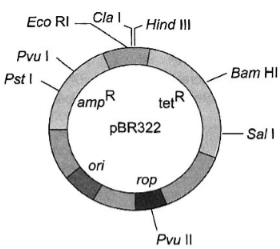
The given figure is the diagrammatic representation of the $E. coli$ vector $pBR322$. Which one of the given options correctly identifies its certain component$(s)$?
A
$Ori$ - original restriction enzymes
B
$Rop$ - reduced osmotic pressure
C
$Hind III, Eco RI$ - selectable markers
D
$amp^R, tet^R$ - antibiotic resistance genes
Solution
(D) In the $pBR322$ vector,$amp^R$ stands for ampicillin resistance gene and $tet^R$ stands for tetracycline resistance gene. These are antibiotic resistance genes that serve as selectable markers. $Ori$ is the origin of replication,and $Rop$ codes for proteins involved in the replication of the plasmid.
0 likes
View Solution385
MediumMCQ
The role of $DNA$ ligase in the construction of a recombinant $DNA$ molecule is:
A
Formation of phosphodiester bond between two $DNA$ fragments
B
Formation of hydrogen bonds between sticky ends of $DNA$ fragments
C
Ligation of all purine and pyrimidine bases
D
None of the above
Solution
(A) The primary role of $DNA$ ligase in the construction of a recombinant $DNA$ molecule is the formation of a phosphodiester bond between two $DNA$ fragments.
$DNA$ ligase acts as a molecular glue by sealing the nicks or gaps in the sugar-phosphate backbone of $DNA$ strands.
It catalyzes the joining of the $3'$-hydroxyl end of one nucleotide to the $5'$-phosphate end of another.
This enzyme is essential for joining the vector $DNA$ and the insert $DNA$ to create a functional recombinant molecule.
$DNA$ ligase acts as a molecular glue by sealing the nicks or gaps in the sugar-phosphate backbone of $DNA$ strands.
It catalyzes the joining of the $3'$-hydroxyl end of one nucleotide to the $5'$-phosphate end of another.
This enzyme is essential for joining the vector $DNA$ and the insert $DNA$ to create a functional recombinant molecule.
0 likes
View Solution386
MediumMCQ
Ligases catalyse the formation of bonds between
A
$C-O$
B
$P-O$
C
$C-C$
D
$C-N$
Solution
(B) Ligases are enzymes that catalyze the joining of two large molecules by forming a new chemical bond. In the context of $DNA$ technology, $DNA$ ligase catalyzes the formation of a phosphodiester bond between the $3'-OH$ end of one nucleotide and the $5'-phosphate$ end of another nucleotide. This bond involves the linkage of $C-O-P-O-C$ atoms, specifically forming the $P-O$ bond within the sugar-phosphate backbone.
0 likes
View Solution387
MediumMCQ
Which of the following would not be used in preparing recombinant $DNA$?
A
$Plasmids$
B
$Phages$
C
$Restriction$ enzymes
D
$DNA$ polymerase $III$
Solution
(D) Recombinant $DNA$ technology involves the insertion of a specific gene into a vector to create a recombinant molecule.
$Plasmids$ and $Phages$ are commonly used as vectors to carry the foreign $DNA$ into the host cell.
$Restriction$ enzymes are essential for cutting the $DNA$ at specific recognition sequences to create sticky or blunt ends.
$DNA$ polymerase $III$ is the primary enzyme responsible for $DNA$ replication in prokaryotes (like $E. coli$). It is not typically used in the construction of recombinant $DNA$ molecules in vitro; instead,$DNA$ ligase is used to join the $DNA$ fragments,and sometimes $DNA$ polymerase $I$ or $Taq$ polymerase is used for specific applications like filling in ends or $PCR$ amplification.
$Plasmids$ and $Phages$ are commonly used as vectors to carry the foreign $DNA$ into the host cell.
$Restriction$ enzymes are essential for cutting the $DNA$ at specific recognition sequences to create sticky or blunt ends.
$DNA$ polymerase $III$ is the primary enzyme responsible for $DNA$ replication in prokaryotes (like $E. coli$). It is not typically used in the construction of recombinant $DNA$ molecules in vitro; instead,$DNA$ ligase is used to join the $DNA$ fragments,and sometimes $DNA$ polymerase $I$ or $Taq$ polymerase is used for specific applications like filling in ends or $PCR$ amplification.
0 likes
View Solution388
MediumMCQ
Which of the following is used in recombinant $DNA$ technique?
A
Cell wall of virus
B
Gene which produces capsid of virus
C
Virus
D
Capsid of virus
Solution
(C) In recombinant $DNA$ technology,a desired segment of $DNA$ or a gene is combined with the $DNA$ of a vector to multiply and produce copies of the gene.
Viruses (such as bacteriophages) and plasmids are the most commonly used cloning vectors in recombinant $DNA$ technology because they can replicate within host cells.
Viruses (such as bacteriophages) and plasmids are the most commonly used cloning vectors in recombinant $DNA$ technology because they can replicate within host cells.
0 likes
View Solution389
MediumMCQ
Gene for cloning may be chemically synthesized:
A
When the exact sequence of nucleotides is known
B
Through the use of restriction enzymes and gel electrophoresis to separate restriction fragments
C
By the Sanger method
D
By making complementary $DNA$ from genes without introns
Solution
(A) Chemical synthesis of a gene is possible when the exact sequence of nucleotides in the gene is known.
This process involves the synthesis of short oligonucleotides that are subsequently joined together to form the complete gene sequence.
This technique is particularly useful for synthesizing genes that are small or for creating synthetic genes with specific modifications.
Other options like restriction enzymes,Sanger method (used for sequencing),or cDNA synthesis (reverse transcription) are different approaches to obtaining genes,not chemical synthesis.
This process involves the synthesis of short oligonucleotides that are subsequently joined together to form the complete gene sequence.
This technique is particularly useful for synthesizing genes that are small or for creating synthetic genes with specific modifications.
Other options like restriction enzymes,Sanger method (used for sequencing),or cDNA synthesis (reverse transcription) are different approaches to obtaining genes,not chemical synthesis.
0 likes
View Solution390
MediumMCQ
Using recombinant technology,genes from a donor cell can be transplanted into a bacterium for $DNA$ replication and protein synthesis. The kinds of cells that can be used as a donor in this technology are
A
Bacteria
B
Either yeast or bacteria
C
Eukaryotic cells
D
Any kind of cell
Solution
(D) In recombinant $DNA$ technology,the donor cell provides the gene of interest. Since the genetic code is universal,genes from any living organism (prokaryotic or eukaryotic) can be isolated and inserted into a host bacterium for replication and expression. Therefore,any kind of cell can serve as a donor.
0 likes
View Solution391
EasyMCQ
Known sequence of $DNA$ that is used to find a complementary $DNA$ strand is:
A
$Vector$
B
$Plasmid$
C
$DNA$ probe
D
Recombinant $DNA$
Solution
(C) $DNA$ probe is a single-stranded sequence of $DNA$ or $RNA$ that has a known sequence.
It is labeled with a radioactive isotope or a fluorescent dye.
It is used to detect the presence of complementary nucleotide sequences in a sample of $DNA$ or $RNA$ through the process of hybridization.
Therefore,the correct option is $C$.
It is labeled with a radioactive isotope or a fluorescent dye.
It is used to detect the presence of complementary nucleotide sequences in a sample of $DNA$ or $RNA$ through the process of hybridization.
Therefore,the correct option is $C$.
0 likes
View Solution392
MediumMCQ
Thermostable enzymes 'Taq' and 'Vent' isolated from thermophilic bacteria are
A
$DNA$ polymerase
B
$DNA$ ligases
C
Restriction endonucleases
D
$RNA$ polymerases
Solution
(A) Thermostable enzymes 'Taq' and 'Vent' isolated from thermophilic bacteria are $DNA$ polymerase.
$Taq$ polymerase is isolated from the thermophilic bacterium $Thermus \; aquaticus$.
$Vent$ polymerase is isolated from the thermophilic bacterium $Thermococcus \; litoralis$.
These enzymes are widely used in the Polymerase Chain Reaction $(PCR)$ technique because they remain stable at high temperatures required for the denaturation of $DNA$.
$Taq$ polymerase is isolated from the thermophilic bacterium $Thermus \; aquaticus$.
$Vent$ polymerase is isolated from the thermophilic bacterium $Thermococcus \; litoralis$.
These enzymes are widely used in the Polymerase Chain Reaction $(PCR)$ technique because they remain stable at high temperatures required for the denaturation of $DNA$.
0 likes
View Solution393
MediumMCQ
In the naming of restriction enzymes, the first letter is derived from $...A...$ name, the next two letters from the $...B...$, and the fourth letter from $...C...$ of $...D...$ where the enzymes are extracted.
$A$ to $D$ in the statement can be:
$A$ to $D$ in the statement can be:
A
$(A)-$Genus, $(B)-$species, $(C)-$strain, $(D)-$bacteria
B
$(A)-$Species, $(B)-$genus, $(C)-$strain, $(D)-$bacteria
C
$(A)-$genus, $(B)-$Species, $(C)-$variety, $(D)-$eukaryote
D
$(A)-$Species, $(B)-$genus, $(C)-$variety, $(D)-$eukaryote
Solution
(A) The naming convention for restriction enzymes follows a specific pattern:
$1$. The first letter comes from the Genus name of the organism.
$2$. The next two letters come from the species name.
$3$. The fourth letter represents the strain of the organism.
$4$. These enzymes are typically extracted from prokaryotic organisms (bacteria).
Therefore, $A = \text{Genus}$, $B = \text{species}$, $C = \text{strain}$, and $D = \text{bacteria}$.
$1$. The first letter comes from the Genus name of the organism.
$2$. The next two letters come from the species name.
$3$. The fourth letter represents the strain of the organism.
$4$. These enzymes are typically extracted from prokaryotic organisms (bacteria).
Therefore, $A = \text{Genus}$, $B = \text{species}$, $C = \text{strain}$, and $D = \text{bacteria}$.
0 likes
View Solution394
MediumMCQ
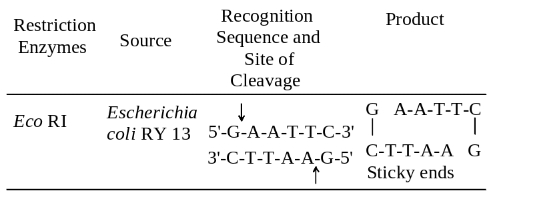
Which of the following statements is not correct regarding the $Eco RI$ restriction endonuclease enzyme?
$I.$ $Eco RI$ restriction endonuclease enzyme is isolated from $Escherichia \; coli \; RY13$.
$II.$ Its recognition sequence is $5^{\prime}-GAATTC-3^{\prime}$ / $3^{\prime}-CTTAAG-5^{\prime}$.
$III.$ Its site of cleavage is between $G$ and $A$ in the sequence $5^{\prime}-GAATTC-3^{\prime}$.
$I.$ $Eco RI$ restriction endonuclease enzyme is isolated from $Escherichia \; coli \; RY13$.
$II.$ Its recognition sequence is $5^{\prime}-GAATTC-3^{\prime}$ / $3^{\prime}-CTTAAG-5^{\prime}$.
$III.$ Its site of cleavage is between $G$ and $A$ in the sequence $5^{\prime}-GAATTC-3^{\prime}$.
A
$I$ and $II$
B
$I$ and $III$
C
$I, II$ and $III$
D
None of the above
Solution
(D) Statement $I$ is correct: $Eco RI$ is indeed isolated from the bacterium $Escherichia \; coli \; RY13$.
Statement $II$ is correct: The recognition sequence for $Eco RI$ is $5^{\prime}-GAATTC-3^{\prime}$ and $3^{\prime}-CTTAAG-5^{\prime}$.
Statement $III$ is correct: The enzyme cleaves the $DNA$ between the bases $G$ and $A$ on both strands,resulting in sticky ends.
Since all the given statements are correct,the correct answer is 'None of the above'.
Statement $II$ is correct: The recognition sequence for $Eco RI$ is $5^{\prime}-GAATTC-3^{\prime}$ and $3^{\prime}-CTTAAG-5^{\prime}$.
Statement $III$ is correct: The enzyme cleaves the $DNA$ between the bases $G$ and $A$ on both strands,resulting in sticky ends.
Since all the given statements are correct,the correct answer is 'None of the above'.
0 likes
View Solution395
MediumMCQ
The most important feature in a plasmid to be used as a vector is
A
Origin of replication
B
Presence of a selectable marker
C
Presence of sites for restriction endonuclease
D
Its size
Solution
(A) The most important feature in a plasmid to be used as a vector is the origin of replication $(Ori)$.
Origin of replication is a specific sequence of $DNA$ bases that is responsible for initiating the replication process.
Without an $Ori$ site,the plasmid cannot replicate within the host cell,making it impossible to maintain the recombinant $DNA$ molecule.
While selectable markers and restriction sites are also essential for a vector,the origin of replication is the fundamental requirement for the autonomous replication of the plasmid.
Origin of replication is a specific sequence of $DNA$ bases that is responsible for initiating the replication process.
Without an $Ori$ site,the plasmid cannot replicate within the host cell,making it impossible to maintain the recombinant $DNA$ molecule.
While selectable markers and restriction sites are also essential for a vector,the origin of replication is the fundamental requirement for the autonomous replication of the plasmid.
0 likes
View Solution396
MediumMCQ
Plasmid is used as a carrier (vector) because:
A
It has both ends with replicating points
B
It has no free ends
C
It is circular $DNA$ with a capacity of binding with eukaryotic $DNA$
D
All of the above
Solution
(D) Plasmids are small,circular,double-stranded $DNA$ molecules that are distinct from a cell's chromosomal $DNA$.
They are widely used as vectors in genetic engineering because they possess an origin of replication $(ori)$,which allows them to replicate independently within the host cell.
Because they are circular,they lack free ends,which protects them from degradation by exonucleases.
Furthermore,their ability to integrate or carry foreign $DNA$ makes them ideal for transferring genes into host organisms,including eukaryotic cells.
They are widely used as vectors in genetic engineering because they possess an origin of replication $(ori)$,which allows them to replicate independently within the host cell.
Because they are circular,they lack free ends,which protects them from degradation by exonucleases.
Furthermore,their ability to integrate or carry foreign $DNA$ makes them ideal for transferring genes into host organisms,including eukaryotic cells.
0 likes
View Solution397
MediumMCQ
Primers are
A
Small chemically synthesized oligonucleotides of about $10-18$ nucleotides that are complementary to the region of template $DNA$
B
Chemically synthesized oligonucleotides of about $10-18$ nucleotides that are not complementary to the region of template $DNA$
C
The double-stranded $DNA$ that need to be amplified
D
Specific sequences present on recombinant $DNA$
Solution
(A) Primers are small,chemically synthesized oligonucleotides,typically $10-18$ nucleotides in length.
They are designed to be complementary to the specific sequences present at the $3'$ ends of the target $DNA$ segment.
These primers provide a free $3'$-$OH$ group,which is essential for the $DNA$ polymerase enzyme to initiate the process of $DNA$ replication during $PCR$.
They are designed to be complementary to the specific sequences present at the $3'$ ends of the target $DNA$ segment.
These primers provide a free $3'$-$OH$ group,which is essential for the $DNA$ polymerase enzyme to initiate the process of $DNA$ replication during $PCR$.
0 likes
View Solution398
MediumMCQ
Two enzymes responsible for restricting the growth of bacteriophages in $E. coli$ were isolated. One was methylase and the other was restriction endonuclease. What is the significance of methylase?
A
Protection of host $DNA$ from the action of restriction endonuclease by adding methyl group to one or two bases usually within the sequence recognized by the restriction enzyme.
B
Able to ligate the two cohesive ends of $DNA$ molecule.
C
Able to remove the methyl group and hence,prevent the action of restriction endonuclease on host $DNA$.
D
Able to cut the $DNA$ of bacteriophage at specific sites.
Solution
(A) In bacteria,the restriction-modification system serves as a defense mechanism against bacteriophages. The restriction endonuclease recognizes specific $DNA$ sequences and cleaves them. To prevent the host's own $DNA$ from being degraded by its own restriction enzymes,the bacterium produces a methylase enzyme. This enzyme adds a methyl group to specific bases within the recognition sequence of the host $DNA$. This modification prevents the restriction endonuclease from binding to or cutting the host $DNA$,thereby protecting it.
0 likes
View Solution399
MediumMCQ
Consider the following statements:
$I.$ $A$ soil-inhabiting plant bacterium,$Agrobacterium \; tumefaciens$,a pathogen of several dicot plants,is able to transfer a piece of $DNA$ known as $T-DNA$.
$II.$ The $T-DNA$ causes tumours.
$III.$ Tumour formation is induced by $Ti-plasmid$.
Which of the statements given above are correct?
$I.$ $A$ soil-inhabiting plant bacterium,$Agrobacterium \; tumefaciens$,a pathogen of several dicot plants,is able to transfer a piece of $DNA$ known as $T-DNA$.
$II.$ The $T-DNA$ causes tumours.
$III.$ Tumour formation is induced by $Ti-plasmid$.
Which of the statements given above are correct?
A
$I$ and $II$
B
$I$ and $III$
C
$II$ and $III$
D
$I, II,$ and $III$
Solution
(D) $Agrobacterium \; tumefaciens$ is a soil-inhabiting bacterium that acts as a natural pathogen for many dicot plants.
It contains a $Ti-plasmid$ (Tumour-inducing plasmid).
During infection,it transfers a specific segment of $DNA$ known as $T-DNA$ into the host plant cell genome.
This $T-DNA$ integrates into the plant genome and causes the formation of tumours (galls) by inducing uncontrolled cell division.
Therefore,all three statements ($I, II,$ and $III$) are correct.
It contains a $Ti-plasmid$ (Tumour-inducing plasmid).
During infection,it transfers a specific segment of $DNA$ known as $T-DNA$ into the host plant cell genome.
This $T-DNA$ integrates into the plant genome and causes the formation of tumours (galls) by inducing uncontrolled cell division.
Therefore,all three statements ($I, II,$ and $III$) are correct.
0 likes
View Solution400
MediumMCQ
The first restriction endonuclease type $II$,$...A..$,was isolated by Smith,Wilcox and Kelley from $...B...$ bacterium. It was found to cut $DNA$ molecules at a particular point by recognizing a specific sequence of six base pairs,known as the $...C....$. Here $A, B$ and $C$ can be:
A
$A-$Eco $RI, B-$Escherichia $RY 13, C-$Restriction sequence
B
$A-$Eco $RII, B-E. coli R 245, C-$Recognition sequence
C
$A-$Hind $II, B-$Haemophilus influenzae,$C$-Recognition sequence
D
$A-$Bam $HI, B-$Bacillus,$C-$Restriction sequence
Solution
(C) The first restriction endonuclease discovered was Hind $II$.
It was isolated by Smith,Wilcox,and Kelley in $1970$ from the bacterium Haemophilus influenzae.
Hind $II$ always cuts $DNA$ molecules at a particular point by recognizing a specific sequence of six base pairs,which is known as the recognition sequence.
It was isolated by Smith,Wilcox,and Kelley in $1970$ from the bacterium Haemophilus influenzae.
Hind $II$ always cuts $DNA$ molecules at a particular point by recognizing a specific sequence of six base pairs,which is known as the recognition sequence.
0 likes
View SolutionBiotechnology Principals and Process — Tools of recombinant DNA technology · Frequently Asked Questions
1Are these Biotechnology Principals and Process questions useful for JEE and NEET?
Yes. All questions in this section are mapped to JEE Main and NEET exam patterns. Previous year questions from JEE Main, NEET, GUJCET and state-level exams are included with full solutions.
2Can I switch to Hindi or Gujarati for these questions?
Yes. Use the language tabs in the hero section or the sidebar to view the same questions and solutions in English, Hindi or Gujarati.
3How do I generate a question paper from this subtopic?
Use the Vedclass Exam Paper Generator — select the chapter and subtopic, set difficulty, and generate Sets A, B, C, D automatically. First 3 chapters of every subject are free.
Vedclass Products
For Students
Vedclass Test Series
Mock tests in real JEE/NEET style with performance analysis. 5-day free trial.
Start Free TrialFor Teachers
Exam Paper Generator
Generate Set A/B/C/D papers from this chapter in 2 minutes. 3 chapters free.
Try FreeFor Institutes
Online Exam Module
Live online exams with unlimited students, 360° analytics & white-label branding.
See DemoFor Teachers & Institutes
Generate a Biotechnology Principals and Process Exam Paper in 2 Minutes
Select subtopic & difficulty — Sets A, B, C, D auto-generated with No Repeat logic.
First 3 chapters of every subject are free — no payment required.