
A English
Tools of recombinant DNA technology Questions in English
Class 12 Biology · Biotechnology Principals and Process · Tools of recombinant DNA technology
564+
Questions
English
Language
100%
With Solutions
Showing 50 of 564 questions in English
301
MediumMCQ
Which of the following is not a restriction enzyme?
A
$ClaI$
B
$Pvu \, II$
C
$Bam \, HI$
D
$pBR322$
Solution
(D) Restriction enzymes are endonucleases that cut $DNA$ at specific recognition sequences. $ClaI$,$Pvu \, II$,and $Bam \, HI$ are all examples of restriction enzymes derived from bacteria. $pBR322$ is a well-known artificial cloning vector (plasmid) used in genetic engineering,not an enzyme.
0 likes
View Solution302
DifficultMCQ
How many restriction sites for different restriction enzymes does the cloning vector $pBR322$ contain?
A
Two
B
Four
C
Six
D
Eight
Solution
(D) The cloning vector $pBR322$ is one of the most widely used $E. coli$ cloning vectors.
It contains unique recognition sites for several restriction enzymes,including $EcoRI$,$BamHI$,$HindIII$,$PstI$,$SalI$,$PvuI$,$PvuII$,and $ClaI$.
Counting these specific sites,there are $8$ distinct restriction sites present in the $pBR322$ plasmid.
Therefore,the correct answer is $8$.
It contains unique recognition sites for several restriction enzymes,including $EcoRI$,$BamHI$,$HindIII$,$PstI$,$SalI$,$PvuI$,$PvuII$,and $ClaI$.
Counting these specific sites,there are $8$ distinct restriction sites present in the $pBR322$ plasmid.
Therefore,the correct answer is $8$.
0 likes
View Solution303
MediumMCQ
The restriction enzyme $EcoRI$ cuts $DNA$ at the recognition site $GAATTC$ between which two bases?
A
Between $G$ and $A$
B
Between $A$ and $A$
C
Between $A$ and $T$
D
Between $C$ and $T$
Solution
(A) The restriction enzyme $EcoRI$ recognizes the palindromic sequence $5'-GAATTC-3'$.
It specifically cleaves the phosphodiester bond between the $G$ (Guanine) and $A$ (Adenine) nucleotides on both strands.
This cleavage results in the formation of sticky ends (overhanging sequences).
Therefore,the correct position of the cut is between $G$ and $A$.
It specifically cleaves the phosphodiester bond between the $G$ (Guanine) and $A$ (Adenine) nucleotides on both strands.
This cleavage results in the formation of sticky ends (overhanging sequences).
Therefore,the correct position of the cut is between $G$ and $A$.
0 likes
View Solution304
MediumMCQ
Which antibiotic resistance genes are present in $pBR322$?
A
Tetracycline and Kanamycin resistance genes
B
Ampicillin and Chloramphenicol resistance genes
C
Tetracycline and Ampicillin resistance genes
D
Chloramphenicol and Kanamycin resistance genes
Solution
(C) $pBR322$ is a widely used cloning vector in biotechnology. It was constructed by Bolivar and Rodriguez. It contains two distinct antibiotic resistance genes which serve as selectable markers: the Ampicillin resistance gene $(amp^R)$ and the Tetracycline resistance gene $(tet^R)$. These genes allow for the identification and selection of transformants.
0 likes
View Solution305
MediumMCQ
How many recognition sites are present for each restriction enzyme in the cloning vector $pBR322$?
A
One
B
Two
C
Three
D
Four
Solution
(A) The cloning vector $pBR322$ is a widely used plasmid vector in genetic engineering.
To facilitate the cloning process,it is essential that the vector contains unique recognition sites for various restriction enzymes.
If a restriction enzyme had multiple recognition sites within the vector,the plasmid would be cleaved into multiple fragments upon digestion,which would make the insertion of the foreign $DNA$ segment impossible or highly inefficient.
Therefore,$pBR322$ is engineered to have only $1$ (one) unique recognition site for each of the specific restriction enzymes used for cloning,such as $EcoRI$,$BamHI$,$HindIII$,etc.
To facilitate the cloning process,it is essential that the vector contains unique recognition sites for various restriction enzymes.
If a restriction enzyme had multiple recognition sites within the vector,the plasmid would be cleaved into multiple fragments upon digestion,which would make the insertion of the foreign $DNA$ segment impossible or highly inefficient.
Therefore,$pBR322$ is engineered to have only $1$ (one) unique recognition site for each of the specific restriction enzymes used for cloning,such as $EcoRI$,$BamHI$,$HindIII$,etc.
0 likes
View Solution306
MediumMCQ
In the $pBR322$ plasmid,the ampicillin and tetracycline resistance genes contain recognition sites for how many restriction enzymes,respectively?
A
$2, 2$
B
$3, 2$
C
$2, 3$
D
$1, 3$
Solution
(A) The $pBR322$ plasmid is a widely used cloning vector in biotechnology.
It contains two antibiotic resistance genes: the ampicillin resistance gene $(amp^R)$ and the tetracycline resistance gene $(tet^R)$.
The ampicillin resistance gene $(amp^R)$ contains recognition sites for two restriction enzymes: $PstI$ and $PvuI$.
The tetracycline resistance gene $(tet^R)$ contains recognition sites for two restriction enzymes: $BamHI$ and $SalI$.
Therefore,the number of restriction sites for ampicillin and tetracycline resistance genes are $2$ and $2$,respectively.
It contains two antibiotic resistance genes: the ampicillin resistance gene $(amp^R)$ and the tetracycline resistance gene $(tet^R)$.
The ampicillin resistance gene $(amp^R)$ contains recognition sites for two restriction enzymes: $PstI$ and $PvuI$.
The tetracycline resistance gene $(tet^R)$ contains recognition sites for two restriction enzymes: $BamHI$ and $SalI$.
Therefore,the number of restriction sites for ampicillin and tetracycline resistance genes are $2$ and $2$,respectively.
0 likes
View Solution307
MediumMCQ
If a foreign $DNA$ fragment is inserted into the $BamHI$ site of $pBR322$ to create $r-DNA$,in which medium will the recombinants not grow?
A
Medium containing only agarose
B
Medium containing ampicillin antibiotic
C
Medium containing glucose
D
Medium containing tetracycline antibiotic
Solution
(D) The plasmid $pBR322$ contains two antibiotic resistance genes: $amp^R$ (ampicillin resistance) and $tet^R$ (tetracycline resistance).
The $BamHI$ restriction site is located within the $tet^R$ gene.
When a foreign $DNA$ fragment is inserted into the $BamHI$ site,it causes insertional inactivation of the $tet^R$ gene.
As a result,the recombinant $DNA$ molecule loses its resistance to tetracycline.
Therefore,the recombinants will not grow in a medium containing tetracycline antibiotic.
The $BamHI$ restriction site is located within the $tet^R$ gene.
When a foreign $DNA$ fragment is inserted into the $BamHI$ site,it causes insertional inactivation of the $tet^R$ gene.
As a result,the recombinant $DNA$ molecule loses its resistance to tetracycline.
Therefore,the recombinants will not grow in a medium containing tetracycline antibiotic.
0 likes
View Solution308
MediumMCQ
Which of the following transforms normal plant cells into a tumor?
A
$c-DNA$
B
$T-DNA$
C
$r-DNA$
D
$Mt-DNA$
Solution
(B) The bacterium $Agrobacterium \text{ } tumefaciens$ is a pathogen of several dicot plants. It is able to deliver a piece of $DNA$ known as '$T-DNA$' (Transfer $DNA$) into the host plant cells. This $T-DNA$ integrates into the host genome and transforms normal plant cells into a tumor, which produces the chemicals required by the pathogen. Therefore, $T-DNA$ is the correct answer.
0 likes
View Solution309
MediumMCQ
Select the appropriate option for $Agrobacterium$ $tumefaciens$.
A
Virus
B
$r-DNA$
C
$Ti-plasmid$
D
$c-DNA$
Solution
(C) $Agrobacterium$ $tumefaciens$ is a soil bacterium that acts as a natural genetic engineer.
It contains a large plasmid known as the $Ti-plasmid$ ($Tumor$ $inducing$ $plasmid$).
This plasmid is widely used in biotechnology to transfer foreign genes into host plant cells,as it naturally integrates a part of its $DNA$ ($T$-$DNA$) into the plant genome.
It contains a large plasmid known as the $Ti-plasmid$ ($Tumor$ $inducing$ $plasmid$).
This plasmid is widely used in biotechnology to transfer foreign genes into host plant cells,as it naturally integrates a part of its $DNA$ ($T$-$DNA$) into the plant genome.
0 likes
View Solution310
MediumMCQ
Select the correct option for the $Ti$ plasmid.
A
Transferable Interfering Plasmid
B
Tetany Inducing Plasmid
C
Tumor Inducing Plasmid
D
Temperature Inducing Plasmid
Solution
(C) The $Ti$ plasmid stands for $Tumor$ $Inducing$ plasmid. It is found in the soil bacterium $Agrobacterium$ $tumefaciens$. This bacterium is used as a vector in genetic engineering to transfer foreign $DNA$ into plant cells because it naturally has the ability to deliver a portion of its $DNA$ (known as $T-DNA$) into the host plant genome,causing crown gall disease (tumors).
0 likes
View Solution311
EasyMCQ
In the gene gun method,$DNA$ is coated onto which of the following?
A
Gold or Copper
B
Copper or Steel
C
Gold or Tungsten
D
Tungsten or Copper
Solution
(C) The gene gun method,also known as biolistics or microprojectile bombardment,is a technique used to introduce foreign $DNA$ into cells.
In this process,microscopic particles of gold or tungsten are coated with the $DNA$ of interest.
These particles are then bombarded into the target cells at high velocity.
Therefore,the correct materials used for coating $DNA$ are gold or tungsten.
In this process,microscopic particles of gold or tungsten are coated with the $DNA$ of interest.
These particles are then bombarded into the target cells at high velocity.
Therefore,the correct materials used for coating $DNA$ are gold or tungsten.
0 likes
View Solution312
MediumMCQ
Which restriction enzymes have recognition sites within the ampicillin resistance gene of $pBR322$?
A
$BamH \,I$ and $Hind \,III$
B
$Sal \,I$ and $EcoR \,I$
C
$Pvu \,I$ and $Pst \,I$
D
$Pvu \,II$ and $EcoR \,I$
Solution
(C) The plasmid $pBR322$ is a widely used cloning vector in biotechnology.
It contains two antibiotic resistance genes: the ampicillin resistance gene $(amp^R)$ and the tetracycline resistance gene $(tet^R)$.
The ampicillin resistance gene $(amp^R)$ contains unique recognition sites for the restriction enzymes $Pvu \,I$ and $Pst \,I$.
The tetracycline resistance gene $(tet^R)$ contains recognition sites for $BamH \,I$ and $Sal \,I$.
Therefore,the correct option is $Pvu \,I$ and $Pst \,I$.
It contains two antibiotic resistance genes: the ampicillin resistance gene $(amp^R)$ and the tetracycline resistance gene $(tet^R)$.
The ampicillin resistance gene $(amp^R)$ contains unique recognition sites for the restriction enzymes $Pvu \,I$ and $Pst \,I$.
The tetracycline resistance gene $(tet^R)$ contains recognition sites for $BamH \,I$ and $Sal \,I$.
Therefore,the correct option is $Pvu \,I$ and $Pst \,I$.
0 likes
View Solution313
MediumMCQ
Which vector is useful for gene transfer in plants?
A
$Ti$ plasmid
B
Phagemid
C
Retrovirus
D
Bacteriophage
Solution
$(A)$ The $Ti$ plasmid (Tumor-inducing plasmid) is found in the soil bacterium $Agrobacterium$ $tumefaciens$.
It is widely used as a cloning vector for gene transfer in plants because it naturally has the ability to transfer a specific segment of $DNA$, known as $T-DNA$, into the plant genome, causing crown gall disease.
Scientists have modified this plasmid to remove its pathogenic properties while retaining its ability to transfer foreign genes into plant cells.
It is widely used as a cloning vector for gene transfer in plants because it naturally has the ability to transfer a specific segment of $DNA$, known as $T-DNA$, into the plant genome, causing crown gall disease.
Scientists have modified this plasmid to remove its pathogenic properties while retaining its ability to transfer foreign genes into plant cells.
0 likes
View Solution314
MediumMCQ
Which enzyme is used to digest the cell wall of fungi?
A
Lysozyme
B
Restriction enzyme
C
Cellulase
D
Chitinase
Solution
(D) In $DNA$ isolation from fungal cells,the cell wall must be broken down to release the genetic material.
Fungal cell walls are primarily composed of chitin.
Therefore,the enzyme $Chitinase$ is specifically used to digest and break down the fungal cell wall.
$Lysozyme$ is used for bacterial cells,$Cellulase$ for plant cells,and $Restriction$ enzymes are used for cutting $DNA$ at specific sites.
Fungal cell walls are primarily composed of chitin.
Therefore,the enzyme $Chitinase$ is specifically used to digest and break down the fungal cell wall.
$Lysozyme$ is used for bacterial cells,$Cellulase$ for plant cells,and $Restriction$ enzymes are used for cutting $DNA$ at specific sites.
0 likes
View Solution315
MediumMCQ
Which enzyme is used to release $DNA$ from a bacterial cell?
A
$DNase$
B
Lysozyme
C
Pectinase
D
Lipase
Solution
(B) To isolate $DNA$ from a bacterial cell,the cell wall must be broken down.
Since bacterial cell walls are primarily composed of peptidoglycan,the enzyme $Lysozyme$ is used to digest the cell wall and release the cellular contents,including $DNA$.
$DNase$ is an enzyme that degrades $DNA$,$Pectinase$ is used for plant cell walls,and $Lipase$ is used to break down lipids.
Since bacterial cell walls are primarily composed of peptidoglycan,the enzyme $Lysozyme$ is used to digest the cell wall and release the cellular contents,including $DNA$.
$DNase$ is an enzyme that degrades $DNA$,$Pectinase$ is used for plant cell walls,and $Lipase$ is used to break down lipids.
0 likes
View Solution316
MediumMCQ
Which enzyme is used to release $DNA$ from a plant cell?
A
Chitinase
B
Cellulase
C
Lipase
D
Lysozyme
Solution
(B) In the process of recombinant $DNA$ technology, the isolation of genetic material is the first step.
Plant cells have a rigid cell wall primarily composed of cellulose.
To release the $DNA$ from the cell, the cell wall must be broken down.
The enzyme $Cellulase$ is specifically used to degrade the cellulose present in the plant cell wall.
$Chitinase$ is used for fungal cells, $Lysozyme$ for bacterial cells, and $Lipase$ is used to break down lipids.
Plant cells have a rigid cell wall primarily composed of cellulose.
To release the $DNA$ from the cell, the cell wall must be broken down.
The enzyme $Cellulase$ is specifically used to degrade the cellulose present in the plant cell wall.
$Chitinase$ is used for fungal cells, $Lysozyme$ for bacterial cells, and $Lipase$ is used to break down lipids.
0 likes
View Solution317
MediumMCQ
Which microorganism is useful for $PCR$?
A
$Bacillus subtilis$
B
$Pseudomonas$
C
$E. coli$
D
$Thermus aquaticus$
Solution
(D) The $PCR$ $(Polymerase Chain Reaction)$ technique requires a heat-stable $DNA$ polymerase enzyme that can withstand high temperatures during the denaturation step of the process.
This enzyme is known as $Taq$ polymerase.
$Taq$ polymerase is isolated from a thermophilic bacterium called $Thermus aquaticus$,which lives in hot springs.
Therefore,$Thermus aquaticus$ is the microorganism useful for $PCR$.
This enzyme is known as $Taq$ polymerase.
$Taq$ polymerase is isolated from a thermophilic bacterium called $Thermus aquaticus$,which lives in hot springs.
Therefore,$Thermus aquaticus$ is the microorganism useful for $PCR$.
0 likes
View Solution318
MediumMCQ
Which enzyme is obtained from $Thermus\ aquaticus$ for the Polymerase Chain Reaction $(PCR)$?
A
$RNA$ polymerase
B
$Taq\ DNA$ polymerase
C
Reverse transcriptase
D
Ribonuclease
Solution
(B) The Polymerase Chain Reaction $(PCR)$ requires a heat-stable $DNA$ polymerase enzyme that can withstand high temperatures during the denaturation step.
$Thermus\ aquaticus$ is a thermophilic bacterium from which the $Taq\ DNA$ polymerase enzyme is isolated.
This enzyme remains active at high temperatures,making it ideal for the amplification of $DNA$ segments in $PCR$.
$Thermus\ aquaticus$ is a thermophilic bacterium from which the $Taq\ DNA$ polymerase enzyme is isolated.
This enzyme remains active at high temperatures,making it ideal for the amplification of $DNA$ segments in $PCR$.
0 likes
View Solution319
MediumMCQ
Select the correct option regarding $Taq$ polymerase.
A
$DNA$-dependent $DNA$ polymerase
B
$RNA$-dependent $DNA$ polymerase
C
$DNA$-dependent $RNA$ polymerase
D
$RNA$-dependent $RNA$ polymerase
Solution
(A) $Taq$ polymerase is an enzyme isolated from the thermophilic bacterium $Thermus$ $aquaticus$.
It is used in the Polymerase Chain Reaction $(PCR)$ technique.
This enzyme acts as a $DNA$-dependent $DNA$ polymerase because it uses a $DNA$ template to synthesize a new $DNA$ strand.
It is highly thermostable,meaning it can withstand the high temperatures required for the denaturation step of $PCR$.
It is used in the Polymerase Chain Reaction $(PCR)$ technique.
This enzyme acts as a $DNA$-dependent $DNA$ polymerase because it uses a $DNA$ template to synthesize a new $DNA$ strand.
It is highly thermostable,meaning it can withstand the high temperatures required for the denaturation step of $PCR$.
0 likes
View Solution320
MediumMCQ
Match the following columns:
| Column-$I$ | Column-$II$ |
| $(a) \ Cla \ I$ | $(1) \ \text{Antibiotic resistance gene}$ |
| $(b) \ pBR322$ | $(2) \ \text{Origin of replication}$ |
| $(c) \ tet^R$ | $(3) \ \text{Restriction enzyme}$ |
| $(d) \ ori$ | $(4) \ \text{Plasmid}$ |
A
$a-4, b-2, c-1, d-3$
B
$a-3, b-4, c-1, d-2$
C
$a-3, b-4, c-2, d-1$
D
$a-2, b-4, c-3, d-1$
Solution
(B) The correct matching is as follows:
$(a) \ Cla \ I$ is a restriction enzyme, which corresponds to $(3)$.
$(b) \ pBR322$ is a widely used cloning vector, which is a plasmid, corresponding to $(4)$.
$(c) \ tet^R$ stands for tetracycline resistance, which is an antibiotic resistance gene, corresponding to $(1)$.
$(d) \ ori$ stands for the origin of replication, which is the sequence where replication starts, corresponding to $(2)$.
Thus, the correct sequence is $a-3, b-4, c-1, d-2$.
$(a) \ Cla \ I$ is a restriction enzyme, which corresponds to $(3)$.
$(b) \ pBR322$ is a widely used cloning vector, which is a plasmid, corresponding to $(4)$.
$(c) \ tet^R$ stands for tetracycline resistance, which is an antibiotic resistance gene, corresponding to $(1)$.
$(d) \ ori$ stands for the origin of replication, which is the sequence where replication starts, corresponding to $(2)$.
Thus, the correct sequence is $a-3, b-4, c-1, d-2$.
0 likes
View Solution321
MediumMCQ
Identify the incorrect statement regarding plasmids.
A
Plasmids are circular extra-chromosomal $DNA$.
B
Plasmids can replicate independently.
C
Plasmids are present in every prokaryote.
D
Plasmids are useful as vectors in $r-DNA$ technology.
Solution
(C) Plasmids are small,circular,double-stranded $DNA$ molecules that are distinct from a cell's chromosomal $DNA$.
They are capable of autonomous replication within a suitable host.
While they are found in many bacteria and some eukaryotes (like yeast),they are not present in every prokaryote.
Therefore,the statement that plasmids are present in every prokaryote is incorrect.
They are capable of autonomous replication within a suitable host.
While they are found in many bacteria and some eukaryotes (like yeast),they are not present in every prokaryote.
Therefore,the statement that plasmids are present in every prokaryote is incorrect.
0 likes
View Solution322
MediumMCQ
Select the incorrect statement.
A
The origin of replication $(ori)$ in a plasmid controls the copy number of the linked $DNA$.
B
The $tet^R$ gene is responsible for the production of tetracycline.
C
$Ti$ plasmid is used as a vector.
D
Agrobacterium is a pathogen for several dicot plants.
Solution
(B) $1$. The origin of replication $(ori)$ is a specific sequence in $DNA$ where replication initiates and it also controls the copy number of the linked $DNA$. Thus,statement $A$ is correct.
$2$. The $tet^R$ gene provides resistance to the antibiotic tetracycline; it does not produce the antibiotic itself. Thus,statement $B$ is incorrect.
$3$. The $Ti$ plasmid (Tumor-inducing plasmid) of Agrobacterium tumefaciens is widely used as a cloning vector to deliver genes into plants. Thus,statement $C$ is correct.
$4$. Agrobacterium tumefaciens is a natural pathogen of several dicot plants,as it can transfer a piece of $DNA$ known as '$T-DNA$' to transform normal plant cells into a tumor. Thus,statement $D$ is correct.
$2$. The $tet^R$ gene provides resistance to the antibiotic tetracycline; it does not produce the antibiotic itself. Thus,statement $B$ is incorrect.
$3$. The $Ti$ plasmid (Tumor-inducing plasmid) of Agrobacterium tumefaciens is widely used as a cloning vector to deliver genes into plants. Thus,statement $C$ is correct.
$4$. Agrobacterium tumefaciens is a natural pathogen of several dicot plants,as it can transfer a piece of $DNA$ known as '$T-DNA$' to transform normal plant cells into a tumor. Thus,statement $D$ is correct.
0 likes
View Solution323
MediumMCQ
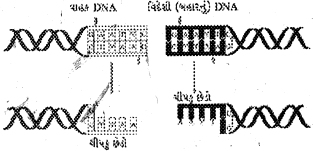
Which enzyme is required for the process shown in the figure below?
A
$BamH\, I$
B
$Hind\,II$
C
$EcoR\,I$
D
$Pst\,I$
Solution
(C) The figure illustrates the action of a restriction endonuclease on both vector $DNA$ and foreign $DNA$ to produce complementary sticky ends.
Specifically,the recognition sequence shown for the enzyme is $5'-GAATTC-3'$ and $3'-CTTAAG-5'$,which is the specific recognition site for the restriction enzyme $EcoR\,I$.
$EcoR\,I$ cuts the $DNA$ between the bases $G$ and $A$,resulting in the formation of sticky ends that facilitate the ligation of the foreign $DNA$ into the vector $DNA$.
Specifically,the recognition sequence shown for the enzyme is $5'-GAATTC-3'$ and $3'-CTTAAG-5'$,which is the specific recognition site for the restriction enzyme $EcoR\,I$.
$EcoR\,I$ cuts the $DNA$ between the bases $G$ and $A$,resulting in the formation of sticky ends that facilitate the ligation of the foreign $DNA$ into the vector $DNA$.
0 likes
View Solution324
MediumMCQ
Which bond is formed by $DNA$ ligase to join a plasmid and a foreign $DNA$ fragment?
A
Hydrogen bond
B
Glycosidic bond
C
Phosphodiester bond
D
Disulfide bond
Solution
(C) $DNA$ ligase is an enzyme that acts as a 'molecular glue'.
It catalyzes the formation of a phosphodiester bond between the $3'-OH$ end of one $DNA$ fragment and the $5'-PO_4$ end of another $DNA$ fragment.
This process is essential for sealing nicks in the sugar-phosphate backbone of $DNA$ during recombinant $DNA$ technology,thereby joining the foreign $DNA$ insert into the plasmid vector.
It catalyzes the formation of a phosphodiester bond between the $3'-OH$ end of one $DNA$ fragment and the $5'-PO_4$ end of another $DNA$ fragment.
This process is essential for sealing nicks in the sugar-phosphate backbone of $DNA$ during recombinant $DNA$ technology,thereby joining the foreign $DNA$ insert into the plasmid vector.
0 likes
View Solution325
MediumMCQ
In $pBR322$,what does the letter '$p$' stand for?
A
Protein
B
Promoter
C
Plasmid
D
Primer
Solution
(C) The cloning vector $pBR322$ is a widely used artificial plasmid in biotechnology.
In the nomenclature of plasmids,the letter '$p$' stands for 'plasmid'.
'$BR$' stands for Bolivar and Rodriguez,the scientists who constructed this vector,and '$322$' is the number assigned to distinguish it from other plasmids developed in the same laboratory.
In the nomenclature of plasmids,the letter '$p$' stands for 'plasmid'.
'$BR$' stands for Bolivar and Rodriguez,the scientists who constructed this vector,and '$322$' is the number assigned to distinguish it from other plasmids developed in the same laboratory.
0 likes
View Solution326
MediumMCQ
$A$ piece of foreign $DNA$ can replicate if it is linked to which of the following?
A
Plasmid
B
Bacteriophage
C
Phasmid
D
All of the above
Solution
(D) For a foreign $DNA$ to replicate within a host cell,it must be integrated into a vector that contains an origin of replication $(ori)$.
Plasmids are extrachromosomal,self-replicating circular $DNA$ molecules found in bacteria.
Bacteriophages are viruses that infect bacteria and have high copy numbers within the host cell.
Phasmids are hybrid vectors containing features of both plasmids and bacteriophages.
Since all these vectors possess an origin of replication,they can support the replication of foreign $DNA$ linked to them.
Plasmids are extrachromosomal,self-replicating circular $DNA$ molecules found in bacteria.
Bacteriophages are viruses that infect bacteria and have high copy numbers within the host cell.
Phasmids are hybrid vectors containing features of both plasmids and bacteriophages.
Since all these vectors possess an origin of replication,they can support the replication of foreign $DNA$ linked to them.
0 likes
View Solution327
EasyMCQ
What type of enzyme is $EcoR\,I$?
A
Type $I$
B
Type $II$
C
Type $III$
D
Type $IV$
Solution
(B) Restriction endonucleases are classified into three main types: Type $I$,Type $II$,and Type $III$.
$EcoR\,I$ is a well-known restriction endonuclease isolated from the bacterium $Escherichia\,coli$.
It belongs to the Type $II$ restriction endonuclease category because it recognizes specific palindromic $DNA$ sequences and cleaves the $DNA$ at a precise location within or near that sequence,which is ideal for genetic engineering applications.
$EcoR\,I$ is a well-known restriction endonuclease isolated from the bacterium $Escherichia\,coli$.
It belongs to the Type $II$ restriction endonuclease category because it recognizes specific palindromic $DNA$ sequences and cleaves the $DNA$ at a precise location within or near that sequence,which is ideal for genetic engineering applications.
0 likes
View Solution328
MediumMCQ
What is agarose?
A
Polysaccharide
B
Polypeptide
C
Polynucleotide
D
Lipid
Solution
(A) Agarose is a natural polymer extracted from seaweeds (red algae like Gelidium and Gracilaria).
Chemically,it is a linear polysaccharide made up of repeating units of agarobiose (a disaccharide of $D$-galactose and $3,6-$anhydro-$L$-galactopyranose).
In biotechnology,it is widely used as a matrix in gel electrophoresis to separate $DNA$ fragments based on their size.
Chemically,it is a linear polysaccharide made up of repeating units of agarobiose (a disaccharide of $D$-galactose and $3,6-$anhydro-$L$-galactopyranose).
In biotechnology,it is widely used as a matrix in gel electrophoresis to separate $DNA$ fragments based on their size.
0 likes
View Solution329
EasyMCQ
Select the correct option for $M13$.
A
$YACs$
B
Plasmid
C
Cosmid
D
Bacteriophage
Solution
(D) $M13$ is a filamentous bacteriophage that infects $E. coli$. It is widely used in biotechnology as a cloning vector because it can be used to produce single-stranded $DNA$,which is essential for $DNA$ sequencing and site-directed mutagenesis.
0 likes
View Solution330
EasyMCQ
Which restriction enzyme produces blunt ends upon cleavage?
A
$EcoR\,I$
B
$Bam\,HI$
C
$Alu\,I$
D
$Hind\,III$
Solution
(C) Restriction enzymes are classified based on the type of ends they produce after cutting $DNA$.
$EcoR\,I$,$Bam\,HI$,and $Hind\,III$ are examples of enzymes that produce 'sticky' or 'cohesive' ends because they cut the $DNA$ strands at different positions within the recognition sequence.
$Alu\,I$ is a restriction enzyme that recognizes the sequence $5'-AGCT-3'$ and cuts exactly between $G$ and $C$,resulting in 'blunt' or 'flush' ends.
Therefore,the correct option is $C$.
$EcoR\,I$,$Bam\,HI$,and $Hind\,III$ are examples of enzymes that produce 'sticky' or 'cohesive' ends because they cut the $DNA$ strands at different positions within the recognition sequence.
$Alu\,I$ is a restriction enzyme that recognizes the sequence $5'-AGCT-3'$ and cuts exactly between $G$ and $C$,resulting in 'blunt' or 'flush' ends.
Therefore,the correct option is $C$.
0 likes
View Solution331
EasyMCQ
How many nitrogen base pairs are present in the recognition sequence of $Hind\, III$?
A
Two
B
Four
C
Six
D
Eight
Solution
(C) The restriction endonuclease $Hind\, III$ is a type $II$ restriction enzyme isolated from Haemophilus influenzae.
It recognizes a specific palindromic $DNA$ sequence.
The recognition sequence for $Hind\, III$ is $5'-AAGCTT-3'$.
This sequence consists of $6$ nitrogen base pairs.
Therefore,the correct option is $C$.
It recognizes a specific palindromic $DNA$ sequence.
The recognition sequence for $Hind\, III$ is $5'-AAGCTT-3'$.
This sequence consists of $6$ nitrogen base pairs.
Therefore,the correct option is $C$.
0 likes
View Solution332
EasyMCQ
Which organism is used as a vector to introduce specific genes into host plants?
A
Mycobacterium
B
Helicobacter
C
Agrobacterium
D
$E$. coli
Solution
(C) $Agrobacterium$ $\text{tumefaciens}$, a pathogen of several dicot plants, is able to deliver a piece of $DNA$ known as '$T-DNA$' to transform normal plant cells into a tumor and direct these tumor cells to produce the chemicals required by the pathogen. This natural ability of $Agrobacterium$ to transfer genes is exploited in genetic engineering to introduce specific genes of interest into host plants.
0 likes
View Solution333
EasyMCQ
In Recombinant $DNA$ technology,antibiotics are used:
A
As selectable markers
B
To keep the medium bacteria-free
C
To detect alien $DNA$
D
To impart disease-resistance to the host plant
Solution
(A) In Recombinant $DNA$ $(RDT)$ technology,antibiotics serve two primary purposes:
$1$. They act as selectable markers to identify and eliminate non-transformants,allowing only the growth of transformants.
$2$. They are added to the culture medium to keep it free from unwanted bacterial contamination.
While the primary role in cloning vectors is as a selectable marker,the context of the question often refers to their use in maintaining sterile culture conditions. However,based on standard $NCERT$ curriculum,antibiotics are primarily defined as selectable markers. Given the provided options,option $A$ is the most scientifically accurate role in the context of vector design.
$1$. They act as selectable markers to identify and eliminate non-transformants,allowing only the growth of transformants.
$2$. They are added to the culture medium to keep it free from unwanted bacterial contamination.
While the primary role in cloning vectors is as a selectable marker,the context of the question often refers to their use in maintaining sterile culture conditions. However,based on standard $NCERT$ curriculum,antibiotics are primarily defined as selectable markers. Given the provided options,option $A$ is the most scientifically accurate role in the context of vector design.
0 likes
View Solution334
EasyMCQ
The first discovered restriction endonuclease that always cuts $DNA$ molecules at a particular point by recognizing a specific sequence of six base pairs is:
A
Hind $II$
B
EcoR $I$
C
Adenosine deaminase
D
Thermostable $DNA$ polymerase
Solution
(A) The first restriction endonuclease discovered was Hind $II$.
It was isolated from the bacterium Haemophilus influenzae and was found to cut $DNA$ molecules at a specific point by recognizing a specific sequence of six base pairs.
EcoR $I$ is a restriction enzyme obtained from Escherichia coli Ry$13$.
Thermostable $DNA$ polymerase,such as Taq polymerase,is used in the Polymerase Chain Reaction $(PCR)$.
Adenosine deaminase $(ADA)$ is an enzyme crucial for the immune system to function; its deficiency leads to Severe Combined Immunodeficiency $(SCID)$.
It was isolated from the bacterium Haemophilus influenzae and was found to cut $DNA$ molecules at a specific point by recognizing a specific sequence of six base pairs.
EcoR $I$ is a restriction enzyme obtained from Escherichia coli Ry$13$.
Thermostable $DNA$ polymerase,such as Taq polymerase,is used in the Polymerase Chain Reaction $(PCR)$.
Adenosine deaminase $(ADA)$ is an enzyme crucial for the immune system to function; its deficiency leads to Severe Combined Immunodeficiency $(SCID)$.
0 likes
View Solution335
MediumMCQ
In $Ti$-plasmid, which of the following is removed:
A
Auxin gene
B
Virulent gene
C
Cytokinin gene
D
Auxin and cytokinin gene
Solution
(D) The $Ti$-plasmid (tumor-inducing plasmid) is found in $Agrobacterium$ $tumefaciens$.
It is used by the bacterium to transfer its genetic material into the host plant, causing tumor formation.
When this plasmid is modified for use as a cloning vector in genetic engineering, the genes responsible for tumor formation (the oncogenes, specifically those encoding for auxin and cytokinin production) are removed.
This makes the plasmid 'disarmed', allowing it to carry the desired gene into the plant without causing disease.
It is used by the bacterium to transfer its genetic material into the host plant, causing tumor formation.
When this plasmid is modified for use as a cloning vector in genetic engineering, the genes responsible for tumor formation (the oncogenes, specifically those encoding for auxin and cytokinin production) are removed.
This makes the plasmid 'disarmed', allowing it to carry the desired gene into the plant without causing disease.
0 likes
View Solution336
MediumMCQ
Plasmid of which bacterium was first time used in recombinant $DNA$ technology?
A
$E. coli$
B
$Salmonella typhimurium$
C
$Haemophilus influenzae$
D
$Streptococcus pneumoniae$
Solution
(B) plasmid is an extrachromosomal,self-replicating circular $DNA$ molecule found in bacteria.
In $1972$,Stanley Cohen and Herbert Boyer constructed the first recombinant $DNA$ molecule.
They achieved this by linking an antibiotic resistance gene with a native plasmid isolated from the bacterium $Salmonella typhimurium$.
In $1972$,Stanley Cohen and Herbert Boyer constructed the first recombinant $DNA$ molecule.
They achieved this by linking an antibiotic resistance gene with a native plasmid isolated from the bacterium $Salmonella typhimurium$.
0 likes
View Solution337
MediumMCQ
$A$ gene library or $DNA$ library contains a collection of:
A
$DNA$ and $RNA$
B
Any one type of gene of an organism
C
$cDNA$ only
D
All possible genes of an organism
Solution
(D) gene library or $DNA$ library is a collection of cloned $DNA$ fragments that represent the entire genome of a particular organism. It contains all the possible genes of that specific organism,which are stored in a vector for further study and analysis.
0 likes
View Solution338
MediumMCQ
An extra-chromosomal self-replicating part of the cell that has proven to be a boon to biotechnology is
A
Virus
B
Mitochondria
C
Nucleus
D
Plasmid
Solution
(D) $Plasmid$ is an extra-chromosomal,circular,double-stranded $DNA$ molecule found in bacteria that is capable of autonomous self-replication.
Because of these properties,plasmids are extensively used as vectors in biotechnology to carry and transfer foreign genes into host cells,making them a fundamental tool in genetic engineering.
Because of these properties,plasmids are extensively used as vectors in biotechnology to carry and transfer foreign genes into host cells,making them a fundamental tool in genetic engineering.
0 likes
View Solution339
EasyMCQ
$A$ set of genes or $cDNA$ is immobilized on a glass slide and used in transcriptome studies is called:
A
Proteome
B
Microarray
C
$DNA$ chip
D
Genome
Solution
(B) $DNA$ microarray (also known as a $DNA$ chip or biochip) is a collection of microscopic $DNA$ spots attached to a solid surface,such as a glass slide.
These spots contain specific gene sequences or $cDNA$ probes.
They are used to measure the expression levels of large numbers of genes simultaneously or to genotype multiple regions of a genome.
Therefore,the technique described is known as a $DNA$ microarray.
These spots contain specific gene sequences or $cDNA$ probes.
They are used to measure the expression levels of large numbers of genes simultaneously or to genotype multiple regions of a genome.
Therefore,the technique described is known as a $DNA$ microarray.
0 likes
View Solution340
MediumMCQ
Agarose extracted from sea weeds finds use in:
A
Spectrophotometry
B
Tissue culture
C
Gel electrophoresis
D
$PCR$
Solution
(C) Agarose is a natural polymer extracted from seaweeds (like Gelidium and Gracilaria).
It is widely used in the laboratory technique known as gel electrophoresis to separate $DNA$ fragments based on their size.
During this process,the agarose forms a matrix (gel) that acts as a molecular sieve,allowing smaller $DNA$ fragments to move faster than larger ones under an electric field.
It is widely used in the laboratory technique known as gel electrophoresis to separate $DNA$ fragments based on their size.
During this process,the agarose forms a matrix (gel) that acts as a molecular sieve,allowing smaller $DNA$ fragments to move faster than larger ones under an electric field.
0 likes
View Solution341
MediumMCQ
The source of $Taq$ polymerase used in $PCR$ is a
A
Thermophilic fungus
B
Mesophilic fungus
C
Thermophilic bacterium
D
Halophilic bacterium
Solution
(C) $Taq$ polymerase is a thermostable enzyme isolated from a thermophilic bacterium named $Thermus \; aquaticus$.
This enzyme is essential for the $PCR$ (Polymerase Chain Reaction) process because it can withstand the high temperatures required for the denaturation of $DNA$ strands without getting denatured itself.
Similarly,$Vent$ polymerase is another thermostable enzyme isolated from the thermophilic bacterium $Thermococcus \; litoralis$.
This enzyme is essential for the $PCR$ (Polymerase Chain Reaction) process because it can withstand the high temperatures required for the denaturation of $DNA$ strands without getting denatured itself.
Similarly,$Vent$ polymerase is another thermostable enzyme isolated from the thermophilic bacterium $Thermococcus \; litoralis$.
0 likes
View Solution342
MediumMCQ
An enzyme catalyzing the removal of nucleotides from the ends of $DNA$ is
A
$Endonuclease$
B
$Exonuclease$
C
$DNA$ $ligase$
D
$Hind$ $II$
Solution
(B) $Exonucleases$ are enzymes that remove nucleotides from the terminal ends (either $5^{\prime}$ or $3^{\prime}$) of $DNA$ molecules. In contrast,$Endonucleases$ make cuts at specific positions within the $DNA$ sequence.
0 likes
View Solution343
MediumMCQ
Polymerase chain reaction employs
A
Primers and $DNA$ ligase
B
$DNA$ ligase only
C
$DNA$ polymerase
D
Primer and $DNA$ polymerase
Solution
(D) The correct answer is $D$. Polymerase Chain Reaction $(PCR)$ is a technique used to synthesize multiple copies of a specific $DNA$ segment in vitro. The essential components required for $PCR$ are a $DNA$ template,two sets of primers (short oligonucleotides),and a thermostable $DNA$ polymerase enzyme (such as $Taq$ polymerase).
0 likes
View Solution344
EasyMCQ
$PCR$ technique was invented by
A
Boyer
B
Kary Mullis
C
Cohen
D
Sanger
Solution
(B) The $PCR$ (Polymerase Chain Reaction) technique was invented by Kary Mullis in $1983$. This technique allows for the amplification of a specific $DNA$ segment in vitro. The provided information regarding antibiotic resistance markers in $E. coli$ is relevant to cloning vectors but is not related to the invention of $PCR$.
0 likes
View Solution345
MediumMCQ
More advancement in genetic engineering is due to
A
Restriction endonuclease
B
Reverse transcription
C
Protease
D
Zymase
Solution
(A) Endonucleases are enzymes that produce internal cuts in $DNA$ molecules. $A$ specific class of endonucleases cleaves $DNA$ only within or near sites that have specific base sequences; these are known as restriction endonucleases,and the sites recognized by them are called recognition sites. Restriction endonucleases play a major role in genetic engineering by allowing the precise cutting of $DNA$ to create recombinant molecules.
0 likes
View Solution346
MediumMCQ
In bacteria,genes for antibiotic resistance are usually located in:
A
Chromosomal $DNA$
B
Cytoplasm
C
Mitochondria
D
Plasmids
Solution
(D) In bacteria,antibiotic resistance genes are typically found on plasmids.
Plasmids are small,circular,double-stranded $DNA$ molecules that are distinct from the cell's chromosomal $DNA$.
These extrachromosomal elements can replicate independently and often carry genes that provide a survival advantage to the bacteria,such as resistance to antibiotics.
Bacteria do not possess mitochondria,and while chromosomal $DNA$ contains essential genes,the specific resistance factors are most commonly associated with plasmids.
Plasmids are small,circular,double-stranded $DNA$ molecules that are distinct from the cell's chromosomal $DNA$.
These extrachromosomal elements can replicate independently and often carry genes that provide a survival advantage to the bacteria,such as resistance to antibiotics.
Bacteria do not possess mitochondria,and while chromosomal $DNA$ contains essential genes,the specific resistance factors are most commonly associated with plasmids.
0 likes
View Solution347
MediumMCQ
Restriction enzymes are isolated chiefly from:
A
Algae
B
Fungi
C
Protozoans
D
Prokaryotes
Solution
(D) Restriction enzymes are a class of enzymes that cut $DNA$ at specific recognition sequences. These enzymes are naturally produced by bacteria as a defense mechanism against bacteriophages (viruses that infect bacteria). Since bacteria are $Prokaryotes$,restriction enzymes are isolated chiefly from them. Therefore,the correct option is $D$.
0 likes
View Solution348
MediumMCQ
Cutting of a piece of $DNA$ from a plasmid was done with the help of $...A...$ enzymes,popularly known as $...B....$ Here $A$ and $B$ can be
A
$A-$ $DNA$ ligases; $B-$ Molecular glue
B
$A-$ Restriction enzyme; $B-$ Molecular scissors
C
$A-$ Joining enzyme; $B-$ Molecular glue
D
$A-$ $DNA$ polymerases; $B-$ Synthesising enzymes
Solution
(B) The process of cutting a specific piece of $DNA$ from a plasmid is performed using restriction enzymes. These enzymes are commonly referred to as molecular scissors because they cut $DNA$ at specific recognition sequences.
0 likes
View Solution349
MediumMCQ
Which one is a true statement regarding $DNA$ polymerase used in $PCR$?
A
It is used to ligate introduced $DNA$ in recipient cell
B
It serves as a selectable marker
C
It is isolated from a virus
D
It remains active at high temperature
Solution
(D) $DNA$ polymerase used in $PCR$ remains active at high temperatures. Specifically,Taq $DNA$ polymerase,which is isolated from the thermophilic bacterium $Thermus$ $aquaticus$,is used because it can withstand the denaturation step of $PCR$ without getting denatured.
0 likes
View Solution350
MediumMCQ
There is a restriction endonuclease called $Eco RI$. What does "co" part in it stand for?
A
Coli
B
Coelom
C
Coenzyme
D
Colon
Solution
(A) The naming convention for restriction endonucleases is based on the genus and species of the prokaryotic cell from which they are isolated.
In the name $Eco RI$:
$E$ stands for the genus $Escherichia$.
$co$ stands for the species $coli$.
$R$ stands for the strain $RY13$.
$I$ indicates the order in which the enzyme was isolated from that strain.
Therefore, "co" stands for $coli$.
In the name $Eco RI$:
$E$ stands for the genus $Escherichia$.
$co$ stands for the species $coli$.
$R$ stands for the strain $RY13$.
$I$ indicates the order in which the enzyme was isolated from that strain.
Therefore, "co" stands for $coli$.
0 likes
View SolutionBiotechnology Principals and Process — Tools of recombinant DNA technology · Frequently Asked Questions
1Are these Biotechnology Principals and Process questions useful for JEE and NEET?
Yes. All questions in this section are mapped to JEE Main and NEET exam patterns. Previous year questions from JEE Main, NEET, GUJCET and state-level exams are included with full solutions.
2Can I switch to Hindi or Gujarati for these questions?
Yes. Use the language tabs in the hero section or the sidebar to view the same questions and solutions in English, Hindi or Gujarati.
3How do I generate a question paper from this subtopic?
Use the Vedclass Exam Paper Generator — select the chapter and subtopic, set difficulty, and generate Sets A, B, C, D automatically. First 3 chapters of every subject are free.
Vedclass Products
For Students
Vedclass Test Series
Mock tests in real JEE/NEET style with performance analysis. 5-day free trial.
Start Free TrialFor Teachers
Exam Paper Generator
Generate Set A/B/C/D papers from this chapter in 2 minutes. 3 chapters free.
Try FreeFor Institutes
Online Exam Module
Live online exams with unlimited students, 360° analytics & white-label branding.
See DemoFor Teachers & Institutes
Generate a Biotechnology Principals and Process Exam Paper in 2 Minutes
Select subtopic & difficulty — Sets A, B, C, D auto-generated with No Repeat logic.
First 3 chapters of every subject are free — no payment required.