
A English
Tools of recombinant DNA technology Questions in English
Class 12 Biology · Biotechnology Principals and Process · Tools of recombinant DNA technology
564+
Questions
English
Language
100%
With Solutions
Showing 50 of 564 questions in English
451
MediumMCQ
Which of the following is not a desirable feature of a cloning vector?
A
Presence of a marker gene
B
Presence of single restriction enzyme site
C
Presence of two or more recognition sites
D
Presence of origin of replication
Solution
(C) cloning vector must have an origin of replication $(ori)$ to allow autonomous replication.
It should contain a selectable marker gene to identify transformants.
It must have a single recognition site for a specific restriction enzyme to allow the insertion of the foreign $DNA$.
Having two or more recognition sites for the same restriction enzyme would result in the fragmentation of the vector,which is undesirable as it complicates the cloning process.
It should contain a selectable marker gene to identify transformants.
It must have a single recognition site for a specific restriction enzyme to allow the insertion of the foreign $DNA$.
Having two or more recognition sites for the same restriction enzyme would result in the fragmentation of the vector,which is undesirable as it complicates the cloning process.
0 likes
View Solution452
MediumMCQ
In genetic engineering,to which part of the bacteria is the human $DNA$ joined to produce a product?
A
Nucleoid
B
Plasmid
C
Cytoplasm
D
Cell wall
Solution
(B) In genetic engineering,a foreign $DNA$ (such as human $DNA$) is inserted into a vector to create recombinant $DNA$.
Plasmids are small,circular,extrachromosomal $DNA$ molecules found in bacteria that replicate independently of the chromosomal $DNA$.
Because of their ability to replicate and carry foreign genes,plasmids are widely used as vectors to transport and express human genes in bacteria to produce desired products like insulin or growth hormones.
Plasmids are small,circular,extrachromosomal $DNA$ molecules found in bacteria that replicate independently of the chromosomal $DNA$.
Because of their ability to replicate and carry foreign genes,plasmids are widely used as vectors to transport and express human genes in bacteria to produce desired products like insulin or growth hormones.
0 likes
View Solution453
MediumMCQ
Which of the following foreign $DNA$ cannot multiply within a host cell?
A
Foreign $DNA$ introduced into the cytoplasm of the host cell.
B
Foreign $DNA$ introduced into the nucleoid of the host cell.
C
Foreign $DNA$ introduced into the plasmid of the host cell.
D
All of the above.
Solution
(D) For a foreign $DNA$ to multiply within a host cell,it must be integrated into the host's genome or be part of a vector (like a plasmid) that possesses an $ORI$ (Origin of Replication) sequence.
If foreign $DNA$ is simply introduced into the cytoplasm or nucleoid without being linked to an $ORI$ sequence,the host cell's replication machinery will not recognize it as a template for replication.
Therefore,foreign $DNA$ introduced into the cytoplasm or nucleoid cannot multiply on its own.
Only $DNA$ linked to an $ORI$ sequence,such as when integrated into a plasmid,can replicate.
If foreign $DNA$ is simply introduced into the cytoplasm or nucleoid without being linked to an $ORI$ sequence,the host cell's replication machinery will not recognize it as a template for replication.
Therefore,foreign $DNA$ introduced into the cytoplasm or nucleoid cannot multiply on its own.
Only $DNA$ linked to an $ORI$ sequence,such as when integrated into a plasmid,can replicate.
0 likes
View Solution454
MediumMCQ
Why is a vector necessary for obtaining the desired product in recombinant $DNA$ technology?
A
The vector possesses an origin of replication.
B
The vector replicates independently within the host cell.
C
The vector creates multiple copies of the foreign $DNA$.
D
All of the above.
Solution
(D) In recombinant $DNA$ technology,a vector is essential for the following reasons:
$1$. The vector contains an 'origin of replication' $(ori)$,which is mandatory for $DNA$ replication.
$2$. When foreign $DNA$ is linked to the vector,it replicates independently within the host cell with the help of the vector.
$3$. Through this process,multiple copies of the foreign $DNA$ are produced,which are necessary to obtain the desired product.
Therefore,all the given options are correct.
$1$. The vector contains an 'origin of replication' $(ori)$,which is mandatory for $DNA$ replication.
$2$. When foreign $DNA$ is linked to the vector,it replicates independently within the host cell with the help of the vector.
$3$. Through this process,multiple copies of the foreign $DNA$ are produced,which are necessary to obtain the desired product.
Therefore,all the given options are correct.
0 likes
View Solution455
MediumMCQ
The plasmid used for the construction of the first artificial recombinant $DNA$ molecule was obtained from which microorganism?
A
Salmonella typhimurium
B
Escherichia coli
C
Bacteriophage
D
Pneumococcus
Solution
(A) The first recombinant $DNA$ molecule was constructed by Stanley Cohen and Herbert Boyer in $1972$.
They isolated the antibiotic resistance gene by cutting out a piece of $DNA$ from a plasmid which was responsible for conferring antibiotic resistance in the bacterium $Salmonella typhimurium$.
This piece of $DNA$ was then linked to a plasmid vector, which acted as a vehicle to transfer the piece of $DNA$ into $Escherichia coli$.
They isolated the antibiotic resistance gene by cutting out a piece of $DNA$ from a plasmid which was responsible for conferring antibiotic resistance in the bacterium $Salmonella typhimurium$.
This piece of $DNA$ was then linked to a plasmid vector, which acted as a vehicle to transfer the piece of $DNA$ into $Escherichia coli$.
0 likes
View Solution456
EasyMCQ
Which enzyme is known as molecular scissors?
A
Ligase
B
Restriction endonuclease
C
$DNA$ polymerase
D
Helicase
Solution
(B) Restriction endonucleases are known as molecular scissors because they cut $DNA$ at specific recognition sequences.
$1$. Ligases are known as molecular glues because they join $DNA$ fragments.
$2$. $DNA$ polymerase is responsible for the synthesis of $DNA$ strands.
$3$. Helicase is responsible for unwinding the $DNA$ double helix.
$1$. Ligases are known as molecular glues because they join $DNA$ fragments.
$2$. $DNA$ polymerase is responsible for the synthesis of $DNA$ strands.
$3$. Helicase is responsible for unwinding the $DNA$ double helix.
0 likes
View Solution457
EasyMCQ
Which enzyme is responsible for joining two fragments of $DNA$?
A
Ligase
B
Restriction endonuclease
C
$DNA$ polymerase
D
Helicase
Solution
(A) The enzyme $DNA$ ligase acts as a molecular glue.
It catalyzes the formation of phosphodiester bonds between the $3'-OH$ end of one nucleotide and the $5'-phosphate$ end of another, thereby joining two $DNA$ fragments together.
Restriction endonucleases cut $DNA$, $DNA$ polymerase synthesizes new strands, and helicase unwinds the $DNA$ double helix.
It catalyzes the formation of phosphodiester bonds between the $3'-OH$ end of one nucleotide and the $5'-phosphate$ end of another, thereby joining two $DNA$ fragments together.
Restriction endonucleases cut $DNA$, $DNA$ polymerase synthesizes new strands, and helicase unwinds the $DNA$ double helix.
0 likes
View Solution458
MediumMCQ
Match the enzymes in Column-$I$ with their respective functions in Column-$II$.
| Column-$I$ | Column-$II$ |
|---|---|
| $P$. Restriction endonuclease | $I$. Synthesizes $DNA$ copies |
| $Q$. $DNA$ polymerase | $II$. Cleaves $DNA$ molecules |
| $R$. $DNA$ ligase | $III$. Joins $DNA$ molecules |
A
$(P-III), (Q-I), (R-II)$
B
$(P-II), (Q-III), (R-I)$
C
$(P-III), (Q-II), (R-I)$
D
$(P-II), (Q-I), (R-III)$
Solution
(D) The correct matching is as follows:
$1$. Restriction endonuclease $(P)$ is responsible for cutting $DNA$ molecules at specific recognition sequences $(II)$.
$2$. $DNA$ polymerase $(Q)$ is responsible for the synthesis of new $DNA$ strands or copies $(I)$.
$3$. $DNA$ ligase $(R)$ acts as a molecular glue that joins $DNA$ fragments together $(III)$.
Therefore,the correct sequence is $(P-II), (Q-I), (R-III)$.
$1$. Restriction endonuclease $(P)$ is responsible for cutting $DNA$ molecules at specific recognition sequences $(II)$.
$2$. $DNA$ polymerase $(Q)$ is responsible for the synthesis of new $DNA$ strands or copies $(I)$.
$3$. $DNA$ ligase $(R)$ acts as a molecular glue that joins $DNA$ fragments together $(III)$.
Therefore,the correct sequence is $(P-II), (Q-I), (R-III)$.
0 likes
View Solution459
EasyMCQ
Which of the following acts as a vector?
A
Plasmid
B
Restriction endonuclease
C
$DNA$ polymerase
D
Bacteria
Solution
(A) vector is a $DNA$ molecule used as a vehicle to artificially carry foreign genetic material into another cell,where it can be replicated and/or expressed. Plasmids are small,circular,extrachromosomal $DNA$ molecules found in bacteria that are widely used as vectors in recombinant $DNA$ technology. Restriction endonucleases are enzymes that cut $DNA$,$DNA$ polymerase is an enzyme that synthesizes $DNA$,and bacteria are the host organisms,not the vectors themselves.
0 likes
View Solution460
DifficultMCQ
The first restriction endonuclease was isolated from which of the following?
A
Salmonella typhimurium
B
Escherichia coli
C
Bacteriophage
D
Pneumococcus
Solution
(D) The first restriction endonuclease,known as $HindII$,was isolated from the bacterium $Haemophilus$ $influenzae$ $Rd$.
However,in the context of the provided options,the question refers to the historical discovery of restriction enzymes.
$HindII$ was the first to be characterized,and its discovery was based on the observation that $Bacteriophage$ growth in $E. coli$ was restricted.
Among the options provided,$HindII$ is the correct enzyme,but since $Haemophilus$ $influenzae$ is not listed,we must identify the source related to the discovery of restriction systems.
Historically,the first restriction enzyme $HindII$ was isolated from $Haemophilus$ $influenzae$.
Given the options,if we consider the context of the first restriction enzyme discovery,the question might be referencing the general study of restriction-modification systems in bacteria like $Haemophilus$ $influenzae$.
However,in the context of the provided options,the question refers to the historical discovery of restriction enzymes.
$HindII$ was the first to be characterized,and its discovery was based on the observation that $Bacteriophage$ growth in $E. coli$ was restricted.
Among the options provided,$HindII$ is the correct enzyme,but since $Haemophilus$ $influenzae$ is not listed,we must identify the source related to the discovery of restriction systems.
Historically,the first restriction enzyme $HindII$ was isolated from $Haemophilus$ $influenzae$.
Given the options,if we consider the context of the first restriction enzyme discovery,the question might be referencing the general study of restriction-modification systems in bacteria like $Haemophilus$ $influenzae$.
0 likes
View Solution461
MediumMCQ
Which is the first restriction endonuclease discovered?
A
Hind $II$
B
EcoR $I$
C
Sal $I$
D
BamH $I$
Solution
(A) The first restriction endonuclease to be discovered and isolated was Hind $II$.
It was isolated from the bacterium Haemophilus influenzae.
Its function was found to be cutting $DNA$ molecules at a specific point by recognizing a specific sequence of $6$ base pairs.
It was isolated from the bacterium Haemophilus influenzae.
Its function was found to be cutting $DNA$ molecules at a specific point by recognizing a specific sequence of $6$ base pairs.
0 likes
View Solution462
MediumMCQ
What does $R$ represent in $EcoR\, I$?
A
$RY\, 11$
B
$RY\, 13$
C
$RY\, 12$
D
$RY\, 23$
Solution
(B) The naming of restriction enzymes follows a specific convention.
In the name $EcoR\, I$:
$1$. The first letter '$E$' stands for the genus $Escherichia$.
$2$. The next two letters '$co$' stand for the species $coli$.
$3$. The letter '$R$' stands for the strain of the bacterium,which is $RY\, 13$.
$4$. The Roman numeral '$I$' indicates the order in which the enzyme was isolated from that strain of bacteria.
Therefore,$R$ represents the strain $RY\, 13$.
In the name $EcoR\, I$:
$1$. The first letter '$E$' stands for the genus $Escherichia$.
$2$. The next two letters '$co$' stand for the species $coli$.
$3$. The letter '$R$' stands for the strain of the bacterium,which is $RY\, 13$.
$4$. The Roman numeral '$I$' indicates the order in which the enzyme was isolated from that strain of bacteria.
Therefore,$R$ represents the strain $RY\, 13$.
0 likes
View Solution463
MediumMCQ
Which of the following $DNA$ sequences can be cut by a restriction endonuclease?
A
$5'-CTTAAC-3'$
$5'-GAATTG-3'$
$5'-GAATTG-3'$
B
$5'-GAATTC-3'$
$5'-GAATTC-3'$
$5'-GAATTC-3'$
C
$5'-CTTAAG-3'$
$3'-GAATTC-5'$
$3'-GAATTC-5'$
D
$5'-GAATTC-3'$
$3'-CTTAAG-5'$
$3'-CTTAAG-5'$
Solution
(D) Restriction endonucleases recognize specific palindromic nucleotide sequences in $DNA$. $A$ palindromic sequence is one that reads the same in both the $5' \rightarrow 3'$ and $3' \rightarrow 5'$ directions on the two strands.
For the sequence $5'-GAATTC-3'$,the complementary strand is $3'-CTTAAG-5'$.
When read from $5' \rightarrow 3'$,the complementary strand is $5'-GAATTC-3'$.
Since both strands read $GAATTC$ in the $5' \rightarrow 3'$ direction,this is a palindromic sequence recognized by the restriction enzyme $EcoRI$.
For the sequence $5'-GAATTC-3'$,the complementary strand is $3'-CTTAAG-5'$.
When read from $5' \rightarrow 3'$,the complementary strand is $5'-GAATTC-3'$.
Since both strands read $GAATTC$ in the $5' \rightarrow 3'$ direction,this is a palindromic sequence recognized by the restriction enzyme $EcoRI$.
0 likes
View Solution464
MediumMCQ
What is a palindromic sequence?
A
$A$ specific sequence on $DNA$
B
$A$ substrate for restriction endonuclease
C
$A$ sequence that reads the same on both strands when read in the $5' \rightarrow 3'$ direction
D
All of the above
Solution
(D) palindromic sequence in $DNA$ is a sequence of base pairs that reads the same on the two strands when the orientation of reading is kept the same,i.e.,$5' \rightarrow 3'$.
These sequences serve as specific recognition sites for restriction endonucleases.
Since these sequences are specific segments of $DNA$ recognized by enzymes,all the given statements are correct.
Therefore,the correct option is $D$.
These sequences serve as specific recognition sites for restriction endonucleases.
Since these sequences are specific segments of $DNA$ recognized by enzymes,all the given statements are correct.
Therefore,the correct option is $D$.
0 likes
View Solution465
MediumMCQ
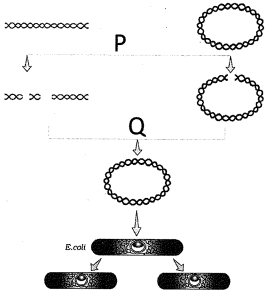
The diagram below represents a schematic of recombinant $DNA$ technology. Which enzymes are responsible for the processes $P$ and $Q$ respectively?
$\quad\quad P\quad\quad\quad Q$
$\quad\quad P\quad\quad\quad Q$
A
$DNA$ polymerase $\quad$ Restriction enzyme
B
Restriction enzyme $\quad$ $DNA$ polymerase
C
Ligase $\quad\quad$ Restriction enzyme
D
Restriction enzyme $\quad$ Ligase
Solution
(D) In recombinant $DNA$ technology,the process $P$ involves cutting both the foreign $DNA$ and the vector $DNA$ (plasmid) at specific sites. This is performed by restriction enzymes (specifically restriction endonucleases).
The process $Q$ involves joining the cut foreign $DNA$ fragment into the cut vector $DNA$ to form a recombinant $DNA$ molecule. This joining process is catalyzed by the enzyme $DNA$ ligase.
Therefore,$P$ represents the action of restriction enzymes and $Q$ represents the action of $DNA$ ligase.
The process $Q$ involves joining the cut foreign $DNA$ fragment into the cut vector $DNA$ to form a recombinant $DNA$ molecule. This joining process is catalyzed by the enzyme $DNA$ ligase.
Therefore,$P$ represents the action of restriction enzymes and $Q$ represents the action of $DNA$ ligase.
0 likes
View Solution466
MediumMCQ
Which restriction enzyme recognizes the given palindromic sequence?
$5^{\prime} ----- GAATTC ----- 3^{\prime}$
$3^{\prime} ----- CTTAAG ----- 5^{\prime}$
$5^{\prime} ----- GAATTC ----- 3^{\prime}$
$3^{\prime} ----- CTTAAG ----- 5^{\prime}$
A
Hind $II$
B
EcoR $I$
C
BamH $I$
D
Sal $I$
Solution
(B) The given $DNA$ sequence is $5^{\prime}-GAATTC-3^{\prime}$.
This specific sequence is the recognition site for the restriction endonuclease $EcoR I$.
$EcoR I$ is derived from the bacterium $Escherichia coli$ $RY13$.
It cleaves the $DNA$ between the $G$ and $A$ bases,producing sticky ends.
This specific sequence is the recognition site for the restriction endonuclease $EcoR I$.
$EcoR I$ is derived from the bacterium $Escherichia coli$ $RY13$.
It cleaves the $DNA$ between the $G$ and $A$ bases,producing sticky ends.
0 likes
View Solution467
MediumMCQ
Select the incorrect statement from the following.
A
$Hind\, II$ cuts $DNA$ at a specific point by recognizing a specific sequence of four base pairs.
B
More than $900$ restriction enzymes have been isolated today.
C
Different restriction enzymes have different recognition sequences.
D
Restriction enzymes are obtained from prokaryotic cells.
Solution
(A) The correct statement regarding $Hind\, II$ is that it recognizes a specific sequence of $6$ base pairs,not $4$.
Therefore,option $A$ is incorrect.
Restriction enzymes are indeed isolated from over $900$ strains of bacteria (prokaryotes).
Each restriction enzyme recognizes a specific palindromic nucleotide sequence.
Thus,statements $B$,$C$,and $D$ are correct.
Therefore,option $A$ is incorrect.
Restriction enzymes are indeed isolated from over $900$ strains of bacteria (prokaryotes).
Each restriction enzyme recognizes a specific palindromic nucleotide sequence.
Thus,statements $B$,$C$,and $D$ are correct.
0 likes
View Solution468
MediumMCQ
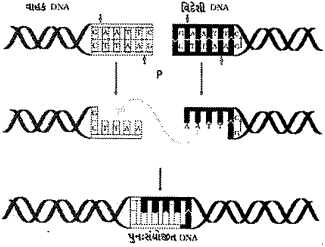
Identify the enzyme shown in the given figure.
A
Cla $I$
B
EcoR $I$
C
Pvu $II$
D
Sal $I$
Solution
(B) The figure illustrates the action of a restriction endonuclease enzyme on both vector $DNA$ and foreign $DNA$.
$1$. The recognition sequence shown is $GAATTC$ on one strand and $CTTAAG$ on the complementary strand.
$2$. This specific palindromic sequence is recognized and cleaved by the restriction enzyme $EcoR I$.
$3$. $EcoR I$ cuts between $G$ and $A$ bases,creating sticky ends that allow the vector and foreign $DNA$ to join together to form recombinant $DNA$.
$4$. Therefore,the correct enzyme is $EcoR I$.
$1$. The recognition sequence shown is $GAATTC$ on one strand and $CTTAAG$ on the complementary strand.
$2$. This specific palindromic sequence is recognized and cleaved by the restriction enzyme $EcoR I$.
$3$. $EcoR I$ cuts between $G$ and $A$ bases,creating sticky ends that allow the vector and foreign $DNA$ to join together to form recombinant $DNA$.
$4$. Therefore,the correct enzyme is $EcoR I$.
0 likes
View Solution469
MediumMCQ
$DNA$ carries a ..... charge,so it moves towards the ......... electrode.
A
Negative,Positive
B
Positive,Negative
C
Positive,Positive
D
Negative,Negative
Solution
(A) $DNA$ molecules are negatively charged due to the presence of phosphate groups in their sugar-phosphate backbone. In gel electrophoresis,when an electric field is applied,these negatively charged $DNA$ fragments migrate towards the positively charged electrode (anode).
0 likes
View Solution470
DifficultMCQ
The agarose powder used in agarose gel electrophoresis is extracted from .......... .
A
Bacteria
B
Protozoa
C
Animal
D
Sea weeds (Plants)
Solution
(D) Agarose is a natural polymer extracted from sea weeds (marine algae),specifically red algae like $Gelidium$ and $Gracilaria$. It is used as a matrix in gel electrophoresis to separate $DNA$ fragments based on their size.
0 likes
View Solution471
EasyMCQ
Which of the following is a cloning vector?
A
Plasmid
B
Bacteriophage
C
Cosmid
D
All of the above
Solution
(D) cloning vector is a small piece of $DNA$,taken from a virus,a plasmid,or the cell of a higher organism,that can be stably maintained in an organism and into which a foreign $DNA$ fragment can be inserted for cloning purposes.
Plasmids are extrachromosomal,self-replicating circular $DNA$ molecules commonly used as vectors.
Bacteriophages are viruses that infect bacteria and are used as vectors for cloning larger $DNA$ fragments.
Cosmids are hybrid vectors containing features of both plasmids and the $cos$ site of bacteriophage $\lambda$.
Since all three are widely used as cloning vectors in recombinant $DNA$ technology,the correct answer is $D$.
Plasmids are extrachromosomal,self-replicating circular $DNA$ molecules commonly used as vectors.
Bacteriophages are viruses that infect bacteria and are used as vectors for cloning larger $DNA$ fragments.
Cosmids are hybrid vectors containing features of both plasmids and the $cos$ site of bacteriophage $\lambda$.
Since all three are widely used as cloning vectors in recombinant $DNA$ technology,the correct answer is $D$.
0 likes
View Solution472
MediumMCQ
What type of biological molecules are cloning vectors?
A
Lipids
B
Proteins
C
$DNA$
D
$RNA$
Solution
(C) Cloning vectors are molecules that are used to carry foreign genetic material into another cell,where it can be replicated and/or expressed.
Most commonly used cloning vectors,such as plasmids and bacteriophages,are composed of $DNA$.
Plasmids are small,circular,double-stranded $DNA$ molecules that are distinct from a cell's chromosomal $DNA$.
Therefore,cloning vectors are essentially $DNA$ molecules.
Most commonly used cloning vectors,such as plasmids and bacteriophages,are composed of $DNA$.
Plasmids are small,circular,double-stranded $DNA$ molecules that are distinct from a cell's chromosomal $DNA$.
Therefore,cloning vectors are essentially $DNA$ molecules.
0 likes
View Solution473
MediumMCQ
Select the correct option regarding vectors used in recombinant $DNA$ technology.
A
Bacteriophages and plasmids can replicate within the bacterial cells independent of the control of chromosomal $DNA$.
B
Bacteriophages have very high copy numbers per cell.
C
Plasmids have copy numbers of $1-2$ or sometimes $15-100$ copies per cell.
D
All of the above.
Solution
(D) In recombinant $DNA$ technology,vectors like plasmids and bacteriophages are used to carry foreign $DNA$ into host cells.
$1$. Bacteriophages and plasmids have the ability to replicate within bacterial cells independently of the control of chromosomal $DNA$ (bacterial nucleoid).
$2$. Bacteriophages have very high copy numbers per cell,which allows for the production of many copies of the inserted $DNA$.
$3$. Plasmids also have varying copy numbers,typically ranging from $1-2$ to $15-100$ copies per cell.
Therefore,all the given statements are correct.
$1$. Bacteriophages and plasmids have the ability to replicate within bacterial cells independently of the control of chromosomal $DNA$ (bacterial nucleoid).
$2$. Bacteriophages have very high copy numbers per cell,which allows for the production of many copies of the inserted $DNA$.
$3$. Plasmids also have varying copy numbers,typically ranging from $1-2$ to $15-100$ copies per cell.
Therefore,all the given statements are correct.
0 likes
View Solution474
MediumMCQ
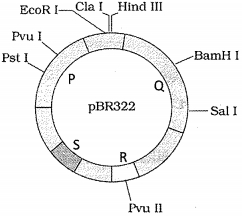
The given figure shows the $pBR322$ plasmid. Which of the following parts encodes the proteins involved in the replication of the plasmid?
A
$P$
B
$Q$
C
$R$
D
$S$
Solution
(C) In the $pBR322$ plasmid,the region labeled as $R$ corresponds to the $rop$ gene.
The $rop$ gene encodes proteins involved in the replication of the plasmid.
$P$ represents the $amp^R$ (ampicillin resistance) gene.
$Q$ represents the $tet^R$ (tetracycline resistance) gene.
$S$ represents the $ori$ (origin of replication) site.
Therefore,the correct option is $C$.
The $rop$ gene encodes proteins involved in the replication of the plasmid.
$P$ represents the $amp^R$ (ampicillin resistance) gene.
$Q$ represents the $tet^R$ (tetracycline resistance) gene.
$S$ represents the $ori$ (origin of replication) site.
Therefore,the correct option is $C$.
0 likes
View Solution475
MediumMCQ
What are $amp^R$ and $tet^R$?
A
Antibiotics
B
Genes
C
Enzymes
D
Recognition sites
Solution
(B) In the context of recombinant $DNA$ technology,$amp^R$ and $tet^R$ refer to antibiotic resistance genes.
Specifically,$amp^R$ stands for the gene providing resistance to ampicillin,and $tet^R$ stands for the gene providing resistance to tetracycline.
These genes are commonly used as selectable markers in cloning vectors (like $pBR322$) to identify transformed cells from non-transformed cells.
Therefore,they are classified as genes.
Specifically,$amp^R$ stands for the gene providing resistance to ampicillin,and $tet^R$ stands for the gene providing resistance to tetracycline.
These genes are commonly used as selectable markers in cloning vectors (like $pBR322$) to identify transformed cells from non-transformed cells.
Therefore,they are classified as genes.
0 likes
View Solution476
MediumMCQ
Which restriction enzymes have recognition sites within the antibiotic resistance genes $amp^R$ and $tet^R$ in the plasmid $pBR322$?
A
$EcoR I, Pvu II$ and $Cla I, Hind II$
B
$Cla I, Hind II$ and $EcoR I, Pvu II$
C
$BamH I, Sal I$ and $Pvu I, Pst I$
D
$Pvu I, Pst I$ and $BamH I, Sal I$
Solution
(D) In the cloning vector $pBR322$,the antibiotic resistance genes $amp^R$ (ampicillin resistance) and $tet^R$ (tetracycline resistance) contain specific recognition sites for restriction enzymes.
$1$. The $amp^R$ gene contains recognition sites for the restriction enzymes $Pvu I$ and $Pst I$.
$2$. The $tet^R$ gene contains recognition sites for the restriction enzymes $BamH I$ and $Sal I$.
Therefore,the correct sequence is $Pvu I, Pst I$ for $amp^R$ and $BamH I, Sal I$ for $tet^R$.
$1$. The $amp^R$ gene contains recognition sites for the restriction enzymes $Pvu I$ and $Pst I$.
$2$. The $tet^R$ gene contains recognition sites for the restriction enzymes $BamH I$ and $Sal I$.
Therefore,the correct sequence is $Pvu I, Pst I$ for $amp^R$ and $BamH I, Sal I$ for $tet^R$.
0 likes
View Solution477
MediumMCQ
When the $pBR322$ plasmid is cut with the $Pst\, I$ restriction enzyme,which of the following occurs?
A
The plasmid loses its property of replication.
B
The $tet^R$ gene becomes inactive.
C
The $amp^R$ gene becomes inactive.
D
All of the above.
Solution
(C) The $pBR322$ plasmid contains two antibiotic resistance genes: $amp^R$ (ampicillin resistance) and $tet^R$ (tetracycline resistance).
The $Pst\, I$ restriction site is located within the $amp^R$ gene sequence.
When the plasmid is digested with $Pst\, I$,the $DNA$ is cut at the specific recognition site within the $amp^R$ gene.
This insertion of foreign $DNA$ or disruption of the sequence leads to the insertional inactivation of the $amp^R$ gene,making the bacteria sensitive to ampicillin.
The $Pst\, I$ restriction site is located within the $amp^R$ gene sequence.
When the plasmid is digested with $Pst\, I$,the $DNA$ is cut at the specific recognition site within the $amp^R$ gene.
This insertion of foreign $DNA$ or disruption of the sequence leads to the insertional inactivation of the $amp^R$ gene,making the bacteria sensitive to ampicillin.
0 likes
View Solution478
MediumMCQ
Which antibiotic resistance is naturally found in $E. coli$?
A
Ampicillin
B
Tetracycline
C
Kanamycin
D
None of these
Solution
(D) Naturally occurring wild-type strains of $E. coli$ do not possess inherent resistance to common antibiotics like $Ampicillin$,$Tetracycline$,or $Kanamycin$. Resistance to these antibiotics in laboratory $E. coli$ strains is typically introduced artificially through the transformation of plasmids (such as $pBR322$) that carry specific antibiotic resistance genes. Therefore,none of the listed antibiotics are naturally resisted by wild-type $E. coli$.
0 likes
View Solution479
MediumMCQ
If foreign $DNA$ is inserted into $pBR322$ at the $Pst \, I$ site and this plasmid is introduced into bacteria,then:
A
It will grow in ampicillin-containing medium but not in tetracycline-containing medium.
B
It will grow in tetracycline-containing medium but not in ampicillin-containing medium.
C
It will not grow in either ampicillin-containing or tetracycline-containing medium.
D
It will grow in both ampicillin-containing and tetracycline-containing medium.
Solution
(B) The plasmid $pBR322$ contains two antibiotic resistance genes: $amp^R$ (ampicillin resistance) and $tet^R$ (tetracycline resistance).
The $Pst \, I$ restriction site is located within the $amp^R$ gene.
When foreign $DNA$ is inserted at the $Pst \, I$ site,the $amp^R$ gene undergoes insertional inactivation,meaning it becomes non-functional.
As a result,the bacteria containing this recombinant plasmid will lose their resistance to ampicillin but will retain their resistance to tetracycline.
Therefore,the bacteria will grow in a tetracycline-containing medium but will fail to grow in an ampicillin-containing medium.
The $Pst \, I$ restriction site is located within the $amp^R$ gene.
When foreign $DNA$ is inserted at the $Pst \, I$ site,the $amp^R$ gene undergoes insertional inactivation,meaning it becomes non-functional.
As a result,the bacteria containing this recombinant plasmid will lose their resistance to ampicillin but will retain their resistance to tetracycline.
Therefore,the bacteria will grow in a tetracycline-containing medium but will fail to grow in an ampicillin-containing medium.
0 likes
View Solution480
MediumMCQ
Identify the vectors for animals and plants respectively.
A
Retrovirus $\quad$ Agrobacterium tumefaciens
B
Agrobacterium tumefaciens $\quad$ Retrovirus
C
Yeast $\quad$ Virus
D
Bacteria $\quad$ Fungi
Solution
(A) In genetic engineering,specific vectors are used to deliver foreign genes into host cells.
For animal cells,retroviruses are commonly used as vectors because they can infect host cells and integrate their genetic material into the host genome.
For plant cells,the bacterium $Agrobacterium \ tumefaciens$ is used as a natural vector. It contains a $Ti$ plasmid (Tumor-inducing plasmid) which can transfer a specific segment of $DNA$ ($T$-$DNA$) into the plant genome.
Therefore,the correct pair is Retrovirus for animals and $Agrobacterium \ tumefaciens$ for plants.
For animal cells,retroviruses are commonly used as vectors because they can infect host cells and integrate their genetic material into the host genome.
For plant cells,the bacterium $Agrobacterium \ tumefaciens$ is used as a natural vector. It contains a $Ti$ plasmid (Tumor-inducing plasmid) which can transfer a specific segment of $DNA$ ($T$-$DNA$) into the plant genome.
Therefore,the correct pair is Retrovirus for animals and $Agrobacterium \ tumefaciens$ for plants.
0 likes
View Solution481
MediumMCQ
Which part of $Agrobacterium$ $tumefaciens$ is pathogenic?
A
Cell wall
B
Capsule
C
Plasmid
D
Nucleoid
Solution
(C) $Agrobacterium$ $tumefaciens$ is a soil bacterium that acts as a natural genetic engineer.
It contains a large plasmid known as the $Ti$ plasmid ($Tumor$ $inducing$ $plasmid$).
$A$ specific segment of this $Ti$ plasmid,called $T-DNA$ ($Transfer$ $DNA$),is integrated into the host plant's genome,causing the formation of tumors (crown galls).
Therefore,the plasmid is the pathogenic component responsible for the disease.
It contains a large plasmid known as the $Ti$ plasmid ($Tumor$ $inducing$ $plasmid$).
$A$ specific segment of this $Ti$ plasmid,called $T-DNA$ ($Transfer$ $DNA$),is integrated into the host plant's genome,causing the formation of tumors (crown galls).
Therefore,the plasmid is the pathogenic component responsible for the disease.
0 likes
View Solution482
MediumMCQ
By what other name is the gene gun known?
A
Electroporation
B
Microinjection
C
Biolistics
D
Lipofection
Solution
(C) The gene gun method is a technique used to introduce foreign $DNA$ into host cells.
In this method,cells are bombarded with high-velocity micro-particles of gold or tungsten coated with $DNA$.
This technique is also known as biolistics or gene gun method.
Therefore,the correct answer is biolistics.
In this method,cells are bombarded with high-velocity micro-particles of gold or tungsten coated with $DNA$.
This technique is also known as biolistics or gene gun method.
Therefore,the correct answer is biolistics.
0 likes
View Solution483
MediumMCQ
$DNA$ from plant or animal tissues and bacterial cells can be obtained by treatment with appropriate enzymes. Match the following columns correctly.
| Column-$I$ | Column-$II$ |
| $P$. Bacteria | $I$. Lysozyme |
| $Q$. Fungi | $II$. Cellulase |
| $R$. Plant cells | $III$. Chitinase |
A
$P-I, Q-III, R-II$
B
$P-I, Q-II, R-III$
C
$P-II, Q-I, R-III$
D
$P-III, Q-I, R-II$
Solution
(A) To isolate $DNA$ from different organisms, the cell wall must be broken down using specific enzymes:
$1$. Bacterial cells have a cell wall made of peptidoglycan, which is broken down by the enzyme $Lysozyme$ $(P-I)$.
$2$. Fungal cells have a cell wall made of chitin, which is broken down by the enzyme $Chitinase$ $(Q-III)$.
$3$. Plant cells have a cell wall made of cellulose, which is broken down by the enzyme $Cellulase$ $(R-II)$.
Therefore, the correct matching is $P-I, Q-III, R-II$.
$1$. Bacterial cells have a cell wall made of peptidoglycan, which is broken down by the enzyme $Lysozyme$ $(P-I)$.
$2$. Fungal cells have a cell wall made of chitin, which is broken down by the enzyme $Chitinase$ $(Q-III)$.
$3$. Plant cells have a cell wall made of cellulose, which is broken down by the enzyme $Cellulase$ $(R-II)$.
Therefore, the correct matching is $P-I, Q-III, R-II$.
0 likes
View Solution484
MediumMCQ
What is the ampicillin resistance gene?
A
Selectable marker
B
Cloning site
C
Antibiotic
D
Both $A$ and $B$
Solution
(A) The ampicillin resistance gene $(amp^R)$ is a gene used in recombinant $DNA$ technology as a selectable marker.
It allows for the identification and selection of transformants (cells that have taken up the recombinant plasmid) from non-transformants.
When host cells are grown on a medium containing ampicillin,only those cells containing the plasmid with the resistance gene will survive and form colonies.
Therefore,it functions as both a selectable marker and a tool for screening transformants.
It allows for the identification and selection of transformants (cells that have taken up the recombinant plasmid) from non-transformants.
When host cells are grown on a medium containing ampicillin,only those cells containing the plasmid with the resistance gene will survive and form colonies.
Therefore,it functions as both a selectable marker and a tool for screening transformants.
0 likes
View Solution485
MediumMCQ
Given below are two statements: one is labelled as Assertion $(A)$ and the other is labelled as Reason $(R)$.
Assertion $(A)$: When a particular restriction enzyme cuts a strand of $DNA$,overhanging stretches or sticky ends are formed.
Reason $(R)$: Some restriction enzymes cut the strand of $DNA$ a little away from the centre of the palindromic site.
In the light of the above statements,choose the correct answer from the options given below:
Assertion $(A)$: When a particular restriction enzyme cuts a strand of $DNA$,overhanging stretches or sticky ends are formed.
Reason $(R)$: Some restriction enzymes cut the strand of $DNA$ a little away from the centre of the palindromic site.
In the light of the above statements,choose the correct answer from the options given below:
A
Both $(A)$ and $(R)$ are correct and $(R)$ is the correct explanation of $(A)$
B
Both $(A)$ and $(R)$ are correct but $(R)$ is not the correct explanation of $(A)$
C
$(A)$ is correct but $(R)$ is not correct
D
$(A)$ is not correct but $(R)$ is correct
Solution
(A) Restriction enzymes,specifically those like $EcoRI$,cut the $DNA$ strands at specific points known as recognition sequences or palindromic sites.
When these enzymes cut the $DNA$ a little away from the centre of the palindromic site,they leave single-stranded portions at the ends.
These overhanging stretches are called sticky ends because they can form hydrogen bonds with their complementary cut counterparts.
Thus,Assertion $(A)$ is correct as it describes the formation of sticky ends.
Reason $(R)$ is also correct because the formation of these sticky ends is specifically due to the staggered cuts made away from the centre of the palindromic sequence.
Therefore,$(R)$ is the correct explanation of $(A)$.
When these enzymes cut the $DNA$ a little away from the centre of the palindromic site,they leave single-stranded portions at the ends.
These overhanging stretches are called sticky ends because they can form hydrogen bonds with their complementary cut counterparts.
Thus,Assertion $(A)$ is correct as it describes the formation of sticky ends.
Reason $(R)$ is also correct because the formation of these sticky ends is specifically due to the staggered cuts made away from the centre of the palindromic sequence.
Therefore,$(R)$ is the correct explanation of $(A)$.
0 likes
View Solution486
MediumMCQ
Pathogenic bacteria gain resistance to antibiotics due to changes in their:
A
Cosmids
B
Plasmids
C
Nucleus
D
Nucleoid
Solution
(B) Pathogenic bacteria often acquire resistance to antibiotics through the presence of $R$-plasmids (resistance plasmids).
These are small,circular,extrachromosomal $DNA$ molecules that exist independently of the bacterial chromosome.
Plasmids carry genes that encode enzymes capable of degrading or modifying antibiotics,thereby rendering them ineffective.
Since bacteria can transfer these plasmids to other bacteria through conjugation,antibiotic resistance can spread rapidly within a population.
Therefore,the correct option is $B$.
These are small,circular,extrachromosomal $DNA$ molecules that exist independently of the bacterial chromosome.
Plasmids carry genes that encode enzymes capable of degrading or modifying antibiotics,thereby rendering them ineffective.
Since bacteria can transfer these plasmids to other bacteria through conjugation,antibiotic resistance can spread rapidly within a population.
Therefore,the correct option is $B$.
0 likes
View Solution487
MediumMCQ
Refer to the following statements for agarose-gel electrophoresis :
$(a)$ Agarose is a natural polymer obtained from sea-weed.
$(b)$ The separation of $DNA$ molecules in agarose-gel electrophoresis depends on the size of $DNA$.
$(c)$ The $DNA$ migrates from negatively-charged electrode to the positively-charged electrode.
$(d)$ The $DNA$ migrates from positively-charged electrode to the negatively-charged electrode.
Choose the most appropriate answer from the options given below :
$(a)$ Agarose is a natural polymer obtained from sea-weed.
$(b)$ The separation of $DNA$ molecules in agarose-gel electrophoresis depends on the size of $DNA$.
$(c)$ The $DNA$ migrates from negatively-charged electrode to the positively-charged electrode.
$(d)$ The $DNA$ migrates from positively-charged electrode to the negatively-charged electrode.
Choose the most appropriate answer from the options given below :
A
$(a)$ and $(b)$ only
B
$(a), (b)$ and $(c)$ only
C
$(a), (b)$ and $(d)$ only
D
$(b), (c)$ and $(d)$ only
Solution
(B) Statement $(a)$ is correct: Agarose is a natural polymer extracted from seaweeds like Gelidium and Gracilaria.
Statement $(b)$ is correct: In agarose-gel electrophoresis,$DNA$ fragments are separated based on their size (molecular weight) through the sieving effect of the gel matrix.
Statement $(c)$ is correct: $DNA$ molecules are negatively charged due to the phosphate backbone. Therefore,they move towards the anode (positively charged electrode) when an electric field is applied.
Statement $(d)$ is incorrect: $DNA$ does not move towards the cathode (negatively charged electrode).
Thus,statements $(a), (b),$ and $(c)$ are correct.
Statement $(b)$ is correct: In agarose-gel electrophoresis,$DNA$ fragments are separated based on their size (molecular weight) through the sieving effect of the gel matrix.
Statement $(c)$ is correct: $DNA$ molecules are negatively charged due to the phosphate backbone. Therefore,they move towards the anode (positively charged electrode) when an electric field is applied.
Statement $(d)$ is incorrect: $DNA$ does not move towards the cathode (negatively charged electrode).
Thus,statements $(a), (b),$ and $(c)$ are correct.
0 likes
View Solution488
EasyMCQ
In the gene gun method used to introduce alien $DNA$ into host cells,microparticles of which metal are used?
A
Silver
B
Copper
C
Zinc
D
Tungsten or gold
Solution
(D) Option $D$ is the correct answer because in the gene gun method (biolistics),microparticles of tungsten or gold are used to bombard host cells.
These metals are chosen because they are chemically inert,meaning they do not react with the cellular components or alter the chemical composition of the host cells.
These metals are chosen because they are chemically inert,meaning they do not react with the cellular components or alter the chemical composition of the host cells.
1 likes
View Solution489
MediumMCQ
Which of the following is not a cloning vector?
A
Probe
B
$BAC$
C
$YAC$
D
pBR322
Solution
(A) Option $A$ is the correct answer because a single-stranded $DNA$ or $RNA$ molecule tagged with a radioactive isotope is called a probe,and it is used for the detection of specific sequences or mutated genes.
Options $B$,$C$,and $D$ are incorrect because $BAC$ (Bacterial Artificial Chromosome),$YAC$ (Yeast Artificial Chromosome),and $pBR322$ are all well-known cloning vectors used in recombinant $DNA$ technology.
Options $B$,$C$,and $D$ are incorrect because $BAC$ (Bacterial Artificial Chromosome),$YAC$ (Yeast Artificial Chromosome),and $pBR322$ are all well-known cloning vectors used in recombinant $DNA$ technology.
0 likes
View Solution490
EasyMCQ
Hind $II$ always cuts $DNA$ molecules at a particular point called a recognition sequence,which consists of: (in $bp$)
A
$6$
B
$4$
C
$10$
D
$8$
Solution
(A) The correct answer is option $A$.
The first restriction endonuclease,Hind $II$,was isolated based on its ability to recognize a specific $DNA$ nucleotide sequence.
It was discovered that Hind $II$ always cuts $DNA$ molecules at a particular point by recognizing a specific sequence of $6$ base pairs $(bp)$.
Options $B$,$C$,and $D$ are incorrect because they represent lengths other than $6 \ bp$.
The first restriction endonuclease,Hind $II$,was isolated based on its ability to recognize a specific $DNA$ nucleotide sequence.
It was discovered that Hind $II$ always cuts $DNA$ molecules at a particular point by recognizing a specific sequence of $6$ base pairs $(bp)$.
Options $B$,$C$,and $D$ are incorrect because they represent lengths other than $6 \ bp$.
0 likes
View Solution491
MediumMCQ
The $Ti$ plasmid of $Agrobacterium$ $tumefaciens$ stands for
A
Tumor independent plasmid
B
Tumor inducing plasmid
C
Temperature independent plasmid
D
Tumour inhibiting plasmid
Solution
(B) The correct answer is option $B$ because the $Ti$ plasmid of $Agrobacterium$ $tumefaciens$ stands for Tumor inducing plasmid.
This plasmid contains $T-DNA$ (Transfer $DNA$),which is integrated into the host plant genome upon infection.
This process leads to the formation of tumors (crown galls) in several dicot plants.
Options $A$,$C$,and $D$ are incorrect as they do not represent the biological function of the $Ti$ plasmid.
This plasmid contains $T-DNA$ (Transfer $DNA$),which is integrated into the host plant genome upon infection.
This process leads to the formation of tumors (crown galls) in several dicot plants.
Options $A$,$C$,and $D$ are incorrect as they do not represent the biological function of the $Ti$ plasmid.
0 likes
View Solution492
MediumMCQ
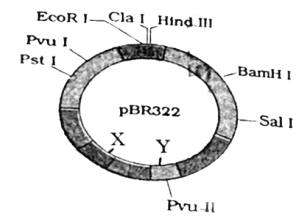
The following diagram shows restriction sites in the $E. coli$ cloning vector $pBR322$. Identify the role of '$X$' and '$Y$' genes:
A
The gene '$X$' is responsible for controlling the copy number of the linked $DNA$ and '$Y$' for the protein involved in the replication of the plasmid.
B
The gene '$X$' is for the protein involved in the replication of the plasmid and '$Y$' is for resistance to antibiotics.
C
Gene '$X$' is responsible for recognition sites and '$Y$' is responsible for antibiotic resistance.
D
The gene '$X$' is responsible for resistance to antibiotics and '$Y$' for the protein involved in the replication of the plasmid.
Solution
(A) The correct answer is option $A$,because:
In the given diagram of the $pBR322$ vector,'$X$' represents the $ori$ (origin of replication) site,while '$Y$' represents the $rop$ gene.
'$X$' $(ori)$ is the sequence where replication starts and is responsible for controlling the copy number of the linked $DNA$.
'$Y$' $(rop)$ codes for proteins involved in the replication of the plasmid.
Therefore,option $A$ correctly identifies the functions of '$X$' and '$Y$'.
In the given diagram of the $pBR322$ vector,'$X$' represents the $ori$ (origin of replication) site,while '$Y$' represents the $rop$ gene.
'$X$' $(ori)$ is the sequence where replication starts and is responsible for controlling the copy number of the linked $DNA$.
'$Y$' $(rop)$ codes for proteins involved in the replication of the plasmid.
Therefore,option $A$ correctly identifies the functions of '$X$' and '$Y$'.
0 likes
View Solution493
MediumMCQ
Which of the following enzyme$(s)$ are $\text{NOT}$ essential for gene cloning?
$A.$ Restriction enzymes
$B.$ $\text{DNA}$ ligase
$C.$ $\text{DNA}$ mutase
$D.$ $\text{DNA}$ recombinase
$E.$ $\text{DNA}$ polymerase
Choose the correct answer from the options given below:
$A.$ Restriction enzymes
$B.$ $\text{DNA}$ ligase
$C.$ $\text{DNA}$ mutase
$D.$ $\text{DNA}$ recombinase
$E.$ $\text{DNA}$ polymerase
Choose the correct answer from the options given below:
A
$C$ and $D$ only
B
$A$ and $B$ only
C
$D$ and $E$ only
D
$B$ and $C$ only
Solution
(A) Gene cloning,a fundamental process in recombinant $\text{DNA}$ technology,requires specific enzymes to manipulate genetic material.
$1$. $\text{Restriction enzymes}$ are essential for cutting the vector and the source $\text{DNA}$ at specific sites.
$2$. $\text{DNA ligase}$ is essential for joining the cut $\text{DNA}$ fragments (ligation) to form recombinant $\text{DNA}$.
$3$. $\text{DNA polymerase}$ is often used in processes like $\text{PCR}$ or for filling in sticky ends.
$4$. $\text{DNA mutase}$ and $\text{DNA recombinase}$ are not standard enzymes used in the basic workflow of gene cloning.
Therefore,$\text{DNA mutase}$ $(C)$ and $\text{DNA recombinase}$ $(D)$ are not essential for gene cloning.
$1$. $\text{Restriction enzymes}$ are essential for cutting the vector and the source $\text{DNA}$ at specific sites.
$2$. $\text{DNA ligase}$ is essential for joining the cut $\text{DNA}$ fragments (ligation) to form recombinant $\text{DNA}$.
$3$. $\text{DNA polymerase}$ is often used in processes like $\text{PCR}$ or for filling in sticky ends.
$4$. $\text{DNA mutase}$ and $\text{DNA recombinase}$ are not standard enzymes used in the basic workflow of gene cloning.
Therefore,$\text{DNA mutase}$ $(C)$ and $\text{DNA recombinase}$ $(D)$ are not essential for gene cloning.
0 likes
View Solution494
MediumMCQ
Hind $II$ always cuts $DNA$ molecules at a particular site called recognition sequence and it consists of : (in $bp$)
A
$8$
B
$6$
C
$4$
D
$10$
Solution
(B) The restriction enzyme Hind $II$ was the first restriction endonuclease to be isolated.
It always cuts $DNA$ molecules at a particular point by recognizing a specific sequence of $6$ base pairs.
This specific sequence is known as the recognition sequence.
Therefore,the correct option is $6 \ bp$.
It always cuts $DNA$ molecules at a particular point by recognizing a specific sequence of $6$ base pairs.
This specific sequence is known as the recognition sequence.
Therefore,the correct option is $6 \ bp$.
0 likes
View Solution495
MediumMCQ
Which of the following is not used for isolation of $\text{DNA}$ from cells?
A
$\text{RNAse}$
B
Protease
C
Micro-injection
D
Cellulase
Solution
(C) The isolation of $\text{DNA}$ from cells involves breaking down cellular components that interfere with the purification process.
$\text{RNAse}$ is used to remove $\text{RNA}$ contaminants.
Protease is used to break down proteins associated with $\text{DNA}$.
Cellulase is used to break down the cell wall of plant cells.
Micro-injection is a technique used for the direct introduction of foreign $\text{DNA}$ into a host cell,not for the isolation of $\text{DNA}$ from cells. Therefore,it is not used in the isolation process.
$\text{RNAse}$ is used to remove $\text{RNA}$ contaminants.
Protease is used to break down proteins associated with $\text{DNA}$.
Cellulase is used to break down the cell wall of plant cells.
Micro-injection is a technique used for the direct introduction of foreign $\text{DNA}$ into a host cell,not for the isolation of $\text{DNA}$ from cells. Therefore,it is not used in the isolation process.
0 likes
View Solution496
MediumMCQ
Which of the following is a wrong match?
A
Taq polymerase $-$ Thermostable enzyme
B
Gene gun $-$ Gold or tungsten microparticles
C
Agrobacterium tumefaciens $-$ $T$-$DNA$
D
EcoRI $-$ Exonuclease
Solution
(D) The correct answer is $D$.
$EcoRI$ is a restriction endonuclease,not an exonuclease.
Restriction endonucleases cut $DNA$ at specific recognition sequences within the molecule,whereas exonucleases remove nucleotides from the ends of the $DNA$ molecule.
$Taq$ polymerase is a thermostable enzyme isolated from the bacterium $Thermus$ $aquaticus$,used in $PCR$.
Gene gun (biolistics) uses gold or tungsten microparticles coated with $DNA$ to transform plant cells.
$Agrobacterium$ $tumefaciens$ is a natural genetic engineer that transfers $T-DNA$ into host plant cells.
$EcoRI$ is a restriction endonuclease,not an exonuclease.
Restriction endonucleases cut $DNA$ at specific recognition sequences within the molecule,whereas exonucleases remove nucleotides from the ends of the $DNA$ molecule.
$Taq$ polymerase is a thermostable enzyme isolated from the bacterium $Thermus$ $aquaticus$,used in $PCR$.
Gene gun (biolistics) uses gold or tungsten microparticles coated with $DNA$ to transform plant cells.
$Agrobacterium$ $tumefaciens$ is a natural genetic engineer that transfers $T-DNA$ into host plant cells.
0 likes
View Solution497
EasyMCQ
In vector $\text{pBR-322}$,the $\text{Rop}$ codes for the $:-$
A
Antibiotic resistance genes
B
Proteins involved in the replication of the plasmid
C
$\text{Bam HI}$
D
$\beta$-galactosidase
Solution
(B) The $\text{pBR-322}$ is a widely used cloning vector in biotechnology.
It contains specific regions such as the origin of replication $(ori)$,antibiotic resistance genes ($amp^R$ and $tet^R$),and the $\text{Rop}$ gene.
$\text{Rop}$ stands for 'Repressor of Primer'.
It codes for proteins that are involved in the regulation of the replication of the plasmid.
It contains specific regions such as the origin of replication $(ori)$,antibiotic resistance genes ($amp^R$ and $tet^R$),and the $\text{Rop}$ gene.
$\text{Rop}$ stands for 'Repressor of Primer'.
It codes for proteins that are involved in the regulation of the replication of the plasmid.
0 likes
View Solution498
MediumMCQ
Which one is not a restriction enzyme?
A
$EcoRI$
B
Pectinase
C
$BamHI$
D
$Hind-II$
Solution
(B) Restriction enzymes are enzymes that cut $DNA$ at specific recognition sequences.
$EcoRI$,$BamHI$,and $Hind-II$ are well-known restriction endonucleases derived from bacteria.
Pectinase is a group of enzymes that break down pectin,a polysaccharide found in plant cell walls.
Therefore,Pectinase is not a restriction enzyme.
$EcoRI$,$BamHI$,and $Hind-II$ are well-known restriction endonucleases derived from bacteria.
Pectinase is a group of enzymes that break down pectin,a polysaccharide found in plant cell walls.
Therefore,Pectinase is not a restriction enzyme.
0 likes
View Solution499
MediumMCQ
The enzyme used during $\text{PCR}$ is$-$
$I.$ Taq polymerase
$II.$ Helicase
$III.$ $\text{RNA}$ polymerase
$IV.$ Gyrase
Select the correct option:
$I.$ Taq polymerase
$II.$ Helicase
$III.$ $\text{RNA}$ polymerase
$IV.$ Gyrase
Select the correct option:
A
$I$ only
B
$I$ and $III$
C
$I$ and $IV$
D
$I, II$ and $III$
Solution
(A) $\text{PCR}$ (Polymerase Chain Reaction) is a technique used to amplify a specific segment of $\text{DNA}$.
The process requires a thermostable $\text{DNA}$ polymerase enzyme that can withstand high temperatures during the denaturation step of $\text{PCR}$.
$\text{Taq}$ polymerase,isolated from the bacterium $\text{Thermus aquaticus}$,is the enzyme used in $\text{PCR}$ because it remains active at high temperatures.
Helicase,$\text{RNA}$ polymerase,and Gyrase are not used in the standard $\text{PCR}$ process as the separation of $\text{DNA}$ strands is achieved by heat denaturation rather than enzymatic action.
The process requires a thermostable $\text{DNA}$ polymerase enzyme that can withstand high temperatures during the denaturation step of $\text{PCR}$.
$\text{Taq}$ polymerase,isolated from the bacterium $\text{Thermus aquaticus}$,is the enzyme used in $\text{PCR}$ because it remains active at high temperatures.
Helicase,$\text{RNA}$ polymerase,and Gyrase are not used in the standard $\text{PCR}$ process as the separation of $\text{DNA}$ strands is achieved by heat denaturation rather than enzymatic action.
0 likes
View Solution500
EasyMCQ
Hind $II$ cuts the $\text{DNA}$ molecule at a particular point by recognizing a specific sequence of how many base pairs?
A
$4$
B
$8$
C
$6$
D
$10$
Solution
(C) The restriction enzyme Hind $II$ was the first restriction endonuclease to be isolated.
It always cuts $\text{DNA}$ molecules at a particular point by recognizing a specific sequence of $6$ base pairs.
This specific base pair sequence is known as the recognition site.
It always cuts $\text{DNA}$ molecules at a particular point by recognizing a specific sequence of $6$ base pairs.
This specific base pair sequence is known as the recognition site.
0 likes
View SolutionBiotechnology Principals and Process — Tools of recombinant DNA technology · Frequently Asked Questions
1Are these Biotechnology Principals and Process questions useful for JEE and NEET?
Yes. All questions in this section are mapped to JEE Main and NEET exam patterns. Previous year questions from JEE Main, NEET, GUJCET and state-level exams are included with full solutions.
2Can I switch to Hindi or Gujarati for these questions?
Yes. Use the language tabs in the hero section or the sidebar to view the same questions and solutions in English, Hindi or Gujarati.
3How do I generate a question paper from this subtopic?
Use the Vedclass Exam Paper Generator — select the chapter and subtopic, set difficulty, and generate Sets A, B, C, D automatically. First 3 chapters of every subject are free.
Vedclass Products
For Students
Vedclass Test Series
Mock tests in real JEE/NEET style with performance analysis. 5-day free trial.
Start Free TrialFor Teachers
Exam Paper Generator
Generate Set A/B/C/D papers from this chapter in 2 minutes. 3 chapters free.
Try FreeFor Institutes
Online Exam Module
Live online exams with unlimited students, 360° analytics & white-label branding.
See DemoFor Teachers & Institutes
Generate a Biotechnology Principals and Process Exam Paper in 2 Minutes
Select subtopic & difficulty — Sets A, B, C, D auto-generated with No Repeat logic.
First 3 chapters of every subject are free — no payment required.