
A English
Tools of recombinant DNA technology Questions in English
Class 12 Biology · Biotechnology Principals and Process · Tools of recombinant DNA technology
564+
Questions
English
Language
100%
With Solutions
Showing 50 of 564 questions in English
401
MediumMCQ
The first restriction enzyme to be isolated and characterised was
A
$EcoRI$
B
$BamHI$
C
$Hind \;III$
D
$Hind \;II$
Solution
(D) The first restriction endonuclease to be isolated and characterised was $Hind \;II$.
It was discovered by Werner Arber,Hamilton Smith,and Daniel Nathans in the late $1960s$.
This enzyme was found to always cut $DNA$ molecules at a particular point by recognising a specific sequence of $6$ base pairs,known as the recognition sequence.
It was discovered by Werner Arber,Hamilton Smith,and Daniel Nathans in the late $1960s$.
This enzyme was found to always cut $DNA$ molecules at a particular point by recognising a specific sequence of $6$ base pairs,known as the recognition sequence.
0 likes
View Solution402
MediumMCQ
Which of the following represents a correct palindromic sequence recognized by $EcoRI$?
A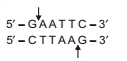
B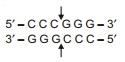
C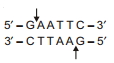
D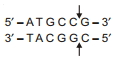
Solution
(C) The restriction endonuclease $EcoRI$ recognizes the specific palindromic sequence $5'-GAATTC-3'$ in $DNA$.
This sequence is read the same in both the $5' \rightarrow 3'$ and $3' \rightarrow 5'$ directions on the complementary strands.
The correct representation of this double-stranded $DNA$ sequence is:
$5'-GAATTC-3'$
$3'-CTTAAG-5'$
$EcoRI$ cuts the $DNA$ between the $G$ and $A$ bases on both strands,creating sticky ends.
This sequence is read the same in both the $5' \rightarrow 3'$ and $3' \rightarrow 5'$ directions on the complementary strands.
The correct representation of this double-stranded $DNA$ sequence is:
$5'-GAATTC-3'$
$3'-CTTAAG-5'$
$EcoRI$ cuts the $DNA$ between the $G$ and $A$ bases on both strands,creating sticky ends.
0 likes
View Solution403
MediumMCQ
The ability to transform normal cells into cancerous cells is found in
A
$Ti$ plasmid
B
Retrovirus
C
All plasmids
D
Both $(a)$ and $(b)$
Solution
(D) $1$. $Ti$ plasmid of $Agrobacterium \text{ } tumefaciens$: $A. \text{ } tumefaciens$ is a pathogen that can deliver a piece of $DNA$ known as 'T-DNA' to transform normal plant cells into tumor cells.
$2$. Retrovirus: These viruses possess the ability to transform normal cells into cancerous cells in animals.
$3$. Therefore, both $Ti$ plasmid and retroviruses have the ability to transform normal cells into cancerous/tumor cells.
$2$. Retrovirus: These viruses possess the ability to transform normal cells into cancerous cells in animals.
$3$. Therefore, both $Ti$ plasmid and retroviruses have the ability to transform normal cells into cancerous/tumor cells.
0 likes
View Solution404
MediumMCQ
Restriction in Restriction endonuclease enzyme refers to
A
Cleaving of phosphodiester bond in $DNA$ by the enzyme
B
Cutting of $DNA$ at specific position only
C
Prevention of bacteriophage multiplication in bacteria
D
Cutting each of the two strands of $DNA$ at specific points in sugar phosphate backbone
Solution
(C) The term 'restriction' refers to the biological function of these enzymes in restricting or preventing the propagation of foreign $DNA$ (such as that of bacteriophages) within the host bacterium. These enzymes act as a defense mechanism for bacteria against viral infections.
0 likes
View Solution405
MediumMCQ
In agarose gel electrophoresis,$DNA$ molecules of different lengths are separated on the basis of their
A
Charge only
B
Size only
C
Charge to size ratio
D
Both $(a)$ and $(c)$
Solution
(B) In agarose gel electrophoresis,$DNA$ fragments are separated based on their size.
Since $DNA$ molecules are negatively charged,they move towards the anode under an electric field.
The agarose gel acts as a molecular sieve.
Larger $DNA$ fragments encounter more resistance from the gel matrix and move slowly,whereas smaller $DNA$ fragments move through the pores more easily and travel faster.
Therefore,the separation is primarily determined by the size of the $DNA$ molecules.
Since $DNA$ molecules are negatively charged,they move towards the anode under an electric field.
The agarose gel acts as a molecular sieve.
Larger $DNA$ fragments encounter more resistance from the gel matrix and move slowly,whereas smaller $DNA$ fragments move through the pores more easily and travel faster.
Therefore,the separation is primarily determined by the size of the $DNA$ molecules.
0 likes
View Solution406
EasyMCQ
While isolating $DNA$ from bacteria,which of the following enzymes is not used?
A
Lysozyme
B
Ribonuclease
C
Protease
D
Deoxyribonuclease
Solution
(D) To isolate $DNA$ from bacterial cells,the cell wall must be broken down and other macromolecules like $RNA$ and proteins must be removed.
$1$. Lysozyme is used to break down the bacterial cell wall.
$2$. Ribonuclease is used to degrade $RNA$.
$3$. Protease is used to degrade proteins.
$4$. Deoxyribonuclease $(DNase)$ is an enzyme that breaks down $DNA$. If $DNase$ is added during the isolation process,it will degrade the $DNA$ we are trying to extract. Therefore,it is not used.
$1$. Lysozyme is used to break down the bacterial cell wall.
$2$. Ribonuclease is used to degrade $RNA$.
$3$. Protease is used to degrade proteins.
$4$. Deoxyribonuclease $(DNase)$ is an enzyme that breaks down $DNA$. If $DNase$ is added during the isolation process,it will degrade the $DNA$ we are trying to extract. Therefore,it is not used.
0 likes
View Solution407
EasyMCQ
Who among the following was awarded the Nobel Prize for the development of the $PCR$ technique?
A
Herbert Boyer
B
Kary Mullis
C
Rene Descartes
D
Andrew Fire
Solution
(B) Kary Mullis was an American biochemist who was awarded the Nobel Prize in Chemistry in $1993$ for his invention of the Polymerase Chain Reaction $(PCR)$ technique.
This technique allows for the amplification of specific $DNA$ segments,which revolutionized molecular biology.
This technique allows for the amplification of specific $DNA$ segments,which revolutionized molecular biology.
0 likes
View Solution408
MediumMCQ
Which of the following statements does not hold true for restriction enzymes?
A
It recognizes a palindromic nucleotide sequence.
B
It is an endonuclease.
C
It is isolated from bacteriophages.
D
It produces the same kind of sticky ends in different $DNA$ molecules.
Solution
(C) Restriction enzymes are a class of enzymes that cut $DNA$ at specific sites. They are naturally found in bacteria,where they serve as a defense mechanism against invading viruses (bacteriophages) by cutting the viral $DNA$. They are not isolated from the bacteriophages themselves. Therefore,the statement that they are isolated from bacteriophages is incorrect. Restriction enzymes recognize specific palindromic sequences and act as endonucleases to produce sticky or blunt ends.
0 likes
View Solution409
MediumMCQ
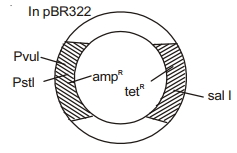
The gene of interest was cloned at the $Sal I$ site in $pBR322$. The recombinant plasmid will exhibit susceptibility to:
A
Tetracycline
B
Tetracycline and Ampicillin
C
Ampicillin only
D
$A$ broad spectrum of antibiotics
Solution
(A) The plasmid $pBR322$ contains two antibiotic resistance genes: $amp^R$ (ampicillin resistance) and $tet^R$ (tetracycline resistance).
When a gene of interest is inserted (cloned) at the $Sal I$ restriction site,it disrupts the $tet^R$ gene.
This process is known as insertional inactivation.
As a result,the recombinant plasmid loses its resistance to tetracycline and becomes susceptible to it,while it remains resistant to ampicillin.
When a gene of interest is inserted (cloned) at the $Sal I$ restriction site,it disrupts the $tet^R$ gene.
This process is known as insertional inactivation.
As a result,the recombinant plasmid loses its resistance to tetracycline and becomes susceptible to it,while it remains resistant to ampicillin.
0 likes
View Solution410
MediumMCQ
In case of $BamHI$,$H$ represents
A
Genus
B
Species
C
Name of scientist
D
Strain
Solution
(D) The naming of restriction enzymes follows a specific convention. The first letter of the name comes from the genus and the next two letters come from the species of the prokaryotic cell from which they were isolated. For example,in $BamHI$,$B$ comes from Bacillus and $am$ comes from amyloliquefaciens. The third letter $H$ represents the strain of the bacterium (e.g.,$H$ for strain $H$). The Roman numeral $I$ following the name indicates the order in which the enzyme was isolated from that strain of bacteria.

0 likes
View Solution411
MediumMCQ
The function of the 'ori' site in a vector is to
A
Initiate insertional inactivation
B
Initiate replication
C
Code for the proteins involved in the replication of the plasmid
D
Initiate antibiotic resistance
Solution
(B) The 'ori' site stands for the 'Origin of Replication'.
It is a specific $DNA$ sequence within a vector where the replication process begins.
Any piece of $DNA$ linked to this sequence can be made to replicate within the host cells.
It is a specific $DNA$ sequence within a vector where the replication process begins.
Any piece of $DNA$ linked to this sequence can be made to replicate within the host cells.
0 likes
View Solution412
MediumMCQ
Normal $E.$ coli cells carry resistance against which of the following antibiotics?
A
Chloramphenicol
B
Ampicillin
C
Tetracycline
D
None of these
Solution
(D) Normal $E.$ coli cells are wild-type bacteria and do not naturally possess plasmids containing antibiotic resistance genes. Therefore,they do not carry resistance against common antibiotics like Chloramphenicol,Ampicillin,or Tetracycline. These resistance genes are typically introduced into $E.$ coli artificially via recombinant $DNA$ technology using cloning vectors.
0 likes
View Solution413
MediumMCQ
$A$ chimaeric $DNA$ is formed by
A
Deleting selectable markers
B
Joining $c-DNA$ with plasmid
C
$EcoRI$
D
Enzyme $\beta-$ galactosidase
Solution
(B) chimaeric $DNA$ is a recombinant $DNA$ molecule.
It is formed by joining a foreign $DNA$ fragment (such as $c-DNA$) with a vector $DNA$ (such as a plasmid) using enzymes like restriction endonucleases and $DNA$ ligase.
This process creates a hybrid or chimaeric molecule containing genetic material from two different sources.
It is formed by joining a foreign $DNA$ fragment (such as $c-DNA$) with a vector $DNA$ (such as a plasmid) using enzymes like restriction endonucleases and $DNA$ ligase.
This process creates a hybrid or chimaeric molecule containing genetic material from two different sources.
0 likes
View Solution414
MediumMCQ
$A$ plasmid:
A
Shows dependent assortment
B
Has ability to replicate within bacterial cells independent of the control of chromosomal $DNA$
C
Cannot replicate
D
Contains genes for vital activities
Solution
(B) plasmid is an extrachromosomal,circular,double-stranded $DNA$ molecule found in many bacteria.
It possesses the ability to replicate autonomously within the bacterial cell,independent of the chromosomal $DNA$ replication control.
While plasmids often carry genes that provide advantages (like antibiotic resistance),they do not contain genes essential for the basic vital activities of the cell,which are located on the main chromosomal $DNA$.
It possesses the ability to replicate autonomously within the bacterial cell,independent of the chromosomal $DNA$ replication control.
While plasmids often carry genes that provide advantages (like antibiotic resistance),they do not contain genes essential for the basic vital activities of the cell,which are located on the main chromosomal $DNA$.
0 likes
View Solution415
MediumMCQ
Each restriction endonuclease functions by inspecting the length of a $DNA$ sequence. It cleaves $ . . . . $
A
Only the master strand to produce sticky ends
B
Sense strand of $DNA$ to produce sticky ends
C
Each of the two strands of the double helix at specific points in their sugar-phosphate backbones
D
Messenger $RNA$ to remove exons
Solution
(C) Restriction endonucleases are enzymes that act as molecular scissors.
They recognize specific palindromic nucleotide sequences in $DNA$.
Upon recognizing the specific sequence,they cleave the phosphodiester bonds in the sugar-phosphate backbone of both strands of the $DNA$ double helix.
This cleavage often results in the formation of single-stranded overhangs known as sticky ends or blunt ends,depending on the enzyme used.
They recognize specific palindromic nucleotide sequences in $DNA$.
Upon recognizing the specific sequence,they cleave the phosphodiester bonds in the sugar-phosphate backbone of both strands of the $DNA$ double helix.
This cleavage often results in the formation of single-stranded overhangs known as sticky ends or blunt ends,depending on the enzyme used.
0 likes
View Solution416
MediumMCQ
Which enzyme is required to prevent unwanted self-ligation of vector $DNA$ molecules in recombinant $DNA$ technology?
A
$DNA$ polymerase
B
$DNA$ ligase
C
Alkaline phosphatase
D
Reverse transcriptase
Solution
(C) In recombinant $DNA$ technology,vector $DNA$ molecules can undergo self-ligation if their $5'$ ends possess phosphate groups.
Alkaline phosphatase is an enzyme that removes the $5'$ phosphate groups from the $DNA$ molecules.
By removing these phosphate groups,the enzyme prevents the vector from re-annealing or self-ligating,thereby ensuring that only the desired insert $DNA$ can be ligated into the vector.
Alkaline phosphatase is an enzyme that removes the $5'$ phosphate groups from the $DNA$ molecules.
By removing these phosphate groups,the enzyme prevents the vector from re-annealing or self-ligating,thereby ensuring that only the desired insert $DNA$ can be ligated into the vector.
0 likes
View Solution417
EasyMCQ
$A$ set of bacterial clones,each containing a plasmid or phage,is called
A
Gene library
B
Gene pool
C
Genophore
D
Genome
Solution
(A) gene library (or genomic library) is a collection of $DNA$ fragments that have been cloned into vectors such as plasmids or phages,representing the entire genetic material of an organism.
Gene pool refers to the total sum of different genes present in an interbreeding population.
Genophore is the term used for the chromosomal $DNA$ of a prokaryote.
Genome refers to the complete haploid set of chromosomes in a gamete or an organism.
Gene pool refers to the total sum of different genes present in an interbreeding population.
Genophore is the term used for the chromosomal $DNA$ of a prokaryote.
Genome refers to the complete haploid set of chromosomes in a gamete or an organism.
0 likes
View Solution418
EasyMCQ
Which of these are most widely used in genetic engineering?
A
Plastid
B
Plasmid
C
Mitochondria
D
Ribosome
Solution
(B) Plasmids are widely used in genetic engineering because they can replicate independently of the chromosomal $DNA$.
Plastids are double-membrane organelles found in plants and algae,primarily involved in photosynthesis and storage.
Mitochondria are the powerhouses of the cell,and ribosomes are the sites of protein synthesis,but neither is used as a vector in genetic engineering.
Plastids are double-membrane organelles found in plants and algae,primarily involved in photosynthesis and storage.
Mitochondria are the powerhouses of the cell,and ribosomes are the sites of protein synthesis,but neither is used as a vector in genetic engineering.
0 likes
View Solution419
MediumMCQ
Agarose extracted from sea weeds finds use in
A
$Gel\; electrophoresis$
B
$Spectrophotometry$
C
$Tissue\; culture$
D
$PCR$
Solution
(A) Agarose is a natural polymer extracted from sea weeds (red algae).
It is widely used in $Gel\; electrophoresis$ to separate $DNA$ fragments based on their size.
Agarose gels provide a matrix with a specific pore size that allows the migration of $DNA$ molecules under an electric field.
$Spectrophotometry$ is used for measuring light absorption,$Tissue\; culture$ involves growing cells in artificial media,and $PCR$ is used for $DNA$ amplification,none of which primarily utilize agarose as a separation matrix.
It is widely used in $Gel\; electrophoresis$ to separate $DNA$ fragments based on their size.
Agarose gels provide a matrix with a specific pore size that allows the migration of $DNA$ molecules under an electric field.
$Spectrophotometry$ is used for measuring light absorption,$Tissue\; culture$ involves growing cells in artificial media,and $PCR$ is used for $DNA$ amplification,none of which primarily utilize agarose as a separation matrix.
0 likes
View Solution420
MediumMCQ
Which of the following is not a basis of difference between chromosomal $DNA$ and plasmid?
A
$b$ and $c$ only
B
$a$ and $d$ only
C
$a, b$ and $d$ only
D
$a, b, c$ and $d$ only
Solution
(A) Chromosomal $DNA$ and plasmid $DNA$ differ in several aspects:
$1$. Presence of histones: Chromosomal $DNA$ is associated with histones in eukaryotes,whereas plasmids (found in bacteria) lack histones.
$2$. Nature of histone: Since plasmids lack histones,this is a point of difference.
$3$. Nature of nucleotide: Both chromosomal $DNA$ and plasmid $DNA$ are composed of the same four nucleotides $(A, T, G, C)$. Therefore,the nature of nucleotides is $NOT$ a basis of difference.
$4$. Linear form of genetic material: Chromosomal $DNA$ in eukaryotes is linear,while plasmids are typically circular. Thus,this is a basis of difference.
Since the question asks for what is $NOT$ a basis of difference,only the 'Nature of nucleotide' $(c)$ fits.
$1$. Presence of histones: Chromosomal $DNA$ is associated with histones in eukaryotes,whereas plasmids (found in bacteria) lack histones.
$2$. Nature of histone: Since plasmids lack histones,this is a point of difference.
$3$. Nature of nucleotide: Both chromosomal $DNA$ and plasmid $DNA$ are composed of the same four nucleotides $(A, T, G, C)$. Therefore,the nature of nucleotides is $NOT$ a basis of difference.
$4$. Linear form of genetic material: Chromosomal $DNA$ in eukaryotes is linear,while plasmids are typically circular. Thus,this is a basis of difference.
Since the question asks for what is $NOT$ a basis of difference,only the 'Nature of nucleotide' $(c)$ fits.
0 likes
View Solution421
MediumMCQ
Select the option that excludes characteristics applicable to plasmids:
$(a)$. Circular $DNA$
$(b)$. Linear $DNA$
$(c)$. Present in all bacteria
$(d)$. Contain essential genes
$(e)$. Extra chromosomal self-replicating
$(a)$. Circular $DNA$
$(b)$. Linear $DNA$
$(c)$. Present in all bacteria
$(d)$. Contain essential genes
$(e)$. Extra chromosomal self-replicating
A
$b$ and $d$ only
B
$b, c$ and $d$ only
C
$d, b, e$ and $c$ only
D
$a$ only
Solution
(B) Plasmids are small,circular,double-stranded $DNA$ molecules that are distinct from a cell's chromosomal $DNA$.
They are extrachromosomal and capable of autonomous (self) replication.
They do not contain essential genes required for the basic survival of the bacteria; instead,they often carry genes that provide advantages like antibiotic resistance.
Plasmids are not present in all bacteria.
Therefore,the characteristics that are $NOT$ applicable to plasmids are: $(b)$ Linear $DNA$,$(c)$ Present in all bacteria,and $(d)$ Contain essential genes.
Thus,the correct option is $b, c$ and $d$ only.
They are extrachromosomal and capable of autonomous (self) replication.
They do not contain essential genes required for the basic survival of the bacteria; instead,they often carry genes that provide advantages like antibiotic resistance.
Plasmids are not present in all bacteria.
Therefore,the characteristics that are $NOT$ applicable to plasmids are: $(b)$ Linear $DNA$,$(c)$ Present in all bacteria,and $(d)$ Contain essential genes.
Thus,the correct option is $b, c$ and $d$ only.
0 likes
View Solution422
MediumMCQ
The term 'disarmed' in a disarmed vector represents:
A
Removal of $T-DNA$ from $Ti$ plasmid
B
Insertional inactivation of $\beta-galactosidase$ gene
C
Insertional inactivation of antibiotic resistance gene
D
Both $(b)$ and $(c)$
Solution
(A) In genetic engineering,a 'disarmed' vector refers to a vector that has been modified to remove its pathogenic or harmful properties while retaining its ability to transfer $DNA$ into a host cell.
Specifically,in the case of the $Ti$ plasmid (Tumor-inducing plasmid) from $Agrobacterium$ $tumefaciens$,the genes responsible for tumor formation (pathogenicity) are removed or replaced with the gene of interest.
Therefore,'disarmed' means the removal of the pathogenic $T-DNA$ region from the $Ti$ plasmid,rendering it safe for use as a cloning vector.
Specifically,in the case of the $Ti$ plasmid (Tumor-inducing plasmid) from $Agrobacterium$ $tumefaciens$,the genes responsible for tumor formation (pathogenicity) are removed or replaced with the gene of interest.
Therefore,'disarmed' means the removal of the pathogenic $T-DNA$ region from the $Ti$ plasmid,rendering it safe for use as a cloning vector.
0 likes
View Solution423
MediumMCQ
$A$ : $DNA$ ligase plays an important role in recombinant $DNA$ technology.
$R$ : The linking of antibiotic resistance gene with plasmid vector became possible by enzyme $DNA$ ligase.
$R$ : The linking of antibiotic resistance gene with plasmid vector became possible by enzyme $DNA$ ligase.
A
Assertion and Reason both are correct and Reason is the correct explanation of Assertion.
B
Assertion and Reason both are correct but Reason is not the correct explanation of Assertion.
C
Assertion is correct,but Reason is incorrect.
D
Both Assertion and Reason are incorrect.
Solution
(A) $DNA$ ligase is an enzyme that acts as a 'molecular glue' by catalyzing the formation of phosphodiester bonds between the $3'$-hydroxyl end of one nucleotide and the $5'$-phosphate end of another.
In recombinant $DNA$ technology,this enzyme is essential for joining the foreign $DNA$ fragment (gene of interest) with the cloning vector (such as a plasmid).
The antibiotic resistance gene is a common marker used in plasmid vectors. To create a recombinant plasmid,the gene of interest and the vector are cut with the same restriction enzyme,and then $DNA$ ligase is used to covalently link them together.
Therefore,both the Assertion and the Reason are correct,and the Reason provides a valid explanation for the importance of $DNA$ ligase in this technology.
In recombinant $DNA$ technology,this enzyme is essential for joining the foreign $DNA$ fragment (gene of interest) with the cloning vector (such as a plasmid).
The antibiotic resistance gene is a common marker used in plasmid vectors. To create a recombinant plasmid,the gene of interest and the vector are cut with the same restriction enzyme,and then $DNA$ ligase is used to covalently link them together.
Therefore,both the Assertion and the Reason are correct,and the Reason provides a valid explanation for the importance of $DNA$ ligase in this technology.
0 likes
View Solution424
MediumMCQ
$A$: Restriction enzymes belong to a larger class of enzymes called nucleases.
$R$: Each restriction enzyme recognizes a specific palindromic nucleotide sequence in the $DNA$.
$R$: Each restriction enzyme recognizes a specific palindromic nucleotide sequence in the $DNA$.
A
Assertion and Reason both are correct and Reason is the correct explanation of Assertion.
B
Assertion and Reason both are correct but Reason is not the correct explanation of Assertion.
C
Assertion is correct,but Reason is incorrect.
D
Both Assertion and Reason are incorrect.
Solution
(A) $1$. Restriction enzymes are a type of enzyme that cuts $DNA$ at specific sites. They belong to a larger class of enzymes known as nucleases.
$2$. Nucleases are categorized into two types: exonucleases (which remove nucleotides from the ends of $DNA$) and endonucleases (which make cuts at specific positions within the $DNA$).
$3$. Restriction endonucleases are a specific type of endonuclease that recognizes a specific palindromic nucleotide sequence in the $DNA$ and cuts the $DNA$ at that site.
$4$. Therefore,both the Assertion and the Reason are correct,and the Reason provides the correct explanation for the Assertion.
$2$. Nucleases are categorized into two types: exonucleases (which remove nucleotides from the ends of $DNA$) and endonucleases (which make cuts at specific positions within the $DNA$).
$3$. Restriction endonucleases are a specific type of endonuclease that recognizes a specific palindromic nucleotide sequence in the $DNA$ and cuts the $DNA$ at that site.
$4$. Therefore,both the Assertion and the Reason are correct,and the Reason provides the correct explanation for the Assertion.
0 likes
View Solution425
MediumMCQ
$A$ : During gel electrophoresis,the $DNA$ fragments move towards the anode.
$R$ : $DNA$ fragments are negatively charged molecules.
$R$ : $DNA$ fragments are negatively charged molecules.
A
Assertion and Reason both are correct and Reason is the correct explanation of Assertion.
B
Assertion and Reason both are correct but Reason is not the correct explanation of Assertion.
C
Assertion is correct,but Reason is incorrect.
D
Both Assertion and Reason are incorrect.
Solution
(A) $DNA$ molecules contain a sugar-phosphate backbone where the phosphate groups carry a negative charge.
Due to this negative charge,$DNA$ fragments migrate towards the positively charged electrode,which is the anode,when an electric field is applied during gel electrophoresis.
Therefore,both the Assertion and the Reason are correct,and the Reason is the correct explanation for the Assertion.
Due to this negative charge,$DNA$ fragments migrate towards the positively charged electrode,which is the anode,when an electric field is applied during gel electrophoresis.
Therefore,both the Assertion and the Reason are correct,and the Reason is the correct explanation for the Assertion.
0 likes
View Solution426
MediumMCQ
$A$: Disarmed $Ti$ plasmid can be utilised as a shuttle vector.
$R$: It can survive in both prokaryotic and eukaryotic organisms.
$R$: It can survive in both prokaryotic and eukaryotic organisms.
A
Assertion and Reason both are correct and Reason is the correct explanation of Assertion.
B
Assertion and Reason both are correct but Reason is not the correct explanation of Assertion.
C
Assertion is correct,but Reason is incorrect.
D
Both Assertion and Reason are incorrect.
Solution
(A) The $Ti$ plasmid (Tumor-inducing plasmid) is naturally found in $Agrobacterium$ $tumefaciens$.
By removing the tumor-causing genes,it becomes a 'disarmed' $Ti$ plasmid.
$A$ shuttle vector is defined as a vector that can replicate in two different host organisms (e.g.,both prokaryotes like $E. coli$ and eukaryotes like plants).
Since the disarmed $Ti$ plasmid can be maintained in $E. coli$ (prokaryote) and also used to transform plant cells (eukaryote),it functions as a shuttle vector.
Therefore,both the Assertion and the Reason are correct,and the Reason correctly explains why it is called a shuttle vector.
By removing the tumor-causing genes,it becomes a 'disarmed' $Ti$ plasmid.
$A$ shuttle vector is defined as a vector that can replicate in two different host organisms (e.g.,both prokaryotes like $E. coli$ and eukaryotes like plants).
Since the disarmed $Ti$ plasmid can be maintained in $E. coli$ (prokaryote) and also used to transform plant cells (eukaryote),it functions as a shuttle vector.
Therefore,both the Assertion and the Reason are correct,and the Reason correctly explains why it is called a shuttle vector.
0 likes
View Solution427
MediumMCQ
$A$ : $Pst I$ generates single-stranded overhanging stretches in $DNA$ after digestion that facilitate ligation.
$R$ : These short extensions can form hydrogen bonds with their complementary counterparts,which are then sealed by $DNA$ ligase to form phosphodiester bonds.
$R$ : These short extensions can form hydrogen bonds with their complementary counterparts,which are then sealed by $DNA$ ligase to form phosphodiester bonds.
A
Assertion and Reason both are correct and Reason is the correct explanation of Assertion.
B
Assertion and Reason both are correct but Reason is not the correct explanation of Assertion.
C
Assertion is correct,but Reason is incorrect.
D
Both Assertion and Reason are incorrect.
Solution
(A) $Pst I$ is a restriction endonuclease that cuts $DNA$ at specific recognition sequences,creating single-stranded overhanging stretches known as 'sticky ends'.
These sticky ends facilitate the ligation process because they can form hydrogen bonds with their complementary counterparts on another $DNA$ fragment.
Once the hydrogen bonds are formed,the enzyme $DNA$ ligase seals the nicks by forming phosphodiester bonds,resulting in a continuous recombinant $DNA$ molecule.
These sticky ends facilitate the ligation process because they can form hydrogen bonds with their complementary counterparts on another $DNA$ fragment.
Once the hydrogen bonds are formed,the enzyme $DNA$ ligase seals the nicks by forming phosphodiester bonds,resulting in a continuous recombinant $DNA$ molecule.
0 likes
View Solution428
MediumMCQ
$A$ : Ethidium bromide helps in visualizing $DNA$ in $UV$ light only.
$R$ : This intercalating agent absorbs light in range $260-330 \; nm$.
$R$ : This intercalating agent absorbs light in range $260-330 \; nm$.
A
Assertion and Reason both are correct and Reason is the correct explanation of Assertion.
B
Assertion and Reason both are correct but Reason is not the correct explanation of Assertion.
C
Assertion is correct,but Reason is incorrect.
D
Both Assertion and Reason are incorrect.
Solution
(A) Ethidium bromide $(EtBr)$ is a fluorescent dye used to stain $DNA$ fragments in agarose gel electrophoresis.
When exposed to $UV$ light,the $DNA$ bands stained with $EtBr$ fluoresce as bright orange bands.
This occurs because $EtBr$ is an intercalating agent that binds between the base pairs of the $DNA$ double helix.
It absorbs light in the $UV$ range,specifically between $260-330 \; nm$,and emits light in the visible spectrum (orange).
Therefore,both the Assertion and the Reason are correct,and the Reason provides the correct explanation for why $DNA$ can be visualized under $UV$ light.
When exposed to $UV$ light,the $DNA$ bands stained with $EtBr$ fluoresce as bright orange bands.
This occurs because $EtBr$ is an intercalating agent that binds between the base pairs of the $DNA$ double helix.
It absorbs light in the $UV$ range,specifically between $260-330 \; nm$,and emits light in the visible spectrum (orange).
Therefore,both the Assertion and the Reason are correct,and the Reason provides the correct explanation for why $DNA$ can be visualized under $UV$ light.
0 likes
View Solution429
MediumMCQ
The organism, which is used for gene transfer in higher plants is
A
Agrobacterium tumefaciens
B
$E$. coli
C
Acetobacter aceti
D
Bacillus thuringiensis
Solution
(A) $Agrobacterium$ $tumefaciens$ is a soil bacterium that naturally infects plants.
Its $Ti$-plasmid $(Tumor$ $inducing$ $plasmid)$ is widely used in genetic engineering to transfer foreign $DNA$ into the genome of higher plants.
Therefore, it acts as a natural vector for gene transfer.
Its $Ti$-plasmid $(Tumor$ $inducing$ $plasmid)$ is widely used in genetic engineering to transfer foreign $DNA$ into the genome of higher plants.
Therefore, it acts as a natural vector for gene transfer.
0 likes
View Solution430
EasyMCQ
Molecular scissors are
A
Restriction endonucleases
B
$DNA$ polymerase
C
$DNA$ ligase
D
$RNA$ polymerase
Solution
(A) Restriction endonuclease is the enzyme that recognizes a specific $DNA$ base sequence and cleaves both strands of a $DNA$ molecule at a particular site called the restriction site,which typically contains a palindromic sequence.
Because these enzymes cut $DNA$ at specific locations,they are commonly referred to as molecular scissors.
Because these enzymes cut $DNA$ at specific locations,they are commonly referred to as molecular scissors.
0 likes
View Solution431
MediumMCQ
The tumour-inducing capacity of $Agrobacterium \; tumefaciens$ is located in large extra-chromosomal plasmids called
A
$R_{1}-$ plasmid
B
Lambda phage
C
$pBR \; 322$
D
$Ti-$ plasmid
Solution
(D) $Ti-$ plasmid (Tumour-inducing plasmid) is found in $Agrobacterium \; tumefaciens$,which produces crown gall (tumour) in a large number of dicot species.
$Agrobacterium \; tumefaciens$ is a Gram-negative soil bacterium that infects a wide range of plants and causes crown galls.
$Agrobacterium \; tumefaciens$ is a Gram-negative soil bacterium that infects a wide range of plants and causes crown galls.
0 likes
View Solution432
EasyMCQ
$T_{i}$ plasmids used in genetic engineering are obtained from:
A
Bacillus thuringiensis
B
Agrobacterium rhizogenes
C
Agrobacterium tumefaciens
D
Pseudomonas syringae
Solution
(C) The $T_{i}$ plasmid (Tumor-inducing plasmid) is a circular $DNA$ molecule found in the soil bacterium $Agrobacterium$ $tumefaciens$.
It is widely used in plant genetic engineering as a cloning vector because it has the natural ability to transfer a specific segment of its $DNA$, known as $T$-$DNA$, into the genome of host plants.
This property is exploited to introduce foreign genes into dicotyledonous plants.
It is widely used in plant genetic engineering as a cloning vector because it has the natural ability to transfer a specific segment of its $DNA$, known as $T$-$DNA$, into the genome of host plants.
This property is exploited to introduce foreign genes into dicotyledonous plants.
0 likes
View Solution433
MediumMCQ
The enzyme that is used in $PCR$ technology is:
A
Taq polymerase
B
Polymerase
C
Helicase
D
Reverse transcriptase
Solution
(A) The polymerase chain reaction $(PCR)$ is a technique by which small samples of $DNA$ can be quickly amplified.
This repeated amplification is achieved by the use of a thermostable $DNA$ polymerase,known as $Taq$ polymerase.
$Taq$ polymerase is isolated from the bacterium $Thermus$ $aquaticus$.
It remains active during the high-temperature induced denaturation step of double-stranded $DNA$ in the $PCR$ cycle.
This repeated amplification is achieved by the use of a thermostable $DNA$ polymerase,known as $Taq$ polymerase.
$Taq$ polymerase is isolated from the bacterium $Thermus$ $aquaticus$.
It remains active during the high-temperature induced denaturation step of double-stranded $DNA$ in the $PCR$ cycle.
0 likes
View Solution434
EasyMCQ
The vector for $T-DNA$ is
A
Thermus aquaticus
B
Salmonella typhimurium
C
Agrobacterium tumefaciens
D
Escherichia coli
Solution
(C) $T-DNA$ (Transfer $DNA$) is a segment of $DNA$ found in the $Ti$ (Tumor-inducing) plasmid of the soil bacterium $Agrobacterium$ $tumefaciens$.
This bacterium naturally infects plants and transfers its $T-DNA$ into the host plant genome, causing crown gall disease.
In biotechnology, scientists have modified this system by removing the disease-causing genes and replacing them with genes of interest, making $Agrobacterium$ $tumefaciens$ an excellent vector for plant genetic engineering.
This bacterium naturally infects plants and transfers its $T-DNA$ into the host plant genome, causing crown gall disease.
In biotechnology, scientists have modified this system by removing the disease-causing genes and replacing them with genes of interest, making $Agrobacterium$ $tumefaciens$ an excellent vector for plant genetic engineering.
0 likes
View Solution435
MediumMCQ
Restriction endonucleases are
A
Present in mammalian cells for degradation of $DNA$ when the cell dies
B
Used in genetic engineering for ligating two $DNA$ molecules
C
Used for in vitro $DNA$ synthesis
D
Synthesized by bacteria as part of their defence mechanism
Solution
(D) Restriction endonucleases are enzymes that recognize specific base sequences in $DNA$ and cut the $DNA$ at specific sites. These enzymes are produced by bacteria as a defense mechanism to protect themselves against the invasion of foreign $DNA$,such as that from bacteriophages (viruses that infect bacteria).
0 likes
View Solution436
MediumMCQ
$A$ single strand of nucleic acid ($DNA$ or $RNA$) tagged with a radioactive molecule is called:
A
Plasmid
B
Vector
C
Probe
D
Selectable marker
Solution
(C) molecular probe is a single-stranded fragment of $DNA$ or $RNA$ that is tagged with a radioactive isotope,such as $P^{32}$.
These probes are used to detect specific sequences of nucleic acids by hybridizing with their complementary strands.
Molecular probes are widely used in the diagnosis of various genetic disorders,including Duchenne muscular dystrophy,cystic fibrosis,and Tay-Sachs disease.
These probes are used to detect specific sequences of nucleic acids by hybridizing with their complementary strands.
Molecular probes are widely used in the diagnosis of various genetic disorders,including Duchenne muscular dystrophy,cystic fibrosis,and Tay-Sachs disease.
0 likes
View Solution437
MediumMCQ
Which of the following key factors makes the plasmid a vector in genetic engineering?
A
It is resistant to antibiotics
B
It is resistant to restriction enzymes
C
Its ability to carry a foreign gene
D
Its ability to cause infection in the host
Solution
(C) Plasmids,cosmids,or bacteriophages can be used as vectors in genetic engineering.
Plasmids are the most widely used circular,extrachromosomal $DNA$ segments found in bacterial cells.
The primary reason they are used as vectors is their ability to carry a foreign gene or desired gene into the host organism.
The size of plasmids ranges from $1 \times 10^{6}$ to $200 \times 10^{6}$ daltons.
Common examples of vector plasmids include $pBR322$,those of the $pUC$ series,and $Ti$ and $Ri$ plasmids of $Agrobacterium$.
Plasmids are the most widely used circular,extrachromosomal $DNA$ segments found in bacterial cells.
The primary reason they are used as vectors is their ability to carry a foreign gene or desired gene into the host organism.
The size of plasmids ranges from $1 \times 10^{6}$ to $200 \times 10^{6}$ daltons.
Common examples of vector plasmids include $pBR322$,those of the $pUC$ series,and $Ti$ and $Ri$ plasmids of $Agrobacterium$.
0 likes
View Solution438
MediumMCQ
Restriction endonucleases are enzymes which
A
Make cuts at specific positions within the $DNA$ molecule
B
Recognize a specific nucleotide sequence for binding of $DNA$ ligase
C
Restrict the action of the enzyme $DNA$ polymerase
D
Remove nucleotides from the ends of the $DNA$ molecule
Solution
(A) Restriction endonucleases are enzymes that recognize a specific $DNA$ base sequence,known as the recognition site or restriction site,which typically consists of a palindromic sequence.
These enzymes cleave both strands of the $DNA$ molecule at or near these specific sites.
This process results in the generation of restriction fragments,which may have overhanging ends (sticky ends) or blunt ends.
These enzymes cleave both strands of the $DNA$ molecule at or near these specific sites.
This process results in the generation of restriction fragments,which may have overhanging ends (sticky ends) or blunt ends.
0 likes
View Solution439
MediumMCQ
What is true for plasmid?
A
Found in viruses
B
Contains genes for vital activities
C
Part of nuclear chromosome
D
Widely used in gene transfer
Solution
(D) plasmid is an extrachromosomal,self-replicating,circular $DNA$ molecule found in bacteria and some eukaryotes.
It is not part of the chromosomal $DNA$ and does not contain genes essential for the host's vital survival activities.
Due to its ability to replicate independently and carry foreign genes,it is widely used as a vector in genetic engineering and gene transfer experiments.
It is not part of the chromosomal $DNA$ and does not contain genes essential for the host's vital survival activities.
Due to its ability to replicate independently and carry foreign genes,it is widely used as a vector in genetic engineering and gene transfer experiments.
0 likes
View Solution440
MediumMCQ
An extrachromosomal $DNA$,which can be used as a vector in gene cloning is called:
A
Transposon
B
Intron
C
Exon
D
Plasmid
Solution
(D) Plasmids are extrachromosomal molecules of $DNA$ that replicate independently of the bacterial chromosomes.
They are typically closed,circular,and supercoiled structures.
Due to their ability to replicate autonomously and carry foreign genes,they are widely used as vectors for cloning and genetic engineering.
They are typically closed,circular,and supercoiled structures.
Due to their ability to replicate autonomously and carry foreign genes,they are widely used as vectors for cloning and genetic engineering.
0 likes
View Solution441
MediumMCQ
Which of the following enzymes are used to join bits of $DNA$?
A
Ligase
B
Primase
C
$DNA$ polymerase
D
Endonuclease
Solution
(A) $DNA$ ligase is an enzyme that facilitates the joining of $DNA$ strands together by catalyzing the formation of a phosphodiester bond.
It acts as a molecular glue to seal nicks or join fragments of $DNA$ during replication,repair,and recombinant $DNA$ technology.
Ligase enzymes catalyze the condensation of $ATP$ or other similar triphosphates to provide the energy required for this joining process.
It acts as a molecular glue to seal nicks or join fragments of $DNA$ during replication,repair,and recombinant $DNA$ technology.
Ligase enzymes catalyze the condensation of $ATP$ or other similar triphosphates to provide the energy required for this joining process.
0 likes
View Solution442
MediumMCQ
Manipulation of $DNA$ in genetic engineering became possible due to the discovery of
A
Restriction endonuclease
B
$DNA$ ligase
C
Transcriptase
D
Primase
Solution
(A) The isolation of restriction endonucleases by Nathans and Smith $(1970)$ made it possible to cut $DNA$ at specific sites.
Restriction enzymes can cut both strands of $DNA$ when foreign nucleotides are introduced into the cell.
They cleave $DNA$ to generate a nick with a $5'$ phosphoryl and $3'$ hydroxyl terminus,which is the fundamental step in recombinant $DNA$ technology.
Restriction enzymes can cut both strands of $DNA$ when foreign nucleotides are introduced into the cell.
They cleave $DNA$ to generate a nick with a $5'$ phosphoryl and $3'$ hydroxyl terminus,which is the fundamental step in recombinant $DNA$ technology.
0 likes
View Solution443
MediumMCQ
$A$ probe,which is a molecule used to locate specific sequences in a mixture of $DNA$ or $RNA$ molecules,could be:
A
$A$ single-stranded $RNA$
B
$A$ single-stranded $DNA$
C
Either $RNA$ or $DNA$
D
Can be $ssDNA$ but not $ssRNA$
Solution
(C) probe is a single-stranded $DNA$ or $RNA$ molecule that is tagged with a radioactive isotope or a fluorescent marker.
It is used to identify specific sequences by hybridizing to its complementary $DNA$ or $RNA$ strand in a sample.
Since both $DNA$ and $RNA$ can act as probes depending on the experimental requirement,the correct answer is that a probe can be either $RNA$ or $DNA$.
It is used to identify specific sequences by hybridizing to its complementary $DNA$ or $RNA$ strand in a sample.
Since both $DNA$ and $RNA$ can act as probes depending on the experimental requirement,the correct answer is that a probe can be either $RNA$ or $DNA$.
0 likes
View Solution444
MediumMCQ
$GAATTC$ is the recognition site for the restriction endonuclease:
A
Eco $RI$
B
Hind $II$
C
Eco $RII$
D
Bam $HI$
Solution
(A) The restriction endonuclease Eco $RI$ is isolated from the bacterium Escherichia coli $RY13$.
It recognizes the specific palindromic nucleotide sequence $5'-GAATTC-3'$ and cuts between $G$ and $A$ on both strands.
Therefore,$GAATTC$ is the recognition site for Eco $RI$.
It recognizes the specific palindromic nucleotide sequence $5'-GAATTC-3'$ and cuts between $G$ and $A$ on both strands.
Therefore,$GAATTC$ is the recognition site for Eco $RI$.
0 likes
View Solution445
MediumMCQ
Find out the wrong statement.
A
Mobile genetic elements,transposons were visualized by Barbara McClintock.
B
Udder cell,a somatic cell is used to produce the cloned sheep by nuclear transplantation method.
C
In pedigree analysis,a person immediately affected by an action is called propositus.
D
$DNA$ ligases are used to cleave a $DNA$ molecule.
Solution
(D) Restriction endonucleases are the enzymes that cleave $DNA$ molecules at specific nucleotide sequences known as restriction sites.
$DNA$ ligase is an enzyme that acts as a 'molecular glue' to join bits of $DNA$ fragments together.
Therefore,the statement that $DNA$ ligases are used to cleave a $DNA$ molecule is incorrect.
$DNA$ ligase is an enzyme that acts as a 'molecular glue' to join bits of $DNA$ fragments together.
Therefore,the statement that $DNA$ ligases are used to cleave a $DNA$ molecule is incorrect.
0 likes
View Solution446
MediumMCQ
Which of the following is not a restriction endonuclease?
A
Eco $RI$
B
Hind $III$
C
Pst $I$
D
DNAse $I$
Solution
(D) Restriction endonucleases are enzymes that cut $DNA$ molecules at specific recognition sites,which have specific base sequences. Examples include Hae $III$,Eco $RI$,Bam $HI$,Hind $II$,and Pst $I$.
$DNAse$ $I$ is a deoxyribonuclease enzyme that degrades $DNA$ by breaking phosphodiester bonds,but it is not a restriction endonuclease.
Therefore,$DNAse$ $I$ is the correct answer.
$DNAse$ $I$ is a deoxyribonuclease enzyme that degrades $DNA$ by breaking phosphodiester bonds,but it is not a restriction endonuclease.
Therefore,$DNAse$ $I$ is the correct answer.
0 likes
View Solution447
MediumMCQ
Microbes found to be very useful in genetic engineering are
A
Escherichia coli and Agrobacterium tumefaciens
B
Vibrio cholerae and a tailed bacteriophage
C
Diplococcus sp. and Pseudomonas sp.
D
Crown gall bacterium and Caenorhabditis elegans
Solution
(A) $Escherichia$ $coli$ and $Agrobacterium$ $tumefaciens$ are microbes found to be very useful in genetic engineering.
$E.$ $coli$ is a motile,Gram-negative,rod-shaped bacterium which is a normal inhabitant of the human colon. It is most extensively used in bacterial genetics and molecular biology.
$Agrobacterium$ $tumefaciens$ is a soil bacterium. It contains a $T_{i}$ plasmid (Tumour-inducing plasmid),which is used as a vector for the transfer of a desired gene into dicot plants.
$E.$ $coli$ is a motile,Gram-negative,rod-shaped bacterium which is a normal inhabitant of the human colon. It is most extensively used in bacterial genetics and molecular biology.
$Agrobacterium$ $tumefaciens$ is a soil bacterium. It contains a $T_{i}$ plasmid (Tumour-inducing plasmid),which is used as a vector for the transfer of a desired gene into dicot plants.
0 likes
View Solution448
MediumMCQ
$A$ specific recognition sequence identified by endonucleases to make cuts at specific positions within the $DNA$ is:
A
Degenerate primer sequence
B
Okazaki sequences
C
Palindromic Nucleotide sequences
D
Poly$(A)$ tail sequences
Solution
(C) Restriction endonucleases are enzymes that recognize specific base pair sequences in $DNA$ and cut the $DNA$ at those sites.
These specific sequences are known as palindromic nucleotide sequences.
$A$ palindromic sequence in $DNA$ is a sequence of base pairs that reads the same on the two strands when the orientation of reading is kept the same (e.g.,$5' - GAATTC - 3'$ and $3' - CTTAAG - 5'$).
Therefore,the correct option is $C$.
These specific sequences are known as palindromic nucleotide sequences.
$A$ palindromic sequence in $DNA$ is a sequence of base pairs that reads the same on the two strands when the orientation of reading is kept the same (e.g.,$5' - GAATTC - 3'$ and $3' - CTTAAG - 5'$).
Therefore,the correct option is $C$.
0 likes
View Solution449
MediumMCQ
In the following palindromic base sequences of $DNA$,which one can be cut easily by a particular restriction enzyme?
A
$5'-GAATTC-3'; 3'-CTTAAG-5'$
B
$5'-CTCAGT-3'; 3'-GAGTCA-5'$
C
$5'-GTATTC-3'; 3'-CATAAG-5'$
D
$5'-GATACT-3'; 3'-CTATGA-5'$
Solution
(A) Restriction enzymes recognize specific palindromic nucleotide sequences in $DNA$ to perform cleavage.
$A$ palindromic sequence in $DNA$ is a sequence of base pairs that reads the same on the two strands when the orientation of reading is kept the same (e.g.,$5' \rightarrow 3'$).
Option $A$ $(5'-GAATTC-3'; 3'-CTTAAG-5')$ represents the recognition site for the restriction enzyme $EcoRI$.
This sequence is a perfect palindrome because the sequence $GAATTC$ read from $5' \rightarrow 3'$ on one strand is identical to the sequence $GAATTC$ read from $5' \rightarrow 3'$ on the complementary strand.
Options $B$,$C$,and $D$ do not represent standard palindromic sequences recognized by common restriction enzymes.
$A$ palindromic sequence in $DNA$ is a sequence of base pairs that reads the same on the two strands when the orientation of reading is kept the same (e.g.,$5' \rightarrow 3'$).
Option $A$ $(5'-GAATTC-3'; 3'-CTTAAG-5')$ represents the recognition site for the restriction enzyme $EcoRI$.
This sequence is a perfect palindrome because the sequence $GAATTC$ read from $5' \rightarrow 3'$ on one strand is identical to the sequence $GAATTC$ read from $5' \rightarrow 3'$ on the complementary strand.
Options $B$,$C$,and $D$ do not represent standard palindromic sequences recognized by common restriction enzymes.
0 likes
View Solution450
MediumMCQ
Given below are two statements:
Statement $I:$
Restriction endonucleases recognise specific sequences to cut $DNA$,known as palindromic nucleotide sequences.
Statement $II:$
Restriction endonucleases cut the $DNA$ strand a little away from the centre of the palindromic site.
In the light of the above statements,choose the most appropriate answer from the options given below:
Statement $I:$
Restriction endonucleases recognise specific sequences to cut $DNA$,known as palindromic nucleotide sequences.
Statement $II:$
Restriction endonucleases cut the $DNA$ strand a little away from the centre of the palindromic site.
In the light of the above statements,choose the most appropriate answer from the options given below:
A
Both Statement $I$ and Statement $II$ are incorrect
B
Statement $I$ is correct but Statement $II$ is incorrect
C
Statement $I$ is incorrect but Statement $II$ is correct
D
Both Statement $I$ and Statement $II$ are correct
Solution
(D) Statement $I$ is correct: Restriction endonucleases scan the $DNA$ molecule for specific recognition sequences,which are palindromic nucleotide sequences (sequences that read the same forward and backward on the two strands).
Statement $II$ is correct: Most restriction enzymes do not cut exactly in the middle of the palindromic site; instead,they cut the $DNA$ strands a little away from the centre,often between the same two bases on opposite strands,leaving single-stranded portions at the ends known as sticky ends.
Statement $II$ is correct: Most restriction enzymes do not cut exactly in the middle of the palindromic site; instead,they cut the $DNA$ strands a little away from the centre,often between the same two bases on opposite strands,leaving single-stranded portions at the ends known as sticky ends.
0 likes
View SolutionBiotechnology Principals and Process — Tools of recombinant DNA technology · Frequently Asked Questions
1Are these Biotechnology Principals and Process questions useful for JEE and NEET?
Yes. All questions in this section are mapped to JEE Main and NEET exam patterns. Previous year questions from JEE Main, NEET, GUJCET and state-level exams are included with full solutions.
2Can I switch to Hindi or Gujarati for these questions?
Yes. Use the language tabs in the hero section or the sidebar to view the same questions and solutions in English, Hindi or Gujarati.
3How do I generate a question paper from this subtopic?
Use the Vedclass Exam Paper Generator — select the chapter and subtopic, set difficulty, and generate Sets A, B, C, D automatically. First 3 chapters of every subject are free.
Vedclass Products
For Students
Vedclass Test Series
Mock tests in real JEE/NEET style with performance analysis. 5-day free trial.
Start Free TrialFor Teachers
Exam Paper Generator
Generate Set A/B/C/D papers from this chapter in 2 minutes. 3 chapters free.
Try FreeFor Institutes
Online Exam Module
Live online exams with unlimited students, 360° analytics & white-label branding.
See DemoFor Teachers & Institutes
Generate a Biotechnology Principals and Process Exam Paper in 2 Minutes
Select subtopic & difficulty — Sets A, B, C, D auto-generated with No Repeat logic.
First 3 chapters of every subject are free — no payment required.