
A English
Work Done by Constant Force Questions in English
Class 11 Physics · Work, Energy, Power and Collision · Work Done by Constant Force
164+
Questions
English
Language
100%
With Solutions
Showing 50 of 164 questions in English
51
DifficultMCQ
$A$ particle moves from position $\vec{r_1} = 3\,\hat{i} + 2\,\hat{j} - 6\,\hat{k}$ to position $\vec{r_2} = 14\,\hat{i} + 13\,\hat{j} + 9\,\hat{k}$ under the influence of a force $\vec{F} = 4\,\hat{i} + \hat{j} + 3\,\hat{k}$. Find the work done in $J$.
A
$10$
B
$100$
C
$0.01$
D
$1$
Solution
(B) The displacement vector $\Delta\vec{r}$ is given by $\Delta\vec{r} = \vec{r_2} - \vec{r_1}$.
$\Delta\vec{r} = (14\,\hat{i} + 13\,\hat{j} + 9\,\hat{k}) - (3\,\hat{i} + 2\,\hat{j} - 6\,\hat{k}) = 11\,\hat{i} + 11\,\hat{j} + 15\,\hat{k}$.
The work done $W$ is the dot product of force and displacement: $W = \vec{F} \cdot \Delta\vec{r}$.
$W = (4\,\hat{i} + \hat{j} + 3\,\hat{k}) \cdot (11\,\hat{i} + 11\,\hat{j} + 15\,\hat{k})$.
$W = (4 \times 11) + (1 \times 11) + (3 \times 15) = 44 + 11 + 45 = 100\,J$.
$\Delta\vec{r} = (14\,\hat{i} + 13\,\hat{j} + 9\,\hat{k}) - (3\,\hat{i} + 2\,\hat{j} - 6\,\hat{k}) = 11\,\hat{i} + 11\,\hat{j} + 15\,\hat{k}$.
The work done $W$ is the dot product of force and displacement: $W = \vec{F} \cdot \Delta\vec{r}$.
$W = (4\,\hat{i} + \hat{j} + 3\,\hat{k}) \cdot (11\,\hat{i} + 11\,\hat{j} + 15\,\hat{k})$.
$W = (4 \times 11) + (1 \times 11) + (3 \times 15) = 44 + 11 + 45 = 100\,J$.
0 likes
View Solution52
DifficultMCQ
$A$ force $\vec{F} = 6\hat{i} + 2\hat{j} - 3\hat{k}$ acts on a particle,causing a displacement $\vec{S} = 2\hat{i} - 3\hat{j} + x\hat{k}$. If the work done during this displacement is zero,find the value of $x$.
A
$-2$
B
$0.5$
C
$6$
D
$2$
Solution
(D) The work done $W$ by a force $\vec{F}$ during a displacement $\vec{S}$ is given by the dot product: $W = \vec{F} \cdot \vec{S}$.
Given that the work done is zero,we have $\vec{F} \cdot \vec{S} = 0$.
Substituting the given vectors: $(6\hat{i} + 2\hat{j} - 3\hat{k}) \cdot (2\hat{i} - 3\hat{j} + x\hat{k}) = 0$.
Calculating the dot product: $(6 \times 2) + (2 \times -3) + (-3 \times x) = 0$.
$12 - 6 - 3x = 0$.
$6 - 3x = 0$.
$3x = 6$.
Therefore,$x = 2$.
Given that the work done is zero,we have $\vec{F} \cdot \vec{S} = 0$.
Substituting the given vectors: $(6\hat{i} + 2\hat{j} - 3\hat{k}) \cdot (2\hat{i} - 3\hat{j} + x\hat{k}) = 0$.
Calculating the dot product: $(6 \times 2) + (2 \times -3) + (-3 \times x) = 0$.
$12 - 6 - 3x = 0$.
$6 - 3x = 0$.
$3x = 6$.
Therefore,$x = 2$.
0 likes
View Solution53
DifficultMCQ
$A$ rope is used to lower a block of mass $M$ vertically downwards by a distance $x$ with a constant downward acceleration of $g/2$. What is the work done by the rope on the block?
A
$Mgx$
B
$\frac{1}{2}Mgx^2$
C
$-\frac{1}{2}Mgx$
D
$Mgx^2$
Solution
(C) Let $T$ be the tension in the rope acting upwards and $Mg$ be the weight of the block acting downwards.
The block is moving downwards with an acceleration $a = g/2$.
Applying Newton's second law of motion: $Mg - T = Ma$
Substituting $a = g/2$,we get: $Mg - T = M(g/2)$
$T = Mg - Mg/2 = Mg/2$
The displacement $x$ is downwards,while the tension $T$ acts upwards.
Therefore,the angle between the force $T$ and the displacement $x$ is $180^{\circ}$.
Work done by the rope $W = T \cdot x \cdot \cos(180^{\circ}) = (Mg/2) \cdot x \cdot (-1) = -\frac{1}{2}Mgx$.
The block is moving downwards with an acceleration $a = g/2$.
Applying Newton's second law of motion: $Mg - T = Ma$
Substituting $a = g/2$,we get: $Mg - T = M(g/2)$
$T = Mg - Mg/2 = Mg/2$
The displacement $x$ is downwards,while the tension $T$ acts upwards.
Therefore,the angle between the force $T$ and the displacement $x$ is $180^{\circ}$.
Work done by the rope $W = T \cdot x \cdot \cos(180^{\circ}) = (Mg/2) \cdot x \cdot (-1) = -\frac{1}{2}Mgx$.

0 likes
View Solution54
DifficultMCQ
$A$ man of mass $50 \ kg$ carries a load of mass $20 \ kg$ and climbs $20$ steps,each of height $0.25 \ m$. Calculate the work done in $J$.
A
$5$
B
$350$
C
$100$
D
$3430$
Solution
(D) Total mass $M = (50 + 20) \ kg = 70 \ kg$.
Total height $h = 20 \times 0.25 \ m = 5 \ m$.
The work done $W$ against gravity is given by $W = Mgh$.
Taking $g = 9.8 \ m/s^2$,we get:
$W = 70 \times 9.8 \times 5 = 3430 \ J$.
Total height $h = 20 \times 0.25 \ m = 5 \ m$.
The work done $W$ against gravity is given by $W = Mgh$.
Taking $g = 9.8 \ m/s^2$,we get:
$W = 70 \times 9.8 \times 5 = 3430 \ J$.
0 likes
View Solution55
DifficultMCQ
When a particle moves from its origin to a point with position vector $\vec{r} = (2\hat{i} - \hat{j}) \ m$,it is subjected to a force $\vec{F} = (5\hat{i} + 3\hat{j} + 2\hat{k}) \ N$. What is the work done by the force in Joules?
A
$-7$
B
$7$
C
$10$
D
$13$
Solution
(B) The work done $W$ by a constant force $\vec{F}$ acting on a particle that undergoes a displacement $\vec{r}$ is given by the dot product of the force and displacement vectors:
$W = \vec{F} \cdot \vec{r}$
Given:
$\vec{F} = (5\hat{i} + 3\hat{j} + 2\hat{k}) \ N$
$\vec{r} = (2\hat{i} - 1\hat{j} + 0\hat{k}) \ m$
Substituting the values:
$W = (5\hat{i} + 3\hat{j} + 2\hat{k}) \cdot (2\hat{i} - 1\hat{j} + 0\hat{k})$
Using the dot product property $\hat{i} \cdot \hat{i} = 1, \hat{j} \cdot \hat{j} = 1, \hat{k} \cdot \hat{k} = 1$ and cross terms are $0$:
$W = (5 \times 2) + (3 \times -1) + (2 \times 0)$
$W = 10 - 3 + 0$
$W = 7 \ J$
Therefore,the work done is $7 \ J$.
$W = \vec{F} \cdot \vec{r}$
Given:
$\vec{F} = (5\hat{i} + 3\hat{j} + 2\hat{k}) \ N$
$\vec{r} = (2\hat{i} - 1\hat{j} + 0\hat{k}) \ m$
Substituting the values:
$W = (5\hat{i} + 3\hat{j} + 2\hat{k}) \cdot (2\hat{i} - 1\hat{j} + 0\hat{k})$
Using the dot product property $\hat{i} \cdot \hat{i} = 1, \hat{j} \cdot \hat{j} = 1, \hat{k} \cdot \hat{k} = 1$ and cross terms are $0$:
$W = (5 \times 2) + (3 \times -1) + (2 \times 0)$
$W = 10 - 3 + 0$
$W = 7 \ J$
Therefore,the work done is $7 \ J$.
0 likes
View Solution56
EasyMCQ
When a force of $50 \, N$ is applied to an object,it undergoes a displacement of $10 \, m$ at an angle of $60^\circ$ with the direction of the force. The work done is ......... $J$.
A
$200$
B
$100$
C
$300$
D
$250$
Solution
(D) The formula for work done by a constant force is given by $W = \vec{F} \cdot \vec{S} = FS \cos \theta$.
Given values are:
Force $F = 50 \, N$
Displacement $S = 10 \, m$
Angle $\theta = 60^\circ$
Substituting these values into the formula:
$W = 50 \times 10 \times \cos 60^\circ$
Since $\cos 60^\circ = \frac{1}{2}$,we get:
$W = 500 \times \frac{1}{2} = 250 \, J$.
Therefore,the work done is $250 \, J$.
Given values are:
Force $F = 50 \, N$
Displacement $S = 10 \, m$
Angle $\theta = 60^\circ$
Substituting these values into the formula:
$W = 50 \times 10 \times \cos 60^\circ$
Since $\cos 60^\circ = \frac{1}{2}$,we get:
$W = 500 \times \frac{1}{2} = 250 \, J$.
Therefore,the work done is $250 \, J$.
0 likes
View Solution57
DifficultMCQ
$A$ force of $(4\hat i + \hat j + 3\hat k) \, N$ acts on a body,causing its displacement from $(3\hat i + 2\hat j - 6\hat k) \, m$ to $(14\hat i + 13\hat j + 9\hat k) \, m$. Calculate the work done in $J$.
A
$100$
B
$200$
C
$300$
D
$250$
Solution
(A) The displacement vector $\vec{S}$ is given by the difference between the final position vector $\vec{r_2}$ and the initial position vector $\vec{r_1}$.
$\vec{S} = \vec{r_2} - \vec{r_1} = (14\hat i + 13\hat j + 9\hat k) - (3\hat i + 2\hat j - 6\hat k) = 11\hat i + 11\hat j + 15\hat k \, m$.
Work done $W$ is the dot product of force $\vec{F}$ and displacement $\vec{S}$.
$W = \vec{F} \cdot \vec{S} = (4\hat i + \hat j + 3\hat k) \cdot (11\hat i + 11\hat j + 15\hat k)$.
$W = (4 \times 11) + (1 \times 11) + (3 \times 15) = 44 + 11 + 45 = 100 \, J$.
$\vec{S} = \vec{r_2} - \vec{r_1} = (14\hat i + 13\hat j + 9\hat k) - (3\hat i + 2\hat j - 6\hat k) = 11\hat i + 11\hat j + 15\hat k \, m$.
Work done $W$ is the dot product of force $\vec{F}$ and displacement $\vec{S}$.
$W = \vec{F} \cdot \vec{S} = (4\hat i + \hat j + 3\hat k) \cdot (11\hat i + 11\hat j + 15\hat k)$.
$W = (4 \times 11) + (1 \times 11) + (3 \times 15) = 44 + 11 + 45 = 100 \, J$.
0 likes
View Solution58
MediumMCQ
$A$ force $F = (5\hat{i} + 3\hat{j}) \ N$ acts on an object,causing a displacement of $r = (2\hat{i} - 1\hat{j}) \ m$. Calculate the work done in $J$.
A
$-7 \ J$
B
$+13 \ J$
C
$+7 \ J$
D
$+11 \ J$
Solution
(C) Work done $W$ is defined as the dot product of force $\vec{F}$ and displacement $\vec{r}$.
$W = \vec{F} \cdot \vec{r}$
Given $\vec{F} = (5\hat{i} + 3\hat{j}) \ N$ and $\vec{r} = (2\hat{i} - 1\hat{j}) \ m$.
$W = (5\hat{i} + 3\hat{j}) \cdot (2\hat{i} - 1\hat{j})$
Using the dot product property $\hat{i} \cdot \hat{i} = 1$ and $\hat{j} \cdot \hat{j} = 1$,while $\hat{i} \cdot \hat{j} = 0$:
$W = (5 \times 2) + (3 \times -1)$
$W = 10 - 3$
$W = +7 \ J$.
$W = \vec{F} \cdot \vec{r}$
Given $\vec{F} = (5\hat{i} + 3\hat{j}) \ N$ and $\vec{r} = (2\hat{i} - 1\hat{j}) \ m$.
$W = (5\hat{i} + 3\hat{j}) \cdot (2\hat{i} - 1\hat{j})$
Using the dot product property $\hat{i} \cdot \hat{i} = 1$ and $\hat{j} \cdot \hat{j} = 1$,while $\hat{i} \cdot \hat{j} = 0$:
$W = (5 \times 2) + (3 \times -1)$
$W = 10 - 3$
$W = +7 \ J$.
0 likes
View Solution59
EasyMCQ
$A$ force of $5 \ N$ is required to maintain a constant velocity of $2 \ m/s$ for a block of mass $10 \ kg$ on a rough surface. The work done by this force in $1 \ minute$ is: (in $J$)
A
$600$
B
$60$
C
$6$
D
$6000$
Solution
(A) Given: Force $F = 5 \ N$, Velocity $v = 2 \ m/s$, Time $t = 1 \ minute = 60 \ s$.
Since the velocity is constant, the displacement $d$ in time $t$ is given by $d = v \times t$.
$d = 2 \ m/s \times 60 \ s = 120 \ m$.
The work done $W$ by the force is $W = F \times d$.
$W = 5 \ N \times 120 \ m = 600 \ J$.
Since the velocity is constant, the displacement $d$ in time $t$ is given by $d = v \times t$.
$d = 2 \ m/s \times 60 \ s = 120 \ m$.
The work done $W$ by the force is $W = F \times d$.
$W = 5 \ N \times 120 \ m = 600 \ J$.
0 likes
View Solution60
DifficultMCQ
$A$ body of mass $m$ starts from rest and acquires a velocity $v$ in time $t_1$. The work done in time $t$ is proportional to:
A
$\frac{1}{2}m\frac{v}{t_1}t^2$
B
$m\frac{v}{t_1}t^2$
C
$\frac{1}{2}\left( \frac{mv}{t_1} \right)^2 t^2$
D
$\frac{1}{2}m\frac{v^2}{t_1^2}t^2$
Solution
(D) The body starts from rest,so initial velocity $u = 0$.
Acceleration $a = \frac{v - u}{t_1} = \frac{v}{t_1}$.
Distance covered in time $t$ is given by $s = ut + \frac{1}{2}at^2 = 0 + \frac{1}{2}at^2 = \frac{1}{2}at^2$.
Work done $W = F \cdot s = (ma) \cdot (\frac{1}{2}at^2) = \frac{1}{2}ma^2t^2$.
Substituting $a = \frac{v}{t_1}$,we get $W = \frac{1}{2}m \left( \frac{v}{t_1} \right)^2 t^2 = \frac{1}{2}m \frac{v^2}{t_1^2} t^2$.
Thus,the work done is proportional to $\frac{1}{2}m \frac{v^2}{t_1^2} t^2$.
Acceleration $a = \frac{v - u}{t_1} = \frac{v}{t_1}$.
Distance covered in time $t$ is given by $s = ut + \frac{1}{2}at^2 = 0 + \frac{1}{2}at^2 = \frac{1}{2}at^2$.
Work done $W = F \cdot s = (ma) \cdot (\frac{1}{2}at^2) = \frac{1}{2}ma^2t^2$.
Substituting $a = \frac{v}{t_1}$,we get $W = \frac{1}{2}m \left( \frac{v}{t_1} \right)^2 t^2 = \frac{1}{2}m \frac{v^2}{t_1^2} t^2$.
Thus,the work done is proportional to $\frac{1}{2}m \frac{v^2}{t_1^2} t^2$.
0 likes
View Solution61
DifficultMCQ
$A$ chain of mass $M$ and length $L$ is hanging from the edge of a table such that one-third of its length is hanging off the edge. The work done to pull the hanging part onto the table is:
A
$MgL$
B
$\frac{MgL}{3}$
C
$\frac{MgL}{9}$
D
$\frac{MgL}{18}$
Solution
(D) Let the total mass be $M$ and total length be $L$. The length of the hanging part is $l = \frac{L}{3}$.
The mass of the hanging part is $m = \frac{M}{L} \times l = \frac{M}{L} \times \frac{L}{3} = \frac{M}{3}$.
The center of mass of the hanging part is at a distance $h = \frac{l}{2} = \frac{L/3}{2} = \frac{L}{6}$ below the table surface.
The work done to pull the chain onto the table is equal to the change in potential energy of the hanging part,which is $W = mgh$.
Substituting the values: $W = (\frac{M}{3}) \times g \times (\frac{L}{6}) = \frac{MgL}{18}$.
The mass of the hanging part is $m = \frac{M}{L} \times l = \frac{M}{L} \times \frac{L}{3} = \frac{M}{3}$.
The center of mass of the hanging part is at a distance $h = \frac{l}{2} = \frac{L/3}{2} = \frac{L}{6}$ below the table surface.
The work done to pull the chain onto the table is equal to the change in potential energy of the hanging part,which is $W = mgh$.
Substituting the values: $W = (\frac{M}{3}) \times g \times (\frac{L}{6}) = \frac{MgL}{18}$.
0 likes
View Solution62
MediumMCQ
$A$ chain of mass $4 \ kg$ and length $2 \ m$ is hanging such that one-fourth of its length is hanging over the edge of a table. The work done to pull the hanging part onto the table is . . . . . . $J$. (Take $g = 10 \ m/s^2$)
A
$32$
B
$16$
C
$10$
D
$2.5$
Solution
(D) The mass of the hanging part is $m = \frac{M}{n}$,where $M = 4 \ kg$ is the total mass and $n = 4$ is the fraction of the length hanging.
So,$m = \frac{4}{4} = 1 \ kg$.
The length of the hanging part is $l = \frac{L}{n} = \frac{2}{4} = 0.5 \ m$.
The center of mass of the hanging part is at a distance $h = \frac{l}{2} = \frac{0.5}{2} = 0.25 \ m$ below the table edge.
The work done to pull the hanging part onto the table is equal to the change in potential energy of the hanging part: $W = mgh$.
Substituting the values: $W = 1 \ kg \times 10 \ m/s^2 \times 0.25 \ m = 2.5 \ J$.
So,$m = \frac{4}{4} = 1 \ kg$.
The length of the hanging part is $l = \frac{L}{n} = \frac{2}{4} = 0.5 \ m$.
The center of mass of the hanging part is at a distance $h = \frac{l}{2} = \frac{0.5}{2} = 0.25 \ m$ below the table edge.
The work done to pull the hanging part onto the table is equal to the change in potential energy of the hanging part: $W = mgh$.
Substituting the values: $W = 1 \ kg \times 10 \ m/s^2 \times 0.25 \ m = 2.5 \ J$.
0 likes
View Solution63
MediumMCQ
$A$ body of mass $3\, kg$ is under a constant force which causes a displacement $s$ in metres in it,given by the relation $s = \frac{1}{3}t^2$,where $t$ is in seconds. Work done by the force in $2$ seconds is
A
$\frac{19}{5}\, J$
B
$\frac{5}{19}\, J$
C
$\frac{3}{8}\, J$
D
$\frac{8}{3}\, J$
Solution
(D) Given: Mass $m = 3\, kg$,displacement $s = \frac{1}{3}t^2$.
First,find the velocity $v$ by differentiating $s$ with respect to $t$:
$v = \frac{ds}{dt} = \frac{d}{dt}(\frac{1}{3}t^2) = \frac{2}{3}t$.
Next,find the acceleration $a$ by differentiating $v$ with respect to $t$:
$a = \frac{dv}{dt} = \frac{d}{dt}(\frac{2}{3}t) = \frac{2}{3}\, m/s^2$.
The force $F$ acting on the body is $F = m \times a = 3 \times \frac{2}{3} = 2\, N$.
The work done $W$ is given by $W = \int F \, ds$. Since $ds = v \, dt$,we have $W = \int_0^2 F \cdot v \, dt$.
$W = \int_0^2 2 \cdot (\frac{2}{3}t) \, dt = \frac{4}{3} \int_0^2 t \, dt$.
$W = \frac{4}{3} [\frac{t^2}{2}]_0^2 = \frac{4}{3} \times \frac{4}{2} = \frac{8}{3}\, J$.
First,find the velocity $v$ by differentiating $s$ with respect to $t$:
$v = \frac{ds}{dt} = \frac{d}{dt}(\frac{1}{3}t^2) = \frac{2}{3}t$.
Next,find the acceleration $a$ by differentiating $v$ with respect to $t$:
$a = \frac{dv}{dt} = \frac{d}{dt}(\frac{2}{3}t) = \frac{2}{3}\, m/s^2$.
The force $F$ acting on the body is $F = m \times a = 3 \times \frac{2}{3} = 2\, N$.
The work done $W$ is given by $W = \int F \, ds$. Since $ds = v \, dt$,we have $W = \int_0^2 F \cdot v \, dt$.
$W = \int_0^2 2 \cdot (\frac{2}{3}t) \, dt = \frac{4}{3} \int_0^2 t \, dt$.
$W = \frac{4}{3} [\frac{t^2}{2}]_0^2 = \frac{4}{3} \times \frac{4}{2} = \frac{8}{3}\, J$.
0 likes
View Solution64
MediumMCQ
$A$ uniform force of $(3\hat i + \hat j) \text{ N}$ acts on a particle of mass $2 \text{ kg}$. The particle is displaced from position $(2\hat i + \hat k) \text{ m}$ to position $(4\hat i + 3\hat j - \hat k) \text{ m}$. The work done by the force on the particle is ............. $J$.
A
$9$
B
$6$
C
$13$
D
$15$
Solution
(A) Given force $\vec{F} = (3\hat{i} + \hat{j}) \text{ N}$.
Initial position $\vec{r}_1 = (2\hat{i} + \hat{k}) \text{ m}$.
Final position $\vec{r}_2 = (4\hat{i} + 3\hat{j} - \hat{k}) \text{ m}$.
Displacement $\vec{d} = \vec{r}_2 - \vec{r}_1 = (4\hat{i} + 3\hat{j} - \hat{k}) - (2\hat{i} + \hat{k}) = (2\hat{i} + 3\hat{j} - 2\hat{k}) \text{ m}$.
Work done $W = \vec{F} \cdot \vec{d} = (3\hat{i} + \hat{j}) \cdot (2\hat{i} + 3\hat{j} - 2\hat{k})$.
$W = (3 \times 2) + (1 \times 3) + (0 \times -2) = 6 + 3 = 9 \text{ J}$.
Initial position $\vec{r}_1 = (2\hat{i} + \hat{k}) \text{ m}$.
Final position $\vec{r}_2 = (4\hat{i} + 3\hat{j} - \hat{k}) \text{ m}$.
Displacement $\vec{d} = \vec{r}_2 - \vec{r}_1 = (4\hat{i} + 3\hat{j} - \hat{k}) - (2\hat{i} + \hat{k}) = (2\hat{i} + 3\hat{j} - 2\hat{k}) \text{ m}$.
Work done $W = \vec{F} \cdot \vec{d} = (3\hat{i} + \hat{j}) \cdot (2\hat{i} + 3\hat{j} - 2\hat{k})$.
$W = (3 \times 2) + (1 \times 3) + (0 \times -2) = 6 + 3 = 9 \text{ J}$.
0 likes
View Solution65
EasyMCQ
$A$ particle moves from a point $(-2\hat i + 5\hat j) \ m$ to $(4\hat j + 3\hat k) \ m$ when a force of $(4\hat i + 3\hat j) \ N$ is applied. How much work has been done by the force? $J$
A
$5$
B
$2$
C
$8$
D
$11$
Solution
(A) The work done $W$ by a constant force $\vec{F}$ during a displacement $\vec{d}$ is given by the dot product: $W = \vec{F} \cdot \vec{d}$.
Here,the initial position is $\vec{r}_1 = -2\hat i + 5\hat j$ and the final position is $\vec{r}_2 = 4\hat j + 3\hat k$.
The displacement vector $\vec{d} = \vec{r}_2 - \vec{r}_1 = (4\hat j + 3\hat k) - (-2\hat i + 5\hat j) = 2\hat i - \hat j + 3\hat k$.
The force is $\vec{F} = 4\hat i + 3\hat j$.
Therefore,$W = (4\hat i + 3\hat j) \cdot (2\hat i - \hat j + 3\hat k) = (4 \times 2) + (3 \times -1) + (0 \times 3) = 8 - 3 = 5 \ J$.
Here,the initial position is $\vec{r}_1 = -2\hat i + 5\hat j$ and the final position is $\vec{r}_2 = 4\hat j + 3\hat k$.
The displacement vector $\vec{d} = \vec{r}_2 - \vec{r}_1 = (4\hat j + 3\hat k) - (-2\hat i + 5\hat j) = 2\hat i - \hat j + 3\hat k$.
The force is $\vec{F} = 4\hat i + 3\hat j$.
Therefore,$W = (4\hat i + 3\hat j) \cdot (2\hat i - \hat j + 3\hat k) = (4 \times 2) + (3 \times -1) + (0 \times 3) = 8 - 3 = 5 \ J$.
0 likes
View Solution66
EasyMCQ
Two constant forces ${F_1} = 2\hat i - 3\hat j + 3\hat k$ $(N)$ and ${F_2} = \hat i + \hat j - 2\hat k$ $(N)$ act on a body and displace it from the position ${r_1} = \hat i + 2\hat j - 2\hat k$ $(m)$ to the position ${r_2} = 7\hat i + 10\hat j + 5\hat k$ $(m)$. What is the work done in $J$?
A
$9$
B
$41$
C
$-3$
D
None of these
Solution
(A) The net force acting on the body is $\vec{F}_{net} = \vec{F}_1 + \vec{F}_2 = (2\hat i - 3\hat j + 3\hat k) + (\hat i + \hat j - 2\hat k) = 3\hat i - 2\hat j + \hat k$ $(N)$.
The displacement of the body is $\vec{d} = \vec{r}_2 - \vec{r}_1 = (7\hat i + 10\hat j + 5\hat k) - (\hat i + 2\hat j - 2\hat k) = 6\hat i + 8\hat j + 7\hat k$ $(m)$.
The work done is given by the dot product of the net force and the displacement: $W = \vec{F}_{net} \cdot \vec{d}$.
$W = (3\hat i - 2\hat j + \hat k) \cdot (6\hat i + 8\hat j + 7\hat k) = (3 \times 6) + (-2 \times 8) + (1 \times 7) = 18 - 16 + 7 = 9$ $J$.
The displacement of the body is $\vec{d} = \vec{r}_2 - \vec{r}_1 = (7\hat i + 10\hat j + 5\hat k) - (\hat i + 2\hat j - 2\hat k) = 6\hat i + 8\hat j + 7\hat k$ $(m)$.
The work done is given by the dot product of the net force and the displacement: $W = \vec{F}_{net} \cdot \vec{d}$.
$W = (3\hat i - 2\hat j + \hat k) \cdot (6\hat i + 8\hat j + 7\hat k) = (3 \times 6) + (-2 \times 8) + (1 \times 7) = 18 - 16 + 7 = 9$ $J$.
0 likes
View Solution67
EasyMCQ
How much work does a pulling force of $40 \,N$ do on a $20 \,kg$ box in pulling it $8 \,m$ across the floor at a constant speed? The pulling force is directed at $60^\circ$ above the horizontal.
A
$160 \,J$
B
$277 \,J$
C
$784 \,J$
D
None of the above
Solution
(A) The work done $W$ by a constant force $\vec{F}$ acting on an object that undergoes a displacement $\vec{s}$ is given by the formula:
$W = \vec{F} \cdot \vec{s} = F s \cos \theta$
Given:
Force $F = 40 \,N$
Displacement $s = 8 \,m$
Angle $\theta = 60^\circ$
Substituting these values into the formula:
$W = 40 \times 8 \times \cos 60^\circ$
Since $\cos 60^\circ = 0.5$:
$W = 320 \times 0.5 = 160 \,J$
Therefore,the work done by the pulling force is $160 \,J$.
$W = \vec{F} \cdot \vec{s} = F s \cos \theta$
Given:
Force $F = 40 \,N$
Displacement $s = 8 \,m$
Angle $\theta = 60^\circ$
Substituting these values into the formula:
$W = 40 \times 8 \times \cos 60^\circ$
Since $\cos 60^\circ = 0.5$:
$W = 320 \times 0.5 = 160 \,J$
Therefore,the work done by the pulling force is $160 \,J$.
0 likes
View Solution68
EasyMCQ
$A$ horizontal force of $5 \,N$ is required to maintain a velocity of $2 \,m/s$ for a block of $10 \,kg$ mass sliding over a rough surface. The work done by this force in one minute is $J$.
A
$600$
B
$60$
C
$6$
D
$6000$
Solution
(A) Given:
Force $F = 5 \,N$
Velocity $v = 2 \,m/s$
Time $t = 1 \,minute = 60 \,s$
Since the velocity is constant,the displacement $s$ in time $t$ is given by $s = v \times t$.
$s = 2 \,m/s \times 60 \,s = 120 \,m$.
The work done $W$ by the force is $W = F \times s$.
$W = 5 \,N \times 120 \,m = 600 \,J$.
Force $F = 5 \,N$
Velocity $v = 2 \,m/s$
Time $t = 1 \,minute = 60 \,s$
Since the velocity is constant,the displacement $s$ in time $t$ is given by $s = v \times t$.
$s = 2 \,m/s \times 60 \,s = 120 \,m$.
The work done $W$ by the force is $W = F \times s$.
$W = 5 \,N \times 120 \,m = 600 \,J$.
0 likes
View Solution69
MediumMCQ
$A$ body of mass $m$ accelerates uniformly from rest to a speed $v_0$ in time $t_0$. The work done on the body till any time $t$ is
A
$\frac{1}{2} m v_0^2 \left( \frac{t^2}{t_0^2} \right)$
B
$\frac{1}{2} m v_0^2 \left( \frac{t_0}{t} \right)$
C
$m v_0^2 \left( \frac{t}{t_0} \right)$
D
$m v_0^2 \left( \frac{t}{t_0} \right)^3$
Solution
(A) The body starts from rest,so initial velocity $u = 0$.
Since the acceleration $a$ is uniform,$a = \frac{v_0 - u}{t_0} = \frac{v_0}{t_0}$.
The force acting on the body is $F = ma = m \left( \frac{v_0}{t_0} \right)$.
The distance $S$ covered in time $t$ is given by $S = ut + \frac{1}{2}at^2 = 0 + \frac{1}{2} \left( \frac{v_0}{t_0} \right) t^2$.
The work done $W$ is equal to the product of force and displacement: $W = F \cdot S = \left( m \frac{v_0}{t_0} \right) \left( \frac{1}{2} \frac{v_0}{t_0} t^2 \right)$.
Simplifying this,we get $W = \frac{1}{2} m v_0^2 \left( \frac{t^2}{t_0^2} \right)$.
Since the acceleration $a$ is uniform,$a = \frac{v_0 - u}{t_0} = \frac{v_0}{t_0}$.
The force acting on the body is $F = ma = m \left( \frac{v_0}{t_0} \right)$.
The distance $S$ covered in time $t$ is given by $S = ut + \frac{1}{2}at^2 = 0 + \frac{1}{2} \left( \frac{v_0}{t_0} \right) t^2$.
The work done $W$ is equal to the product of force and displacement: $W = F \cdot S = \left( m \frac{v_0}{t_0} \right) \left( \frac{1}{2} \frac{v_0}{t_0} t^2 \right)$.
Simplifying this,we get $W = \frac{1}{2} m v_0^2 \left( \frac{t^2}{t_0^2} \right)$.
0 likes
View Solution70
DifficultMCQ
$A$ block of mass $m$ is kept in an elevator which starts moving downward with an acceleration $a$ as shown in the figure. The block is observed by two observers $A$ and $B$ for a time interval $t_0$. The observer $B$ (who is on the ground) finds that the work done by gravity on the block is:

A
$\frac{1}{2}m{g^2}t_0^2$
B
$-\frac{1}{2}m{g^2}t_0^2$
C
$\frac{1}{2}mgat_0^2$
D
$-\frac{1}{2}mgat_0^2$
Solution
(C) The observer $B$ is on the ground (inertial frame).
For observer $B$,the block starts from rest and moves downward with an acceleration $a$.
The displacement $s$ of the block in time $t_0$ is given by the equation of motion: $s = ut + \frac{1}{2}at^2$.
Since initial velocity $u = 0$,the displacement is $s = \frac{1}{2}at_0^2$ (downward).
The force of gravity acting on the block is $F_g = mg$ (downward).
Since both the force and the displacement are in the downward direction,the work done by gravity is positive.
Work done $W = F_g \cdot s = (mg) \cdot (\frac{1}{2}at_0^2) = \frac{1}{2}mgat_0^2$.
For observer $B$,the block starts from rest and moves downward with an acceleration $a$.
The displacement $s$ of the block in time $t_0$ is given by the equation of motion: $s = ut + \frac{1}{2}at^2$.
Since initial velocity $u = 0$,the displacement is $s = \frac{1}{2}at_0^2$ (downward).
The force of gravity acting on the block is $F_g = mg$ (downward).
Since both the force and the displacement are in the downward direction,the work done by gravity is positive.
Work done $W = F_g \cdot s = (mg) \cdot (\frac{1}{2}at_0^2) = \frac{1}{2}mgat_0^2$.
0 likes
View Solution71
DifficultMCQ
$A$ block of mass $m$ is kept in an elevator which starts moving downward with an acceleration $a$ as shown in the figure. The block is observed by two observers $A$ and $B$ for a time interval $t_0$. According to observer $B$,the net work done on the block is
A
$-\frac{1}{2}m{a^2}t_0^2$
B
$\frac{1}{2}m{a^2}t_0^2$
C
$\frac{1}{2}mgat_0^2$
D
$-\frac{1}{2}mgat_0^2$
Solution
(B) Observer $B$ is on the ground (inertial frame).
For observer $B$,the block moves downward with acceleration $a$.
The forces acting on the block are gravity ($mg$ downwards) and the normal force ($N$ upwards).
From the equation of motion: $mg - N = ma$,so $N = m(g - a)$.
The net force on the block is $F_{net} = mg - N = ma$ (downwards).
The displacement of the block in time $t_0$ is $s = \frac{1}{2}at_0^2$ (downwards).
The net work done on the block according to observer $B$ is $W = F_{net} \cdot s = (ma) \cdot (\frac{1}{2}at_0^2) = \frac{1}{2}ma^2t_0^2$.
For observer $B$,the block moves downward with acceleration $a$.
The forces acting on the block are gravity ($mg$ downwards) and the normal force ($N$ upwards).
From the equation of motion: $mg - N = ma$,so $N = m(g - a)$.
The net force on the block is $F_{net} = mg - N = ma$ (downwards).
The displacement of the block in time $t_0$ is $s = \frac{1}{2}at_0^2$ (downwards).
The net work done on the block according to observer $B$ is $W = F_{net} \cdot s = (ma) \cdot (\frac{1}{2}at_0^2) = \frac{1}{2}ma^2t_0^2$.
0 likes
View Solution72
MediumMCQ
$A$ ball of mass $m$ is attached to a string whose other end is fixed. The system is free to rotate in a vertical plane. When the ball swings,no work is done on the ball by the tension in the string. Which of the following statements is the correct explanation?
A
Tension is always perpendicular to the direction of motion of the ball.
B
Tension is an internal force for the ball.
C
Tension is an external force for the ball.
D
Since the ball is swinging about the axis,total displacement is zero.
Solution
(A) The work done by a force is given by $W = \vec{F} \cdot \vec{d} = F d cos( \theta)$,where $\theta$ is the angle between the force and the displacement vector.
In the case of a ball attached to a string,the tension force acts radially inward towards the center of rotation.
The velocity (and thus the instantaneous displacement) of the ball is always tangential to the circular path.
Since the radius is always perpendicular to the tangent,the angle between the tension force and the displacement is $90^{\circ}$.
Therefore,the work done by tension is $W = T d cos(90^{\circ}) = 0$.
In the case of a ball attached to a string,the tension force acts radially inward towards the center of rotation.
The velocity (and thus the instantaneous displacement) of the ball is always tangential to the circular path.
Since the radius is always perpendicular to the tangent,the angle between the tension force and the displacement is $90^{\circ}$.
Therefore,the work done by tension is $W = T d cos(90^{\circ}) = 0$.
0 likes
View Solution73
MediumMCQ
$A$ particle is made to move from the origin in three spells of equal distances,first along the $x$-axis,second parallel to the $y$-axis,and third parallel to the $z$-axis. One of the forces acting on it has a constant magnitude of $50 \ N$ and always acts along the direction of motion. Work done by this force in the three spells of motion are equal,and the total work done in all three spells is $300 \ J$. The final coordinates of the particle will be:
A
$(2, 2, 2) \ m$
B
$(4, 4, 4) \ m$
C
$(6, 6, 6) \ m$
D
$(10, 10, 10) \ m$
Solution
(A) The work done by a constant force is given by $W = \vec{F} \cdot \vec{S}$. Since the force acts along the direction of motion,$W = F \cdot S$.
Given the total work $W_{total} = 300 \ J$ and force $F = 50 \ N$,the total distance $S_{total}$ is $S_{total} = \frac{W_{total}}{F} = \frac{300}{50} = 6 \ m$.
The motion occurs in three equal spells of distance $d$. Thus,$3d = 6 \ m$,which means $d = 2 \ m$.
The particle moves $2 \ m$ along the $x$-axis,$2 \ m$ parallel to the $y$-axis,and $2 \ m$ parallel to the $z$-axis.
Therefore,the final coordinates are $(2, 2, 2) \ m$.
Given the total work $W_{total} = 300 \ J$ and force $F = 50 \ N$,the total distance $S_{total}$ is $S_{total} = \frac{W_{total}}{F} = \frac{300}{50} = 6 \ m$.
The motion occurs in three equal spells of distance $d$. Thus,$3d = 6 \ m$,which means $d = 2 \ m$.
The particle moves $2 \ m$ along the $x$-axis,$2 \ m$ parallel to the $y$-axis,and $2 \ m$ parallel to the $z$-axis.
Therefore,the final coordinates are $(2, 2, 2) \ m$.
0 likes
View Solution74
MediumMCQ
$A$ force of magnitude $50\, N$ acting along $\hat{i} + \hat{j} + \hat{k}$ displaces a point mass from $(5, 9, 7)$ to $(4, 8, 6)$. The work done by this force during this displacement is:
A
$150\, J$
B
$50 \sqrt{3}\, J$
C
$-50 \sqrt{3}\, J$
D
$50/\sqrt{3}\, J$
Solution
(C) The force vector $\vec{F}$ is given by its magnitude multiplied by the unit vector along the direction $\hat{i} + \hat{j} + \hat{k}$.
Unit vector $\hat{n} = \frac{\hat{i} + \hat{j} + \hat{k}}{\sqrt{1^2 + 1^2 + 1^2}} = \frac{\hat{i} + \hat{j} + \hat{k}}{\sqrt{3}}$.
So,$\vec{F} = 50 \times \frac{\hat{i} + \hat{j} + \hat{k}}{\sqrt{3}} = \frac{50}{\sqrt{3}}(\hat{i} + \hat{j} + \hat{k})\, N$.
The displacement vector $\vec{d} = \vec{r}_2 - \vec{r}_1 = (4-5)\hat{i} + (8-9)\hat{j} + (6-7)\hat{k} = -\hat{i} - \hat{j} - \hat{k}\, m$.
The work done $W = \vec{F} \cdot \vec{d} = \left[ \frac{50}{\sqrt{3}}(\hat{i} + \hat{j} + \hat{k}) \right] \cdot (-\hat{i} - \hat{j} - \hat{k})$.
$W = \frac{50}{\sqrt{3}} (-1 - 1 - 1) = \frac{50}{\sqrt{3}} (-3) = -50\sqrt{3}\, J$.
Unit vector $\hat{n} = \frac{\hat{i} + \hat{j} + \hat{k}}{\sqrt{1^2 + 1^2 + 1^2}} = \frac{\hat{i} + \hat{j} + \hat{k}}{\sqrt{3}}$.
So,$\vec{F} = 50 \times \frac{\hat{i} + \hat{j} + \hat{k}}{\sqrt{3}} = \frac{50}{\sqrt{3}}(\hat{i} + \hat{j} + \hat{k})\, N$.
The displacement vector $\vec{d} = \vec{r}_2 - \vec{r}_1 = (4-5)\hat{i} + (8-9)\hat{j} + (6-7)\hat{k} = -\hat{i} - \hat{j} - \hat{k}\, m$.
The work done $W = \vec{F} \cdot \vec{d} = \left[ \frac{50}{\sqrt{3}}(\hat{i} + \hat{j} + \hat{k}) \right] \cdot (-\hat{i} - \hat{j} - \hat{k})$.
$W = \frac{50}{\sqrt{3}} (-1 - 1 - 1) = \frac{50}{\sqrt{3}} (-3) = -50\sqrt{3}\, J$.
0 likes
View Solution75
MediumMCQ
At time $t=0$,a particle starts moving along the $x$-axis. If its kinetic energy increases uniformly with time $t$,the net force acting on it must be proportional to
A
$\sqrt{t}$
B
$t$
C
$\frac{1}{\sqrt{t}}$
D
constant
Solution
(C) The kinetic energy $K$ is given by $K = \frac{1}{2}mv^2$.
Given that kinetic energy increases uniformly with time,we have $K = kt$,where $k$ is a constant.
Thus,$\frac{1}{2}mv^2 = kt$,which implies $v^2 \propto t$,or $v \propto t^{1/2}$.
The acceleration $a$ is the rate of change of velocity: $a = \frac{dv}{dt} = \frac{d}{dt}(ct^{1/2}) = \frac{1}{2}ct^{-1/2}$.
Therefore,$a \propto \frac{1}{\sqrt{t}}$.
According to Newton's second law,the net force $F = ma$.
Since $m$ is constant,$F \propto a$,which means $F \propto \frac{1}{\sqrt{t}}$.
Given that kinetic energy increases uniformly with time,we have $K = kt$,where $k$ is a constant.
Thus,$\frac{1}{2}mv^2 = kt$,which implies $v^2 \propto t$,or $v \propto t^{1/2}$.
The acceleration $a$ is the rate of change of velocity: $a = \frac{dv}{dt} = \frac{d}{dt}(ct^{1/2}) = \frac{1}{2}ct^{-1/2}$.
Therefore,$a \propto \frac{1}{\sqrt{t}}$.
According to Newton's second law,the net force $F = ma$.
Since $m$ is constant,$F \propto a$,which means $F \propto \frac{1}{\sqrt{t}}$.
0 likes
View Solution76
MediumMCQ
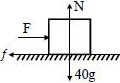
$A$ heavy box of $40\, kg$ is pushed along $20\, m$ by two coolies over a railway platform whose coefficient of friction with the box is $0.4$. The work done by the two coolies is: .................. $J$ (Take $g = 10\, m/s^2$)
A
$3200$
B
$-3200$
C
$1600$
D
$-1600$
Solution
(A) The box is pushed at a constant velocity,so the applied force $F$ must balance the frictional force $f$.
The frictional force is given by $f = \mu N = \mu mg$.
Given: $\mu = 0.4$,$m = 40\, kg$,$g = 10\, m/s^2$.
$f = 0.4 \times 40 \times 10 = 160\, N$.
Since the box is pushed at a constant speed,the applied force $F = f = 160\, N$.
The work done by the coolies is $W = F \cdot s = 160\, N \times 20\, m = 3200\, J$.
The frictional force is given by $f = \mu N = \mu mg$.
Given: $\mu = 0.4$,$m = 40\, kg$,$g = 10\, m/s^2$.
$f = 0.4 \times 40 \times 10 = 160\, N$.
Since the box is pushed at a constant speed,the applied force $F = f = 160\, N$.
The work done by the coolies is $W = F \cdot s = 160\, N \times 20\, m = 3200\, J$.
0 likes
View Solution77
MediumMCQ
The force $F$ acting on a body moving in a circle of radius $r$ is always perpendicular to the instantaneous velocity $v$. The work done by the force on the body in one complete rotation is:
A
$Fv$
B
$F \cdot 2 \pi r$
C
$Fr$
D
$0$
Solution
(D) The work done $W$ by a force $F$ is given by the dot product of force and displacement: $W = \int \vec{F} \cdot d\vec{s}$.
Since the instantaneous velocity $\vec{v}$ is always tangent to the circular path and the force $\vec{F}$ (centripetal force) is always directed towards the center,the angle $\theta$ between $\vec{F}$ and the displacement $d\vec{s}$ (which is in the direction of $\vec{v}$) is always $90^{\circ}$.
Therefore,the work done for an infinitesimal displacement is $dW = F \cdot ds \cdot \cos(90^{\circ}) = 0$.
Integrating this over one complete rotation,the total work done is $W = 0$.
Since the instantaneous velocity $\vec{v}$ is always tangent to the circular path and the force $\vec{F}$ (centripetal force) is always directed towards the center,the angle $\theta$ between $\vec{F}$ and the displacement $d\vec{s}$ (which is in the direction of $\vec{v}$) is always $90^{\circ}$.
Therefore,the work done for an infinitesimal displacement is $dW = F \cdot ds \cdot \cos(90^{\circ}) = 0$.
Integrating this over one complete rotation,the total work done is $W = 0$.
0 likes
View Solution78
DifficultMCQ
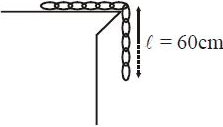
$A$ uniform chain of length $L = 2\,m$ is kept on a table such that a length $\ell = 60\,cm$ hangs freely from the edge of the table. The total mass of the chain is $M = 4\,kg$. The work done in pulling the entire chain onto the table is ............. $J$. (Take $g = 10\,m/s^2$)
A
$12.9$
B
$6.3$
C
$3.6$
D
$2$
Solution
(C) The mass per unit length of the chain is $\lambda = \frac{M}{L} = \frac{4\,kg}{2\,m} = 2\,kg/m$.
The mass of the hanging part is $m = \lambda \times \ell = 2\,kg/m \times 0.6\,m = 1.2\,kg$.
The center of mass of the hanging part is at a distance of $h = \frac{\ell}{2} = \frac{0.6\,m}{2} = 0.3\,m$ below the edge of the table.
The work done $W$ to pull the hanging part onto the table is equal to the change in potential energy of the hanging part,which is $W = mgh = (1.2\,kg) \times (10\,m/s^2) \times (0.3\,m) = 3.6\,J$.
The mass of the hanging part is $m = \lambda \times \ell = 2\,kg/m \times 0.6\,m = 1.2\,kg$.
The center of mass of the hanging part is at a distance of $h = \frac{\ell}{2} = \frac{0.6\,m}{2} = 0.3\,m$ below the edge of the table.
The work done $W$ to pull the hanging part onto the table is equal to the change in potential energy of the hanging part,which is $W = mgh = (1.2\,kg) \times (10\,m/s^2) \times (0.3\,m) = 3.6\,J$.
0 likes
View Solution79
MediumMCQ
If a person is pushing a box inside a moving train,the work done in the frame of the earth will be: (where $\vec{s}$ is the displacement of the box in the train and $\vec{s}_0$ is the displacement of the train relative to the ground)
A
$\vec{F} \cdot \vec{s}_0$
B
$\vec{F} \cdot \vec{s}$
C
$\vec{F} \cdot (\vec{s} + \vec{s}_0)$
D
zero
Solution
(C) The displacement of the box with respect to the ground is the vector sum of its displacement relative to the train and the displacement of the train relative to the ground.
Therefore,the total displacement $\vec{S}_{total} = \vec{s} + \vec{s}_0$.
Work done is defined as the dot product of the force applied and the total displacement in the reference frame.
$W = \vec{F} \cdot \vec{S}_{total} = \vec{F} \cdot (\vec{s} + \vec{s}_0)$.
Therefore,the total displacement $\vec{S}_{total} = \vec{s} + \vec{s}_0$.
Work done is defined as the dot product of the force applied and the total displacement in the reference frame.
$W = \vec{F} \cdot \vec{S}_{total} = \vec{F} \cdot (\vec{s} + \vec{s}_0)$.
0 likes
View Solution80
MediumMCQ
The kinetic energy $K$ of a particle moving in a straight line depends upon the distance $s$ as $K = as^2$. The force acting on the particle is
A
$2as$
B
$2mas$
C
$2a$
D
$\sqrt{as^2}$
Solution
(A) Given,kinetic energy $K = as^2$.
We know that $K = \frac{1}{2}mv^2$,where $m$ is the mass and $v$ is the velocity of the particle.
So,$\frac{1}{2}mv^2 = as^2$.
Differentiating both sides with respect to time $t$:
$\frac{d}{dt}(\frac{1}{2}mv^2) = \frac{d}{dt}(as^2)$
$\frac{1}{2}m(2v \frac{dv}{dt}) = a(2s \frac{ds}{dt})$
Since $F = m \frac{dv}{dt}$ and $v = \frac{ds}{dt}$,we substitute these into the equation:
$mv \frac{dv}{dt} = 2as \frac{ds}{dt}$
$F \cdot v = 2as \cdot v$
$F = 2as$.
We know that $K = \frac{1}{2}mv^2$,where $m$ is the mass and $v$ is the velocity of the particle.
So,$\frac{1}{2}mv^2 = as^2$.
Differentiating both sides with respect to time $t$:
$\frac{d}{dt}(\frac{1}{2}mv^2) = \frac{d}{dt}(as^2)$
$\frac{1}{2}m(2v \frac{dv}{dt}) = a(2s \frac{ds}{dt})$
Since $F = m \frac{dv}{dt}$ and $v = \frac{ds}{dt}$,we substitute these into the equation:
$mv \frac{dv}{dt} = 2as \frac{ds}{dt}$
$F \cdot v = 2as \cdot v$
$F = 2as$.
0 likes
View Solution81
MediumMCQ
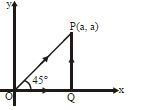
$A$ particle is moved from $(0, 0)$ to $(a, a)$ under a force $\vec{F} = (3\hat{i} + 4\hat{j})$ through two paths. Path $1$ is $OP$ and path $2$ is $OQP$. Let $W_1$ and $W_2$ be the work done by this force in these two paths respectively. Then
A
$W_1 = W_2$
B
$W_1 = 2W_2$
C
$W_2 = 2W_1$
D
$W_2 = 4W_1$
Solution
(A) The given force $\vec{F} = (3\hat{i} + 4\hat{j})$ is a constant force.
$A$ constant force is always a conservative force.
For a conservative force,the work done is independent of the path taken and depends only on the initial and final positions of the particle.
Since both paths start at $(0, 0)$ and end at $(a, a)$,the work done in both cases must be equal.
Therefore,$W_1 = W_2$.
$A$ constant force is always a conservative force.
For a conservative force,the work done is independent of the path taken and depends only on the initial and final positions of the particle.
Since both paths start at $(0, 0)$ and end at $(a, a)$,the work done in both cases must be equal.
Therefore,$W_1 = W_2$.
0 likes
View Solution82
DifficultMCQ
Work done in time $t$ on a body of mass $m$ which is accelerated from rest to a speed $v$ in time $t_1$ as a function of time $t$ is given by
A
$\frac{1}{2}m\left(\frac{v}{t_1}\right)^2 t^2$
B
$m\left(\frac{v}{t_1}\right)^2 t^2$
C
$\frac{1}{2}\left(\frac{mv}{t_1}\right)^2 t^2$
D
$\frac{1}{2}m\frac{v^2}{t_1^2}t^2$
Solution
(D) Given,initial velocity $u = 0$,final velocity $v$ at time $t_1$.
Acceleration $a = \frac{v - u}{t_1} = \frac{v}{t_1}$.
Work done $W$ at any time $t$ is equal to the change in kinetic energy or $F \times s$.
Using $s = \frac{1}{2} a t^2$ and $F = ma$:
$W = F \times s = (ma) \times (\frac{1}{2} a t^2) = \frac{1}{2} m a^2 t^2$.
Substituting $a = \frac{v}{t_1}$:
$W = \frac{1}{2} m \left(\frac{v}{t_1}\right)^2 t^2 = \frac{1}{2} m \frac{v^2}{t_1^2} t^2$.
Acceleration $a = \frac{v - u}{t_1} = \frac{v}{t_1}$.
Work done $W$ at any time $t$ is equal to the change in kinetic energy or $F \times s$.
Using $s = \frac{1}{2} a t^2$ and $F = ma$:
$W = F \times s = (ma) \times (\frac{1}{2} a t^2) = \frac{1}{2} m a^2 t^2$.
Substituting $a = \frac{v}{t_1}$:
$W = \frac{1}{2} m \left(\frac{v}{t_1}\right)^2 t^2 = \frac{1}{2} m \frac{v^2}{t_1^2} t^2$.
0 likes
View Solution83
EasyMCQ
When a body moves in a circular path,no work is done by the centripetal force since
A
there is no net force
B
there is no displacement
C
force is always away from the centre
D
force and displacement are perpendicular to each other
Solution
(D) Work done is defined as the dot product of force and displacement,given by $W = \vec{F} \cdot \vec{s} = Fs \cos \theta$,where $\theta$ is the angle between the force and displacement vectors.
In uniform circular motion,the centripetal force acts towards the center of the circle,while the instantaneous displacement is along the tangent to the circular path.
Since the radius is always perpendicular to the tangent,the angle between the centripetal force and the displacement is $90^{\circ}$.
Therefore,$W = Fs \cos(90^{\circ}) = Fs(0) = 0$.
Thus,no work is done by the centripetal force.
In uniform circular motion,the centripetal force acts towards the center of the circle,while the instantaneous displacement is along the tangent to the circular path.
Since the radius is always perpendicular to the tangent,the angle between the centripetal force and the displacement is $90^{\circ}$.
Therefore,$W = Fs \cos(90^{\circ}) = Fs(0) = 0$.
Thus,no work is done by the centripetal force.
0 likes
View Solution84
DifficultMCQ
Work done in time $t$ on a body of mass $m$ which is accelerated from rest to a speed $v$ in time $t_1$ as a function of time $t$ is given by
A
$\frac{1}{2} m \frac{v}{t_1} t^2$
B
$m \frac{v}{t_1} t^2$
C
$\frac{1}{2} \left( \frac{mv}{t_1} \right)^2 t^2$
D
$\frac{1}{2} m \frac{v^2}{t_1^2} t^2$
Solution
(D) The acceleration of the body is $a = \frac{v}{t_1}$.
The force acting on the body is $F = m \cdot a = m \cdot \frac{v}{t_1}$.
The distance covered by the body in time $t$ starting from rest is $s = \frac{1}{2} a t^2 = \frac{1}{2} \left( \frac{v}{t_1} \right) t^2$.
Work done is defined as $W = F \cdot s$.
Substituting the values,$W = \left( m \cdot \frac{v}{t_1} \right) \cdot \left( \frac{1}{2} \cdot \frac{v}{t_1} \cdot t^2 \right)$.
Simplifying the expression,$W = \frac{1}{2} m \left( \frac{v}{t_1} \right)^2 t^2 = \frac{1}{2} m \frac{v^2}{t_1^2} t^2$.
The force acting on the body is $F = m \cdot a = m \cdot \frac{v}{t_1}$.
The distance covered by the body in time $t$ starting from rest is $s = \frac{1}{2} a t^2 = \frac{1}{2} \left( \frac{v}{t_1} \right) t^2$.
Work done is defined as $W = F \cdot s$.
Substituting the values,$W = \left( m \cdot \frac{v}{t_1} \right) \cdot \left( \frac{1}{2} \cdot \frac{v}{t_1} \cdot t^2 \right)$.
Simplifying the expression,$W = \frac{1}{2} m \left( \frac{v}{t_1} \right)^2 t^2 = \frac{1}{2} m \frac{v^2}{t_1^2} t^2$.
0 likes
View Solution85
DifficultMCQ
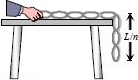
$A$ boy holds a uniform chain of length $2 \, m$ which is kept on a smooth table such that a length of $60 \, cm$ hangs freely from the edge of the table. The total mass of the chain is $4 \, kg$. What is the work done in pulling the entire chain on the table (in $, J$)? (Take $g = 10 \, m/s^2$)
A
$7.2$
B
$3.6$
C
$120$
D
$1200$
Solution
(B) Let the total length of the chain be $L = 2 \, m$ and its total mass be $M = 4 \, kg$.
The length of the chain hanging from the table is $l = 60 \, cm = 0.6 \, m$.
The mass per unit length of the chain is $\lambda = \frac{M}{L} = \frac{4}{2} = 2 \, kg/m$.
The mass of the hanging part is $m = \lambda \times l = 2 \times 0.6 = 1.2 \, kg$.
The center of mass of the hanging part is at a distance $h = \frac{l}{2} = \frac{0.6}{2} = 0.3 \, m$ below the table edge.
The work done to pull the chain onto the table is equal to the change in potential energy of the hanging part,which is $W = mgh$.
Substituting the values: $W = 1.2 \times 10 \times 0.3 = 3.6 \, J$.
The length of the chain hanging from the table is $l = 60 \, cm = 0.6 \, m$.
The mass per unit length of the chain is $\lambda = \frac{M}{L} = \frac{4}{2} = 2 \, kg/m$.
The mass of the hanging part is $m = \lambda \times l = 2 \times 0.6 = 1.2 \, kg$.
The center of mass of the hanging part is at a distance $h = \frac{l}{2} = \frac{0.6}{2} = 0.3 \, m$ below the table edge.
The work done to pull the chain onto the table is equal to the change in potential energy of the hanging part,which is $W = mgh$.
Substituting the values: $W = 1.2 \times 10 \times 0.3 = 3.6 \, J$.
0 likes
View Solution86
EasyMCQ
$A$ particle gets displaced by $\Delta \vec{r} = (2\hat{i} + 3\hat{j} + 4\hat{k}) \text{ m}$ under the action of a force $\vec{F} = (7\hat{i} + 4\hat{j} + 3\hat{k}) \text{ N}$. The change in its kinetic energy is ............... $\text{J}$.
A
$38$
B
$70$
C
$52.5$
D
$126$
Solution
(A) According to the work-energy theorem,the change in kinetic energy of a particle is equal to the work done by the net force acting on it.
$\Delta K = W = \vec{F} \cdot \Delta \vec{r}$
Given:
$\vec{F} = (7\hat{i} + 4\hat{j} + 3\hat{k}) \text{ N}$
$\Delta \vec{r} = (2\hat{i} + 3\hat{j} + 4\hat{k}) \text{ m}$
Calculating the dot product:
$W = (7 \times 2) + (4 \times 3) + (3 \times 4)$
$W = 14 + 12 + 12$
$W = 38 \text{ J}$
Therefore,the change in kinetic energy is $38 \text{ J}$.
$\Delta K = W = \vec{F} \cdot \Delta \vec{r}$
Given:
$\vec{F} = (7\hat{i} + 4\hat{j} + 3\hat{k}) \text{ N}$
$\Delta \vec{r} = (2\hat{i} + 3\hat{j} + 4\hat{k}) \text{ m}$
Calculating the dot product:
$W = (7 \times 2) + (4 \times 3) + (3 \times 4)$
$W = 14 + 12 + 12$
$W = 38 \text{ J}$
Therefore,the change in kinetic energy is $38 \text{ J}$.
0 likes
View Solution87
DifficultMCQ
$A$ person draws water from a $5\,m$ deep well using a bucket of mass $2\,kg$ and capacity $8\,litre$ with a rope of mass $1\,kg.$ What is the total work done by the person? (Assume $g = 10\,m/s^2$ and the density of water is $1\,kg/litre$.)
A
$550$
B
$525$
C
$125$
D
$500$
Solution
(B) The total work done is the sum of the work done to lift the bucket,the water,and the rope.
Mass of bucket $(m_b)$ = $2\,kg$.
Mass of water $(m_w)$ = $8\,litre \times 1\,kg/litre = 8\,kg$.
Mass of rope $(m_r)$ = $1\,kg$.
Depth $(h)$ = $5\,m$.
Work done on bucket: $W_b = m_b \cdot g \cdot h = 2 \times 10 \times 5 = 100\,J$.
Work done on water: $W_w = m_w \cdot g \cdot h = 8 \times 10 \times 5 = 400\,J$.
Work done on rope: Since the rope is uniform,its center of mass is at $h/2 = 2.5\,m$. Thus,$W_r = m_r \cdot g \cdot (h/2) = 1 \times 10 \times 2.5 = 25\,J$.
Total work $W = W_b + W_w + W_r = 100 + 400 + 25 = 525\,J$.
Mass of bucket $(m_b)$ = $2\,kg$.
Mass of water $(m_w)$ = $8\,litre \times 1\,kg/litre = 8\,kg$.
Mass of rope $(m_r)$ = $1\,kg$.
Depth $(h)$ = $5\,m$.
Work done on bucket: $W_b = m_b \cdot g \cdot h = 2 \times 10 \times 5 = 100\,J$.
Work done on water: $W_w = m_w \cdot g \cdot h = 8 \times 10 \times 5 = 400\,J$.
Work done on rope: Since the rope is uniform,its center of mass is at $h/2 = 2.5\,m$. Thus,$W_r = m_r \cdot g \cdot (h/2) = 1 \times 10 \times 2.5 = 25\,J$.
Total work $W = W_b + W_w + W_r = 100 + 400 + 25 = 525\,J$.
0 likes
View Solution88
MediumMCQ
Force acting on a particle moving in a straight line varies with the velocity of the particle as $F = \frac{K}{v}$,where $K$ is a constant. The work done by this force in time $t$ is
A
$\frac{K}{v^2}t$
B
$2Kt$
C
$Kt$
D
$\frac{2Kt}{v^2}$
Solution
(C) The force acting on the particle is given by $F = \frac{K}{v}$.
We know that the work done $W$ is given by the integral of power over time,or $W = \int F \cdot dx$.
Since $v = \frac{dx}{dt}$,we can write $dx = v \cdot dt$.
Substituting this into the work equation:
$W = \int F \cdot (v \cdot dt)$
Substitute $F = \frac{K}{v}$ into the equation:
$W = \int \left(\frac{K}{v}\right) \cdot v \cdot dt$
$W = \int K \cdot dt$
Since $K$ is a constant,the work done in time $t$ is:
$W = K \int_{0}^{t} dt = Kt$.
We know that the work done $W$ is given by the integral of power over time,or $W = \int F \cdot dx$.
Since $v = \frac{dx}{dt}$,we can write $dx = v \cdot dt$.
Substituting this into the work equation:
$W = \int F \cdot (v \cdot dt)$
Substitute $F = \frac{K}{v}$ into the equation:
$W = \int \left(\frac{K}{v}\right) \cdot v \cdot dt$
$W = \int K \cdot dt$
Since $K$ is a constant,the work done in time $t$ is:
$W = K \int_{0}^{t} dt = Kt$.
0 likes
View Solution89
DifficultMCQ
How much work does a pulling force of $40\, N$ do on a $20\, kg$ box in pulling it $8\, m$ across a smooth floor at a constant speed? The pulling force is directed at $60^{\circ}$ above the horizontal. (Answer in $J$)
A
$160$
B
$277$
C
$784$
D
None of the above
Solution
(A) The work done $W$ by a constant force $F$ is given by the formula $W = F \cdot S \cdot \cos \theta$,where $S$ is the displacement and $\theta$ is the angle between the force and the displacement vector.
Given:
Force $F = 40\, N$
Displacement $S = 8\, m$
Angle $\theta = 60^{\circ}$
Substituting these values into the formula:
$W = 40 \times 8 \times \cos 60^{\circ}$
Since $\cos 60^{\circ} = 0.5$ or $\frac{1}{2}$,we have:
$W = 40 \times 8 \times 0.5$
$W = 320 \times 0.5 = 160\, J$
Therefore,the work done is $160\, J$.
Given:
Force $F = 40\, N$
Displacement $S = 8\, m$
Angle $\theta = 60^{\circ}$
Substituting these values into the formula:
$W = 40 \times 8 \times \cos 60^{\circ}$
Since $\cos 60^{\circ} = 0.5$ or $\frac{1}{2}$,we have:
$W = 40 \times 8 \times 0.5$
$W = 320 \times 0.5 = 160\, J$
Therefore,the work done is $160\, J$.
0 likes
View Solution90
MediumMCQ
$A$ body constrained to move along the $y$-axis is subjected to a constant force $\vec{F} = -\hat{i} + 2\hat{j} + 3\hat{k} \text{ N}$. The work done by this force in moving the body a distance of $4 \text{ m}$ along the $y$-axis is ............... $J$.
A
$4$
B
$8$
C
$12$
D
$24$
Solution
(B) The force acting on the body is given by $\vec{F} = -\hat{i} + 2\hat{j} + 3\hat{k} \text{ N}$.
Since the body is constrained to move along the $y$-axis for a distance of $4 \text{ m}$,the displacement vector is $\vec{d} = 4\hat{j} \text{ m}$.
The work done $W$ by a constant force is defined as the dot product of the force vector and the displacement vector: $W = \vec{F} \cdot \vec{d}$.
Substituting the values: $W = (-\hat{i} + 2\hat{j} + 3\hat{k}) \cdot (4\hat{j})$.
Using the dot product properties ($\hat{i} \cdot \hat{j} = 0$,$\hat{j} \cdot \hat{j} = 1$,$\hat{k} \cdot \hat{j} = 0$):
$W = (-1 \times 0) + (2 \times 4) + (3 \times 0) = 8 \text{ J}$.
Thus,the work done is $8 \text{ J}$.
Since the body is constrained to move along the $y$-axis for a distance of $4 \text{ m}$,the displacement vector is $\vec{d} = 4\hat{j} \text{ m}$.
The work done $W$ by a constant force is defined as the dot product of the force vector and the displacement vector: $W = \vec{F} \cdot \vec{d}$.
Substituting the values: $W = (-\hat{i} + 2\hat{j} + 3\hat{k}) \cdot (4\hat{j})$.
Using the dot product properties ($\hat{i} \cdot \hat{j} = 0$,$\hat{j} \cdot \hat{j} = 1$,$\hat{k} \cdot \hat{j} = 0$):
$W = (-1 \times 0) + (2 \times 4) + (3 \times 0) = 8 \text{ J}$.
Thus,the work done is $8 \text{ J}$.
0 likes
View Solution91
MediumMCQ
$A$ particle of mass $m$ is projected at an angle $\alpha$ to the horizontal with initial velocity $u \ m/s$. What is the work done by gravity during the time it reaches its highest point?
A
$u^2 \sin^2 \alpha$
B
$\frac{m u^2 \cos^2 \alpha}{2}$
C
$-\frac{m u^2 \sin^2 \alpha}{2}$
D
$\frac{m u^2 g \sin^2 \alpha}{2}$
Solution
(C) The force of gravity acting on the particle is $\vec{F} = -mg \hat{j}$.
At the highest point,the vertical displacement of the particle is equal to the maximum height $H$.
The formula for maximum height is $H = \frac{u^2 \sin^2 \alpha}{2g}$.
The work done by gravity is given by the product of the force and the vertical displacement: $W = \vec{F} \cdot \vec{S} = (-mg) \times H$.
Substituting the value of $H$: $W = -mg \left( \frac{u^2 \sin^2 \alpha}{2g} \right)$.
Simplifying the expression,we get $W = -\frac{m u^2 \sin^2 \alpha}{2}$.
At the highest point,the vertical displacement of the particle is equal to the maximum height $H$.
The formula for maximum height is $H = \frac{u^2 \sin^2 \alpha}{2g}$.
The work done by gravity is given by the product of the force and the vertical displacement: $W = \vec{F} \cdot \vec{S} = (-mg) \times H$.
Substituting the value of $H$: $W = -mg \left( \frac{u^2 \sin^2 \alpha}{2g} \right)$.
Simplifying the expression,we get $W = -\frac{m u^2 \sin^2 \alpha}{2}$.
0 likes
View Solution92
MediumMCQ
$A$ body of mass $m$ is moving in a circle of radius $r$ with a constant speed $u$. The force on the body is $mv^2/r$ and is directed towards the centre. What is the work done by this force in moving the body over half the circumference of the circle?
A
$\frac {mv^2}{r} \times \pi r$
B
zero
C
$\frac {mv^2}{r}$
D
$\frac {\pi r^2}{mv^2}$
Solution
(B) The force acting on the body is the centripetal force,which is always directed towards the center of the circular path.
The displacement of the body at any instant is along the tangent to the circle at that point.
Since the radius (and thus the centripetal force) is always perpendicular to the tangent (displacement),the angle $\theta$ between the force vector $\vec{F}$ and the displacement vector $d\vec{s}$ is always $90^{\circ}$.
The work done $W$ is given by the dot product of force and displacement: $W = \int \vec{F} \cdot d\vec{s} = \int F \cos(90^{\circ}) ds$.
Since $\cos(90^{\circ}) = 0$,the work done by the centripetal force is always zero,regardless of the distance traveled along the circumference.
The displacement of the body at any instant is along the tangent to the circle at that point.
Since the radius (and thus the centripetal force) is always perpendicular to the tangent (displacement),the angle $\theta$ between the force vector $\vec{F}$ and the displacement vector $d\vec{s}$ is always $90^{\circ}$.
The work done $W$ is given by the dot product of force and displacement: $W = \int \vec{F} \cdot d\vec{s} = \int F \cos(90^{\circ}) ds$.
Since $\cos(90^{\circ}) = 0$,the work done by the centripetal force is always zero,regardless of the distance traveled along the circumference.
0 likes
View Solution93
EasyMCQ
$A$ force $\vec F = 2\hat i - 3\hat j + 7\hat k \text{ (N)}$ acts on a particle which undergoes a displacement of $\vec S = 7\hat i + 3\hat j - 2\hat k \text{ (m)}$. Calculate the work done by the force in $J$.
A
$37$
B
$-9$
C
$49$
D
$14$
Solution
(B) The work done $W$ by a constant force $\vec F$ during a displacement $\vec S$ is given by the dot product of the force and displacement vectors:
$W = \vec F \cdot \vec S$
Given $\vec F = 2\hat i - 3\hat j + 7\hat k$ and $\vec S = 7\hat i + 3\hat j - 2\hat k$.
$W = (2\hat i - 3\hat j + 7\hat k) \cdot (7\hat i + 3\hat j - 2\hat k)$
$W = (2 \times 7) + (-3 \times 3) + (7 \times -2)$
$W = 14 - 9 - 14$
$W = -9 \text{ J}$
$W = \vec F \cdot \vec S$
Given $\vec F = 2\hat i - 3\hat j + 7\hat k$ and $\vec S = 7\hat i + 3\hat j - 2\hat k$.
$W = (2\hat i - 3\hat j + 7\hat k) \cdot (7\hat i + 3\hat j - 2\hat k)$
$W = (2 \times 7) + (-3 \times 3) + (7 \times -2)$
$W = 14 - 9 - 14$
$W = -9 \text{ J}$
0 likes
View Solution94
MediumMCQ
$A$ block of mass $M$ is pulled a distance $x$ on a horizontal table. The work done by the weight (gravitational force) is:
A
$0$
B
$Mgx$
C
$\frac{Mgx}{2}$
D
None of these
Solution
(A) The work done by a force is given by the formula $W = F \cdot d \cdot \cos(\theta)$,where $F$ is the force,$d$ is the displacement,and $\theta$ is the angle between the force vector and the displacement vector.
In this case,the weight (gravitational force) acts vertically downwards,i.e.,$F = Mg$ (downwards).
The displacement $x$ is along the horizontal table,i.e.,in the horizontal direction.
The angle $\theta$ between the downward gravitational force and the horizontal displacement is $90^{\circ}$.
Therefore,the work done by the weight is $W = Mg \cdot x \cdot \cos(90^{\circ})$.
Since $\cos(90^{\circ}) = 0$,the work done $W = 0$.
In this case,the weight (gravitational force) acts vertically downwards,i.e.,$F = Mg$ (downwards).
The displacement $x$ is along the horizontal table,i.e.,in the horizontal direction.
The angle $\theta$ between the downward gravitational force and the horizontal displacement is $90^{\circ}$.
Therefore,the work done by the weight is $W = Mg \cdot x \cdot \cos(90^{\circ})$.
Since $\cos(90^{\circ}) = 0$,the work done $W = 0$.
0 likes
View Solution95
EasyMCQ
Given that $W = \vec F \cdot \vec s = 0$ and $F \neq 0, s \neq 0$,then
A
$\vec F$ is equal to $\vec s$
B
$\vec F$ is parallel to $\vec s$
C
$\vec F$ is perpendicular to $\vec s$
D
none of these
Solution
(C) The work done $W$ is defined as the dot product of the force vector $\vec F$ and the displacement vector $\vec s$,given by $W = \vec F \cdot \vec s = Fs \cos \theta$,where $\theta$ is the angle between the two vectors.
Given that $W = 0$,$F \neq 0$,and $s \neq 0$,we have $Fs \cos \theta = 0$.
Since $F$ and $s$ are non-zero,it must be that $\cos \theta = 0$.
This implies $\theta = 90^\circ$ or $\pi/2$ radians.
Therefore,the force vector $\vec F$ is perpendicular to the displacement vector $\vec s$.
Given that $W = 0$,$F \neq 0$,and $s \neq 0$,we have $Fs \cos \theta = 0$.
Since $F$ and $s$ are non-zero,it must be that $\cos \theta = 0$.
This implies $\theta = 90^\circ$ or $\pi/2$ radians.
Therefore,the force vector $\vec F$ is perpendicular to the displacement vector $\vec s$.
0 likes
View Solution96
MediumMCQ
Given that a force $\vec{F}$ acts on a body for time $t_1$ and displaces the body by $\vec{d}$. In which of the following cases must the velocity of the body increase?
A
$F > d$
B
$F < d$
C
$\hat{F} \parallel \hat{d}$
D
$\hat{F} \perp \hat{d}$
Solution
(C) According to the Work-Energy Theorem,the work done by a force on a body is equal to the change in its kinetic energy: $W = \Delta KE = \frac{1}{2} m v_f^2 - \frac{1}{2} m v_i^2$.
For the velocity to increase,the final kinetic energy must be greater than the initial kinetic energy,which implies that the work done $W$ must be positive.
The work done is given by the dot product $W = \vec{F} \cdot \vec{d} = F d \cos \theta$,where $\theta$ is the angle between the force vector $\vec{F}$ and the displacement vector $\vec{d}$.
If $\hat{F} \parallel \hat{d}$,then the angle $\theta = 0^\circ$,and $\cos 0^\circ = 1$.
Thus,$W = F d > 0$,which results in an increase in kinetic energy and consequently an increase in the velocity of the body.
Therefore,the correct condition is $\hat{F} \parallel \hat{d}$.
For the velocity to increase,the final kinetic energy must be greater than the initial kinetic energy,which implies that the work done $W$ must be positive.
The work done is given by the dot product $W = \vec{F} \cdot \vec{d} = F d \cos \theta$,where $\theta$ is the angle between the force vector $\vec{F}$ and the displacement vector $\vec{d}$.
If $\hat{F} \parallel \hat{d}$,then the angle $\theta = 0^\circ$,and $\cos 0^\circ = 1$.
Thus,$W = F d > 0$,which results in an increase in kinetic energy and consequently an increase in the velocity of the body.
Therefore,the correct condition is $\hat{F} \parallel \hat{d}$.
0 likes
View Solution97
MediumMCQ
$A$ weightlifter lifts a weight off the ground and holds it up.
A
Work is done in lifting as well as holding the weight.
B
No work is done in both lifting and holding the weight.
C
Work is done in lifting the weight,but no work is required to be done in holding it up.
D
No work is done in lifting the weight,but work is required to be done in holding it up.
Solution
(C) In physics,work is defined as the product of force and displacement in the direction of the force $(W = Fs \cos \theta)$.
$(i)$ When the weightlifter lifts the weight,there is a displacement $(s > 0)$ in the direction of the applied force. Therefore,work is done $(W = Fs > 0)$.
$(ii)$ When the weightlifter holds the weight stationary,the displacement is zero $(s = 0)$. Since work requires displacement,the work done while holding the weight is zero $(W = F \times 0 = 0)$.
$(i)$ When the weightlifter lifts the weight,there is a displacement $(s > 0)$ in the direction of the applied force. Therefore,work is done $(W = Fs > 0)$.
$(ii)$ When the weightlifter holds the weight stationary,the displacement is zero $(s = 0)$. Since work requires displacement,the work done while holding the weight is zero $(W = F \times 0 = 0)$.
0 likes
View Solution98
DifficultMCQ
$A$ particle moves from the origin in three segments of equal distance $d$: first along the $x$-axis,second parallel to the $y$-axis,and third parallel to the $z$-axis. $A$ constant force of magnitude $F = 50 \, N$ acts on the particle,always in the direction of motion. The work done by this force in each of the three segments is equal,and the total work done is $300 \, J$. What are the final coordinates of the particle?
A
$(2, 2, 2) \, m$
B
$(4, 4, 4) \, m$
C
$(6, 6, 6) \, m$
D
$(10, 10, 10) \, m$
Solution
(A) The work done by a constant force acting in the direction of displacement is given by $W = F \cdot d$,where $d$ is the distance covered.
Since the force $F = 50 \, N$ acts along the direction of motion in each segment,the work done in each segment is $W_i = F \cdot d$.
Given that the total work done is $W_{total} = 300 \, J$ and the work done in each of the three segments is equal,the work done in each segment is $W_i = \frac{300}{3} = 100 \, J$.
Using $W_i = F \cdot d$,we find the distance $d$ for each segment: $100 = 50 \cdot d$,which gives $d = 2 \, m$.
The particle moves $2 \, m$ along the $x$-axis,then $2 \, m$ parallel to the $y$-axis,and finally $2 \, m$ parallel to the $z$-axis.
Starting from the origin $(0, 0, 0)$,the final coordinates are $(2, 2, 2) \, m$.
Since the force $F = 50 \, N$ acts along the direction of motion in each segment,the work done in each segment is $W_i = F \cdot d$.
Given that the total work done is $W_{total} = 300 \, J$ and the work done in each of the three segments is equal,the work done in each segment is $W_i = \frac{300}{3} = 100 \, J$.
Using $W_i = F \cdot d$,we find the distance $d$ for each segment: $100 = 50 \cdot d$,which gives $d = 2 \, m$.
The particle moves $2 \, m$ along the $x$-axis,then $2 \, m$ parallel to the $y$-axis,and finally $2 \, m$ parallel to the $z$-axis.
Starting from the origin $(0, 0, 0)$,the final coordinates are $(2, 2, 2) \, m$.
0 likes
View Solution99
DifficultMCQ
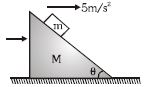
In the figure shown,all the surfaces are frictionless,and the mass of the block $m$ is $1\,kg$. The block and wedge are held initially at rest. Now,the wedge is given a horizontal acceleration of $5\,m/s^2$ by applying a force on the wedge,such that the block does not slip on the wedge. Then,the work done by the normal force in the ground frame on the block in $2\,sec$ is ............... $J$.
A
$30$
B
$50$
C
$100$
D
$150$
Solution
(B) The block $m$ moves with the same horizontal acceleration $a = 5\,m/s^2$ as the wedge because it does not slip on the wedge.
Since the surfaces are frictionless,the only force acting on the block in the horizontal direction is the horizontal component of the normal force $N$.
Let $N$ be the normal force exerted by the wedge on the block. The horizontal component of $N$ provides the acceleration $a$ to the block: $N \sin \theta = ma$.
The vertical component of $N$ balances the weight: $N \cos \theta = mg$.
However,we can use the Work-Energy Theorem directly. The work done by all forces on the block equals the change in its kinetic energy.
The only force doing work on the block in the horizontal direction is the normal force $N$. Since the block moves only horizontally with acceleration $a$,its velocity at time $t = 2\,s$ is $v = at = 5 \times 2 = 10\,m/s$.
The initial velocity is $0$. The change in kinetic energy is $\Delta KE = \frac{1}{2}mv^2 - 0 = \frac{1}{2} \times 1 \times (10)^2 = 50\,J$.
Since the normal force is the only force doing work in the direction of motion (as gravity acts vertically and displacement is horizontal),the work done by the normal force is $50\,J$.
Since the surfaces are frictionless,the only force acting on the block in the horizontal direction is the horizontal component of the normal force $N$.
Let $N$ be the normal force exerted by the wedge on the block. The horizontal component of $N$ provides the acceleration $a$ to the block: $N \sin \theta = ma$.
The vertical component of $N$ balances the weight: $N \cos \theta = mg$.
However,we can use the Work-Energy Theorem directly. The work done by all forces on the block equals the change in its kinetic energy.
The only force doing work on the block in the horizontal direction is the normal force $N$. Since the block moves only horizontally with acceleration $a$,its velocity at time $t = 2\,s$ is $v = at = 5 \times 2 = 10\,m/s$.
The initial velocity is $0$. The change in kinetic energy is $\Delta KE = \frac{1}{2}mv^2 - 0 = \frac{1}{2} \times 1 \times (10)^2 = 50\,J$.
Since the normal force is the only force doing work in the direction of motion (as gravity acts vertically and displacement is horizontal),the work done by the normal force is $50\,J$.
0 likes
View Solution100
MediumMCQ
$A$ force of magnitude $30\, N$ acting along $\hat{i} + \hat{j} + \hat{k}$ displaces a particle from point $(2, 4, 1)$ to $(3, 5, 2)$. The work done during this displacement is:
A
$90\, J$
B
$30\, J$
C
$30\sqrt{3}\, J$
D
$30/\sqrt{3}\, J$
Solution
(C) The force vector $\vec{F}$ is given by its magnitude multiplied by the unit vector in the direction of $\hat{i} + \hat{j} + \hat{k}$.
Unit vector $\hat{n} = \frac{\hat{i} + \hat{j} + \hat{k}}{\sqrt{1^2 + 1^2 + 1^2}} = \frac{\hat{i} + \hat{j} + \hat{k}}{\sqrt{3}}$.
So,$\vec{F} = 30 \times \frac{\hat{i} + \hat{j} + \hat{k}}{\sqrt{3}} = 10\sqrt{3}(\hat{i} + \hat{j} + \hat{k})\, N$.
The displacement vector $\vec{S}$ is the difference between the final and initial position vectors:
$\vec{S} = (3-2)\hat{i} + (5-4)\hat{j} + (2-1)\hat{k} = \hat{i} + \hat{j} + \hat{k}\, m$.
The work done $W$ is the dot product of $\vec{F}$ and $\vec{S}$:
$W = \vec{F} \cdot \vec{S} = [10\sqrt{3}(\hat{i} + \hat{j} + \hat{k})] \cdot [\hat{i} + \hat{j} + \hat{k}]$
$W = 10\sqrt{3} (1 \times 1 + 1 \times 1 + 1 \times 1) = 10\sqrt{3} \times 3 = 30\sqrt{3}\, J$.
Unit vector $\hat{n} = \frac{\hat{i} + \hat{j} + \hat{k}}{\sqrt{1^2 + 1^2 + 1^2}} = \frac{\hat{i} + \hat{j} + \hat{k}}{\sqrt{3}}$.
So,$\vec{F} = 30 \times \frac{\hat{i} + \hat{j} + \hat{k}}{\sqrt{3}} = 10\sqrt{3}(\hat{i} + \hat{j} + \hat{k})\, N$.
The displacement vector $\vec{S}$ is the difference between the final and initial position vectors:
$\vec{S} = (3-2)\hat{i} + (5-4)\hat{j} + (2-1)\hat{k} = \hat{i} + \hat{j} + \hat{k}\, m$.
The work done $W$ is the dot product of $\vec{F}$ and $\vec{S}$:
$W = \vec{F} \cdot \vec{S} = [10\sqrt{3}(\hat{i} + \hat{j} + \hat{k})] \cdot [\hat{i} + \hat{j} + \hat{k}]$
$W = 10\sqrt{3} (1 \times 1 + 1 \times 1 + 1 \times 1) = 10\sqrt{3} \times 3 = 30\sqrt{3}\, J$.
0 likes
View SolutionWork, Energy, Power and Collision — Work Done by Constant Force · Frequently Asked Questions
1Are these Work, Energy, Power and Collision questions useful for JEE and NEET?
Yes. All questions in this section are mapped to JEE Main and NEET exam patterns. Previous year questions from JEE Main, NEET, GUJCET and state-level exams are included with full solutions.
2Can I switch to Hindi or Gujarati for these questions?
Yes. Use the language tabs in the hero section or the sidebar to view the same questions and solutions in English, Hindi or Gujarati.
3How do I generate a question paper from this subtopic?
Use the Vedclass Exam Paper Generator — select the chapter and subtopic, set difficulty, and generate Sets A, B, C, D automatically. First 3 chapters of every subject are free.
Vedclass Products
For Students
Vedclass Test Series
Mock tests in real JEE/NEET style with performance analysis. 5-day free trial.
Start Free TrialFor Teachers
Exam Paper Generator
Generate Set A/B/C/D papers from this chapter in 2 minutes. 3 chapters free.
Try FreeFor Institutes
Online Exam Module
Live online exams with unlimited students, 360° analytics & white-label branding.
See DemoFor Teachers & Institutes
Generate a Work, Energy, Power and Collision Exam Paper in 2 Minutes
Select subtopic & difficulty — Sets A, B, C, D auto-generated with No Repeat logic.
First 3 chapters of every subject are free — no payment required.