
A English
Work Done by Constant Force Questions in English
Class 11 Physics · Work, Energy, Power and Collision · Work Done by Constant Force
164+
Questions
English
Language
100%
With Solutions
Showing 49 of 164 questions in English
101
MediumMCQ
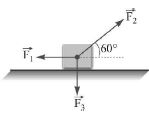
The figure shows three forces applied to a trunk that moves leftward by $3\, m$ over a smooth floor. The force magnitudes are $F_1 = 5\, N$,$F_2 = 9\, N$,and $F_3 = 3\, N$. The net work done on the trunk by the three forces is ............... $J$.
A
$1.50$
B
$2.40$
C
$3$
D
$6$
Solution
(A) The displacement vector is $\vec{s} = -3\hat{i}\, m$.
The forces acting on the trunk are:
$\vec{F}_1 = -5\hat{i}\, N$
$\vec{F}_2 = 9\cos(60^\circ)\hat{i} + 9\sin(60^\circ)\hat{j} = 4.5\hat{i} + 4.5\sqrt{3}\hat{j}\, N$
$\vec{F}_3 = -3\hat{j}\, N$
The net force $\vec{F}_{net}$ is:
$\vec{F}_{net} = \vec{F}_1 + \vec{F}_2 + \vec{F}_3 = (-5 + 4.5)\hat{i} + (4.5\sqrt{3} - 3)\hat{j} = -0.5\hat{i} + (4.5\sqrt{3} - 3)\hat{j}\, N$
The net work done $W$ is the dot product of the net force and displacement:
$W = \vec{F}_{net} \cdot \vec{s} = (-0.5\hat{i} + (4.5\sqrt{3} - 3)\hat{j}) \cdot (-3\hat{i})$
$W = (-0.5 \times -3) + (0) = 1.5\, J$.
The forces acting on the trunk are:
$\vec{F}_1 = -5\hat{i}\, N$
$\vec{F}_2 = 9\cos(60^\circ)\hat{i} + 9\sin(60^\circ)\hat{j} = 4.5\hat{i} + 4.5\sqrt{3}\hat{j}\, N$
$\vec{F}_3 = -3\hat{j}\, N$
The net force $\vec{F}_{net}$ is:
$\vec{F}_{net} = \vec{F}_1 + \vec{F}_2 + \vec{F}_3 = (-5 + 4.5)\hat{i} + (4.5\sqrt{3} - 3)\hat{j} = -0.5\hat{i} + (4.5\sqrt{3} - 3)\hat{j}\, N$
The net work done $W$ is the dot product of the net force and displacement:
$W = \vec{F}_{net} \cdot \vec{s} = (-0.5\hat{i} + (4.5\sqrt{3} - 3)\hat{j}) \cdot (-3\hat{i})$
$W = (-0.5 \times -3) + (0) = 1.5\, J$.
0 likes
View Solution102
Medium
$A$ cyclist comes to a skidding stop in $10 \; m$. During this process,the force on the cycle due to the road is $200 \; N$ and is directly opposed to the motion.
$(a)$ How much work does the road do on the cycle?
$(b)$ How much work does the cycle do on the road?
$(a)$ How much work does the road do on the cycle?
$(b)$ How much work does the cycle do on the road?
Solution
(A) The work done on the cycle by the road is the work done by the stopping (frictional) force on the cycle due to the road.
$(a)$ The stopping force and the displacement make an angle of $180^{\circ} \; (\pi \; \text{rad})$ with each other. Thus,the work done by the road,$W_{r} = F d \cos \theta$
$W_{r} = 200 \times 10 \times \cos(180^{\circ})$
$W_{r} = 2000 \times (-1) = -2000 \; J$
It is this negative work that brings the cycle to a halt in accordance with the Work-Energy theorem.
$(b)$ From Newton's Third Law,an equal and opposite force acts on the road due to the cycle. Its magnitude is $200 \; N$. However,the road undergoes no displacement $(d = 0)$. Thus,the work done by the cycle on the road is $W = F \times 0 = 0 \; J$.
$(a)$ The stopping force and the displacement make an angle of $180^{\circ} \; (\pi \; \text{rad})$ with each other. Thus,the work done by the road,$W_{r} = F d \cos \theta$
$W_{r} = 200 \times 10 \times \cos(180^{\circ})$
$W_{r} = 2000 \times (-1) = -2000 \; J$
It is this negative work that brings the cycle to a halt in accordance with the Work-Energy theorem.
$(b)$ From Newton's Third Law,an equal and opposite force acts on the road due to the cycle. Its magnitude is $200 \; N$. However,the road undergoes no displacement $(d = 0)$. Thus,the work done by the cycle on the road is $W = F \times 0 = 0 \; J$.
1 likes
View Solution103
EasyMCQ
$A$ body constrained to move along the $z$-axis of a coordinate system is subject to a constant force $F$ given by $F = -\hat{i} + 2\hat{j} + 3\hat{k} \text{ N}$,where $\hat{i}, \hat{j}, \hat{k}$ are unit vectors along the $x, y,$ and $z$-axes of the system respectively. What is the work done (in $J$) by this force in moving the body a distance of $4 \text{ m}$ along the $z$-axis?
A
$20$
B
$16$
C
$8$
D
$12$
Solution
(D) The force acting on the body is given by $F = -\hat{i} + 2\hat{j} + 3\hat{k} \text{ N}$.
The displacement of the body is along the $z$-axis for a distance of $4 \text{ m}$,so the displacement vector is $s = 4\hat{k} \text{ m}$.
Work done $(W)$ is defined as the dot product of force and displacement: $W = F \cdot s$.
$W = (-\hat{i} + 2\hat{j} + 3\hat{k}) \cdot (4\hat{k})$.
Using the properties of unit vectors $(\hat{i} \cdot \hat{k} = 0, \hat{j} \cdot \hat{k} = 0, \hat{k} \cdot \hat{k} = 1)$:
$W = (-1 \times 0) + (2 \times 0) + (3 \times 4) = 0 + 0 + 12 = 12 \text{ J}$.
Therefore,the work done by the force is $12 \text{ J}$.
The displacement of the body is along the $z$-axis for a distance of $4 \text{ m}$,so the displacement vector is $s = 4\hat{k} \text{ m}$.
Work done $(W)$ is defined as the dot product of force and displacement: $W = F \cdot s$.
$W = (-\hat{i} + 2\hat{j} + 3\hat{k}) \cdot (4\hat{k})$.
Using the properties of unit vectors $(\hat{i} \cdot \hat{k} = 0, \hat{j} \cdot \hat{k} = 0, \hat{k} \cdot \hat{k} = 1)$:
$W = (-1 \times 0) + (2 \times 0) + (3 \times 4) = 0 + 0 + 12 = 12 \text{ J}$.
Therefore,the work done by the force is $12 \text{ J}$.
0 likes
View Solution104
Easy
Write the definition of work and kinetic energy.
Solution
(N/A) Work: The product of the magnitude of force and the displacement in the direction of the force is called work.
$\therefore$ Work $=$ Force $\times$ Displacement
If the force and the displacement are in the same direction,the work done is positive. If they are in opposite directions,the work done is negative. If the force is perpendicular to the displacement,the work done is zero.
Kinetic Energy: The energy possessed by a body by virtue of its motion is known as kinetic energy.
Alternatively,kinetic energy is defined as half of the product of the mass of a body and the square of its velocity.
$\therefore$ Kinetic energy $= \frac{1}{2} m v^{2}$
where $m$ is the mass of the body and $v$ is the velocity of the body.
$\therefore$ Work $=$ Force $\times$ Displacement
If the force and the displacement are in the same direction,the work done is positive. If they are in opposite directions,the work done is negative. If the force is perpendicular to the displacement,the work done is zero.
Kinetic Energy: The energy possessed by a body by virtue of its motion is known as kinetic energy.
Alternatively,kinetic energy is defined as half of the product of the mass of a body and the square of its velocity.
$\therefore$ Kinetic energy $= \frac{1}{2} m v^{2}$
where $m$ is the mass of the body and $v$ is the velocity of the body.
1 likes
View Solution105
Medium
Explain work done by a constant force.
Solution
(N/A) Constant force: When the magnitude and direction of a force acting on a body remain constant during its motion,such a force is known as a constant force.
Work: The work done by a constant force is defined as the dot product of the force vector $\vec{F}$ and the displacement vector $\vec{d}$.
$\therefore W = \vec{F} \cdot \vec{d} = F d \cos \theta$
where $F$ is the magnitude of the force,$d$ is the magnitude of displacement,and $\theta$ is the angle between the force vector and the displacement vector.
If the displacement is not in the direction of the applied force,work can be calculated in two ways:
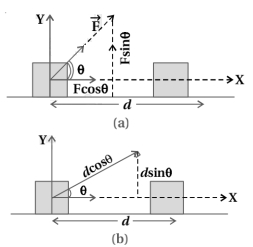
$(1)$ Work $=$ (Force) $\times$ (Component of displacement in the direction of force) $= F(d \cos \theta)$
$(2)$ Work $=$ (Component of force in the direction of displacement) $\times$ (Displacement) $= (F \cos \theta)d$
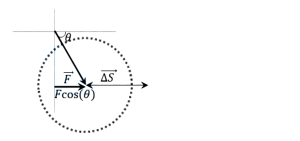
As shown in the figure,when a force $\vec{F}$ acts at an angle $\theta$ to the displacement $\vec{d}$:
$(i)$ The component of force in the direction of displacement is $F \cos \theta$,which is responsible for the work done.
$(ii)$ The perpendicular component $F \sin \theta$ does no work because it is perpendicular to the displacement.
Work: The work done by a constant force is defined as the dot product of the force vector $\vec{F}$ and the displacement vector $\vec{d}$.
$\therefore W = \vec{F} \cdot \vec{d} = F d \cos \theta$
where $F$ is the magnitude of the force,$d$ is the magnitude of displacement,and $\theta$ is the angle between the force vector and the displacement vector.
If the displacement is not in the direction of the applied force,work can be calculated in two ways:
$(1)$ Work $=$ (Force) $\times$ (Component of displacement in the direction of force) $= F(d \cos \theta)$
$(2)$ Work $=$ (Component of force in the direction of displacement) $\times$ (Displacement) $= (F \cos \theta)d$
As shown in the figure,when a force $\vec{F}$ acts at an angle $\theta$ to the displacement $\vec{d}$:
$(i)$ The component of force in the direction of displacement is $F \cos \theta$,which is responsible for the work done.
$(ii)$ The perpendicular component $F \sin \theta$ does no work because it is perpendicular to the displacement.
0 likes
View Solution106
Medium
When is the work done by a force positive and when is it negative?
Solution
(N/A) The general formula for work done is $W = \vec{F} \cdot \vec{d} = F d \cos \theta$,where $\theta$ is the angle between the force vector $\vec{F}$ and the displacement vector $\vec{d}$.
$1$. Positive Work: If the angle $\theta$ between the force and displacement is in the range $0^{\circ} \le \theta < 90^{\circ}$,then $\cos \theta$ is positive. Consequently,the work done $W$ is positive. In this case,the force aids the motion of the body.
$2$. Negative Work: If the angle $\theta$ between the force and displacement is in the range $90^{\circ} < \theta \le 180^{\circ}$,then $\cos \theta$ is negative. Consequently,the work done $W$ is negative. In this case,the force opposes the motion of the body.
$1$. Positive Work: If the angle $\theta$ between the force and displacement is in the range $0^{\circ} \le \theta < 90^{\circ}$,then $\cos \theta$ is positive. Consequently,the work done $W$ is positive. In this case,the force aids the motion of the body.
$2$. Negative Work: If the angle $\theta$ between the force and displacement is in the range $90^{\circ} < \theta \le 180^{\circ}$,then $\cos \theta$ is negative. Consequently,the work done $W$ is negative. In this case,the force opposes the motion of the body.
0 likes
View Solution107
Medium
Define work exerted by force.
Solution
(N/A) Work is defined as the product of the magnitude of the force applied to an object and the displacement of the object in the direction of the force.
Mathematically,it is expressed as the dot product of the force vector $\vec{F}$ and the displacement vector $\vec{d}$:
$W = \vec{F} \cdot \vec{d} = Fd \cos \theta$
Where:
$W$ is the work done,
$F$ is the magnitude of the force,
$d$ is the magnitude of the displacement,
$\theta$ is the angle between the force vector and the displacement vector.
Work is a scalar quantity and its $SI$ unit is the Joule $(J)$.
Mathematically,it is expressed as the dot product of the force vector $\vec{F}$ and the displacement vector $\vec{d}$:
$W = \vec{F} \cdot \vec{d} = Fd \cos \theta$
Where:
$W$ is the work done,
$F$ is the magnitude of the force,
$d$ is the magnitude of the displacement,
$\theta$ is the angle between the force vector and the displacement vector.
Work is a scalar quantity and its $SI$ unit is the Joule $(J)$.
0 likes
View Solution108
EasyMCQ
Under what condition is a force considered constant when it causes displacement?
A
When the magnitude of the force remains the same throughout the displacement.
B
When the direction of the force remains the same throughout the displacement.
C
When both the magnitude and the direction of the force remain constant throughout the displacement.
D
When the force is zero.
Solution
(C) force is defined as a vector quantity,meaning it has both magnitude and direction. For a force to be considered constant,both its magnitude and its direction must remain unchanged throughout the entire process of displacement. If either the magnitude or the direction changes,the force is considered a variable force. Therefore,the correct condition is that both the magnitude and the direction of the force remain constant.
0 likes
View Solution109
MediumMCQ
If work is done by a body against a force,is the work considered positive or negative?
A
Positive
B
Negative
C
Zero
D
Cannot be determined
Solution
(B) Work done by a body against a force means the displacement of the body is in the direction opposite to the applied force.
Since the formula for work is $W = F \cdot s \cdot \cos(\theta)$,where $\theta$ is the angle between the force and displacement.
When the body moves against the force,the angle $\theta = 180^{\circ}$.
Therefore,$W = F \cdot s \cdot \cos(180^{\circ}) = F \cdot s \cdot (-1) = -F \cdot s$.
Thus,the work done is negative.
Since the formula for work is $W = F \cdot s \cdot \cos(\theta)$,where $\theta$ is the angle between the force and displacement.
When the body moves against the force,the angle $\theta = 180^{\circ}$.
Therefore,$W = F \cdot s \cdot \cos(180^{\circ}) = F \cdot s \cdot (-1) = -F \cdot s$.
Thus,the work done is negative.
0 likes
View Solution110
EasyMCQ
When an object is dragged $10 \, m$ along a road,a frictional force of $200 \, N$ acts in the direction opposite to its motion. What is the work done by the frictional force on the object (in $, J$)?
A
$2000$
B
$-2000$
C
$0$
D
$-20$
Solution
(B) The work done by a force is given by the formula $W = F d \cos \theta$,where $F$ is the force,$d$ is the displacement,and $\theta$ is the angle between the force and displacement vectors.
Here,the frictional force $F = 200 \, N$ acts in the direction opposite to the displacement $d = 10 \, m$.
Therefore,the angle $\theta = 180^{\circ}$ (or $\pi$ radians).
Substituting these values: $W = 200 \times 10 \times \cos(180^{\circ})$.
Since $\cos(180^{\circ}) = -1$,we get $W = 2000 \times (-1) = -2000 \, J$.
Here,the frictional force $F = 200 \, N$ acts in the direction opposite to the displacement $d = 10 \, m$.
Therefore,the angle $\theta = 180^{\circ}$ (or $\pi$ radians).
Substituting these values: $W = 200 \times 10 \times \cos(180^{\circ})$.
Since $\cos(180^{\circ}) = -1$,we get $W = 2000 \times (-1) = -2000 \, J$.
0 likes
View Solution111
EasyMCQ
Is the work done by the gravitational force on an object falling freely under gravity positive,negative,or zero?
A
Positive
B
Negative
C
Zero
D
Cannot be determined
Solution
(A) The work done is positive.
This is because the displacement of a freely falling object occurs in the same direction as the gravitational force acting on it.
According to the formula for work,$W = F \cdot d \cdot \cos(\theta)$,where $\theta$ is the angle between the force and displacement.
Since both the gravitational force and the displacement are directed downwards,$\theta = 0^\circ$.
Therefore,$W = F \cdot d \cdot \cos(0^\circ) = F \cdot d$,which is positive.
This is because the displacement of a freely falling object occurs in the same direction as the gravitational force acting on it.
According to the formula for work,$W = F \cdot d \cdot \cos(\theta)$,where $\theta$ is the angle between the force and displacement.
Since both the gravitational force and the displacement are directed downwards,$\theta = 0^\circ$.
Therefore,$W = F \cdot d \cdot \cos(0^\circ) = F \cdot d$,which is positive.
0 likes
View Solution112
Easy
Show that a force that does no work must be a velocity-dependent force.
Solution
(N/A) The work done by a force $\overrightarrow{F}$ over a displacement $d\overrightarrow{l}$ is given by $dW = \overrightarrow{F} \cdot d\overrightarrow{l}$.
Given that the work done is zero,we have $\overrightarrow{F} \cdot d\overrightarrow{l} = 0$.
Since the velocity is defined as $\vec{v} = \frac{d\overrightarrow{l}}{dt}$,we can write $d\overrightarrow{l} = \vec{v} dt$.
Substituting this into the work equation: $\overrightarrow{F} \cdot (\vec{v} dt) = 0$.
Since $dt \neq 0$,it follows that $\overrightarrow{F} \cdot \vec{v} = 0$.
This implies that the force $\overrightarrow{F}$ must always be perpendicular to the velocity vector $\vec{v}$ of the particle.
If the particle changes its direction of motion,the velocity vector $\vec{v}$ changes.
To maintain the condition $\overrightarrow{F} \cdot \vec{v} = 0$ (i.e.,the angle $\theta$ between $\overrightarrow{F}$ and $\vec{v}$ remains $90^{\circ}$),the direction of the force $\overrightarrow{F}$ must also change in accordance with the change in the direction of $\vec{v}$.
Therefore,the force must be velocity-dependent.
Given that the work done is zero,we have $\overrightarrow{F} \cdot d\overrightarrow{l} = 0$.
Since the velocity is defined as $\vec{v} = \frac{d\overrightarrow{l}}{dt}$,we can write $d\overrightarrow{l} = \vec{v} dt$.
Substituting this into the work equation: $\overrightarrow{F} \cdot (\vec{v} dt) = 0$.
Since $dt \neq 0$,it follows that $\overrightarrow{F} \cdot \vec{v} = 0$.
This implies that the force $\overrightarrow{F}$ must always be perpendicular to the velocity vector $\vec{v}$ of the particle.
If the particle changes its direction of motion,the velocity vector $\vec{v}$ changes.
To maintain the condition $\overrightarrow{F} \cdot \vec{v} = 0$ (i.e.,the angle $\theta$ between $\overrightarrow{F}$ and $\vec{v}$ remains $90^{\circ}$),the direction of the force $\overrightarrow{F}$ must also change in accordance with the change in the direction of $\vec{v}$.
Therefore,the force must be velocity-dependent.
0 likes
View Solution113
EasyMCQ
What is required for work to be done when a force is applied to an object?
A
The object must move in the direction of the force.
B
The object must move in a direction not perpendicular to the force.
C
The object must remain stationary.
D
The force must be zero.
Solution
(B) For work to be done on an object when a force is applied,the object must undergo a displacement in a direction that is not perpendicular to the direction of the applied force. Mathematically,work is defined as $W = \vec{F} \cdot \vec{d} = Fd cos \theta$. For $W \neq 0$,the displacement $\vec{d}$ must have a component along the force $\vec{F}$,meaning $\theta \neq 90^{\circ}$.
0 likes
View Solution114
MediumMCQ
$A$ heavy object and a light object are placed on the same surface. If the same force is applied to both for the same displacement,on which object is more work done by the force?
A
The heavy object
B
The light object
C
Both have the same work done
D
Cannot be determined
Solution
(C) Work done $(W)$ is defined by the formula $W = F \cdot d \cdot \cos(\theta)$,where $F$ is the applied force,$d$ is the displacement,and $\theta$ is the angle between the force and displacement vectors.
Since the force $(F)$ and the displacement $(d)$ are the same for both objects,and assuming the force is applied in the direction of displacement $(\theta = 0^\circ)$,the work done is $W = F \cdot d$.
Because $F$ and $d$ are identical for both,the work done on both objects is equal,regardless of their masses.
Since the force $(F)$ and the displacement $(d)$ are the same for both objects,and assuming the force is applied in the direction of displacement $(\theta = 0^\circ)$,the work done is $W = F \cdot d$.
Because $F$ and $d$ are identical for both,the work done on both objects is equal,regardless of their masses.
0 likes
View Solution115
EasyMCQ
$A$ force of $(-\,1, \,2, \,3) \,N$ is applied to an object,causing a displacement of $4 \,m$ along the $X$-axis. Calculate the work done by the force on the object. (in $,J$)
A
$4$
B
$-4$
C
$8$
D
$12$
Solution
(B) The work done $W$ by a constant force $\vec{F}$ during a displacement $\vec{d}$ is given by the dot product: $W = \vec{F} \cdot \vec{d}$.
Given the force vector $\vec{F} = (-1, 2, 3) \,N$.
The displacement is along the $X$-axis by $4 \,m$,so the displacement vector is $\vec{d} = (4, 0, 0) \,m$.
Calculating the dot product:
$W = (-1 \times 4) + (2 \times 0) + (3 \times 0)$
$W = -4 + 0 + 0 = -4 \,J$.
Therefore,the work done by the force is $-4 \,J$.
Given the force vector $\vec{F} = (-1, 2, 3) \,N$.
The displacement is along the $X$-axis by $4 \,m$,so the displacement vector is $\vec{d} = (4, 0, 0) \,m$.
Calculating the dot product:
$W = (-1 \times 4) + (2 \times 0) + (3 \times 0)$
$W = -4 + 0 + 0 = -4 \,J$.
Therefore,the work done by the force is $-4 \,J$.
0 likes
View Solution116
Medium
$A$ body is being raised to height $h$ from the surface of the Earth. What is the sign of work done by $(a)$ applied force and $(b)$ gravitational force?
Solution
(N/A) Force is applied on the body to lift it in the upward direction,and the displacement of the body is also in the upward direction.
Since the angle between the applied force and displacement is $0^{\circ}$,the work done by the applied force is $W = F d \cos 0^{\circ} = F d$,which is positive.
$(b)$ The gravitational force acts in the downward direction,while the displacement is in the upward direction.
Since the angle between the gravitational force and displacement is $180^{\circ}$,the work done by the gravitational force is $W = F d \cos 180^{\circ} = -F d$,which is negative.
Since the angle between the applied force and displacement is $0^{\circ}$,the work done by the applied force is $W = F d \cos 0^{\circ} = F d$,which is positive.
$(b)$ The gravitational force acts in the downward direction,while the displacement is in the upward direction.
Since the angle between the gravitational force and displacement is $180^{\circ}$,the work done by the gravitational force is $W = F d \cos 180^{\circ} = -F d$,which is negative.
0 likes
View Solution117
MediumMCQ
Calculate the work done by a car against gravity in moving along a straight horizontal road. The mass of the car is $400\,kg$ and the distance moved is $2\,m$. (in $,J$)
A
$0$
B
$800$
C
$7840$
D
$1600$
Solution
(A) The force of gravity acts on the car vertically downward,while the car is moving along a horizontal road. Therefore,the angle between the force of gravity and the displacement is $\theta = 90^{\circ}$.
The formula for work done is $W = F d \cos \theta$.
Substituting the values,we get $W = F d \cos 90^{\circ}$.
Since $\cos 90^{\circ} = 0$,the work done is $W = 0\,J$.
Thus,the work done by the car against gravity is $0\,J$ because the displacement is perpendicular to the gravitational force.
The formula for work done is $W = F d \cos \theta$.
Substituting the values,we get $W = F d \cos 90^{\circ}$.
Since $\cos 90^{\circ} = 0$,the work done is $W = 0\,J$.
Thus,the work done by the car against gravity is $0\,J$ because the displacement is perpendicular to the gravitational force.
0 likes
View Solution118
Medium
An adult weighing $600 \, N$ raises the centre of gravity of his body by $0.25 \, m$ while taking each step of $1 \, m$ length in jogging. If he jogs for $6 \, km$,calculate the energy utilised by him in jogging assuming that there is no energy loss due to friction of ground and air. Assuming that the body of the adult is capable of converting $10 \, \%$ of energy intake in the form of food,calculate the energy equivalents of food that would be required to compensate for the energy utilised for jogging.
Solution
(N/A) Given: Weight of adult $W = mg = 600 \, N$,height raised per step $h = 0.25 \, m$,step length $l = 1 \, m$,total distance $d = 6 \, km = 6000 \, m$.
Total number of steps $n = \frac{d}{l} = \frac{6000 \, m}{1 \, m} = 6000$.
Energy utilised per step $E_{step} = mgh = 600 \, N \times 0.25 \, m = 150 \, J$.
Total energy utilised in jogging $E_{total} = n \times E_{step} = 6000 \times 150 \, J = 9 \times 10^5 \, J$.
Given that the body converts $10 \, \%$ of food energy intake into work,let $E_{food}$ be the total energy intake.
$0.10 \times E_{food} = 9 \times 10^5 \, J$.
$E_{food} = \frac{9 \times 10^5}{0.10} = 9 \times 10^6 \, J$.
Total number of steps $n = \frac{d}{l} = \frac{6000 \, m}{1 \, m} = 6000$.
Energy utilised per step $E_{step} = mgh = 600 \, N \times 0.25 \, m = 150 \, J$.
Total energy utilised in jogging $E_{total} = n \times E_{step} = 6000 \times 150 \, J = 9 \times 10^5 \, J$.
Given that the body converts $10 \, \%$ of food energy intake into work,let $E_{food}$ be the total energy intake.
$0.10 \times E_{food} = 9 \times 10^5 \, J$.
$E_{food} = \frac{9 \times 10^5}{0.10} = 9 \times 10^6 \, J$.
0 likes
View Solution119
MediumMCQ
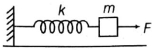
The figure shows a mass $m$ on a frictionless surface. It is connected to a rigid wall by means of a massless spring of spring constant $k$. Initially,the spring is at its natural position. If a force of constant magnitude $F$ starts acting on the block towards the right,then the speed of the block when the deformation in the spring is $x$ will be
A
$\sqrt{\frac{2 Fx - k x^2}{m}}$
B
$\sqrt{\frac{Fx - k x^2}{m}}$
C
$\sqrt{\frac{x(F-k)}{m}}$
D
$\sqrt{\frac{Fx - k x^2}{2m}}$
Solution
(A) According to the work-energy theorem,the total work done on the block is equal to the change in its kinetic energy.
$W_{\text{total}} = \Delta K$
$W_F + W_{\text{spring}} = K_f - K_i$
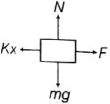
Here,the work done by the constant force $F$ is $W_F = Fx$.
The work done by the spring force is $W_{\text{spring}} = -\frac{1}{2} k x^2$.
The initial kinetic energy $K_i = 0$ (as it starts from rest) and the final kinetic energy $K_f = \frac{1}{2} m v^2$.
Substituting these values into the equation:
$Fx - \frac{1}{2} k x^2 = \frac{1}{2} m v^2 - 0$
$Fx - \frac{1}{2} k x^2 = \frac{1}{2} m v^2$
Multiplying both sides by $2$:
$2Fx - k x^2 = m v^2$
$v^2 = \frac{2Fx - k x^2}{m}$
$v = \sqrt{\frac{2Fx - k x^2}{m}}$
$W_{\text{total}} = \Delta K$
$W_F + W_{\text{spring}} = K_f - K_i$
Here,the work done by the constant force $F$ is $W_F = Fx$.
The work done by the spring force is $W_{\text{spring}} = -\frac{1}{2} k x^2$.
The initial kinetic energy $K_i = 0$ (as it starts from rest) and the final kinetic energy $K_f = \frac{1}{2} m v^2$.
Substituting these values into the equation:
$Fx - \frac{1}{2} k x^2 = \frac{1}{2} m v^2 - 0$
$Fx - \frac{1}{2} k x^2 = \frac{1}{2} m v^2$
Multiplying both sides by $2$:
$2Fx - k x^2 = m v^2$
$v^2 = \frac{2Fx - k x^2}{m}$
$v = \sqrt{\frac{2Fx - k x^2}{m}}$
0 likes
View Solution120
MediumMCQ
Two persons $A$ and $B$ perform the same amount of work in moving a body through a certain distance $d$ with the application of forces acting at angles $45^{\circ}$ and $60^{\circ}$ with the direction of displacement,respectively. The ratio of the force applied by person $A$ to the force applied by person $B$ is $\frac{1}{\sqrt{x}}$. The value of $x$ is ...... .
A
$2$
B
$3$
C
$1$
D
$4$
Solution
(A) Given that the work done by both persons is equal: $W_A = W_B$.
The formula for work done is $W = Fd \cos \theta$.
For person $A$: $W_A = F_A d \cos 45^{\circ}$.
For person $B$: $W_B = F_B d \cos 60^{\circ}$.
Equating the two: $F_A d \cos 45^{\circ} = F_B d \cos 60^{\circ}$.
Substituting the values of $\cos 45^{\circ} = \frac{1}{\sqrt{2}}$ and $\cos 60^{\circ} = \frac{1}{2}$:
$F_A \times \frac{1}{\sqrt{2}} = F_B \times \frac{1}{2}$.
Rearranging for the ratio $\frac{F_A}{F_B}$:
$\frac{F_A}{F_B} = \frac{\sqrt{2}}{2} = \frac{\sqrt{2}}{(\sqrt{2})^2} = \frac{1}{\sqrt{2}}$.
Comparing this with $\frac{1}{\sqrt{x}}$,we get $x = 2$.
The formula for work done is $W = Fd \cos \theta$.
For person $A$: $W_A = F_A d \cos 45^{\circ}$.
For person $B$: $W_B = F_B d \cos 60^{\circ}$.
Equating the two: $F_A d \cos 45^{\circ} = F_B d \cos 60^{\circ}$.
Substituting the values of $\cos 45^{\circ} = \frac{1}{\sqrt{2}}$ and $\cos 60^{\circ} = \frac{1}{2}$:
$F_A \times \frac{1}{\sqrt{2}} = F_B \times \frac{1}{2}$.
Rearranging for the ratio $\frac{F_A}{F_B}$:
$\frac{F_A}{F_B} = \frac{\sqrt{2}}{2} = \frac{\sqrt{2}}{(\sqrt{2})^2} = \frac{1}{\sqrt{2}}$.
Comparing this with $\frac{1}{\sqrt{x}}$,we get $x = 2$.
0 likes
View Solution121
MediumMCQ
$A$ porter lifts a heavy suitcase of mass $80\, \text{kg}$ and at the destination lowers it down by a distance of $80\, \text{cm}$ with a constant velocity. Calculate the work done by the porter in lowering the suitcase. (Take $g = 9.8\, \text{m/s}^2$) (In $\text{J}$)
A
$+627.2\, \text{J}$
B
$-62720.0\, \text{J}$
C
$784.0\, \text{J}$
D
$-627.2\, \text{J}$
Solution
(D) According to the Work-Energy Theorem,the net work done on an object is equal to the change in its kinetic energy.
Since the suitcase is moved with a constant velocity,the change in kinetic energy $\Delta K.E. = 0$.
Therefore,the total work done by all forces is $W_{\text{Porter}} + W_{\text{gravity}} = 0$.
This implies $W_{\text{Porter}} = -W_{\text{gravity}}$.
The work done by gravity is $W_{\text{gravity}} = mgh$,where $h$ is the displacement.
Here,$m = 80\, \text{kg}$,$g = 9.8\, \text{m/s}^2$,and $h = 80\, \text{cm} = 0.8\, \text{m}$.
Since the porter is lowering the suitcase,the force applied by the porter is upwards while the displacement is downwards.
$W_{\text{Porter}} = -mgh = -(80) \times (9.8) \times (0.8) = -627.2\, \text{J}$.
Since the suitcase is moved with a constant velocity,the change in kinetic energy $\Delta K.E. = 0$.
Therefore,the total work done by all forces is $W_{\text{Porter}} + W_{\text{gravity}} = 0$.
This implies $W_{\text{Porter}} = -W_{\text{gravity}}$.
The work done by gravity is $W_{\text{gravity}} = mgh$,where $h$ is the displacement.
Here,$m = 80\, \text{kg}$,$g = 9.8\, \text{m/s}^2$,and $h = 80\, \text{cm} = 0.8\, \text{m}$.
Since the porter is lowering the suitcase,the force applied by the porter is upwards while the displacement is downwards.
$W_{\text{Porter}} = -mgh = -(80) \times (9.8) \times (0.8) = -627.2\, \text{J}$.
0 likes
View Solution122
EasyMCQ
If a force of constant magnitude acts in a direction perpendicular to the motion of a particle,then its
A
Speed is uniform
B
Momentum is uniform
C
Velocity is uniform
D
All of these
Solution
(A) The correct option is $A$.
Since the force $\vec{F}$ is perpendicular to the velocity $\vec{V}$ of the particle,the component of the force in the direction of motion is zero $(F \cos 90^{\circ} = 0)$.
According to Newton's second law,the rate of change of speed depends on the tangential component of the force. Since this component is zero,the speed of the particle remains constant.
However,the force causes a change in the direction of the velocity vector,meaning the velocity is not uniform. Consequently,since momentum $\vec{p} = m\vec{v}$,the momentum also changes because the direction of the velocity changes.
Since the force $\vec{F}$ is perpendicular to the velocity $\vec{V}$ of the particle,the component of the force in the direction of motion is zero $(F \cos 90^{\circ} = 0)$.
According to Newton's second law,the rate of change of speed depends on the tangential component of the force. Since this component is zero,the speed of the particle remains constant.
However,the force causes a change in the direction of the velocity vector,meaning the velocity is not uniform. Consequently,since momentum $\vec{p} = m\vec{v}$,the momentum also changes because the direction of the velocity changes.
0 likes
View Solution123
MediumMCQ
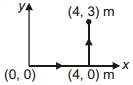
$A$ force $\vec{F}=(3 \hat{i}+4 \hat{j}) \;N$ acts on a particle moving in the $x-y$ plane. Starting from the origin,the particle first moves along the $x$-axis to the point $(4,0) \;m$ and then parallel to the $y$-axis to the point $(4,3) \;m$. The total work done by the force on the particle is ............. $J$.
A
$+12$
B
$-6$
C
$-12$
D
$+24$
Solution
(D) The force $\vec{F}$ is a constant force given by $\vec{F} = (3 \hat{i} + 4 \hat{j}) \;N$.
The particle moves from the origin $(0,0) \;m$ to $(4,0) \;m$ and then to $(4,3) \;m$. The total displacement vector $\vec{d}$ is the vector from the initial position $(0,0)$ to the final position $(4,3)$,which is $\vec{d} = (4 \hat{i} + 3 \hat{j}) \;m$.
Since the force is constant,the work done $W$ is given by the dot product of the force and the displacement vector:
$W = \vec{F} \cdot \vec{d}$
$W = (3 \hat{i} + 4 \hat{j}) \cdot (4 \hat{i} + 3 \hat{j})$
$W = (3 \times 4) + (4 \times 3)$
$W = 12 + 12 = 24 \;J$.
Therefore,the total work done is $24 \;J$.
The particle moves from the origin $(0,0) \;m$ to $(4,0) \;m$ and then to $(4,3) \;m$. The total displacement vector $\vec{d}$ is the vector from the initial position $(0,0)$ to the final position $(4,3)$,which is $\vec{d} = (4 \hat{i} + 3 \hat{j}) \;m$.
Since the force is constant,the work done $W$ is given by the dot product of the force and the displacement vector:
$W = \vec{F} \cdot \vec{d}$
$W = (3 \hat{i} + 4 \hat{j}) \cdot (4 \hat{i} + 3 \hat{j})$
$W = (3 \times 4) + (4 \times 3)$
$W = 12 + 12 = 24 \;J$.
Therefore,the total work done is $24 \;J$.
0 likes
View Solution124
MediumMCQ
$A$ particle of mass $m$ is projected with speed $u$ at angle $\theta$ with the horizontal from the ground. The work done by gravity on it during its upward motion is ..........
A
$\frac{m u^2 \cos^2 \theta}{2}$
B
$\frac{-m u^2 \sin^2 \theta}{2}$
C
$\frac{m u^2 \sin^2 \theta}{2}$
D
Zero
Solution
(B) The maximum height reached by the projectile is $H = \frac{u^2 \sin^2 \theta}{2g}$.
During the upward motion,the displacement of the particle is in the upward direction,while the gravitational force $(F_g = mg)$ acts in the downward direction.
Therefore,the work done by gravity is $W = F_g \cdot H \cdot \cos(180^{\circ})$.
$W = -mg \times \left( \frac{u^2 \sin^2 \theta}{2g} \right)$.
$W = -\frac{m u^2 \sin^2 \theta}{2}$.
During the upward motion,the displacement of the particle is in the upward direction,while the gravitational force $(F_g = mg)$ acts in the downward direction.
Therefore,the work done by gravity is $W = F_g \cdot H \cdot \cos(180^{\circ})$.
$W = -mg \times \left( \frac{u^2 \sin^2 \theta}{2g} \right)$.
$W = -\frac{m u^2 \sin^2 \theta}{2}$.
0 likes
View Solution125
MediumMCQ
$A$ string is used to pull a block of mass $m$ vertically up by a distance $h$ at a constant acceleration $\frac{g}{3}$. The work done by the tension in the string is ..............
A
$\frac{2}{3} m g h$
B
$\frac{-m g h}{3}$
C
$m g h$
D
$\frac{4}{3} m g h$
Solution
(D) According to Newton's second law of motion,the net force on the block is $F_{net} = T - mg = ma$.
Given that the acceleration $a = \frac{g}{3}$,we can substitute this into the equation:
$T - mg = m(\frac{g}{3})$
$T = mg + \frac{mg}{3} = \frac{4}{3} mg$
Since the tension $T$ acts in the same direction as the displacement $h$,the work done by the tension is given by $W = T \cdot h$.
$W = (\frac{4}{3} mg) \cdot h = \frac{4}{3} mgh$.
Given that the acceleration $a = \frac{g}{3}$,we can substitute this into the equation:
$T - mg = m(\frac{g}{3})$
$T = mg + \frac{mg}{3} = \frac{4}{3} mg$
Since the tension $T$ acts in the same direction as the displacement $h$,the work done by the tension is given by $W = T \cdot h$.
$W = (\frac{4}{3} mg) \cdot h = \frac{4}{3} mgh$.

0 likes
View Solution126
EasyMCQ
$A$ man carries a load on his head through a distance of $5 \,m$. The maximum amount of work is done when he ..........
A
Moves it over an inclined plane
B
Moves it over a horizontal surface
C
Lifts it vertically upwards
D
None of these
Solution
(C) The work done by a force is given by the formula $W = F \cdot s \cdot \cos(\theta)$,where $F$ is the force applied,$s$ is the displacement,and $\theta$ is the angle between the force and the displacement vector.
When a man carries a load on his head,he must apply an upward force equal to the weight of the load $(F = mg)$ to counteract gravity.
If he moves the load horizontally,the displacement is perpendicular to the force of gravity (the force he applies to hold the load),so $\theta = 90^\circ$. Since $\cos(90^\circ) = 0$,the work done against gravity is $0$.
If he lifts the load vertically upwards,the displacement is in the same direction as the force applied,so $\theta = 0^\circ$. Since $\cos(0^\circ) = 1$,the work done is $W = F \cdot s = mgs$.
Therefore,the maximum work is done when he lifts the load vertically upwards.
When a man carries a load on his head,he must apply an upward force equal to the weight of the load $(F = mg)$ to counteract gravity.
If he moves the load horizontally,the displacement is perpendicular to the force of gravity (the force he applies to hold the load),so $\theta = 90^\circ$. Since $\cos(90^\circ) = 0$,the work done against gravity is $0$.
If he lifts the load vertically upwards,the displacement is in the same direction as the force applied,so $\theta = 0^\circ$. Since $\cos(0^\circ) = 1$,the work done is $W = F \cdot s = mgs$.
Therefore,the maximum work is done when he lifts the load vertically upwards.
0 likes
View Solution127
EasyMCQ
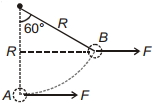
$A$ block of mass $m$ is pulled along a circular arc by means of a constant horizontal force $F$ as shown. Work done by this force in pulling the block from $A$ to $B$ is ............
A
$\frac{F R}{2}$
B
$F R$
C
$\frac{\sqrt{3}}{2} F R$
D
$m g R$
Solution
(C) The work done by a constant force is given by the dot product of force and displacement: $W = \vec{F} \cdot \vec{d} = F d \cos \theta$.
Since the force $F$ is constant and horizontal,the work done is $W = F \times (\text{horizontal displacement})$.
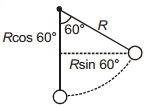
From the geometry of the circular arc,the horizontal displacement of the block as it moves from $A$ to $B$ is $d = R \sin 60^{\circ}$.
Substituting the value of $\sin 60^{\circ} = \frac{\sqrt{3}}{2}$,we get the horizontal displacement $d = R \left(\frac{\sqrt{3}}{2}\right)$.
Therefore,the work done is $W = F \times \left(R \frac{\sqrt{3}}{2}\right) = \frac{\sqrt{3}}{2} F R$.
Thus,the correct option is $C$.
Since the force $F$ is constant and horizontal,the work done is $W = F \times (\text{horizontal displacement})$.
From the geometry of the circular arc,the horizontal displacement of the block as it moves from $A$ to $B$ is $d = R \sin 60^{\circ}$.
Substituting the value of $\sin 60^{\circ} = \frac{\sqrt{3}}{2}$,we get the horizontal displacement $d = R \left(\frac{\sqrt{3}}{2}\right)$.
Therefore,the work done is $W = F \times \left(R \frac{\sqrt{3}}{2}\right) = \frac{\sqrt{3}}{2} F R$.
Thus,the correct option is $C$.
1 likes
View Solution128
MediumMCQ
$A$ string is used to pull a block of mass $m$ vertically up by a distance $h$ at a constant acceleration $\frac{g}{4}$. The work done by the tension in the string is ...............

A
$+\frac{3 m g h}{4}$
B
$-\frac{m g h}{4}$
C
$+\frac{5}{4} m g h$
D
$+mgh$
Solution
(C) According to Newton's second law of motion,the net force acting on the block is $F_{net} = ma$.
Since the block is being pulled vertically upwards,the forces acting on it are the tension $T$ (upwards) and the weight $mg$ (downwards).
Therefore,$T - mg = ma$.
Given that the acceleration $a = \frac{g}{4}$,we substitute this into the equation:
$T - mg = m\left(\frac{g}{4}\right)$
$T = mg + \frac{mg}{4} = \frac{5}{4}mg$.
The work done by the tension $T$ is given by $W = T \cdot h \cdot \cos(0^\circ)$,since the displacement is in the same direction as the tension.
$W = \left(\frac{5}{4}mg\right) \cdot h = \frac{5}{4}mgh$.
Thus,the correct option is $C$.
Since the block is being pulled vertically upwards,the forces acting on it are the tension $T$ (upwards) and the weight $mg$ (downwards).
Therefore,$T - mg = ma$.
Given that the acceleration $a = \frac{g}{4}$,we substitute this into the equation:
$T - mg = m\left(\frac{g}{4}\right)$
$T = mg + \frac{mg}{4} = \frac{5}{4}mg$.
The work done by the tension $T$ is given by $W = T \cdot h \cdot \cos(0^\circ)$,since the displacement is in the same direction as the tension.
$W = \left(\frac{5}{4}mg\right) \cdot h = \frac{5}{4}mgh$.
Thus,the correct option is $C$.
2 likes
View Solution129
MediumMCQ
The kinetic energy $(KE)$ acquired by a mass $m$ in travelling a certain distance $d$,starting from rest,under the action of a constant force $F$ is ..........
A
Directly proportional to $\sqrt{m}$
B
Directly proportional to $m$
C
Directly proportional to $\frac{1}{m}$
D
None of these
Solution
(D) According to the Work-Energy Theorem,the work done by the net force on an object is equal to the change in its kinetic energy.
$W = \Delta K = K_f - K_i$
Since the object starts from rest,the initial kinetic energy $K_i = 0$.
The work done by a constant force $F$ over a distance $d$ is $W = F \cdot d$.
Therefore,$K_f = F \cdot d$.
Since $F$ and $d$ are constants,the kinetic energy $K_f$ is independent of the mass $m$ of the object.
Thus,the correct option is $D$.
$W = \Delta K = K_f - K_i$
Since the object starts from rest,the initial kinetic energy $K_i = 0$.
The work done by a constant force $F$ over a distance $d$ is $W = F \cdot d$.
Therefore,$K_f = F \cdot d$.
Since $F$ and $d$ are constants,the kinetic energy $K_f$ is independent of the mass $m$ of the object.
Thus,the correct option is $D$.
0 likes
View Solution130
EasyMCQ
$A$ small particle moves to position $5 \hat{i}-2 \hat{j}+\hat{k}$ from its initial position $2 \hat{i}+3 \hat{j}-4 \hat{k}$ under the action of force $5 \hat{i}+2 \hat{j}+7 \hat{k} \text{ N}$. The value of work done will be $............ \text{ J}$.
A
$38$
B
$40$
C
$39$
D
$41$
Solution
(B) The work done $W$ by a constant force $\vec{F}$ is given by the dot product of the force and the displacement vector $\vec{d} = \vec{r}_f - \vec{r}_i$.
Given:
Force $\vec{F} = 5 \hat{i} + 2 \hat{j} + 7 \hat{k} \text{ N}$
Initial position $\vec{r}_i = 2 \hat{i} + 3 \hat{j} - 4 \hat{k}$
Final position $\vec{r}_f = 5 \hat{i} - 2 \hat{j} + \hat{k}$
Displacement $\vec{d} = \vec{r}_f - \vec{r}_i = (5-2) \hat{i} + (-2-3) \hat{j} + (1 - (-4)) \hat{k} = 3 \hat{i} - 5 \hat{j} + 5 \hat{k}$
Work done $W = \vec{F} \cdot \vec{d} = (5 \hat{i} + 2 \hat{j} + 7 \hat{k}) \cdot (3 \hat{i} - 5 \hat{j} + 5 \hat{k})$
$W = (5 \times 3) + (2 \times -5) + (7 \times 5)$
$W = 15 - 10 + 35 = 40 \text{ J}$.
Given:
Force $\vec{F} = 5 \hat{i} + 2 \hat{j} + 7 \hat{k} \text{ N}$
Initial position $\vec{r}_i = 2 \hat{i} + 3 \hat{j} - 4 \hat{k}$
Final position $\vec{r}_f = 5 \hat{i} - 2 \hat{j} + \hat{k}$
Displacement $\vec{d} = \vec{r}_f - \vec{r}_i = (5-2) \hat{i} + (-2-3) \hat{j} + (1 - (-4)) \hat{k} = 3 \hat{i} - 5 \hat{j} + 5 \hat{k}$
Work done $W = \vec{F} \cdot \vec{d} = (5 \hat{i} + 2 \hat{j} + 7 \hat{k}) \cdot (3 \hat{i} - 5 \hat{j} + 5 \hat{k})$
$W = (5 \times 3) + (2 \times -5) + (7 \times 5)$
$W = 15 - 10 + 35 = 40 \text{ J}$.
0 likes
View Solution131
DifficultMCQ
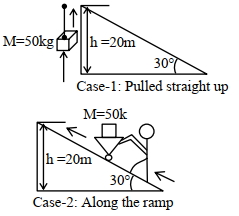
$A$ body of mass $50 \ kg$ is lifted to a height of $20 \ m$ from the ground in two different ways as shown in the figure. The ratio of work done against gravity in both the respective cases will be:
A
$1: 1$
B
$2: 1$
C
$\sqrt{3}: 2$
D
$1: 2$
Solution
(A) The work done against gravity is given by the change in gravitational potential energy,which is $W = mgh$,where $m$ is the mass,$g$ is the acceleration due to gravity,and $h$ is the vertical displacement.
In both cases,the mass $m = 50 \ kg$ and the vertical height $h = 20 \ m$ are the same.
Since gravity is a conservative force,the work done against it depends only on the initial and final vertical positions,not on the path taken.
Therefore,the work done in Case-$1$ is $W_1 = mgh = 50 \times g \times 20 = 1000g \ J$.
The work done in Case-$2$ is also $W_2 = mgh = 50 \times g \times 20 = 1000g \ J$.
The ratio of work done is $W_1 : W_2 = 1000g : 1000g = 1: 1$.
Thus,option $A$ is correct.
In both cases,the mass $m = 50 \ kg$ and the vertical height $h = 20 \ m$ are the same.
Since gravity is a conservative force,the work done against it depends only on the initial and final vertical positions,not on the path taken.
Therefore,the work done in Case-$1$ is $W_1 = mgh = 50 \times g \times 20 = 1000g \ J$.
The work done in Case-$2$ is also $W_2 = mgh = 50 \times g \times 20 = 1000g \ J$.
The ratio of work done is $W_1 : W_2 = 1000g : 1000g = 1: 1$.
Thus,option $A$ is correct.
0 likes
View Solution132
MediumMCQ
$A$ force $\vec{F} = 2\hat{i} + b\hat{j} + \hat{k}$ is applied on a particle and it undergoes a displacement $\vec{S} = \hat{i} - 2\hat{j} - \hat{k}$. What will be the value of $b$,if the work done on the particle is zero?
A
$0$
B
$\frac{1}{2}$
C
$\frac{1}{3}$
D
$2$
Solution
(B) Work done $(W)$ is defined as the dot product of force $(\vec{F})$ and displacement $(\vec{S})$: $W = \vec{F} \cdot \vec{S}$.
Given $\vec{F} = 2\hat{i} + b\hat{j} + \hat{k}$ and $\vec{S} = \hat{i} - 2\hat{j} - \hat{k}$.
Since the work done is zero,$W = (2\hat{i} + b\hat{j} + \hat{k}) \cdot (\hat{i} - 2\hat{j} - \hat{k}) = 0$.
Calculating the dot product: $(2)(1) + (b)(-2) + (1)(-1) = 0$.
$2 - 2b - 1 = 0$.
$1 - 2b = 0$.
$2b = 1$.
Therefore,$b = \frac{1}{2}$.
Given $\vec{F} = 2\hat{i} + b\hat{j} + \hat{k}$ and $\vec{S} = \hat{i} - 2\hat{j} - \hat{k}$.
Since the work done is zero,$W = (2\hat{i} + b\hat{j} + \hat{k}) \cdot (\hat{i} - 2\hat{j} - \hat{k}) = 0$.
Calculating the dot product: $(2)(1) + (b)(-2) + (1)(-1) = 0$.
$2 - 2b - 1 = 0$.
$1 - 2b = 0$.
$2b = 1$.
Therefore,$b = \frac{1}{2}$.
0 likes
View Solution133
MediumMCQ
$A$ chain of mass $m$ and length $\ell$ is held on a frictionless table in such a way that its $\frac{2 \ell}{5}$ part is hanging below the edge of the table. Find the work done to pull the hanging part of the chain up onto the table.
A
$\frac{2 mg \ell}{25}$
B
$\frac{mg \ell}{50}$
C
$\frac{mg \ell}{15}$
D
$\frac{4 mg \ell}{15}$
Solution
(A) The mass of the hanging part is $m' = \frac{m}{\ell} \times \frac{2 \ell}{5} = \frac{2m}{5}$.
The center of mass of the hanging part is at a distance $h = \frac{1}{2} \times \frac{2 \ell}{5} = \frac{\ell}{5}$ below the edge of the table.
The work done to pull the hanging part onto the table is equal to the change in potential energy of the hanging part.
$W = m'gh = \left( \frac{2m}{5} \right) g \left( \frac{\ell}{5} \right) = \frac{2mg \ell}{25}$.
The center of mass of the hanging part is at a distance $h = \frac{1}{2} \times \frac{2 \ell}{5} = \frac{\ell}{5}$ below the edge of the table.
The work done to pull the hanging part onto the table is equal to the change in potential energy of the hanging part.
$W = m'gh = \left( \frac{2m}{5} \right) g \left( \frac{\ell}{5} \right) = \frac{2mg \ell}{25}$.
0 likes
View Solution134
MediumMCQ
$A$ force $\vec{F} = -5 \hat{i} - 7 \hat{j} + 3 \hat{k}$ acting on a particle causes a displacement $\vec{s} = 3 \hat{i} - 2 \hat{j} + a \hat{k}$. If the work done is $14 \ J$,then the value of '$a$' is:
A
$0$
B
$5$
C
$15$
D
$1$
Solution
(B) The work done $W$ by a force $\vec{F}$ during a displacement $\vec{s}$ is given by the dot product: $W = \vec{F} \cdot \vec{s}$.
Given,$\vec{F} = -5 \hat{i} - 7 \hat{j} + 3 \hat{k}$ and $\vec{s} = 3 \hat{i} - 2 \hat{j} + a \hat{k}$.
Substituting the values into the formula:
$14 = (-5 \hat{i} - 7 \hat{j} + 3 \hat{k}) \cdot (3 \hat{i} - 2 \hat{j} + a \hat{k})$
$14 = (-5)(3) + (-7)(-2) + (3)(a)$
$14 = -15 + 14 + 3a$
$14 = -1 + 3a$
$15 = 3a$
$a = 5$.
Given,$\vec{F} = -5 \hat{i} - 7 \hat{j} + 3 \hat{k}$ and $\vec{s} = 3 \hat{i} - 2 \hat{j} + a \hat{k}$.
Substituting the values into the formula:
$14 = (-5 \hat{i} - 7 \hat{j} + 3 \hat{k}) \cdot (3 \hat{i} - 2 \hat{j} + a \hat{k})$
$14 = (-5)(3) + (-7)(-2) + (3)(a)$
$14 = -15 + 14 + 3a$
$14 = -1 + 3a$
$15 = 3a$
$a = 5$.
0 likes
View Solution135
EasyMCQ
The kinetic energy acquired by a body of mass $M$ in travelling a certain distance $d$,starting from rest,under the action of a constant force is:
A
inversely proportional to $\sqrt{M}$.
B
directly proportional to $M$.
C
independent of $M$.
D
directly proportional to $\sqrt{M}$.
Solution
(C) According to the Work-Energy Theorem,the work done by the net force on an object is equal to the change in its kinetic energy.
$W = \Delta K.E.$
Since the body starts from rest,the initial kinetic energy is $0$.
$W = K.E._{final} - 0 = K.E._{final}$
The work done by a constant force $F$ over a distance $d$ is given by $W = F \cdot d$.
Therefore,$K.E. = F \cdot d$.
Since the force $F$ and the distance $d$ are constants,the kinetic energy acquired is independent of the mass $M$ of the body.
$W = \Delta K.E.$
Since the body starts from rest,the initial kinetic energy is $0$.
$W = K.E._{final} - 0 = K.E._{final}$
The work done by a constant force $F$ over a distance $d$ is given by $W = F \cdot d$.
Therefore,$K.E. = F \cdot d$.
Since the force $F$ and the distance $d$ are constants,the kinetic energy acquired is independent of the mass $M$ of the body.
0 likes
View Solution136
EasyMCQ
$A$ particle is displaced from point $P(3 \ m, 4 \ m, 5 \ m)$ to a point $Q(2 \ m, 3 \ m, 4 \ m)$ under a constant force $\vec{F}=(3 \hat{i}+4 \hat{j}+5 \hat{k}) \ N$. The work done by the force in this process is
A
$+10 \ J$
B
$+4 \ J$
C
$-8 \ J$
D
$-12 \ J$
Solution
(D) The displacement vector $\vec{d}$ is given by $\vec{d} = \vec{r}_Q - \vec{r}_P$.
Given $\vec{r}_P = (3 \hat{i} + 4 \hat{j} + 5 \hat{k}) \ m$ and $\vec{r}_Q = (2 \hat{i} + 3 \hat{j} + 4 \hat{k}) \ m$.
So,$\vec{d} = (2-3) \hat{i} + (3-4) \hat{j} + (4-5) \hat{k} = (-1 \hat{i} - 1 \hat{j} - 1 \hat{k}) \ m$.
The work done $W$ by a constant force $\vec{F}$ is given by the dot product $W = \vec{F} \cdot \vec{d}$.
$W = (3 \hat{i} + 4 \hat{j} + 5 \hat{k}) \cdot (-1 \hat{i} - 1 \hat{j} - 1 \hat{k})$.
$W = (3 \times -1) + (4 \times -1) + (5 \times -1) = -3 - 4 - 5 = -12 \ J$.
Given $\vec{r}_P = (3 \hat{i} + 4 \hat{j} + 5 \hat{k}) \ m$ and $\vec{r}_Q = (2 \hat{i} + 3 \hat{j} + 4 \hat{k}) \ m$.
So,$\vec{d} = (2-3) \hat{i} + (3-4) \hat{j} + (4-5) \hat{k} = (-1 \hat{i} - 1 \hat{j} - 1 \hat{k}) \ m$.
The work done $W$ by a constant force $\vec{F}$ is given by the dot product $W = \vec{F} \cdot \vec{d}$.
$W = (3 \hat{i} + 4 \hat{j} + 5 \hat{k}) \cdot (-1 \hat{i} - 1 \hat{j} - 1 \hat{k})$.
$W = (3 \times -1) + (4 \times -1) + (5 \times -1) = -3 - 4 - 5 = -12 \ J$.
0 likes
View Solution137
EasyMCQ
$A$ gardener pushes a lawn roller through a distance of $20 \,m$. If he applies a force of $30 \,kg-wt$ in a direction inclined at $60^{\circ}$ to the ground, the work done by the gardener in pushing the roller is (Given: $g=9.8 \,m/s^2$) (in $\,J$)
A
$3640$
B
$2460$
C
$3940$
D
$2940$
Solution
(D) The work done $W$ by a constant force $F$ is given by the formula: $W = F \cdot S \cdot \cos(\theta)$, where $S$ is the displacement and $\theta$ is the angle between the force and the displacement.
Given:
Force $F = 30 \,kg-wt = 30 \times 9.8 \,N = 294 \,N$
Displacement $S = 20 \,m$
Angle $\theta = 60^{\circ}$
Substituting these values into the formula:
$W = 294 \times 20 \times \cos(60^{\circ})$
Since $\cos(60^{\circ}) = 0.5$, we get:
$W = 294 \times 20 \times 0.5$
$W = 294 \times 10 = 2940 \,J$
Therefore, the work done by the gardener is $2940 \,J$.
Given:
Force $F = 30 \,kg-wt = 30 \times 9.8 \,N = 294 \,N$
Displacement $S = 20 \,m$
Angle $\theta = 60^{\circ}$
Substituting these values into the formula:
$W = 294 \times 20 \times \cos(60^{\circ})$
Since $\cos(60^{\circ}) = 0.5$, we get:
$W = 294 \times 20 \times 0.5$
$W = 294 \times 10 = 2940 \,J$
Therefore, the work done by the gardener is $2940 \,J$.
0 likes
View Solution138
EasyMCQ
$A$ block of mass $m$,kept on a horizontal surface,is moved through a distance $s$ by applying a horizontal force $F$ to it. What is the work done by the normal reaction?
A
$F/s$
B
$Fs$
C
zero
D
$s/F$
Solution
(C) The work done by a force is defined as $W = \vec{F} \cdot \vec{s} = Fs \cos \theta$,where $\theta$ is the angle between the force and the displacement.
In this case,the normal reaction force $N$ acts vertically upwards,perpendicular to the horizontal surface.
The displacement $s$ of the block is along the horizontal surface.
Therefore,the angle $\theta$ between the normal reaction $N$ and the displacement $s$ is $90^\circ$.
Since $\cos 90^\circ = 0$,the work done by the normal reaction is $W = Ns \cos 90^\circ = 0$.
In this case,the normal reaction force $N$ acts vertically upwards,perpendicular to the horizontal surface.
The displacement $s$ of the block is along the horizontal surface.
Therefore,the angle $\theta$ between the normal reaction $N$ and the displacement $s$ is $90^\circ$.
Since $\cos 90^\circ = 0$,the work done by the normal reaction is $W = Ns \cos 90^\circ = 0$.
0 likes
View Solution139
EasyMCQ
$A$ force $\vec{F} = (5 \hat{\imath} - 2 \hat{\jmath} + 3 \hat{k}) \text{ N}$ acts on a body of mass $2 \text{ kg}$ and displaces it from position $\vec{r_1} = (3 \hat{\imath} + 2 \hat{\jmath} - \hat{k}) \text{ m}$ to $\vec{r_2} = (6 \hat{\imath} - \hat{\jmath} + 4 \hat{k}) \text{ m}$. The work done is: (in $\text{ J}$)
A
$27$
B
$18$
C
$36$
D
$9$
Solution
(C) The work done $W$ by a constant force $\vec{F}$ is given by the dot product of force and displacement: $W = \vec{F} \cdot \vec{d}$.
First,calculate the displacement vector $\vec{d} = \vec{r_2} - \vec{r_1}$.
$\vec{d} = (6 - 3) \hat{\imath} + (-1 - 2) \hat{\jmath} + (4 - (-1)) \hat{k} = 3 \hat{\imath} - 3 \hat{\jmath} + 5 \hat{k} \text{ m}$.
Now,calculate the work done:
$W = (5 \hat{\imath} - 2 \hat{\jmath} + 3 \hat{k}) \cdot (3 \hat{\imath} - 3 \hat{\jmath} + 5 \hat{k})$.
$W = (5 \times 3) + (-2 \times -3) + (3 \times 5) = 15 + 6 + 15 = 36 \text{ J}$.
First,calculate the displacement vector $\vec{d} = \vec{r_2} - \vec{r_1}$.
$\vec{d} = (6 - 3) \hat{\imath} + (-1 - 2) \hat{\jmath} + (4 - (-1)) \hat{k} = 3 \hat{\imath} - 3 \hat{\jmath} + 5 \hat{k} \text{ m}$.
Now,calculate the work done:
$W = (5 \hat{\imath} - 2 \hat{\jmath} + 3 \hat{k}) \cdot (3 \hat{\imath} - 3 \hat{\jmath} + 5 \hat{k})$.
$W = (5 \times 3) + (-2 \times -3) + (3 \times 5) = 15 + 6 + 15 = 36 \text{ J}$.
0 likes
View Solution140
EasyMCQ
The work done in moving an object from the origin to a point whose position vector is $\vec{r} = 3 \hat{i} + 2 \hat{j} - 5 \hat{k}$ by a force $\vec{F} = 2 \hat{i} - \hat{j} - \hat{k}$ is:
A
$1 \text{ unit}$
B
$9 \text{ units}$
C
$13 \text{ units}$
D
$60 \text{ units}$
Solution
(B) We know that the work done $W$ is given by the dot product of force $\vec{F}$ and displacement $\vec{d}$.
Given,force $\vec{F} = 2 \hat{i} - \hat{j} - \hat{k}$.
The object moves from the origin $(0, 0, 0)$ to the position vector $\vec{r} = 3 \hat{i} + 2 \hat{j} - 5 \hat{k}$,so the displacement $\vec{d} = \vec{r} - 0 = 3 \hat{i} + 2 \hat{j} - 5 \hat{k}$.
Using the property of dot product $\hat{i} \cdot \hat{i} = \hat{j} \cdot \hat{j} = \hat{k} \cdot \hat{k} = 1$ and $\hat{i} \cdot \hat{j} = \hat{j} \cdot \hat{k} = \hat{k} \cdot \hat{i} = 0$,we calculate:
$W = \vec{F} \cdot \vec{d} = (2 \hat{i} - \hat{j} - \hat{k}) \cdot (3 \hat{i} + 2 \hat{j} - 5 \hat{k})$
$W = (2 \times 3) + (-1 \times 2) + (-1 \times -5)$
$W = 6 - 2 + 5 = 9 \text{ units}$.
Given,force $\vec{F} = 2 \hat{i} - \hat{j} - \hat{k}$.
The object moves from the origin $(0, 0, 0)$ to the position vector $\vec{r} = 3 \hat{i} + 2 \hat{j} - 5 \hat{k}$,so the displacement $\vec{d} = \vec{r} - 0 = 3 \hat{i} + 2 \hat{j} - 5 \hat{k}$.
Using the property of dot product $\hat{i} \cdot \hat{i} = \hat{j} \cdot \hat{j} = \hat{k} \cdot \hat{k} = 1$ and $\hat{i} \cdot \hat{j} = \hat{j} \cdot \hat{k} = \hat{k} \cdot \hat{i} = 0$,we calculate:
$W = \vec{F} \cdot \vec{d} = (2 \hat{i} - \hat{j} - \hat{k}) \cdot (3 \hat{i} + 2 \hat{j} - 5 \hat{k})$
$W = (2 \times 3) + (-1 \times 2) + (-1 \times -5)$
$W = 6 - 2 + 5 = 9 \text{ units}$.
0 likes
View Solution141
EasyMCQ
If a force $\vec{F}=(3 \hat{i}-2 \hat{j}) \text{ N}$ acting on a body displaces it from point $(1 \text{ m}, 2 \text{ m})$ to point $(2 \text{ m}, 0 \text{ m})$,then the work done by the force is (in $\text{ J}$)
A
$5$
B
$6$
C
$4$
D
$7$
Solution
(D) The work done $W$ by a constant force $\vec{F}$ is given by the dot product of the force vector and the displacement vector $\vec{d}$.
Given $\vec{F} = (3 \hat{i} - 2 \hat{j}) \text{ N}$.
The initial position vector is $\vec{r}_1 = (1 \hat{i} + 2 \hat{j}) \text{ m}$.
The final position vector is $\vec{r}_2 = (2 \hat{i} + 0 \hat{j}) \text{ m}$.
The displacement vector $\vec{d} = \vec{r}_2 - \vec{r}_1 = (2-1) \hat{i} + (0-2) \hat{j} = (1 \hat{i} - 2 \hat{j}) \text{ m}$.
Work done $W = \vec{F} \cdot \vec{d} = (3 \hat{i} - 2 \hat{j}) \cdot (1 \hat{i} - 2 \hat{j})$.
$W = (3 \times 1) + (-2 \times -2) = 3 + 4 = 7 \text{ J}$.
Given $\vec{F} = (3 \hat{i} - 2 \hat{j}) \text{ N}$.
The initial position vector is $\vec{r}_1 = (1 \hat{i} + 2 \hat{j}) \text{ m}$.
The final position vector is $\vec{r}_2 = (2 \hat{i} + 0 \hat{j}) \text{ m}$.
The displacement vector $\vec{d} = \vec{r}_2 - \vec{r}_1 = (2-1) \hat{i} + (0-2) \hat{j} = (1 \hat{i} - 2 \hat{j}) \text{ m}$.
Work done $W = \vec{F} \cdot \vec{d} = (3 \hat{i} - 2 \hat{j}) \cdot (1 \hat{i} - 2 \hat{j})$.
$W = (3 \times 1) + (-2 \times -2) = 3 + 4 = 7 \text{ J}$.
0 likes
View Solution142
EasyMCQ
If a constant force of $(2 \hat{i} + 3 \hat{j} + 4 \hat{k}) \text{ N}$ acting on a body of mass $5 \text{ kg}$ displaces it from $(3 \hat{i} - 4 \hat{k}) \text{ m}$ to $(2 \hat{i} + 2 \hat{j} + 3 \hat{k}) \text{ m}$, then the work done by the force on the body is (in $\text{ J}$)
A
$32$
B
$28$
C
$36$
D
$44$
Solution
(A) The work done $W$ by a constant force $\vec{F}$ is given by the dot product of the force vector and the displacement vector $\vec{d}$.
Given force $\vec{F} = (2 \hat{i} + 3 \hat{j} + 4 \hat{k}) \text{ N}$.
The initial position vector is $\vec{r}_1 = (3 \hat{i} - 4 \hat{k}) \text{ m}$.
The final position vector is $\vec{r}_2 = (2 \hat{i} + 2 \hat{j} + 3 \hat{k}) \text{ m}$.
The displacement vector $\vec{d} = \vec{r}_2 - \vec{r}_1 = (2 - 3) \hat{i} + (2 - 0) \hat{j} + (3 - (-4)) \hat{k} = (-1 \hat{i} + 2 \hat{j} + 7 \hat{k}) \text{ m}$.
Work done $W = \vec{F} \cdot \vec{d} = (2 \hat{i} + 3 \hat{j} + 4 \hat{k}) \cdot (-1 \hat{i} + 2 \hat{j} + 7 \hat{k})$.
$W = (2 \times -1) + (3 \times 2) + (4 \times 7) = -2 + 6 + 28 = 32 \text{ J}$.
Given force $\vec{F} = (2 \hat{i} + 3 \hat{j} + 4 \hat{k}) \text{ N}$.
The initial position vector is $\vec{r}_1 = (3 \hat{i} - 4 \hat{k}) \text{ m}$.
The final position vector is $\vec{r}_2 = (2 \hat{i} + 2 \hat{j} + 3 \hat{k}) \text{ m}$.
The displacement vector $\vec{d} = \vec{r}_2 - \vec{r}_1 = (2 - 3) \hat{i} + (2 - 0) \hat{j} + (3 - (-4)) \hat{k} = (-1 \hat{i} + 2 \hat{j} + 7 \hat{k}) \text{ m}$.
Work done $W = \vec{F} \cdot \vec{d} = (2 \hat{i} + 3 \hat{j} + 4 \hat{k}) \cdot (-1 \hat{i} + 2 \hat{j} + 7 \hat{k})$.
$W = (2 \times -1) + (3 \times 2) + (4 \times 7) = -2 + 6 + 28 = 32 \text{ J}$.
0 likes
View Solution143
EasyMCQ
If a force $(3 \hat{i} + 2 \hat{j} + 5 \hat{k}) \text{ N}$ acting on a body displaces it through $(2 \hat{i} + 2 \hat{j} + 1 \hat{k}) \text{ m}$,then the work done by the force on the body is (in $J$)
A
$40$
B
$20$
C
$15$
D
$25$
Solution
(C) The work done $W$ by a constant force $\vec{F}$ during a displacement $\vec{d}$ is given by the dot product of the force and displacement vectors:
$W = \vec{F} \cdot \vec{d}$
Given:
$\vec{F} = (3 \hat{i} + 2 \hat{j} + 5 \hat{k}) \text{ N}$
$\vec{d} = (2 \hat{i} + 2 \hat{j} + 1 \hat{k}) \text{ m}$
Calculating the dot product:
$W = (3 \hat{i} + 2 \hat{j} + 5 \hat{k}) \cdot (2 \hat{i} + 2 \hat{j} + 1 \hat{k})$
$W = (3 \times 2) + (2 \times 2) + (5 \times 1)$
$W = 6 + 4 + 5$
$W = 15 \text{ J}$
Therefore,the work done is $15 \text{ J}$.
$W = \vec{F} \cdot \vec{d}$
Given:
$\vec{F} = (3 \hat{i} + 2 \hat{j} + 5 \hat{k}) \text{ N}$
$\vec{d} = (2 \hat{i} + 2 \hat{j} + 1 \hat{k}) \text{ m}$
Calculating the dot product:
$W = (3 \hat{i} + 2 \hat{j} + 5 \hat{k}) \cdot (2 \hat{i} + 2 \hat{j} + 1 \hat{k})$
$W = (3 \times 2) + (2 \times 2) + (5 \times 1)$
$W = 6 + 4 + 5$
$W = 15 \text{ J}$
Therefore,the work done is $15 \text{ J}$.
0 likes
View Solution144
EasyMCQ
$A$ force of $(4 \hat{i}+2 \hat{j}+\hat{k}) \text{ N}$ is acting on a particle of mass $2 \text{ kg}$,displacing the particle from a position of $(2 \hat{i}+2 \hat{j}+\hat{k}) \text{ m}$ to a position of $(4 \hat{i}+3 \hat{j}+2 \hat{k}) \text{ m}$. The work done by the force on the particle in joules is: (in $\text{ J}$)
A
$21$
B
$11$
C
$14$
D
$18$
Solution
(B) Given force $\vec{F} = (4 \hat{i} + 2 \hat{j} + \hat{k}) \text{ N}$.
Initial position $\vec{r_1} = (2 \hat{i} + 2 \hat{j} + \hat{k}) \text{ m}$.
Final position $\vec{r_2} = (4 \hat{i} + 3 \hat{j} + 2 \hat{k}) \text{ m}$.
Displacement $\vec{S} = \vec{r_2} - \vec{r_1} = (4-2) \hat{i} + (3-2) \hat{j} + (2-1) \hat{k} = (2 \hat{i} + \hat{j} + \hat{k}) \text{ m}$.
Work done $W = \vec{F} \cdot \vec{S}$.
$W = (4 \hat{i} + 2 \hat{j} + \hat{k}) \cdot (2 \hat{i} + \hat{j} + \hat{k})$.
$W = (4 \times 2) + (2 \times 1) + (1 \times 1) = 8 + 2 + 1 = 11 \text{ J}$.
Initial position $\vec{r_1} = (2 \hat{i} + 2 \hat{j} + \hat{k}) \text{ m}$.
Final position $\vec{r_2} = (4 \hat{i} + 3 \hat{j} + 2 \hat{k}) \text{ m}$.
Displacement $\vec{S} = \vec{r_2} - \vec{r_1} = (4-2) \hat{i} + (3-2) \hat{j} + (2-1) \hat{k} = (2 \hat{i} + \hat{j} + \hat{k}) \text{ m}$.
Work done $W = \vec{F} \cdot \vec{S}$.
$W = (4 \hat{i} + 2 \hat{j} + \hat{k}) \cdot (2 \hat{i} + \hat{j} + \hat{k})$.
$W = (4 \times 2) + (2 \times 1) + (1 \times 1) = 8 + 2 + 1 = 11 \text{ J}$.
0 likes
View Solution145
EasyMCQ
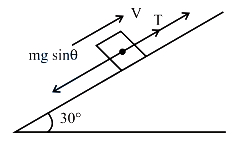
$A$ block of mass $2 \,kg$ is pulled at a constant speed with a taut rope along a frictionless plane that is inclined at $30^{\circ}$. Then the work done by the tension in the rope in pulling it a distance $4 \,m$ along the inclined plane in joule is (acceleration due to gravity $= 10 \,ms^{-2}$)
A
$40$
B
$20$
C
$68$
D
$136$
Solution
(A) Given:
Mass of the block,$m = 2 \,kg$
Angle of inclination,$\theta = 30^{\circ}$
Distance moved,$d = 4 \,m$
Acceleration due to gravity,$g = 10 \,ms^{-2}$
Since the block is pulled at a constant speed,the net force acting on the block along the inclined plane is zero.
Therefore,the tension $T$ in the rope must balance the component of the gravitational force acting down the plane:
$T = mg \sin \theta$
$T = 2 \times 10 \times \sin 30^{\circ}$
$T = 20 \times 0.5 = 10 \,N$
The work done by the tension $W$ is given by:
$W = T \times d \times \cos(0^{\circ})$
$W = 10 \,N \times 4 \,m \times 1$
$W = 40 \,J$
Mass of the block,$m = 2 \,kg$
Angle of inclination,$\theta = 30^{\circ}$
Distance moved,$d = 4 \,m$
Acceleration due to gravity,$g = 10 \,ms^{-2}$
Since the block is pulled at a constant speed,the net force acting on the block along the inclined plane is zero.
Therefore,the tension $T$ in the rope must balance the component of the gravitational force acting down the plane:
$T = mg \sin \theta$
$T = 2 \times 10 \times \sin 30^{\circ}$
$T = 20 \times 0.5 = 10 \,N$
The work done by the tension $W$ is given by:
$W = T \times d \times \cos(0^{\circ})$
$W = 10 \,N \times 4 \,m \times 1$
$W = 40 \,J$
0 likes
View Solution146
EasyMCQ
$A$ body of mass $8 \ kg$,under the action of a force,is displaced according to the equation $s = \frac{t^2}{4} \ m$,where '$t$' is the time. Find the work done by the force in the first $4 \ s$. (in $J$)
A
$9$
B
$16$
C
$6$
D
$3$
Solution
(B) Given the displacement equation: $s = \frac{t^2}{4}$.
Velocity of the body: $v = \frac{ds}{dt} = \frac{d}{dt}(\frac{t^2}{4}) = \frac{2t}{4} = \frac{t}{2} \ m/s$.
Acceleration of the body: $a = \frac{dv}{dt} = \frac{d}{dt}(\frac{t}{2}) = \frac{1}{2} \ m/s^2$.
Force acting on the body: $F = m \times a = 8 \ kg \times 0.5 \ m/s^2 = 4 \ N$.
At $t = 0 \ s$,displacement $s(0) = 0 \ m$.
At $t = 4 \ s$,displacement $s(4) = \frac{4^2}{4} = 4 \ m$.
Work done by the force: $W = F \times \Delta s = 4 \ N \times (4 \ m - 0 \ m) = 16 \ J$.
Velocity of the body: $v = \frac{ds}{dt} = \frac{d}{dt}(\frac{t^2}{4}) = \frac{2t}{4} = \frac{t}{2} \ m/s$.
Acceleration of the body: $a = \frac{dv}{dt} = \frac{d}{dt}(\frac{t}{2}) = \frac{1}{2} \ m/s^2$.
Force acting on the body: $F = m \times a = 8 \ kg \times 0.5 \ m/s^2 = 4 \ N$.
At $t = 0 \ s$,displacement $s(0) = 0 \ m$.
At $t = 4 \ s$,displacement $s(4) = \frac{4^2}{4} = 4 \ m$.
Work done by the force: $W = F \times \Delta s = 4 \ N \times (4 \ m - 0 \ m) = 16 \ J$.
0 likes
View Solution147
EasyMCQ
Work done
A
can only be positive
B
can only be negative
C
can either be positive or negative
D
cannot be assigned a sign
Solution
(C) Work done by a constant force is given by the formula:
$W = F s \cos \theta$
where $F$ is the applied force,$s$ is the displacement,and $\theta$ is the angle between the direction of force and displacement.
If $\theta = 0^{\circ}$,then $W = F s \cos 0^{\circ} = F s$ (positive).
If $\theta = 90^{\circ}$,then $W = F s \cos 90^{\circ} = 0$ (zero).
If $\theta = 180^{\circ}$,then $W = F s \cos 180^{\circ} = -F s$ (negative).
Therefore,work done can be positive,negative,or zero.
$W = F s \cos \theta$
where $F$ is the applied force,$s$ is the displacement,and $\theta$ is the angle between the direction of force and displacement.
If $\theta = 0^{\circ}$,then $W = F s \cos 0^{\circ} = F s$ (positive).
If $\theta = 90^{\circ}$,then $W = F s \cos 90^{\circ} = 0$ (zero).
If $\theta = 180^{\circ}$,then $W = F s \cos 180^{\circ} = -F s$ (negative).
Therefore,work done can be positive,negative,or zero.
0 likes
View Solution148
EasyMCQ
$A$ force $F = (5 \hat{i} + 4 \hat{j}) \text{ N}$ acts on a body and produces a displacement $s = (6 \hat{i} - 5 \hat{j} + 3 \hat{k}) \text{ m}$. The work done by the force is: (in $\text{ J}$)
A
$10$
B
$20$
C
$30$
D
$40$
Solution
(A) The work done $W$ by a constant force $F$ is given by the dot product of the force vector and the displacement vector: $W = F \cdot s$.
Given:
$F = (5 \hat{i} + 4 \hat{j}) \text{ N}$
$s = (6 \hat{i} - 5 \hat{j} + 3 \hat{k}) \text{ m}$
Substituting these values into the formula:
$W = (5 \hat{i} + 4 \hat{j} + 0 \hat{k}) \cdot (6 \hat{i} - 5 \hat{j} + 3 \hat{k})$
$W = (5 \times 6) + (4 \times -5) + (0 \times 3)$
$W = 30 - 20 + 0$
$W = 10 \text{ J}$
Therefore,the work done by the force is $10 \text{ J}$.
Given:
$F = (5 \hat{i} + 4 \hat{j}) \text{ N}$
$s = (6 \hat{i} - 5 \hat{j} + 3 \hat{k}) \text{ m}$
Substituting these values into the formula:
$W = (5 \hat{i} + 4 \hat{j} + 0 \hat{k}) \cdot (6 \hat{i} - 5 \hat{j} + 3 \hat{k})$
$W = (5 \times 6) + (4 \times -5) + (0 \times 3)$
$W = 30 - 20 + 0$
$W = 10 \text{ J}$
Therefore,the work done by the force is $10 \text{ J}$.
0 likes
View Solution149
DifficultMCQ
$A$ cyclist comes to a skidding stop in $10 \,m$. During this process,the force on the cycle due to the road is $200 \,N$ and is directly opposite to the motion. How much work does the road do on the cycle?
A
$2000 \,J$
B
$-2000 \,J$
C
$-1000 \,J$
D
$0$
Solution
(B) The displacement of the cyclist until coming to a stop is $s = 10 \,m$.
The force exerted by the road on the cycle is $F = 200 \,N$.
Since the force acts in the direction directly opposite to the motion (displacement),the angle between the force vector and the displacement vector is $\theta = 180^{\circ}$.
The work done $W$ by a constant force is given by the formula $W = F s \cos \theta$.
Substituting the given values: $W = 200 \,N \times 10 \,m \times \cos 180^{\circ}$.
Since $\cos 180^{\circ} = -1$,we get $W = 200 \times 10 \times (-1) = -2000 \,J$.
Therefore,the work done by the road on the cycle is $-2000 \,J$.
The force exerted by the road on the cycle is $F = 200 \,N$.
Since the force acts in the direction directly opposite to the motion (displacement),the angle between the force vector and the displacement vector is $\theta = 180^{\circ}$.
The work done $W$ by a constant force is given by the formula $W = F s \cos \theta$.
Substituting the given values: $W = 200 \,N \times 10 \,m \times \cos 180^{\circ}$.
Since $\cos 180^{\circ} = -1$,we get $W = 200 \times 10 \times (-1) = -2000 \,J$.
Therefore,the work done by the road on the cycle is $-2000 \,J$.
0 likes
View SolutionWork, Energy, Power and Collision — Work Done by Constant Force · Frequently Asked Questions
1Are these Work, Energy, Power and Collision questions useful for JEE and NEET?
Yes. All questions in this section are mapped to JEE Main and NEET exam patterns. Previous year questions from JEE Main, NEET, GUJCET and state-level exams are included with full solutions.
2Can I switch to Hindi or Gujarati for these questions?
Yes. Use the language tabs in the hero section or the sidebar to view the same questions and solutions in English, Hindi or Gujarati.
3How do I generate a question paper from this subtopic?
Use the Vedclass Exam Paper Generator — select the chapter and subtopic, set difficulty, and generate Sets A, B, C, D automatically. First 3 chapters of every subject are free.
Vedclass Products
For Students
Vedclass Test Series
Mock tests in real JEE/NEET style with performance analysis. 5-day free trial.
Start Free TrialFor Teachers
Exam Paper Generator
Generate Set A/B/C/D papers from this chapter in 2 minutes. 3 chapters free.
Try FreeFor Institutes
Online Exam Module
Live online exams with unlimited students, 360° analytics & white-label branding.
See DemoFor Teachers & Institutes
Generate a Work, Energy, Power and Collision Exam Paper in 2 Minutes
Select subtopic & difficulty — Sets A, B, C, D auto-generated with No Repeat logic.
First 3 chapters of every subject are free — no payment required.