
A English
Work Done by Constant Force Questions in English
Class 11 Physics · Work, Energy, Power and Collision · Work Done by Constant Force
164+
Questions
English
Language
100%
With Solutions
Showing 13 of 164 questions in English
151
EasyMCQ
$A$ man pushes a wall and fails to displace it. He does:
A
negative work
B
positive but not maximum work
C
no work at all
D
maximum work
Solution
(C) When a man pushes a wall,he does not produce any displacement in the wall.
Since the displacement $s = 0$,the work done $W$ is calculated as:
$W = F \cdot s \cdot \cos(\theta)$
$W = F \cdot 0 \cdot \cos(\theta) = 0$
Therefore,the man does no work at all.
Since the displacement $s = 0$,the work done $W$ is calculated as:
$W = F \cdot s \cdot \cos(\theta)$
$W = F \cdot 0 \cdot \cos(\theta) = 0$
Therefore,the man does no work at all.
0 likes
View Solution152
EasyMCQ
$A$ particle moves in the $x-y$ plane under the action of a force,$F = K \left[ \frac{x}{(x^2+y^2)^{3/2}} \hat{i} + \frac{y}{(x^2+y^2)^{3/2}} \hat{j} \right]$,where $K$ is a constant. The work done by the force when the particle moves from $(0, a)$ to $(a, 0)$ along a circular path of radius $a$ about the origin is:
A
$\frac{2 K \pi}{a}$
B
$\frac{K \pi}{a}$
C
$\frac{K \pi}{2 a}$
D
$0$
Solution
(D) The given force is $F = K \left[ \frac{x}{(x^2+y^2)^{3/2}} \hat{i} + \frac{y}{(x^2+y^2)^{3/2}} \hat{j} \right]$.
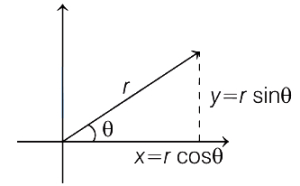
In polar coordinates,$x = r \cos \theta$ and $y = r \sin \theta$,where $r = \sqrt{x^2+y^2}$.
Substituting these into the force expression:
$F = K \left[ \frac{r \cos \theta}{r^3} \hat{i} + \frac{r \sin \theta}{r^3} \hat{j} \right] = \frac{K}{r^2} (\cos \theta \hat{i} + \sin \theta \hat{j})$.
This force is a central force directed radially outward,i.e.,$F = \frac{K}{r^2} \hat{r}$.
The work done by a central force is given by $W = \int F \cdot dr = \int \frac{K}{r^2} dr$.
Since the particle moves along a circular path of radius $a$,the distance $r$ from the origin is constant $(r = a)$.
For a circular path,the displacement vector $d\vec{l}$ is always perpendicular to the radial force vector $\vec{F}$.
Therefore,the dot product $\vec{F} \cdot d\vec{l} = 0$ at every point on the path.
Thus,the total work done $W = \int \vec{F} \cdot d\vec{l} = 0$.
In polar coordinates,$x = r \cos \theta$ and $y = r \sin \theta$,where $r = \sqrt{x^2+y^2}$.
Substituting these into the force expression:
$F = K \left[ \frac{r \cos \theta}{r^3} \hat{i} + \frac{r \sin \theta}{r^3} \hat{j} \right] = \frac{K}{r^2} (\cos \theta \hat{i} + \sin \theta \hat{j})$.
This force is a central force directed radially outward,i.e.,$F = \frac{K}{r^2} \hat{r}$.
The work done by a central force is given by $W = \int F \cdot dr = \int \frac{K}{r^2} dr$.
Since the particle moves along a circular path of radius $a$,the distance $r$ from the origin is constant $(r = a)$.
For a circular path,the displacement vector $d\vec{l}$ is always perpendicular to the radial force vector $\vec{F}$.
Therefore,the dot product $\vec{F} \cdot d\vec{l} = 0$ at every point on the path.
Thus,the total work done $W = \int \vec{F} \cdot d\vec{l} = 0$.
0 likes
View Solution153
MediumMCQ
$A$ horizontal force of $10 \ N$ is applied on a block of mass $1.5 \ kg$ which is initially at rest on a rough horizontal surface. The work done by the applied force in a time of $6 \ s$ from the beginning of the motion is (Acceleration due to gravity $= 10 \ m/s^2$; the coefficient of kinetic friction between the block and the surface is $0.2$). (in $J$)
A
$588$
B
$360$
C
$840$
D
$420$
Solution
(C) Given: Force $F = 10 \ N$,mass $m = 1.5 \ kg$,coefficient of kinetic friction $\mu_k = 0.2$,$g = 10 \ m/s^2$,initial velocity $u = 0$,time $t = 6 \ s$.
First,calculate the kinetic friction force: $f_k = \mu_k \cdot m \cdot g = 0.2 \times 1.5 \times 10 = 3 \ N$.
The net force acting on the block is $F_{net} = F - f_k = 10 - 3 = 7 \ N$.
The acceleration of the block is $a = F_{net} / m = 7 / 1.5 = 14 / 3 \ m/s^2$.
The displacement $s$ in $t = 6 \ s$ is given by $s = ut + (1/2)at^2 = 0 + (1/2) \times (14/3) \times (6)^2 = (1/2) \times (14/3) \times 36 = 7 \times 12 = 84 \ m$.
The work done by the applied force is $W = F \times s = 10 \times 84 = 840 \ J$.
First,calculate the kinetic friction force: $f_k = \mu_k \cdot m \cdot g = 0.2 \times 1.5 \times 10 = 3 \ N$.
The net force acting on the block is $F_{net} = F - f_k = 10 - 3 = 7 \ N$.
The acceleration of the block is $a = F_{net} / m = 7 / 1.5 = 14 / 3 \ m/s^2$.
The displacement $s$ in $t = 6 \ s$ is given by $s = ut + (1/2)at^2 = 0 + (1/2) \times (14/3) \times (6)^2 = (1/2) \times (14/3) \times 36 = 7 \times 12 = 84 \ m$.
The work done by the applied force is $W = F \times s = 10 \times 84 = 840 \ J$.
0 likes
View Solution154
EasyMCQ
$A$ force $F = (2 \hat{i} + 4 \hat{j}) \text{ N}$ is applied on an object of mass $M$. What is the work done by this force in moving the object horizontally along the $X$-axis by $3 \text{ m}$ (in $\text{ J}$)?
A
$2$
B
$4$
C
$6$
D
$8$
Solution
(C) The displacement of the object is along the $X$-axis by $3 \text{ m}$, so the displacement vector is $\vec{d} = 3 \hat{i} \text{ m}$.
Given the force vector is $\vec{F} = (2 \hat{i} + 4 \hat{j}) \text{ N}$.
The work done $W$ by a constant force is given by the dot product of the force vector and the displacement vector:
$W = \vec{F} \cdot \vec{d}$
$W = (2 \hat{i} + 4 \hat{j}) \cdot (3 \hat{i})$
$W = (2 \times 3)(\hat{i} \cdot \hat{i}) + (4 \times 0)(\hat{j} \cdot \hat{i})$
Since $\hat{i} \cdot \hat{i} = 1$ and $\hat{j} \cdot \hat{i} = 0$, we get:
$W = 6 \times 1 + 0 = 6 \text{ J}$.
Given the force vector is $\vec{F} = (2 \hat{i} + 4 \hat{j}) \text{ N}$.
The work done $W$ by a constant force is given by the dot product of the force vector and the displacement vector:
$W = \vec{F} \cdot \vec{d}$
$W = (2 \hat{i} + 4 \hat{j}) \cdot (3 \hat{i})$
$W = (2 \times 3)(\hat{i} \cdot \hat{i}) + (4 \times 0)(\hat{j} \cdot \hat{i})$
Since $\hat{i} \cdot \hat{i} = 1$ and $\hat{j} \cdot \hat{i} = 0$, we get:
$W = 6 \times 1 + 0 = 6 \text{ J}$.
0 likes
View Solution155
MediumMCQ
$A$ force of $4 \,N$ acts on a $10 \,kg$ body initially at rest. Let $W_1$ be the work done by the force during $0 \leq t \leq 1 \,s$. Likewise, $W_2$ is the work done by the force during $1 \,s \leq t \leq 2 \,s$, where $t$ is time in seconds. The ratio $\frac{W_2}{W_1}$ is
A
$1$
B
$2$
C
$\frac{1}{2}$
D
$3$
Solution
(D) Mass of the body, $m = 10 \,kg$. Force, $F = 4 \,N$. Acceleration produced in the body due to the applied force is $a = \frac{F}{m} = \frac{4}{10} = 0.4 \,m/s^2$.
For the interval $0 \leq t \leq 1 \,s$, the distance traveled $s_1$ is $s_1 = u t + \frac{1}{2} a t^2 = 0 + \frac{1}{2} \times 0.4 \times (1)^2 = 0.2 \,m$.
Work done $W_1 = F \times s_1 = 4 \times 0.2 = 0.8 \,J$.
For the interval $1 \,s \leq t \leq 2 \,s$, the initial velocity $v_i$ at $t = 1 \,s$ is $v_i = u + a t = 0 + 0.4 \times 1 = 0.4 \,m/s$.
The distance traveled $s_2$ during this interval $(t = 1 \,s)$ is $s_2 = v_i t + \frac{1}{2} a t^2 = 0.4 \times 1 + \frac{1}{2} \times 0.4 \times (1)^2 = 0.4 + 0.2 = 0.6 \,m$.
Work done $W_2 = F \times s_2 = 4 \times 0.6 = 2.4 \,J$.
The ratio $\frac{W_2}{W_1} = \frac{2.4}{0.8} = 3$.
For the interval $0 \leq t \leq 1 \,s$, the distance traveled $s_1$ is $s_1 = u t + \frac{1}{2} a t^2 = 0 + \frac{1}{2} \times 0.4 \times (1)^2 = 0.2 \,m$.
Work done $W_1 = F \times s_1 = 4 \times 0.2 = 0.8 \,J$.
For the interval $1 \,s \leq t \leq 2 \,s$, the initial velocity $v_i$ at $t = 1 \,s$ is $v_i = u + a t = 0 + 0.4 \times 1 = 0.4 \,m/s$.
The distance traveled $s_2$ during this interval $(t = 1 \,s)$ is $s_2 = v_i t + \frac{1}{2} a t^2 = 0.4 \times 1 + \frac{1}{2} \times 0.4 \times (1)^2 = 0.4 + 0.2 = 0.6 \,m$.
Work done $W_2 = F \times s_2 = 4 \times 0.6 = 2.4 \,J$.
The ratio $\frac{W_2}{W_1} = \frac{2.4}{0.8} = 3$.
0 likes
View Solution156
EasyMCQ
$A$ force acts on a $30 \,g$ particle in such a way that the position of the particle as a function of time is given by $x = \alpha t^2$,where $x$ is in metre,$t$ is in seconds and $\alpha = 1 \,m/s^2$. The work done during the first $4 \,s$ is (in $J$)
A
$0.96$
B
$0.45$
C
$0.49$
D
$0.53$
Solution
(A) Given,mass of particle,$m = 30 \,g = 3 \times 10^{-2} \,kg$.
The position of the particle is $x = \alpha t^2$.
Velocity $v = \frac{dx}{dt} = 2\alpha t$.
Acceleration $a = \frac{dv}{dt} = 2\alpha$.
Force $F = ma = (3 \times 10^{-2} \,kg) \times (2 \times 1 \,m/s^2) = 6 \times 10^{-2} \,N$.
Work done $W = \int F dx$. Since $x = \alpha t^2$,$dx = 2\alpha t dt$.
At $t = 0, x = 0$. At $t = 4, x = 1 \times (4)^2 = 16 \,m$.
$W = \int_{0}^{16} (6 \times 10^{-2}) dx = 6 \times 10^{-2} \times [x]_{0}^{16} = 6 \times 10^{-2} \times 16 = 0.96 \,J$.
The position of the particle is $x = \alpha t^2$.
Velocity $v = \frac{dx}{dt} = 2\alpha t$.
Acceleration $a = \frac{dv}{dt} = 2\alpha$.
Force $F = ma = (3 \times 10^{-2} \,kg) \times (2 \times 1 \,m/s^2) = 6 \times 10^{-2} \,N$.
Work done $W = \int F dx$. Since $x = \alpha t^2$,$dx = 2\alpha t dt$.
At $t = 0, x = 0$. At $t = 4, x = 1 \times (4)^2 = 16 \,m$.
$W = \int_{0}^{16} (6 \times 10^{-2}) dx = 6 \times 10^{-2} \times [x]_{0}^{16} = 6 \times 10^{-2} \times 16 = 0.96 \,J$.
0 likes
View Solution157
EasyMCQ
Consider a particle on which constant forces $F_{1}=\hat{i}+2 \hat{j}+3 \hat{k} \text{ N}$ and $F_{2}=4 \hat{i}-5 \hat{j}-2 \hat{k} \text{ N}$ act together,resulting in a displacement from position $r_{1}=20 \hat{i}+15 \hat{j} \text{ cm}$ to $r_{2}=7 \hat{k} \text{ cm}$. The total work done on the particle is:
A
$-0.48 \text{ J}$
B
$+0.48 \text{ J}$
C
$-4.8 \text{ J}$
D
$+4.8 \text{ J}$
Solution
(A) Given:
$F_{1} = (\hat{i} + 2\hat{j} + 3\hat{k}) \text{ N}$
$F_{2} = (4\hat{i} - 5\hat{j} - 2\hat{k}) \text{ N}$
$r_{1} = (20\hat{i} + 15\hat{j}) \text{ cm} = (0.2\hat{i} + 0.15\hat{j}) \text{ m}$
$r_{2} = (7\hat{k}) \text{ cm} = (0.07\hat{k}) \text{ m}$
Total force $F = F_{1} + F_{2} = (1+4)\hat{i} + (2-5)\hat{j} + (3-2)\hat{k} = (5\hat{i} - 3\hat{j} + \hat{k}) \text{ N}$.
Displacement $s = r_{2} - r_{1} = (0\hat{i} + 0\hat{j} + 0.07\hat{k}) - (0.2\hat{i} + 0.15\hat{j} + 0\hat{k}) = (-0.2\hat{i} - 0.15\hat{j} + 0.07\hat{k}) \text{ m}$.
Work done $W = F \cdot s = (5\hat{i} - 3\hat{j} + \hat{k}) \cdot (-0.2\hat{i} - 0.15\hat{j} + 0.07\hat{k})$.
$W = (5 \times -0.2) + (-3 \times -0.15) + (1 \times 0.07)$.
$W = -1.0 + 0.45 + 0.07 = -0.48 \text{ J}$.
$F_{1} = (\hat{i} + 2\hat{j} + 3\hat{k}) \text{ N}$
$F_{2} = (4\hat{i} - 5\hat{j} - 2\hat{k}) \text{ N}$
$r_{1} = (20\hat{i} + 15\hat{j}) \text{ cm} = (0.2\hat{i} + 0.15\hat{j}) \text{ m}$
$r_{2} = (7\hat{k}) \text{ cm} = (0.07\hat{k}) \text{ m}$
Total force $F = F_{1} + F_{2} = (1+4)\hat{i} + (2-5)\hat{j} + (3-2)\hat{k} = (5\hat{i} - 3\hat{j} + \hat{k}) \text{ N}$.
Displacement $s = r_{2} - r_{1} = (0\hat{i} + 0\hat{j} + 0.07\hat{k}) - (0.2\hat{i} + 0.15\hat{j} + 0\hat{k}) = (-0.2\hat{i} - 0.15\hat{j} + 0.07\hat{k}) \text{ m}$.
Work done $W = F \cdot s = (5\hat{i} - 3\hat{j} + \hat{k}) \cdot (-0.2\hat{i} - 0.15\hat{j} + 0.07\hat{k})$.
$W = (5 \times -0.2) + (-3 \times -0.15) + (1 \times 0.07)$.
$W = -1.0 + 0.45 + 0.07 = -0.48 \text{ J}$.
0 likes
View Solution158
EasyMCQ
$A$ particle moves from $(1, 0, 3)$ to the point $(-3, 4, 5)$,when a force $F = \hat{i} + 5 \hat{k}$ acts on it. The amount of work done in joules is:
A
$14$
B
$10$
C
$6$
D
$15$
Solution
(C) The initial position vector of the particle is $\vec{r}_1 = \hat{i} + 3 \hat{k}$.
The final position vector of the particle is $\vec{r}_2 = -3 \hat{i} + 4 \hat{j} + 5 \hat{k}$.
The force acting on the particle is $\vec{F} = \hat{i} + 5 \hat{k}$.
The displacement vector $\vec{s}$ is given by $\vec{r}_2 - \vec{r}_1$:
$\vec{s} = (-3 \hat{i} + 4 \hat{j} + 5 \hat{k}) - (\hat{i} + 3 \hat{k})$
$\vec{s} = -4 \hat{i} + 4 \hat{j} + 2 \hat{k}$.
Work done $W$ is the dot product of force and displacement:
$W = \vec{F} \cdot \vec{s} = (\hat{i} + 5 \hat{k}) \cdot (-4 \hat{i} + 4 \hat{j} + 2 \hat{k})$.
Calculating the dot product:
$W = (1)(-4) + (0)(4) + (5)(2)$
$W = -4 + 0 + 10 = 6 \ J$.
The final position vector of the particle is $\vec{r}_2 = -3 \hat{i} + 4 \hat{j} + 5 \hat{k}$.
The force acting on the particle is $\vec{F} = \hat{i} + 5 \hat{k}$.
The displacement vector $\vec{s}$ is given by $\vec{r}_2 - \vec{r}_1$:
$\vec{s} = (-3 \hat{i} + 4 \hat{j} + 5 \hat{k}) - (\hat{i} + 3 \hat{k})$
$\vec{s} = -4 \hat{i} + 4 \hat{j} + 2 \hat{k}$.
Work done $W$ is the dot product of force and displacement:
$W = \vec{F} \cdot \vec{s} = (\hat{i} + 5 \hat{k}) \cdot (-4 \hat{i} + 4 \hat{j} + 2 \hat{k})$.
Calculating the dot product:
$W = (1)(-4) + (0)(4) + (5)(2)$
$W = -4 + 0 + 10 = 6 \ J$.
0 likes
View Solution159
DifficultMCQ
$A$ body of mass $6 \,kg$ is under a force which causes displacement in it given by $s = \frac{t^2}{4} \,m$, where $t$ is time in seconds. The work done by the force in $2 \,s$ is: (in $\,J$)
A
$12$
B
$9$
C
$6$
D
$3$
Solution
(D) Given: Mass $m = 6 \,kg$, Displacement $s = \frac{t^2}{4} \,m$.
Velocity $v = \frac{ds}{dt} = \frac{d}{dt}(\frac{t^2}{4}) = \frac{2t}{4} = \frac{t}{2} \,m/s$.
Acceleration $a = \frac{dv}{dt} = \frac{d}{dt}(\frac{t}{2}) = \frac{1}{2} \,m/s^2$.
Force $F = m \times a = 6 \times \frac{1}{2} = 3 \,N$.
At $t = 2 \,s$, displacement $s = \frac{(2)^2}{4} = \frac{4}{4} = 1 \,m$.
Work done $W = F \times s = 3 \,N \times 1 \,m = 3 \,J$.
Velocity $v = \frac{ds}{dt} = \frac{d}{dt}(\frac{t^2}{4}) = \frac{2t}{4} = \frac{t}{2} \,m/s$.
Acceleration $a = \frac{dv}{dt} = \frac{d}{dt}(\frac{t}{2}) = \frac{1}{2} \,m/s^2$.
Force $F = m \times a = 6 \times \frac{1}{2} = 3 \,N$.
At $t = 2 \,s$, displacement $s = \frac{(2)^2}{4} = \frac{4}{4} = 1 \,m$.
Work done $W = F \times s = 3 \,N \times 1 \,m = 3 \,J$.
0 likes
View Solution160
MediumMCQ
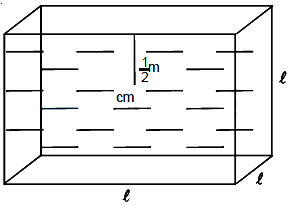
$A$ cubical vessel of height $1 \,m$ is full of water. What is the amount of work done in pumping water out of the vessel (in $\,J$)? (Take $g = 10 \,m \,s^{-2}$)
A
$1250$
B
$5000$
C
$1000$
D
$2500$
Solution
(B) To pump the water out of the vessel, we need to lift the center of mass of the water to the top level of the vessel.
Let the side length of the cube be $L = 1 \,m$.
The volume of the water is $V = L^3 = 1^3 = 1 \,m^3$.
The density of water is $\rho = 1000 \,kg/m^3$.
The mass of the water is $m = \rho V = 1000 \times 1 = 1000 \,kg$.
The center of mass of the water in a full cubical vessel is at a height of $h_{cm} = L/2 = 0.5 \,m$ from the bottom.
To pump the water out, the center of mass must be raised to the top of the vessel, which is at a height $h = L/2 = 0.5 \,m$ from the initial center of mass position.
The work done is $W = mgh = 1000 \times 10 \times 0.5 = 5000 \,J$.
Let the side length of the cube be $L = 1 \,m$.
The volume of the water is $V = L^3 = 1^3 = 1 \,m^3$.
The density of water is $\rho = 1000 \,kg/m^3$.
The mass of the water is $m = \rho V = 1000 \times 1 = 1000 \,kg$.
The center of mass of the water in a full cubical vessel is at a height of $h_{cm} = L/2 = 0.5 \,m$ from the bottom.
To pump the water out, the center of mass must be raised to the top of the vessel, which is at a height $h = L/2 = 0.5 \,m$ from the initial center of mass position.
The work done is $W = mgh = 1000 \times 10 \times 0.5 = 5000 \,J$.
0 likes
View Solution161
EasyMCQ
$A$ uniform rope of length $4 \,m$ and mass $0.4 \,kg$ is held on a frictionless table in such a way that $0.6 \,m$ of the rope is hanging over the edge. The work done to pull the hanging part of the rope onto the table is,(Assume $g = 10 \,m/s^2$) (in $\,J$)
A
$0.36$
B
$0.24$
C
$0.12$
D
$0.18$
Solution
(D) The mass per unit length of the rope is $\lambda = \frac{M}{L} = \frac{0.4 \,kg}{4 \,m} = 0.1 \,kg/m$.
The length of the hanging part is $l = 0.6 \,m$.
The mass of the hanging part is $m = \lambda \times l = 0.1 \,kg/m \times 0.6 \,m = 0.06 \,kg$.
The center of mass of the hanging part is at a distance $h = \frac{l}{2} = \frac{0.6 \,m}{2} = 0.3 \,m$ below the table edge.
The work done to pull the rope onto the table is equal to the change in potential energy of the hanging part,which is $W = mgh$.
Substituting the values: $W = 0.06 \,kg \times 10 \,m/s^2 \times 0.3 \,m = 0.18 \,J$.
The length of the hanging part is $l = 0.6 \,m$.
The mass of the hanging part is $m = \lambda \times l = 0.1 \,kg/m \times 0.6 \,m = 0.06 \,kg$.
The center of mass of the hanging part is at a distance $h = \frac{l}{2} = \frac{0.6 \,m}{2} = 0.3 \,m$ below the table edge.
The work done to pull the rope onto the table is equal to the change in potential energy of the hanging part,which is $W = mgh$.
Substituting the values: $W = 0.06 \,kg \times 10 \,m/s^2 \times 0.3 \,m = 0.18 \,J$.
0 likes
View Solution162
DifficultMCQ
$A$ body of mass $2 \ kg$ is moving along the $x$-direction such that its displacement as a function of time is given by $x(t) = \alpha t^2 + \beta t + \gamma \ m$,where $\alpha = 1 \ m/s^2$,$\beta = 1 \ m/s$,and $\gamma = 1 \ m$. The work done on the body during the time interval $t = 2 \ s$ to $t = 3 \ s$ is . . . . . . $J$.
A
$49$
B
$42$
C
$24$
D
$12$
Solution
(C) Given: $m = 2 \ kg$,$x(t) = t^2 + t + 1 \ m$.
The velocity is $v(t) = \frac{dx}{dt} = 2t + 1 \ m/s$.
The acceleration is $a(t) = \frac{dv}{dt} = 2 \ m/s^2$.
Since the acceleration is constant,the force acting on the body is $F = m \times a = 2 \ kg \times 2 \ m/s^2 = 4 \ N$.
The displacement $s$ during the interval $t = 2 \ s$ to $t = 3 \ s$ is $s = x(3) - x(2)$.
$x(3) = (3)^2 + 3 + 1 = 9 + 3 + 1 = 13 \ m$.
$x(2) = (2)^2 + 2 + 1 = 4 + 2 + 1 = 7 \ m$.
$s = 13 - 7 = 6 \ m$.
The work done is $W = F \times s = 4 \ N \times 6 \ m = 24 \ J$.
The velocity is $v(t) = \frac{dx}{dt} = 2t + 1 \ m/s$.
The acceleration is $a(t) = \frac{dv}{dt} = 2 \ m/s^2$.
Since the acceleration is constant,the force acting on the body is $F = m \times a = 2 \ kg \times 2 \ m/s^2 = 4 \ N$.
The displacement $s$ during the interval $t = 2 \ s$ to $t = 3 \ s$ is $s = x(3) - x(2)$.
$x(3) = (3)^2 + 3 + 1 = 9 + 3 + 1 = 13 \ m$.
$x(2) = (2)^2 + 2 + 1 = 4 + 2 + 1 = 7 \ m$.
$s = 13 - 7 = 6 \ m$.
The work done is $W = F \times s = 4 \ N \times 6 \ m = 24 \ J$.
0 likes
View Solution163
DifficultMCQ
$A$ $1\text{ kg}$ block subjected to two simultaneous forces $\vec{F}_1 = (2\hat{i} + 3\hat{j} + 4\hat{k})\text{ N}$ and $\vec{F}_2 = (3\hat{i} - \hat{j} - 2\hat{k})\text{ N}$ is moved a distance of $25\text{ m}$ along the $(3\hat{i} - 4\hat{j})$ direction. The work done in this process is . . . . . . $J$.
A
$25$
B
$30$
C
$35$
D
$40$
Solution
(C) The resultant force $\vec{F} = \vec{F}_1 + \vec{F}_2 = (2+3)\hat{i} + (3-1)\hat{j} + (4-2)\hat{k} = (5\hat{i} + 2\hat{j} + 2\hat{k})\text{ N}$.
The displacement vector $\vec{d}$ is along the direction $(3\hat{i} - 4\hat{j})$.
The unit vector in this direction is $\hat{u} = \frac{3\hat{i} - 4\hat{j}}{\sqrt{3^2 + (-4)^2}} = \frac{3\hat{i} - 4\hat{j}}{5}$.
Thus,the displacement vector is $\vec{d} = 25 \hat{u} = 25 \times \frac{3\hat{i} - 4\hat{j}}{5} = 5(3\hat{i} - 4\hat{j}) = (15\hat{i} - 20\hat{j})\text{ m}$.
The work done $W$ is given by the dot product of force and displacement: $W = \vec{F} \cdot \vec{d} = (5\hat{i} + 2\hat{j} + 2\hat{k}) \cdot (15\hat{i} - 20\hat{j} + 0\hat{k})$.
$W = (5 \times 15) + (2 \times -20) + (2 \times 0) = 75 - 40 = 35\text{ J}$.
The displacement vector $\vec{d}$ is along the direction $(3\hat{i} - 4\hat{j})$.
The unit vector in this direction is $\hat{u} = \frac{3\hat{i} - 4\hat{j}}{\sqrt{3^2 + (-4)^2}} = \frac{3\hat{i} - 4\hat{j}}{5}$.
Thus,the displacement vector is $\vec{d} = 25 \hat{u} = 25 \times \frac{3\hat{i} - 4\hat{j}}{5} = 5(3\hat{i} - 4\hat{j}) = (15\hat{i} - 20\hat{j})\text{ m}$.
The work done $W$ is given by the dot product of force and displacement: $W = \vec{F} \cdot \vec{d} = (5\hat{i} + 2\hat{j} + 2\hat{k}) \cdot (15\hat{i} - 20\hat{j} + 0\hat{k})$.
$W = (5 \times 15) + (2 \times -20) + (2 \times 0) = 75 - 40 = 35\text{ J}$.
0 likes
View SolutionWork, Energy, Power and Collision — Work Done by Constant Force · Frequently Asked Questions
1Are these Work, Energy, Power and Collision questions useful for JEE and NEET?
Yes. All questions in this section are mapped to JEE Main and NEET exam patterns. Previous year questions from JEE Main, NEET, GUJCET and state-level exams are included with full solutions.
2Can I switch to Hindi or Gujarati for these questions?
Yes. Use the language tabs in the hero section or the sidebar to view the same questions and solutions in English, Hindi or Gujarati.
3How do I generate a question paper from this subtopic?
Use the Vedclass Exam Paper Generator — select the chapter and subtopic, set difficulty, and generate Sets A, B, C, D automatically. First 3 chapters of every subject are free.
Vedclass Products
For Students
Vedclass Test Series
Mock tests in real JEE/NEET style with performance analysis. 5-day free trial.
Start Free TrialFor Teachers
Exam Paper Generator
Generate Set A/B/C/D papers from this chapter in 2 minutes. 3 chapters free.
Try FreeFor Institutes
Online Exam Module
Live online exams with unlimited students, 360° analytics & white-label branding.
See DemoFor Teachers & Institutes
Generate a Work, Energy, Power and Collision Exam Paper in 2 Minutes
Select subtopic & difficulty — Sets A, B, C, D auto-generated with No Repeat logic.
First 3 chapters of every subject are free — no payment required.