
A English
Work Done by Constant Force Questions in English
Class 11 Physics · Work, Energy, Power and Collision · Work Done by Constant Force
164+
Questions
English
Language
100%
With Solutions
Showing 50 of 164 questions in English
1
MediumMCQ
$A$ body,acted upon by a force of $50 \, N$,is displaced through a distance of $10 \, m$ in a direction making an angle of $60^\circ$ with the force. The work done by the force is .......... $J$.
A
$200$
B
$100$
C
$300$
D
$250$
Solution
(D) The work done $W$ by a constant force $\overrightarrow{F}$ causing a displacement $\overrightarrow{S}$ is given by the dot product: $W = \overrightarrow{F} \cdot \overrightarrow{S} = FS \cos \theta$.
Given: Force $F = 50 \, N$,displacement $S = 10 \, m$,and angle $\theta = 60^\circ$.
Substituting these values into the formula: $W = 50 \times 10 \times \cos 60^\circ$.
Since $\cos 60^\circ = 0.5$,we have $W = 500 \times 0.5 = 250 \, J$.
Given: Force $F = 50 \, N$,displacement $S = 10 \, m$,and angle $\theta = 60^\circ$.
Substituting these values into the formula: $W = 50 \times 10 \times \cos 60^\circ$.
Since $\cos 60^\circ = 0.5$,we have $W = 500 \times 0.5 = 250 \, J$.
0 likes
View Solution2
DifficultMCQ
$A$ particle moves from position $3\hat i + 2\hat j - 6\hat k$ to $14\hat i + 13\hat j + 9\hat k$ due to a uniform force of $(4\hat i + \hat j + 3\hat k) \, N$. If the displacement is in meters,the work done will be ......... $J$.
A
$100$
B
$200$
C
$300$
D
$250$
Solution
(A) The displacement vector $\vec{S}$ is given by the difference between the final position vector $\vec{r_2}$ and the initial position vector $\vec{r_1}$.
$\vec{S} = \vec{r_2} - \vec{r_1} = (14\hat i + 13\hat j + 9\hat k) - (3\hat i + 2\hat j - 6\hat k) = 11\hat i + 11\hat j + 15\hat k \, m$.
Work done $W$ is the dot product of force $\vec{F}$ and displacement $\vec{S}$.
$W = \vec{F} \cdot \vec{S} = (4\hat i + \hat j + 3\hat k) \cdot (11\hat i + 11\hat j + 15\hat k)$.
$W = (4 \times 11) + (1 \times 11) + (3 \times 15) = 44 + 11 + 45 = 100 \, J$.
$\vec{S} = \vec{r_2} - \vec{r_1} = (14\hat i + 13\hat j + 9\hat k) - (3\hat i + 2\hat j - 6\hat k) = 11\hat i + 11\hat j + 15\hat k \, m$.
Work done $W$ is the dot product of force $\vec{F}$ and displacement $\vec{S}$.
$W = \vec{F} \cdot \vec{S} = (4\hat i + \hat j + 3\hat k) \cdot (11\hat i + 11\hat j + 15\hat k)$.
$W = (4 \times 11) + (1 \times 11) + (3 \times 15) = 44 + 11 + 45 = 100 \, J$.
0 likes
View Solution3
MediumMCQ
$A$ force $\vec F = (5\hat i + 3\hat j) \text{ N}$ is applied to a particle,which displaces it from its origin to the point $\vec r = (2\hat i - 1\hat j) \text{ m}$. The work done on the particle is ........... $J$.
A
$-7$
B
$+13$
C
$+7$
D
$+11$
Solution
(C) The work done $W$ by a constant force $\vec F$ during a displacement $\vec r$ is given by the dot product of the force and displacement vectors:
$W = \vec F \cdot \vec r$
Given $\vec F = (5\hat i + 3\hat j) \text{ N}$ and $\vec r = (2\hat i - 1\hat j) \text{ m}$.
Substituting the values:
$W = (5\hat i + 3\hat j) \cdot (2\hat i - 1\hat j)$
Using the properties of unit vectors $(\hat i \cdot \hat i = 1, \hat j \cdot \hat j = 1, \hat i \cdot \hat j = 0)$:
$W = (5 \times 2) + (3 \times -1)$
$W = 10 - 3$
$W = 7 \text{ J}$.
Thus,the correct option is $C$.
$W = \vec F \cdot \vec r$
Given $\vec F = (5\hat i + 3\hat j) \text{ N}$ and $\vec r = (2\hat i - 1\hat j) \text{ m}$.
Substituting the values:
$W = (5\hat i + 3\hat j) \cdot (2\hat i - 1\hat j)$
Using the properties of unit vectors $(\hat i \cdot \hat i = 1, \hat j \cdot \hat j = 1, \hat i \cdot \hat j = 0)$:
$W = (5 \times 2) + (3 \times -1)$
$W = 10 - 3$
$W = 7 \text{ J}$.
Thus,the correct option is $C$.
0 likes
View Solution4
EasyMCQ
$A$ force $\overrightarrow{F} = 5\hat{i} + 6\hat{j} + 4\hat{k}$ acting on a body produces a displacement $\overrightarrow{S} = 6\hat{i} - 5\hat{k}$. The work done by the force is: (in $J$)
A
$10$
B
$18$
C
$11$
D
$5$
Solution
(A) The work done $W$ by a constant force $\overrightarrow{F}$ is given by the dot product of the force vector and the displacement vector $\overrightarrow{S}$.
$W = \overrightarrow{F} \cdot \overrightarrow{S}$
Given $\overrightarrow{F} = 5\hat{i} + 6\hat{j} + 4\hat{k}$ and $\overrightarrow{S} = 6\hat{i} + 0\hat{j} - 5\hat{k}$.
$W = (5\hat{i} + 6\hat{j} + 4\hat{k}) \cdot (6\hat{i} + 0\hat{j} - 5\hat{k})$
Using the property $\hat{i} \cdot \hat{i} = 1$,$\hat{j} \cdot \hat{j} = 1$,$\hat{k} \cdot \hat{k} = 1$ and cross-terms are $0$:
$W = (5 \times 6) + (6 \times 0) + (4 \times -5)$
$W = 30 + 0 - 20$
$W = 10 \ J$.
$W = \overrightarrow{F} \cdot \overrightarrow{S}$
Given $\overrightarrow{F} = 5\hat{i} + 6\hat{j} + 4\hat{k}$ and $\overrightarrow{S} = 6\hat{i} + 0\hat{j} - 5\hat{k}$.
$W = (5\hat{i} + 6\hat{j} + 4\hat{k}) \cdot (6\hat{i} + 0\hat{j} - 5\hat{k})$
Using the property $\hat{i} \cdot \hat{i} = 1$,$\hat{j} \cdot \hat{j} = 1$,$\hat{k} \cdot \hat{k} = 1$ and cross-terms are $0$:
$W = (5 \times 6) + (6 \times 0) + (4 \times -5)$
$W = 30 + 0 - 20$
$W = 10 \ J$.
0 likes
View Solution5
EasyMCQ
$A$ body,constrained to move in the $Y$-direction,is subjected to a force given by $\vec{F} = (-2\hat{i} + 15\hat{j} + 6\hat{k})\,N$. What is the work done by this force in moving the body a distance $10\,m$ along the $Y$-axis?
A
$20$
B
$150$
C
$160$
D
$190$
Solution
(B) The work done $W$ by a constant force $\vec{F}$ during a displacement $\vec{r}$ is given by the dot product: $W = \vec{F} \cdot \vec{r}$.
Given the force $\vec{F} = (-2\hat{i} + 15\hat{j} + 6\hat{k})\,N$.
The displacement is $10\,m$ along the $Y$-axis,so $\vec{r} = 10\hat{j}\,m$.
Substituting these into the formula:
$W = (-2\hat{i} + 15\hat{j} + 6\hat{k}) \cdot (10\hat{j})$
$W = (-2 \times 0) + (15 \times 10) + (6 \times 0)$
$W = 0 + 150 + 0 = 150\,J$.
Therefore,the work done is $150\,J$.
Given the force $\vec{F} = (-2\hat{i} + 15\hat{j} + 6\hat{k})\,N$.
The displacement is $10\,m$ along the $Y$-axis,so $\vec{r} = 10\hat{j}\,m$.
Substituting these into the formula:
$W = (-2\hat{i} + 15\hat{j} + 6\hat{k}) \cdot (10\hat{j})$
$W = (-2 \times 0) + (15 \times 10) + (6 \times 0)$
$W = 0 + 150 + 0 = 150\,J$.
Therefore,the work done is $150\,J$.
0 likes
View Solution6
EasyMCQ
If force $\overrightarrow F = 4\hat i + 5\hat j$ and displacement $\overrightarrow s = 3\hat i + 6\hat k$, then the work done is: (in $\text{ J}$)
A
$12$
B
$30$
C
$18$
D
$24$
Solution
(A) Work done $W$ is defined as the dot product of force $\overrightarrow F$ and displacement $\overrightarrow s$.
$W = \overrightarrow F \cdot \overrightarrow s$
Given $\overrightarrow F = 4\hat i + 5\hat j$ and $\overrightarrow s = 3\hat i + 6\hat k$.
$W = (4\hat i + 5\hat j) \cdot (3\hat i + 6\hat k)$
Using the properties of unit vectors $\hat i \cdot \hat i = 1$, $\hat j \cdot \hat j = 1$, $\hat k \cdot \hat k = 1$, and $\hat i \cdot \hat j = \hat j \cdot \hat k = \hat k \cdot \hat i = 0$:
$W = (4 \times 3)(\hat i \cdot \hat i) + (4 \times 6)(\hat i \cdot \hat k) + (5 \times 3)(\hat j \cdot \hat i) + (5 \times 6)(\hat j \cdot \hat k)$
$W = 12(1) + 0 + 0 + 0 = 12 \text{ J}$.
$W = \overrightarrow F \cdot \overrightarrow s$
Given $\overrightarrow F = 4\hat i + 5\hat j$ and $\overrightarrow s = 3\hat i + 6\hat k$.
$W = (4\hat i + 5\hat j) \cdot (3\hat i + 6\hat k)$
Using the properties of unit vectors $\hat i \cdot \hat i = 1$, $\hat j \cdot \hat j = 1$, $\hat k \cdot \hat k = 1$, and $\hat i \cdot \hat j = \hat j \cdot \hat k = \hat k \cdot \hat i = 0$:
$W = (4 \times 3)(\hat i \cdot \hat i) + (4 \times 6)(\hat i \cdot \hat k) + (5 \times 3)(\hat j \cdot \hat i) + (5 \times 6)(\hat j \cdot \hat k)$
$W = 12(1) + 0 + 0 + 0 = 12 \text{ J}$.
0 likes
View Solution7
MediumMCQ
$A$ force $\vec F = 3\hat i + c\hat j + 2\hat k$ acting on a particle causes a displacement $\vec S = - 4\hat i + 2\hat j - 3\hat k$. If the work done is $6 \ J$,then the value of $c$ will be:
A
$12$
B
$6$
C
$1$
D
$0$
Solution
(A) The work done $W$ by a force $\vec F$ during a displacement $\vec S$ is given by the dot product: $W = \vec F \cdot \vec S$.
Given $\vec F = 3\hat i + c\hat j + 2\hat k$ and $\vec S = -4\hat i + 2\hat j - 3\hat k$.
Substituting these into the formula: $W = (3\hat i + c\hat j + 2\hat k) \cdot (-4\hat i + 2\hat j - 3\hat k)$.
Calculating the dot product: $W = (3)(-4) + (c)(2) + (2)(-3) = -12 + 2c - 6 = 2c - 18$.
Given that the work done $W = 6 \ J$,we set up the equation: $2c - 18 = 6$.
Adding $18$ to both sides: $2c = 24$.
Dividing by $2$: $c = 12$.
Given $\vec F = 3\hat i + c\hat j + 2\hat k$ and $\vec S = -4\hat i + 2\hat j - 3\hat k$.
Substituting these into the formula: $W = (3\hat i + c\hat j + 2\hat k) \cdot (-4\hat i + 2\hat j - 3\hat k)$.
Calculating the dot product: $W = (3)(-4) + (c)(2) + (2)(-3) = -12 + 2c - 6 = 2c - 18$.
Given that the work done $W = 6 \ J$,we set up the equation: $2c - 18 = 6$.
Adding $18$ to both sides: $2c = 24$.
Dividing by $2$: $c = 12$.
0 likes
View Solution8
MediumMCQ
$A$ force $\vec F = (5\hat i + 3\hat j) \ N$ is applied to a particle,which displaces it from its original position to the point $\vec s = (2\hat i - 1\hat j) \ m$. The work done on the particle is ......... $J$.
A
$+ 11$
B
$+ 7$
C
$+ 13$
D
$- 7$
Solution
(B) The work done $W$ by a constant force $\vec F$ during a displacement $\vec s$ is given by the dot product of the force and displacement vectors:
$W = \vec F \cdot \vec s$
Given $\vec F = (5\hat i + 3\hat j) \ N$ and $\vec s = (2\hat i - 1\hat j) \ m$.
$W = (5\hat i + 3\hat j) \cdot (2\hat i - 1\hat j)$
Using the dot product properties $\hat i \cdot \hat i = 1$,$\hat j \cdot \hat j = 1$,and $\hat i \cdot \hat j = 0$:
$W = (5 \times 2) + (3 \times -1)$
$W = 10 - 3$
$W = 7 \ J$
Therefore,the correct option is $B$.
$W = \vec F \cdot \vec s$
Given $\vec F = (5\hat i + 3\hat j) \ N$ and $\vec s = (2\hat i - 1\hat j) \ m$.
$W = (5\hat i + 3\hat j) \cdot (2\hat i - 1\hat j)$
Using the dot product properties $\hat i \cdot \hat i = 1$,$\hat j \cdot \hat j = 1$,and $\hat i \cdot \hat j = 0$:
$W = (5 \times 2) + (3 \times -1)$
$W = 10 - 3$
$W = 7 \ J$
Therefore,the correct option is $B$.
0 likes
View Solution9
EasyMCQ
$A$ sphere of mass $m$ is tied to one end of a string of length $l$ and rotated through the other end along a horizontal circular path with speed $v$. The work done in a full horizontal circle is
A
$0$
B
$\left( \frac{mv^2}{l} \right) \cdot 2\pi l$
C
$mg \cdot 2\pi l$
D
$\left( \frac{mv^2}{l} \right) \cdot l$
Solution
(A) In a horizontal circular motion,the centripetal force acts towards the center of the circle,while the displacement of the sphere at any instant is along the tangent to the circular path.
Since the centripetal force is always perpendicular to the direction of displacement (velocity vector),the angle $\theta$ between the force and the displacement is $90^{\circ}$.
The work done $W$ is given by the formula $W = F \cdot s \cdot \cos(\theta)$.
Since $\cos(90^{\circ}) = 0$,the work done by the centripetal force in one full horizontal circle is $0$.
Since the centripetal force is always perpendicular to the direction of displacement (velocity vector),the angle $\theta$ between the force and the displacement is $90^{\circ}$.
The work done $W$ is given by the formula $W = F \cdot s \cdot \cos(\theta)$.
Since $\cos(90^{\circ}) = 0$,the work done by the centripetal force in one full horizontal circle is $0$.
0 likes
View Solution10
EasyMCQ
$A$ body of mass $100 \, g$ is rotating in a circular path of radius $r$ with constant velocity. The work done in one complete revolution is
A
$100 \, r \, J$
B
$(r/100) \, J$
C
$(100/r) \, J$
D
Zero
Solution
(D) The work done by a force is given by the formula $W = \vec{F} \cdot \vec{d} = F d \cos \theta$,where $\theta$ is the angle between the force and the displacement.
In uniform circular motion,the centripetal force acts towards the center of the circle,while the instantaneous displacement is along the tangent to the circular path.
Since the radius vector is always perpendicular to the tangent,the angle between the centripetal force and the displacement is always $90^\circ$.
Therefore,the work done in any small displacement is $dW = F \cdot ds \cdot \cos(90^\circ) = 0$.
Consequently,the total work done in one complete revolution is $0 \, J$.
In uniform circular motion,the centripetal force acts towards the center of the circle,while the instantaneous displacement is along the tangent to the circular path.
Since the radius vector is always perpendicular to the tangent,the angle between the centripetal force and the displacement is always $90^\circ$.
Therefore,the work done in any small displacement is $dW = F \cdot ds \cdot \cos(90^\circ) = 0$.
Consequently,the total work done in one complete revolution is $0 \, J$.
0 likes
View Solution11
MediumMCQ
$A$ ship of mass $3 \times 10^7 \, kg$ initially at rest is pulled by a force of $5 \times 10^4 \, N$ through a distance of $3 \, m$. Assuming that the resistance due to water is negligible,the speed of the ship is ........... $m/s$.
A
$1.5$
B
$60$
C
$0.1$
D
$5$
Solution
(C) Given: Mass $m = 3 \times 10^7 \, kg$,Force $F = 5 \times 10^4 \, N$,Distance $s = 3 \, m$,Initial velocity $u = 0$.
According to Newton's second law,acceleration $a = \frac{F}{m} = \frac{5 \times 10^4}{3 \times 10^7} = \frac{5}{3} \times 10^{-3} \, m/s^2$.
Using the kinematic equation $v^2 - u^2 = 2as$:
$v^2 = 0^2 + 2 \times \left( \frac{5 \times 10^4}{3 \times 10^7} \right) \times 3$.
$v^2 = 2 \times \left( \frac{5}{3} \times 10^{-3} \right) \times 3 = 10 \times 10^{-3} = 10^{-2}$.
$v = \sqrt{10^{-2}} = 0.1 \, m/s$.
According to Newton's second law,acceleration $a = \frac{F}{m} = \frac{5 \times 10^4}{3 \times 10^7} = \frac{5}{3} \times 10^{-3} \, m/s^2$.
Using the kinematic equation $v^2 - u^2 = 2as$:
$v^2 = 0^2 + 2 \times \left( \frac{5 \times 10^4}{3 \times 10^7} \right) \times 3$.
$v^2 = 2 \times \left( \frac{5}{3} \times 10^{-3} \right) \times 3 = 10 \times 10^{-3} = 10^{-2}$.
$v = \sqrt{10^{-2}} = 0.1 \, m/s$.
0 likes
View Solution12
EasyMCQ
$A$ body moves a distance of $10 \, m$ along a straight line under the action of a force of $5 \, N$. If the work done is $25 \, J$,the angle which the force makes with the direction of motion of the body is.....$^o$
A
$0$
B
$30$
C
$60$
D
$90$
Solution
(C) The formula for work done is given by $W = Fs \cos \theta$,where $W$ is work,$F$ is force,$s$ is displacement,and $\theta$ is the angle between the force and the direction of motion.
Given: $W = 25 \, J$,$F = 5 \, N$,and $s = 10 \, m$.
Substituting the values into the formula:
$25 = 5 \times 10 \times \cos \theta$
$25 = 50 \times \cos \theta$
$\cos \theta = \frac{25}{50} = \frac{1}{2}$
Since $\cos 60^\circ = \frac{1}{2}$,the angle $\theta = 60^\circ$.
Given: $W = 25 \, J$,$F = 5 \, N$,and $s = 10 \, m$.
Substituting the values into the formula:
$25 = 5 \times 10 \times \cos \theta$
$25 = 50 \times \cos \theta$
$\cos \theta = \frac{25}{50} = \frac{1}{2}$
Since $\cos 60^\circ = \frac{1}{2}$,the angle $\theta = 60^\circ$.
1 likes
View Solution13
EasyMCQ
You lift a heavy book from the floor of the room and keep it in the bookshelf having a height of $2 \, m$. In this process,you take $5 \, s$. The work done by you will depend upon:
A
Mass of the book and time taken
B
Weight of the book and height of the bookshelf
C
Height of the bookshelf and time taken
D
Mass of the book,height of the bookshelf,and time taken
Solution
(B) The work done $(W)$ by an external force in lifting an object against gravity is given by the formula: $W = mgh$.
Here,$m$ is the mass of the object,$g$ is the acceleration due to gravity,and $h$ is the vertical displacement (height).
Since the weight of the book is $W_b = mg$,the work done can be expressed as $W = W_b \times h$.
Therefore,the work done depends only on the weight of the book and the height of the bookshelf.
It does not depend on the time taken to perform the work,as time is a factor in calculating power,not work.
Here,$m$ is the mass of the object,$g$ is the acceleration due to gravity,and $h$ is the vertical displacement (height).
Since the weight of the book is $W_b = mg$,the work done can be expressed as $W = W_b \times h$.
Therefore,the work done depends only on the weight of the book and the height of the bookshelf.
It does not depend on the time taken to perform the work,as time is a factor in calculating power,not work.
0 likes
View Solution14
EasyMCQ
$A$ body of mass $m$ kg is lifted by a man to a height of one metre in $30\, s$. Another man lifts the same mass to the same height in $60\, s$. The work done by them are in the ratio:
A
$1:2$
B
$1:1$
C
$2:1$
D
$4:1$
Solution
(B) The work done $W$ in lifting a body of mass $m$ to a height $h$ is given by the formula $W = mgh$.
Here,the mass $m$ and the height $h$ are the same for both men.
Since work done is independent of the time taken to perform the task,the work done by both men is equal.
Therefore,the ratio of the work done is $W_1 : W_2 = mgh : mgh = 1:1$.
Here,the mass $m$ and the height $h$ are the same for both men.
Since work done is independent of the time taken to perform the task,the work done by both men is equal.
Therefore,the ratio of the work done is $W_1 : W_2 = mgh : mgh = 1:1$.
0 likes
View Solution15
EasyMCQ
$A$ force $F = (5\hat i + 3\hat j) \, N$ is applied to a particle,which displaces it from its origin to the point $r = (2\hat i - 1\hat j) \, m$. The work done on the particle is:
A
$-7 \, J$
B
$+ 13 \, J$
C
$+ 7 \, J$
D
$+ 11 \, J$
Solution
(C) The work done $W$ by a constant force $\overrightarrow F$ during a displacement $\overrightarrow s$ is given by the dot product: $W = \overrightarrow F \cdot \overrightarrow s$.
Given: $\overrightarrow F = (5\hat i + 3\hat j) \, N$ and $\overrightarrow s = (2\hat i - 1\hat j) \, m$.
Substituting the values: $W = (5\hat i + 3\hat j) \cdot (2\hat i - 1\hat j)$.
Using the dot product property $\hat i \cdot \hat i = 1$ and $\hat i \cdot \hat j = 0$:
$W = (5 \times 2) + (3 \times -1) = 10 - 3 = 7 \, J$.
Given: $\overrightarrow F = (5\hat i + 3\hat j) \, N$ and $\overrightarrow s = (2\hat i - 1\hat j) \, m$.
Substituting the values: $W = (5\hat i + 3\hat j) \cdot (2\hat i - 1\hat j)$.
Using the dot product property $\hat i \cdot \hat i = 1$ and $\hat i \cdot \hat j = 0$:
$W = (5 \times 2) + (3 \times -1) = 10 - 3 = 7 \, J$.
0 likes
View Solution16
EasyMCQ
$A$ body of mass $10\, kg$ is dropped to the ground from a height of $10\, m$. The work done by the gravitational force is ............. $J$ $(g = 9.8\, m/s^2)$.
A
$-490$
B
$+490$
C
$-980$
D
$+980$
Solution
(D) The work done by a constant force is given by the formula $W = F \cdot s \cdot \cos(\theta)$.
Here,the gravitational force $F = mg$ acts downwards,and the displacement $s = h$ is also in the downward direction.
Since the force and displacement are in the same direction,the angle $\theta = 0^\circ$,and $\cos(0^\circ) = 1$.
Therefore,the work done is $W = mgh$.
Given $m = 10\, kg$,$g = 9.8\, m/s^2$,and $h = 10\, m$.
$W = 10 \times 9.8 \times 10 = 980\, J$.
Since the body moves in the direction of the gravitational force,the work done is positive.
Here,the gravitational force $F = mg$ acts downwards,and the displacement $s = h$ is also in the downward direction.
Since the force and displacement are in the same direction,the angle $\theta = 0^\circ$,and $\cos(0^\circ) = 1$.
Therefore,the work done is $W = mgh$.
Given $m = 10\, kg$,$g = 9.8\, m/s^2$,and $h = 10\, m$.
$W = 10 \times 9.8 \times 10 = 980\, J$.
Since the body moves in the direction of the gravitational force,the work done is positive.
0 likes
View Solution17
EasyMCQ
Which of the following is a scalar quantity?
A
Displacement
B
Electric field
C
Acceleration
D
Work
Solution
(D) The correct answer is $(d)$.
Work is defined as the dot product of force and displacement, represented as $W = \vec{F} \cdot \vec{s}$.
Since the dot product of two vectors always results in a scalar, work is a scalar quantity.
Displacement, electric field, and acceleration are all vector quantities because they possess both magnitude and direction.
Work is defined as the dot product of force and displacement, represented as $W = \vec{F} \cdot \vec{s}$.
Since the dot product of two vectors always results in a scalar, work is a scalar quantity.
Displacement, electric field, and acceleration are all vector quantities because they possess both magnitude and direction.
0 likes
View Solution18
EasyMCQ
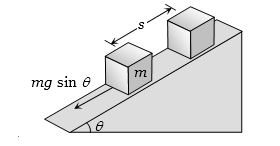
The work done in pulling up a block of wood weighing $2 \, kN$ for a length of $10 \, m$ on a smooth plane inclined at an angle of $15^\circ$ with the horizontal is ............. $kJ$.
A
$4.36$
B
$5.17$
C
$8.91$
D
$9.82$
Solution
(B) The force required to pull the block up the smooth inclined plane at a constant velocity is equal to the component of the gravitational force acting down the plane,which is $F = mg \sin \theta$.
Given that the weight of the block $mg = 2 \, kN = 2000 \, N$,the length of the plane $s = 10 \, m$,and the angle of inclination $\theta = 15^\circ$.
The work done $W$ is given by the product of the force and the displacement: $W = F \times s = (mg \sin \theta) \times s$.
Substituting the values: $W = 2000 \times \sin(15^\circ) \times 10$.
Since $\sin(15^\circ) \approx 0.2588$,we get $W = 2000 \times 0.2588 \times 10 = 5176 \, J$.
Converting to kilojoules: $W = 5.176 \, kJ \approx 5.17 \, kJ$.
Given that the weight of the block $mg = 2 \, kN = 2000 \, N$,the length of the plane $s = 10 \, m$,and the angle of inclination $\theta = 15^\circ$.
The work done $W$ is given by the product of the force and the displacement: $W = F \times s = (mg \sin \theta) \times s$.
Substituting the values: $W = 2000 \times \sin(15^\circ) \times 10$.
Since $\sin(15^\circ) \approx 0.2588$,we get $W = 2000 \times 0.2588 \times 10 = 5176 \, J$.
Converting to kilojoules: $W = 5.176 \, kJ \approx 5.17 \, kJ$.
0 likes
View Solution19
EasyMCQ
$A$ force $\vec F = 5\hat i + 6\hat j - 4\hat k$ acting on a body produces a displacement $\vec s = 6\hat i + 5\hat k$. The work done by the force is $......$ units.
A
$18$
B
$15$
C
$12$
D
$10$
Solution
(D) The work done $W$ by a constant force $\vec F$ during a displacement $\vec s$ is given by the dot product of the force and displacement vectors:
$W = \vec F \cdot \vec s$
Given $\vec F = 5\hat i + 6\hat j - 4\hat k$ and $\vec s = 6\hat i + 0\hat j + 5\hat k$.
$W = (5\hat i + 6\hat j - 4\hat k) \cdot (6\hat i + 0\hat j + 5\hat k)$
$W = (5 \times 6) + (6 \times 0) + (-4 \times 5)$
$W = 30 + 0 - 20$
$W = 10 \text{ units}$.
$W = \vec F \cdot \vec s$
Given $\vec F = 5\hat i + 6\hat j - 4\hat k$ and $\vec s = 6\hat i + 0\hat j + 5\hat k$.
$W = (5\hat i + 6\hat j - 4\hat k) \cdot (6\hat i + 0\hat j + 5\hat k)$
$W = (5 \times 6) + (6 \times 0) + (-4 \times 5)$
$W = 30 + 0 - 20$
$W = 10 \text{ units}$.
0 likes
View Solution20
DifficultMCQ
$A$ force of $5 \, N$ acts on a $15 \, kg$ body initially at rest. The work done by the force during the first second of motion of the body is
A
$5 \, J$
B
$\frac{5}{6} \, J$
C
$6 \, J$
D
$75 \, J$
Solution
(B) Given: Force $F = 5 \, N$,mass $m = 15 \, kg$,initial velocity $u = 0$,time $t = 1 \, s$.
First,calculate the acceleration $a$ using Newton's second law: $a = \frac{F}{m} = \frac{5}{15} = \frac{1}{3} \, m/s^2$.
Next,calculate the displacement $s$ in the first second using the equation of motion: $s = ut + \frac{1}{2}at^2 = 0(1) + \frac{1}{2} \times \frac{1}{3} \times (1)^2 = \frac{1}{6} \, m$.
Finally,calculate the work done $W$ using the formula $W = F \times s$: $W = 5 \times \frac{1}{6} = \frac{5}{6} \, J$.
First,calculate the acceleration $a$ using Newton's second law: $a = \frac{F}{m} = \frac{5}{15} = \frac{1}{3} \, m/s^2$.
Next,calculate the displacement $s$ in the first second using the equation of motion: $s = ut + \frac{1}{2}at^2 = 0(1) + \frac{1}{2} \times \frac{1}{3} \times (1)^2 = \frac{1}{6} \, m$.
Finally,calculate the work done $W$ using the formula $W = F \times s$: $W = 5 \times \frac{1}{6} = \frac{5}{6} \, J$.
0 likes
View Solution21
EasyMCQ
The work done against gravity in taking a $10 \, kg$ mass to a $1 \, m$ height in $1 \, s$ will be .... $J$.
A
$49$
B
$98$
C
$196$
D
None of these
Solution
(B) The work done against gravity is given by the formula $W = mgh$.
Here,mass $m = 10 \, kg$,acceleration due to gravity $g = 9.8 \, m/s^2$,and height $h = 1 \, m$.
Substituting the values,we get $W = 10 \times 9.8 \times 1 = 98 \, J$.
The time taken is irrelevant for calculating the work done against gravity.
Therefore,the correct option is $B$.
Here,mass $m = 10 \, kg$,acceleration due to gravity $g = 9.8 \, m/s^2$,and height $h = 1 \, m$.
Substituting the values,we get $W = 10 \times 9.8 \times 1 = 98 \, J$.
The time taken is irrelevant for calculating the work done against gravity.
Therefore,the correct option is $B$.
0 likes
View Solution22
MediumMCQ
$A$ body of mass $6\,kg$ is under a force which causes displacement in it given by $S = \frac{t^2}{4}$ metres, where $t$ is time. The work done by the force in $2\,seconds$ is ............... $J$.
A
$12$
B
$9$
C
$6$
D
$3$
Solution
(D) Given displacement $S = \frac{t^2}{4}$.
Velocity $v = \frac{dS}{dt} = \frac{d}{dt}\left(\frac{t^2}{4}\right) = \frac{2t}{4} = \frac{t}{2} \, m/s$.
Acceleration $a = \frac{dv}{dt} = \frac{d}{dt}\left(\frac{t}{2}\right) = \frac{1}{2} \, m/s^2$.
Force $F = m \cdot a = 6 \times \frac{1}{2} = 3 \, N$.
Work done $W = \int F \, dS = \int_0^2 F \cdot v \, dt = \int_0^2 3 \cdot \frac{t}{2} \, dt$.
$W = \frac{3}{2} \int_0^2 t \, dt = \frac{3}{2} \left[ \frac{t^2}{2} \right]_0^2 = \frac{3}{4} [4 - 0] = 3 \, J$.
Velocity $v = \frac{dS}{dt} = \frac{d}{dt}\left(\frac{t^2}{4}\right) = \frac{2t}{4} = \frac{t}{2} \, m/s$.
Acceleration $a = \frac{dv}{dt} = \frac{d}{dt}\left(\frac{t}{2}\right) = \frac{1}{2} \, m/s^2$.
Force $F = m \cdot a = 6 \times \frac{1}{2} = 3 \, N$.
Work done $W = \int F \, dS = \int_0^2 F \cdot v \, dt = \int_0^2 3 \cdot \frac{t}{2} \, dt$.
$W = \frac{3}{2} \int_0^2 t \, dt = \frac{3}{2} \left[ \frac{t^2}{2} \right]_0^2 = \frac{3}{4} [4 - 0] = 3 \, J$.
0 likes
View Solution23
EasyMCQ
$A$ force of $(3\,\hat i + 4\,\hat j) \, N$ acts on a body and displaces it by $(3\,\hat i + 4\,\hat j) \, m$. The work done by the force is .............. $J$.
A
$10$
B
$12$
C
$16$
D
$25$
Solution
(D) The work done $W$ by a constant force $\overrightarrow{F}$ during a displacement $\overrightarrow{s}$ is given by the dot product of the force and displacement vectors:
$W = \overrightarrow{F} \cdot \overrightarrow{s}$
Given:
$\overrightarrow{F} = (3\,\hat{i} + 4\,\hat{j}) \, N$
$\overrightarrow{s} = (3\,\hat{i} + 4\,\hat{j}) \, m$
Substituting the values:
$W = (3\,\hat{i} + 4\,\hat{j}) \cdot (3\,\hat{i} + 4\,\hat{j})$
Using the dot product property $\hat{i} \cdot \hat{i} = 1$,$\hat{j} \cdot \hat{j} = 1$,and $\hat{i} \cdot \hat{j} = 0$:
$W = (3 \times 3) + (4 \times 4)$
$W = 9 + 16$
$W = 25 \, J$
$W = \overrightarrow{F} \cdot \overrightarrow{s}$
Given:
$\overrightarrow{F} = (3\,\hat{i} + 4\,\hat{j}) \, N$
$\overrightarrow{s} = (3\,\hat{i} + 4\,\hat{j}) \, m$
Substituting the values:
$W = (3\,\hat{i} + 4\,\hat{j}) \cdot (3\,\hat{i} + 4\,\hat{j})$
Using the dot product property $\hat{i} \cdot \hat{i} = 1$,$\hat{j} \cdot \hat{j} = 1$,and $\hat{i} \cdot \hat{j} = 0$:
$W = (3 \times 3) + (4 \times 4)$
$W = 9 + 16$
$W = 25 \, J$
0 likes
View Solution24
MediumMCQ
$A$ $50\,kg$ man with a $20\,kg$ load on his head climbs up $20$ steps of $0.25\,m$ height each. The work done in climbing is......$J$
A
$5$
B
$350$
C
$100$
D
$3430$
Solution
(D) The total mass $m$ being lifted is the sum of the man's mass and the load: $m = 50\,kg + 20\,kg = 70\,kg$.
The total height $h$ climbed is the number of steps multiplied by the height of each step: $h = 20 \times 0.25\,m = 5\,m$.
The work done $W$ against gravity is given by the formula $W = mgh$,where $g$ is the acceleration due to gravity $(g \approx 9.8\,m/s^2)$.
Substituting the values: $W = 70\,kg \times 9.8\,m/s^2 \times 5\,m = 3430\,J$.
The total height $h$ climbed is the number of steps multiplied by the height of each step: $h = 20 \times 0.25\,m = 5\,m$.
The work done $W$ against gravity is given by the formula $W = mgh$,where $g$ is the acceleration due to gravity $(g \approx 9.8\,m/s^2)$.
Substituting the values: $W = 70\,kg \times 9.8\,m/s^2 \times 5\,m = 3430\,J$.
0 likes
View Solution25
EasyMCQ
$A$ force $\overrightarrow{F} = 6\hat{i} + 2\hat{j} - 3\hat{k}$ acts on a particle and produces a displacement of $\overrightarrow{s} = 2\hat{i} - 3\hat{j} + x\hat{k}$. If the work done is zero,the value of $x$ is
A
$-2$
B
$0.5$
C
$6$
D
$2$
Solution
(D) The work done $W$ by a force $\overrightarrow{F}$ during a displacement $\overrightarrow{s}$ is given by the dot product: $W = \overrightarrow{F} \cdot \overrightarrow{s}$.
Given $\overrightarrow{F} = 6\hat{i} + 2\hat{j} - 3\hat{k}$ and $\overrightarrow{s} = 2\hat{i} - 3\hat{j} + x\hat{k}$.
Since the work done is zero,we have $W = 0$.
Substituting the vectors into the dot product formula:
$(6\hat{i} + 2\hat{j} - 3\hat{k}) \cdot (2\hat{i} - 3\hat{j} + x\hat{k}) = 0$
Calculating the dot product:
$(6 \times 2) + (2 \times -3) + (-3 \times x) = 0$
$12 - 6 - 3x = 0$
$6 - 3x = 0$
$3x = 6$
$x = 2$.
Given $\overrightarrow{F} = 6\hat{i} + 2\hat{j} - 3\hat{k}$ and $\overrightarrow{s} = 2\hat{i} - 3\hat{j} + x\hat{k}$.
Since the work done is zero,we have $W = 0$.
Substituting the vectors into the dot product formula:
$(6\hat{i} + 2\hat{j} - 3\hat{k}) \cdot (2\hat{i} - 3\hat{j} + x\hat{k}) = 0$
Calculating the dot product:
$(6 \times 2) + (2 \times -3) + (-3 \times x) = 0$
$12 - 6 - 3x = 0$
$6 - 3x = 0$
$3x = 6$
$x = 2$.
0 likes
View Solution26
MediumMCQ
$A$ particle moves from position $\vec{r}_1 = 3\hat{i} + 2\hat{j} - 6\hat{k}$ to position $\vec{r}_2 = 14\hat{i} + 13\hat{j} + 9\hat{k}$ under the action of force $\vec{F} = 4\hat{i} + \hat{j} + 3\hat{k} \text{ N}$. The work done will be ............ $\text{J}$.
A
$100$
B
$50$
C
$200$
D
$75$
Solution
(A) The displacement $\vec{d}$ is given by $\vec{d} = \vec{r}_2 - \vec{r}_1$.
$\vec{d} = (14\hat{i} + 13\hat{j} + 9\hat{k}) - (3\hat{i} + 2\hat{j} - 6\hat{k}) = 11\hat{i} + 11\hat{j} + 15\hat{k}$.
The work done $W$ is the dot product of force and displacement: $W = \vec{F} \cdot \vec{d}$.
$W = (4\hat{i} + \hat{j} + 3\hat{k}) \cdot (11\hat{i} + 11\hat{j} + 15\hat{k})$.
$W = (4 \times 11) + (1 \times 11) + (3 \times 15) = 44 + 11 + 45 = 100 \text{ J}$.
$\vec{d} = (14\hat{i} + 13\hat{j} + 9\hat{k}) - (3\hat{i} + 2\hat{j} - 6\hat{k}) = 11\hat{i} + 11\hat{j} + 15\hat{k}$.
The work done $W$ is the dot product of force and displacement: $W = \vec{F} \cdot \vec{d}$.
$W = (4\hat{i} + \hat{j} + 3\hat{k}) \cdot (11\hat{i} + 11\hat{j} + 15\hat{k})$.
$W = (4 \times 11) + (1 \times 11) + (3 \times 15) = 44 + 11 + 45 = 100 \text{ J}$.
0 likes
View Solution27
MediumMCQ
$A$ force $\vec{F} = 3\hat{i} + c\hat{j} + 2\hat{k}$ acting on a particle causes a displacement $\vec{s} = -4\hat{i} + 2\hat{j} + 3\hat{k}$. If the work done is $6\,J$,then the value of $c$ is:
A
$0$
B
$1$
C
$6$
D
$12$
Solution
(C) The work done $W$ by a constant force $\vec{F}$ during a displacement $\vec{s}$ is given by the dot product: $W = \vec{F} \cdot \vec{s}$.
Given $\vec{F} = 3\hat{i} + c\hat{j} + 2\hat{k}$ and $\vec{s} = -4\hat{i} + 2\hat{j} + 3\hat{k}$,and $W = 6\,J$.
Substituting the values into the dot product formula:
$6 = (3\hat{i} + c\hat{j} + 2\hat{k}) \cdot (-4\hat{i} + 2\hat{j} + 3\hat{k})$
$6 = (3 \times -4) + (c \times 2) + (2 \times 3)$
$6 = -12 + 2c + 6$
$6 = -6 + 2c$
$12 = 2c$
$c = 6$.
Given $\vec{F} = 3\hat{i} + c\hat{j} + 2\hat{k}$ and $\vec{s} = -4\hat{i} + 2\hat{j} + 3\hat{k}$,and $W = 6\,J$.
Substituting the values into the dot product formula:
$6 = (3\hat{i} + c\hat{j} + 2\hat{k}) \cdot (-4\hat{i} + 2\hat{j} + 3\hat{k})$
$6 = (3 \times -4) + (c \times 2) + (2 \times 3)$
$6 = -12 + 2c + 6$
$6 = -6 + 2c$
$12 = 2c$
$c = 6$.
0 likes
View Solution28
EasyMCQ
If force and displacement of a particle in the direction of force are doubled,the work done would be:
A
Double
B
$4$ times
C
Half
D
$1$/$4$ times
Solution
(B) The formula for work done by a constant force is $W = F \cdot d$,where $F$ is the force and $d$ is the displacement in the direction of the force.
If the force is doubled $(F' = 2F)$ and the displacement is doubled $(d' = 2d)$,the new work done $W'$ is:
$W' = F' \cdot d' = (2F) \cdot (2d) = 4 \cdot (F \cdot d) = 4W$.
Therefore,the work done becomes $4$ times the original work.
If the force is doubled $(F' = 2F)$ and the displacement is doubled $(d' = 2d)$,the new work done $W'$ is:
$W' = F' \cdot d' = (2F) \cdot (2d) = 4 \cdot (F \cdot d) = 4W$.
Therefore,the work done becomes $4$ times the original work.
0 likes
View Solution29
EasyMCQ
$A$ body of mass $5\, kg$ is placed at the origin and can move only on the $x$-axis. $A$ force of $10\, N$ is acting on it in a direction making an angle of $60^\circ$ with the $x$-axis and displaces it along the $x$-axis by $4\, m$. The work done by the force is $...\, J$.
A
$2.5$
B
$7.25$
C
$40$
D
$20$
Solution
(D) The work done by a constant force is given by the formula $W = F S \cos \theta$,where $F$ is the magnitude of the force,$S$ is the displacement,and $\theta$ is the angle between the force vector and the displacement vector.
Given:
Force $F = 10\, N$
Displacement $S = 4\, m$
Angle $\theta = 60^\circ$
Substituting these values into the formula:
$W = 10 \times 4 \times \cos 60^\circ$
Since $\cos 60^\circ = 0.5$,we have:
$W = 10 \times 4 \times 0.5 = 20\, J$.
Therefore,the work done by the force is $20\, J$.
Given:
Force $F = 10\, N$
Displacement $S = 4\, m$
Angle $\theta = 60^\circ$
Substituting these values into the formula:
$W = 10 \times 4 \times \cos 60^\circ$
Since $\cos 60^\circ = 0.5$,we have:
$W = 10 \times 4 \times 0.5 = 20\, J$.
Therefore,the work done by the force is $20\, J$.
0 likes
View Solution30
EasyMCQ
$A$ force $\overrightarrow F = (5\hat i + 4\hat j) \ N$ acts on a body and produces a displacement $\overrightarrow S = (6\hat i - 5\hat j + 3\hat k) \ m$. The work done will be $J$.
A
$10$
B
$20$
C
$30$
D
$40$
Solution
(A) The work done $W$ is given by the dot product of the force vector $\overrightarrow F$ and the displacement vector $\overrightarrow S$.
$W = \overrightarrow F \cdot \overrightarrow S$
Given $\overrightarrow F = (5\hat i + 4\hat j + 0\hat k) \ N$ and $\overrightarrow S = (6\hat i - 5\hat j + 3\hat k) \ m$.
$W = (5\hat i + 4\hat j + 0\hat k) \cdot (6\hat i - 5\hat j + 3\hat k)$
$W = (5 \times 6) + (4 \times -5) + (0 \times 3)$
$W = 30 - 20 + 0$
$W = 10 \ J$.
$W = \overrightarrow F \cdot \overrightarrow S$
Given $\overrightarrow F = (5\hat i + 4\hat j + 0\hat k) \ N$ and $\overrightarrow S = (6\hat i - 5\hat j + 3\hat k) \ m$.
$W = (5\hat i + 4\hat j + 0\hat k) \cdot (6\hat i - 5\hat j + 3\hat k)$
$W = (5 \times 6) + (4 \times -5) + (0 \times 3)$
$W = 30 - 20 + 0$
$W = 10 \ J$.
0 likes
View Solution31
EasyMCQ
$A$ force $\vec F = (5\hat i + 3\hat j + 2\hat k) \, N$ is applied to a particle which displaces it from its origin to the point $\vec r = (2\hat i - \hat j) \, m$. The work done on the particle in joules is
A
$-7$
B
$+7$
C
$+10$
D
$+13$
Solution
(B) The work done $W$ by a constant force $\vec F$ during a displacement $\vec r$ is given by the dot product of the force and displacement vectors:
$W = \vec F \cdot \vec r$
Given $\vec F = (5\hat i + 3\hat j + 2\hat k) \, N$ and $\vec r = (2\hat i - \hat j + 0\hat k) \, m$.
$W = (5\hat i + 3\hat j + 2\hat k) \cdot (2\hat i - 1\hat j + 0\hat k)$
$W = (5 \times 2) + (3 \times -1) + (2 \times 0)$
$W = 10 - 3 + 0 = 7 \, J$
Therefore,the work done is $+7 \, J$.
$W = \vec F \cdot \vec r$
Given $\vec F = (5\hat i + 3\hat j + 2\hat k) \, N$ and $\vec r = (2\hat i - \hat j + 0\hat k) \, m$.
$W = (5\hat i + 3\hat j + 2\hat k) \cdot (2\hat i - 1\hat j + 0\hat k)$
$W = (5 \times 2) + (3 \times -1) + (2 \times 0)$
$W = 10 - 3 + 0 = 7 \, J$
Therefore,the work done is $+7 \, J$.
1 likes
View Solution32
MediumMCQ
The kinetic energy acquired by a body of mass $m$ traveling a distance $s$,starting from rest under the action of a constant force,is directly proportional to:
A
$m^0$
B
$m$
C
$m^2$
D
$\sqrt{m}$
Solution
(A) According to the work-energy theorem,the kinetic energy $(K.E.)$ acquired by a body is equal to the work done on it by the constant force $F$.
$K.E. = W = F \times s$
Since the force $F$ and the distance $s$ are given as constants,the work done $W$ is constant.
Therefore,the kinetic energy $K.E.$ is independent of the mass $m$ of the body.
Mathematically,$K.E. \propto m^0$.
Thus,the correct option is $A$.
$K.E. = W = F \times s$
Since the force $F$ and the distance $s$ are given as constants,the work done $W$ is constant.
Therefore,the kinetic energy $K.E.$ is independent of the mass $m$ of the body.
Mathematically,$K.E. \propto m^0$.
Thus,the correct option is $A$.
0 likes
View Solution33
MediumMCQ
If a force $\vec F = 4\hat i + 5\hat j$ causes a displacement $\vec s = 3\hat i + 6\hat k$,the work done is:
A
$4 \times 6$ units
B
$6 \times 3$ units
C
$5 \times 6$ units
D
$4 \times 3$ units
Solution
(D) The work done $W$ is given by the dot product of the force vector $\vec F$ and the displacement vector $\vec s$.
$W = \vec F \cdot \vec s$
Given $\vec F = 4\hat i + 5\hat j + 0\hat k$ and $\vec s = 3\hat i + 0\hat j + 6\hat k$.
$W = (4\hat i + 5\hat j + 0\hat k) \cdot (3\hat i + 0\hat j + 6\hat k)$
Using the property of dot products $\hat i \cdot \hat i = 1$,$\hat j \cdot \hat j = 1$,$\hat k \cdot \hat k = 1$,and cross terms are $0$:
$W = (4 \times 3) + (5 \times 0) + (0 \times 6)$
$W = 12 + 0 + 0 = 12$ units.
Comparing this with the options,$4 \times 3 = 12$ units.
Therefore,the correct option is $D$.
$W = \vec F \cdot \vec s$
Given $\vec F = 4\hat i + 5\hat j + 0\hat k$ and $\vec s = 3\hat i + 0\hat j + 6\hat k$.
$W = (4\hat i + 5\hat j + 0\hat k) \cdot (3\hat i + 0\hat j + 6\hat k)$
Using the property of dot products $\hat i \cdot \hat i = 1$,$\hat j \cdot \hat j = 1$,$\hat k \cdot \hat k = 1$,and cross terms are $0$:
$W = (4 \times 3) + (5 \times 0) + (0 \times 6)$
$W = 12 + 0 + 0 = 12$ units.
Comparing this with the options,$4 \times 3 = 12$ units.
Therefore,the correct option is $D$.
0 likes
View Solution34
EasyMCQ
$A$ man starts walking from a point on the surface of the Earth (assumed smooth) and reaches the diagonally opposite point. What is the work done by him?
A
Zero
B
Positive
C
Negative
D
Nothing can be said
Solution
(A) The work done by the man is $W = \int \vec{F} \cdot d\vec{r}$.
Since the surface is assumed to be smooth,there is no friction force acting on the man.
The only force acting on the man is the gravitational force,which always acts towards the center of the Earth.
As the man moves along the surface of the Earth,his displacement vector $d\vec{r}$ is always tangent to the surface,while the gravitational force $\vec{F}_g$ is always directed towards the center (normal to the surface).
Since the angle between the displacement vector and the gravitational force is $90^{\circ}$ at every point,the work done by gravity is $W = \int F_g \cos(90^{\circ}) dr = 0$.
Therefore,the net work done by the man is $0$.
Since the surface is assumed to be smooth,there is no friction force acting on the man.
The only force acting on the man is the gravitational force,which always acts towards the center of the Earth.
As the man moves along the surface of the Earth,his displacement vector $d\vec{r}$ is always tangent to the surface,while the gravitational force $\vec{F}_g$ is always directed towards the center (normal to the surface).
Since the angle between the displacement vector and the gravitational force is $90^{\circ}$ at every point,the work done by gravity is $W = \int F_g \cos(90^{\circ}) dr = 0$.
Therefore,the net work done by the man is $0$.
0 likes
View Solution35
EasyMCQ
Due to a force of $(6\hat i + 2\hat j) \text{ N}$,the displacement of a body is $(3\hat i - \hat j) \text{ m}$. The work done is ..... $J$.
A
$16$
B
$12$
C
$8$
D
$0$
Solution
(A) Work done $W$ is defined as the dot product of force vector $\overrightarrow{F}$ and displacement vector $\overrightarrow{s}$.
$W = \overrightarrow{F} \cdot \overrightarrow{s}$
Given $\overrightarrow{F} = (6\hat{i} + 2\hat{j}) \text{ N}$ and $\overrightarrow{s} = (3\hat{i} - \hat{j}) \text{ m}$.
$W = (6\hat{i} + 2\hat{j}) \cdot (3\hat{i} - \hat{j})$
Using the dot product property $\hat{i} \cdot \hat{i} = 1$,$\hat{j} \cdot \hat{j} = 1$,and $\hat{i} \cdot \hat{j} = 0$:
$W = (6 \times 3) + (2 \times -1)$
$W = 18 - 2$
$W = 16 \text{ J}$.
$W = \overrightarrow{F} \cdot \overrightarrow{s}$
Given $\overrightarrow{F} = (6\hat{i} + 2\hat{j}) \text{ N}$ and $\overrightarrow{s} = (3\hat{i} - \hat{j}) \text{ m}$.
$W = (6\hat{i} + 2\hat{j}) \cdot (3\hat{i} - \hat{j})$
Using the dot product property $\hat{i} \cdot \hat{i} = 1$,$\hat{j} \cdot \hat{j} = 1$,and $\hat{i} \cdot \hat{j} = 0$:
$W = (6 \times 3) + (2 \times -1)$
$W = 18 - 2$
$W = 16 \text{ J}$.
0 likes
View Solution36
EasyMCQ
Work done in raising a box depends on
A
How fast it is raised
B
The strength of the man
C
The height by which it is raised
D
None of the above
Solution
(C) The work done $W$ in raising a box against gravity is given by the formula $W = mgh$,where $m$ is the mass of the box,$g$ is the acceleration due to gravity,and $h$ is the height by which it is raised.
Since $mg$ represents the weight of the box,the work done is equal to the product of the weight of the box and the height by which it is raised.
Therefore,the work done depends on the height $h$ to which the box is raised.
Since $mg$ represents the weight of the box,the work done is equal to the product of the weight of the box and the height by which it is raised.
Therefore,the work done depends on the height $h$ to which the box is raised.
0 likes
View Solution37
EasyMCQ
$A$ simple pendulum bob of mass $m$ is raised to a maximum height $h$. Find the work done by the gravitational force as the pendulum moves from one extreme end to the other.
A
$2mgh$
B
$mgh$
C
$3mgh$
D
Zero
Solution
(D) The work done by a conservative force like gravity depends only on the initial and final vertical positions.
Let the lowest point be the reference level $(h=0)$.
At one extreme end,the height is $h$,so the potential energy is $U_i = mgh$.
At the other extreme end,the height is also $h$,so the potential energy is $U_f = mgh$.
The work done by the gravitational force is given by $W_g = -(U_f - U_i)$.
$W_g = -(mgh - mgh) = 0$.
Alternatively,the net vertical displacement of the bob from one extreme to the other is zero,and since gravity is a vertical force,the total work done is zero.
Let the lowest point be the reference level $(h=0)$.
At one extreme end,the height is $h$,so the potential energy is $U_i = mgh$.
At the other extreme end,the height is also $h$,so the potential energy is $U_f = mgh$.
The work done by the gravitational force is given by $W_g = -(U_f - U_i)$.
$W_g = -(mgh - mgh) = 0$.
Alternatively,the net vertical displacement of the bob from one extreme to the other is zero,and since gravity is a vertical force,the total work done is zero.
0 likes
View Solution38
EasyMCQ
$A$ man of mass $50 \ kg$ carrying a load of $10 \ kg$ reaches the top of a building in $4 \ minutes$. The work done by the man is $6 \times 10^4 \ J$. If he reaches the top in $2 \ minutes$,the work done by the man will be:
A
$1.5 \times 10^4 \ J$
B
$3.3 \times 10^4 \ J$
C
$6 \times 10^4 \ J$
D
$12.1 \times 10^4 \ J$
Solution
(C) The work done by the man is against gravity to lift his own weight and the load to a certain height $h$.
The formula for work done is $W = mgh$,where $m$ is the total mass $(50 \ kg + 10 \ kg = 60 \ kg)$,$g$ is the acceleration due to gravity,and $h$ is the height of the building.
Since the mass,gravity,and height remain constant regardless of the time taken to climb the building,the work done remains the same.
Therefore,the work done in $2 \ minutes$ is also $6 \times 10^4 \ J$.
The formula for work done is $W = mgh$,where $m$ is the total mass $(50 \ kg + 10 \ kg = 60 \ kg)$,$g$ is the acceleration due to gravity,and $h$ is the height of the building.
Since the mass,gravity,and height remain constant regardless of the time taken to climb the building,the work done remains the same.
Therefore,the work done in $2 \ minutes$ is also $6 \times 10^4 \ J$.
0 likes
View Solution39
MediumMCQ
$A$ body moves a distance of $10 \ m$ along a straight line under the action of a force of $5 \ N$. If the work done in this process is $25 \ J$,what is the angle between the force and the displacement in degrees?
A
$0$
B
$30$
C
$60$
D
$90$
Solution
(C) The formula for work done is given by $W = FS \cos \theta$.
Given: Force $F = 5 \ N$,Displacement $S = 10 \ m$,and Work $W = 25 \ J$.
Substituting these values into the formula:
$25 = 5 \times 10 \times \cos \theta$
$25 = 50 \times \cos \theta$
$\cos \theta = \frac{25}{50} = \frac{1}{2}$
Since $\cos 60^\circ = \frac{1}{2}$,the angle $\theta = 60^\circ$.
Given: Force $F = 5 \ N$,Displacement $S = 10 \ m$,and Work $W = 25 \ J$.
Substituting these values into the formula:
$25 = 5 \times 10 \times \cos \theta$
$25 = 50 \times \cos \theta$
$\cos \theta = \frac{25}{50} = \frac{1}{2}$
Since $\cos 60^\circ = \frac{1}{2}$,the angle $\theta = 60^\circ$.
0 likes
View Solution40
MediumMCQ
$A$ body of mass $m$ moves in a circle of radius $r$ with a constant speed $V$. $A$ force of $mV^2/r$ acts towards the center of the circle. Find the work done by this force when the body covers half the circumference of the circle.
A
$(mV^2/r) \pi r$
B
Zero
C
$mV^2/r^2$
D
$\pi r^2/mV^2$
Solution
(B) In uniform circular motion,the centripetal force $F = \frac{mV^2}{r}$ is always directed towards the center of the circle.
At any given instant,the displacement $ds$ of the body is along the tangent to the circular path.
The angle between the centripetal force (directed towards the center) and the displacement (along the tangent) is always $90^\circ$.
The work done $W$ is given by the integral $W = \int F \cdot ds = \int F \cos(90^\circ) ds$.
Since $\cos(90^\circ) = 0$,the work done by the centripetal force is $0$ for any displacement,including half the circumference.
At any given instant,the displacement $ds$ of the body is along the tangent to the circular path.
The angle between the centripetal force (directed towards the center) and the displacement (along the tangent) is always $90^\circ$.
The work done $W$ is given by the integral $W = \int F \cdot ds = \int F \cos(90^\circ) ds$.
Since $\cos(90^\circ) = 0$,the work done by the centripetal force is $0$ for any displacement,including half the circumference.
0 likes
View Solution41
EasyMCQ
If $\vec{F}$ and $\vec{S}$ are force and displacement respectively,and the work done by them is zero,then:
A
$\vec{F}$ and $\vec{S}$ are in opposite directions.
B
$\vec{F}$ and $\vec{S}$ are in the same direction.
C
$\vec{F}$ and $\vec{S}$ are mutually perpendicular.
D
$\vec{F}$ is greater than $\vec{S}$.
Solution
(C) The work done $W$ is defined as the dot product of force $\vec{F}$ and displacement $\vec{S}$:
$W = \vec{F} \cdot \vec{S} = F S \cos \theta$
where $\theta$ is the angle between the force and displacement vectors.
For the work done to be zero $(W = 0)$,we must have $\cos \theta = 0$.
This occurs when $\theta = 90^{\circ}$.
Therefore,the force $\vec{F}$ and displacement $\vec{S}$ must be mutually perpendicular to each other.
$W = \vec{F} \cdot \vec{S} = F S \cos \theta$
where $\theta$ is the angle between the force and displacement vectors.
For the work done to be zero $(W = 0)$,we must have $\cos \theta = 0$.
This occurs when $\theta = 90^{\circ}$.
Therefore,the force $\vec{F}$ and displacement $\vec{S}$ must be mutually perpendicular to each other.
0 likes
View Solution42
MediumMCQ
$A$ particle of mass $m$ moves along a circular path of radius $r$ under the influence of a centripetal force $F$. What is the work done when the particle moves along a semi-circular path?
A
Zero
B
$F \cdot \pi r$
C
$2Fr$
D
$Fmr$
Solution
(A) The centripetal force $F$ acting on a particle moving in a circular path is always directed towards the center of the circle.
At any point on the circular path,the displacement vector $d\vec{s}$ is tangential to the path.
Since the radius vector is perpendicular to the tangent at any point,the centripetal force $F$ is always perpendicular to the instantaneous displacement $d\vec{s}$.
The work done $W$ is given by the integral $W = \int \vec{F} \cdot d\vec{s}$.
Since $\vec{F} \perp d\vec{s}$,the dot product $\vec{F} \cdot d\vec{s} = F \cdot ds \cdot \cos(90^{\circ}) = 0$.
Therefore,the total work done $W = \int 0 = 0$.
At any point on the circular path,the displacement vector $d\vec{s}$ is tangential to the path.
Since the radius vector is perpendicular to the tangent at any point,the centripetal force $F$ is always perpendicular to the instantaneous displacement $d\vec{s}$.
The work done $W$ is given by the integral $W = \int \vec{F} \cdot d\vec{s}$.
Since $\vec{F} \perp d\vec{s}$,the dot product $\vec{F} \cdot d\vec{s} = F \cdot ds \cdot \cos(90^{\circ}) = 0$.
Therefore,the total work done $W = \int 0 = 0$.
0 likes
View Solution43
MediumMCQ
$A$ man carries a bucket of weight $60 \ N$ and walks $7 \ m$ in the horizontal direction,then climbs $5 \ m$ in the vertical direction. What is the work done by the man in $J$?
A
$300$
B
$420$
C
$720$
D
None of the above
Solution
(A) The total work done by the man is the sum of work done in the horizontal and vertical directions.
Work done in the horizontal direction $(W_{Hz})$: Since the force (weight of the bucket) acts vertically downwards and the displacement is horizontal,the angle $\theta = 90^{\circ}$. Thus,$W_{Hz} = F \cdot d \cdot \cos(90^{\circ}) = 0 \ J$.
Work done in the vertical direction $(W_{vert})$: The man lifts the bucket against gravity,so the force applied is equal to the weight $(60 \ N)$ and the displacement is $5 \ m$ upwards. Thus,$W_{vert} = F \cdot d \cdot \cos(0^{\circ}) = 60 \ N \times 5 \ m = 300 \ J$.
Total work done $W_{net} = W_{Hz} + W_{vert} = 0 \ J + 300 \ J = 300 \ J$.
Work done in the horizontal direction $(W_{Hz})$: Since the force (weight of the bucket) acts vertically downwards and the displacement is horizontal,the angle $\theta = 90^{\circ}$. Thus,$W_{Hz} = F \cdot d \cdot \cos(90^{\circ}) = 0 \ J$.
Work done in the vertical direction $(W_{vert})$: The man lifts the bucket against gravity,so the force applied is equal to the weight $(60 \ N)$ and the displacement is $5 \ m$ upwards. Thus,$W_{vert} = F \cdot d \cdot \cos(0^{\circ}) = 60 \ N \times 5 \ m = 300 \ J$.
Total work done $W_{net} = W_{Hz} + W_{vert} = 0 \ J + 300 \ J = 300 \ J$.
0 likes
View Solution44
MediumMCQ
$A$ body of mass $20 \ kg$ is at rest. $A$ force of $5 \ N$ is applied to it. Find the work done in the first second.
A
$4 \ J$
B
$\frac{2}{3} \ J$
C
$1 \ J$
D
$\frac{5}{8} \ J$
Solution
(D) Given: Mass $m = 20 \ kg$,Force $F = 5 \ N$,Initial velocity $u = 0$,Time $t = 1 \ s$.
First,calculate the acceleration $a$ using Newton's second law: $a = \frac{F}{m} = \frac{5}{20} = 0.25 \ m/s^2$.
Next,calculate the displacement $s$ in the first second using the equation of motion: $s = ut + \frac{1}{2}at^2 = 0(1) + \frac{1}{2}(0.25)(1)^2 = 0.125 \ m$.
Finally,calculate the work done $W$ using the formula $W = F \times s$: $W = 5 \times 0.125 = 0.625 \ J$.
Since $0.625 = \frac{5}{8}$,the work done is $\frac{5}{8} \ J$.
First,calculate the acceleration $a$ using Newton's second law: $a = \frac{F}{m} = \frac{5}{20} = 0.25 \ m/s^2$.
Next,calculate the displacement $s$ in the first second using the equation of motion: $s = ut + \frac{1}{2}at^2 = 0(1) + \frac{1}{2}(0.25)(1)^2 = 0.125 \ m$.
Finally,calculate the work done $W$ using the formula $W = F \times s$: $W = 5 \times 0.125 = 0.625 \ J$.
Since $0.625 = \frac{5}{8}$,the work done is $\frac{5}{8} \ J$.
0 likes
View Solution45
DifficultMCQ
$A$ ball is dropped from the top of a tower. What is the ratio of the work done by the force of gravity during the $1^{st}$,$2^{nd}$,and $3^{rd}$ seconds?
A
$1 : 2 : 3$
B
$1 : 4 : 9$
C
$1 : 3 : 5$
D
$1 : 5 : 3$
Solution
(C) When a ball is dropped from the top of a tower,the initial velocity $u = 0$.
The distance covered in the $n^{th}$ second is given by $h_n = u + \frac{g}{2}(2n - 1)$.
Since $u = 0$,$h_n \propto (2n - 1)$.
For $n = 1, 2, 3$,the distances are $h_1 : h_2 : h_3 = (2(1)-1) : (2(2)-1) : (2(3)-1) = 1 : 3 : 5$.
The work done by gravity is $W = mgh$.
Since $m$ and $g$ are constant,the ratio of work done is equal to the ratio of distances covered:
$W_1 : W_2 : W_3 = h_1 : h_2 : h_3 = 1 : 3 : 5$.
The distance covered in the $n^{th}$ second is given by $h_n = u + \frac{g}{2}(2n - 1)$.
Since $u = 0$,$h_n \propto (2n - 1)$.
For $n = 1, 2, 3$,the distances are $h_1 : h_2 : h_3 = (2(1)-1) : (2(2)-1) : (2(3)-1) = 1 : 3 : 5$.
The work done by gravity is $W = mgh$.
Since $m$ and $g$ are constant,the ratio of work done is equal to the ratio of distances covered:
$W_1 : W_2 : W_3 = h_1 : h_2 : h_3 = 1 : 3 : 5$.
0 likes
View Solution46
MediumMCQ
$A$ force $\vec{F} = (-2\hat{i} + 15\hat{j} + 6\hat{k}) \, N$ acts on an object,causing it to move along the $Y$-axis. If the displacement along the $Y$-axis is $10 \, m$,find the work done by the force in $J$.
A
$105$
B
$150$
C
$250$
D
$100$
Solution
(B) The work done $W$ by a constant force is given by the dot product of the force vector $\vec{F}$ and the displacement vector $\vec{S}$.
Given: $\vec{F} = (-2\hat{i} + 15\hat{j} + 6\hat{k}) \, N$.
The displacement is along the $Y$-axis by $10 \, m$,so $\vec{S} = 10\hat{j} \, m$.
Work $W = \vec{F} \cdot \vec{S} = (-2\hat{i} + 15\hat{j} + 6\hat{k}) \cdot (10\hat{j})$.
Using the dot product property $\hat{i} \cdot \hat{j} = 0$,$\hat{j} \cdot \hat{j} = 1$,and $\hat{k} \cdot \hat{j} = 0$:
$W = (-2 \times 0) + (15 \times 10) + (6 \times 0) = 150 \, J$.
Given: $\vec{F} = (-2\hat{i} + 15\hat{j} + 6\hat{k}) \, N$.
The displacement is along the $Y$-axis by $10 \, m$,so $\vec{S} = 10\hat{j} \, m$.
Work $W = \vec{F} \cdot \vec{S} = (-2\hat{i} + 15\hat{j} + 6\hat{k}) \cdot (10\hat{j})$.
Using the dot product property $\hat{i} \cdot \hat{j} = 0$,$\hat{j} \cdot \hat{j} = 1$,and $\hat{k} \cdot \hat{j} = 0$:
$W = (-2 \times 0) + (15 \times 10) + (6 \times 0) = 150 \, J$.
0 likes
View Solution47
DifficultMCQ
$A$ force of $5 \ N$ acts on a stationary body of mass $15 \ kg$. What is the work done during the first second of motion?
A
$5 \ J$
B
$5/6 \ J$
C
$6 \ J$
D
$7 \ J$
Solution
(B) Given: Force $F = 5 \ N$,mass $m = 15 \ kg$,initial velocity $u = 0$,time $t = 1 \ s$.
Using Newton's second law,acceleration $a = F/m = 5/15 = 1/3 \ m/s^2$.
The displacement $s$ in time $t$ is given by $s = ut + 1/2 at^2$.
Since $u = 0$,$s = 1/2 \times (1/3) \times (1)^2 = 1/6 \ m$.
The work done $W = F \times s = 5 \times (1/6) = 5/6 \ J$.
Using Newton's second law,acceleration $a = F/m = 5/15 = 1/3 \ m/s^2$.
The displacement $s$ in time $t$ is given by $s = ut + 1/2 at^2$.
Since $u = 0$,$s = 1/2 \times (1/3) \times (1)^2 = 1/6 \ m$.
The work done $W = F \times s = 5 \times (1/6) = 5/6 \ J$.
0 likes
View Solution48
EasyMCQ
$A$ force of $(5\hat i + 6\hat j - 7\hat k) \, N$ is applied to a body of mass $10 \, kg$,causing it to displace from position $(4\hat i - 2\hat j + 5\hat k) \, m$ to $(8\hat i + 6\hat j - 3\hat k) \, m$. Calculate the work done in $J$.
A
$180$
B
$124$
C
$12$
D
$16$
Solution
(B) The displacement vector $\vec{d}$ is given by the difference between the final position vector $\vec{r_2}$ and the initial position vector $\vec{r_1}$.
$\vec{d} = \vec{r_2} - \vec{r_1} = (8\hat i + 6\hat j - 3\hat k) - (4\hat i - 2\hat j + 5\hat k) = (4\hat i + 8\hat j - 8\hat k) \, m$.
Work done $W$ is the dot product of the force vector $\vec{F}$ and the displacement vector $\vec{d}$.
$W = \vec{F} \cdot \vec{d} = (5\hat i + 6\hat j - 7\hat k) \cdot (4\hat i + 8\hat j - 8\hat k)$.
$W = (5 \times 4) + (6 \times 8) + (-7 \times -8) = 20 + 48 + 56 = 124 \, J$.
$\vec{d} = \vec{r_2} - \vec{r_1} = (8\hat i + 6\hat j - 3\hat k) - (4\hat i - 2\hat j + 5\hat k) = (4\hat i + 8\hat j - 8\hat k) \, m$.
Work done $W$ is the dot product of the force vector $\vec{F}$ and the displacement vector $\vec{d}$.
$W = \vec{F} \cdot \vec{d} = (5\hat i + 6\hat j - 7\hat k) \cdot (4\hat i + 8\hat j - 8\hat k)$.
$W = (5 \times 4) + (6 \times 8) + (-7 \times -8) = 20 + 48 + 56 = 124 \, J$.
0 likes
View Solution49
MediumMCQ
$A$ force $\vec F = 6\hat i + 2\hat j - 3\hat k$ acts on a particle,causing a displacement $\vec d = 2\hat i - 3\hat j + c\hat k$. If the work done during this process is zero,find the value of $c$.
A
$-2$
B
$0.5$
C
$6$
D
$2$
Solution
(D) The work done $W$ by a force $\vec F$ for a displacement $\vec d$ is given by the dot product: $W = \vec F \cdot \vec d$.
Given that the work done is zero,we have $W = 0$.
Substituting the given vectors: $(6\hat i + 2\hat j - 3\hat k) \cdot (2\hat i - 3\hat j + c\hat k) = 0$.
Calculating the dot product: $(6 \times 2) + (2 \times -3) + (-3 \times c) = 0$.
$12 - 6 - 3c = 0$.
$6 - 3c = 0$.
$3c = 6$.
Therefore,$c = 2$.
Given that the work done is zero,we have $W = 0$.
Substituting the given vectors: $(6\hat i + 2\hat j - 3\hat k) \cdot (2\hat i - 3\hat j + c\hat k) = 0$.
Calculating the dot product: $(6 \times 2) + (2 \times -3) + (-3 \times c) = 0$.
$12 - 6 - 3c = 0$.
$6 - 3c = 0$.
$3c = 6$.
Therefore,$c = 2$.
0 likes
View Solution50
MediumMCQ
$A$ particle of mass $100 \ g$ is projected vertically upwards with a speed of $5 \ m/s$. What is the work done by the force of gravity during the time the particle returns to the starting point? (in $J$)
A
$-0.5$
B
$-1.25$
C
$1.25$
D
$0.5$
Solution
(B) The maximum height reached by the particle is given by $h = \frac{u^2}{2g}$.
Substituting the values,$h = \frac{5^2}{2g} = \frac{25}{2g}$.
The work done by the force of gravity when the particle moves up is $W_{up} = -mgh = -m \cdot g \cdot \frac{25}{2g} = -1.25 \ J$.
When the particle returns to the starting point,the displacement is zero.
However,the question asks for the work done by gravity during the entire trip (up and down).
Work done by gravity during the upward journey is $W_{up} = -mgh = -1.25 \ J$.
Work done by gravity during the downward journey is $W_{down} = +mgh = +1.25 \ J$.
The total work done by gravity for the complete round trip is $W_{total} = W_{up} + W_{down} = -1.25 + 1.25 = 0 \ J$.
However,if the question implies the work done during the upward journey until it reaches the maximum height,the answer is $-1.25 \ J$.
Substituting the values,$h = \frac{5^2}{2g} = \frac{25}{2g}$.
The work done by the force of gravity when the particle moves up is $W_{up} = -mgh = -m \cdot g \cdot \frac{25}{2g} = -1.25 \ J$.
When the particle returns to the starting point,the displacement is zero.
However,the question asks for the work done by gravity during the entire trip (up and down).
Work done by gravity during the upward journey is $W_{up} = -mgh = -1.25 \ J$.
Work done by gravity during the downward journey is $W_{down} = +mgh = +1.25 \ J$.
The total work done by gravity for the complete round trip is $W_{total} = W_{up} + W_{down} = -1.25 + 1.25 = 0 \ J$.
However,if the question implies the work done during the upward journey until it reaches the maximum height,the answer is $-1.25 \ J$.
0 likes
View SolutionWork, Energy, Power and Collision — Work Done by Constant Force · Frequently Asked Questions
1Are these Work, Energy, Power and Collision questions useful for JEE and NEET?
Yes. All questions in this section are mapped to JEE Main and NEET exam patterns. Previous year questions from JEE Main, NEET, GUJCET and state-level exams are included with full solutions.
2Can I switch to Hindi or Gujarati for these questions?
Yes. Use the language tabs in the hero section or the sidebar to view the same questions and solutions in English, Hindi or Gujarati.
3How do I generate a question paper from this subtopic?
Use the Vedclass Exam Paper Generator — select the chapter and subtopic, set difficulty, and generate Sets A, B, C, D automatically. First 3 chapters of every subject are free.
Vedclass Products
For Students
Vedclass Test Series
Mock tests in real JEE/NEET style with performance analysis. 5-day free trial.
Start Free TrialFor Teachers
Exam Paper Generator
Generate Set A/B/C/D papers from this chapter in 2 minutes. 3 chapters free.
Try FreeFor Institutes
Online Exam Module
Live online exams with unlimited students, 360° analytics & white-label branding.
See DemoFor Teachers & Institutes
Generate a Work, Energy, Power and Collision Exam Paper in 2 Minutes
Select subtopic & difficulty — Sets A, B, C, D auto-generated with No Repeat logic.
First 3 chapters of every subject are free — no payment required.