
A English
Isothermal Process Questions in English
Class 11 Physics · Thermodynamics · Isothermal Process
91+
Questions
English
Language
100%
With Solutions
Showing 48 of 91 questions in English
1
EasyMCQ
The isothermal elasticity of a gas is equal to
A
Density
B
Volume
C
Pressure
D
Specific heat
Solution
(C) For an isothermal process, the equation of state for an ideal gas is given by $PV = \text{constant}$.
Differentiating both sides with respect to volume $V$, we get $P + V(dP/dV) = 0$.
This implies $P = -V(dP/dV)$.
By definition, the bulk modulus (or elasticity) $K$ is given by $K = -V(dP/dV)$.
Comparing the two expressions, we find that the isothermal elasticity $K_i$ is equal to the pressure $P$ of the gas.
Differentiating both sides with respect to volume $V$, we get $P + V(dP/dV) = 0$.
This implies $P = -V(dP/dV)$.
By definition, the bulk modulus (or elasticity) $K$ is given by $K = -V(dP/dV)$.
Comparing the two expressions, we find that the isothermal elasticity $K_i$ is equal to the pressure $P$ of the gas.
0 likes
View Solution2
EasyMCQ
The temperature of an ideal gas is kept constant as it expands. The gas does external work. During this process,the internal energy of the gas
A
Decreases
B
Increases
C
Remains constant
D
Depends on the molecular motion
Solution
(C) For an ideal gas,the internal energy $U$ is a function of temperature $T$ only,given by $U = nC_vT$.
Since the process is isothermal (temperature is kept constant),the change in temperature $\Delta T = 0$.
Therefore,the change in internal energy $\Delta U = nC_v \Delta T = 0$.
This implies that the internal energy of the gas remains constant throughout the process.
Since the process is isothermal (temperature is kept constant),the change in temperature $\Delta T = 0$.
Therefore,the change in internal energy $\Delta U = nC_v \Delta T = 0$.
This implies that the internal energy of the gas remains constant throughout the process.
0 likes
View Solution3
EasyMCQ
For an ideal gas, in an isothermal process:
A
Heat content remains constant
B
Heat content and temperature remain constant
C
Temperature remains constant
D
None of the above
Solution
(C) An isothermal process is defined as a thermodynamic process in which the temperature of the system remains constant throughout the process $(T = \text{constant})$.
For an ideal gas, the internal energy $U$ is a function of temperature only $(U = f(T))$.
Since the temperature remains constant in an isothermal process, the internal energy of the ideal gas also remains constant $(\Delta U = 0)$.
Therefore, option $(C)$ is the correct statement.
For an ideal gas, the internal energy $U$ is a function of temperature only $(U = f(T))$.
Since the temperature remains constant in an isothermal process, the internal energy of the ideal gas also remains constant $(\Delta U = 0)$.
Therefore, option $(C)$ is the correct statement.
0 likes
View Solution4
EasyMCQ
Can two isothermal curves cut each other?
A
Never
B
Yes
C
They will cut when temperature is $0^{\circ}C$
D
Yes,when the pressure is critical pressure
Solution
(A) Two isothermal curves represent the relationship between pressure and volume at a constant temperature. If two isothermal curves were to intersect at a single point,it would imply that at that specific point (defined by a unique pressure and volume),the system has two different temperatures simultaneously. Since a system in equilibrium can only have one unique temperature at a given state,it is physically impossible for two distinct isothermal curves to intersect. Therefore,they can never cut each other.
0 likes
View Solution5
EasyMCQ
In an isothermal expansion,what happens to the internal energy of the gas?
A
Internal energy of the gas increases
B
Internal energy of the gas decreases
C
Internal energy remains unchanged
D
Average kinetic energy of gas molecule decreases
Solution
(C) In an isothermal process,the temperature $T$ of the system remains constant throughout the expansion.
Since the internal energy $U$ of an ideal gas is a function of temperature only $(U = f(T))$,a constant temperature implies that there is no change in the internal energy of the gas.
Therefore,$\Delta U = 0$.
Since the internal energy $U$ of an ideal gas is a function of temperature only $(U = f(T))$,a constant temperature implies that there is no change in the internal energy of the gas.
Therefore,$\Delta U = 0$.
0 likes
View Solution6
MediumMCQ
In an isothermal reversible expansion,if the volume of $96\, g$ of oxygen at $27^{\circ}C$ is increased from $70\, L$ to $140\, L$,then the work done by the gas will be
A
$300\, R\, \log_{10} 2$
B
$81\, R\, \log_{e} 2$
C
$900\, R\, \log_{10} 2$
D
$2.3 \times 900\, R\, \log_{10} 2$
Solution
(D) The work done in an isothermal reversible expansion is given by the formula: $W = \mu RT \ln\left(\frac{V_2}{V_1}\right)$.
Here,$\mu$ is the number of moles,$R$ is the universal gas constant,$T$ is the absolute temperature,$V_1$ is the initial volume,and $V_2$ is the final volume.
Given: Mass of oxygen $(m)$ = $96\, g$,Molar mass of $O_2$ $(M)$ = $32\, g/mol$.
Number of moles $\mu = \frac{m}{M} = \frac{96}{32} = 3\, mol$.
Temperature $T = 27^{\circ}C = 27 + 273 = 300\, K$.
Initial volume $V_1 = 70\, L$,Final volume $V_2 = 140\, L$.
Converting natural logarithm to base $10$: $\ln(x) = 2.303 \log_{10}(x)$.
Substituting the values: $W = 3 \times R \times 300 \times 2.3 \log_{10}\left(\frac{140}{70}\right)$.
$W = 900 \times 2.3 \times R \times \log_{10}(2)$.
Thus,the work done is $2.3 \times 900\, R\, \log_{10} 2$.
Here,$\mu$ is the number of moles,$R$ is the universal gas constant,$T$ is the absolute temperature,$V_1$ is the initial volume,and $V_2$ is the final volume.
Given: Mass of oxygen $(m)$ = $96\, g$,Molar mass of $O_2$ $(M)$ = $32\, g/mol$.
Number of moles $\mu = \frac{m}{M} = \frac{96}{32} = 3\, mol$.
Temperature $T = 27^{\circ}C = 27 + 273 = 300\, K$.
Initial volume $V_1 = 70\, L$,Final volume $V_2 = 140\, L$.
Converting natural logarithm to base $10$: $\ln(x) = 2.303 \log_{10}(x)$.
Substituting the values: $W = 3 \times R \times 300 \times 2.3 \log_{10}\left(\frac{140}{70}\right)$.
$W = 900 \times 2.3 \times R \times \log_{10}(2)$.
Thus,the work done is $2.3 \times 900\, R\, \log_{10} 2$.
0 likes
View Solution7
EasyMCQ
For an isothermal expansion of a perfect gas,the value of $\frac{\Delta P}{P}$ is equal to:
A
$-\gamma^{1/2} \frac{\Delta V}{V}$
B
$-\frac{\Delta V}{V}$
C
$-\gamma \frac{\Delta V}{V}$
D
$-\gamma^2 \frac{\Delta V}{V}$
Solution
(B) For an isothermal process,the temperature $T$ remains constant.
According to the ideal gas equation,$PV = nRT$.
Since $n$,$R$,and $T$ are constant,$PV = \text{constant}$.
Differentiating both sides with respect to $V$,we get:
$P \Delta V + V \Delta P = 0$
Rearranging the terms,we get $V \Delta P = -P \Delta V$.
Dividing both sides by $PV$,we obtain:
$\frac{\Delta P}{P} = -\frac{\Delta V}{V}$.
According to the ideal gas equation,$PV = nRT$.
Since $n$,$R$,and $T$ are constant,$PV = \text{constant}$.
Differentiating both sides with respect to $V$,we get:
$P \Delta V + V \Delta P = 0$
Rearranging the terms,we get $V \Delta P = -P \Delta V$.
Dividing both sides by $PV$,we obtain:
$\frac{\Delta P}{P} = -\frac{\Delta V}{V}$.
0 likes
View Solution8
MediumMCQ
One mole of ${O_2}$ gas having a volume equal to $22.4 \text{ litres}$ at $0^{\circ}C$ and $1 \text{ atmospheric pressure}$ is compressed isothermally so that its volume reduces to $11.2 \text{ litres}$. The work done in this process is ...... $J$.
A
$1672.5$
B
$1728$
C
$-1728$
D
$-1572.5$
Solution
(D) For an isothermal process,the work done $W$ is given by the formula: $W = -\mu RT \ln\left(\frac{V_2}{V_1}\right)$.
Given: $\mu = 1 \text{ mole}$,$T = 273 \text{ K}$,$V_1 = 22.4 \text{ litres}$,$V_2 = 11.2 \text{ litres}$,and $R = 8.31 \text{ J/mol K}$.
Substituting the values:
$W = -1 \times 8.31 \times 273 \times \ln\left(\frac{11.2}{22.4}\right)$.
$W = -8.31 \times 273 \times \ln(0.5)$.
Since $\ln(0.5) = -\ln(2) \approx -0.693$,
$W = -8.31 \times 273 \times (-0.693) \approx 1572.5 \text{ J}$.
Note: The work done on the gas is positive,but the work done by the gas is negative. Given the options,the value $-1572.5 \text{ J}$ represents the work done by the gas during compression.
Given: $\mu = 1 \text{ mole}$,$T = 273 \text{ K}$,$V_1 = 22.4 \text{ litres}$,$V_2 = 11.2 \text{ litres}$,and $R = 8.31 \text{ J/mol K}$.
Substituting the values:
$W = -1 \times 8.31 \times 273 \times \ln\left(\frac{11.2}{22.4}\right)$.
$W = -8.31 \times 273 \times \ln(0.5)$.
Since $\ln(0.5) = -\ln(2) \approx -0.693$,
$W = -8.31 \times 273 \times (-0.693) \approx 1572.5 \text{ J}$.
Note: The work done on the gas is positive,but the work done by the gas is negative. Given the options,the value $-1572.5 \text{ J}$ represents the work done by the gas during compression.
1 likes
View Solution9
EasyMCQ
Work done per mole in an isothermal change is
A
$RT \log_{10} \frac{V_2}{V_1}$
B
$RT \log_{10} \frac{V_1}{V_2}$
C
$RT \log_{e} \frac{V_2}{V_1}$
D
$RT \log_{e} \frac{V_1}{V_2}$
Solution
(C) For an isothermal process,the temperature $T$ remains constant.
From the ideal gas equation for $1$ mole of gas,$PV = RT$,which implies $P = \frac{RT}{V}$.
The work done $W$ during an isothermal expansion from volume $V_1$ to $V_2$ is given by the integral:
$W = \int_{V_1}^{V_2} P \, dV$
Substituting the value of $P$:
$W = \int_{V_1}^{V_2} \frac{RT}{V} \, dV$
Since $R$ and $T$ are constants,we can take them out of the integral:
$W = RT \int_{V_1}^{V_2} \frac{1}{V} \, dV$
$W = RT [\ln V]_{V_1}^{V_2}$
$W = RT (\ln V_2 - \ln V_1)$
$W = RT \log_{e} \left( \frac{V_2}{V_1} \right)$.
From the ideal gas equation for $1$ mole of gas,$PV = RT$,which implies $P = \frac{RT}{V}$.
The work done $W$ during an isothermal expansion from volume $V_1$ to $V_2$ is given by the integral:
$W = \int_{V_1}^{V_2} P \, dV$
Substituting the value of $P$:
$W = \int_{V_1}^{V_2} \frac{RT}{V} \, dV$
Since $R$ and $T$ are constants,we can take them out of the integral:
$W = RT \int_{V_1}^{V_2} \frac{1}{V} \, dV$
$W = RT [\ln V]_{V_1}^{V_2}$
$W = RT (\ln V_2 - \ln V_1)$
$W = RT \log_{e} \left( \frac{V_2}{V_1} \right)$.
0 likes
View Solution10
EasyMCQ
In isothermal expansion,the pressure is determined by
A
Temperature only
B
Compressibility only
C
Both temperature and compressibility
D
None of these
Solution
(B) For an isothermal process,the temperature $T$ remains constant.
By definition,the isothermal compressibility $\beta_T$ is given by $\beta_T = -\frac{1}{V} \left( \frac{\partial V}{\partial P} \right)_T$.
For an ideal gas,$PV = nRT$,so $P = \frac{nRT}{V}$.
Since $T$ is constant,the pressure $P$ is inversely proportional to the volume $V$,and the compressibility is defined as $\beta_T = \frac{1}{P}$.
Therefore,the pressure $P$ is determined by the reciprocal of the isothermal compressibility,i.e.,$P = \frac{1}{\beta_T}$.
By definition,the isothermal compressibility $\beta_T$ is given by $\beta_T = -\frac{1}{V} \left( \frac{\partial V}{\partial P} \right)_T$.
For an ideal gas,$PV = nRT$,so $P = \frac{nRT}{V}$.
Since $T$ is constant,the pressure $P$ is inversely proportional to the volume $V$,and the compressibility is defined as $\beta_T = \frac{1}{P}$.
Therefore,the pressure $P$ is determined by the reciprocal of the isothermal compressibility,i.e.,$P = \frac{1}{\beta_T}$.
0 likes
View Solution11
EasyMCQ
In an isothermal change, an ideal gas obeys:
A
Boyle's law
B
Charles's law
C
Gay-Lussac's law
D
None of the above
Solution
(A) An isothermal process is a thermodynamic process in which the temperature of the system remains constant, i.e., $T = \text{constant}$.
According to the ideal gas equation, $PV = nRT$.
Since $n$, $R$, and $T$ are constant for an isothermal process, the product $PV$ must be constant.
Therefore, $PV = \text{constant}$, which is the mathematical statement of Boyle's law.
Thus, an ideal gas obeys Boyle's law during an isothermal change.
According to the ideal gas equation, $PV = nRT$.
Since $n$, $R$, and $T$ are constant for an isothermal process, the product $PV$ must be constant.
Therefore, $PV = \text{constant}$, which is the mathematical statement of Boyle's law.
Thus, an ideal gas obeys Boyle's law during an isothermal change.
0 likes
View Solution12
EasyMCQ
In an isothermal process,which statement is wrong?
A
Temperature is constant
B
Internal energy is constant
C
No exchange of energy
D
$A$ and $B$ are correct
Solution
(C) In an isothermal process,the temperature of the system remains constant $(dT = 0)$.
Since internal energy of an ideal gas depends only on temperature $(U = f(T))$,the internal energy also remains constant $(dU = 0)$.
However,for an isothermal process to occur,heat must be exchanged between the system and the surroundings to compensate for the work done by or on the system $(dQ = dW)$.
Therefore,the statement that there is 'No exchange of energy' is incorrect.
Since internal energy of an ideal gas depends only on temperature $(U = f(T))$,the internal energy also remains constant $(dU = 0)$.
However,for an isothermal process to occur,heat must be exchanged between the system and the surroundings to compensate for the work done by or on the system $(dQ = dW)$.
Therefore,the statement that there is 'No exchange of energy' is incorrect.
0 likes
View Solution13
EasyMCQ
The specific heat of a gas in an isothermal process is
A
Infinite
B
Zero
C
Negative
D
Remains constant
Solution
(A) In an isothermal process,the temperature of the system remains constant,which means the change in temperature $\Delta T = 0$.
By definition,the specific heat capacity $C$ is given by the formula $C = \frac{Q}{m \Delta T}$,where $Q$ is the heat supplied,$m$ is the mass,and $\Delta T$ is the change in temperature.
Since $\Delta T = 0$ in an isothermal process,the denominator becomes zero.
Therefore,$C = \frac{Q}{m \times 0} = \infty$.
Thus,the specific heat of a gas in an isothermal process is infinite.
By definition,the specific heat capacity $C$ is given by the formula $C = \frac{Q}{m \Delta T}$,where $Q$ is the heat supplied,$m$ is the mass,and $\Delta T$ is the change in temperature.
Since $\Delta T = 0$ in an isothermal process,the denominator becomes zero.
Therefore,$C = \frac{Q}{m \times 0} = \infty$.
Thus,the specific heat of a gas in an isothermal process is infinite.
0 likes
View Solution14
EasyMCQ
$A$ container that suits the occurrence of an isothermal process should be made of
A
Copper
B
Glass
C
Wood
D
Cloth
Solution
(A) An isothermal process occurs at a constant temperature.
To maintain a constant temperature,the system must be in thermal equilibrium with its surroundings.
This requires the container to have highly conducting walls so that heat can be exchanged freely between the system and the surroundings.
Among the given options,Copper is a metal and a good conductor of heat,whereas Glass,Wood,and Cloth are insulators.
Therefore,a container made of Copper is suitable for an isothermal process.
To maintain a constant temperature,the system must be in thermal equilibrium with its surroundings.
This requires the container to have highly conducting walls so that heat can be exchanged freely between the system and the surroundings.
Among the given options,Copper is a metal and a good conductor of heat,whereas Glass,Wood,and Cloth are insulators.
Therefore,a container made of Copper is suitable for an isothermal process.
0 likes
View Solution15
MediumMCQ
In an isothermal process,the volume of an ideal gas is halved. One can say that:
A
Internal energy of the system decreases
B
Work done by the gas is positive
C
Work done by the gas is negative
D
Internal energy of the system increases
Solution
(C) For an isothermal process,the temperature $T$ remains constant. Since the internal energy $U$ of an ideal gas depends only on temperature,the change in internal energy $dU = 0$.
The work done by the gas is given by $dW = P dV$.
When the volume is halved,the final volume $V_2 = V_1 / 2$.
Therefore,the change in volume $dV = V_2 - V_1 = V_1 / 2 - V_1 = -V_1 / 2$.
Since $dV$ is negative,the work done by the gas $dW = P dV$ is negative. This indicates that work is done on the gas.
The work done by the gas is given by $dW = P dV$.
When the volume is halved,the final volume $V_2 = V_1 / 2$.
Therefore,the change in volume $dV = V_2 - V_1 = V_1 / 2 - V_1 = -V_1 / 2$.
Since $dV$ is negative,the work done by the gas $dW = P dV$ is negative. This indicates that work is done on the gas.
0 likes
View Solution16
EasyMCQ
$A$ thermodynamic process in which the temperature $T$ of the system remains constant,although other variables $P$ and $V$ may change,is called:
A
Isochoric process
B
Isothermal process
C
Isobaric process
D
None of these
Solution
(B) thermodynamic process is defined by the state variables $P$,$V$,and $T$.
An $Isochoric$ process is one where volume $V$ remains constant.
An $Isobaric$ process is one where pressure $P$ remains constant.
An $Isothermal$ process is defined as a process in which the temperature $T$ of the system remains constant throughout the change,even if pressure $P$ and volume $V$ vary.
Therefore,the correct answer is $B$.
An $Isochoric$ process is one where volume $V$ remains constant.
An $Isobaric$ process is one where pressure $P$ remains constant.
An $Isothermal$ process is defined as a process in which the temperature $T$ of the system remains constant throughout the change,even if pressure $P$ and volume $V$ vary.
Therefore,the correct answer is $B$.
0 likes
View Solution17
EasyMCQ
If an ideal gas is compressed isothermally,then:
A
No work is done against the gas
B
Heat is released by the gas
C
The internal energy of the gas will increase
D
Pressure does not change
Solution
(B) In an isothermal process,the temperature $T$ of the system remains constant. According to the first law of thermodynamics,$\Delta Q = \Delta U + \Delta W$. For an ideal gas,the internal energy $U$ depends only on temperature. Since the process is isothermal,$\Delta T = 0$,which implies $\Delta U = 0$. When a gas is compressed,work is done on the gas,so $\Delta W < 0$. Substituting these into the first law,$\Delta Q = 0 + \Delta W$. Since $\Delta W < 0$,$\Delta Q$ must also be negative,meaning heat is released by the gas to the surroundings to maintain a constant temperature.
0 likes
View Solution18
MediumMCQ
When an ideal gas in a cylinder was compressed isothermally by a piston,the work done on the gas was found to be $1.5 \times 10^4 \ J$. During this process,about:
A
$3.6 \times 10^3 \ \text{cal}$ of heat flowed out from the gas
B
$3.6 \times 10^3 \ \text{cal}$ of heat flowed into the gas
C
$1.5 \times 10^4 \ \text{cal}$ of heat flowed into the gas
D
$1.5 \times 10^4 \ \text{cal}$ of heat flowed out from the gas
Solution
(A) For an isothermal process,the change in internal energy $\Delta U = 0$.
According to the first law of thermodynamics,$\Delta Q = \Delta U + \Delta W$.
Since $\Delta U = 0$,we have $\Delta Q = \Delta W$.
In this case,work is done on the gas,so $\Delta W = -1.5 \times 10^4 \ J$ (by convention,work done on the system is negative).
Therefore,$\Delta Q = -1.5 \times 10^4 \ J$.
To convert Joules to calories,we use the conversion factor $1 \ \text{cal} \approx 4.18 \ J$.
$\Delta Q = \frac{-1.5 \times 10^4}{4.18} \ \text{cal} \approx -3.588 \times 10^3 \ \text{cal} \approx -3.6 \times 10^3 \ \text{cal}$.
The negative sign indicates that heat flowed out of the gas.
According to the first law of thermodynamics,$\Delta Q = \Delta U + \Delta W$.
Since $\Delta U = 0$,we have $\Delta Q = \Delta W$.
In this case,work is done on the gas,so $\Delta W = -1.5 \times 10^4 \ J$ (by convention,work done on the system is negative).
Therefore,$\Delta Q = -1.5 \times 10^4 \ J$.
To convert Joules to calories,we use the conversion factor $1 \ \text{cal} \approx 4.18 \ J$.
$\Delta Q = \frac{-1.5 \times 10^4}{4.18} \ \text{cal} \approx -3.588 \times 10^3 \ \text{cal} \approx -3.6 \times 10^3 \ \text{cal}$.
The negative sign indicates that heat flowed out of the gas.
0 likes
View Solution19
EasyMCQ
When heat is given to a gas in an isothermal change,the result will be
A
External work done
B
Rise in temperature
C
Increase in internal energy
D
External work done and also rise in temperature
Solution
(A) In an isothermal process,the temperature of the system remains constant.
Since the internal energy of an ideal gas depends only on its temperature,the change in internal energy $\Delta U$ is $0$.
According to the first law of thermodynamics,$\Delta Q = \Delta U + \Delta W$.
Substituting $\Delta U = 0$,we get $\Delta Q = \Delta W$.
Therefore,the heat supplied to the gas is entirely used in doing external work.
Since the internal energy of an ideal gas depends only on its temperature,the change in internal energy $\Delta U$ is $0$.
According to the first law of thermodynamics,$\Delta Q = \Delta U + \Delta W$.
Substituting $\Delta U = 0$,we get $\Delta Q = \Delta W$.
Therefore,the heat supplied to the gas is entirely used in doing external work.
0 likes
View Solution20
MediumMCQ
One mole of an ideal gas expands at a constant temperature of $300 \, K$ from an initial volume of $10 \, L$ to a final volume of $20 \, L$. The work done in expanding the gas is ...... $J$. $(R = 8.31 \, J/mol \cdot K)$
A
$750$
B
$1728$
C
$1500$
D
$3456$
Solution
(B) For an isothermal process,the work done $W$ by an ideal gas is given by the formula: $W = \mu RT \ln\left(\frac{V_2}{V_1}\right)$.
Given values are: $\mu = 1 \, mol$,$R = 8.31 \, J/mol \cdot K$,$T = 300 \, K$,$V_1 = 10 \, L$,and $V_2 = 20 \, L$.
Substituting these values into the formula:
$W = 1 \times 8.31 \times 300 \times \ln\left(\frac{20}{10}\right)$
$W = 2493 \times \ln(2)$
Using $\ln(2) \approx 0.6931$:
$W = 2493 \times 0.6931 \approx 1728 \, J$.
Given values are: $\mu = 1 \, mol$,$R = 8.31 \, J/mol \cdot K$,$T = 300 \, K$,$V_1 = 10 \, L$,and $V_2 = 20 \, L$.
Substituting these values into the formula:
$W = 1 \times 8.31 \times 300 \times \ln\left(\frac{20}{10}\right)$
$W = 2493 \times \ln(2)$
Using $\ln(2) \approx 0.6931$:
$W = 2493 \times 0.6931 \approx 1728 \, J$.
0 likes
View Solution21
MediumMCQ
$A$ cylinder fitted with a piston contains $0.2 \, moles$ of air at a temperature of $27^{\circ}C$. The piston is pushed so slowly that the air within the cylinder remains in thermal equilibrium with the surroundings. Find the approximate work done by the system if the final volume is twice the initial volume (in $J$).
A
$543$
B
$345$
C
$453$
D
$600$
Solution
(B) Since the process occurs very slowly and the system remains in thermal equilibrium with the surroundings,it is an isothermal process.
For an isothermal process,the work done $W$ is given by the formula:
$W = \mu RT \ln\left(\frac{V_2}{V_1}\right)$
Given:
Number of moles $\mu = 0.2 \, mol$
Temperature $T = 27^{\circ}C = 27 + 273 = 300 \, K$
Universal gas constant $R = 8.3 \, J/(mol \cdot K)$
Final volume $V_2 = 2V_1$,so $\frac{V_2}{V_1} = 2$
Substituting the values:
$W = 0.2 \times 8.3 \times 300 \times \ln(2)$
$W = 0.2 \times 8.3 \times 300 \times 0.693$
$W = 498 \times 0.693 \approx 345 \, J$
Thus,the work done is approximately $345 \, J$.
For an isothermal process,the work done $W$ is given by the formula:
$W = \mu RT \ln\left(\frac{V_2}{V_1}\right)$
Given:
Number of moles $\mu = 0.2 \, mol$
Temperature $T = 27^{\circ}C = 27 + 273 = 300 \, K$
Universal gas constant $R = 8.3 \, J/(mol \cdot K)$
Final volume $V_2 = 2V_1$,so $\frac{V_2}{V_1} = 2$
Substituting the values:
$W = 0.2 \times 8.3 \times 300 \times \ln(2)$
$W = 0.2 \times 8.3 \times 300 \times 0.693$
$W = 498 \times 0.693 \approx 345 \, J$
Thus,the work done is approximately $345 \, J$.
0 likes
View Solution22
MediumMCQ
The volume of an ideal gas is $1 \, L$ and its pressure is equal to $72 \, cm$ of mercury column. The volume of the gas is made $900 \, cm^3$ by compressing it isothermally. The increase in the pressure of the gas will be ...... $cm$ of mercury.
A
$8$
B
$7$
C
$6$
D
$4$
Solution
(A) For an isothermal process,the relationship between pressure and volume is given by Boyle's Law: $P_1 V_1 = P_2 V_2$.
Given:
Initial volume $V_1 = 1 \, L = 1000 \, cm^3$.
Initial pressure $P_1 = 72 \, cm$ of $Hg$.
Final volume $V_2 = 900 \, cm^3$.
Using the formula: $P_2 = \frac{P_1 V_1}{V_2} = \frac{72 \times 1000}{900} = 80 \, cm$ of $Hg$.
The increase in pressure (stress) is $\Delta P = P_2 - P_1 = 80 - 72 = 8 \, cm$ of $Hg$.
Given:
Initial volume $V_1 = 1 \, L = 1000 \, cm^3$.
Initial pressure $P_1 = 72 \, cm$ of $Hg$.
Final volume $V_2 = 900 \, cm^3$.
Using the formula: $P_2 = \frac{P_1 V_1}{V_2} = \frac{72 \times 1000}{900} = 80 \, cm$ of $Hg$.
The increase in pressure (stress) is $\Delta P = P_2 - P_1 = 80 - 72 = 8 \, cm$ of $Hg$.
0 likes
View Solution23
EasyMCQ
During an isothermal expansion of an ideal gas,
A
Its internal energy decreases
B
Its internal energy does not change
C
The work done by the gas is equal to the quantity of heat absorbed by it
D
Both $(b)$ and $(c)$ are correct
Solution
(D) For an ideal gas,the internal energy $U$ is a function of temperature $T$ only,i.e.,$U = f(T)$.
During an isothermal process,the temperature $T$ remains constant.
Therefore,the change in internal energy $\Delta U = 0$,which means the internal energy does not change.
According to the First Law of Thermodynamics,$\Delta Q = \Delta U + \Delta W$.
Since $\Delta U = 0$,we have $\Delta Q = \Delta W$.
This implies that the heat absorbed by the gas is equal to the work done by the gas.
Thus,both statements $(b)$ and $(c)$ are correct.
During an isothermal process,the temperature $T$ remains constant.
Therefore,the change in internal energy $\Delta U = 0$,which means the internal energy does not change.
According to the First Law of Thermodynamics,$\Delta Q = \Delta U + \Delta W$.
Since $\Delta U = 0$,we have $\Delta Q = \Delta W$.
This implies that the heat absorbed by the gas is equal to the work done by the gas.
Thus,both statements $(b)$ and $(c)$ are correct.
0 likes
View Solution24
EasyMCQ
Which of the following is a slow process?
A
Isothermal
B
Adiabatic
C
Isobaric
D
None of these
Solution
(A) An isothermal process is a thermodynamic process in which the temperature of the system remains constant throughout the process.
For the temperature to remain constant,the system must exchange heat with its surroundings very slowly to maintain thermal equilibrium.
If the process were fast,the system would not have sufficient time to exchange heat,and the temperature would change,making it adiabatic rather than isothermal.
Therefore,isothermal processes are inherently slow processes.
For the temperature to remain constant,the system must exchange heat with its surroundings very slowly to maintain thermal equilibrium.
If the process were fast,the system would not have sufficient time to exchange heat,and the temperature would change,making it adiabatic rather than isothermal.
Therefore,isothermal processes are inherently slow processes.
0 likes
View Solution25
DifficultMCQ
Two identical containers $A$ and $B$ with frictionless pistons contain the same ideal gas at the same temperature and the same volume $V$. The mass of the gas in $A$ is ${m_A}$ and that in $B$ is ${m_B}$. The gas in each cylinder is now allowed to expand isothermally to the same final volume $2V$. The changes in the pressure in $A$ and $B$ are found to be $\Delta P$ and $1.5 \Delta P$ respectively. Then:
A
$4{m_A} = 9{m_B}$
B
$2{m_A} = 3{m_B}$
C
$3{m_A} = 2{m_B}$
D
$9{m_A} = 3{m_B}$
Solution
(C) The process is isothermal,therefore $T = \text{constant}$.
Since $PV = \mu RT$,we have $P = \frac{\mu RT}{V}$.
For chamber $A$,the change in pressure is $\Delta P = P_i - P_f = \frac{\mu_A RT}{V} - \frac{\mu_A RT}{2V} = \frac{\mu_A RT}{2V} \dots (i)$.
For chamber $B$,the change in pressure is $1.5 \Delta P = P_i - P_f = \frac{\mu_B RT}{V} - \frac{\mu_B RT}{2V} = \frac{\mu_B RT}{2V} \dots (ii)$.
Dividing equation $(i)$ by $(ii)$,we get $\frac{\Delta P}{1.5 \Delta P} = \frac{\mu_A}{\mu_B} \implies \frac{1}{1.5} = \frac{\mu_A}{\mu_B} \implies \frac{\mu_A}{\mu_B} = \frac{2}{3}$.
Since $\mu = \frac{m}{M}$,where $M$ is the molar mass,we have $\frac{m_A/M}{m_B/M} = \frac{2}{3} \implies \frac{m_A}{m_B} = \frac{2}{3}$.
Therefore,$3m_A = 2m_B$.
Since $PV = \mu RT$,we have $P = \frac{\mu RT}{V}$.
For chamber $A$,the change in pressure is $\Delta P = P_i - P_f = \frac{\mu_A RT}{V} - \frac{\mu_A RT}{2V} = \frac{\mu_A RT}{2V} \dots (i)$.
For chamber $B$,the change in pressure is $1.5 \Delta P = P_i - P_f = \frac{\mu_B RT}{V} - \frac{\mu_B RT}{2V} = \frac{\mu_B RT}{2V} \dots (ii)$.
Dividing equation $(i)$ by $(ii)$,we get $\frac{\Delta P}{1.5 \Delta P} = \frac{\mu_A}{\mu_B} \implies \frac{1}{1.5} = \frac{\mu_A}{\mu_B} \implies \frac{\mu_A}{\mu_B} = \frac{2}{3}$.
Since $\mu = \frac{m}{M}$,where $M$ is the molar mass,we have $\frac{m_A/M}{m_B/M} = \frac{2}{3} \implies \frac{m_A}{m_B} = \frac{2}{3}$.
Therefore,$3m_A = 2m_B$.
0 likes
View Solution26
DifficultMCQ
Work done by a system under isothermal change from a volume $V_1$ to $V_2$ for a gas which obeys Van der Waals' equation $(V - n\beta) \left( P + \frac{\alpha n^2}{V^2} \right) = nRT$.
A
$nRT \log_e \left( \frac{V_2 - n\beta}{V_1 - n\beta} \right) + \alpha n^2 \left( \frac{V_1 - V_2}{V_1 V_2} \right)$
B
$nRT \log_{10} \left( \frac{V_2 - \alpha\beta}{V_1 - \alpha\beta} \right) + \alpha n^2 \left( \frac{V_1 - V_2}{V_1 V_2} \right)$
C
$nRT \log_e \left( \frac{V_2 - n\alpha}{V_1 - n\alpha} \right) + \beta n^2 \left( \frac{V_1 - V_2}{V_1 V_2} \right)$
D
$nRT \log_e \left( \frac{V_1 - n\beta}{V_2 - n\beta} \right) + \alpha n^2 \left( \frac{V_1 V_2}{V_1 - V_2} \right)$
Solution
(A) According to the given Van der Waals' equation:
$(V - n\beta) \left( P + \frac{\alpha n^2}{V^2} \right) = nRT$
Rearranging for $P$:
$P = \frac{nRT}{V - n\beta} - \frac{\alpha n^2}{V^2}$
Work done $W$ is given by the integral:
$W = \int_{V_1}^{V_2} P \, dV = \int_{V_1}^{V_2} \left( \frac{nRT}{V - n\beta} - \frac{\alpha n^2}{V^2} \right) dV$
$W = nRT \int_{V_1}^{V_2} \frac{dV}{V - n\beta} - \alpha n^2 \int_{V_1}^{V_2} V^{-2} dV$
Integrating the terms:
$W = nRT [\log_e(V - n\beta)]_{V_1}^{V_2} - \alpha n^2 \left[ -\frac{1}{V} \right]_{V_1}^{V_2}$
$W = nRT \log_e \left( \frac{V_2 - n\beta}{V_1 - n\beta} \right) + \alpha n^2 \left( \frac{1}{V_2} - \frac{1}{V_1} \right)$
$W = nRT \log_e \left( \frac{V_2 - n\beta}{V_1 - n\beta} \right) + \alpha n^2 \left( \frac{V_1 - V_2}{V_1 V_2} \right)$
$(V - n\beta) \left( P + \frac{\alpha n^2}{V^2} \right) = nRT$
Rearranging for $P$:
$P = \frac{nRT}{V - n\beta} - \frac{\alpha n^2}{V^2}$
Work done $W$ is given by the integral:
$W = \int_{V_1}^{V_2} P \, dV = \int_{V_1}^{V_2} \left( \frac{nRT}{V - n\beta} - \frac{\alpha n^2}{V^2} \right) dV$
$W = nRT \int_{V_1}^{V_2} \frac{dV}{V - n\beta} - \alpha n^2 \int_{V_1}^{V_2} V^{-2} dV$
Integrating the terms:
$W = nRT [\log_e(V - n\beta)]_{V_1}^{V_2} - \alpha n^2 \left[ -\frac{1}{V} \right]_{V_1}^{V_2}$
$W = nRT \log_e \left( \frac{V_2 - n\beta}{V_1 - n\beta} \right) + \alpha n^2 \left( \frac{1}{V_2} - \frac{1}{V_1} \right)$
$W = nRT \log_e \left( \frac{V_2 - n\beta}{V_1 - n\beta} \right) + \alpha n^2 \left( \frac{V_1 - V_2}{V_1 V_2} \right)$
0 likes
View Solution27
EasyMCQ
Which of the accompanying $PV$ diagrams best represents an isothermal process?
A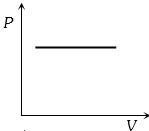
B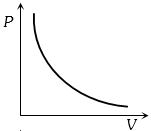
C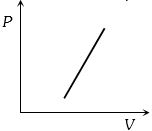
D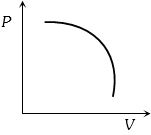
Solution
(B) In an isothermal process, the temperature $T$ remains constant.
According to the ideal gas equation, $PV = nRT$.
Since $n$, $R$, and $T$ are constants, we have $PV = \text{constant}$, which implies $P \propto \frac{1}{V}$.
This relationship represents a rectangular hyperbola in a $PV$ diagram.
Among the given options, the graph in option $B$ shows this hyperbolic relationship.
According to the ideal gas equation, $PV = nRT$.
Since $n$, $R$, and $T$ are constants, we have $PV = \text{constant}$, which implies $P \propto \frac{1}{V}$.
This relationship represents a rectangular hyperbola in a $PV$ diagram.
Among the given options, the graph in option $B$ shows this hyperbolic relationship.
0 likes
View Solution28
EasyMCQ
During which thermodynamic process does $T$ remain constant, while the other two variables $P$ and $V$ change?
A
Isochoric process
B
Isothermal process
C
Isobaric process
D
None of these
Solution
(B) In thermodynamics, an isothermal process is a type of thermodynamic process in which the temperature $T$ of the system remains constant $(dT = 0)$.
During this process, the heat transfer into or out of the system typically occurs at such a slow rate that thermal equilibrium is maintained.
According to the ideal gas law $PV = nRT$, if $T$ is constant, then the product $PV$ must also be constant $(PV = \text{constant})$.
Therefore, while $T$ remains constant, both pressure $P$ and volume $V$ change to satisfy the equation.
Thus, the correct option is $B$.
During this process, the heat transfer into or out of the system typically occurs at such a slow rate that thermal equilibrium is maintained.
According to the ideal gas law $PV = nRT$, if $T$ is constant, then the product $PV$ must also be constant $(PV = \text{constant})$.
Therefore, while $T$ remains constant, both pressure $P$ and volume $V$ change to satisfy the equation.
Thus, the correct option is $B$.
0 likes
View Solution29
DifficultMCQ
One mole of an ideal gas expands from an initial volume of $10 \; L$ to a final volume of $20 \; L$ at a constant temperature of $300 \; K$. Calculate the work done by the gas in $J$. $(R = 8.31 \; J/mol \cdot K)$ (in $; J$)
A
$750$
B
$1728$
C
$1500$
D
$3456$
Solution
(B) For an isothermal process,the work done by an ideal gas is given by the formula:
$W = \mu RT \ln\left(\frac{V_2}{V_1}\right)$
Given:
Number of moles $\mu = 1 \; mol$
Gas constant $R = 8.31 \; J/mol \cdot K$
Temperature $T = 300 \; K$
Initial volume $V_1 = 10 \; L$
Final volume $V_2 = 20 \; L$
Substituting the values:
$W = 1 \times 8.31 \times 300 \times \ln\left(\frac{20}{10}\right)$
$W = 2493 \times \ln(2)$
Using $\ln(2) \approx 0.693$:
$W \approx 2493 \times 0.693 \approx 1727.65 \; J$
Rounding to the nearest integer,we get $W \approx 1728 \; J$.
$W = \mu RT \ln\left(\frac{V_2}{V_1}\right)$
Given:
Number of moles $\mu = 1 \; mol$
Gas constant $R = 8.31 \; J/mol \cdot K$
Temperature $T = 300 \; K$
Initial volume $V_1 = 10 \; L$
Final volume $V_2 = 20 \; L$
Substituting the values:
$W = 1 \times 8.31 \times 300 \times \ln\left(\frac{20}{10}\right)$
$W = 2493 \times \ln(2)$
Using $\ln(2) \approx 0.693$:
$W \approx 2493 \times 0.693 \approx 1727.65 \; J$
Rounding to the nearest integer,we get $W \approx 1728 \; J$.
0 likes
View Solution30
EasyMCQ
The work done in doubling the volume of $5$ moles of an ideal gas at a constant temperature of $500 \, K$ is ....... $J$.
A
$3500$
B
$14400$
C
$17800$
D
$5200$
Solution
(B) For an isothermal process,the work done $W$ is given by the formula: $W = nRT \ln\left(\frac{V_f}{V_i}\right)$.
Given: $n = 5 \, \text{moles}$,$T = 500 \, K$,$V_f = 2V_i$,and $R \approx 8.314 \, J/(mol \cdot K)$.
Substituting the values: $W = 5 \times 8.314 \times 500 \times \ln(2)$.
Since $\ln(2) \approx 0.693$,we have $W = 5 \times 8.314 \times 500 \times 0.693$.
$W = 2500 \times 8.314 \times 0.693 \approx 14412 \, J$.
Rounding to the nearest provided option,the work done is approximately $14400 \, J$.
Given: $n = 5 \, \text{moles}$,$T = 500 \, K$,$V_f = 2V_i$,and $R \approx 8.314 \, J/(mol \cdot K)$.
Substituting the values: $W = 5 \times 8.314 \times 500 \times \ln(2)$.
Since $\ln(2) \approx 0.693$,we have $W = 5 \times 8.314 \times 500 \times 0.693$.
$W = 2500 \times 8.314 \times 0.693 \approx 14412 \, J$.
Rounding to the nearest provided option,the work done is approximately $14400 \, J$.
0 likes
View Solution31
EasyMCQ
During an isothermal expansion,a confined ideal gas does $-150 \, J$ of work against its surroundings. This implies that
A
$150 \, J$ of heat has been removed from the gas
B
$300 \, J$ of heat has been added to the gas
C
no heat is transferred because the process is isothermal
D
$150 \, J$ of heat has been added to the gas
Solution
(D) According to the first law of thermodynamics,$\Delta U = Q + W$,where $\Delta U$ is the change in internal energy,$Q$ is the heat added to the system,and $W$ is the work done on the system.
For an isothermal process involving an ideal gas,the internal energy depends only on temperature. Since the temperature remains constant,$\Delta U = 0$.
Therefore,the equation becomes $0 = Q + W$,which implies $Q = -W$.
Given that the gas does work against its surroundings,the work done on the gas is $W = -150 \, J$.
Substituting this value,we get $Q = -(-150 \, J) = +150 \, J$.
$A$ positive value for $Q$ indicates that $150 \, J$ of heat has been added to the gas.
For an isothermal process involving an ideal gas,the internal energy depends only on temperature. Since the temperature remains constant,$\Delta U = 0$.
Therefore,the equation becomes $0 = Q + W$,which implies $Q = -W$.
Given that the gas does work against its surroundings,the work done on the gas is $W = -150 \, J$.
Substituting this value,we get $Q = -(-150 \, J) = +150 \, J$.
$A$ positive value for $Q$ indicates that $150 \, J$ of heat has been added to the gas.
0 likes
View Solution32
EasyMCQ
The internal energy of an ideal gas increases during an isothermal process when the gas is
A
Expanded by adding more molecules to it
B
Expanded by adding more heat to it
C
Expanded against zero pressure
D
Compressed by doing work on it
Solution
(A) The internal energy $U$ of an ideal gas is given by the formula $U = \frac{f}{2} \mu RT = \frac{f}{2} \left( \frac{N}{N_A} \right) RT$,which implies $U \propto NT$.
In an isothermal process,the temperature $T$ remains constant. Therefore,the internal energy $U$ becomes directly proportional to the number of molecules $N$ $(U \propto N)$.
Consequently,the internal energy of an ideal gas increases during an isothermal process if the number of molecules $N$ is increased.
In an isothermal process,the temperature $T$ remains constant. Therefore,the internal energy $U$ becomes directly proportional to the number of molecules $N$ $(U \propto N)$.
Consequently,the internal energy of an ideal gas increases during an isothermal process if the number of molecules $N$ is increased.
0 likes
View Solution33
MediumMCQ
What is the relationship between pressure $P$ and volume $V$ for an ideal gas undergoing an isothermal process?
A
$P \propto V$
B
$P \propto 1/V$
C
$P \propto V^2$
D
$P = \text{constant}$
Solution
(B) For an ideal gas undergoing an isothermal process,the temperature $T$ remains constant. According to the ideal gas law,$PV = nRT$. Since $n$,$R$,and $T$ are constants,the product $PV$ must be constant. Therefore,$P = \text{constant} / V$,which implies $P \propto 1/V$.
0 likes
View Solution34
AdvancedMCQ
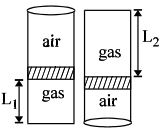
An ideal gas is trapped inside a test tube of cross-sectional area $20 \times 10^{-6} \, m^2$ as shown in the figure. The gas occupies a height $L_1$ at the bottom of the tube and is separated from air at atmospheric pressure by a mercury column of mass $0.002 \, kg$. If the tube is quickly turned isothermally,upside down,the gas now occupies height $L_2$ in the tube. Find the ratio $L_2/L_1$. [Take atmospheric pressure $P_0 = 10^5 \, Nm^{-2}$ and $g = 10 \, ms^{-2}$]
A
$\frac{102}{101}$
B
$\frac{101}{99}$
C
$\frac{99}{100}$
D
$\frac{100}{99}$
Solution
(B) In the first case,the pressure of the gas $P_1$ is given by $P_1 = P_0 + \frac{Mg}{A}$.
In the second case,when the tube is inverted,the pressure of the gas $P_2$ is given by $P_2 = P_0 - \frac{Mg}{A}$.
Since the process is isothermal,$P_1 V_1 = P_2 V_2$. Since $V = A \times L$,we have $P_1 L_1 = P_2 L_2$.
Therefore,$\frac{L_2}{L_1} = \frac{P_1}{P_2} = \frac{P_0 + \frac{Mg}{A}}{P_0 - \frac{Mg}{A}} = \frac{P_0 A + Mg}{P_0 A - Mg}$.
Substituting the values: $P_0 A = 10^5 \times 20 \times 10^{-6} = 2 \, N$ and $Mg = 0.002 \times 10 = 0.02 \, N$.
$\frac{L_2}{L_1} = \frac{2 + 0.02}{2 - 0.02} = \frac{2.02}{1.98} = \frac{202}{198} = \frac{101}{99}$.
In the second case,when the tube is inverted,the pressure of the gas $P_2$ is given by $P_2 = P_0 - \frac{Mg}{A}$.
Since the process is isothermal,$P_1 V_1 = P_2 V_2$. Since $V = A \times L$,we have $P_1 L_1 = P_2 L_2$.
Therefore,$\frac{L_2}{L_1} = \frac{P_1}{P_2} = \frac{P_0 + \frac{Mg}{A}}{P_0 - \frac{Mg}{A}} = \frac{P_0 A + Mg}{P_0 A - Mg}$.
Substituting the values: $P_0 A = 10^5 \times 20 \times 10^{-6} = 2 \, N$ and $Mg = 0.002 \times 10 = 0.02 \, N$.
$\frac{L_2}{L_1} = \frac{2 + 0.02}{2 - 0.02} = \frac{2.02}{1.98} = \frac{202}{198} = \frac{101}{99}$.
0 likes
View Solution35
DifficultMCQ
$A$ vertical cylinder with heat-conducting walls is closed at the bottom and is fitted with a smooth light piston. It contains one mole of an ideal gas. The temperature of the gas is always equal to the surrounding's temperature,$T_0$. The piston is moved up slowly to increase the volume of the gas to $\eta$ times. Which of the following is incorrect?
A
Work done by the gas is $RT_0 \ln \eta$.
B
Work done against the atmosphere is $RT_0(\eta - 1)$.
C
There is no change in the internal energy of the gas.
D
The final pressure of the gas is $\frac{1}{\eta}$ times its initial pressure.
Solution
(D) Since the walls are heat-conducting and the process is slow,the temperature remains constant at $T_0$. This is an isothermal process.
$1$. For an isothermal process,$\Delta U = 0$ (Internal energy change is zero).
$2$. Work done by the gas $W = \int P \, dV = \int_{V_0}^{\eta V_0} \frac{RT_0}{V} \, dV = RT_0 \ln \eta$.
$3$. The piston is light,so the pressure of the gas is always equal to the atmospheric pressure $P_{atm}$. Since $PV = RT_0$,$P = \frac{RT_0}{V}$. Initially $P_i = \frac{RT_0}{V_0}$ and finally $P_f = \frac{RT_0}{\eta V_0} = \frac{P_i}{\eta}$. Thus,the final pressure is $\frac{1}{\eta}$ times the initial pressure.
$4$. Work done against the atmosphere $W_{atm} = P_{atm} \Delta V = P_i (\eta V_0 - V_0) = P_i V_0 (\eta - 1) = RT_0(\eta - 1)$.
Comparing these with the options,option $D$ states the final pressure is $\frac{1}{(\eta - 1)}$ times the initial pressure,which is incorrect.
$1$. For an isothermal process,$\Delta U = 0$ (Internal energy change is zero).
$2$. Work done by the gas $W = \int P \, dV = \int_{V_0}^{\eta V_0} \frac{RT_0}{V} \, dV = RT_0 \ln \eta$.
$3$. The piston is light,so the pressure of the gas is always equal to the atmospheric pressure $P_{atm}$. Since $PV = RT_0$,$P = \frac{RT_0}{V}$. Initially $P_i = \frac{RT_0}{V_0}$ and finally $P_f = \frac{RT_0}{\eta V_0} = \frac{P_i}{\eta}$. Thus,the final pressure is $\frac{1}{\eta}$ times the initial pressure.
$4$. Work done against the atmosphere $W_{atm} = P_{atm} \Delta V = P_i (\eta V_0 - V_0) = P_i V_0 (\eta - 1) = RT_0(\eta - 1)$.
Comparing these with the options,option $D$ states the final pressure is $\frac{1}{(\eta - 1)}$ times the initial pressure,which is incorrect.
1 likes
View Solution36
MediumMCQ
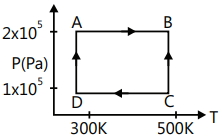
Two moles of helium gas are taken over the cycle $ABCDA$,as shown in the $P-T$ diagram. The work done on the gas in taking it from $D$ to $A$ is
A
$+414 R$
B
$-690 R$
C
$-690 R$
D
$-414 R$
Solution
(A) The process $DA$ is an isochoric process because the temperature $T$ is constant at $300 \text{ K}$ while the pressure changes from $1 \times 10^5 \text{ Pa}$ to $2 \times 10^5 \text{ Pa}$.
However,looking at the $P-T$ diagram,the line $DA$ is vertical,meaning it is an isothermal process at $T = 300 \text{ K}$.
For an isothermal process,the work done by the gas is given by $W_{\text{by}} = nRT \ln\left(\frac{V_f}{V_i}\right)$.
Using the ideal gas law $PV = nRT$,we have $V = \frac{nRT}{P}$,so $\frac{V_f}{V_i} = \frac{P_i}{P_f}$.
Thus,$W_{\text{by}} = nRT \ln\left(\frac{P_D}{P_A}\right) = 2.303 nRT \log_{10}\left(\frac{P_D}{P_A}\right)$.
Given $n = 2$,$T = 300 \text{ K}$,$P_D = 1 \times 10^5 \text{ Pa}$,and $P_A = 2 \times 10^5 \text{ Pa}$.
$W_{\text{by}} = 2.303 \times 2 \times R \times 300 \times \log_{10}\left(\frac{1 \times 10^5}{2 \times 10^5}\right) = 2.303 \times 600 \times R \times \log_{10}(0.5)$.
$W_{\text{by}} = 1381.8 \times R \times (-0.301) \approx -416 R$ (using $\log_{10}(0.5) \approx -0.301$).
Using the standard approximation $\log_{10}(0.5) \approx -0.3$,$W_{\text{by}} = 2.303 \times 600 \times R \times (-0.3) = -414.54 R \approx -414 R$.
The work done $ON$ the gas is $W_{\text{on}} = -W_{\text{by}} = -(-414 R) = +414 R$.
However,looking at the $P-T$ diagram,the line $DA$ is vertical,meaning it is an isothermal process at $T = 300 \text{ K}$.
For an isothermal process,the work done by the gas is given by $W_{\text{by}} = nRT \ln\left(\frac{V_f}{V_i}\right)$.
Using the ideal gas law $PV = nRT$,we have $V = \frac{nRT}{P}$,so $\frac{V_f}{V_i} = \frac{P_i}{P_f}$.
Thus,$W_{\text{by}} = nRT \ln\left(\frac{P_D}{P_A}\right) = 2.303 nRT \log_{10}\left(\frac{P_D}{P_A}\right)$.
Given $n = 2$,$T = 300 \text{ K}$,$P_D = 1 \times 10^5 \text{ Pa}$,and $P_A = 2 \times 10^5 \text{ Pa}$.
$W_{\text{by}} = 2.303 \times 2 \times R \times 300 \times \log_{10}\left(\frac{1 \times 10^5}{2 \times 10^5}\right) = 2.303 \times 600 \times R \times \log_{10}(0.5)$.
$W_{\text{by}} = 1381.8 \times R \times (-0.301) \approx -416 R$ (using $\log_{10}(0.5) \approx -0.301$).
Using the standard approximation $\log_{10}(0.5) \approx -0.3$,$W_{\text{by}} = 2.303 \times 600 \times R \times (-0.3) = -414.54 R \approx -414 R$.
The work done $ON$ the gas is $W_{\text{on}} = -W_{\text{by}} = -(-414 R) = +414 R$.
0 likes
View Solution37
MediumMCQ
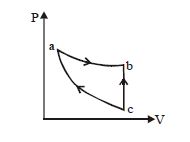
An ideal gas expands isothermally along $ab$ and does $600\,J$ of work. During the process,
A
the heat rejected by the gas to the surroundings is $600\,J$
B
the heat absorbed by the gas from the surrounding is $600\,J$
C
no heat exchange between gas and its surroundings takes place
D
the heat absorbed by the gas is less than $600\,J$
Solution
(B) For an isothermal process,the temperature remains constant,so the change in internal energy $dU = 0$.
According to the first law of thermodynamics,$dQ = dU + dW$.
Given that the gas does $600\,J$ of work,$dW = 600\,J$.
Substituting these values,$dQ = 0 + 600\,J = 600\,J$.
Since $dQ$ is positive,the gas absorbs $600\,J$ of heat from the surroundings.
According to the first law of thermodynamics,$dQ = dU + dW$.
Given that the gas does $600\,J$ of work,$dW = 600\,J$.
Substituting these values,$dQ = 0 + 600\,J = 600\,J$.
Since $dQ$ is positive,the gas absorbs $600\,J$ of heat from the surroundings.
0 likes
View Solution38
EasyMCQ
The specific heat of an isothermal process is:
A
$0$
B
$\infty$
C
$\frac{3}{2} R$
D
$\frac{5}{2} R$
Solution
(B) The molar specific heat capacity $C$ is defined as $C = \frac{\Delta Q}{n \Delta T}$,where $\Delta Q$ is the heat supplied,$n$ is the number of moles,and $\Delta T$ is the change in temperature.
In an isothermal process,the temperature of the system remains constant,which means $\Delta T = 0$.
Substituting $\Delta T = 0$ into the formula,we get $C = \frac{\Delta Q}{n \times 0} = \infty$.
Therefore,the specific heat of an isothermal process is infinite.
In an isothermal process,the temperature of the system remains constant,which means $\Delta T = 0$.
Substituting $\Delta T = 0$ into the formula,we get $C = \frac{\Delta Q}{n \times 0} = \infty$.
Therefore,the specific heat of an isothermal process is infinite.
0 likes
View Solution39
MediumMCQ
One mole of an ideal monoatomic gas is compressed isothermally in a rigid vessel to double its pressure at room temperature,$27\,^{\circ}C$. The work done on the gas will be
A
$300R\,\ln\,6$
B
$300R$
C
$300R\,\ln\,7$
D
$300R\,\ln\,2$
Solution
(D) For an isothermal process,the work done on the gas is given by the formula $W = -nRT \ln\left(\frac{V_f}{V_i}\right)$.
Since the process is isothermal,$P_i V_i = P_f V_f$,which implies $\frac{V_f}{V_i} = \frac{P_i}{P_f}$.
Given that the pressure is doubled,$P_f = 2P_i$,so $\frac{P_i}{P_f} = \frac{1}{2}$.
Thus,$\frac{V_f}{V_i} = \frac{1}{2}$.
The work done on the gas is $W = -nRT \ln\left(\frac{1}{2}\right) = nRT \ln(2)$.
Given $n = 1$ mole and $T = 27 + 273 = 300\,K$.
Substituting the values,$W = 1 \times R \times 300 \times \ln(2) = 300R \ln(2)$.
Since the process is isothermal,$P_i V_i = P_f V_f$,which implies $\frac{V_f}{V_i} = \frac{P_i}{P_f}$.
Given that the pressure is doubled,$P_f = 2P_i$,so $\frac{P_i}{P_f} = \frac{1}{2}$.
Thus,$\frac{V_f}{V_i} = \frac{1}{2}$.
The work done on the gas is $W = -nRT \ln\left(\frac{1}{2}\right) = nRT \ln(2)$.
Given $n = 1$ mole and $T = 27 + 273 = 300\,K$.
Substituting the values,$W = 1 \times R \times 300 \times \ln(2) = 300R \ln(2)$.
0 likes
View Solution40
EasyMCQ
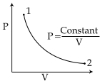
For the $P-V$ diagram given for an ideal gas,which of the following correctly represents the $T-P$ diagram?
A
B
C
D
Solution
(D) From the given $P-V$ diagram,the process follows the relation $P = \frac{\text{constant}}{V}$,which implies $PV = \text{constant}$.
According to the ideal gas equation $PV = nRT$,if $PV$ is constant,then $T$ must also be constant $(T = \text{constant})$.
This represents an isothermal process.
In a $T-P$ diagram,an isothermal process is represented by a horizontal line (where $T$ remains constant as $P$ changes).
Looking at the $P-V$ graph,the pressure $P$ decreases as we move from point $1$ to point $2$ (since $V$ increases).
Therefore,in the $T-P$ diagram,the process should be a horizontal line starting from $1$ and moving towards $2$ as $P$ decreases.
Among the given options,the graph where $T$ is constant and the transition is from $1$ to $2$ as $P$ decreases is represented by option $(d)$.
According to the ideal gas equation $PV = nRT$,if $PV$ is constant,then $T$ must also be constant $(T = \text{constant})$.
This represents an isothermal process.
In a $T-P$ diagram,an isothermal process is represented by a horizontal line (where $T$ remains constant as $P$ changes).
Looking at the $P-V$ graph,the pressure $P$ decreases as we move from point $1$ to point $2$ (since $V$ increases).
Therefore,in the $T-P$ diagram,the process should be a horizontal line starting from $1$ and moving towards $2$ as $P$ decreases.
Among the given options,the graph where $T$ is constant and the transition is from $1$ to $2$ as $P$ decreases is represented by option $(d)$.
0 likes
View Solution41
MediumMCQ
The change in the entropy of $1$ mole of an ideal gas which undergoes an isothermal process from an initial state $(P_1, V_1, T)$ to the final state $(P_2, V_2, T)$ is equal to
A
zero
B
$R \ln T$
C
$R \ln \frac{V_1}{V_2}$
D
$R \ln \frac{V_2}{V_1}$
Solution
(D) For an isothermal process,the temperature $T$ remains constant.
For $n$ moles of an ideal gas,the heat exchanged $\Delta Q$ during an isothermal expansion from $V_1$ to $V_2$ is equal to the work done $W$,because the change in internal energy $\Delta U = 0$.
$W = \int_{V_1}^{V_2} P \, dV = \int_{V_1}^{V_2} \frac{nRT}{V} \, dV = nRT \ln \frac{V_2}{V_1}$.
Given $n = 1$ mole,the heat exchanged is $\Delta Q = RT \ln \frac{V_2}{V_1}$.
The change in entropy $\Delta S$ is defined as $\Delta S = \frac{\Delta Q}{T}$.
Substituting the value of $\Delta Q$,we get $\Delta S = \frac{RT \ln \frac{V_2}{V_1}}{T} = R \ln \frac{V_2}{V_1}$.
For $n$ moles of an ideal gas,the heat exchanged $\Delta Q$ during an isothermal expansion from $V_1$ to $V_2$ is equal to the work done $W$,because the change in internal energy $\Delta U = 0$.
$W = \int_{V_1}^{V_2} P \, dV = \int_{V_1}^{V_2} \frac{nRT}{V} \, dV = nRT \ln \frac{V_2}{V_1}$.
Given $n = 1$ mole,the heat exchanged is $\Delta Q = RT \ln \frac{V_2}{V_1}$.
The change in entropy $\Delta S$ is defined as $\Delta S = \frac{\Delta Q}{T}$.
Substituting the value of $\Delta Q$,we get $\Delta S = \frac{RT \ln \frac{V_2}{V_1}}{T} = R \ln \frac{V_2}{V_1}$.
0 likes
View Solution42
EasyMCQ
An ideal gas is subjected to an isothermal expansion such that its volume changes from $V_i$ to $V_f$ and pressure from $P_i$ to $P_f$. The work done on the gas is:
A
$W = nRT \ln(V_f/V_i)$
B
$W = -nRT \ln(V_f/V_i)$
C
$W = nRT \ln(P_f/P_i)$
D
$W = -nRT \ln(P_f/P_i)$
Solution
(D) For an isothermal process,the work done $BY$ the gas is given by $W_{by} = \int_{V_i}^{V_f} P \, dV$. Since $PV = nRT$,we have $P = nRT/V$.
Integrating this,$W_{by} = nRT \int_{V_i}^{V_f} \frac{1}{V} dV = nRT \ln(V_f/V_i)$.
By Boyle's Law,$P_i V_i = P_f V_f$,so $V_f/V_i = P_i/P_f$.
Thus,$W_{by} = nRT \ln(P_i/P_f) = -nRT \ln(P_f/P_i)$.
The work done $ON$ the gas is the negative of the work done by the gas: $W_{on} = -W_{by} = -nRT \ln(V_f/V_i) = nRT \ln(P_f/P_i)$.
Integrating this,$W_{by} = nRT \int_{V_i}^{V_f} \frac{1}{V} dV = nRT \ln(V_f/V_i)$.
By Boyle's Law,$P_i V_i = P_f V_f$,so $V_f/V_i = P_i/P_f$.
Thus,$W_{by} = nRT \ln(P_i/P_f) = -nRT \ln(P_f/P_i)$.
The work done $ON$ the gas is the negative of the work done by the gas: $W_{on} = -W_{by} = -nRT \ln(V_f/V_i) = nRT \ln(P_f/P_i)$.
0 likes
View Solution43
EasyMCQ
$Assertion :$ In an isothermal process,the whole of the heat supplied to the body is converted into internal energy.
$Reason :$ According to the first law of thermodynamics,$\Delta Q = \Delta U + P\Delta V$.
$Reason :$ According to the first law of thermodynamics,$\Delta Q = \Delta U + P\Delta V$.
A
If both Assertion and Reason are correct and the Reason is a correct explanation of the Assertion.
B
If both Assertion and Reason are correct but Reason is not a correct explanation of the Assertion.
C
If the Assertion is correct but Reason is incorrect.
D
If both the Assertion and Reason are incorrect.
Solution
(D) The first law of thermodynamics is given by $\Delta Q = \Delta U + P\Delta V$.
For an ideal gas,the internal energy $U$ is a function of temperature $T$ only $(U = f(T))$.
In an isothermal process,the temperature remains constant,so $\Delta T = 0$.
Since $\Delta U = nC_v\Delta T$,it follows that $\Delta U = 0$ for an isothermal process.
Substituting this into the first law: $\Delta Q = 0 + P\Delta V$,which means $\Delta Q = P\Delta V$.
Therefore,the heat supplied is converted into work done by the system,not internal energy.
Thus,the Assertion is incorrect,and the Reason is a correct statement of the first law of thermodynamics.
For an ideal gas,the internal energy $U$ is a function of temperature $T$ only $(U = f(T))$.
In an isothermal process,the temperature remains constant,so $\Delta T = 0$.
Since $\Delta U = nC_v\Delta T$,it follows that $\Delta U = 0$ for an isothermal process.
Substituting this into the first law: $\Delta Q = 0 + P\Delta V$,which means $\Delta Q = P\Delta V$.
Therefore,the heat supplied is converted into work done by the system,not internal energy.
Thus,the Assertion is incorrect,and the Reason is a correct statement of the first law of thermodynamics.
0 likes
View Solution44
EasyMCQ
$Assertion :$ The isothermal curves intersect each other at a certain point.
$Reason :$ The isothermal change takes place slowly,so,the isothermal curves have very little slope.
$Reason :$ The isothermal change takes place slowly,so,the isothermal curves have very little slope.
A
If both Assertion and Reason are correct and the Reason is a correct explanation of the Assertion.
B
If both Assertion and Reason are correct but Reason is not a correct explanation of the Assertion.
C
If the Assertion is correct but Reason is incorrect.
D
If the Assertion is incorrect but the Reason is correct.
Solution
(D) The $Assertion$ is incorrect. Two isothermal curves for different temperatures cannot intersect each other. If they were to intersect at a point,it would imply that at that specific $(P, V)$ state,the system has two different temperatures simultaneously,which is impossible.
The $Reason$ is correct. An isothermal process is a slow process that allows the system to remain in thermal equilibrium with its surroundings. The slope of an isothermal curve on a $P-V$ diagram is given by $-\frac{dP}{dV} = \frac{P}{V}$. Since $P$ and $V$ are positive,the slope is finite and relatively small compared to adiabatic curves (which have a slope of $\gamma \frac{P}{V}$).
The $Reason$ is correct. An isothermal process is a slow process that allows the system to remain in thermal equilibrium with its surroundings. The slope of an isothermal curve on a $P-V$ diagram is given by $-\frac{dP}{dV} = \frac{P}{V}$. Since $P$ and $V$ are positive,the slope is finite and relatively small compared to adiabatic curves (which have a slope of $\gamma \frac{P}{V}$).
0 likes
View Solution45
MediumMCQ
$Assertion :$ The isothermal curves intersect each other at a certain point.
$Reason :$ The isothermal changes take place rapidly,so the isothermal curves have very little slope.
$Reason :$ The isothermal changes take place rapidly,so the isothermal curves have very little slope.
A
If both $Assertion$ and $Reason$ are correct and the $Reason$ is a correct explanation of the $Assertion$.
B
If both $Assertion$ and $Reason$ are correct but $Reason$ is not a correct explanation of the $Assertion$.
C
If the $Assertion$ is correct but $Reason$ is incorrect.
D
If both the $Assertion$ and $Reason$ are incorrect.
Solution
(D) An isothermal process is a process that occurs at a constant temperature. For an ideal gas,the equation of state is $PV = nRT$. Since $T$ is constant,$P = (nRT)/V$,which implies $P \propto 1/V$.
Two different isothermal curves correspond to two different temperatures ($T_1$ and $T_2$). If they were to intersect,it would mean that at the point of intersection,the system would have two different temperatures simultaneously,which is physically impossible.
Furthermore,isothermal processes are inherently slow (quasi-static) to maintain thermal equilibrium,contrary to the claim in the $Reason$ that they occur rapidly.
Therefore,both the $Assertion$ and the $Reason$ are incorrect.
Two different isothermal curves correspond to two different temperatures ($T_1$ and $T_2$). If they were to intersect,it would mean that at the point of intersection,the system would have two different temperatures simultaneously,which is physically impossible.
Furthermore,isothermal processes are inherently slow (quasi-static) to maintain thermal equilibrium,contrary to the claim in the $Reason$ that they occur rapidly.
Therefore,both the $Assertion$ and the $Reason$ are incorrect.
0 likes
View Solution46
Difficult
Write the first law of thermodynamics for an isothermal process in an ideal gas.
Solution
(N/A) In an isothermal process of an ideal gas,the temperature remains constant.
Since the internal energy $U$ of an ideal gas depends only on its temperature,for an isothermal process,the change in internal energy $\Delta U = 0$.
According to the first law of thermodynamics:
$\Delta Q = \Delta U + \Delta W$
Substituting $\Delta U = 0$ into the equation:
$\Delta Q = \Delta W$
This means that in an isothermal process,the entire amount of heat supplied to the system is used to perform work by the system.
Since the internal energy $U$ of an ideal gas depends only on its temperature,for an isothermal process,the change in internal energy $\Delta U = 0$.
According to the first law of thermodynamics:
$\Delta Q = \Delta U + \Delta W$
Substituting $\Delta U = 0$ into the equation:
$\Delta Q = \Delta W$
This means that in an isothermal process,the entire amount of heat supplied to the system is used to perform work by the system.
0 likes
View Solution47
Easy
Write the first law of thermodynamics for an isothermal expansion process.
Solution
(N/A) The first law of thermodynamics is given by the equation: $\Delta Q = \Delta U + \Delta W$,where $\Delta Q$ is the heat supplied to the system,$\Delta U$ is the change in internal energy,and $\Delta W$ is the work done by the system.
In an isothermal process,the temperature of the system remains constant $(T = \text{constant})$.
Since the internal energy of an ideal gas depends only on its temperature,for an isothermal process,the change in internal energy is zero $(\Delta U = 0)$.
Substituting this into the first law of thermodynamics,we get: $\Delta Q = \Delta W$.
This means that in an isothermal expansion,the entire amount of heat supplied to the system is used to perform work by the system.
In an isothermal process,the temperature of the system remains constant $(T = \text{constant})$.
Since the internal energy of an ideal gas depends only on its temperature,for an isothermal process,the change in internal energy is zero $(\Delta U = 0)$.
Substituting this into the first law of thermodynamics,we get: $\Delta Q = \Delta W$.
This means that in an isothermal expansion,the entire amount of heat supplied to the system is used to perform work by the system.
0 likes
View Solution48
Medium
Can the temperature of a system remain constant even when it is heated? Explain.
Solution
(N/A) Yes,it is possible for the temperature of a system to remain constant while it is being heated.
According to the first law of thermodynamics,$dQ = dU + dW$.
If the heat supplied $(dQ)$ is entirely used to perform work $(dW)$ against the surroundings,then the change in internal energy $(dU)$ will be zero.
Since internal energy is a function of temperature $(U \propto T)$,if $dU = 0$,then the change in temperature $(dT)$ is also zero.
This occurs during an isothermal process,such as the melting of ice at $0^{\circ}C$ or the boiling of water at $100^{\circ}C$ under constant pressure.
According to the first law of thermodynamics,$dQ = dU + dW$.
If the heat supplied $(dQ)$ is entirely used to perform work $(dW)$ against the surroundings,then the change in internal energy $(dU)$ will be zero.
Since internal energy is a function of temperature $(U \propto T)$,if $dU = 0$,then the change in temperature $(dT)$ is also zero.
This occurs during an isothermal process,such as the melting of ice at $0^{\circ}C$ or the boiling of water at $100^{\circ}C$ under constant pressure.
0 likes
View SolutionThermodynamics — Isothermal Process · Frequently Asked Questions
1Are these Thermodynamics questions useful for JEE and NEET?
Yes. All questions in this section are mapped to JEE Main and NEET exam patterns. Previous year questions from JEE Main, NEET, GUJCET and state-level exams are included with full solutions.
2Can I switch to Hindi or Gujarati for these questions?
Yes. Use the language tabs in the hero section or the sidebar to view the same questions and solutions in English, Hindi or Gujarati.
3How do I generate a question paper from this subtopic?
Use the Vedclass Exam Paper Generator — select the chapter and subtopic, set difficulty, and generate Sets A, B, C, D automatically. First 3 chapters of every subject are free.
Vedclass Products
For Students
Vedclass Test Series
Mock tests in real JEE/NEET style with performance analysis. 5-day free trial.
Start Free TrialFor Teachers
Exam Paper Generator
Generate Set A/B/C/D papers from this chapter in 2 minutes. 3 chapters free.
Try FreeFor Institutes
Online Exam Module
Live online exams with unlimited students, 360° analytics & white-label branding.
See DemoFor Teachers & Institutes
Generate a Thermodynamics Exam Paper in 2 Minutes
Select subtopic & difficulty — Sets A, B, C, D auto-generated with No Repeat logic.
First 3 chapters of every subject are free — no payment required.