
A English
First Law of Thermodynamics Questions in English
Class 11 Physics · Thermodynamics · First Law of Thermodynamics
132+
Questions
English
Language
100%
With Solutions
Showing 49 of 132 questions in English
51
MediumMCQ
The volume of a gas at a constant pressure of $50\,N/m^2$ changes from $10\,m^3$ to $4\,m^3$. If $100\,J$ of heat is supplied to the gas,the increase in internal energy is ....... $J$.
A
$400$
B
$200$
C
$100$
D
$300$
Solution
(A) According to the first law of thermodynamics: $\Delta Q = \Delta U + \Delta W$.
Here,$\Delta Q = 100\,J$ (heat supplied to the system).
The work done by the gas is $\Delta W = P \Delta V = P(V_f - V_i)$.
Given $P = 50\,N/m^2$,$V_i = 10\,m^3$,and $V_f = 4\,m^3$.
$\Delta W = 50 \times (4 - 10) = 50 \times (-6) = -300\,J$.
Substituting these values into the first law equation:
$100 = \Delta U + (-300)$.
$\Delta U = 100 + 300 = 400\,J$.
Therefore,the increase in internal energy is $400\,J$.
Here,$\Delta Q = 100\,J$ (heat supplied to the system).
The work done by the gas is $\Delta W = P \Delta V = P(V_f - V_i)$.
Given $P = 50\,N/m^2$,$V_i = 10\,m^3$,and $V_f = 4\,m^3$.
$\Delta W = 50 \times (4 - 10) = 50 \times (-6) = -300\,J$.
Substituting these values into the first law equation:
$100 = \Delta U + (-300)$.
$\Delta U = 100 + 300 = 400\,J$.
Therefore,the increase in internal energy is $400\,J$.
0 likes
View Solution52
DifficultMCQ
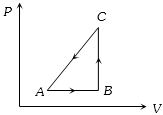
During the process $A \rightarrow B \rightarrow C$,the work done is $50 \, J$ and the heat supplied is $20 \, cal$. Find the change in internal energy between $A$ and $C$ in $J$. (in $, J$)
A
$34$
B
$70$
C
$84$
D
$134$
Solution
(A) According to the first law of thermodynamics,$\Delta Q = \Delta U + \Delta W$,where $\Delta U$ is the change in internal energy,$\Delta Q$ is the heat supplied,and $\Delta W$ is the work done by the system.
Given,$\Delta Q = 20 \, cal = 20 \times 4.2 \, J = 84 \, J$.
The work done $\Delta W$ is given as $50 \, J$. Since the process $A \rightarrow B \rightarrow C$ involves an expansion (or is part of a cycle),we use the convention where work done by the system is positive.
Therefore,$\Delta U = \Delta Q - \Delta W = 84 \, J - 50 \, J = 34 \, J$.
Given,$\Delta Q = 20 \, cal = 20 \times 4.2 \, J = 84 \, J$.
The work done $\Delta W$ is given as $50 \, J$. Since the process $A \rightarrow B \rightarrow C$ involves an expansion (or is part of a cycle),we use the convention where work done by the system is positive.
Therefore,$\Delta U = \Delta Q - \Delta W = 84 \, J - 50 \, J = 34 \, J$.
0 likes
View Solution53
EasyMCQ
If $Q$,$E$,and $W$ denote respectively the heat added,change in internal energy,and the work done by a closed cycle process,then
A
$W = 0$
B
$Q = 0$
C
$E = 0$
D
$Q = W = 0$
Solution
(C) According to the first law of thermodynamics,$Q = \Delta U + W$,where $Q$ is the heat added,$\Delta U$ is the change in internal energy,and $W$ is the work done.
Internal energy is a state function,meaning it depends only on the initial and final states of the system.
In a closed cyclic process,the system returns to its initial state after completing the cycle.
Since the initial and final states are identical,the change in internal energy $\Delta U$ (denoted here as $E$) must be zero.
Therefore,$E = 0$.
Internal energy is a state function,meaning it depends only on the initial and final states of the system.
In a closed cyclic process,the system returns to its initial state after completing the cycle.
Since the initial and final states are identical,the change in internal energy $\Delta U$ (denoted here as $E$) must be zero.
Therefore,$E = 0$.
0 likes
View Solution54
MediumMCQ
$A$ sample of $0.1 \, g$ of water at $100^{\circ} C$ and normal pressure $(1.013 \times 10^5 \, N m^{-2})$ requires $54 \, cal$ of heat energy to convert to steam at $100^{\circ} C$. If the volume of the steam produced is $167.1 \, cc$,the change in internal energy of the sample is ....... $J$.
A
$104.3$
B
$208.7$
C
$84.5$
D
$42.2$
Solution
(B) According to the first law of thermodynamics,$\Delta Q = \Delta U + \Delta W$.
First,convert the heat energy from calories to Joules: $\Delta Q = 54 \, cal \times 4.18 \, J/cal = 225.72 \, J$.
Next,calculate the work done during expansion: $\Delta W = P \Delta V$.
Given $P = 1.013 \times 10^5 \, N/m^2$ and $\Delta V = 167.1 \, cc = 167.1 \times 10^{-6} \, m^3$.
$\Delta W = 1.013 \times 10^5 \times 167.1 \times 10^{-6} \approx 16.93 \, J$.
Now,calculate the change in internal energy: $\Delta U = \Delta Q - \Delta W$.
$\Delta U = 225.72 \, J - 16.93 \, J = 208.79 \, J$.
Rounding to the nearest option,$\Delta U \approx 208.7 \, J$.
First,convert the heat energy from calories to Joules: $\Delta Q = 54 \, cal \times 4.18 \, J/cal = 225.72 \, J$.
Next,calculate the work done during expansion: $\Delta W = P \Delta V$.
Given $P = 1.013 \times 10^5 \, N/m^2$ and $\Delta V = 167.1 \, cc = 167.1 \times 10^{-6} \, m^3$.
$\Delta W = 1.013 \times 10^5 \times 167.1 \times 10^{-6} \approx 16.93 \, J$.
Now,calculate the change in internal energy: $\Delta U = \Delta Q - \Delta W$.
$\Delta U = 225.72 \, J - 16.93 \, J = 208.79 \, J$.
Rounding to the nearest option,$\Delta U \approx 208.7 \, J$.
0 likes
View Solution55
EasyMCQ
In a thermodynamic process,the pressure of a fixed mass of a gas is changed in such a manner that the gas releases $30 \ J$ of heat and $10 \ J$ of work is done on the gas. If the initial internal energy of the gas was $30 \ J$,then the final internal energy will be ........ $J$.
A
$2$
B
$-18$
C
$10$
D
$58$
Solution
(C) According to the first law of thermodynamics: $\Delta Q = \Delta U + \Delta W$.
Here,the gas releases heat,so $\Delta Q = -30 \ J$.
Work is done on the gas,so $\Delta W = -10 \ J$.
Let the initial internal energy be $U_i = 30 \ J$ and the final internal energy be $U_f$.
Then,$\Delta U = U_f - U_i = U_f - 30$.
Substituting these values into the equation: $-30 = (U_f - 30) + (-10)$.
$-30 = U_f - 30 - 10$.
$-30 = U_f - 40$.
$U_f = 40 - 30 = 10 \ J$.
Here,the gas releases heat,so $\Delta Q = -30 \ J$.
Work is done on the gas,so $\Delta W = -10 \ J$.
Let the initial internal energy be $U_i = 30 \ J$ and the final internal energy be $U_f$.
Then,$\Delta U = U_f - U_i = U_f - 30$.
Substituting these values into the equation: $-30 = (U_f - 30) + (-10)$.
$-30 = U_f - 30 - 10$.
$-30 = U_f - 40$.
$U_f = 40 - 30 = 10 \ J$.
0 likes
View Solution56
DifficultMCQ
If heat is added at constant volume,$6300 \ J$ of heat are required to raise the temperature of an ideal gas by $150 \ K$. If instead,heat is added at constant pressure,$8800 \ J$ are required for the same temperature change. When the temperature of the gas changes by $300 \ K$,the internal energy of the gas changes by ..... $J$.
A
$5000$
B
$12600$
C
$17600$
D
$22600$
Solution
(B) Heat added at constant volume is equal to the change in internal energy of the system. The change in internal energy is given by $\Delta U = n C_{v} \Delta T$.
For $\Delta T = 150 \ K$,the change in internal energy is $\Delta U = Q_{v} = 6300 \ J$.
Therefore,$6300 = n C_{v} (150) \quad \dots(1)$.
We need to find the change in internal energy $\Delta U'$ for $\Delta T' = 300 \ K$.
Thus,$\Delta U' = n C_{v} (300) \quad \dots(2)$.
Dividing equation $(2)$ by equation $(1)$,we get $\frac{\Delta U'}{6300} = \frac{300}{150} = 2$.
Therefore,$\Delta U' = 6300 \times 2 = 12600 \ J$.
For $\Delta T = 150 \ K$,the change in internal energy is $\Delta U = Q_{v} = 6300 \ J$.
Therefore,$6300 = n C_{v} (150) \quad \dots(1)$.
We need to find the change in internal energy $\Delta U'$ for $\Delta T' = 300 \ K$.
Thus,$\Delta U' = n C_{v} (300) \quad \dots(2)$.
Dividing equation $(2)$ by equation $(1)$,we get $\frac{\Delta U'}{6300} = \frac{300}{150} = 2$.
Therefore,$\Delta U' = 6300 \times 2 = 12600 \ J$.
0 likes
View Solution57
AdvancedMCQ
When unit mass of water boils to become steam at $100\,^{\circ}C$,it absorbs $Q$ amount of heat. The densities of water and steam at $100\,^{\circ}C$ are $\rho_1$ and $\rho_2$ respectively and the atmospheric pressure is $p_0$. The increase in internal energy of the water is:
A
$Q$
B
$Q + p_0 \left( \frac{1}{\rho_1} - \frac{1}{\rho_2} \right)$
C
$Q + p_0 \left( \frac{1}{\rho_2} - \frac{1}{\rho_1} \right)$
D
$Q - p_0 \left( \frac{1}{\rho_1} + \frac{1}{\rho_2} \right)$
Solution
(B) According to the first law of thermodynamics,the change in internal energy is given by $\Delta U = Q - W$.
The work done $W$ by the system during the phase change at constant atmospheric pressure $p_0$ is $W = p_0 \Delta V$.
For a unit mass $(m = 1)$,the volume of water is $V_1 = \frac{1}{\rho_1}$ and the volume of steam is $V_2 = \frac{1}{\rho_2}$.
Thus,the work done is $W = p_0 (V_2 - V_1) = p_0 \left( \frac{1}{\rho_2} - \frac{1}{\rho_1} \right)$.
Substituting this into the first law equation: $\Delta U = Q - p_0 \left( \frac{1}{\rho_2} - \frac{1}{\rho_1} \right) = Q + p_0 \left( \frac{1}{\rho_1} - \frac{1}{\rho_2} \right)$.
The work done $W$ by the system during the phase change at constant atmospheric pressure $p_0$ is $W = p_0 \Delta V$.
For a unit mass $(m = 1)$,the volume of water is $V_1 = \frac{1}{\rho_1}$ and the volume of steam is $V_2 = \frac{1}{\rho_2}$.
Thus,the work done is $W = p_0 (V_2 - V_1) = p_0 \left( \frac{1}{\rho_2} - \frac{1}{\rho_1} \right)$.
Substituting this into the first law equation: $\Delta U = Q - p_0 \left( \frac{1}{\rho_2} - \frac{1}{\rho_1} \right) = Q + p_0 \left( \frac{1}{\rho_1} - \frac{1}{\rho_2} \right)$.
0 likes
View Solution58
DifficultMCQ
In a thermodynamic process,the pressure of a fixed mass of gas is changed in such a manner that the gas releases $30 \ J$ of heat and $18 \ J$ of work is done on the gas. If the initial internal energy of the gas was $60 \ J$,then the final internal energy will be ..... $J$.
A
$32$
B
$48$
C
$72$
D
$96$
Solution
(B) According to the first law of thermodynamics,the change in internal energy $\Delta U$ is given by $\Delta U = Q + W$,where $Q$ is the heat added to the system and $W$ is the work done on the system.
Given that the gas releases $30 \ J$ of heat,$Q = -30 \ J$.
Since $18 \ J$ of work is done on the gas,$W = +18 \ J$.
Therefore,the change in internal energy is $\Delta U = -30 \ J + 18 \ J = -12 \ J$.
The change in internal energy is defined as $\Delta U = U_f - U_i$,where $U_f$ is the final internal energy and $U_i$ is the initial internal energy.
Given $U_i = 60 \ J$,we have $U_f - 60 \ J = -12 \ J$.
Solving for $U_f$,we get $U_f = 60 \ J - 12 \ J = 48 \ J$.
Given that the gas releases $30 \ J$ of heat,$Q = -30 \ J$.
Since $18 \ J$ of work is done on the gas,$W = +18 \ J$.
Therefore,the change in internal energy is $\Delta U = -30 \ J + 18 \ J = -12 \ J$.
The change in internal energy is defined as $\Delta U = U_f - U_i$,where $U_f$ is the final internal energy and $U_i$ is the initial internal energy.
Given $U_i = 60 \ J$,we have $U_f - 60 \ J = -12 \ J$.
Solving for $U_f$,we get $U_f = 60 \ J - 12 \ J = 48 \ J$.
0 likes
View Solution59
DifficultMCQ
$1\,g$ of water at $100\,^{\circ}C$ and $10^5\,Pa$ pressure converts into $1841\,cm^3$ of steam at constant temperature and pressure. If the latent heat of vaporization of water is $2250\,J/g$,the change in internal energy of water in this process is ..... $J$.
A
$0$
B
$2250$
C
$2066$
D
none
Solution
(C) Given: Mass $m = 1\,g = 10^{-3}\,kg$,Pressure $P = 10^5\,Pa$,Volume of steam $V_s = 1841\,cm^3 = 1841 \times 10^{-6}\,m^3$,Latent heat $L = 2250\,J/g = 2250 \times 10^3\,J/kg$.
The volume of $1\,g$ of water is $V_w = \frac{m}{\rho} = \frac{1\,g}{1\,g/cm^3} = 1\,cm^3 = 10^{-6}\,m^3$.
According to the first law of thermodynamics,$\Delta Q = \Delta U + W$,where $W = P(V_s - V_w)$.
Heat absorbed $\Delta Q = m \times L = 1\,g \times 2250\,J/g = 2250\,J$.
Work done $W = P(V_s - V_w) = 10^5\,Pa \times (1841 \times 10^{-6} - 1 \times 10^{-6})\,m^3 = 10^5 \times 1840 \times 10^{-6} = 184\,J$.
Change in internal energy $\Delta U = \Delta Q - W = 2250\,J - 184\,J = 2066\,J$.
The volume of $1\,g$ of water is $V_w = \frac{m}{\rho} = \frac{1\,g}{1\,g/cm^3} = 1\,cm^3 = 10^{-6}\,m^3$.
According to the first law of thermodynamics,$\Delta Q = \Delta U + W$,where $W = P(V_s - V_w)$.
Heat absorbed $\Delta Q = m \times L = 1\,g \times 2250\,J/g = 2250\,J$.
Work done $W = P(V_s - V_w) = 10^5\,Pa \times (1841 \times 10^{-6} - 1 \times 10^{-6})\,m^3 = 10^5 \times 1840 \times 10^{-6} = 184\,J$.
Change in internal energy $\Delta U = \Delta Q - W = 2250\,J - 184\,J = 2066\,J$.
0 likes
View Solution60
DifficultMCQ
$1 \, kg$ of a gas does $20 \, kJ$ of work and receives $16 \, kJ$ of heat when it is expanded between two states. $A$ second kind of expansion can be found between the initial and final states which requires a heat input of $9 \, kJ$. The work done by the gas in the second expansion is ....... $kJ$.
A
$32$
B
$5$
C
$-4$
D
$13$
Solution
(D) According to the first law of thermodynamics,$\Delta Q = \Delta U + \Delta W$,where $\Delta Q$ is the heat supplied,$\Delta U$ is the change in internal energy,and $\Delta W$ is the work done.
For the first expansion:
$\Delta W_1 = 20 \, kJ$
$\Delta Q_1 = 16 \, kJ$
Using $\Delta U = \Delta Q_1 - \Delta W_1 = 16 \, kJ - 20 \, kJ = -4 \, kJ$.
Since internal energy $U$ is a state function,the change in internal energy $\Delta U$ depends only on the initial and final states. Therefore,$\Delta U$ remains the same for the second expansion.
For the second expansion:
$\Delta U = -4 \, kJ$
$\Delta Q_2 = 9 \, kJ$
Using $\Delta W_2 = \Delta Q_2 - \Delta U = 9 \, kJ - (-4 \, kJ) = 13 \, kJ$.
Thus,the work done in the second expansion is $13 \, kJ$.
For the first expansion:
$\Delta W_1 = 20 \, kJ$
$\Delta Q_1 = 16 \, kJ$
Using $\Delta U = \Delta Q_1 - \Delta W_1 = 16 \, kJ - 20 \, kJ = -4 \, kJ$.
Since internal energy $U$ is a state function,the change in internal energy $\Delta U$ depends only on the initial and final states. Therefore,$\Delta U$ remains the same for the second expansion.
For the second expansion:
$\Delta U = -4 \, kJ$
$\Delta Q_2 = 9 \, kJ$
Using $\Delta W_2 = \Delta Q_2 - \Delta U = 9 \, kJ - (-4 \, kJ) = 13 \, kJ$.
Thus,the work done in the second expansion is $13 \, kJ$.
0 likes
View Solution61
MediumMCQ
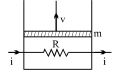
$A$ resistance coil connected to an external battery is placed inside an adiabatic cylinder fitted with a frictionless piston and containing an ideal gas. $A$ current $i$ flows through the coil which has a resistance $R$. At what speed must the piston move upward in order that the temperature of the gas remains unchanged? Neglect atmospheric pressure.
A
$\frac{i^2 m}{Rg}$
B
$\frac{Rmg}{i^2}$
C
$\frac{mg}{i^2}$
D
$\frac{i^2 R}{mg}$
Solution
(D) For an ideal gas,the internal energy depends only on temperature. Since the temperature of the gas remains unchanged,the change in internal energy $\Delta U = 0$.
According to the first law of thermodynamics,$\Delta Q = \Delta U + W$. Since $\Delta U = 0$,we have $\Delta Q = W$.
The heat supplied by the resistance coil in time $t$ is $\Delta Q = i^2 R t$.
The work done by the gas in moving the piston of mass $m$ upward by a distance $x$ is $W = mgx$ (since atmospheric pressure is neglected).
Equating the two,we get $i^2 R t = mgx$.
Differentiating with respect to time $t$,we get $i^2 R = mg \frac{dx}{dt}$.
Since the speed of the piston is $v = \frac{dx}{dt}$,we have $i^2 R = mgv$.
Therefore,the speed of the piston is $v = \frac{i^2 R}{mg}$.
According to the first law of thermodynamics,$\Delta Q = \Delta U + W$. Since $\Delta U = 0$,we have $\Delta Q = W$.
The heat supplied by the resistance coil in time $t$ is $\Delta Q = i^2 R t$.
The work done by the gas in moving the piston of mass $m$ upward by a distance $x$ is $W = mgx$ (since atmospheric pressure is neglected).
Equating the two,we get $i^2 R t = mgx$.
Differentiating with respect to time $t$,we get $i^2 R = mg \frac{dx}{dt}$.
Since the speed of the piston is $v = \frac{dx}{dt}$,we have $i^2 R = mgv$.
Therefore,the speed of the piston is $v = \frac{i^2 R}{mg}$.
0 likes
View Solution62
MediumMCQ
The first law of thermodynamics can be written as $\Delta U = \Delta Q + \Delta W$ for an ideal gas. Which of the following statements is correct?
A
$\Delta U$ is always zero when no heat enters or leaves the gas.
B
$\Delta W$ is the work done by the gas in this written law.
C
$\Delta U$ is zero when heat is supplied and the temperature stays constant.
D
$\Delta Q = -\Delta W$ when the temperature increases very slowly.
Solution
(C) The first law of thermodynamics is given as $\Delta U = \Delta Q + \Delta W$.
In this convention,$\Delta W$ represents the work done $ON$ the gas.
For option $A$: If no heat enters or leaves,$\Delta Q = 0$,so $\Delta U = \Delta W$. Thus,$\Delta U$ is not necessarily zero.
For option $B$: In the equation $\Delta U = \Delta Q + \Delta W$,$\Delta W$ is the work done on the gas,not by the gas.
For option $C$: For an ideal gas,internal energy $\Delta U$ is a function of temperature only,i.e.,$\Delta U = nC_v \Delta T$. If the temperature remains constant,$\Delta T = 0$,which implies $\Delta U = 0$. This statement is correct.
For option $D$: If temperature increases,$\Delta U \neq 0$,so $\Delta Q + \Delta W \neq 0$.
In this convention,$\Delta W$ represents the work done $ON$ the gas.
For option $A$: If no heat enters or leaves,$\Delta Q = 0$,so $\Delta U = \Delta W$. Thus,$\Delta U$ is not necessarily zero.
For option $B$: In the equation $\Delta U = \Delta Q + \Delta W$,$\Delta W$ is the work done on the gas,not by the gas.
For option $C$: For an ideal gas,internal energy $\Delta U$ is a function of temperature only,i.e.,$\Delta U = nC_v \Delta T$. If the temperature remains constant,$\Delta T = 0$,which implies $\Delta U = 0$. This statement is correct.
For option $D$: If temperature increases,$\Delta U \neq 0$,so $\Delta Q + \Delta W \neq 0$.
0 likes
View Solution63
MediumMCQ
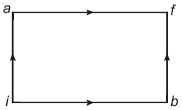
When a system is taken from state $i$ to state $f$ along the path $iaf$,it is found that $Q = 50 \ cal$ and $W = 20 \ cal$. Along the path $ibf$,$Q = 36 \ cal$. The work done $W$ along the path $ibf$ is ....... $cal$.
A
$14$
B
$6$
C
$16$
D
$66$
Solution
(B) According to the first law of thermodynamics,the change in internal energy $\Delta U$ is a state function and depends only on the initial and final states,not on the path taken.
For the path $iaf$:
$\Delta U = Q_{iaf} - W_{iaf}$
$\Delta U = 50 \, cal - 20 \, cal = 30 \, cal$.
Since the initial state $i$ and final state $f$ are the same for the path $ibf$,the change in internal energy $\Delta U$ remains the same.
For the path $ibf$:
$\Delta U = Q_{ibf} - W_{ibf}$
$30 \, cal = 36 \, cal - W_{ibf}$
$W_{ibf} = 36 \, cal - 30 \, cal = 6 \, cal$.
For the path $iaf$:
$\Delta U = Q_{iaf} - W_{iaf}$
$\Delta U = 50 \, cal - 20 \, cal = 30 \, cal$.
Since the initial state $i$ and final state $f$ are the same for the path $ibf$,the change in internal energy $\Delta U$ remains the same.
For the path $ibf$:
$\Delta U = Q_{ibf} - W_{ibf}$
$30 \, cal = 36 \, cal - W_{ibf}$
$W_{ibf} = 36 \, cal - 30 \, cal = 6 \, cal$.
0 likes
View Solution64
DifficultMCQ
$1 \ cc$ of water at its boiling point $(100^{\circ} \ C)$ is converted into steam by supplying $540 \ \text{calories}$ of heat. The volume of steam is $1671 \ cc$. If atmospheric pressure is $1.013 \times 10^5 \ \text{Nm}^{-2}$ and $J = 4.18 \ \text{joule/cal}$, the approximate value of heat required to overcome the molecular attraction is ........ $\text{cal}$.
A
$110$
B
$500$
C
$40$
D
$0$
Solution
(B) The total heat supplied $(\Delta Q)$ is used for two purposes: increasing the internal energy $(\Delta U)$ and doing work against external pressure $(\Delta W)$.
Given:
$\Delta Q = 540 \ \text{cal}$
$P = 1.013 \times 10^5 \ \text{Nm}^{-2}$
$V_1 = 1 \ \text{cc} = 1 \times 10^{-6} \ \text{m}^3$
$V_2 = 1671 \ \text{cc} = 1671 \times 10^{-6} \ \text{m}^3$
$J = 4.18 \ \text{J/cal}$
Work done against atmospheric pressure is $\Delta W = P(V_2 - V_1)$.
$\Delta W = 1.013 \times 10^5 \times (1671 - 1) \times 10^{-6} \ \text{J}$
$\Delta W = 1.013 \times 1670 \times 10^{-1} \ \text{J} \approx 169.17 \ \text{J}$.
Converting work into calories: $\Delta W_{\text{cal}} = \frac{169.17}{4.18} \approx 40.47 \ \text{cal}$.
The heat required to overcome molecular attraction is the change in internal energy $\Delta U$.
$\Delta U = \Delta Q - \Delta W_{\text{cal}}$
$\Delta U = 540 - 40.47 = 499.53 \ \text{cal} \approx 500 \ \text{cal}$.
Given:
$\Delta Q = 540 \ \text{cal}$
$P = 1.013 \times 10^5 \ \text{Nm}^{-2}$
$V_1 = 1 \ \text{cc} = 1 \times 10^{-6} \ \text{m}^3$
$V_2 = 1671 \ \text{cc} = 1671 \times 10^{-6} \ \text{m}^3$
$J = 4.18 \ \text{J/cal}$
Work done against atmospheric pressure is $\Delta W = P(V_2 - V_1)$.
$\Delta W = 1.013 \times 10^5 \times (1671 - 1) \times 10^{-6} \ \text{J}$
$\Delta W = 1.013 \times 1670 \times 10^{-1} \ \text{J} \approx 169.17 \ \text{J}$.
Converting work into calories: $\Delta W_{\text{cal}} = \frac{169.17}{4.18} \approx 40.47 \ \text{cal}$.
The heat required to overcome molecular attraction is the change in internal energy $\Delta U$.
$\Delta U = \Delta Q - \Delta W_{\text{cal}}$
$\Delta U = 540 - 40.47 = 499.53 \ \text{cal} \approx 500 \ \text{cal}$.
0 likes
View Solution65
MediumMCQ
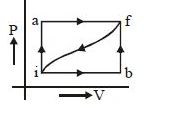
When a system is taken from thermodynamic state $i$ to $f$ along the path $iaf$ (see figure),it is found that the heat $Q$ absorbed by the system is $50 \ cal$ and the work $W$ done by the system is $20 \ cal$. Along the path $ibf$,$Q = 36 \ cal$. What is the work $W$ done along the path $ibf$ (in $cal$)?
A
$6$
B
$18$
C
$40$
D
$-43$
Solution
(A) According to the first law of thermodynamics,the change in internal energy $\Delta U$ is a state function and depends only on the initial and final states,not on the path taken.
For the path $iaf$:
$Q_{iaf} = \Delta U + W_{iaf}$
$50 \ cal = \Delta U + 20 \ cal$
$\Delta U = 50 - 20 = 30 \ cal$
Since the initial state $i$ and final state $f$ are the same for path $ibf$,the change in internal energy $\Delta U$ remains the same.
For the path $ibf$:
$Q_{ibf} = \Delta U + W_{ibf}$
$36 \ cal = 30 \ cal + W_{ibf}$
$W_{ibf} = 36 - 30 = 6 \ cal$
For the path $iaf$:
$Q_{iaf} = \Delta U + W_{iaf}$
$50 \ cal = \Delta U + 20 \ cal$
$\Delta U = 50 - 20 = 30 \ cal$
Since the initial state $i$ and final state $f$ are the same for path $ibf$,the change in internal energy $\Delta U$ remains the same.
For the path $ibf$:
$Q_{ibf} = \Delta U + W_{ibf}$
$36 \ cal = 30 \ cal + W_{ibf}$
$W_{ibf} = 36 - 30 = 6 \ cal$
0 likes
View Solution66
MediumMCQ
The latent heat of vaporization of water is $2240 \, J/g$. If the work done in the process of vaporization of $1 \, g$ is $168 \, J$,then the increase in internal energy is .... $J$.
A
$2408$
B
$2240$
C
$2072$
D
$1904$
Solution
(C) According to the first law of thermodynamics,the heat supplied $(dQ)$ is equal to the sum of the change in internal energy $(dU)$ and the work done $(dW)$: $dQ = dU + dW$.
The heat supplied for vaporization is given by $dQ = m \times L$,where $m$ is the mass and $L$ is the latent heat of vaporization.
Given: $m = 1 \, g$,$L = 2240 \, J/g$,and $dW = 168 \, J$.
Calculating $dQ$: $dQ = 1 \, g \times 2240 \, J/g = 2240 \, J$.
Substituting the values into the first law equation: $2240 \, J = dU + 168 \, J$.
Solving for $dU$: $dU = 2240 \, J - 168 \, J = 2072 \, J$.
Therefore,the increase in internal energy is $2072 \, J$.
The heat supplied for vaporization is given by $dQ = m \times L$,where $m$ is the mass and $L$ is the latent heat of vaporization.
Given: $m = 1 \, g$,$L = 2240 \, J/g$,and $dW = 168 \, J$.
Calculating $dQ$: $dQ = 1 \, g \times 2240 \, J/g = 2240 \, J$.
Substituting the values into the first law equation: $2240 \, J = dU + 168 \, J$.
Solving for $dU$: $dU = 2240 \, J - 168 \, J = 2072 \, J$.
Therefore,the increase in internal energy is $2072 \, J$.
0 likes
View Solution67
MediumMCQ
$200\,g$ of water is heated from $40\,^{\circ}C$ to $60\,^{\circ}C$. Ignoring the slight expansion of water,the change in its internal energy is close to ...... $kJ$ (Given specific heat of water $= 4184\,J/kg\cdot K$)
A
$167.4$
B
$8.4$
C
$4.2$
D
$16.7$
Solution
(D) The volume of water is assumed to be constant,so no work is done by or on the system $(W = 0)$.
According to the first law of thermodynamics:
$Q = \Delta U + W$
Since the process is isochoric $(W = 0)$,the heat supplied is equal to the change in internal energy:
$Q = \Delta U$
The formula for heat is $Q = mc\Delta T$,where:
$m = 200\,g = 0.2\,kg$
$c = 4184\,J/kg\cdot K$
$\Delta T = 60\,^{\circ}C - 40\,^{\circ}C = 20\,K$
Substituting the values:
$\Delta U = 0.2\,kg \times 4184\,J/kg\cdot K \times 20\,K$
$\Delta U = 16736\,J$
$\Delta U = 16.736\,kJ \approx 16.7\,kJ$.
According to the first law of thermodynamics:
$Q = \Delta U + W$
Since the process is isochoric $(W = 0)$,the heat supplied is equal to the change in internal energy:
$Q = \Delta U$
The formula for heat is $Q = mc\Delta T$,where:
$m = 200\,g = 0.2\,kg$
$c = 4184\,J/kg\cdot K$
$\Delta T = 60\,^{\circ}C - 40\,^{\circ}C = 20\,K$
Substituting the values:
$\Delta U = 0.2\,kg \times 4184\,J/kg\cdot K \times 20\,K$
$\Delta U = 16736\,J$
$\Delta U = 16.736\,kJ \approx 16.7\,kJ$.
0 likes
View Solution68
MediumMCQ
Given that $1\,g$ of water in liquid phase has volume $1\,cm^3$ and in vapour phase $1671\,cm^3$ at atmospheric pressure and the latent heat of vaporization of water is $2256\,J/g$,the change in the internal energy in joules for $1\,g$ of water at $373\,K$ when it changes from liquid phase to vapour phase at the same temperature is ....... $J$.
A
$2256$
B
$167$
C
$2089$
D
$1$
Solution
(C) The work done during the phase change at constant pressure is given by $W = P \Delta V$.
Given $P = 1.013 \times 10^5\,Pa$ (atmospheric pressure),$V_{liquid} = 1\,cm^3 = 10^{-6}\,m^3$,and $V_{vapour} = 1671\,cm^3 = 1671 \times 10^{-6}\,m^3$.
$W = 1.013 \times 10^5 \times (1671 - 1) \times 10^{-6} \approx 169\,J$. Using the standard approximation $P = 10^5\,Pa$ as implied by the options: $W = 10^5 \times 1670 \times 10^{-6} = 167\,J$.
The heat supplied is $Q = mL = 1\,g \times 2256\,J/g = 2256\,J$.
From the first law of thermodynamics,$Q = \Delta U + W$,so $\Delta U = Q - W$.
$\Delta U = 2256\,J - 167\,J = 2089\,J$.
Given $P = 1.013 \times 10^5\,Pa$ (atmospheric pressure),$V_{liquid} = 1\,cm^3 = 10^{-6}\,m^3$,and $V_{vapour} = 1671\,cm^3 = 1671 \times 10^{-6}\,m^3$.
$W = 1.013 \times 10^5 \times (1671 - 1) \times 10^{-6} \approx 169\,J$. Using the standard approximation $P = 10^5\,Pa$ as implied by the options: $W = 10^5 \times 1670 \times 10^{-6} = 167\,J$.
The heat supplied is $Q = mL = 1\,g \times 2256\,J/g = 2256\,J$.
From the first law of thermodynamics,$Q = \Delta U + W$,so $\Delta U = Q - W$.
$\Delta U = 2256\,J - 167\,J = 2089\,J$.
0 likes
View Solution69
MediumMCQ
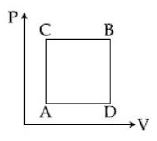
$A$ gas can be taken from $A$ to $B$ via two different processes $ACB$ and $ADB$. When path $ACB$ is used,$60 \, J$ of heat flows into the system and $30 \, J$ of work is done by the system. If path $ADB$ is used,the work done by the system is $10 \, J$. The heat flow into the system in path $ADB$ is ..... $J$.
A
$40$
B
$80$
C
$100$
D
$20$
Solution
(A) According to the first law of thermodynamics,the change in internal energy $\Delta U$ is given by $\Delta U = Q - W$,where $Q$ is the heat supplied to the system and $W$ is the work done by the system.
Since the initial state $A$ and final state $B$ are the same for both paths $ACB$ and $ADB$,the change in internal energy $\Delta U$ must be the same for both processes.
For path $ACB$:
$Q_{ACB} = 60 \, J$
$W_{ACB} = 30 \, J$
$\Delta U = Q_{ACB} - W_{ACB} = 60 - 30 = 30 \, J$
For path $ADB$:
$W_{ADB} = 10 \, J$
Since $\Delta U$ is the same,$\Delta U = Q_{ADB} - W_{ADB}$
$30 = Q_{ADB} - 10$
$Q_{ADB} = 30 + 10 = 40 \, J$
Thus,the heat flow into the system in path $ADB$ is $40 \, J$.
Since the initial state $A$ and final state $B$ are the same for both paths $ACB$ and $ADB$,the change in internal energy $\Delta U$ must be the same for both processes.
For path $ACB$:
$Q_{ACB} = 60 \, J$
$W_{ACB} = 30 \, J$
$\Delta U = Q_{ACB} - W_{ACB} = 60 - 30 = 30 \, J$
For path $ADB$:
$W_{ADB} = 10 \, J$
Since $\Delta U$ is the same,$\Delta U = Q_{ADB} - W_{ADB}$
$30 = Q_{ADB} - 10$
$Q_{ADB} = 30 + 10 = 40 \, J$
Thus,the heat flow into the system in path $ADB$ is $40 \, J$.
0 likes
View Solution70
MediumMCQ
In a thermodynamics process,the pressure of a fixed mass of a gas is changed in such a manner that the gas releases $20 \ J$ of heat and $8 \ J$ of work is done on the gas. If the initial internal energy of the gas was $30 \ J$,what will be the final internal energy in $J$?
A
$18$
B
$9$
C
$4.5$
D
$36$
Solution
(A) According to the first law of thermodynamics,$dQ = dU + dW$,where $dQ$ is the heat supplied to the system,$dU$ is the change in internal energy,and $dW$ is the work done by the system.
Given:
Heat released by the gas,$dQ = -20 \ J$ (negative because heat is released).
Work done on the gas,$dW = -8 \ J$ (negative because work is done on the system).
Initial internal energy,$U_i = 30 \ J$.
Using the formula $dQ = (U_f - U_i) + dW$:
$-20 = (U_f - 30) + (-8)$
$-20 = U_f - 30 - 8$
$-20 = U_f - 38$
$U_f = 38 - 20$
$U_f = 18 \ J$.
Therefore,the final internal energy is $18 \ J$.
Given:
Heat released by the gas,$dQ = -20 \ J$ (negative because heat is released).
Work done on the gas,$dW = -8 \ J$ (negative because work is done on the system).
Initial internal energy,$U_i = 30 \ J$.
Using the formula $dQ = (U_f - U_i) + dW$:
$-20 = (U_f - 30) + (-8)$
$-20 = U_f - 30 - 8$
$-20 = U_f - 38$
$U_f = 38 - 20$
$U_f = 18 \ J$.
Therefore,the final internal energy is $18 \ J$.
0 likes
View Solution71
MediumMCQ
For a thermodynamic process $\delta Q = -50 \text{ calorie}$ and $W = -20 \text{ calorie}$. If the initial internal energy is $-30 \text{ calorie}$,then the final internal energy will be ....... $\text{calorie}$.
A
$191.20$
B
$-60$
C
$100$
D
$-100$
Solution
(B) According to the first law of thermodynamics,the heat supplied to a system is equal to the sum of the change in internal energy and the work done by the system: $\delta Q = \Delta U + W$.
Here,$\delta Q = -50 \text{ calorie}$ and $W = -20 \text{ calorie}$.
Substituting these values into the equation: $-50 = \Delta U + (-20)$.
Solving for $\Delta U$: $\Delta U = -50 + 20 = -30 \text{ calorie}$.
We know that $\Delta U = U_f - U_i$,where $U_f$ is the final internal energy and $U_i$ is the initial internal energy.
Given $U_i = -30 \text{ calorie}$,we have: $-30 = U_f - (-30)$.
$-30 = U_f + 30$.
$U_f = -30 - 30 = -60 \text{ calorie}$.
Here,$\delta Q = -50 \text{ calorie}$ and $W = -20 \text{ calorie}$.
Substituting these values into the equation: $-50 = \Delta U + (-20)$.
Solving for $\Delta U$: $\Delta U = -50 + 20 = -30 \text{ calorie}$.
We know that $\Delta U = U_f - U_i$,where $U_f$ is the final internal energy and $U_i$ is the initial internal energy.
Given $U_i = -30 \text{ calorie}$,we have: $-30 = U_f - (-30)$.
$-30 = U_f + 30$.
$U_f = -30 - 30 = -60 \text{ calorie}$.
0 likes
View Solution72
DifficultMCQ
In a thermodynamic process,the pressure of a fixed mass of a gas is changed in such a manner that the gas releases $20 \, J$ of heat when $8 \, J$ of work is done on the gas. If the initial internal energy of the gas was $30 \, J$,then the final internal energy will be .... $J$.
A
$2$
B
$18$
C
$42$
D
$58$
Solution
(B) According to the first law of thermodynamics,$\Delta Q = \Delta U + \Delta W$.
Given that the gas releases $20 \, J$ of heat,the heat supplied is $\Delta Q = -20 \, J$.
Since $8 \, J$ of work is done on the gas,the work done by the gas is $\Delta W = -8 \, J$.
Substituting these values into the first law equation:
$-20 \, J = \Delta U + (-8 \, J)$.
$\Delta U = -20 \, J + 8 \, J = -12 \, J$.
We know that $\Delta U = U_f - U_i$,where $U_f$ is the final internal energy and $U_i$ is the initial internal energy.
Given $U_i = 30 \, J$,we have:
$U_f - 30 \, J = -12 \, J$.
$U_f = 30 \, J - 12 \, J = 18 \, J$.
Therefore,the final internal energy is $18 \, J$.
Given that the gas releases $20 \, J$ of heat,the heat supplied is $\Delta Q = -20 \, J$.
Since $8 \, J$ of work is done on the gas,the work done by the gas is $\Delta W = -8 \, J$.
Substituting these values into the first law equation:
$-20 \, J = \Delta U + (-8 \, J)$.
$\Delta U = -20 \, J + 8 \, J = -12 \, J$.
We know that $\Delta U = U_f - U_i$,where $U_f$ is the final internal energy and $U_i$ is the initial internal energy.
Given $U_i = 30 \, J$,we have:
$U_f - 30 \, J = -12 \, J$.
$U_f = 30 \, J - 12 \, J = 18 \, J$.
Therefore,the final internal energy is $18 \, J$.
0 likes
View Solution73
EasyMCQ
If $\Delta Q$ and $\Delta W$ represent the heat supplied to the system and the work done on the system respectively,then the first law of thermodynamics can be written as
A
$\Delta Q = \Delta U + \Delta W$
B
$\Delta Q = \Delta U - \Delta W$
C
$\Delta Q = \Delta W - \Delta U$
D
$\Delta Q = -\Delta W - \Delta U$
Solution
(B) The first law of thermodynamics is given by the equation $\Delta Q = \Delta U + W_{by}$,where $W_{by}$ is the work done $BY$ the system.
Given that $\Delta W$ is the work done $ON$ the system,we have $W_{by} = -\Delta W$.
Substituting this into the first law equation:
$\Delta Q = \Delta U + (-\Delta W)$
$\Delta Q = \Delta U - \Delta W$
Therefore,the correct option is $B$.
Given that $\Delta W$ is the work done $ON$ the system,we have $W_{by} = -\Delta W$.
Substituting this into the first law equation:
$\Delta Q = \Delta U + (-\Delta W)$
$\Delta Q = \Delta U - \Delta W$
Therefore,the correct option is $B$.
0 likes
View Solution74
DifficultMCQ
The internal energy change in a system that has absorbed $2 \, kcal$ of heat and done $500 \, J$ of work is ...... $J$.
A
$6400$
B
$5400$
C
$7900$
D
$8900$
Solution
(C) According to the first law of thermodynamics, the relationship between heat $(Q)$, internal energy change $(\Delta U)$, and work done $(W)$ is given by:
$Q = \Delta U + W$
Given:
Heat absorbed $(Q) = 2 \, kcal = 2 \times 1000 \times 4.2 \, J = 8400 \, J$
Work done $(W) = 500 \, J$
Rearranging the formula to find the change in internal energy:
$\Delta U = Q - W$
Substituting the values:
$\Delta U = 8400 \, J - 500 \, J$
$\Delta U = 7900 \, J$
$Q = \Delta U + W$
Given:
Heat absorbed $(Q) = 2 \, kcal = 2 \times 1000 \times 4.2 \, J = 8400 \, J$
Work done $(W) = 500 \, J$
Rearranging the formula to find the change in internal energy:
$\Delta U = Q - W$
Substituting the values:
$\Delta U = 8400 \, J - 500 \, J$
$\Delta U = 7900 \, J$
0 likes
View Solution75
EasyMCQ
$Assertion:$ The heat supplied to a system is always equal to the increase in its internal energy.
$Reason:$ When a system changes from one thermal equilibrium to another,some heat is absorbed by it.
$Reason:$ When a system changes from one thermal equilibrium to another,some heat is absorbed by it.
A
If both $Assertion$ and $Reason$ are correct and the $Reason$ is a correct explanation of the $Assertion$.
B
If both $Assertion$ and $Reason$ are correct but $Reason$ is not a correct explanation of the $Assertion$.
C
If the $Assertion$ is correct but $Reason$ is incorrect.
D
If both the $Assertion$ and $Reason$ are incorrect.
Solution
(D) According to the first law of thermodynamics,$\Delta Q = \Delta U + \Delta W = \Delta U + P\Delta V$.
If heat is supplied in such a manner that the volume does not change $(\Delta V = 0)$,i.e.,an isochoric process,then the whole of the heat energy supplied to the system will increase the internal energy only.
However,in any other process where work is done,the heat supplied is distributed between the change in internal energy and the work done by the system.
Therefore,the $Assertion$ is incorrect.
The $Reason$ is also incorrect because when a system changes from one thermal equilibrium to another,heat may be absorbed,evolved,or remain zero depending on the process.
If heat is supplied in such a manner that the volume does not change $(\Delta V = 0)$,i.e.,an isochoric process,then the whole of the heat energy supplied to the system will increase the internal energy only.
However,in any other process where work is done,the heat supplied is distributed between the change in internal energy and the work done by the system.
Therefore,the $Assertion$ is incorrect.
The $Reason$ is also incorrect because when a system changes from one thermal equilibrium to another,heat may be absorbed,evolved,or remain zero depending on the process.
0 likes
View Solution76
DifficultMCQ
$1\;g$ of water,of volume $1\;cm^{3}$ at $100^{\circ}C$,is converted into steam at the same temperature under normal atmospheric pressure $(=1 \times 10^{5}\;Pa)$. The volume of steam formed equals $1671\;cm^{3}$. If the specific latent heat of vaporisation of water is $2256\;J/g$,the change in internal energy is.....$J$.
A
$2423$
B
$2089$
C
$167$
D
$2256$
Solution
(B) According to the first law of thermodynamics,$Q = \Delta U + W$.
Here,$Q$ is the heat supplied,$\Delta U$ is the change in internal energy,and $W$ is the work done by the system.
Given:
Mass $m = 1\;g$
Latent heat $L = 2256\;J/g$
Pressure $P = 1 \times 10^{5}\;Pa$
Initial volume $V_{1} = 1\;cm^{3} = 1 \times 10^{-6}\;m^{3}$
Final volume $V_{2} = 1671\;cm^{3} = 1671 \times 10^{-6}\;m^{3}$
Heat supplied $Q = mL = 1\;g \times 2256\;J/g = 2256\;J$.
Work done $W = P(V_{2} - V_{1}) = 1 \times 10^{5} \times (1671 - 1) \times 10^{-6} = 10^{5} \times 1670 \times 10^{-6} = 167\;J$.
Using $Q = \Delta U + W$,we get $\Delta U = Q - W = 2256 - 167 = 2089\;J$.
Here,$Q$ is the heat supplied,$\Delta U$ is the change in internal energy,and $W$ is the work done by the system.
Given:
Mass $m = 1\;g$
Latent heat $L = 2256\;J/g$
Pressure $P = 1 \times 10^{5}\;Pa$
Initial volume $V_{1} = 1\;cm^{3} = 1 \times 10^{-6}\;m^{3}$
Final volume $V_{2} = 1671\;cm^{3} = 1671 \times 10^{-6}\;m^{3}$
Heat supplied $Q = mL = 1\;g \times 2256\;J/g = 2256\;J$.
Work done $W = P(V_{2} - V_{1}) = 1 \times 10^{5} \times (1671 - 1) \times 10^{-6} = 10^{5} \times 1670 \times 10^{-6} = 167\;J$.
Using $Q = \Delta U + W$,we get $\Delta U = Q - W = 2256 - 167 = 2089\;J$.
0 likes
View Solution77
EasyMCQ
An electric heater supplies heat to a system at a rate of $100\;W.$ If the system performs work at a rate of $75\;J/s,$ at what rate (in $J/s$) is the internal energy increasing?
A
$36$
B
$20$
C
$30$
D
$25$
Solution
(D) Heat is supplied to the system at a rate of $100\;W.$
Heat supplied,$Q = 100\;J/s.$
The system performs work at a rate of $75\;J/s.$
Work done,$W = 75\;J/s.$
From the first law of thermodynamics,we have:
$Q = \Delta U + W$
Where,$\Delta U$ is the rate of change of internal energy.
$\therefore \Delta U = Q - W$
$= 100 - 75$
$= 25\;J/s.$
Therefore,the internal energy of the system increases at a rate of $25\;J/s.$
Heat supplied,$Q = 100\;J/s.$
The system performs work at a rate of $75\;J/s.$
Work done,$W = 75\;J/s.$
From the first law of thermodynamics,we have:
$Q = \Delta U + W$
Where,$\Delta U$ is the rate of change of internal energy.
$\therefore \Delta U = Q - W$
$= 100 - 75$
$= 25\;J/s.$
Therefore,the internal energy of the system increases at a rate of $25\;J/s.$
0 likes
View Solution78
Medium
Describe an experiment of Benjamin Thomson regarding the heat produced by work.
Solution
(N/A) Benjamin Thomson,also known as Count Rumford,conducted a famous experiment in $1798$ while observing the boring of cannons.
$1$. He observed that when a blunt drill was used to bore a cannon,a significant amount of heat was generated,which could boil water.
$2$. He noted that the heat production continued as long as the mechanical work of turning the drill was performed.
$3$. Since the heat did not seem to come from the metal itself (as the chips of metal produced were not significantly different in heat capacity),he concluded that heat is not a fluid (caloric) but is instead a form of energy generated by mechanical work.
$4$. This experiment provided early evidence that mechanical work can be converted into heat,laying the groundwork for the first law of thermodynamics.
$1$. He observed that when a blunt drill was used to bore a cannon,a significant amount of heat was generated,which could boil water.
$2$. He noted that the heat production continued as long as the mechanical work of turning the drill was performed.
$3$. Since the heat did not seem to come from the metal itself (as the chips of metal produced were not significantly different in heat capacity),he concluded that heat is not a fluid (caloric) but is instead a form of energy generated by mechanical work.
$4$. This experiment provided early evidence that mechanical work can be converted into heat,laying the groundwork for the first law of thermodynamics.
0 likes
View Solution79
Medium
Write and explain the first law of thermodynamics.
Solution
(N/A) The internal energy of a system can change through two modes of energy transfer: heat and work.
Let $\Delta Q$ = Heat supplied to the system by the surroundings.
Let $\Delta W$ = Work done by the system on the surroundings.
Let $\Delta U$ = Change in the internal energy of the system.
From the principle of conservation of energy,$\Delta Q = \Delta U + \Delta W$ ... $(1)$ is known as the first law of thermodynamics.
From equation $(1)$,it is stated that the energy $(\Delta Q)$ supplied to the system is used partly to increase the internal energy of the system $(\Delta U)$ and the rest is used to perform work on the surroundings $(\Delta W)$.
An alternative form of this equation is $\Delta Q - \Delta W = \Delta U$ ... $(2)$.
$A$ system may transition from an initial state to a final state in various ways. For example,to change the state of a gas from $(P_{1}, V_{1})$ to $(P_{2}, V_{2})$,one could change the volume from $V_{1}$ to $V_{2}$ at constant pressure,then change the pressure from $P_{1}$ to $P_{2}$ at constant volume.
When a system is taken from one state to another,$\Delta Q$ and $\Delta W$ are different for different paths,meaning $\Delta Q$ and $\Delta W$ are path-dependent. However,the difference $(\Delta Q - \Delta W)$ is the same for every path. Thus,$(\Delta Q - \Delta W)$ is path-independent and depends only on the initial and final states of the system.
Therefore,the first law of thermodynamics is $\Delta Q - \Delta W = \Delta U$.
This law is obeyed in all natural processes. All three terms must have the same units.
Sign convention: If the system absorbs heat,$\Delta Q$ is positive; if heat is released,$\Delta Q$ is negative. When a gas expands,work done by the system $\Delta W$ is positive; when compressed,work done on the system $\Delta W$ is negative.
If $(\Delta Q - \Delta W) > 0$,the internal energy increases; if $(\Delta Q - \Delta W) < 0$,the internal energy decreases.
Let $\Delta Q$ = Heat supplied to the system by the surroundings.
Let $\Delta W$ = Work done by the system on the surroundings.
Let $\Delta U$ = Change in the internal energy of the system.
From the principle of conservation of energy,$\Delta Q = \Delta U + \Delta W$ ... $(1)$ is known as the first law of thermodynamics.
From equation $(1)$,it is stated that the energy $(\Delta Q)$ supplied to the system is used partly to increase the internal energy of the system $(\Delta U)$ and the rest is used to perform work on the surroundings $(\Delta W)$.
An alternative form of this equation is $\Delta Q - \Delta W = \Delta U$ ... $(2)$.
$A$ system may transition from an initial state to a final state in various ways. For example,to change the state of a gas from $(P_{1}, V_{1})$ to $(P_{2}, V_{2})$,one could change the volume from $V_{1}$ to $V_{2}$ at constant pressure,then change the pressure from $P_{1}$ to $P_{2}$ at constant volume.
When a system is taken from one state to another,$\Delta Q$ and $\Delta W$ are different for different paths,meaning $\Delta Q$ and $\Delta W$ are path-dependent. However,the difference $(\Delta Q - \Delta W)$ is the same for every path. Thus,$(\Delta Q - \Delta W)$ is path-independent and depends only on the initial and final states of the system.
Therefore,the first law of thermodynamics is $\Delta Q - \Delta W = \Delta U$.
This law is obeyed in all natural processes. All three terms must have the same units.
Sign convention: If the system absorbs heat,$\Delta Q$ is positive; if heat is released,$\Delta Q$ is negative. When a gas expands,work done by the system $\Delta W$ is positive; when compressed,work done on the system $\Delta W$ is negative.
If $(\Delta Q - \Delta W) > 0$,the internal energy increases; if $(\Delta Q - \Delta W) < 0$,the internal energy decreases.
0 likes
View Solution80
Easy
Calculate the change in internal energy when $1 \,g$ of water is converted into steam at atmospheric pressure $(1.013 \times 10^{5} \,Pa)$. Given the latent heat of vaporisation is $2256 \,J/g$, the volume of $1 \,g$ of water is $1 \,cm^{3}$, and the volume of $1 \,g$ of steam is $1671 \,cm^{3}$.
Solution
(N/A) Let us consider $1 \,g$ of water for conversion into steam.
Latent heat of vaporisation of water, $L_{v} = 2256 \,J/g$.
Therefore, the heat absorbed is $\Delta Q = m \times L_{v} = 1 \,g \times 2256 \,J/g = 2256 \,J$.
Volume of $1 \,g$ water at atmospheric pressure is $V_{l} = 1 \,cm^{3} = 1 \times 10^{-6} \,m^{3}$.
Volume of $1 \,g$ steam is $V_{g} = 1671 \,cm^{3} = 1671 \times 10^{-6} \,m^{3}$.
Change in volume, $\Delta V = V_{g} - V_{l} = (1671 - 1) \times 10^{-6} \,m^{3} = 1670 \times 10^{-6} \,m^{3}$.
Work done at constant atmospheric pressure, $\Delta W = P \Delta V = (1.013 \times 10^{5} \,Pa) \times (1670 \times 10^{-6} \,m^{3}) \approx 169.2 \,J$.
From the first law of thermodynamics, $\Delta U = \Delta Q - \Delta W$.
$\Delta U = 2256 \,J - 169.2 \,J = 2086.8 \,J$.
Thus, the change in internal energy is $2086.8 \,J$.
Latent heat of vaporisation of water, $L_{v} = 2256 \,J/g$.
Therefore, the heat absorbed is $\Delta Q = m \times L_{v} = 1 \,g \times 2256 \,J/g = 2256 \,J$.
Volume of $1 \,g$ water at atmospheric pressure is $V_{l} = 1 \,cm^{3} = 1 \times 10^{-6} \,m^{3}$.
Volume of $1 \,g$ steam is $V_{g} = 1671 \,cm^{3} = 1671 \times 10^{-6} \,m^{3}$.
Change in volume, $\Delta V = V_{g} - V_{l} = (1671 - 1) \times 10^{-6} \,m^{3} = 1670 \times 10^{-6} \,m^{3}$.
Work done at constant atmospheric pressure, $\Delta W = P \Delta V = (1.013 \times 10^{5} \,Pa) \times (1670 \times 10^{-6} \,m^{3}) \approx 169.2 \,J$.
From the first law of thermodynamics, $\Delta U = \Delta Q - \Delta W$.
$\Delta U = 2256 \,J - 169.2 \,J = 2086.8 \,J$.
Thus, the change in internal energy is $2086.8 \,J$.
0 likes
View Solution81
MediumMCQ
In how many ways can the internal energy of a system be changed?
A
$1$
B
$2$
C
$3$
D
$4$
Solution
(B) The internal energy $(U)$ of a thermodynamic system can be changed in two primary ways:
$1$. By doing work $(W)$ on the system or by the system.
$2$. By transferring heat $(Q)$ to or from the system.
According to the First Law of Thermodynamics, the change in internal energy $(\Delta U)$ is given by the equation: $\Delta U = Q - W$.
Therefore, there are $2$ ways to change the internal energy.
$1$. By doing work $(W)$ on the system or by the system.
$2$. By transferring heat $(Q)$ to or from the system.
According to the First Law of Thermodynamics, the change in internal energy $(\Delta U)$ is given by the equation: $\Delta U = Q - W$.
Therefore, there are $2$ ways to change the internal energy.
0 likes
View Solution82
Medium
State the first law of thermodynamics and write its limitations.
Solution
(N/A) The first law of thermodynamics is a statement of the law of conservation of energy. It states that if a quantity of heat $dQ$ is supplied to a system,it is used to increase the internal energy $dU$ of the system and to do work $dW$ by the system against the surroundings. Mathematically,it is expressed as: $dQ = dU + dW$.
Limitations of the first law of thermodynamics:
$1$. It does not indicate the direction of the process. For example,it does not explain why heat cannot spontaneously flow from a cold body to a hot body.
$2$. It does not specify the conditions under which the conversion of heat into work is possible.
$3$. It does not tell us about the extent of conversion of heat into work,i.e.,it does not explain why heat cannot be completely converted into work in a cyclic process.
Limitations of the first law of thermodynamics:
$1$. It does not indicate the direction of the process. For example,it does not explain why heat cannot spontaneously flow from a cold body to a hot body.
$2$. It does not specify the conditions under which the conversion of heat into work is possible.
$3$. It does not tell us about the extent of conversion of heat into work,i.e.,it does not explain why heat cannot be completely converted into work in a cyclic process.
0 likes
View Solution83
Medium
Write the sign convention for internal energy in thermodynamics.
Solution
(N/A) In thermodynamics,the sign convention for internal energy change $(\Delta U)$ is based on the First Law of Thermodynamics: $\Delta U = Q - W$.
$1$. If the internal energy of the system increases,$\Delta U$ is positive $(+ve)$. This typically occurs when heat is added to the system or work is done on the system.
$2$. If the internal energy of the system decreases,$\Delta U$ is negative $(-ve)$. This typically occurs when heat is released by the system or the system does work on the surroundings.
$3$. For an ideal gas,the internal energy depends only on temperature. Therefore,if the temperature of an ideal gas increases,$\Delta U > 0$,and if the temperature decreases,$\Delta U < 0$.
$1$. If the internal energy of the system increases,$\Delta U$ is positive $(+ve)$. This typically occurs when heat is added to the system or work is done on the system.
$2$. If the internal energy of the system decreases,$\Delta U$ is negative $(-ve)$. This typically occurs when heat is released by the system or the system does work on the surroundings.
$3$. For an ideal gas,the internal energy depends only on temperature. Therefore,if the temperature of an ideal gas increases,$\Delta U > 0$,and if the temperature decreases,$\Delta U < 0$.
0 likes
View Solution84
Advanced
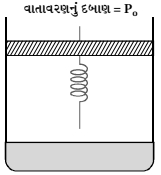
$A$ cylinder with a piston of unit cross-sectional area contains one mole of an ideal gas as shown in the figure. $A$ spring of unstretched length $L$ and spring constant $K$ is connected between the piston and the bottom of the cylinder. Initially, the spring is unstretched and the gas is in equilibrium. When an amount of heat $Q$ is supplied to the gas, its volume changes from $V_0$ to $V_1$. Find:
$(a)$ The initial pressure of the system.
$(b)$ The final pressure of the system.
$(c)$ Using the first law of thermodynamics, find the relation between $Q, V_0, V_1, P_a$ and $K$.
$(a)$ The initial pressure of the system.
$(b)$ The final pressure of the system.
$(c)$ Using the first law of thermodynamics, find the relation between $Q, V_0, V_1, P_a$ and $K$.
Solution
(N/A) Initially, the spring is unstretched, so the force exerted by the spring is zero. The piston is in equilibrium under the atmospheric pressure $P_a$ and the gas pressure $P_i$. Thus, $P_i = P_a$.
$(b)$ When the volume increases from $V_0$ to $V_1$, the piston moves by a distance $x = V_1 - V_0$ (since the area is unit). The spring is now stretched by $x$. The final pressure $P_f$ is balanced by atmospheric pressure, spring force, and gas pressure: $P_f = P_a + \frac{Kx}{A} = P_a + K(V_1 - V_0)$.
$(c)$ According to the first law of thermodynamics, $Q = \Delta U + W$.
For an ideal gas, $\Delta U = C_v \Delta T = \frac{C_v}{R} (P_f V_1 - P_i V_0) = \frac{f}{2} (P_f V_1 - P_i V_0)$.
The work done by the gas is $W = \int_{V_0}^{V_1} P \, dV$. Since the pressure varies linearly with volume, $W = \frac{P_i + P_f}{2} (V_1 - V_0)$.
Substituting the values: $Q = \frac{f}{2} [ (P_a + K(V_1 - V_0)) V_1 - P_a V_0 ] + \frac{P_a + P_a + K(V_1 - V_0)}{2} (V_1 - V_0)$.
$(b)$ When the volume increases from $V_0$ to $V_1$, the piston moves by a distance $x = V_1 - V_0$ (since the area is unit). The spring is now stretched by $x$. The final pressure $P_f$ is balanced by atmospheric pressure, spring force, and gas pressure: $P_f = P_a + \frac{Kx}{A} = P_a + K(V_1 - V_0)$.
$(c)$ According to the first law of thermodynamics, $Q = \Delta U + W$.
For an ideal gas, $\Delta U = C_v \Delta T = \frac{C_v}{R} (P_f V_1 - P_i V_0) = \frac{f}{2} (P_f V_1 - P_i V_0)$.
The work done by the gas is $W = \int_{V_0}^{V_1} P \, dV$. Since the pressure varies linearly with volume, $W = \frac{P_i + P_f}{2} (V_1 - V_0)$.
Substituting the values: $Q = \frac{f}{2} [ (P_a + K(V_1 - V_0)) V_1 - P_a V_0 ] + \frac{P_a + P_a + K(V_1 - V_0)}{2} (V_1 - V_0)$.
0 likes
View Solution85
MediumMCQ
Is $P\Delta V$ an extensive or intensive variable?
A
Extensive
B
Intensive
C
Both
D
Neither
Solution
(A) An extensive variable is one that depends on the size or the amount of matter in the system (e.g.,volume,mass,internal energy).
An intensive variable is one that is independent of the size or the amount of matter in the system (e.g.,pressure,temperature,density).
In the expression $P\Delta V$,$P$ (pressure) is an intensive variable,while $\Delta V$ (change in volume) is an extensive variable.
The product of an intensive variable and an extensive variable is always an extensive variable.
Therefore,$P\Delta V$ represents work done,which is an extensive property because it depends on the amount of substance in the system.
An intensive variable is one that is independent of the size or the amount of matter in the system (e.g.,pressure,temperature,density).
In the expression $P\Delta V$,$P$ (pressure) is an intensive variable,while $\Delta V$ (change in volume) is an extensive variable.
The product of an intensive variable and an extensive variable is always an extensive variable.
Therefore,$P\Delta V$ represents work done,which is an extensive property because it depends on the amount of substance in the system.
0 likes
View Solution86
Medium
Why does a gas get heated on compression?
Solution
(N/A) When a gas is compressed,work is done on the gas by the external agent. According to the first law of thermodynamics,$\Delta Q = \Delta U + \Delta W$. In a rapid compression (adiabatic process),$\Delta Q = 0$. Therefore,$\Delta U = -\Delta W$. Since work is done on the gas,$\Delta W$ is negative,which makes $\Delta U$ positive. An increase in internal energy $(\Delta U)$ leads to an increase in the temperature of the gas.
0 likes
View Solution87
Medium
Is it possible to convert internal energy into work or mechanical energy?
Solution
(A) Yes,it is possible to convert internal energy into work or mechanical energy.
According to the first law of thermodynamics,$\Delta Q = \Delta U + \Delta W$.
If a system undergoes an adiabatic process,$\Delta Q = 0$,which implies $\Delta W = -\Delta U$.
This means that any work done by the system $(\Delta W > 0)$ results in a decrease in internal energy $(-\Delta U)$.
Examples include the adiabatic expansion of a gas in a cylinder or the explosion of a bomb,where chemical internal energy is rapidly converted into mechanical kinetic energy.
According to the first law of thermodynamics,$\Delta Q = \Delta U + \Delta W$.
If a system undergoes an adiabatic process,$\Delta Q = 0$,which implies $\Delta W = -\Delta U$.
This means that any work done by the system $(\Delta W > 0)$ results in a decrease in internal energy $(-\Delta U)$.
Examples include the adiabatic expansion of a gas in a cylinder or the explosion of a bomb,where chemical internal energy is rapidly converted into mechanical kinetic energy.
0 likes
View Solution88
MediumMCQ
What is the net amount of heat entering the system in a cyclic process equivalent to?
A
Change in internal energy
B
Net mechanical work done by the system
C
Zero
D
Total enthalpy change
Solution
(B) In a cyclic process, the system returns to its initial state. Therefore, the change in internal energy $(\Delta U)$ is zero.
According to the First Law of Thermodynamics, $\Delta Q = \Delta U + \Delta W$.
Since $\Delta U = 0$, it follows that $\Delta Q = \Delta W$.
Thus, the net amount of heat entering the system is equivalent to the net mechanical work done by the system.
According to the First Law of Thermodynamics, $\Delta Q = \Delta U + \Delta W$.
Since $\Delta U = 0$, it follows that $\Delta Q = \Delta W$.
Thus, the net amount of heat entering the system is equivalent to the net mechanical work done by the system.
0 likes
View Solution89
Difficult
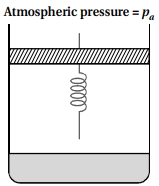
Consider one mole of perfect gas in a cylinder of unit cross-section with a piston attached as shown in the figure. $A$ spring (spring constant $k$) is attached (unstretched length $L$) to the piston and to the bottom of the cylinder. Initially,the spring is unstretched and the gas is in equilibrium. $A$ certain amount of heat $Q$ is supplied to the gas,causing an increase in volume from $V_0$ to $V_1$.
$(a)$ What is the initial pressure of the system?
$(b)$ What is the final pressure of the system?
$(c)$ Using the first law of thermodynamics,write down a relation between $Q, V_0, V_1, P_a$ and $k$.
$(a)$ What is the initial pressure of the system?
$(b)$ What is the final pressure of the system?
$(c)$ Using the first law of thermodynamics,write down a relation between $Q, V_0, V_1, P_a$ and $k$.
Solution
(N/A) Initially,the system is in equilibrium,hence the pressure on the piston is the atmospheric pressure.
$\therefore P_{i} = P_{a}$
$(b)$ On the supply of heat,the volume of the gas increases from $V_{0}$ to $V_{1}$.
Since the cross-sectional area $A = 1$ unit,the displacement of the piston is $x = V_{1} - V_{0}$.
The force exerted by the spring on the piston is $F = kx = k(V_{1} - V_{0})$.
The final pressure $P_{f}$ on the gas is the sum of atmospheric pressure and the pressure due to the spring force:
$P_{f} = P_{a} + \frac{F}{A} = P_{a} + k(V_{1} - V_{0})$
$(c)$ According to the first law of thermodynamics,$Q = \Delta U + \Delta W$.
The change in internal energy for one mole of an ideal gas is $\Delta U = C_{V}(T_{f} - T_{0})$.
Using the ideal gas law $PV = RT$,we have $T = \frac{PV}{R}$,so $\Delta U = C_{V} \left( \frac{P_{f}V_{1}}{R} - \frac{P_{a}V_{0}}{R} \right)$.
The work done by the gas is $\Delta W = P_{a}(V_{1} - V_{0}) + \frac{1}{2}k(V_{1} - V_{0})^{2}$.
Thus,the relation is: $Q = C_{V} \left( \frac{(P_{a} + k(V_{1} - V_{0}))V_{1} - P_{a}V_{0}}{R} \right) + P_{a}(V_{1} - V_{0}) + \frac{1}{2}k(V_{1} - V_{0})^{2}$.
$\therefore P_{i} = P_{a}$
$(b)$ On the supply of heat,the volume of the gas increases from $V_{0}$ to $V_{1}$.
Since the cross-sectional area $A = 1$ unit,the displacement of the piston is $x = V_{1} - V_{0}$.
The force exerted by the spring on the piston is $F = kx = k(V_{1} - V_{0})$.
The final pressure $P_{f}$ on the gas is the sum of atmospheric pressure and the pressure due to the spring force:
$P_{f} = P_{a} + \frac{F}{A} = P_{a} + k(V_{1} - V_{0})$
$(c)$ According to the first law of thermodynamics,$Q = \Delta U + \Delta W$.
The change in internal energy for one mole of an ideal gas is $\Delta U = C_{V}(T_{f} - T_{0})$.
Using the ideal gas law $PV = RT$,we have $T = \frac{PV}{R}$,so $\Delta U = C_{V} \left( \frac{P_{f}V_{1}}{R} - \frac{P_{a}V_{0}}{R} \right)$.
The work done by the gas is $\Delta W = P_{a}(V_{1} - V_{0}) + \frac{1}{2}k(V_{1} - V_{0})^{2}$.
Thus,the relation is: $Q = C_{V} \left( \frac{(P_{a} + k(V_{1} - V_{0}))V_{1} - P_{a}V_{0}}{R} \right) + P_{a}(V_{1} - V_{0}) + \frac{1}{2}k(V_{1} - V_{0})^{2}$.
0 likes
View Solution90
MediumMCQ
$A$ system is given $300$ calories of heat and it does $600$ joules of work. How much does the internal energy of the system change in this process? $(J = 4.18 \text{ Joules/cal})$ (in joule)
A
$654$
B
$156.5$
C
$-300$
D
$-528.2$
Solution
(A) According to the first law of thermodynamics,the change in internal energy $\Delta U$ is given by the equation:
$\Delta Q = \Delta U + \Delta W$
where $\Delta Q$ is the heat supplied to the system and $\Delta W$ is the work done by the system.
First,convert the heat supplied from calories to joules:
$\Delta Q = 300 \text{ cal} \times 4.18 \text{ J/cal} = 1254 \text{ J}$.
The work done by the system is $\Delta W = 600 \text{ J}$.
Rearranging the first law equation to solve for $\Delta U$:
$\Delta U = \Delta Q - \Delta W$
$\Delta U = 1254 \text{ J} - 600 \text{ J} = 654 \text{ J}$.
Therefore,the internal energy of the system increases by $654 \text{ J}$.
$\Delta Q = \Delta U + \Delta W$
where $\Delta Q$ is the heat supplied to the system and $\Delta W$ is the work done by the system.
First,convert the heat supplied from calories to joules:
$\Delta Q = 300 \text{ cal} \times 4.18 \text{ J/cal} = 1254 \text{ J}$.
The work done by the system is $\Delta W = 600 \text{ J}$.
Rearranging the first law equation to solve for $\Delta U$:
$\Delta U = \Delta Q - \Delta W$
$\Delta U = 1254 \text{ J} - 600 \text{ J} = 654 \text{ J}$.
Therefore,the internal energy of the system increases by $654 \text{ J}$.
0 likes
View Solution91
MediumMCQ
An electric appliance supplies $6000 \, J/min$ of heat to the system. If the system delivers a power of $90 \, W$,how long (in $sec$) would it take to increase the internal energy by $2.5 \times 10^{3} \, J$?
A
$250$
B
$410$
C
$300$
D
$150$
Solution
(A) According to the First Law of Thermodynamics,$\Delta Q = \Delta U + \Delta W$.
Given:
Heat supply rate $\frac{\Delta Q}{\Delta t} = \frac{6000 \, J}{60 \, sec} = 100 \, W$.
Power delivered by the system $\frac{\Delta W}{\Delta t} = 90 \, W$.
Change in internal energy $\Delta U = 2.5 \times 10^{3} \, J = 2500 \, J$.
Using the power equation: $\frac{\Delta Q}{\Delta t} = \frac{\Delta U}{\Delta t} + \frac{\Delta W}{\Delta t}$.
$100 = \frac{2500}{\Delta t} + 90$.
$100 - 90 = \frac{2500}{\Delta t}$.
$10 = \frac{2500}{\Delta t}$.
$\Delta t = \frac{2500}{10} = 250 \, sec$.
Given:
Heat supply rate $\frac{\Delta Q}{\Delta t} = \frac{6000 \, J}{60 \, sec} = 100 \, W$.
Power delivered by the system $\frac{\Delta W}{\Delta t} = 90 \, W$.
Change in internal energy $\Delta U = 2.5 \times 10^{3} \, J = 2500 \, J$.
Using the power equation: $\frac{\Delta Q}{\Delta t} = \frac{\Delta U}{\Delta t} + \frac{\Delta W}{\Delta t}$.
$100 = \frac{2500}{\Delta t} + 90$.
$100 - 90 = \frac{2500}{\Delta t}$.
$10 = \frac{2500}{\Delta t}$.
$\Delta t = \frac{2500}{10} = 250 \, sec$.
0 likes
View Solution92
MediumMCQ
$7$ mole of a certain monoatomic ideal gas undergoes a temperature increase of $40 K$ at constant pressure. The increase in the internal energy of the gas in this process is $.... J$ (Given $R = 8.3 J K^{-1} mol^{-1}$)
A
$5810$
B
$3486$
C
$11620$
D
$6972$
Solution
(B) For any ideal gas,the change in internal energy $\Delta U$ depends only on the change in temperature $\Delta T$ and is given by the formula:
$\Delta U = n C_V \Delta T$
For a monoatomic ideal gas,the molar heat capacity at constant volume is $C_V = \frac{3}{2} R$.
Given values are:
$n = 7 \text{ mol}$
$\Delta T = 40 K$
$R = 8.3 J K^{-1} mol^{-1}$
Substituting these values into the formula:
$\Delta U = 7 \times \left( \frac{3}{2} \times 8.3 \right) \times 40$
$\Delta U = 7 \times 3 \times 8.3 \times 20$
$\Delta U = 21 \times 166 = 3486 J$
Thus,the increase in internal energy is $3486 J$.
$\Delta U = n C_V \Delta T$
For a monoatomic ideal gas,the molar heat capacity at constant volume is $C_V = \frac{3}{2} R$.
Given values are:
$n = 7 \text{ mol}$
$\Delta T = 40 K$
$R = 8.3 J K^{-1} mol^{-1}$
Substituting these values into the formula:
$\Delta U = 7 \times \left( \frac{3}{2} \times 8.3 \right) \times 40$
$\Delta U = 7 \times 3 \times 8.3 \times 20$
$\Delta U = 21 \times 166 = 3486 J$
Thus,the increase in internal energy is $3486 J$.
1 likes
View Solution93
MediumMCQ
$A$ thermally insulated rigid container of $1 \,L$ volume contains a diatomic ideal gas at room temperature. $A$ small paddle installed inside the container is rotated from the outside,such that the pressure rises by $10^{5} \,Pa$. The change in internal energy is close to ............... $J$.
A
$0$
B
$67$
C
$150$
D
$250$
Solution
(D) The change in internal energy $\Delta U$ for an ideal gas is given by $\Delta U = n \cdot \frac{f}{2} \cdot R \cdot \Delta T$.
Since the container is rigid,the volume $V$ remains constant. From the ideal gas equation $pV = nRT$,we have $V \Delta p = nR \Delta T$.
Substituting this into the internal energy formula,we get $\Delta U = \frac{f}{2} (V \Delta p)$.
For a diatomic gas,the degrees of freedom $f = 5$.
Given: $V = 1 \,L = 10^{-3} \,m^{3}$ and $\Delta p = 10^{5} \,Pa$.
Calculating the value: $\Delta U = \frac{5}{2} \times 10^{-3} \times 10^{5} = 2.5 \times 10^{2} = 250 \,J$.
Since the container is rigid,the volume $V$ remains constant. From the ideal gas equation $pV = nRT$,we have $V \Delta p = nR \Delta T$.
Substituting this into the internal energy formula,we get $\Delta U = \frac{f}{2} (V \Delta p)$.
For a diatomic gas,the degrees of freedom $f = 5$.
Given: $V = 1 \,L = 10^{-3} \,m^{3}$ and $\Delta p = 10^{5} \,Pa$.
Calculating the value: $\Delta U = \frac{5}{2} \times 10^{-3} \times 10^{5} = 2.5 \times 10^{2} = 250 \,J$.
0 likes
View Solution94
AdvancedMCQ
Consider $1 \,kg$ of liquid water undergoing a change in phase to water vapour at $100^{\circ} C$. At $100^{\circ} C$,the vapour pressure is $1.01 \times 10^5 \,N m^{-2}$ and the latent heat of vaporization is $22.6 \times 10^5 \,J kg^{-1}$. The density of liquid water is $10^3 \,kg m^{-3}$ and that of vapour is $\frac{1}{1.8} \,kg m^{-3}$. The change in internal energy in this phase change is nearly ............ $J kg^{-1}$.
A
$1.8 \times 10^5$
B
$20.8 \times 10^5$
C
$22.6 \times 10^5$
D
$11.3 \times 10^5$
Solution
(B) The change in volume $\Delta V$ for $1 \,kg$ of water during phase change is given by:
$\Delta V = V_{\text{vapour}} - V_{\text{liquid}} = \frac{m}{\rho_{\text{vapour}}} - \frac{m}{\rho_{\text{liquid}}}$
$\Delta V = \frac{1}{(1/1.8)} - \frac{1}{1000} = 1.8 - 0.001 \approx 1.8 \,m^3$
Work done by the system against constant pressure $p$ is:
$W = p \Delta V = (1.01 \times 10^5 \,N m^{-2}) \times (1.8 \,m^3) = 1.818 \times 10^5 \,J$
Heat absorbed during phase change is:
$Q = mL = 1 \,kg \times 22.6 \times 10^5 \,J kg^{-1} = 22.6 \times 10^5 \,J$
Using the first law of thermodynamics,$\Delta U = Q - W$:
$\Delta U = 22.6 \times 10^5 - 1.818 \times 10^5$
$\Delta U = 20.782 \times 10^5 \,J kg^{-1} \approx 20.8 \times 10^5 \,J kg^{-1}$.
$\Delta V = V_{\text{vapour}} - V_{\text{liquid}} = \frac{m}{\rho_{\text{vapour}}} - \frac{m}{\rho_{\text{liquid}}}$
$\Delta V = \frac{1}{(1/1.8)} - \frac{1}{1000} = 1.8 - 0.001 \approx 1.8 \,m^3$
Work done by the system against constant pressure $p$ is:
$W = p \Delta V = (1.01 \times 10^5 \,N m^{-2}) \times (1.8 \,m^3) = 1.818 \times 10^5 \,J$
Heat absorbed during phase change is:
$Q = mL = 1 \,kg \times 22.6 \times 10^5 \,J kg^{-1} = 22.6 \times 10^5 \,J$
Using the first law of thermodynamics,$\Delta U = Q - W$:
$\Delta U = 22.6 \times 10^5 - 1.818 \times 10^5$
$\Delta U = 20.782 \times 10^5 \,J kg^{-1} \approx 20.8 \times 10^5 \,J kg^{-1}$.
0 likes
View Solution95
EasyMCQ
Which of the following laws of thermodynamics defines the term internal energy?
A
Zeroth law
B
First law
C
Second law
D
Third law
Solution
(B) The correct answer is $B$.
Internal energy is the sum of all the microscopic energies (kinetic and potential) of the molecules within a system.
The $1^{\text{st}}$ law of thermodynamics is based on the law of conservation of energy and is expressed as:
$\Delta Q = \Delta U + \Delta W$
Where:
$\Delta Q$ is the heat supplied to the system,
$\Delta U$ is the change in internal energy of the system,
$\Delta W$ is the work done by the system.
Rearranging the equation,we get $\Delta U = \Delta Q - \Delta W$. This law provides the definition and quantitative measure of the change in internal energy of a system.
Internal energy is the sum of all the microscopic energies (kinetic and potential) of the molecules within a system.
The $1^{\text{st}}$ law of thermodynamics is based on the law of conservation of energy and is expressed as:
$\Delta Q = \Delta U + \Delta W$
Where:
$\Delta Q$ is the heat supplied to the system,
$\Delta U$ is the change in internal energy of the system,
$\Delta W$ is the work done by the system.
Rearranging the equation,we get $\Delta U = \Delta Q - \Delta W$. This law provides the definition and quantitative measure of the change in internal energy of a system.
0 likes
View Solution96
MediumMCQ
Given below are two statements. One is labelled as Assertion $A$ and the other is labelled as Reason $R$.
Assertion $A$ : If $dQ$ and $dW$ represent the heat supplied to the system and the work done on the system respectively,then according to the first law of thermodynamics $dQ = dU - dW$.
Reason $R$ : The first law of thermodynamics is based on the law of conservation of energy.
In the light of the above statements,choose the correct answer from the options given below:
Assertion $A$ : If $dQ$ and $dW$ represent the heat supplied to the system and the work done on the system respectively,then according to the first law of thermodynamics $dQ = dU - dW$.
Reason $R$ : The first law of thermodynamics is based on the law of conservation of energy.
In the light of the above statements,choose the correct answer from the options given below:
A
$A$ is correct but $R$ is not correct.
B
$A$ is not correct but $R$ is correct.
C
Both $A$ and $R$ are correct and $R$ is the correct explanation of $A$.
D
Both $A$ and $R$ are correct but $R$ is not the correct explanation of $A$.
Solution
(C) The first law of thermodynamics states that the change in internal energy $(dU)$ of a system is equal to the heat added to the system $(dQ)$ plus the work done on the system $(dW)$.
Mathematically,this is expressed as $dU = dQ + dW$.
If we rearrange this to solve for $dQ$,we get $dQ = dU - dW$.
Therefore,Assertion $A$ is correct.
The first law of thermodynamics is indeed a statement of the law of conservation of energy,which asserts that energy cannot be created or destroyed,only transformed. Thus,Reason $R$ is correct.
Since the mathematical expression in Assertion $A$ is derived directly from the principle of conservation of energy mentioned in Reason $R$,$R$ is the correct explanation of $A$.
Mathematically,this is expressed as $dU = dQ + dW$.
If we rearrange this to solve for $dQ$,we get $dQ = dU - dW$.
Therefore,Assertion $A$ is correct.
The first law of thermodynamics is indeed a statement of the law of conservation of energy,which asserts that energy cannot be created or destroyed,only transformed. Thus,Reason $R$ is correct.
Since the mathematical expression in Assertion $A$ is derived directly from the principle of conservation of energy mentioned in Reason $R$,$R$ is the correct explanation of $A$.
0 likes
View Solution97
EasyMCQ
$A$ source supplies heat to a system at the rate of $1000 \, W$. If the system performs work at a rate of $200 \, W$,the rate at which the internal energy of the system increases is $....... \, W$.
A
$1200$
B
$600$
C
$500$
D
$800$
Solution
(D) According to the first law of thermodynamics,the heat supplied to a system $(dQ)$ is equal to the sum of the change in internal energy $(dU)$ and the work done by the system $(dW)$: $dQ = dU + dW$.
Dividing by the time interval $(dt)$,we get the rate equation: $\frac{dQ}{dt} = \frac{dU}{dt} + \frac{dW}{dt}$.
Given:
Rate of heat supply,$\frac{dQ}{dt} = 1000 \, W$.
Rate of work done,$\frac{dW}{dt} = 200 \, W$.
Rearranging the equation to find the rate of increase of internal energy:
$\frac{dU}{dt} = \frac{dQ}{dt} - \frac{dW}{dt}$.
Substituting the values:
$\frac{dU}{dt} = 1000 \, W - 200 \, W = 800 \, W$.
Dividing by the time interval $(dt)$,we get the rate equation: $\frac{dQ}{dt} = \frac{dU}{dt} + \frac{dW}{dt}$.
Given:
Rate of heat supply,$\frac{dQ}{dt} = 1000 \, W$.
Rate of work done,$\frac{dW}{dt} = 200 \, W$.
Rearranging the equation to find the rate of increase of internal energy:
$\frac{dU}{dt} = \frac{dQ}{dt} - \frac{dW}{dt}$.
Substituting the values:
$\frac{dU}{dt} = 1000 \, W - 200 \, W = 800 \, W$.
0 likes
View Solution98
MediumMCQ
$1\,kg$ of water at $100^{\circ}C$ is converted into steam at $100^{\circ}C$ by boiling at atmospheric pressure. The volume of water changes from $1.00 \times 10^{-3}\,m^3$ as a liquid to $1.671\,m^3$ as steam. The change in internal energy of the system during the process will be $........kJ$ (Given latent heat of vaporisation $= 2257\,kJ/kg$. Atmospheric pressure $= 1 \times 10^5\,Pa$)
A
$+2090$
B
$-2090$
C
$-2426$
D
$+2476$
Solution
(A) According to the first law of thermodynamics,$\Delta Q = \Delta U + \Delta W$.
Therefore,the change in internal energy is $\Delta U = \Delta Q - \Delta W$.
Here,$\Delta Q = mL_v = (1\,kg) \times (2257\,kJ/kg) = 2257\,kJ = 2257 \times 10^3\,J$.
The work done by the system during expansion is $\Delta W = P \Delta V = P(V_f - V_i)$.
$\Delta W = (1 \times 10^5\,Pa) \times (1.671\,m^3 - 1.00 \times 10^{-3}\,m^3) = 10^5 \times (1.671 - 0.001) = 10^5 \times 1.670 = 167000\,J = 167\,kJ$.
Now,$\Delta U = 2257\,kJ - 167\,kJ = 2090\,kJ$.
Therefore,the change in internal energy is $\Delta U = \Delta Q - \Delta W$.
Here,$\Delta Q = mL_v = (1\,kg) \times (2257\,kJ/kg) = 2257\,kJ = 2257 \times 10^3\,J$.
The work done by the system during expansion is $\Delta W = P \Delta V = P(V_f - V_i)$.
$\Delta W = (1 \times 10^5\,Pa) \times (1.671\,m^3 - 1.00 \times 10^{-3}\,m^3) = 10^5 \times (1.671 - 0.001) = 10^5 \times 1.670 = 167000\,J = 167\,kJ$.
Now,$\Delta U = 2257\,kJ - 167\,kJ = 2090\,kJ$.
0 likes
View Solution99
DifficultMCQ
$A$ total of $48 \,J$ heat is given to one mole of helium kept in a cylinder. The temperature of helium increases by $2^{\circ} C$. The work done by the gas is : (Given,$R=8.3 \,J \,K^{-1} \,mol^{-1}$.) (in $\,J$)
A
$72.9$
B
$24.9$
C
$48$
D
$23.1$
Solution
(D) According to the $1^{\text{st}}$ law of thermodynamics:
$\Delta Q = \Delta U + W$
Here,$\Delta Q = 48 \,J$,$n = 1 \,mol$,and $\Delta T = 2 \,K$ (since a change of $2^{\circ}C$ is equal to a change of $2 \,K$).
For a monatomic gas like helium,the molar heat capacity at constant volume is $C_v = \frac{3}{2}R$.
The change in internal energy is $\Delta U = n C_v \Delta T = (1) \left(\frac{3}{2} R\right) (2) = 3R$.
Substituting the values into the first law equation:
$48 = 3R + W$
$W = 48 - 3(8.3)$
$W = 48 - 24.9$
$W = 23.1 \,J$.
$\Delta Q = \Delta U + W$
Here,$\Delta Q = 48 \,J$,$n = 1 \,mol$,and $\Delta T = 2 \,K$ (since a change of $2^{\circ}C$ is equal to a change of $2 \,K$).
For a monatomic gas like helium,the molar heat capacity at constant volume is $C_v = \frac{3}{2}R$.
The change in internal energy is $\Delta U = n C_v \Delta T = (1) \left(\frac{3}{2} R\right) (2) = 3R$.
Substituting the values into the first law equation:
$48 = 3R + W$
$W = 48 - 3(8.3)$
$W = 48 - 24.9$
$W = 23.1 \,J$.
0 likes
View SolutionThermodynamics — First Law of Thermodynamics · Frequently Asked Questions
1Are these Thermodynamics questions useful for JEE and NEET?
Yes. All questions in this section are mapped to JEE Main and NEET exam patterns. Previous year questions from JEE Main, NEET, GUJCET and state-level exams are included with full solutions.
2Can I switch to Hindi or Gujarati for these questions?
Yes. Use the language tabs in the hero section or the sidebar to view the same questions and solutions in English, Hindi or Gujarati.
3How do I generate a question paper from this subtopic?
Use the Vedclass Exam Paper Generator — select the chapter and subtopic, set difficulty, and generate Sets A, B, C, D automatically. First 3 chapters of every subject are free.
Vedclass Products
For Students
Vedclass Test Series
Mock tests in real JEE/NEET style with performance analysis. 5-day free trial.
Start Free TrialFor Teachers
Exam Paper Generator
Generate Set A/B/C/D papers from this chapter in 2 minutes. 3 chapters free.
Try FreeFor Institutes
Online Exam Module
Live online exams with unlimited students, 360° analytics & white-label branding.
See DemoFor Teachers & Institutes
Generate a Thermodynamics Exam Paper in 2 Minutes
Select subtopic & difficulty — Sets A, B, C, D auto-generated with No Repeat logic.
First 3 chapters of every subject are free — no payment required.