
A English
Adiabatic Process Questions in English
Class 11 Physics · Thermodynamics · Adiabatic Process
325+
Questions
English
Language
100%
With Solutions
Showing 48 of 325 questions in English
201
MediumMCQ
Identify the characteristics of an adiabatic process in a monoatomic gas.
$(A)$ Internal energy is constant.
$(B)$ Work done in the process is equal to the change in internal energy (in magnitude).
$(C)$ The product of temperature and volume is a constant.
$(D)$ The product of pressure and volume is a constant.
$(E)$ The work done to change the temperature from $T_1$ to $T_2$ is proportional to $(T_2 - T_1)$.
Choose the correct answer from the options given below.
$(A)$ Internal energy is constant.
$(B)$ Work done in the process is equal to the change in internal energy (in magnitude).
$(C)$ The product of temperature and volume is a constant.
$(D)$ The product of pressure and volume is a constant.
$(E)$ The work done to change the temperature from $T_1$ to $T_2$ is proportional to $(T_2 - T_1)$.
Choose the correct answer from the options given below.
A
$(A), (C), (D)$ only
B
$(A), (C), (E)$ only
C
$(B), (E)$ only
D
$(B), (D)$ only
Solution
(C) For an adiabatic process,the heat exchange $Q = 0$.
According to the first law of thermodynamics,$Q = \Delta U + W$. Since $Q = 0$,we have $W = -\Delta U$. This means the work done is equal to the negative change in internal energy,or $|W| = |\Delta U|$. Thus,statement $(B)$ is correct.
For an ideal gas,the internal energy change is $\Delta U = nC_v \Delta T$. Therefore,the work done $W = -nC_v(T_2 - T_1) = nC_v(T_1 - T_2)$. The magnitude of work done is proportional to $(T_2 - T_1)$. Thus,statement $(E)$ is correct.
Statements $(A), (C),$ and $(D)$ are incorrect because they describe isothermal or other processes,not adiabatic processes.
Therefore,the correct option is $(B), (E)$ only.
According to the first law of thermodynamics,$Q = \Delta U + W$. Since $Q = 0$,we have $W = -\Delta U$. This means the work done is equal to the negative change in internal energy,or $|W| = |\Delta U|$. Thus,statement $(B)$ is correct.
For an ideal gas,the internal energy change is $\Delta U = nC_v \Delta T$. Therefore,the work done $W = -nC_v(T_2 - T_1) = nC_v(T_1 - T_2)$. The magnitude of work done is proportional to $(T_2 - T_1)$. Thus,statement $(E)$ is correct.
Statements $(A), (C),$ and $(D)$ are incorrect because they describe isothermal or other processes,not adiabatic processes.
Therefore,the correct option is $(B), (E)$ only.
0 likes
View Solution202
MediumMCQ
$A$ gas is kept in a container having walls which are thermally non-conducting. Initially,the gas has a volume of $800 \ cm^3$ and a temperature of $27^{\circ} C$. The change in temperature when the gas is adiabatically compressed to $200 \ cm^3$ is ......... $K$. (Take $\gamma=1.5$,where $\gamma$ is the ratio of specific heats at constant pressure and at constant volume.)
A
$327$
B
$600$
C
$522$
D
$300$
Solution
(D) Given: Initial volume $V_1 = 800 \ cm^3$,Final volume $V_2 = 200 \ cm^3$,Initial temperature $T_1 = 27^{\circ} C = 27 + 273 = 300 \ K$,and adiabatic index $\gamma = 1.5$.
For an adiabatic process,the relation between temperature and volume is $T_1 V_1^{\gamma-1} = T_2 V_2^{\gamma-1}$.
Substituting the values: $300 \times (800)^{1.5-1} = T_2 \times (200)^{1.5-1}$.
$300 \times (800)^{0.5} = T_2 \times (200)^{0.5}$.
$T_2 = 300 \times \left( \frac{800}{200} \right)^{0.5} = 300 \times (4)^{0.5} = 300 \times 2 = 600 \ K$.
The change in temperature is $\Delta T = T_2 - T_1 = 600 \ K - 300 \ K = 300 \ K$.
For an adiabatic process,the relation between temperature and volume is $T_1 V_1^{\gamma-1} = T_2 V_2^{\gamma-1}$.
Substituting the values: $300 \times (800)^{1.5-1} = T_2 \times (200)^{1.5-1}$.
$300 \times (800)^{0.5} = T_2 \times (200)^{0.5}$.
$T_2 = 300 \times \left( \frac{800}{200} \right)^{0.5} = 300 \times (4)^{0.5} = 300 \times 2 = 600 \ K$.
The change in temperature is $\Delta T = T_2 - T_1 = 600 \ K - 300 \ K = 300 \ K$.
0 likes
View Solution203
MediumMCQ
$A$ monoatomic gas having $\gamma = 5/3$ is stored in a thermally insulated container and the gas is suddenly compressed to $(1/8)^{th}$ of its initial volume. The ratio of final pressure to initial pressure is: ($\gamma$ is the ratio of specific heats of the gas at constant pressure and at constant volume).
A
$16$
B
$40$
C
$32$
D
$28$
Solution
(C) Since the gas is in a thermally insulated container and is compressed suddenly,the process is adiabatic.
For an adiabatic process,the relation between pressure $P$ and volume $V$ is given by $P_i V_i^\gamma = P_f V_f^\gamma$.
Here,$V_f = \frac{1}{8} V_i$,which implies $\frac{V_i}{V_f} = 8$.
The ratio of final pressure to initial pressure is $\frac{P_f}{P_i} = \left(\frac{V_i}{V_f}\right)^\gamma$.
Substituting the values,$\frac{P_f}{P_i} = (8)^{5/3}$.
Since $8 = 2^3$,we have $(2^3)^{5/3} = 2^5 = 32$.
Thus,the ratio of final pressure to initial pressure is $32$.
For an adiabatic process,the relation between pressure $P$ and volume $V$ is given by $P_i V_i^\gamma = P_f V_f^\gamma$.
Here,$V_f = \frac{1}{8} V_i$,which implies $\frac{V_i}{V_f} = 8$.
The ratio of final pressure to initial pressure is $\frac{P_f}{P_i} = \left(\frac{V_i}{V_f}\right)^\gamma$.
Substituting the values,$\frac{P_f}{P_i} = (8)^{5/3}$.
Since $8 = 2^3$,we have $(2^3)^{5/3} = 2^5 = 32$.
Thus,the ratio of final pressure to initial pressure is $32$.
0 likes
View Solution204
MediumMCQ
$A$ monoatomic ideal gas undergoes an adiabatic process at room temperature. The relation between temperature and volume is $TV^{x} = \text{constant}$, then $x$ is
A
$\frac{2}{5}$
B
$\frac{2}{3}$
C
$\frac{5}{3}$
D
$\frac{3}{5}$
Solution
(B) For an adiabatic process, the relation between temperature $T$ and volume $V$ is given by $TV^{\gamma-1} = \text{constant}$.
Given the relation $TV^{x} = \text{constant}$, we compare the exponents of $V$.
Thus, $x = \gamma - 1$.
For a monoatomic ideal gas, the adiabatic index $\gamma = \frac{C_p}{C_v} = \frac{5/2 R}{3/2 R} = \frac{5}{3}$.
Substituting the value of $\gamma$ into the expression for $x$:
$x = \frac{5}{3} - 1 = \frac{2}{3}$.
Given the relation $TV^{x} = \text{constant}$, we compare the exponents of $V$.
Thus, $x = \gamma - 1$.
For a monoatomic ideal gas, the adiabatic index $\gamma = \frac{C_p}{C_v} = \frac{5/2 R}{3/2 R} = \frac{5}{3}$.
Substituting the value of $\gamma$ into the expression for $x$:
$x = \frac{5}{3} - 1 = \frac{2}{3}$.
0 likes
View Solution205
MediumMCQ
One mole of an ideal gas $\left(\gamma = \frac{5}{3}\right)$ at $127^{\circ} C$ is compressed adiabatically to $\left(\frac{8}{27}\right)$ of its initial volume. Find the magnitude of the work done on the system in $cal$.
A
$500$
B
$1000$
C
$2000$
D
$1500$
Solution
(D) Given: $\mu = 1 \text{ mole}$,$\gamma = \frac{5}{3}$,$T_1 = 127^{\circ} C = 400 \ K$,$V_2 = \frac{8}{27} V_1$.
For an adiabatic process,$T_1 V_1^{\gamma-1} = T_2 V_2^{\gamma-1}$.
$T_2 = T_1 \left( \frac{V_1}{V_2} \right)^{\gamma-1} = 400 \times \left( \frac{27}{8} \right)^{\frac{5}{3}-1} = 400 \times \left( \frac{27}{8} \right)^{\frac{2}{3}} = 400 \times \left( \left( \frac{3}{2} \right)^3 \right)^{\frac{2}{3}} = 400 \times \left( \frac{3}{2} \right)^2 = 400 \times \frac{9}{4} = 900 \ K$.
Work done on the system is $W = -\frac{\mu R (T_2 - T_1)}{\gamma - 1}$.
Using $R = 2 \text{ cal/mol K}$,$W = -\frac{1 \times 2 \times (900 - 400)}{\frac{5}{3} - 1} = -\frac{2 \times 500}{\frac{2}{3}} = -\frac{1000 \times 3}{2} = -1500 \text{ cal}$.
The magnitude of work done on the system is $1500 \text{ cal}$.
For an adiabatic process,$T_1 V_1^{\gamma-1} = T_2 V_2^{\gamma-1}$.
$T_2 = T_1 \left( \frac{V_1}{V_2} \right)^{\gamma-1} = 400 \times \left( \frac{27}{8} \right)^{\frac{5}{3}-1} = 400 \times \left( \frac{27}{8} \right)^{\frac{2}{3}} = 400 \times \left( \left( \frac{3}{2} \right)^3 \right)^{\frac{2}{3}} = 400 \times \left( \frac{3}{2} \right)^2 = 400 \times \frac{9}{4} = 900 \ K$.
Work done on the system is $W = -\frac{\mu R (T_2 - T_1)}{\gamma - 1}$.
Using $R = 2 \text{ cal/mol K}$,$W = -\frac{1 \times 2 \times (900 - 400)}{\frac{5}{3} - 1} = -\frac{2 \times 500}{\frac{2}{3}} = -\frac{1000 \times 3}{2} = -1500 \text{ cal}$.
The magnitude of work done on the system is $1500 \text{ cal}$.
0 likes
View Solution206
EasyMCQ
$A$ gas at normal temperature is suddenly compressed to one-fourth of its original volume. If $\frac{C_{p}}{C_{v}}=\gamma=1.5$,then the increase in its temperature is (in $K$)
A
$273$
B
$373$
C
$473$
D
$573$
Solution
(A) Given that,$V_2 = \frac{V_1}{4}$ and $\gamma = 1.5$.
Since the compression is sudden,the process is adiabatic.
For an adiabatic process,the relation between temperature and volume is $T_1 V_1^{\gamma-1} = T_2 V_2^{\gamma-1}$.
Substituting the values,we get $T_2 = T_1 \left( \frac{V_1}{V_2} \right)^{\gamma-1}$.
Since $\frac{V_1}{V_2} = 4$ and $\gamma - 1 = 1.5 - 1 = 0.5$,we have $T_2 = T_1 (4)^{0.5} = T_1 \times 2 = 2 T_1$.
The increase in temperature is $\Delta T = T_2 - T_1 = 2 T_1 - T_1 = T_1$.
Given that the gas is at normal temperature,$T_1 = 273 \ K$.
Therefore,the increase in temperature is $273 \ K$.
Since the compression is sudden,the process is adiabatic.
For an adiabatic process,the relation between temperature and volume is $T_1 V_1^{\gamma-1} = T_2 V_2^{\gamma-1}$.
Substituting the values,we get $T_2 = T_1 \left( \frac{V_1}{V_2} \right)^{\gamma-1}$.
Since $\frac{V_1}{V_2} = 4$ and $\gamma - 1 = 1.5 - 1 = 0.5$,we have $T_2 = T_1 (4)^{0.5} = T_1 \times 2 = 2 T_1$.
The increase in temperature is $\Delta T = T_2 - T_1 = 2 T_1 - T_1 = T_1$.
Given that the gas is at normal temperature,$T_1 = 273 \ K$.
Therefore,the increase in temperature is $273 \ K$.
0 likes
View Solution207
MediumMCQ
$A$ gas at $N.T.P.$ is suddenly compressed to $\left(\frac{1}{4}\right)$ of its original volume. What will be the final pressure? (Given: $\gamma = \text{ratio of specific heats} = \frac{3}{2}$,$P = \text{original pressure}$)
A
$4\ P$
B
$\frac{3}{2}\ P$
C
$8\ P$
D
$\frac{1}{4}\ P$
Solution
(C) For an adiabatic compression,the relation is $PV^{\gamma} = \text{constant}$.
Given: $V_{\text{new}} = \frac{1}{4} V$ and $\gamma = \frac{3}{2}$.
Using the adiabatic process equation:
$P_1 V_1^{\gamma} = P_2 V_2^{\gamma}$
$P \cdot V^{\gamma} = P_{\text{new}} \cdot \left(\frac{V}{4}\right)^{\gamma}$
$\frac{P_{\text{new}}}{P} = \left(\frac{V}{V/4}\right)^{\gamma} = (4)^{\gamma}$
$\frac{P_{\text{new}}}{P} = (4)^{3/2} = (2^2)^{3/2} = 2^3 = 8$
Therefore,$P_{\text{new}} = 8P$.
Given: $V_{\text{new}} = \frac{1}{4} V$ and $\gamma = \frac{3}{2}$.
Using the adiabatic process equation:
$P_1 V_1^{\gamma} = P_2 V_2^{\gamma}$
$P \cdot V^{\gamma} = P_{\text{new}} \cdot \left(\frac{V}{4}\right)^{\gamma}$
$\frac{P_{\text{new}}}{P} = \left(\frac{V}{V/4}\right)^{\gamma} = (4)^{\gamma}$
$\frac{P_{\text{new}}}{P} = (4)^{3/2} = (2^2)^{3/2} = 2^3 = 8$
Therefore,$P_{\text{new}} = 8P$.
0 likes
View Solution208
DifficultMCQ
We consider a thermodynamic system. If $\Delta U$ represents the increase in its internal energy and $W$ the work done by the system,which of the following statements is true?
A
$\Delta U = -W$ is an adiabatic process
B
$\Delta U = W$ in an isothermal process
C
$\Delta U = -W$ in an isothermal process
D
$\Delta U = W$ in an adiabatic process
Solution
(A) The first law of thermodynamics is given by $Q = \Delta U + W$,where $Q$ is the heat supplied to the system,$\Delta U$ is the change in internal energy,and $W$ is the work done by the system.
For an adiabatic process,there is no exchange of heat with the surroundings,so $Q = 0$.
Substituting $Q = 0$ into the first law equation: $0 = \Delta U + W$.
Rearranging this gives $\Delta U = -W$.
Therefore,the statement $\Delta U = -W$ represents an adiabatic process.
For an adiabatic process,there is no exchange of heat with the surroundings,so $Q = 0$.
Substituting $Q = 0$ into the first law equation: $0 = \Delta U + W$.
Rearranging this gives $\Delta U = -W$.
Therefore,the statement $\Delta U = -W$ represents an adiabatic process.
0 likes
View Solution209
EasyMCQ
In an adiabatic change,the pressure and temperature of a monoatomic gas are related by the relation $p \propto T^{C}$,where $C$ is equal to
A
$\frac{5}{4}$
B
$\frac{5}{3}$
C
$\frac{5}{2}$
D
$\frac{3}{5}$
Solution
(C) For an adiabatic process,the relation between pressure $p$ and volume $V$ is given by Poisson's equation: $p V^{\gamma} = \text{constant}$.
Using the ideal gas law $pV = RT$,we can write $V = \frac{RT}{p}$.
Substituting this into the adiabatic equation:
$p \left( \frac{RT}{p} \right)^{\gamma} = \text{constant}$
$p^{1-\gamma} T^{\gamma} = \text{constant}$
$p \propto T^{\frac{\gamma}{\gamma-1}}$.
Comparing this with the given relation $p \propto T^{C}$,we get $C = \frac{\gamma}{\gamma-1}$.
For a monoatomic gas,the adiabatic index $\gamma = \frac{5}{3}$.
Substituting the value of $\gamma$:
$C = \frac{5/3}{5/3 - 1} = \frac{5/3}{2/3} = \frac{5}{2}$.
Using the ideal gas law $pV = RT$,we can write $V = \frac{RT}{p}$.
Substituting this into the adiabatic equation:
$p \left( \frac{RT}{p} \right)^{\gamma} = \text{constant}$
$p^{1-\gamma} T^{\gamma} = \text{constant}$
$p \propto T^{\frac{\gamma}{\gamma-1}}$.
Comparing this with the given relation $p \propto T^{C}$,we get $C = \frac{\gamma}{\gamma-1}$.
For a monoatomic gas,the adiabatic index $\gamma = \frac{5}{3}$.
Substituting the value of $\gamma$:
$C = \frac{5/3}{5/3 - 1} = \frac{5/3}{2/3} = \frac{5}{2}$.
0 likes
View Solution210
EasyMCQ
The internal energy of a gas will increase when it
A
expands adiabatically.
B
is compressed adiabatically.
C
expands isothermally.
D
is compressed isothermally.
Solution
(B) According to the first law of thermodynamics,$\Delta Q = \Delta U + \Delta W$.
In an adiabatic process,the heat exchange $\Delta Q = 0$.
Therefore,$0 = \Delta U + \Delta W$,which implies $\Delta U = -\Delta W$.
When a gas is compressed,work is done on the gas,so $\Delta W$ is negative.
Substituting this into the equation,$\Delta U = -(\text{negative value})$,which results in a positive $\Delta U$.
$A$ positive change in internal energy $(\Delta U > 0)$ means the internal energy of the gas increases.
In an adiabatic process,the heat exchange $\Delta Q = 0$.
Therefore,$0 = \Delta U + \Delta W$,which implies $\Delta U = -\Delta W$.
When a gas is compressed,work is done on the gas,so $\Delta W$ is negative.
Substituting this into the equation,$\Delta U = -(\text{negative value})$,which results in a positive $\Delta U$.
$A$ positive change in internal energy $(\Delta U > 0)$ means the internal energy of the gas increases.
0 likes
View Solution211
EasyMCQ
In a thermodynamic system,$\Delta U$ represents the increase in internal energy and $W$ represents the work done by the system. Which of the following statements is true?
A
$\Delta U = -W$ in an adiabatic process.
B
$\Delta U = W$ in an isothermal process.
C
$\Delta U = -W$ in an isothermal process.
D
$\Delta U = W$ in an adiabatic process.
Solution
(A) According to the first law of thermodynamics,the change in internal energy $\Delta U$ is given by $\Delta Q = \Delta U + W$,where $\Delta Q$ is the heat supplied to the system and $W$ is the work done by the system.
For an adiabatic process,there is no exchange of heat with the surroundings,so $\Delta Q = 0$.
Substituting this into the first law equation: $0 = \Delta U + W$.
Therefore,$\Delta U = -W$.
For an adiabatic process,there is no exchange of heat with the surroundings,so $\Delta Q = 0$.
Substituting this into the first law equation: $0 = \Delta U + W$.
Therefore,$\Delta U = -W$.
0 likes
View Solution212
DifficultMCQ
$A$ sample of gas at temperature $T$ is adiabatically expanded to double its volume. The work done by the gas in the process is (given $\frac{C_{P}}{C_{V}}=\gamma=\frac{3}{2}$,$R=$ gas constant).
A
$TR(\sqrt{2}-2)$
B
$\frac{T}{R}(\sqrt{2}-2)$
C
$\frac{R}{T}(2-\sqrt{2})$
D
$RT(2-\sqrt{2})$
Solution
(D) For an adiabatic process,the relation between temperature and volume is $T_1 V_1^{\gamma-1} = T_2 V_2^{\gamma-1}$.
Given $T_1 = T$,$V_1 = V$,$V_2 = 2V$,and $\gamma = 3/2$.
Substituting these values: $T V^{\gamma-1} = T_2 (2V)^{\gamma-1}$.
$T_2 = T \left(\frac{V}{2V}\right)^{\gamma-1} = T \left(\frac{1}{2}\right)^{3/2-1} = T \left(\frac{1}{2}\right)^{1/2} = \frac{T}{\sqrt{2}}$.
The work done in an adiabatic process is $W = \frac{R(T_1 - T_2)}{\gamma - 1}$.
Substituting the values: $W = \frac{R(T - T/\sqrt{2})}{3/2 - 1} = \frac{R T (1 - 1/\sqrt{2})}{1/2}$.
$W = 2 R T \left(\frac{\sqrt{2}-1}{\sqrt{2}}\right) = \sqrt{2} R T (\sqrt{2}-1) = R T (2 - \sqrt{2})$.
Given $T_1 = T$,$V_1 = V$,$V_2 = 2V$,and $\gamma = 3/2$.
Substituting these values: $T V^{\gamma-1} = T_2 (2V)^{\gamma-1}$.
$T_2 = T \left(\frac{V}{2V}\right)^{\gamma-1} = T \left(\frac{1}{2}\right)^{3/2-1} = T \left(\frac{1}{2}\right)^{1/2} = \frac{T}{\sqrt{2}}$.
The work done in an adiabatic process is $W = \frac{R(T_1 - T_2)}{\gamma - 1}$.
Substituting the values: $W = \frac{R(T - T/\sqrt{2})}{3/2 - 1} = \frac{R T (1 - 1/\sqrt{2})}{1/2}$.
$W = 2 R T \left(\frac{\sqrt{2}-1}{\sqrt{2}}\right) = \sqrt{2} R T (\sqrt{2}-1) = R T (2 - \sqrt{2})$.
0 likes
View Solution213
MediumMCQ
$A$ diatomic gas $\left(\gamma = \frac{7}{5}\right)$ is compressed adiabatically to volume $\frac{V_0}{32}$,where $V_0$ is its initial volume. The initial temperature of the gas is $T_i$ in Kelvin and the final temperature is $xT_i$ in Kelvin. The value of $x$ is:
A
$5$
B
$4$
C
$3$
D
$2$
Solution
(B) For an adiabatic process,the relationship between temperature and volume is given by $TV^{\gamma-1} = \text{constant}$.
Thus,$T_i V_i^{\gamma-1} = T_f V_f^{\gamma-1}$.
Given $V_i = V_0$,$V_f = \frac{V_0}{32}$,and $\gamma = \frac{7}{5}$.
Then $\gamma - 1 = \frac{7}{5} - 1 = \frac{2}{5}$.
Substituting the values: $T_i (V_0)^{2/5} = T_f \left(\frac{V_0}{32}\right)^{2/5}$.
$T_f = T_i \left(\frac{V_0}{V_0/32}\right)^{2/5} = T_i (32)^{2/5}$.
Since $32 = 2^5$,we have $T_f = T_i (2^5)^{2/5} = T_i (2^2) = 4T_i$.
Comparing $T_f = xT_i$ with $T_f = 4T_i$,we get $x = 4$.
Thus,$T_i V_i^{\gamma-1} = T_f V_f^{\gamma-1}$.
Given $V_i = V_0$,$V_f = \frac{V_0}{32}$,and $\gamma = \frac{7}{5}$.
Then $\gamma - 1 = \frac{7}{5} - 1 = \frac{2}{5}$.
Substituting the values: $T_i (V_0)^{2/5} = T_f \left(\frac{V_0}{32}\right)^{2/5}$.
$T_f = T_i \left(\frac{V_0}{V_0/32}\right)^{2/5} = T_i (32)^{2/5}$.
Since $32 = 2^5$,we have $T_f = T_i (2^5)^{2/5} = T_i (2^2) = 4T_i$.
Comparing $T_f = xT_i$ with $T_f = 4T_i$,we get $x = 4$.
0 likes
View Solution214
MediumMCQ
When a diatomic gas (rigid) undergoes adiabatic change,its pressure $(P)$ and temperature $(T)$ are related as $P \propto T^{c}$. The value of $c$ is
A
$2.5$
B
$3.5$
C
$1.5$
D
$5.2$
Solution
(B) For an adiabatic process,the relation between pressure $(P)$ and temperature $(T)$ is given by $P^{1-\gamma} T^{\gamma} = \text{constant}$.
This can be rewritten as $P \propto T^{\frac{\gamma}{\gamma-1}}$.
Comparing this with $P \propto T^{c}$,we get $c = \frac{\gamma}{\gamma-1}$.
For a rigid diatomic gas,the degrees of freedom $(f)$ is $5$.
The adiabatic exponent $\gamma = 1 + \frac{2}{f} = 1 + \frac{2}{5} = 1.4$.
Substituting the value of $\gamma$ into the expression for $c$:
$c = \frac{1.4}{1.4 - 1} = \frac{1.4}{0.4} = \frac{14}{4} = 3.5$.
Therefore,the value of $c$ is $3.5$.
This can be rewritten as $P \propto T^{\frac{\gamma}{\gamma-1}}$.
Comparing this with $P \propto T^{c}$,we get $c = \frac{\gamma}{\gamma-1}$.
For a rigid diatomic gas,the degrees of freedom $(f)$ is $5$.
The adiabatic exponent $\gamma = 1 + \frac{2}{f} = 1 + \frac{2}{5} = 1.4$.
Substituting the value of $\gamma$ into the expression for $c$:
$c = \frac{1.4}{1.4 - 1} = \frac{1.4}{0.4} = \frac{14}{4} = 3.5$.
Therefore,the value of $c$ is $3.5$.
0 likes
View Solution215
MediumMCQ
$A$ gas undergoes a change in which its pressure $P$ and volume $V$ are related as $PV^{n} = \text{constant}$, where $n$ is a constant. If the specific heat of the gas in this change is zero, then the value of $n$ is $(\gamma = \text{adiabatic ratio})$.
A
$1-\gamma$
B
$\gamma+1$
C
$\gamma-1$
D
$\gamma$
Solution
(D) The molar specific heat $C$ for a polytropic process $PV^{n} = \text{constant}$ is given by the formula: $C = C_{V} + \frac{R}{1-n}$.
Given that the specific heat $C = 0$, we have: $0 = C_{V} + \frac{R}{1-n}$.
Substituting $C_{V} = \frac{R}{\gamma-1}$, we get: $0 = \frac{R}{\gamma-1} + \frac{R}{1-n}$.
Rearranging the terms: $\frac{R}{n-1} = \frac{R}{\gamma-1}$.
This implies $n-1 = \gamma-1$, which simplifies to $n = \gamma$.
Therefore, the process is an adiabatic process, and the value of $n$ is $\gamma$.
Given that the specific heat $C = 0$, we have: $0 = C_{V} + \frac{R}{1-n}$.
Substituting $C_{V} = \frac{R}{\gamma-1}$, we get: $0 = \frac{R}{\gamma-1} + \frac{R}{1-n}$.
Rearranging the terms: $\frac{R}{n-1} = \frac{R}{\gamma-1}$.
This implies $n-1 = \gamma-1$, which simplifies to $n = \gamma$.
Therefore, the process is an adiabatic process, and the value of $n$ is $\gamma$.
0 likes
View Solution216
MediumMCQ
$A$ monoatomic ideal gas, initially at temperature $T_1$, is enclosed in a cylinder fitted with a massless, frictionless piston. By releasing the piston suddenly, the gas is allowed to expand adiabatically to a temperature $T_2$. If $L_1$ and $L_2$ are the lengths of the gas columns before and after expansion respectively, then $(T_2 / T_1)$ is given by
A
$(L_1 / L_2)^{2/3}$
B
$(L_2 / L_1)^{2/3}$
C
$(L_1 / L_2)$
D
$(L_2 / L_1)$
Solution
(A) For an adiabatic process, the relationship between temperature and volume is given by $T V^{\gamma - 1} = \text{constant}$.
Since the gas is monoatomic, the adiabatic index $\gamma = 5/3$.
Therefore, $\gamma - 1 = 5/3 - 1 = 2/3$.
The volume of the gas in a cylinder of cross-sectional area $A$ is $V = A \times L$.
Thus, $T_1 (A L_1)^{2/3} = T_2 (A L_2)^{2/3}$.
Rearranging the terms, we get $(T_2 / T_1) = (L_1 / L_2)^{2/3}$.
Since the gas is monoatomic, the adiabatic index $\gamma = 5/3$.
Therefore, $\gamma - 1 = 5/3 - 1 = 2/3$.
The volume of the gas in a cylinder of cross-sectional area $A$ is $V = A \times L$.
Thus, $T_1 (A L_1)^{2/3} = T_2 (A L_2)^{2/3}$.
Rearranging the terms, we get $(T_2 / T_1) = (L_1 / L_2)^{2/3}$.
0 likes
View Solution217
MediumMCQ
$A$ polyatomic gas is compressed to $\left(\frac{1}{8}\right)^{\text{th}}$ of its original volume adiabatically. If its initial pressure is $P_0$,what will be its new pressure (in $P_0$)? (Given: $\gamma = \frac{C_p}{C_v} = \frac{4}{3}$)
A
$6$
B
$2$
C
$8$
D
$16$
Solution
(D) For an adiabatic process,the relation between pressure $P$ and volume $V$ is given by $PV^{\gamma} = \text{constant}$.
Let the initial pressure be $P_1 = P_0$ and initial volume be $V_1 = V$.
The final volume is $V_2 = \frac{V}{8}$.
The adiabatic index is given as $\gamma = \frac{4}{3}$.
Using the relation $P_1 V_1^{\gamma} = P_2 V_2^{\gamma}$,we have:
$P_0 V^{\gamma} = P_2 \left(\frac{V}{8}\right)^{\gamma}$.
$P_2 = P_0 \left(\frac{V}{V/8}\right)^{\gamma} = P_0 (8)^{\gamma}$.
Substituting $\gamma = \frac{4}{3}$:
$P_2 = P_0 (8)^{4/3} = P_0 (2^3)^{4/3} = P_0 (2^4) = 16 P_0$.
Thus,the new pressure is $16 P_0$.
Let the initial pressure be $P_1 = P_0$ and initial volume be $V_1 = V$.
The final volume is $V_2 = \frac{V}{8}$.
The adiabatic index is given as $\gamma = \frac{4}{3}$.
Using the relation $P_1 V_1^{\gamma} = P_2 V_2^{\gamma}$,we have:
$P_0 V^{\gamma} = P_2 \left(\frac{V}{8}\right)^{\gamma}$.
$P_2 = P_0 \left(\frac{V}{V/8}\right)^{\gamma} = P_0 (8)^{\gamma}$.
Substituting $\gamma = \frac{4}{3}$:
$P_2 = P_0 (8)^{4/3} = P_0 (2^3)^{4/3} = P_0 (2^4) = 16 P_0$.
Thus,the new pressure is $16 P_0$.
0 likes
View Solution218
EasyMCQ
During a thermodynamic process, the increase in internal energy of a system is equal to the work done on the system. Which process does the system undergo?
A
Isothermal
B
Adiabatic
C
Isochoric
D
Isobaric
Solution
(B) According to the first law of thermodynamics, the change in internal energy $(\Delta U)$ is given by $\Delta U = Q + W$, where $Q$ is the heat added to the system and $W$ is the work done on the system.
Given that the increase in internal energy is equal to the work done on the system, we have $\Delta U = W$.
Comparing this with the first law equation, we get $Q = 0$.
A thermodynamic process in which no heat is exchanged with the surroundings $(Q = 0)$ is known as an adiabatic process.
Therefore, the correct option is $B$.
Given that the increase in internal energy is equal to the work done on the system, we have $\Delta U = W$.
Comparing this with the first law equation, we get $Q = 0$.
A thermodynamic process in which no heat is exchanged with the surroundings $(Q = 0)$ is known as an adiabatic process.
Therefore, the correct option is $B$.
0 likes
View Solution219
MediumMCQ
$A$ monoatomic ideal gas is compressed adiabatically to $\left(\frac{1}{27}\right)$ of its initial volume. If the initial temperature of the gas is $T \ K$ and the final temperature is $xT \ K$, the value of $x$ is:
A
$7$
B
$9$
C
$11$
D
$13$
Solution
(B) For an adiabatic process, the relationship between temperature $T$ and volume $V$ is given by $TV^{\gamma-1} = \text{constant}$.
For a monoatomic ideal gas, the adiabatic index $\gamma = \frac{5}{3}$.
Therefore, $\gamma - 1 = \frac{5}{3} - 1 = \frac{2}{3}$.
Given the initial state $(T_1, V_1) = (T, V)$ and the final state $(T_2, V_2) = (xT, V/27)$.
Using the adiabatic relation: $T_1 V_1^{\gamma-1} = T_2 V_2^{\gamma-1}$.
$T(V)^{2/3} = (xT) \left(\frac{V}{27}\right)^{2/3}$.
$1 = x \left(\frac{1}{27}\right)^{2/3}$.
$1 = x \left(\left(\frac{1}{3^3}\right)^{1/3}\right)^2 = x \left(\frac{1}{3^2}\right) = x \left(\frac{1}{9}\right)$.
Thus, $x = 9$.
For a monoatomic ideal gas, the adiabatic index $\gamma = \frac{5}{3}$.
Therefore, $\gamma - 1 = \frac{5}{3} - 1 = \frac{2}{3}$.
Given the initial state $(T_1, V_1) = (T, V)$ and the final state $(T_2, V_2) = (xT, V/27)$.
Using the adiabatic relation: $T_1 V_1^{\gamma-1} = T_2 V_2^{\gamma-1}$.
$T(V)^{2/3} = (xT) \left(\frac{V}{27}\right)^{2/3}$.
$1 = x \left(\frac{1}{27}\right)^{2/3}$.
$1 = x \left(\left(\frac{1}{3^3}\right)^{1/3}\right)^2 = x \left(\frac{1}{3^2}\right) = x \left(\frac{1}{9}\right)$.
Thus, $x = 9$.
0 likes
View Solution220
MediumMCQ
An ideal gas expands adiabatically, $(\gamma = 1.5)$. To reduce the root-mean-square (r.m.s.) velocity of the molecules $4$ times, the gas has to be expanded by a factor of: (in $times$)
A
$256$
B
$128$
C
$64$
D
$8$
Solution
(A) The r.m.s. velocity of gas molecules is given by $v_{rms} = \sqrt{\frac{3RT}{M}}$.
Since $v_{rms} \propto \sqrt{T}$, reducing the $v_{rms}$ by a factor of $4$ means the temperature $T$ must be reduced by a factor of $4^2 = 16$.
So, $T_f = \frac{T_i}{16}$.
For an adiabatic process, the relationship between temperature and volume is $TV^{\gamma-1} = \text{constant}$.
Thus, $T_i V_i^{\gamma-1} = T_f V_f^{\gamma-1}$.
Substituting the values, $T_i V_i^{1.5-1} = \frac{T_i}{16} V_f^{1.5-1}$.
$V_i^{0.5} = \frac{1}{16} V_f^{0.5}$.
$\sqrt{V_i} = \frac{1}{16} \sqrt{V_f}$.
$\sqrt{\frac{V_f}{V_i}} = 16$.
$\frac{V_f}{V_i} = 16^2 = 256$.
Therefore, the gas must be expanded $256$ times.
Since $v_{rms} \propto \sqrt{T}$, reducing the $v_{rms}$ by a factor of $4$ means the temperature $T$ must be reduced by a factor of $4^2 = 16$.
So, $T_f = \frac{T_i}{16}$.
For an adiabatic process, the relationship between temperature and volume is $TV^{\gamma-1} = \text{constant}$.
Thus, $T_i V_i^{\gamma-1} = T_f V_f^{\gamma-1}$.
Substituting the values, $T_i V_i^{1.5-1} = \frac{T_i}{16} V_f^{1.5-1}$.
$V_i^{0.5} = \frac{1}{16} V_f^{0.5}$.
$\sqrt{V_i} = \frac{1}{16} \sqrt{V_f}$.
$\sqrt{\frac{V_f}{V_i}} = 16$.
$\frac{V_f}{V_i} = 16^2 = 256$.
Therefore, the gas must be expanded $256$ times.
0 likes
View Solution221
MediumMCQ
$A$ monoatomic ideal gas is compressed adiabatically to $12.5 \%$ of its initial volume. If the initial temperature of the gas is $T_1 \ K$ and the final temperature is $xT_1 \ K$,the value of $x$ is:
A
$1$
B
$2$
C
$4$
D
$8$
Solution
(C) For an adiabatic process,the relationship between temperature $T$ and volume $V$ is given by $TV^{\gamma-1} = \text{constant}$.
Thus,$T_1 V_1^{\gamma-1} = T_2 V_2^{\gamma-1}$.
Given that the gas is monoatomic,the adiabatic index $\gamma = 5/3$.
Therefore,$\gamma - 1 = 5/3 - 1 = 2/3$.
The final volume $V_2 = 12.5 \% \text{ of } V_1 = 0.125 V_1 = (1/8) V_1$.
Substituting the values into the equation: $T_1 V_1^{2/3} = T_2 (V_1/8)^{2/3}$.
$T_2 = T_1 \times (V_1 / (V_1/8))^{2/3} = T_1 \times (8)^{2/3}$.
$T_2 = T_1 \times (2^3)^{2/3} = T_1 \times 2^2 = 4T_1$.
Comparing this with $T_2 = xT_1$,we get $x = 4$.
Thus,$T_1 V_1^{\gamma-1} = T_2 V_2^{\gamma-1}$.
Given that the gas is monoatomic,the adiabatic index $\gamma = 5/3$.
Therefore,$\gamma - 1 = 5/3 - 1 = 2/3$.
The final volume $V_2 = 12.5 \% \text{ of } V_1 = 0.125 V_1 = (1/8) V_1$.
Substituting the values into the equation: $T_1 V_1^{2/3} = T_2 (V_1/8)^{2/3}$.
$T_2 = T_1 \times (V_1 / (V_1/8))^{2/3} = T_1 \times (8)^{2/3}$.
$T_2 = T_1 \times (2^3)^{2/3} = T_1 \times 2^2 = 4T_1$.
Comparing this with $T_2 = xT_1$,we get $x = 4$.
0 likes
View Solution222
MediumMCQ
$A$ gas having $\gamma = 5/2$ and volume $360 \text{ c.c.}$ is suddenly compressed to $90 \text{ c.c.}$ If the initial pressure of the gas is $P$,then the final pressure will be:
A
$P/4$
B
$8P$
C
$16P$
D
$32P$
Solution
(D) For a sudden compression,the process is adiabatic.
In an adiabatic process,the relation between pressure and volume is given by $P_1 V_1^\gamma = P_2 V_2^\gamma$.
Given: Initial volume $V_1 = 360 \text{ c.c.}$,final volume $V_2 = 90 \text{ c.c.}$,initial pressure $P_1 = P$,and adiabatic index $\gamma = 5/2$.
Substituting the values into the equation:
$P \times (360)^{5/2} = P_2 \times (90)^{5/2}$
$P_2 = P \times \left( \frac{360}{90} \right)^{5/2}$
$P_2 = P \times (4)^{5/2}$
$P_2 = P \times (2^2)^{5/2}$
$P_2 = P \times 2^5$
$P_2 = 32P$
Therefore,the final pressure is $32P$.
In an adiabatic process,the relation between pressure and volume is given by $P_1 V_1^\gamma = P_2 V_2^\gamma$.
Given: Initial volume $V_1 = 360 \text{ c.c.}$,final volume $V_2 = 90 \text{ c.c.}$,initial pressure $P_1 = P$,and adiabatic index $\gamma = 5/2$.
Substituting the values into the equation:
$P \times (360)^{5/2} = P_2 \times (90)^{5/2}$
$P_2 = P \times \left( \frac{360}{90} \right)^{5/2}$
$P_2 = P \times (4)^{5/2}$
$P_2 = P \times (2^2)^{5/2}$
$P_2 = P \times 2^5$
$P_2 = 32P$
Therefore,the final pressure is $32P$.
0 likes
View Solution223
EasyMCQ
One mole of an ideal gas at an initial temperature of $T$ $K$ does $6R$ of work adiabatically. If the ratio of specific heats of this gas at constant pressure and at constant volume is $5/3$,the final temperature of the gas will be $(R=8.31 \ J \ mole^{-1} \ K^{-1})$.
A
$(T+4.2) \ K$
B
$(T-4.2) \ K$
C
$(T+4) \ K$
D
$(T-4) \ K$
Solution
(D) For an adiabatic process,the work done by the gas is given by the formula:
$W = \frac{nR(T_i - T_f)}{\gamma - 1}$
Given:
Number of moles $n = 1$
Work done $W = 6R$
Initial temperature $T_i = T$
Ratio of specific heats $\gamma = 5/3$
Substituting these values into the formula:
$6R = \frac{1 \cdot R(T - T_f)}{(5/3) - 1}$
$6R = \frac{R(T - T_f)}{2/3}$
$6R = \frac{3R(T - T_f)}{2}$
Dividing both sides by $R$:
$6 = \frac{3(T - T_f)}{2}$
$12 = 3(T - T_f)$
$4 = T - T_f$
$T_f = T - 4$
Therefore,the final temperature of the gas is $(T - 4) \ K$.
$W = \frac{nR(T_i - T_f)}{\gamma - 1}$
Given:
Number of moles $n = 1$
Work done $W = 6R$
Initial temperature $T_i = T$
Ratio of specific heats $\gamma = 5/3$
Substituting these values into the formula:
$6R = \frac{1 \cdot R(T - T_f)}{(5/3) - 1}$
$6R = \frac{R(T - T_f)}{2/3}$
$6R = \frac{3R(T - T_f)}{2}$
Dividing both sides by $R$:
$6 = \frac{3(T - T_f)}{2}$
$12 = 3(T - T_f)$
$4 = T - T_f$
$T_f = T - 4$
Therefore,the final temperature of the gas is $(T - 4) \ K$.
0 likes
View Solution224
MediumMCQ
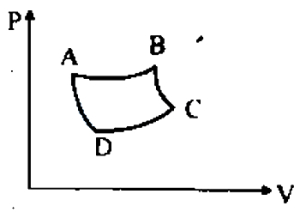
The $P-V$ graph of an ideal gas cycle is shown. The adiabatic process is described by the region
A
$AB$ and $BC$
B
$AB$ and $CD$
C
$AD$ and $BC$
D
$BC$ and $CD$
Solution
(C) In a $P-V$ diagram,the slope of an adiabatic process is given by $\frac{dP}{dV} = -\gamma \frac{P}{V}$,while the slope of an isothermal process is given by $\frac{dP}{dV} = -\frac{P}{V}$.
Since the adiabatic index $\gamma > 1$,the adiabatic curve is steeper than the isothermal curve.
Looking at the provided $P-V$ graph,the segments $AD$ and $BC$ exhibit a steeper slope compared to the segments $AB$ and $CD$.
Therefore,the adiabatic processes are represented by the regions $AD$ and $BC$.
Since the adiabatic index $\gamma > 1$,the adiabatic curve is steeper than the isothermal curve.
Looking at the provided $P-V$ graph,the segments $AD$ and $BC$ exhibit a steeper slope compared to the segments $AB$ and $CD$.
Therefore,the adiabatic processes are represented by the regions $AD$ and $BC$.
0 likes
View Solution225
EasyMCQ
$A$ diatomic gas undergoes adiabatic change. Its pressure $P$ and temperature $T$ are related as $P \propto T^{x}$ where the value of $x$ is
A
$3.5$
B
$2.5$
C
$4.5$
D
$3$
Solution
(A) For an adiabatic process,the relationship between pressure $P$ and temperature $T$ is given by $T^{\gamma} P^{1-\gamma} = \text{constant}$,which can be rewritten as $P \propto T^{\frac{\gamma}{\gamma-1}}$.
For a diatomic gas,the adiabatic index $\gamma = \frac{7}{5} = 1.4$.
Substituting the value of $\gamma$ into the exponent $x = \frac{\gamma}{\gamma-1}$:
$x = \frac{1.4}{1.4-1} = \frac{1.4}{0.4} = \frac{14}{4} = 3.5$.
Thus,$P \propto T^{3.5}$,so the value of $x$ is $3.5$.
For a diatomic gas,the adiabatic index $\gamma = \frac{7}{5} = 1.4$.
Substituting the value of $\gamma$ into the exponent $x = \frac{\gamma}{\gamma-1}$:
$x = \frac{1.4}{1.4-1} = \frac{1.4}{0.4} = \frac{14}{4} = 3.5$.
Thus,$P \propto T^{3.5}$,so the value of $x$ is $3.5$.
0 likes
View Solution226
DifficultMCQ
In an adiabatic process for an ideal gas,the relation between the universal gas constant '$R$' and specific heat at constant volume '$C_v$' is $R = 0.4 C_v$. The pressure '$P$' of the gas is proportional to the temperature '$T$' of the gas as $T^K$. The value of constant '$K$' is
A
$7/2$
B
$7/3$
C
$5$
D
$2/7$
Solution
(A) For an adiabatic process,the relation between pressure $P$ and temperature $T$ is given by $P^{1-\gamma} T^{\gamma} = \text{constant}$,which can be rewritten as $P \propto T^{\frac{\gamma}{\gamma-1}}$.
Given $P \propto T^K$,we have $K = \frac{\gamma}{\gamma-1}$.
We know that $C_p = C_v + R$. Given $R = 0.4 C_v$,we have $C_p = C_v + 0.4 C_v = 1.4 C_v$.
The adiabatic index $\gamma = \frac{C_p}{C_v} = \frac{1.4 C_v}{C_v} = 1.4 = \frac{14}{10} = \frac{7}{5}$.
Substituting $\gamma = 7/5$ into the expression for $K$:
$K = \frac{7/5}{(7/5) - 1} = \frac{7/5}{2/5} = \frac{7}{2}$.
Given $P \propto T^K$,we have $K = \frac{\gamma}{\gamma-1}$.
We know that $C_p = C_v + R$. Given $R = 0.4 C_v$,we have $C_p = C_v + 0.4 C_v = 1.4 C_v$.
The adiabatic index $\gamma = \frac{C_p}{C_v} = \frac{1.4 C_v}{C_v} = 1.4 = \frac{14}{10} = \frac{7}{5}$.
Substituting $\gamma = 7/5$ into the expression for $K$:
$K = \frac{7/5}{(7/5) - 1} = \frac{7/5}{2/5} = \frac{7}{2}$.
0 likes
View Solution227
DifficultMCQ
$A$ monoatomic ideal gas,initially at temperature $T_1$,is enclosed in a cylinder fitted with a frictionless piston. The gas is allowed to expand adiabatically to a temperature $T_2$ by releasing the piston suddenly. $L_1$ and $L_2$ are the lengths of the gas columns before and after the expansion,respectively. The ratio $T_2 / T_1$ is
A
$\left[\frac{L_1}{L_2}\right]^{2/3}$
B
$\left[\frac{L_2}{L_1}\right]^{2/3}$
C
$\left[\frac{L_2}{L_1}\right]^{1/2}$
D
$\left[\frac{L_1}{L_2}\right]^{1/2}$
Solution
(A) For an adiabatic process,the relation between temperature and volume is given by $T_1 V_1^{\gamma-1} = T_2 V_2^{\gamma-1}$.
Therefore,the ratio of temperatures is $\frac{T_2}{T_1} = \left(\frac{V_1}{V_2}\right)^{\gamma-1}$.
For a monoatomic ideal gas,the adiabatic exponent is $\gamma = \frac{5}{3}$.
Thus,$\gamma - 1 = \frac{5}{3} - 1 = \frac{2}{3}$.
Since the gas is in a cylinder of constant cross-sectional area $A$,the volume is $V = A \times L$. Therefore,$V_1 = A L_1$ and $V_2 = A L_2$.
Substituting these into the temperature ratio equation:
$\frac{T_2}{T_1} = \left(\frac{A L_1}{A L_2}\right)^{2/3} = \left(\frac{L_1}{L_2}\right)^{2/3}$.
Therefore,the ratio of temperatures is $\frac{T_2}{T_1} = \left(\frac{V_1}{V_2}\right)^{\gamma-1}$.
For a monoatomic ideal gas,the adiabatic exponent is $\gamma = \frac{5}{3}$.
Thus,$\gamma - 1 = \frac{5}{3} - 1 = \frac{2}{3}$.
Since the gas is in a cylinder of constant cross-sectional area $A$,the volume is $V = A \times L$. Therefore,$V_1 = A L_1$ and $V_2 = A L_2$.
Substituting these into the temperature ratio equation:
$\frac{T_2}{T_1} = \left(\frac{A L_1}{A L_2}\right)^{2/3} = \left(\frac{L_1}{L_2}\right)^{2/3}$.
0 likes
View Solution228
MediumMCQ
An ideal gas at $27^{\circ} C$ is compressed adiabatically to $8/27$ of its original volume. If $\gamma = 5/3$,the rise in temperature of the gas is: (in $K$)
A
$300$
B
$375$
C
$400$
D
$450$
Solution
(B) For an adiabatic process,the relationship between temperature and volume is given by $T_1 V_1^{\gamma-1} = T_2 V_2^{\gamma-1}$.
Given: $T_1 = 27^{\circ} C = 300 \ K$,$V_2 = (8/27) V_1$,and $\gamma = 5/3$.
Substituting the values:
$\frac{T_2}{T_1} = \left(\frac{V_1}{V_2}\right)^{\gamma-1} = \left(\frac{V_1}{(8/27)V_1}\right)^{(5/3)-1} = \left(\frac{27}{8}\right)^{2/3}$.
$\frac{T_2}{T_1} = \left(\left(\frac{3}{2}\right)^3\right)^{2/3} = \left(\frac{3}{2}\right)^2 = \frac{9}{4} = 2.25$.
$T_2 = 2.25 \times 300 \ K = 675 \ K$.
The rise in temperature is $\Delta T = T_2 - T_1 = 675 \ K - 300 \ K = 375 \ K$.
Given: $T_1 = 27^{\circ} C = 300 \ K$,$V_2 = (8/27) V_1$,and $\gamma = 5/3$.
Substituting the values:
$\frac{T_2}{T_1} = \left(\frac{V_1}{V_2}\right)^{\gamma-1} = \left(\frac{V_1}{(8/27)V_1}\right)^{(5/3)-1} = \left(\frac{27}{8}\right)^{2/3}$.
$\frac{T_2}{T_1} = \left(\left(\frac{3}{2}\right)^3\right)^{2/3} = \left(\frac{3}{2}\right)^2 = \frac{9}{4} = 2.25$.
$T_2 = 2.25 \times 300 \ K = 675 \ K$.
The rise in temperature is $\Delta T = T_2 - T_1 = 675 \ K - 300 \ K = 375 \ K$.
0 likes
View Solution229
MediumMCQ
$A$ gas at $N.T.P.$ is suddenly compressed to one-fourth of its original volume. If $\gamma = 1.5$,then the final pressure is
A
$4$ times
B
$1.5$ times
C
$8$ times
D
$\frac{1}{4}$ times
Solution
(C) Since the compression is sudden,the process is adiabatic.
For an adiabatic process,the relation between pressure and volume is given by $P_1 V_1^\gamma = P_2 V_2^\gamma$.
Given: $V_2 = \frac{V_1}{4}$,so $\frac{V_1}{V_2} = 4$.
Given: $\gamma = 1.5 = \frac{3}{2}$.
Substituting these values into the equation:
$\frac{P_2}{P_1} = \left( \frac{V_1}{V_2} \right)^\gamma = (4)^{3/2}$.
Calculating the value: $(4)^{3/2} = (2^2)^{3/2} = 2^3 = 8$.
Therefore,the final pressure $P_2 = 8 P_1$,which is $8$ times the initial pressure.
For an adiabatic process,the relation between pressure and volume is given by $P_1 V_1^\gamma = P_2 V_2^\gamma$.
Given: $V_2 = \frac{V_1}{4}$,so $\frac{V_1}{V_2} = 4$.
Given: $\gamma = 1.5 = \frac{3}{2}$.
Substituting these values into the equation:
$\frac{P_2}{P_1} = \left( \frac{V_1}{V_2} \right)^\gamma = (4)^{3/2}$.
Calculating the value: $(4)^{3/2} = (2^2)^{3/2} = 2^3 = 8$.
Therefore,the final pressure $P_2 = 8 P_1$,which is $8$ times the initial pressure.
0 likes
View Solution230
EasyMCQ
For an adiabatic process,which one of the following is a '$WRONG$' statement?
A
Equation of state is $PV=$ constant.
B
There is exchange of heat with surrounding.
C
All the work is utilized to change the internal energy of the system.
D
Temperature of the system changes,i.e.,$\Delta T \neq 0$.
Solution
(A) In an adiabatic process,the system is thermally insulated from its surroundings,meaning no heat exchange occurs $(Q = 0)$.
According to the first law of thermodynamics,$\Delta U = Q - W$. Since $Q = 0$,we have $\Delta U = -W$,which means all work done is at the expense of internal energy.
The equation of state for an adiabatic process is $PV^{\gamma} = \text{constant}$,where $\gamma$ is the adiabatic index. The statement $PV = \text{constant}$ describes an isothermal process,not an adiabatic one.
Therefore,the statement '$PV=$ constant' is incorrect.
According to the first law of thermodynamics,$\Delta U = Q - W$. Since $Q = 0$,we have $\Delta U = -W$,which means all work done is at the expense of internal energy.
The equation of state for an adiabatic process is $PV^{\gamma} = \text{constant}$,where $\gamma$ is the adiabatic index. The statement $PV = \text{constant}$ describes an isothermal process,not an adiabatic one.
Therefore,the statement '$PV=$ constant' is incorrect.
0 likes
View Solution231
EasyMCQ
In a thermodynamic system,$\Delta U$ represents the increase in its internal energy and $dW$ is the work done by the system. Then,which of the following statements is correct?
A
$\Delta U = dW$ is an isothermal process
B
$\Delta U = -dW$ is an adiabatic process
C
$\Delta U = -dW$ is an isothermal process
D
$\Delta U = dW$ is an adiabatic process
Solution
(B) According to the first law of thermodynamics,the heat supplied to the system $\Delta Q$ is given by $\Delta Q = \Delta U + dW$.
For an adiabatic process,there is no exchange of heat with the surroundings,so $\Delta Q = 0$.
Substituting this into the first law equation: $0 = \Delta U + dW$.
Rearranging the terms,we get $\Delta U = -dW$.
Therefore,the condition $\Delta U = -dW$ corresponds to an adiabatic process.
For an adiabatic process,there is no exchange of heat with the surroundings,so $\Delta Q = 0$.
Substituting this into the first law equation: $0 = \Delta U + dW$.
Rearranging the terms,we get $\Delta U = -dW$.
Therefore,the condition $\Delta U = -dW$ corresponds to an adiabatic process.
0 likes
View Solution232
DifficultMCQ
The pressure and density of a diatomic gas $\left(\gamma=\frac{7}{5}\right)$ change adiabatically from $(P, \rho)$ to $(P^{\prime}, \rho^{\prime})$. If $\frac{\rho^{\prime}}{\rho}=32$,then $\frac{P^{\prime}}{P}$ is:
A
$\frac{1}{128}$
B
$128$
C
$32$
D
$64$
Solution
(B) For an adiabatic process,the relation between pressure $P$ and volume $V$ is $PV^{\gamma} = \text{constant}$.
Since density $\rho = \frac{m}{V}$,we have $V = \frac{m}{\rho}$. Substituting this into the adiabatic equation:
$P \left(\frac{m}{\rho}\right)^{\gamma} = \text{constant}$
$P \rho^{-\gamma} = \text{constant}$
Therefore,$\frac{P^{\prime}}{P} = \left(\frac{\rho^{\prime}}{\rho}\right)^{\gamma}$.
Given $\frac{\rho^{\prime}}{\rho} = 32$ and $\gamma = \frac{7}{5}$,we substitute these values:
$\frac{P^{\prime}}{P} = (32)^{\frac{7}{5}}$
$\frac{P^{\prime}}{P} = (2^5)^{\frac{7}{5}} = 2^7 = 128$.
Since density $\rho = \frac{m}{V}$,we have $V = \frac{m}{\rho}$. Substituting this into the adiabatic equation:
$P \left(\frac{m}{\rho}\right)^{\gamma} = \text{constant}$
$P \rho^{-\gamma} = \text{constant}$
Therefore,$\frac{P^{\prime}}{P} = \left(\frac{\rho^{\prime}}{\rho}\right)^{\gamma}$.
Given $\frac{\rho^{\prime}}{\rho} = 32$ and $\gamma = \frac{7}{5}$,we substitute these values:
$\frac{P^{\prime}}{P} = (32)^{\frac{7}{5}}$
$\frac{P^{\prime}}{P} = (2^5)^{\frac{7}{5}} = 2^7 = 128$.
0 likes
View Solution233
EasyMCQ
In which thermodynamic process is there no exchange of heat between the system and the surroundings?
A
Isochoric
B
Adiabatic
C
Isothermal
D
Isobaric
Solution
(B) The correct option is $B$.
Concept: In an adiabatic process,the system is thermally insulated from its surroundings,meaning no heat is transferred into or out of the system $(dQ = 0)$.
Reason: This process typically occurs rapidly,preventing sufficient time for heat exchange to take place between the system and the surroundings.
Concept: In an adiabatic process,the system is thermally insulated from its surroundings,meaning no heat is transferred into or out of the system $(dQ = 0)$.
Reason: This process typically occurs rapidly,preventing sufficient time for heat exchange to take place between the system and the surroundings.
0 likes
View Solution234
EasyMCQ
In an adiabatic expansion of a gas, the initial and final temperatures are $T_1$ and $T_2$ respectively. Then, the change in internal energy of the gas is:
$[R = \text{gas constant}, \gamma = \text{adiabatic ratio}]$
$[R = \text{gas constant}, \gamma = \text{adiabatic ratio}]$
A
zero
B
$\frac{nR}{\gamma-1}(T_1-T_2)$
C
$\frac{nR}{\gamma-1}(T_2-T_1)$
D
$nR(T_1-T_2)$
Solution
(C) The change in internal energy $(\Delta U)$ of an ideal gas depends only on the change in temperature and is given by the formula: $\Delta U = nC_v\Delta T$.
For an ideal gas, the molar heat capacity at constant volume is $C_v = \frac{R}{\gamma-1}$.
Substituting this into the internal energy formula, we get: $\Delta U = n \left(\frac{R}{\gamma-1}\right) (T_2 - T_1)$.
Therefore, the change in internal energy is $\frac{nR}{\gamma-1}(T_2 - T_1)$.
For an ideal gas, the molar heat capacity at constant volume is $C_v = \frac{R}{\gamma-1}$.
Substituting this into the internal energy formula, we get: $\Delta U = n \left(\frac{R}{\gamma-1}\right) (T_2 - T_1)$.
Therefore, the change in internal energy is $\frac{nR}{\gamma-1}(T_2 - T_1)$.
0 likes
View Solution235
EasyMCQ
$V$ cc volume of a gas having $\gamma = \frac{5}{2}$ is suddenly compressed to $\frac{V}{4}$ cc. The initial pressure of the gas is $P$. The final pressure of the gas will be
A
$\frac{P}{32}$
B
$16 P$
C
$\frac{P}{16}$
D
$32 P$
Solution
(D) For a sudden compression,the process is adiabatic.
For an adiabatic process,the relation between pressure and volume is $P_1 V_1^{\gamma} = P_2 V_2^{\gamma}$.
Given: $V_1 = V$,$V_2 = \frac{V}{4}$,$P_1 = P$,and $\gamma = \frac{5}{2}$.
Substituting these values into the adiabatic equation:
$P \cdot V^{\gamma} = P_2 \cdot \left(\frac{V}{4}\right)^{\gamma}$
$P_2 = P \cdot \left(\frac{V}{V/4}\right)^{\gamma}$
$P_2 = P \cdot (4)^{\gamma}$
$P_2 = P \cdot (4)^{5/2}$
$P_2 = P \cdot (2^2)^{5/2}$
$P_2 = P \cdot 2^5$
$P_2 = 32 P$.
For an adiabatic process,the relation between pressure and volume is $P_1 V_1^{\gamma} = P_2 V_2^{\gamma}$.
Given: $V_1 = V$,$V_2 = \frac{V}{4}$,$P_1 = P$,and $\gamma = \frac{5}{2}$.
Substituting these values into the adiabatic equation:
$P \cdot V^{\gamma} = P_2 \cdot \left(\frac{V}{4}\right)^{\gamma}$
$P_2 = P \cdot \left(\frac{V}{V/4}\right)^{\gamma}$
$P_2 = P \cdot (4)^{\gamma}$
$P_2 = P \cdot (4)^{5/2}$
$P_2 = P \cdot (2^2)^{5/2}$
$P_2 = P \cdot 2^5$
$P_2 = 32 P$.
0 likes
View Solution236
EasyMCQ
In a thermodynamic system,$W$ represents the work done by the system and $\Delta U$ is the increase in internal energy. Which of the following statements is $TRUE$?
A
In an adiabatic process,$\Delta U = -W$
B
In an isothermal process,$\Delta U = W$
C
In an adiabatic process,$\Delta U = W$
D
In an isothermal process,$\Delta U = -nW$
Solution
(A) According to the first law of thermodynamics,the change in internal energy $\Delta U$ is given by $\Delta Q = \Delta U + W$,where $\Delta Q$ is the heat supplied to the system and $W$ is the work done by the system.
In an adiabatic process,there is no exchange of heat between the system and the surroundings,so $\Delta Q = 0$.
Substituting this into the first law equation: $0 = \Delta U + W$.
Therefore,$\Delta U = -W$.
In an adiabatic process,there is no exchange of heat between the system and the surroundings,so $\Delta Q = 0$.
Substituting this into the first law equation: $0 = \Delta U + W$.
Therefore,$\Delta U = -W$.
0 likes
View Solution237
EasyMCQ
$A$ polyatomic gas $\left(\gamma = \frac{4}{3}\right)$ is compressed to $\left(\frac{1}{8}\right)^{\text{th}}$ of its volume adiabatically. If its initial pressure is $p$,its new pressure will be (in $p$)
A
$8$
B
$16$
C
$2$
D
$6$
Solution
(B) For an adiabatic process,the relationship between pressure $p$ and volume $V$ is given by $p V^{\gamma} = \text{constant}$.
Let the initial pressure be $p$ and the initial volume be $V$.
The final volume is $V' = \frac{V}{8}$.
Using the adiabatic equation: $p V^{\gamma} = P' (V')^{\gamma}$.
Substituting the given values: $p V^{4/3} = P' \left(\frac{V}{8}\right)^{4/3}$.
$P' = p \left(\frac{V}{V/8}\right)^{4/3} = p (8)^{4/3}$.
Since $8 = 2^3$,we have $P' = p (2^3)^{4/3} = p (2^4) = 16p$.
Therefore,the new pressure is $16p$.
Let the initial pressure be $p$ and the initial volume be $V$.
The final volume is $V' = \frac{V}{8}$.
Using the adiabatic equation: $p V^{\gamma} = P' (V')^{\gamma}$.
Substituting the given values: $p V^{4/3} = P' \left(\frac{V}{8}\right)^{4/3}$.
$P' = p \left(\frac{V}{V/8}\right)^{4/3} = p (8)^{4/3}$.
Since $8 = 2^3$,we have $P' = p (2^3)^{4/3} = p (2^4) = 16p$.
Therefore,the new pressure is $16p$.
0 likes
View Solution238
DifficultMCQ
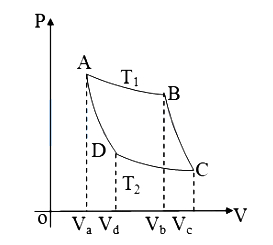
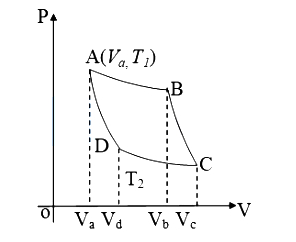
In the $P-V$ diagram shown,there are two adiabatic parts of the same gas intersecting two isothermals at $T_1$ and $T_2$. The ratio $\left(\frac{V_b}{V_a}\right)$ is equal to
A
$\left(\frac{V_c}{V_d}\right)^2$
B
$\left(\frac{V_c}{V_d}\right)$
C
$\frac{1}{2}\left(\frac{V_c}{V_d}\right)$
D
$2\left(\frac{V_c}{V_d}\right)$
Solution
(B) For an adiabatic process,the relation between temperature and volume is $T V^{\gamma-1} = \text{constant}$.
For the adiabatic path $BC$,the points $B$ and $C$ lie on the adiabatic curve connecting the isothermals $T_1$ and $T_2$. Thus:
$T_1 V_b^{\gamma-1} = T_2 V_c^{\gamma-1}$
$\Rightarrow \left(\frac{V_b}{V_c}\right)^{\gamma-1} = \frac{T_2}{T_1} \quad ---(1)$
For the adiabatic path $AD$,the points $A$ and $D$ lie on the adiabatic curve connecting the isothermals $T_1$ and $T_2$. Thus:
$T_1 V_a^{\gamma-1} = T_2 V_d^{\gamma-1}$
$\Rightarrow \left(\frac{V_a}{V_d}\right)^{\gamma-1} = \frac{T_2}{T_1} \quad ---(2)$
Equating $(1)$ and $(2)$:
$\left(\frac{V_b}{V_c}\right)^{\gamma-1} = \left(\frac{V_a}{V_d}\right)^{\gamma-1}$
$\Rightarrow \frac{V_b}{V_c} = \frac{V_a}{V_d}$
Rearranging the terms,we get:
$\frac{V_b}{V_a} = \frac{V_c}{V_d}$
Therefore,option $(B)$ is correct.
For the adiabatic path $BC$,the points $B$ and $C$ lie on the adiabatic curve connecting the isothermals $T_1$ and $T_2$. Thus:
$T_1 V_b^{\gamma-1} = T_2 V_c^{\gamma-1}$
$\Rightarrow \left(\frac{V_b}{V_c}\right)^{\gamma-1} = \frac{T_2}{T_1} \quad ---(1)$
For the adiabatic path $AD$,the points $A$ and $D$ lie on the adiabatic curve connecting the isothermals $T_1$ and $T_2$. Thus:
$T_1 V_a^{\gamma-1} = T_2 V_d^{\gamma-1}$
$\Rightarrow \left(\frac{V_a}{V_d}\right)^{\gamma-1} = \frac{T_2}{T_1} \quad ---(2)$
Equating $(1)$ and $(2)$:
$\left(\frac{V_b}{V_c}\right)^{\gamma-1} = \left(\frac{V_a}{V_d}\right)^{\gamma-1}$
$\Rightarrow \frac{V_b}{V_c} = \frac{V_a}{V_d}$
Rearranging the terms,we get:
$\frac{V_b}{V_a} = \frac{V_c}{V_d}$
Therefore,option $(B)$ is correct.
0 likes
View Solution239
EasyMCQ
$A$ monoatomic gas $(\gamma = 5/3)$ initially at $27^{\circ} C$ having volume $V$ is suddenly compressed to one-eighth of its original volume $(V/8)$. What is the final temperature after the compression (in $K$)?
A
$1160$
B
$580$
C
$1200$
D
$927$
Solution
(C) Since the compression is sudden,it is an adiabatic process.
For an adiabatic process,the relationship between temperature and volume is given by $T_1 V_1^{\gamma-1} = T_2 V_2^{\gamma-1}$.
Given: $T_1 = 27^{\circ} C = 27 + 273 = 300 \ K$,$V_1 = V$,$V_2 = V/8$,and $\gamma = 5/3$.
Substituting the values:
$T_2 = T_1 \left( \frac{V_1}{V_2} \right)^{\gamma-1}$
$T_2 = 300 \times \left( \frac{V}{V/8} \right)^{(5/3) - 1}$
$T_2 = 300 \times (8)^{2/3}$
$T_2 = 300 \times (2^3)^{2/3} = 300 \times 2^2 = 300 \times 4 = 1200 \ K$.
For an adiabatic process,the relationship between temperature and volume is given by $T_1 V_1^{\gamma-1} = T_2 V_2^{\gamma-1}$.
Given: $T_1 = 27^{\circ} C = 27 + 273 = 300 \ K$,$V_1 = V$,$V_2 = V/8$,and $\gamma = 5/3$.
Substituting the values:
$T_2 = T_1 \left( \frac{V_1}{V_2} \right)^{\gamma-1}$
$T_2 = 300 \times \left( \frac{V}{V/8} \right)^{(5/3) - 1}$
$T_2 = 300 \times (8)^{2/3}$
$T_2 = 300 \times (2^3)^{2/3} = 300 \times 2^2 = 300 \times 4 = 1200 \ K$.
0 likes
View Solution240
EasyMCQ
In an adiabatic process,the state of a gas is changed from $P_1, V_1, T_1$ to $P_2, V_2, T_2$. Out of the following relations,the correct one is
A
$T_1 V_1^{\gamma-1} = T_2 V_2^{\gamma-1}$
B
$P_1 T_1^{\gamma-1} = P_2 T_2^{\gamma-1}$
C
$T_1 V_1^{\gamma} = T_2 V_2^{\gamma}$
D
$P_1 V_1^{\gamma-1} = P_2 V_2^{\gamma-1}$
Solution
(A) For an adiabatic process,the relationship between temperature $T$ and volume $V$ is given by the equation $T V^{\gamma-1} = \text{constant}$.
Therefore,for two different states $(P_1, V_1, T_1)$ and $(P_2, V_2, T_2)$,the relation holds as $T_1 V_1^{\gamma-1} = T_2 V_2^{\gamma-1}$.
Thus,the correct option is $A$.
Therefore,for two different states $(P_1, V_1, T_1)$ and $(P_2, V_2, T_2)$,the relation holds as $T_1 V_1^{\gamma-1} = T_2 V_2^{\gamma-1}$.
Thus,the correct option is $A$.
0 likes
View Solution241
EasyMCQ
The relation obeyed by a perfect gas during an adiabatic process is $PV^{3/2} = \text{constant}$. The initial temperature of the gas is $T$. When the gas is compressed to half of its initial volume, the final temperature of the gas is:
A
$2\sqrt{2}T$
B
$4T$
C
$\sqrt{2}T$
D
$2T$
Solution
(C) For an adiabatic process, the relation between pressure and volume is given as $PV^{\gamma} = \text{constant}$. Here, $\gamma = 3/2$.
Using the ideal gas law $PV = nRT$, we can write $P = nRT/V$.
Substituting this into the adiabatic equation: $(nRT/V)V^{\gamma} = \text{constant}$, which simplifies to $TV^{\gamma-1} = \text{constant}$.
Given $\gamma = 3/2$, the relation becomes $TV^{(3/2 - 1)} = TV^{1/2} = \text{constant}$.
Let the initial state be $(T_1, V_1)$ and the final state be $(T_2, V_2)$.
Given $T_1 = T$ and $V_2 = V_1/2$.
Using $T_1 V_1^{1/2} = T_2 V_2^{1/2}$:
$T_2 = T_1 (V_1/V_2)^{1/2} = T (V_1 / (V_1/2))^{1/2} = T (2)^{1/2} = \sqrt{2}T$.
Using the ideal gas law $PV = nRT$, we can write $P = nRT/V$.
Substituting this into the adiabatic equation: $(nRT/V)V^{\gamma} = \text{constant}$, which simplifies to $TV^{\gamma-1} = \text{constant}$.
Given $\gamma = 3/2$, the relation becomes $TV^{(3/2 - 1)} = TV^{1/2} = \text{constant}$.
Let the initial state be $(T_1, V_1)$ and the final state be $(T_2, V_2)$.
Given $T_1 = T$ and $V_2 = V_1/2$.
Using $T_1 V_1^{1/2} = T_2 V_2^{1/2}$:
$T_2 = T_1 (V_1/V_2)^{1/2} = T (V_1 / (V_1/2))^{1/2} = T (2)^{1/2} = \sqrt{2}T$.
0 likes
View Solution242
EasyMCQ
One mole of an ideal gas expands adiabatically at constant pressure such that its temperature $T \propto \frac{1}{\sqrt{V}}$. The value of $\gamma$ for the gas is $(\gamma = \frac{C_p}{C_v}, V = \text{Volume of the gas})$
A
$1.8$
B
$1.5$
C
$1.3$
D
$1.4$
Solution
(B) For an adiabatic process,the relationship between temperature $T$ and volume $V$ is given by $TV^{\gamma-1} = \text{constant}$.
Given the condition $T \propto \frac{1}{\sqrt{V}}$,we can write this as $T \propto V^{-1/2}$,which implies $TV^{1/2} = \text{constant}$.
Comparing the two expressions $TV^{\gamma-1} = \text{constant}$ and $TV^{1/2} = \text{constant}$,we get $\gamma - 1 = \frac{1}{2}$.
Solving for $\gamma$,we find $\gamma = 1 + 0.5 = 1.5$.
Given the condition $T \propto \frac{1}{\sqrt{V}}$,we can write this as $T \propto V^{-1/2}$,which implies $TV^{1/2} = \text{constant}$.
Comparing the two expressions $TV^{\gamma-1} = \text{constant}$ and $TV^{1/2} = \text{constant}$,we get $\gamma - 1 = \frac{1}{2}$.
Solving for $\gamma$,we find $\gamma = 1 + 0.5 = 1.5$.
0 likes
View Solution243
EasyMCQ
Which of the following statements is true? ($\Delta U = \text{increase in internal energy}$,$dW = \text{work done by the system}$)
A
In an adiabatic process $\Delta U = dW$
B
In an adiabatic process $\Delta U = -dW$
C
In an isothermal process $\Delta U = -dW$
D
In an isothermal process $\Delta U = dW$
Solution
(B) According to the first law of thermodynamics,the change in internal energy $\Delta U$ is given by $\Delta Q = \Delta U + dW$,where $\Delta Q$ is the heat supplied to the system and $dW$ is the work done by the system.
In an adiabatic process,there is no exchange of heat with the surroundings,so $\Delta Q = 0$.
Substituting this into the equation,we get $0 = \Delta U + dW$.
Therefore,$\Delta U = -dW$.
In an adiabatic process,there is no exchange of heat with the surroundings,so $\Delta Q = 0$.
Substituting this into the equation,we get $0 = \Delta U + dW$.
Therefore,$\Delta U = -dW$.
0 likes
View Solution244
EasyMCQ
$A$ polyatomic gas $(\gamma = 4/3)$ is compressed to $(1/8)^{\text{th}}$ of its initial volume adiabatically. If its initial pressure is $P_0$,what will be its new pressure (in $P_0$)?
A
$2$
B
$8$
C
$6$
D
$16$
Solution
(D) For an adiabatic process,the relationship between pressure and volume is given by $P_1 V_1^\gamma = P_2 V_2^\gamma$.
Given that the gas is compressed to $(1/8)^{\text{th}}$ of its initial volume,we have $V_2 = V_1 / 8$,which implies $V_1 / V_2 = 8$.
The adiabatic index is given as $\gamma = 4/3$.
Substituting these values into the adiabatic equation:
$P_2 / P_1 = (V_1 / V_2)^\gamma$
$P_2 / P_0 = (8)^{4/3}$
$P_2 / P_0 = (2^3)^{4/3} = 2^4 = 16$
Therefore,the new pressure is $P_2 = 16 P_0$.
Given that the gas is compressed to $(1/8)^{\text{th}}$ of its initial volume,we have $V_2 = V_1 / 8$,which implies $V_1 / V_2 = 8$.
The adiabatic index is given as $\gamma = 4/3$.
Substituting these values into the adiabatic equation:
$P_2 / P_1 = (V_1 / V_2)^\gamma$
$P_2 / P_0 = (8)^{4/3}$
$P_2 / P_0 = (2^3)^{4/3} = 2^4 = 16$
Therefore,the new pressure is $P_2 = 16 P_0$.
0 likes
View Solution245
MediumMCQ
An ideal gas at $27^{\circ} C$ is compressed adiabatically to $8/27$ of its original volume. If the ratio of specific heats is $\gamma = 5/3$,then the rise in temperature of the gas is: (in $K$)
A
$500$
B
$125$
C
$250$
D
$375$
Solution
(D) For an adiabatic process,the relation between temperature and volume is $TV^{\gamma-1} = \text{constant}$.
Thus,$\frac{T_2}{T_1} = \left(\frac{V_1}{V_2}\right)^{\gamma-1}$.
Given $T_1 = 27^{\circ} C = 300 \ K$ and $V_2 = \frac{8}{27} V_1$,so $\frac{V_1}{V_2} = \frac{27}{8}$.
Given $\gamma = 5/3$,so $\gamma - 1 = 5/3 - 1 = 2/3$.
Substituting the values: $\frac{T_2}{300} = \left(\frac{27}{8}\right)^{2/3} = \left(\left(\frac{3}{2}\right)^3\right)^{2/3} = \left(\frac{3}{2}\right)^2 = \frac{9}{4}$.
$T_2 = \frac{9}{4} \times 300 = 9 \times 75 = 675 \ K$.
The rise in temperature is $\Delta T = T_2 - T_1 = 675 \ K - 300 \ K = 375 \ K$.
Thus,$\frac{T_2}{T_1} = \left(\frac{V_1}{V_2}\right)^{\gamma-1}$.
Given $T_1 = 27^{\circ} C = 300 \ K$ and $V_2 = \frac{8}{27} V_1$,so $\frac{V_1}{V_2} = \frac{27}{8}$.
Given $\gamma = 5/3$,so $\gamma - 1 = 5/3 - 1 = 2/3$.
Substituting the values: $\frac{T_2}{300} = \left(\frac{27}{8}\right)^{2/3} = \left(\left(\frac{3}{2}\right)^3\right)^{2/3} = \left(\frac{3}{2}\right)^2 = \frac{9}{4}$.
$T_2 = \frac{9}{4} \times 300 = 9 \times 75 = 675 \ K$.
The rise in temperature is $\Delta T = T_2 - T_1 = 675 \ K - 300 \ K = 375 \ K$.
0 likes
View Solution246
MediumMCQ
An ideal gas at pressure $p$ is adiabatically compressed so that its density becomes twice that of the initial. If $\gamma = \frac{c_p}{c_v} = \frac{7}{5}$,then the final pressure of the gas is:
A
$p$
B
$2p$
C
$\frac{7}{5}p$
D
$2.63p$
Solution
(D) For an ideal gas,density $\rho = \frac{m}{V}$. Since the mass $m$ remains constant,$\rho \propto \frac{1}{V}$.
Given that the final density is twice the initial density,$\rho_2 = 2\rho_1$,which implies $V_2 = \frac{V_1}{2}$ or $\frac{V_1}{V_2} = 2$.
For an adiabatic process,the relation between pressure and volume is $P_1 V_1^\gamma = P_2 V_2^\gamma$.
Therefore,the final pressure $P_2$ is given by $P_2 = P_1 \left( \frac{V_1}{V_2} \right)^\gamma$.
Substituting the given values,$P_2 = p \times (2)^{7/5} = p \times (2)^{1.4}$.
Calculating the value,$2^{1.4} \approx 2.639$.
Thus,the final pressure is approximately $2.63p$.
Given that the final density is twice the initial density,$\rho_2 = 2\rho_1$,which implies $V_2 = \frac{V_1}{2}$ or $\frac{V_1}{V_2} = 2$.
For an adiabatic process,the relation between pressure and volume is $P_1 V_1^\gamma = P_2 V_2^\gamma$.
Therefore,the final pressure $P_2$ is given by $P_2 = P_1 \left( \frac{V_1}{V_2} \right)^\gamma$.
Substituting the given values,$P_2 = p \times (2)^{7/5} = p \times (2)^{1.4}$.
Calculating the value,$2^{1.4} \approx 2.639$.
Thus,the final pressure is approximately $2.63p$.
0 likes
View Solution247
EasyMCQ
$A$ monoatomic gas is suddenly compressed to $(1/8)^{\text{th}}$ of its initial volume adiabatically. The ratio of the final pressure to initial pressure of the gas is $(\gamma = 5/3)$.
A
$32$
B
$8$
C
$40$/$3$
D
$24$/$5$
Solution
(A) Given: Initial volume $V_1$,Final volume $V_2 = V_1/8$,Adiabatic index $\gamma = 5/3$.
For an adiabatic process,the relation between pressure and volume is given by $P_1 V_1^\gamma = P_2 V_2^\gamma$.
Rearranging for the ratio of final pressure to initial pressure: $\frac{P_2}{P_1} = \left(\frac{V_1}{V_2}\right)^\gamma$.
Substituting the values: $\frac{P_2}{P_1} = (8)^{5/3}$.
Since $8 = 2^3$,we have $(2^3)^{5/3} = 2^5 = 32$.
Thus,the ratio of the final pressure to the initial pressure is $32$.
For an adiabatic process,the relation between pressure and volume is given by $P_1 V_1^\gamma = P_2 V_2^\gamma$.
Rearranging for the ratio of final pressure to initial pressure: $\frac{P_2}{P_1} = \left(\frac{V_1}{V_2}\right)^\gamma$.
Substituting the values: $\frac{P_2}{P_1} = (8)^{5/3}$.
Since $8 = 2^3$,we have $(2^3)^{5/3} = 2^5 = 32$.
Thus,the ratio of the final pressure to the initial pressure is $32$.
0 likes
View Solution248
MediumMCQ
$A$ diatomic gas undergoes an adiabatic change. Its pressure $P$ and temperature $T$ are related as $P \propto T^{x}$, where $x$ is:
A
$3$
B
$2.5$
C
$3.5$
D
$1.5$
Solution
(C) For an adiabatic process, the relation between pressure $P$ and volume $V$ is given by $PV^{\gamma} = \text{constant}$.
From the ideal gas equation, $PV = RT$, we have $V = \frac{RT}{P}$.
Substituting $V$ in the adiabatic equation:
$P \left( \frac{RT}{P} \right)^{\gamma} = \text{constant}$
$P \cdot \frac{T^{\gamma}}{P^{\gamma}} = \text{constant}'$
$P^{1-\gamma} T^{\gamma} = \text{constant}'$
$P^{1-\gamma} = \frac{\text{constant}'}{T^{\gamma}}$
$P = \text{constant}'' \cdot T^{\frac{\gamma}{\gamma-1}}$
Comparing this with $P \propto T^{x}$, we get $x = \frac{\gamma}{\gamma-1}$.
For a diatomic gas, the adiabatic exponent $\gamma = 1.4$ (or $\frac{7}{5}$).
Substituting the value of $\gamma$:
$x = \frac{1.4}{1.4 - 1} = \frac{1.4}{0.4} = 3.5$.
Therefore, the correct option is $C$.
From the ideal gas equation, $PV = RT$, we have $V = \frac{RT}{P}$.
Substituting $V$ in the adiabatic equation:
$P \left( \frac{RT}{P} \right)^{\gamma} = \text{constant}$
$P \cdot \frac{T^{\gamma}}{P^{\gamma}} = \text{constant}'$
$P^{1-\gamma} T^{\gamma} = \text{constant}'$
$P^{1-\gamma} = \frac{\text{constant}'}{T^{\gamma}}$
$P = \text{constant}'' \cdot T^{\frac{\gamma}{\gamma-1}}$
Comparing this with $P \propto T^{x}$, we get $x = \frac{\gamma}{\gamma-1}$.
For a diatomic gas, the adiabatic exponent $\gamma = 1.4$ (or $\frac{7}{5}$).
Substituting the value of $\gamma$:
$x = \frac{1.4}{1.4 - 1} = \frac{1.4}{0.4} = 3.5$.
Therefore, the correct option is $C$.
0 likes
View SolutionThermodynamics — Adiabatic Process · Frequently Asked Questions
1Are these Thermodynamics questions useful for JEE and NEET?
Yes. All questions in this section are mapped to JEE Main and NEET exam patterns. Previous year questions from JEE Main, NEET, GUJCET and state-level exams are included with full solutions.
2Can I switch to Hindi or Gujarati for these questions?
Yes. Use the language tabs in the hero section or the sidebar to view the same questions and solutions in English, Hindi or Gujarati.
3How do I generate a question paper from this subtopic?
Use the Vedclass Exam Paper Generator — select the chapter and subtopic, set difficulty, and generate Sets A, B, C, D automatically. First 3 chapters of every subject are free.
Vedclass Products
For Students
Vedclass Test Series
Mock tests in real JEE/NEET style with performance analysis. 5-day free trial.
Start Free TrialFor Teachers
Exam Paper Generator
Generate Set A/B/C/D papers from this chapter in 2 minutes. 3 chapters free.
Try FreeFor Institutes
Online Exam Module
Live online exams with unlimited students, 360° analytics & white-label branding.
See DemoFor Teachers & Institutes
Generate a Thermodynamics Exam Paper in 2 Minutes
Select subtopic & difficulty — Sets A, B, C, D auto-generated with No Repeat logic.
First 3 chapters of every subject are free — no payment required.