
A English
SHM of Simple Pendulum Questions in English
Class 11 Physics · Oscillations · SHM of Simple Pendulum
331+
Questions
English
Language
100%
With Solutions
Showing 47 of 331 questions in English
1
MediumMCQ
$A$ simple pendulum oscillates in a vertical plane. When it passes through the mean position,the tension in the string is $3$ times the weight of the pendulum bob. What is the maximum displacement of the pendulum string with respect to the vertical in degrees?
A
$30$
B
$45$
C
$60$
D
$90$
Solution
(D) At the mean position,the tension $T$ is given by $T = mg + \frac{mv^2}{l}$,where $l$ is the length of the string.
Given that $T = 3mg$,we have $mg + \frac{mv^2}{l} = 3mg$,which simplifies to $\frac{mv^2}{l} = 2mg$,so $v^2 = 2gl$.
Let $\theta$ be the maximum angular displacement from the vertical. By the principle of conservation of energy,the kinetic energy at the mean position must equal the potential energy at the maximum displacement: $\frac{1}{2}mv^2 = mgl(1 - \cos \theta)$.
Substituting $v^2 = 2gl$,we get $\frac{1}{2}m(2gl) = mgl(1 - \cos \theta)$.
This simplifies to $mgl = mgl(1 - \cos \theta)$,which implies $1 = 1 - \cos \theta$,so $\cos \theta = 0$.
Therefore,$\theta = 90^\circ$.
Given that $T = 3mg$,we have $mg + \frac{mv^2}{l} = 3mg$,which simplifies to $\frac{mv^2}{l} = 2mg$,so $v^2 = 2gl$.
Let $\theta$ be the maximum angular displacement from the vertical. By the principle of conservation of energy,the kinetic energy at the mean position must equal the potential energy at the maximum displacement: $\frac{1}{2}mv^2 = mgl(1 - \cos \theta)$.
Substituting $v^2 = 2gl$,we get $\frac{1}{2}m(2gl) = mgl(1 - \cos \theta)$.
This simplifies to $mgl = mgl(1 - \cos \theta)$,which implies $1 = 1 - \cos \theta$,so $\cos \theta = 0$.
Therefore,$\theta = 90^\circ$.
0 likes
View Solution2
MediumMCQ
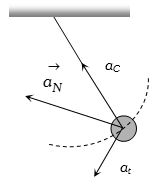
$A$ simple pendulum is oscillating without damping. When the displacement of the bob is less than maximum,its acceleration vector $\vec a$ is correctly shown in
A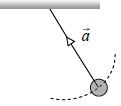
B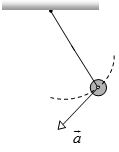
C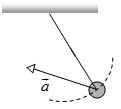
D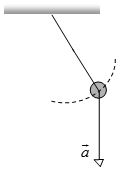
Solution
(C) The acceleration of the bob of a simple pendulum in motion consists of two components:
$1$. Centripetal acceleration $(a_c)$: Directed towards the point of suspension along the string.
$2$. Tangential acceleration $(a_t)$: Directed along the tangent to the circular path of the bob.
The net acceleration $\vec a$ is the vector sum of these two components: $\vec a = \vec a_c + \vec a_t$.
Since the bob is moving in a circular arc,the resultant acceleration vector $\vec a$ must point towards the interior of the arc,specifically between the string and the tangent,as shown in option $(C)$.
$1$. Centripetal acceleration $(a_c)$: Directed towards the point of suspension along the string.
$2$. Tangential acceleration $(a_t)$: Directed along the tangent to the circular path of the bob.
The net acceleration $\vec a$ is the vector sum of these two components: $\vec a = \vec a_c + \vec a_t$.
Since the bob is moving in a circular arc,the resultant acceleration vector $\vec a$ must point towards the interior of the arc,specifically between the string and the tangent,as shown in option $(C)$.
0 likes
View Solution3
MediumMCQ
The time period of a simple pendulum measured inside a stationary lift is found to be $T$. If the lift starts accelerating upwards with an acceleration $g/3$,the new time period is:
A
$T\sqrt{3}$
B
$\frac{\sqrt{3}}{2}T$
C
$T/\sqrt{3}$
D
$T/3$
Solution
(B) The time period of a simple pendulum is given by $T = 2\pi \sqrt{\frac{l}{g}}$.
When the lift is stationary,the effective acceleration due to gravity is $g_{eff} = g$.
When the lift accelerates upwards with an acceleration $a = g/3$,the effective acceleration due to gravity becomes $g' = g + a = g + g/3 = 4g/3$.
The new time period $T'$ is given by $T' = 2\pi \sqrt{\frac{l}{g'}} = 2\pi \sqrt{\frac{l}{4g/3}} = 2\pi \sqrt{\frac{3l}{4g}}$.
This can be written as $T' = \frac{\sqrt{3}}{2} \times (2\pi \sqrt{\frac{l}{g}}) = \frac{\sqrt{3}}{2}T$.
When the lift is stationary,the effective acceleration due to gravity is $g_{eff} = g$.
When the lift accelerates upwards with an acceleration $a = g/3$,the effective acceleration due to gravity becomes $g' = g + a = g + g/3 = 4g/3$.
The new time period $T'$ is given by $T' = 2\pi \sqrt{\frac{l}{g'}} = 2\pi \sqrt{\frac{l}{4g/3}} = 2\pi \sqrt{\frac{3l}{4g}}$.
This can be written as $T' = \frac{\sqrt{3}}{2} \times (2\pi \sqrt{\frac{l}{g}}) = \frac{\sqrt{3}}{2}T$.
0 likes
View Solution4
EasyMCQ
$A$ second's pendulum is mounted in a rocket. Its period of oscillation decreases when the rocket
A
Comes down with uniform acceleration
B
Moves round the earth in a geostationary orbit
C
Moves up with a uniform velocity
D
Moves up with uniform acceleration
Solution
(D) The time period of a simple pendulum is given by $T = 2\pi \sqrt{\frac{l}{g_{eff}}}$,where $g_{eff}$ is the effective acceleration due to gravity.
For the period $T$ to decrease,the effective acceleration $g_{eff}$ must increase.
When a rocket moves up with a uniform acceleration $a$,the effective acceleration experienced by the pendulum is $g_{eff} = g + a$.
Since $g + a > g$,the effective gravity increases,which leads to a decrease in the time period $T$.
Therefore,the correct option is $D$.
For the period $T$ to decrease,the effective acceleration $g_{eff}$ must increase.
When a rocket moves up with a uniform acceleration $a$,the effective acceleration experienced by the pendulum is $g_{eff} = g + a$.
Since $g + a > g$,the effective gravity increases,which leads to a decrease in the time period $T$.
Therefore,the correct option is $D$.
0 likes
View Solution5
MediumMCQ
$A$ man measures the time period of a pendulum $(T)$ in a stationary lift. If the lift moves upward with an acceleration of $\frac{g}{4}$,then the new time period will be:
A
$\frac{2T}{\sqrt{5}}$
B
$\frac{\sqrt{5}T}{2}$
C
$\frac{\sqrt{5}}{2T}$
D
$\frac{2}{\sqrt{5}T}$
Solution
(A) The time period of a simple pendulum is given by $T = 2\pi \sqrt{\frac{l}{g}}$.
When the lift moves upward with acceleration $a = \frac{g}{4}$,the effective acceleration due to gravity becomes $g' = g + a = g + \frac{g}{4} = \frac{5g}{4}$.
The new time period $T'$ is given by $T' = 2\pi \sqrt{\frac{l}{g'}} = 2\pi \sqrt{\frac{l}{5g/4}} = 2\pi \sqrt{\frac{4l}{5g}}$.
Comparing $T'$ with $T$,we get $\frac{T'}{T} = \sqrt{\frac{g}{g'}} = \sqrt{\frac{g}{5g/4}} = \sqrt{\frac{4}{5}} = \frac{2}{\sqrt{5}}$.
Therefore,$T' = \frac{2T}{\sqrt{5}}$.
When the lift moves upward with acceleration $a = \frac{g}{4}$,the effective acceleration due to gravity becomes $g' = g + a = g + \frac{g}{4} = \frac{5g}{4}$.
The new time period $T'$ is given by $T' = 2\pi \sqrt{\frac{l}{g'}} = 2\pi \sqrt{\frac{l}{5g/4}} = 2\pi \sqrt{\frac{4l}{5g}}$.
Comparing $T'$ with $T$,we get $\frac{T'}{T} = \sqrt{\frac{g}{g'}} = \sqrt{\frac{g}{5g/4}} = \sqrt{\frac{4}{5}} = \frac{2}{\sqrt{5}}$.
Therefore,$T' = \frac{2T}{\sqrt{5}}$.
0 likes
View Solution6
EasyMCQ
$A$ simple pendulum is hanging from the ceiling of a lift. When the lift is at rest,the time period of the pendulum is $T$. If the resultant acceleration becomes $g/4$,then the new time period of the pendulum is: (in $, T$)
A
$0.8$
B
$0.25$
C
$2$
D
$4$
Solution
(C) The time period of a simple pendulum is given by the formula $T = 2\pi \sqrt{\frac{l}{g_{eff}}}$,where $l$ is the length of the pendulum and $g_{eff}$ is the effective acceleration due to gravity.
When the lift is at rest,the effective acceleration is $g_{eff} = g$. Therefore,$T = 2\pi \sqrt{\frac{l}{g}}$.
When the resultant acceleration becomes $g' = g/4$,the new time period $T'$ is given by:
$T' = 2\pi \sqrt{\frac{l}{g/4}}$
$T' = 2\pi \sqrt{\frac{4l}{g}}$
$T' = 2 \times (2\pi \sqrt{\frac{l}{g}})$
$T' = 2T$.
When the lift is at rest,the effective acceleration is $g_{eff} = g$. Therefore,$T = 2\pi \sqrt{\frac{l}{g}}$.
When the resultant acceleration becomes $g' = g/4$,the new time period $T'$ is given by:
$T' = 2\pi \sqrt{\frac{l}{g/4}}$
$T' = 2\pi \sqrt{\frac{4l}{g}}$
$T' = 2 \times (2\pi \sqrt{\frac{l}{g}})$
$T' = 2T$.
0 likes
View Solution7
EasyMCQ
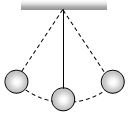
What is the velocity of the bob of a simple pendulum at its mean position,if it is able to rise to a vertical height of $10 \, cm$ ......... $m/s$? (Take $g = 9.8 \, m/s^2$)
A
$0.6$
B
$1.4$
C
$1.8$
D
$2.2$
Solution
(B) According to the law of conservation of energy,the kinetic energy at the mean position is equal to the potential energy at the extreme position.
$1/2 mv^2 = mgh$
$v = \sqrt{2gh}$
Given,$h = 10 \, cm = 0.1 \, m$ and $g = 9.8 \, m/s^2$.
$v = \sqrt{2 \times 9.8 \times 0.1} = \sqrt{1.96} = 1.4 \, m/s$.
$1/2 mv^2 = mgh$
$v = \sqrt{2gh}$
Given,$h = 10 \, cm = 0.1 \, m$ and $g = 9.8 \, m/s^2$.
$v = \sqrt{2 \times 9.8 \times 0.1} = \sqrt{1.96} = 1.4 \, m/s$.
0 likes
View Solution8
EasyMCQ
The time period of a simple pendulum on a freely moving artificial satellite is
A
$Zero$
B
$2 \, s$
C
$3 \, s$
D
Infinite
Solution
(D) The time period of a simple pendulum is given by the formula $T = 2\pi \sqrt{\frac{l}{g_{eff}}}$.
In an artificial satellite orbiting the Earth,the satellite and everything inside it are in a state of weightlessness,which means the effective acceleration due to gravity $g_{eff}$ is $0$.
Substituting $g_{eff} = 0$ into the formula,we get $T = 2\pi \sqrt{\frac{l}{0}} = \infty$.
Therefore,the time period of a simple pendulum on a freely moving artificial satellite is infinite.
In an artificial satellite orbiting the Earth,the satellite and everything inside it are in a state of weightlessness,which means the effective acceleration due to gravity $g_{eff}$ is $0$.
Substituting $g_{eff} = 0$ into the formula,we get $T = 2\pi \sqrt{\frac{l}{0}} = \infty$.
Therefore,the time period of a simple pendulum on a freely moving artificial satellite is infinite.
0 likes
View Solution9
EasyMCQ
In order to find time,the astronaut orbiting in an earth satellite should use
A
$A$ pendulum clock
B
$A$ watch having a main spring to keep it going
C
Either a pendulum clock or a watch
D
Neither a pendulum clock nor a watch
Solution
(B) The time period of a pendulum clock is given by $T = 2\pi \sqrt{l/g}$. In an orbiting satellite,the astronaut experiences weightlessness,which means the effective acceleration due to gravity $g$ is $0$. As $g \to 0$,$T \to \infty$,so a pendulum clock will not work.
However,a watch that uses a main spring to keep it going relies on the elastic properties of the spring and the oscillation of a balance wheel,which are independent of the gravitational field. Therefore,it will function correctly in a satellite.
However,a watch that uses a main spring to keep it going relies on the elastic properties of the spring and the oscillation of a balance wheel,which are independent of the gravitational field. Therefore,it will function correctly in a satellite.
0 likes
View Solution10
MediumMCQ
$A$ pendulum clock keeps correct time at $0^{\circ}C$. If its mean coefficient of linear expansion is $\alpha /^{\circ}C$,what is the loss in seconds per day by the clock if the temperature rises by $t^{\circ}C$?
A
$\frac{\frac{1}{2}\alpha t \times 864000}{1 - \frac{\alpha t}{2}}$
B
$\frac{1}{2}\alpha t \times 86400$
C
$\frac{\frac{1}{2}\alpha t \times 86400}{(1 - \frac{\alpha t}{2})^2}$
D
$\frac{\frac{1}{2}\alpha t \times 86400}{1 + \frac{\alpha t}{2}}$
Solution
(B) The time period of a pendulum is given by $T = 2\pi \sqrt{\frac{L}{g}}$.
Taking the derivative,the fractional change in time period is $\frac{\Delta T}{T} = \frac{1}{2} \frac{\Delta L}{L} = \frac{1}{2} \alpha \Delta \theta$.
Given $\Delta \theta = t$,the fractional change is $\frac{\Delta T}{T} = \frac{1}{2} \alpha t$.
The total number of seconds in a day is $86400 \text{ s}$.
Therefore,the loss in time per day is $\Delta T_{day} = \left( \frac{\Delta T}{T} \right) \times 86400 = \frac{1}{2} \alpha t \times 86400$.
Taking the derivative,the fractional change in time period is $\frac{\Delta T}{T} = \frac{1}{2} \frac{\Delta L}{L} = \frac{1}{2} \alpha \Delta \theta$.
Given $\Delta \theta = t$,the fractional change is $\frac{\Delta T}{T} = \frac{1}{2} \alpha t$.
The total number of seconds in a day is $86400 \text{ s}$.
Therefore,the loss in time per day is $\Delta T_{day} = \left( \frac{\Delta T}{T} \right) \times 86400 = \frac{1}{2} \alpha t \times 86400$.
0 likes
View Solution11
MediumMCQ
The instantaneous displacement of a simple pendulum oscillator is given by $x = A \cos \left( \omega t + \frac{\pi}{4} \right)$. Its speed will be maximum at time
A
$\frac{\pi}{4\omega}$
B
$\frac{\pi}{2\omega}$
C
$\frac{\pi}{\omega}$
D
$\frac{2\pi}{\omega}$
Solution
(A) The displacement of the oscillator is given by $x = A \cos \left( \omega t + \frac{\pi}{4} \right)$.
The velocity $v$ is the derivative of displacement with respect to time: $v = \frac{dx}{dt} = -A\omega \sin \left( \omega t + \frac{\pi}{4} \right)$.
For the speed to be maximum,the magnitude of the sine function must be $1$,i.e.,$|\sin \left( \omega t + \frac{\pi}{4} \right)| = 1$.
This occurs when $\omega t + \frac{\pi}{4} = \frac{\pi}{2}$.
Solving for $t$: $\omega t = \frac{\pi}{2} - \frac{\pi}{4} = \frac{\pi}{4}$.
Therefore,$t = \frac{\pi}{4\omega}$.
The velocity $v$ is the derivative of displacement with respect to time: $v = \frac{dx}{dt} = -A\omega \sin \left( \omega t + \frac{\pi}{4} \right)$.
For the speed to be maximum,the magnitude of the sine function must be $1$,i.e.,$|\sin \left( \omega t + \frac{\pi}{4} \right)| = 1$.
This occurs when $\omega t + \frac{\pi}{4} = \frac{\pi}{2}$.
Solving for $t$: $\omega t = \frac{\pi}{2} - \frac{\pi}{4} = \frac{\pi}{4}$.
Therefore,$t = \frac{\pi}{4\omega}$.
0 likes
View Solution12
MediumMCQ
The angular velocity and the amplitude of a simple pendulum are $\omega$ and $a$ respectively. At a displacement $X$ from the mean position,if its kinetic energy is $T$ and potential energy is $V$,then the ratio of $T$ to $V$ is:
A
$X^2 \omega^2 / (a^2 - X^2 \omega^2)$
B
$X^2 / (a^2 - X^2)$
C
$(a^2 - X^2 \omega^2) / X^2 \omega^2$
D
$(a^2 - X^2) / X^2$
Solution
(D) For a simple harmonic oscillator,the kinetic energy $T$ at displacement $X$ is given by $T = \frac{1}{2} m \omega^2 (a^2 - X^2)$.
The potential energy $V$ at displacement $X$ is given by $V = \frac{1}{2} m \omega^2 X^2$.
To find the ratio of kinetic energy $T$ to potential energy $V$,we divide the two expressions:
$\frac{T}{V} = \frac{\frac{1}{2} m \omega^2 (a^2 - X^2)}{\frac{1}{2} m \omega^2 X^2}$.
Canceling the common terms $\frac{1}{2} m \omega^2$,we get:
$\frac{T}{V} = \frac{a^2 - X^2}{X^2}$.
The potential energy $V$ at displacement $X$ is given by $V = \frac{1}{2} m \omega^2 X^2$.
To find the ratio of kinetic energy $T$ to potential energy $V$,we divide the two expressions:
$\frac{T}{V} = \frac{\frac{1}{2} m \omega^2 (a^2 - X^2)}{\frac{1}{2} m \omega^2 X^2}$.
Canceling the common terms $\frac{1}{2} m \omega^2$,we get:
$\frac{T}{V} = \frac{a^2 - X^2}{X^2}$.
0 likes
View Solution13
MediumMCQ
$A$ tunnel has been dug through the centre of the Earth and a ball is released in it. It will reach the other end of the tunnel after:
A
$84.6$ minutes
B
$42.3$ minutes
C
$1$ day
D
Will not reach the other end
Solution
(B) The motion of a ball dropped in a tunnel through the center of the Earth is simple harmonic motion $(S.H.M.)$.
The time period of this oscillation is given by $T = 2\pi \sqrt{\frac{R}{g}}$, where $R$ is the radius of the Earth and $g$ is the acceleration due to gravity.
Substituting the values $R \approx 6400 \; km$ and $g \approx 9.8 \; m/s^2$, we get $T \approx 84.6 \; \text{minutes}$.
The time taken to travel from one end to the other end of the tunnel is half of the total time period.
Therefore, $t = \frac{T}{2} = \frac{84.6}{2} = 42.3 \; \text{minutes}$.
The time period of this oscillation is given by $T = 2\pi \sqrt{\frac{R}{g}}$, where $R$ is the radius of the Earth and $g$ is the acceleration due to gravity.
Substituting the values $R \approx 6400 \; km$ and $g \approx 9.8 \; m/s^2$, we get $T \approx 84.6 \; \text{minutes}$.
The time taken to travel from one end to the other end of the tunnel is half of the total time period.
Therefore, $t = \frac{T}{2} = \frac{84.6}{2} = 42.3 \; \text{minutes}$.
0 likes
View Solution14
EasyMCQ
The period of a simple pendulum is doubled,when
A
Its length is doubled
B
The mass of the bob is doubled
C
Its length is made four times
D
The mass of the bob and the length of the pendulum are doubled
Solution
(C) The time period $T$ of a simple pendulum is given by the formula $T = 2\pi \sqrt{\frac{l}{g}}$,where $l$ is the length of the pendulum and $g$ is the acceleration due to gravity.
From this relation,we can see that $T \propto \sqrt{l}$.
If the period $T$ is to be doubled $(2T)$,then the new length $l'$ must satisfy $2T \propto \sqrt{l'}$.
Dividing the two relations: $\frac{2T}{T} = \frac{\sqrt{l'}}{\sqrt{l}} \implies 2 = \sqrt{\frac{l'}{l}}$.
Squaring both sides,we get $4 = \frac{l'}{l}$,which means $l' = 4l$.
Therefore,the length must be made four times the original length.
From this relation,we can see that $T \propto \sqrt{l}$.
If the period $T$ is to be doubled $(2T)$,then the new length $l'$ must satisfy $2T \propto \sqrt{l'}$.
Dividing the two relations: $\frac{2T}{T} = \frac{\sqrt{l'}}{\sqrt{l}} \implies 2 = \sqrt{\frac{l'}{l}}$.
Squaring both sides,we get $4 = \frac{l'}{l}$,which means $l' = 4l$.
Therefore,the length must be made four times the original length.
0 likes
View Solution15
MediumMCQ
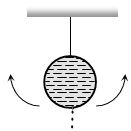
$A$ simple pendulum is made of a body which is a hollow sphere containing mercury, suspended by means of a wire. If a little mercury is drained off, the period of the pendulum will
A
Remain unchanged
B
Increase
C
Decrease
D
Become erratic
Solution
(B) The time period of a simple pendulum is given by $T = 2\pi \sqrt{\frac{L}{g}}$, where $L$ is the effective length of the pendulum.
The effective length $L$ is the distance from the point of suspension to the center of gravity (c.g.) of the bob.
Initially, the center of gravity of the mercury-filled sphere is at its geometric center.
When a little mercury is drained off, the level of mercury inside the sphere drops, causing the center of gravity of the bob to shift downwards (away from the point of suspension).
As the center of gravity moves downwards, the effective length $L$ of the pendulum increases.
Since $T \propto \sqrt{L}$, an increase in $L$ leads to an increase in the time period $T$ of the pendulum.
The effective length $L$ is the distance from the point of suspension to the center of gravity (c.g.) of the bob.
Initially, the center of gravity of the mercury-filled sphere is at its geometric center.
When a little mercury is drained off, the level of mercury inside the sphere drops, causing the center of gravity of the bob to shift downwards (away from the point of suspension).
As the center of gravity moves downwards, the effective length $L$ of the pendulum increases.
Since $T \propto \sqrt{L}$, an increase in $L$ leads to an increase in the time period $T$ of the pendulum.
0 likes
View Solution16
EasyMCQ
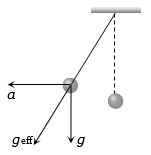
$A$ pendulum suspended from the ceiling of a train has a period $T$,when the train is at rest. When the train is accelerating with a uniform acceleration $a$,the period of oscillation will
A
Increase
B
Decrease
C
Remain unaffected
D
Become infinite
Solution
(B) Initially,the time period of the simple pendulum is given by $T = 2\pi \sqrt{\frac{l}{g}}$.
When the train accelerates with a uniform acceleration $a$,a pseudo force acts on the pendulum bob in the opposite direction of the acceleration.
The effective acceleration due to gravity $(g_{\text{eff}})$ becomes the vector sum of the gravitational acceleration $g$ and the pseudo acceleration $a$. Thus,$g_{\text{eff}} = \sqrt{g^2 + a^2}$.
Since $g_{\text{eff}} > g$,the new time period $T' = 2\pi \sqrt{\frac{l}{g_{\text{eff}}}}$ will be less than the initial time period $T$.
Therefore,the period of oscillation decreases.
When the train accelerates with a uniform acceleration $a$,a pseudo force acts on the pendulum bob in the opposite direction of the acceleration.
The effective acceleration due to gravity $(g_{\text{eff}})$ becomes the vector sum of the gravitational acceleration $g$ and the pseudo acceleration $a$. Thus,$g_{\text{eff}} = \sqrt{g^2 + a^2}$.
Since $g_{\text{eff}} > g$,the new time period $T' = 2\pi \sqrt{\frac{l}{g_{\text{eff}}}}$ will be less than the initial time period $T$.
Therefore,the period of oscillation decreases.
0 likes
View Solution17
EasyMCQ
Which of the following statements is not true? In the case of a simple pendulum for small amplitudes, the period of oscillation is:
A
Directly proportional to the square root of the length of the pendulum
B
Inversely proportional to the square root of the acceleration due to gravity
C
Dependent on the mass, size, and material of the bob
D
Independent of the amplitude
Solution
(C) The time period $T$ of a simple pendulum is given by the formula $T = 2\pi \sqrt{\frac{L}{g}}$, where $L$ is the length of the pendulum and $g$ is the acceleration due to gravity.
From this formula, we can observe the following:
$1$. $T$ is directly proportional to $\sqrt{L}$.
$2$. $T$ is inversely proportional to $\sqrt{g}$.
$3$. $T$ is independent of the mass, size, and material of the bob.
$4$. For small amplitudes, $T$ is independent of the amplitude.
Therefore, the statement that the period is dependent on the mass, size, and material of the bob is false.
From this formula, we can observe the following:
$1$. $T$ is directly proportional to $\sqrt{L}$.
$2$. $T$ is inversely proportional to $\sqrt{g}$.
$3$. $T$ is independent of the mass, size, and material of the bob.
$4$. For small amplitudes, $T$ is independent of the amplitude.
Therefore, the statement that the period is dependent on the mass, size, and material of the bob is false.
0 likes
View Solution18
MediumMCQ
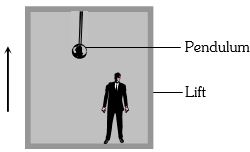
$A$ man measures the period of a simple pendulum inside a stationary lift and finds it to be $T$ seconds. If the lift accelerates upwards with an acceleration of $\frac{g}{4}$,then the period of the pendulum will be
A
$T$
B
$\frac{T}{4}$
C
$\frac{2T}{\sqrt{5}}$
D
$2T\sqrt{5}$
Solution
(C) In a stationary lift,the time period of a simple pendulum is given by $T = 2\pi \sqrt{\frac{l}{g}}$.
When the lift accelerates upwards with an acceleration $a = \frac{g}{4}$,the effective acceleration due to gravity becomes $g_{eff} = g + a = g + \frac{g}{4} = \frac{5g}{4}$.
The new time period $T'$ is given by $T' = 2\pi \sqrt{\frac{l}{g_{eff}}} = 2\pi \sqrt{\frac{l}{5g/4}} = 2\pi \sqrt{\frac{4l}{5g}}$.
We can rewrite this as $T' = \sqrt{\frac{4}{5}} \times (2\pi \sqrt{\frac{l}{g}}) = \frac{2}{\sqrt{5}} T$.
When the lift accelerates upwards with an acceleration $a = \frac{g}{4}$,the effective acceleration due to gravity becomes $g_{eff} = g + a = g + \frac{g}{4} = \frac{5g}{4}$.
The new time period $T'$ is given by $T' = 2\pi \sqrt{\frac{l}{g_{eff}}} = 2\pi \sqrt{\frac{l}{5g/4}} = 2\pi \sqrt{\frac{4l}{5g}}$.
We can rewrite this as $T' = \sqrt{\frac{4}{5}} \times (2\pi \sqrt{\frac{l}{g}}) = \frac{2}{\sqrt{5}} T$.
0 likes
View Solution19
MediumMCQ
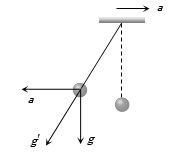
$A$ simple pendulum is suspended from the roof of a trolley which moves in a horizontal direction with an acceleration $a$. The time period is given by $T = 2\pi \sqrt{\frac{l}{g'}}$,where $g'$ is equal to:
A
$g$
B
$g - a$
C
$g + a$
D
$\sqrt{g^2 + a^2}$
Solution
(D) When a trolley moves with a horizontal acceleration $a$,a pseudo force $ma$ acts on the bob of the pendulum in the direction opposite to the acceleration of the trolley.
The effective acceleration due to gravity $g'$ is the vector sum of the acceleration due to gravity $g$ (acting downwards) and the pseudo acceleration $a$ (acting horizontally).
Since these two vectors are perpendicular to each other,the magnitude of the effective acceleration $g'$ is given by:
$g' = \sqrt{g^2 + a^2}$
Thus,the correct option is $D$.
The effective acceleration due to gravity $g'$ is the vector sum of the acceleration due to gravity $g$ (acting downwards) and the pseudo acceleration $a$ (acting horizontally).
Since these two vectors are perpendicular to each other,the magnitude of the effective acceleration $g'$ is given by:
$g' = \sqrt{g^2 + a^2}$
Thus,the correct option is $D$.
0 likes
View Solution20
EasyMCQ
$A$ second's pendulum is placed in a space laboratory orbiting around the earth at a height $3R$,where $R$ is the radius of the earth. The time period of the pendulum is
A
$Zero$
B
$2\sqrt{3} \, s$
C
$4 \, s$
D
Infinite
Solution
(D) second's pendulum is a pendulum whose time period is $2 \, s$ on the surface of the Earth.
In a space laboratory orbiting the Earth,the laboratory and everything inside it are in a state of weightlessness.
This means the effective acceleration due to gravity $(g_{eff})$ inside the orbiting laboratory is $0$.
The formula for the time period of a simple pendulum is $T = 2\pi \sqrt{\frac{l}{g_{eff}}}$.
Substituting $g_{eff} = 0$ into the formula,we get $T = 2\pi \sqrt{\frac{l}{0}} = \infty$.
Therefore,the time period of the pendulum is infinite.
In a space laboratory orbiting the Earth,the laboratory and everything inside it are in a state of weightlessness.
This means the effective acceleration due to gravity $(g_{eff})$ inside the orbiting laboratory is $0$.
The formula for the time period of a simple pendulum is $T = 2\pi \sqrt{\frac{l}{g_{eff}}}$.
Substituting $g_{eff} = 0$ into the formula,we get $T = 2\pi \sqrt{\frac{l}{0}} = \infty$.
Therefore,the time period of the pendulum is infinite.
0 likes
View Solution21
EasyMCQ
The bob of a simple pendulum of mass $m$ and total energy $E$ will have maximum linear momentum equal to
A
$\sqrt{\frac{2E}{m}}$
B
$\sqrt{2mE}$
C
$2mE$
D
$mE^2$
Solution
(B) The total energy $E$ of a simple harmonic oscillator is given by $E = \frac{1}{2}mv_{\max}^2$.
From this,we can express the maximum velocity $v_{\max}$ as $v_{\max} = \sqrt{\frac{2E}{m}}$.
The maximum linear momentum $p_{\max}$ is defined as $p_{\max} = m \cdot v_{\max}$.
Substituting the expression for $v_{\max}$,we get $p_{\max} = m \cdot \sqrt{\frac{2E}{m}} = \sqrt{m^2 \cdot \frac{2E}{m}} = \sqrt{2mE}$.
Therefore,the maximum linear momentum is $\sqrt{2mE}$.
From this,we can express the maximum velocity $v_{\max}$ as $v_{\max} = \sqrt{\frac{2E}{m}}$.
The maximum linear momentum $p_{\max}$ is defined as $p_{\max} = m \cdot v_{\max}$.
Substituting the expression for $v_{\max}$,we get $p_{\max} = m \cdot \sqrt{\frac{2E}{m}} = \sqrt{m^2 \cdot \frac{2E}{m}} = \sqrt{2mE}$.
Therefore,the maximum linear momentum is $\sqrt{2mE}$.
0 likes
View Solution22
EasyMCQ
The length of a seconds pendulum on the surface of the Earth is $1\, m$. The length of a seconds pendulum on the surface of the Moon,where $g$ is $1/6$th the value of $g$ on the surface of the Earth,is:
A
$\frac{1}{6}\, m$
B
$6 \,m$
C
$\frac{1}{36}\, m$
D
$36 \,m$
Solution
(A) The time period of a simple pendulum is given by $T = 2\pi \sqrt{\frac{l}{g}}$.
For a seconds pendulum,the time period $T$ is fixed at $2\, s$ on both the Earth and the Moon.
Since $T = 2\pi \sqrt{\frac{l}{g}}$,we have $T^2 = 4\pi^2 \frac{l}{g}$,which implies $l = \frac{T^2 g}{4\pi^2}$.
Since $T$ is constant,$l \propto g$.
Therefore,$\frac{l_m}{l_e} = \frac{g_m}{g_e}$.
Given $g_m = \frac{1}{6} g_e$ and $l_e = 1\, m$,we get $l_m = \frac{1}{6} \times 1\, m = \frac{1}{6}\, m$.
For a seconds pendulum,the time period $T$ is fixed at $2\, s$ on both the Earth and the Moon.
Since $T = 2\pi \sqrt{\frac{l}{g}}$,we have $T^2 = 4\pi^2 \frac{l}{g}$,which implies $l = \frac{T^2 g}{4\pi^2}$.
Since $T$ is constant,$l \propto g$.
Therefore,$\frac{l_m}{l_e} = \frac{g_m}{g_e}$.
Given $g_m = \frac{1}{6} g_e$ and $l_e = 1\, m$,we get $l_m = \frac{1}{6} \times 1\, m = \frac{1}{6}\, m$.
0 likes
View Solution23
MediumMCQ
If the length of a second's pendulum is decreased by $2\%$,how many seconds will it lose per day?
A
$3927$
B
$3727$
C
$3427$
D
$864$
Solution
(D) The time period of a simple pendulum is given by $T = 2\pi \sqrt{\frac{l}{g}}$,which implies $T \propto \sqrt{l}$.
Taking the derivative,we get $\frac{\Delta T}{T} = \frac{1}{2} \frac{\Delta l}{l}$.
Given that the length is decreased by $2\%$,we have $\frac{\Delta l}{l} = 0.02$.
Therefore,the fractional change in time period is $\frac{\Delta T}{T} = \frac{1}{2} \times 0.02 = 0.01$.
This means the pendulum loses $0.01$ seconds for every second of its time period.
Since a second's pendulum has a time period of $T = 2 \text{ seconds}$,the loss per oscillation is $\Delta T = 0.01 \times 2 = 0.02 \text{ seconds}$.
The number of oscillations in one day $(86400 \text{ seconds})$ is $N = \frac{86400}{2} = 43200$.
The total time lost per day is $N \times \Delta T = 43200 \times 0.02 = 864 \text{ seconds}$.
Taking the derivative,we get $\frac{\Delta T}{T} = \frac{1}{2} \frac{\Delta l}{l}$.
Given that the length is decreased by $2\%$,we have $\frac{\Delta l}{l} = 0.02$.
Therefore,the fractional change in time period is $\frac{\Delta T}{T} = \frac{1}{2} \times 0.02 = 0.01$.
This means the pendulum loses $0.01$ seconds for every second of its time period.
Since a second's pendulum has a time period of $T = 2 \text{ seconds}$,the loss per oscillation is $\Delta T = 0.01 \times 2 = 0.02 \text{ seconds}$.
The number of oscillations in one day $(86400 \text{ seconds})$ is $N = \frac{86400}{2} = 43200$.
The total time lost per day is $N \times \Delta T = 43200 \times 0.02 = 864 \text{ seconds}$.
0 likes
View Solution24
EasyMCQ
The period of a simple pendulum is measured as $T$ in a stationary lift. If the lift moves upwards with an acceleration of $5g$,the new period will be:
A
The same
B
Increased by $3/5$
C
Decreased by $2/3$ times
D
None of the above
Solution
(D) The time period of a simple pendulum is given by $T = 2\pi \sqrt{\frac{L}{g_{eff}}}$.
In a stationary lift,$g_{eff} = g$,so $T = 2\pi \sqrt{\frac{L}{g}}$.
When the lift moves upwards with an acceleration $a = 5g$,the effective acceleration becomes $g_{eff} = g + a = g + 5g = 6g$.
The new time period $T'$ is given by $T' = 2\pi \sqrt{\frac{L}{6g}}$.
Comparing the two,we get $T' = \frac{T}{\sqrt{6}}$.
Since $\frac{T}{\sqrt{6}}$ is not listed in the options,the correct choice is $(d)$.
In a stationary lift,$g_{eff} = g$,so $T = 2\pi \sqrt{\frac{L}{g}}$.
When the lift moves upwards with an acceleration $a = 5g$,the effective acceleration becomes $g_{eff} = g + a = g + 5g = 6g$.
The new time period $T'$ is given by $T' = 2\pi \sqrt{\frac{L}{6g}}$.
Comparing the two,we get $T' = \frac{T}{\sqrt{6}}$.
Since $\frac{T}{\sqrt{6}}$ is not listed in the options,the correct choice is $(d)$.
0 likes
View Solution25
EasyMCQ
The length of a simple pendulum is increased by $1\%$. Its time period will
A
Increase by $1\%$
B
Increase by $0.5\%$
C
Decrease by $0.5\%$
D
Increase by $2\%$
Solution
(B) The time period of a simple pendulum is given by the formula $T = 2\pi \sqrt{\frac{l}{g}}$.
From this relation,we can see that $T \propto \sqrt{l}$.
Taking the logarithmic derivative,we get $\frac{\Delta T}{T} = \frac{1}{2} \frac{\Delta l}{l}$.
Given that the length is increased by $1\%$,we have $\frac{\Delta l}{l} = 1\%$.
Substituting this value,we get $\frac{\Delta T}{T} = \frac{1}{2} \times 1\% = 0.5\%$.
Therefore,the time period will increase by $0.5\%$.
From this relation,we can see that $T \propto \sqrt{l}$.
Taking the logarithmic derivative,we get $\frac{\Delta T}{T} = \frac{1}{2} \frac{\Delta l}{l}$.
Given that the length is increased by $1\%$,we have $\frac{\Delta l}{l} = 1\%$.
Substituting this value,we get $\frac{\Delta T}{T} = \frac{1}{2} \times 1\% = 0.5\%$.
Therefore,the time period will increase by $0.5\%$.
0 likes
View Solution26
MediumMCQ
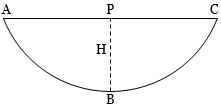
$A$ simple pendulum with a bob of mass $m$ oscillates from $A$ to $C$ and back to $A$ such that $PB$ is $H$. If the acceleration due to gravity is $g$,then the velocity of the bob as it passes through $B$ is
A
$mgH$
B
$\sqrt{2gH}$
C
$\sqrt{gH}$
D
Zero
Solution
(B) At point $A$ (or $C$),the bob is at its maximum height $H$ relative to point $B$,so its kinetic energy is zero and potential energy is $mgH$.
At point $B$,the bob is at its lowest position,so its potential energy is zero and all energy is converted into kinetic energy.
According to the law of conservation of mechanical energy:
$PE_{A} + KE_{A} = PE_{B} + KE_{B}$
$mgH + 0 = 0 + \frac{1}{2}mv^2$
$mgH = \frac{1}{2}mv^2$
$v^2 = 2gH$
$v = \sqrt{2gH}$
At point $B$,the bob is at its lowest position,so its potential energy is zero and all energy is converted into kinetic energy.
According to the law of conservation of mechanical energy:
$PE_{A} + KE_{A} = PE_{B} + KE_{B}$
$mgH + 0 = 0 + \frac{1}{2}mv^2$
$mgH = \frac{1}{2}mv^2$
$v^2 = 2gH$
$v = \sqrt{2gH}$
0 likes
View Solution27
EasyMCQ
Identify the correct statement among the following.
A
The greater the mass of a pendulum bob,the shorter is its frequency of oscillation.
B
$A$ simple pendulum with a bob of mass $M$ swings with an angular amplitude of ${40^\circ}$. When its angular amplitude is ${20^\circ}$,the tension in the string is less than $Mg \cos {20^\circ}$.
C
As the length of a simple pendulum is increased,the maximum velocity of its bob during its oscillation will also decrease.
D
The fractional change in the time period of a pendulum on changing the temperature is independent of the length of the pendulum.
Solution
(D) The time period of a simple pendulum is given by $T = 2\pi \sqrt{\frac{L}{g}}$.
For a given angular amplitude $\theta_0$,the maximum velocity $v_{max}$ is given by $v_{max} = \omega A = \sqrt{\frac{g}{L}} \cdot (L \theta_0) = \theta_0 \sqrt{gL}$.
As the length $L$ increases,the maximum velocity $v_{max}$ increases,not decreases. Thus,$(c)$ is incorrect.
Option $(a)$ is incorrect because the frequency $f = \frac{1}{2\pi} \sqrt{\frac{g}{L}}$ is independent of mass.
Option $(b)$ is incorrect because the tension at any angle $\theta$ is $T = Mg \cos \theta + \frac{Mv^2}{L}$. Since $\frac{Mv^2}{L} > 0$,the tension is always greater than $Mg \cos \theta$.
Option $(d)$ is correct. The time period is $T = 2\pi \sqrt{\frac{L}{g}}$. Taking logs and differentiating,$\frac{\Delta T}{T} = \frac{1}{2} \frac{\Delta L}{L} = \frac{1}{2} \alpha \Delta \theta$. This is independent of the length $L$.
For a given angular amplitude $\theta_0$,the maximum velocity $v_{max}$ is given by $v_{max} = \omega A = \sqrt{\frac{g}{L}} \cdot (L \theta_0) = \theta_0 \sqrt{gL}$.
As the length $L$ increases,the maximum velocity $v_{max}$ increases,not decreases. Thus,$(c)$ is incorrect.
Option $(a)$ is incorrect because the frequency $f = \frac{1}{2\pi} \sqrt{\frac{g}{L}}$ is independent of mass.
Option $(b)$ is incorrect because the tension at any angle $\theta$ is $T = Mg \cos \theta + \frac{Mv^2}{L}$. Since $\frac{Mv^2}{L} > 0$,the tension is always greater than $Mg \cos \theta$.
Option $(d)$ is correct. The time period is $T = 2\pi \sqrt{\frac{L}{g}}$. Taking logs and differentiating,$\frac{\Delta T}{T} = \frac{1}{2} \frac{\Delta L}{L} = \frac{1}{2} \alpha \Delta \theta$. This is independent of the length $L$.
0 likes
View Solution28
MediumMCQ
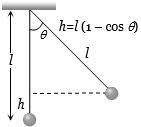
The bob of a simple pendulum having length $l$ is displaced from the mean position to an angular position $\theta$ with respect to the vertical. If it is released,then the velocity of the bob at the lowest position is:
A
$\sqrt{2 g l \cos \theta}$
B
$\sqrt{2gl(1 + \cos \theta)}$
C
$\sqrt{2gl(1 - \cos \theta)}$
D
$\sqrt{2 gl}$
Solution
(C) When the bob is displaced by an angle $\theta$,it rises to a vertical height $h$ above its mean position.
By the law of conservation of mechanical energy,the potential energy at the extreme position is converted into kinetic energy at the mean (lowest) position.
$mgh = \frac{1}{2}mv_{\max}^2$
$v_{\max} = \sqrt{2gh}$
From the geometry of the pendulum,the vertical distance from the point of suspension to the bob at the extreme position is $l \cos \theta$.
Therefore,the height $h$ is given by:
$h = l - l \cos \theta = l(1 - \cos \theta)$
Substituting the value of $h$ into the velocity equation:
$v_{\max} = \sqrt{2gl(1 - \cos \theta)}$
By the law of conservation of mechanical energy,the potential energy at the extreme position is converted into kinetic energy at the mean (lowest) position.
$mgh = \frac{1}{2}mv_{\max}^2$
$v_{\max} = \sqrt{2gh}$
From the geometry of the pendulum,the vertical distance from the point of suspension to the bob at the extreme position is $l \cos \theta$.
Therefore,the height $h$ is given by:
$h = l - l \cos \theta = l(1 - \cos \theta)$
Substituting the value of $h$ into the velocity equation:
$v_{\max} = \sqrt{2gl(1 - \cos \theta)}$
0 likes
View Solution29
EasyMCQ
$A$ simple pendulum executing $S.H.M.$ is falling freely along with its support. Then:
A
Its periodic time decreases
B
Its periodic time increases
C
It does not oscillate at all
D
None of these
Solution
(C) The time period of a simple pendulum is given by $T = 2\pi \sqrt{\frac{l}{g_{eff}}}$.
When a pendulum falls freely,the acceleration due to gravity $g$ is exactly cancelled by the pseudo-force acting on the bob due to the downward acceleration of the support.
Therefore,the effective acceleration due to gravity $g_{eff} = g - g = 0$.
Substituting this into the formula,we get $T = 2\pi \sqrt{\frac{l}{0}} = \infty$.
Since the time period becomes infinite,the frequency $f = \frac{1}{T} = 0$.
This implies that the pendulum does not oscillate at all.
When a pendulum falls freely,the acceleration due to gravity $g$ is exactly cancelled by the pseudo-force acting on the bob due to the downward acceleration of the support.
Therefore,the effective acceleration due to gravity $g_{eff} = g - g = 0$.
Substituting this into the formula,we get $T = 2\pi \sqrt{\frac{l}{0}} = \infty$.
Since the time period becomes infinite,the frequency $f = \frac{1}{T} = 0$.
This implies that the pendulum does not oscillate at all.
0 likes
View Solution30
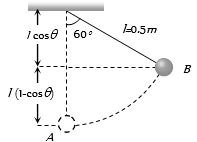
MediumMCQ
$A$ pendulum bob has a speed of $3\, m/s$ at its lowest position. The pendulum is $0.5\, m$ long. The speed of the bob,when the length makes an angle of $60^o$ with the vertical,will be ..... $m/s$ (If $g = 10\, m/s^2$)
A
$3$
B
$0.33$
C
$0.5$
D
$2$
Solution
(D) Let the velocity of the bob be $v$ at point $B$,where the string makes an angle of $60^o$ with the vertical. Using the law of conservation of mechanical energy between the lowest point $A$ and point $B$:
$KE_A + PE_A = KE_B + PE_B$
Taking the lowest point $A$ as the reference level for potential energy $(PE_A = 0)$:
$\frac{1}{2}mv_A^2 + 0 = \frac{1}{2}mv^2 + mgh$
Here,$h = l(1 - \cos \theta)$ is the height of point $B$ above point $A$.
Given $v_A = 3\, m/s$,$l = 0.5\, m$,$\theta = 60^o$,and $g = 10\, m/s^2$:
$\frac{1}{2} \times m \times 3^2 = \frac{1}{2} \times m \times v^2 + m \times 10 \times 0.5 \times (1 - \cos 60^o)$
$4.5 = 0.5v^2 + 5 \times (1 - 0.5)$
$4.5 = 0.5v^2 + 5 \times 0.5$
$4.5 = 0.5v^2 + 2.5$
$0.5v^2 = 2$
$v^2 = 4$
$v = 2\, m/s$
$KE_A + PE_A = KE_B + PE_B$
Taking the lowest point $A$ as the reference level for potential energy $(PE_A = 0)$:
$\frac{1}{2}mv_A^2 + 0 = \frac{1}{2}mv^2 + mgh$
Here,$h = l(1 - \cos \theta)$ is the height of point $B$ above point $A$.
Given $v_A = 3\, m/s$,$l = 0.5\, m$,$\theta = 60^o$,and $g = 10\, m/s^2$:
$\frac{1}{2} \times m \times 3^2 = \frac{1}{2} \times m \times v^2 + m \times 10 \times 0.5 \times (1 - \cos 60^o)$
$4.5 = 0.5v^2 + 5 \times (1 - 0.5)$
$4.5 = 0.5v^2 + 5 \times 0.5$
$4.5 = 0.5v^2 + 2.5$
$0.5v^2 = 2$
$v^2 = 4$
$v = 2\, m/s$
0 likes
View Solution31
EasyMCQ
The time period of a simple pendulum is $2 \, sec$. If its length is increased $4$ times,then its period becomes ..... $\sec$.
A
$16$
B
$12$
C
$8$
D
$4$
Solution
(D) The time period $T$ of a simple pendulum is given by the formula $T = 2\pi \sqrt{\frac{l}{g}}$,where $l$ is the length of the pendulum and $g$ is the acceleration due to gravity.
From this formula,we can see that $T \propto \sqrt{l}$.
Let the initial length be $l_1 = l$ and the initial time period be $T_1 = 2 \, sec$.
Let the new length be $l_2 = 4l$ and the new time period be $T_2$.
Using the ratio method: $\frac{T_1}{T_2} = \sqrt{\frac{l_1}{l_2}}$.
Substituting the values: $\frac{2}{T_2} = \sqrt{\frac{l}{4l}} = \sqrt{\frac{1}{4}} = \frac{1}{2}$.
Therefore,$T_2 = 2 \times 2 = 4 \, sec$.
From this formula,we can see that $T \propto \sqrt{l}$.
Let the initial length be $l_1 = l$ and the initial time period be $T_1 = 2 \, sec$.
Let the new length be $l_2 = 4l$ and the new time period be $T_2$.
Using the ratio method: $\frac{T_1}{T_2} = \sqrt{\frac{l_1}{l_2}}$.
Substituting the values: $\frac{2}{T_2} = \sqrt{\frac{l}{4l}} = \sqrt{\frac{1}{4}} = \frac{1}{2}$.
Therefore,$T_2 = 2 \times 2 = 4 \, sec$.
0 likes
View Solution32
EasyMCQ
If the metal bob of a simple pendulum is replaced by a wooden bob, then its time period will
A
Increase
B
Decrease
C
Remain the same
D
First increase then decrease
Solution
(C) The time period $T$ of a simple pendulum is given by the formula $T = 2\pi \sqrt{\frac{L}{g}}$, where $L$ is the length of the pendulum and $g$ is the acceleration due to gravity.
As seen from the formula, the time period $T$ depends only on the length of the pendulum and the acceleration due to gravity.
It is independent of the mass, material, or density of the bob.
Therefore, replacing the metal bob with a wooden bob will not change the time period of the pendulum.
As seen from the formula, the time period $T$ depends only on the length of the pendulum and the acceleration due to gravity.
It is independent of the mass, material, or density of the bob.
Therefore, replacing the metal bob with a wooden bob will not change the time period of the pendulum.
0 likes
View Solution33
EasyMCQ
In a simple pendulum,the period of oscillation $T$ is related to the length of the pendulum $l$ as
A
$\frac{l}{T} = \text{constant}$
B
$\frac{l^2}{T} = \text{constant}$
C
$\frac{l}{T^2} = \text{constant}$
D
$\frac{l^2}{T^2} = \text{constant}$
Solution
(C) The time period $T$ of a simple pendulum is given by the formula:
$T = 2\pi \sqrt{\frac{l}{g}}$
Squaring both sides,we get:
$T^2 = 4\pi^2 \frac{l}{g}$
Rearranging the terms to isolate the ratio of length to the square of the time period:
$\frac{l}{T^2} = \frac{g}{4\pi^2}$
Since $g$ (acceleration due to gravity) and $\pi$ are constants,the ratio $\frac{l}{T^2}$ is a constant.
Therefore,the correct option is $C$.
$T = 2\pi \sqrt{\frac{l}{g}}$
Squaring both sides,we get:
$T^2 = 4\pi^2 \frac{l}{g}$
Rearranging the terms to isolate the ratio of length to the square of the time period:
$\frac{l}{T^2} = \frac{g}{4\pi^2}$
Since $g$ (acceleration due to gravity) and $\pi$ are constants,the ratio $\frac{l}{T^2}$ is a constant.
Therefore,the correct option is $C$.
0 likes
View Solution34
EasyMCQ
$A$ pendulum has a time period $T$. If it is taken to another planet having an acceleration due to gravity half that of the Earth and a mass $9$ times that of the Earth,then its time period on the other planet will be:
A
$\sqrt{T}$
B
$T$
C
$T^{1/3}$
D
$\sqrt{2}T$
Solution
(D) The time period of a simple pendulum is given by the formula $T = 2\pi \sqrt{\frac{l}{g}}$.
From this formula,we can see that the time period is inversely proportional to the square root of the acceleration due to gravity: $T \propto \frac{1}{\sqrt{g}}$.
Let $T_e$ and $g_e$ be the time period and acceleration due to gravity on Earth,and $T_p$ and $g_p$ be the time period and acceleration due to gravity on the other planet.
Given that the acceleration due to gravity on the planet is half that of the Earth,we have $g_p = \frac{g_e}{2}$.
Using the proportionality relation:
$\frac{T_p}{T_e} = \sqrt{\frac{g_e}{g_p}} = \sqrt{\frac{g_e}{g_e/2}} = \sqrt{2}$.
Therefore,the new time period $T_p = \sqrt{2}T_e = \sqrt{2}T$.
From this formula,we can see that the time period is inversely proportional to the square root of the acceleration due to gravity: $T \propto \frac{1}{\sqrt{g}}$.
Let $T_e$ and $g_e$ be the time period and acceleration due to gravity on Earth,and $T_p$ and $g_p$ be the time period and acceleration due to gravity on the other planet.
Given that the acceleration due to gravity on the planet is half that of the Earth,we have $g_p = \frac{g_e}{2}$.
Using the proportionality relation:
$\frac{T_p}{T_e} = \sqrt{\frac{g_e}{g_p}} = \sqrt{\frac{g_e}{g_e/2}} = \sqrt{2}$.
Therefore,the new time period $T_p = \sqrt{2}T_e = \sqrt{2}T$.
0 likes
View Solution35
MediumMCQ
$A$ simple pendulum is executing simple harmonic motion with a time period $T$. If the length of the pendulum is increased by $21\%$,the percentage increase in the time period of the pendulum of increased length is ..... $\%$
A
$10$
B
$21$
C
$30$
D
$50$
Solution
(A) The time period of a simple pendulum is given by $T = 2\pi \sqrt{\frac{l}{g}}$.
This implies $T \propto \sqrt{l}$.
Let the initial length be $l_1 = 100$ units. Then the new length $l_2 = 100 + 21 = 121$ units.
The ratio of the time periods is $\frac{T_2}{T_1} = \sqrt{\frac{l_2}{l_1}} = \sqrt{\frac{121}{100}} = \frac{11}{10} = 1.1$.
Thus,$T_2 = 1.1 T_1$.
The percentage increase in the time period is given by $\frac{T_2 - T_1}{T_1} \times 100 = \frac{1.1 T_1 - T_1}{T_1} \times 100 = 0.1 \times 100 = 10\%$.
Therefore,the correct option is $A$.
This implies $T \propto \sqrt{l}$.
Let the initial length be $l_1 = 100$ units. Then the new length $l_2 = 100 + 21 = 121$ units.
The ratio of the time periods is $\frac{T_2}{T_1} = \sqrt{\frac{l_2}{l_1}} = \sqrt{\frac{121}{100}} = \frac{11}{10} = 1.1$.
Thus,$T_2 = 1.1 T_1$.
The percentage increase in the time period is given by $\frac{T_2 - T_1}{T_1} \times 100 = \frac{1.1 T_1 - T_1}{T_1} \times 100 = 0.1 \times 100 = 10\%$.
Therefore,the correct option is $A$.
0 likes
View Solution36
MediumMCQ
If the length of a simple pendulum is increased by $300\%$,then the time period will be increased by ..... $\%$
A
$100$
B
$200$
C
$300$
D
$400$
Solution
(A) The time period of a simple pendulum is given by $T = 2\pi \sqrt{\frac{l}{g}}$,which implies $T \propto \sqrt{l}$.
Let the initial length be $l_1 = l$ and the initial time period be $T_1$.
If the length is increased by $300\%$,the new length $l_2 = l + 300\% \text{ of } l = l + 3l = 4l$.
Using the proportionality $T \propto \sqrt{l}$,we have $\frac{T_2}{T_1} = \sqrt{\frac{l_2}{l_1}} = \sqrt{\frac{4l}{l}} = \sqrt{4} = 2$.
Thus,$T_2 = 2T_1$.
The percentage increase in the time period is given by $\frac{T_2 - T_1}{T_1} \times 100\% = \frac{2T_1 - T_1}{T_1} \times 100\% = 100\%$.
Therefore,the time period increases by $100\%$.
Let the initial length be $l_1 = l$ and the initial time period be $T_1$.
If the length is increased by $300\%$,the new length $l_2 = l + 300\% \text{ of } l = l + 3l = 4l$.
Using the proportionality $T \propto \sqrt{l}$,we have $\frac{T_2}{T_1} = \sqrt{\frac{l_2}{l_1}} = \sqrt{\frac{4l}{l}} = \sqrt{4} = 2$.
Thus,$T_2 = 2T_1$.
The percentage increase in the time period is given by $\frac{T_2 - T_1}{T_1} \times 100\% = \frac{2T_1 - T_1}{T_1} \times 100\% = 100\%$.
Therefore,the time period increases by $100\%$.
0 likes
View Solution37
EasyMCQ
The length of a seconds pendulum is .... $cm$.
A
$99.8$
B
$99$
C
$100$
D
None of these
Solution
(B) seconds pendulum is a pendulum whose period of oscillation is exactly $2 \ s$.
Using the formula for the time period of a simple pendulum: $T = 2\pi \sqrt{\frac{l}{g}}$.
Squaring both sides: $T^2 = 4\pi^2 \frac{l}{g}$.
Rearranging for length $l$: $l = \frac{gT^2}{4\pi^2}$.
Given $T = 2 \ s$ and taking $g = 9.8 \ m/s^2$ (or $980 \ cm/s^2$) and $\pi^2 \approx 9.87$:
$l = \frac{980 \times (2)^2}{4 \times 9.87} = \frac{980 \times 4}{39.48} \approx 99.29 \ cm$.
Standard approximation often used in physics textbooks takes $g = \pi^2 \ m/s^2$,which yields $l = 1 \ m = 100 \ cm$. However,using $g = 9.8 \ m/s^2$,the value is approximately $99.3 \ cm$. Among the given options,$99 \ cm$ is the closest standard value.
Using the formula for the time period of a simple pendulum: $T = 2\pi \sqrt{\frac{l}{g}}$.
Squaring both sides: $T^2 = 4\pi^2 \frac{l}{g}$.
Rearranging for length $l$: $l = \frac{gT^2}{4\pi^2}$.
Given $T = 2 \ s$ and taking $g = 9.8 \ m/s^2$ (or $980 \ cm/s^2$) and $\pi^2 \approx 9.87$:
$l = \frac{980 \times (2)^2}{4 \times 9.87} = \frac{980 \times 4}{39.48} \approx 99.29 \ cm$.
Standard approximation often used in physics textbooks takes $g = \pi^2 \ m/s^2$,which yields $l = 1 \ m = 100 \ cm$. However,using $g = 9.8 \ m/s^2$,the value is approximately $99.3 \ cm$. Among the given options,$99 \ cm$ is the closest standard value.
0 likes
View Solution38
MediumMCQ
The time period of a simple pendulum in a lift descending with constant acceleration $g$ is
A
$T = 2\pi \sqrt {\frac{l}{g}} $
B
$T = 2\pi \sqrt {\frac{l}{{2g}}} $
C
Zero
D
Infinite
Solution
(D) When a lift descends with an acceleration $a$,the effective acceleration due to gravity $g_{eff}$ experienced by the pendulum is $g_{eff} = g - a$.
In this case,the lift is descending with an acceleration $a = g$.
Therefore,the effective acceleration $g_{eff} = g - g = 0$.
The time period of a simple pendulum is given by $T = 2\pi \sqrt{\frac{l}{g_{eff}}}$.
Substituting $g_{eff} = 0$,we get $T = 2\pi \sqrt{\frac{l}{0}} = \infty$.
Thus,the time period becomes infinite.
In this case,the lift is descending with an acceleration $a = g$.
Therefore,the effective acceleration $g_{eff} = g - g = 0$.
The time period of a simple pendulum is given by $T = 2\pi \sqrt{\frac{l}{g_{eff}}}$.
Substituting $g_{eff} = 0$,we get $T = 2\pi \sqrt{\frac{l}{0}} = \infty$.
Thus,the time period becomes infinite.
0 likes
View Solution39
EasyMCQ
$A$ chimpanzee swinging on a swing in a sitting position,stands up suddenly,the time period will
A
Become infinite
B
Remain same
C
Increase
D
Decrease
Solution
(D) The time period of a simple pendulum is given by the formula $T = 2\pi \sqrt{\frac{l}{g}}$,where $l$ is the effective length of the pendulum (distance from the point of suspension to the center of mass of the oscillating body).
When the chimpanzee stands up,the center of mass of the system shifts upward,closer to the point of suspension.
This results in a decrease in the effective length $l$ of the swing.
Since $T \propto \sqrt{l}$,a decrease in $l$ leads to a decrease in the time period $T$.
When the chimpanzee stands up,the center of mass of the system shifts upward,closer to the point of suspension.
This results in a decrease in the effective length $l$ of the swing.
Since $T \propto \sqrt{l}$,a decrease in $l$ leads to a decrease in the time period $T$.
0 likes
View Solution40
EasyMCQ
The acceleration due to gravity at a place is $\pi^2 \, m/s^2$. Then the time period of a simple pendulum of length $1 \, m$ is:
A
$2/\pi \, s$
B
$2\pi \, s$
C
$2 \, s$
D
$\pi \, s$
Solution
(C) The formula for the time period $T$ of a simple pendulum is given by $T = 2\pi \sqrt{\frac{l}{g}}$.
Given: length $l = 1 \, m$ and acceleration due to gravity $g = \pi^2 \, m/s^2$.
Substituting these values into the formula:
$T = 2\pi \sqrt{\frac{1}{\pi^2}}$
$T = 2\pi \times \frac{1}{\pi}$
$T = 2 \, s$.
Therefore,the time period is $2 \, s$.
Given: length $l = 1 \, m$ and acceleration due to gravity $g = \pi^2 \, m/s^2$.
Substituting these values into the formula:
$T = 2\pi \sqrt{\frac{1}{\pi^2}}$
$T = 2\pi \times \frac{1}{\pi}$
$T = 2 \, s$.
Therefore,the time period is $2 \, s$.
0 likes
View Solution41
EasyMCQ
$A$ plate oscillates with a time period $T$. If another plate is suddenly placed on the first plate,what happens to the time period?
A
Will decrease
B
Will increase
C
Will be same
D
None of these
Solution
(C) The time period of a simple pendulum is given by the formula $T = 2\pi \sqrt{\frac{L}{g}}$,where $L$ is the length of the pendulum and $g$ is the acceleration due to gravity.
As observed from the formula,the time period $T$ depends only on the length of the pendulum and the acceleration due to gravity.
It is independent of the mass of the bob or the object attached to the pendulum.
Therefore,placing another plate on the first plate does not change the mass-independent nature of the oscillation period.
Thus,the time period will remain the same.
As observed from the formula,the time period $T$ depends only on the length of the pendulum and the acceleration due to gravity.
It is independent of the mass of the bob or the object attached to the pendulum.
Therefore,placing another plate on the first plate does not change the mass-independent nature of the oscillation period.
Thus,the time period will remain the same.
0 likes
View Solution42
EasyMCQ
$A$ simple pendulum of length $l$ has a brass bob attached at its lower end. Its period is $T$. If a steel bob of the same size,having a density $x$ times that of brass,replaces the brass bob and its length is changed so that the period becomes $2T$,then the new length is:
A
$2l$
B
$4l$
C
$4lx$
D
$\frac{4l}{x}$
Solution
(B) The time period of a simple pendulum is given by the formula $T = 2\pi \sqrt{\frac{l}{g}}$,where $l$ is the effective length and $g$ is the acceleration due to gravity.
From this formula,it is clear that $T \propto \sqrt{l}$.
The time period is independent of the mass,size,or density of the bob.
Let the initial length be $l_1 = l$ and the initial time period be $T_1 = T$.
Let the new length be $l_2$ and the new time period be $T_2 = 2T$.
Using the proportionality $T \propto \sqrt{l}$,we have $\frac{T_2}{T_1} = \sqrt{\frac{l_2}{l_1}}$.
Substituting the values: $\frac{2T}{T} = \sqrt{\frac{l_2}{l}}$,which simplifies to $2 = \sqrt{\frac{l_2}{l}}$.
Squaring both sides,we get $4 = \frac{l_2}{l}$,which implies $l_2 = 4l$.
From this formula,it is clear that $T \propto \sqrt{l}$.
The time period is independent of the mass,size,or density of the bob.
Let the initial length be $l_1 = l$ and the initial time period be $T_1 = T$.
Let the new length be $l_2$ and the new time period be $T_2 = 2T$.
Using the proportionality $T \propto \sqrt{l}$,we have $\frac{T_2}{T_1} = \sqrt{\frac{l_2}{l_1}}$.
Substituting the values: $\frac{2T}{T} = \sqrt{\frac{l_2}{l}}$,which simplifies to $2 = \sqrt{\frac{l_2}{l}}$.
Squaring both sides,we get $4 = \frac{l_2}{l}$,which implies $l_2 = 4l$.
0 likes
View Solution43
EasyMCQ
In a seconds pendulum,the mass of the bob is $30\, g$. If it is replaced by a $90\, g$ mass,then its time period will be .... $s$.
A
$1$
B
$2$
C
$4$
D
$3$
Solution
(B) The time period of a simple pendulum is given by the formula $T = 2\pi \sqrt{\frac{L}{g}}$.
Here,$L$ is the length of the pendulum and $g$ is the acceleration due to gravity.
As seen from the formula,the time period $T$ depends only on the length of the pendulum and the acceleration due to gravity.
It is independent of the mass of the bob.
$A$ seconds pendulum is defined as a pendulum with a time period of $2\, s$.
Since the time period does not change with the mass of the bob,the new time period remains $2\, s$.
Here,$L$ is the length of the pendulum and $g$ is the acceleration due to gravity.
As seen from the formula,the time period $T$ depends only on the length of the pendulum and the acceleration due to gravity.
It is independent of the mass of the bob.
$A$ seconds pendulum is defined as a pendulum with a time period of $2\, s$.
Since the time period does not change with the mass of the bob,the new time period remains $2\, s$.
0 likes
View Solution44
EasyMCQ
The time period of a simple pendulum when it is made to oscillate on the surface of the moon:
A
Increases
B
Decreases
C
Remains unchanged
D
Becomes infinite
Solution
(A) The time period $T$ of a simple pendulum is given by the formula $T = 2\pi \sqrt{\frac{L}{g}}$,where $L$ is the length of the pendulum and $g$ is the acceleration due to gravity.
On the surface of the moon,the acceleration due to gravity $g_m$ is approximately $1/6$th of the acceleration due to gravity on Earth $(g_e)$.
Since $T \propto \frac{1}{\sqrt{g}}$,a decrease in the value of $g$ leads to an increase in the time period $T$.
Therefore,the time period of a simple pendulum increases when it oscillates on the surface of the moon.
On the surface of the moon,the acceleration due to gravity $g_m$ is approximately $1/6$th of the acceleration due to gravity on Earth $(g_e)$.
Since $T \propto \frac{1}{\sqrt{g}}$,a decrease in the value of $g$ leads to an increase in the time period $T$.
Therefore,the time period of a simple pendulum increases when it oscillates on the surface of the moon.
0 likes
View Solution45
EasyMCQ
$A$ simple pendulum is attached to the roof of a lift. If the time period of oscillation when the lift is stationary is $T$,then the frequency of oscillation when the lift falls freely will be
A
Zero
B
$T$
C
$1/T$
D
None of these
Solution
(A) The time period of a simple pendulum is given by $T = 2\pi \sqrt{\frac{L}{g_{eff}}}$.
When the lift is stationary,$g_{eff} = g$,so $T = 2\pi \sqrt{\frac{L}{g}}$.
When the lift falls freely,it experiences weightlessness,meaning the effective acceleration due to gravity $g_{eff} = 0$.
Substituting $g_{eff} = 0$ into the formula,the time period $T' = 2\pi \sqrt{\frac{L}{0}} = \infty$.
Since frequency $f = \frac{1}{T'}$,we get $f = \frac{1}{\infty} = 0$.
Therefore,the frequency of oscillation is zero.
When the lift is stationary,$g_{eff} = g$,so $T = 2\pi \sqrt{\frac{L}{g}}$.
When the lift falls freely,it experiences weightlessness,meaning the effective acceleration due to gravity $g_{eff} = 0$.
Substituting $g_{eff} = 0$ into the formula,the time period $T' = 2\pi \sqrt{\frac{L}{0}} = \infty$.
Since frequency $f = \frac{1}{T'}$,we get $f = \frac{1}{\infty} = 0$.
Therefore,the frequency of oscillation is zero.
0 likes
View Solution46
EasyMCQ
$A$ simple pendulum,suspended from the ceiling of a stationary van,has time period $T$. If the van starts moving with a uniform velocity,the period of the pendulum will be
A
Less than $T$
B
Equal to $2T$
C
Greater than $T$
D
Unchanged
Solution
(D) The time period of a simple pendulum is given by the formula $T = 2\pi \sqrt{\frac{L}{g_{eff}}}$,where $L$ is the length of the pendulum and $g_{eff}$ is the effective acceleration due to gravity.
When the van moves with a uniform velocity,its acceleration is zero.
Therefore,the net force acting on the pendulum bob remains the same as when the van was stationary.
Since the effective acceleration due to gravity $g_{eff}$ remains equal to the acceleration due to gravity $g$,the time period $T$ remains unchanged.
When the van moves with a uniform velocity,its acceleration is zero.
Therefore,the net force acting on the pendulum bob remains the same as when the van was stationary.
Since the effective acceleration due to gravity $g_{eff}$ remains equal to the acceleration due to gravity $g$,the time period $T$ remains unchanged.
0 likes
View Solution47
MediumMCQ
If the length of a simple pendulum is increased by $44\%$,then what is the percentage change in the time period of the pendulum (in $\%$)?
A
$22$
B
$20$
C
$33$
D
$44$
Solution
(B) The time period of a simple pendulum is given by $T = 2\pi \sqrt{\frac{l}{g}}$.
Given that the length is increased by $44\%$,the new length $l_2 = l_1 + 0.44 l_1 = 1.44 l_1$.
Since $T \propto \sqrt{l}$,the ratio of the new time period $T_2$ to the original time period $T_1$ is:
$\frac{T_2}{T_1} = \sqrt{\frac{l_2}{l_1}} = \sqrt{\frac{1.44 l_1}{l_1}} = \sqrt{1.44} = 1.2$.
This implies $T_2 = 1.2 T_1$.
The percentage change in the time period is given by:
$\text{Percentage change} = \left( \frac{T_2 - T_1}{T_1} \right) \times 100 = \left( \frac{1.2 T_1 - T_1}{T_1} \right) \times 100 = 0.2 \times 100 = 20\%$.
Therefore,the time period increases by $20\%$.
Given that the length is increased by $44\%$,the new length $l_2 = l_1 + 0.44 l_1 = 1.44 l_1$.
Since $T \propto \sqrt{l}$,the ratio of the new time period $T_2$ to the original time period $T_1$ is:
$\frac{T_2}{T_1} = \sqrt{\frac{l_2}{l_1}} = \sqrt{\frac{1.44 l_1}{l_1}} = \sqrt{1.44} = 1.2$.
This implies $T_2 = 1.2 T_1$.
The percentage change in the time period is given by:
$\text{Percentage change} = \left( \frac{T_2 - T_1}{T_1} \right) \times 100 = \left( \frac{1.2 T_1 - T_1}{T_1} \right) \times 100 = 0.2 \times 100 = 20\%$.
Therefore,the time period increases by $20\%$.
0 likes
View SolutionOscillations — SHM of Simple Pendulum · Frequently Asked Questions
1Are these Oscillations questions useful for JEE and NEET?
Yes. All questions in this section are mapped to JEE Main and NEET exam patterns. Previous year questions from JEE Main, NEET, GUJCET and state-level exams are included with full solutions.
2Can I switch to Hindi or Gujarati for these questions?
Yes. Use the language tabs in the hero section or the sidebar to view the same questions and solutions in English, Hindi or Gujarati.
3How do I generate a question paper from this subtopic?
Use the Vedclass Exam Paper Generator — select the chapter and subtopic, set difficulty, and generate Sets A, B, C, D automatically. First 3 chapters of every subject are free.
Vedclass Products
For Students
Vedclass Test Series
Mock tests in real JEE/NEET style with performance analysis. 5-day free trial.
Start Free TrialFor Teachers
Exam Paper Generator
Generate Set A/B/C/D papers from this chapter in 2 minutes. 3 chapters free.
Try FreeFor Institutes
Online Exam Module
Live online exams with unlimited students, 360° analytics & white-label branding.
See DemoFor Teachers & Institutes
Generate a Oscillations Exam Paper in 2 Minutes
Select subtopic & difficulty — Sets A, B, C, D auto-generated with No Repeat logic.
First 3 chapters of every subject are free — no payment required.