
A English
Motion Under Gravity Questions in English
Class 11 Physics · Motion in Straight Line · Motion Under Gravity
334+
Questions
English
Language
100%
With Solutions
Showing 49 of 334 questions in English
151
DifficultMCQ
The vertical height of point $P$ above the ground is twice that of $Q$. $A$ particle is projected downward with a speed of $5 \, m/s$ from $P$ and at the same time another particle is projected upward with the same speed from $Q$. Both particles reach the ground simultaneously,then:
A
$PQ = 30 \, m$
B
Time of flight of stones $= 3 \, s$
C
Both $(a)$ and $(b)$ are correct
D
Both $(a)$ and $(b)$ are wrong
Solution
(C) Let the height of point $Q$ be $h$ and the height of point $P$ be $2h$. Let the time taken to reach the ground be $t$. Taking the downward direction as negative and the ground as the origin $(y=0)$:
For particle at $P$: Initial velocity $u_P = -5 \, m/s$,displacement $s_P = -2h$. Using $s = ut + \frac{1}{2}at^2$,we get $-2h = -5t - 5t^2$,which simplifies to $2h = 5t + 5t^2$ (Equation $1$).
For particle at $Q$: Initial velocity $u_Q = +5 \, m/s$,displacement $s_Q = -h$. Using $s = ut + \frac{1}{2}at^2$,we get $-h = 5t - 5t^2$,which simplifies to $h = 5t^2 - 5t$ (Equation $2$).
Substitute $h$ from Equation $2$ into Equation $1$: $2(5t^2 - 5t) = 5t + 5t^2 \Rightarrow 10t^2 - 10t = 5t + 5t^2 \Rightarrow 5t^2 = 15t$. Since $t \neq 0$,we get $t = 3 \, s$.
Now,substitute $t = 3$ into Equation $2$: $h = 5(3)^2 - 5(3) = 45 - 15 = 30 \, m$.
The distance between $P$ and $Q$ is $PQ = 2h - h = h = 30 \, m$. Thus,both $(a)$ and $(b)$ are correct.
For particle at $P$: Initial velocity $u_P = -5 \, m/s$,displacement $s_P = -2h$. Using $s = ut + \frac{1}{2}at^2$,we get $-2h = -5t - 5t^2$,which simplifies to $2h = 5t + 5t^2$ (Equation $1$).
For particle at $Q$: Initial velocity $u_Q = +5 \, m/s$,displacement $s_Q = -h$. Using $s = ut + \frac{1}{2}at^2$,we get $-h = 5t - 5t^2$,which simplifies to $h = 5t^2 - 5t$ (Equation $2$).
Substitute $h$ from Equation $2$ into Equation $1$: $2(5t^2 - 5t) = 5t + 5t^2 \Rightarrow 10t^2 - 10t = 5t + 5t^2 \Rightarrow 5t^2 = 15t$. Since $t \neq 0$,we get $t = 3 \, s$.
Now,substitute $t = 3$ into Equation $2$: $h = 5(3)^2 - 5(3) = 45 - 15 = 30 \, m$.
The distance between $P$ and $Q$ is $PQ = 2h - h = h = 30 \, m$. Thus,both $(a)$ and $(b)$ are correct.
0 likes
View Solution152
MediumMCQ
$A$ juggler maintains four balls in vertically upward motion. He throws the next ball every $1/4 \, s$. For the show to continue,what should be the height to which he throws each ball? (Assume $g = 10 \, m/s^2$)
A
$5$
B
$2.5$
C
$1.25$
D
$1$
Solution
(C) The juggler maintains $4$ balls in the air. The time interval between throwing consecutive balls is $T = 1/4 \, s$.
Since there are $4$ balls,the total time a ball stays in the air (time of flight) must be $T_{flight} = 4 \times T = 4 \times (1/4) = 1 \, s$.
The time taken to reach the maximum height is $t = T_{flight} / 2 = 1 / 2 = 0.5 \, s$.
Using the equation of motion for a ball thrown vertically upward,at maximum height,the final velocity $v = 0$.
Using $v = u - gt$,we get $0 = u - (10)(0.5)$,so $u = 5 \, m/s$.
The maximum height $H$ reached is given by $H = \frac{u^2}{2g} = \frac{5^2}{2 \times 10} = \frac{25}{20} = 1.25 \, m$.
Alternatively,using $H = \frac{1}{2}gt^2$ for the downward journey from the peak: $H = \frac{1}{2} \times 10 \times (0.5)^2 = 5 \times 0.25 = 1.25 \, m$.
Since there are $4$ balls,the total time a ball stays in the air (time of flight) must be $T_{flight} = 4 \times T = 4 \times (1/4) = 1 \, s$.
The time taken to reach the maximum height is $t = T_{flight} / 2 = 1 / 2 = 0.5 \, s$.
Using the equation of motion for a ball thrown vertically upward,at maximum height,the final velocity $v = 0$.
Using $v = u - gt$,we get $0 = u - (10)(0.5)$,so $u = 5 \, m/s$.
The maximum height $H$ reached is given by $H = \frac{u^2}{2g} = \frac{5^2}{2 \times 10} = \frac{25}{20} = 1.25 \, m$.
Alternatively,using $H = \frac{1}{2}gt^2$ for the downward journey from the peak: $H = \frac{1}{2} \times 10 \times (0.5)^2 = 5 \times 0.25 = 1.25 \, m$.
0 likes
View Solution153
MediumMCQ
$A$ body dropped from the top of a tower clears $7/16$ of the total height of the tower in its last second of flight. The time taken by the body to reach the ground is........$s$
A
$2$
B
$3$
C
$4$
D
$5$
Solution
(C) Let $H$ be the total height of the tower and $t$ be the total time taken to reach the ground.
Using the equation of motion for a body dropped from rest: $H = \frac{1}{2} gt^2$ --- $(1)$
In the last second,the body covers $7/16$ of the total height,meaning it covers $H - \frac{7}{16}H = \frac{9}{16}H$ in the first $(t-1)$ seconds.
So,$\frac{9}{16}H = \frac{1}{2} g(t-1)^2$ --- $(2)$
Dividing equation $(1)$ by equation $(2)$:
$\frac{H}{\frac{9}{16}H} = \frac{\frac{1}{2} gt^2}{\frac{1}{2} g(t-1)^2}$
$\frac{16}{9} = \frac{t^2}{(t-1)^2}$
Taking the square root on both sides:
$\frac{4}{3} = \frac{t}{t-1}$
$4(t-1) = 3t$
$4t - 4 = 3t$
$t = 4 \ s$
Using the equation of motion for a body dropped from rest: $H = \frac{1}{2} gt^2$ --- $(1)$
In the last second,the body covers $7/16$ of the total height,meaning it covers $H - \frac{7}{16}H = \frac{9}{16}H$ in the first $(t-1)$ seconds.
So,$\frac{9}{16}H = \frac{1}{2} g(t-1)^2$ --- $(2)$
Dividing equation $(1)$ by equation $(2)$:
$\frac{H}{\frac{9}{16}H} = \frac{\frac{1}{2} gt^2}{\frac{1}{2} g(t-1)^2}$
$\frac{16}{9} = \frac{t^2}{(t-1)^2}$
Taking the square root on both sides:
$\frac{4}{3} = \frac{t}{t-1}$
$4(t-1) = 3t$
$4t - 4 = 3t$
$t = 4 \ s$
0 likes
View Solution154
MediumMCQ
If a stone is released from a balloon rising with acceleration $a$ at the instant when its velocity is $v$,then immediately after release,the acceleration and velocity of the stone are
A
$a$ (upward),$v$ (upward)
B
$g$ (upward),$v$ (upward)
C
$g$ (downward),$v$ (upward)
D
$(g-a)$ (downward),$v$ (upward)
Solution
(C) $1$. At the instant the stone is released,it possesses the same velocity as the balloon due to inertia. Therefore,the velocity of the stone immediately after release is $v$ (upward).
$2$. Once the stone is released,it is no longer in contact with the balloon and is only under the influence of gravity.
$3$. The only force acting on the stone is its weight,which acts vertically downward.
$4$. According to Newton's second law,the acceleration of the stone is $F/m = mg/m = g$.
$5$. Thus,the acceleration of the stone is $g$ (downward).
$2$. Once the stone is released,it is no longer in contact with the balloon and is only under the influence of gravity.
$3$. The only force acting on the stone is its weight,which acts vertically downward.
$4$. According to Newton's second law,the acceleration of the stone is $F/m = mg/m = g$.
$5$. Thus,the acceleration of the stone is $g$ (downward).
0 likes
View Solution155
DifficultMCQ
$A$ ball is dropped from the roof of a tower of height $h$. The total distance covered by it in the last second of its motion is equal to the distance covered by it in the first three seconds. The value of $h$ in meters is $(g = 10\,m/s^2)$.
A
$125$
B
$200$
C
$100$
D
$80$
Solution
(A) Let the total time of motion be $n$ seconds. The initial velocity $u = 0$ and acceleration $g = 10\,m/s^2$.
Distance covered in the first $3$ seconds is given by $S_3 = ut + \frac{1}{2}gt^2 = 0 + \frac{1}{2} \times 10 \times 3^2 = 45\,m$.
Distance covered in the last second of motion is given by $S_{last} = u + \frac{g}{2}(2n - 1) = 0 + \frac{10}{2}(2n - 1) = 5(2n - 1)$.
According to the problem,$S_{last} = S_3$,so $5(2n - 1) = 45$.
$2n - 1 = 9 \Rightarrow 2n = 10 \Rightarrow n = 5\,s$.
The total height $h$ is the distance covered in $5$ seconds: $h = \frac{1}{2}gn^2 = \frac{1}{2} \times 10 \times 5^2 = 5 \times 25 = 125\,m$.
Distance covered in the first $3$ seconds is given by $S_3 = ut + \frac{1}{2}gt^2 = 0 + \frac{1}{2} \times 10 \times 3^2 = 45\,m$.
Distance covered in the last second of motion is given by $S_{last} = u + \frac{g}{2}(2n - 1) = 0 + \frac{10}{2}(2n - 1) = 5(2n - 1)$.
According to the problem,$S_{last} = S_3$,so $5(2n - 1) = 45$.
$2n - 1 = 9 \Rightarrow 2n = 10 \Rightarrow n = 5\,s$.
The total height $h$ is the distance covered in $5$ seconds: $h = \frac{1}{2}gn^2 = \frac{1}{2} \times 10 \times 5^2 = 5 \times 25 = 125\,m$.
0 likes
View Solution156
EasyMCQ
Two spheres of same size,one of mass $2\, kg$ and another of mass $4\, kg$,are dropped simultaneously from the top of Qutab Minar (height $= 72\, m$). When they are $1\, m$ above the ground,the two spheres have the same
A
momentum
B
kinetic energy
C
potential energy
D
acceleration
Solution
(D) When objects are dropped from the same height,they undergo free fall under the influence of gravity.
According to the equations of motion,the acceleration of an object in free fall is independent of its mass and is equal to the acceleration due to gravity,$g$.
Since both spheres are dropped from the same height and are at the same position ($1\, m$ above the ground),they have the same velocity.
However,momentum $(p = mv)$,kinetic energy $(K = \frac{1}{2}mv^2)$,and potential energy $(U = mgh)$ all depend on the mass of the object.
Since the masses are different ($2\, kg$ and $4\, kg$),their momentum,kinetic energy,and potential energy will be different.
Therefore,the only quantity that remains the same for both spheres is their acceleration,which is $g$.
According to the equations of motion,the acceleration of an object in free fall is independent of its mass and is equal to the acceleration due to gravity,$g$.
Since both spheres are dropped from the same height and are at the same position ($1\, m$ above the ground),they have the same velocity.
However,momentum $(p = mv)$,kinetic energy $(K = \frac{1}{2}mv^2)$,and potential energy $(U = mgh)$ all depend on the mass of the object.
Since the masses are different ($2\, kg$ and $4\, kg$),their momentum,kinetic energy,and potential energy will be different.
Therefore,the only quantity that remains the same for both spheres is their acceleration,which is $g$.
0 likes
View Solution157
EasyMCQ
$A$ particle is thrown vertically upwards with a velocity of $4\,ms^{-1}$. The ratio of its accelerations after $1\,s$ and $2\,s$ of its motion is
A
$2$
B
$9.8$
C
$1$
D
$4.9$
Solution
(C) For a particle moving under gravity,the acceleration is always equal to the acceleration due to gravity $(g)$,which is approximately $9.8\,ms^{-2}$ directed downwards.
Since the acceleration is constant throughout the motion,the acceleration at $t = 1\,s$ is $a_1 = 9.8\,ms^{-2}$.
Similarly,the acceleration at $t = 2\,s$ is $a_2 = 9.8\,ms^{-2}$.
The ratio of the accelerations is $\frac{a_1}{a_2} = \frac{9.8}{9.8} = 1$.
Since the acceleration is constant throughout the motion,the acceleration at $t = 1\,s$ is $a_1 = 9.8\,ms^{-2}$.
Similarly,the acceleration at $t = 2\,s$ is $a_2 = 9.8\,ms^{-2}$.
The ratio of the accelerations is $\frac{a_1}{a_2} = \frac{9.8}{9.8} = 1$.
0 likes
View Solution158
EasyMCQ
$A$ body is thrown vertically upwards with a velocity of $19.6 \, ms^{-1}$. The position of the body after $4 \, s$ will be
A
at the highest point
B
at the mid-point of the line joining the starting point and the highest point
C
at the starting point
D
none of the above
Solution
(C) The time taken by the body to reach the highest point is given by the equation of motion $v = u - gt$.
At the highest point,the final velocity $v = 0$.
Given $u = 19.6 \, ms^{-1}$ and $g = 9.8 \, ms^{-2}$.
$0 = 19.6 - 9.8 \times t$
$t = \frac{19.6}{9.8} = 2 \, s$.
Since the time taken to go up is equal to the time taken to come down,the body will return to the starting point in $2 \, s + 2 \, s = 4 \, s$.
At the highest point,the final velocity $v = 0$.
Given $u = 19.6 \, ms^{-1}$ and $g = 9.8 \, ms^{-2}$.
$0 = 19.6 - 9.8 \times t$
$t = \frac{19.6}{9.8} = 2 \, s$.
Since the time taken to go up is equal to the time taken to come down,the body will return to the starting point in $2 \, s + 2 \, s = 4 \, s$.
0 likes
View Solution159
MediumMCQ
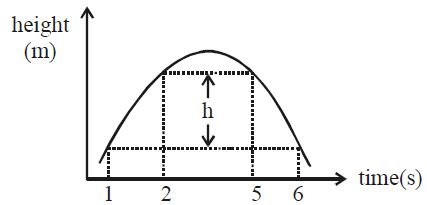
$A$ ball is thrown upwards. Its height varies with time as shown in the graph. If the acceleration due to gravity is $g = 7.5\, m/s^2$,then the height $h$ is.........$m$.
A
$10$
B
$15$
C
$20$
D
$25$
Solution
(B) The equation of motion for height is $y(t) = ut - \frac{1}{2}gt^2$.
From the graph,the ball is at the same height at $t_1 = 1\,s$ and $t_4 = 6\,s$. The time of flight is $T = t_1 + t_4 = 1 + 6 = 7\,s$.
The time to reach the maximum height is $t_{max} = \frac{T}{2} = 3.5\,s$.
At $t_{max} = 3.5\,s$,the velocity is zero,so $u = gt_{max} = 7.5 \times 3.5 = 26.25\,m/s$.
The height at $t = 2\,s$ is $y(2) = u(2) - \frac{1}{2}g(2)^2 = 26.25(2) - 0.5(7.5)(4) = 52.5 - 15 = 37.5\,m$.
The height at $t = 1\,s$ is $y(1) = u(1) - \frac{1}{2}g(1)^2 = 26.25(1) - 0.5(7.5)(1) = 26.25 - 3.75 = 22.5\,m$.
The height $h$ is the difference between the height at $t = 2\,s$ and $t = 1\,s$: $h = y(2) - y(1) = 37.5 - 22.5 = 15\,m$.
From the graph,the ball is at the same height at $t_1 = 1\,s$ and $t_4 = 6\,s$. The time of flight is $T = t_1 + t_4 = 1 + 6 = 7\,s$.
The time to reach the maximum height is $t_{max} = \frac{T}{2} = 3.5\,s$.
At $t_{max} = 3.5\,s$,the velocity is zero,so $u = gt_{max} = 7.5 \times 3.5 = 26.25\,m/s$.
The height at $t = 2\,s$ is $y(2) = u(2) - \frac{1}{2}g(2)^2 = 26.25(2) - 0.5(7.5)(4) = 52.5 - 15 = 37.5\,m$.
The height at $t = 1\,s$ is $y(1) = u(1) - \frac{1}{2}g(1)^2 = 26.25(1) - 0.5(7.5)(1) = 26.25 - 3.75 = 22.5\,m$.
The height $h$ is the difference between the height at $t = 2\,s$ and $t = 1\,s$: $h = y(2) - y(1) = 37.5 - 22.5 = 15\,m$.
1 likes
View Solution160
MediumMCQ
$A$ ball is released from the top of a tower of height $h$ meters. It takes $T$ seconds to reach the ground. What is the position of the ball at $T/3$ seconds?
A
$8h/9$ meters from the ground
B
$7h/9$ meters from the ground
C
$h/9$ meters from the ground
D
$17h/18$ meters from the ground
Solution
(A) The total height $h$ of the tower is given by the equation of motion for a body falling from rest: $h = \frac{1}{2}gT^2$.
At time $t = T/3$,the distance $h'$ covered by the ball from the top is: $h' = \frac{1}{2}g(T/3)^2 = \frac{1}{2}g(T^2/9) = \frac{1}{9}(\frac{1}{2}gT^2) = \frac{h}{9}$.
The position of the ball from the ground is the total height minus the distance covered from the top: $h_{ground} = h - h' = h - \frac{h}{9} = \frac{8h}{9}$ meters.
At time $t = T/3$,the distance $h'$ covered by the ball from the top is: $h' = \frac{1}{2}g(T/3)^2 = \frac{1}{2}g(T^2/9) = \frac{1}{9}(\frac{1}{2}gT^2) = \frac{h}{9}$.
The position of the ball from the ground is the total height minus the distance covered from the top: $h_{ground} = h - h' = h - \frac{h}{9} = \frac{8h}{9}$ meters.
0 likes
View Solution161
DifficultMCQ
Two bodies begin a free fall from the same height at a time interval of $N \, s$. If the vertical separation between the two bodies is $1 \, m$ after $n \, s$ from the start of the first body,then $n$ is equal to:
A
$\sqrt{nN}$
B
$\frac{1}{gN}$
C
$\frac{1}{gN} + \frac{N}{2}$
D
$\frac{1}{gN} - \frac{N}{4}$
Solution
(C) Let the first body fall for time $n$. Its displacement is $y_1 = \frac{1}{2} g n^2$.
The second body starts after a time interval $N$,so it falls for time $(n - N)$. Its displacement is $y_2 = \frac{1}{2} g (n - N)^2$.
The vertical separation between the two bodies is given as $1 \, m$,so $y_1 - y_2 = 1$.
Substituting the expressions: $\frac{1}{2} g n^2 - \frac{1}{2} g (n - N)^2 = 1$.
Expanding the term $(n - N)^2 = n^2 - 2nN + N^2$:
$\frac{g}{2} [n^2 - (n^2 - 2nN + N^2)] = 1$.
$\frac{g}{2} [2nN - N^2] = 1$.
$gNn - \frac{gN^2}{2} = 1$.
$gNn = 1 + \frac{gN^2}{2}$.
Dividing by $gN$: $n = \frac{1}{gN} + \frac{N}{2}$.
The second body starts after a time interval $N$,so it falls for time $(n - N)$. Its displacement is $y_2 = \frac{1}{2} g (n - N)^2$.
The vertical separation between the two bodies is given as $1 \, m$,so $y_1 - y_2 = 1$.
Substituting the expressions: $\frac{1}{2} g n^2 - \frac{1}{2} g (n - N)^2 = 1$.
Expanding the term $(n - N)^2 = n^2 - 2nN + N^2$:
$\frac{g}{2} [n^2 - (n^2 - 2nN + N^2)] = 1$.
$\frac{g}{2} [2nN - N^2] = 1$.
$gNn - \frac{gN^2}{2} = 1$.
$gNn = 1 + \frac{gN^2}{2}$.
Dividing by $gN$: $n = \frac{1}{gN} + \frac{N}{2}$.
0 likes
View Solution162
MediumMCQ
From a balloon moving upwards with a velocity of $12\,ms^{-1}$,a packet is released when it is at a height of $65\,m$ from the ground. The time taken by it to reach the ground is...........$s$ $(g = 10\,ms^{-2})$.
A
$5$
B
$8$
C
$4$
D
$7$
Solution
(A) The initial velocity of the packet is the same as the velocity of the balloon,so $u = 12\,ms^{-1}$.
Since the packet is released from a height,its displacement when it reaches the ground is $s = -65\,m$ (taking the upward direction as positive).
The acceleration due to gravity is $g = -10\,ms^{-2}$.
Using the equation of motion $s = ut + \frac{1}{2}at^2$:
$-65 = 12t + \frac{1}{2}(-10)t^2$
$-65 = 12t - 5t^2$
$5t^2 - 12t - 65 = 0$
Solving the quadratic equation using the formula $t = \frac{-b \pm \sqrt{b^2 - 4ac}}{2a}$:
$t = \frac{12 \pm \sqrt{(-12)^2 - 4(5)(-65)}}{2(5)}$
$t = \frac{12 \pm \sqrt{144 + 1300}}{10}$
$t = \frac{12 \pm \sqrt{1444}}{10}$
$t = \frac{12 \pm 38}{10}$
Since time cannot be negative,we take $t = \frac{12 + 38}{10} = \frac{50}{10} = 5\,s$.
Since the packet is released from a height,its displacement when it reaches the ground is $s = -65\,m$ (taking the upward direction as positive).
The acceleration due to gravity is $g = -10\,ms^{-2}$.
Using the equation of motion $s = ut + \frac{1}{2}at^2$:
$-65 = 12t + \frac{1}{2}(-10)t^2$
$-65 = 12t - 5t^2$
$5t^2 - 12t - 65 = 0$
Solving the quadratic equation using the formula $t = \frac{-b \pm \sqrt{b^2 - 4ac}}{2a}$:
$t = \frac{12 \pm \sqrt{(-12)^2 - 4(5)(-65)}}{2(5)}$
$t = \frac{12 \pm \sqrt{144 + 1300}}{10}$
$t = \frac{12 \pm \sqrt{1444}}{10}$
$t = \frac{12 \pm 38}{10}$
Since time cannot be negative,we take $t = \frac{12 + 38}{10} = \frac{50}{10} = 5\,s$.
0 likes
View Solution163
EasyMCQ
$Assertion$ : $A$ body can have acceleration even if its velocity is zero at a given instant of time.
$Reason$ : $A$ body is momentarily at rest when it reverses its direction.
$Reason$ : $A$ body is momentarily at rest when it reverses its direction.
A
If both $Assertion$ and $Reason$ are correct and the $Reason$ is a correct explanation of the $Assertion$.
B
If both $Assertion$ and $Reason$ are correct but $Reason$ is not a correct explanation of the $Assertion$.
C
If the $Assertion$ is correct but $Reason$ is incorrect.
D
If both the $Assertion$ and $Reason$ are incorrect.
Solution
(A) When a body is thrown vertically upwards,at the highest point,its velocity becomes $0 \ m/s$.
However,the gravitational force continues to act on it,resulting in a constant downward acceleration of $g \approx 9.8 \ m/s^2$.
Thus,a body can have acceleration even when its velocity is zero at a specific instant.
Therefore,the $Assertion$ is correct.
When a body reverses its direction of motion,it must momentarily come to rest (velocity becomes zero) before moving in the opposite direction.
This change in velocity is caused by the acceleration acting on the body.
Thus,the $Reason$ is correct and it provides a valid explanation for why the velocity can be zero while acceleration is non-zero.
However,the gravitational force continues to act on it,resulting in a constant downward acceleration of $g \approx 9.8 \ m/s^2$.
Thus,a body can have acceleration even when its velocity is zero at a specific instant.
Therefore,the $Assertion$ is correct.
When a body reverses its direction of motion,it must momentarily come to rest (velocity becomes zero) before moving in the opposite direction.
This change in velocity is caused by the acceleration acting on the body.
Thus,the $Reason$ is correct and it provides a valid explanation for why the velocity can be zero while acceleration is non-zero.
0 likes
View Solution164
EasyMCQ
$Assertion$ : Two balls of different masses are thrown vertically upward with the same speed. They will pass through their point of projection in the downward direction with the same speed.
$Reason$ : The maximum height and downward velocity attained at the point of projection are independent of the mass of the ball.
$Reason$ : The maximum height and downward velocity attained at the point of projection are independent of the mass of the ball.
A
If both $Assertion$ and $Reason$ are correct and the $Reason$ is a correct explanation of the $Assertion$.
B
If both $Assertion$ and $Reason$ are correct but $Reason$ is not a correct explanation of the $Assertion$.
C
If the $Assertion$ is correct but $Reason$ is incorrect.
D
If both the $Assertion$ and $Reason$ are incorrect.
Solution
$(A)$ When an object is thrown vertically upward with an initial velocity $u$, it reaches a maximum height $H = \frac{u^2}{2g}$.
Since the maximum height depends only on the initial velocity $u$ and acceleration due to gravity $g$, it is independent of the mass $m$ of the object.
According to the law of conservation of energy, the kinetic energy at the point of projection is $K = \frac{1}{2}mu^2$. When the object returns to the same point, its potential energy is the same as at the start, so its kinetic energy must be the same, meaning its speed $v = u$.
Thus, both the maximum height and the final speed at the point of projection are independent of the mass of the ball.
Therefore, both the $Assertion$ and $Reason$ are correct, and the $Reason$ is the correct explanation of the $Assertion$.
Since the maximum height depends only on the initial velocity $u$ and acceleration due to gravity $g$, it is independent of the mass $m$ of the object.
According to the law of conservation of energy, the kinetic energy at the point of projection is $K = \frac{1}{2}mu^2$. When the object returns to the same point, its potential energy is the same as at the start, so its kinetic energy must be the same, meaning its speed $v = u$.
Thus, both the maximum height and the final speed at the point of projection are independent of the mass of the ball.
Therefore, both the $Assertion$ and $Reason$ are correct, and the $Reason$ is the correct explanation of the $Assertion$.
0 likes
View Solution165
MediumMCQ
$Assertion$: If a body is thrown upwards,the distance covered by it in the last second of upward motion is about $5 \ m$ irrespective of its initial speed.
$Reason$: The distance covered in the last second of upward motion is equal to that covered in the first second of downward motion when the particle is dropped.
$Reason$: The distance covered in the last second of upward motion is equal to that covered in the first second of downward motion when the particle is dropped.
A
If both Assertion and Reason are correct and the Reason is a correct explanation of the Assertion.
B
If both Assertion and Reason are correct but Reason is not a correct explanation of the Assertion.
C
If the Assertion is correct but Reason is incorrect.
D
If both the Assertion and Reason are incorrect.
Solution
(A) For the upward motion,the final velocity at the highest point is $v = 0$.
Using the equation of motion $v = u + at$,for the last second of motion,the initial velocity $u'$ at the start of that last second is $u' = v - at = 0 - (-g)(1) = g$.
The distance covered in the last second is $s = u't + \frac{1}{2}at^2 = g(1) + \frac{1}{2}(-g)(1)^2 = g - \frac{g}{2} = \frac{g}{2}$.
Taking $g \approx 10 \ m/s^2$,we get $s = \frac{10}{2} = 5 \ m$.
This distance is independent of the initial velocity of projection.
The reason is also correct because the motion is symmetric; the distance covered in the last second of upward motion is identical to the distance covered in the first second of free fall (downward motion) starting from rest $(u=0)$.
Thus,both Assertion and Reason are correct,and the Reason explains the Assertion.
Using the equation of motion $v = u + at$,for the last second of motion,the initial velocity $u'$ at the start of that last second is $u' = v - at = 0 - (-g)(1) = g$.
The distance covered in the last second is $s = u't + \frac{1}{2}at^2 = g(1) + \frac{1}{2}(-g)(1)^2 = g - \frac{g}{2} = \frac{g}{2}$.
Taking $g \approx 10 \ m/s^2$,we get $s = \frac{10}{2} = 5 \ m$.
This distance is independent of the initial velocity of projection.
The reason is also correct because the motion is symmetric; the distance covered in the last second of upward motion is identical to the distance covered in the first second of free fall (downward motion) starting from rest $(u=0)$.
Thus,both Assertion and Reason are correct,and the Reason explains the Assertion.
0 likes
View Solution166
EasyMCQ
If the water falls from a dam into a turbine wheel $19.6 \ m$ below,then the velocity of water at the turbines is .................. $m/s$ (take $g = 9.8 \ m/s^2$).
A
$9.8$
B
$19.6$
C
$39.2$
D
$98$
Solution
(B) Using the third equation of motion: $v^2 - u^2 = 2as$.
Here,initial velocity $u = 0 \ m/s$ (as water falls from rest),acceleration $a = g = 9.8 \ m/s^2$,and displacement $s = 19.6 \ m$.
Substituting the values:
$v^2 - 0^2 = 2 \times 9.8 \times 19.6$
$v^2 = 2 \times 9.8 \times (2 \times 9.8)$
$v^2 = (2 \times 9.8)^2$
$v = 2 \times 9.8 = 19.6 \ m/s$.
Therefore,the velocity of water at the turbines is $19.6 \ m/s$.
Here,initial velocity $u = 0 \ m/s$ (as water falls from rest),acceleration $a = g = 9.8 \ m/s^2$,and displacement $s = 19.6 \ m$.
Substituting the values:
$v^2 - 0^2 = 2 \times 9.8 \times 19.6$
$v^2 = 2 \times 9.8 \times (2 \times 9.8)$
$v^2 = (2 \times 9.8)^2$
$v = 2 \times 9.8 = 19.6 \ m/s$.
Therefore,the velocity of water at the turbines is $19.6 \ m/s$.
0 likes
View Solution167
EasyMCQ
$A$ person standing on the floor of an elevator drops a coin. The coin reaches the floor in time $t_{1}$ if the elevator is at rest and in time $t_{2}$ if the elevator is moving uniformly. Then
A
$t_{1} < t_{2}$ or $t_{1} > t_{2}$ depending upon whether the lift is going up or down
B
$t_{1} < t_{2}$
C
$t_{1} > t_{2}$
D
$t_{1} = t_{2}$
Solution
(D) The time taken for an object to fall a distance $h$ under constant acceleration $a$ is given by $t = \sqrt{\frac{2h}{a}}$.
When the elevator is at rest,its acceleration is $0$,so the effective acceleration of the coin relative to the floor is $g$.
When the elevator is moving uniformly (constant velocity),its acceleration is also $0$. Therefore,the effective acceleration of the coin relative to the floor remains $g$.
Since the effective acceleration is the same in both cases $(a_{real} = g)$,the time taken for the coin to reach the floor is the same.
Thus,$t_{1} = t_{2}$.
When the elevator is at rest,its acceleration is $0$,so the effective acceleration of the coin relative to the floor is $g$.
When the elevator is moving uniformly (constant velocity),its acceleration is also $0$. Therefore,the effective acceleration of the coin relative to the floor remains $g$.
Since the effective acceleration is the same in both cases $(a_{real} = g)$,the time taken for the coin to reach the floor is the same.
Thus,$t_{1} = t_{2}$.
0 likes
View Solution168
MediumMCQ
$A$ ball is dropped from the top of a $100\; m$ high tower on a planet. In the last $\frac{1}{2}\; s$ before hitting the ground,it covers a distance of $19\; m$. Acceleration due to gravity (in $m/s^2$) near the surface on that planet is:
A
$6.5$
B
$8$
C
$10.3$
D
$5.4$
Solution
(B) Let the total time taken to reach the ground be $T$ seconds.
Using the equation of motion $s = ut + \frac{1}{2}at^2$,where $u = 0$ (dropped from rest):
For the total distance $100\; m$,we have $100 = \frac{1}{2}aT^2 \implies T = \sqrt{\frac{200}{a}}$.
In the last $\frac{1}{2}\; s$,the ball covers $19\; m$. This means in time $(T - 0.5)\; s$,the ball covers $(100 - 19) = 81\; m$.
So,$81 = \frac{1}{2}a(T - 0.5)^2 \implies T - 0.5 = \sqrt{\frac{162}{a}}$.
Substituting $T = \sqrt{\frac{200}{a}}$ into the equation:
$\sqrt{\frac{200}{a}} - 0.5 = \sqrt{\frac{162}{a}}$
$\frac{10\sqrt{2}}{\sqrt{a}} - \frac{9\sqrt{2}}{\sqrt{a}} = 0.5$
$\frac{\sqrt{2}}{\sqrt{a}} = 0.5$
$\sqrt{\frac{2}{a}} = \frac{1}{2}$
Squaring both sides: $\frac{2}{a} = \frac{1}{4} \implies a = 8\; m/s^2$.
Using the equation of motion $s = ut + \frac{1}{2}at^2$,where $u = 0$ (dropped from rest):
For the total distance $100\; m$,we have $100 = \frac{1}{2}aT^2 \implies T = \sqrt{\frac{200}{a}}$.
In the last $\frac{1}{2}\; s$,the ball covers $19\; m$. This means in time $(T - 0.5)\; s$,the ball covers $(100 - 19) = 81\; m$.
So,$81 = \frac{1}{2}a(T - 0.5)^2 \implies T - 0.5 = \sqrt{\frac{162}{a}}$.
Substituting $T = \sqrt{\frac{200}{a}}$ into the equation:
$\sqrt{\frac{200}{a}} - 0.5 = \sqrt{\frac{162}{a}}$
$\frac{10\sqrt{2}}{\sqrt{a}} - \frac{9\sqrt{2}}{\sqrt{a}} = 0.5$
$\frac{\sqrt{2}}{\sqrt{a}} = 0.5$
$\sqrt{\frac{2}{a}} = \frac{1}{2}$
Squaring both sides: $\frac{2}{a} = \frac{1}{4} \implies a = 8\; m/s^2$.
0 likes
View Solution169
MediumMCQ
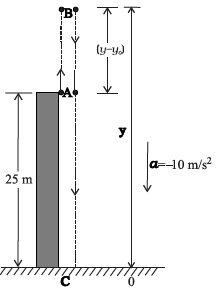
$A$ ball is thrown vertically upwards with a velocity of $20 \; m s^{-1}$ from the top of a multistorey building. The height of the point from where the ball is thrown is $25.0 \; m$ from the ground. How high will the ball rise above the point of projection (in $; m$)? Take $g = 10 \; m s^{-2}$.
A
$25$
B
$20$
C
$5$
D
$35$
Solution
(B) Let the initial velocity of the ball be $v_0 = 20 \; m s^{-1}$ in the upward direction.
At the maximum height,the final velocity of the ball is $v = 0 \; m s^{-1}$.
The acceleration due to gravity is $a = -g = -10 \; m s^{-2}$.
Let $h$ be the maximum height reached by the ball above the point of projection.
Using the kinematic equation $v^2 = v_0^2 + 2ah$,we have:
$0^2 = (20)^2 + 2(-10)h$
$0 = 400 - 20h$
$20h = 400$
$h = 20 \; m$.
Therefore,the ball will rise $20 \; m$ above the point of projection.
At the maximum height,the final velocity of the ball is $v = 0 \; m s^{-1}$.
The acceleration due to gravity is $a = -g = -10 \; m s^{-2}$.
Let $h$ be the maximum height reached by the ball above the point of projection.
Using the kinematic equation $v^2 = v_0^2 + 2ah$,we have:
$0^2 = (20)^2 + 2(-10)h$
$0 = 400 - 20h$
$20h = 400$
$h = 20 \; m$.
Therefore,the ball will rise $20 \; m$ above the point of projection.
0 likes
View Solution170
MediumMCQ
$A$ ball is thrown vertically upwards with a velocity of $20 \; m s^{-1}$ from the top of a multistorey building. The height of the point from where the ball is thrown is $25.0 \; m$ from the ground. How long will it be in $seconds$ before the ball hits the ground? Take $g = 10 \; m s^{-2}$.
A
$3$
B
$2$
C
$5$
D
$7$
Solution
(C) Let the ground be the origin $(y = 0)$ and the vertically upward direction be positive.
Initial position $y_0 = 25 \; m$,initial velocity $v_0 = 20 \; m s^{-1}$,and acceleration $a = -g = -10 \; m s^{-2}$.
The position of the ball at any time $t$ is given by the kinematic equation:
$y = y_0 + v_0 t + \frac{1}{2} a t^2$
When the ball hits the ground,$y = 0$. Substituting the values:
$0 = 25 + 20t + \frac{1}{2}(-10)t^2$
$0 = 25 + 20t - 5t^2$
Dividing by $-5$:
$t^2 - 4t - 5 = 0$
Factoring the quadratic equation:
$(t - 5)(t + 1) = 0$
Since time cannot be negative,we take $t = 5 \; s$.
Initial position $y_0 = 25 \; m$,initial velocity $v_0 = 20 \; m s^{-1}$,and acceleration $a = -g = -10 \; m s^{-2}$.
The position of the ball at any time $t$ is given by the kinematic equation:
$y = y_0 + v_0 t + \frac{1}{2} a t^2$
When the ball hits the ground,$y = 0$. Substituting the values:
$0 = 25 + 20t + \frac{1}{2}(-10)t^2$
$0 = 25 + 20t - 5t^2$
Dividing by $-5$:
$t^2 - 4t - 5 = 0$
Factoring the quadratic equation:
$(t - 5)(t + 1) = 0$
Since time cannot be negative,we take $t = 5 \; s$.
0 likes
View Solution171
Medium
Free-fall: Discuss the motion of an object under free fall. Neglect air resistance.
Solution
(N/A) An object released near the surface of the Earth is accelerated downward under the influence of the force of gravity. The magnitude of acceleration due to gravity is represented by $g$. If air resistance is neglected,the object is said to be in free fall. If the height through which the object falls is small compared to the Earth's radius,$g$ can be taken to be constant,equal to $9.8 \ m \ s^{-2}$. Free fall is thus a case of motion with uniform acceleration.
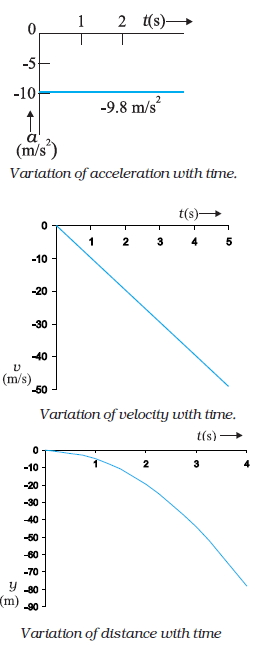
We assume that the motion is in $y$-direction,more correctly in $-y$-direction because we choose the upward direction as positive. Since the acceleration due to gravity is always downward,it is in the negative direction and we have $a = -g = -9.8 \ m \ s^{-2}$.
The object is released from rest at $y = 0$. Therefore,$v_0 = 0$ and the equations of motion become:
$v = 0 - gt = -9.8t \ m \ s^{-1}$
$y = 0 - 1/2 gt^2 = -4.9t^2 \ m$
$v^2 = 0 - 2gy = -19.6y \ m^2 \ s^{-2}$
These equations give the velocity and the distance travelled as a function of time and also the variation of velocity with distance. The variation of acceleration,velocity,and distance with time are shown in the figures.
We assume that the motion is in $y$-direction,more correctly in $-y$-direction because we choose the upward direction as positive. Since the acceleration due to gravity is always downward,it is in the negative direction and we have $a = -g = -9.8 \ m \ s^{-2}$.
The object is released from rest at $y = 0$. Therefore,$v_0 = 0$ and the equations of motion become:
$v = 0 - gt = -9.8t \ m \ s^{-1}$
$y = 0 - 1/2 gt^2 = -4.9t^2 \ m$
$v^2 = 0 - 2gy = -19.6y \ m^2 \ s^{-2}$
These equations give the velocity and the distance travelled as a function of time and also the variation of velocity with distance. The variation of acceleration,velocity,and distance with time are shown in the figures.
0 likes
View Solution172
Medium
Galileo's law of odd numbers: "The distances traversed, during equal intervals of time, by a body falling from rest, stand to one another in the same ratio as the odd numbers beginning with unity [namely, $1: 3: 5: 7 \ldots$]". Prove it.
Solution
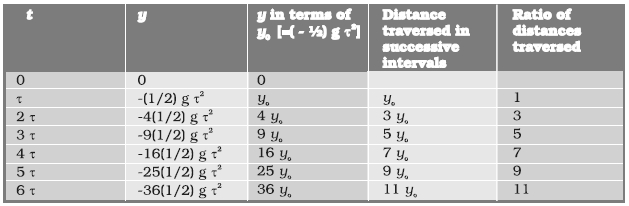
(N/A) Let us divide the time interval of motion of an object under free fall into many equal intervals $\tau$ and find out the distances traversed during successive intervals of time. Since the initial velocity is zero, the position $y$ at time $t$ is given by:
$y = -\frac{1}{2} g t^2$
Using this equation, we calculate the position of the object after time intervals $t = 0, \tau, 2\tau, 3\tau, \dots$. If we define $y_0 = -\frac{1}{2} g \tau^2$ as the position after the first interval $\tau$, then the position at time $n\tau$ is $n^2 y_0$. The distance traversed in the $n^{th}$ interval is the difference between the position at $n\tau$ and $(n-1)\tau$:
Distance in $n^{th}$ interval $= |n^2 y_0 - (n-1)^2 y_0| = |(n^2 - (n^2 - 2n + 1)) y_0| = (2n - 1) |y_0|$.
For $n = 1, 2, 3, 4, \dots$, the distances are $1|y_0|, 3|y_0|, 5|y_0|, 7|y_0|, \dots$. Thus, the ratio of distances is $1: 3: 5: 7: \dots$, which are odd numbers. This law was established by Galileo Galilei ($1564$-$1642$), who was the first to make quantitative studies of free fall.
$y = -\frac{1}{2} g t^2$
Using this equation, we calculate the position of the object after time intervals $t = 0, \tau, 2\tau, 3\tau, \dots$. If we define $y_0 = -\frac{1}{2} g \tau^2$ as the position after the first interval $\tau$, then the position at time $n\tau$ is $n^2 y_0$. The distance traversed in the $n^{th}$ interval is the difference between the position at $n\tau$ and $(n-1)\tau$:
Distance in $n^{th}$ interval $= |n^2 y_0 - (n-1)^2 y_0| = |(n^2 - (n^2 - 2n + 1)) y_0| = (2n - 1) |y_0|$.
For $n = 1, 2, 3, 4, \dots$, the distances are $1|y_0|, 3|y_0|, 5|y_0|, 7|y_0|, \dots$. Thus, the ratio of distances is $1: 3: 5: 7: \dots$, which are odd numbers. This law was established by Galileo Galilei ($1564$-$1642$), who was the first to make quantitative studies of free fall.
0 likes
View Solution173
EasyMCQ
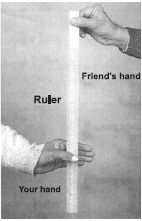
Reaction time: When a situation demands our immediate action,it takes some time before we really respond. Reaction time is the time a person takes to observe,think,and act. For example,if a person is driving and suddenly a boy appears on the road,then the time elapsed before he slams the brakes of the car is the reaction time. Reaction time depends on the complexity of the situation and on an individual.
You can measure your reaction time by a simple experiment. Take a ruler and ask your friend to drop it vertically through the gap between your thumb and forefinger. After you catch it,find the distance $d$ travelled by the ruler. In a particular case,$d$ was found to be $21.0 \; cm$. Estimate the reaction time in seconds. (in $; s$)
You can measure your reaction time by a simple experiment. Take a ruler and ask your friend to drop it vertically through the gap between your thumb and forefinger. After you catch it,find the distance $d$ travelled by the ruler. In a particular case,$d$ was found to be $21.0 \; cm$. Estimate the reaction time in seconds. (in $; s$)
A
$0.1$
B
$0.25$
C
$0.2$
D
$0.15$
Solution
(C) The ruler drops under free fall. Therefore,the initial velocity $u = 0$ and acceleration $a = g = 9.8 \; m/s^2$.
The distance travelled $d$ and the reaction time $t_r$ are related by the kinematic equation:
$d = ut_r + \frac{1}{2}gt_r^2$
Since $u = 0$,we have:
$d = \frac{1}{2}gt_r^2$
$t_r = \sqrt{\frac{2d}{g}}$
Given $d = 21.0 \; cm = 0.21 \; m$ and $g = 9.8 \; m/s^2$:
$t_r = \sqrt{\frac{2 \times 0.21}{9.8}}$
$t_r = \sqrt{\frac{0.42}{9.8}}$
$t_r = \sqrt{0.0428} \approx 0.207 \; s$
Rounding to one significant figure or the nearest given option,the reaction time is approximately $0.2 \; s$.
The distance travelled $d$ and the reaction time $t_r$ are related by the kinematic equation:
$d = ut_r + \frac{1}{2}gt_r^2$
Since $u = 0$,we have:
$d = \frac{1}{2}gt_r^2$
$t_r = \sqrt{\frac{2d}{g}}$
Given $d = 21.0 \; cm = 0.21 \; m$ and $g = 9.8 \; m/s^2$:
$t_r = \sqrt{\frac{2 \times 0.21}{9.8}}$
$t_r = \sqrt{\frac{0.42}{9.8}}$
$t_r = \sqrt{0.0428} \approx 0.207 \; s$
Rounding to one significant figure or the nearest given option,the reaction time is approximately $0.2 \; s$.
0 likes
View Solution174
EasyMCQ
$A$ player throws a ball upwards with an initial speed of $29.4 \; m s^{-1}$. What is the direction of acceleration during the upward motion of the ball?
A
Upwards
B
Downwards
C
Initially upwards then downwards
D
Zero
Solution
(B) The acceleration acting on the ball is the acceleration due to gravity $(g)$.
Irrespective of the direction of the motion of the ball (whether it is moving upwards or downwards),the acceleration due to gravity always acts vertically downwards towards the center of the Earth.
Therefore,the direction of acceleration is downwards.
Irrespective of the direction of the motion of the ball (whether it is moving upwards or downwards),the acceleration due to gravity always acts vertically downwards towards the center of the Earth.
Therefore,the direction of acceleration is downwards.
0 likes
View Solution175
EasyMCQ
$A$ player throws a ball upwards with an initial speed of $29.4\; m s^{-1}$. What are the velocity and acceleration of the ball at the highest point of its motion?
A
$0\; m s^{-1}, 9.8\; m s^{-2}$
B
$29.4\; m s^{-1}, 9.8\; m s^{-2}$
C
$0\; m s^{-1}, 0\; m s^{-2}$
D
$29.4\; m s^{-1}, 0\; m s^{-2}$
Solution
(A) At the maximum height,the vertical velocity of the ball becomes zero momentarily as it changes direction from upward to downward.
Acceleration due to gravity $(g)$ is a constant force acting on the object throughout its flight,regardless of its position or velocity.
Therefore,at the highest point,the velocity is $0\; m s^{-1}$ and the acceleration is $9.8\; m s^{-2}$ directed downwards.
Acceleration due to gravity $(g)$ is a constant force acting on the object throughout its flight,regardless of its position or velocity.
Therefore,at the highest point,the velocity is $0\; m s^{-1}$ and the acceleration is $9.8\; m s^{-2}$ directed downwards.
0 likes
View Solution176
Easy
$A$ player throws a ball upwards with an initial speed of $29.4\; m s^{-1}$. Choose the $x=0\; m$ and $t=0\; s$ to be the location and time of the ball at its highest point. Let the vertically downward direction be the positive direction of the $x$-axis. Determine the signs of position,velocity,and acceleration of the ball during its upward and downward motion.
Solution
(N/A) Given that the highest point is $x=0$ and the downward direction is positive:
$1$. During upward motion: The ball is above the highest point (which is $x=0$),so the position $x$ is negative. The ball is moving upwards (opposite to the positive $x$-axis),so the velocity $v$ is negative. The acceleration due to gravity $g$ always acts downwards,which is the positive direction,so the acceleration $a$ is positive.
$2$. During downward motion: The ball is below the highest point,so the position $x$ is positive. The ball is moving downwards (along the positive $x$-axis),so the velocity $v$ is positive. The acceleration due to gravity $g$ acts downwards,which is the positive direction,so the acceleration $a$ is positive.
$1$. During upward motion: The ball is above the highest point (which is $x=0$),so the position $x$ is negative. The ball is moving upwards (opposite to the positive $x$-axis),so the velocity $v$ is negative. The acceleration due to gravity $g$ always acts downwards,which is the positive direction,so the acceleration $a$ is positive.
$2$. During downward motion: The ball is below the highest point,so the position $x$ is positive. The ball is moving downwards (along the positive $x$-axis),so the velocity $v$ is positive. The acceleration due to gravity $g$ acts downwards,which is the positive direction,so the acceleration $a$ is positive.
0 likes
View Solution177
MediumMCQ
$A$ player throws a ball upwards with an initial speed of $29.4 \; m s^{-1}$. To what height does the ball rise and after how long (in seconds) does the ball return to the player's hands? (Take $g = 9.8 \; m s^{-2}$ and neglect air resistance).
A
$22.1 \; m$ and $6 \; s$
B
$32.1 \; m$ and $5 \; s$
C
$44.1 \; m$ and $6 \; s$
D
$44.1 \; m$ and $8 \; s$
Solution
(C) Given: Initial velocity $u = 29.4 \; m s^{-1}$,final velocity at maximum height $v = 0 \; m s^{-1}$,acceleration $a = -g = -9.8 \; m s^{-2}$.
Using the third equation of motion,$v^{2} - u^{2} = 2as$:
$0^{2} - (29.4)^{2} = 2(-9.8)s$
$s = \frac{-(29.4)^{2}}{-19.6} = \frac{864.36}{19.6} = 44.1 \; m$.
Using the first equation of motion,$v = u + at$ to find the time of ascent $(t_{a})$:
$0 = 29.4 + (-9.8)t_{a}$
$t_{a} = \frac{-29.4}{-9.8} = 3 \; s$.
Since the time of ascent equals the time of descent,the total time taken to return to the player's hands is $T = t_{a} + t_{d} = 3 + 3 = 6 \; s$.
Using the third equation of motion,$v^{2} - u^{2} = 2as$:
$0^{2} - (29.4)^{2} = 2(-9.8)s$
$s = \frac{-(29.4)^{2}}{-19.6} = \frac{864.36}{19.6} = 44.1 \; m$.
Using the first equation of motion,$v = u + at$ to find the time of ascent $(t_{a})$:
$0 = 29.4 + (-9.8)t_{a}$
$t_{a} = \frac{-29.4}{-9.8} = 3 \; s$.
Since the time of ascent equals the time of descent,the total time taken to return to the player's hands is $T = t_{a} + t_{d} = 3 + 3 = 6 \; s$.
0 likes
View Solution178
Medium
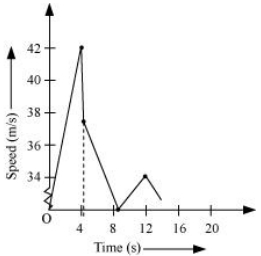
$A$ ball is dropped from a height of $90 \; m$ on a floor. At each collision with the floor,the ball loses one-tenth of its speed. Plot the speed-time graph of its motion between $t = 0$ to $12 \; s$.
Solution
(N/A) The ball is dropped from a height $s = 90 \; m$.
Initial velocity $u = 0$,acceleration $a = g = 9.8 \; m/s^2$.
Time $t$ taken to hit the ground: $s = ut + (1/2)at^2 \implies 90 = 0 + (1/2) \times 9.8 \times t^2 \implies t = \sqrt{18.367} \approx 4.29 \; s$.
Final velocity just before the first impact: $v = u + at = 0 + 9.8 \times 4.29 = 42.04 \; m/s$.
Rebound velocity $u_r = (9/10)v = 0.9 \times 42.04 = 37.84 \; m/s$.
Time to reach maximum height after first rebound: $v = u_r + at' \implies 0 = 37.84 - 9.8 \times t' \implies t' = 3.86 \; s$.
Total time for the ball to return to the floor: $t + 2t' = 4.29 + 2 \times 3.86 = 12.01 \; s$.
Velocity just before the second impact: $v_2 = 37.84 - 9.8 \times 3.86 = 0 \; m/s$ (at peak),then it accelerates back down to $37.84 \; m/s$ at the floor.
After the second collision,the new rebound velocity is $u_{r2} = (9/10) \times 37.84 = 34.06 \; m/s$.
Initial velocity $u = 0$,acceleration $a = g = 9.8 \; m/s^2$.
Time $t$ taken to hit the ground: $s = ut + (1/2)at^2 \implies 90 = 0 + (1/2) \times 9.8 \times t^2 \implies t = \sqrt{18.367} \approx 4.29 \; s$.
Final velocity just before the first impact: $v = u + at = 0 + 9.8 \times 4.29 = 42.04 \; m/s$.
Rebound velocity $u_r = (9/10)v = 0.9 \times 42.04 = 37.84 \; m/s$.
Time to reach maximum height after first rebound: $v = u_r + at' \implies 0 = 37.84 - 9.8 \times t' \implies t' = 3.86 \; s$.
Total time for the ball to return to the floor: $t + 2t' = 4.29 + 2 \times 3.86 = 12.01 \; s$.
Velocity just before the second impact: $v_2 = 37.84 - 9.8 \times 3.86 = 0 \; m/s$ (at peak),then it accelerates back down to $37.84 \; m/s$ at the floor.
After the second collision,the new rebound velocity is $u_{r2} = (9/10) \times 37.84 = 34.06 \; m/s$.
0 likes
View Solution179
Easy
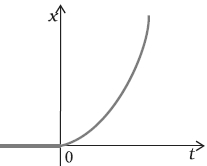
The given figure shows the $x-t$ plot of one-dimensional motion of a particle. Is it correct to say from the graph that the particle moves in a straight line for $t < 0$ and on a parabolic path for $t > 0$? If not,suggest a suitable physical context for this graph.
Solution
(N/A) No,it is not correct. The $x-t$ graph of a particle moving in a straight line for $t < 0$ and on a parabolic path for $t > 0$ cannot be represented by the given graph.
This is because the graph shows the particle at rest $(x = 0)$ for $t < 0$,and then it starts moving with acceleration for $t > 0$.
$A$ suitable physical context for this graph is a ball held at a height $x = 0$ and released at $t = 0$ to fall freely under gravity.
This is because the graph shows the particle at rest $(x = 0)$ for $t < 0$,and then it starts moving with acceleration for $t > 0$.
$A$ suitable physical context for this graph is a ball held at a height $x = 0$ and released at $t = 0$ to fall freely under gravity.
0 likes
View Solution180
Medium
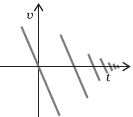
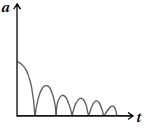
Suggest a suitable physical situation for the following $v-t$ graph.
Solution
(N/A) In the given $v-t$ graph,the sign of velocity changes periodically,and its magnitude decreases with the passage of time.
This indicates that the object is undergoing motion with constant acceleration (due to gravity) but loses a fraction of its velocity upon each collision.
$A$ suitable physical situation for this graph is a ball dropped from a height onto a hard floor.
When the ball strikes the floor,it rebounds with a velocity smaller than the velocity with which it struck the floor,due to energy loss during the collision.
This process repeats with each subsequent bounce,leading to a decrease in the peak velocity and the time interval between bounces,until the ball eventually comes to rest.
This indicates that the object is undergoing motion with constant acceleration (due to gravity) but loses a fraction of its velocity upon each collision.
$A$ suitable physical situation for this graph is a ball dropped from a height onto a hard floor.
When the ball strikes the floor,it rebounds with a velocity smaller than the velocity with which it struck the floor,due to energy loss during the collision.
This process repeats with each subsequent bounce,leading to a decrease in the peak velocity and the time interval between bounces,until the ball eventually comes to rest.
0 likes
View Solution181
Medium
$A$ boy standing on a stationary lift (open from above) throws a ball upwards with the maximum initial speed he can,equal to $49\; m s^{-1}$. How much time does the ball take to return to his hands? If the lift starts moving up with a uniform speed of $5\; m s^{-1}$ and the boy again throws the ball up with the maximum speed he can,how long does the ball take to return to his hands?
Solution
(10 S, 10 S) Initial velocity of the ball,$u = 49\; m s^{-1}$.
Acceleration due to gravity,$a = -g = -9.8\; m s^{-2}$.
Case $I$: When the lift is stationary.
Taking the upward motion of the ball,the final velocity $v$ at the highest point is $0$.
Using the first equation of motion,$v = u + at$,the time of ascent $t_a$ is:
$t_a = \frac{v - u}{a} = \frac{0 - 49}{-9.8} = 5\; s$.
Since the time of ascent equals the time of descent,the total time taken to return to the hand is $T = t_a + t_d = 5 + 5 = 10\; s$.
Case $II$: When the lift moves up with a uniform velocity of $5\; m s^{-1}$.
Since the lift moves with a uniform velocity,its acceleration is $0$. The relative velocity of the ball with respect to the boy remains $49\; m s^{-1}$ (the same as in the stationary case). Because the frame of reference (the lift) is inertial,the time taken for the ball to return to the boy's hand remains the same,which is $10\; s$.
Acceleration due to gravity,$a = -g = -9.8\; m s^{-2}$.
Case $I$: When the lift is stationary.
Taking the upward motion of the ball,the final velocity $v$ at the highest point is $0$.
Using the first equation of motion,$v = u + at$,the time of ascent $t_a$ is:
$t_a = \frac{v - u}{a} = \frac{0 - 49}{-9.8} = 5\; s$.
Since the time of ascent equals the time of descent,the total time taken to return to the hand is $T = t_a + t_d = 5 + 5 = 10\; s$.
Case $II$: When the lift moves up with a uniform velocity of $5\; m s^{-1}$.
Since the lift moves with a uniform velocity,its acceleration is $0$. The relative velocity of the ball with respect to the boy remains $49\; m s^{-1}$ (the same as in the stationary case). Because the frame of reference (the lift) is inertial,the time taken for the ball to return to the boy's hand remains the same,which is $10\; s$.
0 likes
View Solution182
Difficult
Two stones are thrown up simultaneously from the edge of a cliff $200 \; m$ high with initial speeds of $15 \; m s^{-1}$ and $30 \; m s^{-1}$. Verify that the graph shown in Figure correctly represents the time variation of the relative position of the second stone with respect to the first. Neglect air resistance and assume that the stones do not rebound after hitting the ground. Take $g = 10 \; m s^{-2}$. Give the equations for the linear and curved parts of the plot.
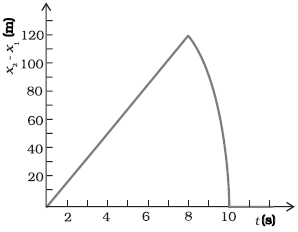
Solution
(N/A) For the first stone:
Initial velocity,$u_{1} = 15 \; m s^{-1}$
Acceleration,$a = -g = -10 \; m s^{-2}$
Using the equation of motion,$x_{1} = x_{0} + u_{1}t + \frac{1}{2}at^{2}$
Given the height of the cliff,$x_{0} = 200 \; m$,so $x_{1} = 200 + 15t - 5t^{2} \; \dots (i)$
When this stone hits the ground,$x_{1} = 0$,so $-5t^{2} + 15t + 200 = 0 \implies t^{2} - 3t - 40 = 0$.
Solving the quadratic equation,$(t - 8)(t + 5) = 0$. Since $t > 0$,$t = 8 \; s$.
For the second stone:
Initial velocity,$u_{2} = 30 \; m s^{-1}$
Acceleration,$a = -g = -10 \; m s^{-2}$
$x_{2} = 200 + 30t - 5t^{2} \; \dots (ii)$
When this stone hits the ground,$x_{2} = 0$,so $-5t^{2} + 30t + 200 = 0 \implies t^{2} - 6t - 40 = 0$.
Solving the quadratic equation,$(t - 10)(t + 4) = 0$. Since $t > 0$,$t = 10 \; s$.
For $0 \le t \le 8 \; s$,both stones are in the air:
$x_{2} - x_{1} = (200 + 30t - 5t^{2}) - (200 + 15t - 5t^{2}) = 15t$.
This is a linear equation representing the straight line part of the graph.
For $8 \; s < t \le 10 \; s$,only the second stone is in the air $(x_{1} = 0)$:
$x_{2} - x_{1} = x_{2} - 0 = 200 + 30t - 5t^{2}$.
This is a quadratic equation representing the curved part of the graph.
Initial velocity,$u_{1} = 15 \; m s^{-1}$
Acceleration,$a = -g = -10 \; m s^{-2}$
Using the equation of motion,$x_{1} = x_{0} + u_{1}t + \frac{1}{2}at^{2}$
Given the height of the cliff,$x_{0} = 200 \; m$,so $x_{1} = 200 + 15t - 5t^{2} \; \dots (i)$
When this stone hits the ground,$x_{1} = 0$,so $-5t^{2} + 15t + 200 = 0 \implies t^{2} - 3t - 40 = 0$.
Solving the quadratic equation,$(t - 8)(t + 5) = 0$. Since $t > 0$,$t = 8 \; s$.
For the second stone:
Initial velocity,$u_{2} = 30 \; m s^{-1}$
Acceleration,$a = -g = -10 \; m s^{-2}$
$x_{2} = 200 + 30t - 5t^{2} \; \dots (ii)$
When this stone hits the ground,$x_{2} = 0$,so $-5t^{2} + 30t + 200 = 0 \implies t^{2} - 6t - 40 = 0$.
Solving the quadratic equation,$(t - 10)(t + 4) = 0$. Since $t > 0$,$t = 10 \; s$.
For $0 \le t \le 8 \; s$,both stones are in the air:
$x_{2} - x_{1} = (200 + 30t - 5t^{2}) - (200 + 15t - 5t^{2}) = 15t$.
This is a linear equation representing the straight line part of the graph.
For $8 \; s < t \le 10 \; s$,only the second stone is in the air $(x_{1} = 0)$:
$x_{2} - x_{1} = x_{2} - 0 = 200 + 30t - 5t^{2}$.
This is a quadratic equation representing the curved part of the graph.
0 likes
View Solution183
MediumMCQ
$A$ stone dropped from the top of a tower of height $300 \; m$ splashes into the water of a pond near the base of the tower. When is the splash heard at the top,given that the speed of sound in air is $340 \; m s^{-1}$ (in $; s$)? $(g = 9.8 \; m s^{-2})$
A
$8.7$
B
$10.2$
C
$6.6$
D
$7.82$
Solution
(A) The total time taken to hear the splash is the sum of the time taken by the stone to fall $(t_1)$ and the time taken by the sound to travel back to the top $(t_2)$.
$1$. Time taken by the stone to reach the water $(t_1)$:
Using the equation of motion $s = ut + \frac{1}{2}gt^2$,where $u = 0$,$s = 300 \; m$,and $g = 9.8 \; m s^{-2}$:
$300 = 0 + \frac{1}{2} \times 9.8 \times t_1^2$
$t_1^2 = \frac{600}{9.8} \approx 61.22$
$t_1 = \sqrt{61.22} \approx 7.82 \; s$
$2$. Time taken by the sound to reach the top $(t_2)$:
Using $t_2 = \frac{\text{distance}}{\text{speed}}$:
$t_2 = \frac{300}{340} \approx 0.88 \; s$
$3$. Total time $(t)$:
$t = t_1 + t_2 = 7.82 + 0.88 = 8.7 \; s$.
$1$. Time taken by the stone to reach the water $(t_1)$:
Using the equation of motion $s = ut + \frac{1}{2}gt^2$,where $u = 0$,$s = 300 \; m$,and $g = 9.8 \; m s^{-2}$:
$300 = 0 + \frac{1}{2} \times 9.8 \times t_1^2$
$t_1^2 = \frac{600}{9.8} \approx 61.22$
$t_1 = \sqrt{61.22} \approx 7.82 \; s$
$2$. Time taken by the sound to reach the top $(t_2)$:
Using $t_2 = \frac{\text{distance}}{\text{speed}}$:
$t_2 = \frac{300}{340} \approx 0.88 \; s$
$3$. Total time $(t)$:
$t = t_1 + t_2 = 7.82 + 0.88 = 8.7 \; s$.
0 likes
View Solution184
Medium
Discuss the observation of Galileo for objects falling freely.
Solution
(N/A) Galileo concluded that for all objects in free fall,the rate of change of velocity with respect to time (acceleration) is a constant of motion,which is independent of the mass or shape of the object.
Conversely,he observed that the change in velocity with respect to distance is not constant.
Specifically,the rate of change of velocity with distance decreases as the distance of the fall increases.
Conversely,he observed that the change in velocity with respect to distance is not constant.
Specifically,the rate of change of velocity with distance decreases as the distance of the fall increases.
0 likes
View Solution185
Medium
Discuss the observation of Galileo for the objects falling freely.
Solution
(N/A) Galileo Galilei challenged the Aristotelian view that heavier objects fall faster than lighter ones. Through his experiments and logical reasoning,he observed that in the absence of air resistance,all objects fall towards the Earth with the same constant acceleration,regardless of their mass. This acceleration is known as the acceleration due to gravity,denoted by $g$,which is approximately $9.8 \ m/s^2$ near the Earth's surface. Galileo concluded that if two objects of different masses are dropped simultaneously from the same height in a vacuum,they will reach the ground at the same time.
1 likes
View Solution186
Medium
What is free fall? Write the equations of uniformly accelerated motion for an object falling freely.
Solution
(N/A) The motion of an object falling solely under the influence of gravitational force is called free fall.
In this motion,the acceleration produced is the acceleration due to gravity $(g)$,which acts in the downward direction.
If air resistance is neglected,the motion is considered uniformly accelerated with acceleration $a = -g$.
By substituting the initial velocity $v_{0} = 0$,acceleration $a = -g$,and displacement $d = -h$ into the standard kinematic equations,we get:
$1$. For velocity: $v = v_{0} + at \implies v = -gt$
$2$. For displacement: $d = v_{0}t + \frac{1}{2}at^{2} \implies -h = 0 - \frac{1}{2}gt^{2} \implies h = \frac{1}{2}gt^{2}$
$3$. For velocity-displacement relation: $v^{2} - v_{0}^{2} = 2ad \implies v^{2} - 0 = 2(-g)(-h) \implies v^{2} = 2gh \implies v = \sqrt{2gh}$
In this motion,the acceleration produced is the acceleration due to gravity $(g)$,which acts in the downward direction.
If air resistance is neglected,the motion is considered uniformly accelerated with acceleration $a = -g$.
By substituting the initial velocity $v_{0} = 0$,acceleration $a = -g$,and displacement $d = -h$ into the standard kinematic equations,we get:
$1$. For velocity: $v = v_{0} + at \implies v = -gt$
$2$. For displacement: $d = v_{0}t + \frac{1}{2}at^{2} \implies -h = 0 - \frac{1}{2}gt^{2} \implies h = \frac{1}{2}gt^{2}$
$3$. For velocity-displacement relation: $v^{2} - v_{0}^{2} = 2ad \implies v^{2} - 0 = 2(-g)(-h) \implies v^{2} = 2gh \implies v = \sqrt{2gh}$
1 likes
View Solution187
Easy
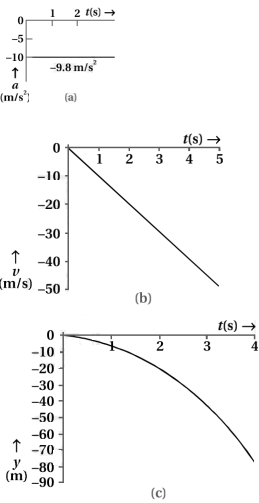
Draw graphs $a \to t$,$v \to t$,and $x \to t$ for an object falling freely.
Solution
(N/A) For an object falling freely,the acceleration is constant and equal to $-g$. Thus,graph $(a)$ shows the constant acceleration with respect to time $(a \to t)$.
The velocity of an object falling freely is given by $v = -gt$. This represents a linear relationship with time,as shown in graph $(b)$ for $v \to t$.
The displacement of an object falling freely is given by $x = -\frac{1}{2}gt^2$ (taking downward as negative). This represents a parabolic relationship with time,as shown in graph $(c)$ for $x \to t$.
The velocity of an object falling freely is given by $v = -gt$. This represents a linear relationship with time,as shown in graph $(b)$ for $v \to t$.
The displacement of an object falling freely is given by $x = -\frac{1}{2}gt^2$ (taking downward as negative). This represents a parabolic relationship with time,as shown in graph $(c)$ for $x \to t$.
0 likes
View Solution188
EasyMCQ
What is the initial velocity of an object falling freely (in $m/s$)?
A
$0$
B
$9.8$
C
$4.9$
D
$10$
Solution
(A) An object is said to be in free fall when it is moving solely under the influence of gravity,without any initial push or throw.
By definition,for an object falling freely from rest,the initial velocity $(u)$ is $0 \ m/s$.
By definition,for an object falling freely from rest,the initial velocity $(u)$ is $0 \ m/s$.
0 likes
View Solution189
Easy
Write the equation for the distance covered by an object falling freely during the $n^{th}$ second.
Solution
(N/A) For an object falling freely under gravity,the initial velocity $u = 0$ and acceleration $a = g$.
The distance covered by an object in the $n^{th}$ second is given by the formula:
$S_n = u + \frac{a}{2}(2n - 1)$
Substituting $u = 0$ and $a = g$ into the equation:
$S_n = 0 + \frac{g}{2}(2n - 1)$
Therefore,the distance covered in the $n^{th}$ second is $S_n = \frac{g}{2}(2n - 1)$.
The distance covered by an object in the $n^{th}$ second is given by the formula:
$S_n = u + \frac{a}{2}(2n - 1)$
Substituting $u = 0$ and $a = g$ into the equation:
$S_n = 0 + \frac{g}{2}(2n - 1)$
Therefore,the distance covered in the $n^{th}$ second is $S_n = \frac{g}{2}(2n - 1)$.
0 likes
View Solution190
Medium
Write the equation of velocity of an object falling freely from height $h$.
Solution
(N/A) For an object falling freely from a height $h$ under gravity,the initial velocity $u$ is $0 \ m/s$.
Using the third equation of motion: $v^2 - u^2 = 2as$.
Here,$v$ is the final velocity,$u = 0$,$a = g$ (acceleration due to gravity),and $s = h$ (displacement).
Substituting these values: $v^2 - 0^2 = 2gh$.
Therefore,the equation for velocity is $v = \sqrt{2gh}$.
Using the third equation of motion: $v^2 - u^2 = 2as$.
Here,$v$ is the final velocity,$u = 0$,$a = g$ (acceleration due to gravity),and $s = h$ (displacement).
Substituting these values: $v^2 - 0^2 = 2gh$.
Therefore,the equation for velocity is $v = \sqrt{2gh}$.
0 likes
View Solution191
Easy
Draw the graph of $y$ versus $t$ for an object falling freely,where $y$ is the vertical displacement and $t$ is time.
Solution
(N/A) For an object falling freely under gravity starting from rest,the equation of motion is given by $y = \frac{1}{2}gt^2$,where $g$ is the acceleration due to gravity.
Since $y$ is proportional to the square of time $(y \propto t^2)$,the graph of $y$ versus $t$ is a parabola opening upwards.
Starting from the origin $(0,0)$,the curve increases as $t$ increases,representing the increasing displacement of the object as it accelerates downwards.
Since $y$ is proportional to the square of time $(y \propto t^2)$,the graph of $y$ versus $t$ is a parabola opening upwards.
Starting from the origin $(0,0)$,the curve increases as $t$ increases,representing the increasing displacement of the object as it accelerates downwards.
0 likes
View Solution192
Medium
Can a particle moving in a straight line have zero velocity and non-zero acceleration at any instant? Give an example.
Solution
(N/A) Yes,a particle moving in a straight line can have zero velocity and non-zero acceleration at the same instant.
For example,when a ball is thrown vertically upwards,at the highest point of its trajectory,its instantaneous velocity is $0 \ m/s$,but it still experiences a constant acceleration due to gravity $(g \approx 9.8 \ m/s^2)$ acting downwards.
For example,when a ball is thrown vertically upwards,at the highest point of its trajectory,its instantaneous velocity is $0 \ m/s$,but it still experiences a constant acceleration due to gravity $(g \approx 9.8 \ m/s^2)$ acting downwards.
0 likes
View Solution193
MediumMCQ
What is the ratio of the distances covered by a freely falling body in the $1^{st}$,$2^{nd}$,and $3^{rd}$ seconds of its motion?
A
$1:2:3$
B
$1:3:5$
C
$1:4:9$
D
$1:9:25$
Solution
(B) For a body falling freely from rest,the initial velocity $u = 0$ and acceleration $a = g$.
The distance covered in the $n^{th}$ second is given by the formula: $S_n = u + \frac{a}{2}(2n - 1)$.
Substituting $u = 0$ and $a = g$,we get $S_n = \frac{g}{2}(2n - 1)$.
For $n = 1$: $S_1 = \frac{g}{2}(2(1) - 1) = \frac{g}{2}(1) = \frac{g}{2}$.
For $n = 2$: $S_2 = \frac{g}{2}(2(2) - 1) = \frac{g}{2}(3) = \frac{3g}{2}$.
For $n = 3$: $S_3 = \frac{g}{2}(2(3) - 1) = \frac{g}{2}(5) = \frac{5g}{2}$.
The ratio of distances $S_1 : S_2 : S_3$ is $\frac{g}{2} : \frac{3g}{2} : \frac{5g}{2} = 1 : 3 : 5$.
The distance covered in the $n^{th}$ second is given by the formula: $S_n = u + \frac{a}{2}(2n - 1)$.
Substituting $u = 0$ and $a = g$,we get $S_n = \frac{g}{2}(2n - 1)$.
For $n = 1$: $S_1 = \frac{g}{2}(2(1) - 1) = \frac{g}{2}(1) = \frac{g}{2}$.
For $n = 2$: $S_2 = \frac{g}{2}(2(2) - 1) = \frac{g}{2}(3) = \frac{3g}{2}$.
For $n = 3$: $S_3 = \frac{g}{2}(2(3) - 1) = \frac{g}{2}(5) = \frac{5g}{2}$.
The ratio of distances $S_1 : S_2 : S_3$ is $\frac{g}{2} : \frac{3g}{2} : \frac{5g}{2} = 1 : 3 : 5$.
0 likes
View Solution194
EasyMCQ
What is the distance covered by a freely falling body in the first second (in $m$)? $(g = 10 \ m/s^2)$
A
$5$
B
$10$
C
$15$
D
$20$
Solution
(A) For a freely falling body,the initial velocity $u = 0 \ m/s$ and acceleration $a = g = 10 \ m/s^2$.
Using the kinematic equation for distance covered in time $t$:
$s = ut + \frac{1}{2}at^2$
Substituting the values for $t = 1 \ s$:
$s = (0)(1) + \frac{1}{2}(10)(1)^2$
$s = 0 + 5(1)$
$s = 5 \ m$
Therefore,the distance covered in the first second is $5 \ m$.
Using the kinematic equation for distance covered in time $t$:
$s = ut + \frac{1}{2}at^2$
Substituting the values for $t = 1 \ s$:
$s = (0)(1) + \frac{1}{2}(10)(1)^2$
$s = 0 + 5(1)$
$s = 5 \ m$
Therefore,the distance covered in the first second is $5 \ m$.
0 likes
View Solution195
Medium
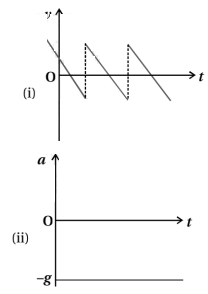
$A$ ball is dropped and its displacement versus time graph is as shown (Displacement $x$ from ground and all quantities are positive upwards).
$(a)$ Plot qualitatively velocity versus time graph.
$(b)$ Plot qualitatively acceleration versus time graph.
$(a)$ Plot qualitatively velocity versus time graph.
$(b)$ Plot qualitatively acceleration versus time graph.
Solution
(N/A) It is clear from the graph that displacement $x$ is positive during motion. The ball is dropped from a height and its velocity increases in the downward direction due to the gravitational field. In this condition,$v$ is negative,but the acceleration of the ball is equal to the acceleration due to gravity,i.e.,$a = -g$.
When the ball rebounds in the upward direction,its velocity is positive,but the acceleration remains $a = -g$.
$(a)$ The velocity-time graph of the ball is shown in fig. $(i)$.
$(b)$ The acceleration-time graph of the ball is shown in fig. $(ii)$.
When the ball rebounds in the upward direction,its velocity is positive,but the acceleration remains $a = -g$.
$(a)$ The velocity-time graph of the ball is shown in fig. $(i)$.
$(b)$ The acceleration-time graph of the ball is shown in fig. $(ii)$.
0 likes
View Solution196
Medium
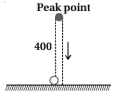
$A$ football is kicked into the air vertically upwards. What is its $(a)$ acceleration and $(b)$ velocity at the highest point?
Solution
(N/A) When a football is kicked vertically upwards,it moves under the influence of gravity alone (ignoring air resistance).
$(a)$ At the highest point,the football is momentarily at rest before it starts moving downwards. However,the gravitational force continues to act on it. Therefore,its acceleration is equal to the acceleration due to gravity,$g \approx 9.8 \ m/s^2$,directed vertically downwards.
$(b)$ At the highest point,the football momentarily stops before changing its direction of motion. Therefore,its velocity at the highest point is $0 \ m/s$.
$(a)$ At the highest point,the football is momentarily at rest before it starts moving downwards. However,the gravitational force continues to act on it. Therefore,its acceleration is equal to the acceleration due to gravity,$g \approx 9.8 \ m/s^2$,directed vertically downwards.
$(b)$ At the highest point,the football momentarily stops before changing its direction of motion. Therefore,its velocity at the highest point is $0 \ m/s$.
0 likes
View Solution197
MediumMCQ
Find the speed of a body at the ground when it falls freely from a height of $2\,m$. $(g = 10\,ms^{-2})$
A
$2\,ms^{-1}$
B
$4\,ms^{-1}$
C
$2\sqrt{10}\,ms^{-1}$
D
$10\,ms^{-1}$
Solution
(C) Using the principle of conservation of mechanical energy,the potential energy at the top is converted into kinetic energy at the ground.
$PE_{top} = KE_{ground}$
$mgh = \frac{1}{2}mv^2$
$v^2 = 2gh$
Given $g = 10\,ms^{-2}$ and $h = 2\,m$:
$v^2 = 2 \times 10 \times 2 = 40$
$v = \sqrt{40} = 2\sqrt{10}\,ms^{-1}$
Thus,the speed of the body at the ground is $2\sqrt{10}\,ms^{-1}$.
$PE_{top} = KE_{ground}$
$mgh = \frac{1}{2}mv^2$
$v^2 = 2gh$
Given $g = 10\,ms^{-2}$ and $h = 2\,m$:
$v^2 = 2 \times 10 \times 2 = 40$
$v = \sqrt{40} = 2\sqrt{10}\,ms^{-1}$
Thus,the speed of the body at the ground is $2\sqrt{10}\,ms^{-1}$.
0 likes
View Solution198
Medium
It is a common observation that rain clouds can be at about a kilometer altitude above the ground.
$(a)$ If a rain drop falls from such a height freely under gravity,what will be its speed? Also calculate in $km/h$ $(g = 10\, m/s^2)$.
$(b)$ $A$ typical rain drop is about $4\, mm$ in diameter. Momentum is mass $\times$ speed in magnitude. Estimate its momentum when it hits the ground.
$(c)$ Estimate the time required to flatten the drop.
$(d)$ Rate of change of momentum is force. Estimate how much force such a drop would exert on you.
$(e)$ Estimate the order of magnitude force on an umbrella. Typical lateral separation between two rain drops is $5\, cm$.
(Assume that the umbrella is circular and has a diameter of $1\, m$ and the cloth is not pierced through.)
$(a)$ If a rain drop falls from such a height freely under gravity,what will be its speed? Also calculate in $km/h$ $(g = 10\, m/s^2)$.
$(b)$ $A$ typical rain drop is about $4\, mm$ in diameter. Momentum is mass $\times$ speed in magnitude. Estimate its momentum when it hits the ground.
$(c)$ Estimate the time required to flatten the drop.
$(d)$ Rate of change of momentum is force. Estimate how much force such a drop would exert on you.
$(e)$ Estimate the order of magnitude force on an umbrella. Typical lateral separation between two rain drops is $5\, cm$.
(Assume that the umbrella is circular and has a diameter of $1\, m$ and the cloth is not pierced through.)
Solution
(D) Given: $h = 1\, km = 1000\, m$,$g = 10\, m/s^2$,$\rho = 10^3\, kg/m^3$.
$(a)$ Using $v^2 = u^2 + 2gh$ with $u = 0$: $v = \sqrt{2 \times 10 \times 1000} = \sqrt{20000} \approx 141.4\, m/s$. In $km/h$: $141.4 \times (18/5) \approx 509\, km/h$.
$(b)$ Radius $r = 2\, mm = 2 \times 10^{-3}\, m$. Mass $m = \rho \times (4/3)\pi r^3 = 10^3 \times (4/3) \times 3.14 \times (2 \times 10^{-3})^3 \approx 3.35 \times 10^{-5}\, kg$. Momentum $p = mv = 3.35 \times 10^{-5} \times 141.4 \approx 4.74 \times 10^{-3}\, kg\cdot m/s$.
$(c)$ Time to flatten $t = d/v = (4 \times 10^{-3}) / 141.4 \approx 2.83 \times 10^{-5}\, s$.
$(d)$ Force $F = \Delta p / \Delta t = (4.74 \times 10^{-3}) / (2.83 \times 10^{-5}) \approx 167.5\, N$.
$(e)$ Area of umbrella $A = \pi R^2 = \pi (0.5)^2 \approx 0.785\, m^2$. Separation $s = 5\, cm = 0.05\, m$. Number of drops $N = A / s^2 = 0.785 / (0.05)^2 = 314$. Total force $F_{total} = N \times F \approx 314 \times 167.5 \approx 5.26 \times 10^4\, N$.
$(a)$ Using $v^2 = u^2 + 2gh$ with $u = 0$: $v = \sqrt{2 \times 10 \times 1000} = \sqrt{20000} \approx 141.4\, m/s$. In $km/h$: $141.4 \times (18/5) \approx 509\, km/h$.
$(b)$ Radius $r = 2\, mm = 2 \times 10^{-3}\, m$. Mass $m = \rho \times (4/3)\pi r^3 = 10^3 \times (4/3) \times 3.14 \times (2 \times 10^{-3})^3 \approx 3.35 \times 10^{-5}\, kg$. Momentum $p = mv = 3.35 \times 10^{-5} \times 141.4 \approx 4.74 \times 10^{-3}\, kg\cdot m/s$.
$(c)$ Time to flatten $t = d/v = (4 \times 10^{-3}) / 141.4 \approx 2.83 \times 10^{-5}\, s$.
$(d)$ Force $F = \Delta p / \Delta t = (4.74 \times 10^{-3}) / (2.83 \times 10^{-5}) \approx 167.5\, N$.
$(e)$ Area of umbrella $A = \pi R^2 = \pi (0.5)^2 \approx 0.785\, m^2$. Separation $s = 5\, cm = 0.05\, m$. Number of drops $N = A / s^2 = 0.785 / (0.05)^2 = 314$. Total force $F_{total} = N \times F \approx 314 \times 167.5 \approx 5.26 \times 10^4\, N$.
0 likes
View Solution199
Difficult
$A$ man is standing on top of a building $100\, m$ high. He throws two balls vertically,one at $t = 0$ and the other after a time interval $\Delta t$ (less than $2\, s$). The second ball is thrown at a velocity half that of the first. The vertical gap between the first and second ball is $15\, m$ at $t = 2\, s$. The gap is found to remain constant. Calculate the velocity with which the balls were thrown and the exact time interval between their throws.
Solution
(A) Let the velocities of the two balls be $v_1$ and $v_2$ respectively.
Given $v_2 = v$,then $v_1 = 2v$.
Since the vertical gap between the balls remains constant,both balls must be moving with the same velocity at any given time $t > \Delta t$. This implies that the balls have reached their maximum heights and are falling,or they are at the same stage of motion.
However,the condition that the gap remains constant $15\, m$ implies that the difference in their displacements is constant,which occurs when they are both in free fall under gravity after being thrown upwards.
Let $y_1$ and $y_2$ be the displacements from the top of the building: $y_1 = v_1 t - \frac{1}{2} g t^2$ and $y_2 = v_2 (t - \Delta t) - \frac{1}{2} g (t - \Delta t)^2$.
The gap $y_1 - y_2 = 15$. Substituting $v_1 = 2v$ and $v_2 = v$:
$(2v t - \frac{1}{2} g t^2) - (v(t - \Delta t) - \frac{1}{2} g (t - \Delta t)^2) = 15$.
Simplifying,$2vt - \frac{1}{2}gt^2 - vt + v\Delta t + \frac{1}{2}g(t^2 - 2t\Delta t + \Delta t^2) = 15$.
$vt + v\Delta t - g t \Delta t + \frac{1}{2}g \Delta t^2 = 15$.
For the gap to be constant,the coefficient of $t$ must be zero: $v - g \Delta t = 0 \implies v = g \Delta t$.
Substituting $v = 10 \Delta t$ into the constant term: $10 \Delta t^2 + 10 \Delta t^2 - 10 \Delta t^2 + 5 \Delta t^2 = 15 \implies 5 \Delta t^2 = 15 \implies \Delta t^2 = 3 \implies \Delta t = \sqrt{3} \approx 1.732\, s$.
Then $v = 10 \times 1.732 = 17.32\, m/s$. Thus $v_1 = 34.64\, m/s$ and $v_2 = 17.32\, m/s$.
Given $v_2 = v$,then $v_1 = 2v$.
Since the vertical gap between the balls remains constant,both balls must be moving with the same velocity at any given time $t > \Delta t$. This implies that the balls have reached their maximum heights and are falling,or they are at the same stage of motion.
However,the condition that the gap remains constant $15\, m$ implies that the difference in their displacements is constant,which occurs when they are both in free fall under gravity after being thrown upwards.
Let $y_1$ and $y_2$ be the displacements from the top of the building: $y_1 = v_1 t - \frac{1}{2} g t^2$ and $y_2 = v_2 (t - \Delta t) - \frac{1}{2} g (t - \Delta t)^2$.
The gap $y_1 - y_2 = 15$. Substituting $v_1 = 2v$ and $v_2 = v$:
$(2v t - \frac{1}{2} g t^2) - (v(t - \Delta t) - \frac{1}{2} g (t - \Delta t)^2) = 15$.
Simplifying,$2vt - \frac{1}{2}gt^2 - vt + v\Delta t + \frac{1}{2}g(t^2 - 2t\Delta t + \Delta t^2) = 15$.
$vt + v\Delta t - g t \Delta t + \frac{1}{2}g \Delta t^2 = 15$.
For the gap to be constant,the coefficient of $t$ must be zero: $v - g \Delta t = 0 \implies v = g \Delta t$.
Substituting $v = 10 \Delta t$ into the constant term: $10 \Delta t^2 + 10 \Delta t^2 - 10 \Delta t^2 + 5 \Delta t^2 = 15 \implies 5 \Delta t^2 = 15 \implies \Delta t^2 = 3 \implies \Delta t = \sqrt{3} \approx 1.732\, s$.
Then $v = 10 \times 1.732 = 17.32\, m/s$. Thus $v_1 = 34.64\, m/s$ and $v_2 = 17.32\, m/s$.
0 likes
View SolutionMotion in Straight Line — Motion Under Gravity · Frequently Asked Questions
1Are these Motion in Straight Line questions useful for JEE and NEET?
Yes. All questions in this section are mapped to JEE Main and NEET exam patterns. Previous year questions from JEE Main, NEET, GUJCET and state-level exams are included with full solutions.
2Can I switch to Hindi or Gujarati for these questions?
Yes. Use the language tabs in the hero section or the sidebar to view the same questions and solutions in English, Hindi or Gujarati.
3How do I generate a question paper from this subtopic?
Use the Vedclass Exam Paper Generator — select the chapter and subtopic, set difficulty, and generate Sets A, B, C, D automatically. First 3 chapters of every subject are free.
Vedclass Products
For Students
Vedclass Test Series
Mock tests in real JEE/NEET style with performance analysis. 5-day free trial.
Start Free TrialFor Teachers
Exam Paper Generator
Generate Set A/B/C/D papers from this chapter in 2 minutes. 3 chapters free.
Try FreeFor Institutes
Online Exam Module
Live online exams with unlimited students, 360° analytics & white-label branding.
See DemoFor Teachers & Institutes
Generate a Motion in Straight Line Exam Paper in 2 Minutes
Select subtopic & difficulty — Sets A, B, C, D auto-generated with No Repeat logic.
First 3 chapters of every subject are free — no payment required.