
A English
Young’s Modulus Questions in English
Class 11 Physics · Mechanical Properties of Solids · Young’s Modulus
394+
Questions
English
Language
100%
With Solutions
Showing 50 of 394 questions in English
301
MediumMCQ
$A$ steel wire of length $L$ and area of cross-section $A$ is suspended from a rigid support. If $Y$ is the Young's modulus of the material of the wire and $\alpha$ is the coefficient of linear expansion,then the increase in tension when the temperature falls by $t^{\circ} C$ is:
A
$\frac{YA}{\alpha t}$
B
$YA \alpha t$
C
$Y \alpha t$
D
$\frac{L \alpha t}{Y}$
Solution
(B) The thermal strain produced in the wire due to a change in temperature $\Delta T = t$ is given by $\epsilon = \frac{\Delta L}{L} = \alpha \Delta T = \alpha t$.
By the definition of Young's modulus,$Y = \frac{\text{Stress}}{\text{Strain}} = \frac{F/A}{\Delta L/L}$.
Substituting the expression for strain,we get $Y = \frac{F/A}{\alpha t}$.
Rearranging for the tension $F$,we obtain $F = YA \alpha t$.
Thus,the increase in tension when the temperature falls by $t^{\circ} C$ is $YA \alpha t$.
By the definition of Young's modulus,$Y = \frac{\text{Stress}}{\text{Strain}} = \frac{F/A}{\Delta L/L}$.
Substituting the expression for strain,we get $Y = \frac{F/A}{\alpha t}$.
Rearranging for the tension $F$,we obtain $F = YA \alpha t$.
Thus,the increase in tension when the temperature falls by $t^{\circ} C$ is $YA \alpha t$.
0 likes
View Solution302
MediumMCQ
The extension in a wire obeying Hooke's law is $x$. The speed of sound in the stretched wire is $V$. If the extension in the wire is increased to $4x$,then the speed of sound in the wire is:
A
$V$
B
$2.5V$
C
$2V$
D
$1.5V$
Solution
(C) The speed of a transverse wave in a stretched wire is given by $V = \sqrt{\frac{T}{\mu}}$,where $T$ is the tension and $\mu$ is the linear mass density.
According to Hooke's law,the tension $T$ in the wire is proportional to the extension $x$,i.e.,$T = kx$.
Initially,$T_1 = kx$,so $V_1 = \sqrt{\frac{kx}{\mu}} = V$.
When the extension is increased to $4x$,the new tension is $T_2 = k(4x) = 4kx$.
The new speed of sound $V_2$ is given by $V_2 = \sqrt{\frac{T_2}{\mu}} = \sqrt{\frac{4kx}{\mu}}$.
Therefore,$V_2 = 2 \sqrt{\frac{kx}{\mu}} = 2V$.
According to Hooke's law,the tension $T$ in the wire is proportional to the extension $x$,i.e.,$T = kx$.
Initially,$T_1 = kx$,so $V_1 = \sqrt{\frac{kx}{\mu}} = V$.
When the extension is increased to $4x$,the new tension is $T_2 = k(4x) = 4kx$.
The new speed of sound $V_2$ is given by $V_2 = \sqrt{\frac{T_2}{\mu}} = \sqrt{\frac{4kx}{\mu}}$.
Therefore,$V_2 = 2 \sqrt{\frac{kx}{\mu}} = 2V$.
0 likes
View Solution303
MediumMCQ
Young's modulus is defined as the ratio of
A
tensile stress and longitudinal strain
B
hydraulic stress and hydraulic strain
C
shearing stress and shearing strain
D
bulk stress and longitudinal strain
Solution
(A) Young's modulus $(Y)$ is defined as the ratio of tensile stress to longitudinal strain within the elastic limit.
Mathematically,it is expressed as $Y = \frac{\text{Tensile Stress}}{\text{Longitudinal Strain}}$.
It provides a measure of the ability of a material to withstand changes in length under tension or compression.
Mathematically,it is expressed as $Y = \frac{\text{Tensile Stress}}{\text{Longitudinal Strain}}$.
It provides a measure of the ability of a material to withstand changes in length under tension or compression.
0 likes
View Solution304
EasyMCQ
Which of the following substances has the highest elasticity?
A
Sponge
B
Steel
C
Rubber
D
Copper
Solution
(B) Elasticity is defined by the ability of a material to regain its original shape after the removal of a deforming force.
Quantitatively,it is measured by Young's modulus $(Y)$.
$A$ material with a higher Young's modulus requires more stress to produce a given strain,meaning it is more elastic.
Among the given substances,steel has the highest value of Young's modulus $(Y \approx 200 \ GPa)$.
Therefore,steel is the most elastic material among the options provided.
Quantitatively,it is measured by Young's modulus $(Y)$.
$A$ material with a higher Young's modulus requires more stress to produce a given strain,meaning it is more elastic.
Among the given substances,steel has the highest value of Young's modulus $(Y \approx 200 \ GPa)$.
Therefore,steel is the most elastic material among the options provided.
0 likes
View Solution305
EasyMCQ
$A$ stretched wire of a material whose Young's modulus $Y = 2 \times 10^{11} \ Nm^{-2}$ has Poisson's ratio $\sigma = 0.25$. Its lateral strain is $\varepsilon_l = 10^{-3}$. The elastic energy density of the wire is:
A
$16 \times 10^5 \ Jm^{-3}$
B
$1 \times 10^5 \ Jm^{-3}$
C
$4 \times 10^5 \ Jm^{-3}$
D
$8 \times 10^5 \ Jm^{-3}$
Solution
(A) Given: Young's modulus $Y = 2 \times 10^{11} \ Nm^{-2}$,Poisson's ratio $\sigma = 0.25$,and lateral strain $\varepsilon_l = 10^{-3}$.
The Poisson's ratio is defined as the ratio of lateral strain to longitudinal strain:
$\sigma = \frac{\varepsilon_l}{\varepsilon_{long}}$
Therefore,the longitudinal strain is:
$\varepsilon_{long} = \frac{\varepsilon_l}{\sigma} = \frac{10^{-3}}{0.25} = 4 \times 10^{-3}$
The elastic energy density $(u)$ is given by the formula:
$u = \frac{1}{2} \times Y \times (\varepsilon_{long})^2$
Substituting the values:
$u = \frac{1}{2} \times (2 \times 10^{11}) \times (4 \times 10^{-3})^2$
$u = 10^{11} \times 16 \times 10^{-6}$
$u = 16 \times 10^5 \ Jm^{-3}$
The Poisson's ratio is defined as the ratio of lateral strain to longitudinal strain:
$\sigma = \frac{\varepsilon_l}{\varepsilon_{long}}$
Therefore,the longitudinal strain is:
$\varepsilon_{long} = \frac{\varepsilon_l}{\sigma} = \frac{10^{-3}}{0.25} = 4 \times 10^{-3}$
The elastic energy density $(u)$ is given by the formula:
$u = \frac{1}{2} \times Y \times (\varepsilon_{long})^2$
Substituting the values:
$u = \frac{1}{2} \times (2 \times 10^{11}) \times (4 \times 10^{-3})^2$
$u = 10^{11} \times 16 \times 10^{-6}$
$u = 16 \times 10^5 \ Jm^{-3}$
0 likes
View Solution306
MediumMCQ
Two wires $A$ and $B$ are made of the same material. Their diameters are in the ratio of $1: 2$ and their lengths are in the ratio of $1: 3$. If they are stretched by the same force,then the increase in their lengths will be in the ratio of:
A
$3: 4$
B
$2: 3$
C
$3: 2$
D
$4: 3$
Solution
(D) The formula for Young's modulus $Y$ is given by $Y = \frac{F/A}{\Delta \ell / \ell}$,where $F$ is the force,$A$ is the cross-sectional area,$\ell$ is the original length,and $\Delta \ell$ is the change in length.
Rearranging for $\Delta \ell$,we get $\Delta \ell = \frac{F \ell}{AY}$.
Since the area $A = \pi r^2 = \pi (d/2)^2$,where $d$ is the diameter,we have $\Delta \ell = \frac{F \ell}{\pi (d/2)^2 Y} = \frac{4F \ell}{\pi d^2 Y}$.
Given that the wires are made of the same material ($Y$ is constant) and are stretched by the same force ($F$ is constant),the change in length is proportional to $\frac{\ell}{d^2}$.
Therefore,$\frac{\Delta \ell_A}{\Delta \ell_B} = \left( \frac{\ell_A}{\ell_B} \right) \times \left( \frac{d_B}{d_A} \right)^2$.
Given $\frac{\ell_A}{\ell_B} = \frac{1}{3}$ and $\frac{d_A}{d_B} = \frac{1}{2}$ (which implies $\frac{d_B}{d_A} = 2$),we substitute these values:
$\frac{\Delta \ell_A}{\Delta \ell_B} = \left( \frac{1}{3} \right) \times (2)^2 = \frac{1}{3} \times 4 = \frac{4}{3}$.
Thus,the ratio of the increase in their lengths is $4: 3$.
Rearranging for $\Delta \ell$,we get $\Delta \ell = \frac{F \ell}{AY}$.
Since the area $A = \pi r^2 = \pi (d/2)^2$,where $d$ is the diameter,we have $\Delta \ell = \frac{F \ell}{\pi (d/2)^2 Y} = \frac{4F \ell}{\pi d^2 Y}$.
Given that the wires are made of the same material ($Y$ is constant) and are stretched by the same force ($F$ is constant),the change in length is proportional to $\frac{\ell}{d^2}$.
Therefore,$\frac{\Delta \ell_A}{\Delta \ell_B} = \left( \frac{\ell_A}{\ell_B} \right) \times \left( \frac{d_B}{d_A} \right)^2$.
Given $\frac{\ell_A}{\ell_B} = \frac{1}{3}$ and $\frac{d_A}{d_B} = \frac{1}{2}$ (which implies $\frac{d_B}{d_A} = 2$),we substitute these values:
$\frac{\Delta \ell_A}{\Delta \ell_B} = \left( \frac{1}{3} \right) \times (2)^2 = \frac{1}{3} \times 4 = \frac{4}{3}$.
Thus,the ratio of the increase in their lengths is $4: 3$.
0 likes
View Solution307
MediumMCQ
$A$ thick metal wire of density $\rho$ and length $L$ is hung from a rigid support. The increase in length of the wire due to its own weight is ($Y =$ Young's modulus of the material of the wire).
A
$\frac{\rho g L}{Y}$
B
$\frac{1}{2} \frac{\rho g L^2}{Y}$
C
$\frac{\rho g L^2}{Y}$
D
$\frac{1}{4 Y} \rho g L^2$
Solution
(B) Consider an element of length $dx$ at a distance $x$ from the free end of the wire.
The weight of the portion of the wire below this element is $dw = (A \cdot x \cdot \rho) g$,where $A$ is the cross-sectional area.
The stress at this section is $\sigma = \frac{dw}{A} = \rho g x$.
The strain is $\frac{d(\Delta l)}{dx} = \frac{\sigma}{Y} = \frac{\rho g x}{Y}$.
Integrating from $x = 0$ to $x = L$ to find the total elongation $\Delta L$:
$\Delta L = \int_{0}^{L} \frac{\rho g x}{Y} dx = \frac{\rho g}{Y} \left[ \frac{x^2}{2} \right]_{0}^{L} = \frac{\rho g L^2}{2 Y}$.
The weight of the portion of the wire below this element is $dw = (A \cdot x \cdot \rho) g$,where $A$ is the cross-sectional area.
The stress at this section is $\sigma = \frac{dw}{A} = \rho g x$.
The strain is $\frac{d(\Delta l)}{dx} = \frac{\sigma}{Y} = \frac{\rho g x}{Y}$.
Integrating from $x = 0$ to $x = L$ to find the total elongation $\Delta L$:
$\Delta L = \int_{0}^{L} \frac{\rho g x}{Y} dx = \frac{\rho g}{Y} \left[ \frac{x^2}{2} \right]_{0}^{L} = \frac{\rho g L^2}{2 Y}$.
0 likes
View Solution308
MediumMCQ
$A$ metallic rod breaks when the strain produced is $0.2 \%$. The Young's modulus of the material of the rod is $7 \times 10^9 \,N/m^2$. The area of cross-section required to support a load of $10^4 \,N$ is:
A
$7.1 \times 10^{-6} \,m^2$
B
$7.1 \times 10^{-4} \,m^2$
C
$7.1 \times 10^{-2} \,m^2$
D
$7.1 \times 10^{-8} \,m^2$
Solution
(B) Given: Young's modulus,$Y = 7 \times 10^9 \,N/m^2$. Load,$F = 10^4 \,N$. Strain,$\epsilon = \frac{\Delta l}{l} = 0.2 \% = 0.002 = 2 \times 10^{-3}$.
We know that Young's modulus is defined as $Y = \frac{\text{Stress}}{\text{Strain}} = \frac{F/A}{\Delta l/l}$.
Rearranging for the area $A$,we get $A = \frac{F}{Y \times (\Delta l/l)}$.
Substituting the values: $A = \frac{10^4}{7 \times 10^9 \times 0.002}$.
$A = \frac{10^4}{14 \times 10^6} = \frac{1}{14} \times 10^{-2} \approx 0.0714 \times 10^{-2} = 7.14 \times 10^{-4} \,m^2$.
Thus,the required area is $7.1 \times 10^{-4} \,m^2$.
We know that Young's modulus is defined as $Y = \frac{\text{Stress}}{\text{Strain}} = \frac{F/A}{\Delta l/l}$.
Rearranging for the area $A$,we get $A = \frac{F}{Y \times (\Delta l/l)}$.
Substituting the values: $A = \frac{10^4}{7 \times 10^9 \times 0.002}$.
$A = \frac{10^4}{14 \times 10^6} = \frac{1}{14} \times 10^{-2} \approx 0.0714 \times 10^{-2} = 7.14 \times 10^{-4} \,m^2$.
Thus,the required area is $7.1 \times 10^{-4} \,m^2$.
0 likes
View Solution309
EasyMCQ
Young's modulus of a perfect rigid body is
A
zero
B
unity
C
infinity
D
Between $(a)$ and $(b)$
Solution
(C) For a perfect rigid body,the strain is always zero for any applied stress.
Young's modulus $(Y)$ is defined as the ratio of normal stress to longitudinal strain:
$Y = \frac{\text{Normal stress}}{\text{Longitudinal strain}}$
Since the strain for a perfectly rigid body is $0$,the denominator becomes $0$.
Therefore,$Y = \frac{\text{Stress}}{0} = \infty$.
Thus,the Young's modulus of a perfect rigid body is infinity.
Young's modulus $(Y)$ is defined as the ratio of normal stress to longitudinal strain:
$Y = \frac{\text{Normal stress}}{\text{Longitudinal strain}}$
Since the strain for a perfectly rigid body is $0$,the denominator becomes $0$.
Therefore,$Y = \frac{\text{Stress}}{0} = \infty$.
Thus,the Young's modulus of a perfect rigid body is infinity.
0 likes
View Solution310
MediumMCQ
The following four wires of length $L$ and radius $r$ are made of the same material. Which of these will have the largest extension,when the same tension is applied?
A
$L=100 \ cm, r=0.2 \ mm$
B
$L=200 \ cm, r=0.4 \ mm$
C
$L=300 \ cm, r=0.6 \ mm$
D
$L=400 \ cm, r=0.8 \ mm$
Solution
(A) The extension $e$ of a wire is given by the formula $e = \frac{FL}{AY}$,where $F$ is the applied force,$L$ is the length,$A$ is the cross-sectional area,and $Y$ is Young's modulus.
Since $A = \pi r^2$,we have $e = \frac{FL}{\pi r^2 Y}$.
Given that $F$ and $Y$ are the same for all wires,the extension is proportional to the ratio $\frac{L}{r^2}$,i.e.,$e \propto \frac{L}{r^2}$.
Let us calculate the value of $\frac{L}{r^2}$ for each case:
For option $A$: $\frac{100}{(0.2)^2} = \frac{100}{0.04} = 2500$.
For option $B$: $\frac{200}{(0.4)^2} = \frac{200}{0.16} = 1250$.
For option $C$: $\frac{300}{(0.6)^2} = \frac{300}{0.36} \approx 833.3$.
For option $D$: $\frac{400}{(0.8)^2} = \frac{400}{0.64} = 625$.
Comparing these values,the wire in option $A$ has the largest value of $\frac{L}{r^2}$,and therefore,it will have the largest extension.
Since $A = \pi r^2$,we have $e = \frac{FL}{\pi r^2 Y}$.
Given that $F$ and $Y$ are the same for all wires,the extension is proportional to the ratio $\frac{L}{r^2}$,i.e.,$e \propto \frac{L}{r^2}$.
Let us calculate the value of $\frac{L}{r^2}$ for each case:
For option $A$: $\frac{100}{(0.2)^2} = \frac{100}{0.04} = 2500$.
For option $B$: $\frac{200}{(0.4)^2} = \frac{200}{0.16} = 1250$.
For option $C$: $\frac{300}{(0.6)^2} = \frac{300}{0.36} \approx 833.3$.
For option $D$: $\frac{400}{(0.8)^2} = \frac{400}{0.64} = 625$.
Comparing these values,the wire in option $A$ has the largest value of $\frac{L}{r^2}$,and therefore,it will have the largest extension.
0 likes
View Solution311
EasyMCQ
Two wires made of the same material are clamped rigidly at one end and pulled by the same force on the other end. The length and the radius of the first wire are three times those of the second wire. If $x$ is the increase in the length of the first wire,then the increase in the length of the second wire is
A
$\frac{1}{3} x$
B
$3 x$
C
$9 x$
D
$\frac{1}{9} x$
Solution
(B) Since both wires are made of the same material,they have the same Young's modulus $(Y_1 = Y_2)$.
The formula for Young's modulus is $Y = \frac{F L}{A \Delta L}$,where $A = \pi r^2$.
Thus,$\frac{F_1 L_1}{\pi r_1^2 \Delta L_1} = \frac{F_2 L_2}{\pi r_2^2 \Delta L_2}$.
Given that $F_1 = F_2$,$L_1 = 3 L_2$,$r_1 = 3 r_2$,and $\Delta L_1 = x$.
Substituting these values into the equation:
$\frac{3 L_2}{(3 r_2)^2 x} = \frac{L_2}{r_2^2 \Delta L_2}$
$\frac{3 L_2}{9 r_2^2 x} = \frac{L_2}{r_2^2 \Delta L_2}$
$\frac{1}{3 x} = \frac{1}{\Delta L_2}$
$\Delta L_2 = 3 x$.
The formula for Young's modulus is $Y = \frac{F L}{A \Delta L}$,where $A = \pi r^2$.
Thus,$\frac{F_1 L_1}{\pi r_1^2 \Delta L_1} = \frac{F_2 L_2}{\pi r_2^2 \Delta L_2}$.
Given that $F_1 = F_2$,$L_1 = 3 L_2$,$r_1 = 3 r_2$,and $\Delta L_1 = x$.
Substituting these values into the equation:
$\frac{3 L_2}{(3 r_2)^2 x} = \frac{L_2}{r_2^2 \Delta L_2}$
$\frac{3 L_2}{9 r_2^2 x} = \frac{L_2}{r_2^2 \Delta L_2}$
$\frac{1}{3 x} = \frac{1}{\Delta L_2}$
$\Delta L_2 = 3 x$.
0 likes
View Solution312
EasyMCQ
Two copper wires $A$ and $B$ of lengths in the ratio $1: 2$ and diameters in the ratio $3: 2$ are stretched by forces in the ratio $3: 1$. The ratio of the elastic potential energies stored per unit volume in the wires $A$ and $B$ is
A
$2: 1$
B
$4: 9$
C
$16: 9$
D
$4: 3$
Solution
(C) Given: $l_1: l_2 = 1: 2$,$d_1: d_2 = 3: 2$,$F_1: F_2 = 3: 1$.
The elastic potential energy stored per unit volume $(U)$ is given by the formula $U = \frac{\sigma^2}{2Y}$,where $\sigma$ is the stress and $Y$ is Young's modulus.
Since stress $\sigma = \frac{F}{A} = \frac{F}{\pi (d/2)^2} = \frac{4F}{\pi d^2}$,we have $\sigma \propto \frac{F}{d^2}$.
Therefore,$U \propto \sigma^2 \propto \left(\frac{F}{d^2}\right)^2$.
The ratio of energies is $\frac{U_1}{U_2} = \left(\frac{F_1}{F_2}\right)^2 \times \left(\frac{d_2}{d_1}\right)^4$.
Substituting the given values: $\frac{U_1}{U_2} = \left(\frac{3}{1}\right)^2 \times \left(\frac{2}{3}\right)^4 = 9 \times \frac{16}{81} = \frac{16}{9}$.
Thus,the ratio is $16: 9$.
The elastic potential energy stored per unit volume $(U)$ is given by the formula $U = \frac{\sigma^2}{2Y}$,where $\sigma$ is the stress and $Y$ is Young's modulus.
Since stress $\sigma = \frac{F}{A} = \frac{F}{\pi (d/2)^2} = \frac{4F}{\pi d^2}$,we have $\sigma \propto \frac{F}{d^2}$.
Therefore,$U \propto \sigma^2 \propto \left(\frac{F}{d^2}\right)^2$.
The ratio of energies is $\frac{U_1}{U_2} = \left(\frac{F_1}{F_2}\right)^2 \times \left(\frac{d_2}{d_1}\right)^4$.
Substituting the given values: $\frac{U_1}{U_2} = \left(\frac{3}{1}\right)^2 \times \left(\frac{2}{3}\right)^4 = 9 \times \frac{16}{81} = \frac{16}{9}$.
Thus,the ratio is $16: 9$.
0 likes
View Solution313
EasyMCQ
Among the following,the physical quantity having the dimensions of Young's modulus is
A
strain
B
gravitational potential
C
surface energy
D
energy density
Solution
(D) Young's modulus $(Y)$ is defined as the ratio of longitudinal stress to longitudinal strain. Since strain is a dimensionless quantity,the dimensions of Young's modulus are the same as those of stress.
Stress = $\frac{\text{Force}}{\text{Area}} = \frac{[MLT^{-2}]}{[L^2]} = [ML^{-1}T^{-2}]$.
Now,let us check the dimensions of energy density:
Energy density = $\frac{\text{Energy}}{\text{Volume}} = \frac{[ML^2T^{-2}]}{[L^3]} = [ML^{-1}T^{-2}]$.
Since the dimensions of Young's modulus and energy density are both $[ML^{-1}T^{-2}]$,the correct option is $D$.
Stress = $\frac{\text{Force}}{\text{Area}} = \frac{[MLT^{-2}]}{[L^2]} = [ML^{-1}T^{-2}]$.
Now,let us check the dimensions of energy density:
Energy density = $\frac{\text{Energy}}{\text{Volume}} = \frac{[ML^2T^{-2}]}{[L^3]} = [ML^{-1}T^{-2}]$.
Since the dimensions of Young's modulus and energy density are both $[ML^{-1}T^{-2}]$,the correct option is $D$.
0 likes
View Solution314
MediumMCQ
As shown in the figure,a light uniform rod $PQ$ of length $150 \ cm$ is suspended from the ceiling horizontally using two metal wires $A$ and $B$ tied to the ends of the rod. The ratios of the radii and the Young's moduli of the materials of the two wires $A$ and $B$ are respectively $2:3$ and $3:2$. The position at which a weight should be suspended from the rod such that the elongations of the two wires become equal is
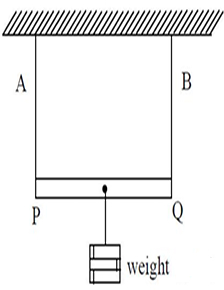
A
$90 \ cm$ from $P$
B
$100 \ cm$ from $P$
C
$40 \ cm$ from $Q$
D
$45 \ cm$ from $Q$
Solution
(A) Let $r_A, r_B$ be the radii and $Y_A, Y_B$ be the Young's moduli of wires $A$ and $B$ respectively.
Given: $\frac{r_A}{r_B} = \frac{2}{3}$ and $\frac{Y_A}{Y_B} = \frac{3}{2}$.
Let $L$ be the length of the wires (assumed equal) and $\Delta L$ be the equal elongation in both wires.
From the formula for elongation,$\Delta L = \frac{F L}{A Y}$,where $F$ is the tension in the wire and $A = \pi r^2$ is the cross-sectional area.
Since $\Delta L$ is the same for both wires,$\frac{F_A L}{\pi r_A^2 Y_A} = \frac{F_B L}{\pi r_B^2 Y_B}$.
Thus,$\frac{F_A}{F_B} = \frac{r_A^2 Y_A}{r_B^2 Y_B} = \left(\frac{r_A}{r_B}\right)^2 \left(\frac{Y_A}{Y_B}\right) = \left(\frac{2}{3}\right)^2 \times \left(\frac{3}{2}\right) = \frac{4}{9} \times \frac{3}{2} = \frac{2}{3}$.
Let the weight be suspended at a distance $x$ from $P$. Taking torque about the point of suspension,$F_A x = F_B (150 - x)$.
$\frac{F_A}{F_B} = \frac{150 - x}{x} = \frac{2}{3}$.
$3(150 - x) = 2x \implies 450 - 3x = 2x \implies 5x = 450 \implies x = 90 \ cm$ from $P$.
Given: $\frac{r_A}{r_B} = \frac{2}{3}$ and $\frac{Y_A}{Y_B} = \frac{3}{2}$.
Let $L$ be the length of the wires (assumed equal) and $\Delta L$ be the equal elongation in both wires.
From the formula for elongation,$\Delta L = \frac{F L}{A Y}$,where $F$ is the tension in the wire and $A = \pi r^2$ is the cross-sectional area.
Since $\Delta L$ is the same for both wires,$\frac{F_A L}{\pi r_A^2 Y_A} = \frac{F_B L}{\pi r_B^2 Y_B}$.
Thus,$\frac{F_A}{F_B} = \frac{r_A^2 Y_A}{r_B^2 Y_B} = \left(\frac{r_A}{r_B}\right)^2 \left(\frac{Y_A}{Y_B}\right) = \left(\frac{2}{3}\right)^2 \times \left(\frac{3}{2}\right) = \frac{4}{9} \times \frac{3}{2} = \frac{2}{3}$.
Let the weight be suspended at a distance $x$ from $P$. Taking torque about the point of suspension,$F_A x = F_B (150 - x)$.
$\frac{F_A}{F_B} = \frac{150 - x}{x} = \frac{2}{3}$.
$3(150 - x) = 2x \implies 450 - 3x = 2x \implies 5x = 450 \implies x = 90 \ cm$ from $P$.
0 likes
View Solution315
MediumMCQ
When a wire of length $L$ clamped at one end is pulled by a force $F$ from the other end,its length increases by $l$. If the radius of the wire and the applied force were halved,then the increase in its length is
A
$l$
B
$2l$
C
$0.5l$
D
$4l$
Solution
(B) The formula for Young's modulus $Y$ is given by $Y = \frac{F \cdot L}{A \cdot l}$,where $A$ is the cross-sectional area of the wire.
Since $A = \pi r^2$,we can write $l = \frac{F \cdot L}{Y \cdot \pi r^2}$.
This implies $l \propto \frac{F}{r^2}$.
Let the initial length increase be $l_1 = k \cdot \frac{F}{r^2}$.
When the force $F' = \frac{F}{2}$ and the radius $r' = \frac{r}{2}$,the new increase in length $l_2$ is:
$l_2 = k \cdot \frac{F'}{(r')^2} = k \cdot \frac{F/2}{(r/2)^2} = k \cdot \frac{F/2}{r^2/4} = 2 \cdot k \cdot \frac{F}{r^2} = 2l_1$.
Therefore,the new increase in length is $2l$.
Since $A = \pi r^2$,we can write $l = \frac{F \cdot L}{Y \cdot \pi r^2}$.
This implies $l \propto \frac{F}{r^2}$.
Let the initial length increase be $l_1 = k \cdot \frac{F}{r^2}$.
When the force $F' = \frac{F}{2}$ and the radius $r' = \frac{r}{2}$,the new increase in length $l_2$ is:
$l_2 = k \cdot \frac{F'}{(r')^2} = k \cdot \frac{F/2}{(r/2)^2} = k \cdot \frac{F/2}{r^2/4} = 2 \cdot k \cdot \frac{F}{r^2} = 2l_1$.
Therefore,the new increase in length is $2l$.
0 likes
View Solution316
MediumMCQ
The force required to stretch a steel wire of area of cross-section $1 \,mm^2$ to double its length is (Young's modulus of steel $= 2 \times 10^{11} \,N \,m^{-2}$)
A
$2 \times 10^3 \,N$
B
$2 \times 10^5 \,N$
C
$2 \times 10^2 \,N$
D
$2 \times 10^4 \,N$
Solution
(B) Young's modulus $(Y)$ is defined as the ratio of longitudinal stress to longitudinal strain.
$Y = \frac{\text{Stress}}{\text{Strain}} = \frac{F/A}{\Delta L/L}$
Given:
Area $A = 1 \,mm^2 = 1 \times 10^{-6} \,m^2$
Young's modulus $Y = 2 \times 10^{11} \,N \,m^{-2}$
To double the length,the change in length $\Delta L$ must be equal to the original length $L$,so $\Delta L = L$,which means $\frac{\Delta L}{L} = 1$.
Substituting these values into the formula:
$2 \times 10^{11} = \frac{F / (1 \times 10^{-6})}{1}$
$F = 2 \times 10^{11} \times 10^{-6} \,N$
$F = 2 \times 10^5 \,N$
Therefore,the correct option is $B$.
$Y = \frac{\text{Stress}}{\text{Strain}} = \frac{F/A}{\Delta L/L}$
Given:
Area $A = 1 \,mm^2 = 1 \times 10^{-6} \,m^2$
Young's modulus $Y = 2 \times 10^{11} \,N \,m^{-2}$
To double the length,the change in length $\Delta L$ must be equal to the original length $L$,so $\Delta L = L$,which means $\frac{\Delta L}{L} = 1$.
Substituting these values into the formula:
$2 \times 10^{11} = \frac{F / (1 \times 10^{-6})}{1}$
$F = 2 \times 10^{11} \times 10^{-6} \,N$
$F = 2 \times 10^5 \,N$
Therefore,the correct option is $B$.
0 likes
View Solution317
MediumMCQ
$A$ wire is stretched $1 \ mm$ by a force $F$. If a second wire of same material,same length and $4$ times the diameter of the first wire is stretched by the same force $F$,then the elongation of the second wire is
A
$\frac{1}{8} \ mm$
B
$8 \ mm$
C
$16 \ mm$
D
$\frac{1}{16} \ mm$
Solution
(D) The formula for Young's modulus $Y$ is given by $Y = \frac{F \cdot L}{A \cdot \Delta L}$,where $F$ is the force,$L$ is the length,$A$ is the cross-sectional area,and $\Delta L$ is the elongation.
Since $A = \pi r^2 = \pi (d/2)^2 = \frac{\pi d^2}{4}$,we can write $\Delta L = \frac{F \cdot L}{Y \cdot A} = \frac{4 \cdot F \cdot L}{Y \cdot \pi d^2}$.
Given that $F$,$L$,and $Y$ are constant for both wires,we have $\Delta L \propto \frac{1}{d^2}$.
Let $\Delta L_1 = 1 \ mm$ and $d_1 = d$. For the second wire,$d_2 = 4d$.
Therefore,$\frac{\Delta L_2}{\Delta L_1} = \left( \frac{d_1}{d_2} \right)^2 = \left( \frac{d}{4d} \right)^2 = \left( \frac{1}{4} \right)^2 = \frac{1}{16}$.
Thus,$\Delta L_2 = \frac{1}{16} \cdot \Delta L_1 = \frac{1}{16} \cdot 1 \ mm = \frac{1}{16} \ mm$.
Since $A = \pi r^2 = \pi (d/2)^2 = \frac{\pi d^2}{4}$,we can write $\Delta L = \frac{F \cdot L}{Y \cdot A} = \frac{4 \cdot F \cdot L}{Y \cdot \pi d^2}$.
Given that $F$,$L$,and $Y$ are constant for both wires,we have $\Delta L \propto \frac{1}{d^2}$.
Let $\Delta L_1 = 1 \ mm$ and $d_1 = d$. For the second wire,$d_2 = 4d$.
Therefore,$\frac{\Delta L_2}{\Delta L_1} = \left( \frac{d_1}{d_2} \right)^2 = \left( \frac{d}{4d} \right)^2 = \left( \frac{1}{4} \right)^2 = \frac{1}{16}$.
Thus,$\Delta L_2 = \frac{1}{16} \cdot \Delta L_1 = \frac{1}{16} \cdot 1 \ mm = \frac{1}{16} \ mm$.
0 likes
View Solution318
MediumMCQ
$A$ wire of length $0.5 \ m$ and area of cross-section $4 \times 10^{-6} \ m^2$ at a temperature of $100^{\circ} C$ is suspended vertically by fixing its upper end to the ceiling. The wire is then cooled to $0^{\circ} C$,but is prevented from contracting,by attaching a mass at the lower end. If the mass of the wire is negligible,then the value of the mass attached to the wire is (Young's modulus of material of the wire $= 10^{11} \ N \ m^{-2}$; coefficient of linear expansion of the material of the wire $= 10^{-5} \ K^{-1}$ and acceleration due to gravity $= 10 \ m \ s^{-2}$) (in $kg$)
A
$10$
B
$20$
C
$30$
D
$40$
Solution
(D) The thermal strain that would occur if the wire were free to contract is given by $\Delta L / L = \alpha \Delta T$.
Here,$\alpha = 10^{-5} \ K^{-1}$ and $\Delta T = 100^{\circ} C - 0^{\circ} C = 100 \ K$.
So,$\Delta L / L = 10^{-5} \times 100 = 10^{-3}$.
Since the wire is prevented from contracting,the stress developed is equal to the Young's modulus multiplied by the strain: $\text{Stress} = Y \times (\Delta L / L)$.
$\text{Stress} = 10^{11} \times 10^{-3} = 10^8 \ N \ m^{-2}$.
Stress is also defined as force per unit area,so $\text{Stress} = F / A = (mg) / A$.
Equating the two expressions for stress: $mg / A = 10^8$.
$m = (10^8 \times A) / g = (10^8 \times 4 \times 10^{-6}) / 10$.
$m = 400 / 10 = 40 \ kg$.
Here,$\alpha = 10^{-5} \ K^{-1}$ and $\Delta T = 100^{\circ} C - 0^{\circ} C = 100 \ K$.
So,$\Delta L / L = 10^{-5} \times 100 = 10^{-3}$.
Since the wire is prevented from contracting,the stress developed is equal to the Young's modulus multiplied by the strain: $\text{Stress} = Y \times (\Delta L / L)$.
$\text{Stress} = 10^{11} \times 10^{-3} = 10^8 \ N \ m^{-2}$.
Stress is also defined as force per unit area,so $\text{Stress} = F / A = (mg) / A$.
Equating the two expressions for stress: $mg / A = 10^8$.
$m = (10^8 \times A) / g = (10^8 \times 4 \times 10^{-6}) / 10$.
$m = 400 / 10 = 40 \ kg$.
0 likes
View Solution319
MediumMCQ
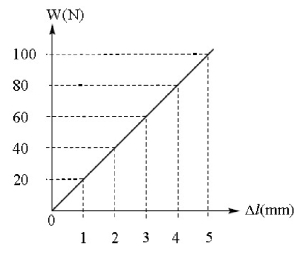
If the given graph shows the load $(W)$ attached to and the elongation $(\Delta l)$ produced in a wire of length $1 \,m$ and area of cross-section $1 \,mm^2$, then the Young's modulus of the material of the wire is
A
$20 \times 10^{10} \,N \,m^{-2}$
B
$2 \times 10^{10} \,N \,m^{-2}$
C
$10 \times 10^{10} \,N \,m^{-2}$
D
$4 \times 10^{10} \,N \,m^{-2}$
Solution
(B) The Young's modulus $(Y)$ is given by the formula: $Y = \frac{\text{Stress}}{\text{Strain}} = \frac{F/A}{\Delta l/L} = \frac{F \cdot L}{A \cdot \Delta l}$.
From the graph, we can take any point, for example, $W = 100 \,N$ and $\Delta l = 5 \,mm = 5 \times 10^{-3} \,m$.
Given: $L = 1 \,m$, $A = 1 \,mm^2 = 1 \times 10^{-6} \,m^2$.
Substituting the values:
$Y = \frac{100 \,N \times 1 \,m}{1 \times 10^{-6} \,m^2 \times 5 \times 10^{-3} \,m} = \frac{100}{5 \times 10^{-9}} = 20 \times 10^9 \,N \,m^{-2} = 2 \times 10^{10} \,N \,m^{-2}$.
Thus, the correct option is $B$.
From the graph, we can take any point, for example, $W = 100 \,N$ and $\Delta l = 5 \,mm = 5 \times 10^{-3} \,m$.
Given: $L = 1 \,m$, $A = 1 \,mm^2 = 1 \times 10^{-6} \,m^2$.
Substituting the values:
$Y = \frac{100 \,N \times 1 \,m}{1 \times 10^{-6} \,m^2 \times 5 \times 10^{-3} \,m} = \frac{100}{5 \times 10^{-9}} = 20 \times 10^9 \,N \,m^{-2} = 2 \times 10^{10} \,N \,m^{-2}$.
Thus, the correct option is $B$.
0 likes
View Solution320
MediumMCQ
$A$ $4 \ kg$ stone attached at the end of a steel wire is being whirled at a constant speed $12 \ ms^{-1}$ in a horizontal circle. The wire is $4 \ m$ long with a diameter $2.0 \ mm$ and Young's modulus of the steel is $2 \times 10^{11} \ Nm^{-2}$. The strain in the wire is:
A
$2.3 \times 10^{-4}$
B
$2.3 \times 10^{-5}$
C
$4.6 \times 10^{-4}$
D
$6.9 \times 10^{-4}$
Solution
(A) Given: Mass $m = 4 \ kg$,speed $v = 12 \ ms^{-1}$,length $l = 4 \ m$,diameter $d = 2.0 \ mm = 2 \times 10^{-3} \ m$,Young's modulus $Y = 2 \times 10^{11} \ Nm^{-2}$.
The tension force $F$ in the wire providing the centripetal force is given by $F = \frac{mv^2}{l}$.
Substituting the values: $F = \frac{4 \times (12)^2}{4} = 144 \ N$.
The strain $\epsilon$ is defined as $\epsilon = \frac{\text{Stress}}{Y} = \frac{F}{AY}$,where $A$ is the cross-sectional area $\pi r^2 = \pi (d/2)^2 = \frac{\pi d^2}{4}$.
Thus,$\epsilon = \frac{4F}{\pi d^2 Y}$.
Substituting the values: $\epsilon = \frac{4 \times 144}{\pi \times (2 \times 10^{-3})^2 \times 2 \times 10^{11}}$.
$\epsilon = \frac{576}{\pi \times 4 \times 10^{-6} \times 2 \times 10^{11}} = \frac{576}{\pi \times 8 \times 10^5} = \frac{72}{\pi \times 10^5} \approx 2.29 \times 10^{-4} \approx 2.3 \times 10^{-4}$.
The tension force $F$ in the wire providing the centripetal force is given by $F = \frac{mv^2}{l}$.
Substituting the values: $F = \frac{4 \times (12)^2}{4} = 144 \ N$.
The strain $\epsilon$ is defined as $\epsilon = \frac{\text{Stress}}{Y} = \frac{F}{AY}$,where $A$ is the cross-sectional area $\pi r^2 = \pi (d/2)^2 = \frac{\pi d^2}{4}$.
Thus,$\epsilon = \frac{4F}{\pi d^2 Y}$.
Substituting the values: $\epsilon = \frac{4 \times 144}{\pi \times (2 \times 10^{-3})^2 \times 2 \times 10^{11}}$.
$\epsilon = \frac{576}{\pi \times 4 \times 10^{-6} \times 2 \times 10^{11}} = \frac{576}{\pi \times 8 \times 10^5} = \frac{72}{\pi \times 10^5} \approx 2.29 \times 10^{-4} \approx 2.3 \times 10^{-4}$.
0 likes
View Solution321
MediumMCQ
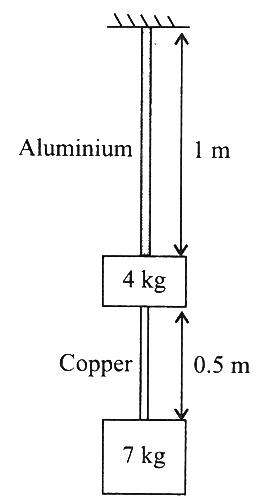
The elongation of the copper wire of cross-sectional area $3.5 \,mm^2$, as shown in the figure, is (Given: $Y_{\text{copper}} = 10 \times 10^{10} \,N/m^2$ and $g = 10 \,m/s^2$).
A
$10^{-4} \,m$
B
$10^{-3} \,m$
C
$10^{-6} \,m$
D
$10^{-2} \,m$
Solution
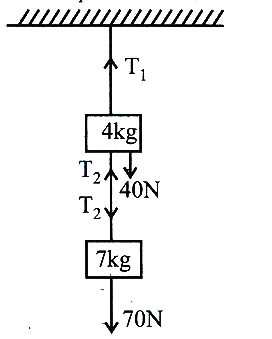
(A) The tension in the copper wire is due to the weight of the $7 \,kg$ mass hanging from it.
$T = m \times g = 7 \,kg \times 10 \,m/s^2 = 70 \,N$.
The formula for elongation $\Delta l$ is given by $\Delta l = \frac{T \times l}{Y \times A}$.
Given:
$T = 70 \,N$
$l = 0.5 \,m$
$Y = 10 \times 10^{10} \,N/m^2$
$A = 3.5 \,mm^2 = 3.5 \times 10^{-6} \,m^2$
Substituting the values:
$\Delta l = \frac{70 \times 0.5}{10 \times 10^{10} \times 3.5 \times 10^{-6}}$
$\Delta l = \frac{35}{35 \times 10^4} = 10^{-4} \,m$.
$T = m \times g = 7 \,kg \times 10 \,m/s^2 = 70 \,N$.
The formula for elongation $\Delta l$ is given by $\Delta l = \frac{T \times l}{Y \times A}$.
Given:
$T = 70 \,N$
$l = 0.5 \,m$
$Y = 10 \times 10^{10} \,N/m^2$
$A = 3.5 \,mm^2 = 3.5 \times 10^{-6} \,m^2$
Substituting the values:
$\Delta l = \frac{70 \times 0.5}{10 \times 10^{10} \times 3.5 \times 10^{-6}}$
$\Delta l = \frac{35}{35 \times 10^4} = 10^{-4} \,m$.
0 likes
View Solution322
EasyMCQ
$A$ wire of length $100 \ cm$ and area of cross-section $2 \ mm^2$ is stretched by two forces of each $440 \ N$ applied at the ends of the wire in opposite directions along the length of the wire. If the elongation of the wire is $2 \ mm$,the Young's modulus of the material of the wire is:
A
$4.4 \times 10^{11} \ Nm^{-2}$
B
$1.1 \times 10^{11} \ Nm^{-2}$
C
$2.2 \times 10^{11} \ Nm^{-2}$
D
$3.3 \times 10^{11} \ Nm^{-2}$
Solution
(B) Given: Length $l = 100 \ cm = 1 \ m$,Area $A = 2 \ mm^2 = 2 \times 10^{-6} \ m^2$,Force $F = 440 \ N$,Elongation $\Delta l = 2 \ mm = 2 \times 10^{-3} \ m$.
Young's modulus $Y$ is defined as the ratio of longitudinal stress to longitudinal strain.
$Y = \frac{\text{Stress}}{\text{Strain}} = \frac{F/A}{\Delta l/l} = \frac{F \cdot l}{A \cdot \Delta l}$.
Substituting the values:
$Y = \frac{440 \times 1}{2 \times 10^{-6} \times 2 \times 10^{-3}} = \frac{440}{4 \times 10^{-9}} = 110 \times 10^9 \ Nm^{-2} = 1.1 \times 10^{11} \ Nm^{-2}$.
Young's modulus $Y$ is defined as the ratio of longitudinal stress to longitudinal strain.
$Y = \frac{\text{Stress}}{\text{Strain}} = \frac{F/A}{\Delta l/l} = \frac{F \cdot l}{A \cdot \Delta l}$.
Substituting the values:
$Y = \frac{440 \times 1}{2 \times 10^{-6} \times 2 \times 10^{-3}} = \frac{440}{4 \times 10^{-9}} = 110 \times 10^9 \ Nm^{-2} = 1.1 \times 10^{11} \ Nm^{-2}$.
0 likes
View Solution323
EasyMCQ
$A$ steel rod of radius $20 \ mm$ and length $2 \ m$ is acted upon by a force of $400 \ kN$ along its length. The values of stress and strain are respectively $(Y_{\text{steel}} = 2 \times 10^{11} \ N \ m^{-2})$.
A
$1.96 \times 10^8 \ N \ m^{-2}, 0.16 \%$
B
$3.18 \times 10^8 \ N \ m^{-2}, 0.16 \%$
C
$3.18 \times 10^8 \ N \ m^{-2}, 0.32 \%$
D
$4 \times 10^8 \ N \ m^{-2}, 0.2 \%$
Solution
(B) Given: Radius $r = 20 \ mm = 20 \times 10^{-3} \ m$,Length $L = 2 \ m$,Force $F = 400 \ kN = 400 \times 10^3 \ N$,Young's modulus $Y = 2 \times 10^{11} \ N \ m^{-2}$.
Stress is defined as force per unit area: $\text{Stress} = \frac{F}{A} = \frac{F}{\pi r^2}$.
Substituting the values: $\text{Stress} = \frac{400 \times 10^3}{3.14 \times (20 \times 10^{-3})^2} = \frac{400 \times 10^3}{3.14 \times 400 \times 10^{-6}} = \frac{10^9}{3.14} \approx 3.18 \times 10^8 \ N \ m^{-2}$.
Strain is calculated using Young's modulus: $Y = \frac{\text{Stress}}{\text{Strain}} \implies \text{Strain} = \frac{\text{Stress}}{Y}$.
$\text{Strain} = \frac{3.18 \times 10^8}{2 \times 10^{11}} = 1.59 \times 10^{-3} = 0.159 \% \approx 0.16 \%$.
Thus,the values are $3.18 \times 10^8 \ N \ m^{-2}$ and $0.16 \%$.
Stress is defined as force per unit area: $\text{Stress} = \frac{F}{A} = \frac{F}{\pi r^2}$.
Substituting the values: $\text{Stress} = \frac{400 \times 10^3}{3.14 \times (20 \times 10^{-3})^2} = \frac{400 \times 10^3}{3.14 \times 400 \times 10^{-6}} = \frac{10^9}{3.14} \approx 3.18 \times 10^8 \ N \ m^{-2}$.
Strain is calculated using Young's modulus: $Y = \frac{\text{Stress}}{\text{Strain}} \implies \text{Strain} = \frac{\text{Stress}}{Y}$.
$\text{Strain} = \frac{3.18 \times 10^8}{2 \times 10^{11}} = 1.59 \times 10^{-3} = 0.159 \% \approx 0.16 \%$.
Thus,the values are $3.18 \times 10^8 \ N \ m^{-2}$ and $0.16 \%$.
0 likes
View Solution324
MediumMCQ
$A$ cylindrical rod made of aluminum has a length of $1 \,m$ and a diameter of $10 \,cm$. The rod is subjected to a tensile force of $100 \,kN$. Calculate the elongation in the rod. (Young's modulus of aluminum $= 70 \,GPa$)
A
$0.81 \times 10^{-4} \,m$
B
$2 \times 10^{-4} \,m$
C
$0.2 \times 10^{-4} \,m$
D
$1.81 \times 10^{-4} \,m$
Solution
(D) Given: Length $l = 1 \,m$, Diameter $d = 10 \,cm = 0.1 \,m$, Radius $r = 0.05 \,m$, Force $F = 100 \,kN = 10^5 \,N$, Young's modulus $Y = 70 \,GPa = 70 \times 10^9 \,Pa$.
Using the formula for Young's modulus: $Y = \frac{F \cdot l}{A \cdot \Delta l}$, where $A = \pi r^2$.
Rearranging for elongation $\Delta l$: $\Delta l = \frac{F \cdot l}{\pi r^2 Y}$.
Substituting the values: $\Delta l = \frac{10^5 \times 1}{3.14159 \times (0.05)^2 \times 70 \times 10^9}$.
$\Delta l = \frac{10^5}{3.14159 \times 0.0025 \times 70 \times 10^9} = \frac{10^5}{549.78 \times 10^6} \approx 1.81 \times 10^{-4} \,m$.
Using the formula for Young's modulus: $Y = \frac{F \cdot l}{A \cdot \Delta l}$, where $A = \pi r^2$.
Rearranging for elongation $\Delta l$: $\Delta l = \frac{F \cdot l}{\pi r^2 Y}$.
Substituting the values: $\Delta l = \frac{10^5 \times 1}{3.14159 \times (0.05)^2 \times 70 \times 10^9}$.
$\Delta l = \frac{10^5}{3.14159 \times 0.0025 \times 70 \times 10^9} = \frac{10^5}{549.78 \times 10^6} \approx 1.81 \times 10^{-4} \,m$.
0 likes
View Solution325
DifficultMCQ
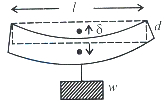
The sag (depression) developed in a bar of length '$l$',breadth '$b$',and thickness '$d$' when subjected to a load of '$W$' at the center is given by (where '$Y$' is Young's modulus of the material of the bar):
A
$\frac{W l^2}{4 b d^2 Y}$
B
$\frac{W l^3}{b d^2 Y}$
C
$\frac{W l^3}{4 b d^3 Y}$
D
None of the above
Solution
(C) For a beam of length '$l$',breadth '$b$',and thickness '$d$' supported at both ends and loaded with a weight '$W$' at its center,the depression (sag) '$\delta$' is given by the formula:
$\delta = \frac{W l^3}{4 Y b d^3}$
Here,'$W$' is the load,'$l$' is the length,'$Y$' is Young's modulus,'$b$' is the breadth,and '$d$' is the thickness.
Comparing this with the given options,option '$C$' matches the formula.
$\delta = \frac{W l^3}{4 Y b d^3}$
Here,'$W$' is the load,'$l$' is the length,'$Y$' is Young's modulus,'$b$' is the breadth,and '$d$' is the thickness.
Comparing this with the given options,option '$C$' matches the formula.
0 likes
View Solution326
MediumMCQ
$A$ metal wire with circular cross-section and length $1 \,m$ is pulled with a tensile force of $1000 \,N$ on each side. For the wire to be stretched not more than $0.25 \,cm$, the minimum diameter of the wire required is (Young's modulus of the metal $= 10^{11} \,Pa$, take $\sqrt{\pi} = 1.77$). (in $\,mm$)
A
$1.13$
B
$2.26$
C
$4.12$
D
$3.1$
Solution
(B) Given: Tensile force $F = 1000 \,N$, Length $L = 1 \,m$, Change in length $\Delta L = 0.25 \,cm = 0.25 \times 10^{-2} \,m$, Young's modulus $Y = 10^{11} \,Pa$.
The formula for Young's modulus is $Y = \frac{FL}{A \Delta L}$, where $A = \pi r^2$.
Rearranging for $r^2$: $r^2 = \frac{FL}{Y \Delta L \pi}$.
Substituting the values: $r^2 = \frac{1000 \times 1}{10^{11} \times 0.25 \times 10^{-2} \times \pi} = \frac{1000}{10^9 \times 0.25 \times \pi} = \frac{1}{0.25 \times \pi \times 10^6} = \frac{4}{\pi \times 10^6}$.
Taking the square root: $r = \frac{2}{\sqrt{\pi} \times 10^3} = \frac{2}{1.77 \times 10^3} \approx 1.13 \times 10^{-3} \,m = 1.13 \,mm$.
The diameter $d = 2r = 2 \times 1.13 \,mm = 2.26 \,mm$.
The formula for Young's modulus is $Y = \frac{FL}{A \Delta L}$, where $A = \pi r^2$.
Rearranging for $r^2$: $r^2 = \frac{FL}{Y \Delta L \pi}$.
Substituting the values: $r^2 = \frac{1000 \times 1}{10^{11} \times 0.25 \times 10^{-2} \times \pi} = \frac{1000}{10^9 \times 0.25 \times \pi} = \frac{1}{0.25 \times \pi \times 10^6} = \frac{4}{\pi \times 10^6}$.
Taking the square root: $r = \frac{2}{\sqrt{\pi} \times 10^3} = \frac{2}{1.77 \times 10^3} \approx 1.13 \times 10^{-3} \,m = 1.13 \,mm$.
The diameter $d = 2r = 2 \times 1.13 \,mm = 2.26 \,mm$.
0 likes
View Solution327
DifficultMCQ
Same tension is applied to the following four wires made of same material. The elongation is longest in
A
Wire of length $50 \ cm$ and diameter $0.5 \ mm$
B
Wire of length $200 \ cm$ and diameter $2 \ mm$
C
Wire of length $300 \ cm$ and diameter $3 \ mm$
D
Wire of length $100 \ cm$ and diameter $1 \ mm$
Solution
(A) The Young's modulus $(Y)$ is defined as the ratio of tensile stress to tensile strain: $Y = \frac{F/A}{\Delta l/l}$.
Rearranging for elongation $(\Delta l)$,we get: $\Delta l = \frac{F \cdot l}{A \cdot Y}$.
Since the area $A = \pi r^2 = \pi (d/2)^2 = \frac{\pi d^2}{4}$,we substitute this into the equation:
$\Delta l = \frac{4 F l}{\pi d^2 Y}$.
Given that the tension $(F)$ and material $(Y)$ are the same for all wires,the elongation is proportional to the ratio $\frac{l}{d^2}$.
Calculating the ratio $\frac{l}{d^2}$ for each option:
$A: \frac{50}{(0.5)^2} = \frac{50}{0.25} = 200$.
$B: \frac{200}{(2)^2} = \frac{200}{4} = 50$.
$C: \frac{300}{(3)^2} = \frac{300}{9} \approx 33.33$.
$D: \frac{100}{(1)^2} = \frac{100}{1} = 100$.
Comparing the values,the ratio is maximum for option $A$.
Rearranging for elongation $(\Delta l)$,we get: $\Delta l = \frac{F \cdot l}{A \cdot Y}$.
Since the area $A = \pi r^2 = \pi (d/2)^2 = \frac{\pi d^2}{4}$,we substitute this into the equation:
$\Delta l = \frac{4 F l}{\pi d^2 Y}$.
Given that the tension $(F)$ and material $(Y)$ are the same for all wires,the elongation is proportional to the ratio $\frac{l}{d^2}$.
Calculating the ratio $\frac{l}{d^2}$ for each option:
$A: \frac{50}{(0.5)^2} = \frac{50}{0.25} = 200$.
$B: \frac{200}{(2)^2} = \frac{200}{4} = 50$.
$C: \frac{300}{(3)^2} = \frac{300}{9} \approx 33.33$.
$D: \frac{100}{(1)^2} = \frac{100}{1} = 100$.
Comparing the values,the ratio is maximum for option $A$.
0 likes
View Solution328
EasyMCQ
Two wires $A$ and $B$ of the same cross-section are connected end to end. When the same tension is applied to both wires,the elongation in wire $B$ is twice the elongation in wire $A$. If $L_A$ and $L_B$ are the initial lengths of the wires $A$ and $B$ respectively,then (Young's modulus of material of wire $A = 2 \times 10^{11} \ Nm^{-2}$ and Young's modulus of material of wire $B = 1.1 \times 10^{11} \ Nm^{-2}$):
A
$\frac{L_A}{L_B} = \frac{10}{11}$
B
$\frac{L_A}{L_B} = \frac{4}{5}$
C
$\frac{L_A}{L_B} = \frac{9}{11}$
D
$\frac{L_A}{L_B} = \frac{3}{7}$
Solution
(A) The formula for Young's modulus $Y$ is given by $Y = \frac{T L}{A \Delta L}$,where $T$ is the tension,$L$ is the initial length,$A$ is the cross-sectional area,and $\Delta L$ is the elongation.
Given that the cross-sectional area $A$ and tension $T$ are the same for both wires,we have:
$Y_A = \frac{T L_A}{A \Delta L_A}$ and $Y_B = \frac{T L_B}{A \Delta L_B}$
Taking the ratio of the two moduli:
$\frac{Y_A}{Y_B} = \frac{L_A}{L_B} \times \frac{\Delta L_B}{\Delta L_A}$
We are given $\Delta L_B = 2 \Delta L_A$,so $\frac{\Delta L_B}{\Delta L_A} = 2$.
Substituting the given values $Y_A = 2 \times 10^{11} \ Nm^{-2}$ and $Y_B = 1.1 \times 10^{11} \ Nm^{-2}$:
$\frac{2 \times 10^{11}}{1.1 \times 10^{11}} = \frac{L_A}{L_B} \times 2$
$\frac{2}{1.1} = \frac{L_A}{L_B} \times 2$
$\frac{1}{1.1} = \frac{L_A}{L_B}$
$\frac{L_A}{L_B} = \frac{10}{11}$
Given that the cross-sectional area $A$ and tension $T$ are the same for both wires,we have:
$Y_A = \frac{T L_A}{A \Delta L_A}$ and $Y_B = \frac{T L_B}{A \Delta L_B}$
Taking the ratio of the two moduli:
$\frac{Y_A}{Y_B} = \frac{L_A}{L_B} \times \frac{\Delta L_B}{\Delta L_A}$
We are given $\Delta L_B = 2 \Delta L_A$,so $\frac{\Delta L_B}{\Delta L_A} = 2$.
Substituting the given values $Y_A = 2 \times 10^{11} \ Nm^{-2}$ and $Y_B = 1.1 \times 10^{11} \ Nm^{-2}$:
$\frac{2 \times 10^{11}}{1.1 \times 10^{11}} = \frac{L_A}{L_B} \times 2$
$\frac{2}{1.1} = \frac{L_A}{L_B} \times 2$
$\frac{1}{1.1} = \frac{L_A}{L_B}$
$\frac{L_A}{L_B} = \frac{10}{11}$
0 likes
View Solution329
MediumMCQ
$A$ copper wire of length $2.4 \ m$ and an aluminum wire of length $0.7 \ m$, both having diameter $2 \ mm$, are connected end to end. When stretched by a load, the total elongation is found to be $0.6 \ mm$. The applied load is (Young's modulus of copper $= 1.2 \times 10^{11} \ N/m^2$ and Young's modulus of aluminum $= 0.7 \times 10^{11} \ N/m^2$). (in $\pi \ N$)
A
$12$
B
$24$
C
$20$
D
$80$
Solution
(C) The total elongation $\Delta l$ is the sum of the elongations of the copper wire and the aluminum wire: $\Delta l = \Delta l_c + \Delta l_a$.
Since the wires are connected in series, the same load $F$ acts on both.
Using the formula $\Delta l = \frac{F l}{Y A}$, where $A = \pi r^2 = \pi (10^{-3} \ m)^2 = \pi \times 10^{-6} \ m^2$:
$\Delta l = \frac{F l_c}{Y_c A} + \frac{F l_a}{Y_a A} = \frac{F}{A} \left( \frac{l_c}{Y_c} + \frac{l_a}{Y_a} \right)$.
Substituting the given values:
$0.6 \times 10^{-3} = \frac{F}{\pi \times 10^{-6}} \left( \frac{2.4}{1.2 \times 10^{11}} + \frac{0.7}{0.7 \times 10^{11}} \right)$.
$0.6 \times 10^{-3} = \frac{F}{\pi \times 10^{-6}} \left( 2 \times 10^{-11} + 1 \times 10^{-11} \right)$.
$0.6 \times 10^{-3} = \frac{F}{\pi \times 10^{-6}} \times 3 \times 10^{-11}$.
$0.6 \times 10^{-3} = F \times \frac{3 \times 10^{-11}}{\pi \times 10^{-6}} = F \times \frac{3 \times 10^{-5}}{\pi}$.
$F = \frac{0.6 \times 10^{-3} \times \pi}{3 \times 10^{-5}} = \frac{0.6 \times 10^2 \times \pi}{3} = 0.2 \times 100 \times \pi = 20 \pi \ N$.
Since the wires are connected in series, the same load $F$ acts on both.
Using the formula $\Delta l = \frac{F l}{Y A}$, where $A = \pi r^2 = \pi (10^{-3} \ m)^2 = \pi \times 10^{-6} \ m^2$:
$\Delta l = \frac{F l_c}{Y_c A} + \frac{F l_a}{Y_a A} = \frac{F}{A} \left( \frac{l_c}{Y_c} + \frac{l_a}{Y_a} \right)$.
Substituting the given values:
$0.6 \times 10^{-3} = \frac{F}{\pi \times 10^{-6}} \left( \frac{2.4}{1.2 \times 10^{11}} + \frac{0.7}{0.7 \times 10^{11}} \right)$.
$0.6 \times 10^{-3} = \frac{F}{\pi \times 10^{-6}} \left( 2 \times 10^{-11} + 1 \times 10^{-11} \right)$.
$0.6 \times 10^{-3} = \frac{F}{\pi \times 10^{-6}} \times 3 \times 10^{-11}$.
$0.6 \times 10^{-3} = F \times \frac{3 \times 10^{-11}}{\pi \times 10^{-6}} = F \times \frac{3 \times 10^{-5}}{\pi}$.
$F = \frac{0.6 \times 10^{-3} \times \pi}{3 \times 10^{-5}} = \frac{0.6 \times 10^2 \times \pi}{3} = 0.2 \times 100 \times \pi = 20 \pi \ N$.
0 likes
View Solution330
EasyMCQ
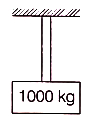
One end of the steel rod is clamped to the roof and the other end is attached to a mass of $1000 \,kg$ as shown in the figure. The length of the rod is $50 \,cm$ and its cross-sectional area is $1000 \,mm^2$. The change in the length of the rod due to the weight of the mass is (Young's modulus of steel $= 2 \times 10^{11} \,Nm^{-2}$ and acceleration due to gravity $= 10 \,ms^{-2}$) (in $\,mm$)
A
$0.025$
B
$0.10$
C
$0.050$
D
$0.075$
Solution
(A) Young's modulus $Y$ is defined as the ratio of longitudinal stress to longitudinal strain:
$Y = \frac{F/A}{\Delta l/l} = \frac{Fl}{A \Delta l}$
Rearranging for the change in length $\Delta l$:
$\Delta l = \frac{Fl}{AY}$
Given:
Force $F = mg = 1000 \,kg \times 10 \,ms^{-2} = 10,000 \,N$
Length $l = 50 \,cm = 0.5 \,m$
Area $A = 1000 \,mm^2 = 1000 \times 10^{-6} \,m^2 = 10^{-3} \,m^2$
Young's modulus $Y = 2 \times 10^{11} \,Nm^{-2}$
Substituting the values:
$\Delta l = \frac{10,000 \times 0.5}{10^{-3} \times 2 \times 10^{11}}$
$\Delta l = \frac{5,000}{2 \times 10^8} = 2,500 \times 10^{-8} \,m = 2.5 \times 10^{-5} \,m$
Converting to millimeters:
$\Delta l = 2.5 \times 10^{-5} \times 10^3 \,mm = 0.025 \,mm$
$Y = \frac{F/A}{\Delta l/l} = \frac{Fl}{A \Delta l}$
Rearranging for the change in length $\Delta l$:
$\Delta l = \frac{Fl}{AY}$
Given:
Force $F = mg = 1000 \,kg \times 10 \,ms^{-2} = 10,000 \,N$
Length $l = 50 \,cm = 0.5 \,m$
Area $A = 1000 \,mm^2 = 1000 \times 10^{-6} \,m^2 = 10^{-3} \,m^2$
Young's modulus $Y = 2 \times 10^{11} \,Nm^{-2}$
Substituting the values:
$\Delta l = \frac{10,000 \times 0.5}{10^{-3} \times 2 \times 10^{11}}$
$\Delta l = \frac{5,000}{2 \times 10^8} = 2,500 \times 10^{-8} \,m = 2.5 \times 10^{-5} \,m$
Converting to millimeters:
$\Delta l = 2.5 \times 10^{-5} \times 10^3 \,mm = 0.025 \,mm$
0 likes
View Solution331
MediumMCQ
The Young's modulus of a rubber string of length $12 \ cm$ and density $1.5 \ kg \ m^{-3}$ is $5 \times 10^8 \ N \ m^{-2}$. When this string is suspended vertically,the increase in its length due to its own weight is (take $g = 10 \ m \ s^{-2}$)
A
$2.16 \times 10^{-10} \ m$
B
$9.6 \times 10^{-11} \ m$
C
$9.6 \times 10^{-3} \ m$
D
$2.16 \times 10^{-3} \ m$
Solution
(A) The elongation $\Delta l$ of a string of length $L$ suspended vertically due to its own weight is given by the formula $\Delta l = \frac{\rho g L^2}{2Y}$.
Here,$L = 12 \ cm = 0.12 \ m$,$\rho = 1.5 \ kg \ m^{-3}$,$g = 10 \ m \ s^{-2}$,and $Y = 5 \times 10^8 \ N \ m^{-2}$.
Substituting the values:
$\Delta l = \frac{1.5 \times 10 \times (0.12)^2}{2 \times 5 \times 10^8}$
$\Delta l = \frac{15 \times 0.0144}{10^9}$
$\Delta l = \frac{0.216}{10^9} = 2.16 \times 10^{-10} \ m$.
Here,$L = 12 \ cm = 0.12 \ m$,$\rho = 1.5 \ kg \ m^{-3}$,$g = 10 \ m \ s^{-2}$,and $Y = 5 \times 10^8 \ N \ m^{-2}$.
Substituting the values:
$\Delta l = \frac{1.5 \times 10 \times (0.12)^2}{2 \times 5 \times 10^8}$
$\Delta l = \frac{15 \times 0.0144}{10^9}$
$\Delta l = \frac{0.216}{10^9} = 2.16 \times 10^{-10} \ m$.
0 likes
View Solution332
EasyMCQ
Young's modulus of a wire is $2 \times 10^{11} \ N \ m^{-2}$. If an external stretching force of $2 \times 10^{11} \ N$ is applied to a wire of length $L$ and cross-sectional area $A = 1 \ m^2$,the final length of the wire is: (in $L$)
A
$2$
B
$1.5$
C
$3$
D
$1.25$
Solution
(A) Given: Young's modulus $Y = 2 \times 10^{11} \ N \ m^{-2}$,Force $F = 2 \times 10^{11} \ N$,Area $A = 1 \ m^2$,Initial length $= L$.
The formula for Young's modulus is $Y = \frac{\text{stress}}{\text{strain}} = \frac{F/A}{\Delta L/L}$.
Substituting the given values: $2 \times 10^{11} = \frac{(2 \times 10^{11} / 1)}{\Delta L / L}$.
This simplifies to $1 = \frac{L}{\Delta L}$,which means $\Delta L = L$.
The final length $L_f = L + \Delta L = L + L = 2L$.
The formula for Young's modulus is $Y = \frac{\text{stress}}{\text{strain}} = \frac{F/A}{\Delta L/L}$.
Substituting the given values: $2 \times 10^{11} = \frac{(2 \times 10^{11} / 1)}{\Delta L / L}$.
This simplifies to $1 = \frac{L}{\Delta L}$,which means $\Delta L = L$.
The final length $L_f = L + \Delta L = L + L = 2L$.
0 likes
View Solution333
MediumMCQ
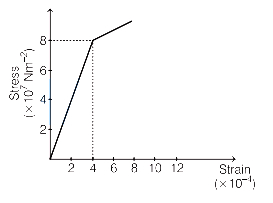
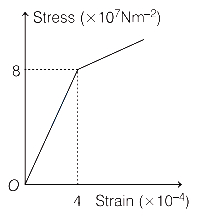
Find the Young's modulus of the wire whose stress-strain curve is as shown in the following figure.
A
$8 \times 10^{11} \text{ Nm}^{-2}$
B
$24 \times 10^{11} \text{ Nm}^{-2}$
C
$10 \times 10^{11} \text{ Nm}^{-2}$
D
$2 \times 10^{11} \text{ Nm}^{-2}$
Solution
(D) Young's modulus $(Y)$ is defined as the ratio of stress to strain within the proportional limit,which corresponds to the slope of the linear portion of the stress-strain graph.
From the given graph,the linear portion extends from the origin $(0, 0)$ to the point $(4 \times 10^{-4}, 8 \times 10^7 \text{ Nm}^{-2})$.
Therefore,the slope is:
$Y = \frac{\text{Stress}}{\text{Strain}} = \frac{8 \times 10^7 \text{ Nm}^{-2} - 0}{4 \times 10^{-4} - 0}$
$Y = \frac{8 \times 10^7}{4 \times 10^{-4}} \text{ Nm}^{-2}$
$Y = 2 \times 10^{11} \text{ Nm}^{-2}$
From the given graph,the linear portion extends from the origin $(0, 0)$ to the point $(4 \times 10^{-4}, 8 \times 10^7 \text{ Nm}^{-2})$.
Therefore,the slope is:
$Y = \frac{\text{Stress}}{\text{Strain}} = \frac{8 \times 10^7 \text{ Nm}^{-2} - 0}{4 \times 10^{-4} - 0}$
$Y = \frac{8 \times 10^7}{4 \times 10^{-4}} \text{ Nm}^{-2}$
$Y = 2 \times 10^{11} \text{ Nm}^{-2}$
0 likes
View Solution334
MediumMCQ
When a weight of $10 \,kg$ is suspended from a copper wire of length $3 \,m$ and diameter $0.4 \,mm$, its length increases by $2.4 \,cm$. If the diameter of the wire is doubled, then the extension in its length will be (in $\,cm$)
A
$9.6$
B
$4.8$
C
$1.2$
D
$0.6$
Solution
(D) The formula for Young's Modulus $(Y)$ is given by $Y = \frac{F \cdot L}{A \cdot \Delta L}$, where $F$ is the force, $L$ is the original length, $A$ is the cross-sectional area, and $\Delta L$ is the extension.
Since $A = \pi r^2 = \pi (d/2)^2 = \frac{\pi d^2}{4}$, we can write $\Delta L = \frac{F \cdot L}{Y \cdot A} = \frac{4 \cdot F \cdot L}{Y \cdot \pi \cdot d^2}$.
From this, we see that $\Delta L \propto \frac{1}{d^2}$.
Given the initial diameter $d_1 = 0.4 \,mm$ and initial extension $\Delta L_1 = 2.4 \,cm$.
If the diameter is doubled, $d_2 = 2 \cdot d_1$.
Then, $\frac{\Delta L_2}{\Delta L_1} = \left( \frac{d_1}{d_2} \right)^2 = \left( \frac{d_1}{2 \cdot d_1} \right)^2 = \left( \frac{1}{2} \right)^2 = \frac{1}{4}$.
Therefore, $\Delta L_2 = \frac{\Delta L_1}{4} = \frac{2.4 \,cm}{4} = 0.6 \,cm$.
Since $A = \pi r^2 = \pi (d/2)^2 = \frac{\pi d^2}{4}$, we can write $\Delta L = \frac{F \cdot L}{Y \cdot A} = \frac{4 \cdot F \cdot L}{Y \cdot \pi \cdot d^2}$.
From this, we see that $\Delta L \propto \frac{1}{d^2}$.
Given the initial diameter $d_1 = 0.4 \,mm$ and initial extension $\Delta L_1 = 2.4 \,cm$.
If the diameter is doubled, $d_2 = 2 \cdot d_1$.
Then, $\frac{\Delta L_2}{\Delta L_1} = \left( \frac{d_1}{d_2} \right)^2 = \left( \frac{d_1}{2 \cdot d_1} \right)^2 = \left( \frac{1}{2} \right)^2 = \frac{1}{4}$.
Therefore, $\Delta L_2 = \frac{\Delta L_1}{4} = \frac{2.4 \,cm}{4} = 0.6 \,cm$.
0 likes
View Solution335
DifficultMCQ
$A$ steel wire of length $20 \text{ cm}$ and area of cross-section $1 \text{ mm}^2$ is tied rigidly at both the ends. When the temperature of the wire is changed from $40^{\circ} \text{C}$ to $20^{\circ} \text{C}$, find the change in its tension. Given, the coefficient of linear expansion for steel is $\alpha = 1.1 \times 10^{-5} {}^{\circ} \text{C}^{-1}$ and Young's modulus of steel is $Y = 2.0 \times 10^{11} \text{ N/m}^2$. (in $\text{ N}$)
A
$22$
B
$44$
C
$16$
D
$8$
Solution
(B) The thermal stress developed in a wire fixed at both ends when its temperature changes is given by $\sigma = Y \alpha \Delta t$.
Since stress $\sigma = \frac{T}{A}$, the change in tension $T$ is given by $T = Y A \alpha \Delta t$.
Given:
Young's modulus $Y = 2.0 \times 10^{11} \text{ N/m}^2$.
Area $A = 1 \text{ mm}^2 = 10^{-6} \text{ m}^2$.
Coefficient of linear expansion $\alpha = 1.1 \times 10^{-5} {}^{\circ} \text{C}^{-1}$.
Change in temperature $\Delta t = 40^{\circ} \text{C} - 20^{\circ} \text{C} = 20^{\circ} \text{C}$.
Substituting these values:
$T = (2.0 \times 10^{11}) \times (10^{-6}) \times (1.1 \times 10^{-5}) \times (20)$.
$T = 2.0 \times 10^{11} \times 10^{-6} \times 1.1 \times 10^{-5} \times 20$.
$T = 2.0 \times 1.1 \times 20 \times 10^{11-6-5}$.
$T = 44 \times 10^0 = 44 \text{ N}$.
Thus, the change in tension is $44 \text{ N}$.
Since stress $\sigma = \frac{T}{A}$, the change in tension $T$ is given by $T = Y A \alpha \Delta t$.
Given:
Young's modulus $Y = 2.0 \times 10^{11} \text{ N/m}^2$.
Area $A = 1 \text{ mm}^2 = 10^{-6} \text{ m}^2$.
Coefficient of linear expansion $\alpha = 1.1 \times 10^{-5} {}^{\circ} \text{C}^{-1}$.
Change in temperature $\Delta t = 40^{\circ} \text{C} - 20^{\circ} \text{C} = 20^{\circ} \text{C}$.
Substituting these values:
$T = (2.0 \times 10^{11}) \times (10^{-6}) \times (1.1 \times 10^{-5}) \times (20)$.
$T = 2.0 \times 10^{11} \times 10^{-6} \times 1.1 \times 10^{-5} \times 20$.
$T = 2.0 \times 1.1 \times 20 \times 10^{11-6-5}$.
$T = 44 \times 10^0 = 44 \text{ N}$.
Thus, the change in tension is $44 \text{ N}$.
0 likes
View Solution336
DifficultMCQ
What should be the diameter of a copper wire $(Y=12 \times 10^{10} \text{ N/m}^2)$ of length $5 \text{ m}$ to produce the same elongation produced by a $5 \text{ m}$ long aluminium wire $(Y=7 \times 10^{10} \text{ N/m}^2)$ of diameter $3 \text{ mm}$ with the same $40 \text{ kg}$ mass (in $\text{ mm}$)?
A
$1.5$
B
$5$
C
$2.3$
D
$10$
Solution
(C) The formula for Young's modulus is $Y = \frac{F L}{A \Delta L}$, where $A = \pi r^2 = \pi (d/2)^2 = \frac{\pi d^2}{4}$.
Rearranging for elongation: $\Delta L = \frac{4 F L}{\pi d^2 Y}$.
Since $F$, $L$, and $\Delta L$ are the same for both wires, we have $\frac{1}{d_c^2 Y_c} = \frac{1}{d_a^2 Y_a}$, where $c$ denotes copper and $a$ denotes aluminium.
Thus, $d_c^2 Y_c = d_a^2 Y_a$.
Substituting the values: $d_c^2 (12 \times 10^{10}) = (3 \text{ mm})^2 (7 \times 10^{10})$.
$d_c^2 = \frac{9 \times 7}{12} \text{ mm}^2 = \frac{63}{12} \text{ mm}^2 = 5.25 \text{ mm}^2$.
$d_c = \sqrt{5.25} \text{ mm} \approx 2.29 \text{ mm} \approx 2.3 \text{ mm}$.
Rearranging for elongation: $\Delta L = \frac{4 F L}{\pi d^2 Y}$.
Since $F$, $L$, and $\Delta L$ are the same for both wires, we have $\frac{1}{d_c^2 Y_c} = \frac{1}{d_a^2 Y_a}$, where $c$ denotes copper and $a$ denotes aluminium.
Thus, $d_c^2 Y_c = d_a^2 Y_a$.
Substituting the values: $d_c^2 (12 \times 10^{10}) = (3 \text{ mm})^2 (7 \times 10^{10})$.
$d_c^2 = \frac{9 \times 7}{12} \text{ mm}^2 = \frac{63}{12} \text{ mm}^2 = 5.25 \text{ mm}^2$.
$d_c = \sqrt{5.25} \text{ mm} \approx 2.29 \text{ mm} \approx 2.3 \text{ mm}$.
0 likes
View Solution337
EasyMCQ
Young's modulus for a perfectly rigid body is
A
zero
B
infinite
C
$1 \times 10^{10} \text{ N m}^{-2}$
D
$10 \times 10^{10} \text{ N m}^{-2}$
Solution
(B) In a perfectly rigid body,there is no change in its dimensions upon applying a deforming force; therefore,the strain in a perfectly rigid body is zero.
$\text{Young's modulus} = \frac{\text{Stress}}{\text{Strain}} = \frac{\text{Stress}}{0} = \infty$.
Thus,the Young's modulus of a perfectly rigid body is infinite.
$\text{Young's modulus} = \frac{\text{Stress}}{\text{Strain}} = \frac{\text{Stress}}{0} = \infty$.
Thus,the Young's modulus of a perfectly rigid body is infinite.
0 likes
View Solution338
MediumMCQ
Two different wires made with the same material have their radii in the ratio $1:2$. Their lengths are also in the ratio $1:2$. If the extensions produced are equal when subjected to different loads,find the ratio of the loads applied.
A
$1:4$
B
$1:3$
C
$1:2$
D
$4:1$
Solution
(C) Young's Modulus $(Y)$ is defined as $Y = \frac{FL}{A \Delta L}$,where $F$ is the load,$L$ is the length,$A$ is the cross-sectional area,and $\Delta L$ is the extension.
Since the material is the same,$Y$ is constant for both wires.
Rearranging the formula for load $F$,we get $F = \frac{Y A \Delta L}{L}$.
Since $A = \pi r^2$,we can write $F = \frac{Y (\pi r^2) \Delta L}{L}$.
Given the ratios: $r_1/r_2 = 1/2$ and $L_1/L_2 = 1/2$. The extensions are equal,so $\Delta L_1 = \Delta L_2$.
The ratio of the loads is $\frac{F_1}{F_2} = \frac{r_1^2}{r_2^2} \times \frac{L_2}{L_1}$.
Substituting the given values: $\frac{F_1}{F_2} = (1/2)^2 \times (2/1) = (1/4) \times 2 = 1/2$.
Therefore,the ratio of the loads applied is $1:2$.
Since the material is the same,$Y$ is constant for both wires.
Rearranging the formula for load $F$,we get $F = \frac{Y A \Delta L}{L}$.
Since $A = \pi r^2$,we can write $F = \frac{Y (\pi r^2) \Delta L}{L}$.
Given the ratios: $r_1/r_2 = 1/2$ and $L_1/L_2 = 1/2$. The extensions are equal,so $\Delta L_1 = \Delta L_2$.
The ratio of the loads is $\frac{F_1}{F_2} = \frac{r_1^2}{r_2^2} \times \frac{L_2}{L_1}$.
Substituting the given values: $\frac{F_1}{F_2} = (1/2)^2 \times (2/1) = (1/4) \times 2 = 1/2$.
Therefore,the ratio of the loads applied is $1:2$.
0 likes
View Solution339
MediumMCQ
The speed of a transverse wave travelling in a wire of length $50 \text{ cm}$,cross-sectional area $1 \text{ mm}^2$ and mass $5 \text{ g}$ is $80 \text{ ms}^{-1}$. The Young's modulus of the material of the wire is $4 \times 10^{11} \text{ Nm}^{-2}$. The extension in the length of the wire is
A
$8 \times 10^{-5} \text{ m}$
B
$8 \times 10^{-4} \text{ m}$
C
$16 \times 10^{-5} \text{ m}$
D
$16 \times 10^{-4} \text{ m}$
Solution
(A) Given,length of the wire,$l = 50 \text{ cm} = 0.5 \text{ m}$.
Cross-sectional area of wire,$A = 1 \text{ mm}^2 = 1 \times 10^{-6} \text{ m}^2$.
Mass of the wire,$m = 5 \text{ g} = 5 \times 10^{-3} \text{ kg}$.
Speed of transverse wave,$v = 80 \text{ ms}^{-1}$.
Young's modulus,$Y = 4 \times 10^{11} \text{ Nm}^{-2}$.
The speed of a transverse wave in a stretched wire is given by $v = \sqrt{\frac{T}{\mu}}$,where $T$ is the tension and $\mu = \frac{m}{l}$ is the linear mass density.
So,$v = \sqrt{\frac{T \cdot l}{m}} \implies v^2 = \frac{T \cdot l}{m} \implies T = \frac{v^2 m}{l}$.
Young's modulus is defined as $Y = \frac{T/A}{\Delta l/l} \implies \Delta l = \frac{T \cdot l}{A \cdot Y}$.
Substituting $T = \frac{v^2 m}{l}$ into the expression for $\Delta l$:
$\Delta l = \frac{(v^2 m / l) \cdot l}{A \cdot Y} = \frac{v^2 m}{A Y}$.
Substituting the values:
$\Delta l = \frac{(80)^2 \times (5 \times 10^{-3})}{(1 \times 10^{-6}) \times (4 \times 10^{11})} = \frac{6400 \times 5 \times 10^{-3}}{4 \times 10^5} = \frac{32000 \times 10^{-3}}{4 \times 10^5} = \frac{32}{4 \times 10^5} = 8 \times 10^{-5} \text{ m}$.
Thus,the extension in the length of the wire is $8 \times 10^{-5} \text{ m}$.
Cross-sectional area of wire,$A = 1 \text{ mm}^2 = 1 \times 10^{-6} \text{ m}^2$.
Mass of the wire,$m = 5 \text{ g} = 5 \times 10^{-3} \text{ kg}$.
Speed of transverse wave,$v = 80 \text{ ms}^{-1}$.
Young's modulus,$Y = 4 \times 10^{11} \text{ Nm}^{-2}$.
The speed of a transverse wave in a stretched wire is given by $v = \sqrt{\frac{T}{\mu}}$,where $T$ is the tension and $\mu = \frac{m}{l}$ is the linear mass density.
So,$v = \sqrt{\frac{T \cdot l}{m}} \implies v^2 = \frac{T \cdot l}{m} \implies T = \frac{v^2 m}{l}$.
Young's modulus is defined as $Y = \frac{T/A}{\Delta l/l} \implies \Delta l = \frac{T \cdot l}{A \cdot Y}$.
Substituting $T = \frac{v^2 m}{l}$ into the expression for $\Delta l$:
$\Delta l = \frac{(v^2 m / l) \cdot l}{A \cdot Y} = \frac{v^2 m}{A Y}$.
Substituting the values:
$\Delta l = \frac{(80)^2 \times (5 \times 10^{-3})}{(1 \times 10^{-6}) \times (4 \times 10^{11})} = \frac{6400 \times 5 \times 10^{-3}}{4 \times 10^5} = \frac{32000 \times 10^{-3}}{4 \times 10^5} = \frac{32}{4 \times 10^5} = 8 \times 10^{-5} \text{ m}$.
Thus,the extension in the length of the wire is $8 \times 10^{-5} \text{ m}$.

0 likes
View Solution340
DifficultMCQ
$A$ one metre steel wire of negligible mass and area of cross-section $0.01 \,cm^2$ is kept on a smooth horizontal table with one end fixed. $A$ ball of mass $1 \,kg$ is attached to the other end. The ball and the wire are rotating with an angular velocity of $\omega$. If the elongation of the wire is $2 \,mm$, then $\omega$ is (Young's modulus of steel $= 2 \times 10^{11} \,N/m^2$)
A
$5 \,rad/s$
B
$10 \,rad/s$
C
$15 \,rad/s$
D
$20 \,rad/s$
Solution
(D) Given: Elongation of the wire, $\Delta l = 2 \,mm = 2 \times 10^{-3} \,m$. Mass of the ball, $m = 1 \,kg$. Length of wire, $l = 1 \,m$. Area of cross-section of wire, $A = 0.01 \,cm^2 = 0.01 \times 10^{-4} \,m^2 = 10^{-6} \,m^2$. Young's modulus of steel, $Y = 2 \times 10^{11} \,N/m^2$.
The tension force $T$ in the wire provides the necessary centripetal force for the ball: $T = m \omega^2 l$.
From the definition of Young's modulus, $Y = \frac{\text{Stress}}{\text{Strain}} = \frac{T/A}{\Delta l/l} = \frac{T l}{A \Delta l}$.
Substituting $T = m \omega^2 l$ into the equation:
$Y = \frac{(m \omega^2 l) l}{A \Delta l} = \frac{m \omega^2 l^2}{A \Delta l}$.
Rearranging for $\omega$:
$\omega^2 = \frac{Y A \Delta l}{m l^2} \implies \omega = \sqrt{\frac{Y A \Delta l}{m l^2}}$.
Substituting the values:
$\omega = \sqrt{\frac{(2 \times 10^{11}) \times (10^{-6}) \times (2 \times 10^{-3})}{1 \times (1)^2}} = \sqrt{\frac{2 \times 10^{11} \times 2 \times 10^{-9}}{1}} = \sqrt{4 \times 10^2} = \sqrt{400} = 20 \,rad/s$.
The tension force $T$ in the wire provides the necessary centripetal force for the ball: $T = m \omega^2 l$.
From the definition of Young's modulus, $Y = \frac{\text{Stress}}{\text{Strain}} = \frac{T/A}{\Delta l/l} = \frac{T l}{A \Delta l}$.
Substituting $T = m \omega^2 l$ into the equation:
$Y = \frac{(m \omega^2 l) l}{A \Delta l} = \frac{m \omega^2 l^2}{A \Delta l}$.
Rearranging for $\omega$:
$\omega^2 = \frac{Y A \Delta l}{m l^2} \implies \omega = \sqrt{\frac{Y A \Delta l}{m l^2}}$.
Substituting the values:
$\omega = \sqrt{\frac{(2 \times 10^{11}) \times (10^{-6}) \times (2 \times 10^{-3})}{1 \times (1)^2}} = \sqrt{\frac{2 \times 10^{11} \times 2 \times 10^{-9}}{1}} = \sqrt{4 \times 10^2} = \sqrt{400} = 20 \,rad/s$.
0 likes
View Solution341
EasyMCQ
The following four wires are made of the same material. If the same tension is applied to each,the wire having the largest extension is
A
length $0.5 \ m$,diameter $0.5 \ mm$.
B
length $1 \ m$,diameter $1 \ mm$.
C
length $2 \ m$,diameter $2 \ mm$.
D
length $3 \ m$,diameter $3 \ mm$.
Solution
(A) Since the material is the same,Young's modulus $(Y)$ is constant. Given that the tension $(F)$ is also constant,the extension $(\Delta L)$ is given by the formula:
$\Delta L = \frac{F L}{Y A}$
Substituting the area $A = \frac{\pi D^2}{4}$,we get:
$\Delta L = \frac{4 F L}{Y \pi D^2} \Rightarrow \Delta L \propto \frac{L}{D^2}$
Now,we calculate the ratio $\frac{L}{D^2}$ for each option:
$(A)$ $\frac{0.5}{(0.5 \times 10^{-3})^2} = \frac{0.5}{0.25 \times 10^{-6}} = 2 \times 10^6 \ m^{-1}$
$(B)$ $\frac{1}{(1 \times 10^{-3})^2} = \frac{1}{1 \times 10^{-6}} = 1 \times 10^6 \ m^{-1}$
$(C)$ $\frac{2}{(2 \times 10^{-3})^2} = \frac{2}{4 \times 10^{-6}} = 0.5 \times 10^6 \ m^{-1}$
$(D)$ $\frac{3}{(3 \times 10^{-3})^2} = \frac{3}{9 \times 10^{-6}} = 0.33 \times 10^6 \ m^{-1}$
Comparing the values,the ratio $\frac{L}{D^2}$ is largest for option $(A)$. Therefore,the wire in option $(A)$ has the largest extension.
$\Delta L = \frac{F L}{Y A}$
Substituting the area $A = \frac{\pi D^2}{4}$,we get:
$\Delta L = \frac{4 F L}{Y \pi D^2} \Rightarrow \Delta L \propto \frac{L}{D^2}$
Now,we calculate the ratio $\frac{L}{D^2}$ for each option:
$(A)$ $\frac{0.5}{(0.5 \times 10^{-3})^2} = \frac{0.5}{0.25 \times 10^{-6}} = 2 \times 10^6 \ m^{-1}$
$(B)$ $\frac{1}{(1 \times 10^{-3})^2} = \frac{1}{1 \times 10^{-6}} = 1 \times 10^6 \ m^{-1}$
$(C)$ $\frac{2}{(2 \times 10^{-3})^2} = \frac{2}{4 \times 10^{-6}} = 0.5 \times 10^6 \ m^{-1}$
$(D)$ $\frac{3}{(3 \times 10^{-3})^2} = \frac{3}{9 \times 10^{-6}} = 0.33 \times 10^6 \ m^{-1}$
Comparing the values,the ratio $\frac{L}{D^2}$ is largest for option $(A)$. Therefore,the wire in option $(A)$ has the largest extension.
0 likes
View Solution342
MediumMCQ
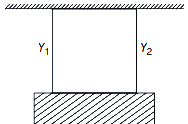
Two wires of equal length and equal cross-sectional areas are suspended as shown in the figure. Their Young's moduli are $Y_1$ and $Y_2$,respectively. The equivalent Young's modulus is
A
$Y_1+Y_2$
B
$\frac{Y_1+Y_2}{2}$
C
$\frac{Y_1 Y_2}{Y_1+Y_2}$
D
$\sqrt{Y_1 Y_2}$
Solution
(B) Given,two wires have the same length and equal cross-sectional area.
$l_1 = l_2 = l$ and $A_1 = A_2 = A$.
Let $m$ be the mass of the hanging load.
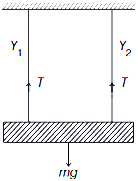
From the figure,the total upward force is $2T = mg$,where $T$ is the tension in each wire.
Thus,$T = \frac{mg}{2}$.
The stress on each wire is $\text{stress} = \frac{T}{A} = \frac{mg}{2A}$.
Since the wires are connected to a rigid bar,they undergo the same extension $\Delta l$ when the load is applied.
The Young's modulus for each wire is given by:
$Y_1 = \frac{\text{stress}}{\text{strain}} = \frac{mg/2A}{\Delta l/l} = \frac{mgl}{2A \Delta l} \implies \frac{mgl}{A \Delta l} = 2Y_1$ ... $(i)$
$Y_2 = \frac{\text{stress}}{\text{strain}} = \frac{mg/2A}{\Delta l/l} = \frac{mgl}{2A \Delta l} \implies \frac{mgl}{A \Delta l} = 2Y_2$ ... (ii)
If $Y$ is the equivalent Young's modulus of the combination,then the total force $mg$ is supported by an equivalent wire of area $2A$:
$Y = \frac{\text{total stress}}{\text{total strain}} = \frac{mg/2A}{\Delta l/l} = \frac{mgl}{2A \Delta l}$.
Alternatively,considering the force balance: $mg = F_1 + F_2 = \frac{Y_1 A \Delta l}{l} + \frac{Y_2 A \Delta l}{l} = \frac{(Y_1 + Y_2) A \Delta l}{l}$.
For the equivalent system: $mg = \frac{Y (2A) \Delta l}{l}$.
Equating the two expressions for $mg$:
$\frac{Y (2A) \Delta l}{l} = \frac{(Y_1 + Y_2) A \Delta l}{l} \implies 2Y = Y_1 + Y_2 \implies Y = \frac{Y_1 + Y_2}{2}$.
$l_1 = l_2 = l$ and $A_1 = A_2 = A$.
Let $m$ be the mass of the hanging load.
From the figure,the total upward force is $2T = mg$,where $T$ is the tension in each wire.
Thus,$T = \frac{mg}{2}$.
The stress on each wire is $\text{stress} = \frac{T}{A} = \frac{mg}{2A}$.
Since the wires are connected to a rigid bar,they undergo the same extension $\Delta l$ when the load is applied.
The Young's modulus for each wire is given by:
$Y_1 = \frac{\text{stress}}{\text{strain}} = \frac{mg/2A}{\Delta l/l} = \frac{mgl}{2A \Delta l} \implies \frac{mgl}{A \Delta l} = 2Y_1$ ... $(i)$
$Y_2 = \frac{\text{stress}}{\text{strain}} = \frac{mg/2A}{\Delta l/l} = \frac{mgl}{2A \Delta l} \implies \frac{mgl}{A \Delta l} = 2Y_2$ ... (ii)
If $Y$ is the equivalent Young's modulus of the combination,then the total force $mg$ is supported by an equivalent wire of area $2A$:
$Y = \frac{\text{total stress}}{\text{total strain}} = \frac{mg/2A}{\Delta l/l} = \frac{mgl}{2A \Delta l}$.
Alternatively,considering the force balance: $mg = F_1 + F_2 = \frac{Y_1 A \Delta l}{l} + \frac{Y_2 A \Delta l}{l} = \frac{(Y_1 + Y_2) A \Delta l}{l}$.
For the equivalent system: $mg = \frac{Y (2A) \Delta l}{l}$.
Equating the two expressions for $mg$:
$\frac{Y (2A) \Delta l}{l} = \frac{(Y_1 + Y_2) A \Delta l}{l} \implies 2Y = Y_1 + Y_2 \implies Y = \frac{Y_1 + Y_2}{2}$.
0 likes
View Solution343
DifficultMCQ
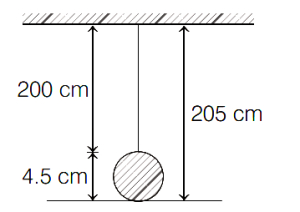
$A$ sphere of mass $2 \,kg$ and diameter $4.5 \,cm$ is attached to the lower end of a steel wire of $2 \,m$ length and area of cross-section $0.24 \times 10^{-6} \,m^2$. The wire is suspended from a $205 \,cm$ high ceiling of a room. When the system is made to oscillate as a simple pendulum, the sphere just grazes the floor at its lowest position. Find the velocity of the sphere at the lowest position. (Young's modulus of steel $= 2 \times 10^{11} \,Nm^{-2}$ and acceleration due to gravity $= 10 \,ms^{-2}$) (in $\,ms^{-1}$)
A
$10$
B
$12$
C
$15$
D
$18$
Solution
(A) Given: Mass $M = 2 \,kg$, Diameter $d = 4.5 \,cm$, Radius $r = 2.25 \,cm = 0.0225 \,m$, Wire length $L = 2 \,m$, Cross-sectional area $A = 0.24 \times 10^{-6} \,m^2$, Ceiling height $H = 205 \,cm = 2.05 \,m$, Young's modulus $Y = 2 \times 10^{11} \,Nm^{-2}$, $g = 10 \,ms^{-2}$.
At the lowest position, the total length of the system (wire + sphere) is $2.05 \,m$. The unstretched length of the wire is $2 \,m$ and the diameter of the sphere is $4.5 \,cm = 0.045 \,m$. The extension $\Delta L$ in the wire is $\Delta L = 2.05 \,m - (2 \,m + 0.045 \,m) = 0.005 \,m$.
The tension $T$ in the wire at the lowest point is the sum of the weight of the sphere and the centrifugal force: $T = Mg + \frac{Mv^2}{R}$, where $R$ is the distance from the ceiling to the center of the sphere, $R = L + \Delta L + r = 2 + 0.005 + 0.0225 = 2.0275 \,m$.
Using Hooke's Law: $Y = \frac{T L}{A \Delta L} \Rightarrow T = \frac{Y A \Delta L}{L}$.
Substituting the values: $T = \frac{(2 \times 10^{11}) \times (0.24 \times 10^{-6}) \times 0.005}{2} = 120 \,N$.
Now, $Mg + \frac{Mv^2}{R} = 120 \Rightarrow (2 \times 10) + \frac{2 v^2}{2.0275} = 120$.
$20 + \frac{2 v^2}{2.0275} = 120 \Rightarrow \frac{2 v^2}{2.0275} = 100 \Rightarrow v^2 = 50 \times 2.0275 = 101.375$.
$v = \sqrt{101.375} \approx 10.07 \,ms^{-1}$. The closest option is $10 \,ms^{-1}$.
At the lowest position, the total length of the system (wire + sphere) is $2.05 \,m$. The unstretched length of the wire is $2 \,m$ and the diameter of the sphere is $4.5 \,cm = 0.045 \,m$. The extension $\Delta L$ in the wire is $\Delta L = 2.05 \,m - (2 \,m + 0.045 \,m) = 0.005 \,m$.
The tension $T$ in the wire at the lowest point is the sum of the weight of the sphere and the centrifugal force: $T = Mg + \frac{Mv^2}{R}$, where $R$ is the distance from the ceiling to the center of the sphere, $R = L + \Delta L + r = 2 + 0.005 + 0.0225 = 2.0275 \,m$.
Using Hooke's Law: $Y = \frac{T L}{A \Delta L} \Rightarrow T = \frac{Y A \Delta L}{L}$.
Substituting the values: $T = \frac{(2 \times 10^{11}) \times (0.24 \times 10^{-6}) \times 0.005}{2} = 120 \,N$.
Now, $Mg + \frac{Mv^2}{R} = 120 \Rightarrow (2 \times 10) + \frac{2 v^2}{2.0275} = 120$.
$20 + \frac{2 v^2}{2.0275} = 120 \Rightarrow \frac{2 v^2}{2.0275} = 100 \Rightarrow v^2 = 50 \times 2.0275 = 101.375$.
$v = \sqrt{101.375} \approx 10.07 \,ms^{-1}$. The closest option is $10 \,ms^{-1}$.
0 likes
View Solution344
EasyMCQ
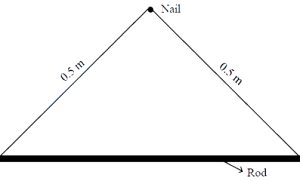
$A$ uniform steel rod of mass $1.8 \,kg$ and length $0.8 \,m$ is hung from a nail with the help of two steel wires,each of area of cross-section $0.01 \,mm^2$ and unstretched length $0.5 \,m$,as shown in the figure. The centre of mass of the rod lies vertically below the nail. The increase in the distance between the centre of mass of the rod and the nail due to stretching of the wires as the rod hangs is . . . . . . $mm$. (Young's modulus of steel $= 2 \times 10^{11} \,N/m^2$ and acceleration due to gravity $= 10 \,m/s^2$)
A
$50$
B
$25$
C
$12.5$
D
$6.25$
Solution
(D) Let the length of each wire be $L = 0.5 \,m$,area $A = 0.01 \,mm^2 = 0.01 \times 10^{-6} \,m^2 = 10^{-8} \,m^2$,and mass of the rod $M = 1.8 \,kg$.
The rod is suspended by two wires forming an isosceles triangle with the nail. The length of the rod is $0.8 \,m$,so the horizontal distance from the center to each end is $0.4 \,m$.
The vertical height $h$ of the nail from the rod is $h = \sqrt{L^2 - (0.4)^2} = \sqrt{0.5^2 - 0.4^2} = \sqrt{0.25 - 0.16} = \sqrt{0.09} = 0.3 \,m$.
The tension $T$ in each wire is determined by the vertical equilibrium: $2T \cos \theta = Mg$,where $\cos \theta = h/L = 0.3/0.5 = 0.6$.
$2T(0.6) = 1.8 \times 10 \implies 1.2T = 18 \implies T = 15 \,N$.
The extension in each wire is $\Delta L = \frac{TL}{AY} = \frac{15 \times 0.5}{10^{-8} \times 2 \times 10^{11}} = \frac{7.5}{2000} = 3.75 \times 10^{-3} \,m = 3.75 \,mm$.
The new length of the wire is $L' = L + \Delta L$. The new vertical height $h'$ is $\sqrt{(L')^2 - (0.4)^2}$.
Using binomial approximation,$h' \approx h + \frac{L}{h} \Delta L = 0.3 + \frac{0.5}{0.3} \times 3.75 \,mm = 0.3 + 1.666 \times 3.75 \,mm = 0.3 + 6.25 \,mm$.
The increase in vertical distance is $h' - h = 6.25 \,mm$.
The rod is suspended by two wires forming an isosceles triangle with the nail. The length of the rod is $0.8 \,m$,so the horizontal distance from the center to each end is $0.4 \,m$.
The vertical height $h$ of the nail from the rod is $h = \sqrt{L^2 - (0.4)^2} = \sqrt{0.5^2 - 0.4^2} = \sqrt{0.25 - 0.16} = \sqrt{0.09} = 0.3 \,m$.
The tension $T$ in each wire is determined by the vertical equilibrium: $2T \cos \theta = Mg$,where $\cos \theta = h/L = 0.3/0.5 = 0.6$.
$2T(0.6) = 1.8 \times 10 \implies 1.2T = 18 \implies T = 15 \,N$.
The extension in each wire is $\Delta L = \frac{TL}{AY} = \frac{15 \times 0.5}{10^{-8} \times 2 \times 10^{11}} = \frac{7.5}{2000} = 3.75 \times 10^{-3} \,m = 3.75 \,mm$.
The new length of the wire is $L' = L + \Delta L$. The new vertical height $h'$ is $\sqrt{(L')^2 - (0.4)^2}$.
Using binomial approximation,$h' \approx h + \frac{L}{h} \Delta L = 0.3 + \frac{0.5}{0.3} \times 3.75 \,mm = 0.3 + 1.666 \times 3.75 \,mm = 0.3 + 6.25 \,mm$.
The increase in vertical distance is $h' - h = 6.25 \,mm$.
0 likes
View Solution345
MediumMCQ
$A$ $500 \,g$ ball is attached to one end of an aluminum wire of area of cross-section $0.5 \,mm^2$ and an unstretched length of $1.4 \,m$. The other end of the wire is fixed to the top of a vertical pole. The ball rotates about the pole in a horizontal plane such that the angle between the wire and the horizontal is $30^{\circ}$. The increase in the length of the wire is . . . . . . $mm$. (Young's modulus of aluminum $= 0.7 \times 10^{11} \,N/m^2$ and acceleration due to gravity $= 10 \,m/s^2$)
A
$0.1$
B
$0.2$
C
$0.3$
D
$0.4$
Solution
(D) Let $L = 1.4 \,m$ be the unstretched length,$A = 0.5 \,mm^2 = 0.5 \times 10^{-6} \,m^2$ be the area,$m = 0.5 \,kg$ be the mass,and $\theta = 30^{\circ}$ be the angle with the horizontal.
Let $r$ be the radius of the horizontal circle and $l$ be the stretched length of the wire.
From geometry,$r = l \cos \theta$ and $h = l \sin \theta$.
The forces acting on the ball are tension $T$ in the wire,gravity $mg$,and centripetal force $m \omega^2 r$.
For vertical equilibrium: $T \sin \theta = mg$.
Thus,$T = \frac{mg}{\sin 30^{\circ}} = \frac{0.5 \times 10}{0.5} = 10 \,N$.
Using Young's modulus formula: $Y = \frac{T L}{A \Delta L}$,where $\Delta L$ is the extension.
$\Delta L = \frac{T L}{A Y} = \frac{10 \times 1.4}{0.5 \times 10^{-6} \times 0.7 \times 10^{11}}$.
$\Delta L = \frac{14}{0.35 \times 10^5} = \frac{14}{35000} = 0.0004 \,m$.
Converting to $mm$: $\Delta L = 0.0004 \times 1000 = 0.4 \,mm$.
Let $r$ be the radius of the horizontal circle and $l$ be the stretched length of the wire.
From geometry,$r = l \cos \theta$ and $h = l \sin \theta$.
The forces acting on the ball are tension $T$ in the wire,gravity $mg$,and centripetal force $m \omega^2 r$.
For vertical equilibrium: $T \sin \theta = mg$.
Thus,$T = \frac{mg}{\sin 30^{\circ}} = \frac{0.5 \times 10}{0.5} = 10 \,N$.
Using Young's modulus formula: $Y = \frac{T L}{A \Delta L}$,where $\Delta L$ is the extension.
$\Delta L = \frac{T L}{A Y} = \frac{10 \times 1.4}{0.5 \times 10^{-6} \times 0.7 \times 10^{11}}$.
$\Delta L = \frac{14}{0.35 \times 10^5} = \frac{14}{35000} = 0.0004 \,m$.
Converting to $mm$: $\Delta L = 0.0004 \times 1000 = 0.4 \,mm$.
0 likes
View Solution346
DifficultMCQ
The ratios of lengths,areas of cross-section,and Young's modulii of steel to that of brass wires shown in the figure are $a, b,$ and $c$ respectively. The ratio of the increase in the lengths of brass to that of steel wires is [Assume that the masses of steel and brass wires are negligible].
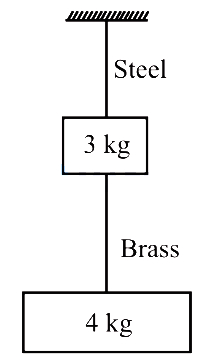
A
$\frac{4 a}{7 b c}$
B
$\frac{7 b c}{4 a}$
C
$\frac{4 b c}{7 a}$
D
$\frac{7 a}{4 b c}$
Solution
(C) Let $L_S, A_S, Y_S$ be the length,area of cross-section,and Young's modulus of the steel wire,and $L_B, A_B, Y_B$ be the corresponding values for the brass wire.
Given ratios are $\frac{L_S}{L_B} = a$,$\frac{A_S}{A_B} = b$,and $\frac{Y_S}{Y_B} = c$.
The tension in the brass wire $(F_B)$ supports the $4 \ kg$ mass,so $F_B = 4g$.
The tension in the steel wire $(F_S)$ supports both the $3 \ kg$ and $4 \ kg$ masses,so $F_S = (3+4)g = 7g$.
From the formula for elongation,$\Delta L = \frac{FL}{AY}$,the elongation of the brass wire is $\Delta L_B = \frac{F_B L_B}{A_B Y_B}$ and the elongation of the steel wire is $\Delta L_S = \frac{F_S L_S}{A_S Y_S}$.
The ratio of the increase in length of brass to steel is:
$\frac{\Delta L_B}{\Delta L_S} = \left(\frac{F_B}{F_S}\right) \left(\frac{L_B}{L_S}\right) \left(\frac{A_S}{A_B}\right) \left(\frac{Y_S}{Y_B}\right)$
Substituting the given ratios:
$\frac{\Delta L_B}{\Delta L_S} = \left(\frac{4g}{7g}\right) \left(\frac{1}{a}\right) (b) (c) = \frac{4bc}{7a}$.
Given ratios are $\frac{L_S}{L_B} = a$,$\frac{A_S}{A_B} = b$,and $\frac{Y_S}{Y_B} = c$.
The tension in the brass wire $(F_B)$ supports the $4 \ kg$ mass,so $F_B = 4g$.
The tension in the steel wire $(F_S)$ supports both the $3 \ kg$ and $4 \ kg$ masses,so $F_S = (3+4)g = 7g$.
From the formula for elongation,$\Delta L = \frac{FL}{AY}$,the elongation of the brass wire is $\Delta L_B = \frac{F_B L_B}{A_B Y_B}$ and the elongation of the steel wire is $\Delta L_S = \frac{F_S L_S}{A_S Y_S}$.
The ratio of the increase in length of brass to steel is:
$\frac{\Delta L_B}{\Delta L_S} = \left(\frac{F_B}{F_S}\right) \left(\frac{L_B}{L_S}\right) \left(\frac{A_S}{A_B}\right) \left(\frac{Y_S}{Y_B}\right)$
Substituting the given ratios:
$\frac{\Delta L_B}{\Delta L_S} = \left(\frac{4g}{7g}\right) \left(\frac{1}{a}\right) (b) (c) = \frac{4bc}{7a}$.
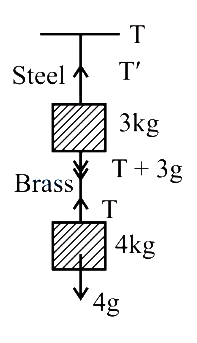
0 likes
View Solution347
MediumMCQ
One end of a steel wire of radius $r$ is fixed to a ceiling and a load of $3 \ kg$ is attached to the free end of the wire. Another wire made of copper of radius $2r$ is attached to the bottom of the $3 \ kg$ load and a $2 \ kg$ load is attached to the free end of the copper wire. The ratio of longitudinal strains produced in copper and steel wires is (Young modulus of steel $= 20 \times 10^{10} \ Nm^{-2}$,Young modulus of copper $= 12 \times 10^{10} \ Nm^{-2}$)
A
$6: 1$
B
$1: 6$
C
$2: 3$
D
$3: 2$
Solution
(B) The longitudinal strain $\epsilon$ is given by $\epsilon = \frac{\text{Stress}}{Y} = \frac{F}{A \cdot Y}$,where $F$ is the tension,$A$ is the cross-sectional area,and $Y$ is the Young's modulus.
For the steel wire: Tension $F_s = (3 + 2) \ kg \times g = 5g$. Area $A_s = \pi r^2$. Young's modulus $Y_s = 20 \times 10^{10} \ Nm^{-2}$.
Strain in steel $\epsilon_s = \frac{5g}{\pi r^2 \cdot 20 \times 10^{10}}$.
For the copper wire: Tension $F_c = 2 \ kg \times g = 2g$. Area $A_c = \pi (2r)^2 = 4\pi r^2$. Young's modulus $Y_c = 12 \times 10^{10} \ Nm^{-2}$.
Strain in copper $\epsilon_c = \frac{2g}{4\pi r^2 \cdot 12 \times 10^{10}} = \frac{g}{2\pi r^2 \cdot 12 \times 10^{10}} = \frac{g}{24\pi r^2 \times 10^{10}}$.
Ratio $\frac{\epsilon_c}{\epsilon_s} = \frac{g}{24\pi r^2 \times 10^{10}} \times \frac{20\pi r^2 \times 10^{10}}{5g} = \frac{20}{24 \times 5} = \frac{20}{120} = \frac{1}{6}$.
Thus,the ratio is $1: 6$.
For the steel wire: Tension $F_s = (3 + 2) \ kg \times g = 5g$. Area $A_s = \pi r^2$. Young's modulus $Y_s = 20 \times 10^{10} \ Nm^{-2}$.
Strain in steel $\epsilon_s = \frac{5g}{\pi r^2 \cdot 20 \times 10^{10}}$.
For the copper wire: Tension $F_c = 2 \ kg \times g = 2g$. Area $A_c = \pi (2r)^2 = 4\pi r^2$. Young's modulus $Y_c = 12 \times 10^{10} \ Nm^{-2}$.
Strain in copper $\epsilon_c = \frac{2g}{4\pi r^2 \cdot 12 \times 10^{10}} = \frac{g}{2\pi r^2 \cdot 12 \times 10^{10}} = \frac{g}{24\pi r^2 \times 10^{10}}$.
Ratio $\frac{\epsilon_c}{\epsilon_s} = \frac{g}{24\pi r^2 \times 10^{10}} \times \frac{20\pi r^2 \times 10^{10}}{5g} = \frac{20}{24 \times 5} = \frac{20}{120} = \frac{1}{6}$.
Thus,the ratio is $1: 6$.
0 likes
View Solution348
MediumMCQ
Consider a rod of length $1.0 \ m$ with a cross-sectional area of $0.50 \ cm^2$. The rod supports a $500 \ kg$ platform that hangs attached to the rod's lower end. What is the elongation of the rod under the stress,ignoring the weight of the rod (in $mm$)? Consider Young's modulus to be $10^{11} \ Pa$ and $g = 10 \ m \ s^{-2}$.
A
$2$
B
$0.5$
C
$1.5$
D
$1$
Solution
(D) The formula for Young's modulus $(Y)$ is given by $Y = \frac{\text{stress}}{\text{strain}}$.
Stress is defined as force per unit area $(F/A)$,and strain is the ratio of change in length to original length $(\Delta L/L)$.
Given: $L = 1.0 \ m$,$A = 0.50 \ cm^2 = 0.50 \times 10^{-4} \ m^2$,$m = 500 \ kg$,$Y = 10^{11} \ Pa$,and $g = 10 \ m \ s^{-2}$.
The force $F$ acting on the rod is the weight of the platform: $F = mg = 500 \times 10 = 5000 \ N$.
Substituting these into the formula $Y = \frac{F/A}{\Delta L/L}$,we get $\Delta L = \frac{FL}{AY}$.
$\Delta L = \frac{5000 \times 1.0}{0.50 \times 10^{-4} \times 10^{11}} = \frac{5000}{0.50 \times 10^7} = \frac{5000}{5000000} = 10^{-3} \ m$.
Therefore,the elongation $\Delta L = 1 \ mm$.
Stress is defined as force per unit area $(F/A)$,and strain is the ratio of change in length to original length $(\Delta L/L)$.
Given: $L = 1.0 \ m$,$A = 0.50 \ cm^2 = 0.50 \times 10^{-4} \ m^2$,$m = 500 \ kg$,$Y = 10^{11} \ Pa$,and $g = 10 \ m \ s^{-2}$.
The force $F$ acting on the rod is the weight of the platform: $F = mg = 500 \times 10 = 5000 \ N$.
Substituting these into the formula $Y = \frac{F/A}{\Delta L/L}$,we get $\Delta L = \frac{FL}{AY}$.
$\Delta L = \frac{5000 \times 1.0}{0.50 \times 10^{-4} \times 10^{11}} = \frac{5000}{0.50 \times 10^7} = \frac{5000}{5000000} = 10^{-3} \ m$.
Therefore,the elongation $\Delta L = 1 \ mm$.
0 likes
View Solution349
EasyMCQ
The lengths of four wires $A, B, C$ and $D$ made of the same material are $1 \,m, 2 \,m, 3 \,m$ and $4 \,m$ respectively. The radii of the wires $A, B, C$ and $D$ are $0.2 \,mm, 0.4 \,mm, 0.6 \,mm$ and $0.8 \,mm$ respectively. For the same applied tension,the elongation is more in which wire?
A
$A$
B
$B$
C
$C$
D
All have the same elongation
Solution
(A) The Young's modulus $Y$ is given by $Y = \frac{F/A}{\Delta l/l} = \frac{F \cdot l}{\pi r^2 \cdot \Delta l}$.
Rearranging for elongation $\Delta l$,we get $\Delta l = \frac{F \cdot l}{Y \cdot \pi r^2}$.
Since the material is the same ($Y$ is constant) and the tension $F$ is the same,$\Delta l \propto \frac{l}{r^2}$.
For wire $A$: $\Delta l_A \propto \frac{1}{(0.2)^2} = \frac{1}{0.04} = 25$.
For wire $B$: $\Delta l_B \propto \frac{2}{(0.4)^2} = \frac{2}{0.16} = 12.5$.
For wire $C$: $\Delta l_C \propto \frac{3}{(0.6)^2} = \frac{3}{0.36} = 8.33$.
For wire $D$: $\Delta l_D \propto \frac{4}{(0.8)^2} = \frac{4}{0.64} = 6.25$.
Comparing the values,the elongation is greatest in wire $A$.
Rearranging for elongation $\Delta l$,we get $\Delta l = \frac{F \cdot l}{Y \cdot \pi r^2}$.
Since the material is the same ($Y$ is constant) and the tension $F$ is the same,$\Delta l \propto \frac{l}{r^2}$.
For wire $A$: $\Delta l_A \propto \frac{1}{(0.2)^2} = \frac{1}{0.04} = 25$.
For wire $B$: $\Delta l_B \propto \frac{2}{(0.4)^2} = \frac{2}{0.16} = 12.5$.
For wire $C$: $\Delta l_C \propto \frac{3}{(0.6)^2} = \frac{3}{0.36} = 8.33$.
For wire $D$: $\Delta l_D \propto \frac{4}{(0.8)^2} = \frac{4}{0.64} = 6.25$.
Comparing the values,the elongation is greatest in wire $A$.
0 likes
View Solution350
DifficultMCQ
If the ratio of lengths,radii and Young's modulus of steel and brass wires shown in the figure are $a, b$ and $c$ respectively,the ratio between the increase in lengths of brass and steel wires would be
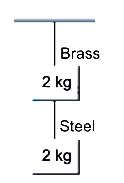
A
$\frac{b^2 a}{2 c}$
B
$\frac{b c}{2 a^2}$
C
$\frac{b a^2}{2 c}$
D
$\frac{a}{2 b^2 c}$
Solution
(D) Let $l_s, r_s, Y_s$ be the length,radius,and Young's modulus of the steel wire,and $l_b, r_b, Y_b$ be those of the brass wire.
Given ratios: $\frac{l_s}{l_b} = a$,$\frac{r_s}{r_b} = b$,$\frac{Y_s}{Y_b} = c$.
From the free body diagram,the tension in the steel wire is $F_s = 2g$ and the tension in the brass wire is $F_b = 2g + 2g = 4g$.
The elongation $\Delta l$ is given by $\Delta l = \frac{F l}{A Y} = \frac{F l}{\pi r^2 Y}$.
Thus,the ratio of elongation of brass to steel is:
$\frac{\Delta l_b}{\Delta l_s} = \frac{F_b l_b}{\pi r_b^2 Y_b} \cdot \frac{\pi r_s^2 Y_s}{F_s l_s} = \left(\frac{F_b}{F_s}\right) \left(\frac{l_b}{l_s}\right) \left(\frac{r_s}{r_b}\right)^2 \left(\frac{Y_s}{Y_b}\right)$.
Substituting the given values:
$\frac{\Delta l_b}{\Delta l_s} = \left(\frac{4g}{2g}\right) \left(\frac{1}{a}\right) (b)^2 (c) = 2 \cdot \frac{1}{a} \cdot b^2 \cdot c = \frac{2 b^2 c}{a}$.
Wait,re-evaluating the question's provided solution steps: The question asks for the ratio of brass to steel elongation. Based on the provided options and the standard derivation,the correct expression is $\frac{2 b^2 c}{a}$. However,checking the provided options,none match this. Let's re-read the ratio definitions: $a = l_s/l_b$,$b = r_s/r_b$,$c = Y_s/Y_b$. The ratio $\Delta l_b / \Delta l_s = (F_b/F_s) \cdot (l_b/l_s) \cdot (r_s/r_b)^2 \cdot (Y_s/Y_b) = (4g/2g) \cdot (1/a) \cdot b^2 \cdot c = 2b^2c/a$. If the question intended $\Delta l_s / \Delta l_b$,it would be $a/(2b^2c)$,which is option $D$.
Given ratios: $\frac{l_s}{l_b} = a$,$\frac{r_s}{r_b} = b$,$\frac{Y_s}{Y_b} = c$.
From the free body diagram,the tension in the steel wire is $F_s = 2g$ and the tension in the brass wire is $F_b = 2g + 2g = 4g$.
The elongation $\Delta l$ is given by $\Delta l = \frac{F l}{A Y} = \frac{F l}{\pi r^2 Y}$.
Thus,the ratio of elongation of brass to steel is:
$\frac{\Delta l_b}{\Delta l_s} = \frac{F_b l_b}{\pi r_b^2 Y_b} \cdot \frac{\pi r_s^2 Y_s}{F_s l_s} = \left(\frac{F_b}{F_s}\right) \left(\frac{l_b}{l_s}\right) \left(\frac{r_s}{r_b}\right)^2 \left(\frac{Y_s}{Y_b}\right)$.
Substituting the given values:
$\frac{\Delta l_b}{\Delta l_s} = \left(\frac{4g}{2g}\right) \left(\frac{1}{a}\right) (b)^2 (c) = 2 \cdot \frac{1}{a} \cdot b^2 \cdot c = \frac{2 b^2 c}{a}$.
Wait,re-evaluating the question's provided solution steps: The question asks for the ratio of brass to steel elongation. Based on the provided options and the standard derivation,the correct expression is $\frac{2 b^2 c}{a}$. However,checking the provided options,none match this. Let's re-read the ratio definitions: $a = l_s/l_b$,$b = r_s/r_b$,$c = Y_s/Y_b$. The ratio $\Delta l_b / \Delta l_s = (F_b/F_s) \cdot (l_b/l_s) \cdot (r_s/r_b)^2 \cdot (Y_s/Y_b) = (4g/2g) \cdot (1/a) \cdot b^2 \cdot c = 2b^2c/a$. If the question intended $\Delta l_s / \Delta l_b$,it would be $a/(2b^2c)$,which is option $D$.
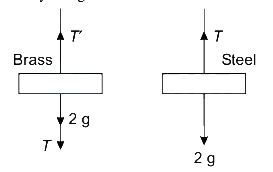
0 likes
View SolutionMechanical Properties of Solids — Young’s Modulus · Frequently Asked Questions
1Are these Mechanical Properties of Solids questions useful for JEE and NEET?
Yes. All questions in this section are mapped to JEE Main and NEET exam patterns. Previous year questions from JEE Main, NEET, GUJCET and state-level exams are included with full solutions.
2Can I switch to Hindi or Gujarati for these questions?
Yes. Use the language tabs in the hero section or the sidebar to view the same questions and solutions in English, Hindi or Gujarati.
3How do I generate a question paper from this subtopic?
Use the Vedclass Exam Paper Generator — select the chapter and subtopic, set difficulty, and generate Sets A, B, C, D automatically. First 3 chapters of every subject are free.
Vedclass Products
For Students
Vedclass Test Series
Mock tests in real JEE/NEET style with performance analysis. 5-day free trial.
Start Free TrialFor Teachers
Exam Paper Generator
Generate Set A/B/C/D papers from this chapter in 2 minutes. 3 chapters free.
Try FreeFor Institutes
Online Exam Module
Live online exams with unlimited students, 360° analytics & white-label branding.
See DemoFor Teachers & Institutes
Generate a Mechanical Properties of Solids Exam Paper in 2 Minutes
Select subtopic & difficulty — Sets A, B, C, D auto-generated with No Repeat logic.
First 3 chapters of every subject are free — no payment required.