
A English
Young’s Modulus Questions in English
Class 11 Physics · Mechanical Properties of Solids · Young’s Modulus
394+
Questions
English
Language
100%
With Solutions
Showing 49 of 394 questions in English
251
EasyMCQ
For a solid rod,the Young's modulus of elasticity is $3.2 \times 10^{11} \, N m^{-2}$ and density is $8 \times 10^3 \, kg m^{-3}$. The velocity of longitudinal wave in the rod will be $......... \times 10^{3} \, m s^{-1}$.
A
$145.75$
B
$3.65$
C
$18.96$
D
$6.32$
Solution
(D) The velocity of a longitudinal wave in a solid rod is given by the formula $v = \sqrt{\frac{Y}{\rho}}$,where $Y$ is the Young's modulus and $\rho$ is the density of the material.
Given values are $Y = 3.2 \times 10^{11} \, N m^{-2}$ and $\rho = 8 \times 10^3 \, kg m^{-3}$.
Substituting these values into the formula:
$v = \sqrt{\frac{3.2 \times 10^{11}}{8 \times 10^3}}$
$v = \sqrt{0.4 \times 10^8}$
$v = \sqrt{40 \times 10^6}$
$v = \sqrt{40} \times 10^3 \, m s^{-1}$
Since $\sqrt{40} \approx 6.32$,the velocity is $6.32 \times 10^3 \, m s^{-1}$.
Given values are $Y = 3.2 \times 10^{11} \, N m^{-2}$ and $\rho = 8 \times 10^3 \, kg m^{-3}$.
Substituting these values into the formula:
$v = \sqrt{\frac{3.2 \times 10^{11}}{8 \times 10^3}}$
$v = \sqrt{0.4 \times 10^8}$
$v = \sqrt{40 \times 10^6}$
$v = \sqrt{40} \times 10^3 \, m s^{-1}$
Since $\sqrt{40} \approx 6.32$,the velocity is $6.32 \times 10^3 \, m s^{-1}$.
0 likes
View Solution252
MediumMCQ
Under the same load,wire $A$ having length $5.0 \, m$ and cross-section $2.5 \times 10^{-5} \, m^2$ stretches uniformly by the same amount as another wire $B$ of length $6.0 \, m$ and a cross-section of $3.0 \times 10^{-5} \, m^2$ stretches. The ratio of the Young's modulus of wire $A$ to that of wire $B$ will be
A
$1:4$
B
$1:1$
C
$1:10$
D
$1:2$
Solution
(B) The formula for Young's modulus $Y$ is given by $Y = \frac{F L}{A \Delta L}$,where $F$ is the load,$L$ is the length,$A$ is the cross-sectional area,and $\Delta L$ is the extension.
Given that the load $F$ and the extension $\Delta L$ are the same for both wires,we have $Y \propto \frac{L}{A}$.
For wire $A$: $L_A = 5.0 \, m$,$A_A = 2.5 \times 10^{-5} \, m^2$.
For wire $B$: $L_B = 6.0 \, m$,$A_B = 3.0 \times 10^{-5} \, m^2$.
The ratio of Young's moduli is $\frac{Y_A}{Y_B} = \frac{L_A / A_A}{L_B / A_B} = \frac{L_A}{A_A} \times \frac{A_B}{L_B}$.
Substituting the values: $\frac{Y_A}{Y_B} = \frac{5.0}{2.5 \times 10^{-5}} \times \frac{3.0 \times 10^{-5}}{6.0} = \frac{5.0}{2.5} \times \frac{3.0}{6.0} = 2 \times 0.5 = 1$.
Thus,the ratio is $1:1$.
Given that the load $F$ and the extension $\Delta L$ are the same for both wires,we have $Y \propto \frac{L}{A}$.
For wire $A$: $L_A = 5.0 \, m$,$A_A = 2.5 \times 10^{-5} \, m^2$.
For wire $B$: $L_B = 6.0 \, m$,$A_B = 3.0 \times 10^{-5} \, m^2$.
The ratio of Young's moduli is $\frac{Y_A}{Y_B} = \frac{L_A / A_A}{L_B / A_B} = \frac{L_A}{A_A} \times \frac{A_B}{L_B}$.
Substituting the values: $\frac{Y_A}{Y_B} = \frac{5.0}{2.5 \times 10^{-5}} \times \frac{3.0 \times 10^{-5}}{6.0} = \frac{5.0}{2.5} \times \frac{3.0}{6.0} = 2 \times 0.5 = 1$.
Thus,the ratio is $1:1$.
0 likes
View Solution253
MediumMCQ
The Young's modulus of a steel wire of length $6\,m$ and cross-sectional area $3\,mm^2$ is $2 \times 10^{11}\,N/m^2$. The wire is suspended from its support on a given planet. $A$ block of mass $4\,kg$ is attached to the free end of the wire. The acceleration due to gravity on the planet is $\frac{1}{4}$ of its value on the Earth. The elongation of the wire is (Take $g$ on the Earth $= 10\,m/s^2$):
A
$1\,cm$
B
$1\,mm$
C
$0.1\,mm$
D
$0.1\,cm$
Solution
(C) Given:
Length $L = 6\,m$
Area $A = 3\,mm^2 = 3 \times 10^{-6}\,m^2$
Young's modulus $Y = 2 \times 10^{11}\,N/m^2$
Mass $m = 4\,kg$
Gravity on Earth $g_e = 10\,m/s^2$
Gravity on planet $g_p = \frac{1}{4} g_e = \frac{10}{4} = 2.5\,m/s^2$
The tension $F$ in the wire is equal to the weight of the block on the planet:
$F = m \times g_p = 4 \times 2.5 = 10\,N$
The formula for elongation $\Delta L$ is:
$\Delta L = \frac{FL}{AY}$
Substituting the values:
$\Delta L = \frac{10 \times 6}{3 \times 10^{-6} \times 2 \times 10^{11}}$
$\Delta L = \frac{60}{6 \times 10^5} = 10 \times 10^{-5} = 10^{-4}\,m$
Converting to millimeters:
$\Delta L = 10^{-4} \times 10^3\,mm = 0.1\,mm$
Length $L = 6\,m$
Area $A = 3\,mm^2 = 3 \times 10^{-6}\,m^2$
Young's modulus $Y = 2 \times 10^{11}\,N/m^2$
Mass $m = 4\,kg$
Gravity on Earth $g_e = 10\,m/s^2$
Gravity on planet $g_p = \frac{1}{4} g_e = \frac{10}{4} = 2.5\,m/s^2$
The tension $F$ in the wire is equal to the weight of the block on the planet:
$F = m \times g_p = 4 \times 2.5 = 10\,N$
The formula for elongation $\Delta L$ is:
$\Delta L = \frac{FL}{AY}$
Substituting the values:
$\Delta L = \frac{10 \times 6}{3 \times 10^{-6} \times 2 \times 10^{11}}$
$\Delta L = \frac{60}{6 \times 10^5} = 10 \times 10^{-5} = 10^{-4}\,m$
Converting to millimeters:
$\Delta L = 10^{-4} \times 10^3\,mm = 0.1\,mm$
0 likes
View Solution254
EasyMCQ
$A$ steel rod has a radius of $20\,mm$ and a length of $2.0\,m$. $A$ force of $62.8\,kN$ stretches it along its length. Young's modulus of steel is $2.0 \times 10^{11}\,N/m^2$. The longitudinal strain produced in the wire is $..........\times 10^{-5}$.
A
$24$
B
$23$
C
$22$
D
$25$
Solution
(D) Given: Radius $r = 20\,mm = 0.02\,m$,Force $F = 62.8\,kN = 62.8 \times 10^3\,N$,Young's modulus $Y = 2.0 \times 10^{11}\,N/m^2$.
Stress is defined as $\text{Stress} = \frac{F}{A} = \frac{F}{\pi r^2}$.
Substituting the values: $\text{Stress} = \frac{62.8 \times 10^3}{\pi \times (0.02)^2} = \frac{62.8 \times 10^3}{3.14 \times 4 \times 10^{-4}} = \frac{62.8 \times 10^3}{12.56 \times 10^{-4}} = 5 \times 10^7\,N/m^2$.
Longitudinal strain is given by $\text{Strain} = \frac{\text{Stress}}{Y}$.
$\text{Strain} = \frac{5 \times 10^7}{2.0 \times 10^{11}} = 2.5 \times 10^{-4}$.
Converting to the required format: $2.5 \times 10^{-4} = 25 \times 10^{-5}$.
Stress is defined as $\text{Stress} = \frac{F}{A} = \frac{F}{\pi r^2}$.
Substituting the values: $\text{Stress} = \frac{62.8 \times 10^3}{\pi \times (0.02)^2} = \frac{62.8 \times 10^3}{3.14 \times 4 \times 10^{-4}} = \frac{62.8 \times 10^3}{12.56 \times 10^{-4}} = 5 \times 10^7\,N/m^2$.
Longitudinal strain is given by $\text{Strain} = \frac{\text{Stress}}{Y}$.
$\text{Strain} = \frac{5 \times 10^7}{2.0 \times 10^{11}} = 2.5 \times 10^{-4}$.
Converting to the required format: $2.5 \times 10^{-4} = 25 \times 10^{-5}$.
0 likes
View Solution255
EasyMCQ
$A$ steel rod of length $1\,m$ and cross-sectional area $10^{-4}\,m^2$ is heated from $0^{\circ}C$ to $200^{\circ}C$ without being allowed to extend or bend. The compressive force produced in the rod is $........\times 10^4\,N$. (Given: Young's modulus of steel $Y = 2 \times 10^{11}\,N/m^2$,coefficient of linear expansion $\alpha = 10^{-5}\,K^{-1}$)
A
$4$
B
$3$
C
$2$
D
$1$
Solution
(A) The thermal stress produced in a rod prevented from expanding is given by $\sigma = Y \alpha \Delta T$.
The compressive force $F$ is given by $F = \text{Stress} \times A = Y A \alpha \Delta T$.
Given values:
$Y = 2 \times 10^{11}\,N/m^2$
$A = 10^{-4}\,m^2$
$\alpha = 10^{-5}\,K^{-1}$
$\Delta T = 200^{\circ}C - 0^{\circ}C = 200\,K$
Substituting the values:
$F = (2 \times 10^{11}) \times (10^{-4}) \times (10^{-5}) \times (200)$
$F = 2 \times 10^{11} \times 10^{-9} \times 200$
$F = 2 \times 10^2 \times 200 = 400 \times 100 = 4 \times 10^4\,N$.
Thus,the compressive force is $4 \times 10^4\,N$.
The compressive force $F$ is given by $F = \text{Stress} \times A = Y A \alpha \Delta T$.
Given values:
$Y = 2 \times 10^{11}\,N/m^2$
$A = 10^{-4}\,m^2$
$\alpha = 10^{-5}\,K^{-1}$
$\Delta T = 200^{\circ}C - 0^{\circ}C = 200\,K$
Substituting the values:
$F = (2 \times 10^{11}) \times (10^{-4}) \times (10^{-5}) \times (200)$
$F = 2 \times 10^{11} \times 10^{-9} \times 200$
$F = 2 \times 10^2 \times 200 = 400 \times 100 = 4 \times 10^4\,N$.
Thus,the compressive force is $4 \times 10^4\,N$.
1 likes
View Solution256
DifficultMCQ
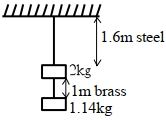
Two wires each of radius $0.2\,cm$ and negligible mass, one made of steel and the other made of brass, are loaded as shown in the figure. The elongation of the steel wire is $.........\times 10^{-6}\,m$. [Young's modulus for steel $= 2 \times 10^{11}\,N/m^2$ and $g = 10\,m/s^2$]
A
$10$
B
$5$
C
$4$
D
$20$
Solution
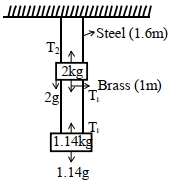
(D) The tension in the brass wire $(T_1)$ supports the $1.14\,kg$ mass:
$T_1 = 1.14 \times g = 1.14 \times 10 = 11.4\,N$.
The tension in the steel wire $(T_2)$ supports both the $2\,kg$ mass and the $1.14\,kg$ mass:
$T_2 = (2 + 1.14) \times g = 3.14 \times 10 = 31.4\,N$.
The elongation $(\Delta L)$ in the steel wire is given by:
$\Delta L = \frac{T_2 L}{A Y} = \frac{T_2 L}{(\pi r^2) Y}$.
Given: $T_2 = 31.4\,N$, $L = 1.6\,m$, $r = 0.2\,cm = 0.2 \times 10^{-2}\,m$, $Y = 2 \times 10^{11}\,N/m^2$.
$\Delta L = \frac{31.4 \times 1.6}{\pi \times (0.2 \times 10^{-2})^2 \times 2 \times 10^{11}} = \frac{50.24}{3.14 \times 0.04 \times 10^{-4} \times 2 \times 10^{11}} = \frac{50.24}{2.512 \times 10^7} \approx 20 \times 10^{-6}\,m$.
Thus, the elongation is $20 \times 10^{-6}\,m$.
$T_1 = 1.14 \times g = 1.14 \times 10 = 11.4\,N$.
The tension in the steel wire $(T_2)$ supports both the $2\,kg$ mass and the $1.14\,kg$ mass:
$T_2 = (2 + 1.14) \times g = 3.14 \times 10 = 31.4\,N$.
The elongation $(\Delta L)$ in the steel wire is given by:
$\Delta L = \frac{T_2 L}{A Y} = \frac{T_2 L}{(\pi r^2) Y}$.
Given: $T_2 = 31.4\,N$, $L = 1.6\,m$, $r = 0.2\,cm = 0.2 \times 10^{-2}\,m$, $Y = 2 \times 10^{11}\,N/m^2$.
$\Delta L = \frac{31.4 \times 1.6}{\pi \times (0.2 \times 10^{-2})^2 \times 2 \times 10^{11}} = \frac{50.24}{3.14 \times 0.04 \times 10^{-4} \times 2 \times 10^{11}} = \frac{50.24}{2.512 \times 10^7} \approx 20 \times 10^{-6}\,m$.
Thus, the elongation is $20 \times 10^{-6}\,m$.
0 likes
View Solution257
MediumMCQ
Young's moduli of the material of wires $A$ and $B$ are in the ratio of $1: 4$,while their areas of cross-section are in the ratio of $1: 3$. If the same amount of load is applied to both the wires,the amount of elongation produced in the wires $A$ and $B$ will be in the ratio of [Assume length of wires $A$ and $B$ are same].
A
$36: 1$
B
$12: 1$
C
$1: 36$
D
$12: 1$
Solution
(B) The formula for elongation $\Delta L$ in a wire is given by $\Delta L = \frac{FL}{AY}$,where $F$ is the load,$L$ is the length,$A$ is the area of cross-section,and $Y$ is the Young's modulus.
Given that the load $F$ and length $L$ are the same for both wires,we have $\Delta L \propto \frac{1}{AY}$.
Therefore,the ratio of elongation is $\frac{\Delta L_A}{\Delta L_B} = \frac{A_B}{A_A} \times \frac{Y_B}{Y_A}$.
Given $\frac{Y_A}{Y_B} = \frac{1}{4}$ and $\frac{A_A}{A_B} = \frac{1}{3}$.
Substituting these values,we get $\frac{\Delta L_A}{\Delta L_B} = \frac{3}{1} \times \frac{4}{1} = \frac{12}{1}$.
Thus,the ratio is $12: 1$.
Given that the load $F$ and length $L$ are the same for both wires,we have $\Delta L \propto \frac{1}{AY}$.
Therefore,the ratio of elongation is $\frac{\Delta L_A}{\Delta L_B} = \frac{A_B}{A_A} \times \frac{Y_B}{Y_A}$.
Given $\frac{Y_A}{Y_B} = \frac{1}{4}$ and $\frac{A_A}{A_B} = \frac{1}{3}$.
Substituting these values,we get $\frac{\Delta L_A}{\Delta L_B} = \frac{3}{1} \times \frac{4}{1} = \frac{12}{1}$.
Thus,the ratio is $12: 1$.
0 likes
View Solution258
MediumMCQ
The length of a wire becomes $l_1$ and $l_2$ when $100\,N$ and $120\,N$ tensions are applied respectively. If $10l_2 = 11l_1$,the natural length of the wire will be $\frac{1}{x} l_1$. Here,the value of $x$ is ........
A
$8$
B
$2$
C
$6$
D
$4$
Solution
(B) Let the natural length of the wire be $\ell_0$ and the force constant be $K$.
According to Hooke's Law,$T = K(\ell - \ell_0)$.
For the first case: $100 = K(l_1 - \ell_0)$ --- $(1)$
For the second case: $120 = K(l_2 - \ell_0)$ --- $(2)$
Dividing equation $(1)$ by $(2)$:
$\frac{100}{120} = \frac{l_1 - \ell_0}{l_2 - \ell_0} \Rightarrow \frac{5}{6} = \frac{l_1 - \ell_0}{l_2 - \ell_0}$
$5(l_2 - \ell_0) = 6(l_1 - \ell_0)$
$5l_2 - 5\ell_0 = 6l_1 - 6\ell_0$
$\ell_0 = 6l_1 - 5l_2$
Given that $10l_2 = 11l_1$,so $l_2 = \frac{11}{10}l_1$.
Substituting $l_2$ in the equation for $\ell_0$:
$\ell_0 = 6l_1 - 5(\frac{11}{10}l_1)$
$\ell_0 = 6l_1 - \frac{11}{2}l_1$
$\ell_0 = \frac{12l_1 - 11l_1}{2} = \frac{1}{2}l_1$
Comparing this with $\frac{1}{x}l_1$,we get $x = 2$.
According to Hooke's Law,$T = K(\ell - \ell_0)$.
For the first case: $100 = K(l_1 - \ell_0)$ --- $(1)$
For the second case: $120 = K(l_2 - \ell_0)$ --- $(2)$
Dividing equation $(1)$ by $(2)$:
$\frac{100}{120} = \frac{l_1 - \ell_0}{l_2 - \ell_0} \Rightarrow \frac{5}{6} = \frac{l_1 - \ell_0}{l_2 - \ell_0}$
$5(l_2 - \ell_0) = 6(l_1 - \ell_0)$
$5l_2 - 5\ell_0 = 6l_1 - 6\ell_0$
$\ell_0 = 6l_1 - 5l_2$
Given that $10l_2 = 11l_1$,so $l_2 = \frac{11}{10}l_1$.
Substituting $l_2$ in the equation for $\ell_0$:
$\ell_0 = 6l_1 - 5(\frac{11}{10}l_1)$
$\ell_0 = 6l_1 - \frac{11}{2}l_1$
$\ell_0 = \frac{12l_1 - 11l_1}{2} = \frac{1}{2}l_1$
Comparing this with $\frac{1}{x}l_1$,we get $x = 2$.
0 likes
View Solution259
MediumMCQ
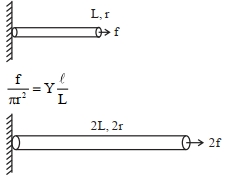
$A$ wire of length $L$ and radius $r$ is clamped rigidly at one end. When the other end of the wire is pulled by a force $f$,its length increases by $l$. Another wire of the same material of length $2L$ and radius $2r$ is pulled by a force $2f$. Then the increase in its length will be
A
$2l$
B
$l$
C
$4l$
D
$l/2$
Solution
(B) The Young's modulus $Y$ is given by the formula $Y = \frac{F/A}{\Delta L/L} = \frac{FL}{A\Delta L}$,where $A = \pi r^2$.
For the first wire: $Y = \frac{fL}{(\pi r^2)l} \Rightarrow l = \frac{fL}{Y\pi r^2}$.
For the second wire: $Y = \frac{(2f)(2L)}{\pi(2r)^2 l'} = \frac{4fL}{4\pi r^2 l'} = \frac{fL}{\pi r^2 l'}$.
Equating the two expressions for $Y$: $\frac{fL}{\pi r^2 l} = \frac{fL}{\pi r^2 l'}$.
Therefore,$l' = l$.
For the first wire: $Y = \frac{fL}{(\pi r^2)l} \Rightarrow l = \frac{fL}{Y\pi r^2}$.
For the second wire: $Y = \frac{(2f)(2L)}{\pi(2r)^2 l'} = \frac{4fL}{4\pi r^2 l'} = \frac{fL}{\pi r^2 l'}$.
Equating the two expressions for $Y$: $\frac{fL}{\pi r^2 l} = \frac{fL}{\pi r^2 l'}$.
Therefore,$l' = l$.
0 likes
View Solution260
DifficultMCQ
$A$ wire of length $L$ and radius $r$ is clamped at one end. If its other end is pulled by a force $F$,its length increases by $l$. If the radius of the wire and the applied force both are reduced to half of their original values keeping original length constant,the increase in length will become.
A
$3$ times
B
$3/2$ times
C
$4$ times
D
$2$ times
Solution
(D) Young's modulus $Y$ is given by the formula: $Y = \frac{\text{Stress}}{\text{Strain}} = \frac{F/A}{\ell/L} = \frac{FL}{A\ell}$.
Since $A = \pi r^2$,we have $Y = \frac{FL}{\pi r^2 \ell}$,which implies $\ell = \frac{FL}{Y \pi r^2}$.
In the initial state,the extension is $\ell = \frac{FL}{Y \pi r^2}$.
In the new state,the force $F' = F/2$ and the radius $r' = r/2$. The length $L$ remains constant.
The new extension $\ell'$ is given by: $\ell' = \frac{F' L}{Y \pi (r')^2} = \frac{(F/2) L}{Y \pi (r/2)^2}$.
Simplifying this,we get: $\ell' = \frac{(F/2) L}{Y \pi (r^2/4)} = \frac{FL}{2 Y \pi (r^2/4)} = \frac{FL}{Y \pi r^2 / 2} = 2 \times \frac{FL}{Y \pi r^2}$.
Substituting the initial expression for $\ell$,we get $\ell' = 2\ell$.
Therefore,the increase in length becomes $2$ times the original value.
Since $A = \pi r^2$,we have $Y = \frac{FL}{\pi r^2 \ell}$,which implies $\ell = \frac{FL}{Y \pi r^2}$.
In the initial state,the extension is $\ell = \frac{FL}{Y \pi r^2}$.
In the new state,the force $F' = F/2$ and the radius $r' = r/2$. The length $L$ remains constant.
The new extension $\ell'$ is given by: $\ell' = \frac{F' L}{Y \pi (r')^2} = \frac{(F/2) L}{Y \pi (r/2)^2}$.
Simplifying this,we get: $\ell' = \frac{(F/2) L}{Y \pi (r^2/4)} = \frac{FL}{2 Y \pi (r^2/4)} = \frac{FL}{Y \pi r^2 / 2} = 2 \times \frac{FL}{Y \pi r^2}$.
Substituting the initial expression for $\ell$,we get $\ell' = 2\ell$.
Therefore,the increase in length becomes $2$ times the original value.
0 likes
View Solution261
DifficultMCQ
Two metallic wires $P$ and $Q$ have the same volume and are made up of the same material. If their areas of cross-section are in the ratio $4:1$ and a force $F_1$ is applied to $P$,an extension of $\Delta l$ is produced. The force required to produce the same extension in $Q$ is $F_2$. The value of $\frac{F_1}{F_2}$ is . . . . . . .
A
$16$
B
$14$
C
$20$
D
$50$
Solution
(A) The Young's modulus $Y$ is given by $Y = \frac{\text{Stress}}{\text{Strain}} = \frac{F/A}{\Delta l/l} = \frac{Fl}{A\Delta l}$.
Rearranging for extension,we get $\Delta l = \frac{Fl}{AY}$.
Since volume $V = A \times l$,we can write $l = \frac{V}{A}$.
Substituting $l$ into the extension formula: $\Delta l = \frac{F(V/A)}{AY} = \frac{FV}{A^2Y}$.
Since $Y$ and $V$ are the same for both wires,$\Delta l \propto \frac{F}{A^2}$.
Given $\Delta l_1 = \Delta l_2$,we have $\frac{F_1}{A_1^2} = \frac{F_2}{A_2^2}$.
Therefore,$\frac{F_1}{F_2} = \frac{A_1^2}{A_2^2} = \left(\frac{A_1}{A_2}\right)^2$.
Given the ratio of areas $\frac{A_1}{A_2} = \frac{4}{1}$,we get $\frac{F_1}{F_2} = (4)^2 = 16$.
Rearranging for extension,we get $\Delta l = \frac{Fl}{AY}$.
Since volume $V = A \times l$,we can write $l = \frac{V}{A}$.
Substituting $l$ into the extension formula: $\Delta l = \frac{F(V/A)}{AY} = \frac{FV}{A^2Y}$.
Since $Y$ and $V$ are the same for both wires,$\Delta l \propto \frac{F}{A^2}$.
Given $\Delta l_1 = \Delta l_2$,we have $\frac{F_1}{A_1^2} = \frac{F_2}{A_2^2}$.
Therefore,$\frac{F_1}{F_2} = \frac{A_1^2}{A_2^2} = \left(\frac{A_1}{A_2}\right)^2$.
Given the ratio of areas $\frac{A_1}{A_2} = \frac{4}{1}$,we get $\frac{F_1}{F_2} = (4)^2 = 16$.
0 likes
View Solution262
DifficultMCQ
Young's modulus of the material of a wire of length $L$ and cross-sectional area $A$ is $Y$. If the length of the wire is doubled and the cross-sectional area is halved,then the Young's modulus will be:
A
$Y/4$
B
$4Y$
C
$Y$
D
$2Y$
Solution
(C) Young's modulus is an intrinsic property of the material of the wire.
It depends only on the nature of the material and the temperature,not on the dimensions of the wire such as its length $L$ or cross-sectional area $A$.
Therefore,even if the length is doubled and the cross-sectional area is halved,the Young's modulus $Y$ remains unchanged.
It depends only on the nature of the material and the temperature,not on the dimensions of the wire such as its length $L$ or cross-sectional area $A$.
Therefore,even if the length is doubled and the cross-sectional area is halved,the Young's modulus $Y$ remains unchanged.
0 likes
View Solution263
DifficultMCQ
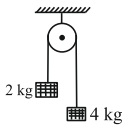
Two blocks of mass $2 \ kg$ and $4 \ kg$ are connected by a metal wire going over a smooth pulley as shown in the figure. The radius of the wire is $4.0 \times 10^{-5} \ m$ and Young's modulus of the metal is $2.0 \times 10^{11} \ N/m^2$. The longitudinal strain developed in the wire is $\frac{1}{\alpha \pi}$. The value of $\alpha$ is [Use $g = 10 \ m/s^2$].
A
$9$
B
$10$
C
$11$
D
$12$
Solution
(D) The tension $T$ in the wire is given by the formula for an Atwood machine:
$T = \frac{2 m_1 m_2}{m_1 + m_2} g = \frac{2 \times 2 \times 4}{2 + 4} \times 10 = \frac{16}{6} \times 10 = \frac{80}{3} \ N$
The cross-sectional area $A$ of the wire is:
$A = \pi r^2 = \pi (4.0 \times 10^{-5})^2 = 16 \pi \times 10^{-10} \ m^2$
Longitudinal strain is defined as:
$\text{Strain} = \frac{\Delta \ell}{\ell} = \frac{F}{AY} = \frac{T}{AY}$
Substituting the values:
$\text{Strain} = \frac{80/3}{16 \pi \times 10^{-10} \times 2.0 \times 10^{11}}$
$\text{Strain} = \frac{80/3}{32 \pi \times 10} = \frac{80}{3 \times 320 \pi} = \frac{80}{960 \pi} = \frac{1}{12 \pi}$
Comparing this with $\frac{1}{\alpha \pi}$,we get $\alpha = 12$.
$T = \frac{2 m_1 m_2}{m_1 + m_2} g = \frac{2 \times 2 \times 4}{2 + 4} \times 10 = \frac{16}{6} \times 10 = \frac{80}{3} \ N$
The cross-sectional area $A$ of the wire is:
$A = \pi r^2 = \pi (4.0 \times 10^{-5})^2 = 16 \pi \times 10^{-10} \ m^2$
Longitudinal strain is defined as:
$\text{Strain} = \frac{\Delta \ell}{\ell} = \frac{F}{AY} = \frac{T}{AY}$
Substituting the values:
$\text{Strain} = \frac{80/3}{16 \pi \times 10^{-10} \times 2.0 \times 10^{11}}$
$\text{Strain} = \frac{80/3}{32 \pi \times 10} = \frac{80}{3 \times 320 \pi} = \frac{80}{960 \pi} = \frac{1}{12 \pi}$
Comparing this with $\frac{1}{\alpha \pi}$,we get $\alpha = 12$.
0 likes
View Solution264
DifficultMCQ
With a rise in temperature,the Young's modulus of elasticity
A
changes erratically
B
decreases
C
increases
D
remains unchanged
Solution
(B) The Young's modulus of elasticity $(Y)$ is a measure of the stiffness of a material.
When the temperature of a solid increases,the thermal energy of the atoms increases,causing the interatomic bonds to weaken.
As the interatomic forces decrease,the material becomes less stiff,which leads to a decrease in the Young's modulus of elasticity.
Therefore,with a rise in temperature,the Young's modulus of elasticity decreases.
When the temperature of a solid increases,the thermal energy of the atoms increases,causing the interatomic bonds to weaken.
As the interatomic forces decrease,the material becomes less stiff,which leads to a decrease in the Young's modulus of elasticity.
Therefore,with a rise in temperature,the Young's modulus of elasticity decreases.
0 likes
View Solution265
DifficultMCQ
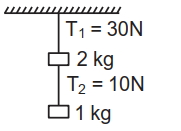
One end of a metal wire is fixed to a ceiling and a load of $2 \ kg$ hangs from the other end. $A$ similar wire is attached to the bottom of the load and another load of $1 \ kg$ hangs from this lower wire. Then the ratio of longitudinal strain of the upper wire to that of the lower wire will be . . . . . . .
[Area of cross section of wire $= 0.005 \ cm^2$,$Y = 2 \times 10^{11} \ Nm^{-2}$ and $g = 10 \ ms^{-2}$]
[Area of cross section of wire $= 0.005 \ cm^2$,$Y = 2 \times 10^{11} \ Nm^{-2}$ and $g = 10 \ ms^{-2}$]
A
$5$
B
$10$
C
$8$
D
$3$
Solution
(D) The longitudinal strain is given by $\text{Strain} = \frac{\Delta L}{L} = \frac{F}{AY}$.
Since the area of cross-section $A$ and Young's modulus $Y$ are the same for both wires,the strain is directly proportional to the tension $F$ in the wire.
For the lower wire,the tension $F_2$ is due to the $1 \ kg$ load: $F_2 = m_2 g = 1 \ kg \times 10 \ ms^{-2} = 10 \ N$.
For the upper wire,the tension $F_1$ is due to both the $2 \ kg$ load and the $1 \ kg$ load: $F_1 = (m_1 + m_2) g = (2 \ kg + 1 \ kg) \times 10 \ ms^{-2} = 30 \ N$.
The ratio of the longitudinal strain of the upper wire to that of the lower wire is:
$\frac{\text{Strain}_1}{\text{Strain}_2} = \frac{F_1 / AY}{F_2 / AY} = \frac{F_1}{F_2} = \frac{30 \ N}{10 \ N} = 3$.
Since the area of cross-section $A$ and Young's modulus $Y$ are the same for both wires,the strain is directly proportional to the tension $F$ in the wire.
For the lower wire,the tension $F_2$ is due to the $1 \ kg$ load: $F_2 = m_2 g = 1 \ kg \times 10 \ ms^{-2} = 10 \ N$.
For the upper wire,the tension $F_1$ is due to both the $2 \ kg$ load and the $1 \ kg$ load: $F_1 = (m_1 + m_2) g = (2 \ kg + 1 \ kg) \times 10 \ ms^{-2} = 30 \ N$.
The ratio of the longitudinal strain of the upper wire to that of the lower wire is:
$\frac{\text{Strain}_1}{\text{Strain}_2} = \frac{F_1 / AY}{F_2 / AY} = \frac{F_1}{F_2} = \frac{30 \ N}{10 \ N} = 3$.
0 likes
View Solution266
DifficultMCQ
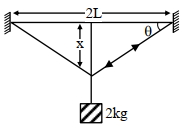
$A$ wire of cross-sectional area $A$,modulus of elasticity $2 \times 10^{11} \text{ N m}^{-2}$,and length $2L = 2 \text{ m}$ is stretched between two vertical rigid supports. When a mass of $2 \text{ kg}$ is suspended at the middle,it sags from its original position,making an angle $\theta = \frac{1}{100} \text{ radian}$ with the horizontal at the points of support. The value of $A$ is . . . . . . $\times 10^{-4} \text{ m}^2$. (Given: $g = 10 \text{ m/s}^2$)
A
$4$
B
$5$
C
$1$
D
$3$
Solution
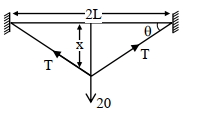
(C) For the equilibrium of the mass in the vertical direction,the vertical components of the tension $T$ in the wire must balance the weight of the mass:
$2T \sin \theta = mg$
Given $m = 2 \text{ kg}$,$g = 10 \text{ m/s}^2$,and $\theta = \frac{1}{100} \text{ rad}$. Using the small angle approximation $\sin \theta \approx \theta$:
$2T \theta = 20$
$T = \frac{10}{\theta} = \frac{10}{1/100} = 1000 \text{ N}$
The original length of the wire is $2L = 2 \text{ m}$,so $L = 1 \text{ m}$.
The new length of the wire is $2 \sqrt{L^2 + x^2}$,where $x = L \tan \theta \approx L \theta$.
The change in length $\Delta L$ is:
$\Delta L = 2 \sqrt{L^2 + x^2} - 2L = 2L \left( \sqrt{1 + \tan^2 \theta} - 1 \right) \approx 2L \left( 1 + \frac{\tan^2 \theta}{2} - 1 \right) = L \tan^2 \theta \approx L \theta^2$
$\Delta L = 1 \times (1/100)^2 = 10^{-4} \text{ m}$
Using Young's modulus $Y = \frac{T/A}{\Delta L / (2L)}$:
$2 \times 10^{11} = \frac{1000 / A}{10^{-4} / 2}$
$2 \times 10^{11} = \frac{2000}{A \times 10^{-4}}$
$A = \frac{2000}{2 \times 10^{11} \times 10^{-4}} = \frac{1000}{10^7} = 10^{-4} \text{ m}^2$
Thus,the value of $A$ is $1 \times 10^{-4} \text{ m}^2$.
$2T \sin \theta = mg$
Given $m = 2 \text{ kg}$,$g = 10 \text{ m/s}^2$,and $\theta = \frac{1}{100} \text{ rad}$. Using the small angle approximation $\sin \theta \approx \theta$:
$2T \theta = 20$
$T = \frac{10}{\theta} = \frac{10}{1/100} = 1000 \text{ N}$
The original length of the wire is $2L = 2 \text{ m}$,so $L = 1 \text{ m}$.
The new length of the wire is $2 \sqrt{L^2 + x^2}$,where $x = L \tan \theta \approx L \theta$.
The change in length $\Delta L$ is:
$\Delta L = 2 \sqrt{L^2 + x^2} - 2L = 2L \left( \sqrt{1 + \tan^2 \theta} - 1 \right) \approx 2L \left( 1 + \frac{\tan^2 \theta}{2} - 1 \right) = L \tan^2 \theta \approx L \theta^2$
$\Delta L = 1 \times (1/100)^2 = 10^{-4} \text{ m}$
Using Young's modulus $Y = \frac{T/A}{\Delta L / (2L)}$:
$2 \times 10^{11} = \frac{1000 / A}{10^{-4} / 2}$
$2 \times 10^{11} = \frac{2000}{A \times 10^{-4}}$
$A = \frac{2000}{2 \times 10^{11} \times 10^{-4}} = \frac{1000}{10^7} = 10^{-4} \text{ m}^2$
Thus,the value of $A$ is $1 \times 10^{-4} \text{ m}^2$.
0 likes
View Solution267
DifficultMCQ
Two persons pull a wire towards themselves. Each person exerts a force of $200 \, N$ on the wire. Young's modulus of the material of the wire is $1 \times 10^{11} \, N \, m^{-2}$. The original length of the wire is $2 \, m$ and the area of cross-section is $2 \, cm^2$. The wire will extend in length by $...... \, \mu m$.
A
$17$
B
$18$
C
$20$
D
$21$
Solution
(C) The formula for Young's modulus $(Y)$ is given by $Y = \frac{F/A}{\Delta \ell / \ell}$, where $F$ is the applied force, $A$ is the area of cross-section, $\ell$ is the original length, and $\Delta \ell$ is the change in length.
Given:
Force $F = 200 \, N$ (Note: In a wire pulled from both ends with $200 \, N$, the tension in the wire is $200 \, N$)
Original length $\ell = 2 \, m$
Area of cross-section $A = 2 \, cm^2 = 2 \times 10^{-4} \, m^2$
Young's modulus $Y = 1 \times 10^{11} \, N \, m^{-2}$
Rearranging the formula to find the extension $\Delta \ell$:
$\Delta \ell = \frac{F \ell}{AY}$
Substituting the values:
$\Delta \ell = \frac{200 \times 2}{(2 \times 10^{-4}) \times (1 \times 10^{11})}$
$\Delta \ell = \frac{400}{2 \times 10^7}$
$\Delta \ell = 200 \times 10^{-7} \, m$
$\Delta \ell = 2 \times 10^{-5} \, m$
Converting to micrometers $(\mu m)$:
$1 \, m = 10^6 \, \mu m$
$\Delta \ell = 2 \times 10^{-5} \times 10^6 \, \mu m = 20 \, \mu m$.
Given:
Force $F = 200 \, N$ (Note: In a wire pulled from both ends with $200 \, N$, the tension in the wire is $200 \, N$)
Original length $\ell = 2 \, m$
Area of cross-section $A = 2 \, cm^2 = 2 \times 10^{-4} \, m^2$
Young's modulus $Y = 1 \times 10^{11} \, N \, m^{-2}$
Rearranging the formula to find the extension $\Delta \ell$:
$\Delta \ell = \frac{F \ell}{AY}$
Substituting the values:
$\Delta \ell = \frac{200 \times 2}{(2 \times 10^{-4}) \times (1 \times 10^{11})}$
$\Delta \ell = \frac{400}{2 \times 10^7}$
$\Delta \ell = 200 \times 10^{-7} \, m$
$\Delta \ell = 2 \times 10^{-5} \, m$
Converting to micrometers $(\mu m)$:
$1 \, m = 10^6 \, \mu m$
$\Delta \ell = 2 \times 10^{-5} \times 10^6 \, \mu m = 20 \, \mu m$.

0 likes
View Solution268
MediumMCQ
The maximum elongation of a steel wire of $1 \,m$ length if the elastic limit of steel and its Young's modulus,respectively,are $8 \times 10^8 \,N \,m^{-2}$ and $2 \times 10^{11} \,N \,m^{-2}$,is: (in $\,mm$)
A
$0.4$
B
$40$
C
$8$
D
$4$
Solution
(D) For maximum elongation,the stress applied must be equal to the elastic limit of the material.
Given:
Length of the wire,$L = 1 \,m$
Elastic limit (maximum stress),$\sigma = 8 \times 10^8 \,N \,m^{-2}$
Young's modulus,$Y = 2 \times 10^{11} \,N \,m^{-2}$
Using the formula for Young's modulus: $Y = \frac{\text{Stress}}{\text{Strain}} = \frac{\sigma}{\Delta L / L}$
Rearranging for elongation $\Delta L$:
$\Delta L = \frac{\sigma \times L}{Y}$
Substituting the values:
$\Delta L = \frac{8 \times 10^8 \times 1}{2 \times 10^{11}}$
$\Delta L = 4 \times 10^{-3} \,m$
Converting to millimeters:
$\Delta L = 4 \,mm$
Thus,the maximum elongation is $4 \,mm$.
Given:
Length of the wire,$L = 1 \,m$
Elastic limit (maximum stress),$\sigma = 8 \times 10^8 \,N \,m^{-2}$
Young's modulus,$Y = 2 \times 10^{11} \,N \,m^{-2}$
Using the formula for Young's modulus: $Y = \frac{\text{Stress}}{\text{Strain}} = \frac{\sigma}{\Delta L / L}$
Rearranging for elongation $\Delta L$:
$\Delta L = \frac{\sigma \times L}{Y}$
Substituting the values:
$\Delta L = \frac{8 \times 10^8 \times 1}{2 \times 10^{11}}$
$\Delta L = 4 \times 10^{-3} \,m$
Converting to millimeters:
$\Delta L = 4 \,mm$
Thus,the maximum elongation is $4 \,mm$.
0 likes
View Solution269
MediumMCQ
$A$ metallic bar of Young's modulus $0.5 \times 10^{11} \,N \,m^{-2}$, coefficient of linear thermal expansion $10^{-5} \,^{\circ}C^{-1}$, length $1 \,m$, and area of cross-section $10^{-3} \,m^2$ is heated from $0^{\circ}C$ to $100^{\circ}C$ without expansion or bending. The compressive force developed in it is:
A
$50 \times 10^3 \,N$
B
$100 \times 10^3 \,N$
C
$2 \times 10^3 \,N$
D
$5 \times 10^3 \,N$
Solution
(A) The thermal strain produced in the bar is given by $\epsilon = \alpha \Delta T$.
Given $\alpha = 10^{-5} \,^{\circ}C^{-1}$ and $\Delta T = 100^{\circ}C - 0^{\circ}C = 100^{\circ}C$.
So, $\epsilon = 10^{-5} \times 100 = 10^{-3}$.
Since the bar is prevented from expanding, the compressive stress $\sigma$ is given by $\sigma = Y \times \epsilon$, where $Y$ is Young's modulus.
$\sigma = (0.5 \times 10^{11} \,N \,m^{-2}) \times 10^{-3} = 0.5 \times 10^8 \,N \,m^{-2}$.
The compressive force $F$ is given by $F = \sigma \times A$, where $A$ is the area of cross-section.
$F = (0.5 \times 10^8 \,N \,m^{-2}) \times (10^{-3} \,m^2) = 0.5 \times 10^5 \,N = 50 \times 10^3 \,N$.
Given $\alpha = 10^{-5} \,^{\circ}C^{-1}$ and $\Delta T = 100^{\circ}C - 0^{\circ}C = 100^{\circ}C$.
So, $\epsilon = 10^{-5} \times 100 = 10^{-3}$.
Since the bar is prevented from expanding, the compressive stress $\sigma$ is given by $\sigma = Y \times \epsilon$, where $Y$ is Young's modulus.
$\sigma = (0.5 \times 10^{11} \,N \,m^{-2}) \times 10^{-3} = 0.5 \times 10^8 \,N \,m^{-2}$.
The compressive force $F$ is given by $F = \sigma \times A$, where $A$ is the area of cross-section.
$F = (0.5 \times 10^8 \,N \,m^{-2}) \times (10^{-3} \,m^2) = 0.5 \times 10^5 \,N = 50 \times 10^3 \,N$.
1 likes
View Solution270
AdvancedMCQ
$A$ student performs an experiment to determine the Young's modulus of a wire, exactly $2 \,m$ long, by Searle's method. In a particular reading, the student measures the extension in the length of the wire to be $0.8 \,mm$ with an uncertainty of $\pm 0.05 \,mm$ at a load of exactly $1.0 \,kg$. The student also measures the diameter of the wire to be $0.4 \,mm$ with an uncertainty of $\pm 0.01 \,mm$. Take $g=9.8 \,m/s^2$ (exact). The Young's modulus obtained from the reading is
A
$(2.0 \pm 0.3) \times 10^{11} \,N/m^2$
B
$(2.0 \pm 0.2) \times 10^{11} \,N/m^2$
C
$(2.0 \pm 0.1) \times 10^{11} \,N/m^2$
D
$(2.0 \pm 0.05) \times 10^{11} \,N/m^2$
Solution
(B) The formula for Young's modulus is $Y = \frac{FL}{Ae} = \frac{4FL}{\pi D^2 e}$.
Given: $L = 2 \,m$, $F = 1.0 \times 9.8 \,N$, $e = 0.8 \times 10^{-3} \,m$, $\Delta e = 0.05 \times 10^{-3} \,m$, $D = 0.4 \times 10^{-3} \,m$, $\Delta D = 0.01 \times 10^{-3} \,m$.
First, calculate the value of $Y$:
$Y = \frac{4 \times 9.8 \times 2}{\pi \times (0.4 \times 10^{-3})^2 \times (0.8 \times 10^{-3})} = \frac{78.4}{\pi \times 0.16 \times 10^{-6} \times 0.8 \times 10^{-3}} \approx 1.95 \times 10^{11} \,N/m^2 \approx 2.0 \times 10^{11} \,N/m^2$.
Now, calculate the relative uncertainty $\frac{\Delta Y}{Y}$:
$\frac{\Delta Y}{Y} = \frac{\Delta F}{F} + \frac{\Delta L}{L} + 2\frac{\Delta D}{D} + \frac{\Delta e}{e}$.
Since $F$ and $L$ are exact, $\frac{\Delta F}{F} = 0$ and $\frac{\Delta L}{L} = 0$.
$\frac{\Delta Y}{Y} = 2 \left( \frac{0.01}{0.4} \right) + \left( \frac{0.05}{0.8} \right) = 2(0.025) + 0.0625 = 0.05 + 0.0625 = 0.1125$.
Absolute uncertainty $\Delta Y = 0.1125 \times Y = 0.1125 \times 1.95 \times 10^{11} \approx 0.22 \times 10^{11} \,N/m^2$.
Rounding to one decimal place, $\Delta Y \approx 0.2 \times 10^{11} \,N/m^2$.
Thus, $Y = (2.0 \pm 0.2) \times 10^{11} \,N/m^2$.
Given: $L = 2 \,m$, $F = 1.0 \times 9.8 \,N$, $e = 0.8 \times 10^{-3} \,m$, $\Delta e = 0.05 \times 10^{-3} \,m$, $D = 0.4 \times 10^{-3} \,m$, $\Delta D = 0.01 \times 10^{-3} \,m$.
First, calculate the value of $Y$:
$Y = \frac{4 \times 9.8 \times 2}{\pi \times (0.4 \times 10^{-3})^2 \times (0.8 \times 10^{-3})} = \frac{78.4}{\pi \times 0.16 \times 10^{-6} \times 0.8 \times 10^{-3}} \approx 1.95 \times 10^{11} \,N/m^2 \approx 2.0 \times 10^{11} \,N/m^2$.
Now, calculate the relative uncertainty $\frac{\Delta Y}{Y}$:
$\frac{\Delta Y}{Y} = \frac{\Delta F}{F} + \frac{\Delta L}{L} + 2\frac{\Delta D}{D} + \frac{\Delta e}{e}$.
Since $F$ and $L$ are exact, $\frac{\Delta F}{F} = 0$ and $\frac{\Delta L}{L} = 0$.
$\frac{\Delta Y}{Y} = 2 \left( \frac{0.01}{0.4} \right) + \left( \frac{0.05}{0.8} \right) = 2(0.025) + 0.0625 = 0.05 + 0.0625 = 0.1125$.
Absolute uncertainty $\Delta Y = 0.1125 \times Y = 0.1125 \times 1.95 \times 10^{11} \approx 0.22 \times 10^{11} \,N/m^2$.
Rounding to one decimal place, $\Delta Y \approx 0.2 \times 10^{11} \,N/m^2$.
Thus, $Y = (2.0 \pm 0.2) \times 10^{11} \,N/m^2$.
0 likes
View Solution271
AdvancedMCQ
$A$ $0.1 \,kg$ mass is suspended from a wire of negligible mass. The length of the wire is $1 \,m$ and its cross-sectional area is $4.9 \times 10^{-7} \,m^2$. If the mass is pulled a little in the vertically downward direction and released, it performs simple harmonic motion of angular frequency $140 \,rad \,s^{-1}$. If the Young's modulus of the material of the wire is $n \times 10^9 \,N \,m^{-2}$, the value of $n$ is
A
$1$
B
$2$
C
$4$
D
$5$
Solution
(C) The angular frequency $\omega$ of a mass $m$ suspended from a wire of length $L$, area $A$, and Young's modulus $Y$ is given by $\omega = \sqrt{\frac{YA}{mL}}$.
Given: $m = 0.1 \,kg$, $L = 1 \,m$, $A = 4.9 \times 10^{-7} \,m^2$, $\omega = 140 \,rad \,s^{-1}$.
Squaring both sides: $\omega^2 = \frac{YA}{mL}$.
Rearranging for $Y$: $Y = \frac{\omega^2 mL}{A}$.
Substituting the values: $Y = \frac{(140)^2 \times 0.1 \times 1}{4.9 \times 10^{-7}} = \frac{19600 \times 0.1}{4.9 \times 10^{-7}} = \frac{1960}{4.9 \times 10^{-7}} = 400 \times 10^7 = 4 \times 10^9 \,N \,m^{-2}$.
Comparing this with $n \times 10^9 \,N \,m^{-2}$, we get $n = 4$.
Given: $m = 0.1 \,kg$, $L = 1 \,m$, $A = 4.9 \times 10^{-7} \,m^2$, $\omega = 140 \,rad \,s^{-1}$.
Squaring both sides: $\omega^2 = \frac{YA}{mL}$.
Rearranging for $Y$: $Y = \frac{\omega^2 mL}{A}$.
Substituting the values: $Y = \frac{(140)^2 \times 0.1 \times 1}{4.9 \times 10^{-7}} = \frac{19600 \times 0.1}{4.9 \times 10^{-7}} = \frac{1960}{4.9 \times 10^{-7}} = 400 \times 10^7 = 4 \times 10^9 \,N \,m^{-2}$.
Comparing this with $n \times 10^9 \,N \,m^{-2}$, we get $n = 4$.
0 likes
View Solution272
AdvancedMCQ
$A$ steel wire of length $L$ at $40^{\circ} C$ is suspended from the ceiling and then a mass $m$ is hung from its free end. The wire is cooled down from $40^{\circ} C$ to $30^{\circ} C$ to regain its original length $L$. The coefficient of linear thermal expansion of the steel is $\alpha = 10^{-5} /^{\circ} C$,Young's modulus of steel is $Y = 10^{11} N/m^2$,and the radius of the wire is $r = 1 \ mm$. Assume that $L \gg$ diameter of the wire. Then the value of $m$ in $kg$ is nearly:
A
$3$
B
$4$
C
$5$
D
$6$
Solution
(A) The extension produced by the mass $m$ is $\Delta L = \frac{FL}{AY} = \frac{mgL}{AY}$.
The contraction due to cooling is $\Delta L = L \alpha \Delta T$.
Since the wire regains its original length,the extension due to the mass must equal the contraction due to cooling:
$\frac{mgL}{AY} = L \alpha \Delta T \Rightarrow mg = AY \alpha \Delta T$.
Given $r = 1 \ mm = 10^{-3} \ m$,so $A = \pi r^2 = \pi \times (10^{-3})^2 = \pi \times 10^{-6} \ m^2$.
Given $\Delta T = 40^{\circ} C - 30^{\circ} C = 10^{\circ} C$,$\alpha = 10^{-5} /^{\circ} C$,$Y = 10^{11} \ N/m^2$,and $g \approx 10 \ m/s^2$.
Substituting the values:
$m = \frac{A Y \alpha \Delta T}{g} = \frac{(\pi \times 10^{-6}) \times 10^{11} \times 10^{-5} \times 10}{10} = \pi \approx 3.14 \ kg$.
Rounding to the nearest integer,$m \approx 3 \ kg$.
The contraction due to cooling is $\Delta L = L \alpha \Delta T$.
Since the wire regains its original length,the extension due to the mass must equal the contraction due to cooling:
$\frac{mgL}{AY} = L \alpha \Delta T \Rightarrow mg = AY \alpha \Delta T$.
Given $r = 1 \ mm = 10^{-3} \ m$,so $A = \pi r^2 = \pi \times (10^{-3})^2 = \pi \times 10^{-6} \ m^2$.
Given $\Delta T = 40^{\circ} C - 30^{\circ} C = 10^{\circ} C$,$\alpha = 10^{-5} /^{\circ} C$,$Y = 10^{11} \ N/m^2$,and $g \approx 10 \ m/s^2$.
Substituting the values:
$m = \frac{A Y \alpha \Delta T}{g} = \frac{(\pi \times 10^{-6}) \times 10^{11} \times 10^{-5} \times 10}{10} = \pi \approx 3.14 \ kg$.
Rounding to the nearest integer,$m \approx 3 \ kg$.
0 likes
View Solution273
AdvancedMCQ
In the determination of Young's modulus $\left(Y=\frac{4 MLg}{\pi \ell d^2}\right)$ by using Searle's method,a wire of length $L=2 \ m$ and diameter $d=0.5 \ mm$ is used. For a load $M=2.5 \ kg$,an extension $\ell=0.25 \ mm$ in the length of the wire is observed. Quantities $d$ and $\ell$ are measured using a screw gauge and a micrometer,respectively. They have the same pitch of $0.5 \ mm$. The number of divisions on their circular scale is $100$. The contributions to the maximum probable error of the $Y$ measurement:
A
due to the errors in the measurements of $d$ and $\ell$ are the same.
B
due to the error in the measurement of $d$ is twice that due to the error in the measurement of $\ell$.
C
due to the error in the measurement of $\ell$ is twice that due to the error in the measurement of $d$.
D
due to the error in the measurement of $d$ is four times that due to the error in the measurement of $\ell$.
Solution
(A) The formula for Young's modulus is $Y = \frac{4 MLg}{\pi \ell d^2}$.
The maximum relative error in $Y$ is given by $\left(\frac{\Delta Y}{Y}\right)_{\max} = \frac{\Delta \ell}{\ell} + 2 \frac{\Delta d}{d}$.
The least count of both instruments is $\text{LC} = \frac{\text{pitch}}{\text{number of divisions}} = \frac{0.5 \ mm}{100} = 0.005 \ mm$. Thus,$\Delta d = \Delta \ell = 0.005 \ mm$.
The relative error contribution due to $\ell$ is $\frac{\Delta \ell}{\ell} = \frac{0.005 \ mm}{0.25 \ mm} = 0.02$.
The relative error contribution due to $d$ is $2 \frac{\Delta d}{d} = 2 \times \frac{0.005 \ mm}{0.5 \ mm} = 2 \times 0.01 = 0.02$.
Since both contributions are equal to $0.02$,the errors in the measurements of $d$ and $\ell$ contribute equally to the maximum probable error of $Y$.
The maximum relative error in $Y$ is given by $\left(\frac{\Delta Y}{Y}\right)_{\max} = \frac{\Delta \ell}{\ell} + 2 \frac{\Delta d}{d}$.
The least count of both instruments is $\text{LC} = \frac{\text{pitch}}{\text{number of divisions}} = \frac{0.5 \ mm}{100} = 0.005 \ mm$. Thus,$\Delta d = \Delta \ell = 0.005 \ mm$.
The relative error contribution due to $\ell$ is $\frac{\Delta \ell}{\ell} = \frac{0.005 \ mm}{0.25 \ mm} = 0.02$.
The relative error contribution due to $d$ is $2 \frac{\Delta d}{d} = 2 \times \frac{0.005 \ mm}{0.5 \ mm} = 2 \times 0.01 = 0.02$.
Since both contributions are equal to $0.02$,the errors in the measurements of $d$ and $\ell$ contribute equally to the maximum probable error of $Y$.
0 likes
View Solution274
AdvancedMCQ
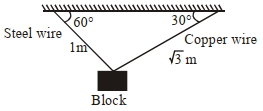
$A$ block of weight $100 \ N$ is suspended by copper and steel wires of same cross-sectional area $0.5 \ cm^2$ and lengths $\sqrt{3} \ m$ and $1 \ m$,respectively. Their other ends are fixed on a ceiling as shown in the figure. The angles subtended by the copper and steel wires with the ceiling are $30^{\circ}$ and $60^{\circ}$,respectively. If the elongation in the copper wire is $\Delta \ell_C$ and the elongation in the steel wire is $\Delta \ell_S$,then the ratio $\frac{\Delta \ell_C}{\Delta \ell_S}$ is. . . . . .
[Young's modulus for copper and steel are $1 \times 10^{11} \ N/m^2$ and $2 \times 10^{11} \ N/m^2$ respectively]
[Young's modulus for copper and steel are $1 \times 10^{11} \ N/m^2$ and $2 \times 10^{11} \ N/m^2$ respectively]
A
$1$
B
$0$
C
$2$
D
$3$
Solution
(C) Let $T_S$ be the tension in the steel wire and $T_C$ be the tension in the copper wire.
Resolving forces in the horizontal $(x)$ direction:
$T_C \cos 30^{\circ} = T_S \cos 60^{\circ}$
$T_C \times \frac{\sqrt{3}}{2} = T_S \times \frac{1}{2}$
$T_S = \sqrt{3} T_C \quad \dots (i)$
Resolving forces in the vertical $(y)$ direction:
$T_C \sin 30^{\circ} + T_S \sin 60^{\circ} = 100$
$\frac{T_C}{2} + \frac{T_S \sqrt{3}}{2} = 100 \quad \dots (ii)$
Substituting $(i)$ into $(ii)$:
$\frac{T_C}{2} + \frac{(\sqrt{3} T_C) \sqrt{3}}{2} = 100$
$\frac{T_C}{2} + \frac{3 T_C}{2} = 100 \implies 2 T_C = 100 \implies T_C = 50 \ N$
$T_S = \sqrt{3} \times 50 = 50\sqrt{3} \ N$
Using the formula for elongation $\Delta \ell = \frac{FL}{AY}$:
$\frac{\Delta \ell_C}{\Delta \ell_S} = \frac{T_C L_C}{A_C Y_C} \times \frac{A_S Y_S}{T_S L_S}$
Given $A_C = A_S = 0.5 \ cm^2$,$L_C = \sqrt{3} \ m$,$L_S = 1 \ m$,$Y_C = 1 \times 10^{11} \ N/m^2$,$Y_S = 2 \times 10^{11} \ N/m^2$:
$\frac{\Delta \ell_C}{\Delta \ell_S} = \left( \frac{50 \times \sqrt{3}}{0.5 \times 10^{11}} \right) \times \left( \frac{0.5 \times 2 \times 10^{11}}{50\sqrt{3} \times 1} \right) = \frac{50\sqrt{3}}{50\sqrt{3}} \times \frac{2}{1} = 2$
Thus,the ratio is $2$.
Resolving forces in the horizontal $(x)$ direction:
$T_C \cos 30^{\circ} = T_S \cos 60^{\circ}$
$T_C \times \frac{\sqrt{3}}{2} = T_S \times \frac{1}{2}$
$T_S = \sqrt{3} T_C \quad \dots (i)$
Resolving forces in the vertical $(y)$ direction:
$T_C \sin 30^{\circ} + T_S \sin 60^{\circ} = 100$
$\frac{T_C}{2} + \frac{T_S \sqrt{3}}{2} = 100 \quad \dots (ii)$
Substituting $(i)$ into $(ii)$:
$\frac{T_C}{2} + \frac{(\sqrt{3} T_C) \sqrt{3}}{2} = 100$
$\frac{T_C}{2} + \frac{3 T_C}{2} = 100 \implies 2 T_C = 100 \implies T_C = 50 \ N$
$T_S = \sqrt{3} \times 50 = 50\sqrt{3} \ N$
Using the formula for elongation $\Delta \ell = \frac{FL}{AY}$:
$\frac{\Delta \ell_C}{\Delta \ell_S} = \frac{T_C L_C}{A_C Y_C} \times \frac{A_S Y_S}{T_S L_S}$
Given $A_C = A_S = 0.5 \ cm^2$,$L_C = \sqrt{3} \ m$,$L_S = 1 \ m$,$Y_C = 1 \times 10^{11} \ N/m^2$,$Y_S = 2 \times 10^{11} \ N/m^2$:
$\frac{\Delta \ell_C}{\Delta \ell_S} = \left( \frac{50 \times \sqrt{3}}{0.5 \times 10^{11}} \right) \times \left( \frac{0.5 \times 2 \times 10^{11}}{50\sqrt{3} \times 1} \right) = \frac{50\sqrt{3}}{50\sqrt{3}} \times \frac{2}{1} = 2$
Thus,the ratio is $2$.
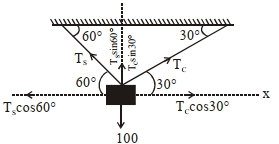
0 likes
View Solution275
MediumMCQ
One end of a horizontal thick copper wire of length $2L$ and radius $2R$ is welded to an end of another horizontal thin copper wire of length $L$ and radius $R$. When the arrangement is stretched by applying forces at two ends,the ratio of the elongation in the thin wire to that in the thick wire is:
A
$0.25$
B
$0.50$
C
$2.00$
D
$4.00$
Solution
(C) Let the thin wire have length $L_1 = L$ and radius $r_1 = R$. Its area is $A_1 = \pi R^2$.
Let the thick wire have length $L_2 = 2L$ and radius $r_2 = 2R$. Its area is $A_2 = \pi (2R)^2 = 4\pi R^2 = 4A_1$.
Since the wires are in series,the same force $F$ acts on both wires.
Young's modulus $Y$ is given by $Y = \frac{F/A}{\Delta L/L}$,so $\Delta L = \frac{FL}{AY}$.
For the thin wire: $\Delta L_1 = \frac{FL_1}{A_1 Y} = \frac{FL}{\pi R^2 Y}$.
For the thick wire: $\Delta L_2 = \frac{FL_2}{A_2 Y} = \frac{F(2L)}{(4\pi R^2) Y} = \frac{FL}{2\pi R^2 Y}$.
The ratio of elongation in the thin wire to that in the thick wire is $\frac{\Delta L_1}{\Delta L_2} = \frac{FL/\pi R^2 Y}{FL/2\pi R^2 Y} = 2$.
Let the thick wire have length $L_2 = 2L$ and radius $r_2 = 2R$. Its area is $A_2 = \pi (2R)^2 = 4\pi R^2 = 4A_1$.
Since the wires are in series,the same force $F$ acts on both wires.
Young's modulus $Y$ is given by $Y = \frac{F/A}{\Delta L/L}$,so $\Delta L = \frac{FL}{AY}$.
For the thin wire: $\Delta L_1 = \frac{FL_1}{A_1 Y} = \frac{FL}{\pi R^2 Y}$.
For the thick wire: $\Delta L_2 = \frac{FL_2}{A_2 Y} = \frac{F(2L)}{(4\pi R^2) Y} = \frac{FL}{2\pi R^2 Y}$.
The ratio of elongation in the thin wire to that in the thick wire is $\frac{\Delta L_1}{\Delta L_2} = \frac{FL/\pi R^2 Y}{FL/2\pi R^2 Y} = 2$.
0 likes
View Solution276
MediumMCQ
The length of a light string is $1.4 \ m$ when the tension on it is $5 \ N$. If the tension increases to $7 \ N$,the length of the string is $1.56 \ m$. The original length of the string is . . . . . . $m$.
A
$3$
B
$9$
C
$5$
D
$1$
Solution
(D) According to Hooke's Law,the tension $T$ in a string is proportional to its extension: $T = K(\ell - \ell_0)$,where $K$ is the force constant,$\ell$ is the stretched length,and $\ell_0$ is the original length.
For the first case: $5 = K(1.4 - \ell_0)$ -- (Equation $1$)
For the second case: $7 = K(1.56 - \ell_0)$ -- (Equation $2$)
Dividing Equation $1$ by Equation $2$:
$\frac{5}{7} = \frac{1.4 - \ell_0}{1.56 - \ell_0}$
$5(1.56 - \ell_0) = 7(1.4 - \ell_0)$
$7.8 - 5\ell_0 = 9.8 - 7\ell_0$
$2\ell_0 = 9.8 - 7.8$
$2\ell_0 = 2.0$
$\ell_0 = 1 \ m$.
For the first case: $5 = K(1.4 - \ell_0)$ -- (Equation $1$)
For the second case: $7 = K(1.56 - \ell_0)$ -- (Equation $2$)
Dividing Equation $1$ by Equation $2$:
$\frac{5}{7} = \frac{1.4 - \ell_0}{1.56 - \ell_0}$
$5(1.56 - \ell_0) = 7(1.4 - \ell_0)$
$7.8 - 5\ell_0 = 9.8 - 7\ell_0$
$2\ell_0 = 9.8 - 7.8$
$2\ell_0 = 2.0$
$\ell_0 = 1 \ m$.
0 likes
View Solution277
MediumMCQ
Two wires $A$ and $B$ are made of the same material having a ratio of lengths $\frac{L_A}{L_B} = \frac{1}{3}$ and their diameters ratio $\frac{d_A}{d_B} = 2$. If both the wires are stretched using the same force,what would be the ratio of their respective elongations?
A
$1: 6$
B
$1: 12$
C
$3: 4$
D
$1: 3$
Solution
(B) Given: $\frac{L_A}{L_B} = \frac{1}{3}$ and $\frac{d_A}{d_B} = 2$.
The elongation $\Delta L$ of a wire is given by the formula $\Delta L = \frac{FL}{AY}$,where $F$ is the force,$L$ is the length,$A$ is the cross-sectional area,and $Y$ is Young's modulus.
Since both wires are made of the same material,$Y_A = Y_B$. Given that the force applied is the same,$F_A = F_B$.
The ratio of elongations is $\frac{\Delta L_A}{\Delta L_B} = \frac{F_A L_A}{A_A Y_A} \times \frac{A_B Y_B}{F_B L_B} = \left(\frac{L_A}{L_B}\right) \left(\frac{A_B}{A_A}\right)$.
Since $A = \pi r^2 = \pi (d/2)^2 = \frac{\pi d^2}{4}$,the ratio of areas is $\frac{A_B}{A_A} = \left(\frac{d_B}{d_A}\right)^2$.
Substituting the given values: $\frac{\Delta L_A}{\Delta L_B} = \left(\frac{1}{3}\right) \times \left(\frac{1}{2}\right)^2 = \frac{1}{3} \times \frac{1}{4} = \frac{1}{12}$.
The elongation $\Delta L$ of a wire is given by the formula $\Delta L = \frac{FL}{AY}$,where $F$ is the force,$L$ is the length,$A$ is the cross-sectional area,and $Y$ is Young's modulus.
Since both wires are made of the same material,$Y_A = Y_B$. Given that the force applied is the same,$F_A = F_B$.
The ratio of elongations is $\frac{\Delta L_A}{\Delta L_B} = \frac{F_A L_A}{A_A Y_A} \times \frac{A_B Y_B}{F_B L_B} = \left(\frac{L_A}{L_B}\right) \left(\frac{A_B}{A_A}\right)$.
Since $A = \pi r^2 = \pi (d/2)^2 = \frac{\pi d^2}{4}$,the ratio of areas is $\frac{A_B}{A_A} = \left(\frac{d_B}{d_A}\right)^2$.
Substituting the given values: $\frac{\Delta L_A}{\Delta L_B} = \left(\frac{1}{3}\right) \times \left(\frac{1}{2}\right)^2 = \frac{1}{3} \times \frac{1}{4} = \frac{1}{12}$.
0 likes
View Solution278
MediumMCQ
$A$ $3 \ m$ long wire of radius $3 \ mm$ shows an extension of $0.1 \ mm$ when loaded vertically by a mass of $50 \ kg$ in an experiment to determine Young's modulus. The value of Young's modulus of the wire as per this experiment is $P \times 10^{11} \ Nm^{-2}$,where the value of $P$ is: (Take $g = 3 \pi \ m/s^2$)
A
$5$
B
$10$
C
$25$
D
$2.5$
Solution
(A) The formula for Young's modulus $(Y)$ is given by $Y = \frac{F \cdot L}{A \cdot \Delta L}$.
Here,$F = mg = 50 \times 3 \pi \ N$,$L = 3 \ m$,$r = 3 \times 10^{-3} \ m$,and $\Delta L = 0.1 \times 10^{-3} \ m$.
The area $A = \pi r^2 = \pi \times (3 \times 10^{-3})^2 = 9 \pi \times 10^{-6} \ m^2$.
Substituting these values into the formula:
$Y = \frac{(50 \times 3 \pi) \times 3}{(9 \pi \times 10^{-6}) \times (0.1 \times 10^{-3})}$
$Y = \frac{450 \pi}{0.9 \pi \times 10^{-9}} = \frac{450}{0.9} \times 10^9 = 500 \times 10^9 = 5 \times 10^{11} \ Nm^{-2}$.
Comparing this with $P \times 10^{11} \ Nm^{-2}$,we get $P = 5$.
Here,$F = mg = 50 \times 3 \pi \ N$,$L = 3 \ m$,$r = 3 \times 10^{-3} \ m$,and $\Delta L = 0.1 \times 10^{-3} \ m$.
The area $A = \pi r^2 = \pi \times (3 \times 10^{-3})^2 = 9 \pi \times 10^{-6} \ m^2$.
Substituting these values into the formula:
$Y = \frac{(50 \times 3 \pi) \times 3}{(9 \pi \times 10^{-6}) \times (0.1 \times 10^{-3})}$
$Y = \frac{450 \pi}{0.9 \pi \times 10^{-9}} = \frac{450}{0.9} \times 10^9 = 500 \times 10^9 = 5 \times 10^{11} \ Nm^{-2}$.
Comparing this with $P \times 10^{11} \ Nm^{-2}$,we get $P = 5$.
0 likes
View Solution279
EasyMCQ
$A$ wire of area of cross-section $10^{-6} \ m^2$ is increased in length by $0.1 \%$. The tension produced is $1000 \ N$. The Young's modulus of the wire is:
A
$10^{12} \ N/m^2$
B
$10^{11} \ N/m^2$
C
$10^{10} \ N/m^2$
D
$10^9 \ N/m^2$
Solution
(A) The formula for Young's modulus $(Y)$ is given by $Y = \frac{F \cdot \ell}{A \cdot \Delta \ell} = \frac{F}{A \cdot (\Delta \ell / \ell)}$.
Given:
Area $(A)$ = $10^{-6} \ m^2$
Strain $(\Delta \ell / \ell)$ = $0.1 \% = 0.1 / 100 = 10^{-3}$
Tension $(F)$ = $1000 \ N$
Substituting the values:
$Y = \frac{1000}{10^{-6} \times 10^{-3}}$
$Y = \frac{10^3}{10^{-9}}$
$Y = 10^{12} \ N/m^2$.
Given:
Area $(A)$ = $10^{-6} \ m^2$
Strain $(\Delta \ell / \ell)$ = $0.1 \% = 0.1 / 100 = 10^{-3}$
Tension $(F)$ = $1000 \ N$
Substituting the values:
$Y = \frac{1000}{10^{-6} \times 10^{-3}}$
$Y = \frac{10^3}{10^{-9}}$
$Y = 10^{12} \ N/m^2$.
0 likes
View Solution280
EasyMCQ
In Searle's experiment,a vertical steel wire of diameter $2.5 \ mm$ and length $3.14 \ m$ supports a weight of $8000 \ kg$. The change in length produced is: (Given $Y = 2 \times 10^{11} \ Pa$)
A
$0.21 \ mm$
B
$0.026 \ mm$
C
$0.021 \ cm$
D
$0.021 \ nm$
Solution
(B) The formula for the change in length (elongation) is $\Delta \ell = \frac{F \ell}{AY}$.
Here,$F = mg = 8000 \ kg \times 10 \ m/s^2 = 80000 \ N$.
The area of cross-section $A = \frac{\pi d^2}{4}$,where $d = 2.5 \ mm = 2.5 \times 10^{-3} \ m$.
$A = \frac{3.14 \times (2.5 \times 10^{-3})^2}{4} \approx \frac{3.14 \times 6.25 \times 10^{-6}}{4} \approx 4.906 \times 10^{-6} \ m^2$.
Substituting the values: $\Delta \ell = \frac{80000 \times 3.14}{4.906 \times 10^{-6} \times 2 \times 10^{11}}$.
$\Delta \ell = \frac{251200}{9.812 \times 10^5} \approx 0.0256 \times 10^{-2} \ m = 0.256 \times 10^{-3} \ m = 0.256 \ mm$.
Given the options provided and standard approximations in such problems,the closest value is $0.026 \ mm$.
Here,$F = mg = 8000 \ kg \times 10 \ m/s^2 = 80000 \ N$.
The area of cross-section $A = \frac{\pi d^2}{4}$,where $d = 2.5 \ mm = 2.5 \times 10^{-3} \ m$.
$A = \frac{3.14 \times (2.5 \times 10^{-3})^2}{4} \approx \frac{3.14 \times 6.25 \times 10^{-6}}{4} \approx 4.906 \times 10^{-6} \ m^2$.
Substituting the values: $\Delta \ell = \frac{80000 \times 3.14}{4.906 \times 10^{-6} \times 2 \times 10^{11}}$.
$\Delta \ell = \frac{251200}{9.812 \times 10^5} \approx 0.0256 \times 10^{-2} \ m = 0.256 \times 10^{-3} \ m = 0.256 \ mm$.
Given the options provided and standard approximations in such problems,the closest value is $0.026 \ mm$.
0 likes
View Solution281
MediumMCQ
Two identical wires of substances $P$ and $Q$ are subjected to equal stretching force along the length. If the elongation of $Q$ is more than that of $P$,then
A
both $P$ and $Q$ are equally elastic
B
$P$ is more elastic than $Q$
C
$P$ is plastic and $Q$ is elastic
D
$Q$ is more elastic than $P$
Solution
(B) The Young's modulus $Y$ is defined as $Y = \frac{F/A}{\Delta l/l}$.
Since the wires are identical,their length $l$ and cross-sectional area $A$ are the same. The stretching force $F$ is also the same for both.
Therefore,$Y \propto \frac{1}{\Delta l}$.
Given that the elongation of $Q$ is more than that of $P$,i.e.,$(\Delta l)_Q > (\Delta l)_P$.
Since $Y$ is inversely proportional to elongation,it follows that $Y_P > Y_Q$.
$A$ higher Young's modulus indicates that the material is more elastic (more resistant to deformation).
Thus,$P$ is more elastic than $Q$.
Since the wires are identical,their length $l$ and cross-sectional area $A$ are the same. The stretching force $F$ is also the same for both.
Therefore,$Y \propto \frac{1}{\Delta l}$.
Given that the elongation of $Q$ is more than that of $P$,i.e.,$(\Delta l)_Q > (\Delta l)_P$.
Since $Y$ is inversely proportional to elongation,it follows that $Y_P > Y_Q$.
$A$ higher Young's modulus indicates that the material is more elastic (more resistant to deformation).
Thus,$P$ is more elastic than $Q$.
0 likes
View Solution282
MediumMCQ
$A$ constant force is applied to a metal wire of length $L$. The volume of the wire remains constant. The extension produced is proportional to:
A
$L^{2}$
B
$L^{3}$
C
$L$
D
$L^{-2}$
Solution
(A) Let the length of the wire be $L$,the cross-sectional area be $A$,and the volume be $V$. Since the volume is constant,$V = A \times L$,which implies $A = \frac{V}{L}$.
According to Young's modulus formula,$Y = \frac{F \times L}{A \times \Delta L}$,where $\Delta L$ is the extension.
Rearranging for $\Delta L$,we get $\Delta L = \frac{F \times L}{Y \times A}$.
Substituting $A = \frac{V}{L}$ into the equation,we get $\Delta L = \frac{F \times L}{Y \times (V/L)} = \frac{F \times L^{2}}{Y \times V}$.
Since $F$,$Y$,and $V$ are constants,the extension $\Delta L$ is proportional to $L^{2}$.
According to Young's modulus formula,$Y = \frac{F \times L}{A \times \Delta L}$,where $\Delta L$ is the extension.
Rearranging for $\Delta L$,we get $\Delta L = \frac{F \times L}{Y \times A}$.
Substituting $A = \frac{V}{L}$ into the equation,we get $\Delta L = \frac{F \times L}{Y \times (V/L)} = \frac{F \times L^{2}}{Y \times V}$.
Since $F$,$Y$,and $V$ are constants,the extension $\Delta L$ is proportional to $L^{2}$.
0 likes
View Solution283
MediumMCQ
One end of a thick horizontal copper wire of length '$2L$' and radius '$2R$' is welded to an end of another thin horizontal copper wire of length '$L$' and radius '$R$'. When they are stretched by applying the same force at the two ends,the ratio of the elongation in the thick wire to that in the thin wire is:
A
$1: 2$
B
$4: 1$
C
$1: 8$
D
$1: 1$
Solution
(A) The elongation $\Delta l$ in a wire is given by the formula: $\Delta l = \frac{F \cdot l}{Y \cdot A}$,where $F$ is the applied force,$l$ is the length,$Y$ is Young's modulus,and $A$ is the cross-sectional area.
Since the wires are made of the same material,$Y$ is the same for both. The area $A = \pi r^2$.
For the thick wire $(1)$: $l_1 = 2L$,$r_1 = 2R$,$A_1 = \pi (2R)^2 = 4\pi R^2$.
For the thin wire $(2)$: $l_2 = L$,$r_2 = R$,$A_2 = \pi R^2$.
Since the same force $F$ is applied to both wires connected in series,the tension in both wires is the same.
Therefore,the ratio of elongations is:
$\frac{\Delta l_1}{\Delta l_2} = \frac{F \cdot l_1 / (Y \cdot A_1)}{F \cdot l_2 / (Y \cdot A_2)} = \frac{l_1}{l_2} \cdot \frac{A_2}{A_1}$
Substituting the values:
$\frac{\Delta l_1}{\Delta l_2} = \frac{2L}{L} \cdot \frac{\pi R^2}{4\pi R^2} = 2 \cdot \frac{1}{4} = \frac{1}{2}$.
Wait,let's re-evaluate: $\frac{2}{1} \times \frac{1}{4} = \frac{2}{4} = \frac{1}{2}$.
Thus,the ratio of elongation in the thick wire to that in the thin wire is $1:2$.
Since the wires are made of the same material,$Y$ is the same for both. The area $A = \pi r^2$.
For the thick wire $(1)$: $l_1 = 2L$,$r_1 = 2R$,$A_1 = \pi (2R)^2 = 4\pi R^2$.
For the thin wire $(2)$: $l_2 = L$,$r_2 = R$,$A_2 = \pi R^2$.
Since the same force $F$ is applied to both wires connected in series,the tension in both wires is the same.
Therefore,the ratio of elongations is:
$\frac{\Delta l_1}{\Delta l_2} = \frac{F \cdot l_1 / (Y \cdot A_1)}{F \cdot l_2 / (Y \cdot A_2)} = \frac{l_1}{l_2} \cdot \frac{A_2}{A_1}$
Substituting the values:
$\frac{\Delta l_1}{\Delta l_2} = \frac{2L}{L} \cdot \frac{\pi R^2}{4\pi R^2} = 2 \cdot \frac{1}{4} = \frac{1}{2}$.
Wait,let's re-evaluate: $\frac{2}{1} \times \frac{1}{4} = \frac{2}{4} = \frac{1}{2}$.
Thus,the ratio of elongation in the thick wire to that in the thin wire is $1:2$.

0 likes
View Solution284
EasyMCQ
Two wires of the same length and material are stretched by the same force. If their masses are in the ratio $3:4$,then the ratio of their elongations is
A
$4:3$
B
$3:4$
C
$9:16$
D
$16:9$
Solution
(A) The elongation $\Delta L$ of a wire is given by the formula $\Delta L = \frac{FL}{AY}$,where $F$ is the force,$L$ is the length,$A$ is the cross-sectional area,and $Y$ is the Young's modulus.
Since $F$,$L$,and $Y$ are the same for both wires,$\Delta L \propto \frac{1}{A}$.
The mass $m$ of a wire is given by $m = \rho AL$,where $\rho$ is the density. Since $\rho$ and $L$ are the same,$m \propto A$.
Therefore,$\Delta L \propto \frac{1}{m}$.
Given the ratio of masses $\frac{m_1}{m_2} = \frac{3}{4}$,the ratio of elongations is $\frac{\Delta L_1}{\Delta L_2} = \frac{m_2}{m_1} = \frac{4}{3}$.
Since $F$,$L$,and $Y$ are the same for both wires,$\Delta L \propto \frac{1}{A}$.
The mass $m$ of a wire is given by $m = \rho AL$,where $\rho$ is the density. Since $\rho$ and $L$ are the same,$m \propto A$.
Therefore,$\Delta L \propto \frac{1}{m}$.
Given the ratio of masses $\frac{m_1}{m_2} = \frac{3}{4}$,the ratio of elongations is $\frac{\Delta L_1}{\Delta L_2} = \frac{m_2}{m_1} = \frac{4}{3}$.
0 likes
View Solution285
EasyMCQ
Two rods of same material and volume having circular cross-section are subjected to tension $T$. Within the elastic limit,the same force is applied to both the rods. If the diameter of the first rod is half of the second rod,then the ratio of the extension of the first rod to the second rod will be: (in $: 1$)
A
$4$
B
$16$
C
$32$
D
$2$
Solution
(B) The Young's modulus $Y$ is given by the formula: $Y = \frac{F \cdot l}{A \cdot \Delta l}$.
Since volume $V = A \cdot l$,we can write $l = \frac{V}{A}$.
Substituting this into the formula: $Y = \frac{F \cdot (V/A)}{A \cdot \Delta l} = \frac{F \cdot V}{A^2 \cdot \Delta l}$.
Rearranging for extension $\Delta l$: $\Delta l = \frac{F \cdot V}{Y \cdot A^2}$.
Since $F, V,$ and $Y$ are constant for both rods,$\Delta l \propto \frac{1}{A^2}$.
Since the cross-section is circular,area $A = \pi r^2 = \pi (d/2)^2$,so $A \propto d^2$.
Therefore,$\Delta l \propto \frac{1}{(d^2)^2} = \frac{1}{d^4}$.
Given $d_1 = \frac{1}{2} d_2$,or $d_2 = 2 d_1$.
The ratio of extensions is $\frac{\Delta l_1}{\Delta l_2} = \left( \frac{d_2}{d_1} \right)^4 = \left( \frac{2 d_1}{d_1} \right)^4 = 2^4 = 16$.
Thus,the ratio is $16: 1$.
Since volume $V = A \cdot l$,we can write $l = \frac{V}{A}$.
Substituting this into the formula: $Y = \frac{F \cdot (V/A)}{A \cdot \Delta l} = \frac{F \cdot V}{A^2 \cdot \Delta l}$.
Rearranging for extension $\Delta l$: $\Delta l = \frac{F \cdot V}{Y \cdot A^2}$.
Since $F, V,$ and $Y$ are constant for both rods,$\Delta l \propto \frac{1}{A^2}$.
Since the cross-section is circular,area $A = \pi r^2 = \pi (d/2)^2$,so $A \propto d^2$.
Therefore,$\Delta l \propto \frac{1}{(d^2)^2} = \frac{1}{d^4}$.
Given $d_1 = \frac{1}{2} d_2$,or $d_2 = 2 d_1$.
The ratio of extensions is $\frac{\Delta l_1}{\Delta l_2} = \left( \frac{d_2}{d_1} \right)^4 = \left( \frac{2 d_1}{d_1} \right)^4 = 2^4 = 16$.
Thus,the ratio is $16: 1$.
0 likes
View Solution286
EasyMCQ
Two wires of different materials have same length $L$ and same diameter $d$. The second wire is connected at the end of the first wire and forms one single wire of double the length. This wire is subjected to a stretching force $F$ to produce an elongation $\ell$. The two wires have:
A
same stress and same strain
B
different stress but same strain
C
different stress and different strain
D
same stress but different strain
Solution
(D) $1$. Stress is defined as force per unit area $(Stress = F/A)$. Since both wires have the same diameter $d$,they have the same cross-sectional area $A = \pi(d/2)^2$. When a force $F$ is applied to the combined wire,the same force $F$ acts on each wire. Therefore,both wires experience the same stress.
$2$. Strain is defined as the ratio of change in length to the original length $(Strain = \Delta L / L)$. The relationship between stress and strain is given by Hooke's Law: $Stress = Y \times Strain$,where $Y$ is the Young's modulus of the material.
$3$. Since the wires are made of different materials,they have different Young's moduli $(Y_1 \neq Y_2)$.
$4$. Because $Strain = Stress / Y$,and the stress is the same for both but the Young's moduli are different,the strain in the two wires must be different.
$5$. Thus,the wires have the same stress but different strain.
$2$. Strain is defined as the ratio of change in length to the original length $(Strain = \Delta L / L)$. The relationship between stress and strain is given by Hooke's Law: $Stress = Y \times Strain$,where $Y$ is the Young's modulus of the material.
$3$. Since the wires are made of different materials,they have different Young's moduli $(Y_1 \neq Y_2)$.
$4$. Because $Strain = Stress / Y$,and the stress is the same for both but the Young's moduli are different,the strain in the two wires must be different.
$5$. Thus,the wires have the same stress but different strain.
0 likes
View Solution287
EasyMCQ
$A$ thick brass wire of length $L$ and density $\rho$ is suspended from a rigid support. Due to its own weight,$\ell$ is the increase in length. The Young's modulus $Y$ of the brass wire in terms of density is $(g = \text{acceleration due to gravity})$
A
$Y = \frac{\rho g L^2}{2 \ell}$
B
$Y = \frac{\rho g L^2}{4 \ell}$
C
$Y = \frac{\rho g L}{\ell}$
D
$Y = \frac{\rho g L^2}{\ell}$
Solution
(A) The stress at a distance $x$ from the free end is $\sigma = \frac{(\rho A x) g}{A} = \rho g x$.
The elongation $d\ell$ in a small element $dx$ is given by $d\ell = \frac{\sigma dx}{Y} = \frac{\rho g x dx}{Y}$.
Integrating from $x = 0$ to $x = L$,the total elongation $\ell$ is:
$\ell = \int_0^L \frac{\rho g x}{Y} dx = \frac{\rho g}{Y} \left[ \frac{x^2}{2} \right]_0^L = \frac{\rho g L^2}{2Y}$.
Rearranging for Young's modulus $Y$,we get:
$Y = \frac{\rho g L^2}{2 \ell}$.
The elongation $d\ell$ in a small element $dx$ is given by $d\ell = \frac{\sigma dx}{Y} = \frac{\rho g x dx}{Y}$.
Integrating from $x = 0$ to $x = L$,the total elongation $\ell$ is:
$\ell = \int_0^L \frac{\rho g x}{Y} dx = \frac{\rho g}{Y} \left[ \frac{x^2}{2} \right]_0^L = \frac{\rho g L^2}{2Y}$.
Rearranging for Young's modulus $Y$,we get:
$Y = \frac{\rho g L^2}{2 \ell}$.
0 likes
View Solution288
EasyMCQ
The ratio of the lengths of two wires of the same material is $1:2$ and the ratio of their radii is $1:\sqrt{2}$. If they are stretched by the same force,what is the ratio of the increase in their lengths?
A
$1:2$
B
$1:1$
C
$2:1$
D
$1:\sqrt{2}$
Solution
(B) The formula for Young's modulus $Y$ is given by $Y = \frac{F l}{A \Delta l}$,where $A = \pi r^2$.
Rearranging for the change in length $\Delta l$,we get $\Delta l = \frac{F l}{\pi r^2 Y}$.
Since the material is the same,$Y$ is constant. Given that the force $F$ is also the same,we have $\Delta l \propto \frac{l}{r^2}$.
Let the lengths be $l_1 = l$ and $l_2 = 2l$,and the radii be $r_1 = r$ and $r_2 = \sqrt{2}r$.
The ratio of the increase in lengths is $\frac{\Delta l_1}{\Delta l_2} = \frac{l_1}{r_1^2} \times \frac{r_2^2}{l_2} = \frac{l}{r^2} \times \frac{(\sqrt{2}r)^2}{2l} = \frac{l}{r^2} \times \frac{2r^2}{2l} = 1$.
Thus,the ratio is $1:1$.
Rearranging for the change in length $\Delta l$,we get $\Delta l = \frac{F l}{\pi r^2 Y}$.
Since the material is the same,$Y$ is constant. Given that the force $F$ is also the same,we have $\Delta l \propto \frac{l}{r^2}$.
Let the lengths be $l_1 = l$ and $l_2 = 2l$,and the radii be $r_1 = r$ and $r_2 = \sqrt{2}r$.
The ratio of the increase in lengths is $\frac{\Delta l_1}{\Delta l_2} = \frac{l_1}{r_1^2} \times \frac{r_2^2}{l_2} = \frac{l}{r^2} \times \frac{(\sqrt{2}r)^2}{2l} = \frac{l}{r^2} \times \frac{2r^2}{2l} = 1$.
Thus,the ratio is $1:1$.
0 likes
View Solution289
DifficultMCQ
$A$ steel ring of radius '$r$' is to be fitted over a wooden disc of radius '$R$' $(R > r)$. The force required to expand the ring so that it fits over the disc is ($Y =$ Young's modulus of steel,$A =$ area of cross-section of the wire).
A
$YA\left(\frac{R-r}{r}\right)$
B
$YA\left(\frac{r}{R-r}\right)$
C
$YA \frac{r}{R}$
D
$\left(\frac{YAR}{r}\right)$
Solution
(A) The formula for Young's modulus is $Y = \frac{F L}{A \Delta L}$,where $F$ is the force,$L$ is the original length,$A$ is the cross-sectional area,and $\Delta L$ is the change in length.
Rearranging for force,we get $F = \frac{Y A \Delta L}{L}$.
The original length of the ring is $L = 2 \pi r$.
The final length of the ring when fitted over the disc is $2 \pi R$.
The change in length is $\Delta L = 2 \pi R - 2 \pi r = 2 \pi (R - r)$.
Substituting these values into the force equation:
$F = \frac{Y A \times 2 \pi (R - r)}{2 \pi r} = \frac{Y A (R - r)}{r}$.
Rearranging for force,we get $F = \frac{Y A \Delta L}{L}$.
The original length of the ring is $L = 2 \pi r$.
The final length of the ring when fitted over the disc is $2 \pi R$.
The change in length is $\Delta L = 2 \pi R - 2 \pi r = 2 \pi (R - r)$.
Substituting these values into the force equation:
$F = \frac{Y A \times 2 \pi (R - r)}{2 \pi r} = \frac{Y A (R - r)}{r}$.
0 likes
View Solution290
MediumMCQ
$A$ wire of length $L$ and radius $r$ is rigidly fixed at one end. On stretching the other end of the wire with a force $F$,the increase in length is $l$. If another wire of the same material but double the length and double the radius is stretched with a force $2F$,then the increase in length is:
A
$\frac{l}{4}$
B
$2l$
C
$\frac{l}{2}$
D
$l$
Solution
(D) Young's modulus $Y$ is given by the formula: $Y = \frac{F L}{A l} = \frac{F L}{\pi r^2 l}$.
For the first wire: $Y = \frac{F L}{\pi r^2 l} \quad \dots (i)$.
For the second wire,the parameters are: $L' = 2L$,$r' = 2r$,$F' = 2F$,and let the new elongation be $l'$.
Since the material is the same,the Young's modulus $Y$ remains constant.
$Y = \frac{F' L'}{\pi (r')^2 l'} = \frac{(2F) (2L)}{\pi (2r)^2 l'} = \frac{4 F L}{\pi (4 r^2) l'} = \frac{F L}{\pi r^2 l'} \quad \dots (ii)$.
Comparing equations $(i)$ and $(ii)$:
$\frac{F L}{\pi r^2 l} = \frac{F L}{\pi r^2 l'}$.
Therefore,$l' = l$.
For the first wire: $Y = \frac{F L}{\pi r^2 l} \quad \dots (i)$.
For the second wire,the parameters are: $L' = 2L$,$r' = 2r$,$F' = 2F$,and let the new elongation be $l'$.
Since the material is the same,the Young's modulus $Y$ remains constant.
$Y = \frac{F' L'}{\pi (r')^2 l'} = \frac{(2F) (2L)}{\pi (2r)^2 l'} = \frac{4 F L}{\pi (4 r^2) l'} = \frac{F L}{\pi r^2 l'} \quad \dots (ii)$.
Comparing equations $(i)$ and $(ii)$:
$\frac{F L}{\pi r^2 l} = \frac{F L}{\pi r^2 l'}$.
Therefore,$l' = l$.
0 likes
View Solution291
MediumMCQ
The decrease in length of a metal bar of length $L$ and cross-sectional area $A$ when compressed with a load $F$ along its length is (where $Y$ is Young's modulus of the material of the metal bar).
A
$\frac{F L}{2 A Y}$
B
$\frac{F^2 L}{2 A Y}$
C
$\frac{F L}{A Y}$
D
$\frac{F^2 L^2}{2 A Y}$
Solution
(C) Young's modulus $Y$ is defined as the ratio of longitudinal stress to longitudinal strain.
$Y = \frac{\text{Stress}}{\text{Strain}} = \frac{F/A}{\Delta L/L}$
Rearranging the formula to solve for the change in length $\Delta L$:
$Y = \frac{F L}{A \Delta L}$
$\Delta L = \frac{F L}{A Y}$
Thus,the decrease in length is $\frac{F L}{A Y}$.
$Y = \frac{\text{Stress}}{\text{Strain}} = \frac{F/A}{\Delta L/L}$
Rearranging the formula to solve for the change in length $\Delta L$:
$Y = \frac{F L}{A \Delta L}$
$\Delta L = \frac{F L}{A Y}$
Thus,the decrease in length is $\frac{F L}{A Y}$.
0 likes
View Solution292
MediumMCQ
$A$ metal rod of length $L$ and cross-sectional area $A$ is heated through $T^{\circ} C$. What is the force required to prevent the expansion of the rod lengthwise? $[Y=$ Young's modulus of the material of rod,$\alpha=$ coefficient of linear expansion $]$
A
$\frac{Y A \alpha T}{(1-\alpha T)}$
B
$\frac{Y A \alpha T}{(1+\alpha T)}$
C
$\frac{(1-\alpha T)}{Y A \alpha T}$
D
$\frac{(1+\alpha T)}{Y A \alpha T}$
Solution
(B) The thermal expansion of the rod if it were free to expand is given by $\Delta L = \alpha L T$.
To prevent this expansion,a compressive force $F$ must be applied.
The stress produced is $\sigma = \frac{F}{A}$.
The strain produced is $\epsilon = \frac{\Delta L}{L_{new}}$,where $L_{new} = L(1 + \alpha T)$.
Using Young's modulus $Y = \frac{\text{Stress}}{\text{Strain}} = \frac{F/A}{\Delta L / L(1 + \alpha T)}$.
Rearranging for $F$,we get $F = \frac{Y A \Delta L}{L(1 + \alpha T)}$.
Substituting $\Delta L = \alpha L T$,we get $F = \frac{Y A (\alpha L T)}{L(1 + \alpha T)}$.
Therefore,$F = \frac{Y A \alpha T}{1 + \alpha T}$.
To prevent this expansion,a compressive force $F$ must be applied.
The stress produced is $\sigma = \frac{F}{A}$.
The strain produced is $\epsilon = \frac{\Delta L}{L_{new}}$,where $L_{new} = L(1 + \alpha T)$.
Using Young's modulus $Y = \frac{\text{Stress}}{\text{Strain}} = \frac{F/A}{\Delta L / L(1 + \alpha T)}$.
Rearranging for $F$,we get $F = \frac{Y A \Delta L}{L(1 + \alpha T)}$.
Substituting $\Delta L = \alpha L T$,we get $F = \frac{Y A (\alpha L T)}{L(1 + \alpha T)}$.
Therefore,$F = \frac{Y A \alpha T}{1 + \alpha T}$.
0 likes
View Solution293
MediumMCQ
Let a steel bar of length $l$,breadth $b$,and depth $d$ be loaded at the centre by a load $W$. Then the sag of bending of the beam is ($Y =$ Young's modulus of the material of steel).
A
$\frac{W l^3}{2 b d^3 Y}$
B
$\frac{W l^3}{4 b d^3 Y}$
C
$\frac{W l^3}{2 d b^3 Y}$
D
$\frac{W l^3}{4 d b^3 Y}$
Solution
(B) The sag (depression) $\delta$ of a beam supported at both ends and loaded at the centre is given by the formula: $\delta = \frac{W l^3}{48 Y I}$.
Here,$W$ is the load,$l$ is the length,$Y$ is Young's modulus,and $I$ is the geometrical moment of inertia.
For a rectangular cross-section of breadth $b$ and depth $d$,the moment of inertia is $I = \frac{b d^3}{12}$.
Substituting the value of $I$ into the formula for $\delta$:
$\delta = \frac{W l^3}{48 Y (\frac{b d^3}{12})}$
$\delta = \frac{W l^3}{48 Y} \times \frac{12}{b d^3}$
$\delta = \frac{W l^3}{4 b d^3 Y}$.
Here,$W$ is the load,$l$ is the length,$Y$ is Young's modulus,and $I$ is the geometrical moment of inertia.
For a rectangular cross-section of breadth $b$ and depth $d$,the moment of inertia is $I = \frac{b d^3}{12}$.
Substituting the value of $I$ into the formula for $\delta$:
$\delta = \frac{W l^3}{48 Y (\frac{b d^3}{12})}$
$\delta = \frac{W l^3}{48 Y} \times \frac{12}{b d^3}$
$\delta = \frac{W l^3}{4 b d^3 Y}$.
0 likes
View Solution294
DifficultMCQ
Two wires $A$ and $B$ are of the same material. Their lengths are in the ratio $1: 2$ and diameters are in the ratio $2: 1$. When stretched by forces $F_{A}$ and $F_{B}$ respectively,they get equal increase in their lengths. Then the ratio $F_{A} / F_{B}$ is
A
$1: 2$
B
$1: 1$
C
$2: 1$
D
$8: 1$
Solution
(D) The force $F$ required to produce an extension $\Delta l$ in a wire of length $l$,area of cross-section $A$,and Young's modulus $Y$ is given by $F = \frac{Y A \Delta l}{l}$.
Since the area $A = \pi \left(\frac{d}{2}\right)^2 = \frac{\pi d^2}{4}$,we can write the force as $F = \frac{Y \pi d^2 \Delta l}{4 l}$.
For wires of the same material,$Y$ is constant. Thus,$F \propto \frac{d^2 \Delta l}{l}$.
Given $\Delta l_A = \Delta l_B$,the ratio of forces is $\frac{F_A}{F_B} = \frac{d_A^2}{d_B^2} \times \frac{l_B}{l_A}$.
Given $\frac{l_A}{l_B} = \frac{1}{2} \implies \frac{l_B}{l_A} = 2$ and $\frac{d_A}{d_B} = \frac{2}{1}$.
Substituting these values: $\frac{F_A}{F_B} = \left(\frac{2}{1}\right)^2 \times 2 = 4 \times 2 = 8$.
Therefore,the ratio $F_A : F_B = 8: 1$.
Since the area $A = \pi \left(\frac{d}{2}\right)^2 = \frac{\pi d^2}{4}$,we can write the force as $F = \frac{Y \pi d^2 \Delta l}{4 l}$.
For wires of the same material,$Y$ is constant. Thus,$F \propto \frac{d^2 \Delta l}{l}$.
Given $\Delta l_A = \Delta l_B$,the ratio of forces is $\frac{F_A}{F_B} = \frac{d_A^2}{d_B^2} \times \frac{l_B}{l_A}$.
Given $\frac{l_A}{l_B} = \frac{1}{2} \implies \frac{l_B}{l_A} = 2$ and $\frac{d_A}{d_B} = \frac{2}{1}$.
Substituting these values: $\frac{F_A}{F_B} = \left(\frac{2}{1}\right)^2 \times 2 = 4 \times 2 = 8$.
Therefore,the ratio $F_A : F_B = 8: 1$.
0 likes
View Solution295
DifficultMCQ
Four wires of the same material are stretched by the same load. Which one of them will elongate the most if their dimensions are as follows?
A
$L=100 \ cm, r=1 \ mm$
B
$L=200 \ cm, r=3 \ mm$
C
$L=300 \ cm, r=3 \ mm$
D
$L=400 \ cm, r=4 \ mm$
Solution
(A) The elongation $\Delta L$ is given by the formula $\Delta L = \frac{FL}{AY} = \frac{FL}{\pi r^2 Y}$.
Since the wires are of the same material and stretched by the same load,$F$ and $Y$ are constant.
Therefore,$\Delta L \propto \frac{L}{r^2}$.
Calculating the proportionality factor $\frac{L}{r^2}$ for each case:
For $A$: $\frac{100}{1^2} = 100$.
For $B$: $\frac{200}{3^2} = \frac{200}{9} \approx 22.22$.
For $C$: $\frac{300}{3^2} = \frac{300}{9} \approx 33.33$.
For $D$: $\frac{400}{4^2} = \frac{400}{16} = 25$.
Comparing the values,the wire with dimensions $L=100 \ cm$ and $r=1 \ mm$ has the largest value of $\frac{L}{r^2}$,hence it will elongate the most.
Since the wires are of the same material and stretched by the same load,$F$ and $Y$ are constant.
Therefore,$\Delta L \propto \frac{L}{r^2}$.
Calculating the proportionality factor $\frac{L}{r^2}$ for each case:
For $A$: $\frac{100}{1^2} = 100$.
For $B$: $\frac{200}{3^2} = \frac{200}{9} \approx 22.22$.
For $C$: $\frac{300}{3^2} = \frac{300}{9} \approx 33.33$.
For $D$: $\frac{400}{4^2} = \frac{400}{16} = 25$.
Comparing the values,the wire with dimensions $L=100 \ cm$ and $r=1 \ mm$ has the largest value of $\frac{L}{r^2}$,hence it will elongate the most.
0 likes
View Solution296
DifficultMCQ
$5 \,m$ long aluminium wire $(Y = 7 \times 10^{10} \,N/m^2)$ of diameter $3 \,mm$ supports a $40 \,kg$ mass. In order to have the same elongation in a copper wire $(Y = 12 \times 10^{10} \,N/m^2)$ of the same length under the same weight, the diameter should be (in $mm$):
A
$1.75$
B
$2.29$
C
$2.5$
D
$5.0$
Solution
(B) The formula for elongation $l$ is given by $l = \frac{F L}{A Y} = \frac{F L}{\pi r^2 Y}$.
Since $l, F,$ and $L$ are constant for both wires, we have $r^2 Y = \text{constant}$, which implies $r^2 \propto \frac{1}{Y}$.
Therefore, $\frac{r_2}{r_1} = \sqrt{\frac{Y_1}{Y_2}}$.
Given $Y_1 = 7 \times 10^{10} \,N/m^2$, $Y_2 = 12 \times 10^{10} \,N/m^2$, and diameter $d_1 = 3 \,mm$ (so $r_1 = 1.5 \,mm$).
$r_2 = r_1 \sqrt{\frac{Y_1}{Y_2}} = 1.5 \times \sqrt{\frac{7 \times 10^{10}}{12 \times 10^{10}}} = 1.5 \times \sqrt{\frac{7}{12}} \approx 1.5 \times 0.7637 \approx 1.145 \,mm$.
The diameter $d_2 = 2 \times r_2 = 2 \times 1.145 = 2.29 \,mm$.
Since $l, F,$ and $L$ are constant for both wires, we have $r^2 Y = \text{constant}$, which implies $r^2 \propto \frac{1}{Y}$.
Therefore, $\frac{r_2}{r_1} = \sqrt{\frac{Y_1}{Y_2}}$.
Given $Y_1 = 7 \times 10^{10} \,N/m^2$, $Y_2 = 12 \times 10^{10} \,N/m^2$, and diameter $d_1 = 3 \,mm$ (so $r_1 = 1.5 \,mm$).
$r_2 = r_1 \sqrt{\frac{Y_1}{Y_2}} = 1.5 \times \sqrt{\frac{7 \times 10^{10}}{12 \times 10^{10}}} = 1.5 \times \sqrt{\frac{7}{12}} \approx 1.5 \times 0.7637 \approx 1.145 \,mm$.
The diameter $d_2 = 2 \times r_2 = 2 \times 1.145 = 2.29 \,mm$.
0 likes
View Solution297
DifficultMCQ
$A$ metal rod of cross-sectional area $3 \times 10^{-6} \,m^{2}$ is suspended vertically from one end and has a length of $0.4 \,m$ at $100^{\circ} C$. The rod is cooled to $0^{\circ} C$, but prevented from contracting by attaching a mass '$m$' at the lower end. Find the value of '$m$'. (Given: $Y = 10^{11} \,N/m^{2}$, coefficient of linear expansion $\alpha = 10^{-5} /K$, $g = 10 \,m/s^{2}$) (in $\,kg$)
A
$40$
B
$20$
C
$30$
D
$10$
Solution
(C) The thermal contraction that would occur due to cooling is $\Delta L = L \alpha \Delta T$.
To prevent this contraction, the tensile force $F$ applied by the mass $m$ must produce an equal extension: $\Delta L = \frac{FL}{AY}$.
Equating the two expressions: $L \alpha \Delta T = \frac{FL}{AY}$.
Thus, the force required is $F = AY \alpha \Delta T$.
Since $F = Mg$, we have $Mg = AY \alpha \Delta T$.
Substituting the given values: $M = \frac{AY \alpha \Delta T}{g}$.
$M = \frac{(3 \times 10^{-6} \,m^{2}) \times (10^{11} \,N/m^{2}) \times (10^{-5} /K) \times (100 - 0) \,K}{10 \,m/s^{2}}$.
$M = \frac{3 \times 10^{0} \times 100}{10} = \frac{300}{10} = 30 \,kg$.
To prevent this contraction, the tensile force $F$ applied by the mass $m$ must produce an equal extension: $\Delta L = \frac{FL}{AY}$.
Equating the two expressions: $L \alpha \Delta T = \frac{FL}{AY}$.
Thus, the force required is $F = AY \alpha \Delta T$.
Since $F = Mg$, we have $Mg = AY \alpha \Delta T$.
Substituting the given values: $M = \frac{AY \alpha \Delta T}{g}$.
$M = \frac{(3 \times 10^{-6} \,m^{2}) \times (10^{11} \,N/m^{2}) \times (10^{-5} /K) \times (100 - 0) \,K}{10 \,m/s^{2}}$.
$M = \frac{3 \times 10^{0} \times 100}{10} = \frac{300}{10} = 30 \,kg$.
0 likes
View Solution298
EasyMCQ
$A$ metal rod of Young's modulus $Y$ and coefficient of linear expansion $\alpha$ has its temperature raised by $\Delta \theta$. The linear stress required to prevent the expansion of the rod is:
A
$Y \frac{L}{\ell}$
B
$\frac{Y \alpha}{\Delta \theta}$
C
$Y \alpha \Delta \theta$
D
$Y \left( \frac{\ell}{L} \right)^2$
Solution
(C) The thermal expansion of the rod is given by $\Delta L = L \alpha \Delta \theta$.
To prevent this expansion,a compressive force $F$ must be applied such that the compression equals the thermal expansion.
From the definition of Young's modulus,$Y = \frac{\text{Stress}}{\text{Strain}} = \frac{F/A}{\Delta L/L}$.
Thus,the stress $\sigma = \frac{F}{A} = Y \frac{\Delta L}{L}$.
Substituting $\Delta L = L \alpha \Delta \theta$ into the stress equation:
$\sigma = Y \frac{L \alpha \Delta \theta}{L} = Y \alpha \Delta \theta$.
To prevent this expansion,a compressive force $F$ must be applied such that the compression equals the thermal expansion.
From the definition of Young's modulus,$Y = \frac{\text{Stress}}{\text{Strain}} = \frac{F/A}{\Delta L/L}$.
Thus,the stress $\sigma = \frac{F}{A} = Y \frac{\Delta L}{L}$.
Substituting $\Delta L = L \alpha \Delta \theta$ into the stress equation:
$\sigma = Y \frac{L \alpha \Delta \theta}{L} = Y \alpha \Delta \theta$.
0 likes
View Solution299
EasyMCQ
$A$ metal rod of length $L$ and cross-sectional area $A$ is heated through $T^{\circ} C$. What is the force required to prevent the expansion of the rod lengthwise? ($Y=$ Young's modulus of the material of the rod,$\alpha=$ coefficient of linear expansion of the rod.)
A
$YA \alpha / T(1+\alpha T)$
B
$YA \alpha T /(1-\alpha T)$
C
$YA \alpha T /(1+\alpha T)$
D
$YA \alpha /(1-\alpha T)$
Solution
(C) The thermal expansion of the rod is given by $\Delta L = L \alpha T$.
To prevent this expansion,we must apply a compressive force $F$ such that the compressive strain equals the thermal strain.
The stress developed is $\sigma = Y \times \text{strain} = Y \times \frac{\Delta L}{L_{final}}$.
The final length of the rod after heating is $L_{final} = L(1 + \alpha T)$.
Thus,the force $F = \text{Stress} \times A = Y \times \frac{\Delta L}{L_{final}} \times A$.
Substituting the values,$F = Y \times \frac{L \alpha T}{L(1 + \alpha T)} \times A = \frac{YA \alpha T}{1 + \alpha T}$.
To prevent this expansion,we must apply a compressive force $F$ such that the compressive strain equals the thermal strain.
The stress developed is $\sigma = Y \times \text{strain} = Y \times \frac{\Delta L}{L_{final}}$.
The final length of the rod after heating is $L_{final} = L(1 + \alpha T)$.
Thus,the force $F = \text{Stress} \times A = Y \times \frac{\Delta L}{L_{final}} \times A$.
Substituting the values,$F = Y \times \frac{L \alpha T}{L(1 + \alpha T)} \times A = \frac{YA \alpha T}{1 + \alpha T}$.
0 likes
View SolutionMechanical Properties of Solids — Young’s Modulus · Frequently Asked Questions
1Are these Mechanical Properties of Solids questions useful for JEE and NEET?
Yes. All questions in this section are mapped to JEE Main and NEET exam patterns. Previous year questions from JEE Main, NEET, GUJCET and state-level exams are included with full solutions.
2Can I switch to Hindi or Gujarati for these questions?
Yes. Use the language tabs in the hero section or the sidebar to view the same questions and solutions in English, Hindi or Gujarati.
3How do I generate a question paper from this subtopic?
Use the Vedclass Exam Paper Generator — select the chapter and subtopic, set difficulty, and generate Sets A, B, C, D automatically. First 3 chapters of every subject are free.
Vedclass Products
For Students
Vedclass Test Series
Mock tests in real JEE/NEET style with performance analysis. 5-day free trial.
Start Free TrialFor Teachers
Exam Paper Generator
Generate Set A/B/C/D papers from this chapter in 2 minutes. 3 chapters free.
Try FreeFor Institutes
Online Exam Module
Live online exams with unlimited students, 360° analytics & white-label branding.
See DemoFor Teachers & Institutes
Generate a Mechanical Properties of Solids Exam Paper in 2 Minutes
Select subtopic & difficulty — Sets A, B, C, D auto-generated with No Repeat logic.
First 3 chapters of every subject are free — no payment required.