
A English
Bulk Modulus Questions in English
Class 11 Physics · Mechanical Properties of Solids · Bulk Modulus
123+
Questions
English
Language
100%
With Solutions
Showing 50 of 123 questions in English
1
EasyMCQ
When compared with solids and liquids,the gases have
A
Minimum volume elasticity
B
Maximum volume elasticity
C
Maximum Young's modulus
D
Maximum modulus of rigidity
Solution
(A) The bulk modulus $(B)$ is defined as the ratio of volumetric stress to volumetric strain,given by $B = -\Delta P / (\Delta V / V)$.
For a given change in pressure $(\Delta P)$,gases undergo a much larger change in volume $(\Delta V)$ compared to solids and liquids because gas molecules are loosely packed.
Since $B$ is inversely proportional to the fractional change in volume $(\Delta V / V)$,a large $\Delta V$ results in a very small value of $B$.
Therefore,gases have the minimum volume elasticity compared to solids and liquids.
For a given change in pressure $(\Delta P)$,gases undergo a much larger change in volume $(\Delta V)$ compared to solids and liquids because gas molecules are loosely packed.
Since $B$ is inversely proportional to the fractional change in volume $(\Delta V / V)$,a large $\Delta V$ results in a very small value of $B$.
Therefore,gases have the minimum volume elasticity compared to solids and liquids.
0 likes
View Solution2
EasyMCQ
The adiabatic elasticity of a gas is equal to
A
$\gamma \times \text{density}$
B
$\gamma \times \text{volume}$
C
$\gamma \times \text{pressure}$
D
$\gamma \times \text{specific heat}$
Solution
(C) For an adiabatic process,the relation between pressure $P$ and volume $V$ is given by $PV^{\gamma} = \text{constant}$.
Differentiating both sides with respect to $V$,we get $P(\gamma V^{\gamma-1}) + V^{\gamma} \frac{dP}{dV} = 0$.
Dividing by $V^{\gamma-1}$,we get $P\gamma + V \frac{dP}{dV} = 0$.
Rearranging the terms,we find $-V \frac{dP}{dV} = \gamma P$.
The adiabatic elasticity $K_a$ is defined as the bulk modulus for an adiabatic process,given by $K_a = -V \frac{dP}{dV}$.
Therefore,$K_a = \gamma P$.
Differentiating both sides with respect to $V$,we get $P(\gamma V^{\gamma-1}) + V^{\gamma} \frac{dP}{dV} = 0$.
Dividing by $V^{\gamma-1}$,we get $P\gamma + V \frac{dP}{dV} = 0$.
Rearranging the terms,we find $-V \frac{dP}{dV} = \gamma P$.
The adiabatic elasticity $K_a$ is defined as the bulk modulus for an adiabatic process,given by $K_a = -V \frac{dP}{dV}$.
Therefore,$K_a = \gamma P$.
0 likes
View Solution3
EasyMCQ
The only elastic modulus that applies to fluids is
A
Young's modulus
B
Shear modulus
C
Modulus of rigidity
D
Bulk modulus
Solution
(D) Fluids (liquids and gases) cannot sustain shearing stress,which means they have no resistance to change in shape. Therefore,Young's modulus,shear modulus,and modulus of rigidity are not applicable to fluids.
Fluids can only resist a change in volume when subjected to uniform pressure from all sides. This property is described by the Bulk modulus $(B)$,which is defined as the ratio of volumetric stress to volumetric strain.
$B = -\frac{\Delta P}{\Delta V / V}$
Thus,the only elastic modulus applicable to fluids is the Bulk modulus.
Fluids can only resist a change in volume when subjected to uniform pressure from all sides. This property is described by the Bulk modulus $(B)$,which is defined as the ratio of volumetric stress to volumetric strain.
$B = -\frac{\Delta P}{\Delta V / V}$
Thus,the only elastic modulus applicable to fluids is the Bulk modulus.
0 likes
View Solution4
MediumMCQ
The compressibility of water is $4 \times 10^{-5}$ per unit atmospheric pressure. The decrease in volume of $100 \ cm^3$ of water under a pressure of $100 \ atm$ will be ......... $cm^3$.
A
$0.4$
B
$4 \times 10^{-5}$
C
$0.025$
D
$0.004$
Solution
(A) The compressibility $C$ is defined as the reciprocal of the Bulk Modulus $K$,given by $C = \frac{1}{K} = \frac{\Delta V / V}{\Delta P}$.
Rearranging the formula to find the change in volume $\Delta V$,we get $\Delta V = C \times \Delta P \times V$.
Given:
Compressibility $C = 4 \times 10^{-5} \ atm^{-1}$,
Initial volume $V = 100 \ cm^3$,
Change in pressure $\Delta P = 100 \ atm$.
Substituting these values into the equation:
$\Delta V = (4 \times 10^{-5}) \times 100 \times 100$
$\Delta V = 4 \times 10^{-5} \times 10^4$
$\Delta V = 4 \times 10^{-1} = 0.4 \ cm^3$.
Therefore,the decrease in volume is $0.4 \ cm^3$.
Rearranging the formula to find the change in volume $\Delta V$,we get $\Delta V = C \times \Delta P \times V$.
Given:
Compressibility $C = 4 \times 10^{-5} \ atm^{-1}$,
Initial volume $V = 100 \ cm^3$,
Change in pressure $\Delta P = 100 \ atm$.
Substituting these values into the equation:
$\Delta V = (4 \times 10^{-5}) \times 100 \times 100$
$\Delta V = 4 \times 10^{-5} \times 10^4$
$\Delta V = 4 \times 10^{-1} = 0.4 \ cm^3$.
Therefore,the decrease in volume is $0.4 \ cm^3$.
0 likes
View Solution5
DifficultMCQ
If a rubber ball is taken to a depth of $200 \ m$ in a pool,its volume decreases by $0.1 \%$. If the density of the water is $1 \times 10^3 \ kg/m^3$ and $g = 10 \ m/s^2$,then the bulk modulus (volume elasticity) in $N/m^2$ will be:
A
$10^8$
B
$2 \times 10^8$
C
$10^9$
D
$2 \times 10^9$
Solution
(D) The bulk modulus $K$ is defined as the ratio of the change in pressure $\Delta P$ to the volumetric strain $\Delta V/V$.
Given:
Depth $h = 200 \ m$
Density of water $\rho = 1 \times 10^3 \ kg/m^3$
Acceleration due to gravity $g = 10 \ m/s^2$
Volumetric strain $\frac{\Delta V}{V} = 0.1 \% = \frac{0.1}{100} = 10^{-3}$
The change in pressure at depth $h$ is given by $\Delta P = h \rho g$.
$\Delta P = 200 \times 10^3 \times 10 = 2 \times 10^6 \ N/m^2$.
Now,calculate the bulk modulus $K$:
$K = \frac{\Delta P}{\Delta V/V} = \frac{2 \times 10^6}{10^{-3}} = 2 \times 10^9 \ N/m^2$.
Therefore,the correct option is $D$.
Given:
Depth $h = 200 \ m$
Density of water $\rho = 1 \times 10^3 \ kg/m^3$
Acceleration due to gravity $g = 10 \ m/s^2$
Volumetric strain $\frac{\Delta V}{V} = 0.1 \% = \frac{0.1}{100} = 10^{-3}$
The change in pressure at depth $h$ is given by $\Delta P = h \rho g$.
$\Delta P = 200 \times 10^3 \times 10 = 2 \times 10^6 \ N/m^2$.
Now,calculate the bulk modulus $K$:
$K = \frac{\Delta P}{\Delta V/V} = \frac{2 \times 10^6}{10^{-3}} = 2 \times 10^9 \ N/m^2$.
Therefore,the correct option is $D$.
0 likes
View Solution6
EasyMCQ
The compressibility of a material is defined as:
A
Product of volume and its pressure
B
The change in pressure per unit change in volume strain
C
The fractional change in volume per unit change in pressure
D
None of the above
Solution
(C) The Bulk Modulus $(K)$ is defined as the ratio of change in pressure to the volumetric strain: $K = -\frac{\Delta P}{\Delta V/V}$.
Compressibility is defined as the reciprocal of the Bulk Modulus.
Therefore,Compressibility $= \frac{1}{K} = -\frac{\Delta V/V}{\Delta P}$.
This represents the fractional change in volume per unit change in pressure.
Compressibility is defined as the reciprocal of the Bulk Modulus.
Therefore,Compressibility $= \frac{1}{K} = -\frac{\Delta V/V}{\Delta P}$.
This represents the fractional change in volume per unit change in pressure.
0 likes
View Solution7
EasyMCQ
When a pressure of $100$ atmosphere is applied on a spherical ball,its volume reduces by $0.01\%$. The bulk modulus of the material of the ball in $dyne/cm^2$ is:
A
$10 \times 10^{12}$
B
$100 \times 10^{12}$
C
$1 \times 10^{12}$
D
$20 \times 10^{12}$
Solution
(C) The bulk modulus $K$ is defined as $K = -\frac{\Delta P}{\Delta V / V}$.
Given,pressure change $\Delta P = 100 \text{ atm}$.
Since $1 \text{ atm} \approx 1.013 \times 10^6 \text{ dyne/cm}^2$,we can approximate $1 \text{ atm} \approx 10^6 \text{ dyne/cm}^2$.
Thus,$\Delta P = 100 \times 10^6 \text{ dyne/cm}^2 = 10^8 \text{ dyne/cm}^2$.
The fractional change in volume is $\frac{\Delta V}{V} = 0.01\% = \frac{0.01}{100} = 10^{-4}$.
Substituting these values into the formula:
$K = \frac{10^8}{10^{-4}} = 10^{12} \text{ dyne/cm}^2$.
Therefore,the correct option is $C$.
Given,pressure change $\Delta P = 100 \text{ atm}$.
Since $1 \text{ atm} \approx 1.013 \times 10^6 \text{ dyne/cm}^2$,we can approximate $1 \text{ atm} \approx 10^6 \text{ dyne/cm}^2$.
Thus,$\Delta P = 100 \times 10^6 \text{ dyne/cm}^2 = 10^8 \text{ dyne/cm}^2$.
The fractional change in volume is $\frac{\Delta V}{V} = 0.01\% = \frac{0.01}{100} = 10^{-4}$.
Substituting these values into the formula:
$K = \frac{10^8}{10^{-4}} = 10^{12} \text{ dyne/cm}^2$.
Therefore,the correct option is $C$.
0 likes
View Solution8
EasyMCQ
Among the three states of matter (solid,liquid,and gas),which elastic coefficient is applicable to all of them?
A
Young's modulus
B
Bulk modulus
C
Modulus of rigidity
D
Poisson's ratio
Solution
(B) The elastic property applicable to all three states of matter (solid,liquid,and gas) is the Bulk modulus ($B$ or $K$).
Bulk modulus is defined as the ratio of volumetric stress to volumetric strain.
It is given by the formula: $B = -\frac{dp}{dv/v}$,where $dp$ is the change in pressure and $dv/v$ is the volumetric strain.
Since liquids and gases can only resist changes in volume under pressure,they possess a Bulk modulus,whereas Young's modulus and Modulus of rigidity are only applicable to solids.
Bulk modulus is defined as the ratio of volumetric stress to volumetric strain.
It is given by the formula: $B = -\frac{dp}{dv/v}$,where $dp$ is the change in pressure and $dv/v$ is the volumetric strain.
Since liquids and gases can only resist changes in volume under pressure,they possess a Bulk modulus,whereas Young's modulus and Modulus of rigidity are only applicable to solids.
0 likes
View Solution9
EasyMCQ
Bulk modulus was first defined by
A
Young
B
Bulk
C
Maxwell
D
None of the above
Solution
(C) The concept of Bulk modulus,which describes the resistance of a substance to uniform compression,was first defined and introduced by the physicist James Clerk Maxwell.
0 likes
View Solution10
MediumMCQ
$A$ ball falling in a lake of depth $200 \ m$ shows $0.1\%$ decrease in its volume at the bottom. What is the bulk modulus of the material of the ball?
A
$19.6 \times 10^8 \ N/m^2$
B
$19.6 \times 10^{-10} \ N/m^2$
C
$19.6 \times 10^{10} \ N/m^2$
D
$19.6 \times 10^{-8} \ N/m^2$
Solution
(A) The bulk modulus $B$ is given by the formula $B = \frac{\Delta p}{\Delta V/V}$.
Here,the change in pressure $\Delta p$ at depth $h$ is given by $\Delta p = h \rho g$.
Given: $h = 200 \ m$,$\rho = 10^3 \ kg/m^3$ (density of water),$g = 9.8 \ m/s^2$,and $\frac{\Delta V}{V} = 0.1\% = \frac{0.1}{100} = 10^{-3}$.
Substituting the values:
$B = \frac{200 \times 10^3 \times 9.8}{10^{-3}}$
$B = \frac{19.6 \times 10^5}{10^{-3}}$
$B = 19.6 \times 10^8 \ N/m^2$.
Here,the change in pressure $\Delta p$ at depth $h$ is given by $\Delta p = h \rho g$.
Given: $h = 200 \ m$,$\rho = 10^3 \ kg/m^3$ (density of water),$g = 9.8 \ m/s^2$,and $\frac{\Delta V}{V} = 0.1\% = \frac{0.1}{100} = 10^{-3}$.
Substituting the values:
$B = \frac{200 \times 10^3 \times 9.8}{10^{-3}}$
$B = \frac{19.6 \times 10^5}{10^{-3}}$
$B = 19.6 \times 10^8 \ N/m^2$.
0 likes
View Solution11
EasyMCQ
The isothermal bulk modulus of a gas at atmospheric pressure is:
A
$1\,mm$ of $Hg$
B
$13.6\,mm$ of $Hg$
C
$1.013 \times 10^5\,N/m^2$
D
$2.026 \times 10^5\,N/m^2$
Solution
(C) The isothermal bulk modulus $(K_i)$ of an ideal gas is defined as the pressure $(P)$ of the gas.
For a gas at atmospheric pressure,the pressure is $P = 1\,atm$.
We know that $1\,atm = 1.013 \times 10^5\,N/m^2$.
Therefore,the isothermal bulk modulus is $K_i = 1.013 \times 10^5\,N/m^2$.
For a gas at atmospheric pressure,the pressure is $P = 1\,atm$.
We know that $1\,atm = 1.013 \times 10^5\,N/m^2$.
Therefore,the isothermal bulk modulus is $K_i = 1.013 \times 10^5\,N/m^2$.
0 likes
View Solution12
EasyMCQ
The bulk modulus of an ideal gas at constant temperature is:
A
Equal to its volume $V$
B
Equal to $p/2$
C
Equal to its pressure $p$
D
Cannot be determined
Solution
(C) For an ideal gas undergoing an isothermal process, the equation of state is $pV = \text{constant}$.
Differentiating both sides with respect to $V$, we get $p + V(dp/dV) = 0$.
This implies $p = -V(dp/dV)$.
The bulk modulus $B$ is defined as $B = -V(dp/dV)$.
Substituting the expression, we find $B = p$.
Therefore, the isothermal bulk modulus of an ideal gas is equal to its pressure $p$.
Differentiating both sides with respect to $V$, we get $p + V(dp/dV) = 0$.
This implies $p = -V(dp/dV)$.
The bulk modulus $B$ is defined as $B = -V(dp/dV)$.
Substituting the expression, we find $B = p$.
Therefore, the isothermal bulk modulus of an ideal gas is equal to its pressure $p$.
0 likes
View Solution13
MediumMCQ
The pressure of a medium is changed from $1.01 \times 10^5 \ Pa$ to $1.165 \times 10^5 \ Pa$ and the change in volume is $10\%$ keeping the temperature constant. The Bulk modulus of the medium is:
A
$204.8 \times 10^5 \ Pa$
B
$102.4 \times 10^5 \ Pa$
C
$51.2 \times 10^5 \ Pa$
D
$1.55 \times 10^5 \ Pa$
Solution
(D) The Bulk modulus $(K)$ is defined as the ratio of the change in pressure to the fractional change in volume: $K = -\frac{\Delta p}{\Delta V/V}$.
Given,initial pressure $P_1 = 1.01 \times 10^5 \ Pa$ and final pressure $P_2 = 1.165 \times 10^5 \ Pa$.
The change in pressure is $\Delta p = P_2 - P_1 = (1.165 - 1.01) \times 10^5 \ Pa = 0.155 \times 10^5 \ Pa$.
The fractional change in volume is $\frac{\Delta V}{V} = 10\% = 0.1$.
Substituting these values into the formula:
$K = \frac{0.155 \times 10^5}{0.1} = 1.55 \times 10^5 \ Pa$.
Given,initial pressure $P_1 = 1.01 \times 10^5 \ Pa$ and final pressure $P_2 = 1.165 \times 10^5 \ Pa$.
The change in pressure is $\Delta p = P_2 - P_1 = (1.165 - 1.01) \times 10^5 \ Pa = 0.155 \times 10^5 \ Pa$.
The fractional change in volume is $\frac{\Delta V}{V} = 10\% = 0.1$.
Substituting these values into the formula:
$K = \frac{0.155 \times 10^5}{0.1} = 1.55 \times 10^5 \ Pa$.
0 likes
View Solution14
DifficultMCQ
The density $\rho$ of water of bulk modulus $B$ at a depth $y$ in the ocean is related to the density at the surface $\rho_0$ by the relation:
A
$\rho = \rho_0 \left[ 1 - \frac{\rho_0 gy}{B} \right]$
B
$\rho = \rho_0 \left[ 1 + \frac{\rho_0 gy}{B} \right]$
C
$\rho = \rho_0 \left[ 1 + \frac{B}{\rho_0 gy} \right]$
D
$\rho = \rho_0 \left[ 1 - \frac{B}{\rho_0 gy} \right]$
Solution
(B) The bulk modulus $B$ is defined as $B = -V_0 \frac{\Delta p}{\Delta V}$,which implies $\Delta V = -V_0 \frac{\Delta p}{B}$.
Since $V = V_0 + \Delta V$,we have $V = V_0 \left[ 1 - \frac{\Delta p}{B} \right]$.
Density $\rho = \frac{m}{V} = \frac{m}{V_0 [1 - \frac{\Delta p}{B}]} = \rho_0 [1 - \frac{\Delta p}{B}]^{-1}$.
Using the binomial approximation $(1 - x)^{-1} \approx 1 + x$ for small $x$,we get $\rho = \rho_0 [1 + \frac{\Delta p}{B}]$.
At depth $y$,the pressure difference is $\Delta p = \rho_0 gy$.
Substituting this,we get $\rho = \rho_0 [1 + \frac{\rho_0 gy}{B}]$.
Since $V = V_0 + \Delta V$,we have $V = V_0 \left[ 1 - \frac{\Delta p}{B} \right]$.
Density $\rho = \frac{m}{V} = \frac{m}{V_0 [1 - \frac{\Delta p}{B}]} = \rho_0 [1 - \frac{\Delta p}{B}]^{-1}$.
Using the binomial approximation $(1 - x)^{-1} \approx 1 + x$ for small $x$,we get $\rho = \rho_0 [1 + \frac{\Delta p}{B}]$.
At depth $y$,the pressure difference is $\Delta p = \rho_0 gy$.
Substituting this,we get $\rho = \rho_0 [1 + \frac{\rho_0 gy}{B}]$.
0 likes
View Solution15
EasyMCQ
The isothermal bulk modulus of an ideal gas at pressure $P$ is:
A
$P$
B
$\gamma P$
C
$P/2$
D
$P/\gamma$
Solution
(A) The bulk modulus $B$ is defined as $B = -V \frac{dP}{dV}$.
For an isothermal process,the equation of state for an ideal gas is $PV = \text{constant}$.
Differentiating both sides with respect to $V$,we get $P + V \frac{dP}{dV} = 0$.
This implies $P = -V \frac{dP}{dV}$.
Therefore,the isothermal bulk modulus $B_T = P$.
For an isothermal process,the equation of state for an ideal gas is $PV = \text{constant}$.
Differentiating both sides with respect to $V$,we get $P + V \frac{dP}{dV} = 0$.
This implies $P = -V \frac{dP}{dV}$.
Therefore,the isothermal bulk modulus $B_T = P$.
0 likes
View Solution16
EasyMCQ
The isothermal bulk modulus of a perfect gas at normal pressure is
A
$1.013 \times 10^5 \ N/m^2$
B
$1.013 \times 10^6 \ N/m^2$
C
$1.013 \times 10^{-11} \ N/m^2$
D
$1.013 \times 10^{11} \ N/m^2$
Solution
(A) For an isothermal process, the equation of state is $PV = \text{constant}$.
Differentiating both sides with respect to $V$, we get $P + V(dP/dV) = 0$, which implies $P = -V(dP/dV)$.
The isothermal bulk modulus $E_{\theta}$ is defined as $E_{\theta} = -V(dP/dV)$.
Therefore, $E_{\theta} = P$.
At normal pressure, $P = 1.013 \times 10^5 \ N/m^2$.
Thus, the isothermal bulk modulus is $1.013 \times 10^5 \ N/m^2$.
Differentiating both sides with respect to $V$, we get $P + V(dP/dV) = 0$, which implies $P = -V(dP/dV)$.
The isothermal bulk modulus $E_{\theta}$ is defined as $E_{\theta} = -V(dP/dV)$.
Therefore, $E_{\theta} = P$.
At normal pressure, $P = 1.013 \times 10^5 \ N/m^2$.
Thus, the isothermal bulk modulus is $1.013 \times 10^5 \ N/m^2$.
0 likes
View Solution17
EasyMCQ
When a pressure of $100 \, atm$ is applied to a rubber ball,its volume decreases by $0.01 \%$. What is the bulk modulus of the rubber?
A
$10 \times 10^{12} \, dyne/cm^2$
B
$100 \times 10^{12} \, dyne/cm^2$
C
$1 \times 10^{12} \, dyne/cm^2$
D
$20 \times 10^{12} \, dyne/cm^2$
Solution
(C) Given: Pressure $P = 100 \, atm = 100 \times 1.013 \times 10^5 \, N/m^2 \approx 10^7 \, N/m^2$.
Fractional change in volume $\frac{\Delta V}{V} = 0.01 \% = \frac{0.01}{100} = 10^{-4}$.
The bulk modulus $K$ is defined as $K = \frac{P}{\Delta V/V}$.
Substituting the values: $K = \frac{10^7}{10^{-4}} = 10^{11} \, N/m^2$.
Since $1 \, N/m^2 = 10 \, dyne/cm^2$,we have $K = 10^{11} \times 10 \, dyne/cm^2 = 1 \times 10^{12} \, dyne/cm^2$.
Fractional change in volume $\frac{\Delta V}{V} = 0.01 \% = \frac{0.01}{100} = 10^{-4}$.
The bulk modulus $K$ is defined as $K = \frac{P}{\Delta V/V}$.
Substituting the values: $K = \frac{10^7}{10^{-4}} = 10^{11} \, N/m^2$.
Since $1 \, N/m^2 = 10 \, dyne/cm^2$,we have $K = 10^{11} \times 10 \, dyne/cm^2 = 1 \times 10^{12} \, dyne/cm^2$.
0 likes
View Solution18
EasyMCQ
What is the relationship between the isothermal bulk modulus $E_\theta$ and the adiabatic bulk modulus $E_\phi$? (where $\gamma = C_p/C_v$)
A
$E_\theta = \gamma E_\phi$
B
$E_\phi = \gamma E_\theta$
C
$E_\theta = \gamma / E_\phi$
D
$E_\theta = \gamma^2 E_\phi$
Solution
(B) The isothermal bulk modulus is defined as $E_\theta = -V (dP/dV)_\theta = P$.
For an adiabatic process,$PV^\gamma = \text{constant}$.
Differentiating with respect to $V$,we get $P(\gamma V^{\gamma-1}) + V^\gamma (dP/dV) = 0$.
This simplifies to $dP/dV = -\gamma P/V$.
The adiabatic bulk modulus is $E_\phi = -V (dP/dV)_\phi = -V(-\gamma P/V) = \gamma P$.
Since $E_\theta = P$,we substitute to get $E_\phi = \gamma E_\theta$.
For an adiabatic process,$PV^\gamma = \text{constant}$.
Differentiating with respect to $V$,we get $P(\gamma V^{\gamma-1}) + V^\gamma (dP/dV) = 0$.
This simplifies to $dP/dV = -\gamma P/V$.
The adiabatic bulk modulus is $E_\phi = -V (dP/dV)_\phi = -V(-\gamma P/V) = \gamma P$.
Since $E_\theta = P$,we substitute to get $E_\phi = \gamma E_\theta$.
0 likes
View Solution19
DifficultMCQ
$A$ ball is taken to a depth of $200 \ m$ in a lake. The decrease in its volume is $0.1\%$. Calculate the bulk modulus of the material of the ball.
A
$19.6 \times 10^8 \ N/m^2$
B
$19.6 \times 10^{-10} \ N/m^2$
C
$19.6 \times 10^{10} \ N/m^2$
D
$19.6 \times 10^{-8} \ N/m^2$
Solution
(A) The pressure at depth $h$ is given by $P = h \rho g$.
Given: $h = 200 \ m$,$\rho = 10^3 \ kg/m^3$ (density of water),$g = 9.8 \ m/s^2$.
The fractional change in volume is $\frac{\Delta V}{V} = 0.1\% = 0.001$.
The bulk modulus $K$ is defined as $K = \frac{P}{\Delta V/V}$.
Substituting the values: $K = \frac{200 \times 10^3 \times 9.8}{0.001}$.
$K = \frac{19.6 \times 10^5}{10^{-3}} = 19.6 \times 10^8 \ N/m^2$.
Given: $h = 200 \ m$,$\rho = 10^3 \ kg/m^3$ (density of water),$g = 9.8 \ m/s^2$.
The fractional change in volume is $\frac{\Delta V}{V} = 0.1\% = 0.001$.
The bulk modulus $K$ is defined as $K = \frac{P}{\Delta V/V}$.
Substituting the values: $K = \frac{200 \times 10^3 \times 9.8}{0.001}$.
$K = \frac{19.6 \times 10^5}{10^{-3}} = 19.6 \times 10^8 \ N/m^2$.
0 likes
View Solution20
DifficultMCQ
If the pressure of a gas is given by $P = P_0 e^{\alpha V}$,what is the bulk modulus?
A
$P$
B
$\alpha PV$
C
$\alpha P$
D
$\frac{PV}{\alpha}$
Solution
(B) The bulk modulus $K$ is defined as $K = -V \frac{dP}{dV}$.
Given the pressure equation $P = P_0 e^{\alpha V}$.
Differentiating with respect to volume $V$:
$\frac{dP}{dV} = P_0 e^{\alpha V} \cdot \alpha = P \cdot \alpha$.
Now,substitute this into the formula for bulk modulus:
$K = -V \frac{dP}{dV} = -V (P \alpha) = -\alpha PV$.
Taking the magnitude for the bulk modulus:
$K = \alpha PV$.
Given the pressure equation $P = P_0 e^{\alpha V}$.
Differentiating with respect to volume $V$:
$\frac{dP}{dV} = P_0 e^{\alpha V} \cdot \alpha = P \cdot \alpha$.
Now,substitute this into the formula for bulk modulus:
$K = -V \frac{dP}{dV} = -V (P \alpha) = -\alpha PV$.
Taking the magnitude for the bulk modulus:
$K = \alpha PV$.
0 likes
View Solution21
MediumMCQ
The density of a metal at normal pressure is $\rho$. Its density when it is subjected to an excess pressure $p$ is $\rho^{\prime}$. If $B$ is the Bulk modulus of the metal,the ratio $\frac{\rho^{\prime}}{\rho}$ is:
A
$\frac{1}{1 - \frac{p}{B}}$
B
$1 + \frac{p}{B}$
C
$\frac{1}{1 + \frac{p}{B}}$
D
$1 + \frac{B}{p}$
Solution
(A) The Bulk modulus $B$ is defined as $B = -V \frac{dp}{dV}$.
For a small change in pressure $p$,the change in volume $\Delta V$ is given by $\Delta V = -\frac{pV}{B}$.
The new volume $V^{\prime}$ is $V^{\prime} = V + \Delta V = V - \frac{pV}{B} = V(1 - \frac{p}{B})$.
Since mass $m$ remains constant,the new density $\rho^{\prime}$ is $\rho^{\prime} = \frac{m}{V^{\prime}} = \frac{m}{V(1 - \frac{p}{B})}$.
Substituting $\rho = \frac{m}{V}$,we get $\rho^{\prime} = \frac{\rho}{1 - \frac{p}{B}}$.
Therefore,the ratio $\frac{\rho^{\prime}}{\rho} = \frac{1}{1 - \frac{p}{B}}$.
For a small change in pressure $p$,the change in volume $\Delta V$ is given by $\Delta V = -\frac{pV}{B}$.
The new volume $V^{\prime}$ is $V^{\prime} = V + \Delta V = V - \frac{pV}{B} = V(1 - \frac{p}{B})$.
Since mass $m$ remains constant,the new density $\rho^{\prime}$ is $\rho^{\prime} = \frac{m}{V^{\prime}} = \frac{m}{V(1 - \frac{p}{B})}$.
Substituting $\rho = \frac{m}{V}$,we get $\rho^{\prime} = \frac{\rho}{1 - \frac{p}{B}}$.
Therefore,the ratio $\frac{\rho^{\prime}}{\rho} = \frac{1}{1 - \frac{p}{B}}$.
0 likes
View Solution22
MediumMCQ
The bulk modulus of a spherical object is '$B$'. If it is subjected to uniform pressure '$P$',the fractional decrease in radius is
A
$\frac{3P}{B}$
B
$\frac{P}{3B}$
C
$\frac{P}{B}$
D
$\frac{B}{3P}$
Solution
(B) Bulk modulus $B$ is defined as $B = -\frac{P}{\Delta V / V}$,where $\Delta V / V$ is the volumetric strain.
The volume of a sphere is $V = \frac{4}{3} \pi r^3$.
Differentiating with respect to $r$,we get $\Delta V = 4 \pi r^2 \Delta r$.
The volumetric strain is $\frac{\Delta V}{V} = \frac{4 \pi r^2 \Delta r}{\frac{4}{3} \pi r^3} = 3 \frac{\Delta r}{r}$.
Substituting this into the bulk modulus formula:
$B = -\frac{P}{3 \Delta r / r}$.
Rearranging for the fractional decrease in radius $(-\frac{\Delta r}{r})$:
$-\frac{\Delta r}{r} = \frac{P}{3B}$.
The volume of a sphere is $V = \frac{4}{3} \pi r^3$.
Differentiating with respect to $r$,we get $\Delta V = 4 \pi r^2 \Delta r$.
The volumetric strain is $\frac{\Delta V}{V} = \frac{4 \pi r^2 \Delta r}{\frac{4}{3} \pi r^3} = 3 \frac{\Delta r}{r}$.
Substituting this into the bulk modulus formula:
$B = -\frac{P}{3 \Delta r / r}$.
Rearranging for the fractional decrease in radius $(-\frac{\Delta r}{r})$:
$-\frac{\Delta r}{r} = \frac{P}{3B}$.
0 likes
View Solution23
MediumMCQ
The approximate depth of an ocean is $2700 \, m$. The compressibility of water is $45.4 \times 10^{-11} \, Pa^{-1}$ and the density of water is $10^3 \, kg/m^3$. What fractional compression of water will be obtained at the bottom of the ocean?
A
$0.8 \times 10^{-2}$
B
$1.0 \times 10^{-2}$
C
$1.2 \times 10^{-2}$
D
$1.4 \times 10^{-2}$
Solution
(C) Given:
Depth of ocean,$d = 2700 \, m$
Density of water,$\rho = 10^3 \, kg/m^3$
Compressibility of water,$K = 45.4 \times 10^{-11} \, Pa^{-1}$
Acceleration due to gravity,$g = 10 \, m/s^2$
The excess pressure at the bottom of the ocean is given by $\Delta P = \rho gd$.
$\Delta P = 10^3 \times 10 \times 2700 = 27 \times 10^6 \, Pa$.
Compressibility $K$ is defined as the reciprocal of the Bulk Modulus $B$,i.e.,$K = \frac{1}{B}$.
Since $B = \frac{\Delta P}{(\Delta V/V)}$,we have $\frac{\Delta V}{V} = K \times \Delta P$.
Substituting the values:
$\frac{\Delta V}{V} = (45.4 \times 10^{-11} \, Pa^{-1}) \times (27 \times 10^6 \, Pa)$
$\frac{\Delta V}{V} = 1225.8 \times 10^{-5} = 1.2258 \times 10^{-2} \approx 1.2 \times 10^{-2}$.
Depth of ocean,$d = 2700 \, m$
Density of water,$\rho = 10^3 \, kg/m^3$
Compressibility of water,$K = 45.4 \times 10^{-11} \, Pa^{-1}$
Acceleration due to gravity,$g = 10 \, m/s^2$
The excess pressure at the bottom of the ocean is given by $\Delta P = \rho gd$.
$\Delta P = 10^3 \times 10 \times 2700 = 27 \times 10^6 \, Pa$.
Compressibility $K$ is defined as the reciprocal of the Bulk Modulus $B$,i.e.,$K = \frac{1}{B}$.
Since $B = \frac{\Delta P}{(\Delta V/V)}$,we have $\frac{\Delta V}{V} = K \times \Delta P$.
Substituting the values:
$\frac{\Delta V}{V} = (45.4 \times 10^{-11} \, Pa^{-1}) \times (27 \times 10^6 \, Pa)$
$\frac{\Delta V}{V} = 1225.8 \times 10^{-5} = 1.2258 \times 10^{-2} \approx 1.2 \times 10^{-2}$.
0 likes
View Solution24
DifficultMCQ
The density of a metal at normal pressure is $\rho$. When an additional pressure $P$ is applied,its density becomes $\rho'$. If its bulk modulus is $B$,then the ratio $\frac{\rho'}{\rho}$ is:
A
$\frac{1}{1 - \frac{P}{B}}$
B
$1 + \frac{P}{B}$
C
$\frac{1}{1 + \frac{P}{B}}$
D
$1 + \frac{B}{P}$
Solution
(A) The bulk modulus $B$ is defined as $B = -\frac{P}{\Delta V / V}$.
Since $\Delta V = V' - V$,we have $B = -\frac{P}{(V' - V) / V} = -\frac{PV}{V' - V}$.
Rearranging for the change in volume: $V' - V = -\frac{PV}{B}$,which gives $V' = V(1 - \frac{P}{B})$.
Density $\rho$ is defined as $\rho = \frac{m}{V}$,so $V = \frac{m}{\rho}$ and $V' = \frac{m}{\rho'}$.
Substituting these into the volume equation: $\frac{m}{\rho'} = \frac{m}{\rho}(1 - \frac{P}{B})$.
Therefore,$\frac{1}{\rho'} = \frac{1}{\rho}(1 - \frac{P}{B})$,which implies $\frac{\rho'}{\rho} = \frac{1}{1 - P/B}$.
Since the density increases with pressure,the correct expression is $\frac{\rho'}{\rho} = (1 - P/B)^{-1} \approx 1 + P/B$ for small $P$. However,based on the standard derivation,the exact ratio is $\frac{1}{1 - P/B}$.
Since $\Delta V = V' - V$,we have $B = -\frac{P}{(V' - V) / V} = -\frac{PV}{V' - V}$.
Rearranging for the change in volume: $V' - V = -\frac{PV}{B}$,which gives $V' = V(1 - \frac{P}{B})$.
Density $\rho$ is defined as $\rho = \frac{m}{V}$,so $V = \frac{m}{\rho}$ and $V' = \frac{m}{\rho'}$.
Substituting these into the volume equation: $\frac{m}{\rho'} = \frac{m}{\rho}(1 - \frac{P}{B})$.
Therefore,$\frac{1}{\rho'} = \frac{1}{\rho}(1 - \frac{P}{B})$,which implies $\frac{\rho'}{\rho} = \frac{1}{1 - P/B}$.
Since the density increases with pressure,the correct expression is $\frac{\rho'}{\rho} = (1 - P/B)^{-1} \approx 1 + P/B$ for small $P$. However,based on the standard derivation,the exact ratio is $\frac{1}{1 - P/B}$.
0 likes
View Solution25
EasyMCQ
If the compressibility of water is $\sigma$ per unit atmospheric pressure,then the decrease in volume $V$ due to $P$ atmospheric pressure will be
A
$\sigma P/V$
B
$\sigma PV$
C
$\sigma /PV$
D
$\sigma V/P$
Solution
(B) Compressibility is defined as the fractional change in volume per unit change in pressure.
Mathematically,compressibility $\sigma = \frac{1}{V} \cdot \frac{\Delta V}{P}$.
Given that $\sigma$ is the compressibility per unit atmospheric pressure,we have the relation $\sigma = \frac{\Delta V}{V \cdot P}$.
Rearranging this formula to solve for the decrease in volume $\Delta V$,we get:
$\Delta V = \sigma \cdot V \cdot P$ or $\sigma PV$.
Mathematically,compressibility $\sigma = \frac{1}{V} \cdot \frac{\Delta V}{P}$.
Given that $\sigma$ is the compressibility per unit atmospheric pressure,we have the relation $\sigma = \frac{\Delta V}{V \cdot P}$.
Rearranging this formula to solve for the decrease in volume $\Delta V$,we get:
$\Delta V = \sigma \cdot V \cdot P$ or $\sigma PV$.
0 likes
View Solution26
DifficultMCQ
$A$ solid sphere of radius $R$ made of a material of bulk modulus $K$ is surrounded by a liquid in a cylindrical container. $A$ massless piston of area $A$ floats on the surface of the liquid. When a mass $m$ is placed on the piston to compress the liquid,the fractional change in the radius of the sphere $\delta R/R$ is
A
$mg/AK$
B
$mg/3AK$
C
$mg/A$
D
$mg/3AR$
Solution
(B) The volume of the sphere is $V = \frac{4}{3} \pi R^3$.
Taking the logarithmic derivative,we get $\frac{\delta V}{V} = 3 \frac{\delta R}{R}$.
The pressure exerted on the liquid by the piston is $P = \frac{mg}{A}$.
By the definition of bulk modulus,$K = -\frac{P}{\delta V / V}$.
Substituting the expressions for $P$ and $\frac{\delta V}{V}$,we have $K = -\frac{mg/A}{3 \delta R / R}$.
Rearranging for the fractional change in radius,we get $\frac{\delta R}{R} = -\frac{mg}{3AK}$.
The negative sign indicates a decrease in radius due to compression.
Taking the logarithmic derivative,we get $\frac{\delta V}{V} = 3 \frac{\delta R}{R}$.
The pressure exerted on the liquid by the piston is $P = \frac{mg}{A}$.
By the definition of bulk modulus,$K = -\frac{P}{\delta V / V}$.
Substituting the expressions for $P$ and $\frac{\delta V}{V}$,we have $K = -\frac{mg/A}{3 \delta R / R}$.
Rearranging for the fractional change in radius,we get $\frac{\delta R}{R} = -\frac{mg}{3AK}$.
The negative sign indicates a decrease in radius due to compression.
0 likes
View Solution27
DifficultMCQ
The bulk modulus of copper is $1.4 \times 10^{11} \ Pa$ and the coefficient of linear expansion is $1.7 \times 10^{-5} (^{\circ}C)^{-1}$. What hydrostatic pressure is necessary to prevent a copper block from expanding when its temperature is increased from $20^{\circ}C$ to $30^{\circ}C$?
A
$6.0 \times 10^5 \ Pa$
B
$7.1 \times 10^7 \ Pa$
C
$5.2 \times 10^6 \ Pa$
D
$40 \ atm$
Solution
(B) The bulk modulus $B$ is defined as $B = \frac{P}{\Delta V / V}$,where $P$ is the hydrostatic pressure.
To prevent expansion,the thermal strain must be balanced by the compressive strain.
The thermal expansion of volume is given by $\Delta V = V \cdot 3\alpha \cdot \Delta T$,where $\alpha$ is the coefficient of linear expansion.
Thus,the volumetric strain is $\frac{\Delta V}{V} = 3\alpha \Delta T$.
Substituting this into the bulk modulus formula: $B = \frac{P}{3\alpha \Delta T}$.
Rearranging for pressure $P$: $P = 3 B \alpha \Delta T$.
Given values: $B = 1.4 \times 10^{11} \ Pa$,$\alpha = 1.7 \times 10^{-5} (^{\circ}C)^{-1}$,and $\Delta T = 30^{\circ}C - 20^{\circ}C = 10^{\circ}C$.
Calculating $P$: $P = 3 \times (1.4 \times 10^{11}) \times (1.7 \times 10^{-5}) \times 10 = 7.14 \times 10^7 \ Pa \approx 7.1 \times 10^7 \ Pa$.
To prevent expansion,the thermal strain must be balanced by the compressive strain.
The thermal expansion of volume is given by $\Delta V = V \cdot 3\alpha \cdot \Delta T$,where $\alpha$ is the coefficient of linear expansion.
Thus,the volumetric strain is $\frac{\Delta V}{V} = 3\alpha \Delta T$.
Substituting this into the bulk modulus formula: $B = \frac{P}{3\alpha \Delta T}$.
Rearranging for pressure $P$: $P = 3 B \alpha \Delta T$.
Given values: $B = 1.4 \times 10^{11} \ Pa$,$\alpha = 1.7 \times 10^{-5} (^{\circ}C)^{-1}$,and $\Delta T = 30^{\circ}C - 20^{\circ}C = 10^{\circ}C$.
Calculating $P$: $P = 3 \times (1.4 \times 10^{11}) \times (1.7 \times 10^{-5}) \times 10 = 7.14 \times 10^7 \ Pa \approx 7.1 \times 10^7 \ Pa$.
0 likes
View Solution28
MediumMCQ
$A$ solid sphere of radius $r$ made of a soft material of bulk modulus $K$ is surrounded by a liquid in a cylindrical container. $A$ massless piston of area $a$ floats on the surface of the liquid,covering the entire cross-section of the cylindrical container. When a mass $m$ is placed on the surface of the piston to compress the liquid,the fractional decrement in the radius of the sphere,$\left( \frac{dr}{r} \right)$ is:
A
$\frac{Ka}{3mg}$
B
$\frac{mg}{3Ka}$
C
$\frac{mg}{Ka}$
D
$\frac{Ka}{mg}$
Solution
(B) The pressure applied to the liquid by the mass $m$ on the piston is given by $\Delta P = \frac{mg}{a}$.
The bulk modulus $K$ is defined as $K = -\frac{\Delta P}{\Delta V/V}$.
For a sphere,the volume is $V = \frac{4}{3}\pi r^3$,so the fractional change in volume is $\frac{\Delta V}{V} = 3\frac{\Delta r}{r}$.
Substituting these into the bulk modulus formula: $K = -\frac{mg/a}{3(\Delta r/r)}$.
Rearranging for the fractional decrement in radius $\left| \frac{\Delta r}{r} \right|$,we get $\frac{\Delta r}{r} = \frac{mg}{3Ka}$.
The bulk modulus $K$ is defined as $K = -\frac{\Delta P}{\Delta V/V}$.
For a sphere,the volume is $V = \frac{4}{3}\pi r^3$,so the fractional change in volume is $\frac{\Delta V}{V} = 3\frac{\Delta r}{r}$.
Substituting these into the bulk modulus formula: $K = -\frac{mg/a}{3(\Delta r/r)}$.
Rearranging for the fractional decrement in radius $\left| \frac{\Delta r}{r} \right|$,we get $\frac{\Delta r}{r} = \frac{mg}{3Ka}$.
0 likes
View Solution29
DifficultMCQ
An external pressure $P$ is applied on a cube at $0^o C$ so that it is equally compressed from all sides. $K$ is the bulk modulus of the material of the cube and $\alpha$ is its coefficient of linear expansion. Suppose we want to bring the cube to its original size by heating. The temperature should be raised by
A
$\frac{P}{3\alpha K}$
B
$\frac{P}{\alpha K}$
C
$\frac{3\alpha}{PK}$
D
$\frac{PK}{3\alpha}$
Solution
(A) The bulk modulus $K$ is defined as the ratio of the change in pressure to the volumetric strain:
$K = \frac{P}{\left( \frac{-\Delta V}{V} \right)} \Rightarrow \frac{\Delta V}{V} = \frac{P}{K}$
where $\Delta V$ is the decrease in volume due to pressure $P$.
When the cube is heated by a temperature $\Delta t$,its volume increases due to thermal expansion:
$\Delta V = V_0 \gamma \Delta t$
where $\gamma$ is the coefficient of volume expansion and $V_0$ is the initial volume.
For a solid,the coefficient of volume expansion $\gamma$ is related to the coefficient of linear expansion $\alpha$ by $\gamma = 3\alpha$.
To bring the cube back to its original size,the increase in volume due to heating must equal the decrease in volume due to pressure:
$\frac{\Delta V}{V_0} = \gamma \Delta t = 3\alpha \Delta t$
Equating the two expressions for volumetric strain:
$\frac{P}{K} = 3\alpha \Delta t$
Solving for the temperature change $\Delta t$:
$\Delta t = \frac{P}{3\alpha K}$
$K = \frac{P}{\left( \frac{-\Delta V}{V} \right)} \Rightarrow \frac{\Delta V}{V} = \frac{P}{K}$
where $\Delta V$ is the decrease in volume due to pressure $P$.
When the cube is heated by a temperature $\Delta t$,its volume increases due to thermal expansion:
$\Delta V = V_0 \gamma \Delta t$
where $\gamma$ is the coefficient of volume expansion and $V_0$ is the initial volume.
For a solid,the coefficient of volume expansion $\gamma$ is related to the coefficient of linear expansion $\alpha$ by $\gamma = 3\alpha$.
To bring the cube back to its original size,the increase in volume due to heating must equal the decrease in volume due to pressure:
$\frac{\Delta V}{V_0} = \gamma \Delta t = 3\alpha \Delta t$
Equating the two expressions for volumetric strain:
$\frac{P}{K} = 3\alpha \Delta t$
Solving for the temperature change $\Delta t$:
$\Delta t = \frac{P}{3\alpha K}$

0 likes
View Solution30
MediumMCQ
The average density of Earth's crust $10 \ km$ beneath the surface is $2.7 \ g/cm^3$. The speed of longitudinal seismic waves at that depth is $5.4 \ km/s$. The bulk modulus of Earth's crust,considering its behavior as a fluid at that depth,is:
A
$7.9 \times 10^{10} \ Pa$
B
$5.6 \times 10^{10} \ Pa$
C
$7.9 \times 10^7 \ Pa$
D
$1.46 \times 10^7 \ Pa$
Solution
(A) The speed of longitudinal waves in a fluid is given by the formula $v = \sqrt{\frac{B}{\rho}}$,where $B$ is the bulk modulus and $\rho$ is the density.
Given:
Density $\rho = 2.7 \ g/cm^3 = 2.7 \times 10^3 \ kg/m^3$.
Speed $v = 5.4 \ km/s = 5.4 \times 10^3 \ m/s$.
Rearranging the formula for $B$:
$B = \rho v^2$
Substituting the values:
$B = (2.7 \times 10^3) \times (5.4 \times 10^3)^2$
$B = 2.7 \times 10^3 \times 29.16 \times 10^6$
$B = 78.732 \times 10^9 \ Pa$
$B \approx 7.9 \times 10^{10} \ Pa$.
Given:
Density $\rho = 2.7 \ g/cm^3 = 2.7 \times 10^3 \ kg/m^3$.
Speed $v = 5.4 \ km/s = 5.4 \times 10^3 \ m/s$.
Rearranging the formula for $B$:
$B = \rho v^2$
Substituting the values:
$B = (2.7 \times 10^3) \times (5.4 \times 10^3)^2$
$B = 2.7 \times 10^3 \times 29.16 \times 10^6$
$B = 78.732 \times 10^9 \ Pa$
$B \approx 7.9 \times 10^{10} \ Pa$.
0 likes
View Solution31
MediumMCQ
It is found that an increase in pressure of $100 \, kPa$ causes a certain volume of water to decrease by $5 \times 10^{-3}$ percent of its original volume. Then the speed of sound in the water is about .... $m/s$ (density of water $10^3 \, kg/m^3$)
A
$330$
B
$1414$
C
$1732$
D
$2500$
Solution
(B) The bulk modulus $\beta$ is defined as $\beta = -\frac{\Delta P}{\Delta V / V}$.
Given $\Delta P = 100 \, kPa = 10^5 \, Pa$ and the fractional change in volume $\frac{\Delta V}{V} = 5 \times 10^{-3} \% = \frac{5 \times 10^{-3}}{100} = 5 \times 10^{-5}$.
Substituting these values,$\beta = \frac{10^5}{5 \times 10^{-5}} = 0.2 \times 10^{10} = 2 \times 10^9 \, Pa$.
The speed of sound $v$ in a fluid is given by $v = \sqrt{\frac{\beta}{\rho}}$,where $\rho = 10^3 \, kg/m^3$.
$v = \sqrt{\frac{2 \times 10^9}{10^3}} = \sqrt{2 \times 10^6} = 1000 \sqrt{2} \approx 1414 \, m/s$.
Given $\Delta P = 100 \, kPa = 10^5 \, Pa$ and the fractional change in volume $\frac{\Delta V}{V} = 5 \times 10^{-3} \% = \frac{5 \times 10^{-3}}{100} = 5 \times 10^{-5}$.
Substituting these values,$\beta = \frac{10^5}{5 \times 10^{-5}} = 0.2 \times 10^{10} = 2 \times 10^9 \, Pa$.
The speed of sound $v$ in a fluid is given by $v = \sqrt{\frac{\beta}{\rho}}$,where $\rho = 10^3 \, kg/m^3$.
$v = \sqrt{\frac{2 \times 10^9}{10^3}} = \sqrt{2 \times 10^6} = 1000 \sqrt{2} \approx 1414 \, m/s$.
0 likes
View Solution32
DifficultMCQ
Given: $\sigma$ is the compressibility of water,$\rho$ is the density of water,and $K$ is the bulk modulus of water. What is the energy density of water at the bottom of a lake $h$ metre deep?
A
$\frac{1}{2}\sigma (h\rho g)^2$
B
$\frac{1}{2}\sigma (h\rho g)$
C
$\frac{1}{2}\frac{h\rho g}{\sigma}$
D
$\frac{h\rho g}{\sigma}$
Solution
(A) The pressure at a depth $h$ in a lake is given by the hydrostatic pressure formula: $P = h\rho g$.
This pressure acts as the stress on the water.
The energy density $u$ stored in a material under stress is given by the formula: $u = \frac{1}{2} \times \text{stress} \times \text{strain}$.
Since the bulk modulus $K = \frac{\text{stress}}{\text{strain}}$,we have $\text{strain} = \frac{\text{stress}}{K}$.
Substituting this into the energy density formula: $u = \frac{1}{2} \times \text{stress} \times \frac{\text{stress}}{K} = \frac{1}{2} \frac{(\text{stress})^2}{K}$.
Given that compressibility $\sigma = \frac{1}{K}$,we can rewrite the expression as: $u = \frac{1}{2} \sigma (\text{stress})^2$.
Substituting the stress $P = h\rho g$,we get: $u = \frac{1}{2} \sigma (h\rho g)^2$.
This pressure acts as the stress on the water.
The energy density $u$ stored in a material under stress is given by the formula: $u = \frac{1}{2} \times \text{stress} \times \text{strain}$.
Since the bulk modulus $K = \frac{\text{stress}}{\text{strain}}$,we have $\text{strain} = \frac{\text{stress}}{K}$.
Substituting this into the energy density formula: $u = \frac{1}{2} \times \text{stress} \times \frac{\text{stress}}{K} = \frac{1}{2} \frac{(\text{stress})^2}{K}$.
Given that compressibility $\sigma = \frac{1}{K}$,we can rewrite the expression as: $u = \frac{1}{2} \sigma (\text{stress})^2$.
Substituting the stress $P = h\rho g$,we get: $u = \frac{1}{2} \sigma (h\rho g)^2$.
0 likes
View Solution33
MediumMCQ
An object is taken $1.0 \, km$ deep in the sea. The density of sea water is $1.025 \times 10^3 \, kg/m^3$ and the bulk modulus of the object is $1.6 \times 10^6 \, kPa$. Find the percentage change in the density of the object.
A
$0.36$
B
$0.64$
C
$0.40$
D
$0.60$
Solution
(B) The bulk modulus $B$ is defined as $B = -\frac{P}{\Delta V / V}$.
Since the mass $M = \rho V$ is constant,differentiating gives $\rho \Delta V + V \Delta \rho = 0$,which implies $\frac{\Delta \rho}{\rho} = -\frac{\Delta V}{V}$.
Substituting this into the bulk modulus formula,we get $\frac{\Delta \rho}{\rho} = \frac{P}{B}$.
The pressure at depth $h$ is $P = \rho_{sea} g h$.
Given $\rho_{sea} = 1.025 \times 10^3 \, kg/m^3$,$g = 10 \, m/s^2$,$h = 1000 \, m$,and $B = 1.6 \times 10^9 \, Pa$ $(1.6 \times 10^6 \, kPa = 1.6 \times 10^9 \, Pa)$.
$\frac{\Delta \rho}{\rho} = \frac{1.025 \times 10^3 \times 10 \times 1000}{1.6 \times 10^9} = \frac{1.025 \times 10^7}{1.6 \times 10^9} = 0.6406 \times 10^{-2} \approx 0.0064$.
Percentage change $= \frac{\Delta \rho}{\rho} \times 100 = 0.64 \%$.
Since the mass $M = \rho V$ is constant,differentiating gives $\rho \Delta V + V \Delta \rho = 0$,which implies $\frac{\Delta \rho}{\rho} = -\frac{\Delta V}{V}$.
Substituting this into the bulk modulus formula,we get $\frac{\Delta \rho}{\rho} = \frac{P}{B}$.
The pressure at depth $h$ is $P = \rho_{sea} g h$.
Given $\rho_{sea} = 1.025 \times 10^3 \, kg/m^3$,$g = 10 \, m/s^2$,$h = 1000 \, m$,and $B = 1.6 \times 10^9 \, Pa$ $(1.6 \times 10^6 \, kPa = 1.6 \times 10^9 \, Pa)$.
$\frac{\Delta \rho}{\rho} = \frac{1.025 \times 10^3 \times 10 \times 1000}{1.6 \times 10^9} = \frac{1.025 \times 10^7}{1.6 \times 10^9} = 0.6406 \times 10^{-2} \approx 0.0064$.
Percentage change $= \frac{\Delta \rho}{\rho} \times 100 = 0.64 \%$.
0 likes
View Solution34
MediumMCQ
The bulk modulus of rubber is $9.1 \times 10^8 \, N/m^2$. To what depth should a rubber ball be taken in a lake so that its volume is decreased by $0.1\%$? (Take density of water $\rho = 10^3 \, kg/m^3$ and $g = 10 \, m/s^2$)
A
$25$
B
$91$
C
$200$
D
$500$
Solution
(B) The bulk modulus $K$ is defined as $K = \frac{\Delta P}{-\Delta V/V}$.
Here,the change in pressure $\Delta P$ at depth $h$ is given by $\Delta P = h \rho g$.
The fractional change in volume is $\frac{\Delta V}{V} = -0.1\% = -\frac{0.1}{100} = -10^{-3}$.
Substituting the values into the formula:
$9.1 \times 10^8 = \frac{h \times 10^3 \times 10}{10^{-3}}$.
$9.1 \times 10^8 = h \times 10^7$.
$h = \frac{9.1 \times 10^8}{10^7} = 91 \, m$.
Here,the change in pressure $\Delta P$ at depth $h$ is given by $\Delta P = h \rho g$.
The fractional change in volume is $\frac{\Delta V}{V} = -0.1\% = -\frac{0.1}{100} = -10^{-3}$.
Substituting the values into the formula:
$9.1 \times 10^8 = \frac{h \times 10^3 \times 10}{10^{-3}}$.
$9.1 \times 10^8 = h \times 10^7$.
$h = \frac{9.1 \times 10^8}{10^7} = 91 \, m$.
0 likes
View Solution35
DifficultMCQ
The increase in pressure required to decrease the $200\,L$ volume of a liquid by $0.004\%$ in a container is ............ $kPa$. (Bulk modulus of the liquid $= 2100\,MPa$)
A
$188$
B
$8.4$
C
$18.8$
D
$84$
Solution
(D) The formula for Bulk modulus $(B)$ is given by: $B = \frac{\Delta P}{-\Delta V / V}$.
Rearranging for the change in pressure: $\Delta P = B \times \left( -\frac{\Delta V}{V} \right)$.
Given that the volume decreases by $0.004\%$,the volumetric strain is $\left| \frac{\Delta V}{V} \right| = \frac{0.004}{100} = 4 \times 10^{-5}$.
The Bulk modulus $B = 2100\,MPa = 2100 \times 10^6\,Pa = 2.1 \times 10^9\,Pa$.
Substituting the values: $\Delta P = (2.1 \times 10^9\,Pa) \times (4 \times 10^{-5})$.
$\Delta P = 8.4 \times 10^4\,Pa = 84 \times 10^3\,Pa = 84\,kPa$.
Rearranging for the change in pressure: $\Delta P = B \times \left( -\frac{\Delta V}{V} \right)$.
Given that the volume decreases by $0.004\%$,the volumetric strain is $\left| \frac{\Delta V}{V} \right| = \frac{0.004}{100} = 4 \times 10^{-5}$.
The Bulk modulus $B = 2100\,MPa = 2100 \times 10^6\,Pa = 2.1 \times 10^9\,Pa$.
Substituting the values: $\Delta P = (2.1 \times 10^9\,Pa) \times (4 \times 10^{-5})$.
$\Delta P = 8.4 \times 10^4\,Pa = 84 \times 10^3\,Pa = 84\,kPa$.
0 likes
View Solution36
MediumMCQ
$A$ rubber ball is taken to a $100\, m$ deep lake and its volume changes by $0.1\%$. The bulk modulus of rubber is nearly
A
$1\times10^{6} \,N/m^2$
B
$1\times10^{8} \,N/m^2$
C
$1\times10^{7} \,N/m^2$
D
$1\times10^{9} \,N/m^2$
Solution
(D) The change in pressure $\Delta P$ at a depth $h$ is given by $\Delta P = h \rho g$.
Given: $h = 100\, m$,$\rho = 10^3\, kg/m^3$ (density of water),$g = 10\, m/s^2$,and fractional volume change $\frac{-\Delta V}{V} = 0.1\% = 0.001 = 10^{-3}$.
The bulk modulus $\beta$ is defined as $\beta = \frac{\Delta P}{(-\Delta V/V)}$.
Substituting the values: $\beta = \frac{100 \times 10^3 \times 10}{10^{-3}} = \frac{10^6}{10^{-3}} = 10^9\, N/m^2$.
Given: $h = 100\, m$,$\rho = 10^3\, kg/m^3$ (density of water),$g = 10\, m/s^2$,and fractional volume change $\frac{-\Delta V}{V} = 0.1\% = 0.001 = 10^{-3}$.
The bulk modulus $\beta$ is defined as $\beta = \frac{\Delta P}{(-\Delta V/V)}$.
Substituting the values: $\beta = \frac{100 \times 10^3 \times 10}{10^{-3}} = \frac{10^6}{10^{-3}} = 10^9\, N/m^2$.
0 likes
View Solution37
MediumMCQ
$A$ sample of a liquid has an initial volume of $1.5\,L$. The volume is reduced by $0.2\,mL$ when the pressure increases by $140\,kPa$. What is the bulk modulus of the liquid?
A
$3.05 \times 10^9\,Pa$
B
$1.05 \times 10^9\,Pa$
C
$1.05 \times 10^7\,Pa$
D
$1.05 \times 10^{11}\,Pa$
Solution
(B) The formula for bulk modulus $(B)$ is given by $B = -\frac{\Delta P}{\Delta V / V} = -\frac{V \Delta P}{\Delta V}$.
Given:
Initial volume $V = 1.5\,L = 1.5 \times 10^{-3}\,m^3$.
Change in pressure $\Delta P = 140\,kPa = 140 \times 10^3\,Pa$.
Change in volume $\Delta V = -0.2\,mL = -0.2 \times 10^{-6}\,m^3$.
Substituting the values into the formula:
$B = -\frac{1.5 \times 10^{-3} \times 140 \times 10^3}{-0.2 \times 10^{-6}}$
$B = \frac{210}{0.2 \times 10^{-6}} = 1050 \times 10^6\,Pa = 1.05 \times 10^9\,Pa$.
Given:
Initial volume $V = 1.5\,L = 1.5 \times 10^{-3}\,m^3$.
Change in pressure $\Delta P = 140\,kPa = 140 \times 10^3\,Pa$.
Change in volume $\Delta V = -0.2\,mL = -0.2 \times 10^{-6}\,m^3$.
Substituting the values into the formula:
$B = -\frac{1.5 \times 10^{-3} \times 140 \times 10^3}{-0.2 \times 10^{-6}}$
$B = \frac{210}{0.2 \times 10^{-6}} = 1050 \times 10^6\,Pa = 1.05 \times 10^9\,Pa$.
0 likes
View Solution38
MediumMCQ
The Bulk Modulus for an incompressible liquid is
A
zero
B
unity
C
infinity
D
between $0$ and $1$
Solution
(C) The bulk modulus $B$ is defined as the ratio of volumetric stress to volumetric strain:
$B = -\frac{\Delta p}{\Delta V / V}$
where $\Delta p$ is the change in pressure and $\Delta V / V$ is the volumetric strain.
For an incompressible liquid,the volume does not change even when pressure is applied,which means $\Delta V = 0$.
Substituting this into the formula:
$B = -\frac{\Delta p}{0 / V} = \infty$
Therefore,the bulk modulus for an incompressible liquid is infinite.
$B = -\frac{\Delta p}{\Delta V / V}$
where $\Delta p$ is the change in pressure and $\Delta V / V$ is the volumetric strain.
For an incompressible liquid,the volume does not change even when pressure is applied,which means $\Delta V = 0$.
Substituting this into the formula:
$B = -\frac{\Delta p}{0 / V} = \infty$
Therefore,the bulk modulus for an incompressible liquid is infinite.
0 likes
View Solution39
DifficultMCQ
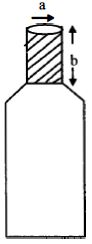
$A$ bottle has an opening of radius $a$ and length $b$. $A$ cork of length $b$ and radius $(a + \Delta a)$,where $(\Delta a << a)$,is compressed to fit into the opening completely (see figure). If the bulk modulus of the cork is $B$ and the frictional coefficient between the bottle and the cork is $\mu$,then the force needed to push the cork into the bottle is:
A
$(\pi \mu Bb) a$
B
$(2\pi \mu Bb) \Delta a$
C
$(\pi \mu Bb) \Delta a$
D
$(4\pi \mu Bb) \Delta a$
Solution
(D) The change in volume of the cork is $\Delta V = V_{initial} - V_{final} = \pi (a + \Delta a)^2 b - \pi a^2 b \approx \pi (a^2 + 2a \Delta a) b - \pi a^2 b = 2\pi a b \Delta a$.
The volumetric strain is $\frac{\Delta V}{V} = \frac{2\pi a b \Delta a}{\pi a^2 b} = \frac{2 \Delta a}{a}$.
The pressure $P$ exerted by the cork on the walls of the bottle is given by $P = B \times \text{volumetric strain} = B \left( \frac{2 \Delta a}{a} \right)$.
The normal force $N$ exerted by the cork on the inner surface of the bottle opening is $N = P \times A_{surface} = \left( \frac{2B \Delta a}{a} \right) \times (2\pi a b) = 4\pi B b \Delta a$.
The frictional force $f$ required to push the cork is $f = \mu N = \mu (4\pi B b \Delta a) = (4\pi \mu B b) \Delta a$.
The volumetric strain is $\frac{\Delta V}{V} = \frac{2\pi a b \Delta a}{\pi a^2 b} = \frac{2 \Delta a}{a}$.
The pressure $P$ exerted by the cork on the walls of the bottle is given by $P = B \times \text{volumetric strain} = B \left( \frac{2 \Delta a}{a} \right)$.
The normal force $N$ exerted by the cork on the inner surface of the bottle opening is $N = P \times A_{surface} = \left( \frac{2B \Delta a}{a} \right) \times (2\pi a b) = 4\pi B b \Delta a$.
The frictional force $f$ required to push the cork is $f = \mu N = \mu (4\pi B b \Delta a) = (4\pi \mu B b) \Delta a$.
0 likes
View Solution40
MediumMCQ
The bulk moduli of ethanol,mercury,and water are given as $0.9$,$25$,and $2.2$ respectively in units of $10^9 \, Nm^{-2}$. For a given value of pressure,the fractional compression in volume is $\frac{\Delta V}{V}$. Which of the following statements about $\frac{\Delta V}{V}$ for these three liquids is correct?
A
Ethanol $>$ Water $>$ Mercury
B
Water $>$ Ethanol $>$ Mercury
C
Mercury $>$ Ethanol $>$ Water
D
Ethanol $>$ Mercury $>$ Water
Solution
(A) The bulk modulus $B$ is defined as $B = -\frac{\Delta P}{\Delta V/V}$,which implies the fractional compression $\frac{\Delta V}{V} = \frac{\Delta P}{B}$.
For a constant pressure change $\Delta P$,the fractional compression $\frac{\Delta V}{V}$ is inversely proportional to the bulk modulus $B$ (i.e.,$\frac{\Delta V}{V} \propto \frac{1}{B}$).
Given bulk moduli:
$B_{\text{ethanol}} = 0.9 \times 10^9 \, Nm^{-2}$
$B_{\text{water}} = 2.2 \times 10^9 \, Nm^{-2}$
$B_{\text{mercury}} = 25 \times 10^9 \, Nm^{-2}$
Since $B_{\text{ethanol}} < B_{\text{water}} < B_{\text{mercury}}$,the fractional compression follows the order:
$\left( \frac{\Delta V}{V} \right)_{\text{ethanol}} > \left( \frac{\Delta V}{V} \right)_{\text{water}} > \left( \frac{\Delta V}{V} \right)_{\text{mercury}}$
Therefore,the correct order is Ethanol $>$ Water $>$ Mercury.
For a constant pressure change $\Delta P$,the fractional compression $\frac{\Delta V}{V}$ is inversely proportional to the bulk modulus $B$ (i.e.,$\frac{\Delta V}{V} \propto \frac{1}{B}$).
Given bulk moduli:
$B_{\text{ethanol}} = 0.9 \times 10^9 \, Nm^{-2}$
$B_{\text{water}} = 2.2 \times 10^9 \, Nm^{-2}$
$B_{\text{mercury}} = 25 \times 10^9 \, Nm^{-2}$
Since $B_{\text{ethanol}} < B_{\text{water}} < B_{\text{mercury}}$,the fractional compression follows the order:
$\left( \frac{\Delta V}{V} \right)_{\text{ethanol}} > \left( \frac{\Delta V}{V} \right)_{\text{water}} > \left( \frac{\Delta V}{V} \right)_{\text{mercury}}$
Therefore,the correct order is Ethanol $>$ Water $>$ Mercury.
0 likes
View Solution41
MediumMCQ
$A$ glass slab is subjected to a pressure of $10 \, atm$. The fractional change in its volume is (Bulk modulus of glass $= 37 \times 10^9 \, N \, m^{-2}$,$1 \, atm = 1 \times 10^5 \, N \, m^{-2}$)
A
$2.7 \times 10^{-2}$
B
$2.7 \times 10^{-3}$
C
$2.7 \times 10^{-4}$
D
$2.7 \times 10^{-5}$
Solution
(D) The Bulk modulus $(B)$ is defined as the ratio of the change in pressure $(P)$ to the fractional change in volume $(\frac{\Delta V}{V})$:
$B = \frac{P}{\Delta V / V}$
Rearranging the formula to find the fractional change in volume:
$\frac{\Delta V}{V} = \frac{P}{B}$
Given values:
$P = 10 \, atm = 10 \times 10^5 \, N \, m^{-2} = 10^6 \, N \, m^{-2}$
$B = 37 \times 10^9 \, N \, m^{-2}$
Substituting the values into the equation:
$\frac{\Delta V}{V} = \frac{10^6}{37 \times 10^9}$
$\frac{\Delta V}{V} = \frac{1}{37} \times 10^{-3}$
$\frac{\Delta V}{V} \approx 0.027027 \times 10^{-3}$
$\frac{\Delta V}{V} = 2.7 \times 10^{-5}$
$B = \frac{P}{\Delta V / V}$
Rearranging the formula to find the fractional change in volume:
$\frac{\Delta V}{V} = \frac{P}{B}$
Given values:
$P = 10 \, atm = 10 \times 10^5 \, N \, m^{-2} = 10^6 \, N \, m^{-2}$
$B = 37 \times 10^9 \, N \, m^{-2}$
Substituting the values into the equation:
$\frac{\Delta V}{V} = \frac{10^6}{37 \times 10^9}$
$\frac{\Delta V}{V} = \frac{1}{37} \times 10^{-3}$
$\frac{\Delta V}{V} \approx 0.027027 \times 10^{-3}$
$\frac{\Delta V}{V} = 2.7 \times 10^{-5}$
0 likes
View Solution42
DifficultMCQ
An increase in pressure required to decrease the $200 \ L$ volume of a liquid by $0.004\%$ in a container is .......... $kPa$ (Bulk modulus of the liquid $= 2100 \ MPa$).
A
$188$
B
$8.4$
C
$18.8$
D
$84$
Solution
(D) The formula for Bulk modulus $(B)$ is given by $B = \frac{\Delta P}{-\Delta V / V}$.
Rearranging for the change in pressure,we get $\Delta P = B \times \left( -\frac{\Delta V}{V} \right)$.
Given that the volume decreases by $0.004\%$,the fractional change in volume is $\frac{-\Delta V}{V} = \frac{0.004}{100} = 4 \times 10^{-5}$.
The Bulk modulus $B = 2100 \ MPa = 2100 \times 10^6 \ Pa$.
Substituting these values into the equation:
$\Delta P = (2100 \times 10^6 \ Pa) \times (4 \times 10^{-5})$
$\Delta P = 84000 \ Pa = 84 \ kPa$.
Rearranging for the change in pressure,we get $\Delta P = B \times \left( -\frac{\Delta V}{V} \right)$.
Given that the volume decreases by $0.004\%$,the fractional change in volume is $\frac{-\Delta V}{V} = \frac{0.004}{100} = 4 \times 10^{-5}$.
The Bulk modulus $B = 2100 \ MPa = 2100 \times 10^6 \ Pa$.
Substituting these values into the equation:
$\Delta P = (2100 \times 10^6 \ Pa) \times (4 \times 10^{-5})$
$\Delta P = 84000 \ Pa = 84 \ kPa$.
0 likes
View Solution43
MediumMCQ
The bulk modulus of rubber is $9.1 \times 10^8 \, N/m^2$. To what depth $h$ (in $m$) must a rubber ball be taken in a lake so that its volume is decreased by $0.1 \, \%$?
A
$25$
B
$91$
C
$200$
D
$500$
Solution
(B) The bulk modulus $K$ is defined as $K = \frac{\Delta P}{\Delta V/V}$.
Here, the change in pressure $\Delta P$ at depth $h$ is given by $\Delta P = \rho gh$, where $\rho$ is the density of water $(10^3 \, kg/m^3)$ and $g$ is the acceleration due to gravity $(10 \, m/s^2)$.
The fractional change in volume is $\frac{\Delta V}{V} = 0.1 \, \% = \frac{0.1}{100} = 10^{-3}$.
Substituting the values into the formula:
$9.1 \times 10^8 = \frac{10^3 \times 10 \times h}{10^{-3}}$
$9.1 \times 10^8 = \frac{10^4 \times h}{10^{-3}}$
$9.1 \times 10^8 = 10^7 \times h$
$h = \frac{9.1 \times 10^8}{10^7} = 9.1 \times 10 = 91 \, m$.
Here, the change in pressure $\Delta P$ at depth $h$ is given by $\Delta P = \rho gh$, where $\rho$ is the density of water $(10^3 \, kg/m^3)$ and $g$ is the acceleration due to gravity $(10 \, m/s^2)$.
The fractional change in volume is $\frac{\Delta V}{V} = 0.1 \, \% = \frac{0.1}{100} = 10^{-3}$.
Substituting the values into the formula:
$9.1 \times 10^8 = \frac{10^3 \times 10 \times h}{10^{-3}}$
$9.1 \times 10^8 = \frac{10^4 \times h}{10^{-3}}$
$9.1 \times 10^8 = 10^7 \times h$
$h = \frac{9.1 \times 10^8}{10^7} = 9.1 \times 10 = 91 \, m$.
0 likes
View Solution44
MediumMCQ
$A$ uniform cube is subjected to volume compression. If each side is decreased by $1\%$,then the bulk strain is
A
$0.01$
B
$0.06$
C
$0.02$
D
$0.03$
Solution
(D) Let the side of the cube be $L$. The volume of the cube is given by $V = L^3$.
Taking the logarithmic derivative,we get $\frac{dV}{V} = 3 \frac{dL}{L}$.
Given that the side is decreased by $1\%$,we have $\frac{dL}{L} = -0.01$.
Therefore,the fractional change in volume (bulk strain) is $\frac{\Delta V}{V} = 3 \times (-0.01) = -0.03$.
The magnitude of the bulk strain is $|\frac{\Delta V}{V}| = 0.03$.
Taking the logarithmic derivative,we get $\frac{dV}{V} = 3 \frac{dL}{L}$.
Given that the side is decreased by $1\%$,we have $\frac{dL}{L} = -0.01$.
Therefore,the fractional change in volume (bulk strain) is $\frac{\Delta V}{V} = 3 \times (-0.01) = -0.03$.
The magnitude of the bulk strain is $|\frac{\Delta V}{V}| = 0.03$.
0 likes
View Solution45
MediumMCQ
$A$ copper solid cube of $60\, mm$ side is subjected to a pressure of $2.5 \times 10^7\, Pa$. If the bulk modulus of copper is $1.25 \times 10^{11}\, N/m^2$,the change in the volume of the cube is:
A
$-43.2\, m^3$
B
$-43.2\, mm^3$
C
$-43.2\, cm^3$
D
$-432\, mm^3$
Solution
(B) The bulk modulus $B$ is defined as $B = -\frac{\Delta P}{\Delta V / V}$,where $\Delta P$ is the change in pressure,$V$ is the initial volume,and $\Delta V$ is the change in volume.
Rearranging for $\Delta V$,we get $\Delta V = -\frac{\Delta P \cdot V}{B}$.
The initial volume $V = (60\, mm)^3 = 216000\, mm^3 = 2.16 \times 10^5\, mm^3$.
Given $\Delta P = 2.5 \times 10^7\, Pa$ and $B = 1.25 \times 10^{11}\, N/m^2$.
Substituting the values: $\Delta V = -\frac{2.5 \times 10^7}{1.25 \times 10^{11}} \times (60\, mm)^3$.
$\Delta V = -2 \times 10^{-4} \times 216000\, mm^3 = -43.2\, mm^3$.
Rearranging for $\Delta V$,we get $\Delta V = -\frac{\Delta P \cdot V}{B}$.
The initial volume $V = (60\, mm)^3 = 216000\, mm^3 = 2.16 \times 10^5\, mm^3$.
Given $\Delta P = 2.5 \times 10^7\, Pa$ and $B = 1.25 \times 10^{11}\, N/m^2$.
Substituting the values: $\Delta V = -\frac{2.5 \times 10^7}{1.25 \times 10^{11}} \times (60\, mm)^3$.
$\Delta V = -2 \times 10^{-4} \times 216000\, mm^3 = -43.2\, mm^3$.
0 likes
View Solution46
MediumMCQ
The compressibility of water per unit atmospheric pressure is $\sigma$. If there is a decrease in volume $V$ due to an applied pressure $P$,find the change in volume.
A
$\sigma P V$
B
$\sigma P / V$
C
$\sigma / PV$
D
$\sigma V / P$
Solution
(A) The bulk modulus $B$ is defined as the ratio of volumetric stress to volumetric strain: $B = -\frac{P}{\Delta V / V}$.
The compressibility $\sigma$ is the reciprocal of the bulk modulus: $\sigma = \frac{1}{B} = -\frac{\Delta V / V}{P}$.
Given that there is a decrease in volume $V$ due to pressure $P$,we consider the magnitude of the change in volume $\Delta V$: $\sigma = \frac{\Delta V}{PV}$.
Rearranging the formula to solve for the change in volume $\Delta V$,we get: $\Delta V = \sigma PV$.
The compressibility $\sigma$ is the reciprocal of the bulk modulus: $\sigma = \frac{1}{B} = -\frac{\Delta V / V}{P}$.
Given that there is a decrease in volume $V$ due to pressure $P$,we consider the magnitude of the change in volume $\Delta V$: $\sigma = \frac{\Delta V}{PV}$.
Rearranging the formula to solve for the change in volume $\Delta V$,we get: $\Delta V = \sigma PV$.
0 likes
View Solution47
MediumMCQ
For a constant hydraulic stress on an object,the fractional change in the object's volume $(\Delta V/V)$ and its bulk modulus $(B)$ are related as
A
$\frac{\Delta V}{V} \propto B$
B
$\frac{\Delta V}{V} \propto \frac{1}{B}$
C
$\frac{\Delta V}{V} \propto B^2$
D
$\frac{\Delta V}{V} \propto B^{-2}$
Solution
(B) The bulk modulus $(B)$ is defined as the ratio of hydraulic stress to the volumetric strain.
$B = \frac{\text{Stress}}{\text{Volumetric Strain}} = \frac{\text{Stress}}{\Delta V / V}$
Rearranging the formula to solve for the fractional change in volume $(\Delta V / V)$:
$\frac{\Delta V}{V} = \frac{\text{Stress}}{B}$
Since the hydraulic stress is given as a constant,the relationship between the fractional change in volume and the bulk modulus is:
$\frac{\Delta V}{V} \propto \frac{1}{B}$
$B = \frac{\text{Stress}}{\text{Volumetric Strain}} = \frac{\text{Stress}}{\Delta V / V}$
Rearranging the formula to solve for the fractional change in volume $(\Delta V / V)$:
$\frac{\Delta V}{V} = \frac{\text{Stress}}{B}$
Since the hydraulic stress is given as a constant,the relationship between the fractional change in volume and the bulk modulus is:
$\frac{\Delta V}{V} \propto \frac{1}{B}$
0 likes
View Solution48
MediumMCQ
$1\, m^3$ of water is brought inside a lake up to a depth of $200\, m$ from the surface. What will be the change in volume if the bulk modulus of elasticity of water is $22000\, \text{atm}$? (Given: density of water $\rho = 1\times10^3\, kg/m^3$, atmospheric pressure $P_0 = 10^5\, N/m^2$, and $g = 10\, m/s^2$)
A
$8.9\times10^{-3}\, m^3$
B
$7.8\times10^{-3}\, m^3$
C
$9.1\times10^{-4}\, m^3$
D
$8.7\times10^{-4}\, m^3$
Solution
(C) The formula for bulk modulus $K$ is given by $K = \frac{P}{\Delta V/V}$, where $P$ is the change in pressure, $V$ is the initial volume, and $\Delta V$ is the change in volume.
Rearranging for $\Delta V$, we get $\Delta V = \frac{PV}{K}$.
The pressure at depth $h$ is $P = h\rho g = 200 \times 10^3 \times 10 = 2 \times 10^6\, N/m^2$.
The bulk modulus is $K = 22000\, \text{atm} = 22000 \times 10^5 = 2.2 \times 10^9\, N/m^2$.
Given $V = 1\, m^3$, substituting the values:
$\Delta V = \frac{2 \times 10^6 \times 1}{2.2 \times 10^9} = \frac{2}{2200} = \frac{1}{1100} \approx 9.09 \times 10^{-4}\, m^3$.
Rounding to the nearest option, $\Delta V \approx 9.1 \times 10^{-4}\, m^3$.
Rearranging for $\Delta V$, we get $\Delta V = \frac{PV}{K}$.
The pressure at depth $h$ is $P = h\rho g = 200 \times 10^3 \times 10 = 2 \times 10^6\, N/m^2$.
The bulk modulus is $K = 22000\, \text{atm} = 22000 \times 10^5 = 2.2 \times 10^9\, N/m^2$.
Given $V = 1\, m^3$, substituting the values:
$\Delta V = \frac{2 \times 10^6 \times 1}{2.2 \times 10^9} = \frac{2}{2200} = \frac{1}{1100} \approx 9.09 \times 10^{-4}\, m^3$.
Rounding to the nearest option, $\Delta V \approx 9.1 \times 10^{-4}\, m^3$.
1 likes
View Solution49
MediumMCQ
The average depth of the Indian Ocean is about $3000\; m$. Calculate the fractional compression,$\Delta V / V,$ of water at the bottom of the ocean,given that the bulk modulus of water is $2.2 \times 10^{9}\; N m^{-2}$. (Take $g = 10\; m s^{-2}$)
A
$1.36 \times 10^{-2}$
B
$2.56 \times 10^{-2}$
C
$3.63 \times 10^{-2}$
D
$4.94 \times 10^{-2}$
Solution
(A) The pressure $p$ exerted by a $3000\; m$ column of water at the bottom of the ocean is given by the formula $p = h \rho g$.
Given: depth $h = 3000\; m$,density of water $\rho = 1000\; kg\; m^{-3}$,and acceleration due to gravity $g = 10\; m s^{-2}$.
$p = 3000\; m \times 1000\; kg\; m^{-3} \times 10\; m s^{-2} = 3 \times 10^{7}\; N m^{-2}$.
The bulk modulus $B$ is defined as $B = -\frac{p}{\Delta V / V}$,so the fractional compression is $\frac{\Delta V}{V} = \frac{p}{B}$.
Substituting the values: $\frac{\Delta V}{V} = \frac{3 \times 10^{7}\; N m^{-2}}{2.2 \times 10^{9}\; N m^{-2}} \approx 1.36 \times 10^{-2}$.
Thus,the fractional compression is $1.36 \times 10^{-2}$.
Given: depth $h = 3000\; m$,density of water $\rho = 1000\; kg\; m^{-3}$,and acceleration due to gravity $g = 10\; m s^{-2}$.
$p = 3000\; m \times 1000\; kg\; m^{-3} \times 10\; m s^{-2} = 3 \times 10^{7}\; N m^{-2}$.
The bulk modulus $B$ is defined as $B = -\frac{p}{\Delta V / V}$,so the fractional compression is $\frac{\Delta V}{V} = \frac{p}{B}$.
Substituting the values: $\frac{\Delta V}{V} = \frac{3 \times 10^{7}\; N m^{-2}}{2.2 \times 10^{9}\; N m^{-2}} \approx 1.36 \times 10^{-2}$.
Thus,the fractional compression is $1.36 \times 10^{-2}$.
0 likes
View Solution50
Medium
Compute the bulk modulus of water from the following data: Initial volume $= 100.0 \; L$,Pressure increase $= 100.0 \; atm$ $(1 \; atm = 1.013 \times 10^{5} \; Pa)$,Final volume $= 100.5 \; L$. Compare the bulk modulus of water with that of air (at constant temperature). Explain in simple terms why the ratio is so large.
Solution
(N/A) Initial volume,$V_{1} = 100.0 \; L = 100.0 \times 10^{-3} \; m^{3}$.
Final volume,$V_{2} = 100.5 \; L = 100.5 \times 10^{-3} \; m^{3}$.
Change in volume,$\Delta V = V_{2} - V_{1} = 0.5 \times 10^{-3} \; m^{3}$.
Increase in pressure,$\Delta p = 100.0 \; atm = 100 \times 1.013 \times 10^{5} \; Pa = 1.013 \times 10^{7} \; Pa$.
Bulk modulus $B = -\frac{\Delta p}{\Delta V / V_{1}} = \frac{\Delta p \cdot V_{1}}{\Delta V}$.
$B = \frac{1.013 \times 10^{7} \times 100.0 \times 10^{-3}}{0.5 \times 10^{-3}} = \frac{1.013 \times 10^{6}}{0.5 \times 10^{-3}} = 2.026 \times 10^{9} \; Pa$.
The bulk modulus of air is approximately $1.0 \times 10^{5} \; Pa$.
The ratio of the bulk modulus of water to that of air is $\frac{2.026 \times 10^{9}}{1.0 \times 10^{5}} \approx 2.026 \times 10^{4}$.
This ratio is very large because water is a liquid and is nearly incompressible,whereas air is a gas and is highly compressible due to the large intermolecular spaces.
Final volume,$V_{2} = 100.5 \; L = 100.5 \times 10^{-3} \; m^{3}$.
Change in volume,$\Delta V = V_{2} - V_{1} = 0.5 \times 10^{-3} \; m^{3}$.
Increase in pressure,$\Delta p = 100.0 \; atm = 100 \times 1.013 \times 10^{5} \; Pa = 1.013 \times 10^{7} \; Pa$.
Bulk modulus $B = -\frac{\Delta p}{\Delta V / V_{1}} = \frac{\Delta p \cdot V_{1}}{\Delta V}$.
$B = \frac{1.013 \times 10^{7} \times 100.0 \times 10^{-3}}{0.5 \times 10^{-3}} = \frac{1.013 \times 10^{6}}{0.5 \times 10^{-3}} = 2.026 \times 10^{9} \; Pa$.
The bulk modulus of air is approximately $1.0 \times 10^{5} \; Pa$.
The ratio of the bulk modulus of water to that of air is $\frac{2.026 \times 10^{9}}{1.0 \times 10^{5}} \approx 2.026 \times 10^{4}$.
This ratio is very large because water is a liquid and is nearly incompressible,whereas air is a gas and is highly compressible due to the large intermolecular spaces.
0 likes
View SolutionMechanical Properties of Solids — Bulk Modulus · Frequently Asked Questions
1Are these Mechanical Properties of Solids questions useful for JEE and NEET?
Yes. All questions in this section are mapped to JEE Main and NEET exam patterns. Previous year questions from JEE Main, NEET, GUJCET and state-level exams are included with full solutions.
2Can I switch to Hindi or Gujarati for these questions?
Yes. Use the language tabs in the hero section or the sidebar to view the same questions and solutions in English, Hindi or Gujarati.
3How do I generate a question paper from this subtopic?
Use the Vedclass Exam Paper Generator — select the chapter and subtopic, set difficulty, and generate Sets A, B, C, D automatically. First 3 chapters of every subject are free.
Vedclass Products
For Students
Vedclass Test Series
Mock tests in real JEE/NEET style with performance analysis. 5-day free trial.
Start Free TrialFor Teachers
Exam Paper Generator
Generate Set A/B/C/D papers from this chapter in 2 minutes. 3 chapters free.
Try FreeFor Institutes
Online Exam Module
Live online exams with unlimited students, 360° analytics & white-label branding.
See DemoFor Teachers & Institutes
Generate a Mechanical Properties of Solids Exam Paper in 2 Minutes
Select subtopic & difficulty — Sets A, B, C, D auto-generated with No Repeat logic.
First 3 chapters of every subject are free — no payment required.