
A English
Gas Laws (Charles, Boyle's, Avagadro's, Gay Lussacs and Dalton's law) and Ideal gas Equation Questions in English
Class 11 Physics · Kinetic Theory of Gases · Gas Laws (Charles, Boyle's, Avagadro's, Gay Lussacs and Dalton's law) and Ideal gas Equation
391+
Questions
English
Language
100%
With Solutions
Showing 50 of 391 questions in English
251
Easy
State Avogadro's law for matter.
Solution
(N/A) Avogadro's law states that equal volumes of all gases under the same conditions of temperature and pressure contain an equal number of molecules.
Mathematically,it is expressed as $V \propto n$ (at constant $T$ and $P$),where $V$ is the volume of the gas,$n$ is the amount of substance (number of moles),$T$ is the absolute temperature,and $P$ is the pressure.
This implies that the molar volume of all ideal gases at standard temperature and pressure $(STP)$ is the same,which is approximately $22.4 \ L$ per mole.
Mathematically,it is expressed as $V \propto n$ (at constant $T$ and $P$),where $V$ is the volume of the gas,$n$ is the amount of substance (number of moles),$T$ is the absolute temperature,and $P$ is the pressure.
This implies that the molar volume of all ideal gases at standard temperature and pressure $(STP)$ is the same,which is approximately $22.4 \ L$ per mole.
0 likes
View Solution252
Medium
Explain Avogadro's hypothesis by relating pressure,temperature,and volume of a gas.
Solution
(N/A) The equation relating pressure $(P)$,volume $(V)$,and temperature $(T)$ of a gas is given by:
$PV = KT$
Where $T$ is the absolute temperature in Kelvin.
$K$ is a constant for a given gas,but it varies with the amount of gas.
$K$ is proportional to the number of molecules $(N)$ in the given sample of gas.
$\therefore K \propto N$
$\therefore K = k_{B} N$
Here,$k_{B}$ is the Boltzmann constant.
Its value is the same for all gases.
The unit of $k_{B}$ is $\text{J/K}$ and its dimension is $[M^{1} L^{2} T^{-2} K^{-1}]$.
Substituting $K$ into the first equation:
$PV = k_{B} NT$
$\therefore \frac{PV}{NT} = k_{B} = \text{constant}$
This implies that for two different gas samples:
$\frac{P_{1} V_{1}}{N_{1} T_{1}} = \frac{P_{2} V_{2}}{N_{2} T_{2}}$
If $P, V,$ and $T$ are the same for different gases,then $N$ must also be equal. This represents Avogadro's hypothesis,which states: Equal volumes of all gases at the same temperature and pressure contain the same number of molecules.
$PV = KT$
Where $T$ is the absolute temperature in Kelvin.
$K$ is a constant for a given gas,but it varies with the amount of gas.
$K$ is proportional to the number of molecules $(N)$ in the given sample of gas.
$\therefore K \propto N$
$\therefore K = k_{B} N$
Here,$k_{B}$ is the Boltzmann constant.
Its value is the same for all gases.
The unit of $k_{B}$ is $\text{J/K}$ and its dimension is $[M^{1} L^{2} T^{-2} K^{-1}]$.
Substituting $K$ into the first equation:
$PV = k_{B} NT$
$\therefore \frac{PV}{NT} = k_{B} = \text{constant}$
This implies that for two different gas samples:
$\frac{P_{1} V_{1}}{N_{1} T_{1}} = \frac{P_{2} V_{2}}{N_{2} T_{2}}$
If $P, V,$ and $T$ are the same for different gases,then $N$ must also be equal. This represents Avogadro's hypothesis,which states: Equal volumes of all gases at the same temperature and pressure contain the same number of molecules.
0 likes
View Solution253
Difficult
Write the values of standard temperature and pressure $(STP)$.
Solution
(N/A) $STP$ stands for standard temperature and pressure.
The standard temperature is defined as $0^{\circ}C$,which is equal to $0 + 273.15 = 273.15 \ K \approx 273 \ K$.
The standard pressure is defined as $1 \ atm$,which is equal to $1.01325 \times 10^{5} \ Nm^{-2} \approx 1.01 \times 10^{5} \ Nm^{-2}$.
The standard temperature is defined as $0^{\circ}C$,which is equal to $0 + 273.15 = 273.15 \ K \approx 273 \ K$.
The standard pressure is defined as $1 \ atm$,which is equal to $1.01325 \times 10^{5} \ Nm^{-2} \approx 1.01 \times 10^{5} \ Nm^{-2}$.
0 likes
View Solution254
Medium
What is a mole? Write two equations for a mole.
Solution
(N/A) mole is defined as the amount of substance that contains as many elementary entities as there are atoms in $0.012 \ kg$ of carbon-$12$. At standard temperature and pressure $(STP)$,the mass contained in $22.4 \ L$ volume of an ideal gas is equal to its molecular mass. Its symbol is $mol$.
Equation $1$: In terms of mass,if $M$ is the mass of the gas and $M_{0}$ is the molar mass,the number of moles $\mu$ is given by:
$\mu = \frac{M}{M_{0}}$
Equation $2$: In terms of the number of molecules,if $N$ is the total number of molecules and $N_{A}$ is the Avogadro constant $(6.022 \times 10^{23} \ mol^{-1})$,the number of moles $\mu$ is given by:
$\mu = \frac{N}{N_{A}}$
Equation $1$: In terms of mass,if $M$ is the mass of the gas and $M_{0}$ is the molar mass,the number of moles $\mu$ is given by:
$\mu = \frac{M}{M_{0}}$
Equation $2$: In terms of the number of molecules,if $N$ is the total number of molecules and $N_{A}$ is the Avogadro constant $(6.022 \times 10^{23} \ mol^{-1})$,the number of moles $\mu$ is given by:
$\mu = \frac{N}{N_{A}}$
0 likes
View Solution255
Medium
What is Avogadro number? Write its value.
Solution
(N/A) The number of molecules contained in $1 \text{ mole}$ of a substance is called the Avogadro number. It is represented by the symbol $N_{A}$.
$N_{A} = 6.022 \times 10^{23} \text{ mol}^{-1}$.
Modern definition: The number of atoms contained in exactly $12 \text{ g}$ of carbon-$12$ is called the Avogadro number.
Avogadro number is a universal constant applicable to all types of fundamental particles:
$1 \text{ mole of atoms} = 6.022 \times 10^{23} \text{ atoms/mole}$
$1 \text{ mole of ions} = 6.022 \times 10^{23} \text{ ions/mole}$
$1 \text{ mole of electrons} = 6.022 \times 10^{23} \text{ electrons/mole}$
$N_{A} = 6.022 \times 10^{23} \text{ mol}^{-1}$.
Modern definition: The number of atoms contained in exactly $12 \text{ g}$ of carbon-$12$ is called the Avogadro number.
Avogadro number is a universal constant applicable to all types of fundamental particles:
$1 \text{ mole of atoms} = 6.022 \times 10^{23} \text{ atoms/mole}$
$1 \text{ mole of ions} = 6.022 \times 10^{23} \text{ ions/mole}$
$1 \text{ mole of electrons} = 6.022 \times 10^{23} \text{ electrons/mole}$
1 likes
View Solution256
Medium
By using the ideal gas equation $PV = \mu RT$,write the value,unit,and dimension of $R$.
Solution
(N/A) The ideal gas equation is given by $PV = \mu RT$.
Rearranging for $R$,we get $R = \frac{PV}{\mu T}$.
At standard temperature and pressure $(STP)$,for $1 \text{ mole}$ of an ideal gas $(\mu = 1)$:
$P = 1.013 \times 10^{5} \text{ N/m}^2$
$V = 22.4 \times 10^{-3} \text{ m}^3$
$T = 273.15 \text{ K}$
Substituting these values:
$R = \frac{1.013 \times 10^{5} \times 22.4 \times 10^{-3}}{1 \times 273.15} \approx 8.314 \text{ J mol}^{-1} \text{ K}^{-1}$.
Unit of $R$: $\text{J mol}^{-1} \text{ K}^{-1}$ or $\text{N m mol}^{-1} \text{ K}^{-1}$.
Dimension of $R$:
Since $R = \frac{PV}{\mu T}$,the dimension is $\frac{[M^1 L^{-1} T^{-2}] [L^3]}{[mol] [K]} = [M^1 L^2 T^{-2} K^{-1} mol^{-1}]$.
Rearranging for $R$,we get $R = \frac{PV}{\mu T}$.
At standard temperature and pressure $(STP)$,for $1 \text{ mole}$ of an ideal gas $(\mu = 1)$:
$P = 1.013 \times 10^{5} \text{ N/m}^2$
$V = 22.4 \times 10^{-3} \text{ m}^3$
$T = 273.15 \text{ K}$
Substituting these values:
$R = \frac{1.013 \times 10^{5} \times 22.4 \times 10^{-3}}{1 \times 273.15} \approx 8.314 \text{ J mol}^{-1} \text{ K}^{-1}$.
Unit of $R$: $\text{J mol}^{-1} \text{ K}^{-1}$ or $\text{N m mol}^{-1} \text{ K}^{-1}$.
Dimension of $R$:
Since $R = \frac{PV}{\mu T}$,the dimension is $\frac{[M^1 L^{-1} T^{-2}] [L^3]}{[mol] [K]} = [M^1 L^2 T^{-2} K^{-1} mol^{-1}]$.
0 likes
View Solution257
Difficult
What is an ideal gas? Write the state equation for an ideal gas. Write and explain the different laws relating to gases.
Solution
(N/A) An ideal gas is a theoretical model of a gas that satisfies the equation $PV = \mu RT$ at all pressures and temperatures.
No real gas is a perfectly ideal gas.
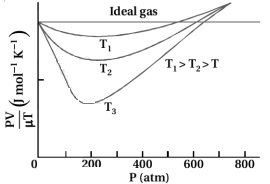
The provided graph shows the deviation of real gases from ideal gas behavior at three different temperatures. The horizontal line represents the ideal gas,which is parallel to the $P$ (pressure) axis.
All curves approach ideal gas behavior at low pressure and high temperature.
At low pressure and high temperature,the molecules are far apart,and molecular interactions are negligible. Hence,in this limit,a real gas behaves like an ideal gas.
The state equation for an ideal gas is $PV = \mu RT$,where $R$ is the universal gas constant.
Gas Laws:
$(1)$ Boyle's Law: At a constant temperature,the pressure of a given mass of gas varies inversely with its volume.
$\therefore P \propto \frac{1}{V} \implies PV = \text{constant}$.
$(2)$ Charles's Law: At a constant pressure,the volume of a given mass of gas is directly proportional to its absolute temperature.
$\therefore V \propto T \implies \frac{V}{T} = \text{constant}$.
$(3)$ Gay-Lussac's Law: At a constant volume,the pressure of a given mass of gas is directly proportional to its absolute temperature.
$\therefore P \propto T \implies \frac{P}{T} = \text{constant}$.
No real gas is a perfectly ideal gas.
The provided graph shows the deviation of real gases from ideal gas behavior at three different temperatures. The horizontal line represents the ideal gas,which is parallel to the $P$ (pressure) axis.
All curves approach ideal gas behavior at low pressure and high temperature.
At low pressure and high temperature,the molecules are far apart,and molecular interactions are negligible. Hence,in this limit,a real gas behaves like an ideal gas.
The state equation for an ideal gas is $PV = \mu RT$,where $R$ is the universal gas constant.
Gas Laws:
$(1)$ Boyle's Law: At a constant temperature,the pressure of a given mass of gas varies inversely with its volume.
$\therefore P \propto \frac{1}{V} \implies PV = \text{constant}$.
$(2)$ Charles's Law: At a constant pressure,the volume of a given mass of gas is directly proportional to its absolute temperature.
$\therefore V \propto T \implies \frac{V}{T} = \text{constant}$.
$(3)$ Gay-Lussac's Law: At a constant volume,the pressure of a given mass of gas is directly proportional to its absolute temperature.
$\therefore P \propto T \implies \frac{P}{T} = \text{constant}$.
0 likes
View Solution258
Medium
State and explain Dalton's law of partial pressure.
Solution
(N/A) Law: The total pressure exerted by a mixture of non-reacting ideal gases is equal to the sum of the partial pressures of the individual gases.
Let the volume of the container be $V$ and the temperature of the gases be $T$. Let the total pressure of the mixture be $P$.
Let the number of moles of the individual gases be $\mu_{1}, \mu_{2}, \ldots, \mu_{n}$.
The total number of moles is $\mu = \mu_{1} + \mu_{2} + \ldots + \mu_{n}$.
According to the ideal gas equation,$PV = \mu RT$.
Substituting the total moles: $PV = (\mu_{1} + \mu_{2} + \ldots + \mu_{n}) RT$.
Therefore,$P = \frac{\mu_{1} RT}{V} + \frac{\mu_{2} RT}{V} + \ldots + \frac{\mu_{n} RT}{V}$.
Since the partial pressure of an individual gas $i$ is defined as $P_{i} = \frac{\mu_{i} RT}{V}$,we get:
$P = P_{1} + P_{2} + \ldots + P_{n}$.
Thus,in a mixture of non-interacting gases,the total pressure of the mixture is equal to the sum of the partial pressures of the individual gases.
Let the volume of the container be $V$ and the temperature of the gases be $T$. Let the total pressure of the mixture be $P$.
Let the number of moles of the individual gases be $\mu_{1}, \mu_{2}, \ldots, \mu_{n}$.
The total number of moles is $\mu = \mu_{1} + \mu_{2} + \ldots + \mu_{n}$.
According to the ideal gas equation,$PV = \mu RT$.
Substituting the total moles: $PV = (\mu_{1} + \mu_{2} + \ldots + \mu_{n}) RT$.
Therefore,$P = \frac{\mu_{1} RT}{V} + \frac{\mu_{2} RT}{V} + \ldots + \frac{\mu_{n} RT}{V}$.
Since the partial pressure of an individual gas $i$ is defined as $P_{i} = \frac{\mu_{i} RT}{V}$,we get:
$P = P_{1} + P_{2} + \ldots + P_{n}$.
Thus,in a mixture of non-interacting gases,the total pressure of the mixture is equal to the sum of the partial pressures of the individual gases.
0 likes
View Solution259
EasyMCQ
In the equation $PV = KT$,the value of $K$ depends on which factors?
A
Nature of the gas
B
Mass of the gas
C
Both $(A)$ and $(B)$
D
None of the above
Solution
(C) The ideal gas equation is given by $PV = nRT$,where $n$ is the number of moles and $R$ is the universal gas constant.
Comparing this with the given equation $PV = KT$,we find that $K = nR$.
Since $n = \frac{m}{M}$ (where $m$ is the mass of the gas and $M$ is the molar mass),we have $K = \frac{m}{M} R$.
Thus,$K$ depends on the mass of the gas $(m)$ and the molar mass $(M)$,which is characteristic of the nature of the gas.
Therefore,$K$ depends on both the nature of the gas and the mass of the gas.
Comparing this with the given equation $PV = KT$,we find that $K = nR$.
Since $n = \frac{m}{M}$ (where $m$ is the mass of the gas and $M$ is the molar mass),we have $K = \frac{m}{M} R$.
Thus,$K$ depends on the mass of the gas $(m)$ and the molar mass $(M)$,which is characteristic of the nature of the gas.
Therefore,$K$ depends on both the nature of the gas and the mass of the gas.
0 likes
View Solution260
Medium
State the Avogadro hypothesis.
Solution
(N/A) Avogadro's hypothesis states that equal volumes of all gases under the same conditions of temperature and pressure contain an equal number of molecules.
Mathematically,for two gases at the same temperature $T$ and pressure $P$,if their volumes $V_1 = V_2$,then the number of molecules $N_1 = N_2$.
Mathematically,for two gases at the same temperature $T$ and pressure $P$,if their volumes $V_1 = V_2$,then the number of molecules $N_1 = N_2$.
0 likes
View Solution261
Easy
What is Avogadro number? Write its value.
Solution
(N/A) The Avogadro number,denoted by $N_A$,is defined as the number of constituent particles (usually atoms or molecules) that are contained in one mole of a given substance.
It represents the number of carbon atoms in exactly $12 \ g$ of the carbon-$12$ isotope.
The value of the Avogadro number is approximately $6.022 \times 10^{23} \ mol^{-1}$.
It represents the number of carbon atoms in exactly $12 \ g$ of the carbon-$12$ isotope.
The value of the Avogadro number is approximately $6.022 \times 10^{23} \ mol^{-1}$.
0 likes
View Solution262
Medium
Write the standard temperature and pressure $(STP)$ values.
Solution
(N/A) Standard Temperature and Pressure $(STP)$ is defined by the International Union of Pure and Applied Chemistry $(IUPAC)$ as follows:
$1$. Standard Temperature: The standard temperature is defined as $273.15 \ K$ (which is equivalent to $0 \ ^\circ C$).
$2$. Standard Pressure: The standard pressure is defined as $10^5 \ Pa$ (or $1 \ bar$).
Note: In older conventions,$STP$ was often defined as $273.15 \ K$ and $1 \ atm$ $(101325 \ Pa)$,but the current $IUPAC$ standard is $1 \ bar$.
$1$. Standard Temperature: The standard temperature is defined as $273.15 \ K$ (which is equivalent to $0 \ ^\circ C$).
$2$. Standard Pressure: The standard pressure is defined as $10^5 \ Pa$ (or $1 \ bar$).
Note: In older conventions,$STP$ was often defined as $273.15 \ K$ and $1 \ atm$ $(101325 \ Pa)$,but the current $IUPAC$ standard is $1 \ bar$.
0 likes
View Solution263
Medium
What is $1$ mole? Write two different methods to represent a mole.
Solution
(N/A) $1$ mole is defined as the amount of substance that contains exactly $6.022 \times 10^{23}$ elementary entities (atoms,molecules,ions,or other particles). This number is known as Avogadro's number $(N_A)$.
Two different methods to represent a mole are:
$1$. In terms of mass: $A$ mole is the amount of substance whose mass in grams is numerically equal to its molar mass (atomic or molecular mass).
$2$. In terms of number of particles: $A$ mole is the amount of substance that contains $N_A = 6.022 \times 10^{23}$ particles.
Two different methods to represent a mole are:
$1$. In terms of mass: $A$ mole is the amount of substance whose mass in grams is numerically equal to its molar mass (atomic or molecular mass).
$2$. In terms of number of particles: $A$ mole is the amount of substance that contains $N_A = 6.022 \times 10^{23}$ particles.
0 likes
View Solution264
EasyMCQ
What is the universal gas constant? Write its value and unit.
A
$8.314 \ J \ mol^{-1} \ K^{-1}$
B
$0.0821 \ L \ atm \ mol^{-1} \ K^{-1}$
C
$1.38 \times 10^{-23} \ J \ K^{-1}$
D
$6.626 \times 10^{-34} \ J \ s$
Solution
(A) The universal gas constant, denoted by $R$, is a physical constant that appears in the ideal gas law equation, $PV = nRT$.
It represents the work done by one mole of an ideal gas when its temperature is increased by $1 \ K$ at constant pressure.
The value of the universal gas constant in $SI$ units is $R = 8.314 \ J \ mol^{-1} \ K^{-1}$.
It represents the work done by one mole of an ideal gas when its temperature is increased by $1 \ K$ at constant pressure.
The value of the universal gas constant in $SI$ units is $R = 8.314 \ J \ mol^{-1} \ K^{-1}$.
0 likes
View Solution265
Medium
State Boyle's law and Charles's law.
Solution
(N/A) Boyle's Law: For a fixed mass of an ideal gas at a constant temperature, the pressure $P$ is inversely proportional to its volume $V$. Mathematically, $P \propto 1/V$ or $PV = \text{constant}$.
Charles's Law: For a fixed mass of an ideal gas at a constant pressure, the volume $V$ is directly proportional to its absolute temperature $T$. Mathematically, $V \propto T$ or $V/T = \text{constant}$.
Charles's Law: For a fixed mass of an ideal gas at a constant pressure, the volume $V$ is directly proportional to its absolute temperature $T$. Mathematically, $V \propto T$ or $V/T = \text{constant}$.
0 likes
View Solution266
Medium
State Gay-Lussac's Law.
Solution
(N/A) Gay-Lussac's Law states that for a given mass of an ideal gas, the pressure $(P)$ of the gas is directly proportional to its absolute temperature $(T)$, provided the volume $(V)$ remains constant.
Mathematically, this is expressed as:
$P \propto T$ (at constant $V$ and mass)
$P = kT$ or $\frac{P}{T} = \text{constant}$
where $P$ is the pressure, $T$ is the absolute temperature in Kelvin, and $k$ is a proportionality constant.
Mathematically, this is expressed as:
$P \propto T$ (at constant $V$ and mass)
$P = kT$ or $\frac{P}{T} = \text{constant}$
where $P$ is the pressure, $T$ is the absolute temperature in Kelvin, and $k$ is a proportionality constant.
0 likes
View Solution267
MediumMCQ
What is molar mass?
A
The mass of one molecule of a substance.
B
The mass of one mole of a substance.
C
The mass of one atom of a substance.
D
The mass of one gram of a substance.
Solution
(B) Molar mass is defined as the mass of one mole of a substance.
It is typically expressed in units of $g/mol$ or $kg/mol$.
Mathematically,it is the ratio of the mass of a sample to the amount of substance in moles $(n = m/M)$.
It is typically expressed in units of $g/mol$ or $kg/mol$.
Mathematically,it is the ratio of the mass of a sample to the amount of substance in moles $(n = m/M)$.
0 likes
View Solution268
EasyMCQ
According to Charles' law, what is the possible minimum temperature?
A
$-273.15^{\circ} C$
B
$0^{\circ} C$
C
$273.15^{\circ} C$
D
$100^{\circ} C$
Solution
(A) According to Charles' law, the volume of a gas is directly proportional to its absolute temperature $(V \propto T)$ at constant pressure.
As the temperature decreases, the volume of the gas decreases.
The theoretical minimum temperature is reached when the volume of the gas becomes zero.
This temperature is known as absolute zero, which is equal to $-273.15^{\circ} C$ or $0 \ K$.
As the temperature decreases, the volume of the gas decreases.
The theoretical minimum temperature is reached when the volume of the gas becomes zero.
This temperature is known as absolute zero, which is equal to $-273.15^{\circ} C$ or $0 \ K$.
0 likes
View Solution269
EasyMCQ
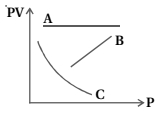
The graph shows the $PV$ vs $P$ plot for different gases at a constant temperature. Which graph represents an ideal gas?
A
$A$
B
$B$
C
$C$
D
None of these
Solution
(A) For an ideal gas,the equation of state is $PV = nRT$.
At a constant temperature $(T)$,$n$ and $R$ are constants,so the product $PV$ remains constant regardless of the pressure $P$.
Therefore,the graph of $PV$ versus $P$ for an ideal gas is a horizontal straight line parallel to the $P$-axis.
Looking at the provided graph,line $A$ is a horizontal line,which indicates that $PV$ is constant for all values of $P$.
Thus,graph $A$ represents an ideal gas.
At a constant temperature $(T)$,$n$ and $R$ are constants,so the product $PV$ remains constant regardless of the pressure $P$.
Therefore,the graph of $PV$ versus $P$ for an ideal gas is a horizontal straight line parallel to the $P$-axis.
Looking at the provided graph,line $A$ is a horizontal line,which indicates that $PV$ is constant for all values of $P$.
Thus,graph $A$ represents an ideal gas.
0 likes
View Solution270
Medium
Explain why the pressure inside a tyre increases when a vehicle moves for a long period of time.
Solution
(N/A) When a vehicle moves for a long period of time,the tyre becomes warm due to friction between the tyre and the road surface.
As a result,the temperature of the air trapped inside the tyre increases.
Since the volume of the tyre remains approximately constant,according to Gay-Lussac's Law ($P \propto T$ at constant volume),an increase in temperature leads to a proportional increase in the pressure of the air inside the tyre.
As a result,the temperature of the air trapped inside the tyre increases.
Since the volume of the tyre remains approximately constant,according to Gay-Lussac's Law ($P \propto T$ at constant volume),an increase in temperature leads to a proportional increase in the pressure of the air inside the tyre.
0 likes
View Solution271
EasyMCQ
At $N.T.P.$,$1 \text{ cm}^3$ of oxygen and $1 \text{ cm}^3$ of hydrogen are kept in different containers. Which will have a greater number of molecules?
A
Oxygen
B
Hydrogen
C
Both will have the same number of molecules
D
Neither
Solution
(C) According to Avogadro's Law,equal volumes of all gases at the same temperature and pressure contain an equal number of molecules.
Since both oxygen and hydrogen are at $N.T.P.$ and have the same volume $(1 \text{ cm}^3)$,they will contain the same number of molecules.
Since both oxygen and hydrogen are at $N.T.P.$ and have the same volume $(1 \text{ cm}^3)$,they will contain the same number of molecules.
0 likes
View Solution272
EasyMCQ
The temperature of a gas at $-173^{\circ} C$ is $1 \text{ atm}$ at constant volume. Up to what temperature should the gas be heated so that the pressure becomes $2 \text{ atm}$ (in $^{\circ} C$)?
A
$200$
B
$100$
C
$-73$
D
$273$
Solution
(C) According to Gay-Lussac's Law,for a fixed mass of gas at constant volume,the pressure is directly proportional to its absolute temperature: $P \propto T$.
Therefore,$\frac{P_{1}}{T_{1}} = \frac{P_{2}}{T_{2}}$.
Given:
$P_{1} = 1 \text{ atm}$
$T_{1} = -173^{\circ} C = (-173 + 273) K = 100 K$
$P_{2} = 2 \text{ atm}$
Substituting the values:
$T_{2} = \frac{P_{2} \times T_{1}}{P_{1}} = \frac{2 \times 100}{1} = 200 K$.
Converting back to Celsius:
$t_{2} = T_{2} - 273 = 200 - 273 = -73^{\circ} C$.
Therefore,$\frac{P_{1}}{T_{1}} = \frac{P_{2}}{T_{2}}$.
Given:
$P_{1} = 1 \text{ atm}$
$T_{1} = -173^{\circ} C = (-173 + 273) K = 100 K$
$P_{2} = 2 \text{ atm}$
Substituting the values:
$T_{2} = \frac{P_{2} \times T_{1}}{P_{1}} = \frac{2 \times 100}{1} = 200 K$.
Converting back to Celsius:
$t_{2} = T_{2} - 273 = 200 - 273 = -73^{\circ} C$.
0 likes
View Solution273
EasyMCQ
What is the nature of the $P$ versus $1/V$ graph at a constant temperature?
A
Parabolic
B
Straight line passing through the origin
C
Hyperbolic
D
Exponential
Solution
(B) According to Boyle's Law,for a fixed mass of an ideal gas at a constant temperature,the pressure $P$ is inversely proportional to the volume $V$,which is expressed as $P \propto 1/V$ or $P = k(1/V)$,where $k$ is a constant.
This equation is in the form of $y = mx$,where $y = P$,$x = 1/V$,and the slope $m = k$.
Therefore,the graph of $P$ versus $1/V$ is a straight line passing through the origin.
This equation is in the form of $y = mx$,where $y = P$,$x = 1/V$,and the slope $m = k$.
Therefore,the graph of $P$ versus $1/V$ is a straight line passing through the origin.
0 likes
View Solution274
MediumMCQ
What is the value of the volume of an ideal gas at absolute zero temperature?
A
$0$
B
$1 \ m^3$
C
Infinity
D
Cannot be determined
Solution
(A) According to Charles's Law,the volume $V$ of a given mass of an ideal gas is directly proportional to its absolute temperature $T$ at constant pressure,expressed as $V \propto T$ or $V = kT$. At absolute zero temperature $(T = 0 \ K)$,the volume of the gas becomes $V = k \times 0 = 0$. Therefore,the theoretical volume of an ideal gas at absolute zero is $0$.
0 likes
View Solution275
Easy
Why is an increase in the temperature of a gas at constant volume and constant pressure not possible?
Solution
(N/A) According to the ideal gas equation,$PV = nRT$.
If both pressure $P$ and volume $V$ are kept constant,then the product $PV$ is constant.
Since $n$ (number of moles) and $R$ (universal gas constant) are also constants,the temperature $T$ must remain constant.
Therefore,it is mathematically impossible to increase the temperature $T$ while keeping both $P$ and $V$ constant for a fixed amount of gas.
If both pressure $P$ and volume $V$ are kept constant,then the product $PV$ is constant.
Since $n$ (number of moles) and $R$ (universal gas constant) are also constants,the temperature $T$ must remain constant.
Therefore,it is mathematically impossible to increase the temperature $T$ while keeping both $P$ and $V$ constant for a fixed amount of gas.
0 likes
View Solution276
Medium
What does the universal gas constant $R$ represent? Write its value and unit.
Solution
(N/A) The universal gas constant $R$ represents the work done per unit mole of gas per unit change in temperature (in Kelvin). It is defined by the ideal gas equation $PV = nRT$. Its value is $8.314 \text{ J mol}^{-1} \text{ K}^{-1}$.
0 likes
View Solution277
Medium
What is molar volume? Write its $SI$ unit.
Solution
(N/A) Molar volume is defined as the volume occupied by $1$ mole of a substance (usually a gas) at a given temperature and pressure.
Mathematically,$V_m = V/n$,where $V$ is the volume and $n$ is the number of moles.
The $SI$ unit of molar volume is $m^3/mol$.
Mathematically,$V_m = V/n$,where $V$ is the volume and $n$ is the number of moles.
The $SI$ unit of molar volume is $m^3/mol$.
0 likes
View Solution278
EasyMCQ
If in a given container there are $N$ number of molecules,then what will be the number of moles?
A
$N \times N_{A}$
B
$\frac{N}{N_{A}}$
C
$\frac{N_{A}}{N}$
D
$N + N_{A}$
Solution
(B) The number of moles ($\mu$ or $n$) is defined as the ratio of the total number of molecules $(N)$ to the Avogadro constant $(N_{A})$.
Mathematically,it is expressed as:
$\mu = \frac{N}{N_{A}}$
where $N_{A} \approx 6.022 \times 10^{23} \text{ mol}^{-1}$.
Mathematically,it is expressed as:
$\mu = \frac{N}{N_{A}}$
where $N_{A} \approx 6.022 \times 10^{23} \text{ mol}^{-1}$.
0 likes
View Solution279
MediumMCQ
If in a given container there is a gas of mass $M$ and $M_{0}$ is its molar mass,then what will be the number of moles?
A
$M/M_{0}$
B
$M \times M_{0}$
C
$M_{0}/M$
D
$M + M_{0}$
Solution
(A) The number of moles ($\mu$ or $n$) of a substance is defined as the ratio of the given mass $(M)$ of the substance to its molar mass $(M_{0})$.
Therefore,the formula for the number of moles is given by:
$\mu = \frac{M}{M_{0}}$
Therefore,the formula for the number of moles is given by:
$\mu = \frac{M}{M_{0}}$
0 likes
View Solution280
EasyMCQ
What is the ratio of the universal gas constant $(R)$ to the Avogadro number $(N_A)$?
A
$1.38 \times 10^{-23} \text{ J/K}$
B
$8.314 \text{ J/(mol K)}$
C
$6.022 \times 10^{23} \text{ mol}^{-1}$
D
$1.66 \times 10^{-27} \text{ kg}$
Solution
(A) The ratio of the universal gas constant $(R)$ to the Avogadro number $(N_A)$ is defined as the Boltzmann constant $(k_B)$.
$k_B = \frac{R}{N_A}$
Given:
$R = 8.314 \text{ J/(mol K)}$
$N_A = 6.022 \times 10^{23} \text{ mol}^{-1}$
Calculating the value:
$k_B = \frac{8.314}{6.022 \times 10^{23}} \approx 1.38 \times 10^{-23} \text{ J/K}$
$k_B = \frac{R}{N_A}$
Given:
$R = 8.314 \text{ J/(mol K)}$
$N_A = 6.022 \times 10^{23} \text{ mol}^{-1}$
Calculating the value:
$k_B = \frac{8.314}{6.022 \times 10^{23}} \approx 1.38 \times 10^{-23} \text{ J/K}$
0 likes
View Solution281
Medium
What is Boltzmann's constant?
Solution
(N/A) Boltzmann's constant $(k_B)$ is defined as the ratio of the universal gas constant $(R)$ to the Avogadro number $(N_A)$.
Mathematically,it is expressed as: $k_B = \frac{R}{N_A}$.
Its value is approximately $1.38 \times 10^{-23} \ J/K$.
Mathematically,it is expressed as: $k_B = \frac{R}{N_A}$.
Its value is approximately $1.38 \times 10^{-23} \ J/K$.
0 likes
View Solution282
EasyMCQ
Column-$I$ represents gas laws and Column-$II$ represents the physical quantity which is constant for the given law. Match them correctly:
| Column-$I$ | Column-$II$ |
|---|---|
| $(a)$ Boyle's law | $(i)$ Pressure |
| $(b)$ Charles's law | $(ii)$ Volume |
| $(iii)$ Temperature |
A
$a-iii, b-i$
B
$a-i, b-ii$
C
$a-ii, b-iii$
D
$a-iii, b-ii$
Solution
(A) Boyle's law states that for a fixed mass of an ideal gas at constant temperature, the pressure is inversely proportional to the volume $(PV = \text{constant})$. Thus, $(a)$ matches with $(iii)$.
Charles's law states that for a fixed mass of an ideal gas at constant pressure, the volume is directly proportional to the absolute temperature $(V/T = \text{constant})$. Thus, $(b)$ matches with $(i)$.
Therefore, the correct matching is $(a-iii, b-i)$.
Charles's law states that for a fixed mass of an ideal gas at constant pressure, the volume is directly proportional to the absolute temperature $(V/T = \text{constant})$. Thus, $(b)$ matches with $(i)$.
Therefore, the correct matching is $(a-iii, b-i)$.
0 likes
View Solution283
Easy
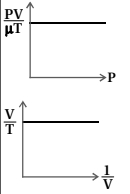
Column-$I$ represents a graph and Column-$II$ represents a physical quantity or condition that is constant for that graph. Match them correctly:
| Column-$I$ | Column-$II$ |
| $(a)$ Top graph | $(i)$ Constant pressure |
| $(b)$ Bottom graph | $(ii)$ Constant volume |
| $(iii)$ For ideal gas |
Solution
(A-III, B-I) For an ideal gas, the equation of state is $PV = \mu RT$, which implies $\frac{PV}{\mu T} = R$. Since $R$ (the universal gas constant) is always constant for an ideal gas, the top graph showing $\frac{PV}{\mu T}$ vs $P$ as a horizontal line represents the property of an ideal gas. Thus, $(a-iii)$.
For the bottom graph, we have $\frac{V}{T}$ as a constant. According to Charles's Law, $\frac{V}{T} = \text{constant}$ when the pressure $P$ is constant. Thus, the graph represents a process at constant pressure. Thus, $(b-i)$.
For the bottom graph, we have $\frac{V}{T}$ as a constant. According to Charles's Law, $\frac{V}{T} = \text{constant}$ when the pressure $P$ is constant. Thus, the graph represents a process at constant pressure. Thus, $(b-i)$.
0 likes
View Solution284
MediumMCQ
The volume of a given mass of a gas at $27^{\circ} C$ and $1$ $atm$ is $100$ $cc$. What will be its volume at $327^{\circ} C$ if the pressure remains constant (in $cc$)?
A
$100$
B
$200$
C
$300$
D
$400$
Solution
(B) According to Charles's Law,if the pressure of a given mass of gas remains constant,then the volume is directly proportional to its absolute temperature: $V \propto T$.
Therefore,$\frac{V_1}{T_1} = \frac{V_2}{T_2}$.
Given:
$V_1 = 100$ $cc$
$T_1 = 27^{\circ} C = 27 + 273 = 300$ $K$
$T_2 = 327^{\circ} C = 327 + 273 = 600$ $K$
Substituting the values into the formula:
$V_2 = V_1 \times \left(\frac{T_2}{T_1}\right)$
$V_2 = 100 \times \left(\frac{600}{300}\right)$
$V_2 = 100 \times 2 = 200$ $cc$.
Thus,the volume at $327^{\circ} C$ will be $200$ $cc$.
Therefore,$\frac{V_1}{T_1} = \frac{V_2}{T_2}$.
Given:
$V_1 = 100$ $cc$
$T_1 = 27^{\circ} C = 27 + 273 = 300$ $K$
$T_2 = 327^{\circ} C = 327 + 273 = 600$ $K$
Substituting the values into the formula:
$V_2 = V_1 \times \left(\frac{T_2}{T_1}\right)$
$V_2 = 100 \times \left(\frac{600}{300}\right)$
$V_2 = 100 \times 2 = 200$ $cc$.
Thus,the volume at $327^{\circ} C$ will be $200$ $cc$.
0 likes
View Solution285
Medium
When air is pumped into a cycle tyre, the volume and pressure of the air in the tyre both increase. What about Boyle's law in this case?
Solution
(N/A) Boyle's law states that for a fixed mass of an ideal gas at a constant temperature, the pressure is inversely proportional to the volume $(PV = \text{constant})$.
In this scenario, when air is pumped into the cycle tyre, the mass (number of moles) of the air inside the tyre increases.
Since the mass of the gas is not constant, the conditions required for Boyle's law are not satisfied.
Therefore, Boyle's law is not applicable in this case.
In this scenario, when air is pumped into the cycle tyre, the mass (number of moles) of the air inside the tyre increases.
Since the mass of the gas is not constant, the conditions required for Boyle's law are not satisfied.
Therefore, Boyle's law is not applicable in this case.
0 likes
View Solution286
Medium
Air pressure in a car tyre increases during driving. Explain.
Solution
(N/A) The volume of a car tyre is approximately fixed. During driving,the friction between the tyre and the road generates heat,which increases the temperature of the air inside the tyre. Since the volume $V$ remains constant,according to Gay-Lussac's Law,the pressure $P$ is directly proportional to the absolute temperature $T$ $(P \propto T)$. Therefore,as the temperature increases,the air pressure inside the tyre also increases.
0 likes
View Solution287
EasyMCQ
On which does the value of $\alpha_V$ depend for an ideal gas?
A
Pressure
B
Volume
C
Temperature
D
Nature of the gas
Solution
(C) For an ideal gas,the equation of state is given by $PV = nRT$.
At constant pressure,$V = (nR/P)T$.
The coefficient of volume expansion $\alpha_V$ is defined as $\alpha_V = \frac{1}{V} (\frac{\partial V}{\partial T})_P$.
Substituting the expression for $V$,we get $\alpha_V = \frac{1}{V} (\frac{nR}{P}) = \frac{1}{V} (\frac{V}{T}) = \frac{1}{T}$.
Thus,the value of $\alpha_V$ depends only on the temperature $T$ and is inversely proportional to it.
At constant pressure,$V = (nR/P)T$.
The coefficient of volume expansion $\alpha_V$ is defined as $\alpha_V = \frac{1}{V} (\frac{\partial V}{\partial T})_P$.
Substituting the expression for $V$,we get $\alpha_V = \frac{1}{V} (\frac{nR}{P}) = \frac{1}{V} (\frac{V}{T}) = \frac{1}{T}$.
Thus,the value of $\alpha_V$ depends only on the temperature $T$ and is inversely proportional to it.
0 likes
View Solution288
DifficultMCQ
The change in the magnitude of the volume of an ideal gas when a small additional pressure $\Delta P$ is applied at a constant temperature is the same as the change when the temperature is reduced by a small quantity $\Delta T$ at constant pressure. The initial temperature and pressure of the gas were $300 \ K$ and $2 \ atm$ respectively. If $|\Delta T| = C|\Delta P|$,then the value of $C$ in $(K/atm)$ is......
A
$150$
B
$176$
C
$145$
D
$135$
Solution
(A) For an ideal gas,the equation of state is $PV = nRT$.
Case $1$: Constant temperature ($T$ is constant).
Differentiating $PV = nRT$ with respect to pressure,we get $P \Delta V + V \Delta P = 0$,which implies $\Delta V = -\frac{V \Delta P}{P}$.
The magnitude of the change in volume is $|\Delta V| = \frac{V |\Delta P|}{P}$.
Case $2$: Constant pressure ($P$ is constant).
Differentiating $PV = nRT$ with respect to temperature,we get $P \Delta V = nR \Delta T$,which implies $\Delta V = \frac{nR \Delta T}{P}$.
The magnitude of the change in volume is $|\Delta V| = \frac{nR |\Delta T|}{P}$.
Since the magnitude of the change in volume is the same in both cases:
$\frac{V |\Delta P|}{P} = \frac{nR |\Delta T|}{P}$
$V |\Delta P| = nR |\Delta T|$
$|\Delta T| = \frac{V}{nR} |\Delta P|$
From the ideal gas law,$\frac{V}{nR} = \frac{T}{P}$.
Substituting this into the equation,we get $|\Delta T| = \frac{T}{P} |\Delta P|$.
Given $|\Delta T| = C |\Delta P|$,we have $C = \frac{T}{P}$.
Given $T = 300 \ K$ and $P = 2 \ atm$,$C = \frac{300}{2} = 150 \ K/atm$.
Case $1$: Constant temperature ($T$ is constant).
Differentiating $PV = nRT$ with respect to pressure,we get $P \Delta V + V \Delta P = 0$,which implies $\Delta V = -\frac{V \Delta P}{P}$.
The magnitude of the change in volume is $|\Delta V| = \frac{V |\Delta P|}{P}$.
Case $2$: Constant pressure ($P$ is constant).
Differentiating $PV = nRT$ with respect to temperature,we get $P \Delta V = nR \Delta T$,which implies $\Delta V = \frac{nR \Delta T}{P}$.
The magnitude of the change in volume is $|\Delta V| = \frac{nR |\Delta T|}{P}$.
Since the magnitude of the change in volume is the same in both cases:
$\frac{V |\Delta P|}{P} = \frac{nR |\Delta T|}{P}$
$V |\Delta P| = nR |\Delta T|$
$|\Delta T| = \frac{V}{nR} |\Delta P|$
From the ideal gas law,$\frac{V}{nR} = \frac{T}{P}$.
Substituting this into the equation,we get $|\Delta T| = \frac{T}{P} |\Delta P|$.
Given $|\Delta T| = C |\Delta P|$,we have $C = \frac{T}{P}$.
Given $T = 300 \ K$ and $P = 2 \ atm$,$C = \frac{300}{2} = 150 \ K/atm$.
0 likes
View Solution289
EasyMCQ
$A$ cylinder contains hydrogen gas at a pressure of $249\; kPa$ and temperature $27^{\circ} C$. Its density is $............. kg/m^{3}$ $(R = 8.3\; J\; mol^{-1} K^{-1})$.
A
$0.02$
B
$0.5$
C
$0.2$
D
$0.1$
Solution
(C) The ideal gas equation is given by $PV = nRT$.
Since $n = \frac{m}{M_w}$,we have $PV = \frac{m}{M_w} RT$.
Rearranging for density $\rho = \frac{m}{V}$,we get $\rho = \frac{PM_w}{RT}$.
Given: Pressure $P = 249\; kPa = 249 \times 10^{3}\; Pa$,Temperature $T = 27^{\circ} C = 300\; K$,Gas constant $R = 8.3\; J\; mol^{-1} K^{-1}$,and Molar mass of hydrogen gas $(H_2)$ $M_w = 2 \times 10^{-3}\; kg/mol$.
Substituting the values:
$\rho = \frac{249 \times 10^{3} \times 2 \times 10^{-3}}{8.3 \times 300}$
$\rho = \frac{498}{2490} = 0.2\; kg/m^{3}$.
Since $n = \frac{m}{M_w}$,we have $PV = \frac{m}{M_w} RT$.
Rearranging for density $\rho = \frac{m}{V}$,we get $\rho = \frac{PM_w}{RT}$.
Given: Pressure $P = 249\; kPa = 249 \times 10^{3}\; Pa$,Temperature $T = 27^{\circ} C = 300\; K$,Gas constant $R = 8.3\; J\; mol^{-1} K^{-1}$,and Molar mass of hydrogen gas $(H_2)$ $M_w = 2 \times 10^{-3}\; kg/mol$.
Substituting the values:
$\rho = \frac{249 \times 10^{3} \times 2 \times 10^{-3}}{8.3 \times 300}$
$\rho = \frac{498}{2490} = 0.2\; kg/m^{3}$.
0 likes
View Solution290
EasyMCQ
An ideal gas equation can be written as $P = \frac{\rho R T}{M_{0}}$,where $\rho$ and $M_{0}$ are respectively,
A
Number density,mass of the gas
B
Mass density,mass of the gas
C
Number density,molar mass
D
Mass density,molar mass
Solution
(D) The ideal gas equation is given by $PV = \mu RT$.
Here,$\mu$ is the number of moles,which is defined as $\mu = \frac{M}{M_{0}}$,where $M$ is the total mass of the gas and $M_{0}$ is the molar mass.
Substituting this into the ideal gas equation,we get $PV = \left(\frac{M}{M_{0}}\right) RT$.
Rearranging the terms,we get $P = \left(\frac{M}{V}\right) \frac{RT}{M_{0}}$.
Since mass density $\rho$ is defined as $\rho = \frac{M}{V}$,we can substitute it into the equation to get $P = \frac{\rho RT}{M_{0}}$.
Thus,$\rho$ represents the mass density and $M_{0}$ represents the molar mass.
Here,$\mu$ is the number of moles,which is defined as $\mu = \frac{M}{M_{0}}$,where $M$ is the total mass of the gas and $M_{0}$ is the molar mass.
Substituting this into the ideal gas equation,we get $PV = \left(\frac{M}{M_{0}}\right) RT$.
Rearranging the terms,we get $P = \left(\frac{M}{V}\right) \frac{RT}{M_{0}}$.
Since mass density $\rho$ is defined as $\rho = \frac{M}{V}$,we can substitute it into the equation to get $P = \frac{\rho RT}{M_{0}}$.
Thus,$\rho$ represents the mass density and $M_{0}$ represents the molar mass.
0 likes
View Solution291
MediumMCQ
An ideal gas initially at pressure $1 \, bar$ is being compressed from $30 \, m^{3}$ to $10 \, m^{3}$ volume and its temperature decreases from $320 \, K$ to $280 \, K$. Find the final pressure of the gas (in $bar$).
A
$2.625$
B
$3.4$
C
$1.325$
D
$4.5$
Solution
(A) For an ideal gas,the combined gas law is given by the equation: $\frac{P_{1} V_{1}}{T_{1}} = \frac{P_{2} V_{2}}{T_{2}}$.
Given values are:
Initial pressure $P_{1} = 1 \, bar$
Initial volume $V_{1} = 30 \, m^{3}$
Initial temperature $T_{1} = 320 \, K$
Final volume $V_{2} = 10 \, m^{3}$
Final temperature $T_{2} = 280 \, K$
Substituting these values into the equation:
$\frac{1 \times 30}{320} = \frac{P_{2} \times 10}{280}$
Solving for $P_{2}$:
$P_{2} = \frac{1 \times 30 \times 280}{320 \times 10}$
$P_{2} = \frac{3 \times 280}{320} = \frac{840}{320} = 2.625 \, bar$.
Thus,the final pressure of the gas is $2.625 \, bar$.
Given values are:
Initial pressure $P_{1} = 1 \, bar$
Initial volume $V_{1} = 30 \, m^{3}$
Initial temperature $T_{1} = 320 \, K$
Final volume $V_{2} = 10 \, m^{3}$
Final temperature $T_{2} = 280 \, K$
Substituting these values into the equation:
$\frac{1 \times 30}{320} = \frac{P_{2} \times 10}{280}$
Solving for $P_{2}$:
$P_{2} = \frac{1 \times 30 \times 280}{320 \times 10}$
$P_{2} = \frac{3 \times 280}{320} = \frac{840}{320} = 2.625 \, bar$.
Thus,the final pressure of the gas is $2.625 \, bar$.
0 likes
View Solution292
EasyMCQ
Which of the following graphs represents the behavior of an ideal gas? Symbols have their usual meaning.
A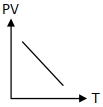
B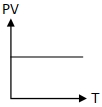
C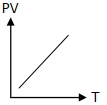
D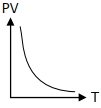
Solution
(C) For an ideal gas,the equation of state is given by the ideal gas law:
$PV = nRT$
where $P$ is pressure,$V$ is volume,$n$ is the number of moles,$R$ is the universal gas constant,and $T$ is the absolute temperature.
Since $n$ and $R$ are constants for a given amount of gas,we have:
$PV \propto T$
This implies that the graph of $PV$ versus $T$ should be a straight line passing through the origin,as $PV$ is directly proportional to $T$.
Therefore,the correct graph is the one showing a linear increase of $PV$ with respect to $T$ passing through the origin.
$PV = nRT$
where $P$ is pressure,$V$ is volume,$n$ is the number of moles,$R$ is the universal gas constant,and $T$ is the absolute temperature.
Since $n$ and $R$ are constants for a given amount of gas,we have:
$PV \propto T$
This implies that the graph of $PV$ versus $T$ should be a straight line passing through the origin,as $PV$ is directly proportional to $T$.
Therefore,the correct graph is the one showing a linear increase of $PV$ with respect to $T$ passing through the origin.
0 likes
View Solution293
EasyMCQ
The volume occupied by the molecules contained in $4.5 \, kg$ of water at $STP$,if the intermolecular forces vanish away,is ........ $m^{3}$.
A
$5.6 \times 10^{3}$
B
$5.6 \times 10^{-3}$
C
$5.6$
D
$5.6 \times 10^{6}$
Solution
(C) The number of moles $n$ is given by the mass divided by the molar mass of water $(H_{2}O)$.
Given mass $= 4.5 \, kg = 4.5 \times 10^{3} \, g$.
Molar mass of water $= 18 \, g/mol$.
$n = \frac{4.5 \times 10^{3}}{18} = 0.25 \times 10^{3} = 250 \, mol$.
At $STP$,the volume of $1 \, mole$ of an ideal gas is $22.4 \, L = 22.4 \times 10^{-3} \, m^{3}$.
Therefore,the total volume $V = n \times 22.4 \times 10^{-3} \, m^{3}$.
$V = 250 \times 22.4 \times 10^{-3} \, m^{3} = 5.6 \, m^{3}$.
Given mass $= 4.5 \, kg = 4.5 \times 10^{3} \, g$.
Molar mass of water $= 18 \, g/mol$.
$n = \frac{4.5 \times 10^{3}}{18} = 0.25 \times 10^{3} = 250 \, mol$.
At $STP$,the volume of $1 \, mole$ of an ideal gas is $22.4 \, L = 22.4 \times 10^{-3} \, m^{3}$.
Therefore,the total volume $V = n \times 22.4 \times 10^{-3} \, m^{3}$.
$V = 250 \times 22.4 \times 10^{-3} \, m^{3} = 5.6 \, m^{3}$.
0 likes
View Solution294
MediumMCQ
When a gas filled in a closed vessel is heated by raising the temperature by $1^{\circ} C$,its pressure increases by $0.4 \%$. The initial temperature of the gas is ..........$K$.
A
$270$
B
$258$
C
$250$
D
$290$
Solution
(C) For a gas in a closed vessel,the volume $V$ remains constant.
According to the ideal gas law,$pV = nRT$.
Since $V$,$n$,and $R$ are constant,we have $p \propto T$,which implies $\frac{\Delta p}{p} = \frac{\Delta T}{T}$.
Given that the pressure increases by $0.4 \%$,we have $\frac{\Delta p}{p} = \frac{0.4}{100}$.
The change in temperature is $\Delta T = 1^{\circ} C = 1 \ K$.
Substituting these values into the equation: $\frac{0.4}{100} = \frac{1}{T}$.
Solving for $T$,we get $T = \frac{100}{0.4} = 250 \ K$.
According to the ideal gas law,$pV = nRT$.
Since $V$,$n$,and $R$ are constant,we have $p \propto T$,which implies $\frac{\Delta p}{p} = \frac{\Delta T}{T}$.
Given that the pressure increases by $0.4 \%$,we have $\frac{\Delta p}{p} = \frac{0.4}{100}$.
The change in temperature is $\Delta T = 1^{\circ} C = 1 \ K$.
Substituting these values into the equation: $\frac{0.4}{100} = \frac{1}{T}$.
Solving for $T$,we get $T = \frac{100}{0.4} = 250 \ K$.
0 likes
View Solution295
MediumMCQ
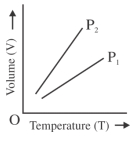
For a perfect gas,two pressures $P_{1}$ and $P_{2}$ are shown in the figure. The graph shows:
A
$P_{1} > P_{2}$
B
$P_{1} < P_{2}$
C
$P_{1} = P_{2}$
D
Insufficient data to draw any conclusion
Solution
(A) The ideal gas equation is given by $PV = nRT$.
Rearranging this for the volume $V$ as a function of temperature $T$,we get $V = (\frac{nR}{P})T$.
This represents a straight line passing through the origin with a slope $m = \frac{nR}{P}$.
From the graph,the slope of the line for $P_{2}$ is greater than the slope of the line for $P_{1}$ (since the line for $P_{2}$ is steeper).
Therefore,$\frac{nR}{P_{2}} > \frac{nR}{P_{1}}$.
This implies that $\frac{1}{P_{2}} > \frac{1}{P_{1}}$,which further simplifies to $P_{1} > P_{2}$.
Rearranging this for the volume $V$ as a function of temperature $T$,we get $V = (\frac{nR}{P})T$.
This represents a straight line passing through the origin with a slope $m = \frac{nR}{P}$.
From the graph,the slope of the line for $P_{2}$ is greater than the slope of the line for $P_{1}$ (since the line for $P_{2}$ is steeper).
Therefore,$\frac{nR}{P_{2}} > \frac{nR}{P_{1}}$.
This implies that $\frac{1}{P_{2}} > \frac{1}{P_{1}}$,which further simplifies to $P_{1} > P_{2}$.
0 likes
View Solution296
MediumMCQ
$A$ vessel contains $16 \,g$ of hydrogen and $128 \,g$ of oxygen at standard temperature and pressure $(STP)$. The volume of the vessel in $cm^{3}$ is:
A
$72 \times 10^{5}$
B
$32 \times 10^{5}$
C
$27 \times 10^{4}$
D
$54 \times 10^{4}$
Solution
(C) The molar mass of $H_{2}$ is $2 \,g/mol$. Number of moles of $H_{2} = \frac{16 \,g}{2 \,g/mol} = 8 \,moles$.
The molar mass of $O_{2}$ is $32 \,g/mol$. Number of moles of $O_{2} = \frac{128 \,g}{32 \,g/mol} = 4 \,moles$.
Total number of moles $n = 8 + 4 = 12 \,moles$.
At $STP$,the molar volume of an ideal gas is $22.4 \,L = 22.4 \times 10^{3} \,cm^{3}$.
Total volume $V = n \times 22.4 \times 10^{3} \,cm^{3} = 12 \times 22.4 \times 10^{3} \,cm^{3} = 268.8 \times 10^{3} \,cm^{3} = 26.88 \times 10^{4} \,cm^{3}$.
Rounding to the nearest option,the volume is approximately $27 \times 10^{4} \,cm^{3}$.
The molar mass of $O_{2}$ is $32 \,g/mol$. Number of moles of $O_{2} = \frac{128 \,g}{32 \,g/mol} = 4 \,moles$.
Total number of moles $n = 8 + 4 = 12 \,moles$.
At $STP$,the molar volume of an ideal gas is $22.4 \,L = 22.4 \times 10^{3} \,cm^{3}$.
Total volume $V = n \times 22.4 \times 10^{3} \,cm^{3} = 12 \times 22.4 \times 10^{3} \,cm^{3} = 268.8 \times 10^{3} \,cm^{3} = 26.88 \times 10^{4} \,cm^{3}$.
Rounding to the nearest option,the volume is approximately $27 \times 10^{4} \,cm^{3}$.
0 likes
View Solution297
AdvancedMCQ
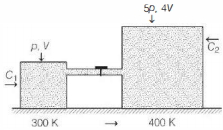
Two containers $C_{1}$ and $C_{2}$ of volumes $V$ and $4V$ respectively,hold the same ideal gas and are connected by a thin horizontal tube of negligible volume with a valve which is initially closed. The initial pressures of the gas in $C_{1}$ and $C_{2}$ are $p$ and $5p$,respectively. Heat baths are employed to maintain the temperatures in the containers at $300 \, K$ and $400 \, K$,respectively. The valve is now opened. Select the correct statement.
A
The gas will flow from the hot container to the cold one and the process is reversible.
B
The gas will flow from one container to the other till the number of moles in two containers are equal.
C
$A$ long time after the valve is opened,the pressure in both the containers will be $3p$.
D
$A$ long time after the valve is opened,the number of moles of gas in the hot container will be thrice that of the cold one.
Solution
(D) Let $n_{1}$ and $n_{2}$ be the number of moles of gas present in containers $C_{1}$ and $C_{2}$ respectively,before the valve is opened.
Using the ideal gas equation $pV = nRT$:
$n_{1} = \frac{pV}{R(300)}$
$n_{2} = \frac{5p(4V)}{R(400)} = \frac{20pV}{400R} = \frac{pV}{20R}$
When the valve is opened,gas flows until the pressure in both $C_{1}$ and $C_{2}$ becomes equal to $p_{0}$.
Let $n_{1}'$ and $n_{2}'$ be the new number of moles:
$n_{1}' = \frac{p_{0}V}{R(300)}$
$n_{2}' = \frac{p_{0}(4V)}{R(400)} = \frac{p_{0}V}{100R}$
Since the total number of moles is conserved $(n_{1} + n_{2} = n_{1}' + n_{2}')$:
$\frac{pV}{300R} + \frac{20pV}{400R} = \frac{p_{0}V}{300R} + \frac{p_{0}V}{100R}$
$\frac{p}{300} + \frac{p}{20} = p_{0} \left( \frac{1}{300} + \frac{3}{300} \right)$
$\frac{p + 15p}{300} = p_{0} \left( \frac{4}{300} \right)$
$16p = 4p_{0} \Rightarrow p_{0} = 4p$
Now,the ratio of moles in the hot container $(C_{2})$ to the cold container $(C_{1})$ is:
$\frac{n_{2}'}{n_{1}'} = \frac{p_{0}(4V) / R(400)}{p_{0}V / R(300)} = \frac{4/400}{1/300} = \frac{1/100}{1/300} = 3$
Thus,the number of moles in the hot container is thrice that of the cold one.
Using the ideal gas equation $pV = nRT$:
$n_{1} = \frac{pV}{R(300)}$
$n_{2} = \frac{5p(4V)}{R(400)} = \frac{20pV}{400R} = \frac{pV}{20R}$
When the valve is opened,gas flows until the pressure in both $C_{1}$ and $C_{2}$ becomes equal to $p_{0}$.
Let $n_{1}'$ and $n_{2}'$ be the new number of moles:
$n_{1}' = \frac{p_{0}V}{R(300)}$
$n_{2}' = \frac{p_{0}(4V)}{R(400)} = \frac{p_{0}V}{100R}$
Since the total number of moles is conserved $(n_{1} + n_{2} = n_{1}' + n_{2}')$:
$\frac{pV}{300R} + \frac{20pV}{400R} = \frac{p_{0}V}{300R} + \frac{p_{0}V}{100R}$
$\frac{p}{300} + \frac{p}{20} = p_{0} \left( \frac{1}{300} + \frac{3}{300} \right)$
$\frac{p + 15p}{300} = p_{0} \left( \frac{4}{300} \right)$
$16p = 4p_{0} \Rightarrow p_{0} = 4p$
Now,the ratio of moles in the hot container $(C_{2})$ to the cold container $(C_{1})$ is:
$\frac{n_{2}'}{n_{1}'} = \frac{p_{0}(4V) / R(400)}{p_{0}V / R(300)} = \frac{4/400}{1/300} = \frac{1/100}{1/300} = 3$
Thus,the number of moles in the hot container is thrice that of the cold one.
0 likes
View Solution298
DifficultMCQ
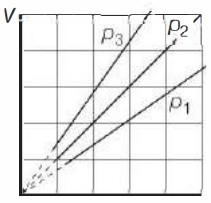
The state of an ideal gas was changed isobarically. The graph depicts three such isobaric lines. Which of the following is true about the pressures of the gas?
A
$p_1=p_2=p_3$
B
$p_1 > p_2 > p_3$
C
$p_1 < p_2 < p_3$
D
$p_1 / p_2=p_3 / p_1$
Solution
(B) The equation of state for an ideal gas is $pV = nRT$,which can be rearranged as $V = (nR/p) \cdot T$.
This represents the equation of a straight line passing through the origin with a slope $m = nR/p$.
From the relationship,we can see that the slope is inversely proportional to the pressure,i.e.,$\text{slope} \propto 1/p$.
By observing the given $V-T$ graph,the slope of the line for $p_3$ is the greatest,followed by $p_2$,and the slope for $p_1$ is the smallest.
Since $\text{slope} \propto 1/p$,a larger slope corresponds to a smaller pressure.
Therefore,the relationship between the pressures is $p_1 > p_2 > p_3$.
This represents the equation of a straight line passing through the origin with a slope $m = nR/p$.
From the relationship,we can see that the slope is inversely proportional to the pressure,i.e.,$\text{slope} \propto 1/p$.
By observing the given $V-T$ graph,the slope of the line for $p_3$ is the greatest,followed by $p_2$,and the slope for $p_1$ is the smallest.
Since $\text{slope} \propto 1/p$,a larger slope corresponds to a smaller pressure.
Therefore,the relationship between the pressures is $p_1 > p_2 > p_3$.
0 likes
View Solution299
DifficultMCQ
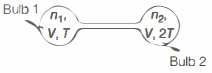
Two bulbs of identical volumes connected by a small capillary are initially filled with an ideal gas at temperature $T$. Bulb $2$ is heated to maintain a temperature $2 T$,while bulb $1$ remains at temperature $T$. Assume throughout that the heat conduction by the capillary is negligible. Then,the ratio of final mass of the gas in bulb $2$ to the initial mass of the gas in the same bulb is close to
A
$1 / 2$
B
$2 / 3$
C
$1 / 3$
D
$1$
Solution
(B) Let $n$ be the total number of moles of gas in both bulbs initially. Since the bulbs have identical volumes $V$ and are at the same temperature $T$,the number of moles in each bulb is $n_1 = n_2 = n / 2$.
When bulb $2$ is heated to $2 T$ and bulb $1$ is at $T$,the pressure $p$ in both bulbs must be equal for the system to be in equilibrium.
Using the ideal gas law $p V = n R T$,the number of moles in bulb $1$ $(n_1')$ and bulb $2$ $(n_2')$ are:
$n_1' = \frac{p V}{R T}$
$n_2' = \frac{p V}{R (2 T)} = \frac{p V}{2 R T}$
Since the total number of moles is conserved,$n_1' + n_2' = n = n_1 + n_2 = n / 2 + n / 2 = n$.
$\frac{p V}{R T} + \frac{p V}{2 R T} = n \Rightarrow \frac{3 p V}{2 R T} = n \Rightarrow \frac{p V}{R T} = \frac{2 n}{3}$.
Thus,the final number of moles in bulb $2$ is $n_2' = \frac{1}{2} \times \frac{p V}{R T} = \frac{1}{2} \times \frac{2 n}{3} = \frac{n}{3}$.
The ratio of the final mass (or final moles) in bulb $2$ to the initial mass (or initial moles) in bulb $2$ is:
Ratio $= \frac{n_2'}{n_2} = \frac{n / 3}{n / 2} = \frac{2}{3}$.
When bulb $2$ is heated to $2 T$ and bulb $1$ is at $T$,the pressure $p$ in both bulbs must be equal for the system to be in equilibrium.
Using the ideal gas law $p V = n R T$,the number of moles in bulb $1$ $(n_1')$ and bulb $2$ $(n_2')$ are:
$n_1' = \frac{p V}{R T}$
$n_2' = \frac{p V}{R (2 T)} = \frac{p V}{2 R T}$
Since the total number of moles is conserved,$n_1' + n_2' = n = n_1 + n_2 = n / 2 + n / 2 = n$.
$\frac{p V}{R T} + \frac{p V}{2 R T} = n \Rightarrow \frac{3 p V}{2 R T} = n \Rightarrow \frac{p V}{R T} = \frac{2 n}{3}$.
Thus,the final number of moles in bulb $2$ is $n_2' = \frac{1}{2} \times \frac{p V}{R T} = \frac{1}{2} \times \frac{2 n}{3} = \frac{n}{3}$.
The ratio of the final mass (or final moles) in bulb $2$ to the initial mass (or initial moles) in bulb $2$ is:
Ratio $= \frac{n_2'}{n_2} = \frac{n / 3}{n / 2} = \frac{2}{3}$.
0 likes
View Solution300
DifficultMCQ
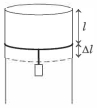
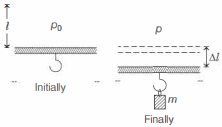
$A$ long cylindrical pipe of radius $20 \,cm$ is closed at its upper end and has an airtight piston of negligible mass as shown. When a $50 \,kg$ mass is attached to the other end of the piston,it moves down by a distance $\Delta l$ before coming to equilibrium. Assuming air to be an ideal gas,$\Delta l / l$ (see figure) is close to ($g=10 \,m/s^2$,atmospheric pressure is $10^5 \,Pa$):
A
$0.01$
B
$0.02$
C
$0.04$
D
$0.09$
Solution
(C) Initially,the pressure inside the cylinder is the atmospheric pressure $p_0$. When a mass $m$ is attached to the piston and it moves down by a distance $\Delta l$,let the new pressure be $p$.
Since the process is isothermal (assuming temperature remains constant),we have $p_0 V_0 = p V$.
$p_0 (A l) = p A (l + \Delta l)$
$p = p_0 \frac{l}{l + \Delta l}$
In equilibrium,the downward force due to the mass $m$ is balanced by the upward force due to the pressure difference between the atmosphere and the gas inside.
$(p_0 - p) A = m g$
Substituting $p$:
$(p_0 - p_0 \frac{l}{l + \Delta l}) A = m g$
$p_0 A (1 - \frac{l}{l + \Delta l}) = m g$
$p_0 A (\frac{\Delta l}{l + \Delta l}) = m g$
Given $p_0 = 10^5 \,Pa$,$m = 50 \,kg$,$g = 10 \,m/s^2$,$r = 0.2 \,m$,$A = \pi r^2 = \pi (0.2)^2 = 0.04 \pi \,m^2$.
$10^5 \times 0.04 \pi \times \frac{\Delta l}{l + \Delta l} = 50 \times 10 = 500$
$4000 \pi \times \frac{\Delta l}{l + \Delta l} = 500$
$\frac{\Delta l}{l + \Delta l} = \frac{500}{4000 \pi} = \frac{1}{8 \pi} \approx \frac{1}{8 \times 3.14} \approx \frac{1}{25.12} \approx 0.0398$
Since $\frac{\Delta l}{l + \Delta l} \approx 0.04$,we have $\frac{\Delta l}{l} \approx 0.04$ (assuming $\Delta l \ll l$).
Thus,the correct option is $C$.
Since the process is isothermal (assuming temperature remains constant),we have $p_0 V_0 = p V$.
$p_0 (A l) = p A (l + \Delta l)$
$p = p_0 \frac{l}{l + \Delta l}$
In equilibrium,the downward force due to the mass $m$ is balanced by the upward force due to the pressure difference between the atmosphere and the gas inside.
$(p_0 - p) A = m g$
Substituting $p$:
$(p_0 - p_0 \frac{l}{l + \Delta l}) A = m g$
$p_0 A (1 - \frac{l}{l + \Delta l}) = m g$
$p_0 A (\frac{\Delta l}{l + \Delta l}) = m g$
Given $p_0 = 10^5 \,Pa$,$m = 50 \,kg$,$g = 10 \,m/s^2$,$r = 0.2 \,m$,$A = \pi r^2 = \pi (0.2)^2 = 0.04 \pi \,m^2$.
$10^5 \times 0.04 \pi \times \frac{\Delta l}{l + \Delta l} = 50 \times 10 = 500$
$4000 \pi \times \frac{\Delta l}{l + \Delta l} = 500$
$\frac{\Delta l}{l + \Delta l} = \frac{500}{4000 \pi} = \frac{1}{8 \pi} \approx \frac{1}{8 \times 3.14} \approx \frac{1}{25.12} \approx 0.0398$
Since $\frac{\Delta l}{l + \Delta l} \approx 0.04$,we have $\frac{\Delta l}{l} \approx 0.04$ (assuming $\Delta l \ll l$).
Thus,the correct option is $C$.
0 likes
View SolutionKinetic Theory of Gases — Gas Laws (Charles, Boyle's, Avagadro's, Gay Lussacs and Dalton's law) and Ideal gas Equation · Frequently Asked Questions
1Are these Kinetic Theory of Gases questions useful for JEE and NEET?
Yes. All questions in this section are mapped to JEE Main and NEET exam patterns. Previous year questions from JEE Main, NEET, GUJCET and state-level exams are included with full solutions.
2Can I switch to Hindi or Gujarati for these questions?
Yes. Use the language tabs in the hero section or the sidebar to view the same questions and solutions in English, Hindi or Gujarati.
3How do I generate a question paper from this subtopic?
Use the Vedclass Exam Paper Generator — select the chapter and subtopic, set difficulty, and generate Sets A, B, C, D automatically. First 3 chapters of every subject are free.
Vedclass Products
For Students
Vedclass Test Series
Mock tests in real JEE/NEET style with performance analysis. 5-day free trial.
Start Free TrialFor Teachers
Exam Paper Generator
Generate Set A/B/C/D papers from this chapter in 2 minutes. 3 chapters free.
Try FreeFor Institutes
Online Exam Module
Live online exams with unlimited students, 360° analytics & white-label branding.
See DemoFor Teachers & Institutes
Generate a Kinetic Theory of Gases Exam Paper in 2 Minutes
Select subtopic & difficulty — Sets A, B, C, D auto-generated with No Repeat logic.
First 3 chapters of every subject are free — no payment required.