
A English
Newton’s Law of Gravitation Questions in English
Class 11 Physics · Gravitation · Newton’s Law of Gravitation
107+
Questions
English
Language
100%
With Solutions
Showing 49 of 107 questions in English
1
EasyMCQ
$A$ suitable unit for gravitational constant is
A
$kg \cdot m \cdot s^{-1}$
B
$N \cdot m^{-1} \cdot s$
C
$N \cdot m^2 \cdot kg^{-2}$
D
$kg \cdot m \cdot s^{-1}$
Solution
(C) According to Newton's law of universal gravitation,the force $F$ between two masses $m_1$ and $m_2$ separated by a distance $d$ is given by:
$F = \frac{G m_1 m_2}{d^2}$
Rearranging the formula to solve for the gravitational constant $G$:
$G = \frac{F d^2}{m_1 m_2}$
The $SI$ unit of force $F$ is Newton $(N)$,distance $d$ is meter $(m)$,and mass $m$ is kilogram $(kg)$.
Substituting these units into the formula:
$G = \frac{N \cdot m^2}{kg^2} = N \cdot m^2 \cdot kg^{-2}$
Therefore,the correct unit is $N \cdot m^2 \cdot kg^{-2}$.
$F = \frac{G m_1 m_2}{d^2}$
Rearranging the formula to solve for the gravitational constant $G$:
$G = \frac{F d^2}{m_1 m_2}$
The $SI$ unit of force $F$ is Newton $(N)$,distance $d$ is meter $(m)$,and mass $m$ is kilogram $(kg)$.
Substituting these units into the formula:
$G = \frac{N \cdot m^2}{kg^2} = N \cdot m^2 \cdot kg^{-2}$
Therefore,the correct unit is $N \cdot m^2 \cdot kg^{-2}$.
0 likes
View Solution2
EasyMCQ
The tidal waves in the sea are primarily due to
A
The gravitational effect of the moon on the earth
B
The gravitational effect of the sun on the earth
C
The gravitational effect of Venus on the earth
D
The atmospheric effect of the earth itself
Solution
(A) The tidal waves in the sea are primarily caused by the gravitational pull exerted by the moon on the earth's oceans.
Although the sun also exerts a gravitational force on the earth,the moon's proximity to the earth makes its tidal force significantly stronger than that of the sun.
Therefore,the correct option is $A$.
Although the sun also exerts a gravitational force on the earth,the moon's proximity to the earth makes its tidal force significantly stronger than that of the sun.
Therefore,the correct option is $A$.
0 likes
View Solution3
EasyMCQ
The atmosphere is held to the earth by
A
Winds
B
Gravity
C
Clouds
D
None of the above
Solution
(B) The atmosphere consists of various gas molecules that possess mass.
According to Newton's law of universal gravitation,a gravitational force acts between the earth and these gas molecules.
This gravitational force pulls the gas molecules toward the center of the earth,preventing them from escaping into space.
Therefore,the atmosphere is held to the earth primarily due to gravity.
Thus,the correct option is $B.$
According to Newton's law of universal gravitation,a gravitational force acts between the earth and these gas molecules.
This gravitational force pulls the gas molecules toward the center of the earth,preventing them from escaping into space.
Therefore,the atmosphere is held to the earth primarily due to gravity.
Thus,the correct option is $B.$
0 likes
View Solution4
EasyMCQ
If the distance between two masses is doubled,the gravitational attraction between them
A
Is doubled
B
Becomes four times
C
Is reduced to half
D
Is reduced to a quarter
Solution
(D) According to Newton's law of universal gravitation,the force of attraction $F$ between two masses $m_1$ and $m_2$ separated by a distance $r$ is given by $F = G \frac{m_1 m_2}{r^2}$.
From this formula,we can see that $F \propto \frac{1}{r^2}$.
If the distance $r$ is doubled,the new distance becomes $r' = 2r$.
The new gravitational force $F'$ will be $F' = G \frac{m_1 m_2}{(2r)^2} = G \frac{m_1 m_2}{4r^2} = \frac{1}{4} F$.
Therefore,the gravitational attraction is reduced to a quarter of its original value.
From this formula,we can see that $F \propto \frac{1}{r^2}$.
If the distance $r$ is doubled,the new distance becomes $r' = 2r$.
The new gravitational force $F'$ will be $F' = G \frac{m_1 m_2}{(2r)^2} = G \frac{m_1 m_2}{4r^2} = \frac{1}{4} F$.
Therefore,the gravitational attraction is reduced to a quarter of its original value.
0 likes
View Solution5
EasyMCQ
The gravitational force between two stones of mass $1 \, kg$ each,separated by a distance of $1 \, m$ in a vacuum,is:
A
$Zero$
B
$6.675 \times 10^{-5} \, N$
C
$6.675 \times 10^{-11} \, N$
D
$6.675 \times 10^{-8} \, N$
Solution
(C) According to Newton's law of universal gravitation,the force $F$ between two masses $m_1$ and $m_2$ separated by a distance $r$ is given by $F = G \frac{m_1 m_2}{r^2}$.
Given: $m_1 = 1 \, kg$,$m_2 = 1 \, kg$,$r = 1 \, m$,and the gravitational constant $G = 6.675 \times 10^{-11} \, N \cdot m^2/kg^2$.
Substituting these values into the formula:
$F = (6.675 \times 10^{-11}) \times \frac{1 \times 1}{1^2} = 6.675 \times 10^{-11} \, N$.
Given: $m_1 = 1 \, kg$,$m_2 = 1 \, kg$,$r = 1 \, m$,and the gravitational constant $G = 6.675 \times 10^{-11} \, N \cdot m^2/kg^2$.
Substituting these values into the formula:
$F = (6.675 \times 10^{-11}) \times \frac{1 \times 1}{1^2} = 6.675 \times 10^{-11} \, N$.
0 likes
View Solution6
MediumMCQ
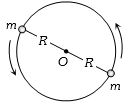
Two particles of equal mass $m$ move in a circle of radius $R$ under the action of their mutual gravitational attraction. The speed of each particle is
A
$v = \frac{1}{{2R}}\sqrt {\frac{1}{{Gm}}} $
B
$v = \sqrt {\frac{{Gm}}{{2R}}} $
C
$v = \frac{1}{2}\sqrt {\frac{{Gm}}{R}} $
D
$v = \sqrt {\frac{{4Gm}}{R}} $
Solution
(C) The centripetal force required for circular motion is provided by the gravitational force of attraction between the two particles.
The distance between the two particles is $2R$.
The gravitational force between them is $F_g = \frac{G \cdot m \cdot m}{(2R)^2} = \frac{Gm^2}{4R^2}$.
The centripetal force required for a particle of mass $m$ moving with speed $v$ in a circle of radius $R$ is $F_c = \frac{mv^2}{R}$.
Equating the two forces:
$\frac{mv^2}{R} = \frac{Gm^2}{4R^2}$
Solving for $v$:
$v^2 = \frac{Gm^2}{4R^2} \cdot \frac{R}{m}$
$v^2 = \frac{Gm}{4R}$
$v = \sqrt{\frac{Gm}{4R}} = \frac{1}{2}\sqrt{\frac{Gm}{R}}$
The distance between the two particles is $2R$.
The gravitational force between them is $F_g = \frac{G \cdot m \cdot m}{(2R)^2} = \frac{Gm^2}{4R^2}$.
The centripetal force required for a particle of mass $m$ moving with speed $v$ in a circle of radius $R$ is $F_c = \frac{mv^2}{R}$.
Equating the two forces:
$\frac{mv^2}{R} = \frac{Gm^2}{4R^2}$
Solving for $v$:
$v^2 = \frac{Gm^2}{4R^2} \cdot \frac{R}{m}$
$v^2 = \frac{Gm}{4R}$
$v = \sqrt{\frac{Gm}{4R}} = \frac{1}{2}\sqrt{\frac{Gm}{R}}$
0 likes
View Solution7
EasyMCQ
The gravitational force between two point masses $m_1$ and $m_2$ at a separation $r$ is given by $F = k \frac{m_1 m_2}{r^2}$. The constant $k$:
A
Depends on the system of units only.
B
Depends on the medium between the masses only.
C
Depends on both $(a)$ and $(b)$.
D
Is independent of both $(a)$ and $(b)$.
Solution
(A) The constant $k$ in the formula $F = k \frac{m_1 m_2}{r^2}$ is the universal gravitational constant,denoted as $G$.
By definition,the gravitational force between two masses is independent of the medium between them.
The value of $G$ is a universal constant,but its numerical value depends on the system of units used (e.g.,$SI$ units vs. $CGS$ units).
Therefore,$k$ depends only on the system of units.
By definition,the gravitational force between two masses is independent of the medium between them.
The value of $G$ is a universal constant,but its numerical value depends on the system of units used (e.g.,$SI$ units vs. $CGS$ units).
Therefore,$k$ depends only on the system of units.
0 likes
View Solution8
DifficultMCQ
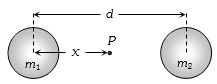
The distance between the centres of the moon and the earth is $D$. The mass of the earth is $81$ times the mass of the moon. At what distance from the centre of the earth will the net gravitational force on a test mass be zero?
A
$\frac{D}{2}$
B
$\frac{2D}{3}$
C
$\frac{4D}{3}$
D
$\frac{9D}{10}$
Solution
(D) Let $M_e$ be the mass of the earth and $M_m$ be the mass of the moon. Given $M_e = 81 M_m$.
Let the distance from the centre of the earth where the gravitational force is zero be $x$.
The gravitational force exerted by the earth on a test mass $m$ at distance $x$ is $F_e = \frac{G M_e m}{x^2}$.
The gravitational force exerted by the moon on the same test mass at distance $(D - x)$ is $F_m = \frac{G M_m m}{(D - x)^2}$.
For the net gravitational force to be zero,$F_e = F_m$.
$\frac{G M_e m}{x^2} = \frac{G M_m m}{(D - x)^2}$
$\frac{81 M_m}{x^2} = \frac{M_m}{(D - x)^2}$
Taking the square root on both sides:
$\frac{9}{x} = \frac{1}{D - x}$
$9(D - x) = x$
$9D - 9x = x$
$10x = 9D$
$x = \frac{9D}{10}$.
Let the distance from the centre of the earth where the gravitational force is zero be $x$.
The gravitational force exerted by the earth on a test mass $m$ at distance $x$ is $F_e = \frac{G M_e m}{x^2}$.
The gravitational force exerted by the moon on the same test mass at distance $(D - x)$ is $F_m = \frac{G M_m m}{(D - x)^2}$.
For the net gravitational force to be zero,$F_e = F_m$.
$\frac{G M_e m}{x^2} = \frac{G M_m m}{(D - x)^2}$
$\frac{81 M_m}{x^2} = \frac{M_m}{(D - x)^2}$
Taking the square root on both sides:
$\frac{9}{x} = \frac{1}{D - x}$
$9(D - x) = x$
$9D - 9x = x$
$10x = 9D$
$x = \frac{9D}{10}$.
0 likes
View Solution9
EasyMCQ
Who among the following gave the first experimental value of $G$?
A
Cavendish
B
Copernicus
C
Brook Taylor
D
None of these
Solution
(A) Henry Cavendish performed an experiment to determine the density of the Earth. In $1798$,he experimentally determined the value of the universal gravitational constant $G$ using a torsion balance apparatus.
0 likes
View Solution10
MediumMCQ
$A$ mass $M$ is divided into two parts $xM$ and $(1 - x)M$. For a given separation,the value of $x$ for which the gravitational attraction between the two pieces becomes maximum is
A
$0.5$
B
$3/5$
C
$1$
D
$2$
Solution
(A) The gravitational force $F$ between two masses $m_1 = xM$ and $m_2 = (1 - x)M$ separated by a distance $r$ is given by $F = \frac{G(xM)((1 - x)M)}{r^2}$.
Since $G$,$M$,and $r$ are constants,the force $F$ is proportional to $x(1 - x) = x - x^2$.
To find the value of $x$ for which the force is maximum,we differentiate $F$ with respect to $x$ and set it to zero:
$\frac{d}{dx}(x - x^2) = 1 - 2x = 0$.
Solving for $x$,we get $1 = 2x$,which implies $x = 0.5$.
Since $G$,$M$,and $r$ are constants,the force $F$ is proportional to $x(1 - x) = x - x^2$.
To find the value of $x$ for which the force is maximum,we differentiate $F$ with respect to $x$ and set it to zero:
$\frac{d}{dx}(x - x^2) = 1 - 2x = 0$.
Solving for $x$,we get $1 = 2x$,which implies $x = 0.5$.
1 likes
View Solution11
EasyMCQ
The force of gravitation is:
A
Repulsive
B
Electrostatic
C
Conservative
D
Non-conservative
Solution
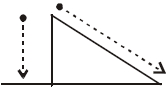
(C) The gravitational force is a conservative force.
By definition,a force is conservative if the work done by or against it in moving a particle between two points is independent of the path taken.
In the gravitational field,the work done to move an object from one point to another depends only on the initial and final positions,not on the path followed. This is illustrated by the fact that the potential energy change is solely a function of position.
By definition,a force is conservative if the work done by or against it in moving a particle between two points is independent of the path taken.
In the gravitational field,the work done to move an object from one point to another depends only on the initial and final positions,not on the path followed. This is illustrated by the fact that the potential energy change is solely a function of position.
0 likes
View Solution12
EasyMCQ
The gravitational force $F_g$ between two objects does not depend on
A
Sum of the masses
B
Product of the masses
C
Gravitational constant
D
Distance between the masses
Solution
(A) According to Newton's Law of Universal Gravitation,the force $F_g$ between two objects of masses $m_1$ and $m_2$ separated by a distance $r$ is given by:
$F_g = G \frac{m_1 m_2}{r^2}$
Where $G$ is the gravitational constant.
From the formula,it is clear that the force depends on the product of the masses $(m_1 m_2)$,the gravitational constant $(G)$,and the square of the distance $(r^2)$ between them.
It does not depend on the sum of the masses $(m_1 + m_2)$.
Therefore,the correct option is $A$.
$F_g = G \frac{m_1 m_2}{r^2}$
Where $G$ is the gravitational constant.
From the formula,it is clear that the force depends on the product of the masses $(m_1 m_2)$,the gravitational constant $(G)$,and the square of the distance $(r^2)$ between them.
It does not depend on the sum of the masses $(m_1 + m_2)$.
Therefore,the correct option is $A$.
0 likes
View Solution13
EasyMCQ
Two spheres of mass $m$ and $M$ are situated in air and the gravitational force between them is $F$. The space around the masses is now filled with a liquid of specific gravity $3$. The gravitational force will now be
A
$F$
B
$F/3$
C
$F/9$
D
$3F$
Solution
(A) The gravitational force between two masses $m$ and $M$ separated by a distance $r$ is given by Newton's Law of Gravitation: $F = G \frac{mM}{r^2}$.
This force depends only on the masses of the objects and the distance between them.
Unlike electrostatic force,the gravitational force is independent of the medium in which the objects are placed.
Therefore,even when the space around the masses is filled with a liquid,the gravitational force remains unchanged.
Thus,the new force is $F$.
This force depends only on the masses of the objects and the distance between them.
Unlike electrostatic force,the gravitational force is independent of the medium in which the objects are placed.
Therefore,even when the space around the masses is filled with a liquid,the gravitational force remains unchanged.
Thus,the new force is $F$.
0 likes
View Solution14
EasyMCQ
Which of the following statements about the gravitational constant $G$ is true?
A
It is a force.
B
It has no unit.
C
It has the same value in all systems of units.
D
It does not depend on the nature of the medium in which the bodies are kept.
Solution
(D) According to Newton's law of gravitation,the force between two masses $M_1$ and $M_2$ separated by a distance $r$ is given by $F = \frac{G M_1 M_2}{r^2}$.
Rearranging for $G$,we get $G = \frac{F r^2}{M_1 M_2}$.
$G$ is a universal constant,meaning its value does not depend on the masses,the distance between them,or the nature of the medium in which the bodies are placed.
Since $G$ is a physical constant with dimensions $[M^{-1} L^3 T^{-2}]$,it has specific units (e.g.,$N \cdot m^2/kg^2$ in $SI$ units) and its numerical value changes depending on the system of units used.
Therefore,the statement that it does not depend on the nature of the medium is correct.
Rearranging for $G$,we get $G = \frac{F r^2}{M_1 M_2}$.
$G$ is a universal constant,meaning its value does not depend on the masses,the distance between them,or the nature of the medium in which the bodies are placed.
Since $G$ is a physical constant with dimensions $[M^{-1} L^3 T^{-2}]$,it has specific units (e.g.,$N \cdot m^2/kg^2$ in $SI$ units) and its numerical value changes depending on the system of units used.
Therefore,the statement that it does not depend on the nature of the medium is correct.
0 likes
View Solution15
MediumMCQ
Two identical solid copper spheres of radius $R$ are placed in contact with each other. The gravitational attraction between them is proportional to
A
$R^2$
B
$R^{-2}$
C
$R^4$
D
$R^{-4}$
Solution
(C) The gravitational force $F$ between two spheres of mass $m$ and radius $R$ whose centers are separated by a distance $d = 2R$ is given by Newton's Law of Gravitation: $F = \frac{G m^2}{(2R)^2}$.
Since the spheres are solid copper,their mass $m$ is given by $m = \text{Volume} \times \text{Density} = (\frac{4}{3} \pi R^3) \rho$,where $\rho$ is the density of copper.
Substituting the expression for $m$ into the force equation:
$F = \frac{G (\frac{4}{3} \pi R^3 \rho)^2}{4R^2} = \frac{G \cdot \frac{16}{9} \pi^2 R^6 \rho^2}{4R^2}$.
Simplifying the expression:
$F = \frac{4}{9} G \pi^2 \rho^2 R^4$.
Since $G$,$\pi$,and $\rho$ are constants,we find that $F \propto R^4$.
Since the spheres are solid copper,their mass $m$ is given by $m = \text{Volume} \times \text{Density} = (\frac{4}{3} \pi R^3) \rho$,where $\rho$ is the density of copper.
Substituting the expression for $m$ into the force equation:
$F = \frac{G (\frac{4}{3} \pi R^3 \rho)^2}{4R^2} = \frac{G \cdot \frac{16}{9} \pi^2 R^6 \rho^2}{4R^2}$.
Simplifying the expression:
$F = \frac{4}{9} G \pi^2 \rho^2 R^4$.
Since $G$,$\pi$,and $\rho$ are constants,we find that $F \propto R^4$.
0 likes
View Solution16
EasyMCQ
If the mass of a body is $M$ on the Earth's surface,then the mass of the same body on the Moon's surface is:
A
$M/6$
B
$Zero$
C
$M$
D
$6M$
Solution
(C) The mass of a body is defined as the quantity of matter contained in it.
Mass is an intrinsic property of an object and remains constant regardless of its location in the universe.
Unlike weight,which depends on the acceleration due to gravity $(g)$ at a specific location,mass does not change.
Therefore,if the mass of the body is $M$ on the Earth,it will remain $M$ on the Moon.
Mass is an intrinsic property of an object and remains constant regardless of its location in the universe.
Unlike weight,which depends on the acceleration due to gravity $(g)$ at a specific location,mass does not change.
Therefore,if the mass of the body is $M$ on the Earth,it will remain $M$ on the Moon.
0 likes
View Solution17
DifficultMCQ
$A$ mass $M$ is split into two parts,$m$ and $(M-m)$,which are then separated by a certain distance. What ratio of $\frac{m}{M}$ maximizes the gravitational force between the two parts?
A
$\frac{1}{3}$
B
$\frac{1}{2}$
C
$\frac{1}{4}$
D
$\frac{1}{5}$
Solution
(B) The gravitational force $F$ between two masses $m$ and $(M-m)$ separated by a distance $r$ is given by $F = \frac{G m (M - m)}{r^2}$.
To maximize the force,we differentiate $F$ with respect to $m$ and set it to zero: $\frac{dF}{dm} = 0$.
$\frac{d}{dm} \left( \frac{G M m - G m^2}{r^2} \right) = 0$.
Since $G$ and $r^2$ are constants,we have $\frac{d}{dm} (M m - m^2) = 0$.
$M - 2m = 0$.
$M = 2m$.
Therefore,the ratio $\frac{m}{M} = \frac{1}{2}$.
To maximize the force,we differentiate $F$ with respect to $m$ and set it to zero: $\frac{dF}{dm} = 0$.
$\frac{d}{dm} \left( \frac{G M m - G m^2}{r^2} \right) = 0$.
Since $G$ and $r^2$ are constants,we have $\frac{d}{dm} (M m - m^2) = 0$.
$M - 2m = 0$.
$M = 2m$.
Therefore,the ratio $\frac{m}{M} = \frac{1}{2}$.
0 likes
View Solution18
EasyMCQ
$A$ black hole is a:
A
Hole in the ozone layer of the atmosphere
B
Hole in the Earth's center
C
Region of space having a gravitational field so intense that no matter or radiation can escape
D
Hole in the troposphere
Solution
(C) black hole is a region of spacetime where gravity is so strong that nothing—no particles or even electromagnetic radiation such as light—can escape from it. It is formed by the gravitational collapse of massive stars. Option $C$ is the most accurate description among the choices provided,as it refers to a region of extremely high density and gravitational pull.
0 likes
View Solution19
EasyMCQ
The mass of the Earth has been determined through:
A
Use of Kepler's $T^2/R^3$ constancy law
B
Sampling the density of the Earth's crust and using $R$
C
Cavendish's determination of $G$ and using $R$ and $g$ at the surface
D
Use of periods of satellites at different heights above the Earth's surface
Solution
(C) The acceleration due to gravity $g$ at the surface of the Earth is given by the formula $g = \frac{GM}{R^2}$,where $G$ is the universal gravitational constant,$M$ is the mass of the Earth,and $R$ is the radius of the Earth.
Rearranging this formula to solve for the mass of the Earth,we get $M = \frac{gR^2}{G}$.
Henry Cavendish determined the value of the gravitational constant $G$ experimentally using a torsion balance.
Since the radius of the Earth $R$ is known from geodetic measurements and the acceleration due to gravity $g$ is known from experiments,the mass of the Earth $M$ can be calculated using these values.
Therefore,the correct method is the determination of $G$ by Cavendish and the use of $R$ and $g$ at the surface.
Rearranging this formula to solve for the mass of the Earth,we get $M = \frac{gR^2}{G}$.
Henry Cavendish determined the value of the gravitational constant $G$ experimentally using a torsion balance.
Since the radius of the Earth $R$ is known from geodetic measurements and the acceleration due to gravity $g$ is known from experiments,the mass of the Earth $M$ can be calculated using these values.
Therefore,the correct method is the determination of $G$ by Cavendish and the use of $R$ and $g$ at the surface.
0 likes
View Solution20
DifficultMCQ
$A$ mass $M$ is divided into two parts $xM$ and $(1 - x)M$. For what value of $x$ is the gravitational force between them maximum for a given distance?
A
$1/2$
B
$3/5$
C
$1$
D
$2$
Solution
(A) The gravitational force $F$ between two masses $m_1 = xM$ and $m_2 = (1 - x)M$ separated by a distance $r$ is given by:
$F = \frac{G m_1 m_2}{r^2} = \frac{G (xM) ((1 - x)M)}{r^2}$
$F = \frac{G M^2}{r^2} (x - x^2)$
To find the value of $x$ for which $F$ is maximum,we differentiate $F$ with respect to $x$ and set it to zero:
$\frac{dF}{dx} = \frac{G M^2}{r^2} \frac{d}{dx} (x - x^2) = 0$
$\frac{G M^2}{r^2} (1 - 2x) = 0$
Since $\frac{G M^2}{r^2} \neq 0$,we have:
$1 - 2x = 0$
$2x = 1$
$x = 1/2$
Thus,the gravitational force is maximum when $x = 1/2$.
$F = \frac{G m_1 m_2}{r^2} = \frac{G (xM) ((1 - x)M)}{r^2}$
$F = \frac{G M^2}{r^2} (x - x^2)$
To find the value of $x$ for which $F$ is maximum,we differentiate $F$ with respect to $x$ and set it to zero:
$\frac{dF}{dx} = \frac{G M^2}{r^2} \frac{d}{dx} (x - x^2) = 0$
$\frac{G M^2}{r^2} (1 - 2x) = 0$
Since $\frac{G M^2}{r^2} \neq 0$,we have:
$1 - 2x = 0$
$2x = 1$
$x = 1/2$
Thus,the gravitational force is maximum when $x = 1/2$.
0 likes
View Solution21
EasyMCQ
Two astronauts are floating in gravitational free space after having lost contact with their spaceship. The two will:
A
move away from each other.
B
become stationary.
C
keep floating at the same distance between them.
D
move towards each other.
Solution
(D) In gravitational free space,the only force acting between the two astronauts is their mutual gravitational attraction.
According to Newton's Law of Gravitation,the force of attraction between two masses $m_1$ and $m_2$ separated by a distance $r$ is given by $F = \frac{G m_1 m_2}{r^2}$.
Since this gravitational force is attractive in nature,it will pull the two astronauts towards each other.
Therefore,they will move towards each other.
According to Newton's Law of Gravitation,the force of attraction between two masses $m_1$ and $m_2$ separated by a distance $r$ is given by $F = \frac{G m_1 m_2}{r^2}$.
Since this gravitational force is attractive in nature,it will pull the two astronauts towards each other.
Therefore,they will move towards each other.
0 likes
View Solution22
DifficultMCQ
Two identical spheres are placed in contact with each other. The force of gravitation between the spheres will be proportional to ($R =$ radius of each sphere).
A
$R$
B
$R^2$
C
$R^4$
D
None of these
Solution
(C) The gravitational force $F$ between two spheres of mass $M$ and radius $R$ is given by $F = G \frac{M^2}{d^2}$,where $d$ is the distance between their centers.
Since the spheres are in contact,the distance between their centers is $d = R + R = 2R$.
The mass of each sphere is $M = \text{Volume} \times \text{Density} = \frac{4}{3} \pi R^3 \rho$.
Substituting these into the force equation:
$F = G \frac{(\frac{4}{3} \pi R^3 \rho)^2}{(2R)^2}$
$F = G \frac{\frac{16}{9} \pi^2 R^6 \rho^2}{4R^2}$
$F = \frac{4}{9} G \pi^2 \rho^2 R^4$
Thus,$F \propto R^4$.
Since the spheres are in contact,the distance between their centers is $d = R + R = 2R$.
The mass of each sphere is $M = \text{Volume} \times \text{Density} = \frac{4}{3} \pi R^3 \rho$.
Substituting these into the force equation:
$F = G \frac{(\frac{4}{3} \pi R^3 \rho)^2}{(2R)^2}$
$F = G \frac{\frac{16}{9} \pi^2 R^6 \rho^2}{4R^2}$
$F = \frac{4}{9} G \pi^2 \rho^2 R^4$
Thus,$F \propto R^4$.
0 likes
View Solution23
EasyMCQ
The mass of the moon is about $1.2\%$ of the mass of the earth. Compared to the gravitational force the earth exerts on the moon,the gravitational force the moon exerts on the earth:
A
Is the same
B
Is smaller
C
Is greater
D
Varies with its phase
Solution
(A) According to Newton's Law of Universal Gravitation,the force exerted by one body on another is given by $F = \frac{G m_1 m_2}{r^2}$.
This force is mutual,meaning the force exerted by the earth on the moon is equal in magnitude and opposite in direction to the force exerted by the moon on the earth,as per Newton's Third Law of Motion.
Therefore,the gravitational force the moon exerts on the earth is the same as the gravitational force the earth exerts on the moon.
This force is mutual,meaning the force exerted by the earth on the moon is equal in magnitude and opposite in direction to the force exerted by the moon on the earth,as per Newton's Third Law of Motion.
Therefore,the gravitational force the moon exerts on the earth is the same as the gravitational force the earth exerts on the moon.
0 likes
View Solution24
AdvancedMCQ
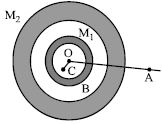
Two concentric shells of uniform density of mass $M_1$ and $M_2$ are situated as shown in the figure. The forces experienced by a particle of mass $m$ when placed at positions $A, B$ and $C$ respectively are (given $OA = p, OB = q$ and $OC = r$):
A
zero,$G\frac{M_1 m}{q^2}$ and $G\frac{(M_1 + M_2)m}{p^2}$
B
$G\frac{(M_1 + M_2)m}{p^2}, G\frac{(M_1 + M_2)m}{q^2}$ and $G\frac{M_1 m}{r^2}$
C
$G\frac{M_1 m}{q^2}, G\frac{(M_1 + M_2)m}{p^2}$ and zero
D
$G\frac{(M_1 + M_2)m}{p^2}, G\frac{M_1 m}{q^2}$ and zero
Solution
(D) According to the shell theorem,the gravitational force inside a uniform spherical shell is zero,and the force outside is equivalent to the entire mass being concentrated at the center.
$1$. At position $A$ (outside both shells): The distance from the center $O$ is $p$. The total mass is $M_1 + M_2$. The force is $F_A = G\frac{(M_1 + M_2)m}{p^2}$.
$2$. At position $B$ (between the two shells): The distance from the center $O$ is $q$. The particle is outside shell $M_1$ but inside shell $M_2$. The force due to $M_2$ is zero. The force due to $M_1$ is $F_B = G\frac{M_1 m}{q^2}$.
$3$. At position $C$ (inside both shells): The distance from the center $O$ is $r$. The particle is inside both shells $M_1$ and $M_2$. Therefore,the net gravitational force is $F_C = 0$.
$1$. At position $A$ (outside both shells): The distance from the center $O$ is $p$. The total mass is $M_1 + M_2$. The force is $F_A = G\frac{(M_1 + M_2)m}{p^2}$.
$2$. At position $B$ (between the two shells): The distance from the center $O$ is $q$. The particle is outside shell $M_1$ but inside shell $M_2$. The force due to $M_2$ is zero. The force due to $M_1$ is $F_B = G\frac{M_1 m}{q^2}$.
$3$. At position $C$ (inside both shells): The distance from the center $O$ is $r$. The particle is inside both shells $M_1$ and $M_2$. Therefore,the net gravitational force is $F_C = 0$.
0 likes
View Solution25
MediumMCQ
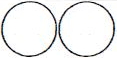
The gravitational force between two identical uniform solid gold spheres of radius $r$ placed in contact is proportional to:
A
$r^4$
B
$r^2$
C
$\frac{1}{r^2}$
D
$\frac{1}{r^3}$
Solution
(A) Let the density of the gold spheres be $\rho$. The mass $m$ of each sphere is given by $m = \rho \times \frac{4}{3} \pi r^3$.
When the two spheres are in contact,the distance between their centers is $d = r + r = 2r$.
The gravitational force $F$ between them is given by Newton's law of gravitation: $F = \frac{G m^2}{d^2}$.
Substituting the values of $m$ and $d$:
$F = \frac{G (\rho \times \frac{4}{3} \pi r^3)^2}{(2r)^2}$
$F = \frac{G \rho^2 \times \frac{16}{9} \pi^2 r^6}{4r^2}$
$F = G \rho^2 \times \frac{4}{9} \pi^2 r^4$
Since $G$,$\rho$,and $\pi$ are constants,we have $F \propto r^4$.
When the two spheres are in contact,the distance between their centers is $d = r + r = 2r$.
The gravitational force $F$ between them is given by Newton's law of gravitation: $F = \frac{G m^2}{d^2}$.
Substituting the values of $m$ and $d$:
$F = \frac{G (\rho \times \frac{4}{3} \pi r^3)^2}{(2r)^2}$
$F = \frac{G \rho^2 \times \frac{16}{9} \pi^2 r^6}{4r^2}$
$F = G \rho^2 \times \frac{4}{9} \pi^2 r^4$
Since $G$,$\rho$,and $\pi$ are constants,we have $F \propto r^4$.
0 likes
View Solution26
DifficultMCQ
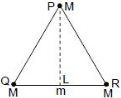
Three particles each of mass $M$ are placed at the three corners of an equilateral triangle of side $l$. What is the gravitational force due to this system of particles on another particle of mass $m$ placed at the midpoint of any side?
A
$\frac{3GMm}{4l^2}$
B
$\frac{4GMm}{3l^2}$
C
$\frac{GMm}{4l^2}$
D
$\frac{4GMm}{l^2}$
Solution
(B) Let the equilateral triangle be $PQR$ with side length $l$. The masses $M$ are at $P, Q,$ and $R$. The mass $m$ is placed at the midpoint $L$ of side $QR$.
The gravitational force exerted by the mass $M$ at $Q$ on mass $m$ at $L$ is $F_Q = \frac{GMm}{(l/2)^2}$ directed towards $Q$.
The gravitational force exerted by the mass $M$ at $R$ on mass $m$ at $L$ is $F_R = \frac{GMm}{(l/2)^2}$ directed towards $R$.
Since $F_Q$ and $F_R$ are equal in magnitude and opposite in direction,they cancel each other out $(F_Q + F_R = 0)$.
The net force on $m$ is therefore only due to the mass $M$ at vertex $P$.
The distance $PL$ is the altitude of the equilateral triangle,given by $PL = l \sin 60^{\circ} = l \frac{\sqrt{3}}{2}$.
The magnitude of the force is $F = \frac{GMm}{(PL)^2} = \frac{GMm}{(l\sqrt{3}/2)^2} = \frac{GMm}{3l^2/4} = \frac{4GMm}{3l^2}$.
The gravitational force exerted by the mass $M$ at $Q$ on mass $m$ at $L$ is $F_Q = \frac{GMm}{(l/2)^2}$ directed towards $Q$.
The gravitational force exerted by the mass $M$ at $R$ on mass $m$ at $L$ is $F_R = \frac{GMm}{(l/2)^2}$ directed towards $R$.
Since $F_Q$ and $F_R$ are equal in magnitude and opposite in direction,they cancel each other out $(F_Q + F_R = 0)$.
The net force on $m$ is therefore only due to the mass $M$ at vertex $P$.
The distance $PL$ is the altitude of the equilateral triangle,given by $PL = l \sin 60^{\circ} = l \frac{\sqrt{3}}{2}$.
The magnitude of the force is $F = \frac{GMm}{(PL)^2} = \frac{GMm}{(l\sqrt{3}/2)^2} = \frac{GMm}{3l^2/4} = \frac{4GMm}{3l^2}$.
0 likes
View Solution27
MediumMCQ
Two spheres of masses $m$ and $M$ are situated in air and the gravitational force between them is $F$. The space around the masses is now filled with a liquid of specific gravity $3$. The gravitational force between the bodies will now be
A
$F$
B
$F/3$
C
$F/9$
D
$3F$
Solution
(A) According to Newton's law of universal gravitation,the force $F$ between two point masses $m$ and $M$ separated by a distance $r$ is given by the formula: $F = \frac{G M m}{r^2}$.
This formula depends only on the masses of the objects,the distance between them,and the universal gravitational constant $G$.
The gravitational force is independent of the medium present between the two masses.
Therefore,even when the space is filled with a liquid of specific gravity $3$,the gravitational force remains unchanged.
Thus,the new force is $F$.
This formula depends only on the masses of the objects,the distance between them,and the universal gravitational constant $G$.
The gravitational force is independent of the medium present between the two masses.
Therefore,even when the space is filled with a liquid of specific gravity $3$,the gravitational force remains unchanged.
Thus,the new force is $F$.
0 likes
View Solution28
EasyMCQ
The ratio of inertial mass and gravitational mass has been found to be $1$ for all material bodies. If this ratio were different for different bodies,what would be the consequence for two bodies having the same gravitational mass but different inertial masses?
A
Same weight but different acceleration due to gravity
B
Same weight and same acceleration due to gravity
C
Different weight but same acceleration due to gravity
D
Different weight and different acceleration due to gravity
Solution
(A) The gravitational force acting on a body is given by $F_g = m_g g$,where $m_g$ is the gravitational mass and $g$ is the acceleration due to gravity. The weight of the body is equal to this gravitational force,so $W = m_g g$.
Since the gravitational mass $m_g$ is the same for both bodies,their weight $W$ will be the same.
According to Newton's second law,$F = m_i a$,where $m_i$ is the inertial mass and $a$ is the acceleration. Equating the gravitational force to the inertial force,we get $m_g g = m_i a$.
Thus,the acceleration is $a = (m_g / m_i) g$.
Since the gravitational mass $m_g$ is the same but the inertial mass $m_i$ is different for the two bodies,the acceleration $a$ will be different for the two bodies.
Therefore,the bodies will have the same weight but different acceleration due to gravity.
Since the gravitational mass $m_g$ is the same for both bodies,their weight $W$ will be the same.
According to Newton's second law,$F = m_i a$,where $m_i$ is the inertial mass and $a$ is the acceleration. Equating the gravitational force to the inertial force,we get $m_g g = m_i a$.
Thus,the acceleration is $a = (m_g / m_i) g$.
Since the gravitational mass $m_g$ is the same but the inertial mass $m_i$ is different for the two bodies,the acceleration $a$ will be different for the two bodies.
Therefore,the bodies will have the same weight but different acceleration due to gravity.
0 likes
View Solution29
DifficultMCQ
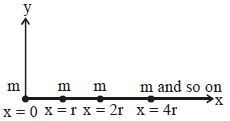
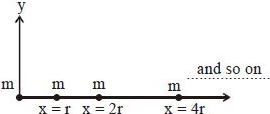
Consider an infinite distribution of point masses (each of mass $m$) placed on the $x$-axis as shown in the diagram. What is the gravitational force acting on the point mass placed at the origin?
A
$\frac{4Gm^2}{3r^2}$
B
$\frac{Gm^2}{3r^2}$
C
$\frac{4Gm^2}{r^2}$
D
$\frac{Gm^2}{r^2}$
Solution
(A) The gravitational force $F$ acting on the point mass at the origin due to the infinite distribution of point masses at $x = r, 2r, 4r, 8r, \ldots$ is given by the sum of individual gravitational forces:
$F = \frac{Gm^2}{r^2} + \frac{Gm^2}{(2r)^2} + \frac{Gm^2}{(4r)^2} + \frac{Gm^2}{(8r)^2} + \ldots$
$F = \frac{Gm^2}{r^2} \left[ 1 + \frac{1}{4} + \frac{1}{16} + \frac{1}{64} + \ldots \right]$
This is an infinite geometric series with the first term $a = 1$ and common ratio $q = \frac{1}{4}$.
The sum of an infinite geometric series is $S = \frac{a}{1-q}$.
$S = \frac{1}{1 - 1/4} = \frac{1}{3/4} = \frac{4}{3}$.
Therefore,$F = \frac{Gm^2}{r^2} \times \frac{4}{3} = \frac{4Gm^2}{3r^2}$.
$F = \frac{Gm^2}{r^2} + \frac{Gm^2}{(2r)^2} + \frac{Gm^2}{(4r)^2} + \frac{Gm^2}{(8r)^2} + \ldots$
$F = \frac{Gm^2}{r^2} \left[ 1 + \frac{1}{4} + \frac{1}{16} + \frac{1}{64} + \ldots \right]$
This is an infinite geometric series with the first term $a = 1$ and common ratio $q = \frac{1}{4}$.
The sum of an infinite geometric series is $S = \frac{a}{1-q}$.
$S = \frac{1}{1 - 1/4} = \frac{1}{3/4} = \frac{4}{3}$.
Therefore,$F = \frac{Gm^2}{r^2} \times \frac{4}{3} = \frac{4Gm^2}{3r^2}$.
0 likes
View Solution30
MediumMCQ
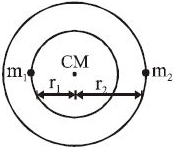
Two stars of masses $m_1$ and $m_2$ are parts of a binary star system. The radii of their orbits are $r_1$ and $r_2$ respectively,measured from the centre of mass of the system. The magnitude of the gravitational force that $m_1$ exerts on $m_2$ is
A
$\frac{m_1 m_2 G}{(r_1 + r_2)^2}$
B
$\frac{m_1 G}{(r_1 + r_2)^2}$
C
$\frac{m_2 G}{(r_1 + r_2)^2}$
D
$\frac{G(m_1 + m_2)}{(r_1 + r_2)^2}$
Solution
(A) According to Newton's law of universal gravitation,the gravitational force $F$ between two point masses $m_1$ and $m_2$ separated by a distance $r$ is given by $F = \frac{G m_1 m_2}{r^2}$.
In a binary star system,the two stars revolve around their common centre of mass $(CM)$.
The distance between the two stars is the sum of their orbital radii measured from the centre of mass,which is $r = r_1 + r_2$.
Substituting this distance into the formula,we get the magnitude of the gravitational force as $F = \frac{G m_1 m_2}{(r_1 + r_2)^2}$.
In a binary star system,the two stars revolve around their common centre of mass $(CM)$.
The distance between the two stars is the sum of their orbital radii measured from the centre of mass,which is $r = r_1 + r_2$.
Substituting this distance into the formula,we get the magnitude of the gravitational force as $F = \frac{G m_1 m_2}{(r_1 + r_2)^2}$.
0 likes
View Solution31
DifficultMCQ
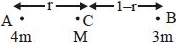
Two point masses $A$ and $B$ having masses in the ratio $4 : 3$ are separated by a distance of $1\, m$. When another point mass $C$ of mass $M$ is placed in between $A$ and $B$,the gravitational force between $A$ and $C$ is $\frac{1}{3}$ of the gravitational force between $B$ and $C$. Then the distance of $C$ from $A$ is:
A
$\frac{2}{3}\, m$
B
$\frac{1}{3}\, m$
C
$\frac{1}{4}\, m$
D
$\frac{2}{7}\, m$
Solution
(A) Let the mass of $A$ be $4m$ and the mass of $B$ be $3m$. Let the mass of $C$ be $M$.
Let the distance of $C$ from $A$ be $r$. Then the distance of $C$ from $B$ is $(1 - r)$.
The gravitational force between $A$ and $C$ is $F_{AC} = \frac{G(4m)M}{r^2}$.
The gravitational force between $B$ and $C$ is $F_{BC} = \frac{G(3m)M}{(1 - r)^2}$.
According to the problem,$F_{AC} = \frac{1}{3} F_{BC}$.
Substituting the expressions,we get: $\frac{G(4m)M}{r^2} = \frac{1}{3} \cdot \frac{G(3m)M}{(1 - r)^2}$.
Simplifying,we get: $\frac{4}{r^2} = \frac{1}{(1 - r)^2}$.
Taking the square root on both sides: $\frac{2}{r} = \frac{1}{1 - r}$.
$2(1 - r) = r \Rightarrow 2 - 2r = r \Rightarrow 3r = 2 \Rightarrow r = \frac{2}{3}\, m$.
Let the distance of $C$ from $A$ be $r$. Then the distance of $C$ from $B$ is $(1 - r)$.
The gravitational force between $A$ and $C$ is $F_{AC} = \frac{G(4m)M}{r^2}$.
The gravitational force between $B$ and $C$ is $F_{BC} = \frac{G(3m)M}{(1 - r)^2}$.
According to the problem,$F_{AC} = \frac{1}{3} F_{BC}$.
Substituting the expressions,we get: $\frac{G(4m)M}{r^2} = \frac{1}{3} \cdot \frac{G(3m)M}{(1 - r)^2}$.
Simplifying,we get: $\frac{4}{r^2} = \frac{1}{(1 - r)^2}$.
Taking the square root on both sides: $\frac{2}{r} = \frac{1}{1 - r}$.
$2(1 - r) = r \Rightarrow 2 - 2r = r \Rightarrow 3r = 2 \Rightarrow r = \frac{2}{3}\, m$.
0 likes
View Solution32
MediumMCQ
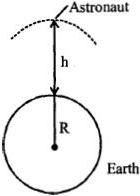
An astronaut of mass $m$ is working on a satellite orbiting the Earth at a distance $h$ from the Earth's surface. The radius of the Earth is $R$,while its mass is $M$. The gravitational pull $F_G$ on the astronaut is
A
Zero since the astronaut feels weightless
B
$\frac{GMm}{(R + h)^2} < F_G < \frac{GMm}{R^2}$
C
$F_G = \frac{GMm}{(R + h)^2}$
D
$0 < F_G < \frac{GMm}{R^2}$
Solution
(C) According to Newton's universal law of gravitation,the gravitational force $F_G$ between two point masses is given by $F_G = \frac{GMm}{r^2}$,where $r$ is the distance between the centers of the two masses.
In this case,the astronaut is at a distance $h$ from the surface of the Earth,so the distance from the center of the Earth is $r = R + h$.
Therefore,the gravitational pull on the astronaut is $F_G = \frac{GMm}{(R + h)^2}$.
In this case,the astronaut is at a distance $h$ from the surface of the Earth,so the distance from the center of the Earth is $r = R + h$.
Therefore,the gravitational pull on the astronaut is $F_G = \frac{GMm}{(R + h)^2}$.
0 likes
View Solution33
DifficultMCQ
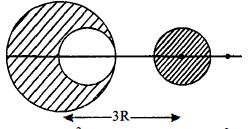
From a sphere of mass $M$ and radius $R$,a smaller sphere of radius $\frac{R}{2}$ is carved out. For the configuration shown in the figure where the distance between the center of the original sphere and the center of the removed sphere is $3R$,the gravitational force between the two spheres is:
A
$\frac{7GM^2}{576R^2}$
B
$\frac{41GM^2}{450R^2}$
C
$\frac{59GM^2}{450R^2}$
D
$\frac{GM^2}{225R^2}$
Solution
(A) Let the density of the sphere be $\rho$.
Mass of the original sphere $M = \rho \cdot \frac{4}{3}\pi R^3$.
Volume of the removed sphere $V_{\text{removed}} = \frac{4}{3}\pi (\frac{R}{2})^3 = \frac{1}{8} (\frac{4}{3}\pi R^3)$.
Mass of the removed sphere $m = \rho \cdot V_{\text{removed}} = \frac{M}{8}$.
Mass of the remaining part of the sphere $M' = M - m = M - \frac{M}{8} = \frac{7M}{8}$.
The gravitational force between the remaining part of the sphere and the removed sphere is given by Newton's law of gravitation:
$F = \frac{G M' m}{r^2}$
Here,$r = 3R$ is the distance between the centers of the two spheres.
$F = \frac{G (\frac{7M}{8}) (\frac{M}{8})}{(3R)^2}$
$F = \frac{G (\frac{7M^2}{64})}{9R^2}$
$F = \frac{7GM^2}{576R^2}$
Mass of the original sphere $M = \rho \cdot \frac{4}{3}\pi R^3$.
Volume of the removed sphere $V_{\text{removed}} = \frac{4}{3}\pi (\frac{R}{2})^3 = \frac{1}{8} (\frac{4}{3}\pi R^3)$.
Mass of the removed sphere $m = \rho \cdot V_{\text{removed}} = \frac{M}{8}$.
Mass of the remaining part of the sphere $M' = M - m = M - \frac{M}{8} = \frac{7M}{8}$.
The gravitational force between the remaining part of the sphere and the removed sphere is given by Newton's law of gravitation:
$F = \frac{G M' m}{r^2}$
Here,$r = 3R$ is the distance between the centers of the two spheres.
$F = \frac{G (\frac{7M}{8}) (\frac{M}{8})}{(3R)^2}$
$F = \frac{G (\frac{7M^2}{64})}{9R^2}$
$F = \frac{7GM^2}{576R^2}$
0 likes
View Solution34
DifficultMCQ
The change in the value of acceleration of the earth towards the sun,when the moon moves from the position of a solar eclipse to the position on the other side of the earth in line with the sun,is: (mass of the moon $= 7.36 \times 10^{22} \ kg$,radius of the moon's orbit $= 3.8 \times 10^8 \ m$).
A
$6.73 \times 10^{-5} \ m/s^2$
B
$6.73 \times 10^{-3} \ m/s^2$
C
$6.73 \times 10^{-2} \ m/s^2$
D
$6.73 \times 10^{-4} \ m/s^2$
Solution
(A) During a solar eclipse,the sun and moon are on the same side of the earth. During a lunar eclipse,the moon and the sun are on opposite sides of the earth.
Let $F_S$ be the gravitational force between the earth and the sun,and $F_L$ be the gravitational force between the earth and the moon.
According to Newton's second law,the net force on the earth is $F = m_e a$,where $m_e$ is the mass of the earth.
During a solar eclipse,the forces from the sun and moon act in the same direction on the earth:
$m_e a_S = F_S + F_L$ --- $(1)$
During a lunar eclipse,the forces act in opposite directions:
$m_e a_L = F_S - F_L$ --- $(2)$
The change in acceleration is $\Delta a = a_S - a_L$. Subtracting $(2)$ from $(1)$:
$m_e (a_S - a_L) = (F_S + F_L) - (F_S - F_L) = 2F_L$
Since $F_L = G \frac{m_e M_L}{D^2}$,where $M_L$ is the mass of the moon and $D$ is the orbital radius:
$m_e \Delta a = 2 G \frac{m_e M_L}{D^2} \implies \Delta a = \frac{2 G M_L}{D^2}$
Substituting the values: $G = 6.67 \times 10^{-11} \ N \cdot m^2/kg^2$,$M_L = 7.36 \times 10^{22} \ kg$,$D = 3.8 \times 10^8 \ m$:
$\Delta a = \frac{2 \times 6.67 \times 10^{-11} \times 7.36 \times 10^{22}}{(3.8 \times 10^8)^2} = \frac{98.1776 \times 10^{11}}{14.44 \times 10^{16}} \approx 6.8 \times 10^{-5} \ m/s^2$.
The closest option is $6.73 \times 10^{-5} \ m/s^2$.
Let $F_S$ be the gravitational force between the earth and the sun,and $F_L$ be the gravitational force between the earth and the moon.
According to Newton's second law,the net force on the earth is $F = m_e a$,where $m_e$ is the mass of the earth.
During a solar eclipse,the forces from the sun and moon act in the same direction on the earth:
$m_e a_S = F_S + F_L$ --- $(1)$
During a lunar eclipse,the forces act in opposite directions:
$m_e a_L = F_S - F_L$ --- $(2)$
The change in acceleration is $\Delta a = a_S - a_L$. Subtracting $(2)$ from $(1)$:
$m_e (a_S - a_L) = (F_S + F_L) - (F_S - F_L) = 2F_L$
Since $F_L = G \frac{m_e M_L}{D^2}$,where $M_L$ is the mass of the moon and $D$ is the orbital radius:
$m_e \Delta a = 2 G \frac{m_e M_L}{D^2} \implies \Delta a = \frac{2 G M_L}{D^2}$
Substituting the values: $G = 6.67 \times 10^{-11} \ N \cdot m^2/kg^2$,$M_L = 7.36 \times 10^{22} \ kg$,$D = 3.8 \times 10^8 \ m$:
$\Delta a = \frac{2 \times 6.67 \times 10^{-11} \times 7.36 \times 10^{22}}{(3.8 \times 10^8)^2} = \frac{98.1776 \times 10^{11}}{14.44 \times 10^{16}} \approx 6.8 \times 10^{-5} \ m/s^2$.
The closest option is $6.73 \times 10^{-5} \ m/s^2$.
0 likes
View Solution35
DifficultMCQ
$A$ straight rod of length $L$ extends from $x = a$ to $x = L + a$. The gravitational force it exerts on a point mass $m$ at $x = 0$,if the mass per unit length of the rod is $A + Bx^2$,is given by
A
$Gm\left[ {A\left( {\frac{1}{{a + L}} - \frac{1}{a}} \right) - BL} \right]$
B
$Gm\left[ {A\left( {\frac{1}{a} - \frac{1}{{a + L}}} \right) - BL} \right]$
C
$Gm\left[ {A\left( {\frac{1}{{a + L}} - \frac{1}{a}} \right) + BL} \right]$
D
$Gm\left[ {A\left( {\frac{1}{a} - \frac{1}{{a + L}}} \right) + BL} \right]$
Solution
(D) Consider a small element of the rod of length $dx$ at a distance $x$ from the origin.
The mass of this element is $dm = (A + Bx^2)dx$.
The gravitational force exerted by this element on the point mass $m$ at $x = 0$ is given by $dF = \frac{G(dm)m}{x^2}$.
Substituting $dm$,we get $dF = \frac{Gm(A + Bx^2)dx}{x^2} = Gm\left( \frac{A}{x^2} + B \right)dx$.
To find the total force,we integrate from $x = a$ to $x = a + L$:
$F = \int_a^{a+L} Gm\left( \frac{A}{x^2} + B \right)dx = Gm \left[ A \int_a^{a+L} x^{-2} dx + B \int_a^{a+L} dx \right]$.
$F = Gm \left[ A \left( -\frac{1}{x} \right)_a^{a+L} + B(x)_a^{a+L} \right]$.
$F = Gm \left[ A \left( -\frac{1}{a+L} + \frac{1}{a} \right) + B(a+L-a) \right]$.
$F = Gm \left[ A \left( \frac{1}{a} - \frac{1}{a+L} \right) + BL \right]$.
The mass of this element is $dm = (A + Bx^2)dx$.
The gravitational force exerted by this element on the point mass $m$ at $x = 0$ is given by $dF = \frac{G(dm)m}{x^2}$.
Substituting $dm$,we get $dF = \frac{Gm(A + Bx^2)dx}{x^2} = Gm\left( \frac{A}{x^2} + B \right)dx$.
To find the total force,we integrate from $x = a$ to $x = a + L$:
$F = \int_a^{a+L} Gm\left( \frac{A}{x^2} + B \right)dx = Gm \left[ A \int_a^{a+L} x^{-2} dx + B \int_a^{a+L} dx \right]$.
$F = Gm \left[ A \left( -\frac{1}{x} \right)_a^{a+L} + B(x)_a^{a+L} \right]$.
$F = Gm \left[ A \left( -\frac{1}{a+L} + \frac{1}{a} \right) + B(a+L-a) \right]$.
$F = Gm \left[ A \left( \frac{1}{a} - \frac{1}{a+L} \right) + BL \right]$.
1 likes
View Solution36
MediumMCQ
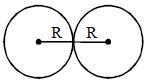
Two spheres of radius $R$ are placed in contact as shown in the figure. If the mass density of each sphere is $\rho$,find the gravitational force between them.
A
$\frac{4}{9}{\pi ^2}G\rho {R^3}$
B
$\frac{4}{9}{\pi ^2}{\rho ^2}{R^4}G$
C
$\frac{4}{9}{\pi ^2}{\rho ^2}{R^2}G$
D
$\pi^2 \rho^2 R^4 G$
Solution
(B) The mass $M$ of each sphere is given by the product of its volume and density: $M = V \cdot \rho = (\frac{4}{3} \pi R^3) \rho$.
The distance between the centers of the two spheres in contact is $d = R + R = 2R$.
According to Newton's law of gravitation,the force $F$ between two point masses is $F = \frac{G M_1 M_2}{d^2}$.
Substituting the values: $F = \frac{G (\frac{4}{3} \pi R^3 \rho) (\frac{4}{3} \pi R^3 \rho)}{(2R)^2}$.
$F = \frac{G \cdot \frac{16}{9} \pi^2 R^6 \rho^2}{4 R^2}$.
$F = \frac{16}{36} \pi^2 \rho^2 R^4 G = \frac{4}{9} \pi^2 \rho^2 R^4 G$.
The distance between the centers of the two spheres in contact is $d = R + R = 2R$.
According to Newton's law of gravitation,the force $F$ between two point masses is $F = \frac{G M_1 M_2}{d^2}$.
Substituting the values: $F = \frac{G (\frac{4}{3} \pi R^3 \rho) (\frac{4}{3} \pi R^3 \rho)}{(2R)^2}$.
$F = \frac{G \cdot \frac{16}{9} \pi^2 R^6 \rho^2}{4 R^2}$.
$F = \frac{16}{36} \pi^2 \rho^2 R^4 G = \frac{4}{9} \pi^2 \rho^2 R^4 G$.
0 likes
View Solution37
EasyMCQ
The mass of the moon is $1\%$ of the mass of the earth. The ratio of the gravitational pull of the earth on the moon and that of the moon on the earth will be
A
$1 : 1$
B
$1 : 10$
C
$1 : 100$
D
$2 : 1$
Solution
(A) According to Newton's third law of motion,for every action,there is an equal and opposite reaction.
Newton's law of universal gravitation states that the force exerted by the earth on the moon $(F_{EM})$ and the force exerted by the moon on the earth $(F_{ME})$ form an action-reaction pair.
Therefore,the magnitude of the gravitational force exerted by the earth on the moon is equal to the magnitude of the gravitational force exerted by the moon on the earth.
$F_{EM} = F_{ME}$
Thus,the ratio of the gravitational pull of the earth on the moon to that of the moon on the earth is $1 : 1$.
Newton's law of universal gravitation states that the force exerted by the earth on the moon $(F_{EM})$ and the force exerted by the moon on the earth $(F_{ME})$ form an action-reaction pair.
Therefore,the magnitude of the gravitational force exerted by the earth on the moon is equal to the magnitude of the gravitational force exerted by the moon on the earth.
$F_{EM} = F_{ME}$
Thus,the ratio of the gravitational pull of the earth on the moon to that of the moon on the earth is $1 : 1$.
0 likes
View Solution38
MediumMCQ
Two spheres of masses $m$ and $M$ are situated in air and the gravitational force between them is $F.$ The space around the masses is now filled with a liquid of specific gravity $3.$ The gravitational force will now be
A
$3F$
B
$F$
C
$\frac{F}{3}$
D
$\frac{F}{9}$
Solution
(B) The gravitational force between two point masses $m$ and $M$ separated by a distance $r$ is given by Newton's Law of Gravitation: $F = G \frac{mM}{r^2}$.
This force depends only on the masses of the objects and the distance between them.
Unlike electrostatic force,the gravitational force is independent of the medium in which the objects are placed.
Therefore,even when the space around the masses is filled with a liquid of specific gravity $3$,the gravitational force remains unchanged.
Thus,the new force is $F$.
This force depends only on the masses of the objects and the distance between them.
Unlike electrostatic force,the gravitational force is independent of the medium in which the objects are placed.
Therefore,even when the space around the masses is filled with a liquid of specific gravity $3$,the gravitational force remains unchanged.
Thus,the new force is $F$.
0 likes
View Solution39
DifficultMCQ
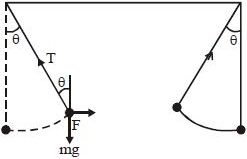
Two metallic spheres each of mass $M$ are suspended by two strings each of length $L$. The distance between the upper ends of the strings is $L$. The angle which the strings will make with the vertical due to the mutual attraction of the spheres is
A
$\tan^{-1}\left[\frac{GM}{gL^2}\right]$
B
$\tan^{-1}\left[\frac{GM}{2gL^2}\right]$
C
$\tan^{-1}\left[\frac{GM}{gL}\right]$
D
$\tan^{-1}\left[\frac{2GM}{gL^2}\right]$
Solution
(A) Let the angle made by each string with the vertical be $\theta$. The distance between the two spheres is $r = L + 2L \sin \theta$. Since the angle $\theta$ is very small,$\sin \theta \approx \theta$,so $r \approx L$.
The gravitational force of attraction between the spheres is $F = \frac{GM^2}{r^2} \approx \frac{GM^2}{L^2}$.
For equilibrium of one sphere,the forces acting are tension $T$,gravitational force $F$,and weight $Mg$.
Resolving forces:
$T \sin \theta = F = \frac{GM^2}{L^2}$
$T \cos \theta = Mg$
Dividing the two equations:
$\tan \theta = \frac{F}{Mg} = \frac{GM^2 / L^2}{Mg} = \frac{GM}{gL^2}$
Therefore,$\theta = \tan^{-1}\left[\frac{GM}{gL^2}\right]$.
The gravitational force of attraction between the spheres is $F = \frac{GM^2}{r^2} \approx \frac{GM^2}{L^2}$.
For equilibrium of one sphere,the forces acting are tension $T$,gravitational force $F$,and weight $Mg$.
Resolving forces:
$T \sin \theta = F = \frac{GM^2}{L^2}$
$T \cos \theta = Mg$
Dividing the two equations:
$\tan \theta = \frac{F}{Mg} = \frac{GM^2 / L^2}{Mg} = \frac{GM}{gL^2}$
Therefore,$\theta = \tan^{-1}\left[\frac{GM}{gL^2}\right]$.
0 likes
View Solution40
DifficultMCQ
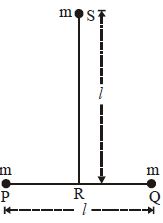
Two particles each of mass $m$ are placed at points $P$ and $Q$ as shown in the figure. $R$ is the mid-point of $PQ = l$. The gravitational force on the third particle of mass $m$ placed at point $S$ on the perpendicular bisector of $PQ$ is
A
$\frac{G m^2}{l^2}$
B
$\frac{16 G m^2}{5 l^2}$
C
$\frac{16 G m^2}{5 \sqrt{5} l^2}$
D
$\frac{4 \sqrt{2} G m^2}{5 l^2}$
Solution
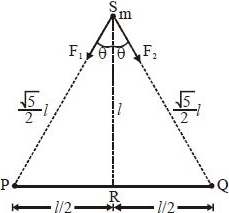
(C) Let the distance $RS = x$. From the figure,$RS = l$. The distance from $P$ to $S$ is $PS = \sqrt{PR^2 + RS^2} = \sqrt{(l/2)^2 + l^2} = \sqrt{l^2/4 + l^2} = \sqrt{5l^2/4} = \frac{\sqrt{5}}{2} l$.
The gravitational force exerted by particle at $P$ on particle at $S$ is $F_1 = \frac{G m^2}{PS^2} = \frac{G m^2}{5l^2/4} = \frac{4 G m^2}{5 l^2}$.
Similarly,the gravitational force exerted by particle at $Q$ on particle at $S$ is $F_2 = \frac{G m^2}{QS^2} = \frac{4 G m^2}{5 l^2}$.
Let $\theta$ be the angle between $RS$ and $PS$. Then $\cos \theta = \frac{RS}{PS} = \frac{l}{(\sqrt{5}/2) l} = \frac{2}{\sqrt{5}}$.
The horizontal components of the forces $F_1$ and $F_2$ cancel each other out. The resultant force is the sum of the vertical components:
$F = F_1 \cos \theta + F_2 \cos \theta = 2 F_1 \cos \theta$.
Substituting the values:
$F = 2 \times \left( \frac{4 G m^2}{5 l^2} \right) \times \left( \frac{2}{\sqrt{5}} \right) = \frac{16 G m^2}{5 \sqrt{5} l^2}$.
The gravitational force exerted by particle at $P$ on particle at $S$ is $F_1 = \frac{G m^2}{PS^2} = \frac{G m^2}{5l^2/4} = \frac{4 G m^2}{5 l^2}$.
Similarly,the gravitational force exerted by particle at $Q$ on particle at $S$ is $F_2 = \frac{G m^2}{QS^2} = \frac{4 G m^2}{5 l^2}$.
Let $\theta$ be the angle between $RS$ and $PS$. Then $\cos \theta = \frac{RS}{PS} = \frac{l}{(\sqrt{5}/2) l} = \frac{2}{\sqrt{5}}$.
The horizontal components of the forces $F_1$ and $F_2$ cancel each other out. The resultant force is the sum of the vertical components:
$F = F_1 \cos \theta + F_2 \cos \theta = 2 F_1 \cos \theta$.
Substituting the values:
$F = 2 \times \left( \frac{4 G m^2}{5 l^2} \right) \times \left( \frac{2}{\sqrt{5}} \right) = \frac{16 G m^2}{5 \sqrt{5} l^2}$.
0 likes
View Solution41
DifficultMCQ
There are three arrangements of three point masses (each of mass $m$). In which of the following three arrangements are they arranged in order of increasing magnitude of the net gravitational force on the point mass marked as $1$?
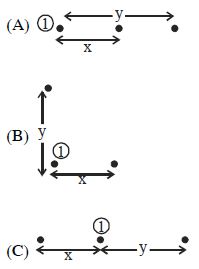
A
$C, B$ and $A$
B
$B, C$ and $A$
C
$C, A$ and $B$
D
$A, C$ and $B$
Solution
(A) Let the mass of each point mass be $m$. The gravitational force between two masses $m$ separated by distance $r$ is $F = \frac{Gm^2}{r^2}$.
For arrangement $(A)$:
The point mass $1$ is at one end. The other two masses are at distances $x$ and $y$ from it. Since both forces act in the same direction,the net force is $F_A = \frac{Gm^2}{x^2} + \frac{Gm^2}{y^2} = Gm^2 \left( \frac{1}{x^2} + \frac{1}{y^2} \right)$.
For arrangement $(B)$:
The point mass $1$ is at the corner of a right-angled triangle. The other two masses are at distances $x$ and $y$ along the perpendicular axes. The forces are $F_x = \frac{Gm^2}{x^2}$ and $F_y = \frac{Gm^2}{y^2}$. The net force is $F_B = \sqrt{F_x^2 + F_y^2} = Gm^2 \sqrt{\frac{1}{x^4} + \frac{1}{y^4}}$.
For arrangement $(C)$:
The point mass $1$ is in the middle. The other two masses are at distances $x$ and $y$ on opposite sides. The forces act in opposite directions,so the net force is $F_C = \left| \frac{Gm^2}{x^2} - \frac{Gm^2}{y^2} \right| = Gm^2 \left| \frac{1}{x^2} - \frac{1}{y^2} \right|$.
Comparing the magnitudes,$F_C < F_B < F_A$ (assuming $x < y$). Thus,the increasing order is $C, B, A$.
For arrangement $(A)$:
The point mass $1$ is at one end. The other two masses are at distances $x$ and $y$ from it. Since both forces act in the same direction,the net force is $F_A = \frac{Gm^2}{x^2} + \frac{Gm^2}{y^2} = Gm^2 \left( \frac{1}{x^2} + \frac{1}{y^2} \right)$.
For arrangement $(B)$:
The point mass $1$ is at the corner of a right-angled triangle. The other two masses are at distances $x$ and $y$ along the perpendicular axes. The forces are $F_x = \frac{Gm^2}{x^2}$ and $F_y = \frac{Gm^2}{y^2}$. The net force is $F_B = \sqrt{F_x^2 + F_y^2} = Gm^2 \sqrt{\frac{1}{x^4} + \frac{1}{y^4}}$.
For arrangement $(C)$:
The point mass $1$ is in the middle. The other two masses are at distances $x$ and $y$ on opposite sides. The forces act in opposite directions,so the net force is $F_C = \left| \frac{Gm^2}{x^2} - \frac{Gm^2}{y^2} \right| = Gm^2 \left| \frac{1}{x^2} - \frac{1}{y^2} \right|$.
Comparing the magnitudes,$F_C < F_B < F_A$ (assuming $x < y$). Thus,the increasing order is $C, B, A$.
0 likes
View Solution42
MediumMCQ
The force of gravitation is
A
repulsive
B
conservative
C
electrostatic
D
non-conservative
Solution
(B) The work done by the force of gravitation depends only on the initial and final positions of the object and does not depend on the path taken.
Since the work done in a closed loop by the gravitational force is zero,it is classified as a conservative force.
Since the work done in a closed loop by the gravitational force is zero,it is classified as a conservative force.
0 likes
View Solution43
MediumMCQ
Two masses $m_1$ and $m_2$ $(m_1 < m_2)$ are released from rest from a finite distance. They start moving under their mutual gravitational attraction.
A
acceleration of $m_1$ is more than that of $m_2$
B
acceleration of $m_2$ is more than that of $m_1$
C
centre of mass of system will remain at rest in all the reference frame
D
total energy of system does not remain constant
Solution
(A) The gravitational force $F$ acting on both masses is equal in magnitude and opposite in direction.
According to Newton's second law,$F = ma$,which implies $a = F/m$.
Since the force $F$ is the same for both,the acceleration $a$ is inversely proportional to the mass $m$ $(a \propto 1/m)$.
Given $m_1 < m_2$,it follows that $a_1 > a_2$. Thus,the acceleration of $m_1$ is greater than that of $m_2$.
Since the gravitational force is an internal force for the system,there is no external force acting on the system.
Therefore,the total energy of the system remains constant.
According to Newton's second law,$F = ma$,which implies $a = F/m$.
Since the force $F$ is the same for both,the acceleration $a$ is inversely proportional to the mass $m$ $(a \propto 1/m)$.
Given $m_1 < m_2$,it follows that $a_1 > a_2$. Thus,the acceleration of $m_1$ is greater than that of $m_2$.
Since the gravitational force is an internal force for the system,there is no external force acting on the system.
Therefore,the total energy of the system remains constant.
0 likes
View Solution44
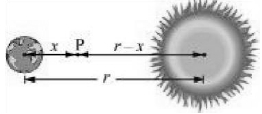
MediumMCQ
$A$ rocket is fired from the Earth towards the Sun. At what distance from the Earth's centre is the gravitational force on the rocket zero? Mass of the Sun $= 2 \times 10^{30} \; kg$,mass of the Earth $= 6 \times 10^{24} \; kg$. Neglect the effect of other planets,etc. (Orbital radius $= 1.5 \times 10^{11} \; m$)
A
$6.42 \times 10^{9} \; m$
B
$1.26 \times 10^{7} \; m$
C
$4.8 \times 10^{6} \; m$
D
$2.59 \times 10^{8} \; m$
Solution
(D) Let $M_s = 2 \times 10^{30} \; kg$ be the mass of the Sun and $M_e = 6 \times 10^{24} \; kg$ be the mass of the Earth. The distance between them is $r = 1.5 \times 10^{11} \; m$.
Let $x$ be the distance from the Earth's centre where the net gravitational force on the rocket of mass $m$ is zero.
At this point,the gravitational pull of the Earth equals the gravitational pull of the Sun:
$\frac{G M_e m}{x^2} = \frac{G M_s m}{(r - x)^2}$
$\frac{M_e}{x^2} = \frac{M_s}{(r - x)^2}$
Taking the square root on both sides:
$\frac{\sqrt{M_e}}{x} = \frac{\sqrt{M_s}}{r - x}$
$\frac{r - x}{x} = \sqrt{\frac{M_s}{M_e}}$
$\frac{r}{x} - 1 = \sqrt{\frac{2 \times 10^{30}}{6 \times 10^{24}}} = \sqrt{\frac{1}{3} \times 10^6} = \frac{1000}{\sqrt{3}} \approx 577.35$
$\frac{r}{x} = 578.35$
$x = \frac{1.5 \times 10^{11}}{578.35} \approx 2.59 \times 10^8 \; m$.
Let $x$ be the distance from the Earth's centre where the net gravitational force on the rocket of mass $m$ is zero.
At this point,the gravitational pull of the Earth equals the gravitational pull of the Sun:
$\frac{G M_e m}{x^2} = \frac{G M_s m}{(r - x)^2}$
$\frac{M_e}{x^2} = \frac{M_s}{(r - x)^2}$
Taking the square root on both sides:
$\frac{\sqrt{M_e}}{x} = \frac{\sqrt{M_s}}{r - x}$
$\frac{r - x}{x} = \sqrt{\frac{M_s}{M_e}}$
$\frac{r}{x} - 1 = \sqrt{\frac{2 \times 10^{30}}{6 \times 10^{24}}} = \sqrt{\frac{1}{3} \times 10^6} = \frac{1000}{\sqrt{3}} \approx 577.35$
$\frac{r}{x} = 578.35$
$x = \frac{1.5 \times 10^{11}}{578.35} \approx 2.59 \times 10^8 \; m$.
0 likes
View Solution45
Medium
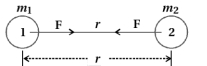
State Newton's universal law of gravitation and represent it in a mathematical expression.
Solution
(N/A) Newton's universal law of gravitation states that every particle of matter in the universe attracts every other particle with a force that is directly proportional to the product of their masses and inversely proportional to the square of the distance between them.
To obtain the mathematical form,consider two point masses $m_{1}$ and $m_{2}$ separated by a distance $r$. The gravitational force $F$ between them is given by:
$F \propto m_{1} m_{2}$ ... $(1)$
$F \propto \frac{1}{r^{2}}$ ... $(2)$
Combining these two relations,we get:
$F \propto \frac{m_{1} m_{2}}{r^{2}}$
$F = G \frac{m_{1} m_{2}}{r^{2}}$
Here,$G$ is the universal gravitational constant. Its value is $6.67 \times 10^{-11} \text{ N m}^{2} \text{ kg}^{-2}$. It is called a universal constant because its value remains the same everywhere in the universe.
To obtain the mathematical form,consider two point masses $m_{1}$ and $m_{2}$ separated by a distance $r$. The gravitational force $F$ between them is given by:
$F \propto m_{1} m_{2}$ ... $(1)$
$F \propto \frac{1}{r^{2}}$ ... $(2)$
Combining these two relations,we get:
$F \propto \frac{m_{1} m_{2}}{r^{2}}$
$F = G \frac{m_{1} m_{2}}{r^{2}}$
Here,$G$ is the universal gravitational constant. Its value is $6.67 \times 10^{-11} \text{ N m}^{2} \text{ kg}^{-2}$. It is called a universal constant because its value remains the same everywhere in the universe.
0 likes
View Solution46
Easy
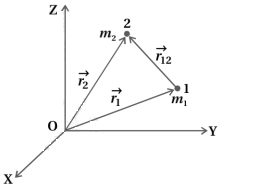
Explain the vector form of Newton's universal law of gravitation.
Solution
(N/A) Newton's universal law of gravitation states that every body in the universe attracts every other body with a force that is directly proportional to the product of their masses and inversely proportional to the square of the distance between them.
This force acts along the line joining the centers of the two bodies.
This force is known as the gravitational force.
$\therefore \left|\overrightarrow{F}_{12}\right| = \left|\overrightarrow{F}_{21}\right| = \frac{G m_{1} m_{2}}{r^{2}}$
where $m_{1}$ and $m_{2}$ are the masses of the two bodies,$r$ is the distance between them,and $G$ is the universal gravitational constant.
According to the figure,$m_{1}$ and $m_{2}$ are two masses placed in a Cartesian coordinate system,and $\vec{r}_{1}$ and $\vec{r}_{2}$ are their respective position vectors.
The displacement vector from $m_{1}$ to $m_{2}$ is $\overrightarrow{r}_{12} = \vec{r}_{2} - \vec{r}_{1}$.
The unit vector in the direction of $\overrightarrow{r}_{12}$ is $\hat{r}_{12} = \frac{\overrightarrow{r}_{12}}{\left|\overrightarrow{r}_{12}\right|} = \frac{\vec{r}_{2} - \vec{r}_{1}}{r}$,where $r = \left|\overrightarrow{r}_{12}\right|$.
The gravitational force exerted on mass $m_{1}$ by mass $m_{2}$ is given by $\overrightarrow{F}_{12} = \frac{G m_{1} m_{2}}{r^{2}} \hat{r}_{21}$,where $\hat{r}_{21}$ is the unit vector from $m_{2}$ to $m_{1}$.
This force acts along the line joining the centers of the two bodies.
This force is known as the gravitational force.
$\therefore \left|\overrightarrow{F}_{12}\right| = \left|\overrightarrow{F}_{21}\right| = \frac{G m_{1} m_{2}}{r^{2}}$
where $m_{1}$ and $m_{2}$ are the masses of the two bodies,$r$ is the distance between them,and $G$ is the universal gravitational constant.
According to the figure,$m_{1}$ and $m_{2}$ are two masses placed in a Cartesian coordinate system,and $\vec{r}_{1}$ and $\vec{r}_{2}$ are their respective position vectors.
The displacement vector from $m_{1}$ to $m_{2}$ is $\overrightarrow{r}_{12} = \vec{r}_{2} - \vec{r}_{1}$.
The unit vector in the direction of $\overrightarrow{r}_{12}$ is $\hat{r}_{12} = \frac{\overrightarrow{r}_{12}}{\left|\overrightarrow{r}_{12}\right|} = \frac{\vec{r}_{2} - \vec{r}_{1}}{r}$,where $r = \left|\overrightarrow{r}_{12}\right|$.
The gravitational force exerted on mass $m_{1}$ by mass $m_{2}$ is given by $\overrightarrow{F}_{12} = \frac{G m_{1} m_{2}}{r^{2}} \hat{r}_{21}$,where $\hat{r}_{21}$ is the unit vector from $m_{2}$ to $m_{1}$.
0 likes
View Solution47
Medium
Explain the principle of superposition for gravitational force.
Solution
(N/A) The principle of superposition states that the net gravitational force on a particle is the vector sum of the individual gravitational forces exerted on it by all other particles.
If a particle of mass $m_1$ is surrounded by particles of masses $m_2, m_3, ..., m_n$ at distances $r_{12}, r_{13}, ..., r_{1n}$ respectively,the total force $\vec{F}_1$ on $m_1$ is:
$\vec{F}_1 = \vec{F}_{12} + \vec{F}_{13} + ... + \vec{F}_{1n} = \sum_{i=2}^{n} \vec{F}_{1i}$
Where the force due to any mass $m_i$ is given by:
$\vec{F}_{1i} = G \frac{m_1 m_i}{|\vec{r}_{1i}|^2} \hat{r}_{1i}$
Here,$\hat{r}_{1i}$ is the unit vector pointing from $m_1$ towards $m_i$. The total force is the vector sum of these individual forces as shown in the diagram.
If a particle of mass $m_1$ is surrounded by particles of masses $m_2, m_3, ..., m_n$ at distances $r_{12}, r_{13}, ..., r_{1n}$ respectively,the total force $\vec{F}_1$ on $m_1$ is:
$\vec{F}_1 = \vec{F}_{12} + \vec{F}_{13} + ... + \vec{F}_{1n} = \sum_{i=2}^{n} \vec{F}_{1i}$
Where the force due to any mass $m_i$ is given by:
$\vec{F}_{1i} = G \frac{m_1 m_i}{|\vec{r}_{1i}|^2} \hat{r}_{1i}$
Here,$\hat{r}_{1i}$ is the unit vector pointing from $m_1$ towards $m_i$. The total force is the vector sum of these individual forces as shown in the diagram.
0 likes
View Solution48
Easy
Explain the gravitational force exerted by an extended object.
Solution
(N/A) For the gravitational force between an extended object,such as the $Earth$,and a point mass,the equation $F = \frac{G m_1 m_2}{r^2}$ is not directly applicable because it is only valid for point masses.
Each infinitesimal point mass within the extended object exerts a gravitational force on the given point mass. Since these individual forces act in different directions,the total force must be calculated by performing a vector summation of all these infinitesimal forces.
This summation is mathematically represented as an integral over the volume of the extended object: $\vec{F} = \int d\vec{F}$. This process is efficiently handled using calculus.
Each infinitesimal point mass within the extended object exerts a gravitational force on the given point mass. Since these individual forces act in different directions,the total force must be calculated by performing a vector summation of all these infinitesimal forces.
This summation is mathematically represented as an integral over the volume of the extended object: $\vec{F} = \int d\vec{F}$. This process is efficiently handled using calculus.
0 likes
View Solution49
MediumMCQ
If the mass of two bodies is doubled and the distance between them is also doubled,what happens to the new gravitational force?
A
It remains the same.
B
It becomes double.
C
It becomes half.
D
It becomes four times.
Solution
(A) According to Newton's Law of Gravitation,the force $F$ between two bodies of masses $m_1$ and $m_2$ separated by a distance $r$ is given by $F = G \frac{m_1 m_2}{r^2}$.
Given that the new masses are $m_1' = 2m_1$ and $m_2' = 2m_2$,and the new distance is $r' = 2r$.
The new gravitational force $F'$ is given by $F' = G \frac{m_1' m_2'}{(r')^2}$.
Substituting the new values: $F' = G \frac{(2m_1)(2m_2)}{(2r)^2} = G \frac{4 m_1 m_2}{4 r^2}$.
Simplifying the expression: $F' = G \frac{m_1 m_2}{r^2} = F$.
Therefore,the new gravitational force remains the same.
Given that the new masses are $m_1' = 2m_1$ and $m_2' = 2m_2$,and the new distance is $r' = 2r$.
The new gravitational force $F'$ is given by $F' = G \frac{m_1' m_2'}{(r')^2}$.
Substituting the new values: $F' = G \frac{(2m_1)(2m_2)}{(2r)^2} = G \frac{4 m_1 m_2}{4 r^2}$.
Simplifying the expression: $F' = G \frac{m_1 m_2}{r^2} = F$.
Therefore,the new gravitational force remains the same.
0 likes
View SolutionGravitation — Newton’s Law of Gravitation · Frequently Asked Questions
1Are these Gravitation questions useful for JEE and NEET?
Yes. All questions in this section are mapped to JEE Main and NEET exam patterns. Previous year questions from JEE Main, NEET, GUJCET and state-level exams are included with full solutions.
2Can I switch to Hindi or Gujarati for these questions?
Yes. Use the language tabs in the hero section or the sidebar to view the same questions and solutions in English, Hindi or Gujarati.
3How do I generate a question paper from this subtopic?
Use the Vedclass Exam Paper Generator — select the chapter and subtopic, set difficulty, and generate Sets A, B, C, D automatically. First 3 chapters of every subject are free.
Vedclass Products
For Students
Vedclass Test Series
Mock tests in real JEE/NEET style with performance analysis. 5-day free trial.
Start Free TrialFor Teachers
Exam Paper Generator
Generate Set A/B/C/D papers from this chapter in 2 minutes. 3 chapters free.
Try FreeFor Institutes
Online Exam Module
Live online exams with unlimited students, 360° analytics & white-label branding.
See DemoFor Teachers & Institutes
Generate a Gravitation Exam Paper in 2 Minutes
Select subtopic & difficulty — Sets A, B, C, D auto-generated with No Repeat logic.
First 3 chapters of every subject are free — no payment required.