
A English
Newton’s Law of Gravitation Questions in English
Class 11 Physics · Gravitation · Newton’s Law of Gravitation
107+
Questions
English
Language
100%
With Solutions
Showing 49 of 107 questions in English
51
EasyMCQ
Are the inertial mass and gravitational mass of a body different from each other?
A
Yes
B
No
C
Depends on the material
D
Depends on the location
Solution
(B) No,the inertial mass and gravitational mass of a body are equivalent to each other. According to the Equivalence Principle in general relativity,the inertial mass (which determines the resistance to acceleration) and the gravitational mass (which determines the gravitational force experienced in a field) are identical for all objects.
0 likes
View Solution52
Medium
Draw a schematic diagram of Cavendish's experiment for the determination of the universal gravitational constant $G$ and obtain the formula used in it.
Solution
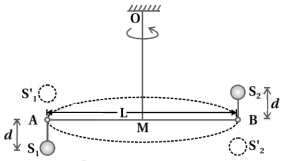
(N/A) The value of the gravitational constant $G$ can be determined experimentally,which was first done by Cavendish in $1798$. The apparatus used is schematically shown in the figure.
The bar $AB$ has two small lead spheres attached at its ends. The bar is suspended from a rigid support by a fine wire.
Two large lead spheres are brought close to the small ones but on opposite sides. The big spheres attract the nearby small ones by equal and opposite forces. There is no net force on the bar,but there is a torque equal to $F \times L$,where $F$ is the force of attraction between a big sphere and a small sphere,and $L$ is the length of the bar. As a result,the bar rotates about the wire $OM$. The wire gets twisted until the restoring torque of the wire equals the gravitational torque.
In this equilibrium position,the angle of twist $\theta$ is measured. If $k$ is the torsion constant of the wire,the restoring torque is $\tau = k\theta$.
Gravitational force on each small sphere is $F = \frac{GMm}{d^2}$,where $M$ is the mass of the large sphere,$m$ is the mass of the small sphere,and $d$ is the distance between their centers.
The gravitational torque is $\tau_g = F \times L = \frac{GMm}{d^2} L$.
At equilibrium,$\tau_g = \tau$,so $\frac{GMm}{d^2} L = k\theta$.
Thus,$G = \frac{k\theta d^2}{MLm}$.
The bar $AB$ has two small lead spheres attached at its ends. The bar is suspended from a rigid support by a fine wire.
Two large lead spheres are brought close to the small ones but on opposite sides. The big spheres attract the nearby small ones by equal and opposite forces. There is no net force on the bar,but there is a torque equal to $F \times L$,where $F$ is the force of attraction between a big sphere and a small sphere,and $L$ is the length of the bar. As a result,the bar rotates about the wire $OM$. The wire gets twisted until the restoring torque of the wire equals the gravitational torque.
In this equilibrium position,the angle of twist $\theta$ is measured. If $k$ is the torsion constant of the wire,the restoring torque is $\tau = k\theta$.
Gravitational force on each small sphere is $F = \frac{GMm}{d^2}$,where $M$ is the mass of the large sphere,$m$ is the mass of the small sphere,and $d$ is the distance between their centers.
The gravitational torque is $\tau_g = F \times L = \frac{GMm}{d^2} L$.
At equilibrium,$\tau_g = \tau$,so $\frac{GMm}{d^2} L = k\theta$.
Thus,$G = \frac{k\theta d^2}{MLm}$.
0 likes
View Solution53
EasyMCQ
How much force of gravitation acts on a body at an infinite distance from the Earth?
A
Zero
B
Infinite
C
Equal to the weight of the body
D
Cannot be determined
Solution
(A) The gravitational force $F$ between two bodies of masses $M$ and $m$ separated by a distance $r$ is given by Newton's Law of Gravitation: $F = G \frac{Mm}{r^2}$.
As the distance $r$ approaches infinity $(r \to \infty)$,the denominator $r^2$ becomes infinitely large.
Therefore,the force $F = G \frac{Mm}{r^2}$ approaches zero.
Thus,at an infinite distance from the Earth,the gravitational force acting on a body is zero.
As the distance $r$ approaches infinity $(r \to \infty)$,the denominator $r^2$ becomes infinitely large.
Therefore,the force $F = G \frac{Mm}{r^2}$ approaches zero.
Thus,at an infinite distance from the Earth,the gravitational force acting on a body is zero.
0 likes
View Solution54
Easy
Define the universal gravitational constant $(G)$.
Solution
(N/A) According to Newton's law of gravitation,the force between two masses is given by $F = \frac{G m_{1} m_{2}}{r^{2}}$.
If we take $m_{1} = 1 \ kg$,$m_{2} = 1 \ kg$,and $r = 1 \ m$,then $F = G$.
Therefore,the universal gravitational constant is defined as the gravitational force of attraction between two bodies of unit mass separated by a unit distance.
If we take $m_{1} = 1 \ kg$,$m_{2} = 1 \ kg$,and $r = 1 \ m$,then $F = G$.
Therefore,the universal gravitational constant is defined as the gravitational force of attraction between two bodies of unit mass separated by a unit distance.
0 likes
View Solution55
EasyMCQ
The value of $G$ on Earth is $6.67 \times 10^{-11} \ Nm^2/kg^2$. What is the value of $G$ on the Moon?
A
$6.67 \times 10^{-11} \ Nm^2/kg^2$
B
$1.11 \times 10^{-11} \ Nm^2/kg^2$
C
$4.00 \times 10^{-10} \ Nm^2/kg^2$
D
Zero
Solution
(A) $G$ is the Universal Gravitational Constant.
Its value remains the same at any place and at any time in the universe.
Therefore,the value of $G$ on the Moon is also $6.67 \times 10^{-11} \ Nm^2/kg^2$.
Its value remains the same at any place and at any time in the universe.
Therefore,the value of $G$ on the Moon is also $6.67 \times 10^{-11} \ Nm^2/kg^2$.
0 likes
View Solution56
EasyMCQ
Two objects are placed at a certain distance from each other in air. If they are placed at the same distance in water,what is the ratio of the gravitational force between them?
A
$1:K$
B
$1:1$
C
$K:1$
D
$1:K^2$
Solution
(B) The gravitational force between two objects is given by $F = G \frac{m_1 m_2}{r^2}$.
This formula shows that the gravitational force depends only on the masses of the objects and the distance between them.
It does not depend on the medium in which the objects are placed.
Therefore,the gravitational force in air and water remains the same.
Thus,the ratio of the force in air to the force in water is $1:1$.
This formula shows that the gravitational force depends only on the masses of the objects and the distance between them.
It does not depend on the medium in which the objects are placed.
Therefore,the gravitational force in air and water remains the same.
Thus,the ratio of the force in air to the force in water is $1:1$.
0 likes
View Solution57
Difficult
Two identical spheres each of radius $r$ are placed in contact with each other. Show that the gravitational force between them is proportional to $r^4$.
Solution
(N/A) The mass $m$ of each sphere can be expressed in terms of density $\rho$ and radius $r$ as $m = \text{Volume} \times \text{Density} = \frac{4}{3} \pi r^3 \rho$.
The distance between the centers of the two spheres in contact is $d = r + r = 2r$.
According to Newton's Law of Gravitation,the force $F$ is given by $F = \frac{G m_1 m_2}{d^2}$.
Substituting the values,$F = \frac{G (\frac{4}{3} \pi r^3 \rho) (\frac{4}{3} \pi r^3 \rho)}{(2r)^2}$.
$F = \frac{G \cdot \frac{16}{9} \pi^2 r^6 \rho^2}{4r^2}$.
$F = (\frac{4}{9} \pi^2 \rho^2 G) r^4$.
Since $\frac{4}{9} \pi^2 \rho^2 G$ is a constant,we have $F \propto r^4$.
The distance between the centers of the two spheres in contact is $d = r + r = 2r$.
According to Newton's Law of Gravitation,the force $F$ is given by $F = \frac{G m_1 m_2}{d^2}$.
Substituting the values,$F = \frac{G (\frac{4}{3} \pi r^3 \rho) (\frac{4}{3} \pi r^3 \rho)}{(2r)^2}$.
$F = \frac{G \cdot \frac{16}{9} \pi^2 r^6 \rho^2}{4r^2}$.
$F = (\frac{4}{9} \pi^2 \rho^2 G) r^4$.
Since $\frac{4}{9} \pi^2 \rho^2 G$ is a constant,we have $F \propto r^4$.
0 likes
View Solution58
EasyMCQ
The mass of the Moon is approximately $10\%$ of the mass of the Earth. What will be the gravitational force exerted by the Moon on the Earth compared to the gravitational force exerted by the Earth on the Moon?
A
It will be $10\%$ of the force exerted by the Earth on the Moon.
B
It will be equal to the force exerted by the Earth on the Moon.
C
It will be $10$ times the force exerted by the Earth on the Moon.
D
It will be $1/10$ of the force exerted by the Earth on the Moon.
Solution
(B) According to Newton's Law of Universal Gravitation,the force between two bodies is given by $F = G \frac{m_1 m_2}{r^2}$.
This force depends on the product of the masses of the two bodies $(m_1 m_2)$.
Since the force is mutual,the Earth exerts the same magnitude of force on the Moon as the Moon exerts on the Earth,in accordance with Newton's Third Law of Motion.
Therefore,the gravitational force exerted by the Moon on the Earth is equal to the gravitational force exerted by the Earth on the Moon.
This force depends on the product of the masses of the two bodies $(m_1 m_2)$.
Since the force is mutual,the Earth exerts the same magnitude of force on the Moon as the Moon exerts on the Earth,in accordance with Newton's Third Law of Motion.
Therefore,the gravitational force exerted by the Moon on the Earth is equal to the gravitational force exerted by the Earth on the Moon.
0 likes
View Solution59
MediumMCQ
According to Newton's law of gravitation,both the Earth and an apple exert equal forces on each other. Why does the apple fall towards the Earth,but the Earth does not move towards the apple?
A
The Earth exerts a stronger force on the apple.
B
The mass of the Earth is much larger than the mass of the apple,making the acceleration of the Earth negligible.
C
The apple is attracted by the Earth's magnetic field.
D
The gravitational force only acts on smaller objects.
Solution
(B) According to Newton's second law of motion,$F = ma$,or $a = F/m$.
Since the force $F$ exerted by the Earth on the apple and the apple on the Earth is equal in magnitude,the acceleration produced is inversely proportional to the mass of the object.
The mass of the Earth $(M)$ is extremely large compared to the mass of the apple $(m)$.
Therefore,the acceleration of the Earth $(a_E = F/M)$ is so small that it is practically undetectable,whereas the acceleration of the apple $(a_a = F/m)$ is significant,causing it to fall towards the Earth.
Since the force $F$ exerted by the Earth on the apple and the apple on the Earth is equal in magnitude,the acceleration produced is inversely proportional to the mass of the object.
The mass of the Earth $(M)$ is extremely large compared to the mass of the apple $(m)$.
Therefore,the acceleration of the Earth $(a_E = F/M)$ is so small that it is practically undetectable,whereas the acceleration of the apple $(a_a = F/m)$ is significant,causing it to fall towards the Earth.
0 likes
View Solution60
MediumMCQ
According to Newton's law of gravitation,every object in the universe exerts a gravitational force on every other object. Why do two objects not move towards each other?
A
The force is too weak to overcome friction.
B
The gravitational force is only applicable to celestial bodies.
C
The masses of the objects are too small,making the gravitational force between them negligible.
D
The objects are not in a vacuum.
Solution
(C) According to Newton's law of universal gravitation,the force $F$ is given by $F = G \frac{m_1 m_2}{r^2}$.
Since the gravitational constant $G$ is extremely small $(6.67 \times 10^{-11} \ N \ m^2/kg^2)$,the force $F$ between two ordinary objects with small masses $m_1$ and $m_2$ is negligible.
Because this force is so weak,it is insufficient to overcome other forces like friction or air resistance,and it is not strong enough to cause observable acceleration towards each other.
Since the gravitational constant $G$ is extremely small $(6.67 \times 10^{-11} \ N \ m^2/kg^2)$,the force $F$ between two ordinary objects with small masses $m_1$ and $m_2$ is negligible.
Because this force is so weak,it is insufficient to overcome other forces like friction or air resistance,and it is not strong enough to cause observable acceleration towards each other.
0 likes
View Solution61
MediumMCQ
The gravitational force between two objects is $1 \ N$. If the distance between the two objects is doubled,what will be the new gravitational force between them (in $N$)?
A
$0.25$
B
$0.5$
C
$2$
D
$4$
Solution
(A) According to Newton's law of universal gravitation,the force $F$ between two objects of masses $m_1$ and $m_2$ separated by a distance $r$ is given by $F = G \frac{m_1 m_2}{r^2}$.
This implies that $F \propto \frac{1}{r^2}$.
Let the initial force be $F_1 = 1 \ N$ at distance $r_1 = r$.
When the distance is doubled,$r_2 = 2r$.
The new force $F_2$ is given by the ratio: $\frac{F_2}{F_1} = \left(\frac{r_1}{r_2}\right)^2$.
Substituting the values: $\frac{F_2}{1} = \left(\frac{r}{2r}\right)^2 = \left(\frac{1}{2}\right)^2 = \frac{1}{4}$.
Therefore,$F_2 = \frac{1}{4} \ N = 0.25 \ N$.
This implies that $F \propto \frac{1}{r^2}$.
Let the initial force be $F_1 = 1 \ N$ at distance $r_1 = r$.
When the distance is doubled,$r_2 = 2r$.
The new force $F_2$ is given by the ratio: $\frac{F_2}{F_1} = \left(\frac{r_1}{r_2}\right)^2$.
Substituting the values: $\frac{F_2}{1} = \left(\frac{r}{2r}\right)^2 = \left(\frac{1}{2}\right)^2 = \frac{1}{4}$.
Therefore,$F_2 = \frac{1}{4} \ N = 0.25 \ N$.
0 likes
View Solution62
EasyMCQ
Two objects,each of mass $1\,kg$,are placed at a distance of $10\,cm$ from each other. Calculate the gravitational force between them.
A
$6.67 \times 10^{-9}\,N$
B
$6.67 \times 10^{-11}\,N$
C
$6.67 \times 10^{-7}\,N$
D
$6.67 \times 10^{-10}\,N$
Solution
(A) The formula for the gravitational force between two objects is $F = \frac{G m_1 m_2}{r^2}$.
Given: $m_1 = 1\,kg$,$m_2 = 1\,kg$,$r = 10\,cm = 0.1\,m = 10^{-1}\,m$,and $G = 6.67 \times 10^{-11}\,N\cdot m^2/kg^2$.
Substituting the values into the formula:
$F = \frac{(6.67 \times 10^{-11}) \times (1) \times (1)}{(10^{-1})^2}$
$F = \frac{6.67 \times 10^{-11}}{10^{-2}}$
$F = 6.67 \times 10^{-9}\,N$.
Given: $m_1 = 1\,kg$,$m_2 = 1\,kg$,$r = 10\,cm = 0.1\,m = 10^{-1}\,m$,and $G = 6.67 \times 10^{-11}\,N\cdot m^2/kg^2$.
Substituting the values into the formula:
$F = \frac{(6.67 \times 10^{-11}) \times (1) \times (1)}{(10^{-1})^2}$
$F = \frac{6.67 \times 10^{-11}}{10^{-2}}$
$F = 6.67 \times 10^{-9}\,N$.
0 likes
View Solution63
MediumMCQ
The distance of the planet Pluto from the Sun is $40$ times the distance of the Earth from the Sun. Assuming the masses of the Earth and Pluto are equal,find the ratio of the gravitational force exerted by the Sun on the Earth to that on Pluto.
A
$1: 1600$
B
$1600: 1$
C
$40: 1$
D
$1: 40$
Solution
(B) According to Newton's law of universal gravitation,the force exerted by the Sun on a planet is given by $F = \frac{G M m}{r^2}$,where $M$ is the mass of the Sun,$m$ is the mass of the planet,and $r$ is the distance between them.
Let $m_e$ and $m_p$ be the masses of Earth and Pluto,and $r_e$ and $r_p$ be their respective distances from the Sun.
Given $m_e = m_p$ and $r_p = 40 r_e$.
The gravitational force on Earth is $F_e = \frac{G M m_e}{r_e^2}$.
The gravitational force on Pluto is $F_p = \frac{G M m_p}{r_p^2}$.
The ratio of the forces is $\frac{F_e}{F_p} = \frac{G M m_e / r_e^2}{G M m_p / r_p^2} = \frac{r_p^2}{r_e^2}$.
Substituting $r_p = 40 r_e$,we get $\frac{F_e}{F_p} = \frac{(40 r_e)^2}{r_e^2} = 40^2 = 1600$.
Thus,the ratio is $1600: 1$.
Let $m_e$ and $m_p$ be the masses of Earth and Pluto,and $r_e$ and $r_p$ be their respective distances from the Sun.
Given $m_e = m_p$ and $r_p = 40 r_e$.
The gravitational force on Earth is $F_e = \frac{G M m_e}{r_e^2}$.
The gravitational force on Pluto is $F_p = \frac{G M m_p}{r_p^2}$.
The ratio of the forces is $\frac{F_e}{F_p} = \frac{G M m_e / r_e^2}{G M m_p / r_p^2} = \frac{r_p^2}{r_e^2}$.
Substituting $r_p = 40 r_e$,we get $\frac{F_e}{F_p} = \frac{(40 r_e)^2}{r_e^2} = 40^2 = 1600$.
Thus,the ratio is $1600: 1$.
0 likes
View Solution64
MediumMCQ
The distance between two objects $A$ and $B$ is $r$. The gravitational force between them is inversely proportional to the square of the distance. If the gravitational force between these two objects were inversely proportional to the fourth power of the distance,find the acceleration of object $A$.
A
$a_A / r^2$
B
$a_A / r^4$
C
$a_A / r$
D
$a_A / r^3$
Solution
(A) According to the inverse square law,the gravitational force between $A$ and $B$ is given by:
$F = G \frac{m_A m_B}{r^2}$
The acceleration of object $A$ is $a_A = \frac{F}{m_A} = \frac{G m_B}{r^2}$ ... $(1)$
For the second case,where the force is inversely proportional to the fourth power of the distance:
$F' = G \frac{m_A m_B}{r^4}$
The new acceleration of object $A$ is $a_A' = \frac{F'}{m_A} = \frac{G m_B}{r^4}$
Substituting the expression from equation $(1)$ into the new acceleration formula:
$a_A' = \frac{1}{r^2} \left( \frac{G m_B}{r^2} \right) = \frac{a_A}{r^2}$
Therefore,the acceleration of object $A$ becomes $\frac{a_A}{r^2}$.
$F = G \frac{m_A m_B}{r^2}$
The acceleration of object $A$ is $a_A = \frac{F}{m_A} = \frac{G m_B}{r^2}$ ... $(1)$
For the second case,where the force is inversely proportional to the fourth power of the distance:
$F' = G \frac{m_A m_B}{r^4}$
The new acceleration of object $A$ is $a_A' = \frac{F'}{m_A} = \frac{G m_B}{r^4}$
Substituting the expression from equation $(1)$ into the new acceleration formula:
$a_A' = \frac{1}{r^2} \left( \frac{G m_B}{r^2} \right) = \frac{a_A}{r^2}$
Therefore,the acceleration of object $A$ becomes $\frac{a_A}{r^2}$.
0 likes
View Solution65
Medium
How is the gravitational force between two point masses affected when they are dipped in water,keeping the separation between them the same?
Solution
(C) The gravitational force between two point masses is given by Newton's law of gravitation: $F = \frac{G m_1 m_2}{r^2}$.
This formula shows that the gravitational force depends only on the masses $(m_1, m_2)$ and the distance $(r)$ between them.
It does not depend on the medium present between the masses.
Therefore,when the masses are dipped in water while keeping the separation constant,the gravitational force remains unchanged.
This formula shows that the gravitational force depends only on the masses $(m_1, m_2)$ and the distance $(r)$ between them.
It does not depend on the medium present between the masses.
Therefore,when the masses are dipped in water while keeping the separation constant,the gravitational force remains unchanged.
0 likes
View Solution66
Medium
We can shield a charge from electric fields by putting it inside a hollow conductor. Can we shield a body from the gravitational influence of nearby matter by putting it inside a hollow sphere or by some other means?
Solution
(N/A) No,we cannot shield a body from gravitational influence.
Gravitational force is a fundamental interaction that acts between any two masses in the universe.
Unlike electric fields,which can be shielded by placing a charge inside a conductor (where the internal field becomes zero due to charge redistribution),gravitational fields cannot be shielded.
There is no such thing as a 'gravitational insulator' or a material that can block gravitational flux.
Gravitational force depends only on the masses of the two bodies and the distance between them,as given by Newton's Law of Gravitation: $F = G \frac{m_1 m_2}{r^2}$.
Therefore,placing a body inside a hollow sphere does not eliminate the gravitational pull exerted by external matter.
Gravitational force is a fundamental interaction that acts between any two masses in the universe.
Unlike electric fields,which can be shielded by placing a charge inside a conductor (where the internal field becomes zero due to charge redistribution),gravitational fields cannot be shielded.
There is no such thing as a 'gravitational insulator' or a material that can block gravitational flux.
Gravitational force depends only on the masses of the two bodies and the distance between them,as given by Newton's Law of Gravitation: $F = G \frac{m_1 m_2}{r^2}$.
Therefore,placing a body inside a hollow sphere does not eliminate the gravitational pull exerted by external matter.
0 likes
View Solution67
Medium
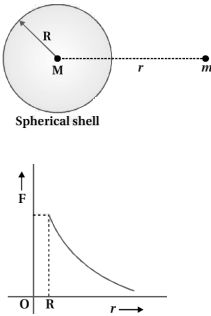
The gravitational force between a hollow spherical shell (of radius $R$ and uniform density) and a point mass $m$ is $F$. Show the nature of the $F$ versus $r$ graph,where $r$ is the distance of the point mass from the centre of the hollow spherical shell.
Solution
(N/A) According to the shell theorem for gravitation:
$1$. For a point mass $m$ located outside the hollow spherical shell $(r \geq R)$,the shell acts as if all its mass $M$ is concentrated at its centre. Thus,the gravitational force is given by $F = \frac{GMm}{r^2}$.
$2$. For a point mass $m$ located inside the hollow spherical shell $(r < R)$,the net gravitational force exerted by the shell on the point mass is zero,because the gravitational fields from different parts of the shell cancel each other out. Thus,$F = 0$.
The graph of $F$ versus $r$ is zero for $0 \leq r < R$ and follows an inverse-square law $(F \propto 1/r^2)$ for $r \geq R$.
$1$. For a point mass $m$ located outside the hollow spherical shell $(r \geq R)$,the shell acts as if all its mass $M$ is concentrated at its centre. Thus,the gravitational force is given by $F = \frac{GMm}{r^2}$.
$2$. For a point mass $m$ located inside the hollow spherical shell $(r < R)$,the net gravitational force exerted by the shell on the point mass is zero,because the gravitational fields from different parts of the shell cancel each other out. Thus,$F = 0$.
The graph of $F$ versus $r$ is zero for $0 \leq r < R$ and follows an inverse-square law $(F \propto 1/r^2)$ for $r \geq R$.
0 likes
View Solution68
Difficult
Six point masses of mass $m$ each are at the vertices of a regular hexagon of side $l$. Calculate the net gravitational force on any one of the masses.
Solution
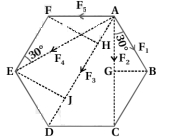
(N/A) Let the vertices of the regular hexagon be $A, B, C, D, E, F$ in order. Consider the mass at vertex $A$. The forces acting on it due to the other five masses are:
$1$. Force due to mass at $B$: $F_1 = \frac{Gm^2}{l^2}$ along $\vec{AB}$.
$2$. Force due to mass at $F$: $F_5 = \frac{Gm^2}{l^2}$ along $\vec{AF}$.
$3$. Force due to mass at $C$: $F_2 = \frac{Gm^2}{(AC)^2} = \frac{Gm^2}{3l^2}$ along $\vec{AC}$.
$4$. Force due to mass at $E$: $F_4 = \frac{Gm^2}{(AE)^2} = \frac{Gm^2}{3l^2}$ along $\vec{AE}$.
$5$. Force due to mass at $D$: $F_3 = \frac{Gm^2}{(AD)^2} = \frac{Gm^2}{4l^2}$ along $\vec{AD}$.
By symmetry,the components of $F_1$ and $F_5$ perpendicular to the diagonal $AD$ cancel out. Their components along $AD$ are $F_1 \cos 30^{\circ} + F_5 \cos 30^{\circ} = 2 \cdot \frac{Gm^2}{l^2} \cdot \frac{\sqrt{3}}{2} = \frac{\sqrt{3}Gm^2}{l^2}$.
Similarly,the components of $F_2$ and $F_4$ perpendicular to $AD$ cancel out. Their components along $AD$ are $F_2 \cos 30^{\circ} + F_4 \cos 30^{\circ} = 2 \cdot \frac{Gm^2}{3l^2} \cdot \frac{\sqrt{3}}{2} = \frac{Gm^2}{\sqrt{3}l^2}$.
The force $F_3$ is already along $AD$.
Total force $F_{net} = \frac{\sqrt{3}Gm^2}{l^2} + \frac{Gm^2}{\sqrt{3}l^2} + \frac{Gm^2}{4l^2} = \frac{Gm^2}{l^2} (\sqrt{3} + \frac{1}{\sqrt{3}} + \frac{1}{4}) = \frac{Gm^2}{l^2} (\frac{3+1}{\sqrt{3}} + \frac{1}{4}) = \frac{Gm^2}{l^2} (\frac{4}{\sqrt{3}} + \frac{1}{4}) = \frac{Gm^2}{l^2} (\frac{16+\sqrt{3}}{4\sqrt{3}})$.
$1$. Force due to mass at $B$: $F_1 = \frac{Gm^2}{l^2}$ along $\vec{AB}$.
$2$. Force due to mass at $F$: $F_5 = \frac{Gm^2}{l^2}$ along $\vec{AF}$.
$3$. Force due to mass at $C$: $F_2 = \frac{Gm^2}{(AC)^2} = \frac{Gm^2}{3l^2}$ along $\vec{AC}$.
$4$. Force due to mass at $E$: $F_4 = \frac{Gm^2}{(AE)^2} = \frac{Gm^2}{3l^2}$ along $\vec{AE}$.
$5$. Force due to mass at $D$: $F_3 = \frac{Gm^2}{(AD)^2} = \frac{Gm^2}{4l^2}$ along $\vec{AD}$.
By symmetry,the components of $F_1$ and $F_5$ perpendicular to the diagonal $AD$ cancel out. Their components along $AD$ are $F_1 \cos 30^{\circ} + F_5 \cos 30^{\circ} = 2 \cdot \frac{Gm^2}{l^2} \cdot \frac{\sqrt{3}}{2} = \frac{\sqrt{3}Gm^2}{l^2}$.
Similarly,the components of $F_2$ and $F_4$ perpendicular to $AD$ cancel out. Their components along $AD$ are $F_2 \cos 30^{\circ} + F_4 \cos 30^{\circ} = 2 \cdot \frac{Gm^2}{3l^2} \cdot \frac{\sqrt{3}}{2} = \frac{Gm^2}{\sqrt{3}l^2}$.
The force $F_3$ is already along $AD$.
Total force $F_{net} = \frac{\sqrt{3}Gm^2}{l^2} + \frac{Gm^2}{\sqrt{3}l^2} + \frac{Gm^2}{4l^2} = \frac{Gm^2}{l^2} (\sqrt{3} + \frac{1}{\sqrt{3}} + \frac{1}{4}) = \frac{Gm^2}{l^2} (\frac{3+1}{\sqrt{3}} + \frac{1}{4}) = \frac{Gm^2}{l^2} (\frac{4}{\sqrt{3}} + \frac{1}{4}) = \frac{Gm^2}{l^2} (\frac{16+\sqrt{3}}{4\sqrt{3}})$.
0 likes
View Solution69
EasyMCQ
Two objects of equal masses placed at a certain distance from each other attract each other with a force of $F$. If one-third mass of one object is transferred to the other object,then the new force will be
A
$\frac{2}{9}F$
B
$\frac{16}{9}F$
C
$\frac{8}{9}F$
D
$F$
Solution
(C) According to Newton's law of gravitation,the initial force between two objects of mass $m$ separated by distance $r$ is given by $F = \frac{Gm^2}{r^2}$.
When one-third of the mass of one object is transferred to the other,the new masses become $m_1 = m - \frac{1}{3}m = \frac{2}{3}m$ and $m_2 = m + \frac{1}{3}m = \frac{4}{3}m$.
The new gravitational force $F^{\prime}$ is given by $F^{\prime} = \frac{G m_1 m_2}{r^2}$.
Substituting the new masses: $F^{\prime} = \frac{G (\frac{2}{3}m) (\frac{4}{3}m)}{r^2} = \frac{8}{9} \frac{Gm^2}{r^2}$.
Since $F = \frac{Gm^2}{r^2}$,we get $F^{\prime} = \frac{8}{9}F$.
When one-third of the mass of one object is transferred to the other,the new masses become $m_1 = m - \frac{1}{3}m = \frac{2}{3}m$ and $m_2 = m + \frac{1}{3}m = \frac{4}{3}m$.
The new gravitational force $F^{\prime}$ is given by $F^{\prime} = \frac{G m_1 m_2}{r^2}$.
Substituting the new masses: $F^{\prime} = \frac{G (\frac{2}{3}m) (\frac{4}{3}m)}{r^2} = \frac{8}{9} \frac{Gm^2}{r^2}$.
Since $F = \frac{Gm^2}{r^2}$,we get $F^{\prime} = \frac{8}{9}F$.
0 likes
View Solution70
EasyMCQ
If the masses of two point objects are tripled and the distance between them is doubled,then the gravitational force of attraction between them will increase by .......... $\%$
A
Increase by $225\%$
B
Decrease by $56\%$
C
Increase by $125\%$
D
Decrease by $144\%$
Solution
(C) The initial gravitational force is given by $F = \frac{GMm}{R^2}$.
When the masses are tripled $(M' = 3M, m' = 3m)$ and the distance is doubled $(R' = 2R)$,the new force $F'$ is:
$F' = \frac{G(3M)(3m)}{(2R)^2} = \frac{9GMm}{4R^2} = 2.25F$.
The change in force is $\Delta F = F' - F = 2.25F - F = 1.25F$.
The percentage increase is $\frac{\Delta F}{F} \times 100\% = 1.25 \times 100\% = 125\%$.
When the masses are tripled $(M' = 3M, m' = 3m)$ and the distance is doubled $(R' = 2R)$,the new force $F'$ is:
$F' = \frac{G(3M)(3m)}{(2R)^2} = \frac{9GMm}{4R^2} = 2.25F$.
The change in force is $\Delta F = F' - F = 2.25F - F = 1.25F$.
The percentage increase is $\frac{\Delta F}{F} \times 100\% = 1.25 \times 100\% = 125\%$.
0 likes
View Solution71
MediumMCQ
Two point objects of mass $2x$ and $3x$ are separated by a distance $r$. Keeping the distance fixed,how much mass should be transferred from $3x$ to $2x$,so that the gravitational force between them becomes maximum?
A
$\frac{x}{4}$
B
$\frac{x}{3}$
C
$\frac{x}{2}$
D
$\frac{2x}{3}$
Solution
(C) Let $y$ be the amount of mass transferred from the object with mass $3x$ to the object with mass $2x$.
After the transfer,the new masses are $(3x - y)$ and $(2x + y)$.
The gravitational force between them is given by $F' = \frac{G(3x - y)(2x + y)}{r^2}$.
To maximize the force,we differentiate $F'$ with respect to $y$ and set it to zero:
$\frac{dF'}{dy} = \frac{G}{r^2} \frac{d}{dy} [6x^2 + 3xy - 2xy - y^2] = 0$.
$\frac{G}{r^2} [3x - 2x - 2y] = 0$.
$x - 2y = 0$.
$y = \frac{x}{2}$.
Thus,the mass to be transferred is $\frac{x}{2}$.
After the transfer,the new masses are $(3x - y)$ and $(2x + y)$.
The gravitational force between them is given by $F' = \frac{G(3x - y)(2x + y)}{r^2}$.
To maximize the force,we differentiate $F'$ with respect to $y$ and set it to zero:
$\frac{dF'}{dy} = \frac{G}{r^2} \frac{d}{dy} [6x^2 + 3xy - 2xy - y^2] = 0$.
$\frac{G}{r^2} [3x - 2x - 2y] = 0$.
$x - 2y = 0$.
$y = \frac{x}{2}$.
Thus,the mass to be transferred is $\frac{x}{2}$.
0 likes
View Solution72
EasyMCQ
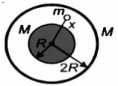
$A$ uniform sphere of mass $M$ and radius $R$ is surrounded by a concentric spherical shell of the same mass but radius $2R$. $A$ point mass $m$ is kept at a distance $x$ $(R < x < 2R)$ in the region bounded by the spheres as shown in the figure. The net gravitational force on the particle is:
A
$\frac{G M m}{x^2}$
B
$\frac{G M m x}{R^3}$
C
$\frac{G(M+m)}{x^2}$
D
Zero
Solution
(A) The gravitational force on the point mass $m$ due to the inner uniform sphere of mass $M$ is given by Newton's law of gravitation as $F_1 = \frac{G M m}{x^2}$,acting towards the center.
The gravitational force on the point mass $m$ due to the outer spherical shell of mass $M$ and radius $2R$ is zero. This is because,according to the shell theorem,the gravitational field inside a uniform spherical shell is zero everywhere,as the gravitational forces exerted by different parts of the shell on the point mass cancel each other out completely.
Therefore,the net gravitational force on the particle is $F_{net} = F_1 + 0 = \frac{G M m}{x^2}$.
The gravitational force on the point mass $m$ due to the outer spherical shell of mass $M$ and radius $2R$ is zero. This is because,according to the shell theorem,the gravitational field inside a uniform spherical shell is zero everywhere,as the gravitational forces exerted by different parts of the shell on the point mass cancel each other out completely.
Therefore,the net gravitational force on the particle is $F_{net} = F_1 + 0 = \frac{G M m}{x^2}$.
0 likes
View Solution73
EasyMCQ
The gravitational constant depends upon .........
A
Size of the bodies
B
Gravitational mass
C
Distance between the bodies
D
None of these
Solution
(D) The correct option is $D$.
The gravitational constant,denoted by $G$,is a universal constant.
It is independent of the size of the bodies,their gravitational mass,the distance between them,or the medium in which they are placed.
Therefore,it does not depend on any of the factors mentioned in options $A$,$B$,or $C$.
The gravitational constant,denoted by $G$,is a universal constant.
It is independent of the size of the bodies,their gravitational mass,the distance between them,or the medium in which they are placed.
Therefore,it does not depend on any of the factors mentioned in options $A$,$B$,or $C$.
0 likes
View Solution74
MediumMCQ
Gravitation is the phenomenon of interaction between ............
A
Point masses only
B
Any arbitrary shaped masses
C
Planets only
D
None of these
Solution
(B) The phenomenon of gravitation is a universal force of attraction that acts between any two bodies in the universe,regardless of their shape,size,or mass.
While Newton's law of gravitation is strictly derived for point masses,it can be extended to bodies of any arbitrary shape by considering them as a collection of point masses and integrating the gravitational forces acting on each infinitesimal element.
Therefore,gravitation is the phenomenon of interaction between any arbitrary shaped masses.
While Newton's law of gravitation is strictly derived for point masses,it can be extended to bodies of any arbitrary shape by considering them as a collection of point masses and integrating the gravitational forces acting on each infinitesimal element.
Therefore,gravitation is the phenomenon of interaction between any arbitrary shaped masses.
0 likes
View Solution75
MediumMCQ
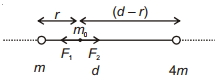
Two point masses $m$ and $4m$ are separated by a distance $d$ on a line. $A$ third point mass $m_0$ is to be placed at a point on the line such that the net gravitational force on it is zero. The distance of that point from the $m$ mass is:

A
$\frac{d}{2}$
B
$\frac{d}{4}$
C
$\frac{d}{3}$
D
$\frac{d}{5}$
Solution
(C) Let the third point mass $m_0$ be placed at a distance $r$ from the mass $m$. Then its distance from the mass $4m$ is $(d-r)$.
The gravitational force on $m_0$ due to mass $m$ is $F_1 = \frac{G m m_0}{r^2}$.
The gravitational force on $m_0$ due to mass $4m$ is $F_2 = \frac{G (4m) m_0}{(d-r)^2}$.
For the net gravitational force on $m_0$ to be zero,the magnitudes of these forces must be equal:
$F_1 = F_2$
$\frac{G m m_0}{r^2} = \frac{4 G m m_0}{(d-r)^2}$
$\frac{1}{r^2} = \frac{4}{(d-r)^2}$
Taking the square root on both sides:
$\frac{1}{r} = \frac{2}{d-r}$
$d - r = 2r$
$d = 3r$
$r = \frac{d}{3}$
Therefore,the distance of the point from the mass $m$ is $\frac{d}{3}$.
The gravitational force on $m_0$ due to mass $m$ is $F_1 = \frac{G m m_0}{r^2}$.
The gravitational force on $m_0$ due to mass $4m$ is $F_2 = \frac{G (4m) m_0}{(d-r)^2}$.
For the net gravitational force on $m_0$ to be zero,the magnitudes of these forces must be equal:
$F_1 = F_2$
$\frac{G m m_0}{r^2} = \frac{4 G m m_0}{(d-r)^2}$
$\frac{1}{r^2} = \frac{4}{(d-r)^2}$
Taking the square root on both sides:
$\frac{1}{r} = \frac{2}{d-r}$
$d - r = 2r$
$d = 3r$
$r = \frac{d}{3}$
Therefore,the distance of the point from the mass $m$ is $\frac{d}{3}$.
0 likes
View Solution76
MediumMCQ
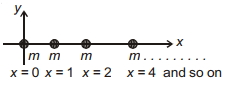
$A$ large number of identical point masses $m$ are placed along the $x$-axis at $x = 0, 1, 2, 4, 8, \dots$ units. The magnitude of the total gravitational force on the mass at the origin $(x = 0)$ will be:
A
$G m^2$
B
$\frac{4}{3} G m^2$
C
$\frac{2}{3} G m^2$
D
$\frac{5}{4} G m^2$
Solution
(B) Let $F_1, F_2, F_4, F_8, \dots$ be the gravitational forces exerted on the mass at the origin by the masses $m$ located at $x = 1, 2, 4, 8, \dots$ respectively.
Using Newton's law of gravitation,$F = \frac{G m_1 m_2}{r^2}$,the forces are:
$F_1 = \frac{G m^2}{1^2} = G m^2$
$F_2 = \frac{G m^2}{2^2} = \frac{G m^2}{4}$
$F_4 = \frac{G m^2}{4^2} = \frac{G m^2}{16}$
$F_8 = \frac{G m^2}{8^2} = \frac{G m^2}{64}$
The total force $F_{total}$ is the sum of these forces:
$F_{total} = G m^2 \left( 1 + \frac{1}{4} + \frac{1}{16} + \frac{1}{64} + \dots \right)$
The term in the bracket is an infinite geometric progression ($G$.$P$.) with the first term $a = 1$ and common ratio $r = \frac{1}{4}$.
The sum of an infinite $G$.$P$. is given by $S = \frac{a}{1 - r}$.
$S = \frac{1}{1 - 1/4} = \frac{1}{3/4} = \frac{4}{3}$.
Therefore,$F_{total} = G m^2 \left( \frac{4}{3} \right) = \frac{4}{3} G m^2$.
Using Newton's law of gravitation,$F = \frac{G m_1 m_2}{r^2}$,the forces are:
$F_1 = \frac{G m^2}{1^2} = G m^2$
$F_2 = \frac{G m^2}{2^2} = \frac{G m^2}{4}$
$F_4 = \frac{G m^2}{4^2} = \frac{G m^2}{16}$
$F_8 = \frac{G m^2}{8^2} = \frac{G m^2}{64}$
The total force $F_{total}$ is the sum of these forces:
$F_{total} = G m^2 \left( 1 + \frac{1}{4} + \frac{1}{16} + \frac{1}{64} + \dots \right)$
The term in the bracket is an infinite geometric progression ($G$.$P$.) with the first term $a = 1$ and common ratio $r = \frac{1}{4}$.
The sum of an infinite $G$.$P$. is given by $S = \frac{a}{1 - r}$.
$S = \frac{1}{1 - 1/4} = \frac{1}{3/4} = \frac{4}{3}$.
Therefore,$F_{total} = G m^2 \left( \frac{4}{3} \right) = \frac{4}{3} G m^2$.
0 likes
View Solution77
MediumMCQ
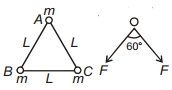
Three particles $A, B$ and $C$ each of mass $m$ are lying at the corners of an equilateral triangle of side $L$. If the particle $A$ is released keeping the particles $B$ and $C$ fixed,the magnitude of instantaneous acceleration of $A$ is ........

A
$\sqrt{3} \frac{G m^2}{L^2}$
B
$\sqrt{2} \frac{G m^2}{L^2}$
C
$\sqrt{2} \frac{G m}{L^2}$
D
$\sqrt{3} \frac{G m}{L^2}$
Solution
(D) The gravitational force exerted by particle $B$ on particle $A$ is $F = \frac{G m^2}{L^2}$ directed towards $B$.
Similarly,the gravitational force exerted by particle $C$ on particle $A$ is $F = \frac{G m^2}{L^2}$ directed towards $C$.
The angle between these two forces is $60^{\circ}$ because the triangle is equilateral.
The resultant force $F_{\text{net}}$ on particle $A$ is given by the vector sum:
$F_{\text{net}} = \sqrt{F^2 + F^2 + 2 F^2 \cos 60^{\circ}} = \sqrt{2 F^2 + 2 F^2 (0.5)} = \sqrt{3 F^2} = \sqrt{3} F$
Substituting $F = \frac{G m^2}{L^2}$,we get $F_{\text{net}} = \sqrt{3} \frac{G m^2}{L^2}$.
According to Newton's second law,the acceleration $a$ of particle $A$ is $a = \frac{F_{\text{net}}}{m}$.
$a = \frac{\sqrt{3} G m^2}{L^2 m} = \sqrt{3} \frac{G m}{L^2}$.
Similarly,the gravitational force exerted by particle $C$ on particle $A$ is $F = \frac{G m^2}{L^2}$ directed towards $C$.
The angle between these two forces is $60^{\circ}$ because the triangle is equilateral.
The resultant force $F_{\text{net}}$ on particle $A$ is given by the vector sum:
$F_{\text{net}} = \sqrt{F^2 + F^2 + 2 F^2 \cos 60^{\circ}} = \sqrt{2 F^2 + 2 F^2 (0.5)} = \sqrt{3 F^2} = \sqrt{3} F$
Substituting $F = \frac{G m^2}{L^2}$,we get $F_{\text{net}} = \sqrt{3} \frac{G m^2}{L^2}$.
According to Newton's second law,the acceleration $a$ of particle $A$ is $a = \frac{F_{\text{net}}}{m}$.
$a = \frac{\sqrt{3} G m^2}{L^2 m} = \sqrt{3} \frac{G m}{L^2}$.
0 likes
View Solution78
EasyMCQ
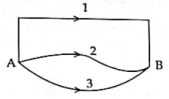
$A$ gravitational field is present in a region and a mass is shifted from $A$ to $B$ through different paths as shown. If $W_1, W_2$ and $W_3$ represent the work done by the gravitational force along the respective paths,then
A
$W_1 = W_2 = W_3$
B
$W_1 > W_2 > W_3$
C
$W_1 > W_3 > W_2$
D
$W_1 < W_2 < W_3$
Solution
(A) The gravitational force is a conservative force.
By definition,the work done by a conservative force in moving an object between two points is independent of the path taken.
It depends only on the initial and final positions of the object.
Since all three paths start at point $A$ and end at point $B$,the work done by the gravitational force along each path must be equal.
Therefore,$W_1 = W_2 = W_3$.
By definition,the work done by a conservative force in moving an object between two points is independent of the path taken.
It depends only on the initial and final positions of the object.
Since all three paths start at point $A$ and end at point $B$,the work done by the gravitational force along each path must be equal.
Therefore,$W_1 = W_2 = W_3$.
0 likes
View Solution79
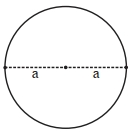
MediumMCQ
Two identical particles each of mass $m$ go round a circle of radius $a$ under the action of their mutual gravitational attraction. The angular speed of each particle will be
A
$\sqrt{\frac{G m}{2 a^3}}$
B
$\sqrt{\frac{G m}{8 a^3}}$
C
$\sqrt{\frac{G m}{4 a^3}}$
D
$\sqrt{\frac{G m}{a^3}}$
Solution
(C) The gravitational force between the two particles acts as the centripetal force required for circular motion.
The distance between the two particles is $r = 2a$.
The gravitational force is given by $F = \frac{G m m}{(2a)^2} = \frac{G m^2}{4a^2}$.
The centripetal force required for a particle of mass $m$ to move in a circle of radius $a$ with angular speed $\omega$ is $F_c = m \omega^2 a$.
Equating the two forces: $\frac{G m^2}{4a^2} = m \omega^2 a$.
$\omega^2 = \frac{G m}{4 a^3}$.
Therefore,the angular speed is $\omega = \sqrt{\frac{G m}{4 a^3}}$.
The distance between the two particles is $r = 2a$.
The gravitational force is given by $F = \frac{G m m}{(2a)^2} = \frac{G m^2}{4a^2}$.
The centripetal force required for a particle of mass $m$ to move in a circle of radius $a$ with angular speed $\omega$ is $F_c = m \omega^2 a$.
Equating the two forces: $\frac{G m^2}{4a^2} = m \omega^2 a$.
$\omega^2 = \frac{G m}{4 a^3}$.
Therefore,the angular speed is $\omega = \sqrt{\frac{G m}{4 a^3}}$.
0 likes
View Solution80
DifficultMCQ
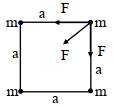
Four identical particles of mass $m$ are kept at the four corners of a square. If the gravitational force exerted on one of the masses by the other masses is $\left(\frac{2 \sqrt{2}+1}{32}\right) \frac{Gm^2}{L^2}$,the length of the sides of the square is
A
$\frac{L}{2}$
B
$4 L$
C
$3 L$
D
$2 L$
Solution
(B) Let the side length of the square be $a$. Consider one of the masses at a corner. It experiences gravitational forces from the other three masses.
Two masses are at a distance $a$ (adjacent corners),and one mass is at a distance $\sqrt{2}a$ (opposite corner).
The forces from the two adjacent masses are $F = \frac{Gm^2}{a^2}$ each,acting at an angle of $90^\circ$. Their resultant is $\sqrt{F^2 + F^2} = \sqrt{2}F = \sqrt{2} \frac{Gm^2}{a^2}$.
The force from the opposite mass is $F' = \frac{Gm^2}{(\sqrt{2}a)^2} = \frac{Gm^2}{2a^2}$.
Both these forces act along the diagonal of the square,so the net force is:
$F_{\text{net}} = \sqrt{2} \frac{Gm^2}{a^2} + \frac{Gm^2}{2a^2} = \frac{Gm^2}{a^2} \left( \sqrt{2} + \frac{1}{2} \right) = \frac{Gm^2}{a^2} \left( \frac{2\sqrt{2} + 1}{2} \right)$.
Given that $F_{\text{net}} = \left( \frac{2\sqrt{2} + 1}{32} \right) \frac{Gm^2}{L^2}$,we equate the two expressions:
$\frac{Gm^2}{a^2} \left( \frac{2\sqrt{2} + 1}{2} \right) = \left( \frac{2\sqrt{2} + 1}{32} \right) \frac{Gm^2}{L^2}$.
$\frac{1}{2a^2} = \frac{1}{32L^2} \implies a^2 = 16L^2 \implies a = 4L$.
Two masses are at a distance $a$ (adjacent corners),and one mass is at a distance $\sqrt{2}a$ (opposite corner).
The forces from the two adjacent masses are $F = \frac{Gm^2}{a^2}$ each,acting at an angle of $90^\circ$. Their resultant is $\sqrt{F^2 + F^2} = \sqrt{2}F = \sqrt{2} \frac{Gm^2}{a^2}$.
The force from the opposite mass is $F' = \frac{Gm^2}{(\sqrt{2}a)^2} = \frac{Gm^2}{2a^2}$.
Both these forces act along the diagonal of the square,so the net force is:
$F_{\text{net}} = \sqrt{2} \frac{Gm^2}{a^2} + \frac{Gm^2}{2a^2} = \frac{Gm^2}{a^2} \left( \sqrt{2} + \frac{1}{2} \right) = \frac{Gm^2}{a^2} \left( \frac{2\sqrt{2} + 1}{2} \right)$.
Given that $F_{\text{net}} = \left( \frac{2\sqrt{2} + 1}{32} \right) \frac{Gm^2}{L^2}$,we equate the two expressions:
$\frac{Gm^2}{a^2} \left( \frac{2\sqrt{2} + 1}{2} \right) = \left( \frac{2\sqrt{2} + 1}{32} \right) \frac{Gm^2}{L^2}$.
$\frac{1}{2a^2} = \frac{1}{32L^2} \implies a^2 = 16L^2 \implies a = 4L$.
0 likes
View Solution81
DifficultMCQ
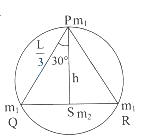
$A$ system consists of three particles each of mass $m_1$ placed at the corners of an equilateral triangle of side $\frac{L}{3}$. $A$ particle of mass $m_2$ is placed at the midpoint of any one side of the triangle. Due to the system of particles,the force acting on $m_2$ is
A
$\frac{3 Gm_1 m_2}{L^2}$
B
$\frac{6 Gm_1 m_2}{L^2}$
C
$\frac{9 Gm_1 m_2}{L^2}$
D
$\frac{12 Gm_1 m_2}{L^2}$
Solution
(D) Let the vertices of the equilateral triangle be $P, Q,$ and $R$. The mass $m_2$ is placed at point $S$,which is the midpoint of side $QR$.
The gravitational forces exerted by the masses at $Q$ and $R$ on the mass $m_2$ at $S$ are equal in magnitude and opposite in direction because $S$ is the midpoint of $QR$. Thus,these two forces cancel each other out.
The net force on $m_2$ is only due to the mass $m_1$ located at vertex $P$.
In $\triangle PQS$,the side $PQ = \frac{L}{3}$ and $\angle PQS = 60^{\circ}$. The distance $h$ (the altitude from $P$ to $QR$) is given by $h = PQ \sin 60^{\circ} = \frac{L}{3} \cdot \frac{\sqrt{3}}{2} = \frac{L\sqrt{3}}{6}$.
The gravitational force $F$ on $m_2$ due to $m_1$ at $P$ is:
$F = \frac{G m_1 m_2}{h^2} = \frac{G m_1 m_2}{(\frac{L\sqrt{3}}{6})^2} = \frac{G m_1 m_2}{\frac{3L^2}{36}} = \frac{G m_1 m_2}{\frac{L^2}{12}} = \frac{12 G m_1 m_2}{L^2}$.
The gravitational forces exerted by the masses at $Q$ and $R$ on the mass $m_2$ at $S$ are equal in magnitude and opposite in direction because $S$ is the midpoint of $QR$. Thus,these two forces cancel each other out.
The net force on $m_2$ is only due to the mass $m_1$ located at vertex $P$.
In $\triangle PQS$,the side $PQ = \frac{L}{3}$ and $\angle PQS = 60^{\circ}$. The distance $h$ (the altitude from $P$ to $QR$) is given by $h = PQ \sin 60^{\circ} = \frac{L}{3} \cdot \frac{\sqrt{3}}{2} = \frac{L\sqrt{3}}{6}$.
The gravitational force $F$ on $m_2$ due to $m_1$ at $P$ is:
$F = \frac{G m_1 m_2}{h^2} = \frac{G m_1 m_2}{(\frac{L\sqrt{3}}{6})^2} = \frac{G m_1 m_2}{\frac{3L^2}{36}} = \frac{G m_1 m_2}{\frac{L^2}{12}} = \frac{12 G m_1 m_2}{L^2}$.
0 likes
View Solution82
DifficultMCQ
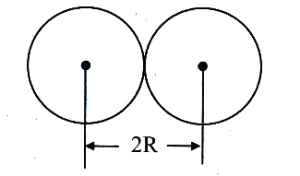
Two identical metal spheres are kept in contact with each other,each having radius '$R$' and '$\rho$' is the density of the material of the metal spheres. The gravitational force '$F$' of attraction between them is proportional to
A
$R^3 \rho$
B
$R^4 \rho^2$
C
$R^4 \rho$
D
$R^3 \rho^2$
Solution
(B) The gravitational force between two spheres of mass $M$ separated by a distance $d$ is given by $F = \frac{GM^2}{d^2}$.
Since the spheres are in contact,the distance between their centers is $d = 2R$.
Thus,$F = \frac{GM^2}{(2R)^2} = \frac{GM^2}{4R^2}$.
The mass $M$ of each sphere is given by $M = \text{density} \times \text{volume} = \rho \times \frac{4}{3} \pi R^3$.
Substituting the value of $M$ into the force equation:
$F = \frac{G}{4R^2} \left( \rho \cdot \frac{4}{3} \pi R^3 \right)^2$
$F = \frac{G}{4R^2} \cdot \rho^2 \cdot \frac{16}{9} \pi^2 R^6$
$F = \frac{4}{9} G \pi^2 R^4 \rho^2$
Therefore,$F \propto R^4 \rho^2$.
Since the spheres are in contact,the distance between their centers is $d = 2R$.
Thus,$F = \frac{GM^2}{(2R)^2} = \frac{GM^2}{4R^2}$.
The mass $M$ of each sphere is given by $M = \text{density} \times \text{volume} = \rho \times \frac{4}{3} \pi R^3$.
Substituting the value of $M$ into the force equation:
$F = \frac{G}{4R^2} \left( \rho \cdot \frac{4}{3} \pi R^3 \right)^2$
$F = \frac{G}{4R^2} \cdot \rho^2 \cdot \frac{16}{9} \pi^2 R^6$
$F = \frac{4}{9} G \pi^2 R^4 \rho^2$
Therefore,$F \propto R^4 \rho^2$.
0 likes
View Solution83
DifficultMCQ
If two identical spherical bodies of same material and dimensions are kept in contact,the gravitational force between them is proportional to $R^{x}$,where $x$ is a non-zero integer. [Given: $R$ is the radius of each spherical body]
A
-$4$
B
$4$
C
$2$
D
-$2$
Solution
(B) The gravitational force $F$ between two bodies of mass $m$ separated by a distance $d$ is given by $F = \frac{G m^2}{d^2}$.
Since the spheres are in contact,the distance between their centers is $d = R + R = 2R$.
The mass $m$ of each sphere with density $\rho$ is $m = \text{Volume} \times \text{Density} = \frac{4}{3} \pi R^3 \rho$.
Substituting these into the force equation:
$F = \frac{G (\frac{4}{3} \pi R^3 \rho)^2}{(2R)^2}$
$F = \frac{G \times \frac{16}{9} \pi^2 R^6 \rho^2}{4 R^2}$
$F = \frac{4}{9} G \pi^2 \rho^2 R^4$
Since $G$,$\pi$,and $\rho$ are constants,$F \propto R^4$.
Therefore,$x = 4$.
Since the spheres are in contact,the distance between their centers is $d = R + R = 2R$.
The mass $m$ of each sphere with density $\rho$ is $m = \text{Volume} \times \text{Density} = \frac{4}{3} \pi R^3 \rho$.
Substituting these into the force equation:
$F = \frac{G (\frac{4}{3} \pi R^3 \rho)^2}{(2R)^2}$
$F = \frac{G \times \frac{16}{9} \pi^2 R^6 \rho^2}{4 R^2}$
$F = \frac{4}{9} G \pi^2 \rho^2 R^4$
Since $G$,$\pi$,and $\rho$ are constants,$F \propto R^4$.
Therefore,$x = 4$.
0 likes
View Solution84
MediumMCQ
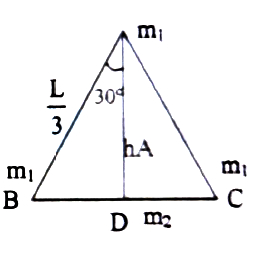
Three particles each of mass $m_{1}$ are placed at the corners of an equilateral triangle of side $\frac{L}{3}$. $A$ particle of mass $m_{2}$ is placed at the midpoint of any one side of the triangle. Due to the system of particles,the net gravitational force acting on $m_{2}$ is ($G$ = Universal constant of gravitation).
A
$\frac{12 G m_{1} m_{2}}{L^{2}}$
B
$\frac{2 G m_{1} m_{2}}{L^{2}}$
C
$\frac{4 G m_{1} m_{2}}{L^{2}}$
D
$\frac{8 G m_{1} m_{2}}{L^{2}}$
Solution
(A) Let the vertices of the equilateral triangle be $A, B,$ and $C$. Let the mass $m_{2}$ be placed at point $D$,which is the midpoint of side $BC$.
The gravitational forces on $m_{2}$ due to the masses $m_{1}$ at $B$ and $C$ are equal in magnitude and opposite in direction,so they cancel each other out.
The distance of point $D$ from vertex $A$ is the altitude $h$ of the equilateral triangle.
In the right-angled triangle $ABD$,the hypotenuse $AB = \frac{L}{3}$ and $\angle BAD = 30^{\circ}$.
Thus,$h = AB \cos 30^{\circ} = \frac{L}{3} \times \frac{\sqrt{3}}{2} = \frac{L}{2\sqrt{3}}$.
The net force on $m_{2}$ is the force due to the mass $m_{1}$ at $A$:
$F = G \frac{m_{1} m_{2}}{h^{2}} = G \frac{m_{1} m_{2}}{\left(\frac{L}{2\sqrt{3}}\right)^{2}} = G \frac{m_{1} m_{2}}{\frac{L^{2}}{12}} = \frac{12 G m_{1} m_{2}}{L^{2}}$.
The gravitational forces on $m_{2}$ due to the masses $m_{1}$ at $B$ and $C$ are equal in magnitude and opposite in direction,so they cancel each other out.
The distance of point $D$ from vertex $A$ is the altitude $h$ of the equilateral triangle.
In the right-angled triangle $ABD$,the hypotenuse $AB = \frac{L}{3}$ and $\angle BAD = 30^{\circ}$.
Thus,$h = AB \cos 30^{\circ} = \frac{L}{3} \times \frac{\sqrt{3}}{2} = \frac{L}{2\sqrt{3}}$.
The net force on $m_{2}$ is the force due to the mass $m_{1}$ at $A$:
$F = G \frac{m_{1} m_{2}}{h^{2}} = G \frac{m_{1} m_{2}}{\left(\frac{L}{2\sqrt{3}}\right)^{2}} = G \frac{m_{1} m_{2}}{\frac{L^{2}}{12}} = \frac{12 G m_{1} m_{2}}{L^{2}}$.
0 likes
View Solution85
EasyMCQ
The $SI$ unit of $\frac{G}{g}$ is $(g = \text{acceleration due to gravity}, G = \text{gravitational constant})$
A
$\frac{kg}{m^2}$
B
$\frac{m^2}{kg}$
C
$\frac{m}{kg}$
D
$\frac{kg}{m}$
Solution
(B) The gravitational force is given by $F = \frac{G M m}{r^2}$.
Acceleration due to gravity is $g = \frac{F}{m} = \frac{G M}{r^2}$.
Therefore,the ratio $\frac{G}{g}$ can be expressed as:
$\frac{G}{g} = \frac{G}{\frac{G M}{r^2}} = \frac{r^2}{M}$.
The unit of $r$ is $m$ (meters) and the unit of $M$ is $kg$ (kilograms).
Thus,the $SI$ unit of $\frac{G}{g}$ is $\frac{m^2}{kg}$.
Acceleration due to gravity is $g = \frac{F}{m} = \frac{G M}{r^2}$.
Therefore,the ratio $\frac{G}{g}$ can be expressed as:
$\frac{G}{g} = \frac{G}{\frac{G M}{r^2}} = \frac{r^2}{M}$.
The unit of $r$ is $m$ (meters) and the unit of $M$ is $kg$ (kilograms).
Thus,the $SI$ unit of $\frac{G}{g}$ is $\frac{m^2}{kg}$.
0 likes
View Solution86
EasyMCQ
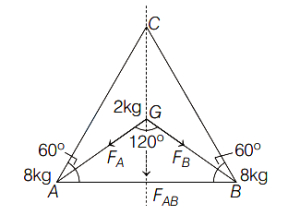
Two bodies of masses $8 \,kg$ are placed at the vertices $A$ and $B$ of an equilateral triangle $ABC$. $A$ third body of mass $2 \,kg$ is placed at the centroid $G$ of the triangle. If $AG=BG=CG=1 \,m$, where should a fourth body of mass $4 \,kg$ be placed, so that the resultant force on the $2 \,kg$ body is zero?
A
At $C$
B
At a point $P$ on the line $CG$ such that $PG=\frac{1}{\sqrt{2}} \,m$
C
At a point $P$ on the line $CG$ such that $PG=0.5 \,m$
D
At a point $P$ on the line $CG$ such that $PG=2 \,m$
Solution
(B) The gravitational force between two masses is given by $F = \frac{G m_1 m_2}{r^2}$.
Given $m_A = m_B = 8 \,kg$, $m_G = 2 \,kg$, and $AG = BG = 1 \,m$.
The force exerted by mass at $A$ on mass at $G$ is $F_A = \frac{G \times 8 \times 2}{1^2} = 16G$.
The force exerted by mass at $B$ on mass at $G$ is $F_B = \frac{G \times 8 \times 2}{1^2} = 16G$.
The angle between $F_A$ and $F_B$ is $120^{\circ}$.
The resultant force $F_{AB}$ is given by $F_{AB} = \sqrt{F_A^2 + F_B^2 + 2 F_A F_B \cos 120^{\circ}}$.
Since $F_A = F_B = 16G$, $F_{AB} = \sqrt{(16G)^2 + (16G)^2 + 2(16G)(16G)(-0.5)} = \sqrt{3(16G)^2 - (16G)^2} = 16G$.
This resultant force $F_{AB}$ acts along the line $GC$ directed towards $C$.
To make the net force on the $2 \,kg$ body zero, a fourth body of mass $m_C = 4 \,kg$ must be placed at a distance $x$ from $G$ along the line $GC$ such that the gravitational force $F_C$ exerted by it balances $F_{AB}$.
$F_C = \frac{G \times 4 \times 2}{x^2} = 16G$.
$\frac{8G}{x^2} = 16G \Rightarrow x^2 = \frac{8}{16} = 0.5$.
$x = \frac{1}{\sqrt{2}} \,m$.
Thus, the fourth body should be placed at a point $P$ on the line $CG$ such that $PG = \frac{1}{\sqrt{2}} \,m$.
Given $m_A = m_B = 8 \,kg$, $m_G = 2 \,kg$, and $AG = BG = 1 \,m$.
The force exerted by mass at $A$ on mass at $G$ is $F_A = \frac{G \times 8 \times 2}{1^2} = 16G$.
The force exerted by mass at $B$ on mass at $G$ is $F_B = \frac{G \times 8 \times 2}{1^2} = 16G$.
The angle between $F_A$ and $F_B$ is $120^{\circ}$.
The resultant force $F_{AB}$ is given by $F_{AB} = \sqrt{F_A^2 + F_B^2 + 2 F_A F_B \cos 120^{\circ}}$.
Since $F_A = F_B = 16G$, $F_{AB} = \sqrt{(16G)^2 + (16G)^2 + 2(16G)(16G)(-0.5)} = \sqrt{3(16G)^2 - (16G)^2} = 16G$.
This resultant force $F_{AB}$ acts along the line $GC$ directed towards $C$.
To make the net force on the $2 \,kg$ body zero, a fourth body of mass $m_C = 4 \,kg$ must be placed at a distance $x$ from $G$ along the line $GC$ such that the gravitational force $F_C$ exerted by it balances $F_{AB}$.
$F_C = \frac{G \times 4 \times 2}{x^2} = 16G$.
$\frac{8G}{x^2} = 16G \Rightarrow x^2 = \frac{8}{16} = 0.5$.
$x = \frac{1}{\sqrt{2}} \,m$.
Thus, the fourth body should be placed at a point $P$ on the line $CG$ such that $PG = \frac{1}{\sqrt{2}} \,m$.
0 likes
View Solution87
MediumMCQ
If the mass of a body is $M$ on the surface of the earth,the mass of the same body on the surface of the moon is
A
$M / 6$
B
$M$
C
$6M$
D
Zero
Solution
(B) Mass is a fundamental property of matter and it does not depend on external conditions such as gravity or location.
It represents the amount of matter contained in an object.
Since mass is an intrinsic property,it remains constant regardless of where the object is placed.
Therefore,if the mass of the body on the surface of the Earth is $M$,its mass on the surface of the moon will also be $M$.
It represents the amount of matter contained in an object.
Since mass is an intrinsic property,it remains constant regardless of where the object is placed.
Therefore,if the mass of the body on the surface of the Earth is $M$,its mass on the surface of the moon will also be $M$.
0 likes
View Solution88
EasyMCQ
What is the strength of the gravitational force compared to the strong nuclear force?
A
$10^{-39}$
B
$10^{-13}$
C
$10^{-2}$
D
$1$
Solution
(A) The relative strengths of fundamental forces are compared by considering their interaction between two protons at a distance of $10^{-15} \ m$.
The gravitational force $(F_G)$ is approximately $10^{-36} \ N$ to $10^{-39} \ N$ relative to the strong nuclear force $(F_S)$.
Specifically,the ratio of gravitational force to strong nuclear force is approximately $10^{-39}$.
Thus,the gravitational force is $10^{-39}$ times the strength of the strong nuclear force.
The gravitational force $(F_G)$ is approximately $10^{-36} \ N$ to $10^{-39} \ N$ relative to the strong nuclear force $(F_S)$.
Specifically,the ratio of gravitational force to strong nuclear force is approximately $10^{-39}$.
Thus,the gravitational force is $10^{-39}$ times the strength of the strong nuclear force.
0 likes
View Solution89
MediumMCQ
Two solid spheres each of radius $R$ made of the same material are placed in contact with each other. If the gravitational force acting between them is $F$,then:
A
$F \propto R^4$
B
$F \propto R^3$
C
$F \propto R^2$
D
$F \propto R$
Solution
(A) The mass $M$ of a solid sphere of radius $R$ and density $\rho$ is given by $M = \text{Volume} \times \text{Density} = \frac{4}{3} \pi R^3 \rho$.
Since both spheres are made of the same material,their density $\rho$ is constant.
Thus,$M \propto R^3$.
The distance between the centers of the two spheres in contact is $d = R + R = 2R$.
The gravitational force $F$ between two spheres is given by Newton's Law of Gravitation: $F = \frac{G M_1 M_2}{d^2}$.
Substituting $M_1 = M_2 = M$ and $d = 2R$,we get $F = \frac{G M^2}{(2R)^2} = \frac{G M^2}{4R^2}$.
Since $M \propto R^3$,then $M^2 \propto (R^3)^2 = R^6$.
Substituting this into the force equation: $F \propto \frac{R^6}{R^2} = R^4$.
Therefore,$F \propto R^4$.
Since both spheres are made of the same material,their density $\rho$ is constant.
Thus,$M \propto R^3$.
The distance between the centers of the two spheres in contact is $d = R + R = 2R$.
The gravitational force $F$ between two spheres is given by Newton's Law of Gravitation: $F = \frac{G M_1 M_2}{d^2}$.
Substituting $M_1 = M_2 = M$ and $d = 2R$,we get $F = \frac{G M^2}{(2R)^2} = \frac{G M^2}{4R^2}$.
Since $M \propto R^3$,then $M^2 \propto (R^3)^2 = R^6$.
Substituting this into the force equation: $F \propto \frac{R^6}{R^2} = R^4$.
Therefore,$F \propto R^4$.
0 likes
View Solution90
EasyMCQ
What is the vector form of the universal law of gravitation?
A
$\overrightarrow{F} = G \frac{m_1 m_2}{r} \overrightarrow{r}$
B
$\overrightarrow{F} = G \frac{m_1 m_2}{r^3} \hat{r}$
C
$\overrightarrow{F} = G \frac{m_1 m_2}{r^2} \overrightarrow{r}$
D
$\overrightarrow{F} = G \frac{m_1 m_2}{r^3} \overrightarrow{r}$
Solution
(D) The universal law of gravitation in scalar form is given by $F = G \frac{m_1 m_2}{r^2}$.
To express this in vector form,we multiply the magnitude by the unit vector $\hat{r}$ in the direction of the force: $\overrightarrow{F} = G \frac{m_1 m_2}{r^2} \hat{r}$.
Since the unit vector is defined as $\hat{r} = \frac{\overrightarrow{r}}{r}$,we substitute this into the equation:
$\overrightarrow{F} = G \frac{m_1 m_2}{r^2} \left( \frac{\overrightarrow{r}}{r} \right)$.
Therefore,the vector form is $\overrightarrow{F} = G \frac{m_1 m_2}{r^3} \overrightarrow{r}$.
To express this in vector form,we multiply the magnitude by the unit vector $\hat{r}$ in the direction of the force: $\overrightarrow{F} = G \frac{m_1 m_2}{r^2} \hat{r}$.
Since the unit vector is defined as $\hat{r} = \frac{\overrightarrow{r}}{r}$,we substitute this into the equation:
$\overrightarrow{F} = G \frac{m_1 m_2}{r^2} \left( \frac{\overrightarrow{r}}{r} \right)$.
Therefore,the vector form is $\overrightarrow{F} = G \frac{m_1 m_2}{r^3} \overrightarrow{r}$.
0 likes
View Solution91
EasyMCQ
Find the gravitational force between two stones, each of mass $2 \,kg$ and separated by a distance $1 \,m$ in vacuum.
A
$0$
B
$6.675 \times 10^{-5} \,N$
C
$6.675 \times 10^{-11} \,N$
D
$2.67 \times 10^{-10} \,N$
Solution
(D) Given: Mass of each stone, $m_1 = m_2 = 2 \,kg$.
Separation distance, $r = 1 \,m$.
Universal gravitational constant, $G = 6.67 \times 10^{-11} \,N \cdot m^2/kg^2$.
According to Newton's law of gravitation, the force $F$ is given by $F = \frac{G m_1 m_2}{r^2}$.
Substituting the values: $F = \frac{6.67 \times 10^{-11} \times 2 \times 2}{1^2}$.
$F = 6.67 \times 10^{-11} \times 4$.
$F = 26.68 \times 10^{-11} \,N = 2.668 \times 10^{-10} \,N$.
Rounding to the nearest value, $F \approx 2.67 \times 10^{-10} \,N$.
Separation distance, $r = 1 \,m$.
Universal gravitational constant, $G = 6.67 \times 10^{-11} \,N \cdot m^2/kg^2$.
According to Newton's law of gravitation, the force $F$ is given by $F = \frac{G m_1 m_2}{r^2}$.
Substituting the values: $F = \frac{6.67 \times 10^{-11} \times 2 \times 2}{1^2}$.
$F = 6.67 \times 10^{-11} \times 4$.
$F = 26.68 \times 10^{-11} \,N = 2.668 \times 10^{-10} \,N$.
Rounding to the nearest value, $F \approx 2.67 \times 10^{-10} \,N$.
0 likes
View Solution92
MediumMCQ
The distance between the centre of the moon and the earth is $D$ and the mass of the earth is $81$ times the mass of the moon. At what distance from the centre of the earth will the net gravitational force on an object be zero?
A
$\frac{D}{2}$
B
$\frac{2 D}{3}$
C
$\frac{4 D}{3}$
D
$\frac{9 D}{10}$
Solution
(D) Let a unit mass $m$ be placed at a distance $x$ from the centre of the earth,where the net gravitational force is zero.
At this point,the gravitational pull from the earth must be equal in magnitude to the gravitational pull from the moon.
$\frac{G m M_e}{x^2} = \frac{G m M_m}{(D-x)^2}$ ... $(i)$
where $M_e$ is the mass of the earth and $M_m$ is the mass of the moon.
Given that $M_e = 81 M_m$.
Substituting this into equation $(i)$:
$\frac{G m (81 M_m)}{x^2} = \frac{G m M_m}{(D-x)^2}$
$\frac{81}{x^2} = \frac{1}{(D-x)^2}$
Taking the square root on both sides:
$\frac{9}{x} = \frac{1}{D-x}$
$9(D - x) = x$
$9D - 9x = x$
$9D = 10x$
$x = \frac{9D}{10}$
Thus,the gravitational force is zero at a distance of $\frac{9D}{10}$ from the centre of the earth.
At this point,the gravitational pull from the earth must be equal in magnitude to the gravitational pull from the moon.
$\frac{G m M_e}{x^2} = \frac{G m M_m}{(D-x)^2}$ ... $(i)$
where $M_e$ is the mass of the earth and $M_m$ is the mass of the moon.
Given that $M_e = 81 M_m$.
Substituting this into equation $(i)$:
$\frac{G m (81 M_m)}{x^2} = \frac{G m M_m}{(D-x)^2}$
$\frac{81}{x^2} = \frac{1}{(D-x)^2}$
Taking the square root on both sides:
$\frac{9}{x} = \frac{1}{D-x}$
$9(D - x) = x$
$9D - 9x = x$
$9D = 10x$
$x = \frac{9D}{10}$
Thus,the gravitational force is zero at a distance of $\frac{9D}{10}$ from the centre of the earth.
0 likes
View Solution93
MediumMCQ
Mass $M$ is divided into two parts $xM$ and $(1-x)M$. For a given separation,the value of $x$ for which the gravitational attraction between the two pieces becomes maximum is
A
$1/2$
B
$3/5$
C
$1$
D
$2$
Solution
(A) The gravitational force $F$ between two masses $m_1$ and $m_2$ separated by a distance $r$ is given by $F = G \frac{m_1 m_2}{r^2}$.
Here,$m_1 = xM$ and $m_2 = (1-x)M$.
Substituting these,we get $F = \frac{G}{r^2} (xM)(1-x)M = \frac{GM^2}{r^2} (x - x^2)$.
For $F$ to be maximum,the derivative with respect to $x$ must be zero: $\frac{dF}{dx} = 0$.
$\frac{d}{dx} [\frac{GM^2}{r^2} (x - x^2)] = 0$.
Since $\frac{GM^2}{r^2}$ is constant,we have $\frac{d}{dx} (x - x^2) = 0$.
$1 - 2x = 0$.
Therefore,$x = 1/2$.
Here,$m_1 = xM$ and $m_2 = (1-x)M$.
Substituting these,we get $F = \frac{G}{r^2} (xM)(1-x)M = \frac{GM^2}{r^2} (x - x^2)$.
For $F$ to be maximum,the derivative with respect to $x$ must be zero: $\frac{dF}{dx} = 0$.
$\frac{d}{dx} [\frac{GM^2}{r^2} (x - x^2)] = 0$.
Since $\frac{GM^2}{r^2}$ is constant,we have $\frac{d}{dx} (x - x^2) = 0$.
$1 - 2x = 0$.
Therefore,$x = 1/2$.
0 likes
View Solution94
EasyMCQ
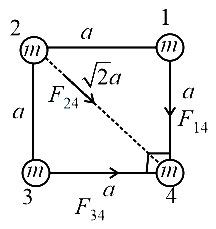
Four identical masses of $m$ are kept at the corners of a square. If the gravitational force exerted on one of the masses by the other masses is $\left(\frac{2 \sqrt{2}+1}{32}\right) \frac{G m^2}{L^2}$,then the length of the side of the square is
A
$L$
B
$2L$
C
$4L$
D
$L/2$
Solution
(C) Let the side length of the square be $a$. The net gravitational force on any one mass (say mass $4$) is the vector sum of the forces exerted by the other three masses $(1, 2, 3)$.
Let $\vec{F}_{14}$,$\vec{F}_{34}$,and $\vec{F}_{24}$ be the forces exerted by masses $1, 3,$ and $2$ on mass $4$ respectively.
The magnitudes are $F_{14} = \frac{Gm^2}{a^2}$,$F_{34} = \frac{Gm^2}{a^2}$,and $F_{24} = \frac{Gm^2}{(\sqrt{2}a)^2} = \frac{Gm^2}{2a^2}$.
The resultant of $\vec{F}_{14}$ and $\vec{F}_{34}$ is $F_{13} = \sqrt{F_{14}^2 + F_{34}^2} = \sqrt{\left(\frac{Gm^2}{a^2}\right)^2 + \left(\frac{Gm^2}{a^2}\right)^2} = \sqrt{2} \frac{Gm^2}{a^2}$.
This resultant force $F_{13}$ acts along the diagonal,in the same direction as $\vec{F}_{24}$.
Thus,the net force is $F_{net} = F_{13} + F_{24} = \sqrt{2} \frac{Gm^2}{a^2} + \frac{Gm^2}{2a^2} = \frac{Gm^2}{a^2} \left(\sqrt{2} + \frac{1}{2}\right) = \frac{Gm^2}{a^2} \left(\frac{2\sqrt{2} + 1}{2}\right)$.
Given that $F_{net} = \left(\frac{2\sqrt{2} + 1}{32}\right) \frac{Gm^2}{L^2}$,we equate the two expressions:
$\frac{Gm^2}{a^2} \left(\frac{2\sqrt{2} + 1}{2}\right) = \left(\frac{2\sqrt{2} + 1}{32}\right) \frac{Gm^2}{L^2}$.
$\frac{1}{2a^2} = \frac{1}{32L^2} \Rightarrow a^2 = 16L^2 \Rightarrow a = 4L$.
Let $\vec{F}_{14}$,$\vec{F}_{34}$,and $\vec{F}_{24}$ be the forces exerted by masses $1, 3,$ and $2$ on mass $4$ respectively.
The magnitudes are $F_{14} = \frac{Gm^2}{a^2}$,$F_{34} = \frac{Gm^2}{a^2}$,and $F_{24} = \frac{Gm^2}{(\sqrt{2}a)^2} = \frac{Gm^2}{2a^2}$.
The resultant of $\vec{F}_{14}$ and $\vec{F}_{34}$ is $F_{13} = \sqrt{F_{14}^2 + F_{34}^2} = \sqrt{\left(\frac{Gm^2}{a^2}\right)^2 + \left(\frac{Gm^2}{a^2}\right)^2} = \sqrt{2} \frac{Gm^2}{a^2}$.
This resultant force $F_{13}$ acts along the diagonal,in the same direction as $\vec{F}_{24}$.
Thus,the net force is $F_{net} = F_{13} + F_{24} = \sqrt{2} \frac{Gm^2}{a^2} + \frac{Gm^2}{2a^2} = \frac{Gm^2}{a^2} \left(\sqrt{2} + \frac{1}{2}\right) = \frac{Gm^2}{a^2} \left(\frac{2\sqrt{2} + 1}{2}\right)$.
Given that $F_{net} = \left(\frac{2\sqrt{2} + 1}{32}\right) \frac{Gm^2}{L^2}$,we equate the two expressions:
$\frac{Gm^2}{a^2} \left(\frac{2\sqrt{2} + 1}{2}\right) = \left(\frac{2\sqrt{2} + 1}{32}\right) \frac{Gm^2}{L^2}$.
$\frac{1}{2a^2} = \frac{1}{32L^2} \Rightarrow a^2 = 16L^2 \Rightarrow a = 4L$.
0 likes
View Solution95
MediumMCQ
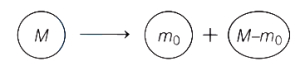
$A$ mass $M$ is split into two parts $m_0$ and $M-m_0$. These two masses are then separated by a distance $D$. If the gravitational force between the parts is maximum,then the ratio $\frac{m_0}{M}$ is
A
$0.2$
B
$0.4$
C
$0.5$
D
$0.6$
Solution
(C) The gravitational force $F$ between two masses $m_0$ and $M-m_0$ separated by a distance $D$ is given by:
$F = \frac{G m_0 (M - m_0)}{D^2}$
To find the condition for maximum force,we differentiate $F$ with respect to $m_0$ and set it to zero:
$\frac{dF}{dm_0} = \frac{d}{dm_0} \left[ \frac{G}{D^2} (M m_0 - m_0^2) \right] = 0$
$\frac{G}{D^2} (M - 2m_0) = 0$
Since $\frac{G}{D^2} \neq 0$,we have:
$M - 2m_0 = 0$
$M = 2m_0$
$\frac{m_0}{M} = \frac{1}{2} = 0.5$
$F = \frac{G m_0 (M - m_0)}{D^2}$
To find the condition for maximum force,we differentiate $F$ with respect to $m_0$ and set it to zero:
$\frac{dF}{dm_0} = \frac{d}{dm_0} \left[ \frac{G}{D^2} (M m_0 - m_0^2) \right] = 0$
$\frac{G}{D^2} (M - 2m_0) = 0$
Since $\frac{G}{D^2} \neq 0$,we have:
$M - 2m_0 = 0$
$M = 2m_0$
$\frac{m_0}{M} = \frac{1}{2} = 0.5$
0 likes
View Solution96
MediumMCQ
Statement $(I)$: The force of attraction due to a hollow spherical shell of uniform density on a point mass situated inside it is always zero.
Statement $(II)$: The force of attraction between a hollow spherical shell of uniform density and a point mass situated outside is the same as if the entire mass of the shell were concentrated at the center of the shell.
Which of the following is correct?
Statement $(II)$: The force of attraction between a hollow spherical shell of uniform density and a point mass situated outside is the same as if the entire mass of the shell were concentrated at the center of the shell.
Which of the following is correct?
A
Both statements $I$ and $II$ are true
B
Statement $I$ is true,but statement $II$ is false
C
Statement $II$ is true,but statement $I$ is false
D
Both statements $I$ and $II$ are false
Solution
(C) According to the Shell Theorem,the gravitational field $E$ inside a uniform hollow spherical shell is $0$. Therefore,no net gravitational force acts on a point mass placed inside it. Thus,Statement $(I)$ is false.
For any point outside a uniform hollow spherical shell,the shell behaves as if its entire mass were concentrated at its center. Thus,the gravitational force is calculated using Newton's Law of Gravitation as $F = G M m / r^2$,where $r$ is the distance from the center. Thus,Statement $(II)$ is correct.
For any point outside a uniform hollow spherical shell,the shell behaves as if its entire mass were concentrated at its center. Thus,the gravitational force is calculated using Newton's Law of Gravitation as $F = G M m / r^2$,where $r$ is the distance from the center. Thus,Statement $(II)$ is correct.
0 likes
View Solution97
EasyMCQ
The force of mutual attraction between any two objects by virtue of their masses is
A
Gravitational force
B
Electromagnetic force
C
Strong nuclear force
D
Weak nuclear force
Solution
(A) According to Newton's Law of Universal Gravitation,every particle of matter in the universe attracts every other particle with a force that is directly proportional to the product of their masses and inversely proportional to the square of the distance between their centers.
This force of mutual attraction that exists between any two objects due to their masses is known as the Gravitational force.
This force of mutual attraction that exists between any two objects due to their masses is known as the Gravitational force.
0 likes
View Solution98
EasyMCQ
Which of the following is incorrect about the gravitational force between two bodies?
A
Conservative force
B
Attractive force
C
Not a central force
D
Not a contact force
Solution
(C) The gravitational force between two point masses is given by Newton's Law of Gravitation,$F = G \frac{m_1 m_2}{r^2}$.
$1$. It is a conservative force,meaning the work done by it is independent of the path.
$2$. It is always an attractive force between two masses.
$3$. It is a central force,as it acts along the line joining the centers of the two bodies.
$4$. It is a non-contact force (or action-at-a-distance force),meaning it does not require physical contact between the bodies.
Therefore,the statement that it is 'Not a central force' is incorrect.
$1$. It is a conservative force,meaning the work done by it is independent of the path.
$2$. It is always an attractive force between two masses.
$3$. It is a central force,as it acts along the line joining the centers of the two bodies.
$4$. It is a non-contact force (or action-at-a-distance force),meaning it does not require physical contact between the bodies.
Therefore,the statement that it is 'Not a central force' is incorrect.
0 likes
View Solution99
EasyMCQ
Regarding fundamental forces in nature,the correct statement is
A
electromagnetic forces are always attractive
B
electromagnetic forces are always repulsive
C
gravitational forces are always attractive
D
strong nuclear forces are always repulsive
Solution
(C) Among the four fundamental forces in nature (gravitational,electromagnetic,strong nuclear,and weak nuclear forces),the gravitational force is unique because it is always attractive in nature.
Electromagnetic forces can be either attractive or repulsive depending on the charges.
Strong nuclear forces are generally attractive at short ranges to hold the nucleus together.
Therefore,the statement that gravitational forces are always attractive is correct.
Electromagnetic forces can be either attractive or repulsive depending on the charges.
Strong nuclear forces are generally attractive at short ranges to hold the nucleus together.
Therefore,the statement that gravitational forces are always attractive is correct.
0 likes
View SolutionGravitation — Newton’s Law of Gravitation · Frequently Asked Questions
1Are these Gravitation questions useful for JEE and NEET?
Yes. All questions in this section are mapped to JEE Main and NEET exam patterns. Previous year questions from JEE Main, NEET, GUJCET and state-level exams are included with full solutions.
2Can I switch to Hindi or Gujarati for these questions?
Yes. Use the language tabs in the hero section or the sidebar to view the same questions and solutions in English, Hindi or Gujarati.
3How do I generate a question paper from this subtopic?
Use the Vedclass Exam Paper Generator — select the chapter and subtopic, set difficulty, and generate Sets A, B, C, D automatically. First 3 chapters of every subject are free.
Vedclass Products
For Students
Vedclass Test Series
Mock tests in real JEE/NEET style with performance analysis. 5-day free trial.
Start Free TrialFor Teachers
Exam Paper Generator
Generate Set A/B/C/D papers from this chapter in 2 minutes. 3 chapters free.
Try FreeFor Institutes
Online Exam Module
Live online exams with unlimited students, 360° analytics & white-label branding.
See DemoFor Teachers & Institutes
Generate a Gravitation Exam Paper in 2 Minutes
Select subtopic & difficulty — Sets A, B, C, D auto-generated with No Repeat logic.
First 3 chapters of every subject are free — no payment required.