
A English
Newton’s Law of Gravitation Questions in English
Class 11 Physics · Gravitation · Newton’s Law of Gravitation
107+
Questions
English
Language
100%
With Solutions
Showing 7 of 107 questions in English
101
EasyMCQ
Gravitational forces operate among which of the following?
A
All objects in the universe
B
Some elementary particles only
C
Charged particles only
D
Nucleons only
Solution
(A) Gravitational force is a universal force. According to Newton's law of universal gravitation,every particle of matter in the universe attracts every other particle with a force that is directly proportional to the product of their masses and inversely proportional to the square of the distance between their centers. Therefore,gravitational forces operate among all objects in the universe.
0 likes
View Solution102
MediumMCQ
Find the acceleration of our galaxy due to the nearest comparably sized galaxy. The approximate mass of each galaxy is $8 \times 10^{11}$ solar masses,and they are separated by $2 \times 10^6$ light-years. Each galaxy has a diameter of $10^5$ light-years. (Assume $1 \text{ light-year} \approx 10^{16} \text{ m}$,gravitational constant $G \approx 10^{-10} \text{ Nm}^2/\text{kg}^2$,and mass of the Sun $= 2.0 \times 10^{30} \text{ kg}$)
A
$4 \times 10^{-13} \text{ m/s}^2$
B
$2 \times 10^{-13} \text{ m/s}^2$
C
$5 \times 10^{-15} \text{ m/s}^2$
D
$5 \times 10^{-13} \text{ m/s}^2$
Solution
(A) Given:
Mass of each galaxy,$m = 8 \times 10^{11} \text{ solar masses} = 8 \times 10^{11} \times 2.0 \times 10^{30} \text{ kg} = 16 \times 10^{41} \text{ kg}$.
Distance between galaxies,$d = 2 \times 10^6 \text{ light-years} = 2 \times 10^6 \times 10^{16} \text{ m} = 2 \times 10^{22} \text{ m}$.
Gravitational force,$F = \frac{G m^2}{d^2}$.
Acceleration of the galaxy,$a = \frac{F}{m} = \frac{G m}{d^2}$.
Substituting the values:
$a = \frac{10^{-10} \times (16 \times 10^{41})}{(2 \times 10^{22})^2} = \frac{16 \times 10^{31}}{4 \times 10^{44}} = 4 \times 10^{-13} \text{ m/s}^2$.
Mass of each galaxy,$m = 8 \times 10^{11} \text{ solar masses} = 8 \times 10^{11} \times 2.0 \times 10^{30} \text{ kg} = 16 \times 10^{41} \text{ kg}$.
Distance between galaxies,$d = 2 \times 10^6 \text{ light-years} = 2 \times 10^6 \times 10^{16} \text{ m} = 2 \times 10^{22} \text{ m}$.
Gravitational force,$F = \frac{G m^2}{d^2}$.
Acceleration of the galaxy,$a = \frac{F}{m} = \frac{G m}{d^2}$.
Substituting the values:
$a = \frac{10^{-10} \times (16 \times 10^{41})}{(2 \times 10^{22})^2} = \frac{16 \times 10^{31}}{4 \times 10^{44}} = 4 \times 10^{-13} \text{ m/s}^2$.
0 likes
View Solution103
EasyMCQ
The long-range force experienced by a neutral particle with a finite mass is:
A
gravitational force
B
weak force
C
electromagnetic force
D
strong force
Solution
(A) The long-range force experienced by a neutral particle with a finite mass is the gravitational force.
In this universe,every body attracts every other body with a force that is directly proportional to the product of their masses ($m_1$ and $m_2$) and inversely proportional to the square of the distance $(r)$ between them.
The formula is given by $F = \frac{G m_1 m_2}{r^2}$.
Since gravitational force acts over infinite distances and depends only on mass,it is the only fundamental force that acts on neutral particles with finite mass over long ranges.
In this universe,every body attracts every other body with a force that is directly proportional to the product of their masses ($m_1$ and $m_2$) and inversely proportional to the square of the distance $(r)$ between them.
The formula is given by $F = \frac{G m_1 m_2}{r^2}$.
Since gravitational force acts over infinite distances and depends only on mass,it is the only fundamental force that acts on neutral particles with finite mass over long ranges.
0 likes
View Solution104
EasyMCQ
Let $G, W, E$ and $S$ be the relative strengths of gravitational,weak-nuclear,electromagnetic,and strong-nuclear forces,respectively. Which of the following statements is correct?
A
$S > W > E > G$
B
$E > W > S > G$
C
$S > E > W > G$
D
$S > E > G > W$
Solution
(C) The four fundamental forces in nature,in decreasing order of their relative strengths,are as follows:
$1$. Strong nuclear force $(S)$: The strongest force,acting between nucleons.
$2$. Electromagnetic force $(E)$: Acts between charged particles.
$3$. Weak nuclear force $(W)$: Responsible for radioactive decay processes.
$4$. Gravitational force $(G)$: The weakest force,acting between all masses.
Comparing their relative magnitudes,we have $S > E > W > G$.
Therefore,the correct statement is $S > E > W > G$.
$1$. Strong nuclear force $(S)$: The strongest force,acting between nucleons.
$2$. Electromagnetic force $(E)$: Acts between charged particles.
$3$. Weak nuclear force $(W)$: Responsible for radioactive decay processes.
$4$. Gravitational force $(G)$: The weakest force,acting between all masses.
Comparing their relative magnitudes,we have $S > E > W > G$.
Therefore,the correct statement is $S > E > W > G$.
0 likes
View Solution105
DifficultMCQ
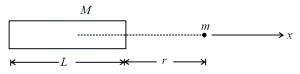
$A$ point mass '$m$' is located at a distance '$r$' from the end of a uniform thin rod of mass '$M$' and length '$L$' as shown in the figure. The magnitude of the gravitational force of attraction is
A
$\frac{G M m}{r^2}$
B
$\frac{G M m}{(r+L)^2}$
C
$\frac{G M m}{r(r+L)}$
D
$\frac{G M m}{\left(r+\frac{L}{2}\right)^2}$
Solution
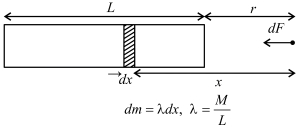
(C) Let the rod lie along the $x$-axis with its near end at $x = r$ and its far end at $x = r + L$ from the point mass '$m$' located at the origin.
Consider a small element of the rod of length '$dx$' at a distance '$x$' from the point mass '$m$'.
The mass of this element is $dm = \lambda dx = \frac{M}{L} dx$.
The gravitational force '$dF$' exerted by this element on the point mass '$m$' is given by:
$dF = \frac{G m dm}{x^2} = \frac{G m (M/L) dx}{x^2} = \frac{G M m}{L} \frac{dx}{x^2}$.
To find the total force '$F$',we integrate '$dF$' from $x = r$ to $x = r + L$:
$F = \int_{r}^{r+L} \frac{G M m}{L} \frac{dx}{x^2} = \frac{G M m}{L} \left[ -\frac{1}{x} \right]_{r}^{r+L}$.
$F = \frac{G M m}{L} \left( -\frac{1}{r+L} - (-\frac{1}{r}) \right) = \frac{G M m}{L} \left( \frac{1}{r} - \frac{1}{r+L} \right)$.
$F = \frac{G M m}{L} \left( \frac{r+L-r}{r(r+L)} \right) = \frac{G M m}{L} \left( \frac{L}{r(r+L)} \right) = \frac{G M m}{r(r+L)}$.
Consider a small element of the rod of length '$dx$' at a distance '$x$' from the point mass '$m$'.
The mass of this element is $dm = \lambda dx = \frac{M}{L} dx$.
The gravitational force '$dF$' exerted by this element on the point mass '$m$' is given by:
$dF = \frac{G m dm}{x^2} = \frac{G m (M/L) dx}{x^2} = \frac{G M m}{L} \frac{dx}{x^2}$.
To find the total force '$F$',we integrate '$dF$' from $x = r$ to $x = r + L$:
$F = \int_{r}^{r+L} \frac{G M m}{L} \frac{dx}{x^2} = \frac{G M m}{L} \left[ -\frac{1}{x} \right]_{r}^{r+L}$.
$F = \frac{G M m}{L} \left( -\frac{1}{r+L} - (-\frac{1}{r}) \right) = \frac{G M m}{L} \left( \frac{1}{r} - \frac{1}{r+L} \right)$.
$F = \frac{G M m}{L} \left( \frac{r+L-r}{r(r+L)} \right) = \frac{G M m}{L} \left( \frac{L}{r(r+L)} \right) = \frac{G M m}{r(r+L)}$.
0 likes
View Solution106
MediumMCQ
Two particles of mass $m_{1}$ and $m_{2}$ approach each other due to their mutual gravitational attraction only. Then,
A
accelerations of both the particles are equal
B
acceleration of the particle of mass $m_{1}$ is proportional to $m_{1}$
C
acceleration of the particle of mass $m_{1}$ is proportional to $m_{2}$
D
acceleration of the particle of mass $m_{1}$ is inversely proportional to $m_{1}$
Solution
(C) The gravitational force acting between the two masses $m_{1}$ and $m_{2}$ separated by a distance $r$ is given by Newton's law of gravitation:
$F = \frac{G m_{1} m_{2}}{r^{2}}$
According to Newton's second law of motion,the force on mass $m_{1}$ is $F = m_{1} a_{1}$,where $a_{1}$ is the acceleration of mass $m_{1}$.
Equating the two expressions:
$m_{1} a_{1} = \frac{G m_{1} m_{2}}{r^{2}}$
$a_{1} = \frac{G m_{2}}{r^{2}}$
Since $G$ and $r$ are constant for the system at any given instant,we find that $a_{1} \propto m_{2}$.
Similarly,for mass $m_{2}$,$a_{2} = \frac{G m_{1}}{r^{2}}$,which implies $a_{2} \propto m_{1}$.
$F = \frac{G m_{1} m_{2}}{r^{2}}$
According to Newton's second law of motion,the force on mass $m_{1}$ is $F = m_{1} a_{1}$,where $a_{1}$ is the acceleration of mass $m_{1}$.
Equating the two expressions:
$m_{1} a_{1} = \frac{G m_{1} m_{2}}{r^{2}}$
$a_{1} = \frac{G m_{2}}{r^{2}}$
Since $G$ and $r$ are constant for the system at any given instant,we find that $a_{1} \propto m_{2}$.
Similarly,for mass $m_{2}$,$a_{2} = \frac{G m_{1}}{r^{2}}$,which implies $a_{2} \propto m_{1}$.
0 likes
View Solution107
MediumMCQ
$A$ mass $M$ at rest is broken into two pieces having masses $m$ and $(M-m)$. The two masses are then separated by a distance $r$. The gravitational force between them will be maximum when the ratio of the masses $[m : (M-m)]$ of the two parts is:
A
$1$: $1$
B
$1$: $2$
C
$1$: $3$
D
$1$: $4$
Solution
(A) The gravitational force $F$ between two masses $m_1$ and $m_2$ separated by a distance $r$ is given by $F = \frac{G m_1 m_2}{r^2}$.
Here,$m_1 = m$ and $m_2 = (M - m)$.
Substituting these values,we get $F = \frac{G m(M - m)}{r^2} = \frac{G}{r^2} (Mm - m^2)$.
For the force to be maximum,the derivative of $F$ with respect to $m$ must be zero,i.e.,$\frac{dF}{dm} = 0$.
$\frac{d}{dm} [\frac{G}{r^2} (Mm - m^2)] = 0$.
$\frac{G}{r^2} (M - 2m) = 0$.
Since $\frac{G}{r^2} \neq 0$,we have $M - 2m = 0$,which implies $m = \frac{M}{2}$.
Thus,the mass of the second piece is $(M - m) = M - \frac{M}{2} = \frac{M}{2}$.
The ratio of the masses is $\frac{m}{M-m} = \frac{M/2}{M/2} = \frac{1}{1}$.
Here,$m_1 = m$ and $m_2 = (M - m)$.
Substituting these values,we get $F = \frac{G m(M - m)}{r^2} = \frac{G}{r^2} (Mm - m^2)$.
For the force to be maximum,the derivative of $F$ with respect to $m$ must be zero,i.e.,$\frac{dF}{dm} = 0$.
$\frac{d}{dm} [\frac{G}{r^2} (Mm - m^2)] = 0$.
$\frac{G}{r^2} (M - 2m) = 0$.
Since $\frac{G}{r^2} \neq 0$,we have $M - 2m = 0$,which implies $m = \frac{M}{2}$.
Thus,the mass of the second piece is $(M - m) = M - \frac{M}{2} = \frac{M}{2}$.
The ratio of the masses is $\frac{m}{M-m} = \frac{M/2}{M/2} = \frac{1}{1}$.
0 likes
View SolutionGravitation — Newton’s Law of Gravitation · Frequently Asked Questions
1Are these Gravitation questions useful for JEE and NEET?
Yes. All questions in this section are mapped to JEE Main and NEET exam patterns. Previous year questions from JEE Main, NEET, GUJCET and state-level exams are included with full solutions.
2Can I switch to Hindi or Gujarati for these questions?
Yes. Use the language tabs in the hero section or the sidebar to view the same questions and solutions in English, Hindi or Gujarati.
3How do I generate a question paper from this subtopic?
Use the Vedclass Exam Paper Generator — select the chapter and subtopic, set difficulty, and generate Sets A, B, C, D automatically. First 3 chapters of every subject are free.
Vedclass Products
For Students
Vedclass Test Series
Mock tests in real JEE/NEET style with performance analysis. 5-day free trial.
Start Free TrialFor Teachers
Exam Paper Generator
Generate Set A/B/C/D papers from this chapter in 2 minutes. 3 chapters free.
Try FreeFor Institutes
Online Exam Module
Live online exams with unlimited students, 360° analytics & white-label branding.
See DemoFor Teachers & Institutes
Generate a Gravitation Exam Paper in 2 Minutes
Select subtopic & difficulty — Sets A, B, C, D auto-generated with No Repeat logic.
First 3 chapters of every subject are free — no payment required.