
A English
Kepler’s laws of Planetary Motion Questions in English
Class 11 Physics · Gravitation · Kepler’s laws of Planetary Motion
145+
Questions
English
Language
100%
With Solutions
Showing 49 of 145 questions in English
51
MediumMCQ
Two planets revolve around the sun with frequencies ${N_1}$ and ${N_2}$ revolutions per year. If their average orbital radii are ${R_1}$ and ${R_2}$ respectively,then ${R_1}/{R_2}$ is equal to:
A
${(N_1/N_2)^{3/2}}$
B
${(N_2/N_1)^{3/2}}$
C
${(N_1/N_2)^{2/3}}$
D
${(N_2/N_1)^{2/3}}$
Solution
(D) According to Kepler's third law of planetary motion,the square of the time period $T$ is proportional to the cube of the semi-major axis $R$ of the orbit: $T^2 \propto R^3$.
Since the frequency $N$ is the reciprocal of the time period $(N = 1/T)$,we have $T = 1/N$.
Substituting this into Kepler's law: $(1/N)^2 \propto R^3$,which implies $N^{-2} \propto R^3$ or $R^3 \propto N^{-2}$.
Therefore,$R \propto N^{-2/3}$.
For two planets,the ratio of their orbital radii is given by: $\frac{R_1}{R_2} = \left( \frac{N_1}{N_2} \right)^{-2/3}$.
This can be rewritten as: $\frac{R_1}{R_2} = \left( \frac{N_2}{N_1} \right)^{2/3}$.
Since the frequency $N$ is the reciprocal of the time period $(N = 1/T)$,we have $T = 1/N$.
Substituting this into Kepler's law: $(1/N)^2 \propto R^3$,which implies $N^{-2} \propto R^3$ or $R^3 \propto N^{-2}$.
Therefore,$R \propto N^{-2/3}$.
For two planets,the ratio of their orbital radii is given by: $\frac{R_1}{R_2} = \left( \frac{N_1}{N_2} \right)^{-2/3}$.
This can be rewritten as: $\frac{R_1}{R_2} = \left( \frac{N_2}{N_1} \right)^{2/3}$.
0 likes
View Solution52
MediumMCQ
The mean radius of the earth's orbit around the sun is $1.5 \times 10^{11} \ m$. The mean radius of the orbit of mercury around the sun is $6 \times 10^{10} \ m$. The mercury will rotate around the sun in
A
$1$ year
B
Nearly $4$ years
C
Nearly $\frac{1}{4}$ year
D
$2.5$ years
Solution
(C) According to Kepler's third law of planetary motion,the square of the time period $(T)$ is proportional to the cube of the semi-major axis $(r)$ of the orbit: $T^2 \propto r^3$.
Therefore,the ratio of the time periods is given by: $\frac{T_{\text{mercury}}}{T_{\text{earth}}} = \left( \frac{r_{\text{mercury}}}{r_{\text{earth}}} \right)^{3/2}$.
Given: $r_{\text{earth}} = 1.5 \times 10^{11} \ m$ and $r_{\text{mercury}} = 6 \times 10^{10} \ m$.
Substituting the values: $\frac{T_{\text{mercury}}}{T_{\text{earth}}} = \left( \frac{6 \times 10^{10}}{1.5 \times 10^{11}} \right)^{3/2} = \left( \frac{0.6 \times 10^{11}}{1.5 \times 10^{11}} \right)^{3/2} = \left( \frac{0.6}{1.5} \right)^{3/2} = \left( \frac{2}{5} \right)^{3/2} = \left( 0.4 \right)^{1.5} \approx 0.252$.
Since $T_{\text{earth}} = 1$ year,$T_{\text{mercury}} \approx 0.25$ years or $\frac{1}{4}$ year.
Therefore,the ratio of the time periods is given by: $\frac{T_{\text{mercury}}}{T_{\text{earth}}} = \left( \frac{r_{\text{mercury}}}{r_{\text{earth}}} \right)^{3/2}$.
Given: $r_{\text{earth}} = 1.5 \times 10^{11} \ m$ and $r_{\text{mercury}} = 6 \times 10^{10} \ m$.
Substituting the values: $\frac{T_{\text{mercury}}}{T_{\text{earth}}} = \left( \frac{6 \times 10^{10}}{1.5 \times 10^{11}} \right)^{3/2} = \left( \frac{0.6 \times 10^{11}}{1.5 \times 10^{11}} \right)^{3/2} = \left( \frac{0.6}{1.5} \right)^{3/2} = \left( \frac{2}{5} \right)^{3/2} = \left( 0.4 \right)^{1.5} \approx 0.252$.
Since $T_{\text{earth}} = 1$ year,$T_{\text{mercury}} \approx 0.25$ years or $\frac{1}{4}$ year.
0 likes
View Solution53
DifficultMCQ
The distance of Venus from the sun is $0.72\, AU$. The orbital period of Venus is ............ days.
A
$200$
B
$320$
C
$225$
D
$325$
Solution
(C) According to Kepler's third law of planetary motion, the square of the orbital period $T$ is proportional to the cube of the semi-major axis $r$ of its orbit: $\frac{T_2^2}{T_1^2} = \left( \frac{r_2}{r_1} \right)^3$.
For Earth, $T_1 = 1\, \text{year} = 365.25\, \text{days}$ and $r_1 = 1\, AU$.
For Venus, $r_2 = 0.72\, AU$.
Substituting the values: $T_2 = T_1 \times (r_2/r_1)^{3/2} = 1 \times (0.72)^{3/2} \approx 0.611\, \text{years}$.
Converting to days: $0.611 \times 365.25 \approx 223.2\, \text{days}$, which is approximately $225\, \text{days}$.
For Earth, $T_1 = 1\, \text{year} = 365.25\, \text{days}$ and $r_1 = 1\, AU$.
For Venus, $r_2 = 0.72\, AU$.
Substituting the values: $T_2 = T_1 \times (r_2/r_1)^{3/2} = 1 \times (0.72)^{3/2} \approx 0.611\, \text{years}$.
Converting to days: $0.611 \times 365.25 \approx 223.2\, \text{days}$, which is approximately $225\, \text{days}$.
0 likes
View Solution54
MediumMCQ
The motion of satellites in the solar system is an example of which of the following?
A
Conservation of mass
B
Conservation of linear momentum
C
Conservation of angular momentum
D
Conservation of energy
Solution
(C) According to Kepler's second law,the areal velocity of a planet is constant,which is given by $\frac{dA}{dt} = \frac{L}{2m}$.
Here,$L$ is the angular momentum and $m$ is the mass of the planet.
Since the gravitational force exerted by the Sun on the planet is a central force,the torque acting on the planet about the Sun is zero $(\tau = 0)$.
Because $\tau = \frac{dL}{dt}$,if $\tau = 0$,then $L$ must be constant.
Therefore,the motion of satellites or planets in the solar system is an example of the conservation of angular momentum.
Here,$L$ is the angular momentum and $m$ is the mass of the planet.
Since the gravitational force exerted by the Sun on the planet is a central force,the torque acting on the planet about the Sun is zero $(\tau = 0)$.
Because $\tau = \frac{dL}{dt}$,if $\tau = 0$,then $L$ must be constant.
Therefore,the motion of satellites or planets in the solar system is an example of the conservation of angular momentum.
0 likes
View Solution55
EasyMCQ
Which quantity remains constant in the orbital motion of the Earth around the Sun?
A
Angular momentum
B
Linear momentum
C
Angular kinetic energy
D
Linear kinetic energy
Solution
(A) The gravitational force exerted by the Sun on the Earth acts along the line joining the two bodies.
This force is a central force,meaning its torque about the Sun is zero.
According to the principle of conservation of angular momentum,if the net external torque acting on a system is zero,the angular momentum of the system remains constant.
Therefore,the angular momentum of the Earth about the Sun is conserved during its orbital motion.
This force is a central force,meaning its torque about the Sun is zero.
According to the principle of conservation of angular momentum,if the net external torque acting on a system is zero,the angular momentum of the system remains constant.
Therefore,the angular momentum of the Earth about the Sun is conserved during its orbital motion.
0 likes
View Solution56
EasyMCQ
When a satellite moves around the earth in a certain orbit,the quantity which remains constant is:
A
angular velocity
B
kinetic energy
C
areal velocity
D
potential energy
Solution
(C) According to Kepler's second law of planetary motion,the areal velocity (the rate at which the area is swept out by the radius vector) of a planet or satellite moving in a central gravitational field remains constant. This is a direct consequence of the conservation of angular momentum.
0 likes
View Solution57
DifficultMCQ
$A$ satellite is launched into a circular orbit of radius $R$ around the Earth. $A$ second satellite is launched into an orbit of radius $1.02 R$. The period of the second satellite is larger than the first one by approximately ........ $\%$
A
$1.5$
B
$3$
C
$1$
D
$2$
Solution
(B) According to Kepler's third law of planetary motion,the square of the time period $T$ is proportional to the cube of the orbital radius $R$ $(T^2 \propto R^3)$.
Let $T_1$ be the period of the first satellite with radius $R_1 = R$,and $T_2$ be the period of the second satellite with radius $R_2 = 1.02 R$.
Then,$\frac{T_2}{T_1} = \left( \frac{R_2}{R_1} \right)^{3/2} = (1.02)^{3/2}$.
Using the binomial approximation $(1+x)^n \approx 1+nx$ for small $x$:
$\frac{T_2}{T_1} \approx 1 + \frac{3}{2}(0.02) = 1 + 0.03 = 1.03$.
Therefore,$T_2 \approx 1.03 T_1$.
The percentage increase in the time period is $\frac{T_2 - T_1}{T_1} \times 100 = (1.03 - 1) \times 100 = 3 \%$.
Let $T_1$ be the period of the first satellite with radius $R_1 = R$,and $T_2$ be the period of the second satellite with radius $R_2 = 1.02 R$.
Then,$\frac{T_2}{T_1} = \left( \frac{R_2}{R_1} \right)^{3/2} = (1.02)^{3/2}$.
Using the binomial approximation $(1+x)^n \approx 1+nx$ for small $x$:
$\frac{T_2}{T_1} \approx 1 + \frac{3}{2}(0.02) = 1 + 0.03 = 1.03$.
Therefore,$T_2 \approx 1.03 T_1$.
The percentage increase in the time period is $\frac{T_2 - T_1}{T_1} \times 100 = (1.03 - 1) \times 100 = 3 \%$.
0 likes
View Solution58
MediumMCQ
$A$ planet of mass $m$ is in an elliptical orbit about the sun $(m \ll M_{sun})$ with an orbital period $T$. If $A$ is the area of the orbit,then its angular momentum is:
A
$\frac{2mA}{T}$
B
$mAT$
C
$\frac{mA}{2T}$
D
$2mAT$
Solution
(A) According to Kepler's second law,the areal velocity of a planet is constant and is given by the relation: $\frac{dA}{dt} = \frac{L}{2m}$,where $L$ is the angular momentum and $m$ is the mass of the planet.
For a complete orbit,the total area swept is $A$ and the time taken is the orbital period $T$. Thus,the average areal velocity is $\frac{A}{T}$.
Equating the two expressions: $\frac{A}{T} = \frac{L}{2m}$.
Solving for $L$,we get: $L = \frac{2mA}{T}$.
For a complete orbit,the total area swept is $A$ and the time taken is the orbital period $T$. Thus,the average areal velocity is $\frac{A}{T}$.
Equating the two expressions: $\frac{A}{T} = \frac{L}{2m}$.
Solving for $L$,we get: $L = \frac{2mA}{T}$.
0 likes
View Solution59
MediumMCQ
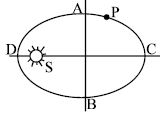
The figure shows the orbit of a planet $P$ around the sun $S.$ $AB$ and $CD$ are the minor and major axes of the ellipse,respectively.
If $t_1$ is the time taken by the planet to travel along the path $ACB$ and $t_2$ is the time taken to travel along the path $BDA,$ then:
If $t_1$ is the time taken by the planet to travel along the path $ACB$ and $t_2$ is the time taken to travel along the path $BDA,$ then:
A
$t_1 = t_2$
B
$t_1 > t_2$
C
$t_1 < t_2$
D
Nothing can be concluded
Solution
(B) According to Kepler's second law of planetary motion,the areal velocity of a planet revolving around the sun is constant.
This means the planet sweeps out equal areas in equal intervals of time.
In the given ellipse,the sun $S$ is at one of the foci.
The path $ACB$ covers more than half of the area of the ellipse,while the path $BDA$ covers less than half of the area of the ellipse.
Since the area swept by the radius vector in path $ACB$ (Area $S-ACB$) is greater than the area swept in path $BDA$ (Area $S-BDA$),and the areal velocity is constant,it follows that the time taken $t_1$ must be greater than $t_2$.
Therefore,$t_1 > t_2$.
This means the planet sweeps out equal areas in equal intervals of time.
In the given ellipse,the sun $S$ is at one of the foci.
The path $ACB$ covers more than half of the area of the ellipse,while the path $BDA$ covers less than half of the area of the ellipse.
Since the area swept by the radius vector in path $ACB$ (Area $S-ACB$) is greater than the area swept in path $BDA$ (Area $S-BDA$),and the areal velocity is constant,it follows that the time taken $t_1$ must be greater than $t_2$.
Therefore,$t_1 > t_2$.
0 likes
View Solution60
DifficultMCQ
The mean radius of the earth's orbit around the sun is $1.5 \times 10^{11} \ m$. The mean radius of the orbit of Mercury around the sun is $6 \times 10^{10} \ m$. Mercury will revolve around the sun in:
A
$A$ year
B
Nearly $4$ years
C
Nearly $\frac{1}{4}$ year
D
$2.5$ years
Solution
(C) According to Kepler's third law of planetary motion,the square of the time period $(T)$ is proportional to the cube of the semi-major axis $(r)$ of the orbit: $T^2 \propto r^3$ or $\frac{T_1^2}{r_1^3} = \frac{T_2^2}{r_2^3}$.
Given:
$r_1 = 1.5 \times 10^{11} \ m$ (Earth's orbital radius)
$T_1 = 1 \text{ year}$
$r_2 = 6 \times 10^{10} \ m$ (Mercury's orbital radius)
Substituting the values:
$\frac{1^2}{(1.5 \times 10^{11})^3} = \frac{T_2^2}{(6 \times 10^{10})^3}$
$T_2^2 = \left( \frac{6 \times 10^{10}}{1.5 \times 10^{11}} \right)^3$
$T_2^2 = \left( \frac{6}{15} \right)^3 = \left( 0.4 \right)^3 = 0.064$
$T_2 = \sqrt{0.064} \approx 0.25 \text{ years}$.
Thus,Mercury revolves around the sun in nearly $\frac{1}{4}$ of a year.
Given:
$r_1 = 1.5 \times 10^{11} \ m$ (Earth's orbital radius)
$T_1 = 1 \text{ year}$
$r_2 = 6 \times 10^{10} \ m$ (Mercury's orbital radius)
Substituting the values:
$\frac{1^2}{(1.5 \times 10^{11})^3} = \frac{T_2^2}{(6 \times 10^{10})^3}$
$T_2^2 = \left( \frac{6 \times 10^{10}}{1.5 \times 10^{11}} \right)^3$
$T_2^2 = \left( \frac{6}{15} \right)^3 = \left( 0.4 \right)^3 = 0.064$
$T_2 = \sqrt{0.064} \approx 0.25 \text{ years}$.
Thus,Mercury revolves around the sun in nearly $\frac{1}{4}$ of a year.
0 likes
View Solution61
DifficultMCQ
$A$ geostationary satellite is orbiting the earth at a height of $6R$ above the surface of the earth ($R$ is the radius of the earth). The time period of another satellite at a height of $2.5R$ from the surface of the earth is:
A
$3\sqrt{2} \text{ hours}$
B
$6\sqrt{2} \text{ hours}$
C
$6 \text{ hours}$
D
$72 \text{ hours}$
Solution
(B) According to Kepler's Third Law of planetary motion,the square of the time period $(T)$ is proportional to the cube of the orbital radius $(r)$: $T^2 \propto r^3$,or $\frac{T_1^2}{r_1^3} = \frac{T_2^2}{r_2^3}$.
For a geostationary satellite,the time period $T_1 = 24 \text{ hours}$ and the orbital radius $r_1 = R + 6R = 7R$.
For the second satellite,the height is $2.5R$,so the orbital radius $r_2 = R + 2.5R = 3.5R$.
Substituting these values into the formula:
$\frac{24^2}{(7R)^3} = \frac{T_2^2}{(3.5R)^3}$
$T_2^2 = 24^2 \times \left(\frac{3.5R}{7R}\right)^3$
$T_2^2 = 576 \times \left(\frac{1}{2}\right)^3 = 576 \times \frac{1}{8} = 72$
$T_2 = \sqrt{72} = \sqrt{36 \times 2} = 6\sqrt{2} \text{ hours}$.
For a geostationary satellite,the time period $T_1 = 24 \text{ hours}$ and the orbital radius $r_1 = R + 6R = 7R$.
For the second satellite,the height is $2.5R$,so the orbital radius $r_2 = R + 2.5R = 3.5R$.
Substituting these values into the formula:
$\frac{24^2}{(7R)^3} = \frac{T_2^2}{(3.5R)^3}$
$T_2^2 = 24^2 \times \left(\frac{3.5R}{7R}\right)^3$
$T_2^2 = 576 \times \left(\frac{1}{2}\right)^3 = 576 \times \frac{1}{8} = 72$
$T_2 = \sqrt{72} = \sqrt{36 \times 2} = 6\sqrt{2} \text{ hours}$.
0 likes
View Solution62
MediumMCQ
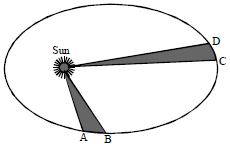
The figure shows the motion of a planet around the sun in an elliptical orbit with the sun at the focus. The shaded areas are equal. If $t_1$ and $t_2$ represent the time taken for the planet to move from $A$ to $B$ and $C$ to $D$ respectively,then:
A
$t_1 < t_2$
B
$t_1 > t_2$
C
$t_1 = t_2$
D
None of the above
Solution
(C) According to Kepler's $II$ law of planetary motion (Law of Areas),the line joining the planet and the sun sweeps out equal areas in equal intervals of time.
Since the shaded areas are given to be equal,the time taken to sweep these areas must also be equal.
Therefore,$t_1 = t_2$.
Since the shaded areas are given to be equal,the time taken to sweep these areas must also be equal.
Therefore,$t_1 = t_2$.
0 likes
View Solution63
MediumMCQ
Which of the following statements is true for the planets orbiting around the sun?
A
Their velocity increases when their distance decreases from the sun in accordance with the conservation of angular momentum.
B
Their velocity decreases when they are nearest to the sun in accordance with the conservation of angular momentum.
C
Areal velocity of the planet changes with time to conserve the energy.
D
Areal velocity of the planet is directly proportional to the distance of the planet from the sun.
Solution
(A) According to Kepler's second law of planetary motion, the areal velocity of a planet revolving around the sun remains constant. This is a direct consequence of the conservation of angular momentum, as the gravitational force exerted by the sun is a central force, resulting in zero torque $(\tau = 0)$.
Since angular momentum $L = mvr \sin(\theta)$ is conserved, when a planet is closer to the sun (smaller $r$), its orbital velocity $v$ must increase to keep $L$ constant. Therefore, the statement in option $A$ is correct.
Since angular momentum $L = mvr \sin(\theta)$ is conserved, when a planet is closer to the sun (smaller $r$), its orbital velocity $v$ must increase to keep $L$ constant. Therefore, the statement in option $A$ is correct.
0 likes
View Solution64
DifficultMCQ
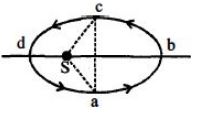
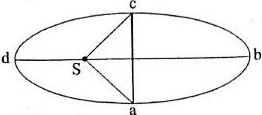
The figure shows the elliptical path $abcd$ of a planet around the sun $S$ such that the area of triangle $csa$ is $\frac{1}{4}$ of the area of the ellipse. With $db$ as the major axis and $ca$ as a chord perpendicular to the major axis,if $t_1$ is the time taken for the planet to travel along the path $abc$ and $t_2$ is the time taken for the path $cda$,then:
A
$t_1 = 4t_2$
B
$t_1 = 2t_2$
C
$t_1 = 3t_2$
D
$t_1 = t_2$
Solution
(C) According to Kepler's Second Law,the areal velocity of a planet is constant,meaning the time taken to sweep an area is directly proportional to the area swept.
Let the total area of the ellipse be $A$.
The area swept by the planet in path $abc$ is the sum of the area of the semi-ellipse (on the side of $b$) and the area of the triangle $Sca$.
Area of semi-ellipse $= \frac{A}{2}$.
Area of triangle $Sca = \frac{1}{4}A$ (given).
Therefore,the area swept in path $abc$ is $A_1 = \frac{A}{2} + \frac{A}{4} = \frac{3A}{4}$.
The area swept in path $cda$ is $A_2 = A - A_1 = A - \frac{3A}{4} = \frac{A}{4}$.
Since $\frac{t_1}{t_2} = \frac{A_1}{A_2}$,we have $\frac{t_1}{t_2} = \frac{3A/4}{A/4} = 3$.
Thus,$t_1 = 3t_2$.
Let the total area of the ellipse be $A$.
The area swept by the planet in path $abc$ is the sum of the area of the semi-ellipse (on the side of $b$) and the area of the triangle $Sca$.
Area of semi-ellipse $= \frac{A}{2}$.
Area of triangle $Sca = \frac{1}{4}A$ (given).
Therefore,the area swept in path $abc$ is $A_1 = \frac{A}{2} + \frac{A}{4} = \frac{3A}{4}$.
The area swept in path $cda$ is $A_2 = A - A_1 = A - \frac{3A}{4} = \frac{A}{4}$.
Since $\frac{t_1}{t_2} = \frac{A_1}{A_2}$,we have $\frac{t_1}{t_2} = \frac{3A/4}{A/4} = 3$.
Thus,$t_1 = 3t_2$.
1 likes
View Solution65
DifficultMCQ
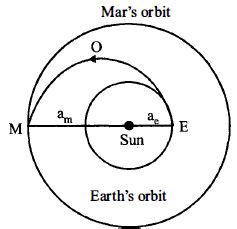
India's Mangalyaan was sent to Mars by launching it into a transfer orbit $EOM$ around the Sun. It leaves the Earth at $E$ and meets Mars at $M$. If the semi-major axis of Earth's orbit is $a_e = 1.5 \times 10^{11} \, m$ and that of Mars' orbit is $a_m = 2.28 \times 10^{11} \, m$, using Kepler's laws, estimate the time taken for Mangalyaan to reach Mars from Earth in days.
A
$500$
B
$320$
C
$260$
D
$220$
Solution
(C) The transfer orbit is an elliptical path with the Sun at one of the foci. The semi-major axis $a_{tr}$ of this transfer orbit is the average of the semi-major axes of Earth's and Mars' orbits:
$a_{tr} = \frac{a_e + a_m}{2} = \frac{1.5 \times 10^{11} + 2.28 \times 10^{11}}{2} = 1.89 \times 10^{11} \, m$
According to Kepler's third law, $T^2 \propto a^3$. Let $T_e$ be the orbital period of Earth $(1 \, \text{year} = 365 \, \text{days})$ and $T_{tr}$ be the period of the transfer orbit:
$\left( \frac{T_{tr}}{T_e} \right)^2 = \left( \frac{a_{tr}}{a_e} \right)^3$
$T_{tr} = T_e \times \left( \frac{1.89 \times 10^{11}}{1.5 \times 10^{11}} \right)^{3/2} = 365 \times (1.26)^{1.5} \approx 365 \times 1.415 \approx 516.5 \, \text{days}$
The time taken to travel from Earth to Mars is half of the full orbital period of the transfer orbit:
$t = \frac{T_{tr}}{2} = \frac{516.5}{2} \approx 258.25 \, \text{days}$
Rounding to the nearest given option, the time is approximately $260 \, \text{days}$.
$a_{tr} = \frac{a_e + a_m}{2} = \frac{1.5 \times 10^{11} + 2.28 \times 10^{11}}{2} = 1.89 \times 10^{11} \, m$
According to Kepler's third law, $T^2 \propto a^3$. Let $T_e$ be the orbital period of Earth $(1 \, \text{year} = 365 \, \text{days})$ and $T_{tr}$ be the period of the transfer orbit:
$\left( \frac{T_{tr}}{T_e} \right)^2 = \left( \frac{a_{tr}}{a_e} \right)^3$
$T_{tr} = T_e \times \left( \frac{1.89 \times 10^{11}}{1.5 \times 10^{11}} \right)^{3/2} = 365 \times (1.26)^{1.5} \approx 365 \times 1.415 \approx 516.5 \, \text{days}$
The time taken to travel from Earth to Mars is half of the full orbital period of the transfer orbit:
$t = \frac{T_{tr}}{2} = \frac{516.5}{2} \approx 258.25 \, \text{days}$
Rounding to the nearest given option, the time is approximately $260 \, \text{days}$.
0 likes
View Solution66
EasyMCQ
If the angular momentum of a planet of mass $m$,moving around the Sun in a circular orbit is $L$,about the center of the Sun,its areal velocity is
A
$\frac{L}{m}$
B
$\frac{4L}{m}$
C
$\frac{L}{2m}$
D
$\frac{2L}{m}$
Solution
(C) The areal velocity of a planet is defined as the rate at which the area is swept by the position vector of the planet with respect to the Sun.
According to Kepler's second law of planetary motion,the areal velocity is given by the formula:
$\frac{dA}{dt} = \frac{L}{2m}$
where $L$ is the angular momentum of the planet and $m$ is its mass.
Thus,the correct option is $C$.
According to Kepler's second law of planetary motion,the areal velocity is given by the formula:
$\frac{dA}{dt} = \frac{L}{2m}$
where $L$ is the angular momentum of the planet and $m$ is its mass.
Thus,the correct option is $C$.
0 likes
View Solution67
MediumMCQ
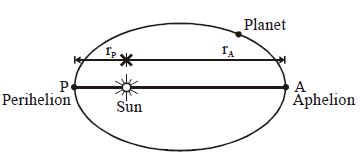
$A$ planet orbits the sun in an elliptical path as shown in the figure. Let $v_P$ and $v_A$ be the speed of the planet when at perihelion and aphelion respectively. Which of the following relations is correct?
A
$\frac{r_P}{r_A} = \frac{v_A}{v_P}$
B
$\frac{r_P}{r_A} = \frac{v_P}{v_A}$
C
$\frac{r_P}{r_A} = \sqrt{\frac{v_P}{v_A}}$
D
$\frac{r_P}{r_A} = \sqrt{\frac{v_A}{v_P}}$
Solution
(A) According to Kepler's second law,the angular momentum of the planet about the sun remains constant throughout its orbit.
The angular momentum $L$ is given by $L = mvr \sin(\theta)$. At perihelion $(P)$ and aphelion $(A)$,the velocity vector is perpendicular to the position vector,so $\theta = 90^\circ$ and $\sin(90^\circ) = 1$.
Thus,the angular momentum at perihelion is $L_P = m v_P r_P$ and at aphelion is $L_A = m v_A r_A$.
Since $L_P = L_A$,we have:
$m v_P r_P = m v_A r_A$
Dividing both sides by $m$ and rearranging the terms,we get:
$v_P r_P = v_A r_A$
$\frac{r_P}{r_A} = \frac{v_A}{v_P}$
The angular momentum $L$ is given by $L = mvr \sin(\theta)$. At perihelion $(P)$ and aphelion $(A)$,the velocity vector is perpendicular to the position vector,so $\theta = 90^\circ$ and $\sin(90^\circ) = 1$.
Thus,the angular momentum at perihelion is $L_P = m v_P r_P$ and at aphelion is $L_A = m v_A r_A$.
Since $L_P = L_A$,we have:
$m v_P r_P = m v_A r_A$
Dividing both sides by $m$ and rearranging the terms,we get:
$v_P r_P = v_A r_A$
$\frac{r_P}{r_A} = \frac{v_A}{v_P}$
0 likes
View Solution68
EasyMCQ
Which of the following orbits is a possible orbit for a planet?
A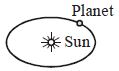
B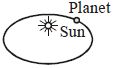
C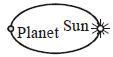
D
Solution
(D) According to Kepler's first law of planetary motion,all planets move in elliptical orbits with the Sun situated at one of the two foci of the ellipse.
In the given options,option $(D)$ shows the Sun located at one of the foci of the elliptical path,which is consistent with Kepler's law.
Therefore,option $(D)$ is the correct representation of a possible orbit for a planet.
In the given options,option $(D)$ shows the Sun located at one of the foci of the elliptical path,which is consistent with Kepler's law.
Therefore,option $(D)$ is the correct representation of a possible orbit for a planet.
0 likes
View Solution69
MediumMCQ
$A$ planet of mass $m$ is moving in an elliptical orbit about the sun with time period $T$. If $A$ is the area of the orbit,then its angular momentum is:
A
$\frac{2mA}{T}$
B
$mAT$
C
$\frac{mA}{2T}$
D
$2mAT$
Solution
(A) According to Kepler's second law of planetary motion,the areal velocity of a planet is constant.
The areal velocity is given by $\frac{dA}{dt} = \frac{L}{2m}$,where $L$ is the angular momentum and $m$ is the mass of the planet.
For one complete revolution,the planet covers the total area $A$ in time period $T$.
Therefore,the average areal velocity is $\frac{A}{T}$.
Equating the two expressions: $\frac{A}{T} = \frac{L}{2m}$.
Solving for $L$,we get $L = \frac{2mA}{T}$.
The areal velocity is given by $\frac{dA}{dt} = \frac{L}{2m}$,where $L$ is the angular momentum and $m$ is the mass of the planet.
For one complete revolution,the planet covers the total area $A$ in time period $T$.
Therefore,the average areal velocity is $\frac{A}{T}$.
Equating the two expressions: $\frac{A}{T} = \frac{L}{2m}$.
Solving for $L$,we get $L = \frac{2mA}{T}$.
0 likes
View Solution70
MediumMCQ
The time period of a satellite of Earth is $5\, h$. If the separation between the centre of the Earth and the satellite is increased to $4$ times the previous value,the new time period will become ....... $h$.
A
$10$
B
$80$
C
$40$
D
$20$
Solution
(C) According to Kepler's third law of planetary motion,the square of the time period $(T)$ is proportional to the cube of the semi-major axis $(r)$,i.e.,$T^2 \propto r^3$ or $T \propto r^{3/2}$.
Given the initial time period $T_1 = 5\, h$ and the initial separation $r_1 = r$.
The new separation is $r_2 = 4r$.
Using the ratio formula: $\frac{T_2}{T_1} = \left(\frac{r_2}{r_1}\right)^{3/2}$.
Substituting the values: $\frac{T_2}{5} = \left(\frac{4r}{r}\right)^{3/2}$.
$\frac{T_2}{5} = (4)^{3/2} = (2^2)^{3/2} = 2^3 = 8$.
Therefore,$T_2 = 5 \times 8 = 40\, h$.
Given the initial time period $T_1 = 5\, h$ and the initial separation $r_1 = r$.
The new separation is $r_2 = 4r$.
Using the ratio formula: $\frac{T_2}{T_1} = \left(\frac{r_2}{r_1}\right)^{3/2}$.
Substituting the values: $\frac{T_2}{5} = \left(\frac{4r}{r}\right)^{3/2}$.
$\frac{T_2}{5} = (4)^{3/2} = (2^2)^{3/2} = 2^3 = 8$.
Therefore,$T_2 = 5 \times 8 = 40\, h$.
0 likes
View Solution71
EasyMCQ
$Assertion$ : For the planets orbiting around the sun,angular speed,linear speed and $K.E.$ change with time,but angular momentum remains constant.
$Reason$ : No torque is acting on the rotating planet. So its angular momentum is constant.
$Reason$ : No torque is acting on the rotating planet. So its angular momentum is constant.
A
If both $Assertion$ and $Reason$ are correct and the $Reason$ is a correct explanation of the $Assertion$.
B
If both $Assertion$ and $Reason$ are correct but $Reason$ is not a correct explanation of the $Assertion$.
C
If the $Assertion$ is correct but $Reason$ is incorrect.
D
If both the $Assertion$ and $Reason$ are incorrect.
Solution
(A) The net torque acting on the planet orbiting the sun is zero because the gravitational force is a central force,i.e.,$\tau = 0$.
According to the principle of conservation of angular momentum,$\frac{dL}{dt} = \tau$.
Since $\tau = 0$,the angular momentum $L$ remains constant.
Thus,the $Reason$ statement is correct.
For a planet,$L = mvr = \text{constant}$. As the distance $r$ between the sun and the planet changes (elliptical orbit),the linear speed $v$ must change to keep $L$ constant. Consequently,the kinetic energy $K.E. = \frac{1}{2}mv^2$ also changes.
Similarly,$L = mr^2\omega = \text{constant}$. As $r$ changes,the angular speed $\omega$ must change.
Therefore,the $Assertion$ statement is correct,and the $Reason$ provides a correct explanation for it.
According to the principle of conservation of angular momentum,$\frac{dL}{dt} = \tau$.
Since $\tau = 0$,the angular momentum $L$ remains constant.
Thus,the $Reason$ statement is correct.
For a planet,$L = mvr = \text{constant}$. As the distance $r$ between the sun and the planet changes (elliptical orbit),the linear speed $v$ must change to keep $L$ constant. Consequently,the kinetic energy $K.E. = \frac{1}{2}mv^2$ also changes.
Similarly,$L = mr^2\omega = \text{constant}$. As $r$ changes,the angular speed $\omega$ must change.
Therefore,the $Assertion$ statement is correct,and the $Reason$ provides a correct explanation for it.
0 likes
View Solution72
DifficultMCQ
The distance of Neptune and Saturn from the Sun is nearly $10^{13} \ m$ and $10^{12} \ m$ respectively. Assuming that they move in circular orbits,their periodic times will be in the ratio:
A
$10$
B
$100$
C
$10\sqrt{10}$
D
$1000$
Solution
(C) According to Kepler's third law of planetary motion,the square of the time period $(T)$ is directly proportional to the cube of the semi-major axis $(R)$ of the orbit: $T^2 \propto R^3$.
Given:
Distance of Neptune,$R_1 = 10^{13} \ m$
Distance of Saturn,$R_2 = 10^{12} \ m$
Using the ratio formula:
$\frac{T_1^2}{T_2^2} = \left( \frac{R_1}{R_2} \right)^3$
Substitute the values:
$\frac{T_1^2}{T_2^2} = \left( \frac{10^{13}}{10^{12}} \right)^3 = (10)^3 = 1000$
Taking the square root on both sides:
$\frac{T_1}{T_2} = \sqrt{1000} = \sqrt{100 \times 10} = 10\sqrt{10}$
Given:
Distance of Neptune,$R_1 = 10^{13} \ m$
Distance of Saturn,$R_2 = 10^{12} \ m$
Using the ratio formula:
$\frac{T_1^2}{T_2^2} = \left( \frac{R_1}{R_2} \right)^3$
Substitute the values:
$\frac{T_1^2}{T_2^2} = \left( \frac{10^{13}}{10^{12}} \right)^3 = (10)^3 = 1000$
Taking the square root on both sides:
$\frac{T_1}{T_2} = \sqrt{1000} = \sqrt{100 \times 10} = 10\sqrt{10}$
0 likes
View Solution73
MediumMCQ
The time period of a geostationary satellite is $24 \; h$,at a height $6 R_{E}$ ($R_{E}$ is the radius of the Earth) from the surface of the Earth. The time period of another satellite whose height is $2.5 R_{E}$ from the surface will be:
A
$6 \sqrt{2} \; h$
B
$12 \sqrt{2} \; h$
C
$\frac{24}{2.5} \; h$
D
$\frac{12}{25} \; h$
Solution
(A) According to Kepler's Third Law of planetary motion,the square of the time period $(T)$ is proportional to the cube of the orbital radius $(r)$: $T^2 \propto r^3$ or $T \propto r^{3/2}$.
The orbital radius $r$ is the distance from the center of the Earth,given by $r = R_{E} + h$,where $h$ is the height above the surface.
For the first satellite: $r_1 = R_{E} + 6 R_{E} = 7 R_{E}$ and $T_1 = 24 \; h$.
For the second satellite: $r_2 = R_{E} + 2.5 R_{E} = 3.5 R_{E}$.
Using the ratio: $\frac{T_2}{T_1} = \left( \frac{r_2}{r_1} \right)^{3/2} = \left( \frac{3.5 R_{E}}{7 R_{E}} \right)^{3/2} = \left( \frac{1}{2} \right)^{3/2} = \frac{1}{2 \sqrt{2}}$.
Therefore,$T_2 = T_1 \times \frac{1}{2 \sqrt{2}} = \frac{24}{2 \sqrt{2}} = \frac{12}{\sqrt{2}} = 6 \sqrt{2} \; h$.
The orbital radius $r$ is the distance from the center of the Earth,given by $r = R_{E} + h$,where $h$ is the height above the surface.
For the first satellite: $r_1 = R_{E} + 6 R_{E} = 7 R_{E}$ and $T_1 = 24 \; h$.
For the second satellite: $r_2 = R_{E} + 2.5 R_{E} = 3.5 R_{E}$.
Using the ratio: $\frac{T_2}{T_1} = \left( \frac{r_2}{r_1} \right)^{3/2} = \left( \frac{3.5 R_{E}}{7 R_{E}} \right)^{3/2} = \left( \frac{1}{2} \right)^{3/2} = \frac{1}{2 \sqrt{2}}$.
Therefore,$T_2 = T_1 \times \frac{1}{2 \sqrt{2}} = \frac{24}{2 \sqrt{2}} = \frac{12}{\sqrt{2}} = 6 \sqrt{2} \; h$.
0 likes
View Solution74
Easy
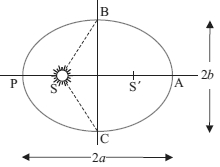
Let the speed of the planet at the perihelion $P$ in the figure be $v_{P}$ and the Sun-planet distance $SP$ be $r_{P}$. Relate $\{r_{P}, v_{P}\}$ to the corresponding quantities at the aphelion $\{r_{A}, v_{A}\}$. Will the planet take equal times to traverse $BAC$ and $CPB$?
Solution
(N/A) The magnitude of the angular momentum at $P$ is $L_{P} = m_{p} r_{P} v_{P}$,since $r_{P}$ and $v_{P}$ are mutually perpendicular. Similarly,$L_{A} = m_{p} r_{A} v_{A}$.
From the conservation of angular momentum,we have:
$m_{p} r_{P} v_{P} = m_{p} r_{A} v_{A}$
$\frac{v_{P}}{v_{A}} = \frac{r_{A}}{r_{P}}$
Since $r_{A} > r_{P}$,it follows that $v_{P} > v_{A}$.
Regarding the time taken,according to Kepler's Second Law,the radius vector sweeps out equal areas in equal times. The area of the sector $SBC$ is not equal to the area of the sector $SCPB$ (or $SAB$). Specifically,the area swept by the planet in traversing $BAC$ is different from the area swept in traversing $CPB$. Therefore,the planet will not take equal times to traverse $BAC$ and $CPB$.
From the conservation of angular momentum,we have:
$m_{p} r_{P} v_{P} = m_{p} r_{A} v_{A}$
$\frac{v_{P}}{v_{A}} = \frac{r_{A}}{r_{P}}$
Since $r_{A} > r_{P}$,it follows that $v_{P} > v_{A}$.
Regarding the time taken,according to Kepler's Second Law,the radius vector sweeps out equal areas in equal times. The area of the sector $SBC$ is not equal to the area of the sector $SCPB$ (or $SAB$). Specifically,the area swept by the planet in traversing $BAC$ is different from the area swept in traversing $CPB$. Therefore,the planet will not take equal times to traverse $BAC$ and $CPB$.
0 likes
View Solution75
MediumMCQ
Suppose there existed a planet that went around the sun twice as fast as the earth. What would be its orbital size as compared to that of the earth?
A
more by a factor of $2.67$
B
more by a factor of $1.24$
C
Lesser by a factor of $0.63$
D
Lesser by a factor of $0.33$
Solution
(C) Time taken by the Earth to complete one revolution around the Sun,$T_{e} = 1 \text{ year}$.
Orbital radius of the Earth,$R_{e} = 1 \text{ AU}$.
Given that the planet goes around the Sun twice as fast as the Earth,its orbital period $T_{p}$ is half that of the Earth:
$T_{p} = \frac{1}{2} T_{e} = 0.5 \text{ year}$.
According to Kepler's third law of planetary motion,the square of the orbital period is proportional to the cube of the semi-major axis (orbital radius):
$\left(\frac{R_{p}}{R_{e}}\right)^{3} = \left(\frac{T_{p}}{T_{e}}\right)^{2}$.
Substituting the values:
$\frac{R_{p}}{R_{e}} = \left(\frac{T_{p}}{T_{e}}\right)^{2/3} = \left(\frac{0.5}{1}\right)^{2/3} = (0.5)^{0.666} \approx 0.63$.
Thus,the orbital size of the planet is lesser by a factor of $0.63$ compared to that of the Earth.
Orbital radius of the Earth,$R_{e} = 1 \text{ AU}$.
Given that the planet goes around the Sun twice as fast as the Earth,its orbital period $T_{p}$ is half that of the Earth:
$T_{p} = \frac{1}{2} T_{e} = 0.5 \text{ year}$.
According to Kepler's third law of planetary motion,the square of the orbital period is proportional to the cube of the semi-major axis (orbital radius):
$\left(\frac{R_{p}}{R_{e}}\right)^{3} = \left(\frac{T_{p}}{T_{e}}\right)^{2}$.
Substituting the values:
$\frac{R_{p}}{R_{e}} = \left(\frac{T_{p}}{T_{e}}\right)^{2/3} = \left(\frac{0.5}{1}\right)^{2/3} = (0.5)^{0.666} \approx 0.63$.
Thus,the orbital size of the planet is lesser by a factor of $0.63$ compared to that of the Earth.
0 likes
View Solution76
Medium
Io, one of the satellites of Jupiter, has an orbital period of $1.769$ days and the radius of the orbit is $4.22 \times 10^{8} \; m$. Show that the mass of Jupiter is about one-thousandth that of the Sun.
Solution
(N/A) The orbital period of $Io$, $T_{Io} = 1.769 \; \text{days} = 1.769 \times 24 \times 3600 \; s$.
The orbital radius of $Io$, $R_{Io} = 4.22 \times 10^{8} \; m$.
The mass of Jupiter $(M_J)$ is given by Kepler's third law: $M_J = \frac{4 \pi^{2} R_{Io}^{3}}{G T_{Io}^{2}} \quad ... (i)$.
Similarly, for the Earth orbiting the Sun, the mass of the Sun $(M_S)$ is: $M_S = \frac{4 \pi^{2} R_e^{3}}{G T_e^{2}} \quad ... (ii)$, where $R_e = 1.496 \times 10^{11} \; m$ and $T_e = 365.25 \; \text{days}$.
Dividing equation $(ii)$ by $(i)$: $\frac{M_S}{M_J} = \left( \frac{R_e}{R_{Io}} \right)^{3} \times \left( \frac{T_{Io}}{T_e} \right)^{2}$.
Substituting the values: $\frac{M_S}{M_J} = \left( \frac{1.496 \times 10^{11}}{4.22 \times 10^{8}} \right)^{3} \times \left( \frac{1.769}{365.25} \right)^{2}$.
Calculating the ratio: $\frac{M_S}{M_J} \approx (354.5)^{3} \times (0.00484)^{2} \approx 44558000 \times 0.0000234 \approx 1045$.
Thus, $\frac{M_S}{M_J} \approx 1000$, which implies $M_J \approx \frac{M_S}{1000}$.
Hence, the mass of Jupiter is about one-thousandth that of the Sun.
The orbital radius of $Io$, $R_{Io} = 4.22 \times 10^{8} \; m$.
The mass of Jupiter $(M_J)$ is given by Kepler's third law: $M_J = \frac{4 \pi^{2} R_{Io}^{3}}{G T_{Io}^{2}} \quad ... (i)$.
Similarly, for the Earth orbiting the Sun, the mass of the Sun $(M_S)$ is: $M_S = \frac{4 \pi^{2} R_e^{3}}{G T_e^{2}} \quad ... (ii)$, where $R_e = 1.496 \times 10^{11} \; m$ and $T_e = 365.25 \; \text{days}$.
Dividing equation $(ii)$ by $(i)$: $\frac{M_S}{M_J} = \left( \frac{R_e}{R_{Io}} \right)^{3} \times \left( \frac{T_{Io}}{T_e} \right)^{2}$.
Substituting the values: $\frac{M_S}{M_J} = \left( \frac{1.496 \times 10^{11}}{4.22 \times 10^{8}} \right)^{3} \times \left( \frac{1.769}{365.25} \right)^{2}$.
Calculating the ratio: $\frac{M_S}{M_J} \approx (354.5)^{3} \times (0.00484)^{2} \approx 44558000 \times 0.0000234 \approx 1045$.
Thus, $\frac{M_S}{M_J} \approx 1000$, which implies $M_J \approx \frac{M_S}{1000}$.
Hence, the mass of Jupiter is about one-thousandth that of the Sun.
0 likes
View Solution77
Medium
How will you 'weigh the sun',that is estimate its mass? The mean orbital radius of the earth around the sun is $1.5 \times 10^{8} \text{ km}$.
Solution
(N/A) The mass of the Sun can be estimated using Kepler's Third Law of planetary motion and the law of universal gravitation.
Given:
Orbital radius of the Earth,$r = 1.5 \times 10^{11} \text{ m}$.
Time period of Earth's revolution,$T = 1 \text{ year} = 365.25 \times 24 \times 60 \times 60 \text{ s} \approx 3.156 \times 10^{7} \text{ s}$.
Gravitational constant,$G = 6.67 \times 10^{-11} \text{ Nm}^2\text{kg}^{-2}$.
The centripetal force required for Earth's orbit is provided by the gravitational force between the Sun and the Earth:
$\frac{M_s m_e}{r^2} = m_e \omega^2 r = m_e \left(\frac{2\pi}{T}\right)^2 r$
Rearranging to solve for the mass of the Sun $(M_s)$:
$M_s = \frac{4 \pi^2 r^3}{G T^2}$
Substituting the values:
$M_s = \frac{4 \times (3.14)^2 \times (1.5 \times 10^{11})^3}{6.67 \times 10^{-11} \times (3.156 \times 10^7)^2}$
$M_s \approx \frac{39.48 \times 3.375 \times 10^{33}}{6.67 \times 10^{-11} \times 9.96 \times 10^{14}}$
$M_s \approx 2.0 \times 10^{30} \text{ kg}$.
Thus,the estimated mass of the Sun is $2.0 \times 10^{30} \text{ kg}$.
Given:
Orbital radius of the Earth,$r = 1.5 \times 10^{11} \text{ m}$.
Time period of Earth's revolution,$T = 1 \text{ year} = 365.25 \times 24 \times 60 \times 60 \text{ s} \approx 3.156 \times 10^{7} \text{ s}$.
Gravitational constant,$G = 6.67 \times 10^{-11} \text{ Nm}^2\text{kg}^{-2}$.
The centripetal force required for Earth's orbit is provided by the gravitational force between the Sun and the Earth:
$\frac{M_s m_e}{r^2} = m_e \omega^2 r = m_e \left(\frac{2\pi}{T}\right)^2 r$
Rearranging to solve for the mass of the Sun $(M_s)$:
$M_s = \frac{4 \pi^2 r^3}{G T^2}$
Substituting the values:
$M_s = \frac{4 \times (3.14)^2 \times (1.5 \times 10^{11})^3}{6.67 \times 10^{-11} \times (3.156 \times 10^7)^2}$
$M_s \approx \frac{39.48 \times 3.375 \times 10^{33}}{6.67 \times 10^{-11} \times 9.96 \times 10^{14}}$
$M_s \approx 2.0 \times 10^{30} \text{ kg}$.
Thus,the estimated mass of the Sun is $2.0 \times 10^{30} \text{ kg}$.
0 likes
View Solution78
MediumMCQ
$A$ Saturn year is $29.5$ times the Earth year. How far is Saturn from the Sun if the Earth is $1.50 \times 10^{8} \; km$ away from the Sun?
A
$2.82 \times 10^{14} \; m$
B
$1.43 \times 10^{12} \; m$
C
$4.38 \times 10^{16} \; m$
D
$6.25 \times 10^{10} \; m$
Solution
(B) Distance of the Earth from the Sun,$r_{e} = 1.5 \times 10^{8} \; km = 1.5 \times 10^{11} \; m$.
Time period of the Earth $= T_{e}$.
Time period of Saturn,$T_{s} = 29.5 \; T_{e}$.
Distance of Saturn from the Sun $= r_{s}$.
From Kepler's third law of planetary motion,$T^{2} \propto r^{3}$,so $\frac{r_{s}^{3}}{r_{e}^{3}} = \frac{T_{s}^{2}}{T_{e}^{2}}$.
$r_{s} = r_{e} \left(\frac{T_{s}}{T_{e}}\right)^{2/3}$.
$r_{s} = 1.5 \times 10^{11} \times (29.5)^{2/3}$.
$(29.5)^{2/3} \approx 9.545$.
$r_{s} = 1.5 \times 10^{11} \times 9.545 = 14.3175 \times 10^{11} \; m = 1.43 \times 10^{12} \; m$.
Time period of the Earth $= T_{e}$.
Time period of Saturn,$T_{s} = 29.5 \; T_{e}$.
Distance of Saturn from the Sun $= r_{s}$.
From Kepler's third law of planetary motion,$T^{2} \propto r^{3}$,so $\frac{r_{s}^{3}}{r_{e}^{3}} = \frac{T_{s}^{2}}{T_{e}^{2}}$.
$r_{s} = r_{e} \left(\frac{T_{s}}{T_{e}}\right)^{2/3}$.
$r_{s} = 1.5 \times 10^{11} \times (29.5)^{2/3}$.
$(29.5)^{2/3} \approx 9.545$.
$r_{s} = 1.5 \times 10^{11} \times 9.545 = 14.3175 \times 10^{11} \; m = 1.43 \times 10^{12} \; m$.
0 likes
View Solution79
Easy
Describe the model and theory of planetary motions presented in the earliest of times.
Solution
(A) The earliest recorded model for planetary motions,proposed by Ptolemy about $2000$ years ago,was a 'geocentric' model in which all celestial objects,including stars,the sun,and the planets,revolved around the earth.
$A$ more elegant model,the 'heliocentric' model,in which the sun was the center around which the planets revolved,was mentioned by the Indian sage and scientist Shri Aryabhatta in his treatise. $A$ thousand years later,Nicholas Copernicus proposed a model in which the planets moved in circles around a fixed central sun. His theory was initially opposed by the church but was supported by the observations of Galileo.
Following Galileo,Tycho Brahe recorded detailed observations of the planets with the naked eye. His compiled data were later analyzed by Johannes Kepler,who formulated three laws of planetary motion. These laws were known to Newton and enabled him to make a great scientific leap in proposing his universal law of gravitation.
$A$ more elegant model,the 'heliocentric' model,in which the sun was the center around which the planets revolved,was mentioned by the Indian sage and scientist Shri Aryabhatta in his treatise. $A$ thousand years later,Nicholas Copernicus proposed a model in which the planets moved in circles around a fixed central sun. His theory was initially opposed by the church but was supported by the observations of Galileo.
Following Galileo,Tycho Brahe recorded detailed observations of the planets with the naked eye. His compiled data were later analyzed by Johannes Kepler,who formulated three laws of planetary motion. These laws were known to Newton and enabled him to make a great scientific leap in proposing his universal law of gravitation.
0 likes
View Solution80
Easy
Describe the Nicolaus Copernicus model for planetary motion.
Solution
(N/A) Nicolaus Copernicus proposed the heliocentric model of the solar system in the $16^{th}$ century. The key features of his model are:
$1$. The Sun is at the center of the solar system,and all planets,including the Earth,revolve around it in circular orbits.
$2$. The Earth is not stationary; it rotates on its own axis once every $24$ hours,which explains the apparent daily motion of the stars.
$3$. The Earth also revolves around the Sun once every year.
$4$. The apparent retrograde motion of planets (where they seem to move backward in the sky) is explained as a natural consequence of the Earth overtaking slower-moving outer planets in their orbits.
$1$. The Sun is at the center of the solar system,and all planets,including the Earth,revolve around it in circular orbits.
$2$. The Earth is not stationary; it rotates on its own axis once every $24$ hours,which explains the apparent daily motion of the stars.
$3$. The Earth also revolves around the Sun once every year.
$4$. The apparent retrograde motion of planets (where they seem to move backward in the sky) is explained as a natural consequence of the Earth overtaking slower-moving outer planets in their orbits.
1 likes
View Solution81
Easy
Give the contribution of Tycho Brahe on planetary motion.
Solution
(N/A) Tycho Brahe $(1546-1601)$ was a Danish astronomer known for his incredibly accurate and comprehensive astronomical observations of the positions of stars and planets.
His primary contribution was the collection of a vast amount of precise observational data regarding the motion of planets,particularly Mars,over many years.
Although he did not formulate the laws of planetary motion himself,his meticulous data provided the essential empirical foundation for Johannes Kepler.
Kepler used Brahe's data to derive his three laws of planetary motion,which eventually paved the way for Isaac Newton to formulate the law of universal gravitation.
His primary contribution was the collection of a vast amount of precise observational data regarding the motion of planets,particularly Mars,over many years.
Although he did not formulate the laws of planetary motion himself,his meticulous data provided the essential empirical foundation for Johannes Kepler.
Kepler used Brahe's data to derive his three laws of planetary motion,which eventually paved the way for Isaac Newton to formulate the law of universal gravitation.
0 likes
View Solution82
MediumMCQ
For proposing the universal law of gravitation,which laws were taken for help?
A
Kepler's laws of planetary motion
B
Newton's laws of motion
C
Coulomb's law
D
Faraday's law
Solution
(A) Isaac Newton formulated the universal law of gravitation by utilizing $Kepler's$ laws of planetary motion. Specifically,he used $Kepler's$ third law,which states that the square of the orbital period $T$ of a planet is directly proportional to the cube of the semi-major axis $r$ of its orbit $(T^2 \propto r^3)$. By combining this with the concept of centripetal force $(F = mv^2/r)$,he deduced that the gravitational force between two bodies is inversely proportional to the square of the distance between them $(F \propto 1/r^2)$.
0 likes
View Solution83
Easy
Explain Kepler's first law (Law of Orbits) for planetary motion.
Solution
(N/A) Law of Orbits:
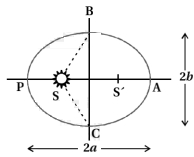
All planets move in elliptical orbits with the Sun situated at one of the foci of the ellipse.
An ellipse is traced out by a planet around the Sun. The closest point is $P$ and the farthest point is $A$. $P$ is called the perihelion and $A$ is called the aphelion. The semi-major axis is half the distance $AP$ (denoted as $a$).
This law was a deviation from the Copernican model,which allowed only circular orbits. (The ellipse,of which the circle is a special case,is a closed curve).
All planets move in elliptical orbits with the Sun situated at one of the foci of the ellipse.
An ellipse is traced out by a planet around the Sun. The closest point is $P$ and the farthest point is $A$. $P$ is called the perihelion and $A$ is called the aphelion. The semi-major axis is half the distance $AP$ (denoted as $a$).
This law was a deviation from the Copernican model,which allowed only circular orbits. (The ellipse,of which the circle is a special case,is a closed curve).
0 likes
View Solution84
Medium
State and prove Kepler's second law (Law of Areas) of planetary motion.
Solution
(N/A) Kepler's second law states: "The line that joins any planet to the sun sweeps out equal areas in equal intervals of time."
Proof:
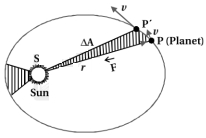
Consider a planet $P$ moving around the sun $S$ in an elliptical orbit. Let $\vec{r}$ be the position vector of the planet with respect to the sun. In a small time interval $\Delta t$, the planet moves from $P$ to $P^{\prime}$, covering a displacement $\Delta \vec{r} = \vec{v} \Delta t$.
The area $\Delta A$ swept out by the position vector in time $\Delta t$ is given by the area of the triangle $SPP^{\prime}$:
$\Delta A = \frac{1}{2} |\vec{r} \times \Delta \vec{r}| = \frac{1}{2} |\vec{r} \times (\vec{v} \Delta t)| = \frac{1}{2} |\vec{r} \times \vec{v}| \Delta t$
Dividing by $\Delta t$, we get the areal velocity:
$\frac{dA}{dt} = \frac{1}{2} |\vec{r} \times \vec{v}|$
Since the gravitational force exerted by the sun on the planet is a central force, it acts along the line joining the sun and the planet. Thus, the torque $\vec{\tau} = \vec{r} \times \vec{F} = 0$.
Because the torque is zero, the angular momentum $\vec{L} = \vec{r} \times \vec{p} = \vec{r} \times (m\vec{v}) = m(\vec{r} \times \vec{v})$ is conserved.
Substituting $\vec{r} \times \vec{v} = \frac{\vec{L}}{m}$ into the areal velocity equation:
$\frac{dA}{dt} = \frac{1}{2} |\frac{\vec{L}}{m}| = \frac{L}{2m}$
Since $L$ and $m$ are constants, $\frac{dA}{dt}$ is constant. This proves that the planet sweeps out equal areas in equal intervals of time.
Proof:
Consider a planet $P$ moving around the sun $S$ in an elliptical orbit. Let $\vec{r}$ be the position vector of the planet with respect to the sun. In a small time interval $\Delta t$, the planet moves from $P$ to $P^{\prime}$, covering a displacement $\Delta \vec{r} = \vec{v} \Delta t$.
The area $\Delta A$ swept out by the position vector in time $\Delta t$ is given by the area of the triangle $SPP^{\prime}$:
$\Delta A = \frac{1}{2} |\vec{r} \times \Delta \vec{r}| = \frac{1}{2} |\vec{r} \times (\vec{v} \Delta t)| = \frac{1}{2} |\vec{r} \times \vec{v}| \Delta t$
Dividing by $\Delta t$, we get the areal velocity:
$\frac{dA}{dt} = \frac{1}{2} |\vec{r} \times \vec{v}|$
Since the gravitational force exerted by the sun on the planet is a central force, it acts along the line joining the sun and the planet. Thus, the torque $\vec{\tau} = \vec{r} \times \vec{F} = 0$.
Because the torque is zero, the angular momentum $\vec{L} = \vec{r} \times \vec{p} = \vec{r} \times (m\vec{v}) = m(\vec{r} \times \vec{v})$ is conserved.
Substituting $\vec{r} \times \vec{v} = \frac{\vec{L}}{m}$ into the areal velocity equation:
$\frac{dA}{dt} = \frac{1}{2} |\frac{\vec{L}}{m}| = \frac{L}{2m}$
Since $L$ and $m$ are constants, $\frac{dA}{dt}$ is constant. This proves that the planet sweeps out equal areas in equal intervals of time.
0 likes
View Solution85
Easy
State Kepler's law of periods (Kepler's third law) for planetary motion.
Solution
(N/A) Kepler's third law,also known as the law of periods,states that the square of the time period of revolution $(T)$ of a planet is directly proportional to the cube of the semi-major axis $(a)$ of the elliptical orbit traced out by the planet.
$T^{2} \propto a^{3}$
This can be written as:
$T^{2} = K a^{3}$
where $K$ is a constant for all planets orbiting the same star.
Defining $Q = \frac{T^{2}}{a^{3}}$,where $a$ is the semi-major axis in units of $10^{10} \ m$ and $T$ is the period of revolution in years $(y)$,the value of $Q$ remains approximately constant $(Q \approx 2.98 \times 10^{-34} \ y^{2} \ m^{-3})$.
$T^{2} \propto a^{3}$
This can be written as:
$T^{2} = K a^{3}$
where $K$ is a constant for all planets orbiting the same star.
Defining $Q = \frac{T^{2}}{a^{3}}$,where $a$ is the semi-major axis in units of $10^{10} \ m$ and $T$ is the period of revolution in years $(y)$,the value of $Q$ remains approximately constant $(Q \approx 2.98 \times 10^{-34} \ y^{2} \ m^{-3})$.
| Planet | $a$ $(10^{10} \ m)$ | $T$ $(y)$ | $Q$ $(10^{-34} \ y^{2} \ m^{-3})$ |
| Mercury | $5.79$ | $0.24$ | $2.95$ |
| Venus | $10.8$ | $0.615$ | $3.00$ |
| Earth | $15.0$ | $1$ | $2.96$ |
| Mars | $22.8$ | $1.88$ | $2.98$ |
| Jupiter | $77.8$ | $11.9$ | $3.01$ |
| Saturn | $143$ | $29.5$ | $2.98$ |
| Uranus | $287$ | $84$ | $2.98$ |
| Neptune | $450$ | $165$ | $2.99$ |
| Pluto | $590$ | $248$ | $2.99$ |
0 likes
View Solution86
EasyMCQ
Does the speed of a planet remain constant in its orbit?
A
Yes
B
No
C
Only for circular orbits
D
Only for elliptical orbits
Solution
(B) According to Kepler's Second Law,a planet sweeps out equal areas in equal intervals of time.
For a planet in an elliptical orbit,the distance $r$ from the Sun changes continuously.
Since the angular momentum $L = mvr \sin(\theta)$ is conserved,the speed $v$ must change as $r$ changes.
Specifically,the planet moves faster when it is closer to the Sun (perihelion) and slower when it is farther away (aphelion).
Therefore,the speed of a planet is not constant in an elliptical orbit.
For a planet in an elliptical orbit,the distance $r$ from the Sun changes continuously.
Since the angular momentum $L = mvr \sin(\theta)$ is conserved,the speed $v$ must change as $r$ changes.
Specifically,the planet moves faster when it is closer to the Sun (perihelion) and slower when it is farther away (aphelion).
Therefore,the speed of a planet is not constant in an elliptical orbit.
0 likes
View Solution87
EasyMCQ
The distances of two planets from the Sun are $10^{11} \ m$ and $10^{10} \ m$ respectively. Find the ratio of their orbital periods.
A
$10\sqrt{10}$
B
$\sqrt{10}$
C
$100\sqrt{10}$
D
$10$
Solution
(A) According to Kepler's third law of planetary motion,the square of the orbital period $T$ is proportional to the cube of the semi-major axis $R$ of the orbit,i.e.,$T^2 \propto R^3$.
Therefore,the ratio of the orbital periods is given by $\frac{T_1}{T_2} = \left(\frac{R_1}{R_2}\right)^{3/2}$.
Given $R_1 = 10^{11} \ m$ and $R_2 = 10^{10} \ m$.
Substituting the values: $\frac{T_1}{T_2} = \left(\frac{10^{11}}{10^{10}}\right)^{3/2} = (10)^{3/2}$.
This simplifies to $10^1 \times 10^{1/2} = 10\sqrt{10}$.
Therefore,the ratio of the orbital periods is given by $\frac{T_1}{T_2} = \left(\frac{R_1}{R_2}\right)^{3/2}$.
Given $R_1 = 10^{11} \ m$ and $R_2 = 10^{10} \ m$.
Substituting the values: $\frac{T_1}{T_2} = \left(\frac{10^{11}}{10^{10}}\right)^{3/2} = (10)^{3/2}$.
This simplifies to $10^1 \times 10^{1/2} = 10\sqrt{10}$.
0 likes
View Solution88
MediumMCQ
If the orbital period of a satellite becomes $8$ times, then by how many times does its orbital radius increase (in $times$)?
A
$2$
B
$4$
C
$8$
D
$16$
Solution
(B) According to Kepler's Third Law of Planetary Motion, the square of the orbital period $T$ is directly proportional to the cube of the semi-major axis (orbital radius) $r$ of the orbit.
$T^2 \propto r^3$
This implies $T \propto r^{3/2}$ or $r \propto T^{2/3}$.
Given that the new orbital period $T' = 8T$.
Substituting this into the proportionality:
$r' / r = (T' / T)^{2/3}$
$r' / r = (8T / T)^{2/3} = (8)^{2/3}$
$r' / r = (2^3)^{2/3} = 2^2 = 4$.
Therefore, the orbital radius becomes $4$ times the original radius.
$T^2 \propto r^3$
This implies $T \propto r^{3/2}$ or $r \propto T^{2/3}$.
Given that the new orbital period $T' = 8T$.
Substituting this into the proportionality:
$r' / r = (T' / T)^{2/3}$
$r' / r = (8T / T)^{2/3} = (8)^{2/3}$
$r' / r = (2^3)^{2/3} = 2^2 = 4$.
Therefore, the orbital radius becomes $4$ times the original radius.
0 likes
View Solution89
Easy
Draw the areal velocity versus time graph for Mars.
Solution
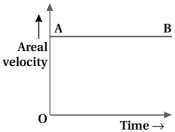
(N/A) According to Kepler's second law of planetary motion,the areal velocity (the rate at which the radius vector sweeps out area) of a planet revolving around the Sun is constant.
Since the areal velocity does not change with time,the graph of areal velocity versus time is a straight horizontal line parallel to the time axis,as shown in the figure.
Since the areal velocity does not change with time,the graph of areal velocity versus time is a straight horizontal line parallel to the time axis,as shown in the figure.
0 likes
View Solution90
EasyMCQ
What is the direction of areal velocity of the earth around the sun?
A
Along the radius vector
B
Along the velocity vector
C
Perpendicular to the plane of the orbit
D
Along the tangent to the orbit
Solution
(C) Areal velocity is defined as $\frac{dA}{dt} = \frac{L}{2m}$.
Since angular momentum $L = r \times p = r \times (mv)$,we have $\frac{dA}{dt} = \frac{r \times mv}{2m} = \frac{1}{2}(r \times v)$.
The direction of the areal velocity vector is the same as the direction of the angular momentum vector $L$.
According to the right-hand rule for the cross product $(r \times v)$,the direction of $L$ is perpendicular to the plane containing the position vector $r$ and the velocity vector $v$.
Therefore,the direction of the areal velocity is perpendicular to the plane of the earth's orbit around the sun.
Since angular momentum $L = r \times p = r \times (mv)$,we have $\frac{dA}{dt} = \frac{r \times mv}{2m} = \frac{1}{2}(r \times v)$.
The direction of the areal velocity vector is the same as the direction of the angular momentum vector $L$.
According to the right-hand rule for the cross product $(r \times v)$,the direction of $L$ is perpendicular to the plane containing the position vector $r$ and the velocity vector $v$.
Therefore,the direction of the areal velocity is perpendicular to the plane of the earth's orbit around the sun.
0 likes
View Solution91
Difficult
Out of aphelion and perihelion,where is the speed of the earth more and why?
Solution
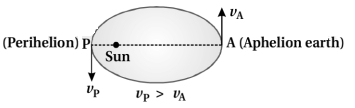
(N/A) Aphelion is the position of the earth where it is at the maximum distance from the sun,while perihelion is the position where it is at the minimum distance from the sun.
According to Kepler's second law of planetary motion,the areal velocity of a planet remains constant. This implies that the angular momentum of the planet is conserved.
The angular momentum $L$ is given by $L = mvr \sin(\theta)$. At perihelion and aphelion,the velocity vector is perpendicular to the radius vector,so $\theta = 90^{\circ}$ and $\sin(90^{\circ}) = 1$.
Thus,$L = mvr$,which means $v \propto 1/r$.
Since the distance $r$ is minimum at perihelion,the speed $v$ of the earth is maximum at perihelion compared to aphelion.
According to Kepler's second law of planetary motion,the areal velocity of a planet remains constant. This implies that the angular momentum of the planet is conserved.
The angular momentum $L$ is given by $L = mvr \sin(\theta)$. At perihelion and aphelion,the velocity vector is perpendicular to the radius vector,so $\theta = 90^{\circ}$ and $\sin(90^{\circ}) = 1$.
Thus,$L = mvr$,which means $v \propto 1/r$.
Since the distance $r$ is minimum at perihelion,the speed $v$ of the earth is maximum at perihelion compared to aphelion.
0 likes
View Solution92
Difficult
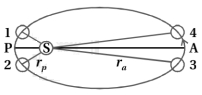
Earth's orbit is an ellipse with eccentricity $e = 0.0167$. Thus,the Earth's distance from the Sun and its speed as it moves around the Sun vary from day to day. This means that the length of the solar day is not constant throughout the year. Assume that the Earth's spin axis is normal to its orbital plane and find the length of the shortest and the longest day. $A$ day should be taken from noon to noon. Does this explain the variation in the length of the day during the year?
Solution
(N/A) Let $m$ be the mass of the Earth.
Let $\omega_p$ and $\omega_a$ be the angular velocities of the Earth around the Sun at perihelion and aphelion,respectively.
According to Kepler's second law,the areal velocity is constant,which implies $r_p^2 \omega_p = r_a^2 \omega_a$.
Given $r_p = a(1-e)$ and $r_a = a(1+e)$,we have $\frac{\omega_p}{\omega_a} = \left(\frac{1+e}{1-e}\right)^2$.
Substituting $e = 0.0167$,we get $\frac{\omega_p}{\omega_a} = \left(\frac{1.0167}{0.9833}\right)^2 \approx 1.0691$.
Let $\omega$ be the average angular velocity corresponding to the mean solar day. Then $\omega^2 = \omega_p \omega_a$.
Thus,$\frac{\omega_p}{\omega} = \frac{\omega}{\omega_a} = \sqrt{1.0691} \approx 1.034$.
In one day,the Earth rotates $360^\circ$ relative to the stars,plus the angle $\theta$ it moves in its orbit. The solar day is $T = \frac{360^\circ + \theta}{\omega_{spin}}$.
Since $\theta \propto \omega_{orbit}$,the variation in the solar day is $\Delta T \approx T_{mean} \times \frac{\Delta \omega}{\omega_{spin}}$.
Calculating the extremes,the variation is approximately $\pm 8 \text{ s}$.
This calculation shows that the variation due to orbital eccentricity is small and does not fully explain the observed variations in the length of the day,which are also significantly affected by the tilt of the Earth's axis (obliquity).
Let $\omega_p$ and $\omega_a$ be the angular velocities of the Earth around the Sun at perihelion and aphelion,respectively.
According to Kepler's second law,the areal velocity is constant,which implies $r_p^2 \omega_p = r_a^2 \omega_a$.
Given $r_p = a(1-e)$ and $r_a = a(1+e)$,we have $\frac{\omega_p}{\omega_a} = \left(\frac{1+e}{1-e}\right)^2$.
Substituting $e = 0.0167$,we get $\frac{\omega_p}{\omega_a} = \left(\frac{1.0167}{0.9833}\right)^2 \approx 1.0691$.
Let $\omega$ be the average angular velocity corresponding to the mean solar day. Then $\omega^2 = \omega_p \omega_a$.
Thus,$\frac{\omega_p}{\omega} = \frac{\omega}{\omega_a} = \sqrt{1.0691} \approx 1.034$.
In one day,the Earth rotates $360^\circ$ relative to the stars,plus the angle $\theta$ it moves in its orbit. The solar day is $T = \frac{360^\circ + \theta}{\omega_{spin}}$.
Since $\theta \propto \omega_{orbit}$,the variation in the solar day is $\Delta T \approx T_{mean} \times \frac{\Delta \omega}{\omega_{spin}}$.
Calculating the extremes,the variation is approximately $\pm 8 \text{ s}$.
This calculation shows that the variation due to orbital eccentricity is small and does not fully explain the observed variations in the length of the day,which are also significantly affected by the tilt of the Earth's axis (obliquity).
0 likes
View Solution93
MediumMCQ
Match Column-$I$ with Column-$II$.
| Column-$I$ | Column-$II$ |
| $(1)$ Kepler's first law | $(a)$ Law of periods |
| $(2)$ Kepler's second law | $(b)$ Law of orbits |
| $(3)$ Kepler's third law | $(c)$ Law of areas |
A
$(1-a), (2-c), (3-b)$
B
$(1-b), (2-c), (3-a)$
C
$(1-c), (2-b), (3-a)$
D
$(1-c), (2-a), (3-b)$
Solution
(B) Kepler's laws of planetary motion are defined as follows:
$(1)$ Kepler's first law is the Law of orbits,which states that all planets move in elliptical orbits with the Sun at one of the foci.
$(2)$ Kepler's second law is the Law of areas,which states that a line joining any planet to the Sun sweeps out equal areas in equal intervals of time.
$(3)$ Kepler's third law is the Law of periods,which states that the square of the time period of revolution of a planet is proportional to the cube of the semi-major axis of its orbit.
Therefore,the correct matching is $(1-b), (2-c), (3-a)$.
$(1)$ Kepler's first law is the Law of orbits,which states that all planets move in elliptical orbits with the Sun at one of the foci.
$(2)$ Kepler's second law is the Law of areas,which states that a line joining any planet to the Sun sweeps out equal areas in equal intervals of time.
$(3)$ Kepler's third law is the Law of periods,which states that the square of the time period of revolution of a planet is proportional to the cube of the semi-major axis of its orbit.
Therefore,the correct matching is $(1-b), (2-c), (3-a)$.
0 likes
View Solution94
MediumMCQ
The time period of a satellite in a circular orbit of radius $R$ is $T$. The period of another satellite in a circular orbit of radius $9R$ is............ $T$.
A
$9$
B
$27$
C
$12$
D
$3$
Solution
(B) According to Kepler's Third Law of Planetary Motion,the square of the time period $T$ is proportional to the cube of the orbital radius $R$,i.e.,$T^2 \propto R^3$.
Let the time period of the first satellite be $T_1 = T$ with radius $R_1 = R$.
Let the time period of the second satellite be $T_2$ with radius $R_2 = 9R$.
Using the ratio formula:
$\left(\frac{T_2}{T_1}\right)^2 = \left(\frac{R_2}{R_1}\right)^3$
Substituting the given values:
$\left(\frac{T_2}{T}\right)^2 = \left(\frac{9R}{R}\right)^3$
$\left(\frac{T_2}{T}\right)^2 = (9)^3 = 729$
Taking the square root on both sides:
$\frac{T_2}{T} = \sqrt{729} = 27$
Therefore,$T_2 = 27T$.
Let the time period of the first satellite be $T_1 = T$ with radius $R_1 = R$.
Let the time period of the second satellite be $T_2$ with radius $R_2 = 9R$.
Using the ratio formula:
$\left(\frac{T_2}{T_1}\right)^2 = \left(\frac{R_2}{R_1}\right)^3$
Substituting the given values:
$\left(\frac{T_2}{T}\right)^2 = \left(\frac{9R}{R}\right)^3$
$\left(\frac{T_2}{T}\right)^2 = (9)^3 = 729$
Taking the square root on both sides:
$\frac{T_2}{T} = \sqrt{729} = 27$
Therefore,$T_2 = 27T$.
0 likes
View Solution95
DifficultMCQ
$A$ planet revolving in an elliptical orbit has:
$(A)$ a constant velocity of revolution.
$(B)$ the least velocity when it is nearest to the sun.
$(C)$ its areal velocity is directly proportional to its velocity.
$(D)$ areal velocity is inversely proportional to its velocity.
$(E)$ a trajectory such that the areal velocity is constant.
Choose the correct answer from the options given below:
$(A)$ a constant velocity of revolution.
$(B)$ the least velocity when it is nearest to the sun.
$(C)$ its areal velocity is directly proportional to its velocity.
$(D)$ areal velocity is inversely proportional to its velocity.
$(E)$ a trajectory such that the areal velocity is constant.
Choose the correct answer from the options given below:
A
$A$ only
B
$D$ only
C
$C$ only
D
$E$ only
Solution
(D) According to Kepler's $2^{\text{nd}}$ law of planetary motion,the line joining the planet and the sun sweeps out equal areas in equal intervals of time.
This implies that the areal velocity $(dA/dt)$ of a planet revolving in an elliptical orbit remains constant throughout its motion.
Therefore,statement $(E)$ is the only correct statement.
This implies that the areal velocity $(dA/dt)$ of a planet revolving in an elliptical orbit remains constant throughout its motion.
Therefore,statement $(E)$ is the only correct statement.
0 likes
View Solution96
DifficultMCQ
$A$ satellite is launched into a circular orbit of radius $R$ around Earth,while a second satellite is launched into a circular orbit of radius $1.02 R$. The percentage difference in the time periods of the two satellites is:
A
$1.5$
B
$2.0$
C
$3.0$
D
$0.7$
Solution
(C) According to Kepler's Third Law of planetary motion,the square of the time period $T$ is proportional to the cube of the orbital radius $R$,i.e.,$T^2 \propto R^3$.
Taking the logarithm and differentiating both sides,we get $2 \frac{dT}{T} = 3 \frac{dR}{R}$,which simplifies to $\frac{dT}{T} = \frac{3}{2} \frac{dR}{R}$.
Given that the change in radius is $\Delta R = 1.02 R - R = 0.02 R$,the fractional change in radius is $\frac{\Delta R}{R} = 0.02$.
Substituting this into the expression for the fractional change in time period: $\frac{\Delta T}{T} = \frac{3}{2} \times 0.02 = 0.03$.
To find the percentage difference,multiply by $100$: $\frac{\Delta T}{T} \times 100 = 0.03 \times 100 = 3\%$.
Thus,the percentage difference in the time periods is $3\%$.
Taking the logarithm and differentiating both sides,we get $2 \frac{dT}{T} = 3 \frac{dR}{R}$,which simplifies to $\frac{dT}{T} = \frac{3}{2} \frac{dR}{R}$.
Given that the change in radius is $\Delta R = 1.02 R - R = 0.02 R$,the fractional change in radius is $\frac{\Delta R}{R} = 0.02$.
Substituting this into the expression for the fractional change in time period: $\frac{\Delta T}{T} = \frac{3}{2} \times 0.02 = 0.03$.
To find the percentage difference,multiply by $100$: $\frac{\Delta T}{T} \times 100 = 0.03 \times 100 = 3\%$.
Thus,the percentage difference in the time periods is $3\%$.
0 likes
View Solution97
MediumMCQ
The distance between the Sun and the Earth is $R$. What will be the duration of the year if the distance between the Sun and the Earth becomes $3R$?
A
$\sqrt{3} \text{ years}$
B
$3 \text{ years}$
C
$9 \text{ years}$
D
$3\sqrt{3} \text{ years}$
Solution
(D) According to Kepler's third law of planetary motion,the square of the orbital period $T$ is directly proportional to the cube of the semi-major axis $R$ of its orbit: $T^2 \propto R^3$.
Given the initial distance is $R$ and the initial period $T = 1 \text{ year}$.
When the new distance $R' = 3R$,the new period $T'$ is given by the ratio:
$\frac{T'}{T} = \left(\frac{R'}{R}\right)^{3/2}$.
Substituting the values:
$\frac{T'}{1} = \left(\frac{3R}{R}\right)^{3/2} = (3)^{3/2}$.
$T' = 3^{1} \cdot 3^{1/2} = 3\sqrt{3} \text{ years}$.
Given the initial distance is $R$ and the initial period $T = 1 \text{ year}$.
When the new distance $R' = 3R$,the new period $T'$ is given by the ratio:
$\frac{T'}{T} = \left(\frac{R'}{R}\right)^{3/2}$.
Substituting the values:
$\frac{T'}{1} = \left(\frac{3R}{R}\right)^{3/2} = (3)^{3/2}$.
$T' = 3^{1} \cdot 3^{1/2} = 3\sqrt{3} \text{ years}$.
0 likes
View Solution98
MediumMCQ
Two planets $A$ and $B$ of equal mass have periods of revolution $T_{A}$ and $T_{B}$ such that $T_{A} = 2 T_{B}$. These planets are revolving in circular orbits of radii $r_{A}$ and $r_{B}$ respectively. Which of the following is the correct relationship between their orbital radii?
A
$2 r_{A}^{2} = r_{B}^{2}$
B
$r_{A}^{3} = 2 r_{B}^{3}$
C
$r_{A}^{3} = 4 r_{B}^{3}$
D
$T_{A}^{2} - T_{B}^{2} = \frac{\pi^{2}}{G M} (r_{B}^{3} - 4 r_{A}^{3})$
Solution
(C) According to Kepler's Third Law of Planetary Motion,the square of the time period of revolution $T$ is directly proportional to the cube of the semi-major axis (or radius $r$ for circular orbits) of the orbit: $T^{2} \propto r^{3}$.
Given that $T_{A} = 2 T_{B}$,we can write the ratio of the time periods as $\frac{T_{A}}{T_{B}} = 2$.
Using the relation $\left(\frac{T_{A}}{T_{B}}\right)^{2} = \left(\frac{r_{A}}{r_{B}}\right)^{3}$,we substitute the given ratio:
$(2)^{2} = \left(\frac{r_{A}}{r_{B}}\right)^{3}$
$4 = \frac{r_{A}^{3}}{r_{B}^{3}}$
$r_{A}^{3} = 4 r_{B}^{3}$.
Given that $T_{A} = 2 T_{B}$,we can write the ratio of the time periods as $\frac{T_{A}}{T_{B}} = 2$.
Using the relation $\left(\frac{T_{A}}{T_{B}}\right)^{2} = \left(\frac{r_{A}}{r_{B}}\right)^{3}$,we substitute the given ratio:
$(2)^{2} = \left(\frac{r_{A}}{r_{B}}\right)^{3}$
$4 = \frac{r_{A}^{3}}{r_{B}^{3}}$
$r_{A}^{3} = 4 r_{B}^{3}$.
0 likes
View Solution99
MediumMCQ
The time period of a satellite revolving around earth in a given orbit is $7 \, hours$. If the radius of orbit is increased to three times its previous value,then the approximate new time period of the satellite will be ...... $hours$.
A
$40$
B
$36$
C
$30$
D
$25$
Solution
(B) According to Kepler's third law of planetary motion,the square of the time period $(T)$ is proportional to the cube of the orbital radius $(r)$: $T^2 \propto r^3$,which implies $T \propto r^{3/2}$.
Given the initial time period $T_1 = 7 \, hours$ and the initial radius $r_1 = r$.
The new radius is $r_2 = 3r$.
Using the ratio: $\frac{T_2}{T_1} = \left(\frac{r_2}{r_1}\right)^{3/2}$.
Substituting the values: $\frac{T_2}{7} = \left(\frac{3r}{r}\right)^{3/2} = 3^{3/2} = 3\sqrt{3}$.
$T_2 = 7 \times 3\sqrt{3} = 21\sqrt{3} \, hours$.
Since $\sqrt{3} \approx 1.732$,$T_2 \approx 21 \times 1.732 = 36.372 \, hours$.
Therefore,the approximate new time period is $36 \, hours$.
Given the initial time period $T_1 = 7 \, hours$ and the initial radius $r_1 = r$.
The new radius is $r_2 = 3r$.
Using the ratio: $\frac{T_2}{T_1} = \left(\frac{r_2}{r_1}\right)^{3/2}$.
Substituting the values: $\frac{T_2}{7} = \left(\frac{3r}{r}\right)^{3/2} = 3^{3/2} = 3\sqrt{3}$.
$T_2 = 7 \times 3\sqrt{3} = 21\sqrt{3} \, hours$.
Since $\sqrt{3} \approx 1.732$,$T_2 \approx 21 \times 1.732 = 36.372 \, hours$.
Therefore,the approximate new time period is $36 \, hours$.
0 likes
View SolutionGravitation — Kepler’s laws of Planetary Motion · Frequently Asked Questions
1Are these Gravitation questions useful for JEE and NEET?
Yes. All questions in this section are mapped to JEE Main and NEET exam patterns. Previous year questions from JEE Main, NEET, GUJCET and state-level exams are included with full solutions.
2Can I switch to Hindi or Gujarati for these questions?
Yes. Use the language tabs in the hero section or the sidebar to view the same questions and solutions in English, Hindi or Gujarati.
3How do I generate a question paper from this subtopic?
Use the Vedclass Exam Paper Generator — select the chapter and subtopic, set difficulty, and generate Sets A, B, C, D automatically. First 3 chapters of every subject are free.
Vedclass Products
For Students
Vedclass Test Series
Mock tests in real JEE/NEET style with performance analysis. 5-day free trial.
Start Free TrialFor Teachers
Exam Paper Generator
Generate Set A/B/C/D papers from this chapter in 2 minutes. 3 chapters free.
Try FreeFor Institutes
Online Exam Module
Live online exams with unlimited students, 360° analytics & white-label branding.
See DemoFor Teachers & Institutes
Generate a Gravitation Exam Paper in 2 Minutes
Select subtopic & difficulty — Sets A, B, C, D auto-generated with No Repeat logic.
First 3 chapters of every subject are free — no payment required.