
A English
Kepler’s laws of Planetary Motion Questions in English
Class 11 Physics · Gravitation · Kepler’s laws of Planetary Motion
145+
Questions
English
Language
100%
With Solutions
Showing 40 of 145 questions in English
101
AdvancedMCQ
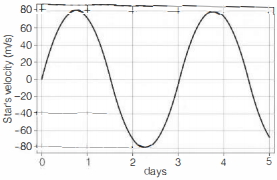
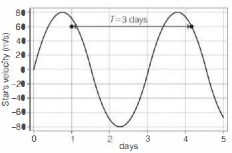
$A$ star of mass $M$ (equal to the solar mass) with a planet (much smaller than the star) revolves around the star in a circular orbit. The velocity of the star with respect to the centre of mass of the star-planet system is shown below. The radius of the planet's orbit is closest to .......... $AU$ ($1 \, AU =$ Earth-Sun distance).
A
$0.004$
B
$0.008$
C
$0.04$
D
$0.12$
Solution
(C) From the given graph,the time period of rotation of the planet around the star is $T = 3 \text{ days}$.
According to Kepler's third law,the relationship between the orbital period $T$ and the orbital radius $r$ is given by:
$T^{2} = \frac{4 \pi^{2}}{G M} \cdot r^{3} \quad \dots(i)$
If we express the time period in years and the radius in $AU$,then for the Earth ($T = 1 \text{ yr}$,$r = 1 \text{ AU}$),the constant $\frac{4 \pi^{2}}{G M} = 1$.
Given $T = 3 \text{ days} = \frac{3}{365} \text{ yr}$,we substitute this into equation $(i)$:
$r^{3} = T^{2}$
$r = T^{2/3}$
$r = \left(\frac{3}{365}\right)^{2/3} \approx \left(\frac{1}{121.67}\right)^{2/3} \approx \left(0.0082\right)^{2/3} \approx 0.04 \text{ AU}$.
Thus,the radius of the planet's orbit is approximately $0.04 \text{ AU}$.
According to Kepler's third law,the relationship between the orbital period $T$ and the orbital radius $r$ is given by:
$T^{2} = \frac{4 \pi^{2}}{G M} \cdot r^{3} \quad \dots(i)$
If we express the time period in years and the radius in $AU$,then for the Earth ($T = 1 \text{ yr}$,$r = 1 \text{ AU}$),the constant $\frac{4 \pi^{2}}{G M} = 1$.
Given $T = 3 \text{ days} = \frac{3}{365} \text{ yr}$,we substitute this into equation $(i)$:
$r^{3} = T^{2}$
$r = T^{2/3}$
$r = \left(\frac{3}{365}\right)^{2/3} \approx \left(\frac{1}{121.67}\right)^{2/3} \approx \left(0.0082\right)^{2/3} \approx 0.04 \text{ AU}$.
Thus,the radius of the planet's orbit is approximately $0.04 \text{ AU}$.
0 likes
View Solution102
MediumMCQ
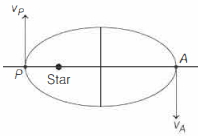
$A$ planet orbits in an elliptical path of eccentricity $e$ around a massive star considered fixed at one of the foci. The point in space,where it is closest to the star is denoted by $P$ and the point,where it is farthest is denoted by $A$. Let $v_P$ and $v_A$ be the respective speeds at $P$ and $A$,then
A
$\frac{v_P}{v_A}=\frac{1+e}{1-e}$
B
$\frac{v_P}{v_A}=1$
C
$\frac{v_P}{v_A}=\frac{1+e^2}{1-e}$
D
$\frac{v_P}{v_A}=\frac{1+e^2}{1-e^2}$
Solution
(A) By the law of conservation of angular momentum,the angular momentum $L$ of the planet remains constant at all points in its orbit.
At the perihelion $P$ and aphelion $A$,the velocity vector is perpendicular to the position vector,so the angular momentum is given by $L = mvr$.
Since $L_P = L_A$,we have $m v_P r_P = m v_A r_A$,which implies $\frac{v_P}{v_A} = \frac{r_A}{r_P}$.
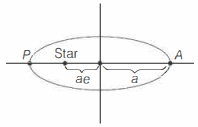
For an ellipse with semi-major axis $a$ and eccentricity $e$,the distance of the closest point (perihelion) is $r_P = a(1-e)$ and the distance of the farthest point (aphelion) is $r_A = a(1+e)$.
Substituting these values,we get $\frac{v_P}{v_A} = \frac{a(1+e)}{a(1-e)} = \frac{1+e}{1-e}$.
At the perihelion $P$ and aphelion $A$,the velocity vector is perpendicular to the position vector,so the angular momentum is given by $L = mvr$.
Since $L_P = L_A$,we have $m v_P r_P = m v_A r_A$,which implies $\frac{v_P}{v_A} = \frac{r_A}{r_P}$.
For an ellipse with semi-major axis $a$ and eccentricity $e$,the distance of the closest point (perihelion) is $r_P = a(1-e)$ and the distance of the farthest point (aphelion) is $r_A = a(1+e)$.
Substituting these values,we get $\frac{v_P}{v_A} = \frac{a(1+e)}{a(1-e)} = \frac{1+e}{1-e}$.
0 likes
View Solution103
AdvancedMCQ
$A$ comet (assumed to be in an elliptical orbit around the sun) is at a distance of $0.4 \, AU$ from the sun at the perihelion. If the time period of the comet is $125 \, yr$,the aphelion distance is ........... $AU$ ($AU$: Astronomical Unit).
A
$50$
B
$25$
C
$49.6$
D
$24.6$
Solution
(C) For a comet in an elliptical orbit,the semi-major axis $a$ is given by the average of the perihelion distance $(r_p)$ and the aphelion distance $(r_a)$:
$a = \frac{r_p + r_a}{2} = \frac{0.4 + x}{2} \, AU$
According to Kepler's Third Law,the square of the time period $T$ is proportional to the cube of the semi-major axis $a$:
$T^2 \propto a^3$
Comparing the comet with Earth ($T_e = 1 \, yr$,$a_e = 1 \, AU$):
$\left(\frac{T}{T_e}\right)^2 = \left(\frac{a}{a_e}\right)^3$
Substituting the given values $(T = 125 \, yr)$:
$\left(\frac{125}{1}\right)^2 = \left(\frac{0.4 + x}{2 \times 1}\right)^3$
$(125)^2 = \left(\frac{0.4 + x}{2}\right)^3$
Taking the cube root of both sides:
$(125)^{2/3} = \frac{0.4 + x}{2}$
$(5^3)^{2/3} = \frac{0.4 + x}{2}$
$5^2 = \frac{0.4 + x}{2}$
$25 = \frac{0.4 + x}{2}$
$50 = 0.4 + x$
$x = 50 - 0.4 = 49.6 \, AU$
Thus,the aphelion distance is $49.6 \, AU$.
$a = \frac{r_p + r_a}{2} = \frac{0.4 + x}{2} \, AU$
According to Kepler's Third Law,the square of the time period $T$ is proportional to the cube of the semi-major axis $a$:
$T^2 \propto a^3$
Comparing the comet with Earth ($T_e = 1 \, yr$,$a_e = 1 \, AU$):
$\left(\frac{T}{T_e}\right)^2 = \left(\frac{a}{a_e}\right)^3$
Substituting the given values $(T = 125 \, yr)$:
$\left(\frac{125}{1}\right)^2 = \left(\frac{0.4 + x}{2 \times 1}\right)^3$
$(125)^2 = \left(\frac{0.4 + x}{2}\right)^3$
Taking the cube root of both sides:
$(125)^{2/3} = \frac{0.4 + x}{2}$
$(5^3)^{2/3} = \frac{0.4 + x}{2}$
$5^2 = \frac{0.4 + x}{2}$
$25 = \frac{0.4 + x}{2}$
$50 = 0.4 + x$
$x = 50 - 0.4 = 49.6 \, AU$
Thus,the aphelion distance is $49.6 \, AU$.

0 likes
View Solution104
MediumMCQ
Which graph best represents the variation of radius $r$ of a circular orbit of a satellite against its time period $T$?
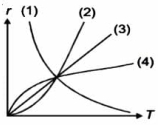
A
$1$
B
$2$
C
$3$
D
$4$
Solution
(D) According to Kepler's third law of planetary motion,the square of the time period $T$ of a satellite is directly proportional to the cube of the radius $r$ of its orbit.
$T^2 \propto r^3$
This implies $T \propto r^{3/2}$ or $r \propto T^{2/3}$.
Since the exponent of $T$ is $2/3$ (which is less than $1$),the graph of $r$ versus $T$ will be concave downwards.
Looking at the provided graph,curve $(4)$ represents a relationship where $r$ increases with $T$ but with a decreasing slope (concave downwards),which matches the mathematical relationship $r \propto T^{2/3}$.
Therefore,the correct graph is $(4)$.
$T^2 \propto r^3$
This implies $T \propto r^{3/2}$ or $r \propto T^{2/3}$.
Since the exponent of $T$ is $2/3$ (which is less than $1$),the graph of $r$ versus $T$ will be concave downwards.
Looking at the provided graph,curve $(4)$ represents a relationship where $r$ increases with $T$ but with a decreasing slope (concave downwards),which matches the mathematical relationship $r \propto T^{2/3}$.
Therefore,the correct graph is $(4)$.
0 likes
View Solution105
DifficultMCQ
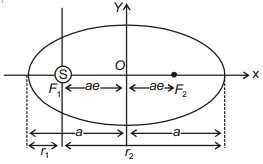
Consider a planet moving around a star in an elliptical orbit with period $T$. The area of the elliptical orbit is proportional to ...........
A
$T^{4/3}$
B
$T$
C
$T^{2/3}$
D
$T^{1/2}$
Solution
(A) The area $A$ of an ellipse with semi-major axis $a$ and semi-minor axis $b$ is given by $A = \pi ab$.
For an elliptical orbit,the semi-minor axis $b$ is related to the semi-major axis $a$ and eccentricity $e$ by $b = a\sqrt{1-e^2}$.
Thus,$A = \pi a^2 \sqrt{1-e^2}$.
Since $e$ is a constant for a given orbit,$A \propto a^2$.
According to Kepler's $III$ law of planetary motion,the square of the time period $T$ is proportional to the cube of the semi-major axis $a$:
$T^2 \propto a^3$
$a \propto T^{2/3}$
Substituting this into the area relation:
$A \propto (T^{2/3})^2$
$A \propto T^{4/3}$
Therefore,the area of the elliptical orbit is proportional to $T^{4/3}$.
For an elliptical orbit,the semi-minor axis $b$ is related to the semi-major axis $a$ and eccentricity $e$ by $b = a\sqrt{1-e^2}$.
Thus,$A = \pi a^2 \sqrt{1-e^2}$.
Since $e$ is a constant for a given orbit,$A \propto a^2$.
According to Kepler's $III$ law of planetary motion,the square of the time period $T$ is proportional to the cube of the semi-major axis $a$:
$T^2 \propto a^3$
$a \propto T^{2/3}$
Substituting this into the area relation:
$A \propto (T^{2/3})^2$
$A \propto T^{4/3}$
Therefore,the area of the elliptical orbit is proportional to $T^{4/3}$.
0 likes
View Solution106
EasyMCQ
According to Kepler,planets move in
A
Circular orbits around the sun
B
Elliptical orbits around the sun with sun at exact centre
C
Straight lines with constant velocity
D
Elliptical orbits around the sun with sun at one of its foci
Solution
(D) The correct answer is $(D)$.
Kepler's first law,also known as the Law of Orbits,states that all planets move in elliptical orbits,with the sun situated at one of the two foci of the ellipse.
Kepler's first law,also known as the Law of Orbits,states that all planets move in elliptical orbits,with the sun situated at one of the two foci of the ellipse.
0 likes
View Solution107
MediumMCQ
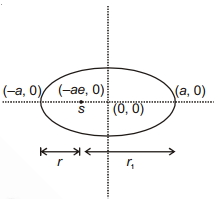
$A$ planet of mass $m$ moves around the sun of mass $M$ in an elliptical orbit. The maximum and minimum distances of the planet from the sun are $r_1$ and $r_2$ respectively. The time period of the planet is proportional to ..........
A
$r_1^{3/2}$
B
$r_2^{3/2}$
C
$(r_1+r_2)^{3/2}$
D
$(r_1-r_2)^{3/2}$
Solution
(C) According to Kepler's Third Law (Law of Periods),the square of the time period $T$ of revolution of a planet is proportional to the cube of the semi-major axis $a$ of the elliptical orbit.
$T^2 \propto a^3$
For an elliptical orbit with the sun at one focus,the maximum distance (aphelion) is $r_1 = a(1+e)$ and the minimum distance (perihelion) is $r_2 = a(1-e)$,where $e$ is the eccentricity.
Adding these two distances:
$r_1 + r_2 = a(1+e) + a(1-e) = 2a$
Therefore,the semi-major axis is:
$a = \frac{r_1 + r_2}{2}$
Substituting this into Kepler's Third Law:
$T^2 \propto \left(\frac{r_1 + r_2}{2}\right)^3$
Since $2^3$ is a constant,we have:
$T^2 \propto (r_1 + r_2)^3$
Taking the square root of both sides:
$T \propto (r_1 + r_2)^{3/2}$
Thus,the correct option is $C$.
$T^2 \propto a^3$
For an elliptical orbit with the sun at one focus,the maximum distance (aphelion) is $r_1 = a(1+e)$ and the minimum distance (perihelion) is $r_2 = a(1-e)$,where $e$ is the eccentricity.
Adding these two distances:
$r_1 + r_2 = a(1+e) + a(1-e) = 2a$
Therefore,the semi-major axis is:
$a = \frac{r_1 + r_2}{2}$
Substituting this into Kepler's Third Law:
$T^2 \propto \left(\frac{r_1 + r_2}{2}\right)^3$
Since $2^3$ is a constant,we have:
$T^2 \propto (r_1 + r_2)^3$
Taking the square root of both sides:
$T \propto (r_1 + r_2)^{3/2}$
Thus,the correct option is $C$.
0 likes
View Solution108
EasyMCQ
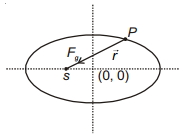
The torque on a planet about the centre of the Sun is ..............
A
Zero
B
Negative
C
Positive
D
Depend on the mass of the planet
Solution
(A) The gravitational force exerted by the Sun on a planet acts along the line joining the Sun and the planet.
Let $\vec{r}$ be the position vector of the planet with respect to the Sun and $\vec{F}_g$ be the gravitational force acting on the planet.
The torque $\vec{\tau}$ is given by $\vec{\tau} = \vec{r} \times \vec{F}_g$.
The magnitude of the torque is $\tau = r F_g \sin \theta$,where $\theta$ is the angle between the position vector $\vec{r}$ and the force vector $\vec{F}_g$.
Since the gravitational force is a central force,it acts along the line joining the centers of the two bodies. Therefore,the force vector $\vec{F}_g$ is directed towards the Sun,which is opposite to the position vector $\vec{r}$ (i.e.,$\theta = 180^{\circ}$).
Since $\sin(180^{\circ}) = 0$,the torque $\tau = 0$.
Let $\vec{r}$ be the position vector of the planet with respect to the Sun and $\vec{F}_g$ be the gravitational force acting on the planet.
The torque $\vec{\tau}$ is given by $\vec{\tau} = \vec{r} \times \vec{F}_g$.
The magnitude of the torque is $\tau = r F_g \sin \theta$,where $\theta$ is the angle between the position vector $\vec{r}$ and the force vector $\vec{F}_g$.
Since the gravitational force is a central force,it acts along the line joining the centers of the two bodies. Therefore,the force vector $\vec{F}_g$ is directed towards the Sun,which is opposite to the position vector $\vec{r}$ (i.e.,$\theta = 180^{\circ}$).
Since $\sin(180^{\circ}) = 0$,the torque $\tau = 0$.
0 likes
View Solution109
EasyMCQ
An earth satellite $X$ is revolving around the earth in an orbit whose radius is one-fourth of the radius of the orbit of a communication satellite. The time period of revolution of $X$ is ..........
A
$3 \, hrs$
B
$6 \, hrs$
C
$4 \, days$
D
$72 \, days$
Solution
(A) The time period of a communication satellite is $T_c = 24 \, hrs$.
According to Kepler's third law of planetary motion,the square of the time period is directly proportional to the cube of the orbital radius,i.e.,$T^2 \propto r^3$.
Let $r_c$ be the radius of the communication satellite's orbit and $r_x$ be the radius of satellite $X$'s orbit. Given $r_x = \frac{1}{4} r_c$,or $\frac{r_c}{r_x} = 4$.
Using the ratio form of Kepler's law: $\frac{T_c}{T_x} = \left( \frac{r_c}{r_x} \right)^{3/2}$.
Substituting the values: $\frac{24}{T_x} = (4)^{3/2}$.
Since $(4)^{3/2} = (2^2)^{3/2} = 2^3 = 8$,we have $\frac{24}{T_x} = 8$.
Therefore,$T_x = \frac{24}{8} = 3 \, hrs$.
According to Kepler's third law of planetary motion,the square of the time period is directly proportional to the cube of the orbital radius,i.e.,$T^2 \propto r^3$.
Let $r_c$ be the radius of the communication satellite's orbit and $r_x$ be the radius of satellite $X$'s orbit. Given $r_x = \frac{1}{4} r_c$,or $\frac{r_c}{r_x} = 4$.
Using the ratio form of Kepler's law: $\frac{T_c}{T_x} = \left( \frac{r_c}{r_x} \right)^{3/2}$.
Substituting the values: $\frac{24}{T_x} = (4)^{3/2}$.
Since $(4)^{3/2} = (2^2)^{3/2} = 2^3 = 8$,we have $\frac{24}{T_x} = 8$.
Therefore,$T_x = \frac{24}{8} = 3 \, hrs$.
0 likes
View Solution110
MediumMCQ
If the distance of the earth from the Sun is $1.5 \times 10^8 \, km$. Then the distance of an imaginary planet from the Sun,if its period of revolution is $2.83$ years,is $............. \times 10^8 \, km$.
A
$0.6$
B
$6$
C
$3$
D
$0.3$
Solution
(C) According to Kepler's third law of planetary motion,the square of the time period of revolution $(T)$ is directly proportional to the cube of the semi-major axis $(R)$ of the orbit: $T^2 \propto R^3$.
Given:
For Earth: $T_1 = 1 \, \text{year}$,$R_1 = 1.5 \times 10^8 \, \text{km}$.
For the imaginary planet: $T_2 = 2.83 \, \text{years}$,$R_2 = ?$.
Using the ratio formula:
$\left(\frac{T_2}{T_1}\right)^2 = \left(\frac{R_2}{R_1}\right)^3$
Substituting the values:
$\left(\frac{2.83}{1}\right)^2 = \left(\frac{R_2}{1.5 \times 10^8}\right)^3$
Since $2.83 \approx \sqrt{8}$,then $(2.83)^2 \approx 8$:
$8 = \left(\frac{R_2}{1.5 \times 10^8}\right)^3$
Taking the cube root on both sides:
$2 = \frac{R_2}{1.5 \times 10^8}$
$R_2 = 2 \times 1.5 \times 10^8 = 3 \times 10^8 \, \text{km}$.
Thus,the distance is $3 \times 10^8 \, \text{km}$.
Given:
For Earth: $T_1 = 1 \, \text{year}$,$R_1 = 1.5 \times 10^8 \, \text{km}$.
For the imaginary planet: $T_2 = 2.83 \, \text{years}$,$R_2 = ?$.
Using the ratio formula:
$\left(\frac{T_2}{T_1}\right)^2 = \left(\frac{R_2}{R_1}\right)^3$
Substituting the values:
$\left(\frac{2.83}{1}\right)^2 = \left(\frac{R_2}{1.5 \times 10^8}\right)^3$
Since $2.83 \approx \sqrt{8}$,then $(2.83)^2 \approx 8$:
$8 = \left(\frac{R_2}{1.5 \times 10^8}\right)^3$
Taking the cube root on both sides:
$2 = \frac{R_2}{1.5 \times 10^8}$
$R_2 = 2 \times 1.5 \times 10^8 = 3 \times 10^8 \, \text{km}$.
Thus,the distance is $3 \times 10^8 \, \text{km}$.
0 likes
View Solution111
EasyMCQ
The time period of a satellite of earth is $24 \ hours$. If the separation between the earth and the satellite is decreased to one-fourth of the previous value,then its new time period will become $....... \ hours$.
A
$4$
B
$6$
C
$12$
D
$3$
Solution
(D) According to Kepler's third law of planetary motion,the square of the time period $(T)$ is directly proportional to the cube of the orbital radius $(R)$: $T^2 \propto R^3$.
Given the initial time period $T_1 = 24 \ hours$ and initial radius $R_1 = R$.
The new radius is $R_2 = \frac{R}{4}$.
Using the ratio formula: $\frac{T_1^2}{T_2^2} = \frac{R_1^3}{R_2^3}$.
Substituting the values: $\left(\frac{24}{T_2}\right)^2 = \left(\frac{R}{R/4}\right)^3 = (4)^3 = 64$.
Taking the square root on both sides: $\frac{24}{T_2} = \sqrt{64} = 8$.
Therefore,$T_2 = \frac{24}{8} = 3 \ hours$.
Given the initial time period $T_1 = 24 \ hours$ and initial radius $R_1 = R$.
The new radius is $R_2 = \frac{R}{4}$.
Using the ratio formula: $\frac{T_1^2}{T_2^2} = \frac{R_1^3}{R_2^3}$.
Substituting the values: $\left(\frac{24}{T_2}\right)^2 = \left(\frac{R}{R/4}\right)^3 = (4)^3 = 64$.
Taking the square root on both sides: $\frac{24}{T_2} = \sqrt{64} = 8$.
Therefore,$T_2 = \frac{24}{8} = 3 \ hours$.
0 likes
View Solution112
MediumMCQ
Choose the incorrect statement from the following.
A
The speed of a satellite in a given circular orbit remains constant.
B
For a planet revolving around the sun in an elliptical orbit,the total energy of the planet remains constant.
C
When a body falls towards the earth,the displacement of the earth towards the body is negligible.
D
The linear speed of a planet revolving around the sun remains constant.
Solution
(D) According to Kepler's second law of planetary motion,a planet moves faster when it is closer to the sun and slower when it is farther away.
Therefore,the linear speed of a planet revolving around the sun in an elliptical orbit is not constant.
Option $A$ is correct because the speed of a satellite in a circular orbit is given by $v = \sqrt{GM/r}$,which is constant for a fixed radius $r$.
Option $B$ is correct because the total mechanical energy of a planet in an elliptical orbit is conserved.
Option $C$ is correct because the mass of the earth is extremely large compared to any falling body,making its acceleration and displacement negligible.
Thus,the incorrect statement is $D$.
Therefore,the linear speed of a planet revolving around the sun in an elliptical orbit is not constant.
Option $A$ is correct because the speed of a satellite in a circular orbit is given by $v = \sqrt{GM/r}$,which is constant for a fixed radius $r$.
Option $B$ is correct because the total mechanical energy of a planet in an elliptical orbit is conserved.
Option $C$ is correct because the mass of the earth is extremely large compared to any falling body,making its acceleration and displacement negligible.
Thus,the incorrect statement is $D$.
0 likes
View Solution113
DifficultMCQ
$A$ planet takes $200$ days to complete one revolution around the Sun. If the distance of the planet from the Sun is reduced to one-fourth of the original distance,how many days will it take to complete one revolution?
A
$25$
B
$50$
C
$100$
D
$20$
Solution
(A) According to Kepler's third law of planetary motion,the square of the time period $(T)$ is directly proportional to the cube of the semi-major axis $(r)$: $T^2 \propto r^3$.
Let the initial time period be $T_1 = 200 \text{ days}$ and the initial distance be $r_1 = r$.
Let the new time period be $T_2$ and the new distance be $r_2 = \frac{r}{4}$.
Using the relation $\frac{T_1^2}{r_1^3} = \frac{T_2^2}{r_2^3}$,we get:
$\frac{(200)^2}{r^3} = \frac{T_2^2}{(\frac{r}{4})^3}$
$T_2^2 = (200)^2 \times \frac{(\frac{r}{4})^3}{r^3}$
$T_2^2 = (200)^2 \times \frac{r^3}{64 \times r^3}$
$T_2^2 = \frac{(200)^2}{64}$
Taking the square root of both sides:
$T_2 = \frac{200}{\sqrt{64}}$
$T_2 = \frac{200}{8}$
$T_2 = 25 \text{ days}$.
Let the initial time period be $T_1 = 200 \text{ days}$ and the initial distance be $r_1 = r$.
Let the new time period be $T_2$ and the new distance be $r_2 = \frac{r}{4}$.
Using the relation $\frac{T_1^2}{r_1^3} = \frac{T_2^2}{r_2^3}$,we get:
$\frac{(200)^2}{r^3} = \frac{T_2^2}{(\frac{r}{4})^3}$
$T_2^2 = (200)^2 \times \frac{(\frac{r}{4})^3}{r^3}$
$T_2^2 = (200)^2 \times \frac{r^3}{64 \times r^3}$
$T_2^2 = \frac{(200)^2}{64}$
Taking the square root of both sides:
$T_2 = \frac{200}{\sqrt{64}}$
$T_2 = \frac{200}{8}$
$T_2 = 25 \text{ days}$.
0 likes
View Solution114
MediumMCQ
If a satellite orbiting the Earth is $9$ times closer to the Earth than the Moon, what is the time period of rotation of the satellite? Given rotational time period of Moon $= 27 \text{ days}$ and gravitational attraction between the satellite and the moon is neglected.
A
$1 \text{ day}$
B
$81 \text{ days}$
C
$27 \text{ days}$
D
$3 \text{ days}$
Solution
(A) According to Kepler's Third Law of Planetary Motion, the square of the time period $(T)$ is proportional to the cube of the orbital radius $(R)$: $T^2 \propto R^3$.
Let $T_m$ and $R_m$ be the time period and orbital radius of the Moon, and $T_s$ and $R_s$ be the time period and orbital radius of the satellite.
Given: $R_s = R_m / 9$ and $T_m = 27 \text{ days}$.
Using the ratio formula: $\left(\frac{T_m}{T_s}\right)^2 = \left(\frac{R_m}{R_s}\right)^3$.
Substituting the values: $\left(\frac{27}{T_s}\right)^2 = \left(\frac{R_m}{R_m / 9}\right)^3 = (9)^3 = 729$.
Taking the square root on both sides: $\frac{27}{T_s} = \sqrt{729} = 27$.
Therefore, $T_s = \frac{27}{27} = 1 \text{ day}$.
Let $T_m$ and $R_m$ be the time period and orbital radius of the Moon, and $T_s$ and $R_s$ be the time period and orbital radius of the satellite.
Given: $R_s = R_m / 9$ and $T_m = 27 \text{ days}$.
Using the ratio formula: $\left(\frac{T_m}{T_s}\right)^2 = \left(\frac{R_m}{R_s}\right)^3$.
Substituting the values: $\left(\frac{27}{T_s}\right)^2 = \left(\frac{R_m}{R_m / 9}\right)^3 = (9)^3 = 729$.
Taking the square root on both sides: $\frac{27}{T_s} = \sqrt{729} = 27$.
Therefore, $T_s = \frac{27}{27} = 1 \text{ day}$.
0 likes
View Solution115
MediumMCQ
$A$ satellite is launched into a circular orbit of radius $R$ around the Earth. $A$ second satellite is launched into an orbit of radius $1.03 R$. The time period of revolution of the second satellite is larger than the first one approximately by: (in $\%$)
A
$3$
B
$4.5$
C
$9$
D
$2.5$
Solution
(B) According to Kepler's third law of planetary motion,the square of the time period $T$ is proportional to the cube of the orbital radius $R$: $T^2 \propto R^3$.
Taking the logarithmic derivative of both sides,we get: $2 \frac{\Delta T}{T} = 3 \frac{\Delta R}{R}$.
Given the change in radius $\Delta R = 1.03 R - R = 0.03 R$,so $\frac{\Delta R}{R} = 0.03$.
Substituting this into the derivative equation: $2 \frac{\Delta T}{T} = 3 \times 0.03$.
Therefore,the percentage change in the time period is: $\frac{\Delta T}{T} \times 100 = \frac{3 \times 0.03}{2} \times 100 = 4.5 \%$.
Taking the logarithmic derivative of both sides,we get: $2 \frac{\Delta T}{T} = 3 \frac{\Delta R}{R}$.
Given the change in radius $\Delta R = 1.03 R - R = 0.03 R$,so $\frac{\Delta R}{R} = 0.03$.
Substituting this into the derivative equation: $2 \frac{\Delta T}{T} = 3 \times 0.03$.
Therefore,the percentage change in the time period is: $\frac{\Delta T}{T} \times 100 = \frac{3 \times 0.03}{2} \times 100 = 4.5 \%$.
0 likes
View Solution116
MediumMCQ
Given below are two statements: one is labelled as Assertion $(A)$ and the other is labelled as Reason $(R)$.
Assertion $(A):$ The radius vector from the Sun to a planet sweeps out equal areas in equal intervals of time and thus the areal velocity of the planet is constant.
Reason $(R):$ For a central force field,the angular momentum is a constant.
In the light of the above statements,choose the most appropriate answer from the options given below:
Assertion $(A):$ The radius vector from the Sun to a planet sweeps out equal areas in equal intervals of time and thus the areal velocity of the planet is constant.
Reason $(R):$ For a central force field,the angular momentum is a constant.
In the light of the above statements,choose the most appropriate answer from the options given below:
A
Both $(A)$ and $(R)$ are correct and $(R)$ is the correct explanation of $(A)$
B
Both $(A)$ and $(R)$ are correct but $(R)$ is not the correct explanation of $(A)$
C
$(A)$ is correct but $(R)$ is not correct
D
$(A)$ is not correct but $(R)$ is correct
Solution
(A) Kepler's second law states that the radius vector from the Sun to a planet sweeps out equal areas in equal intervals of time. This implies that the areal velocity $\frac{dA}{dt}$ is constant.
The areal velocity is given by the formula $\frac{dA}{dt} = \frac{L}{2m}$,where $L$ is the angular momentum and $m$ is the mass of the planet.
Since the gravitational force exerted by the Sun on the planet is a central force,the torque $\tau$ acting on the planet about the Sun is zero $(\tau = \vec{r} \times \vec{F} = 0)$.
Because the torque is zero,the angular momentum $L$ remains constant over time.
Since $L$ and $m$ are constant,the areal velocity $\frac{dA}{dt}$ is also constant.
Therefore,Assertion $(A)$ is correct,and Reason $(R)$ provides the correct physical explanation for it.
The areal velocity is given by the formula $\frac{dA}{dt} = \frac{L}{2m}$,where $L$ is the angular momentum and $m$ is the mass of the planet.
Since the gravitational force exerted by the Sun on the planet is a central force,the torque $\tau$ acting on the planet about the Sun is zero $(\tau = \vec{r} \times \vec{F} = 0)$.
Because the torque is zero,the angular momentum $L$ remains constant over time.
Since $L$ and $m$ are constant,the areal velocity $\frac{dA}{dt}$ is also constant.
Therefore,Assertion $(A)$ is correct,and Reason $(R)$ provides the correct physical explanation for it.
0 likes
View Solution117
MediumMCQ
The radius of the Martian orbit around the Sun is about $4$ times the radius of the orbit of Mercury. The Martian year is $687$ Earth days. What is the length of $1$ year on Mercury?
A
$88$ earth days
B
$225$ earth days
C
$172$ earth days
D
$124$ earth days
Solution
(A) According to Kepler's third law of planetary motion,the square of the time period $T$ is proportional to the cube of the semi-major axis $r$ of the orbit: $T^2 \propto r^3$.
Given that the radius of the Martian orbit $r_M = 4 \times r_{Me}$,where $r_{Me}$ is the radius of the Mercury orbit.
The ratio of the time periods is given by: $\frac{T_{Me}}{T_M} = \left(\frac{r_{Me}}{r_M}\right)^{3/2}$.
Substituting the given values: $\frac{T_{Me}}{687} = \left(\frac{1}{4}\right)^{3/2} = \frac{1}{8}$.
Therefore,$T_{Me} = \frac{687}{8} = 85.875$ days.
Rounding to the nearest whole number,the length of $1$ year on Mercury is approximately $88$ Earth days.
Given that the radius of the Martian orbit $r_M = 4 \times r_{Me}$,where $r_{Me}$ is the radius of the Mercury orbit.
The ratio of the time periods is given by: $\frac{T_{Me}}{T_M} = \left(\frac{r_{Me}}{r_M}\right)^{3/2}$.
Substituting the given values: $\frac{T_{Me}}{687} = \left(\frac{1}{4}\right)^{3/2} = \frac{1}{8}$.
Therefore,$T_{Me} = \frac{687}{8} = 85.875$ days.
Rounding to the nearest whole number,the length of $1$ year on Mercury is approximately $88$ Earth days.
0 likes
View Solution118
EasyMCQ
The time period of a satellite of Earth is $24 \text{ hours}$. If the separation between the Earth and the satellite is decreased to one-fourth of the previous value, then its new time period will become: (in $\text{ hours}$)
A
$3$
B
$6$
C
$24$
D
$12$
Solution
(A) According to Kepler's third law of planetary motion, the square of the time period $(T)$ is directly proportional to the cube of the semi-major axis or the orbital radius $(r)$: $T^2 \propto r^3$.
Given that the initial time period $T_1 = 24 \text{ hours}$ and the initial radius is $r_1$.
The new radius is $r_2 = \frac{1}{4} r_1$.
Using the relation $\frac{T_2^2}{T_1^2} = \left( \frac{r_2}{r_1} \right)^3$, we get:
$\frac{T_2^2}{T_1^2} = \left( \frac{1}{4} \right)^3 = \frac{1}{64}$.
Taking the square root on both sides:
$\frac{T_2}{T_1} = \sqrt{\frac{1}{64}} = \frac{1}{8}$.
Therefore, $T_2 = \frac{T_1}{8} = \frac{24}{8} = 3 \text{ hours}$.
Given that the initial time period $T_1 = 24 \text{ hours}$ and the initial radius is $r_1$.
The new radius is $r_2 = \frac{1}{4} r_1$.
Using the relation $\frac{T_2^2}{T_1^2} = \left( \frac{r_2}{r_1} \right)^3$, we get:
$\frac{T_2^2}{T_1^2} = \left( \frac{1}{4} \right)^3 = \frac{1}{64}$.
Taking the square root on both sides:
$\frac{T_2}{T_1} = \sqrt{\frac{1}{64}} = \frac{1}{8}$.
Therefore, $T_2 = \frac{T_1}{8} = \frac{24}{8} = 3 \text{ hours}$.
0 likes
View Solution119
MediumMCQ
The period of a planet around the sun is $8$ times that of earth. The ratio of the radius of the planet's orbit to the radius of the earth's orbit is:
A
$4$
B
$8$
C
$16$
D
$64$
Solution
(A) According to Kepler's third law of planetary motion,the square of the time period $(T)$ is directly proportional to the cube of the semi-major axis $(r)$ of the orbit: $T^2 \propto r^3$.
This implies that $\frac{T_p^2}{T_e^2} = \frac{r_p^3}{r_e^3}$,where $T_p$ and $r_p$ are the time period and orbital radius of the planet,and $T_e$ and $r_e$ are those of the earth.
Given that $T_p = 8 T_e$,we substitute this into the ratio:
$\frac{(8 T_e)^2}{T_e^2} = \frac{r_p^3}{r_e^3}$
$64 = \frac{r_p^3}{r_e^3}$
Taking the cube root on both sides:
$\frac{r_p}{r_e} = (64)^{1/3} = 4$.
Therefore,the ratio of the radius of the planet's orbit to the radius of the earth's orbit is $4$.
This implies that $\frac{T_p^2}{T_e^2} = \frac{r_p^3}{r_e^3}$,where $T_p$ and $r_p$ are the time period and orbital radius of the planet,and $T_e$ and $r_e$ are those of the earth.
Given that $T_p = 8 T_e$,we substitute this into the ratio:
$\frac{(8 T_e)^2}{T_e^2} = \frac{r_p^3}{r_e^3}$
$64 = \frac{r_p^3}{r_e^3}$
Taking the cube root on both sides:
$\frac{r_p}{r_e} = (64)^{1/3} = 4$.
Therefore,the ratio of the radius of the planet's orbit to the radius of the earth's orbit is $4$.
0 likes
View Solution120
EasyMCQ
$A$ satellite $S_1$ of mass $m$ is moving in an orbit of radius $r$. Another satellite $S_2$ of mass $2m$ is moving in an orbit of radius $2r$. The ratio of the time period of satellite $S_2$ to that of $S_1$ is
A
$2:1$
B
$1:8$
C
$1:4$
D
$2\sqrt{2}:1$
Solution
(D) According to Kepler's Third Law of Planetary Motion,the square of the time period $(T)$ of a satellite is directly proportional to the cube of the radius $(r)$ of its orbit:
$T^2 \propto r^3$
Given for satellite $S_1$: radius = $r$,time period = $T_1$.
Given for satellite $S_2$: radius = $2r$,time period = $T_2$.
Using the proportionality:
$\frac{T_2}{T_1} = \left( \frac{r_2}{r_1} \right)^{3/2}$
Substituting the values:
$\frac{T_2}{T_1} = \left( \frac{2r}{r} \right)^{3/2} = (2)^{3/2} = 2^{1} \cdot 2^{1/2} = 2\sqrt{2}$
Thus,the ratio is $2\sqrt{2}:1$.
$T^2 \propto r^3$
Given for satellite $S_1$: radius = $r$,time period = $T_1$.
Given for satellite $S_2$: radius = $2r$,time period = $T_2$.
Using the proportionality:
$\frac{T_2}{T_1} = \left( \frac{r_2}{r_1} \right)^{3/2}$
Substituting the values:
$\frac{T_2}{T_1} = \left( \frac{2r}{r} \right)^{3/2} = (2)^{3/2} = 2^{1} \cdot 2^{1/2} = 2\sqrt{2}$
Thus,the ratio is $2\sqrt{2}:1$.
0 likes
View Solution121
MediumMCQ
The period of revolution of planet $A$ around the sun is $8$ times that of planet $B$. How many times is the distance of planet $A$ from the sun greater than that of planet $B$ from the sun (in $times$)?
A
$5$
B
$2$
C
$4$
D
$6$
Solution
(C) According to Kepler's Third Law of Planetary Motion, the square of the period of revolution $T$ is proportional to the cube of the semi-major axis $R$ of the orbit: $T^2 \propto R^3$.
Given that the period of planet $A$ $(T_A)$ is $8$ times the period of planet $B$ $(T_B)$, we have $T_A = 8 T_B$.
Using the relation $\frac{T_A}{T_B} = \left(\frac{R_A}{R_B}\right)^{3/2}$, we can write:
$\left(\frac{T_A}{T_B}\right)^2 = \left(\frac{R_A}{R_B}\right)^3$
Substituting the given values:
$(8)^2 = \left(\frac{R_A}{R_B}\right)^3$
$64 = \left(\frac{R_A}{R_B}\right)^3$
Taking the cube root on both sides:
$\frac{R_A}{R_B} = (64)^{1/3} = 4$
Thus, the distance of planet $A$ from the sun is $4$ times the distance of planet $B$ from the sun.
Given that the period of planet $A$ $(T_A)$ is $8$ times the period of planet $B$ $(T_B)$, we have $T_A = 8 T_B$.
Using the relation $\frac{T_A}{T_B} = \left(\frac{R_A}{R_B}\right)^{3/2}$, we can write:
$\left(\frac{T_A}{T_B}\right)^2 = \left(\frac{R_A}{R_B}\right)^3$
Substituting the given values:
$(8)^2 = \left(\frac{R_A}{R_B}\right)^3$
$64 = \left(\frac{R_A}{R_B}\right)^3$
Taking the cube root on both sides:
$\frac{R_A}{R_B} = (64)^{1/3} = 4$
Thus, the distance of planet $A$ from the sun is $4$ times the distance of planet $B$ from the sun.
0 likes
View Solution122
EasyMCQ
The time period of a satellite of the Earth is $5 \text{ hours}$. If the separation between the Earth and the satellite is increased to four times the previous value, the new time period of the satellite will be: (in $\text{ hours}$)
A
$20$
B
$40$
C
$80$
D
$10$
Solution
(B) According to Kepler's Third Law of Planetary Motion, the square of the time period $(T)$ is directly proportional to the cube of the semi-major axis or the orbital radius $(r)$:
$T^2 \propto r^3$
Given the initial time period $T_1 = 5 \text{ hours}$ and the initial radius $r_1 = r$.
The new radius is $r_2 = 4r$.
Using the ratio formula:
$\frac{T_2^2}{T_1^2} = \left(\frac{r_2}{r_1}\right)^3$
Substituting the values:
$\frac{T_2^2}{T_1^2} = \left(\frac{4r}{r}\right)^3 = (4)^3 = 64$
Taking the square root on both sides:
$\frac{T_2}{T_1} = \sqrt{64} = 8$
Therefore, the new time period is:
$T_2 = 8 \times T_1 = 8 \times 5 \text{ hours} = 40 \text{ hours}$.
$T^2 \propto r^3$
Given the initial time period $T_1 = 5 \text{ hours}$ and the initial radius $r_1 = r$.
The new radius is $r_2 = 4r$.
Using the ratio formula:
$\frac{T_2^2}{T_1^2} = \left(\frac{r_2}{r_1}\right)^3$
Substituting the values:
$\frac{T_2^2}{T_1^2} = \left(\frac{4r}{r}\right)^3 = (4)^3 = 64$
Taking the square root on both sides:
$\frac{T_2}{T_1} = \sqrt{64} = 8$
Therefore, the new time period is:
$T_2 = 8 \times T_1 = 8 \times 5 \text{ hours} = 40 \text{ hours}$.
0 likes
View Solution123
MediumMCQ
If $r_p, v_p, L_p$ and $r_a, v_a, L_a$ are radii,velocities and angular momenta of a planet at perihelion and aphelion of its elliptical orbit around the Sun respectively,then
A
$r_p > r_a, v_p > v_a, L_a > L_p$
B
$r_p < r_a, v_p > v_a, L_a = L_p$
C
$r_p > r_a, v_p < v_a, L_a = L_p$
D
$r_p < r_a, v_p < v_a, L_a < L_p$
Solution
(B) According to Kepler's second law,the angular momentum of a planet revolving around the Sun is conserved because the gravitational force is a central force.
Therefore,$L_p = L_a$.
Perihelion is the point in the orbit closest to the Sun,and aphelion is the point farthest from the Sun.
Therefore,$r_p < r_a$.
Since angular momentum $L = mvr$ is conserved,we have $m v_p r_p = m v_a r_a$.
Since $r_p < r_a$,it follows that $v_p > v_a$.
Thus,the correct relation is $r_p < r_a, v_p > v_a, L_a = L_p$.
Therefore,$L_p = L_a$.
Perihelion is the point in the orbit closest to the Sun,and aphelion is the point farthest from the Sun.
Therefore,$r_p < r_a$.
Since angular momentum $L = mvr$ is conserved,we have $m v_p r_p = m v_a r_a$.
Since $r_p < r_a$,it follows that $v_p > v_a$.
Thus,the correct relation is $r_p < r_a, v_p > v_a, L_a = L_p$.
0 likes
View Solution124
EasyMCQ
When a planet revolves around the Sun,in general,for the planet:
A
linear momentum and linear velocity are constant.
B
linear momentum and areal velocity are constant.
C
kinetic and potential energy of the planet are constant.
D
angular momentum about the Sun and areal velocity of the planet are constant.
Solution
(D) When a planet revolves around the Sun,the gravitational force exerted by the Sun on the planet acts along the line joining them.
Since the torque $\vec{\tau} = \vec{r} \times \vec{F} = 0$,the angular momentum $\vec{L}$ of the planet about the Sun remains conserved.
According to Kepler's second law,the areal velocity (area swept per unit time) is proportional to the angular momentum $(dA/dt = L/2m)$.
Since the angular momentum $L$ and the mass $m$ of the planet are constant,the areal velocity remains constant.
Since the torque $\vec{\tau} = \vec{r} \times \vec{F} = 0$,the angular momentum $\vec{L}$ of the planet about the Sun remains conserved.
According to Kepler's second law,the areal velocity (area swept per unit time) is proportional to the angular momentum $(dA/dt = L/2m)$.
Since the angular momentum $L$ and the mass $m$ of the planet are constant,the areal velocity remains constant.
0 likes
View Solution125
MediumMCQ
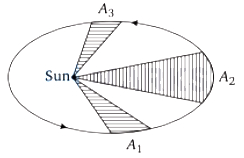
$A$ planet moving around the Sun sweeps out an area $A_{1}$ in $2$ days,$A_{2}$ in $3$ days,and $A_{3}$ in $6$ days. Then,the relation between $A_{1}, A_{2}$,and $A_{3}$ is
A
$6 A_{1} = 3 A_{2} = 2 A_{3}$
B
$3 A_{1} = 2 A_{2} = A_{3}$
C
$2 A_{1} = 3 A_{2} = 6 A_{3}$
D
$3 A_{1} = 2 A_{2} = 6 A_{3}$
Solution
(B) According to Kepler's second law of planetary motion,the areal velocity of a planet remains constant.
This means the area swept per unit time is constant:
$\frac{A_{1}}{t_{1}} = \frac{A_{2}}{t_{2}} = \frac{A_{3}}{t_{3}}$
Given $t_{1} = 2$ days,$t_{2} = 3$ days,and $t_{3} = 6$ days,we have:
$\frac{A_{1}}{2} = \frac{A_{2}}{3} = \frac{A_{3}}{6}$
To simplify this,multiply the entire equation by $6$:
$6 \times \frac{A_{1}}{2} = 6 \times \frac{A_{2}}{3} = 6 \times \frac{A_{3}}{6}$
$3 A_{1} = 2 A_{2} = A_{3}$
This means the area swept per unit time is constant:
$\frac{A_{1}}{t_{1}} = \frac{A_{2}}{t_{2}} = \frac{A_{3}}{t_{3}}$
Given $t_{1} = 2$ days,$t_{2} = 3$ days,and $t_{3} = 6$ days,we have:
$\frac{A_{1}}{2} = \frac{A_{2}}{3} = \frac{A_{3}}{6}$
To simplify this,multiply the entire equation by $6$:
$6 \times \frac{A_{1}}{2} = 6 \times \frac{A_{2}}{3} = 6 \times \frac{A_{3}}{6}$
$3 A_{1} = 2 A_{2} = A_{3}$
0 likes
View Solution126
EasyMCQ
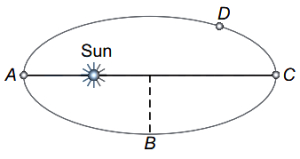
$A$ planet revolves around the sun in an elliptical orbit. The linear speed of the planet will be maximum at
A
$D$
B
$B$
C
$A$
D
$C$
Solution
(C) According to Kepler's second law of planetary motion,the areal velocity of a planet remains constant. This implies that the angular momentum of the planet is conserved.
Since the angular momentum $L = mvr \sin(\theta)$ is constant,where $m$ is the mass of the planet,$v$ is its linear speed,$r$ is the distance from the sun,and $\theta$ is the angle between the position vector and the velocity vector.
At the perihelion (the point closest to the sun),the distance $r$ is minimum.
Therefore,to conserve angular momentum,the linear speed $v$ must be maximum at this point.
In the given diagram,point $A$ is the closest to the sun.
Thus,the linear speed of the planet is maximum at point $A$.
Since the angular momentum $L = mvr \sin(\theta)$ is constant,where $m$ is the mass of the planet,$v$ is its linear speed,$r$ is the distance from the sun,and $\theta$ is the angle between the position vector and the velocity vector.
At the perihelion (the point closest to the sun),the distance $r$ is minimum.
Therefore,to conserve angular momentum,the linear speed $v$ must be maximum at this point.
In the given diagram,point $A$ is the closest to the sun.
Thus,the linear speed of the planet is maximum at point $A$.
0 likes
View Solution127
MediumMCQ
Assertion $(A)$: Angular speed,linear speed,and kinetic energy change with time,but angular momentum remains constant for a planet orbiting the sun.
Reason $(R)$: Angular momentum is constant as no external torque acts on the planet.
Reason $(R)$: Angular momentum is constant as no external torque acts on the planet.
A
Both $A$ and $R$ are true and $R$ is a correct explanation for $A$.
B
Both $A$ and $R$ are true but $R$ is not a correct explanation for $A$.
C
$A$ is true,$R$ is false.
D
$A$ is false,$R$ is true.
Solution
(A) According to Kepler's second law,the areal velocity of a planet is constant,which implies that the angular momentum $(L)$ of the planet remains constant.
The torque $(\tau)$ acting on a planet due to the gravitational force of the sun is given by $\tau = r \times F$. Since the gravitational force is a central force acting along the line joining the planet and the sun,the torque is zero $(\tau = 0)$.
From the relation $\tau = \frac{dL}{dt}$,if $\tau = 0$,then $\frac{dL}{dt} = 0$,which means $L$ is constant.
As the planet moves in an elliptical orbit,its distance from the sun changes,causing its linear speed,angular speed,and kinetic energy to vary with time.
Therefore,both Assertion $(A)$ and Reason $(R)$ are true,and Reason $(R)$ is the correct explanation for Assertion $(A)$.
The torque $(\tau)$ acting on a planet due to the gravitational force of the sun is given by $\tau = r \times F$. Since the gravitational force is a central force acting along the line joining the planet and the sun,the torque is zero $(\tau = 0)$.
From the relation $\tau = \frac{dL}{dt}$,if $\tau = 0$,then $\frac{dL}{dt} = 0$,which means $L$ is constant.
As the planet moves in an elliptical orbit,its distance from the sun changes,causing its linear speed,angular speed,and kinetic energy to vary with time.
Therefore,both Assertion $(A)$ and Reason $(R)$ are true,and Reason $(R)$ is the correct explanation for Assertion $(A)$.
0 likes
View Solution128
EasyMCQ
Kepler's second law (law of areas) is nothing but a statement of
A
work-energy theory
B
conservation of linear momentum
C
conservation of angular momentum
D
conservation of energy
Solution
(C) According to Kepler's second law of planetary motion,the radius vector joining a planet to the sun sweeps out equal areas in equal intervals of time.
That is,$\frac{dA}{dt} = \text{constant}$.
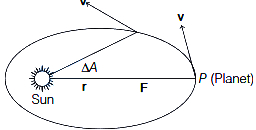
As shown in the figure,let $r$ be the position vector of the planet with respect to the sun and $F$ be the gravitational force on the planet due to the sun.
The torque $\tau$ exerted on the planet by this force about the sun is given by:
$\tau = r \times F = 0$
(Since $r$ and $F$ are collinear,i.e.,they act along the same line).
We know that torque is the rate of change of angular momentum:
$\tau = \frac{dL}{dt}$
Since $\tau = 0$,we have $\frac{dL}{dt} = 0$,which implies $L = \text{constant}$.
Thus,Kepler's second law is a direct consequence of the law of conservation of angular momentum.
That is,$\frac{dA}{dt} = \text{constant}$.
As shown in the figure,let $r$ be the position vector of the planet with respect to the sun and $F$ be the gravitational force on the planet due to the sun.
The torque $\tau$ exerted on the planet by this force about the sun is given by:
$\tau = r \times F = 0$
(Since $r$ and $F$ are collinear,i.e.,they act along the same line).
We know that torque is the rate of change of angular momentum:
$\tau = \frac{dL}{dt}$
Since $\tau = 0$,we have $\frac{dL}{dt} = 0$,which implies $L = \text{constant}$.
Thus,Kepler's second law is a direct consequence of the law of conservation of angular momentum.
0 likes
View Solution129
EasyMCQ
The period of revolution of planet $A$ around the sun is $8$ times that of $B$. The distance of $A$ from the sun is how many times greater than that of $B$ from the sun?
A
$2$
B
$3$
C
$4$
D
$5$
Solution
(C) Let $T_A$ and $T_B$ be the time periods of planet $A$ and $B$ around the sun respectively. Given that $T_A = 8 T_B$.
According to Kepler's third law of planetary motion,the square of the time period is proportional to the cube of the semi-major axis (distance from the sun),i.e.,$T^2 \propto R^3$.
Therefore,$\left(\frac{T_A}{T_B}\right)^2 = \left(\frac{R_A}{R_B}\right)^3$.
Substituting the given values:
$\left(\frac{8 T_B}{T_B}\right)^2 = \left(\frac{R_A}{R_B}\right)^3$
$8^2 = \left(\frac{R_A}{R_B}\right)^3$
$64 = \left(\frac{R_A}{R_B}\right)^3$
Taking the cube root on both sides:
$\frac{R_A}{R_B} = (64)^{1/3} = 4$.
Thus,the distance of planet $A$ from the sun is $4$ times the distance of planet $B$ from the sun.
According to Kepler's third law of planetary motion,the square of the time period is proportional to the cube of the semi-major axis (distance from the sun),i.e.,$T^2 \propto R^3$.
Therefore,$\left(\frac{T_A}{T_B}\right)^2 = \left(\frac{R_A}{R_B}\right)^3$.
Substituting the given values:
$\left(\frac{8 T_B}{T_B}\right)^2 = \left(\frac{R_A}{R_B}\right)^3$
$8^2 = \left(\frac{R_A}{R_B}\right)^3$
$64 = \left(\frac{R_A}{R_B}\right)^3$
Taking the cube root on both sides:
$\frac{R_A}{R_B} = (64)^{1/3} = 4$.
Thus,the distance of planet $A$ from the sun is $4$ times the distance of planet $B$ from the sun.
0 likes
View Solution130
EasyMCQ
An artificial satellite of mass $m$ is moving along an elliptical path around the earth. The areal velocity of the satellite is proportional to
A
$m$
B
$m^{-1}$
C
$m^0$
D
$m^{\frac{1}{2}}$
Solution
(C) According to Kepler's second law of planetary motion,the areal velocity of a planet or satellite moving in a central force field is constant.
Mathematically,the areal velocity is given by $\frac{dA}{dt} = \frac{L}{2m}$,where $L$ is the angular momentum and $m$ is the mass of the satellite.
Since $L = mvr \sin \theta$,we substitute this into the expression:
$\frac{dA}{dt} = \frac{mvr \sin \theta}{2m} = \frac{vr \sin \theta}{2}$.
As seen in the final expression,the mass $m$ cancels out.
Therefore,the areal velocity is independent of the mass of the satellite,meaning it is proportional to $m^0$.
Mathematically,the areal velocity is given by $\frac{dA}{dt} = \frac{L}{2m}$,where $L$ is the angular momentum and $m$ is the mass of the satellite.
Since $L = mvr \sin \theta$,we substitute this into the expression:
$\frac{dA}{dt} = \frac{mvr \sin \theta}{2m} = \frac{vr \sin \theta}{2}$.
As seen in the final expression,the mass $m$ cancels out.
Therefore,the areal velocity is independent of the mass of the satellite,meaning it is proportional to $m^0$.
0 likes
View Solution131
EasyMCQ
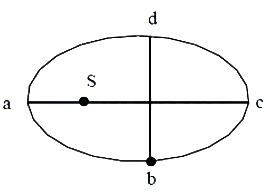
$A$ planet revolves around the Sun in an elliptical orbit,where the semi-major axis $a$ is double the semi-minor axis $b$ $(a = 2b)$. The Sun is at the focus. Given that the planet takes $24$ hours to travel through the path $bed$ as shown in the figure,find the time taken by the planet to travel along the path $dab$.
A
$744$ minutes
B
$634$ minutes
C
$804$ minutes
D
$1440$ minutes
Solution
(C) According to Kepler's second law,the areal velocity of a planet is constant. The time taken to sweep an area is proportional to the area swept.
Let the ellipse be $\frac{x^2}{a^2} + \frac{y^2}{b^2} = 1$. Here $a = 2b$.
The Sun is at the focus $S(ae, 0)$. The eccentricity $e = \sqrt{1 - \frac{b^2}{a^2}} = \sqrt{1 - \frac{1}{4}} = \frac{\sqrt{3}}{2}$.
So,$S = (2 \cdot \frac{\sqrt{3}}{2}, 0) = (\sqrt{3}, 0)$.
The path $bed$ corresponds to the area swept by the radius vector from $S$ to the arc $bed$. The area of the ellipse is $A = \pi ab$.
The area swept by the radius vector in path $bed$ is $A_{bed} = \text{Area of rectangle} + \text{Area of sector}$.
Using the property of areal velocity,the time taken is proportional to the area swept. After calculating the areas for path $bed$ and $dab$,the ratio of times is found. Given $T_{bed} = 24$ hours = $1440$ minutes,the calculation yields $T_{dab} = 804$ minutes.
Let the ellipse be $\frac{x^2}{a^2} + \frac{y^2}{b^2} = 1$. Here $a = 2b$.
The Sun is at the focus $S(ae, 0)$. The eccentricity $e = \sqrt{1 - \frac{b^2}{a^2}} = \sqrt{1 - \frac{1}{4}} = \frac{\sqrt{3}}{2}$.
So,$S = (2 \cdot \frac{\sqrt{3}}{2}, 0) = (\sqrt{3}, 0)$.
The path $bed$ corresponds to the area swept by the radius vector from $S$ to the arc $bed$. The area of the ellipse is $A = \pi ab$.
The area swept by the radius vector in path $bed$ is $A_{bed} = \text{Area of rectangle} + \text{Area of sector}$.
Using the property of areal velocity,the time taken is proportional to the area swept. After calculating the areas for path $bed$ and $dab$,the ratio of times is found. Given $T_{bed} = 24$ hours = $1440$ minutes,the calculation yields $T_{dab} = 804$ minutes.
0 likes
View Solution132
MediumMCQ
If $A$ is the areal velocity of a planet of mass $M$,its angular momentum is
A
$\frac{M}{A}$
B
$2MA$
C
$A^2 M$
D
$A M^2$
Solution
(B) The areal velocity $A$ is defined as the rate at which the area is swept by the position vector of the planet.
$A = \frac{dA}{dt} = \frac{1}{2} r^2 \omega$
Multiplying both sides by the mass $M$ of the planet:
$MA = \frac{1}{2} M r^2 \omega$
Since the moment of inertia $I$ of a point mass $M$ at distance $r$ is $I = M r^2$,we have:
$MA = \frac{1}{2} I \omega$
We know that the angular momentum $L$ is given by $L = I \omega$.
Substituting $L$ into the equation:
$MA = \frac{1}{2} L$
Therefore,the angular momentum $L$ is:
$L = 2MA$
$A = \frac{dA}{dt} = \frac{1}{2} r^2 \omega$
Multiplying both sides by the mass $M$ of the planet:
$MA = \frac{1}{2} M r^2 \omega$
Since the moment of inertia $I$ of a point mass $M$ at distance $r$ is $I = M r^2$,we have:
$MA = \frac{1}{2} I \omega$
We know that the angular momentum $L$ is given by $L = I \omega$.
Substituting $L$ into the equation:
$MA = \frac{1}{2} L$
Therefore,the angular momentum $L$ is:
$L = 2MA$
0 likes
View Solution133
DifficultMCQ
$A$ geostationary satellite is taken from one orbit to another orbit,whose distance from the centre of the Earth is $2$ times that of the earlier orbit. The time period in the second orbit is how many hours?
A
$4.8$
B
$48 \sqrt{2}$
C
$24$
D
$24 \sqrt{2}$
Solution
(B) According to Kepler's Third Law of Planetary Motion,the square of the time period $(T)$ is directly proportional to the cube of the semi-major axis $(r)$ of the orbit: $T^2 \propto r^3$.
Let the initial orbit radius be $r_1$ and the initial time period be $T_1 = 24 \text{ hours}$ (since it is a geostationary satellite).
Let the new orbit radius be $r_2 = 2r_1$.
We need to find the new time period $T_2$.
Using the ratio: $\frac{T_2^2}{T_1^2} = \left( \frac{r_2}{r_1} \right)^3$.
Substituting the values: $\frac{T_2^2}{24^2} = \left( \frac{2r_1}{r_1} \right)^3 = 2^3 = 8$.
$T_2^2 = 8 \times 24^2$.
Taking the square root on both sides: $T_2 = \sqrt{8} \times 24 = 2\sqrt{2} \times 24 = 48\sqrt{2} \text{ hours}$.
Let the initial orbit radius be $r_1$ and the initial time period be $T_1 = 24 \text{ hours}$ (since it is a geostationary satellite).
Let the new orbit radius be $r_2 = 2r_1$.
We need to find the new time period $T_2$.
Using the ratio: $\frac{T_2^2}{T_1^2} = \left( \frac{r_2}{r_1} \right)^3$.
Substituting the values: $\frac{T_2^2}{24^2} = \left( \frac{2r_1}{r_1} \right)^3 = 2^3 = 8$.
$T_2^2 = 8 \times 24^2$.
Taking the square root on both sides: $T_2 = \sqrt{8} \times 24 = 2\sqrt{2} \times 24 = 48\sqrt{2} \text{ hours}$.
0 likes
View Solution134
EasyMCQ
$A$ satellite is launched into a circular orbit of radius $R$ around Earth,while a second satellite is launched into an orbit of radius $1.02 R$. The percentage difference in the time periods of the two satellites is:
A
$0.7$
B
$1$
C
$1.5$
D
$3$
Solution
(D) According to Kepler's third law of planetary motion,the square of the time period $T$ is proportional to the cube of the orbital radius $R$,i.e.,$T^2 \propto R^3$.
Let $T_1$ be the time period for radius $R_1 = R$ and $T_2$ be the time period for radius $R_2 = 1.02 R$.
Then,$\frac{T_2}{T_1} = \left( \frac{R_2}{R_1} \right)^{3/2} = (1.02)^{3/2}$.
Using the binomial approximation $(1+x)^n \approx 1+nx$ for small $x$,where $x = 0.02$ and $n = 1.5$:
$\frac{T_2}{T_1} \approx 1 + (1.5 \times 0.02) = 1 + 0.03 = 1.03$.
This implies $T_2 \approx 1.03 T_1$.
The percentage difference is given by $\frac{T_2 - T_1}{T_1} \times 100 = \left( \frac{T_2}{T_1} - 1 \right) \times 100$.
Substituting the value: $(1.03 - 1) \times 100 = 0.03 \times 100 = 3\%$.
Let $T_1$ be the time period for radius $R_1 = R$ and $T_2$ be the time period for radius $R_2 = 1.02 R$.
Then,$\frac{T_2}{T_1} = \left( \frac{R_2}{R_1} \right)^{3/2} = (1.02)^{3/2}$.
Using the binomial approximation $(1+x)^n \approx 1+nx$ for small $x$,where $x = 0.02$ and $n = 1.5$:
$\frac{T_2}{T_1} \approx 1 + (1.5 \times 0.02) = 1 + 0.03 = 1.03$.
This implies $T_2 \approx 1.03 T_1$.
The percentage difference is given by $\frac{T_2 - T_1}{T_1} \times 100 = \left( \frac{T_2}{T_1} - 1 \right) \times 100$.
Substituting the value: $(1.03 - 1) \times 100 = 0.03 \times 100 = 3\%$.
0 likes
View Solution135
EasyMCQ
In planetary motion,the areal velocity of the position vector of a planet depends on the angular velocity $\omega$ and the distance of the planet from the sun $r$. The correct relation for areal velocity is:
A
$\frac{d A}{d t} \propto \omega r$
B
$\frac{d A}{d t} \propto \omega^2 r$
C
$\frac{d A}{d t} \propto \omega r^2$
D
$\frac{d A}{d t} \propto \sqrt{\omega r}$
Solution
(C) The areal velocity $\frac{d A}{d t}$ is given by the formula $\frac{d A}{d t} = \frac{1}{2} r^2 \omega$.
This formula is derived from the angular momentum $L = mvr = mr^2 \omega$,where the areal velocity $\frac{d A}{d t} = \frac{L}{2m} = \frac{1}{2} r^2 \omega$.
Since $\frac{1}{2}$ is a constant,we have $\frac{d A}{d t} \propto r^2 \omega$.
Therefore,the correct relation is $\frac{d A}{d t} \propto \omega r^2$.
This formula is derived from the angular momentum $L = mvr = mr^2 \omega$,where the areal velocity $\frac{d A}{d t} = \frac{L}{2m} = \frac{1}{2} r^2 \omega$.
Since $\frac{1}{2}$ is a constant,we have $\frac{d A}{d t} \propto r^2 \omega$.
Therefore,the correct relation is $\frac{d A}{d t} \propto \omega r^2$.
0 likes
View Solution136
MediumMCQ
$A$ planet of mass $m$ moves around the Sun along an elliptical path with a period of revolution $T$. During the motion,the planet's maximum and minimum distance from the Sun is $R$ and $\frac{R}{3}$ respectively. If $T^2 = \alpha R^3$,then the magnitude of constant $\alpha$ will be
A
$\frac{10}{9} \cdot \frac{\pi^2}{GM}$
B
$\frac{20}{27} \cdot \frac{\pi^2}{GM}$
C
$\frac{32}{27} \cdot \frac{\pi^2}{GM}$
D
$\frac{1}{18} \cdot \frac{\pi^2}{GM}$
Solution
(C) The semi-major axis $a$ of an elliptical orbit is the average of the maximum distance $(r_{max} = R)$ and minimum distance $(r_{min} = R/3)$:
$a = \frac{R + R/3}{2} = \frac{4R/3}{2} = \frac{2R}{3}$
According to Kepler's Third Law,the period of revolution $T$ is given by:
$T = 2\pi \sqrt{\frac{a^3}{GM}}$
Substituting the value of $a$:
$T = 2\pi \sqrt{\frac{(2R/3)^3}{GM}} = 2\pi \sqrt{\frac{8R^3}{27GM}}$
Squaring both sides:
$T^2 = 4\pi^2 \cdot \frac{8R^3}{27GM} = \frac{32\pi^2}{27GM} \cdot R^3$
Comparing this with $T^2 = \alpha R^3$,we get:
$\alpha = \frac{32\pi^2}{27GM}$
$a = \frac{R + R/3}{2} = \frac{4R/3}{2} = \frac{2R}{3}$
According to Kepler's Third Law,the period of revolution $T$ is given by:
$T = 2\pi \sqrt{\frac{a^3}{GM}}$
Substituting the value of $a$:
$T = 2\pi \sqrt{\frac{(2R/3)^3}{GM}} = 2\pi \sqrt{\frac{8R^3}{27GM}}$
Squaring both sides:
$T^2 = 4\pi^2 \cdot \frac{8R^3}{27GM} = \frac{32\pi^2}{27GM} \cdot R^3$
Comparing this with $T^2 = \alpha R^3$,we get:
$\alpha = \frac{32\pi^2}{27GM}$
0 likes
View Solution137
MediumMCQ
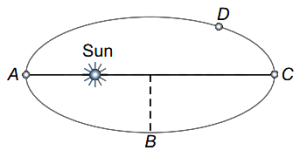
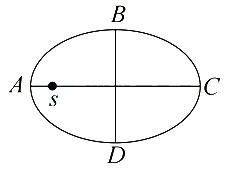
$A$ planet is revolving around the Sun in an elliptical orbit as shown in the figure. Which of the following is a correct statement?
A
The time taken in travelling $DAB$ is less than that for $BCD$.
B
The time taken in travelling $DAB$ is greater than that for $BCD$.
C
The time taken in travelling $CDA$ is less than that for $ABC$.
D
The time taken in travelling $CDA$ is greater than that for $ABC$.
Solution
(A) According to Kepler's Second Law (Law of Areas),the radius vector joining the Sun and the planet sweeps out equal areas in equal intervals of time.
In the given figure,the Sun $(S)$ is at one of the foci of the elliptical orbit.
The area swept by the planet in path $DAB$ is the area of the region bounded by the arc $DAB$ and the lines $SD$ and $SB$.
The area swept by the planet in path $BCD$ is the area of the region bounded by the arc $BCD$ and the lines $SB$ and $SD$.
Since the Sun is closer to the side $A$,the area swept by the planet in path $DAB$ is smaller than the area swept in path $BCD$.
Therefore,the time taken to travel $DAB$ is less than the time taken to travel $BCD$.
In the given figure,the Sun $(S)$ is at one of the foci of the elliptical orbit.
The area swept by the planet in path $DAB$ is the area of the region bounded by the arc $DAB$ and the lines $SD$ and $SB$.
The area swept by the planet in path $BCD$ is the area of the region bounded by the arc $BCD$ and the lines $SB$ and $SD$.
Since the Sun is closer to the side $A$,the area swept by the planet in path $DAB$ is smaller than the area swept in path $BCD$.
Therefore,the time taken to travel $DAB$ is less than the time taken to travel $BCD$.
0 likes
View Solution138
MediumMCQ
Assume that the earth moves around the sun in a circular orbit of radius $R$ and there exists a planet which also moves around the sun in a circular orbit with an angular speed twice as large as that of the earth. The radius of the orbit of the planet is
A
$2^{-2 / 3} R$
B
$2^{2 / 3} R$
C
$2^{-1 / 3} R$
D
$\frac{R}{\sqrt{2}}$
Solution
(A) According to Kepler's third law of planetary motion,the square of the time period $T$ is proportional to the cube of the orbital radius $r$:
$T^2 \propto r^3$
Since angular speed $\omega = \frac{2\pi}{T}$,we have $T = \frac{2\pi}{\omega}$. Substituting this into the law:
$(\frac{2\pi}{\omega})^2 \propto r^3 \Rightarrow \frac{1}{\omega^2} \propto r^3 \Rightarrow r^3 \omega^2 = \text{constant}$.
For the earth $(E)$ and the planet $(P)$:
$r_E^3 \omega_E^2 = r_P^3 \omega_P^2$
Given $r_E = R$ and $\omega_P = 2\omega_E$:
$R^3 \omega_E^2 = r_P^3 (2\omega_E)^2$
$R^3 \omega_E^2 = r_P^3 (4\omega_E^2)$
$R^3 = 4 r_P^3$
$r_P^3 = \frac{R^3}{4} = \frac{R^3}{2^2}$
Taking the cube root on both sides:
$r_P = \frac{R}{2^{2/3}} = 2^{-2/3} R$.
$T^2 \propto r^3$
Since angular speed $\omega = \frac{2\pi}{T}$,we have $T = \frac{2\pi}{\omega}$. Substituting this into the law:
$(\frac{2\pi}{\omega})^2 \propto r^3 \Rightarrow \frac{1}{\omega^2} \propto r^3 \Rightarrow r^3 \omega^2 = \text{constant}$.
For the earth $(E)$ and the planet $(P)$:
$r_E^3 \omega_E^2 = r_P^3 \omega_P^2$
Given $r_E = R$ and $\omega_P = 2\omega_E$:
$R^3 \omega_E^2 = r_P^3 (2\omega_E)^2$
$R^3 \omega_E^2 = r_P^3 (4\omega_E^2)$
$R^3 = 4 r_P^3$
$r_P^3 = \frac{R^3}{4} = \frac{R^3}{2^2}$
Taking the cube root on both sides:
$r_P = \frac{R}{2^{2/3}} = 2^{-2/3} R$.
0 likes
View Solution139
EasyMCQ
The average distance of the Earth from the Sun is $L_{1}$. If one year of the Earth is $D$ days,then one year of another planet whose average distance from the Sun is $L_{2}$ will be:
A
$D\left(\frac{L_{2}}{L_{1}}\right)^{\frac{1}{2}} \text{ days}$
B
$D\left(\frac{L_{2}}{L_{1}}\right)^{\frac{3}{2}} \text{ days}$
C
$D\left(\frac{L_{2}}{L_{1}}\right)^{\frac{2}{3}} \text{ days}$
D
$D\left(\frac{L_{2}}{L_{1}}\right) \text{ days}$
Solution
(B) According to Kepler's third law of planetary motion,the square of the time period $(T)$ of a planet is directly proportional to the cube of its average distance $(R)$ from the Sun.
$T^{2} \propto R^{3}$
Let $T_{1} = D$ be the time period of the Earth at distance $L_{1}$,and $T_{2}$ be the time period of the other planet at distance $L_{2}$.
Then,$\frac{T_{2}^{2}}{T_{1}^{2}} = \frac{L_{2}^{3}}{L_{1}^{3}}$
$\frac{T_{2}^{2}}{D^{2}} = \left(\frac{L_{2}}{L_{1}}\right)^{3}$
$T_{2}^{2} = D^{2} \left(\frac{L_{2}}{L_{1}}\right)^{3}$
Taking the square root on both sides:
$T_{2} = D \left(\frac{L_{2}}{L_{1}}\right)^{3/2} \text{ days}$.
$T^{2} \propto R^{3}$
Let $T_{1} = D$ be the time period of the Earth at distance $L_{1}$,and $T_{2}$ be the time period of the other planet at distance $L_{2}$.
Then,$\frac{T_{2}^{2}}{T_{1}^{2}} = \frac{L_{2}^{3}}{L_{1}^{3}}$
$\frac{T_{2}^{2}}{D^{2}} = \left(\frac{L_{2}}{L_{1}}\right)^{3}$
$T_{2}^{2} = D^{2} \left(\frac{L_{2}}{L_{1}}\right)^{3}$
Taking the square root on both sides:
$T_{2} = D \left(\frac{L_{2}}{L_{1}}\right)^{3/2} \text{ days}$.
0 likes
View Solution140
DifficultMCQ
$A$ planet $(P_1)$ is moving around a star of mass $2M$ in an orbit of radius $R$. Another planet $(P_2)$ is moving around another star of mass $4M$ in an orbit of radius $2R$. The ratio of the time periods of revolution of $P_2$ and $P_1$ is . . . . . . .
A
$1$/$2$
B
$2$
C
$4$
D
$1$/$4$
Solution
(B) According to Kepler's Third Law,the time period $T$ of a planet orbiting a star of mass $M$ at a distance $R$ is given by $T^2 = \frac{4\pi^2 R^3}{GM}$.
Thus,$T \propto \sqrt{\frac{R^3}{M}}$.
For planet $P_1$: $T_1 \propto \sqrt{\frac{R^3}{2M}}$.
For planet $P_2$: $T_2 \propto \sqrt{\frac{(2R)^3}{4M}} = \sqrt{\frac{8R^3}{4M}} = \sqrt{\frac{2R^3}{M}}$.
Taking the ratio $\frac{T_2}{T_1}$:
$\frac{T_2}{T_1} = \frac{\sqrt{2R^3/M}}{\sqrt{R^3/2M}} = \sqrt{\frac{2R^3}{M} \cdot \frac{2M}{R^3}} = \sqrt{4} = 2$.
Therefore,the ratio of the time periods of revolution of $P_2$ and $P_1$ is $2$.
Thus,$T \propto \sqrt{\frac{R^3}{M}}$.
For planet $P_1$: $T_1 \propto \sqrt{\frac{R^3}{2M}}$.
For planet $P_2$: $T_2 \propto \sqrt{\frac{(2R)^3}{4M}} = \sqrt{\frac{8R^3}{4M}} = \sqrt{\frac{2R^3}{M}}$.
Taking the ratio $\frac{T_2}{T_1}$:
$\frac{T_2}{T_1} = \frac{\sqrt{2R^3/M}}{\sqrt{R^3/2M}} = \sqrt{\frac{2R^3}{M} \cdot \frac{2M}{R^3}} = \sqrt{4} = 2$.
Therefore,the ratio of the time periods of revolution of $P_2$ and $P_1$ is $2$.
0 likes
View SolutionGravitation — Kepler’s laws of Planetary Motion · Frequently Asked Questions
1Are these Gravitation questions useful for JEE and NEET?
Yes. All questions in this section are mapped to JEE Main and NEET exam patterns. Previous year questions from JEE Main, NEET, GUJCET and state-level exams are included with full solutions.
2Can I switch to Hindi or Gujarati for these questions?
Yes. Use the language tabs in the hero section or the sidebar to view the same questions and solutions in English, Hindi or Gujarati.
3How do I generate a question paper from this subtopic?
Use the Vedclass Exam Paper Generator — select the chapter and subtopic, set difficulty, and generate Sets A, B, C, D automatically. First 3 chapters of every subject are free.
Vedclass Products
For Students
Vedclass Test Series
Mock tests in real JEE/NEET style with performance analysis. 5-day free trial.
Start Free TrialFor Teachers
Exam Paper Generator
Generate Set A/B/C/D papers from this chapter in 2 minutes. 3 chapters free.
Try FreeFor Institutes
Online Exam Module
Live online exams with unlimited students, 360° analytics & white-label branding.
See DemoFor Teachers & Institutes
Generate a Gravitation Exam Paper in 2 Minutes
Select subtopic & difficulty — Sets A, B, C, D auto-generated with No Repeat logic.
First 3 chapters of every subject are free — no payment required.