
A English
Acceleration Due to Gravity and its Variation Questions in English
Class 11 Physics · Gravitation · Acceleration Due to Gravity and its Variation
430+
Questions
English
Language
100%
With Solutions
Showing 29 of 430 questions in English
401
MediumMCQ
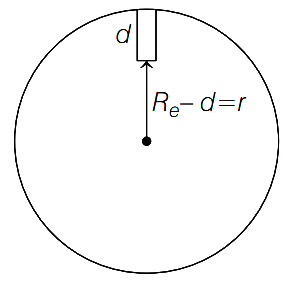
The acceleration due to gravity at a height $(1/20)^{th}$ of the radius of the Earth above the Earth's surface is $9 m s^{-2}$. Its value at an equal depth below the surface of the Earth is: (in $m s^{-2}$)
A
$9$
B
$9.25$
C
$9.5$
D
$9.8$
Solution
(C) The variation in acceleration due to gravity at a height $h$ above the Earth's surface is given by $g' = g(1 - 2h/R)$.
Given $g' = 9 m s^{-2}$ and $h = R/20$,we have:
$9 = g(1 - 2(R/20)/R) = g(1 - 1/10) = g(9/10)$.
Therefore,$g = 10 m s^{-2}$.
The variation in acceleration due to gravity at a depth $d$ below the Earth's surface is given by $g'' = g(1 - d/R)$.
For an equal depth $d = h = R/20$,we have:
$g'' = 10(1 - (R/20)/R) = 10(1 - 1/20) = 10(19/20) = 9.5 m s^{-2}$.
Given $g' = 9 m s^{-2}$ and $h = R/20$,we have:
$9 = g(1 - 2(R/20)/R) = g(1 - 1/10) = g(9/10)$.
Therefore,$g = 10 m s^{-2}$.
The variation in acceleration due to gravity at a depth $d$ below the Earth's surface is given by $g'' = g(1 - d/R)$.
For an equal depth $d = h = R/20$,we have:
$g'' = 10(1 - (R/20)/R) = 10(1 - 1/20) = 10(19/20) = 9.5 m s^{-2}$.
0 likes
View Solution402
MediumMCQ
The distance through which one has to dig the earth from its surface so as to reach the point where the acceleration due to gravity is reduced by $40 \%$ of that at the surface of the earth,is (radius of earth is $6400 \ km$) (in $km$)
A
$2560$
B
$3000$
C
$3260$
D
$1560$
Solution
(A) The acceleration due to gravity at a depth $d$ below the surface of the earth is given by $g_d = g(1 - \frac{d}{R})$,where $g$ is the acceleration due to gravity at the surface and $R$ is the radius of the earth.
Given that the acceleration due to gravity is reduced by $40 \%$,the value at depth $d$ becomes $g_d = g - 0.40g = 0.60g$.
Substituting this into the formula: $0.60g = g(1 - \frac{d}{R})$.
Dividing both sides by $g$: $0.60 = 1 - \frac{d}{R}$.
Rearranging the terms: $\frac{d}{R} = 1 - 0.60 = 0.40$.
Therefore,$d = 0.40 \times R$.
Given $R = 6400 \ km$,we have $d = 0.40 \times 6400 \ km = 2560 \ km$.
Given that the acceleration due to gravity is reduced by $40 \%$,the value at depth $d$ becomes $g_d = g - 0.40g = 0.60g$.
Substituting this into the formula: $0.60g = g(1 - \frac{d}{R})$.
Dividing both sides by $g$: $0.60 = 1 - \frac{d}{R}$.
Rearranging the terms: $\frac{d}{R} = 1 - 0.60 = 0.40$.
Therefore,$d = 0.40 \times R$.
Given $R = 6400 \ km$,we have $d = 0.40 \times 6400 \ km = 2560 \ km$.
0 likes
View Solution403
EasyMCQ
At what depth below the surface of the earth will the acceleration due to gravity be half of its value at $1600 \ km$ above the surface of the earth?
A
$4.8 \times 10^6 \ m$
B
$3.19 \times 10^6 \ m$
C
$1.59 \times 10^6 \ m$
D
$5.5 \times 10^6 \ m$
Solution
(A) The acceleration due to gravity at height $h$ is given by $g_h = g \left( \frac{R}{R+h} \right)^2$. Given $h = 1600 \ km$ and $R = 6400 \ km$,we have $g_h = g \left( \frac{6400}{6400+1600} \right)^2 = g \left( \frac{6400}{8000} \right)^2 = g \left( \frac{4}{5} \right)^2 = 0.64g$.
The acceleration due to gravity at depth $d$ is given by $g_d = g \left( 1 - \frac{d}{R} \right)$.
According to the problem,$g_d = \frac{1}{2} g_h = \frac{1}{2} (0.64g) = 0.32g$.
Substituting this into the depth formula: $0.32g = g \left( 1 - \frac{d}{R} \right)$.
$0.32 = 1 - \frac{d}{R} \Rightarrow \frac{d}{R} = 1 - 0.32 = 0.68$.
$d = 0.68 \times 6400 \ km = 4352 \ km = 4.352 \times 10^6 \ m$.
Note: If using the approximation $g_h \approx g(1 - 2h/R)$,then $g_h = g(1 - 3200/6400) = 0.5g$. Then $g_d = 0.5 g_h = 0.25g$.
$0.25g = g(1 - d/R) \Rightarrow d/R = 0.75 \Rightarrow d = 0.75 \times 6400 \ km = 4800 \ km = 4.8 \times 10^6 \ m$.
Given the options,the approximation method is intended.
The acceleration due to gravity at depth $d$ is given by $g_d = g \left( 1 - \frac{d}{R} \right)$.
According to the problem,$g_d = \frac{1}{2} g_h = \frac{1}{2} (0.64g) = 0.32g$.
Substituting this into the depth formula: $0.32g = g \left( 1 - \frac{d}{R} \right)$.
$0.32 = 1 - \frac{d}{R} \Rightarrow \frac{d}{R} = 1 - 0.32 = 0.68$.
$d = 0.68 \times 6400 \ km = 4352 \ km = 4.352 \times 10^6 \ m$.
Note: If using the approximation $g_h \approx g(1 - 2h/R)$,then $g_h = g(1 - 3200/6400) = 0.5g$. Then $g_d = 0.5 g_h = 0.25g$.
$0.25g = g(1 - d/R) \Rightarrow d/R = 0.75 \Rightarrow d = 0.75 \times 6400 \ km = 4800 \ km = 4.8 \times 10^6 \ m$.
Given the options,the approximation method is intended.
0 likes
View Solution404
EasyMCQ
If the earth stops rotating on its own axis,there will be no variation in the weight of our bodies at:
A
Equator
B
$60^\circ$ latitude
C
Poles
D
Nowhere
Solution
(C) The effective acceleration due to gravity $g'$ at a latitude $\lambda$ is given by $g' = g - \omega^2 R \cos^2 \lambda$,where $\omega$ is the angular velocity of the earth's rotation and $R$ is the radius of the earth.
At the poles,the latitude $\lambda = 90^\circ$. Substituting this into the formula,we get $g' = g - \omega^2 R \cos^2(90^\circ) = g - 0 = g$.
Since the value of $g'$ at the poles is independent of the angular velocity $\omega$,the weight of a body $(w = mg')$ will not change if the earth stops rotating on its own axis.
Therefore,there will be no variation in the weight of our bodies at the poles.
At the poles,the latitude $\lambda = 90^\circ$. Substituting this into the formula,we get $g' = g - \omega^2 R \cos^2(90^\circ) = g - 0 = g$.
Since the value of $g'$ at the poles is independent of the angular velocity $\omega$,the weight of a body $(w = mg')$ will not change if the earth stops rotating on its own axis.
Therefore,there will be no variation in the weight of our bodies at the poles.
0 likes
View Solution405
MediumMCQ
The radius of Earth is about $6400 \,km$ and that of Mars is $3200 \,km$,and the mass of the Earth is about $10$ times the mass of Mars. An object weighs $200 \,N$ on the surface of Earth. Then,its weight on the surface of Mars will be (in $\,N$)
A
$80$
B
$40$
C
$20$
D
$8$
Solution
(A) Given: Radius of Earth $(R_e)$ $= 6400 \,km$,Radius of Mars $(R_m)$ $= 3200 \,km$.
Mass of Earth $(M_e)$ $= 10 M_m$,where $M_m$ is the mass of Mars.
The acceleration due to gravity on the surface of a planet is given by $g = \frac{GM}{R^2}$.
The ratio of acceleration due to gravity on Mars $(g_m)$ to that on Earth $(g_e)$ is:
$\frac{g_m}{g_e} = \frac{G M_m / R_m^2}{G M_e / R_e^2} = \frac{M_m}{M_e} \times \left(\frac{R_e}{R_m}\right)^2$.
Substituting the given values:
$\frac{g_m}{g_e} = \frac{1}{10} \times \left(\frac{6400}{3200}\right)^2 = \frac{1}{10} \times (2)^2 = \frac{4}{10} = \frac{2}{5}$.
The weight of an object is $W = mg$.
Given weight on Earth $W_e = m g_e = 200 \,N$.
Weight on Mars $W_m = m g_m = m \left(\frac{2}{5} g_e\right) = \frac{2}{5} W_e$.
$W_m = \frac{2}{5} \times 200 \,N = 80 \,N$.
Mass of Earth $(M_e)$ $= 10 M_m$,where $M_m$ is the mass of Mars.
The acceleration due to gravity on the surface of a planet is given by $g = \frac{GM}{R^2}$.
The ratio of acceleration due to gravity on Mars $(g_m)$ to that on Earth $(g_e)$ is:
$\frac{g_m}{g_e} = \frac{G M_m / R_m^2}{G M_e / R_e^2} = \frac{M_m}{M_e} \times \left(\frac{R_e}{R_m}\right)^2$.
Substituting the given values:
$\frac{g_m}{g_e} = \frac{1}{10} \times \left(\frac{6400}{3200}\right)^2 = \frac{1}{10} \times (2)^2 = \frac{4}{10} = \frac{2}{5}$.
The weight of an object is $W = mg$.
Given weight on Earth $W_e = m g_e = 200 \,N$.
Weight on Mars $W_m = m g_m = m \left(\frac{2}{5} g_e\right) = \frac{2}{5} W_e$.
$W_m = \frac{2}{5} \times 200 \,N = 80 \,N$.
0 likes
View Solution406
DifficultMCQ
The rotation of the Earth (of radius $R$) about its axis speeds up to a value such that a man at latitude angle $45^{\circ}$ feels weightlessness. The duration of a day in such a case is
A
$\pi \sqrt{\frac{R}{g}}$
B
$\pi \sqrt{\frac{2 R}{g}}$
C
$\frac{\pi}{2} \sqrt{\frac{R}{g}}$
D
$\pi \sqrt{\frac{g}{R}}$
Solution
(B) Given that,the angle of latitude is $\lambda = 45^{\circ}$.
The effective acceleration due to gravity at a latitude $\lambda$ is given by $g_{\lambda} = g - \omega^2 R \cos^2 \lambda$.
The apparent weight of a man of mass $m$ at this point is $w = m g_{\lambda} = m(g - \omega^2 R \cos^2 \lambda)$.
According to the question,the man feels weightlessness,so $w = 0$.
Therefore,$m(g - \omega^2 R \cos^2 45^{\circ}) = 0$.
Since $m \neq 0$,we have $g - \omega^2 R (\frac{1}{\sqrt{2}})^2 = 0$,which simplifies to $g - \frac{\omega^2 R}{2} = 0$.
This gives $\omega^2 = \frac{2g}{R}$,or $\omega = \sqrt{\frac{2g}{R}}$.
The duration of a day (time period $T$) is given by $T = \frac{2\pi}{\omega}$.
Substituting the value of $\omega$,we get $T = \frac{2\pi}{\sqrt{2g/R}} = 2\pi \sqrt{\frac{R}{2g}} = \pi \sqrt{\frac{2R}{g}}$.
The effective acceleration due to gravity at a latitude $\lambda$ is given by $g_{\lambda} = g - \omega^2 R \cos^2 \lambda$.
The apparent weight of a man of mass $m$ at this point is $w = m g_{\lambda} = m(g - \omega^2 R \cos^2 \lambda)$.
According to the question,the man feels weightlessness,so $w = 0$.
Therefore,$m(g - \omega^2 R \cos^2 45^{\circ}) = 0$.
Since $m \neq 0$,we have $g - \omega^2 R (\frac{1}{\sqrt{2}})^2 = 0$,which simplifies to $g - \frac{\omega^2 R}{2} = 0$.
This gives $\omega^2 = \frac{2g}{R}$,or $\omega = \sqrt{\frac{2g}{R}}$.
The duration of a day (time period $T$) is given by $T = \frac{2\pi}{\omega}$.
Substituting the value of $\omega$,we get $T = \frac{2\pi}{\sqrt{2g/R}} = 2\pi \sqrt{\frac{R}{2g}} = \pi \sqrt{\frac{2R}{g}}$.
0 likes
View Solution407
EasyMCQ
How does the acceleration due to gravity change with altitude?
A
increases with altitude
B
decreases with altitude
C
is independent of altitude
D
first decreases and then increases with altitude
Solution
(B) The acceleration due to gravity $g'$ at an altitude $h$ above the Earth's surface is given by the formula:
$g' = g \left( 1 + \frac{h}{R_e} \right)^{-2}$
Using the binomial theorem for $h \ll R_e$,we can approximate this as:
$g' \approx g \left( 1 - \frac{2h}{R_e} \right)$
From this expression,it is clear that as the altitude $h$ increases,the term $\frac{2h}{R_e}$ increases,causing the value of $g'$ to decrease.
Therefore,the acceleration due to gravity decreases with altitude.
$g' = g \left( 1 + \frac{h}{R_e} \right)^{-2}$
Using the binomial theorem for $h \ll R_e$,we can approximate this as:
$g' \approx g \left( 1 - \frac{2h}{R_e} \right)$
From this expression,it is clear that as the altitude $h$ increases,the term $\frac{2h}{R_e}$ increases,causing the value of $g'$ to decrease.
Therefore,the acceleration due to gravity decreases with altitude.
0 likes
View Solution408
EasyMCQ
At what height from the surface of the earth will the value of acceleration due to gravity fall to half of its value on the surface of the earth?
A
$2625 \,m$
B
$2625 \,km$
C
$2526 \,m$
D
$2526 \,km$
Solution
(B) Let $g$ be the acceleration due to gravity on the surface of the earth and $R_e$ be the radius of the earth.
The acceleration due to gravity at a height $h$ is given by the formula:
$g_h = \frac{g}{(1 + \frac{h}{R_e})^2}$
According to the problem, $g_h = \frac{g}{2}$.
Substituting this into the equation:
$\frac{g}{2} = \frac{g}{(1 + \frac{h}{R_e})^2}$
$(1 + \frac{h}{R_e})^2 = 2$
$1 + \frac{h}{R_e} = \sqrt{2}$
$h = (\sqrt{2} - 1) R_e$
Using $R_e \approx 6400 \,km$ and $\sqrt{2} \approx 1.414$:
$h = (1.414 - 1) \times 6400 \,km$
$h = 0.414 \times 6400 \,km$
$h = 2649.6 \,km$
Rounding to the nearest provided option, the height is approximately $2625 \,km$.
The acceleration due to gravity at a height $h$ is given by the formula:
$g_h = \frac{g}{(1 + \frac{h}{R_e})^2}$
According to the problem, $g_h = \frac{g}{2}$.
Substituting this into the equation:
$\frac{g}{2} = \frac{g}{(1 + \frac{h}{R_e})^2}$
$(1 + \frac{h}{R_e})^2 = 2$
$1 + \frac{h}{R_e} = \sqrt{2}$
$h = (\sqrt{2} - 1) R_e$
Using $R_e \approx 6400 \,km$ and $\sqrt{2} \approx 1.414$:
$h = (1.414 - 1) \times 6400 \,km$
$h = 0.414 \times 6400 \,km$
$h = 2649.6 \,km$
Rounding to the nearest provided option, the height is approximately $2625 \,km$.
0 likes
View Solution409
EasyMCQ
Acceleration due to gravity at a height $h$ is equal to that at a depth $d$ below the surface of the earth,if
A
$d=h$
B
$2 d=h$
C
$d=2 h$
D
$3 d=h$
Solution
(C) The acceleration due to gravity at a height $h$ above the Earth's surface is given by $g_h = g(1 - \frac{2h}{R_e})$,where $R_e$ is the radius of the Earth.
The acceleration due to gravity at a depth $d$ below the Earth's surface is given by $g_d = g(1 - \frac{d}{R_e})$.
According to the problem,$g_h = g_d$.
Equating the two expressions:
$g(1 - \frac{2h}{R_e}) = g(1 - \frac{d}{R_e})$
Canceling $g$ from both sides:
$1 - \frac{2h}{R_e} = 1 - \frac{d}{R_e}$
Subtracting $1$ from both sides:
$-\frac{2h}{R_e} = -\frac{d}{R_e}$
Multiplying by $-R_e$:
$2h = d$ or $d = 2h$.
The acceleration due to gravity at a depth $d$ below the Earth's surface is given by $g_d = g(1 - \frac{d}{R_e})$.
According to the problem,$g_h = g_d$.
Equating the two expressions:
$g(1 - \frac{2h}{R_e}) = g(1 - \frac{d}{R_e})$
Canceling $g$ from both sides:
$1 - \frac{2h}{R_e} = 1 - \frac{d}{R_e}$
Subtracting $1$ from both sides:
$-\frac{2h}{R_e} = -\frac{d}{R_e}$
Multiplying by $-R_e$:
$2h = d$ or $d = 2h$.
0 likes
View Solution410
EasyMCQ
The value of acceleration due to gravity $g$ is maximum at
A
poles
B
centre
C
equator
D
surface of earth
Solution
(A) The acceleration due to gravity $g^{\prime}$ at a latitude $\lambda$ on the surface of the Earth is given by the formula:
$g^{\prime} = g - \omega^2 R_e \cos^2 \lambda$
where $g$ is the acceleration due to gravity at the poles,$\omega$ is the angular velocity of the Earth,and $R_e$ is the radius of the Earth.
At the poles,the latitude $\lambda = 90^{\circ}$.
Since $\cos 90^{\circ} = 0$,the expression becomes:
$g^{\prime} = g - \omega^2 R_e (0)^2 = g$
At the equator,$\lambda = 0^{\circ}$,so $\cos 0^{\circ} = 1$,which gives $g^{\prime} = g - \omega^2 R_e$,which is the minimum value.
Therefore,the value of acceleration due to gravity is maximum at the poles.
$g^{\prime} = g - \omega^2 R_e \cos^2 \lambda$
where $g$ is the acceleration due to gravity at the poles,$\omega$ is the angular velocity of the Earth,and $R_e$ is the radius of the Earth.
At the poles,the latitude $\lambda = 90^{\circ}$.
Since $\cos 90^{\circ} = 0$,the expression becomes:
$g^{\prime} = g - \omega^2 R_e (0)^2 = g$
At the equator,$\lambda = 0^{\circ}$,so $\cos 0^{\circ} = 1$,which gives $g^{\prime} = g - \omega^2 R_e$,which is the minimum value.
Therefore,the value of acceleration due to gravity is maximum at the poles.
0 likes
View Solution411
EasyMCQ
The weight of a body at the earth's surface is $w$. At a depth half way to the centre of the earth,its weight will be (assuming uniform density for the earth):
A
$w$
B
$\frac{w}{4}$
C
$\frac{w}{2}$
D
$\frac{w}{16}$
Solution
(C) The acceleration due to gravity at a depth $d$ below the earth's surface is given by the formula: $g_d = g(1 - \frac{d}{R})$,where $g$ is the acceleration due to gravity at the surface and $R$ is the radius of the earth.
Given that the depth $d = \frac{R}{2}$,we substitute this into the formula:
$g_d = g(1 - \frac{R/2}{R}) = g(1 - \frac{1}{2}) = \frac{g}{2}$.
Since weight $w = mg$,the new weight $w'$ at depth $d$ is $w' = m g_d = m(\frac{g}{2}) = \frac{mg}{2} = \frac{w}{2}$.
Therefore,the weight of the body at a depth half way to the centre of the earth is $\frac{w}{2}$.
Given that the depth $d = \frac{R}{2}$,we substitute this into the formula:
$g_d = g(1 - \frac{R/2}{R}) = g(1 - \frac{1}{2}) = \frac{g}{2}$.
Since weight $w = mg$,the new weight $w'$ at depth $d$ is $w' = m g_d = m(\frac{g}{2}) = \frac{mg}{2} = \frac{w}{2}$.
Therefore,the weight of the body at a depth half way to the centre of the earth is $\frac{w}{2}$.
0 likes
View Solution412
MediumMCQ
Assertion $(A)$: $A$ particle of mass $m$ dropped into a hole made along the diameter of the Earth from one end to the other possesses simple harmonic motion.
Reason $(R)$: Gravitational force between any two particles is inversely proportional to the square of the distance between them.
Reason $(R)$: Gravitational force between any two particles is inversely proportional to the square of the distance between them.
A
Both $(A)$ and $(R)$ are true and $(R)$ is the correct explanation of $(A)$
B
Both $(A)$ and $(R)$ are true but $(R)$ is not the correct explanation of $(A)$
C
$(A)$ is true but $(R)$ is false
D
$(A)$ is false but $(R)$ is true
Solution
(B) The gravitational force on a particle of mass $m$ at a distance $r$ from the center of the Earth (where $r < R_e$) is given by $F = -\frac{GMmr}{R_e^3}$.
Since $F \propto -r$,the force is a restoring force proportional to the displacement from the center,which is the condition for Simple Harmonic Motion $(SHM)$. Thus,Assertion $(A)$ is true.
The Reason $(R)$ states Newton's Law of Gravitation,which is also a true statement $(F \propto 1/r^2)$.
However,the motion inside the Earth is governed by the effective gravitational field inside a sphere,where the force is proportional to $r$,not $1/r^2$. Therefore,$(R)$ is not the correct explanation for $(A)$.
Since $F \propto -r$,the force is a restoring force proportional to the displacement from the center,which is the condition for Simple Harmonic Motion $(SHM)$. Thus,Assertion $(A)$ is true.
The Reason $(R)$ states Newton's Law of Gravitation,which is also a true statement $(F \propto 1/r^2)$.
However,the motion inside the Earth is governed by the effective gravitational field inside a sphere,where the force is proportional to $r$,not $1/r^2$. Therefore,$(R)$ is not the correct explanation for $(A)$.
0 likes
View Solution413
EasyMCQ
$A$ point mass of $10 \,kg$ is placed at the centre of the Earth. The weight of the point mass is
A
zero
B
$98 \,N$
C
$49 \,N$
D
$10 \,N$
Solution
(A) At the centre of the Earth, the gravitational acceleration $g$ is zero.
Since the weight $w$ of an object is defined as the product of its mass $m$ and the gravitational acceleration $g$, we have $w = m \times g$.
Substituting the given values, $w = 10 \,kg \times 0 \,m/s^2 = 0 \,N$.
Therefore, the weight of the point mass at the centre of the Earth is zero.
Since the weight $w$ of an object is defined as the product of its mass $m$ and the gravitational acceleration $g$, we have $w = m \times g$.
Substituting the given values, $w = 10 \,kg \times 0 \,m/s^2 = 0 \,N$.
Therefore, the weight of the point mass at the centre of the Earth is zero.
0 likes
View Solution414
MediumMCQ
Find the angular speed of rotation of the Earth,so that the apparent $g$ at the equator becomes $(1/6)$th of its original value. $(R = 6.4 \times 10^6 \ m)$
A
$1.3 \times 10^{-6} \ rad \ s^{-1}$
B
$8.75 \times 10^{-4} \ rad \ s^{-1}$
C
$1.14 \times 10^{-3} \ rad \ s^{-1}$
D
$2.6 \times 10^6 \ rad \ s^{-1}$
Solution
(C) The apparent acceleration due to gravity $g^{\prime}$ at the equator due to the rotation of the Earth is given by the formula:
$g^{\prime} = g_0 - \omega^2 R$
Given that the apparent $g^{\prime}$ is $(1/6)$th of its original value $g_0$,we have:
$g^{\prime} = \frac{g_0}{6}$
Substituting this into the equation:
$\frac{g_0}{6} = g_0 - \omega^2 R$
Rearranging the terms to solve for $\omega^2 R$:
$\omega^2 R = g_0 - \frac{g_0}{6} = \frac{5}{6} g_0$
$\omega = \sqrt{\frac{5 g_0}{6 R}}$
Substituting the values $g_0 = 9.8 \ m/s^2$ and $R = 6.4 \times 10^6 \ m$:
$\omega = \sqrt{\frac{5 \times 9.8}{6 \times 6.4 \times 10^6}}$
$\omega = \sqrt{\frac{49}{38.4 \times 10^6}} = \sqrt{1.276 \times 10^{-6}}$
$\omega \approx 1.13 \times 10^{-3} \ rad \ s^{-1}$
Thus,the angular speed is approximately $1.14 \times 10^{-3} \ rad \ s^{-1}$.
$g^{\prime} = g_0 - \omega^2 R$
Given that the apparent $g^{\prime}$ is $(1/6)$th of its original value $g_0$,we have:
$g^{\prime} = \frac{g_0}{6}$
Substituting this into the equation:
$\frac{g_0}{6} = g_0 - \omega^2 R$
Rearranging the terms to solve for $\omega^2 R$:
$\omega^2 R = g_0 - \frac{g_0}{6} = \frac{5}{6} g_0$
$\omega = \sqrt{\frac{5 g_0}{6 R}}$
Substituting the values $g_0 = 9.8 \ m/s^2$ and $R = 6.4 \times 10^6 \ m$:
$\omega = \sqrt{\frac{5 \times 9.8}{6 \times 6.4 \times 10^6}}$
$\omega = \sqrt{\frac{49}{38.4 \times 10^6}} = \sqrt{1.276 \times 10^{-6}}$
$\omega \approx 1.13 \times 10^{-3} \ rad \ s^{-1}$
Thus,the angular speed is approximately $1.14 \times 10^{-3} \ rad \ s^{-1}$.
0 likes
View Solution415
MediumMCQ
When a ball is dropped from a height $h$,it takes $t \ s$ to reach the ground. If the same experiment is done on a different planet having a mass $100$ times the earth's mass and a radius $10$ times the earth's radius,then the time it will take to cover the same height on the new planet is:
A
$t \ s$
B
$100t \ s$
C
$\frac{t}{100} \ s$
D
$\frac{t}{10} \ s$
Solution
(A) The acceleration due to gravity on the surface of a planet is given by $g = \frac{GM}{R^2}$.
For Earth,$g_e = \frac{GM}{R^2}$.
For the new planet,the mass $M' = 100M$ and the radius $R' = 10R$.
Therefore,the acceleration due to gravity on the new planet is $g_p = \frac{G(100M)}{(10R)^2} = \frac{100GM}{100R^2} = \frac{GM}{R^2} = g_e$.
Since the height $h$ is the same and the acceleration due to gravity $g$ is the same,the time taken to reach the ground is given by $h = \frac{1}{2}gt^2$,which implies $t = \sqrt{\frac{2h}{g}}$.
Since $h$ and $g$ are identical for both,the time taken $t$ remains the same.
For Earth,$g_e = \frac{GM}{R^2}$.
For the new planet,the mass $M' = 100M$ and the radius $R' = 10R$.
Therefore,the acceleration due to gravity on the new planet is $g_p = \frac{G(100M)}{(10R)^2} = \frac{100GM}{100R^2} = \frac{GM}{R^2} = g_e$.
Since the height $h$ is the same and the acceleration due to gravity $g$ is the same,the time taken to reach the ground is given by $h = \frac{1}{2}gt^2$,which implies $t = \sqrt{\frac{2h}{g}}$.
Since $h$ and $g$ are identical for both,the time taken $t$ remains the same.
0 likes
View Solution416
MediumMCQ
Two bodies each of mass $m$ are hung from a balance whose scale pans differ in a vertical height by $h$. If the mean density of the earth is $\rho$,the error in weighing is
A
$\frac{4 \pi \rho G m h}{3}$
B
$\frac{3 \pi \rho Gmh}{4}$
C
$\frac{8 \pi \rho Gmh}{3}$
D
$\frac{3 \pi \rho Gmh}{8}$
Solution
(C) The gravitational force on a body of mass $m$ at the surface of the earth is $F_0 = \frac{G M_e m}{R^2}$.
At a height $h$,the force is $F_h = \frac{G M_e m}{(R+h)^2}$.
The error in weighing is the difference in forces: $\Delta F = F_0 - F_h = \frac{G M_e m}{R^2} - \frac{G M_e m}{(R+h)^2}$.
$\Delta F = \frac{G M_e m}{R^2} \left[ 1 - (1 + \frac{h}{R})^{-2} \right]$.
Using binomial expansion $(1+x)^n \approx 1+nx$ for $h \ll R$,we get $(1 + \frac{h}{R})^{-2} \approx 1 - \frac{2h}{R}$.
So,$\Delta F \approx \frac{G M_e m}{R^2} \left[ 1 - (1 - \frac{2h}{R}) \right] = \frac{G M_e m}{R^2} \left( \frac{2h}{R} \right) = \frac{2 G M_e m h}{R^3}$.
Since the density $\rho = \frac{M_e}{\frac{4}{3} \pi R^3}$,we have $M_e = \frac{4}{3} \pi R^3 \rho$.
Substituting $M_e$ into the expression: $\Delta F = \frac{2 G m h}{R^3} \left( \frac{4}{3} \pi R^3 \rho \right) = \frac{8}{3} \pi \rho G m h$.
At a height $h$,the force is $F_h = \frac{G M_e m}{(R+h)^2}$.
The error in weighing is the difference in forces: $\Delta F = F_0 - F_h = \frac{G M_e m}{R^2} - \frac{G M_e m}{(R+h)^2}$.
$\Delta F = \frac{G M_e m}{R^2} \left[ 1 - (1 + \frac{h}{R})^{-2} \right]$.
Using binomial expansion $(1+x)^n \approx 1+nx$ for $h \ll R$,we get $(1 + \frac{h}{R})^{-2} \approx 1 - \frac{2h}{R}$.
So,$\Delta F \approx \frac{G M_e m}{R^2} \left[ 1 - (1 - \frac{2h}{R}) \right] = \frac{G M_e m}{R^2} \left( \frac{2h}{R} \right) = \frac{2 G M_e m h}{R^3}$.
Since the density $\rho = \frac{M_e}{\frac{4}{3} \pi R^3}$,we have $M_e = \frac{4}{3} \pi R^3 \rho$.
Substituting $M_e$ into the expression: $\Delta F = \frac{2 G m h}{R^3} \left( \frac{4}{3} \pi R^3 \rho \right) = \frac{8}{3} \pi \rho G m h$.
0 likes
View Solution417
MediumMCQ
The time period of a simple pendulum on the surface of the earth is $T$. The height above the surface of the earth at which the time period of the pendulum becomes $2T$ is (Radius of the earth $= 6400 \text{ km}$) (in $\text{ km}$)
A
$3200$
B
$6400$
C
$19200$
D
$800$
Solution
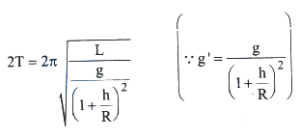
(B) The time period of a simple pendulum is given by $T = 2\pi \sqrt{\frac{L}{g}}$.
At height $h$ above the surface, the acceleration due to gravity is $g' = \frac{g}{(1 + \frac{h}{R})^2}$.
The new time period $T'$ is given by $T' = 2\pi \sqrt{\frac{L}{g'}} = 2\pi \sqrt{\frac{L}{g / (1 + \frac{h}{R})^2}} = T(1 + \frac{h}{R})$.
Given $T' = 2T$, we have $2T = T(1 + \frac{h}{R})$.
$2 = 1 + \frac{h}{R} \Rightarrow \frac{h}{R} = 1$.
Therefore, $h = R = 6400 \text{ km}$.
At height $h$ above the surface, the acceleration due to gravity is $g' = \frac{g}{(1 + \frac{h}{R})^2}$.
The new time period $T'$ is given by $T' = 2\pi \sqrt{\frac{L}{g'}} = 2\pi \sqrt{\frac{L}{g / (1 + \frac{h}{R})^2}} = T(1 + \frac{h}{R})$.
Given $T' = 2T$, we have $2T = T(1 + \frac{h}{R})$.
$2 = 1 + \frac{h}{R} \Rightarrow \frac{h}{R} = 1$.
Therefore, $h = R = 6400 \text{ km}$.
0 likes
View Solution418
MediumMCQ
The ratio of the time periods of a simple pendulum at heights $2 R_E$ and $3 R_E$ from the surface of the earth is ($R_E$ is the radius of the earth).
A
$1: 2$
B
$1: 3$
C
$3: 4$
D
$2: 3$
Solution
(C) The time period of a simple pendulum is given by $T = 2\pi \sqrt{\frac{L}{g'}}$.
Here,$g'$ is the acceleration due to gravity at a height $h$ from the surface of the earth,given by $g' = g (\frac{R_E}{R_E + h} )^2$.
Therefore,$T \propto \frac{1}{\sqrt{g'}} \propto \frac{R_E + h}{R_E}$.
At height $h_1 = 2 R_E$,the time period is $T_1 \propto \frac{R_E + 2 R_E}{R_E} = \frac{3 R_E}{R_E} = 3$.
At height $h_2 = 3 R_E$,the time period is $T_2 \propto \frac{R_E + 3 R_E}{R_E} = \frac{4 R_E}{R_E} = 4$.
The ratio of the time periods is $\frac{T_1}{T_2} = \frac{3}{4}$ or $3: 4$.
Here,$g'$ is the acceleration due to gravity at a height $h$ from the surface of the earth,given by $g' = g (\frac{R_E}{R_E + h} )^2$.
Therefore,$T \propto \frac{1}{\sqrt{g'}} \propto \frac{R_E + h}{R_E}$.
At height $h_1 = 2 R_E$,the time period is $T_1 \propto \frac{R_E + 2 R_E}{R_E} = \frac{3 R_E}{R_E} = 3$.
At height $h_2 = 3 R_E$,the time period is $T_2 \propto \frac{R_E + 3 R_E}{R_E} = \frac{4 R_E}{R_E} = 4$.
The ratio of the time periods is $\frac{T_1}{T_2} = \frac{3}{4}$ or $3: 4$.
0 likes
View Solution419
EasyMCQ
The ratio of the accelerations due to gravity at heights $1280 \ km$ and $3200 \ km$ above the surface of the earth is (Radius of the earth $= 6400 \ km$)
A
$25: 16$
B
$5: 2$
C
$1: 1$
D
$25: 4$
Solution
(A) The acceleration due to gravity at a height $h$ above the surface of the earth is given by the formula: $g' = g \left( \frac{R}{R+h} \right)^2$,where $g$ is the acceleration due to gravity at the surface and $R$ is the radius of the earth.
Given $R = 6400 \ km$.
For $h_1 = 1280 \ km$:
$g_1 = g \left( \frac{6400}{6400 + 1280} \right)^2 = g \left( \frac{6400}{7680} \right)^2 = g \left( \frac{5}{6} \right)^2 = \frac{25}{36} g$.
For $h_2 = 3200 \ km$:
$g_2 = g \left( \frac{6400}{6400 + 3200} \right)^2 = g \left( \frac{6400}{9600} \right)^2 = g \left( \frac{2}{3} \right)^2 = \frac{4}{9} g$.
Now,the ratio $\frac{g_1}{g_2}$ is:
$\frac{g_1}{g_2} = \frac{25/36 g}{4/9 g} = \frac{25}{36} \times \frac{9}{4} = \frac{25}{16}$.
Thus,the ratio is $25:16$.
Given $R = 6400 \ km$.
For $h_1 = 1280 \ km$:
$g_1 = g \left( \frac{6400}{6400 + 1280} \right)^2 = g \left( \frac{6400}{7680} \right)^2 = g \left( \frac{5}{6} \right)^2 = \frac{25}{36} g$.
For $h_2 = 3200 \ km$:
$g_2 = g \left( \frac{6400}{6400 + 3200} \right)^2 = g \left( \frac{6400}{9600} \right)^2 = g \left( \frac{2}{3} \right)^2 = \frac{4}{9} g$.
Now,the ratio $\frac{g_1}{g_2}$ is:
$\frac{g_1}{g_2} = \frac{25/36 g}{4/9 g} = \frac{25}{36} \times \frac{9}{4} = \frac{25}{16}$.
Thus,the ratio is $25:16$.
0 likes
View Solution420
EasyMCQ
Choose the correct statement.
A
Acceleration due to gravity increases with increasing altitude.
B
Acceleration due to gravity is independent of mass of earth.
C
$A$ geostationary satellite can have a time period less than $24$ h.
D
Acceleration due to gravity decreases with increasing depth assuming earth to be a sphere of uniform density.
Solution
(D) The acceleration due to gravity at an altitude $h$ is given by $g_h = \frac{GM}{(R+h)^2}$.
Since $g_h$ is inversely proportional to the square of the distance from the center,$g_h$ decreases as altitude $h$ increases.
Acceleration due to gravity at the surface is $g = \frac{GM}{R^2}$,which clearly depends on the mass of the Earth $M$.
$A$ geostationary satellite must have a time period of exactly $24 \ h$ to remain stationary relative to the Earth's surface.
The acceleration due to gravity at a depth $d$ is given by $g_d = g(1 - \frac{d}{R}) = g(\frac{R-d}{R})$.
As depth $d$ increases,the term $(\frac{R-d}{R})$ decreases,so $g_d$ decreases with increasing depth.
Therefore,option $D$ is the correct statement.
Since $g_h$ is inversely proportional to the square of the distance from the center,$g_h$ decreases as altitude $h$ increases.
Acceleration due to gravity at the surface is $g = \frac{GM}{R^2}$,which clearly depends on the mass of the Earth $M$.
$A$ geostationary satellite must have a time period of exactly $24 \ h$ to remain stationary relative to the Earth's surface.
The acceleration due to gravity at a depth $d$ is given by $g_d = g(1 - \frac{d}{R}) = g(\frac{R-d}{R})$.
As depth $d$ increases,the term $(\frac{R-d}{R})$ decreases,so $g_d$ decreases with increasing depth.
Therefore,option $D$ is the correct statement.
0 likes
View Solution421
EasyMCQ
Which graph correctly represents the variation of acceleration due to gravity $(g)$ with radial distance $(r)$ from the centre of the earth (radius of the earth $= R_e$)?
A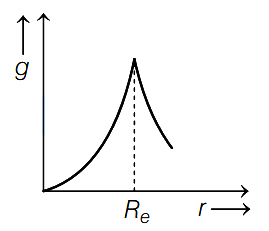
B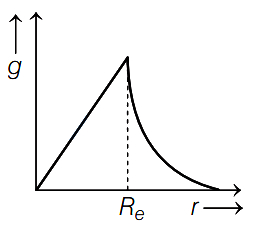
C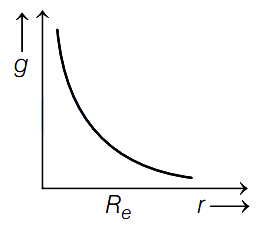
D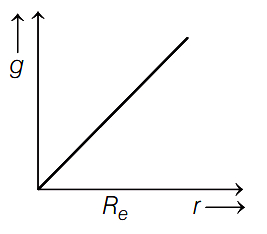
Solution
(B) The variation of acceleration due to gravity $(g)$ with distance $(r)$ from the centre of the earth is given by:
$1$. Inside the earth $(r < R_e)$: The acceleration due to gravity is $g' = \frac{GM r}{R_e^3}$. Since $G, M, R_e$ are constants,$g' \propto r$. This represents a straight line passing through the origin.
$2$. Outside the earth $(r \geq R_e)$: The acceleration due to gravity is $g' = \frac{GM}{r^2}$. Thus,$g' \propto \frac{1}{r^2}$. This represents a rectangular hyperbola.
At the surface $(r = R_e)$,the value of $g$ is maximum. Combining these two,the graph shows a linear increase up to $r = R_e$ and then a decrease following an inverse-square law. Therefore,the correct graph is the one showing a linear rise to a peak at $R_e$ followed by a curve.
$1$. Inside the earth $(r < R_e)$: The acceleration due to gravity is $g' = \frac{GM r}{R_e^3}$. Since $G, M, R_e$ are constants,$g' \propto r$. This represents a straight line passing through the origin.
$2$. Outside the earth $(r \geq R_e)$: The acceleration due to gravity is $g' = \frac{GM}{r^2}$. Thus,$g' \propto \frac{1}{r^2}$. This represents a rectangular hyperbola.
At the surface $(r = R_e)$,the value of $g$ is maximum. Combining these two,the graph shows a linear increase up to $r = R_e$ and then a decrease following an inverse-square law. Therefore,the correct graph is the one showing a linear rise to a peak at $R_e$ followed by a curve.
0 likes
View Solution422
MediumMCQ
If the radius of the earth shrinks by $1 \%$,its mass remaining the same,then the acceleration due to gravity on the earth's surface would
A
increase by $1 \%$
B
remain unchanged
C
increase by $2 \%$
D
decrease by $9.8 \%$
Solution
(C) The acceleration due to gravity on the surface of the Earth is given by $g = \frac{GM}{R^2}$.
Since the mass $M$ remains constant,we have $g \propto \frac{1}{R^2}$.
Taking the logarithmic differentiation,we get $\frac{\Delta g}{g} = -2 \frac{\Delta R}{R}$.
Given that the radius shrinks by $1 \%$,we have $\frac{\Delta R}{R} = -0.01$.
Substituting this value,we get $\frac{\Delta g}{g} = -2 \times (-0.01) = 0.02$.
Therefore,the percentage change in $g$ is $0.02 \times 100 = 2 \%$.
Since the value is positive,the acceleration due to gravity increases by $2 \%$.
Since the mass $M$ remains constant,we have $g \propto \frac{1}{R^2}$.
Taking the logarithmic differentiation,we get $\frac{\Delta g}{g} = -2 \frac{\Delta R}{R}$.
Given that the radius shrinks by $1 \%$,we have $\frac{\Delta R}{R} = -0.01$.
Substituting this value,we get $\frac{\Delta g}{g} = -2 \times (-0.01) = 0.02$.
Therefore,the percentage change in $g$ is $0.02 \times 100 = 2 \%$.
Since the value is positive,the acceleration due to gravity increases by $2 \%$.
0 likes
View Solution423
EasyMCQ
The ratio of the height $h$ above the surface of the Earth to the depth $d$ below the surface of the Earth,for which the gravitational accelerations are the same (assuming small heights),is:
A
$0.25$
B
$0.5$
C
$1.0$
D
$1.25$
Solution
(B) The gravitational acceleration at a height $h$ above the Earth's surface is given by $g_h = g(1 - \frac{2h}{R})$,where $R$ is the radius of the Earth.
The gravitational acceleration at a depth $d$ below the Earth's surface is given by $g_d = g(1 - \frac{d}{R})$.
Given that the gravitational accelerations are the same,we equate the two expressions:
$g(1 - \frac{2h}{R}) = g(1 - \frac{d}{R})$
Canceling $g$ from both sides:
$1 - \frac{2h}{R} = 1 - \frac{d}{R}$
Subtracting $1$ from both sides:
$-\frac{2h}{R} = -\frac{d}{R}$
Multiplying by $-R$:
$2h = d$
Therefore,the ratio of height to depth is:
$\frac{h}{d} = \frac{1}{2} = 0.5$
The gravitational acceleration at a depth $d$ below the Earth's surface is given by $g_d = g(1 - \frac{d}{R})$.
Given that the gravitational accelerations are the same,we equate the two expressions:
$g(1 - \frac{2h}{R}) = g(1 - \frac{d}{R})$
Canceling $g$ from both sides:
$1 - \frac{2h}{R} = 1 - \frac{d}{R}$
Subtracting $1$ from both sides:
$-\frac{2h}{R} = -\frac{d}{R}$
Multiplying by $-R$:
$2h = d$
Therefore,the ratio of height to depth is:
$\frac{h}{d} = \frac{1}{2} = 0.5$
0 likes
View Solution424
EasyMCQ
The ratio of the radii of a planet and the earth is $1: 2$, and the ratio of their mean densities is $4: 1$. If the acceleration due to gravity on the surface of the earth is $9.8 \,ms^{-2}$, then the acceleration due to gravity on the surface of the planet is: (in $\,ms^{-2}$)
A
$4.9$
B
$8.9$
C
$29.4$
D
$19.6$
Solution
(D) The acceleration due to gravity $g$ on the surface of a planet is given by the formula: $g = \frac{4}{3} \pi \rho G R$, where $\rho$ is the mean density and $R$ is the radius of the planet.
From this relation, we see that $g \propto \rho R$.
Given for the planet $(1)$ and the earth $(2)$:
Ratio of radii: $\frac{R_1}{R_2} = \frac{1}{2}$
Ratio of densities: $\frac{\rho_1}{\rho_2} = \frac{4}{1}$
Acceleration due to gravity on earth: $g_2 = 9.8 \,ms^{-2}$.
Using the proportionality $g_1 / g_2 = (\rho_1 / \rho_2) \times (R_1 / R_2)$:
$\frac{g_1}{g_2} = \frac{4}{1} \times \frac{1}{2} = 2$.
Therefore, $g_1 = 2 \times g_2 = 2 \times 9.8 \,ms^{-2} = 19.6 \,ms^{-2}$.
From this relation, we see that $g \propto \rho R$.
Given for the planet $(1)$ and the earth $(2)$:
Ratio of radii: $\frac{R_1}{R_2} = \frac{1}{2}$
Ratio of densities: $\frac{\rho_1}{\rho_2} = \frac{4}{1}$
Acceleration due to gravity on earth: $g_2 = 9.8 \,ms^{-2}$.
Using the proportionality $g_1 / g_2 = (\rho_1 / \rho_2) \times (R_1 / R_2)$:
$\frac{g_1}{g_2} = \frac{4}{1} \times \frac{1}{2} = 2$.
Therefore, $g_1 = 2 \times g_2 = 2 \times 9.8 \,ms^{-2} = 19.6 \,ms^{-2}$.
0 likes
View Solution425
EasyMCQ
The highest temperature,density,and pressure on Earth are found:
A
near the Earth's surface
B
in the middle of the Earth
C
in the atmosphere above the Earth
D
at the center of the Earth
Solution
(D) The Earth's internal structure consists of layers with increasing density and pressure as one moves towards the core.
At the center of the Earth (the inner core),the gravitational compression from the overlying layers is at its maximum,resulting in the highest pressure.
Due to the intense pressure and the presence of radioactive decay and residual heat from planetary formation,the temperature is also highest at the center.
Therefore,the center of the Earth exhibits the highest values for temperature,density,and pressure.
At the center of the Earth (the inner core),the gravitational compression from the overlying layers is at its maximum,resulting in the highest pressure.
Due to the intense pressure and the presence of radioactive decay and residual heat from planetary formation,the temperature is also highest at the center.
Therefore,the center of the Earth exhibits the highest values for temperature,density,and pressure.
0 likes
View Solution426
MediumMCQ
What is the change in mass of a body,when taken $64 \ km$ below the surface of the earth? $[$Take radius of the earth as $6400 \ km]$
A
Increases by $2\%$
B
Remain constant
C
Increases by $1\%$
D
Decrease by $1\%$
Solution
(B) The mass of a body is defined as the quantity of matter contained in it and is an intrinsic property of the object.
Mass remains constant regardless of the location of the body in the universe,whether it is on the surface of the earth,at a depth $d$ below the surface,or at an altitude $h$ above the surface.
While the weight of the body changes due to the variation in the acceleration due to gravity $(g)$,the mass of the body does not change.
Therefore,the change in mass is zero,and it remains constant.
Mass remains constant regardless of the location of the body in the universe,whether it is on the surface of the earth,at a depth $d$ below the surface,or at an altitude $h$ above the surface.
While the weight of the body changes due to the variation in the acceleration due to gravity $(g)$,the mass of the body does not change.
Therefore,the change in mass is zero,and it remains constant.
0 likes
View Solution427
MediumMCQ
The height vertically above the earth's surface at which the acceleration due to gravity becomes $1 \%$ of its value at the surface is ($R$ is the radius of the Earth). (in $R$)
A
$8$
B
$9$
C
$10$
D
$20$
Solution
(B) The acceleration due to gravity at a height $h$ above the Earth's surface is given by the formula: $g' = g \left(1 + \frac{h}{R}\right)^{-2}$.
Given that the acceleration due to gravity at height $h$ is $1 \%$ of its value at the surface,we have $g' = \frac{1}{100} g$.
Substituting this into the formula:
$\frac{g}{100} = g \left(1 + \frac{h}{R}\right)^{-2}$
$\frac{1}{100} = \left(1 + \frac{h}{R}\right)^{-2}$
Taking the square root on both sides:
$\frac{1}{10} = \left(1 + \frac{h}{R}\right)^{-1}$
$1 + \frac{h}{R} = 10$
$\frac{h}{R} = 9$
$h = 9 R$.
Therefore,the height is $9 R$.
Given that the acceleration due to gravity at height $h$ is $1 \%$ of its value at the surface,we have $g' = \frac{1}{100} g$.
Substituting this into the formula:
$\frac{g}{100} = g \left(1 + \frac{h}{R}\right)^{-2}$
$\frac{1}{100} = \left(1 + \frac{h}{R}\right)^{-2}$
Taking the square root on both sides:
$\frac{1}{10} = \left(1 + \frac{h}{R}\right)^{-1}$
$1 + \frac{h}{R} = 10$
$\frac{h}{R} = 9$
$h = 9 R$.
Therefore,the height is $9 R$.
0 likes
View Solution428
DifficultMCQ
When one moves from a point $16 \text{ km}$ below the earth's surface to a point $16 \text{ km}$ above the earth's surface,the change in $g$ is approximately $\alpha \%$. The value of $\alpha$ is . . . . . . . (Take radius of the earth $R = 6400 \text{ km}$.)
A
$0.12$
B
$0.25$
C
$0.5$
D
$0.75$
Solution
(B) The acceleration due to gravity at a depth $d$ is given by $g_d = g(1 - \frac{d}{R})$.
The acceleration due to gravity at a height $h$ is given by $g_h = g(1 - \frac{2h}{R})$.
We are moving from depth $d = 16 \text{ km}$ to height $h = 16 \text{ km}$.
The change in $g$ is $\Delta g = g_h - g_d = g(1 - \frac{2h}{R}) - g(1 - \frac{d}{R})$.
Substituting the values: $\Delta g = g(1 - \frac{2 \times 16}{6400}) - g(1 - \frac{16}{6400}) = g(1 - \frac{32}{6400} - 1 + \frac{16}{6400}) = g(-\frac{16}{6400}) = -\frac{g}{400}$.
The percentage change $\alpha$ is given by $|\frac{\Delta g}{g}| \times 100 = |-\frac{1}{400}| \times 100 = 0.25 \%$.
Thus,the value of $\alpha$ is $0.25$.
The acceleration due to gravity at a height $h$ is given by $g_h = g(1 - \frac{2h}{R})$.
We are moving from depth $d = 16 \text{ km}$ to height $h = 16 \text{ km}$.
The change in $g$ is $\Delta g = g_h - g_d = g(1 - \frac{2h}{R}) - g(1 - \frac{d}{R})$.
Substituting the values: $\Delta g = g(1 - \frac{2 \times 16}{6400}) - g(1 - \frac{16}{6400}) = g(1 - \frac{32}{6400} - 1 + \frac{16}{6400}) = g(-\frac{16}{6400}) = -\frac{g}{400}$.
The percentage change $\alpha$ is given by $|\frac{\Delta g}{g}| \times 100 = |-\frac{1}{400}| \times 100 = 0.25 \%$.
Thus,the value of $\alpha$ is $0.25$.
0 likes
View Solution429
MediumMCQ
The height in terms of radius of the earth $(R)$,at which the acceleration due to gravity becomes $g/9$,where $g$ is acceleration due to gravity on earth's surface,is . . . . . . .
A
$R$
B
$2R$
C
$3R$
D
$4R$
Solution
(B) The formula for acceleration due to gravity at a height $h$ above the earth's surface is given by: $g' = g \left( \frac{R}{R+h} \right)^2$.
Given that $g' = g/9$,we substitute this into the equation:
$\frac{g}{9} = g \left( \frac{R}{R+h} \right)^2$.
Dividing both sides by $g$:
$\frac{1}{9} = \left( \frac{R}{R+h} \right)^2$.
Taking the square root on both sides:
$\frac{1}{3} = \frac{R}{R+h}$.
Cross-multiplying gives:
$R + h = 3R$.
Therefore,$h = 3R - R = 2R$.
Given that $g' = g/9$,we substitute this into the equation:
$\frac{g}{9} = g \left( \frac{R}{R+h} \right)^2$.
Dividing both sides by $g$:
$\frac{1}{9} = \left( \frac{R}{R+h} \right)^2$.
Taking the square root on both sides:
$\frac{1}{3} = \frac{R}{R+h}$.
Cross-multiplying gives:
$R + h = 3R$.
Therefore,$h = 3R - R = 2R$.
0 likes
View SolutionGravitation — Acceleration Due to Gravity and its Variation · Frequently Asked Questions
1Are these Gravitation questions useful for JEE and NEET?
Yes. All questions in this section are mapped to JEE Main and NEET exam patterns. Previous year questions from JEE Main, NEET, GUJCET and state-level exams are included with full solutions.
2Can I switch to Hindi or Gujarati for these questions?
Yes. Use the language tabs in the hero section or the sidebar to view the same questions and solutions in English, Hindi or Gujarati.
3How do I generate a question paper from this subtopic?
Use the Vedclass Exam Paper Generator — select the chapter and subtopic, set difficulty, and generate Sets A, B, C, D automatically. First 3 chapters of every subject are free.
Vedclass Products
For Students
Vedclass Test Series
Mock tests in real JEE/NEET style with performance analysis. 5-day free trial.
Start Free TrialFor Teachers
Exam Paper Generator
Generate Set A/B/C/D papers from this chapter in 2 minutes. 3 chapters free.
Try FreeFor Institutes
Online Exam Module
Live online exams with unlimited students, 360° analytics & white-label branding.
See DemoFor Teachers & Institutes
Generate a Gravitation Exam Paper in 2 Minutes
Select subtopic & difficulty — Sets A, B, C, D auto-generated with No Repeat logic.
First 3 chapters of every subject are free — no payment required.