
A English
Principle of Calorimetry and Water Equivalent Questions in English
Class 11 Physics · 10-1.Thermometry, Thermal Expansion and Calorimetry · Principle of Calorimetry and Water Equivalent
175+
Questions
English
Language
100%
With Solutions
Showing 50 of 175 questions in English
101
DifficultMCQ
$1\, kg$ of ice at $-10\,^{\circ}C$ is mixed with $4.4\, kg$ of water at $30\,^{\circ}C$. The final temperature of the mixture is ........ $^{\circ}C$. (Specific heat of ice = $2100\, J/kg\cdot K$,specific heat of water = $4200\, J/kg\cdot K$,latent heat of fusion of ice = $3.36 \times 10^5\, J/kg$)
A
$2.3$
B
$4.4$
C
$5.3$
D
$8.7$
Solution
(D) Heat required to raise $1\, kg$ of ice from $-10\,^{\circ}C$ to $0\,^{\circ}C$: $Q_1 = m_i c_i \Delta T = 1 \times 2100 \times 10 = 21,000\, J$.
Heat required to melt $1\, kg$ of ice at $0\,^{\circ}C$: $Q_2 = m_i L_f = 1 \times 3.36 \times 10^5 = 336,000\, J$.
Total heat required to convert ice to water at $0\,^{\circ}C$: $Q_{total} = 21,000 + 336,000 = 357,000\, J$.
Heat available from $4.4\, kg$ of water cooling from $30\,^{\circ}C$ to $0\,^{\circ}C$: $Q_{avail} = m_w c_w \Delta T = 4.4 \times 4200 \times 30 = 554,400\, J$.
Since $Q_{avail} > Q_{total}$,the ice melts completely and the final temperature $\theta$ is above $0\,^{\circ}C$.
Heat balance equation: $Q_{avail} - Q_{total} = (m_i + m_w) c_w (\theta - 0)$.
$554,400 - 357,000 = (1 + 4.4) \times 4200 \times \theta$.
$197,400 = 5.4 \times 4200 \times \theta$.
$197,400 = 22,680 \times \theta$.
$\theta = \frac{197,400}{22,680} \approx 8.7\,^{\circ}C$.
Heat required to melt $1\, kg$ of ice at $0\,^{\circ}C$: $Q_2 = m_i L_f = 1 \times 3.36 \times 10^5 = 336,000\, J$.
Total heat required to convert ice to water at $0\,^{\circ}C$: $Q_{total} = 21,000 + 336,000 = 357,000\, J$.
Heat available from $4.4\, kg$ of water cooling from $30\,^{\circ}C$ to $0\,^{\circ}C$: $Q_{avail} = m_w c_w \Delta T = 4.4 \times 4200 \times 30 = 554,400\, J$.
Since $Q_{avail} > Q_{total}$,the ice melts completely and the final temperature $\theta$ is above $0\,^{\circ}C$.
Heat balance equation: $Q_{avail} - Q_{total} = (m_i + m_w) c_w (\theta - 0)$.
$554,400 - 357,000 = (1 + 4.4) \times 4200 \times \theta$.
$197,400 = 5.4 \times 4200 \times \theta$.
$197,400 = 22,680 \times \theta$.
$\theta = \frac{197,400}{22,680} \approx 8.7\,^{\circ}C$.
0 likes
View Solution102
DifficultMCQ
$200 \, g$ of a solid ball at $20 \, ^oC$ is dropped into an equal amount of water at $80 \, ^oC$. The resulting temperature is $60 \, ^oC$. This means that the specific heat of the solid is
A
One fourth of water
B
One half of water
C
Twice of water
D
Four times of water
Solution
(B) According to the principle of calorimetry,heat lost by the water is equal to the heat gained by the solid ball.
$m_w \cdot S_w \cdot \Delta T_w = m_s \cdot S_s \cdot \Delta T_s$
Given:
$m_w = m_s = 200 \, g$
$S_w = 1 \, cal/g \cdot ^oC$
Temperature change for water: $\Delta T_w = 80 \, ^oC - 60 \, ^oC = 20 \, ^oC$
Temperature change for solid: $\Delta T_s = 60 \, ^oC - 20 \, ^oC = 40 \, ^oC$
Substituting the values:
$200 \cdot S_w \cdot 20 = 200 \cdot S_s \cdot 40$
$S_w \cdot 20 = S_s \cdot 40$
$S_s = S_w \cdot (20 / 40)$
$S_s = 0.5 \cdot S_w$
Therefore,the specific heat of the solid is one half that of water.
$m_w \cdot S_w \cdot \Delta T_w = m_s \cdot S_s \cdot \Delta T_s$
Given:
$m_w = m_s = 200 \, g$
$S_w = 1 \, cal/g \cdot ^oC$
Temperature change for water: $\Delta T_w = 80 \, ^oC - 60 \, ^oC = 20 \, ^oC$
Temperature change for solid: $\Delta T_s = 60 \, ^oC - 20 \, ^oC = 40 \, ^oC$
Substituting the values:
$200 \cdot S_w \cdot 20 = 200 \cdot S_s \cdot 40$
$S_w \cdot 20 = S_s \cdot 40$
$S_s = S_w \cdot (20 / 40)$
$S_s = 0.5 \cdot S_w$
Therefore,the specific heat of the solid is one half that of water.
0 likes
View Solution103
MediumMCQ
$50\, g$ of ice at $0\,^{\circ}C$ is dropped into a calorimeter containing $100\, g$ of water at $30\,^{\circ}C$. If the thermal capacity of the calorimeter is zero,then the amount of ice left in the mixture at equilibrium is ........ $g$.
A
$12.5$
B
$25$
C
$20$
D
$10$
Solution
(A) Let $m$ be the mass of ice that melts to reach equilibrium at $0\,^{\circ}C$.
Heat lost by water $= m_w \cdot c_w \cdot \Delta T = 100 \times 1 \times (30 - 0) = 3000\, cal$.
Heat gained by ice to melt $= m \cdot L_f = m \times 80$.
Equating heat lost and heat gained: $3000 = 80m$.
Solving for $m$: $m = \frac{3000}{80} = 37.5\, g$.
This is the amount of ice that melts.
The initial mass of ice was $50\, g$.
Therefore,the amount of ice left $= 50 - 37.5 = 12.5\, g$.
Heat lost by water $= m_w \cdot c_w \cdot \Delta T = 100 \times 1 \times (30 - 0) = 3000\, cal$.
Heat gained by ice to melt $= m \cdot L_f = m \times 80$.
Equating heat lost and heat gained: $3000 = 80m$.
Solving for $m$: $m = \frac{3000}{80} = 37.5\, g$.
This is the amount of ice that melts.
The initial mass of ice was $50\, g$.
Therefore,the amount of ice left $= 50 - 37.5 = 12.5\, g$.
0 likes
View Solution104
MediumMCQ
$M$ grams of steam at $100^{\circ} C$ is mixed with $200 \; g$ of ice at its melting point in a thermally insulated container. If it produces liquid water at $40^{\circ} C$ [heat of vaporization of water is $540 \; cal/g$ and heat of fusion of ice is $80 \; cal/g$],the value of $M$ is:
A
$35$
B
$37$
C
$40$
D
$42$
Solution
(C) According to the principle of calorimetry,heat lost by steam = heat gained by ice.
Heat lost by $M$ grams of steam at $100^{\circ} C$ to become water at $40^{\circ} C$:
$Q_{lost} = M \times L_v + M \times c_w \times \Delta T$
$Q_{lost} = M \times 540 + M \times 1 \times (100 - 40) = 540M + 60M = 600M$
Heat gained by $200 \; g$ of ice at $0^{\circ} C$ to become water at $40^{\circ} C$:
$Q_{gained} = m_{ice} \times L_f + m_{ice} \times c_w \times \Delta T$
$Q_{gained} = 200 \times 80 + 200 \times 1 \times (40 - 0) = 16000 + 8000 = 24000 \; cal$
Equating the two:
$600M = 24000$
$M = 24000 / 600 = 40 \; g$.
Heat lost by $M$ grams of steam at $100^{\circ} C$ to become water at $40^{\circ} C$:
$Q_{lost} = M \times L_v + M \times c_w \times \Delta T$
$Q_{lost} = M \times 540 + M \times 1 \times (100 - 40) = 540M + 60M = 600M$
Heat gained by $200 \; g$ of ice at $0^{\circ} C$ to become water at $40^{\circ} C$:
$Q_{gained} = m_{ice} \times L_f + m_{ice} \times c_w \times \Delta T$
$Q_{gained} = 200 \times 80 + 200 \times 1 \times (40 - 0) = 16000 + 8000 = 24000 \; cal$
Equating the two:
$600M = 24000$
$M = 24000 / 600 = 40 \; g$.
0 likes
View Solution105
DifficultMCQ
Three containers $C_{1}, C_{2}$ and $C_{3}$ have water at different temperatures. The table below shows the final temperature $T$ when different amounts of water (given in litres) are taken from each container and mixed (assume no loss of heat during the process).
The value of $\theta$ (in $^{\circ} C$ to the nearest integer) is
| $C_{1}$ | $C_{2}$ | $C_{3}$ | $T$ |
| $1 \ l$ | $2 \ l$ | $-$ | $60^{\circ} C$ |
| $-$ | $1 \ l$ | $2 \ l$ | $30^{\circ} C$ |
| $2 \ l$ | $-$ | $1 \ l$ | $60^{\circ} C$ |
| $1 \ l$ | $1 \ l$ | $1 \ l$ | $\theta$ |
The value of $\theta$ (in $^{\circ} C$ to the nearest integer) is
A
$45$
B
$48$
C
$55$
D
$50$
Solution
(D) Let the temperatures of water in containers $C_{1}, C_{2}$,and $C_{3}$ be $T_{1}, T_{2}$,and $T_{3}$ respectively.
Using the principle of calorimetry $(m_{1}T_{1} + m_{2}T_{2} = (m_{1}+m_{2})T_{mix})$:
$1$. For the first mixture: $1T_{1} + 2T_{2} = (1+2)60 = 180$ ---$(i)$
$2$. For the second mixture: $1T_{2} + 2T_{3} = (1+2)30 = 90$ ---(ii)
$3$. For the third mixture: $2T_{1} + 1T_{3} = (2+1)60 = 180$ ---(iii)
Adding equations $(i)$,(ii),and (iii):
$(1+2)T_{1} + (2+1)T_{2} + (2+1)T_{3} = 180 + 90 + 180$
$3(T_{1} + T_{2} + T_{3}) = 450$
$T_{1} + T_{2} + T_{3} = 150^{\circ} C$
For the final mixture of $1 \ l$ each:
$1T_{1} + 1T_{2} + 1T_{3} = (1+1+1)\theta$
$150 = 3\theta$
$\theta = 50^{\circ} C$
Using the principle of calorimetry $(m_{1}T_{1} + m_{2}T_{2} = (m_{1}+m_{2})T_{mix})$:
$1$. For the first mixture: $1T_{1} + 2T_{2} = (1+2)60 = 180$ ---$(i)$
$2$. For the second mixture: $1T_{2} + 2T_{3} = (1+2)30 = 90$ ---(ii)
$3$. For the third mixture: $2T_{1} + 1T_{3} = (2+1)60 = 180$ ---(iii)
Adding equations $(i)$,(ii),and (iii):
$(1+2)T_{1} + (2+1)T_{2} + (2+1)T_{3} = 180 + 90 + 180$
$3(T_{1} + T_{2} + T_{3}) = 450$
$T_{1} + T_{2} + T_{3} = 150^{\circ} C$
For the final mixture of $1 \ l$ each:
$1T_{1} + 1T_{2} + 1T_{3} = (1+1+1)\theta$
$150 = 3\theta$
$\theta = 50^{\circ} C$
0 likes
View Solution106
MediumMCQ
$A$ sphere of $0.047 \; kg$ aluminium is placed for a sufficient time in a vessel containing boiling water,so that the sphere is at $100 \; ^{\circ}C$. It is then immediately transferred to a $0.14 \; kg$ copper calorimeter containing $0.25 \; kg$ water at $20 \; ^{\circ}C$. The temperature of the water rises and attains a steady state at $23 \; ^{\circ}C$. Calculate the specific heat capacity of aluminium in $kJ \; kg^{-1} K^{-1}$.
A
$2.56$
B
$0.24$
C
$0.91$
D
$1.62$
Solution
(C) According to the principle of calorimetry,at steady state: Heat lost by aluminium sphere = Heat gained by water + Heat gained by calorimeter.
Mass of aluminium sphere $(m_1) = 0.047 \; kg$.
Initial temperature of aluminium sphere = $100 \; ^{\circ}C$.
Final temperature = $23 \; ^{\circ}C$.
Change in temperature $(\Delta T_1) = 100 \; ^{\circ}C - 23 \; ^{\circ}C = 77 \; ^{\circ}C$.
Heat lost by aluminium sphere $Q_{lost} = m_1 s_{Al} \Delta T_1 = 0.047 \times s_{Al} \times 77$.
Mass of water $(m_2) = 0.25 \; kg$.
Mass of copper calorimeter $(m_3) = 0.14 \; kg$.
Initial temperature of water and calorimeter = $20 \; ^{\circ}C$.
Final temperature = $23 \; ^{\circ}C$.
Change in temperature $(\Delta T_2) = 23 \; ^{\circ}C - 20 \; ^{\circ}C = 3 \; ^{\circ}C$.
Specific heat of water $(s_w) = 4.18 \times 10^3 \; J \; kg^{-1} K^{-1}$.
Specific heat of copper $(s_{cu}) = 0.386 \times 10^3 \; J \; kg^{-1} K^{-1}$.
Heat gained by water and calorimeter $Q_{gained} = (m_2 s_w + m_3 s_{cu}) \Delta T_2$.
$Q_{gained} = (0.25 \times 4.18 \times 10^3 + 0.14 \times 0.386 \times 10^3) \times 3$.
$Q_{gained} = (1045 + 54.04) \times 3 = 1099.04 \times 3 = 3297.12 \; J$.
Equating heat lost and gained:
$0.047 \times s_{Al} \times 77 = 3297.12$.
$3.619 \times s_{Al} = 3297.12$.
$s_{Al} = 3297.12 / 3.619 \approx 911.06 \; J \; kg^{-1} K^{-1}$.
Converting to $kJ \; kg^{-1} K^{-1}$,$s_{Al} \approx 0.911 \; kJ \; kg^{-1} K^{-1}$.
Mass of aluminium sphere $(m_1) = 0.047 \; kg$.
Initial temperature of aluminium sphere = $100 \; ^{\circ}C$.
Final temperature = $23 \; ^{\circ}C$.
Change in temperature $(\Delta T_1) = 100 \; ^{\circ}C - 23 \; ^{\circ}C = 77 \; ^{\circ}C$.
Heat lost by aluminium sphere $Q_{lost} = m_1 s_{Al} \Delta T_1 = 0.047 \times s_{Al} \times 77$.
Mass of water $(m_2) = 0.25 \; kg$.
Mass of copper calorimeter $(m_3) = 0.14 \; kg$.
Initial temperature of water and calorimeter = $20 \; ^{\circ}C$.
Final temperature = $23 \; ^{\circ}C$.
Change in temperature $(\Delta T_2) = 23 \; ^{\circ}C - 20 \; ^{\circ}C = 3 \; ^{\circ}C$.
Specific heat of water $(s_w) = 4.18 \times 10^3 \; J \; kg^{-1} K^{-1}$.
Specific heat of copper $(s_{cu}) = 0.386 \times 10^3 \; J \; kg^{-1} K^{-1}$.
Heat gained by water and calorimeter $Q_{gained} = (m_2 s_w + m_3 s_{cu}) \Delta T_2$.
$Q_{gained} = (0.25 \times 4.18 \times 10^3 + 0.14 \times 0.386 \times 10^3) \times 3$.
$Q_{gained} = (1045 + 54.04) \times 3 = 1099.04 \times 3 = 3297.12 \; J$.
Equating heat lost and gained:
$0.047 \times s_{Al} \times 77 = 3297.12$.
$3.619 \times s_{Al} = 3297.12$.
$s_{Al} = 3297.12 / 3.619 \approx 911.06 \; J \; kg^{-1} K^{-1}$.
Converting to $kJ \; kg^{-1} K^{-1}$,$s_{Al} \approx 0.911 \; kJ \; kg^{-1} K^{-1}$.
0 likes
View Solution107
MediumMCQ
When $0.15 \; kg$ of ice at $0^{\circ} C$ is mixed with $0.30 \; kg$ of water at $50^{\circ} C$ in a container,the resulting temperature is $6.7^{\circ} C$. Calculate the latent heat of fusion of ice. (Given: $s_{\text{water}} = 4186 \; J \; kg^{-1} \; K^{-1}$)
A
$6.54 \times 10^{3} \; J \; kg^{-1}$
B
$6.48 \times 10^{3} \; kJ \; kg^{-1}$
C
$3.34 \times 10^{5} \; kJ \; kg^{-1}$
D
$3.34 \times 10^{5} \; J \; kg^{-1}$
Solution
(D) Heat lost by water $= m_w s_w (\theta_i - \theta_f) = (0.30 \; kg) (4186 \; J \; kg^{-1} \; K^{-1}) (50.0^{\circ} C - 6.7^{\circ} C) = 54376.14 \; J$.
Heat gained by ice to melt $= m_i L_f = (0.15 \; kg) L_f$.
Heat gained by melted ice to reach $6.7^{\circ} C = m_i s_w (\theta_f - 0^{\circ} C) = (0.15 \; kg) (4186 \; J \; kg^{-1} \; K^{-1}) (6.7^{\circ} C) = 4206.93 \; J$.
By the principle of calorimetry,Heat lost = Heat gained:
$54376.14 \; J = (0.15 \; kg) L_f + 4206.93 \; J$.
$(0.15 \; kg) L_f = 54376.14 \; J - 4206.93 \; J = 50169.21 \; J$.
$L_f = \frac{50169.21 \; J}{0.15 \; kg} = 3.3446 \times 10^5 \; J \; kg^{-1} \approx 3.34 \times 10^5 \; J \; kg^{-1}$.
Heat gained by ice to melt $= m_i L_f = (0.15 \; kg) L_f$.
Heat gained by melted ice to reach $6.7^{\circ} C = m_i s_w (\theta_f - 0^{\circ} C) = (0.15 \; kg) (4186 \; J \; kg^{-1} \; K^{-1}) (6.7^{\circ} C) = 4206.93 \; J$.
By the principle of calorimetry,Heat lost = Heat gained:
$54376.14 \; J = (0.15 \; kg) L_f + 4206.93 \; J$.
$(0.15 \; kg) L_f = 54376.14 \; J - 4206.93 \; J = 50169.21 \; J$.
$L_f = \frac{50169.21 \; J}{0.15 \; kg} = 3.3446 \times 10^5 \; J \; kg^{-1} \approx 3.34 \times 10^5 \; J \; kg^{-1}$.
0 likes
View Solution108
Medium
In an experiment on the specific heat of a metal,a $0.20 \; kg$ block of the metal at $150 \; ^{\circ}C$ is dropped in a copper calorimeter (of water equivalent $0.025 \; kg$) containing $150 \; cm^{3}$ of water at $27 \; ^{\circ}C$. The final temperature is $40 \; ^{\circ}C$. Compute the specific heat of the metal. If heat losses to the surroundings are not negligible,is your answer greater or smaller than the actual value for the specific heat of the metal?
Solution
(0.433 J/GK) Mass of the metal,$m = 0.20 \; kg = 200 \; g$.
Initial temperature of the metal,$T_{1} = 150 \; ^{\circ}C$.
Final temperature of the metal,$T_{2} = 40 \; ^{\circ}C$.
Water equivalent of the calorimeter,$m' = 0.025 \; kg = 25 \; g$.
Volume of water,$V = 150 \; cm^{3}$.
Mass of water,$M = 150 \; g$ (since density is $1 \; g/cm^{3}$).
Fall in temperature of the metal,$\Delta T = 150 - 40 = 110 \; ^{\circ}C$.
Rise in temperature of the water and calorimeter,$\Delta T' = 40 - 27 = 13 \; ^{\circ}C$.
Specific heat of water,$C_{w} = 4.186 \; J \cdot g^{-1} \cdot K^{-1}$.
Heat lost by metal = Heat gained by water and calorimeter.
$m \cdot C \cdot \Delta T = (M + m') \cdot C_{w} \cdot \Delta T'$.
$200 \cdot C \cdot 110 = (150 + 25) \cdot 4.186 \cdot 13$.
$22000 \cdot C = 175 \cdot 4.186 \cdot 13 = 9523.15$.
$C = 9523.15 / 22000 \approx 0.433 \; J \cdot g^{-1} \cdot K^{-1}$.
If heat is lost to the surroundings,the measured heat gained by the water/calorimeter is less than the actual heat lost by the metal. Thus,the calculated specific heat $C$ would be smaller than the actual value.
Initial temperature of the metal,$T_{1} = 150 \; ^{\circ}C$.
Final temperature of the metal,$T_{2} = 40 \; ^{\circ}C$.
Water equivalent of the calorimeter,$m' = 0.025 \; kg = 25 \; g$.
Volume of water,$V = 150 \; cm^{3}$.
Mass of water,$M = 150 \; g$ (since density is $1 \; g/cm^{3}$).
Fall in temperature of the metal,$\Delta T = 150 - 40 = 110 \; ^{\circ}C$.
Rise in temperature of the water and calorimeter,$\Delta T' = 40 - 27 = 13 \; ^{\circ}C$.
Specific heat of water,$C_{w} = 4.186 \; J \cdot g^{-1} \cdot K^{-1}$.
Heat lost by metal = Heat gained by water and calorimeter.
$m \cdot C \cdot \Delta T = (M + m') \cdot C_{w} \cdot \Delta T'$.
$200 \cdot C \cdot 110 = (150 + 25) \cdot 4.186 \cdot 13$.
$22000 \cdot C = 175 \cdot 4.186 \cdot 13 = 9523.15$.
$C = 9523.15 / 22000 \approx 0.433 \; J \cdot g^{-1} \cdot K^{-1}$.
If heat is lost to the surroundings,the measured heat gained by the water/calorimeter is less than the actual heat lost by the metal. Thus,the calculated specific heat $C$ would be smaller than the actual value.
0 likes
View Solution109
Medium
What is calorimetry? What is a calorimeter? Explain its principle and construction.
Solution
(N/A) Calorimetry is the branch of science that deals with the measurement of heat.
$A$ calorimeter is a device used to measure the amount of heat involved in a physical or chemical process.
Principle: The principle of calorimetry is based on the law of conservation of energy. In an isolated system (where no heat exchange occurs with the surroundings), the heat lost by a hot body is equal to the heat gained by a cold body. Mathematically, $\text{Heat lost} = \text{Heat gained}$.
Construction: $A$ calorimeter typically consists of a metallic vessel and a stirrer made of the same material, such as copper or aluminium. The vessel is placed inside a wooden jacket or box, which is filled with heat-insulating materials like glass wool or cotton to minimize heat loss to the surroundings. The outer jacket acts as a thermal shield. $A$ lid is provided with an opening to insert a mercury thermometer to measure the temperature changes during the experiment.
$A$ calorimeter is a device used to measure the amount of heat involved in a physical or chemical process.
Principle: The principle of calorimetry is based on the law of conservation of energy. In an isolated system (where no heat exchange occurs with the surroundings), the heat lost by a hot body is equal to the heat gained by a cold body. Mathematically, $\text{Heat lost} = \text{Heat gained}$.
Construction: $A$ calorimeter typically consists of a metallic vessel and a stirrer made of the same material, such as copper or aluminium. The vessel is placed inside a wooden jacket or box, which is filled with heat-insulating materials like glass wool or cotton to minimize heat loss to the surroundings. The outer jacket acts as a thermal shield. $A$ lid is provided with an opening to insert a mercury thermometer to measure the temperature changes during the experiment.
0 likes
View Solution110
Medium
$100 \, g$ of water is supercooled to $-10 \, ^\circ C$. At this point,due to some disturbance,some of it suddenly freezes to ice. What will be the temperature of the resultant mixture and how much mass would freeze? $[S_W = 1 \, cal \, g^{-1} \, ^\circ C^{-1}$ and $L_{fusion} = 80 \, cal \, g^{-1}]$
Solution
(C) Mass of water $m = 100 \, g$.
When supercooled water at $-10 \, ^\circ C$ is disturbed,it releases heat as it warms up to $0 \, ^\circ C$. This heat is used to freeze a portion of the water into ice.
Heat released by $100 \, g$ of water to reach $0 \, ^\circ C$:
$Q = m \cdot S_W \cdot \Delta T = 100 \times 1 \times (0 - (-10)) = 1000 \, cal$.
Let $m'$ be the mass of water that freezes into ice at $0 \, ^\circ C$. The heat released by the water is absorbed by the freezing process:
$Q = m' \cdot L_{fusion}$.
$1000 = m' \times 80$.
$m' = \frac{1000}{80} = 12.5 \, g$.
Since the final state is a mixture of ice and water at equilibrium,the temperature of the resultant mixture will be $0 \, ^\circ C$ and the mass of ice formed is $12.5 \, g$.
When supercooled water at $-10 \, ^\circ C$ is disturbed,it releases heat as it warms up to $0 \, ^\circ C$. This heat is used to freeze a portion of the water into ice.
Heat released by $100 \, g$ of water to reach $0 \, ^\circ C$:
$Q = m \cdot S_W \cdot \Delta T = 100 \times 1 \times (0 - (-10)) = 1000 \, cal$.
Let $m'$ be the mass of water that freezes into ice at $0 \, ^\circ C$. The heat released by the water is absorbed by the freezing process:
$Q = m' \cdot L_{fusion}$.
$1000 = m' \times 80$.
$m' = \frac{1000}{80} = 12.5 \, g$.
Since the final state is a mixture of ice and water at equilibrium,the temperature of the resultant mixture will be $0 \, ^\circ C$ and the mass of ice formed is $12.5 \, g$.
0 likes
View Solution111
MediumMCQ
$A$ calorimeter of water equivalent $20 \, g$ contains $180 \, g$ of water at $25^{\circ} C$. '$m$' grams of steam at $100^{\circ} C$ is mixed in it until the temperature of the mixture is $31^{\circ} C$. The value of '$m$' is close to (Latent heat of water $= 540 \, \text{cal} \, g^{-1}$,specific heat of water $= 1 \, \text{cal} \, g^{-1} {}^{\circ} C^{-1}$)
A
$2.6$
B
$2$
C
$4$
D
$3.2$
Solution
(B) The principle of calorimetry states that heat lost by the hot body equals heat gained by the cold body.
Heat gained by the calorimeter and water:
$Q_{\text{gained}} = (m_{\text{cal}} + m_{\text{water}}) \times c_w \times \Delta T$
$Q_{\text{gained}} = (20 \, g + 180 \, g) \times 1 \, \text{cal} \, g^{-1} {}^{\circ} C^{-1} \times (31^{\circ} C - 25^{\circ} C)$
$Q_{\text{gained}} = 200 \times 6 = 1200 \, \text{cal}$.
Heat lost by steam at $100^{\circ} C$ to become water at $31^{\circ} C$:
$Q_{\text{lost}} = m \times L_v + m \times c_w \times \Delta T$
$Q_{\text{lost}} = m \times 540 + m \times 1 \times (100^{\circ} C - 31^{\circ} C)$
$Q_{\text{lost}} = m \times (540 + 69) = 609m$.
Equating heat gained and lost:
$1200 = 609m$
$m = \frac{1200}{609} \approx 1.97 \, g$.
Thus,the value of '$m$' is close to $2 \, g$.
Heat gained by the calorimeter and water:
$Q_{\text{gained}} = (m_{\text{cal}} + m_{\text{water}}) \times c_w \times \Delta T$
$Q_{\text{gained}} = (20 \, g + 180 \, g) \times 1 \, \text{cal} \, g^{-1} {}^{\circ} C^{-1} \times (31^{\circ} C - 25^{\circ} C)$
$Q_{\text{gained}} = 200 \times 6 = 1200 \, \text{cal}$.
Heat lost by steam at $100^{\circ} C$ to become water at $31^{\circ} C$:
$Q_{\text{lost}} = m \times L_v + m \times c_w \times \Delta T$
$Q_{\text{lost}} = m \times 540 + m \times 1 \times (100^{\circ} C - 31^{\circ} C)$
$Q_{\text{lost}} = m \times (540 + 69) = 609m$.
Equating heat gained and lost:
$1200 = 609m$
$m = \frac{1200}{609} \approx 1.97 \, g$.
Thus,the value of '$m$' is close to $2 \, g$.
0 likes
View Solution112
MediumMCQ
The specific heat of water is $4200 \, J \, kg^{-1} \, K^{-1}$ and the latent heat of ice is $3.4 \times 10^{5} \, J \, kg^{-1}$. $100 \, g$ of ice at $0^{\circ} C$ is placed in $200 \, g$ of water at $25^{\circ} C$. The amount of ice that will melt as the temperature of the water reaches $0^{\circ} C$ is close to (in grams):
A
$61.7$
B
$63.8$
C
$69.3$
D
$64.6$
Solution
(A) The heat lost by the water as it cools from $25^{\circ} C$ to $0^{\circ} C$ is used to melt the ice.
Heat lost by water: $Q = m_w s_w \Delta \theta$
$Q = 0.2 \, kg \times 4200 \, J \, kg^{-1} \, K^{-1} \times (25 - 0) \, K = 21000 \, J$
Heat required to melt $m_{ice}$ grams of ice: $Q = m_{ice} L_f$
$21000 \, J = m_{ice} \times 3.4 \times 10^{5} \, J \, kg^{-1}$
$m_{ice} = \frac{21000}{3.4 \times 10^{5}} \, kg$
$m_{ice} = 0.06176 \, kg = 61.76 \, g$
Rounding to the nearest value,the amount of ice that melts is approximately $61.7 \, g$.
Heat lost by water: $Q = m_w s_w \Delta \theta$
$Q = 0.2 \, kg \times 4200 \, J \, kg^{-1} \, K^{-1} \times (25 - 0) \, K = 21000 \, J$
Heat required to melt $m_{ice}$ grams of ice: $Q = m_{ice} L_f$
$21000 \, J = m_{ice} \times 3.4 \times 10^{5} \, J \, kg^{-1}$
$m_{ice} = \frac{21000}{3.4 \times 10^{5}} \, kg$
$m_{ice} = 0.06176 \, kg = 61.76 \, g$
Rounding to the nearest value,the amount of ice that melts is approximately $61.7 \, g$.
0 likes
View Solution113
DifficultMCQ
The temperatures of equal masses of three different liquids $x$,$y$,and $z$ are $10^{\circ}C$,$20^{\circ}C$,and $30^{\circ}C$ respectively. The temperature of the mixture when $x$ is mixed with $y$ is $16^{\circ}C$,and the temperature when $y$ is mixed with $z$ is $26^{\circ}C$. The temperature of the mixture when $x$ and $z$ are mixed will be ...... $^{\circ}C$.
A
$28.32$
B
$25.62$
C
$23.84$
D
$20.28$
Solution
(C) Let the specific heats of liquids $x$,$y$,and $z$ be $s_1$,$s_2$,and $s_3$ respectively. Since the masses are equal $(m_1 = m_2 = m_3 = m)$,the principle of calorimetry states: $m s_1 T_1 + m s_2 T_2 = (m s_1 + m s_2) T_f$.
For $x$ and $y$ mixed: $s_1(10) + s_2(20) = (s_1 + s_2)(16) \implies 10s_1 + 20s_2 = 16s_1 + 16s_2 \implies 4s_2 = 6s_1 \implies s_1 = \frac{2}{3}s_2$.
For $y$ and $z$ mixed: $s_2(20) + s_3(30) = (s_2 + s_3)(26) \implies 20s_2 + 30s_3 = 26s_2 + 26s_3 \implies 4s_3 = 6s_2 \implies s_3 = \frac{3}{2}s_2$.
For $x$ and $z$ mixed: $s_1(10) + s_3(30) = (s_1 + s_3)T_f$.
Substituting $s_1 = \frac{2}{3}s_2$ and $s_3 = \frac{3}{2}s_2$:
$(\frac{2}{3}s_2)(10) + (\frac{3}{2}s_2)(30) = (\frac{2}{3}s_2 + \frac{3}{2}s_2)T_f$.
$\frac{20}{3}s_2 + 45s_2 = (\frac{4+9}{6})s_2 T_f \implies \frac{20+135}{3} = \frac{13}{6}T_f$.
$\frac{155}{3} = \frac{13}{6}T_f \implies T_f = \frac{155 \times 6}{3 \times 13} = \frac{310}{13} \approx 23.84^{\circ}C$.
For $x$ and $y$ mixed: $s_1(10) + s_2(20) = (s_1 + s_2)(16) \implies 10s_1 + 20s_2 = 16s_1 + 16s_2 \implies 4s_2 = 6s_1 \implies s_1 = \frac{2}{3}s_2$.
For $y$ and $z$ mixed: $s_2(20) + s_3(30) = (s_2 + s_3)(26) \implies 20s_2 + 30s_3 = 26s_2 + 26s_3 \implies 4s_3 = 6s_2 \implies s_3 = \frac{3}{2}s_2$.
For $x$ and $z$ mixed: $s_1(10) + s_3(30) = (s_1 + s_3)T_f$.
Substituting $s_1 = \frac{2}{3}s_2$ and $s_3 = \frac{3}{2}s_2$:
$(\frac{2}{3}s_2)(10) + (\frac{3}{2}s_2)(30) = (\frac{2}{3}s_2 + \frac{3}{2}s_2)T_f$.
$\frac{20}{3}s_2 + 45s_2 = (\frac{4+9}{6})s_2 T_f \implies \frac{20+135}{3} = \frac{13}{6}T_f$.
$\frac{155}{3} = \frac{13}{6}T_f \implies T_f = \frac{155 \times 6}{3 \times 13} = \frac{310}{13} \approx 23.84^{\circ}C$.
0 likes
View Solution114
MediumMCQ
$A$ copper block of mass $5.0 \, kg$ is heated to a temperature of $500^{\circ} C$ and is placed on a large ice block. What is the maximum amount of ice (in $kg$) that can melt? [Specific heat of copper: $0.39 \, J g^{-1} {}^{\circ} C^{-1}$ and latent heat of fusion of water: $335 \, J g^{-1}$]
A
$1.5$
B
$5.8$
C
$2.9$
D
$3.8$
Solution
(C) The heat lost by the copper block as it cools from $500^{\circ} C$ to $0^{\circ} C$ is given by the formula $\Delta Q = mc\Delta T$.
Mass of copper $m = 5.0 \, kg = 5000 \, g$.
Specific heat of copper $c = 0.39 \, J g^{-1} {}^{\circ} C^{-1}$.
Temperature change $\Delta T = 500^{\circ} C - 0^{\circ} C = 500^{\circ} C$.
Heat released $\Delta Q_1 = 5000 \times 0.39 \times 500 = 975,000 \, J$.
Let $m_{ice}$ be the mass of ice that melts. The heat absorbed by the ice to melt at $0^{\circ} C$ is $\Delta Q_2 = m_{ice} \times L_f$,where $L_f = 335 \, J g^{-1}$.
Equating the heat lost and heat gained: $\Delta Q_1 = \Delta Q_2$.
$975,000 = m_{ice} \times 335$.
$m_{ice} = \frac{975,000}{335} \approx 2910.45 \, g$.
Converting to $kg$,$m_{ice} \approx 2.91 \, kg$.
Mass of copper $m = 5.0 \, kg = 5000 \, g$.
Specific heat of copper $c = 0.39 \, J g^{-1} {}^{\circ} C^{-1}$.
Temperature change $\Delta T = 500^{\circ} C - 0^{\circ} C = 500^{\circ} C$.
Heat released $\Delta Q_1 = 5000 \times 0.39 \times 500 = 975,000 \, J$.
Let $m_{ice}$ be the mass of ice that melts. The heat absorbed by the ice to melt at $0^{\circ} C$ is $\Delta Q_2 = m_{ice} \times L_f$,where $L_f = 335 \, J g^{-1}$.
Equating the heat lost and heat gained: $\Delta Q_1 = \Delta Q_2$.
$975,000 = m_{ice} \times 335$.
$m_{ice} = \frac{975,000}{335} \approx 2910.45 \, g$.
Converting to $kg$,$m_{ice} \approx 2.91 \, kg$.
0 likes
View Solution115
MediumMCQ
$A$ block of ice of mass $120\,g$ at temperature $0^{\circ}C$ is put in $300\,g$ of water at $25^{\circ}C$. The $x\,g$ of ice melts as the temperature of the water reaches $0^{\circ}C$. The value of $x$ is.
[Use: Specific heat capacity of water $= 4200\,J\,kg^{-1}K^{-1}$,Latent heat of ice $= 3.5 \times 10^{5}\,J\,kg^{-1}$]
[Use: Specific heat capacity of water $= 4200\,J\,kg^{-1}K^{-1}$,Latent heat of ice $= 3.5 \times 10^{5}\,J\,kg^{-1}$]
A
$90$
B
$89$
C
$95$
D
$100$
Solution
(A) The heat lost by the water as it cools from $25^{\circ}C$ to $0^{\circ}C$ is given by $Q = mc\Delta T$.
Here,$m = 0.3\,kg$,$c = 4200\,J\,kg^{-1}K^{-1}$,and $\Delta T = 25^{\circ}C$.
$Q = 0.3 \times 4200 \times 25 = 31500\,J$.
This heat is used to melt $x\,g$ (or $m\,kg$) of ice at $0^{\circ}C$.
The heat required to melt ice is $Q = mL_f$,where $L_f = 3.5 \times 10^{5}\,J\,kg^{-1}$.
$31500 = m \times 3.5 \times 10^{5}$.
$m = \frac{31500}{3.5 \times 10^{5}} = \frac{31500}{350000} = 0.09\,kg$.
Converting to grams,$m = 0.09 \times 1000 = 90\,g$.
Therefore,$x = 90$.
Here,$m = 0.3\,kg$,$c = 4200\,J\,kg^{-1}K^{-1}$,and $\Delta T = 25^{\circ}C$.
$Q = 0.3 \times 4200 \times 25 = 31500\,J$.
This heat is used to melt $x\,g$ (or $m\,kg$) of ice at $0^{\circ}C$.
The heat required to melt ice is $Q = mL_f$,where $L_f = 3.5 \times 10^{5}\,J\,kg^{-1}$.
$31500 = m \times 3.5 \times 10^{5}$.
$m = \frac{31500}{3.5 \times 10^{5}} = \frac{31500}{350000} = 0.09\,kg$.
Converting to grams,$m = 0.09 \times 1000 = 90\,g$.
Therefore,$x = 90$.
0 likes
View Solution116
DifficultMCQ
$A$ coffee maker makes coffee by passing steam through a mixture of coffee powder,milk,and water. If the steam is mixed at the rate of $50 \, g/min$ in a mug containing $500 \, g$ of mixture,then it takes about $t_0$ seconds to make coffee at $70^{\circ} C$ when the initial temperature of the mixture is $25^{\circ} C$. The value of $t_0$ is close to .......... $s$ (ratio of latent heat of evaporation to specific heat of water is $540^{\circ} C$ and specific heat of the mixture can be taken to be the same as that of water).
A
$30$
B
$45$
C
$60$
D
$90$
Solution
(B) Let $m$ be the mass of steam (in grams) condensed to heat the mixture from $25^{\circ} C$ to $70^{\circ} C$.
Heat lost by steam = Heat gained by mixture.
Heat lost by steam = (Heat of condensation of steam) + (Heat released by condensed water cooling from $100^{\circ} C$ to $70^{\circ} C$).
Heat gained by mixture = (Mass of mixture) $\times$ (Specific heat of water) $\times$ (Change in temperature).
$m L + m s_w (100 - 70) = M s_w (70 - 25)$.
Given $L/s_w = 540^{\circ} C$,$M = 500 \, g$,and $\Delta T = 45^{\circ} C$.
$m(540 + 30) = 500 \times 45$.
$m = (500 \times 45) / 570 \approx 39.47 \, g$.
Rate of steam supply = $50 \, g/min = 50/60 \, g/s = 5/6 \, g/s$.
Time $t_0 = m / \text{rate} = 39.47 / (5/6) \approx 47.36 \, s$.
The closest value among the options is $45 \, s$.
Heat lost by steam = Heat gained by mixture.
Heat lost by steam = (Heat of condensation of steam) + (Heat released by condensed water cooling from $100^{\circ} C$ to $70^{\circ} C$).
Heat gained by mixture = (Mass of mixture) $\times$ (Specific heat of water) $\times$ (Change in temperature).
$m L + m s_w (100 - 70) = M s_w (70 - 25)$.
Given $L/s_w = 540^{\circ} C$,$M = 500 \, g$,and $\Delta T = 45^{\circ} C$.
$m(540 + 30) = 500 \times 45$.
$m = (500 \times 45) / 570 \approx 39.47 \, g$.
Rate of steam supply = $50 \, g/min = 50/60 \, g/s = 5/6 \, g/s$.
Time $t_0 = m / \text{rate} = 39.47 / (5/6) \approx 47.36 \, s$.
The closest value among the options is $45 \, s$.
0 likes
View Solution117
MediumMCQ
Ice in a freezer is at $-7^{\circ} C$. $100 \, g$ of this ice is mixed with $200 \, g$ of water at $15^{\circ} C$. Take the freezing temperature of water to be $0^{\circ} C$,the specific heat of ice equal to $2.2 \, J/g^{\circ} C$,specific heat of water equal to $4.2 \, J/g^{\circ} C$,and the latent heat of ice equal to $335 \, J/g$. Assuming no loss of heat to the environment,the mass of ice in the final mixture is closest to .......... $g$.
A
$88$
B
$67$
C
$54$
D
$45$
Solution
(B) Step $1$: Calculate the heat required to bring $100 \, g$ of ice from $-7^{\circ} C$ to $0^{\circ} C$.
$Q_1 = m_{\text{ice}} \cdot c_{\text{ice}} \cdot \Delta T = 100 \cdot 2.2 \cdot (0 - (-7)) = 100 \cdot 2.2 \cdot 7 = 1540 \, J$.
Step $2$: Calculate the heat released by $200 \, g$ of water cooling from $15^{\circ} C$ to $0^{\circ} C$.
$Q_2 = m_{\text{water}} \cdot c_{\text{water}} \cdot \Delta T = 200 \cdot 4.2 \cdot (15 - 0) = 200 \cdot 4.2 \cdot 15 = 12600 \, J$.
Step $3$: Determine the heat available for melting the ice.
Heat available for melting = $Q_2 - Q_1 = 12600 - 1540 = 11060 \, J$.
Step $4$: Calculate the mass of ice that melts $(m_{\text{melt}})$.
$m_{\text{melt}} = \frac{\text{Heat available}}{L_f} = \frac{11060}{335} \approx 33.01 \, g$.
Step $5$: Calculate the remaining mass of ice.
$m_{\text{remaining}} = 100 - 33.01 = 66.99 \, g \approx 67 \, g$.
$Q_1 = m_{\text{ice}} \cdot c_{\text{ice}} \cdot \Delta T = 100 \cdot 2.2 \cdot (0 - (-7)) = 100 \cdot 2.2 \cdot 7 = 1540 \, J$.
Step $2$: Calculate the heat released by $200 \, g$ of water cooling from $15^{\circ} C$ to $0^{\circ} C$.
$Q_2 = m_{\text{water}} \cdot c_{\text{water}} \cdot \Delta T = 200 \cdot 4.2 \cdot (15 - 0) = 200 \cdot 4.2 \cdot 15 = 12600 \, J$.
Step $3$: Determine the heat available for melting the ice.
Heat available for melting = $Q_2 - Q_1 = 12600 - 1540 = 11060 \, J$.
Step $4$: Calculate the mass of ice that melts $(m_{\text{melt}})$.
$m_{\text{melt}} = \frac{\text{Heat available}}{L_f} = \frac{11060}{335} \approx 33.01 \, g$.
Step $5$: Calculate the remaining mass of ice.
$m_{\text{remaining}} = 100 - 33.01 = 66.99 \, g \approx 67 \, g$.
0 likes
View Solution118
MediumMCQ
$1 \,kg$ of ice at $-20^{\circ} C$ is mixed with $2 \,kg$ of water at $90^{\circ} C$. Assuming that there is no loss of energy to the environment,the final temperature of the mixture is ............ $^{\circ} C$. (Assume,latent heat of ice $= 334.4 \,kJ/kg$,specific heat of water and ice are $4.18 \,kJ \,kg^{-1} K^{-1}$ and $2.09 \,kJ \,kg^{-1} K^{-1}$,respectively.)
A
$30$
B
$0$
C
$80$
D
$45$
Solution
(A) Let the final temperature of the mixture be $T^{\circ} C$.
Heat lost by $2 \,kg$ of water at $90^{\circ} C$ to reach $T^{\circ} C$ is given by: $Q_{lost} = m_w s_w (90 - T) = 2 \times 4.18 \times (90 - T) = 8.36(90 - T) \,kJ$.
Heat gained by $1 \,kg$ of ice at $-20^{\circ} C$ to reach $0^{\circ} C$: $Q_1 = m_i s_i (0 - (-20)) = 1 \times 2.09 \times 20 = 41.8 \,kJ$.
Heat gained by $1 \,kg$ of ice at $0^{\circ} C$ to melt into water at $0^{\circ} C$: $Q_2 = m_i L_f = 1 \times 334.4 = 334.4 \,kJ$.
Heat gained by the resulting $1 \,kg$ of water at $0^{\circ} C$ to reach $T^{\circ} C$: $Q_3 = m_i s_w (T - 0) = 1 \times 4.18 \times T = 4.18T \,kJ$.
By the principle of calorimetry,$Q_{lost} = Q_1 + Q_2 + Q_3$.
$8.36(90 - T) = 41.8 + 334.4 + 4.18T$.
$752.4 - 8.36T = 376.2 + 4.18T$.
$752.4 - 376.2 = 4.18T + 8.36T$.
$376.2 = 12.54T$.
$T = \frac{376.2}{12.54} = 30^{\circ} C$.
Heat lost by $2 \,kg$ of water at $90^{\circ} C$ to reach $T^{\circ} C$ is given by: $Q_{lost} = m_w s_w (90 - T) = 2 \times 4.18 \times (90 - T) = 8.36(90 - T) \,kJ$.
Heat gained by $1 \,kg$ of ice at $-20^{\circ} C$ to reach $0^{\circ} C$: $Q_1 = m_i s_i (0 - (-20)) = 1 \times 2.09 \times 20 = 41.8 \,kJ$.
Heat gained by $1 \,kg$ of ice at $0^{\circ} C$ to melt into water at $0^{\circ} C$: $Q_2 = m_i L_f = 1 \times 334.4 = 334.4 \,kJ$.
Heat gained by the resulting $1 \,kg$ of water at $0^{\circ} C$ to reach $T^{\circ} C$: $Q_3 = m_i s_w (T - 0) = 1 \times 4.18 \times T = 4.18T \,kJ$.
By the principle of calorimetry,$Q_{lost} = Q_1 + Q_2 + Q_3$.
$8.36(90 - T) = 41.8 + 334.4 + 4.18T$.
$752.4 - 8.36T = 376.2 + 4.18T$.
$752.4 - 376.2 = 4.18T + 8.36T$.
$376.2 = 12.54T$.
$T = \frac{376.2}{12.54} = 30^{\circ} C$.
0 likes
View Solution119
MediumMCQ
An aluminium piece of mass $50 \,g$ initially at $300^{\circ} C$ is dipped quickly and taken out of $1 \,kg$ of water,initially at $30^{\circ} C$. If the temperature of the aluminium piece immediately after being taken out of the water is found to be $160^{\circ} C$,the temperature of the water is ............ $^{\circ} C$. The specific heat capacities of aluminium and water are $900 \,J \,kg^{-1} K^{-1}$ and $4200 \,J \,kg^{-1} K^{-1}$,respectively.
A
$165$
B
$45$
C
$31.5$
D
$28.5$
Solution
(C) According to the principle of calorimetry,heat lost by the aluminium piece is equal to the heat gained by the water.
Let $m_a = 50 \,g = 0.05 \,kg$ be the mass of aluminium,$s_a = 900 \,J \,kg^{-1} K^{-1}$ be its specific heat,and $\Delta T_a = (300^{\circ} C - 160^{\circ} C) = 140^{\circ} C$ be the change in temperature.
Let $m_w = 1 \,kg$ be the mass of water,$s_w = 4200 \,J \,kg^{-1} K^{-1}$ be its specific heat,and $\Delta T_w = (T - 30^{\circ} C)$ be the change in temperature of water.
Heat lost by aluminium = $m_a s_a \Delta T_a = 0.05 \times 900 \times 140 = 6300 \,J$.
Heat gained by water = $m_w s_w \Delta T_w = 1 \times 4200 \times (T - 30) = 4200(T - 30)$.
Equating the two: $6300 = 4200(T - 30)$.
$T - 30 = \frac{6300}{4200} = 1.5$.
$T = 30 + 1.5 = 31.5^{\circ} C$.
Thus,the final temperature of the water is $31.5^{\circ} C$.
Let $m_a = 50 \,g = 0.05 \,kg$ be the mass of aluminium,$s_a = 900 \,J \,kg^{-1} K^{-1}$ be its specific heat,and $\Delta T_a = (300^{\circ} C - 160^{\circ} C) = 140^{\circ} C$ be the change in temperature.
Let $m_w = 1 \,kg$ be the mass of water,$s_w = 4200 \,J \,kg^{-1} K^{-1}$ be its specific heat,and $\Delta T_w = (T - 30^{\circ} C)$ be the change in temperature of water.
Heat lost by aluminium = $m_a s_a \Delta T_a = 0.05 \times 900 \times 140 = 6300 \,J$.
Heat gained by water = $m_w s_w \Delta T_w = 1 \times 4200 \times (T - 30) = 4200(T - 30)$.
Equating the two: $6300 = 4200(T - 30)$.
$T - 30 = \frac{6300}{4200} = 1.5$.
$T = 30 + 1.5 = 31.5^{\circ} C$.
Thus,the final temperature of the water is $31.5^{\circ} C$.
0 likes
View Solution120
MediumMCQ
$150 \,g$ of ice is mixed with $100 \,g$ of water at temperature $80^{\circ} C$. The latent heat of ice is $80 \,cal/g$ and the specific heat of water is $1 \,cal/g^{\circ} C$. Assuming no heat loss to the environment,the amount of ice which does not melt is ........... $g$.
A
$100$
B
$0$
C
$150$
D
$50$
Solution
(D) Let $m$ be the mass of ice that melts to reach a final equilibrium temperature of $0^{\circ} C$.
According to the principle of calorimetry,Heat lost by water = Heat gained by ice.
Heat lost by $100 \,g$ of water cooling from $80^{\circ} C$ to $0^{\circ} C$ is $Q_{lost} = m_w \cdot s_w \cdot \Delta T = 100 \times 1 \times (80 - 0) = 8000 \,cal$.
Heat required to melt $m$ grams of ice at $0^{\circ} C$ is $Q_{gained} = m \cdot L_f = m \times 80$.
Equating the two: $80m = 8000$.
Solving for $m$: $m = 100 \,g$.
Since the total mass of ice is $150 \,g$,the amount of ice that does not melt is $150 \,g - 100 \,g = 50 \,g$.
According to the principle of calorimetry,Heat lost by water = Heat gained by ice.
Heat lost by $100 \,g$ of water cooling from $80^{\circ} C$ to $0^{\circ} C$ is $Q_{lost} = m_w \cdot s_w \cdot \Delta T = 100 \times 1 \times (80 - 0) = 8000 \,cal$.
Heat required to melt $m$ grams of ice at $0^{\circ} C$ is $Q_{gained} = m \cdot L_f = m \times 80$.
Equating the two: $80m = 8000$.
Solving for $m$: $m = 100 \,g$.
Since the total mass of ice is $150 \,g$,the amount of ice that does not melt is $150 \,g - 100 \,g = 50 \,g$.
0 likes
View Solution121
DifficultMCQ
Two identical blocks of metal are at $20^{\circ} C$ and $80^{\circ} C$,respectively. The specific heat of the material of the two blocks increases with temperature. Which of the following is true about the final temperature $T_f$ when the two blocks are brought into contact (assuming that no heat is lost to the surroundings)?
A
$T_f$ will be $50^{\circ} C$
B
$T_f$ will be more than $50^{\circ} C$
C
$T_f$ will be less than $50^{\circ} C$
D
$T_f$ can be either more than or less than $50^{\circ} C$ depending on the precise variation of the specific heat with temperature
Solution
(B) When two blocks are brought into contact,the hotter block loses heat and the colder block gains heat.
Let $T_f$ be the final equilibrium temperature.
According to the principle of calorimetry,heat lost by the hotter block equals heat gained by the colder block.
$m \int_{T_f}^{80} s(T) dT = m \int_{20}^{T_f} s(T) dT$
Since the specific heat $s(T)$ is an increasing function of temperature,the average specific heat of the hotter block (in the range $T_f$ to $80^{\circ} C$) is greater than the average specific heat of the colder block (in the range $20^{\circ} C$ to $T_f$).
Let $s_{avg, hot}$ be the average specific heat of the hotter block and $s_{avg, cold}$ be the average specific heat of the colder block. Then $s_{avg, hot} > s_{avg, cold}$.
$s_{avg, hot} (80 - T_f) = s_{avg, cold} (T_f - 20)$
$\frac{80 - T_f}{T_f - 20} = \frac{s_{avg, cold}}{s_{avg, hot}} < 1$
$80 - T_f < T_f - 20$
$100 < 2T_f$
$T_f > 50^{\circ} C$
Therefore,the final temperature will be more than $50^{\circ} C$.
Let $T_f$ be the final equilibrium temperature.
According to the principle of calorimetry,heat lost by the hotter block equals heat gained by the colder block.
$m \int_{T_f}^{80} s(T) dT = m \int_{20}^{T_f} s(T) dT$
Since the specific heat $s(T)$ is an increasing function of temperature,the average specific heat of the hotter block (in the range $T_f$ to $80^{\circ} C$) is greater than the average specific heat of the colder block (in the range $20^{\circ} C$ to $T_f$).
Let $s_{avg, hot}$ be the average specific heat of the hotter block and $s_{avg, cold}$ be the average specific heat of the colder block. Then $s_{avg, hot} > s_{avg, cold}$.
$s_{avg, hot} (80 - T_f) = s_{avg, cold} (T_f - 20)$
$\frac{80 - T_f}{T_f - 20} = \frac{s_{avg, cold}}{s_{avg, hot}} < 1$
$80 - T_f < T_f - 20$
$100 < 2T_f$
$T_f > 50^{\circ} C$
Therefore,the final temperature will be more than $50^{\circ} C$.
0 likes
View Solution122
DifficultMCQ
The temperature of $100 \, g$ of water is to be raised from $24^{\circ} C$ to $90^{\circ} C$ by adding steam at $100^{\circ} C$ to it. The mass of the steam required for this purpose is ........... $g$.
A
$20$
B
$15$
C
$13$
D
$18$
Solution
(C) Let the mass of steam required be $m \, g$.
Heat lost by steam at $100^{\circ} C$ to become water at $90^{\circ} C$:
$1$. Heat released during condensation: $Q_1 = m \times L_v = m \times 540 \, cal/g$ (using $L_v \approx 540 \, cal/g$ for steam).
$2$. Heat released by condensed water cooling from $100^{\circ} C$ to $90^{\circ} C$: $Q_2 = m \times c_w \times \Delta T = m \times 1 \times (100 - 90) = 10m \, cal$.
Total heat lost $= Q_1 + Q_2 = 540m + 10m = 550m \, cal$.
Heat gained by $100 \, g$ of water to raise its temperature from $24^{\circ} C$ to $90^{\circ} C$:
$Q_3 = m_{water} \times c_w \times \Delta T = 100 \times 1 \times (90 - 24) = 100 \times 66 = 6600 \, cal$.
By the principle of calorimetry,Heat Lost = Heat Gained:
$550m = 6600$
$m = \frac{6600}{550} = 12 \, g$.
Given the options,$13 \, g$ is the closest approximation.
Heat lost by steam at $100^{\circ} C$ to become water at $90^{\circ} C$:
$1$. Heat released during condensation: $Q_1 = m \times L_v = m \times 540 \, cal/g$ (using $L_v \approx 540 \, cal/g$ for steam).
$2$. Heat released by condensed water cooling from $100^{\circ} C$ to $90^{\circ} C$: $Q_2 = m \times c_w \times \Delta T = m \times 1 \times (100 - 90) = 10m \, cal$.
Total heat lost $= Q_1 + Q_2 = 540m + 10m = 550m \, cal$.
Heat gained by $100 \, g$ of water to raise its temperature from $24^{\circ} C$ to $90^{\circ} C$:
$Q_3 = m_{water} \times c_w \times \Delta T = 100 \times 1 \times (90 - 24) = 100 \times 66 = 6600 \, cal$.
By the principle of calorimetry,Heat Lost = Heat Gained:
$550m = 6600$
$m = \frac{6600}{550} = 12 \, g$.
Given the options,$13 \, g$ is the closest approximation.
0 likes
View Solution123
MediumMCQ
$10 \, g$ of ice at $-20^{\circ} C$ is kept in a calorimeter containing $10 \, g$ of water at $10^{\circ} C$. The specific heat of water is twice that of ice. When equilibrium is reached, the calorimeter will contain ..........
A
$20 \, g$ of water
B
$20 \, g$ of ice
C
$10 \, g$ ice and $10 \, g$ of water
D
$5 \, g$ ice and $15 \, g$ water
Solution
(C) Given: Mass of ice $m_i = 10 \, g$, initial temperature $T_i = -20^{\circ} C$. Mass of water $m_w = 10 \, g$, initial temperature $T_w = 10^{\circ} C$. Specific heat of ice $c_i = 0.5 \, cal/g^{\circ} C$, specific heat of water $c_w = 1.0 \, cal/g^{\circ} C$. Latent heat of fusion $L_f = 80 \, cal/g$.
Heat released by water to reach $0^{\circ} C$: $Q_w = m_w c_w \Delta T = 10 \times 1 \times (10 - 0) = 100 \, cal$.
Heat required by ice to reach $0^{\circ} C$: $Q_{i1} = m_i c_i \Delta T = 10 \times 0.5 \times (0 - (-20)) = 100 \, cal$.
Since the heat released by water $(100 \, cal)$ is exactly equal to the heat required to bring the ice to $0^{\circ} C$ $(100 \, cal)$, no further heat is available to melt the ice.
Therefore, at equilibrium, the system remains at $0^{\circ} C$ with $10 \, g$ of ice and $10 \, g$ of water.
Heat released by water to reach $0^{\circ} C$: $Q_w = m_w c_w \Delta T = 10 \times 1 \times (10 - 0) = 100 \, cal$.
Heat required by ice to reach $0^{\circ} C$: $Q_{i1} = m_i c_i \Delta T = 10 \times 0.5 \times (0 - (-20)) = 100 \, cal$.
Since the heat released by water $(100 \, cal)$ is exactly equal to the heat required to bring the ice to $0^{\circ} C$ $(100 \, cal)$, no further heat is available to melt the ice.
Therefore, at equilibrium, the system remains at $0^{\circ} C$ with $10 \, g$ of ice and $10 \, g$ of water.
0 likes
View Solution124
EasyMCQ
The water equivalent of $20 \,g$ of aluminium (specific heat $0.2 \,cal \,g^{-1} {}^{\circ}C^{-1}$) is ......... $g$.
A
$40$
B
$4$
C
$8$
D
$160$
Solution
(B) The water equivalent $(W)$ of a body is defined as the mass of water that would have the same thermal capacity as the body.
Thermal capacity of the aluminium sample $= m \times c = 20 \,g \times 0.2 \,cal \,g^{-1} {}^{\circ}C^{-1} = 4 \,cal \,{}^{\circ}C^{-1}$.
Since the specific heat of water is $1 \,cal \,g^{-1} {}^{\circ}C^{-1}$,the water equivalent $W$ is given by:
$W = \frac{\text{Thermal Capacity}}{\text{Specific heat of water}} = \frac{4 \,cal \,{}^{\circ}C^{-1}}{1 \,cal \,g^{-1} {}^{\circ}C^{-1}} = 4 \,g$.
Therefore,the correct option is $B$.
Thermal capacity of the aluminium sample $= m \times c = 20 \,g \times 0.2 \,cal \,g^{-1} {}^{\circ}C^{-1} = 4 \,cal \,{}^{\circ}C^{-1}$.
Since the specific heat of water is $1 \,cal \,g^{-1} {}^{\circ}C^{-1}$,the water equivalent $W$ is given by:
$W = \frac{\text{Thermal Capacity}}{\text{Specific heat of water}} = \frac{4 \,cal \,{}^{\circ}C^{-1}}{1 \,cal \,g^{-1} {}^{\circ}C^{-1}} = 4 \,g$.
Therefore,the correct option is $B$.
0 likes
View Solution125
MediumMCQ
$200 \,g$ of ice at $-20^{\circ} C$ is mixed with $500 \,g$ of water at $20^{\circ} C$ in an insulating vessel. The final mass of water in the vessel is ........... $g$ (specific heat of ice $= 0.5 \,cal \,g^{-1} {^{\circ}C}^{-1}$,latent heat of fusion of ice $= 80 \,cal \,g^{-1}$).
A
$700$
B
$600$
C
$400$
D
$200$
Solution
(B) Heat released by water to reach $0^{\circ} C$: $\Delta Q_1 = m_w c_w \Delta T = 500 \times 1 \times (20 - 0) = 10,000 \,cal$.
Heat required by ice to reach $0^{\circ} C$: $\Delta Q_2 = m_i c_i \Delta T = 200 \times 0.5 \times (0 - (-20)) = 2000 \,cal$.
Remaining heat available to melt the ice: $\Delta Q_{rem} = \Delta Q_1 - \Delta Q_2 = 10,000 - 2,000 = 8,000 \,cal$.
Mass of ice melted: $m_{melted} = \frac{\Delta Q_{rem}}{L_f} = \frac{8,000}{80} = 100 \,g$.
Total mass of water in the vessel = Initial mass of water + Mass of melted ice = $500 + 100 = 600 \,g$.
Heat required by ice to reach $0^{\circ} C$: $\Delta Q_2 = m_i c_i \Delta T = 200 \times 0.5 \times (0 - (-20)) = 2000 \,cal$.
Remaining heat available to melt the ice: $\Delta Q_{rem} = \Delta Q_1 - \Delta Q_2 = 10,000 - 2,000 = 8,000 \,cal$.
Mass of ice melted: $m_{melted} = \frac{\Delta Q_{rem}}{L_f} = \frac{8,000}{80} = 100 \,g$.
Total mass of water in the vessel = Initial mass of water + Mass of melted ice = $500 + 100 = 600 \,g$.
0 likes
View Solution126
EasyMCQ
Which of the following materials is used to make a calorimeter?
A
Glass
B
Ebonite
C
Metal
D
Superconductor
Solution
(C) calorimeter is a device used to measure the amount of heat involved in a physical or chemical process.
It is typically made of a metal,most commonly copper,because metals have high thermal conductivity,which allows for rapid thermal equilibrium between the contents and the calorimeter.
Additionally,metals have a low specific heat capacity,which minimizes the heat absorbed by the calorimeter itself during the measurement process.
Therefore,the correct option is $C$.
It is typically made of a metal,most commonly copper,because metals have high thermal conductivity,which allows for rapid thermal equilibrium between the contents and the calorimeter.
Additionally,metals have a low specific heat capacity,which minimizes the heat absorbed by the calorimeter itself during the measurement process.
Therefore,the correct option is $C$.
0 likes
View Solution127
MediumMCQ
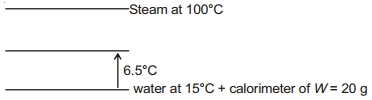
In a calorimeter of water equivalent $20 \,g$,water of mass $1.1 \,kg$ is taken at $288 \,K$ temperature. If steam at temperature $373 \,K$ is passed through it and the temperature of the water increases by $6.5^{\circ} C$,then the mass of steam condensed is ............ $g$.
A
$17.5$
B
$11.7$
C
$15.7$
D
$18.2$
Solution
(B) Let the mass of steam that condenses be $x \,g$.
The initial temperature of water is $288 \,K = 15^{\circ} C$.
The final temperature of water is $15^{\circ} C + 6.5^{\circ} C = 21.5^{\circ} C$.
Heat released by steam in condensing at $100^{\circ} C$ and cooling down to $21.5^{\circ} C$:
$Q_{\text{released}} = m_s L_v + m_s c_w \Delta T_s$
$Q_{\text{released}} = x \times 540 + x \times 1 \times (100 - 21.5) = 540x + 78.5x = 618.5x \,cal$.
Heat absorbed by water and calorimeter:
$Q_{\text{absorbed}} = (m_w c_w + W) \Delta T_w$
$Q_{\text{absorbed}} = (1100 \times 1 + 20) \times 6.5 = 1120 \times 6.5 = 7280 \,cal$.
By the principle of calorimetry,$Q_{\text{released}} = Q_{\text{absorbed}}$:
$618.5x = 7280$
$x = \frac{7280}{618.5} \approx 11.77 \,g$.
Rounding to the nearest provided option,$x = 11.7 \,g$.
The initial temperature of water is $288 \,K = 15^{\circ} C$.
The final temperature of water is $15^{\circ} C + 6.5^{\circ} C = 21.5^{\circ} C$.
Heat released by steam in condensing at $100^{\circ} C$ and cooling down to $21.5^{\circ} C$:
$Q_{\text{released}} = m_s L_v + m_s c_w \Delta T_s$
$Q_{\text{released}} = x \times 540 + x \times 1 \times (100 - 21.5) = 540x + 78.5x = 618.5x \,cal$.
Heat absorbed by water and calorimeter:
$Q_{\text{absorbed}} = (m_w c_w + W) \Delta T_w$
$Q_{\text{absorbed}} = (1100 \times 1 + 20) \times 6.5 = 1120 \times 6.5 = 7280 \,cal$.
By the principle of calorimetry,$Q_{\text{released}} = Q_{\text{absorbed}}$:
$618.5x = 7280$
$x = \frac{7280}{618.5} \approx 11.77 \,g$.
Rounding to the nearest provided option,$x = 11.7 \,g$.
0 likes
View Solution128
MediumMCQ
$A$ water heater of power $2000\,W$ is used to heat water. The specific heat capacity of water is $4200\,J\,kg^{-1}\,K^{-1}$. The efficiency of the heater is $70\%$. The time required to heat $2\,kg$ of water from $10^{\circ}C$ to $60^{\circ}C$ is $..........s$. (Assume that the specific heat capacity of water remains constant over the temperature range).
A
$301$
B
$302$
C
$300$
D
$303$
Solution
(C) The heat energy required to raise the temperature of water is given by $Q = m \cdot s \cdot \Delta T$.
Here,$m = 2\,kg$,$s = 4200\,J\,kg^{-1}K^{-1}$,and $\Delta T = 60^{\circ}C - 10^{\circ}C = 50^{\circ}C$.
$Q = 2 \times 4200 \times 50 = 420,000\,J$.
The effective power delivered by the heater is $P_{eff} = \eta \times P = 0.70 \times 2000\,W = 1400\,W$.
The time required is $\Delta t = \frac{Q}{P_{eff}} = \frac{420,000}{1400} = 300\,s$.
Here,$m = 2\,kg$,$s = 4200\,J\,kg^{-1}K^{-1}$,and $\Delta T = 60^{\circ}C - 10^{\circ}C = 50^{\circ}C$.
$Q = 2 \times 4200 \times 50 = 420,000\,J$.
The effective power delivered by the heater is $P_{eff} = \eta \times P = 0.70 \times 2000\,W = 1400\,W$.
The time required is $\Delta t = \frac{Q}{P_{eff}} = \frac{420,000}{1400} = 300\,s$.
1 likes
View Solution129
MediumMCQ
$A$ piece of ice (heat capacity $= 2100 \ J \ kg^{-1} \ ^{\circ}C^{-1}$ and latent heat $= 3.36 \times 10^5 \ J \ kg^{-1}$) of mass $m$ grams is at $-5^{\circ}C$ at atmospheric pressure. It is given $420 \ J$ of heat so that the ice starts melting. Finally,when the ice-water mixture is in equilibrium,it is found that $1 \ g$ of ice has melted. Assuming there is no other heat exchange in the process,the value of $m$ is:
A
$7$
B
$8$
C
$9$
D
$5$
Solution
(B) The total heat $Q = 420 \ J$ is used for two processes:
$1$. Raising the temperature of the entire mass $m$ (in grams) from $-5^{\circ}C$ to $0^{\circ}C$.
$2$. Melting $1 \ g$ of ice at $0^{\circ}C$.
Given:
Mass $m$ in grams $= m \times 10^{-3} \ kg$.
Specific heat of ice $c = 2100 \ J \ kg^{-1} \ ^{\circ}C^{-1}$.
Latent heat of fusion $L = 3.36 \times 10^5 \ J \ kg^{-1}$.
Heat required to raise temperature: $Q_1 = m \times 10^{-3} \times 2100 \times (0 - (-5)) = m \times 2.1 \times 5 = 10.5m \ J$.
Heat required to melt $1 \ g$ of ice: $Q_2 = 1 \times 10^{-3} \times 3.36 \times 10^5 = 336 \ J$.
Total heat $Q = Q_1 + Q_2 = 420 \ J$.
$10.5m + 336 = 420$.
$10.5m = 420 - 336 = 84$.
$m = 84 / 10.5 = 8$.
Therefore,the value of $m$ is $8 \ g$.
$1$. Raising the temperature of the entire mass $m$ (in grams) from $-5^{\circ}C$ to $0^{\circ}C$.
$2$. Melting $1 \ g$ of ice at $0^{\circ}C$.
Given:
Mass $m$ in grams $= m \times 10^{-3} \ kg$.
Specific heat of ice $c = 2100 \ J \ kg^{-1} \ ^{\circ}C^{-1}$.
Latent heat of fusion $L = 3.36 \times 10^5 \ J \ kg^{-1}$.
Heat required to raise temperature: $Q_1 = m \times 10^{-3} \times 2100 \times (0 - (-5)) = m \times 2.1 \times 5 = 10.5m \ J$.
Heat required to melt $1 \ g$ of ice: $Q_2 = 1 \times 10^{-3} \times 3.36 \times 10^5 = 336 \ J$.
Total heat $Q = Q_1 + Q_2 = 420 \ J$.
$10.5m + 336 = 420$.
$10.5m = 420 - 336 = 84$.
$m = 84 / 10.5 = 8$.
Therefore,the value of $m$ is $8 \ g$.
0 likes
View Solution130
MediumMCQ
$A$ liquid of mass $2m$ and specific heat $C$ is heated to a temperature $4T$. Another liquid of mass $m$ and specific heat $2C$ is heated to a temperature $T$. If these two liquids are mixed,the resulting temperature of the mixture is:
A
$\frac{5}{2} T$
B
$\frac{8}{5} T$
C
$\frac{2}{3} T$
D
$\frac{3}{2} T$
Solution
(A) According to the principle of calorimetry,the heat lost by the hotter liquid is equal to the heat gained by the colder liquid.
Let $T_f$ be the final equilibrium temperature of the mixture.
Heat lost by the first liquid: $Q_{loss} = (2m) \cdot C \cdot (4T - T_f)$
Heat gained by the second liquid: $Q_{gain} = m \cdot (2C) \cdot (T_f - T)$
Equating the two: $(2m) \cdot C \cdot (4T - T_f) = m \cdot (2C) \cdot (T_f - T)$
Dividing both sides by $2mC$: $4T - T_f = T_f - T$
$4T + T = T_f + T_f$
$5T = 2T_f$
$T_f = \frac{5}{2} T$
Let $T_f$ be the final equilibrium temperature of the mixture.
Heat lost by the first liquid: $Q_{loss} = (2m) \cdot C \cdot (4T - T_f)$
Heat gained by the second liquid: $Q_{gain} = m \cdot (2C) \cdot (T_f - T)$
Equating the two: $(2m) \cdot C \cdot (4T - T_f) = m \cdot (2C) \cdot (T_f - T)$
Dividing both sides by $2mC$: $4T - T_f = T_f - T$
$4T + T = T_f + T_f$
$5T = 2T_f$
$T_f = \frac{5}{2} T$
0 likes
View Solution131
MediumMCQ
$A$ piece of copper of mass $250 \ g$ at $500^{\circ} C$ is put inside a calorimeter of water equivalent $50 \ g$ containing $200 \ g$ of water at $20^{\circ} C$. At thermal equilibrium,the temperature of the mixture is $60^{\circ} C$. The specific heat of copper (in $J / kg \cdot ^{\circ} C$) is approximately: [Specific heat of water $= 4200 \ J / kg \cdot ^{\circ} C$]
A
$580$
B
$440$
C
$380$
D
$290$
Solution
(C) According to the principle of calorimetry,Heat lost by the copper = Heat gained by the water and calorimeter.
Let $S$ be the specific heat of copper.
Heat lost by copper = $m_{Cu} \cdot S \cdot \Delta T_{Cu} = 0.250 \ kg \cdot S \cdot (500^{\circ} C - 60^{\circ} C) = 0.250 \cdot S \cdot 440 = 110S$.
Heat gained by water and calorimeter = $(m_{water} + w) \cdot S_{water} \cdot \Delta T_{water}$,where $w$ is the water equivalent.
Heat gained = $(0.200 \ kg + 0.050 \ kg) \cdot 4200 \ J/kg^{\circ} C \cdot (60^{\circ} C - 20^{\circ} C) = 0.250 \cdot 4200 \cdot 40 = 42000 \ J$.
Equating the two: $110S = 42000$.
$S = 42000 / 110 \approx 381.8 \ J/kg^{\circ} C$.
Rounding to the nearest given option,$S \approx 380 \ J/kg^{\circ} C$.
Let $S$ be the specific heat of copper.
Heat lost by copper = $m_{Cu} \cdot S \cdot \Delta T_{Cu} = 0.250 \ kg \cdot S \cdot (500^{\circ} C - 60^{\circ} C) = 0.250 \cdot S \cdot 440 = 110S$.
Heat gained by water and calorimeter = $(m_{water} + w) \cdot S_{water} \cdot \Delta T_{water}$,where $w$ is the water equivalent.
Heat gained = $(0.200 \ kg + 0.050 \ kg) \cdot 4200 \ J/kg^{\circ} C \cdot (60^{\circ} C - 20^{\circ} C) = 0.250 \cdot 4200 \cdot 40 = 42000 \ J$.
Equating the two: $110S = 42000$.
$S = 42000 / 110 \approx 381.8 \ J/kg^{\circ} C$.
Rounding to the nearest given option,$S \approx 380 \ J/kg^{\circ} C$.
0 likes
View Solution132
MediumMCQ
Two liquids $A$ and $B$ are at temperatures of $75^{\circ} C$ and $15^{\circ} C$. Their masses are in the ratio of $2: 3$ and their specific heats in the ratio $3: 4$. If these two liquids are mixed,then the resulting temperature will be $...^{\circ} C$.
A
$90$
B
$70$
C
$35$
D
$60$
Solution
(C) According to the principle of calorimetry,heat lost by the hot liquid equals the heat gained by the cold liquid.
$m_A s_A (T_A - T_f) = m_B s_B (T_f - T_B)$
Given ratios: $\frac{m_A}{m_B} = \frac{2}{3}$ and $\frac{s_A}{s_B} = \frac{3}{4}$.
Substituting the values: $\frac{2}{3} \times \frac{3}{4} \times (75 - T_f) = (T_f - 15)$
$\frac{1}{2} \times (75 - T_f) = T_f - 15$
$75 - T_f = 2(T_f - 15)$
$75 - T_f = 2T_f - 30$
$3T_f = 105$
$T_f = 35^{\circ} C$.
$m_A s_A (T_A - T_f) = m_B s_B (T_f - T_B)$
Given ratios: $\frac{m_A}{m_B} = \frac{2}{3}$ and $\frac{s_A}{s_B} = \frac{3}{4}$.
Substituting the values: $\frac{2}{3} \times \frac{3}{4} \times (75 - T_f) = (T_f - 15)$
$\frac{1}{2} \times (75 - T_f) = T_f - 15$
$75 - T_f = 2(T_f - 15)$
$75 - T_f = 2T_f - 30$
$3T_f = 105$
$T_f = 35^{\circ} C$.
0 likes
View Solution133
DifficultMCQ
$4 \text{ g}$ of steam at $100^{\circ} C$ is added to $20 \text{ g}$ of water at $46^{\circ} C$ in a container of negligible mass. Assuming no heat is lost to the surroundings, the mass of water in the container at thermal equilibrium is. (Latent heat of vaporisation $= 540 \text{ cal/g}$, Specific heat of water $= 1 \text{ cal/g}^{\circ} C$):- (in $\text{ g}$)
A
$18$
B
$20$
C
$22$
D
$24$
Solution
(C) Heat released by $4 \text{ g}$ of steam to condense into water at $100^{\circ} C$ is $Q_1 = m_s L = 4 \times 540 = 2160 \text{ cal}$.
Heat required by $20 \text{ g}$ of water to reach $100^{\circ} C$ is $Q_2 = m_w c \Delta T = 20 \times 1 \times (100 - 46) = 20 \times 54 = 1080 \text{ cal}$.
Since $Q_1 > Q_2$, the steam will not condense completely.
The amount of steam condensed is $m' = \frac{Q_2}{L} = \frac{1080}{540} = 2 \text{ g}$.
Final mass of water in the container = Initial mass of water + Mass of condensed steam = $20 \text{ g} + 2 \text{ g} = 22 \text{ g}$.
Heat required by $20 \text{ g}$ of water to reach $100^{\circ} C$ is $Q_2 = m_w c \Delta T = 20 \times 1 \times (100 - 46) = 20 \times 54 = 1080 \text{ cal}$.
Since $Q_1 > Q_2$, the steam will not condense completely.
The amount of steam condensed is $m' = \frac{Q_2}{L} = \frac{1080}{540} = 2 \text{ g}$.
Final mass of water in the container = Initial mass of water + Mass of condensed steam = $20 \text{ g} + 2 \text{ g} = 22 \text{ g}$.
0 likes
View Solution134
MediumMCQ
$A$ liquid of specific heat $0.8 \ cal / g^{\circ} C$ at temperature $60^{\circ} C$ is mixed with another liquid of the same mass having temperature $45^{\circ} C$. If the temperature of the mixture is $53^{\circ} C$,then the specific heat (in $cal / g^{\circ} C$) of the second liquid is:
A
$0.5$
B
$0.6$
C
$0.7$
D
$0.8$
Solution
(C) According to the principle of calorimetry,the heat lost by the hotter liquid is equal to the heat gained by the colder liquid.
Let $m$ be the mass of each liquid and $X$ be the specific heat of the second liquid.
Heat lost by the first liquid = $m \times 0.8 \times (60 - 53)$
Heat gained by the second liquid = $m \times X \times (53 - 45)$
Equating the two:
$m \times 0.8 \times 7 = m \times X \times 8$
$5.6 = 8X$
$X = \frac{5.6}{8} = 0.7 \ cal / g^{\circ} C$
Let $m$ be the mass of each liquid and $X$ be the specific heat of the second liquid.
Heat lost by the first liquid = $m \times 0.8 \times (60 - 53)$
Heat gained by the second liquid = $m \times X \times (53 - 45)$
Equating the two:
$m \times 0.8 \times 7 = m \times X \times 8$
$5.6 = 8X$
$X = \frac{5.6}{8} = 0.7 \ cal / g^{\circ} C$
0 likes
View Solution135
MediumMCQ
When $0.4 \ kg$ of water at $30^{\circ} C$ is mixed with $0.15 \ kg$ of water at $25^{\circ} C$ in a calorimeter,the final temperature is found to be $27^{\circ} C$. Find the water equivalent of the calorimeter. (in $kg$)
A
$0.45$
B
$1.0$
C
$0.50$
D
$1.5$
Solution
(A) According to the principle of calorimetry,heat lost by the hot body equals heat gained by the cold body and the calorimeter.
Let $w$ be the water equivalent of the calorimeter.
Heat lost by $0.4 \ kg$ of water at $30^{\circ} C$ cooling to $27^{\circ} C$ is:
$Q_{lost} = m_1 c \Delta T_1 = 0.4 \times 1 \times (30 - 27) = 0.4 \times 3 = 1.2 \ kcal$ (considering specific heat of water $c = 1 \ kcal/kg^{\circ}C$)
Heat gained by $0.15 \ kg$ of water at $25^{\circ} C$ heating to $27^{\circ} C$ is:
$Q_{gained, water} = m_2 c \Delta T_2 = 0.15 \times 1 \times (27 - 25) = 0.15 \times 2 = 0.3 \ kcal$
Heat gained by the calorimeter is:
$Q_{gained, cal} = w \times c \times \Delta T_2 = w \times 1 \times (27 - 25) = 2w$
Equating heat lost and heat gained:
$1.2 = 0.3 + 2w$
$0.9 = 2w$
$w = 0.45 \ kg$
Let $w$ be the water equivalent of the calorimeter.
Heat lost by $0.4 \ kg$ of water at $30^{\circ} C$ cooling to $27^{\circ} C$ is:
$Q_{lost} = m_1 c \Delta T_1 = 0.4 \times 1 \times (30 - 27) = 0.4 \times 3 = 1.2 \ kcal$ (considering specific heat of water $c = 1 \ kcal/kg^{\circ}C$)
Heat gained by $0.15 \ kg$ of water at $25^{\circ} C$ heating to $27^{\circ} C$ is:
$Q_{gained, water} = m_2 c \Delta T_2 = 0.15 \times 1 \times (27 - 25) = 0.15 \times 2 = 0.3 \ kcal$
Heat gained by the calorimeter is:
$Q_{gained, cal} = w \times c \times \Delta T_2 = w \times 1 \times (27 - 25) = 2w$
Equating heat lost and heat gained:
$1.2 = 0.3 + 2w$
$0.9 = 2w$
$w = 0.45 \ kg$
0 likes
View Solution136
MediumMCQ
$A$ piece of metal weighing $100 \,g$ is heated to $80^{\circ} C$ and dropped into $1 \,kg$ of cold water in an insulated container at $15^{\circ} C$. If the final temperature of the water in the container is $15.69^{\circ} C$,the specific heat of the metal in $J / g^{\circ} C$ is:
A
$0.38$
B
$0.24$
C
$0.45$
D
$0.13$
Solution
(C) The principle of calorimetry states that heat lost by the hot body equals heat gained by the cold body.
Heat lost by metal = Heat gained by water.
$m_{\text{metal}} \times s_{\text{metal}} \times \Delta T_{\text{metal}} = m_{\text{water}} \times s_{\text{water}} \times \Delta T_{\text{water}}$
Given: $m_{\text{metal}} = 100 \,g = 0.1 \,kg$,$T_{\text{initial, metal}} = 80^{\circ} C$,$T_{\text{final}} = 15.69^{\circ} C$,$m_{\text{water}} = 1 \,kg = 1000 \,g$,$T_{\text{initial, water}} = 15^{\circ} C$,$s_{\text{water}} = 4.18 \,J/g^{\circ} C$.
Substituting the values:
$100 \times s_{\text{metal}} \times (80 - 15.69) = 1000 \times 4.18 \times (15.69 - 15)$
$100 \times s_{\text{metal}} \times 64.31 = 1000 \times 4.18 \times 0.69$
$6431 \times s_{\text{metal}} = 2884.2$
$s_{\text{metal}} = \frac{2884.2}{6431} \approx 0.4485 \,J/g^{\circ} C \approx 0.45 \,J/g^{\circ} C$.
Heat lost by metal = Heat gained by water.
$m_{\text{metal}} \times s_{\text{metal}} \times \Delta T_{\text{metal}} = m_{\text{water}} \times s_{\text{water}} \times \Delta T_{\text{water}}$
Given: $m_{\text{metal}} = 100 \,g = 0.1 \,kg$,$T_{\text{initial, metal}} = 80^{\circ} C$,$T_{\text{final}} = 15.69^{\circ} C$,$m_{\text{water}} = 1 \,kg = 1000 \,g$,$T_{\text{initial, water}} = 15^{\circ} C$,$s_{\text{water}} = 4.18 \,J/g^{\circ} C$.
Substituting the values:
$100 \times s_{\text{metal}} \times (80 - 15.69) = 1000 \times 4.18 \times (15.69 - 15)$
$100 \times s_{\text{metal}} \times 64.31 = 1000 \times 4.18 \times 0.69$
$6431 \times s_{\text{metal}} = 2884.2$
$s_{\text{metal}} = \frac{2884.2}{6431} \approx 0.4485 \,J/g^{\circ} C \approx 0.45 \,J/g^{\circ} C$.
0 likes
View Solution137
EasyMCQ
$100 \text{ g}$ of ice at $0^{\circ}C$ is mixed with $100 \text{ g}$ of water at $100^{\circ}C$. The final temperature of the mixture is. [Take,$L_f = 3.36 \times 10^5 \text{ J kg}^{-1}$ and $S_w = 4.2 \times 10^3 \text{ J kg}^{-1} \text{ K}^{-1}$] (in $^{\circ}C$)
A
$40$
B
$10$
C
$50$
D
$1$
Solution
(B) Let the final temperature of the mixture be $T$.
Heat gained by ice = Heat lost by water.
Heat gained by ice = (Heat to melt ice) + (Heat to raise temperature of melted ice from $0^{\circ}C$ to $T$).
$Q_{gain} = m_i L_f + m_i S_w (T - 0)$
$Q_{gain} = (0.1 \text{ kg} \times 3.36 \times 10^5 \text{ J/kg}) + (0.1 \text{ kg} \times 4.2 \times 10^3 \text{ J/kg K} \times T)$
$Q_{gain} = 33600 + 420 T$
Heat lost by water = $m_w S_w (100 - T)$
$Q_{lost} = 0.1 \text{ kg} \times 4.2 \times 10^3 \text{ J/kg K} \times (100 - T)$
$Q_{lost} = 420 (100 - T) = 42000 - 420 T$
Equating heat gained and lost:
$33600 + 420 T = 42000 - 420 T$
$840 T = 8400$
$T = 10^{\circ}C$.
Heat gained by ice = Heat lost by water.
Heat gained by ice = (Heat to melt ice) + (Heat to raise temperature of melted ice from $0^{\circ}C$ to $T$).
$Q_{gain} = m_i L_f + m_i S_w (T - 0)$
$Q_{gain} = (0.1 \text{ kg} \times 3.36 \times 10^5 \text{ J/kg}) + (0.1 \text{ kg} \times 4.2 \times 10^3 \text{ J/kg K} \times T)$
$Q_{gain} = 33600 + 420 T$
Heat lost by water = $m_w S_w (100 - T)$
$Q_{lost} = 0.1 \text{ kg} \times 4.2 \times 10^3 \text{ J/kg K} \times (100 - T)$
$Q_{lost} = 420 (100 - T) = 42000 - 420 T$
Equating heat gained and lost:
$33600 + 420 T = 42000 - 420 T$
$840 T = 8400$
$T = 10^{\circ}C$.
0 likes
View Solution138
DifficultMCQ
$0.1 \,m^{3}$ of water at $80^{\circ} C$ is mixed with $0.3 \,m^{3}$ of water at $60^{\circ} C$. The final temperature of the mixture is (in $^{\circ} C$)
A
$65$
B
$70$
C
$60$
D
$75$
Solution
(A) Let the final temperature of the mixture be $t$.
Heat lost by water at $80^{\circ} C = m_1 s \Delta t_1 = (V_1 \rho) s (80^{\circ} - t)$.
Heat gained by water at $60^{\circ} C = m_2 s \Delta t_2 = (V_2 \rho) s (t - 60^{\circ})$.
According to the principle of calorimetry,Heat lost = Heat gained.
Since the density $\rho$ and specific heat $s$ are the same for both:
$V_1 (80^{\circ} - t) = V_2 (t - 60^{\circ})$.
Substituting the values:
$0.1 (80 - t) = 0.3 (t - 60)$.
$8 - 0.1t = 0.3t - 18$.
$26 = 0.4t$.
$t = \frac{26}{0.4} = 65^{\circ} C$.
Heat lost by water at $80^{\circ} C = m_1 s \Delta t_1 = (V_1 \rho) s (80^{\circ} - t)$.
Heat gained by water at $60^{\circ} C = m_2 s \Delta t_2 = (V_2 \rho) s (t - 60^{\circ})$.
According to the principle of calorimetry,Heat lost = Heat gained.
Since the density $\rho$ and specific heat $s$ are the same for both:
$V_1 (80^{\circ} - t) = V_2 (t - 60^{\circ})$.
Substituting the values:
$0.1 (80 - t) = 0.3 (t - 60)$.
$8 - 0.1t = 0.3t - 18$.
$26 = 0.4t$.
$t = \frac{26}{0.4} = 65^{\circ} C$.
0 likes
View Solution139
DifficultMCQ
$A$ $10 \,kW$ drilling machine is used to drill a bore in an aluminium block of mass $25 \,kg$. If the machine is on for $3 \,minutes$ and $50 \%$ of the heat liberated is absorbed by the block, what is the rise in temperature of the block (in $^{\circ} C$)? (Specific heat of aluminium is $900 \,J \,kg^{-1} \,K^{-1}$)
A
$20$
B
$40$
C
$85$
D
$150$
Solution
(B) Power of the machine $P = 10 \,kW = 10,000 \,W$.
Time $t = 3 \,minutes = 3 \times 60 = 180 \,s$.
Total energy produced $E = P \times t = 10,000 \times 180 = 1,800,000 \,J$.
Heat absorbed by the block $Q = 50 \% \text{ of } E = 0.5 \times 1,800,000 = 900,000 \,J$.
Using the formula $Q = mc\Delta T$, where $m = 25 \,kg$ and $c = 900 \,J \,kg^{-1} \,K^{-1}$:
$900,000 = 25 \times 900 \times \Delta T$.
$900,000 = 22,500 \times \Delta T$.
$\Delta T = \frac{900,000}{22,500} = 40^{\circ} C$.
Therefore, the rise in temperature is $40^{\circ} C$.
Time $t = 3 \,minutes = 3 \times 60 = 180 \,s$.
Total energy produced $E = P \times t = 10,000 \times 180 = 1,800,000 \,J$.
Heat absorbed by the block $Q = 50 \% \text{ of } E = 0.5 \times 1,800,000 = 900,000 \,J$.
Using the formula $Q = mc\Delta T$, where $m = 25 \,kg$ and $c = 900 \,J \,kg^{-1} \,K^{-1}$:
$900,000 = 25 \times 900 \times \Delta T$.
$900,000 = 22,500 \times \Delta T$.
$\Delta T = \frac{900,000}{22,500} = 40^{\circ} C$.
Therefore, the rise in temperature is $40^{\circ} C$.
0 likes
View Solution140
EasyMCQ
Steam at $100^{\circ} C$ is passed into $114 \ g$ of water at $30^{\circ} C$. The mass of water present in the mixture when the temperature of the mixture becomes $70^{\circ} C$ is (Latent heat of steam $= 540 \ cal \ g^{-1}$; specific heat capacity of water $= 1 \ cal \ g^{-1} {}^{\circ} C^{-1}$) (in $g$)
A
$122$
B
$132$
C
$142$
D
$152$
Solution
(A) Let $m$ be the mass of steam condensed into water.
Heat lost by steam = Heat gained by water.
Heat lost by steam = (Heat released during condensation) + (Heat released by condensed water cooling from $100^{\circ} C$ to $70^{\circ} C$)
$Q_{lost} = m \times L + m \times c \times \Delta T$
$Q_{lost} = m \times 540 + m \times 1 \times (100 - 70) = 540m + 30m = 570m$
Heat gained by water = $m_{water} \times c \times \Delta T$
$Q_{gained} = 114 \times 1 \times (70 - 30) = 114 \times 40 = 4560 \ cal$
Equating heat lost and gained: $570m = 4560$
$m = 4560 / 570 = 8 \ g$
The total mass of water in the mixture = (Initial mass of water) + (Mass of condensed steam)
Total mass = $114 \ g + 8 \ g = 122 \ g$.
Heat lost by steam = Heat gained by water.
Heat lost by steam = (Heat released during condensation) + (Heat released by condensed water cooling from $100^{\circ} C$ to $70^{\circ} C$)
$Q_{lost} = m \times L + m \times c \times \Delta T$
$Q_{lost} = m \times 540 + m \times 1 \times (100 - 70) = 540m + 30m = 570m$
Heat gained by water = $m_{water} \times c \times \Delta T$
$Q_{gained} = 114 \times 1 \times (70 - 30) = 114 \times 40 = 4560 \ cal$
Equating heat lost and gained: $570m = 4560$
$m = 4560 / 570 = 8 \ g$
The total mass of water in the mixture = (Initial mass of water) + (Mass of condensed steam)
Total mass = $114 \ g + 8 \ g = 122 \ g$.
0 likes
View Solution141
EasyMCQ
$A$ small quantity of water of mass $m$ at temperature $\theta^{\circ} C$ is mixed with a large mass $M$ of ice which is at its melting point. If $s$ is the specific heat capacity of water and $L$ is the latent heat of fusion of ice,then the mass of ice melted is:
A
$\frac{ML}{ms \theta}$
B
$\frac{ms \theta}{ML}$
C
$\frac{Ms \theta}{L}$
D
$\frac{ms \theta}{L}$
Solution
(D) According to the principle of calorimetry,the heat lost by the water is equal to the heat gained by the ice to melt.
Heat lost by water $(Q_{lost})$ = $m \cdot s \cdot \Delta T = m \cdot s \cdot \theta$.
Heat gained by ice to melt $(Q_{gained})$ = $m_{melted} \cdot L$.
Equating the two: $m \cdot s \cdot \theta = m_{melted} \cdot L$.
Therefore,the mass of ice melted $(m_{melted})$ = $\frac{ms \theta}{L}$.
Heat lost by water $(Q_{lost})$ = $m \cdot s \cdot \Delta T = m \cdot s \cdot \theta$.
Heat gained by ice to melt $(Q_{gained})$ = $m_{melted} \cdot L$.
Equating the two: $m \cdot s \cdot \theta = m_{melted} \cdot L$.
Therefore,the mass of ice melted $(m_{melted})$ = $\frac{ms \theta}{L}$.
0 likes
View Solution142
EasyMCQ
The temperature of water of mass $100 \ g$ is raised from $24^{\circ} C$ to $90^{\circ} C$ by adding steam to it. The mass of the steam added is (Latent heat of steam $= 540 \ cal \ g^{-1}$ and specific heat capacity of water $= 1 \ cal \ g^{-1} {}^{\circ} C^{-1}$) (in $g$)
A
$10$
B
$12$
C
$8$
D
$16$
Solution
(B) Let $m_s$ be the mass of the steam added.
According to the principle of calorimetry,Heat lost by steam = Heat gained by water.
Heat lost by steam consists of two parts:
$1$. Heat released during condensation of steam at $100^{\circ} C$ to water at $100^{\circ} C$: $Q_1 = m_s \times L = m_s \times 540$.
$2$. Heat released by the condensed water cooling from $100^{\circ} C$ to $90^{\circ} C$: $Q_2 = m_s \times c \times \Delta T = m_s \times 1 \times (100 - 90) = 10 m_s$.
Total heat lost = $540 m_s + 10 m_s = 550 m_s$.
Heat gained by $100 \ g$ of water to raise its temperature from $24^{\circ} C$ to $90^{\circ} C$:
$Q_{gain} = m_w \times c \times \Delta T = 100 \times 1 \times (90 - 24) = 100 \times 66 = 6600 \ cal$.
Equating heat lost and gained: $550 m_s = 6600$.
$m_s = 6600 / 550 = 12 \ g$.
According to the principle of calorimetry,Heat lost by steam = Heat gained by water.
Heat lost by steam consists of two parts:
$1$. Heat released during condensation of steam at $100^{\circ} C$ to water at $100^{\circ} C$: $Q_1 = m_s \times L = m_s \times 540$.
$2$. Heat released by the condensed water cooling from $100^{\circ} C$ to $90^{\circ} C$: $Q_2 = m_s \times c \times \Delta T = m_s \times 1 \times (100 - 90) = 10 m_s$.
Total heat lost = $540 m_s + 10 m_s = 550 m_s$.
Heat gained by $100 \ g$ of water to raise its temperature from $24^{\circ} C$ to $90^{\circ} C$:
$Q_{gain} = m_w \times c \times \Delta T = 100 \times 1 \times (90 - 24) = 100 \times 66 = 6600 \ cal$.
Equating heat lost and gained: $550 m_s = 6600$.
$m_s = 6600 / 550 = 12 \ g$.
0 likes
View Solution143
MediumMCQ
$A$ metal ball of mass $100 \ g$ at $20^{\circ} C$ is dropped in $200 \ ml$ of water at $80^{\circ} C$. If the resultant temperature is $70^{\circ} C$,then the ratio of specific heat of the metal to that of water is
A
$\frac{5}{2}$
B
$\frac{1}{2}$
C
$\frac{2}{5}$
D
$\frac{2}{1}$
Solution
(C) According to the principle of calorimetry,the heat gained by the metal ball is equal to the heat lost by the water.
Let $m_1 = 100 \ g$ be the mass of the metal,$s_1$ be its specific heat,and $T_1 = 20^{\circ} C$ be its initial temperature.
Let $m_2 = 200 \ g$ (since density of water is $1 \ g/ml$) be the mass of water,$s_2$ be its specific heat,and $T_2 = 80^{\circ} C$ be its initial temperature.
The final equilibrium temperature is $T = 70^{\circ} C$.
Heat gained by metal = $m_1 s_1 (T - T_1) = 100 \times s_1 \times (70 - 20) = 5000 s_1$.
Heat lost by water = $m_2 s_2 (T_2 - T) = 200 \times s_2 \times (80 - 70) = 2000 s_2$.
Equating the two: $5000 s_1 = 2000 s_2$.
Therefore,the ratio $\frac{s_1}{s_2} = \frac{2000}{5000} = \frac{2}{5}$.
Let $m_1 = 100 \ g$ be the mass of the metal,$s_1$ be its specific heat,and $T_1 = 20^{\circ} C$ be its initial temperature.
Let $m_2 = 200 \ g$ (since density of water is $1 \ g/ml$) be the mass of water,$s_2$ be its specific heat,and $T_2 = 80^{\circ} C$ be its initial temperature.
The final equilibrium temperature is $T = 70^{\circ} C$.
Heat gained by metal = $m_1 s_1 (T - T_1) = 100 \times s_1 \times (70 - 20) = 5000 s_1$.
Heat lost by water = $m_2 s_2 (T_2 - T) = 200 \times s_2 \times (80 - 70) = 2000 s_2$.
Equating the two: $5000 s_1 = 2000 s_2$.
Therefore,the ratio $\frac{s_1}{s_2} = \frac{2000}{5000} = \frac{2}{5}$.
0 likes
View Solution144
MediumMCQ
$m$ g of water at $30^{\circ} C$ is mixed with $5$ g of ice at $-20^{\circ} C$. If the final equilibrium temperature of the mixture is $6^{\circ} C$,find the value of $m$. (Given: specific heat capacity of ice $= 0.5 \text{ cal g}^{-1} {}^{\circ} C^{-1}$,specific heat capacity of water $= 1 \text{ cal g}^{-1} {}^{\circ} C^{-1}$,and latent heat of fusion of ice $= 80 \text{ cal g}^{-1}$) (in $g$)
A
$48$
B
$20$
C
$24$
D
$40$
Solution
(B) According to the principle of calorimetry,Heat lost by water = Heat gained by ice.
Let $m$ be the mass of water in grams.
Heat lost by water $= m \times c_w \times (T_i - T_f) = m \times 1 \times (30 - 6) = 24m \text{ cal}$.
Heat gained by ice consists of three parts:
$1$. Heating ice from $-20^{\circ} C$ to $0^{\circ} C$: $Q_1 = m_i \times c_i \times \Delta T = 5 \times 0.5 \times (0 - (-20)) = 5 \times 0.5 \times 20 = 50 \text{ cal}$.
$2$. Melting ice at $0^{\circ} C$: $Q_2 = m_i \times L_f = 5 \times 80 = 400 \text{ cal}$.
$3$. Heating the melted water from $0^{\circ} C$ to $6^{\circ} C$: $Q_3 = m_i \times c_w \times \Delta T = 5 \times 1 \times (6 - 0) = 30 \text{ cal}$.
Total heat gained $= 50 + 400 + 30 = 480 \text{ cal}$.
Equating heat lost and gained: $24m = 480$.
$m = 480 / 24 = 20 \text{ g}$.
Let $m$ be the mass of water in grams.
Heat lost by water $= m \times c_w \times (T_i - T_f) = m \times 1 \times (30 - 6) = 24m \text{ cal}$.
Heat gained by ice consists of three parts:
$1$. Heating ice from $-20^{\circ} C$ to $0^{\circ} C$: $Q_1 = m_i \times c_i \times \Delta T = 5 \times 0.5 \times (0 - (-20)) = 5 \times 0.5 \times 20 = 50 \text{ cal}$.
$2$. Melting ice at $0^{\circ} C$: $Q_2 = m_i \times L_f = 5 \times 80 = 400 \text{ cal}$.
$3$. Heating the melted water from $0^{\circ} C$ to $6^{\circ} C$: $Q_3 = m_i \times c_w \times \Delta T = 5 \times 1 \times (6 - 0) = 30 \text{ cal}$.
Total heat gained $= 50 + 400 + 30 = 480 \text{ cal}$.
Equating heat lost and gained: $24m = 480$.
$m = 480 / 24 = 20 \text{ g}$.
0 likes
View Solution145
EasyMCQ
$A$ $50 \,g$ ice cube at $-10^{\circ} C$ is added to $200 \,g$ of water at $30^{\circ} C$. The final temperature of the mixture is (specific heat of water $= 1 \,cal \,g^{-1} {}^{\circ} C^{-1}$,latent heat of fusion of ice $= 80 \,cal \,g^{-1}$,specific heat of ice $= 0.5 \,cal \,g^{-1} {}^{\circ} C^{-1}$). (in $^{\circ} C$)
A
$20$
B
$7$
C
$12$
D
$10$
Solution
(B) Step $1$: Calculate heat required to bring ice from $-10^{\circ} C$ to $0^{\circ} C$ (ice): $Q_1 = m_i c_i \Delta T = 50 \times 0.5 \times 10 = 250 \,cal$.
Step $2$: Calculate heat required to melt $50 \,g$ of ice at $0^{\circ} C$: $Q_2 = m_i L_f = 50 \times 80 = 4000 \,cal$.
Total heat required by ice to become water at $0^{\circ} C$ is $Q_{total} = 250 + 4000 = 4250 \,cal$.
Step $3$: Calculate heat released by $200 \,g$ of water cooling from $30^{\circ} C$ to $0^{\circ} C$: $Q_{release} = m_w c_w \Delta T = 200 \times 1 \times 30 = 6000 \,cal$.
Since $Q_{release} > Q_{total}$,the ice melts completely and the final temperature $T_f$ will be above $0^{\circ} C$.
Step $4$: Apply the principle of calorimetry: Heat lost by water = Heat gained by ice.
$200 \times 1 \times (30 - T_f) = 4250 + 50 \times 1 \times (T_f - 0)$.
$6000 - 200 T_f = 4250 + 50 T_f$.
$1750 = 250 T_f$.
$T_f = 7^{\circ} C$.
Step $2$: Calculate heat required to melt $50 \,g$ of ice at $0^{\circ} C$: $Q_2 = m_i L_f = 50 \times 80 = 4000 \,cal$.
Total heat required by ice to become water at $0^{\circ} C$ is $Q_{total} = 250 + 4000 = 4250 \,cal$.
Step $3$: Calculate heat released by $200 \,g$ of water cooling from $30^{\circ} C$ to $0^{\circ} C$: $Q_{release} = m_w c_w \Delta T = 200 \times 1 \times 30 = 6000 \,cal$.
Since $Q_{release} > Q_{total}$,the ice melts completely and the final temperature $T_f$ will be above $0^{\circ} C$.
Step $4$: Apply the principle of calorimetry: Heat lost by water = Heat gained by ice.
$200 \times 1 \times (30 - T_f) = 4250 + 50 \times 1 \times (T_f - 0)$.
$6000 - 200 T_f = 4250 + 50 T_f$.
$1750 = 250 T_f$.
$T_f = 7^{\circ} C$.
0 likes
View Solution146
EasyMCQ
$5 \ g$ of ice at $-30^{\circ} C$ and $20 \ g$ of water at $35^{\circ} C$ are mixed together in a calorimeter. The final temperature of the mixture is (Neglect heat capacity of the calorimeter,specific heat capacity of ice $= 0.5 \ cal \ g^{-1} {}^{\circ} C^{-1}$,latent heat of fusion of ice $= 80 \ cal \ g^{-1}$,and specific heat capacity of water $= 1 \ cal \ g^{-1} {}^{\circ} C^{-1}$). (in $^{\circ} C$)
A
$0$
B
$4$
C
$5$
D
$9$
Solution
(D) Given: Mass of ice $m_{\text{ice}} = 5 \ g$,initial temperature $T_{\text{ice}} = -30^{\circ} C$. Mass of water $m_w = 20 \ g$,initial temperature $T_w = 35^{\circ} C$.
Specific heat of ice $s_{\text{ice}} = 0.5 \ cal \ g^{-1} {}^{\circ} C^{-1}$,specific heat of water $s_w = 1 \ cal \ g^{-1} {}^{\circ} C^{-1}$,latent heat of fusion $L_f = 80 \ cal \ g^{-1}$.
Heat required to raise ice from $-30^{\circ} C$ to $0^{\circ} C$: $Q_1 = m_{\text{ice}} s_{\text{ice}} \Delta T = 5 \times 0.5 \times 30 = 75 \ cal$.
Heat required to melt ice at $0^{\circ} C$: $Q_2 = m_{\text{ice}} L_f = 5 \times 80 = 400 \ cal$.
Total heat required to convert ice at $-30^{\circ} C$ to water at $0^{\circ} C$ is $Q_{\text{total}} = 75 + 400 = 475 \ cal$.
Heat available from water cooling from $35^{\circ} C$ to $0^{\circ} C$: $Q_{\text{avail}} = m_w s_w \Delta T = 20 \times 1 \times 35 = 700 \ cal$.
Since $Q_{\text{avail}} > Q_{\text{total}}$,the final temperature $T$ will be above $0^{\circ} C$.
Heat lost by water = Heat gained by ice:
$m_w s_w (35 - T) = Q_{\text{total}} + m_{\text{ice}} s_w (T - 0)$
$20 \times 1 \times (35 - T) = 475 + 5 \times 1 \times T$
$700 - 20T = 475 + 5T$
$225 = 25T$
$T = 9^{\circ} C$.
Specific heat of ice $s_{\text{ice}} = 0.5 \ cal \ g^{-1} {}^{\circ} C^{-1}$,specific heat of water $s_w = 1 \ cal \ g^{-1} {}^{\circ} C^{-1}$,latent heat of fusion $L_f = 80 \ cal \ g^{-1}$.
Heat required to raise ice from $-30^{\circ} C$ to $0^{\circ} C$: $Q_1 = m_{\text{ice}} s_{\text{ice}} \Delta T = 5 \times 0.5 \times 30 = 75 \ cal$.
Heat required to melt ice at $0^{\circ} C$: $Q_2 = m_{\text{ice}} L_f = 5 \times 80 = 400 \ cal$.
Total heat required to convert ice at $-30^{\circ} C$ to water at $0^{\circ} C$ is $Q_{\text{total}} = 75 + 400 = 475 \ cal$.
Heat available from water cooling from $35^{\circ} C$ to $0^{\circ} C$: $Q_{\text{avail}} = m_w s_w \Delta T = 20 \times 1 \times 35 = 700 \ cal$.
Since $Q_{\text{avail}} > Q_{\text{total}}$,the final temperature $T$ will be above $0^{\circ} C$.
Heat lost by water = Heat gained by ice:
$m_w s_w (35 - T) = Q_{\text{total}} + m_{\text{ice}} s_w (T - 0)$
$20 \times 1 \times (35 - T) = 475 + 5 \times 1 \times T$
$700 - 20T = 475 + 5T$
$225 = 25T$
$T = 9^{\circ} C$.
0 likes
View Solution147
EasyMCQ
$A$ metal block of mass $3.3 \ kg$ is heated to a temperature of $400^{\circ} C$ and then placed on a large ice block. The specific heat of the metal is $0.4 \ J \ g^{-1} \ K^{-1}$ and the latent heat of fusion of water is $330 \ J \ g^{-1}$. The maximum amount of ice that can melt is: (in $kg$)
A
$1.2$
B
$2.2$
C
$1.6$
D
$2$
Solution
(C) Given: Mass of metal block,$m = 3.3 \ kg = 3300 \ g$.
Temperature change,$\Delta T = 400^{\circ} C$.
Specific heat of metal,$s_m = 0.4 \ J \ g^{-1} \ K^{-1}$.
Latent heat of fusion of ice,$L_f = 330 \ J \ g^{-1}$.
The heat released by the metal block is $Q = m \cdot s_m \cdot \Delta T$.
$Q = 3300 \ g \times 0.4 \ J \ g^{-1} \ K^{-1} \times 400 \ K = 528,000 \ J$.
Let $m'$ be the mass of ice melted. The heat required to melt the ice is $Q = m' \cdot L_f$.
$m' = \frac{Q}{L_f} = \frac{528,000 \ J}{330 \ J \ g^{-1}} = 1600 \ g$.
Therefore,$m' = 1.6 \ kg$.
Temperature change,$\Delta T = 400^{\circ} C$.
Specific heat of metal,$s_m = 0.4 \ J \ g^{-1} \ K^{-1}$.
Latent heat of fusion of ice,$L_f = 330 \ J \ g^{-1}$.
The heat released by the metal block is $Q = m \cdot s_m \cdot \Delta T$.
$Q = 3300 \ g \times 0.4 \ J \ g^{-1} \ K^{-1} \times 400 \ K = 528,000 \ J$.
Let $m'$ be the mass of ice melted. The heat required to melt the ice is $Q = m' \cdot L_f$.
$m' = \frac{Q}{L_f} = \frac{528,000 \ J}{330 \ J \ g^{-1}} = 1600 \ g$.
Therefore,$m' = 1.6 \ kg$.
0 likes
View Solution148
MediumMCQ
$A$ calorimeter contains $0.5 \,kg$ of water at $30^{\circ} C$. When $0.3 \,kg$ of water at $60^{\circ} C$ is added to it, the resulting temperature is found to be $40^{\circ} C$. The water equivalent of the calorimeter is (in $\,kg$)
A
$0.25$
B
$0.1$
C
$0.2$
D
$0.15$
Solution
(B) Let the water equivalent of the calorimeter be $W$ (in $kg$).
According to the principle of calorimetry, the heat lost by the hot water is equal to the heat gained by the cold water and the calorimeter.
Heat lost by hot water = $m_2 c (T_2 - T_f)$
Heat gained by cold water = $m_1 c (T_f - T_1)$
Heat gained by calorimeter = $W c (T_f - T_1)$
Here, $m_1 = 0.5 \,kg$, $T_1 = 30^{\circ} C$, $m_2 = 0.3 \,kg$, $T_2 = 60^{\circ} C$, and $T_f = 40^{\circ} C$.
Since the specific heat capacity $c$ of water is common to all terms, it cancels out:
$m_2 (T_2 - T_f) = (m_1 + W) (T_f - T_1)$
$0.3 (60 - 40) = (0.5 + W) (40 - 30)$
$0.3 \times 20 = (0.5 + W) \times 10$
$6 = 5 + 10W$
$1 = 10W$
$W = 0.1 \,kg$.
According to the principle of calorimetry, the heat lost by the hot water is equal to the heat gained by the cold water and the calorimeter.
Heat lost by hot water = $m_2 c (T_2 - T_f)$
Heat gained by cold water = $m_1 c (T_f - T_1)$
Heat gained by calorimeter = $W c (T_f - T_1)$
Here, $m_1 = 0.5 \,kg$, $T_1 = 30^{\circ} C$, $m_2 = 0.3 \,kg$, $T_2 = 60^{\circ} C$, and $T_f = 40^{\circ} C$.
Since the specific heat capacity $c$ of water is common to all terms, it cancels out:
$m_2 (T_2 - T_f) = (m_1 + W) (T_f - T_1)$
$0.3 (60 - 40) = (0.5 + W) (40 - 30)$
$0.3 \times 20 = (0.5 + W) \times 10$
$6 = 5 + 10W$
$1 = 10W$
$W = 0.1 \,kg$.
0 likes
View Solution149
MediumMCQ
When $50 \ g$ of water at $10^{\circ} C$ is mixed with $50 \ g$ of water at $100^{\circ} C$,the resultant temperature is: (in $^{\circ} C$)
A
$80$
B
$55$
C
$25$
D
$45$
Solution
(B) Let the final equilibrium temperature of the mixture be $T^{\circ} C$.
According to the principle of calorimetry,heat gained by the cold water equals the heat lost by the hot water.
Heat gained by $50 \ g$ of water at $10^{\circ} C$: $H_{\text{gain}} = m c \Delta T = 50 \cdot c \cdot (T - 10)$.
Heat lost by $50 \ g$ of water at $100^{\circ} C$: $H_{\text{loss}} = m c \Delta T = 50 \cdot c \cdot (100 - T)$.
Equating the two: $50 \cdot c \cdot (T - 10) = 50 \cdot c \cdot (100 - T)$.
Dividing both sides by $50 \cdot c$: $T - 10 = 100 - T$.
$2T = 110$.
$T = 55^{\circ} C$.
According to the principle of calorimetry,heat gained by the cold water equals the heat lost by the hot water.
Heat gained by $50 \ g$ of water at $10^{\circ} C$: $H_{\text{gain}} = m c \Delta T = 50 \cdot c \cdot (T - 10)$.
Heat lost by $50 \ g$ of water at $100^{\circ} C$: $H_{\text{loss}} = m c \Delta T = 50 \cdot c \cdot (100 - T)$.
Equating the two: $50 \cdot c \cdot (T - 10) = 50 \cdot c \cdot (100 - T)$.
Dividing both sides by $50 \cdot c$: $T - 10 = 100 - T$.
$2T = 110$.
$T = 55^{\circ} C$.
0 likes
View Solution150
DifficultMCQ
$1 \text{ kg}$ of steam at $150^{\circ} \text{C}$ is passed from a steam chamber into a copper coil immersed in $20 \text{ L}$ of water. The steam condenses in the coil and is returned to the steam chamber as water at $90^{\circ} \text{C}$. The latent heat of steam is $540 \text{ cal g}^{-1}$,and the specific heat of steam is $1 \text{ cal g}^{-1} {}^{\circ} \text{C}^{-1}$. The rise in temperature of the water is: (in $^{\circ} \text{C}$)
A
$75$
B
$60$
C
$30$
D
$20$
Solution
(C) Mass of steam,$m_s = 1 \text{ kg} = 1000 \text{ g} = 10^3 \text{ g}$.
Initial temperature of steam,$T_i = 150^{\circ} \text{C}$.
Final temperature of steam (as water),$T_f = 90^{\circ} \text{C}$.
Latent heat of steam,$L_v = 540 \text{ cal g}^{-1}$.
Specific heat of steam,$c_s = 1 \text{ cal g}^{-1} {}^{\circ} \text{C}^{-1}$.
Specific heat of water,$c_w = 1 \text{ cal g}^{-1} {}^{\circ} \text{C}^{-1}$.
Heat lost by steam $(Q_{lost})$ consists of cooling steam from $150^{\circ} \text{C}$ to $100^{\circ} \text{C}$,condensation at $100^{\circ} \text{C}$,and cooling water from $100^{\circ} \text{C}$ to $90^{\circ} \text{C}$.
$Q_{lost} = m_s c_s (150-100) + m_s L_v + m_s c_w (100-90)$
$Q_{lost} = 1000 \times 1 \times 50 + 1000 \times 540 + 1000 \times 1 \times 10$
$Q_{lost} = 50,000 + 540,000 + 10,000 = 600,000 \text{ cal} = 60 \times 10^4 \text{ cal}$.
Heat gained by $20 \text{ L}$ of water $(Q_{gained})$: $m_w = 20 \text{ kg} = 20,000 \text{ g}$.
$Q_{gained} = m_w c_w \Delta T = 20,000 \times 1 \times \Delta T = 20,000 \Delta T$.
By the principle of calorimetry,$Q_{lost} = Q_{gained}$.
$600,000 = 20,000 \Delta T$.
$\Delta T = \frac{600,000}{20,000} = 30^{\circ} \text{C}$.
Initial temperature of steam,$T_i = 150^{\circ} \text{C}$.
Final temperature of steam (as water),$T_f = 90^{\circ} \text{C}$.
Latent heat of steam,$L_v = 540 \text{ cal g}^{-1}$.
Specific heat of steam,$c_s = 1 \text{ cal g}^{-1} {}^{\circ} \text{C}^{-1}$.
Specific heat of water,$c_w = 1 \text{ cal g}^{-1} {}^{\circ} \text{C}^{-1}$.
Heat lost by steam $(Q_{lost})$ consists of cooling steam from $150^{\circ} \text{C}$ to $100^{\circ} \text{C}$,condensation at $100^{\circ} \text{C}$,and cooling water from $100^{\circ} \text{C}$ to $90^{\circ} \text{C}$.
$Q_{lost} = m_s c_s (150-100) + m_s L_v + m_s c_w (100-90)$
$Q_{lost} = 1000 \times 1 \times 50 + 1000 \times 540 + 1000 \times 1 \times 10$
$Q_{lost} = 50,000 + 540,000 + 10,000 = 600,000 \text{ cal} = 60 \times 10^4 \text{ cal}$.
Heat gained by $20 \text{ L}$ of water $(Q_{gained})$: $m_w = 20 \text{ kg} = 20,000 \text{ g}$.
$Q_{gained} = m_w c_w \Delta T = 20,000 \times 1 \times \Delta T = 20,000 \Delta T$.
By the principle of calorimetry,$Q_{lost} = Q_{gained}$.
$600,000 = 20,000 \Delta T$.
$\Delta T = \frac{600,000}{20,000} = 30^{\circ} \text{C}$.
0 likes
View Solution10-1.Thermometry, Thermal Expansion and Calorimetry — Principle of Calorimetry and Water Equivalent · Frequently Asked Questions
1Are these 10-1.Thermometry, Thermal Expansion and Calorimetry questions useful for JEE and NEET?
Yes. All questions in this section are mapped to JEE Main and NEET exam patterns. Previous year questions from JEE Main, NEET, GUJCET and state-level exams are included with full solutions.
2Can I switch to Hindi or Gujarati for these questions?
Yes. Use the language tabs in the hero section or the sidebar to view the same questions and solutions in English, Hindi or Gujarati.
3How do I generate a question paper from this subtopic?
Use the Vedclass Exam Paper Generator — select the chapter and subtopic, set difficulty, and generate Sets A, B, C, D automatically. First 3 chapters of every subject are free.
Vedclass Products
For Students
Vedclass Test Series
Mock tests in real JEE/NEET style with performance analysis. 5-day free trial.
Start Free TrialFor Teachers
Exam Paper Generator
Generate Set A/B/C/D papers from this chapter in 2 minutes. 3 chapters free.
Try FreeFor Institutes
Online Exam Module
Live online exams with unlimited students, 360° analytics & white-label branding.
See DemoFor Teachers & Institutes
Generate a 10-1.Thermometry, Thermal Expansion and Calorimetry Exam Paper in 2 Minutes
Select subtopic & difficulty — Sets A, B, C, D auto-generated with No Repeat logic.
First 3 chapters of every subject are free — no payment required.