
A English
Relation between sides and angles, Solutions of triangles Questions in English
Class 11 Mathematics · Trigonometrical Equations · Relation between sides and angles, Solutions of triangles
611+
Questions
English
Language
100%
With Solutions
Showing 50 of 611 questions in English
201
AdvancedMCQ
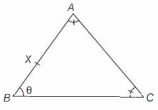
Let $ABC$ be a triangle in which $AB=BC$. Let $X$ be a point on $AB$ such that $AX:XB=AB:AX$. If $AC=AX$,then the measure of $\angle ABC$ equals (in $^{\circ}$)
A
$18$
B
$36$
C
$54$
D
$72$
Solution
(B) Given in $\triangle ABC$,$AB=BC$ and $\frac{AX}{XB} = \frac{AB}{AX} = k$.
Since $AB = AX + XB$,we have $\frac{AB}{AX} = \frac{AX+XB}{AX} = 1 + \frac{XB}{AX} = 1 + \frac{1}{k}$.
Thus,$k = 1 + \frac{1}{k} \Rightarrow k^2 - k - 1 = 0$.
Since $k > 0$,$k = \frac{1+\sqrt{5}}{2}$.
Then $\frac{AX}{AB} = \frac{1}{k} = \frac{2}{1+\sqrt{5}} = \frac{\sqrt{5}-1}{2}$.
Let $\angle ABC = \theta$. Since $AB=BC$,$\angle BAC = \angle BCA = \frac{180^{\circ}-\theta}{2} = 90^{\circ} - \frac{\theta}{2}$.
In $\triangle AXC$,$AC=AX$,so $\angle AXC = \angle ACX = \angle BCA = 90^{\circ} - \frac{\theta}{2}$.
Then $\angle XAC = 180^{\circ} - 2(90^{\circ} - \frac{\theta}{2}) = \theta$.
Since $\angle BAC = 90^{\circ} - \frac{\theta}{2}$,we have $\angle BAX = \angle BAC - \angle XAC = (90^{\circ} - \frac{\theta}{2}) - \theta = 90^{\circ} - \frac{3\theta}{2}$.
In $\triangle BAX$,by the Law of Sines: $\frac{AX}{\sin \theta} = \frac{AB}{\sin(90^{\circ}-\frac{\theta}{2})}$.
$\frac{AX}{AB} = \frac{\sin \theta}{\cos(\theta/2)} = \frac{2\sin(\theta/2)\cos(\theta/2)}{\cos(\theta/2)} = 2\sin(\theta/2)$.
Equating the two expressions for $\frac{AX}{AB}$: $2\sin(\theta/2) = \frac{\sqrt{5}-1}{2} \Rightarrow \sin(\theta/2) = \frac{\sqrt{5}-1}{4} = \sin 18^{\circ}$.
Therefore,$\frac{\theta}{2} = 18^{\circ} \Rightarrow \theta = 36^{\circ}$.
Since $AB = AX + XB$,we have $\frac{AB}{AX} = \frac{AX+XB}{AX} = 1 + \frac{XB}{AX} = 1 + \frac{1}{k}$.
Thus,$k = 1 + \frac{1}{k} \Rightarrow k^2 - k - 1 = 0$.
Since $k > 0$,$k = \frac{1+\sqrt{5}}{2}$.
Then $\frac{AX}{AB} = \frac{1}{k} = \frac{2}{1+\sqrt{5}} = \frac{\sqrt{5}-1}{2}$.
Let $\angle ABC = \theta$. Since $AB=BC$,$\angle BAC = \angle BCA = \frac{180^{\circ}-\theta}{2} = 90^{\circ} - \frac{\theta}{2}$.
In $\triangle AXC$,$AC=AX$,so $\angle AXC = \angle ACX = \angle BCA = 90^{\circ} - \frac{\theta}{2}$.
Then $\angle XAC = 180^{\circ} - 2(90^{\circ} - \frac{\theta}{2}) = \theta$.
Since $\angle BAC = 90^{\circ} - \frac{\theta}{2}$,we have $\angle BAX = \angle BAC - \angle XAC = (90^{\circ} - \frac{\theta}{2}) - \theta = 90^{\circ} - \frac{3\theta}{2}$.
In $\triangle BAX$,by the Law of Sines: $\frac{AX}{\sin \theta} = \frac{AB}{\sin(90^{\circ}-\frac{\theta}{2})}$.
$\frac{AX}{AB} = \frac{\sin \theta}{\cos(\theta/2)} = \frac{2\sin(\theta/2)\cos(\theta/2)}{\cos(\theta/2)} = 2\sin(\theta/2)$.
Equating the two expressions for $\frac{AX}{AB}$: $2\sin(\theta/2) = \frac{\sqrt{5}-1}{2} \Rightarrow \sin(\theta/2) = \frac{\sqrt{5}-1}{4} = \sin 18^{\circ}$.
Therefore,$\frac{\theta}{2} = 18^{\circ} \Rightarrow \theta = 36^{\circ}$.
0 likes
View Solution202
AdvancedMCQ
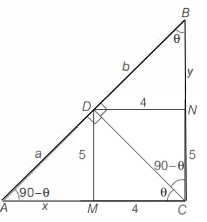
Let $ABC$ be a triangle with $\angle C=90^{\circ}$. Draw $CD$ perpendicular to $AB$. Choose points $M$ and $N$ on sides $AC$ and $BC$ respectively such that $DM$ is parallel to $BC$ and $DN$ is parallel to $AC$. If $DM=5$ and $DN=4$,then $AC$ and $BC$ are respectively equal to:
A
$\frac{41}{4}, \frac{41}{5}$
B
$\frac{39}{4}, \frac{39}{5}$
C
$\frac{38}{4}, \frac{38}{5}$
D
$\frac{37}{4}, \frac{37}{5}$
Solution
(A) Given,$ABC$ is a right-angled triangle with $\angle C=90^{\circ}$.
$CD \perp AB$,$DM \parallel BC$,and $DN \parallel AC$.
Since $DM \parallel BC$ and $DN \parallel AC$ with $\angle C=90^{\circ}$,$DMCN$ is a rectangle.
Thus,$MC = DN = 4$ and $NC = DM = 5$.
In $\triangle ADC$,$DM \perp AC$ is not true,but $DM \parallel BC$ implies $\triangle ADM \sim \triangle ACB$.
Thus,$\frac{DM}{BC} = \frac{AM}{AC} = \frac{AD}{AB}$.
Also,$\triangle CDN \sim \triangle ACB$ is not correct; rather $\triangle DNC \sim \triangle ABC$ is not correct,but $\triangle DNC \sim \triangle ACB$ is not correct. Let $\angle A = \alpha$,then $\angle B = 90^{\circ} - \alpha$.
In $\triangle ADM$,$\tan \alpha = \frac{DM}{AM} = \frac{5}{AM} \Rightarrow AM = 5 \cot \alpha$.
In $\triangle DNB$,$\tan B = \tan(90^{\circ}-\alpha) = \cot \alpha = \frac{DN}{NB} = \frac{4}{NB} \Rightarrow NB = 4 \tan \alpha$.
In $\triangle ABC$,$\tan \alpha = \frac{BC}{AC} = \frac{NC+NB}{AM+MC} = \frac{5+4 \tan \alpha}{5 \cot \alpha + 4}$.
Let $\tan \alpha = t$. Then $t = \frac{5+4t}{5/t + 4} = \frac{t(5+4t)}{5+4t} = t$. This is an identity.
Using $\triangle ADM \sim \triangle CDB$,$\frac{AM}{DM} = \frac{CD}{DB}$ and $\triangle DNC \sim \triangle ADC$,$\frac{NC}{DN} = \frac{AC}{CD}$.
Actually,$AC = AM + MC = AM + 4$ and $BC = BN + NC = BN + 5$.
From $\triangle ADM \sim \triangle CDB$,$\frac{AM}{5} = \frac{5}{BN} \Rightarrow AM \cdot BN = 25$.
Also $\frac{AM}{5} = \frac{5}{BN} \Rightarrow AM = \frac{25}{BN}$.
Since $\triangle ABC$ is right angled,$AC^2 + BC^2 = AB^2$. Using similar triangles,$AC = \frac{41}{4}$ and $BC = \frac{41}{5}$.
$CD \perp AB$,$DM \parallel BC$,and $DN \parallel AC$.
Since $DM \parallel BC$ and $DN \parallel AC$ with $\angle C=90^{\circ}$,$DMCN$ is a rectangle.
Thus,$MC = DN = 4$ and $NC = DM = 5$.
In $\triangle ADC$,$DM \perp AC$ is not true,but $DM \parallel BC$ implies $\triangle ADM \sim \triangle ACB$.
Thus,$\frac{DM}{BC} = \frac{AM}{AC} = \frac{AD}{AB}$.
Also,$\triangle CDN \sim \triangle ACB$ is not correct; rather $\triangle DNC \sim \triangle ABC$ is not correct,but $\triangle DNC \sim \triangle ACB$ is not correct. Let $\angle A = \alpha$,then $\angle B = 90^{\circ} - \alpha$.
In $\triangle ADM$,$\tan \alpha = \frac{DM}{AM} = \frac{5}{AM} \Rightarrow AM = 5 \cot \alpha$.
In $\triangle DNB$,$\tan B = \tan(90^{\circ}-\alpha) = \cot \alpha = \frac{DN}{NB} = \frac{4}{NB} \Rightarrow NB = 4 \tan \alpha$.
In $\triangle ABC$,$\tan \alpha = \frac{BC}{AC} = \frac{NC+NB}{AM+MC} = \frac{5+4 \tan \alpha}{5 \cot \alpha + 4}$.
Let $\tan \alpha = t$. Then $t = \frac{5+4t}{5/t + 4} = \frac{t(5+4t)}{5+4t} = t$. This is an identity.
Using $\triangle ADM \sim \triangle CDB$,$\frac{AM}{DM} = \frac{CD}{DB}$ and $\triangle DNC \sim \triangle ADC$,$\frac{NC}{DN} = \frac{AC}{CD}$.
Actually,$AC = AM + MC = AM + 4$ and $BC = BN + NC = BN + 5$.
From $\triangle ADM \sim \triangle CDB$,$\frac{AM}{5} = \frac{5}{BN} \Rightarrow AM \cdot BN = 25$.
Also $\frac{AM}{5} = \frac{5}{BN} \Rightarrow AM = \frac{25}{BN}$.
Since $\triangle ABC$ is right angled,$AC^2 + BC^2 = AB^2$. Using similar triangles,$AC = \frac{41}{4}$ and $BC = \frac{41}{5}$.
0 likes
View Solution203
AdvancedMCQ
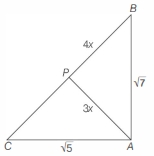
In a $\triangle ABC$ with $\angle A = 90^{\circ}$,$P$ is a point on $BC$ such that $PA:PB = 3:4$. If $AB = \sqrt{7}$ and $AC = \sqrt{5}$,then $BP:PC$ is
A
$2:1$
B
$4:3$
C
$4:5$
D
$8:7$
Solution
(A) Given,$\triangle ABC$ is a right-angled triangle with $\angle A = 90^{\circ}$.
$AC = \sqrt{5}$,$AB = \sqrt{7}$.
In $\triangle ABC$,$BC^2 = AB^2 + AC^2 = 7 + 5 = 12$,so $BC = \sqrt{12} = 2\sqrt{3}$.
Let $PA = 3x$ and $PB = 4x$. In $\triangle ABP$,by the Law of Cosines:
$PA^2 = AB^2 + PB^2 - 2(AB)(PB)\cos B$
$(3x)^2 = (\sqrt{7})^2 + (4x)^2 - 2(\sqrt{7})(4x)\cos B$
$9x^2 = 7 + 16x^2 - 8x\sqrt{7}\cos B$
Since $\cos B = \frac{AB}{BC} = \frac{\sqrt{7}}{2\sqrt{3}}$,we have:
$9x^2 = 7 + 16x^2 - 8x\sqrt{7} \left(\frac{\sqrt{7}}{2\sqrt{3}}\right)$
$9x^2 = 7 + 16x^2 - \frac{28x}{\sqrt{3}}$
$7x^2 - \frac{28x}{\sqrt{3}} + 7 = 0$
$x^2 - \frac{4x}{\sqrt{3}} + 1 = 0$
$\sqrt{3}x^2 - 4x + \sqrt{3} = 0$
$\sqrt{3}x^2 - 3x - x + \sqrt{3} = 0$
$\sqrt{3}x(x - \sqrt{3}) - 1(x - \sqrt{3}) = 0$
$(x - \sqrt{3})(\sqrt{3}x - 1) = 0$
Since $P$ lies on $BC$,$PB < BC$,so $4x < 2\sqrt{3} \Rightarrow x < \frac{\sqrt{3}}{2}$. Thus,$x = \frac{1}{\sqrt{3}}$.
$PB = 4x = \frac{4}{\sqrt{3}}$.
$PC = BC - PB = 2\sqrt{3} - \frac{4}{\sqrt{3}} = \frac{6-4}{\sqrt{3}} = \frac{2}{\sqrt{3}}$.
Therefore,$BP:PC = \frac{4}{\sqrt{3}} : \frac{2}{\sqrt{3}} = 2:1$.
$AC = \sqrt{5}$,$AB = \sqrt{7}$.
In $\triangle ABC$,$BC^2 = AB^2 + AC^2 = 7 + 5 = 12$,so $BC = \sqrt{12} = 2\sqrt{3}$.
Let $PA = 3x$ and $PB = 4x$. In $\triangle ABP$,by the Law of Cosines:
$PA^2 = AB^2 + PB^2 - 2(AB)(PB)\cos B$
$(3x)^2 = (\sqrt{7})^2 + (4x)^2 - 2(\sqrt{7})(4x)\cos B$
$9x^2 = 7 + 16x^2 - 8x\sqrt{7}\cos B$
Since $\cos B = \frac{AB}{BC} = \frac{\sqrt{7}}{2\sqrt{3}}$,we have:
$9x^2 = 7 + 16x^2 - 8x\sqrt{7} \left(\frac{\sqrt{7}}{2\sqrt{3}}\right)$
$9x^2 = 7 + 16x^2 - \frac{28x}{\sqrt{3}}$
$7x^2 - \frac{28x}{\sqrt{3}} + 7 = 0$
$x^2 - \frac{4x}{\sqrt{3}} + 1 = 0$
$\sqrt{3}x^2 - 4x + \sqrt{3} = 0$
$\sqrt{3}x^2 - 3x - x + \sqrt{3} = 0$
$\sqrt{3}x(x - \sqrt{3}) - 1(x - \sqrt{3}) = 0$
$(x - \sqrt{3})(\sqrt{3}x - 1) = 0$
Since $P$ lies on $BC$,$PB < BC$,so $4x < 2\sqrt{3} \Rightarrow x < \frac{\sqrt{3}}{2}$. Thus,$x = \frac{1}{\sqrt{3}}$.
$PB = 4x = \frac{4}{\sqrt{3}}$.
$PC = BC - PB = 2\sqrt{3} - \frac{4}{\sqrt{3}} = \frac{6-4}{\sqrt{3}} = \frac{2}{\sqrt{3}}$.
Therefore,$BP:PC = \frac{4}{\sqrt{3}} : \frac{2}{\sqrt{3}} = 2:1$.
0 likes
View Solution204
AdvancedMCQ
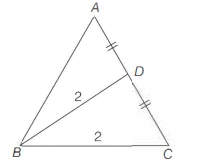
In a $\triangle ABC$,it is known that $AB=AC$. Suppose $D$ is the mid-point of $AC$ and $BD=BC=2$. Then,the area of the $\triangle ABC$ is
A
$2$
B
$2\sqrt{2}$
C
$\sqrt{7}$
D
$2\sqrt{7}$
Solution
(C) Let $AD = CD = x$. Then $AC = 2x$ and $AB = 2x$ (since $AB = AC$).
In $\triangle BCD$,by the Law of Cosines:
$BD^2 = BC^2 + CD^2 - 2(BC)(CD)\cos C$
$2^2 = 2^2 + x^2 - 2(2)(x)\cos C$
$4 = 4 + x^2 - 4x\cos C \Rightarrow \cos C = \frac{x}{4}$.
Since $AB = AC$,$\angle B = \angle C$,so $\cos B = \cos C = \frac{x}{4}$.
In $\triangle ABC$,$\angle A = 180^\circ - 2C$. Thus,$\cos A = \cos(180^\circ - 2C) = -\cos(2C) = -(2\cos^2 C - 1) = 1 - 2(\frac{x^2}{16}) = 1 - \frac{x^2}{8}$.
Using the Law of Cosines in $\triangle ABC$:
$BC^2 = AB^2 + AC^2 - 2(AB)(AC)\cos A$
$2^2 = (2x)^2 + (2x)^2 - 2(2x)(2x)(1 - \frac{x^2}{8})$
$4 = 4x^2 + 4x^2 - 8x^2(1 - \frac{x^2}{8})$
$4 = 8x^2 - 8x^2 + x^4$
$x^4 = 4$ $\Rightarrow x^2 = 2$ $\Rightarrow x = \sqrt{2}$.
Thus,$AC = 2\sqrt{2}$ and $BC = 2$.
$\cos C = \frac{\sqrt{2}}{4} = \frac{1}{2\sqrt{2}}$.
$\sin C = \sqrt{1 - \cos^2 C} = \sqrt{1 - \frac{1}{8}} = \sqrt{\frac{7}{8}} = \frac{\sqrt{7}}{2\sqrt{2}}$.
Area of $\triangle ABC = \frac{1}{2} \times AC \times BC \times \sin C = \frac{1}{2} \times 2\sqrt{2} \times 2 \times \frac{\sqrt{7}}{2\sqrt{2}} = \sqrt{7}$.
In $\triangle BCD$,by the Law of Cosines:
$BD^2 = BC^2 + CD^2 - 2(BC)(CD)\cos C$
$2^2 = 2^2 + x^2 - 2(2)(x)\cos C$
$4 = 4 + x^2 - 4x\cos C \Rightarrow \cos C = \frac{x}{4}$.
Since $AB = AC$,$\angle B = \angle C$,so $\cos B = \cos C = \frac{x}{4}$.
In $\triangle ABC$,$\angle A = 180^\circ - 2C$. Thus,$\cos A = \cos(180^\circ - 2C) = -\cos(2C) = -(2\cos^2 C - 1) = 1 - 2(\frac{x^2}{16}) = 1 - \frac{x^2}{8}$.
Using the Law of Cosines in $\triangle ABC$:
$BC^2 = AB^2 + AC^2 - 2(AB)(AC)\cos A$
$2^2 = (2x)^2 + (2x)^2 - 2(2x)(2x)(1 - \frac{x^2}{8})$
$4 = 4x^2 + 4x^2 - 8x^2(1 - \frac{x^2}{8})$
$4 = 8x^2 - 8x^2 + x^4$
$x^4 = 4$ $\Rightarrow x^2 = 2$ $\Rightarrow x = \sqrt{2}$.
Thus,$AC = 2\sqrt{2}$ and $BC = 2$.
$\cos C = \frac{\sqrt{2}}{4} = \frac{1}{2\sqrt{2}}$.
$\sin C = \sqrt{1 - \cos^2 C} = \sqrt{1 - \frac{1}{8}} = \sqrt{\frac{7}{8}} = \frac{\sqrt{7}}{2\sqrt{2}}$.
Area of $\triangle ABC = \frac{1}{2} \times AC \times BC \times \sin C = \frac{1}{2} \times 2\sqrt{2} \times 2 \times \frac{\sqrt{7}}{2\sqrt{2}} = \sqrt{7}$.
0 likes
View Solution205
AdvancedMCQ
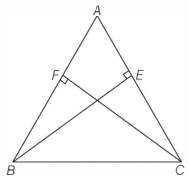
In a $\triangle ABC$,the altitudes from $B$ and $C$ to the opposite sides are not shorter than their respective opposite sides. Then,one of the angles of $\triangle ABC$ is $........^{\circ}$
A
$30$
B
$45$
C
$60$
D
$72$
Solution
(B) Let $BE$ and $CF$ be the altitudes from $B$ and $C$ to the sides $AC$ and $AB$ respectively.
Given that $BE \geq AC$ and $CF \geq AB$.
In $\triangle ABE$,$\sin A = \frac{BE}{AB} \implies BE = AB \sin A$.
Since $BE \geq AC$,we have $AB \sin A \geq AC \dots (i)$.
In $\triangle ACF$,$\sin A = \frac{CF}{AC} \implies CF = AC \sin A$.
Since $CF \geq AB$,we have $AC \sin A \geq AB \dots (ii)$.
Multiplying $(i)$ and $(ii)$,we get $(AB \cdot AC) \sin^2 A \geq (AB \cdot AC) \implies \sin^2 A \geq 1$.
Since $\sin A \leq 1$,this implies $\sin^2 A = 1$,so $\sin A = 1$,which means $A = 90^{\circ}$.
Substituting $A = 90^{\circ}$ into $(i)$ and $(ii)$,we get $AB \geq AC$ and $AC \geq AB$,so $AB = AC$.
Thus,the angles of the triangle are $90^{\circ}, 45^{\circ}, 45^{\circ}$.
Given that $BE \geq AC$ and $CF \geq AB$.
In $\triangle ABE$,$\sin A = \frac{BE}{AB} \implies BE = AB \sin A$.
Since $BE \geq AC$,we have $AB \sin A \geq AC \dots (i)$.
In $\triangle ACF$,$\sin A = \frac{CF}{AC} \implies CF = AC \sin A$.
Since $CF \geq AB$,we have $AC \sin A \geq AB \dots (ii)$.
Multiplying $(i)$ and $(ii)$,we get $(AB \cdot AC) \sin^2 A \geq (AB \cdot AC) \implies \sin^2 A \geq 1$.
Since $\sin A \leq 1$,this implies $\sin^2 A = 1$,so $\sin A = 1$,which means $A = 90^{\circ}$.
Substituting $A = 90^{\circ}$ into $(i)$ and $(ii)$,we get $AB \geq AC$ and $AC \geq AB$,so $AB = AC$.
Thus,the angles of the triangle are $90^{\circ}, 45^{\circ}, 45^{\circ}$.
0 likes
View Solution206
AdvancedMCQ
In a triangle,the lengths of the sides are integers. Suppose that the length of one side is $1$,and the longest altitude is twice the shortest altitude. Let $R$ and $r$ be the circumradius and inradius of the triangle,respectively. If $R:r = m:n$,where $m$ and $n$ are coprime positive integers,then $m + n$ is
A
$5$
B
$7$
C
$9$
D
$11$
Solution
(D) Let the sides of the triangle be $a=1$,$b$,and $c$. Let the altitudes corresponding to these sides be $h_a$,$h_b$,and $h_c$. The area $\Delta = \frac{1}{2} a h_a = \frac{1}{2} b h_b = \frac{1}{2} c h_c$.
Given $h_a = 1 \cdot h_a$ and $h_b = 2 h_a$ (or vice versa). Since $h_a = \frac{2\Delta}{1}$ and $h_b = \frac{2\Delta}{b}$,the condition that the longest altitude is twice the shortest implies $b=2$ or $c=2$.
For a triangle with sides $1, 2, c$,the triangle inequality requires $2-1 < c < 2+1$,so $1 < c < 3$. Since $c$ is an integer,$c=2$.
The sides are $1, 2, 2$. This is an isosceles triangle.
The semi-perimeter $s = \frac{1+2+2}{2} = \frac{5}{2}$.
The area $\Delta = \sqrt{s(s-a)(s-b)(s-c)} = \sqrt{\frac{5}{2} \cdot \frac{3}{2} \cdot \frac{1}{2} \cdot \frac{1}{2}} = \frac{\sqrt{15}}{4}$.
The inradius $r = \frac{\Delta}{s} = \frac{\sqrt{15}/4}{5/2} = \frac{\sqrt{15}}{10}$.
The circumradius $R = \frac{abc}{4\Delta} = \frac{1 \cdot 2 \cdot 2}{4 \cdot \sqrt{15}/4} = \frac{4}{\sqrt{15}}$.
Then $\frac{R}{r} = \frac{4/\sqrt{15}}{\sqrt{15}/10} = \frac{40}{15} = \frac{8}{3}$.
Thus $m=8$ and $n=3$. Since $m, n$ are coprime,$m+n = 8+3 = 11$.
Given $h_a = 1 \cdot h_a$ and $h_b = 2 h_a$ (or vice versa). Since $h_a = \frac{2\Delta}{1}$ and $h_b = \frac{2\Delta}{b}$,the condition that the longest altitude is twice the shortest implies $b=2$ or $c=2$.
For a triangle with sides $1, 2, c$,the triangle inequality requires $2-1 < c < 2+1$,so $1 < c < 3$. Since $c$ is an integer,$c=2$.
The sides are $1, 2, 2$. This is an isosceles triangle.
The semi-perimeter $s = \frac{1+2+2}{2} = \frac{5}{2}$.
The area $\Delta = \sqrt{s(s-a)(s-b)(s-c)} = \sqrt{\frac{5}{2} \cdot \frac{3}{2} \cdot \frac{1}{2} \cdot \frac{1}{2}} = \frac{\sqrt{15}}{4}$.
The inradius $r = \frac{\Delta}{s} = \frac{\sqrt{15}/4}{5/2} = \frac{\sqrt{15}}{10}$.
The circumradius $R = \frac{abc}{4\Delta} = \frac{1 \cdot 2 \cdot 2}{4 \cdot \sqrt{15}/4} = \frac{4}{\sqrt{15}}$.
Then $\frac{R}{r} = \frac{4/\sqrt{15}}{\sqrt{15}/10} = \frac{40}{15} = \frac{8}{3}$.
Thus $m=8$ and $n=3$. Since $m, n$ are coprime,$m+n = 8+3 = 11$.
0 likes
View Solution207
AdvancedMCQ
In a triangle $ABC$,$\cos 3A + \cos 3B + \cos 3C = 1$. If the circumradius of triangle $ABC$ is $\sqrt{3}$,then the length of its longest side is
A
$\sqrt{3}$
B
$2$
C
$3$
D
$2\sqrt{3}$
Solution
(C) Given $\cos 3A + \cos 3B + \cos 3C = 1$.
Using the identity for $\cos 3A + \cos 3B + \cos 3C$ in a triangle where $A+B+C = \pi$,the expression simplifies to $1 - 4 \cos \frac{3A}{2} \cos \frac{3B}{2} \cos \frac{3C}{2} = 1$.
This implies $\cos \frac{3A}{2} \cos \frac{3B}{2} \cos \frac{3C}{2} = 0$.
Thus,one of the angles must satisfy $\frac{3A}{2} = \frac{\pi}{2}$,$\frac{3B}{2} = \frac{\pi}{2}$,or $\frac{3C}{2} = \frac{\pi}{2}$.
This gives $A = \frac{\pi}{3}$,$B = \frac{\pi}{3}$,or $C = \frac{\pi}{3}$.
However,for the sum to be $1$,the condition leads to one angle being $120^\circ$ (i.e.,$\frac{2\pi}{3}$).
Let $A = \frac{2\pi}{3}$. Given circumradius $R = \sqrt{3}$.
Using the sine rule,the side $a = 2R \sin A = 2(\sqrt{3}) \sin \frac{2\pi}{3} = 2\sqrt{3} \times \frac{\sqrt{3}}{2} = 3$.
Since $A$ is the largest angle $(120^\circ)$,$a$ is the longest side.
Therefore,the length of the longest side is $3$.
Using the identity for $\cos 3A + \cos 3B + \cos 3C$ in a triangle where $A+B+C = \pi$,the expression simplifies to $1 - 4 \cos \frac{3A}{2} \cos \frac{3B}{2} \cos \frac{3C}{2} = 1$.
This implies $\cos \frac{3A}{2} \cos \frac{3B}{2} \cos \frac{3C}{2} = 0$.
Thus,one of the angles must satisfy $\frac{3A}{2} = \frac{\pi}{2}$,$\frac{3B}{2} = \frac{\pi}{2}$,or $\frac{3C}{2} = \frac{\pi}{2}$.
This gives $A = \frac{\pi}{3}$,$B = \frac{\pi}{3}$,or $C = \frac{\pi}{3}$.
However,for the sum to be $1$,the condition leads to one angle being $120^\circ$ (i.e.,$\frac{2\pi}{3}$).
Let $A = \frac{2\pi}{3}$. Given circumradius $R = \sqrt{3}$.
Using the sine rule,the side $a = 2R \sin A = 2(\sqrt{3}) \sin \frac{2\pi}{3} = 2\sqrt{3} \times \frac{\sqrt{3}}{2} = 3$.
Since $A$ is the largest angle $(120^\circ)$,$a$ is the longest side.
Therefore,the length of the longest side is $3$.
0 likes
View Solution208
DifficultMCQ
Let $ABC$ and $ABC^{\prime}$ be two non-congruent triangles with sides $AB=4$,$AC=AC^{\prime}=2\sqrt{2}$ and $\angle B=30^{\circ}$. The absolute value of the difference between the areas of these triangles is
A
$2$
B
$9$
C
$4$
D
$5$
Solution
(C) Using the cosine rule in $\triangle ABC$ and $\triangle ABC^{\prime}$ with $AB=c=4$,$AC=AC^{\prime}=b=2\sqrt{2}$,and $\angle B=30^{\circ}$:
$\cos 30^{\circ} = \frac{a^2+c^2-b^2}{2ac} \Rightarrow \frac{\sqrt{3}}{2} = \frac{a^2+16-8}{2 \cdot a \cdot 4}$
$\Rightarrow 4\sqrt{3}a = a^2+8$ $\Rightarrow a^2 - 4\sqrt{3}a + 8 = 0$
Let $a_1$ and $a_2$ be the two possible lengths of side $BC$. From the quadratic equation,$a_1+a_2 = 4\sqrt{3}$ and $a_1a_2 = 8$.
The difference $|a_1-a_2| = \sqrt{(a_1+a_2)^2 - 4a_1a_2} = \sqrt{(4\sqrt{3})^2 - 4(8)} = \sqrt{48-32} = \sqrt{16} = 4$.
The area of a triangle is given by $\Delta = \frac{1}{2}ac \sin B$.
The difference in areas is $|\Delta_1 - \Delta_2| = |\frac{1}{2}a_1c \sin B - \frac{1}{2}a_2c \sin B| = \frac{1}{2}c \sin B |a_1-a_2|$.
Substituting the values: $|\Delta_1 - \Delta_2| = \frac{1}{2} \cdot 4 \cdot \sin 30^{\circ} \cdot 4 = \frac{1}{2} \cdot 4 \cdot \frac{1}{2} \cdot 4 = 4$.
$\cos 30^{\circ} = \frac{a^2+c^2-b^2}{2ac} \Rightarrow \frac{\sqrt{3}}{2} = \frac{a^2+16-8}{2 \cdot a \cdot 4}$
$\Rightarrow 4\sqrt{3}a = a^2+8$ $\Rightarrow a^2 - 4\sqrt{3}a + 8 = 0$
Let $a_1$ and $a_2$ be the two possible lengths of side $BC$. From the quadratic equation,$a_1+a_2 = 4\sqrt{3}$ and $a_1a_2 = 8$.
The difference $|a_1-a_2| = \sqrt{(a_1+a_2)^2 - 4a_1a_2} = \sqrt{(4\sqrt{3})^2 - 4(8)} = \sqrt{48-32} = \sqrt{16} = 4$.
The area of a triangle is given by $\Delta = \frac{1}{2}ac \sin B$.
The difference in areas is $|\Delta_1 - \Delta_2| = |\frac{1}{2}a_1c \sin B - \frac{1}{2}a_2c \sin B| = \frac{1}{2}c \sin B |a_1-a_2|$.
Substituting the values: $|\Delta_1 - \Delta_2| = \frac{1}{2} \cdot 4 \cdot \sin 30^{\circ} \cdot 4 = \frac{1}{2} \cdot 4 \cdot \frac{1}{2} \cdot 4 = 4$.
0 likes
View Solution209
AdvancedMCQ
Let $ABC$ be a triangle such that $\angle ACB = \frac{\pi}{6}$ and let $a, b$ and $c$ denote the lengths of the sides opposite to $A, B$ and $C$ respectively. The value$(s)$ of $x$ for which $a = x^2+x+1, b = x^2-1$ and $c = 2x+1$ is (are)
A
$-(2+\sqrt{3})$
B
$1+\sqrt{3}$
C
$2+\sqrt{3}$
D
$4\sqrt{3}$
Solution
(B) Using the cosine rule for $\angle C$:
$\cos(C) = \frac{a^2+b^2-c^2}{2ab}$
$\cos(\frac{\pi}{6}) = \frac{(x^2+x+1)^2 + (x^2-1)^2 - (2x+1)^2}{2(x^2+x+1)(x^2-1)}$
$\frac{\sqrt{3}}{2} = \frac{(x^4+x^2+1+2x^3+2x^2+2x) + (x^4-2x^2+1) - (4x^2+4x+1)}{2(x^2+x+1)(x^2-1)}$
$\frac{\sqrt{3}}{2} = \frac{2x^4+2x^3-3x^2-2x+1}{2(x^2+x+1)(x^2-1)}$
Since $(x^2+x+1)(x^2-1) = x^4+x^3-x^2-x^2-x-1 = x^4+x^3-2x^2-x-1$,the numerator simplifies to $2(x^4+x^3-2x^2-x-1) + x^2+1$.
Solving the equation leads to $x = 1+\sqrt{3}$.
Since side lengths must be positive,$b = x^2-1 > 0 \implies x > 1$. Thus,$x = 1+\sqrt{3}$ is the valid solution.
$\cos(C) = \frac{a^2+b^2-c^2}{2ab}$
$\cos(\frac{\pi}{6}) = \frac{(x^2+x+1)^2 + (x^2-1)^2 - (2x+1)^2}{2(x^2+x+1)(x^2-1)}$
$\frac{\sqrt{3}}{2} = \frac{(x^4+x^2+1+2x^3+2x^2+2x) + (x^4-2x^2+1) - (4x^2+4x+1)}{2(x^2+x+1)(x^2-1)}$
$\frac{\sqrt{3}}{2} = \frac{2x^4+2x^3-3x^2-2x+1}{2(x^2+x+1)(x^2-1)}$
Since $(x^2+x+1)(x^2-1) = x^4+x^3-x^2-x^2-x-1 = x^4+x^3-2x^2-x-1$,the numerator simplifies to $2(x^4+x^3-2x^2-x-1) + x^2+1$.
Solving the equation leads to $x = 1+\sqrt{3}$.
Since side lengths must be positive,$b = x^2-1 > 0 \implies x > 1$. Thus,$x = 1+\sqrt{3}$ is the valid solution.
0 likes
View Solution210
AdvancedMCQ
Consider a triangle $ABC$ and let $a, b$ and $c$ denote the lengths of the sides opposite to vertices $A, B$ and $C$ respectively. Suppose $a=6, b=10$ and the area of the triangle is $15 \sqrt{3}$. If $\angle ACB$ is obtuse and if $r$ denotes the radius of the incircle of the triangle,then $r^2$ is equal to
A
$1$
B
$2$
C
$3$
D
$4$
Solution
(C) The area of the triangle is given by $\Delta = \frac{1}{2} ab \sin C$.
Substituting the given values,$15 \sqrt{3} = \frac{1}{2} \times 6 \times 10 \times \sin C$,which simplifies to $\sin C = \frac{\sqrt{3}}{2}$.
Since $\angle ACB$ is obtuse,$C = 120^{\circ}$.
Using the Law of Cosines,$c^2 = a^2 + b^2 - 2ab \cos C = 6^2 + 10^2 - 2(6)(10) \cos 120^{\circ} = 36 + 100 - 120(-0.5) = 136 + 60 = 196$,so $c = 14$.
The semi-perimeter $s = \frac{a+b+c}{2} = \frac{6+10+14}{2} = 15$.
The inradius $r = \frac{\Delta}{s} = \frac{15 \sqrt{3}}{15} = \sqrt{3}$.
Therefore,$r^2 = (\sqrt{3})^2 = 3$.
Substituting the given values,$15 \sqrt{3} = \frac{1}{2} \times 6 \times 10 \times \sin C$,which simplifies to $\sin C = \frac{\sqrt{3}}{2}$.
Since $\angle ACB$ is obtuse,$C = 120^{\circ}$.
Using the Law of Cosines,$c^2 = a^2 + b^2 - 2ab \cos C = 6^2 + 10^2 - 2(6)(10) \cos 120^{\circ} = 36 + 100 - 120(-0.5) = 136 + 60 = 196$,so $c = 14$.
The semi-perimeter $s = \frac{a+b+c}{2} = \frac{6+10+14}{2} = 15$.
The inradius $r = \frac{\Delta}{s} = \frac{15 \sqrt{3}}{15} = \sqrt{3}$.
Therefore,$r^2 = (\sqrt{3})^2 = 3$.
0 likes
View Solution211
AdvancedMCQ
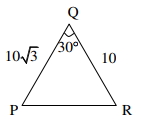
In a triangle $PQR$,let $\angle PQR = 30^{\circ}$ and the sides $PQ$ and $QR$ have lengths $10\sqrt{3}$ and $10$,respectively. Then,which of the following statement$(s)$ is (are) $TRUE$?
$(A)$ $\angle QPR = 45^{\circ}$
$(B)$ The area of the triangle $PQR$ is $25\sqrt{3}$ and $\angle QRP = 120^{\circ}$
$(C)$ The radius of the incircle of the triangle $PQR$ is $10\sqrt{3} - 15$
$(D)$ The area of the circumcircle of the triangle $PQR$ is $100\pi$
$(A)$ $\angle QPR = 45^{\circ}$
$(B)$ The area of the triangle $PQR$ is $25\sqrt{3}$ and $\angle QRP = 120^{\circ}$
$(C)$ The radius of the incircle of the triangle $PQR$ is $10\sqrt{3} - 15$
$(D)$ The area of the circumcircle of the triangle $PQR$ is $100\pi$
A
$B, C, A$
B
$B, C, D$
C
$B, C$
D
$B, D$
Solution
(B) Given: $PQ = 10\sqrt{3}$,$QR = 10$,and $\angle PQR = 30^{\circ}$.
Using the Law of Cosines to find $PR$:
$PR^2 = PQ^2 + QR^2 - 2(PQ)(QR)\cos(30^{\circ})$
$PR^2 = (10\sqrt{3})^2 + 10^2 - 2(10\sqrt{3})(10)\left(\frac{\sqrt{3}}{2}\right)$
$PR^2 = 300 + 100 - 300 = 100$
$PR = 10$.
Since $PR = QR = 10$,the triangle is isosceles with $\angle QPR = \angle PQR = 30^{\circ}$.
Then,$\angle QRP = 180^{\circ} - (30^{\circ} + 30^{\circ}) = 120^{\circ}$. Thus,statement $(B)$ is true.
Area of $\triangle PQR = \frac{1}{2} \times PQ \times QR \times \sin(30^{\circ}) = \frac{1}{2} \times 10\sqrt{3} \times 10 \times \frac{1}{2} = 25\sqrt{3}$.
Semi-perimeter $s = \frac{10\sqrt{3} + 10 + 10}{2} = 5\sqrt{3} + 10$.
Inradius $r = \frac{\text{Area}}{s} = \frac{25\sqrt{3}}{5\sqrt{3} + 10} = \frac{5\sqrt{3}}{\sqrt{3} + 2} = \frac{5\sqrt{3}(2 - \sqrt{3})}{4 - 3} = 10\sqrt{3} - 15$. Thus,statement $(C)$ is true.
Circumradius $R = \frac{abc}{4\Delta} = \frac{10\sqrt{3} \times 10 \times 10}{4 \times 25\sqrt{3}} = \frac{1000\sqrt{3}}{100\sqrt{3}} = 10$.
Area of circumcircle = $\pi R^2 = \pi(10)^2 = 100\pi$. Thus,statement $(D)$ is true.
Therefore,statements $(B), (C), (D)$ are true.
Using the Law of Cosines to find $PR$:
$PR^2 = PQ^2 + QR^2 - 2(PQ)(QR)\cos(30^{\circ})$
$PR^2 = (10\sqrt{3})^2 + 10^2 - 2(10\sqrt{3})(10)\left(\frac{\sqrt{3}}{2}\right)$
$PR^2 = 300 + 100 - 300 = 100$
$PR = 10$.
Since $PR = QR = 10$,the triangle is isosceles with $\angle QPR = \angle PQR = 30^{\circ}$.
Then,$\angle QRP = 180^{\circ} - (30^{\circ} + 30^{\circ}) = 120^{\circ}$. Thus,statement $(B)$ is true.
Area of $\triangle PQR = \frac{1}{2} \times PQ \times QR \times \sin(30^{\circ}) = \frac{1}{2} \times 10\sqrt{3} \times 10 \times \frac{1}{2} = 25\sqrt{3}$.
Semi-perimeter $s = \frac{10\sqrt{3} + 10 + 10}{2} = 5\sqrt{3} + 10$.
Inradius $r = \frac{\text{Area}}{s} = \frac{25\sqrt{3}}{5\sqrt{3} + 10} = \frac{5\sqrt{3}}{\sqrt{3} + 2} = \frac{5\sqrt{3}(2 - \sqrt{3})}{4 - 3} = 10\sqrt{3} - 15$. Thus,statement $(C)$ is true.
Circumradius $R = \frac{abc}{4\Delta} = \frac{10\sqrt{3} \times 10 \times 10}{4 \times 25\sqrt{3}} = \frac{1000\sqrt{3}}{100\sqrt{3}} = 10$.
Area of circumcircle = $\pi R^2 = \pi(10)^2 = 100\pi$. Thus,statement $(D)$ is true.
Therefore,statements $(B), (C), (D)$ are true.
0 likes
View Solution212
MediumMCQ
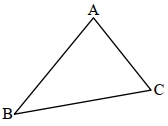
In a triangle $ABC$,let $AB = \sqrt{23}$,$BC = 3$,and $CA = 4$. Then the value of $\frac{\cot A + \cot C}{\cot B}$ is:
A
$1$
B
$2$
C
$5$
D
$8$
Solution
(B) Given sides are $c = AB = \sqrt{23}$,$a = BC = 3$,and $b = CA = 4$.
Using the formula for $\cot$ in terms of sides and area $\Delta$:
$\cot A = \frac{b^2 + c^2 - a^2}{4\Delta}$,$\cot B = \frac{a^2 + c^2 - b^2}{4\Delta}$,and $\cot C = \frac{a^2 + b^2 - c^2}{4\Delta}$.
Now,calculate the expression:
$\frac{\cot A + \cot C}{\cot B} = \frac{\frac{b^2 + c^2 - a^2}{4\Delta} + \frac{a^2 + b^2 - c^2}{4\Delta}}{\frac{a^2 + c^2 - b^2}{4\Delta}}$
$= \frac{b^2 + c^2 - a^2 + a^2 + b^2 - c^2}{a^2 + c^2 - b^2}$
$= \frac{2b^2}{a^2 + c^2 - b^2}$
Substitute the values $a = 3$,$b = 4$,$c = \sqrt{23}$:
$= \frac{2(4^2)}{3^2 + (\sqrt{23})^2 - 4^2}$
$= \frac{2(16)}{9 + 23 - 16}$
$= \frac{32}{32 - 16} = \frac{32}{16} = 2$.
Using the formula for $\cot$ in terms of sides and area $\Delta$:
$\cot A = \frac{b^2 + c^2 - a^2}{4\Delta}$,$\cot B = \frac{a^2 + c^2 - b^2}{4\Delta}$,and $\cot C = \frac{a^2 + b^2 - c^2}{4\Delta}$.
Now,calculate the expression:
$\frac{\cot A + \cot C}{\cot B} = \frac{\frac{b^2 + c^2 - a^2}{4\Delta} + \frac{a^2 + b^2 - c^2}{4\Delta}}{\frac{a^2 + c^2 - b^2}{4\Delta}}$
$= \frac{b^2 + c^2 - a^2 + a^2 + b^2 - c^2}{a^2 + c^2 - b^2}$
$= \frac{2b^2}{a^2 + c^2 - b^2}$
Substitute the values $a = 3$,$b = 4$,$c = \sqrt{23}$:
$= \frac{2(4^2)}{3^2 + (\sqrt{23})^2 - 4^2}$
$= \frac{2(16)}{9 + 23 - 16}$
$= \frac{32}{32 - 16} = \frac{32}{16} = 2$.
0 likes
View Solution213
DifficultMCQ
In a triangle,the sum of lengths of two sides is $x$ and the product of the lengths of the same two sides is $y$. If $x^2 - c^2 = y$,where $c$ is the length of the third side of the triangle,then the circumradius of the triangle is
A
$\frac{c}{3}$
B
$\frac{c}{\sqrt{3}}$
C
$\frac{3}{2} y$
D
$\frac{y}{\sqrt{3}}$
Solution
(B) Let $a$ and $b$ be the lengths of two sides of a triangle.
According to the given condition,$a+b=x$ and $ab=y$.
Given $x^2-c^2=y$,we substitute $x=a+b$:
$(a+b)^2-c^2=ab$
$a^2+b^2+2ab-c^2=ab$
$a^2+b^2-c^2=-ab$
Dividing by $2ab$,we get:
$\frac{a^2+b^2-c^2}{2ab} = -\frac{1}{2}$
By the Law of Cosines,$\cos C = \frac{a^2+b^2-c^2}{2ab}$.
Therefore,$\cos C = -\frac{1}{2}$.
Since $C$ is an angle in a triangle,$C = 120^\circ$ or $\frac{2\pi}{3}$ radians.
The circumradius $R$ is given by $R = \frac{c}{2\sin C}$.
$R = \frac{c}{2\sin(120^\circ)} = \frac{c}{2(\frac{\sqrt{3}}{2})} = \frac{c}{\sqrt{3}}$.
According to the given condition,$a+b=x$ and $ab=y$.
Given $x^2-c^2=y$,we substitute $x=a+b$:
$(a+b)^2-c^2=ab$
$a^2+b^2+2ab-c^2=ab$
$a^2+b^2-c^2=-ab$
Dividing by $2ab$,we get:
$\frac{a^2+b^2-c^2}{2ab} = -\frac{1}{2}$
By the Law of Cosines,$\cos C = \frac{a^2+b^2-c^2}{2ab}$.
Therefore,$\cos C = -\frac{1}{2}$.
Since $C$ is an angle in a triangle,$C = 120^\circ$ or $\frac{2\pi}{3}$ radians.
The circumradius $R$ is given by $R = \frac{c}{2\sin C}$.
$R = \frac{c}{2\sin(120^\circ)} = \frac{c}{2(\frac{\sqrt{3}}{2})} = \frac{c}{\sqrt{3}}$.
0 likes
View Solution214
MediumMCQ
In a triangle $ABC$ with usual notations,if $a=13, b=14, c=15$,then $\sin A=$
A
$\frac{4}{5}$
B
$\frac{3}{5}$
C
$\frac{1}{2}$
D
$\frac{4}{7}$
Solution
(A) First,calculate the semi-perimeter $s$ of the triangle:
$s = \frac{a+b+c}{2} = \frac{13+14+15}{2} = \frac{42}{2} = 21$.
Using Heron's formula,the area $\Delta$ is:
$\Delta = \sqrt{s(s-a)(s-b)(s-c)} = \sqrt{21(21-13)(21-14)(21-15)} = \sqrt{21 \times 8 \times 7 \times 6} = \sqrt{7056} = 84$.
We know the area formula $\Delta = \frac{1}{2}bc \sin A$.
Substituting the values: $84 = \frac{1}{2} \times 14 \times 15 \times \sin A$.
$84 = 105 \sin A$.
$\sin A = \frac{84}{105} = \frac{4}{5}$.
$s = \frac{a+b+c}{2} = \frac{13+14+15}{2} = \frac{42}{2} = 21$.
Using Heron's formula,the area $\Delta$ is:
$\Delta = \sqrt{s(s-a)(s-b)(s-c)} = \sqrt{21(21-13)(21-14)(21-15)} = \sqrt{21 \times 8 \times 7 \times 6} = \sqrt{7056} = 84$.
We know the area formula $\Delta = \frac{1}{2}bc \sin A$.
Substituting the values: $84 = \frac{1}{2} \times 14 \times 15 \times \sin A$.
$84 = 105 \sin A$.
$\sin A = \frac{84}{105} = \frac{4}{5}$.
0 likes
View Solution215
MediumMCQ
In a triangle $ABC$,with usual notations,if $a=4, b=8, \angle C=60^{\circ}$,then the value of $\angle B$ and the ratio $\cos A : \cos C$ respectively are,
A
$90^{\circ}, 1 : \sqrt{3}$
B
$90^{\circ}, \sqrt{3} : 1$
C
$60^{\circ}, 2 : \sqrt{3}$
D
$30^{\circ}, \sqrt{3} : 2$
Solution
(B) Using the Law of Cosines: $c^2 = a^2 + b^2 - 2ab \cos C$
$c^2 = 4^2 + 8^2 - 2(4)(8) \cos 60^{\circ} = 16 + 64 - 64(0.5) = 80 - 32 = 48$
$c = \sqrt{48} = 4\sqrt{3}$
Now,using the Law of Sines: $\frac{a}{\sin A} = \frac{b}{\sin B} = \frac{c}{\sin C}$
$\sin B = \frac{b \sin C}{c} = \frac{8 \sin 60^{\circ}}{4\sqrt{3}} = \frac{8(\sqrt{3}/2)}{4\sqrt{3}} = 1$
Thus,$\angle B = 90^{\circ}$
Since $\angle B = 90^{\circ}$ and $\angle C = 60^{\circ}$,then $\angle A = 180^{\circ} - 90^{\circ} - 60^{\circ} = 30^{\circ}$
The ratio $\cos A : \cos C = \cos 30^{\circ} : \cos 60^{\circ} = \frac{\sqrt{3}}{2} : \frac{1}{2} = \sqrt{3} : 1$
$c^2 = 4^2 + 8^2 - 2(4)(8) \cos 60^{\circ} = 16 + 64 - 64(0.5) = 80 - 32 = 48$
$c = \sqrt{48} = 4\sqrt{3}$
Now,using the Law of Sines: $\frac{a}{\sin A} = \frac{b}{\sin B} = \frac{c}{\sin C}$
$\sin B = \frac{b \sin C}{c} = \frac{8 \sin 60^{\circ}}{4\sqrt{3}} = \frac{8(\sqrt{3}/2)}{4\sqrt{3}} = 1$
Thus,$\angle B = 90^{\circ}$
Since $\angle B = 90^{\circ}$ and $\angle C = 60^{\circ}$,then $\angle A = 180^{\circ} - 90^{\circ} - 60^{\circ} = 30^{\circ}$
The ratio $\cos A : \cos C = \cos 30^{\circ} : \cos 60^{\circ} = \frac{\sqrt{3}}{2} : \frac{1}{2} = \sqrt{3} : 1$
0 likes
View Solution216
MediumMCQ
With usual notation,in triangle $ABC$,$m \angle A = 30^{\circ}$. Then the value of $\left(1+\frac{a}{c}+\frac{b}{c}\right)\left(1+\frac{c}{b}-\frac{a}{b}\right)$ is equal to
A
$\frac{2+\sqrt{3}}{2}$
B
$2+\sqrt{3}$
C
$\frac{1+\sqrt{3}}{2}$
D
$1+\sqrt{3}$
Solution
(B) Given the expression $E = \left(1+\frac{a}{c}+\frac{b}{c}\right)\left(1+\frac{c}{b}-\frac{a}{b}\right)$.
This can be rewritten as $E = \left(\frac{c+a+b}{c}\right)\left(\frac{b+c-a}{b}\right)$.
$E = \frac{(b+c)+a}{c} \times \frac{(b+c)-a}{b} = \frac{(b+c)^2 - a^2}{bc}$.
Expanding the numerator: $E = \frac{b^2 + c^2 + 2bc - a^2}{bc} = \frac{b^2 + c^2 - a^2}{bc} + 2$.
Using the Law of Cosines,$a^2 = b^2 + c^2 - 2bc \cos A$,so $b^2 + c^2 - a^2 = 2bc \cos A$.
Substituting this into the expression: $E = \frac{2bc \cos A}{bc} + 2 = 2 \cos A + 2$.
Given $A = 30^{\circ}$,$\cos 30^{\circ} = \frac{\sqrt{3}}{2}$.
Thus,$E = 2(\frac{\sqrt{3}}{2}) + 2 = \sqrt{3} + 2$.
This can be rewritten as $E = \left(\frac{c+a+b}{c}\right)\left(\frac{b+c-a}{b}\right)$.
$E = \frac{(b+c)+a}{c} \times \frac{(b+c)-a}{b} = \frac{(b+c)^2 - a^2}{bc}$.
Expanding the numerator: $E = \frac{b^2 + c^2 + 2bc - a^2}{bc} = \frac{b^2 + c^2 - a^2}{bc} + 2$.
Using the Law of Cosines,$a^2 = b^2 + c^2 - 2bc \cos A$,so $b^2 + c^2 - a^2 = 2bc \cos A$.
Substituting this into the expression: $E = \frac{2bc \cos A}{bc} + 2 = 2 \cos A + 2$.
Given $A = 30^{\circ}$,$\cos 30^{\circ} = \frac{\sqrt{3}}{2}$.
Thus,$E = 2(\frac{\sqrt{3}}{2}) + 2 = \sqrt{3} + 2$.
0 likes
View Solution217
MediumMCQ
With usual notations,the perimeter of a triangle $ABC$ is $6$ times the arithmetic mean of the sines of its angles. If $a=1$,then $\angle A=$
A
$\frac{\pi}{6}$
B
$\frac{\pi}{3}$
C
$\frac{\pi}{2}$
D
$\frac{2\pi}{3}$
Solution
(A) The perimeter of the triangle is $P = a + b + c$. The arithmetic mean of the sines of its angles is $\frac{\sin A + \sin B + \sin C}{3}$.
Given $a + b + c = 6 \times \frac{\sin A + \sin B + \sin C}{3} = 2(\sin A + \sin B + \sin C)$.
Using the Sine Rule,$a = 2R \sin A$,$b = 2R \sin B$,and $c = 2R \sin C$,where $R$ is the circumradius.
Substituting these into the equation: $2R(\sin A + \sin B + \sin C) = 2(\sin A + \sin B + \sin C)$.
This implies $2R = 2$,so $R = 1$.
Since $a = 2R \sin A$ and $a = 1$,we have $1 = 2(1) \sin A$.
Therefore,$\sin A = \frac{1}{2}$,which gives $A = \frac{\pi}{6}$ or $A = \frac{5\pi}{6}$.
Given the standard context of such problems,we select $A = \frac{\pi}{6}$.
Given $a + b + c = 6 \times \frac{\sin A + \sin B + \sin C}{3} = 2(\sin A + \sin B + \sin C)$.
Using the Sine Rule,$a = 2R \sin A$,$b = 2R \sin B$,and $c = 2R \sin C$,where $R$ is the circumradius.
Substituting these into the equation: $2R(\sin A + \sin B + \sin C) = 2(\sin A + \sin B + \sin C)$.
This implies $2R = 2$,so $R = 1$.
Since $a = 2R \sin A$ and $a = 1$,we have $1 = 2(1) \sin A$.
Therefore,$\sin A = \frac{1}{2}$,which gives $A = \frac{\pi}{6}$ or $A = \frac{5\pi}{6}$.
Given the standard context of such problems,we select $A = \frac{\pi}{6}$.
0 likes
View Solution218
MediumMCQ
With usual notations,in $\triangle ABC$,the lengths of two sides are $10 \text{ cm}$ and $9 \text{ cm}$ respectively. If angles $A, B, C$ are in $A$.$P$.,then the perimeter of $\triangle ABC$ is:
A
$24+2 \sqrt{6} \text{ cm}$
B
$24+\sqrt{6} \text{ cm}$
C
$24-2 \sqrt{6} \text{ cm}$
D
$24-\sqrt{6} \text{ cm}$
Solution
(B) Given that angles $A, B, C$ are in $A$.$P$.,we have $2B = A + C$. Since $A+B+C = 180^{\circ}$,we get $3B = 180^{\circ}$,so $B = 60^{\circ}$.
Using the Law of Cosines: $b^2 = a^2 + c^2 - 2ac \cos B$.
Let the sides be $a=10, c=9$ and $b$ be the third side. Then $b^2 = 10^2 + 9^2 - 2(10)(9) \cos 60^{\circ} = 100 + 81 - 180(0.5) = 181 - 90 = 91$.
Thus $b = \sqrt{91}$. However,the problem implies the sides are $a, b, c$ where $B=60^{\circ}$.
If $a=10, b=9$,then $9^2 = 10^2 + c^2 - 2(10)(c) \cos 60^{\circ} \implies 81 = 100 + c^2 - 10c \implies c^2 - 10c + 19 = 0$.
Solving for $c$: $c = \frac{10 \pm \sqrt{100 - 76}}{2} = 5 \pm \sqrt{6}$.
Case $1$: $c = 5 + \sqrt{6}$. Perimeter $= 10 + 9 + 5 + \sqrt{6} = 24 + \sqrt{6}$.
Case $2$: $c = 5 - \sqrt{6}$. Perimeter $= 10 + 9 + 5 - \sqrt{6} = 24 - \sqrt{6}$.
Given the options,$24+\sqrt{6}$ is a valid perimeter.
Using the Law of Cosines: $b^2 = a^2 + c^2 - 2ac \cos B$.
Let the sides be $a=10, c=9$ and $b$ be the third side. Then $b^2 = 10^2 + 9^2 - 2(10)(9) \cos 60^{\circ} = 100 + 81 - 180(0.5) = 181 - 90 = 91$.
Thus $b = \sqrt{91}$. However,the problem implies the sides are $a, b, c$ where $B=60^{\circ}$.
If $a=10, b=9$,then $9^2 = 10^2 + c^2 - 2(10)(c) \cos 60^{\circ} \implies 81 = 100 + c^2 - 10c \implies c^2 - 10c + 19 = 0$.
Solving for $c$: $c = \frac{10 \pm \sqrt{100 - 76}}{2} = 5 \pm \sqrt{6}$.
Case $1$: $c = 5 + \sqrt{6}$. Perimeter $= 10 + 9 + 5 + \sqrt{6} = 24 + \sqrt{6}$.
Case $2$: $c = 5 - \sqrt{6}$. Perimeter $= 10 + 9 + 5 - \sqrt{6} = 24 - \sqrt{6}$.
Given the options,$24+\sqrt{6}$ is a valid perimeter.
0 likes
View Solution219
MediumMCQ
In a triangle $ABC$,with usual notations,if $a=5$,$b=7$,and $\sin A=\frac{3}{4}$,then the total number of triangles possible is:
A
$1$
B
$0$
C
$2$
D
$5$
Solution
(B) Using the Law of Sines,we have $\frac{a}{\sin A} = \frac{b}{\sin B}$.
Substituting the given values: $\frac{5}{3/4} = \frac{7}{\sin B}$.
$\frac{20}{3} = \frac{7}{\sin B} \implies \sin B = \frac{21}{20}$.
Since the value of $\sin B$ must be $\le 1$ and $\frac{21}{20} > 1$,no such angle $B$ exists.
Therefore,no triangle $ABC$ can be formed with the given parameters.
Substituting the given values: $\frac{5}{3/4} = \frac{7}{\sin B}$.
$\frac{20}{3} = \frac{7}{\sin B} \implies \sin B = \frac{21}{20}$.
Since the value of $\sin B$ must be $\le 1$ and $\frac{21}{20} > 1$,no such angle $B$ exists.
Therefore,no triangle $ABC$ can be formed with the given parameters.
0 likes
View Solution220
MediumMCQ
If the angles $A, B$ and $C$ of a triangle are in $A.P.$ and if $a, b$ and $c$ denote the length of the sides opposite to $A, B$ and $C$ respectively,then the value of $\frac{a}{b} \sin 2B + \frac{b}{a} \sin 2A$ is
A
$\sqrt{3}$
B
$\frac{\sqrt{3}}{2}$
C
$\frac{1}{\sqrt{3}}$
D
$\frac{1}{2}$
Solution
(A) Since $A, B, C$ are in $A.P.$,we have $2B = A + C$.
Given $A + B + C = 180^{\circ}$,we get $3B = 180^{\circ}$,so $B = 60^{\circ}$.
Using the Sine Rule,$\frac{a}{\sin A} = \frac{b}{\sin B} = \frac{c}{\sin C} = k$.
Thus,$a = k \sin A$ and $b = k \sin B$.
The expression becomes $\frac{\sin A}{\sin B} \sin 2B + \frac{\sin B}{\sin A} \sin 2A$.
Substituting $B = 60^{\circ}$,$\sin B = \frac{\sqrt{3}}{2}$ and $\sin 2B = \sin 120^{\circ} = \frac{\sqrt{3}}{2}$.
Expression $= \frac{\sin A}{\sqrt{3}/2} \cdot \frac{\sqrt{3}}{2} + \frac{\sqrt{3}/2}{\sin A} \cdot 2 \sin A \cos A = \sin A + \sqrt{3} \cos A$.
Since $A + C = 120^{\circ}$,$C = 120^{\circ} - A$.
Using $\sin A + \sqrt{3} \cos A = 2(\frac{1}{2} \sin A + \frac{\sqrt{3}}{2} \cos A) = 2 \sin(A + 60^{\circ})$.
Since $A + 60^{\circ} = A + B = 180^{\circ} - C$,this simplifies to $2 \sin(180^{\circ} - C) = 2 \sin C$.
However,evaluating the expression $\frac{a}{b} \sin 2B + \frac{b}{a} \sin 2A$ specifically:
$= \frac{\sin A}{\sin B} (2 \sin B \cos B) + \frac{\sin B}{\sin A} (2 \sin A \cos A) = 2 \sin A \cos B + 2 \sin B \cos A = 2 \sin(A + B)$.
Since $A + B = 180^{\circ} - C$,$2 \sin(180^{\circ} - C) = 2 \sin C$.
Given $B = 60^{\circ}$,$A+C = 120^{\circ}$.
Actually,$2 \sin(A+B) = 2 \sin(180^{\circ} - C) = 2 \sin C$.
Wait,$2 \sin(A+B) = 2 \sin(120^{\circ}) = 2 \cdot \frac{\sqrt{3}}{2} = \sqrt{3}$.
Given $A + B + C = 180^{\circ}$,we get $3B = 180^{\circ}$,so $B = 60^{\circ}$.
Using the Sine Rule,$\frac{a}{\sin A} = \frac{b}{\sin B} = \frac{c}{\sin C} = k$.
Thus,$a = k \sin A$ and $b = k \sin B$.
The expression becomes $\frac{\sin A}{\sin B} \sin 2B + \frac{\sin B}{\sin A} \sin 2A$.
Substituting $B = 60^{\circ}$,$\sin B = \frac{\sqrt{3}}{2}$ and $\sin 2B = \sin 120^{\circ} = \frac{\sqrt{3}}{2}$.
Expression $= \frac{\sin A}{\sqrt{3}/2} \cdot \frac{\sqrt{3}}{2} + \frac{\sqrt{3}/2}{\sin A} \cdot 2 \sin A \cos A = \sin A + \sqrt{3} \cos A$.
Since $A + C = 120^{\circ}$,$C = 120^{\circ} - A$.
Using $\sin A + \sqrt{3} \cos A = 2(\frac{1}{2} \sin A + \frac{\sqrt{3}}{2} \cos A) = 2 \sin(A + 60^{\circ})$.
Since $A + 60^{\circ} = A + B = 180^{\circ} - C$,this simplifies to $2 \sin(180^{\circ} - C) = 2 \sin C$.
However,evaluating the expression $\frac{a}{b} \sin 2B + \frac{b}{a} \sin 2A$ specifically:
$= \frac{\sin A}{\sin B} (2 \sin B \cos B) + \frac{\sin B}{\sin A} (2 \sin A \cos A) = 2 \sin A \cos B + 2 \sin B \cos A = 2 \sin(A + B)$.
Since $A + B = 180^{\circ} - C$,$2 \sin(180^{\circ} - C) = 2 \sin C$.
Given $B = 60^{\circ}$,$A+C = 120^{\circ}$.
Actually,$2 \sin(A+B) = 2 \sin(180^{\circ} - C) = 2 \sin C$.
Wait,$2 \sin(A+B) = 2 \sin(120^{\circ}) = 2 \cdot \frac{\sqrt{3}}{2} = \sqrt{3}$.
0 likes
View Solution221
MediumMCQ
In a triangle $ABC$ with usual notations,if $\angle A = 30^{\circ}$,then the value of $\left(1+\frac{a}{c}+\frac{b}{c}\right)\left(1+\frac{c}{b}-\frac{a}{b}\right)=$
A
$\sqrt{3}-2$
B
$2+\sqrt{5}$
C
$\sqrt{3}+2$
D
$2-\sqrt{5}$
Solution
(C) Given the expression $E = \left(1+\frac{a}{c}+\frac{b}{c}\right)\left(1+\frac{c}{b}-\frac{a}{b}\right)$.
Simplifying the terms,we get $E = \left(\frac{c+a+b}{c}\right)\left(\frac{b+c-a}{b}\right)$.
This can be written as $E = \frac{(b+c)+a}{c} \times \frac{(b+c)-a}{b} = \frac{(b+c)^2 - a^2}{bc}$.
Expanding the numerator,we get $E = \frac{b^2+c^2+2bc-a^2}{bc} = \frac{b^2+c^2-a^2}{bc} + 2$.
Using the Law of Cosines,$\cos A = \frac{b^2+c^2-a^2}{2bc}$,so $b^2+c^2-a^2 = 2bc \cos A$.
Substituting this into the expression,$E = \frac{2bc \cos A}{bc} + 2 = 2 \cos A + 2$.
Given $\angle A = 30^{\circ}$,we have $\cos 30^{\circ} = \frac{\sqrt{3}}{2}$.
Thus,$E = 2 \left(\frac{\sqrt{3}}{2}\right) + 2 = \sqrt{3} + 2$.
Simplifying the terms,we get $E = \left(\frac{c+a+b}{c}\right)\left(\frac{b+c-a}{b}\right)$.
This can be written as $E = \frac{(b+c)+a}{c} \times \frac{(b+c)-a}{b} = \frac{(b+c)^2 - a^2}{bc}$.
Expanding the numerator,we get $E = \frac{b^2+c^2+2bc-a^2}{bc} = \frac{b^2+c^2-a^2}{bc} + 2$.
Using the Law of Cosines,$\cos A = \frac{b^2+c^2-a^2}{2bc}$,so $b^2+c^2-a^2 = 2bc \cos A$.
Substituting this into the expression,$E = \frac{2bc \cos A}{bc} + 2 = 2 \cos A + 2$.
Given $\angle A = 30^{\circ}$,we have $\cos 30^{\circ} = \frac{\sqrt{3}}{2}$.
Thus,$E = 2 \left(\frac{\sqrt{3}}{2}\right) + 2 = \sqrt{3} + 2$.
0 likes
View Solution222
MediumMCQ
In a triangle $ABC$,with usual notation,$\angle B = \pi/3$ and $\angle C = \pi/4$. If $D$ divides $BC$ internally in the ratio $1:3$,find the value of $\frac{\sin \angle BAD}{\sin \angle CAD}$.
A
$1/\sqrt{6}$
B
$1/3$
C
$1/\sqrt{3}$
D
$1/\sqrt{2}$
Solution
(A) Let $AB = c$,$AC = b$,and $BC = a$. Let $\angle BAD = \alpha$ and $\angle CAD = \beta$.
In $\triangle ABD$,by the sine rule: $\frac{BD}{\sin \alpha} = \frac{c}{\sin \angle ADB} \implies \sin \alpha = \frac{BD \sin \angle ADB}{c}$.
In $\triangle ACD$,by the sine rule: $\frac{CD}{\sin \beta} = \frac{b}{\sin \angle ADC} \implies \sin \beta = \frac{CD \sin \angle ADC}{c}$.
Since $\angle ADB + \angle ADC = \pi$,$\sin \angle ADB = \sin \angle ADC$.
Thus,$\frac{\sin \alpha}{\sin \beta} = \frac{BD}{CD} \cdot \frac{b}{c}$.
Given $BD:CD = 1:3$,so $BD/CD = 1/3$.
By the sine rule in $\triangle ABC$,$\frac{b}{\sin B} = \frac{c}{\sin C} \implies \frac{b}{c} = \frac{\sin(\pi/3)}{\sin(\pi/4)} = \frac{\sqrt{3}/2}{1/\sqrt{2}} = \frac{\sqrt{3}}{\sqrt{2}}$.
Therefore,$\frac{\sin \alpha}{\sin \beta} = \frac{1}{3} \cdot \frac{\sqrt{3}}{\sqrt{2}} = \frac{1}{\sqrt{3} \cdot \sqrt{2}} = \frac{1}{\sqrt{6}}$.
In $\triangle ABD$,by the sine rule: $\frac{BD}{\sin \alpha} = \frac{c}{\sin \angle ADB} \implies \sin \alpha = \frac{BD \sin \angle ADB}{c}$.
In $\triangle ACD$,by the sine rule: $\frac{CD}{\sin \beta} = \frac{b}{\sin \angle ADC} \implies \sin \beta = \frac{CD \sin \angle ADC}{c}$.
Since $\angle ADB + \angle ADC = \pi$,$\sin \angle ADB = \sin \angle ADC$.
Thus,$\frac{\sin \alpha}{\sin \beta} = \frac{BD}{CD} \cdot \frac{b}{c}$.
Given $BD:CD = 1:3$,so $BD/CD = 1/3$.
By the sine rule in $\triangle ABC$,$\frac{b}{\sin B} = \frac{c}{\sin C} \implies \frac{b}{c} = \frac{\sin(\pi/3)}{\sin(\pi/4)} = \frac{\sqrt{3}/2}{1/\sqrt{2}} = \frac{\sqrt{3}}{\sqrt{2}}$.
Therefore,$\frac{\sin \alpha}{\sin \beta} = \frac{1}{3} \cdot \frac{\sqrt{3}}{\sqrt{2}} = \frac{1}{\sqrt{3} \cdot \sqrt{2}} = \frac{1}{\sqrt{6}}$.
0 likes
View Solution223
MediumMCQ
If the angles $A, B$ and $C$ of a triangle $ABC$ are in the ratio $2:3:7$ respectively,then the sides $a, b$ and $c$ are respectively in the ratio
A
$2: \sqrt{2}:(\sqrt{3}+1)$
B
$\sqrt{2}: 2:(\sqrt{3}+1)$
C
$(\sqrt{3}+1): \sqrt{2}: 2$
D
$2:(\sqrt{3}+1): \sqrt{2}$
Solution
(B) The angles of triangle $ABC$ are in the ratio $2:3:7$. Let the common multiple be $x$.
$\angle A = 2x, \angle B = 3x, \angle C = 7x$.
Since the sum of the angles of a triangle is $180^{\circ}$,we have $2x + 3x + 7x = 180^{\circ} \implies 12x = 180^{\circ} \implies x = 15^{\circ}$.
Thus,$\angle A = 30^{\circ}, \angle B = 45^{\circ}, \angle C = 105^{\circ}$.
By the sine rule,$\frac{a}{\sin A} = \frac{b}{\sin B} = \frac{c}{\sin C}$.
Substituting the values: $\frac{a}{\sin 30^{\circ}} = \frac{b}{\sin 45^{\circ}} = \frac{c}{\sin 105^{\circ}}$.
We know $\sin 30^{\circ} = \frac{1}{2}$,$\sin 45^{\circ} = \frac{1}{\sqrt{2}}$,and $\sin 105^{\circ} = \sin(60^{\circ} + 45^{\circ}) = \sin 60^{\circ} \cos 45^{\circ} + \cos 60^{\circ} \sin 45^{\circ} = \frac{\sqrt{3}}{2} \cdot \frac{1}{\sqrt{2}} + \frac{1}{2} \cdot \frac{1}{\sqrt{2}} = \frac{\sqrt{3}+1}{2\sqrt{2}}$.
Therefore,$\frac{a}{1/2} = \frac{b}{1/\sqrt{2}} = \frac{c}{(\sqrt{3}+1)/(2\sqrt{2})}$.
Multiplying by $\frac{1}{2}$,we get $\frac{a}{\sqrt{2}} = \frac{b}{2} = \frac{c}{\sqrt{3}+1}$.
Thus,the ratio $a:b:c = \sqrt{2}: 2: (\sqrt{3}+1)$.
$\angle A = 2x, \angle B = 3x, \angle C = 7x$.
Since the sum of the angles of a triangle is $180^{\circ}$,we have $2x + 3x + 7x = 180^{\circ} \implies 12x = 180^{\circ} \implies x = 15^{\circ}$.
Thus,$\angle A = 30^{\circ}, \angle B = 45^{\circ}, \angle C = 105^{\circ}$.
By the sine rule,$\frac{a}{\sin A} = \frac{b}{\sin B} = \frac{c}{\sin C}$.
Substituting the values: $\frac{a}{\sin 30^{\circ}} = \frac{b}{\sin 45^{\circ}} = \frac{c}{\sin 105^{\circ}}$.
We know $\sin 30^{\circ} = \frac{1}{2}$,$\sin 45^{\circ} = \frac{1}{\sqrt{2}}$,and $\sin 105^{\circ} = \sin(60^{\circ} + 45^{\circ}) = \sin 60^{\circ} \cos 45^{\circ} + \cos 60^{\circ} \sin 45^{\circ} = \frac{\sqrt{3}}{2} \cdot \frac{1}{\sqrt{2}} + \frac{1}{2} \cdot \frac{1}{\sqrt{2}} = \frac{\sqrt{3}+1}{2\sqrt{2}}$.
Therefore,$\frac{a}{1/2} = \frac{b}{1/\sqrt{2}} = \frac{c}{(\sqrt{3}+1)/(2\sqrt{2})}$.
Multiplying by $\frac{1}{2}$,we get $\frac{a}{\sqrt{2}} = \frac{b}{2} = \frac{c}{\sqrt{3}+1}$.
Thus,the ratio $a:b:c = \sqrt{2}: 2: (\sqrt{3}+1)$.
0 likes
View Solution224
DifficultMCQ
In a triangle $ABC$,with usual notations,if $m \angle A = 45^{\circ}$ and $m \angle B = 75^{\circ}$,then $a + c \sqrt{2}$ is equal to:
A
$b$
B
$\frac{b}{2}$
C
$2b$
D
$3b$
Solution
(C) Given that: $m \angle A = 45^{\circ}, m \angle B = 75^{\circ}$.
Since the sum of angles in a triangle is $180^{\circ}$,$m \angle C = 180^{\circ} - (45^{\circ} + 75^{\circ}) = 60^{\circ}$.
Using the Sine Rule: $\frac{a}{\sin A} = \frac{b}{\sin B} = \frac{c}{\sin C} = k$.
Thus,$a = k \sin 45^{\circ} = \frac{k}{\sqrt{2}}$,$b = k \sin 75^{\circ} = k \sin(45^{\circ} + 30^{\circ}) = k \left( \frac{1}{\sqrt{2}} \cdot \frac{\sqrt{3}}{2} + \frac{1}{\sqrt{2}} \cdot \frac{1}{2} \right) = \frac{k(\sqrt{3} + 1)}{2\sqrt{2}}$,and $c = k \sin 60^{\circ} = \frac{k\sqrt{3}}{2}$.
We need to find $a + c\sqrt{2}$:
$a + c\sqrt{2} = \frac{k}{\sqrt{2}} + \frac{k\sqrt{3}}{2} \cdot \sqrt{2} = \frac{k}{\sqrt{2}} + \frac{k\sqrt{3}}{\sqrt{2}} = \frac{k(1 + \sqrt{3})}{\sqrt{2}}$.
From the expression for $b$,we have $b = \frac{k(\sqrt{3} + 1)}{2\sqrt{2}}$,which implies $2b = \frac{k(\sqrt{3} + 1)}{\sqrt{2}}$.
Therefore,$a + c\sqrt{2} = 2b$.
Since the sum of angles in a triangle is $180^{\circ}$,$m \angle C = 180^{\circ} - (45^{\circ} + 75^{\circ}) = 60^{\circ}$.
Using the Sine Rule: $\frac{a}{\sin A} = \frac{b}{\sin B} = \frac{c}{\sin C} = k$.
Thus,$a = k \sin 45^{\circ} = \frac{k}{\sqrt{2}}$,$b = k \sin 75^{\circ} = k \sin(45^{\circ} + 30^{\circ}) = k \left( \frac{1}{\sqrt{2}} \cdot \frac{\sqrt{3}}{2} + \frac{1}{\sqrt{2}} \cdot \frac{1}{2} \right) = \frac{k(\sqrt{3} + 1)}{2\sqrt{2}}$,and $c = k \sin 60^{\circ} = \frac{k\sqrt{3}}{2}$.
We need to find $a + c\sqrt{2}$:
$a + c\sqrt{2} = \frac{k}{\sqrt{2}} + \frac{k\sqrt{3}}{2} \cdot \sqrt{2} = \frac{k}{\sqrt{2}} + \frac{k\sqrt{3}}{\sqrt{2}} = \frac{k(1 + \sqrt{3})}{\sqrt{2}}$.
From the expression for $b$,we have $b = \frac{k(\sqrt{3} + 1)}{2\sqrt{2}}$,which implies $2b = \frac{k(\sqrt{3} + 1)}{\sqrt{2}}$.
Therefore,$a + c\sqrt{2} = 2b$.
0 likes
View Solution225
MediumMCQ
If in a triangle $ABC$,with usual notations,the angles are in $A$.$P$. and $b:c = \sqrt{3}:\sqrt{2}$,then angle $A = $ (in $^{\circ}$)
A
$30$
B
$60$
C
$75$
D
$45$
Solution
(C) Given that the angles $A, B, C$ are in $A$.$P$.,we have $A+C = 2B$. Since $A+B+C = 180^{\circ}$,it follows that $3B = 180^{\circ}$,so $B = 60^{\circ}$.
Using the sine rule,$\frac{b}{\sin B} = \frac{c}{\sin C}$,we have $\frac{b}{c} = \frac{\sin B}{\sin C}$.
Substituting the given values,$\frac{\sqrt{3}}{\sqrt{2}} = \frac{\sin 60^{\circ}}{\sin C} = \frac{\sqrt{3}/2}{\sin C}$.
This simplifies to $\sin C = \frac{\sqrt{3}}{2} \times \frac{\sqrt{2}}{\sqrt{3}} = \frac{\sqrt{2}}{2} = \frac{1}{\sqrt{2}}$.
Thus,$C = 45^{\circ}$.
Finally,$A = 180^{\circ} - (B + C) = 180^{\circ} - (60^{\circ} + 45^{\circ}) = 180^{\circ} - 105^{\circ} = 75^{\circ}$.
Using the sine rule,$\frac{b}{\sin B} = \frac{c}{\sin C}$,we have $\frac{b}{c} = \frac{\sin B}{\sin C}$.
Substituting the given values,$\frac{\sqrt{3}}{\sqrt{2}} = \frac{\sin 60^{\circ}}{\sin C} = \frac{\sqrt{3}/2}{\sin C}$.
This simplifies to $\sin C = \frac{\sqrt{3}}{2} \times \frac{\sqrt{2}}{\sqrt{3}} = \frac{\sqrt{2}}{2} = \frac{1}{\sqrt{2}}$.
Thus,$C = 45^{\circ}$.
Finally,$A = 180^{\circ} - (B + C) = 180^{\circ} - (60^{\circ} + 45^{\circ}) = 180^{\circ} - 105^{\circ} = 75^{\circ}$.
0 likes
View Solution226
EasyMCQ
The angles of a triangle are in the ratio $5:1:6$. The ratio of the smallest side to the greatest side is:
A
$\sqrt{3}+1: 2 \sqrt{2}$
B
$2 \sqrt{2}: \sqrt{3}+1$
C
$2 \sqrt{2}: \sqrt{3}-1$
D
$\sqrt{3}-1: 2 \sqrt{2}$
Solution
(D) Let the angles of the triangle be $5x, x, 6x$.
Since the sum of angles in a triangle is $180^{\circ}$,we have $5x + x + 6x = 180^{\circ}$,which gives $12x = 180^{\circ}$,so $x = 15^{\circ}$.
The angles are $75^{\circ}, 15^{\circ}, 90^{\circ}$.
Let the sides opposite to these angles be $a, b, c$ respectively. By the Sine Rule,$\frac{a}{\sin 75^{\circ}} = \frac{b}{\sin 15^{\circ}} = \frac{c}{\sin 90^{\circ}} = k$.
The smallest side is $b$ (opposite to $15^{\circ}$) and the greatest side is $c$ (opposite to $90^{\circ}$).
The ratio of the smallest side to the greatest side is $\frac{b}{c} = \frac{\sin 15^{\circ}}{\sin 90^{\circ}}$.
We know $\sin 15^{\circ} = \sin(45^{\circ}-30^{\circ}) = \sin 45^{\circ} \cos 30^{\circ} - \cos 45^{\circ} \sin 30^{\circ} = \frac{1}{\sqrt{2}} \cdot \frac{\sqrt{3}}{2} - \frac{1}{\sqrt{2}} \cdot \frac{1}{2} = \frac{\sqrt{3}-1}{2\sqrt{2}}$.
Since $\sin 90^{\circ} = 1$,the ratio is $\frac{\sqrt{3}-1}{2\sqrt{2}} : 1 = \sqrt{3}-1 : 2\sqrt{2}$.
Since the sum of angles in a triangle is $180^{\circ}$,we have $5x + x + 6x = 180^{\circ}$,which gives $12x = 180^{\circ}$,so $x = 15^{\circ}$.
The angles are $75^{\circ}, 15^{\circ}, 90^{\circ}$.
Let the sides opposite to these angles be $a, b, c$ respectively. By the Sine Rule,$\frac{a}{\sin 75^{\circ}} = \frac{b}{\sin 15^{\circ}} = \frac{c}{\sin 90^{\circ}} = k$.
The smallest side is $b$ (opposite to $15^{\circ}$) and the greatest side is $c$ (opposite to $90^{\circ}$).
The ratio of the smallest side to the greatest side is $\frac{b}{c} = \frac{\sin 15^{\circ}}{\sin 90^{\circ}}$.
We know $\sin 15^{\circ} = \sin(45^{\circ}-30^{\circ}) = \sin 45^{\circ} \cos 30^{\circ} - \cos 45^{\circ} \sin 30^{\circ} = \frac{1}{\sqrt{2}} \cdot \frac{\sqrt{3}}{2} - \frac{1}{\sqrt{2}} \cdot \frac{1}{2} = \frac{\sqrt{3}-1}{2\sqrt{2}}$.
Since $\sin 90^{\circ} = 1$,the ratio is $\frac{\sqrt{3}-1}{2\sqrt{2}} : 1 = \sqrt{3}-1 : 2\sqrt{2}$.
0 likes
View Solution227
DifficultMCQ
In a triangle $ABC$,with usual notations,$2 ac \sin \left(\frac{A-B+C}{2}\right)$ is equal to
A
$a^2+b^2-c^2$
B
$b^2-a^2+c^2$
C
$c^2+a^2-b^2$
D
$a^2-b^2-c^2$
Solution
(C) We know that in any triangle $ABC$,$A+B+C = \pi$.
Therefore,$A+C = \pi - B$.
Substituting this into the expression:
$2 ac \sin \left(\frac{A-B+C}{2}\right) = 2 ac \sin \left(\frac{(A+C)-B}{2}\right)$
$= 2 ac \sin \left(\frac{(\pi-B)-B}{2}\right)$
$= 2 ac \sin \left(\frac{\pi-2B}{2}\right)$
$= 2 ac \sin \left(\frac{\pi}{2} - B\right)$
$= 2 ac \cos B$
Using the cosine rule,$\cos B = \frac{a^2+c^2-b^2}{2ac}$.
Substituting this value:
$= 2 ac \left(\frac{a^2+c^2-b^2}{2ac}\right)$
$= a^2+c^2-b^2$.
Therefore,$A+C = \pi - B$.
Substituting this into the expression:
$2 ac \sin \left(\frac{A-B+C}{2}\right) = 2 ac \sin \left(\frac{(A+C)-B}{2}\right)$
$= 2 ac \sin \left(\frac{(\pi-B)-B}{2}\right)$
$= 2 ac \sin \left(\frac{\pi-2B}{2}\right)$
$= 2 ac \sin \left(\frac{\pi}{2} - B\right)$
$= 2 ac \cos B$
Using the cosine rule,$\cos B = \frac{a^2+c^2-b^2}{2ac}$.
Substituting this value:
$= 2 ac \left(\frac{a^2+c^2-b^2}{2ac}\right)$
$= a^2+c^2-b^2$.
0 likes
View Solution228
MediumMCQ
In a triangle $ABC$,$l(AB)=\sqrt{23}$ units,$l(BC)=3$ units,$l(CA)=4$ units,then $\frac{\cot A+\cot C}{\cot B}$ is
A
$1$
B
$2$
C
$4$
D
$8$
Solution
(B) Let $a, b, c$ be the side lengths opposite to vertices $A, B, C$ respectively. Here,$a = 3$,$b = 4$,and $c = \sqrt{23}$.
Using the cotangent rule,$\cot A = \frac{b^2+c^2-a^2}{4\Delta}$,$\cot B = \frac{a^2+c^2-b^2}{4\Delta}$,and $\cot C = \frac{a^2+b^2-c^2}{4\Delta}$,where $\Delta$ is the area of the triangle.
Then,$\frac{\cot A+\cot C}{\cot B} = \frac{\frac{b^2+c^2-a^2}{4\Delta} + \frac{a^2+b^2-c^2}{4\Delta}}{\frac{a^2+c^2-b^2}{4\Delta}} = \frac{b^2+c^2-a^2+a^2+b^2-c^2}{a^2+c^2-b^2} = \frac{2b^2}{a^2+c^2-b^2}$.
Substituting the values: $a^2 = 9$,$b^2 = 16$,$c^2 = 23$.
$\frac{2(16)}{9+23-16} = \frac{32}{16} = 2$.
Using the cotangent rule,$\cot A = \frac{b^2+c^2-a^2}{4\Delta}$,$\cot B = \frac{a^2+c^2-b^2}{4\Delta}$,and $\cot C = \frac{a^2+b^2-c^2}{4\Delta}$,where $\Delta$ is the area of the triangle.
Then,$\frac{\cot A+\cot C}{\cot B} = \frac{\frac{b^2+c^2-a^2}{4\Delta} + \frac{a^2+b^2-c^2}{4\Delta}}{\frac{a^2+c^2-b^2}{4\Delta}} = \frac{b^2+c^2-a^2+a^2+b^2-c^2}{a^2+c^2-b^2} = \frac{2b^2}{a^2+c^2-b^2}$.
Substituting the values: $a^2 = 9$,$b^2 = 16$,$c^2 = 23$.
$\frac{2(16)}{9+23-16} = \frac{32}{16} = 2$.
0 likes
View Solution229
MediumMCQ
Two sides of a triangle are $\sqrt{3}+1$ and $\sqrt{3}-1$ and the included angle is $60^{\circ}$. Find the difference of the remaining angles. (in $^{\circ}$)
A
$30$
B
$45$
C
$60$
D
$90$
Solution
(D) Let $a = \sqrt{3}+1$,$b = \sqrt{3}-1$,and $C = 60^{\circ}$.
Using the Law of Cosines:
$c^2 = a^2 + b^2 - 2ab \cos C$
$c^2 = (\sqrt{3}+1)^2 + (\sqrt{3}-1)^2 - 2(\sqrt{3}+1)(\sqrt{3}-1) \cos 60^{\circ}$
$c^2 = (3+1+2\sqrt{3}) + (3+1-2\sqrt{3}) - 2(3-1) \times \frac{1}{2}$
$c^2 = 8 - 2 = 6 \implies c = \sqrt{6}$.
Using the Law of Tangents:
$\tan\left(\frac{A-B}{2}\right) = \frac{a-b}{a+b} \cot\left(\frac{C}{2}\right)$
$\tan\left(\frac{A-B}{2}\right) = \frac{(\sqrt{3}+1) - (\sqrt{3}-1)}{(\sqrt{3}+1) + (\sqrt{3}-1)} \cot(30^{\circ})$
$\tan\left(\frac{A-B}{2}\right) = \frac{2}{2\sqrt{3}} \times \sqrt{3} = 1$.
Therefore,$\frac{A-B}{2} = 45^{\circ} \implies A-B = 90^{\circ}$.
Using the Law of Cosines:
$c^2 = a^2 + b^2 - 2ab \cos C$
$c^2 = (\sqrt{3}+1)^2 + (\sqrt{3}-1)^2 - 2(\sqrt{3}+1)(\sqrt{3}-1) \cos 60^{\circ}$
$c^2 = (3+1+2\sqrt{3}) + (3+1-2\sqrt{3}) - 2(3-1) \times \frac{1}{2}$
$c^2 = 8 - 2 = 6 \implies c = \sqrt{6}$.
Using the Law of Tangents:
$\tan\left(\frac{A-B}{2}\right) = \frac{a-b}{a+b} \cot\left(\frac{C}{2}\right)$
$\tan\left(\frac{A-B}{2}\right) = \frac{(\sqrt{3}+1) - (\sqrt{3}-1)}{(\sqrt{3}+1) + (\sqrt{3}-1)} \cot(30^{\circ})$
$\tan\left(\frac{A-B}{2}\right) = \frac{2}{2\sqrt{3}} \times \sqrt{3} = 1$.
Therefore,$\frac{A-B}{2} = 45^{\circ} \implies A-B = 90^{\circ}$.
0 likes
View Solution230
MediumMCQ
In a triangle $ABC$,with usual notations,if $m \angle A = 60^{\circ}$,$b = 8$,$a = 6$,and $B = \sin^{-1} x$,then $x$ has the value:
A
$\frac{\sqrt{3}}{2}$
B
$\frac{2}{\sqrt{3}}$
C
$2\sqrt{3}$
D
$\frac{1}{2\sqrt{3}}$
Solution
(B) Using the sine rule,we have:
$\frac{\sin A}{a} = \frac{\sin B}{b}$
Substituting the given values:
$\frac{\sin 60^{\circ}}{6} = \frac{\sin B}{8}$
Since $B = \sin^{-1} x$,we have $\sin B = x$.
$\frac{\sqrt{3}/2}{6} = \frac{x}{8}$
$\frac{\sqrt{3}}{12} = \frac{x}{8}$
$x = \frac{8\sqrt{3}}{12} = \frac{2\sqrt{3}}{3} = \frac{2}{\sqrt{3}}$
$\frac{\sin A}{a} = \frac{\sin B}{b}$
Substituting the given values:
$\frac{\sin 60^{\circ}}{6} = \frac{\sin B}{8}$
Since $B = \sin^{-1} x$,we have $\sin B = x$.
$\frac{\sqrt{3}/2}{6} = \frac{x}{8}$
$\frac{\sqrt{3}}{12} = \frac{x}{8}$
$x = \frac{8\sqrt{3}}{12} = \frac{2\sqrt{3}}{3} = \frac{2}{\sqrt{3}}$
0 likes
View Solution231
EasyMCQ
In triangle $ABC$ with usual notations $b=\sqrt{3}$,$c=1$,and $m \angle A=30^{\circ}$,then the largest angle of the triangle is (in $^{\circ}$)
A
$135$
B
$90$
C
$60$
D
$120$
Solution
(D) By the cosine rule,we have:
$a^2 = b^2 + c^2 - 2bc \cos A$
$a^2 = (\sqrt{3})^2 + (1)^2 - 2(\sqrt{3})(1) \cos(30^{\circ})$
$a^2 = 3 + 1 - 2\sqrt{3} \left(\frac{\sqrt{3}}{2}\right)$
$a^2 = 4 - 3 = 1$
$\therefore a = 1$
Since $b = \sqrt{3} \approx 1.732$ is the largest side,the largest angle is $\angle B$.
Using the cosine rule for $\angle B$:
$\cos B = \frac{a^2 + c^2 - b^2}{2ac} = \frac{1^2 + 1^2 - (\sqrt{3})^2}{2(1)(1)} = \frac{1 + 1 - 3}{2} = -\frac{1}{2}$
$\therefore B = 120^{\circ}$
$a^2 = b^2 + c^2 - 2bc \cos A$
$a^2 = (\sqrt{3})^2 + (1)^2 - 2(\sqrt{3})(1) \cos(30^{\circ})$
$a^2 = 3 + 1 - 2\sqrt{3} \left(\frac{\sqrt{3}}{2}\right)$
$a^2 = 4 - 3 = 1$
$\therefore a = 1$
Since $b = \sqrt{3} \approx 1.732$ is the largest side,the largest angle is $\angle B$.
Using the cosine rule for $\angle B$:
$\cos B = \frac{a^2 + c^2 - b^2}{2ac} = \frac{1^2 + 1^2 - (\sqrt{3})^2}{2(1)(1)} = \frac{1 + 1 - 3}{2} = -\frac{1}{2}$
$\therefore B = 120^{\circ}$
0 likes
View Solution232
EasyMCQ
With usual notations,if the angles of a triangle are in the ratio $1: 2: 3$,then their corresponding sides are in the ratio.
A
$1: 2: 3$
B
$1: \sqrt{3}: 3$
C
$\sqrt{2}: \sqrt{3}: 3$
D
$1: \sqrt{3}: 2$
Solution
(D) Let the angles be $x, 2x, 3x$.
Since the sum of angles in a triangle is $180^{\circ}$,we have $x + 2x + 3x = 180^{\circ}$ $\Rightarrow 6x = 180^{\circ}$ $\Rightarrow x = 30^{\circ}$.
Thus,the angles of the triangle are $A = 30^{\circ}, B = 60^{\circ}, C = 90^{\circ}$.
Using the Sine Rule,$\frac{a}{\sin A} = \frac{b}{\sin B} = \frac{c}{\sin C}$.
Substituting the values,$\frac{a}{\sin 30^{\circ}} = \frac{b}{\sin 60^{\circ}} = \frac{c}{\sin 90^{\circ}}$.
$\frac{a}{1/2} = \frac{b}{\sqrt{3}/2} = \frac{c}{1}$.
Multiplying by $1/2$,we get $a : b : c = \sin 30^{\circ} : \sin 60^{\circ} : \sin 90^{\circ} = \frac{1}{2} : \frac{\sqrt{3}}{2} : 1$.
Multiplying throughout by $2$,we get $a : b : c = 1 : \sqrt{3} : 2$.
Since the sum of angles in a triangle is $180^{\circ}$,we have $x + 2x + 3x = 180^{\circ}$ $\Rightarrow 6x = 180^{\circ}$ $\Rightarrow x = 30^{\circ}$.
Thus,the angles of the triangle are $A = 30^{\circ}, B = 60^{\circ}, C = 90^{\circ}$.
Using the Sine Rule,$\frac{a}{\sin A} = \frac{b}{\sin B} = \frac{c}{\sin C}$.
Substituting the values,$\frac{a}{\sin 30^{\circ}} = \frac{b}{\sin 60^{\circ}} = \frac{c}{\sin 90^{\circ}}$.
$\frac{a}{1/2} = \frac{b}{\sqrt{3}/2} = \frac{c}{1}$.
Multiplying by $1/2$,we get $a : b : c = \sin 30^{\circ} : \sin 60^{\circ} : \sin 90^{\circ} = \frac{1}{2} : \frac{\sqrt{3}}{2} : 1$.
Multiplying throughout by $2$,we get $a : b : c = 1 : \sqrt{3} : 2$.
0 likes
View Solution233
MediumMCQ
With usual notations,the perimeter of a triangle $ABC$ is $6$ times the arithmetic mean of the sines of its angles. If $a=1$,then the measure of angle $A$ is:
A
$\frac{\pi^c}{3}$
B
$\frac{\pi^c}{2}$
C
$\frac{\pi^c}{4}$
D
$\frac{\pi^c}{6}$
Solution
(D) Let $\frac{a}{\sin A} = \frac{b}{\sin B} = \frac{c}{\sin C} = k$.
Then $\sin A = \frac{a}{k}$,$\sin B = \frac{b}{k}$,and $\sin C = \frac{c}{k}$.
The perimeter of the triangle is $a+b+c$.
The arithmetic mean of the sines of its angles is $\frac{\sin A + \sin B + \sin C}{3}$.
According to the problem,$a+b+c = 6 \times \left( \frac{\sin A + \sin B + \sin C}{3} \right)$.
Substituting the values,we get $a+b+c = 2(\sin A + \sin B + \sin C) = 2 \left( \frac{a+b+c}{k} \right)$.
Thus,$1 = \frac{2}{k}$,which implies $k = 2$.
Since $\sin A = \frac{a}{k}$ and $a=1$,we have $\sin A = \frac{1}{2}$.
Therefore,$A = \frac{\pi^c}{6}$.
Then $\sin A = \frac{a}{k}$,$\sin B = \frac{b}{k}$,and $\sin C = \frac{c}{k}$.
The perimeter of the triangle is $a+b+c$.
The arithmetic mean of the sines of its angles is $\frac{\sin A + \sin B + \sin C}{3}$.
According to the problem,$a+b+c = 6 \times \left( \frac{\sin A + \sin B + \sin C}{3} \right)$.
Substituting the values,we get $a+b+c = 2(\sin A + \sin B + \sin C) = 2 \left( \frac{a+b+c}{k} \right)$.
Thus,$1 = \frac{2}{k}$,which implies $k = 2$.
Since $\sin A = \frac{a}{k}$ and $a=1$,we have $\sin A = \frac{1}{2}$.
Therefore,$A = \frac{\pi^c}{6}$.
0 likes
View Solution234
MediumMCQ
If in $\triangle ABC$,with usual notations,the angles are in $A$.$P$.,then $\frac{a}{c} \sin 2C + \frac{c}{a} \sin 2A =$
A
$\frac{1}{2}$
B
$\sqrt{3}$
C
$2\sqrt{3}$
D
$\frac{\sqrt{3}}{2}$
Solution
(B) Given that the angles $A, B, C$ of $\triangle ABC$ are in $A$.$P$.,we have $2B = A + C$.
Since $A + B + C = 180^{\circ}$,we get $3B = 180^{\circ}$,so $B = 60^{\circ}$ and $A + C = 120^{\circ}$.
Using the Sine Rule,$\frac{a}{\sin A} = \frac{c}{\sin C} = k$,so $a = k \sin A$ and $c = k \sin C$.
Substituting these into the expression:
$\frac{a}{c} \sin 2C + \frac{c}{a} \sin 2A = \frac{k \sin A}{k \sin C} (2 \sin C \cos C) + \frac{k \sin C}{k \sin A} (2 \sin A \cos A)$
$= 2 \sin A \cos C + 2 \sin C \cos A$
$= 2(\sin A \cos C + \cos A \sin C)$
$= 2 \sin(A + C)$
$= 2 \sin(120^{\circ}) = 2 \times \frac{\sqrt{3}}{2} = \sqrt{3}$.
Since $A + B + C = 180^{\circ}$,we get $3B = 180^{\circ}$,so $B = 60^{\circ}$ and $A + C = 120^{\circ}$.
Using the Sine Rule,$\frac{a}{\sin A} = \frac{c}{\sin C} = k$,so $a = k \sin A$ and $c = k \sin C$.
Substituting these into the expression:
$\frac{a}{c} \sin 2C + \frac{c}{a} \sin 2A = \frac{k \sin A}{k \sin C} (2 \sin C \cos C) + \frac{k \sin C}{k \sin A} (2 \sin A \cos A)$
$= 2 \sin A \cos C + 2 \sin C \cos A$
$= 2(\sin A \cos C + \cos A \sin C)$
$= 2 \sin(A + C)$
$= 2 \sin(120^{\circ}) = 2 \times \frac{\sqrt{3}}{2} = \sqrt{3}$.
0 likes
View Solution235
MediumMCQ
In $\triangle ABC$,with usual notations,$2ab \sin \frac{1}{2}(A+B-C) =$
A
$a^2-b^2-c^2$
B
$a^2+b^2-c^2$
C
$a^2+b^2+c^2$
D
$a^2-b^2+c^2$
Solution
(B) We know that in $\triangle ABC$,$A+B+C = \pi$,so $A+B = \pi-C$.
Substituting this into the expression:
$2ab \sin \frac{1}{2}(A+B-C) = 2ab \sin \frac{1}{2}((\pi-C)-C)$
$= 2ab \sin \frac{1}{2}(\pi-2C) = 2ab \sin (\frac{\pi}{2}-C)$
$= 2ab \cos C$
Using the cosine rule,$\cos C = \frac{a^2+b^2-c^2}{2ab}$.
Therefore,$2ab \cos C = 2ab \left(\frac{a^2+b^2-c^2}{2ab}\right) = a^2+b^2-c^2$.
Substituting this into the expression:
$2ab \sin \frac{1}{2}(A+B-C) = 2ab \sin \frac{1}{2}((\pi-C)-C)$
$= 2ab \sin \frac{1}{2}(\pi-2C) = 2ab \sin (\frac{\pi}{2}-C)$
$= 2ab \cos C$
Using the cosine rule,$\cos C = \frac{a^2+b^2-c^2}{2ab}$.
Therefore,$2ab \cos C = 2ab \left(\frac{a^2+b^2-c^2}{2ab}\right) = a^2+b^2-c^2$.
0 likes
View Solution236
EasyMCQ
With usual notations,in any $\triangle ABC$,if $a \cos B = b \cos A$,then the triangle is:
A
an isosceles triangle
B
an equilateral triangle
C
a right-angled triangle
D
a scalene triangle
Solution
(A) We know the Sine Rule: $\frac{a}{\sin A} = \frac{b}{\sin B}$.
This implies $a \sin B = b \sin A$ ... $(1)$.
We are given the condition: $a \cos B = b \cos A$ ... $(2)$.
Dividing equation $(1)$ by equation $(2)$,we get:
$\frac{a \sin B}{a \cos B} = \frac{b \sin A}{b \cos A} \Rightarrow \tan B = \tan A$.
Since $A$ and $B$ are angles of a triangle,$A = B$.
Therefore,the triangle is an isosceles triangle.
This implies $a \sin B = b \sin A$ ... $(1)$.
We are given the condition: $a \cos B = b \cos A$ ... $(2)$.
Dividing equation $(1)$ by equation $(2)$,we get:
$\frac{a \sin B}{a \cos B} = \frac{b \sin A}{b \cos A} \Rightarrow \tan B = \tan A$.
Since $A$ and $B$ are angles of a triangle,$A = B$.
Therefore,the triangle is an isosceles triangle.
0 likes
View Solution237
MediumMCQ
In $\triangle ABC$,with usual notations,the value of $\frac{b \sin B - c \sin C}{\sin (B - C)}$ is:
A
$b$
B
$c$
C
$a$
D
$a+b+c$
Solution
(C) Using the Sine Rule,we have $\frac{a}{\sin A} = \frac{b}{\sin B} = \frac{c}{\sin C} = k$.
Therefore,$b = k \sin B$ and $c = k \sin C$.
Substituting these into the expression:
$\frac{b \sin B - c \sin C}{\sin (B - C)} = \frac{(k \sin B) \sin B - (k \sin C) \sin C}{\sin (B - C)}$
$= \frac{k(\sin^2 B - \sin^2 C)}{\sin (B - C)}$
Using the identity $\sin^2 B - \sin^2 C = \sin(B - C) \sin(B + C)$:
$= \frac{k \sin(B - C) \sin(B + C)}{\sin (B - C)}$
$= k \sin(B + C)$
Since $A + B + C = \pi$,we have $\sin(B + C) = \sin(\pi - A) = \sin A$.
Thus,the expression becomes $k \sin A = a$.
Therefore,$b = k \sin B$ and $c = k \sin C$.
Substituting these into the expression:
$\frac{b \sin B - c \sin C}{\sin (B - C)} = \frac{(k \sin B) \sin B - (k \sin C) \sin C}{\sin (B - C)}$
$= \frac{k(\sin^2 B - \sin^2 C)}{\sin (B - C)}$
Using the identity $\sin^2 B - \sin^2 C = \sin(B - C) \sin(B + C)$:
$= \frac{k \sin(B - C) \sin(B + C)}{\sin (B - C)}$
$= k \sin(B + C)$
Since $A + B + C = \pi$,we have $\sin(B + C) = \sin(\pi - A) = \sin A$.
Thus,the expression becomes $k \sin A = a$.
0 likes
View Solution238
MediumMCQ
With usual notations in $\triangle ABC$,if $\frac{\sin A}{\sin C}=\frac{\sin (A-B)}{\sin (B-C)}$,then $a^2, b^2, c^2$ are in
A
Not in $AP$
B
$HP$
C
$AP$
D
$GP$
Solution
(C) Given $\frac{\sin A}{\sin C} = \frac{\sin (A-B)}{\sin (B-C)}$.
Applying cross-multiplication: $\sin A \sin (B-C) = \sin C \sin (A-B)$.
Using the expansion $\sin(x-y) = \sin x \cos y - \cos x \sin y$:
$\sin A (\sin B \cos C - \cos B \sin C) = \sin C (\sin A \cos B - \cos A \sin B)$.
$\sin A \sin B \cos C - \sin A \cos B \sin C = \sin C \sin A \cos B - \sin C \cos A \sin B$.
Rearranging terms: $\sin A \sin B \cos C + \sin C \cos A \sin B = 2 \sin A \cos B \sin C$.
$\sin B (\sin A \cos C + \cos A \sin C) = 2 \sin A \cos B \sin C$.
Since $\sin A \cos C + \cos A \sin C = \sin(A+C) = \sin(\pi - B) = \sin B$,we have:
$\sin B \cdot \sin B = 2 \sin A \cos B \sin C$.
$\sin^2 B = 2 \sin A \sin C \cos B$.
Dividing by $\sin A \sin C \sin B$: $\frac{\sin B}{\sin A \sin C} = \frac{2 \cos B}{\sin B} = 2 \cot B$.
Using the sine rule $\frac{a}{\sin A} = \frac{b}{\sin B} = \frac{c}{\sin C} = 2R$,we have $\sin A = \frac{a}{2R}, \sin B = \frac{b}{2R}, \sin C = \frac{c}{2R}$.
Substituting these: $\frac{(b/2R)^2}{(a/2R)(c/2R)} = 2 \cos B \Rightarrow \frac{b^2}{ac} = 2 \cos B$.
Using the cosine rule $\cos B = \frac{a^2+c^2-b^2}{2ac}$:
$\frac{b^2}{ac} = 2 \left( \frac{a^2+c^2-b^2}{2ac} \right) = \frac{a^2+c^2-b^2}{ac}$.
$b^2 = a^2+c^2-b^2 \Rightarrow 2b^2 = a^2+c^2$.
Thus,$a^2, b^2, c^2$ are in $AP$.
Applying cross-multiplication: $\sin A \sin (B-C) = \sin C \sin (A-B)$.
Using the expansion $\sin(x-y) = \sin x \cos y - \cos x \sin y$:
$\sin A (\sin B \cos C - \cos B \sin C) = \sin C (\sin A \cos B - \cos A \sin B)$.
$\sin A \sin B \cos C - \sin A \cos B \sin C = \sin C \sin A \cos B - \sin C \cos A \sin B$.
Rearranging terms: $\sin A \sin B \cos C + \sin C \cos A \sin B = 2 \sin A \cos B \sin C$.
$\sin B (\sin A \cos C + \cos A \sin C) = 2 \sin A \cos B \sin C$.
Since $\sin A \cos C + \cos A \sin C = \sin(A+C) = \sin(\pi - B) = \sin B$,we have:
$\sin B \cdot \sin B = 2 \sin A \cos B \sin C$.
$\sin^2 B = 2 \sin A \sin C \cos B$.
Dividing by $\sin A \sin C \sin B$: $\frac{\sin B}{\sin A \sin C} = \frac{2 \cos B}{\sin B} = 2 \cot B$.
Using the sine rule $\frac{a}{\sin A} = \frac{b}{\sin B} = \frac{c}{\sin C} = 2R$,we have $\sin A = \frac{a}{2R}, \sin B = \frac{b}{2R}, \sin C = \frac{c}{2R}$.
Substituting these: $\frac{(b/2R)^2}{(a/2R)(c/2R)} = 2 \cos B \Rightarrow \frac{b^2}{ac} = 2 \cos B$.
Using the cosine rule $\cos B = \frac{a^2+c^2-b^2}{2ac}$:
$\frac{b^2}{ac} = 2 \left( \frac{a^2+c^2-b^2}{2ac} \right) = \frac{a^2+c^2-b^2}{ac}$.
$b^2 = a^2+c^2-b^2 \Rightarrow 2b^2 = a^2+c^2$.
Thus,$a^2, b^2, c^2$ are in $AP$.
0 likes
View Solution239
EasyMCQ
In a triangle $ABC$ with usual notations $a=2$ and $b=3$,the value of $\frac{\cos 2A}{a^2} - \frac{\cos 2B}{b^2}$ is:
A
$\frac{5}{36}$
B
$\frac{1}{4}$
C
$\frac{1}{9}$
D
$\frac{13}{19}$
Solution
(A) Using the identity $\cos 2\theta = 1 - 2\sin^2\theta$,the expression becomes:
$\frac{1 - 2\sin^2 A}{a^2} - \frac{1 - 2\sin^2 B}{b^2} = \left(\frac{1}{a^2} - \frac{1}{b^2}\right) - 2\left(\frac{\sin^2 A}{a^2} - \frac{\sin^2 B}{b^2}\right)$
From the sine rule,$\frac{a}{\sin A} = \frac{b}{\sin B} = k$,which implies $\frac{\sin A}{a} = \frac{\sin B}{b} = \frac{1}{k}$.
Therefore,$\frac{\sin^2 A}{a^2} = \frac{\sin^2 B}{b^2} = \frac{1}{k^2}$.
Substituting this into the expression:
$\left(\frac{1}{a^2} - \frac{1}{b^2}\right) - 2\left(\frac{1}{k^2} - \frac{1}{k^2}\right) = \frac{1}{a^2} - \frac{1}{b^2}$
Given $a=2$ and $b=3$:
$\frac{1}{2^2} - \frac{1}{3^2} = \frac{1}{4} - \frac{1}{9} = \frac{9-4}{36} = \frac{5}{36}$
$\frac{1 - 2\sin^2 A}{a^2} - \frac{1 - 2\sin^2 B}{b^2} = \left(\frac{1}{a^2} - \frac{1}{b^2}\right) - 2\left(\frac{\sin^2 A}{a^2} - \frac{\sin^2 B}{b^2}\right)$
From the sine rule,$\frac{a}{\sin A} = \frac{b}{\sin B} = k$,which implies $\frac{\sin A}{a} = \frac{\sin B}{b} = \frac{1}{k}$.
Therefore,$\frac{\sin^2 A}{a^2} = \frac{\sin^2 B}{b^2} = \frac{1}{k^2}$.
Substituting this into the expression:
$\left(\frac{1}{a^2} - \frac{1}{b^2}\right) - 2\left(\frac{1}{k^2} - \frac{1}{k^2}\right) = \frac{1}{a^2} - \frac{1}{b^2}$
Given $a=2$ and $b=3$:
$\frac{1}{2^2} - \frac{1}{3^2} = \frac{1}{4} - \frac{1}{9} = \frac{9-4}{36} = \frac{5}{36}$
0 likes
View Solution240
EasyMCQ
If two angles of $\triangle ABC$ are $\frac{\pi}{4}$ and $\frac{\pi}{3}$,then the ratio of the smallest and greatest side is
A
$\sqrt{3}: \sqrt{2}$
B
$(\sqrt{3}-1): 1$
C
$(\sqrt{3}+1):(\sqrt{3}-1)$
D
$(\sqrt{3}+1): 1$
Solution
(B) Let the angles of $\triangle ABC$ be $A = \frac{\pi}{4} = 45^{\circ}$,$B = \frac{\pi}{3} = 60^{\circ}$,and $C$.
The sum of angles in a triangle is $\pi$ radians $(180^{\circ})$.
So,$C = 180^{\circ} - (45^{\circ} + 60^{\circ}) = 75^{\circ}$.
The angles are $45^{\circ}, 60^{\circ}, 75^{\circ}$.
The smallest angle is $45^{\circ}$ and the greatest angle is $75^{\circ}$.
By the Sine Rule,$\frac{a}{\sin A} = \frac{c}{\sin C}$,where $a$ is the smallest side and $c$ is the greatest side.
The ratio of the smallest side to the greatest side is $\frac{a}{c} = \frac{\sin 45^{\circ}}{\sin 75^{\circ}}$.
We know $\sin 45^{\circ} = \frac{1}{\sqrt{2}}$ and $\sin 75^{\circ} = \sin(45^{\circ} + 30^{\circ}) = \frac{1}{\sqrt{2}} \cdot \frac{\sqrt{3}}{2} + \frac{1}{\sqrt{2}} \cdot \frac{1}{2} = \frac{\sqrt{3}+1}{2\sqrt{2}}$.
Thus,$\frac{a}{c} = \frac{1/\sqrt{2}}{(\sqrt{3}+1)/(2\sqrt{2})} = \frac{2}{\sqrt{3}+1}$.
Rationalizing the denominator: $\frac{2(\sqrt{3}-1)}{(\sqrt{3}+1)(\sqrt{3}-1)} = \frac{2(\sqrt{3}-1)}{3-1} = \sqrt{3}-1$.
Therefore,the ratio is $(\sqrt{3}-1) : 1$.
The sum of angles in a triangle is $\pi$ radians $(180^{\circ})$.
So,$C = 180^{\circ} - (45^{\circ} + 60^{\circ}) = 75^{\circ}$.
The angles are $45^{\circ}, 60^{\circ}, 75^{\circ}$.
The smallest angle is $45^{\circ}$ and the greatest angle is $75^{\circ}$.
By the Sine Rule,$\frac{a}{\sin A} = \frac{c}{\sin C}$,where $a$ is the smallest side and $c$ is the greatest side.
The ratio of the smallest side to the greatest side is $\frac{a}{c} = \frac{\sin 45^{\circ}}{\sin 75^{\circ}}$.
We know $\sin 45^{\circ} = \frac{1}{\sqrt{2}}$ and $\sin 75^{\circ} = \sin(45^{\circ} + 30^{\circ}) = \frac{1}{\sqrt{2}} \cdot \frac{\sqrt{3}}{2} + \frac{1}{\sqrt{2}} \cdot \frac{1}{2} = \frac{\sqrt{3}+1}{2\sqrt{2}}$.
Thus,$\frac{a}{c} = \frac{1/\sqrt{2}}{(\sqrt{3}+1)/(2\sqrt{2})} = \frac{2}{\sqrt{3}+1}$.
Rationalizing the denominator: $\frac{2(\sqrt{3}-1)}{(\sqrt{3}+1)(\sqrt{3}-1)} = \frac{2(\sqrt{3}-1)}{3-1} = \sqrt{3}-1$.
Therefore,the ratio is $(\sqrt{3}-1) : 1$.
0 likes
View Solution241
EasyMCQ
With usual notations in $\Delta ABC$,$a=3$,$c=2$ and $\sin C=\frac{2}{3}$,then $\angle A=$
A
$\frac{\pi}{4}$
B
$\frac{\pi}{3}$
C
$\frac{\pi}{2}$
D
$\frac{\pi}{6}$
Solution
(C) By the Sine Rule,we have: $\frac{\sin A}{a} = \frac{\sin C}{c}$
Substituting the given values: $\frac{\sin A}{3} = \frac{(2/3)}{2}$
$\frac{\sin A}{3} = \frac{1}{3}$
$\sin A = 1$
Therefore,$A = 90^{\circ} = \frac{\pi}{2}$.
Substituting the given values: $\frac{\sin A}{3} = \frac{(2/3)}{2}$
$\frac{\sin A}{3} = \frac{1}{3}$
$\sin A = 1$
Therefore,$A = 90^{\circ} = \frac{\pi}{2}$.
0 likes
View Solution242
EasyMCQ
In $\triangle ABC$,if $\frac{\cos A}{a} = \frac{\cos B}{b} = \frac{\cos C}{c}$ with usual notations,then the triangle is
A
an isosceles triangle
B
an equilateral triangle
C
a right-angled scalene triangle
D
a scalene triangle
Solution
(B) Using the sine rule,we have $\frac{a}{\sin A} = \frac{b}{\sin B} = \frac{c}{\sin C} = 2R$,which implies $a = 2R \sin A$,$b = 2R \sin B$,and $c = 2R \sin C$.
Given the condition $\frac{\cos A}{a} = \frac{\cos B}{b} = \frac{\cos C}{c}$,we substitute the values of $a, b, c$:
$\frac{\cos A}{2R \sin A} = \frac{\cos B}{2R \sin B} = \frac{\cos C}{2R \sin C}$.
This simplifies to $\cot A = \cot B = \cot C$.
Since $A, B, C$ are angles of a triangle,$\cot A = \cot B = \cot C$ implies $A = B = C$.
Therefore,the triangle is an equilateral triangle.
Given the condition $\frac{\cos A}{a} = \frac{\cos B}{b} = \frac{\cos C}{c}$,we substitute the values of $a, b, c$:
$\frac{\cos A}{2R \sin A} = \frac{\cos B}{2R \sin B} = \frac{\cos C}{2R \sin C}$.
This simplifies to $\cot A = \cot B = \cot C$.
Since $A, B, C$ are angles of a triangle,$\cot A = \cot B = \cot C$ implies $A = B = C$.
Therefore,the triangle is an equilateral triangle.
0 likes
View Solution243
EasyMCQ
With usual notations,in triangle $ABC$,$a=\sqrt{3}+1$,$b=\sqrt{3}-1$ and $m \angle C=60^{\circ}$,then $A-B=$ (in $^{\circ}$)
A
$45$
B
$60$
C
$30$
D
$90$
Solution
(D) Given $a=\sqrt{3}+1$,$b=\sqrt{3}-1$,$m \angle C=60^{\circ}$.
Using the tangent rule (Napier's Analogy): $\tan \left( \frac{A-B}{2} \right) = \frac{a-b}{a+b} \cot \left( \frac{C}{2} \right)$.
Substitute the values: $\frac{a-b}{a+b} = \frac{(\sqrt{3}+1)-(\sqrt{3}-1)}{(\sqrt{3}+1)+(\sqrt{3}-1)} = \frac{2}{2\sqrt{3}} = \frac{1}{\sqrt{3}}$.
$\tan \left( \frac{A-B}{2} \right) = \frac{1}{\sqrt{3}} \cot \left( \frac{60^{\circ}}{2} \right) = \frac{1}{\sqrt{3}} \cot(30^{\circ}) = \frac{1}{\sqrt{3}} \times \sqrt{3} = 1$.
$\frac{A-B}{2} = 45^{\circ} \Rightarrow A-B = 90^{\circ}$.
Using the tangent rule (Napier's Analogy): $\tan \left( \frac{A-B}{2} \right) = \frac{a-b}{a+b} \cot \left( \frac{C}{2} \right)$.
Substitute the values: $\frac{a-b}{a+b} = \frac{(\sqrt{3}+1)-(\sqrt{3}-1)}{(\sqrt{3}+1)+(\sqrt{3}-1)} = \frac{2}{2\sqrt{3}} = \frac{1}{\sqrt{3}}$.
$\tan \left( \frac{A-B}{2} \right) = \frac{1}{\sqrt{3}} \cot \left( \frac{60^{\circ}}{2} \right) = \frac{1}{\sqrt{3}} \cot(30^{\circ}) = \frac{1}{\sqrt{3}} \times \sqrt{3} = 1$.
$\frac{A-B}{2} = 45^{\circ} \Rightarrow A-B = 90^{\circ}$.
0 likes
View Solution244
EasyMCQ
In a $\Delta ABC$,if $2 \cos C = \sin B \cdot \operatorname{cosec} A$,then:
A
$a = b$
B
$b = c$
C
$a = c$
D
$a = b = c$
Solution
(C) Given the equation: $2 \cos C = \sin B \cdot \operatorname{cosec} A$
Since $\operatorname{cosec} A = \frac{1}{\sin A}$,we have $2 \cos C = \frac{\sin B}{\sin A}$.
Using the Sine Rule,$\frac{\sin B}{\sin A} = \frac{b}{a}$.
Thus,$2 \cos C = \frac{b}{a}$.
Using the Cosine Rule,$\cos C = \frac{a^2 + b^2 - c^2}{2ab}$.
Substituting this into the equation: $2 \left( \frac{a^2 + b^2 - c^2}{2ab} \right) = \frac{b}{a}$.
$\frac{a^2 + b^2 - c^2}{ab} = \frac{b}{a}$.
Multiplying both sides by $ab$,we get $a^2 + b^2 - c^2 = b^2$.
$a^2 - c^2 = 0 \Rightarrow a^2 = c^2$.
Since $a$ and $c$ are side lengths,$a = c$.
Since $\operatorname{cosec} A = \frac{1}{\sin A}$,we have $2 \cos C = \frac{\sin B}{\sin A}$.
Using the Sine Rule,$\frac{\sin B}{\sin A} = \frac{b}{a}$.
Thus,$2 \cos C = \frac{b}{a}$.
Using the Cosine Rule,$\cos C = \frac{a^2 + b^2 - c^2}{2ab}$.
Substituting this into the equation: $2 \left( \frac{a^2 + b^2 - c^2}{2ab} \right) = \frac{b}{a}$.
$\frac{a^2 + b^2 - c^2}{ab} = \frac{b}{a}$.
Multiplying both sides by $ab$,we get $a^2 + b^2 - c^2 = b^2$.
$a^2 - c^2 = 0 \Rightarrow a^2 = c^2$.
Since $a$ and $c$ are side lengths,$a = c$.
0 likes
View Solution245
EasyMCQ
With usual notations,if the angles $A, B, C$ of a $\triangle ABC$ are in $A$.$P$. and $b:c = \sqrt{3}:\sqrt{2}$,then $\angle A=$ (in $^{\circ}$)
A
$55$
B
$45$
C
$35$
D
$75$
Solution
(D) Given that $A, B, C$ are in $A$.$P$.,we have $2B = A + C$.
Since $A + B + C = 180^{\circ}$,we substitute $A + C = 2B$ to get $3B = 180^{\circ}$,which implies $B = 60^{\circ}$.
Using the Sine Rule,$\frac{\sin B}{b} = \frac{\sin C}{c}$,we have $\sin C = \frac{c}{b} \sin B$.
Given $b:c = \sqrt{3}:\sqrt{2}$,we have $\frac{c}{b} = \frac{\sqrt{2}}{\sqrt{3}}$.
Thus,$\sin C = \frac{\sqrt{2}}{\sqrt{3}} \times \sin 60^{\circ} = \frac{\sqrt{2}}{\sqrt{3}} \times \frac{\sqrt{3}}{2} = \frac{\sqrt{2}}{2} = \frac{1}{\sqrt{2}}$.
Therefore,$C = 45^{\circ}$.
Finally,$A = 180^{\circ} - (B + C) = 180^{\circ} - (60^{\circ} + 45^{\circ}) = 180^{\circ} - 105^{\circ} = 75^{\circ}$.
Since $A + B + C = 180^{\circ}$,we substitute $A + C = 2B$ to get $3B = 180^{\circ}$,which implies $B = 60^{\circ}$.
Using the Sine Rule,$\frac{\sin B}{b} = \frac{\sin C}{c}$,we have $\sin C = \frac{c}{b} \sin B$.
Given $b:c = \sqrt{3}:\sqrt{2}$,we have $\frac{c}{b} = \frac{\sqrt{2}}{\sqrt{3}}$.
Thus,$\sin C = \frac{\sqrt{2}}{\sqrt{3}} \times \sin 60^{\circ} = \frac{\sqrt{2}}{\sqrt{3}} \times \frac{\sqrt{3}}{2} = \frac{\sqrt{2}}{2} = \frac{1}{\sqrt{2}}$.
Therefore,$C = 45^{\circ}$.
Finally,$A = 180^{\circ} - (B + C) = 180^{\circ} - (60^{\circ} + 45^{\circ}) = 180^{\circ} - 105^{\circ} = 75^{\circ}$.
0 likes
View Solution246
MediumMCQ
With usual notations,if triangle $ABC$ is right-angled at $C$,then $\left(\frac{a^{2}+b^{2}}{a^{2}-b^{2}}\right) \sin (A-B) =$
A
$3$
B
$1$
C
$0$
D
$-1$
Solution
(B) Given that in $\triangle ABC, \angle C = 90^{\circ}$,so $A+B = 90^{\circ} \Rightarrow B = 90^{\circ}-A$.
Using the sine rule,$a = k \sin A$ and $b = k \sin B$.
Substituting these into the expression:
$\frac{a^{2}+b^{2}}{a^{2}-b^{2}} \sin (A-B) = \frac{\sin^{2} A + \sin^{2} B}{\sin^{2} A - \sin^{2} B} \sin (A-B)$.
Since $B = 90^{\circ}-A$,$\sin B = \cos A$ and $\cos B = \sin A$.
Thus,$\sin^{2} A + \sin^{2} B = \sin^{2} A + \cos^{2} A = 1$.
And $\sin^{2} A - \sin^{2} B = \sin^{2} A - \cos^{2} A = -\cos 2A$.
Also,$\sin (A-B) = \sin (A - (90^{\circ}-A)) = \sin (2A - 90^{\circ}) = -\cos 2A$.
Substituting these values:
$\frac{1}{-\cos 2A} \cdot (-\cos 2A) = 1$.
Using the sine rule,$a = k \sin A$ and $b = k \sin B$.
Substituting these into the expression:
$\frac{a^{2}+b^{2}}{a^{2}-b^{2}} \sin (A-B) = \frac{\sin^{2} A + \sin^{2} B}{\sin^{2} A - \sin^{2} B} \sin (A-B)$.
Since $B = 90^{\circ}-A$,$\sin B = \cos A$ and $\cos B = \sin A$.
Thus,$\sin^{2} A + \sin^{2} B = \sin^{2} A + \cos^{2} A = 1$.
And $\sin^{2} A - \sin^{2} B = \sin^{2} A - \cos^{2} A = -\cos 2A$.
Also,$\sin (A-B) = \sin (A - (90^{\circ}-A)) = \sin (2A - 90^{\circ}) = -\cos 2A$.
Substituting these values:
$\frac{1}{-\cos 2A} \cdot (-\cos 2A) = 1$.
0 likes
View Solution247
EasyMCQ
In $\triangle ABC$,with the usual notations,if $\sin B \sin C = \frac{bc}{a^2}$,then the triangle is $\ldots$.
A
Right angled triangle
B
Obtuse angled triangle
C
Equilateral triangle
D
Acute angled triangle
Solution
(A) Key Idea: Use the sine rule,i.e.,$\frac{a}{\sin A} = \frac{b}{\sin B} = \frac{c}{\sin C} = 2R$.
Given,$\sin B \sin C = \frac{bc}{a^2}$.
From the sine rule,we have $\sin B = \frac{b}{2R}$ and $\sin C = \frac{c}{2R}$.
Substituting these into the given equation:
$\left(\frac{b}{2R}\right) \left(\frac{c}{2R}\right) = \frac{bc}{a^2}$
$\Rightarrow \frac{bc}{4R^2} = \frac{bc}{a^2}$
$\Rightarrow 4R^2 = a^2$
$\Rightarrow a = 2R$.
Since $\frac{a}{\sin A} = 2R$,we have $\frac{2R}{\sin A} = 2R$,which implies $\sin A = 1$.
Therefore,$A = 90^{\circ}$.
Thus,the triangle is a right-angled triangle.
Given,$\sin B \sin C = \frac{bc}{a^2}$.
From the sine rule,we have $\sin B = \frac{b}{2R}$ and $\sin C = \frac{c}{2R}$.
Substituting these into the given equation:
$\left(\frac{b}{2R}\right) \left(\frac{c}{2R}\right) = \frac{bc}{a^2}$
$\Rightarrow \frac{bc}{4R^2} = \frac{bc}{a^2}$
$\Rightarrow 4R^2 = a^2$
$\Rightarrow a = 2R$.
Since $\frac{a}{\sin A} = 2R$,we have $\frac{2R}{\sin A} = 2R$,which implies $\sin A = 1$.
Therefore,$A = 90^{\circ}$.
Thus,the triangle is a right-angled triangle.
0 likes
View Solution248
EasyMCQ
In $\triangle ABC$,with usual notations,$\frac{b \sin B - c \sin C}{\sin (B - C)} = $
A
$b$
B
$a + b + c$
C
$a$
D
$c$
Solution
(C) Using the Sine Rule,we have $\frac{a}{\sin A} = \frac{b}{\sin B} = \frac{c}{\sin C} = k$.
Thus,$b = k \sin B$ and $c = k \sin C$.
Substituting these into the expression:
$\frac{b \sin B - c \sin C}{\sin (B - C)} = \frac{(k \sin B) \sin B - (k \sin C) \sin C}{\sin (B - C)}$
$= \frac{k(\sin^2 B - \sin^2 C)}{\sin (B - C)}$
Using the identity $\sin^2 B - \sin^2 C = \sin(B + C) \sin(B - C)$:
$= \frac{k \sin(B + C) \sin(B - C)}{\sin (B - C)}$
$= k \sin(B + C)$
Since $A + B + C = 180^{\circ}$,then $B + C = 180^{\circ} - A$.
$= k \sin(180^{\circ} - A) = k \sin A$
$= a$.
Thus,$b = k \sin B$ and $c = k \sin C$.
Substituting these into the expression:
$\frac{b \sin B - c \sin C}{\sin (B - C)} = \frac{(k \sin B) \sin B - (k \sin C) \sin C}{\sin (B - C)}$
$= \frac{k(\sin^2 B - \sin^2 C)}{\sin (B - C)}$
Using the identity $\sin^2 B - \sin^2 C = \sin(B + C) \sin(B - C)$:
$= \frac{k \sin(B + C) \sin(B - C)}{\sin (B - C)}$
$= k \sin(B + C)$
Since $A + B + C = 180^{\circ}$,then $B + C = 180^{\circ} - A$.
$= k \sin(180^{\circ} - A) = k \sin A$
$= a$.
0 likes
View Solution249
MediumMCQ
In a triangle $ABC$,with usual notations,if $\frac{b+c}{11} = \frac{c+a}{12} = \frac{a+b}{13}$,then $\cos A : \cos B : \cos C$ is
A
$7 : 19 : 25$
B
$19 : 7 : 25$
C
$12 : 14 : 20$
D
$19 : 25 : 20$
Solution
(A) Let $\frac{b+c}{11} = \frac{c+a}{12} = \frac{a+b}{13} = k$.
Then $b+c = 11k$,$c+a = 12k$,and $a+b = 13k$.
Adding these equations,we get $2(a+b+c) = 36k$,so $a+b+c = 18k$.
Subtracting the equations from $a+b+c = 18k$:
$a = (a+b+c) - (b+c) = 18k - 11k = 7k$.
$b = (a+b+c) - (c+a) = 18k - 12k = 6k$.
$c = (a+b+c) - (a+b) = 18k - 13k = 5k$.
Using the cosine rule:
$\cos A = \frac{b^2+c^2-a^2}{2bc} = \frac{(6k)^2+(5k)^2-(7k)^2}{2(6k)(5k)} = \frac{36+25-49}{60} = \frac{12}{60} = \frac{1}{5}$.
$\cos B = \frac{a^2+c^2-b^2}{2ac} = \frac{(7k)^2+(5k)^2-(6k)^2}{2(7k)(5k)} = \frac{49+25-36}{70} = \frac{38}{70} = \frac{19}{35}$.
$\cos C = \frac{a^2+b^2-c^2}{2ab} = \frac{(7k)^2+(6k)^2-(5k)^2}{2(7k)(6k)} = \frac{49+36-25}{84} = \frac{60}{84} = \frac{5}{7}$.
Now,$\cos A : \cos B : \cos C = \frac{1}{5} : \frac{19}{35} : \frac{5}{7}$.
Multiplying by $35$,we get $7 : 19 : 25$.
Then $b+c = 11k$,$c+a = 12k$,and $a+b = 13k$.
Adding these equations,we get $2(a+b+c) = 36k$,so $a+b+c = 18k$.
Subtracting the equations from $a+b+c = 18k$:
$a = (a+b+c) - (b+c) = 18k - 11k = 7k$.
$b = (a+b+c) - (c+a) = 18k - 12k = 6k$.
$c = (a+b+c) - (a+b) = 18k - 13k = 5k$.
Using the cosine rule:
$\cos A = \frac{b^2+c^2-a^2}{2bc} = \frac{(6k)^2+(5k)^2-(7k)^2}{2(6k)(5k)} = \frac{36+25-49}{60} = \frac{12}{60} = \frac{1}{5}$.
$\cos B = \frac{a^2+c^2-b^2}{2ac} = \frac{(7k)^2+(5k)^2-(6k)^2}{2(7k)(5k)} = \frac{49+25-36}{70} = \frac{38}{70} = \frac{19}{35}$.
$\cos C = \frac{a^2+b^2-c^2}{2ab} = \frac{(7k)^2+(6k)^2-(5k)^2}{2(7k)(6k)} = \frac{49+36-25}{84} = \frac{60}{84} = \frac{5}{7}$.
Now,$\cos A : \cos B : \cos C = \frac{1}{5} : \frac{19}{35} : \frac{5}{7}$.
Multiplying by $35$,we get $7 : 19 : 25$.
0 likes
View Solution250
MediumMCQ
The smallest angle of the triangle whose sides are $6+\sqrt{12}, \sqrt{48}, \sqrt{24}$ is
A
$\frac{\pi}{2}$
B
$\frac{\pi}{6}$
C
$\frac{\pi}{4}$
D
$\frac{\pi}{3}$
Solution
(B) Let the sides of the triangle be $a = 6+\sqrt{12} = 6+2\sqrt{3}$,$b = \sqrt{48} = 4\sqrt{3}$,and $c = \sqrt{24} = 2\sqrt{6}$.
Note that $a \approx 6 + 3.464 = 9.464$,$b \approx 4 \times 1.732 = 6.928$,and $c \approx 2 \times 2.449 = 4.898$.
The smallest side is $c = 2\sqrt{6}$. The smallest angle is opposite to the smallest side,so we need to find angle $C$.
Using the Law of Cosines: $\cos C = \frac{a^2 + b^2 - c^2}{2ab}$.
$a^2 = (6+2\sqrt{3})^2 = 36 + 12 + 24\sqrt{3} = 48 + 24\sqrt{3}$.
$b^2 = (4\sqrt{3})^2 = 48$.
$c^2 = (2\sqrt{6})^2 = 24$.
$\cos C = \frac{48 + 24\sqrt{3} + 48 - 24}{2(6+2\sqrt{3})(4\sqrt{3})} = \frac{72 + 24\sqrt{3}}{8\sqrt{3}(6+2\sqrt{3})} = \frac{24(3 + \sqrt{3})}{8\sqrt{3} \times 2(3 + \sqrt{3})} = \frac{24}{16\sqrt{3}} = \frac{3}{2\sqrt{3}} = \frac{\sqrt{3}}{2}$.
Since $\cos C = \frac{\sqrt{3}}{2}$,we have $C = \frac{\pi}{6}$.
Note that $a \approx 6 + 3.464 = 9.464$,$b \approx 4 \times 1.732 = 6.928$,and $c \approx 2 \times 2.449 = 4.898$.
The smallest side is $c = 2\sqrt{6}$. The smallest angle is opposite to the smallest side,so we need to find angle $C$.
Using the Law of Cosines: $\cos C = \frac{a^2 + b^2 - c^2}{2ab}$.
$a^2 = (6+2\sqrt{3})^2 = 36 + 12 + 24\sqrt{3} = 48 + 24\sqrt{3}$.
$b^2 = (4\sqrt{3})^2 = 48$.
$c^2 = (2\sqrt{6})^2 = 24$.
$\cos C = \frac{48 + 24\sqrt{3} + 48 - 24}{2(6+2\sqrt{3})(4\sqrt{3})} = \frac{72 + 24\sqrt{3}}{8\sqrt{3}(6+2\sqrt{3})} = \frac{24(3 + \sqrt{3})}{8\sqrt{3} \times 2(3 + \sqrt{3})} = \frac{24}{16\sqrt{3}} = \frac{3}{2\sqrt{3}} = \frac{\sqrt{3}}{2}$.
Since $\cos C = \frac{\sqrt{3}}{2}$,we have $C = \frac{\pi}{6}$.
0 likes
View SolutionTrigonometrical Equations — Relation between sides and angles, Solutions of triangles · Frequently Asked Questions
1Are these Trigonometrical Equations questions useful for JEE and NEET?
Yes. All questions in this section are mapped to JEE Main and NEET exam patterns. Previous year questions from JEE Main, NEET, GUJCET and state-level exams are included with full solutions.
2Can I switch to Hindi or Gujarati for these questions?
Yes. Use the language tabs in the hero section or the sidebar to view the same questions and solutions in English, Hindi or Gujarati.
3How do I generate a question paper from this subtopic?
Use the Vedclass Exam Paper Generator — select the chapter and subtopic, set difficulty, and generate Sets A, B, C, D automatically. First 3 chapters of every subject are free.
Vedclass Products
For Students
Vedclass Test Series
Mock tests in real JEE/NEET style with performance analysis. 5-day free trial.
Start Free TrialFor Teachers
Exam Paper Generator
Generate Set A/B/C/D papers from this chapter in 2 minutes. 3 chapters free.
Try FreeFor Institutes
Online Exam Module
Live online exams with unlimited students, 360° analytics & white-label branding.
See DemoFor Teachers & Institutes
Generate a Trigonometrical Equations Exam Paper in 2 Minutes
Select subtopic & difficulty — Sets A, B, C, D auto-generated with No Repeat logic.
First 3 chapters of every subject are free — no payment required.