
A English
Relation between sides and angles, Solutions of triangles Questions in English
Class 11 Mathematics · Trigonometrical Equations · Relation between sides and angles, Solutions of triangles
611+
Questions
English
Language
100%
With Solutions
Showing 50 of 611 questions in English
151
MediumMCQ
If $p_1, p_2, p_3$ are altitudes of a triangle $ABC$ from the vertices $A, B, C$ respectively,and $\Delta$ is the area of the triangle,then $p_1^{-1} + p_2^{-1} - p_3^{-1}$ is equal to
A
$\frac{s - a}{\Delta}$
B
$\frac{s - b}{\Delta}$
C
$\frac{s - c}{\Delta}$
D
$\frac{s}{\Delta}$
Solution
(C) We know that the area of a triangle $\Delta = \frac{1}{2} a p_1 = \frac{1}{2} b p_2 = \frac{1}{2} c p_3$.
From this,we get $p_1 = \frac{2\Delta}{a}$,$p_2 = \frac{2\Delta}{b}$,and $p_3 = \frac{2\Delta}{c}$.
Therefore,$p_1^{-1} + p_2^{-1} - p_3^{-1} = \frac{1}{p_1} + \frac{1}{p_2} - \frac{1}{p_3} = \frac{a}{2\Delta} + \frac{b}{2\Delta} - \frac{c}{2\Delta}$.
This simplifies to $\frac{a + b - c}{2\Delta}$.
Since the semi-perimeter $s = \frac{a + b + c}{2}$,we have $a + b + c = 2s$,so $a + b - c = (a + b + c) - 2c = 2s - 2c = 2(s - c)$.
Substituting this into the expression,we get $\frac{2(s - c)}{2\Delta} = \frac{s - c}{\Delta}$.
From this,we get $p_1 = \frac{2\Delta}{a}$,$p_2 = \frac{2\Delta}{b}$,and $p_3 = \frac{2\Delta}{c}$.
Therefore,$p_1^{-1} + p_2^{-1} - p_3^{-1} = \frac{1}{p_1} + \frac{1}{p_2} - \frac{1}{p_3} = \frac{a}{2\Delta} + \frac{b}{2\Delta} - \frac{c}{2\Delta}$.
This simplifies to $\frac{a + b - c}{2\Delta}$.
Since the semi-perimeter $s = \frac{a + b + c}{2}$,we have $a + b + c = 2s$,so $a + b - c = (a + b + c) - 2c = 2s - 2c = 2(s - c)$.
Substituting this into the expression,we get $\frac{2(s - c)}{2\Delta} = \frac{s - c}{\Delta}$.
0 likes
View Solution152
MediumMCQ
Which of the following sets of data does not uniquely determine an acute-angled $\Delta ABC$ ($R$ = circum-radius)?
A
$a, \sin A, \sin B$
B
$a, b, c$
C
$a, \sin B, R$
D
$a, \sin A, R$
Solution
(D) In $\Delta ABC$,the Sine Rule states $\frac{a}{\sin A} = \frac{b}{\sin B} = \frac{c}{\sin C} = 2R$.
For option $(a)$: Given $a, \sin A, \sin B$. From $\frac{a}{\sin A} = 2R$,we find $R$. Then $b = 2R \sin B$ and $c = 2R \sin C = 2R \sin(180^{\circ} - (A+B)) = 2R \sin(A+B)$. Thus,the triangle is uniquely determined.
For option $(b)$: Given $a, b, c$. By the $SSS$ congruence criterion,the triangle is uniquely determined.
For option $(c)$: Given $a, \sin B, R$. We have $b = 2R \sin B$. Now we have two sides $a, b$ and the circum-radius $R$. Since $\sin A = \frac{a}{2R}$,angle $A$ is determined. Thus,the triangle is uniquely determined.
For option $(d)$: Given $a, \sin A, R$. We have $\frac{a}{\sin A} = 2R$. This is an identity that holds for any triangle with side $a$ and angle $A$ having circum-radius $R$. It does not provide enough information to fix the other sides or angles. Therefore,the triangle is not uniquely determined.
For option $(a)$: Given $a, \sin A, \sin B$. From $\frac{a}{\sin A} = 2R$,we find $R$. Then $b = 2R \sin B$ and $c = 2R \sin C = 2R \sin(180^{\circ} - (A+B)) = 2R \sin(A+B)$. Thus,the triangle is uniquely determined.
For option $(b)$: Given $a, b, c$. By the $SSS$ congruence criterion,the triangle is uniquely determined.
For option $(c)$: Given $a, \sin B, R$. We have $b = 2R \sin B$. Now we have two sides $a, b$ and the circum-radius $R$. Since $\sin A = \frac{a}{2R}$,angle $A$ is determined. Thus,the triangle is uniquely determined.
For option $(d)$: Given $a, \sin A, R$. We have $\frac{a}{\sin A} = 2R$. This is an identity that holds for any triangle with side $a$ and angle $A$ having circum-radius $R$. It does not provide enough information to fix the other sides or angles. Therefore,the triangle is not uniquely determined.
0 likes
View Solution153
DifficultMCQ
In the ambiguous case of a triangle,if $a, b$ and $A$ are given and there are two possible values for the third side,$c_1$ and $c_2$,then what is the value of $|c_1 - c_2|$?
A
$c_1 - c_2 = 2\sqrt{a^2 + b^2\sin^2 A}$
B
$c_1 - c_2 = 2\sqrt{a^2 - b^2\sin^2 A}$
C
$c_1 - c_2 = 4\sqrt{a^2 + b^2\sin^2 A}$
D
$c_1 - c_2 = 3\sqrt{a^2 - b^2\sin^2 A}$
Solution
(B) Using the Law of Cosines: $\cos A = \frac{b^2 + c^2 - a^2}{2bc}$.
This can be rearranged as a quadratic equation in $c$: $c^2 - (2b\cos A)c + (b^2 - a^2) = 0$.
Let $c_1$ and $c_2$ be the two roots of this quadratic equation.
Then,the sum of roots is $c_1 + c_2 = 2b\cos A$ and the product of roots is $c_1 c_2 = b^2 - a^2$.
The difference between the roots is given by $|c_1 - c_2| = \sqrt{(c_1 + c_2)^2 - 4c_1 c_2}$.
Substituting the values: $|c_1 - c_2| = \sqrt{(2b\cos A)^2 - 4(b^2 - a^2)}$.
$|c_1 - c_2| = \sqrt{4b^2\cos^2 A - 4b^2 + 4a^2} = \sqrt{4a^2 - 4b^2(1 - \cos^2 A)}$.
Since $1 - \cos^2 A = \sin^2 A$,we get $|c_1 - c_2| = \sqrt{4a^2 - 4b^2\sin^2 A} = 2\sqrt{a^2 - b^2\sin^2 A}$.
This can be rearranged as a quadratic equation in $c$: $c^2 - (2b\cos A)c + (b^2 - a^2) = 0$.
Let $c_1$ and $c_2$ be the two roots of this quadratic equation.
Then,the sum of roots is $c_1 + c_2 = 2b\cos A$ and the product of roots is $c_1 c_2 = b^2 - a^2$.
The difference between the roots is given by $|c_1 - c_2| = \sqrt{(c_1 + c_2)^2 - 4c_1 c_2}$.
Substituting the values: $|c_1 - c_2| = \sqrt{(2b\cos A)^2 - 4(b^2 - a^2)}$.
$|c_1 - c_2| = \sqrt{4b^2\cos^2 A - 4b^2 + 4a^2} = \sqrt{4a^2 - 4b^2(1 - \cos^2 A)}$.
Since $1 - \cos^2 A = \sin^2 A$,we get $|c_1 - c_2| = \sqrt{4a^2 - 4b^2\sin^2 A} = 2\sqrt{a^2 - b^2\sin^2 A}$.
0 likes
View Solution154
MediumMCQ
Which of the following conditions allows for the existence of a triangle $ABC$?
A
$b \sin A = a, A < \frac{\pi}{2}$
B
$b \sin A > a, A > \frac{\pi}{2}$
C
$b \sin A > a, A < \frac{\pi}{2}$
D
None of these
Solution
(A) Using the Law of Sines,we have $\frac{\sin A}{a} = \frac{\sin B}{b}$,which implies $a \sin B = b \sin A$.
From option $(A)$,$b \sin A = a$,so $a \sin B = a$,which gives $\sin B = 1$,meaning $B = \frac{\pi}{2}$.
Since $A < \frac{\pi}{2}$,the sum of angles $A + B < \pi$,so the triangle $ABC$ is possible.
From option $(B)$,$b \sin A > a$,which implies $a \sin B > a$,or $\sin B > 1$,which is impossible.
Similarly,for option $(C)$,$b \sin A > a$ leads to $\sin B > 1$,which is also impossible.
From option $(A)$,$b \sin A = a$,so $a \sin B = a$,which gives $\sin B = 1$,meaning $B = \frac{\pi}{2}$.
Since $A < \frac{\pi}{2}$,the sum of angles $A + B < \pi$,so the triangle $ABC$ is possible.
From option $(B)$,$b \sin A > a$,which implies $a \sin B > a$,or $\sin B > 1$,which is impossible.
Similarly,for option $(C)$,$b \sin A > a$ leads to $\sin B > 1$,which is also impossible.
0 likes
View Solution155
AdvancedMCQ
If $A$ is the area and $2s$ is the sum of the $3$ sides of a triangle,then :
A
$A \le \frac{s^2}{3\sqrt{3}}$
B
$A = \frac{s^2}{2}$
C
$A > \frac{s^2}{\sqrt{3}}$
D
None
Solution
(A) For a given perimeter,an equilateral triangle has the maximum area.
Let the sides be $a, b, c$. The perimeter is $2s = a + b + c$,so the semi-perimeter is $s$.
For an equilateral triangle,$a = b = c = \frac{2s}{3}$.
The maximum area $A_{max} = \frac{\sqrt{3}}{4} \left(\frac{2s}{3}\right)^2 = \frac{\sqrt{3}}{4} \cdot \frac{4s^2}{9} = \frac{s^2}{3\sqrt{3}}$.
Since any triangle with perimeter $2s$ has an area $A \le A_{max}$,we have $A \le \frac{s^2}{3\sqrt{3}}$.
Alternatively,using Heron's formula: $A = \sqrt{s(s-a)(s-b)(s-c)}$.
By the $AM$-$GM$ inequality,$\frac{(s-a) + (s-b) + (s-c)}{3} \ge \sqrt[3]{(s-a)(s-b)(s-c)}$.
Since $(s-a) + (s-b) + (s-c) = 3s - (a+b+c) = 3s - 2s = s$,we have $\frac{s}{3} \ge \sqrt[3]{(s-a)(s-b)(s-c)}$.
Cubing both sides: $\frac{s^3}{27} \ge (s-a)(s-b)(s-c)$.
Multiplying by $s$: $A^2 = s(s-a)(s-b)(s-c) \le \frac{s^4}{27}$.
Taking the square root: $A \le \frac{s^2}{\sqrt{27}} = \frac{s^2}{3\sqrt{3}}$.
Let the sides be $a, b, c$. The perimeter is $2s = a + b + c$,so the semi-perimeter is $s$.
For an equilateral triangle,$a = b = c = \frac{2s}{3}$.
The maximum area $A_{max} = \frac{\sqrt{3}}{4} \left(\frac{2s}{3}\right)^2 = \frac{\sqrt{3}}{4} \cdot \frac{4s^2}{9} = \frac{s^2}{3\sqrt{3}}$.
Since any triangle with perimeter $2s$ has an area $A \le A_{max}$,we have $A \le \frac{s^2}{3\sqrt{3}}$.
Alternatively,using Heron's formula: $A = \sqrt{s(s-a)(s-b)(s-c)}$.
By the $AM$-$GM$ inequality,$\frac{(s-a) + (s-b) + (s-c)}{3} \ge \sqrt[3]{(s-a)(s-b)(s-c)}$.
Since $(s-a) + (s-b) + (s-c) = 3s - (a+b+c) = 3s - 2s = s$,we have $\frac{s}{3} \ge \sqrt[3]{(s-a)(s-b)(s-c)}$.
Cubing both sides: $\frac{s^3}{27} \ge (s-a)(s-b)(s-c)$.
Multiplying by $s$: $A^2 = s(s-a)(s-b)(s-c) \le \frac{s^4}{27}$.
Taking the square root: $A \le \frac{s^2}{\sqrt{27}} = \frac{s^2}{3\sqrt{3}}$.
0 likes
View Solution156
AdvancedMCQ
In any triangle $ABC$,$(a + b)^2 \sin^2 \frac{C}{2} + (a - b)^2 \cos^2 \frac{C}{2} =$
A
$c^2$
B
$a^2$
C
$b^2$
D
$a^2 + b^2$
Solution
(A) Expanding the expression:
$(a + b)^2 \sin^2 \frac{C}{2} + (a - b)^2 \cos^2 \frac{C}{2}$
$= (a^2 + b^2 + 2ab) \sin^2 \frac{C}{2} + (a^2 + b^2 - 2ab) \cos^2 \frac{C}{2}$
$= a^2(\sin^2 \frac{C}{2} + \cos^2 \frac{C}{2}) + b^2(\sin^2 \frac{C}{2} + \cos^2 \frac{C}{2}) + 2ab(\sin^2 \frac{C}{2} - \cos^2 \frac{C}{2})$
$= a^2 + b^2 - 2ab(\cos^2 \frac{C}{2} - \sin^2 \frac{C}{2})$
$= a^2 + b^2 - 2ab \cos C$
Using the Law of Cosines,$c^2 = a^2 + b^2 - 2ab \cos C$.
Therefore,the expression equals $c^2$.
$(a + b)^2 \sin^2 \frac{C}{2} + (a - b)^2 \cos^2 \frac{C}{2}$
$= (a^2 + b^2 + 2ab) \sin^2 \frac{C}{2} + (a^2 + b^2 - 2ab) \cos^2 \frac{C}{2}$
$= a^2(\sin^2 \frac{C}{2} + \cos^2 \frac{C}{2}) + b^2(\sin^2 \frac{C}{2} + \cos^2 \frac{C}{2}) + 2ab(\sin^2 \frac{C}{2} - \cos^2 \frac{C}{2})$
$= a^2 + b^2 - 2ab(\cos^2 \frac{C}{2} - \sin^2 \frac{C}{2})$
$= a^2 + b^2 - 2ab \cos C$
Using the Law of Cosines,$c^2 = a^2 + b^2 - 2ab \cos C$.
Therefore,the expression equals $c^2$.
0 likes
View Solution157
AdvancedMCQ
In a $\Delta ABC$,the value of $\frac{a \cos A + b \cos B + c \cos C}{a + b + c}$ is equal to:
A
$\frac{r}{R}$
B
$\frac{R}{2r}$
C
$\frac{R}{r}$
D
$\frac{2r}{R}$
Solution
(A) Using the sine rule,$a = 2R \sin A$,$b = 2R \sin B$,and $c = 2R \sin C$.
Substituting these into the expression:
$LHS = \frac{2R \sin A \cos A + 2R \sin B \cos B + 2R \sin C \cos C}{2R \sin A + 2R \sin B + 2R \sin C}$
$= \frac{\sin 2A + \sin 2B + \sin 2C}{2(\sin A + \sin B + \sin C)}$
Using the identities $\sin 2A + \sin 2B + \sin 2C = 4 \sin A \sin B \sin C$ and $\sin A + \sin B + \sin C = 4 \cos \frac{A}{2} \cos \frac{B}{2} \cos \frac{C}{2}$:
$LHS = \frac{4 \sin A \sin B \sin C}{2(4 \cos \frac{A}{2} \cos \frac{B}{2} \cos \frac{C}{2})}$
$= \frac{8 \sin \frac{A}{2} \cos \frac{A}{2} \sin \frac{B}{2} \cos \frac{B}{2} \sin \frac{C}{2} \cos \frac{C}{2}}{8 \cos \frac{A}{2} \cos \frac{B}{2} \cos \frac{C}{2}}$
$= \sin \frac{A}{2} \sin \frac{B}{2} \sin \frac{C}{2} = \frac{r}{4R} \times 4 = \frac{r}{R}$.
Substituting these into the expression:
$LHS = \frac{2R \sin A \cos A + 2R \sin B \cos B + 2R \sin C \cos C}{2R \sin A + 2R \sin B + 2R \sin C}$
$= \frac{\sin 2A + \sin 2B + \sin 2C}{2(\sin A + \sin B + \sin C)}$
Using the identities $\sin 2A + \sin 2B + \sin 2C = 4 \sin A \sin B \sin C$ and $\sin A + \sin B + \sin C = 4 \cos \frac{A}{2} \cos \frac{B}{2} \cos \frac{C}{2}$:
$LHS = \frac{4 \sin A \sin B \sin C}{2(4 \cos \frac{A}{2} \cos \frac{B}{2} \cos \frac{C}{2})}$
$= \frac{8 \sin \frac{A}{2} \cos \frac{A}{2} \sin \frac{B}{2} \cos \frac{B}{2} \sin \frac{C}{2} \cos \frac{C}{2}}{8 \cos \frac{A}{2} \cos \frac{B}{2} \cos \frac{C}{2}}$
$= \sin \frac{A}{2} \sin \frac{B}{2} \sin \frac{C}{2} = \frac{r}{4R} \times 4 = \frac{r}{R}$.
0 likes
View Solution158
AdvancedMCQ
With usual notation in a $\Delta ABC$,if $R = k \frac{(r_1 + r_2)(r_2 + r_3)(r_3 + r_1)}{r_1 r_2 + r_2 r_3 + r_3 r_1}$,where $k$ has the value equal to:
A
$1$
B
$2$
C
$1/4$
D
$4$
Solution
(C) We know that $r_1 + r_2 = \frac{\Delta}{s-a} + \frac{\Delta}{s-b} = \frac{\Delta(s-b+s-a)}{(s-a)(s-b)} = \frac{\Delta c}{(s-a)(s-b)} = \frac{c}{r} \cdot \frac{\Delta^2}{s(s-a)(s-b)(s-c)} \cdot \frac{s(s-c)}{\Delta} = \frac{c}{r} \cdot \frac{s(s-c)}{\Delta} = \frac{c}{r} \cdot \frac{s(s-c)R}{abc/4R} = \dots$
Alternatively,using $r_1 = s \tan(A/2)$,$r_2 = s \tan(B/2)$,$r_3 = s \tan(C/2)$,we have $r_1 + r_2 = \frac{c}{\cos(C/2)} \cos(A/2) \cos(B/2) / \dots = \frac{4R \cos(C/2) \cos(A/2) \cos(B/2)}{\sin(C/2)} = \frac{4R \cos(C/2) \sin(C/2)}{\sin(C/2)} = 4R \cos^2(C/2)$ is not correct.
Correct identity: $r_1 + r_2 = \frac{c}{\sin C} \cos(A/2) \cos(B/2) \dots = 4R \cos(C/2) \cos(A/2) \cos(B/2) / \sin(C/2) = 4R \cos(C/2) \sin(C/2) / \sin(C/2) = 4R \cos^2(C/2)$ is wrong.
Actually,$r_1 + r_2 = \frac{c \cos(C/2)}{\sin(A/2) \sin(B/2)}$.
Using $r_1 = \frac{\Delta}{s-a}$,the expression simplifies to $R = k(4R)$.
Thus,$k = 1/4$.
Alternatively,using $r_1 = s \tan(A/2)$,$r_2 = s \tan(B/2)$,$r_3 = s \tan(C/2)$,we have $r_1 + r_2 = \frac{c}{\cos(C/2)} \cos(A/2) \cos(B/2) / \dots = \frac{4R \cos(C/2) \cos(A/2) \cos(B/2)}{\sin(C/2)} = \frac{4R \cos(C/2) \sin(C/2)}{\sin(C/2)} = 4R \cos^2(C/2)$ is not correct.
Correct identity: $r_1 + r_2 = \frac{c}{\sin C} \cos(A/2) \cos(B/2) \dots = 4R \cos(C/2) \cos(A/2) \cos(B/2) / \sin(C/2) = 4R \cos(C/2) \sin(C/2) / \sin(C/2) = 4R \cos^2(C/2)$ is wrong.
Actually,$r_1 + r_2 = \frac{c \cos(C/2)}{\sin(A/2) \sin(B/2)}$.
Using $r_1 = \frac{\Delta}{s-a}$,the expression simplifies to $R = k(4R)$.
Thus,$k = 1/4$.
0 likes
View Solution159
AdvancedMCQ
In a $\Delta ABC$,if $\cos 3A + \cos 3B + \cos 3C = 1$,then:
A
$\Delta ABC$ is right-angled
B
$\Delta ABC$ is acute-angled
C
$\Delta ABC$ is obtuse-angled
D
Nothing definite can be said about the nature of the $\Delta$
Solution
(C) Given $\cos 3A + \cos 3B + \cos 3C = 1$.
Using the identity for $\cos 3A + \cos 3B + \cos 3C$ in a triangle where $A+B+C = \pi$:
$\cos 3A + \cos 3B + \cos 3C = 1 - 4 \sin \frac{3A}{2} \sin \frac{3B}{2} \sin \frac{3C}{2} = 1$.
This implies $4 \sin \frac{3A}{2} \sin \frac{3B}{2} \sin \frac{3C}{2} = 0$.
Thus,$\sin \frac{3A}{2} = 0$ or $\sin \frac{3B}{2} = 0$ or $\sin \frac{3C}{2} = 0$.
For $\sin \frac{3A}{2} = 0$,we have $\frac{3A}{2} = \pi \Rightarrow A = \frac{2\pi}{3} = 120^\circ$.
Since one angle is $120^\circ$,which is greater than $90^\circ$,the triangle is obtuse-angled.
Using the identity for $\cos 3A + \cos 3B + \cos 3C$ in a triangle where $A+B+C = \pi$:
$\cos 3A + \cos 3B + \cos 3C = 1 - 4 \sin \frac{3A}{2} \sin \frac{3B}{2} \sin \frac{3C}{2} = 1$.
This implies $4 \sin \frac{3A}{2} \sin \frac{3B}{2} \sin \frac{3C}{2} = 0$.
Thus,$\sin \frac{3A}{2} = 0$ or $\sin \frac{3B}{2} = 0$ or $\sin \frac{3C}{2} = 0$.
For $\sin \frac{3A}{2} = 0$,we have $\frac{3A}{2} = \pi \Rightarrow A = \frac{2\pi}{3} = 120^\circ$.
Since one angle is $120^\circ$,which is greater than $90^\circ$,the triangle is obtuse-angled.
0 likes
View Solution160
AdvancedMCQ
In a $\Delta ABC$,if $b + c = 3a$,then the value of $cot\, \frac{B}{2} \cdot cot\, \frac{C}{2}$ is equal to:
A
$4$
B
$3$
C
$2$
D
$1$
Solution
(C) We know that $cot\, \frac{B}{2} = \sqrt{\frac{s(s-b)}{(s-a)(s-c)}}$ and $cot\, \frac{C}{2} = \sqrt{\frac{s(s-c)}{(s-a)(s-b)}}$.
Multiplying these,we get:
$cot\, \frac{B}{2} \cdot cot\, \frac{C}{2} = \sqrt{\frac{s(s-b)}{(s-a)(s-c)} \cdot \frac{s(s-c)}{(s-a)(s-b)}} = \sqrt{\frac{s^2}{(s-a)^2}} = \frac{s}{s-a}$.
Given $b + c = 3a$,the perimeter $2s = a + b + c = a + 3a = 4a$,so $s = 2a$.
Substituting $s = 2a$ into the expression:
$\frac{s}{s-a} = \frac{2a}{2a-a} = \frac{2a}{a} = 2$.
Multiplying these,we get:
$cot\, \frac{B}{2} \cdot cot\, \frac{C}{2} = \sqrt{\frac{s(s-b)}{(s-a)(s-c)} \cdot \frac{s(s-c)}{(s-a)(s-b)}} = \sqrt{\frac{s^2}{(s-a)^2}} = \frac{s}{s-a}$.
Given $b + c = 3a$,the perimeter $2s = a + b + c = a + 3a = 4a$,so $s = 2a$.
Substituting $s = 2a$ into the expression:
$\frac{s}{s-a} = \frac{2a}{2a-a} = \frac{2a}{a} = 2$.
0 likes
View Solution161
AdvancedMCQ
Let $f, g, h$ be the lengths of the perpendiculars from the circumcentre of the $\Delta ABC$ on the sides $a, b$ and $c$ respectively. If $\frac{a}{f} + \frac{b}{g} + \frac{c}{h} = \lambda \frac{abc}{fgh}$,then the value of $\lambda$ is:
A
$1/4$
B
$1/2$
C
$1$
D
$2$
Solution
(A) Let $R$ be the circumradius of $\Delta ABC$. The perpendicular distance from the circumcentre to the side $a$ is $f = R \cos A$.
Similarly,$g = R \cos B$ and $h = R \cos C$.
We know that $a = 2R \sin A$,$b = 2R \sin B$,and $c = 2R \sin C$.
Thus,$\frac{a}{f} = \frac{2R \sin A}{R \cos A} = 2 \tan A$.
Similarly,$\frac{b}{g} = 2 \tan B$ and $\frac{c}{h} = 2 \tan C$.
Substituting these into the given equation: $2 \tan A + 2 \tan B + 2 \tan C = \lambda \frac{(2R \sin A)(2R \sin B)(2R \sin C)}{(R \cos A)(R \cos B)(R \cos C)}$.
$2(\tan A + \tan B + \tan C) = \lambda \cdot 8 \tan A \tan B \tan C$.
In any triangle,$\tan A + \tan B + \tan C = \tan A \tan B \tan C$.
Therefore,$2(\tan A \tan B \tan C) = 8 \lambda (\tan A \tan B \tan C)$.
$2 = 8 \lambda \Rightarrow \lambda = 1/4$.
Similarly,$g = R \cos B$ and $h = R \cos C$.
We know that $a = 2R \sin A$,$b = 2R \sin B$,and $c = 2R \sin C$.
Thus,$\frac{a}{f} = \frac{2R \sin A}{R \cos A} = 2 \tan A$.
Similarly,$\frac{b}{g} = 2 \tan B$ and $\frac{c}{h} = 2 \tan C$.
Substituting these into the given equation: $2 \tan A + 2 \tan B + 2 \tan C = \lambda \frac{(2R \sin A)(2R \sin B)(2R \sin C)}{(R \cos A)(R \cos B)(R \cos C)}$.
$2(\tan A + \tan B + \tan C) = \lambda \cdot 8 \tan A \tan B \tan C$.
In any triangle,$\tan A + \tan B + \tan C = \tan A \tan B \tan C$.
Therefore,$2(\tan A \tan B \tan C) = 8 \lambda (\tan A \tan B \tan C)$.
$2 = 8 \lambda \Rightarrow \lambda = 1/4$.
0 likes
View Solution162
AdvancedMCQ
In a $\Delta ABC$,if $b = a(\sqrt{3} - 1)$ and $\angle C = 30^o$,then the measure of the angle $A$ is.....$^o$.
A
$15$
B
$45$
C
$75$
D
$105$
Solution
(D) Given $b = a(\sqrt{3} - 1)$ and $\angle C = 30^o$.
Since $\angle A + \angle B + \angle C = 180^o$,we have $\angle A + \angle B = 150^o$.
Using the Napier's Analogy: $\tan\left(\frac{A - B}{2}\right) = \frac{a - b}{a + b} \cot\left(\frac{C}{2}\right)$.
Substituting $b = a(\sqrt{3} - 1)$:
$\frac{a - a(\sqrt{3} - 1)}{a + a(\sqrt{3} - 1)} = \frac{1 - \sqrt{3} + 1}{1 + \sqrt{3} - 1} = \frac{2 - \sqrt{3}}{\sqrt{3}}$.
Also,$\cot\left(\frac{30^o}{2}\right) = \cot(15^o) = 2 + \sqrt{3}$.
So,$\tan\left(\frac{A - B}{2}\right) = \left(\frac{2 - \sqrt{3}}{\sqrt{3}}\right)(2 + \sqrt{3}) = \frac{4 + 2\sqrt{3} - 2\sqrt{3} - 3}{\sqrt{3}} = \frac{1}{\sqrt{3}}$.
Thus,$\frac{A - B}{2} = 30^o$,which implies $A - B = 60^o$.
Solving $A + B = 150^o$ and $A - B = 60^o$,we get $2A = 210^o$,so $A = 105^o$.
Since $\angle A + \angle B + \angle C = 180^o$,we have $\angle A + \angle B = 150^o$.
Using the Napier's Analogy: $\tan\left(\frac{A - B}{2}\right) = \frac{a - b}{a + b} \cot\left(\frac{C}{2}\right)$.
Substituting $b = a(\sqrt{3} - 1)$:
$\frac{a - a(\sqrt{3} - 1)}{a + a(\sqrt{3} - 1)} = \frac{1 - \sqrt{3} + 1}{1 + \sqrt{3} - 1} = \frac{2 - \sqrt{3}}{\sqrt{3}}$.
Also,$\cot\left(\frac{30^o}{2}\right) = \cot(15^o) = 2 + \sqrt{3}$.
So,$\tan\left(\frac{A - B}{2}\right) = \left(\frac{2 - \sqrt{3}}{\sqrt{3}}\right)(2 + \sqrt{3}) = \frac{4 + 2\sqrt{3} - 2\sqrt{3} - 3}{\sqrt{3}} = \frac{1}{\sqrt{3}}$.
Thus,$\frac{A - B}{2} = 30^o$,which implies $A - B = 60^o$.
Solving $A + B = 150^o$ and $A - B = 60^o$,we get $2A = 210^o$,so $A = 105^o$.
0 likes
View Solution163
AdvancedMCQ
If in a $\Delta ABC$,$\frac{\cos A}{a} = \frac{\cos B}{b} = \frac{\cos C}{c}$,then the triangle is
A
right angled
B
isosceles
C
equilateral
D
obtuse
Solution
(C) Using the sine rule,we have $a = 2R \sin A$,$b = 2R \sin B$,and $c = 2R \sin C$,where $R$ is the circumradius.
Substituting these into the given equation: $\frac{\cos A}{2R \sin A} = \frac{\cos B}{2R \sin B} = \frac{\cos C}{2R \sin C}$.
This simplifies to $\cot A = \cot B = \cot C$.
Since $A, B, C$ are angles of a triangle,this implies $A = B = C$.
Therefore,the triangle is equilateral.
Substituting these into the given equation: $\frac{\cos A}{2R \sin A} = \frac{\cos B}{2R \sin B} = \frac{\cos C}{2R \sin C}$.
This simplifies to $\cot A = \cot B = \cot C$.
Since $A, B, C$ are angles of a triangle,this implies $A = B = C$.
Therefore,the triangle is equilateral.
0 likes
View Solution164
AdvancedMCQ
If in a triangle $\sin A : \sin C = \sin (A - B) : \sin (B - C)$,then $a^2, b^2, c^2$:
A
are in $A.P.$
B
are in $G.P.$
C
are in $H.P.$
D
none of these
Solution
(A) Given $\frac{\sin A}{\sin C} = \frac{\sin (A - B)}{\sin (B - C)}$.
Using the sine rule,$\frac{a}{\sin A} = \frac{b}{\sin B} = \frac{c}{\sin C} = 2R$,so $\sin A = \frac{a}{2R}$,$\sin B = \frac{b}{2R}$,and $\sin C = \frac{c}{2R}$.
In any triangle,$A + B + C = \pi$,so $A = \pi - (B + C)$,which implies $\sin A = \sin(B + C)$. Similarly,$C = \pi - (A + B)$,so $\sin C = \sin(A + B)$.
Substituting these into the given equation:
$\frac{\sin(B + C)}{\sin(A + B)} = \frac{\sin(A - B)}{\sin(B - C)}$
$\sin(B + C) \sin(B - C) = \sin(A + B) \sin(A - B)$
Using the identity $\sin(x+y)\sin(x-y) = \sin^2 x - \sin^2 y$:
$\sin^2 B - \sin^2 C = \sin^2 A - \sin^2 B$
$2 \sin^2 B = \sin^2 A + \sin^2 C$
Multiplying by $(2R)^2$:
$2b^2 = a^2 + c^2$
Therefore,$a^2, b^2, c^2$ are in $A.P.$
Using the sine rule,$\frac{a}{\sin A} = \frac{b}{\sin B} = \frac{c}{\sin C} = 2R$,so $\sin A = \frac{a}{2R}$,$\sin B = \frac{b}{2R}$,and $\sin C = \frac{c}{2R}$.
In any triangle,$A + B + C = \pi$,so $A = \pi - (B + C)$,which implies $\sin A = \sin(B + C)$. Similarly,$C = \pi - (A + B)$,so $\sin C = \sin(A + B)$.
Substituting these into the given equation:
$\frac{\sin(B + C)}{\sin(A + B)} = \frac{\sin(A - B)}{\sin(B - C)}$
$\sin(B + C) \sin(B - C) = \sin(A + B) \sin(A - B)$
Using the identity $\sin(x+y)\sin(x-y) = \sin^2 x - \sin^2 y$:
$\sin^2 B - \sin^2 C = \sin^2 A - \sin^2 B$
$2 \sin^2 B = \sin^2 A + \sin^2 C$
Multiplying by $(2R)^2$:
$2b^2 = a^2 + c^2$
Therefore,$a^2, b^2, c^2$ are in $A.P.$
0 likes
View Solution165
AdvancedMCQ
If in a triangle $ABC$,$\frac{2 \cos A}{a} + \frac{\cos B}{b} + \frac{2 \cos C}{c} = \frac{a}{bc} + \frac{b}{ca}$,then the value of the angle $A$ is:
A
$\frac{\pi}{8}$
B
$\frac{\pi}{4}$
C
$\frac{\pi}{3}$
D
$\frac{\pi}{2}$
Solution
(D) Using the cosine rule,$\cos A = \frac{b^2+c^2-a^2}{2bc}$,$\cos B = \frac{a^2+c^2-b^2}{2ac}$,and $\cos C = \frac{a^2+b^2-c^2}{2ab}$.
Substituting these into the given equation:
$\frac{2(b^2+c^2-a^2)}{2abc} + \frac{a^2+c^2-b^2}{2abc} + \frac{2(a^2+b^2-c^2)}{2abc} = \frac{a^2+b^2}{abc}$
Multiplying by $2abc$:
$2(b^2+c^2-a^2) + (a^2+c^2-b^2) + 2(a^2+b^2-c^2) = 2(a^2+b^2)$
$2b^2 + 2c^2 - 2a^2 + a^2 + c^2 - b^2 + 2a^2 + 2b^2 - 2c^2 = 2a^2 + 2b^2$
$3b^2 + c^2 + a^2 = 2a^2 + 2b^2$
$b^2 + c^2 = a^2$
Since $b^2 + c^2 = a^2$,by the converse of the Pythagorean theorem,$\angle A = 90^{\circ}$ or $\frac{\pi}{2}$.
Substituting these into the given equation:
$\frac{2(b^2+c^2-a^2)}{2abc} + \frac{a^2+c^2-b^2}{2abc} + \frac{2(a^2+b^2-c^2)}{2abc} = \frac{a^2+b^2}{abc}$
Multiplying by $2abc$:
$2(b^2+c^2-a^2) + (a^2+c^2-b^2) + 2(a^2+b^2-c^2) = 2(a^2+b^2)$
$2b^2 + 2c^2 - 2a^2 + a^2 + c^2 - b^2 + 2a^2 + 2b^2 - 2c^2 = 2a^2 + 2b^2$
$3b^2 + c^2 + a^2 = 2a^2 + 2b^2$
$b^2 + c^2 = a^2$
Since $b^2 + c^2 = a^2$,by the converse of the Pythagorean theorem,$\angle A = 90^{\circ}$ or $\frac{\pi}{2}$.
0 likes
View Solution166
AdvancedMCQ
With usual notations in a triangle $ABC$,if $r_1 = 2r_2 = 2r_3$,then:
A
$4a = 3b$
B
$3a = 2b$
C
$4b = 3a$
D
$2a = 3b$
Solution
(C) Given $r_1 = 2r_2 = 2r_3$.
Using the formulas for exradii,$\frac{\Delta}{s-a} = \frac{2\Delta}{s-b} = \frac{2\Delta}{s-c}$.
From $2r_2 = 2r_3$,we get $s-b = s-c$,which implies $b = c$.
From $r_1 = 2r_2$,we have $\frac{\Delta}{s-a} = \frac{2\Delta}{s-b}$,so $s-b = 2(s-a)$.
Substituting $s = \frac{a+b+c}{2}$ and $b=c$:
$\frac{a+c-b}{2} = 2(\frac{b+c-a}{2})$.
Since $b=c$,this simplifies to $\frac{a}{2} = 2(\frac{2b-a}{2}) = 2b-a$.
$a = 4b - 2a$,which gives $3a = 4b$.
Using the formulas for exradii,$\frac{\Delta}{s-a} = \frac{2\Delta}{s-b} = \frac{2\Delta}{s-c}$.
From $2r_2 = 2r_3$,we get $s-b = s-c$,which implies $b = c$.
From $r_1 = 2r_2$,we have $\frac{\Delta}{s-a} = \frac{2\Delta}{s-b}$,so $s-b = 2(s-a)$.
Substituting $s = \frac{a+b+c}{2}$ and $b=c$:
$\frac{a+c-b}{2} = 2(\frac{b+c-a}{2})$.
Since $b=c$,this simplifies to $\frac{a}{2} = 2(\frac{2b-a}{2}) = 2b-a$.
$a = 4b - 2a$,which gives $3a = 4b$.
0 likes
View Solution167
AdvancedMCQ
If $r_1, r_2, r_3$ are the radii of the excircles of triangle $ABC$,then $\frac{\sum r_1}{\sqrt{\sum r_1 r_2}}$ is equal to:
A
$\sum \cot \frac{A}{2}$
B
$\sum \cot \frac{A}{2} \cot \frac{B}{2}$
C
$\sum \tan \frac{A}{2}$
D
$\prod \tan \frac{A}{2}$
Solution
(C) We know that the radii of the excircles are given by $r_1 = s \tan \frac{A}{2}$,$r_2 = s \tan \frac{B}{2}$,and $r_3 = s \tan \frac{C}{2}$.
Sum of radii: $\sum r_1 = s(\tan \frac{A}{2} + \tan \frac{B}{2} + \tan \frac{C}{2})$.
Also,$\sum r_1 r_2 = s^2(\tan \frac{A}{2} \tan \frac{B}{2} + \tan \frac{B}{2} \tan \frac{C}{2} + \tan \frac{C}{2} \tan \frac{A}{2})$.
Using the identity $\sum \tan \frac{A}{2} \tan \frac{B}{2} = 1$ for any triangle $ABC$,we have $\sum r_1 r_2 = s^2(1) = s^2$.
Therefore,$\frac{\sum r_1}{\sqrt{\sum r_1 r_2}} = \frac{s \sum \tan \frac{A}{2}}{\sqrt{s^2}} = \sum \tan \frac{A}{2}$.
Sum of radii: $\sum r_1 = s(\tan \frac{A}{2} + \tan \frac{B}{2} + \tan \frac{C}{2})$.
Also,$\sum r_1 r_2 = s^2(\tan \frac{A}{2} \tan \frac{B}{2} + \tan \frac{B}{2} \tan \frac{C}{2} + \tan \frac{C}{2} \tan \frac{A}{2})$.
Using the identity $\sum \tan \frac{A}{2} \tan \frac{B}{2} = 1$ for any triangle $ABC$,we have $\sum r_1 r_2 = s^2(1) = s^2$.
Therefore,$\frac{\sum r_1}{\sqrt{\sum r_1 r_2}} = \frac{s \sum \tan \frac{A}{2}}{\sqrt{s^2}} = \sum \tan \frac{A}{2}$.
0 likes
View Solution168
AdvancedMCQ
In a $\Delta ABC$,the expression $\left( \frac{a^2}{\sin A} + \frac{b^2}{\sin B} + \frac{c^2}{\sin C} \right) \sin \frac{A}{2} \sin \frac{B}{2} \sin \frac{C}{2}$ simplifies to,where $\Delta$ is the area of the triangle.
A
$2\Delta$
B
$\Delta$
C
$\frac{\Delta}{2}$
D
$\frac{\Delta}{4}$
Solution
(B) Using the Sine Rule,we have $\frac{a}{\sin A} = \frac{b}{\sin B} = \frac{c}{\sin C} = 2R$.
Thus,the expression becomes $(a(2R) + b(2R) + c(2R)) \sin \frac{A}{2} \sin \frac{B}{2} \sin \frac{C}{2}$.
$= 2R(a + b + c) \sin \frac{A}{2} \sin \frac{B}{2} \sin \frac{C}{2}$.
Since $a+b+c = 2s$,we have $2R(2s) \sin \frac{A}{2} \sin \frac{B}{2} \sin \frac{C}{2} = 4Rs \sin \frac{A}{2} \sin \frac{B}{2} \sin \frac{C}{2}$.
We know that $\sin \frac{A}{2} \sin \frac{B}{2} \sin \frac{C}{2} = \frac{r}{4R}$,where $r$ is the inradius.
Substituting this,we get $4Rs \left( \frac{r}{4R} \right) = rs$.
Since $\Delta = rs$,the expression simplifies to $\Delta$.
Thus,the expression becomes $(a(2R) + b(2R) + c(2R)) \sin \frac{A}{2} \sin \frac{B}{2} \sin \frac{C}{2}$.
$= 2R(a + b + c) \sin \frac{A}{2} \sin \frac{B}{2} \sin \frac{C}{2}$.
Since $a+b+c = 2s$,we have $2R(2s) \sin \frac{A}{2} \sin \frac{B}{2} \sin \frac{C}{2} = 4Rs \sin \frac{A}{2} \sin \frac{B}{2} \sin \frac{C}{2}$.
We know that $\sin \frac{A}{2} \sin \frac{B}{2} \sin \frac{C}{2} = \frac{r}{4R}$,where $r$ is the inradius.
Substituting this,we get $4Rs \left( \frac{r}{4R} \right) = rs$.
Since $\Delta = rs$,the expression simplifies to $\Delta$.
0 likes
View Solution169
DifficultMCQ
The sines of two angles of a triangle are $\frac{5}{13}$ and $\frac{99}{101}$. The cosine of the third angle is: (in $/1313$)
A
$245$
B
$255$
C
$735$
D
$725$
Solution
(B) Let the angles of the triangle be $A, B,$ and $C$. Given $\sin A = \frac{5}{13}$ and $\sin B = \frac{99}{101}$.
Since $A$ and $B$ are angles of a triangle,$\cos A = \sqrt{1 - \sin^2 A} = \sqrt{1 - \frac{25}{169}} = \sqrt{\frac{144}{169}} = \frac{12}{13}$.
Similarly,$\cos B = \sqrt{1 - \sin^2 B} = \sqrt{1 - \frac{9801}{10201}} = \sqrt{\frac{400}{10201}} = \frac{20}{101}$.
In a triangle,$A + B + C = 180^{\circ}$,so $C = 180^{\circ} - (A + B)$.
Therefore,$\cos C = \cos(180^{\circ} - (A + B)) = -\cos(A + B)$.
Using the formula $\cos(A + B) = \cos A \cos B - \sin A \sin B$:
$\cos C = -(\cos A \cos B - \sin A \sin B) = \sin A \sin B - \cos A \cos B$.
Substituting the values:
$\cos C = \left(\frac{5}{13} \times \frac{99}{101}\right) - \left(\frac{12}{13} \times \frac{20}{101}\right) = \frac{495}{1313} - \frac{240}{1313} = \frac{255}{1313}$.
Since $A$ and $B$ are angles of a triangle,$\cos A = \sqrt{1 - \sin^2 A} = \sqrt{1 - \frac{25}{169}} = \sqrt{\frac{144}{169}} = \frac{12}{13}$.
Similarly,$\cos B = \sqrt{1 - \sin^2 B} = \sqrt{1 - \frac{9801}{10201}} = \sqrt{\frac{400}{10201}} = \frac{20}{101}$.
In a triangle,$A + B + C = 180^{\circ}$,so $C = 180^{\circ} - (A + B)$.
Therefore,$\cos C = \cos(180^{\circ} - (A + B)) = -\cos(A + B)$.
Using the formula $\cos(A + B) = \cos A \cos B - \sin A \sin B$:
$\cos C = -(\cos A \cos B - \sin A \sin B) = \sin A \sin B - \cos A \cos B$.
Substituting the values:
$\cos C = \left(\frac{5}{13} \times \frac{99}{101}\right) - \left(\frac{12}{13} \times \frac{20}{101}\right) = \frac{495}{1313} - \frac{240}{1313} = \frac{255}{1313}$.
0 likes
View Solution170
AdvancedMCQ
If in $\Delta ABC$,$AB = 4$,$BC = 6$ and $AC = 5$,and $h_1, h_2, h_3$ are the lengths of the altitudes from vertices $A, B, C$ respectively,then the value of $(\frac{1}{h_1} + \frac{1}{h_2} - \frac{1}{h_3})$ is equal to-
A
$\frac{\sqrt{7}}{15}$
B
$\frac{2\sqrt{7}}{15}$
C
$\frac{4\sqrt{7}}{15}$
D
$\frac{8\sqrt{7}}{15}$
Solution
(B) Let the sides opposite to vertices $A, B, C$ be $a, b, c$ respectively. Here $a = BC = 6$,$b = AC = 5$,and $c = AB = 4$.
The area of the triangle $\Delta$ is given by $\Delta = \frac{1}{2} a h_1 = \frac{1}{2} b h_2 = \frac{1}{2} c h_3$.
Thus,$h_1 = \frac{2\Delta}{a}$,$h_2 = \frac{2\Delta}{b}$,and $h_3 = \frac{2\Delta}{c}$.
Substituting these into the expression: $\frac{1}{h_1} + \frac{1}{h_2} - \frac{1}{h_3} = \frac{a}{2\Delta} + \frac{b}{2\Delta} - \frac{c}{2\Delta} = \frac{a+b-c}{2\Delta}$.
Using Heron's formula,the semi-perimeter $s = \frac{a+b+c}{2} = \frac{6+5+4}{2} = \frac{15}{2} = 7.5$.
$\Delta = \sqrt{s(s-a)(s-b)(s-c)} = \sqrt{7.5(7.5-6)(7.5-5)(7.5-4)} = \sqrt{7.5 \times 1.5 \times 2.5 \times 3.5} = \sqrt{\frac{15}{2} \times \frac{3}{2} \times \frac{5}{2} \times \frac{7}{2}} = \frac{\sqrt{1575}}{4} = \frac{15\sqrt{7}}{4}$.
Now,$\frac{a+b-c}{2\Delta} = \frac{6+5-4}{2 \times \frac{15\sqrt{7}}{4}} = \frac{7}{\frac{15\sqrt{7}}{2}} = \frac{14}{15\sqrt{7}} = \frac{14\sqrt{7}}{15 \times 7} = \frac{2\sqrt{7}}{15}$.
The area of the triangle $\Delta$ is given by $\Delta = \frac{1}{2} a h_1 = \frac{1}{2} b h_2 = \frac{1}{2} c h_3$.
Thus,$h_1 = \frac{2\Delta}{a}$,$h_2 = \frac{2\Delta}{b}$,and $h_3 = \frac{2\Delta}{c}$.
Substituting these into the expression: $\frac{1}{h_1} + \frac{1}{h_2} - \frac{1}{h_3} = \frac{a}{2\Delta} + \frac{b}{2\Delta} - \frac{c}{2\Delta} = \frac{a+b-c}{2\Delta}$.
Using Heron's formula,the semi-perimeter $s = \frac{a+b+c}{2} = \frac{6+5+4}{2} = \frac{15}{2} = 7.5$.
$\Delta = \sqrt{s(s-a)(s-b)(s-c)} = \sqrt{7.5(7.5-6)(7.5-5)(7.5-4)} = \sqrt{7.5 \times 1.5 \times 2.5 \times 3.5} = \sqrt{\frac{15}{2} \times \frac{3}{2} \times \frac{5}{2} \times \frac{7}{2}} = \frac{\sqrt{1575}}{4} = \frac{15\sqrt{7}}{4}$.
Now,$\frac{a+b-c}{2\Delta} = \frac{6+5-4}{2 \times \frac{15\sqrt{7}}{4}} = \frac{7}{\frac{15\sqrt{7}}{2}} = \frac{14}{15\sqrt{7}} = \frac{14\sqrt{7}}{15 \times 7} = \frac{2\sqrt{7}}{15}$.
0 likes
View Solution171
AdvancedMCQ
In a $\Delta ABC$,let $a, b$ and $c$ denote the lengths of sides opposite to vertices $A, B$ and $C$ respectively. If $b = 2, c = \sqrt{3}$ and $\angle BAC = \frac{\pi}{6}$,then the value of the circumradius of triangle $ABC$ is:
A
$1/2$
B
$1$
C
$2$
D
$1/4$
Solution
(B) First,we use the Law of Cosines to find side $a$:
$a^2 = b^2 + c^2 - 2bc \cos A$
$a^2 = 2^2 + (\sqrt{3})^2 - 2(2)(\sqrt{3}) \cos(\frac{\pi}{6})$
$a^2 = 4 + 3 - 4\sqrt{3} \times \frac{\sqrt{3}}{2}$
$a^2 = 7 - 6 = 1$
$a = 1$
Now,we use the formula for the circumradius $R$:
$R = \frac{a}{2 \sin A}$
$R = \frac{1}{2 \sin(\frac{\pi}{6})}$
$R = \frac{1}{2 \times (1/2)} = 1$
$a^2 = b^2 + c^2 - 2bc \cos A$
$a^2 = 2^2 + (\sqrt{3})^2 - 2(2)(\sqrt{3}) \cos(\frac{\pi}{6})$
$a^2 = 4 + 3 - 4\sqrt{3} \times \frac{\sqrt{3}}{2}$
$a^2 = 7 - 6 = 1$
$a = 1$
Now,we use the formula for the circumradius $R$:
$R = \frac{a}{2 \sin A}$
$R = \frac{1}{2 \sin(\frac{\pi}{6})}$
$R = \frac{1}{2 \times (1/2)} = 1$
0 likes
View Solution172
AdvancedMCQ
If two adjacent sides of a cyclic quadrilateral are $2$ and $5$ and the angle between them is $60^{\circ}$. If the third side is $3$,then the remaining fourth side is :-
A
$2$
B
$3$
C
$4$
D
$5$
Solution
(A) Let the cyclic quadrilateral be $ABCD$ with sides $AB=5$,$AD=2$,$BC=3$,and $\angle DAB = 60^{\circ}$.
In $\triangle ABD$,by the Law of Cosines:
$BD^{2} = AB^{2} + AD^{2} - 2(AB)(AD)\cos(60^{\circ})$
$BD^{2} = 5^{2} + 2^{2} - 2(5)(2)(\frac{1}{2})$
$BD^{2} = 25 + 4 - 10 = 19$.
Since $ABCD$ is a cyclic quadrilateral,the opposite angles sum to $180^{\circ}$. Thus,$\angle BCD = 180^{\circ} - 60^{\circ} = 120^{\circ}$.
In $\triangle BCD$,let $CD = x$. By the Law of Cosines:
$BD^{2} = BC^{2} + CD^{2} - 2(BC)(CD)\cos(120^{\circ})$
$19 = 3^{2} + x^{2} - 2(3)(x)(-\frac{1}{2})$
$19 = 9 + x^{2} + 3x$
$x^{2} + 3x - 10 = 0$
$(x+5)(x-2) = 0$
Since $x$ must be positive,$x = 2$.
In $\triangle ABD$,by the Law of Cosines:
$BD^{2} = AB^{2} + AD^{2} - 2(AB)(AD)\cos(60^{\circ})$
$BD^{2} = 5^{2} + 2^{2} - 2(5)(2)(\frac{1}{2})$
$BD^{2} = 25 + 4 - 10 = 19$.
Since $ABCD$ is a cyclic quadrilateral,the opposite angles sum to $180^{\circ}$. Thus,$\angle BCD = 180^{\circ} - 60^{\circ} = 120^{\circ}$.
In $\triangle BCD$,let $CD = x$. By the Law of Cosines:
$BD^{2} = BC^{2} + CD^{2} - 2(BC)(CD)\cos(120^{\circ})$
$19 = 3^{2} + x^{2} - 2(3)(x)(-\frac{1}{2})$
$19 = 9 + x^{2} + 3x$
$x^{2} + 3x - 10 = 0$
$(x+5)(x-2) = 0$
Since $x$ must be positive,$x = 2$.

0 likes
View Solution173
AdvancedMCQ
In $\Delta ABC$,$8 \Delta = (b + c)(bc + 1)$,then the circumradius of $\Delta ABC$ is (where $\Delta$ denotes the area of the triangle and $b, c$ are the lengths of sides $AC$ and $AB$ respectively):
A
$\sqrt{\Delta}$
B
$\frac{1}{\sqrt{2\Delta}}$
C
$\sqrt{2}\Delta$
D
$\frac{1}{\sqrt{\Delta}}$
Solution
(A) Given $8 \Delta = (b + c)(bc + 1)$.
Since $\Delta = \frac{1}{2} bc \sin A$,we have $8 \cdot \frac{1}{2} bc \sin A = (b + c)(bc + 1)$.
$4 bc \sin A = (b + c)(bc + 1)$.
Dividing by $bc$,we get $4 \sin A = (b + c) \left(1 + \frac{1}{bc}\right) = b + \frac{1}{b} + c + \frac{1}{c}$.
By $AM$-$GM$ inequality,$b + \frac{1}{b} \ge 2$ and $c + \frac{1}{c} \ge 2$,so $b + \frac{1}{b} + c + \frac{1}{c} \ge 4$.
Since $\sin A \le 1$,$4 \sin A \le 4$.
Thus,equality holds only when $b = 1, c = 1$ and $\sin A = 1$,which means $A = 90^\circ$.
In this case,the sides are $b = 1, c = 1$,and $a = \sqrt{b^2 + c^2} = \sqrt{2}$.
The area $\Delta = \frac{1}{2} \cdot 1 \cdot 1 = \frac{1}{2}$.
The circumradius $R = \frac{a}{2 \sin A} = \frac{\sqrt{2}}{2 \cdot 1} = \frac{1}{\sqrt{2}}$.
Since $\Delta = \frac{1}{2}$,we have $\sqrt{\Delta} = \sqrt{\frac{1}{2}} = \frac{1}{\sqrt{2}}$.
Therefore,$R = \sqrt{\Delta}$.
Since $\Delta = \frac{1}{2} bc \sin A$,we have $8 \cdot \frac{1}{2} bc \sin A = (b + c)(bc + 1)$.
$4 bc \sin A = (b + c)(bc + 1)$.
Dividing by $bc$,we get $4 \sin A = (b + c) \left(1 + \frac{1}{bc}\right) = b + \frac{1}{b} + c + \frac{1}{c}$.
By $AM$-$GM$ inequality,$b + \frac{1}{b} \ge 2$ and $c + \frac{1}{c} \ge 2$,so $b + \frac{1}{b} + c + \frac{1}{c} \ge 4$.
Since $\sin A \le 1$,$4 \sin A \le 4$.
Thus,equality holds only when $b = 1, c = 1$ and $\sin A = 1$,which means $A = 90^\circ$.
In this case,the sides are $b = 1, c = 1$,and $a = \sqrt{b^2 + c^2} = \sqrt{2}$.
The area $\Delta = \frac{1}{2} \cdot 1 \cdot 1 = \frac{1}{2}$.
The circumradius $R = \frac{a}{2 \sin A} = \frac{\sqrt{2}}{2 \cdot 1} = \frac{1}{\sqrt{2}}$.
Since $\Delta = \frac{1}{2}$,we have $\sqrt{\Delta} = \sqrt{\frac{1}{2}} = \frac{1}{\sqrt{2}}$.
Therefore,$R = \sqrt{\Delta}$.
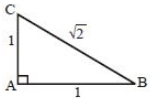
0 likes
View Solution174
AdvancedMCQ
The area of triangle $ABC$ is $84 \ sq. \ units$. If $AB = 13$ and $AC = 15$,then $BC$ can be ........ $units$.
A
$14$
B
$4\sqrt{14}$
C
$37$
D
$2\sqrt{37}$
Solution
(A) Let $AB = c = 13$,$AC = b = 15$,and $BC = a$. The area of the triangle is given by $\Delta = 84$.
Using the formula for the area of a triangle,$\Delta = \frac{1}{2} \times b \times c \times \sin(A)$,we have $84 = \frac{1}{2} \times 15 \times 13 \times \sin(A)$.
$\sin(A) = \frac{84 \times 2}{195} = \frac{168}{195} = \frac{56}{65}$.
Since $\sin^2(A) + \cos^2(A) = 1$,$\cos(A) = \pm \sqrt{1 - (\frac{56}{65})^2} = \pm \sqrt{\frac{4225 - 3136}{4225}} = \pm \sqrt{\frac{1089}{4225}} = \pm \frac{33}{65}$.
Using the Law of Cosines,$a^2 = b^2 + c^2 - 2bc \cos(A) = 15^2 + 13^2 - 2(15)(13) \cos(A) = 225 + 169 - 390 \cos(A) = 394 - 390 \cos(A)$.
Case $1$: $\cos(A) = \frac{33}{65}$,$a^2 = 394 - 390(\frac{33}{65}) = 394 - 6(33) = 394 - 198 = 196$,so $a = 14$.
Case $2$: $\cos(A) = -\frac{33}{65}$,$a^2 = 394 - 390(-\frac{33}{65}) = 394 + 198 = 592$,so $a = \sqrt{592} = 4\sqrt{37}$.
Comparing with the options,$14$ is a valid value for $BC$.
Using the formula for the area of a triangle,$\Delta = \frac{1}{2} \times b \times c \times \sin(A)$,we have $84 = \frac{1}{2} \times 15 \times 13 \times \sin(A)$.
$\sin(A) = \frac{84 \times 2}{195} = \frac{168}{195} = \frac{56}{65}$.
Since $\sin^2(A) + \cos^2(A) = 1$,$\cos(A) = \pm \sqrt{1 - (\frac{56}{65})^2} = \pm \sqrt{\frac{4225 - 3136}{4225}} = \pm \sqrt{\frac{1089}{4225}} = \pm \frac{33}{65}$.
Using the Law of Cosines,$a^2 = b^2 + c^2 - 2bc \cos(A) = 15^2 + 13^2 - 2(15)(13) \cos(A) = 225 + 169 - 390 \cos(A) = 394 - 390 \cos(A)$.
Case $1$: $\cos(A) = \frac{33}{65}$,$a^2 = 394 - 390(\frac{33}{65}) = 394 - 6(33) = 394 - 198 = 196$,so $a = 14$.
Case $2$: $\cos(A) = -\frac{33}{65}$,$a^2 = 394 - 390(-\frac{33}{65}) = 394 + 198 = 592$,so $a = \sqrt{592} = 4\sqrt{37}$.
Comparing with the options,$14$ is a valid value for $BC$.
0 likes
View Solution175
AdvancedMCQ
If in a $\Delta ABC$,$b = 2$,$c = \sqrt{3}$,$\angle A = \frac{\pi}{6}$,then $R = $?
A
$1/2$
B
$2$
C
$1$
D
None
Solution
(C) Using the Law of Cosines: $a^2 = b^2 + c^2 - 2bc \cos A$
Given $b = 2$,$c = \sqrt{3}$,and $\angle A = \frac{\pi}{6}$:
$a^2 = (2)^2 + (\sqrt{3})^2 - 2(2)(\sqrt{3}) \cos(\frac{\pi}{6})$
$a^2 = 4 + 3 - 4\sqrt{3} \cdot \frac{\sqrt{3}}{2}$
$a^2 = 7 - 6 = 1$
$a = 1$
Using the Sine Rule: $R = \frac{a}{2 \sin A}$
$R = \frac{1}{2 \sin(\frac{\pi}{6})} = \frac{1}{2 \cdot (1/2)} = 1$
Given $b = 2$,$c = \sqrt{3}$,and $\angle A = \frac{\pi}{6}$:
$a^2 = (2)^2 + (\sqrt{3})^2 - 2(2)(\sqrt{3}) \cos(\frac{\pi}{6})$
$a^2 = 4 + 3 - 4\sqrt{3} \cdot \frac{\sqrt{3}}{2}$
$a^2 = 7 - 6 = 1$
$a = 1$
Using the Sine Rule: $R = \frac{a}{2 \sin A}$
$R = \frac{1}{2 \sin(\frac{\pi}{6})} = \frac{1}{2 \cdot (1/2)} = 1$
0 likes
View Solution176
AdvancedMCQ
The inradius of $\Delta ABC$ is $3$ units and the exradius opposite to vertex $A$ is $4$ units. Then,the length of the altitude from vertex $A$ is ............. $units$.
A
$24$
B
$23$
C
$26$
D
$22$
Solution
(A) Let $r$ be the inradius and $r_a$ be the exradius opposite to vertex $A$. We are given $r = 3$ and $r_a = 4$.
Using the formulas $r = \frac{\Delta}{s}$ and $r_a = \frac{\Delta}{s-a}$,where $\Delta$ is the area of the triangle and $s$ is the semi-perimeter,we have:
$\frac{\Delta}{s} = 3$ and $\frac{\Delta}{s-a} = 4$.
Dividing the two equations,we get $\frac{s-a}{s} = \frac{3}{4}$,which implies $1 - \frac{a}{s} = \frac{3}{4}$,so $\frac{a}{s} = \frac{1}{4}$.
Since $s = \frac{a+b+c}{2}$,we have $\frac{a}{s} = \frac{2a}{a+b+c} = \frac{1}{4}$,so $a+b+c = 8a$,or $b+c = 7a$.
Using the area formula $\Delta = \frac{1}{2} a h_a$,where $h_a$ is the altitude from $A$,we have $r = \frac{\Delta}{s} = \frac{a h_a}{2s} = 3$,so $h_a = \frac{6s}{a}$.
Since $\frac{s}{a} = 4$,we get $h_a = 6 \times 4 = 24$ units.
Using the formulas $r = \frac{\Delta}{s}$ and $r_a = \frac{\Delta}{s-a}$,where $\Delta$ is the area of the triangle and $s$ is the semi-perimeter,we have:
$\frac{\Delta}{s} = 3$ and $\frac{\Delta}{s-a} = 4$.
Dividing the two equations,we get $\frac{s-a}{s} = \frac{3}{4}$,which implies $1 - \frac{a}{s} = \frac{3}{4}$,so $\frac{a}{s} = \frac{1}{4}$.
Since $s = \frac{a+b+c}{2}$,we have $\frac{a}{s} = \frac{2a}{a+b+c} = \frac{1}{4}$,so $a+b+c = 8a$,or $b+c = 7a$.
Using the area formula $\Delta = \frac{1}{2} a h_a$,where $h_a$ is the altitude from $A$,we have $r = \frac{\Delta}{s} = \frac{a h_a}{2s} = 3$,so $h_a = \frac{6s}{a}$.
Since $\frac{s}{a} = 4$,we get $h_a = 6 \times 4 = 24$ units.
0 likes
View Solution177
AdvancedMCQ
If a triangle has sides $a, b, c$ and $r_1 > r_2 > r_3$ (where $r_1, r_2, r_3$ are the ex-radii),then:
A
$a > b > c$
B
$a < b < c$
C
$a > b$ and $b < c$
D
$a < b$ and $b > c$
Solution
(A) The ex-radii are given by $r_1 = \frac{\Delta}{s-a}$,$r_2 = \frac{\Delta}{s-b}$,and $r_3 = \frac{\Delta}{s-c}$,where $\Delta$ is the area and $s$ is the semi-perimeter.
Given $r_1 > r_2 > r_3$,we have:
$\frac{\Delta}{s-a} > \frac{\Delta}{s-b} > \frac{\Delta}{s-c}$
Since $\Delta > 0$,taking the reciprocal reverses the inequality:
$s-a < s-b < s-c$
Subtracting $s$ from all parts:
$-a < -b < -c$
Multiplying by $-1$ reverses the inequality again:
$a > b > c$
Given $r_1 > r_2 > r_3$,we have:
$\frac{\Delta}{s-a} > \frac{\Delta}{s-b} > \frac{\Delta}{s-c}$
Since $\Delta > 0$,taking the reciprocal reverses the inequality:
$s-a < s-b < s-c$
Subtracting $s$ from all parts:
$-a < -b < -c$
Multiplying by $-1$ reverses the inequality again:
$a > b > c$
0 likes
View Solution178
AdvancedMCQ
In a $\Delta ABC$,$\angle A = 30^\circ$ and $a = 8 \text{ cm}$,then the distance of the orthocentre from vertex $A$ is equal to (with usual notations).
A
$4 \text{ cm}$
B
$8 \text{ cm}$
C
$8\sqrt{3} \text{ cm}$
D
$4\sqrt{3} \text{ cm}$
Solution
(C) The distance of the orthocentre $H$ from vertex $A$ in a triangle is given by the formula $AH = 2R \cos A$.
From the Sine Rule,we know that $\frac{a}{\sin A} = 2R$,which implies $2R = \frac{a}{\sin A}$.
Substituting this into the formula for $AH$,we get $AH = \frac{a}{\sin A} \times \cos A = a \cot A$.
Given $a = 8 \text{ cm}$ and $\angle A = 30^\circ$,we have $AH = 8 \times \cot(30^\circ)$.
Since $\cot(30^\circ) = \sqrt{3}$,we get $AH = 8\sqrt{3} \text{ cm}$.
From the Sine Rule,we know that $\frac{a}{\sin A} = 2R$,which implies $2R = \frac{a}{\sin A}$.
Substituting this into the formula for $AH$,we get $AH = \frac{a}{\sin A} \times \cos A = a \cot A$.
Given $a = 8 \text{ cm}$ and $\angle A = 30^\circ$,we have $AH = 8 \times \cot(30^\circ)$.
Since $\cot(30^\circ) = \sqrt{3}$,we get $AH = 8\sqrt{3} \text{ cm}$.
0 likes
View Solution179
AdvancedMCQ
In a $\Delta ABC$,if two sides $b$ and $c$ and an angle $B$ are given.
Statement $-1$: Let $b = 5 \ cm, c = 3 \ cm$ and $\angle B = 60^\circ$. The total number of possible triangles is $2$.
Statement $-2$: If $c \sin B < b < c$ and $B$ is an acute angle,then there are two possible values of $\angle C$.
Statement $-1$: Let $b = 5 \ cm, c = 3 \ cm$ and $\angle B = 60^\circ$. The total number of possible triangles is $2$.
Statement $-2$: If $c \sin B < b < c$ and $B$ is an acute angle,then there are two possible values of $\angle C$.
A
Statement $-1$ is true,statement $-2$ is true but statement $-1$ is not the correct explanation for statement $-2$
B
Statement $-1$ is true,statement $-2$ is false
C
Statement $-1$ is false,statement $-2$ is true
D
Both statements are true,and statement $-1$ is the true explanation of statement $-2$
0 likes
View Solution180
AdvancedMCQ
In a $\Delta ABC$,evaluate $\frac{b \sin(C - A)}{c^2 - a^2} + \frac{c \sin(A - B)}{a^2 - b^2}$.
A
$0$
B
$\frac{1}{R}$
C
$\frac{2}{R}$
D
None of these
Solution
(B) Given the expression: $E = \frac{b \sin(C - A)}{c^2 - a^2} + \frac{c \sin(A - B)}{a^2 - b^2}$.
Using the sine rule,$\frac{a}{\sin A} = \frac{b}{\sin B} = \frac{c}{\sin C} = 2R$,we have $a = 2R \sin A$,$b = 2R \sin B$,and $c = 2R \sin C$.
Substituting these into the denominator $c^2 - a^2 = 4R^2(\sin^2 C - \sin^2 A) = 4R^2 \sin(C - A) \sin(C + A)$.
Since $A + B + C = \pi$,$\sin(C + A) = \sin(\pi - B) = \sin B$.
Thus,$c^2 - a^2 = 4R^2 \sin(C - A) \sin B$.
Substituting this into the first term: $\frac{b \sin(C - A)}{4R^2 \sin(C - A) \sin B} = \frac{2R \sin B \sin(C - A)}{4R^2 \sin(C - A) \sin B} = \frac{1}{2R}$.
Similarly,for the second term: $\frac{c \sin(A - B)}{a^2 - b^2} = \frac{2R \sin C \sin(A - B)}{4R^2 \sin(A - B) \sin C} = \frac{1}{2R}$.
Adding them together: $\frac{1}{2R} + \frac{1}{2R} = \frac{1}{R}$.
Using the sine rule,$\frac{a}{\sin A} = \frac{b}{\sin B} = \frac{c}{\sin C} = 2R$,we have $a = 2R \sin A$,$b = 2R \sin B$,and $c = 2R \sin C$.
Substituting these into the denominator $c^2 - a^2 = 4R^2(\sin^2 C - \sin^2 A) = 4R^2 \sin(C - A) \sin(C + A)$.
Since $A + B + C = \pi$,$\sin(C + A) = \sin(\pi - B) = \sin B$.
Thus,$c^2 - a^2 = 4R^2 \sin(C - A) \sin B$.
Substituting this into the first term: $\frac{b \sin(C - A)}{4R^2 \sin(C - A) \sin B} = \frac{2R \sin B \sin(C - A)}{4R^2 \sin(C - A) \sin B} = \frac{1}{2R}$.
Similarly,for the second term: $\frac{c \sin(A - B)}{a^2 - b^2} = \frac{2R \sin C \sin(A - B)}{4R^2 \sin(A - B) \sin C} = \frac{1}{2R}$.
Adding them together: $\frac{1}{2R} + \frac{1}{2R} = \frac{1}{R}$.
0 likes
View Solution181
AdvancedMCQ
The perimeter of $\Delta ABC$ is $6$ times the $A.M.$ of the sines of its angles. If $a = 1$,then $\angle A = $
A
$\frac{\pi}{3}$
B
$\frac{\pi}{4}$
C
$\frac{\pi}{2}$
D
$\frac{\pi}{6}$
Solution
(D) Given that the perimeter $a+b+c = 6 \times \frac{\sin A + \sin B + \sin C}{3}$.
Using the sine rule,$a = 2R \sin A$,$b = 2R \sin B$,and $c = 2R \sin C$,where $R$ is the circumradius.
Substituting these into the equation: $2R(\sin A + \sin B + \sin C) = 2(\sin A + \sin B + \sin C)$.
This implies $2R = 2$,so $R = 1$.
Since $a = 2R \sin A$ and $a = 1$,we have $1 = 2(1) \sin A$.
Therefore,$\sin A = \frac{1}{2}$,which gives $\angle A = \frac{\pi}{6}$ (or $30^{\circ}$).
Using the sine rule,$a = 2R \sin A$,$b = 2R \sin B$,and $c = 2R \sin C$,where $R$ is the circumradius.
Substituting these into the equation: $2R(\sin A + \sin B + \sin C) = 2(\sin A + \sin B + \sin C)$.
This implies $2R = 2$,so $R = 1$.
Since $a = 2R \sin A$ and $a = 1$,we have $1 = 2(1) \sin A$.
Therefore,$\sin A = \frac{1}{2}$,which gives $\angle A = \frac{\pi}{6}$ (or $30^{\circ}$).
0 likes
View Solution182
AdvancedMCQ
If in a $\Delta ABC$,$a, b, c$ are in $A.P.$,then $\tan \frac{A}{2} \tan \frac{C}{2} = $
A
$\frac{1}{4}$
B
$\frac{1}{3}$
C
$3$
D
$4$
Solution
(B) We know that $\tan \frac{A}{2} \tan \frac{C}{2} = \sqrt{\frac{(s-b)(s-c)}{s(s-a)}} \times \sqrt{\frac{(s-a)(s-b)}{s(s-c)}} = \frac{s-b}{s}$.
Since $a, b, c$ are in $A.P.$,we have $2b = a + c$.
Adding $b$ to both sides,$3b = a + b + c = 2s$,so $b = \frac{2s}{3}$.
Substituting this into the expression:
$\tan \frac{A}{2} \tan \frac{C}{2} = \frac{s - \frac{2s}{3}}{s} = \frac{\frac{s}{3}}{s} = \frac{1}{3}$.
Since $a, b, c$ are in $A.P.$,we have $2b = a + c$.
Adding $b$ to both sides,$3b = a + b + c = 2s$,so $b = \frac{2s}{3}$.
Substituting this into the expression:
$\tan \frac{A}{2} \tan \frac{C}{2} = \frac{s - \frac{2s}{3}}{s} = \frac{\frac{s}{3}}{s} = \frac{1}{3}$.
0 likes
View Solution183
AdvancedMCQ
In a $\Delta ABC$,if $C = 90^{\circ}$,then $\frac{a^{2} + b^{2}}{a^{2} - b^{2}} \sin(A - B)$ is equal to:
A
$2$
B
$1$
C
$0$
D
None of these
Solution
(B) Given $\angle C = 90^{\circ}$,in $\Delta ABC$,we have $a = c \sin A$ and $b = c \sin B$.
Substituting these into the expression:
$\frac{a^{2} + b^{2}}{a^{2} - b^{2}} \sin(A - B) = \frac{c^{2} \sin^{2} A + c^{2} \sin^{2} B}{c^{2} \sin^{2} A - c^{2} \sin^{2} B} \sin(A - B)$
$= \frac{\sin^{2} A + \sin^{2} B}{\sin^{2} A - \sin^{2} B} \sin(A - B)$
Using the identity $\sin^{2} A - \sin^{2} B = \sin(A + B) \sin(A - B)$:
$= \frac{\sin^{2} A + \sin^{2} B}{\sin(A + B) \sin(A - B)} \sin(A - B)$
Since $A + B = 90^{\circ}$,$\sin(A + B) = \sin 90^{\circ} = 1$ and $\sin A = \cos B$:
$= \frac{\cos^{2} B + \sin^{2} B}{1} = 1$.
Substituting these into the expression:
$\frac{a^{2} + b^{2}}{a^{2} - b^{2}} \sin(A - B) = \frac{c^{2} \sin^{2} A + c^{2} \sin^{2} B}{c^{2} \sin^{2} A - c^{2} \sin^{2} B} \sin(A - B)$
$= \frac{\sin^{2} A + \sin^{2} B}{\sin^{2} A - \sin^{2} B} \sin(A - B)$
Using the identity $\sin^{2} A - \sin^{2} B = \sin(A + B) \sin(A - B)$:
$= \frac{\sin^{2} A + \sin^{2} B}{\sin(A + B) \sin(A - B)} \sin(A - B)$
Since $A + B = 90^{\circ}$,$\sin(A + B) = \sin 90^{\circ} = 1$ and $\sin A = \cos B$:
$= \frac{\cos^{2} B + \sin^{2} B}{1} = 1$.
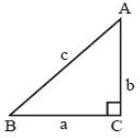
0 likes
View Solution184
AdvancedMCQ
In a $\Delta ABC$,the ratio of angles $A : B : C = 3 : 5 : 4$. Then $a + b + c \sqrt{2}$ is equal to
A
$2b$
B
$2c$
C
$3b$
D
$3a$
Solution
(C) Given $A : B : C = 3 : 5 : 4$. Since the sum of angles in a triangle is $180^{\circ}$,we have $3x + 5x + 4x = 180^{\circ}$,which gives $12x = 180^{\circ}$,so $x = 15^{\circ}$.
Thus,$A = 45^{\circ}, B = 75^{\circ}, C = 60^{\circ}$.
Using the Sine Rule,$\frac{a}{\sin 45^{\circ}} = \frac{b}{\sin 75^{\circ}} = \frac{c}{\sin 60^{\circ}} = K$.
Then $a = K \sin 45^{\circ} = \frac{K}{\sqrt{2}}$,$b = K \sin 75^{\circ} = K \left( \frac{\sqrt{3}+1}{2\sqrt{2}} \right)$,and $c = K \sin 60^{\circ} = K \frac{\sqrt{3}}{2}$.
Now,$a + b + c \sqrt{2} = \frac{K}{\sqrt{2}} + K \left( \frac{\sqrt{3}+1}{2\sqrt{2}} \right) + K \frac{\sqrt{3}}{2} \cdot \sqrt{2}$.
$= \frac{K}{\sqrt{2}} \left( 1 + \frac{\sqrt{3}+1}{2} + \sqrt{3} \right) = \frac{K}{\sqrt{2}} \left( \frac{2 + \sqrt{3} + 1 + 2\sqrt{3}}{2} \right) = \frac{K}{\sqrt{2}} \left( \frac{3 + 3\sqrt{3}}{2} \right) = \frac{3K(\sqrt{3}+1)}{2\sqrt{2}}$.
Since $b = K \sin 75^{\circ} = K \left( \frac{\sqrt{3}+1}{2\sqrt{2}} \right)$,we have $3b = 3K \left( \frac{\sqrt{3}+1}{2\sqrt{2}} \right)$.
Therefore,$a + b + c \sqrt{2} = 3b$.
Thus,$A = 45^{\circ}, B = 75^{\circ}, C = 60^{\circ}$.
Using the Sine Rule,$\frac{a}{\sin 45^{\circ}} = \frac{b}{\sin 75^{\circ}} = \frac{c}{\sin 60^{\circ}} = K$.
Then $a = K \sin 45^{\circ} = \frac{K}{\sqrt{2}}$,$b = K \sin 75^{\circ} = K \left( \frac{\sqrt{3}+1}{2\sqrt{2}} \right)$,and $c = K \sin 60^{\circ} = K \frac{\sqrt{3}}{2}$.
Now,$a + b + c \sqrt{2} = \frac{K}{\sqrt{2}} + K \left( \frac{\sqrt{3}+1}{2\sqrt{2}} \right) + K \frac{\sqrt{3}}{2} \cdot \sqrt{2}$.
$= \frac{K}{\sqrt{2}} \left( 1 + \frac{\sqrt{3}+1}{2} + \sqrt{3} \right) = \frac{K}{\sqrt{2}} \left( \frac{2 + \sqrt{3} + 1 + 2\sqrt{3}}{2} \right) = \frac{K}{\sqrt{2}} \left( \frac{3 + 3\sqrt{3}}{2} \right) = \frac{3K(\sqrt{3}+1)}{2\sqrt{2}}$.
Since $b = K \sin 75^{\circ} = K \left( \frac{\sqrt{3}+1}{2\sqrt{2}} \right)$,we have $3b = 3K \left( \frac{\sqrt{3}+1}{2\sqrt{2}} \right)$.
Therefore,$a + b + c \sqrt{2} = 3b$.
0 likes
View Solution185
AdvancedMCQ
In $\Delta ABC$,if $\sin^{2} A + \sin^{2} B + \sin^{2} C = 2$,then the triangle is:
A
Equilateral
B
Right-angled
C
Isosceles
D
None of these
Solution
(B) Given $\sin^{2} A + \sin^{2} B + \sin^{2} C = 2$.
Using $\sin^{2} \theta = 1 - \cos^{2} \theta$,we have:
$(1 - \cos^{2} A) + \sin^{2} B + \sin^{2} C = 2$
$\sin^{2} B + \sin^{2} C - \cos^{2} A = 1$
Using the identity $\sin^{2} B + \sin^{2} C = 1 - \cos(B+C)\cos(B-C)$ and $\cos A = -\cos(B+C)$:
$1 - \cos(B+C)\cos(B-C) - \cos^{2} A = 1$
$-\cos(B+C)\cos(B-C) - \cos^{2} A = 0$
$\cos A \cos(B-C) - \cos^{2} A = 0$
$\cos A [\cos(B-C) - \cos A] = 0$
$\cos A [\cos(B-C) + \cos(B+C)] = 0$
$\cos A [2 \cos B \cos C] = 0$
This implies $\cos A = 0$ or $\cos B = 0$ or $\cos C = 0$.
Thus,one of the angles must be $90^{\circ}$,which means the triangle is right-angled.
Using $\sin^{2} \theta = 1 - \cos^{2} \theta$,we have:
$(1 - \cos^{2} A) + \sin^{2} B + \sin^{2} C = 2$
$\sin^{2} B + \sin^{2} C - \cos^{2} A = 1$
Using the identity $\sin^{2} B + \sin^{2} C = 1 - \cos(B+C)\cos(B-C)$ and $\cos A = -\cos(B+C)$:
$1 - \cos(B+C)\cos(B-C) - \cos^{2} A = 1$
$-\cos(B+C)\cos(B-C) - \cos^{2} A = 0$
$\cos A \cos(B-C) - \cos^{2} A = 0$
$\cos A [\cos(B-C) - \cos A] = 0$
$\cos A [\cos(B-C) + \cos(B+C)] = 0$
$\cos A [2 \cos B \cos C] = 0$
This implies $\cos A = 0$ or $\cos B = 0$ or $\cos C = 0$.
Thus,one of the angles must be $90^{\circ}$,which means the triangle is right-angled.
0 likes
View Solution186
AdvancedMCQ
For the triangle shown in the figure,side $b = 10 \, m$,and angles $\angle C$ and $\angle A$ are equal. Find the lengths of sides $a$ and $c$.
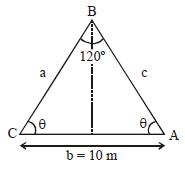
A
side $a = \text{side } c = 10 \, m$
B
side $a \neq \text{side } c$
C
side $a = \text{side } c = \frac{10 \sqrt{3}}{3} \, m$
D
side $a = \text{side } c = \frac{10}{\sqrt{2}} \, m$
Solution
(C) In $\Delta ABC$,the sum of angles is $180^{\circ}$. Given $\angle B = 120^{\circ}$ and $\angle C = \angle A = \theta$,we have $120^{\circ} + 2\theta = 180^{\circ}$,so $2\theta = 60^{\circ}$,which means $\theta = 30^{\circ}$.
Draw a perpendicular $BM$ from $B$ to $AC$. Since $\Delta ABC$ is isosceles,$M$ is the midpoint of $AC$,so $CM = 5 \, m$.
In right-angled $\Delta BMC$,$\cos 30^{\circ} = \frac{CM}{BC}$.
$\frac{\sqrt{3}}{2} = \frac{5}{a}$.
$a = \frac{10}{\sqrt{3}} = \frac{10 \sqrt{3}}{3} \, m$.
Since the triangle is isosceles,$a = c = \frac{10 \sqrt{3}}{3} \, m$.
Draw a perpendicular $BM$ from $B$ to $AC$. Since $\Delta ABC$ is isosceles,$M$ is the midpoint of $AC$,so $CM = 5 \, m$.
In right-angled $\Delta BMC$,$\cos 30^{\circ} = \frac{CM}{BC}$.
$\frac{\sqrt{3}}{2} = \frac{5}{a}$.
$a = \frac{10}{\sqrt{3}} = \frac{10 \sqrt{3}}{3} \, m$.
Since the triangle is isosceles,$a = c = \frac{10 \sqrt{3}}{3} \, m$.
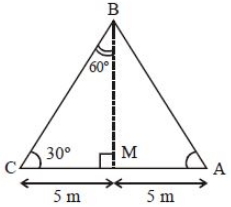
0 likes
View Solution187
DifficultMCQ
In a $\Delta ABC$,$\frac{a}{b} = 2 + \sqrt{3}$ and $\angle C = 60^\circ$. Then the ordered pair $(\angle A, \angle B)$ is equal to
A
$(105^\circ, 15^\circ)$
B
$(75^\circ, 45^\circ)$
C
$(15^\circ, 105^\circ)$
D
$(45^\circ, 75^\circ)$
Solution
(A) Given $\frac{a}{b} = 2 + \sqrt{3}$ and $\angle C = 60^\circ$.
Using the Law of Tangents: $\tan\left(\frac{A-B}{2}\right) = \frac{a-b}{a+b} \cot\left(\frac{C}{2}\right)$.
$\frac{a-b}{a+b} = \frac{(2+\sqrt{3})b - b}{(2+\sqrt{3})b + b} = \frac{1+\sqrt{3}}{3+\sqrt{3}} = \frac{1+\sqrt{3}}{\sqrt{3}(\sqrt{3}+1)} = \frac{1}{\sqrt{3}}$.
$\cot\left(\frac{60^\circ}{2}\right) = \cot(30^\circ) = \sqrt{3}$.
So,$\tan\left(\frac{A-B}{2}\right) = \frac{1}{\sqrt{3}} \times \sqrt{3} = 1$.
$\frac{A-B}{2} = 45^\circ \implies A-B = 90^\circ$.
Since $A+B+C = 180^\circ$ and $C = 60^\circ$,$A+B = 120^\circ$.
Solving $A-B = 90^\circ$ and $A+B = 120^\circ$,we get $2A = 210^\circ \implies A = 105^\circ$ and $B = 15^\circ$.
Thus,the ordered pair is $(105^\circ, 15^\circ)$.
Using the Law of Tangents: $\tan\left(\frac{A-B}{2}\right) = \frac{a-b}{a+b} \cot\left(\frac{C}{2}\right)$.
$\frac{a-b}{a+b} = \frac{(2+\sqrt{3})b - b}{(2+\sqrt{3})b + b} = \frac{1+\sqrt{3}}{3+\sqrt{3}} = \frac{1+\sqrt{3}}{\sqrt{3}(\sqrt{3}+1)} = \frac{1}{\sqrt{3}}$.
$\cot\left(\frac{60^\circ}{2}\right) = \cot(30^\circ) = \sqrt{3}$.
So,$\tan\left(\frac{A-B}{2}\right) = \frac{1}{\sqrt{3}} \times \sqrt{3} = 1$.
$\frac{A-B}{2} = 45^\circ \implies A-B = 90^\circ$.
Since $A+B+C = 180^\circ$ and $C = 60^\circ$,$A+B = 120^\circ$.
Solving $A-B = 90^\circ$ and $A+B = 120^\circ$,we get $2A = 210^\circ \implies A = 105^\circ$ and $B = 15^\circ$.
Thus,the ordered pair is $(105^\circ, 15^\circ)$.
0 likes
View Solution188
DifficultMCQ
If in a triangle $ABC$,$\frac{b + c}{11} = \frac{c + a}{12} = \frac{a + b}{13}$,then $\cos A$ is equal to
A
$5/7$
B
$1/5$
C
$35/19$
D
$19/35$
Solution
(B) Let $\frac{b+c}{11}=\frac{c+a}{12}=\frac{a+b}{13}=K$ in a triangle $ABC$.
$\Rightarrow b+c=11K, c+a=12K, a+b=13K$.
Adding these equations: $2(a+b+c) = 36K \Rightarrow a+b+c = 18K$.
Subtracting each equation from the sum:
$a = (a+b+c) - (b+c) = 18K - 11K = 7K$.
$b = (a+b+c) - (c+a) = 18K - 12K = 6K$.
$c = (a+b+c) - (a+b) = 18K - 13K = 5K$.
Using the cosine rule:
$\cos A = \frac{b^2 + c^2 - a^2}{2bc}$.
Substituting the values:
$\cos A = \frac{(6K)^2 + (5K)^2 - (7K)^2}{2(6K)(5K)} = \frac{36K^2 + 25K^2 - 49K^2}{60K^2} = \frac{12K^2}{60K^2} = \frac{1}{5}$.
$\Rightarrow b+c=11K, c+a=12K, a+b=13K$.
Adding these equations: $2(a+b+c) = 36K \Rightarrow a+b+c = 18K$.
Subtracting each equation from the sum:
$a = (a+b+c) - (b+c) = 18K - 11K = 7K$.
$b = (a+b+c) - (c+a) = 18K - 12K = 6K$.
$c = (a+b+c) - (a+b) = 18K - 13K = 5K$.
Using the cosine rule:
$\cos A = \frac{b^2 + c^2 - a^2}{2bc}$.
Substituting the values:
$\cos A = \frac{(6K)^2 + (5K)^2 - (7K)^2}{2(6K)(5K)} = \frac{36K^2 + 25K^2 - 49K^2}{60K^2} = \frac{12K^2}{60K^2} = \frac{1}{5}$.
0 likes
View Solution189
DifficultMCQ
With the usual notation,in $\Delta ABC$,if $\angle A + \angle B = 120^{\circ}$ and $a : b = (\sqrt{3} + 1) : (\sqrt{3} - 1)$,then the ratio $\angle A : \angle B$ is
A
$7 : 1$
B
$5 : 3$
C
$9 : 7$
D
$3 : 1$
Solution
(A) Given $\angle A + \angle B = 120^{\circ}$ and $\frac{a}{b} = \frac{\sqrt{3}+1}{\sqrt{3}-1}$.
Using the Sine Rule,$\frac{\sin A}{\sin B} = \frac{a}{b} = \frac{\sqrt{3}+1}{\sqrt{3}-1} = \frac{(\sqrt{3}+1)^2}{3-1} = \frac{4+2\sqrt{3}}{2} = 2+\sqrt{3}$.
Since $\angle B = 120^{\circ} - A$,we have $\frac{\sin A}{\sin(120^{\circ}-A)} = 2+\sqrt{3}$.
$\frac{\sin A}{\sin 120^{\circ} \cos A - \cos 120^{\circ} \sin A} = 2+\sqrt{3}$.
$\frac{\sin A}{\frac{\sqrt{3}}{2} \cos A + \frac{1}{2} \sin A} = 2+\sqrt{3}$.
Dividing numerator and denominator by $\sin A$,we get $\frac{1}{\frac{\sqrt{3}}{2} \cot A + \frac{1}{2}} = 2+\sqrt{3}$.
$\frac{2}{\sqrt{3} \cot A + 1} = 2+\sqrt{3} \implies \sqrt{3} \cot A + 1 = \frac{2}{2+\sqrt{3}} = 2(2-\sqrt{3}) = 4-2\sqrt{3}$.
$\sqrt{3} \cot A = 3-2\sqrt{3} \implies \cot A = \sqrt{3}-2$.
Since $\cot 105^{\circ} = \cot(60^{\circ}+45^{\circ}) = \frac{\cot 60^{\circ} \cot 45^{\circ}-1}{\cot 60^{\circ}+\cot 45^{\circ}} = \frac{\frac{1}{\sqrt{3}}-1}{\frac{1}{\sqrt{3}}+1} = \frac{1-\sqrt{3}}{1+\sqrt{3}} = \frac{(1-\sqrt{3})^2}{1-3} = \frac{4-2\sqrt{3}}{-2} = \sqrt{3}-2$.
Thus,$A = 105^{\circ}$ and $B = 120^{\circ} - 105^{\circ} = 15^{\circ}$.
The ratio $A : B = 105^{\circ} : 15^{\circ} = 7 : 1$.
Using the Sine Rule,$\frac{\sin A}{\sin B} = \frac{a}{b} = \frac{\sqrt{3}+1}{\sqrt{3}-1} = \frac{(\sqrt{3}+1)^2}{3-1} = \frac{4+2\sqrt{3}}{2} = 2+\sqrt{3}$.
Since $\angle B = 120^{\circ} - A$,we have $\frac{\sin A}{\sin(120^{\circ}-A)} = 2+\sqrt{3}$.
$\frac{\sin A}{\sin 120^{\circ} \cos A - \cos 120^{\circ} \sin A} = 2+\sqrt{3}$.
$\frac{\sin A}{\frac{\sqrt{3}}{2} \cos A + \frac{1}{2} \sin A} = 2+\sqrt{3}$.
Dividing numerator and denominator by $\sin A$,we get $\frac{1}{\frac{\sqrt{3}}{2} \cot A + \frac{1}{2}} = 2+\sqrt{3}$.
$\frac{2}{\sqrt{3} \cot A + 1} = 2+\sqrt{3} \implies \sqrt{3} \cot A + 1 = \frac{2}{2+\sqrt{3}} = 2(2-\sqrt{3}) = 4-2\sqrt{3}$.
$\sqrt{3} \cot A = 3-2\sqrt{3} \implies \cot A = \sqrt{3}-2$.
Since $\cot 105^{\circ} = \cot(60^{\circ}+45^{\circ}) = \frac{\cot 60^{\circ} \cot 45^{\circ}-1}{\cot 60^{\circ}+\cot 45^{\circ}} = \frac{\frac{1}{\sqrt{3}}-1}{\frac{1}{\sqrt{3}}+1} = \frac{1-\sqrt{3}}{1+\sqrt{3}} = \frac{(1-\sqrt{3})^2}{1-3} = \frac{4-2\sqrt{3}}{-2} = \sqrt{3}-2$.
Thus,$A = 105^{\circ}$ and $B = 120^{\circ} - 105^{\circ} = 15^{\circ}$.
The ratio $A : B = 105^{\circ} : 15^{\circ} = 7 : 1$.
0 likes
View Solution190
DifficultMCQ
In a triangle,the sum of lengths of two sides is $x$ and the product of the lengths of the same two sides is $y$. If $x^2 - c^2 = y$,where $c$ is the length of the third side of the triangle,then the circumradius of the triangle is
A
$\frac{3}{2}y$
B
$\frac{c}{\sqrt{3}}$
C
$\frac{c}{3}$
D
$\frac{y}{\sqrt{3}}$
Solution
(B) Let the sides of the triangle be $a, b,$ and $c$. Given $a + b = x$ and $ab = y$.
Given the condition $x^2 - c^2 = y$,we substitute $x = a + b$:
$(a + b)^2 - c^2 = ab$
$a^2 + b^2 + 2ab - c^2 = ab$
$a^2 + b^2 - c^2 = -ab$
Dividing by $2ab$,we get:
$\frac{a^2 + b^2 - c^2}{2ab} = -\frac{1}{2}$
By the Law of Cosines,$\cos C = \frac{a^2 + b^2 - c^2}{2ab}$,so $\cos C = -\frac{1}{2}$.
Thus,$C = 120^\circ$ or $\frac{2\pi}{3}$ radians.
Then $\sin C = \sin(120^\circ) = \frac{\sqrt{3}}{2}$.
Using the Sine Rule,$\frac{c}{\sin C} = 2R$,where $R$ is the circumradius:
$R = \frac{c}{2 \sin C} = \frac{c}{2(\frac{\sqrt{3}}{2})} = \frac{c}{\sqrt{3}}$.
Given the condition $x^2 - c^2 = y$,we substitute $x = a + b$:
$(a + b)^2 - c^2 = ab$
$a^2 + b^2 + 2ab - c^2 = ab$
$a^2 + b^2 - c^2 = -ab$
Dividing by $2ab$,we get:
$\frac{a^2 + b^2 - c^2}{2ab} = -\frac{1}{2}$
By the Law of Cosines,$\cos C = \frac{a^2 + b^2 - c^2}{2ab}$,so $\cos C = -\frac{1}{2}$.
Thus,$C = 120^\circ$ or $\frac{2\pi}{3}$ radians.
Then $\sin C = \sin(120^\circ) = \frac{\sqrt{3}}{2}$.
Using the Sine Rule,$\frac{c}{\sin C} = 2R$,where $R$ is the circumradius:
$R = \frac{c}{2 \sin C} = \frac{c}{2(\frac{\sqrt{3}}{2})} = \frac{c}{\sqrt{3}}$.
0 likes
View Solution191
DifficultMCQ
Given $\frac{b + c}{11} = \frac{c + a}{12} = \frac{a + b}{13}$ for a $\Delta ABC$ with usual notation. If $\frac{\cos A}{\alpha} = \frac{\cos B}{\beta} = \frac{\cos C}{\gamma}$,then the ordered triple $(\alpha, \beta, \gamma)$ is proportional to
A
$(7, 19, 25)$
B
$(3, 4, 5)$
C
$(5, 12, 13)$
D
$(19, 7, 25)$
Solution
(A) Let $\frac{b+c}{11} = \frac{c+a}{12} = \frac{a+b}{13} = k$.
Summing these gives $2(a+b+c) = 36k$,so $a+b+c = 18k$.
Subtracting each original equation from this sum:
$a = (a+b+c) - (b+c) = 18k - 11k = 7k$.
$b = (a+b+c) - (c+a) = 18k - 12k = 6k$.
$c = (a+b+c) - (a+b) = 18k - 13k = 5k$.
Using the cosine rule $\cos A = \frac{b^2+c^2-a^2}{2bc} = \frac{36k^2+25k^2-49k^2}{2(6k)(5k)} = \frac{12k^2}{60k^2} = \frac{1}{5}$.
Similarly,$\cos B = \frac{a^2+c^2-b^2}{2ac} = \frac{49k^2+25k^2-36k^2}{2(7k)(5k)} = \frac{38k^2}{70k^2} = \frac{19}{35}$.
And $\cos C = \frac{a^2+b^2-c^2}{2ab} = \frac{49k^2+36k^2-25k^2}{2(7k)(6k)} = \frac{60k^2}{84k^2} = \frac{5}{7}$.
Given $\frac{\cos A}{\alpha} = \frac{\cos B}{\beta} = \frac{\cos C}{\gamma} = \lambda$,we have $\alpha = \frac{\cos A}{\lambda} = \frac{1}{5\lambda}$,$\beta = \frac{\cos B}{\lambda} = \frac{19}{35\lambda}$,$\gamma = \frac{\cos C}{\lambda} = \frac{5}{7\lambda}$.
Multiplying by $35\lambda$,we get $\alpha : \beta : \gamma = 7 : 19 : 25$.
Summing these gives $2(a+b+c) = 36k$,so $a+b+c = 18k$.
Subtracting each original equation from this sum:
$a = (a+b+c) - (b+c) = 18k - 11k = 7k$.
$b = (a+b+c) - (c+a) = 18k - 12k = 6k$.
$c = (a+b+c) - (a+b) = 18k - 13k = 5k$.
Using the cosine rule $\cos A = \frac{b^2+c^2-a^2}{2bc} = \frac{36k^2+25k^2-49k^2}{2(6k)(5k)} = \frac{12k^2}{60k^2} = \frac{1}{5}$.
Similarly,$\cos B = \frac{a^2+c^2-b^2}{2ac} = \frac{49k^2+25k^2-36k^2}{2(7k)(5k)} = \frac{38k^2}{70k^2} = \frac{19}{35}$.
And $\cos C = \frac{a^2+b^2-c^2}{2ab} = \frac{49k^2+36k^2-25k^2}{2(7k)(6k)} = \frac{60k^2}{84k^2} = \frac{5}{7}$.
Given $\frac{\cos A}{\alpha} = \frac{\cos B}{\beta} = \frac{\cos C}{\gamma} = \lambda$,we have $\alpha = \frac{\cos A}{\lambda} = \frac{1}{5\lambda}$,$\beta = \frac{\cos B}{\lambda} = \frac{19}{35\lambda}$,$\gamma = \frac{\cos C}{\lambda} = \frac{5}{7\lambda}$.
Multiplying by $35\lambda$,we get $\alpha : \beta : \gamma = 7 : 19 : 25$.
0 likes
View Solution192
Medium
Prove that in any triangle $ABC$,$\cos A = \frac{b^{2} + c^{2} - a^{2}}{2bc}$,where $a, b, c$ are the lengths of the sides opposite to the vertices $A, B, C$ respectively.
Solution
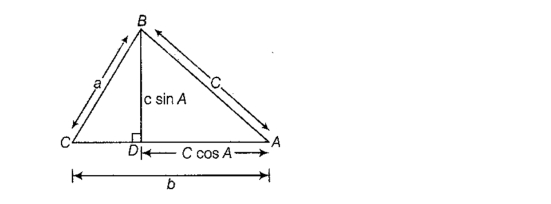
(N/A) Consider a triangle $ABC$ with sides $a, b, c$ opposite to vertices $A, B, C$. Draw a perpendicular $BD$ from vertex $B$ to side $AC$. Let $D$ be the point on $AC$ such that $BD \perp AC$.
In the right-angled triangle $ABD$,we have:
$AD = c \cos A$
$BD = c \sin A$
Since $AC = b$,the length $CD = AC - AD = b - c \cos A$.
Now,in the right-angled triangle $BDC$,by the Pythagorean theorem:
$BC^{2} = BD^{2} + CD^{2}$
$a^{2} = (c \sin A)^{2} + (b - c \cos A)^{2}$
Expanding the terms:
$a^{2} = c^{2} \sin^{2} A + b^{2} + c^{2} \cos^{2} A - 2bc \cos A$
Using the identity $\sin^{2} A + \cos^{2} A = 1$:
$a^{2} = b^{2} + c^{2}(\sin^{2} A + \cos^{2} A) - 2bc \cos A$
$a^{2} = b^{2} + c^{2} - 2bc \cos A$
Rearranging the terms to solve for $\cos A$:
$2bc \cos A = b^{2} + c^{2} - a^{2}$
$\cos A = \frac{b^{2} + c^{2} - a^{2}}{2bc}$
In the right-angled triangle $ABD$,we have:
$AD = c \cos A$
$BD = c \sin A$
Since $AC = b$,the length $CD = AC - AD = b - c \cos A$.
Now,in the right-angled triangle $BDC$,by the Pythagorean theorem:
$BC^{2} = BD^{2} + CD^{2}$
$a^{2} = (c \sin A)^{2} + (b - c \cos A)^{2}$
Expanding the terms:
$a^{2} = c^{2} \sin^{2} A + b^{2} + c^{2} \cos^{2} A - 2bc \cos A$
Using the identity $\sin^{2} A + \cos^{2} A = 1$:
$a^{2} = b^{2} + c^{2}(\sin^{2} A + \cos^{2} A) - 2bc \cos A$
$a^{2} = b^{2} + c^{2} - 2bc \cos A$
Rearranging the terms to solve for $\cos A$:
$2bc \cos A = b^{2} + c^{2} - a^{2}$
$\cos A = \frac{b^{2} + c^{2} - a^{2}}{2bc}$
0 likes
View Solution193
DifficultMCQ
Let $a, b$ and $c$ be the lengths of the sides of a triangle $ABC$ such that $\frac{a+b}{7} = \frac{b+c}{8} = \frac{c+a}{9}$. If $r$ and $R$ are the inradius and circumradius of the triangle $ABC$,respectively,then the value of $\frac{R}{r}$ is equal to
A
$\frac{5}{2}$
B
$2$
C
$\frac{3}{2}$
D
$1$
Solution
(A) Given $\frac{a+b}{7} = \frac{b+c}{8} = \frac{c+a}{9} = \lambda$.
Then $a+b = 7\lambda$,$b+c = 8\lambda$,and $c+a = 9\lambda$.
Adding these equations,$2(a+b+c) = 24\lambda$,so $a+b+c = 12\lambda$.
Subtracting the given equations from $a+b+c = 12\lambda$,we get $c = 5\lambda$,$a = 4\lambda$,and $b = 3\lambda$.
Since $a^2 + b^2 = (4\lambda)^2 + (3\lambda)^2 = 25\lambda^2 = c^2$,the triangle is a right-angled triangle with $\angle C = 90^{\circ}$.
For a right-angled triangle,the circumradius $R = \frac{c}{2} = \frac{5\lambda}{2}$ and the inradius $r = \frac{a+b-c}{2} = \frac{4\lambda+3\lambda-5\lambda}{2} = \lambda$.
Therefore,$\frac{R}{r} = \frac{5\lambda/2}{\lambda} = \frac{5}{2}$.
Then $a+b = 7\lambda$,$b+c = 8\lambda$,and $c+a = 9\lambda$.
Adding these equations,$2(a+b+c) = 24\lambda$,so $a+b+c = 12\lambda$.
Subtracting the given equations from $a+b+c = 12\lambda$,we get $c = 5\lambda$,$a = 4\lambda$,and $b = 3\lambda$.
Since $a^2 + b^2 = (4\lambda)^2 + (3\lambda)^2 = 25\lambda^2 = c^2$,the triangle is a right-angled triangle with $\angle C = 90^{\circ}$.
For a right-angled triangle,the circumradius $R = \frac{c}{2} = \frac{5\lambda}{2}$ and the inradius $r = \frac{a+b-c}{2} = \frac{4\lambda+3\lambda-5\lambda}{2} = \lambda$.
Therefore,$\frac{R}{r} = \frac{5\lambda/2}{\lambda} = \frac{5}{2}$.
0 likes
View Solution194
AdvancedMCQ
Let $ABC$ be a triangle such that $AB=15$ and $AC=9$. The bisector of $\angle BAC$ meets $BC$ in $D$. If $\angle ACB=2\angle ABC$,then $BD$ is
A
$8$
B
$9$
C
$10$
D
$12$
Solution
(C) Let $\angle ABC = \theta$,then $\angle ACB = 2\theta$. Let $\angle BAC = 180^{\circ} - 3\theta$. Let $BC = x$.
By the sine rule in $\triangle ABC$:
$\frac{9}{\sin \theta} = \frac{15}{\sin 2\theta} = \frac{x}{\sin 3\theta}$
From $\frac{9}{\sin \theta} = \frac{15}{2 \sin \theta \cos \theta}$,we get $\cos \theta = \frac{15}{18} = \frac{5}{6}$.
Using $\frac{x}{\sin 3\theta} = \frac{9}{\sin \theta}$,we have $x = 9 \cdot \frac{\sin 3\theta}{\sin \theta} = 9(3 - 4 \sin^2 \theta)$.
Since $\sin^2 \theta = 1 - \cos^2 \theta = 1 - \frac{25}{36} = \frac{11}{36}$,we get $x = 9(3 - 4 \cdot \frac{11}{36}) = 9(3 - \frac{11}{9}) = 27 - 11 = 16$.
By the Angle Bisector Theorem,$D$ divides $BC$ in the ratio $AB:AC = 15:9 = 5:3$.
Thus,$BD = \frac{5}{5+3} \cdot BC = \frac{5}{8} \cdot 16 = 10$.
By the sine rule in $\triangle ABC$:
$\frac{9}{\sin \theta} = \frac{15}{\sin 2\theta} = \frac{x}{\sin 3\theta}$
From $\frac{9}{\sin \theta} = \frac{15}{2 \sin \theta \cos \theta}$,we get $\cos \theta = \frac{15}{18} = \frac{5}{6}$.
Using $\frac{x}{\sin 3\theta} = \frac{9}{\sin \theta}$,we have $x = 9 \cdot \frac{\sin 3\theta}{\sin \theta} = 9(3 - 4 \sin^2 \theta)$.
Since $\sin^2 \theta = 1 - \cos^2 \theta = 1 - \frac{25}{36} = \frac{11}{36}$,we get $x = 9(3 - 4 \cdot \frac{11}{36}) = 9(3 - \frac{11}{9}) = 27 - 11 = 16$.
By the Angle Bisector Theorem,$D$ divides $BC$ in the ratio $AB:AC = 15:9 = 5:3$.
Thus,$BD = \frac{5}{5+3} \cdot BC = \frac{5}{8} \cdot 16 = 10$.
0 likes
View Solution195
AdvancedMCQ
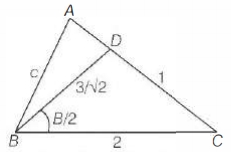
In a $\triangle ABC$,the angle bisector $BD$ of $\angle B$ intersects $AC$ in $D$. Suppose $BC=2$,$CD=1$ and $BD=\frac{3}{\sqrt{2}}$. The perimeter of the $\triangle ABC$ is
A
$\frac{17}{2}$
B
$\frac{15}{2}$
C
$\frac{17}{4}$
D
$\frac{15}{4}$
Solution
(B) Let $AB = c$ and $AD = x$. By the Angle Bisector Theorem,$\frac{AB}{BC} = \frac{AD}{CD}$,so $\frac{c}{2} = \frac{x}{1}$,which implies $x = \frac{c}{2}$.
In $\triangle BCD$,by the Law of Cosines,$BD^2 = BC^2 + CD^2 - 2(BC)(CD) \cos C$.
$\left(\frac{3}{\sqrt{2}}\right)^2 = 2^2 + 1^2 - 2(2)(1) \cos C \implies \frac{9}{2} = 5 - 4 \cos C \implies 4 \cos C = \frac{1}{2} \implies \cos C = \frac{1}{8}$.
In $\triangle ABC$,by the Law of Cosines,$c^2 = AB^2 = BC^2 + AC^2 - 2(BC)(AC) \cos C$.
$c^2 = 2^2 + (x+1)^2 - 2(2)(x+1) \left(\frac{1}{8}\right)$.
Substituting $x = \frac{c}{2}$,$c^2 = 4 + (\frac{c}{2}+1)^2 - (\frac{c}{2}+1) = 4 + \frac{c^2}{4} + c + 1 - \frac{c}{2} - 1 = \frac{c^2}{4} + \frac{c}{2} + 4$.
$\frac{3c^2}{4} - \frac{c}{2} - 4 = 0 \implies 3c^2 - 2c - 16 = 0$.
$(3c - 8)(c + 2) = 0$. Since $c > 0$,$c = \frac{8}{3}$.
Then $AD = x = \frac{c}{2} = \frac{4}{3}$.
Perimeter $= AB + BC + AC = c + 2 + (x+1) = \frac{8}{3} + 2 + \frac{4}{3} + 1 = 4 + 3 = 7$.
Wait,re-evaluating the provided solution logic: The formula $BD = \frac{2ac}{a+c} \cos \frac{B}{2}$ is standard. Using $a=2, CD=1, AD=x, c=AB$,we have $x/1 = c/2 \implies x = c/2$. $AC = c/2 + 1$. Using Stewart's Theorem on $\triangle ABC$ with cevian $BD$: $c^2(1) + 2^2(c/2) = (c/2+1)(BD^2 + (c/2)(1))$.
$c^2 + 2c = (c/2+1)(9/2 + c/2) = (c/2+1)(c+9)/2 = (c^2 + 9c + 2c + 18)/4$.
$4c^2 + 8c = c^2 + 11c + 18 \implies 3c^2 - 3c - 18 = 0 \implies c^2 - c - 6 = 0 \implies (c-3)(c+2) = 0$. So $c=3$.
Then $AD = c/2 = 3/2$. Perimeter $= 3 + 2 + (3/2 + 1) = 5 + 2.5 = 7.5 = \frac{15}{2}$.
In $\triangle BCD$,by the Law of Cosines,$BD^2 = BC^2 + CD^2 - 2(BC)(CD) \cos C$.
$\left(\frac{3}{\sqrt{2}}\right)^2 = 2^2 + 1^2 - 2(2)(1) \cos C \implies \frac{9}{2} = 5 - 4 \cos C \implies 4 \cos C = \frac{1}{2} \implies \cos C = \frac{1}{8}$.
In $\triangle ABC$,by the Law of Cosines,$c^2 = AB^2 = BC^2 + AC^2 - 2(BC)(AC) \cos C$.
$c^2 = 2^2 + (x+1)^2 - 2(2)(x+1) \left(\frac{1}{8}\right)$.
Substituting $x = \frac{c}{2}$,$c^2 = 4 + (\frac{c}{2}+1)^2 - (\frac{c}{2}+1) = 4 + \frac{c^2}{4} + c + 1 - \frac{c}{2} - 1 = \frac{c^2}{4} + \frac{c}{2} + 4$.
$\frac{3c^2}{4} - \frac{c}{2} - 4 = 0 \implies 3c^2 - 2c - 16 = 0$.
$(3c - 8)(c + 2) = 0$. Since $c > 0$,$c = \frac{8}{3}$.
Then $AD = x = \frac{c}{2} = \frac{4}{3}$.
Perimeter $= AB + BC + AC = c + 2 + (x+1) = \frac{8}{3} + 2 + \frac{4}{3} + 1 = 4 + 3 = 7$.
Wait,re-evaluating the provided solution logic: The formula $BD = \frac{2ac}{a+c} \cos \frac{B}{2}$ is standard. Using $a=2, CD=1, AD=x, c=AB$,we have $x/1 = c/2 \implies x = c/2$. $AC = c/2 + 1$. Using Stewart's Theorem on $\triangle ABC$ with cevian $BD$: $c^2(1) + 2^2(c/2) = (c/2+1)(BD^2 + (c/2)(1))$.
$c^2 + 2c = (c/2+1)(9/2 + c/2) = (c/2+1)(c+9)/2 = (c^2 + 9c + 2c + 18)/4$.
$4c^2 + 8c = c^2 + 11c + 18 \implies 3c^2 - 3c - 18 = 0 \implies c^2 - c - 6 = 0 \implies (c-3)(c+2) = 0$. So $c=3$.
Then $AD = c/2 = 3/2$. Perimeter $= 3 + 2 + (3/2 + 1) = 5 + 2.5 = 7.5 = \frac{15}{2}$.
0 likes
View Solution196
AdvancedMCQ
Let $a=BC, b=CA, c=AB$ be the side lengths of a $\triangle ABC$ and $m$ be the length of the median through $A$. If $a=8, b-c=2, m=6$,then the nearest integer to $b$ is
A
$7$
B
$8$
C
$9$
D
$10$
Solution
(B) Let $AD$ be the median to side $BC$. By Apollonius Theorem,we have:
$AB^2 + AC^2 = 2(AD^2 + BD^2)$
Given $a = BC = 8$,so $BD = DC = 4$. Also $m = AD = 6$.
Let $AC = b$ and $AB = c$. Given $b - c = 2$,so $c = b - 2$.
Substituting these values into the theorem:
$(b - 2)^2 + b^2 = 2(6^2 + 4^2)$
$b^2 - 4b + 4 + b^2 = 2(36 + 16)$
$2b^2 - 4b + 4 = 2(52)$
$2b^2 - 4b + 4 = 104$
$2b^2 - 4b - 100 = 0$
$b^2 - 2b - 50 = 0$
Using the quadratic formula $b = \frac{-(-2) \pm \sqrt{(-2)^2 - 4(1)(-50)}}{2(1)}$:
$b = \frac{2 \pm \sqrt{4 + 200}}{2} = \frac{2 \pm \sqrt{204}}{2} = 1 \pm \sqrt{51}$
Since $b$ must be positive,$b = 1 + \sqrt{51} \approx 1 + 7.14 = 8.14$.
The nearest integer to $b$ is $8$.
$AB^2 + AC^2 = 2(AD^2 + BD^2)$
Given $a = BC = 8$,so $BD = DC = 4$. Also $m = AD = 6$.
Let $AC = b$ and $AB = c$. Given $b - c = 2$,so $c = b - 2$.
Substituting these values into the theorem:
$(b - 2)^2 + b^2 = 2(6^2 + 4^2)$
$b^2 - 4b + 4 + b^2 = 2(36 + 16)$
$2b^2 - 4b + 4 = 2(52)$
$2b^2 - 4b + 4 = 104$
$2b^2 - 4b - 100 = 0$
$b^2 - 2b - 50 = 0$
Using the quadratic formula $b = \frac{-(-2) \pm \sqrt{(-2)^2 - 4(1)(-50)}}{2(1)}$:
$b = \frac{2 \pm \sqrt{4 + 200}}{2} = \frac{2 \pm \sqrt{204}}{2} = 1 \pm \sqrt{51}$
Since $b$ must be positive,$b = 1 + \sqrt{51} \approx 1 + 7.14 = 8.14$.
The nearest integer to $b$ is $8$.
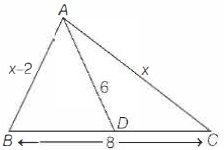
0 likes
View Solution197
AdvancedMCQ
Let $ABC$ be a triangle such that $AB = BC$. Let $F$ be the mid-point of $AB$ and $X$ be a point on $BC$ such that $FX$ is perpendicular to $AB$. If $BX = 3XC$,then the ratio $BC / AC$ equals
A
$\sqrt{3}$
B
$\sqrt{2}$
C
$\sqrt{\frac{3}{2}}$
D
$1$
Solution
(C) Let $BC = 4x$. Since $BX = 3XC$ and $BC = BX + XC$,we have $BX = 3x$ and $XC = x$.
Given $AB = BC$,so $AB = 4x$.
Since $F$ is the mid-point of $AB$,$BF = AF = 2x$.
In $\triangle BFX$,$\angle BFX = 90^\circ$. Thus,$\cos B = \frac{BF}{BX} = \frac{2x}{3x} = \frac{2}{3}$.
In $\triangle ABC$,by the Law of Cosines:
$\cos B = \frac{AB^2 + BC^2 - AC^2}{2(AB)(BC)}$
$\frac{2}{3} = \frac{(4x)^2 + (4x)^2 - AC^2}{2(4x)(4x)}$
$\frac{2}{3} = \frac{32x^2 - AC^2}{32x^2}$
$64x^2 = 3(32x^2 - AC^2)$
$64x^2 = 96x^2 - 3AC^2$
$3AC^2 = 32x^2$
$AC^2 = \frac{32x^2}{3}$
$AC = \sqrt{\frac{32}{3}}x = 4x \sqrt{\frac{2}{3}}$
Therefore,$\frac{BC}{AC} = \frac{4x}{4x \sqrt{\frac{2}{3}}} = \sqrt{\frac{3}{2}}$.
Given $AB = BC$,so $AB = 4x$.
Since $F$ is the mid-point of $AB$,$BF = AF = 2x$.
In $\triangle BFX$,$\angle BFX = 90^\circ$. Thus,$\cos B = \frac{BF}{BX} = \frac{2x}{3x} = \frac{2}{3}$.
In $\triangle ABC$,by the Law of Cosines:
$\cos B = \frac{AB^2 + BC^2 - AC^2}{2(AB)(BC)}$
$\frac{2}{3} = \frac{(4x)^2 + (4x)^2 - AC^2}{2(4x)(4x)}$
$\frac{2}{3} = \frac{32x^2 - AC^2}{32x^2}$
$64x^2 = 3(32x^2 - AC^2)$
$64x^2 = 96x^2 - 3AC^2$
$3AC^2 = 32x^2$
$AC^2 = \frac{32x^2}{3}$
$AC = \sqrt{\frac{32}{3}}x = 4x \sqrt{\frac{2}{3}}$
Therefore,$\frac{BC}{AC} = \frac{4x}{4x \sqrt{\frac{2}{3}}} = \sqrt{\frac{3}{2}}$.
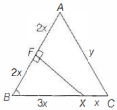
0 likes
View Solution198
AdvancedMCQ
Let $ABC$ be an acute-angled triangle and let $D$ be the mid-point of $BC$. If $AB = AD$,then $\tan(B) / \tan(C)$ equals
A
$\sqrt{2}$
B
$\sqrt{3}$
C
$2$
D
$3$
Solution
(D) Given,in $\triangle ABC$,$D$ is the mid-point of $BC$ and $AB = AD$.
Since $AB = AD$,we have $\angle B = \angle ADB$.
Let $\angle ADB = B$. Then $\angle ADC = \pi - B$. Let $\angle ADC = \theta$,so $\theta = \pi - B$.
Since $D$ is the mid-point of $BC$,$BD = DC = 1$ (taking ratio $m:n = 1:1$).
Applying the cotangent theorem in $\triangle ABC$ with cevian $AD$:
$(m+n) \cot \theta = n \cot B - m \cot C$
Substituting $m=1, n=1$ and $\theta = \pi - B$:
$(1+1) \cot(\pi - B) = 1 \cdot \cot B - 1 \cdot \cot C$
$2(-\cot B) = \cot B - \cot C$
$-2 \cot B = \cot B - \cot C$
$\cot C = 3 \cot B$
$\frac{1}{\tan C} = \frac{3}{\tan B}$
$\frac{\tan B}{\tan C} = 3$.
Since $AB = AD$,we have $\angle B = \angle ADB$.
Let $\angle ADB = B$. Then $\angle ADC = \pi - B$. Let $\angle ADC = \theta$,so $\theta = \pi - B$.
Since $D$ is the mid-point of $BC$,$BD = DC = 1$ (taking ratio $m:n = 1:1$).
Applying the cotangent theorem in $\triangle ABC$ with cevian $AD$:
$(m+n) \cot \theta = n \cot B - m \cot C$
Substituting $m=1, n=1$ and $\theta = \pi - B$:
$(1+1) \cot(\pi - B) = 1 \cdot \cot B - 1 \cdot \cot C$
$2(-\cot B) = \cot B - \cot C$
$-2 \cot B = \cot B - \cot C$
$\cot C = 3 \cot B$
$\frac{1}{\tan C} = \frac{3}{\tan B}$
$\frac{\tan B}{\tan C} = 3$.
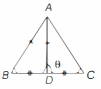
0 likes
View Solution199
AdvancedMCQ
In a $\triangle ABC$,the altitude $AD$ and the median $AE$ divide $\angle A$ into three equal parts. If $BC=28$,then the nearest integer to $AB+AC$ is
A
$38$
B
$37$
C
$36$
D
$33$
Solution
(A) Let $\angle BAD = \angle DAE = \angle EAC = \theta$. Thus,$\angle A = 3\theta$.
Since $AD$ is the altitude,$\triangle ABD$ and $\triangle ADC$ are right-angled at $D$.
In $\triangle ABD$,$\tan \theta = \frac{BD}{AD}$.
In $\triangle ADE$,$\tan \theta = \frac{DE}{AD}$.
Since $\tan \theta = \tan \theta$,we have $BD = DE$. Let $BD = DE = x$.
Since $AE$ is the median,$BE = EC = 14$. Thus,$DE = BE - BD = 14 - x$.
Equating the two expressions for $DE$: $x = 14 - x$ $\Rightarrow 2x = 14$ $\Rightarrow x = 7$.
So,$BD = 7$ and $DE = 7$.
In $\triangle ADC$,$\angle DAC = 2\theta$,so $\tan 2\theta = \frac{DC}{AD} = \frac{DE+EC}{AD} = \frac{7+14}{AD} = \frac{21}{AD}$.
In $\triangle ABD$,$\tan \theta = \frac{BD}{AD} = \frac{7}{AD}$.
Dividing the two equations: $\frac{\tan 2\theta}{\tan \theta} = \frac{21}{7} = 3$.
Using the identity $\tan 2\theta = \frac{2\tan \theta}{1-\tan^2 \theta}$,we get $\frac{2}{1-\tan^2 \theta} = 3$.
$2 = 3 - 3\tan^2 \theta$ $\Rightarrow 3\tan^2 \theta = 1$ $\Rightarrow \tan \theta = \frac{1}{\sqrt{3}}$.
Thus,$\theta = 30^{\circ}$.
In $\triangle ABD$,$\sin 30^{\circ} = \frac{BD}{AB} = \frac{7}{AB} \Rightarrow AB = \frac{7}{1/2} = 14$.
In $\triangle ADC$,$\angle DAC = 60^{\circ}$,so $\sin 60^{\circ} = \frac{DC}{AC} = \frac{21}{AC}$ $\Rightarrow AC = \frac{21}{\sqrt{3}/2} = \frac{42}{\sqrt{3}} = 14\sqrt{3}$.
$AB + AC = 14 + 14\sqrt{3} = 14(1 + 1.732) = 14(2.732) = 38.248$.
The nearest integer is $38$.
Since $AD$ is the altitude,$\triangle ABD$ and $\triangle ADC$ are right-angled at $D$.
In $\triangle ABD$,$\tan \theta = \frac{BD}{AD}$.
In $\triangle ADE$,$\tan \theta = \frac{DE}{AD}$.
Since $\tan \theta = \tan \theta$,we have $BD = DE$. Let $BD = DE = x$.
Since $AE$ is the median,$BE = EC = 14$. Thus,$DE = BE - BD = 14 - x$.
Equating the two expressions for $DE$: $x = 14 - x$ $\Rightarrow 2x = 14$ $\Rightarrow x = 7$.
So,$BD = 7$ and $DE = 7$.
In $\triangle ADC$,$\angle DAC = 2\theta$,so $\tan 2\theta = \frac{DC}{AD} = \frac{DE+EC}{AD} = \frac{7+14}{AD} = \frac{21}{AD}$.
In $\triangle ABD$,$\tan \theta = \frac{BD}{AD} = \frac{7}{AD}$.
Dividing the two equations: $\frac{\tan 2\theta}{\tan \theta} = \frac{21}{7} = 3$.
Using the identity $\tan 2\theta = \frac{2\tan \theta}{1-\tan^2 \theta}$,we get $\frac{2}{1-\tan^2 \theta} = 3$.
$2 = 3 - 3\tan^2 \theta$ $\Rightarrow 3\tan^2 \theta = 1$ $\Rightarrow \tan \theta = \frac{1}{\sqrt{3}}$.
Thus,$\theta = 30^{\circ}$.
In $\triangle ABD$,$\sin 30^{\circ} = \frac{BD}{AB} = \frac{7}{AB} \Rightarrow AB = \frac{7}{1/2} = 14$.
In $\triangle ADC$,$\angle DAC = 60^{\circ}$,so $\sin 60^{\circ} = \frac{DC}{AC} = \frac{21}{AC}$ $\Rightarrow AC = \frac{21}{\sqrt{3}/2} = \frac{42}{\sqrt{3}} = 14\sqrt{3}$.
$AB + AC = 14 + 14\sqrt{3} = 14(1 + 1.732) = 14(2.732) = 38.248$.
The nearest integer is $38$.
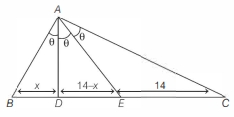
0 likes
View Solution200
AdvancedMCQ
Let $ABC$ be a triangle such that $AB=4, BC=5$ and $CA=6$. Choose points $D, E, F$ on $AB, BC, CA$ respectively,such that $AD=2, BE=2, CF=2$. Then find the ratio of the area of $\triangle DEF$ to the area of $\triangle ABC$.
A
$\frac{1}{4}$
B
$\frac{3}{15}$
C
$\frac{4}{15}$
D
$\frac{7}{30}$
Solution
(C) Given $AB=c=4, BC=a=5, CA=b=6$. Points $D, E, F$ are on $AB, BC, CA$ such that $AD=2, BE=2, CF=2$.
Note that $BD = AB - AD = 4 - 2 = 2$,$CE = BC - BE = 5 - 2 = 3$,$AF = AC - CF = 6 - 2 = 4$.
The area of $\triangle ABC = \Delta$.
The area of $\triangle ADF = \frac{1}{2} \cdot AD \cdot AF \cdot \sin A = \frac{1}{2} \cdot 2 \cdot 4 \cdot \sin A = 4 \sin A$.
Since $\Delta = \frac{1}{2} bc \sin A = \frac{1}{2} \cdot 6 \cdot 4 \cdot \sin A = 12 \sin A$,we have $\sin A = \frac{\Delta}{12}$.
Thus,Area$(\triangle ADF)$ = $4 \cdot \frac{\Delta}{12} = \frac{1}{3} \Delta$.
Similarly,Area$(\triangle BED)$ = $\frac{1}{2} \cdot BE \cdot BD \cdot \sin B = \frac{1}{2} \cdot 2 \cdot 2 \cdot \sin B = 2 \sin B$.
Since $\Delta = \frac{1}{2} ac \sin B = \frac{1}{2} \cdot 5 \cdot 4 \cdot \sin B = 10 \sin B$,we have $\sin B = \frac{\Delta}{10}$.
Thus,Area$(\triangle BED)$ = $2 \cdot \frac{\Delta}{10} = \frac{1}{5} \Delta$.
Similarly,Area$(\triangle CFE)$ = $\frac{1}{2} \cdot CF \cdot CE \cdot \sin C = \frac{1}{2} \cdot 2 \cdot 3 \cdot \sin C = 3 \sin C$.
Since $\Delta = \frac{1}{2} ab \sin C = \frac{1}{2} \cdot 5 \cdot 6 \cdot \sin C = 15 \sin C$,we have $\sin C = \frac{\Delta}{15}$.
Thus,Area$(\triangle CFE)$ = $3 \cdot \frac{\Delta}{15} = \frac{1}{5} \Delta$.
Area$(\triangle DEF)$ = $\Delta - (\text{Area}(\triangle ADF) + \text{Area}(\triangle BED) + \text{Area}(\triangle CFE)) = \Delta - (\frac{1}{3} + \frac{1}{5} + \frac{1}{5}) \Delta = \Delta - \frac{11}{15} \Delta = \frac{4}{15} \Delta$.
Therefore,the ratio is $\frac{4}{15}$.
Note that $BD = AB - AD = 4 - 2 = 2$,$CE = BC - BE = 5 - 2 = 3$,$AF = AC - CF = 6 - 2 = 4$.
The area of $\triangle ABC = \Delta$.
The area of $\triangle ADF = \frac{1}{2} \cdot AD \cdot AF \cdot \sin A = \frac{1}{2} \cdot 2 \cdot 4 \cdot \sin A = 4 \sin A$.
Since $\Delta = \frac{1}{2} bc \sin A = \frac{1}{2} \cdot 6 \cdot 4 \cdot \sin A = 12 \sin A$,we have $\sin A = \frac{\Delta}{12}$.
Thus,Area$(\triangle ADF)$ = $4 \cdot \frac{\Delta}{12} = \frac{1}{3} \Delta$.
Similarly,Area$(\triangle BED)$ = $\frac{1}{2} \cdot BE \cdot BD \cdot \sin B = \frac{1}{2} \cdot 2 \cdot 2 \cdot \sin B = 2 \sin B$.
Since $\Delta = \frac{1}{2} ac \sin B = \frac{1}{2} \cdot 5 \cdot 4 \cdot \sin B = 10 \sin B$,we have $\sin B = \frac{\Delta}{10}$.
Thus,Area$(\triangle BED)$ = $2 \cdot \frac{\Delta}{10} = \frac{1}{5} \Delta$.
Similarly,Area$(\triangle CFE)$ = $\frac{1}{2} \cdot CF \cdot CE \cdot \sin C = \frac{1}{2} \cdot 2 \cdot 3 \cdot \sin C = 3 \sin C$.
Since $\Delta = \frac{1}{2} ab \sin C = \frac{1}{2} \cdot 5 \cdot 6 \cdot \sin C = 15 \sin C$,we have $\sin C = \frac{\Delta}{15}$.
Thus,Area$(\triangle CFE)$ = $3 \cdot \frac{\Delta}{15} = \frac{1}{5} \Delta$.
Area$(\triangle DEF)$ = $\Delta - (\text{Area}(\triangle ADF) + \text{Area}(\triangle BED) + \text{Area}(\triangle CFE)) = \Delta - (\frac{1}{3} + \frac{1}{5} + \frac{1}{5}) \Delta = \Delta - \frac{11}{15} \Delta = \frac{4}{15} \Delta$.
Therefore,the ratio is $\frac{4}{15}$.
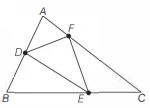
0 likes
View SolutionTrigonometrical Equations — Relation between sides and angles, Solutions of triangles · Frequently Asked Questions
1Are these Trigonometrical Equations questions useful for JEE and NEET?
Yes. All questions in this section are mapped to JEE Main and NEET exam patterns. Previous year questions from JEE Main, NEET, GUJCET and state-level exams are included with full solutions.
2Can I switch to Hindi or Gujarati for these questions?
Yes. Use the language tabs in the hero section or the sidebar to view the same questions and solutions in English, Hindi or Gujarati.
3How do I generate a question paper from this subtopic?
Use the Vedclass Exam Paper Generator — select the chapter and subtopic, set difficulty, and generate Sets A, B, C, D automatically. First 3 chapters of every subject are free.
Vedclass Products
For Students
Vedclass Test Series
Mock tests in real JEE/NEET style with performance analysis. 5-day free trial.
Start Free TrialFor Teachers
Exam Paper Generator
Generate Set A/B/C/D papers from this chapter in 2 minutes. 3 chapters free.
Try FreeFor Institutes
Online Exam Module
Live online exams with unlimited students, 360° analytics & white-label branding.
See DemoFor Teachers & Institutes
Generate a Trigonometrical Equations Exam Paper in 2 Minutes
Select subtopic & difficulty — Sets A, B, C, D auto-generated with No Repeat logic.
First 3 chapters of every subject are free — no payment required.