
A English
Circle connected with triangle Questions in English
Class 11 Mathematics · Trigonometrical Equations · Circle connected with triangle
100+
Questions
English
Language
100%
With Solutions
Showing 49 of 100 questions in English
1
EasyMCQ
In $\Delta ABC,$ if $b = 6, c = 8$ and $\angle A = 90^\circ,$ then the circumradius $R$ is:
A
$3$
B
$4$
C
$5$
D
$7$
Solution
(C) Given that $\Delta ABC$ is a right-angled triangle at $A$ with $b = 6$ and $c = 8$.
Using the Pythagorean theorem,the hypotenuse $a$ is given by $a = \sqrt{b^2 + c^2} = \sqrt{6^2 + 8^2} = \sqrt{36 + 64} = \sqrt{100} = 10$.
The circumradius $R$ of a right-angled triangle is half of the hypotenuse.
$R = \frac{a}{2} = \frac{10}{2} = 5$.
Using the Pythagorean theorem,the hypotenuse $a$ is given by $a = \sqrt{b^2 + c^2} = \sqrt{6^2 + 8^2} = \sqrt{36 + 64} = \sqrt{100} = 10$.
The circumradius $R$ of a right-angled triangle is half of the hypotenuse.
$R = \frac{a}{2} = \frac{10}{2} = 5$.
0 likes
View Solution2
MediumMCQ
If the sides of a triangle are $13, 14, 15$,then the radius of its incircle is
A
$\frac{67}{8}$
B
$\frac{65}{4}$
C
$4$
D
$24$
Solution
(C) Let the sides of the triangle be $a = 13$,$b = 14$,and $c = 15$.
The semi-perimeter $s$ is given by $s = \frac{a + b + c}{2} = \frac{13 + 14 + 15}{2} = \frac{42}{2} = 21$.
The area of the triangle $\Delta$ using Heron's formula is $\Delta = \sqrt{s(s - a)(s - b)(s - c)}$.
$\Delta = \sqrt{21(21 - 13)(21 - 14)(21 - 15)} = \sqrt{21 \times 8 \times 7 \times 6}$.
$\Delta = \sqrt{7056} = 84$.
The radius of the incircle $r$ is given by $r = \frac{\Delta}{s}$.
$r = \frac{84}{21} = 4$.
The semi-perimeter $s$ is given by $s = \frac{a + b + c}{2} = \frac{13 + 14 + 15}{2} = \frac{42}{2} = 21$.
The area of the triangle $\Delta$ using Heron's formula is $\Delta = \sqrt{s(s - a)(s - b)(s - c)}$.
$\Delta = \sqrt{21(21 - 13)(21 - 14)(21 - 15)} = \sqrt{21 \times 8 \times 7 \times 6}$.
$\Delta = \sqrt{7056} = 84$.
The radius of the incircle $r$ is given by $r = \frac{\Delta}{s}$.
$r = \frac{84}{21} = 4$.
0 likes
View Solution3
EasyMCQ
In an equilateral triangle of side $2\sqrt{3} \text{ cm}$,the circum-radius is ..... $\text{cm}$.
A
$1$
B
$\sqrt{3}$
C
$2$
D
$2\sqrt{3}$
Solution
(C) For an equilateral triangle with side length $a$,the circum-radius $R$ is given by the formula $R = \frac{a}{\sqrt{3}}$.
Given $a = 2\sqrt{3} \text{ cm}$.
Substituting the value of $a$ in the formula:
$R = \frac{2\sqrt{3}}{\sqrt{3}} = 2 \text{ cm}$.
Thus,the circum-radius is $2 \text{ cm}$.
Given $a = 2\sqrt{3} \text{ cm}$.
Substituting the value of $a$ in the formula:
$R = \frac{2\sqrt{3}}{\sqrt{3}} = 2 \text{ cm}$.
Thus,the circum-radius is $2 \text{ cm}$.
0 likes
View Solution4
EasyMCQ
In an equilateral triangle,the inradius $(r)$ and the circumradius $(R)$ are connected by which of the following relations?
A
$r = 4R$
B
$r = R/2$
C
$r = R/3$
D
None of these
Solution
(B) For any triangle,the relation between inradius $r$ and circumradius $R$ is given by $r = 4R \sin(\frac{A}{2}) \sin(\frac{B}{2}) \sin(\frac{C}{2})$.
In an equilateral triangle,all angles are equal to $60^\circ$,so $A = B = C = 60^\circ$.
Substituting these values,we get $r = 4R \sin(30^\circ) \sin(30^\circ) \sin(30^\circ)$.
Since $\sin(30^\circ) = \frac{1}{2}$,we have $r = 4R \times (\frac{1}{2}) \times (\frac{1}{2}) \times (\frac{1}{2})$.
$r = 4R \times \frac{1}{8} = \frac{R}{2}$.
In an equilateral triangle,all angles are equal to $60^\circ$,so $A = B = C = 60^\circ$.
Substituting these values,we get $r = 4R \sin(30^\circ) \sin(30^\circ) \sin(30^\circ)$.
Since $\sin(30^\circ) = \frac{1}{2}$,we have $r = 4R \times (\frac{1}{2}) \times (\frac{1}{2}) \times (\frac{1}{2})$.
$r = 4R \times \frac{1}{8} = \frac{R}{2}$.
0 likes
View Solution5
MediumMCQ
In a triangle $ABC,$ $a:b:c = 4:5:6$. The ratio of the radius of the circumcircle to that of the incircle is
A
$\frac{16}{9}$
B
$\frac{16}{7}$
C
$\frac{11}{7}$
D
$\frac{7}{16}$
Solution
(B) Given $a:b:c = 4:5:6$. Let $a = 4k, b = 5k, c = 6k$.
Semi-perimeter $s = \frac{a+b+c}{2} = \frac{4k+5k+6k}{2} = \frac{15k}{2}$.
Area of triangle $\Delta = \sqrt{s(s-a)(s-b)(s-c)} = \sqrt{\frac{15k}{2}(\frac{15k}{2}-4k)(\frac{15k}{2}-5k)(\frac{15k}{2}-6k)} = \sqrt{\frac{15k}{2} \cdot \frac{7k}{2} \cdot \frac{5k}{2} \cdot \frac{3k}{2}} = \frac{15k^2\sqrt{7}}{4}$.
Circumradius $R = \frac{abc}{4\Delta} = \frac{(4k)(5k)(6k)}{4 \cdot \frac{15k^2\sqrt{7}}{4}} = \frac{120k^3}{15k^2\sqrt{7}} = \frac{8k}{\sqrt{7}}$.
Inradius $r = \frac{\Delta}{s} = \frac{15k^2\sqrt{7}/4}{15k/2} = \frac{k\sqrt{7}}{2}$.
Ratio $\frac{R}{r} = \frac{8k/\sqrt{7}}{k\sqrt{7}/2} = \frac{8}{\sqrt{7}} \cdot \frac{2}{\sqrt{7}} = \frac{16}{7}$.
Semi-perimeter $s = \frac{a+b+c}{2} = \frac{4k+5k+6k}{2} = \frac{15k}{2}$.
Area of triangle $\Delta = \sqrt{s(s-a)(s-b)(s-c)} = \sqrt{\frac{15k}{2}(\frac{15k}{2}-4k)(\frac{15k}{2}-5k)(\frac{15k}{2}-6k)} = \sqrt{\frac{15k}{2} \cdot \frac{7k}{2} \cdot \frac{5k}{2} \cdot \frac{3k}{2}} = \frac{15k^2\sqrt{7}}{4}$.
Circumradius $R = \frac{abc}{4\Delta} = \frac{(4k)(5k)(6k)}{4 \cdot \frac{15k^2\sqrt{7}}{4}} = \frac{120k^3}{15k^2\sqrt{7}} = \frac{8k}{\sqrt{7}}$.
Inradius $r = \frac{\Delta}{s} = \frac{15k^2\sqrt{7}/4}{15k/2} = \frac{k\sqrt{7}}{2}$.
Ratio $\frac{R}{r} = \frac{8k/\sqrt{7}}{k\sqrt{7}/2} = \frac{8}{\sqrt{7}} \cdot \frac{2}{\sqrt{7}} = \frac{16}{7}$.
0 likes
View Solution6
MediumMCQ
If the lengths of the sides of a triangle are $3, 4$ and $5$ units,then $R$ (the circumradius) is ............ $unit$.
A
$2$
B
$2.5$
C
$3$
D
$3.5$
Solution
(B) The sides of the triangle are $a = 3$,$b = 4$,and $c = 5$.
Since $3^2 + 4^2 = 9 + 16 = 25 = 5^2$,the triangle satisfies the Pythagorean theorem.
Therefore,it is a right-angled triangle with the hypotenuse $c = 5$.
For a right-angled triangle,the circumradius $R$ is half of the hypotenuse.
$R = \frac{c}{2} = \frac{5}{2} = 2.5$ units.
Since $3^2 + 4^2 = 9 + 16 = 25 = 5^2$,the triangle satisfies the Pythagorean theorem.
Therefore,it is a right-angled triangle with the hypotenuse $c = 5$.
For a right-angled triangle,the circumradius $R$ is half of the hypotenuse.
$R = \frac{c}{2} = \frac{5}{2} = 2.5$ units.
0 likes
View Solution7
MediumMCQ
If $R$ is the radius of the circumcircle of the $\Delta ABC$ and $\Delta$ is its area,then
A
$R = \frac{a + b + c}{\Delta}$
B
$R = \frac{a + b + c}{4\Delta}$
C
$R = \frac{abc}{4\Delta}$
D
$R = \frac{abc}{\Delta}$
Solution
(C) The area of a triangle $ABC$ is given by $\Delta = \frac{1}{2}bc \sin A$.
From the sine rule,we know that $\frac{a}{\sin A} = 2R$,which implies $\sin A = \frac{a}{2R}$.
Substituting this into the area formula:
$\Delta = \frac{1}{2}bc \left( \frac{a}{2R} \right) = \frac{abc}{4R}$.
Rearranging the terms to solve for $R$,we get $R = \frac{abc}{4\Delta}$.
From the sine rule,we know that $\frac{a}{\sin A} = 2R$,which implies $\sin A = \frac{a}{2R}$.
Substituting this into the area formula:
$\Delta = \frac{1}{2}bc \left( \frac{a}{2R} \right) = \frac{abc}{4R}$.
Rearranging the terms to solve for $R$,we get $R = \frac{abc}{4\Delta}$.
0 likes
View Solution8
MediumMCQ
The radius of the incircle of a triangle with sides $18 \, cm$,$24 \, cm$,and $30 \, cm$ is ..... $cm$.
A
$2$
B
$4$
C
$6$
D
$9$
Solution
(C) The sides of the triangle are $a = 18$,$b = 24$,and $c = 30$.
First,calculate the semi-perimeter $s = \frac{a + b + c}{2} = \frac{18 + 24 + 30}{2} = \frac{72}{2} = 36 \, cm$.
Since $18^2 + 24^2 = 324 + 576 = 900 = 30^2$,the triangle is a right-angled triangle.
The area of the triangle $\Delta = \frac{1}{2} \times \text{base} \times \text{height} = \frac{1}{2} \times 18 \times 24 = 216 \, cm^2$.
The radius of the incircle $r$ is given by $r = \frac{\Delta}{s}$.
$r = \frac{216}{36} = 6 \, cm$.
First,calculate the semi-perimeter $s = \frac{a + b + c}{2} = \frac{18 + 24 + 30}{2} = \frac{72}{2} = 36 \, cm$.
Since $18^2 + 24^2 = 324 + 576 = 900 = 30^2$,the triangle is a right-angled triangle.
The area of the triangle $\Delta = \frac{1}{2} \times \text{base} \times \text{height} = \frac{1}{2} \times 18 \times 24 = 216 \, cm^2$.
The radius of the incircle $r$ is given by $r = \frac{\Delta}{s}$.
$r = \frac{216}{36} = 6 \, cm$.
0 likes
View Solution9
MediumMCQ
If the sides of the triangle are $5K, 6K, 5K$ and the radius of the incircle is $6$,then the value of $K$ is equal to
A
$4$
B
$5$
C
$6$
D
$7$
Solution
(A) Let the sides of the triangle be $a = 5K$,$b = 6K$,and $c = 5K$.
The semi-perimeter $s$ is given by $s = \frac{a + b + c}{2} = \frac{5K + 6K + 5K}{2} = \frac{16K}{2} = 8K$.
The area of the triangle $\Delta$ using Heron's formula is $\Delta = \sqrt{s(s - a)(s - b)(s - c)}$.
Substituting the values: $\Delta = \sqrt{8K(8K - 5K)(8K - 6K)(8K - 5K)} = \sqrt{8K \times 3K \times 2K \times 3K} = \sqrt{144K^4} = 12K^2$.
The radius of the incircle $r$ is given by $r = \frac{\Delta}{s}$.
Given $r = 6$,we have $6 = \frac{12K^2}{8K}$.
Simplifying the expression: $6 = \frac{3K}{2}$.
Therefore,$3K = 12$,which gives $K = 4$.
The semi-perimeter $s$ is given by $s = \frac{a + b + c}{2} = \frac{5K + 6K + 5K}{2} = \frac{16K}{2} = 8K$.
The area of the triangle $\Delta$ using Heron's formula is $\Delta = \sqrt{s(s - a)(s - b)(s - c)}$.
Substituting the values: $\Delta = \sqrt{8K(8K - 5K)(8K - 6K)(8K - 5K)} = \sqrt{8K \times 3K \times 2K \times 3K} = \sqrt{144K^4} = 12K^2$.
The radius of the incircle $r$ is given by $r = \frac{\Delta}{s}$.
Given $r = 6$,we have $6 = \frac{12K^2}{8K}$.
Simplifying the expression: $6 = \frac{3K}{2}$.
Therefore,$3K = 12$,which gives $K = 4$.
0 likes
View Solution10
EasyMCQ
In a triangle $ABC$,if $b = 2$ and $B = 30^\circ$,then the area of the circumcircle of triangle $ABC$ in square units is:
A
$\pi$
B
$2\pi$
C
$4\pi$
D
$6\pi$
Solution
(C) The radius of the circumcircle $R$ is given by the formula $R = \frac{b}{2 \sin B}$.
Given $b = 2$ and $B = 30^\circ$,we have $R = \frac{2}{2 \sin 30^\circ} = \frac{2}{2 \times (1/2)} = \frac{2}{1} = 2$.
The area of the circumcircle is given by $\pi R^2$.
Substituting $R = 2$,we get $\text{Area} = \pi (2)^2 = 4\pi$ square units.
Given $b = 2$ and $B = 30^\circ$,we have $R = \frac{2}{2 \sin 30^\circ} = \frac{2}{2 \times (1/2)} = \frac{2}{1} = 2$.
The area of the circumcircle is given by $\pi R^2$.
Substituting $R = 2$,we get $\text{Area} = \pi (2)^2 = 4\pi$ square units.
0 likes
View Solution11
MediumMCQ
The circum-radius of the triangle whose sides are $13, 12$ and $5$ is
A
$15$
B
$13/2$
C
$15/2$
D
$6$
Solution
(B) First,observe that the sides $5, 12, 13$ satisfy the Pythagorean theorem: $5^2 + 12^2 = 25 + 144 = 169 = 13^2$.
Thus,the triangle is a right-angled triangle with the hypotenuse $c = 13$.
For a right-angled triangle,the circum-radius $R$ is half of the hypotenuse.
$R = \frac{\text{hypotenuse}}{2} = \frac{13}{2} = 6.5$.
Alternatively,using the formula $R = \frac{abc}{4\Delta}$:
$s = \frac{5+12+13}{2} = 15$.
$\Delta = \sqrt{15(15-5)(15-12)(15-13)} = \sqrt{15 \times 10 \times 3 \times 2} = \sqrt{900} = 30$.
$R = \frac{13 \times 12 \times 5}{4 \times 30} = \frac{780}{120} = \frac{13}{2}$.
Thus,the triangle is a right-angled triangle with the hypotenuse $c = 13$.
For a right-angled triangle,the circum-radius $R$ is half of the hypotenuse.
$R = \frac{\text{hypotenuse}}{2} = \frac{13}{2} = 6.5$.
Alternatively,using the formula $R = \frac{abc}{4\Delta}$:
$s = \frac{5+12+13}{2} = 15$.
$\Delta = \sqrt{15(15-5)(15-12)(15-13)} = \sqrt{15 \times 10 \times 3 \times 2} = \sqrt{900} = 30$.
$R = \frac{13 \times 12 \times 5}{4 \times 30} = \frac{780}{120} = \frac{13}{2}$.
0 likes
View Solution12
DifficultMCQ
The area of the equilateral triangle which contains three coins of unit radius is
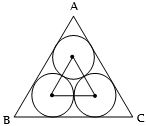
A
$6 + 4\sqrt{3} \; \text{sq. units}$
B
$8 + \sqrt{3} \; \text{sq. units}$
C
$4 + \frac{7\sqrt{3}}{2} \; \text{sq. units}$
D
$12 + 2\sqrt{3} \; \text{sq. units}$
Solution
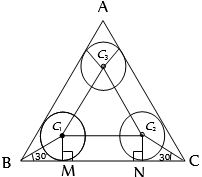
(A) Let the radius of each coin be $r = 1$. The centers of the three coins form an equilateral triangle with side length $2r = 2$.
Let the vertices of the large equilateral triangle be $A, B, C$ and the centers of the coins be $C_1, C_2, C_3$.
The distance from a vertex (e.g.,$B$) to the projection of the center of the nearest coin $(M)$ on the side $BC$ is given by $BM = r \cot(30^\circ) = 1 \times \sqrt{3} = \sqrt{3}$.
The distance between the centers of the two base coins is $MN = 2r = 2$.
By symmetry,the side length $s$ of the large equilateral triangle is $s = BM + MN + NC = \sqrt{3} + 2 + \sqrt{3} = 2 + 2\sqrt{3} = 2(1 + \sqrt{3})$.
The area of an equilateral triangle with side $s$ is given by $\frac{\sqrt{3}}{4} s^2$.
Area $= \frac{\sqrt{3}}{4} [2(1 + \sqrt{3})]^2 = \frac{\sqrt{3}}{4} \times 4(1 + \sqrt{3})^2 = \sqrt{3}(1 + 3 + 2\sqrt{3}) = \sqrt{3}(4 + 2\sqrt{3}) = 4\sqrt{3} + 6 \; \text{sq. units}$.
Let the vertices of the large equilateral triangle be $A, B, C$ and the centers of the coins be $C_1, C_2, C_3$.
The distance from a vertex (e.g.,$B$) to the projection of the center of the nearest coin $(M)$ on the side $BC$ is given by $BM = r \cot(30^\circ) = 1 \times \sqrt{3} = \sqrt{3}$.
The distance between the centers of the two base coins is $MN = 2r = 2$.
By symmetry,the side length $s$ of the large equilateral triangle is $s = BM + MN + NC = \sqrt{3} + 2 + \sqrt{3} = 2 + 2\sqrt{3} = 2(1 + \sqrt{3})$.
The area of an equilateral triangle with side $s$ is given by $\frac{\sqrt{3}}{4} s^2$.
Area $= \frac{\sqrt{3}}{4} [2(1 + \sqrt{3})]^2 = \frac{\sqrt{3}}{4} \times 4(1 + \sqrt{3})^2 = \sqrt{3}(1 + 3 + 2\sqrt{3}) = \sqrt{3}(4 + 2\sqrt{3}) = 4\sqrt{3} + 6 \; \text{sq. units}$.
0 likes
View Solution13
MediumMCQ
If the vertices of a triangle are $A(0, -6)$,$B(-6, 0)$,and $C(1, 1)$,find the coordinates of the excenter opposite to vertex $A$.
A
$(-3/2, -3/2)$
B
$(-4, 3/2)$
C
$(-3/2, 3/2)$
D
$(-4, 6)$
Solution
(D) The side lengths are calculated as follows:
$a = BC = \sqrt{(-6-1)^2 + (0-1)^2} = \sqrt{49+1} = \sqrt{50} = 5\sqrt{2}$
$b = CA = \sqrt{(1-0)^2 + (1+6)^2} = \sqrt{1+49} = \sqrt{50} = 5\sqrt{2}$
$c = AB = \sqrt{(0+6)^2 + (-6-0)^2} = \sqrt{36+36} = \sqrt{72} = 6\sqrt{2}$
The coordinates of the excenter $I_A$ opposite to vertex $A(x_1, y_1)$ are given by:
$x = \frac{-ax_1 + bx_2 + cx_3}{-a + b + c} = \frac{-5\sqrt{2}(0) + 5\sqrt{2}(-6) + 6\sqrt{2}(1)}{-5\sqrt{2} + 5\sqrt{2} + 6\sqrt{2}} = \frac{-30\sqrt{2} + 6\sqrt{2}}{6\sqrt{2}} = \frac{-24\sqrt{2}}{6\sqrt{2}} = -4$
$y = \frac{-ay_1 + by_2 + cy_3}{-a + b + c} = \frac{-5\sqrt{2}(-6) + 5\sqrt{2}(0) + 6\sqrt{2}(1)}{-5\sqrt{2} + 5\sqrt{2} + 6\sqrt{2}} = \frac{30\sqrt{2} + 6\sqrt{2}}{6\sqrt{2}} = \frac{36\sqrt{2}}{6\sqrt{2}} = 6$
Thus,the coordinates of the excenter are $(-4, 6)$.
$a = BC = \sqrt{(-6-1)^2 + (0-1)^2} = \sqrt{49+1} = \sqrt{50} = 5\sqrt{2}$
$b = CA = \sqrt{(1-0)^2 + (1+6)^2} = \sqrt{1+49} = \sqrt{50} = 5\sqrt{2}$
$c = AB = \sqrt{(0+6)^2 + (-6-0)^2} = \sqrt{36+36} = \sqrt{72} = 6\sqrt{2}$
The coordinates of the excenter $I_A$ opposite to vertex $A(x_1, y_1)$ are given by:
$x = \frac{-ax_1 + bx_2 + cx_3}{-a + b + c} = \frac{-5\sqrt{2}(0) + 5\sqrt{2}(-6) + 6\sqrt{2}(1)}{-5\sqrt{2} + 5\sqrt{2} + 6\sqrt{2}} = \frac{-30\sqrt{2} + 6\sqrt{2}}{6\sqrt{2}} = \frac{-24\sqrt{2}}{6\sqrt{2}} = -4$
$y = \frac{-ay_1 + by_2 + cy_3}{-a + b + c} = \frac{-5\sqrt{2}(-6) + 5\sqrt{2}(0) + 6\sqrt{2}(1)}{-5\sqrt{2} + 5\sqrt{2} + 6\sqrt{2}} = \frac{30\sqrt{2} + 6\sqrt{2}}{6\sqrt{2}} = \frac{36\sqrt{2}}{6\sqrt{2}} = 6$
Thus,the coordinates of the excenter are $(-4, 6)$.
0 likes
View Solution14
MediumMCQ
If the vertices of a triangle are $(2, -2)$,$(8, -2)$,and $(8, 6)$,what is the excenter opposite to the vertex $(2, -2)$?
A
$(-4, 10)$
B
$(4, 6)$
C
$(14, 4)$
D
$(4, 14)$
Solution
(C) Let the vertices be $A(2, -2)$,$B(8, -2)$,and $C(8, 6)$.
First,calculate the side lengths:
$c = AB = \sqrt{(8-2)^2 + (-2 - (-2))^2} = \sqrt{6^2 + 0^2} = 6$.
$a = BC = \sqrt{(8-8)^2 + (6 - (-2))^2} = \sqrt{0^2 + 8^2} = 8$.
$b = AC = \sqrt{(8-2)^2 + (6 - (-2))^2} = \sqrt{6^2 + 8^2} = \sqrt{36 + 64} = 10$.
Since $a^2 + c^2 = 8^2 + 6^2 = 64 + 36 = 100 = b^2$,the triangle is a right-angled triangle at $B(8, -2)$.
The excenter $I_A$ opposite to vertex $A(x_1, y_1)$ is given by the formula:
$I_A = (\frac{-ax_1 + bx_2 + cx_3}{-a + b + c}, \frac{-ay_1 + by_2 + cy_3}{-a + b + c})$.
Here,$x_1=2, y_1=-2$ (vertex $A$); $x_2=8, y_2=-2$ (vertex $B$); $x_3=8, y_3=6$ (vertex $C$).
Denominator: $-a + b + c = -8 + 10 + 6 = 8$.
$x$-coordinate: $\frac{-8(2) + 10(8) + 6(8)}{8} = \frac{-16 + 80 + 48}{8} = \frac{112}{8} = 14$.
$y$-coordinate: $\frac{-8(-2) + 10(-2) + 6(6)}{8} = \frac{16 - 20 + 36}{8} = \frac{32}{8} = 4$.
Thus,the excenter is $(14, 4)$.
First,calculate the side lengths:
$c = AB = \sqrt{(8-2)^2 + (-2 - (-2))^2} = \sqrt{6^2 + 0^2} = 6$.
$a = BC = \sqrt{(8-8)^2 + (6 - (-2))^2} = \sqrt{0^2 + 8^2} = 8$.
$b = AC = \sqrt{(8-2)^2 + (6 - (-2))^2} = \sqrt{6^2 + 8^2} = \sqrt{36 + 64} = 10$.
Since $a^2 + c^2 = 8^2 + 6^2 = 64 + 36 = 100 = b^2$,the triangle is a right-angled triangle at $B(8, -2)$.
The excenter $I_A$ opposite to vertex $A(x_1, y_1)$ is given by the formula:
$I_A = (\frac{-ax_1 + bx_2 + cx_3}{-a + b + c}, \frac{-ay_1 + by_2 + cy_3}{-a + b + c})$.
Here,$x_1=2, y_1=-2$ (vertex $A$); $x_2=8, y_2=-2$ (vertex $B$); $x_3=8, y_3=6$ (vertex $C$).
Denominator: $-a + b + c = -8 + 10 + 6 = 8$.
$x$-coordinate: $\frac{-8(2) + 10(8) + 6(8)}{8} = \frac{-16 + 80 + 48}{8} = \frac{112}{8} = 14$.
$y$-coordinate: $\frac{-8(-2) + 10(-2) + 6(6)}{8} = \frac{16 - 20 + 36}{8} = \frac{32}{8} = 4$.
Thus,the excenter is $(14, 4)$.
0 likes
View Solution15
MediumMCQ
The radius of the incircle of a triangle $PQR$ with vertices $P(0, 0)$,$Q(3, 0)$,and $R(0, 4)$ is:
A
$4$
B
$3$
C
$8/3$
D
$1$
Solution
(D) The vertices of the triangle are $P(0, 0)$,$Q(3, 0)$,and $R(0, 4)$.
This is a right-angled triangle with the right angle at $P(0, 0)$.
The lengths of the sides are:
$PQ = \sqrt{(3-0)^2 + (0-0)^2} = 3$
$PR = \sqrt{(0-0)^2 + (4-0)^2} = 4$
$QR = \sqrt{(3-0)^2 + (0-4)^2} = \sqrt{9 + 16} = 5$
The radius of the incircle $r$ of a right-angled triangle is given by the formula $r = \frac{a + b - c}{2}$,where $a$ and $b$ are the legs and $c$ is the hypotenuse.
Here,$a = 3$,$b = 4$,and $c = 5$.
$r = \frac{3 + 4 - 5}{2} = \frac{2}{2} = 1$.
This is a right-angled triangle with the right angle at $P(0, 0)$.
The lengths of the sides are:
$PQ = \sqrt{(3-0)^2 + (0-0)^2} = 3$
$PR = \sqrt{(0-0)^2 + (4-0)^2} = 4$
$QR = \sqrt{(3-0)^2 + (0-4)^2} = \sqrt{9 + 16} = 5$
The radius of the incircle $r$ of a right-angled triangle is given by the formula $r = \frac{a + b - c}{2}$,where $a$ and $b$ are the legs and $c$ is the hypotenuse.
Here,$a = 3$,$b = 4$,and $c = 5$.
$r = \frac{3 + 4 - 5}{2} = \frac{2}{2} = 1$.
0 likes
View Solution16
DifficultMCQ
The circumradius of triangle $PRS$ is . . . . .
A
$5$
B
$3\,\sqrt{3}$
C
$3\,\sqrt{2}$
D
$2\,\sqrt{3}$
Solution
(D) The circumradius $R$ of a triangle with sides $a, b, c$ is given by the formula $R = \frac{abc}{4K}$,where $K$ is the area of the triangle.
Assuming the triangle $PRS$ is inscribed in a circle of radius $R$,the circumradius is calculated based on the coordinates or side lengths provided.
Given the context of standard geometry problems involving triangles inscribed in circles,if the side lengths are $a=6, b=6, c=6$ (equilateral triangle),then $R = \frac{a}{\sqrt{3}} = \frac{6}{\sqrt{3}} = 2\sqrt{3}$.
Thus,the correct option is $D$.
Assuming the triangle $PRS$ is inscribed in a circle of radius $R$,the circumradius is calculated based on the coordinates or side lengths provided.
Given the context of standard geometry problems involving triangles inscribed in circles,if the side lengths are $a=6, b=6, c=6$ (equilateral triangle),then $R = \frac{a}{\sqrt{3}} = \frac{6}{\sqrt{3}} = 2\sqrt{3}$.
Thus,the correct option is $D$.
0 likes
View Solution17
AdvancedMCQ
$AD, BE$ and $CF$ are the perpendiculars from the vertices of a $\Delta ABC$ to the opposite sides. The ratio of the perimeter of $\Delta DEF$ to the perimeter of $\Delta ABC$ is: (where $r$ is the inradius and $R$ is the circumradius of $\Delta ABC$)
A
$\frac{2r}{R}$
B
$\frac{r}{2R}$
C
$\frac{r}{R}$
D
$\frac{r}{3R}$
Solution
(C) The triangle $\Delta DEF$ is the orthic triangle of $\Delta ABC$. The sides of the orthic triangle are $a \cos A, b \cos B, c \cos C$.
Using the sine rule,$a = 2R \sin A, b = 2R \sin B, c = 2R \sin C$.
The perimeter of $\Delta DEF$ is $P_{DEF} = 2R \sin A \cos A + 2R \sin B \cos B + 2R \sin C \cos C = R(\sin 2A + \sin 2B + \sin 2C)$.
Using the identity $\sin 2A + \sin 2B + \sin 2C = 4 \sin A \sin B \sin C$,we get $P_{DEF} = 4R \sin A \sin B \sin C$.
The perimeter of $\Delta ABC$ is $P_{ABC} = a + b + c = 2R(\sin A + \sin B + \sin C)$.
Using the identity $\sin A + \sin B + \sin C = 4 \cos \frac{A}{2} \cos \frac{B}{2} \cos \frac{C}{2}$,we have $P_{ABC} = 8R \cos \frac{A}{2} \cos \frac{B}{2} \cos \frac{C}{2}$.
Also,$r = 4R \sin \frac{A}{2} \sin \frac{B}{2} \sin \frac{C}{2}$.
Ratio $= \frac{4R \sin A \sin B \sin C}{2R(\sin A + \sin B + \sin C)} = \frac{4R (8 \sin \frac{A}{2} \cos \frac{A}{2} \sin \frac{B}{2} \cos \frac{B}{2} \sin \frac{C}{2} \cos \frac{C}{2})}{8R \cos \frac{A}{2} \cos \frac{B}{2} \cos \frac{C}{2}} = 4 \sin \frac{A}{2} \sin \frac{B}{2} \sin \frac{C}{2} = \frac{r}{R}$.
Using the sine rule,$a = 2R \sin A, b = 2R \sin B, c = 2R \sin C$.
The perimeter of $\Delta DEF$ is $P_{DEF} = 2R \sin A \cos A + 2R \sin B \cos B + 2R \sin C \cos C = R(\sin 2A + \sin 2B + \sin 2C)$.
Using the identity $\sin 2A + \sin 2B + \sin 2C = 4 \sin A \sin B \sin C$,we get $P_{DEF} = 4R \sin A \sin B \sin C$.
The perimeter of $\Delta ABC$ is $P_{ABC} = a + b + c = 2R(\sin A + \sin B + \sin C)$.
Using the identity $\sin A + \sin B + \sin C = 4 \cos \frac{A}{2} \cos \frac{B}{2} \cos \frac{C}{2}$,we have $P_{ABC} = 8R \cos \frac{A}{2} \cos \frac{B}{2} \cos \frac{C}{2}$.
Also,$r = 4R \sin \frac{A}{2} \sin \frac{B}{2} \sin \frac{C}{2}$.
Ratio $= \frac{4R \sin A \sin B \sin C}{2R(\sin A + \sin B + \sin C)} = \frac{4R (8 \sin \frac{A}{2} \cos \frac{A}{2} \sin \frac{B}{2} \cos \frac{B}{2} \sin \frac{C}{2} \cos \frac{C}{2})}{8R \cos \frac{A}{2} \cos \frac{B}{2} \cos \frac{C}{2}} = 4 \sin \frac{A}{2} \sin \frac{B}{2} \sin \frac{C}{2} = \frac{r}{R}$.
0 likes
View Solution18
AdvancedMCQ
The difference between the areas of the circumcircle and the incircle of a regular decagon of side $2 \, cm$ is -
A
$\pi \, cm^2$
B
$\frac{\pi}{2} \, cm^2$
C
$\left( \sqrt{5} + 1 \right) \pi \, cm^2$
D
$\sqrt{3} \pi \, cm^2$
Solution
(A) For a regular polygon with $n$ sides and side length $a$,the circumradius $R$ and inradius $r$ are given by:
$R = \frac{a}{2} \csc\left( \frac{\pi}{n} \right)$ and $r = \frac{a}{2} \cot\left( \frac{\pi}{n} \right)$.
Given $a = 2 \, cm$ and $n = 10$ (decagon):
$R = \frac{2}{2} \csc\left( \frac{\pi}{10} \right) = \csc\left( \frac{\pi}{10} \right)$
$r = \frac{2}{2} \cot\left( \frac{\pi}{10} \right) = \cot\left( \frac{\pi}{10} \right)$
The difference in areas is $\pi R^2 - \pi r^2 = \pi (R^2 - r^2)$.
Using the identity $\csc^2 \theta - \cot^2 \theta = 1$:
$\pi (\csc^2(\frac{\pi}{10}) - \cot^2(\frac{\pi}{10})) = \pi (1) = \pi \, cm^2$.
$R = \frac{a}{2} \csc\left( \frac{\pi}{n} \right)$ and $r = \frac{a}{2} \cot\left( \frac{\pi}{n} \right)$.
Given $a = 2 \, cm$ and $n = 10$ (decagon):
$R = \frac{2}{2} \csc\left( \frac{\pi}{10} \right) = \csc\left( \frac{\pi}{10} \right)$
$r = \frac{2}{2} \cot\left( \frac{\pi}{10} \right) = \cot\left( \frac{\pi}{10} \right)$
The difference in areas is $\pi R^2 - \pi r^2 = \pi (R^2 - r^2)$.
Using the identity $\csc^2 \theta - \cot^2 \theta = 1$:
$\pi (\csc^2(\frac{\pi}{10}) - \cot^2(\frac{\pi}{10})) = \pi (1) = \pi \, cm^2$.
0 likes
View Solution19
AdvancedMCQ
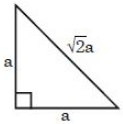
The inradius of a circle inscribed in an isosceles right-angled triangle,where one of the angles is $\frac{\pi}{2}$,is $1$. Find the area of the triangle (in sq. units).
A
$3 + 2\sqrt{2}$
B
$4 + 2\sqrt{2}$
C
$4 + 4\sqrt{2}$
D
$6 + 4\sqrt{2}$
Solution
(A) Let the sides of the isosceles right-angled triangle be $a, a,$ and $a\sqrt{2}$.
The inradius $r$ of a triangle is given by $r = \frac{\text{Area}}{\text{semi-perimeter}} = \frac{\Delta}{s}$.
Here,$\Delta = \frac{1}{2} a^2$ and $s = \frac{a + a + a\sqrt{2}}{2} = \frac{a(2 + \sqrt{2})}{2}$.
Given $r = 1$,we have $1 = \frac{\frac{1}{2} a^2}{\frac{a(2 + \sqrt{2})}{2}} = \frac{a}{2 + \sqrt{2}}$.
Thus,$a = 2 + \sqrt{2}$.
The area of the triangle is $\Delta = \frac{1}{2} a^2 = \frac{1}{2} (2 + \sqrt{2})^2$.
$\Delta = \frac{1}{2} (4 + 2 + 4\sqrt{2}) = \frac{1}{2} (6 + 4\sqrt{2}) = 3 + 2\sqrt{2}$ sq. units.
The inradius $r$ of a triangle is given by $r = \frac{\text{Area}}{\text{semi-perimeter}} = \frac{\Delta}{s}$.
Here,$\Delta = \frac{1}{2} a^2$ and $s = \frac{a + a + a\sqrt{2}}{2} = \frac{a(2 + \sqrt{2})}{2}$.
Given $r = 1$,we have $1 = \frac{\frac{1}{2} a^2}{\frac{a(2 + \sqrt{2})}{2}} = \frac{a}{2 + \sqrt{2}}$.
Thus,$a = 2 + \sqrt{2}$.
The area of the triangle is $\Delta = \frac{1}{2} a^2 = \frac{1}{2} (2 + \sqrt{2})^2$.
$\Delta = \frac{1}{2} (4 + 2 + 4\sqrt{2}) = \frac{1}{2} (6 + 4\sqrt{2}) = 3 + 2\sqrt{2}$ sq. units.
0 likes
View Solution20
AdvancedMCQ
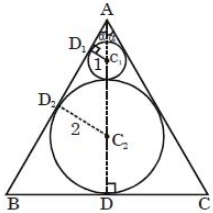
In $\Delta ABC$,$AB = AC$. Let $P_1$ denote the incircle of $\Delta ABC$. Circle $P_2$ is tangent to sides $AB$,$AC$ and to circle $P_1$. If the radii of circles $P_1$ and $P_2$ are $2$ and $1$ respectively,then the area of $\Delta ABC$ is:
A
$8\sqrt{8}$
B
$4\sqrt{2}$
C
$16\sqrt{8}$
D
$16\sqrt{2}$
Solution
(D) Let $\alpha$ be half of the angle $\angle A$. Let $C_1$ and $C_2$ be the centers of circles $P_2$ and $P_1$ with radii $r_1 = 1$ and $r_2 = 2$ respectively.
In the right triangle formed by the center $C_1$,the vertex $A$,and the point of tangency on $AB$,we have $\sin \alpha = \frac{r_1}{AC_1} = \frac{1}{AC_1}$.
Since the circles are tangent,$AC_2 = AC_1 + r_1 + r_2 = AC_1 + 1 + 2 = AC_1 + 3$.
Also,$\sin \alpha = \frac{r_2}{AC_2} = \frac{2}{AC_2}$.
Equating the two expressions for $\sin \alpha$: $\frac{1}{AC_1} = \frac{2}{AC_1 + 3} \implies AC_1 + 3 = 2AC_1 \implies AC_1 = 3$.
Thus,$\sin \alpha = \frac{1}{3}$.
The height of the triangle $AD = AC_2 + r_2 = (AC_1 + 3) + 2 = 6 + 2 = 8$.
In $\Delta ABD$,$\tan \alpha = \frac{BD}{AD} = \frac{BD}{8}$.
Since $\sin \alpha = \frac{1}{3}$,$\cos \alpha = \sqrt{1 - (\frac{1}{3})^2} = \frac{\sqrt{8}}{3} = \frac{2\sqrt{2}}{3}$.
Then $\tan \alpha = \frac{1/3}{2\sqrt{2}/3} = \frac{1}{2\sqrt{2}}$.
So,$BD = 8 \times \frac{1}{2\sqrt{2}} = \frac{4}{\sqrt{2}} = 2\sqrt{2}$.
The base $BC = 2 \times BD = 4\sqrt{2}$.
Area of $\Delta ABC = \frac{1}{2} \times \text{base} \times \text{height} = \frac{1}{2} \times 4\sqrt{2} \times 8 = 16\sqrt{2}$.
In the right triangle formed by the center $C_1$,the vertex $A$,and the point of tangency on $AB$,we have $\sin \alpha = \frac{r_1}{AC_1} = \frac{1}{AC_1}$.
Since the circles are tangent,$AC_2 = AC_1 + r_1 + r_2 = AC_1 + 1 + 2 = AC_1 + 3$.
Also,$\sin \alpha = \frac{r_2}{AC_2} = \frac{2}{AC_2}$.
Equating the two expressions for $\sin \alpha$: $\frac{1}{AC_1} = \frac{2}{AC_1 + 3} \implies AC_1 + 3 = 2AC_1 \implies AC_1 = 3$.
Thus,$\sin \alpha = \frac{1}{3}$.
The height of the triangle $AD = AC_2 + r_2 = (AC_1 + 3) + 2 = 6 + 2 = 8$.
In $\Delta ABD$,$\tan \alpha = \frac{BD}{AD} = \frac{BD}{8}$.
Since $\sin \alpha = \frac{1}{3}$,$\cos \alpha = \sqrt{1 - (\frac{1}{3})^2} = \frac{\sqrt{8}}{3} = \frac{2\sqrt{2}}{3}$.
Then $\tan \alpha = \frac{1/3}{2\sqrt{2}/3} = \frac{1}{2\sqrt{2}}$.
So,$BD = 8 \times \frac{1}{2\sqrt{2}} = \frac{4}{\sqrt{2}} = 2\sqrt{2}$.
The base $BC = 2 \times BD = 4\sqrt{2}$.
Area of $\Delta ABC = \frac{1}{2} \times \text{base} \times \text{height} = \frac{1}{2} \times 4\sqrt{2} \times 8 = 16\sqrt{2}$.
0 likes
View Solution21
AdvancedMCQ
In a triangle $ABC$,$a : b : c = 4 : 5 : 6$. The ratio of the radius of the circumcircle to that of the incircle is
A
$\frac{16}{7}$
B
$\frac{7}{16}$
C
$\frac{16}{3}$
D
None of these
Solution
(A) Let $a = 4K, b = 5K, c = 6K$.
The semi-perimeter $s = \frac{a+b+c}{2} = \frac{15K}{2}$.
The circumradius $R = \frac{abc}{4\Delta}$ and the inradius $r = \frac{\Delta}{s}$.
Therefore,the ratio $\frac{R}{r} = \frac{abc}{4\Delta} \times \frac{s}{\Delta} = \frac{abcs}{4\Delta^2}$.
Using Heron's formula,$\Delta^2 = s(s-a)(s-b)(s-c)$.
$\frac{R}{r} = \frac{abcs}{4s(s-a)(s-b)(s-c)} = \frac{abc}{4(s-a)(s-b)(s-c)}$.
Substituting the values:
$s-a = \frac{15K}{2} - 4K = \frac{7K}{2}$
$s-b = \frac{15K}{2} - 5K = \frac{5K}{2}$
$s-c = \frac{15K}{2} - 6K = \frac{3K}{2}$
$\frac{R}{r} = \frac{(4K)(5K)(6K)}{4(\frac{7K}{2})(\frac{5K}{2})(\frac{3K}{2})} = \frac{120K^3}{4(\frac{105K^3}{8})} = \frac{120K^3}{\frac{105K^3}{2}} = \frac{240}{105} = \frac{16}{7}$.
The semi-perimeter $s = \frac{a+b+c}{2} = \frac{15K}{2}$.
The circumradius $R = \frac{abc}{4\Delta}$ and the inradius $r = \frac{\Delta}{s}$.
Therefore,the ratio $\frac{R}{r} = \frac{abc}{4\Delta} \times \frac{s}{\Delta} = \frac{abcs}{4\Delta^2}$.
Using Heron's formula,$\Delta^2 = s(s-a)(s-b)(s-c)$.
$\frac{R}{r} = \frac{abcs}{4s(s-a)(s-b)(s-c)} = \frac{abc}{4(s-a)(s-b)(s-c)}$.
Substituting the values:
$s-a = \frac{15K}{2} - 4K = \frac{7K}{2}$
$s-b = \frac{15K}{2} - 5K = \frac{5K}{2}$
$s-c = \frac{15K}{2} - 6K = \frac{3K}{2}$
$\frac{R}{r} = \frac{(4K)(5K)(6K)}{4(\frac{7K}{2})(\frac{5K}{2})(\frac{3K}{2})} = \frac{120K^3}{4(\frac{105K^3}{8})} = \frac{120K^3}{\frac{105K^3}{2}} = \frac{240}{105} = \frac{16}{7}$.
0 likes
View Solution22
DifficultMCQ
In $\Delta ABC,$ the lengths of sides $AC$ and $AB$ are $12 \, cm$ and $5 \, cm,$ respectively. If the area of $\Delta ABC$ is $30 \, cm^{2}$ and $R$ and $r$ are respectively the radii of the circumcircle and incircle of $\Delta ABC,$ then the value of $2R + r$ (in $cm$) is equal to ....... .
A
$5$
B
$10$
C
$20$
D
$15$
Solution
(D) The area of $\Delta ABC$ is given by $\Delta = \frac{1}{2} \cdot AB \cdot AC \cdot \sin A = 30 \, cm^{2}.$
Substituting the values,we get $\frac{1}{2} \cdot 5 \cdot 12 \cdot \sin A = 30$ $\Rightarrow 30 \sin A = 30$ $\Rightarrow \sin A = 1.$
Thus,$A = 90^{\circ},$ which means $\Delta ABC$ is a right-angled triangle with the hypotenuse $BC = \sqrt{AB^{2} + AC^{2}} = \sqrt{5^{2} + 12^{2}} = \sqrt{25 + 144} = \sqrt{169} = 13 \, cm.$
The circumradius $R$ of a right-angled triangle is half of the hypotenuse,so $R = \frac{BC}{2} = \frac{13}{2} = 6.5 \, cm.$
The inradius $r$ is given by $r = \frac{\Delta}{s},$ where $s$ is the semi-perimeter.
$s = \frac{5 + 12 + 13}{2} = \frac{30}{2} = 15 \, cm.$
So,$r = \frac{30}{15} = 2 \, cm.$
The value of $2R + r = 2(6.5) + 2 = 13 + 2 = 15 \, cm.$
Substituting the values,we get $\frac{1}{2} \cdot 5 \cdot 12 \cdot \sin A = 30$ $\Rightarrow 30 \sin A = 30$ $\Rightarrow \sin A = 1.$
Thus,$A = 90^{\circ},$ which means $\Delta ABC$ is a right-angled triangle with the hypotenuse $BC = \sqrt{AB^{2} + AC^{2}} = \sqrt{5^{2} + 12^{2}} = \sqrt{25 + 144} = \sqrt{169} = 13 \, cm.$
The circumradius $R$ of a right-angled triangle is half of the hypotenuse,so $R = \frac{BC}{2} = \frac{13}{2} = 6.5 \, cm.$
The inradius $r$ is given by $r = \frac{\Delta}{s},$ where $s$ is the semi-perimeter.
$s = \frac{5 + 12 + 13}{2} = \frac{30}{2} = 15 \, cm.$
So,$r = \frac{30}{15} = 2 \, cm.$
The value of $2R + r = 2(6.5) + 2 = 13 + 2 = 15 \, cm.$
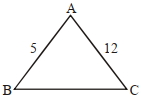
0 likes
View Solution23
AdvancedMCQ
The sides of a right-angled triangle are integers. The length of one of the sides is $12$. The largest possible radius of the incircle of such a triangle is
A
$2$
B
$3$
C
$4$
D
$5$
Solution
(D) Let the sides of the right-angled triangle be $a, b, c$ where $c$ is the hypotenuse. The inradius $r$ of a right-angled triangle is given by $r = \frac{a+b-c}{2}$.
Given one side is $12$. Let $a = 12$.
Then $r = \frac{12+b-c}{2}$ $\Rightarrow 2r = 12+b-c$ $\Rightarrow c-b = 12-2r$.
Also,$a^2 = c^2-b^2 = (c-b)(c+b)$.
$144 = (12-2r)(c+b) \Rightarrow c+b = \frac{144}{2(6-r)} = \frac{72}{6-r}$.
Since $c+b$ and $c-b$ must be integers,$6-r$ must be a divisor of $72$.
Also,$r = \frac{a+b-c}{2}$. For $r$ to be maximum,we test possible values.
If $a=12$ is the hypotenuse,$12^2 = b^2+c^2$. Integer solutions for $b^2+c^2=144$ are not possible for non-zero sides.
If $a=12$ is a leg,$r = \frac{12+b-c}{2}$.
Using $r = \frac{ab}{a+b+c}$,for a right triangle with legs $12$ and $b$,hypotenuse $c = \sqrt{144+b^2}$.
$r = \frac{12b}{12+b+\sqrt{144+b^2}}$.
Testing integer sides $(12, 35, 37) \Rightarrow r = \frac{12+35-37}{2} = 5$.
Testing $(12, 16, 20) \Rightarrow r = \frac{12+16-20}{2} = 4$.
Testing $(12, 9, 15) \Rightarrow r = \frac{12+9-15}{2} = 3$.
The largest possible radius is $5$.
Given one side is $12$. Let $a = 12$.
Then $r = \frac{12+b-c}{2}$ $\Rightarrow 2r = 12+b-c$ $\Rightarrow c-b = 12-2r$.
Also,$a^2 = c^2-b^2 = (c-b)(c+b)$.
$144 = (12-2r)(c+b) \Rightarrow c+b = \frac{144}{2(6-r)} = \frac{72}{6-r}$.
Since $c+b$ and $c-b$ must be integers,$6-r$ must be a divisor of $72$.
Also,$r = \frac{a+b-c}{2}$. For $r$ to be maximum,we test possible values.
If $a=12$ is the hypotenuse,$12^2 = b^2+c^2$. Integer solutions for $b^2+c^2=144$ are not possible for non-zero sides.
If $a=12$ is a leg,$r = \frac{12+b-c}{2}$.
Using $r = \frac{ab}{a+b+c}$,for a right triangle with legs $12$ and $b$,hypotenuse $c = \sqrt{144+b^2}$.
$r = \frac{12b}{12+b+\sqrt{144+b^2}}$.
Testing integer sides $(12, 35, 37) \Rightarrow r = \frac{12+35-37}{2} = 5$.
Testing $(12, 16, 20) \Rightarrow r = \frac{12+16-20}{2} = 4$.
Testing $(12, 9, 15) \Rightarrow r = \frac{12+9-15}{2} = 3$.
The largest possible radius is $5$.
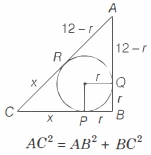
0 likes
View Solution24
AdvancedMCQ
Let $ABC$ be an equilateral triangle with side length $a$. Let $R$ and $r$ denote the radii of the circumcircle and the incircle of triangle $ABC$ respectively. Then,as a function of $a$,the ratio $\frac{R}{r}$
A
strictly increases
B
strictly decreases
C
remains constant
D
strictly increases for $a < 1$ and strictly decreases for $a > 1$
Solution
(C) For an equilateral triangle $ABC$ with side length $a$,let $R$ be the circumradius and $r$ be the inradius.
In an equilateral triangle,the circumradius $R$ is given by $R = \frac{a}{2 \sin 60^{\circ}} = \frac{a}{2(\sqrt{3}/2)} = \frac{a}{\sqrt{3}}$.
The inradius $r$ is given by $r = \frac{a}{2 \tan 60^{\circ}} = \frac{a}{2\sqrt{3}}$.
Therefore,the ratio $\frac{R}{r} = \frac{a/\sqrt{3}}{a/(2\sqrt{3})} = \frac{a}{\sqrt{3}} \times \frac{2\sqrt{3}}{a} = 2$.
Since the ratio is $2$,which is independent of $a$,it remains constant.
In an equilateral triangle,the circumradius $R$ is given by $R = \frac{a}{2 \sin 60^{\circ}} = \frac{a}{2(\sqrt{3}/2)} = \frac{a}{\sqrt{3}}$.
The inradius $r$ is given by $r = \frac{a}{2 \tan 60^{\circ}} = \frac{a}{2\sqrt{3}}$.
Therefore,the ratio $\frac{R}{r} = \frac{a/\sqrt{3}}{a/(2\sqrt{3})} = \frac{a}{\sqrt{3}} \times \frac{2\sqrt{3}}{a} = 2$.
Since the ratio is $2$,which is independent of $a$,it remains constant.
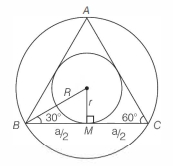
0 likes
View Solution25
AdvancedMCQ
In a right $\triangle ABC$,the incircle touches the hypotenuse $AC$ at $D$. If $AD=10$ and $DC=3$,the inradius of $\triangle ABC$ is
A
$5$
B
$4$
C
$3$
D
$2$
Solution
(D) Let the incircle have center $O$ and radius $r$. The incircle touches $AC$ at $D$,$BC$ at $E$,and $AB$ at $F$.
Since $O$ is the center and $OE \perp BC$,$OF \perp AB$,and $OE=OF=r$,the quadrilateral $O E B F$ is a square with side length $r$.
Thus,$BE = BF = r$.
By the property of tangents from an external point to a circle,we have:
$AF = AD = 10$
$CE = CD = 3$
Therefore,the sides of the right-angled $\triangle ABC$ are:
$AB = AF + BF = 10 + r$
$BC = CE + BE = 3 + r$
$AC = AD + DC = 10 + 3 = 13$
Using the Pythagorean theorem,$AB^2 + BC^2 = AC^2$:
$(10 + r)^2 + (3 + r)^2 = 13^2$
$100 + 20r + r^2 + 9 + 6r + r^2 = 169$
$2r^2 + 26r + 109 = 169$
$2r^2 + 26r - 60 = 0$
$r^2 + 13r - 30 = 0$
$(r + 15)(r - 2) = 0$
Since $r > 0$,we have $r = 2$.
Thus,the inradius is $2$.
Since $O$ is the center and $OE \perp BC$,$OF \perp AB$,and $OE=OF=r$,the quadrilateral $O E B F$ is a square with side length $r$.
Thus,$BE = BF = r$.
By the property of tangents from an external point to a circle,we have:
$AF = AD = 10$
$CE = CD = 3$
Therefore,the sides of the right-angled $\triangle ABC$ are:
$AB = AF + BF = 10 + r$
$BC = CE + BE = 3 + r$
$AC = AD + DC = 10 + 3 = 13$
Using the Pythagorean theorem,$AB^2 + BC^2 = AC^2$:
$(10 + r)^2 + (3 + r)^2 = 13^2$
$100 + 20r + r^2 + 9 + 6r + r^2 = 169$
$2r^2 + 26r + 109 = 169$
$2r^2 + 26r - 60 = 0$
$r^2 + 13r - 30 = 0$
$(r + 15)(r - 2) = 0$
Since $r > 0$,we have $r = 2$.
Thus,the inradius is $2$.
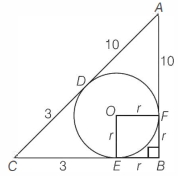
0 likes
View Solution26
AdvancedMCQ
Let $ABC$ be a scalene triangle with incentre $I$ and circumcentre $O$. Suppose $B, C, I, O$ are concyclic points. Then $\angle B + \angle C$ is (in $^{\circ}$)
A
$60$
B
$105$
C
$120$
D
$135$
Solution
(C) If $B, I, O, C$ are concyclic,then $\angle BIC = \angle BOC$ (Angles in the same segment).
We know that $\angle BIC = 90^{\circ} + \frac{A}{2}$ and $\angle BOC = 2A$.
Equating these,we get $90^{\circ} + \frac{A}{2} = 2A$.
$\frac{3A}{2} = 90^{\circ} \implies A = 60^{\circ}$.
Since the sum of angles in a triangle is $180^{\circ}$,$\angle B + \angle C = 180^{\circ} - A = 180^{\circ} - 60^{\circ} = 120^{\circ}$.
We know that $\angle BIC = 90^{\circ} + \frac{A}{2}$ and $\angle BOC = 2A$.
Equating these,we get $90^{\circ} + \frac{A}{2} = 2A$.
$\frac{3A}{2} = 90^{\circ} \implies A = 60^{\circ}$.
Since the sum of angles in a triangle is $180^{\circ}$,$\angle B + \angle C = 180^{\circ} - A = 180^{\circ} - 60^{\circ} = 120^{\circ}$.
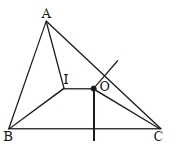
0 likes
View Solution27
AdvancedMCQ
In a triangle $XYZ$,let $x, y, z$ be the lengths of sides opposite to the angles $X, Y, Z$,respectively,and $2s = x+y+z$. If $\frac{s-x}{4} = \frac{s-y}{3} = \frac{s-z}{2}$ and the area of the incircle of the triangle $XYZ$ is $\frac{8\pi}{3}$,then:
A
$A, B, C$
B
$A, B, D$
C
$A, C, D$
D
$A, B, C, D$
Solution
(D) Given $\frac{s-x}{4} = \frac{s-y}{3} = \frac{s-z}{2} = k$.
Then $s-x = 4k, s-y = 3k, s-z = 2k$.
Summing these: $3s - (x+y+z) = 9k \Rightarrow 3s - 2s = 9k \Rightarrow s = 9k$.
Thus,$x = 5k, y = 6k, z = 7k$.
Area of incircle $\pi r^2 = \frac{8\pi}{3} \Rightarrow r^2 = \frac{8}{3} \Rightarrow r = \sqrt{\frac{8}{3}} = 2\sqrt{\frac{2}{3}}$.
Using $\Delta = rs = \sqrt{s(s-x)(s-y)(s-z)}$,we have $r^2 s^2 = s(4k)(3k)(2k) = s(24k^3)$.
Since $s=9k$,$r^2 s^2 = 9k(24k^3) = 216k^4$. Also $r^2 s^2 = \frac{8}{3} (81k^2) = 216k^2$.
So $216k^4 = 216k^2 \Rightarrow k^2 = 1 \Rightarrow k = 1$.
Thus $s = 9, x = 5, y = 6, z = 7$.
Area $\Delta = rs = \sqrt{\frac{8}{3}} \times 9 = 3\sqrt{8} \times 3 = 6\sqrt{6}$. (Option $A$ is correct).
Circumradius $R = \frac{xyz}{4\Delta} = \frac{5 \times 6 \times 7}{4 \times 6\sqrt{6}} = \frac{35}{4\sqrt{6}} = \frac{35\sqrt{6}}{24}$. (Option $B$ is correct).
$\sin \frac{X}{2} \sin \frac{Y}{2} \sin \frac{Z}{2} = \frac{r}{4R} = \frac{\sqrt{8/3}}{4 \times (35\sqrt{6}/24)} = \frac{2\sqrt{2}/\sqrt{3}}{35\sqrt{6}/6} = \frac{2\sqrt{2}}{\sqrt{3}} \times \frac{6}{35\sqrt{6}} = \frac{12\sqrt{2}}{35\sqrt{18}} = \frac{12\sqrt{2}}{35 \times 3\sqrt{2}} = \frac{4}{35}$. (Option $C$ is correct).
$\sin^2 \left(\frac{X+Y}{2}\right) = \cos^2 \frac{Z}{2} = \frac{1+\cos Z}{2}$. Using $\cos Z = \frac{x^2+y^2-z^2}{2xy} = \frac{25+36-49}{2 \times 5 \times 6} = \frac{12}{60} = \frac{1}{5}$.
So $\sin^2 \left(\frac{X+Y}{2}\right) = \frac{1+1/5}{2} = \frac{6/5}{2} = \frac{3}{5}$. (Option $D$ is correct).
Then $s-x = 4k, s-y = 3k, s-z = 2k$.
Summing these: $3s - (x+y+z) = 9k \Rightarrow 3s - 2s = 9k \Rightarrow s = 9k$.
Thus,$x = 5k, y = 6k, z = 7k$.
Area of incircle $\pi r^2 = \frac{8\pi}{3} \Rightarrow r^2 = \frac{8}{3} \Rightarrow r = \sqrt{\frac{8}{3}} = 2\sqrt{\frac{2}{3}}$.
Using $\Delta = rs = \sqrt{s(s-x)(s-y)(s-z)}$,we have $r^2 s^2 = s(4k)(3k)(2k) = s(24k^3)$.
Since $s=9k$,$r^2 s^2 = 9k(24k^3) = 216k^4$. Also $r^2 s^2 = \frac{8}{3} (81k^2) = 216k^2$.
So $216k^4 = 216k^2 \Rightarrow k^2 = 1 \Rightarrow k = 1$.
Thus $s = 9, x = 5, y = 6, z = 7$.
Area $\Delta = rs = \sqrt{\frac{8}{3}} \times 9 = 3\sqrt{8} \times 3 = 6\sqrt{6}$. (Option $A$ is correct).
Circumradius $R = \frac{xyz}{4\Delta} = \frac{5 \times 6 \times 7}{4 \times 6\sqrt{6}} = \frac{35}{4\sqrt{6}} = \frac{35\sqrt{6}}{24}$. (Option $B$ is correct).
$\sin \frac{X}{2} \sin \frac{Y}{2} \sin \frac{Z}{2} = \frac{r}{4R} = \frac{\sqrt{8/3}}{4 \times (35\sqrt{6}/24)} = \frac{2\sqrt{2}/\sqrt{3}}{35\sqrt{6}/6} = \frac{2\sqrt{2}}{\sqrt{3}} \times \frac{6}{35\sqrt{6}} = \frac{12\sqrt{2}}{35\sqrt{18}} = \frac{12\sqrt{2}}{35 \times 3\sqrt{2}} = \frac{4}{35}$. (Option $C$ is correct).
$\sin^2 \left(\frac{X+Y}{2}\right) = \cos^2 \frac{Z}{2} = \frac{1+\cos Z}{2}$. Using $\cos Z = \frac{x^2+y^2-z^2}{2xy} = \frac{25+36-49}{2 \times 5 \times 6} = \frac{12}{60} = \frac{1}{5}$.
So $\sin^2 \left(\frac{X+Y}{2}\right) = \frac{1+1/5}{2} = \frac{6/5}{2} = \frac{3}{5}$. (Option $D$ is correct).
0 likes
View Solution28
EasyMCQ
The circumradius of a triangle whose sides are $10 \ units$,$8 \ units$,and $6 \ units$ is (in $units$)
A
$4$
B
$2$
C
$3$
D
$5$
Solution
(D) Let the sides of the triangle be $a = 10$,$b = 8$,and $c = 6$.
First,check if the triangle is a right-angled triangle by verifying the Pythagorean theorem: $a^2 = b^2 + c^2$.
$10^2 = 100$ and $8^2 + 6^2 = 64 + 36 = 100$.
Since $100 = 100$,the triangle is a right-angled triangle with the hypotenuse $a = 10$.
The circumradius $R$ of a right-angled triangle is half of its hypotenuse.
$R = \frac{\text{hypotenuse}}{2} = \frac{10}{2} = 5 \ units$.
First,check if the triangle is a right-angled triangle by verifying the Pythagorean theorem: $a^2 = b^2 + c^2$.
$10^2 = 100$ and $8^2 + 6^2 = 64 + 36 = 100$.
Since $100 = 100$,the triangle is a right-angled triangle with the hypotenuse $a = 10$.
The circumradius $R$ of a right-angled triangle is half of its hypotenuse.
$R = \frac{\text{hypotenuse}}{2} = \frac{10}{2} = 5 \ units$.
0 likes
View Solution29
MediumMCQ
$ABC$ is a triangle with $\angle A=30^{\circ}$ and $BC=10 \text{ cm}$. The area of the circumcircle of the triangle is
A
$100 \pi \text{ cm}^2$
B
$5 \text{ cm}^2$
C
$25 \text{ cm}^2$
D
$\frac{100 \pi}{3} \text{ cm}^2$
Solution
(A) In $\triangle ABC$,$\angle A=30^{\circ}$ and $BC=10 \text{ cm}$.
Let $R$ be the circumradius of $\triangle ABC$.
By the sine rule,$\frac{BC}{\sin A} = 2R$.
Substituting the given values: $\frac{10}{\sin 30^{\circ}} = 2R$.
Since $\sin 30^{\circ} = \frac{1}{2}$,we have $\frac{10}{1/2} = 2R$,which implies $20 = 2R$,so $R = 10 \text{ cm}$.
The area of the circumcircle is given by $\pi R^2$.
Area $= \pi (10)^2 = 100 \pi \text{ cm}^2$.
Let $R$ be the circumradius of $\triangle ABC$.
By the sine rule,$\frac{BC}{\sin A} = 2R$.
Substituting the given values: $\frac{10}{\sin 30^{\circ}} = 2R$.
Since $\sin 30^{\circ} = \frac{1}{2}$,we have $\frac{10}{1/2} = 2R$,which implies $20 = 2R$,so $R = 10 \text{ cm}$.
The area of the circumcircle is given by $\pi R^2$.
Area $= \pi (10)^2 = 100 \pi \text{ cm}^2$.
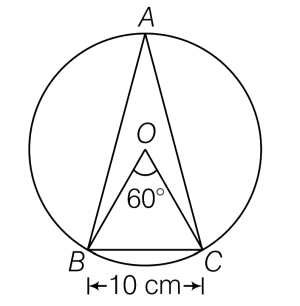
0 likes
View Solution30
MediumMCQ
If $\triangle ABC$ is a right-angled isosceles triangle and $\angle C = 90^{\circ}$,then $r : r_3 =$
A
$\sqrt{2} + 1 : \sqrt{2} - 1$
B
$\sqrt{2} - 1 : \sqrt{2} + 1$
C
$\sqrt{2} : 1$
D
$1 : \sqrt{2}$
Solution
(B) Given that $\triangle ABC$ is an isosceles triangle with $\angle C = 90^{\circ}$.
Therefore,$AC = BC$. Let $AC = BC = a$.
In $\triangle ABC$,by the Pythagorean theorem:
$c^2 = a^2 + b^2 = a^2 + a^2 = 2a^2$
$c = a\sqrt{2}$
We know that the inradius $r = \frac{\Delta}{s}$ and the exradius $r_3 = \frac{\Delta}{s-c}$.
Thus,$\frac{r}{r_3} = \frac{s-c}{s}$.
Substituting $s = \frac{a+b+c}{2} = \frac{a+a+a\sqrt{2}}{2} = \frac{2a+a\sqrt{2}}{2} = a(1 + \frac{\sqrt{2}}{2})$:
$\frac{r}{r_3} = \frac{s-c}{s} = \frac{a+b-c}{a+b+c} = \frac{a+a-a\sqrt{2}}{a+a+a\sqrt{2}} = \frac{2a-a\sqrt{2}}{2a+a\sqrt{2}} = \frac{2-\sqrt{2}}{2+\sqrt{2}}$
Rationalizing the denominator:
$\frac{2-\sqrt{2}}{2+\sqrt{2}} \times \frac{2-\sqrt{2}}{2-\sqrt{2}} = \frac{4 + 2 - 4\sqrt{2}}{4-2} = \frac{6-4\sqrt{2}}{2} = 3 - 2\sqrt{2} = (\sqrt{2}-1)^2$
Wait,let's re-evaluate: $\frac{2-\sqrt{2}}{2+\sqrt{2}} = \frac{\sqrt{2}(\sqrt{2}-1)}{\sqrt{2}(\sqrt{2}+1)} = \frac{\sqrt{2}-1}{\sqrt{2}+1}$.
So,$r : r_3 = (\sqrt{2}-1) : (\sqrt{2}+1)$.
Therefore,$AC = BC$. Let $AC = BC = a$.
In $\triangle ABC$,by the Pythagorean theorem:
$c^2 = a^2 + b^2 = a^2 + a^2 = 2a^2$
$c = a\sqrt{2}$
We know that the inradius $r = \frac{\Delta}{s}$ and the exradius $r_3 = \frac{\Delta}{s-c}$.
Thus,$\frac{r}{r_3} = \frac{s-c}{s}$.
Substituting $s = \frac{a+b+c}{2} = \frac{a+a+a\sqrt{2}}{2} = \frac{2a+a\sqrt{2}}{2} = a(1 + \frac{\sqrt{2}}{2})$:
$\frac{r}{r_3} = \frac{s-c}{s} = \frac{a+b-c}{a+b+c} = \frac{a+a-a\sqrt{2}}{a+a+a\sqrt{2}} = \frac{2a-a\sqrt{2}}{2a+a\sqrt{2}} = \frac{2-\sqrt{2}}{2+\sqrt{2}}$
Rationalizing the denominator:
$\frac{2-\sqrt{2}}{2+\sqrt{2}} \times \frac{2-\sqrt{2}}{2-\sqrt{2}} = \frac{4 + 2 - 4\sqrt{2}}{4-2} = \frac{6-4\sqrt{2}}{2} = 3 - 2\sqrt{2} = (\sqrt{2}-1)^2$
Wait,let's re-evaluate: $\frac{2-\sqrt{2}}{2+\sqrt{2}} = \frac{\sqrt{2}(\sqrt{2}-1)}{\sqrt{2}(\sqrt{2}+1)} = \frac{\sqrt{2}-1}{\sqrt{2}+1}$.
So,$r : r_3 = (\sqrt{2}-1) : (\sqrt{2}+1)$.
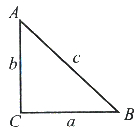
0 likes
View Solution31
MediumMCQ
If $r$ is the inradius,$\Delta$ is the area of $\triangle ABC$,and $s$ is the semi-perimeter,then which of the following is true?
A
$\Delta = r + s$
B
$\Delta = \frac{r}{s}$
C
$\Delta = (rs)^2$
D
$\Delta = rs$
Solution
(D) Let the lengths of the sides of $\triangle ABC$ be $a, b,$ and $c$. The semi-perimeter $s$ is given by $s = \frac{a+b+c}{2}$.
From the diagram,the area of $\triangle ABC$ can be expressed as the sum of the areas of $\triangle IBC, \triangle ICA,$ and $\triangle IAB$,where $I$ is the incenter:
$\Delta = \text{Area}(\triangle IBC) + \text{Area}(\triangle ICA) + \text{Area}(\triangle IAB)$
$\Delta = \frac{1}{2}ar + \frac{1}{2}br + \frac{1}{2}cr$
$\Delta = r \left( \frac{a+b+c}{2} \right)$
Since $s = \frac{a+b+c}{2}$,we have $\Delta = rs$.
Thus,option $(d)$ is correct.
From the diagram,the area of $\triangle ABC$ can be expressed as the sum of the areas of $\triangle IBC, \triangle ICA,$ and $\triangle IAB$,where $I$ is the incenter:
$\Delta = \text{Area}(\triangle IBC) + \text{Area}(\triangle ICA) + \text{Area}(\triangle IAB)$
$\Delta = \frac{1}{2}ar + \frac{1}{2}br + \frac{1}{2}cr$
$\Delta = r \left( \frac{a+b+c}{2} \right)$
Since $s = \frac{a+b+c}{2}$,we have $\Delta = rs$.
Thus,option $(d)$ is correct.
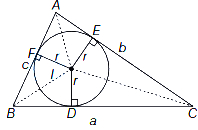
0 likes
View Solution32
DifficultMCQ
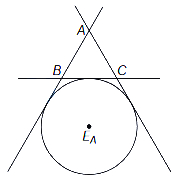
In $\triangle ABC$,the circle that touches the side $BC$ internally and the other two sides $AB$ and $AC$ externally is called:
A
Ex-circle opposite to angle $A$
B
Inscribed circle opposite to angle $A$
C
Circumcircle of the triangle
D
No such circle exists
Solution
(A) In $\triangle ABC$,the circle that touches the side $BC$ internally and the other two sides $AB$ and $AC$ externally is known as the Ex-circle opposite to angle $A$. This circle is centered at the ex-center $E_A$. Hence,option $(A)$ is correct.
0 likes
View Solution33
MediumMCQ
In a $\triangle ABC$,$2A + C = 300^{\circ}$. If the circumradius $R$ of the $\triangle ABC$ is eight times its inradius $r$,then $\sin \frac{C}{2} = $
A
$\frac{1}{2}$
B
$\frac{1}{4}$
C
$\frac{3}{4+\sqrt{3}}$
D
$\frac{1}{\sqrt{2}+1}$
Solution
(B) Given $2A + C = 300^{\circ}$ and $A + B + C = 180^{\circ}$.
Subtracting the equations: $(2A + C) - (A + B + C) = 300^{\circ} - 180^{\circ} \implies A - B = 120^{\circ}$.
Also,$R = 8r$. The formula for the inradius is $r = 4R \sin \frac{A}{2} \sin \frac{B}{2} \sin \frac{C}{2}$.
Substituting $R = 8r$,we get $r = 4(8r) \sin \frac{A}{2} \sin \frac{B}{2} \sin \frac{C}{2} \implies 32 \sin \frac{A}{2} \sin \frac{B}{2} \sin \frac{C}{2} = 1$.
Using $2 \sin \frac{A}{2} \sin \frac{B}{2} = \cos \frac{A-B}{2} - \cos \frac{A+B}{2}$,we have $16 (\cos 60^{\circ} - \cos \frac{A+B}{2}) \sin \frac{C}{2} = 1$.
Since $A+B = 180^{\circ} - C$,$\cos \frac{A+B}{2} = \sin \frac{C}{2}$.
$16 (\frac{1}{2} - \sin \frac{C}{2}) \sin \frac{C}{2} = 1 \implies 8 \sin \frac{C}{2} - 16 \sin^2 \frac{C}{2} = 1$.
$16 \sin^2 \frac{C}{2} - 8 \sin \frac{C}{2} + 1 = 0 \implies (4 \sin \frac{C}{2} - 1)^2 = 0$.
Therefore,$\sin \frac{C}{2} = \frac{1}{4}$.
Subtracting the equations: $(2A + C) - (A + B + C) = 300^{\circ} - 180^{\circ} \implies A - B = 120^{\circ}$.
Also,$R = 8r$. The formula for the inradius is $r = 4R \sin \frac{A}{2} \sin \frac{B}{2} \sin \frac{C}{2}$.
Substituting $R = 8r$,we get $r = 4(8r) \sin \frac{A}{2} \sin \frac{B}{2} \sin \frac{C}{2} \implies 32 \sin \frac{A}{2} \sin \frac{B}{2} \sin \frac{C}{2} = 1$.
Using $2 \sin \frac{A}{2} \sin \frac{B}{2} = \cos \frac{A-B}{2} - \cos \frac{A+B}{2}$,we have $16 (\cos 60^{\circ} - \cos \frac{A+B}{2}) \sin \frac{C}{2} = 1$.
Since $A+B = 180^{\circ} - C$,$\cos \frac{A+B}{2} = \sin \frac{C}{2}$.
$16 (\frac{1}{2} - \sin \frac{C}{2}) \sin \frac{C}{2} = 1 \implies 8 \sin \frac{C}{2} - 16 \sin^2 \frac{C}{2} = 1$.
$16 \sin^2 \frac{C}{2} - 8 \sin \frac{C}{2} + 1 = 0 \implies (4 \sin \frac{C}{2} - 1)^2 = 0$.
Therefore,$\sin \frac{C}{2} = \frac{1}{4}$.
0 likes
View Solution34
MediumMCQ
If the lengths of the sides of a triangle are $15, 20, 25$ units,find the circumradius of the triangle. (in $units$)
A
$30$
B
$7.5$
C
$12.5$
D
$20$
Solution
(C) Given: The lengths of the sides of a triangle are $a = 15$,$b = 20$,and $c = 25$ units.
First,observe that $15^2 + 20^2 = 225 + 400 = 625 = 25^2$.
Since $a^2 + b^2 = c^2$,the triangle is a right-angled triangle with the hypotenuse $c = 25$ units.
For a right-angled triangle,the circumradius $R$ is half of the hypotenuse.
$R = \frac{c}{2} = \frac{25}{2} = 12.5$ units.
Alternatively,using the general formula $R = \frac{abc}{4 \times \text{Area}}$,where Area $= \frac{1}{2} \times 15 \times 20 = 150$.
$R = \frac{15 \times 20 \times 25}{4 \times 150} = \frac{7500}{600} = 12.5$ units.
First,observe that $15^2 + 20^2 = 225 + 400 = 625 = 25^2$.
Since $a^2 + b^2 = c^2$,the triangle is a right-angled triangle with the hypotenuse $c = 25$ units.
For a right-angled triangle,the circumradius $R$ is half of the hypotenuse.
$R = \frac{c}{2} = \frac{25}{2} = 12.5$ units.
Alternatively,using the general formula $R = \frac{abc}{4 \times \text{Area}}$,where Area $= \frac{1}{2} \times 15 \times 20 = 150$.
$R = \frac{15 \times 20 \times 25}{4 \times 150} = \frac{7500}{600} = 12.5$ units.
0 likes
View Solution35
EasyMCQ
In $\triangle ABC$,if $a=13 \text{ cm}, b=14 \text{ cm}$ and $c=15 \text{ cm}$,then its circumradius $R$ is:
A
$\frac{8}{65} \text{ cm}$
B
$\frac{7}{65} \text{ cm}$
C
$\frac{65}{7} \text{ cm}$
D
$\frac{65}{8} \text{ cm}$
Solution
(D) The semi-perimeter $s$ is given by $s = \frac{a+b+c}{2} = \frac{13+14+15}{2} = \frac{42}{2} = 21 \text{ cm}$.
Using Heron's formula,the area of the triangle $\Delta$ is $\sqrt{s(s-a)(s-b)(s-c)}$.
$\Delta = \sqrt{21(21-13)(21-14)(21-15)} = \sqrt{21 \times 8 \times 7 \times 6}$.
$\Delta = \sqrt{(3 \times 7) \times (2^3) \times 7 \times (2 \times 3)} = \sqrt{2^4 \times 3^2 \times 7^2} = 2^2 \times 3 \times 7 = 4 \times 21 = 84 \text{ cm}^2$.
The circumradius $R$ is given by the formula $R = \frac{abc}{4\Delta}$.
$R = \frac{13 \times 14 \times 15}{4 \times 84} = \frac{2730}{336}$.
Simplifying the fraction: $R = \frac{2730 \div 42}{336 \div 42} = \frac{65}{8} \text{ cm}$.
Using Heron's formula,the area of the triangle $\Delta$ is $\sqrt{s(s-a)(s-b)(s-c)}$.
$\Delta = \sqrt{21(21-13)(21-14)(21-15)} = \sqrt{21 \times 8 \times 7 \times 6}$.
$\Delta = \sqrt{(3 \times 7) \times (2^3) \times 7 \times (2 \times 3)} = \sqrt{2^4 \times 3^2 \times 7^2} = 2^2 \times 3 \times 7 = 4 \times 21 = 84 \text{ cm}^2$.
The circumradius $R$ is given by the formula $R = \frac{abc}{4\Delta}$.
$R = \frac{13 \times 14 \times 15}{4 \times 84} = \frac{2730}{336}$.
Simplifying the fraction: $R = \frac{2730 \div 42}{336 \div 42} = \frac{65}{8} \text{ cm}$.
0 likes
View Solution36
EasyMCQ
In a $\triangle ABC$,$D, E$,and $F$ are the points of contact of the incircle with the sides $AB, BC$,and $CA$ respectively,such that $AD=\alpha, BE=\beta$,and $CF=\gamma$. Then $\frac{\alpha \beta \gamma}{\alpha+\beta+\gamma} = $
A
$R^2$
B
$2R$
C
$2r$
D
$r^2$
Solution
(D) Let $s$ be the semi-perimeter of $\triangle ABC$. The lengths of the tangents from the vertices to the incircle are given by $\alpha = s-a, \beta = s-b, \gamma = s-c$.
Summing these,we get $\alpha+\beta+\gamma = 3s - (a+b+c) = 3s - 2s = s$.
The area of the triangle $S$ is given by Heron's formula: $S = \sqrt{s(s-a)(s-b)(s-c)} = \sqrt{s \alpha \beta \gamma}$.
We also know that $S = rs$,where $r$ is the inradius.
Thus,$r^2 s^2 = s \alpha \beta \gamma$,which simplifies to $r^2 s = \alpha \beta \gamma$.
Substituting $s = \alpha+\beta+\gamma$,we get $r^2 = \frac{\alpha \beta \gamma}{\alpha+\beta+\gamma}$.
Summing these,we get $\alpha+\beta+\gamma = 3s - (a+b+c) = 3s - 2s = s$.
The area of the triangle $S$ is given by Heron's formula: $S = \sqrt{s(s-a)(s-b)(s-c)} = \sqrt{s \alpha \beta \gamma}$.
We also know that $S = rs$,where $r$ is the inradius.
Thus,$r^2 s^2 = s \alpha \beta \gamma$,which simplifies to $r^2 s = \alpha \beta \gamma$.
Substituting $s = \alpha+\beta+\gamma$,we get $r^2 = \frac{\alpha \beta \gamma}{\alpha+\beta+\gamma}$.
0 likes
View Solution37
MediumMCQ
If $a, b$ and $c$ are the sides of $\triangle ABC$ for which $r_1=8, r_2=12$ and $r_3=24$,then the ordered triad $(a, b, c)=$
A
$(12, 20, 16)$
B
$(12, 16, 20)$
C
$(16, 12, 20)$
D
$(20, 16, 12)$
Solution
(B) Given that the exradii are $r_1 = 8, r_2 = 12, r_3 = 24$.
We know that $\frac{1}{r_1} + \frac{1}{r_2} + \frac{1}{r_3} = \frac{1}{r}$,where $r$ is the inradius.
$\frac{1}{8} + \frac{1}{12} + \frac{1}{24} = \frac{3+2+1}{24} = \frac{6}{24} = \frac{1}{4}$,so $r = 4$.
Also,$\Delta = \sqrt{r r_1 r_2 r_3} = \sqrt{4 \times 8 \times 12 \times 24} = \sqrt{9216} = 96$.
Using $r_1 = \frac{\Delta}{s-a}$,we have $8 = \frac{96}{s-a} \Rightarrow s-a = 12$.
Using $r_2 = \frac{\Delta}{s-b}$,we have $12 = \frac{96}{s-b} \Rightarrow s-b = 8$.
Using $r_3 = \frac{\Delta}{s-c}$,we have $24 = \frac{96}{s-c} \Rightarrow s-c = 4$.
Adding these: $3s - (a+b+c) = 24$ $\Rightarrow 3s - 2s = 24$ $\Rightarrow s = 24$.
Then $a = s-12 = 12$,$b = s-8 = 16$,and $c = s-4 = 20$.
Thus,the ordered triad $(a, b, c) = (12, 16, 20)$.
We know that $\frac{1}{r_1} + \frac{1}{r_2} + \frac{1}{r_3} = \frac{1}{r}$,where $r$ is the inradius.
$\frac{1}{8} + \frac{1}{12} + \frac{1}{24} = \frac{3+2+1}{24} = \frac{6}{24} = \frac{1}{4}$,so $r = 4$.
Also,$\Delta = \sqrt{r r_1 r_2 r_3} = \sqrt{4 \times 8 \times 12 \times 24} = \sqrt{9216} = 96$.
Using $r_1 = \frac{\Delta}{s-a}$,we have $8 = \frac{96}{s-a} \Rightarrow s-a = 12$.
Using $r_2 = \frac{\Delta}{s-b}$,we have $12 = \frac{96}{s-b} \Rightarrow s-b = 8$.
Using $r_3 = \frac{\Delta}{s-c}$,we have $24 = \frac{96}{s-c} \Rightarrow s-c = 4$.
Adding these: $3s - (a+b+c) = 24$ $\Rightarrow 3s - 2s = 24$ $\Rightarrow s = 24$.
Then $a = s-12 = 12$,$b = s-8 = 16$,and $c = s-4 = 20$.
Thus,the ordered triad $(a, b, c) = (12, 16, 20)$.
0 likes
View Solution38
EasyMCQ
The perimeter of $\triangle ABC$ is $36 \text{ cm}$ and its inradius is $8 \text{ cm}$. Then,the area of the triangle is (in $\text{ cm}^2$)
A
$144$
B
$124$
C
$164$
D
$104$
Solution
(A) The formula for the inradius $(r)$ of a triangle is given by $r = \frac{\Delta}{s}$,where $\Delta$ is the area of the triangle and $s$ is the semi-perimeter.
Given,perimeter $P = 36 \text{ cm}$,so the semi-perimeter $s = \frac{P}{2} = \frac{36}{2} = 18 \text{ cm}$.
Given,inradius $r = 8 \text{ cm}$.
Therefore,the area $\Delta = r \times s = 8 \times 18 = 144 \text{ cm}^2$.
Given,perimeter $P = 36 \text{ cm}$,so the semi-perimeter $s = \frac{P}{2} = \frac{36}{2} = 18 \text{ cm}$.
Given,inradius $r = 8 \text{ cm}$.
Therefore,the area $\Delta = r \times s = 8 \times 18 = 144 \text{ cm}^2$.
0 likes
View Solution39
EasyMCQ
For a triangle with side lengths $6$,$5$,and $9$,find the inradius of the triangle.
A
$\sqrt{3}$
B
$\sqrt{2}$
C
$\sqrt{5}$
D
$\frac{\sqrt{3}}{\sqrt{2}}$
Solution
(B) Let the sides of the triangle be $a = 6$,$b = 5$,and $c = 9$.
The semi-perimeter $s$ is given by $s = \frac{a+b+c}{2} = \frac{6+5+9}{2} = \frac{20}{2} = 10$.
The area of the triangle $\Delta$ is calculated using Heron's formula: $\Delta = \sqrt{s(s-a)(s-b)(s-c)}$.
$\Delta = \sqrt{10(10-6)(10-5)(10-9)} = \sqrt{10 \times 4 \times 5 \times 1} = \sqrt{200} = 10\sqrt{2}$.
The inradius $r$ is given by $r = \frac{\Delta}{s}$.
$r = \frac{10\sqrt{2}}{10} = \sqrt{2}$.
The semi-perimeter $s$ is given by $s = \frac{a+b+c}{2} = \frac{6+5+9}{2} = \frac{20}{2} = 10$.
The area of the triangle $\Delta$ is calculated using Heron's formula: $\Delta = \sqrt{s(s-a)(s-b)(s-c)}$.
$\Delta = \sqrt{10(10-6)(10-5)(10-9)} = \sqrt{10 \times 4 \times 5 \times 1} = \sqrt{200} = 10\sqrt{2}$.
The inradius $r$ is given by $r = \frac{\Delta}{s}$.
$r = \frac{10\sqrt{2}}{10} = \sqrt{2}$.
0 likes
View Solution40
EasyMCQ
In a $\triangle ABC$,if $\frac{2 r_2 r_3}{r_2-r_1}=r_3-r_1$,then $\frac{r_1(r_2+r_3)}{\sqrt{r_1 r_2+r_2 r_3+r_3 r_1}} = $
A
$\frac{a^2+b^2+c^2}{\Delta^2}$
B
$b-c$
C
$\frac{1}{2R}$
D
$2R$
Solution
(D) Given,$\frac{2 r_2 r_3}{r_2-r_1} = r_3-r_1$.
Using $r_1 = \frac{\Delta}{s-a}, r_2 = \frac{\Delta}{s-b}, r_3 = \frac{\Delta}{s-c}$,we get:
$2 \cdot \frac{\Delta}{s-b} \cdot \frac{\Delta}{s-c} = \left(\frac{\Delta}{s-b} - \frac{\Delta}{s-a}\right) \left(\frac{\Delta}{s-c} - \frac{\Delta}{s-a}\right)$
$\frac{2}{(s-b)(s-c)} = \frac{(s-a)-(s-b)}{(s-b)(s-a)} \cdot \frac{(s-a)-(s-c)}{(s-c)(s-a)}$
$2(s-a)^2 = (b-a)(c-a)$
$2(\frac{b+c-a}{2})^2 = (b-a)(c-a)$
$\frac{(b+c-a)^2}{2} = (b-a)(c-a)$
$b^2+c^2+a^2+2bc-2ab-2ac = 2(bc-ab-ac+a^2)$
$b^2+c^2+a^2+2bc-2ab-2ac = 2bc-2ab-2ac+2a^2$
$b^2+c^2 = a^2$.
Now,$\sqrt{r_1 r_2+r_2 r_3+r_3 r_1} = \sqrt{\frac{\Delta^2}{(s-a)(s-b)} + \frac{\Delta^2}{(s-b)(s-c)} + \frac{\Delta^2}{(s-c)(s-a)}} = \sqrt{\frac{\Delta^2(s-c+s-a+s-b)}{(s-a)(s-b)(s-c)}} = \sqrt{\frac{\Delta^2(3s-2s)}{\frac{\Delta^2}{s}}} = s$.
Thus,$\frac{r_1(r_2+r_3)}{s} = \frac{\frac{\Delta}{s-a}(\frac{\Delta}{s-b} + \frac{\Delta}{s-c})}{s} = \frac{\Delta^2(2s-b-c)}{s(s-a)(s-b)(s-c)} = \frac{\Delta^2(a)}{\Delta^2} = a = 2R$.
Using $r_1 = \frac{\Delta}{s-a}, r_2 = \frac{\Delta}{s-b}, r_3 = \frac{\Delta}{s-c}$,we get:
$2 \cdot \frac{\Delta}{s-b} \cdot \frac{\Delta}{s-c} = \left(\frac{\Delta}{s-b} - \frac{\Delta}{s-a}\right) \left(\frac{\Delta}{s-c} - \frac{\Delta}{s-a}\right)$
$\frac{2}{(s-b)(s-c)} = \frac{(s-a)-(s-b)}{(s-b)(s-a)} \cdot \frac{(s-a)-(s-c)}{(s-c)(s-a)}$
$2(s-a)^2 = (b-a)(c-a)$
$2(\frac{b+c-a}{2})^2 = (b-a)(c-a)$
$\frac{(b+c-a)^2}{2} = (b-a)(c-a)$
$b^2+c^2+a^2+2bc-2ab-2ac = 2(bc-ab-ac+a^2)$
$b^2+c^2+a^2+2bc-2ab-2ac = 2bc-2ab-2ac+2a^2$
$b^2+c^2 = a^2$.
Now,$\sqrt{r_1 r_2+r_2 r_3+r_3 r_1} = \sqrt{\frac{\Delta^2}{(s-a)(s-b)} + \frac{\Delta^2}{(s-b)(s-c)} + \frac{\Delta^2}{(s-c)(s-a)}} = \sqrt{\frac{\Delta^2(s-c+s-a+s-b)}{(s-a)(s-b)(s-c)}} = \sqrt{\frac{\Delta^2(3s-2s)}{\frac{\Delta^2}{s}}} = s$.
Thus,$\frac{r_1(r_2+r_3)}{s} = \frac{\frac{\Delta}{s-a}(\frac{\Delta}{s-b} + \frac{\Delta}{s-c})}{s} = \frac{\Delta^2(2s-b-c)}{s(s-a)(s-b)(s-c)} = \frac{\Delta^2(a)}{\Delta^2} = a = 2R$.
0 likes
View Solution41
EasyMCQ
In $\triangle ABC$,$\frac{1}{r_1^2}+\frac{1}{r_2^2}+\frac{1}{r_3^2}+\frac{1}{r^2} =$
A
$\frac{a^2+b^2+c^2}{\Delta^2}$
B
$\frac{a+b+c}{\Delta^2}$
C
$\frac{s^2}{\Delta^2}$
D
$\frac{4s^2}{\Delta^2}$
Solution
(A) We know that $r_1 = \frac{\Delta}{s-a}$,$r_2 = \frac{\Delta}{s-b}$,$r_3 = \frac{\Delta}{s-c}$,and $r = \frac{\Delta}{s}$.
Therefore,$\frac{1}{r_1} = \frac{s-a}{\Delta}$,$\frac{1}{r_2} = \frac{s-b}{\Delta}$,$\frac{1}{r_3} = \frac{s-c}{\Delta}$,and $\frac{1}{r} = \frac{s}{\Delta}$.
Now,$\frac{1}{r_1^2}+\frac{1}{r_2^2}+\frac{1}{r_3^2}+\frac{1}{r^2} = \frac{(s-a)^2}{\Delta^2} + \frac{(s-b)^2}{\Delta^2} + \frac{(s-c)^2}{\Delta^2} + \frac{s^2}{\Delta^2}$.
$= \frac{(s^2+a^2-2as) + (s^2+b^2-2sb) + (s^2+c^2-2sc) + s^2}{\Delta^2}$.
$= \frac{4s^2 + a^2+b^2+c^2 - 2s(a+b+c)}{\Delta^2}$.
Since $a+b+c = 2s$,we have $2s(a+b+c) = 2s(2s) = 4s^2$.
$= \frac{4s^2 + a^2+b^2+c^2 - 4s^2}{\Delta^2} = \frac{a^2+b^2+c^2}{\Delta^2}$.
Therefore,$\frac{1}{r_1} = \frac{s-a}{\Delta}$,$\frac{1}{r_2} = \frac{s-b}{\Delta}$,$\frac{1}{r_3} = \frac{s-c}{\Delta}$,and $\frac{1}{r} = \frac{s}{\Delta}$.
Now,$\frac{1}{r_1^2}+\frac{1}{r_2^2}+\frac{1}{r_3^2}+\frac{1}{r^2} = \frac{(s-a)^2}{\Delta^2} + \frac{(s-b)^2}{\Delta^2} + \frac{(s-c)^2}{\Delta^2} + \frac{s^2}{\Delta^2}$.
$= \frac{(s^2+a^2-2as) + (s^2+b^2-2sb) + (s^2+c^2-2sc) + s^2}{\Delta^2}$.
$= \frac{4s^2 + a^2+b^2+c^2 - 2s(a+b+c)}{\Delta^2}$.
Since $a+b+c = 2s$,we have $2s(a+b+c) = 2s(2s) = 4s^2$.
$= \frac{4s^2 + a^2+b^2+c^2 - 4s^2}{\Delta^2} = \frac{a^2+b^2+c^2}{\Delta^2}$.
0 likes
View Solution42
DifficultMCQ
In a $\triangle ABC$,which of the following formulae are correct?
$I. r = 4R \sin \frac{A}{2} \sin \frac{B}{2} \sin \frac{C}{2}$
$II. r_1 = (s-a) \tan \frac{A}{2}$
$III. r_3 = \frac{\Delta}{s-c}$
$I. r = 4R \sin \frac{A}{2} \sin \frac{B}{2} \sin \frac{C}{2}$
$II. r_1 = (s-a) \tan \frac{A}{2}$
$III. r_3 = \frac{\Delta}{s-c}$
A
Only $I, II$
B
Only $II, III$
C
Only $I, III$
D
$I, II, III$
Solution
(C) Statement $I$: We know that $r = 4R \sin \frac{A}{2} \sin \frac{B}{2} \sin \frac{C}{2}$. This is a standard identity in a triangle. Thus,$I$ is true.
Statement $II$: We know that $r_1 = s \tan \frac{A}{2}$. The given formula $r_1 = (s-a) \tan \frac{A}{2}$ is incorrect. Thus,$II$ is false.
Statement $III$: We know that $r_3 = \frac{\Delta}{s-c}$. This is a standard formula for the exradius $r_3$. Thus,$III$ is true.
Therefore,statements $I$ and $III$ are correct.
Statement $II$: We know that $r_1 = s \tan \frac{A}{2}$. The given formula $r_1 = (s-a) \tan \frac{A}{2}$ is incorrect. Thus,$II$ is false.
Statement $III$: We know that $r_3 = \frac{\Delta}{s-c}$. This is a standard formula for the exradius $r_3$. Thus,$III$ is true.
Therefore,statements $I$ and $III$ are correct.
0 likes
View Solution43
MediumMCQ
In a triangle $ABC$,if $r_1=3, r_2=4, r_3=6$,then $b=$
A
$2 \sqrt{6}$
B
$\frac{5 \sqrt{6}}{3}$
C
$\frac{7 \sqrt{6}}{3}$
D
$3 \sqrt{6}$
Solution
(A) We know the formulas for the exradii of a triangle: $r_1 = \frac{\Delta}{s-a}, r_2 = \frac{\Delta}{s-b}, r_3 = \frac{\Delta}{s-c}$.
Given $r_1=3, r_2=4, r_3=6$.
Taking reciprocals: $\frac{1}{r_1} = \frac{s-a}{\Delta}, \frac{1}{r_2} = \frac{s-b}{\Delta}, \frac{1}{r_3} = \frac{s-c}{\Delta}$.
Summing these: $\frac{1}{r_1} + \frac{1}{r_2} + \frac{1}{r_3} = \frac{3s-(a+b+c)}{\Delta} = \frac{3s-2s}{\Delta} = \frac{s}{\Delta} = \frac{1}{r}$.
$\frac{1}{3} + \frac{1}{4} + \frac{1}{6} = \frac{4+3+2}{12} = \frac{9}{12} = \frac{3}{4} = \frac{1}{r} \implies r = \frac{4}{3}$.
Also,$\Delta^2 = r r_1 r_2 r_3 = \frac{4}{3} \times 3 \times 4 \times 6 = 96 \implies \Delta = \sqrt{96} = 4\sqrt{6}$.
Since $r_2 = \frac{\Delta}{s-b}$,we have $4 = \frac{4\sqrt{6}}{s-b} \implies s-b = \sqrt{6}$.
Also $s = \frac{\Delta}{r} = \frac{4\sqrt{6}}{4/3} = 3\sqrt{6}$.
Thus,$b = s - (s-b) = 3\sqrt{6} - \sqrt{6} = 2\sqrt{6}$.
Given $r_1=3, r_2=4, r_3=6$.
Taking reciprocals: $\frac{1}{r_1} = \frac{s-a}{\Delta}, \frac{1}{r_2} = \frac{s-b}{\Delta}, \frac{1}{r_3} = \frac{s-c}{\Delta}$.
Summing these: $\frac{1}{r_1} + \frac{1}{r_2} + \frac{1}{r_3} = \frac{3s-(a+b+c)}{\Delta} = \frac{3s-2s}{\Delta} = \frac{s}{\Delta} = \frac{1}{r}$.
$\frac{1}{3} + \frac{1}{4} + \frac{1}{6} = \frac{4+3+2}{12} = \frac{9}{12} = \frac{3}{4} = \frac{1}{r} \implies r = \frac{4}{3}$.
Also,$\Delta^2 = r r_1 r_2 r_3 = \frac{4}{3} \times 3 \times 4 \times 6 = 96 \implies \Delta = \sqrt{96} = 4\sqrt{6}$.
Since $r_2 = \frac{\Delta}{s-b}$,we have $4 = \frac{4\sqrt{6}}{s-b} \implies s-b = \sqrt{6}$.
Also $s = \frac{\Delta}{r} = \frac{4\sqrt{6}}{4/3} = 3\sqrt{6}$.
Thus,$b = s - (s-b) = 3\sqrt{6} - \sqrt{6} = 2\sqrt{6}$.
0 likes
View Solution44
MediumMCQ
In triangle $ABC$,if $a=6, b=8$ and $c=10$,then $\frac{2 r_2 r_3}{r r_1} = $
A
$b+c$
B
$c+a$
C
$a+b$
D
$a+b+c$
Solution
(A) Given $a=6, b=8, c=10$. Since $6^2 + 8^2 = 36 + 64 = 100 = 10^2$,the triangle is a right-angled triangle with the hypotenuse $c=10$.
The semi-perimeter $s = \frac{a+b+c}{2} = \frac{6+8+10}{2} = 12$.
The area of the triangle $\Delta = \frac{1}{2} \times 6 \times 8 = 24$.
The exradii are given by $r_1 = \frac{\Delta}{s-a} = \frac{24}{12-6} = 4$,$r_2 = \frac{\Delta}{s-b} = \frac{24}{12-8} = 6$,$r_3 = \frac{\Delta}{s-c} = \frac{24}{12-10} = 12$.
The inradius $r = \frac{\Delta}{s} = \frac{24}{12} = 2$.
Now,calculate the expression $\frac{2 r_2 r_3}{r r_1} = \frac{2 \times 6 \times 12}{2 \times 4} = \frac{144}{8} = 18$.
Check the options: $a+b = 6+8 = 14$,$b+c = 8+10 = 18$,$c+a = 10+6 = 16$,$a+b+c = 24$.
Thus,the value is $b+c = 18$.
The semi-perimeter $s = \frac{a+b+c}{2} = \frac{6+8+10}{2} = 12$.
The area of the triangle $\Delta = \frac{1}{2} \times 6 \times 8 = 24$.
The exradii are given by $r_1 = \frac{\Delta}{s-a} = \frac{24}{12-6} = 4$,$r_2 = \frac{\Delta}{s-b} = \frac{24}{12-8} = 6$,$r_3 = \frac{\Delta}{s-c} = \frac{24}{12-10} = 12$.
The inradius $r = \frac{\Delta}{s} = \frac{24}{12} = 2$.
Now,calculate the expression $\frac{2 r_2 r_3}{r r_1} = \frac{2 \times 6 \times 12}{2 \times 4} = \frac{144}{8} = 18$.
Check the options: $a+b = 6+8 = 14$,$b+c = 8+10 = 18$,$c+a = 10+6 = 16$,$a+b+c = 24$.
Thus,the value is $b+c = 18$.
0 likes
View Solution45
MediumMCQ
In $\triangle ABC$,if $a=8, b=10, c=12$,then $\frac{r}{R}=$
A
$\frac{8}{15}$
B
$\frac{7}{16}$
C
$\frac{3}{5}$
D
$\frac{5}{8}$
Solution
(B) Given sides are $a=8, b=10, c=12$.
Semi-perimeter $s = \frac{a+b+c}{2} = \frac{8+10+12}{2} = 15$.
Area of triangle $\Delta = \sqrt{s(s-a)(s-b)(s-c)} = \sqrt{15(15-8)(15-10)(15-12)} = \sqrt{15 \times 7 \times 5 \times 3} = \sqrt{1575} = 15\sqrt{7}$.
Inradius $r = \frac{\Delta}{s} = \frac{15\sqrt{7}}{15} = \sqrt{7}$.
Circumradius $R = \frac{abc}{4\Delta} = \frac{8 \times 10 \times 12}{4 \times 15\sqrt{7}} = \frac{960}{60\sqrt{7}} = \frac{16}{\sqrt{7}}$.
Therefore,$\frac{r}{R} = \frac{\sqrt{7}}{16/\sqrt{7}} = \frac{7}{16}$.
Semi-perimeter $s = \frac{a+b+c}{2} = \frac{8+10+12}{2} = 15$.
Area of triangle $\Delta = \sqrt{s(s-a)(s-b)(s-c)} = \sqrt{15(15-8)(15-10)(15-12)} = \sqrt{15 \times 7 \times 5 \times 3} = \sqrt{1575} = 15\sqrt{7}$.
Inradius $r = \frac{\Delta}{s} = \frac{15\sqrt{7}}{15} = \sqrt{7}$.
Circumradius $R = \frac{abc}{4\Delta} = \frac{8 \times 10 \times 12}{4 \times 15\sqrt{7}} = \frac{960}{60\sqrt{7}} = \frac{16}{\sqrt{7}}$.
Therefore,$\frac{r}{R} = \frac{\sqrt{7}}{16/\sqrt{7}} = \frac{7}{16}$.
0 likes
View Solution46
EasyMCQ
In a $\triangle ABC$,if $a=13, b=14, c=15$,then find the value of $r_1$.
A
$\frac{23}{2}$
B
$\frac{21}{2}$
C
$\frac{25}{2}$
D
$\frac{26}{3}$
Solution
(B) Given sides of the triangle are $a=13, b=14, c=15$.
First,calculate the semi-perimeter $s$:
$s = \frac{a+b+c}{2} = \frac{13+14+15}{2} = \frac{42}{2} = 21$.
Next,calculate the area of the triangle $\Delta$ using Heron's formula:
$\Delta = \sqrt{s(s-a)(s-b)(s-c)} = \sqrt{21(21-13)(21-14)(21-15)} = \sqrt{21 \times 8 \times 7 \times 6} = \sqrt{7056} = 84$.
The exradius $r_1$ is given by the formula $r_1 = \frac{\Delta}{s-a}$:
$r_1 = \frac{84}{21-13} = \frac{84}{8} = \frac{21}{2}$.
First,calculate the semi-perimeter $s$:
$s = \frac{a+b+c}{2} = \frac{13+14+15}{2} = \frac{42}{2} = 21$.
Next,calculate the area of the triangle $\Delta$ using Heron's formula:
$\Delta = \sqrt{s(s-a)(s-b)(s-c)} = \sqrt{21(21-13)(21-14)(21-15)} = \sqrt{21 \times 8 \times 7 \times 6} = \sqrt{7056} = 84$.
The exradius $r_1$ is given by the formula $r_1 = \frac{\Delta}{s-a}$:
$r_1 = \frac{84}{21-13} = \frac{84}{8} = \frac{21}{2}$.
0 likes
View Solution47
DifficultMCQ
In $\triangle ABC$,find the value of $\frac{r_1-r}{a}+\frac{r_2-r}{b}$.
A
$\frac{a}{r_3}$
B
$\frac{b}{r_3}$
C
$\frac{c}{r_3}$
D
$1$
Solution
(C) We know that $r = \frac{\Delta}{s}$,$r_1 = \frac{\Delta}{s-a}$,$r_2 = \frac{\Delta}{s-b}$,and $r_3 = \frac{\Delta}{s-c}$.
Substituting these into the expression:
$\frac{r_1-r}{a} + \frac{r_2-r}{b} = \frac{\frac{\Delta}{s-a} - \frac{\Delta}{s}}{a} + \frac{\frac{\Delta}{s-b} - \frac{\Delta}{s}}{b}$
$= \frac{\Delta}{a} \left( \frac{s - (s-a)}{s(s-a)} \right) + \frac{\Delta}{b} \left( \frac{s - (s-b)}{s(s-b)} \right)$
$= \frac{\Delta}{a} \left( \frac{a}{s(s-a)} \right) + \frac{\Delta}{b} \left( \frac{b}{s(s-b)} \right)$
$= \frac{\Delta}{s(s-a)} + \frac{\Delta}{s(s-b)}$
$= \frac{\Delta}{s} \left( \frac{1}{s-a} + \frac{1}{s-b} \right) = \frac{\Delta}{s} \left( \frac{s-b+s-a}{(s-a)(s-b)} \right)$
$= \frac{\Delta}{s} \left( \frac{2s-a-b}{(s-a)(s-b)} \right) = \frac{\Delta}{s} \left( \frac{c}{(s-a)(s-b)} \right)$
Since $\Delta^2 = s(s-a)(s-b)(s-c)$,we have $(s-a)(s-b) = \frac{\Delta^2}{s(s-c)}$.
Substituting this:
$= \frac{\Delta}{s} \cdot \frac{c \cdot s(s-c)}{\Delta^2} = \frac{c(s-c)}{\Delta} = \frac{c}{\frac{\Delta}{s-c}} = \frac{c}{r_3}$.
Substituting these into the expression:
$\frac{r_1-r}{a} + \frac{r_2-r}{b} = \frac{\frac{\Delta}{s-a} - \frac{\Delta}{s}}{a} + \frac{\frac{\Delta}{s-b} - \frac{\Delta}{s}}{b}$
$= \frac{\Delta}{a} \left( \frac{s - (s-a)}{s(s-a)} \right) + \frac{\Delta}{b} \left( \frac{s - (s-b)}{s(s-b)} \right)$
$= \frac{\Delta}{a} \left( \frac{a}{s(s-a)} \right) + \frac{\Delta}{b} \left( \frac{b}{s(s-b)} \right)$
$= \frac{\Delta}{s(s-a)} + \frac{\Delta}{s(s-b)}$
$= \frac{\Delta}{s} \left( \frac{1}{s-a} + \frac{1}{s-b} \right) = \frac{\Delta}{s} \left( \frac{s-b+s-a}{(s-a)(s-b)} \right)$
$= \frac{\Delta}{s} \left( \frac{2s-a-b}{(s-a)(s-b)} \right) = \frac{\Delta}{s} \left( \frac{c}{(s-a)(s-b)} \right)$
Since $\Delta^2 = s(s-a)(s-b)(s-c)$,we have $(s-a)(s-b) = \frac{\Delta^2}{s(s-c)}$.
Substituting this:
$= \frac{\Delta}{s} \cdot \frac{c \cdot s(s-c)}{\Delta^2} = \frac{c(s-c)}{\Delta} = \frac{c}{\frac{\Delta}{s-c}} = \frac{c}{r_3}$.
0 likes
View Solution48
EasyMCQ
In $\triangle ABC$,if $r=1, R=4$ and $\Delta=8$,then $\frac{1}{ab}+\frac{1}{bc}+\frac{1}{ca}=$
A
$8$
B
$\frac{1}{4}$
C
$\frac{1}{8}$
D
$\frac{1}{16}$
Solution
(C) Given,in $\triangle ABC$,$r=1$,$R=4$,and $\Delta=8$.
We know that $r = \frac{\Delta}{s}$,where $s$ is the semi-perimeter.
$1 = \frac{8}{s} \implies s = 8$.
Since $s = \frac{a+b+c}{2}$,we have $a+b+c = 2s = 16$.
We also know that $abc = 4R\Delta$.
$abc = 4 \times 4 \times 8 = 128$.
Now,we need to evaluate $\frac{1}{ab} + \frac{1}{bc} + \frac{1}{ca}$.
$\frac{1}{ab} + \frac{1}{bc} + \frac{1}{ca} = \frac{c+a+b}{abc} = \frac{a+b+c}{abc}$.
Substituting the values,we get $\frac{16}{128} = \frac{1}{8}$.
We know that $r = \frac{\Delta}{s}$,where $s$ is the semi-perimeter.
$1 = \frac{8}{s} \implies s = 8$.
Since $s = \frac{a+b+c}{2}$,we have $a+b+c = 2s = 16$.
We also know that $abc = 4R\Delta$.
$abc = 4 \times 4 \times 8 = 128$.
Now,we need to evaluate $\frac{1}{ab} + \frac{1}{bc} + \frac{1}{ca}$.
$\frac{1}{ab} + \frac{1}{bc} + \frac{1}{ca} = \frac{c+a+b}{abc} = \frac{a+b+c}{abc}$.
Substituting the values,we get $\frac{16}{128} = \frac{1}{8}$.
0 likes
View Solution49
MediumMCQ
In $\triangle ABC$,if $r$ is the inradius and $r_1, r_2, r_3$ are the ex-radii,then $\frac{1}{4}[b^2 \sin 2C + c^2 \sin 2B] =$
A
$rr_1 \tan \frac{A}{2}$
B
$bc \cos A$
C
$rr_1 r_2 r_3$
D
$rr_1 \cot \frac{A}{2}$
Solution
(D) We know that $\sin 2C = 2 \sin C \cos C$ and $\sin 2B = 2 \sin B \cos B$.
Substituting these into the expression:
$\frac{1}{4}[b^2(2 \sin C \cos C) + c^2(2 \sin B \cos B)] = \frac{1}{2}[b^2 \sin C \cos C + c^2 \sin B \cos B]$.
Using the sine rule,$\sin C = \frac{c \sin A}{a}$ and $\sin B = \frac{b \sin A}{a}$,or simply using the projection formula $a = b \cos C + c \cos B$ and $\Delta = \frac{1}{2} bc \sin A$:
$\frac{1}{2}[b^2 \cos C \frac{2\Delta}{ab} + c^2 \cos B \frac{2\Delta}{ac}] = \frac{\Delta}{a}[b \cos C + c \cos B] = \frac{\Delta}{a}(a) = \Delta$.
Now,consider the expression $rr_1 \cot \frac{A}{2}$.
We know $r = \frac{\Delta}{s}$,$r_1 = \frac{\Delta}{s-a}$,and $\cot \frac{A}{2} = \sqrt{\frac{s(s-a)}{(s-b)(s-c)}} = \frac{s(s-a)}{\Delta}$.
Thus,$rr_1 \cot \frac{A}{2} = \frac{\Delta}{s} \cdot \frac{\Delta}{s-a} \cdot \frac{s(s-a)}{\Delta} = \Delta$.
Therefore,$\frac{1}{4}[b^2 \sin 2C + c^2 \sin 2B] = rr_1 \cot \frac{A}{2}$.
Substituting these into the expression:
$\frac{1}{4}[b^2(2 \sin C \cos C) + c^2(2 \sin B \cos B)] = \frac{1}{2}[b^2 \sin C \cos C + c^2 \sin B \cos B]$.
Using the sine rule,$\sin C = \frac{c \sin A}{a}$ and $\sin B = \frac{b \sin A}{a}$,or simply using the projection formula $a = b \cos C + c \cos B$ and $\Delta = \frac{1}{2} bc \sin A$:
$\frac{1}{2}[b^2 \cos C \frac{2\Delta}{ab} + c^2 \cos B \frac{2\Delta}{ac}] = \frac{\Delta}{a}[b \cos C + c \cos B] = \frac{\Delta}{a}(a) = \Delta$.
Now,consider the expression $rr_1 \cot \frac{A}{2}$.
We know $r = \frac{\Delta}{s}$,$r_1 = \frac{\Delta}{s-a}$,and $\cot \frac{A}{2} = \sqrt{\frac{s(s-a)}{(s-b)(s-c)}} = \frac{s(s-a)}{\Delta}$.
Thus,$rr_1 \cot \frac{A}{2} = \frac{\Delta}{s} \cdot \frac{\Delta}{s-a} \cdot \frac{s(s-a)}{\Delta} = \Delta$.
Therefore,$\frac{1}{4}[b^2 \sin 2C + c^2 \sin 2B] = rr_1 \cot \frac{A}{2}$.
0 likes
View SolutionTrigonometrical Equations — Circle connected with triangle · Frequently Asked Questions
1Are these Trigonometrical Equations questions useful for JEE and NEET?
Yes. All questions in this section are mapped to JEE Main and NEET exam patterns. Previous year questions from JEE Main, NEET, GUJCET and state-level exams are included with full solutions.
2Can I switch to Hindi or Gujarati for these questions?
Yes. Use the language tabs in the hero section or the sidebar to view the same questions and solutions in English, Hindi or Gujarati.
3How do I generate a question paper from this subtopic?
Use the Vedclass Exam Paper Generator — select the chapter and subtopic, set difficulty, and generate Sets A, B, C, D automatically. First 3 chapters of every subject are free.
Vedclass Products
For Students
Vedclass Test Series
Mock tests in real JEE/NEET style with performance analysis. 5-day free trial.
Start Free TrialFor Teachers
Exam Paper Generator
Generate Set A/B/C/D papers from this chapter in 2 minutes. 3 chapters free.
Try FreeFor Institutes
Online Exam Module
Live online exams with unlimited students, 360° analytics & white-label branding.
See DemoFor Teachers & Institutes
Generate a Trigonometrical Equations Exam Paper in 2 Minutes
Select subtopic & difficulty — Sets A, B, C, D auto-generated with No Repeat logic.
First 3 chapters of every subject are free — no payment required.