
A English
Relation between sides and angles, Solutions of triangles Questions in English
Class 11 Mathematics · Trigonometrical Equations · Relation between sides and angles, Solutions of triangles
611+
Questions
English
Language
100%
With Solutions
Showing 50 of 611 questions in English
101
MediumMCQ
In a triangle $ABC,$ if $a \sin A = b \sin B,$ then the nature of the triangle is:
A
$a > b$
B
$a < b$
C
$a = b$
D
$a + b = c$
Solution
(C) Using the Sine Rule,we know that $\frac{a}{\sin A} = \frac{b}{\sin B} = 2R,$ where $R$ is the circumradius of the triangle.
This implies $\sin A = \frac{a}{2R}$ and $\sin B = \frac{b}{2R}.$
Substituting these into the given equation $a \sin A = b \sin B$:
$a \left( \frac{a}{2R} \right) = b \left( \frac{b}{2R} \right)$
$\frac{a^2}{2R} = \frac{b^2}{2R}$
$a^2 = b^2$
Since $a$ and $b$ are side lengths of a triangle,they must be positive,so $a = b.$
Thus,the triangle is isosceles.
This implies $\sin A = \frac{a}{2R}$ and $\sin B = \frac{b}{2R}.$
Substituting these into the given equation $a \sin A = b \sin B$:
$a \left( \frac{a}{2R} \right) = b \left( \frac{b}{2R} \right)$
$\frac{a^2}{2R} = \frac{b^2}{2R}$
$a^2 = b^2$
Since $a$ and $b$ are side lengths of a triangle,they must be positive,so $a = b.$
Thus,the triangle is isosceles.
0 likes
View Solution102
MediumMCQ
If in a triangle $ABC$,$\cos A + \cos B + \cos C = \frac{3}{2}$,then the triangle is
A
Isosceles
B
Equilateral
C
Right angled
D
None of these
Solution
(B) We know that for any triangle $ABC$,the maximum value of $\cos A + \cos B + \cos C$ is $\frac{3}{2}$,which occurs if and only if $A = B = C = 60^{\circ}$.
Alternatively,using the identity $\cos A + \cos B + \cos C = 1 + 4 \sin(\frac{A}{2}) \sin(\frac{B}{2}) \sin(\frac{C}{2}) = \frac{3}{2}$,we get $\sin(\frac{A}{2}) \sin(\frac{B}{2}) \sin(\frac{C}{2}) = \frac{1}{8}$.
Since the maximum value of $\sin(\frac{A}{2}) \sin(\frac{B}{2}) \sin(\frac{C}{2})$ is $\frac{1}{8}$ (by Jensen's inequality for concave functions),this equality holds only when $\frac{A}{2} = \frac{B}{2} = \frac{C}{2} = 30^{\circ}$,i.e.,$A = B = C = 60^{\circ}$.
Thus,the triangle is equilateral.
Alternatively,using the identity $\cos A + \cos B + \cos C = 1 + 4 \sin(\frac{A}{2}) \sin(\frac{B}{2}) \sin(\frac{C}{2}) = \frac{3}{2}$,we get $\sin(\frac{A}{2}) \sin(\frac{B}{2}) \sin(\frac{C}{2}) = \frac{1}{8}$.
Since the maximum value of $\sin(\frac{A}{2}) \sin(\frac{B}{2}) \sin(\frac{C}{2})$ is $\frac{1}{8}$ (by Jensen's inequality for concave functions),this equality holds only when $\frac{A}{2} = \frac{B}{2} = \frac{C}{2} = 30^{\circ}$,i.e.,$A = B = C = 60^{\circ}$.
Thus,the triangle is equilateral.
0 likes
View Solution103
EasyMCQ
If in a triangle $ABC$ the sides $AB$ and $AC$ are perpendicular,then the true equation is
A
$\tan A + \tan B = 0$
B
$\tan B + \tan C = 0$
C
$\tan A + 2\tan C = 0$
D
$\tan B \cdot \tan C = 1$
Solution
(D) Given that sides $AB$ and $AC$ are perpendicular,$\angle A = 90^{\circ}$ or $\frac{\pi}{2}$.
In any triangle $ABC$,the sum of angles is $A + B + C = 180^{\circ}$ or $\pi$.
Since $A = 90^{\circ}$,we have $B + C = 90^{\circ}$,which implies $C = 90^{\circ} - B$.
Taking the tangent on both sides,$\tan C = \tan(90^{\circ} - B)$.
Using the trigonometric identity $\tan(90^{\circ} - \theta) = \cot \theta$,we get $\tan C = \cot B$.
Since $\cot B = \frac{1}{\tan B}$,we have $\tan C = \frac{1}{\tan B}$.
Therefore,$\tan B \cdot \tan C = 1$.
In any triangle $ABC$,the sum of angles is $A + B + C = 180^{\circ}$ or $\pi$.
Since $A = 90^{\circ}$,we have $B + C = 90^{\circ}$,which implies $C = 90^{\circ} - B$.
Taking the tangent on both sides,$\tan C = \tan(90^{\circ} - B)$.
Using the trigonometric identity $\tan(90^{\circ} - \theta) = \cot \theta$,we get $\tan C = \cot B$.
Since $\cot B = \frac{1}{\tan B}$,we have $\tan C = \frac{1}{\tan B}$.
Therefore,$\tan B \cdot \tan C = 1$.
0 likes
View Solution104
MediumMCQ
If $a, b, c$ are the sides and $A, B, C$ are the angles of a triangle $ABC$,then $\tan \left( \frac{A}{2} \right)$ is equal to
A
$\sqrt{\frac{(s - b)(s - c)}{s(s - a)}}$
B
$\sqrt{\frac{(s - b)(s - c)}{s(s - a)}}$
C
$\sqrt{\frac{(s - a)(s - b)}{s(s - c)}}$
D
$\sqrt{\frac{s(s - a)}{(s - b)(s - c)}}$
Solution
(B) In a triangle $ABC$,the semi-perimeter $s$ is defined as $s = \frac{a+b+c}{2}$.
Using the half-angle formula for $\tan \left( \frac{A}{2} \right)$,we have:
$\tan \left( \frac{A}{2} \right) = \sqrt{\frac{(s - b)(s - c)}{s(s - a)}}$.
Thus,the correct option is $B$.
Using the half-angle formula for $\tan \left( \frac{A}{2} \right)$,we have:
$\tan \left( \frac{A}{2} \right) = \sqrt{\frac{(s - b)(s - c)}{s(s - a)}}$.
Thus,the correct option is $B$.
0 likes
View Solution105
DifficultMCQ
In a triangle $ABC$,$AD$ is the altitude from $A$. Given $b > c$,$\angle C = 23^\circ$ and $AD = \frac{abc}{b^2 - c^2}$,then $\angle B = $ .....$^\circ$
A
$67$
B
$44$
C
$113$
D
None of these
Solution
(C) In $\triangle ABC$,$AD = b \sin C = c \sin B$.
Given $AD = \frac{abc}{b^2 - c^2}$,we have $AD(b^2 - c^2) = abc$.
Substituting $AD = b \sin C$ and $AD = c \sin B$:
$b \sin C (b^2 - c^2) = abc \implies \sin C (b^2 - c^2) = ac$.
Using the sine rule $\frac{a}{\sin A} = \frac{b}{\sin B} = \frac{c}{\sin C} = 2R$:
$\sin C (4R^2 \sin^2 B - 4R^2 \sin^2 C) = (2R \sin A)(2R \sin C)$.
$\sin^2 B - \sin^2 C = \sin A = \sin(180^\circ - (B+C)) = \sin(B+C)$.
$(\sin B - \sin C)(\sin B + \sin C) = \sin B \cos C + \cos B \sin C$.
Since $\sin B - \sin C = 2 \sin(\frac{B-C}{2}) \cos(\frac{B+C}{2})$ and $\sin B + \sin C = 2 \sin(\frac{B+C}{2}) \cos(\frac{B-C}{2})$,
$2 \sin(\frac{B-C}{2}) \cos(\frac{B+C}{2}) \cdot 2 \sin(\frac{B+C}{2}) \cos(\frac{B-C}{2}) = \sin(B+C)$.
$2 \sin(B-C) \cdot 2 \sin(B+C) \cdot \frac{1}{2} = \sin(B+C)$.
$2 \sin(B-C) = 1 \implies \sin(B-C) = \frac{1}{2} = \sin 30^\circ$.
$B - C = 30^\circ \implies B = 30^\circ + 23^\circ = 53^\circ$ (Not in options).
Re-evaluating the condition $AD = \frac{abc}{b^2-c^2}$:
$AD = \frac{abc}{b^2-c^2} \implies \frac{1}{AD} = \frac{b^2-c^2}{abc} = \frac{b}{ac} - \frac{c}{ab} = \frac{\sin B}{a \sin C} - \frac{\sin C}{a \sin B} = \frac{\sin^2 B - \sin^2 C}{a \sin B \sin C}$.
Since $AD = c \sin B$,$\frac{1}{c \sin B} = \frac{\sin(B-C)\sin(B+C)}{a \sin B \sin C}$.
Using $a = \frac{c \sin A}{\sin C} = \frac{c \sin(B+C)}{\sin C}$,we get $\sin(B-C) = 1$.
$B - C = 90^\circ \implies B = 90^\circ + 23^\circ = 113^\circ$.
Given $AD = \frac{abc}{b^2 - c^2}$,we have $AD(b^2 - c^2) = abc$.
Substituting $AD = b \sin C$ and $AD = c \sin B$:
$b \sin C (b^2 - c^2) = abc \implies \sin C (b^2 - c^2) = ac$.
Using the sine rule $\frac{a}{\sin A} = \frac{b}{\sin B} = \frac{c}{\sin C} = 2R$:
$\sin C (4R^2 \sin^2 B - 4R^2 \sin^2 C) = (2R \sin A)(2R \sin C)$.
$\sin^2 B - \sin^2 C = \sin A = \sin(180^\circ - (B+C)) = \sin(B+C)$.
$(\sin B - \sin C)(\sin B + \sin C) = \sin B \cos C + \cos B \sin C$.
Since $\sin B - \sin C = 2 \sin(\frac{B-C}{2}) \cos(\frac{B+C}{2})$ and $\sin B + \sin C = 2 \sin(\frac{B+C}{2}) \cos(\frac{B-C}{2})$,
$2 \sin(\frac{B-C}{2}) \cos(\frac{B+C}{2}) \cdot 2 \sin(\frac{B+C}{2}) \cos(\frac{B-C}{2}) = \sin(B+C)$.
$2 \sin(B-C) \cdot 2 \sin(B+C) \cdot \frac{1}{2} = \sin(B+C)$.
$2 \sin(B-C) = 1 \implies \sin(B-C) = \frac{1}{2} = \sin 30^\circ$.
$B - C = 30^\circ \implies B = 30^\circ + 23^\circ = 53^\circ$ (Not in options).
Re-evaluating the condition $AD = \frac{abc}{b^2-c^2}$:
$AD = \frac{abc}{b^2-c^2} \implies \frac{1}{AD} = \frac{b^2-c^2}{abc} = \frac{b}{ac} - \frac{c}{ab} = \frac{\sin B}{a \sin C} - \frac{\sin C}{a \sin B} = \frac{\sin^2 B - \sin^2 C}{a \sin B \sin C}$.
Since $AD = c \sin B$,$\frac{1}{c \sin B} = \frac{\sin(B-C)\sin(B+C)}{a \sin B \sin C}$.
Using $a = \frac{c \sin A}{\sin C} = \frac{c \sin(B+C)}{\sin C}$,we get $\sin(B-C) = 1$.
$B - C = 90^\circ \implies B = 90^\circ + 23^\circ = 113^\circ$.
0 likes
View Solution106
EasyMCQ
If $A = 60^\circ$,$a = 5$,and $b = 4\sqrt{3}$ in $\Delta ABC$,then $B =$
A
$30^\circ$
B
$60^\circ$
C
$90^\circ$
D
None of these
Solution
(D) Using the Law of Sines: $\frac{a}{\sin A} = \frac{b}{\sin B}$.
Rearranging for $\sin B$: $\sin B = \frac{b \sin A}{a}$.
Substituting the given values: $\sin B = \frac{4\sqrt{3} \sin 60^\circ}{5} = \frac{4\sqrt{3} \times (\frac{\sqrt{3}}{2})}{5} = \frac{4 \times 3}{2 \times 5} = \frac{6}{5} = 1.2$.
Since the value of $\sin B$ must be $\le 1$,the value $1.2$ is inadmissible.
Therefore,no such triangle exists,and the correct option is $D$.
Rearranging for $\sin B$: $\sin B = \frac{b \sin A}{a}$.
Substituting the given values: $\sin B = \frac{4\sqrt{3} \sin 60^\circ}{5} = \frac{4\sqrt{3} \times (\frac{\sqrt{3}}{2})}{5} = \frac{4 \times 3}{2 \times 5} = \frac{6}{5} = 1.2$.
Since the value of $\sin B$ must be $\le 1$,the value $1.2$ is inadmissible.
Therefore,no such triangle exists,and the correct option is $D$.
0 likes
View Solution107
MediumMCQ
If $\Delta = a^2 - (b - c)^2$,where $\Delta$ is the area of triangle $ABC$,then $\tan A$ is equal to
A
$\frac{15}{16}$
B
$\frac{8}{15}$
C
$\frac{8}{17}$
D
$\frac{1}{2}$
Solution
(B) Given $\Delta = a^2 - (b - c)^2 = a^2 - b^2 - c^2 + 2bc$.
Since $a^2 = b^2 + c^2 - 2bc \cos A$,we have $a^2 - b^2 - c^2 = -2bc \cos A$.
Substituting this into the expression for $\Delta$:
$\Delta = 2bc - 2bc \cos A = 2bc(1 - \cos A) = 2bc(2 \sin^2 \frac{A}{2}) = 4bc \sin^2 \frac{A}{2}$ .....$(i)$
Also,the area of the triangle is given by $\Delta = \frac{1}{2} bc \sin A = bc \sin \frac{A}{2} \cos \frac{A}{2}$ .....$(ii)$
Dividing $(i)$ by $(ii)$:
$\frac{\Delta}{\Delta} = \frac{4bc \sin^2 \frac{A}{2}}{bc \sin \frac{A}{2} \cos \frac{A}{2}} \implies 1 = 4 \tan \frac{A}{2}$.
Thus,$\tan \frac{A}{2} = \frac{1}{4}$.
Using the formula $\tan A = \frac{2 \tan \frac{A}{2}}{1 - \tan^2 \frac{A}{2}}$:
$\tan A = \frac{2(\frac{1}{4})}{1 - (\frac{1}{4})^2} = \frac{\frac{1}{2}}{1 - \frac{1}{16}} = \frac{\frac{1}{2}}{\frac{15}{16}} = \frac{1}{2} \times \frac{16}{15} = \frac{8}{15}$.
Since $a^2 = b^2 + c^2 - 2bc \cos A$,we have $a^2 - b^2 - c^2 = -2bc \cos A$.
Substituting this into the expression for $\Delta$:
$\Delta = 2bc - 2bc \cos A = 2bc(1 - \cos A) = 2bc(2 \sin^2 \frac{A}{2}) = 4bc \sin^2 \frac{A}{2}$ .....$(i)$
Also,the area of the triangle is given by $\Delta = \frac{1}{2} bc \sin A = bc \sin \frac{A}{2} \cos \frac{A}{2}$ .....$(ii)$
Dividing $(i)$ by $(ii)$:
$\frac{\Delta}{\Delta} = \frac{4bc \sin^2 \frac{A}{2}}{bc \sin \frac{A}{2} \cos \frac{A}{2}} \implies 1 = 4 \tan \frac{A}{2}$.
Thus,$\tan \frac{A}{2} = \frac{1}{4}$.
Using the formula $\tan A = \frac{2 \tan \frac{A}{2}}{1 - \tan^2 \frac{A}{2}}$:
$\tan A = \frac{2(\frac{1}{4})}{1 - (\frac{1}{4})^2} = \frac{\frac{1}{2}}{1 - \frac{1}{16}} = \frac{\frac{1}{2}}{\frac{15}{16}} = \frac{1}{2} \times \frac{16}{15} = \frac{8}{15}$.
0 likes
View Solution108
MediumMCQ
If ${p_1}, {p_2}, {p_3}$ are altitudes of a triangle $ABC$ from the vertices $A, B, C$ respectively and $\Delta$ is the area of the triangle,then ${p_1}^{-2} + {p_2}^{-2} + {p_3}^{-2}$ is equal to
A
$\frac{a + b + c}{\Delta}$
B
$\frac{a^2 + b^2 + c^2}{4\Delta^2}$
C
$\frac{a^2 + b^2 + c^2}{\Delta^2}$
D
None of these
Solution
(B) The area of triangle $ABC$ is given by $\Delta = \frac{1}{2} a p_1 = \frac{1}{2} b p_2 = \frac{1}{2} c p_3$.
From this,we get $p_1 = \frac{2\Delta}{a}$,$p_2 = \frac{2\Delta}{b}$,and $p_3 = \frac{2\Delta}{c}$.
Therefore,${p_1}^{-2} + {p_2}^{-2} + {p_3}^{-2} = \frac{1}{p_1^2} + \frac{1}{p_2^2} + \frac{1}{p_3^2}$.
Substituting the values,we get $\frac{a^2}{4\Delta^2} + \frac{b^2}{4\Delta^2} + \frac{c^2}{4\Delta^2} = \frac{a^2 + b^2 + c^2}{4\Delta^2}$.
From this,we get $p_1 = \frac{2\Delta}{a}$,$p_2 = \frac{2\Delta}{b}$,and $p_3 = \frac{2\Delta}{c}$.
Therefore,${p_1}^{-2} + {p_2}^{-2} + {p_3}^{-2} = \frac{1}{p_1^2} + \frac{1}{p_2^2} + \frac{1}{p_3^2}$.
Substituting the values,we get $\frac{a^2}{4\Delta^2} + \frac{b^2}{4\Delta^2} + \frac{c^2}{4\Delta^2} = \frac{a^2 + b^2 + c^2}{4\Delta^2}$.
0 likes
View Solution109
DifficultMCQ
If the median of $\Delta ABC$ through $A$ is perpendicular to $AB$,then
A
$\tan A + \tan B = 0$
B
$2\tan A + \tan B = 0$
C
$\tan A + 2\tan B = 0$
D
None of these
Solution
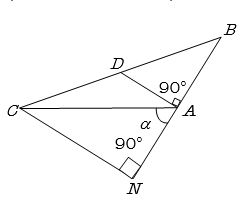
(C) Let $AD$ be the median through $A$ to the side $BC$. We are given that $AD \perp AB$,so $\angle DAB = 90^{\circ}$.
Draw $CN \perp AB$ (produced). In $\Delta BCN$,$AD \parallel CN$ because both are perpendicular to $AB$.
Since $D$ is the midpoint of $BC$,by the intercept theorem,$A$ is the midpoint of $BN$,so $AB = AN$.
In $\Delta ACN$,$\angle CAN = \alpha$. Then $\angle CAB = 180^{\circ} - \alpha$,so $\tan A = \tan(180^{\circ} - \alpha) = -\tan \alpha$.
In $\Delta ACN$,$\tan \alpha = \frac{CN}{AN}$.
In $\Delta ABD$,$\tan B = \frac{AD}{AB}$.
Since $AD = \frac{1}{2}CN$ and $AB = AN$,we have $\tan \alpha = \frac{2AD}{AB} = 2\tan B$.
Therefore,$\tan A = -2\tan B$,which implies $\tan A + 2\tan B = 0$.
Draw $CN \perp AB$ (produced). In $\Delta BCN$,$AD \parallel CN$ because both are perpendicular to $AB$.
Since $D$ is the midpoint of $BC$,by the intercept theorem,$A$ is the midpoint of $BN$,so $AB = AN$.
In $\Delta ACN$,$\angle CAN = \alpha$. Then $\angle CAB = 180^{\circ} - \alpha$,so $\tan A = \tan(180^{\circ} - \alpha) = -\tan \alpha$.
In $\Delta ACN$,$\tan \alpha = \frac{CN}{AN}$.
In $\Delta ABD$,$\tan B = \frac{AD}{AB}$.
Since $AD = \frac{1}{2}CN$ and $AB = AN$,we have $\tan \alpha = \frac{2AD}{AB} = 2\tan B$.
Therefore,$\tan A = -2\tan B$,which implies $\tan A + 2\tan B = 0$.
0 likes
View Solution110
MediumMCQ
If in a triangle $ABC$ right-angled at $B$,$s - a = 3$ and $s - c = 2$,then the values of $a$ and $c$ are respectively:
A
$2, 3$
B
$3, 4$
C
$4, 3$
D
$6, 8$
Solution
(B) Given $s - a = 3$ and $s - c = 2$,where $s = \frac{a+b+c}{2}$.
$s - a = \frac{b+c-a}{2} = 3 \Rightarrow b+c-a = 6$ ... $(i)$
$s - c = \frac{a+b-c}{2} = 2 \Rightarrow a+b-c = 4$ ... $(ii)$
Adding $(i)$ and $(ii)$,we get $2b = 10 \Rightarrow b = 5$.
Since the triangle is right-angled at $B$,by Pythagoras theorem,$a^2 + c^2 = b^2 = 25$ ... $(iii)$.
From $(i)$,$c - a = 6 - b = 6 - 5 = 1 \Rightarrow c = a + 1$.
Substituting into $(iii)$: $a^2 + (a+1)^2 = 25$ $\Rightarrow a^2 + a^2 + 2a + 1 = 25$ $\Rightarrow 2a^2 + 2a - 24 = 0$ $\Rightarrow a^2 + a - 12 = 0$.
$(a+4)(a-3) = 0$. Since $a > 0$,$a = 3$.
Then $c = a + 1 = 4$.
Thus,the values are $a = 3$ and $c = 4$.
$s - a = \frac{b+c-a}{2} = 3 \Rightarrow b+c-a = 6$ ... $(i)$
$s - c = \frac{a+b-c}{2} = 2 \Rightarrow a+b-c = 4$ ... $(ii)$
Adding $(i)$ and $(ii)$,we get $2b = 10 \Rightarrow b = 5$.
Since the triangle is right-angled at $B$,by Pythagoras theorem,$a^2 + c^2 = b^2 = 25$ ... $(iii)$.
From $(i)$,$c - a = 6 - b = 6 - 5 = 1 \Rightarrow c = a + 1$.
Substituting into $(iii)$: $a^2 + (a+1)^2 = 25$ $\Rightarrow a^2 + a^2 + 2a + 1 = 25$ $\Rightarrow 2a^2 + 2a - 24 = 0$ $\Rightarrow a^2 + a - 12 = 0$.
$(a+4)(a-3) = 0$. Since $a > 0$,$a = 3$.
Then $c = a + 1 = 4$.
Thus,the values are $a = 3$ and $c = 4$.
0 likes
View Solution111
EasyMCQ
We are given $b, c$ and $\sin B$ such that $B$ is acute and $b < c \sin B$. Then
A
No triangle is possible
B
One triangle is possible
C
Two triangles are possible
D
$A$ right angled triangle is possible
Solution
(A) Using the Sine Rule,we have $\frac{\sin B}{b} = \frac{\sin C}{c}$.
Rearranging for $\sin C$,we get $\sin C = \frac{c}{b} \sin B$.
Given the condition $b < c \sin B$,we can rewrite this as $\frac{c}{b} \sin B > 1$.
Therefore,$\sin C > 1$,which is impossible because the value of the sine function cannot exceed $1$.
Hence,no triangle is possible.
Rearranging for $\sin C$,we get $\sin C = \frac{c}{b} \sin B$.
Given the condition $b < c \sin B$,we can rewrite this as $\frac{c}{b} \sin B > 1$.
Therefore,$\sin C > 1$,which is impossible because the value of the sine function cannot exceed $1$.
Hence,no triangle is possible.
0 likes
View Solution112
DifficultMCQ
In a $\Delta ABC$,$a, c, A$ are given and $b_1, b_2$ are two values of the third side $b$ such that $b_2 = 2b_1$. Then $\sin A = $
A
$\sqrt{\frac{9a^2 - c^2}{8a^2}}$
B
$\sqrt{\frac{9a^2 - c^2}{8c^2}}$
C
$\sqrt{\frac{9a^2 + c^2}{8a^2}}$
D
None of these
Solution
(B) Using the Law of Cosines,we have $\cos A = \frac{b^2 + c^2 - a^2}{2bc}$.
This rearranges to the quadratic equation in $b$: $b^2 - (2c \cos A)b + (c^2 - a^2) = 0$.
Given that $b_1$ and $b_2$ are the roots of this equation,we have $b_1 + b_2 = 2c \cos A$ and $b_1 b_2 = c^2 - a^2$.
Since $b_2 = 2b_1$,we get $3b_1 = 2c \cos A \Rightarrow b_1 = \frac{2c \cos A}{3}$ and $2b_1^2 = c^2 - a^2$.
Substituting $b_1$ into the second equation: $2(\frac{2c \cos A}{3})^2 = c^2 - a^2$.
$2(\frac{4c^2 \cos^2 A}{9}) = c^2 - a^2 \Rightarrow 8c^2 \cos^2 A = 9(c^2 - a^2)$.
Using $\cos^2 A = 1 - \sin^2 A$,we get $8c^2(1 - \sin^2 A) = 9c^2 - 9a^2$.
$8c^2 - 8c^2 \sin^2 A = 9c^2 - 9a^2 \Rightarrow 8c^2 \sin^2 A = 9a^2 - c^2$.
Therefore,$\sin A = \sqrt{\frac{9a^2 - c^2}{8c^2}}$.
This rearranges to the quadratic equation in $b$: $b^2 - (2c \cos A)b + (c^2 - a^2) = 0$.
Given that $b_1$ and $b_2$ are the roots of this equation,we have $b_1 + b_2 = 2c \cos A$ and $b_1 b_2 = c^2 - a^2$.
Since $b_2 = 2b_1$,we get $3b_1 = 2c \cos A \Rightarrow b_1 = \frac{2c \cos A}{3}$ and $2b_1^2 = c^2 - a^2$.
Substituting $b_1$ into the second equation: $2(\frac{2c \cos A}{3})^2 = c^2 - a^2$.
$2(\frac{4c^2 \cos^2 A}{9}) = c^2 - a^2 \Rightarrow 8c^2 \cos^2 A = 9(c^2 - a^2)$.
Using $\cos^2 A = 1 - \sin^2 A$,we get $8c^2(1 - \sin^2 A) = 9c^2 - 9a^2$.
$8c^2 - 8c^2 \sin^2 A = 9c^2 - 9a^2 \Rightarrow 8c^2 \sin^2 A = 9a^2 - c^2$.
Therefore,$\sin A = \sqrt{\frac{9a^2 - c^2}{8c^2}}$.
0 likes
View Solution113
EasyMCQ
In a $\Delta ABC$,$a, b, A$ are given and $c_1, c_2$ are two values of the third side $c$. The sum of the areas of the two triangles with sides $(a, b, c_1)$ and $(a, b, c_2)$ is
A
$\frac{1}{2}b^2 \sin 2A$
B
$\frac{1}{2}a^2 \sin 2A$
C
$b^2 \sin 2A$
D
None of these
Solution
(A) Using the Law of Cosines,we have $\cos A = \frac{c^2 + b^2 - a^2}{2bc}$.
This rearranges to the quadratic equation in $c$: $c^2 - (2b \cos A)c + (b^2 - a^2) = 0$.
Since $c_1$ and $c_2$ are the roots of this equation,we have $c_1 + c_2 = 2b \cos A$ and $c_1 c_2 = b^2 - a^2$.
The area of a triangle with sides $a, b$ and included angle $C$ is $\frac{1}{2}ab \sin C$.
The sum of the areas of the two triangles is $S = \frac{1}{2}ab \sin C_1 + \frac{1}{2}ab \sin C_2 = \frac{1}{2}ab(\sin C_1 + \sin C_2)$.
From the Law of Sines,$\frac{c}{\sin C} = \frac{b}{\sin B} = \frac{a}{\sin A} = 2R$,so $\sin C = \frac{c \sin A}{a}$.
Thus,$\sin C_1 + \sin C_2 = \frac{(c_1 + c_2) \sin A}{a} = \frac{(2b \cos A) \sin A}{a} = \frac{b \sin 2A}{a}$.
Substituting this into the sum of areas: $S = \frac{1}{2}ab \left( \frac{b \sin 2A}{a} \right) = \frac{1}{2}b^2 \sin 2A$.
This rearranges to the quadratic equation in $c$: $c^2 - (2b \cos A)c + (b^2 - a^2) = 0$.
Since $c_1$ and $c_2$ are the roots of this equation,we have $c_1 + c_2 = 2b \cos A$ and $c_1 c_2 = b^2 - a^2$.
The area of a triangle with sides $a, b$ and included angle $C$ is $\frac{1}{2}ab \sin C$.
The sum of the areas of the two triangles is $S = \frac{1}{2}ab \sin C_1 + \frac{1}{2}ab \sin C_2 = \frac{1}{2}ab(\sin C_1 + \sin C_2)$.
From the Law of Sines,$\frac{c}{\sin C} = \frac{b}{\sin B} = \frac{a}{\sin A} = 2R$,so $\sin C = \frac{c \sin A}{a}$.
Thus,$\sin C_1 + \sin C_2 = \frac{(c_1 + c_2) \sin A}{a} = \frac{(2b \cos A) \sin A}{a} = \frac{b \sin 2A}{a}$.
Substituting this into the sum of areas: $S = \frac{1}{2}ab \left( \frac{b \sin 2A}{a} \right) = \frac{1}{2}b^2 \sin 2A$.
0 likes
View Solution114
EasyMCQ
If in a triangle $ABC$,$2\cos A = \sin B \csc C$,then
A
$a = b$
B
$b = c$
C
$c = a$
D
$2a = bc$
Solution
(C) Given the equation: $2 \cos A = \sin B \csc C$
Using the sine rule,$\frac{\sin B}{b} = \frac{\sin C}{c}$,so $\frac{\sin B}{\sin C} = \frac{b}{c}$.
Substituting this into the given equation: $2 \cos A = \frac{b}{c}$.
Using the cosine rule,$\cos A = \frac{b^2 + c^2 - a^2}{2bc}$.
Substituting $\cos A$ into the equation: $2 \left( \frac{b^2 + c^2 - a^2}{2bc} \right) = \frac{b}{c}$.
$\frac{b^2 + c^2 - a^2}{bc} = \frac{b}{c}$.
Multiplying both sides by $bc$: $b^2 + c^2 - a^2 = b^2$.
$c^2 - a^2 = 0 \Rightarrow c^2 = a^2$.
Since $a$ and $c$ are side lengths of a triangle,$c = a$.
Using the sine rule,$\frac{\sin B}{b} = \frac{\sin C}{c}$,so $\frac{\sin B}{\sin C} = \frac{b}{c}$.
Substituting this into the given equation: $2 \cos A = \frac{b}{c}$.
Using the cosine rule,$\cos A = \frac{b^2 + c^2 - a^2}{2bc}$.
Substituting $\cos A$ into the equation: $2 \left( \frac{b^2 + c^2 - a^2}{2bc} \right) = \frac{b}{c}$.
$\frac{b^2 + c^2 - a^2}{bc} = \frac{b}{c}$.
Multiplying both sides by $bc$: $b^2 + c^2 - a^2 = b^2$.
$c^2 - a^2 = 0 \Rightarrow c^2 = a^2$.
Since $a$ and $c$ are side lengths of a triangle,$c = a$.
0 likes
View Solution115
MediumMCQ
If the sides of a triangle are $3, 5, 7$,then
A
All its angles are acute
B
One angle is obtuse
C
Triangle is right angled
D
None of these
Solution
(B) Let the sides be $a = 3$,$b = 5$,and $c = 7$.
To determine the nature of the triangle,we calculate the cosine of the largest angle,which is opposite the longest side $(c = 7)$.
Using the Law of Cosines: $\cos C = \frac{a^2 + b^2 - c^2}{2ab}$.
Substituting the values: $\cos C = \frac{3^2 + 5^2 - 7^2}{2 \times 3 \times 5} = \frac{9 + 25 - 49}{30} = \frac{34 - 49}{30} = \frac{-15}{30} = -\frac{1}{2}$.
Since $\cos C = -\frac{1}{2}$,the angle $C = 120^{\circ}$.
Because $C > 90^{\circ}$,the triangle has one obtuse angle.
To determine the nature of the triangle,we calculate the cosine of the largest angle,which is opposite the longest side $(c = 7)$.
Using the Law of Cosines: $\cos C = \frac{a^2 + b^2 - c^2}{2ab}$.
Substituting the values: $\cos C = \frac{3^2 + 5^2 - 7^2}{2 \times 3 \times 5} = \frac{9 + 25 - 49}{30} = \frac{34 - 49}{30} = \frac{-15}{30} = -\frac{1}{2}$.
Since $\cos C = -\frac{1}{2}$,the angle $C = 120^{\circ}$.
Because $C > 90^{\circ}$,the triangle has one obtuse angle.
0 likes
View Solution116
DifficultMCQ
In a triangle $PQR$,if $\sin P, \sin Q, \sin R$ are in $A.P.$,then
A
The altitudes are in $A.P.$
B
The altitudes are in $H.P.$
C
The medians are in $G.P.$
D
The medians are in $A.P.$
Solution
(B) Given that $\sin P, \sin Q, \sin R$ are in $A.P.$
By the Sine Rule,$\frac{a}{\sin P} = \frac{b}{\sin Q} = \frac{c}{\sin R} = 2R$,where $R$ is the circumradius.
This implies $\sin P = \frac{a}{2R}, \sin Q = \frac{b}{2R}, \sin R = \frac{c}{2R}$.
Since $\sin P, \sin Q, \sin R$ are in $A.P.$,it follows that $a, b, c$ are in $A.P.$
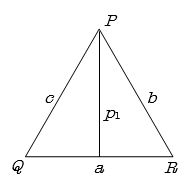
Let $p_1, p_2, p_3$ be the altitudes from vertices $P, Q, R$ respectively.
The area of the triangle $\Delta = \frac{1}{2} a p_1 = \frac{1}{2} b p_2 = \frac{1}{2} c p_3$.
Thus,$p_1 = \frac{2\Delta}{a}, p_2 = \frac{2\Delta}{b}, p_3 = \frac{2\Delta}{c}$.
Since $a, b, c$ are in $A.P.$,their reciprocals $\frac{1}{a}, \frac{1}{b}, \frac{1}{c}$ are in $H.P.$
Multiplying by $2\Delta$,we get $\frac{2\Delta}{a}, \frac{2\Delta}{b}, \frac{2\Delta}{c}$ are in $H.P.$
Therefore,$p_1, p_2, p_3$ are in $H.P.$
By the Sine Rule,$\frac{a}{\sin P} = \frac{b}{\sin Q} = \frac{c}{\sin R} = 2R$,where $R$ is the circumradius.
This implies $\sin P = \frac{a}{2R}, \sin Q = \frac{b}{2R}, \sin R = \frac{c}{2R}$.
Since $\sin P, \sin Q, \sin R$ are in $A.P.$,it follows that $a, b, c$ are in $A.P.$
Let $p_1, p_2, p_3$ be the altitudes from vertices $P, Q, R$ respectively.
The area of the triangle $\Delta = \frac{1}{2} a p_1 = \frac{1}{2} b p_2 = \frac{1}{2} c p_3$.
Thus,$p_1 = \frac{2\Delta}{a}, p_2 = \frac{2\Delta}{b}, p_3 = \frac{2\Delta}{c}$.
Since $a, b, c$ are in $A.P.$,their reciprocals $\frac{1}{a}, \frac{1}{b}, \frac{1}{c}$ are in $H.P.$
Multiplying by $2\Delta$,we get $\frac{2\Delta}{a}, \frac{2\Delta}{b}, \frac{2\Delta}{c}$ are in $H.P.$
Therefore,$p_1, p_2, p_3$ are in $H.P.$
0 likes
View Solution117
DifficultMCQ
In a $\Delta ABC,$ if $\frac{\sin A}{\sin C} = \frac{\sin (A - B)}{\sin (B - C)},$ then $a^2, b^2, c^2$ are in
A
$A.P.$
B
$G.P.$
C
$H.P.$
D
None of these
Solution
(A) Given $\frac{\sin A}{\sin C} = \frac{\sin (A - B)}{\sin (B - C)}$.
Using the sine rule $\frac{a}{\sin A} = \frac{b}{\sin B} = \frac{c}{\sin C} = 2R$,we have $\sin A = \frac{a}{2R}, \sin B = \frac{b}{2R}, \sin C = \frac{c}{2R}$.
Substituting these,we get $\frac{a}{c} = \frac{\sin A \cos B - \cos A \sin B}{\sin B \cos C - \cos B \sin C}$.
Using the projection formula $a = b \cos C + c \cos B$,we have $\cos C = \frac{a^2 + b^2 - c^2}{2ab}$ and $\cos A = \frac{b^2 + c^2 - a^2}{2bc}$.
Cross-multiplying: $a(\sin B \cos C - \cos B \sin C) = c(\sin A \cos B - \cos A \sin B)$.
Using $\sin A = \frac{a}{2R}$,etc.,this simplifies to $a(b \cos C - c \cos B) = c(a \cos B - b \cos A)$.
$ab \cos C - ac \cos B = ac \cos B - bc \cos A$.
$ab \cos C + bc \cos A = 2ac \cos B$.
Substituting $\cos C = \frac{a^2+b^2-c^2}{2ab}$ and $\cos A = \frac{b^2+c^2-a^2}{2bc}$ and $\cos B = \frac{a^2+c^2-b^2}{2ac}$:
$ab(\frac{a^2+b^2-c^2}{2ab}) + bc(\frac{b^2+c^2-a^2}{2bc}) = 2ac(\frac{a^2+c^2-b^2}{2ac})$.
$\frac{a^2+b^2-c^2}{2} + \frac{b^2+c^2-a^2}{2} = a^2+c^2-b^2$.
$\frac{2b^2}{2} = a^2+c^2-b^2$.
$b^2 = a^2+c^2-b^2 \implies 2b^2 = a^2+c^2$.
Thus,$a^2, b^2, c^2$ are in $A.P.$
Using the sine rule $\frac{a}{\sin A} = \frac{b}{\sin B} = \frac{c}{\sin C} = 2R$,we have $\sin A = \frac{a}{2R}, \sin B = \frac{b}{2R}, \sin C = \frac{c}{2R}$.
Substituting these,we get $\frac{a}{c} = \frac{\sin A \cos B - \cos A \sin B}{\sin B \cos C - \cos B \sin C}$.
Using the projection formula $a = b \cos C + c \cos B$,we have $\cos C = \frac{a^2 + b^2 - c^2}{2ab}$ and $\cos A = \frac{b^2 + c^2 - a^2}{2bc}$.
Cross-multiplying: $a(\sin B \cos C - \cos B \sin C) = c(\sin A \cos B - \cos A \sin B)$.
Using $\sin A = \frac{a}{2R}$,etc.,this simplifies to $a(b \cos C - c \cos B) = c(a \cos B - b \cos A)$.
$ab \cos C - ac \cos B = ac \cos B - bc \cos A$.
$ab \cos C + bc \cos A = 2ac \cos B$.
Substituting $\cos C = \frac{a^2+b^2-c^2}{2ab}$ and $\cos A = \frac{b^2+c^2-a^2}{2bc}$ and $\cos B = \frac{a^2+c^2-b^2}{2ac}$:
$ab(\frac{a^2+b^2-c^2}{2ab}) + bc(\frac{b^2+c^2-a^2}{2bc}) = 2ac(\frac{a^2+c^2-b^2}{2ac})$.
$\frac{a^2+b^2-c^2}{2} + \frac{b^2+c^2-a^2}{2} = a^2+c^2-b^2$.
$\frac{2b^2}{2} = a^2+c^2-b^2$.
$b^2 = a^2+c^2-b^2 \implies 2b^2 = a^2+c^2$.
Thus,$a^2, b^2, c^2$ are in $A.P.$
0 likes
View Solution118
MediumMCQ
If in a triangle $ABC$,$a, b, c$ are sides and angle $A$ is given,and $c \sin A < a < c$,and $b_1$ and $b_2$ are two possible values of $b$,then:
A
$b_1 + b_2 = 2c \cos A$
B
$b_1 + b_2 = c \cos A$
C
$b_1 + b_2 = 3c \cos A$
D
$b_1 + b_2 = 4c \sin A$
Solution
(A) Using the Law of Cosines: $\cos A = \frac{b^2 + c^2 - a^2}{2bc}$.
Rearranging the terms,we get the quadratic equation in $b$: $b^2 - (2c \cos A)b + (c^2 - a^2) = 0$.
Since $c \sin A < a < c$,the quadratic equation has two distinct positive roots,$b_1$ and $b_2$.
According to the properties of quadratic equations,the sum of the roots is given by the negative of the coefficient of $b$ divided by the coefficient of $b^2$.
Therefore,$b_1 + b_2 = -(-(2c \cos A)) / 1 = 2c \cos A$.
Rearranging the terms,we get the quadratic equation in $b$: $b^2 - (2c \cos A)b + (c^2 - a^2) = 0$.
Since $c \sin A < a < c$,the quadratic equation has two distinct positive roots,$b_1$ and $b_2$.
According to the properties of quadratic equations,the sum of the roots is given by the negative of the coefficient of $b$ divided by the coefficient of $b^2$.
Therefore,$b_1 + b_2 = -(-(2c \cos A)) / 1 = 2c \cos A$.
0 likes
View Solution119
MediumMCQ
In $\Delta ABC,$ if ${a^2} + {b^2} + {c^2} = ac + ab\sqrt{3},$ then the triangle is:
A
Equilateral
B
Isosceles
C
Right angled
D
None of these
Solution
(C) Given,${a^2} + {b^2} + {c^2} = ac + ab\sqrt{3}$
Rearranging the terms,we get: ${a^2} + {b^2} + {c^2} - ac - ab\sqrt{3} = 0$
We can rewrite this as: $\left(\frac{a^2}{4} - ac + c^2\right) + \left(\frac{3a^2}{4} - ab\sqrt{3} + b^2\right) = 0$
This simplifies to: ${\left(\frac{a}{2} - c\right)^2} + {\left(\frac{a\sqrt{3}}{2} - b\right)^2} = 0$
For the sum of squares to be zero,each term must be zero:
$\frac{a}{2} - c = 0 \implies a = 2c$
$\frac{a\sqrt{3}}{2} - b = 0 \implies b = \frac{a\sqrt{3}}{2}$
Now,check the relation between sides: ${b^2} + {c^2} = {\left(\frac{a\sqrt{3}}{2}\right)^2} + {\left(\frac{a}{2}\right)^2} = \frac{3a^2}{4} + \frac{a^2}{4} = \frac{4a^2}{4} = {a^2}$
Since ${b^2} + {c^2} = {a^2},$ the triangle is right-angled.
Rearranging the terms,we get: ${a^2} + {b^2} + {c^2} - ac - ab\sqrt{3} = 0$
We can rewrite this as: $\left(\frac{a^2}{4} - ac + c^2\right) + \left(\frac{3a^2}{4} - ab\sqrt{3} + b^2\right) = 0$
This simplifies to: ${\left(\frac{a}{2} - c\right)^2} + {\left(\frac{a\sqrt{3}}{2} - b\right)^2} = 0$
For the sum of squares to be zero,each term must be zero:
$\frac{a}{2} - c = 0 \implies a = 2c$
$\frac{a\sqrt{3}}{2} - b = 0 \implies b = \frac{a\sqrt{3}}{2}$
Now,check the relation between sides: ${b^2} + {c^2} = {\left(\frac{a\sqrt{3}}{2}\right)^2} + {\left(\frac{a}{2}\right)^2} = \frac{3a^2}{4} + \frac{a^2}{4} = \frac{4a^2}{4} = {a^2}$
Since ${b^2} + {c^2} = {a^2},$ the triangle is right-angled.
0 likes
View Solution120
MediumMCQ
The area of triangle $ABC$,in which $a = 1$,$b = 2$,and $\angle C = 60^\circ$ is
A
$\frac{1}{2}$
B
$\sqrt{3}$
C
$\frac{\sqrt{3}}{2}$
D
$\frac{3}{2}$
Solution
(C) The area of a triangle is given by the formula: $\text{Area} = \frac{1}{2}ab \sin C$.
Given $a = 1$,$b = 2$,and $\angle C = 60^\circ$.
Substituting these values into the formula:
$\text{Area} = \frac{1}{2} \times 1 \times 2 \times \sin 60^\circ$.
Since $\sin 60^\circ = \frac{\sqrt{3}}{2}$,we have:
$\text{Area} = 1 \times \frac{\sqrt{3}}{2} = \frac{\sqrt{3}}{2}$.
Given $a = 1$,$b = 2$,and $\angle C = 60^\circ$.
Substituting these values into the formula:
$\text{Area} = \frac{1}{2} \times 1 \times 2 \times \sin 60^\circ$.
Since $\sin 60^\circ = \frac{\sqrt{3}}{2}$,we have:
$\text{Area} = 1 \times \frac{\sqrt{3}}{2} = \frac{\sqrt{3}}{2}$.
0 likes
View Solution121
MediumMCQ
In a triangle $ABC$,if $b + c = 2a$ and $\angle A = 60^\circ$,then $\Delta ABC$ is
A
Scalene
B
Equilateral
C
Isosceles
D
Right angled
Solution
(B) Given $b + c = 2a$ .....$(i)$
Using the Law of Cosines: $\cos A = \frac{b^2 + c^2 - a^2}{2bc}$
Since $\angle A = 60^\circ$,we have $\frac{1}{2} = \frac{b^2 + c^2 - a^2}{2bc}$
$bc = b^2 + c^2 - a^2$
$a^2 = b^2 + c^2 - bc$
From $(i)$,$a = \frac{b+c}{2}$,so $a^2 = \frac{(b+c)^2}{4} = \frac{b^2 + c^2 + 2bc}{4}$
Equating the two expressions for $a^2$: $\frac{b^2 + c^2 + 2bc}{4} = b^2 + c^2 - bc$
$b^2 + c^2 + 2bc = 4b^2 + 4c^2 - 4bc$
$3b^2 + 3c^2 - 6bc = 0$
$3(b^2 + c^2 - 2bc) = 0$
$3(b - c)^2 = 0$
Thus,$b = c$.
Substituting $b = c$ into $(i)$,$2b = 2a \implies b = a$.
Since $a = b = c$,the triangle is equilateral.
Using the Law of Cosines: $\cos A = \frac{b^2 + c^2 - a^2}{2bc}$
Since $\angle A = 60^\circ$,we have $\frac{1}{2} = \frac{b^2 + c^2 - a^2}{2bc}$
$bc = b^2 + c^2 - a^2$
$a^2 = b^2 + c^2 - bc$
From $(i)$,$a = \frac{b+c}{2}$,so $a^2 = \frac{(b+c)^2}{4} = \frac{b^2 + c^2 + 2bc}{4}$
Equating the two expressions for $a^2$: $\frac{b^2 + c^2 + 2bc}{4} = b^2 + c^2 - bc$
$b^2 + c^2 + 2bc = 4b^2 + 4c^2 - 4bc$
$3b^2 + 3c^2 - 6bc = 0$
$3(b^2 + c^2 - 2bc) = 0$
$3(b - c)^2 = 0$
Thus,$b = c$.
Substituting $b = c$ into $(i)$,$2b = 2a \implies b = a$.
Since $a = b = c$,the triangle is equilateral.
0 likes
View Solution122
MediumMCQ
If in a $\Delta ABC$,the altitudes from the vertices $A, B, C$ on opposite sides are in $H.P.$,then $\sin A, \sin B, \sin C$ are in
A
$A.G.P.$
B
$H.P.$
C
$G.P.$
D
$A.P.$
Solution
(D) Let the altitudes from vertices $A, B, C$ be $h_a, h_b, h_c$ respectively.
We know that $h_a = \frac{2\Delta}{a}$,$h_b = \frac{2\Delta}{b}$,and $h_c = \frac{2\Delta}{c}$,where $\Delta$ is the area of the triangle.
Given that $h_a, h_b, h_c$ are in $H.P.$,we have $\frac{2\Delta}{a}, \frac{2\Delta}{b}, \frac{2\Delta}{c}$ are in $H.P.$
This implies that $\frac{1}{a}, \frac{1}{b}, \frac{1}{c}$ are in $H.P.$
Therefore,$a, b, c$ are in $A.P.$
By the Sine Rule,$\frac{a}{\sin A} = \frac{b}{\sin B} = \frac{c}{\sin C} = 2R$.
Thus,$a = 2R \sin A$,$b = 2R \sin B$,and $c = 2R \sin C$.
Since $a, b, c$ are in $A.P.$,it follows that $2R \sin A, 2R \sin B, 2R \sin C$ are in $A.P.$
Hence,$\sin A, \sin B, \sin C$ are in $A.P.$
We know that $h_a = \frac{2\Delta}{a}$,$h_b = \frac{2\Delta}{b}$,and $h_c = \frac{2\Delta}{c}$,where $\Delta$ is the area of the triangle.
Given that $h_a, h_b, h_c$ are in $H.P.$,we have $\frac{2\Delta}{a}, \frac{2\Delta}{b}, \frac{2\Delta}{c}$ are in $H.P.$
This implies that $\frac{1}{a}, \frac{1}{b}, \frac{1}{c}$ are in $H.P.$
Therefore,$a, b, c$ are in $A.P.$
By the Sine Rule,$\frac{a}{\sin A} = \frac{b}{\sin B} = \frac{c}{\sin C} = 2R$.
Thus,$a = 2R \sin A$,$b = 2R \sin B$,and $c = 2R \sin C$.
Since $a, b, c$ are in $A.P.$,it follows that $2R \sin A, 2R \sin B, 2R \sin C$ are in $A.P.$
Hence,$\sin A, \sin B, \sin C$ are in $A.P.$
0 likes
View Solution123
MediumMCQ
If $a, b$ and $c$ are the sides of a triangle such that $a^4 + b^4 + c^4 = 2c^2(a^2 + b^2)$,then the angle opposite to the side $c$ is:
A
$45^\circ$ or $135^\circ$
B
$30^\circ$ or $100^\circ$
C
$50^\circ$ or $100^\circ$
D
$60^\circ$ or $120^\circ$
Solution
(A) Given the equation: $a^4 + b^4 + c^4 = 2c^2(a^2 + b^2)$
Rearranging the terms: $a^4 + b^4 + c^4 - 2a^2c^2 - 2b^2c^2 = 0$
Adding $2a^2b^2$ to both sides: $a^4 + b^4 + c^4 - 2a^2c^2 - 2b^2c^2 + 2a^2b^2 = 2a^2b^2$
This simplifies to: $(a^2 + b^2 - c^2)^2 = 2a^2b^2$
Taking the square root: $a^2 + b^2 - c^2 = \pm \sqrt{2}ab$
Dividing by $2ab$: $\frac{a^2 + b^2 - c^2}{2ab} = \pm \frac{\sqrt{2}ab}{2ab} = \pm \frac{1}{\sqrt{2}}$
By the Law of Cosines,$\cos C = \frac{a^2 + b^2 - c^2}{2ab}$,so $\cos C = \pm \frac{1}{\sqrt{2}}$
Therefore,$C = 45^\circ$ or $C = 135^\circ$.
Rearranging the terms: $a^4 + b^4 + c^4 - 2a^2c^2 - 2b^2c^2 = 0$
Adding $2a^2b^2$ to both sides: $a^4 + b^4 + c^4 - 2a^2c^2 - 2b^2c^2 + 2a^2b^2 = 2a^2b^2$
This simplifies to: $(a^2 + b^2 - c^2)^2 = 2a^2b^2$
Taking the square root: $a^2 + b^2 - c^2 = \pm \sqrt{2}ab$
Dividing by $2ab$: $\frac{a^2 + b^2 - c^2}{2ab} = \pm \frac{\sqrt{2}ab}{2ab} = \pm \frac{1}{\sqrt{2}}$
By the Law of Cosines,$\cos C = \frac{a^2 + b^2 - c^2}{2ab}$,so $\cos C = \pm \frac{1}{\sqrt{2}}$
Therefore,$C = 45^\circ$ or $C = 135^\circ$.
0 likes
View Solution124
MediumMCQ
In a $\Delta ABC$,if the sides are $a = 3, b = 5$,and $c = 4$,then $\sin \frac{B}{2} + \cos \frac{B}{2}$ is equal to
A
$\sqrt{2}$
B
$\frac{\sqrt{3} + 1}{2}$
C
$\frac{\sqrt{3} - 1}{2}$
D
$1$
Solution
(A) Given sides are $a = 3, b = 5, c = 4$.
First,calculate the semi-perimeter $s$:
$s = \frac{a + b + c}{2} = \frac{3 + 5 + 4}{2} = \frac{12}{2} = 6$.
Using the half-angle formulas for a triangle:
$\sin \frac{B}{2} = \sqrt{\frac{(s - a)(s - c)}{ac}} = \sqrt{\frac{(6 - 3)(6 - 4)}{3 \times 4}} = \sqrt{\frac{3 \times 2}{12}} = \sqrt{\frac{6}{12}} = \sqrt{\frac{1}{2}} = \frac{1}{\sqrt{2}}$.
$\cos \frac{B}{2} = \sqrt{\frac{s(s - b)}{ac}} = \sqrt{\frac{6(6 - 5)}{3 \times 4}} = \sqrt{\frac{6 \times 1}{12}} = \sqrt{\frac{1}{2}} = \frac{1}{\sqrt{2}}$.
Therefore,$\sin \frac{B}{2} + \cos \frac{B}{2} = \frac{1}{\sqrt{2}} + \frac{1}{\sqrt{2}} = \frac{2}{\sqrt{2}} = \sqrt{2}$.
First,calculate the semi-perimeter $s$:
$s = \frac{a + b + c}{2} = \frac{3 + 5 + 4}{2} = \frac{12}{2} = 6$.
Using the half-angle formulas for a triangle:
$\sin \frac{B}{2} = \sqrt{\frac{(s - a)(s - c)}{ac}} = \sqrt{\frac{(6 - 3)(6 - 4)}{3 \times 4}} = \sqrt{\frac{3 \times 2}{12}} = \sqrt{\frac{6}{12}} = \sqrt{\frac{1}{2}} = \frac{1}{\sqrt{2}}$.
$\cos \frac{B}{2} = \sqrt{\frac{s(s - b)}{ac}} = \sqrt{\frac{6(6 - 5)}{3 \times 4}} = \sqrt{\frac{6 \times 1}{12}} = \sqrt{\frac{1}{2}} = \frac{1}{\sqrt{2}}$.
Therefore,$\sin \frac{B}{2} + \cos \frac{B}{2} = \frac{1}{\sqrt{2}} + \frac{1}{\sqrt{2}} = \frac{2}{\sqrt{2}} = \sqrt{2}$.
0 likes
View Solution125
EasyMCQ
Which of the following is true in a triangle $ABC$?
A
$(b + c)\sin \frac{B - C}{2} = 2a\cos \frac{A}{2}$
B
$(b + c)\cos \frac{A}{2} = 2a\sin \frac{B - C}{2}$
C
$(b - c)\cos \frac{A}{2} = a\sin \frac{B - C}{2}$
D
$(b - c)\sin \frac{B - C}{2} = 2a\cos \frac{A}{2}$
Solution
(C) Using the Sine Rule,we have $\frac{a}{\sin A} = \frac{b}{\sin B} = \frac{c}{\sin C} = k$.
Thus,$a = k\sin A$,$b = k\sin B$,and $c = k\sin C$.
Consider the expression $\frac{b - c}{a} = \frac{\sin B - \sin C}{\sin A}$.
Using the sum-to-product formula,$\sin B - \sin C = 2\sin \frac{B - C}{2} \cos \frac{B + C}{2}$.
Since $A + B + C = \pi$,we have $\frac{B + C}{2} = \frac{\pi}{2} - \frac{A}{2}$,so $\cos \frac{B + C}{2} = \sin \frac{A}{2}$.
Also,$\sin A = 2\sin \frac{A}{2} \cos \frac{A}{2}$.
Substituting these into the expression:
$\frac{b - c}{a} = \frac{2\sin \frac{B - C}{2} \sin \frac{A}{2}}{2\sin \frac{A}{2} \cos \frac{A}{2}} = \frac{\sin \frac{B - C}{2}}{\cos \frac{A}{2}}$.
Rearranging gives $(b - c)\cos \frac{A}{2} = a\sin \frac{B - C}{2}$.
Thus,$a = k\sin A$,$b = k\sin B$,and $c = k\sin C$.
Consider the expression $\frac{b - c}{a} = \frac{\sin B - \sin C}{\sin A}$.
Using the sum-to-product formula,$\sin B - \sin C = 2\sin \frac{B - C}{2} \cos \frac{B + C}{2}$.
Since $A + B + C = \pi$,we have $\frac{B + C}{2} = \frac{\pi}{2} - \frac{A}{2}$,so $\cos \frac{B + C}{2} = \sin \frac{A}{2}$.
Also,$\sin A = 2\sin \frac{A}{2} \cos \frac{A}{2}$.
Substituting these into the expression:
$\frac{b - c}{a} = \frac{2\sin \frac{B - C}{2} \sin \frac{A}{2}}{2\sin \frac{A}{2} \cos \frac{A}{2}} = \frac{\sin \frac{B - C}{2}}{\cos \frac{A}{2}}$.
Rearranging gives $(b - c)\cos \frac{A}{2} = a\sin \frac{B - C}{2}$.
0 likes
View Solution126
DifficultMCQ
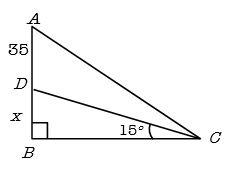
$ABC$ is a right-angled isosceles triangle with $\angle B = 90^\circ$. If $D$ is a point on $AB$ such that $\angle DCB = 15^\circ$ and $AD = 35 \, cm$,then $CD = $
A
$35\sqrt{2} \, cm$
B
$70\sqrt{2} \, cm$
C
$\frac{35\sqrt{3}}{2} \, cm$
D
$35\sqrt{6} \, cm$
Solution
(A) In $\triangle ABC$,$\angle B = 90^\circ$ and it is isosceles,so $\angle CAB = \angle ACB = 45^\circ$.
Given $\angle DCB = 15^\circ$,then $\angle ACD = \angle ACB - \angle DCB = 45^\circ - 15^\circ = 30^\circ$.
In $\triangle DBC$,$\angle B = 90^\circ$ and $\angle DCB = 15^\circ$,so $\angle BDC = 75^\circ$.
Let $BC = h$. Since $\triangle ABC$ is isosceles,$AB = BC = h$.
Then $BD = AB - AD = h - 35$.
In $\triangle DBC$,$\tan(15^\circ) = \frac{BD}{BC} = \frac{h - 35}{h}$.
We know $\tan(15^\circ) = 2 - \sqrt{3}$.
$h(2 - \sqrt{3}) = h - 35 \implies h(1 - \sqrt{3}) = -35 \implies h = \frac{35}{\sqrt{3} - 1} = \frac{35(\sqrt{3} + 1)}{2}$.
Now,in $\triangle DBC$,$\cos(15^\circ) = \frac{BC}{CD} \implies CD = \frac{BC}{\cos(15^\circ)} = \frac{h}{\cos(15^\circ)}$.
Using $\cos(15^\circ) = \frac{\sqrt{6} + \sqrt{2}}{4}$,we get $CD = \frac{35(\sqrt{3} + 1)}{2} \times \frac{4}{\sqrt{6} + \sqrt{2}} = \frac{70(\sqrt{3} + 1)}{\sqrt{2}(\sqrt{3} + 1)} = \frac{70}{\sqrt{2}} = 35\sqrt{2} \, cm$.
Given $\angle DCB = 15^\circ$,then $\angle ACD = \angle ACB - \angle DCB = 45^\circ - 15^\circ = 30^\circ$.
In $\triangle DBC$,$\angle B = 90^\circ$ and $\angle DCB = 15^\circ$,so $\angle BDC = 75^\circ$.
Let $BC = h$. Since $\triangle ABC$ is isosceles,$AB = BC = h$.
Then $BD = AB - AD = h - 35$.
In $\triangle DBC$,$\tan(15^\circ) = \frac{BD}{BC} = \frac{h - 35}{h}$.
We know $\tan(15^\circ) = 2 - \sqrt{3}$.
$h(2 - \sqrt{3}) = h - 35 \implies h(1 - \sqrt{3}) = -35 \implies h = \frac{35}{\sqrt{3} - 1} = \frac{35(\sqrt{3} + 1)}{2}$.
Now,in $\triangle DBC$,$\cos(15^\circ) = \frac{BC}{CD} \implies CD = \frac{BC}{\cos(15^\circ)} = \frac{h}{\cos(15^\circ)}$.
Using $\cos(15^\circ) = \frac{\sqrt{6} + \sqrt{2}}{4}$,we get $CD = \frac{35(\sqrt{3} + 1)}{2} \times \frac{4}{\sqrt{6} + \sqrt{2}} = \frac{70(\sqrt{3} + 1)}{\sqrt{2}(\sqrt{3} + 1)} = \frac{70}{\sqrt{2}} = 35\sqrt{2} \, cm$.
0 likes
View Solution127
MediumMCQ
If in a triangle $ABC$,$a = 5$,$b = 4$,and $A = \frac{\pi}{2} + B$,then $C$ is:
A
$\tan^{-1}\left(\frac{1}{9}\right)$
B
$\tan^{-1}\left(\frac{1}{40}\right)$
C
Cannot be evaluated
D
$2\tan^{-1}\left(\frac{1}{9}\right)$
Solution
(D) Given $\frac{a}{\sin A} = \frac{b}{\sin B}$.
Substituting $a=5, b=4$ and $A = \frac{\pi}{2} + B$:
$\frac{5}{\sin(\frac{\pi}{2} + B)} = \frac{4}{\sin B} \implies \frac{5}{\cos B} = \frac{4}{\sin B}$.
Thus,$\tan B = \frac{4}{5}$.
Since $A = \frac{\pi}{2} + B$,$\tan A = \tan(\frac{\pi}{2} + B) = -\cot B = -\frac{5}{4}$.
In $\triangle ABC$,$C = \pi - (A + B)$.
$\tan C = \tan(\pi - (A + B)) = -\tan(A + B) = -\frac{\tan A + \tan B}{1 - \tan A \tan B}$.
Substituting values: $\tan C = -\frac{-\frac{5}{4} + \frac{4}{5}}{1 - (-\frac{5}{4})(\frac{4}{5})} = -\frac{-\frac{25}{20} + \frac{16}{20}}{1 + 1} = -\frac{-\frac{9}{20}}{2} = \frac{9}{40}$.
Using the identity $2\tan^{-1}(x) = \tan^{-1}(\frac{2x}{1-x^2})$,we check $2\tan^{-1}(\frac{1}{9}) = \tan^{-1}(\frac{2/9}{1 - 1/81}) = \tan^{-1}(\frac{2/9}{80/81}) = \tan^{-1}(\frac{2}{9} \times \frac{81}{80}) = \tan^{-1}(\frac{9}{40})$.
Therefore,$C = 2\tan^{-1}(\frac{1}{9})$.
Substituting $a=5, b=4$ and $A = \frac{\pi}{2} + B$:
$\frac{5}{\sin(\frac{\pi}{2} + B)} = \frac{4}{\sin B} \implies \frac{5}{\cos B} = \frac{4}{\sin B}$.
Thus,$\tan B = \frac{4}{5}$.
Since $A = \frac{\pi}{2} + B$,$\tan A = \tan(\frac{\pi}{2} + B) = -\cot B = -\frac{5}{4}$.
In $\triangle ABC$,$C = \pi - (A + B)$.
$\tan C = \tan(\pi - (A + B)) = -\tan(A + B) = -\frac{\tan A + \tan B}{1 - \tan A \tan B}$.
Substituting values: $\tan C = -\frac{-\frac{5}{4} + \frac{4}{5}}{1 - (-\frac{5}{4})(\frac{4}{5})} = -\frac{-\frac{25}{20} + \frac{16}{20}}{1 + 1} = -\frac{-\frac{9}{20}}{2} = \frac{9}{40}$.
Using the identity $2\tan^{-1}(x) = \tan^{-1}(\frac{2x}{1-x^2})$,we check $2\tan^{-1}(\frac{1}{9}) = \tan^{-1}(\frac{2/9}{1 - 1/81}) = \tan^{-1}(\frac{2/9}{80/81}) = \tan^{-1}(\frac{2}{9} \times \frac{81}{80}) = \tan^{-1}(\frac{9}{40})$.
Therefore,$C = 2\tan^{-1}(\frac{1}{9})$.
0 likes
View Solution128
EasyMCQ
In $\Delta ABC$,$2R^2 \sin A \sin B \sin C = $
A
$s^2$
B
$ab + bc + ca$
C
$\Delta$
D
None of these
Solution
(C) We know that by the Sine Rule,$\frac{\sin A}{a} = \frac{\sin B}{b} = \frac{\sin C}{c} = \frac{1}{2R}$.
Therefore,$\sin A = \frac{a}{2R}$,$\sin B = \frac{b}{2R}$,and $\sin C = \frac{c}{2R}$.
Substituting these into the expression:
$2R^2 \sin A \sin B \sin C = 2R^2 \left( \frac{a}{2R} \right) \left( \frac{b}{2R} \right) \left( \frac{c}{2R} \right)$
$= 2R^2 \left( \frac{abc}{8R^3} \right)$
$= \frac{abc}{4R}$.
Since the area of a triangle $\Delta = \frac{abc}{4R}$,the expression equals $\Delta$.
Therefore,$\sin A = \frac{a}{2R}$,$\sin B = \frac{b}{2R}$,and $\sin C = \frac{c}{2R}$.
Substituting these into the expression:
$2R^2 \sin A \sin B \sin C = 2R^2 \left( \frac{a}{2R} \right) \left( \frac{b}{2R} \right) \left( \frac{c}{2R} \right)$
$= 2R^2 \left( \frac{abc}{8R^3} \right)$
$= \frac{abc}{4R}$.
Since the area of a triangle $\Delta = \frac{abc}{4R}$,the expression equals $\Delta$.
0 likes
View Solution129
MediumMCQ
If the sides of a triangle are in the ratio $3 : 7 : 8,$ then $R : r$ is equal to
A
$2:7$
B
$7:2$
C
$3:7$
D
$7:3$
Solution
(B) Let the sides of the triangle be $a = 3k, b = 7k, c = 8k$.
The semi-perimeter $s$ is given by $s = \frac{a + b + c}{2} = \frac{3k + 7k + 8k}{2} = 9k$.
The circumradius $R$ is given by $R = \frac{abc}{4\Delta}$ and the inradius $r$ is given by $r = \frac{\Delta}{s}$,where $\Delta$ is the area of the triangle.
Thus,$\frac{R}{r} = \frac{abc}{4\Delta} \times \frac{s}{\Delta} = \frac{abc \cdot s}{4\Delta^2}$.
Using Heron's formula,$\Delta^2 = s(s-a)(s-b)(s-c) = 9k(9k-3k)(9k-7k)(9k-8k) = 9k(6k)(2k)(k) = 108k^4$.
Substituting these values: $\frac{R}{r} = \frac{(3k)(7k)(8k)(9k)}{4(108k^4)} = \frac{1512k^4}{432k^4} = \frac{7}{2}$.
Therefore,$R : r = 7 : 2$.
The semi-perimeter $s$ is given by $s = \frac{a + b + c}{2} = \frac{3k + 7k + 8k}{2} = 9k$.
The circumradius $R$ is given by $R = \frac{abc}{4\Delta}$ and the inradius $r$ is given by $r = \frac{\Delta}{s}$,where $\Delta$ is the area of the triangle.
Thus,$\frac{R}{r} = \frac{abc}{4\Delta} \times \frac{s}{\Delta} = \frac{abc \cdot s}{4\Delta^2}$.
Using Heron's formula,$\Delta^2 = s(s-a)(s-b)(s-c) = 9k(9k-3k)(9k-7k)(9k-8k) = 9k(6k)(2k)(k) = 108k^4$.
Substituting these values: $\frac{R}{r} = \frac{(3k)(7k)(8k)(9k)}{4(108k^4)} = \frac{1512k^4}{432k^4} = \frac{7}{2}$.
Therefore,$R : r = 7 : 2$.
0 likes
View Solution130
MediumMCQ
The inradius of the triangle whose sides are $3, 5, 6$ is
A
$\sqrt{8/7}$
B
$\sqrt{8}$
C
$\sqrt{7}$
D
$\sqrt{7/8}$
Solution
(A) The semi-perimeter $s$ of the triangle is given by $s = \frac{3 + 5 + 6}{2} = \frac{14}{2} = 7$.
Using Heron's formula,the area $\Delta$ is $\sqrt{s(s-a)(s-b)(s-c)} = \sqrt{7(7-3)(7-5)(7-6)} = \sqrt{7 \times 4 \times 2 \times 1} = \sqrt{56} = 2\sqrt{14}$.
The inradius $r$ is given by $r = \frac{\Delta}{s} = \frac{\sqrt{56}}{7} = \sqrt{\frac{56}{49}} = \sqrt{\frac{8}{7}}$.
Using Heron's formula,the area $\Delta$ is $\sqrt{s(s-a)(s-b)(s-c)} = \sqrt{7(7-3)(7-5)(7-6)} = \sqrt{7 \times 4 \times 2 \times 1} = \sqrt{56} = 2\sqrt{14}$.
The inradius $r$ is given by $r = \frac{\Delta}{s} = \frac{\sqrt{56}}{7} = \sqrt{\frac{56}{49}} = \sqrt{\frac{8}{7}}$.
0 likes
View Solution131
DifficultMCQ
In any triangle $ABC$,$a \cot A + b \cot B + c \cot C = $
A
$r + R$
B
$r - R$
C
$2(r + R)$
D
$2(r - R)$
Solution
(C) We know that $a = 2R \sin A$,$b = 2R \sin B$,and $c = 2R \sin C$.
Substituting these in the expression:
$a \cot A + b \cot B + c \cot C = 2R \sin A \cot A + 2R \sin B \cot B + 2R \sin C \cot C$
$= 2R (\cos A + \cos B + \cos C)$
Using the identity $\cos A + \cos B + \cos C = 1 + 4 \sin \frac{A}{2} \sin \frac{B}{2} \sin \frac{C}{2}$ and $r = 4R \sin \frac{A}{2} \sin \frac{B}{2} \sin \frac{C}{2}$,we get:
$= 2R \left( 1 + \frac{r}{R} \right)$
$= 2(R + r)$.
Substituting these in the expression:
$a \cot A + b \cot B + c \cot C = 2R \sin A \cot A + 2R \sin B \cot B + 2R \sin C \cot C$
$= 2R (\cos A + \cos B + \cos C)$
Using the identity $\cos A + \cos B + \cos C = 1 + 4 \sin \frac{A}{2} \sin \frac{B}{2} \sin \frac{C}{2}$ and $r = 4R \sin \frac{A}{2} \sin \frac{B}{2} \sin \frac{C}{2}$,we get:
$= 2R \left( 1 + \frac{r}{R} \right)$
$= 2(R + r)$.
0 likes
View Solution132
DifficultMCQ
If the radius of the circumcircle of an isosceles triangle $PQR$ is equal to $PQ$ (where $PQ = PR$),then the angle $P$ is
A
$\frac{\pi}{6}$
B
$\frac{\pi}{3}$
C
$\frac{\pi}{2}$
D
$\frac{2\pi}{3}$
Solution
(D) Let $R$ be the circumradius of $\Delta PQR$. Given $R = PQ = PR$.
By the sine rule,$R = \frac{PQ}{2 \sin R} = \frac{PR}{2 \sin Q} = \frac{QR}{2 \sin P}$.
Since $R = PQ$,we have $PQ = \frac{PQ}{2 \sin R}$,which implies $\sin R = \frac{1}{2}$.
Thus,$\angle R = \frac{\pi}{6}$.
Since $PQ = PR$,the triangle is isosceles,so $\angle Q = \angle R = \frac{\pi}{6}$.
The sum of angles in a triangle is $\pi$. Therefore,$\angle P = \pi - (\angle Q + \angle R) = \pi - (\frac{\pi}{6} + \frac{\pi}{6}) = \pi - \frac{\pi}{3} = \frac{2\pi}{3}$.
By the sine rule,$R = \frac{PQ}{2 \sin R} = \frac{PR}{2 \sin Q} = \frac{QR}{2 \sin P}$.
Since $R = PQ$,we have $PQ = \frac{PQ}{2 \sin R}$,which implies $\sin R = \frac{1}{2}$.
Thus,$\angle R = \frac{\pi}{6}$.
Since $PQ = PR$,the triangle is isosceles,so $\angle Q = \angle R = \frac{\pi}{6}$.
The sum of angles in a triangle is $\pi$. Therefore,$\angle P = \pi - (\angle Q + \angle R) = \pi - (\frac{\pi}{6} + \frac{\pi}{6}) = \pi - \frac{\pi}{3} = \frac{2\pi}{3}$.
0 likes
View Solution133
MediumMCQ
The sum of the radii of the inscribed and circumscribed circles for an $n$-sided regular polygon of side $a$ is:
A
$a \cot \left( \frac{\pi}{n} \right)$
B
$\frac{a}{2} \cot \left( \frac{\pi}{2n} \right)$
C
$a \cot \left( \frac{\pi}{2n} \right)$
D
$\frac{a}{2} \cot \left( \frac{\pi}{n} \right)$
Solution
(B) For a regular $n$-sided polygon with side length $a$,the inradius $r$ and circumradius $R$ are given by:
$r = \frac{a}{2} \cot \left( \frac{\pi}{n} \right)$
$R = \frac{a}{2} \csc \left( \frac{\pi}{n} \right)$
Sum $= r + R = \frac{a}{2} \left( \cot \frac{\pi}{n} + \csc \frac{\pi}{n} \right)$
Using the identity $\cot \theta + \csc \theta = \cot \left( \frac{\theta}{2} \right)$:
Sum $= \frac{a}{2} \cot \left( \frac{\pi}{2n} \right)$.
$r = \frac{a}{2} \cot \left( \frac{\pi}{n} \right)$
$R = \frac{a}{2} \csc \left( \frac{\pi}{n} \right)$
Sum $= r + R = \frac{a}{2} \left( \cot \frac{\pi}{n} + \csc \frac{\pi}{n} \right)$
Using the identity $\cot \theta + \csc \theta = \cot \left( \frac{\theta}{2} \right)$:
Sum $= \frac{a}{2} \cot \left( \frac{\pi}{2n} \right)$.
0 likes
View Solution134
EasyMCQ
In a $\Delta ABC$,if ${r_1} < {r_2} < {r_3}$,then:
A
$a < b < c$
B
$a > b > c$
C
$b < a < c$
D
$a < c < b$
Solution
(A) Given that in a $\Delta ABC$,${r_1} < {r_2} < {r_3}$.
Taking the reciprocal of the inequality,we get:
$\frac{1}{r_1} > \frac{1}{r_2} > \frac{1}{r_3}$.
Using the formula for the exradii,$\frac{1}{r_1} = \frac{s-a}{\Delta}$,$\frac{1}{r_2} = \frac{s-b}{\Delta}$,and $\frac{1}{r_3} = \frac{s-c}{\Delta}$,where $s$ is the semi-perimeter and $\Delta$ is the area of the triangle:
$\frac{s-a}{\Delta} > \frac{s-b}{\Delta} > \frac{s-c}{\Delta}$.
Multiplying by $\Delta$ (since $\Delta > 0$):
$s - a > s - b > s - c$.
Subtracting $s$ from all parts:
$-a > -b > -c$.
Multiplying by $-1$ reverses the inequality signs:
$a < b < c$.
Taking the reciprocal of the inequality,we get:
$\frac{1}{r_1} > \frac{1}{r_2} > \frac{1}{r_3}$.
Using the formula for the exradii,$\frac{1}{r_1} = \frac{s-a}{\Delta}$,$\frac{1}{r_2} = \frac{s-b}{\Delta}$,and $\frac{1}{r_3} = \frac{s-c}{\Delta}$,where $s$ is the semi-perimeter and $\Delta$ is the area of the triangle:
$\frac{s-a}{\Delta} > \frac{s-b}{\Delta} > \frac{s-c}{\Delta}$.
Multiplying by $\Delta$ (since $\Delta > 0$):
$s - a > s - b > s - c$.
Subtracting $s$ from all parts:
$-a > -b > -c$.
Multiplying by $-1$ reverses the inequality signs:
$a < b < c$.
0 likes
View Solution135
DifficultMCQ
$\frac{a\cos A + b\cos B + c\cos C}{a + b + c} = $
A
$1/r$
B
$r/R$
C
$R/r$
D
$1/R$
Solution
(B) We know that $a = 2R\sin A$,$b = 2R\sin B$,and $c = 2R\sin C$.
Substituting these in the expression:
$\frac{a\cos A + b\cos B + c\cos C}{a + b + c} = \frac{2R\sin A \cos A + 2R\sin B \cos B + 2R\sin C \cos C}{2R\sin A + 2R\sin B + 2R\sin C}$
$= \frac{\sin 2A + \sin 2B + \sin 2C}{2(\sin A + \sin B + \sin C)}$
Using the identity $\sin 2A + \sin 2B + \sin 2C = 4\sin A \sin B \sin C$ and $\sin A + \sin B + \sin C = 4\cos(A/2)\cos(B/2)\cos(C/2)$:
$= \frac{4\sin A \sin B \sin C}{2(4\cos(A/2)\cos(B/2)\cos(C/2))}$
$= \frac{4(2\sin(A/2)\cos(A/2))(2\sin(B/2)\cos(B/2))(2\sin(C/2)\cos(C/2))}{8\cos(A/2)\cos(B/2)\cos(C/2)}$
$= 8\sin(A/2)\sin(B/2)\sin(C/2)$
Since $r = 4R\sin(A/2)\sin(B/2)\sin(C/2)$,we have $4\sin(A/2)\sin(B/2)\sin(C/2) = r/R$.
Thus,the expression equals $r/R$.
Substituting these in the expression:
$\frac{a\cos A + b\cos B + c\cos C}{a + b + c} = \frac{2R\sin A \cos A + 2R\sin B \cos B + 2R\sin C \cos C}{2R\sin A + 2R\sin B + 2R\sin C}$
$= \frac{\sin 2A + \sin 2B + \sin 2C}{2(\sin A + \sin B + \sin C)}$
Using the identity $\sin 2A + \sin 2B + \sin 2C = 4\sin A \sin B \sin C$ and $\sin A + \sin B + \sin C = 4\cos(A/2)\cos(B/2)\cos(C/2)$:
$= \frac{4\sin A \sin B \sin C}{2(4\cos(A/2)\cos(B/2)\cos(C/2))}$
$= \frac{4(2\sin(A/2)\cos(A/2))(2\sin(B/2)\cos(B/2))(2\sin(C/2)\cos(C/2))}{8\cos(A/2)\cos(B/2)\cos(C/2)}$
$= 8\sin(A/2)\sin(B/2)\sin(C/2)$
Since $r = 4R\sin(A/2)\sin(B/2)\sin(C/2)$,we have $4\sin(A/2)\sin(B/2)\sin(C/2) = r/R$.
Thus,the expression equals $r/R$.
0 likes
View Solution136
EasyMCQ
If $a, b, c$ are the sides of a triangle $ABC,$ then which of the following inequalities is not true?
A
$8abc \le (a + b)(b + c)(c + a)$
B
$3abc \le a^3 + b^3 + c^3$
C
$6abc \le bc(b + c) + ca(c + a) + ab(a + b)$
D
$abc \le (a + b - c)(b + c - a)(c + a - b)$
Solution
(D) To determine which inequality is not true,we can test with a specific triangle. Let the sides be $a = 2, b = 3, c = 4$. These satisfy the triangle inequality $(2+3 > 4)$.
For option $A$: $8(2)(3)(4) = 192$ and $(2+3)(3+4)(4+2) = 5 \times 7 \times 6 = 210$. Since $192 \le 210$,this is true.
For option $B$: $3(2)(3)(4) = 72$ and $2^3 + 3^3 + 4^3 = 8 + 27 + 64 = 99$. Since $72 \le 99$,this is true.
For option $C$: $6(2)(3)(4) = 144$ and $3(4)(3+4) + 4(2)(4+2) + 2(3)(2+3) = 12(7) + 8(6) + 6(5) = 84 + 48 + 30 = 162$. Since $144 \le 162$,this is true.
For option $D$: $abc = 24$ and $(2+3-4)(3+4-2)(4+2-3) = (1)(5)(3) = 15$. Since $24 \not\le 15$,this inequality is not true.
For option $A$: $8(2)(3)(4) = 192$ and $(2+3)(3+4)(4+2) = 5 \times 7 \times 6 = 210$. Since $192 \le 210$,this is true.
For option $B$: $3(2)(3)(4) = 72$ and $2^3 + 3^3 + 4^3 = 8 + 27 + 64 = 99$. Since $72 \le 99$,this is true.
For option $C$: $6(2)(3)(4) = 144$ and $3(4)(3+4) + 4(2)(4+2) + 2(3)(2+3) = 12(7) + 8(6) + 6(5) = 84 + 48 + 30 = 162$. Since $144 \le 162$,this is true.
For option $D$: $abc = 24$ and $(2+3-4)(3+4-2)(4+2-3) = (1)(5)(3) = 15$. Since $24 \not\le 15$,this inequality is not true.
0 likes
View Solution137
EasyMCQ
In $\Delta ABC, a(b\cos C - c\cos B) = $
A
$a^2 - b^2$
B
$b^2 - c^2$
C
$c^2 - a^2$
D
$a^2 + b^2 + c^2$
Solution
(B) Using the projection formula,we know that $\cos C = \frac{a^2 + b^2 - c^2}{2ab}$ and $\cos B = \frac{a^2 + c^2 - b^2}{2ac}$.
Substituting these values into the expression:
$a(b\cos C - c\cos B) = a \left( b \left( \frac{a^2 + b^2 - c^2}{2ab} \right) - c \left( \frac{a^2 + c^2 - b^2}{2ac} \right) \right)$
$= a \left( \frac{a^2 + b^2 - c^2}{2a} - \frac{a^2 + c^2 - b^2}{2a} \right)$
$= \frac{a^2 + b^2 - c^2 - (a^2 + c^2 - b^2)}{2}$
$= \frac{a^2 + b^2 - c^2 - a^2 - c^2 + b^2}{2}$
$= \frac{2b^2 - 2c^2}{2}$
$= b^2 - c^2$.
Substituting these values into the expression:
$a(b\cos C - c\cos B) = a \left( b \left( \frac{a^2 + b^2 - c^2}{2ab} \right) - c \left( \frac{a^2 + c^2 - b^2}{2ac} \right) \right)$
$= a \left( \frac{a^2 + b^2 - c^2}{2a} - \frac{a^2 + c^2 - b^2}{2a} \right)$
$= \frac{a^2 + b^2 - c^2 - (a^2 + c^2 - b^2)}{2}$
$= \frac{a^2 + b^2 - c^2 - a^2 - c^2 + b^2}{2}$
$= \frac{2b^2 - 2c^2}{2}$
$= b^2 - c^2$.
0 likes
View Solution138
EasyMCQ
In $\Delta ABC$,if $\cos \frac{A}{2} = \sqrt{\frac{b + c}{2c}}$,then:
A
$a^2 + b^2 = c^2$
B
$b^2 + c^2 = a^2$
C
$c^2 + a^2 = b^2$
D
$b - c = c - a$
Solution
(A) We know the formula for $\cos \frac{A}{2} = \sqrt{\frac{s(s - a)}{bc}}$.
Given $\cos \frac{A}{2} = \sqrt{\frac{b + c}{2c}}$,we equate the two:
$\sqrt{\frac{s(s - a)}{bc}} = \sqrt{\frac{b + c}{2c}}$
Squaring both sides:
$\frac{s(s - a)}{bc} = \frac{b + c}{2c}$
$\frac{s(s - a)}{b} = \frac{b + c}{2}$
$2s(s - a) = b(b + c)$
Substitute $2s = a + b + c$ and $s - a = \frac{b + c - a}{2}$:
$(a + b + c) \left( \frac{b + c - a}{2} \right) = b^2 + bc$
$((b + c) + a)((b + c) - a) = 2(b^2 + bc)$
$(b + c)^2 - a^2 = 2b^2 + 2bc$
$b^2 + c^2 + 2bc - a^2 = 2b^2 + 2bc$
$c^2 - a^2 = b^2$
$c^2 = a^2 + b^2$.
Given $\cos \frac{A}{2} = \sqrt{\frac{b + c}{2c}}$,we equate the two:
$\sqrt{\frac{s(s - a)}{bc}} = \sqrt{\frac{b + c}{2c}}$
Squaring both sides:
$\frac{s(s - a)}{bc} = \frac{b + c}{2c}$
$\frac{s(s - a)}{b} = \frac{b + c}{2}$
$2s(s - a) = b(b + c)$
Substitute $2s = a + b + c$ and $s - a = \frac{b + c - a}{2}$:
$(a + b + c) \left( \frac{b + c - a}{2} \right) = b^2 + bc$
$((b + c) + a)((b + c) - a) = 2(b^2 + bc)$
$(b + c)^2 - a^2 = 2b^2 + 2bc$
$b^2 + c^2 + 2bc - a^2 = 2b^2 + 2bc$
$c^2 - a^2 = b^2$
$c^2 = a^2 + b^2$.
0 likes
View Solution139
MediumMCQ
In a $\Delta ABC,$ if $(\sin A + \sin B + \sin C)(\sin A + \sin B - \sin C) = 3\sin A\sin B,$ then the angle $C$ is equal to
A
$\frac{\pi}{2}$
B
$\frac{\pi}{3}$
C
$\frac{\pi}{4}$
D
$\frac{\pi}{6}$
Solution
(B) Given: $(\sin A + \sin B + \sin C)(\sin A + \sin B - \sin C) = 3\sin A\sin B$
Using the identity $(x+y)(x-y) = x^2 - y^2$,we get:
$(\sin A + \sin B)^2 - \sin^2 C = 3\sin A\sin B$
$\sin^2 A + \sin^2 B + 2\sin A\sin B - \sin^2 C = 3\sin A\sin B$
$\sin^2 A + \sin^2 B - \sin^2 C = \sin A\sin B$
By the Sine Rule,$\sin A = \frac{a}{2R}, \sin B = \frac{b}{2R}, \sin C = \frac{c}{2R}$. Substituting these:
$\frac{a^2}{4R^2} + \frac{b^2}{4R^2} - \frac{c^2}{4R^2} = \frac{a}{2R} \cdot \frac{b}{2R}$
$a^2 + b^2 - c^2 = ab$
Dividing by $2ab$:
$\frac{a^2 + b^2 - c^2}{2ab} = \frac{ab}{2ab} = \frac{1}{2}$
By the Cosine Rule,$\cos C = \frac{a^2 + b^2 - c^2}{2ab}$.
Therefore,$\cos C = \frac{1}{2} = \cos \frac{\pi}{3}$.
Thus,$\angle C = \frac{\pi}{3}$.
Using the identity $(x+y)(x-y) = x^2 - y^2$,we get:
$(\sin A + \sin B)^2 - \sin^2 C = 3\sin A\sin B$
$\sin^2 A + \sin^2 B + 2\sin A\sin B - \sin^2 C = 3\sin A\sin B$
$\sin^2 A + \sin^2 B - \sin^2 C = \sin A\sin B$
By the Sine Rule,$\sin A = \frac{a}{2R}, \sin B = \frac{b}{2R}, \sin C = \frac{c}{2R}$. Substituting these:
$\frac{a^2}{4R^2} + \frac{b^2}{4R^2} - \frac{c^2}{4R^2} = \frac{a}{2R} \cdot \frac{b}{2R}$
$a^2 + b^2 - c^2 = ab$
Dividing by $2ab$:
$\frac{a^2 + b^2 - c^2}{2ab} = \frac{ab}{2ab} = \frac{1}{2}$
By the Cosine Rule,$\cos C = \frac{a^2 + b^2 - c^2}{2ab}$.
Therefore,$\cos C = \frac{1}{2} = \cos \frac{\pi}{3}$.
Thus,$\angle C = \frac{\pi}{3}$.
0 likes
View Solution140
EasyMCQ
In triangle $ABC$,if $\frac{\cos A}{a} = \frac{\cos B}{b} = \frac{\cos C}{c}$,then the triangle is:
A
Right angled
B
Obtuse angled
C
Equilateral
D
Isosceles
Solution
(C) Given $\frac{\cos A}{a} = \frac{\cos B}{b} = \frac{\cos C}{c}$.
Using the sine rule,$\frac{a}{\sin A} = \frac{b}{\sin B} = \frac{c}{\sin C} = 2R$,we have $a = 2R \sin A$,$b = 2R \sin B$,and $c = 2R \sin C$.
Substituting these into the given equation:
$\frac{\cos A}{2R \sin A} = \frac{\cos B}{2R \sin B} = \frac{\cos C}{2R \sin C}$
$\cot A = \cot B = \cot C$
Since $A, B, C$ are angles of a triangle,$A = B = C$.
Therefore,the triangle is equilateral.
Using the sine rule,$\frac{a}{\sin A} = \frac{b}{\sin B} = \frac{c}{\sin C} = 2R$,we have $a = 2R \sin A$,$b = 2R \sin B$,and $c = 2R \sin C$.
Substituting these into the given equation:
$\frac{\cos A}{2R \sin A} = \frac{\cos B}{2R \sin B} = \frac{\cos C}{2R \sin C}$
$\cot A = \cot B = \cot C$
Since $A, B, C$ are angles of a triangle,$A = B = C$.
Therefore,the triangle is equilateral.
0 likes
View Solution141
MediumMCQ
In a triangle,the lengths of the two larger sides are $10 \, cm$ and $9 \, cm$ respectively. If the angles of the triangle are in $A.P.$,then the length of the third side in $cm$ can be
A
$5 - \sqrt{6}$ only
B
$5 + \sqrt{6}$ only
C
$5 - \sqrt{6}$ or $5 + \sqrt{6}$
D
Neither $5 - \sqrt{6}$ nor $5 + \sqrt{6}$
Solution
(C) Let the angles of the triangle be $A, B, C$ in $A.P.$ such that $A \le B \le C$. Since $A + B + C = 180^{\circ}$ and $2B = A + C$,we have $3B = 180^{\circ}$,so $B = 60^{\circ}$.
Given the sides are $10 \, cm$ and $9 \, cm$,and $B = 60^{\circ}$ is the middle angle,the side opposite to $B$ (let it be $b$) must be the middle side. Since $10$ and $9$ are the two larger sides,$b$ must be $9 \, cm$ and the largest side $a = 10 \, cm$.
Using the Law of Cosines: $\cos B = \frac{a^2 + c^2 - b^2}{2ac}$.
Substituting the values: $\cos 60^{\circ} = \frac{10^2 + c^2 - 9^2}{2(10)(c)} \Rightarrow \frac{1}{2} = \frac{100 + c^2 - 81}{20c}$.
$10c = 19 + c^2 \Rightarrow c^2 - 10c + 19 = 0$.
Solving for $c$ using the quadratic formula: $c = \frac{10 \pm \sqrt{100 - 76}}{2} = \frac{10 \pm \sqrt{24}}{2} = 5 \pm \sqrt{6}$.
Since both values are positive and satisfy the triangle inequality,the third side can be $5 - \sqrt{6}$ or $5 + \sqrt{6}$.
Given the sides are $10 \, cm$ and $9 \, cm$,and $B = 60^{\circ}$ is the middle angle,the side opposite to $B$ (let it be $b$) must be the middle side. Since $10$ and $9$ are the two larger sides,$b$ must be $9 \, cm$ and the largest side $a = 10 \, cm$.
Using the Law of Cosines: $\cos B = \frac{a^2 + c^2 - b^2}{2ac}$.
Substituting the values: $\cos 60^{\circ} = \frac{10^2 + c^2 - 9^2}{2(10)(c)} \Rightarrow \frac{1}{2} = \frac{100 + c^2 - 81}{20c}$.
$10c = 19 + c^2 \Rightarrow c^2 - 10c + 19 = 0$.
Solving for $c$ using the quadratic formula: $c = \frac{10 \pm \sqrt{100 - 76}}{2} = \frac{10 \pm \sqrt{24}}{2} = 5 \pm \sqrt{6}$.
Since both values are positive and satisfy the triangle inequality,the third side can be $5 - \sqrt{6}$ or $5 + \sqrt{6}$.
0 likes
View Solution142
MediumMCQ
In triangle $ABC$,if $\angle A = 45^\circ$ and $\angle B = 75^\circ$,then $a + c\sqrt{2} = $
A
$0$
B
$1$
C
$b$
D
$2b$
Solution
(D) In $\triangle ABC$,the sum of angles is $180^\circ$.
$\angle C = 180^\circ - 45^\circ - 75^\circ = 60^\circ$.
Using the Sine Rule,$\frac{a}{\sin A} = \frac{b}{\sin B} = \frac{c}{\sin C} = k$.
Thus,$a = k \sin 45^\circ = k \frac{1}{\sqrt{2}}$ and $c = k \sin 60^\circ = k \frac{\sqrt{3}}{2}$.
We need to evaluate $a + c\sqrt{2} = k \frac{1}{\sqrt{2}} + k \frac{\sqrt{3}}{2} \sqrt{2} = k \left( \frac{1}{\sqrt{2}} + \frac{\sqrt{3}}{\sqrt{2}} \right) = k \frac{1 + \sqrt{3}}{\sqrt{2}}$.
Since $b = k \sin 75^\circ = k \sin(45^\circ + 30^\circ) = k \left( \frac{1}{\sqrt{2}} \cdot \frac{\sqrt{3}}{2} + \frac{1}{\sqrt{2}} \cdot \frac{1}{2} \right) = k \frac{\sqrt{3} + 1}{2\sqrt{2}}$.
Therefore,$2b = 2k \frac{\sqrt{3} + 1}{2\sqrt{2}} = k \frac{\sqrt{3} + 1}{\sqrt{2}}$.
Hence,$a + c\sqrt{2} = 2b$.
$\angle C = 180^\circ - 45^\circ - 75^\circ = 60^\circ$.
Using the Sine Rule,$\frac{a}{\sin A} = \frac{b}{\sin B} = \frac{c}{\sin C} = k$.
Thus,$a = k \sin 45^\circ = k \frac{1}{\sqrt{2}}$ and $c = k \sin 60^\circ = k \frac{\sqrt{3}}{2}$.
We need to evaluate $a + c\sqrt{2} = k \frac{1}{\sqrt{2}} + k \frac{\sqrt{3}}{2} \sqrt{2} = k \left( \frac{1}{\sqrt{2}} + \frac{\sqrt{3}}{\sqrt{2}} \right) = k \frac{1 + \sqrt{3}}{\sqrt{2}}$.
Since $b = k \sin 75^\circ = k \sin(45^\circ + 30^\circ) = k \left( \frac{1}{\sqrt{2}} \cdot \frac{\sqrt{3}}{2} + \frac{1}{\sqrt{2}} \cdot \frac{1}{2} \right) = k \frac{\sqrt{3} + 1}{2\sqrt{2}}$.
Therefore,$2b = 2k \frac{\sqrt{3} + 1}{2\sqrt{2}} = k \frac{\sqrt{3} + 1}{\sqrt{2}}$.
Hence,$a + c\sqrt{2} = 2b$.
0 likes
View Solution143
MediumMCQ
If in a triangle $ABC$,$\frac{\sin A}{4} = \frac{\sin B}{5} = \frac{\sin C}{6}$,then the value of $\cos A + \cos B + \cos C$ is equal to
A
$\frac{69}{48}$
B
$\frac{96}{48}$
C
$\frac{48}{69}$
D
None of these
Solution
(A) Given $\frac{\sin A}{4} = \frac{\sin B}{5} = \frac{\sin C}{6} = k$ (where $k$ is a constant).
By the Sine Rule,$\frac{a}{\sin A} = \frac{b}{\sin B} = \frac{c}{\sin C} = 2R$.
Thus,$a = 4(2Rk)$,$b = 5(2Rk)$,and $c = 6(2Rk)$.
Let $a = 4\lambda$,$b = 5\lambda$,and $c = 6\lambda$.
Using the Cosine Rule:
$\cos A = \frac{b^2 + c^2 - a^2}{2bc} = \frac{(5\lambda)^2 + (6\lambda)^2 - (4\lambda)^2}{2(5\lambda)(6\lambda)} = \frac{25 + 36 - 16}{60} = \frac{45}{60} = \frac{3}{4}$.
$\cos B = \frac{a^2 + c^2 - b^2}{2ac} = \frac{(4\lambda)^2 + (6\lambda)^2 - (5\lambda)^2}{2(4\lambda)(6\lambda)} = \frac{16 + 36 - 25}{48} = \frac{27}{48} = \frac{9}{16}$.
$\cos C = \frac{a^2 + b^2 - c^2}{2ab} = \frac{(4\lambda)^2 + (5\lambda)^2 - (6\lambda)^2}{2(4\lambda)(5\lambda)} = \frac{16 + 25 - 36}{40} = \frac{5}{40} = \frac{1}{8}$.
Summing these: $\cos A + \cos B + \cos C = \frac{3}{4} + \frac{9}{16} + \frac{1}{8} = \frac{12 + 9 + 2}{16} = \frac{23}{16}$.
Since $\frac{23}{16} = \frac{69}{48}$,the correct option is $A$.
By the Sine Rule,$\frac{a}{\sin A} = \frac{b}{\sin B} = \frac{c}{\sin C} = 2R$.
Thus,$a = 4(2Rk)$,$b = 5(2Rk)$,and $c = 6(2Rk)$.
Let $a = 4\lambda$,$b = 5\lambda$,and $c = 6\lambda$.
Using the Cosine Rule:
$\cos A = \frac{b^2 + c^2 - a^2}{2bc} = \frac{(5\lambda)^2 + (6\lambda)^2 - (4\lambda)^2}{2(5\lambda)(6\lambda)} = \frac{25 + 36 - 16}{60} = \frac{45}{60} = \frac{3}{4}$.
$\cos B = \frac{a^2 + c^2 - b^2}{2ac} = \frac{(4\lambda)^2 + (6\lambda)^2 - (5\lambda)^2}{2(4\lambda)(6\lambda)} = \frac{16 + 36 - 25}{48} = \frac{27}{48} = \frac{9}{16}$.
$\cos C = \frac{a^2 + b^2 - c^2}{2ab} = \frac{(4\lambda)^2 + (5\lambda)^2 - (6\lambda)^2}{2(4\lambda)(5\lambda)} = \frac{16 + 25 - 36}{40} = \frac{5}{40} = \frac{1}{8}$.
Summing these: $\cos A + \cos B + \cos C = \frac{3}{4} + \frac{9}{16} + \frac{1}{8} = \frac{12 + 9 + 2}{16} = \frac{23}{16}$.
Since $\frac{23}{16} = \frac{69}{48}$,the correct option is $A$.
0 likes
View Solution144
EasyMCQ
In a $\Delta ABC,$ if $a = 2x,$ $b = 2y$ and $\angle C = 120^\circ,$ then the area of the triangle is
A
$xy$
B
$xy\sqrt{3}$
C
$3xy$
D
$2xy$
Solution
(B) The area of a triangle is given by the formula $\Delta = \frac{1}{2}ab \sin C.$
Given $a = 2x,$ $b = 2y,$ and $\angle C = 120^\circ.$
Substituting these values into the formula:
$\Delta = \frac{1}{2} \times (2x) \times (2y) \times \sin(120^\circ)$
Since $\sin(120^\circ) = \sin(180^\circ - 60^\circ) = \sin(60^\circ) = \frac{\sqrt{3}}{2},$
$\Delta = \frac{1}{2} \times 4xy \times \frac{\sqrt{3}}{2}$
$\Delta = 2xy \times \frac{\sqrt{3}}{2} = xy\sqrt{3}.$
Given $a = 2x,$ $b = 2y,$ and $\angle C = 120^\circ.$
Substituting these values into the formula:
$\Delta = \frac{1}{2} \times (2x) \times (2y) \times \sin(120^\circ)$
Since $\sin(120^\circ) = \sin(180^\circ - 60^\circ) = \sin(60^\circ) = \frac{\sqrt{3}}{2},$
$\Delta = \frac{1}{2} \times 4xy \times \frac{\sqrt{3}}{2}$
$\Delta = 2xy \times \frac{\sqrt{3}}{2} = xy\sqrt{3}.$
0 likes
View Solution145
EasyMCQ
If the sides of a $\Delta$ are $(x^2 + x + 1)$,$(2x + 1)$,and $(x^2 - 1)$,then the greatest angle is.....$^o$
A
$105$
B
$120$
C
$135$
D
None
Solution
(B) Let the sides be $a = x^2 + x + 1$,$b = 2x + 1$,and $c = x^2 - 1$.
The greatest side subtends the greatest angle. Comparing the sides for $x > 1$,$x^2 + x + 1$ is the largest.
Using the Law of Cosines,$\cos \theta = \frac{b^2 + c^2 - a^2}{2bc}$.
$\cos \theta = \frac{(2x + 1)^2 + (x^2 - 1)^2 - (x^2 + x + 1)^2}{2(2x + 1)(x^2 - 1)}$.
Expanding the terms:
$(2x + 1)^2 = 4x^2 + 4x + 1$
$(x^2 - 1)^2 = x^4 - 2x^2 + 1$
$(x^2 + x + 1)^2 = x^4 + x^2 + 1 + 2x^3 + 2x^2 + 2x = x^4 + 2x^3 + 3x^2 + 2x + 1$.
Numerator $= (4x^2 + 4x + 1) + (x^4 - 2x^2 + 1) - (x^4 + 2x^3 + 3x^2 + 2x + 1) = -2x^3 - x^2 + 2x + 1$.
Factorizing the numerator: $-(2x^3 + x^2 - 2x - 1) = -[x^2(2x + 1) - 1(2x + 1)] = -(x^2 - 1)(2x + 1)$.
$\cos \theta = \frac{-(x^2 - 1)(2x + 1)}{2(2x + 1)(x^2 - 1)} = -\frac{1}{2}$.
Since $\cos \theta = -\frac{1}{2}$,$\theta = 120^o$.
The greatest side subtends the greatest angle. Comparing the sides for $x > 1$,$x^2 + x + 1$ is the largest.
Using the Law of Cosines,$\cos \theta = \frac{b^2 + c^2 - a^2}{2bc}$.
$\cos \theta = \frac{(2x + 1)^2 + (x^2 - 1)^2 - (x^2 + x + 1)^2}{2(2x + 1)(x^2 - 1)}$.
Expanding the terms:
$(2x + 1)^2 = 4x^2 + 4x + 1$
$(x^2 - 1)^2 = x^4 - 2x^2 + 1$
$(x^2 + x + 1)^2 = x^4 + x^2 + 1 + 2x^3 + 2x^2 + 2x = x^4 + 2x^3 + 3x^2 + 2x + 1$.
Numerator $= (4x^2 + 4x + 1) + (x^4 - 2x^2 + 1) - (x^4 + 2x^3 + 3x^2 + 2x + 1) = -2x^3 - x^2 + 2x + 1$.
Factorizing the numerator: $-(2x^3 + x^2 - 2x - 1) = -[x^2(2x + 1) - 1(2x + 1)] = -(x^2 - 1)(2x + 1)$.
$\cos \theta = \frac{-(x^2 - 1)(2x + 1)}{2(2x + 1)(x^2 - 1)} = -\frac{1}{2}$.
Since $\cos \theta = -\frac{1}{2}$,$\theta = 120^o$.
0 likes
View Solution146
MediumMCQ
In a $\Delta ABC,$ if $3a = b + c,$ then the value of $\cot \frac{B}{2} \cot \frac{C}{2}$ is
A
$1$
B
$2$
C
$\sqrt{3}$
D
$\sqrt{2}$
Solution
(B) We know that $\cot \frac{B}{2} = \sqrt{\frac{s(s-b)}{(s-a)(s-c)}}$ and $\cot \frac{C}{2} = \sqrt{\frac{s(s-c)}{(s-a)(s-b)}}.$
Multiplying these,we get $\cot \frac{B}{2} \cot \frac{C}{2} = \sqrt{\frac{s(s-b)}{(s-a)(s-c)} \times \frac{s(s-c)}{(s-a)(s-b)}} = \sqrt{\frac{s^2}{(s-a)^2}} = \frac{s}{s-a}.$
Given $3a = b + c,$ we add $a$ to both sides to get $a + b + c = 4a,$ which implies $2s = 4a,$ so $s = 2a.$
Substituting $s = 2a$ into the expression,we get $\frac{2a}{2a - a} = \frac{2a}{a} = 2.$
Multiplying these,we get $\cot \frac{B}{2} \cot \frac{C}{2} = \sqrt{\frac{s(s-b)}{(s-a)(s-c)} \times \frac{s(s-c)}{(s-a)(s-b)}} = \sqrt{\frac{s^2}{(s-a)^2}} = \frac{s}{s-a}.$
Given $3a = b + c,$ we add $a$ to both sides to get $a + b + c = 4a,$ which implies $2s = 4a,$ so $s = 2a.$
Substituting $s = 2a$ into the expression,we get $\frac{2a}{2a - a} = \frac{2a}{a} = 2.$
0 likes
View Solution147
MediumMCQ
In $\Delta ABC,$ if $8{R^2} = {a^2} + {b^2} + {c^2},$ then the triangle is
A
Right angled
B
Equilateral
C
Acute angled
D
Obtuse angled
Solution
(A) We know that $a = 2R \sin A,$ $b = 2R \sin B,$ and $c = 2R \sin C.$
Substituting these in the given equation $8R^2 = a^2 + b^2 + c^2,$
$8R^2 = (2R \sin A)^2 + (2R \sin B)^2 + (2R \sin C)^2$
$8R^2 = 4R^2(\sin^2 A + \sin^2 B + \sin^2 C)$
$2 = \sin^2 A + \sin^2 B + \sin^2 C$
Using $\sin^2 \theta = 1 - \cos^2 \theta,$
$2 = (1 - \cos^2 A) + (1 - \cos^2 B) + \sin^2 C$
$2 = 2 - \cos^2 A - \cos^2 B + \sin^2 C$
$\cos^2 A + \cos^2 B = \sin^2 C = 1 - \cos^2 C$
$\cos^2 A + \cos^2 B + \cos^2 C = 1$
Using the identity $\cos^2 A + \cos^2 B + \cos^2 C = 1 - 2 \cos A \cos B \cos C,$
$1 = 1 - 2 \cos A \cos B \cos C$
$2 \cos A \cos B \cos C = 0$
This implies $\cos A = 0$ or $\cos B = 0$ or $\cos C = 0.$
Therefore,$A = \frac{\pi}{2}$ or $B = \frac{\pi}{2}$ or $C = \frac{\pi}{2}.$
Thus,the triangle is a right-angled triangle.
Substituting these in the given equation $8R^2 = a^2 + b^2 + c^2,$
$8R^2 = (2R \sin A)^2 + (2R \sin B)^2 + (2R \sin C)^2$
$8R^2 = 4R^2(\sin^2 A + \sin^2 B + \sin^2 C)$
$2 = \sin^2 A + \sin^2 B + \sin^2 C$
Using $\sin^2 \theta = 1 - \cos^2 \theta,$
$2 = (1 - \cos^2 A) + (1 - \cos^2 B) + \sin^2 C$
$2 = 2 - \cos^2 A - \cos^2 B + \sin^2 C$
$\cos^2 A + \cos^2 B = \sin^2 C = 1 - \cos^2 C$
$\cos^2 A + \cos^2 B + \cos^2 C = 1$
Using the identity $\cos^2 A + \cos^2 B + \cos^2 C = 1 - 2 \cos A \cos B \cos C,$
$1 = 1 - 2 \cos A \cos B \cos C$
$2 \cos A \cos B \cos C = 0$
This implies $\cos A = 0$ or $\cos B = 0$ or $\cos C = 0.$
Therefore,$A = \frac{\pi}{2}$ or $B = \frac{\pi}{2}$ or $C = \frac{\pi}{2}.$
Thus,the triangle is a right-angled triangle.
0 likes
View Solution148
DifficultMCQ
In $\Delta ABC$,if the altitudes from $A, B, C$ to the opposite sides are in harmonic progression,then $\sin A, \sin B, \sin C$ are in ............. progression.
A
Geometric
B
Arithmetic
C
Harmonic
D
Arithmetico-Geometric
Solution
(B) Let $\Delta$ be the area of $\Delta ABC$ and $p_1, p_2, p_3$ be the altitudes from $A, B, C$ respectively.
We know that $\Delta = \frac{1}{2} p_1 a = \frac{1}{2} p_2 b = \frac{1}{2} p_3 c$.
Therefore,$p_1 = \frac{2\Delta}{a}, p_2 = \frac{2\Delta}{b}, p_3 = \frac{2\Delta}{c}$.
Given that $p_1, p_2, p_3$ are in harmonic progression $(H.P.)$,
$\frac{1}{p_1}, \frac{1}{p_2}, \frac{1}{p_3}$ are in arithmetic progression $(A.P.)$.
Substituting the values,$\frac{a}{2\Delta}, \frac{b}{2\Delta}, \frac{c}{2\Delta}$ are in $A.P.$
This implies $a, b, c$ are in $A.P.$
Using the sine rule,$\frac{a}{\sin A} = \frac{b}{\sin B} = \frac{c}{\sin C} = 2R$,we have $a = 2R \sin A, b = 2R \sin B, c = 2R \sin C$.
Thus,$2R \sin A, 2R \sin B, 2R \sin C$ are in $A.P.$
Therefore,$\sin A, \sin B, \sin C$ are in arithmetic progression.
We know that $\Delta = \frac{1}{2} p_1 a = \frac{1}{2} p_2 b = \frac{1}{2} p_3 c$.
Therefore,$p_1 = \frac{2\Delta}{a}, p_2 = \frac{2\Delta}{b}, p_3 = \frac{2\Delta}{c}$.
Given that $p_1, p_2, p_3$ are in harmonic progression $(H.P.)$,
$\frac{1}{p_1}, \frac{1}{p_2}, \frac{1}{p_3}$ are in arithmetic progression $(A.P.)$.
Substituting the values,$\frac{a}{2\Delta}, \frac{b}{2\Delta}, \frac{c}{2\Delta}$ are in $A.P.$
This implies $a, b, c$ are in $A.P.$
Using the sine rule,$\frac{a}{\sin A} = \frac{b}{\sin B} = \frac{c}{\sin C} = 2R$,we have $a = 2R \sin A, b = 2R \sin B, c = 2R \sin C$.
Thus,$2R \sin A, 2R \sin B, 2R \sin C$ are in $A.P.$
Therefore,$\sin A, \sin B, \sin C$ are in arithmetic progression.
0 likes
View Solution149
MediumMCQ
In a $\Delta PQR$,if $3 \sin P + 4 \cos Q = 6$ and $4 \sin Q + 3 \cos P = 1$,then the angle $R$ is equal to:
A
$\frac{5\pi}{6}$
B
$\frac{\pi}{6}$
C
$\frac{\pi}{4}$
D
$\frac{3\pi}{4}$
Solution
(B) Given equations are:
$3 \sin P + 4 \cos Q = 6$ $(1)$
$4 \sin Q + 3 \cos P = 1$ $(2)$
Squaring and adding $(1)$ and $(2)$:
$(3 \sin P + 4 \cos Q)^2 + (4 \sin Q + 3 \cos P)^2 = 6^2 + 1^2$
$9 \sin^2 P + 16 \cos^2 Q + 24 \sin P \cos Q + 16 \sin^2 Q + 9 \cos^2 P + 24 \sin Q \cos P = 37$
$9(\sin^2 P + \cos^2 P) + 16(\sin^2 Q + \cos^2 Q) + 24(\sin P \cos Q + \cos P \sin Q) = 37$
$9(1) + 16(1) + 24 \sin(P + Q) = 37$
$25 + 24 \sin(P + Q) = 37$
$24 \sin(P + Q) = 12$
$\sin(P + Q) = \frac{1}{2}$
Since $P + Q + R = \pi$,we have $\sin(P + Q) = \sin(\pi - R) = \sin R$.
Thus,$\sin R = \frac{1}{2}$,which implies $R = \frac{\pi}{6}$ or $R = \frac{5\pi}{6}$.
If $R = \frac{5\pi}{6}$,then $P + Q = \frac{\pi}{6}$. Since $P, Q > 0$,$\sin P < \sin(\frac{\pi}{6}) = \frac{1}{2}$ and $\cos Q < 1$. This contradicts $3 \sin P + 4 \cos Q = 6$.
Therefore,$R = \frac{\pi}{6}$.
$3 \sin P + 4 \cos Q = 6$ $(1)$
$4 \sin Q + 3 \cos P = 1$ $(2)$
Squaring and adding $(1)$ and $(2)$:
$(3 \sin P + 4 \cos Q)^2 + (4 \sin Q + 3 \cos P)^2 = 6^2 + 1^2$
$9 \sin^2 P + 16 \cos^2 Q + 24 \sin P \cos Q + 16 \sin^2 Q + 9 \cos^2 P + 24 \sin Q \cos P = 37$
$9(\sin^2 P + \cos^2 P) + 16(\sin^2 Q + \cos^2 Q) + 24(\sin P \cos Q + \cos P \sin Q) = 37$
$9(1) + 16(1) + 24 \sin(P + Q) = 37$
$25 + 24 \sin(P + Q) = 37$
$24 \sin(P + Q) = 12$
$\sin(P + Q) = \frac{1}{2}$
Since $P + Q + R = \pi$,we have $\sin(P + Q) = \sin(\pi - R) = \sin R$.
Thus,$\sin R = \frac{1}{2}$,which implies $R = \frac{\pi}{6}$ or $R = \frac{5\pi}{6}$.
If $R = \frac{5\pi}{6}$,then $P + Q = \frac{\pi}{6}$. Since $P, Q > 0$,$\sin P < \sin(\frac{\pi}{6}) = \frac{1}{2}$ and $\cos Q < 1$. This contradicts $3 \sin P + 4 \cos Q = 6$.
Therefore,$R = \frac{\pi}{6}$.
0 likes
View Solution150
MediumMCQ
The sides of a triangle are $\sin \alpha$,$\cos \alpha$,and $\sqrt{1 + \sin \alpha \cos \alpha}$ for some $0 < \alpha < \frac{\pi}{2}$. Then the greatest angle of the triangle is.....$^o$
A
$150$
B
$90$
C
$120$
D
$60$
Solution
(C) Let the sides be $a = \sin \alpha$,$b = \cos \alpha$,and $c = \sqrt{1 + \sin \alpha \cos \alpha}$.
Since $0 < \alpha < \frac{\pi}{2}$,both $\sin \alpha$ and $\cos \alpha$ are positive,and $c$ is clearly the longest side because $c^2 = 1 + \sin \alpha \cos \alpha > \sin^2 \alpha + \cos^2 \alpha = 1$.
Using the Law of Cosines for the angle $C$ opposite to side $c$:
$\cos C = \frac{a^2 + b^2 - c^2}{2ab}$
$\cos C = \frac{\sin^2 \alpha + \cos^2 \alpha - (1 + \sin \alpha \cos \alpha)}{2 \sin \alpha \cos \alpha}$
$\cos C = \frac{1 - 1 - \sin \alpha \cos \alpha}{2 \sin \alpha \cos \alpha}$
$\cos C = \frac{-\sin \alpha \cos \alpha}{2 \sin \alpha \cos \alpha} = -\frac{1}{2}$
Since $\cos C = -\frac{1}{2}$,the angle $C = 120^\circ$.
Since $0 < \alpha < \frac{\pi}{2}$,both $\sin \alpha$ and $\cos \alpha$ are positive,and $c$ is clearly the longest side because $c^2 = 1 + \sin \alpha \cos \alpha > \sin^2 \alpha + \cos^2 \alpha = 1$.
Using the Law of Cosines for the angle $C$ opposite to side $c$:
$\cos C = \frac{a^2 + b^2 - c^2}{2ab}$
$\cos C = \frac{\sin^2 \alpha + \cos^2 \alpha - (1 + \sin \alpha \cos \alpha)}{2 \sin \alpha \cos \alpha}$
$\cos C = \frac{1 - 1 - \sin \alpha \cos \alpha}{2 \sin \alpha \cos \alpha}$
$\cos C = \frac{-\sin \alpha \cos \alpha}{2 \sin \alpha \cos \alpha} = -\frac{1}{2}$
Since $\cos C = -\frac{1}{2}$,the angle $C = 120^\circ$.
0 likes
View SolutionTrigonometrical Equations — Relation between sides and angles, Solutions of triangles · Frequently Asked Questions
1Are these Trigonometrical Equations questions useful for JEE and NEET?
Yes. All questions in this section are mapped to JEE Main and NEET exam patterns. Previous year questions from JEE Main, NEET, GUJCET and state-level exams are included with full solutions.
2Can I switch to Hindi or Gujarati for these questions?
Yes. Use the language tabs in the hero section or the sidebar to view the same questions and solutions in English, Hindi or Gujarati.
3How do I generate a question paper from this subtopic?
Use the Vedclass Exam Paper Generator — select the chapter and subtopic, set difficulty, and generate Sets A, B, C, D automatically. First 3 chapters of every subject are free.
Vedclass Products
For Students
Vedclass Test Series
Mock tests in real JEE/NEET style with performance analysis. 5-day free trial.
Start Free TrialFor Teachers
Exam Paper Generator
Generate Set A/B/C/D papers from this chapter in 2 minutes. 3 chapters free.
Try FreeFor Institutes
Online Exam Module
Live online exams with unlimited students, 360° analytics & white-label branding.
See DemoFor Teachers & Institutes
Generate a Trigonometrical Equations Exam Paper in 2 Minutes
Select subtopic & difficulty — Sets A, B, C, D auto-generated with No Repeat logic.
First 3 chapters of every subject are free — no payment required.