
A English
Mix Examples-Trigonometrical Equations and Inequations, Properties of Triangles, Height and Distance Questions in English
Class 11 Mathematics · Trigonometrical Equations · Mix Examples-Trigonometrical Equations and Inequations, Properties of Triangles, Height and Distance
293+
Questions
English
Language
100%
With Solutions
Showing 49 of 293 questions in English
1
EasyMCQ
If $ABCD$ is a cyclic quadrilateral,then the value of $\cos A - \cos B + \cos C - \cos D = $
A
$0$
B
$1$
C
$2(\cos B - \cos D)$
D
$2(\cos A - \cos C)$
Solution
(A) In a cyclic quadrilateral $ABCD$,the sum of opposite angles is $180^\circ$.
Therefore,$A + C = 180^\circ$ and $B + D = 180^\circ$.
From $A + C = 180^\circ$,we have $A = 180^\circ - C$.
Taking cosine on both sides,$\cos A = \cos(180^\circ - C) = -\cos C$,which implies $\cos A + \cos C = 0$.
Similarly,from $B + D = 180^\circ$,we have $B = 180^\circ - D$.
Taking cosine on both sides,$\cos B = \cos(180^\circ - D) = -\cos D$,which implies $\cos B + \cos D = 0$.
Now,consider the expression $\cos A - \cos B + \cos C - \cos D$.
Rearranging the terms,we get $(\cos A + \cos C) - (\cos B + \cos D)$.
Substituting the values derived above,we get $0 - 0 = 0$.
Therefore,$A + C = 180^\circ$ and $B + D = 180^\circ$.
From $A + C = 180^\circ$,we have $A = 180^\circ - C$.
Taking cosine on both sides,$\cos A = \cos(180^\circ - C) = -\cos C$,which implies $\cos A + \cos C = 0$.
Similarly,from $B + D = 180^\circ$,we have $B = 180^\circ - D$.
Taking cosine on both sides,$\cos B = \cos(180^\circ - D) = -\cos D$,which implies $\cos B + \cos D = 0$.
Now,consider the expression $\cos A - \cos B + \cos C - \cos D$.
Rearranging the terms,we get $(\cos A + \cos C) - (\cos B + \cos D)$.
Substituting the values derived above,we get $0 - 0 = 0$.
0 likes
View Solution2
MediumMCQ
If $A, B, C$ are the angles of a triangle,then $\sin^2 A + \sin^2 B + \sin^2 C - 2\cos A \cos B \cos C = $
A
$1$
B
$2$
C
$3$
D
$4$
Solution
(B) Given that $A, B, C$ are angles of a triangle,$A + B + C = \pi$,so $C = \pi - (A + B)$.
We know that $\sin^2 A + \sin^2 B + \sin^2 C = 2 + 2\cos A \cos B \cos C$.
Starting with the expression: $\sin^2 A + \sin^2 B + \sin^2 C - 2\cos A \cos B \cos C$.
Using the identity $\sin^2 A + \sin^2 B + \sin^2 C = 2 + 2\cos A \cos B \cos C$,we substitute this into the expression:
$= (2 + 2\cos A \cos B \cos C) - 2\cos A \cos B \cos C$
$= 2$.
We know that $\sin^2 A + \sin^2 B + \sin^2 C = 2 + 2\cos A \cos B \cos C$.
Starting with the expression: $\sin^2 A + \sin^2 B + \sin^2 C - 2\cos A \cos B \cos C$.
Using the identity $\sin^2 A + \sin^2 B + \sin^2 C = 2 + 2\cos A \cos B \cos C$,we substitute this into the expression:
$= (2 + 2\cos A \cos B \cos C) - 2\cos A \cos B \cos C$
$= 2$.
0 likes
View Solution3
EasyMCQ
In any triangle $ABC$,${\sin ^2}\frac{A}{2} + {\sin ^2}\frac{B}{2} + {\sin ^2}\frac{C}{2}$ is equal to:
A
$1 - 2\cos \frac{A}{2}\cos \frac{B}{2}\cos \frac{C}{2}$
B
$1 - 2\sin \frac{A}{2}\cos \frac{B}{2}\cos \frac{C}{2}$
C
$1 - 2\sin \frac{A}{2}\sin \frac{B}{2}\sin \frac{C}{2}$
D
$1 - 2\cos \frac{A}{2}\cos \frac{B}{2}\sin \frac{C}{2}$
Solution
(C) We know that $\sin^2 \theta = \frac{1 - \cos 2\theta}{2}$.
Applying this to each term: $\sin^2 \frac{A}{2} + \sin^2 \frac{B}{2} + \sin^2 \frac{C}{2} = \frac{1 - \cos A}{2} + \frac{1 - \cos B}{2} + \sin^2 \frac{C}{2}$.
$= 1 - \frac{1}{2}(\cos A + \cos B) + \sin^2 \frac{C}{2}$.
$= 1 - \cos \frac{A+B}{2} \cos \frac{A-B}{2} + \sin^2 \frac{C}{2}$.
Since $A+B = 180^o - C$,then $\frac{A+B}{2} = 90^o - \frac{C}{2}$,so $\cos \frac{A+B}{2} = \sin \frac{C}{2}$.
$= 1 - \sin \frac{C}{2} \cos \frac{A-B}{2} + \sin^2 \frac{C}{2}$.
$= 1 - \sin \frac{C}{2} (\cos \frac{A-B}{2} - \sin \frac{C}{2})$.
$= 1 - \sin \frac{C}{2} (\cos \frac{A-B}{2} - \cos \frac{A+B}{2})$.
Using $\cos X - \cos Y = 2 \sin \frac{X+Y}{2} \sin \frac{Y-X}{2}$,we get $2 \sin \frac{A}{2} \sin \frac{B}{2}$.
Thus,the expression equals $1 - 2 \sin \frac{A}{2} \sin \frac{B}{2} \sin \frac{C}{2}$.
Applying this to each term: $\sin^2 \frac{A}{2} + \sin^2 \frac{B}{2} + \sin^2 \frac{C}{2} = \frac{1 - \cos A}{2} + \frac{1 - \cos B}{2} + \sin^2 \frac{C}{2}$.
$= 1 - \frac{1}{2}(\cos A + \cos B) + \sin^2 \frac{C}{2}$.
$= 1 - \cos \frac{A+B}{2} \cos \frac{A-B}{2} + \sin^2 \frac{C}{2}$.
Since $A+B = 180^o - C$,then $\frac{A+B}{2} = 90^o - \frac{C}{2}$,so $\cos \frac{A+B}{2} = \sin \frac{C}{2}$.
$= 1 - \sin \frac{C}{2} \cos \frac{A-B}{2} + \sin^2 \frac{C}{2}$.
$= 1 - \sin \frac{C}{2} (\cos \frac{A-B}{2} - \sin \frac{C}{2})$.
$= 1 - \sin \frac{C}{2} (\cos \frac{A-B}{2} - \cos \frac{A+B}{2})$.
Using $\cos X - \cos Y = 2 \sin \frac{X+Y}{2} \sin \frac{Y-X}{2}$,we get $2 \sin \frac{A}{2} \sin \frac{B}{2}$.
Thus,the expression equals $1 - 2 \sin \frac{A}{2} \sin \frac{B}{2} \sin \frac{C}{2}$.
0 likes
View Solution4
DifficultMCQ
The equation $\sin^4 x + \cos^4 x + \sin 2x + \alpha = 0$ is solvable for
A
$-\frac{1}{2} \le \alpha \le \frac{1}{2}$
B
$-3 \le \alpha \le 1$
C
$-\frac{3}{2} \le \alpha \le \frac{1}{2}$
D
$-1 \le \alpha \le 1$
Solution
(C) Given the equation $\sin^4 x + \cos^4 x + \sin 2x + \alpha = 0$.
We know that $\sin^4 x + \cos^4 x = (\sin^2 x + \cos^2 x)^2 - 2\sin^2 x \cos^2 x = 1 - \frac{1}{2}\sin^2 2x$.
Substituting this into the equation:
$1 - \frac{1}{2}\sin^2 2x + \sin 2x + \alpha = 0$.
Let $y = \sin 2x$,where $-1 \le y \le 1$.
The equation becomes $1 - \frac{1}{2}y^2 + y + \alpha = 0$,which simplifies to $y^2 - 2y - 2(1 + \alpha) = 0$.
For $y$ to have a real solution,the discriminant $D \ge 0$:
$D = (-2)^2 - 4(1)(-2(1 + \alpha)) = 4 + 8(1 + \alpha) = 12 + 8\alpha \ge 0 \Rightarrow \alpha \ge -\frac{3}{2}$.
The roots are $y = \frac{2 \pm \sqrt{4 + 8(1 + \alpha)}}{2} = 1 \pm \sqrt{1 + 2(1 + \alpha)} = 1 \pm \sqrt{3 + 2\alpha}$.
Since $-1 \le y \le 1$,we must have $-1 \le 1 - \sqrt{3 + 2\alpha} \le 1$ (the root $1 + \sqrt{3 + 2\alpha}$ will always be $\ge 1$).
$-1 \le 1 - \sqrt{3 + 2\alpha}$ $\Rightarrow \sqrt{3 + 2\alpha} \le 2$ $\Rightarrow 3 + 2\alpha \le 4$ $\Rightarrow \alpha \le \frac{1}{2}$.
Thus,the range is $-\frac{3}{2} \le \alpha \le \frac{1}{2}$.
We know that $\sin^4 x + \cos^4 x = (\sin^2 x + \cos^2 x)^2 - 2\sin^2 x \cos^2 x = 1 - \frac{1}{2}\sin^2 2x$.
Substituting this into the equation:
$1 - \frac{1}{2}\sin^2 2x + \sin 2x + \alpha = 0$.
Let $y = \sin 2x$,where $-1 \le y \le 1$.
The equation becomes $1 - \frac{1}{2}y^2 + y + \alpha = 0$,which simplifies to $y^2 - 2y - 2(1 + \alpha) = 0$.
For $y$ to have a real solution,the discriminant $D \ge 0$:
$D = (-2)^2 - 4(1)(-2(1 + \alpha)) = 4 + 8(1 + \alpha) = 12 + 8\alpha \ge 0 \Rightarrow \alpha \ge -\frac{3}{2}$.
The roots are $y = \frac{2 \pm \sqrt{4 + 8(1 + \alpha)}}{2} = 1 \pm \sqrt{1 + 2(1 + \alpha)} = 1 \pm \sqrt{3 + 2\alpha}$.
Since $-1 \le y \le 1$,we must have $-1 \le 1 - \sqrt{3 + 2\alpha} \le 1$ (the root $1 + \sqrt{3 + 2\alpha}$ will always be $\ge 1$).
$-1 \le 1 - \sqrt{3 + 2\alpha}$ $\Rightarrow \sqrt{3 + 2\alpha} \le 2$ $\Rightarrow 3 + 2\alpha \le 4$ $\Rightarrow \alpha \le \frac{1}{2}$.
Thus,the range is $-\frac{3}{2} \le \alpha \le \frac{1}{2}$.
0 likes
View Solution5
MediumMCQ
The common roots of the equations $2\sin^2 x + \sin^2 2x = 2$ and $\sin 2x + \cos 2x = \tan x$ are
A
$x = (2n - 1)\frac{\pi}{2}$
B
$x = (2n + 1)\frac{\pi}{4}$
C
$x = (2n + 1)\frac{\pi}{3}$
D
None of these
Solution
(B) Given equations are:
$2\sin^2 x + \sin^2 2x = 2$ ... $(i)$
$\sin 2x + \cos 2x = \tan x$ ... $(ii)$
From $(i)$:
$2\sin^2 x + (2\sin x \cos x)^2 = 2$
$2\sin^2 x + 4\sin^2 x \cos^2 x = 2$
$2\sin^2 x + 4\sin^2 x (1 - \sin^2 x) = 2$
$2\sin^2 x + 4\sin^2 x - 4\sin^4 x = 2$
$4\sin^4 x - 6\sin^2 x + 2 = 0$
$2\sin^4 x - 3\sin^2 x + 1 = 0$
$(2\sin^2 x - 1)(\sin^2 x - 1) = 0$
So,$\sin^2 x = \frac{1}{2}$ or $\sin^2 x = 1$.
If $\sin^2 x = 1$,then $\cos^2 x = 0$,which makes $\tan x$ undefined.
If $\sin^2 x = \frac{1}{2}$,then $\cos^2 x = \frac{1}{2}$,so $\tan^2 x = 1$,which means $x = n\pi \pm \frac{\pi}{4}$.
From $(ii)$:
$\frac{2\tan x}{1 + \tan^2 x} + \frac{1 - \tan^2 x}{1 + \tan^2 x} = \tan x$
$2\tan x + 1 - \tan^2 x = \tan x + \tan^3 x$
$\tan^3 x + \tan^2 x - \tan x - 1 = 0$
$\tan^2 x(\tan x + 1) - 1(\tan x + 1) = 0$
$(\tan^2 x - 1)(\tan x + 1) = 0$
So,$\tan^2 x = 1$ or $\tan x = -1$.
Both imply $\tan x = \pm 1$,which gives $x = n\pi \pm \frac{\pi}{4} = (2n + 1)\frac{\pi}{4}$.
Thus,the common roots are $x = (2n + 1)\frac{\pi}{4}$.
$2\sin^2 x + \sin^2 2x = 2$ ... $(i)$
$\sin 2x + \cos 2x = \tan x$ ... $(ii)$
From $(i)$:
$2\sin^2 x + (2\sin x \cos x)^2 = 2$
$2\sin^2 x + 4\sin^2 x \cos^2 x = 2$
$2\sin^2 x + 4\sin^2 x (1 - \sin^2 x) = 2$
$2\sin^2 x + 4\sin^2 x - 4\sin^4 x = 2$
$4\sin^4 x - 6\sin^2 x + 2 = 0$
$2\sin^4 x - 3\sin^2 x + 1 = 0$
$(2\sin^2 x - 1)(\sin^2 x - 1) = 0$
So,$\sin^2 x = \frac{1}{2}$ or $\sin^2 x = 1$.
If $\sin^2 x = 1$,then $\cos^2 x = 0$,which makes $\tan x$ undefined.
If $\sin^2 x = \frac{1}{2}$,then $\cos^2 x = \frac{1}{2}$,so $\tan^2 x = 1$,which means $x = n\pi \pm \frac{\pi}{4}$.
From $(ii)$:
$\frac{2\tan x}{1 + \tan^2 x} + \frac{1 - \tan^2 x}{1 + \tan^2 x} = \tan x$
$2\tan x + 1 - \tan^2 x = \tan x + \tan^3 x$
$\tan^3 x + \tan^2 x - \tan x - 1 = 0$
$\tan^2 x(\tan x + 1) - 1(\tan x + 1) = 0$
$(\tan^2 x - 1)(\tan x + 1) = 0$
So,$\tan^2 x = 1$ or $\tan x = -1$.
Both imply $\tan x = \pm 1$,which gives $x = n\pi \pm \frac{\pi}{4} = (2n + 1)\frac{\pi}{4}$.
Thus,the common roots are $x = (2n + 1)\frac{\pi}{4}$.
0 likes
View Solution6
DifficultMCQ
In a $\Delta ABC$,if ${b^2} + {c^2} = 3{a^2}$,then $\cot B + \cot C - \cot A = $
A
$1$
B
$\frac{ab}{4\Delta}$
C
$0$
D
$\frac{ac}{4\Delta}$
Solution
(C) We know that $\cot B + \cot C = \frac{\cos B}{\sin B} + \frac{\cos C}{\sin C} = \frac{\sin C \cos B + \cos C \sin B}{\sin B \sin C} = \frac{\sin(B+C)}{\sin B \sin C}$.
Since $A+B+C = \pi$,$\sin(B+C) = \sin A$.
So,$\cot B + \cot C = \frac{\sin A}{\sin B \sin C}$.
Using the Sine Rule,$\frac{a}{\sin A} = \frac{b}{\sin B} = \frac{c}{\sin C} = 2R$,we have $\sin A = \frac{a}{2R}, \sin B = \frac{b}{2R}, \sin C = \frac{c}{2R}$.
Thus,$\cot B + \cot C = \frac{a/2R}{(b/2R)(c/2R)} = \frac{2Ra}{bc}$.
Also,$\cot A = \frac{\cos A}{\sin A} = \frac{(b^2+c^2-a^2)/(2bc)}{a/(2R)} = \frac{R(b^2+c^2-a^2)}{abc}$.
Given $b^2+c^2 = 3a^2$,then $b^2+c^2-a^2 = 2a^2$.
So,$\cot A = \frac{R(2a^2)}{abc} = \frac{2Ra}{bc}$.
Therefore,$\cot B + \cot C - \cot A = \frac{2Ra}{bc} - \frac{2Ra}{bc} = 0$.
Since $A+B+C = \pi$,$\sin(B+C) = \sin A$.
So,$\cot B + \cot C = \frac{\sin A}{\sin B \sin C}$.
Using the Sine Rule,$\frac{a}{\sin A} = \frac{b}{\sin B} = \frac{c}{\sin C} = 2R$,we have $\sin A = \frac{a}{2R}, \sin B = \frac{b}{2R}, \sin C = \frac{c}{2R}$.
Thus,$\cot B + \cot C = \frac{a/2R}{(b/2R)(c/2R)} = \frac{2Ra}{bc}$.
Also,$\cot A = \frac{\cos A}{\sin A} = \frac{(b^2+c^2-a^2)/(2bc)}{a/(2R)} = \frac{R(b^2+c^2-a^2)}{abc}$.
Given $b^2+c^2 = 3a^2$,then $b^2+c^2-a^2 = 2a^2$.
So,$\cot A = \frac{R(2a^2)}{abc} = \frac{2Ra}{bc}$.
Therefore,$\cot B + \cot C - \cot A = \frac{2Ra}{bc} - \frac{2Ra}{bc} = 0$.
0 likes
View Solution7
DifficultMCQ
In $\Delta ABC,$ if $\sin^2 \frac{A}{2}, \sin^2 \frac{B}{2}, \sin^2 \frac{C}{2}$ are in $H.P.,$ then $a, b, c$ will be in
A
$A.P.$
B
$G.P.$
C
$H.P.$
D
None of these
Solution
(C) Given that $\sin^2 \frac{A}{2}, \sin^2 \frac{B}{2}, \sin^2 \frac{C}{2}$ are in $H.P.$
Therefore,$\frac{1}{\sin^2 \frac{A}{2}}, \frac{1}{\sin^2 \frac{B}{2}}, \frac{1}{\sin^2 \frac{C}{2}}$ are in $A.P.$
Using the formula $\sin^2 \frac{A}{2} = \frac{(s-b)(s-c)}{bc},$ we have $\frac{bc}{(s-b)(s-c)}, \frac{ac}{(s-a)(s-c)}, \frac{ab}{(s-a)(s-b)}$ are in $A.P.$
This implies $\frac{ac}{(s-a)(s-c)} - \frac{bc}{(s-b)(s-c)} = \frac{ab}{(s-a)(s-b)} - \frac{ac}{(s-a)(s-c)}.$
Simplifying this expression leads to $ab + bc = 2ac.$
Dividing by $abc,$ we get $\frac{1}{c} + \frac{1}{a} = \frac{2}{b}.$
This shows that $a, b, c$ are in $H.P.$
Therefore,$\frac{1}{\sin^2 \frac{A}{2}}, \frac{1}{\sin^2 \frac{B}{2}}, \frac{1}{\sin^2 \frac{C}{2}}$ are in $A.P.$
Using the formula $\sin^2 \frac{A}{2} = \frac{(s-b)(s-c)}{bc},$ we have $\frac{bc}{(s-b)(s-c)}, \frac{ac}{(s-a)(s-c)}, \frac{ab}{(s-a)(s-b)}$ are in $A.P.$
This implies $\frac{ac}{(s-a)(s-c)} - \frac{bc}{(s-b)(s-c)} = \frac{ab}{(s-a)(s-b)} - \frac{ac}{(s-a)(s-c)}.$
Simplifying this expression leads to $ab + bc = 2ac.$
Dividing by $abc,$ we get $\frac{1}{c} + \frac{1}{a} = \frac{2}{b}.$
This shows that $a, b, c$ are in $H.P.$
0 likes
View Solution8
EasyMCQ
In $\Delta ABC$,$(a - b)^2 \cos^2 \frac{C}{2} + (a + b)^2 \sin^2 \frac{C}{2} = $
A
$a^2$
B
$b^2$
C
$c^2$
D
None of these
Solution
(C) Expand the expression: $(a^2 + b^2 - 2ab) \cos^2 \frac{C}{2} + (a^2 + b^2 + 2ab) \sin^2 \frac{C}{2}$
$= (a^2 + b^2)(\cos^2 \frac{C}{2} + \sin^2 \frac{C}{2}) + 2ab(\sin^2 \frac{C}{2} - \cos^2 \frac{C}{2})$
$= (a^2 + b^2)(1) - 2ab(\cos^2 \frac{C}{2} - \sin^2 \frac{C}{2})$
$= a^2 + b^2 - 2ab \cos C$
Using the Law of Cosines,$c^2 = a^2 + b^2 - 2ab \cos C$,so the expression equals $c^2$.
$= (a^2 + b^2)(\cos^2 \frac{C}{2} + \sin^2 \frac{C}{2}) + 2ab(\sin^2 \frac{C}{2} - \cos^2 \frac{C}{2})$
$= (a^2 + b^2)(1) - 2ab(\cos^2 \frac{C}{2} - \sin^2 \frac{C}{2})$
$= a^2 + b^2 - 2ab \cos C$
Using the Law of Cosines,$c^2 = a^2 + b^2 - 2ab \cos C$,so the expression equals $c^2$.
0 likes
View Solution9
EasyMCQ
In $\Delta ABC,$ if $2(bc \cos A + ca \cos B + ab \cos C) = $
A
$0$
B
$a + b + c$
C
$a^2 + b^2 + c^2$
D
None of these
Solution
(C) Using the cosine rule,we have $\cos A = \frac{b^2 + c^2 - a^2}{2bc}$,$\cos B = \frac{a^2 + c^2 - b^2}{2ac}$,and $\cos C = \frac{a^2 + b^2 - c^2}{2ab}$.
Substituting these into the expression $2(bc \cos A + ca \cos B + ab \cos C)$:
$= 2 \left( bc \cdot \frac{b^2 + c^2 - a^2}{2bc} + ca \cdot \frac{a^2 + c^2 - b^2}{2ac} + ab \cdot \frac{a^2 + b^2 - c^2}{2ab} \right)$
$= (b^2 + c^2 - a^2) + (a^2 + c^2 - b^2) + (a^2 + b^2 - c^2)$
$= a^2 + b^2 + c^2$.
Substituting these into the expression $2(bc \cos A + ca \cos B + ab \cos C)$:
$= 2 \left( bc \cdot \frac{b^2 + c^2 - a^2}{2bc} + ca \cdot \frac{a^2 + c^2 - b^2}{2ac} + ab \cdot \frac{a^2 + b^2 - c^2}{2ab} \right)$
$= (b^2 + c^2 - a^2) + (a^2 + c^2 - b^2) + (a^2 + b^2 - c^2)$
$= a^2 + b^2 + c^2$.
0 likes
View Solution10
DifficultMCQ
In a triangle $ABC,$ ${a^3}\cos (B - C) + {b^3}\cos (C - A) + {c^3}\cos (A - B) = $
A
$abc$
B
$3abc$
C
$a + b + c$
D
None of these
Solution
(B) Using the sine rule,$a = k \sin A, b = k \sin B, c = k \sin C.$
Substituting these into the expression:
$E = k^3 [\sin^3 A \cos(B-C) + \sin^3 B \cos(C-A) + \sin^3 C \cos(A-B)]$
Since $A+B+C = \pi,$ we have $\sin A = \sin(B+C).$
Thus,$\sin^3 A \cos(B-C) = \sin^2 A \sin(B+C) \cos(B-C) = \sin^2 A \cdot \frac{1}{2} (\sin 2B + \sin 2C).$
Expanding this for all terms and simplifying using the identity $\sin A \sin B \sin C = \frac{abc}{k^3},$ we get:
$E = 3k^3 \sin A \sin B \sin C = 3abc.$
Substituting these into the expression:
$E = k^3 [\sin^3 A \cos(B-C) + \sin^3 B \cos(C-A) + \sin^3 C \cos(A-B)]$
Since $A+B+C = \pi,$ we have $\sin A = \sin(B+C).$
Thus,$\sin^3 A \cos(B-C) = \sin^2 A \sin(B+C) \cos(B-C) = \sin^2 A \cdot \frac{1}{2} (\sin 2B + \sin 2C).$
Expanding this for all terms and simplifying using the identity $\sin A \sin B \sin C = \frac{abc}{k^3},$ we get:
$E = 3k^3 \sin A \sin B \sin C = 3abc.$
0 likes
View Solution11
EasyMCQ
In $\Delta ABC$,${a^2}({\cos ^2}B - {\cos ^2}C) + {b^2}({\cos ^2}C - {\cos ^2}A) + {c^2}({\cos ^2}A - {\cos ^2}B) = $
A
$0$
B
$1$
C
${a^2} + {b^2} + {c^2}$
D
$2({a^2} + {b^2} + {c^2})$
Solution
(A) Using the sine rule,we have $\frac{a}{\sin A} = \frac{b}{\sin B} = \frac{c}{\sin C} = 2R$,so $a = 2R \sin A$,$b = 2R \sin B$,and $c = 2R \sin C$.
Substituting these into the expression:
$E = \sum a^2(\cos^2 B - \cos^2 C) = \sum (2R \sin A)^2(\cos^2 B - \cos^2 C)$
Since $\cos^2 \theta = 1 - \sin^2 \theta$,we have $\cos^2 B - \cos^2 C = (1 - \sin^2 B) - (1 - \sin^2 C) = \sin^2 C - \sin^2 B$.
Thus,$E = 4R^2 \sum \sin^2 A(\sin^2 C - \sin^2 B)$.
Using $a = 2R \sin A$,we have $\sin A = \frac{a}{2R}$,so $\sin^2 A = \frac{a^2}{4R^2}$.
$E = 4R^2 \left[ \frac{a^2}{4R^2}(\sin^2 C - \sin^2 B) + \frac{b^2}{4R^2}(\sin^2 A - \sin^2 C) + \frac{c^2}{4R^2}(\sin^2 B - \sin^2 A) \right]$
$E = a^2(\sin^2 C - \sin^2 B) + b^2(\sin^2 A - \sin^2 C) + c^2(\sin^2 B - \sin^2 A)$
Substituting $\sin^2 A = \frac{a^2}{4R^2}$,$\sin^2 B = \frac{b^2}{4R^2}$,$\sin^2 C = \frac{c^2}{4R^2}$:
$E = a^2(\frac{c^2}{4R^2} - \frac{b^2}{4R^2}) + b^2(\frac{a^2}{4R^2} - \frac{c^2}{4R^2}) + c^2(\frac{b^2}{4R^2} - \frac{a^2}{4R^2})$
$E = \frac{1}{4R^2} [a^2c^2 - a^2b^2 + b^2a^2 - b^2c^2 + c^2b^2 - c^2a^2] = 0$.
Substituting these into the expression:
$E = \sum a^2(\cos^2 B - \cos^2 C) = \sum (2R \sin A)^2(\cos^2 B - \cos^2 C)$
Since $\cos^2 \theta = 1 - \sin^2 \theta$,we have $\cos^2 B - \cos^2 C = (1 - \sin^2 B) - (1 - \sin^2 C) = \sin^2 C - \sin^2 B$.
Thus,$E = 4R^2 \sum \sin^2 A(\sin^2 C - \sin^2 B)$.
Using $a = 2R \sin A$,we have $\sin A = \frac{a}{2R}$,so $\sin^2 A = \frac{a^2}{4R^2}$.
$E = 4R^2 \left[ \frac{a^2}{4R^2}(\sin^2 C - \sin^2 B) + \frac{b^2}{4R^2}(\sin^2 A - \sin^2 C) + \frac{c^2}{4R^2}(\sin^2 B - \sin^2 A) \right]$
$E = a^2(\sin^2 C - \sin^2 B) + b^2(\sin^2 A - \sin^2 C) + c^2(\sin^2 B - \sin^2 A)$
Substituting $\sin^2 A = \frac{a^2}{4R^2}$,$\sin^2 B = \frac{b^2}{4R^2}$,$\sin^2 C = \frac{c^2}{4R^2}$:
$E = a^2(\frac{c^2}{4R^2} - \frac{b^2}{4R^2}) + b^2(\frac{a^2}{4R^2} - \frac{c^2}{4R^2}) + c^2(\frac{b^2}{4R^2} - \frac{a^2}{4R^2})$
$E = \frac{1}{4R^2} [a^2c^2 - a^2b^2 + b^2a^2 - b^2c^2 + c^2b^2 - c^2a^2] = 0$.
0 likes
View Solution12
MediumMCQ
If in $\Delta ABC$,$2b^2 = a^2 + c^2$,then $\frac{\sin 3B}{\sin B} = $
A
$\frac{c^2 - a^2}{2ca}$
B
$\frac{c^2 - a^2}{ca}$
C
$\left( \frac{c^2 - a^2}{ca} \right)^2$
D
$\left( \frac{c^2 - a^2}{2ca} \right)^2$
Solution
(D) Given $2b^2 = a^2 + c^2$.
Using the identity $\sin 3B = 3\sin B - 4\sin^3 B$,we have $\frac{\sin 3B}{\sin B} = 3 - 4\sin^2 B$.
Using $\sin^2 B = 1 - \cos^2 B$,we get $3 - 4(1 - \cos^2 B) = 4\cos^2 B - 1$.
From the Law of Cosines,$\cos B = \frac{a^2 + c^2 - b^2}{2ac}$.
Since $b^2 = \frac{a^2 + c^2}{2}$,we substitute this into the expression for $\cos B$:
$\cos B = \frac{a^2 + c^2 - \frac{a^2 + c^2}{2}}{2ac} = \frac{\frac{a^2 + c^2}{2}}{2ac} = \frac{a^2 + c^2}{4ac}$.
Now,substitute $\cos B$ back into $4\cos^2 B - 1$:
$4\left( \frac{a^2 + c^2}{4ac} \right)^2 - 1 = 4 \cdot \frac{(a^2 + c^2)^2}{16a^2c^2} - 1 = \frac{(a^2 + c^2)^2}{4a^2c^2} - 1$.
$= \frac{(a^2 + c^2)^2 - 4a^2c^2}{4a^2c^2} = \frac{(c^2 - a^2)^2}{4a^2c^2} = \left( \frac{c^2 - a^2}{2ac} \right)^2$.
Using the identity $\sin 3B = 3\sin B - 4\sin^3 B$,we have $\frac{\sin 3B}{\sin B} = 3 - 4\sin^2 B$.
Using $\sin^2 B = 1 - \cos^2 B$,we get $3 - 4(1 - \cos^2 B) = 4\cos^2 B - 1$.
From the Law of Cosines,$\cos B = \frac{a^2 + c^2 - b^2}{2ac}$.
Since $b^2 = \frac{a^2 + c^2}{2}$,we substitute this into the expression for $\cos B$:
$\cos B = \frac{a^2 + c^2 - \frac{a^2 + c^2}{2}}{2ac} = \frac{\frac{a^2 + c^2}{2}}{2ac} = \frac{a^2 + c^2}{4ac}$.
Now,substitute $\cos B$ back into $4\cos^2 B - 1$:
$4\left( \frac{a^2 + c^2}{4ac} \right)^2 - 1 = 4 \cdot \frac{(a^2 + c^2)^2}{16a^2c^2} - 1 = \frac{(a^2 + c^2)^2}{4a^2c^2} - 1$.
$= \frac{(a^2 + c^2)^2 - 4a^2c^2}{4a^2c^2} = \frac{(c^2 - a^2)^2}{4a^2c^2} = \left( \frac{c^2 - a^2}{2ac} \right)^2$.
0 likes
View Solution13
EasyMCQ
If in a triangle $ABC$,$a\cos^2\frac{C}{2} + c\cos^2\frac{A}{2} = \frac{3b}{2}$,then its sides will be in
A
$A.P.$
B
$G.P.$
C
$H.P.$
D
$A.G.P.$
Solution
(A) Given: $a\cos^2\frac{C}{2} + c\cos^2\frac{A}{2} = \frac{3b}{2}$
Using the half-angle formula $\cos^2\frac{A}{2} = \frac{s(s-a)}{bc}$ and $\cos^2\frac{C}{2} = \frac{s(s-c)}{ab}$,where $s = \frac{a+b+c}{2}$ is the semi-perimeter:
$a \left( \frac{s(s-c)}{ab} \right) + c \left( \frac{s(s-a)}{bc} \right) = \frac{3b}{2}$
$\frac{s(s-c)}{b} + \frac{s(s-a)}{b} = \frac{3b}{2}$
$\frac{s}{b} (s-c + s-a) = \frac{3b}{2}$
Since $s-c+s-a = 2s - (a+c) = (a+b+c) - (a+c) = b$:
$\frac{s}{b} (b) = \frac{3b}{2} \Rightarrow s = \frac{3b}{2}$
Substituting $s = \frac{a+b+c}{2}$:
$\frac{a+b+c}{2} = \frac{3b}{2}$ $\Rightarrow a+b+c = 3b$ $\Rightarrow a+c = 2b$
Thus,$a, b, c$ are in $A.P.$
Using the half-angle formula $\cos^2\frac{A}{2} = \frac{s(s-a)}{bc}$ and $\cos^2\frac{C}{2} = \frac{s(s-c)}{ab}$,where $s = \frac{a+b+c}{2}$ is the semi-perimeter:
$a \left( \frac{s(s-c)}{ab} \right) + c \left( \frac{s(s-a)}{bc} \right) = \frac{3b}{2}$
$\frac{s(s-c)}{b} + \frac{s(s-a)}{b} = \frac{3b}{2}$
$\frac{s}{b} (s-c + s-a) = \frac{3b}{2}$
Since $s-c+s-a = 2s - (a+c) = (a+b+c) - (a+c) = b$:
$\frac{s}{b} (b) = \frac{3b}{2} \Rightarrow s = \frac{3b}{2}$
Substituting $s = \frac{a+b+c}{2}$:
$\frac{a+b+c}{2} = \frac{3b}{2}$ $\Rightarrow a+b+c = 3b$ $\Rightarrow a+c = 2b$
Thus,$a, b, c$ are in $A.P.$
0 likes
View Solution14
MediumMCQ
If in a triangle the angles are in $A.P.$ and $b:c = \sqrt{3}:\sqrt{2}$,then $\angle A$ is equal to .....$^o$.
A
$30$
B
$60$
C
$15$
D
$75$
Solution
(D) Let the angles of the triangle be $A-d, A, A+d$. Since the sum of angles in a triangle is $180^o$,we have $(A-d) + A + (A+d) = 180^o$,which implies $3A = 180^o$,so $A = 60^o$.
Given $b:c = \sin B : \sin C = \sqrt{3} : \sqrt{2}$.
Since $B = A = 60^o$ is not necessarily true (the angles are $A-d, A, A+d$),let the angles be $B-d, B, B+d$. Then $B = 60^o$.
Using the sine rule,$\frac{\sin B}{\sin C} = \frac{b}{c} = \frac{\sqrt{3}}{\sqrt{2}}$.
Substituting $B = 60^o$,we get $\frac{\sin 60^o}{\sin C} = \frac{\sqrt{3}/2}{\sin C} = \frac{\sqrt{3}}{\sqrt{2}}$.
This simplifies to $\sin C = \frac{\sqrt{2}}{2} = \frac{1}{\sqrt{2}}$,so $C = 45^o$.
Since $A+B+C = 180^o$,we have $A + 60^o + 45^o = 180^o$,which gives $A = 75^o$.
Given $b:c = \sin B : \sin C = \sqrt{3} : \sqrt{2}$.
Since $B = A = 60^o$ is not necessarily true (the angles are $A-d, A, A+d$),let the angles be $B-d, B, B+d$. Then $B = 60^o$.
Using the sine rule,$\frac{\sin B}{\sin C} = \frac{b}{c} = \frac{\sqrt{3}}{\sqrt{2}}$.
Substituting $B = 60^o$,we get $\frac{\sin 60^o}{\sin C} = \frac{\sqrt{3}/2}{\sin C} = \frac{\sqrt{3}}{\sqrt{2}}$.
This simplifies to $\sin C = \frac{\sqrt{2}}{2} = \frac{1}{\sqrt{2}}$,so $C = 45^o$.
Since $A+B+C = 180^o$,we have $A + 60^o + 45^o = 180^o$,which gives $A = 75^o$.
0 likes
View Solution15
MediumMCQ
If the angles $A, B, C$ of a triangle are in $A.P.$ and the sides $a, b, c$ opposite to these angles are in $G.P.$,then $a^2, b^2, c^2$ are in
A
$A.P.$
B
$H.P.$
C
$G.P.$
D
None of these
Solution
(A) Given that $A, B, C$ are in $A.P.$,we have $A + C = 2B$. Since $A + B + C = 180^\circ$,we get $3B = 180^\circ$,so $B = 60^\circ$.
Given that $a, b, c$ are in $G.P.$,we have $b^2 = ac$.
Using the Law of Cosines: $\cos B = \frac{a^2 + c^2 - b^2}{2ac}$.
Substituting $B = 60^\circ$ and $ac = b^2$: $\cos 60^\circ = \frac{a^2 + c^2 - b^2}{2b^2}$.
$\frac{1}{2} = \frac{a^2 + c^2 - b^2}{2b^2} \Rightarrow b^2 = a^2 + c^2 - b^2$.
Therefore,$a^2 + c^2 = 2b^2$,which implies that $a^2, b^2, c^2$ are in $A.P.$
Given that $a, b, c$ are in $G.P.$,we have $b^2 = ac$.
Using the Law of Cosines: $\cos B = \frac{a^2 + c^2 - b^2}{2ac}$.
Substituting $B = 60^\circ$ and $ac = b^2$: $\cos 60^\circ = \frac{a^2 + c^2 - b^2}{2b^2}$.
$\frac{1}{2} = \frac{a^2 + c^2 - b^2}{2b^2} \Rightarrow b^2 = a^2 + c^2 - b^2$.
Therefore,$a^2 + c^2 = 2b^2$,which implies that $a^2, b^2, c^2$ are in $A.P.$
0 likes
View Solution16
DifficultMCQ
If in a triangle $ABC,$ $\cos A \cos B + \sin A \sin B \sin C = 1,$ then the sides are proportional to
A
$1 : 1 : \sqrt{2}$
B
$1 : \sqrt{2} : 1$
C
$\sqrt{2} : 1 : 1$
D
None of these
Solution
(A) Given the relation $\cos A \cos B + \sin A \sin B \sin C = 1.$
Rearranging for $\sin C,$ we get $\sin C = \frac{1 - \cos A \cos B}{\sin A \sin B}.$
Since $\sin C \le 1,$ we have $\frac{1 - \cos A \cos B}{\sin A \sin B} \le 1.$
This implies $1 - \cos A \cos B \le \sin A \sin B,$ or $1 \le \cos A \cos B + \sin A \sin B.$
Using the cosine difference formula,$1 \le \cos(A - B).$
Since the maximum value of $\cos \theta$ is $1,$ we must have $\cos(A - B) = 1,$ which implies $A - B = 0$ or $A = B.$
Substituting $A = B$ into the original equation,$\sin C = \frac{1 - \cos^2 A}{\sin^2 A} = \frac{\sin^2 A}{\sin^2 A} = 1.$
Thus,$C = 90^{\circ}.$ Since $A + B + C = 180^{\circ}$ and $A = B,$ we get $2A = 90^{\circ},$ so $A = B = 45^{\circ}.$
Using the sine rule,the sides are proportional to $\sin A : \sin B : \sin C = \sin 45^{\circ} : \sin 45^{\circ} : \sin 90^{\circ} = \frac{1}{\sqrt{2}} : \frac{1}{\sqrt{2}} : 1 = 1 : 1 : \sqrt{2}.$
Rearranging for $\sin C,$ we get $\sin C = \frac{1 - \cos A \cos B}{\sin A \sin B}.$
Since $\sin C \le 1,$ we have $\frac{1 - \cos A \cos B}{\sin A \sin B} \le 1.$
This implies $1 - \cos A \cos B \le \sin A \sin B,$ or $1 \le \cos A \cos B + \sin A \sin B.$
Using the cosine difference formula,$1 \le \cos(A - B).$
Since the maximum value of $\cos \theta$ is $1,$ we must have $\cos(A - B) = 1,$ which implies $A - B = 0$ or $A = B.$
Substituting $A = B$ into the original equation,$\sin C = \frac{1 - \cos^2 A}{\sin^2 A} = \frac{\sin^2 A}{\sin^2 A} = 1.$
Thus,$C = 90^{\circ}.$ Since $A + B + C = 180^{\circ}$ and $A = B,$ we get $2A = 90^{\circ},$ so $A = B = 45^{\circ}.$
Using the sine rule,the sides are proportional to $\sin A : \sin B : \sin C = \sin 45^{\circ} : \sin 45^{\circ} : \sin 90^{\circ} = \frac{1}{\sqrt{2}} : \frac{1}{\sqrt{2}} : 1 = 1 : 1 : \sqrt{2}.$
0 likes
View Solution17
MediumMCQ
In a $\Delta ABC$,if $\frac{\cos A}{a} = \frac{\cos B}{b} = \frac{\cos C}{c}$ and the side $a = 2$,then the area of the triangle is:
A
$1$
B
$2$
C
$\frac{\sqrt{3}}{2}$
D
$\sqrt{3}$
Solution
(D) Given $\frac{\cos A}{a} = \frac{\cos B}{b} = \frac{\cos C}{c}$.
Using the Sine Rule,$a = 2R \sin A$,$b = 2R \sin B$,and $c = 2R \sin C$.
Substituting these,we get $\frac{\cos A}{2R \sin A} = \frac{\cos B}{2R \sin B} = \frac{\cos C}{2R \sin C}$.
This simplifies to $\cot A = \cot B = \cot C$.
Since $A, B, C$ are angles of a triangle,$A = B = C = 60^\circ$.
Thus,$\Delta ABC$ is an equilateral triangle.
The area of an equilateral triangle is given by $\text{Area} = \frac{\sqrt{3}}{4} a^2$.
Given $a = 2$,$\text{Area} = \frac{\sqrt{3}}{4} (2)^2 = \sqrt{3}$.
Using the Sine Rule,$a = 2R \sin A$,$b = 2R \sin B$,and $c = 2R \sin C$.
Substituting these,we get $\frac{\cos A}{2R \sin A} = \frac{\cos B}{2R \sin B} = \frac{\cos C}{2R \sin C}$.
This simplifies to $\cot A = \cot B = \cot C$.
Since $A, B, C$ are angles of a triangle,$A = B = C = 60^\circ$.
Thus,$\Delta ABC$ is an equilateral triangle.
The area of an equilateral triangle is given by $\text{Area} = \frac{\sqrt{3}}{4} a^2$.
Given $a = 2$,$\text{Area} = \frac{\sqrt{3}}{4} (2)^2 = \sqrt{3}$.
0 likes
View Solution18
EasyMCQ
If in a triangle $ABC$,angle $C$ is $45^o$,then $(1 + \cot A)(1 + \cot B) = $
A
$-1$
B
$2$
C
$3$
D
$1/\sqrt{2}$
Solution
(B) Given,$\angle C = 45^o$.
Since $A + B + C = 180^o$,we have $A + B = 180^o - 45^o = 135^o$.
Using the formula $\cot(A + B) = \frac{\cot A \cot B - 1}{\cot A + \cot B}$,we get:
$\cot(135^o) = \frac{\cot A \cot B - 1}{\cot A + \cot B}$.
Since $\cot(135^o) = -1$,we have:
$-1 = \frac{\cot A \cot B - 1}{\cot A + \cot B}$.
$-(\cot A + \cot B) = \cot A \cot B - 1$.
$1 = \cot A \cot B + \cot A + \cot B$.
Adding $1$ to both sides:
$1 + 1 = 1 + \cot A + \cot B + \cot A \cot B$.
$2 = (1 + \cot A)(1 + \cot B)$.
Thus,$(1 + \cot A)(1 + \cot B) = 2$.
Since $A + B + C = 180^o$,we have $A + B = 180^o - 45^o = 135^o$.
Using the formula $\cot(A + B) = \frac{\cot A \cot B - 1}{\cot A + \cot B}$,we get:
$\cot(135^o) = \frac{\cot A \cot B - 1}{\cot A + \cot B}$.
Since $\cot(135^o) = -1$,we have:
$-1 = \frac{\cot A \cot B - 1}{\cot A + \cot B}$.
$-(\cot A + \cot B) = \cot A \cot B - 1$.
$1 = \cot A \cot B + \cot A + \cot B$.
Adding $1$ to both sides:
$1 + 1 = 1 + \cot A + \cot B + \cot A \cot B$.
$2 = (1 + \cot A)(1 + \cot B)$.
Thus,$(1 + \cot A)(1 + \cot B) = 2$.
0 likes
View Solution19
DifficultMCQ
If $\alpha, \beta, \gamma$ are angles of a triangle,then $\sin^2 \alpha + \sin^2 \beta + \sin^2 \gamma - 2 \cos \alpha \cos \beta \cos \gamma$ is
A
$2$
B
$-1$
C
$-2$
D
$0$
Solution
(A) Given that $\alpha + \beta + \gamma = \pi$,so $\gamma = \pi - (\alpha + \beta)$.
Then $\cos \gamma = -\cos(\alpha + \beta)$.
The expression is $E = \sin^2 \alpha + \sin^2 \beta + \sin^2 \gamma - 2 \cos \alpha \cos \beta \cos \gamma$.
Using $\sin^2 \theta = 1 - \cos^2 \theta$,we get:
$E = (1 - \cos^2 \alpha) + (1 - \cos^2 \beta) + (1 - \cos^2 \gamma) - 2 \cos \alpha \cos \beta \cos \gamma$
$E = 3 - (\cos^2 \alpha + \cos^2 \beta + \cos^2 \gamma) - 2 \cos \alpha \cos \beta \cos \gamma$.
Since $\cos^2 \alpha + \cos^2 \beta + \cos^2 \gamma = 1 - 2 \cos \alpha \cos \beta \cos \gamma$,we substitute this:
$E = 3 - (1 - 2 \cos \alpha \cos \beta \cos \gamma) - 2 \cos \alpha \cos \beta \cos \gamma$
$E = 3 - 1 + 2 \cos \alpha \cos \beta \cos \gamma - 2 \cos \alpha \cos \beta \cos \gamma$
$E = 2$.
Then $\cos \gamma = -\cos(\alpha + \beta)$.
The expression is $E = \sin^2 \alpha + \sin^2 \beta + \sin^2 \gamma - 2 \cos \alpha \cos \beta \cos \gamma$.
Using $\sin^2 \theta = 1 - \cos^2 \theta$,we get:
$E = (1 - \cos^2 \alpha) + (1 - \cos^2 \beta) + (1 - \cos^2 \gamma) - 2 \cos \alpha \cos \beta \cos \gamma$
$E = 3 - (\cos^2 \alpha + \cos^2 \beta + \cos^2 \gamma) - 2 \cos \alpha \cos \beta \cos \gamma$.
Since $\cos^2 \alpha + \cos^2 \beta + \cos^2 \gamma = 1 - 2 \cos \alpha \cos \beta \cos \gamma$,we substitute this:
$E = 3 - (1 - 2 \cos \alpha \cos \beta \cos \gamma) - 2 \cos \alpha \cos \beta \cos \gamma$
$E = 3 - 1 + 2 \cos \alpha \cos \beta \cos \gamma - 2 \cos \alpha \cos \beta \cos \gamma$
$E = 2$.
0 likes
View Solution20
MediumMCQ
If in $\Delta ABC,$ $a = 6, b = 3$ and $\cos(A - B) = \frac{4}{5},$ then its area will be ..... $square \, unit.$
A
$7$
B
$8$
C
$9$
D
None of these
Solution
(C) Given: $a = 6, b = 3, \cos(A - B) = \frac{4}{5}.$
Using the formula $\cos(A - B) = \frac{1 - \tan^2(\frac{A - B}{2})}{1 + \tan^2(\frac{A - B}{2})},$
$\frac{4}{5} = \frac{1 - t^2}{1 + t^2} \implies 4 + 4t^2 = 5 - 5t^2 \implies 9t^2 = 1 \implies t = \frac{1}{3}.$
So,$\tan(\frac{A - B}{2}) = \frac{1}{3}.$
Using Napier's Analogy: $\tan(\frac{A - B}{2}) = \frac{a - b}{a + b} \cot(\frac{C}{2}).$
$\frac{1}{3} = \frac{6 - 3}{6 + 3} \cot(\frac{C}{2}) = \frac{3}{9} \cot(\frac{C}{2}) = \frac{1}{3} \cot(\frac{C}{2}).$
$\cot(\frac{C}{2}) = 1 \implies \frac{C}{2} = 45^\circ \implies C = 90^\circ.$
The area of $\Delta ABC = \frac{1}{2} ab \sin C = \frac{1}{2} \times 6 \times 3 \times \sin 90^\circ = 9 \times 1 = 9 \, square \, unit.$
Using the formula $\cos(A - B) = \frac{1 - \tan^2(\frac{A - B}{2})}{1 + \tan^2(\frac{A - B}{2})},$
$\frac{4}{5} = \frac{1 - t^2}{1 + t^2} \implies 4 + 4t^2 = 5 - 5t^2 \implies 9t^2 = 1 \implies t = \frac{1}{3}.$
So,$\tan(\frac{A - B}{2}) = \frac{1}{3}.$
Using Napier's Analogy: $\tan(\frac{A - B}{2}) = \frac{a - b}{a + b} \cot(\frac{C}{2}).$
$\frac{1}{3} = \frac{6 - 3}{6 + 3} \cot(\frac{C}{2}) = \frac{3}{9} \cot(\frac{C}{2}) = \frac{1}{3} \cot(\frac{C}{2}).$
$\cot(\frac{C}{2}) = 1 \implies \frac{C}{2} = 45^\circ \implies C = 90^\circ.$
The area of $\Delta ABC = \frac{1}{2} ab \sin C = \frac{1}{2} \times 6 \times 3 \times \sin 90^\circ = 9 \times 1 = 9 \, square \, unit.$
0 likes
View Solution21
MediumMCQ
If in triangle $ABC$,$\frac{a^2 - b^2}{a^2 + b^2} = \frac{\sin(A - B)}{\sin(A + B)}$,then the triangle is
A
Right angled
B
Isosceles
C
Right angled or isosceles
D
Right angled isosceles
Solution
(C) Given $\frac{a^2 - b^2}{a^2 + b^2} = \frac{\sin(A - B)}{\sin(A + B)}$.
Using the sine rule,$a = 2R \sin A$ and $b = 2R \sin B$,we have $\frac{\sin^2 A - \sin^2 B}{\sin^2 A + \sin^2 B} = \frac{\sin(A - B)}{\sin(A + B)}$.
Since $\sin^2 A - \sin^2 B = \sin(A - B)\sin(A + B)$,the equation becomes $\frac{\sin(A - B)\sin(A + B)}{\sin^2 A + \sin^2 B} = \frac{\sin(A - B)}{\sin(A + B)}$.
This implies $\sin(A - B) = 0$ or $\frac{\sin(A + B)}{\sin^2 A + \sin^2 B} = \frac{1}{\sin(A + B)}$.
If $\sin(A - B) = 0$,then $A = B$,so the triangle is isosceles.
If $\sin^2(A + B) = \sin^2 A + \sin^2 B$,then $\sin^2 C = \sin^2 A + \sin^2 B$,which implies $c^2 = a^2 + b^2$,so the triangle is right-angled.
Thus,the triangle is right-angled or isosceles.
Using the sine rule,$a = 2R \sin A$ and $b = 2R \sin B$,we have $\frac{\sin^2 A - \sin^2 B}{\sin^2 A + \sin^2 B} = \frac{\sin(A - B)}{\sin(A + B)}$.
Since $\sin^2 A - \sin^2 B = \sin(A - B)\sin(A + B)$,the equation becomes $\frac{\sin(A - B)\sin(A + B)}{\sin^2 A + \sin^2 B} = \frac{\sin(A - B)}{\sin(A + B)}$.
This implies $\sin(A - B) = 0$ or $\frac{\sin(A + B)}{\sin^2 A + \sin^2 B} = \frac{1}{\sin(A + B)}$.
If $\sin(A - B) = 0$,then $A = B$,so the triangle is isosceles.
If $\sin^2(A + B) = \sin^2 A + \sin^2 B$,then $\sin^2 C = \sin^2 A + \sin^2 B$,which implies $c^2 = a^2 + b^2$,so the triangle is right-angled.
Thus,the triangle is right-angled or isosceles.
0 likes
View Solution22
MediumMCQ
In a triangle with one angle of $120^\circ$,the lengths of the sides form an $A.P.$ If the length of the greatest side is $7 \ cm$,the area of the triangle is:
A
$\frac{3\sqrt{15}}{4} \ cm^2$
B
$\frac{15\sqrt{3}}{4} \ cm^2$
C
$\frac{15}{4} \ cm^2$
D
$\frac{3\sqrt{3}}{4} \ cm^2$
Solution
(B) Let the sides of the triangle be $a, b, c$ in $A.P.$ such that $a < b < c$. Given $c = 7 \ cm$.
Since they are in $A.P.$,$2b = a + c$,so $a = 2b - 7$.
The angle opposite to the greatest side $c$ is $120^\circ$. Using the Law of Cosines:
$\cos(120^\circ) = \frac{a^2 + b^2 - c^2}{2ab}$
$-\frac{1}{2} = \frac{(2b-7)^2 + b^2 - 7^2}{2(2b-7)b}$
$-b(2b-7) = 4b^2 - 28b + 49 + b^2 - 49$
$-2b^2 + 7b = 5b^2 - 28b$
$7b^2 - 35b = 0$
Since $b \neq 0$,$b = 5 \ cm$.
Then $a = 2(5) - 7 = 3 \ cm$.
The area of the triangle is $\frac{1}{2}ab \sin(120^\circ) = \frac{1}{2} \times 3 \times 5 \times \frac{\sqrt{3}}{2} = \frac{15\sqrt{3}}{4} \ cm^2$.
Since they are in $A.P.$,$2b = a + c$,so $a = 2b - 7$.
The angle opposite to the greatest side $c$ is $120^\circ$. Using the Law of Cosines:
$\cos(120^\circ) = \frac{a^2 + b^2 - c^2}{2ab}$
$-\frac{1}{2} = \frac{(2b-7)^2 + b^2 - 7^2}{2(2b-7)b}$
$-b(2b-7) = 4b^2 - 28b + 49 + b^2 - 49$
$-2b^2 + 7b = 5b^2 - 28b$
$7b^2 - 35b = 0$
Since $b \neq 0$,$b = 5 \ cm$.
Then $a = 2(5) - 7 = 3 \ cm$.
The area of the triangle is $\frac{1}{2}ab \sin(120^\circ) = \frac{1}{2} \times 3 \times 5 \times \frac{\sqrt{3}}{2} = \frac{15\sqrt{3}}{4} \ cm^2$.
0 likes
View Solution23
EasyMCQ
If the area of a triangle $ABC$ is $\Delta$, then ${a^2}\sin 2B + {b^2}\sin 2A$ is equal to (in $\Delta$)
A
$3$
B
$2$
C
$4$
D
$-4$
Solution
(C) We know that the area of triangle $ABC$ is given by $\Delta = \frac{1}{2}ab \sin C = \frac{1}{2}bc \sin A = \frac{1}{2}ca \sin B$.
Using the sine rule, $\frac{a}{\sin A} = \frac{b}{\sin B} = \frac{c}{\sin C} = 2R$, we have $a = 2R \sin A$ and $b = 2R \sin B$.
Now, consider the expression $E = a^2 \sin 2B + b^2 \sin 2A$.
$E = a^2 (2 \sin B \cos B) + b^2 (2 \sin A \cos A)$.
Substituting $a = 2R \sin A$ and $b = 2R \sin B$:
$E = (2R \sin A)^2 (2 \sin B \cos B) + (2R \sin B)^2 (2 \sin A \cos A)$.
$E = 8R^2 \sin A \sin B (\sin A \cos B + \sin B \cos A)$.
$E = 8R^2 \sin A \sin B \sin(A + B)$.
Since $A + B + C = 180^{\circ}$, $\sin(A + B) = \sin C$.
$E = 8R^2 \sin A \sin B \sin C$.
We know $\Delta = \frac{abc}{4R} = \frac{(2R \sin A)(2R \sin B)(2R \sin C)}{4R} = 2R^2 \sin A \sin B \sin C$.
Therefore, $E = 4(2R^2 \sin A \sin B \sin C) = 4\Delta$.
Using the sine rule, $\frac{a}{\sin A} = \frac{b}{\sin B} = \frac{c}{\sin C} = 2R$, we have $a = 2R \sin A$ and $b = 2R \sin B$.
Now, consider the expression $E = a^2 \sin 2B + b^2 \sin 2A$.
$E = a^2 (2 \sin B \cos B) + b^2 (2 \sin A \cos A)$.
Substituting $a = 2R \sin A$ and $b = 2R \sin B$:
$E = (2R \sin A)^2 (2 \sin B \cos B) + (2R \sin B)^2 (2 \sin A \cos A)$.
$E = 8R^2 \sin A \sin B (\sin A \cos B + \sin B \cos A)$.
$E = 8R^2 \sin A \sin B \sin(A + B)$.
Since $A + B + C = 180^{\circ}$, $\sin(A + B) = \sin C$.
$E = 8R^2 \sin A \sin B \sin C$.
We know $\Delta = \frac{abc}{4R} = \frac{(2R \sin A)(2R \sin B)(2R \sin C)}{4R} = 2R^2 \sin A \sin B \sin C$.
Therefore, $E = 4(2R^2 \sin A \sin B \sin C) = 4\Delta$.
0 likes
View Solution24
MediumMCQ
In any triangle $ABC$,the value of $a(b^2 + c^2)\cos A + b(c^2 + a^2)\cos B + c(a^2 + b^2)\cos C$ is
A
$3abc^2$
B
$3a^2bc$
C
$3abc$
D
$3ab^2c$
Solution
(C) The given expression is $E = a(b^2 + c^2)\cos A + b(c^2 + a^2)\cos B + c(a^2 + b^2)\cos C$.
Expanding the terms,we get:
$E = ab^2\cos A + ac^2\cos A + bc^2\cos B + ba^2\cos B + ca^2\cos C + cb^2\cos C$.
Grouping the terms:
$E = ab(b\cos A + a\cos B) + bc(c\cos B + b\cos C) + ca(a\cos C + c\cos A)$.
Using the projection formula $c = b\cos A + a\cos B$,$a = c\cos B + b\cos C$,and $b = a\cos C + c\cos A$:
$E = ab(c) + bc(a) + ca(b) = abc + abc + abc = 3abc$.
Expanding the terms,we get:
$E = ab^2\cos A + ac^2\cos A + bc^2\cos B + ba^2\cos B + ca^2\cos C + cb^2\cos C$.
Grouping the terms:
$E = ab(b\cos A + a\cos B) + bc(c\cos B + b\cos C) + ca(a\cos C + c\cos A)$.
Using the projection formula $c = b\cos A + a\cos B$,$a = c\cos B + b\cos C$,and $b = a\cos C + c\cos A$:
$E = ab(c) + bc(a) + ca(b) = abc + abc + abc = 3abc$.
0 likes
View Solution25
MediumMCQ
If ${c^2} = {a^2} + {b^2}$,then $4s(s - a)(s - b)(s - c) = $
A
${s^4}$
B
${b^2}{c^2}$
C
${c^2}{a^2}$
D
${a^2}{b^2}$
Solution
(D) Given the condition ${c^2} = {a^2} + {b^2}$,the triangle is a right-angled triangle with the hypotenuse $c$ and $\angle C = 90^{\circ}$.
By Heron's formula,the area of the triangle $\Delta$ is given by $\Delta = \sqrt{s(s - a)(s - b)(s - c)}$.
Squaring both sides,we get $\Delta^2 = s(s - a)(s - b)(s - c)$,which implies $4\Delta^2 = 4s(s - a)(s - b)(s - c)$.
For a right-angled triangle with legs $a$ and $b$,the area is $\Delta = \frac{1}{2}ab$.
Substituting this into the expression,we get $4\Delta^2 = 4(\frac{1}{2}ab)^2 = 4(\frac{1}{4}a^2b^2) = {a^2}{b^2}$.
By Heron's formula,the area of the triangle $\Delta$ is given by $\Delta = \sqrt{s(s - a)(s - b)(s - c)}$.
Squaring both sides,we get $\Delta^2 = s(s - a)(s - b)(s - c)$,which implies $4\Delta^2 = 4s(s - a)(s - b)(s - c)$.
For a right-angled triangle with legs $a$ and $b$,the area is $\Delta = \frac{1}{2}ab$.
Substituting this into the expression,we get $4\Delta^2 = 4(\frac{1}{2}ab)^2 = 4(\frac{1}{4}a^2b^2) = {a^2}{b^2}$.
0 likes
View Solution26
EasyMCQ
If $A$ is the area and $2s$ is the sum of $3$ sides of a triangle,then:
A
$A \le \frac{s^2}{3\sqrt{3}}$
B
$A \le \frac{s^2}{2}$
C
$A > \frac{s^2}{\sqrt{3}}$
D
None of these
Solution
(A) We have $2s = a + b + c$ and the area $A$ is given by Heron's formula: $A^2 = s(s - a)(s - b)(s - c)$.
By the Arithmetic Mean-Geometric Mean $(AM \ge GM)$ inequality for the positive terms $(s-a), (s-b), (s-c)$:
$\frac{(s-a) + (s-b) + (s-c)}{3} \ge \sqrt[3]{(s-a)(s-b)(s-c)}$
Substituting $a+b+c = 2s$:
$\frac{3s - (a+b+c)}{3} \ge \sqrt[3]{\frac{A^2}{s}}$
$\frac{3s - 2s}{3} \ge \sqrt[3]{\frac{A^2}{s}}$
$\frac{s}{3} \ge \sqrt[3]{\frac{A^2}{s}}$
Cubing both sides:
$\frac{s^3}{27} \ge \frac{A^2}{s}$
$A^2 \le \frac{s^4}{27}$
Taking the square root:
$A \le \frac{s^2}{3\sqrt{3}}$.
By the Arithmetic Mean-Geometric Mean $(AM \ge GM)$ inequality for the positive terms $(s-a), (s-b), (s-c)$:
$\frac{(s-a) + (s-b) + (s-c)}{3} \ge \sqrt[3]{(s-a)(s-b)(s-c)}$
Substituting $a+b+c = 2s$:
$\frac{3s - (a+b+c)}{3} \ge \sqrt[3]{\frac{A^2}{s}}$
$\frac{3s - 2s}{3} \ge \sqrt[3]{\frac{A^2}{s}}$
$\frac{s}{3} \ge \sqrt[3]{\frac{A^2}{s}}$
Cubing both sides:
$\frac{s^3}{27} \ge \frac{A^2}{s}$
$A^2 \le \frac{s^4}{27}$
Taking the square root:
$A \le \frac{s^2}{3\sqrt{3}}$.
0 likes
View Solution27
MediumMCQ
In a $\Delta ABC$,${a^2}\sin 2C + {c^2}\sin 2A = $
A
$\Delta$
B
$2\Delta$
C
$3\Delta$
D
$4\Delta$
Solution
(D) Given expression: ${a^2}\sin 2C + {c^2}\sin 2A$
$= {a^2}(2\sin C \cos C) + {c^2}(2\sin A \cos A)$
Using the area formula $\Delta = \frac{1}{2}ab \sin C = \frac{1}{2}bc \sin A$,we have $\sin C = \frac{2\Delta}{ab}$ and $\sin A = \frac{2\Delta}{bc}$.
Substituting these values:
$= 2{a^2}\left( \frac{2\Delta}{ab} \cos C \right) + 2{c^2}\left( \frac{2\Delta}{bc} \cos A \right)$
$= 4\Delta \left( \frac{a \cos C + c \cos A}{b} \right)$
Since $a \cos C + c \cos A = b$ (Projection Rule):
$= 4\Delta \left( \frac{b}{b} \right) = 4\Delta$.
$= {a^2}(2\sin C \cos C) + {c^2}(2\sin A \cos A)$
Using the area formula $\Delta = \frac{1}{2}ab \sin C = \frac{1}{2}bc \sin A$,we have $\sin C = \frac{2\Delta}{ab}$ and $\sin A = \frac{2\Delta}{bc}$.
Substituting these values:
$= 2{a^2}\left( \frac{2\Delta}{ab} \cos C \right) + 2{c^2}\left( \frac{2\Delta}{bc} \cos A \right)$
$= 4\Delta \left( \frac{a \cos C + c \cos A}{b} \right)$
Since $a \cos C + c \cos A = b$ (Projection Rule):
$= 4\Delta \left( \frac{b}{b} \right) = 4\Delta$.
0 likes
View Solution28
MediumMCQ
Which of the following is true?
A
$a\cos A + b\cos B + c\cos C = R\sin A\sin B\sin C$
B
$a\cos A + b\cos B + c\cos C = 2R\sin A\sin B\sin C$
C
$a\cos A + b\cos B + c\cos C = 4R\sin A\sin B\sin C$
D
$a\cos A + b\cos B + c\cos C = 8R\sin A\sin B\sin C$
Solution
(C) Using the sine rule,we have $a = 2R\sin A$,$b = 2R\sin B$,and $c = 2R\sin C$.
Substituting these into the expression:
$a\cos A + b\cos B + c\cos C = (2R\sin A)\cos A + (2R\sin B)\cos B + (2R\sin C)\cos C$
$= R(2\sin A\cos A + 2\sin B\cos B + 2\sin C\cos C)$
$= R(\sin 2A + \sin 2B + \sin 2C)$
Using the identity $\sin 2A + \sin 2B + \sin 2C = 4\sin A\sin B\sin C$ for a triangle $ABC$:
$= R(4\sin A\sin B\sin C)$
$= 4R\sin A\sin B\sin C$.
Substituting these into the expression:
$a\cos A + b\cos B + c\cos C = (2R\sin A)\cos A + (2R\sin B)\cos B + (2R\sin C)\cos C$
$= R(2\sin A\cos A + 2\sin B\cos B + 2\sin C\cos C)$
$= R(\sin 2A + \sin 2B + \sin 2C)$
Using the identity $\sin 2A + \sin 2B + \sin 2C = 4\sin A\sin B\sin C$ for a triangle $ABC$:
$= R(4\sin A\sin B\sin C)$
$= 4R\sin A\sin B\sin C$.
0 likes
View Solution29
MediumMCQ
If $x, y, z$ are the lengths of the perpendiculars drawn from the circumcenter to the sides $a, b, c$ respectively of a triangle,then the value of $\frac{bx}{c} + \frac{cy}{a} + \frac{az}{b}$ is
A
$\frac{a^2 + b^2 + c^2}{2R}$
B
$\frac{a^2 + b^2 + c^2}{R}$
C
$\frac{a^2 + b^2 + c^2}{4R}$
D
$\frac{2(a^2 + b^2 + c^2)}{R}$
Solution
(A) Let $\Delta$ be the area of the triangle. The perpendicular distances from the circumcenter to the sides $a, b, c$ are $x = R \cos A$,$y = R \cos B$,and $z = R \cos C$.
However,the problem states $x, y, z$ are perpendiculars to sides $a, b, c$. In a triangle,the perpendicular distance from the circumcenter to side $a$ is $R \cos A$.
Given $\Delta = \frac{1}{2}ax = \frac{1}{2}by = \frac{1}{2}cz$,we have $x = \frac{2\Delta}{a}$,$y = \frac{2\Delta}{b}$,and $z = \frac{2\Delta}{c}$.
Substituting these into the expression:
$\frac{bx}{c} + \frac{cy}{a} + \frac{az}{b} = \frac{b}{c}(\frac{2\Delta}{a}) + \frac{c}{a}(\frac{2\Delta}{b}) + \frac{a}{b}(\frac{2\Delta}{c})$
$= 2\Delta \left( \frac{b^2 + c^2 + a^2}{abc} \right)$
Using $\Delta = \frac{abc}{4R}$,we get:
$= 2(\frac{abc}{4R}) \left( \frac{a^2 + b^2 + c^2}{abc} \right) = \frac{a^2 + b^2 + c^2}{2R}$.
However,the problem states $x, y, z$ are perpendiculars to sides $a, b, c$. In a triangle,the perpendicular distance from the circumcenter to side $a$ is $R \cos A$.
Given $\Delta = \frac{1}{2}ax = \frac{1}{2}by = \frac{1}{2}cz$,we have $x = \frac{2\Delta}{a}$,$y = \frac{2\Delta}{b}$,and $z = \frac{2\Delta}{c}$.
Substituting these into the expression:
$\frac{bx}{c} + \frac{cy}{a} + \frac{az}{b} = \frac{b}{c}(\frac{2\Delta}{a}) + \frac{c}{a}(\frac{2\Delta}{b}) + \frac{a}{b}(\frac{2\Delta}{c})$
$= 2\Delta \left( \frac{b^2 + c^2 + a^2}{abc} \right)$
Using $\Delta = \frac{abc}{4R}$,we get:
$= 2(\frac{abc}{4R}) \left( \frac{a^2 + b^2 + c^2}{abc} \right) = \frac{a^2 + b^2 + c^2}{2R}$.
0 likes
View Solution30
DifficultMCQ
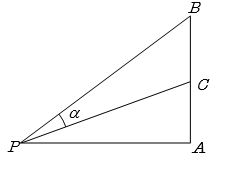
$AB$ is a vertical tower. The point $A$ is on the ground and $C$ is the middle point of $AB$. The part $CB$ subtends an angle $\alpha$ at a point $P$ on the ground. If $AP = n \cdot AB$,then the correct relation is:
A
$n = (n^2 + 1)\tan \alpha$
B
$n = (2n^2 - 1)\tan \alpha$
C
$n^2 = (2n^2 + 1)\tan \alpha$
D
$n = (2n^2 + 1)\tan \alpha$
Solution
(D) Let $AB = h$. Since $C$ is the midpoint of $AB$,$AC = \frac{h}{2}$ and $CB = \frac{h}{2}$.
Given $AP = n \cdot AB = nh$.
In $\triangle PAC$,$\tan(\angle APC) = \frac{AC}{AP} = \frac{h/2}{nh} = \frac{1}{2n}$.
In $\triangle PAB$,$\tan(\angle APB) = \frac{AB}{AP} = \frac{h}{nh} = \frac{1}{n}$.
We know $\alpha = \angle APB - \angle APC$.
Therefore,$\tan \alpha = \tan(\angle APB - \angle APC) = \frac{\tan(\angle APB) - \tan(\angle APC)}{1 + \tan(\angle APB) \cdot \tan(\angle APC)}$.
Substituting the values: $\tan \alpha = \frac{\frac{1}{n} - \frac{1}{2n}}{1 + (\frac{1}{n})(\frac{1}{2n})} = \frac{\frac{1}{2n}}{1 + \frac{1}{2n^2}} = \frac{\frac{1}{2n}}{\frac{2n^2 + 1}{2n^2}} = \frac{1}{2n} \cdot \frac{2n^2}{2n^2 + 1} = \frac{n}{2n^2 + 1}$.
Thus,$n = (2n^2 + 1)\tan \alpha$.
Given $AP = n \cdot AB = nh$.
In $\triangle PAC$,$\tan(\angle APC) = \frac{AC}{AP} = \frac{h/2}{nh} = \frac{1}{2n}$.
In $\triangle PAB$,$\tan(\angle APB) = \frac{AB}{AP} = \frac{h}{nh} = \frac{1}{n}$.
We know $\alpha = \angle APB - \angle APC$.
Therefore,$\tan \alpha = \tan(\angle APB - \angle APC) = \frac{\tan(\angle APB) - \tan(\angle APC)}{1 + \tan(\angle APB) \cdot \tan(\angle APC)}$.
Substituting the values: $\tan \alpha = \frac{\frac{1}{n} - \frac{1}{2n}}{1 + (\frac{1}{n})(\frac{1}{2n})} = \frac{\frac{1}{2n}}{1 + \frac{1}{2n^2}} = \frac{\frac{1}{2n}}{\frac{2n^2 + 1}{2n^2}} = \frac{1}{2n} \cdot \frac{2n^2}{2n^2 + 1} = \frac{n}{2n^2 + 1}$.
Thus,$n = (2n^2 + 1)\tan \alpha$.
0 likes
View Solution31
EasyMCQ
In $\Delta ABC$,find the value of $\frac{1}{a}\cos^2\frac{A}{2} + \frac{1}{b}\cos^2\frac{B}{2} + \frac{1}{c}\cos^2\frac{C}{2}$.
A
$s$
B
$\frac{s}{abc}$
C
$\frac{s^2}{abc}$
D
$\frac{s^3}{abc}$
Solution
(C) We know that $\cos^2\frac{A}{2} = \frac{s(s-a)}{bc}$.
Substituting this into the expression:
$\sum \frac{1}{a} \cos^2\frac{A}{2} = \sum \frac{1}{a} \cdot \frac{s(s-a)}{bc}$
$= \sum \frac{s(s-a)}{abc}$
$= \frac{s}{abc} [(s-a) + (s-b) + (s-c)]$
$= \frac{s}{abc} [3s - (a+b+c)]$
Since $a+b+c = 2s$,we have:
$= \frac{s}{abc} [3s - 2s] = \frac{s}{abc} \cdot s = \frac{s^2}{abc}$.
Substituting this into the expression:
$\sum \frac{1}{a} \cos^2\frac{A}{2} = \sum \frac{1}{a} \cdot \frac{s(s-a)}{bc}$
$= \sum \frac{s(s-a)}{abc}$
$= \frac{s}{abc} [(s-a) + (s-b) + (s-c)]$
$= \frac{s}{abc} [3s - (a+b+c)]$
Since $a+b+c = 2s$,we have:
$= \frac{s}{abc} [3s - 2s] = \frac{s}{abc} \cdot s = \frac{s^2}{abc}$.
0 likes
View Solution32
MediumMCQ
In a triangle $ABC$,$\tan \frac{A}{2} = \frac{5}{6}$ and $\tan \frac{C}{2} = \frac{2}{5}$,then
A
$a, b, c$ are in $A.P.$
B
$\cos A, \cos B, \cos C$ are in $A.P.$
C
$\sin A, \sin B, \sin C$ are in $A.P.$
D
$a, b, c$ and $\sin A, \sin B, \sin C$ are in $A.P.$
Solution
(D) We know that $\tan \frac{A}{2} \tan \frac{C}{2} = \frac{s-b}{s}$.
Given $\tan \frac{A}{2} = \frac{5}{6}$ and $\tan \frac{C}{2} = \frac{2}{5}$,we have $\frac{5}{6} \times \frac{2}{5} = \frac{s-b}{s}$.
$\frac{1}{3} = \frac{s-b}{s}$ $\Rightarrow s = 3s - 3b$ $\Rightarrow 2s = 3b$.
Since $2s = a + b + c$,we have $a + b + c = 3b$,which implies $a + c = 2b$.
Thus,$a, b, c$ are in $A.P.$
By the Sine Rule,$a = 2R \sin A, b = 2R \sin B, c = 2R \sin C$.
Since $a, b, c$ are in $A.P.$,$2R \sin A, 2R \sin B, 2R \sin C$ are in $A.P.$
Therefore,$\sin A, \sin B, \sin C$ are also in $A.P.$
Given $\tan \frac{A}{2} = \frac{5}{6}$ and $\tan \frac{C}{2} = \frac{2}{5}$,we have $\frac{5}{6} \times \frac{2}{5} = \frac{s-b}{s}$.
$\frac{1}{3} = \frac{s-b}{s}$ $\Rightarrow s = 3s - 3b$ $\Rightarrow 2s = 3b$.
Since $2s = a + b + c$,we have $a + b + c = 3b$,which implies $a + c = 2b$.
Thus,$a, b, c$ are in $A.P.$
By the Sine Rule,$a = 2R \sin A, b = 2R \sin B, c = 2R \sin C$.
Since $a, b, c$ are in $A.P.$,$2R \sin A, 2R \sin B, 2R \sin C$ are in $A.P.$
Therefore,$\sin A, \sin B, \sin C$ are also in $A.P.$
0 likes
View Solution33
MediumMCQ
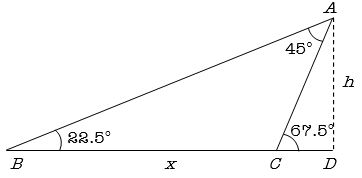
If the two angles on the base of a triangle are $22.5^o$ and $112.5^o$,then the ratio of the height of the triangle to the length of the base is
A
$1:2$
B
$2:1$
C
$2:3$
D
$1:1$
Solution
(A) Let the triangle be $\Delta ABC$ with base $BC = x$ and height $AD = h$. The angles at the base are $\angle B = 22.5^o$ and $\angle ACB = 112.5^o$.
Since $\angle ACB$ is an exterior angle to $\Delta ABD$,the angle $\angle ACD = 180^o - 112.5^o = 67.5^o$.
In right-angled $\Delta ACD$,$\angle CAD = 90^o - 67.5^o = 22.5^o$.
Thus,$\angle BAC = 180^o - (22.5^o + 112.5^o) = 45^o$.
Using the sine rule in $\Delta ABC$,$\frac{x}{\sin 45^o} = \frac{AC}{\sin 22.5^o} \Rightarrow AC = \frac{x \sin 22.5^o}{\sin 45^o}$.
In $\Delta ACD$,$h = AC \sin 67.5^o = \frac{x \sin 22.5^o \sin 67.5^o}{\sin 45^o}$.
Using $\sin 67.5^o = \cos 22.5^o$,we get $h = \frac{x \sin 22.5^o \cos 22.5^o}{\sin 45^o} = \frac{x \sin 45^o}{2 \sin 45^o} = \frac{x}{2}$.
Therefore,the ratio $\frac{h}{x} = \frac{1}{2}$.
Since $\angle ACB$ is an exterior angle to $\Delta ABD$,the angle $\angle ACD = 180^o - 112.5^o = 67.5^o$.
In right-angled $\Delta ACD$,$\angle CAD = 90^o - 67.5^o = 22.5^o$.
Thus,$\angle BAC = 180^o - (22.5^o + 112.5^o) = 45^o$.
Using the sine rule in $\Delta ABC$,$\frac{x}{\sin 45^o} = \frac{AC}{\sin 22.5^o} \Rightarrow AC = \frac{x \sin 22.5^o}{\sin 45^o}$.
In $\Delta ACD$,$h = AC \sin 67.5^o = \frac{x \sin 22.5^o \sin 67.5^o}{\sin 45^o}$.
Using $\sin 67.5^o = \cos 22.5^o$,we get $h = \frac{x \sin 22.5^o \cos 22.5^o}{\sin 45^o} = \frac{x \sin 45^o}{2 \sin 45^o} = \frac{x}{2}$.
Therefore,the ratio $\frac{h}{x} = \frac{1}{2}$.
0 likes
View Solution34
MediumMCQ
If $\alpha$ and $\beta$ are different values of $x$ satisfying $a \cos x + b \sin x = c,$ then $\tan \left( \frac{\alpha + \beta}{2} \right) = $
A
$a + b$
B
$a - b$
C
$\frac{b}{a}$
D
$\frac{a}{b}$
Solution
(C) Given the equation $a \cos x + b \sin x = c.$
Using the half-angle formulas $\cos x = \frac{1 - \tan^2(x/2)}{1 + \tan^2(x/2)}$ and $\sin x = \frac{2 \tan(x/2)}{1 + \tan^2(x/2)},$ we get:
$a \left( \frac{1 - \tan^2(x/2)}{1 + \tan^2(x/2)} \right) + b \left( \frac{2 \tan(x/2)}{1 + \tan^2(x/2)} \right) = c$
$a(1 - \tan^2(x/2)) + 2b \tan(x/2) = c(1 + \tan^2(x/2))$
$(a + c) \tan^2(x/2) - 2b \tan(x/2) + (c - a) = 0$
Let $t = \tan(x/2).$ The roots of this quadratic equation are $t_1 = \tan(\alpha/2)$ and $t_2 = \tan(\beta/2).$
From the properties of quadratic equations,the sum of roots is $t_1 + t_2 = \frac{2b}{a + c}$ and the product of roots is $t_1 t_2 = \frac{c - a}{a + c}.$
We need to find $\tan \left( \frac{\alpha + \beta}{2} \right) = \tan \left( \frac{\alpha}{2} + \frac{\beta}{2} \right).$
Using the identity $\tan(A + B) = \frac{\tan A + \tan B}{1 - \tan A \tan B},$
$\tan \left( \frac{\alpha + \beta}{2} \right) = \frac{t_1 + t_2}{1 - t_1 t_2} = \frac{\frac{2b}{a + c}}{1 - \frac{c - a}{a + c}} = \frac{2b}{a + c - c + a} = \frac{2b}{2a} = \frac{b}{a}.$
Using the half-angle formulas $\cos x = \frac{1 - \tan^2(x/2)}{1 + \tan^2(x/2)}$ and $\sin x = \frac{2 \tan(x/2)}{1 + \tan^2(x/2)},$ we get:
$a \left( \frac{1 - \tan^2(x/2)}{1 + \tan^2(x/2)} \right) + b \left( \frac{2 \tan(x/2)}{1 + \tan^2(x/2)} \right) = c$
$a(1 - \tan^2(x/2)) + 2b \tan(x/2) = c(1 + \tan^2(x/2))$
$(a + c) \tan^2(x/2) - 2b \tan(x/2) + (c - a) = 0$
Let $t = \tan(x/2).$ The roots of this quadratic equation are $t_1 = \tan(\alpha/2)$ and $t_2 = \tan(\beta/2).$
From the properties of quadratic equations,the sum of roots is $t_1 + t_2 = \frac{2b}{a + c}$ and the product of roots is $t_1 t_2 = \frac{c - a}{a + c}.$
We need to find $\tan \left( \frac{\alpha + \beta}{2} \right) = \tan \left( \frac{\alpha}{2} + \frac{\beta}{2} \right).$
Using the identity $\tan(A + B) = \frac{\tan A + \tan B}{1 - \tan A \tan B},$
$\tan \left( \frac{\alpha + \beta}{2} \right) = \frac{t_1 + t_2}{1 - t_1 t_2} = \frac{\frac{2b}{a + c}}{1 - \frac{c - a}{a + c}} = \frac{2b}{a + c - c + a} = \frac{2b}{2a} = \frac{b}{a}.$
0 likes
View Solution35
EasyMCQ
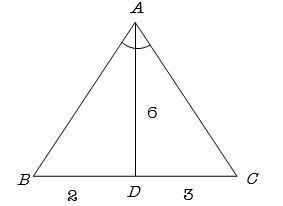
If the perpendicular $AD$ divides the base of the triangle $ABC$ such that $BD, CD$ and $AD$ are in the ratio $2:3:6$,then angle $A$ is equal to
A
$\frac{\pi}{2}$
B
$\frac{\pi}{3}$
C
$\frac{\pi}{4}$
D
$\frac{\pi}{6}$
Solution
(C) Let $\angle BAD = \alpha$ and $\angle CAD = \beta$. Since $AD \perp BC$,we have $\tan \alpha = \frac{BD}{AD} = \frac{2}{6} = \frac{1}{3}$ and $\tan \beta = \frac{CD}{AD} = \frac{3}{6} = \frac{1}{2}$.
We need to find $\angle A = \alpha + \beta$.
Using the formula $\tan(\alpha + \beta) = \frac{\tan \alpha + \tan \beta}{1 - \tan \alpha \tan \beta}$,we get:
$\tan A = \frac{\frac{1}{3} + \frac{1}{2}}{1 - (\frac{1}{3} \times \frac{1}{2})} = \frac{\frac{5}{6}}{1 - \frac{1}{6}} = \frac{\frac{5}{6}}{\frac{5}{6}} = 1$.
Since $\tan A = 1$,we have $A = \frac{\pi}{4}$.
We need to find $\angle A = \alpha + \beta$.
Using the formula $\tan(\alpha + \beta) = \frac{\tan \alpha + \tan \beta}{1 - \tan \alpha \tan \beta}$,we get:
$\tan A = \frac{\frac{1}{3} + \frac{1}{2}}{1 - (\frac{1}{3} \times \frac{1}{2})} = \frac{\frac{5}{6}}{1 - \frac{1}{6}} = \frac{\frac{5}{6}}{\frac{5}{6}} = 1$.
Since $\tan A = 1$,we have $A = \frac{\pi}{4}$.
0 likes
View Solution36
MediumMCQ
In $\Delta ABC$,if $\sin A : \sin C = \sin (A - B) : \sin (B - C)$,then
A
$a, b, c$ are in $A.P.$
B
$a^2, b^2, c^2$ are in $A.P.$
C
$a^2, b^2, c^2$ are in $G.P.$
D
None of these
Solution
(B) Given $\frac{\sin A}{\sin C} = \frac{\sin (A - B)}{\sin (B - C)}$.
Since $A + B + C = \pi$,we have $A = \pi - (B + C)$,so $\sin A = \sin (B + C)$.
Similarly,$C = \pi - (A + B)$,so $\sin C = \sin (A + B)$.
Substituting these,we get $\frac{\sin (B + C)}{\sin (A + B)} = \frac{\sin (A - B)}{\sin (B - C)}$.
Cross-multiplying gives $\sin (B + C) \sin (B - C) = \sin (A + B) \sin (A - B)$.
Using the identity $\sin (x+y) \sin (x-y) = \sin^2 x - \sin^2 y$,we get $\sin^2 B - \sin^2 C = \sin^2 A - \sin^2 B$.
Rearranging,$2 \sin^2 B = \sin^2 A + \sin^2 C$.
By the Sine Rule,$\frac{a}{\sin A} = \frac{b}{\sin B} = \frac{c}{\sin C} = 2R$,so $\sin A = \frac{a}{2R}, \sin B = \frac{b}{2R}, \sin C = \frac{c}{2R}$.
Substituting these,$2(\frac{b}{2R})^2 = (\frac{a}{2R})^2 + (\frac{c}{2R})^2$.
This simplifies to $2b^2 = a^2 + c^2$.
Thus,$a^2, b^2, c^2$ are in $A.P.$
Since $A + B + C = \pi$,we have $A = \pi - (B + C)$,so $\sin A = \sin (B + C)$.
Similarly,$C = \pi - (A + B)$,so $\sin C = \sin (A + B)$.
Substituting these,we get $\frac{\sin (B + C)}{\sin (A + B)} = \frac{\sin (A - B)}{\sin (B - C)}$.
Cross-multiplying gives $\sin (B + C) \sin (B - C) = \sin (A + B) \sin (A - B)$.
Using the identity $\sin (x+y) \sin (x-y) = \sin^2 x - \sin^2 y$,we get $\sin^2 B - \sin^2 C = \sin^2 A - \sin^2 B$.
Rearranging,$2 \sin^2 B = \sin^2 A + \sin^2 C$.
By the Sine Rule,$\frac{a}{\sin A} = \frac{b}{\sin B} = \frac{c}{\sin C} = 2R$,so $\sin A = \frac{a}{2R}, \sin B = \frac{b}{2R}, \sin C = \frac{c}{2R}$.
Substituting these,$2(\frac{b}{2R})^2 = (\frac{a}{2R})^2 + (\frac{c}{2R})^2$.
This simplifies to $2b^2 = a^2 + c^2$.
Thus,$a^2, b^2, c^2$ are in $A.P.$
0 likes
View Solution37
MediumMCQ
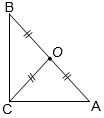
In a $\Delta ABC,$ let $\angle C = \frac{\pi}{2}.$ If $r$ and $R$ are the inradius and the circumradius respectively of the triangle,then $2(r + R)$ is equal to
A
$a + b$
B
$b + c$
C
$c + a$
D
$a + b + c$
Solution
(A) In a right-angled triangle $\Delta ABC$ with $\angle C = \frac{\pi}{2},$ the hypotenuse is $c = AB.$
The circumradius $R$ is half of the hypotenuse,so $R = \frac{c}{2}.$
The inradius $r$ is given by $r = \frac{\Delta}{s},$ where $\Delta = \frac{1}{2}ab$ and $s = \frac{a + b + c}{2}.$
Thus,$r = \frac{\frac{1}{2}ab}{\frac{1}{2}(a + b + c)} = \frac{ab}{a + b + c}.$
Now,$r + R = \frac{ab}{a + b + c} + \frac{c}{2} = \frac{2ab + c(a + b + c)}{2(a + b + c)}.$
Since $c^2 = a^2 + b^2,$ we have $2ab + c(a + b + c) = 2ab + ca + cb + c^2 = 2ab + ca + cb + a^2 + b^2 = (a + b)^2 + c(a + b) = (a + b)(a + b + c).$
Therefore,$r + R = \frac{(a + b)(a + b + c)}{2(a + b + c)} = \frac{a + b}{2}.$
Hence,$2(r + R) = a + b.$
The circumradius $R$ is half of the hypotenuse,so $R = \frac{c}{2}.$
The inradius $r$ is given by $r = \frac{\Delta}{s},$ where $\Delta = \frac{1}{2}ab$ and $s = \frac{a + b + c}{2}.$
Thus,$r = \frac{\frac{1}{2}ab}{\frac{1}{2}(a + b + c)} = \frac{ab}{a + b + c}.$
Now,$r + R = \frac{ab}{a + b + c} + \frac{c}{2} = \frac{2ab + c(a + b + c)}{2(a + b + c)}.$
Since $c^2 = a^2 + b^2,$ we have $2ab + c(a + b + c) = 2ab + ca + cb + c^2 = 2ab + ca + cb + a^2 + b^2 = (a + b)^2 + c(a + b) = (a + b)(a + b + c).$
Therefore,$r + R = \frac{(a + b)(a + b + c)}{2(a + b + c)} = \frac{a + b}{2}.$
Hence,$2(r + R) = a + b.$
0 likes
View Solution38
DifficultMCQ
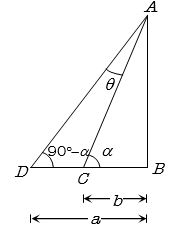
$A$ tower is situated on a horizontal plane. Two points lie on the line passing through the base of the tower,at distances $a$ and $b$ from the base. The angles of elevation of the top of the tower from these points are $\alpha$ and $90^\circ - \alpha$. If the line segment joining the two points subtends an angle $\theta$ at the top of the tower,find the height of the tower.
A
$\frac{a + b}{a - b}$
B
$\frac{a - b}{a + b}$
C
$\sqrt{ab}$
D
$(ab)^{1/3}$
Solution
(C) Let the tower be $AB$ with height $h$. Let the two points on the horizontal plane be $C$ and $D$ such that $BC = b$ and $BD = a$.
Given that the angles of elevation from $C$ and $D$ are $\alpha$ and $90^\circ - \alpha$ respectively.
In $\Delta ABC$,$\tan \alpha = \frac{AB}{BC} = \frac{h}{b} \implies h = b \tan \alpha$ ... $(i)$
In $\Delta ABD$,$\tan(90^\circ - \alpha) = \frac{AB}{BD} = \frac{h}{a} \implies \cot \alpha = \frac{h}{a} \implies h = a \cot \alpha$ ... (ii)
Multiplying equations $(i)$ and (ii):
$h^2 = (b \tan \alpha)(a \cot \alpha) = ab \tan \alpha \cdot \frac{1}{\tan \alpha} = ab$
Therefore,$h = \sqrt{ab}$.
Given that the angles of elevation from $C$ and $D$ are $\alpha$ and $90^\circ - \alpha$ respectively.
In $\Delta ABC$,$\tan \alpha = \frac{AB}{BC} = \frac{h}{b} \implies h = b \tan \alpha$ ... $(i)$
In $\Delta ABD$,$\tan(90^\circ - \alpha) = \frac{AB}{BD} = \frac{h}{a} \implies \cot \alpha = \frac{h}{a} \implies h = a \cot \alpha$ ... (ii)
Multiplying equations $(i)$ and (ii):
$h^2 = (b \tan \alpha)(a \cot \alpha) = ab \tan \alpha \cdot \frac{1}{\tan \alpha} = ab$
Therefore,$h = \sqrt{ab}$.
0 likes
View Solution39
DifficultMCQ
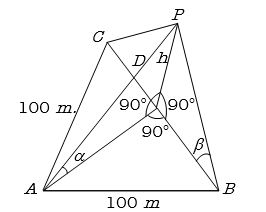
$ABC$ is a triangular park with $AB = AC = 100 \, m$. $A$ clock tower is situated at the mid-point $D$ of $BC$. The angles of elevation of the top of the tower at $A$ and $B$ are $\cot^{-1} 3.2$ and $\csc^{-1} 2.6$ respectively. The height of the tower is .... $m$.
A
$50$
B
$25$
C
$40$
D
None of these
Solution
(B) Let $DP = h$ be the height of the clock tower standing at the mid-point $D$ of $BC$.
Given $\angle PAD = \alpha = \cot^{-1} 3.2 \Rightarrow \cot \alpha = 3.2$.
Given $\angle PBD = \beta = \csc^{-1} 2.6 \Rightarrow \csc \beta = 2.6$.
Then $\cot \beta = \sqrt{\csc^2 \beta - 1} = \sqrt{(2.6)^2 - 1} = \sqrt{6.76 - 1} = \sqrt{5.76} = 2.4$.
In right-angled triangles $\triangle PAD$ and $\triangle PBD$:
$AD = h \cot \alpha = 3.2h$ and $BD = h \cot \beta = 2.4h$.
In the right-angled $\triangle ABD$ (since $AD \perp BC$ in isosceles $\triangle ABC$ where $AB=AC$):
$AB^2 = AD^2 + BD^2$
$100^2 = (3.2h)^2 + (2.4h)^2$
$10000 = (10.24 + 5.76)h^2$
$10000 = 16h^2$
$h^2 = \frac{10000}{16} = 625$
$h = 25 \, m$.
Given $\angle PAD = \alpha = \cot^{-1} 3.2 \Rightarrow \cot \alpha = 3.2$.
Given $\angle PBD = \beta = \csc^{-1} 2.6 \Rightarrow \csc \beta = 2.6$.
Then $\cot \beta = \sqrt{\csc^2 \beta - 1} = \sqrt{(2.6)^2 - 1} = \sqrt{6.76 - 1} = \sqrt{5.76} = 2.4$.
In right-angled triangles $\triangle PAD$ and $\triangle PBD$:
$AD = h \cot \alpha = 3.2h$ and $BD = h \cot \beta = 2.4h$.
In the right-angled $\triangle ABD$ (since $AD \perp BC$ in isosceles $\triangle ABC$ where $AB=AC$):
$AB^2 = AD^2 + BD^2$
$100^2 = (3.2h)^2 + (2.4h)^2$
$10000 = (10.24 + 5.76)h^2$
$10000 = 16h^2$
$h^2 = \frac{10000}{16} = 625$
$h = 25 \, m$.
0 likes
View Solution40
MediumMCQ
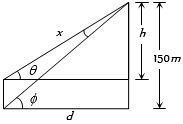
The angles of depression of the top and the foot of a chimney as seen from the top of a second chimney,which is $150 \, m$ high and standing on the same level as the first,are $\theta$ and $\phi$ respectively. If $\tan \theta = \frac{4}{3}$ and $\tan \phi = \frac{5}{2}$,then the distance between their tops is.......$m$.
A
$\frac{150}{\sqrt{3}}$
B
$100\sqrt{3}$
C
$150$
D
$100$
Solution
(D) Let $H = 150 \, m$ be the height of the second chimney.
Let $d$ be the distance between the two chimneys.
From the geometry of the problem,the angle of depression to the foot of the first chimney is $\phi$,so $\tan \phi = \frac{H}{d}$.
Given $\tan \phi = \frac{5}{2}$,we have $\frac{150}{d} = \frac{5}{2}$,which gives $d = \frac{150 \times 2}{5} = 60 \, m$.
Let $h$ be the height of the first chimney. The angle of depression to the top of the first chimney is $\theta$,so $\tan \theta = \frac{H - h}{d}$.
Given $\tan \theta = \frac{4}{3}$,we have $\frac{150 - h}{60} = \frac{4}{3}$.
$150 - h = 60 \times \frac{4}{3} = 80$.
$h = 150 - 80 = 70 \, m$.
The vertical distance between the tops is $H - h = 150 - 70 = 80 \, m$.
The horizontal distance between the tops is $d = 60 \, m$.
The distance between the tops is $\sqrt{(H - h)^2 + d^2} = \sqrt{80^2 + 60^2} = \sqrt{6400 + 3600} = \sqrt{10000} = 100 \, m$.
Let $d$ be the distance between the two chimneys.
From the geometry of the problem,the angle of depression to the foot of the first chimney is $\phi$,so $\tan \phi = \frac{H}{d}$.
Given $\tan \phi = \frac{5}{2}$,we have $\frac{150}{d} = \frac{5}{2}$,which gives $d = \frac{150 \times 2}{5} = 60 \, m$.
Let $h$ be the height of the first chimney. The angle of depression to the top of the first chimney is $\theta$,so $\tan \theta = \frac{H - h}{d}$.
Given $\tan \theta = \frac{4}{3}$,we have $\frac{150 - h}{60} = \frac{4}{3}$.
$150 - h = 60 \times \frac{4}{3} = 80$.
$h = 150 - 80 = 70 \, m$.
The vertical distance between the tops is $H - h = 150 - 70 = 80 \, m$.
The horizontal distance between the tops is $d = 60 \, m$.
The distance between the tops is $\sqrt{(H - h)^2 + d^2} = \sqrt{80^2 + 60^2} = \sqrt{6400 + 3600} = \sqrt{10000} = 100 \, m$.
0 likes
View Solution41
DifficultMCQ
For a $\Delta ABC$,if $a \cos^2 \frac{C}{2} + c \cos^2 \frac{A}{2} = \frac{3b}{2}$,then the sides $a, b, c$ are in:
A
Arithmetic Progression $(AP)$
B
Geometric Progression $(GP)$
C
Harmonic Progression $(HP)$
D
Satisfy $a + b - c = 0$
0 likes
View Solution42
DifficultMCQ
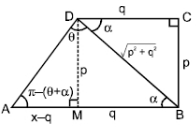
$ABCD$ is a trapezium such that $AB$ and $CD$ are parallel and $BC \perp CD$. If $\angle ADB = \theta$,$BC = p$ and $CD = q$,then $AB$ is equal to:
A
$\frac{(p^2 + q^2) \sin \theta}{p \cos \theta + q \sin \theta}$
B
$\frac{p^2 + q^2 \cos \theta}{p \cos \theta + q \sin \theta}$
C
$\frac{p^2 + q^2}{p^2 \cos \theta + q^2 \sin \theta}$
D
$\frac{(p^2 + q^2) \sin \theta}{(p \cos \theta + q \sin \theta)^2}$
Solution
(A) Let $AB = x$. Drop a perpendicular from $D$ to $AB$ at point $M$. Then $DM = BC = p$ and $MB = CD = q$. Thus,$AM = AB - MB = x - q$.
In $\triangle BCD$,$\tan \alpha = \frac{p}{q}$.
In $\triangle ADM$,$\angle DAM = \pi - (\theta + \alpha)$.
Therefore,$\tan(\pi - (\theta + \alpha)) = \frac{DM}{AM} = \frac{p}{x - q}$.
This implies $-\tan(\theta + \alpha) = \frac{p}{x - q}$,or $\tan(\theta + \alpha) = \frac{p}{q - x}$.
$q - x = p \cot(\theta + \alpha) = p \left( \frac{\cot \theta \cot \alpha - 1}{\cot \alpha + \cot \theta} \right)$.
Since $\cot \alpha = \frac{q}{p}$,we have $q - x = p \left( \frac{\frac{q}{p} \cot \theta - 1}{\frac{q}{p} + \cot \theta} \right) = p \left( \frac{q \cot \theta - p}{q + p \cot \theta} \right) = p \left( \frac{q \cos \theta - p \sin \theta}{q \sin \theta + p \cos \theta} \right)$.
$x = q - \frac{pq \cos \theta - p^2 \sin \theta}{q \sin \theta + p \cos \theta} = \frac{q^2 \sin \theta + pq \cos \theta - pq \cos \theta + p^2 \sin \theta}{p \cos \theta + q \sin \theta}$.
$x = \frac{(p^2 + q^2) \sin \theta}{p \cos \theta + q \sin \theta}$.
In $\triangle BCD$,$\tan \alpha = \frac{p}{q}$.
In $\triangle ADM$,$\angle DAM = \pi - (\theta + \alpha)$.
Therefore,$\tan(\pi - (\theta + \alpha)) = \frac{DM}{AM} = \frac{p}{x - q}$.
This implies $-\tan(\theta + \alpha) = \frac{p}{x - q}$,or $\tan(\theta + \alpha) = \frac{p}{q - x}$.
$q - x = p \cot(\theta + \alpha) = p \left( \frac{\cot \theta \cot \alpha - 1}{\cot \alpha + \cot \theta} \right)$.
Since $\cot \alpha = \frac{q}{p}$,we have $q - x = p \left( \frac{\frac{q}{p} \cot \theta - 1}{\frac{q}{p} + \cot \theta} \right) = p \left( \frac{q \cot \theta - p}{q + p \cot \theta} \right) = p \left( \frac{q \cos \theta - p \sin \theta}{q \sin \theta + p \cos \theta} \right)$.
$x = q - \frac{pq \cos \theta - p^2 \sin \theta}{q \sin \theta + p \cos \theta} = \frac{q^2 \sin \theta + pq \cos \theta - pq \cos \theta + p^2 \sin \theta}{p \cos \theta + q \sin \theta}$.
$x = \frac{(p^2 + q^2) \sin \theta}{p \cos \theta + q \sin \theta}$.
0 likes
View Solution43
DifficultMCQ
If $A, B, C$ are the angles of a triangle,then $\sum \frac{\cot A + \cot B}{\tan A + \tan B} = $
A
$1$
B
$2$
C
$-1$
D
$-2$
Solution
(A) Given the expression $\sum \frac{\cot A + \cot B}{\tan A + \tan B}$.
We know that $\cot A + \cot B = \frac{\cos A}{\sin A} + \frac{\cos B}{\sin B} = \frac{\sin B \cos A + \cos B \sin A}{\sin A \sin B} = \frac{\sin(A+B)}{\sin A \sin B}$.
Also,$\tan A + \tan B = \frac{\sin A}{\cos A} + \frac{\sin B}{\cos B} = \frac{\sin A \cos B + \cos A \sin B}{\cos A \cos B} = \frac{\sin(A+B)}{\cos A \cos B}$.
Therefore,$\frac{\cot A + \cot B}{\tan A + \tan B} = \frac{\sin(A+B)}{\sin A \sin B} \times \frac{\cos A \cos B}{\sin(A+B)} = \cot A \cot B$.
Summing over the cyclic permutations,we get $\sum \cot A \cot B = \cot A \cot B + \cot B \cot C + \cot C \cot A$.
For any triangle $ABC$,$A+B+C = \pi$,which implies $\cot A \cot B + \cot B \cot C + \cot C \cot A = 1$.
We know that $\cot A + \cot B = \frac{\cos A}{\sin A} + \frac{\cos B}{\sin B} = \frac{\sin B \cos A + \cos B \sin A}{\sin A \sin B} = \frac{\sin(A+B)}{\sin A \sin B}$.
Also,$\tan A + \tan B = \frac{\sin A}{\cos A} + \frac{\sin B}{\cos B} = \frac{\sin A \cos B + \cos A \sin B}{\cos A \cos B} = \frac{\sin(A+B)}{\cos A \cos B}$.
Therefore,$\frac{\cot A + \cot B}{\tan A + \tan B} = \frac{\sin(A+B)}{\sin A \sin B} \times \frac{\cos A \cos B}{\sin(A+B)} = \cot A \cot B$.
Summing over the cyclic permutations,we get $\sum \cot A \cot B = \cot A \cot B + \cot B \cot C + \cot C \cot A$.
For any triangle $ABC$,$A+B+C = \pi$,which implies $\cot A \cot B + \cot B \cot C + \cot C \cot A = 1$.
0 likes
View Solution44
DifficultMCQ
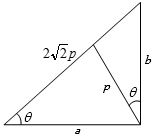
In a right-angled triangle,the hypotenuse is $2\sqrt{2}$ times the length of the perpendicular drawn from the opposite vertex to the hypotenuse. Then,the other two angles are:
A
$\frac{\pi}{3}, \frac{\pi}{6}$
B
$\frac{\pi}{4}, \frac{\pi}{4}$
C
$\frac{\pi}{8}, \frac{3\pi}{8}$
D
$\frac{\pi}{12}, \frac{5\pi}{12}$
Solution
(C) Let the right-angled triangle have sides $a$ and $b$ and hypotenuse $c$. Let $p$ be the length of the perpendicular from the right-angle vertex to the hypotenuse.
We know that $p = \frac{ab}{c}$.
Given $c = 2\sqrt{2}p$,we have $c = 2\sqrt{2} \frac{ab}{c}$,so $c^2 = 2\sqrt{2}ab$.
Since $c^2 = a^2 + b^2$,we have $a^2 + b^2 = 2\sqrt{2}ab$.
Dividing by $ab$,we get $\frac{a}{b} + \frac{b}{a} = 2\sqrt{2}$.
Let $\theta$ be one of the acute angles,so $\tan \theta = \frac{b}{a}$.
Then $\cot \theta + \tan \theta = 2\sqrt{2}$.
$\frac{1}{\tan \theta} + \tan \theta = 2\sqrt{2} \Rightarrow \frac{1 + \tan^2 \theta}{\tan \theta} = 2\sqrt{2}$.
$\frac{\sec^2 \theta}{\tan \theta} = 2\sqrt{2}$ $\Rightarrow \frac{1}{\sin \theta \cos \theta} = 2\sqrt{2}$ $\Rightarrow \frac{2}{\sin 2\theta} = 2\sqrt{2}$.
$\sin 2\theta = \frac{1}{\sqrt{2}} = \sin \frac{\pi}{4}$.
Thus,$2\theta = \frac{\pi}{4}$ or $2\theta = \pi - \frac{\pi}{4} = \frac{3\pi}{4}$.
So,$\theta = \frac{\pi}{8}$ or $\theta = \frac{3\pi}{8}$.
The two acute angles are $\frac{\pi}{8}$ and $\frac{3\pi}{8}$.
We know that $p = \frac{ab}{c}$.
Given $c = 2\sqrt{2}p$,we have $c = 2\sqrt{2} \frac{ab}{c}$,so $c^2 = 2\sqrt{2}ab$.
Since $c^2 = a^2 + b^2$,we have $a^2 + b^2 = 2\sqrt{2}ab$.
Dividing by $ab$,we get $\frac{a}{b} + \frac{b}{a} = 2\sqrt{2}$.
Let $\theta$ be one of the acute angles,so $\tan \theta = \frac{b}{a}$.
Then $\cot \theta + \tan \theta = 2\sqrt{2}$.
$\frac{1}{\tan \theta} + \tan \theta = 2\sqrt{2} \Rightarrow \frac{1 + \tan^2 \theta}{\tan \theta} = 2\sqrt{2}$.
$\frac{\sec^2 \theta}{\tan \theta} = 2\sqrt{2}$ $\Rightarrow \frac{1}{\sin \theta \cos \theta} = 2\sqrt{2}$ $\Rightarrow \frac{2}{\sin 2\theta} = 2\sqrt{2}$.
$\sin 2\theta = \frac{1}{\sqrt{2}} = \sin \frac{\pi}{4}$.
Thus,$2\theta = \frac{\pi}{4}$ or $2\theta = \pi - \frac{\pi}{4} = \frac{3\pi}{4}$.
So,$\theta = \frac{\pi}{8}$ or $\theta = \frac{3\pi}{8}$.
The two acute angles are $\frac{\pi}{8}$ and $\frac{3\pi}{8}$.
0 likes
View Solution45
MediumMCQ
In a $\Delta ABC$,if $\sin A + \sin B + \sin C = 1 + \sqrt{2}$ and $\cos A + \cos B + \cos C = \sqrt{2}$,then the triangle is:
A
Equilateral
B
Isosceles
C
Right angled
D
Right angled isosceles
Solution
(D) Given: $\sin A + \sin B + \sin C = 1 + \sqrt{2}$ and $\cos A + \cos B + \cos C = \sqrt{2}$.
For a right-angled isosceles triangle,the angles are $90^{\circ}, 45^{\circ}, 45^{\circ}$.
Let $A = 90^{\circ}, B = 45^{\circ}, C = 45^{\circ}$.
Then $\sin 90^{\circ} + \sin 45^{\circ} + \sin 45^{\circ} = 1 + \frac{1}{\sqrt{2}} + \frac{1}{\sqrt{2}} = 1 + \frac{2}{\sqrt{2}} = 1 + \sqrt{2}$.
Also,$\cos 90^{\circ} + \cos 45^{\circ} + \cos 45^{\circ} = 0 + \frac{1}{\sqrt{2}} + \frac{1}{\sqrt{2}} = \frac{2}{\sqrt{2}} = \sqrt{2}$.
Since these values satisfy the given equations,the triangle is a right-angled isosceles triangle.
For a right-angled isosceles triangle,the angles are $90^{\circ}, 45^{\circ}, 45^{\circ}$.
Let $A = 90^{\circ}, B = 45^{\circ}, C = 45^{\circ}$.
Then $\sin 90^{\circ} + \sin 45^{\circ} + \sin 45^{\circ} = 1 + \frac{1}{\sqrt{2}} + \frac{1}{\sqrt{2}} = 1 + \frac{2}{\sqrt{2}} = 1 + \sqrt{2}$.
Also,$\cos 90^{\circ} + \cos 45^{\circ} + \cos 45^{\circ} = 0 + \frac{1}{\sqrt{2}} + \frac{1}{\sqrt{2}} = \frac{2}{\sqrt{2}} = \sqrt{2}$.
Since these values satisfy the given equations,the triangle is a right-angled isosceles triangle.
0 likes
View Solution46
MediumMCQ
In a triangle $ABC$,$\angle B = \frac{\pi}{3}$ and $\angle C = \frac{\pi}{4}$,and $D$ divides $BC$ internally in the ratio $1 : 3$. Then $\frac{\sin \angle BAD}{\sin \angle CAD}$ is equal to
A
$\frac{1}{3}$
B
$\frac{1}{\sqrt{3}}$
C
$\frac{1}{\sqrt{6}}$
D
$\sqrt{\frac{2}{3}}$
Solution
(C) Let $\angle BAD = \alpha$ and $\angle CAD = \beta$.
In $\Delta ADB$,applying the sine rule:
$\frac{BD}{\sin \alpha} = \frac{AD}{\sin B} \implies \frac{x}{\sin \alpha} = \frac{AD}{\sin(\pi/3)}$ .....$(i)$
In $\Delta ADC$,applying the sine rule:
$\frac{CD}{\sin \beta} = \frac{AD}{\sin C} \implies \frac{3x}{\sin \beta} = \frac{AD}{\sin(\pi/4)}$ .....(ii)
Dividing $(i)$ by (ii):
$\frac{x}{\sin \alpha} \times \frac{\sin \beta}{3x} = \frac{AD}{\sin(\pi/3)} \times \frac{\sin(\pi/4)}{AD}$
$\frac{\sin \beta}{3 \sin \alpha} = \frac{1/\sqrt{2}}{\sqrt{3}/2} = \frac{2}{\sqrt{6}} = \sqrt{\frac{2}{3}}$
$\frac{\sin \beta}{\sin \alpha} = 3 \times \sqrt{\frac{2}{3}} = \sqrt{3} \times \sqrt{2} = \sqrt{6}$
Therefore,$\frac{\sin \angle BAD}{\sin \angle CAD} = \frac{\sin \alpha}{\sin \beta} = \frac{1}{\sqrt{6}}$.
In $\Delta ADB$,applying the sine rule:
$\frac{BD}{\sin \alpha} = \frac{AD}{\sin B} \implies \frac{x}{\sin \alpha} = \frac{AD}{\sin(\pi/3)}$ .....$(i)$
In $\Delta ADC$,applying the sine rule:
$\frac{CD}{\sin \beta} = \frac{AD}{\sin C} \implies \frac{3x}{\sin \beta} = \frac{AD}{\sin(\pi/4)}$ .....(ii)
Dividing $(i)$ by (ii):
$\frac{x}{\sin \alpha} \times \frac{\sin \beta}{3x} = \frac{AD}{\sin(\pi/3)} \times \frac{\sin(\pi/4)}{AD}$
$\frac{\sin \beta}{3 \sin \alpha} = \frac{1/\sqrt{2}}{\sqrt{3}/2} = \frac{2}{\sqrt{6}} = \sqrt{\frac{2}{3}}$
$\frac{\sin \beta}{\sin \alpha} = 3 \times \sqrt{\frac{2}{3}} = \sqrt{3} \times \sqrt{2} = \sqrt{6}$
Therefore,$\frac{\sin \angle BAD}{\sin \angle CAD} = \frac{\sin \alpha}{\sin \beta} = \frac{1}{\sqrt{6}}$.
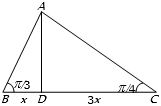
0 likes
View Solution47
DifficultMCQ
In a triangle $ABC$,angle $A$ is greater than angle $B$. If the measures of angles $A$ and $B$ satisfy the equation $3\sin x - 4\sin^3 x - k = 0$ for $0 < k < 1$,then the measure of angle $C$ is:
A
$\frac{\pi}{3}$
B
$\frac{\pi}{2}$
C
$\frac{2\pi}{3}$
D
$\frac{5\pi}{6}$
Solution
(C) Given the equation $3\sin x - 4\sin^3 x = k$,we know that $\sin(3x) = k$.
Since angles $A$ and $B$ satisfy this,we have $\sin(3A) = k$ and $\sin(3B) = k$.
This implies $\sin(3A) - \sin(3B) = 0$,which gives $2\cos\left(\frac{3A+3B}{2}\right)\sin\left(\frac{3A-3B}{2}\right) = 0$.
Since $A > B$,$\sin\left(\frac{3A-3B}{2}\right) \neq 0$,so we must have $\cos\left(\frac{3A+3B}{2}\right) = 0$.
Thus,$\frac{3(A+B)}{2} = \frac{\pi}{2} + n\pi$. For a triangle,$A+B < \pi$,so $\frac{3(A+B)}{2} = \frac{\pi}{2}$ or $\frac{3\pi}{2}$.
If $\frac{3(A+B)}{2} = \frac{\pi}{2}$,then $A+B = \frac{\pi}{3}$,which gives $C = \pi - (A+B) = \frac{2\pi}{3}$.
If $\frac{3(A+B)}{2} = \frac{3\pi}{2}$,then $A+B = \pi$,which is impossible for a triangle as $C$ would be $0$.
Since angles $A$ and $B$ satisfy this,we have $\sin(3A) = k$ and $\sin(3B) = k$.
This implies $\sin(3A) - \sin(3B) = 0$,which gives $2\cos\left(\frac{3A+3B}{2}\right)\sin\left(\frac{3A-3B}{2}\right) = 0$.
Since $A > B$,$\sin\left(\frac{3A-3B}{2}\right) \neq 0$,so we must have $\cos\left(\frac{3A+3B}{2}\right) = 0$.
Thus,$\frac{3(A+B)}{2} = \frac{\pi}{2} + n\pi$. For a triangle,$A+B < \pi$,so $\frac{3(A+B)}{2} = \frac{\pi}{2}$ or $\frac{3\pi}{2}$.
If $\frac{3(A+B)}{2} = \frac{\pi}{2}$,then $A+B = \frac{\pi}{3}$,which gives $C = \pi - (A+B) = \frac{2\pi}{3}$.
If $\frac{3(A+B)}{2} = \frac{3\pi}{2}$,then $A+B = \pi$,which is impossible for a triangle as $C$ would be $0$.
0 likes
View Solution48
MediumMCQ
The upper $\frac{3}{4}$th portion of a vertical pole subtends an angle $\tan^{-1}\left(\frac{3}{5}\right)$ at a point in the horizontal plane through its foot and at a distance $40 \ m$ from the foot. $A$ possible height of the vertical pole is $....... \ m$.
A
$20$
B
$40$
C
$60$
D
$80$
Solution
(B) Let the total height of the pole be $h$. The pole is divided into two parts: the upper part of length $\frac{3h}{4}$ and the lower part of length $\frac{h}{4}$.
Let the point on the ground be $C$ and the foot of the pole be $B$. Given $BC = 40 \ m$.
Let $\theta$ be the angle of elevation of the top of the pole $(A)$ and $\alpha$ be the angle of elevation of the point $D$ (where the pole is divided).
Then $\tan \theta = \frac{h}{40}$ and $\tan \alpha = \frac{h/4}{40} = \frac{h}{160}$.
The angle subtended by the upper part $AD$ at $C$ is $\beta = \theta - \alpha = \tan^{-1}\left(\frac{3}{5}\right)$.
Thus,$\tan \beta = \frac{\tan \theta - \tan \alpha}{1 + \tan \theta \tan \alpha} = \frac{3}{5}$.
Substituting the values: $\frac{\frac{h}{40} - \frac{h}{160}}{1 + \left(\frac{h}{40}\right)\left(\frac{h}{160}\right)} = \frac{3}{5}$.
$\frac{\frac{3h}{160}}{1 + \frac{h^2}{6400}} = \frac{3}{5}$ $\Rightarrow \frac{3h}{160} \times \frac{6400}{6400 + h^2} = \frac{3}{5}$.
$\frac{120h}{6400 + h^2} = \frac{3}{5}$ $\Rightarrow 600h = 3(6400 + h^2)$ $\Rightarrow 200h = 6400 + h^2$.
$h^2 - 200h + 6400 = 0 \Rightarrow (h - 160)(h - 40) = 0$.
So,$h = 40 \ m$ or $h = 160 \ m$.
Let the point on the ground be $C$ and the foot of the pole be $B$. Given $BC = 40 \ m$.
Let $\theta$ be the angle of elevation of the top of the pole $(A)$ and $\alpha$ be the angle of elevation of the point $D$ (where the pole is divided).
Then $\tan \theta = \frac{h}{40}$ and $\tan \alpha = \frac{h/4}{40} = \frac{h}{160}$.
The angle subtended by the upper part $AD$ at $C$ is $\beta = \theta - \alpha = \tan^{-1}\left(\frac{3}{5}\right)$.
Thus,$\tan \beta = \frac{\tan \theta - \tan \alpha}{1 + \tan \theta \tan \alpha} = \frac{3}{5}$.
Substituting the values: $\frac{\frac{h}{40} - \frac{h}{160}}{1 + \left(\frac{h}{40}\right)\left(\frac{h}{160}\right)} = \frac{3}{5}$.
$\frac{\frac{3h}{160}}{1 + \frac{h^2}{6400}} = \frac{3}{5}$ $\Rightarrow \frac{3h}{160} \times \frac{6400}{6400 + h^2} = \frac{3}{5}$.
$\frac{120h}{6400 + h^2} = \frac{3}{5}$ $\Rightarrow 600h = 3(6400 + h^2)$ $\Rightarrow 200h = 6400 + h^2$.
$h^2 - 200h + 6400 = 0 \Rightarrow (h - 160)(h - 40) = 0$.
So,$h = 40 \ m$ or $h = 160 \ m$.
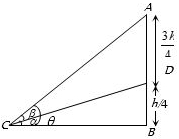
0 likes
View Solution49
DifficultMCQ
$A$ spherical balloon of radius $r$ subtends an angle $\alpha$ at the eye of an observer. If the angle of elevation of the centre of the balloon is $\beta$,then the height of the centre of the balloon is:
A
$r \csc\left(\frac{\alpha}{2}\right) \sin \beta$
B
$r \csc \alpha \sin\left(\frac{\beta}{2}\right)$
C
$r \sin\left(\frac{\alpha}{2}\right) \csc \beta$
D
$r \sin \alpha \csc\left(\frac{\beta}{2}\right)$
Solution
(A) Let $P$ be the eye of the observer and $B$ be the centre of the spherical balloon. Let $Q$ be a point of tangency on the balloon from $P$. Then $\angle QPB = \frac{\alpha}{2}$.
In the right-angled triangle $\triangle PQB$,we have $\sin\left(\frac{\alpha}{2}\right) = \frac{BQ}{PB} = \frac{r}{l}$,where $l = PB$ is the distance from the observer to the centre of the balloon.
Thus,$l = r \csc\left(\frac{\alpha}{2}\right)$.
In the right-angled triangle formed by the height $H$ of the centre $B$ from the ground,we have $\sin \beta = \frac{H}{l}$.
Therefore,$H = l \sin \beta = r \csc\left(\frac{\alpha}{2}\right) \sin \beta$.
In the right-angled triangle $\triangle PQB$,we have $\sin\left(\frac{\alpha}{2}\right) = \frac{BQ}{PB} = \frac{r}{l}$,where $l = PB$ is the distance from the observer to the centre of the balloon.
Thus,$l = r \csc\left(\frac{\alpha}{2}\right)$.
In the right-angled triangle formed by the height $H$ of the centre $B$ from the ground,we have $\sin \beta = \frac{H}{l}$.
Therefore,$H = l \sin \beta = r \csc\left(\frac{\alpha}{2}\right) \sin \beta$.
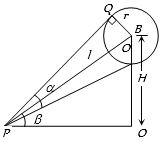
0 likes
View SolutionTrigonometrical Equations — Mix Examples-Trigonometrical Equations and Inequations, Properties of Triangles, Height and Distance · Frequently Asked Questions
1Are these Trigonometrical Equations questions useful for JEE and NEET?
Yes. All questions in this section are mapped to JEE Main and NEET exam patterns. Previous year questions from JEE Main, NEET, GUJCET and state-level exams are included with full solutions.
2Can I switch to Hindi or Gujarati for these questions?
Yes. Use the language tabs in the hero section or the sidebar to view the same questions and solutions in English, Hindi or Gujarati.
3How do I generate a question paper from this subtopic?
Use the Vedclass Exam Paper Generator — select the chapter and subtopic, set difficulty, and generate Sets A, B, C, D automatically. First 3 chapters of every subject are free.
Vedclass Products
For Students
Vedclass Test Series
Mock tests in real JEE/NEET style with performance analysis. 5-day free trial.
Start Free TrialFor Teachers
Exam Paper Generator
Generate Set A/B/C/D papers from this chapter in 2 minutes. 3 chapters free.
Try FreeFor Institutes
Online Exam Module
Live online exams with unlimited students, 360° analytics & white-label branding.
See DemoFor Teachers & Institutes
Generate a Trigonometrical Equations Exam Paper in 2 Minutes
Select subtopic & difficulty — Sets A, B, C, D auto-generated with No Repeat logic.
First 3 chapters of every subject are free — no payment required.