
A English
Mix Examples-Trigonometrical Equations and Inequations, Properties of Triangles, Height and Distance Questions in English
Class 11 Mathematics · Trigonometrical Equations · Mix Examples-Trigonometrical Equations and Inequations, Properties of Triangles, Height and Distance
293+
Questions
English
Language
100%
With Solutions
Showing 49 of 293 questions in English
101
DifficultMCQ
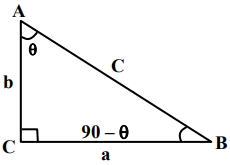
Let in a right-angled triangle,the smallest angle be $\theta$. If a triangle formed by taking the reciprocal of its sides is also a right-angled triangle,then $\sin \theta$ is equal to:
A
$\frac{\sqrt{5}+1}{4}$
B
$\frac{\sqrt{5}-1}{2}$
C
$\frac{\sqrt{2}-1}{2}$
D
$\frac{\sqrt{5}-1}{4}$
Solution
(B) Let the sides of the right-angled triangle be $a, b, c$ where $c$ is the hypotenuse. Thus,$c^2 = a^2 + b^2$.
Given that the triangle formed by the reciprocals of the sides is also a right-angled triangle,the largest side among $\frac{1}{a}, \frac{1}{b}, \frac{1}{c}$ must be the hypotenuse. Since $c$ is the largest side,$\frac{1}{c}$ is the smallest,so $\frac{1}{a}$ is the largest.
Thus,$(\frac{1}{a})^2 = (\frac{1}{b})^2 + (\frac{1}{c})^2$.
Substituting $a = c \sin \theta$ and $b = c \cos \theta$:
$\frac{1}{c^2 \sin^2 \theta} = \frac{1}{c^2 \cos^2 \theta} + \frac{1}{c^2}$
$\frac{1}{\sin^2 \theta} = \frac{1}{\cos^2 \theta} + 1$
$1 = \frac{\sin^2 \theta}{\cos^2 \theta} + \sin^2 \theta$
$1 = \tan^2 \theta + \sin^2 \theta$
$1 = \frac{\sin^2 \theta}{1 - \sin^2 \theta} + \sin^2 \theta$
Let $x = \sin^2 \theta$. Then $1 = \frac{x}{1-x} + x \implies 1-x = x + x(1-x) \implies 1-x = x + x - x^2 \implies x^2 - 3x + 1 = 0$.
Using the quadratic formula,$x = \frac{3 \pm \sqrt{9-4}}{2} = \frac{3 \pm \sqrt{5}}{2}$.
Since $\sin^2 \theta < 1$,we take $x = \frac{3 - \sqrt{5}}{2}$.
$\sin \theta = \sqrt{\frac{3 - \sqrt{5}}{2}} = \sqrt{\frac{6 - 2\sqrt{5}}{4}} = \frac{\sqrt{5}-1}{2}$.
Given that the triangle formed by the reciprocals of the sides is also a right-angled triangle,the largest side among $\frac{1}{a}, \frac{1}{b}, \frac{1}{c}$ must be the hypotenuse. Since $c$ is the largest side,$\frac{1}{c}$ is the smallest,so $\frac{1}{a}$ is the largest.
Thus,$(\frac{1}{a})^2 = (\frac{1}{b})^2 + (\frac{1}{c})^2$.
Substituting $a = c \sin \theta$ and $b = c \cos \theta$:
$\frac{1}{c^2 \sin^2 \theta} = \frac{1}{c^2 \cos^2 \theta} + \frac{1}{c^2}$
$\frac{1}{\sin^2 \theta} = \frac{1}{\cos^2 \theta} + 1$
$1 = \frac{\sin^2 \theta}{\cos^2 \theta} + \sin^2 \theta$
$1 = \tan^2 \theta + \sin^2 \theta$
$1 = \frac{\sin^2 \theta}{1 - \sin^2 \theta} + \sin^2 \theta$
Let $x = \sin^2 \theta$. Then $1 = \frac{x}{1-x} + x \implies 1-x = x + x(1-x) \implies 1-x = x + x - x^2 \implies x^2 - 3x + 1 = 0$.
Using the quadratic formula,$x = \frac{3 \pm \sqrt{9-4}}{2} = \frac{3 \pm \sqrt{5}}{2}$.
Since $\sin^2 \theta < 1$,we take $x = \frac{3 - \sqrt{5}}{2}$.
$\sin \theta = \sqrt{\frac{3 - \sqrt{5}}{2}} = \sqrt{\frac{6 - 2\sqrt{5}}{4}} = \frac{\sqrt{5}-1}{2}$.
0 likes
View Solution102
DifficultMCQ
Let $S = \left\{ \theta \in [-\pi, \pi] - \left\{ \pm \frac{\pi}{2} \right\} : \sin \theta \tan \theta + \tan \theta = \sin 2 \theta \right\}$. If $T = \sum_{\theta \in S} \cos 2 \theta$,then $T + n(S)$ is equal to:
A
$7 + \sqrt{3}$
B
$9$
C
$8 + \sqrt{3}$
D
$10$
Solution
(B) Given equation: $\sin \theta \tan \theta + \tan \theta = \sin 2 \theta$
$\tan \theta (\sin \theta + 1) = \frac{2 \tan \theta}{1 + \tan^2 \theta} = 2 \sin \theta \cos \theta$
Case $1$: $\tan \theta = 0 \implies \theta = 0, \pi, -\pi$ (since $\theta \in [-\pi, \pi]$).
Case $2$: $\sin \theta + 1 = 2 \cos^2 \theta = 2(1 - \sin^2 \theta) = 2(1 - \sin \theta)(1 + \sin \theta)$.
If $\sin \theta = -1$,then $\theta = -\frac{\pi}{2}$,which is excluded.
If $\sin \theta \neq -1$,then $1 = 2(1 - \sin \theta) \implies 1 = 2 - 2 \sin \theta \implies \sin \theta = \frac{1}{2}$.
Thus,$\theta = \frac{\pi}{6}, \frac{5\pi}{6}$.
The set $S = \{0, \pi, -\pi, \frac{\pi}{6}, \frac{5\pi}{6} \}$,so $n(S) = 5$.
$T = \sum_{\theta \in S} \cos 2 \theta = \cos(0) + \cos(2\pi) + \cos(-2\pi) + \cos(\frac{\pi}{3}) + \cos(\frac{5\pi}{3})$
$T = 1 + 1 + 1 + \frac{1}{2} + \frac{1}{2} = 4$.
Therefore,$T + n(S) = 4 + 5 = 9$.
$\tan \theta (\sin \theta + 1) = \frac{2 \tan \theta}{1 + \tan^2 \theta} = 2 \sin \theta \cos \theta$
Case $1$: $\tan \theta = 0 \implies \theta = 0, \pi, -\pi$ (since $\theta \in [-\pi, \pi]$).
Case $2$: $\sin \theta + 1 = 2 \cos^2 \theta = 2(1 - \sin^2 \theta) = 2(1 - \sin \theta)(1 + \sin \theta)$.
If $\sin \theta = -1$,then $\theta = -\frac{\pi}{2}$,which is excluded.
If $\sin \theta \neq -1$,then $1 = 2(1 - \sin \theta) \implies 1 = 2 - 2 \sin \theta \implies \sin \theta = \frac{1}{2}$.
Thus,$\theta = \frac{\pi}{6}, \frac{5\pi}{6}$.
The set $S = \{0, \pi, -\pi, \frac{\pi}{6}, \frac{5\pi}{6} \}$,so $n(S) = 5$.
$T = \sum_{\theta \in S} \cos 2 \theta = \cos(0) + \cos(2\pi) + \cos(-2\pi) + \cos(\frac{\pi}{3}) + \cos(\frac{5\pi}{3})$
$T = 1 + 1 + 1 + \frac{1}{2} + \frac{1}{2} = 4$.
Therefore,$T + n(S) = 4 + 5 = 9$.
0 likes
View Solution103
DifficultMCQ
Let $S = \{\theta \in (0, 2\pi) : 7 \cos^2 \theta - 3 \sin^2 \theta - 2 \cos^2 2\theta = 2\}$. Then,the sum of roots of all the equations $x^2 - 2(\tan^2 \theta + \cot^2 \theta)x + 6 \sin^2 \theta = 0$ for $\theta \in S$ is...
A
$15$
B
$14$
C
$13$
D
$16$
Solution
(D) Given the equation: $7 \cos^2 \theta - 3 \sin^2 \theta - 2 \cos^2 2\theta = 2$.
Using $\sin^2 \theta = 1 - \cos^2 \theta$,we get $7 \cos^2 \theta - 3(1 - \cos^2 \theta) - 2 \cos^2 2\theta = 2$,which simplifies to $10 \cos^2 \theta - 3 - 2 \cos^2 2\theta = 2$.
Since $2 \cos^2 \theta = 1 + \cos 2\theta$,we have $5(1 + \cos 2\theta) - 3 - 2 \cos^2 2\theta = 2$,leading to $5 + 5 \cos 2\theta - 3 - 2 \cos^2 2\theta = 2$.
This simplifies to $2 \cos^2 2\theta - 5 \cos 2\theta = 0$,so $\cos 2\theta(2 \cos 2\theta - 5) = 0$.
Since $\cos 2\theta$ cannot be $2.5$,we have $\cos 2\theta = 0$,which gives $2\theta = \frac{\pi}{2}, \frac{3\pi}{2}, \frac{5\pi}{2}, \frac{7\pi}{2}$.
Thus,$S = \{\frac{\pi}{4}, \frac{3\pi}{4}, \frac{5\pi}{4}, \frac{7\pi}{4}\}$.
For any $\theta \in S$,$\tan^2 \theta = 1$ and $\cot^2 \theta = 1$,so $\tan^2 \theta + \cot^2 \theta = 2$.
Also,$\sin^2 \theta = \frac{1}{2}$.
The equation becomes $x^2 - 2(2)x + 6(\frac{1}{2}) = 0$,which is $x^2 - 4x + 3 = 0$.
The sum of roots for each equation is $4$.
Since there are $4$ such equations,the total sum of roots is $4 \times 4 = 16$.
Using $\sin^2 \theta = 1 - \cos^2 \theta$,we get $7 \cos^2 \theta - 3(1 - \cos^2 \theta) - 2 \cos^2 2\theta = 2$,which simplifies to $10 \cos^2 \theta - 3 - 2 \cos^2 2\theta = 2$.
Since $2 \cos^2 \theta = 1 + \cos 2\theta$,we have $5(1 + \cos 2\theta) - 3 - 2 \cos^2 2\theta = 2$,leading to $5 + 5 \cos 2\theta - 3 - 2 \cos^2 2\theta = 2$.
This simplifies to $2 \cos^2 2\theta - 5 \cos 2\theta = 0$,so $\cos 2\theta(2 \cos 2\theta - 5) = 0$.
Since $\cos 2\theta$ cannot be $2.5$,we have $\cos 2\theta = 0$,which gives $2\theta = \frac{\pi}{2}, \frac{3\pi}{2}, \frac{5\pi}{2}, \frac{7\pi}{2}$.
Thus,$S = \{\frac{\pi}{4}, \frac{3\pi}{4}, \frac{5\pi}{4}, \frac{7\pi}{4}\}$.
For any $\theta \in S$,$\tan^2 \theta = 1$ and $\cot^2 \theta = 1$,so $\tan^2 \theta + \cot^2 \theta = 2$.
Also,$\sin^2 \theta = \frac{1}{2}$.
The equation becomes $x^2 - 2(2)x + 6(\frac{1}{2}) = 0$,which is $x^2 - 4x + 3 = 0$.
The sum of roots for each equation is $4$.
Since there are $4$ such equations,the total sum of roots is $4 \times 4 = 16$.
0 likes
View Solution104
AdvancedMCQ
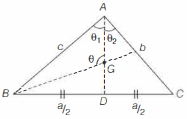
Let $ABC$ be a triangle and let $D$ be the mid-point of $BC$. Suppose $\cot (\angle CAD) : \cot (\angle BAD) = 2 : 1$. If $G$ is the centroid of $\triangle ABC$,then the measure of $\angle BGA$ is (in $^{\circ}$)
A
$90$
B
$105$
C
$120$
D
$135$
Solution
(A) Let $\angle CAD = \theta_2$ and $\angle BAD = \theta_1$. We are given $\cot \theta_2 : \cot \theta_1 = 2 : 1$,so $\cot \theta_2 = 2 \cot \theta_1$.
Using the cotangent rule in $\triangle ADC$ and $\triangle ADB$ with $AD$ as a common side and $BD = DC = a/2$:
$\cot \theta_2 = \frac{AD^2 + b^2 - (a/2)^2}{2 \cdot AD \cdot (a/2) \cdot \sin \theta_2} \cdot \sin \theta_2 = \frac{AD^2 + b^2 - a^2/4}{2 \cdot \text{Area}(\triangle ADC)}$
Since $\text{Area}(\triangle ADC) = \text{Area}(\triangle ADB)$,the condition $\cot \theta_2 = 2 \cot \theta_1$ implies:
$AD^2 + b^2 - a^2/4 = 2(AD^2 + c^2 - a^2/4)$
$AD^2 = b^2 - 2c^2 + a^2/4$
Using Apollonius theorem,$AD^2 = \frac{2b^2 + 2c^2 - a^2}{4}$.
Equating the two expressions for $AD^2$:
$\frac{2b^2 + 2c^2 - a^2}{4} = b^2 - 2c^2 + \frac{a^2}{4}$
$2b^2 + 2c^2 - a^2 = 4b^2 - 8c^2 + a^2$
$10c^2 = 2b^2 + 2a^2 \Rightarrow b^2 + a^2 = 5c^2$.
In $\triangle BGA$,by the Law of Cosines:
$\cos(\angle BGA) = \frac{AG^2 + BG^2 - AB^2}{2 \cdot AG \cdot BG}$.
Using $AG = \frac{2}{3}m_a$ and $BG = \frac{2}{3}m_b$,where $m_a^2 = \frac{2b^2+2c^2-a^2}{4}$ and $m_b^2 = \frac{2a^2+2c^2-b^2}{4}$,and substituting $a^2+b^2=5c^2$,we find $\cos(\angle BGA) = 0$,so $\angle BGA = 90^{\circ}$.
Using the cotangent rule in $\triangle ADC$ and $\triangle ADB$ with $AD$ as a common side and $BD = DC = a/2$:
$\cot \theta_2 = \frac{AD^2 + b^2 - (a/2)^2}{2 \cdot AD \cdot (a/2) \cdot \sin \theta_2} \cdot \sin \theta_2 = \frac{AD^2 + b^2 - a^2/4}{2 \cdot \text{Area}(\triangle ADC)}$
Since $\text{Area}(\triangle ADC) = \text{Area}(\triangle ADB)$,the condition $\cot \theta_2 = 2 \cot \theta_1$ implies:
$AD^2 + b^2 - a^2/4 = 2(AD^2 + c^2 - a^2/4)$
$AD^2 = b^2 - 2c^2 + a^2/4$
Using Apollonius theorem,$AD^2 = \frac{2b^2 + 2c^2 - a^2}{4}$.
Equating the two expressions for $AD^2$:
$\frac{2b^2 + 2c^2 - a^2}{4} = b^2 - 2c^2 + \frac{a^2}{4}$
$2b^2 + 2c^2 - a^2 = 4b^2 - 8c^2 + a^2$
$10c^2 = 2b^2 + 2a^2 \Rightarrow b^2 + a^2 = 5c^2$.
In $\triangle BGA$,by the Law of Cosines:
$\cos(\angle BGA) = \frac{AG^2 + BG^2 - AB^2}{2 \cdot AG \cdot BG}$.
Using $AG = \frac{2}{3}m_a$ and $BG = \frac{2}{3}m_b$,where $m_a^2 = \frac{2b^2+2c^2-a^2}{4}$ and $m_b^2 = \frac{2a^2+2c^2-b^2}{4}$,and substituting $a^2+b^2=5c^2$,we find $\cos(\angle BGA) = 0$,so $\angle BGA = 90^{\circ}$.
0 likes
View Solution105
AdvancedMCQ
The number of solutions to $\sin(\pi \sin^2 \theta) + \sin(\pi \cos^2 \theta) = 2 \cos(\frac{\pi}{2} \cos \theta)$ satisfying $0 \leq \theta \leq 2\pi$ is
A
$1$
B
$2$
C
$4$
D
$7$
Solution
(D) The given equation is $\sin(\pi \sin^2 \theta) + \sin(\pi \cos^2 \theta) = 2 \cos(\frac{\pi}{2} \cos \theta)$.
Using the identity $\sin A + \sin B = 2 \sin(\frac{A+B}{2}) \cos(\frac{A-B}{2})$,we get:
$2 \sin(\frac{\pi(\sin^2 \theta + \cos^2 \theta)}{2}) \cos(\frac{\pi(\sin^2 \theta - \cos^2 \theta)}{2}) = 2 \cos(\frac{\pi}{2} \cos \theta)$.
Since $\sin^2 \theta + \cos^2 \theta = 1$ and $\sin^2 \theta - \cos^2 \theta = -\cos 2\theta$,we have:
$2 \sin(\frac{\pi}{2}) \cos(-\frac{\pi}{2} \cos 2\theta) = 2 \cos(\frac{\pi}{2} \cos \theta)$.
Since $\sin(\frac{\pi}{2}) = 1$ and $\cos(-x) = \cos x$,this simplifies to:
$\cos(\frac{\pi}{2} \cos 2\theta) = \cos(\frac{\pi}{2} \cos \theta)$.
This implies $\frac{\pi}{2} \cos 2\theta = 2n\pi \pm \frac{\pi}{2} \cos \theta$,so $\cos 2\theta = 4n \pm \cos \theta$ for $n \in Z$.
Case $I$: $\cos 2\theta - \cos \theta = 4n$. For $n=0$,$2\cos^2 \theta - 1 - \cos \theta = 0$,so $(2\cos \theta + 1)(\cos \theta - 1) = 0$. Thus $\cos \theta = 1$ or $\cos \theta = -1/2$. Solutions in $[0, 2\pi]$ are $\theta = 0, 2\pi, 2\pi/3, 4\pi/3$.
Case $II$: $\cos 2\theta + \cos \theta = 4n$. For $n=0$,$2\cos^2 \theta + \cos \theta - 1 = 0$,so $(2\cos \theta - 1)(\cos \theta + 1) = 0$. Thus $\cos \theta = 1/2$ or $\cos \theta = -1$. Solutions in $[0, 2\pi]$ are $\theta = \pi, \pi/3, 5\pi/3$.
Total solutions are ${0, 2\pi, 2\pi/3, 4\pi/3, \pi, \pi/3, 5\pi/3}$,which is $7$ solutions.
Using the identity $\sin A + \sin B = 2 \sin(\frac{A+B}{2}) \cos(\frac{A-B}{2})$,we get:
$2 \sin(\frac{\pi(\sin^2 \theta + \cos^2 \theta)}{2}) \cos(\frac{\pi(\sin^2 \theta - \cos^2 \theta)}{2}) = 2 \cos(\frac{\pi}{2} \cos \theta)$.
Since $\sin^2 \theta + \cos^2 \theta = 1$ and $\sin^2 \theta - \cos^2 \theta = -\cos 2\theta$,we have:
$2 \sin(\frac{\pi}{2}) \cos(-\frac{\pi}{2} \cos 2\theta) = 2 \cos(\frac{\pi}{2} \cos \theta)$.
Since $\sin(\frac{\pi}{2}) = 1$ and $\cos(-x) = \cos x$,this simplifies to:
$\cos(\frac{\pi}{2} \cos 2\theta) = \cos(\frac{\pi}{2} \cos \theta)$.
This implies $\frac{\pi}{2} \cos 2\theta = 2n\pi \pm \frac{\pi}{2} \cos \theta$,so $\cos 2\theta = 4n \pm \cos \theta$ for $n \in Z$.
Case $I$: $\cos 2\theta - \cos \theta = 4n$. For $n=0$,$2\cos^2 \theta - 1 - \cos \theta = 0$,so $(2\cos \theta + 1)(\cos \theta - 1) = 0$. Thus $\cos \theta = 1$ or $\cos \theta = -1/2$. Solutions in $[0, 2\pi]$ are $\theta = 0, 2\pi, 2\pi/3, 4\pi/3$.
Case $II$: $\cos 2\theta + \cos \theta = 4n$. For $n=0$,$2\cos^2 \theta + \cos \theta - 1 = 0$,so $(2\cos \theta - 1)(\cos \theta + 1) = 0$. Thus $\cos \theta = 1/2$ or $\cos \theta = -1$. Solutions in $[0, 2\pi]$ are $\theta = \pi, \pi/3, 5\pi/3$.
Total solutions are ${0, 2\pi, 2\pi/3, 4\pi/3, \pi, \pi/3, 5\pi/3}$,which is $7$ solutions.
0 likes
View Solution106
AdvancedMCQ
The angles $\alpha, \beta, \gamma$ of a triangle satisfy the equations $2 \sin \alpha + 3 \cos \beta = 3 \sqrt{2}$ and $3 \sin \beta + 2 \cos \alpha = 1$. Then,angle $\gamma$ equals (in $^{\circ}$)
A
$150$
B
$120$
C
$60$
D
$30$
Solution
(D) Given that $\alpha, \beta, \gamma$ are the angles of a triangle,we have $\alpha + \beta + \gamma = 180^{\circ}$.
We are given the equations:
$(i) \quad 2 \sin \alpha + 3 \cos \beta = 3 \sqrt{2}$
$(ii) \quad 3 \sin \beta + 2 \cos \alpha = 1$
Squaring both equations:
$(2 \sin \alpha + 3 \cos \beta)^2 = (3 \sqrt{2})^2 = 18$
$4 \sin^2 \alpha + 9 \cos^2 \beta + 12 \sin \alpha \cos \beta = 18$
$(3 \sin \beta + 2 \cos \alpha)^2 = 1^2 = 1$
$9 \sin^2 \beta + 4 \cos^2 \alpha + 12 \sin \beta \cos \alpha = 1$
Adding these two equations:
$4(\sin^2 \alpha + \cos^2 \alpha) + 9(\sin^2 \beta + \cos^2 \beta) + 12(\sin \alpha \cos \beta + \cos \alpha \sin \beta) = 18 + 1$
$4(1) + 9(1) + 12 \sin(\alpha + \beta) = 19$
$13 + 12 \sin(\alpha + \beta) = 19$
$12 \sin(\alpha + \beta) = 6$
$\sin(\alpha + \beta) = \frac{1}{2}$
Since $\alpha + \beta + \gamma = 180^{\circ}$,we have $\alpha + \beta = 180^{\circ} - \gamma$. Thus,$\sin(180^{\circ} - \gamma) = \sin \gamma = \frac{1}{2}$.
Therefore,$\gamma = 30^{\circ}$ or $\gamma = 150^{\circ}$.
Checking the original equations,if $\gamma = 150^{\circ}$,then $\alpha + \beta = 30^{\circ}$,which is not possible for positive angles $\alpha, \beta$ satisfying the given equations. Thus,$\gamma = 30^{\circ}$.
We are given the equations:
$(i) \quad 2 \sin \alpha + 3 \cos \beta = 3 \sqrt{2}$
$(ii) \quad 3 \sin \beta + 2 \cos \alpha = 1$
Squaring both equations:
$(2 \sin \alpha + 3 \cos \beta)^2 = (3 \sqrt{2})^2 = 18$
$4 \sin^2 \alpha + 9 \cos^2 \beta + 12 \sin \alpha \cos \beta = 18$
$(3 \sin \beta + 2 \cos \alpha)^2 = 1^2 = 1$
$9 \sin^2 \beta + 4 \cos^2 \alpha + 12 \sin \beta \cos \alpha = 1$
Adding these two equations:
$4(\sin^2 \alpha + \cos^2 \alpha) + 9(\sin^2 \beta + \cos^2 \beta) + 12(\sin \alpha \cos \beta + \cos \alpha \sin \beta) = 18 + 1$
$4(1) + 9(1) + 12 \sin(\alpha + \beta) = 19$
$13 + 12 \sin(\alpha + \beta) = 19$
$12 \sin(\alpha + \beta) = 6$
$\sin(\alpha + \beta) = \frac{1}{2}$
Since $\alpha + \beta + \gamma = 180^{\circ}$,we have $\alpha + \beta = 180^{\circ} - \gamma$. Thus,$\sin(180^{\circ} - \gamma) = \sin \gamma = \frac{1}{2}$.
Therefore,$\gamma = 30^{\circ}$ or $\gamma = 150^{\circ}$.
Checking the original equations,if $\gamma = 150^{\circ}$,then $\alpha + \beta = 30^{\circ}$,which is not possible for positive angles $\alpha, \beta$ satisfying the given equations. Thus,$\gamma = 30^{\circ}$.
0 likes
View Solution107
DifficultMCQ
In $\triangle ABC$,we are given that $3 \sin A + 4 \cos B = 6$ and $4 \sin B + 3 \cos A = 1$. Then,the measure of $\angle C$ is $....^{\circ}$
A
$30$
B
$150$
C
$60$
D
$75$
Solution
(A) Given equations are:
$3 \sin A + 4 \cos B = 6$ $(i)$
$4 \sin B + 3 \cos A = 1$ $(ii)$
Squaring and adding equations $(i)$ and $(ii)$:
$(3 \sin A + 4 \cos B)^2 + (4 \sin B + 3 \cos A)^2 = 6^2 + 1^2$
$9 \sin^2 A + 16 \cos^2 B + 24 \sin A \cos B + 16 \sin^2 B + 9 \cos^2 A + 24 \sin B \cos A = 37$
$9(\sin^2 A + \cos^2 A) + 16(\sin^2 B + \cos^2 B) + 24(\sin A \cos B + \cos A \sin B) = 37$
$9(1) + 16(1) + 24 \sin(A + B) = 37$
$25 + 24 \sin(A + B) = 37$
$24 \sin(A + B) = 12$
$\sin(A + B) = \frac{1}{2}$
Since $A + B + C = 180^{\circ}$,we have $A + B = 180^{\circ} - C$.
$\sin(180^{\circ} - C) = \frac{1}{2}$
$\sin C = \frac{1}{2}$
Thus,$C = 30^{\circ}$ or $C = 150^{\circ}$.
Checking the original equations with $C = 150^{\circ}$ leads to a contradiction,so $C = 30^{\circ}$.
$3 \sin A + 4 \cos B = 6$ $(i)$
$4 \sin B + 3 \cos A = 1$ $(ii)$
Squaring and adding equations $(i)$ and $(ii)$:
$(3 \sin A + 4 \cos B)^2 + (4 \sin B + 3 \cos A)^2 = 6^2 + 1^2$
$9 \sin^2 A + 16 \cos^2 B + 24 \sin A \cos B + 16 \sin^2 B + 9 \cos^2 A + 24 \sin B \cos A = 37$
$9(\sin^2 A + \cos^2 A) + 16(\sin^2 B + \cos^2 B) + 24(\sin A \cos B + \cos A \sin B) = 37$
$9(1) + 16(1) + 24 \sin(A + B) = 37$
$25 + 24 \sin(A + B) = 37$
$24 \sin(A + B) = 12$
$\sin(A + B) = \frac{1}{2}$
Since $A + B + C = 180^{\circ}$,we have $A + B = 180^{\circ} - C$.
$\sin(180^{\circ} - C) = \frac{1}{2}$
$\sin C = \frac{1}{2}$
Thus,$C = 30^{\circ}$ or $C = 150^{\circ}$.
Checking the original equations with $C = 150^{\circ}$ leads to a contradiction,so $C = 30^{\circ}$.
0 likes
View Solution108
AdvancedMCQ
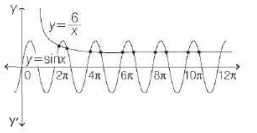
The number of solutions to $\sin x = \frac{6}{x}$ with $0 \leq x \leq 12 \pi$ is
A
$1$
B
$6$
C
$10$
D
$12$
Solution
(C) To find the number of solutions to $\sin x = \frac{6}{x}$ in the interval $0 \leq x \leq 12 \pi$,we look for the points of intersection between the graphs of $y = \sin x$ and $y = \frac{6}{x}$.
$1$. The function $y = \sin x$ oscillates between $-1$ and $1$ with a period of $2 \pi$.
$2$. The function $y = \frac{6}{x}$ is a hyperbola that decreases as $x$ increases.
$3$. For $x > 0$,the intersection points occur where $\sin x = \frac{6}{x}$. Since $|\sin x| \leq 1$,we must have $|\frac{6}{x}| \leq 1$,which implies $x \geq 6$.
$4$. In the interval $[0, 12 \pi]$,the function $y = \frac{6}{x}$ intersects the peaks of the sine wave. By observing the graph,the curve $y = \frac{6}{x}$ intersects the sine wave twice in each period of $2 \pi$ starting from the first positive cycle where the value of $\sin x$ can reach $\frac{6}{x}$.
$5$. Counting the intersection points from the graph,there are $10$ such points.
Thus,the correct option is $C$.
$1$. The function $y = \sin x$ oscillates between $-1$ and $1$ with a period of $2 \pi$.
$2$. The function $y = \frac{6}{x}$ is a hyperbola that decreases as $x$ increases.
$3$. For $x > 0$,the intersection points occur where $\sin x = \frac{6}{x}$. Since $|\sin x| \leq 1$,we must have $|\frac{6}{x}| \leq 1$,which implies $x \geq 6$.
$4$. In the interval $[0, 12 \pi]$,the function $y = \frac{6}{x}$ intersects the peaks of the sine wave. By observing the graph,the curve $y = \frac{6}{x}$ intersects the sine wave twice in each period of $2 \pi$ starting from the first positive cycle where the value of $\sin x$ can reach $\frac{6}{x}$.
$5$. Counting the intersection points from the graph,there are $10$ such points.
Thus,the correct option is $C$.
0 likes
View Solution109
DifficultMCQ
The sides $a, b, c$ of a triangle satisfy the relations $c^2=2ab$ and $a^2+c^2=3b^2$. Then the measure of $\angle BAC$,in degrees,is
A
$30$
B
$45$
C
$60$
D
$90$
Solution
(B) Given relations for the sides of the triangle are:
$c^2 = 2ab$ $(i)$
$a^2 + c^2 = 3b^2$ $(ii)$
Substituting $(i)$ into $(ii)$:
$a^2 + 2ab = 3b^2$
$a^2 + 2ab - 3b^2 = 0$
$(a + 3b)(a - b) = 0$
Since $a$ and $b$ are side lengths,$a, b > 0$,so $a = b$.
Substituting $a = b$ into $(i)$:
$c^2 = 2(b)(b) = 2b^2$
$c = \sqrt{2}b$
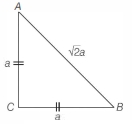
Now,we have sides $a = b$,$b = b$,and $c = \sqrt{2}b$.
Since $a^2 + b^2 = b^2 + b^2 = 2b^2 = c^2$,the triangle is a right-angled triangle with the right angle at $C$ (i.e.,$\angle C = 90^{\circ}$).
Since $a = b$,the triangle is an isosceles right-angled triangle.
Therefore,$\angle A = \angle B = 45^{\circ}$.
The measure of $\angle BAC$ is $45^{\circ}$.
$c^2 = 2ab$ $(i)$
$a^2 + c^2 = 3b^2$ $(ii)$
Substituting $(i)$ into $(ii)$:
$a^2 + 2ab = 3b^2$
$a^2 + 2ab - 3b^2 = 0$
$(a + 3b)(a - b) = 0$
Since $a$ and $b$ are side lengths,$a, b > 0$,so $a = b$.
Substituting $a = b$ into $(i)$:
$c^2 = 2(b)(b) = 2b^2$
$c = \sqrt{2}b$
Now,we have sides $a = b$,$b = b$,and $c = \sqrt{2}b$.
Since $a^2 + b^2 = b^2 + b^2 = 2b^2 = c^2$,the triangle is a right-angled triangle with the right angle at $C$ (i.e.,$\angle C = 90^{\circ}$).
Since $a = b$,the triangle is an isosceles right-angled triangle.
Therefore,$\angle A = \angle B = 45^{\circ}$.
The measure of $\angle BAC$ is $45^{\circ}$.
0 likes
View Solution110
AdvancedMCQ
Let $A_1 A_2 A_3 \ldots A_9$ be a nine-sided regular polygon with side length $2$ units. The difference between the lengths of the diagonals $A_1 A_5$ and $A_2 A_4$ equals
A
$2+\sqrt{12}$
B
$\sqrt{12}-2$
C
$6$
D
$2$
Solution
(D) Let $O$ be the center of the circumcircle of the regular nonagon $A_1 A_2 \ldots A_9$. The side length is $s = 2$.
The central angle subtended by each side is $\theta = \frac{2\pi}{9}$.
Let $r$ be the circumradius. In $\triangle O A_1 A_2$,by the law of cosines:
$s^2 = r^2 + r^2 - 2r^2 \cos(\frac{2\pi}{9}) = 2r^2(1 - \cos(\frac{2\pi}{9})) = 4r^2 \sin^2(\frac{\pi}{9})$.
Since $s = 2$,we have $4 = 4r^2 \sin^2(\frac{\pi}{9})$,so $r = \frac{1}{\sin(\frac{\pi}{9})}$.
The length of a chord $A_i A_j$ subtending a central angle $\phi$ is $2r \sin(\frac{\phi}{2})$.
For $A_1 A_5$,the central angle is $4 \times \frac{2\pi}{9} = \frac{8\pi}{9}$,so $A_1 A_5 = 2r \sin(\frac{4\pi}{9})$.
For $A_2 A_4$,the central angle is $2 \times \frac{2\pi}{9} = \frac{4\pi}{9}$,so $A_2 A_4 = 2r \sin(\frac{2\pi}{9})$.
The difference is $A_1 A_5 - A_2 A_4 = 2r(\sin(\frac{4\pi}{9}) - \sin(\frac{2\pi}{9}))$.
Using the identity $\sin C - \sin D = 2 \sin(\frac{C-D}{2}) \cos(\frac{C+D}{2})$:
$A_1 A_5 - A_2 A_4 = 2r \cdot 2 \sin(\frac{\pi}{9}) \cos(\frac{3\pi}{9}) = 4r \sin(\frac{\pi}{9}) \cos(\frac{\pi}{3})$.
Substituting $r = \frac{1}{\sin(\frac{\pi}{9})}$ and $\cos(\frac{\pi}{3}) = \frac{1}{2}$:
$A_1 A_5 - A_2 A_4 = 4 \cdot \frac{1}{\sin(\frac{\pi}{9})} \cdot \sin(\frac{\pi}{9}) \cdot \frac{1}{2} = 2$.
The central angle subtended by each side is $\theta = \frac{2\pi}{9}$.
Let $r$ be the circumradius. In $\triangle O A_1 A_2$,by the law of cosines:
$s^2 = r^2 + r^2 - 2r^2 \cos(\frac{2\pi}{9}) = 2r^2(1 - \cos(\frac{2\pi}{9})) = 4r^2 \sin^2(\frac{\pi}{9})$.
Since $s = 2$,we have $4 = 4r^2 \sin^2(\frac{\pi}{9})$,so $r = \frac{1}{\sin(\frac{\pi}{9})}$.
The length of a chord $A_i A_j$ subtending a central angle $\phi$ is $2r \sin(\frac{\phi}{2})$.
For $A_1 A_5$,the central angle is $4 \times \frac{2\pi}{9} = \frac{8\pi}{9}$,so $A_1 A_5 = 2r \sin(\frac{4\pi}{9})$.
For $A_2 A_4$,the central angle is $2 \times \frac{2\pi}{9} = \frac{4\pi}{9}$,so $A_2 A_4 = 2r \sin(\frac{2\pi}{9})$.
The difference is $A_1 A_5 - A_2 A_4 = 2r(\sin(\frac{4\pi}{9}) - \sin(\frac{2\pi}{9}))$.
Using the identity $\sin C - \sin D = 2 \sin(\frac{C-D}{2}) \cos(\frac{C+D}{2})$:
$A_1 A_5 - A_2 A_4 = 2r \cdot 2 \sin(\frac{\pi}{9}) \cos(\frac{3\pi}{9}) = 4r \sin(\frac{\pi}{9}) \cos(\frac{\pi}{3})$.
Substituting $r = \frac{1}{\sin(\frac{\pi}{9})}$ and $\cos(\frac{\pi}{3}) = \frac{1}{2}$:
$A_1 A_5 - A_2 A_4 = 4 \cdot \frac{1}{\sin(\frac{\pi}{9})} \cdot \sin(\frac{\pi}{9}) \cdot \frac{1}{2} = 2$.
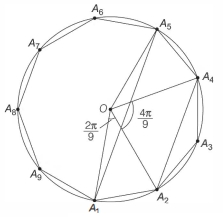
0 likes
View Solution111
AdvancedMCQ
The angle bisectors $BD$ and $CE$ of a $\triangle ABC$ are divided by the incentre $I$ in the ratios $3:2$ and $2:1$ respectively. Then,the ratio in which $I$ divides the angle bisector through $A$ is
A
$3:1$
B
$11:4$
C
$6:5$
D
$7:4$
Solution
(B) Given,in $\triangle ABC$,the angle bisectors $BD$ and $CE$ are divided by the incentre $I$ in the ratios $3:2$ and $2:1$ respectively.
$\frac{BI}{ID} = \frac{3}{2}$ and $\frac{CI}{IE} = \frac{2}{1}$.
We know that for an incentre $I$ of $\triangle ABC$ with sides $a, b, c$ opposite to vertices $A, B, C$ respectively,the ratio in which $I$ divides the angle bisectors are:
$\frac{AI}{IF} = \frac{b+c}{a}$,$\frac{BI}{ID} = \frac{a+c}{b}$,and $\frac{CI}{IE} = \frac{a+b}{c}$.
Given $\frac{a+c}{b} = \frac{3}{2} \Rightarrow 2a + 2c = 3b \quad \dots(i)$
Given $\frac{a+b}{c} = \frac{2}{1} \Rightarrow a + b = 2c \quad \dots(ii)$
From $(ii)$,$c = \frac{a+b}{2}$. Substituting this into $(i)$:
$2a + 2(\frac{a+b}{2}) = 3b$
$2a + a + b = 3b$
$3a = 2b \Rightarrow b = \frac{3}{2}a$
Now,substitute $b = \frac{3}{2}a$ into $(ii)$:
$a + \frac{3}{2}a = 2c$
$\frac{5}{2}a = 2c \Rightarrow c = \frac{5}{4}a$
Finally,the ratio $\frac{AI}{IF} = \frac{b+c}{a} = \frac{\frac{3}{2}a + \frac{5}{4}a}{a} = \frac{6+5}{4} = \frac{11}{4}$.
Thus,the ratio is $11:4$.
$\frac{BI}{ID} = \frac{3}{2}$ and $\frac{CI}{IE} = \frac{2}{1}$.
We know that for an incentre $I$ of $\triangle ABC$ with sides $a, b, c$ opposite to vertices $A, B, C$ respectively,the ratio in which $I$ divides the angle bisectors are:
$\frac{AI}{IF} = \frac{b+c}{a}$,$\frac{BI}{ID} = \frac{a+c}{b}$,and $\frac{CI}{IE} = \frac{a+b}{c}$.
Given $\frac{a+c}{b} = \frac{3}{2} \Rightarrow 2a + 2c = 3b \quad \dots(i)$
Given $\frac{a+b}{c} = \frac{2}{1} \Rightarrow a + b = 2c \quad \dots(ii)$
From $(ii)$,$c = \frac{a+b}{2}$. Substituting this into $(i)$:
$2a + 2(\frac{a+b}{2}) = 3b$
$2a + a + b = 3b$
$3a = 2b \Rightarrow b = \frac{3}{2}a$
Now,substitute $b = \frac{3}{2}a$ into $(ii)$:
$a + \frac{3}{2}a = 2c$
$\frac{5}{2}a = 2c \Rightarrow c = \frac{5}{4}a$
Finally,the ratio $\frac{AI}{IF} = \frac{b+c}{a} = \frac{\frac{3}{2}a + \frac{5}{4}a}{a} = \frac{6+5}{4} = \frac{11}{4}$.
Thus,the ratio is $11:4$.
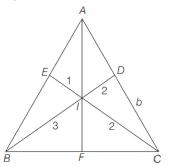
0 likes
View Solution112
AdvancedMCQ
Suppose that the sides $a, b, c$ of a triangle $ABC$ satisfy $b^2 = ac$. Then the set of all possible values of $\frac{\sin A \cot C + \cos A}{\sin B \cot C + \cos B}$ is
A
$(0, \infty)$
B
$\left(0, \frac{\sqrt{5}+1}{2}\right)$
C
$\left(\frac{\sqrt{5}-1}{2}, \frac{\sqrt{5}+1}{2}\right)$
D
$\left(\frac{\sqrt{5}-1}{2}, \infty\right)$
Solution
(C) Given the expression $E = \frac{\sin A \cot C + \cos A}{\sin B \cot C + \cos B}$.
Substituting $\cot C = \frac{\cos C}{\sin C}$,we get $E = \frac{\frac{\sin A \cos C + \cos A \sin C}{\sin C}}{\frac{\sin B \cos C + \cos B \sin C}{\sin C}} = \frac{\sin(A+C)}{\sin(B+C)}$.
Since $A+B+C = \pi$,we have $A+C = \pi - B$ and $B+C = \pi - A$.
Thus,$E = \frac{\sin(\pi - B)}{\sin(\pi - A)} = \frac{\sin B}{\sin A} = \frac{b}{a}$.
Given $b^2 = ac$,the sides $a, b, c$ are in a Geometric Progression $(G.P.)$. Let $b = ar$ and $c = ar^2$.
Then $E = \frac{b}{a} = \frac{ar}{a} = r$.
For a triangle to exist,the sum of any two sides must be greater than the third side:
$1) a+b > c$ $\Rightarrow a+ar > ar^2$ $\Rightarrow 1+r > r^2$ $\Rightarrow r^2-r-1 < 0$. Solving this gives $r \in \left(\frac{1-\sqrt{5}}{2}, \frac{1+\sqrt{5}}{2}\right)$. Since $r > 0$,$r \in \left(0, \frac{1+\sqrt{5}}{2}\right)$.
$2) a+c > b$ $\Rightarrow a+ar^2 > ar$ $\Rightarrow r^2-r+1 > 0$. This is true for all $r$.
$3) b+c > a$ $\Rightarrow ar+ar^2 > a$ $\Rightarrow r^2+r-1 > 0$. Solving this gives $r > \frac{-1+\sqrt{5}}{2}$ (since $r > 0$).
Combining these,$r \in \left(\frac{\sqrt{5}-1}{2}, \frac{\sqrt{5}+1}{2}\right)$.
Substituting $\cot C = \frac{\cos C}{\sin C}$,we get $E = \frac{\frac{\sin A \cos C + \cos A \sin C}{\sin C}}{\frac{\sin B \cos C + \cos B \sin C}{\sin C}} = \frac{\sin(A+C)}{\sin(B+C)}$.
Since $A+B+C = \pi$,we have $A+C = \pi - B$ and $B+C = \pi - A$.
Thus,$E = \frac{\sin(\pi - B)}{\sin(\pi - A)} = \frac{\sin B}{\sin A} = \frac{b}{a}$.
Given $b^2 = ac$,the sides $a, b, c$ are in a Geometric Progression $(G.P.)$. Let $b = ar$ and $c = ar^2$.
Then $E = \frac{b}{a} = \frac{ar}{a} = r$.
For a triangle to exist,the sum of any two sides must be greater than the third side:
$1) a+b > c$ $\Rightarrow a+ar > ar^2$ $\Rightarrow 1+r > r^2$ $\Rightarrow r^2-r-1 < 0$. Solving this gives $r \in \left(\frac{1-\sqrt{5}}{2}, \frac{1+\sqrt{5}}{2}\right)$. Since $r > 0$,$r \in \left(0, \frac{1+\sqrt{5}}{2}\right)$.
$2) a+c > b$ $\Rightarrow a+ar^2 > ar$ $\Rightarrow r^2-r+1 > 0$. This is true for all $r$.
$3) b+c > a$ $\Rightarrow ar+ar^2 > a$ $\Rightarrow r^2+r-1 > 0$. Solving this gives $r > \frac{-1+\sqrt{5}}{2}$ (since $r > 0$).
Combining these,$r \in \left(\frac{\sqrt{5}-1}{2}, \frac{\sqrt{5}+1}{2}\right)$.
0 likes
View Solution113
AdvancedMCQ
The sum of the sides of a right-angled triangle is $42$,and the difference between the median and altitude drawn from the vertex at the right angle is $2$. The area of the triangle is
A
$42$
B
$51$
C
$63$
D
$9 \sqrt{51}$
Solution
(C) Let the sides of the right-angled triangle be $b$,$c$ (legs) and $x$ (hypotenuse).
Given $b + c + x = 42$ --- $(1)$
In a right-angled triangle,the median to the hypotenuse is half the hypotenuse,so $M = \frac{x}{2}$.
The altitude $h$ to the hypotenuse is given by $h = \frac{bc}{x}$.
Given $M - h = 2$,so $\frac{x}{2} - \frac{bc}{x} = 2 \Rightarrow x^2 - 2bc = 4x$ --- $(2)$
From $(1)$,$b + c = 42 - x$. Squaring both sides: $b^2 + c^2 + 2bc = (42 - x)^2$.
Since $b^2 + c^2 = x^2$,we have $x^2 + 2bc = (42 - x)^2$ --- $(3)$
Adding $(2)$ and $(3)$: $2x^2 = (42 - x)^2 + 4x$.
$2x^2 = 1764 - 84x + x^2 + 4x \Rightarrow x^2 + 80x - 1764 = 0$.
Solving the quadratic equation: $(x + 98)(x - 18) = 0$. Since $x > 0$,$x = 18$.
Substitute $x = 18$ into $(2)$: $18^2 - 2bc = 4(18)$ $\Rightarrow 324 - 2bc = 72$ $\Rightarrow 2bc = 252$ $\Rightarrow bc = 126$.
The area of the triangle is $\frac{1}{2}bc = \frac{1}{2} \times 126 = 63$.
Given $b + c + x = 42$ --- $(1)$
In a right-angled triangle,the median to the hypotenuse is half the hypotenuse,so $M = \frac{x}{2}$.
The altitude $h$ to the hypotenuse is given by $h = \frac{bc}{x}$.
Given $M - h = 2$,so $\frac{x}{2} - \frac{bc}{x} = 2 \Rightarrow x^2 - 2bc = 4x$ --- $(2)$
From $(1)$,$b + c = 42 - x$. Squaring both sides: $b^2 + c^2 + 2bc = (42 - x)^2$.
Since $b^2 + c^2 = x^2$,we have $x^2 + 2bc = (42 - x)^2$ --- $(3)$
Adding $(2)$ and $(3)$: $2x^2 = (42 - x)^2 + 4x$.
$2x^2 = 1764 - 84x + x^2 + 4x \Rightarrow x^2 + 80x - 1764 = 0$.
Solving the quadratic equation: $(x + 98)(x - 18) = 0$. Since $x > 0$,$x = 18$.
Substitute $x = 18$ into $(2)$: $18^2 - 2bc = 4(18)$ $\Rightarrow 324 - 2bc = 72$ $\Rightarrow 2bc = 252$ $\Rightarrow bc = 126$.
The area of the triangle is $\frac{1}{2}bc = \frac{1}{2} \times 126 = 63$.
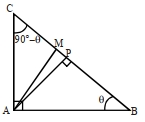
0 likes
View Solution114
DifficultMCQ
Let $S=\{\theta \in[0,2 \pi): \tan (\pi \cos \theta)+\tan (\pi \sin \theta)=0\}$. Then $\sum_{\theta \in S } \sin ^2\left(\theta+\frac{\pi}{4}\right)$ is equal to
A
$4$
B
$6$
C
$8$
D
$2$
Solution
(D) Given $\tan (\pi \cos \theta) + \tan (\pi \sin \theta) = 0$.
This implies $\tan (\pi \cos \theta) = -\tan (\pi \sin \theta) = \tan (-\pi \sin \theta)$.
Thus,$\pi \cos \theta = n\pi - \pi \sin \theta$,where $n \in \mathbb{Z}$.
Dividing by $\pi$,we get $\sin \theta + \cos \theta = n$.
Since $-\sqrt{2} \leq \sin \theta + \cos \theta \leq \sqrt{2}$,the possible integer values for $n$ are $-1, 0, 1$.
Case $1$: $\sin \theta + \cos \theta = 0 \implies \tan \theta = -1$. In $[0, 2\pi)$,$\theta = \frac{3\pi}{4}, \frac{7\pi}{4}$.
Case $2$: $\sin \theta + \cos \theta = 1 \implies \sin(\theta + \frac{\pi}{4}) = \frac{1}{\sqrt{2}}$. In $[0, 2\pi)$,$\theta = 0, \frac{\pi}{2}$.
Case $3$: $\sin \theta + \cos \theta = -1 \implies \sin(\theta + \frac{\pi}{4}) = -\frac{1}{\sqrt{2}}$. In $[0, 2\pi)$,$\theta = \pi, \frac{3\pi}{2}$.
The set $S = \{0, \frac{\pi}{2}, \frac{3\pi}{4}, \pi, \frac{3\pi}{2}, \frac{7\pi}{4}\}$.
We need to calculate $\sum_{\theta \in S} \sin^2(\theta + \frac{\pi}{4})$.
For $\theta \in \{0, \frac{\pi}{2}\}$,$\sin^2(\theta + \frac{\pi}{4}) = (\frac{1}{\sqrt{2}})^2 = \frac{1}{2}$.
For $\theta \in \{\pi, \frac{3\pi}{2}\}$,$\sin^2(\theta + \frac{\pi}{4}) = (-\frac{1}{\sqrt{2}})^2 = \frac{1}{2}$.
For $\theta \in \{\frac{3\pi}{4}, \frac{7\pi}{4}\}$,$\sin^2(\theta + \frac{\pi}{4}) = (0)^2 = 0$.
Sum $= 4 \times \frac{1}{2} + 2 \times 0 = 2$.
This implies $\tan (\pi \cos \theta) = -\tan (\pi \sin \theta) = \tan (-\pi \sin \theta)$.
Thus,$\pi \cos \theta = n\pi - \pi \sin \theta$,where $n \in \mathbb{Z}$.
Dividing by $\pi$,we get $\sin \theta + \cos \theta = n$.
Since $-\sqrt{2} \leq \sin \theta + \cos \theta \leq \sqrt{2}$,the possible integer values for $n$ are $-1, 0, 1$.
Case $1$: $\sin \theta + \cos \theta = 0 \implies \tan \theta = -1$. In $[0, 2\pi)$,$\theta = \frac{3\pi}{4}, \frac{7\pi}{4}$.
Case $2$: $\sin \theta + \cos \theta = 1 \implies \sin(\theta + \frac{\pi}{4}) = \frac{1}{\sqrt{2}}$. In $[0, 2\pi)$,$\theta = 0, \frac{\pi}{2}$.
Case $3$: $\sin \theta + \cos \theta = -1 \implies \sin(\theta + \frac{\pi}{4}) = -\frac{1}{\sqrt{2}}$. In $[0, 2\pi)$,$\theta = \pi, \frac{3\pi}{2}$.
The set $S = \{0, \frac{\pi}{2}, \frac{3\pi}{4}, \pi, \frac{3\pi}{2}, \frac{7\pi}{4}\}$.
We need to calculate $\sum_{\theta \in S} \sin^2(\theta + \frac{\pi}{4})$.
For $\theta \in \{0, \frac{\pi}{2}\}$,$\sin^2(\theta + \frac{\pi}{4}) = (\frac{1}{\sqrt{2}})^2 = \frac{1}{2}$.
For $\theta \in \{\pi, \frac{3\pi}{2}\}$,$\sin^2(\theta + \frac{\pi}{4}) = (-\frac{1}{\sqrt{2}})^2 = \frac{1}{2}$.
For $\theta \in \{\frac{3\pi}{4}, \frac{7\pi}{4}\}$,$\sin^2(\theta + \frac{\pi}{4}) = (0)^2 = 0$.
Sum $= 4 \times \frac{1}{2} + 2 \times 0 = 2$.
0 likes
View Solution115
DifficultMCQ
For a triangle $ABC$,the value of $\cos 2A + \cos 2B + \cos 2C$ is least. If its inradius is $3$ and incentre is $M$,then which of the following is $NOT$ correct?
A
Perimeter of $\triangle ABC$ is $18\sqrt{3}$
B
$\sin 2A + \sin 2B + \sin 2C = \sin A + \sin B + \sin C$
C
$\overrightarrow{MA} \cdot \overrightarrow{MB} = -18$
D
Area of $\triangle ABC$ is $\frac{27\sqrt{3}}{2}$
Solution
(D) The expression $\cos 2A + \cos 2B + \cos 2C$ is minimized when $\triangle ABC$ is an equilateral triangle,i.e.,$A = B = C = 60^{\circ}$.
Given inradius $r = 3$. For an equilateral triangle,$r = \frac{a}{2\sqrt{3}}$,so $3 = \frac{a}{2\sqrt{3}} \implies a = 6\sqrt{3}$.
Perimeter $= 3a = 18\sqrt{3}$. (Option $A$ is correct).
Area $= \frac{\sqrt{3}}{4} a^2 = \frac{\sqrt{3}}{4} (6\sqrt{3})^2 = \frac{\sqrt{3}}{4} (108) = 27\sqrt{3}$. (Option $D$ is incorrect as it states $\frac{27\sqrt{3}}{2}$).
For $\sin 2A + \sin 2B + \sin 2C = 4\sin A \sin B \sin C$ and $\sin A + \sin B + \sin C = 3\sin 60^{\circ} = \frac{3\sqrt{3}}{2}$. Since $4\sin^3 60^{\circ} = 4(\frac{\sqrt{3}}{2})^3 = \frac{3\sqrt{3}}{2}$,Option $B$ is correct.
For $\overrightarrow{MA} \cdot \overrightarrow{MB} = |MA||MB| \cos(120^{\circ}) = (2r)(2r)(-1/2) = -2r^2 = -2(3^2) = -18$. (Option $C$ is correct).
Given inradius $r = 3$. For an equilateral triangle,$r = \frac{a}{2\sqrt{3}}$,so $3 = \frac{a}{2\sqrt{3}} \implies a = 6\sqrt{3}$.
Perimeter $= 3a = 18\sqrt{3}$. (Option $A$ is correct).
Area $= \frac{\sqrt{3}}{4} a^2 = \frac{\sqrt{3}}{4} (6\sqrt{3})^2 = \frac{\sqrt{3}}{4} (108) = 27\sqrt{3}$. (Option $D$ is incorrect as it states $\frac{27\sqrt{3}}{2}$).
For $\sin 2A + \sin 2B + \sin 2C = 4\sin A \sin B \sin C$ and $\sin A + \sin B + \sin C = 3\sin 60^{\circ} = \frac{3\sqrt{3}}{2}$. Since $4\sin^3 60^{\circ} = 4(\frac{\sqrt{3}}{2})^3 = \frac{3\sqrt{3}}{2}$,Option $B$ is correct.
For $\overrightarrow{MA} \cdot \overrightarrow{MB} = |MA||MB| \cos(120^{\circ}) = (2r)(2r)(-1/2) = -2r^2 = -2(3^2) = -18$. (Option $C$ is correct).
0 likes
View Solution116
DifficultMCQ
In a triangle $ABC$,if $\cos A + 2 \cos B + \cos C = 2$ and the lengths of the sides opposite to the angles $A$ and $C$ are $3$ and $7$ respectively,then $\cos A - \cos C$ is equal to
A
$\frac{3}{7}$
B
$\frac{9}{7}$
C
$\frac{10}{7}$
D
$\frac{5}{7}$
Solution
(C) Given $\cos A + \cos C = 2(1 - \cos B)$.
Using the sum-to-product formula,$2 \cos \frac{A+C}{2} \cos \frac{A-C}{2} = 4 \sin^2 \frac{B}{2}$.
Since $\cos \frac{A+C}{2} = \sin \frac{B}{2}$,we have $2 \sin \frac{B}{2} \cos \frac{A-C}{2} = 4 \sin^2 \frac{B}{2}$,which simplifies to $\cos \frac{A-C}{2} = 2 \sin \frac{B}{2}$.
Using the sine rule,$\sin A + \sin C = 2 \sin B$,which implies $a + c = 2b$.
Given $a = 3$ and $c = 7$,we get $3 + 7 = 2b$,so $b = 5$.
Now,$\cos A - \cos C = \frac{b^2 + c^2 - a^2}{2bc} - \frac{a^2 + b^2 - c^2}{2ab}$.
Substituting the values: $\cos A - \cos C = \frac{25 + 49 - 9}{2(5)(7)} - \frac{9 + 25 - 49}{2(3)(5)}$.
$= \frac{65}{70} - \frac{-15}{30} = \frac{13}{14} + \frac{1}{2} = \frac{13 + 7}{14} = \frac{20}{14} = \frac{10}{7}$.
Using the sum-to-product formula,$2 \cos \frac{A+C}{2} \cos \frac{A-C}{2} = 4 \sin^2 \frac{B}{2}$.
Since $\cos \frac{A+C}{2} = \sin \frac{B}{2}$,we have $2 \sin \frac{B}{2} \cos \frac{A-C}{2} = 4 \sin^2 \frac{B}{2}$,which simplifies to $\cos \frac{A-C}{2} = 2 \sin \frac{B}{2}$.
Using the sine rule,$\sin A + \sin C = 2 \sin B$,which implies $a + c = 2b$.
Given $a = 3$ and $c = 7$,we get $3 + 7 = 2b$,so $b = 5$.
Now,$\cos A - \cos C = \frac{b^2 + c^2 - a^2}{2bc} - \frac{a^2 + b^2 - c^2}{2ab}$.
Substituting the values: $\cos A - \cos C = \frac{25 + 49 - 9}{2(5)(7)} - \frac{9 + 25 - 49}{2(3)(5)}$.
$= \frac{65}{70} - \frac{-15}{30} = \frac{13}{14} + \frac{1}{2} = \frac{13 + 7}{14} = \frac{20}{14} = \frac{10}{7}$.
0 likes
View Solution117
DifficultMCQ
If $2 \tan ^2 \theta-5 \sec \theta=1$ has exactly $7$ solutions in the interval $\left[0, \frac{n \pi}{2}\right]$,for the least value of $n \in N$,then $\sum_{k=1}^{n} \frac{k}{2^{k}}$ is equal to :
A
$\frac{1}{2^{15}}(2^{14}-14)$
B
$\frac{1}{2^{14}}(2^{15}-15)$
C
$1-\frac{15}{2^{13}}$
D
$\frac{1}{2^{13}}(2^{14}-15)$
Solution
(D) Given $2 \tan ^2 \theta - 5 \sec \theta = 1$.
Using $\tan ^2 \theta = \sec ^2 \theta - 1$,we get $2(\sec ^2 \theta - 1) - 5 \sec \theta - 1 = 0$.
$2 \sec ^2 \theta - 5 \sec \theta - 3 = 0$.
$(2 \sec \theta + 1)(\sec \theta - 3) = 0$.
Since $\sec \theta = -\frac{1}{2}$ is impossible,we have $\sec \theta = 3$,which means $\cos \theta = \frac{1}{3}$.
In the interval $[0, 2\pi]$,there are $2$ solutions for $\cos \theta = \frac{1}{3}$.
For $7$ solutions,we need $3$ full periods of $2\pi$ plus one more solution in the next interval,so $n = 13$.
We need to calculate $S = \sum_{k=1}^{13} \frac{k}{2^k}$.
$S = \frac{1}{2} + \frac{2}{2^2} + \dots + \frac{13}{2^{13}}$.
$\frac{1}{2}S = \frac{1}{2^2} + \dots + \frac{12}{2^{13}} + \frac{13}{2^{14}}$.
Subtracting gives $\frac{S}{2} = \frac{1}{2} + \frac{1}{2^2} + \dots + \frac{1}{2^{13}} - \frac{13}{2^{14}} = \frac{1/2(1 - 1/2^{13})}{1 - 1/2} - \frac{13}{2^{14}} = 1 - \frac{1}{2^{13}} - \frac{13}{2^{14}} = 1 - \frac{15}{2^{14}}$.
$S = 2 - \frac{15}{2^{13}} = \frac{2^{14} - 15}{2^{13}}$.
Using $\tan ^2 \theta = \sec ^2 \theta - 1$,we get $2(\sec ^2 \theta - 1) - 5 \sec \theta - 1 = 0$.
$2 \sec ^2 \theta - 5 \sec \theta - 3 = 0$.
$(2 \sec \theta + 1)(\sec \theta - 3) = 0$.
Since $\sec \theta = -\frac{1}{2}$ is impossible,we have $\sec \theta = 3$,which means $\cos \theta = \frac{1}{3}$.
In the interval $[0, 2\pi]$,there are $2$ solutions for $\cos \theta = \frac{1}{3}$.
For $7$ solutions,we need $3$ full periods of $2\pi$ plus one more solution in the next interval,so $n = 13$.
We need to calculate $S = \sum_{k=1}^{13} \frac{k}{2^k}$.
$S = \frac{1}{2} + \frac{2}{2^2} + \dots + \frac{13}{2^{13}}$.
$\frac{1}{2}S = \frac{1}{2^2} + \dots + \frac{12}{2^{13}} + \frac{13}{2^{14}}$.
Subtracting gives $\frac{S}{2} = \frac{1}{2} + \frac{1}{2^2} + \dots + \frac{1}{2^{13}} - \frac{13}{2^{14}} = \frac{1/2(1 - 1/2^{13})}{1 - 1/2} - \frac{13}{2^{14}} = 1 - \frac{1}{2^{13}} - \frac{13}{2^{14}} = 1 - \frac{15}{2^{14}}$.
$S = 2 - \frac{15}{2^{13}} = \frac{2^{14} - 15}{2^{13}}$.
1 likes
View Solution118
DifficultMCQ
The number of solutions of $\sin ^2 x + (2 + 2x - x^2) \sin x - 3(x - 1)^2 = 0$,where $-\pi \leq x \leq \pi$,is....................
A
$6$
B
$7$
C
$2$
D
$4$
Solution
(C) Given equation: $\sin ^2 x + (2 + 2x - x^2) \sin x - 3(x - 1)^2 = 0$
Rewrite the middle term: $2 + 2x - x^2 = 3 - (x^2 - 2x + 1) = 3 - (x - 1)^2$
Let $u = \sin x$ and $v = (x - 1)^2$. The equation becomes $u^2 + (3 - v)u - 3v = 0$.
Factoring the quadratic: $u^2 + 3u - vu - 3v = 0 \implies u(u + 3) - v(u + 3) = 0 \implies (u - v)(u + 3) = 0$.
This gives two cases: $\sin x = -3$ (which is impossible as $-1 \leq \sin x \leq 1$) or $\sin x = (x - 1)^2$.
We need to find the number of solutions for $\sin x = (x - 1)^2$ in the interval $[-\pi, \pi]$.
Let $f(x) = \sin x$ and $g(x) = (x - 1)^2$.
$g(x) = 0$ at $x = 1$. Since $1 < \pi \approx 3.14$,$x = 1$ is in the interval.
At $x = 1$,$f(1) = \sin(1) \approx 0.84$ and $g(1) = 0$. Since $f(1) > g(1)$,and $g(x)$ is a parabola opening upwards with vertex at $(1, 0)$,we check intersection points.
For $x > 1$,$g(x)$ increases rapidly. At $x = 1 + \sqrt{1} = 2$,$g(2) = 1$ and $\sin(2) < 1$. At $x = 1 + \sqrt{\sin x}$,there are two intersection points between $x=1$ and $x=1+\pi/2$.
Graphically,the curve $y = \sin x$ and $y = (x - 1)^2$ intersect at $2$ points in the given interval $[-\pi, \pi]$.
Rewrite the middle term: $2 + 2x - x^2 = 3 - (x^2 - 2x + 1) = 3 - (x - 1)^2$
Let $u = \sin x$ and $v = (x - 1)^2$. The equation becomes $u^2 + (3 - v)u - 3v = 0$.
Factoring the quadratic: $u^2 + 3u - vu - 3v = 0 \implies u(u + 3) - v(u + 3) = 0 \implies (u - v)(u + 3) = 0$.
This gives two cases: $\sin x = -3$ (which is impossible as $-1 \leq \sin x \leq 1$) or $\sin x = (x - 1)^2$.
We need to find the number of solutions for $\sin x = (x - 1)^2$ in the interval $[-\pi, \pi]$.
Let $f(x) = \sin x$ and $g(x) = (x - 1)^2$.
$g(x) = 0$ at $x = 1$. Since $1 < \pi \approx 3.14$,$x = 1$ is in the interval.
At $x = 1$,$f(1) = \sin(1) \approx 0.84$ and $g(1) = 0$. Since $f(1) > g(1)$,and $g(x)$ is a parabola opening upwards with vertex at $(1, 0)$,we check intersection points.
For $x > 1$,$g(x)$ increases rapidly. At $x = 1 + \sqrt{1} = 2$,$g(2) = 1$ and $\sin(2) < 1$. At $x = 1 + \sqrt{\sin x}$,there are two intersection points between $x=1$ and $x=1+\pi/2$.
Graphically,the curve $y = \sin x$ and $y = (x - 1)^2$ intersect at $2$ points in the given interval $[-\pi, \pi]$.
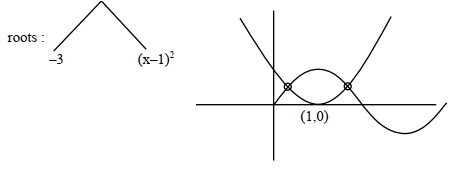
0 likes
View Solution119
DifficultMCQ
In a triangle $ABC$,$BC=7$,$AC=8$,$AB=\alpha \in N$ and $\cos A=\frac{2}{3}$. If $49 \cos (3C)+42=\frac{m}{n}$,where $\operatorname{gcd}(m, n)=1$,then $m+n$ is equal to..........
A
$29$
B
$39$
C
$40$
D
$31$
Solution
(B) Using the Law of Cosines: $\cos A = \frac{b^2+c^2-a^2}{2bc}$.
Given $a=7$,$b=8$,$c=\alpha$,and $\cos A = \frac{2}{3}$:
$\frac{2}{3} = \frac{8^2+\alpha^2-7^2}{2 \times 8 \times \alpha} = \frac{64+\alpha^2-49}{16\alpha} = \frac{15+\alpha^2}{16\alpha}$.
$32\alpha = 45 + 3\alpha^2 \implies 3\alpha^2 - 32\alpha + 45 = 0$.
$(3\alpha - 5)(\alpha - 9) = 0$. Since $\alpha \in N$,we have $\alpha = 9$.
Now,find $\cos C$ using the Law of Cosines: $\cos C = \frac{a^2+b^2-c^2}{2ab} = \frac{7^2+8^2-9^2}{2 \times 7 \times 8} = \frac{49+64-81}{112} = \frac{32}{112} = \frac{2}{7}$.
We need to evaluate $49 \cos(3C) + 42$.
Using $\cos(3C) = 4\cos^3 C - 3\cos C$:
$49(4(\frac{2}{7})^3 - 3(\frac{2}{7})) + 42 = 49(4 \times \frac{8}{343} - \frac{6}{7}) + 42 = 49(\frac{32}{343} - \frac{6}{7}) + 42 = 49(\frac{32 - 294}{343}) + 42 = \frac{32 - 294}{7} + 42 = \frac{-262}{7} + \frac{294}{7} = \frac{32}{7}$.
Thus,$\frac{m}{n} = \frac{32}{7}$,so $m=32$ and $n=7$. Since $\operatorname{gcd}(32, 7)=1$,$m+n = 32+7 = 39$.
Given $a=7$,$b=8$,$c=\alpha$,and $\cos A = \frac{2}{3}$:
$\frac{2}{3} = \frac{8^2+\alpha^2-7^2}{2 \times 8 \times \alpha} = \frac{64+\alpha^2-49}{16\alpha} = \frac{15+\alpha^2}{16\alpha}$.
$32\alpha = 45 + 3\alpha^2 \implies 3\alpha^2 - 32\alpha + 45 = 0$.
$(3\alpha - 5)(\alpha - 9) = 0$. Since $\alpha \in N$,we have $\alpha = 9$.
Now,find $\cos C$ using the Law of Cosines: $\cos C = \frac{a^2+b^2-c^2}{2ab} = \frac{7^2+8^2-9^2}{2 \times 7 \times 8} = \frac{49+64-81}{112} = \frac{32}{112} = \frac{2}{7}$.
We need to evaluate $49 \cos(3C) + 42$.
Using $\cos(3C) = 4\cos^3 C - 3\cos C$:
$49(4(\frac{2}{7})^3 - 3(\frac{2}{7})) + 42 = 49(4 \times \frac{8}{343} - \frac{6}{7}) + 42 = 49(\frac{32}{343} - \frac{6}{7}) + 42 = 49(\frac{32 - 294}{343}) + 42 = \frac{32 - 294}{7} + 42 = \frac{-262}{7} + \frac{294}{7} = \frac{32}{7}$.
Thus,$\frac{m}{n} = \frac{32}{7}$,so $m=32$ and $n=7$. Since $\operatorname{gcd}(32, 7)=1$,$m+n = 32+7 = 39$.
0 likes
View Solution120
AdvancedMCQ
In a triangle $ABC$ with a fixed base $BC$,the vertex $A$ moves such that $\cos B + \cos C = 4 \sin^2 \frac{A}{2}$. If $a, b,$ and $c$ denote the lengths of the sides of the triangle opposite to the angles $A, B,$ and $C$,respectively,then:
$(A) b+c=4a$
$(B) b+c=2a$
$(C) \text{locus of point } A \text{ is an ellipse}$
$(D) \text{locus of point } A \text{ is a pair of straight lines}$
$(A) b+c=4a$
$(B) b+c=2a$
$(C) \text{locus of point } A \text{ is an ellipse}$
$(D) \text{locus of point } A \text{ is a pair of straight lines}$
A
$(B, C)$
B
$(B, D)$
C
$(A, C)$
D
$(A, D)$
Solution
(C) In $\triangle ABC$,we have $A + B + C = 180^{\circ}$,so $\frac{B+C}{2} = 90^{\circ} - \frac{A}{2}$.
Given $\cos B + \cos C = 4 \sin^2 \frac{A}{2}$.
Using the sum-to-product formula: $2 \cos \frac{B+C}{2} \cos \frac{B-C}{2} = 4 \sin^2 \frac{A}{2}$.
Since $\cos \frac{B+C}{2} = \sin \frac{A}{2}$,we have $2 \sin \frac{A}{2} \cos \frac{B-C}{2} = 4 \sin^2 \frac{A}{2}$.
Dividing by $2 \sin \frac{A}{2}$ (assuming $A \neq 0$),we get $\cos \frac{B-C}{2} = 2 \sin \frac{A}{2}$.
Multiplying both sides by $2 \cos \frac{A}{2}$,we get $2 \cos \frac{A}{2} \cos \frac{B-C}{2} = 4 \sin \frac{A}{2} \cos \frac{A}{2}$.
Using $2 \cos \frac{A}{2} = 2 \sin \frac{B+C}{2}$,we get $2 \sin \frac{B+C}{2} \cos \frac{B-C}{2} = 2 \sin A$.
This simplifies to $\sin B + \sin C = 2 \sin A$.
By the Sine Rule,$\frac{b}{2R} + \frac{c}{2R} = 2 \frac{a}{2R}$,which implies $b + c = 2a$.
Since $b + c = AB + AC = 2BC$,and $BC$ is a fixed base,the sum of the distances of $A$ from two fixed points $B$ and $C$ is constant $(2BC > BC)$.
Therefore,the locus of point $A$ is an ellipse with foci at $B$ and $C$.
Given $\cos B + \cos C = 4 \sin^2 \frac{A}{2}$.
Using the sum-to-product formula: $2 \cos \frac{B+C}{2} \cos \frac{B-C}{2} = 4 \sin^2 \frac{A}{2}$.
Since $\cos \frac{B+C}{2} = \sin \frac{A}{2}$,we have $2 \sin \frac{A}{2} \cos \frac{B-C}{2} = 4 \sin^2 \frac{A}{2}$.
Dividing by $2 \sin \frac{A}{2}$ (assuming $A \neq 0$),we get $\cos \frac{B-C}{2} = 2 \sin \frac{A}{2}$.
Multiplying both sides by $2 \cos \frac{A}{2}$,we get $2 \cos \frac{A}{2} \cos \frac{B-C}{2} = 4 \sin \frac{A}{2} \cos \frac{A}{2}$.
Using $2 \cos \frac{A}{2} = 2 \sin \frac{B+C}{2}$,we get $2 \sin \frac{B+C}{2} \cos \frac{B-C}{2} = 2 \sin A$.
This simplifies to $\sin B + \sin C = 2 \sin A$.
By the Sine Rule,$\frac{b}{2R} + \frac{c}{2R} = 2 \frac{a}{2R}$,which implies $b + c = 2a$.
Since $b + c = AB + AC = 2BC$,and $BC$ is a fixed base,the sum of the distances of $A$ from two fixed points $B$ and $C$ is constant $(2BC > BC)$.
Therefore,the locus of point $A$ is an ellipse with foci at $B$ and $C$.
0 likes
View Solution121
DifficultMCQ
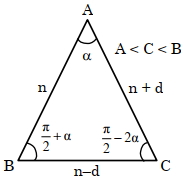
Consider an obtuse-angled triangle $ABC$ in which the difference between the largest and the smallest angle is $\frac{\pi}{2}$ and whose sides are in arithmetic progression. Suppose that the vertices of this triangle lie on a circle of radius $1$.
$(1)$ Let $a$ be the area of the triangle $ABC$. Then the value of $(64 a)^2$ is
$(2)$ The inradius of the triangle $ABC$ is
$(1)$ Let $a$ be the area of the triangle $ABC$. Then the value of $(64 a)^2$ is
$(2)$ The inradius of the triangle $ABC$ is
A
$1008, 0.25$
B
$1080, 0.25$
C
$1009, 0.30$
D
$1010, 0.35$
Solution
(A) Let the angles of the triangle be $A, C, B$ such that $A < C < B$. Given $B - A = \frac{\pi}{2}$.
Let the sides be $a_1 = n-d, a_2 = n, a_3 = n+d$ in arithmetic progression.
Using the sine rule with circumradius $R=1$,the sides are $2R \sin A, 2R \sin C, 2R \sin B$.
Thus,$n-d = 2 \sin A$,$n = 2 \sin C$,$n+d = 2 \sin B$.
Since $A+B+C = \pi$ and $B = A + \frac{\pi}{2}$,we have $C = \pi - (A + B) = \pi - (2A + \frac{\pi}{2}) = \frac{\pi}{2} - 2A$.
Since $A+C+B = \pi$,$A + (\frac{\pi}{2} - 2A) + (A + \frac{\pi}{2}) = \pi$,which is consistent.
From $2n = (n-d) + (n+d) = 2 \sin A + 2 \sin B$,we get $n = \sin A + \sin B = \sin A + \cos A$.
Also $n = 2 \sin C = 2 \sin(\frac{\pi}{2} - 2A) = 2 \cos 2A$.
Equating $n$: $\sin A + \cos A = 2 \cos 2A = 2(\cos^2 A - \sin^2 A) = 2(\cos A - \sin A)(\cos A + \sin A)$.
Since $\sin A + \cos A \neq 0$,we have $1 = 2(\cos A - \sin A) \Rightarrow \cos A - \sin A = \frac{1}{2}$.
Squaring both sides: $1 - 2 \sin A \cos A = \frac{1}{4} \Rightarrow \sin 2A = \frac{3}{4}$.
Area $a = \frac{1}{2} (n-d)(n+d) \sin C = \frac{1}{2} (2 \sin A)(2 \sin B) \sin C = 2 \sin A \cos A \sin C = \sin 2A \cos 2A$.
Since $\sin 2A = \frac{3}{4}$,$\cos 2A = \sqrt{1 - (3/4)^2} = \frac{\sqrt{7}}{4}$.
$a = \frac{3}{4} \times \frac{\sqrt{7}}{4} = \frac{3\sqrt{7}}{16}$.
$(64a)^2 = (64 \times \frac{3\sqrt{7}}{16})^2 = (4 \times 3\sqrt{7})^2 = 144 \times 7 = 1008$.
Inradius $r = \frac{a}{s} = \frac{a}{(3n/2)} = \frac{2a}{3n} = \frac{2 \sin 2A \cos 2A}{3(2 \cos 2A)} = \frac{\sin 2A}{3} = \frac{3/4}{3} = \frac{1}{4} = 0.25$.
Let the sides be $a_1 = n-d, a_2 = n, a_3 = n+d$ in arithmetic progression.
Using the sine rule with circumradius $R=1$,the sides are $2R \sin A, 2R \sin C, 2R \sin B$.
Thus,$n-d = 2 \sin A$,$n = 2 \sin C$,$n+d = 2 \sin B$.
Since $A+B+C = \pi$ and $B = A + \frac{\pi}{2}$,we have $C = \pi - (A + B) = \pi - (2A + \frac{\pi}{2}) = \frac{\pi}{2} - 2A$.
Since $A+C+B = \pi$,$A + (\frac{\pi}{2} - 2A) + (A + \frac{\pi}{2}) = \pi$,which is consistent.
From $2n = (n-d) + (n+d) = 2 \sin A + 2 \sin B$,we get $n = \sin A + \sin B = \sin A + \cos A$.
Also $n = 2 \sin C = 2 \sin(\frac{\pi}{2} - 2A) = 2 \cos 2A$.
Equating $n$: $\sin A + \cos A = 2 \cos 2A = 2(\cos^2 A - \sin^2 A) = 2(\cos A - \sin A)(\cos A + \sin A)$.
Since $\sin A + \cos A \neq 0$,we have $1 = 2(\cos A - \sin A) \Rightarrow \cos A - \sin A = \frac{1}{2}$.
Squaring both sides: $1 - 2 \sin A \cos A = \frac{1}{4} \Rightarrow \sin 2A = \frac{3}{4}$.
Area $a = \frac{1}{2} (n-d)(n+d) \sin C = \frac{1}{2} (2 \sin A)(2 \sin B) \sin C = 2 \sin A \cos A \sin C = \sin 2A \cos 2A$.
Since $\sin 2A = \frac{3}{4}$,$\cos 2A = \sqrt{1 - (3/4)^2} = \frac{\sqrt{7}}{4}$.
$a = \frac{3}{4} \times \frac{\sqrt{7}}{4} = \frac{3\sqrt{7}}{16}$.
$(64a)^2 = (64 \times \frac{3\sqrt{7}}{16})^2 = (4 \times 3\sqrt{7})^2 = 144 \times 7 = 1008$.
Inradius $r = \frac{a}{s} = \frac{a}{(3n/2)} = \frac{2a}{3n} = \frac{2 \sin 2A \cos 2A}{3(2 \cos 2A)} = \frac{\sin 2A}{3} = \frac{3/4}{3} = \frac{1}{4} = 0.25$.
0 likes
View Solution122
AdvancedMCQ
The number of values of $\theta$ in the interval $\left(-\frac{\pi}{2}, \frac{\pi}{2}\right)$ such that $\theta \neq \frac{n \pi}{5}$ for $n=0, \pm 1, \pm 2$ and $\tan \theta = \cot 5 \theta$ as well as $\sin 2 \theta = \cos 4 \theta$ is
A
$3$
B
$2$
C
$5$
D
$8$
Solution
(A) Given $\tan \theta = \cot 5 \theta = \tan\left(\frac{\pi}{2} - 5\theta\right)$.
This implies $\theta = n\pi + \frac{\pi}{2} - 5\theta$,so $6\theta = n\pi + \frac{\pi}{2}$,or $\theta = \frac{(2n+1)\pi}{12}$.
Also,$\sin 2\theta = \cos 4\theta = 1 - 2\sin^2 2\theta$.
Let $x = \sin 2\theta$,then $2x^2 + x - 1 = 0$,which gives $(2x-1)(x+1) = 0$.
So $\sin 2\theta = \frac{1}{2}$ or $\sin 2\theta = -1$.
If $\sin 2\theta = -1$,then $2\theta = -\frac{\pi}{2} \Rightarrow \theta = -\frac{\pi}{4}$.
If $\sin 2\theta = \frac{1}{2}$,then $2\theta = \frac{\pi}{6}$ or $\frac{5\pi}{6} \Rightarrow \theta = \frac{\pi}{12}$ or $\frac{5\pi}{12}$.
Checking the condition $\theta \neq \frac{n\pi}{5}$ for $n=0, \pm 1, \pm 2$:
For $\theta = -\frac{\pi}{4}$,$\theta = \frac{\pi}{12}$,and $\theta = \frac{5\pi}{12}$,none of these are equal to $0, \pm \frac{\pi}{5}, \pm \frac{2\pi}{5}$.
Thus,there are $3$ such values.
This implies $\theta = n\pi + \frac{\pi}{2} - 5\theta$,so $6\theta = n\pi + \frac{\pi}{2}$,or $\theta = \frac{(2n+1)\pi}{12}$.
Also,$\sin 2\theta = \cos 4\theta = 1 - 2\sin^2 2\theta$.
Let $x = \sin 2\theta$,then $2x^2 + x - 1 = 0$,which gives $(2x-1)(x+1) = 0$.
So $\sin 2\theta = \frac{1}{2}$ or $\sin 2\theta = -1$.
If $\sin 2\theta = -1$,then $2\theta = -\frac{\pi}{2} \Rightarrow \theta = -\frac{\pi}{4}$.
If $\sin 2\theta = \frac{1}{2}$,then $2\theta = \frac{\pi}{6}$ or $\frac{5\pi}{6} \Rightarrow \theta = \frac{\pi}{12}$ or $\frac{5\pi}{12}$.
Checking the condition $\theta \neq \frac{n\pi}{5}$ for $n=0, \pm 1, \pm 2$:
For $\theta = -\frac{\pi}{4}$,$\theta = \frac{\pi}{12}$,and $\theta = \frac{5\pi}{12}$,none of these are equal to $0, \pm \frac{\pi}{5}, \pm \frac{2\pi}{5}$.
Thus,there are $3$ such values.
0 likes
View Solution123
AdvancedMCQ
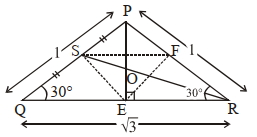
In a non-right-angled triangle $\triangle PQR$, let $p, q, r$ denote the lengths of the sides opposite to the angles at $P, Q, R$ respectively. The median from $R$ meets the side $PQ$ at $S$, the perpendicular from $P$ meets the side $QR$ at $E$, and $RS$ and $PE$ intersect at $O$. If $p=\sqrt{3}, q=1$, and the radius of the circumcircle of the $\triangle PQR$ equals $1$, then which of the following options is/are correct?
$(1)$ Area of $\triangle SOE = \frac{\sqrt{3}}{48}$
$(2)$ Radius of incircle of $\triangle PQR = \frac{\sqrt{3}}{2}(2-\sqrt{3})$
$(3)$ Length of $RS = \frac{\sqrt{7}}{2}$
$(4)$ Length of $OE = \frac{1}{6}$
$(1)$ Area of $\triangle SOE = \frac{\sqrt{3}}{48}$
$(2)$ Radius of incircle of $\triangle PQR = \frac{\sqrt{3}}{2}(2-\sqrt{3})$
$(3)$ Length of $RS = \frac{\sqrt{7}}{2}$
$(4)$ Length of $OE = \frac{1}{6}$
A
$1, 2, 3$
B
$1, 2, 4$
C
$2, 3, 4$
D
$1, 3, 4$
Solution
(C) Using the sine rule, $\frac{p}{\sin P} = \frac{q}{\sin Q} = \frac{r}{\sin R} = 2R_{c} = 2(1) = 2$.
Given $p=\sqrt{3}, q=1$, we have $\sin P = \frac{\sqrt{3}}{2}$ and $\sin Q = \frac{1}{2}$.
Since $p > q$, $P > Q$. Possible values for $P$ are $60^{\circ}$ or $120^{\circ}$, and for $Q$ are $30^{\circ}$ or $150^{\circ}$.
If $P=60^{\circ}, Q=30^{\circ}$, then $R=90^{\circ}$ (rejected as it is non-right-angled).
If $P=120^{\circ}, Q=30^{\circ}$, then $R=30^{\circ}$. Thus, $\triangle PQR$ is isosceles with $q=r=1$.
Area $\Delta = \frac{1}{2}qr \sin P = \frac{1}{2}(1)(1)\sin 120^{\circ} = \frac{\sqrt{3}}{4}$.
Semi-perimeter $s = \frac{\sqrt{3}+1+1}{2} = \frac{\sqrt{3}+2}{2}$.
Inradius $r_{in} = \frac{\Delta}{s} = \frac{\sqrt{3}/4}{(\sqrt{3}+2)/2} = \frac{\sqrt{3}}{2(2+\sqrt{3})} = \frac{\sqrt{3}}{2}(2-\sqrt{3})$. (Option $2$ is correct).
Length of median $RS = \frac{1}{2}\sqrt{2p^2+2q^2-r^2} = \frac{1}{2}\sqrt{2(3)+2(1)-1} = \frac{\sqrt{7}}{2}$. (Option $3$ is correct).
$PE$ is the altitude to $QR$. $PE = q \sin R = 1 \sin 30^{\circ} = \frac{1}{2}$.
$O$ is the centroid of $\triangle PQR$ (since $S$ is midpoint of $PQ$ and $PE$ is altitude, $O$ is intersection of median $RS$ and altitude $PE$ is not generally the centroid, but here $PQR$ is isosceles with $q=r$, so altitude $PE$ is also the median). Thus $O$ is the centroid, $OE = \frac{1}{3}PE = \frac{1}{6}$. (Option $4$ is correct).
Area $\triangle SOE = \frac{1}{6} \Delta = \frac{1}{6} \cdot \frac{\sqrt{3}}{4} = \frac{\sqrt{3}}{24}$. (Option $1$ is incorrect).
Given $p=\sqrt{3}, q=1$, we have $\sin P = \frac{\sqrt{3}}{2}$ and $\sin Q = \frac{1}{2}$.
Since $p > q$, $P > Q$. Possible values for $P$ are $60^{\circ}$ or $120^{\circ}$, and for $Q$ are $30^{\circ}$ or $150^{\circ}$.
If $P=60^{\circ}, Q=30^{\circ}$, then $R=90^{\circ}$ (rejected as it is non-right-angled).
If $P=120^{\circ}, Q=30^{\circ}$, then $R=30^{\circ}$. Thus, $\triangle PQR$ is isosceles with $q=r=1$.
Area $\Delta = \frac{1}{2}qr \sin P = \frac{1}{2}(1)(1)\sin 120^{\circ} = \frac{\sqrt{3}}{4}$.
Semi-perimeter $s = \frac{\sqrt{3}+1+1}{2} = \frac{\sqrt{3}+2}{2}$.
Inradius $r_{in} = \frac{\Delta}{s} = \frac{\sqrt{3}/4}{(\sqrt{3}+2)/2} = \frac{\sqrt{3}}{2(2+\sqrt{3})} = \frac{\sqrt{3}}{2}(2-\sqrt{3})$. (Option $2$ is correct).
Length of median $RS = \frac{1}{2}\sqrt{2p^2+2q^2-r^2} = \frac{1}{2}\sqrt{2(3)+2(1)-1} = \frac{\sqrt{7}}{2}$. (Option $3$ is correct).
$PE$ is the altitude to $QR$. $PE = q \sin R = 1 \sin 30^{\circ} = \frac{1}{2}$.
$O$ is the centroid of $\triangle PQR$ (since $S$ is midpoint of $PQ$ and $PE$ is altitude, $O$ is intersection of median $RS$ and altitude $PE$ is not generally the centroid, but here $PQR$ is isosceles with $q=r$, so altitude $PE$ is also the median). Thus $O$ is the centroid, $OE = \frac{1}{3}PE = \frac{1}{6}$. (Option $4$ is correct).
Area $\triangle SOE = \frac{1}{6} \Delta = \frac{1}{6} \cdot \frac{\sqrt{3}}{4} = \frac{\sqrt{3}}{24}$. (Option $1$ is incorrect).
0 likes
View Solution124
AdvancedMCQ
Let $x, y$ and $z$ be positive real numbers. Suppose $x, y$ and $z$ are lengths of the sides of a triangle opposite to its angles $X, Y$ and $Z$,respectively. If $\tan \frac{X}{2} + \tan \frac{Z}{2} = \frac{2y}{x+y+z}$,then which of the following statements is/are $TRUE$?
$(A) 2Y = X + Z$
$(B) Y = X + Z$
$(C) \tan \frac{X}{2} = \frac{x}{y+z}$
$(D) x^2 + z^2 - y^2 = xz$
$(A) 2Y = X + Z$
$(B) Y = X + Z$
$(C) \tan \frac{X}{2} = \frac{x}{y+z}$
$(D) x^2 + z^2 - y^2 = xz$
A
$A, C$
B
$B, C$
C
$A, D$
D
$A, B$
Solution
(B) Given $\tan \frac{X}{2} + \tan \frac{Z}{2} = \frac{2y}{x+y+z}$.
Using the formula $\tan \frac{X}{2} = \frac{\Delta}{S(S-x)}$ where $S = \frac{x+y+z}{2}$ and $\Delta$ is the area of the triangle,we have:
$\frac{\Delta}{S(S-x)} + \frac{\Delta}{S(S-z)} = \frac{2y}{2S} = \frac{y}{S}$
$\frac{\Delta}{S} \left( \frac{S-z + S-x}{(S-x)(S-z)} \right) = \frac{y}{S}$
$\Delta \left( \frac{2S - (x+z)}{(S-x)(S-z)} \right) = y$
Since $2S = x+y+z$,$2S - (x+z) = y$.
$\Delta \left( \frac{y}{(S-x)(S-z)} \right) = y \implies \Delta = (S-x)(S-z)$
Squaring both sides: $\Delta^2 = (S-x)^2(S-z)^2$
$S(S-x)(S-y)(S-z) = (S-x)^2(S-z)^2$
$S(S-y) = (S-x)(S-z)$
Substituting $S = \frac{x+y+z}{2}$,we get $y^2 = x^2 + z^2$.
This implies $\angle Y = 90^\circ$.
Since $X+Y+Z = 180^\circ$,$X+Z = 90^\circ$,so $Y = X+Z$. Thus $(B)$ is true.
Also,for a right-angled triangle at $Y$,$\tan \frac{X}{2} = \sqrt{\frac{(S-y)(S-z)}{S(S-x)}} = \frac{x}{y+z}$. Thus $(C)$ is true.
Therefore,$(B)$ and $(C)$ are true.
Using the formula $\tan \frac{X}{2} = \frac{\Delta}{S(S-x)}$ where $S = \frac{x+y+z}{2}$ and $\Delta$ is the area of the triangle,we have:
$\frac{\Delta}{S(S-x)} + \frac{\Delta}{S(S-z)} = \frac{2y}{2S} = \frac{y}{S}$
$\frac{\Delta}{S} \left( \frac{S-z + S-x}{(S-x)(S-z)} \right) = \frac{y}{S}$
$\Delta \left( \frac{2S - (x+z)}{(S-x)(S-z)} \right) = y$
Since $2S = x+y+z$,$2S - (x+z) = y$.
$\Delta \left( \frac{y}{(S-x)(S-z)} \right) = y \implies \Delta = (S-x)(S-z)$
Squaring both sides: $\Delta^2 = (S-x)^2(S-z)^2$
$S(S-x)(S-y)(S-z) = (S-x)^2(S-z)^2$
$S(S-y) = (S-x)(S-z)$
Substituting $S = \frac{x+y+z}{2}$,we get $y^2 = x^2 + z^2$.
This implies $\angle Y = 90^\circ$.
Since $X+Y+Z = 180^\circ$,$X+Z = 90^\circ$,so $Y = X+Z$. Thus $(B)$ is true.
Also,for a right-angled triangle at $Y$,$\tan \frac{X}{2} = \sqrt{\frac{(S-y)(S-z)}{S(S-x)}} = \frac{x}{y+z}$. Thus $(C)$ is true.
Therefore,$(B)$ and $(C)$ are true.
0 likes
View Solution125
AdvancedMCQ
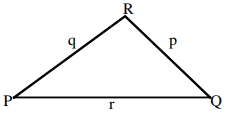
Consider a triangle $PQR$ having sides of lengths $p, q$ and $r$ opposite to the angles $P, Q$ and $R$,respectively. Then which of the following statements is (are) $TRUE$?
$(A)$ $\cos P \geq 1-\frac{p^2}{2qr}$
$(B)$ $\cos R \geq \left(\frac{q-r}{p+q}\right) \cos P + \left(\frac{p-r}{p+q}\right) \cos Q$
$(C)$ $\frac{q+r}{p} < 2 \frac{\sqrt{\sin Q \sin R}}{\sin P}$
$(D)$ If $p < q$ and $p < r$,then $\cos Q > \frac{p}{r}$ and $\cos R > \frac{p}{q}$
$(A)$ $\cos P \geq 1-\frac{p^2}{2qr}$
$(B)$ $\cos R \geq \left(\frac{q-r}{p+q}\right) \cos P + \left(\frac{p-r}{p+q}\right) \cos Q$
$(C)$ $\frac{q+r}{p} < 2 \frac{\sqrt{\sin Q \sin R}}{\sin P}$
$(D)$ If $p < q$ and $p < r$,then $\cos Q > \frac{p}{r}$ and $\cos R > \frac{p}{q}$
A
$A, B, C$
B
$A, B, D$
C
$A, C$
D
$A, B$
Solution
(D) By the Law of Cosines,$\cos P = \frac{q^2+r^2-p^2}{2qr} = \frac{q^2+r^2}{2qr} - \frac{p^2}{2qr}$. Since $q^2+r^2 \geq 2qr$ (by $AM \geq GM$),we have $\frac{q^2+r^2}{2qr} \geq 1$. Thus,$\cos P \geq 1 - \frac{p^2}{2qr}$. So,$(A)$ is correct.
$(B)$ The inequality $(p+q) \cos R \geq (q-r) \cos P + (p-r) \cos Q$ can be rewritten as $(p \cos R + r \cos P) + (q \cos R + r \cos Q) \geq q \cos P + p \cos Q$. Using the projection formula,this simplifies to $q + p \geq r$,which is true by the triangle inequality. So,$(B)$ is correct.
$(C)$ By the Law of Sines,$\frac{q+r}{p} = \frac{\sin Q + \sin R}{\sin P}$. Since $\sin Q + \sin R \geq 2 \sqrt{\sin Q \sin R}$,we have $\frac{q+r}{p} \geq 2 \frac{\sqrt{\sin Q \sin R}}{\sin P}$. Thus,$(C)$ is incorrect.
$(D)$ The condition $\cos Q > \frac{p}{r}$ implies $\sin R \cos Q > \sin P$,which simplifies to $\sin P + \sin(R-Q) > 2 \sin P$,or $\sin(R-Q) > \sin P$. This is not necessarily true for all triangles where $p < q$ and $p < r$. Thus,$(D)$ is incorrect.
Hence,the correct statements are $(A)$ and $(B)$.
$(B)$ The inequality $(p+q) \cos R \geq (q-r) \cos P + (p-r) \cos Q$ can be rewritten as $(p \cos R + r \cos P) + (q \cos R + r \cos Q) \geq q \cos P + p \cos Q$. Using the projection formula,this simplifies to $q + p \geq r$,which is true by the triangle inequality. So,$(B)$ is correct.
$(C)$ By the Law of Sines,$\frac{q+r}{p} = \frac{\sin Q + \sin R}{\sin P}$. Since $\sin Q + \sin R \geq 2 \sqrt{\sin Q \sin R}$,we have $\frac{q+r}{p} \geq 2 \frac{\sqrt{\sin Q \sin R}}{\sin P}$. Thus,$(C)$ is incorrect.
$(D)$ The condition $\cos Q > \frac{p}{r}$ implies $\sin R \cos Q > \sin P$,which simplifies to $\sin P + \sin(R-Q) > 2 \sin P$,or $\sin(R-Q) > \sin P$. This is not necessarily true for all triangles where $p < q$ and $p < r$. Thus,$(D)$ is incorrect.
Hence,the correct statements are $(A)$ and $(B)$.
0 likes
View Solution126
AdvancedMCQ
Let $PQR$ be a triangle of area $\Delta$ with $a=2, b=\frac{7}{2}$ and $c=\frac{5}{2}$,where $a, b$ and $c$ are the lengths of the sides of the triangle opposite to the angles at $P, Q$ and $R$ respectively. Then $\frac{2 \sin P-\sin 2P}{2 \sin P+\sin 2P}$ equals
A
$\left(\frac{3}{4 \Delta}\right)^2$
B
$\frac{45}{4 \Delta}$
C
$\frac{3}{4 \Delta}$
D
$\left(\frac{45}{4 \Delta}\right)^2$
Solution
(A) Given $a=2, b=\frac{7}{2}, c=\frac{5}{2}$.
Semi-perimeter $s = \frac{a+b+c}{2} = \frac{2 + 3.5 + 2.5}{2} = \frac{8}{2} = 4$.
The expression is $\frac{2 \sin P - \sin 2P}{2 \sin P + \sin 2P} = \frac{2 \sin P - 2 \sin P \cos P}{2 \sin P + 2 \sin P \cos P} = \frac{2 \sin P(1 - \cos P)}{2 \sin P(1 + \cos P)} = \frac{1 - \cos P}{1 + \cos P}$.
Using half-angle formulas,$\frac{1 - \cos P}{1 + \cos P} = \frac{2 \sin^2(P/2)}{2 \cos^2(P/2)} = \tan^2(P/2)$.
We know $\tan^2(P/2) = \frac{(s-b)(s-c)}{s(s-a)}$.
Substituting the values: $s-a = 4-2 = 2$,$s-b = 4-3.5 = 0.5 = 1/2$,$s-c = 4-2.5 = 1.5 = 3/2$.
$\tan^2(P/2) = \frac{(1/2)(3/2)}{4(2)} = \frac{3/4}{8} = \frac{3}{32}$.
Also,$\Delta = \sqrt{s(s-a)(s-b)(s-c)} = \sqrt{4 \times 2 \times 0.5 \times 1.5} = \sqrt{6}$.
Thus,$\left(\frac{3}{4 \Delta}\right)^2 = \frac{9}{16 \Delta^2} = \frac{9}{16 \times 6} = \frac{9}{96} = \frac{3}{32}$.
Therefore,the expression equals $\left(\frac{3}{4 \Delta}\right)^2$.
Semi-perimeter $s = \frac{a+b+c}{2} = \frac{2 + 3.5 + 2.5}{2} = \frac{8}{2} = 4$.
The expression is $\frac{2 \sin P - \sin 2P}{2 \sin P + \sin 2P} = \frac{2 \sin P - 2 \sin P \cos P}{2 \sin P + 2 \sin P \cos P} = \frac{2 \sin P(1 - \cos P)}{2 \sin P(1 + \cos P)} = \frac{1 - \cos P}{1 + \cos P}$.
Using half-angle formulas,$\frac{1 - \cos P}{1 + \cos P} = \frac{2 \sin^2(P/2)}{2 \cos^2(P/2)} = \tan^2(P/2)$.
We know $\tan^2(P/2) = \frac{(s-b)(s-c)}{s(s-a)}$.
Substituting the values: $s-a = 4-2 = 2$,$s-b = 4-3.5 = 0.5 = 1/2$,$s-c = 4-2.5 = 1.5 = 3/2$.
$\tan^2(P/2) = \frac{(1/2)(3/2)}{4(2)} = \frac{3/4}{8} = \frac{3}{32}$.
Also,$\Delta = \sqrt{s(s-a)(s-b)(s-c)} = \sqrt{4 \times 2 \times 0.5 \times 1.5} = \sqrt{6}$.
Thus,$\left(\frac{3}{4 \Delta}\right)^2 = \frac{9}{16 \Delta^2} = \frac{9}{16 \times 6} = \frac{9}{96} = \frac{3}{32}$.
Therefore,the expression equals $\left(\frac{3}{4 \Delta}\right)^2$.
0 likes
View Solution127
AdvancedMCQ
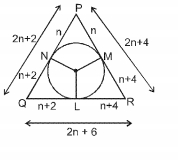
In a triangle $PQR$,$P$ is the largest angle and $\cos P = \frac{1}{3}$. Further,the incircle of the triangle touches the sides $PQ, QR$ and $RP$ at $N, L$ and $M$ respectively,such that the lengths of $PN, QL$ and $RM$ are consecutive even integers. Then the possible length$(s)$ of the side$(s)$ of the triangle is (are):
$(A) 16$
$(B) 18$
$(C) 24$
$(D) 22$
$(A) 16$
$(B) 18$
$(C) 24$
$(D) 22$
A
$(A, D)$
B
$(B, D)$
C
$(B, C)$
D
$(A, C)$
Solution
(B) Let the lengths of the tangents from the vertices be $x, y, z$. Given $PN=x, QL=y, RM=z$ are consecutive even integers. Let $x=2k, y=2k+2, z=2k+4$.
Since $P$ is the largest angle,the side opposite to $P$ $(QR = y+z)$ must be the largest side.
$QR = (2k+2) + (2k+4) = 4k+6$
$PQ = x+y = 2k + 2k+2 = 4k+2$
$PR = x+z = 2k + 2k+4 = 4k+4$
Using the Law of Cosines: $\cos P = \frac{PQ^2 + PR^2 - QR^2}{2(PQ)(PR)} = \frac{1}{3}$
$\frac{(4k+2)^2 + (4k+4)^2 - (4k+6)^2}{2(4k+2)(4k+4)} = \frac{1}{3}$
$\frac{16k^2+16k+4 + 16k^2+32k+16 - (16k^2+48k+36)}{2(16k^2+24k+8)} = \frac{1}{3}$
$\frac{16k^2}{32k^2+48k+16} = \frac{1}{3} \Rightarrow \frac{k^2}{2k^2+3k+1} = \frac{1}{3}$
$3k^2 = 2k^2+3k+1 \Rightarrow k^2-3k-1 = 0$. This gives no integer solution for $k$.
Re-evaluating the consecutive even integers as $2n, 2n+2, 2n+4$ where $PN=2n, QL=2n+2, RM=2n+4$:
$PQ = 4n+2, PR = 4n+4, QR = 4n+6$. $\cos P = \frac{(4n+2)^2+(4n+4)^2-(4n+6)^2}{2(4n+2)(4n+4)} = \frac{1}{3}$
$\frac{16n^2+16n+4+16n^2+32n+16-16n^2-48n-36}{2(16n^2+24n+8)} = \frac{1}{3}$ $\Rightarrow \frac{16n^2-16}{32n^2+48n+16} = \frac{1}{3}$
$\frac{n^2-1}{2n^2+3n+1} = \frac{1}{3}$ $\Rightarrow 3n^2-3 = 2n^2+3n+1$ $\Rightarrow n^2-3n-4 = 0$
$(n-4)(n+1) = 0 \Rightarrow n=4$.
Sides are $PQ = 18, PR = 20, QR = 22$. The possible lengths are $18$ and $22$.
Since $P$ is the largest angle,the side opposite to $P$ $(QR = y+z)$ must be the largest side.
$QR = (2k+2) + (2k+4) = 4k+6$
$PQ = x+y = 2k + 2k+2 = 4k+2$
$PR = x+z = 2k + 2k+4 = 4k+4$
Using the Law of Cosines: $\cos P = \frac{PQ^2 + PR^2 - QR^2}{2(PQ)(PR)} = \frac{1}{3}$
$\frac{(4k+2)^2 + (4k+4)^2 - (4k+6)^2}{2(4k+2)(4k+4)} = \frac{1}{3}$
$\frac{16k^2+16k+4 + 16k^2+32k+16 - (16k^2+48k+36)}{2(16k^2+24k+8)} = \frac{1}{3}$
$\frac{16k^2}{32k^2+48k+16} = \frac{1}{3} \Rightarrow \frac{k^2}{2k^2+3k+1} = \frac{1}{3}$
$3k^2 = 2k^2+3k+1 \Rightarrow k^2-3k-1 = 0$. This gives no integer solution for $k$.
Re-evaluating the consecutive even integers as $2n, 2n+2, 2n+4$ where $PN=2n, QL=2n+2, RM=2n+4$:
$PQ = 4n+2, PR = 4n+4, QR = 4n+6$. $\cos P = \frac{(4n+2)^2+(4n+4)^2-(4n+6)^2}{2(4n+2)(4n+4)} = \frac{1}{3}$
$\frac{16n^2+16n+4+16n^2+32n+16-16n^2-48n-36}{2(16n^2+24n+8)} = \frac{1}{3}$ $\Rightarrow \frac{16n^2-16}{32n^2+48n+16} = \frac{1}{3}$
$\frac{n^2-1}{2n^2+3n+1} = \frac{1}{3}$ $\Rightarrow 3n^2-3 = 2n^2+3n+1$ $\Rightarrow n^2-3n-4 = 0$
$(n-4)(n+1) = 0 \Rightarrow n=4$.
Sides are $PQ = 18, PR = 20, QR = 22$. The possible lengths are $18$ and $22$.
0 likes
View Solution128
AdvancedMCQ
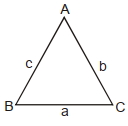
In a triangle,the sum of two sides is $x$ and the product of the same two sides is $y$. If $x^2 - c^2 = y$,where $c$ is the third side of the triangle,then the ratio of the in-radius to the circum-radius of the triangle is
A
$\frac{3 y}{2 x(x+c)}$
B
$\frac{3 y}{2 c(x+c)}$
C
$\frac{3 y}{4 x(x+c)}$
D
$\frac{3 y}{4 c(x+c)}$
Solution
(B) Let the two sides be $a$ and $b$. Given $a+b=x$ and $ab=y$.
Given $x^2-c^2=y$,substituting $x=a+b$ and $y=ab$,we get $(a+b)^2-c^2=ab$.
$a^2+b^2+2ab-c^2=ab \implies a^2+b^2-c^2=-ab$.
Using the cosine rule,$\cos C = \frac{a^2+b^2-c^2}{2ab} = \frac{-ab}{2ab} = -\frac{1}{2}$.
Thus,$C = 120^\circ$ or $\frac{2\pi}{3}$.
The ratio of in-radius $r$ to circum-radius $R$ is given by $\frac{r}{R} = 4 \sin\frac{A}{2} \sin\frac{B}{2} \sin\frac{C}{2}$.
Alternatively,$\frac{r}{R} = \frac{\Delta/s}{abc/4\Delta} = \frac{4\Delta^2}{sabc} = \frac{4 \cdot (\frac{1}{2}ab \sin C)^2}{(\frac{a+b+c}{2})abc} = \frac{a^2b^2 \sin^2(120^\circ)}{(\frac{x+c}{2})abc} = \frac{y^2 \cdot (\frac{\sqrt{3}}{2})^2}{(\frac{x+c}{2})abc} = \frac{3y^2}{2(x+c)abc}$.
Since $ab=y$,this simplifies to $\frac{3y}{2c(x+c)}$.
Wait,re-evaluating: $\frac{r}{R} = \frac{4\Delta^2}{sabc} = \frac{a^2b^2 \sin^2 C}{sabc} = \frac{y^2 \cdot (3/4)}{(\frac{x+c}{2})abc} = \frac{3y^2}{2(x+c)abc} = \frac{3y^2}{2(x+c)yc} = \frac{3y}{2c(x+c)}$.
Given $x^2-c^2=y$,substituting $x=a+b$ and $y=ab$,we get $(a+b)^2-c^2=ab$.
$a^2+b^2+2ab-c^2=ab \implies a^2+b^2-c^2=-ab$.
Using the cosine rule,$\cos C = \frac{a^2+b^2-c^2}{2ab} = \frac{-ab}{2ab} = -\frac{1}{2}$.
Thus,$C = 120^\circ$ or $\frac{2\pi}{3}$.
The ratio of in-radius $r$ to circum-radius $R$ is given by $\frac{r}{R} = 4 \sin\frac{A}{2} \sin\frac{B}{2} \sin\frac{C}{2}$.
Alternatively,$\frac{r}{R} = \frac{\Delta/s}{abc/4\Delta} = \frac{4\Delta^2}{sabc} = \frac{4 \cdot (\frac{1}{2}ab \sin C)^2}{(\frac{a+b+c}{2})abc} = \frac{a^2b^2 \sin^2(120^\circ)}{(\frac{x+c}{2})abc} = \frac{y^2 \cdot (\frac{\sqrt{3}}{2})^2}{(\frac{x+c}{2})abc} = \frac{3y^2}{2(x+c)abc}$.
Since $ab=y$,this simplifies to $\frac{3y}{2c(x+c)}$.
Wait,re-evaluating: $\frac{r}{R} = \frac{4\Delta^2}{sabc} = \frac{a^2b^2 \sin^2 C}{sabc} = \frac{y^2 \cdot (3/4)}{(\frac{x+c}{2})abc} = \frac{3y^2}{2(x+c)abc} = \frac{3y^2}{2(x+c)yc} = \frac{3y}{2c(x+c)}$.
0 likes
View Solution129
DifficultMCQ
For $x \in (0, \pi)$,the equation $\sin x + 2 \sin 2x - \sin 3x = 3$ has
A
infinitely many solutions
B
three solutions
C
one solution
D
no solution
Solution
(D) Given the equation: $\sin x + 2 \sin 2x - \sin 3x = 3$.
Using the identity $\sin 3x = 3 \sin x - 4 \sin^3 x$,we substitute:
$\sin x + 2(2 \sin x \cos x) - (3 \sin x - 4 \sin^3 x) = 3$.
$-2 \sin x + 4 \sin x \cos x + 4 \sin^3 x = 3$.
Since $\sin x \in (0, 1]$ for $x \in (0, \pi)$,we analyze the maximum value of the expression $f(x) = \sin x + 2 \sin 2x - \sin 3x$.
We know that $\sin x \leq 1$,$\sin 2x \leq 1$,and $-\sin 3x \leq 1$.
However,these cannot all be $1$ simultaneously for the same $x$.
Alternatively,consider the range of $f(x) = \sin x + 4 \sin x \cos x - 3 \sin x + 4 \sin^3 x = 4 \sin x \cos x + 4 \sin^3 x - 2 \sin x$.
$f(x) = 2 \sin x (2 \cos x + 2 \sin^2 x - 1) = 2 \sin x (2 \cos x + 2(1 - \cos^2 x) - 1) = 2 \sin x (-2 \cos^2 x + 2 \cos x + 1)$.
Let $u = \cos x$,where $u \in (-1, 1)$. The function $g(u) = 2 \sqrt{1-u^2} (-2u^2 + 2u + 1)$.
By checking the maximum value,it is found that $f(x) < 3$ for all $x \in (0, \pi)$.
Thus,there is no solution.
Using the identity $\sin 3x = 3 \sin x - 4 \sin^3 x$,we substitute:
$\sin x + 2(2 \sin x \cos x) - (3 \sin x - 4 \sin^3 x) = 3$.
$-2 \sin x + 4 \sin x \cos x + 4 \sin^3 x = 3$.
Since $\sin x \in (0, 1]$ for $x \in (0, \pi)$,we analyze the maximum value of the expression $f(x) = \sin x + 2 \sin 2x - \sin 3x$.
We know that $\sin x \leq 1$,$\sin 2x \leq 1$,and $-\sin 3x \leq 1$.
However,these cannot all be $1$ simultaneously for the same $x$.
Alternatively,consider the range of $f(x) = \sin x + 4 \sin x \cos x - 3 \sin x + 4 \sin^3 x = 4 \sin x \cos x + 4 \sin^3 x - 2 \sin x$.
$f(x) = 2 \sin x (2 \cos x + 2 \sin^2 x - 1) = 2 \sin x (2 \cos x + 2(1 - \cos^2 x) - 1) = 2 \sin x (-2 \cos^2 x + 2 \cos x + 1)$.
Let $u = \cos x$,where $u \in (-1, 1)$. The function $g(u) = 2 \sqrt{1-u^2} (-2u^2 + 2u + 1)$.
By checking the maximum value,it is found that $f(x) < 3$ for all $x \in (0, \pi)$.
Thus,there is no solution.
0 likes
View Solution130
AdvancedMCQ
Let $PQRS$ be a quadrilateral in a plane,where $QR = 1$,$\angle PQR = \angle QRS = 70^{\circ}$,$\angle PQS = 15^{\circ}$ and $\angle PRS = 40^{\circ}$. If $\angle RPS = \theta^{\circ}$,$PQ = \alpha$ and $PS = \beta$,then the interval$(s)$ that contain$(s)$ the value of $4 \alpha \beta \sin \theta^{\circ}$ is/are
$(A)$ $(0, \sqrt{2})$
$(B)$ $(1, 2)$
$(C)$ $(\sqrt{2}, 3)$
$(D)$ $(2 \sqrt{2}, 3 \sqrt{2})$
$(A)$ $(0, \sqrt{2})$
$(B)$ $(1, 2)$
$(C)$ $(\sqrt{2}, 3)$
$(D)$ $(2 \sqrt{2}, 3 \sqrt{2})$
A
$(A), (B), (C)$
B
$(A), (B), (D)$
C
$(A), (B)$
D
$(A), (C)$
Solution
(C) In $\triangle PQR$,$\angle PRQ = \angle QRS - \angle PRS = 70^{\circ} - 40^{\circ} = 30^{\circ}$.
In $\triangle QRS$,$\angle RQS = \angle PQR - \angle PQS = 70^{\circ} - 15^{\circ} = 55^{\circ}$.
Then $\angle QSR = 180^{\circ} - 70^{\circ} - 55^{\circ} = 55^{\circ}$.
Since $\angle RQS = \angle QSR = 55^{\circ}$,we have $QR = RS = 1$.
In $\triangle PQR$,$\angle QPR = 180^{\circ} - 70^{\circ} - 30^{\circ} = 80^{\circ}$.
Applying the sine rule in $\triangle PQR$:
$\frac{\alpha}{\sin 30^{\circ}} = \frac{1}{\sin 80^{\circ}} \Rightarrow \alpha = \frac{1}{2 \sin 80^{\circ}}$.
Applying the sine rule in $\triangle PRS$:
$\frac{\beta}{\sin 40^{\circ}} = \frac{1}{\sin \theta} \Rightarrow \beta \sin \theta = \sin 40^{\circ}$.
Now,$4 \alpha \beta \sin \theta = 4 \left( \frac{1}{2 \sin 80^{\circ}} \right) \sin 40^{\circ} = \frac{2 \sin 40^{\circ}}{\sin 80^{\circ}} = \frac{2 \sin 40^{\circ}}{2 \sin 40^{\circ} \cos 40^{\circ}} = \sec 40^{\circ}$.
Since $30^{\circ} < 40^{\circ} < 45^{\circ}$,we have $\sec 30^{\circ} < \sec 40^{\circ} < \sec 45^{\circ}$,which means $\frac{2}{\sqrt{3}} < \sec 40^{\circ} < \sqrt{2}$.
Since $\frac{2}{\sqrt{3}} \approx 1.15$ and $\sqrt{2} \approx 1.414$,the value $\sec 40^{\circ}$ lies in the intervals $(0, \sqrt{2})$ and $(1, 2)$.
Thus,the correct options are $(A)$ and $(B)$.
In $\triangle QRS$,$\angle RQS = \angle PQR - \angle PQS = 70^{\circ} - 15^{\circ} = 55^{\circ}$.
Then $\angle QSR = 180^{\circ} - 70^{\circ} - 55^{\circ} = 55^{\circ}$.
Since $\angle RQS = \angle QSR = 55^{\circ}$,we have $QR = RS = 1$.
In $\triangle PQR$,$\angle QPR = 180^{\circ} - 70^{\circ} - 30^{\circ} = 80^{\circ}$.
Applying the sine rule in $\triangle PQR$:
$\frac{\alpha}{\sin 30^{\circ}} = \frac{1}{\sin 80^{\circ}} \Rightarrow \alpha = \frac{1}{2 \sin 80^{\circ}}$.
Applying the sine rule in $\triangle PRS$:
$\frac{\beta}{\sin 40^{\circ}} = \frac{1}{\sin \theta} \Rightarrow \beta \sin \theta = \sin 40^{\circ}$.
Now,$4 \alpha \beta \sin \theta = 4 \left( \frac{1}{2 \sin 80^{\circ}} \right) \sin 40^{\circ} = \frac{2 \sin 40^{\circ}}{\sin 80^{\circ}} = \frac{2 \sin 40^{\circ}}{2 \sin 40^{\circ} \cos 40^{\circ}} = \sec 40^{\circ}$.
Since $30^{\circ} < 40^{\circ} < 45^{\circ}$,we have $\sec 30^{\circ} < \sec 40^{\circ} < \sec 45^{\circ}$,which means $\frac{2}{\sqrt{3}} < \sec 40^{\circ} < \sqrt{2}$.
Since $\frac{2}{\sqrt{3}} \approx 1.15$ and $\sqrt{2} \approx 1.414$,the value $\sec 40^{\circ}$ lies in the intervals $(0, \sqrt{2})$ and $(1, 2)$.
Thus,the correct options are $(A)$ and $(B)$.
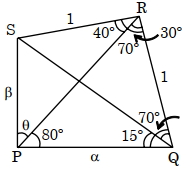
0 likes
View Solution131
DifficultMCQ
The sum of all values of $\theta \in [0, 2\pi]$ satisfying $2 \sin^2 \theta = \cos 2\theta$ and $2 \cos^2 \theta = 3 \sin \theta$ is
A
$\frac{\pi}{2}$
B
$4\pi$
C
$\frac{5\pi}{6}$
D
$\pi$
Solution
(D) Given equations are $2 \sin^2 \theta = \cos 2\theta$ and $2 \cos^2 \theta = 3 \sin \theta$.
From the first equation: $2 \sin^2 \theta = 1 - 2 \sin^2 \theta \implies 4 \sin^2 \theta = 1 \implies \sin^2 \theta = \frac{1}{4} \implies \sin \theta = \pm \frac{1}{2}$.
From the second equation: $2(1 - \sin^2 \theta) = 3 \sin \theta \implies 2 - 2 \sin^2 \theta = 3 \sin \theta \implies 2 \sin^2 \theta + 3 \sin \theta - 2 = 0$.
Factoring the quadratic: $(2 \sin \theta - 1)(\sin \theta + 2) = 0$.
Since $\sin \theta$ cannot be $-2$,we have $\sin \theta = \frac{1}{2}$.
Comparing both results,the common solution is $\sin \theta = \frac{1}{2}$.
For $\theta \in [0, 2\pi]$,the values are $\theta = \frac{\pi}{6}$ and $\theta = \frac{5\pi}{6}$.
The sum of these values is $\frac{\pi}{6} + \frac{5\pi}{6} = \pi$.
From the first equation: $2 \sin^2 \theta = 1 - 2 \sin^2 \theta \implies 4 \sin^2 \theta = 1 \implies \sin^2 \theta = \frac{1}{4} \implies \sin \theta = \pm \frac{1}{2}$.
From the second equation: $2(1 - \sin^2 \theta) = 3 \sin \theta \implies 2 - 2 \sin^2 \theta = 3 \sin \theta \implies 2 \sin^2 \theta + 3 \sin \theta - 2 = 0$.
Factoring the quadratic: $(2 \sin \theta - 1)(\sin \theta + 2) = 0$.
Since $\sin \theta$ cannot be $-2$,we have $\sin \theta = \frac{1}{2}$.
Comparing both results,the common solution is $\sin \theta = \frac{1}{2}$.
For $\theta \in [0, 2\pi]$,the values are $\theta = \frac{\pi}{6}$ and $\theta = \frac{5\pi}{6}$.
The sum of these values is $\frac{\pi}{6} + \frac{5\pi}{6} = \pi$.
0 likes
View Solution132
DifficultMCQ
In a triangle $ABC$ with usual notations,if $\tan A, \tan B, \tan C$ are in $H.P.$,then $a^{2}, b^{2}, c^{2}$ are in
A
$A.P.$
B
Not in $A.P.$
C
$H.P.$
D
$G.P.$
Solution
(A) Given that $\tan A, \tan B, \tan C$ are in $H.P.$
$\frac{2}{\tan B} = \frac{1}{\tan A} + \frac{1}{\tan C}$
$\frac{2 \cos B}{\sin B} = \frac{\cos A}{\sin A} + \frac{\cos C}{\sin C}$
Using the sine rule $\frac{a}{\sin A} = \frac{b}{\sin B} = \frac{c}{\sin C} = 2R$,we have $\sin A = \frac{a}{2R}, \sin B = \frac{b}{2R}, \sin C = \frac{c}{2R}$.
Also,$\cos B = \frac{a^{2}+c^{2}-b^{2}}{2ac}, \cos A = \frac{b^{2}+c^{2}-a^{2}}{2bc}, \cos C = \frac{a^{2}+b^{2}-c^{2}}{2ab}$.
Substituting these values:
$2 \left( \frac{a^{2}+c^{2}-b^{2}}{2ac} \right) \cdot \frac{2R}{b} = \frac{b^{2}+c^{2}-a^{2}}{2bc} \cdot \frac{2R}{a} + \frac{a^{2}+b^{2}-c^{2}}{2ab} \cdot \frac{2R}{c}$
Multiplying both sides by $\frac{abc}{2R}$:
$2(a^{2}+c^{2}-b^{2}) = (b^{2}+c^{2}-a^{2}) + (a^{2}+b^{2}-c^{2})$
$2a^{2} + 2c^{2} - 2b^{2} = 2b^{2}$
$2a^{2} + 2c^{2} = 4b^{2}$
$a^{2} + c^{2} = 2b^{2}$
Thus,$a^{2}, b^{2}, c^{2}$ are in $A.P.$
$\frac{2}{\tan B} = \frac{1}{\tan A} + \frac{1}{\tan C}$
$\frac{2 \cos B}{\sin B} = \frac{\cos A}{\sin A} + \frac{\cos C}{\sin C}$
Using the sine rule $\frac{a}{\sin A} = \frac{b}{\sin B} = \frac{c}{\sin C} = 2R$,we have $\sin A = \frac{a}{2R}, \sin B = \frac{b}{2R}, \sin C = \frac{c}{2R}$.
Also,$\cos B = \frac{a^{2}+c^{2}-b^{2}}{2ac}, \cos A = \frac{b^{2}+c^{2}-a^{2}}{2bc}, \cos C = \frac{a^{2}+b^{2}-c^{2}}{2ab}$.
Substituting these values:
$2 \left( \frac{a^{2}+c^{2}-b^{2}}{2ac} \right) \cdot \frac{2R}{b} = \frac{b^{2}+c^{2}-a^{2}}{2bc} \cdot \frac{2R}{a} + \frac{a^{2}+b^{2}-c^{2}}{2ab} \cdot \frac{2R}{c}$
Multiplying both sides by $\frac{abc}{2R}$:
$2(a^{2}+c^{2}-b^{2}) = (b^{2}+c^{2}-a^{2}) + (a^{2}+b^{2}-c^{2})$
$2a^{2} + 2c^{2} - 2b^{2} = 2b^{2}$
$2a^{2} + 2c^{2} = 4b^{2}$
$a^{2} + c^{2} = 2b^{2}$
Thus,$a^{2}, b^{2}, c^{2}$ are in $A.P.$
0 likes
View Solution133
MediumMCQ
In a triangle $ABC$ with usual notations,if $\frac{\cos A}{a} = \frac{\cos B}{b} = \frac{\cos C}{c}$,then the triangle is equilateral. If the side length is $a = \sqrt{6}$,find the area of the triangle.
A
$\frac{\sqrt{3}}{2}$ sq. units
B
$\frac{3 \sqrt{3}}{2}$ sq. units
C
$\frac{2}{\sqrt{3}}$ sq. units
D
$\frac{5 \sqrt{3}}{2}$ sq. units
Solution
(B) We know from the Sine Rule that $\frac{\sin A}{a} = \frac{\sin B}{b} = \frac{\sin C}{c} = k$.
Given that $\frac{\cos A}{a} = \frac{\cos B}{b} = \frac{\cos C}{c}$.
Dividing the Sine Rule equation by the given equation,we get $\tan A = \tan B = \tan C$.
Since $A, B, C$ are angles of a triangle,this implies $A = B = C = 60^{\circ}$,so the triangle is equilateral.
The area of an equilateral triangle with side $a$ is given by $\text{Area} = \frac{\sqrt{3}}{4} a^2$.
Given $a = \sqrt{6}$,the area is $\frac{\sqrt{3}}{4} (\sqrt{6})^2 = \frac{\sqrt{3}}{4} \times 6 = \frac{3 \sqrt{3}}{2}$ sq. units.
Given that $\frac{\cos A}{a} = \frac{\cos B}{b} = \frac{\cos C}{c}$.
Dividing the Sine Rule equation by the given equation,we get $\tan A = \tan B = \tan C$.
Since $A, B, C$ are angles of a triangle,this implies $A = B = C = 60^{\circ}$,so the triangle is equilateral.
The area of an equilateral triangle with side $a$ is given by $\text{Area} = \frac{\sqrt{3}}{4} a^2$.
Given $a = \sqrt{6}$,the area is $\frac{\sqrt{3}}{4} (\sqrt{6})^2 = \frac{\sqrt{3}}{4} \times 6 = \frac{3 \sqrt{3}}{2}$ sq. units.
0 likes
View Solution134
MediumMCQ
In a triangle $ABC$,the sides $a, b, c$ are the roots of the equation $x^3-11x^2+38x-40=0$. Then,find the value of $\frac{\cos A}{a}+\frac{\cos B}{b}+\frac{\cos C}{c}$.
A
$\frac{3}{4}$
B
$1$
C
$\frac{9}{16}$
D
$\frac{1}{16}$
Solution
(C) Given the cubic equation $x^3-11x^2+38x-40=0$,the roots $a, b, c$ represent the sides of the triangle.
By Vieta's formulas,we have:
$a+b+c = 11$
$ab+bc+ca = 38$
$abc = 40$
Using the Law of Cosines,$\cos A = \frac{b^2+c^2-a^2}{2bc}$.
Substituting this into the expression $\frac{\cos A}{a} = \frac{b^2+c^2-a^2}{2abc}$.
Similarly,$\frac{\cos B}{b} = \frac{a^2+c^2-b^2}{2abc}$ and $\frac{\cos C}{c} = \frac{a^2+b^2-c^2}{2abc}$.
Summing these,we get $\frac{\cos A}{a}+\frac{\cos B}{b}+\frac{\cos C}{c} = \frac{b^2+c^2-a^2+a^2+c^2-b^2+a^2+b^2-c^2}{2abc} = \frac{a^2+b^2+c^2}{2abc}$.
We know $(a+b+c)^2 = a^2+b^2+c^2+2(ab+bc+ca)$.
$11^2 = a^2+b^2+c^2+2(38) \implies 121 = a^2+b^2+c^2+76 \implies a^2+b^2+c^2 = 45$.
Thus,the expression equals $\frac{45}{2(40)} = \frac{45}{80} = \frac{9}{16}$.
By Vieta's formulas,we have:
$a+b+c = 11$
$ab+bc+ca = 38$
$abc = 40$
Using the Law of Cosines,$\cos A = \frac{b^2+c^2-a^2}{2bc}$.
Substituting this into the expression $\frac{\cos A}{a} = \frac{b^2+c^2-a^2}{2abc}$.
Similarly,$\frac{\cos B}{b} = \frac{a^2+c^2-b^2}{2abc}$ and $\frac{\cos C}{c} = \frac{a^2+b^2-c^2}{2abc}$.
Summing these,we get $\frac{\cos A}{a}+\frac{\cos B}{b}+\frac{\cos C}{c} = \frac{b^2+c^2-a^2+a^2+c^2-b^2+a^2+b^2-c^2}{2abc} = \frac{a^2+b^2+c^2}{2abc}$.
We know $(a+b+c)^2 = a^2+b^2+c^2+2(ab+bc+ca)$.
$11^2 = a^2+b^2+c^2+2(38) \implies 121 = a^2+b^2+c^2+76 \implies a^2+b^2+c^2 = 45$.
Thus,the expression equals $\frac{45}{2(40)} = \frac{45}{80} = \frac{9}{16}$.
0 likes
View Solution135
MediumMCQ
In $\triangle ABC$,with usual notations,if $a \cos B = b \cos A$ and $a \cos C \neq c \cos A$,then the area of $\triangle ABC$ is . . . . . . sq. units.
A
$\frac{c}{2} \sqrt{4a^2 - b^2}$
B
$\frac{c}{4} \sqrt{4a^2 - c^2}$
C
$\frac{b}{2} \sqrt{4b^2 - c^2}$
D
$\frac{b}{4} \sqrt{4b^2 - c^2}$
Solution
(B) Given $a \cos B = b \cos A$. Using the sine rule,$a = 2R \sin A$ and $b = 2R \sin B$.
Substituting these,we get $2R \sin A \cos B = 2R \sin B \cos A$,which implies $\sin A \cos B - \cos A \sin B = 0$,so $\sin(A - B) = 0$.
Since $A$ and $B$ are angles of a triangle,$A = B$,meaning the triangle is isosceles with $a = b$.
However,the condition $a \cos C \neq c \cos A$ implies $\sin A \cos C \neq \sin C \cos A$,so $\sin(A - C) \neq 0$,meaning $A \neq C$.
Thus,the triangle is isosceles with $a = b$ and $a \neq c$.
The area of an isosceles triangle with sides $a, a, c$ is given by $\frac{1}{2} \times \text{base} \times \text{height}$.
The base is $c$. The height $h$ is $\sqrt{a^2 - (c/2)^2} = \frac{1}{2} \sqrt{4a^2 - c^2}$.
Area $= \frac{1}{2} \times c \times \frac{1}{2} \sqrt{4a^2 - c^2} = \frac{c}{4} \sqrt{4a^2 - c^2}$.
Substituting these,we get $2R \sin A \cos B = 2R \sin B \cos A$,which implies $\sin A \cos B - \cos A \sin B = 0$,so $\sin(A - B) = 0$.
Since $A$ and $B$ are angles of a triangle,$A = B$,meaning the triangle is isosceles with $a = b$.
However,the condition $a \cos C \neq c \cos A$ implies $\sin A \cos C \neq \sin C \cos A$,so $\sin(A - C) \neq 0$,meaning $A \neq C$.
Thus,the triangle is isosceles with $a = b$ and $a \neq c$.
The area of an isosceles triangle with sides $a, a, c$ is given by $\frac{1}{2} \times \text{base} \times \text{height}$.
The base is $c$. The height $h$ is $\sqrt{a^2 - (c/2)^2} = \frac{1}{2} \sqrt{4a^2 - c^2}$.
Area $= \frac{1}{2} \times c \times \frac{1}{2} \sqrt{4a^2 - c^2} = \frac{c}{4} \sqrt{4a^2 - c^2}$.
0 likes
View Solution136
MediumMCQ
In a triangle with one of the angles $120^{\circ}$,the lengths of the sides form an $A$.$P$. If the length of the greatest side is $7 \ m$,then the area of the triangle is
A
$\frac{15 \sqrt{3}}{4} \ m^2$
B
$\frac{15 \sqrt{3}}{2} \ m^2$
C
$\frac{15}{2} \ m^2$
D
$\frac{15}{4} \ m^2$
Solution
(A) Let the sides of the triangle be $a-d$,$a$,and $a+d$,where $d > 0$. The greatest side is $a+d = 7$.
Since the angle opposite to the greatest side is $120^{\circ}$,we use the Law of Cosines:
$(a+d)^2 = (a-d)^2 + a^2 - 2a(a-d) \cos(120^{\circ})$.
Substituting $a+d=7$,we have $d = 7-a$.
$49 = (a-(7-a))^2 + a^2 - 2a(a-(7-a))(-1/2)$.
$49 = (2a-7)^2 + a^2 + a(2a-7)$.
$49 = 4a^2 - 28a + 49 + a^2 + 2a^2 - 7a$.
$7a^2 - 35a = 0$.
Since $a \neq 0$,$7a = 35$,so $a = 5$.
The sides are $5-(7-5) = 3$,$5$,and $7$.
The area of the triangle is $\frac{1}{2} \times \text{side}_1 \times \text{side}_2 \times \sin(120^{\circ})$.
Area $= \frac{1}{2} \times 3 \times 5 \times \frac{\sqrt{3}}{2} = \frac{15 \sqrt{3}}{4} \ m^2$.
Since the angle opposite to the greatest side is $120^{\circ}$,we use the Law of Cosines:
$(a+d)^2 = (a-d)^2 + a^2 - 2a(a-d) \cos(120^{\circ})$.
Substituting $a+d=7$,we have $d = 7-a$.
$49 = (a-(7-a))^2 + a^2 - 2a(a-(7-a))(-1/2)$.
$49 = (2a-7)^2 + a^2 + a(2a-7)$.
$49 = 4a^2 - 28a + 49 + a^2 + 2a^2 - 7a$.
$7a^2 - 35a = 0$.
Since $a \neq 0$,$7a = 35$,so $a = 5$.
The sides are $5-(7-5) = 3$,$5$,and $7$.
The area of the triangle is $\frac{1}{2} \times \text{side}_1 \times \text{side}_2 \times \sin(120^{\circ})$.
Area $= \frac{1}{2} \times 3 \times 5 \times \frac{\sqrt{3}}{2} = \frac{15 \sqrt{3}}{4} \ m^2$.
0 likes
View Solution137
MediumMCQ
In a triangle $ABC$,with usual notations,the sides $a, b, c$ are the roots of the equation $x^3-11x^2+38x-40=0$. Then,find the value of $\frac{\cos A}{a}+\frac{\cos B}{b}+\frac{\cos C}{c}$.
A
$\frac{9}{16}$
B
$\frac{3}{4}$
C
$1$
D
$\frac{5}{16}$
Solution
(A) The sides $a, b, c$ are the roots of the cubic equation $x^3-11x^2+38x-40=0$.
By Vieta's formulas,we have:
$a+b+c = 11$
$ab+bc+ca = 38$
$abc = 40$
Using the Law of Cosines,$\cos A = \frac{b^2+c^2-a^2}{2bc}$.
Thus,$\frac{\cos A}{a} = \frac{b^2+c^2-a^2}{2abc}$.
Similarly,$\frac{\cos B}{b} = \frac{a^2+c^2-b^2}{2abc}$ and $\frac{\cos C}{c} = \frac{a^2+b^2-c^2}{2abc}$.
Adding these expressions:
$\frac{\cos A}{a}+\frac{\cos B}{b}+\frac{\cos C}{c} = \frac{b^2+c^2-a^2+a^2+c^2-b^2+a^2+b^2-c^2}{2abc} = \frac{a^2+b^2+c^2}{2abc}$.
We know that $a^2+b^2+c^2 = (a+b+c)^2 - 2(ab+bc+ca) = 11^2 - 2(38) = 121 - 76 = 45$.
Therefore,the sum is $\frac{45}{2(40)} = \frac{45}{80} = \frac{9}{16}$.
By Vieta's formulas,we have:
$a+b+c = 11$
$ab+bc+ca = 38$
$abc = 40$
Using the Law of Cosines,$\cos A = \frac{b^2+c^2-a^2}{2bc}$.
Thus,$\frac{\cos A}{a} = \frac{b^2+c^2-a^2}{2abc}$.
Similarly,$\frac{\cos B}{b} = \frac{a^2+c^2-b^2}{2abc}$ and $\frac{\cos C}{c} = \frac{a^2+b^2-c^2}{2abc}$.
Adding these expressions:
$\frac{\cos A}{a}+\frac{\cos B}{b}+\frac{\cos C}{c} = \frac{b^2+c^2-a^2+a^2+c^2-b^2+a^2+b^2-c^2}{2abc} = \frac{a^2+b^2+c^2}{2abc}$.
We know that $a^2+b^2+c^2 = (a+b+c)^2 - 2(ab+bc+ca) = 11^2 - 2(38) = 121 - 76 = 45$.
Therefore,the sum is $\frac{45}{2(40)} = \frac{45}{80} = \frac{9}{16}$.
0 likes
View Solution138
DifficultMCQ
With usual notations,in $\triangle ABC$,if $a=2, b=3, c=5$ and $\frac{\cos A}{a}+\frac{\cos B}{b}+\frac{\cos C}{c}=\frac{k+7}{30}$,then $k=$
A
$6$
B
$16$
C
$17$
D
$12$
Solution
(D) Using the cosine rule,$\cos A = \frac{b^2+c^2-a^2}{2bc}$,$\cos B = \frac{a^2+c^2-b^2}{2ac}$,and $\cos C = \frac{a^2+b^2-c^2}{2ab}$.
Substituting these into the given expression:
$\frac{b^2+c^2-a^2}{2abc} + \frac{a^2+c^2-b^2}{2abc} + \frac{a^2+b^2-c^2}{2abc} = \frac{k+7}{30}$
$\frac{a^2+b^2+c^2}{2abc} = \frac{k+7}{30}$
Given $a=2, b=3, c=5$,we have $a^2+b^2+c^2 = 4+9+25 = 38$ and $2abc = 2 \times 2 \times 3 \times 5 = 60$.
So,$\frac{38}{60} = \frac{k+7}{30}$
$\frac{38}{60} = \frac{2(k+7)}{60}$
$38 = 2k + 14$
$2k = 24 \Rightarrow k = 12$.
Substituting these into the given expression:
$\frac{b^2+c^2-a^2}{2abc} + \frac{a^2+c^2-b^2}{2abc} + \frac{a^2+b^2-c^2}{2abc} = \frac{k+7}{30}$
$\frac{a^2+b^2+c^2}{2abc} = \frac{k+7}{30}$
Given $a=2, b=3, c=5$,we have $a^2+b^2+c^2 = 4+9+25 = 38$ and $2abc = 2 \times 2 \times 3 \times 5 = 60$.
So,$\frac{38}{60} = \frac{k+7}{30}$
$\frac{38}{60} = \frac{2(k+7)}{60}$
$38 = 2k + 14$
$2k = 24 \Rightarrow k = 12$.
0 likes
View Solution139
EasyMCQ
In $\triangle ABC$,with usual notations,if $a, b, c$ are in $A.P.$,then $a \cos^2\left(\frac{C}{2}\right) + c \cos^2\left(\frac{A}{2}\right) = $
A
$\frac{3a}{2}$
B
$\frac{3c}{2}$
C
$\frac{3b}{2}$
D
$\frac{3abc}{2}$
Solution
(C) Given that $a, b, c$ are in $A.P.$,we have $2b = a + c$.
The expression is $E = a \cos^2\left(\frac{C}{2}\right) + c \cos^2\left(\frac{A}{2}\right)$.
Using the identity $2 \cos^2\theta = 1 + \cos(2\theta)$,we get:
$E = \frac{a}{2}(1 + \cos C) + \frac{c}{2}(1 + \cos A)$
$E = \frac{1}{2}(a + a \cos C + c + c \cos A)$
By the projection formula,$a \cos C + c \cos A = b$.
$E = \frac{1}{2}(a + c + b)$
Since $a + c = 2b$,we have:
$E = \frac{1}{2}(2b + b) = \frac{3b}{2}$.
The expression is $E = a \cos^2\left(\frac{C}{2}\right) + c \cos^2\left(\frac{A}{2}\right)$.
Using the identity $2 \cos^2\theta = 1 + \cos(2\theta)$,we get:
$E = \frac{a}{2}(1 + \cos C) + \frac{c}{2}(1 + \cos A)$
$E = \frac{1}{2}(a + a \cos C + c + c \cos A)$
By the projection formula,$a \cos C + c \cos A = b$.
$E = \frac{1}{2}(a + c + b)$
Since $a + c = 2b$,we have:
$E = \frac{1}{2}(2b + b) = \frac{3b}{2}$.
0 likes
View Solution140
MediumMCQ
In a triangle $PQR$ with usual notations,$\angle R = \frac{\pi}{2}$. If $\tan \frac{P}{2}$ and $\tan \frac{Q}{2}$ are the roots of the equation $ax^2 + bx + c = 0$ $(a \neq 0)$,then:
A
$a + b = c$
B
$b + c = a$
C
$a + c = b$
D
$b = c$
Solution
(A) In $\triangle PQR$,$\angle R = \frac{\pi}{2}$,so $P + Q = \frac{\pi}{2}$.
Thus,$\frac{P+Q}{2} = \frac{\pi}{4}$.
We know that $\tan \frac{P}{2}$ and $\tan \frac{Q}{2}$ are roots of $ax^2 + bx + c = 0$.
Sum of roots: $\tan \frac{P}{2} + \tan \frac{Q}{2} = -\frac{b}{a}$.
Product of roots: $\tan \frac{P}{2} \tan \frac{Q}{2} = \frac{c}{a}$.
Using the identity $\tan(\frac{P}{2} + \frac{Q}{2}) = \frac{\tan \frac{P}{2} + \tan \frac{Q}{2}}{1 - \tan \frac{P}{2} \tan \frac{Q}{2}}$.
Since $\frac{P+Q}{2} = \frac{\pi}{4}$,$\tan(\frac{\pi}{4}) = 1$.
So,$1 = \frac{-b/a}{1 - c/a} = \frac{-b/a}{(a-c)/a} = \frac{-b}{a-c}$.
$a - c = -b$,which implies $a + b = c$.
Thus,$\frac{P+Q}{2} = \frac{\pi}{4}$.
We know that $\tan \frac{P}{2}$ and $\tan \frac{Q}{2}$ are roots of $ax^2 + bx + c = 0$.
Sum of roots: $\tan \frac{P}{2} + \tan \frac{Q}{2} = -\frac{b}{a}$.
Product of roots: $\tan \frac{P}{2} \tan \frac{Q}{2} = \frac{c}{a}$.
Using the identity $\tan(\frac{P}{2} + \frac{Q}{2}) = \frac{\tan \frac{P}{2} + \tan \frac{Q}{2}}{1 - \tan \frac{P}{2} \tan \frac{Q}{2}}$.
Since $\frac{P+Q}{2} = \frac{\pi}{4}$,$\tan(\frac{\pi}{4}) = 1$.
So,$1 = \frac{-b/a}{1 - c/a} = \frac{-b/a}{(a-c)/a} = \frac{-b}{a-c}$.
$a - c = -b$,which implies $a + b = c$.
0 likes
View Solution141
EasyMCQ
Let $a, b, c$ be the lengths of sides of triangle $ABC$ such that $\frac{a+b}{7}=\frac{b+c}{8}=\frac{c+a}{9}=k$. Then $\frac{(A(\triangle ABC))^2}{k^4}=$
A
$36$
B
$32$
C
$38$
D
$40$
Solution
(A) In $\triangle ABC$,we have $\frac{a+b}{7}=\frac{b+c}{8}=\frac{c+a}{9}=k$.
This gives:
$a+b=7k$ $(i)$
$b+c=8k$ $(ii)$
$c+a=9k$ $(iii)$
Adding these equations,we get $2(a+b+c)=24k$,so $a+b+c=12k$ $(iv)$.
Subtracting $(i), (ii), (iii)$ from $(iv)$ respectively:
$c = (a+b+c) - (a+b) = 12k - 7k = 5k$
$a = (a+b+c) - (b+c) = 12k - 8k = 4k$
$b = (a+b+c) - (c+a) = 12k - 9k = 3k$
Since $a^2+b^2 = (4k)^2 + (3k)^2 = 16k^2 + 9k^2 = 25k^2 = (5k)^2 = c^2$,the triangle is a right-angled triangle with hypotenuse $c$.
Thus,$\angle C = 90^{\circ}$.
Area of $\triangle ABC = \frac{1}{2} \times a \times b = \frac{1}{2} \times 4k \times 3k = 6k^2$.
Therefore,$\frac{(A(\triangle ABC))^2}{k^4} = \frac{(6k^2)^2}{k^4} = \frac{36k^4}{k^4} = 36$.
This gives:
$a+b=7k$ $(i)$
$b+c=8k$ $(ii)$
$c+a=9k$ $(iii)$
Adding these equations,we get $2(a+b+c)=24k$,so $a+b+c=12k$ $(iv)$.
Subtracting $(i), (ii), (iii)$ from $(iv)$ respectively:
$c = (a+b+c) - (a+b) = 12k - 7k = 5k$
$a = (a+b+c) - (b+c) = 12k - 8k = 4k$
$b = (a+b+c) - (c+a) = 12k - 9k = 3k$
Since $a^2+b^2 = (4k)^2 + (3k)^2 = 16k^2 + 9k^2 = 25k^2 = (5k)^2 = c^2$,the triangle is a right-angled triangle with hypotenuse $c$.
Thus,$\angle C = 90^{\circ}$.
Area of $\triangle ABC = \frac{1}{2} \times a \times b = \frac{1}{2} \times 4k \times 3k = 6k^2$.
Therefore,$\frac{(A(\triangle ABC))^2}{k^4} = \frac{(6k^2)^2}{k^4} = \frac{36k^4}{k^4} = 36$.
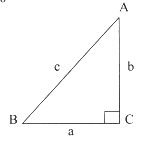
0 likes
View Solution142
MediumMCQ
In $\triangle ABC$ with usual notation,$\frac{\cos A}{a}=\frac{\cos B}{b}=\frac{\cos C}{c}$ and $a=\frac{1}{\sqrt{6}}$,then the area of the triangle is
A
$\frac{1}{8}$ sq. units.
B
$\frac{1}{24 \sqrt{3}}$ sq. units.
C
$\frac{1}{24}$ sq. units.
D
$\frac{1}{8 \sqrt{3}}$ sq. units.
Solution
(D) Given $\frac{\cos A}{a} = \frac{\cos B}{b} = \frac{\cos C}{c}$.
Using the Sine Rule,$\frac{a}{\sin A} = \frac{b}{\sin B} = \frac{c}{\sin C} = 2R$,we have $a = 2R \sin A$,$b = 2R \sin B$,and $c = 2R \sin C$.
Substituting these,we get $\frac{\cos A}{2R \sin A} = \frac{\cos B}{2R \sin B} = \frac{\cos C}{2R \sin C}$,which implies $\cot A = \cot B = \cot C$.
Since $A, B, C$ are angles of a triangle,$A = B = C = 60^\circ$,so the triangle is equilateral.
Given $a = \frac{1}{\sqrt{6}}$,the area of an equilateral triangle is $\frac{\sqrt{3}}{4} a^2$.
Area $= \frac{\sqrt{3}}{4} \left( \frac{1}{\sqrt{6}} \right)^2 = \frac{\sqrt{3}}{4} \times \frac{1}{6} = \frac{\sqrt{3}}{24} = \frac{1}{8 \sqrt{3}}$ sq. units.
Using the Sine Rule,$\frac{a}{\sin A} = \frac{b}{\sin B} = \frac{c}{\sin C} = 2R$,we have $a = 2R \sin A$,$b = 2R \sin B$,and $c = 2R \sin C$.
Substituting these,we get $\frac{\cos A}{2R \sin A} = \frac{\cos B}{2R \sin B} = \frac{\cos C}{2R \sin C}$,which implies $\cot A = \cot B = \cot C$.
Since $A, B, C$ are angles of a triangle,$A = B = C = 60^\circ$,so the triangle is equilateral.
Given $a = \frac{1}{\sqrt{6}}$,the area of an equilateral triangle is $\frac{\sqrt{3}}{4} a^2$.
Area $= \frac{\sqrt{3}}{4} \left( \frac{1}{\sqrt{6}} \right)^2 = \frac{\sqrt{3}}{4} \times \frac{1}{6} = \frac{\sqrt{3}}{24} = \frac{1}{8 \sqrt{3}}$ sq. units.
0 likes
View Solution143
MediumMCQ
If the angles $A, B$ and $C$ of a triangle are in an Arithmetic Progression and if $a, b$ and $c$ denote the lengths of the sides opposite to $A, B$ and $C$ respectively,then the value of the expression $\frac{a}{c} \sin 2C + \frac{c}{a} \sin 2A$ is
A
$\frac{1}{2}$
B
$\frac{\sqrt{3}}{2}$
C
$1$
D
$\sqrt{3}$
Solution
(D) Given that $A, B, C$ are in an Arithmetic Progression ($A$.$P$.).
Since $A + B + C = 180^{\circ}$,we have $3B = 180^{\circ}$,which implies $B = 60^{\circ}$.
By the sine rule,$\frac{\sin A}{a} = \frac{\sin B}{b} = \frac{\sin C}{c} = k$,so $\sin A = ak, \sin B = bk, \sin C = ck$.
The expression is $E = \frac{a}{c} \sin 2C + \frac{c}{a} \sin 2A$.
$E = \frac{a}{c} (2 \sin C \cos C) + \frac{c}{a} (2 \sin A \cos A)$.
Substituting $\sin C = ck$ and $\sin A = ak$:
$E = \frac{a}{c} (2 ck \cos C) + \frac{c}{a} (2 ak \cos A) = 2ak \cos C + 2ck \cos A$.
$E = 2k (a \cos C + c \cos A)$.
Using the projection formula $b = a \cos C + c \cos A$,we get:
$E = 2kb = 2 \sin B$.
Since $B = 60^{\circ}$,$E = 2 \sin 60^{\circ} = 2 \times \frac{\sqrt{3}}{2} = \sqrt{3}$.
Since $A + B + C = 180^{\circ}$,we have $3B = 180^{\circ}$,which implies $B = 60^{\circ}$.
By the sine rule,$\frac{\sin A}{a} = \frac{\sin B}{b} = \frac{\sin C}{c} = k$,so $\sin A = ak, \sin B = bk, \sin C = ck$.
The expression is $E = \frac{a}{c} \sin 2C + \frac{c}{a} \sin 2A$.
$E = \frac{a}{c} (2 \sin C \cos C) + \frac{c}{a} (2 \sin A \cos A)$.
Substituting $\sin C = ck$ and $\sin A = ak$:
$E = \frac{a}{c} (2 ck \cos C) + \frac{c}{a} (2 ak \cos A) = 2ak \cos C + 2ck \cos A$.
$E = 2k (a \cos C + c \cos A)$.
Using the projection formula $b = a \cos C + c \cos A$,we get:
$E = 2kb = 2 \sin B$.
Since $B = 60^{\circ}$,$E = 2 \sin 60^{\circ} = 2 \times \frac{\sqrt{3}}{2} = \sqrt{3}$.
0 likes
View Solution144
MediumMCQ
In a triangle $ABC$,with usual notations $\angle A=60^{\circ}$,then $\left(1+\frac{a}{c}+\frac{b}{c}\right)\left(1+\frac{c}{b}-\frac{a}{b}\right)=$
A
$3/2$
B
$1/2$
C
$1$
D
$3$
Solution
(D) Given the expression $\left(1+\frac{a}{c}+\frac{b}{c}\right)\left(1+\frac{c}{b}-\frac{a}{b}\right)$.
Simplifying the terms inside the parentheses:
$= \left(\frac{c+a+b}{c}\right) \left(\frac{b+c-a}{b}\right)$
$= \frac{(b+c)+a}{c} \times \frac{(b+c)-a}{b}$
$= \frac{(b+c)^2 - a^2}{bc}$
$= \frac{b^2 + c^2 + 2bc - a^2}{bc}$
$= \frac{b^2 + c^2 - a^2}{bc} + 2$
Using the cosine rule $\cos A = \frac{b^2 + c^2 - a^2}{2bc}$,we have $\frac{b^2 + c^2 - a^2}{bc} = 2 \cos A$.
$= 2 \cos A + 2$
Given $\angle A = 60^{\circ}$,$\cos 60^{\circ} = 1/2$.
$= 2(1/2) + 2 = 1 + 2 = 3$.
Simplifying the terms inside the parentheses:
$= \left(\frac{c+a+b}{c}\right) \left(\frac{b+c-a}{b}\right)$
$= \frac{(b+c)+a}{c} \times \frac{(b+c)-a}{b}$
$= \frac{(b+c)^2 - a^2}{bc}$
$= \frac{b^2 + c^2 + 2bc - a^2}{bc}$
$= \frac{b^2 + c^2 - a^2}{bc} + 2$
Using the cosine rule $\cos A = \frac{b^2 + c^2 - a^2}{2bc}$,we have $\frac{b^2 + c^2 - a^2}{bc} = 2 \cos A$.
$= 2 \cos A + 2$
Given $\angle A = 60^{\circ}$,$\cos 60^{\circ} = 1/2$.
$= 2(1/2) + 2 = 1 + 2 = 3$.
0 likes
View Solution145
MediumMCQ
With usual notations,in $\Delta ABC$,if $b \cos ^{2} \frac{C}{2}+c \cos ^{2} \frac{B}{2}=\frac{3 a}{2}$,then
A
$b, a, c$ are in $A$.$P$.
B
$b, a, c$ are in $G$.$P$.
C
$a, b, c$ are in $G$.$P$.
D
$a, b, c$ are in $A$.$P$.
Solution
(A) Given $b \cos ^{2} \frac{C}{2}+c \cos ^{2} \frac{B}{2}=\frac{3 a}{2}$.
Using the identity $\cos ^{2} \theta = \frac{1+\cos 2\theta}{2}$,we have:
$b \left( \frac{1+\cos C}{2} \right) + c \left( \frac{1+\cos B}{2} \right) = \frac{3 a}{2}$.
Multiplying by $2$ on both sides:
$b(1+\cos C) + c(1+\cos B) = 3a$.
$b + b \cos C + c + c \cos B = 3a$.
Rearranging terms:
$(b \cos C + c \cos B) + b + c = 3a$.
By the projection rule,$b \cos C + c \cos B = a$,so:
$a + b + c = 3a$.
$b + c = 2a$.
This implies that $b, a, c$ are in $A$.$P$.
Using the identity $\cos ^{2} \theta = \frac{1+\cos 2\theta}{2}$,we have:
$b \left( \frac{1+\cos C}{2} \right) + c \left( \frac{1+\cos B}{2} \right) = \frac{3 a}{2}$.
Multiplying by $2$ on both sides:
$b(1+\cos C) + c(1+\cos B) = 3a$.
$b + b \cos C + c + c \cos B = 3a$.
Rearranging terms:
$(b \cos C + c \cos B) + b + c = 3a$.
By the projection rule,$b \cos C + c \cos B = a$,so:
$a + b + c = 3a$.
$b + c = 2a$.
This implies that $b, a, c$ are in $A$.$P$.
0 likes
View Solution146
DifficultMCQ
In $\triangle ABC$,if $\sin^2 A + \sin^2 B = \sin^2 C$ and $l(AB) = 10$,then the maximum value of the area of $\triangle ABC$ is
A
$50$
B
$10\sqrt{2}$
C
$25$
D
$25\sqrt{2}$
Solution
(C) Given $\sin^2 A + \sin^2 B = \sin^2 C$.
Using the Sine Rule,$\frac{a}{\sin A} = \frac{b}{\sin B} = \frac{c}{\sin C} = 2R$,we have $\sin A = \frac{a}{2R}$,$\sin B = \frac{b}{2R}$,and $\sin C = \frac{c}{2R}$.
Substituting these into the given equation: $(\frac{a}{2R})^2 + (\frac{b}{2R})^2 = (\frac{c}{2R})^2 \Rightarrow a^2 + b^2 = c^2$.
This implies that $\triangle ABC$ is a right-angled triangle with the hypotenuse $c = l(AB) = 10$.
The area of the triangle is $Area = \frac{1}{2}ab$.
Since $c = 10$,we have $a = 10 \sin A$ and $b = 10 \cos A$.
$Area = \frac{1}{2}(10 \sin A)(10 \cos A) = 50 \sin A \cos A = 25 \sin(2A)$.
The maximum value of $\sin(2A)$ is $1$ (when $2A = 90^{\circ}$ or $A = 45^{\circ}$).
Therefore,the maximum area is $25 \times 1 = 25$.
Using the Sine Rule,$\frac{a}{\sin A} = \frac{b}{\sin B} = \frac{c}{\sin C} = 2R$,we have $\sin A = \frac{a}{2R}$,$\sin B = \frac{b}{2R}$,and $\sin C = \frac{c}{2R}$.
Substituting these into the given equation: $(\frac{a}{2R})^2 + (\frac{b}{2R})^2 = (\frac{c}{2R})^2 \Rightarrow a^2 + b^2 = c^2$.
This implies that $\triangle ABC$ is a right-angled triangle with the hypotenuse $c = l(AB) = 10$.
The area of the triangle is $Area = \frac{1}{2}ab$.
Since $c = 10$,we have $a = 10 \sin A$ and $b = 10 \cos A$.
$Area = \frac{1}{2}(10 \sin A)(10 \cos A) = 50 \sin A \cos A = 25 \sin(2A)$.
The maximum value of $\sin(2A)$ is $1$ (when $2A = 90^{\circ}$ or $A = 45^{\circ}$).
Therefore,the maximum area is $25 \times 1 = 25$.
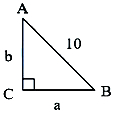
0 likes
View Solution147
MediumMCQ
If triangle $ABC$ is right-angled at $A$ and $\tan \frac{B}{2}, \tan \frac{C}{2}$ are roots of the equation $ax^2 + bx + c = 0$ $(a \neq 0)$,then:
A
$a+c=b$
B
$a+b=c$
C
$b+c=a$
D
$a+c=2b$
Solution
(B) In a triangle $ABC$ right-angled at $A$,we have $B+C = 90^\circ$,so $\frac{B+C}{2} = 45^\circ$.
Since $\tan \frac{B}{2}$ and $\tan \frac{C}{2}$ are roots of $ax^2+bx+c=0$,the sum of roots is $\tan \frac{B}{2} + \tan \frac{C}{2} = -\frac{b}{a}$ and the product of roots is $\tan \frac{B}{2} \tan \frac{C}{2} = \frac{c}{a}$.
Using the identity $\tan(\frac{B}{2} + \frac{C}{2}) = \frac{\tan \frac{B}{2} + \tan \frac{C}{2}}{1 - \tan \frac{B}{2} \tan \frac{C}{2}}$,we substitute $\tan 45^\circ = 1$:
$1 = \frac{-b/a}{1 - c/a} = \frac{-b/a}{(a-c)/a} = \frac{-b}{a-c}$.
This simplifies to $a-c = -b$,which rearranges to $a+b=c$.
Since $\tan \frac{B}{2}$ and $\tan \frac{C}{2}$ are roots of $ax^2+bx+c=0$,the sum of roots is $\tan \frac{B}{2} + \tan \frac{C}{2} = -\frac{b}{a}$ and the product of roots is $\tan \frac{B}{2} \tan \frac{C}{2} = \frac{c}{a}$.
Using the identity $\tan(\frac{B}{2} + \frac{C}{2}) = \frac{\tan \frac{B}{2} + \tan \frac{C}{2}}{1 - \tan \frac{B}{2} \tan \frac{C}{2}}$,we substitute $\tan 45^\circ = 1$:
$1 = \frac{-b/a}{1 - c/a} = \frac{-b/a}{(a-c)/a} = \frac{-b}{a-c}$.
This simplifies to $a-c = -b$,which rearranges to $a+b=c$.
0 likes
View Solution148
MediumMCQ
With usual notations in $\triangle ABC$,if $\angle B = \frac{\pi}{2}$,and $\tan \frac{A}{2}, \tan \frac{C}{2}$ are roots of the equation $px^2 + qx + r = 0$,$p \neq 0$,then:
A
$p + q = r$
B
$r + p = q$
C
$r = p$
D
$p = q$
Solution
(A) In $\triangle ABC$,since $\angle B = \frac{\pi}{2}$,we have $A + C = \frac{\pi}{2}$,which implies $\frac{A}{2} + \frac{C}{2} = \frac{\pi}{4}$.
Taking tangent on both sides,$\tan(\frac{A}{2} + \frac{C}{2}) = \tan(\frac{\pi}{4}) = 1$.
Using the formula $\tan(x+y) = \frac{\tan x + \tan y}{1 - \tan x \tan y}$,we get $\frac{\tan \frac{A}{2} + \tan \frac{C}{2}}{1 - \tan \frac{A}{2} \tan \frac{C}{2}} = 1$.
Let $\alpha = \tan \frac{A}{2}$ and $\beta = \tan \frac{C}{2}$ be the roots of $px^2 + qx + r = 0$.
From the properties of roots,$\alpha + \beta = -\frac{q}{p}$ and $\alpha \beta = \frac{r}{p}$.
Substituting these into the equation $\alpha + \beta = 1 - \alpha \beta$,we get $-\frac{q}{p} = 1 - \frac{r}{p}$.
Multiplying by $p$,we get $-q = p - r$,which simplifies to $r = p + q$ or $p + q = r$.
Taking tangent on both sides,$\tan(\frac{A}{2} + \frac{C}{2}) = \tan(\frac{\pi}{4}) = 1$.
Using the formula $\tan(x+y) = \frac{\tan x + \tan y}{1 - \tan x \tan y}$,we get $\frac{\tan \frac{A}{2} + \tan \frac{C}{2}}{1 - \tan \frac{A}{2} \tan \frac{C}{2}} = 1$.
Let $\alpha = \tan \frac{A}{2}$ and $\beta = \tan \frac{C}{2}$ be the roots of $px^2 + qx + r = 0$.
From the properties of roots,$\alpha + \beta = -\frac{q}{p}$ and $\alpha \beta = \frac{r}{p}$.
Substituting these into the equation $\alpha + \beta = 1 - \alpha \beta$,we get $-\frac{q}{p} = 1 - \frac{r}{p}$.
Multiplying by $p$,we get $-q = p - r$,which simplifies to $r = p + q$ or $p + q = r$.
0 likes
View Solution149
MediumMCQ
In a $\triangle PQR$,$m \angle R = \frac{\pi}{2}$. If $\tan \left(\frac{P}{2}\right)$ and $\tan \left(\frac{Q}{2}\right)$ are the roots of the equation $ax^2 + bx + c = 0$ $(a \neq 0)$,then:
A
$a+b=c$
B
$b+c=a$
C
$a+c=b$
D
$b=c$
Solution
(A) In $\triangle PQR$,$\angle P + \angle Q + \angle R = 180^{\circ}$.
Since $\angle R = \frac{\pi}{2} = 90^{\circ}$,we have $\angle P + \angle Q = 90^{\circ}$.
Dividing by $2$,we get $\frac{P}{2} + \frac{Q}{2} = 45^{\circ} = \frac{\pi}{4}$.
Given that $\tan \left(\frac{P}{2}\right)$ and $\tan \left(\frac{Q}{2}\right)$ are roots of $ax^2 + bx + c = 0$,by Vieta's formulas:
Sum of roots: $\tan \left(\frac{P}{2}\right) + \tan \left(\frac{Q}{2}\right) = -\frac{b}{a}$.
Product of roots: $\tan \left(\frac{P}{2}\right) \tan \left(\frac{Q}{2}\right) = \frac{c}{a}$.
Using the identity $\tan(A+B) = \frac{\tan A + \tan B}{1 - \tan A \tan B}$:
$\tan \left(\frac{P}{2} + \frac{Q}{2}\right) = \frac{\tan \frac{P}{2} + \tan \frac{Q}{2}}{1 - \tan \frac{P}{2} \tan \frac{Q}{2}}$.
Substituting the values: $\tan \left(\frac{\pi}{4}\right) = \frac{-b/a}{1 - c/a}$.
$1 = \frac{-b/a}{(a-c)/a} = \frac{-b}{a-c}$.
$a - c = -b$,which implies $a + b = c$.
Since $\angle R = \frac{\pi}{2} = 90^{\circ}$,we have $\angle P + \angle Q = 90^{\circ}$.
Dividing by $2$,we get $\frac{P}{2} + \frac{Q}{2} = 45^{\circ} = \frac{\pi}{4}$.
Given that $\tan \left(\frac{P}{2}\right)$ and $\tan \left(\frac{Q}{2}\right)$ are roots of $ax^2 + bx + c = 0$,by Vieta's formulas:
Sum of roots: $\tan \left(\frac{P}{2}\right) + \tan \left(\frac{Q}{2}\right) = -\frac{b}{a}$.
Product of roots: $\tan \left(\frac{P}{2}\right) \tan \left(\frac{Q}{2}\right) = \frac{c}{a}$.
Using the identity $\tan(A+B) = \frac{\tan A + \tan B}{1 - \tan A \tan B}$:
$\tan \left(\frac{P}{2} + \frac{Q}{2}\right) = \frac{\tan \frac{P}{2} + \tan \frac{Q}{2}}{1 - \tan \frac{P}{2} \tan \frac{Q}{2}}$.
Substituting the values: $\tan \left(\frac{\pi}{4}\right) = \frac{-b/a}{1 - c/a}$.
$1 = \frac{-b/a}{(a-c)/a} = \frac{-b}{a-c}$.
$a - c = -b$,which implies $a + b = c$.
0 likes
View SolutionTrigonometrical Equations — Mix Examples-Trigonometrical Equations and Inequations, Properties of Triangles, Height and Distance · Frequently Asked Questions
1Are these Trigonometrical Equations questions useful for JEE and NEET?
Yes. All questions in this section are mapped to JEE Main and NEET exam patterns. Previous year questions from JEE Main, NEET, GUJCET and state-level exams are included with full solutions.
2Can I switch to Hindi or Gujarati for these questions?
Yes. Use the language tabs in the hero section or the sidebar to view the same questions and solutions in English, Hindi or Gujarati.
3How do I generate a question paper from this subtopic?
Use the Vedclass Exam Paper Generator — select the chapter and subtopic, set difficulty, and generate Sets A, B, C, D automatically. First 3 chapters of every subject are free.
Vedclass Products
For Students
Vedclass Test Series
Mock tests in real JEE/NEET style with performance analysis. 5-day free trial.
Start Free TrialFor Teachers
Exam Paper Generator
Generate Set A/B/C/D papers from this chapter in 2 minutes. 3 chapters free.
Try FreeFor Institutes
Online Exam Module
Live online exams with unlimited students, 360° analytics & white-label branding.
See DemoFor Teachers & Institutes
Generate a Trigonometrical Equations Exam Paper in 2 Minutes
Select subtopic & difficulty — Sets A, B, C, D auto-generated with No Repeat logic.
First 3 chapters of every subject are free — no payment required.