
A English
Definition of combinations, Condition combinations Questions in English
Class 11 Mathematics · Permutation and Combination · Definition of combinations, Condition combinations
363+
Questions
English
Language
100%
With Solutions
Showing 49 of 363 questions in English
151
AdvancedMCQ
$A$ country has $10$ smart cities. The government decides to connect all these cities by road. How many roads does the government need to construct so that every city is connected to every other city?
A
$45$
B
$50$
C
$55$
D
$60$
Solution
(A) To connect every city to every other city,we need to choose $2$ cities out of $10$ to form a road connection.
This is a combination problem where we need to calculate $^{10}C_2$.
$^{10}C_2 = \frac{10 \times 9}{2 \times 1} = 45$.
Therefore,the government needs to construct $45$ roads.
This is a combination problem where we need to calculate $^{10}C_2$.
$^{10}C_2 = \frac{10 \times 9}{2 \times 1} = 45$.
Therefore,the government needs to construct $45$ roads.
0 likes
View Solution152
AdvancedMCQ
There are $10$ points in a row. In how many ways can $4$ points be selected such that no two of them are consecutive?
A
$140$
B
$35$
C
$104$
D
None
Solution
(B) To select $r$ items from $n$ items in a row such that no two are consecutive,the formula is given by $^{n-r+1}C_r$.
Here,$n = 10$ and $r = 4$.
Substituting the values,we get $^{10-4+1}C_4 = ^7C_4$.
Since $^7C_4 = ^7C_3$,we calculate:
$^7C_3 = \frac{7 \times 6 \times 5}{3 \times 2 \times 1} = 35$.
Here,$n = 10$ and $r = 4$.
Substituting the values,we get $^{10-4+1}C_4 = ^7C_4$.
Since $^7C_4 = ^7C_3$,we calculate:
$^7C_3 = \frac{7 \times 6 \times 5}{3 \times 2 \times 1} = 35$.
0 likes
View Solution153
AdvancedMCQ
The number of ways to distribute $25$ identical apples among $4$ boys,such that each boy receives at least $4$ apples,is
A
$^{29}C_3$
B
$100$
C
$^{12}C_3$
D
$^{24}C_3$
Solution
(C) Let the number of apples received by the $4$ boys be $x_1, x_2, x_3, x_4$ respectively.
We are given the equation $x_1 + x_2 + x_3 + x_4 = 25$,where $x_i \ge 4$ for $i = 1, 2, 3, 4$.
Let $y_i = x_i - 4$,where $y_i \ge 0$.
Substituting $x_i = y_i + 4$ into the equation:
$(y_1 + 4) + (y_2 + 4) + (y_3 + 4) + (y_4 + 4) = 25$
$y_1 + y_2 + y_3 + y_4 + 16 = 25$
$y_1 + y_2 + y_3 + y_4 = 9$
Using the stars and bars formula,the number of non-negative integer solutions is given by $^{n+r-1}C_{r-1}$,where $n = 9$ and $r = 4$.
Number of ways = $^{9+4-1}C_{4-1} = ^{12}C_3$.
We are given the equation $x_1 + x_2 + x_3 + x_4 = 25$,where $x_i \ge 4$ for $i = 1, 2, 3, 4$.
Let $y_i = x_i - 4$,where $y_i \ge 0$.
Substituting $x_i = y_i + 4$ into the equation:
$(y_1 + 4) + (y_2 + 4) + (y_3 + 4) + (y_4 + 4) = 25$
$y_1 + y_2 + y_3 + y_4 + 16 = 25$
$y_1 + y_2 + y_3 + y_4 = 9$
Using the stars and bars formula,the number of non-negative integer solutions is given by $^{n+r-1}C_{r-1}$,where $n = 9$ and $r = 4$.
Number of ways = $^{9+4-1}C_{4-1} = ^{12}C_3$.
0 likes
View Solution154
AdvancedMCQ
There are $5$ apples,$4$ mangoes,$3$ oranges,and $1$ each of $2$ other varieties of fruits. The number of ways of selecting at least one fruit of each kind is
A
$2!$
B
$3!$
C
$60$
D
$5!$
Solution
(C) To select at least one fruit of each kind,we must choose at least one from each group.
For $5$ apples,the number of ways to select at least one is $5$.
For $4$ mangoes,the number of ways to select at least one is $4$.
For $3$ oranges,the number of ways to select at least one is $3$.
For the $2$ other varieties,each having $1$ fruit,the number of ways to select at least one is $1$ for each.
Therefore,the total number of ways is $5 \times 4 \times 3 \times 1 \times 1 = 60$.
For $5$ apples,the number of ways to select at least one is $5$.
For $4$ mangoes,the number of ways to select at least one is $4$.
For $3$ oranges,the number of ways to select at least one is $3$.
For the $2$ other varieties,each having $1$ fruit,the number of ways to select at least one is $1$ for each.
Therefore,the total number of ways is $5 \times 4 \times 3 \times 1 \times 1 = 60$.
0 likes
View Solution155
AdvancedMCQ
The number of ways in which one or more balls can be selected out of $10$ white,$9$ green,and $7$ blue balls is:
A
$892$
B
$881$
C
$891$
D
$879$
Solution
(D) To select one or more balls from $10$ white,$9$ green,and $7$ blue balls,we consider the choices for each color.
For white balls,we can choose $0, 1, 2, \dots, 10$ balls,which gives $(10 + 1) = 11$ options.
For green balls,we can choose $0, 1, 2, \dots, 9$ balls,which gives $(9 + 1) = 10$ options.
For blue balls,we can choose $0, 1, 2, \dots, 7$ balls,which gives $(7 + 1) = 8$ options.
The total number of ways to select any number of balls (including selecting zero balls) is $11 \times 10 \times 8 = 880$.
Since we must select at least one ball,we subtract the case where zero balls are selected from all three colors.
Required number of ways $= 880 - 1 = 879$.
For white balls,we can choose $0, 1, 2, \dots, 10$ balls,which gives $(10 + 1) = 11$ options.
For green balls,we can choose $0, 1, 2, \dots, 9$ balls,which gives $(9 + 1) = 10$ options.
For blue balls,we can choose $0, 1, 2, \dots, 7$ balls,which gives $(7 + 1) = 8$ options.
The total number of ways to select any number of balls (including selecting zero balls) is $11 \times 10 \times 8 = 880$.
Since we must select at least one ball,we subtract the case where zero balls are selected from all three colors.
Required number of ways $= 880 - 1 = 879$.
0 likes
View Solution156
AdvancedMCQ
All the five-digit numbers in which each successive digit exceeds its predecessor are arranged in increasing order of their magnitude. The $97^{th}$ number in the list does not contain the digit:
A
$4$
B
$5$
C
$7$
D
$8$
Solution
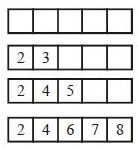
(B) five-digit number with strictly increasing digits is uniquely determined by choosing $5$ distinct digits from the set $\{1, 2, 3, 4, 5, 6, 7, 8, 9\}$. The total number of such integers is $\binom{9}{5} = 126$.
$1$. Numbers starting with $1$: We choose $4$ more digits from $\{2, 3, 4, 5, 6, 7, 8, 9\}$. Total = $\binom{8}{4} = 70$.
$2$. Numbers starting with $2$:
- Starting with $23$: We choose $3$ more digits from $\{4, 5, 6, 7, 8, 9\}$. Total = $\binom{6}{3} = 20$.
- Starting with $24$:
- Starting with $245$: We choose $2$ more digits from $\{6, 7, 8, 9\}$. Total = $\binom{4}{2} = 6$.
- Starting with $246$:
- $24678$ ($96^{th}$ number)
- $24679$ ($97^{th}$ number)
Thus,the $97^{th}$ number is $24679$. This number does not contain the digit $5$.
$1$. Numbers starting with $1$: We choose $4$ more digits from $\{2, 3, 4, 5, 6, 7, 8, 9\}$. Total = $\binom{8}{4} = 70$.
$2$. Numbers starting with $2$:
- Starting with $23$: We choose $3$ more digits from $\{4, 5, 6, 7, 8, 9\}$. Total = $\binom{6}{3} = 20$.
- Starting with $24$:
- Starting with $245$: We choose $2$ more digits from $\{6, 7, 8, 9\}$. Total = $\binom{4}{2} = 6$.
- Starting with $246$:
- $24678$ ($96^{th}$ number)
- $24679$ ($97^{th}$ number)
Thus,the $97^{th}$ number is $24679$. This number does not contain the digit $5$.
0 likes
View Solution157
AdvancedMCQ
For a scholarship,at most $n$ candidates out of $2n+1$ can be selected. If the number of different ways of selecting at least one candidate for the scholarship is $63$,then the maximum number of candidates that can be selected for the scholarship is -
A
$2$
B
$3$
C
$4$
D
$5$
Solution
(B) The number of ways to select at least one candidate is given by $\sum_{k=1}^{n} {^{2n+1}C_k} = 63$.
We know that $\sum_{k=0}^{2n+1} {^{2n+1}C_k} = 2^{2n+1}$.
Since ${^{2n+1}C_k} = {^{2n+1}C_{2n+1-k}}$,we have $\sum_{k=0}^{n} {^{2n+1}C_k} = \sum_{k=n+1}^{2n+1} {^{2n+1}C_k} = \frac{2^{2n+1}}{2} = 2^{2n}$.
Thus,$\sum_{k=1}^{n} {^{2n+1}C_k} = (\sum_{k=0}^{n} {^{2n+1}C_k}) - {^{2n+1}C_0} = 2^{2n} - 1$.
Given $2^{2n} - 1 = 63$,we get $2^{2n} = 64 = 2^6$.
Therefore,$2n = 6$,which implies $n = 3$.
The maximum number of candidates that can be selected is $n = 3$.
We know that $\sum_{k=0}^{2n+1} {^{2n+1}C_k} = 2^{2n+1}$.
Since ${^{2n+1}C_k} = {^{2n+1}C_{2n+1-k}}$,we have $\sum_{k=0}^{n} {^{2n+1}C_k} = \sum_{k=n+1}^{2n+1} {^{2n+1}C_k} = \frac{2^{2n+1}}{2} = 2^{2n}$.
Thus,$\sum_{k=1}^{n} {^{2n+1}C_k} = (\sum_{k=0}^{n} {^{2n+1}C_k}) - {^{2n+1}C_0} = 2^{2n} - 1$.
Given $2^{2n} - 1 = 63$,we get $2^{2n} = 64 = 2^6$.
Therefore,$2n = 6$,which implies $n = 3$.
The maximum number of candidates that can be selected is $n = 3$.
0 likes
View Solution158
AdvancedMCQ
Let $A_1, A_2, \dots, A_{11}$ be players in a team with their $T$-shirts numbered $1, 2, \dots, 11$. One hundred gold coins were won by the team in the final match. These coins are to be distributed among the players such that each player $A_i$ gets at least $i+1$ coins,except for the captain and vice-captain who get at least $5$ and $3$ coins more than their $T$-shirt numbers respectively. If the captain is $A_1$ and the vice-captain is $A_2$,in how many different ways can these coins be distributed?
A
$^{100}C_{83}$
B
$^{28}C_{11}$
C
$^{27}C_{9}$
D
$^{27}C_{10}$
Solution
(D) Let $x_i$ be the number of coins given to player $A_i$. The total number of coins is $\sum_{i=1}^{11} x_i = 100$.
Given conditions: $x_i \ge i+1$ for $i=3, 4, \dots, 11$,$x_1 \ge 1+5=6$,and $x_2 \ge 2+3=5$.
Let $y_i = x_i - (i+1)$ for $i=3, \dots, 11$,$y_1 = x_1 - 6$,and $y_2 = x_2 - 5$.
Substituting these into the sum: $(y_1+6) + (y_2+5) + \sum_{i=3}^{11} (y_i + i + 1) = 100$.
$y_1 + y_2 + \dots + y_{11} + 11 + \sum_{i=1}^{11} i = 100$.
$y_1 + y_2 + \dots + y_{11} + 11 + \frac{11 \times 12}{2} = 100$.
$y_1 + y_2 + \dots + y_{11} + 11 + 66 = 100$.
$y_1 + y_2 + \dots + y_{11} = 100 - 77 = 23$.
Wait,re-evaluating the base distribution: $x_1 \ge 6, x_2 \ge 5, x_3 \ge 4, x_4 \ge 5, \dots, x_{11} \ge 12$.
Sum of minimums $= 6+5+4+5+6+7+8+9+10+11+12 = 83$.
Remaining coins $= 100 - 83 = 17$.
Using stars and bars,the number of ways to distribute $17$ coins among $11$ players is $^{17+11-1}C_{11-1} = ^{27}C_{10}$.
Given conditions: $x_i \ge i+1$ for $i=3, 4, \dots, 11$,$x_1 \ge 1+5=6$,and $x_2 \ge 2+3=5$.
Let $y_i = x_i - (i+1)$ for $i=3, \dots, 11$,$y_1 = x_1 - 6$,and $y_2 = x_2 - 5$.
Substituting these into the sum: $(y_1+6) + (y_2+5) + \sum_{i=3}^{11} (y_i + i + 1) = 100$.
$y_1 + y_2 + \dots + y_{11} + 11 + \sum_{i=1}^{11} i = 100$.
$y_1 + y_2 + \dots + y_{11} + 11 + \frac{11 \times 12}{2} = 100$.
$y_1 + y_2 + \dots + y_{11} + 11 + 66 = 100$.
$y_1 + y_2 + \dots + y_{11} = 100 - 77 = 23$.
Wait,re-evaluating the base distribution: $x_1 \ge 6, x_2 \ge 5, x_3 \ge 4, x_4 \ge 5, \dots, x_{11} \ge 12$.
Sum of minimums $= 6+5+4+5+6+7+8+9+10+11+12 = 83$.
Remaining coins $= 100 - 83 = 17$.
Using stars and bars,the number of ways to distribute $17$ coins among $11$ players is $^{17+11-1}C_{11-1} = ^{27}C_{10}$.
0 likes
View Solution159
AdvancedMCQ
$n$ balls each of weight $w$. When weighed in pairs,the sum of the weights of all possible pairs is $120$. When they are weighed in triplets,the sum of the weights of all possible triplets is $480$. Then $n$ is:
A
$5$
B
$10$
C
$15$
D
$20$
Solution
(B) The number of possible pairs of $n$ objects is given by $^nC_2 = \frac{n(n-1)}{2}$.
Each pair has a total weight of $2w$.
Therefore,the sum of the weights of all pairs is $\frac{n(n-1)}{2} \times 2w = n(n-1)w = 120$ --- $(1)$.
The number of possible triplets of $n$ objects is given by $^nC_3 = \frac{n(n-1)(n-2)}{6}$.
Each triplet has a total weight of $3w$.
Therefore,the sum of the weights of all triplets is $\frac{n(n-1)(n-2)}{6} \times 3w = \frac{n(n-1)(n-2)w}{2} = 480$ --- $(2)$.
Dividing equation $(2)$ by equation $(1)$:
$\frac{\frac{n(n-1)(n-2)w}{2}}{n(n-1)w} = \frac{480}{120}$
$\frac{n-2}{2} = 4$
$n-2 = 8$
$n = 10$.
Each pair has a total weight of $2w$.
Therefore,the sum of the weights of all pairs is $\frac{n(n-1)}{2} \times 2w = n(n-1)w = 120$ --- $(1)$.
The number of possible triplets of $n$ objects is given by $^nC_3 = \frac{n(n-1)(n-2)}{6}$.
Each triplet has a total weight of $3w$.
Therefore,the sum of the weights of all triplets is $\frac{n(n-1)(n-2)}{6} \times 3w = \frac{n(n-1)(n-2)w}{2} = 480$ --- $(2)$.
Dividing equation $(2)$ by equation $(1)$:
$\frac{\frac{n(n-1)(n-2)w}{2}}{n(n-1)w} = \frac{480}{120}$
$\frac{n-2}{2} = 4$
$n-2 = 8$
$n = 10$.
0 likes
View Solution160
AdvancedMCQ
$A$ company has $10$ employees. The company has decided to form a team including at least three employees and also excluding at least three employees. Then the number of ways of forming the team is
A
$950$
B
$912$
C
$1000$
D
$953$
Solution
(B) Let $n = 10$ be the total number of employees.
We need to form a team of size $r$ such that the team includes at least $3$ employees and excludes at least $3$ employees.
This means the number of employees in the team $r$ must satisfy $3 \le r \le 10 - 3$,which simplifies to $3 \le r \le 7$.
The number of ways to form such a team is the sum of combinations $\sum_{r=3}^{7} {^{10}C_r}$.
We know that $\sum_{r=0}^{10} {^{10}C_r} = 2^{10} = 1024$.
The required sum is $2^{10} - ({^{10}C_0} + {^{10}C_1} + {^{10}C_2} + {^{10}C_8} + {^{10}C_9} + {^{10}C_{10}})$.
Calculating the values: ${^{10}C_0} = 1$,${^{10}C_1} = 10$,${^{10}C_2} = \frac{10 \times 9}{2} = 45$.
Since ${^{10}C_8} = {^{10}C_2} = 45$,${^{10}C_9} = {^{10}C_1} = 10$,and ${^{10}C_{10}} = {^{10}C_0} = 1$.
The sum of excluded terms is $(1 + 10 + 45 + 45 + 10 + 1) = 112$.
Therefore,the number of ways is $1024 - 112 = 912$.
We need to form a team of size $r$ such that the team includes at least $3$ employees and excludes at least $3$ employees.
This means the number of employees in the team $r$ must satisfy $3 \le r \le 10 - 3$,which simplifies to $3 \le r \le 7$.
The number of ways to form such a team is the sum of combinations $\sum_{r=3}^{7} {^{10}C_r}$.
We know that $\sum_{r=0}^{10} {^{10}C_r} = 2^{10} = 1024$.
The required sum is $2^{10} - ({^{10}C_0} + {^{10}C_1} + {^{10}C_2} + {^{10}C_8} + {^{10}C_9} + {^{10}C_{10}})$.
Calculating the values: ${^{10}C_0} = 1$,${^{10}C_1} = 10$,${^{10}C_2} = \frac{10 \times 9}{2} = 45$.
Since ${^{10}C_8} = {^{10}C_2} = 45$,${^{10}C_9} = {^{10}C_1} = 10$,and ${^{10}C_{10}} = {^{10}C_0} = 1$.
The sum of excluded terms is $(1 + 10 + 45 + 45 + 10 + 1) = 112$.
Therefore,the number of ways is $1024 - 112 = 912$.
0 likes
View Solution161
AdvancedMCQ
If $^nC_{r-2} = 36$,$^nC_{r-1} = 84$,and $^nC_r = 126$,then the value of $^nC_{2r}$ is
A
$9$
B
$36$
C
$66$
D
$126$
Solution
(A) Given: $^nC_{r-2} = 36$,$^nC_{r-1} = 84$,and $^nC_r = 126$.
Using the property $\frac{^nC_k}{^nC_{k-1}} = \frac{n-k+1}{k}$:
$\frac{^nC_{r-1}}{^nC_{r-2}} = \frac{84}{36} = \frac{7}{3}$ $\Rightarrow \frac{n-(r-1)+1}{r-1} = \frac{7}{3}$ $\Rightarrow \frac{n-r+2}{r-1} = \frac{7}{3}$
$3n - 3r + 6 = 7r - 7 \Rightarrow 3n - 10r = -13$ ....$(1)$
$\frac{^nC_r}{^nC_{r-1}} = \frac{126}{84} = \frac{3}{2} \Rightarrow \frac{n-r+1}{r} = \frac{3}{2}$
$2n - 2r + 2 = 3r \Rightarrow 2n - 5r = -2$ ....$(2)$
Multiplying equation $(2)$ by $2$: $4n - 10r = -4$ ....$(3)$
Subtracting $(1)$ from $(3)$: $(4n - 10r) - (3n - 10r) = -4 - (-13) \Rightarrow n = 9$
Substituting $n=9$ in $(2)$: $2(9) - 5r = -2$ $\Rightarrow 18 - 5r = -2$ $\Rightarrow 5r = 20$ $\Rightarrow r = 4$
We need to find $^nC_{2r} = ^9C_{2(4)} = ^9C_8 = ^9C_1 = 9$.
Using the property $\frac{^nC_k}{^nC_{k-1}} = \frac{n-k+1}{k}$:
$\frac{^nC_{r-1}}{^nC_{r-2}} = \frac{84}{36} = \frac{7}{3}$ $\Rightarrow \frac{n-(r-1)+1}{r-1} = \frac{7}{3}$ $\Rightarrow \frac{n-r+2}{r-1} = \frac{7}{3}$
$3n - 3r + 6 = 7r - 7 \Rightarrow 3n - 10r = -13$ ....$(1)$
$\frac{^nC_r}{^nC_{r-1}} = \frac{126}{84} = \frac{3}{2} \Rightarrow \frac{n-r+1}{r} = \frac{3}{2}$
$2n - 2r + 2 = 3r \Rightarrow 2n - 5r = -2$ ....$(2)$
Multiplying equation $(2)$ by $2$: $4n - 10r = -4$ ....$(3)$
Subtracting $(1)$ from $(3)$: $(4n - 10r) - (3n - 10r) = -4 - (-13) \Rightarrow n = 9$
Substituting $n=9$ in $(2)$: $2(9) - 5r = -2$ $\Rightarrow 18 - 5r = -2$ $\Rightarrow 5r = 20$ $\Rightarrow r = 4$
We need to find $^nC_{2r} = ^9C_{2(4)} = ^9C_8 = ^9C_1 = 9$.
0 likes
View Solution162
AdvancedMCQ
$A$ die is rolled three times. Find the probability of getting a larger number than the previous number each time.
A
$\frac{19}{216}$
B
$\frac{20}{216}$
C
$\frac{22}{216}$
D
$\frac{18}{216}$
Solution
(B) When a die is rolled three times,the total number of outcomes is $6^3 = 216$.
Let the outcomes be $x_1, x_2, x_3$ such that $1 \le x_1 < x_2 < x_3 \le 6$.
To satisfy the condition that each number is larger than the previous one,we need to select $3$ distinct numbers from the set $\{1, 2, 3, 4, 5, 6\}$.
The number of ways to choose $3$ distinct numbers is given by the combination formula $^6C_3$.
$^6C_3 = \frac{6 \times 5 \times 4}{3 \times 2 \times 1} = 20$.
Once $3$ distinct numbers are chosen,there is only $1$ way to arrange them in strictly increasing order.
Therefore,the number of favorable outcomes is $20$.
The probability is $\frac{20}{216}$.
Let the outcomes be $x_1, x_2, x_3$ such that $1 \le x_1 < x_2 < x_3 \le 6$.
To satisfy the condition that each number is larger than the previous one,we need to select $3$ distinct numbers from the set $\{1, 2, 3, 4, 5, 6\}$.
The number of ways to choose $3$ distinct numbers is given by the combination formula $^6C_3$.
$^6C_3 = \frac{6 \times 5 \times 4}{3 \times 2 \times 1} = 20$.
Once $3$ distinct numbers are chosen,there is only $1$ way to arrange them in strictly increasing order.
Therefore,the number of favorable outcomes is $20$.
The probability is $\frac{20}{216}$.
0 likes
View Solution163
AdvancedMCQ
If $n$ objects are arranged in a row,then the number of ways of selecting three of these objects such that no two of them are next to each other is:
A
${}^{n - 2}{C_3}$
B
${}^{n - 2}{C_2}$
C
${}^{n - 3}{C_3}$
D
None of these
Solution
(A) To select $3$ objects from $n$ objects arranged in a row such that no two are consecutive,we use the gap method.
Let the $n-3$ objects that are not selected be represented by $X$.
$X \_ X \_ X \_ \dots \_ X$
There are $n-3$ objects,which create $(n-3) + 1 = n-2$ available gaps (including the ends).
We need to choose $3$ gaps out of these $n-2$ gaps to place the selected objects.
The number of ways to do this is given by the combination formula ${}^{n-2}C_3$.
Let the $n-3$ objects that are not selected be represented by $X$.
$X \_ X \_ X \_ \dots \_ X$
There are $n-3$ objects,which create $(n-3) + 1 = n-2$ available gaps (including the ends).
We need to choose $3$ gaps out of these $n-2$ gaps to place the selected objects.
The number of ways to do this is given by the combination formula ${}^{n-2}C_3$.
0 likes
View Solution164
AdvancedMCQ
$^{20}C_1 + 3 ^{20}C_2 + 3 ^{20}C_3 + ^{20}C_4$ is equal to-
A
$^{20}C_4$
B
$2 \cdot ^{21}C_4$
C
$2 \cdot ^{22}C_4$
D
$^{23}C_4$
Solution
(D) The given expression is $S = ^{20}C_1 + 3 ^{20}C_2 + 3 ^{20}C_3 + ^{20}C_4$.
We can rewrite the coefficients as:
$S = (^{20}C_1 + ^{20}C_2) + 2(^{20}C_2 + ^{20}C_3) + (^{20}C_3 + ^{20}C_4)$.
Using the Pascal's identity $^{n}C_{r} + ^{n}C_{r-1} = ^{n+1}C_{r}$,we get:
$S = ^{21}C_2 + 2(^{21}C_3) + ^{21}C_4$.
Further,$S = (^{21}C_2 + ^{21}C_3) + (^{21}C_3 + ^{21}C_4)$.
Applying the identity again:
$S = ^{22}C_3 + ^{22}C_4 = ^{23}C_4$.
We can rewrite the coefficients as:
$S = (^{20}C_1 + ^{20}C_2) + 2(^{20}C_2 + ^{20}C_3) + (^{20}C_3 + ^{20}C_4)$.
Using the Pascal's identity $^{n}C_{r} + ^{n}C_{r-1} = ^{n+1}C_{r}$,we get:
$S = ^{21}C_2 + 2(^{21}C_3) + ^{21}C_4$.
Further,$S = (^{21}C_2 + ^{21}C_3) + (^{21}C_3 + ^{21}C_4)$.
Applying the identity again:
$S = ^{22}C_3 + ^{22}C_4 = ^{23}C_4$.
0 likes
View Solution165
AdvancedMCQ
Six married couples decide to form a committee of $6$ persons. The total number of ways to form the committee such that it contains no couples is equal to:
A
$32$
B
$64$
C
$320$
D
$160$
Solution
(B) There are $6$ married couples,so there are $12$ people in total.
We need to select $6$ people out of $12$ such that no two people form a couple.
First,we select $6$ couples out of $6$ available couples,which can be done in $\binom{6}{6} = 1$ way.
From each of these $6$ selected couples,we must choose exactly one person to be on the committee.
Since each couple has $2$ people,for each of the $6$ positions,we have $2$ choices.
Therefore,the total number of ways is $\binom{6}{6} \times 2^6 = 1 \times 64 = 64$.
We need to select $6$ people out of $12$ such that no two people form a couple.
First,we select $6$ couples out of $6$ available couples,which can be done in $\binom{6}{6} = 1$ way.
From each of these $6$ selected couples,we must choose exactly one person to be on the committee.
Since each couple has $2$ people,for each of the $6$ positions,we have $2$ choices.
Therefore,the total number of ways is $\binom{6}{6} \times 2^6 = 1 \times 64 = 64$.
0 likes
View Solution166
AdvancedMCQ
The number of values of $r$ satisfying $^{69}C_{3r-1} - ^{69}C_{r^2} = ^{69}C_{r^2-1} - ^{69}C_{3r}$ is:
A
$1$
B
$2$
C
$3$
D
$7$
Solution
(B) Given equation: $^{69}C_{3r-1} - ^{69}C_{r^2} = ^{69}C_{r^2-1} - ^{69}C_{3r}$
Rearranging the terms: $^{69}C_{3r-1} + ^{69}C_{3r} = ^{69}C_{r^2} + ^{69}C_{r^2-1}$
Using the identity $^{n}C_{r} + ^{n}C_{r-1} = ^{n+1}C_{r}$:
$^{70}C_{3r} = ^{70}C_{r^2}$
This implies either $3r = r^2$ or $3r + r^2 = 70$.
Case $1$: $r^2 - 3r = 0$ $\Rightarrow r(r-3) = 0$ $\Rightarrow r = 0$ or $r = 3$.
Case $2$: $r^2 + 3r - 70 = 0$ $\Rightarrow (r+10)(r-7) = 0$ $\Rightarrow r = -10$ or $r = 7$.
Since $nCr$ is defined for $n \ge r \ge 0$,we check the values:
For $r=0$: $^{69}C_{-1}$ is undefined.
For $r=-10$: $^{69}C_{-31}$ is undefined.
For $r=3$: $^{69}C_{8} - ^{69}C_{9} = ^{69}C_{8} - ^{69}C_{9}$ (Valid).
For $r=7$: $^{69}C_{20} - ^{69}C_{49} = ^{69}C_{48} - ^{69}C_{21}$ (Valid,since $^{69}C_{49} = ^{69}C_{20}$ and $^{69}C_{48} = ^{69}C_{21}$).
Thus,the valid values for $r$ are $3$ and $7$.
The number of values is $2$.
Rearranging the terms: $^{69}C_{3r-1} + ^{69}C_{3r} = ^{69}C_{r^2} + ^{69}C_{r^2-1}$
Using the identity $^{n}C_{r} + ^{n}C_{r-1} = ^{n+1}C_{r}$:
$^{70}C_{3r} = ^{70}C_{r^2}$
This implies either $3r = r^2$ or $3r + r^2 = 70$.
Case $1$: $r^2 - 3r = 0$ $\Rightarrow r(r-3) = 0$ $\Rightarrow r = 0$ or $r = 3$.
Case $2$: $r^2 + 3r - 70 = 0$ $\Rightarrow (r+10)(r-7) = 0$ $\Rightarrow r = -10$ or $r = 7$.
Since $nCr$ is defined for $n \ge r \ge 0$,we check the values:
For $r=0$: $^{69}C_{-1}$ is undefined.
For $r=-10$: $^{69}C_{-31}$ is undefined.
For $r=3$: $^{69}C_{8} - ^{69}C_{9} = ^{69}C_{8} - ^{69}C_{9}$ (Valid).
For $r=7$: $^{69}C_{20} - ^{69}C_{49} = ^{69}C_{48} - ^{69}C_{21}$ (Valid,since $^{69}C_{49} = ^{69}C_{20}$ and $^{69}C_{48} = ^{69}C_{21}$).
Thus,the valid values for $r$ are $3$ and $7$.
The number of values is $2$.
0 likes
View Solution167
DifficultMCQ
$A$ set contains $(2n + 1)$ elements. The number of subsets of the set which contain at most $n$ elements is:
A
$2^{2n-1}$
B
$2^{2n}$
C
$2^{n}$
D
$2^{n+1}$
Solution
(B) Let $S$ be a set with $N = 2n + 1$ elements. We want to find the number of subsets with at most $n$ elements,which is given by the sum:
$S = \sum_{r=0}^{n} \binom{2n+1}{r} = \binom{2n+1}{0} + \binom{2n+1}{1} + \dots + \binom{2n+1}{n}$.
We know that the total number of subsets is $\sum_{r=0}^{2n+1} \binom{2n+1}{r} = 2^{2n+1}$.
By the property of combinations,$\binom{N}{r} = \binom{N}{N-r}$.
Thus,$\binom{2n+1}{0} = \binom{2n+1}{2n+1}$,$\binom{2n+1}{1} = \binom{2n+1}{2n}$,...,$\binom{2n+1}{n} = \binom{2n+1}{n+1}$.
Let $X = \sum_{r=0}^{n} \binom{2n+1}{r}$. Then $X = \binom{2n+1}{0} + \dots + \binom{2n+1}{n}$.
Also,$X = \binom{2n+1}{2n+1} + \dots + \binom{2n+1}{n+1}$.
Adding these two expressions: $2X = \sum_{r=0}^{2n+1} \binom{2n+1}{r} = 2^{2n+1}$.
Therefore,$X = \frac{2^{2n+1}}{2} = 2^{2n}$.
$S = \sum_{r=0}^{n} \binom{2n+1}{r} = \binom{2n+1}{0} + \binom{2n+1}{1} + \dots + \binom{2n+1}{n}$.
We know that the total number of subsets is $\sum_{r=0}^{2n+1} \binom{2n+1}{r} = 2^{2n+1}$.
By the property of combinations,$\binom{N}{r} = \binom{N}{N-r}$.
Thus,$\binom{2n+1}{0} = \binom{2n+1}{2n+1}$,$\binom{2n+1}{1} = \binom{2n+1}{2n}$,...,$\binom{2n+1}{n} = \binom{2n+1}{n+1}$.
Let $X = \sum_{r=0}^{n} \binom{2n+1}{r}$. Then $X = \binom{2n+1}{0} + \dots + \binom{2n+1}{n}$.
Also,$X = \binom{2n+1}{2n+1} + \dots + \binom{2n+1}{n+1}$.
Adding these two expressions: $2X = \sum_{r=0}^{2n+1} \binom{2n+1}{r} = 2^{2n+1}$.
Therefore,$X = \frac{2^{2n+1}}{2} = 2^{2n}$.
0 likes
View Solution168
AdvancedMCQ
If the domain and range of $f(x) = ^{9-x}C_{x-1}$ contain $m$ and $n$ elements respectively,then:
A
$m = n$
B
$m = n + 1$
C
$m = n - 1$
D
$m = n + 2$
Solution
(B) For the function $f(x) = ^{9-x}C_{x-1}$ to be defined,the following conditions must be satisfied:
$1$. $9-x \geq 0 \Rightarrow x \leq 9$
$2$. $x-1 \geq 0 \Rightarrow x \geq 1$
$3$. $9-x \geq x-1 \Rightarrow 10 \geq 2x \Rightarrow x \leq 5$
Combining these,we get $1 \leq x \leq 5$. Since $x$ must be an integer for the combination to be defined,$x \in \{1, 2, 3, 4, 5\}$.
Thus,the domain has $m = 5$ elements.
Now,we calculate the values of $f(x)$ for each $x$:
$f(1) = ^{9-1}C_{1-1} = ^8C_0 = 1$
$f(2) = ^{9-2}C_{2-1} = ^7C_1 = 7$
$f(3) = ^{9-3}C_{3-1} = ^6C_2 = 15$
$f(4) = ^{9-4}C_{4-1} = ^5C_3 = 10$
$f(5) = ^{9-5}C_{5-1} = ^4C_4 = 1$
The range is the set of distinct values: $\{1, 7, 15, 10\}$.
Thus,the range has $n = 4$ elements.
Comparing $m=5$ and $n=4$,we see that $m = n + 1$.
$1$. $9-x \geq 0 \Rightarrow x \leq 9$
$2$. $x-1 \geq 0 \Rightarrow x \geq 1$
$3$. $9-x \geq x-1 \Rightarrow 10 \geq 2x \Rightarrow x \leq 5$
Combining these,we get $1 \leq x \leq 5$. Since $x$ must be an integer for the combination to be defined,$x \in \{1, 2, 3, 4, 5\}$.
Thus,the domain has $m = 5$ elements.
Now,we calculate the values of $f(x)$ for each $x$:
$f(1) = ^{9-1}C_{1-1} = ^8C_0 = 1$
$f(2) = ^{9-2}C_{2-1} = ^7C_1 = 7$
$f(3) = ^{9-3}C_{3-1} = ^6C_2 = 15$
$f(4) = ^{9-4}C_{4-1} = ^5C_3 = 10$
$f(5) = ^{9-5}C_{5-1} = ^4C_4 = 1$
The range is the set of distinct values: $\{1, 7, 15, 10\}$.
Thus,the range has $n = 4$ elements.
Comparing $m=5$ and $n=4$,we see that $m = n + 1$.
0 likes
View Solution169
DifficultMCQ
$A$ committee of $4$ persons is to be formed from $2$ ladies,$2$ old men,and $4$ young men such that it includes at least $1$ lady,at least $1$ old man,and at most $2$ young men. The total number of ways in which this committee can be formed is:
A
$40$
B
$41$
C
$16$
D
$32$
Solution
(B) We need to select $4$ persons from $2$ ladies $(L)$,$2$ old men $(O)$,and $4$ young men $(Y)$ with the constraints: $L \ge 1$,$O \ge 1$,and $Y \le 2$.
The possible combinations $(L, O, Y)$ that sum to $4$ are:
$1. (1, 1, 2) \implies ^2C_1 \times ^2C_1 \times ^4C_2 = 2 \times 2 \times 6 = 24$
$2. (1, 2, 1) \implies ^2C_1 \times ^2C_2 \times ^4C_1 = 2 \times 1 \times 4 = 8$
$3. (2, 1, 1) \implies ^2C_2 \times ^2C_1 \times ^4C_1 = 1 \times 2 \times 4 = 8$
$4. (2, 2, 0) \implies ^2C_2 \times ^2C_2 \times ^4C_0 = 1 \times 1 \times 1 = 1$
Total number of ways $= 24 + 8 + 8 + 1 = 41$.
The possible combinations $(L, O, Y)$ that sum to $4$ are:
$1. (1, 1, 2) \implies ^2C_1 \times ^2C_1 \times ^4C_2 = 2 \times 2 \times 6 = 24$
$2. (1, 2, 1) \implies ^2C_1 \times ^2C_2 \times ^4C_1 = 2 \times 1 \times 4 = 8$
$3. (2, 1, 1) \implies ^2C_2 \times ^2C_1 \times ^4C_1 = 1 \times 2 \times 4 = 8$
$4. (2, 2, 0) \implies ^2C_2 \times ^2C_2 \times ^4C_0 = 1 \times 1 \times 1 = 1$
Total number of ways $= 24 + 8 + 8 + 1 = 41$.
0 likes
View Solution170
DifficultMCQ
The number of ways in which an examiner can assign $30$ marks to $8$ questions,giving not less than $2$ marks to any question,is
A
$^{30}C_7$
B
$^{21}C_8$
C
$^{21}C_7$
D
$^{30}C_8$
Solution
(C) Let the marks assigned to the $8$ questions be $x_1, x_2, \dots, x_8$.
We are given that $x_1 + x_2 + \dots + x_8 = 30$,where $x_i \ge 2$ for all $i = 1, 2, \dots, 8$.
Let $x_i = y_i + 2$,where $y_i \ge 0$.
Substituting this into the equation,we get:
$(y_1 + 2) + (y_2 + 2) + \dots + (y_8 + 2) = 30$
$y_1 + y_2 + \dots + y_8 + 16 = 30$
$y_1 + y_2 + \dots + y_8 = 14$.
The number of non-negative integer solutions to this equation is given by the formula $^{n+r-1}C_{r-1}$,where $n=14$ and $r=8$.
Number of ways $= ^{14+8-1}C_{8-1} = ^{21}C_7$.
We are given that $x_1 + x_2 + \dots + x_8 = 30$,where $x_i \ge 2$ for all $i = 1, 2, \dots, 8$.
Let $x_i = y_i + 2$,where $y_i \ge 0$.
Substituting this into the equation,we get:
$(y_1 + 2) + (y_2 + 2) + \dots + (y_8 + 2) = 30$
$y_1 + y_2 + \dots + y_8 + 16 = 30$
$y_1 + y_2 + \dots + y_8 = 14$.
The number of non-negative integer solutions to this equation is given by the formula $^{n+r-1}C_{r-1}$,where $n=14$ and $r=8$.
Number of ways $= ^{14+8-1}C_{8-1} = ^{21}C_7$.
0 likes
View Solution171
DifficultMCQ
If the number of $5$-element subsets of the set $A = \{a_1, a_2, \dots, a_{20}\}$ of $20$ distinct elements is $k$ times the number of $5$-element subsets containing $a_4$,then $k$ is
A
$5$
B
$\frac{20}{7}$
C
$4$
D
$\frac{10}{3}$
Solution
(C) The set $A = \{a_1, a_2, \dots, a_{20}\}$ contains $20$ distinct elements.
The total number of $5$-element subsets is given by $^{20}C_5$.
The number of $5$-element subsets containing $a_4$ is equivalent to choosing $4$ more elements from the remaining $19$ elements,which is $^{19}C_4$.
According to the problem,$^{20}C_5 = k \times ^{19}C_4$.
Using the formula $^nC_r = \frac{n}{r} \times ^{n-1}C_{r-1}$,we have $^{20}C_5 = \frac{20}{5} \times ^{19}C_4$.
Therefore,$k = \frac{20}{5} = 4$.
The total number of $5$-element subsets is given by $^{20}C_5$.
The number of $5$-element subsets containing $a_4$ is equivalent to choosing $4$ more elements from the remaining $19$ elements,which is $^{19}C_4$.
According to the problem,$^{20}C_5 = k \times ^{19}C_4$.
Using the formula $^nC_r = \frac{n}{r} \times ^{n-1}C_{r-1}$,we have $^{20}C_5 = \frac{20}{5} \times ^{19}C_4$.
Therefore,$k = \frac{20}{5} = 4$.
0 likes
View Solution172
DifficultMCQ
Consider a class of $5$ girls and $7$ boys. The number of different teams consisting of $2$ girls and $3$ boys that can be formed from this class,if there are two specific boys $A$ and $B$ who refuse to be members of the same team,is
A
$500$
B
$200$
C
$300$
D
$350$
Solution
(C) Total number of ways to select $2$ girls from $5$ and $3$ boys from $7$ without any restriction is given by $^5C_2 \times ^7C_3 = 10 \times 35 = 350$.
If both specific boys $A$ and $B$ are in the team,we need to select $1$ more boy from the remaining $5$ boys and $2$ girls from $5$ girls. The number of such teams is $^5C_1 \times ^5C_2 = 5 \times 10 = 50$.
Therefore,the number of teams where $A$ and $B$ are not together is $350 - 50 = 300$.
If both specific boys $A$ and $B$ are in the team,we need to select $1$ more boy from the remaining $5$ boys and $2$ girls from $5$ girls. The number of such teams is $^5C_1 \times ^5C_2 = 5 \times 10 = 50$.
Therefore,the number of teams where $A$ and $B$ are not together is $350 - 50 = 300$.
0 likes
View Solution173
DifficultMCQ
The value of $r$ for which $^{20}C_r ^{20}C_0 + ^{20}C_{r-1} ^{20}C_1 + ^{20}C_{r-2} ^{20}C_2 + ... + ^{20}C_0 ^{20}C_r$ is maximum is
A
$15$
B
$20$
C
$11$
D
$10$
Solution
(B) The given expression is the sum of products of combinations:
$^{20}C_r ^{20}C_0 + ^{20}C_{r-1} ^{20}C_1 + ... + ^{20}C_0 ^{20}C_r = ^{40}C_r$
This is based on Vandermonde's Identity,which states that $\sum_{k=0}^{r} {^nC_k} {^mC_{r-k}} = ^{n+m}C_r$.
Here,$n=20$ and $m=20$,so the sum is $^{40}C_r$.
The value of $^{40}C_r$ is maximum when $r = \frac{n+m}{2} = \frac{40}{2} = 20$.
$^{20}C_r ^{20}C_0 + ^{20}C_{r-1} ^{20}C_1 + ... + ^{20}C_0 ^{20}C_r = ^{40}C_r$
This is based on Vandermonde's Identity,which states that $\sum_{k=0}^{r} {^nC_k} {^mC_{r-k}} = ^{n+m}C_r$.
Here,$n=20$ and $m=20$,so the sum is $^{40}C_r$.
The value of $^{40}C_r$ is maximum when $r = \frac{n+m}{2} = \frac{40}{2} = 20$.
0 likes
View Solution174
DifficultMCQ
Consider three boxes,each containing $10$ balls labelled $1, 2, \dots, 10$. Suppose one ball is randomly drawn from each of the boxes. Denote by $n_i$ the label of the ball drawn from the $i^{th}$ box,$(i = 1, 2, 3)$. Then,the number of ways in which the balls can be chosen such that $n_1 < n_2 < n_3$ is:
A
$120$
B
$82$
C
$240$
D
$164$
Solution
(A) We need to choose $3$ distinct balls from the set $\{1, 2, \dots, 10\}$ such that their labels satisfy $n_1 < n_2 < n_3$.
Since the order is strictly increasing,any selection of $3$ distinct balls from the $10$ available balls can be arranged in exactly one way to satisfy the condition $n_1 < n_2 < n_3$.
Therefore,the number of ways is given by the combination formula $^{10}C_3$.
$^{10}C_3 = \frac{10 \times 9 \times 8}{3 \times 2 \times 1} = 120$.
Since the order is strictly increasing,any selection of $3$ distinct balls from the $10$ available balls can be arranged in exactly one way to satisfy the condition $n_1 < n_2 < n_3$.
Therefore,the number of ways is given by the combination formula $^{10}C_3$.
$^{10}C_3 = \frac{10 \times 9 \times 8}{3 \times 2 \times 1} = 120$.
0 likes
View Solution175
DifficultMCQ
If $^nC_4, ^nC_5,$ and $^nC_6$ are in $A.P.,$ then $n$ can be
A
$9$
B
$14$
C
$11$
D
$12$
Solution
(B) Given that $^nC_4, ^nC_5,$ and $^nC_6$ are in $A.P.$
Therefore,$2(^nC_5) = ^nC_4 + ^nC_6$
Using the formula $^nC_r = \frac{n!}{r!(n-r)!}$,we have:
$2 \times \frac{n!}{5!(n-5)!} = \frac{n!}{4!(n-4)!} + \frac{n!}{6!(n-6)!}$
Dividing both sides by $n!$ and multiplying by $6!(n-4)!$:
$\frac{2 \times 6 \times (n-4)}{5!} = \frac{6 \times 5 \times 4!}{4!} + \frac{(n-4)(n-5)}{6!/6!}$
$\frac{12}{5!(n-5)!} = \frac{1}{4!(n-4)!} + \frac{1}{6!(n-6)!}$
Dividing by $\frac{1}{4!(n-6)!}$:
$\frac{12}{5(n-5)} = \frac{1}{(n-4)(n-5)} + \frac{1}{30}$
Multiplying by $30(n-4)(n-5)$:
$72(n-4) = 30 + (n-4)(n-5)$
$72n - 288 = 30 + n^2 - 9n + 20$
$n^2 - 81n + 338 = 0$
$(n-14)(n-67) = 0$
Since $n \ge 6$ for $^nC_6$ to be defined,$n = 14$ or $n = 67$. Among the options,$n = 14$ is correct.
Therefore,$2(^nC_5) = ^nC_4 + ^nC_6$
Using the formula $^nC_r = \frac{n!}{r!(n-r)!}$,we have:
$2 \times \frac{n!}{5!(n-5)!} = \frac{n!}{4!(n-4)!} + \frac{n!}{6!(n-6)!}$
Dividing both sides by $n!$ and multiplying by $6!(n-4)!$:
$\frac{2 \times 6 \times (n-4)}{5!} = \frac{6 \times 5 \times 4!}{4!} + \frac{(n-4)(n-5)}{6!/6!}$
$\frac{12}{5!(n-5)!} = \frac{1}{4!(n-4)!} + \frac{1}{6!(n-6)!}$
Dividing by $\frac{1}{4!(n-6)!}$:
$\frac{12}{5(n-5)} = \frac{1}{(n-4)(n-5)} + \frac{1}{30}$
Multiplying by $30(n-4)(n-5)$:
$72(n-4) = 30 + (n-4)(n-5)$
$72n - 288 = 30 + n^2 - 9n + 20$
$n^2 - 81n + 338 = 0$
$(n-14)(n-67) = 0$
Since $n \ge 6$ for $^nC_6$ to be defined,$n = 14$ or $n = 67$. Among the options,$n = 14$ is correct.
0 likes
View Solution176
DifficultMCQ
$A$ committee of $11$ members is to be formed from $8$ males and $5$ females. If $m$ is the number of ways the committee is formed with at least $6$ males and $n$ is the number of ways the committee is formed with at least $3$ females,then:
A
$n = m - 8$
B
$m + n = 68$
C
$m = n = 78$
D
$m = n = 68$
Solution
(C) Total members available are $8$ males and $5$ females,so total persons = $13$. We need to select $11$ members.
For $m$ (at least $6$ males):
Possible cases are ($6$ males,$5$ females),($7$ males,$4$ females),($8$ males,$3$ females).
$m = \binom{8}{6} \times \binom{5}{5} + \binom{8}{7} \times \binom{5}{4} + \binom{8}{8} \times \binom{5}{3} = (28 \times 1) + (8 \times 5) + (1 \times 10) = 28 + 40 + 10 = 78$.
For $n$ (at least $3$ females):
Possible cases are ($8$ males,$3$ females),($7$ males,$4$ females),($6$ males,$5$ females).
$n = \binom{5}{3} \times \binom{8}{8} + \binom{5}{4} \times \binom{8}{7} + \binom{5}{5} \times \binom{8}{6} = (10 \times 1) + (5 \times 8) + (1 \times 28) = 10 + 40 + 28 = 78$.
Thus,$m = n = 78$.
For $m$ (at least $6$ males):
Possible cases are ($6$ males,$5$ females),($7$ males,$4$ females),($8$ males,$3$ females).
$m = \binom{8}{6} \times \binom{5}{5} + \binom{8}{7} \times \binom{5}{4} + \binom{8}{8} \times \binom{5}{3} = (28 \times 1) + (8 \times 5) + (1 \times 10) = 28 + 40 + 10 = 78$.
For $n$ (at least $3$ females):
Possible cases are ($8$ males,$3$ females),($7$ males,$4$ females),($6$ males,$5$ females).
$n = \binom{5}{3} \times \binom{8}{8} + \binom{5}{4} \times \binom{8}{7} + \binom{5}{5} \times \binom{8}{6} = (10 \times 1) + (5 \times 8) + (1 \times 28) = 10 + 40 + 28 = 78$.
Thus,$m = n = 78$.
1 likes
View Solution177
DifficultMCQ
The number of ways of choosing $10$ objects out of $31$ objects,of which $10$ are identical and the remaining $21$ are distinct,is
A
$2^{20}$
B
$2^{20}+1$
C
$2^{21}$
D
$2^{20}-1$
Solution
(A) Let the $10$ identical objects be $I$ and the $21$ distinct objects be $D_1, D_2, ..., D_{21}$.
To choose $10$ objects,we can select $k$ objects from the $21$ distinct objects and $(10-k)$ objects from the $10$ identical objects,where $0 \le k \le 10$.
Since the $10$ identical objects are indistinguishable,there is only $1$ way to choose any number of them.
Thus,the number of ways is the sum of the ways to choose $k$ distinct objects for all possible $k$ from $0$ to $10$:
Total ways = $\sum_{k=0}^{10} \binom{21}{k} = \binom{21}{0} + \binom{21}{1} + ... + \binom{21}{10}$.
We know that the sum of binomial coefficients is $\sum_{k=0}^{21} \binom{21}{k} = 2^{21}$.
Since $\binom{21}{k} = \binom{21}{21-k}$,we have $\sum_{k=0}^{10} \binom{21}{k} = \sum_{k=11}^{21} \binom{21}{k}$.
Let $S = \sum_{k=0}^{10} \binom{21}{k}$. Then $S + S = \sum_{k=0}^{21} \binom{21}{k} = 2^{21}$.
Therefore,$2S = 2^{21}$,which implies $S = 2^{20}$.
To choose $10$ objects,we can select $k$ objects from the $21$ distinct objects and $(10-k)$ objects from the $10$ identical objects,where $0 \le k \le 10$.
Since the $10$ identical objects are indistinguishable,there is only $1$ way to choose any number of them.
Thus,the number of ways is the sum of the ways to choose $k$ distinct objects for all possible $k$ from $0$ to $10$:
Total ways = $\sum_{k=0}^{10} \binom{21}{k} = \binom{21}{0} + \binom{21}{1} + ... + \binom{21}{10}$.
We know that the sum of binomial coefficients is $\sum_{k=0}^{21} \binom{21}{k} = 2^{21}$.
Since $\binom{21}{k} = \binom{21}{21-k}$,we have $\sum_{k=0}^{10} \binom{21}{k} = \sum_{k=11}^{21} \binom{21}{k}$.
Let $S = \sum_{k=0}^{10} \binom{21}{k}$. Then $S + S = \sum_{k=0}^{21} \binom{21}{k} = 2^{21}$.
Therefore,$2S = 2^{21}$,which implies $S = 2^{20}$.
0 likes
View Solution178
DifficultMCQ
The number of ordered pairs $(r, k)$ for which $6 \cdot ^{35}C_{r} = (k^{2} - 3) \cdot ^{36}C_{r+1}$,where $k$ is an integer,is
A
$3$
B
$2$
C
$4$
D
$6$
Solution
(C) Given the equation: $6 \cdot ^{35}C_{r} = (k^{2} - 3) \cdot ^{36}C_{r+1}$.
Using the identity $^{n}C_{r} = \frac{n}{r} \cdot ^{n-1}C_{r-1}$ or $^{n+1}C_{r+1} = \frac{n+1}{r+1} \cdot ^{n}C_{r}$,we have $^{36}C_{r+1} = \frac{36}{r+1} \cdot ^{35}C_{r}$.
Substituting this into the equation:
$6 \cdot ^{35}C_{r} = (k^{2} - 3) \cdot \frac{36}{r+1} \cdot ^{35}C_{r}$.
Since $^{35}C_{r} \neq 0$,we can divide both sides by $^{35}C_{r}$:
$6 = (k^{2} - 3) \cdot \frac{36}{r+1}$.
Rearranging for $(k^{2} - 3)$:
$k^{2} - 3 = \frac{6(r+1)}{36} = \frac{r+1}{6}$.
Thus,$k^{2} = \frac{r+1}{6} + 3 = \frac{r+19}{6}$.
Since $k$ is an integer,$k^{2}$ must be a perfect square. Also,$0 \le r \le 35$.
For $r=5$,$k^{2} = \frac{5+19}{6} = 4 \Rightarrow k = \pm 2$.
For $r=35$,$k^{2} = \frac{35+19}{6} = 9 \Rightarrow k = \pm 3$.
These give the ordered pairs $(5, 2), (5, -2), (35, 3), (35, -3)$.
There are $4$ such ordered pairs.
Using the identity $^{n}C_{r} = \frac{n}{r} \cdot ^{n-1}C_{r-1}$ or $^{n+1}C_{r+1} = \frac{n+1}{r+1} \cdot ^{n}C_{r}$,we have $^{36}C_{r+1} = \frac{36}{r+1} \cdot ^{35}C_{r}$.
Substituting this into the equation:
$6 \cdot ^{35}C_{r} = (k^{2} - 3) \cdot \frac{36}{r+1} \cdot ^{35}C_{r}$.
Since $^{35}C_{r} \neq 0$,we can divide both sides by $^{35}C_{r}$:
$6 = (k^{2} - 3) \cdot \frac{36}{r+1}$.
Rearranging for $(k^{2} - 3)$:
$k^{2} - 3 = \frac{6(r+1)}{36} = \frac{r+1}{6}$.
Thus,$k^{2} = \frac{r+1}{6} + 3 = \frac{r+19}{6}$.
Since $k$ is an integer,$k^{2}$ must be a perfect square. Also,$0 \le r \le 35$.
For $r=5$,$k^{2} = \frac{5+19}{6} = 4 \Rightarrow k = \pm 2$.
For $r=35$,$k^{2} = \frac{35+19}{6} = 9 \Rightarrow k = \pm 3$.
These give the ordered pairs $(5, 2), (5, -2), (35, 3), (35, -3)$.
There are $4$ such ordered pairs.
0 likes
View Solution179
MediumMCQ
An urn contains $5$ red marbles,$4$ black marbles and $3$ white marbles. The number of ways in which $4$ marbles can be drawn so that at most three of them are red is
A
$540$
B
$450$
C
$420$
D
$490$
Solution
(D) Total number of marbles $= 5 + 4 + 3 = 12$.
We need to draw $4$ marbles from $12$ marbles.
The total number of ways to draw $4$ marbles is $^{12}C_{4} = \frac{12 \times 11 \times 10 \times 9}{4 \times 3 \times 2 \times 1} = 495$.
We want to find the number of ways such that at most $3$ marbles are red.
This is equivalent to: (Total ways) - (Ways where all $4$ marbles are red).
The number of ways to choose $4$ red marbles from $5$ red marbles is $^{5}C_{4} = 5$.
Therefore,the number of ways to draw $4$ marbles such that at most $3$ are red is $495 - 5 = 490$.
We need to draw $4$ marbles from $12$ marbles.
The total number of ways to draw $4$ marbles is $^{12}C_{4} = \frac{12 \times 11 \times 10 \times 9}{4 \times 3 \times 2 \times 1} = 495$.
We want to find the number of ways such that at most $3$ marbles are red.
This is equivalent to: (Total ways) - (Ways where all $4$ marbles are red).
The number of ways to choose $4$ red marbles from $5$ red marbles is $^{5}C_{4} = 5$.
Therefore,the number of ways to draw $4$ marbles such that at most $3$ are red is $495 - 5 = 490$.
0 likes
View Solution180
EasyMCQ
Compute $\frac{12!}{10! \times 2!}$
A
$66$
B
$60$
C
$72$
D
$132$
Solution
(A) We know that $n! = n \times (n-1) \times (n-2) \times \dots \times 1$.
Thus,$\frac{12!}{10! \times 2!} = \frac{12 \times 11 \times 10!}{10! \times (2 \times 1)}$.
Canceling $10!$ from the numerator and denominator,we get $\frac{12 \times 11}{2}$.
This simplifies to $6 \times 11 = 66$.
Thus,$\frac{12!}{10! \times 2!} = \frac{12 \times 11 \times 10!}{10! \times (2 \times 1)}$.
Canceling $10!$ from the numerator and denominator,we get $\frac{12 \times 11}{2}$.
This simplifies to $6 \times 11 = 66$.
0 likes
View Solution181
EasyMCQ
Evaluate $\frac{n!}{r!(n-r)!}$ when $n=5$ and $r=2$.
A
$10$
B
$20$
C
$30$
D
$40$
Solution
(A) Given the expression $\frac{n!}{r!(n-r)!}$ with $n=5$ and $r=2$.
Substituting the values,we get $\frac{5!}{2!(5-2)!}$.
This simplifies to $\frac{5!}{2! \times 3!}$.
Expanding the factorials,we have $\frac{5 \times 4 \times 3!}{2 \times 1 \times 3!}$.
Canceling $3!$ from the numerator and denominator,we get $\frac{5 \times 4}{2 \times 1} = \frac{20}{2} = 10$.
Substituting the values,we get $\frac{5!}{2!(5-2)!}$.
This simplifies to $\frac{5!}{2! \times 3!}$.
Expanding the factorials,we have $\frac{5 \times 4 \times 3!}{2 \times 1 \times 3!}$.
Canceling $3!$ from the numerator and denominator,we get $\frac{5 \times 4}{2 \times 1} = \frac{20}{2} = 10$.
0 likes
View Solution182
EasyMCQ
Compute $\frac{8!}{6! \times 2!}$
A
$28$
B
$24$
C
$56$
D
$16$
Solution
(A) We know that $n! = n \times (n-1) \times (n-2) \times \dots \times 1$.
Thus,$\frac{8!}{6! \times 2!} = \frac{8 \times 7 \times 6!}{6! \times (2 \times 1)}$.
Canceling $6!$ from the numerator and denominator,we get $\frac{8 \times 7}{2}$.
This simplifies to $\frac{56}{2} = 28$.
Thus,$\frac{8!}{6! \times 2!} = \frac{8 \times 7 \times 6!}{6! \times (2 \times 1)}$.
Canceling $6!$ from the numerator and denominator,we get $\frac{8 \times 7}{2}$.
This simplifies to $\frac{56}{2} = 28$.
0 likes
View Solution183
EasyMCQ
If $^{n}C_{9} = ^{n}C_{8}$,find $^{n}C_{17}$.
A
$1$
B
$17$
C
$16$
D
$0$
Solution
(A) We know the property of combinations: if $^{n}C_{r} = ^{n}C_{k}$,then either $r = k$ or $n = r + k$.
Given $^{n}C_{9} = ^{n}C_{8}$,since $9 \neq 8$,we must have $n = 9 + 8 = 17$.
Now,we need to find $^{n}C_{17}$,which is $^{17}C_{17}$.
Using the formula $^{n}C_{n} = 1$,we get $^{17}C_{17} = 1$.
Given $^{n}C_{9} = ^{n}C_{8}$,since $9 \neq 8$,we must have $n = 9 + 8 = 17$.
Now,we need to find $^{n}C_{17}$,which is $^{17}C_{17}$.
Using the formula $^{n}C_{n} = 1$,we get $^{17}C_{17} = 1$.
0 likes
View Solution184
MediumMCQ
$A$ committee of $3$ persons is to be constituted from a group of $2$ men and $3$ women. In how many ways can this be done? How many of these committees would consist of $1$ man and $2$ women?
A
Total ways: $10$,Committees with $1$ man and $2$ women: $6$
B
Total ways: $10$,Committees with $1$ man and $2$ women: $5$
C
Total ways: $8$,Committees with $1$ man and $2$ women: $6$
D
Total ways: $12$,Committees with $1$ man and $2$ women: $4$
Solution
(A) The total number of persons is $2 + 3 = 5$. We need to select $3$ persons out of $5$. Since the order does not matter,we use combinations.
Total ways $= ^{5}C_{3} = \frac{5!}{3!2!} = \frac{5 \times 4}{2 \times 1} = 10$.
To form a committee with $1$ man and $2$ women:
We select $1$ man from $2$ men in $^{2}C_{1}$ ways.
We select $2$ women from $3$ women in $^{3}C_{2}$ ways.
Number of ways $= ^{2}C_{1} \times ^{3}C_{2} = 2 \times 3 = 6$.
Total ways $= ^{5}C_{3} = \frac{5!}{3!2!} = \frac{5 \times 4}{2 \times 1} = 10$.
To form a committee with $1$ man and $2$ women:
We select $1$ man from $2$ men in $^{2}C_{1}$ ways.
We select $2$ women from $3$ women in $^{3}C_{2}$ ways.
Number of ways $= ^{2}C_{1} \times ^{3}C_{2} = 2 \times 3 = 6$.
0 likes
View Solution185
MediumMCQ
What is the number of ways of choosing $4$ cards from a pack of $52$ playing cards? In how many of these do the four cards belong to four different suits?
A
$270725$ and $13^{4}$
B
$270725$ and $13^{2}$
C
$270725$ and $4 \times 13^{4}$
D
$270725$ and $52 \times 13^{3}$
Solution
(A) The number of ways to choose $4$ cards from $52$ cards is given by the combination formula $^{52}C_{4}$.
$^{52}C_{4} = \frac{52!}{4!48!} = \frac{52 \times 51 \times 50 \times 49}{4 \times 3 \times 2 \times 1} = 270725$.
To choose $4$ cards such that each belongs to a different suit,we must select $1$ card from each of the $4$ suits (diamonds,hearts,clubs,spades).
There are $13$ cards in each suit. The number of ways to choose $1$ card from each suit is $^{13}C_{1} \times ^{13}C_{1} \times ^{13}C_{1} \times ^{13}C_{1} = 13 \times 13 \times 13 \times 13 = 13^{4} = 28561$.
Thus,the total ways are $270725$ and the ways to choose $4$ cards from different suits are $13^{4}$.
$^{52}C_{4} = \frac{52!}{4!48!} = \frac{52 \times 51 \times 50 \times 49}{4 \times 3 \times 2 \times 1} = 270725$.
To choose $4$ cards such that each belongs to a different suit,we must select $1$ card from each of the $4$ suits (diamonds,hearts,clubs,spades).
There are $13$ cards in each suit. The number of ways to choose $1$ card from each suit is $^{13}C_{1} \times ^{13}C_{1} \times ^{13}C_{1} \times ^{13}C_{1} = 13 \times 13 \times 13 \times 13 = 13^{4} = 28561$.
Thus,the total ways are $270725$ and the ways to choose $4$ cards from different suits are $13^{4}$.
0 likes
View Solution186
MediumMCQ
What is the number of ways of choosing $4$ cards from a pack of $52$ playing cards? In how many of these are all $4$ cards face cards?
A
$270725$
B
$495$
C
$1320$
D
$10626$
Solution
(B) The number of ways to choose $4$ cards from $52$ cards is given by the combination formula $^{n}C_{r} = \frac{n!}{r!(n-r)!}$.
For choosing $4$ cards from $52$,we have $^{52}C_{4} = \frac{52 \times 51 \times 50 \times 49}{4 \times 3 \times 2 \times 1} = 270725$.
There are $12$ face cards in a deck (Jack,Queen,King of each of the $4$ suits).
The number of ways to select $4$ face cards out of $12$ is $^{12}C_{4} = \frac{12 \times 11 \times 10 \times 9}{4 \times 3 \times 2 \times 1} = 495$.
For choosing $4$ cards from $52$,we have $^{52}C_{4} = \frac{52 \times 51 \times 50 \times 49}{4 \times 3 \times 2 \times 1} = 270725$.
There are $12$ face cards in a deck (Jack,Queen,King of each of the $4$ suits).
The number of ways to select $4$ face cards out of $12$ is $^{12}C_{4} = \frac{12 \times 11 \times 10 \times 9}{4 \times 3 \times 2 \times 1} = 495$.
0 likes
View Solution187
MediumMCQ
What is the number of ways of choosing $4$ cards from a pack of $52$ playing cards? In how many of these are two red cards and two black cards?
A
$270725$ and $105625$
B
$270725$ and $105600$
C
$270000$ and $105625$
D
$270725$ and $100000$
Solution
(A) The total number of ways to choose $4$ cards from $52$ is given by the combination formula $^{n}C_{r} = \frac{n!}{r!(n-r)!}$.
Total ways $= ^{52}C_{4} = \frac{52 \times 51 \times 50 \times 49}{4 \times 3 \times 2 \times 1} = 270725$.
There are $26$ red cards and $26$ black cards in a deck.
To choose $2$ red cards from $26$ and $2$ black cards from $26$,the number of ways is $^{26}C_{2} \times ^{26}C_{2}$.
$^{26}C_{2} = \frac{26 \times 25}{2 \times 1} = 325$.
So,the required number of ways $= 325 \times 325 = 105625$.
Total ways $= ^{52}C_{4} = \frac{52 \times 51 \times 50 \times 49}{4 \times 3 \times 2 \times 1} = 270725$.
There are $26$ red cards and $26$ black cards in a deck.
To choose $2$ red cards from $26$ and $2$ black cards from $26$,the number of ways is $^{26}C_{2} \times ^{26}C_{2}$.
$^{26}C_{2} = \frac{26 \times 25}{2 \times 1} = 325$.
So,the required number of ways $= 325 \times 325 = 105625$.
0 likes
View Solution188
MediumMCQ
What is the total number of ways of choosing $4$ cards from a pack of $52$ playing cards? In how many of these are the $4$ cards of the same colour?
A
$270725$ and $29900$
B
$270725$ and $14950$
C
$270725$ and $59800$
D
$270725$ and $15820$
Solution
(A) The total number of ways to choose $4$ cards from $52$ is given by the combination formula $^{n}C_{r} = \frac{n!}{r!(n-r)!}$.
Total ways $= ^{52}C_{4} = \frac{52 \times 51 \times 50 \times 49}{4 \times 3 \times 2 \times 1} = 270725$.
For the cards to be of the same colour,they must be either all red or all black.
There are $26$ red cards and $26$ black cards.
Ways to choose $4$ red cards $= ^{26}C_{4} = \frac{26 \times 25 \times 24 \times 23}{4 \times 3 \times 2 \times 1} = 14950$.
Ways to choose $4$ black cards $= ^{26}C_{4} = 14950$.
Total ways for same colour $= 14950 + 14950 = 29900$.
Total ways $= ^{52}C_{4} = \frac{52 \times 51 \times 50 \times 49}{4 \times 3 \times 2 \times 1} = 270725$.
For the cards to be of the same colour,they must be either all red or all black.
There are $26$ red cards and $26$ black cards.
Ways to choose $4$ red cards $= ^{26}C_{4} = \frac{26 \times 25 \times 24 \times 23}{4 \times 3 \times 2 \times 1} = 14950$.
Ways to choose $4$ black cards $= ^{26}C_{4} = 14950$.
Total ways for same colour $= 14950 + 14950 = 29900$.
0 likes
View Solution189
EasyMCQ
If $^{n}C_{8} = ^{n}C_{2}$,find $^{n}C_{2}$.
A
$45$
B
$36$
C
$28$
D
$10$
Solution
(A) We know that if $^{n}C_{a} = ^{n}C_{b}$,then either $a = b$ or $n = a + b$.
Given $^{n}C_{8} = ^{n}C_{2}$,since $8 \neq 2$,we must have $n = 8 + 2 = 10$.
Now,we need to find $^{n}C_{2} = ^{10}C_{2}$.
$^{10}C_{2} = \frac{10!}{2!(10-2)!} = \frac{10 \times 9}{2 \times 1} = 45$.
Given $^{n}C_{8} = ^{n}C_{2}$,since $8 \neq 2$,we must have $n = 8 + 2 = 10$.
Now,we need to find $^{n}C_{2} = ^{10}C_{2}$.
$^{10}C_{2} = \frac{10!}{2!(10-2)!} = \frac{10 \times 9}{2 \times 1} = 45$.
0 likes
View Solution190
MediumMCQ
Determine $n$ if $^{2n}C_{3} : ^{n}C_{3} = 12 : 1$.
A
$5$
B
$6$
C
$4$
D
$7$
Solution
(A) Given $\frac{^{2n}C_{3}}{^{n}C_{3}} = \frac{12}{1}$.
Using the formula $^{n}C_{r} = \frac{n!}{r!(n-r)!}$,we have:
$\frac{(2n)!}{3!(2n-3)!} \times \frac{3!(n-3)!}{n!} = 12$.
Simplifying the factorials:
$\frac{(2n)(2n-1)(2n-2)(2n-3)!}{(2n-3)!} \times \frac{(n-3)!}{n(n-1)(n-2)(n-3)!} = 12$.
$\frac{(2n)(2n-1)(2(n-1))}{n(n-1)(n-2)} = 12$.
$\frac{2(2n-1)(2)}{n-2} = 12$.
$\frac{4(2n-1)}{n-2} = 12$.
$\frac{2n-1}{n-2} = 3$.
$2n - 1 = 3(n - 2)$.
$2n - 1 = 3n - 6$.
$n = 5$.
Using the formula $^{n}C_{r} = \frac{n!}{r!(n-r)!}$,we have:
$\frac{(2n)!}{3!(2n-3)!} \times \frac{3!(n-3)!}{n!} = 12$.
Simplifying the factorials:
$\frac{(2n)(2n-1)(2n-2)(2n-3)!}{(2n-3)!} \times \frac{(n-3)!}{n(n-1)(n-2)(n-3)!} = 12$.
$\frac{(2n)(2n-1)(2(n-1))}{n(n-1)(n-2)} = 12$.
$\frac{2(2n-1)(2)}{n-2} = 12$.
$\frac{4(2n-1)}{n-2} = 12$.
$\frac{2n-1}{n-2} = 3$.
$2n - 1 = 3(n - 2)$.
$2n - 1 = 3n - 6$.
$n = 5$.
0 likes
View Solution191
MediumMCQ
Determine $n$ if $^{2n}C_{3} : ^{n}C_{3} = 11 : 1$.
A
$5$
B
$6$
C
$7$
D
$8$
Solution
(B) Given $\frac{^{2n}C_{3}}{^{n}C_{3}} = \frac{11}{1}$.
Using the formula $^{n}C_{r} = \frac{n!}{r!(n-r)!}$,we have:
$\frac{(2n)!}{3!(2n-3)!} \times \frac{3!(n-3)!}{n!} = 11$
$\Rightarrow \frac{(2n)(2n-1)(2n-2)(2n-3)!}{(2n-3)!} \times \frac{(n-3)!}{n(n-1)(n-2)(n-3)!} = 11$
$\Rightarrow \frac{(2n)(2n-1) \cdot 2(n-1)}{n(n-1)(n-2)} = 11$
$\Rightarrow \frac{2(2n-1) \cdot 2}{n-2} = 11$
$\Rightarrow \frac{4(2n-1)}{n-2} = 11$
$\Rightarrow 8n - 4 = 11n - 22$
$\Rightarrow 3n = 18$
$\Rightarrow n = 6$.
Using the formula $^{n}C_{r} = \frac{n!}{r!(n-r)!}$,we have:
$\frac{(2n)!}{3!(2n-3)!} \times \frac{3!(n-3)!}{n!} = 11$
$\Rightarrow \frac{(2n)(2n-1)(2n-2)(2n-3)!}{(2n-3)!} \times \frac{(n-3)!}{n(n-1)(n-2)(n-3)!} = 11$
$\Rightarrow \frac{(2n)(2n-1) \cdot 2(n-1)}{n(n-1)(n-2)} = 11$
$\Rightarrow \frac{2(2n-1) \cdot 2}{n-2} = 11$
$\Rightarrow \frac{4(2n-1)}{n-2} = 11$
$\Rightarrow 8n - 4 = 11n - 22$
$\Rightarrow 3n = 18$
$\Rightarrow n = 6$.
0 likes
View Solution192
EasyMCQ
In how many ways can a team of $3$ boys and $3$ girls be selected from $5$ boys and $4$ girls?
A
$40$
B
$60$
C
$80$
D
$100$
Solution
(A) team of $3$ boys and $3$ girls is to be selected from $5$ boys and $4$ girls.
$3$ boys can be selected from $5$ boys in $^{5}C_{3}$ ways.
$3$ girls can be selected from $4$ girls in $^{4}C_{3}$ ways.
Therefore,by the multiplication principle,the number of ways in which a team of $3$ boys and $3$ girls can be selected is given by:
$^{5}C_{3} \times ^{4}C_{3} = \frac{5!}{3!2!} \times \frac{4!}{3!1!}$
$= \frac{5 \times 4}{2 \times 1} \times \frac{4}{1}$
$= 10 \times 4 = 40$ ways.
$3$ boys can be selected from $5$ boys in $^{5}C_{3}$ ways.
$3$ girls can be selected from $4$ girls in $^{4}C_{3}$ ways.
Therefore,by the multiplication principle,the number of ways in which a team of $3$ boys and $3$ girls can be selected is given by:
$^{5}C_{3} \times ^{4}C_{3} = \frac{5!}{3!2!} \times \frac{4!}{3!1!}$
$= \frac{5 \times 4}{2 \times 1} \times \frac{4}{1}$
$= 10 \times 4 = 40$ ways.
0 likes
View Solution193
MediumMCQ
Find the number of ways of selecting $9$ balls from $6$ red balls,$5$ white balls,and $5$ blue balls if each selection consists of $3$ balls of each colour.
A
$2000$
B
$1500$
C
$1000$
D
$2500$
Solution
(A) We need to select $9$ balls such that $3$ balls are of each colour (red,white,and blue).
Number of ways to select $3$ red balls from $6$ is $^{6}C_{3} = \frac{6 \times 5 \times 4}{3 \times 2 \times 1} = 20$.
Number of ways to select $3$ white balls from $5$ is $^{5}C_{3} = \frac{5 \times 4 \times 3}{3 \times 2 \times 1} = 10$.
Number of ways to select $3$ blue balls from $5$ is $^{5}C_{3} = \frac{5 \times 4 \times 3}{3 \times 2 \times 1} = 10$.
By the multiplication principle,the total number of ways is $20 \times 10 \times 10 = 2000$.
Number of ways to select $3$ red balls from $6$ is $^{6}C_{3} = \frac{6 \times 5 \times 4}{3 \times 2 \times 1} = 20$.
Number of ways to select $3$ white balls from $5$ is $^{5}C_{3} = \frac{5 \times 4 \times 3}{3 \times 2 \times 1} = 10$.
Number of ways to select $3$ blue balls from $5$ is $^{5}C_{3} = \frac{5 \times 4 \times 3}{3 \times 2 \times 1} = 10$.
By the multiplication principle,the total number of ways is $20 \times 10 \times 10 = 2000$.
0 likes
View Solution194
MediumMCQ
Determine the number of $5$ card combinations out of a deck of $52$ cards if there is exactly one ace in each combination.
A
$778320$
B
$778320$
C
$778320$
D
$778320$
Solution
(A) In a deck of $52$ cards,there are $4$ aces and $48$ non-ace cards.
We need to select $5$ cards such that there is exactly $1$ ace.
First,select $1$ ace from $4$ available aces in $^{4}C_{1}$ ways.
Next,select the remaining $4$ cards from the $48$ non-ace cards in $^{48}C_{4}$ ways.
Using the multiplication principle,the total number of combinations is $^{4}C_{1} \times ^{48}C_{4}$.
$^{4}C_{1} = 4$.
$^{48}C_{4} = \frac{48 \times 47 \times 46 \times 45}{4 \times 3 \times 2 \times 1} = 194580$.
Total combinations $= 4 \times 194580 = 778320$.
We need to select $5$ cards such that there is exactly $1$ ace.
First,select $1$ ace from $4$ available aces in $^{4}C_{1}$ ways.
Next,select the remaining $4$ cards from the $48$ non-ace cards in $^{48}C_{4}$ ways.
Using the multiplication principle,the total number of combinations is $^{4}C_{1} \times ^{48}C_{4}$.
$^{4}C_{1} = 4$.
$^{48}C_{4} = \frac{48 \times 47 \times 46 \times 45}{4 \times 3 \times 2 \times 1} = 194580$.
Total combinations $= 4 \times 194580 = 778320$.
0 likes
View Solution195
MediumMCQ
In how many ways can one select a cricket team of $11$ from $17$ players in which only $5$ players can bowl,if each cricket team of $11$ must include exactly $4$ bowlers?
A
$3960$
B
$4950$
C
$2970$
D
$1980$
Solution
(A) Total players = $17$. Number of bowlers = $5$. Number of non-bowlers = $17 - 5 = 12$.
We need to select a team of $11$ players including exactly $4$ bowlers.
Number of ways to select $4$ bowlers from $5$ is $^{5}C_{4} = \frac{5!}{4!1!} = 5$.
Number of ways to select the remaining $11 - 4 = 7$ players from $12$ non-bowlers is $^{12}C_{7} = \frac{12!}{7!5!} = \frac{12 \times 11 \times 10 \times 9 \times 8}{5 \times 4 \times 3 \times 2 \times 1} = 792$.
Total number of ways = $^{5}C_{4} \times ^{12}C_{7} = 5 \times 792 = 3960$.
We need to select a team of $11$ players including exactly $4$ bowlers.
Number of ways to select $4$ bowlers from $5$ is $^{5}C_{4} = \frac{5!}{4!1!} = 5$.
Number of ways to select the remaining $11 - 4 = 7$ players from $12$ non-bowlers is $^{12}C_{7} = \frac{12!}{7!5!} = \frac{12 \times 11 \times 10 \times 9 \times 8}{5 \times 4 \times 3 \times 2 \times 1} = 792$.
Total number of ways = $^{5}C_{4} \times ^{12}C_{7} = 5 \times 792 = 3960$.
0 likes
View Solution196
MediumMCQ
$A$ bag contains $5$ black and $6$ red balls. Determine the number of ways in which $2$ black and $3$ red balls can be selected.
A
$200$
B
$150$
C
$100$
D
$250$
Solution
(A) There are $5$ black and $6$ red balls in the bag.
$2$ black balls can be selected out of $5$ black balls in $^{5}C_{2}$ ways.
$3$ red balls can be selected out of $6$ red balls in $^{6}C_{3}$ ways.
Thus,by the multiplication principle,the required number of ways of selecting $2$ black and $3$ red balls is:
$= ^{5}C_{2} \times ^{6}C_{3} = \frac{5!}{2!3!} \times \frac{6!}{3!3!} = \frac{5 \times 4}{2 \times 1} \times \frac{6 \times 5 \times 4}{3 \times 2 \times 1} = 10 \times 20 = 200$.
$2$ black balls can be selected out of $5$ black balls in $^{5}C_{2}$ ways.
$3$ red balls can be selected out of $6$ red balls in $^{6}C_{3}$ ways.
Thus,by the multiplication principle,the required number of ways of selecting $2$ black and $3$ red balls is:
$= ^{5}C_{2} \times ^{6}C_{3} = \frac{5!}{2!3!} \times \frac{6!}{3!3!} = \frac{5 \times 4}{2 \times 1} \times \frac{6 \times 5 \times 4}{3 \times 2 \times 1} = 10 \times 20 = 200$.
0 likes
View Solution197
MediumMCQ
In how many ways can a student choose a programme of $5$ courses if $9$ courses are available and $2$ specific courses are compulsory for every student?
A
$35$
B
$21$
C
$56$
D
$70$
Solution
(A) There are $9$ courses available,out of which $2$ specific courses are compulsory for every student.
Since $2$ courses are already selected,the student needs to choose $5 - 2 = 3$ more courses.
The number of remaining courses to choose from is $9 - 2 = 7$.
Therefore,the number of ways to choose the remaining courses is given by the combination formula $^{n}C_{r} = \frac{n!}{r!(n-r)!}$.
Number of ways $= ^{7}C_{3} = \frac{7!}{3!4!} = \frac{7 \times 6 \times 5}{3 \times 2 \times 1} = 35$.
Since $2$ courses are already selected,the student needs to choose $5 - 2 = 3$ more courses.
The number of remaining courses to choose from is $9 - 2 = 7$.
Therefore,the number of ways to choose the remaining courses is given by the combination formula $^{n}C_{r} = \frac{n!}{r!(n-r)!}$.
Number of ways $= ^{7}C_{3} = \frac{7!}{3!4!} = \frac{7 \times 6 \times 5}{3 \times 2 \times 1} = 35$.
0 likes
View Solution198
EasyMCQ
$A$ group consists of $4$ girls and $7$ boys. In how many ways can a team of $5$ members be selected if the team has no girl?
A
$21$
B
$35$
C
$42$
D
$70$
Solution
(A) Since the team will not include any girl,only boys are to be selected.
We need to select $5$ boys out of $7$ boys.
The number of ways to select $5$ boys out of $7$ is given by the combination formula $^{n}C_{r} = \frac{n!}{r!(n-r)!}$.
Therefore,the number of ways $= ^{7}C_{5} = ^{7}C_{7-5} = ^{7}C_{2}$.
$^{7}C_{2} = \frac{7 \times 6}{2 \times 1} = 21$.
Thus,there are $21$ ways to select the team.
We need to select $5$ boys out of $7$ boys.
The number of ways to select $5$ boys out of $7$ is given by the combination formula $^{n}C_{r} = \frac{n!}{r!(n-r)!}$.
Therefore,the number of ways $= ^{7}C_{5} = ^{7}C_{7-5} = ^{7}C_{2}$.
$^{7}C_{2} = \frac{7 \times 6}{2 \times 1} = 21$.
Thus,there are $21$ ways to select the team.
0 likes
View Solution199
MediumMCQ
$A$ group consists of $4$ girls and $7$ boys. In how many ways can a team of $5$ members be selected if the team has at least one boy and one girl?
A
$441$
B
$440$
C
$442$
D
$443$
Solution
(A) The total number of members to be selected is $5$. The team must contain at least one boy and one girl.
The possible compositions of the team are:
$(a)$ $1$ boy and $4$ girls: $^{7}C_{1} \times ^{4}C_{4} = 7 \times 1 = 7$ ways.
$(b)$ $2$ boys and $3$ girls: $^{7}C_{2} \times ^{4}C_{3} = 21 \times 4 = 84$ ways.
$(c)$ $3$ boys and $2$ girls: $^{7}C_{3} \times ^{4}C_{2} = 35 \times 6 = 210$ ways.
$(d)$ $4$ boys and $1$ girl: $^{7}C_{4} \times ^{4}C_{1} = 35 \times 4 = 140$ ways.
Total number of ways = $7 + 84 + 210 + 140 = 441$.
The possible compositions of the team are:
$(a)$ $1$ boy and $4$ girls: $^{7}C_{1} \times ^{4}C_{4} = 7 \times 1 = 7$ ways.
$(b)$ $2$ boys and $3$ girls: $^{7}C_{2} \times ^{4}C_{3} = 21 \times 4 = 84$ ways.
$(c)$ $3$ boys and $2$ girls: $^{7}C_{3} \times ^{4}C_{2} = 35 \times 6 = 210$ ways.
$(d)$ $4$ boys and $1$ girl: $^{7}C_{4} \times ^{4}C_{1} = 35 \times 4 = 140$ ways.
Total number of ways = $7 + 84 + 210 + 140 = 441$.
0 likes
View SolutionPermutation and Combination — Definition of combinations, Condition combinations · Frequently Asked Questions
1Are these Permutation and Combination questions useful for JEE and NEET?
Yes. All questions in this section are mapped to JEE Main and NEET exam patterns. Previous year questions from JEE Main, NEET, GUJCET and state-level exams are included with full solutions.
2Can I switch to Hindi or Gujarati for these questions?
Yes. Use the language tabs in the hero section or the sidebar to view the same questions and solutions in English, Hindi or Gujarati.
3How do I generate a question paper from this subtopic?
Use the Vedclass Exam Paper Generator — select the chapter and subtopic, set difficulty, and generate Sets A, B, C, D automatically. First 3 chapters of every subject are free.
Vedclass Products
For Students
Vedclass Test Series
Mock tests in real JEE/NEET style with performance analysis. 5-day free trial.
Start Free TrialFor Teachers
Exam Paper Generator
Generate Set A/B/C/D papers from this chapter in 2 minutes. 3 chapters free.
Try FreeFor Institutes
Online Exam Module
Live online exams with unlimited students, 360° analytics & white-label branding.
See DemoFor Teachers & Institutes
Generate a Permutation and Combination Exam Paper in 2 Minutes
Select subtopic & difficulty — Sets A, B, C, D auto-generated with No Repeat logic.
First 3 chapters of every subject are free — no payment required.