
A English
Circular permutations Questions in English
Class 11 Mathematics · Permutation and Combination · Circular permutations
72+
Questions
English
Language
100%
With Solutions
Showing 49 of 72 questions in English
1
EasyMCQ
If $11$ members of a committee sit at a round table so that the President and Secretary always sit together,then the number of arrangements is
A
$10! \times 2$
B
$10!$
C
$9! \times 2$
D
None of these
Solution
(C) To arrange $11$ members in a circle such that the President and Secretary always sit together,we treat the President and Secretary as a single unit.
Now,we have $9$ other members plus the $1$ unit of (President + Secretary),making a total of $10$ entities to be arranged in a circle.
The number of ways to arrange $n$ items in a circle is $(n-1)!$.
So,the number of ways to arrange these $10$ entities is $(10-1)! = 9!$.
Within the unit,the President and Secretary can be arranged in $2! = 2$ ways.
Therefore,the total number of arrangements is $9! \times 2$.
Now,we have $9$ other members plus the $1$ unit of (President + Secretary),making a total of $10$ entities to be arranged in a circle.
The number of ways to arrange $n$ items in a circle is $(n-1)!$.
So,the number of ways to arrange these $10$ entities is $(10-1)! = 9!$.
Within the unit,the President and Secretary can be arranged in $2! = 2$ ways.
Therefore,the total number of arrangements is $9! \times 2$.
0 likes
View Solution2
EasyMCQ
In how many ways can $5$ keys be put in a ring?
A
$\frac{1}{2} \times 4!$
B
$\frac{1}{2} \times 5!$
C
$4!$
D
$5!$
Solution
(A) The number of ways to arrange $n$ distinct items in a circle is $(n-1)!$.
In the case of a ring or a necklace,the clockwise and anticlockwise arrangements are considered identical.
Therefore,the number of ways to arrange $n$ keys in a ring is $\frac{(n-1)!}{2}$.
For $n = 5$,the number of ways is $\frac{(5-1)!}{2} = \frac{4!}{2} = \frac{1}{2} \times 4!$.
In the case of a ring or a necklace,the clockwise and anticlockwise arrangements are considered identical.
Therefore,the number of ways to arrange $n$ keys in a ring is $\frac{(n-1)!}{2}$.
For $n = 5$,the number of ways is $\frac{(5-1)!}{2} = \frac{4!}{2} = \frac{1}{2} \times 4!$.
0 likes
View Solution3
EasyMCQ
In how many ways can $5$ boys and $5$ girls sit in a circle so that no two boys sit together?
A
$5! \times 5!$
B
$4! \times 5!$
C
$\frac{5! \times 5!}{2}$
D
None of these
Solution
(B) To arrange $5$ boys and $5$ girls in a circle such that no two boys sit together,we first arrange the $5$ girls in a circle.
The number of ways to arrange $5$ girls in a circle is $(5 - 1)! = 4!$.
This creates $5$ gaps between the girls where the $5$ boys can be seated.
The number of ways to arrange $5$ boys in these $5$ gaps is $5!$.
Therefore,the total number of ways is $4! \times 5!$.
The number of ways to arrange $5$ girls in a circle is $(5 - 1)! = 4!$.
This creates $5$ gaps between the girls where the $5$ boys can be seated.
The number of ways to arrange $5$ boys in these $5$ gaps is $5!$.
Therefore,the total number of ways is $4! \times 5!$.
0 likes
View Solution4
EasyMCQ
In how many ways can $12$ gentlemen sit around a round table so that three specified gentlemen are always together?
A
$9!$
B
$10!$
C
$3! \times 10!$
D
$3! \times 9!$
Solution
(D) To solve this,we treat the $3$ specified gentlemen as a single unit.
Now,we have $(12 - 3 + 1) = 10$ units to arrange around a circular table.
The number of ways to arrange $10$ units in a circle is $(10 - 1)! = 9!$.
Within the single unit,the $3$ specified gentlemen can be arranged among themselves in $3!$ ways.
Therefore,the total number of ways is $3! \times 9!$.
Now,we have $(12 - 3 + 1) = 10$ units to arrange around a circular table.
The number of ways to arrange $10$ units in a circle is $(10 - 1)! = 9!$.
Within the single unit,the $3$ specified gentlemen can be arranged among themselves in $3!$ ways.
Therefore,the total number of ways is $3! \times 9!$.
0 likes
View Solution5
MediumMCQ
In how many ways can $15$ members of a council sit along a circular table,when the Secretary is to sit on one side of the Chairman and the Deputy Secretary on the other side?
A
$2 \times 12!$
B
$24$
C
$2 \times 15!$
D
None of these
Solution
(A) To arrange $15$ members around a circular table with the condition that the Secretary and Deputy Secretary sit on either side of the Chairman,we treat the group of these $3$ members as a single unit.
This leaves us with $15 - 3 + 1 = 13$ units to arrange in a circle.
The number of ways to arrange $13$ units in a circle is $(13 - 1)! = 12!$.
Within the unit of $3$ members,the Secretary and Deputy Secretary can swap places on either side of the Chairman in $2! = 2$ ways.
Therefore,the total number of arrangements is $12! \times 2$.
This leaves us with $15 - 3 + 1 = 13$ units to arrange in a circle.
The number of ways to arrange $13$ units in a circle is $(13 - 1)! = 12!$.
Within the unit of $3$ members,the Secretary and Deputy Secretary can swap places on either side of the Chairman in $2! = 2$ ways.
Therefore,the total number of arrangements is $12! \times 2$.
0 likes
View Solution6
EasyMCQ
In how many ways can a garland be made from exactly $10$ flowers?
A
$10!$
B
$9!$
C
$2(9!)$
D
$\frac{9!}{2}$
Solution
(D) The number of ways to arrange $n$ distinct objects in a circle is $(n-1)!$.
In the case of a garland or a necklace,the clockwise and anticlockwise arrangements are considered identical because the garland can be flipped over.
Therefore,the number of ways to make a garland from $n$ flowers is $\frac{(n-1)!}{2}$.
For $n = 10$,the number of ways is $\frac{(10-1)!}{2} = \frac{9!}{2}$.
In the case of a garland or a necklace,the clockwise and anticlockwise arrangements are considered identical because the garland can be flipped over.
Therefore,the number of ways to make a garland from $n$ flowers is $\frac{(n-1)!}{2}$.
For $n = 10$,the number of ways is $\frac{(10-1)!}{2} = \frac{9!}{2}$.
0 likes
View Solution7
MediumMCQ
$20$ persons are invited for a party. In how many different ways can they and the host be seated at a circular table,if two particular persons are to be seated on either side of the host?
A
$20!$
B
$2 \times 18!$
C
$18!$
D
None of these
Solution
(B) Total number of persons $= 20 + 1 = 21$.
Let the host be $H$ and the two particular persons be $P_1$ and $P_2$.
Since $P_1$ and $P_2$ must sit on either side of the host,we treat the group $(P_1, H, P_2)$ as a single unit.
This leaves $21 - 3 = 18$ other persons plus the $1$ unit,making a total of $19$ entities to be arranged in a circle.
The number of ways to arrange $n$ items in a circle is $(n-1)!$,so $19$ entities can be arranged in $(19-1)! = 18!$ ways.
Within the unit $(P_1, H, P_2)$,the two persons $P_1$ and $P_2$ can be arranged in $2! = 2$ ways (i.e.,$P_1HP_2$ or $P_2HP_1$).
Therefore,the total number of ways is $2 \times 18!$.
Let the host be $H$ and the two particular persons be $P_1$ and $P_2$.
Since $P_1$ and $P_2$ must sit on either side of the host,we treat the group $(P_1, H, P_2)$ as a single unit.
This leaves $21 - 3 = 18$ other persons plus the $1$ unit,making a total of $19$ entities to be arranged in a circle.
The number of ways to arrange $n$ items in a circle is $(n-1)!$,so $19$ entities can be arranged in $(19-1)! = 18!$ ways.
Within the unit $(P_1, H, P_2)$,the two persons $P_1$ and $P_2$ can be arranged in $2! = 2$ ways (i.e.,$P_1HP_2$ or $P_2HP_1$).
Therefore,the total number of ways is $2 \times 18!$.
0 likes
View Solution8
EasyMCQ
The number of ways in which $5$ beads of different colours form a necklace is
A
$12$
B
$24$
C
$120$
D
$60$
Solution
(A) The number of ways in which $n$ distinct beads can be arranged in a circle is $(n - 1)!$.
For a necklace,the clockwise and anticlockwise arrangements are considered identical because the necklace can be flipped over.
Therefore,the number of ways to form a necklace with $n$ beads is $\frac{(n - 1)!}{2}$.
For $n = 5$,the number of ways is $\frac{(5 - 1)!}{2} = \frac{4!}{2} = \frac{24}{2} = 12$.
For a necklace,the clockwise and anticlockwise arrangements are considered identical because the necklace can be flipped over.
Therefore,the number of ways to form a necklace with $n$ beads is $\frac{(n - 1)!}{2}$.
For $n = 5$,the number of ways is $\frac{(5 - 1)!}{2} = \frac{4!}{2} = \frac{24}{2} = 12$.
0 likes
View Solution9
EasyMCQ
$n$ gentlemen can be made to sit on a round table in how many ways?
A
$\frac{1}{2}(n + 1)!$ ways
B
$(n - 1)!$ ways
C
$\frac{1}{2}(n - 1)!$ ways
D
$(n + 1)!$ ways
Solution
(B) The number of ways to arrange $n$ distinct objects in a circle is given by the formula $(n - 1)!$.
This is because in a circular arrangement,one position is fixed to account for rotational symmetry,leaving $(n - 1)$ objects to be arranged in the remaining $(n - 1)$ positions.
This is because in a circular arrangement,one position is fixed to account for rotational symmetry,leaving $(n - 1)$ objects to be arranged in the remaining $(n - 1)$ positions.
0 likes
View Solution10
MediumMCQ
The number of ways in which $5$ male and $2$ female members of a committee can be seated around a round table so that the two female members are not seated together is:
A
$480$
B
$600$
C
$720$
D
$840$
Solution
(A) First,arrange the $5$ male members around a round table. The number of ways to arrange $n$ objects in a circle is $(n-1)!$. So,$5$ males can be seated in $(5-1)! = 4! = 24$ ways.
After seating the $5$ males,there are $5$ gaps created between them.
To ensure the $2$ females are not seated together,we must place them in these $5$ available gaps.
The number of ways to choose and arrange $2$ females in $5$ gaps is given by the permutation formula ${}^5P_2 = \frac{5!}{(5-2)!} = 5 \times 4 = 20$.
Therefore,the total number of ways is $4! \times {}^5P_2 = 24 \times 20 = 480$.
After seating the $5$ males,there are $5$ gaps created between them.
To ensure the $2$ females are not seated together,we must place them in these $5$ available gaps.
The number of ways to choose and arrange $2$ females in $5$ gaps is given by the permutation formula ${}^5P_2 = \frac{5!}{(5-2)!} = 5 \times 4 = 20$.
Therefore,the total number of ways is $4! \times {}^5P_2 = 24 \times 20 = 480$.
0 likes
View Solution11
EasyMCQ
The number of circular permutations of $n$ different objects is
A
$n!$
B
$n$
C
$(n - 2)!$
D
$(n - 1)!$
Solution
(D) The number of ways to arrange $n$ distinct objects in a row is $n!$.
In a circular arrangement,rotations are considered identical.
Since there are $n$ possible rotations for any linear arrangement of $n$ objects,we divide the linear permutations by $n$.
Therefore,the number of circular permutations is $\frac{n!}{n} = (n - 1)!$.
In a circular arrangement,rotations are considered identical.
Since there are $n$ possible rotations for any linear arrangement of $n$ objects,we divide the linear permutations by $n$.
Therefore,the number of circular permutations is $\frac{n!}{n} = (n - 1)!$.
0 likes
View Solution12
MediumMCQ
The number of ways in which $6$ men and $5$ women can dine at a round table if no two women are to sit together is given by
A
$6! \times 5!$
B
$30$
C
$5! \times 4!$
D
$7! \times 5!$
Solution
(A) First,arrange the $6$ men at a round table. The number of ways to arrange $n$ objects in a circle is $(n-1)!$. So,$6$ men can be arranged in $(6-1)! = 5!$ ways.
After arranging the men,there are $6$ gaps created between them.
Since no two women should sit together,we need to place $5$ women in these $6$ gaps.
The number of ways to choose $5$ gaps out of $6$ is $^6C_5$,and the $5$ women can be arranged in these gaps in $5!$ ways.
Alternatively,we can place $5$ women in $6$ gaps in $P(6, 5)$ ways.
Total number of ways $= 5! \times P(6, 5) = 5! \times \frac{6!}{(6-5)!} = 5! \times 6!$.
After arranging the men,there are $6$ gaps created between them.
Since no two women should sit together,we need to place $5$ women in these $6$ gaps.
The number of ways to choose $5$ gaps out of $6$ is $^6C_5$,and the $5$ women can be arranged in these gaps in $5!$ ways.
Alternatively,we can place $5$ women in $6$ gaps in $P(6, 5)$ ways.
Total number of ways $= 5! \times P(6, 5) = 5! \times \frac{6!}{(6-5)!} = 5! \times 6!$.
0 likes
View Solution13
MediumMCQ
$12$ persons are to be arranged at a round table. If two particular persons among them are not to be side by side,the total number of arrangements is
A
$9(10!)$
B
$2(10!)$
C
$45(8!)$
D
$10!$
Solution
(A) The total number of ways to arrange $12$ persons around a round table is $(12 - 1)! = 11!$.
To find the number of arrangements where $2$ particular persons sit side by side,we treat them as a single unit. Now,we have $11$ units to arrange in a circle,which can be done in $(11 - 1)! = 10!$ ways.
Since the $2$ particular persons can be arranged among themselves in $2! = 2$ ways,the total number of ways they sit together is $10! \times 2$.
The number of arrangements where they are not side by side is the total arrangements minus the arrangements where they sit together:
$11! - (10! \times 2) = (11 \times 10!) - (2 \times 10!) = (11 - 2) \times 10! = 9 \times 10!$.
To find the number of arrangements where $2$ particular persons sit side by side,we treat them as a single unit. Now,we have $11$ units to arrange in a circle,which can be done in $(11 - 1)! = 10!$ ways.
Since the $2$ particular persons can be arranged among themselves in $2! = 2$ ways,the total number of ways they sit together is $10! \times 2$.
The number of arrangements where they are not side by side is the total arrangements minus the arrangements where they sit together:
$11! - (10! \times 2) = (11 \times 10!) - (2 \times 10!) = (11 - 2) \times 10! = 9 \times 10!$.
0 likes
View Solution14
MediumMCQ
In how many ways can $5$ keys be arranged in a ring?
A
$\frac{1}{2} \times 4!$
B
$\frac{1}{2} \times 5!$
C
$4!$
D
$5!$
Solution
(A) The arrangement of keys in a ring is a case of circular permutation where clockwise and anti-clockwise arrangements are considered identical.
The formula for circular permutation of $n$ distinct objects is $(n - 1)!$.
For a ring or necklace,the number of ways is given by $\frac{(n - 1)!}{2}$.
Here,$n = 5$.
Therefore,the number of ways $= \frac{(5 - 1)!}{2} = \frac{4!}{2} = \frac{24}{2} = 12$.
The formula for circular permutation of $n$ distinct objects is $(n - 1)!$.
For a ring or necklace,the number of ways is given by $\frac{(n - 1)!}{2}$.
Here,$n = 5$.
Therefore,the number of ways $= \frac{(5 - 1)!}{2} = \frac{4!}{2} = \frac{24}{2} = 12$.
0 likes
View Solution15
EasyMCQ
In how many ways can $5$ boys and $5$ girls be seated around a circular table such that no two girls are together?
A
$5! \times 5!$
B
$5! \times 4!$
C
$\frac{1}{2} (5!)^2$
D
$\frac{1}{2} (5! \times 4!)$
Solution
(B) First,arrange the $5$ boys around a circular table. The number of ways to arrange $n$ distinct objects in a circle is $(n-1)!$. So,$5$ boys can be seated in $(5-1)! = 4!$ ways.
After seating the boys,there are $5$ gaps created between them.
To ensure no two girls sit together,we must place the $5$ girls in these $5$ gaps. The number of ways to arrange $5$ girls in $5$ gaps is $5!$ ways.
Therefore,the total number of ways is $4! \times 5!$.
After seating the boys,there are $5$ gaps created between them.
To ensure no two girls sit together,we must place the $5$ girls in these $5$ gaps. The number of ways to arrange $5$ girls in $5$ gaps is $5!$ ways.
Therefore,the total number of ways is $4! \times 5!$.
0 likes
View Solution16
MediumMCQ
$A$ couple can sit with $6$ guests around a circular table. In how many ways can they sit if the couple sits in consecutive seats?
A
$1440$
B
$720$
C
$5040$
D
None of these
Solution
(A) Treat the couple as a single unit. Now,we have $1$ unit (the couple) and $6$ guests,making a total of $7$ entities to be arranged around a circular table.
Number of ways to arrange $n$ items in a circle is $(n-1)!$.
So,the number of ways to arrange these $7$ entities is $(7-1)! = 6! = 720$.
Within the couple unit,the $2$ individuals can arrange themselves in $2! = 2$ ways.
Therefore,the total number of ways is $6! \times 2! = 720 \times 2 = 1440$.
Number of ways to arrange $n$ items in a circle is $(n-1)!$.
So,the number of ways to arrange these $7$ entities is $(7-1)! = 6! = 720$.
Within the couple unit,the $2$ individuals can arrange themselves in $2! = 2$ ways.
Therefore,the total number of ways is $6! \times 2! = 720 \times 2 = 1440$.
0 likes
View Solution17
MediumMCQ
In how many ways can $6$ men and $5$ women be seated around a circular table if no two women are to be seated together?
A
$6! \times 5!$
B
$6! \times P(7, 5)$
C
$5! \times P(6, 5)$
D
$7! \times 5!$
Solution
(C) First,arrange the $6$ men around a circular table. The number of ways to arrange $n$ objects in a circle is $(n-1)!$. So,$6$ men can be seated in $(6-1)! = 5!$ ways.
This arrangement creates $6$ gaps between the men where the $5$ women can be seated.
To ensure no two women sit together,we choose $5$ gaps out of $6$ and arrange the $5$ women in them. This can be done in $P(6, 5)$ ways.
Total number of ways $= 5! \times P(6, 5) = 120 \times 720 = 86400$.
This arrangement creates $6$ gaps between the men where the $5$ women can be seated.
To ensure no two women sit together,we choose $5$ gaps out of $6$ and arrange the $5$ women in them. This can be done in $P(6, 5)$ ways.
Total number of ways $= 5! \times P(6, 5) = 120 \times 720 = 86400$.
0 likes
View Solution18
EasyMCQ
In how many ways can $4$ beads be selected and arranged in a necklace from $6$ distinct beads?
A
$45$
B
$24$
C
$360$
D
$180$
Solution
(A) The number of ways to select $4$ beads from $6$ distinct beads is given by $^6C_4 = \frac{6 \times 5}{2 \times 1} = 15$.
For a necklace,the clockwise and anti-clockwise arrangements are considered identical.
The number of circular arrangements of $n$ objects is $(n-1)!$.
For a necklace of $4$ beads,the number of arrangements is $\frac{(4-1)!}{2} = \frac{3!}{2} = \frac{6}{2} = 3$.
Therefore,the total number of ways to form the necklace is $15 \times 3 = 45$.
For a necklace,the clockwise and anti-clockwise arrangements are considered identical.
The number of circular arrangements of $n$ objects is $(n-1)!$.
For a necklace of $4$ beads,the number of arrangements is $\frac{(4-1)!}{2} = \frac{3!}{2} = \frac{6}{2} = 3$.
Therefore,the total number of ways to form the necklace is $15 \times 3 = 45$.
0 likes
View Solution19
EasyMCQ
In how many ways can $8$ beads of different colors be strung into a necklace?
A
$2520$
B
$2880$
C
$5040$
D
$4320$
Solution
(A) The number of circular arrangements of $n$ distinct objects is $(n - 1)!$.
For a necklace,the clockwise and counter-clockwise arrangements are considered identical because the necklace can be flipped over.
Therefore,the number of ways to arrange $n$ beads in a necklace is given by $\frac{(n - 1)!}{2}$.
For $n = 8$,the number of ways is $\frac{(8 - 1)!}{2} = \frac{7!}{2}$.
Calculating $7! = 5040$,we get $\frac{5040}{2} = 2520$.
For a necklace,the clockwise and counter-clockwise arrangements are considered identical because the necklace can be flipped over.
Therefore,the number of ways to arrange $n$ beads in a necklace is given by $\frac{(n - 1)!}{2}$.
For $n = 8$,the number of ways is $\frac{(8 - 1)!}{2} = \frac{7!}{2}$.
Calculating $7! = 5040$,we get $\frac{5040}{2} = 2520$.
0 likes
View Solution20
EasyMCQ
The number of circular permutations of $n$ distinct objects is......
A
$n!$
B
$n$
C
$(n - 2)!$
D
$(n - 1)!$
Solution
(D) For $n$ distinct objects,the number of circular permutations is given by the formula $(n - 1)!$.
0 likes
View Solution21
MediumMCQ
If $12$ people are to be seated around a circular table,in how many ways can they be seated such that two specific individuals do not sit together?
A
$9(10!)$
B
$2(10!)$
C
$45(8!)$
D
$10!$
Solution
(A) The total number of ways to arrange $12$ people around a circular table is $(12-1)! = 11!$.
To find the number of ways where two specific individuals sit together,we treat them as a single unit. This leaves us with $11$ units to arrange in a circle,which can be done in $(11-1)! = 10!$ ways. Since the two individuals can swap places between themselves,they can be arranged in $2! = 2$ ways.
Thus,the number of ways they sit together is $2 \times 10!$.
The number of ways they do not sit together is the total arrangements minus the arrangements where they sit together:
$11! - 2 \times 10! = 11 \times 10! - 2 \times 10! = (11-2) \times 10! = 9 \times 10!$.
To find the number of ways where two specific individuals sit together,we treat them as a single unit. This leaves us with $11$ units to arrange in a circle,which can be done in $(11-1)! = 10!$ ways. Since the two individuals can swap places between themselves,they can be arranged in $2! = 2$ ways.
Thus,the number of ways they sit together is $2 \times 10!$.
The number of ways they do not sit together is the total arrangements minus the arrangements where they sit together:
$11! - 2 \times 10! = 11 \times 10! - 2 \times 10! = (11-2) \times 10! = 9 \times 10!$.
0 likes
View Solution22
DifficultMCQ
If $20$ beads of two different colors are to be arranged in a necklace such that they alternate,and there are $10$ beads of each color,then what is the number of ways to arrange them?
A
$9! \times 10!$
B
$5(9!)^2$
C
$(9!)^2$
D
None of these
Solution
(B) First,arrange the $10$ beads of the first color in a circle. The number of ways to arrange $n$ distinct items in a circle is $(n-1)!$. Since the beads of the same color are identical,the arrangement of $10$ beads of the first color in a circle is $\frac{(10-1)!}{2} = \frac{9!}{2}$.
Now,there are $10$ gaps created between these $10$ beads. We need to place the $10$ beads of the second color in these $10$ gaps. Since the beads are now in fixed positions relative to the first set,the number of ways to arrange the $10$ beads of the second color in these $10$ gaps is $10!$.
Therefore,the total number of ways is $\frac{9!}{2} \times 10! = \frac{9!}{2} \times (10 \times 9!) = 5 \times (9!)^2$.
Now,there are $10$ gaps created between these $10$ beads. We need to place the $10$ beads of the second color in these $10$ gaps. Since the beads are now in fixed positions relative to the first set,the number of ways to arrange the $10$ beads of the second color in these $10$ gaps is $10!$.
Therefore,the total number of ways is $\frac{9!}{2} \times 10! = \frac{9!}{2} \times (10 \times 9!) = 5 \times (9!)^2$.
0 likes
View Solution23
MediumMCQ
In how many ways can $7$ men and $7$ women be seated around a circular table such that no two women sit together?
A
$(7!)^2$
B
$7! \times 6!$
C
$(6!)^2$
D
$7!$
Solution
(B) First,arrange the $7$ men around a circular table. The number of ways to arrange $n$ items in a circle is $(n-1)!$. So,the $7$ men can be seated in $(7-1)! = 6!$ ways.
This arrangement creates $7$ gaps between the men.
To ensure no two women sit together,we must place the $7$ women in these $7$ gaps.
The number of ways to arrange $7$ women in $7$ gaps is $7!$.
Therefore,the total number of ways is $6! \times 7!$.
This arrangement creates $7$ gaps between the men.
To ensure no two women sit together,we must place the $7$ women in these $7$ gaps.
The number of ways to arrange $7$ women in $7$ gaps is $7!$.
Therefore,the total number of ways is $6! \times 7!$.
0 likes
View Solution24
MediumMCQ
In how many ways can $5$ men and $2$ women be seated around a circular table such that the two women do not sit together?
A
$600$
B
$480$
C
$720$
D
$840$
Solution
(B) The total number of ways to arrange $7$ people ( $5$ men and $2$ women) around a circular table is $(7-1)! = 6! = 720$.
To find the number of ways where the two women sit together,we treat the two women as a single unit. Now,we have $5$ men and $1$ unit of women,totaling $6$ entities.
The number of ways to arrange $6$ entities around a circular table is $(6-1)! = 5! = 120$.
Since the $2$ women can be arranged among themselves in $2! = 2$ ways,the total number of ways where the two women sit together is $120 \times 2 = 240$.
The number of ways where the two women do not sit together is the total number of arrangements minus the number of arrangements where they sit together: $720 - 240 = 480$.
To find the number of ways where the two women sit together,we treat the two women as a single unit. Now,we have $5$ men and $1$ unit of women,totaling $6$ entities.
The number of ways to arrange $6$ entities around a circular table is $(6-1)! = 5! = 120$.
Since the $2$ women can be arranged among themselves in $2! = 2$ ways,the total number of ways where the two women sit together is $120 \times 2 = 240$.
The number of ways where the two women do not sit together is the total number of arrangements minus the number of arrangements where they sit together: $720 - 240 = 480$.
0 likes
View Solution25
MediumMCQ
In how many ways can $10$ people be seated around a circular table such that no two arrangements have the same neighbors? (Clockwise and counter-clockwise arrangements are considered the same.)
A
$9!$
B
$7 \times 8!$
C
$10!$
D
$\frac{1}{2} \times 9!$
Solution
(D) The number of ways to arrange $n$ people around a circular table is $(n-1)!$.
For $n = 10$,the total number of distinct circular arrangements is $(10-1)! = 9!$.
However,in circular permutations,if clockwise and counter-clockwise arrangements are considered identical,we divide by $2$.
Thus,the number of distinct arrangements where no two arrangements have the same neighbors is $\frac{(n-1)!}{2} = \frac{9!}{2}$.
For $n = 10$,the total number of distinct circular arrangements is $(10-1)! = 9!$.
However,in circular permutations,if clockwise and counter-clockwise arrangements are considered identical,we divide by $2$.
Thus,the number of distinct arrangements where no two arrangements have the same neighbors is $\frac{(n-1)!}{2} = \frac{9!}{2}$.
0 likes
View Solution26
EasyMCQ
In how many ways can $7$ women and $7$ men be seated around a circular table such that each woman is seated next to a man?
A
$7!$
B
$6! \times 7!$
C
$(6!)^2$
D
$(7!)^2$
Solution
(B) To ensure each woman is seated next to a man,we first arrange the $7$ women around the circular table. The number of ways to arrange $7$ women in a circle is $(n-1)! = (7-1)! = 6!$.
There are $7$ gaps created between these $7$ women. We place the $7$ men in these $7$ gaps. The number of ways to arrange $7$ men in these $7$ distinct gaps is $7!$.
Therefore,the total number of ways is $6! \times 7!$.
There are $7$ gaps created between these $7$ women. We place the $7$ men in these $7$ gaps. The number of ways to arrange $7$ men in these $7$ distinct gaps is $7!$.
Therefore,the total number of ways is $6! \times 7!$.
0 likes
View Solution27
MediumMCQ
$4$ gentlemen and $4$ ladies are to be seated at a round table. What is the probability that they sit alternately?
A
$4/35$
B
$1/70$
C
$2/35$
D
$1/35$
Solution
(D) Total number of ways to arrange $8$ people at a round table is $(8-1)! = 7!$.
To seat them alternately,first arrange the $4$ gentlemen at the round table in $(4-1)! = 3!$ ways.
There are $4$ gaps created between the gentlemen,where the $4$ ladies can be seated in $4!$ ways.
Thus,the number of favorable outcomes is $n(E) = 3! \times 4!$.
The probability $P(E) = \frac{n(E)}{n(S)} = \frac{3! \times 4!}{7!} = \frac{6 \times 24}{5040} = \frac{144}{5040} = \frac{1}{35}$.
To seat them alternately,first arrange the $4$ gentlemen at the round table in $(4-1)! = 3!$ ways.
There are $4$ gaps created between the gentlemen,where the $4$ ladies can be seated in $4!$ ways.
Thus,the number of favorable outcomes is $n(E) = 3! \times 4!$.
The probability $P(E) = \frac{n(E)}{n(S)} = \frac{3! \times 4!}{7!} = \frac{6 \times 24}{5040} = \frac{144}{5040} = \frac{1}{35}$.
0 likes
View Solution28
MediumMCQ
If $n$ persons are seated around a circular table,what is the ratio of the unfavorable probability to the favorable probability that two specific persons sit together?
A
$2 : (n - 3)$
B
$(n - 3) : 2$
C
$(n - 2) : 2$
D
$2 : (n - 2)$
Solution
(B) The total number of ways $n$ persons can be seated around a circular table is $(n - 1)!$.
The number of ways in which two specific persons sit together is $2! \times (n - 2)!$.
The probability $p$ that they sit together is $p = \frac{2! (n - 2)!}{(n - 1)!} = \frac{2}{n - 1}$.
The probability $q$ that they do not sit together is $q = 1 - p = 1 - \frac{2}{n - 1} = \frac{n - 3}{n - 1}$.
The ratio of unfavorable probability to favorable probability is $q : p = \frac{n - 3}{n - 1} : \frac{2}{n - 1} = (n - 3) : 2$.
The number of ways in which two specific persons sit together is $2! \times (n - 2)!$.
The probability $p$ that they sit together is $p = \frac{2! (n - 2)!}{(n - 1)!} = \frac{2}{n - 1}$.
The probability $q$ that they do not sit together is $q = 1 - p = 1 - \frac{2}{n - 1} = \frac{n - 3}{n - 1}$.
The ratio of unfavorable probability to favorable probability is $q : p = \frac{n - 3}{n - 1} : \frac{2}{n - 1} = (n - 3) : 2$.
0 likes
View Solution29
MediumMCQ
If a party of $n$ persons sit at a round table,then the odds against two specified individuals sitting next to each other are
A
$2 : (n - 3)$
B
$(n - 3) : 2$
C
$(n - 2) : 2$
D
$2 : (n - 2)$
Solution
(B) The total number of ways in which $n$ persons can sit at a round table is $(n - 1)!$.
To find the number of ways where two specified individuals sit together,we treat them as a single unit. This gives us $(n - 1)$ units,which can be arranged in $(n - 2)!$ ways. The two individuals can be arranged among themselves in $2!$ ways.
So,the number of favourable ways is $2! \times (n - 2)!$.
The probability $p$ that they sit together is $\frac{2! \times (n - 2)!}{(n - 1)!} = \frac{2}{n - 1}$.
The odds against the event are given by $(1 - p) : p$.
$(1 - \frac{2}{n - 1}) : \frac{2}{n - 1} = \frac{n - 3}{n - 1} : \frac{2}{n - 1} = (n - 3) : 2$.
To find the number of ways where two specified individuals sit together,we treat them as a single unit. This gives us $(n - 1)$ units,which can be arranged in $(n - 2)!$ ways. The two individuals can be arranged among themselves in $2!$ ways.
So,the number of favourable ways is $2! \times (n - 2)!$.
The probability $p$ that they sit together is $\frac{2! \times (n - 2)!}{(n - 1)!} = \frac{2}{n - 1}$.
The odds against the event are given by $(1 - p) : p$.
$(1 - \frac{2}{n - 1}) : \frac{2}{n - 1} = \frac{n - 3}{n - 1} : \frac{2}{n - 1} = (n - 3) : 2$.
0 likes
View Solution30
AdvancedMCQ
The number of ways in which $3$ boys and $4$ girls can be seated around a circular table if no two boys sit together is
A
$36$
B
$3! \times 4!$
C
$7! - 3! \times 4!$
D
$18$
Solution
(B) First,arrange the $4$ girls around a circular table. This can be done in $(4 - 1)! = 3! = 6$ ways.
There are $4$ gaps created between the girls. The $3$ boys can occupy any of these $4$ gaps.
This can be done in $^4P_3 = \frac{4!}{(4-3)!} = 4! = 24$ ways.
Hence,the total number of ways is $3! \times 4! = 6 \times 24 = 144$.
There are $4$ gaps created between the girls. The $3$ boys can occupy any of these $4$ gaps.
This can be done in $^4P_3 = \frac{4!}{(4-3)!} = 4! = 24$ ways.
Hence,the total number of ways is $3! \times 4! = 6 \times 24 = 144$.

0 likes
View Solution31
AdvancedMCQ
Find the number of ways in which two Americans,two British,one Chinese,one Dutch,and one Egyptian can sit at a round table so that persons of the same nationality are separated.
A
$330$
B
$240$
C
$336$
D
$422$
Solution
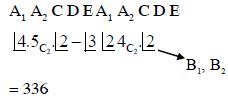
(C) Total number of people = $2$ (Americans) + $2$ (British) + $1$ (Chinese) + $1$ (Dutch) + $1$ (Egyptian) = $7$ people.
Let the people be $A_1, A_2$ (Americans),$B_1, B_2$ (British),$C$ (Chinese),$D$ (Dutch),and $E$ (Egyptian).
We need to arrange them in a circle such that $A_1, A_2$ are not together and $B_1, B_2$ are not together.
First,arrange the $5$ people $(C, D, E, A_1, B_1)$ in a circle in $(5-1)! = 4! = 24$ ways.
There are $5$ gaps created between these $5$ people.
We need to place $A_2$ and $B_2$ in these $5$ gaps such that they are not adjacent to their respective nationals.
Using the principle of inclusion-exclusion or gap method,the total arrangements where $A_1, A_2$ are separated and $B_1, B_2$ are separated is $336$.
Let the people be $A_1, A_2$ (Americans),$B_1, B_2$ (British),$C$ (Chinese),$D$ (Dutch),and $E$ (Egyptian).
We need to arrange them in a circle such that $A_1, A_2$ are not together and $B_1, B_2$ are not together.
First,arrange the $5$ people $(C, D, E, A_1, B_1)$ in a circle in $(5-1)! = 4! = 24$ ways.
There are $5$ gaps created between these $5$ people.
We need to place $A_2$ and $B_2$ in these $5$ gaps such that they are not adjacent to their respective nationals.
Using the principle of inclusion-exclusion or gap method,the total arrangements where $A_1, A_2$ are separated and $B_1, B_2$ are separated is $336$.
0 likes
View Solution32
DifficultMCQ
The number of ways in which $5$ boys and $3$ girls can be seated on a round table if a particular boy $B_1$ and a particular girl $G_1$ never sit adjacent to each other is:
A
$5 \times 6!$
B
$6 \times 6!$
C
$7!$
D
$5 \times 7!$
Solution
(A) Total number of people = $5 + 3 = 8$.
Total ways to seat $8$ people on a round table = $(8-1)! = 7!$.
Now,consider the case where $B_1$ and $G_1$ sit together. Treat $(B_1, G_1)$ as one unit.
Now we have $7$ units to arrange in a circle,which can be done in $(7-1)! = 6!$ ways.
Within the unit,$B_1$ and $G_1$ can be arranged in $2! = 2$ ways.
So,the number of ways they sit together = $2 \times 6!$.
The number of ways they never sit adjacent = Total ways - Ways they sit together.
$= 7! - 2 \times 6! = 7 \times 6! - 2 \times 6! = (7-2) \times 6! = 5 \times 6!$.
Total ways to seat $8$ people on a round table = $(8-1)! = 7!$.
Now,consider the case where $B_1$ and $G_1$ sit together. Treat $(B_1, G_1)$ as one unit.
Now we have $7$ units to arrange in a circle,which can be done in $(7-1)! = 6!$ ways.
Within the unit,$B_1$ and $G_1$ can be arranged in $2! = 2$ ways.
So,the number of ways they sit together = $2 \times 6!$.
The number of ways they never sit adjacent = Total ways - Ways they sit together.
$= 7! - 2 \times 6! = 7 \times 6! - 2 \times 6! = (7-2) \times 6! = 5 \times 6!$.
0 likes
View Solution33
DifficultMCQ
If seven women and seven men are to be seated around a circular table such that there is a man on either side of every woman,then the number of seating arrangements is
A
$6!7!$
B
$(6!)^2$
C
$(7!)^2$
D
$7!$
Solution
(A) To ensure that there is a man on either side of every woman,the men and women must alternate around the circular table.
First,arrange the $7$ men around the circular table. The number of ways to arrange $n$ items in a circle is $(n-1)!$. Thus,$7$ men can be arranged in $(7-1)! = 6!$ ways.
Once the men are seated,there are $7$ distinct gaps created between them.
Since there are $7$ women to be seated in these $7$ gaps,they can be arranged in $7!$ ways.
Therefore,the total number of seating arrangements is $6! \times 7!$.
First,arrange the $7$ men around the circular table. The number of ways to arrange $n$ items in a circle is $(n-1)!$. Thus,$7$ men can be arranged in $(7-1)! = 6!$ ways.
Once the men are seated,there are $7$ distinct gaps created between them.
Since there are $7$ women to be seated in these $7$ gaps,they can be arranged in $7!$ ways.
Therefore,the total number of seating arrangements is $6! \times 7!$.
0 likes
View Solution34
MediumMCQ
The number of ways,in which $5$ girls and $7$ boys can be seated at a round table so that no two girls sit together,is
A
$126(5!)^2$
B
$7(360)^2$
C
$720$
D
$7(720)^2$
Solution
(A) First,arrange the $7$ boys in a circle. The number of ways to arrange $7$ boys in a circle is $(7-1)! = 6!$.
There are $7$ gaps created between the boys in the circular arrangement.
We need to place $5$ girls in these $7$ gaps such that no two girls sit together. The number of ways to choose $5$ gaps out of $7$ is $^7C_5$.
The number of ways to arrange $5$ girls in the chosen $5$ gaps is $5!$.
Total number of ways = $6! \times ^7C_5 \times 5!$.
$= 720 \times 21 \times 120$.
$= 720 \times 21 \times 120 = 1,814,400$.
Calculating the expression in option $A$: $126 \times (120)^2 = 126 \times 14,400 = 1,814,400$.
Thus,the correct option is $A$.
There are $7$ gaps created between the boys in the circular arrangement.
We need to place $5$ girls in these $7$ gaps such that no two girls sit together. The number of ways to choose $5$ gaps out of $7$ is $^7C_5$.
The number of ways to arrange $5$ girls in the chosen $5$ gaps is $5!$.
Total number of ways = $6! \times ^7C_5 \times 5!$.
$= 720 \times 21 \times 120$.
$= 720 \times 21 \times 120 = 1,814,400$.
Calculating the expression in option $A$: $126 \times (120)^2 = 126 \times 14,400 = 1,814,400$.
Thus,the correct option is $A$.
0 likes
View Solution35
MediumMCQ
Five persons $A, B, C, D$ and $E$ are seated in a circular arrangement. If each of them is given a hat of one of the three colours red,blue,and green,then the number of ways of distributing the hats such that the persons seated in adjacent seats get different coloured hats is
A
$30$
B
$40$
C
$50$
D
$60$
Solution
(A) Let the number of ways to color $n$ vertices of a cycle graph with $k$ colors such that no two adjacent vertices have the same color be $P(n, k)$.
This is given by the formula $P(n, k) = (k-1)^n + (-1)^n(k-1)$.
Here,$n = 5$ (number of persons) and $k = 3$ (number of colors).
Substituting the values,we get:
$P(5, 3) = (3-1)^5 + (-1)^5(3-1)$
$P(5, 3) = 2^5 - 2$
$P(5, 3) = 32 - 2 = 30$.
Thus,the total number of ways is $30$.
This is given by the formula $P(n, k) = (k-1)^n + (-1)^n(k-1)$.
Here,$n = 5$ (number of persons) and $k = 3$ (number of colors).
Substituting the values,we get:
$P(5, 3) = (3-1)^5 + (-1)^5(3-1)$
$P(5, 3) = 2^5 - 2$
$P(5, 3) = 32 - 2 = 30$.
Thus,the total number of ways is $30$.

0 likes
View Solution36
MediumMCQ
Let $m$ denote the number of ways in which $5$ boys and $5$ girls can be arranged in a line alternately,and $n$ denote the number of ways in which $5$ boys and $5$ girls can be arranged in a circle so that no two boys are together. If $m = kn$,then the value of $k$ is
A
$30$
B
$5$
C
$6$
D
$10$
Solution
(D) For $m$: The boys and girls can be arranged in a line alternately in two ways: ($B$ $G$ $B$ $G$ $B$ $G$ $B$ $G$ $B$ $G$) or ($G$ $B$ $G$ $B$ $G$ $B$ $G$ $B$ $G$ $B$). In each case,$5$ boys can be arranged in $5!$ ways and $5$ girls can be arranged in $5!$ ways. So,$m = 2 \times 5! \times 5! = 2 \times 120 \times 120 = 28800$.
For $n$: To arrange $5$ boys and $5$ girls in a circle such that no two boys are together,we first arrange the $5$ girls in a circle in $(5-1)! = 4! = 24$ ways. This creates $5$ gaps between them. The $5$ boys can be arranged in these $5$ gaps in $5! = 120$ ways. So,$n = 4! \times 5! = 24 \times 120 = 2880$.
Given $m = kn$,we have $28800 = k \times 2880$,which gives $k = 10$.
For $n$: To arrange $5$ boys and $5$ girls in a circle such that no two boys are together,we first arrange the $5$ girls in a circle in $(5-1)! = 4! = 24$ ways. This creates $5$ gaps between them. The $5$ boys can be arranged in these $5$ gaps in $5! = 120$ ways. So,$n = 4! \times 5! = 24 \times 120 = 2880$.
Given $m = kn$,we have $28800 = k \times 2880$,which gives $k = 10$.
0 likes
View Solution37
EasyMCQ
The number of ways in which $8$ different pearls can be arranged to form a necklace is
A
$40320$
B
$5040$
C
$2520$
D
$1260$
Solution
(C) The number of ways to arrange $n$ distinct objects in a circle is $(n-1)!$.
For a necklace,the clockwise and anti-clockwise arrangements are considered identical,so the number of ways to form a necklace with $n$ different pearls is $\frac{(n-1)!}{2}$.
Given $n = 8$,the number of ways is $\frac{(8-1)!}{2} = \frac{7!}{2}$.
$\frac{5040}{2} = 2520$.
For a necklace,the clockwise and anti-clockwise arrangements are considered identical,so the number of ways to form a necklace with $n$ different pearls is $\frac{(n-1)!}{2}$.
Given $n = 8$,the number of ways is $\frac{(8-1)!}{2} = \frac{7!}{2}$.
$\frac{5040}{2} = 2520$.
0 likes
View Solution38
MediumMCQ
The number of ways in which $6$ boys and $5$ girls can sit at a round table,if no two girls are to sit together,is
A
$518400$
B
$14400$
C
$86400$
D
$17280$
Solution
(C) To arrange $6$ boys and $5$ girls at a round table such that no two girls sit together,we first arrange the $6$ boys in a circle.
The number of ways to arrange $6$ boys in a circle is $(6-1)! = 5! = 120$.
After arranging the boys,there are $6$ gaps created between them.
We need to place $5$ girls in these $6$ gaps such that no two girls are together.
The number of ways to choose $5$ gaps out of $6$ is $^6C_5 = 6$.
The number of ways to arrange the $5$ girls in the chosen gaps is $5! = 120$.
Therefore,the total number of ways is $120 \times 6 \times 120 = 86400$.
The number of ways to arrange $6$ boys in a circle is $(6-1)! = 5! = 120$.
After arranging the boys,there are $6$ gaps created between them.
We need to place $5$ girls in these $6$ gaps such that no two girls are together.
The number of ways to choose $5$ gaps out of $6$ is $^6C_5 = 6$.
The number of ways to arrange the $5$ girls in the chosen gaps is $5! = 120$.
Therefore,the total number of ways is $120 \times 6 \times 120 = 86400$.
0 likes
View Solution39
MediumMCQ
The number of ways in which $6$ boys and $4$ girls can be seated around a round table such that $2$ special boys and a special girl never sit together is
A
$332620$
B
$332540$
C
$332640$
D
$332520$
Solution
(C) Total number of ways to seat $10$ people around a round table is $(10-1)! = 9! = 362880$.
Let the $2$ special boys be $B_1, B_2$ and the special girl be $G_1$.
We want to find the number of arrangements where $B_1, B_2, G_1$ do not sit together.
Using the complement method,we subtract the cases where they sit together from the total.
Treating $(B_1, B_2, G_1)$ as one unit,we have $8$ units to arrange in a circle: $(8-1)! = 7! = 5040$.
Within the unit,$B_1, B_2, G_1$ can be arranged in $3! = 6$ ways.
Total cases where they sit together = $5040 \times 6 = 30240$.
Number of ways they do not sit together = $362880 - 30240 = 332640$.
Let the $2$ special boys be $B_1, B_2$ and the special girl be $G_1$.
We want to find the number of arrangements where $B_1, B_2, G_1$ do not sit together.
Using the complement method,we subtract the cases where they sit together from the total.
Treating $(B_1, B_2, G_1)$ as one unit,we have $8$ units to arrange in a circle: $(8-1)! = 7! = 5040$.
Within the unit,$B_1, B_2, G_1$ can be arranged in $3! = 6$ ways.
Total cases where they sit together = $5040 \times 6 = 30240$.
Number of ways they do not sit together = $362880 - 30240 = 332640$.
0 likes
View Solution40
EasyMCQ
The number of ways in which $5$ boys and $3$ girls can be seated on a round table,if a particular boy $B_1$ and a particular girl $G_1$ never sit adjacent to each other,is
A
$7!$
B
$5 \times 6!$
C
$6 \times 6!$
D
$5 \times 7!$
Solution
(B) Total number of people $= 5 + 3 = 8$.
Total ways to arrange $8$ people on a round table $= (8-1)! = 7!$.
Now,consider the case where $B_1$ and $G_1$ sit together. Treat $(B_1G_1)$ as one unit.
Now we have $7$ units to arrange on a round table,which can be done in $(7-1)! = 6!$ ways.
Within the unit,$B_1$ and $G_1$ can be arranged in $2! = 2$ ways.
So,the number of ways they sit together $= 6! \times 2$.
The number of ways they never sit adjacent $= 7! - (2 \times 6!) = 7 \times 6! - 2 \times 6! = (7-2) \times 6! = 5 \times 6!$.
Total ways to arrange $8$ people on a round table $= (8-1)! = 7!$.
Now,consider the case where $B_1$ and $G_1$ sit together. Treat $(B_1G_1)$ as one unit.
Now we have $7$ units to arrange on a round table,which can be done in $(7-1)! = 6!$ ways.
Within the unit,$B_1$ and $G_1$ can be arranged in $2! = 2$ ways.
So,the number of ways they sit together $= 6! \times 2$.
The number of ways they never sit adjacent $= 7! - (2 \times 6!) = 7 \times 6! - 2 \times 6! = (7-2) \times 6! = 5 \times 6!$.
0 likes
View Solution41
MediumMCQ
$21$ friends were invited for a party. Two round tables can accommodate $12$ and $9$ friends respectively. The number of ways of the seating arrangements of friends is:
A
$11! \times 8!$
B
$12! \times 9!$
C
$\frac{35}{9} \times 19!$
D
$\binom{21}{12} \times 11! \times 8!$
Solution
(D) Step $1$: Select $12$ friends out of $21$ to sit at the first table. The number of ways is $\binom{21}{12}$.
Step $2$: The number of ways to arrange $12$ friends at a round table is $(12-1)! = 11!$.
Step $3$: The remaining $9$ friends are to be seated at the second round table. The number of ways to arrange them is $(9-1)! = 8!$.
Step $4$: The total number of ways is $\binom{21}{12} \times 11! \times 8! = \frac{21!}{12!9!} \times 11! \times 8! = \frac{21!}{12 \times 9} = \frac{21!}{108}$.
Step $2$: The number of ways to arrange $12$ friends at a round table is $(12-1)! = 11!$.
Step $3$: The remaining $9$ friends are to be seated at the second round table. The number of ways to arrange them is $(9-1)! = 8!$.
Step $4$: The total number of ways is $\binom{21}{12} \times 11! \times 8! = \frac{21!}{12!9!} \times 11! \times 8! = \frac{21!}{12 \times 9} = \frac{21!}{108}$.
0 likes
View Solution42
MediumMCQ
$A$ family consisting of a mother,father,and their $8$ children ($4$ boys and $4$ girls) are to be seated at a round table in a party. How many ways can this be done if the mother and father sit together and the males and females alternate?
A
$576$
B
$765$
C
$657$
D
$567$
Solution
(A) The family consists of $10$ people: $1$ mother,$1$ father,$4$ boys,and $4$ girls.
Total males = $1$ (father) + $4$ (boys) = $5$.
Total females = $1$ (mother) + $4$ (girls) = $5$.
Since the males and females must alternate,we arrange the $5$ males around the circular table in $(5-1)! = 4! = 24$ ways.
This creates $5$ spaces between the males.
We need to place the $5$ females in these $5$ spaces.
However,the mother and father must sit together.
Let the father be at position $F_1$. The mother must be in one of the two spaces adjacent to the father.
There are $2$ choices for the mother's position relative to the father.
The remaining $4$ females can be arranged in the remaining $4$ spaces in $4! = 24$ ways.
Total ways = $24 \times 2 \times 24 = 576$.
Total males = $1$ (father) + $4$ (boys) = $5$.
Total females = $1$ (mother) + $4$ (girls) = $5$.
Since the males and females must alternate,we arrange the $5$ males around the circular table in $(5-1)! = 4! = 24$ ways.
This creates $5$ spaces between the males.
We need to place the $5$ females in these $5$ spaces.
However,the mother and father must sit together.
Let the father be at position $F_1$. The mother must be in one of the two spaces adjacent to the father.
There are $2$ choices for the mother's position relative to the father.
The remaining $4$ females can be arranged in the remaining $4$ spaces in $4! = 24$ ways.
Total ways = $24 \times 2 \times 24 = 576$.
0 likes
View Solution43
MediumMCQ
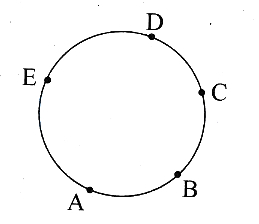
Five persons $A, B, C, D$ and $E$ are seated in a circular arrangement. If each of them is given a hat of one of the three colours: red,blue,and green,then the number of ways of distributing the hats such that the persons seated in adjacent seats get different coloured hats is:
A
$30$
B
$15$
C
$60$
D
$40$
Solution
(A) Let the colours be $R, B, G$. The number of ways to colour the vertices of a cycle graph $C_n$ with $k$ colours such that no two adjacent vertices have the same colour is given by the chromatic polynomial $P(C_n, k) = (k-1)^n + (-1)^n(k-1)$.
Here,$n = 5$ (number of persons) and $k = 3$ (number of colours).
Substituting the values:
$P(C_5, 3) = (3-1)^5 + (-1)^5(3-1)$
$= 2^5 - 2$
$= 32 - 2$
$= 30$
Thus,there are $30$ ways to distribute the hats.
Here,$n = 5$ (number of persons) and $k = 3$ (number of colours).
Substituting the values:
$P(C_5, 3) = (3-1)^5 + (-1)^5(3-1)$
$= 2^5 - 2$
$= 32 - 2$
$= 30$
Thus,there are $30$ ways to distribute the hats.
0 likes
View Solution44
EasyMCQ
Five persons $A, B, C, D$ and $E$ are seated in a circular arrangement. If each of them is given a cap of one of the three colours red,blue and green,then the number of ways of distributing the caps such that the persons seated in adjacent seats get different coloured caps,is
A
$30$
B
$15$
C
$60$
D
$40$
Solution
(A) Let the number of ways to colour a circle of $n$ vertices with $k$ colours such that no two adjacent vertices have the same colour be $P_n(k)$.
For a circular arrangement,the formula is given by $P_n(k) = (k-1)^n + (-1)^n(k-1)$.
Here,$n = 5$ (number of persons) and $k = 3$ (number of colours).
Substituting the values,we get $P_5(3) = (3-1)^5 + (-1)^5(3-1)$.
$P_5(3) = 2^5 - 1(2) = 32 - 2 = 30$.
Therefore,the total number of ways is $30$.
For a circular arrangement,the formula is given by $P_n(k) = (k-1)^n + (-1)^n(k-1)$.
Here,$n = 5$ (number of persons) and $k = 3$ (number of colours).
Substituting the values,we get $P_5(3) = (3-1)^5 + (-1)^5(3-1)$.
$P_5(3) = 2^5 - 1(2) = 32 - 2 = 30$.
Therefore,the total number of ways is $30$.
0 likes
View Solution45
MediumMCQ
$A$ round table conference is to be held amongst $20$ countries. If two particular delegates wish to sit together,then in how many ways can such arrangements be done?
A
$2 \times 18!$
B
$\frac{19!}{2!}$
C
$18!$
D
$19! \times 2!$
Solution
(A) To arrange $20$ delegates around a round table such that $2$ particular delegates sit together,we treat the $2$ delegates as a single unit.
Now,we have $18$ other delegates plus $1$ unit (the pair),making a total of $19$ units.
The number of ways to arrange $19$ units in a circle is $(19 - 1)! = 18!$.
The $2$ delegates within their unit can be arranged in $2!$ ways.
Therefore,the total number of arrangements is $2! \times 18! = 2 \times 18!$.
Now,we have $18$ other delegates plus $1$ unit (the pair),making a total of $19$ units.
The number of ways to arrange $19$ units in a circle is $(19 - 1)! = 18!$.
The $2$ delegates within their unit can be arranged in $2!$ ways.
Therefore,the total number of arrangements is $2! \times 18! = 2 \times 18!$.
0 likes
View Solution46
MediumMCQ
The number of ways in which $6$ men and $5$ women can sit at a round table,if no two women sit together,is:
A
$5! \times 6P5$
B
$6! \times 5!$
C
$30$
D
$7! \times 5!$
Solution
(A) First,arrange the $6$ men around a round table. The number of ways to arrange $n$ objects in a circle is $(n-1)!$. So,$6$ men can be seated in $(6-1)! = 5!$ ways.
There are $6$ gaps created between these $6$ men. We need to place $5$ women in these $6$ gaps such that no two women sit together.
The number of ways to arrange $5$ women in $6$ gaps is given by $P(6, 5) = \frac{6!}{(6-5)!} = 6!$.
Therefore,the total number of ways is $5! \times 6!$.
There are $6$ gaps created between these $6$ men. We need to place $5$ women in these $6$ gaps such that no two women sit together.
The number of ways to arrange $5$ women in $6$ gaps is given by $P(6, 5) = \frac{6!}{(6-5)!} = 6!$.
Therefore,the total number of ways is $5! \times 6!$.
0 likes
View Solution47
EasyMCQ
Find the number of different garlands that can be prepared using $5$ different coloured flowers.
A
$12$
B
$60$
C
$119$
D
$59$
Solution
(A) The number of ways to arrange $n$ distinct objects in a circle is $(n-1)!$.
Since a garland can be flipped over,the clockwise and counter-clockwise arrangements are considered identical.
Therefore,the number of different garlands that can be prepared using $n$ different coloured flowers is given by the formula $\frac{(n-1)!}{2}$.
For $n = 5$,the number of garlands is $\frac{(5-1)!}{2} = \frac{4!}{2} = \frac{24}{2} = 12$.
Since a garland can be flipped over,the clockwise and counter-clockwise arrangements are considered identical.
Therefore,the number of different garlands that can be prepared using $n$ different coloured flowers is given by the formula $\frac{(n-1)!}{2}$.
For $n = 5$,the number of garlands is $\frac{(5-1)!}{2} = \frac{4!}{2} = \frac{24}{2} = 12$.
0 likes
View Solution48
EasyMCQ
$A$ person invites $8$ guests to a dinner and places $5$ of them at one table and the remaining $3$ at another,both the tables being round. The number of ways in which the guests can be arranged is
A
$40320$
B
$2688$
C
$8064$
D
$13440$
Solution
(B) The number of ways to select $5$ persons out of $8$ is ${}^8C_5$.
Now,the number of ways to arrange $5$ guests at a round table is $(5-1)! = 4!$.
The number of ways to arrange the remaining $3$ guests at another round table is $(3-1)! = 2!$.
Thus,the total number of ways is ${}^8C_5 \times 4! \times 2!$.
Calculation: ${}^8C_5 = \frac{8 \times 7 \times 6}{3 \times 2 \times 1} = 56$.
Total ways $= 56 \times 24 \times 2 = 56 \times 48 = 2688$.
Hence,option $(B)$ is correct.
Now,the number of ways to arrange $5$ guests at a round table is $(5-1)! = 4!$.
The number of ways to arrange the remaining $3$ guests at another round table is $(3-1)! = 2!$.
Thus,the total number of ways is ${}^8C_5 \times 4! \times 2!$.
Calculation: ${}^8C_5 = \frac{8 \times 7 \times 6}{3 \times 2 \times 1} = 56$.
Total ways $= 56 \times 24 \times 2 = 56 \times 48 = 2688$.
Hence,option $(B)$ is correct.
0 likes
View Solution49
DifficultMCQ
If $3$ sisters and $8$ brothers are together playing a game,then the number of ways in which all the sisters and brothers are to be seated around a circle such that all the $3$ sisters are not seated together is
A
$8! \times 504$
B
$11! \times 8$
C
$7! \times 210$
D
$8! \times 84$
Solution
(D) Total number of people = $3 + 8 = 11$.
Number of ways to arrange $11$ people around a circle = $(11 - 1)! = 10!$.
Now,consider the case where all $3$ sisters sit together. Treat the $3$ sisters as $1$ unit.
Total units to arrange = $8$ brothers + $1$ unit of sisters = $9$ units.
Number of ways to arrange $9$ units around a circle = $(9 - 1)! = 8!$.
The $3$ sisters can be arranged among themselves in $3! = 6$ ways.
So,the number of ways where all $3$ sisters sit together = $8! \times 6$.
The number of ways where all $3$ sisters are not seated together = (Total arrangements) - (Arrangements where all $3$ sisters sit together) = $10! - (8! \times 6)$.
$10! - 6 \times 8! = (10 \times 9 \times 8!) - (6 \times 8!) = (90 - 6) \times 8! = 84 \times 8!$.
Number of ways to arrange $11$ people around a circle = $(11 - 1)! = 10!$.
Now,consider the case where all $3$ sisters sit together. Treat the $3$ sisters as $1$ unit.
Total units to arrange = $8$ brothers + $1$ unit of sisters = $9$ units.
Number of ways to arrange $9$ units around a circle = $(9 - 1)! = 8!$.
The $3$ sisters can be arranged among themselves in $3! = 6$ ways.
So,the number of ways where all $3$ sisters sit together = $8! \times 6$.
The number of ways where all $3$ sisters are not seated together = (Total arrangements) - (Arrangements where all $3$ sisters sit together) = $10! - (8! \times 6)$.
$10! - 6 \times 8! = (10 \times 9 \times 8!) - (6 \times 8!) = (90 - 6) \times 8! = 84 \times 8!$.
0 likes
View SolutionPermutation and Combination — Circular permutations · Frequently Asked Questions
1Are these Permutation and Combination questions useful for JEE and NEET?
Yes. All questions in this section are mapped to JEE Main and NEET exam patterns. Previous year questions from JEE Main, NEET, GUJCET and state-level exams are included with full solutions.
2Can I switch to Hindi or Gujarati for these questions?
Yes. Use the language tabs in the hero section or the sidebar to view the same questions and solutions in English, Hindi or Gujarati.
3How do I generate a question paper from this subtopic?
Use the Vedclass Exam Paper Generator — select the chapter and subtopic, set difficulty, and generate Sets A, B, C, D automatically. First 3 chapters of every subject are free.
Vedclass Products
For Students
Vedclass Test Series
Mock tests in real JEE/NEET style with performance analysis. 5-day free trial.
Start Free TrialFor Teachers
Exam Paper Generator
Generate Set A/B/C/D papers from this chapter in 2 minutes. 3 chapters free.
Try FreeFor Institutes
Online Exam Module
Live online exams with unlimited students, 360° analytics & white-label branding.
See DemoFor Teachers & Institutes
Generate a Permutation and Combination Exam Paper in 2 Minutes
Select subtopic & difficulty — Sets A, B, C, D auto-generated with No Repeat logic.
First 3 chapters of every subject are free — no payment required.