
A English
Division into groups, Derangements Questions in English
Class 11 Mathematics · Permutation and Combination · Division into groups, Derangements
47+
Questions
English
Language
100%
With Solutions
Showing 47 of 47 questions in English
1
MediumMCQ
The number of ways in which $9$ persons can be divided into three equal groups is
A
$280$
B
$840$
C
$560$
D
$1680$
Solution
(A) To divide $9$ persons into $3$ equal groups of $3$ persons each,we first select $3$ persons out of $9$,then $3$ out of the remaining $6$,and finally $3$ out of the remaining $3$.
Since the order of the groups does not matter,we divide by $3!$.
The number of ways is given by $\frac{\binom{9}{3} \binom{6}{3} \binom{3}{3}}{3!} = \frac{\frac{9!}{3!6!} \times \frac{6!}{3!3!} \times \frac{3!}{3!0!}}{3!} = \frac{9!}{(3!)^3 \times 3!}$.
Calculating the value: $\frac{9 \times 8 \times 7 \times 6 \times 5 \times 4}{6 \times 6 \times 6} = \frac{60480}{216} = 280$.
Since the order of the groups does not matter,we divide by $3!$.
The number of ways is given by $\frac{\binom{9}{3} \binom{6}{3} \binom{3}{3}}{3!} = \frac{\frac{9!}{3!6!} \times \frac{6!}{3!3!} \times \frac{3!}{3!0!}}{3!} = \frac{9!}{(3!)^3 \times 3!}$.
Calculating the value: $\frac{9 \times 8 \times 7 \times 6 \times 5 \times 4}{6 \times 6 \times 6} = \frac{60480}{216} = 280$.
0 likes
View Solution2
EasyMCQ
Choose the correct number of ways in which $15$ different books can be divided into $5$ heaps of equal number of books.
A
$\frac{15!}{(3!)^5 \times 5!}$
B
$\frac{15!}{(3!)^5}$
C
$^{15}C_5$
D
$^{15}P_5$
Solution
(A) To divide $n$ distinct objects into $k$ groups of equal size $m$ (where $n = km$),the number of ways is given by the formula: $\frac{n!}{(m!)^k \times k!}$.
Here,$n = 15$,$m = 3$,and $k = 5$.
Substituting these values,the number of ways is $\frac{15!}{(3!)^5 \times 5!}$.
Thus,the correct option is $A$.
Here,$n = 15$,$m = 3$,and $k = 5$.
Substituting these values,the number of ways is $\frac{15!}{(3!)^5 \times 5!}$.
Thus,the correct option is $A$.
0 likes
View Solution3
EasyMCQ
The number of ways of dividing $52$ cards amongst four players equally is
A
$\frac{52!}{(13!)^4}$
B
$\frac{52!}{(13!)^2 \times 4!}$
C
$\frac{52!}{(12!)^4 \times 4!}$
D
None of these
Solution
(A) The total number of cards is $52$,and they are to be divided equally among $4$ players,meaning each player receives $13$ cards.
The number of ways to choose $13$ cards for the first player is $^{52}C_{13}$.
The number of ways to choose $13$ cards for the second player from the remaining $39$ cards is $^{39}C_{13}$.
The number of ways to choose $13$ cards for the third player from the remaining $26$ cards is $^{26}C_{13}$.
The number of ways to choose $13$ cards for the fourth player from the remaining $13$ cards is $^{13}C_{13}$.
Therefore,the total number of ways is:
$^{52}C_{13} \times ^{39}C_{13} \times ^{26}C_{13} \times ^{13}C_{13}$
$= \frac{52!}{39! \times 13!} \times \frac{39!}{26! \times 13!} \times \frac{26!}{13! \times 13!} \times \frac{13!}{0! \times 13!}$
$= \frac{52!}{(13!)^4}$.
The number of ways to choose $13$ cards for the first player is $^{52}C_{13}$.
The number of ways to choose $13$ cards for the second player from the remaining $39$ cards is $^{39}C_{13}$.
The number of ways to choose $13$ cards for the third player from the remaining $26$ cards is $^{26}C_{13}$.
The number of ways to choose $13$ cards for the fourth player from the remaining $13$ cards is $^{13}C_{13}$.
Therefore,the total number of ways is:
$^{52}C_{13} \times ^{39}C_{13} \times ^{26}C_{13} \times ^{13}C_{13}$
$= \frac{52!}{39! \times 13!} \times \frac{39!}{26! \times 13!} \times \frac{26!}{13! \times 13!} \times \frac{13!}{0! \times 13!}$
$= \frac{52!}{(13!)^4}$.
0 likes
View Solution4
DifficultMCQ
There are four balls of different colours and four boxes of colours same as those of the balls. The number of ways in which the balls,one in each box,could be placed such that a ball does not go to the box of its own colour is
A
$8$
B
$7$
C
$9$
D
None of these
Solution
(C) This is a problem of derangements where $n = 4$ items are to be placed in $n$ boxes such that no item goes into its correct box.
The number of derangements $D_n$ is given by the formula:
$D_n = n! \left( 1 - \frac{1}{1!} + \frac{1}{2!} - \frac{1}{3!} + \dots + \frac{(-1)^n}{n!} \right)$
For $n = 4$:
$D_4 = 4! \left( \frac{1}{2!} - \frac{1}{3!} + \frac{1}{4!} \right)$
$D_4 = 24 \left( \frac{1}{2} - \frac{1}{6} + \frac{1}{24} \right)$
$D_4 = 12 - 4 + 1 = 9$.
Thus,there are $9$ ways.
The number of derangements $D_n$ is given by the formula:
$D_n = n! \left( 1 - \frac{1}{1!} + \frac{1}{2!} - \frac{1}{3!} + \dots + \frac{(-1)^n}{n!} \right)$
For $n = 4$:
$D_4 = 4! \left( \frac{1}{2!} - \frac{1}{3!} + \frac{1}{4!} \right)$
$D_4 = 24 \left( \frac{1}{2} - \frac{1}{6} + \frac{1}{24} \right)$
$D_4 = 12 - 4 + 1 = 9$.
Thus,there are $9$ ways.
0 likes
View Solution5
MediumMCQ
The number of ways of dividing $52$ cards amongst four players so that three players have $17$ cards each and the fourth player has just one card,is
A
$\frac{52!}{(17!)^3}$
B
$52!$
C
$\frac{52!}{17!}$
D
None of these
Solution
(A) The total number of ways to distribute $52$ cards among four players such that three players receive $17$ cards each and the fourth player receives $1$ card is calculated as follows:
$1$. Choose $17$ cards for the first player from $52$ cards: $^{52}C_{17} = \frac{52!}{35!17!}$.
$2$. Choose $17$ cards for the second player from the remaining $35$ cards: $^{35}C_{17} = \frac{35!}{18!17!}$.
$3$. Choose $17$ cards for the third player from the remaining $18$ cards: $^{18}C_{17} = \frac{18!}{1!17!}$.
$4$. The remaining $1$ card goes to the fourth player: $^{1}C_{1} = 1$.
Multiplying these combinations together:
$\frac{52!}{35!17!} \times \frac{35!}{18!17!} \times \frac{18!}{1!17!} \times 1 = \frac{52!}{17!17!17!1!} = \frac{52!}{(17!)^3}$.
$1$. Choose $17$ cards for the first player from $52$ cards: $^{52}C_{17} = \frac{52!}{35!17!}$.
$2$. Choose $17$ cards for the second player from the remaining $35$ cards: $^{35}C_{17} = \frac{35!}{18!17!}$.
$3$. Choose $17$ cards for the third player from the remaining $18$ cards: $^{18}C_{17} = \frac{18!}{1!17!}$.
$4$. The remaining $1$ card goes to the fourth player: $^{1}C_{1} = 1$.
Multiplying these combinations together:
$\frac{52!}{35!17!} \times \frac{35!}{18!17!} \times \frac{18!}{1!17!} \times 1 = \frac{52!}{17!17!17!1!} = \frac{52!}{(17!)^3}$.
0 likes
View Solution6
MediumMCQ
There are $n$ letters and $n$ addressed envelopes. The probability that all the letters are not kept in the right envelope is:
A
$\frac{1}{n!}$
B
$1 - \frac{1}{n!}$
C
$1 - \frac{1}{n}$
D
None of these
Solution
(B) The total number of ways to arrange $n$ letters in $n$ envelopes is $n!$.
There is only $1$ way in which all letters are placed in their correct envelopes.
Therefore,the probability that all letters are kept in the right envelope is $P(\text{correct}) = \frac{1}{n!}$.
The probability that all letters are not kept in the right envelope is $1 - P(\text{correct}) = 1 - \frac{1}{n!}$.
There is only $1$ way in which all letters are placed in their correct envelopes.
Therefore,the probability that all letters are kept in the right envelope is $P(\text{correct}) = \frac{1}{n!}$.
The probability that all letters are not kept in the right envelope is $1 - P(\text{correct}) = 1 - \frac{1}{n!}$.
0 likes
View Solution7
EasyMCQ
Three letters are to be sent to different persons,and addresses on the three envelopes are also written. Without looking at the addresses,the probability that all the letters go into the right envelopes is equal to
A
$\frac{1}{27}$
B
$\frac{1}{9}$
C
$\frac{4}{27}$
D
$\frac{1}{6}$
Solution
(D) The total number of ways to place $3$ distinct letters into $3$ distinct envelopes is $3! = 3 \times 2 \times 1 = 6$.
Out of these $6$ possible arrangements,only $1$ arrangement corresponds to all letters being placed in their correct envelopes.
Therefore,the required probability is $\frac{1}{3!} = \frac{1}{6}$.
Out of these $6$ possible arrangements,only $1$ arrangement corresponds to all letters being placed in their correct envelopes.
Therefore,the required probability is $\frac{1}{3!} = \frac{1}{6}$.
0 likes
View Solution8
MediumMCQ
There are $4$ envelopes with addresses and $4$ corresponding letters. The probability that no letter goes into its correct envelope is:
A
$\frac{19}{24}$
B
$\frac{21}{23}$
C
$\frac{23}{24}$
D
$\frac{1}{24}$
Solution
(C) The total number of ways to place $4$ letters into $4$ envelopes is $4! = 24$.
This is a problem of derangements. The number of ways in which no letter goes into its correct envelope is given by $D_4 = 4! \left( 1 - \frac{1}{1!} + \frac{1}{2!} - \frac{1}{3!} + \frac{1}{4!} \right) = 24 \left( \frac{1}{2} - \frac{1}{6} + \frac{1}{24} \right) = 12 - 4 + 1 = 9$.
The probability is $\frac{9}{24} = \frac{3}{8}$.
Wait,the standard interpretation of 'not going into the proper envelope' usually implies at least one is wrong,but the phrasing 'no letter goes into its correct envelope' refers to derangements.
However,if the question implies the complement of 'all letters go into their correct envelopes',the probability is $1 - \frac{1}{4!} = 1 - \frac{1}{24} = \frac{23}{24}$.
This is a problem of derangements. The number of ways in which no letter goes into its correct envelope is given by $D_4 = 4! \left( 1 - \frac{1}{1!} + \frac{1}{2!} - \frac{1}{3!} + \frac{1}{4!} \right) = 24 \left( \frac{1}{2} - \frac{1}{6} + \frac{1}{24} \right) = 12 - 4 + 1 = 9$.
The probability is $\frac{9}{24} = \frac{3}{8}$.
Wait,the standard interpretation of 'not going into the proper envelope' usually implies at least one is wrong,but the phrasing 'no letter goes into its correct envelope' refers to derangements.
However,if the question implies the complement of 'all letters go into their correct envelopes',the probability is $1 - \frac{1}{4!} = 1 - \frac{1}{24} = \frac{23}{24}$.
0 likes
View Solution9
DifficultMCQ
There are $n$ different objects $1, 2, 3, \dots, n$ distributed at random in $n$ places marked $1, 2, 3, \dots, n$. The probability that at least three of the objects occupy places corresponding to their number is
A
$\frac{1}{6}$
B
$\frac{5}{6}$
C
$\frac{1}{3}$
D
None of these
Solution
(A) Let $E_i$ denote the event that the $i^{th}$ object goes to the $i^{th}$ place.
We have $P(E_i) = \frac{(n-1)!}{n!} = \frac{1}{n}$ for all $i$.
The probability that exactly $3$ specific objects occupy their correct places is $P(E_i \cap E_j \cap E_k) = \frac{(n-3)!}{n!}$ for $i < j < k$.
Since we can choose $3$ places out of $n$ in $\binom{n}{3}$ ways,the probability that at least three objects occupy their corresponding places is given by $\binom{n}{3} \times \frac{(n-3)!}{n!} = \frac{n!}{3!(n-3)!} \times \frac{(n-3)!}{n!} = \frac{1}{3!} = \frac{1}{6}$.
We have $P(E_i) = \frac{(n-1)!}{n!} = \frac{1}{n}$ for all $i$.
The probability that exactly $3$ specific objects occupy their correct places is $P(E_i \cap E_j \cap E_k) = \frac{(n-3)!}{n!}$ for $i < j < k$.
Since we can choose $3$ places out of $n$ in $\binom{n}{3}$ ways,the probability that at least three objects occupy their corresponding places is given by $\binom{n}{3} \times \frac{(n-3)!}{n!} = \frac{n!}{3!(n-3)!} \times \frac{(n-3)!}{n!} = \frac{1}{3!} = \frac{1}{6}$.
0 likes
View Solution10
DifficultMCQ
There are $4$ balls of different colors and $4$ boxes of the same colors as the balls. In how many ways can $2$ balls be placed in the boxes such that they do not match their respective colors?
A
$6$
B
$4$
C
$2$
D
None of these
Solution
(A) We need to select $2$ balls out of $4$ and place them in the boxes corresponding to the other $2$ balls such that no ball goes into its own box.
Number of ways to select $2$ balls out of $4$ is $^4C_2 = \frac{4 \times 3}{2 \times 1} = 6$.
For the $2$ selected balls,the number of ways to place them such that neither goes into its own box is given by the derangement $D_2 = 2! \times (1 - 1 + \frac{1}{2!}) = 1$.
Thus,the total number of ways is $6 \times 1 = 6$.
Number of ways to select $2$ balls out of $4$ is $^4C_2 = \frac{4 \times 3}{2 \times 1} = 6$.
For the $2$ selected balls,the number of ways to place them such that neither goes into its own box is given by the derangement $D_2 = 2! \times (1 - 1 + \frac{1}{2!}) = 1$.
Thus,the total number of ways is $6 \times 1 = 6$.
0 likes
View Solution11
DifficultMCQ
The set $S = \{1, 2, 3, \dots, 12\}$ is partitioned into three sets $A, B, C$ of equal size such that $A \cup B \cup C = S$ and $A \cap B = B \cap C = C \cap A = \phi$. In how many ways can $S$ be partitioned?
A
$\frac{12!}{3! \times (3!)^4}$
B
$\frac{12!}{(4!)^3}$
C
$\frac{12!}{(3!)^4}$
D
$\frac{12!}{3! \times (4!)^3}$
Solution
(B) The set $S$ contains $12$ elements. Since it is partitioned into three sets $A, B, C$ of equal size,each set must contain $12 / 3 = 4$ elements.
The number of ways to choose $4$ elements for set $A$ is $\binom{12}{4}$.
The number of ways to choose $4$ elements for set $B$ from the remaining $8$ is $\binom{8}{4}$.
The number of ways to choose $4$ elements for set $C$ from the remaining $4$ is $\binom{4}{4}$.
Since the sets $A, B, C$ are distinct (labeled),the total number of ways is:
$\binom{12}{4} \times \binom{8}{4} \times \binom{4}{4} = \frac{12!}{4! \times 8!} \times \frac{8!}{4! \times 4!} \times \frac{4!}{4! \times 0!} = \frac{12!}{(4!)^3}$.
The number of ways to choose $4$ elements for set $A$ is $\binom{12}{4}$.
The number of ways to choose $4$ elements for set $B$ from the remaining $8$ is $\binom{8}{4}$.
The number of ways to choose $4$ elements for set $C$ from the remaining $4$ is $\binom{4}{4}$.
Since the sets $A, B, C$ are distinct (labeled),the total number of ways is:
$\binom{12}{4} \times \binom{8}{4} \times \binom{4}{4} = \frac{12!}{4! \times 8!} \times \frac{8!}{4! \times 4!} \times \frac{4!}{4! \times 0!} = \frac{12!}{(4!)^3}$.
0 likes
View Solution12
MediumMCQ
In how many ways can $52$ cards be distributed equally among four players?
A
$\frac{52!}{(13!)^4}$
B
$\frac{52!}{(13!)^2 \times 4!}$
C
$\frac{52!}{(12!)^4 \times 4!}$
D
None of these
Solution
(A) The number of ways to distribute $52$ cards equally among four players is given by the multinomial coefficient:
$\frac{52!}{13! \times 13! \times 13! \times 13!} = \frac{52!}{(13!)^4}$
This can also be calculated as:
$^{52}C_{13} \times ^{39}C_{13} \times ^{26}C_{13} \times ^{13}C_{13} = \frac{52!}{39!13!} \times \frac{39!}{26!13!} \times \frac{26!}{13!13!} \times \frac{13!}{0!13!} = \frac{52!}{(13!)^4}$
$\frac{52!}{13! \times 13! \times 13! \times 13!} = \frac{52!}{(13!)^4}$
This can also be calculated as:
$^{52}C_{13} \times ^{39}C_{13} \times ^{26}C_{13} \times ^{13}C_{13} = \frac{52!}{39!13!} \times \frac{39!}{26!13!} \times \frac{26!}{13!13!} \times \frac{13!}{0!13!} = \frac{52!}{(13!)^4}$
0 likes
View Solution13
MediumMCQ
There are $4$ balls of different colors and $4$ boxes of the same colors. In how many ways can the $4$ balls be placed in the boxes,one in each box,such that no ball goes into a box of its own color?
A
$3$
B
$6$
C
$9$
D
$12$
Solution
(C) This is a problem of derangements of $4$ objects,denoted as $D_4$.
The formula for derangements of $n$ objects is $D_n = n! \left( 1 - \frac{1}{1!} + \frac{1}{2!} - \frac{1}{3!} + \dots + \frac{(-1)^n}{n!} \right)$.
For $n = 4$:
$D_4 = 4! \left( 1 - 1 + \frac{1}{2} - \frac{1}{6} + \frac{1}{24} \right)$
$D_4 = 24 \left( \frac{1}{2} - \frac{1}{6} + \frac{1}{24} \right)$
$D_4 = 24 \left( \frac{12 - 4 + 1}{24} \right)$
$D_4 = 9$.
Thus,there are $9$ ways to place the balls such that no ball is in its own color box.
The formula for derangements of $n$ objects is $D_n = n! \left( 1 - \frac{1}{1!} + \frac{1}{2!} - \frac{1}{3!} + \dots + \frac{(-1)^n}{n!} \right)$.
For $n = 4$:
$D_4 = 4! \left( 1 - 1 + \frac{1}{2} - \frac{1}{6} + \frac{1}{24} \right)$
$D_4 = 24 \left( \frac{1}{2} - \frac{1}{6} + \frac{1}{24} \right)$
$D_4 = 24 \left( \frac{12 - 4 + 1}{24} \right)$
$D_4 = 9$.
Thus,there are $9$ ways to place the balls such that no ball is in its own color box.
0 likes
View Solution14
MediumMCQ
If there are $6$ letters and $6$ corresponding envelopes,in how many ways can all the letters be placed in the wrong envelopes?
A
$265$
B
$9$
C
$45$
D
None of these
Solution
(A) The number of ways to place $n$ letters in wrong envelopes is given by the derangement formula $D_n = n! \left[ 1 - \frac{1}{1!} + \frac{1}{2!} - \frac{1}{3!} + \dots + (-1)^n \frac{1}{n!} \right]$.
For $n = 6$,the number of ways is $D_6 = 6! \left[ 1 - \frac{1}{1!} + \frac{1}{2!} - \frac{1}{3!} + \frac{1}{4!} - \frac{1}{5!} + \frac{1}{6!} \right]$.
$D_6 = 6! \left[ \frac{1}{2!} - \frac{1}{3!} + \frac{1}{4!} - \frac{1}{5!} + \frac{1}{6!} \right]$.
$D_6 = \frac{720}{2} - \frac{720}{6} + \frac{720}{24} - \frac{720}{120} + \frac{720}{720}$.
$D_6 = 360 - 120 + 30 - 6 + 1 = 265$.
For $n = 6$,the number of ways is $D_6 = 6! \left[ 1 - \frac{1}{1!} + \frac{1}{2!} - \frac{1}{3!} + \frac{1}{4!} - \frac{1}{5!} + \frac{1}{6!} \right]$.
$D_6 = 6! \left[ \frac{1}{2!} - \frac{1}{3!} + \frac{1}{4!} - \frac{1}{5!} + \frac{1}{6!} \right]$.
$D_6 = \frac{720}{2} - \frac{720}{6} + \frac{720}{24} - \frac{720}{120} + \frac{720}{720}$.
$D_6 = 360 - 120 + 30 - 6 + 1 = 265$.
0 likes
View Solution15
MediumMCQ
There are $4$ distinct colored balls and $4$ boxes of the same colors as the balls. In how many ways can the balls be placed in the boxes such that no ball goes into a box of its own color?
A
$8$
B
$7$
C
$9$
D
None of these
Solution
(C) This is a problem of derangements,denoted by $D_n$ or $!n$.
For $n = 4$ objects,the number of derangements is given by the formula:
$D_n = n! \left( 1 - \frac{1}{1!} + \frac{1}{2!} - \frac{1}{3!} + \frac{1}{4!} \right)$
Substituting $n = 4$:
$D_4 = 4! \left( 1 - 1 + \frac{1}{2} - \frac{1}{6} + \frac{1}{24} \right)$
$D_4 = 24 \left( \frac{1}{2} - \frac{1}{6} + \frac{1}{24} \right)$
$D_4 = 12 - 4 + 1 = 9$
Thus,there are $9$ ways to place the balls such that no ball goes into a box of its own color.
For $n = 4$ objects,the number of derangements is given by the formula:
$D_n = n! \left( 1 - \frac{1}{1!} + \frac{1}{2!} - \frac{1}{3!} + \frac{1}{4!} \right)$
Substituting $n = 4$:
$D_4 = 4! \left( 1 - 1 + \frac{1}{2} - \frac{1}{6} + \frac{1}{24} \right)$
$D_4 = 24 \left( \frac{1}{2} - \frac{1}{6} + \frac{1}{24} \right)$
$D_4 = 12 - 4 + 1 = 9$
Thus,there are $9$ ways to place the balls such that no ball goes into a box of its own color.
0 likes
View Solution16
DifficultMCQ
In how many ways can a pack of $52$ cards be divided into four equal groups?
A
$\frac{52!}{(13!)^4}$
B
$\frac{52!}{(13!)^4 \times 4!}$
C
$\frac{52!}{(13!)^4 \times 3!}$
D
None of these
Solution
(B) The number of ways to divide $52$ distinct items into $n$ groups of equal size $k$ is given by the formula $\frac{n!}{(k!)^n \times n!}$.
Here,$n = 4$ and $k = 13$.
Therefore,the number of ways is $\frac{52!}{(13!)^4 \times 4!}$.
Here,$n = 4$ and $k = 13$.
Therefore,the number of ways is $\frac{52!}{(13!)^4 \times 4!}$.
0 likes
View Solution17
EasyMCQ
$150$ students took admission. In how many ways can they be divided into three equal sections $A, B,$ and $C$?
A
$\frac{150!}{3!(50!)^3}$
B
$\frac{150!}{(50!)^3}$
C
$\frac{150!}{(50!)^3} \times 150!$
D
None of these
Solution
(B) The total number of students is $150$. We need to divide them into $3$ groups of $50$ students each.
Since the sections $A, B,$ and $C$ are distinct (labeled),the number of ways to distribute $150$ students into $3$ groups of $50$ is given by the multinomial coefficient:
$\frac{150!}{50! 50! 50!} = \frac{150!}{(50!)^3}$.
Therefore,the correct option is $B$.
Since the sections $A, B,$ and $C$ are distinct (labeled),the number of ways to distribute $150$ students into $3$ groups of $50$ is given by the multinomial coefficient:
$\frac{150!}{50! 50! 50!} = \frac{150!}{(50!)^3}$.
Therefore,the correct option is $B$.
0 likes
View Solution18
DifficultMCQ
If there are $4$ letters and $4$ envelopes,in how many ways can all the letters be placed in the wrong envelopes?
A
$8$
B
$9$
C
$16$
D
None of these
Solution
(B) This is a problem of derangements of $n$ objects,denoted by $D_n$.
For $n = 4$,the number of derangements is given by the formula:
$D_n = n! \left( 1 - \frac{1}{1!} + \frac{1}{2!} - \frac{1}{3!} + \frac{1}{4!} \right)$
Substituting $n = 4$:
$D_4 = 4! \left( 1 - 1 + \frac{1}{2} - \frac{1}{6} + \frac{1}{24} \right)$
$D_4 = 24 \left( \frac{1}{2} - \frac{1}{6} + \frac{1}{24} \right)$
$D_4 = 24 \left( \frac{12 - 4 + 1}{24} \right)$
$D_4 = 12 - 4 + 1 = 9$
Thus,there are $9$ ways to place all letters in the wrong envelopes.
For $n = 4$,the number of derangements is given by the formula:
$D_n = n! \left( 1 - \frac{1}{1!} + \frac{1}{2!} - \frac{1}{3!} + \frac{1}{4!} \right)$
Substituting $n = 4$:
$D_4 = 4! \left( 1 - 1 + \frac{1}{2} - \frac{1}{6} + \frac{1}{24} \right)$
$D_4 = 24 \left( \frac{1}{2} - \frac{1}{6} + \frac{1}{24} \right)$
$D_4 = 24 \left( \frac{12 - 4 + 1}{24} \right)$
$D_4 = 12 - 4 + 1 = 9$
Thus,there are $9$ ways to place all letters in the wrong envelopes.
0 likes
View Solution19
DifficultMCQ
There are $4$ letters and $4$ envelopes. If the letters are placed into the envelopes at random,find the probability that all letters are placed in the wrong envelopes.
A
$5/4$
B
$3/7$
C
$2/9$
D
$3/8$
Solution
(D) The number of ways to place $n$ letters into $n$ envelopes such that no letter is in its correct envelope is given by the derangement formula $D_n = n! \sum_{k=0}^{n} \frac{(-1)^k}{k!}$.
The total number of ways to arrange $4$ letters in $4$ envelopes is $4! = 24$.
The number of derangements for $n=4$ is $D_4 = 4! \left( \frac{1}{0!} - \frac{1}{1!} + \frac{1}{2!} - \frac{1}{3!} + \frac{1}{4!} \right) = 24 \left( 1 - 1 + \frac{1}{2} - \frac{1}{6} + \frac{1}{24} \right) = 12 - 4 + 1 = 9$.
The probability that all letters are in the wrong envelopes is $\frac{D_4}{4!} = \frac{9}{24} = \frac{3}{8}$.
The total number of ways to arrange $4$ letters in $4$ envelopes is $4! = 24$.
The number of derangements for $n=4$ is $D_4 = 4! \left( \frac{1}{0!} - \frac{1}{1!} + \frac{1}{2!} - \frac{1}{3!} + \frac{1}{4!} \right) = 24 \left( 1 - 1 + \frac{1}{2} - \frac{1}{6} + \frac{1}{24} \right) = 12 - 4 + 1 = 9$.
The probability that all letters are in the wrong envelopes is $\frac{D_4}{4!} = \frac{9}{24} = \frac{3}{8}$.
0 likes
View Solution20
DifficultMCQ
$n$ distinct items $1, 2, 3, \dots, n$ are arranged in $n$ distinct positions $1, 2, 3, \dots, n$. What is the probability that at least three items are in their correct positions?
A
$\frac{1}{6}$
B
$\frac{5}{6}$
C
$\frac{1}{3}$
D
$\text{None of these}$
Solution
(D) Let $E_i$ be the event that the $i^{th}$ item is in the $i^{th}$ position.
The probability that a specific set of $3$ items are in their correct positions is given by $\frac{(n-3)!}{n!}$.
There are $\binom{n}{3}$ ways to choose $3$ positions out of $n$.
For large $n$,the probability that exactly $k$ items are in their correct positions follows a Poisson distribution with parameter $\lambda = 1$,given by $P(X=k) = \frac{e^{-1}}{k!}$.
The probability that at least $3$ items are in their correct positions is $1 - [P(X=0) + P(X=1) + P(X=2)]$.
$P(X=0) = \frac{e^{-1}}{0!} = e^{-1}$,$P(X=1) = \frac{e^{-1}}{1!} = e^{-1}$,$P(X=2) = \frac{e^{-1}}{2!} = \frac{e^{-1}}{2}$.
Sum $= e^{-1}(1 + 1 + 0.5) = 2.5 e^{-1} = \frac{2.5}{e} \approx \frac{2.5}{2.718} \approx 0.919$.
Probability $= 1 - 0.919 = 0.081$,which is not equal to $\frac{1}{6} \approx 0.166$.
Thus,the correct answer is $\text{None of these}$.
The probability that a specific set of $3$ items are in their correct positions is given by $\frac{(n-3)!}{n!}$.
There are $\binom{n}{3}$ ways to choose $3$ positions out of $n$.
For large $n$,the probability that exactly $k$ items are in their correct positions follows a Poisson distribution with parameter $\lambda = 1$,given by $P(X=k) = \frac{e^{-1}}{k!}$.
The probability that at least $3$ items are in their correct positions is $1 - [P(X=0) + P(X=1) + P(X=2)]$.
$P(X=0) = \frac{e^{-1}}{0!} = e^{-1}$,$P(X=1) = \frac{e^{-1}}{1!} = e^{-1}$,$P(X=2) = \frac{e^{-1}}{2!} = \frac{e^{-1}}{2}$.
Sum $= e^{-1}(1 + 1 + 0.5) = 2.5 e^{-1} = \frac{2.5}{e} \approx \frac{2.5}{2.718} \approx 0.919$.
Probability $= 1 - 0.919 = 0.081$,which is not equal to $\frac{1}{6} \approx 0.166$.
Thus,the correct answer is $\text{None of these}$.
0 likes
View Solution21
MediumMCQ
If $4$ letters are placed randomly into $4$ envelopes,what is the probability that none of the letters are placed in their correct envelopes?
A
$1/24$
B
$1$
C
$23/24$
D
$9/24$
Solution
(C) The total number of ways to place $4$ letters into $4$ envelopes is $4! = 24$.
There is only $1$ way for all letters to be in their correct envelopes.
The probability that all letters are in their correct envelopes is $\frac{1}{24}$.
The probability that not all letters are in their correct envelopes is $1 - \frac{1}{24} = \frac{23}{24}$.
There is only $1$ way for all letters to be in their correct envelopes.
The probability that all letters are in their correct envelopes is $\frac{1}{24}$.
The probability that not all letters are in their correct envelopes is $1 - \frac{1}{24} = \frac{23}{24}$.
0 likes
View Solution22
EasyMCQ
Three letters are placed at random into three envelopes addressed to three different people. The probability that all letters are placed in the correct envelopes is ..........
A
$\frac{1}{27}$
B
$\frac{1}{9}$
C
$\frac{4}{27}$
D
$\frac{1}{6}$
Solution
(D) The total number of ways to place $3$ letters into $3$ envelopes is $n = 3! = 6$.
Out of these,there is only $r = 1$ way to place all letters into their correct envelopes.
The probability of the described event is $\frac{r}{n} = \frac{1}{3!} = \frac{1}{6}$.
Out of these,there is only $r = 1$ way to place all letters into their correct envelopes.
The probability of the described event is $\frac{r}{n} = \frac{1}{3!} = \frac{1}{6}$.
0 likes
View Solution23
DifficultMCQ
The set $S = \{1, 2, 3, \dots, 12\}$ is to be partitioned into three sets $A, B, C$ of equal size such that $A \cup B \cup C = S$ and $A \cap B = B \cap C = C \cap A = \emptyset$. The number of ways to partition $S$ is:
A
$\frac{12!}{(4!)^3}$
B
$\frac{12!}{(4!)^4}$
C
$\frac{12!}{3!(4!)^3}$
D
$\frac{12!}{3!(4!)^4}$
Solution
(C) The set $S$ contains $12$ elements.
We need to partition $S$ into three disjoint sets $A, B, C$ of equal size.
Since $|S| = 12$,each set must contain $12 / 3 = 4$ elements.
The number of ways to distribute $12$ distinct items into $3$ unlabeled groups of size $4$ is given by the formula $\frac{1}{3!} \binom{12}{4, 4, 4}$.
This is calculated as:
$\frac{1}{3!} \times \binom{12}{4} \times \binom{8}{4} \times \binom{4}{4} = \frac{1}{3!} \times \frac{12!}{4!8!} \times \frac{8!}{4!4!} \times \frac{4!}{4!0!} = \frac{12!}{3!(4!)^3}$.
We need to partition $S$ into three disjoint sets $A, B, C$ of equal size.
Since $|S| = 12$,each set must contain $12 / 3 = 4$ elements.
The number of ways to distribute $12$ distinct items into $3$ unlabeled groups of size $4$ is given by the formula $\frac{1}{3!} \binom{12}{4, 4, 4}$.
This is calculated as:
$\frac{1}{3!} \times \binom{12}{4} \times \binom{8}{4} \times \binom{4}{4} = \frac{1}{3!} \times \frac{12!}{4!8!} \times \frac{8!}{4!4!} \times \frac{4!}{4!0!} = \frac{12!}{3!(4!)^3}$.
0 likes
View Solution24
AdvancedMCQ
Let $A = \{x_1, x_2, x_3, x_4\}$ and $B = \{y_1, y_2, y_3, y_4\}$. $A$ function $f: A \to B$ is defined. The number of one-one functions such that $f(x_i) \neq y_i$ for $i = 1, 2, 3, 4$ is equal to:
A
$2$
B
$9$
C
$44$
D
$256$
Solution
(B) This problem is equivalent to finding the number of derangements of $4$ distinct elements,denoted as $D_4$.
The formula for derangements of $n$ elements is given by $D_n = n! \left( 1 - \frac{1}{1!} + \frac{1}{2!} - \frac{1}{3!} + \dots + \frac{(-1)^n}{n!} \right)$.
For $n = 4$:
$D_4 = 4! \left( 1 - 1 + \frac{1}{2} - \frac{1}{6} + \frac{1}{24} \right)$
$D_4 = 24 \left( \frac{1}{2} - \frac{1}{6} + \frac{1}{24} \right)$
$D_4 = 12 - 4 + 1 = 9$.
Thus,the number of such one-one functions is $9$.
The formula for derangements of $n$ elements is given by $D_n = n! \left( 1 - \frac{1}{1!} + \frac{1}{2!} - \frac{1}{3!} + \dots + \frac{(-1)^n}{n!} \right)$.
For $n = 4$:
$D_4 = 4! \left( 1 - 1 + \frac{1}{2} - \frac{1}{6} + \frac{1}{24} \right)$
$D_4 = 24 \left( \frac{1}{2} - \frac{1}{6} + \frac{1}{24} \right)$
$D_4 = 12 - 4 + 1 = 9$.
Thus,the number of such one-one functions is $9$.
0 likes
View Solution25
AdvancedMCQ
The number of arrangements of all digits of $12345$ such that at least $3$ digits will not come in their original positions is
A
$89$
B
$109$
C
$78$
D
$57$
Solution
(B) Let $S = \{1, 2, 3, 4, 5\}$. We want to find the number of permutations $\sigma$ of $S$ such that at least $3$ elements are not in their original positions.
This is equivalent to saying that at most $2$ elements are in their original positions.
Let $A_i$ be the set of permutations where the $i$-th digit is in its original position.
We want to find the number of permutations where at most $2$ digits are fixed.
Total permutations = $5! = 120$.
Let $f(k)$ be the number of permutations with exactly $k$ fixed points. $f(k) = \binom{5}{k} D_{5-k}$,where $D_n$ is the number of derangements of $n$ objects.
$D_0 = 1, D_1 = 0, D_2 = 1, D_3 = 2, D_4 = 9, D_5 = 44$.
The number of permutations with at least $3$ digits not in their original positions is the total permutations minus those with $4$ or $5$ fixed points.
Permutations with $5$ fixed points: $\binom{5}{5} D_0 = 1 \times 1 = 1$.
Permutations with $4$ fixed points: $\binom{5}{4} D_1 = 5 \times 0 = 0$.
Permutations with $3$ fixed points: $\binom{5}{3} D_2 = 10 \times 1 = 10$.
Number of permutations with at most $2$ fixed points = $120 - (1 + 0 + 10) = 120 - 11 = 109$.
This is equivalent to saying that at most $2$ elements are in their original positions.
Let $A_i$ be the set of permutations where the $i$-th digit is in its original position.
We want to find the number of permutations where at most $2$ digits are fixed.
Total permutations = $5! = 120$.
Let $f(k)$ be the number of permutations with exactly $k$ fixed points. $f(k) = \binom{5}{k} D_{5-k}$,where $D_n$ is the number of derangements of $n$ objects.
$D_0 = 1, D_1 = 0, D_2 = 1, D_3 = 2, D_4 = 9, D_5 = 44$.
The number of permutations with at least $3$ digits not in their original positions is the total permutations minus those with $4$ or $5$ fixed points.
Permutations with $5$ fixed points: $\binom{5}{5} D_0 = 1 \times 1 = 1$.
Permutations with $4$ fixed points: $\binom{5}{4} D_1 = 5 \times 0 = 0$.
Permutations with $3$ fixed points: $\binom{5}{3} D_2 = 10 \times 1 = 10$.
Number of permutations with at most $2$ fixed points = $120 - (1 + 0 + 10) = 120 - 11 = 109$.
0 likes
View Solution26
AdvancedMCQ
Consider a square matrix of order $5$ such that $a_{ij} = 0$ for all $i + j = 6$,where $a_{ij} \in \{0, 1\}$ for all $i, j$. In each row as well as in each column,there is only one non-zero element. Then,the number of such matrices is:
A
$44$
B
$720$
C
$24$
D
$120$
Solution
(A) square matrix of order $n=5$ where each row and each column has exactly one non-zero element (which is $1$) is a permutation matrix.
There are $n!$ such matrices in total.
For $n=5$,the total number of such matrices is $5! = 120$.
However,we are given the condition $a_{ij} = 0$ whenever $i + j = n + 1 = 6$.
This means the non-zero element cannot be placed on the anti-diagonal of the matrix.
Let $S_n$ be the set of all permutation matrices of order $n$. We want to find the number of matrices in $S_n$ such that no $1$ is on the anti-diagonal.
This is equivalent to finding the number of permutations $\sigma$ of $\{1, 2, 3, 4, 5\}$ such that $\sigma(i) \neq 6 - i$ for all $i \in \{1, 2, 3, 4, 5\}$.
This is the definition of the number of derangements of a specific type,often related to the ménage problem or restricted permutations.
For $n=5$,the number of such permutations is given by the formula for the number of permutations with no fixed points on the anti-diagonal,which is $D_n$ for even $n$ and a related value for odd $n$.
Specifically,for $n=5$,the number of such permutations is $44$.
There are $n!$ such matrices in total.
For $n=5$,the total number of such matrices is $5! = 120$.
However,we are given the condition $a_{ij} = 0$ whenever $i + j = n + 1 = 6$.
This means the non-zero element cannot be placed on the anti-diagonal of the matrix.
Let $S_n$ be the set of all permutation matrices of order $n$. We want to find the number of matrices in $S_n$ such that no $1$ is on the anti-diagonal.
This is equivalent to finding the number of permutations $\sigma$ of $\{1, 2, 3, 4, 5\}$ such that $\sigma(i) \neq 6 - i$ for all $i \in \{1, 2, 3, 4, 5\}$.
This is the definition of the number of derangements of a specific type,often related to the ménage problem or restricted permutations.
For $n=5$,the number of such permutations is given by the formula for the number of permutations with no fixed points on the anti-diagonal,which is $D_n$ for even $n$ and a related value for odd $n$.
Specifically,for $n=5$,the number of such permutations is $44$.
0 likes
View Solution27
MediumMCQ
Three letters are dictated to three persons and an envelope is addressed to each of them. The letters are inserted into the envelopes at random so that each envelope contains exactly one letter. Find the probability that at least one letter is in its proper envelope.
A
$1/3$
B
$1/2$
C
$2/3$
D
$5/6$
Solution
(C) Let the letters be $L_1, L_2, L_3$ and their corresponding envelopes be $E_1, E_2, E_3$. The total number of ways to arrange $3$ letters in $3$ envelopes is $3! = 6$.
These arrangements are:
$(L_1E_1, L_2E_2, L_3E_3)$ - All $3$ correct
$(L_1E_1, L_2E_3, L_3E_2)$ - $L_1$ correct
$(L_2E_2, L_1E_1, L_3E_3)$ - $L_3$ correct
$(L_3E_3, L_2E_2, L_1E_1)$ - $L_2$ correct
$(L_1E_2, L_2E_3, L_3E_1)$ - None correct
$(L_1E_3, L_2E_1, L_3E_2)$ - None correct
There are $4$ arrangements where at least one letter is in its proper envelope.
Thus,the required probability is $\frac{4}{6} = \frac{2}{3}$.
These arrangements are:
$(L_1E_1, L_2E_2, L_3E_3)$ - All $3$ correct
$(L_1E_1, L_2E_3, L_3E_2)$ - $L_1$ correct
$(L_2E_2, L_1E_1, L_3E_3)$ - $L_3$ correct
$(L_3E_3, L_2E_2, L_1E_1)$ - $L_2$ correct
$(L_1E_2, L_2E_3, L_3E_1)$ - None correct
$(L_1E_3, L_2E_1, L_3E_2)$ - None correct
There are $4$ arrangements where at least one letter is in its proper envelope.
Thus,the required probability is $\frac{4}{6} = \frac{2}{3}$.
0 likes
View Solution28
MediumMCQ
Eight persons are to be transported from city $A$ to city $B$ in three cars of different makes. If each car can accommodate at most three persons,then the number of ways,in which they can be transported,is $...........$.
A
$3360$
B
$1680$
C
$560$
D
$1120$
Solution
(B) To transport $8$ persons in $3$ cars with a maximum capacity of $3$ persons each,the distribution of persons in the cars must be $(3, 3, 2)$.
First,we divide the $8$ persons into groups of $3, 3,$ and $2$:
$\text{Number of ways to group} = \frac{8!}{3!3!2!} \times \frac{1}{2!}$
Since the cars are of different makes,the order of the groups matters,so we multiply by $3!$:
$\text{Total ways} = \left( \frac{8!}{3!3!2! \times 2!} \right) \times 3!$
$= \frac{40320}{6 \times 6 \times 2 \times 2} \times 6$
$= \frac{40320}{144} \times 6 = 280 \times 6 = 1680$.
First,we divide the $8$ persons into groups of $3, 3,$ and $2$:
$\text{Number of ways to group} = \frac{8!}{3!3!2!} \times \frac{1}{2!}$
Since the cars are of different makes,the order of the groups matters,so we multiply by $3!$:
$\text{Total ways} = \left( \frac{8!}{3!3!2! \times 2!} \right) \times 3!$
$= \frac{40320}{6 \times 6 \times 2 \times 2} \times 6$
$= \frac{40320}{144} \times 6 = 280 \times 6 = 1680$.

0 likes
View Solution29
DifficultMCQ
In an examination,$5$ students have been allotted their seats as per their roll numbers. The number of ways,in which none of the students sits on the allotted seat,is $..........$.
A
$43$
B
$44$
C
$42$
D
$41$
Solution
(B) The number of ways in which none of the $n$ students sits on their allotted seat is given by the derangement formula $D_n = n! \left(1 - \frac{1}{1!} + \frac{1}{2!} - \frac{1}{3!} + \dots + \frac{(-1)^n}{n!}\right)$.
For $n = 5$:
$D_5 = 5! \left(1 - \frac{1}{1!} + \frac{1}{2!} - \frac{1}{3!} + \frac{1}{4!} - \frac{1}{5!}\right)$
$D_5 = 120 \left(1 - 1 + \frac{1}{2} - \frac{1}{6} + \frac{1}{24} - \frac{1}{120}\right)$
$D_5 = 120 \left(\frac{1}{2} - \frac{1}{6} + \frac{1}{24} - \frac{1}{120}\right)$
$D_5 = 60 - 20 + 5 - 1$
$D_5 = 44$.
For $n = 5$:
$D_5 = 5! \left(1 - \frac{1}{1!} + \frac{1}{2!} - \frac{1}{3!} + \frac{1}{4!} - \frac{1}{5!}\right)$
$D_5 = 120 \left(1 - 1 + \frac{1}{2} - \frac{1}{6} + \frac{1}{24} - \frac{1}{120}\right)$
$D_5 = 120 \left(\frac{1}{2} - \frac{1}{6} + \frac{1}{24} - \frac{1}{120}\right)$
$D_5 = 60 - 20 + 5 - 1$
$D_5 = 44$.
0 likes
View Solution30
DifficultMCQ
Let $\alpha = \frac{(4!)!}{(4!)^{3!}}$ and $\beta = \frac{(5!)!}{(5!)^{4!}}$. Then:
A
$\alpha \in N$ and $\beta \notin N$
B
$\alpha \notin N$ and $\beta \in N$
C
$\alpha \in N$ and $\beta \in N$
D
$\alpha \notin N$ and $\beta \notin N$
Solution
(C) Given $\alpha = \frac{(4!)!}{(4!)^{3!}} = \frac{24!}{(24)^6}$ and $\beta = \frac{(5!)!}{(5!)^{4!}} = \frac{120!}{(120)^{24}}$.
The number of ways to divide $n$ distinct objects into $k$ groups of size $m$ each (where $n = km$) is given by $\frac{n!}{(m!)^k \cdot k!}$.
For $\alpha$,we have $n=24, m=4, k=6$. The number of ways is $\frac{24!}{(4!)^6 \cdot 6!} = K_1$,where $K_1 \in N$.
Thus,$\alpha = K_1 \cdot 6!$. Since $K_1$ and $6!$ are integers,$\alpha \in N$.
For $\beta$,we have $n=120, m=5, k=24$. The number of ways is $\frac{120!}{(5!)^{24} \cdot 24!} = K_2$,where $K_2 \in N$.
Thus,$\beta = K_2 \cdot 24!$. Since $K_2$ and $24!$ are integers,$\beta \in N$.
Therefore,both $\alpha$ and $\beta$ are natural numbers.
The number of ways to divide $n$ distinct objects into $k$ groups of size $m$ each (where $n = km$) is given by $\frac{n!}{(m!)^k \cdot k!}$.
For $\alpha$,we have $n=24, m=4, k=6$. The number of ways is $\frac{24!}{(4!)^6 \cdot 6!} = K_1$,where $K_1 \in N$.
Thus,$\alpha = K_1 \cdot 6!$. Since $K_1$ and $6!$ are integers,$\alpha \in N$.
For $\beta$,we have $n=120, m=5, k=24$. The number of ways is $\frac{120!}{(5!)^{24} \cdot 24!} = K_2$,where $K_2 \in N$.
Thus,$\beta = K_2 \cdot 24!$. Since $K_2$ and $24!$ are integers,$\beta \in N$.
Therefore,both $\alpha$ and $\beta$ are natural numbers.
0 likes
View Solution31
DifficultMCQ
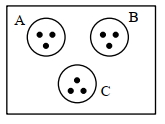
Let the set $S = \{2, 4, 8, 16, \ldots, 512\}$ be partitioned into $3$ sets $A, B, C$ with an equal number of elements such that $A \cup B \cup C = S$ and $A \cap B = B \cap C = A \cap C = \phi$. The number of such possible partitions of $S$ is equal to:
A
$1680$
B
$1520$
C
$1710$
D
$1640$
Solution
(A) The set $S = \{2^1, 2^2, 2^3, \ldots, 2^9\}$ contains $9$ elements.
We need to partition these $9$ elements into $3$ sets $A, B, C$ each containing $3$ elements.
The number of ways to divide $9$ distinct objects into $3$ groups of $3$ is given by the multinomial coefficient:
$\frac{9!}{3! 3! 3! 3!}$
Since the sets $A, B, C$ are distinct (labeled),we multiply by $3!$ to assign the groups to the sets $A, B, C$:
$\text{Number of ways} = \frac{9!}{3! 3! 3! 3!} \times 3! = \frac{9!}{3! 3! 3!} = \frac{362880}{6 \times 6 \times 6} = \frac{362880}{216} = 1680$.
We need to partition these $9$ elements into $3$ sets $A, B, C$ each containing $3$ elements.
The number of ways to divide $9$ distinct objects into $3$ groups of $3$ is given by the multinomial coefficient:
$\frac{9!}{3! 3! 3! 3!}$
Since the sets $A, B, C$ are distinct (labeled),we multiply by $3!$ to assign the groups to the sets $A, B, C$:
$\text{Number of ways} = \frac{9!}{3! 3! 3! 3!} \times 3! = \frac{9!}{3! 3! 3!} = \frac{362880}{6 \times 6 \times 6} = \frac{362880}{216} = 1680$.
0 likes
View Solution32
Difficult
There are five students $S_1, S_2, S_3, S_4$ and $S_5$ in a music class and for them there are five seats $R_1, R_2, R_3, R_4$ and $R_5$ arranged in a row,where initially the seat $R_i$ is allotted to the student $S_i$,$i = 1, 2, 3, 4, 5$. But,on the examination day,the five students are randomly allotted the five seats.
$(1)$ The probability that,on the examination day,the student $S_1$ gets the previously allotted seat $R_1$,and $NONE$ of the remaining students gets the seat previously allotted to him/her is
$(A)$ $\frac{3}{40}$ $(B)$ $\frac{1}{8}$ $(C)$ $\frac{7}{40}$ $(D)$ $\frac{1}{5}$
$(2)$ For $i = 1, 2, 3, 4$,let $T_i$ denote the event that the students $S_i$ and $S_{i+1}$ do $NOT$ sit adjacent to each other on the day of the examination. Then,the probability of the event $T_1 \cap T_2 \cap T_3 \cap T_4$ is
$(A)$ $\frac{1}{15}$ $(B)$ $\frac{1}{10}$ $(C)$ $\frac{7}{60}$ $(D)$ $\frac{1}{5}$
$(1)$ The probability that,on the examination day,the student $S_1$ gets the previously allotted seat $R_1$,and $NONE$ of the remaining students gets the seat previously allotted to him/her is
$(A)$ $\frac{3}{40}$ $(B)$ $\frac{1}{8}$ $(C)$ $\frac{7}{40}$ $(D)$ $\frac{1}{5}$
$(2)$ For $i = 1, 2, 3, 4$,let $T_i$ denote the event that the students $S_i$ and $S_{i+1}$ do $NOT$ sit adjacent to each other on the day of the examination. Then,the probability of the event $T_1 \cap T_2 \cap T_3 \cap T_4$ is
$(A)$ $\frac{1}{15}$ $(B)$ $\frac{1}{10}$ $(C)$ $\frac{7}{60}$ $(D)$ $\frac{1}{5}$
Solution
(A, C) $(1)$ Total ways to arrange $5$ students in $5$ seats is $n(S) = 5! = 120$.
Let $A$ be the event that $S_1$ gets seat $R_1$ and none of the remaining $4$ students $(S_2, S_3, S_4, S_5)$ get their original seats $(R_2, R_3, R_4, R_5)$.
This is a derangement of $4$ items,denoted by $D_4$.
$n(A) = D_4 = 4! \left(1 - \frac{1}{1!} + \frac{1}{2!} - \frac{1}{3!} + \frac{1}{4!}\right) = 24 \left(\frac{1}{2} - \frac{1}{6} + \frac{1}{24}\right) = 12 - 4 + 1 = 9$.
$P(A) = \frac{9}{120} = \frac{3}{40}$.
$(2)$ Let $E_i$ be the event that $S_i$ and $S_{i+1}$ sit adjacent. We want $P(T_1 \cap T_2 \cap T_3 \cap T_4) = 1 - P(E_1 \cup E_2 \cup E_3 \cup E_4)$.
Using the principle of inclusion-exclusion,the number of permutations where at least one pair is adjacent is calculated. For $n=5$,the number of permutations where no two adjacent students $S_i, S_{i+1}$ are together is $14$.
Thus,$P(T_1 \cap T_2 \cap T_3 \cap T_4) = \frac{14}{120} = \frac{7}{60}$.
Let $A$ be the event that $S_1$ gets seat $R_1$ and none of the remaining $4$ students $(S_2, S_3, S_4, S_5)$ get their original seats $(R_2, R_3, R_4, R_5)$.
This is a derangement of $4$ items,denoted by $D_4$.
$n(A) = D_4 = 4! \left(1 - \frac{1}{1!} + \frac{1}{2!} - \frac{1}{3!} + \frac{1}{4!}\right) = 24 \left(\frac{1}{2} - \frac{1}{6} + \frac{1}{24}\right) = 12 - 4 + 1 = 9$.
$P(A) = \frac{9}{120} = \frac{3}{40}$.
$(2)$ Let $E_i$ be the event that $S_i$ and $S_{i+1}$ sit adjacent. We want $P(T_1 \cap T_2 \cap T_3 \cap T_4) = 1 - P(E_1 \cup E_2 \cup E_3 \cup E_4)$.
Using the principle of inclusion-exclusion,the number of permutations where at least one pair is adjacent is calculated. For $n=5$,the number of permutations where no two adjacent students $S_i, S_{i+1}$ are together is $14$.
Thus,$P(T_1 \cap T_2 \cap T_3 \cap T_4) = \frac{14}{120} = \frac{7}{60}$.
0 likes
View Solution33
DifficultMCQ
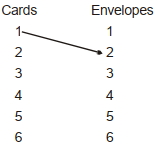
Six cards and six envelopes are numbered $1, 2, 3, 4, 5, 6$. Cards are to be placed in envelopes such that each envelope contains exactly one card,no card is placed in the envelope bearing the same number,and the card numbered $1$ is always placed in the envelope numbered $2$. The number of ways this can be done is:
A
$264$
B
$265$
C
$53$
D
$67$
Solution
(C) Let the cards be $C_1, C_2, C_3, C_4, C_5, C_6$ and envelopes be $E_1, E_2, E_3, E_4, E_5, E_6$.
Given $C_1$ is in $E_2$.
We need to place $C_2, C_3, C_4, C_5, C_6$ in $E_1, E_3, E_4, E_5, E_6$ such that $C_i$ is not in $E_i$ for $i \in \{2, 3, 4, 5, 6\}$.
Case $1$: $C_2$ is in $E_1$.
Then we need to place $C_3, C_4, C_5, C_6$ in $E_3, E_4, E_5, E_6$ such that no card $C_i$ is in $E_i$. This is a derangement of $4$ objects,$D_4 = 4!(\frac{1}{2!} - \frac{1}{3!} + \frac{1}{4!}) = 24(\frac{1}{2} - \frac{1}{6} + \frac{1}{24}) = 12 - 4 + 1 = 9$.
Case $2$: $C_2$ is not in $E_1$.
We have $5$ cards $C_2, C_3, C_4, C_5, C_6$ to be placed in $E_1, E_3, E_4, E_5, E_6$ such that $C_2 \neq E_1, C_3 \neq E_3, C_4 \neq E_4, C_5 \neq E_5, C_6 \neq E_6$. This is a derangement of $5$ objects,$D_5 = 5!(\frac{1}{2!} - \frac{1}{3!} + \frac{1}{4!} - \frac{1}{5!}) = 120(\frac{60-20+5-1}{120}) = 44$.
Total ways = $9 + 44 = 53$.
Given $C_1$ is in $E_2$.
We need to place $C_2, C_3, C_4, C_5, C_6$ in $E_1, E_3, E_4, E_5, E_6$ such that $C_i$ is not in $E_i$ for $i \in \{2, 3, 4, 5, 6\}$.
Case $1$: $C_2$ is in $E_1$.
Then we need to place $C_3, C_4, C_5, C_6$ in $E_3, E_4, E_5, E_6$ such that no card $C_i$ is in $E_i$. This is a derangement of $4$ objects,$D_4 = 4!(\frac{1}{2!} - \frac{1}{3!} + \frac{1}{4!}) = 24(\frac{1}{2} - \frac{1}{6} + \frac{1}{24}) = 12 - 4 + 1 = 9$.
Case $2$: $C_2$ is not in $E_1$.
We have $5$ cards $C_2, C_3, C_4, C_5, C_6$ to be placed in $E_1, E_3, E_4, E_5, E_6$ such that $C_2 \neq E_1, C_3 \neq E_3, C_4 \neq E_4, C_5 \neq E_5, C_6 \neq E_6$. This is a derangement of $5$ objects,$D_5 = 5!(\frac{1}{2!} - \frac{1}{3!} + \frac{1}{4!} - \frac{1}{5!}) = 120(\frac{60-20+5-1}{120}) = 44$.
Total ways = $9 + 44 = 53$.
0 likes
View Solution34
EasyMCQ
Five letters are placed at random in five addressed envelopes. The probability that all the letters are not dispatched in the respective right envelopes is
A
$\frac{1}{120}$
B
$\frac{1}{5}$
C
$\frac{119}{120}$
D
$\frac{4}{5}$
Solution
(C) The total number of ways to arrange $5$ letters in $5$ envelopes is $5! = 120$.
There is only $1$ way in which all letters go into their respective correct envelopes.
Therefore,the probability that all letters go into the correct envelopes is $P(E) = \frac{1}{5!} = \frac{1}{120}$.
The probability that all letters are not dispatched in the respective right envelopes is $P(E') = 1 - P(E)$.
$P(E') = 1 - \frac{1}{120} = \frac{119}{120}$.
There is only $1$ way in which all letters go into their respective correct envelopes.
Therefore,the probability that all letters go into the correct envelopes is $P(E) = \frac{1}{5!} = \frac{1}{120}$.
The probability that all letters are not dispatched in the respective right envelopes is $P(E') = 1 - P(E)$.
$P(E') = 1 - \frac{1}{120} = \frac{119}{120}$.
0 likes
View Solution35
MediumMCQ
The total number of ways of dividing $52$ cards amongst $4$ players,such that $3$ players have $17$ cards each and the fourth player has just $1$ card,is:
A
$\frac{52!}{(17!)^3 \cdot 3!}$
B
$\frac{52!}{(17!)^3}$
C
$\frac{52!}{17!}$
D
$\frac{52!}{17}$
Solution
(B) To divide $52$ cards into groups of sizes $17, 17, 17,$ and $1$,we first consider the number of ways to partition the set of $52$ cards into these groups.
Since $3$ groups have the same size $(17)$,we must account for the indistinguishability of these groups if we were just partitioning,but here the players are distinct.
The number of ways to distribute $52$ distinct items into $4$ distinct groups of sizes $n_1, n_2, n_3, n_4$ is given by the multinomial coefficient: $\frac{52!}{n_1! n_2! n_3! n_4!}$.
Here,$n_1=17, n_2=17, n_3=17, n_4=1$.
Thus,the number of ways is $\frac{52!}{17! 17! 17! 1!} = \frac{52!}{(17!)^3}$.
Since $3$ groups have the same size $(17)$,we must account for the indistinguishability of these groups if we were just partitioning,but here the players are distinct.
The number of ways to distribute $52$ distinct items into $4$ distinct groups of sizes $n_1, n_2, n_3, n_4$ is given by the multinomial coefficient: $\frac{52!}{n_1! n_2! n_3! n_4!}$.
Here,$n_1=17, n_2=17, n_3=17, n_4=1$.
Thus,the number of ways is $\frac{52!}{17! 17! 17! 1!} = \frac{52!}{(17!)^3}$.
0 likes
View Solution36
EasyMCQ
Three letters,to each of which corresponds an envelope,are placed in the envelopes at random. The probability that all the letters are not placed in the right envelopes is
A
$\frac{1}{6}$
B
$\frac{5}{6}$
C
$\frac{1}{3}$
D
$\frac{2}{3}$
Solution
(B) The total number of ways to place $3$ letters in $3$ envelopes is $3! = 6$.
There is only $1$ way to place all letters in their correct envelopes.
The probability that all letters are placed in the correct envelopes is $\frac{1}{3!} = \frac{1}{6}$.
The probability that all letters are not placed in the right envelopes is $1 - \frac{1}{6} = \frac{5}{6}$.
There is only $1$ way to place all letters in their correct envelopes.
The probability that all letters are placed in the correct envelopes is $\frac{1}{3!} = \frac{1}{6}$.
The probability that all letters are not placed in the right envelopes is $1 - \frac{1}{6} = \frac{5}{6}$.
0 likes
View Solution37
MediumMCQ
The number of ways of distributing $3$ dozen fruits (no two fruits are identical) to $9$ persons such that each gets the same number of fruits is
A
$\frac{36!}{(9!)^4}$
B
$\frac{36!}{(4!)^9}$
C
${ }^{36} P_9 \times 4!$
D
$\frac{36!}{4!(9!)^4}$
Solution
(B) Total number of fruits = $3 \times 12 = 36$.
Number of persons = $9$.
Each person receives an equal number of fruits,so each person gets $\frac{36}{9} = 4$ fruits.
The number of ways to distribute $36$ distinct fruits into $9$ groups of $4$ each is given by the multinomial coefficient:
$\frac{36!}{4! \times 4! \times 4! \times 4! \times 4! \times 4! \times 4! \times 4! \times 4!} = \frac{36!}{(4!)^9}$.
Thus,the correct option is $B$.
Number of persons = $9$.
Each person receives an equal number of fruits,so each person gets $\frac{36}{9} = 4$ fruits.
The number of ways to distribute $36$ distinct fruits into $9$ groups of $4$ each is given by the multinomial coefficient:
$\frac{36!}{4! \times 4! \times 4! \times 4! \times 4! \times 4! \times 4! \times 4! \times 4!} = \frac{36!}{(4!)^9}$.
Thus,the correct option is $B$.
0 likes
View Solution38
MediumMCQ
The number of ways of dividing $15$ persons into $3$ groups containing $3, 5$ and $7$ persons such that two particular persons are not included in the $5$-person group is:
A
$\frac{11!}{(3!)(5!)(7!)}$
B
$13 \times \frac{11!}{3!7!}$
C
$90 \times \frac{13!}{7!}$
D
$13 \times \frac{11!}{3!5!}$
Solution
(D) Total persons = $15$. Groups required are of sizes $3, 5, 7$.
Let the two particular persons be $P_1$ and $P_2$.
We need to form groups such that $P_1$ and $P_2$ are not in the group of $5$.
Case $1$: Both $P_1$ and $P_2$ are in the group of $3$.
Remaining $13$ persons are to be divided into groups of $1, 5, 7$.
Number of ways = $\binom{13}{1} \times \binom{12}{5} \times \binom{7}{7} = 13 \times \frac{12!}{5!7!} = 13 \times \frac{12 \times 11!}{5!7!} = \frac{156 \times 11!}{5!7!}$.
Case $2$: Both $P_1$ and $P_2$ are in the group of $7$.
Remaining $13$ persons are to be divided into groups of $3, 5, 5$.
Number of ways = $\binom{13}{3} \times \binom{10}{5} \times \binom{5}{5} = \frac{13!}{3!10!} \times \frac{10!}{5!5!} = \frac{13!}{3!5!5!}$.
Case $3$: One is in the group of $3$ and one is in the group of $7$.
Number of ways = $\binom{2}{1} \times \binom{13}{2} \times \binom{11}{4} \times \binom{7}{6} = 2 \times \frac{13!}{2!11!} \times \frac{11!}{4!7!} \times 7 = \frac{13!}{4!6!}$.
Summing these cases or using the complement method: Total ways to divide $15$ into $3, 5, 7$ is $\frac{15!}{3!5!7!}$.
Ways where $P_1, P_2$ are in the group of $5$ is $\binom{13}{3} \times \binom{10}{7} = \frac{13!}{3!10!} \times \frac{10!}{7!3!} = \frac{13!}{3!3!7!}$.
Subtracting this from total: $\frac{15!}{3!5!7!} - \frac{13!}{3!3!7!} = \frac{13!}{3!7!} [\frac{15 \times 14}{5 \times 4} - \frac{1}{3}] = \frac{13!}{3!7!} [4.2 - 0.33] = 13 \times \frac{11!}{3!5!}$.
Let the two particular persons be $P_1$ and $P_2$.
We need to form groups such that $P_1$ and $P_2$ are not in the group of $5$.
Case $1$: Both $P_1$ and $P_2$ are in the group of $3$.
Remaining $13$ persons are to be divided into groups of $1, 5, 7$.
Number of ways = $\binom{13}{1} \times \binom{12}{5} \times \binom{7}{7} = 13 \times \frac{12!}{5!7!} = 13 \times \frac{12 \times 11!}{5!7!} = \frac{156 \times 11!}{5!7!}$.
Case $2$: Both $P_1$ and $P_2$ are in the group of $7$.
Remaining $13$ persons are to be divided into groups of $3, 5, 5$.
Number of ways = $\binom{13}{3} \times \binom{10}{5} \times \binom{5}{5} = \frac{13!}{3!10!} \times \frac{10!}{5!5!} = \frac{13!}{3!5!5!}$.
Case $3$: One is in the group of $3$ and one is in the group of $7$.
Number of ways = $\binom{2}{1} \times \binom{13}{2} \times \binom{11}{4} \times \binom{7}{6} = 2 \times \frac{13!}{2!11!} \times \frac{11!}{4!7!} \times 7 = \frac{13!}{4!6!}$.
Summing these cases or using the complement method: Total ways to divide $15$ into $3, 5, 7$ is $\frac{15!}{3!5!7!}$.
Ways where $P_1, P_2$ are in the group of $5$ is $\binom{13}{3} \times \binom{10}{7} = \frac{13!}{3!10!} \times \frac{10!}{7!3!} = \frac{13!}{3!3!7!}$.
Subtracting this from total: $\frac{15!}{3!5!7!} - \frac{13!}{3!3!7!} = \frac{13!}{3!7!} [\frac{15 \times 14}{5 \times 4} - \frac{1}{3}] = \frac{13!}{3!7!} [4.2 - 0.33] = 13 \times \frac{11!}{3!5!}$.
0 likes
View Solution39
MediumMCQ
The number of ways of dividing $200$ dissimilar things into $10$ groups each containing $20$ elements is
A
$(200)! / (20!)^{10} \cdot 10!$
B
$(200)! / (10!)^{10} \cdot 20!$
C
$(200)! / (20!)^{10} \cdot 10!$
D
$(200)! / (10!)^{20} \cdot 20!$
Solution
(C) The number of ways to divide $mn$ distinct objects into $m$ groups of equal size $n$ is given by the formula $\frac{(mn)!}{(n!)^m \cdot m!}$.
Here,$mn = 200$ and $n = 20$,which implies $m = 10$.
Substituting these values into the formula,we get the number of ways as $\frac{200!}{(20!)^{10} \cdot 10!}$.
Here,$mn = 200$ and $n = 20$,which implies $m = 10$.
Substituting these values into the formula,we get the number of ways as $\frac{200!}{(20!)^{10} \cdot 10!}$.
0 likes
View Solution40
MediumMCQ
$A$ person writes letters to $6$ friends and addresses the corresponding envelopes. In how many ways can the letters be placed in the envelopes so that at least two of them are in the wrong envelopes?
Notation : $D_n = n! \left( \sum_{i=0}^n \frac{(-1)^i}{i!} \right)$
Notation : $D_n = n! \left( \sum_{i=0}^n \frac{(-1)^i}{i!} \right)$
A
${ }^6 C _4 \cdot D_2$
B
$\sum_{r=3}^6{ }^6 C_{6-r} \cdot D_r$
C
$\sum_{r=2}^6{ }^6 C_{6-r} \cdot D_r$
D
${ }^6 C_1 D_5 + { }^6 C_0 \cdot D_6$
Solution
(C) The total number of ways to place $6$ letters in $6$ envelopes is $6!$.
Let $S$ be the total number of ways,which is $6!$.
Let $E_0$ be the case where all letters are in the correct envelopes ($1$ way).
Let $E_1$ be the case where exactly one letter is in the wrong envelope. This is impossible,as if $5$ are correct,the $6^{th}$ must also be correct.
Therefore,the number of ways where at least two letters are in the wrong envelopes is the total ways minus the ways where $0$ or $1$ letter is in the wrong envelope.
This is equivalent to $6! - (1 + 0) = 6! - 1$.
Alternatively,using the derangement formula $D_r$ (where $r$ is the number of letters in wrong envelopes),we sum the cases where $r$ letters are in wrong envelopes for $r = 2, 3, 4, 5, 6$.
The number of ways is $\sum_{r=2}^6 { }^6 C_{6-r} D_r = { }^6 C_4 D_2 + { }^6 C_3 D_3 + { }^6 C_2 D_4 + { }^6 C_1 D_5 + { }^6 C_0 D_6$.
Let $S$ be the total number of ways,which is $6!$.
Let $E_0$ be the case where all letters are in the correct envelopes ($1$ way).
Let $E_1$ be the case where exactly one letter is in the wrong envelope. This is impossible,as if $5$ are correct,the $6^{th}$ must also be correct.
Therefore,the number of ways where at least two letters are in the wrong envelopes is the total ways minus the ways where $0$ or $1$ letter is in the wrong envelope.
This is equivalent to $6! - (1 + 0) = 6! - 1$.
Alternatively,using the derangement formula $D_r$ (where $r$ is the number of letters in wrong envelopes),we sum the cases where $r$ letters are in wrong envelopes for $r = 2, 3, 4, 5, 6$.
The number of ways is $\sum_{r=2}^6 { }^6 C_{6-r} D_r = { }^6 C_4 D_2 + { }^6 C_3 D_3 + { }^6 C_2 D_4 + { }^6 C_1 D_5 + { }^6 C_0 D_6$.
0 likes
View Solution41
EasyMCQ
If $5$ letters are to be placed in $5$ addressed envelopes,then the probability that at least one letter is placed in the wrongly addressed envelope is
A
$\frac{1}{5}$
B
$\frac{1}{120}$
C
$\frac{4}{5}$
D
$\frac{119}{120}$
Solution
(D) The total number of ways to place $5$ letters in $5$ addressed envelopes is $5! = 120$.
The number of ways in which all letters are placed in the correct envelopes is $1$.
Thus,the probability that all letters are placed correctly is $\frac{1}{120}$.
The probability that at least one letter is placed in the wrongly addressed envelope is $1 - P(\text{all correct}) = 1 - \frac{1}{120} = \frac{119}{120}$.
The number of ways in which all letters are placed in the correct envelopes is $1$.
Thus,the probability that all letters are placed correctly is $\frac{1}{120}$.
The probability that at least one letter is placed in the wrongly addressed envelope is $1 - P(\text{all correct}) = 1 - \frac{1}{120} = \frac{119}{120}$.
0 likes
View Solution42
MediumMCQ
There are $8$ different coloured balls and $8$ bags having the same colours as that of the balls. If one ball is placed at random in each one of the bags,then the probability that $5$ of the balls are placed in the respective coloured bags,is
A
$\frac{1}{120}$
B
$\frac{1}{160}$
C
$\frac{1}{180}$
D
$\frac{1}{360}$
Solution
(D) The total number of ways to place $8$ balls in $8$ bags is $8!$.
We want to find the number of ways such that exactly $5$ balls are in their respective coloured bags.
First,we choose $5$ balls out of $8$ to be in their correct bags,which can be done in $\binom{8}{5}$ ways.
The remaining $3$ balls must be placed in the remaining $3$ bags such that none of them is in its respective coloured bag. This is a derangement of $3$ items,denoted by $D_3$.
$D_3 = 3! \times (1 - \frac{1}{1!} + \frac{1}{2!} - \frac{1}{3!}) = 6 \times (1 - 1 + 0.5 - 0.1667) = 2$.
So,the number of favorable outcomes is $\binom{8}{5} \times D_3 = \binom{8}{3} \times 2 = 56 \times 2 = 112$.
The probability is $\frac{112}{8!} = \frac{112}{40320} = \frac{1}{360}$.
We want to find the number of ways such that exactly $5$ balls are in their respective coloured bags.
First,we choose $5$ balls out of $8$ to be in their correct bags,which can be done in $\binom{8}{5}$ ways.
The remaining $3$ balls must be placed in the remaining $3$ bags such that none of them is in its respective coloured bag. This is a derangement of $3$ items,denoted by $D_3$.
$D_3 = 3! \times (1 - \frac{1}{1!} + \frac{1}{2!} - \frac{1}{3!}) = 6 \times (1 - 1 + 0.5 - 0.1667) = 2$.
So,the number of favorable outcomes is $\binom{8}{5} \times D_3 = \binom{8}{3} \times 2 = 56 \times 2 = 112$.
The probability is $\frac{112}{8!} = \frac{112}{40320} = \frac{1}{360}$.
0 likes
View Solution43
EasyMCQ
If there are $5$ letters written to $5$ different people and $5$ envelopes addressed to them,then the number of ways in which these letters can be arranged so that no letter goes into its corresponding envelope is
A
$9$
B
$24$
C
$44$
D
$119$
Solution
(C) Given that $5$ letters are written to $5$ different people and $5$ envelopes are addressed to them.
The number of ways in which these letters can be arranged so that no letter goes into its corresponding envelope is equal to the number of derangements of $5$ objects,denoted by $D_n$ or $!n$.
The formula for the derangement of $n$ objects is $D_n = n! \left[ 1 - \frac{1}{1!} + \frac{1}{2!} - \frac{1}{3!} + \ldots + (-1)^n \frac{1}{n!} \right]$.
Here,$n = 5$.
$D_5 = 5! \left[ 1 - \frac{1}{1!} + \frac{1}{2!} - \frac{1}{3!} + \frac{1}{4!} - \frac{1}{5!} \right]$.
$D_5 = 120 \left[ 1 - 1 + \frac{1}{2} - \frac{1}{6} + \frac{1}{24} - \frac{1}{120} \right]$.
$D_5 = 120 \left[ \frac{60 - 20 + 5 - 1}{120} \right]$.
$D_5 = 60 - 20 + 5 - 1 = 44$.
Hence,the number of ways to put $5$ letters in $5$ addressed envelopes so that all are in wrong envelopes is $44$.
The number of ways in which these letters can be arranged so that no letter goes into its corresponding envelope is equal to the number of derangements of $5$ objects,denoted by $D_n$ or $!n$.
The formula for the derangement of $n$ objects is $D_n = n! \left[ 1 - \frac{1}{1!} + \frac{1}{2!} - \frac{1}{3!} + \ldots + (-1)^n \frac{1}{n!} \right]$.
Here,$n = 5$.
$D_5 = 5! \left[ 1 - \frac{1}{1!} + \frac{1}{2!} - \frac{1}{3!} + \frac{1}{4!} - \frac{1}{5!} \right]$.
$D_5 = 120 \left[ 1 - 1 + \frac{1}{2} - \frac{1}{6} + \frac{1}{24} - \frac{1}{120} \right]$.
$D_5 = 120 \left[ \frac{60 - 20 + 5 - 1}{120} \right]$.
$D_5 = 60 - 20 + 5 - 1 = 44$.
Hence,the number of ways to put $5$ letters in $5$ addressed envelopes so that all are in wrong envelopes is $44$.
0 likes
View Solution44
EasyMCQ
The number of ways in which $4$ letters can be put into $4$ addressed envelopes such that no letter goes into the envelope meant for it is:
A
$8$
B
$12$
C
$16$
D
$9$
Solution
(D) This is a problem of derangements,denoted by $D_n$,where $n$ is the number of items.
For $n=4$,the number of derangements is given by the formula $D_n = n! \times \left(1 - \frac{1}{1!} + \frac{1}{2!} - \frac{1}{3!} + \frac{1}{4!}\right)$.
Substituting $n=4$:
$D_4 = 24 \times \left(1 - 1 + \frac{1}{2} - \frac{1}{6} + \frac{1}{24}\right)$
$D_4 = 24 \times \left(\frac{12 - 4 + 1}{24}\right)$
$D_4 = 24 \times \frac{9}{24} = 9$.
Alternatively,using the inclusion-exclusion principle:
Total ways $= 4! = 24$.
Ways where at least one letter is in the correct envelope $= \binom{4}{1} \times 3! - \binom{4}{2} \times 2! + \binom{4}{3} \times 1! - \binom{4}{4} \times 0! = 24 - 12 + 4 - 1 = 15$.
Required ways $= 24 - 15 = 9$.
For $n=4$,the number of derangements is given by the formula $D_n = n! \times \left(1 - \frac{1}{1!} + \frac{1}{2!} - \frac{1}{3!} + \frac{1}{4!}\right)$.
Substituting $n=4$:
$D_4 = 24 \times \left(1 - 1 + \frac{1}{2} - \frac{1}{6} + \frac{1}{24}\right)$
$D_4 = 24 \times \left(\frac{12 - 4 + 1}{24}\right)$
$D_4 = 24 \times \frac{9}{24} = 9$.
Alternatively,using the inclusion-exclusion principle:
Total ways $= 4! = 24$.
Ways where at least one letter is in the correct envelope $= \binom{4}{1} \times 3! - \binom{4}{2} \times 2! + \binom{4}{3} \times 1! - \binom{4}{4} \times 0! = 24 - 12 + 4 - 1 = 15$.
Required ways $= 24 - 15 = 9$.
0 likes
View Solution45
EasyMCQ
Among the $5$ married couples,if the names of $5$ men are matched with the names of their wives randomly,then the probability that no man is matched with the name of his wife is
A
$\frac{9}{20}$
B
$\frac{1}{5}$
C
$\frac{11}{30}$
D
$\frac{17}{60}$
Solution
(C) The total number of ways to match $5$ men with $5$ wives is given by $5! = 120$.
The number of ways in which no man is matched with his own wife is a derangement of $5$ objects,denoted by $D_5$.
The formula for derangement is $D_n = n! \left( 1 - \frac{1}{1!} + \frac{1}{2!} - \frac{1}{3!} + \frac{1}{4!} - \dots + \frac{(-1)^n}{n!} \right)$.
For $n = 5$:
$D_5 = 5! \left( 1 - 1 + \frac{1}{2} - \frac{1}{6} + \frac{1}{24} - \frac{1}{120} \right) = 120 \left( \frac{60 - 20 + 5 - 1}{120} \right) = 44$.
Therefore,the probability that no man is matched with his wife is $\frac{D_5}{5!} = \frac{44}{120} = \frac{11}{30}$.
The number of ways in which no man is matched with his own wife is a derangement of $5$ objects,denoted by $D_5$.
The formula for derangement is $D_n = n! \left( 1 - \frac{1}{1!} + \frac{1}{2!} - \frac{1}{3!} + \frac{1}{4!} - \dots + \frac{(-1)^n}{n!} \right)$.
For $n = 5$:
$D_5 = 5! \left( 1 - 1 + \frac{1}{2} - \frac{1}{6} + \frac{1}{24} - \frac{1}{120} \right) = 120 \left( \frac{60 - 20 + 5 - 1}{120} \right) = 44$.
Therefore,the probability that no man is matched with his wife is $\frac{D_5}{5!} = \frac{44}{120} = \frac{11}{30}$.
0 likes
View Solution46
MediumMCQ
There are $7$ greeting cards,each of a different colour,and $7$ envelopes of the same $7$ colours as the cards. The number of ways in which the cards can be put in envelopes,so that exactly $4$ of the cards go into envelopes of the respective colour,is:
A
${ }^{7} C_{3}$
B
$2 \times { }^{7} C_{3}$
C
$3! \times { }^{4} C_{4}$
D
$3! \times { }^{7} C_{3} \times { }^{4} C_{3}$
Solution
(B) To find the number of ways such that exactly $4$ cards go into their respective envelopes:
$1$. First,select $4$ cards out of $7$ to be placed in their correct envelopes. This can be done in ${ }^{7} C_{4}$ ways.
$2$. The remaining $3$ cards must be placed in the remaining $3$ envelopes such that none of them go into their respective envelopes (this is a derangement of $3$ objects,denoted by $D(3)$).
$3$. The number of derangements of $n$ objects is given by $D(n) = n! \left(1 - \frac{1}{1!} + \frac{1}{2!} - \frac{1}{3!} + \dots + \frac{(-1)^n}{n!}\right)$.
$4$. For $n = 3$,$D(3) = 3! \left(1 - 1 + \frac{1}{2} - \frac{1}{6}\right) = 6 \times \left(\frac{1}{3}\right) = 2$.
$5$. Total ways = ${ }^{7} C_{4} \times D(3) = { }^{7} C_{3} \times 2 = 2 \times { }^{7} C_{3}$.
$1$. First,select $4$ cards out of $7$ to be placed in their correct envelopes. This can be done in ${ }^{7} C_{4}$ ways.
$2$. The remaining $3$ cards must be placed in the remaining $3$ envelopes such that none of them go into their respective envelopes (this is a derangement of $3$ objects,denoted by $D(3)$).
$3$. The number of derangements of $n$ objects is given by $D(n) = n! \left(1 - \frac{1}{1!} + \frac{1}{2!} - \frac{1}{3!} + \dots + \frac{(-1)^n}{n!}\right)$.
$4$. For $n = 3$,$D(3) = 3! \left(1 - 1 + \frac{1}{2} - \frac{1}{6}\right) = 6 \times \left(\frac{1}{3}\right) = 2$.
$5$. Total ways = ${ }^{7} C_{4} \times D(3) = { }^{7} C_{3} \times 2 = 2 \times { }^{7} C_{3}$.
0 likes
View Solution47
DifficultMCQ
$A$ person has three different bags and four different books. The number of ways,in which he can put these books in the bags so that no bag is empty,is:
A
$18$
B
$36$
C
$39$
D
$72$
Solution
(B) We need to distribute $4$ distinct books into $3$ distinct bags such that no bag is empty.
This is equivalent to finding the number of onto functions from a set of $4$ elements to a set of $3$ elements.
The formula for the number of onto functions from a set of $n$ elements to a set of $m$ elements is given by $\sum_{k=0}^{m} (-1)^k \binom{m}{k} (m-k)^n$.
Here,$n = 4$ and $m = 3$.
Number of ways = $\binom{3}{0} 3^4 - \binom{3}{1} 2^4 + \binom{3}{2} 1^4 = 1 \times 81 - 3 \times 16 + 3 \times 1 = 81 - 48 + 3 = 36$.
This is equivalent to finding the number of onto functions from a set of $4$ elements to a set of $3$ elements.
The formula for the number of onto functions from a set of $n$ elements to a set of $m$ elements is given by $\sum_{k=0}^{m} (-1)^k \binom{m}{k} (m-k)^n$.
Here,$n = 4$ and $m = 3$.
Number of ways = $\binom{3}{0} 3^4 - \binom{3}{1} 2^4 + \binom{3}{2} 1^4 = 1 \times 81 - 3 \times 16 + 3 \times 1 = 81 - 48 + 3 = 36$.
0 likes
View SolutionPermutation and Combination — Division into groups, Derangements · Frequently Asked Questions
1Are these Permutation and Combination questions useful for JEE and NEET?
Yes. All questions in this section are mapped to JEE Main and NEET exam patterns. Previous year questions from JEE Main, NEET, GUJCET and state-level exams are included with full solutions.
2Can I switch to Hindi or Gujarati for these questions?
Yes. Use the language tabs in the hero section or the sidebar to view the same questions and solutions in English, Hindi or Gujarati.
3How do I generate a question paper from this subtopic?
Use the Vedclass Exam Paper Generator — select the chapter and subtopic, set difficulty, and generate Sets A, B, C, D automatically. First 3 chapters of every subject are free.
Vedclass Products
For Students
Vedclass Test Series
Mock tests in real JEE/NEET style with performance analysis. 5-day free trial.
Start Free TrialFor Teachers
Exam Paper Generator
Generate Set A/B/C/D papers from this chapter in 2 minutes. 3 chapters free.
Try FreeFor Institutes
Online Exam Module
Live online exams with unlimited students, 360° analytics & white-label branding.
See DemoFor Teachers & Institutes
Generate a Permutation and Combination Exam Paper in 2 Minutes
Select subtopic & difficulty — Sets A, B, C, D auto-generated with No Repeat logic.
First 3 chapters of every subject are free — no payment required.