
A English
Definition of combinations, Condition combinations Questions in English
Class 11 Mathematics · Permutation and Combination · Definition of combinations, Condition combinations
363+
Questions
English
Language
100%
With Solutions
Showing 46 of 363 questions in English
251
EasyMCQ
Everybody in a room shakes hands with everybody else. The total number of handshakes is $45$. The total number of persons in the room is
A
$09$
B
$10$
C
$05$
D
$15$
Solution
(B) Let the total number of persons in the room be $n$.
The number of handshakes is given by the combination formula ${}^{n}C_{2}$,as a handshake occurs between $2$ people.
Given,${}^{n}C_{2} = 45$.
Using the formula ${}^{n}C_{2} = \frac{n(n-1)}{2}$,we have:
$\frac{n(n-1)}{2} = 45$
$n(n-1) = 90$
$n^2 - n - 90 = 0$
$(n - 10)(n + 9) = 0$
Since the number of persons cannot be negative,$n = 10$.
The number of handshakes is given by the combination formula ${}^{n}C_{2}$,as a handshake occurs between $2$ people.
Given,${}^{n}C_{2} = 45$.
Using the formula ${}^{n}C_{2} = \frac{n(n-1)}{2}$,we have:
$\frac{n(n-1)}{2} = 45$
$n(n-1) = 90$
$n^2 - n - 90 = 0$
$(n - 10)(n + 9) = 0$
Since the number of persons cannot be negative,$n = 10$.
0 likes
View Solution252
EasyMCQ
The number of $4$-digit numbers without repetition that can be formed using the digits $1, 2, 3, 4, 5, 6, 7$ in which each number has two odd digits and two even digits is:
A
$436$
B
$454$
C
$432$
D
$450$
Solution
(C) The set of digits is $\{1, 2, 3, 4, 5, 6, 7\}$.
Odd digits are $\{1, 3, 5, 7\}$ (total $4$) and even digits are $\{2, 4, 6\}$ (total $3$).
We need to select $2$ odd digits from $4$ and $2$ even digits from $3$.
Number of ways to select the digits $= {}^{4}C_{2} \times {}^{3}C_{2} = 6 \times 3 = 18$.
These $4$ selected digits can be arranged in $4!$ ways.
Total number of $4$-digit numbers $= 18 \times 4! = 18 \times 24 = 432$.
Odd digits are $\{1, 3, 5, 7\}$ (total $4$) and even digits are $\{2, 4, 6\}$ (total $3$).
We need to select $2$ odd digits from $4$ and $2$ even digits from $3$.
Number of ways to select the digits $= {}^{4}C_{2} \times {}^{3}C_{2} = 6 \times 3 = 18$.
These $4$ selected digits can be arranged in $4!$ ways.
Total number of $4$-digit numbers $= 18 \times 4! = 18 \times 24 = 432$.
0 likes
View Solution253
EasyMCQ
The value of ${ }^{49} C_3+{ }^{48} C_3+{ }^{47} C_3+{ }^{46} C_3+{ }^{45} C_3+{ }^{45} C_4$ is
A
${ }^{50} C_4$
B
${ }^{50} C_3$
C
${ }^{50} C_2$
D
${ }^{50} C_1$
Solution
(A) We use the Pascal's identity: ${ }^{n} C_{r}+{ }^{n} C_{r+1}={ }^{n+1} C_{r+1}$.
Given expression: ${ }^{49} C_3+{ }^{48} C_3+{ }^{47} C_3+{ }^{46} C_3+{ }^{45} C_3+{ }^{45} C_4$.
Step $1$: Combine ${ }^{45} C_3+{ }^{45} C_4 = { }^{46} C_4$.
Step $2$: Combine ${ }^{46} C_3+{ }^{46} C_4 = { }^{47} C_4$.
Step $3$: Combine ${ }^{47} C_3+{ }^{47} C_4 = { }^{48} C_4$.
Step $4$: Combine ${ }^{48} C_3+{ }^{48} C_4 = { }^{49} C_4$.
Step $5$: Combine ${ }^{49} C_3+{ }^{49} C_4 = { }^{50} C_4$.
Thus,the final value is ${ }^{50} C_4$.
Given expression: ${ }^{49} C_3+{ }^{48} C_3+{ }^{47} C_3+{ }^{46} C_3+{ }^{45} C_3+{ }^{45} C_4$.
Step $1$: Combine ${ }^{45} C_3+{ }^{45} C_4 = { }^{46} C_4$.
Step $2$: Combine ${ }^{46} C_3+{ }^{46} C_4 = { }^{47} C_4$.
Step $3$: Combine ${ }^{47} C_3+{ }^{47} C_4 = { }^{48} C_4$.
Step $4$: Combine ${ }^{48} C_3+{ }^{48} C_4 = { }^{49} C_4$.
Step $5$: Combine ${ }^{49} C_3+{ }^{49} C_4 = { }^{50} C_4$.
Thus,the final value is ${ }^{50} C_4$.
0 likes
View Solution254
DifficultMCQ
If ${ }^{n} C_{12}={ }^{n} C_{8}$,then $n$ is equal to
A
$26$
B
$12$
C
$06$
D
$20$
Solution
(D) Given that ${ }^{n} C_{12}={ }^{n} C_{8}$.
We know the property of combinations that ${ }^{n} C_{r}={ }^{n} C_{k}$ implies either $r=k$ or $n=r+k$.
Here,$r=12$ and $k=8$.
Since $12 \neq 8$,we must have $n=12+8$.
Therefore,$n=20$.
We know the property of combinations that ${ }^{n} C_{r}={ }^{n} C_{k}$ implies either $r=k$ or $n=r+k$.
Here,$r=12$ and $k=8$.
Since $12 \neq 8$,we must have $n=12+8$.
Therefore,$n=20$.
0 likes
View Solution255
EasyMCQ
The value of ${ }^{16} C_{9}+{ }^{16} C_{10}-{ }^{16} C_{6}-{ }^{16} C_{7}$ is
A
$0$
B
$1$
C
${ }^{17} C_{0}$
D
${ }^{17} C_{3}$
Solution
(A) We use the property of combinations: ${ }^{n} C_{r} = { }^{n} C_{n-r}$.
Applying this to the terms ${ }^{16} C_{6}$ and ${ }^{16} C_{7}$:
${ }^{16} C_{6} = { }^{16} C_{16-6} = { }^{16} C_{10}$
${ }^{16} C_{7} = { }^{16} C_{16-7} = { }^{16} C_{9}$
Substituting these into the original expression:
${ }^{16} C_{9} + { }^{16} C_{10} - { }^{16} C_{6} - { }^{16} C_{7} = { }^{16} C_{9} + { }^{16} C_{10} - { }^{16} C_{10} - { }^{16} C_{9}$
$= ({ }^{16} C_{9} - { }^{16} C_{9}) + ({ }^{16} C_{10} - { }^{16} C_{10}) = 0 + 0 = 0$.
Applying this to the terms ${ }^{16} C_{6}$ and ${ }^{16} C_{7}$:
${ }^{16} C_{6} = { }^{16} C_{16-6} = { }^{16} C_{10}$
${ }^{16} C_{7} = { }^{16} C_{16-7} = { }^{16} C_{9}$
Substituting these into the original expression:
${ }^{16} C_{9} + { }^{16} C_{10} - { }^{16} C_{6} - { }^{16} C_{7} = { }^{16} C_{9} + { }^{16} C_{10} - { }^{16} C_{10} - { }^{16} C_{9}$
$= ({ }^{16} C_{9} - { }^{16} C_{9}) + ({ }^{16} C_{10} - { }^{16} C_{10}) = 0 + 0 = 0$.
0 likes
View Solution256
MediumMCQ
The number of four-digit numbers that can be formed using all the digits from $1$ to $9$ (excluding zero) such that every number has exactly $2$ distinct digits is:
A
$189$
B
$216$
C
$288$
D
$504$
Solution
(D) Step $1$: Choose $2$ distinct digits out of $9$ available digits ($1$ to $9$). This can be done in $^9C_2 = \frac{9 \times 8}{2} = 36$ ways.
Step $2$: For each pair of chosen digits,we need to form a $4$-digit number using both digits at least once.
Step $3$: The total number of ways to fill $4$ positions using $2$ chosen digits is $2^4 = 16$.
Step $4$: We must exclude the cases where only one digit is used (i.e.,all $4$ digits are the same). There are $2$ such cases (all $4$ digits are the first chosen digit or all $4$ digits are the second chosen digit).
Step $5$: The number of valid $4$-digit numbers for each pair is $(2^4 - 2) = 14$.
Step $6$: Total numbers = $36 \times 14 = 504$.
Step $2$: For each pair of chosen digits,we need to form a $4$-digit number using both digits at least once.
Step $3$: The total number of ways to fill $4$ positions using $2$ chosen digits is $2^4 = 16$.
Step $4$: We must exclude the cases where only one digit is used (i.e.,all $4$ digits are the same). There are $2$ such cases (all $4$ digits are the first chosen digit or all $4$ digits are the second chosen digit).
Step $5$: The number of valid $4$-digit numbers for each pair is $(2^4 - 2) = 14$.
Step $6$: Total numbers = $36 \times 14 = 504$.
0 likes
View Solution257
EasyMCQ
If a person has $3$ coins of different denominations,the number of different sums that can be formed is
A
$3$
B
$7$
C
$8$
D
$6$
Solution
(B) Given that a person has $3$ coins of different denominations.
To form a sum,the person can choose $1, 2,$ or $3$ coins.
The number of ways to select $1$ coin out of $3$ is ${}^3C_1 = 3$.
The number of ways to select $2$ coins out of $3$ is ${}^3C_2 = 3$.
The number of ways to select $3$ coins out of $3$ is ${}^3C_3 = 1$.
Since each combination of coins results in a unique sum (as denominations are different),the total number of different sums is ${}^3C_1 + {}^3C_2 + {}^3C_3 = 3 + 3 + 1 = 7$.
To form a sum,the person can choose $1, 2,$ or $3$ coins.
The number of ways to select $1$ coin out of $3$ is ${}^3C_1 = 3$.
The number of ways to select $2$ coins out of $3$ is ${}^3C_2 = 3$.
The number of ways to select $3$ coins out of $3$ is ${}^3C_3 = 1$.
Since each combination of coins results in a unique sum (as denominations are different),the total number of different sums is ${}^3C_1 + {}^3C_2 + {}^3C_3 = 3 + 3 + 1 = 7$.
0 likes
View Solution258
EasyMCQ
If $\frac{{}^{n+1}C_{r+1}}{{}^{n+1}C_r} = \frac{n-r+1}{m}$,then $m =$
A
$r$
B
$r-1$
C
$r+1$
D
$1-r$
Solution
(C) We are given the expression $\frac{{}^{n+1}C_{r+1}}{{}^{n+1}C_r} = \frac{n-r+1}{m}$.
Using the formula ${}^{n}C_{r} = \frac{n!}{r!(n-r)!}$,we have:
$\frac{{}^{n+1}C_{r+1}}{{}^{n+1}C_r} = \frac{\frac{(n+1)!}{(r+1)!(n-r)!}}{\frac{(n+1)!}{r!(n-r+1)!}} = \frac{r!(n-r+1)!}{(r+1)!(n-r)!}$.
Simplifying the factorials:
$= \frac{r! \times (n-r+1) \times (n-r)!}{(r+1) \times r! \times (n-r)!} = \frac{n-r+1}{r+1}$.
Comparing this with the given expression $\frac{n-r+1}{m}$,we get $m = r+1$.
Thus,option $C$ is correct.
Using the formula ${}^{n}C_{r} = \frac{n!}{r!(n-r)!}$,we have:
$\frac{{}^{n+1}C_{r+1}}{{}^{n+1}C_r} = \frac{\frac{(n+1)!}{(r+1)!(n-r)!}}{\frac{(n+1)!}{r!(n-r+1)!}} = \frac{r!(n-r+1)!}{(r+1)!(n-r)!}$.
Simplifying the factorials:
$= \frac{r! \times (n-r+1) \times (n-r)!}{(r+1) \times r! \times (n-r)!} = \frac{n-r+1}{r+1}$.
Comparing this with the given expression $\frac{n-r+1}{m}$,we get $m = r+1$.
Thus,option $C$ is correct.
0 likes
View Solution259
MediumMCQ
The greatest positive integer which divides $(n+16)(n+17)(n+18)(n+19)$,for all positive integers $n$,is
A
$6$
B
$24$
C
$28$
D
$20$
Solution
(B) The expression is the product of four consecutive integers: $(n+16)(n+17)(n+18)(n+19)$.
Let $k = n+16$. Then the expression becomes $k(k+1)(k+2)(k+3)$.
This is equivalent to $4! \times \binom{k+3}{4}$.
Since $\binom{k+3}{4}$ is always an integer for any positive integer $k$,the product of any $r$ consecutive integers is always divisible by $r!$.
Here,$r = 4$,so the expression is divisible by $4! = 4 \times 3 \times 2 \times 1 = 24$.
Thus,the greatest positive integer that divides the product for all $n$ is $24$.
Let $k = n+16$. Then the expression becomes $k(k+1)(k+2)(k+3)$.
This is equivalent to $4! \times \binom{k+3}{4}$.
Since $\binom{k+3}{4}$ is always an integer for any positive integer $k$,the product of any $r$ consecutive integers is always divisible by $r!$.
Here,$r = 4$,so the expression is divisible by $4! = 4 \times 3 \times 2 \times 1 = 24$.
Thus,the greatest positive integer that divides the product for all $n$ is $24$.
0 likes
View Solution260
MediumMCQ
If a team of $4$ persons is to be selected out of $4$ married couples to play a mixed doubles tennis game,then the number of ways of forming a team in which no married couple appears is:
A
$12$
B
$8$
C
$16$
D
$24$
Solution
(C) We have $4$ married couples,which means $4$ men and $4$ women. We need to select $4$ persons such that no married couple is included.
First,we select $4$ couples out of $4$ available couples,which can be done in $\binom{4}{4} = 1$ way.
From these $4$ selected couples,we need to choose $1$ person from each couple such that we have $4$ persons in total. Since each couple has $2$ choices (either the husband or the wife),the number of ways to select $4$ persons is $2 \times 2 \times 2 \times 2 = 2^4 = 16$ ways.
Thus,the total number of ways is $16$.
First,we select $4$ couples out of $4$ available couples,which can be done in $\binom{4}{4} = 1$ way.
From these $4$ selected couples,we need to choose $1$ person from each couple such that we have $4$ persons in total. Since each couple has $2$ choices (either the husband or the wife),the number of ways to select $4$ persons is $2 \times 2 \times 2 \times 2 = 2^4 = 16$ ways.
Thus,the total number of ways is $16$.
0 likes
View Solution261
EasyMCQ
There are $6$ different novels and $3$ different poetry books on a table. If $4$ novels and $1$ poetry book are to be selected and arranged in a row on a shelf such that the poetry book is always in the middle,then the number of such possible arrangements is
A
$270$
B
$180$
C
$540$
D
$1080$
Solution
(D) Step $1$: Select $4$ novels out of $6$ novels in ${}^6C_4$ ways.
${}^6C_4 = \frac{6 \times 5}{2 \times 1} = 15$ ways.
Step $2$: Select $1$ poetry book out of $3$ poetry books in ${}^3C_1$ ways.
${}^3C_1 = 3$ ways.
Step $3$: Arrange the $4$ selected novels and $1$ poetry book in a row such that the poetry book is in the middle. The arrangement looks like: $(N_1, N_2, P, N_3, N_4)$.
The $4$ novels can be arranged in the $4$ available positions in $4!$ ways.
$4! = 4 \times 3 \times 2 \times 1 = 24$ ways.
Step $4$: Total number of arrangements $= {}^6C_4 \times {}^3C_1 \times 4! = 15 \times 3 \times 24 = 1080$.
${}^6C_4 = \frac{6 \times 5}{2 \times 1} = 15$ ways.
Step $2$: Select $1$ poetry book out of $3$ poetry books in ${}^3C_1$ ways.
${}^3C_1 = 3$ ways.
Step $3$: Arrange the $4$ selected novels and $1$ poetry book in a row such that the poetry book is in the middle. The arrangement looks like: $(N_1, N_2, P, N_3, N_4)$.
The $4$ novels can be arranged in the $4$ available positions in $4!$ ways.
$4! = 4 \times 3 \times 2 \times 1 = 24$ ways.
Step $4$: Total number of arrangements $= {}^6C_4 \times {}^3C_1 \times 4! = 15 \times 3 \times 24 = 1080$.
0 likes
View Solution262
EasyMCQ
Find the number of ways of selecting $4$ pens and $3$ pencils from a packet of $8$ pens and $5$ pencils.
A
$700$
B
${ }^8 P_4 \times{ }^5 P_3$
C
${ }^8 P_4+{ }^5 P_3$
D
$700 \times{ }^8 P_4$
Solution
(A) To select $4$ pens from $8$ pens,the number of ways is ${ }^8 C_4 = \frac{8 \times 7 \times 6 \times 5}{4 \times 3 \times 2 \times 1} = 70$.
To select $3$ pencils from $5$ pencils,the number of ways is ${ }^5 C_3 = \frac{5 \times 4 \times 3}{3 \times 2 \times 1} = 10$.
Total number of ways $= { }^8 C_4 \times { }^5 C_3 = 70 \times 10 = 700$.
To select $3$ pencils from $5$ pencils,the number of ways is ${ }^5 C_3 = \frac{5 \times 4 \times 3}{3 \times 2 \times 1} = 10$.
Total number of ways $= { }^8 C_4 \times { }^5 C_3 = 70 \times 10 = 700$.
0 likes
View Solution263
MediumMCQ
The number of ways of forming the ordered pairs $(p, q)$ such that $p > q$ by choosing $p$ and $q$ from the first $50$ natural numbers is
A
$1275$
B
$1250$
C
$1225$
D
$1200$
Solution
(C) To form an ordered pair $(p, q)$ such that $p > q$ from the set $S = \{1, 2, 3, \dots, 50\}$,we need to choose $2$ distinct numbers from the $50$ available numbers.
Let the chosen numbers be $x$ and $y$ where $x < y$.
For any such pair,there is exactly one way to assign them to $p$ and $q$ such that $p > q$,which is $p = y$ and $q = x$.
The number of ways to choose $2$ distinct numbers from $50$ is given by the combination formula $\binom{n}{r}$.
Here,$n = 50$ and $r = 2$.
Number of ways = $\binom{50}{2} = \frac{50 \times 49}{2 \times 1} = 25 \times 49 = 1225$.
Let the chosen numbers be $x$ and $y$ where $x < y$.
For any such pair,there is exactly one way to assign them to $p$ and $q$ such that $p > q$,which is $p = y$ and $q = x$.
The number of ways to choose $2$ distinct numbers from $50$ is given by the combination formula $\binom{n}{r}$.
Here,$n = 50$ and $r = 2$.
Number of ways = $\binom{50}{2} = \frac{50 \times 49}{2 \times 1} = 25 \times 49 = 1225$.
0 likes
View Solution264
DifficultMCQ
The number of integers between $10$ and $10,000$ such that in every integer every digit is greater than its immediate preceding digit,is
A
$1112$
B
$437$
C
$246$
D
$182$
Solution
(C) We need to find the number of integers $n$ such that $10 < n < 10,000$ and the digits of $n$ are in strictly increasing order.
This means we are looking for integers with $2, 3,$ or $4$ digits.
For any set of $k$ distinct digits chosen from the set $\{1, 2, 3, 4, 5, 6, 7, 8, 9\}$,there is exactly one way to arrange them in strictly increasing order.
Note that $0$ cannot be included because if $0$ is present,it would have to be the first digit to maintain the increasing order,which is not allowed for integers between $10$ and $10,000$.
$1$. For $2$-digit integers: We choose $2$ digits from $9$ available digits. The number of ways is $\binom{9}{2} = \frac{9 \times 8}{2} = 36$.
$2$. For $3$-digit integers: We choose $3$ digits from $9$ available digits. The number of ways is $\binom{9}{3} = \frac{9 \times 8 \times 7}{3 \times 2 \times 1} = 84$.
$3$. For $4$-digit integers: We choose $4$ digits from $9$ available digits. The number of ways is $\binom{9}{4} = \frac{9 \times 8 \times 7 \times 6}{4 \times 3 \times 2 \times 1} = 126$.
Total number of such integers $= 36 + 84 + 126 = 246$.
This means we are looking for integers with $2, 3,$ or $4$ digits.
For any set of $k$ distinct digits chosen from the set $\{1, 2, 3, 4, 5, 6, 7, 8, 9\}$,there is exactly one way to arrange them in strictly increasing order.
Note that $0$ cannot be included because if $0$ is present,it would have to be the first digit to maintain the increasing order,which is not allowed for integers between $10$ and $10,000$.
$1$. For $2$-digit integers: We choose $2$ digits from $9$ available digits. The number of ways is $\binom{9}{2} = \frac{9 \times 8}{2} = 36$.
$2$. For $3$-digit integers: We choose $3$ digits from $9$ available digits. The number of ways is $\binom{9}{3} = \frac{9 \times 8 \times 7}{3 \times 2 \times 1} = 84$.
$3$. For $4$-digit integers: We choose $4$ digits from $9$ available digits. The number of ways is $\binom{9}{4} = \frac{9 \times 8 \times 7 \times 6}{4 \times 3 \times 2 \times 1} = 126$.
Total number of such integers $= 36 + 84 + 126 = 246$.
0 likes
View Solution265
MediumMCQ
The number of ways in which a cricket team of $11$ members can be formed out of $6$ batsmen,$6$ bowlers,$4$ all-rounders and $4$ wicket keepers by selecting at least $4$ batsmen,at least $3$ bowlers,at least $2$ all-rounders and only $1$ wicket keeper is:
A
$11560$
B
$6480$
C
$7680$
D
$13080$
Solution
(D) We need to select $11$ members from $6$ batsmen $(B)$,$6$ bowlers $(Bo)$,$4$ all-rounders $(A)$,and $4$ wicket keepers $(W)$.
Constraints: $B \ge 4$,$Bo \ge 3$,$A \ge 2$,$W = 1$.
Total members selected = $11$.
Let $b, bo, a, w$ be the number of players selected from each category.
$w = 1$,so $b + bo + a = 10$.
Possible cases $(b, bo, a)$ such that $b \ge 4, bo \ge 3, a \ge 2$:
Case $1$: $(5, 3, 2) \implies \binom{6}{5} \times \binom{6}{3} \times \binom{4}{2} \times \binom{4}{1} = 6 \times 20 \times 6 \times 4 = 2880$.
Case $2$: $(4, 4, 2) \implies \binom{6}{4} \times \binom{6}{4} \times \binom{4}{2} \times \binom{4}{1} = 15 \times 15 \times 6 \times 4 = 5400$.
Case $3$: $(4, 3, 3) \implies \binom{6}{4} \times \binom{6}{3} \times \binom{4}{3} \times \binom{4}{1} = 15 \times 20 \times 4 \times 4 = 4800$.
Total ways = $2880 + 5400 + 4800 = 13080$.
Constraints: $B \ge 4$,$Bo \ge 3$,$A \ge 2$,$W = 1$.
Total members selected = $11$.
Let $b, bo, a, w$ be the number of players selected from each category.
$w = 1$,so $b + bo + a = 10$.
Possible cases $(b, bo, a)$ such that $b \ge 4, bo \ge 3, a \ge 2$:
Case $1$: $(5, 3, 2) \implies \binom{6}{5} \times \binom{6}{3} \times \binom{4}{2} \times \binom{4}{1} = 6 \times 20 \times 6 \times 4 = 2880$.
Case $2$: $(4, 4, 2) \implies \binom{6}{4} \times \binom{6}{4} \times \binom{4}{2} \times \binom{4}{1} = 15 \times 15 \times 6 \times 4 = 5400$.
Case $3$: $(4, 3, 3) \implies \binom{6}{4} \times \binom{6}{3} \times \binom{4}{3} \times \binom{4}{1} = 15 \times 20 \times 4 \times 4 = 4800$.
Total ways = $2880 + 5400 + 4800 = 13080$.
0 likes
View Solution266
EasyMCQ
The least value of $n$ for which ${ }^{(n-1)} C_2 + { }^{(n-1)} C_3 > { }^n C_2$ is
A
$7$
B
$4$
C
$5$
D
$6$
Solution
(D) Using the identity ${ }^n C_r + { }^n C_{r-1} = { }^{n+1} C_r$,we have ${ }^{(n-1)} C_2 + { }^{(n-1)} C_3 = { }^n C_3$.
Given the inequality ${ }^n C_3 > { }^n C_2$.
Expanding the combinations: $\frac{n!}{3!(n-3)!} > \frac{n!}{2!(n-2)!}$.
Simplifying the expression: $\frac{1}{3(n-3)!} > \frac{1}{2(n-2)(n-3)!}$.
$\frac{1}{3} > \frac{1}{2(n-2)}$.
$2(n-2) > 3$.
$2n - 4 > 3$.
$2n > 7$.
$n > 3.5$.
Since $n$ must be an integer and $n \geq 3$ for the combinations to be defined,the smallest integer $n$ satisfying the inequality is $n = 4$. However,checking the original expression for $n=4$: ${ }^3 C_2 + { }^3 C_3 = 3 + 1 = 4$ and ${ }^4 C_2 = 6$. $4 > 6$ is false.
Checking $n=5$: ${ }^4 C_2 + { }^4 C_3 = 6 + 4 = 10$ and ${ }^5 C_2 = 10$. $10 > 10$ is false.
Checking $n=6$: ${ }^5 C_2 + { }^5 C_3 = 10 + 10 = 20$ and ${ }^6 C_2 = 15$. $20 > 15$ is true.
Thus,the least value is $n = 6$.
Given the inequality ${ }^n C_3 > { }^n C_2$.
Expanding the combinations: $\frac{n!}{3!(n-3)!} > \frac{n!}{2!(n-2)!}$.
Simplifying the expression: $\frac{1}{3(n-3)!} > \frac{1}{2(n-2)(n-3)!}$.
$\frac{1}{3} > \frac{1}{2(n-2)}$.
$2(n-2) > 3$.
$2n - 4 > 3$.
$2n > 7$.
$n > 3.5$.
Since $n$ must be an integer and $n \geq 3$ for the combinations to be defined,the smallest integer $n$ satisfying the inequality is $n = 4$. However,checking the original expression for $n=4$: ${ }^3 C_2 + { }^3 C_3 = 3 + 1 = 4$ and ${ }^4 C_2 = 6$. $4 > 6$ is false.
Checking $n=5$: ${ }^4 C_2 + { }^4 C_3 = 6 + 4 = 10$ and ${ }^5 C_2 = 10$. $10 > 10$ is false.
Checking $n=6$: ${ }^5 C_2 + { }^5 C_3 = 10 + 10 = 20$ and ${ }^6 C_2 = 15$. $20 > 15$ is true.
Thus,the least value is $n = 6$.
0 likes
View Solution267
EasyMCQ
$^{2n}C_4 : ^nC_3 = 99 : 4 \Rightarrow n = $
A
$7$
B
$6$
C
$8$
D
$5$
Solution
(B) Given the ratio: $\frac{^{2n}C_4}{^nC_3} = \frac{99}{4}$
Using the formula $^nC_r = \frac{n!}{r!(n-r)!}$:
$\frac{\frac{(2n)!}{4!(2n-4)!}}{\frac{n!}{3!(n-3)!}} = \frac{99}{4}$
$\frac{(2n)(2n-1)(2n-2)(2n-3)}{4 \times 3 \times 2 \times 1} \times \frac{3 \times 2 \times 1}{n(n-1)(n-2)} = \frac{99}{4}$
$\frac{(2n)(2n-1) \times 2(n-1)(2n-3)}{4 \times n(n-1)(n-2)} = \frac{99}{4}$
$\frac{2(2n-1)(2n-3)}{n-2} = 99$
$4(4n^2 - 6n - 2n + 3) = 99(n-2)$
$16n^2 - 32n + 12 = 99n - 198$
$16n^2 - 131n + 210 = 0$
$(n-6)(16n-35) = 0$
Since $n$ must be an integer,$n = 6$.
Using the formula $^nC_r = \frac{n!}{r!(n-r)!}$:
$\frac{\frac{(2n)!}{4!(2n-4)!}}{\frac{n!}{3!(n-3)!}} = \frac{99}{4}$
$\frac{(2n)(2n-1)(2n-2)(2n-3)}{4 \times 3 \times 2 \times 1} \times \frac{3 \times 2 \times 1}{n(n-1)(n-2)} = \frac{99}{4}$
$\frac{(2n)(2n-1) \times 2(n-1)(2n-3)}{4 \times n(n-1)(n-2)} = \frac{99}{4}$
$\frac{2(2n-1)(2n-3)}{n-2} = 99$
$4(4n^2 - 6n - 2n + 3) = 99(n-2)$
$16n^2 - 32n + 12 = 99n - 198$
$16n^2 - 131n + 210 = 0$
$(n-6)(16n-35) = 0$
Since $n$ must be an integer,$n = 6$.
0 likes
View Solution268
EasyMCQ
If ${}^nC_{r-1}=36$,${}^nC_r=84$,and ${}^nC_{r+1}=126$,then the value of $nr^2$ is
A
$243$
B
$9$
C
$27$
D
$81$
Solution
(D) We are given the combinations: ${}^nC_{r-1}=36$,${}^nC_r=84$,and ${}^nC_{r+1}=126$.
Taking the ratio $\frac{{}^nC_r}{{}^nC_{r-1}} = \frac{84}{36} = \frac{7}{3}$.
Using the formula $\frac{{}^nC_r}{{}^nC_{r-1}} = \frac{n-r+1}{r}$,we get $\frac{n-r+1}{r} = \frac{7}{3}$ $\Rightarrow 3n-3r+3 = 7r$ $\Rightarrow 3n+3 = 10r$ (Equation $i$).
Taking the ratio $\frac{{}^nC_{r+1}}{{}^nC_r} = \frac{126}{84} = \frac{3}{2}$.
Using the formula $\frac{{}^nC_{r+1}}{{}^nC_r} = \frac{n-r}{r+1}$,we get $\frac{n-r}{r+1} = \frac{3}{2}$ $\Rightarrow 2n-2r = 3r+3$ $\Rightarrow 2n-3 = 5r$ (Equation $ii$).
From Equation $ii$,$r = \frac{2n-3}{5}$. Substituting this into Equation $i$:
$3n+3 = 10 \left( \frac{2n-3}{5} \right)$ $\Rightarrow 3n+3 = 2(2n-3)$ $\Rightarrow 3n+3 = 4n-6$ $\Rightarrow n = 9$.
Substituting $n=9$ into Equation $ii$: $2(9)-3 = 5r$ $\Rightarrow 15 = 5r$ $\Rightarrow r = 3$.
Therefore,$nr^2 = 9 \times (3)^2 = 9 \times 9 = 81$.
Taking the ratio $\frac{{}^nC_r}{{}^nC_{r-1}} = \frac{84}{36} = \frac{7}{3}$.
Using the formula $\frac{{}^nC_r}{{}^nC_{r-1}} = \frac{n-r+1}{r}$,we get $\frac{n-r+1}{r} = \frac{7}{3}$ $\Rightarrow 3n-3r+3 = 7r$ $\Rightarrow 3n+3 = 10r$ (Equation $i$).
Taking the ratio $\frac{{}^nC_{r+1}}{{}^nC_r} = \frac{126}{84} = \frac{3}{2}$.
Using the formula $\frac{{}^nC_{r+1}}{{}^nC_r} = \frac{n-r}{r+1}$,we get $\frac{n-r}{r+1} = \frac{3}{2}$ $\Rightarrow 2n-2r = 3r+3$ $\Rightarrow 2n-3 = 5r$ (Equation $ii$).
From Equation $ii$,$r = \frac{2n-3}{5}$. Substituting this into Equation $i$:
$3n+3 = 10 \left( \frac{2n-3}{5} \right)$ $\Rightarrow 3n+3 = 2(2n-3)$ $\Rightarrow 3n+3 = 4n-6$ $\Rightarrow n = 9$.
Substituting $n=9$ into Equation $ii$: $2(9)-3 = 5r$ $\Rightarrow 15 = 5r$ $\Rightarrow r = 3$.
Therefore,$nr^2 = 9 \times (3)^2 = 9 \times 9 = 81$.
0 likes
View Solution269
EasyMCQ
The English alphabet has $5$ vowels and $21$ consonants. How many words with two different vowels and two different consonants can be formed from the alphabet?
A
$2100 \times 2!$
B
$210 \times 2!$
C
$210 \times 4!$
D
$2100 \times 4!$
Solution
(D) Selection of two vowels $\Rightarrow {}^{5}C_{2} = \frac{5 \times 4}{2 \times 1} = 10$.
Selection of two consonants $\Rightarrow {}^{21}C_{2} = \frac{21 \times 20}{2 \times 1} = 210$.
Total selection of four letters $= 10 \times 210 = 2100$.
Arrangements of these four distinct letters $= 4!$.
$\therefore$ Total words $= 2100 \times 4!$.
Selection of two consonants $\Rightarrow {}^{21}C_{2} = \frac{21 \times 20}{2 \times 1} = 210$.
Total selection of four letters $= 10 \times 210 = 2100$.
Arrangements of these four distinct letters $= 4!$.
$\therefore$ Total words $= 2100 \times 4!$.
0 likes
View Solution270
EasyMCQ
If ${}^{10}P_r = 604800$ and ${}^{10}C_r = 120$,then $r =$
A
$14$
B
$7$
C
$8$
D
$16$
Solution
(B) We know the relationship between permutations and combinations is given by:
${}^{n}P_r = {}^{n}C_r \times r!$
Substituting the given values:
$604800 = 120 \times r!$
$r! = \frac{604800}{120}$
$r! = 5040$
Since $7! = 7 \times 6 \times 5 \times 4 \times 3 \times 2 \times 1 = 5040$,we have:
$r! = 7!$
Therefore,$r = 7$.
${}^{n}P_r = {}^{n}C_r \times r!$
Substituting the given values:
$604800 = 120 \times r!$
$r! = \frac{604800}{120}$
$r! = 5040$
Since $7! = 7 \times 6 \times 5 \times 4 \times 3 \times 2 \times 1 = 5040$,we have:
$r! = 7!$
Therefore,$r = 7$.
0 likes
View Solution271
MediumMCQ
$A$ question paper consists of two sections having $3$ and $4$ questions respectively. The following note is given on the paper: "It is not necessary to attempt all the questions. One question from each section is compulsory". In how many ways can a candidate select the questions?
A
$105$
B
$210$
C
$27$
D
$25$
Solution
(A) Section $1$ has $3$ questions. The number of ways to select one or more questions from this section is $2^3 - 1 = 7$.
Section $2$ has $4$ questions. The number of ways to select one or more questions from this section is $2^4 - 1 = 15$.
Since the candidate must select at least one question from each section,the total number of ways is the product of the ways to select from each section.
Total ways $= 7 \times 15 = 105$.
Section $2$ has $4$ questions. The number of ways to select one or more questions from this section is $2^4 - 1 = 15$.
Since the candidate must select at least one question from each section,the total number of ways is the product of the ways to select from each section.
Total ways $= 7 \times 15 = 105$.
0 likes
View Solution272
MediumMCQ
$A$ set contains $11$ elements. The number of subsets of the set which contain at most $5$ elements is
A
${ }^{12}C_0 + { }^{12}C_2 + { }^{12}C_4$
B
${ }^{11}C_0 + { }^{11}C_1 + { }^{11}C_2 + { }^{11}C_3 + { }^{11}C_4 + { }^{11}C_5$
C
${ }^{11}C_0 + { }^{11}C_1 + { }^{11}C_2 + { }^{11}C_3 + { }^{11}C_4 + { }^{11}C_5$
D
${ }^{11}C_0 + { }^{11}C_1 + { }^{11}C_2 + { }^{11}C_3$
Solution
(B) The total number of elements in the set is $n = 11$.
To find the number of subsets containing at most $5$ elements,we sum the number of ways to choose $k$ elements for $k = 0, 1, 2, 3, 4, 5$.
This is given by the sum: ${ }^{11}C_0 + { }^{11}C_1 + { }^{11}C_2 + { }^{11}C_3 + { }^{11}C_4 + { }^{11}C_5$.
To find the number of subsets containing at most $5$ elements,we sum the number of ways to choose $k$ elements for $k = 0, 1, 2, 3, 4, 5$.
This is given by the sum: ${ }^{11}C_0 + { }^{11}C_1 + { }^{11}C_2 + { }^{11}C_3 + { }^{11}C_4 + { }^{11}C_5$.
0 likes
View Solution273
EasyMCQ
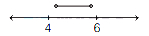
The solution set of ${ }^5 C_{x-1} > 2 \cdot { }^5 C_x$ is
A
$\{1, 2, 5\}$
B
$\{2, 3, 5\}$
C
$\{5\}$
D
$\{1, 3, 5\}$
Solution
(C) Given inequality: ${ }^5 C_{x-1} > 2 \cdot { }^5 C_x$
For the combinations to be defined,we must have $0 \le x-1 \le 5$ and $0 \le x \le 5$. Thus,$x \in \{1, 2, 3, 4, 5\}$.
Using the formula ${ }^n C_r = \frac{n!}{r!(n-r)!}$,we have:
$\frac{{ }^5 C_{x-1}}{{ }^5 C_x} > 2$
$\frac{5!}{(x-1)!(5-(x-1))!} \cdot \frac{x!(5-x)!}{5!} > 2$
$\frac{x!(5-x)!}{(x-1)!(6-x)!} > 2$
$\frac{x(x-1)!(5-x)!}{(x-1)!(6-x)(5-x)!} > 2$
$\frac{x}{6-x} > 2$
$\frac{x}{6-x} - 2 > 0$
$\frac{x - 2(6-x)}{6-x} > 0$
$\frac{x - 12 + 2x}{6-x} > 0$
$\frac{3x - 12}{6-x} > 0$
$\frac{3(x-4)}{-(x-6)} > 0$
$\frac{x-4}{x-6} < 0$
This inequality holds for $4 < x < 6$.
Since $x$ must be an integer,the only possible value is $x = 5$.
Therefore,the solution set is $\{5\}$.
For the combinations to be defined,we must have $0 \le x-1 \le 5$ and $0 \le x \le 5$. Thus,$x \in \{1, 2, 3, 4, 5\}$.
Using the formula ${ }^n C_r = \frac{n!}{r!(n-r)!}$,we have:
$\frac{{ }^5 C_{x-1}}{{ }^5 C_x} > 2$
$\frac{5!}{(x-1)!(5-(x-1))!} \cdot \frac{x!(5-x)!}{5!} > 2$
$\frac{x!(5-x)!}{(x-1)!(6-x)!} > 2$
$\frac{x(x-1)!(5-x)!}{(x-1)!(6-x)(5-x)!} > 2$
$\frac{x}{6-x} > 2$
$\frac{x}{6-x} - 2 > 0$
$\frac{x - 2(6-x)}{6-x} > 0$
$\frac{x - 12 + 2x}{6-x} > 0$
$\frac{3x - 12}{6-x} > 0$
$\frac{3(x-4)}{-(x-6)} > 0$
$\frac{x-4}{x-6} < 0$
This inequality holds for $4 < x < 6$.
Since $x$ must be an integer,the only possible value is $x = 5$.
Therefore,the solution set is $\{5\}$.
0 likes
View Solution274
MediumMCQ
$A$ student has to answer $10$ out of $13$ questions in an examination. The number of ways in which he can answer if he must answer at least $3$ of the first $5$ questions is:
A
$376$
B
$276$
C
$286$
D
$386$
Solution
(B) The student must select $10$ questions out of $13$. The first $5$ questions are in one group and the remaining $8$ questions are in another group. The student must select at least $3$ from the first $5$ questions.
Case $1$: Select $3$ from the first $5$ and $7$ from the remaining $8$.
Number of ways $= {}^{5}C_{3} \times {}^{8}C_{7} = 10 \times 8 = 80$.
Case $2$: Select $4$ from the first $5$ and $6$ from the remaining $8$.
Number of ways $= {}^{5}C_{4} \times {}^{8}C_{6} = 5 \times 28 = 140$.
Case $3$: Select $5$ from the first $5$ and $5$ from the remaining $8$.
Number of ways $= {}^{5}C_{5} \times {}^{8}C_{5} = 1 \times 56 = 56$.
Total number of ways $= 80 + 140 + 56 = 276$.
Case $1$: Select $3$ from the first $5$ and $7$ from the remaining $8$.
Number of ways $= {}^{5}C_{3} \times {}^{8}C_{7} = 10 \times 8 = 80$.
Case $2$: Select $4$ from the first $5$ and $6$ from the remaining $8$.
Number of ways $= {}^{5}C_{4} \times {}^{8}C_{6} = 5 \times 28 = 140$.
Case $3$: Select $5$ from the first $5$ and $5$ from the remaining $8$.
Number of ways $= {}^{5}C_{5} \times {}^{8}C_{5} = 1 \times 56 = 56$.
Total number of ways $= 80 + 140 + 56 = 276$.
0 likes
View Solution275
EasyMCQ
If $1 \times 1! + 2 \times 2! + 3 \times 3! + \ldots + n \times n! = 11! - 1$,then the maximum value of ${}^n C_r$ is
A
$462$
B
$252$
C
$162$
D
$512$
Solution
(B) We know that $k \times k! = (k+1-1) \times k! = (k+1)! - k!$.
Summing this from $k=1$ to $n$:
$\sum_{k=1}^{n} k \times k! = \sum_{k=1}^{n} ((k+1)! - k!) = (2! - 1!) + (3! - 2!) + \ldots + ((n+1)! - n!) = (n+1)! - 1!$.
Given that the sum is $11! - 1$,we have $(n+1)! - 1 = 11! - 1$,which implies $n+1 = 11$,so $n = 10$.
The maximum value of ${}^n C_r$ occurs at $r = n/2$ when $n$ is even.
For $n = 10$,the maximum value is ${}^{10} C_5 = \frac{10!}{5!5!} = \frac{10 \times 9 \times 8 \times 7 \times 6}{5 \times 4 \times 3 \times 2 \times 1} = 252$.
Summing this from $k=1$ to $n$:
$\sum_{k=1}^{n} k \times k! = \sum_{k=1}^{n} ((k+1)! - k!) = (2! - 1!) + (3! - 2!) + \ldots + ((n+1)! - n!) = (n+1)! - 1!$.
Given that the sum is $11! - 1$,we have $(n+1)! - 1 = 11! - 1$,which implies $n+1 = 11$,so $n = 10$.
The maximum value of ${}^n C_r$ occurs at $r = n/2$ when $n$ is even.
For $n = 10$,the maximum value is ${}^{10} C_5 = \frac{10!}{5!5!} = \frac{10 \times 9 \times 8 \times 7 \times 6}{5 \times 4 \times 3 \times 2 \times 1} = 252$.
0 likes
View Solution276
EasyMCQ
In an apartment,there are $30$ kids. If each kid plays table tennis with every other kid exactly once,then the total number of matches played by them is:
A
$^{30}C_2$
B
$^{30}P_2$
C
$^{30}C_2 - 1$
D
$^{30}P_2 - 1$
Solution
(A) match between two kids is equivalent to selecting a pair of $2$ kids out of $30$ kids.
Since the order of selection does not matter in a match,we use the combination formula.
The number of ways to choose $2$ kids out of $30$ is given by $^{30}C_2 = \frac{30 \times 29}{2 \times 1} = 435$ matches.
Since the order of selection does not matter in a match,we use the combination formula.
The number of ways to choose $2$ kids out of $30$ is given by $^{30}C_2 = \frac{30 \times 29}{2 \times 1} = 435$ matches.
0 likes
View Solution277
MediumMCQ
If ${}^n C_r$ denotes the number of combinations of $n$ things taken $r$ at a time,then the expression ${}^n C_{r+1} + {}^n C_{r-1} + 2{}^n C_r$ equals
A
${}^{n+2} C_r$
B
${}^{n+2} C_{r+1}$
C
${}^{n+1} C_r$
D
${}^{n+1} C_{r+1}$
Solution
(B) We use the identity ${}^n C_r + {}^n C_{r-1} = {}^{n+1} C_r$.
The given expression is ${}^n C_{r+1} + {}^n C_{r-1} + 2{}^n C_r$.
This can be rewritten as $({}^n C_{r+1} + {}^n C_r) + ({}^n C_r + {}^n C_{r-1})$.
Applying the identity,we get ${}^{n+1} C_{r+1} + {}^{n+1} C_r$.
Applying the identity again,we get ${}^{n+2} C_{r+1}$.
Hence,option $B$ is correct.
The given expression is ${}^n C_{r+1} + {}^n C_{r-1} + 2{}^n C_r$.
This can be rewritten as $({}^n C_{r+1} + {}^n C_r) + ({}^n C_r + {}^n C_{r-1})$.
Applying the identity,we get ${}^{n+1} C_{r+1} + {}^{n+1} C_r$.
Applying the identity again,we get ${}^{n+2} C_{r+1}$.
Hence,option $B$ is correct.
0 likes
View Solution278
EasyMCQ
In how many ways can a committee of $6$ members be formed out of $10$ members,such that it always includes a specified member?
A
$\frac{1}{2} {}^{9}P_{5}$
B
${}^{9}P_{5}$
C
${}^{9}C_{5}$
D
$\frac{1}{2} {}^{9}C_{5}$
Solution
(C) Since the committee must always include a specified member,we have already filled $1$ spot out of the $6$ required spots.
Therefore,we need to select the remaining $6 - 1 = 5$ members from the remaining $10 - 1 = 9$ members.
The number of ways to choose $5$ members from $9$ is given by the combination formula ${}^{n}C_{r} = \frac{n!}{r!(n-r)!}$.
Thus,the number of ways is ${}^{9}C_{5}$.
Hence,option $C$ is correct.
Therefore,we need to select the remaining $6 - 1 = 5$ members from the remaining $10 - 1 = 9$ members.
The number of ways to choose $5$ members from $9$ is given by the combination formula ${}^{n}C_{r} = \frac{n!}{r!(n-r)!}$.
Thus,the number of ways is ${}^{9}C_{5}$.
Hence,option $C$ is correct.
0 likes
View Solution279
EasyMCQ
$A$ student is allowed to choose at most $n$ books from a collection of $2n+1$ books. If the total number of ways in which he can select at least one book is $255$,then the value of $n$ is:
A
$4$
B
$5$
C
$6$
D
$7$
Solution
(A) Let the total number of ways to select at most $n$ books be $x$. Since the student must select at least one book,we have:
$x = {}^{2n+1}C_1 + {}^{2n+1}C_2 + \dots + {}^{2n+1}C_n = 255$
We know that the sum of all combinations for $2n+1$ items is:
${}^{2n+1}C_0 + {}^{2n+1}C_1 + \dots + {}^{2n+1}C_n + {}^{2n+1}C_{n+1} + \dots + {}^{2n+1}C_{2n+1} = 2^{2n+1}$
Using the property ${}^{m}C_r = {}^{m}C_{m-r}$,we have ${}^{2n+1}C_0 = {}^{2n+1}C_{2n+1} = 1$ and ${}^{2n+1}C_1 = {}^{2n+1}C_{2n}$,etc.
Thus,the sum can be written as:
$2({}^{2n+1}C_1 + {}^{2n+1}C_2 + \dots + {}^{2n+1}C_n) + {}^{2n+1}C_0 + {}^{2n+1}C_{2n+1} = 2^{2n+1}$
$2x + 1 + 1 = 2^{2n+1}$
$2x + 2 = 2^{2n+1}$
$x + 1 = 2^{2n}$
Given $x = 255$,we get:
$255 + 1 = 2^{2n}$
$256 = 2^{2n}$
$2^8 = 2^{2n}$
$2n = 8 \implies n = 4$
Therefore,the value of $n$ is $4$.
$x = {}^{2n+1}C_1 + {}^{2n+1}C_2 + \dots + {}^{2n+1}C_n = 255$
We know that the sum of all combinations for $2n+1$ items is:
${}^{2n+1}C_0 + {}^{2n+1}C_1 + \dots + {}^{2n+1}C_n + {}^{2n+1}C_{n+1} + \dots + {}^{2n+1}C_{2n+1} = 2^{2n+1}$
Using the property ${}^{m}C_r = {}^{m}C_{m-r}$,we have ${}^{2n+1}C_0 = {}^{2n+1}C_{2n+1} = 1$ and ${}^{2n+1}C_1 = {}^{2n+1}C_{2n}$,etc.
Thus,the sum can be written as:
$2({}^{2n+1}C_1 + {}^{2n+1}C_2 + \dots + {}^{2n+1}C_n) + {}^{2n+1}C_0 + {}^{2n+1}C_{2n+1} = 2^{2n+1}$
$2x + 1 + 1 = 2^{2n+1}$
$2x + 2 = 2^{2n+1}$
$x + 1 = 2^{2n}$
Given $x = 255$,we get:
$255 + 1 = 2^{2n}$
$256 = 2^{2n}$
$2^8 = 2^{2n}$
$2n = 8 \implies n = 4$
Therefore,the value of $n$ is $4$.
0 likes
View Solution280
EasyMCQ
The number of ways of forming a committee of $6$ members out of $5$ Indians,$5$ Americans,and $5$ Australians such that there will be at least one member from each country in the committee is:
A
$3375$
B
$4375$
C
$3875$
D
$4250$
Solution
(B) To form a committee of $6$ members with at least one member from each of the $3$ countries (Indians,Americans,Australians),we consider the possible distributions of members $(n_I, n_A, n_{Au})$ such that $n_I + n_A + n_{Au} = 6$ and $n_I, n_A, n_{Au} \ge 1$.
The possible partitions of $6$ into $3$ parts are:
$1. (4, 1, 1)$ and its permutations: $(4, 1, 1), (1, 4, 1), (1, 1, 4)$. There are $3$ such cases.
Number of ways $= 3 \times \binom{5}{4} \times \binom{5}{1} \times \binom{5}{1} = 3 \times 5 \times 5 \times 5 = 375$.
$2. (3, 2, 1)$ and its permutations: $(3, 2, 1), (3, 1, 2), (2, 3, 1), (2, 1, 3), (1, 3, 2), (1, 2, 3)$. There are $3! = 6$ such cases.
Number of ways $= 6 \times \binom{5}{3} \times \binom{5}{2} \times \binom{5}{1} = 6 \times 10 \times 10 \times 5 = 3000$.
$3. (2, 2, 2)$. There is $1$ such case.
Number of ways $= 1 \times \binom{5}{2} \times \binom{5}{2} \times \binom{5}{2} = 10 \times 10 \times 10 = 1000$.
Total ways $= 375 + 3000 + 1000 = 4375$.
The possible partitions of $6$ into $3$ parts are:
$1. (4, 1, 1)$ and its permutations: $(4, 1, 1), (1, 4, 1), (1, 1, 4)$. There are $3$ such cases.
Number of ways $= 3 \times \binom{5}{4} \times \binom{5}{1} \times \binom{5}{1} = 3 \times 5 \times 5 \times 5 = 375$.
$2. (3, 2, 1)$ and its permutations: $(3, 2, 1), (3, 1, 2), (2, 3, 1), (2, 1, 3), (1, 3, 2), (1, 2, 3)$. There are $3! = 6$ such cases.
Number of ways $= 6 \times \binom{5}{3} \times \binom{5}{2} \times \binom{5}{1} = 6 \times 10 \times 10 \times 5 = 3000$.
$3. (2, 2, 2)$. There is $1$ such case.
Number of ways $= 1 \times \binom{5}{2} \times \binom{5}{2} \times \binom{5}{2} = 10 \times 10 \times 10 = 1000$.
Total ways $= 375 + 3000 + 1000 = 4375$.
0 likes
View Solution281
MediumMCQ
There are $10$ intermediate stations on a railway line between two particular stations. The number of ways that a train can be made to stop at $3$ of these intermediate stations so that no two of these halting stations are consecutive is:
A
$56$
B
$20$
C
$126$
D
$120$
Solution
(A) Let the $10$ intermediate stations be $S_1, S_2, S_3, \dots, S_{10}$.
We need to select $3$ stations such that no two are consecutive.
This is a classic problem of selecting $r$ objects from $n$ objects arranged in a row such that no two are consecutive,which is given by the formula $^{n-r+1}C_r$.
Here,$n = 10$ and $r = 3$.
Number of ways $= ^{10-3+1}C_3 = ^8C_3$.
Calculating the value: $^8C_3 = \frac{8 \times 7 \times 6}{3 \times 2 \times 1} = 56$.
We need to select $3$ stations such that no two are consecutive.
This is a classic problem of selecting $r$ objects from $n$ objects arranged in a row such that no two are consecutive,which is given by the formula $^{n-r+1}C_r$.
Here,$n = 10$ and $r = 3$.
Number of ways $= ^{10-3+1}C_3 = ^8C_3$.
Calculating the value: $^8C_3 = \frac{8 \times 7 \times 6}{3 \times 2 \times 1} = 56$.
0 likes
View Solution282
DifficultMCQ
If ${}^nC_{r-1}=330$,${}^nC_r=462$,and ${}^nC_{r+1}=462$,then $r$ is equal to
A
$3$
B
$4$
C
$5$
D
$6$
Solution
(C) Given,${}^nC_{r-1}=330$,${}^nC_r=462$,and ${}^nC_{r+1}=462$.
We know that $\frac{{}^nC_{r+1}}{{}^nC_r} = \frac{n-r}{r+1}$.
Since ${}^nC_{r+1} = {}^nC_r = 462$,we have $\frac{462}{462} = 1$.
Therefore,$\frac{n-r}{r+1} = 1 \implies n-r = r+1 \implies n = 2r+1$.
Now,consider the ratio $\frac{{}^nC_r}{{}^nC_{r-1}} = \frac{462}{330}$.
Using the formula $\frac{{}^nC_r}{{}^nC_{r-1}} = \frac{n-r+1}{r}$,we get $\frac{n-r+1}{r} = \frac{462}{330} = \frac{7}{5}$.
Substituting $n = 2r+1$ into the equation:
$\frac{(2r+1)-r+1}{r} = \frac{7}{5} \implies \frac{r+2}{r} = \frac{7}{5}$.
$5(r+2) = 7r \implies 5r + 10 = 7r \implies 2r = 10 \implies r = 5$.
We know that $\frac{{}^nC_{r+1}}{{}^nC_r} = \frac{n-r}{r+1}$.
Since ${}^nC_{r+1} = {}^nC_r = 462$,we have $\frac{462}{462} = 1$.
Therefore,$\frac{n-r}{r+1} = 1 \implies n-r = r+1 \implies n = 2r+1$.
Now,consider the ratio $\frac{{}^nC_r}{{}^nC_{r-1}} = \frac{462}{330}$.
Using the formula $\frac{{}^nC_r}{{}^nC_{r-1}} = \frac{n-r+1}{r}$,we get $\frac{n-r+1}{r} = \frac{462}{330} = \frac{7}{5}$.
Substituting $n = 2r+1$ into the equation:
$\frac{(2r+1)-r+1}{r} = \frac{7}{5} \implies \frac{r+2}{r} = \frac{7}{5}$.
$5(r+2) = 7r \implies 5r + 10 = 7r \implies 2r = 10 \implies r = 5$.
0 likes
View Solution283
DifficultMCQ
If ${ }^{(n-1)} C_3+{ }^{(n-1)} C_4>{ }^n C_3$,then the minimum value of $n$ is
A
$5$
B
$6$
C
$7$
D
$8$
Solution
(D) Given,${ }^{n-1} C_3+{ }^{n-1} C_4>{ }^n C_3$
Using the identity ${ }^n C_r+{ }^n C_{r-1}={ }^{n+1} C_r$,we have:
${ }^n C_4>{ }^n C_3$
Expanding the combinations:
$\frac{n!}{4!(n-4)!} > \frac{n!}{3!(n-3)!}$
$\frac{1}{4(n-4)!} > \frac{1}{(n-3)(n-4)!}$
$\frac{1}{4} > \frac{1}{n-3}$
$n-3 > 4$
$n > 7$
Since $n$ must be an integer greater than $7$,the minimum value of $n$ is $8$.
Using the identity ${ }^n C_r+{ }^n C_{r-1}={ }^{n+1} C_r$,we have:
${ }^n C_4>{ }^n C_3$
Expanding the combinations:
$\frac{n!}{4!(n-4)!} > \frac{n!}{3!(n-3)!}$
$\frac{1}{4(n-4)!} > \frac{1}{(n-3)(n-4)!}$
$\frac{1}{4} > \frac{1}{n-3}$
$n-3 > 4$
$n > 7$
Since $n$ must be an integer greater than $7$,the minimum value of $n$ is $8$.
0 likes
View Solution284
DifficultMCQ
The least value of the natural number $n$ satisfying $C(n, 5)+C(n, 6)>C(n+1, 5)$ is
A
$10$
B
$11$
C
$12$
D
$13$
Solution
(B) Using the Pascal's identity,${}^nC_r + {}^nC_{r-1} = {}^{n+1}C_r$,we have ${}^nC_5 + {}^nC_6 = {}^{n+1}C_6$.
Given inequality: ${}^{n+1}C_6 > {}^{n+1}C_5$.
Expanding the combinations: $\frac{(n+1)!}{6!(n-5)!} > \frac{(n+1)!}{5!(n-4)!}$.
Dividing both sides by $(n+1)!$ and simplifying: $\frac{1}{6!(n-5)!} > \frac{1}{5!(n-4)!}$.
Since $6! = 6 \times 5!$ and $(n-4)! = (n-4) \times (n-5)!$,we get: $\frac{1}{6 \times 5!(n-5)!} > \frac{1}{5!(n-4)(n-5)!}$.
Canceling common terms: $\frac{1}{6} > \frac{1}{n-4}$.
This implies $n-4 > 6$,so $n > 10$.
The least natural number $n$ satisfying this is $n = 11$.
Given inequality: ${}^{n+1}C_6 > {}^{n+1}C_5$.
Expanding the combinations: $\frac{(n+1)!}{6!(n-5)!} > \frac{(n+1)!}{5!(n-4)!}$.
Dividing both sides by $(n+1)!$ and simplifying: $\frac{1}{6!(n-5)!} > \frac{1}{5!(n-4)!}$.
Since $6! = 6 \times 5!$ and $(n-4)! = (n-4) \times (n-5)!$,we get: $\frac{1}{6 \times 5!(n-5)!} > \frac{1}{5!(n-4)(n-5)!}$.
Canceling common terms: $\frac{1}{6} > \frac{1}{n-4}$.
This implies $n-4 > 6$,so $n > 10$.
The least natural number $n$ satisfying this is $n = 11$.
0 likes
View Solution285
EasyMCQ
The number of ways a committee of $8$ members can be formed from a group of $10$ men and $8$ women such that the committee contains at most $5$ men and at least $5$ women is:
A
$8061$
B
$8612$
C
$6082$
D
$8271$
Solution
(A) We need to form a committee of $8$ members from $10$ men and $8$ women such that there are at most $5$ men and at least $5$ women.
Since the total number of members is $8$,the possible combinations of (women,men) are:
$(5, 3), (6, 2), (7, 1), (8, 0)$.
The number of ways is given by:
$\sum_{k=5}^{8} {}^{8}C_{k} \times {}^{10}C_{8-k}$
$= {}^{8}C_{5} \times {}^{10}C_{3} + {}^{8}C_{6} \times {}^{10}C_{2} + {}^{8}C_{7} \times {}^{10}C_{1} + {}^{8}C_{8} \times {}^{10}C_{0}$
$= (56 \times 120) + (28 \times 45) + (8 \times 10) + (1 \times 1)$
$= 6720 + 1260 + 80 + 1 = 8061$.
Since the total number of members is $8$,the possible combinations of (women,men) are:
$(5, 3), (6, 2), (7, 1), (8, 0)$.
The number of ways is given by:
$\sum_{k=5}^{8} {}^{8}C_{k} \times {}^{10}C_{8-k}$
$= {}^{8}C_{5} \times {}^{10}C_{3} + {}^{8}C_{6} \times {}^{10}C_{2} + {}^{8}C_{7} \times {}^{10}C_{1} + {}^{8}C_{8} \times {}^{10}C_{0}$
$= (56 \times 120) + (28 \times 45) + (8 \times 10) + (1 \times 1)$
$= 6720 + 1260 + 80 + 1 = 8061$.
0 likes
View Solution286
MediumMCQ
If a committee of $10$ members is to be formed from $8$ men and $6$ women,then the number of different possible committees in which the men are in majority is
A
$931$
B
$175$
C
$48$
D
$595$
Solution
(D) To form a committee of $10$ members where men are in majority,the number of men must be greater than the number of women. Since the total members are $10$,the possible cases for (men,women) are $(6, 4), (7, 3), (8, 2)$.
Number of ways = $^8C_6 \times ^6C_4 + ^8C_7 \times ^6C_3 + ^8C_8 \times ^6C_2$.
Calculating each term:
$^8C_6 \times ^6C_4 = 28 \times 15 = 420$.
$^8C_7 \times ^6C_3 = 8 \times 20 = 160$.
$^8C_8 \times ^6C_2 = 1 \times 15 = 15$.
Total ways = $420 + 160 + 15 = 595$.
Number of ways = $^8C_6 \times ^6C_4 + ^8C_7 \times ^6C_3 + ^8C_8 \times ^6C_2$.
Calculating each term:
$^8C_6 \times ^6C_4 = 28 \times 15 = 420$.
$^8C_7 \times ^6C_3 = 8 \times 20 = 160$.
$^8C_8 \times ^6C_2 = 1 \times 15 = 15$.
Total ways = $420 + 160 + 15 = 595$.
0 likes
View Solution287
EasyMCQ
There are $7$ identical white balls and $3$ identical black balls. The number of distinguishable arrangements in a row of all the balls,so that no two black balls are adjacent is
A
$120$
B
$89$
C
$56$
D
$42$
Solution
(C) To solve this,we use the gap method.
Since the $7$ white balls are identical,they can be arranged in only $1$ way.
To ensure no two black balls are adjacent,we place the $3$ black balls in the gaps created by the $7$ white balls.
Representing white balls as $W$,the arrangement is: $\_ W \_ W \_ W \_ W \_ W \_ W \_ W \_$.
There are $8$ available slots for the $3$ identical black balls.
The number of ways to choose $3$ slots out of $8$ is given by ${}^8C_3$.
${}^8C_3 = \frac{8 \times 7 \times 6}{3 \times 2 \times 1} = 56$.
Thus,the total number of distinguishable arrangements is $56$.
Since the $7$ white balls are identical,they can be arranged in only $1$ way.
To ensure no two black balls are adjacent,we place the $3$ black balls in the gaps created by the $7$ white balls.
Representing white balls as $W$,the arrangement is: $\_ W \_ W \_ W \_ W \_ W \_ W \_ W \_$.
There are $8$ available slots for the $3$ identical black balls.
The number of ways to choose $3$ slots out of $8$ is given by ${}^8C_3$.
${}^8C_3 = \frac{8 \times 7 \times 6}{3 \times 2 \times 1} = 56$.
Thus,the total number of distinguishable arrangements is $56$.
0 likes
View Solution288
EasyMCQ
The number of ways of distributing $8$ identical rings to $3$ different girls so that every girl gets at least $1$ ring is
A
$21$
B
$120$
C
$^8 P_3$
D
$^8 P_3 - 6$
Solution
(A) To distribute $n$ identical items among $r$ distinct recipients such that each recipient gets at least $1$ item,we use the stars and bars method (or the formula for positive integer solutions to $x_1 + x_2 + \dots + x_r = n$).
Here,$n = 8$ and $r = 3$.
The number of ways is given by the formula $\binom{n-1}{r-1}$.
Substituting the values,we get $\binom{8-1}{3-1} = \binom{7}{2}$.
$\binom{7}{2} = \frac{7 \times 6}{2 \times 1} = 21$.
Here,$n = 8$ and $r = 3$.
The number of ways is given by the formula $\binom{n-1}{r-1}$.
Substituting the values,we get $\binom{8-1}{3-1} = \binom{7}{2}$.
$\binom{7}{2} = \frac{7 \times 6}{2 \times 1} = 21$.
0 likes
View Solution289
MediumMCQ
In how many ways can $4$ balls be picked from $6$ black and $4$ green colored balls such that at least one black ball is selected?
A
$212$
B
$210$
C
$209$
D
$15$
Solution
(C) The total number of ways to select $4$ balls from $10$ balls ($6$ black + $4$ green) is given by $^{10}C_4 = \frac{10 \times 9 \times 8 \times 7}{4 \times 3 \times 2 \times 1} = 210$.
The number of ways to select $4$ balls such that no black ball is selected (i.e.,all $4$ balls are green) is $^{4}C_4 = 1$.
Therefore,the number of ways to select at least one black ball is (Total ways) - (Ways with no black ball) = $210 - 1 = 209$.
The number of ways to select $4$ balls such that no black ball is selected (i.e.,all $4$ balls are green) is $^{4}C_4 = 1$.
Therefore,the number of ways to select at least one black ball is (Total ways) - (Ways with no black ball) = $210 - 1 = 209$.
0 likes
View Solution290
EasyMCQ
The number of ways of choosing a committee from $4$ men and $6$ women so that the committee includes at least $2$ men and exactly twice as many women as men is
A
$90$
B
$92$
C
$94$
D
$96$
Solution
(C) Let $m$ be the number of men and $w$ be the number of women in the committee.
We are given that $w = 2m$ and $m \ge 2$.
Since there are $4$ men and $6$ women available,we have the constraints $m \le 4$ and $w \le 6$.
Substituting $w = 2m$ into $w \le 6$,we get $2m \le 6$,which implies $m \le 3$.
Thus,the possible values for $m$ are $2$ and $3$.
Case $1$: If $m = 2$,then $w = 2(2) = 4$. The number of ways is $^4C_2 \times ^6C_4 = 6 \times 15 = 90$.
Case $2$: If $m = 3$,then $w = 2(3) = 6$. The number of ways is $^4C_3 \times ^6C_6 = 4 \times 1 = 4$.
Total number of ways = $90 + 4 = 94$.
We are given that $w = 2m$ and $m \ge 2$.
Since there are $4$ men and $6$ women available,we have the constraints $m \le 4$ and $w \le 6$.
Substituting $w = 2m$ into $w \le 6$,we get $2m \le 6$,which implies $m \le 3$.
Thus,the possible values for $m$ are $2$ and $3$.
Case $1$: If $m = 2$,then $w = 2(2) = 4$. The number of ways is $^4C_2 \times ^6C_4 = 6 \times 15 = 90$.
Case $2$: If $m = 3$,then $w = 2(3) = 6$. The number of ways is $^4C_3 \times ^6C_6 = 4 \times 1 = 4$.
Total number of ways = $90 + 4 = 94$.
0 likes
View Solution291
MediumMCQ
From $5$ consonants and $5$ vowels,how many words can be formed using $3$ consonants and $2$ vowels?
A
$12000$
B
$2000$
C
$20000$
D
$1200$
Solution
(A) We need to form words using $3$ consonants and $2$ vowels from $5$ consonants and $5$ vowels.
First,we select the consonants and vowels:
Number of ways to select $3$ consonants from $5$ is ${}^5C_3 = \frac{5 \times 4}{2 \times 1} = 10$.
Number of ways to select $2$ vowels from $5$ is ${}^5C_2 = \frac{5 \times 4}{2 \times 1} = 10$.
Total ways to select the letters = $10 \times 10 = 100$.
Now,these $5$ selected letters can be arranged among themselves in $5!$ ways.
$5! = 5 \times 4 \times 3 \times 2 \times 1 = 120$.
Total number of words formed = $100 \times 120 = 12000$.
First,we select the consonants and vowels:
Number of ways to select $3$ consonants from $5$ is ${}^5C_3 = \frac{5 \times 4}{2 \times 1} = 10$.
Number of ways to select $2$ vowels from $5$ is ${}^5C_2 = \frac{5 \times 4}{2 \times 1} = 10$.
Total ways to select the letters = $10 \times 10 = 100$.
Now,these $5$ selected letters can be arranged among themselves in $5!$ ways.
$5! = 5 \times 4 \times 3 \times 2 \times 1 = 120$.
Total number of words formed = $100 \times 120 = 12000$.
0 likes
View Solution292
EasyMCQ
The number of ways in which $17$ apples can be distributed among $4$ guests such that each guest gets at least $3$ apples is
A
$1140$
B
$336$
C
$36$
D
$56$
Solution
(D) Let $x_1, x_2, x_3, x_4$ be the number of apples received by the $4$ guests respectively. We need to find the number of integer solutions to $x_1 + x_2 + x_3 + x_4 = 17$ where $x_i \ge 3$ for each $i \in \{1, 2, 3, 4\}$.
Let $y_i = x_i - 3$,then $y_i \ge 0$.
Substituting $x_i = y_i + 3$ into the equation: $(y_1 + 3) + (y_2 + 3) + (y_3 + 3) + (y_4 + 3) = 17$.
$y_1 + y_2 + y_3 + y_4 + 12 = 17 \implies y_1 + y_2 + y_3 + y_4 = 5$.
The number of non-negative integer solutions is given by the formula $\binom{n+r-1}{r-1}$,where $n=5$ and $r=4$.
Number of ways $= \binom{5+4-1}{4-1} = \binom{8}{3} = \frac{8 \times 7 \times 6}{3 \times 2 \times 1} = 56$.
Let $y_i = x_i - 3$,then $y_i \ge 0$.
Substituting $x_i = y_i + 3$ into the equation: $(y_1 + 3) + (y_2 + 3) + (y_3 + 3) + (y_4 + 3) = 17$.
$y_1 + y_2 + y_3 + y_4 + 12 = 17 \implies y_1 + y_2 + y_3 + y_4 = 5$.
The number of non-negative integer solutions is given by the formula $\binom{n+r-1}{r-1}$,where $n=5$ and $r=4$.
Number of ways $= \binom{5+4-1}{4-1} = \binom{8}{3} = \frac{8 \times 7 \times 6}{3 \times 2 \times 1} = 56$.
0 likes
View Solution293
EasyMCQ
If there are $6$ alike fruits,$7$ alike vegetables,and $8$ alike biscuits,then the number of ways of selecting any number of things out of them such that at least one from each category is selected,is
A
$504$
B
$336$
C
$503$
D
$335$
Solution
(B) Since the items in each category are alike,the number of ways to select items from each category is equal to the number of items available plus one (for the case of selecting zero items).
For $6$ alike fruits,the number of ways to select is $(6+1) = 7$.
For $7$ alike vegetables,the number of ways to select is $(7+1) = 8$.
For $8$ alike biscuits,the number of ways to select is $(8+1) = 9$.
To ensure at least one item from each category is selected,we must select at least $1$ fruit,$1$ vegetable,and $1$ biscuit.
The number of ways to select at least one fruit is $6$.
The number of ways to select at least one vegetable is $7$.
The number of ways to select at least one biscuit is $8$.
Therefore,the total number of ways is $6 \times 7 \times 8 = 336$.
For $6$ alike fruits,the number of ways to select is $(6+1) = 7$.
For $7$ alike vegetables,the number of ways to select is $(7+1) = 8$.
For $8$ alike biscuits,the number of ways to select is $(8+1) = 9$.
To ensure at least one item from each category is selected,we must select at least $1$ fruit,$1$ vegetable,and $1$ biscuit.
The number of ways to select at least one fruit is $6$.
The number of ways to select at least one vegetable is $7$.
The number of ways to select at least one biscuit is $8$.
Therefore,the total number of ways is $6 \times 7 \times 8 = 336$.
0 likes
View Solution294
EasyMCQ
$A$ question paper has two sections $A$ and $B$,in which section-$A$ has $8$ questions and section-$B$ has $6$ questions. $A$ student has to answer a total of $10$ questions,choosing at least $4$ questions from section-$A$ and at least $3$ questions from section-$B$. The number of ways a student can answer the paper is:
A
$800$
B
$820$
C
$840$
D
$986$
Solution
(D) The student needs to select $10$ questions in total,with at least $4$ from section-$A$ ($8$ available) and at least $3$ from section-$B$ ($6$ available).
Possible combinations $(A, B)$ are:
$(i)$ $4$ from $A$ and $6$ from $B$: $\binom{8}{4} \times \binom{6}{6} = 70 \times 1 = 70$
(ii) $5$ from $A$ and $5$ from $B$: $\binom{8}{5} \times \binom{6}{5} = 56 \times 6 = 336$
(iii) $6$ from $A$ and $4$ from $B$: $\binom{8}{6} \times \binom{6}{4} = 28 \times 15 = 420$
(iv) $7$ from $A$ and $3$ from $B$: $\binom{8}{7} \times \binom{6}{3} = 8 \times 20 = 160$
Total ways $= 70 + 336 + 420 + 160 = 986$.
Possible combinations $(A, B)$ are:
$(i)$ $4$ from $A$ and $6$ from $B$: $\binom{8}{4} \times \binom{6}{6} = 70 \times 1 = 70$
(ii) $5$ from $A$ and $5$ from $B$: $\binom{8}{5} \times \binom{6}{5} = 56 \times 6 = 336$
(iii) $6$ from $A$ and $4$ from $B$: $\binom{8}{6} \times \binom{6}{4} = 28 \times 15 = 420$
(iv) $7$ from $A$ and $3$ from $B$: $\binom{8}{7} \times \binom{6}{3} = 8 \times 20 = 160$
Total ways $= 70 + 336 + 420 + 160 = 986$.
0 likes
View Solution295
MediumMCQ
Given $5$ different green toys,$4$ different blue toys,and $3$ different red toys,how many combinations of toys can be chosen taking at least one green and one blue toy?
A
$32 \times 16 \times 4$
B
$31 \times 15 \times 4$
C
$32 \times 16 \times 8$
D
$31 \times 15 \times 8$
Solution
(D) The number of ways to select at least one green toy from $5$ is $2^5 - 1 = 31$ ways.
The number of ways to select at least one blue toy from $4$ is $2^4 - 1 = 15$ ways.
The number of ways to select any number of red toys from $3$ (including zero) is $2^3 = 8$ ways.
Since these selections are independent,the total number of combinations is $31 \times 15 \times 8$.
The number of ways to select at least one blue toy from $4$ is $2^4 - 1 = 15$ ways.
The number of ways to select any number of red toys from $3$ (including zero) is $2^3 = 8$ ways.
Since these selections are independent,the total number of combinations is $31 \times 15 \times 8$.
0 likes
View Solution296
MediumMCQ
There are $4$ oranges,$5$ apples,and $7$ mangoes in a fruit basket. The number of ways of selecting at least one fruit from among the fruits in the basket is
A
$210$
B
$240$
C
$209$
D
$239$
Solution
(D) Considering fruits of the same kind to be identical.
If there are $p$ identical items of the $1^{\text{st}}$ kind,$q$ identical items of the $2^{\text{nd}}$ kind,and $r$ identical items of the $3^{\text{rd}}$ kind,then the total number of ways of selecting any number of objects is given by $(p+1)(q+1)(r+1)$.
In this case,$p=4$,$q=5$,and $r=7$.
Total number of ways including the case of selecting zero fruits $= (4+1)(5+1)(7+1) = 5 \times 6 \times 8 = 240$.
Since we must select at least one fruit,we exclude the case where $0$ oranges,$0$ apples,and $0$ mangoes are selected.
Total number of ways of selecting at least one fruit $= 240 - 1 = 239$.
If there are $p$ identical items of the $1^{\text{st}}$ kind,$q$ identical items of the $2^{\text{nd}}$ kind,and $r$ identical items of the $3^{\text{rd}}$ kind,then the total number of ways of selecting any number of objects is given by $(p+1)(q+1)(r+1)$.
In this case,$p=4$,$q=5$,and $r=7$.
Total number of ways including the case of selecting zero fruits $= (4+1)(5+1)(7+1) = 5 \times 6 \times 8 = 240$.
Since we must select at least one fruit,we exclude the case where $0$ oranges,$0$ apples,and $0$ mangoes are selected.
Total number of ways of selecting at least one fruit $= 240 - 1 = 239$.
0 likes
View SolutionPermutation and Combination — Definition of combinations, Condition combinations · Frequently Asked Questions
1Are these Permutation and Combination questions useful for JEE and NEET?
Yes. All questions in this section are mapped to JEE Main and NEET exam patterns. Previous year questions from JEE Main, NEET, GUJCET and state-level exams are included with full solutions.
2Can I switch to Hindi or Gujarati for these questions?
Yes. Use the language tabs in the hero section or the sidebar to view the same questions and solutions in English, Hindi or Gujarati.
3How do I generate a question paper from this subtopic?
Use the Vedclass Exam Paper Generator — select the chapter and subtopic, set difficulty, and generate Sets A, B, C, D automatically. First 3 chapters of every subject are free.
Vedclass Products
For Students
Vedclass Test Series
Mock tests in real JEE/NEET style with performance analysis. 5-day free trial.
Start Free TrialFor Teachers
Exam Paper Generator
Generate Set A/B/C/D papers from this chapter in 2 minutes. 3 chapters free.
Try FreeFor Institutes
Online Exam Module
Live online exams with unlimited students, 360° analytics & white-label branding.
See DemoFor Teachers & Institutes
Generate a Permutation and Combination Exam Paper in 2 Minutes
Select subtopic & difficulty — Sets A, B, C, D auto-generated with No Repeat logic.
First 3 chapters of every subject are free — no payment required.