
A English
Word problem of Linear inequalities Questions in English
Class 11 Mathematics · Linear Inequalities · Word problem of Linear inequalities
100+
Questions
English
Language
100%
With Solutions
Showing 50 of 100 questions in English
1
MediumMCQ
If $x$ is real and satisfies $x + 2 > \sqrt{x + 4}$,then
A
$x < -2$
B
$x > 0$
C
$-3 < x < 0$
D
$-3 < x < 4$
Solution
(B) For the square root to be defined,we must have $x + 4 \geq 0$,which implies $x \geq -4$.
Given the inequality $x + 2 > \sqrt{x + 4}$.
If $x + 2 < 0$ (i.e.,$x < -2$),the inequality is not satisfied because the left side is negative and the right side is non-negative.
Thus,we must have $x + 2 \geq 0$,i.e.,$x \geq -2$.
Squaring both sides,we get $(x + 2)^2 > x + 4$.
$x^2 + 4x + 4 > x + 4$.
$x^2 + 3x > 0$.
$x(x + 3) > 0$.
This inequality holds when $x > 0$ or $x < -3$.
Combining this with the condition $x \geq -2$,we get $x > 0$.
Given the inequality $x + 2 > \sqrt{x + 4}$.
If $x + 2 < 0$ (i.e.,$x < -2$),the inequality is not satisfied because the left side is negative and the right side is non-negative.
Thus,we must have $x + 2 \geq 0$,i.e.,$x \geq -2$.
Squaring both sides,we get $(x + 2)^2 > x + 4$.
$x^2 + 4x + 4 > x + 4$.
$x^2 + 3x > 0$.
$x(x + 3) > 0$.
This inequality holds when $x > 0$ or $x < -3$.
Combining this with the condition $x \geq -2$,we get $x > 0$.
0 likes
View Solution2
DifficultMCQ
The set of all real numbers $x$ for which ${x^2} - |x + 2| + x > 0$ is
A
$( - \infty , - 2) \cup (2, \infty )$
B
$( - \infty , - \sqrt{2} ) \cup (\sqrt{2}, \infty )$
C
$( - \infty , - 1) \cup (1, \infty )$
D
$( \sqrt{2}, \infty )$
Solution
(B) Case $I$: When $x + 2 \ge 0$ i.e.,$x \ge -2,$
The given inequality becomes ${x^2} - (x + 2) + x > 0 \implies {x^2} - 2 > 0 \implies |x| > \sqrt{2}.$
This implies $x < -\sqrt{2}$ or $x > \sqrt{2}.$
Since $x \ge -2,$ the solution set for this case is $[ -2, -\sqrt{2} ) \cup (\sqrt{2}, \infty ).$
Case $II$: When $x + 2 < 0$ i.e.,$x < -2,$
The given inequality becomes ${x^2} + (x + 2) + x > 0 \implies {x^2} + 2x + 2 > 0.$
Since the discriminant $D = 2^2 - 4(1)(2) = 4 - 8 = -4 < 0$ and the coefficient of ${x^2}$ is positive,the expression ${x^2} + 2x + 2$ is always positive for all real $x.$
Thus,the solution set for this case is $( -\infty, -2).$
Combining the two cases,the total solution set is $( -\infty, -2) \cup [ -2, -\sqrt{2} ) \cup (\sqrt{2}, \infty ) = ( -\infty, -\sqrt{2} ) \cup (\sqrt{2}, \infty ).$
The given inequality becomes ${x^2} - (x + 2) + x > 0 \implies {x^2} - 2 > 0 \implies |x| > \sqrt{2}.$
This implies $x < -\sqrt{2}$ or $x > \sqrt{2}.$
Since $x \ge -2,$ the solution set for this case is $[ -2, -\sqrt{2} ) \cup (\sqrt{2}, \infty ).$
Case $II$: When $x + 2 < 0$ i.e.,$x < -2,$
The given inequality becomes ${x^2} + (x + 2) + x > 0 \implies {x^2} + 2x + 2 > 0.$
Since the discriminant $D = 2^2 - 4(1)(2) = 4 - 8 = -4 < 0$ and the coefficient of ${x^2}$ is positive,the expression ${x^2} + 2x + 2$ is always positive for all real $x.$
Thus,the solution set for this case is $( -\infty, -2).$
Combining the two cases,the total solution set is $( -\infty, -2) \cup [ -2, -\sqrt{2} ) \cup (\sqrt{2}, \infty ) = ( -\infty, -\sqrt{2} ) \cup (\sqrt{2}, \infty ).$
0 likes
View Solution3
EasyMCQ
The set of values of $x$ which satisfy $5x + 2 < 3x + 8$ and $\frac{x + 2}{x - 1} < 4$ is
A
$(2, 3)$
B
$(-\infty, 1) \cup (2, 3)$
C
$(-\infty, 1)$
D
$(1, 3)$
Solution
(B) Step $1$: Solve the first inequality: $5x + 2 < 3x + 8 \implies 2x < 6 \implies x < 3$.
Step $2$: Solve the second inequality: $\frac{x + 2}{x - 1} < 4 \implies \frac{x + 2}{x - 1} - 4 < 0 \implies \frac{x + 2 - 4(x - 1)}{x - 1} < 0 \implies \frac{x + 2 - 4x + 4}{x - 1} < 0 \implies \frac{-3x + 6}{x - 1} < 0$.
Multiplying by $-1$,we get $\frac{3x - 6}{x - 1} > 0 \implies \frac{x - 2}{x - 1} > 0$.
Using the sign scheme (Wavy curve method),the solution is $x \in (-\infty, 1) \cup (2, \infty)$.
Step $3$: Find the intersection of $x < 3$ and $x \in (-\infty, 1) \cup (2, \infty)$.
The intersection is $(-\infty, 1) \cup (2, 3)$.
Step $2$: Solve the second inequality: $\frac{x + 2}{x - 1} < 4 \implies \frac{x + 2}{x - 1} - 4 < 0 \implies \frac{x + 2 - 4(x - 1)}{x - 1} < 0 \implies \frac{x + 2 - 4x + 4}{x - 1} < 0 \implies \frac{-3x + 6}{x - 1} < 0$.
Multiplying by $-1$,we get $\frac{3x - 6}{x - 1} > 0 \implies \frac{x - 2}{x - 1} > 0$.
Using the sign scheme (Wavy curve method),the solution is $x \in (-\infty, 1) \cup (2, \infty)$.
Step $3$: Find the intersection of $x < 3$ and $x \in (-\infty, 1) \cup (2, \infty)$.
The intersection is $(-\infty, 1) \cup (2, 3)$.
0 likes
View Solution4
MediumMCQ
If $\frac{2x}{2x^2 + 5x + 2} > \frac{1}{x + 1}$,then
A
$-2 > x > -1$
B
$-2 \ge x \ge -1$
C
$-2 < x < -1$
D
$-2 < x \le -1$
Solution
(C) Given the inequality: $\frac{2x}{2x^2 + 5x + 2} > \frac{1}{x + 1}$
Factor the denominator: $\frac{2x}{(2x + 1)(x + 2)} > \frac{1}{x + 1}$
Subtract $\frac{1}{x + 1}$ from both sides: $\frac{2x}{(2x + 1)(x + 2)} - \frac{1}{x + 1} > 0$
Find a common denominator: $\frac{2x(x + 1) - (2x + 1)(x + 2)}{(2x + 1)(x + 2)(x + 1)} > 0$
Simplify the numerator: $\frac{2x^2 + 2x - (2x^2 + 5x + 2)}{(2x + 1)(x + 2)(x + 1)} > 0$
$\frac{-3x - 2}{(2x + 1)(x + 2)(x + 1)} > 0$
Multiply by $-1$ and reverse the inequality: $\frac{3x + 2}{(2x + 1)(x + 2)(x + 1)} < 0$
The critical points are $x = -2, -1, -\frac{2}{3}, -\frac{1}{2}$.
Testing the intervals,the inequality holds for $x \in (-2, -1) \cup (-\frac{2}{3}, -\frac{1}{2})$.
Factor the denominator: $\frac{2x}{(2x + 1)(x + 2)} > \frac{1}{x + 1}$
Subtract $\frac{1}{x + 1}$ from both sides: $\frac{2x}{(2x + 1)(x + 2)} - \frac{1}{x + 1} > 0$
Find a common denominator: $\frac{2x(x + 1) - (2x + 1)(x + 2)}{(2x + 1)(x + 2)(x + 1)} > 0$
Simplify the numerator: $\frac{2x^2 + 2x - (2x^2 + 5x + 2)}{(2x + 1)(x + 2)(x + 1)} > 0$
$\frac{-3x - 2}{(2x + 1)(x + 2)(x + 1)} > 0$
Multiply by $-1$ and reverse the inequality: $\frac{3x + 2}{(2x + 1)(x + 2)(x + 1)} < 0$
The critical points are $x = -2, -1, -\frac{2}{3}, -\frac{1}{2}$.
Testing the intervals,the inequality holds for $x \in (-2, -1) \cup (-\frac{2}{3}, -\frac{1}{2})$.
0 likes
View Solution5
EasyMCQ
For a positive integer $n$,the inequality $10^{n - 2} > 81n$ holds true if:
A
$n > 5$
B
$n \geq 5$
C
$n < 5$
D
$n > 6$
Solution
(B) To find the values of $n$ for which $10^{n - 2} > 81n$ holds true,we test integer values starting from $n = 1$:
For $n = 1$: $10^{-1} = 0.1$ and $81(1) = 81$. $0.1 > 81$ is false.
For $n = 2$: $10^{0} = 1$ and $81(2) = 162$. $1 > 162$ is false.
For $n = 3$: $10^{1} = 10$ and $81(3) = 243$. $10 > 243$ is false.
For $n = 4$: $10^{2} = 100$ and $81(4) = 324$. $100 > 324$ is false.
For $n = 5$: $10^{3} = 1000$ and $81(5) = 405$. $1000 > 405$ is true.
For $n = 6$: $10^{4} = 10000$ and $81(6) = 486$. $10000 > 486$ is true.
Since the inequality holds for $n \geq 5$,the correct option is $B$.
For $n = 1$: $10^{-1} = 0.1$ and $81(1) = 81$. $0.1 > 81$ is false.
For $n = 2$: $10^{0} = 1$ and $81(2) = 162$. $1 > 162$ is false.
For $n = 3$: $10^{1} = 10$ and $81(3) = 243$. $10 > 243$ is false.
For $n = 4$: $10^{2} = 100$ and $81(4) = 324$. $100 > 324$ is false.
For $n = 5$: $10^{3} = 1000$ and $81(5) = 405$. $1000 > 405$ is true.
For $n = 6$: $10^{4} = 10000$ and $81(6) = 486$. $10000 > 486$ is true.
Since the inequality holds for $n \geq 5$,the correct option is $B$.
0 likes
View Solution6
EasyMCQ
If the point $(a, a)$ is placed between the lines $|x + y| = 4$,then
A
$|a| = 2$
B
$|a| = 3$
C
$|a| < 2$
D
$|a| < 3$
Solution
(C) The equation $|x + y| = 4$ represents two parallel lines: $x + y = 4$ and $x + y = -4$.
For the point $(a, a)$ to lie between these two lines,it must satisfy the inequality $-4 < a + a < 4$.
This simplifies to $-4 < 2a < 4$.
Dividing by $2$,we get $-2 < a < 2$.
This is equivalent to $|a| < 2$.
For the point $(a, a)$ to lie between these two lines,it must satisfy the inequality $-4 < a + a < 4$.
This simplifies to $-4 < 2a < 4$.
Dividing by $2$,we get $-2 < a < 2$.
This is equivalent to $|a| < 2$.
0 likes
View Solution7
DifficultMCQ
Let $2\sin^2 x + 3\sin x - 2 > 0$ and $x^2 - x - 2 < 0$ ($x$ is measured in radians). Then $x$ lies in the interval
A
$\left( \frac{\pi}{6}, \frac{5\pi}{6} \right)$
B
$\left( -1, \frac{5\pi}{6} \right)$
C
$(-1, 2)$
D
$\left( \frac{\pi}{6}, 2 \right)$
Solution
(D) Given $2\sin^2 x + 3\sin x - 2 > 0$.
Factoring the quadratic: $2\sin^2 x + 4\sin x - \sin x - 2 > 0$.
$2\sin x(\sin x + 2) - 1(\sin x + 2) > 0$.
$(\sin x + 2)(2\sin x - 1) > 0$.
Since $\sin x + 2 > 0$ for all real $x$,we must have $2\sin x - 1 > 0$,which implies $\sin x > 1/2$.
For $x$ in a reasonable range,$\sin x > 1/2$ implies $x > \pi/6$.
Given $x^2 - x - 2 < 0$.
Factoring the quadratic: $(x - 2)(x + 1) < 0$.
This inequality holds for $x \in (-1, 2)$.
Combining the two conditions: $x > \pi/6$ and $-1 < x < 2$.
Since $\pi/6 \approx 0.523$,the intersection is $x \in (\pi/6, 2)$.
Factoring the quadratic: $2\sin^2 x + 4\sin x - \sin x - 2 > 0$.
$2\sin x(\sin x + 2) - 1(\sin x + 2) > 0$.
$(\sin x + 2)(2\sin x - 1) > 0$.
Since $\sin x + 2 > 0$ for all real $x$,we must have $2\sin x - 1 > 0$,which implies $\sin x > 1/2$.
For $x$ in a reasonable range,$\sin x > 1/2$ implies $x > \pi/6$.
Given $x^2 - x - 2 < 0$.
Factoring the quadratic: $(x - 2)(x + 1) < 0$.
This inequality holds for $x \in (-1, 2)$.
Combining the two conditions: $x > \pi/6$ and $-1 < x < 2$.
Since $\pi/6 \approx 0.523$,the intersection is $x \in (\pi/6, 2)$.
0 likes
View Solution8
DifficultMCQ
If $\theta$ is an acute angle and $\sin\theta = \frac{p - 6}{8 - p}$,then $p$ must satisfy
A
$6 \le p < 8$
B
$6 \le p < 7$
C
$3 \le p \le 4$
D
$4 \le p < 7$
Solution
(B) Since $\theta$ is an acute angle,we have $0 < \theta < 90^{\circ}$.
Therefore,$0 < \sin\theta < 1$.
Substituting the given expression: $0 < \frac{p - 6}{8 - p} < 1$.
Case $1$: $\frac{p - 6}{8 - p} \ge 0$. Since the denominator $8 - p$ must be positive for $\sin\theta$ to be defined and positive,$p < 8$. Thus,$p - 6 \ge 0$,which gives $p \ge 6$.
Case $2$: $\frac{p - 6}{8 - p} < 1$. Since $8 - p > 0$,we have $p - 6 < 8 - p$,which simplifies to $2p < 14$,or $p < 7$.
Combining these,we get $6 \le p < 7$.
Therefore,$0 < \sin\theta < 1$.
Substituting the given expression: $0 < \frac{p - 6}{8 - p} < 1$.
Case $1$: $\frac{p - 6}{8 - p} \ge 0$. Since the denominator $8 - p$ must be positive for $\sin\theta$ to be defined and positive,$p < 8$. Thus,$p - 6 \ge 0$,which gives $p \ge 6$.
Case $2$: $\frac{p - 6}{8 - p} < 1$. Since $8 - p > 0$,we have $p - 6 < 8 - p$,which simplifies to $2p < 14$,or $p < 7$.
Combining these,we get $6 \le p < 7$.
0 likes
View Solution9
AdvancedMCQ
Find the sum of all integral values of $a$ such that the equation $||x - 2| - |3 - x|| = 2 - a$ has a solution.
A
$1$
B
$2$
C
$3$
D
$4$
Solution
(C) Let $f(x) = ||x - 2| - |3 - x||$.
By the triangle inequality,$||x - 2| - |3 - x|| \leq |(x - 2) - (3 - x)| = |2x - 5|$.
More precisely,the expression $||x - 2| - |3 - x||$ represents the absolute difference of the distances of $x$ from $2$ and $3$.
For $x < 2$,$f(x) = |(2 - x) - (3 - x)| = |-1| = 1$.
For $2 \leq x \leq 3$,$f(x) = |(x - 2) - (3 - x)| = |2x - 5|$,which ranges from $1$ to $0$ and back to $1$.
For $x > 3$,$f(x) = |(x - 2) - (x - 3)| = |1| = 1$.
Thus,the range of $f(x)$ is $[0, 1]$.
For the equation $f(x) = 2 - a$ to have a solution,we must have $0 \leq 2 - a \leq 1$.
This implies $a - 2 \leq 0$ and $2 - a \leq 1$,so $a \leq 2$ and $a \geq 1$.
The integral values of $a$ are $1$ and $2$.
The sum of these values is $1 + 2 = 3$.
By the triangle inequality,$||x - 2| - |3 - x|| \leq |(x - 2) - (3 - x)| = |2x - 5|$.
More precisely,the expression $||x - 2| - |3 - x||$ represents the absolute difference of the distances of $x$ from $2$ and $3$.
For $x < 2$,$f(x) = |(2 - x) - (3 - x)| = |-1| = 1$.
For $2 \leq x \leq 3$,$f(x) = |(x - 2) - (3 - x)| = |2x - 5|$,which ranges from $1$ to $0$ and back to $1$.
For $x > 3$,$f(x) = |(x - 2) - (x - 3)| = |1| = 1$.
Thus,the range of $f(x)$ is $[0, 1]$.
For the equation $f(x) = 2 - a$ to have a solution,we must have $0 \leq 2 - a \leq 1$.
This implies $a - 2 \leq 0$ and $2 - a \leq 1$,so $a \leq 2$ and $a \geq 1$.
The integral values of $a$ are $1$ and $2$.
The sum of these values is $1 + 2 = 3$.
1 likes
View Solution10
AdvancedMCQ
Let $a$ $(a < 0, a \notin I)$ be a constant and $t$ be a parameter. Then the set of values of $t$ for which the function $f(x) = \left( \frac{|[t]+1|+a}{|[t]+1|+1-a} \right)x$ is a decreasing function of $x$ (where $[.]$ denotes the greatest integer function) is:
A
$([a], [-a+1])$
B
$[[a], [-a])$
C
$[[a+1], [-a+1]]$
D
$[[a-1], [-a+1])$
Solution
(B) For $f(x)$ to be a decreasing function,the coefficient of $x$ must be less than or equal to $0$.
Let $k = [t]+1$. Then $\frac{|k|+a}{|k|+1-a} \leq 0$.
Since $a < 0$,we have $1-a > 0$.
For the fraction to be $\leq 0$,the numerator must be $\leq 0$ (since the denominator is always positive).
$|k| + a \leq 0 \implies |k| \leq -a$.
Since $-a > 0$,this implies $a \leq k \leq -a$.
Substituting $k = [t]+1$,we get $a \leq [t]+1 \leq -a$.
Subtracting $1$ from all sides,$a-1 \leq [t] \leq -a-1$.
Since $a \notin I$,the range for $t$ is $[[a], [-a])$.
Thus,the correct option is $B$.
Let $k = [t]+1$. Then $\frac{|k|+a}{|k|+1-a} \leq 0$.
Since $a < 0$,we have $1-a > 0$.
For the fraction to be $\leq 0$,the numerator must be $\leq 0$ (since the denominator is always positive).
$|k| + a \leq 0 \implies |k| \leq -a$.
Since $-a > 0$,this implies $a \leq k \leq -a$.
Substituting $k = [t]+1$,we get $a \leq [t]+1 \leq -a$.
Subtracting $1$ from all sides,$a-1 \leq [t] \leq -a-1$.
Since $a \notin I$,the range for $t$ is $[[a], [-a])$.
Thus,the correct option is $B$.
0 likes
View Solution11
AdvancedMCQ
For a positive integer $n$,if $10^{n-2} > 91n$,then the complete set of values of $n$ is:
A
$\left\{ 1, 2, 3, 4 \right\}$
B
$\left\{ 6, 7, 8, 9, \dots \right\}$
C
$\left\{ 5, 6, 7, 8, \dots \right\}$
D
$\left\{ 7, 8, 9, 10, \dots \right\}$
Solution
(C) We test values for $n$ to check the inequality $10^{n-2} > 91n$:
For $n=1$: $10^{-1} = 0.1$,$91(1) = 91$. $0.1 > 91$ is false.
For $n=2$: $10^{0} = 1$,$91(2) = 182$. $1 > 182$ is false.
For $n=3$: $10^{1} = 10$,$91(3) = 273$. $10 > 273$ is false.
For $n=4$: $10^{2} = 100$,$91(4) = 364$. $100 > 364$ is false.
For $n=5$: $10^{3} = 1000$,$91(5) = 455$. $1000 > 455$ is true.
For $n=6$: $10^{4} = 10000$,$91(6) = 546$. $10000 > 546$ is true.
Since the exponential function $10^{n-2}$ grows much faster than the linear function $91n$,the inequality will hold for all $n \ge 5$.
Thus,the set of values is $\left\{ 5, 6, 7, 8, \dots \right\}$.
For $n=1$: $10^{-1} = 0.1$,$91(1) = 91$. $0.1 > 91$ is false.
For $n=2$: $10^{0} = 1$,$91(2) = 182$. $1 > 182$ is false.
For $n=3$: $10^{1} = 10$,$91(3) = 273$. $10 > 273$ is false.
For $n=4$: $10^{2} = 100$,$91(4) = 364$. $100 > 364$ is false.
For $n=5$: $10^{3} = 1000$,$91(5) = 455$. $1000 > 455$ is true.
For $n=6$: $10^{4} = 10000$,$91(6) = 546$. $10000 > 546$ is true.
Since the exponential function $10^{n-2}$ grows much faster than the linear function $91n$,the inequality will hold for all $n \ge 5$.
Thus,the set of values is $\left\{ 5, 6, 7, 8, \dots \right\}$.
0 likes
View Solution12
AdvancedMCQ
Solve $\frac{1 - |x|}{2 - |x|} \ge 0$.
A
$R$
B
$[-1, 2) \cup (2, \infty)$
C
$[-1, 1] \cup (2, \infty)$
D
$(-\infty, -2) \cup [-1, 1] \cup (2, \infty)$
Solution
(D) Let $t = |x|$. Since $|x| \ge 0$,we have $t \ge 0$. The inequality becomes $\frac{1 - t}{2 - t} \ge 0$.
Multiplying by $-1$ in the numerator and denominator,we get $\frac{t - 1}{t - 2} \ge 0$.
Using the wavy curve method for $t$,the critical points are $t = 1$ and $t = 2$.
The inequality holds for $t \in [0, 1] \cup (2, \infty)$.
Substituting $t = |x|$ back,we have $|x| \in [0, 1] \cup (2, \infty)$.
Case $1$: $0 \le |x| \le 1 \implies x \in [-1, 1]$.
Case $2$: $|x| > 2 \implies x \in (-\infty, -2) \cup (2, \infty)$.
Combining these,the solution is $x \in (-\infty, -2) \cup [-1, 1] \cup (2, \infty)$.
Multiplying by $-1$ in the numerator and denominator,we get $\frac{t - 1}{t - 2} \ge 0$.
Using the wavy curve method for $t$,the critical points are $t = 1$ and $t = 2$.
The inequality holds for $t \in [0, 1] \cup (2, \infty)$.
Substituting $t = |x|$ back,we have $|x| \in [0, 1] \cup (2, \infty)$.
Case $1$: $0 \le |x| \le 1 \implies x \in [-1, 1]$.
Case $2$: $|x| > 2 \implies x \in (-\infty, -2) \cup (2, \infty)$.
Combining these,the solution is $x \in (-\infty, -2) \cup [-1, 1] \cup (2, \infty)$.
0 likes
View Solution13
AdvancedMCQ
Find the set of all values of $x$ satisfying $\frac{x^4 - 4x^3 + 3x^2}{(x^2 - 4)(x^2 - 7x + 10)} \ge 0$.
A
$( - \infty, -2 ) \cup [1, 3] \cup (5, \infty)$
B
$( - \infty, -2 ) \cup [0, 1] \cup (2, 3] \cup (5, \infty)$
C
$( - \infty, -2 ) \cup [1, 3] \cup (5, \infty) \cup \{0\}$
D
$( - \infty, -2 ) \cup [1, 2) \cup (2, 3] \cup (5, \infty) \cup \{0\}$
Solution
(D) The given inequality is $\frac{x^4 - 4x^3 + 3x^2}{(x^2 - 4)(x^2 - 7x + 10)} \ge 0$.
Factorizing the numerator: $x^2(x^2 - 4x + 3) = x^2(x - 1)(x - 3)$.
Factorizing the denominator: $(x - 2)(x + 2)(x - 2)(x - 5) = (x + 2)(x - 2)^2(x - 5)$.
The inequality becomes $\frac{x^2(x - 1)(x - 3)}{(x + 2)(x - 2)^2(x - 5)} \ge 0$.
The critical points are $x = -2, 0, 1, 2, 3, 5$.
Note that $x \neq -2, 2, 5$ as they make the denominator zero.
At $x = 0$,the expression is $0$,which satisfies the inequality.
Using the wavy curve method (sign scheme):
For $x > 5$,the expression is positive.
For $3 < x < 5$,the expression is negative.
For $2 < x < 3$,the expression is positive.
For $1 < x < 2$,the expression is positive.
For $0 < x < 1$,the expression is negative.
For $-2 < x < 0$,the expression is positive.
For $x < -2$,the expression is positive.
Combining these intervals and including $x=0$,we get $( - \infty, -2 ) \cup \{0\} \cup [1, 2) \cup (2, 3] \cup (5, \infty)$.
Factorizing the numerator: $x^2(x^2 - 4x + 3) = x^2(x - 1)(x - 3)$.
Factorizing the denominator: $(x - 2)(x + 2)(x - 2)(x - 5) = (x + 2)(x - 2)^2(x - 5)$.
The inequality becomes $\frac{x^2(x - 1)(x - 3)}{(x + 2)(x - 2)^2(x - 5)} \ge 0$.
The critical points are $x = -2, 0, 1, 2, 3, 5$.
Note that $x \neq -2, 2, 5$ as they make the denominator zero.
At $x = 0$,the expression is $0$,which satisfies the inequality.
Using the wavy curve method (sign scheme):
For $x > 5$,the expression is positive.
For $3 < x < 5$,the expression is negative.
For $2 < x < 3$,the expression is positive.
For $1 < x < 2$,the expression is positive.
For $0 < x < 1$,the expression is negative.
For $-2 < x < 0$,the expression is positive.
For $x < -2$,the expression is positive.
Combining these intervals and including $x=0$,we get $( - \infty, -2 ) \cup \{0\} \cup [1, 2) \cup (2, 3] \cup (5, \infty)$.
0 likes
View Solution14
DifficultMCQ
The least integral value $\alpha$ of $x$ such that $\frac{x - 5}{x^2 + 5x - 14} > 0$ satisfies:
A
$\alpha^2 + 3\alpha - 4 = 0$
B
$\alpha^2 - 5\alpha + 4 = 0$
C
$\alpha^2 - 7\alpha + 6 = 0$
D
$\alpha^2 + 5\alpha - 6 = 0$
Solution
(D) Given the inequality: $\frac{x - 5}{(x + 7)(x - 2)} > 0$.
We use the wavy curve method (sign scheme) to find the intervals.
The critical points are $x = -7, 2, 5$.
Testing the intervals:
For $x > 5$,the expression is positive.
For $2 < x < 5$,the expression is negative.
For $-7 < x < 2$,the expression is positive.
For $x < -7$,the expression is negative.
The solution set is $x \in (-7, 2) \cup (5, \infty)$.
The integral values in the interval $(-7, 2)$ are $\{-6, -5, -4, -3, -2, -1, 0, 1\}$.
The integral values in the interval $(5, \infty)$ are $\{6, 7, 8, \dots\}$.
The least integral value $\alpha$ is $-6$.
Checking the options for $\alpha = -6$:
$(A)$ $(-6)^2 + 3(-6) - 4 = 36 - 18 - 4 = 14 \neq 0$.
$(B)$ $(-6)^2 - 5(-6) + 4 = 36 + 30 + 4 = 70 \neq 0$.
$(C)$ $(-6)^2 - 7(-6) + 6 = 36 + 42 + 6 = 84 \neq 0$.
$(D)$ $(-6)^2 + 5(-6) - 6 = 36 - 30 - 6 = 0$.
Thus,$\alpha = -6$ satisfies option $(D)$.
We use the wavy curve method (sign scheme) to find the intervals.
The critical points are $x = -7, 2, 5$.
Testing the intervals:
For $x > 5$,the expression is positive.
For $2 < x < 5$,the expression is negative.
For $-7 < x < 2$,the expression is positive.
For $x < -7$,the expression is negative.
The solution set is $x \in (-7, 2) \cup (5, \infty)$.
The integral values in the interval $(-7, 2)$ are $\{-6, -5, -4, -3, -2, -1, 0, 1\}$.
The integral values in the interval $(5, \infty)$ are $\{6, 7, 8, \dots\}$.
The least integral value $\alpha$ is $-6$.
Checking the options for $\alpha = -6$:
$(A)$ $(-6)^2 + 3(-6) - 4 = 36 - 18 - 4 = 14 \neq 0$.
$(B)$ $(-6)^2 - 5(-6) + 4 = 36 + 30 + 4 = 70 \neq 0$.
$(C)$ $(-6)^2 - 7(-6) + 6 = 36 + 42 + 6 = 84 \neq 0$.
$(D)$ $(-6)^2 + 5(-6) - 6 = 36 - 30 - 6 = 0$.
Thus,$\alpha = -6$ satisfies option $(D)$.
0 likes
View Solution15
DifficultMCQ
The region represented by $|x - y| \leq 2$ and $|x + y| \leq 2$ is bounded by a
A
rhombus of area $8\sqrt{2}$ sq. units
B
square of area $8$ sq. units
C
rhombus of side length $2$ units
D
square of side length $2\sqrt{2}$ units
Solution
(D) The given inequalities are $|x - y| \leq 2$ and $|x + y| \leq 2$.
These can be written as $-2 \leq x - y \leq 2$ and $-2 \leq x + y \leq 2$.
This represents the region bounded by the lines $x - y = 2$,$x - y = -2$,$x + y = 2$,and $x + y = -2$.
The vertices of this region are the intersection points of these lines:
$1$) $x - y = 2$ and $x + y = 2$ gives $(2, 0)$.
$2$) $x + y = 2$ and $x - y = -2$ gives $(0, 2)$.
$3$) $x - y = -2$ and $x + y = -2$ gives $(-2, 0)$.
$4$) $x + y = -2$ and $x - y = 2$ gives $(0, -2)$.
The distance between consecutive vertices (e.g.,$(2, 0)$ and $(0, 2)$) is $\sqrt{(2-0)^2 + (0-2)^2} = \sqrt{4 + 4} = \sqrt{8} = 2\sqrt{2}$.
Since all sides are equal to $2\sqrt{2}$ and the diagonals are perpendicular (slopes are $1$ and $-1$),the region is a square.
The area of the square is $(\text{side})^2 = (2\sqrt{2})^2 = 8$ sq. units.
Thus,the region is a square of side length $2\sqrt{2}$ units.
These can be written as $-2 \leq x - y \leq 2$ and $-2 \leq x + y \leq 2$.
This represents the region bounded by the lines $x - y = 2$,$x - y = -2$,$x + y = 2$,and $x + y = -2$.
The vertices of this region are the intersection points of these lines:
$1$) $x - y = 2$ and $x + y = 2$ gives $(2, 0)$.
$2$) $x + y = 2$ and $x - y = -2$ gives $(0, 2)$.
$3$) $x - y = -2$ and $x + y = -2$ gives $(-2, 0)$.
$4$) $x + y = -2$ and $x - y = 2$ gives $(0, -2)$.
The distance between consecutive vertices (e.g.,$(2, 0)$ and $(0, 2)$) is $\sqrt{(2-0)^2 + (0-2)^2} = \sqrt{4 + 4} = \sqrt{8} = 2\sqrt{2}$.
Since all sides are equal to $2\sqrt{2}$ and the diagonals are perpendicular (slopes are $1$ and $-1$),the region is a square.
The area of the square is $(\text{side})^2 = (2\sqrt{2})^2 = 8$ sq. units.
Thus,the region is a square of side length $2\sqrt{2}$ units.
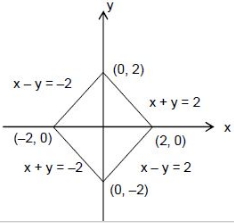
0 likes
View Solution16
EasyMCQ
The marks obtained by a student of Class $XI$ in first and second terminal examination are $62$ and $48$,respectively. Find the minimum marks he should get in the annual examination to have an average of at least $60$ marks.
A
$60$
B
$65$
C
$70$
D
$75$
Solution
(C) Let $x$ be the marks obtained by the student in the annual examination.
The average of the three examinations is given by $\frac{62 + 48 + x}{3}$.
According to the problem,the average must be at least $60$,so we have the inequality:
$\frac{62 + 48 + x}{3} \geq 60$
Multiplying both sides by $3$,we get:
$110 + x \geq 180$
Subtracting $110$ from both sides,we get:
$x \geq 70$
Thus,the student must obtain a minimum of $70$ marks to have an average of at least $60$ marks.
The average of the three examinations is given by $\frac{62 + 48 + x}{3}$.
According to the problem,the average must be at least $60$,so we have the inequality:
$\frac{62 + 48 + x}{3} \geq 60$
Multiplying both sides by $3$,we get:
$110 + x \geq 180$
Subtracting $110$ from both sides,we get:
$x \geq 70$
Thus,the student must obtain a minimum of $70$ marks to have an average of at least $60$ marks.
0 likes
View Solution17
MediumMCQ
Find all pairs of consecutive odd natural numbers,both of which are larger than $10$,such that their sum is less than $40$.
A
$(11, 13), (13, 15), (15, 17), (17, 19)$
B
$(11, 13), (13, 15), (15, 17), (17, 19), (19, 21)$
C
$(9, 11), (11, 13), (13, 15), (15, 17)$
D
$(13, 15), (15, 17), (17, 19), (19, 21)$
Solution
(A) Let $x$ be the smaller of the two consecutive odd natural numbers,so the other one is $x+2$.
According to the problem:
$x > 10$ $(1)$
$x + (x + 2) < 40$ $(2)$
Solving $(2)$:
$2x + 2 < 40$
$2x < 38$
$x < 19$ $(3)$
From $(1)$ and $(3)$,we have $10 < x < 19$.
Since $x$ is an odd natural number,the possible values for $x$ are $11, 13, 15, 17$.
Thus,the pairs $(x, x+2)$ are:
$(11, 13), (13, 15), (15, 17), (17, 19)$.
According to the problem:
$x > 10$ $(1)$
$x + (x + 2) < 40$ $(2)$
Solving $(2)$:
$2x + 2 < 40$
$2x < 38$
$x < 19$ $(3)$
From $(1)$ and $(3)$,we have $10 < x < 19$.
Since $x$ is an odd natural number,the possible values for $x$ are $11, 13, 15, 17$.
Thus,the pairs $(x, x+2)$ are:
$(11, 13), (13, 15), (15, 17), (17, 19)$.
0 likes
View Solution18
EasyMCQ
Ravi obtained $70$ and $75$ marks in the first two unit tests. Find the minimum marks he should get in the third test to have an average of at least $60$ marks.
A
$35$
B
$40$
C
$45$
D
$50$
Solution
(A) Let $x$ be the marks obtained by Ravi in the third unit test.
Since the student should have an average of at least $60$ marks,we have:
$\frac{70+75+x}{3} \geq 60$
Multiplying both sides by $3$:
$145+x \geq 180$
Subtracting $145$ from both sides:
$x \geq 180-145$
$x \geq 35$
Thus,the student must obtain a minimum of $35$ marks to have an average of at least $60$ marks.
Since the student should have an average of at least $60$ marks,we have:
$\frac{70+75+x}{3} \geq 60$
Multiplying both sides by $3$:
$145+x \geq 180$
Subtracting $145$ from both sides:
$x \geq 180-145$
$x \geq 35$
Thus,the student must obtain a minimum of $35$ marks to have an average of at least $60$ marks.
0 likes
View Solution19
MediumMCQ
To receive grade $A$ in a course,one must obtain an average of $90$ marks or more in five examinations (each of $100$ marks). If Sunita's marks in the first four examinations are $87, 92, 94,$ and $95,$ find the minimum marks that Sunita must obtain in the fifth examination to get grade $A$ in the course.
A
$82$
B
$85$
C
$88$
D
$90$
Solution
(A) Let $x$ be the marks obtained by Sunita in the fifth examination.
In order to receive grade $A$ in the course,she must obtain an average of $90$ marks or more in five examinations.
Therefore,the inequality is:
$\frac{87+92+94+95+x}{5} \geq 90$
$\Rightarrow \frac{368+x}{5} \geq 90$
$\Rightarrow 368+x \geq 450$
$\Rightarrow x \geq 450-368$
$\Rightarrow x \geq 82$
Thus,Sunita must obtain at least $82$ marks in the fifth examination to get grade $A$.
In order to receive grade $A$ in the course,she must obtain an average of $90$ marks or more in five examinations.
Therefore,the inequality is:
$\frac{87+92+94+95+x}{5} \geq 90$
$\Rightarrow \frac{368+x}{5} \geq 90$
$\Rightarrow 368+x \geq 450$
$\Rightarrow x \geq 450-368$
$\Rightarrow x \geq 82$
Thus,Sunita must obtain at least $82$ marks in the fifth examination to get grade $A$.
0 likes
View Solution20
MediumMCQ
Find all pairs of consecutive odd positive integers,both of which are smaller than $10$,such that their sum is more than $11$.
A
$(5, 7), (7, 9)$
B
$(3, 5), (5, 7)$
C
$(7, 9), (9, 11)$
D
$(1, 3), (3, 5)$
Solution
(A) Let $x$ be the smaller of the two consecutive odd positive integers. Then,the other integer is $x+2$.
Since both integers are smaller than $10$,we have:
$x+2 < 10$
$\Rightarrow x < 8$ ... $(i)$
Also,the sum of the two integers is more than $11$:
$x + (x+2) > 11$
$\Rightarrow 2x + 2 > 11$
$\Rightarrow 2x > 9$
$\Rightarrow x > 4.5$ ... $(ii)$
From $(i)$ and $(ii)$,we have $4.5 < x < 8$.
Since $x$ must be an odd positive integer,the possible values for $x$ are $5$ and $7$.
If $x = 5$,the pair is $(5, 7)$.
If $x = 7$,the pair is $(7, 9)$.
Thus,the required pairs are $(5, 7)$ and $(7, 9)$.
Since both integers are smaller than $10$,we have:
$x+2 < 10$
$\Rightarrow x < 8$ ... $(i)$
Also,the sum of the two integers is more than $11$:
$x + (x+2) > 11$
$\Rightarrow 2x + 2 > 11$
$\Rightarrow 2x > 9$
$\Rightarrow x > 4.5$ ... $(ii)$
From $(i)$ and $(ii)$,we have $4.5 < x < 8$.
Since $x$ must be an odd positive integer,the possible values for $x$ are $5$ and $7$.
If $x = 5$,the pair is $(5, 7)$.
If $x = 7$,the pair is $(7, 9)$.
Thus,the required pairs are $(5, 7)$ and $(7, 9)$.
0 likes
View Solution21
EasyMCQ
Find all pairs of consecutive even positive integers,both of which are larger than $5$,such that their sum is less than $23$.
A
$(6, 8), (8, 10), (10, 12)$
B
$(6, 8), (8, 10)$
C
$(8, 10), (10, 12)$
D
$(6, 8), (10, 12)$
Solution
(A) Let $x$ be the smaller of the two consecutive even positive integers.
Then,the other integer is $x + 2$.
Since both integers are larger than $5$,we have $x > 5$ $(1)$.
Also,the sum of the two integers is less than $23$,so $x + (x + 2) < 23$.
$2x + 2 < 23$
$2x < 21$
$x < 10.5$ $(2)$.
From $(1)$ and $(2)$,we obtain $5 < x < 10.5$.
Since $x$ is an even number,$x$ can take the values $6, 8,$ and $10$.
Thus,the required possible pairs are $(6, 8), (8, 10),$ and $(10, 12)$.
Then,the other integer is $x + 2$.
Since both integers are larger than $5$,we have $x > 5$ $(1)$.
Also,the sum of the two integers is less than $23$,so $x + (x + 2) < 23$.
$2x + 2 < 23$
$2x < 21$
$x < 10.5$ $(2)$.
From $(1)$ and $(2)$,we obtain $5 < x < 10.5$.
Since $x$ is an even number,$x$ can take the values $6, 8,$ and $10$.
Thus,the required possible pairs are $(6, 8), (8, 10),$ and $(10, 12)$.
0 likes
View Solution22
MediumMCQ
The longest side of a triangle is $3$ times the shortest side and the third side is $2 \, cm$ shorter than the longest side. If the perimeter of the triangle is at least $61 \, cm$,find the minimum length of the shortest side. (in $, cm$)
A
$7$
B
$8$
C
$9$
D
$10$
Solution
(C) Let the length of the shortest side of the triangle be $x \, cm$.
Then,the length of the longest side is $3x \, cm$.
The length of the third side is $(3x - 2) \, cm$.
Since the perimeter of the triangle is at least $61 \, cm$,we have:
$x + 3x + (3x - 2) \geq 61$
$\Rightarrow 7x - 2 \geq 61$
$\Rightarrow 7x \geq 63$
$\Rightarrow x \geq 9$
Thus,the minimum length of the shortest side is $9 \, cm$.
Then,the length of the longest side is $3x \, cm$.
The length of the third side is $(3x - 2) \, cm$.
Since the perimeter of the triangle is at least $61 \, cm$,we have:
$x + 3x + (3x - 2) \geq 61$
$\Rightarrow 7x - 2 \geq 61$
$\Rightarrow 7x \geq 63$
$\Rightarrow x \geq 9$
Thus,the minimum length of the shortest side is $9 \, cm$.
0 likes
View Solution23
Medium
$A$ man wants to cut three lengths from a single piece of board of length $91 \, cm$. The second length is to be $3 \, cm$ longer than the shortest and the third length is to be twice as long as the shortest. What are the possible lengths of the shortest board if the third piece is to be at least $5 \, cm$ longer than the second?
Solution
(N/A) Let the length of the shortest piece be $x \, cm$. Then,the lengths of the second and third pieces are $(x+3) \, cm$ and $2x \, cm$ respectively.
Since the three lengths are cut from a single board of length $91 \, cm$:
$x + (x+3) + 2x \leq 91$
$4x + 3 \leq 91$
$4x \leq 88$
$x \leq 22$ ...... $(1)$
Also,the third piece is at least $5 \, cm$ longer than the second piece:
$2x \geq (x+3) + 5$
$2x \geq x + 8$
$x \geq 8$ ...... $(2)$
From $(1)$ and $(2)$,we obtain:
$8 \leq x \leq 22$
Thus,the possible length of the shortest board is greater than or equal to $8 \, cm$ but less than or equal to $22 \, cm$.
Since the three lengths are cut from a single board of length $91 \, cm$:
$x + (x+3) + 2x \leq 91$
$4x + 3 \leq 91$
$4x \leq 88$
$x \leq 22$ ...... $(1)$
Also,the third piece is at least $5 \, cm$ longer than the second piece:
$2x \geq (x+3) + 5$
$2x \geq x + 8$
$x \geq 8$ ...... $(2)$
From $(1)$ and $(2)$,we obtain:
$8 \leq x \leq 22$
Thus,the possible length of the shortest board is greater than or equal to $8 \, cm$ but less than or equal to $22 \, cm$.
0 likes
View Solution24
MediumMCQ
In an experiment,a solution of hydrochloric acid is to be kept between $30^{\circ} \text{C}$ and $35^{\circ} \text{C}$. What is the range of temperature in degree Fahrenheit if the conversion formula is given by $C = \frac{5}{9}(F - 32)$,where $C$ and $F$ represent temperature in degree Celsius and degree Fahrenheit,respectively?
A
$86^{\circ} \text{F}$ and $95^{\circ} \text{F}$
B
$80^{\circ} \text{F}$ and $90^{\circ} \text{F}$
C
$75^{\circ} \text{F}$ and $85^{\circ} \text{F}$
D
$90^{\circ} \text{F}$ and $100^{\circ} \text{F}$
Solution
(A) It is given that the temperature $C$ in Celsius is $30 < C < 35$.
Substituting the conversion formula $C = \frac{5}{9}(F - 32)$,we get:
$30 < \frac{5}{9}(F - 32) < 35$
Multiplying the entire inequality by $\frac{9}{5}$:
$\frac{9}{5} \times 30 < F - 32 < \frac{9}{5} \times 35$
$54 < F - 32 < 63$
Adding $32$ to all parts of the inequality:
$54 + 32 < F < 63 + 32$
$86 < F < 95$
Thus,the required range of temperature in Fahrenheit is between $86^{\circ} \text{F}$ and $95^{\circ} \text{F}$.
Substituting the conversion formula $C = \frac{5}{9}(F - 32)$,we get:
$30 < \frac{5}{9}(F - 32) < 35$
Multiplying the entire inequality by $\frac{9}{5}$:
$\frac{9}{5} \times 30 < F - 32 < \frac{9}{5} \times 35$
$54 < F - 32 < 63$
Adding $32$ to all parts of the inequality:
$54 + 32 < F < 63 + 32$
$86 < F < 95$
Thus,the required range of temperature in Fahrenheit is between $86^{\circ} \text{F}$ and $95^{\circ} \text{F}$.
0 likes
View Solution25
Difficult
$A$ manufacturer has $600 \text{ litres}$ of a $12 \%$ solution of acid. How many litres of a $30 \%$ acid solution must be added to it so that the acid content in the resulting mixture will be more than $15 \%$ but less than $18 \%$?
Solution
Let $x$ litres of $30 \%$ acid solution be added to the mixture.
The total volume of the resulting mixture is $(x + 600) \text{ litres}$.
The amount of acid in the mixture is $0.30x + 0.12(600)$.
According to the problem,the acid content must be between $15 \%$ and $18 \%$:
$0.15(x + 600) < 0.30x + 0.12(600) < 0.18(x + 600)$
Solving the first inequality:
$0.15x + 90 < 0.30x + 72$
$18 < 0.15x$
$x > \frac{18}{0.15} = 120$
Solving the second inequality:
$0.30x + 72 < 0.18x + 108$
$0.12x < 36$
$x < \frac{36}{0.12} = 300$
Thus,the number of litres of the $30 \%$ solution must be greater than $120 \text{ litres}$ and less than $300 \text{ litres}$.
The total volume of the resulting mixture is $(x + 600) \text{ litres}$.
The amount of acid in the mixture is $0.30x + 0.12(600)$.
According to the problem,the acid content must be between $15 \%$ and $18 \%$:
$0.15(x + 600) < 0.30x + 0.12(600) < 0.18(x + 600)$
Solving the first inequality:
$0.15x + 90 < 0.30x + 72$
$18 < 0.15x$
$x > \frac{18}{0.15} = 120$
Solving the second inequality:
$0.30x + 72 < 0.18x + 108$
$0.12x < 36$
$x < \frac{36}{0.12} = 300$
Thus,the number of litres of the $30 \%$ solution must be greater than $120 \text{ litres}$ and less than $300 \text{ litres}$.
0 likes
View Solution26
MediumMCQ
$A$ solution is to be kept between $68\,^{\circ} F$ and $77\,^{\circ} F$. What is the range in temperature in degree Celsius $(C)$ if the Celsius/Fahrenheit $(F)$ conversion formula is given by $F = \frac{9}{5} C + 32$?
A
$20\,^{\circ} C$ and $25\,^{\circ} C$
B
$15\,^{\circ} C$ and $20\,^{\circ} C$
C
$25\,^{\circ} C$ and $30\,^{\circ} C$
D
$10\,^{\circ} C$ and $15\,^{\circ} C$
Solution
(A) Given that the temperature $F$ is between $68\,^{\circ} F$ and $77\,^{\circ} F$,we have the inequality:
$68 < F < 77$
Substituting the formula $F = \frac{9}{5} C + 32$ into the inequality:
$68 < \frac{9}{5} C + 32 < 77$
Subtracting $32$ from all parts:
$68 - 32 < \frac{9}{5} C < 77 - 32$
$36 < \frac{9}{5} C < 45$
Multiplying by $\frac{5}{9}$ throughout:
$36 \times \frac{5}{9} < C < 45 \times \frac{5}{9}$
$20 < C < 25$
Thus,the required range of temperature in degree Celsius is between $20\,^{\circ} C$ and $25\,^{\circ} C$.
$68 < F < 77$
Substituting the formula $F = \frac{9}{5} C + 32$ into the inequality:
$68 < \frac{9}{5} C + 32 < 77$
Subtracting $32$ from all parts:
$68 - 32 < \frac{9}{5} C < 77 - 32$
$36 < \frac{9}{5} C < 45$
Multiplying by $\frac{5}{9}$ throughout:
$36 \times \frac{5}{9} < C < 45 \times \frac{5}{9}$
$20 < C < 25$
Thus,the required range of temperature in degree Celsius is between $20\,^{\circ} C$ and $25\,^{\circ} C$.
0 likes
View Solution27
DifficultMCQ
$A$ solution of $8 \%$ boric acid is to be diluted by adding a $2 \%$ boric acid solution to it. The resulting mixture is to be more than $4 \%$ but less than $6 \%$ boric acid. If we have $640$ litres of the $8 \%$ solution,how many litres of the $2 \%$ solution will have to be added?
A
$320 < x < 1280$
B
$200 < x < 1000$
C
$400 < x < 1500$
D
$300 < x < 1000$
Solution
(A) Let $x$ litres of $2 \%$ boric acid solution be added.
Total volume of the mixture $= (x + 640)$ litres.
Amount of boric acid in the mixture $= (0.02x + 0.08 \times 640) = (0.02x + 51.2)$ litres.
The concentration of the resulting mixture must be between $4 \%$ and $6 \%$.
Condition $1$: $\frac{0.02x + 51.2}{x + 640} > 0.04$
$0.02x + 51.2 > 0.04x + 25.6$
$51.2 - 25.6 > 0.04x - 0.02x$
$25.6 > 0.02x \Rightarrow x < 1280$.
Condition $2$: $\frac{0.02x + 51.2}{x + 640} < 0.06$
$0.02x + 51.2 < 0.06x + 38.4$
$51.2 - 38.4 < 0.06x - 0.02x$
$12.8 < 0.04x \Rightarrow x > 320$.
Thus,the amount of $2 \%$ solution to be added is between $320$ litres and $1280$ litres.
Total volume of the mixture $= (x + 640)$ litres.
Amount of boric acid in the mixture $= (0.02x + 0.08 \times 640) = (0.02x + 51.2)$ litres.
The concentration of the resulting mixture must be between $4 \%$ and $6 \%$.
Condition $1$: $\frac{0.02x + 51.2}{x + 640} > 0.04$
$0.02x + 51.2 > 0.04x + 25.6$
$51.2 - 25.6 > 0.04x - 0.02x$
$25.6 > 0.02x \Rightarrow x < 1280$.
Condition $2$: $\frac{0.02x + 51.2}{x + 640} < 0.06$
$0.02x + 51.2 < 0.06x + 38.4$
$51.2 - 38.4 < 0.06x - 0.02x$
$12.8 < 0.04x \Rightarrow x > 320$.
Thus,the amount of $2 \%$ solution to be added is between $320$ litres and $1280$ litres.
0 likes
View Solution28
Difficult
How many litres of water will have to be added to $1125$ litres of the $45 \%$ solution of acid so that the resulting mixture will contain more than $25 \%$ but less than $30 \%$ acid content?
Solution
(N/A) Let $x$ litres of water be added to the solution.
Total volume of the mixture becomes $(1125 + x)$ litres.
The amount of acid remains constant at $45 \%$ of $1125$ litres,which is $0.45 \times 1125 = 506.25$ litres.
According to the problem,the acid content in the new mixture must be between $25 \%$ and $30 \%$.
So,$25 \% < \frac{506.25}{1125 + x} \times 100 < 30 \%$.
First,consider the inequality $\frac{506.25}{1125 + x} < 0.30$:
$506.25 < 0.30(1125 + x)$
$506.25 < 337.5 + 0.3x$
$168.75 < 0.3x$
$x > \frac{168.75}{0.3} = 562.5$.
Next,consider the inequality $\frac{506.25}{1125 + x} > 0.25$:
$506.25 > 0.25(1125 + x)$
$506.25 > 281.25 + 0.25x$
$225 > 0.25x$
$x < \frac{225}{0.25} = 900$.
Therefore,the amount of water to be added must be between $562.5$ litres and $900$ litres,i.e.,$562.5 < x < 900$.
Total volume of the mixture becomes $(1125 + x)$ litres.
The amount of acid remains constant at $45 \%$ of $1125$ litres,which is $0.45 \times 1125 = 506.25$ litres.
According to the problem,the acid content in the new mixture must be between $25 \%$ and $30 \%$.
So,$25 \% < \frac{506.25}{1125 + x} \times 100 < 30 \%$.
First,consider the inequality $\frac{506.25}{1125 + x} < 0.30$:
$506.25 < 0.30(1125 + x)$
$506.25 < 337.5 + 0.3x$
$168.75 < 0.3x$
$x > \frac{168.75}{0.3} = 562.5$.
Next,consider the inequality $\frac{506.25}{1125 + x} > 0.25$:
$506.25 > 0.25(1125 + x)$
$506.25 > 281.25 + 0.25x$
$225 > 0.25x$
$x < \frac{225}{0.25} = 900$.
Therefore,the amount of water to be added must be between $562.5$ litres and $900$ litres,i.e.,$562.5 < x < 900$.
0 likes
View Solution29
MediumMCQ
The $IQ$ of a person is given by the formula $IQ = \frac{MA}{CA} \times 100$,where $MA$ is mental age and $CA$ is chronological age. If $80 \leq IQ \leq 140$ for a group of $12$ years old children,find the range of their mental age.
A
$9.6 \leq MA \leq 16.8$
B
$8.6 \leq MA \leq 15.8$
C
$9.6 \leq MA \leq 15.8$
D
$8.6 \leq MA \leq 16.8$
Solution
(A) It is given that for a group of $12$ years old children,$CA = 12$ years.
The formula for $IQ$ is $IQ = \frac{MA}{12} \times 100$.
Given the inequality $80 \leq IQ \leq 140$,we substitute the expression for $IQ$:
$80 \leq \frac{MA}{12} \times 100 \leq 140$
To solve for $MA$,multiply the entire inequality by $\frac{12}{100}$:
$80 \times \frac{12}{100} \leq MA \leq 140 \times \frac{12}{100}$
$9.6 \leq MA \leq 16.8$
Thus,the range of mental age for the group of $12$ years old children is $9.6 \leq MA \leq 16.8$.
The formula for $IQ$ is $IQ = \frac{MA}{12} \times 100$.
Given the inequality $80 \leq IQ \leq 140$,we substitute the expression for $IQ$:
$80 \leq \frac{MA}{12} \times 100 \leq 140$
To solve for $MA$,multiply the entire inequality by $\frac{12}{100}$:
$80 \times \frac{12}{100} \leq MA \leq 140 \times \frac{12}{100}$
$9.6 \leq MA \leq 16.8$
Thus,the range of mental age for the group of $12$ years old children is $9.6 \leq MA \leq 16.8$.
0 likes
View Solution30
Medium
In the first four examinations,each of $100$ marks,Ravi scored $94, 73, 72,$ and $84$ marks. If a final average greater than or equal to $80$ and less than $90$ is needed to obtain a final grade $'B'$ in a course,find the minimum marks that Ravi must obtain in the fifth examination to get grade $'B'$.
Solution
(77) Let the marks obtained by Ravi in the fifth examination be $x$.
The total marks for the five examinations are $94 + 73 + 72 + 84 + x = 323 + x$.
The average of the five examinations is $\frac{323 + x}{5}$.
According to the condition for grade $'B'$,the average must be at least $80$ and less than $90$:
$80 \le \frac{323 + x}{5} < 90$.
Multiplying the inequality by $5$:
$400 \le 323 + x < 450$.
Subtracting $323$ from all parts:
$400 - 323 \le x < 450 - 323$.
$77 \le x < 127$.
Since the maximum marks in an examination is $100$,the minimum marks required is $77$.
The total marks for the five examinations are $94 + 73 + 72 + 84 + x = 323 + x$.
The average of the five examinations is $\frac{323 + x}{5}$.
According to the condition for grade $'B'$,the average must be at least $80$ and less than $90$:
$80 \le \frac{323 + x}{5} < 90$.
Multiplying the inequality by $5$:
$400 \le 323 + x < 450$.
Subtracting $323$ from all parts:
$400 - 323 \le x < 450 - 323$.
$77 \le x < 127$.
Since the maximum marks in an examination is $100$,the minimum marks required is $77$.
0 likes
View Solution31
MediumMCQ
The marks scored by Mohan in two tests were $62$ and $48$. Find the minimum marks he should score in the third test to have an average of at least $60$ marks.
A
$60$
B
$70$
C
$80$
D
$90$
Solution
(B) Let the marks scored by Mohan in the third test be $x$.
Given that the marks in the first two tests are $62$ and $48$.
The average of the three tests is given by $\frac{62 + 48 + x}{3}$.
We want the average to be at least $60$,so we set up the inequality:
$\frac{62 + 48 + x}{3} \geq 60$
$110 + x \geq 180$
$x \geq 180 - 110$
$x \geq 70$
Thus,the minimum marks he should score in the third test is $70$.
Given that the marks in the first two tests are $62$ and $48$.
The average of the three tests is given by $\frac{62 + 48 + x}{3}$.
We want the average to be at least $60$,so we set up the inequality:
$\frac{62 + 48 + x}{3} \geq 60$
$110 + x \geq 180$
$x \geq 180 - 110$
$x \geq 70$
Thus,the minimum marks he should score in the third test is $70$.
0 likes
View Solution32
MediumMCQ
The longest side of a triangle is twice the shortest side and the third side is $3 \text{ cm}$ more than the shortest side. If the perimeter of the triangle is at least $51 \text{ cm}$, find the minimum length of the shortest side. (in $\text{ cm}$)
A
$12$
B
$13$
C
$14$
D
$15$
Solution
(A) Let the shortest side of the triangle be $x \text{ cm}$.
According to the problem, the longest side is $2x \text{ cm}$ and the third side is $(x + 3) \text{ cm}$.
The perimeter of the triangle is the sum of its three sides:
$P = x + 2x + (x + 3) = 4x + 3$.
Given that the perimeter is at least $51 \text{ cm}$, we have the inequality:
$4x + 3 \geq 51$.
Subtracting $3$ from both sides:
$4x \geq 48$.
Dividing by $4$:
$x \geq 12$.
Thus, the minimum length of the shortest side is $12 \text{ cm}$.
According to the problem, the longest side is $2x \text{ cm}$ and the third side is $(x + 3) \text{ cm}$.
The perimeter of the triangle is the sum of its three sides:
$P = x + 2x + (x + 3) = 4x + 3$.
Given that the perimeter is at least $51 \text{ cm}$, we have the inequality:
$4x + 3 \geq 51$.
Subtracting $3$ from both sides:
$4x \geq 48$.
Dividing by $4$:
$x \geq 12$.
Thus, the minimum length of the shortest side is $12 \text{ cm}$.
0 likes
View Solution33
MediumMCQ
Find all pairs of consecutive odd positive integers,both of which are smaller than $18$,such that their sum is more than $20$.
A
$(11, 13), (13, 15), (15, 17)$
B
$(9, 11), (11, 13), (13, 15)$
C
$(7, 9), (9, 11), (11, 13)$
D
$(13, 15), (15, 17), (17, 19)$
Solution
(A) Let the two consecutive odd positive integers be $x$ and $x + 2$.
Given that both integers are smaller than $18$,we have $x + 2 < 18$,which implies $x < 16$.
Also,their sum is more than $20$,so $x + (x + 2) > 20$.
$2x + 2 > 20$
$2x > 18$
$x > 9$.
Since $x$ is an odd integer and $9 < x < 16$,the possible values for $x$ are $11, 13, 15$.
If $x = 11$,the pair is $(11, 13)$.
If $x = 13$,the pair is $(13, 15)$.
If $x = 15$,the pair is $(15, 17)$.
Thus,the pairs are $(11, 13), (13, 15), (15, 17)$.
Given that both integers are smaller than $18$,we have $x + 2 < 18$,which implies $x < 16$.
Also,their sum is more than $20$,so $x + (x + 2) > 20$.
$2x + 2 > 20$
$2x > 18$
$x > 9$.
Since $x$ is an odd integer and $9 < x < 16$,the possible values for $x$ are $11, 13, 15$.
If $x = 11$,the pair is $(11, 13)$.
If $x = 13$,the pair is $(13, 15)$.
If $x = 15$,the pair is $(15, 17)$.
Thus,the pairs are $(11, 13), (13, 15), (15, 17)$.
0 likes
View Solution34
MediumMCQ
$A$ solution is to be kept between $30^{\circ} C$ and $35^{\circ} C$. What is the range of temperature in degree Fahrenheit,if the conversion formula is $F = \frac{9}{5} C + 32$?
A
$86^{\circ} F$ and $95^{\circ} F$
B
$80^{\circ} F$ and $90^{\circ} F$
C
$75^{\circ} F$ and $85^{\circ} F$
D
$90^{\circ} F$ and $100^{\circ} F$
Solution
(A) Given the temperature range in Celsius is $30 < C < 35$.
Using the conversion formula $F = \frac{9}{5} C + 32$:
For $C = 30$,$F = \frac{9}{5}(30) + 32 = 54 + 32 = 86^{\circ} F$.
For $C = 35$,$F = \frac{9}{5}(35) + 32 = 63 + 32 = 95^{\circ} F$.
Thus,the range of temperature in Fahrenheit is between $86^{\circ} F$ and $95^{\circ} F$.
Using the conversion formula $F = \frac{9}{5} C + 32$:
For $C = 30$,$F = \frac{9}{5}(30) + 32 = 54 + 32 = 86^{\circ} F$.
For $C = 35$,$F = \frac{9}{5}(35) + 32 = 63 + 32 = 95^{\circ} F$.
Thus,the range of temperature in Fahrenheit is between $86^{\circ} F$ and $95^{\circ} F$.
0 likes
View Solution35
DifficultMCQ
Solve the following inequality: $\frac{|x-1|}{x+2} < 1$.
A
$(-\infty, -2) \cup (-\frac{1}{2}, \infty)$
B
$(-\infty, -2) \cup (\frac{1}{2}, \infty)$
C
$(-2, \frac{1}{2})$
D
$(-\infty, -\frac{1}{2}) \cup (2, \infty)$
Solution
(A) Given the inequality $\frac{|x-1|}{x+2} < 1$.
Case $1$: If $x+2 > 0$,i.e.,$x > -2$,then $|x-1| < x+2$.
If $x \ge 1$,then $x-1 < x+2 \implies -1 < 2$,which is true for all $x \ge 1$.
If $-2 < x < 1$,then $-(x-1) < x+2 \implies -x+1 < x+2 \implies 2x > -1 \implies x > -\frac{1}{2}$.
So,for $x > -2$,the solution is $x > -\frac{1}{2}$.
Case $2$: If $x+2 < 0$,i.e.,$x < -2$,then $|x-1| > x+2$.
Since $x < -2$,$x-1$ is negative,so $|x-1| = -(x-1) = 1-x$.
$1-x > x+2 \implies 2x < -1 \implies x < -\frac{1}{2}$.
Since we assumed $x < -2$,the solution is $x < -2$.
Combining both cases,the solution set is $(-\infty, -2) \cup (-\frac{1}{2}, \infty)$.
Case $1$: If $x+2 > 0$,i.e.,$x > -2$,then $|x-1| < x+2$.
If $x \ge 1$,then $x-1 < x+2 \implies -1 < 2$,which is true for all $x \ge 1$.
If $-2 < x < 1$,then $-(x-1) < x+2 \implies -x+1 < x+2 \implies 2x > -1 \implies x > -\frac{1}{2}$.
So,for $x > -2$,the solution is $x > -\frac{1}{2}$.
Case $2$: If $x+2 < 0$,i.e.,$x < -2$,then $|x-1| > x+2$.
Since $x < -2$,$x-1$ is negative,so $|x-1| = -(x-1) = 1-x$.
$1-x > x+2 \implies 2x < -1 \implies x < -\frac{1}{2}$.
Since we assumed $x < -2$,the solution is $x < -2$.
Combining both cases,the solution set is $(-\infty, -2) \cup (-\frac{1}{2}, \infty)$.
0 likes
View Solution36
Difficult
Solve the following system of inequalities: $\frac{x}{2x+1} \geq \frac{1}{4}$ and $\frac{6x}{4x-1} < \frac{1}{2}$.
Solution
(D) For the first inequality: $\frac{x}{2x+1} - \frac{1}{4} \geq 0 \implies \frac{4x - (2x+1)}{4(2x+1)} \geq 0 \implies \frac{2x-1}{4(2x+1)} \geq 0$. The critical points are $x = -\frac{1}{2}$ and $x = \frac{1}{2}$. Testing intervals,we get $x \in (-\infty, -\frac{1}{2}) \cup [\frac{1}{2}, \infty)$.
For the second inequality: $\frac{6x}{4x-1} - \frac{1}{2} < 0 \implies \frac{12x - (4x-1)}{2(4x-1)} < 0 \implies \frac{8x+1}{2(4x-1)} < 0$. The critical points are $x = -\frac{1}{8}$ and $x = \frac{1}{4}$. Testing intervals,we get $x \in (-\frac{1}{8}, \frac{1}{4})$.
Since there is no common interval between $(-\infty, -\frac{1}{2}) \cup [\frac{1}{2}, \infty)$ and $(-\frac{1}{8}, \frac{1}{4})$,the solution set is $\emptyset$ (empty set).
For the second inequality: $\frac{6x}{4x-1} - \frac{1}{2} < 0 \implies \frac{12x - (4x-1)}{2(4x-1)} < 0 \implies \frac{8x+1}{2(4x-1)} < 0$. The critical points are $x = -\frac{1}{8}$ and $x = \frac{1}{4}$. Testing intervals,we get $x \in (-\frac{1}{8}, \frac{1}{4})$.
Since there is no common interval between $(-\infty, -\frac{1}{2}) \cup [\frac{1}{2}, \infty)$ and $(-\frac{1}{8}, \frac{1}{4})$,the solution set is $\emptyset$ (empty set).
0 likes
View Solution37
DifficultMCQ
Solve the following inequality: $\frac{|x+2|-x}{x} < 2$
A
$(-\infty, -2) \cup (1, \infty)$
B
$(-\infty, 0) \cup (1, \infty)$
C
$(-\infty, -2) \cup (0, 1)$
D
$(-\infty, 0) \cup (0, 1)$
Solution
(B) Case $1$: $x+2 \ge 0 \implies x \ge -2$. The inequality becomes $\frac{x+2-x}{x} < 2 \implies \frac{2}{x} < 2 \implies \frac{2-2x}{x} < 0 \implies \frac{1-x}{x} < 0$. This holds for $x \in (-\infty, 0) \cup (1, \infty)$. Considering $x \ge -2$ and $x \neq 0$,we get $x \in [-2, 0) \cup (1, \infty)$.
Case $2$: $x+2 < 0 \implies x < -2$. The inequality becomes $\frac{-(x+2)-x}{x} < 2 \implies \frac{-2x-2}{x} < 2 \implies \frac{-2x-2-2x}{x} < 0 \implies \frac{-4x-2}{x} < 0 \implies \frac{2x+1}{x} > 0$. This holds for $x \in (-\infty, -1/2) \cup (0, \infty)$. Considering $x < -2$,we get $x \in (-\infty, -2)$.
Combining both cases,the solution is $(-\infty, -2) \cup [-2, 0) \cup (1, \infty)$,which simplifies to $(-\infty, 0) \cup (1, \infty)$.
Case $2$: $x+2 < 0 \implies x < -2$. The inequality becomes $\frac{-(x+2)-x}{x} < 2 \implies \frac{-2x-2}{x} < 2 \implies \frac{-2x-2-2x}{x} < 0 \implies \frac{-4x-2}{x} < 0 \implies \frac{2x+1}{x} > 0$. This holds for $x \in (-\infty, -1/2) \cup (0, \infty)$. Considering $x < -2$,we get $x \in (-\infty, -2)$.
Combining both cases,the solution is $(-\infty, -2) \cup [-2, 0) \cup (1, \infty)$,which simplifies to $(-\infty, 0) \cup (1, \infty)$.
0 likes
View Solution38
DifficultMCQ
Solve the following inequality: $|x-1|+|x-2|+|x-3| \geq 6$
A
$x \in (-\infty, 0] \cup [4, \infty)$
B
$x \in [0, 4]$
C
$x \in (-\infty, 0) \cup (4, \infty)$
D
$x \in [1, 3]$
Solution
(A) Let $f(x) = |x-1|+|x-2|+|x-3|$.
Case $1$: $x < 1$,$f(x) = -(x-1)-(x-2)-(x-3) = -3x+6$. Setting $-3x+6 \geq 6$,we get $-3x \geq 0$,so $x \leq 0$.
Case $2$: $1 \leq x < 2$,$f(x) = (x-1)-(x-2)-(x-3) = -x+4$. Setting $-x+4 \geq 6$,we get $-x \geq 2$,so $x \leq -2$ (No solution in this interval).
Case $3$: $2 \leq x < 3$,$f(x) = (x-1)+(x-2)-(x-3) = x$. Setting $x \geq 6$ (No solution in this interval).
Case $4$: $x \geq 3$,$f(x) = (x-1)+(x-2)+(x-3) = 3x-6$. Setting $3x-6 \geq 6$,we get $3x \geq 12$,so $x \geq 4$.
Combining the results,the solution is $x \in (-\infty, 0] \cup [4, \infty)$.
Case $1$: $x < 1$,$f(x) = -(x-1)-(x-2)-(x-3) = -3x+6$. Setting $-3x+6 \geq 6$,we get $-3x \geq 0$,so $x \leq 0$.
Case $2$: $1 \leq x < 2$,$f(x) = (x-1)-(x-2)-(x-3) = -x+4$. Setting $-x+4 \geq 6$,we get $-x \geq 2$,so $x \leq -2$ (No solution in this interval).
Case $3$: $2 \leq x < 3$,$f(x) = (x-1)+(x-2)-(x-3) = x$. Setting $x \geq 6$ (No solution in this interval).
Case $4$: $x \geq 3$,$f(x) = (x-1)+(x-2)+(x-3) = 3x-6$. Setting $3x-6 \geq 6$,we get $3x \geq 12$,so $x \geq 4$.
Combining the results,the solution is $x \in (-\infty, 0] \cup [4, \infty)$.
0 likes
View Solution39
Difficult
$A$ manufacturer has $600 \text{ litres}$ of a $12 \%$ solution of acid. How many litres of a $30 \%$ acid solution must be added to it so that the acid content in the resulting mixture will be more than $15 \%$ but less than $18 \%$?
Solution
Let $x$ be the number of litres of the $30 \%$ acid solution to be added.
The total volume of the mixture will be $(600 + x) \text{ litres}$.
The amount of acid in the mixture is $(0.12 \times 600 + 0.30 \times x) = (72 + 0.3x) \text{ litres}$.
According to the problem,the acid content must be more than $15 \%$ and less than $18 \%$ of the total volume:
$0.15(600 + x) < 72 + 0.3x < 0.18(600 + x)$.
Solving the first inequality: $90 + 0.15x < 72 + 0.3x \implies 18 < 0.15x \implies x > 120$.
Solving the second inequality: $72 + 0.3x < 108 + 0.18x \implies 0.12x < 36 \implies x < 300$.
Thus,the amount of $30 \%$ acid solution to be added must be more than $120 \text{ litres}$ and less than $300 \text{ litres}$.
The total volume of the mixture will be $(600 + x) \text{ litres}$.
The amount of acid in the mixture is $(0.12 \times 600 + 0.30 \times x) = (72 + 0.3x) \text{ litres}$.
According to the problem,the acid content must be more than $15 \%$ and less than $18 \%$ of the total volume:
$0.15(600 + x) < 72 + 0.3x < 0.18(600 + x)$.
Solving the first inequality: $90 + 0.15x < 72 + 0.3x \implies 18 < 0.15x \implies x > 120$.
Solving the second inequality: $72 + 0.3x < 108 + 0.18x \implies 0.12x < 36 \implies x < 300$.
Thus,the amount of $30 \%$ acid solution to be added must be more than $120 \text{ litres}$ and less than $300 \text{ litres}$.
0 likes
View Solution40
MediumMCQ
$A$ solution is to be kept between $86^{\circ} F$ and $95^{\circ} F$. What is the range of temperature in degree Celsius if the Celsius $(C)$/Fahrenheit $(F)$ conversion formula is given by $F = \frac{9}{5} C + 32$?
A
$25^{\circ} C < C < 30^{\circ} C$
B
$30^{\circ} C < C < 35^{\circ} C$
C
$35^{\circ} C < C < 40^{\circ} C$
D
$20^{\circ} C < C < 25^{\circ} C$
Solution
(B) Given the temperature range in Fahrenheit is $86 < F < 95$.
Substituting the formula $F = \frac{9}{5} C + 32$ into the inequality:
$86 < \frac{9}{5} C + 32 < 95$
Subtracting $32$ from all parts:
$86 - 32 < \frac{9}{5} C < 95 - 32$
$54 < \frac{9}{5} C < 63$
Multiplying by $\frac{5}{9}$:
$54 \times \frac{5}{9} < C < 63 \times \frac{5}{9}$
$30 < C < 35$
Thus,the range of temperature in Celsius is between $30^{\circ} C$ and $35^{\circ} C$.
Substituting the formula $F = \frac{9}{5} C + 32$ into the inequality:
$86 < \frac{9}{5} C + 32 < 95$
Subtracting $32$ from all parts:
$86 - 32 < \frac{9}{5} C < 95 - 32$
$54 < \frac{9}{5} C < 63$
Multiplying by $\frac{5}{9}$:
$54 \times \frac{5}{9} < C < 63 \times \frac{5}{9}$
$30 < C < 35$
Thus,the range of temperature in Celsius is between $30^{\circ} C$ and $35^{\circ} C$.
0 likes
View Solution41
Medium
In a manufacturing company,the cost and revenue functions of a product are given by $C(x) = 500 + \frac{5}{2}x$ and $R(x) = 3x$,where $x$ is the number of items produced and sold. How many items must be sold to realize no profit or loss? Is there any profit?
Solution
(N/A) To realize no profit or loss,the revenue must equal the cost,i.e.,$R(x) = C(x)$.
Substituting the given functions: $3x = 500 + \frac{5}{2}x$.
Subtracting $\frac{5}{2}x$ from both sides: $3x - 2.5x = 500$.
$0.5x = 500$.
$x = \frac{500}{0.5} = 1000$.
Thus,$1000$ items must be sold to realize no profit or loss.
Profit occurs when $R(x) > C(x)$,which implies $3x > 500 + 2.5x$,or $0.5x > 500$,which means $x > 1000$. Therefore,there is a profit if more than $1000$ items are sold.
Substituting the given functions: $3x = 500 + \frac{5}{2}x$.
Subtracting $\frac{5}{2}x$ from both sides: $3x - 2.5x = 500$.
$0.5x = 500$.
$x = \frac{500}{0.5} = 1000$.
Thus,$1000$ items must be sold to realize no profit or loss.
Profit occurs when $R(x) > C(x)$,which implies $3x > 500 + 2.5x$,or $0.5x > 500$,which means $x > 1000$. Therefore,there is a profit if more than $1000$ items are sold.
0 likes
View Solution42
Difficult
$A$ container is filled with $1120 \text{ litres}$ of a solution containing $40 \%$ acid. How many litres of acid must be added so that the resulting mixture contains more than $40 \%$ but less than $50 \%$ water?
Solution
Let $x$ be the amount of acid added in litres.
The initial amount of acid is $40 \% \text{ of } 1120 = 0.40 \times 1120 = 448 \text{ litres}$.
The initial amount of water is $1120 - 448 = 672 \text{ litres}$.
After adding $x$ litres of acid,the total volume becomes $(1120 + x) \text{ litres}$.
The amount of water remains $672 \text{ litres}$.
The percentage of water in the new mixture is $\frac{672}{1120 + x} \times 100$.
We are given that $40 < \frac{672}{1120 + x} \times 100 < 50$.
Dividing by $100$: $0.4 < \frac{672}{1120 + x} < 0.5$.
Taking the first inequality: $0.4 < \frac{672}{1120 + x} \implies 1120 + x < \frac{672}{0.4} = 1680 \implies x < 560$.
Taking the second inequality: $\frac{672}{1120 + x} < 0.5 \implies 1120 + x > \frac{672}{0.5} = 1344 \implies x > 224$.
Thus,the amount of acid to be added is between $224 \text{ litres}$ and $560 \text{ litres}$.
The initial amount of acid is $40 \% \text{ of } 1120 = 0.40 \times 1120 = 448 \text{ litres}$.
The initial amount of water is $1120 - 448 = 672 \text{ litres}$.
After adding $x$ litres of acid,the total volume becomes $(1120 + x) \text{ litres}$.
The amount of water remains $672 \text{ litres}$.
The percentage of water in the new mixture is $\frac{672}{1120 + x} \times 100$.
We are given that $40 < \frac{672}{1120 + x} \times 100 < 50$.
Dividing by $100$: $0.4 < \frac{672}{1120 + x} < 0.5$.
Taking the first inequality: $0.4 < \frac{672}{1120 + x} \implies 1120 + x < \frac{672}{0.4} = 1680 \implies x < 560$.
Taking the second inequality: $\frac{672}{1120 + x} < 0.5 \implies 1120 + x > \frac{672}{0.5} = 1344 \implies x > 224$.
Thus,the amount of acid to be added is between $224 \text{ litres}$ and $560 \text{ litres}$.
1 likes
View Solution43
Easy
The $I.Q.$ of a person is given by the formula $I.Q. = \frac{MA}{CA} \times 100$,where $MA$ is mental age and $CA$ is chronological age. If $75 < I.Q. < 125$ for a group of $16$ year old children,find the range of their mental age.
Solution
(N/A) Given the formula $I.Q. = \frac{MA}{CA} \times 100$ and $CA = 16$.
Substituting the values,we get $75 < \frac{MA}{16} \times 100 < 125$.
Divide the entire inequality by $100$: $0.75 < \frac{MA}{16} < 1.25$.
Multiply by $16$: $0.75 \times 16 < MA < 1.25 \times 16$.
Calculating the values: $12 < MA < 20$.
Thus,the range of their mental age is between $12$ and $20$ years.
Substituting the values,we get $75 < \frac{MA}{16} \times 100 < 125$.
Divide the entire inequality by $100$: $0.75 < \frac{MA}{16} < 1.25$.
Multiply by $16$: $0.75 \times 16 < MA < 1.25 \times 16$.
Calculating the values: $12 < MA < 20$.
Thus,the range of their mental age is between $12$ and $20$ years.
0 likes
View Solution44
Medium
Solve for $x$ in the following inequality: $\frac{4}{x+1} \leq 3 \leq \frac{6}{x+1}$ where $x > 0$.
Solution
(N/A) Consider the first part of the inequality: $\frac{4}{x+1} \leq 3$.
Since $x > 0$,$x+1 > 0$,so we can multiply by $(x+1)$ without changing the inequality sign:
$4 \leq 3(x+1)$
$4 \leq 3x + 3$
$1 \leq 3x$
$x \geq \frac{1}{3} \quad (i)$
Consider the second part of the inequality: $3 \leq \frac{6}{x+1}$.
Since $x+1 > 0$,we have:
$3(x+1) \leq 6$
$3x + 3 \leq 6$
$3x \leq 3$
$x \leq 1 \quad (ii)$
Combining $(i)$ and $(ii)$,we get:
$\frac{1}{3} \leq x \leq 1$
Thus,the solution set is $x \in [\frac{1}{3}, 1]$.
Since $x > 0$,$x+1 > 0$,so we can multiply by $(x+1)$ without changing the inequality sign:
$4 \leq 3(x+1)$
$4 \leq 3x + 3$
$1 \leq 3x$
$x \geq \frac{1}{3} \quad (i)$
Consider the second part of the inequality: $3 \leq \frac{6}{x+1}$.
Since $x+1 > 0$,we have:
$3(x+1) \leq 6$
$3x + 3 \leq 6$
$3x \leq 3$
$x \leq 1 \quad (ii)$
Combining $(i)$ and $(ii)$,we get:
$\frac{1}{3} \leq x \leq 1$
Thus,the solution set is $x \in [\frac{1}{3}, 1]$.
0 likes
View Solution45
Difficult
Solve for $x$ the following inequality: $\frac{1}{|x|-3} \leq \frac{1}{2}$
Solution
(N/A) Given the inequality: $\frac{1}{|x|-3} \leq \frac{1}{2}$.
Case $1$: If $|x|-3 > 0$,then $|x| > 3$. Multiplying both sides by $2(|x|-3)$,we get $2 \leq |x|-3$,which implies $|x| \geq 5$. Since $|x| \geq 5$ satisfies $|x| > 3$,the solution for this case is $x \in (-\infty, -5] \cup [5, \infty)$.
Case $2$: If $|x|-3 < 0$,then $|x| < 3$. Multiplying both sides by $2(|x|-3)$ reverses the inequality sign: $2 \geq |x|-3$,which implies $|x| \leq 5$. Since we must satisfy $|x| < 3$,the solution for this case is $x \in (-3, 3)$.
Combining both cases,the final solution is $x \in (-\infty, -5] \cup (-3, 3) \cup [5, \infty)$.
Case $1$: If $|x|-3 > 0$,then $|x| > 3$. Multiplying both sides by $2(|x|-3)$,we get $2 \leq |x|-3$,which implies $|x| \geq 5$. Since $|x| \geq 5$ satisfies $|x| > 3$,the solution for this case is $x \in (-\infty, -5] \cup [5, \infty)$.
Case $2$: If $|x|-3 < 0$,then $|x| < 3$. Multiplying both sides by $2(|x|-3)$ reverses the inequality sign: $2 \geq |x|-3$,which implies $|x| \leq 5$. Since we must satisfy $|x| < 3$,the solution for this case is $x \in (-3, 3)$.
Combining both cases,the final solution is $x \in (-\infty, -5] \cup (-3, 3) \cup [5, \infty)$.
0 likes
View Solution46
Medium
Find the solution set of the inequality: $4x + 3 \geq 2x + 17$ and $3x - 5 < -2$.
Solution
(NONE) We have $4x + 3 \geq 2x + 17$.
$\therefore 4x - 2x \geq 17 - 3$
$\therefore 2x \geq 14$
$\therefore x \geq 7$
$...(i)$
Now,we have $3x - 5 < -2$.
$\therefore 3x < -2 + 5$
$\therefore 3x < 3$
$\therefore x < 1$
$...(ii)$
From $(i)$ and $(ii)$,we need to find the values of $x$ that satisfy both $x \geq 7$ and $x < 1$ simultaneously.
Since there is no real number $x$ that is both greater than or equal to $7$ and less than $1$,the solution set is the empty set,denoted by $\emptyset$.
$\therefore 4x - 2x \geq 17 - 3$
$\therefore 2x \geq 14$
$\therefore x \geq 7$
$...(i)$
Now,we have $3x - 5 < -2$.
$\therefore 3x < -2 + 5$
$\therefore 3x < 3$
$\therefore x < 1$
$...(ii)$
From $(i)$ and $(ii)$,we need to find the values of $x$ that satisfy both $x \geq 7$ and $x < 1$ simultaneously.
Since there is no real number $x$ that is both greater than or equal to $7$ and less than $1$,the solution set is the empty set,denoted by $\emptyset$.
0 likes
View Solution47
DifficultMCQ
$A$ company manufactures cassettes. Its cost and revenue functions are $C(x) = 26000 + 30x$ and $R(x) = 43x$,respectively,where $x$ is the number of cassettes produced and sold in a week. How many cassettes must be sold by the company to realize some profit?
A
$x > 2000$
B
$x < 2000$
C
$x = 2000$
D
$x \leq 2000$
Solution
(A) Profit is defined as Revenue minus Cost,i.e.,$P(x) = R(x) - C(x)$.
Given $R(x) = 43x$ and $C(x) = 26000 + 30x$.
$P(x) = 43x - (26000 + 30x)$
$P(x) = 43x - 26000 - 30x$
$P(x) = 13x - 26000$
For the company to realize a profit,the profit must be greater than zero,so $P(x) > 0$.
$13x - 26000 > 0$
$13x > 26000$
$x > \frac{26000}{13}$
$x > 2000$
Therefore,the company must sell more than $2000$ cassettes to realize a profit.
Given $R(x) = 43x$ and $C(x) = 26000 + 30x$.
$P(x) = 43x - (26000 + 30x)$
$P(x) = 43x - 26000 - 30x$
$P(x) = 13x - 26000$
For the company to realize a profit,the profit must be greater than zero,so $P(x) > 0$.
$13x - 26000 > 0$
$13x > 26000$
$x > \frac{26000}{13}$
$x > 2000$
Therefore,the company must sell more than $2000$ cassettes to realize a profit.
0 likes
View Solution48
Medium
The water acidity in a pool is considered normal when the average pH reading of three daily measurements is between $8.2$ and $8.5$. If the first two pH readings are $8.48$ and $8.35$,then find the range of $pH$ value for the third reading that will result in the acidity level being normal.
Solution
(N/A) Let the third pH reading be $x$.
The average of the three readings must be between $8.2$ and $8.5$.
$\therefore 8.2 < \frac{8.48 + 8.35 + x}{3} < 8.5$
Multiply the entire inequality by $3$:
$\therefore 3 \times 8.2 < 16.83 + x < 8.5 \times 3$
$\therefore 24.6 < 16.83 + x < 25.5$
Subtract $16.83$ from all parts:
$\therefore 24.6 - 16.83 < x < 25.5 - 16.83$
$\therefore 7.77 < x < 8.67$
Hence,the third pH reading must be in the range $(7.77, 8.67)$.
The average of the three readings must be between $8.2$ and $8.5$.
$\therefore 8.2 < \frac{8.48 + 8.35 + x}{3} < 8.5$
Multiply the entire inequality by $3$:
$\therefore 3 \times 8.2 < 16.83 + x < 8.5 \times 3$
$\therefore 24.6 < 16.83 + x < 25.5$
Subtract $16.83$ from all parts:
$\therefore 24.6 - 16.83 < x < 25.5 - 16.83$
$\therefore 7.77 < x < 8.67$
Hence,the third pH reading must be in the range $(7.77, 8.67)$.
0 likes
View Solution49
Difficult
$A$ solution of $9 \%$ acid is to be diluted by adding $3 \%$ acid solution to it. The resulting mixture is to be more than $5 \%$ but less than $7 \%$ acid. If there is $460 \text{ L}$ of the $9 \%$ solution,how many litres of $3 \%$ solution will have to be added?
Solution
(N/A) Let $x \text{ L}$ of $3 \%$ solution be added to $460 \text{ L}$ of $9 \%$ solution of acid.
Total quantity of mixture $= (460 + x) \text{ L}$.
Total acid content in the $(460 + x) \text{ L}$ of mixture $= 460 \times \frac{9}{100} + x \times \frac{3}{100}$.
It is given that acid content in the resulting mixture must be more than $5 \%$ but less than $7 \%$ acid.
$\therefore 5 \% \text{ of } (460 + x) < \left( 460 \times \frac{9}{100} + \frac{3x}{100} \right) < 7 \% \text{ of } (460 + x)$.
$\therefore (460 + x) \frac{5}{100} < \frac{4140 + 3x}{100} < (460 + x) \frac{7}{100}$.
$\therefore 5(460 + x) < 4140 + 3x < 7(460 + x)$.
$\therefore 2300 + 5x < 4140 + 3x < 3220 + 7x$.
Now,solving $2300 + 5x < 4140 + 3x$:
$2x < 1840 \implies x < 920 \quad \dots(i)$.
Solving $4140 + 3x < 3220 + 7x$:
$3x - 7x < 3220 - 4140 \implies -4x < -920 \implies 4x > 920 \implies x > 230 \quad \dots(ii)$.
From $(i)$ and $(ii)$,the number of litres of the $3 \%$ solution must be more than $230 \text{ L}$ and less than $920 \text{ L}$.
Total quantity of mixture $= (460 + x) \text{ L}$.
Total acid content in the $(460 + x) \text{ L}$ of mixture $= 460 \times \frac{9}{100} + x \times \frac{3}{100}$.
It is given that acid content in the resulting mixture must be more than $5 \%$ but less than $7 \%$ acid.
$\therefore 5 \% \text{ of } (460 + x) < \left( 460 \times \frac{9}{100} + \frac{3x}{100} \right) < 7 \% \text{ of } (460 + x)$.
$\therefore (460 + x) \frac{5}{100} < \frac{4140 + 3x}{100} < (460 + x) \frac{7}{100}$.
$\therefore 5(460 + x) < 4140 + 3x < 7(460 + x)$.
$\therefore 2300 + 5x < 4140 + 3x < 3220 + 7x$.
Now,solving $2300 + 5x < 4140 + 3x$:
$2x < 1840 \implies x < 920 \quad \dots(i)$.
Solving $4140 + 3x < 3220 + 7x$:
$3x - 7x < 3220 - 4140 \implies -4x < -920 \implies 4x > 920 \implies x > 230 \quad \dots(ii)$.
From $(i)$ and $(ii)$,the number of litres of the $3 \%$ solution must be more than $230 \text{ L}$ and less than $920 \text{ L}$.
0 likes
View Solution50
MediumMCQ
$A$ solution is to be kept between $40^{\circ} C$ and $45^{\circ} C$. What is the range of temperature in degree Fahrenheit,if the conversion formula is $F = \frac{9}{5} C + 32$?
A
$104^{\circ} F$ and $113^{\circ} F$
B
$100^{\circ} F$ and $110^{\circ} F$
C
$105^{\circ} F$ and $115^{\circ} F$
D
$95^{\circ} F$ and $105^{\circ} F$
Solution
(A) Given that the temperature $C$ in Celsius lies between $40^{\circ} C$ and $45^{\circ} C$,we have the inequality: $40 < C < 45$.
The conversion formula is $F = \frac{9}{5} C + 32$.
To find the range in Fahrenheit,we substitute $C = \frac{5}{9}(F - 32)$ into the inequality:
$40 < \frac{5}{9}(F - 32) < 45$.
Multiply the entire inequality by $\frac{9}{5}$:
$40 \times \frac{9}{5} < F - 32 < 45 \times \frac{9}{5}$.
$72 < F - 32 < 81$.
Add $32$ to all parts of the inequality:
$72 + 32 < F < 81 + 32$.
$104 < F < 113$.
Thus,the range of temperature in degree Fahrenheit is between $104^{\circ} F$ and $113^{\circ} F$.
The conversion formula is $F = \frac{9}{5} C + 32$.
To find the range in Fahrenheit,we substitute $C = \frac{5}{9}(F - 32)$ into the inequality:
$40 < \frac{5}{9}(F - 32) < 45$.
Multiply the entire inequality by $\frac{9}{5}$:
$40 \times \frac{9}{5} < F - 32 < 45 \times \frac{9}{5}$.
$72 < F - 32 < 81$.
Add $32$ to all parts of the inequality:
$72 + 32 < F < 81 + 32$.
$104 < F < 113$.
Thus,the range of temperature in degree Fahrenheit is between $104^{\circ} F$ and $113^{\circ} F$.
0 likes
View SolutionLinear Inequalities — Word problem of Linear inequalities · Frequently Asked Questions
1Are these Linear Inequalities questions useful for JEE and NEET?
Yes. All questions in this section are mapped to JEE Main and NEET exam patterns. Previous year questions from JEE Main, NEET, GUJCET and state-level exams are included with full solutions.
2Can I switch to Hindi or Gujarati for these questions?
Yes. Use the language tabs in the hero section or the sidebar to view the same questions and solutions in English, Hindi or Gujarati.
3How do I generate a question paper from this subtopic?
Use the Vedclass Exam Paper Generator — select the chapter and subtopic, set difficulty, and generate Sets A, B, C, D automatically. First 3 chapters of every subject are free.
Vedclass Products
For Students
Vedclass Test Series
Mock tests in real JEE/NEET style with performance analysis. 5-day free trial.
Start Free TrialFor Teachers
Exam Paper Generator
Generate Set A/B/C/D papers from this chapter in 2 minutes. 3 chapters free.
Try FreeFor Institutes
Online Exam Module
Live online exams with unlimited students, 360° analytics & white-label branding.
See DemoFor Teachers & Institutes
Generate a Linear Inequalities Exam Paper in 2 Minutes
Select subtopic & difficulty — Sets A, B, C, D auto-generated with No Repeat logic.
First 3 chapters of every subject are free — no payment required.