
A English
Word problem of Linear inequalities Questions in English
Class 11 Mathematics · Linear Inequalities · Word problem of Linear inequalities
100+
Questions
English
Language
100%
With Solutions
Showing 46 of 100 questions in English
51
DifficultMCQ
The longest side of a triangle is twice the shortest side and the third side is $2 \text{ cm}$ longer than the shortest side. If the perimeter of the triangle is more than $166 \text{ cm}$, then find the minimum length of the shortest side. (in $\text{ cm}$)
A
$40$
B
$41$
C
$42$
D
$43$
Solution
(C) Let the length of the shortest side be $x \text{ cm}$.
The longest side is $2x \text{ cm}$ and the third side is $(x + 2) \text{ cm}$.
The perimeter of the triangle is the sum of all sides: $P = x + 2x + (x + 2) = 4x + 2$.
According to the problem, the perimeter is greater than $166 \text{ cm}$:
$4x + 2 > 166$
Subtract $2$ from both sides:
$4x > 164$
Divide by $4$:
$x > 41$.
Since $x$ must be greater than $41$, the minimum integer length of the shortest side is $42 \text{ cm}$.
The longest side is $2x \text{ cm}$ and the third side is $(x + 2) \text{ cm}$.
The perimeter of the triangle is the sum of all sides: $P = x + 2x + (x + 2) = 4x + 2$.
According to the problem, the perimeter is greater than $166 \text{ cm}$:
$4x + 2 > 166$
Subtract $2$ from both sides:
$4x > 164$
Divide by $4$:
$x > 41$.
Since $x$ must be greater than $41$, the minimum integer length of the shortest side is $42 \text{ cm}$.
0 likes
View Solution52
Medium
In drilling the world's deepest hole,it was found that the temperature $T$ in degrees Celsius,$x \text{ km}$ below the earth's surface,is given by $T = 30 + 25(x - 3)$,where $3 \leq x \leq 15$. At what depth will the temperature be between $155^{\circ}C$ and $205^{\circ}C$?
Solution
(N/A) Given the temperature formula: $T = 30 + 25(x - 3)$,for $3 \leq x \leq 15$.
We need to find the depth $x$ such that $155 < T < 205$.
Substituting the expression for $T$:
$155 < 30 + 25(x - 3) < 205$
Subtract $30$ from all parts:
$155 - 30 < 25(x - 3) < 205 - 30$
$125 < 25(x - 3) < 175$
Divide by $25$:
$5 < x - 3 < 7$
Add $3$ to all parts:
$5 + 3 < x < 7 + 3$
$8 < x < 10$
Thus,the temperature will be between $155^{\circ}C$ and $205^{\circ}C$ at a depth between $8 \text{ km}$ and $10 \text{ km}$.
We need to find the depth $x$ such that $155 < T < 205$.
Substituting the expression for $T$:
$155 < 30 + 25(x - 3) < 205$
Subtract $30$ from all parts:
$155 - 30 < 25(x - 3) < 205 - 30$
$125 < 25(x - 3) < 175$
Divide by $25$:
$5 < x - 3 < 7$
Add $3$ to all parts:
$5 + 3 < x < 7 + 3$
$8 < x < 10$
Thus,the temperature will be between $155^{\circ}C$ and $205^{\circ}C$ at a depth between $8 \text{ km}$ and $10 \text{ km}$.
0 likes
View Solution53
Difficult
Solve the following system of inequalities: $\frac{2x+1}{7x-1} > 5$ and $\frac{x+7}{x-8} > 2$.
Solution
(NONE) For the first inequality: $\frac{2x+1}{7x-1} > 5$
$\Rightarrow \frac{2x+1}{7x-1} - 5 > 0$
$\Rightarrow \frac{2x+1 - 35x + 5}{7x-1} > 0$
$\Rightarrow \frac{-33x + 6}{7x-1} > 0$
$\Rightarrow \frac{33x - 6}{7x-1} < 0$
$\Rightarrow \frac{x - 2/11}{x - 1/7} < 0$
Thus,$x \in (1/7, 2/11)$.
For the second inequality: $\frac{x+7}{x-8} > 2$
$\Rightarrow \frac{x+7}{x-8} - 2 > 0$
$\Rightarrow \frac{x+7 - 2x + 16}{x-8} > 0$
$\Rightarrow \frac{-x + 23}{x-8} > 0$
$\Rightarrow \frac{x - 23}{x-8} < 0$
Thus,$x \in (8, 23)$.
The intersection of the intervals $(1/7, 2/11)$ and $(8, 23)$ is empty.
Therefore,there is no solution for the given system of inequalities.
$\Rightarrow \frac{2x+1}{7x-1} - 5 > 0$
$\Rightarrow \frac{2x+1 - 35x + 5}{7x-1} > 0$
$\Rightarrow \frac{-33x + 6}{7x-1} > 0$
$\Rightarrow \frac{33x - 6}{7x-1} < 0$
$\Rightarrow \frac{x - 2/11}{x - 1/7} < 0$
Thus,$x \in (1/7, 2/11)$.
For the second inequality: $\frac{x+7}{x-8} > 2$
$\Rightarrow \frac{x+7}{x-8} - 2 > 0$
$\Rightarrow \frac{x+7 - 2x + 16}{x-8} > 0$
$\Rightarrow \frac{-x + 23}{x-8} > 0$
$\Rightarrow \frac{x - 23}{x-8} < 0$
Thus,$x \in (8, 23)$.
The intersection of the intervals $(1/7, 2/11)$ and $(8, 23)$ is empty.
Therefore,there is no solution for the given system of inequalities.
0 likes
View Solution54
EasyMCQ
If $\frac{x^{2}-1}{x^{2}+1} \geq 0,$ then $x \in$
A
$x \in(-\infty, -1] \cup [1, \infty)$
B
$x \in [-1, 1]$
C
$x \in \{-1, 1\}$
D
$x \in (-\infty, -1) \cup (1, \infty)$
Solution
(A) Given the inequality $\frac{x^{2}-1}{x^{2}+1} \geq 0$.
Since $x^{2} + 1 > 0$ for all real $x$,we can multiply both sides by $(x^{2} + 1)$ without changing the inequality sign.
This simplifies to $x^{2} - 1 \geq 0$.
Factoring the expression,we get $(x - 1)(x + 1) \geq 0$.
Using the wavy curve method (sign scheme),the expression is non-negative when $x \leq -1$ or $x \geq 1$.
Thus,$x \in (-\infty, -1] \cup [1, \infty)$.
Since $x^{2} + 1 > 0$ for all real $x$,we can multiply both sides by $(x^{2} + 1)$ without changing the inequality sign.
This simplifies to $x^{2} - 1 \geq 0$.
Factoring the expression,we get $(x - 1)(x + 1) \geq 0$.
Using the wavy curve method (sign scheme),the expression is non-negative when $x \leq -1$ or $x \geq 1$.
Thus,$x \in (-\infty, -1] \cup [1, \infty)$.
0 likes
View Solution55
MediumMCQ
The region formed by the inequalities $x, y \geq 0, y \leq 6, x+y \leq 3$ is $.....$
A
unbounded in first quadrant
B
unbounded in first and second quadrants
C
bounded in first quadrant
D
none of these
Solution
(C) The given inequalities are $x \geq 0, y \geq 0, y \leq 6$,and $x+y \leq 3$.
$1$. The conditions $x \geq 0$ and $y \geq 0$ restrict the region to the first quadrant.
$2$. The line $x+y = 3$ passes through $(3, 0)$ and $(0, 3)$. Since $(0, 0)$ satisfies $x+y \leq 3$,the region lies towards the origin.
$3$. The line $y = 6$ is a horizontal line. Since $x+y \leq 3$ already implies $y \leq 3$ (given $x \geq 0$),the condition $y \leq 6$ is redundant as the region is already bounded by $x+y \leq 3$ and the axes.
$4$. The intersection of these regions forms a triangle with vertices $(0, 0), (3, 0)$,and $(0, 3)$.
Since this region has finite boundaries,it is a bounded region in the first quadrant.
$1$. The conditions $x \geq 0$ and $y \geq 0$ restrict the region to the first quadrant.
$2$. The line $x+y = 3$ passes through $(3, 0)$ and $(0, 3)$. Since $(0, 0)$ satisfies $x+y \leq 3$,the region lies towards the origin.
$3$. The line $y = 6$ is a horizontal line. Since $x+y \leq 3$ already implies $y \leq 3$ (given $x \geq 0$),the condition $y \leq 6$ is redundant as the region is already bounded by $x+y \leq 3$ and the axes.
$4$. The intersection of these regions forms a triangle with vertices $(0, 0), (3, 0)$,and $(0, 3)$.
Since this region has finite boundaries,it is a bounded region in the first quadrant.
0 likes
View Solution56
EasyMCQ
The region represented by the inequation $x-y \leq -1, x-y \geq 0, x \geq 0, y \geq 0$ is $.....$
A
bounded
B
unbounded
C
does not exist
D
triangular region
Solution
(C) The given system of inequalities is:
$x - y \leq -1$ $(1)$
$x - y \geq 0$ $(2)$
$x \geq 0, y \geq 0$ $(3)$
From inequality $(1)$,we have $x - y \leq -1$,which implies $y \geq x + 1$.
From inequality $(2)$,we have $x - y \geq 0$,which implies $y \leq x$.
Combining these,we get $x + 1 \leq y \leq x$.
This implies $x + 1 \leq x$,which simplifies to $1 \leq 0$.
Since $1 \leq 0$ is a false statement,there is no value of $x$ and $y$ that can satisfy both inequalities simultaneously.
Therefore,the region represented by these inequalities does not exist.
$x - y \leq -1$ $(1)$
$x - y \geq 0$ $(2)$
$x \geq 0, y \geq 0$ $(3)$
From inequality $(1)$,we have $x - y \leq -1$,which implies $y \geq x + 1$.
From inequality $(2)$,we have $x - y \geq 0$,which implies $y \leq x$.
Combining these,we get $x + 1 \leq y \leq x$.
This implies $x + 1 \leq x$,which simplifies to $1 \leq 0$.
Since $1 \leq 0$ is a false statement,there is no value of $x$ and $y$ that can satisfy both inequalities simultaneously.
Therefore,the region represented by these inequalities does not exist.
0 likes
View Solution57
EasyMCQ
The constraints $x+y \leq 4$,$3x+3y \geq 18$,$x \geq 0$,$y \geq 0$ define:
A
a bounded feasible region
B
an unbounded feasible region
C
a feasible region in the first and second quadrants
D
no feasible region
Solution
(D) To determine the feasible region,we analyze the given constraints:
$1$. $x + y \leq 4$
$2$. $3x + 3y \geq 18 \implies x + y \geq 6$
$3$. $x \geq 0, y \geq 0$
From the first constraint,the region must lie on or below the line $x + y = 4$.
From the second constraint,the region must lie on or above the line $x + y = 6$.
Since these two lines are parallel and represent disjoint half-planes ($x+y \leq 4$ and $x+y \geq 6$),there is no point $(x, y)$ that can satisfy both inequalities simultaneously.
Therefore,the feasible region does not exist.
$1$. $x + y \leq 4$
$2$. $3x + 3y \geq 18 \implies x + y \geq 6$
$3$. $x \geq 0, y \geq 0$
From the first constraint,the region must lie on or below the line $x + y = 4$.
From the second constraint,the region must lie on or above the line $x + y = 6$.
Since these two lines are parallel and represent disjoint half-planes ($x+y \leq 4$ and $x+y \geq 6$),there is no point $(x, y)$ that can satisfy both inequalities simultaneously.
Therefore,the feasible region does not exist.
0 likes
View Solution58
EasyMCQ
How many points having integer coordinates are there in the feasible region of the inequalities $3x + 4y \leq 12$,$x \geq 0$,and $y \geq 1$?
A
$7$
B
$6$
C
$5$
D
$8$
Solution
(B) The feasible region is defined by the inequalities $3x + 4y \leq 12$,$x \geq 0$,and $y \geq 1$.
We need to find integer pairs $(x, y)$ that satisfy these conditions.
Since $y \geq 1$,we test integer values for $y$:
$1$. If $y = 1$: The inequality becomes $3x + 4(1) \leq 12$,which simplifies to $3x \leq 8$,so $x \leq 2.66$. Since $x \geq 0$,the possible integer values for $x$ are $0, 1, 2$. The points are $(0, 1), (1, 1), (2, 1)$.
$2$. If $y = 2$: The inequality becomes $3x + 4(2) \leq 12$,which simplifies to $3x \leq 4$,so $x \leq 1.33$. Since $x \geq 0$,the possible integer values for $x$ are $0, 1$. The points are $(0, 2), (1, 2)$.
$3$. If $y = 3$: The inequality becomes $3x + 4(3) \leq 12$,which simplifies to $3x \leq 0$,so $x \leq 0$. Since $x \geq 0$,the only integer value for $x$ is $0$. The point is $(0, 3)$.
$4$. If $y > 3$: For $y = 4$,$3x + 16 \leq 12$ implies $3x \leq -4$,which has no non-negative integer solution for $x$.
Summing these up,the points are $(0, 1), (1, 1), (2, 1), (0, 2), (1, 2), (0, 3)$.
There are $6$ such points.
We need to find integer pairs $(x, y)$ that satisfy these conditions.
Since $y \geq 1$,we test integer values for $y$:
$1$. If $y = 1$: The inequality becomes $3x + 4(1) \leq 12$,which simplifies to $3x \leq 8$,so $x \leq 2.66$. Since $x \geq 0$,the possible integer values for $x$ are $0, 1, 2$. The points are $(0, 1), (1, 1), (2, 1)$.
$2$. If $y = 2$: The inequality becomes $3x + 4(2) \leq 12$,which simplifies to $3x \leq 4$,so $x \leq 1.33$. Since $x \geq 0$,the possible integer values for $x$ are $0, 1$. The points are $(0, 2), (1, 2)$.
$3$. If $y = 3$: The inequality becomes $3x + 4(3) \leq 12$,which simplifies to $3x \leq 0$,so $x \leq 0$. Since $x \geq 0$,the only integer value for $x$ is $0$. The point is $(0, 3)$.
$4$. If $y > 3$: For $y = 4$,$3x + 16 \leq 12$ implies $3x \leq -4$,which has no non-negative integer solution for $x$.
Summing these up,the points are $(0, 1), (1, 1), (2, 1), (0, 2), (1, 2), (0, 3)$.
There are $6$ such points.
0 likes
View Solution59
EasyMCQ
The region formed by the inequalities $2x + 3y - 5 \leq 0$,$4x - 3y + 2 \leq 0$,and $x \geq 0$ is:
A
does not lie in the first quadrant
B
lies in the first quadrant and is bounded
C
lies in the first quadrant and is unbounded
D
lies in the first and second quadrant
Solution
(B) To determine the region,we analyze the given inequalities:
$1$. $2x + 3y \leq 5$: This represents a region on or below the line $2x + 3y = 5$.
$2$. $4x - 3y \leq -2$ or $3y \geq 4x + 2$: This represents a region on or above the line $3y = 4x + 2$.
$3$. $x \geq 0$: This restricts the region to the right of the $y$-axis (first and fourth quadrants).
Intersection points:
- Intersection of $2x + 3y = 5$ and $3y = 4x + 2$: Substituting $3y$,we get $2x + (4x + 2) = 5 \implies 6x = 3 \implies x = 0.5$. Then $3y = 4(0.5) + 2 = 4 \implies y = 4/3$.
- When $x = 0$,$2x + 3y = 5 \implies y = 5/3$ and $3y = 4x + 2 \implies y = 2/3$.
Since the region includes $x = 0$ and values of $y$ where $x$ can be negative for the second inequality,but the constraint $x \geq 0$ limits it,we observe the region spans across the $y$-axis boundary. Specifically,for $x \geq 0$,the region exists in the first quadrant,but the boundary $4x - 3y + 2 \leq 0$ allows $x$ to be $0$ while $y \geq 2/3$,and $2x + 3y - 5 \leq 0$ allows $x=0$ while $y \leq 5/3$. Thus,the region lies in the first quadrant.
$1$. $2x + 3y \leq 5$: This represents a region on or below the line $2x + 3y = 5$.
$2$. $4x - 3y \leq -2$ or $3y \geq 4x + 2$: This represents a region on or above the line $3y = 4x + 2$.
$3$. $x \geq 0$: This restricts the region to the right of the $y$-axis (first and fourth quadrants).
Intersection points:
- Intersection of $2x + 3y = 5$ and $3y = 4x + 2$: Substituting $3y$,we get $2x + (4x + 2) = 5 \implies 6x = 3 \implies x = 0.5$. Then $3y = 4(0.5) + 2 = 4 \implies y = 4/3$.
- When $x = 0$,$2x + 3y = 5 \implies y = 5/3$ and $3y = 4x + 2 \implies y = 2/3$.
Since the region includes $x = 0$ and values of $y$ where $x$ can be negative for the second inequality,but the constraint $x \geq 0$ limits it,we observe the region spans across the $y$-axis boundary. Specifically,for $x \geq 0$,the region exists in the first quadrant,but the boundary $4x - 3y + 2 \leq 0$ allows $x$ to be $0$ while $y \geq 2/3$,and $2x + 3y - 5 \leq 0$ allows $x=0$ while $y \leq 5/3$. Thus,the region lies in the first quadrant.
0 likes
View Solution60
AdvancedMCQ
Let $a$ and $b$ be two positive real numbers such that $a+2b \leq 1$. Let $A_1$ and $A_2$ be respectively the areas of circles with radii $ab^3$ and $b^2$. Then,the maximum possible value of $\frac{A_1}{A_2}$ is
A
$\frac{1}{16}$
B
$\frac{1}{64}$
C
$\frac{1}{16\sqrt{2}}$
D
$\frac{1}{32}$
Solution
(B) Given $a, b > 0$ and $a+2b \leq 1$.
Radius of circle $C_1 = ab^3$ and radius of circle $C_2 = b^2$.
Area $A_1 = \pi(ab^3)^2 = \pi a^2b^6$.
Area $A_2 = \pi(b^2)^2 = \pi b^4$.
Thus,$\frac{A_1}{A_2} = \frac{\pi a^2b^6}{\pi b^4} = a^2b^2 = (ab)^2$.
Using the $AM$-$GM$ inequality for $a$ and $2b$:
$\frac{a+2b}{2} \geq \sqrt{a \cdot 2b} = \sqrt{2ab}$.
Since $a+2b \leq 1$,we have $\frac{1}{2} \geq \sqrt{2ab}$.
Squaring both sides,$\frac{1}{4} \geq 2ab$,which implies $ab \leq \frac{1}{8}$.
Therefore,$(ab)^2 \leq (\frac{1}{8})^2 = \frac{1}{64}$.
The maximum value of $\frac{A_1}{A_2}$ is $\frac{1}{64}$.
Radius of circle $C_1 = ab^3$ and radius of circle $C_2 = b^2$.
Area $A_1 = \pi(ab^3)^2 = \pi a^2b^6$.
Area $A_2 = \pi(b^2)^2 = \pi b^4$.
Thus,$\frac{A_1}{A_2} = \frac{\pi a^2b^6}{\pi b^4} = a^2b^2 = (ab)^2$.
Using the $AM$-$GM$ inequality for $a$ and $2b$:
$\frac{a+2b}{2} \geq \sqrt{a \cdot 2b} = \sqrt{2ab}$.
Since $a+2b \leq 1$,we have $\frac{1}{2} \geq \sqrt{2ab}$.
Squaring both sides,$\frac{1}{4} \geq 2ab$,which implies $ab \leq \frac{1}{8}$.
Therefore,$(ab)^2 \leq (\frac{1}{8})^2 = \frac{1}{64}$.
The maximum value of $\frac{A_1}{A_2}$ is $\frac{1}{64}$.
0 likes
View Solution61
AdvancedMCQ
The least positive integer $n$ for which $\sqrt{n+1}-\sqrt{n-1} < 0.2$ is
A
$24$
B
$25$
C
$26$
D
$27$
Solution
(C) Given the inequality: $\sqrt{n+1}-\sqrt{n-1} < 0.2$
Rationalizing the left side:
$\frac{(\sqrt{n+1}-\sqrt{n-1})(\sqrt{n+1}+\sqrt{n-1})}{\sqrt{n+1}+\sqrt{n-1}} < 0.2$
$\frac{(n+1)-(n-1)}{\sqrt{n+1}+\sqrt{n-1}} < 0.2$
$\frac{2}{\sqrt{n+1}+\sqrt{n-1}} < 0.2$
$\frac{2}{0.2} < \sqrt{n+1}+\sqrt{n-1}$
$10 < \sqrt{n+1}+\sqrt{n-1}$
For $n=25$: $\sqrt{26}+\sqrt{24} \approx 5.099 + 4.899 = 9.998 < 10$ (False)
For $n=26$: $\sqrt{27}+\sqrt{25} \approx 5.196 + 5 = 10.196 > 10$ (True)
Thus,the least positive integer $n$ is $26$.
Rationalizing the left side:
$\frac{(\sqrt{n+1}-\sqrt{n-1})(\sqrt{n+1}+\sqrt{n-1})}{\sqrt{n+1}+\sqrt{n-1}} < 0.2$
$\frac{(n+1)-(n-1)}{\sqrt{n+1}+\sqrt{n-1}} < 0.2$
$\frac{2}{\sqrt{n+1}+\sqrt{n-1}} < 0.2$
$\frac{2}{0.2} < \sqrt{n+1}+\sqrt{n-1}$
$10 < \sqrt{n+1}+\sqrt{n-1}$
For $n=25$: $\sqrt{26}+\sqrt{24} \approx 5.099 + 4.899 = 9.998 < 10$ (False)
For $n=26$: $\sqrt{27}+\sqrt{25} \approx 5.196 + 5 = 10.196 > 10$ (True)
Thus,the least positive integer $n$ is $26$.
0 likes
View Solution62
DifficultMCQ
There are $30$ questions in a multiple-choice test. $A$ student gets $1$ mark for each unattempted question,$0$ mark for each wrong answer,and $4$ marks for each correct answer. If a student answered $x$ questions correctly and scored $60$,then the number of possible values of $x$ is:
A
$15$
B
$10$
C
$6$
D
$5$
Solution
(C) Let $x$ be the number of correct answers,$y$ be the number of wrong answers,and $z$ be the number of unattempted questions.
Given that the total number of questions is $30$,we have $x + y + z = 30$.
The total score is given by $4x + 0y + 1z = 60$,which simplifies to $4x + z = 60$.
From the second equation,$z = 60 - 4x$.
Since $z \ge 0$,we have $60 - 4x \ge 0$,which implies $x \le 15$.
Also,since $x + y + z = 30$,we substitute $z = 60 - 4x$ to get $x + y + (60 - 4x) = 30$,which simplifies to $y = 3x - 30$.
Since $y \ge 0$,we have $3x - 30 \ge 0$,which implies $x \ge 10$.
Thus,$10 \le x \le 15$.
The possible integer values for $x$ are $10, 11, 12, 13, 14, 15$.
Counting these,there are $6$ possible values for $x$.
Given that the total number of questions is $30$,we have $x + y + z = 30$.
The total score is given by $4x + 0y + 1z = 60$,which simplifies to $4x + z = 60$.
From the second equation,$z = 60 - 4x$.
Since $z \ge 0$,we have $60 - 4x \ge 0$,which implies $x \le 15$.
Also,since $x + y + z = 30$,we substitute $z = 60 - 4x$ to get $x + y + (60 - 4x) = 30$,which simplifies to $y = 3x - 30$.
Since $y \ge 0$,we have $3x - 30 \ge 0$,which implies $x \ge 10$.
Thus,$10 \le x \le 15$.
The possible integer values for $x$ are $10, 11, 12, 13, 14, 15$.
Counting these,there are $6$ possible values for $x$.
0 likes
View Solution63
AdvancedMCQ
Let $m, n$ be real numbers such that $0 \leq m \leq \sqrt{3}$ and $-\sqrt{3} \leq n \leq 0$. The minimum possible area of the region of the plane consisting of points $(x, y)$ satisfying the inequalities $y \geq 0$,$y - 3 \leq mx$,and $y - 3 \leq nx$ is
A
$0$
B
$\frac{3 \sqrt{3}}{2}$
C
$3 \sqrt{3}$
D
$6 \sqrt{3}$
Solution
(C) The region is bounded by the lines $y = mx + 3$,$y = nx + 3$,and the $x$-axis $(y = 0)$.
For $y = 0$,the $x$-intercepts are $x_1 = -\frac{3}{m}$ (for $m > 0$) and $x_2 = -\frac{3}{n}$ (for $n < 0$).
The intersection point of the two lines $y = mx + 3$ and $y = nx + 3$ is $(0, 3)$.
The base of the triangle on the $x$-axis has length $b = |x_2 - x_1| = |-\frac{3}{n} - (-\frac{3}{m})| = 3 |\frac{1}{m} - \frac{1}{n}|$.
The height of the triangle is $h = 3$.
Area $A = \frac{1}{2} \times b \times h = \frac{1}{2} \times 3 |\frac{1}{m} - \frac{1}{n}| \times 3 = \frac{9}{2} (\frac{1}{m} - \frac{1}{n})$.
To minimize the area,we maximize $m$ and $n$. Given $m \leq \sqrt{3}$ and $n \geq -\sqrt{3}$,we take $m = \sqrt{3}$ and $n = -\sqrt{3}$.
Area $= \frac{9}{2} (\frac{1}{\sqrt{3}} - \frac{1}{-\sqrt{3}}) = \frac{9}{2} (\frac{2}{\sqrt{3}}) = \frac{9}{\sqrt{3}} = 3 \sqrt{3}$.
For $y = 0$,the $x$-intercepts are $x_1 = -\frac{3}{m}$ (for $m > 0$) and $x_2 = -\frac{3}{n}$ (for $n < 0$).
The intersection point of the two lines $y = mx + 3$ and $y = nx + 3$ is $(0, 3)$.
The base of the triangle on the $x$-axis has length $b = |x_2 - x_1| = |-\frac{3}{n} - (-\frac{3}{m})| = 3 |\frac{1}{m} - \frac{1}{n}|$.
The height of the triangle is $h = 3$.
Area $A = \frac{1}{2} \times b \times h = \frac{1}{2} \times 3 |\frac{1}{m} - \frac{1}{n}| \times 3 = \frac{9}{2} (\frac{1}{m} - \frac{1}{n})$.
To minimize the area,we maximize $m$ and $n$. Given $m \leq \sqrt{3}$ and $n \geq -\sqrt{3}$,we take $m = \sqrt{3}$ and $n = -\sqrt{3}$.
Area $= \frac{9}{2} (\frac{1}{\sqrt{3}} - \frac{1}{-\sqrt{3}}) = \frac{9}{2} (\frac{2}{\sqrt{3}}) = \frac{9}{\sqrt{3}} = 3 \sqrt{3}$.
0 likes
View Solution64
DifficultMCQ
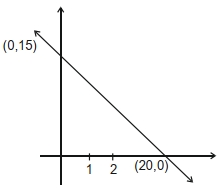
$A$ triangle is formed by the $X$-axis,$Y$-axis,and the line $3x + 4y = 60$. The number of points $P(a, b)$ which lie strictly inside the triangle,where $a$ is an integer and $b$ is a multiple of $a$,is $...........$
A
$31$
B
$30$
C
$28$
D
$56$
Solution
(A) The triangle is bounded by $x > 0$,$y > 0$,and $3x + 4y < 60$. Since $b$ is a multiple of $a$,let $b = ka$ for some integer $k \ge 1$.
For a fixed $x = a$,we have $3a + 4y < 60$,so $y < \frac{60 - 3a}{4} = 15 - 0.75a$.
Since $y = ka$,we have $ka < 15 - 0.75a$,which implies $k < \frac{15}{a} - 0.75$.
For $a=1$: $k < 15 - 0.75 = 14.25 \Rightarrow k \in \{1, 2, \dots, 14\}$ ($14$ points).
For $a=2$: $k < 7.5 - 0.75 = 6.75 \Rightarrow k \in \{1, 2, \dots, 6\}$ ($6$ points).
For $a=3$: $k < 5 - 0.75 = 4.25 \Rightarrow k \in \{1, 2, 3, 4\}$ ($4$ points).
For $a=4$: $k < 3.75 - 0.75 = 3 \Rightarrow k \in \{1, 2\}$ ($2$ points).
For $a=5$: $k < 3 - 0.75 = 2.25 \Rightarrow k \in \{1, 2\}$ ($2$ points).
For $a=6$: $k < 2.5 - 0.75 = 1.75 \Rightarrow k \in \{1\}$ ($1$ point).
For $a=7$: $k < 2.14 - 0.75 = 1.39 \Rightarrow k \in \{1\}$ ($1$ point).
For $a=8$: $k < 1.875 - 0.75 = 1.125 \Rightarrow k \in \{1\}$ ($1$ point).
For $a \ge 9$: $k < \frac{15}{a} - 0.75 \le \frac{15}{9} - 0.75 = 1.66 - 0.75 = 0.91$,no positive integer $k$ exists.
Total points $= 14 + 6 + 4 + 2 + 2 + 1 + 1 + 1 = 31$.
For a fixed $x = a$,we have $3a + 4y < 60$,so $y < \frac{60 - 3a}{4} = 15 - 0.75a$.
Since $y = ka$,we have $ka < 15 - 0.75a$,which implies $k < \frac{15}{a} - 0.75$.
For $a=1$: $k < 15 - 0.75 = 14.25 \Rightarrow k \in \{1, 2, \dots, 14\}$ ($14$ points).
For $a=2$: $k < 7.5 - 0.75 = 6.75 \Rightarrow k \in \{1, 2, \dots, 6\}$ ($6$ points).
For $a=3$: $k < 5 - 0.75 = 4.25 \Rightarrow k \in \{1, 2, 3, 4\}$ ($4$ points).
For $a=4$: $k < 3.75 - 0.75 = 3 \Rightarrow k \in \{1, 2\}$ ($2$ points).
For $a=5$: $k < 3 - 0.75 = 2.25 \Rightarrow k \in \{1, 2\}$ ($2$ points).
For $a=6$: $k < 2.5 - 0.75 = 1.75 \Rightarrow k \in \{1\}$ ($1$ point).
For $a=7$: $k < 2.14 - 0.75 = 1.39 \Rightarrow k \in \{1\}$ ($1$ point).
For $a=8$: $k < 1.875 - 0.75 = 1.125 \Rightarrow k \in \{1\}$ ($1$ point).
For $a \ge 9$: $k < \frac{15}{a} - 0.75 \le \frac{15}{9} - 0.75 = 1.66 - 0.75 = 0.91$,no positive integer $k$ exists.
Total points $= 14 + 6 + 4 + 2 + 2 + 1 + 1 + 1 = 31$.
0 likes
View Solution65
DifficultMCQ
The number of elements in the set $\{n \in \mathbb{Z} : |n^2 - 10n + 19| < 6\}$ is $...........$
A
$12$
B
$18$
C
$24$
D
$6$
Solution
(D) The given inequality is $|n^2 - 10n + 19| < 6$.
This is equivalent to $-6 < n^2 - 10n + 19 < 6$.
Case $1$: $n^2 - 10n + 19 < 6 \Rightarrow n^2 - 10n + 13 < 0$.
The roots of $n^2 - 10n + 13 = 0$ are $n = \frac{10 \pm \sqrt{100 - 52}}{2} = 5 \pm \sqrt{12} = 5 \pm 2\sqrt{3}$.
Since $2\sqrt{3} \approx 3.46$,the range is $n \in (5 - 3.46, 5 + 3.46) = (1.54, 8.46)$.
Case $2$: $n^2 - 10n + 19 > -6$ $\Rightarrow n^2 - 10n + 25 > 0$ $\Rightarrow (n - 5)^2 > 0$.
This is true for all $n \in \mathbb{Z}$ except $n = 5$.
Combining these,$n \in \{2, 3, 4, 6, 7, 8\}$.
The number of such elements is $6$.
This is equivalent to $-6 < n^2 - 10n + 19 < 6$.
Case $1$: $n^2 - 10n + 19 < 6 \Rightarrow n^2 - 10n + 13 < 0$.
The roots of $n^2 - 10n + 13 = 0$ are $n = \frac{10 \pm \sqrt{100 - 52}}{2} = 5 \pm \sqrt{12} = 5 \pm 2\sqrt{3}$.
Since $2\sqrt{3} \approx 3.46$,the range is $n \in (5 - 3.46, 5 + 3.46) = (1.54, 8.46)$.
Case $2$: $n^2 - 10n + 19 > -6$ $\Rightarrow n^2 - 10n + 25 > 0$ $\Rightarrow (n - 5)^2 > 0$.
This is true for all $n \in \mathbb{Z}$ except $n = 5$.
Combining these,$n \in \{2, 3, 4, 6, 7, 8\}$.
The number of such elements is $6$.
0 likes
View Solution66
MediumMCQ
The solution set of the constraints $|x-y| \leqslant 1, x, y \geqslant 0$ is
A
a finite set
B
an unbounded set
C
a convex polygon
D
such that the feasible region does not exist
Solution
(B) The given constraints are $|x-y| \leqslant 1$ and $x, y \geqslant 0$.
The inequality $|x-y| \leqslant 1$ is equivalent to $-1 \leqslant x-y \leqslant 1$,which can be split into two inequalities: $y \leqslant x+1$ and $y \geqslant x-1$.
Combining these with $x \geqslant 0$ and $y \geqslant 0$,we observe the region in the first quadrant.
For any $x \geqslant 0$,we can choose $y$ such that $x-1 \leqslant y \leqslant x+1$.
As $x$ increases indefinitely,$y$ can also increase indefinitely (e.g.,by choosing $y=x$).
Since the region extends infinitely in the first quadrant,the solution set is an unbounded set.
The inequality $|x-y| \leqslant 1$ is equivalent to $-1 \leqslant x-y \leqslant 1$,which can be split into two inequalities: $y \leqslant x+1$ and $y \geqslant x-1$.
Combining these with $x \geqslant 0$ and $y \geqslant 0$,we observe the region in the first quadrant.
For any $x \geqslant 0$,we can choose $y$ such that $x-1 \leqslant y \leqslant x+1$.
As $x$ increases indefinitely,$y$ can also increase indefinitely (e.g.,by choosing $y=x$).
Since the region extends infinitely in the first quadrant,the solution set is an unbounded set.
0 likes
View Solution67
EasyMCQ
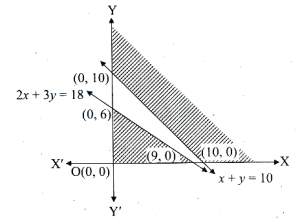
The region represented by the inequations $2x + 3y \leqslant 18$,$x + y \geqslant 10$,$x \geqslant 0$,$y \geqslant 0$ is
A
unbounded
B
bounded region,but not a singleton set
C
singleton set
D
null set
Solution
(D) To find the feasible region,we analyze the given constraints:
$1$. $2x + 3y \leqslant 18$: This represents the region on or below the line $2x + 3y = 18$. The intercepts are $(9, 0)$ and $(0, 6)$.
$2$. $x + y \geqslant 10$: This represents the region on or above the line $x + y = 10$. The intercepts are $(10, 0)$ and $(0, 10)$.
$3$. $x \geqslant 0, y \geqslant 0$: This restricts the region to the first quadrant.
Comparing the two lines:
For $2x + 3y = 18$,the maximum $x$-value is $9$ and the maximum $y$-value is $6$.
For $x + y = 10$,the minimum $x$-value is $10$ and the minimum $y$-value is $10$.
Since the region defined by $2x + 3y \leqslant 18$ lies entirely below the line $x + y = 10$ in the first quadrant,there is no point $(x, y)$ that satisfies both $2x + 3y \leqslant 18$ and $x + y \geqslant 10$ simultaneously.
Therefore,the feasible region is a null set.
$1$. $2x + 3y \leqslant 18$: This represents the region on or below the line $2x + 3y = 18$. The intercepts are $(9, 0)$ and $(0, 6)$.
$2$. $x + y \geqslant 10$: This represents the region on or above the line $x + y = 10$. The intercepts are $(10, 0)$ and $(0, 10)$.
$3$. $x \geqslant 0, y \geqslant 0$: This restricts the region to the first quadrant.
Comparing the two lines:
For $2x + 3y = 18$,the maximum $x$-value is $9$ and the maximum $y$-value is $6$.
For $x + y = 10$,the minimum $x$-value is $10$ and the minimum $y$-value is $10$.
Since the region defined by $2x + 3y \leqslant 18$ lies entirely below the line $x + y = 10$ in the first quadrant,there is no point $(x, y)$ that satisfies both $2x + 3y \leqslant 18$ and $x + y \geqslant 10$ simultaneously.
Therefore,the feasible region is a null set.
0 likes
View Solution68
EasyMCQ
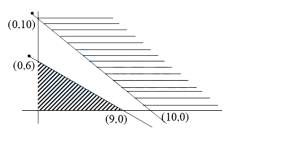
The feasible region represented by the inequations $2x + 3y \leq 18$,$x + y \geq 10$,$x \geq 0$,$y \geq 0$ is
A
a finite set.
B
unbounded.
C
bounded.
D
an empty set.
Solution
(D) Given the system of linear inequations:
$1) 2x + 3y \leq 18$
$2) x + y \geq 10$
$3) x \geq 0, y \geq 0$
For the first inequation $2x + 3y \leq 18$,the boundary line is $2x + 3y = 18$. The intercepts are $(9, 0)$ and $(0, 6)$. Since the origin $(0, 0)$ satisfies $2(0) + 3(0) \leq 18$,the feasible region lies towards the origin.
For the second inequation $x + y \geq 10$,the boundary line is $x + y = 10$. The intercepts are $(10, 0)$ and $(0, 10)$. Since the origin $(0, 0)$ does not satisfy $0 + 0 \geq 10$,the feasible region lies away from the origin.
Comparing the two regions: the first region is below the line passing through $(9, 0)$ and $(0, 6)$,while the second region is above the line passing through $(10, 0)$ and $(0, 10)$. These two regions do not intersect in the first quadrant $(x \geq 0, y \geq 0)$.
Therefore,there is no common region that satisfies all the given inequations. Thus,the feasible region is an empty set.
$1) 2x + 3y \leq 18$
$2) x + y \geq 10$
$3) x \geq 0, y \geq 0$
For the first inequation $2x + 3y \leq 18$,the boundary line is $2x + 3y = 18$. The intercepts are $(9, 0)$ and $(0, 6)$. Since the origin $(0, 0)$ satisfies $2(0) + 3(0) \leq 18$,the feasible region lies towards the origin.
For the second inequation $x + y \geq 10$,the boundary line is $x + y = 10$. The intercepts are $(10, 0)$ and $(0, 10)$. Since the origin $(0, 0)$ does not satisfy $0 + 0 \geq 10$,the feasible region lies away from the origin.
Comparing the two regions: the first region is below the line passing through $(9, 0)$ and $(0, 6)$,while the second region is above the line passing through $(10, 0)$ and $(0, 10)$. These two regions do not intersect in the first quadrant $(x \geq 0, y \geq 0)$.
Therefore,there is no common region that satisfies all the given inequations. Thus,the feasible region is an empty set.
0 likes
View Solution69
EasyMCQ
The solution set for the system of linear inequations $x+y \geq 1$,$7x+9y \leq 63$,$y \leq 5$,$x \leq 6$,$x \geq 0$,and $y \geq 0$ is represented graphically. Which of the following figures represents the correct solution set?
A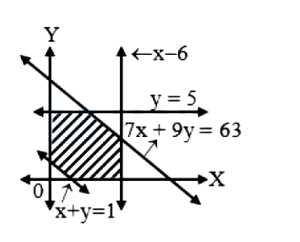
B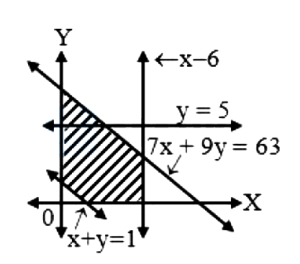
C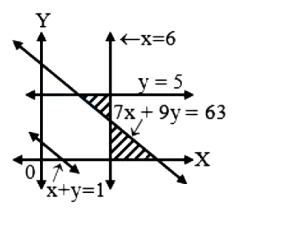
D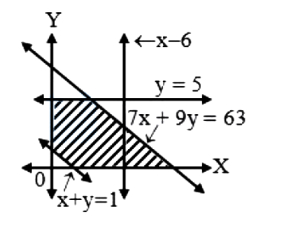
Solution
(A) The system of linear inequalities is given by:
$1) x+y \geq 1$
$2) 7x+9y \leq 63$
$3) y \leq 5$
$4) x \leq 6$
$5) x \geq 0, y \geq 0$
To find the feasible region,we analyze the boundaries:
- The line $x+y=1$ passes through $(1,0)$ and $(0,1)$. The region $x+y \geq 1$ is away from the origin.
- The line $7x+9y=63$ passes through $(9,0)$ and $(0,7)$. The region $7x+9y \leq 63$ is towards the origin.
- The lines $x=6$ and $y=5$ are vertical and horizontal lines respectively,bounding the region.
- The conditions $x \geq 0$ and $y \geq 0$ restrict the region to the first quadrant.
By plotting these lines and considering the inequalities,the feasible region is the bounded polygon in the first quadrant that satisfies all conditions. Comparing this with the provided options,the figure in the solution image (which matches option $A$) correctly represents the intersection of all these half-planes.
$1) x+y \geq 1$
$2) 7x+9y \leq 63$
$3) y \leq 5$
$4) x \leq 6$
$5) x \geq 0, y \geq 0$
To find the feasible region,we analyze the boundaries:
- The line $x+y=1$ passes through $(1,0)$ and $(0,1)$. The region $x+y \geq 1$ is away from the origin.
- The line $7x+9y=63$ passes through $(9,0)$ and $(0,7)$. The region $7x+9y \leq 63$ is towards the origin.
- The lines $x=6$ and $y=5$ are vertical and horizontal lines respectively,bounding the region.
- The conditions $x \geq 0$ and $y \geq 0$ restrict the region to the first quadrant.
By plotting these lines and considering the inequalities,the feasible region is the bounded polygon in the first quadrant that satisfies all conditions. Comparing this with the provided options,the figure in the solution image (which matches option $A$) correctly represents the intersection of all these half-planes.
0 likes
View Solution70
EasyMCQ
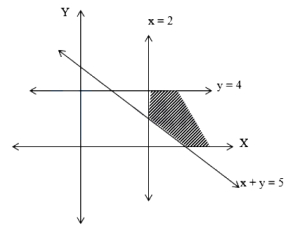
The common region of the solution of the inequations $x+y \geq 5$,$y \leq 4$,$x \geq 2$,$x, y \geq 0$ is
A
unbounded and non-origin side
B
unbounded and origin side
C
bounded and origin side
D
bounded and non-origin side
Solution
(D) To find the common region,we analyze the given inequations:
$1$. $x+y \geq 5$: This represents the region on or above the line $x+y=5$. Since $(0,0)$ does not satisfy this ($0 \geq 5$ is false),the region is on the non-origin side.
$2$. $y \leq 4$: This represents the region on or below the line $y=4$.
$3$. $x \geq 2$: This represents the region on or to the right of the line $x=2$.
$4$. $x, y \geq 0$: This restricts the region to the first quadrant.
By plotting these lines,we observe the shaded region in the figure. The region is bounded by the lines $x=2$,$y=4$,and $x+y=5$. Since the region is enclosed by these lines,it is a bounded region. Furthermore,the origin $(0,0)$ does not lie in the shaded region,so it is on the non-origin side.
Therefore,the correct option is $D$.
$1$. $x+y \geq 5$: This represents the region on or above the line $x+y=5$. Since $(0,0)$ does not satisfy this ($0 \geq 5$ is false),the region is on the non-origin side.
$2$. $y \leq 4$: This represents the region on or below the line $y=4$.
$3$. $x \geq 2$: This represents the region on or to the right of the line $x=2$.
$4$. $x, y \geq 0$: This restricts the region to the first quadrant.
By plotting these lines,we observe the shaded region in the figure. The region is bounded by the lines $x=2$,$y=4$,and $x+y=5$. Since the region is enclosed by these lines,it is a bounded region. Furthermore,the origin $(0,0)$ does not lie in the shaded region,so it is on the non-origin side.
Therefore,the correct option is $D$.
0 likes
View Solution71
EasyMCQ
The cost and revenue functions of a product are given by $C(x) = 20x + 4000$ and $R(x) = 60x + 2000$ respectively,where $x$ is the number of items produced and sold. The value of $x$ to earn profit is
A
$> 50$
B
$> 60$
C
$> 80$
D
$> 40$
Solution
(A) Given,$C(x) = 20x + 4000$ and $R(x) = 60x + 2000$.
To earn a profit,the revenue must be greater than the cost,i.e.,$R(x) - C(x) > 0$.
Substituting the given functions:
$(60x + 2000) - (20x + 4000) > 0$
$60x + 2000 - 20x - 4000 > 0$
$40x - 2000 > 0$
$40x > 2000$
$x > \frac{2000}{40}$
$x > 50$.
Thus,the number of items $x$ must be greater than $50$ to earn a profit.
To earn a profit,the revenue must be greater than the cost,i.e.,$R(x) - C(x) > 0$.
Substituting the given functions:
$(60x + 2000) - (20x + 4000) > 0$
$60x + 2000 - 20x - 4000 > 0$
$40x - 2000 > 0$
$40x > 2000$
$x > \frac{2000}{40}$
$x > 50$.
Thus,the number of items $x$ must be greater than $50$ to earn a profit.
0 likes
View Solution72
EasyMCQ
The length of a rectangle is five times the breadth. If the minimum perimeter of the rectangle is $180 \ cm$,then:
A
Breadth $\leq 15 \ cm$
B
Breadth $\geq 15 \ cm$
C
Length $\leq 15 \ cm$
D
Length $= 15 \ cm$
Solution
(B) Let the breadth of the rectangle be $x \ cm$.
Then,the length of the rectangle is $5x \ cm$.
The perimeter of a rectangle is given by $P = 2(\text{length} + \text{breadth})$.
Substituting the values,$P = 2(5x + x) = 2(6x) = 12x$.
Given that the minimum perimeter is $180 \ cm$,we have $P \geq 180$.
Therefore,$12x \geq 180$.
Dividing both sides by $12$,we get $x \geq 15$.
Since $x$ represents the breadth,the breadth must be at least $15 \ cm$.
Then,the length of the rectangle is $5x \ cm$.
The perimeter of a rectangle is given by $P = 2(\text{length} + \text{breadth})$.
Substituting the values,$P = 2(5x + x) = 2(6x) = 12x$.
Given that the minimum perimeter is $180 \ cm$,we have $P \geq 180$.
Therefore,$12x \geq 180$.
Dividing both sides by $12$,we get $x \geq 15$.
Since $x$ represents the breadth,the breadth must be at least $15 \ cm$.
0 likes
View Solution73
DifficultMCQ
The solution set of the inequation $\frac{x^{2}+6x-7}{|x+4|} < 0$ is
A
$(-7, 1)$
B
$(-7, -4)$
C
$(-7, -4) \cup (-4, 1)$
D
$(-7, -4) \cup (4, 1)$
Solution
(C) Given the inequation $\frac{x^{2}+6x-7}{|x+4|} < 0$.
Since $|x+4|$ is always positive for $x \neq -4$,the expression is negative only when the numerator is negative.
Thus,$x^{2}+6x-7 < 0$ and $x \neq -4$.
Factoring the quadratic expression,we get $(x+7)(x-1) < 0$.
This inequality holds for $x \in (-7, 1)$.
Excluding the point where the denominator is zero $(x = -4)$,the solution set is $(-7, -4) \cup (-4, 1)$.
Since $|x+4|$ is always positive for $x \neq -4$,the expression is negative only when the numerator is negative.
Thus,$x^{2}+6x-7 < 0$ and $x \neq -4$.
Factoring the quadratic expression,we get $(x+7)(x-1) < 0$.
This inequality holds for $x \in (-7, 1)$.
Excluding the point where the denominator is zero $(x = -4)$,the solution set is $(-7, -4) \cup (-4, 1)$.
0 likes
View Solution74
MediumMCQ
The set of all real values of $x$ satisfying the inequation $\frac{8x^2-14x-9}{3x^2-7x-6} > 2$ is
A
$(-\infty, 1) \cup (3, \infty)$
B
$(-\infty, -2/3) \cup (2, \infty)$
C
$(-2/3, 2)$
D
$(-\infty, -2/3) \cup (3, \infty)$
Solution
(D) Given the inequality: $\frac{8x^2-14x-9}{3x^2-7x-6} > 2$ \\ Subtract $2$ from both sides: $\frac{8x^2-14x-9}{3x^2-7x-6} - 2 > 0$ \\ $\frac{8x^2-14x-9 - 2(3x^2-7x-6)}{3x^2-7x-6} > 0$ \\ $\frac{8x^2-14x-9 - 6x^2+14x+12}{3x^2-7x-6} > 0$ \\ $\frac{2x^2+3}{3x^2-7x-6} > 0$ \\ Since $2x^2+3$ is always positive for all real $x$,the inequality holds if $3x^2-7x-6 > 0$ \\ Factor the denominator: $3x^2-9x+2x-6 = 3x(x-3)+2(x-3) = (3x+2)(x-3) > 0$ \\ The critical points are $x = -2/3$ and $x = 3$ \\ Testing the intervals $(-\infty, -2/3)$,$(-2/3, 3)$,and $(3, \infty)$,the expression is positive in $(-\infty, -2/3) \cup (3, \infty)$.
0 likes
View Solution75
MediumMCQ
The set of all real values of $x$ for which $\frac{x^2-1}{(x-4)(x-3)} \geq 1$ is
A
$[-1, 1] \cup (3, 4)$
B
$[\frac{13}{7}, 3) \cup (4, \infty)$
C
$(-\infty, \frac{13}{7}] \cup (3, 4)$
D
$R - [3, 4]$
Solution
(B) Given the inequality: $\frac{x^2-1}{(x-4)(x-3)} \geq 1$.
Subtract $1$ from both sides: $\frac{x^2-1}{(x-4)(x-3)} - 1 \geq 0$.
Simplify the expression: $\frac{x^2-1 - (x^2-7x+12)}{(x-4)(x-3)} \geq 0$.
$\frac{x^2-1 - x^2+7x-12}{(x-4)(x-3)} \geq 0$.
$\frac{7x-13}{(x-4)(x-3)} \geq 0$.
Find the critical points: $x = \frac{13}{7}, x = 3, x = 4$.
Using the wavy curve method on the number line,we test the intervals:
For $x > 4$,the expression is positive.
For $3 < x < 4$,the expression is negative.
For $\frac{13}{7} \leq x < 3$,the expression is positive.
For $x < \frac{13}{7}$,the expression is negative.
Thus,the solution set is $[\frac{13}{7}, 3) \cup (4, \infty)$.
Subtract $1$ from both sides: $\frac{x^2-1}{(x-4)(x-3)} - 1 \geq 0$.
Simplify the expression: $\frac{x^2-1 - (x^2-7x+12)}{(x-4)(x-3)} \geq 0$.
$\frac{x^2-1 - x^2+7x-12}{(x-4)(x-3)} \geq 0$.
$\frac{7x-13}{(x-4)(x-3)} \geq 0$.
Find the critical points: $x = \frac{13}{7}, x = 3, x = 4$.
Using the wavy curve method on the number line,we test the intervals:
For $x > 4$,the expression is positive.
For $3 < x < 4$,the expression is negative.
For $\frac{13}{7} \leq x < 3$,the expression is positive.
For $x < \frac{13}{7}$,the expression is negative.
Thus,the solution set is $[\frac{13}{7}, 3) \cup (4, \infty)$.
0 likes
View Solution76
EasyMCQ
The inequality $\frac{x-1}{3x+4} < \frac{x-3}{3x-2}$ holds for all $x$ in the interval:
A
$\left(-\frac{4}{3}, \frac{2}{3}\right)$
B
$\left(-\infty, -\frac{5}{4}\right)$
C
$(-\infty, \infty)$
D
$\left(-\infty, -\frac{4}{3}\right) \cup \left(\frac{2}{3}, \infty\right)$
Solution
(A) Given the inequality: $\frac{x-1}{3x+4} - \frac{x-3}{3x-2} < 0$
Taking the common denominator:
$\frac{(x-1)(3x-2) - (x-3)(3x+4)}{(3x+4)(3x-2)} < 0$
Expanding the numerators:
$\frac{(3x^2 - 2x - 3x + 2) - (3x^2 + 4x - 9x - 12)}{(3x+4)(3x-2)} < 0$
Simplifying the numerator:
$\frac{(3x^2 - 5x + 2) - (3x^2 - 5x - 12)}{(3x+4)(3x-2)} < 0$
$\frac{3x^2 - 5x + 2 - 3x^2 + 5x + 12}{(3x+4)(3x-2)} < 0$
$\frac{14}{(3x+4)(3x-2)} < 0$
Since the numerator $14$ is positive,the expression is negative only when the denominator is negative:
$(3x+4)(3x-2) < 0$
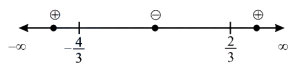
The roots of the denominator are $x = -\frac{4}{3}$ and $x = \frac{2}{3}$.
Using the wavy curve method (sign scheme),the expression $(3x+4)(3x-2)$ is negative between the roots.
Thus,$x \in \left(-\frac{4}{3}, \frac{2}{3}\right)$.
Taking the common denominator:
$\frac{(x-1)(3x-2) - (x-3)(3x+4)}{(3x+4)(3x-2)} < 0$
Expanding the numerators:
$\frac{(3x^2 - 2x - 3x + 2) - (3x^2 + 4x - 9x - 12)}{(3x+4)(3x-2)} < 0$
Simplifying the numerator:
$\frac{(3x^2 - 5x + 2) - (3x^2 - 5x - 12)}{(3x+4)(3x-2)} < 0$
$\frac{3x^2 - 5x + 2 - 3x^2 + 5x + 12}{(3x+4)(3x-2)} < 0$
$\frac{14}{(3x+4)(3x-2)} < 0$
Since the numerator $14$ is positive,the expression is negative only when the denominator is negative:
$(3x+4)(3x-2) < 0$
The roots of the denominator are $x = -\frac{4}{3}$ and $x = \frac{2}{3}$.
Using the wavy curve method (sign scheme),the expression $(3x+4)(3x-2)$ is negative between the roots.
Thus,$x \in \left(-\frac{4}{3}, \frac{2}{3}\right)$.
0 likes
View Solution77
DifficultMCQ
$\left\{x \in R: \frac{14 x}{x+1}-\frac{9 x-30}{x-4} < 0\right\}$ is equal to
A
$(-1,4)$
B
$(1,4) \cup(5,7)$
C
$(1,7)$
D
$(-1,1) \cup(4,6)$
Solution
(D) Given inequality: $\frac{14 x}{x+1}-\frac{9 x-30}{x-4} < 0$
Simplify the expression:
$\frac{14 x(x-4)-(9 x-30)(x+1)}{(x+1)(x-4)} < 0$
$\frac{14 x^2-56 x-(9 x^2+9 x-30 x-30)}{(x+1)(x-4)} < 0$
$\frac{14 x^2-56 x-(9 x^2-21 x-30)}{(x+1)(x-4)} < 0$
$\frac{5 x^2-35 x+30}{(x+1)(x-4)} < 0$
$\frac{5(x^2-7 x+6)}{(x+1)(x-4)} < 0$
$\frac{5(x-1)(x-6)}{(x+1)(x-4)} < 0$
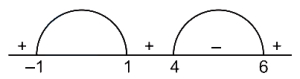
Using the wavy curve method (sign scheme) on the number line with critical points $-1, 1, 4, 6$:
The expression is negative in the intervals $(-1, 1)$ and $(4, 6)$.
Thus,$x \in (-1, 1) \cup (4, 6)$.
Simplify the expression:
$\frac{14 x(x-4)-(9 x-30)(x+1)}{(x+1)(x-4)} < 0$
$\frac{14 x^2-56 x-(9 x^2+9 x-30 x-30)}{(x+1)(x-4)} < 0$
$\frac{14 x^2-56 x-(9 x^2-21 x-30)}{(x+1)(x-4)} < 0$
$\frac{5 x^2-35 x+30}{(x+1)(x-4)} < 0$
$\frac{5(x^2-7 x+6)}{(x+1)(x-4)} < 0$
$\frac{5(x-1)(x-6)}{(x+1)(x-4)} < 0$
Using the wavy curve method (sign scheme) on the number line with critical points $-1, 1, 4, 6$:
The expression is negative in the intervals $(-1, 1)$ and $(4, 6)$.
Thus,$x \in (-1, 1) \cup (4, 6)$.
0 likes
View Solution78
EasyMCQ
The set of all real values of $x$ satisfying the inequality $\frac{7 x^2-5 x-18}{2 x^2+x-6} < 2$ is
A
$\left(-\infty, -\frac{2}{3}\right] \cup [3, \infty)$
B
$\left(-2, -\frac{2}{3}\right) \cup \left(\frac{3}{2}, 3 \right)$
C
$(-\infty, -2) \cup \left(\frac{3}{2}, \infty\right)$
D
$\left[-\frac{2}{3}, \frac{3}{2}\right)$
Solution
(B) Given the inequality: $\frac{7 x^2-5 x-18}{2 x^2+x-6} < 2$
Subtract $2$ from both sides: $\frac{7 x^2-5 x-18}{2 x^2+x-6} - 2 < 0$
$\Rightarrow \frac{7 x^2-5 x-18 - 2(2 x^2+x-6)}{2 x^2+x-6} < 0$
$\Rightarrow \frac{7 x^2-5 x-18 - 4 x^2-2 x+12}{(2 x-3)(x+2)} < 0$
$\Rightarrow \frac{3 x^2-7 x-6}{(2 x-3)(x+2)} < 0$
Factor the numerator: $3 x^2-7 x-6 = 3 x^2-9 x+2 x-6 = 3 x(x-3)+2(x-3) = (3 x+2)(x-3)$
So,the inequality becomes: $\frac{(3 x+2)(x-3)}{(2 x-3)(x+2)} < 0$
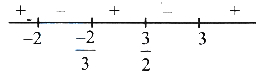
The critical points are $x = -2, -\frac{2}{3}, \frac{3}{2}, 3$.
Using the wavy curve method,we test the intervals:
For $x > 3$,the expression is positive.
For $\frac{3}{2} < x < 3$,the expression is negative.
For $-\frac{2}{3} < x < \frac{3}{2}$,the expression is positive.
For $-2 < x < -\frac{2}{3}$,the expression is negative.
For $x < -2$,the expression is positive.
Since we need the expression to be less than $0$,the solution is $x \in \left(-2, -\frac{2}{3}\right) \cup \left(\frac{3}{2}, 3 \right)$.
Subtract $2$ from both sides: $\frac{7 x^2-5 x-18}{2 x^2+x-6} - 2 < 0$
$\Rightarrow \frac{7 x^2-5 x-18 - 2(2 x^2+x-6)}{2 x^2+x-6} < 0$
$\Rightarrow \frac{7 x^2-5 x-18 - 4 x^2-2 x+12}{(2 x-3)(x+2)} < 0$
$\Rightarrow \frac{3 x^2-7 x-6}{(2 x-3)(x+2)} < 0$
Factor the numerator: $3 x^2-7 x-6 = 3 x^2-9 x+2 x-6 = 3 x(x-3)+2(x-3) = (3 x+2)(x-3)$
So,the inequality becomes: $\frac{(3 x+2)(x-3)}{(2 x-3)(x+2)} < 0$
The critical points are $x = -2, -\frac{2}{3}, \frac{3}{2}, 3$.
Using the wavy curve method,we test the intervals:
For $x > 3$,the expression is positive.
For $\frac{3}{2} < x < 3$,the expression is negative.
For $-\frac{2}{3} < x < \frac{3}{2}$,the expression is positive.
For $-2 < x < -\frac{2}{3}$,the expression is negative.
For $x < -2$,the expression is positive.
Since we need the expression to be less than $0$,the solution is $x \in \left(-2, -\frac{2}{3}\right) \cup \left(\frac{3}{2}, 3 \right)$.
0 likes
View Solution79
MediumMCQ
If $x \in R$ and $1 \leq \frac{3x^2-7x+8}{x^2+1} \leq 2$,then the minimum and maximum values of $x$ are respectively.
A
$1, 2$
B
$5, 12$
C
$6, 10$
D
$1, 6$
Solution
(D) Given,$1 \leq \frac{3x^2-7x+8}{x^2+1} \leq 2$. Since $x^2+1 > 0$ for all $x \in R$,we can multiply throughout by $(x^2+1)$.
First,consider $1 \leq \frac{3x^2-7x+8}{x^2+1} \implies x^2+1 \leq 3x^2-7x+8 \implies 2x^2-7x+7 \geq 0$.
The discriminant of $2x^2-7x+7$ is $D = (-7)^2 - 4(2)(7) = 49 - 56 = -7 < 0$. Since the leading coefficient is positive,$2x^2-7x+7 > 0$ for all $x \in R$.
Next,consider $\frac{3x^2-7x+8}{x^2+1} \leq 2 \implies 3x^2-7x+8 \leq 2x^2+2 \implies x^2-7x+6 \leq 0$.
Factoring the quadratic,we get $(x-1)(x-6) \leq 0$.
This inequality holds for $x \in [1, 6]$.
Thus,the minimum value is $1$ and the maximum value is $6$.
First,consider $1 \leq \frac{3x^2-7x+8}{x^2+1} \implies x^2+1 \leq 3x^2-7x+8 \implies 2x^2-7x+7 \geq 0$.
The discriminant of $2x^2-7x+7$ is $D = (-7)^2 - 4(2)(7) = 49 - 56 = -7 < 0$. Since the leading coefficient is positive,$2x^2-7x+7 > 0$ for all $x \in R$.
Next,consider $\frac{3x^2-7x+8}{x^2+1} \leq 2 \implies 3x^2-7x+8 \leq 2x^2+2 \implies x^2-7x+6 \leq 0$.
Factoring the quadratic,we get $(x-1)(x-6) \leq 0$.
This inequality holds for $x \in [1, 6]$.
Thus,the minimum value is $1$ and the maximum value is $6$.
0 likes
View Solution80
MediumMCQ
The values of $x$ for which the inequality $\frac{8x^2+16x-51}{(2x-3)(x+4)} > 3$ holds,are
A
$x \geq 4$
B
$-4 \leq x \leq -3$
C
$\frac{3}{2} < x < \frac{5}{2}$
D
$x < -4$ or $x > \frac{5}{2}$ or $-3 < x < \frac{3}{2}$
Solution
(D) Given inequality: $\frac{8x^2+16x-51}{(2x-3)(x+4)} > 3$
Subtract $3$ from both sides: $\frac{8x^2+16x-51 - 3(2x^2+5x-12)}{(2x-3)(x+4)} > 0$
Simplify the numerator: $8x^2+16x-51 - 6x^2-15x+36 = 2x^2+x-15$
Factor the numerator: $2x^2+6x-5x-15 = 2x(x+3)-5(x+3) = (2x-5)(x+3)$
So,the inequality becomes: $\frac{(2x-5)(x+3)}{(2x-3)(x+4)} > 0$
The critical points are $x = -4, -3, \frac{3}{2}, \frac{5}{2}$.
Using the wavy curve method (sign scheme) for the intervals $(-\infty, -4), (-4, -3), (-3, \frac{3}{2}), (\frac{3}{2}, \frac{5}{2}), (\frac{5}{2}, \infty)$:
The expression is positive in the intervals $(-\infty, -4) \cup (-3, \frac{3}{2}) \cup (\frac{5}{2}, \infty)$.
Subtract $3$ from both sides: $\frac{8x^2+16x-51 - 3(2x^2+5x-12)}{(2x-3)(x+4)} > 0$
Simplify the numerator: $8x^2+16x-51 - 6x^2-15x+36 = 2x^2+x-15$
Factor the numerator: $2x^2+6x-5x-15 = 2x(x+3)-5(x+3) = (2x-5)(x+3)$
So,the inequality becomes: $\frac{(2x-5)(x+3)}{(2x-3)(x+4)} > 0$
The critical points are $x = -4, -3, \frac{3}{2}, \frac{5}{2}$.
Using the wavy curve method (sign scheme) for the intervals $(-\infty, -4), (-4, -3), (-3, \frac{3}{2}), (\frac{3}{2}, \frac{5}{2}), (\frac{5}{2}, \infty)$:
The expression is positive in the intervals $(-\infty, -4) \cup (-3, \frac{3}{2}) \cup (\frac{5}{2}, \infty)$.
0 likes
View Solution81
MediumMCQ
$\left\{x \in R : \frac{\sqrt{6+x-x^2}}{2x+5} \geq \frac{\sqrt{6+x-x^2}}{x+4}\right\}=$
A
$[-2,3]$
B
$(-\infty,-4] \cup \left[\frac{-5}{2},-1\right]$
C
$[-2,-1] \cup \{3\}$
D
$(-\infty,-4] \cup [-2,-1]$
Solution
(C) The given inequality is $\frac{\sqrt{6+x-x^2}}{2x+5} \geq \frac{\sqrt{6+x-x^2}}{x+4}$.
First,for the expression to be defined,we must have $6+x-x^2 \geq 0$,which implies $x^2-x-6 \leq 0$,so $(x-3)(x+2) \leq 0$. Thus,$x \in [-2, 3]$.
If $6+x-x^2 = 0$,then $x = -2$ or $x = 3$. Both satisfy the inequality as $0 \geq 0$.
If $6+x-x^2 > 0$,we can divide by $\sqrt{6+x-x^2}$:
$\frac{1}{2x+5} \geq \frac{1}{x+4} \Rightarrow \frac{1}{2x+5} - \frac{1}{x+4} \geq 0$
$\Rightarrow \frac{x+4-(2x+5)}{(2x+5)(x+4)} \geq 0$ $\Rightarrow \frac{-x-1}{(2x+5)(x+4)} \geq 0$
$\Rightarrow \frac{x+1}{(2x+5)(x+4)} \leq 0$.
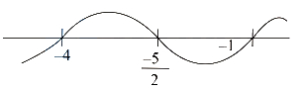
Using the sign scheme for critical points $-4, -2.5, -1$,the expression is $\leq 0$ for $x \in (-\infty, -4) \cup (-2.5, -1]$.
Combining this with the domain $x \in [-2, 3]$,we get $x \in [-2, -1] \cup \{3\}$.
First,for the expression to be defined,we must have $6+x-x^2 \geq 0$,which implies $x^2-x-6 \leq 0$,so $(x-3)(x+2) \leq 0$. Thus,$x \in [-2, 3]$.
If $6+x-x^2 = 0$,then $x = -2$ or $x = 3$. Both satisfy the inequality as $0 \geq 0$.
If $6+x-x^2 > 0$,we can divide by $\sqrt{6+x-x^2}$:
$\frac{1}{2x+5} \geq \frac{1}{x+4} \Rightarrow \frac{1}{2x+5} - \frac{1}{x+4} \geq 0$
$\Rightarrow \frac{x+4-(2x+5)}{(2x+5)(x+4)} \geq 0$ $\Rightarrow \frac{-x-1}{(2x+5)(x+4)} \geq 0$
$\Rightarrow \frac{x+1}{(2x+5)(x+4)} \leq 0$.
Using the sign scheme for critical points $-4, -2.5, -1$,the expression is $\leq 0$ for $x \in (-\infty, -4) \cup (-2.5, -1]$.
Combining this with the domain $x \in [-2, 3]$,we get $x \in [-2, -1] \cup \{3\}$.
0 likes
View Solution82
DifficultMCQ
The number of integral values of $x$ satisfying $5x - 1 < (x + 1)^2 < 7x - 3$ is
A
$0$
B
$1$
C
$2$
D
$3$
Solution
(B) We have two inequalities to solve:
$5x - 1 < (x + 1)^2$ and $(x + 1)^2 < 7x - 3$.
For the first inequality:
$5x - 1 < x^2 + 2x + 1$
$x^2 - 3x + 2 > 0$
$(x - 1)(x - 2) > 0$
This implies $x \in (-\infty, 1) \cup (2, \infty)$.
For the second inequality:
$(x + 1)^2 < 7x - 3$
$x^2 + 2x + 1 < 7x - 3$
$x^2 - 5x + 4 < 0$
$(x - 1)(x - 4) < 0$
This implies $x \in (1, 4)$.
Taking the intersection of both intervals:
$x \in ((-\infty, 1) \cup (2, \infty)) \cap (1, 4) = (2, 4)$.
The integers in the interval $(2, 4)$ is only $x = 3$.
Thus,there is only $1$ integral value.
$5x - 1 < (x + 1)^2$ and $(x + 1)^2 < 7x - 3$.
For the first inequality:
$5x - 1 < x^2 + 2x + 1$
$x^2 - 3x + 2 > 0$
$(x - 1)(x - 2) > 0$
This implies $x \in (-\infty, 1) \cup (2, \infty)$.
For the second inequality:
$(x + 1)^2 < 7x - 3$
$x^2 + 2x + 1 < 7x - 3$
$x^2 - 5x + 4 < 0$
$(x - 1)(x - 4) < 0$
This implies $x \in (1, 4)$.
Taking the intersection of both intervals:
$x \in ((-\infty, 1) \cup (2, \infty)) \cap (1, 4) = (2, 4)$.
The integers in the interval $(2, 4)$ is only $x = 3$.
Thus,there is only $1$ integral value.
0 likes
View Solution83
DifficultMCQ
If $\sqrt{9x^2+6x+1} < (2-x)$,then:
A
$x \in \left(-\frac{3}{2}, \frac{1}{4}\right)$
B
$x \in \left(-\frac{3}{2}, \frac{1}{4}\right]$
C
$x \in \left[-\frac{3}{2}, \frac{1}{4}\right)$
D
$x < \frac{1}{4}$
Solution
(A) Given the inequality: $\sqrt{9x^2+6x+1} < (2-x)$
Since $9x^2+6x+1 = (3x+1)^2$,the expression becomes $\sqrt{(3x+1)^2} < 2-x$.
This simplifies to $|3x+1| < 2-x$.
For the square root to be defined,we must have $2-x > 0$,which implies $x < 2$.
Now,solving the absolute value inequality $|3x+1| < 2-x$:
$-(2-x) < 3x+1 < 2-x$
Case $1$: $3x+1 < 2-x$
$4x < 1 \Rightarrow x < \frac{1}{4}$
Case $2$: $3x+1 > -(2-x)$
$3x+1 > -2+x$
$2x > -3 \Rightarrow x > -\frac{3}{2}$
Combining these,we get $-\frac{3}{2} < x < \frac{1}{4}$.
Thus,$x \in \left(-\frac{3}{2}, \frac{1}{4}\right)$.
Since $9x^2+6x+1 = (3x+1)^2$,the expression becomes $\sqrt{(3x+1)^2} < 2-x$.
This simplifies to $|3x+1| < 2-x$.
For the square root to be defined,we must have $2-x > 0$,which implies $x < 2$.
Now,solving the absolute value inequality $|3x+1| < 2-x$:
$-(2-x) < 3x+1 < 2-x$
Case $1$: $3x+1 < 2-x$
$4x < 1 \Rightarrow x < \frac{1}{4}$
Case $2$: $3x+1 > -(2-x)$
$3x+1 > -2+x$
$2x > -3 \Rightarrow x > -\frac{3}{2}$
Combining these,we get $-\frac{3}{2} < x < \frac{1}{4}$.
Thus,$x \in \left(-\frac{3}{2}, \frac{1}{4}\right)$.
0 likes
View Solution84
DifficultMCQ
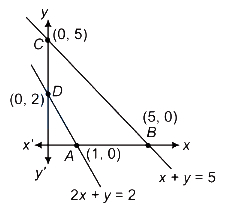
The number of points $P(x, y)$ with natural numbers as coordinates that lie inside the quadrilateral formed by the lines $2x + y = 2$,$x = 0$,$y = 0$,and $x + y = 5$ is
A
$12$
B
$10$
C
$6$
D
$4$
Solution
(C) The quadrilateral is bounded by the lines $x = 0$ ($y$-axis),$y = 0$ ($x$-axis),$2x + y = 2$,and $x + y = 5$.
For a point $(x, y)$ to be inside the quadrilateral with natural number coordinates $(x, y \in \{1, 2, 3, \dots\})$,it must satisfy the inequalities:
$1) \ x > 0$
$2) \ y > 0$
$3) \ 2x + y > 2$
$4) \ x + y < 5$
Testing integer values for $x$:
If $x = 1$: $2(1) + y > 2 \implies 2 + y > 2 \implies y > 0$. Also $1 + y < 5 \implies y < 4$. So $y \in \{1, 2, 3\}$. Points: $(1, 1), (1, 2), (1, 3)$.
If $x = 2$: $2(2) + y > 2 \implies 4 + y > 2 \implies y > -2$. Also $2 + y < 5 \implies y < 3$. So $y \in \{1, 2\}$. Points: $(2, 1), (2, 2)$.
If $x = 3$: $2(3) + y > 2 \implies 6 + y > 2 \implies y > -4$. Also $3 + y < 5 \implies y < 2$. So $y = 1$. Point: $(3, 1)$.
If $x \ge 4$: $x + y < 5$ cannot be satisfied for natural numbers $y \ge 1$.
The total number of such points is $3 + 2 + 1 = 6$.
For a point $(x, y)$ to be inside the quadrilateral with natural number coordinates $(x, y \in \{1, 2, 3, \dots\})$,it must satisfy the inequalities:
$1) \ x > 0$
$2) \ y > 0$
$3) \ 2x + y > 2$
$4) \ x + y < 5$
Testing integer values for $x$:
If $x = 1$: $2(1) + y > 2 \implies 2 + y > 2 \implies y > 0$. Also $1 + y < 5 \implies y < 4$. So $y \in \{1, 2, 3\}$. Points: $(1, 1), (1, 2), (1, 3)$.
If $x = 2$: $2(2) + y > 2 \implies 4 + y > 2 \implies y > -2$. Also $2 + y < 5 \implies y < 3$. So $y \in \{1, 2\}$. Points: $(2, 1), (2, 2)$.
If $x = 3$: $2(3) + y > 2 \implies 6 + y > 2 \implies y > -4$. Also $3 + y < 5 \implies y < 2$. So $y = 1$. Point: $(3, 1)$.
If $x \ge 4$: $x + y < 5$ cannot be satisfied for natural numbers $y \ge 1$.
The total number of such points is $3 + 2 + 1 = 6$.
0 likes
View Solution85
MediumMCQ
The number of elements in the set $S = \{x \in \mathbb{Z} : x^2 - 7x + 6 \leq 0 \text{ and } x^2 - 3x > 0\}$ is
A
$\infty$
B
$2$
C
$3$
D
$4$
Solution
(C) Given $S = \{x \in \mathbb{Z} : x^2 - 7x + 6 \leq 0 \text{ and } x^2 - 3x > 0\}$ ...$(i)$
First,solve the inequality $x^2 - 7x + 6 \leq 0$:
$(x - 6)(x - 1) \leq 0$
This implies $x \in [1, 6]$.
Next,solve the inequality $x^2 - 3x > 0$:
$x(x - 3) > 0$
This implies $x \in (-\infty, 0) \cup (3, \infty)$.
Now,find the intersection of these two intervals:
$S = \{x \in \mathbb{Z} : x \in [1, 6] \cap ((-\infty, 0) \cup (3, \infty))\}$
$S = \{x \in \mathbb{Z} : x \in (3, 6] \cap \mathbb{Z}\}$
$S = \{4, 5, 6\}$.
The number of elements in set $S$ is $3$.
First,solve the inequality $x^2 - 7x + 6 \leq 0$:
$(x - 6)(x - 1) \leq 0$
This implies $x \in [1, 6]$.
Next,solve the inequality $x^2 - 3x > 0$:
$x(x - 3) > 0$
This implies $x \in (-\infty, 0) \cup (3, \infty)$.
Now,find the intersection of these two intervals:
$S = \{x \in \mathbb{Z} : x \in [1, 6] \cap ((-\infty, 0) \cup (3, \infty))\}$
$S = \{x \in \mathbb{Z} : x \in (3, 6] \cap \mathbb{Z}\}$
$S = \{4, 5, 6\}$.
The number of elements in set $S$ is $3$.
0 likes
View Solution86
MediumMCQ
For $x$ and $y$ satisfying $|x|+|y|=|x-3|+|y-2|$,which of the following is correct?
A
$x=\frac{1}{2}$ for $0 \leq x < 3$ and $1 \leq y < 2$
B
$x+y=\frac{5}{2}$ for $x \geq 3$ and $y \geq 2$
C
$x=\frac{1}{2}$ for $x \geq 2$ and $0 \leq y < 3$
D
$x+y=\frac{5}{2}$ for $0 \leq x < 3, 0 \leq y < 2$
Solution
(D) Given equation: $|x|+|y|=|x-3|+|y-2|$.
Case $I$: $0 \leq x < 3$ and $0 \leq y < 2$.
In this region,$|x|=x$,$|y|=y$,$|x-3|=-(x-3)$,and $|y-2|=-(y-2)$.
Substituting these into the equation: $x+y = -(x-3) - (y-2)$.
$x+y = -x+3-y+2$.
$2x+2y = 5$.
$x+y = 5/2$.
Case $II$: $x \geq 3$ and $y \geq 2$.
In this region,$|x|=x$,$|y|=y$,$|x-3|=x-3$,and $|y-2|=y-2$.
Substituting these into the equation: $x+y = (x-3) + (y-2)$.
$x+y = x+y-5$.
$0 = -5$,which is impossible.
Therefore,the condition $x+y = 5/2$ holds for $0 \leq x < 3$ and $0 \leq y < 2$.
Case $I$: $0 \leq x < 3$ and $0 \leq y < 2$.
In this region,$|x|=x$,$|y|=y$,$|x-3|=-(x-3)$,and $|y-2|=-(y-2)$.
Substituting these into the equation: $x+y = -(x-3) - (y-2)$.
$x+y = -x+3-y+2$.
$2x+2y = 5$.
$x+y = 5/2$.
Case $II$: $x \geq 3$ and $y \geq 2$.
In this region,$|x|=x$,$|y|=y$,$|x-3|=x-3$,and $|y-2|=y-2$.
Substituting these into the equation: $x+y = (x-3) + (y-2)$.
$x+y = x+y-5$.
$0 = -5$,which is impossible.
Therefore,the condition $x+y = 5/2$ holds for $0 \leq x < 3$ and $0 \leq y < 2$.
0 likes
View Solution87
EasyMCQ
The set of all real values of $x$ satisfying the inequalities $x^2-4x+3 > 0$ and $x^2-2x-8 \leq 0$ is
A
$[-2, 1) \cup (3, 4]$
B
$[-1, 2) \cup (3, 4)$
C
$[-2, 2) \cup (2, 4)$
D
$[0, 2) \cup (3, 5)$
Solution
(A) We have the system of inequalities:
$x^2-4x+3 > 0$ and $x^2-2x-8 \leq 0$
First,solve $x^2-4x+3 > 0$:
$(x-3)(x-1) > 0$
This implies $x \in (-\infty, 1) \cup (3, \infty)$.
Next,solve $x^2-2x-8 \leq 0$:
$(x-4)(x+2) \leq 0$
This implies $x \in [-2, 4]$.
Finally,find the intersection of the two sets:
$x \in ((-\infty, 1) \cup (3, \infty)) \cap [-2, 4]$
$x \in [-2, 1) \cup (3, 4]$
$x^2-4x+3 > 0$ and $x^2-2x-8 \leq 0$
First,solve $x^2-4x+3 > 0$:
$(x-3)(x-1) > 0$
This implies $x \in (-\infty, 1) \cup (3, \infty)$.
Next,solve $x^2-2x-8 \leq 0$:
$(x-4)(x+2) \leq 0$
This implies $x \in [-2, 4]$.
Finally,find the intersection of the two sets:
$x \in ((-\infty, 1) \cup (3, \infty)) \cap [-2, 4]$
$x \in [-2, 1) \cup (3, 4]$
0 likes
View Solution88
EasyMCQ
When $R$ is the set of all real numbers,$\{x \in R: \frac{\sqrt{12-x-x^2}}{x+10} \leq \frac{\sqrt{12-x-x^2}}{2x+9}\} = $
A
$(-4, 1] \cup \{3\}$
B
$[-4, 1]$
C
$[-4, 1] \cup \{3\}$
D
$\phi$,the empty set
Solution
(C) The given inequality is $\frac{\sqrt{12-x-x^2}}{x+10} \leq \frac{\sqrt{12-x-x^2}}{2x+9}$.
First,for the square root to be defined,we must have $12-x-x^2 \geq 0$,which implies $x^2+x-12 \leq 0$,so $(x+4)(x-3) \leq 0$,giving $x \in [-4, 3]$.
Also,the denominators must be non-zero: $x+10 \neq 0 \implies x \neq -10$ and $2x+9 \neq 0 \implies x \neq -4.5$.
Case $1$: If $12-x-x^2 = 0$,then $x = -4$ or $x = 3$. Both satisfy the inequality $0 \leq 0$.
Case $2$: If $12-x-x^2 > 0$,we can divide by $\sqrt{12-x-x^2}$:
$\frac{1}{x+10} \leq \frac{1}{2x+9} \implies \frac{1}{x+10} - \frac{1}{2x+9} \leq 0 \implies \frac{2x+9-x-10}{(x+10)(2x+9)} \leq 0 \implies \frac{x-1}{(x+10)(2x+9)} \leq 0$.
Using the sign scheme for $\frac{x-1}{(x+10)(2x+9)} \leq 0$ with $x \in (-4, 3)$:
The critical points are $-10, -4.5, 1$. Within $(-4, 3)$,the relevant interval is $(-4, 1]$.
Combining Case $1$ and Case $2$,we get $x \in [-4, 1] \cup \{3\}$.
First,for the square root to be defined,we must have $12-x-x^2 \geq 0$,which implies $x^2+x-12 \leq 0$,so $(x+4)(x-3) \leq 0$,giving $x \in [-4, 3]$.
Also,the denominators must be non-zero: $x+10 \neq 0 \implies x \neq -10$ and $2x+9 \neq 0 \implies x \neq -4.5$.
Case $1$: If $12-x-x^2 = 0$,then $x = -4$ or $x = 3$. Both satisfy the inequality $0 \leq 0$.
Case $2$: If $12-x-x^2 > 0$,we can divide by $\sqrt{12-x-x^2}$:
$\frac{1}{x+10} \leq \frac{1}{2x+9} \implies \frac{1}{x+10} - \frac{1}{2x+9} \leq 0 \implies \frac{2x+9-x-10}{(x+10)(2x+9)} \leq 0 \implies \frac{x-1}{(x+10)(2x+9)} \leq 0$.
Using the sign scheme for $\frac{x-1}{(x+10)(2x+9)} \leq 0$ with $x \in (-4, 3)$:
The critical points are $-10, -4.5, 1$. Within $(-4, 3)$,the relevant interval is $(-4, 1]$.
Combining Case $1$ and Case $2$,we get $x \in [-4, 1] \cup \{3\}$.
0 likes
View Solution89
DifficultMCQ
The value of the greatest integer $k$ satisfying the inequation $2^{n+4} + 12 \geq k(n+4)$ for all $n \in \mathbb{N}$ is
A
$7$
B
$8$
C
$9$
D
$10$
Solution
(B) Let $m = n+4$. Since $n \in \mathbb{N}$,$n \geq 1$,so $m \geq 5$.
The given inequality becomes $2^m + 12 \geq km$,which implies $k \leq \frac{2^m + 12}{m}$ for all $m \geq 5$.
To find the greatest integer $k$,we need to find the minimum value of the function $f(m) = \frac{2^m + 12}{m}$ for $m \in \{5, 6, 7, \dots\}$.
For $m = 5$: $f(5) = \frac{2^5 + 12}{5} = \frac{32 + 12}{5} = \frac{44}{5} = 8.8$.
For $m = 6$: $f(6) = \frac{2^6 + 12}{6} = \frac{64 + 12}{6} = \frac{76}{6} \approx 12.66$.
For $m = 7$: $f(7) = \frac{2^7 + 12}{7} = \frac{128 + 12}{7} = \frac{140}{7} = 20$.
As $m$ increases,$f(m)$ increases for $m \geq 5$.
Thus,the minimum value is $8.8$ at $m = 5$.
Since $k \leq f(m)$ for all $m$,$k$ must be less than or equal to the minimum value of $f(m)$.
Therefore,$k \leq 8.8$.
The greatest integer $k$ is $8$.
The given inequality becomes $2^m + 12 \geq km$,which implies $k \leq \frac{2^m + 12}{m}$ for all $m \geq 5$.
To find the greatest integer $k$,we need to find the minimum value of the function $f(m) = \frac{2^m + 12}{m}$ for $m \in \{5, 6, 7, \dots\}$.
For $m = 5$: $f(5) = \frac{2^5 + 12}{5} = \frac{32 + 12}{5} = \frac{44}{5} = 8.8$.
For $m = 6$: $f(6) = \frac{2^6 + 12}{6} = \frac{64 + 12}{6} = \frac{76}{6} \approx 12.66$.
For $m = 7$: $f(7) = \frac{2^7 + 12}{7} = \frac{128 + 12}{7} = \frac{140}{7} = 20$.
As $m$ increases,$f(m)$ increases for $m \geq 5$.
Thus,the minimum value is $8.8$ at $m = 5$.
Since $k \leq f(m)$ for all $m$,$k$ must be less than or equal to the minimum value of $f(m)$.
Therefore,$k \leq 8.8$.
The greatest integer $k$ is $8$.
0 likes
View Solution90
MediumMCQ
The origin belongs to a region between the lines $x+2y-5=0$ and $3x-4y+5=0$. The number of points in that region of the form $((\alpha-1)^2, \alpha)$,where $\alpha \in \mathbb{Z}$,is
A
Infinite in number
B
$3$
C
$4$
D
$2$
Solution
(B) Let $L_1(x, y) = x+2y-5$ and $L_2(x, y) = 3x-4y+5$. The origin $(0,0)$ gives $L_1(0,0) = -5$ and $L_2(0,0) = 5$. Since they have opposite signs,the origin lies between the lines.
For a point $P = ((\alpha-1)^2, \alpha)$ to lie in the same region as the origin,$L_1(P)$ must have the same sign as $L_1(0,0)$,i.e.,$L_1(P) < 0$,and $L_2(P)$ must have the same sign as $L_2(0,0)$,i.e.,$L_2(P) > 0$.
Condition $1$: $(\alpha-1)^2 + 2\alpha - 5 < 0$ $\Rightarrow \alpha^2 - 2\alpha + 1 + 2\alpha - 5 < 0$ $\Rightarrow \alpha^2 - 4 < 0$ $\Rightarrow -2 < \alpha < 2$.
Condition $2$: $3(\alpha-1)^2 - 4\alpha + 5 > 0$ $\Rightarrow 3(\alpha^2 - 2\alpha + 1) - 4\alpha + 5 > 0$ $\Rightarrow 3\alpha^2 - 10\alpha + 8 > 0$ $\Rightarrow (3\alpha-4)(\alpha-2) > 0$ $\Rightarrow \alpha < \frac{4}{3}$ or $\alpha > 2$.
Combining the conditions: $\alpha \in (-2, 2) \cap (\alpha < \frac{4}{3} \cup \alpha > 2) \Rightarrow \alpha \in (-2, \frac{4}{3})$.
Since $\alpha \in \mathbb{Z}$,the possible values are $\alpha \in \{-1, 0, 1\}$.
Thus,there are $3$ such points.
For a point $P = ((\alpha-1)^2, \alpha)$ to lie in the same region as the origin,$L_1(P)$ must have the same sign as $L_1(0,0)$,i.e.,$L_1(P) < 0$,and $L_2(P)$ must have the same sign as $L_2(0,0)$,i.e.,$L_2(P) > 0$.
Condition $1$: $(\alpha-1)^2 + 2\alpha - 5 < 0$ $\Rightarrow \alpha^2 - 2\alpha + 1 + 2\alpha - 5 < 0$ $\Rightarrow \alpha^2 - 4 < 0$ $\Rightarrow -2 < \alpha < 2$.
Condition $2$: $3(\alpha-1)^2 - 4\alpha + 5 > 0$ $\Rightarrow 3(\alpha^2 - 2\alpha + 1) - 4\alpha + 5 > 0$ $\Rightarrow 3\alpha^2 - 10\alpha + 8 > 0$ $\Rightarrow (3\alpha-4)(\alpha-2) > 0$ $\Rightarrow \alpha < \frac{4}{3}$ or $\alpha > 2$.
Combining the conditions: $\alpha \in (-2, 2) \cap (\alpha < \frac{4}{3} \cup \alpha > 2) \Rightarrow \alpha \in (-2, \frac{4}{3})$.
Since $\alpha \in \mathbb{Z}$,the possible values are $\alpha \in \{-1, 0, 1\}$.
Thus,there are $3$ such points.
0 likes
View Solution91
EasyMCQ
The maximum value of $x$ in the set $\{x \in R : \sqrt{x+2} > \sqrt{8-x^2}\}$ is:
A
$2$
B
$\sqrt{2}+1$
C
$3$
D
$2\sqrt{2}$
Solution
(D) Given the inequality $\sqrt{x+2} > \sqrt{8-x^2}$.
First,we determine the domain of the functions:
$x+2 \geq 0 \Rightarrow x \geq -2$ $(i)$
$8-x^2 \geq 0$ $\Rightarrow x^2 \leq 8$ $\Rightarrow x \in [-2\sqrt{2}, 2\sqrt{2}]$ $(ii)$
Combining $(i)$ and $(ii)$,the domain is $x \in [-2, 2\sqrt{2}]$.
Now,squaring both sides of the inequality:
$x+2 > 8-x^2$
$x^2 + x - 6 > 0$
$(x+3)(x-2) > 0$
This inequality holds for $x \in (-\infty, -3) \cup (2, \infty)$ $(iii)$.
Taking the intersection of the domain $[-2, 2\sqrt{2}]$ and the solution $(iii)$:
$x \in (2, 2\sqrt{2}]$.
The maximum value of $x$ in this interval is $2\sqrt{2}$.
First,we determine the domain of the functions:
$x+2 \geq 0 \Rightarrow x \geq -2$ $(i)$
$8-x^2 \geq 0$ $\Rightarrow x^2 \leq 8$ $\Rightarrow x \in [-2\sqrt{2}, 2\sqrt{2}]$ $(ii)$
Combining $(i)$ and $(ii)$,the domain is $x \in [-2, 2\sqrt{2}]$.
Now,squaring both sides of the inequality:
$x+2 > 8-x^2$
$x^2 + x - 6 > 0$
$(x+3)(x-2) > 0$
This inequality holds for $x \in (-\infty, -3) \cup (2, \infty)$ $(iii)$.
Taking the intersection of the domain $[-2, 2\sqrt{2}]$ and the solution $(iii)$:
$x \in (2, 2\sqrt{2}]$.
The maximum value of $x$ in this interval is $2\sqrt{2}$.
0 likes
View Solution92
EasyMCQ
The solution set contained in $R$ of the inequation $3^x+3^{1-x}-4 < 0$ is:
A
$(1,3)$
B
$(0,1)$
C
$(1,2)$
D
$(0,2)$
Solution
(B) Given the inequation: $3^x + 3^{1-x} - 4 < 0$.
Substitute $3^{1-x} = \frac{3}{3^x}$ into the expression: $3^x + \frac{3}{3^x} - 4 < 0$.
Multiply the entire inequality by $3^x$ (since $3^x > 0$ for all $x \in R$): $(3^x)^2 - 4(3^x) + 3 < 0$.
Let $y = 3^x$. The inequality becomes $y^2 - 4y + 3 < 0$.
Factor the quadratic expression: $(y - 1)(y - 3) < 0$.
This implies $1 < y < 3$.
Substituting back $y = 3^x$,we get $1 < 3^x < 3$.
Since $3^0 = 1$ and $3^1 = 3$,we have $3^0 < 3^x < 3^1$.
Comparing the exponents,we get $0 < x < 1$.
Thus,the solution set is $(0, 1)$.
Substitute $3^{1-x} = \frac{3}{3^x}$ into the expression: $3^x + \frac{3}{3^x} - 4 < 0$.
Multiply the entire inequality by $3^x$ (since $3^x > 0$ for all $x \in R$): $(3^x)^2 - 4(3^x) + 3 < 0$.
Let $y = 3^x$. The inequality becomes $y^2 - 4y + 3 < 0$.
Factor the quadratic expression: $(y - 1)(y - 3) < 0$.
This implies $1 < y < 3$.
Substituting back $y = 3^x$,we get $1 < 3^x < 3$.
Since $3^0 = 1$ and $3^1 = 3$,we have $3^0 < 3^x < 3^1$.
Comparing the exponents,we get $0 < x < 1$.
Thus,the solution set is $(0, 1)$.
0 likes
View Solution93
EasyMCQ
The set of real values of $x$ for which the inequality $|x-1|+|x+1| < 4$ holds true is
A
$(-2, 2)$
B
$(-\infty, -2) \cup (2, \infty)$
C
$(-\infty, -1] \cup [1, \infty)$
D
$(-2, -1) \cup (1, 2)$
Solution
(A) The given inequality is $|x-1|+|x+1| < 4$.
We define the function $f(x) = |x-1|+|x+1|$.
Case $1$: $x < -1$. Then $f(x) = -(x-1) - (x+1) = -2x$.
$-2x < 4 \Rightarrow x > -2$. So,$x \in (-2, -1)$.
Case $2$: $-1 \leq x \leq 1$. Then $f(x) = -(x-1) + (x+1) = 2$.
$2 < 4$ is always true for $x \in [-1, 1]$.
Case $3$: $x > 1$. Then $f(x) = (x-1) + (x+1) = 2x$.
$2x < 4 \Rightarrow x < 2$. So,$x \in (1, 2)$.
Combining all cases,the solution set is $(-2, -1) \cup [-1, 1] \cup (1, 2) = (-2, 2)$.
We define the function $f(x) = |x-1|+|x+1|$.
Case $1$: $x < -1$. Then $f(x) = -(x-1) - (x+1) = -2x$.
$-2x < 4 \Rightarrow x > -2$. So,$x \in (-2, -1)$.
Case $2$: $-1 \leq x \leq 1$. Then $f(x) = -(x-1) + (x+1) = 2$.
$2 < 4$ is always true for $x \in [-1, 1]$.
Case $3$: $x > 1$. Then $f(x) = (x-1) + (x+1) = 2x$.
$2x < 4 \Rightarrow x < 2$. So,$x \in (1, 2)$.
Combining all cases,the solution set is $(-2, -1) \cup [-1, 1] \cup (1, 2) = (-2, 2)$.
0 likes
View Solution94
EasyMCQ
The solution set of the inequation $\sqrt{x^2+x-2} > (1-x)$ is
A
$(-\infty, -2) \cup (1, \infty)$
B
$(-\infty, -2)$
C
$(1, \infty)$
D
$(0, \infty)$
Solution
(C) For the square root to be defined,we must have $x^2+x-2 \ge 0$,which implies $(x+2)(x-1) \ge 0$. Thus,$x \in (-\infty, -2] \cup [1, \infty)$.
Case $1$: If $1-x < 0$,i.e.,$x > 1$,the inequality $\sqrt{x^2+x-2} > 1-x$ is always true because the left side is non-negative and the right side is negative.
Case $2$: If $1-x \ge 0$,i.e.,$x \le 1$,we square both sides: $x^2+x-2 > (1-x)^2$.
$x^2+x-2 > 1-2x+x^2$.
$x-2 > 1-2x$ $\Rightarrow 3x > 3$ $\Rightarrow x > 1$.
Combining this with the condition $x \le 1$,we get no solution from this case.
However,considering the domain $x \in (-\infty, -2] \cup [1, \infty)$,for $x > 1$,the inequality holds.
Checking $x \le -2$: If $x = -2$,$\sqrt{4-2-2} = 0$ and $1-(-2) = 3$. $0 > 3$ is false.
Thus,the solution set is $(1, \infty)$.
Case $1$: If $1-x < 0$,i.e.,$x > 1$,the inequality $\sqrt{x^2+x-2} > 1-x$ is always true because the left side is non-negative and the right side is negative.
Case $2$: If $1-x \ge 0$,i.e.,$x \le 1$,we square both sides: $x^2+x-2 > (1-x)^2$.
$x^2+x-2 > 1-2x+x^2$.
$x-2 > 1-2x$ $\Rightarrow 3x > 3$ $\Rightarrow x > 1$.
Combining this with the condition $x \le 1$,we get no solution from this case.
However,considering the domain $x \in (-\infty, -2] \cup [1, \infty)$,for $x > 1$,the inequality holds.
Checking $x \le -2$: If $x = -2$,$\sqrt{4-2-2} = 0$ and $1-(-2) = 3$. $0 > 3$ is false.
Thus,the solution set is $(1, \infty)$.
0 likes
View Solution95
MediumMCQ
Eleven apples are distributed among a girl and a boy. Then,which one of the following statements is true?
A
at least one of them will receive $7$ apples
B
the girl receives at least $4$ apples or the boy receives at least $9$ apples
C
the girl receives at least $5$ apples or the boy receives at least $8$ apples
D
the girl receives at least $4$ apples or the boy receives at least $8$ apples
Solution
(D) Let $g$ be the number of apples the girl receives and $b$ be the number of apples the boy receives. We have $g + b = 11$.
By the Pigeonhole Principle,if we distribute $11$ items into $2$ groups,at least one group must contain at least $\lceil 11/2 \rceil = 6$ items.
However,we check the given options using the condition $g + b = 11$.
If $g < 4$ and $b < 8$,then $g \leq 3$ and $b \leq 7$. Adding these gives $g + b \leq 10$,which contradicts $g + b = 11$.
Therefore,it must be that $g \geq 4$ or $b \geq 8$.
By the Pigeonhole Principle,if we distribute $11$ items into $2$ groups,at least one group must contain at least $\lceil 11/2 \rceil = 6$ items.
However,we check the given options using the condition $g + b = 11$.
If $g < 4$ and $b < 8$,then $g \leq 3$ and $b \leq 7$. Adding these gives $g + b \leq 10$,which contradicts $g + b = 11$.
Therefore,it must be that $g \geq 4$ or $b \geq 8$.
0 likes
View Solution96
DifficultMCQ
If the set of all solutions of $|x^2 + x - 9| = |x| + |x^2 - 9|$ is $[\alpha, \beta] \cup [\gamma, \infty)$,then $(\alpha^2 + \beta^2 + \gamma^2)$ is equal to:
A
$9$
B
$18$
C
$36$
D
$72$
Solution
(B) We know that $|A + B| = |A| + |B|$ if and only if $AB \geq 0$.
Given the equation $|x^2 + x - 9| = |x| + |x^2 - 9|$.
Let $A = x$ and $B = x^2 - 9$. Then $A + B = x^2 + x - 9$.
The condition for the equality to hold is $x(x^2 - 9) \geq 0$.
Factoring the expression,we get $x(x - 3)(x + 3) \geq 0$.
Using the wavy curve method (sign scheme),the solution set is $x \in [-3, 0] \cup [3, \infty)$.
Comparing this with the given form $[\alpha, \beta] \cup [\gamma, \infty)$,we identify $\alpha = -3$,$\beta = 0$,and $\gamma = 3$.
Therefore,the value of $(\alpha^2 + \beta^2 + \gamma^2) = (-3)^2 + 0^2 + 3^2 = 9 + 0 + 9 = 18$.
Given the equation $|x^2 + x - 9| = |x| + |x^2 - 9|$.
Let $A = x$ and $B = x^2 - 9$. Then $A + B = x^2 + x - 9$.
The condition for the equality to hold is $x(x^2 - 9) \geq 0$.
Factoring the expression,we get $x(x - 3)(x + 3) \geq 0$.
Using the wavy curve method (sign scheme),the solution set is $x \in [-3, 0] \cup [3, \infty)$.
Comparing this with the given form $[\alpha, \beta] \cup [\gamma, \infty)$,we identify $\alpha = -3$,$\beta = 0$,and $\gamma = 3$.
Therefore,the value of $(\alpha^2 + \beta^2 + \gamma^2) = (-3)^2 + 0^2 + 3^2 = 9 + 0 + 9 = 18$.
0 likes
View SolutionLinear Inequalities — Word problem of Linear inequalities · Frequently Asked Questions
1Are these Linear Inequalities questions useful for JEE and NEET?
Yes. All questions in this section are mapped to JEE Main and NEET exam patterns. Previous year questions from JEE Main, NEET, GUJCET and state-level exams are included with full solutions.
2Can I switch to Hindi or Gujarati for these questions?
Yes. Use the language tabs in the hero section or the sidebar to view the same questions and solutions in English, Hindi or Gujarati.
3How do I generate a question paper from this subtopic?
Use the Vedclass Exam Paper Generator — select the chapter and subtopic, set difficulty, and generate Sets A, B, C, D automatically. First 3 chapters of every subject are free.
Vedclass Products
For Students
Vedclass Test Series
Mock tests in real JEE/NEET style with performance analysis. 5-day free trial.
Start Free TrialFor Teachers
Exam Paper Generator
Generate Set A/B/C/D papers from this chapter in 2 minutes. 3 chapters free.
Try FreeFor Institutes
Online Exam Module
Live online exams with unlimited students, 360° analytics & white-label branding.
See DemoFor Teachers & Institutes
Generate a Linear Inequalities Exam Paper in 2 Minutes
Select subtopic & difficulty — Sets A, B, C, D auto-generated with No Repeat logic.
First 3 chapters of every subject are free — no payment required.