
A English
Linear inequalities for Multiple Lines Questions in English
Class 11 Mathematics · Linear Inequalities · Linear inequalities for Multiple Lines
52+
Questions
English
Language
100%
With Solutions
Showing 50 of 52 questions in English
1
Medium
Solve the following system of linear inequalities graphically:
$x+y \geq 5$ ..... $(1)$
$x-y \leq 3$ ..... $(2)$
$x+y \geq 5$ ..... $(1)$
$x-y \leq 3$ ..... $(2)$
Solution
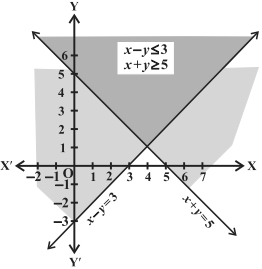
(N/A) The graph of the linear equation $x+y=5$ is drawn.
Inequality $(1)$ is represented by the shaded region above the line $x+y=5$,including the points on the line.
On the same set of axes,we draw the graph of the equation $x-y=3$. Then we note that inequality $(2)$ represents the shaded region above the line $x-y=3$,including the points on the line.
Clearly,the double shaded region,common to the above two shaded regions,is the required solution region of the given system of inequalities.
Inequality $(1)$ is represented by the shaded region above the line $x+y=5$,including the points on the line.
On the same set of axes,we draw the graph of the equation $x-y=3$. Then we note that inequality $(2)$ represents the shaded region above the line $x-y=3$,including the points on the line.
Clearly,the double shaded region,common to the above two shaded regions,is the required solution region of the given system of inequalities.
0 likes
View Solution2
Medium
Solve the following system of inequalities graphically:
$5x + 4y \leq 40$ ..... $(1)$
$x \geq 2$ ..... $(2)$
$y \geq 3$ ..... $(3)$
$5x + 4y \leq 40$ ..... $(1)$
$x \geq 2$ ..... $(2)$
$y \geq 3$ ..... $(3)$
Solution
(N/A) First,we draw the graphs of the lines $5x + 4y = 40$,$x = 2$,and $y = 3$.
For $5x + 4y = 40$,the intercepts are $(8, 0)$ and $(0, 10)$. The inequality $5x + 4y \leq 40$ represents the region on or below this line.
The inequality $x \geq 2$ represents the region on or to the right of the vertical line $x = 2$.
The inequality $y \geq 3$ represents the region on or above the horizontal line $y = 3$.
The solution to the system is the common shaded region bounded by these three lines,forming a triangle with vertices at $(2, 3)$,$(5.6, 3)$,and $(2, 7.5)$.
For $5x + 4y = 40$,the intercepts are $(8, 0)$ and $(0, 10)$. The inequality $5x + 4y \leq 40$ represents the region on or below this line.
The inequality $x \geq 2$ represents the region on or to the right of the vertical line $x = 2$.
The inequality $y \geq 3$ represents the region on or above the horizontal line $y = 3$.
The solution to the system is the common shaded region bounded by these three lines,forming a triangle with vertices at $(2, 3)$,$(5.6, 3)$,and $(2, 7.5)$.
0 likes
View Solution3
Medium
Solve the following system of inequalities graphically:
$x + 2y \leqslant 8$ ..... $(1)$
$2x + y \leqslant 8$ ..... $(2)$
$x \geqslant 0$ ..... $(3)$
$y \geqslant 0$ ..... $(4)$
$x + 2y \leqslant 8$ ..... $(1)$
$2x + y \leqslant 8$ ..... $(2)$
$x \geqslant 0$ ..... $(3)$
$y \geqslant 0$ ..... $(4)$
Solution
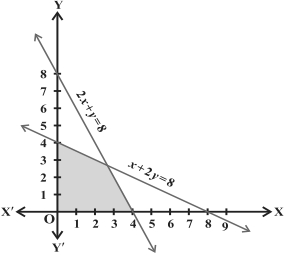
(N/A) To solve the system of inequalities graphically,we first draw the lines $x + 2y = 8$ and $2x + y = 8$.
For the line $x + 2y = 8$:
If $x = 0$,$y = 4$. If $y = 0$,$x = 8$. The line passes through $(0, 4)$ and $(8, 0)$.
For the line $2x + y = 8$:
If $x = 0$,$y = 8$. If $y = 0$,$x = 4$. The line passes through $(0, 8)$ and $(4, 0)$.
The inequalities $x + 2y \leqslant 8$ and $2x + y \leqslant 8$ represent the regions below these lines,respectively.
Since $x \geqslant 0$ and $y \geqslant 0$,the solution region is restricted to the first quadrant.
The intersection point of the two lines is found by solving $x + 2y = 8$ and $2x + y = 8$. Multiplying the first by $2$ gives $2x + 4y = 16$. Subtracting the second equation gives $3y = 8$,so $y = 8/3$. Then $x = 8 - 2(8/3) = 8/3$. The intersection point is $(8/3, 8/3)$.
The shaded region in the graph represents the common solution set of the given system of inequalities.
For the line $x + 2y = 8$:
If $x = 0$,$y = 4$. If $y = 0$,$x = 8$. The line passes through $(0, 4)$ and $(8, 0)$.
For the line $2x + y = 8$:
If $x = 0$,$y = 8$. If $y = 0$,$x = 4$. The line passes through $(0, 8)$ and $(4, 0)$.
The inequalities $x + 2y \leqslant 8$ and $2x + y \leqslant 8$ represent the regions below these lines,respectively.
Since $x \geqslant 0$ and $y \geqslant 0$,the solution region is restricted to the first quadrant.
The intersection point of the two lines is found by solving $x + 2y = 8$ and $2x + y = 8$. Multiplying the first by $2$ gives $2x + 4y = 16$. Subtracting the second equation gives $3y = 8$,so $y = 8/3$. Then $x = 8 - 2(8/3) = 8/3$. The intersection point is $(8/3, 8/3)$.
The shaded region in the graph represents the common solution set of the given system of inequalities.
0 likes
View Solution4
Medium
Solve the following system of inequalities graphically: $x \geq 3, y \geq 2.$
Solution
(N/A) The given system of inequalities is:
$x \geq 3$ ..... $(1)$
$y \geq 2$ ..... $(2)$
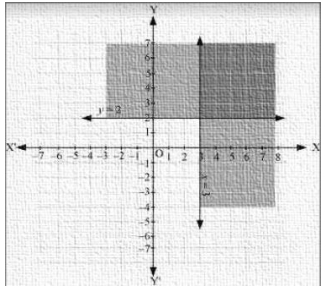
The graph of the lines $x=3$ and $y=2$ are drawn in the Cartesian plane.
Inequality $(1)$ represents the region on the right-hand side of the line $x=3$ (including the line $x=3$).
Inequality $(2)$ represents the region above the line $y=2$ (including the line $y=2$).
Hence,the solution of the given system of linear inequalities is represented by the common shaded region in the first quadrant,which is the intersection of the two regions,including the points on the respective lines.
$x \geq 3$ ..... $(1)$
$y \geq 2$ ..... $(2)$
The graph of the lines $x=3$ and $y=2$ are drawn in the Cartesian plane.
Inequality $(1)$ represents the region on the right-hand side of the line $x=3$ (including the line $x=3$).
Inequality $(2)$ represents the region above the line $y=2$ (including the line $y=2$).
Hence,the solution of the given system of linear inequalities is represented by the common shaded region in the first quadrant,which is the intersection of the two regions,including the points on the respective lines.
0 likes
View Solution5
Medium
Solve the following system of inequalities graphically: $3x + 2y \leq 12, x \geq 1, y \geq 2$
Solution
(N/A) $3x + 2y \leq 12$ ...... $(1)$
$x \geq 1$ ...... $(2)$
$y \geq 2$ ...... $(3)$
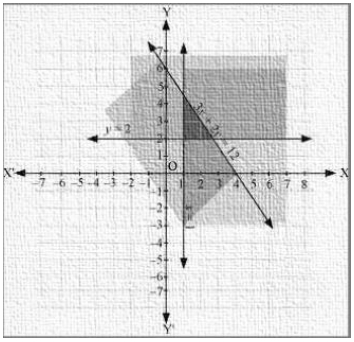
The graphs of the lines $3x + 2y = 12$,$x = 1$,and $y = 2$ are drawn in the figure below.
Inequality $(1)$ represents the region below the line $3x + 2y = 12$ (including the line $3x + 2y = 12$).
Inequality $(2)$ represents the region on the right side of the line $x = 1$ (including the line $x = 1$).
Inequality $(3)$ represents the region above the line $y = 2$ (including the line $y = 2$).
Hence,the solution of the given system of linear inequalities is represented by the common shaded region including the points on the respective lines.
$x \geq 1$ ...... $(2)$
$y \geq 2$ ...... $(3)$
The graphs of the lines $3x + 2y = 12$,$x = 1$,and $y = 2$ are drawn in the figure below.
Inequality $(1)$ represents the region below the line $3x + 2y = 12$ (including the line $3x + 2y = 12$).
Inequality $(2)$ represents the region on the right side of the line $x = 1$ (including the line $x = 1$).
Inequality $(3)$ represents the region above the line $y = 2$ (including the line $y = 2$).
Hence,the solution of the given system of linear inequalities is represented by the common shaded region including the points on the respective lines.
0 likes
View Solution6
Medium
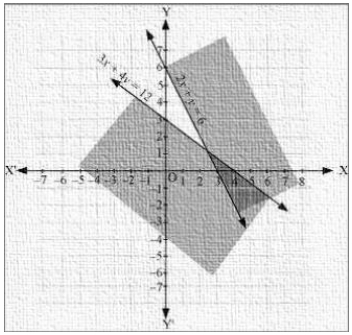
Solve the following system of inequalities graphically: $2x + y \geq 6, 3x + 4y \leq 12$
Solution
(N/A) $2x + y \geq 6$ ..... $(1)$
$3x + 4y \leq 12$ ..... $(2)$
The graph of the lines $2x + y = 6$ and $3x + 4y = 12$ are drawn in the figure. Inequality $(1)$ represents the region above the line $2x + y = 6$ (including the line $2x + y = 6$),and inequality $(2)$ represents the region below the line $3x + 4y = 12$ (including the line $3x + 4y = 12$).
Hence,the solution of the given system of linear inequalities is represented by the common shaded region including the points on the respective lines as shown in the figure.
$3x + 4y \leq 12$ ..... $(2)$
The graph of the lines $2x + y = 6$ and $3x + 4y = 12$ are drawn in the figure. Inequality $(1)$ represents the region above the line $2x + y = 6$ (including the line $2x + y = 6$),and inequality $(2)$ represents the region below the line $3x + 4y = 12$ (including the line $3x + 4y = 12$).
Hence,the solution of the given system of linear inequalities is represented by the common shaded region including the points on the respective lines as shown in the figure.
0 likes
View Solution7
Medium
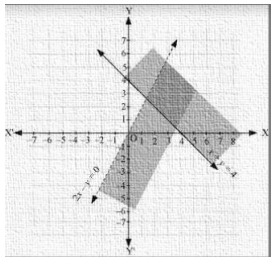
Solve the following system of inequalities graphically: $x+y \geq 4, 2x-y > 0$.
Solution
(N/A) $x+y \geq 4$ ..... $(1)$
$2x-y > 0$ ..... $(2)$
The graph of the lines,$x+y=4$ and $2x-y=0$,are drawn in the figure below.
Inequality $(1)$ represents the region above the line,$x+y=4$ (including the line $x+y=4$).
It is observed that $(1,0)$ does not satisfy the inequality $2x-y > 0$ as $2(1)-0 = 2 > 0$,so we test a point like $(0,1)$ which gives $2(0)-1 = -1 < 0$. Thus,the region for $2x-y > 0$ is the half-plane containing $(1,0)$ (since $2(1)-0 = 2 > 0$).
Hence,the solution of the given system of linear inequalities is represented by the common shaded region including the points on line $x+y=4$ and excluding the points on line $2x-y=0$.
$2x-y > 0$ ..... $(2)$
The graph of the lines,$x+y=4$ and $2x-y=0$,are drawn in the figure below.
Inequality $(1)$ represents the region above the line,$x+y=4$ (including the line $x+y=4$).
It is observed that $(1,0)$ does not satisfy the inequality $2x-y > 0$ as $2(1)-0 = 2 > 0$,so we test a point like $(0,1)$ which gives $2(0)-1 = -1 < 0$. Thus,the region for $2x-y > 0$ is the half-plane containing $(1,0)$ (since $2(1)-0 = 2 > 0$).
Hence,the solution of the given system of linear inequalities is represented by the common shaded region including the points on line $x+y=4$ and excluding the points on line $2x-y=0$.
0 likes
View Solution8
Medium
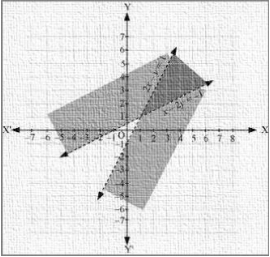
Solve the following system of inequalities graphically: $2x - y > 1, x - 2y < -1$
Solution
(N/A) $2x - y > 1$ ..... $(1)$
$x - 2y < -1$ ..... $(2)$
The graph of the lines,$2x - y = 1$ and $x - 2y = -1$,are drawn in the figure below.
Inequality $(1)$ represents the region below the line $2x - y = 1$ (excluding the line $2x - y = 1$),and inequality $(2)$ represents the region above the line $x - 2y = -1$ (excluding the line $x - 2y = -1$).
Hence,the solution of the given system of linear inequalities is represented by the common shaded region excluding the points on the respective lines as shown in the figure.
$x - 2y < -1$ ..... $(2)$
The graph of the lines,$2x - y = 1$ and $x - 2y = -1$,are drawn in the figure below.
Inequality $(1)$ represents the region below the line $2x - y = 1$ (excluding the line $2x - y = 1$),and inequality $(2)$ represents the region above the line $x - 2y = -1$ (excluding the line $x - 2y = -1$).
Hence,the solution of the given system of linear inequalities is represented by the common shaded region excluding the points on the respective lines as shown in the figure.
0 likes
View Solution9
Medium
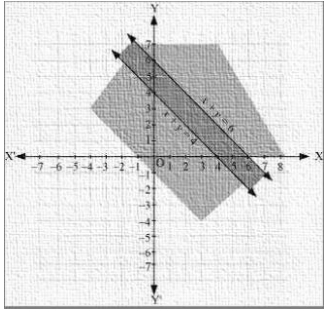
Solve the following system of inequalities graphically: $x+y \leq 6, x+y \geq 4$
Solution
(N/A) $x+y \leq 6$ ..... $(1)$
$x+y \geq 4$ ..... $(2)$
The graph of the lines,$x+y=6$ and $x+y=4$,are drawn in the figure below.
Inequality $(1)$ represents the region below the line,$x+y=6$ (including the line $x+y=6$),and inequality $(2)$ represents the region above the line,$x+y=4$ (including the line $x+y=4$).
Hence,the solution of the given system of linear inequalities is represented by the common shaded region including the points on the respective lines as shown in the figure.
$x+y \geq 4$ ..... $(2)$
The graph of the lines,$x+y=6$ and $x+y=4$,are drawn in the figure below.
Inequality $(1)$ represents the region below the line,$x+y=6$ (including the line $x+y=6$),and inequality $(2)$ represents the region above the line,$x+y=4$ (including the line $x+y=4$).
Hence,the solution of the given system of linear inequalities is represented by the common shaded region including the points on the respective lines as shown in the figure.
0 likes
View Solution10
Medium
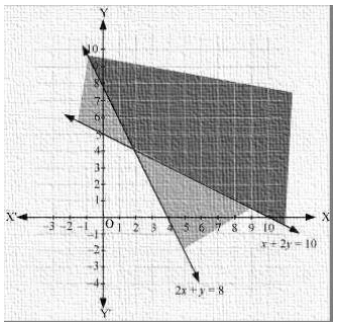
Solve the following system of inequalities graphically: $2x + y \geq 8, x + 2y \geq 10$
Solution
(N/A) To solve the system of inequalities $2x + y \geq 8$ and $x + 2y \geq 10$ graphically,we first consider the corresponding equations:
$2x + y = 8$ ... $(1)$
$x + 2y = 10$ ... $(2)$
For equation $(1)$,if $x = 0$,$y = 8$. If $y = 0$,$x = 4$. The line passes through $(0, 8)$ and $(4, 0)$.
For equation $(2)$,if $x = 0$,$y = 5$. If $y = 0$,$x = 10$. The line passes through $(0, 5)$ and $(10, 0)$.
Since both inequalities are of the type $\geq$,the solution region for each inequality is the region on or above the respective lines.
The intersection point of the two lines is found by solving the equations:
$2(2x + y = 8) \Rightarrow 4x + 2y = 16$
Subtracting $(2)$ from this: $(4x + 2y) - (x + 2y) = 16 - 10$ $\Rightarrow 3x = 6$ $\Rightarrow x = 2$.
Substituting $x = 2$ in $(1)$: $2(2) + y = 8$ $\Rightarrow 4 + y = 8$ $\Rightarrow y = 4$.
The intersection point is $(2, 4)$.
The solution to the system is the common shaded region in the first quadrant and beyond,bounded by the lines $2x + y = 8$ and $x + 2y = 10$,including the points on the lines.
$2x + y = 8$ ... $(1)$
$x + 2y = 10$ ... $(2)$
For equation $(1)$,if $x = 0$,$y = 8$. If $y = 0$,$x = 4$. The line passes through $(0, 8)$ and $(4, 0)$.
For equation $(2)$,if $x = 0$,$y = 5$. If $y = 0$,$x = 10$. The line passes through $(0, 5)$ and $(10, 0)$.
Since both inequalities are of the type $\geq$,the solution region for each inequality is the region on or above the respective lines.
The intersection point of the two lines is found by solving the equations:
$2(2x + y = 8) \Rightarrow 4x + 2y = 16$
Subtracting $(2)$ from this: $(4x + 2y) - (x + 2y) = 16 - 10$ $\Rightarrow 3x = 6$ $\Rightarrow x = 2$.
Substituting $x = 2$ in $(1)$: $2(2) + y = 8$ $\Rightarrow 4 + y = 8$ $\Rightarrow y = 4$.
The intersection point is $(2, 4)$.
The solution to the system is the common shaded region in the first quadrant and beyond,bounded by the lines $2x + y = 8$ and $x + 2y = 10$,including the points on the lines.
0 likes
View Solution11
Medium
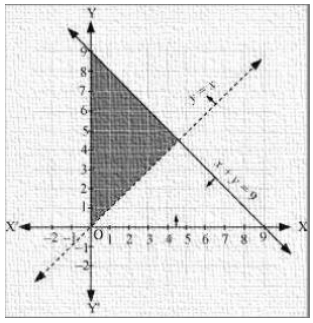
Solve the following system of inequalities graphically: $x+y \leq 9, y>x, x \geq 0$.
Solution
(N/A) $x+y \leq 9$ .... $(1)$
$y>x$ .... $(2)$
$x \geq 0$ .... $(3)$
The graph of the lines,$x+y=9$ and $y=x$,are drawn in the figure below.
Inequality $(1)$ represents the region below the line $x+y=9$ (including the line $x+y=9$). It is observed that $(0,1)$ satisfies the inequality $y>x$ $[1>0]$. Therefore,inequality $(2)$ represents the half-plane corresponding to the line $y=x$,containing the point $(0,1)$ (excluding the line $y=x$). Inequality $(3)$ represents the region on the right-hand side of the line $x=0$ or $y$-axis (including the $y$-axis).
Hence,the solution of the given system of linear inequalities is represented by the common shaded region including the points on the lines $x+y=9$ and $x=0$,and excluding the points on the line $y=x$ as shown in the figure.
$y>x$ .... $(2)$
$x \geq 0$ .... $(3)$
The graph of the lines,$x+y=9$ and $y=x$,are drawn in the figure below.
Inequality $(1)$ represents the region below the line $x+y=9$ (including the line $x+y=9$). It is observed that $(0,1)$ satisfies the inequality $y>x$ $[1>0]$. Therefore,inequality $(2)$ represents the half-plane corresponding to the line $y=x$,containing the point $(0,1)$ (excluding the line $y=x$). Inequality $(3)$ represents the region on the right-hand side of the line $x=0$ or $y$-axis (including the $y$-axis).
Hence,the solution of the given system of linear inequalities is represented by the common shaded region including the points on the lines $x+y=9$ and $x=0$,and excluding the points on the line $y=x$ as shown in the figure.
0 likes
View Solution12
Medium
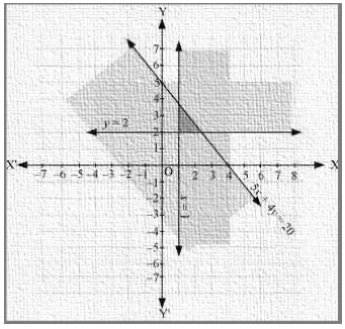
Solve the following system of inequalities graphically: $5x + 4y \leq 20, x \geq 1, y \geq 2$.
Solution
(N/A) The given system of inequalities is:
$5x + 4y \leq 20$ .....$(1)$
$x \geq 1$ .....$(2)$
$y \geq 2$ .....$(3)$
First,we draw the graphs of the corresponding equations $5x + 4y = 20$,$x = 1$,and $y = 2$.
$1$. For $5x + 4y = 20$,if $x = 0$,$y = 5$; if $y = 0$,$x = 4$. The line passes through $(0, 5)$ and $(4, 0)$. Since the inequality is $\leq$,the region is below the line.
$2$. For $x = 1$,the region is to the right of the vertical line $x = 1$.
$3$. For $y = 2$,the region is above the horizontal line $y = 2$.
The common shaded region represents the solution set of the given system of inequalities,which is a triangle with vertices at $(1, 2)$,$(2.4, 2)$,and $(1, 3.75)$.
$5x + 4y \leq 20$ .....$(1)$
$x \geq 1$ .....$(2)$
$y \geq 2$ .....$(3)$
First,we draw the graphs of the corresponding equations $5x + 4y = 20$,$x = 1$,and $y = 2$.
$1$. For $5x + 4y = 20$,if $x = 0$,$y = 5$; if $y = 0$,$x = 4$. The line passes through $(0, 5)$ and $(4, 0)$. Since the inequality is $\leq$,the region is below the line.
$2$. For $x = 1$,the region is to the right of the vertical line $x = 1$.
$3$. For $y = 2$,the region is above the horizontal line $y = 2$.
The common shaded region represents the solution set of the given system of inequalities,which is a triangle with vertices at $(1, 2)$,$(2.4, 2)$,and $(1, 3.75)$.
0 likes
View Solution13
Medium
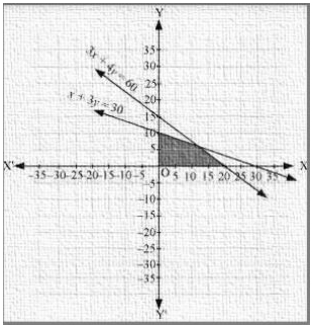
Solve the following system of inequalities graphically: $3x + 4y \leq 60, x + 3y \leq 30, x \geq 0, y \geq 0$
Solution
(N/A) $3x + 4y \leq 60$ ...... $(1)$
$x + 3y \leq 30$ ...... $(2)$
The graph of the lines $3x + 4y = 60$ and $x + 3y = 30$ are drawn in the figure below.
Inequality $(1)$ represents the region below the line $3x + 4y = 60$ (including the line $3x + 4y = 60$),and inequality $(2)$ represents the region below the line $x + 3y = 30$ (including the line $x + 3y = 30$).
Since $x \geq 0$ and $y \geq 0$,every point in the common shaded region in the first quadrant,including the points on the respective lines and the axes,represents the solution of the given system of linear inequalities.
$x + 3y \leq 30$ ...... $(2)$
The graph of the lines $3x + 4y = 60$ and $x + 3y = 30$ are drawn in the figure below.
Inequality $(1)$ represents the region below the line $3x + 4y = 60$ (including the line $3x + 4y = 60$),and inequality $(2)$ represents the region below the line $x + 3y = 30$ (including the line $x + 3y = 30$).
Since $x \geq 0$ and $y \geq 0$,every point in the common shaded region in the first quadrant,including the points on the respective lines and the axes,represents the solution of the given system of linear inequalities.
0 likes
View Solution14
Medium
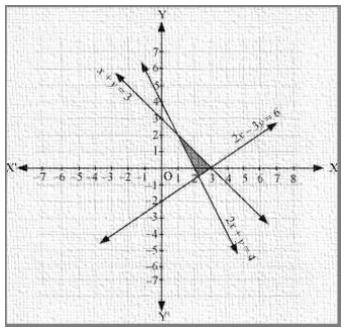
Solve the following system of inequalities graphically: $2x + y \geq 4$,$x + y \leq 3$,$2x - 3y \leq 6$.
Solution
(N/A) $2x + y \geq 4$ ...... $(1)$
$x + y \leq 3$ ...... $(2)$
$2x - 3y \leq 6$ ...... $(3)$
The graph of the lines $2x + y = 4$,$x + y = 3$,and $2x - 3y = 6$ are drawn in the figure.
Inequality $(1)$ represents the region above the line $2x + y = 4$ (including the line).
Inequality $(2)$ represents the region below the line $x + y = 3$ (including the line).
Inequality $(3)$ represents the region above the line $2x - 3y = 6$ (including the line).
Hence,the solution of the given system of linear inequalities is represented by the common shaded triangular region in the graph,including the points on the respective boundary lines.
$x + y \leq 3$ ...... $(2)$
$2x - 3y \leq 6$ ...... $(3)$
The graph of the lines $2x + y = 4$,$x + y = 3$,and $2x - 3y = 6$ are drawn in the figure.
Inequality $(1)$ represents the region above the line $2x + y = 4$ (including the line).
Inequality $(2)$ represents the region below the line $x + y = 3$ (including the line).
Inequality $(3)$ represents the region above the line $2x - 3y = 6$ (including the line).
Hence,the solution of the given system of linear inequalities is represented by the common shaded triangular region in the graph,including the points on the respective boundary lines.
0 likes
View Solution15
Medium
Solve the following system of inequalities graphically:
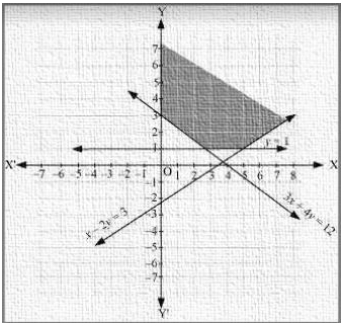
$x-2y \leq 3, 3x+4y \geq 12, x \geq 0, y \geq 1$
$x-2y \leq 3, 3x+4y \geq 12, x \geq 0, y \geq 1$
Solution
(N/A) The given system of inequalities is:
$x-2y \leq 3$ .....$(1)$
$3x+4y \geq 12$ .....$(2)$
$y \geq 1$ .....$(3)$
$x \geq 0$ .....$(4)$
First,we draw the graphs of the lines $x-2y=3$,$3x+4y=12$,$y=1$,and $x=0$ (the $y$-axis).
For inequality $(1)$,testing the point $(0,0)$: $0-0 \leq 3$ is true,so the region includes the origin. Since the line $x-2y=3$ passes through $(3,0)$ and $(0,-1.5)$,the region is towards the origin.
For inequality $(2)$,testing the point $(0,0)$: $0+0 \geq 12$ is false,so the region is away from the origin. The line $3x+4y=12$ passes through $(4,0)$ and $(0,3)$.
For inequality $(3)$,the region is above the line $y=1$.
For inequality $(4)$,the region is to the right of the $y$-axis.
The common shaded region satisfying all these inequalities is the feasible region shown in the graph.
$x-2y \leq 3$ .....$(1)$
$3x+4y \geq 12$ .....$(2)$
$y \geq 1$ .....$(3)$
$x \geq 0$ .....$(4)$
First,we draw the graphs of the lines $x-2y=3$,$3x+4y=12$,$y=1$,and $x=0$ (the $y$-axis).
For inequality $(1)$,testing the point $(0,0)$: $0-0 \leq 3$ is true,so the region includes the origin. Since the line $x-2y=3$ passes through $(3,0)$ and $(0,-1.5)$,the region is towards the origin.
For inequality $(2)$,testing the point $(0,0)$: $0+0 \geq 12$ is false,so the region is away from the origin. The line $3x+4y=12$ passes through $(4,0)$ and $(0,3)$.
For inequality $(3)$,the region is above the line $y=1$.
For inequality $(4)$,the region is to the right of the $y$-axis.
The common shaded region satisfying all these inequalities is the feasible region shown in the graph.
0 likes
View Solution16
Medium
Solve the following system of inequalities graphically:
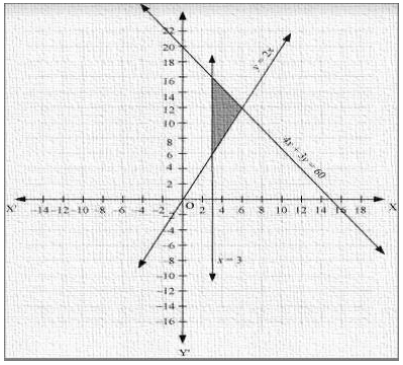
$4x + 3y \leq 60, y \geq 2x, x \geq 3, x, y \geq 0$
$4x + 3y \leq 60, y \geq 2x, x \geq 3, x, y \geq 0$
Solution
(N/A) The given system of inequalities is:
$4x + 3y \leq 60$ .....$(1)$
$y \geq 2x$ .....$(2)$
$x \geq 3$ .....$(3)$
To solve this graphically,we first draw the corresponding lines:
$1$. For $4x + 3y = 60$: If $x=0, y=20$; if $y=0, x=15$. The line passes through $(0, 20)$ and $(15, 0)$.
$2$. For $y = 2x$: The line passes through $(0, 0)$ and $(3, 6)$.
$3$. For $x = 3$: This is a vertical line passing through $(3, 0)$.
Analysis of regions:
- Inequality $(1)$ represents the region below the line $4x + 3y = 60$.
- Inequality $(2)$ represents the region above the line $y = 2x$.
- Inequality $(3)$ represents the region to the right of the line $x = 3$.
The common shaded region in the graph represents the solution set of the given system of linear inequalities.
$4x + 3y \leq 60$ .....$(1)$
$y \geq 2x$ .....$(2)$
$x \geq 3$ .....$(3)$
To solve this graphically,we first draw the corresponding lines:
$1$. For $4x + 3y = 60$: If $x=0, y=20$; if $y=0, x=15$. The line passes through $(0, 20)$ and $(15, 0)$.
$2$. For $y = 2x$: The line passes through $(0, 0)$ and $(3, 6)$.
$3$. For $x = 3$: This is a vertical line passing through $(3, 0)$.
Analysis of regions:
- Inequality $(1)$ represents the region below the line $4x + 3y = 60$.
- Inequality $(2)$ represents the region above the line $y = 2x$.
- Inequality $(3)$ represents the region to the right of the line $x = 3$.
The common shaded region in the graph represents the solution set of the given system of linear inequalities.
0 likes
View Solution17
Medium
Solve the following system of inequalities graphically:
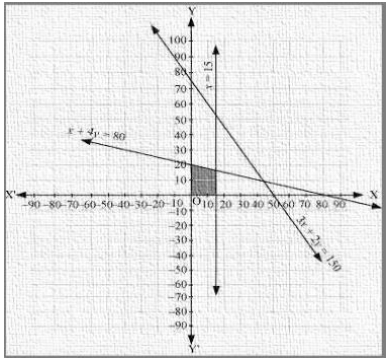
$3x + 2y \leq 150, x + 4y \leq 80, x \leq 15, y \geq 0, x \geq 0$
$3x + 2y \leq 150, x + 4y \leq 80, x \leq 15, y \geq 0, x \geq 0$
Solution
(N/A) $3x + 2y \leq 150$ .... $(1)$
$x + 4y \leq 80$ .... $(2)$
$x \leq 15$ .... $(3)$
The graph of the lines $3x + 2y = 150$,$x + 4y = 80$,and $x = 15$ are drawn in the figure.
Inequality $(1)$ represents the region below the line $3x + 2y = 150$ (including the line).
Inequality $(2)$ represents the region below the line $x + 4y = 80$ (including the line).
Inequality $(3)$ represents the region on the left side of the line $x = 15$ (including the line).
Since $x \geq 0$ and $y \geq 0$,the solution is the common shaded region in the first quadrant,including the points on the respective lines and the axes.
$x + 4y \leq 80$ .... $(2)$
$x \leq 15$ .... $(3)$
The graph of the lines $3x + 2y = 150$,$x + 4y = 80$,and $x = 15$ are drawn in the figure.
Inequality $(1)$ represents the region below the line $3x + 2y = 150$ (including the line).
Inequality $(2)$ represents the region below the line $x + 4y = 80$ (including the line).
Inequality $(3)$ represents the region on the left side of the line $x = 15$ (including the line).
Since $x \geq 0$ and $y \geq 0$,the solution is the common shaded region in the first quadrant,including the points on the respective lines and the axes.
0 likes
View Solution18
Medium
Solve the following system of inequalities graphically:
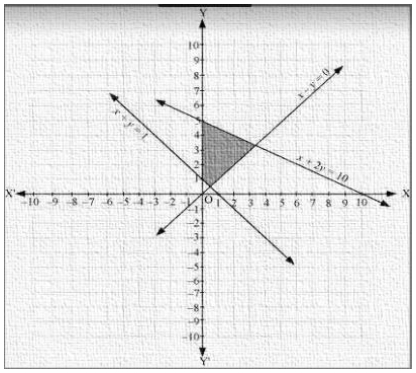
$x+2y \leq 10, x+y \geq 1, x-y \leq 0, x \geq 0, y \geq 0$
$x+2y \leq 10, x+y \geq 1, x-y \leq 0, x \geq 0, y \geq 0$
Solution
(N/A) The given system of inequalities is:
$x+2y \leq 10$ .....$(1)$
$x+y \geq 1$ .....$(2)$
$x-y \leq 0$ .....$(3)$
$x \geq 0, y \geq 0$ .....$(4)$
To solve this graphically,we first draw the lines $x+2y=10$,$x+y=1$,and $x-y=0$.
$1$. For $x+2y=10$: If $x=0, y=5$; if $y=0, x=10$. The line passes through $(0, 5)$ and $(10, 0)$. Since $(0,0)$ satisfies $x+2y \leq 10$,the region is towards the origin.
$2$. For $x+y=1$: If $x=0, y=1$; if $y=0, x=1$. The line passes through $(0, 1)$ and $(1, 0)$. Since $(0,0)$ does not satisfy $x+y \geq 1$,the region is away from the origin.
$3$. For $x-y=0$: This is a line passing through the origin $(0,0)$ and $(2,2)$. Testing a point like $(0,1)$,we see $0-1 \leq 0$ is true,so the region is above the line $x-y=0$.
The common shaded region in the first quadrant,bounded by these lines,represents the solution set of the given system of linear inequalities.
$x+2y \leq 10$ .....$(1)$
$x+y \geq 1$ .....$(2)$
$x-y \leq 0$ .....$(3)$
$x \geq 0, y \geq 0$ .....$(4)$
To solve this graphically,we first draw the lines $x+2y=10$,$x+y=1$,and $x-y=0$.
$1$. For $x+2y=10$: If $x=0, y=5$; if $y=0, x=10$. The line passes through $(0, 5)$ and $(10, 0)$. Since $(0,0)$ satisfies $x+2y \leq 10$,the region is towards the origin.
$2$. For $x+y=1$: If $x=0, y=1$; if $y=0, x=1$. The line passes through $(0, 1)$ and $(1, 0)$. Since $(0,0)$ does not satisfy $x+y \geq 1$,the region is away from the origin.
$3$. For $x-y=0$: This is a line passing through the origin $(0,0)$ and $(2,2)$. Testing a point like $(0,1)$,we see $0-1 \leq 0$ is true,so the region is above the line $x-y=0$.
The common shaded region in the first quadrant,bounded by these lines,represents the solution set of the given system of linear inequalities.
0 likes
View Solution19
MediumMCQ
Solve the following system of inequalities graphically: $x - y + 2 \geq 0$ and $2x + y - 5 \leq 0$.
A
The solution is the region bounded by the lines $x - y = -2$ and $2x + y = 5$ in the first quadrant.
B
The solution is the intersection of the half-planes defined by $x - y \geq -2$ and $2x + y \leq 5$.
C
The solution is the set of all points $(x, y)$ such that $x - y + 2 = 0$ and $2x + y - 5 = 0$.
D
There is no solution for this system of inequalities.
Solution
(B) Step $1$: Consider the boundary lines $x - y + 2 = 0$ and $2x + y - 5 = 0$.
Step $2$: For $x - y + 2 = 0$,if $x = 0$,$y = 2$; if $y = 0$,$x = -2$. The line passes through $(0, 2)$ and $(-2, 0)$. Testing $(0, 0)$,$0 - 0 + 2 \geq 0$ is true,so the region includes the origin.
Step $3$: For $2x + y - 5 = 0$,if $x = 0$,$y = 5$; if $y = 0$,$x = 2.5$. The line passes through $(0, 5)$ and $(2.5, 0)$. Testing $(0, 0)$,$2(0) + 0 - 5 \leq 0$ is true,so the region includes the origin.
Step $4$: The solution is the common shaded region satisfying both inequalities simultaneously.
Step $2$: For $x - y + 2 = 0$,if $x = 0$,$y = 2$; if $y = 0$,$x = -2$. The line passes through $(0, 2)$ and $(-2, 0)$. Testing $(0, 0)$,$0 - 0 + 2 \geq 0$ is true,so the region includes the origin.
Step $3$: For $2x + y - 5 = 0$,if $x = 0$,$y = 5$; if $y = 0$,$x = 2.5$. The line passes through $(0, 5)$ and $(2.5, 0)$. Testing $(0, 0)$,$2(0) + 0 - 5 \leq 0$ is true,so the region includes the origin.
Step $4$: The solution is the common shaded region satisfying both inequalities simultaneously.
0 likes
View Solution20
MediumMCQ
Solve the following system of inequalities graphically: $x+y < 2, x > 0, y > 1$.
A
The region is in the first quadrant bounded by $x=0, y=1$ and $x+y=2$.
B
The region is an empty set (no solution).
C
The region is an unbounded region in the second quadrant.
D
The region is a line segment.
Solution
(A) To solve the system $x+y < 2, x > 0, y > 1$ graphically,we consider the corresponding equations:
$1$. $x+y = 2$
$2$. $x = 0$
$3$. $y = 1$
Step $1$: Plot the line $x+y = 2$. It passes through $(2, 0)$ and $(0, 2)$. Since the inequality is $x+y < 2$,the region is below the line.
Step $2$: The line $x = 0$ is the $y$-axis. The inequality $x > 0$ represents the region to the right of the $y$-axis.
Step $3$: The line $y = 1$ is a horizontal line. The inequality $y > 1$ represents the region above this line.
Combining these:
We need $x > 0, y > 1$,and $x+y < 2$.
If $y > 1$ and $x > 0$,then $x+y > 1$.
For $x+y < 2$ to hold while $y > 1$ and $x > 0$,the region must be the triangle formed by the intersection of these lines.
Intersection of $x=0$ and $y=1$ is $(0, 1)$.
Intersection of $x+y=2$ and $y=1$ is $(1, 1)$.
Intersection of $x+y=2$ and $x=0$ is $(0, 2)$.
Since the inequalities are strict ($ < $ and $>$),the region is the interior of the triangle with vertices $(0, 1), (1, 1), (0, 2)$,excluding the boundaries.
$1$. $x+y = 2$
$2$. $x = 0$
$3$. $y = 1$
Step $1$: Plot the line $x+y = 2$. It passes through $(2, 0)$ and $(0, 2)$. Since the inequality is $x+y < 2$,the region is below the line.
Step $2$: The line $x = 0$ is the $y$-axis. The inequality $x > 0$ represents the region to the right of the $y$-axis.
Step $3$: The line $y = 1$ is a horizontal line. The inequality $y > 1$ represents the region above this line.
Combining these:
We need $x > 0, y > 1$,and $x+y < 2$.
If $y > 1$ and $x > 0$,then $x+y > 1$.
For $x+y < 2$ to hold while $y > 1$ and $x > 0$,the region must be the triangle formed by the intersection of these lines.
Intersection of $x=0$ and $y=1$ is $(0, 1)$.
Intersection of $x+y=2$ and $y=1$ is $(1, 1)$.
Intersection of $x+y=2$ and $x=0$ is $(0, 2)$.
Since the inequalities are strict ($ < $ and $>$),the region is the interior of the triangle with vertices $(0, 1), (1, 1), (0, 2)$,excluding the boundaries.
0 likes
View Solution21
Medium
Solve the following system of inequalities graphically: $x \geq 0, y \geq 0, 5x + 3y \leq 15, 4x + 5y \leq 20$.
Solution
(N/A) To solve the system of inequalities graphically,we first consider the corresponding equations:
$1$. $5x + 3y = 15$
For $x = 0, y = 5$. For $y = 0, x = 3$. The line passes through $(0, 5)$ and $(3, 0)$.
$2$. $4x + 5y = 20$
For $x = 0, y = 4$. For $y = 0, x = 5$. The line passes through $(0, 4)$ and $(5, 0)$.
$3$. $x \geq 0$ and $y \geq 0$ indicate that the solution lies in the first quadrant.
Testing the origin $(0, 0)$ for both inequalities:
$5(0) + 3(0) = 0 \leq 15$ (True)
$4(0) + 5(0) = 0 \leq 20$ (True)
Since both are true,the shaded region is towards the origin.
The feasible region is the quadrilateral bounded by the vertices $(0, 0), (3, 0), (15/13, 40/13),$ and $(0, 4)$.
$1$. $5x + 3y = 15$
For $x = 0, y = 5$. For $y = 0, x = 3$. The line passes through $(0, 5)$ and $(3, 0)$.
$2$. $4x + 5y = 20$
For $x = 0, y = 4$. For $y = 0, x = 5$. The line passes through $(0, 4)$ and $(5, 0)$.
$3$. $x \geq 0$ and $y \geq 0$ indicate that the solution lies in the first quadrant.
Testing the origin $(0, 0)$ for both inequalities:
$5(0) + 3(0) = 0 \leq 15$ (True)
$4(0) + 5(0) = 0 \leq 20$ (True)
Since both are true,the shaded region is towards the origin.
The feasible region is the quadrilateral bounded by the vertices $(0, 0), (3, 0), (15/13, 40/13),$ and $(0, 4)$.
0 likes
View Solution22
MediumMCQ
Solve the following system of inequalities graphically: $2x + y \leq 12, x + 2y \leq 7, x \geq 0, y \geq 0$.
A
The feasible region is a bounded polygon with vertices $(0,0), (6,0), (5,1), (0,3.5)$.
B
The feasible region is a bounded polygon with vertices $(0,0), (7,0), (0,3.5)$.
C
The feasible region is an unbounded region.
D
The system has no solution.
Solution
(A) $1$. Consider the inequality $2x + y \leq 12$. The boundary line is $2x + y = 12$. For $x=0, y=12$; for $y=0, x=6$. The region includes the origin $(0,0)$ since $0 \leq 12$.
$2$. Consider the inequality $x + 2y \leq 7$. The boundary line is $x + 2y = 7$. For $x=0, y=3.5$; for $y=0, x=7$. The region includes the origin $(0,0)$ since $0 \leq 7$.
$3$. The constraints $x \geq 0$ and $y \geq 0$ restrict the solution to the first quadrant.
$4$. To find the intersection of $2x + y = 12$ and $x + 2y = 7$,multiply the second equation by $2$: $2x + 4y = 14$. Subtracting the first from this gives $3y = 2$,so $y = 2/3$. Then $x = 7 - 2(2/3) = 7 - 4/3 = 17/3$.
$5$. The vertices of the feasible region are $(0,0), (6,0), (17/3, 2/3), (0, 3.5)$.
$2$. Consider the inequality $x + 2y \leq 7$. The boundary line is $x + 2y = 7$. For $x=0, y=3.5$; for $y=0, x=7$. The region includes the origin $(0,0)$ since $0 \leq 7$.
$3$. The constraints $x \geq 0$ and $y \geq 0$ restrict the solution to the first quadrant.
$4$. To find the intersection of $2x + y = 12$ and $x + 2y = 7$,multiply the second equation by $2$: $2x + 4y = 14$. Subtracting the first from this gives $3y = 2$,so $y = 2/3$. Then $x = 7 - 2(2/3) = 7 - 4/3 = 17/3$.
$5$. The vertices of the feasible region are $(0,0), (6,0), (17/3, 2/3), (0, 3.5)$.
0 likes
View Solution23
Medium
Solve the following system of inequalities graphically: $x > 0, y > 0, x \leq 3, y \leq 2$.
Solution
The given system of inequalities is:
$1. x > 0$ (Region to the right of the $y$-axis)
$2. y > 0$ (Region above the $x$-axis)
$3. x \leq 3$ (Region to the left of the line $x = 3$)
$4. y \leq 2$ (Region below the line $y = 2$)
To solve this graphically,we plot the lines $x = 0$ (the $y$-axis),$y = 0$ (the $x$-axis),$x = 3$,and $y = 2$.
The solution is the rectangular region in the first quadrant bounded by the vertices $(0, 0), (3, 0), (3, 2),$ and $(0, 2)$.
$1. x > 0$ (Region to the right of the $y$-axis)
$2. y > 0$ (Region above the $x$-axis)
$3. x \leq 3$ (Region to the left of the line $x = 3$)
$4. y \leq 2$ (Region below the line $y = 2$)
To solve this graphically,we plot the lines $x = 0$ (the $y$-axis),$y = 0$ (the $x$-axis),$x = 3$,and $y = 2$.
The solution is the rectangular region in the first quadrant bounded by the vertices $(0, 0), (3, 0), (3, 2),$ and $(0, 2)$.
0 likes
View Solution24
Medium
Solve the following system of inequalities graphically: $x < 1, y < 0, x \geq -3, x + y \geq 0$.
Solution
(N/A) To solve the system of inequalities graphically,we consider the corresponding equations:
$1$. $x = 1$ (Vertical line passing through $(1, 0)$,shade to the left).
$2$. $y = 0$ (The $x$-axis,shade below the line).
$3$. $x = -3$ (Vertical line passing through $(-3, 0)$,shade to the right).
$4$. $x + y = 0$ or $y = -x$ (Line passing through $(0, 0)$ and $(1, -1)$,shade above the line).
The solution region is the intersection of these four half-planes. The vertices of the resulting region are $(-3, 3)$,$(-3, 0)$,and $(1, -1)$.
$1$. $x = 1$ (Vertical line passing through $(1, 0)$,shade to the left).
$2$. $y = 0$ (The $x$-axis,shade below the line).
$3$. $x = -3$ (Vertical line passing through $(-3, 0)$,shade to the right).
$4$. $x + y = 0$ or $y = -x$ (Line passing through $(0, 0)$ and $(1, -1)$,shade above the line).
The solution region is the intersection of these four half-planes. The vertices of the resulting region are $(-3, 3)$,$(-3, 0)$,and $(1, -1)$.
0 likes
View Solution25
MediumMCQ
Solve the following system of inequalities graphically: $3x + y > 0$ and $3x + y < 3$.
A
The region between the lines $3x + y = 0$ and $3x + y = 3$.
B
The region to the left of $3x + y = 0$.
C
The region to the right of $3x + y = 3$.
D
The entire plane.
Solution
(A) To solve the system of inequalities $3x + y > 0$ and $3x + y < 3$ graphically,we first consider the boundary lines:
$1$. For $3x + y = 0$,we plot the line passing through $(0, 0)$ and $(1, -3)$. Since the inequality is $3x + y > 0$,the solution region is the half-plane above this line.
$2$. For $3x + y = 3$,we plot the line passing through $(1, 0)$ and $(0, 3)$. Since the inequality is $3x + y < 3$,the solution region is the half-plane below this line.
$3$. The intersection of these two regions is the strip between the two parallel lines $3x + y = 0$ and $3x + y = 3$.
$1$. For $3x + y = 0$,we plot the line passing through $(0, 0)$ and $(1, -3)$. Since the inequality is $3x + y > 0$,the solution region is the half-plane above this line.
$2$. For $3x + y = 3$,we plot the line passing through $(1, 0)$ and $(0, 3)$. Since the inequality is $3x + y < 3$,the solution region is the half-plane below this line.
$3$. The intersection of these two regions is the strip between the two parallel lines $3x + y = 0$ and $3x + y = 3$.
0 likes
View Solution26
Medium
Solve the following system of inequalities graphically: $x \geq 0, y \geq 0, x+y \leq 6, 3x+4y \leq 12$.
Solution
(N/A) To solve the system of inequalities graphically,we first consider the corresponding equations to find the boundary lines:
$1$. $x = 0$ (the $y$-axis)
$2$. $y = 0$ (the $x$-axis)
$3$. $x + y = 6$: If $x=0, y=6$; if $y=0, x=6$. The line passes through $(0, 6)$ and $(6, 0)$.
$4$. $3x + 4y = 12$: If $x=0, y=3$; if $y=0, x=4$. The line passes through $(0, 3)$ and $(4, 0)$.
Next,we determine the feasible region:
- $x \geq 0$ and $y \geq 0$ restrict the solution to the first quadrant.
- For $x + y \leq 6$,the region is towards the origin since $(0,0)$ satisfies $0+0 \leq 6$.
- For $3x + 4y \leq 12$,the region is towards the origin since $(0,0)$ satisfies $0+0 \leq 12$.
The intersection of these regions is the polygon formed by the vertices $(0, 0), (4, 0), (0, 3)$.
$1$. $x = 0$ (the $y$-axis)
$2$. $y = 0$ (the $x$-axis)
$3$. $x + y = 6$: If $x=0, y=6$; if $y=0, x=6$. The line passes through $(0, 6)$ and $(6, 0)$.
$4$. $3x + 4y = 12$: If $x=0, y=3$; if $y=0, x=4$. The line passes through $(0, 3)$ and $(4, 0)$.
Next,we determine the feasible region:
- $x \geq 0$ and $y \geq 0$ restrict the solution to the first quadrant.
- For $x + y \leq 6$,the region is towards the origin since $(0,0)$ satisfies $0+0 \leq 6$.
- For $3x + 4y \leq 12$,the region is towards the origin since $(0,0)$ satisfies $0+0 \leq 12$.
The intersection of these regions is the polygon formed by the vertices $(0, 0), (4, 0), (0, 3)$.
0 likes
View Solution27
MediumMCQ
Solve the following system of linear inequalities: $x+5 > 2(x+1)$ and $2-x < 3(x+2)$.
A
$x < 3$
B
$x > -1$
C
$-1 < x < 3$
D
$x < -1$ or $x > 3$
Solution
(C) For the first inequality:
$x+5 > 2x+2$
$5-2 > 2x-x$
$3 > x$ or $x < 3$
For the second inequality:
$2-x < 3x+6$
$2-6 < 3x+x$
$-4 < 4x$
$-1 < x$ or $x > -1$
Combining both inequalities,we get $-1 < x < 3$.
$x+5 > 2x+2$
$5-2 > 2x-x$
$3 > x$ or $x < 3$
For the second inequality:
$2-x < 3x+6$
$2-6 < 3x+x$
$-4 < 4x$
$-1 < x$ or $x > -1$
Combining both inequalities,we get $-1 < x < 3$.
0 likes
View Solution28
MediumMCQ
Solve the following system of linear inequalities: $2(x-6) < 3x-7$ and $11-2x < 6-x$.
A
$x > -5$
B
$x < -5$
C
$x > 5$
D
$x < 5$
Solution
(C) Given inequalities are:
$2(x-6) < 3x-7$
$2x - 12 < 3x - 7$
$-12 + 7 < 3x - 2x$
$-5 < x$ or $x > -5$
And $11-2x < 6-x$
$11 - 6 < 2x - x$
$5 < x$ or $x > 5$
To satisfy both inequalities,we need the intersection of $x > -5$ and $x > 5$.
The intersection is $x > 5$.
Thus,the solution set is $(5, \infty)$.
$2(x-6) < 3x-7$
$2x - 12 < 3x - 7$
$-12 + 7 < 3x - 2x$
$-5 < x$ or $x > -5$
And $11-2x < 6-x$
$11 - 6 < 2x - x$
$5 < x$ or $x > 5$
To satisfy both inequalities,we need the intersection of $x > -5$ and $x > 5$.
The intersection is $x > 5$.
Thus,the solution set is $(5, \infty)$.
0 likes
View Solution29
Medium
Solve for $x$ the following system of inequalities: $|x-1| \leq 5$ and $|x| \geq 2$.
Solution
(A) Given the inequalities:
$|x-1| \leq 5$ $(i)$
$|x| \geq 2$ $(ii)$
Solving $(i)$:
$|x-1| \leq 5$
$-5 \leq x-1 \leq 5$
$-5+1 \leq x \leq 5+1$
$-4 \leq x \leq 6$
So,$x \in [-4, 6]$.
Solving $(ii)$:
$|x| \geq 2$
$x \leq -2$ or $x \geq 2$
So,$x \in (-\infty, -2] \cup [2, \infty)$.
Combining the solutions from $(i)$ and $(ii)$:
We look for the intersection of $[-4, 6]$ and $(-\infty, -2] \cup [2, \infty)$.
Intersection $= [-4, -2] \cup [2, 6]$.
$|x-1| \leq 5$ $(i)$
$|x| \geq 2$ $(ii)$
Solving $(i)$:
$|x-1| \leq 5$
$-5 \leq x-1 \leq 5$
$-5+1 \leq x \leq 5+1$
$-4 \leq x \leq 6$
So,$x \in [-4, 6]$.
Solving $(ii)$:
$|x| \geq 2$
$x \leq -2$ or $x \geq 2$
So,$x \in (-\infty, -2] \cup [2, \infty)$.
Combining the solutions from $(i)$ and $(ii)$:
We look for the intersection of $[-4, 6]$ and $(-\infty, -2] \cup [2, \infty)$.
Intersection $= [-4, -2] \cup [2, 6]$.
0 likes
View Solution30
Medium
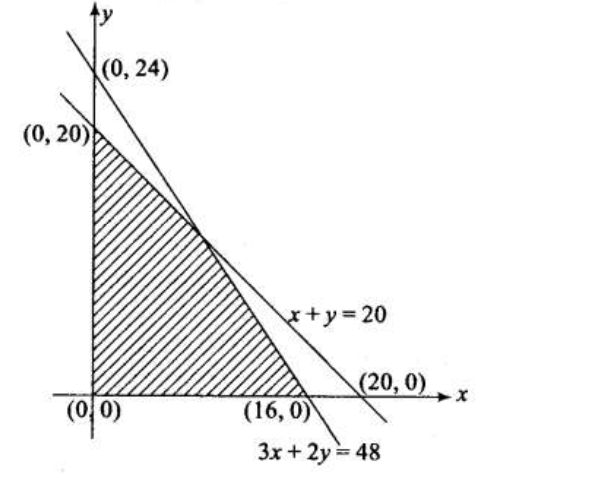
Find the linear inequalities for which the shaded region in the given figure is the solution set.
Solution
(N/A) First,we consider the line $3x + 2y = 48$,which intersects the $X$-axis at $(16, 0)$ and the $Y$-axis at $(0, 24)$.
Since the origin $(0, 0)$ lies within the shaded region,it must satisfy the inequality $3x + 2y \leq 48$.
Next,we consider the line $x + y = 20$,which intersects the $X$-axis at $(20, 0)$ and the $Y$-axis at $(0, 20)$.
Since the origin $(0, 0)$ lies within the shaded region,it must satisfy the inequality $x + y \leq 20$.
From the figure,it is clear that the shaded region is in the first quadrant,which implies $x \geq 0$ and $y \geq 0$.
Thus,the system of linear inequalities representing the shaded region is $3x + 2y \leq 48$,$x + y \leq 20$,$x \geq 0$,and $y \geq 0$.
Since the origin $(0, 0)$ lies within the shaded region,it must satisfy the inequality $3x + 2y \leq 48$.
Next,we consider the line $x + y = 20$,which intersects the $X$-axis at $(20, 0)$ and the $Y$-axis at $(0, 20)$.
Since the origin $(0, 0)$ lies within the shaded region,it must satisfy the inequality $x + y \leq 20$.
From the figure,it is clear that the shaded region is in the first quadrant,which implies $x \geq 0$ and $y \geq 0$.
Thus,the system of linear inequalities representing the shaded region is $3x + 2y \leq 48$,$x + y \leq 20$,$x \geq 0$,and $y \geq 0$.
0 likes
View Solution31
Medium
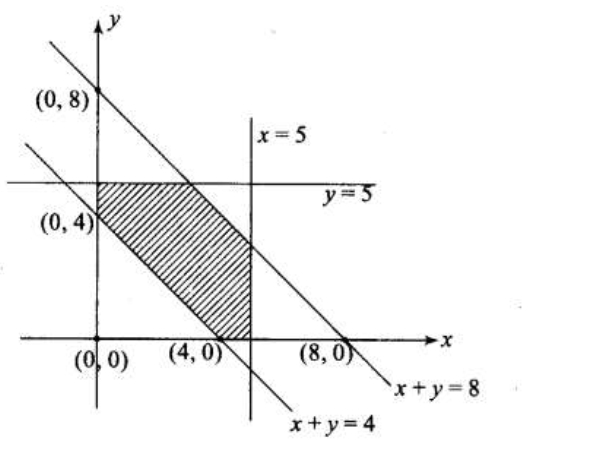
Find the linear inequalities for which the shaded region in the given figure is the solution set.
Solution
(N/A) $1$. Consider the line $x+y=4$. This line intersects the $X$-axis at $(4,0)$ and the $Y$-axis at $(0,4)$. Testing the origin $(0,0)$,we see $0+0 \leq 4$ is false,so the region is on the side away from the origin,giving $x+y \geq 4$.
$2$. Consider the line $x+y=8$. This line intersects the $X$-axis at $(8,0)$ and the $Y$-axis at $(0,8)$. Testing the origin $(0,0)$,we see $0+0 \leq 8$ is true,so the region is on the side containing the origin,giving $x+y \leq 8$.
$3$. The vertical line $x=5$ intersects the $X$-axis at $(5,0)$. The shaded region is to the left of this line,giving $x \leq 5$.
$4$. The horizontal line $y=5$ intersects the $Y$-axis at $(0,5)$. The shaded region is below this line,giving $y \leq 5$.
$5$. Since the shaded region is in the first quadrant,we have $x \geq 0$ and $y \geq 0$.
Thus,the system of linear inequalities is $x+y \geq 4, x+y \leq 8, x \leq 5, y \leq 5, x \geq 0, y \geq 0$.
$2$. Consider the line $x+y=8$. This line intersects the $X$-axis at $(8,0)$ and the $Y$-axis at $(0,8)$. Testing the origin $(0,0)$,we see $0+0 \leq 8$ is true,so the region is on the side containing the origin,giving $x+y \leq 8$.
$3$. The vertical line $x=5$ intersects the $X$-axis at $(5,0)$. The shaded region is to the left of this line,giving $x \leq 5$.
$4$. The horizontal line $y=5$ intersects the $Y$-axis at $(0,5)$. The shaded region is below this line,giving $y \leq 5$.
$5$. Since the shaded region is in the first quadrant,we have $x \geq 0$ and $y \geq 0$.
Thus,the system of linear inequalities is $x+y \geq 4, x+y \leq 8, x \leq 5, y \leq 5, x \geq 0, y \geq 0$.
0 likes
View Solution32
Difficult
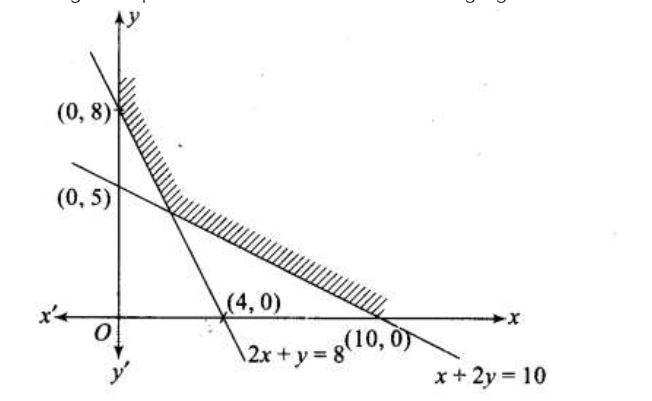
Show that the solution set of the following system of linear inequalities is an unbounded region: $2x + y \geq 8$,$x + 2y \geq 10$,$x \geq 0$ and $y \geq 0$.
Solution
(N/A) Solution:
We have the system of linear inequalities: $2x + y \geq 8$,$x + 2y \geq 10$,$x \geq 0$,and $y \geq 0$.
$1$. The line $2x + y = 8$ passes through the points $(0, 8)$ and $(4, 0)$.
$2$. The line $x + 2y = 10$ passes through the points $(0, 5)$ and $(10, 0)$.
$3$. For the origin $(0, 0)$,we test the inequalities:
- For $2x + y \geq 8$: $2(0) + 0 = 0 < 8$. Thus,the origin does not satisfy the inequality,and the region lies on the side of the line away from the origin.
- For $x + 2y \geq 10$: $0 + 2(0) = 0 < 10$. Thus,the origin does not satisfy the inequality,and the region lies on the side of the line away from the origin.
$4$. The conditions $x \geq 0$ and $y \geq 0$ restrict the solution to the first quadrant.
$5$. By plotting these lines and identifying the common region satisfying all inequalities,we observe that the shaded region extends infinitely away from the origin.
$6$. Therefore,the solution set is an unbounded region.
We have the system of linear inequalities: $2x + y \geq 8$,$x + 2y \geq 10$,$x \geq 0$,and $y \geq 0$.
$1$. The line $2x + y = 8$ passes through the points $(0, 8)$ and $(4, 0)$.
$2$. The line $x + 2y = 10$ passes through the points $(0, 5)$ and $(10, 0)$.
$3$. For the origin $(0, 0)$,we test the inequalities:
- For $2x + y \geq 8$: $2(0) + 0 = 0 < 8$. Thus,the origin does not satisfy the inequality,and the region lies on the side of the line away from the origin.
- For $x + 2y \geq 10$: $0 + 2(0) = 0 < 10$. Thus,the origin does not satisfy the inequality,and the region lies on the side of the line away from the origin.
$4$. The conditions $x \geq 0$ and $y \geq 0$ restrict the solution to the first quadrant.
$5$. By plotting these lines and identifying the common region satisfying all inequalities,we observe that the shaded region extends infinitely away from the origin.
$6$. Therefore,the solution set is an unbounded region.
0 likes
View Solution33
Difficult
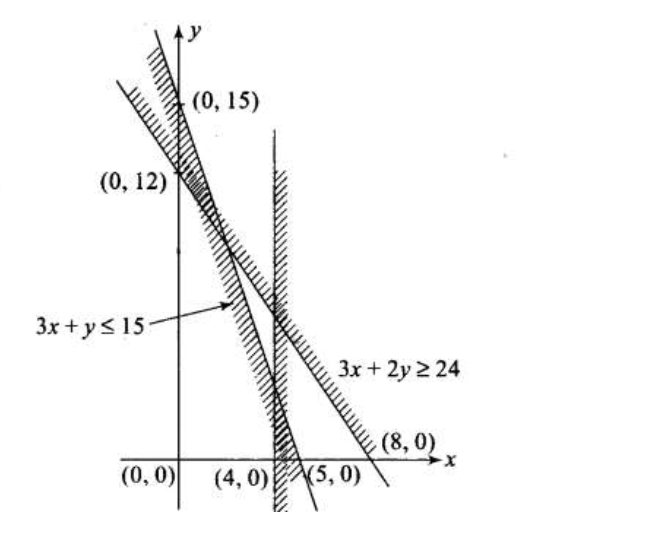
Solve the following system of linear inequalities: $3x + 2y \geq 24$,$3x + y \leq 15$,$x \geq 4$.
Solution
(NONE) We have the system of inequalities:
$1) \ 3x + 2y \geq 24$
$2) \ 3x + y \leq 15$
$3) \ x \geq 4$
First,we plot the corresponding lines on the coordinate plane:
- For $3x + 2y = 24$,the intercepts are $(8, 0)$ and $(0, 12)$. The region $3x + 2y \geq 24$ is the half-plane away from the origin.
- For $3x + y = 15$,the intercepts are $(5, 0)$ and $(0, 15)$. The region $3x + y \leq 15$ is the half-plane containing the origin.
- For $x = 4$,this is a vertical line passing through $(4, 0)$. The region $x \geq 4$ is the half-plane to the right of this line.
By observing the graph,we see that the region satisfying $3x + 2y \geq 24$ and $3x + y \leq 15$ are disjoint in the region where $x \geq 4$. Specifically,for $x \geq 4$,the inequality $3x + y \leq 15$ implies $y \leq 15 - 3x$. If $x=4$,$y \leq 3$. However,$3x + 2y \geq 24$ implies $2y \geq 24 - 3x$. If $x=4$,$2y \geq 12$,so $y \geq 6$. Since there is no $y$ such that $y \leq 3$ and $y \geq 6$ simultaneously,there is no common solution region.
Thus,the given system of inequalities has no solution.
$1) \ 3x + 2y \geq 24$
$2) \ 3x + y \leq 15$
$3) \ x \geq 4$
First,we plot the corresponding lines on the coordinate plane:
- For $3x + 2y = 24$,the intercepts are $(8, 0)$ and $(0, 12)$. The region $3x + 2y \geq 24$ is the half-plane away from the origin.
- For $3x + y = 15$,the intercepts are $(5, 0)$ and $(0, 15)$. The region $3x + y \leq 15$ is the half-plane containing the origin.
- For $x = 4$,this is a vertical line passing through $(4, 0)$. The region $x \geq 4$ is the half-plane to the right of this line.
By observing the graph,we see that the region satisfying $3x + 2y \geq 24$ and $3x + y \leq 15$ are disjoint in the region where $x \geq 4$. Specifically,for $x \geq 4$,the inequality $3x + y \leq 15$ implies $y \leq 15 - 3x$. If $x=4$,$y \leq 3$. However,$3x + 2y \geq 24$ implies $2y \geq 24 - 3x$. If $x=4$,$2y \geq 12$,so $y \geq 6$. Since there is no $y$ such that $y \leq 3$ and $y \geq 6$ simultaneously,there is no common solution region.
Thus,the given system of inequalities has no solution.
0 likes
View Solution34
Difficult
Show that the following system of linear inequalities has no solution: $x + 2y \leq 3$,$3x + 4y \geq 12$,$x \geq 0$,and $y \geq 1$.
Solution
(N/A) We are given the system of linear inequalities: $x + 2y \leq 3$,$3x + 4y \geq 12$,$x \geq 0$,and $y \geq 1$.
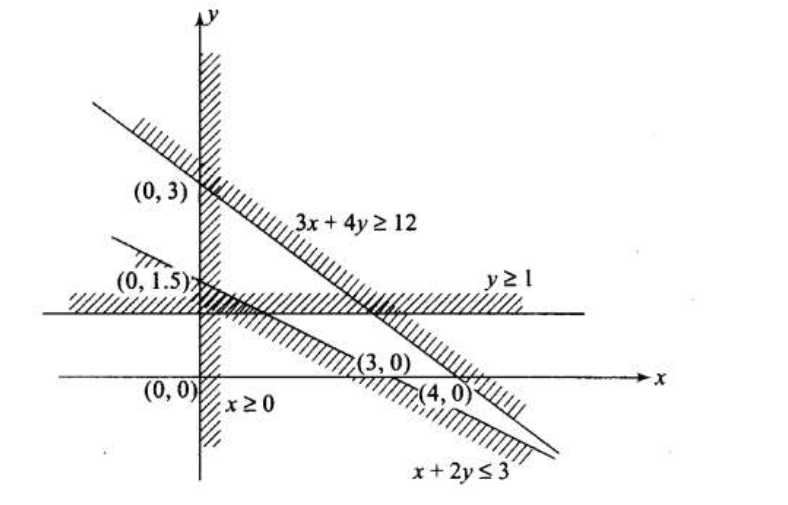
First,we plot the corresponding lines $x + 2y = 3$,$3x + 4y = 12$,$x = 0$,and $y = 1$ in the coordinate plane.
$1$. The line $x + 2y = 3$ passes through the points $(0, 1.5)$ and $(3, 0)$. Testing the point $(0, 0)$,we get $0 + 2(0) = 0 \leq 3$,which is true. Thus,the region satisfying $x + 2y \leq 3$ contains the origin.
$2$. The line $3x + 4y = 12$ passes through the points $(0, 3)$ and $(4, 0)$. Testing the point $(0, 0)$,we get $3(0) + 4(0) = 0 \geq 12$,which is false. Thus,the region satisfying $3x + 4y \geq 12$ does not contain the origin.
$3$. The region $x \geq 0$ represents the right half-plane (including the $y$-axis).
$4$. The region $y \geq 1$ represents the upper half-plane (including the line $y = 1$).
By plotting these regions,we observe that the shaded region for $x + 2y \leq 3$ lies below the line $x + 2y = 3$,while the region for $3x + 4y \geq 12$ lies above the line $3x + 4y = 12$. Furthermore,the constraints $x \geq 0$ and $y \geq 1$ restrict the solution to the first quadrant above $y = 1$. As shown in the figure,there is no common region that satisfies all these inequalities simultaneously. Therefore,the system has no solution (the solution set is the empty set).
First,we plot the corresponding lines $x + 2y = 3$,$3x + 4y = 12$,$x = 0$,and $y = 1$ in the coordinate plane.
$1$. The line $x + 2y = 3$ passes through the points $(0, 1.5)$ and $(3, 0)$. Testing the point $(0, 0)$,we get $0 + 2(0) = 0 \leq 3$,which is true. Thus,the region satisfying $x + 2y \leq 3$ contains the origin.
$2$. The line $3x + 4y = 12$ passes through the points $(0, 3)$ and $(4, 0)$. Testing the point $(0, 0)$,we get $3(0) + 4(0) = 0 \geq 12$,which is false. Thus,the region satisfying $3x + 4y \geq 12$ does not contain the origin.
$3$. The region $x \geq 0$ represents the right half-plane (including the $y$-axis).
$4$. The region $y \geq 1$ represents the upper half-plane (including the line $y = 1$).
By plotting these regions,we observe that the shaded region for $x + 2y \leq 3$ lies below the line $x + 2y = 3$,while the region for $3x + 4y \geq 12$ lies above the line $3x + 4y = 12$. Furthermore,the constraints $x \geq 0$ and $y \geq 1$ restrict the solution to the first quadrant above $y = 1$. As shown in the figure,there is no common region that satisfies all these inequalities simultaneously. Therefore,the system has no solution (the solution set is the empty set).
0 likes
View Solution35
EasyMCQ
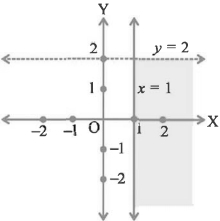
The inequalities represented by the coloured region in the figure are...
A
$x \geq 1$
B
$y < 2$
C
$x \geq 1$ and $y < 2$
D
$x \leq 1$ and $y \geq 2$
Solution
(C) $1$. The vertical line is $x = 1$. Since the shaded region is to the right of this line and the line is solid,the inequality is $x \geq 1$.
$2$. The horizontal line is $y = 2$. Since the line is dashed,it is not included in the region. The shaded region is below this line,so the inequality is $y < 2$.
$3$. Combining both,the region is represented by $x \geq 1$ and $y < 2$.
$2$. The horizontal line is $y = 2$. Since the line is dashed,it is not included in the region. The shaded region is below this line,so the inequality is $y < 2$.
$3$. Combining both,the region is represented by $x \geq 1$ and $y < 2$.
0 likes
View Solution36
EasyMCQ
The feasible region of the inequalities $x+y \leq 1$ and $x-y \leq 1$ lies in $\ldots \ldots \ldots$ quadrants.
A
Only $I$ and $II$
B
Only $I$ and $III$
C
Only $II$ and $III$
D
All the four
Solution
(D) To find the feasible region,we analyze the inequalities $x+y \leq 1$ and $x-y \leq 1$.
$1$. The line $x+y = 1$ passes through $(1, 0)$ and $(0, 1)$. The region $x+y \leq 1$ includes the origin $(0,0)$ and extends into all four quadrants.
$2$. The line $x-y = 1$ passes through $(1, 0)$ and $(0, -1)$. The region $x-y \leq 1$ also includes the origin $(0,0)$ and extends into all four quadrants.
$3$. Since both inequalities represent half-planes that extend infinitely in various directions and contain the origin,their intersection (the feasible region) is an unbounded region that spans across all four quadrants of the Cartesian plane.
Therefore,the correct option is $D$.
$1$. The line $x+y = 1$ passes through $(1, 0)$ and $(0, 1)$. The region $x+y \leq 1$ includes the origin $(0,0)$ and extends into all four quadrants.
$2$. The line $x-y = 1$ passes through $(1, 0)$ and $(0, -1)$. The region $x-y \leq 1$ also includes the origin $(0,0)$ and extends into all four quadrants.
$3$. Since both inequalities represent half-planes that extend infinitely in various directions and contain the origin,their intersection (the feasible region) is an unbounded region that spans across all four quadrants of the Cartesian plane.
Therefore,the correct option is $D$.
0 likes
View Solution37
EasyMCQ
The solution set of the constraints $2x + 3y \leq 6$,$5x + 3y \leq 15$,$x \geq 0$,and $y \geq 0$ does not include which of the following points?
A
$(0, 2)$
B
$(0, 0)$
C
$(3, 0)$
D
$(0, 5)$
Solution
(D) To find the solution set,we analyze the given constraints:
$1$. $2x + 3y \leq 6$
$2$. $5x + 3y \leq 15$
$3$. $x \geq 0, y \geq 0$
We test each point against the constraints:
For point $(0, 2)$: $2(0) + 3(2) = 6 \leq 6$ (True) and $5(0) + 3(2) = 6 \leq 15$ (True).
For point $(0, 0)$: $2(0) + 3(0) = 0 \leq 6$ (True) and $5(0) + 3(0) = 0 \leq 15$ (True).
For point $(3, 0)$: $2(3) + 3(0) = 6 \leq 6$ (True) and $5(3) + 3(0) = 15 \leq 15$ (True).
For point $(0, 5)$: $2(0) + 3(5) = 15 \not\leq 6$ (False) and $5(0) + 3(5) = 15 \leq 15$ (True).
Since the point $(0, 5)$ violates the first constraint,it is not in the solution set.
$1$. $2x + 3y \leq 6$
$2$. $5x + 3y \leq 15$
$3$. $x \geq 0, y \geq 0$
We test each point against the constraints:
For point $(0, 2)$: $2(0) + 3(2) = 6 \leq 6$ (True) and $5(0) + 3(2) = 6 \leq 15$ (True).
For point $(0, 0)$: $2(0) + 3(0) = 0 \leq 6$ (True) and $5(0) + 3(0) = 0 \leq 15$ (True).
For point $(3, 0)$: $2(3) + 3(0) = 6 \leq 6$ (True) and $5(3) + 3(0) = 15 \leq 15$ (True).
For point $(0, 5)$: $2(0) + 3(5) = 15 \not\leq 6$ (False) and $5(0) + 3(5) = 15 \leq 15$ (True).
Since the point $(0, 5)$ violates the first constraint,it is not in the solution set.
0 likes
View Solution38
MediumMCQ
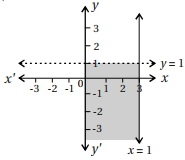
The shaded region given in the figure represents the $\ldots \ldots \ldots$ inequality.
A
$x \leq 3$ and $y < 1$
B
$x \geq 3$ and $y < 1$
C
$x \leq 3$ and $y > 1$
D
$x \geq 3$ and $y > 1$
Solution
(A) $1$. Observe the vertical line $x = 3$. The shaded region lies to the left of this line,which corresponds to $x \leq 3$. Since the line is solid,the inequality includes the boundary.
$2$. Observe the horizontal line $y = 1$. The shaded region lies below this line,which corresponds to $y < 1$. Since the line is dashed,the inequality is strict.
$3$. Combining these,the shaded region represents the system of inequalities $x \leq 3$ and $y < 1$.
$2$. Observe the horizontal line $y = 1$. The shaded region lies below this line,which corresponds to $y < 1$. Since the line is dashed,the inequality is strict.
$3$. Combining these,the shaded region represents the system of inequalities $x \leq 3$ and $y < 1$.
0 likes
View Solution39
DifficultMCQ
The shaded region in the following figure is the solution set of the inequations:
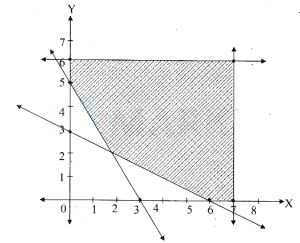
A
$x+2y \leq 6, 5x+3y \geq 15, x \leq 7, y \leq 6, x, y \geq 0$
B
$x+2y \geq 6, 5x+3y \geq 15, x \leq 7, y \leq 6, x, y \geq 0$
C
$x+2y \geq 6, 5x+3y \leq 15, x \geq 7, y \leq 6, x, y \geq 0$
D
$x+2y \leq 6, 5x+3y \leq 15, x \leq 7, y \geq 6, x, y \geq 0$
Solution
(B) To determine the correct system of inequalities for the shaded region,we analyze the boundary lines shown in the figure:
$1$. The line passing through $(0, 3)$ and $(6, 0)$ has the equation $\frac{x}{6} + \frac{y}{3} = 1$,which simplifies to $x + 2y = 6$. Since the shaded region is above this line,the inequality is $x + 2y \geq 6$.
$2$. The line passing through $(0, 5)$ and $(3, 0)$ has the equation $\frac{x}{3} + \frac{y}{5} = 1$,which simplifies to $5x + 3y = 15$. Since the shaded region is above this line,the inequality is $5x + 3y \geq 15$.
$3$. The vertical line is $x = 7$. Since the shaded region is to the left of this line,the inequality is $x \leq 7$.
$4$. The horizontal line is $y = 6$. Since the shaded region is below this line,the inequality is $y \leq 6$.
$5$. The region is in the first quadrant,so $x \geq 0$ and $y \geq 0$.
Combining these,the system is $x + 2y \geq 6, 5x + 3y \geq 15, x \leq 7, y \leq 6, x, y \geq 0$. This corresponds to option $(B)$.
$1$. The line passing through $(0, 3)$ and $(6, 0)$ has the equation $\frac{x}{6} + \frac{y}{3} = 1$,which simplifies to $x + 2y = 6$. Since the shaded region is above this line,the inequality is $x + 2y \geq 6$.
$2$. The line passing through $(0, 5)$ and $(3, 0)$ has the equation $\frac{x}{3} + \frac{y}{5} = 1$,which simplifies to $5x + 3y = 15$. Since the shaded region is above this line,the inequality is $5x + 3y \geq 15$.
$3$. The vertical line is $x = 7$. Since the shaded region is to the left of this line,the inequality is $x \leq 7$.
$4$. The horizontal line is $y = 6$. Since the shaded region is below this line,the inequality is $y \leq 6$.
$5$. The region is in the first quadrant,so $x \geq 0$ and $y \geq 0$.
Combining these,the system is $x + 2y \geq 6, 5x + 3y \geq 15, x \leq 7, y \leq 6, x, y \geq 0$. This corresponds to option $(B)$.
0 likes
View Solution40
MediumMCQ
The shaded region in the following figure represents the solution set of:
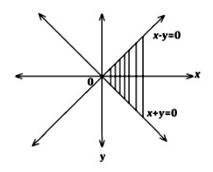
A
$x-y \leq 0, x+y \geq 0$
B
$x-y \leq 0, x+y \leq 0$
C
$x-y \geq 0, x+y \geq 0$
D
$x-y \geq 0, x+y \leq 0$
Solution
(A) The shaded region is bounded by the lines $x-y=0$ and $x+y=0$.
For the line $x-y=0$,testing a point in the shaded region,such as $(1, 0)$,gives $1-0=1 > 0$. However,the region includes the line itself,so we consider $x-y \leq 0$ for the region below the line $y=x$.
Looking at the graph,the shaded region lies below the line $y=x$ (i.e.,$y \geq x$ or $x-y \leq 0$) and above the line $y=-x$ (i.e.,$y \geq -x$ or $x+y \geq 0$).
Thus,the inequalities representing the shaded region are $x-y \leq 0$ and $x+y \geq 0$.
For the line $x-y=0$,testing a point in the shaded region,such as $(1, 0)$,gives $1-0=1 > 0$. However,the region includes the line itself,so we consider $x-y \leq 0$ for the region below the line $y=x$.
Looking at the graph,the shaded region lies below the line $y=x$ (i.e.,$y \geq x$ or $x-y \leq 0$) and above the line $y=-x$ (i.e.,$y \geq -x$ or $x+y \geq 0$).
Thus,the inequalities representing the shaded region are $x-y \leq 0$ and $x+y \geq 0$.
0 likes
View Solution41
EasyMCQ
The graphical solution set of the system of inequations $2x + 3y \leq 6$,$x + 4y \geq 4$,$x \geq 0$,$y \geq 0$ is given by
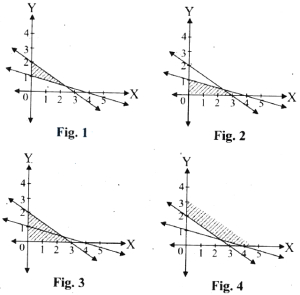
A
Fig. $1$
B
Fig. $3$
C
Fig. $2$
D
Fig. $4$
Solution
(A) To find the feasible region,we analyze the given system of inequations:
$1$. $2x + 3y \leq 6$: The boundary line is $2x + 3y = 6$. For $(0,0)$,$0 \leq 6$ is true,so the region is towards the origin.
$2$. $x + 4y \geq 4$: The boundary line is $x + 4y = 4$. For $(0,0)$,$0 \geq 4$ is false,so the region is away from the origin.
$3$. $x \geq 0, y \geq 0$: This restricts the region to the $1^{\text{st}}$ quadrant.
Combining these,the feasible region is the area bounded by the lines in the $1^{\text{st}}$ quadrant that satisfies both conditions simultaneously. Looking at the provided figures,Fig. $1$ represents the region bounded by these constraints.
Therefore,Option $(A)$ is the correct answer.
$1$. $2x + 3y \leq 6$: The boundary line is $2x + 3y = 6$. For $(0,0)$,$0 \leq 6$ is true,so the region is towards the origin.
$2$. $x + 4y \geq 4$: The boundary line is $x + 4y = 4$. For $(0,0)$,$0 \geq 4$ is false,so the region is away from the origin.
$3$. $x \geq 0, y \geq 0$: This restricts the region to the $1^{\text{st}}$ quadrant.
Combining these,the feasible region is the area bounded by the lines in the $1^{\text{st}}$ quadrant that satisfies both conditions simultaneously. Looking at the provided figures,Fig. $1$ represents the region bounded by these constraints.
Therefore,Option $(A)$ is the correct answer.
0 likes
View Solution42
EasyMCQ
The shaded figure given below is the solution set for the linear inequations. Choose the correct option.
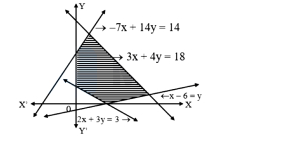
A
$3x + 4y \geq 18; x - 6y \leq 3; 2x + 3y \geq 3; 7x - 14y \leq 14; x \geq 0; y \geq 0$
B
$3x + 4y \leq 18; x - 6y \leq 3; 2x + 3y \leq 3; -7x + 14y \geq 14; x \geq 0; y \geq 0$
C
$3x + 4y \leq 18; x - 6y \leq 3; 2x + 3y \geq 3; -7x + 14y \leq 14; x \geq 0; y \geq 0$
D
$3x + 4y \geq -18; x - 6y \leq 3; 2x + 3y \leq 3; -7x + 14y \geq 14; x \geq 0; y \geq 0$
Solution
(C) To determine the correct system of linear inequalities for the shaded region,we analyze the boundary lines and the direction of the shaded area relative to the origin $(0,0)$.
$1$. The region is in the first quadrant,so $x \geq 0$ and $y \geq 0$.
$2$. For the line $3x + 4y = 18$,the origin $(0,0)$ satisfies $3(0) + 4(0) = 0 < 18$. Since the shaded region contains the origin side of this line,the inequality is $3x + 4y \leq 18$.
$3$. For the line $x - 6y = 3$,the origin $(0,0)$ satisfies $0 - 0 = 0 < 3$. The shaded region is on the side of the origin,so the inequality is $x - 6y \leq 3$.
$4$. For the line $2x + 3y = 3$,the origin $(0,0)$ satisfies $2(0) + 3(0) = 0 < 3$. However,the shaded region is on the opposite side of the origin,so the inequality is $2x + 3y \geq 3$.
$5$. For the line $-7x + 14y = 14$,the origin $(0,0)$ satisfies $-7(0) + 14(0) = 0 < 14$. The shaded region is on the side of the origin,so the inequality is $-7x + 14y \leq 14$.
Comparing these with the given options,option $C$ matches all these conditions.
$1$. The region is in the first quadrant,so $x \geq 0$ and $y \geq 0$.
$2$. For the line $3x + 4y = 18$,the origin $(0,0)$ satisfies $3(0) + 4(0) = 0 < 18$. Since the shaded region contains the origin side of this line,the inequality is $3x + 4y \leq 18$.
$3$. For the line $x - 6y = 3$,the origin $(0,0)$ satisfies $0 - 0 = 0 < 3$. The shaded region is on the side of the origin,so the inequality is $x - 6y \leq 3$.
$4$. For the line $2x + 3y = 3$,the origin $(0,0)$ satisfies $2(0) + 3(0) = 0 < 3$. However,the shaded region is on the opposite side of the origin,so the inequality is $2x + 3y \geq 3$.
$5$. For the line $-7x + 14y = 14$,the origin $(0,0)$ satisfies $-7(0) + 14(0) = 0 < 14$. The shaded region is on the side of the origin,so the inequality is $-7x + 14y \leq 14$.
Comparing these with the given options,option $C$ matches all these conditions.
0 likes
View Solution43
EasyMCQ
The common region of the solution of the inequations $x+2y \geq 4$,$2x-y \leq 6$ and $x, y > 0$ is
A
bounded and origin side
B
unbounded and non-origin side
C
unbounded and origin side
D
bounded and non-origin side
Solution
(B) To determine the common region,we analyze the given inequations:
$1$. $x+2y \geq 4$: The boundary line is $x+2y=4$. Testing the origin $(0,0)$,we get $0+0 \geq 4$,which is false. Thus,the region is on the non-origin side of the line.
$2$. $2x-y \leq 6$: The boundary line is $2x-y=6$. Testing the origin $(0,0)$,we get $0-0 \leq 6$,which is true. Thus,the region is on the origin side of the line.
$3$. $x, y > 0$: This restricts the region to the first quadrant.
By observing the intersection of these regions,the feasible region is not enclosed by a finite boundary,meaning it is unbounded. Since the region does not include the origin and is defined by the intersection of these half-planes in the first quadrant,it is an unbounded region on the non-origin side. Therefore,the correct option is $B$.
$1$. $x+2y \geq 4$: The boundary line is $x+2y=4$. Testing the origin $(0,0)$,we get $0+0 \geq 4$,which is false. Thus,the region is on the non-origin side of the line.
$2$. $2x-y \leq 6$: The boundary line is $2x-y=6$. Testing the origin $(0,0)$,we get $0-0 \leq 6$,which is true. Thus,the region is on the origin side of the line.
$3$. $x, y > 0$: This restricts the region to the first quadrant.
By observing the intersection of these regions,the feasible region is not enclosed by a finite boundary,meaning it is unbounded. Since the region does not include the origin and is defined by the intersection of these half-planes in the first quadrant,it is an unbounded region on the non-origin side. Therefore,the correct option is $B$.
0 likes
View Solution44
EasyMCQ
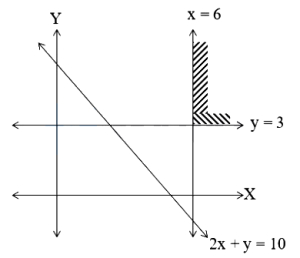
The region represented by the inequalities $x \geq 6, y \geq 3, 2x + y \geq 10, x \geq 0, y \geq 0$ is
A
origin side of all the inequalities
B
unbounded
C
polygon
D
bounded
Solution
(B) To determine the nature of the region,we analyze the given inequalities:
$1$. $x \geq 6$: This represents the region to the right of the vertical line $x = 6$.
$2$. $y \geq 3$: This represents the region above the horizontal line $y = 3$.
$3$. $2x + y \geq 10$: This represents the region on or above the line $2x + y = 10$.
$4$. $x \geq 0, y \geq 0$: These represent the first quadrant.
By plotting these lines,we observe that the intersection of these regions starts from the point $(6, 3)$ and extends infinitely in the positive $x$ and $y$ directions.
Since the region does not have a finite area and extends infinitely,it is an unbounded region.
Therefore,the correct option is $B$.
$1$. $x \geq 6$: This represents the region to the right of the vertical line $x = 6$.
$2$. $y \geq 3$: This represents the region above the horizontal line $y = 3$.
$3$. $2x + y \geq 10$: This represents the region on or above the line $2x + y = 10$.
$4$. $x \geq 0, y \geq 0$: These represent the first quadrant.
By plotting these lines,we observe that the intersection of these regions starts from the point $(6, 3)$ and extends infinitely in the positive $x$ and $y$ directions.
Since the region does not have a finite area and extends infinitely,it is an unbounded region.
Therefore,the correct option is $B$.
0 likes
View Solution45
EasyMCQ
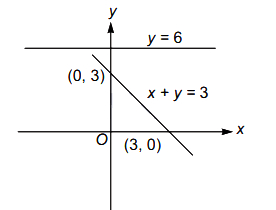
The region represented by the inequation system $x, y \geq 0, y \leq 6, x+y \leq 3$ is
A
unbounded in first quadrant
B
unbounded in first and second quadrants
C
bounded in first quadrant
D
None of the above
Solution
(C) The given system of inequations is $x \geq 0$,$y \geq 0$,$y \leq 6$,and $x+y \leq 3$.
$1$. The conditions $x \geq 0$ and $y \geq 0$ restrict the region to the first quadrant.
$2$. The line $x+y = 3$ passes through $(3, 0)$ and $(0, 3)$. The inequality $x+y \leq 3$ represents the region on or below this line.
$3$. The condition $y \leq 6$ is satisfied by the region defined by $x+y \leq 3$ in the first quadrant,as the maximum value of $y$ in this region is $3$.
$4$. Since the region is enclosed by the axes and the line $x+y=3$,it is a bounded region in the first quadrant.
$1$. The conditions $x \geq 0$ and $y \geq 0$ restrict the region to the first quadrant.
$2$. The line $x+y = 3$ passes through $(3, 0)$ and $(0, 3)$. The inequality $x+y \leq 3$ represents the region on or below this line.
$3$. The condition $y \leq 6$ is satisfied by the region defined by $x+y \leq 3$ in the first quadrant,as the maximum value of $y$ in this region is $3$.
$4$. Since the region is enclosed by the axes and the line $x+y=3$,it is a bounded region in the first quadrant.
0 likes
View Solution46
EasyMCQ
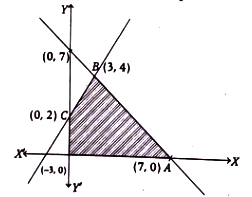
The shaded region in the figure is the solution of which of the following systems of inequations?
A
$x+y \geq 7, 2x-3y+6 \leq 0, x \geq 0, y \geq 0$
B
$x+y \geq 7, 2x-3y+6 \geq 0, x \geq 0, y \geq 0$
C
$x+y \leq 7, 2x-3y+6 \leq 0, x \geq 0, y \geq 0$
D
$x+y \leq 7, 2x-3y+6 \geq 0, x \geq 0, y \geq 0$
Solution
(D) $1$. The line passing through $A(7, 0)$ and $(0, 7)$ has the equation $\frac{x}{7} + \frac{y}{7} = 1$,which simplifies to $x + y = 7$. Since the shaded region is towards the origin,the inequality is $x + y \leq 7$.
$2$. The line passing through $C(0, 2)$ and $B(3, 4)$ has the slope $m = \frac{4-2}{3-0} = \frac{2}{3}$. The equation is $y - 2 = \frac{2}{3}(x - 0)$,which simplifies to $3y - 6 = 2x$,or $2x - 3y + 6 = 0$. Testing the point $(3, 0)$ which is in the shaded region: $2(3) - 3(0) + 6 = 12 \geq 0$. Thus,the inequality is $2x - 3y + 6 \geq 0$.
$3$. Since the region is in the first quadrant,$x \geq 0$ and $y \geq 0$.
$4$. Combining these,the system is $x + y \leq 7, 2x - 3y + 6 \geq 0, x \geq 0, y \geq 0$. Therefore,option $(D)$ is correct.
$2$. The line passing through $C(0, 2)$ and $B(3, 4)$ has the slope $m = \frac{4-2}{3-0} = \frac{2}{3}$. The equation is $y - 2 = \frac{2}{3}(x - 0)$,which simplifies to $3y - 6 = 2x$,or $2x - 3y + 6 = 0$. Testing the point $(3, 0)$ which is in the shaded region: $2(3) - 3(0) + 6 = 12 \geq 0$. Thus,the inequality is $2x - 3y + 6 \geq 0$.
$3$. Since the region is in the first quadrant,$x \geq 0$ and $y \geq 0$.
$4$. Combining these,the system is $x + y \leq 7, 2x - 3y + 6 \geq 0, x \geq 0, y \geq 0$. Therefore,option $(D)$ is correct.
0 likes
View Solution47
MediumMCQ
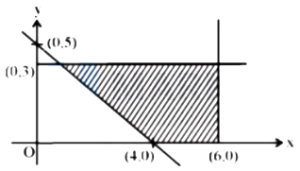
The shaded region in the figure is the solution set of the inequations:
A
$5x + 4y \geq 20, x \leq 6, y \leq 3, x \geq 0, y \geq 0$
B
$5x + 4y \leq 20, x \leq 6, y \leq 3, x \geq 0, y \geq 0$
C
$5x + 4y \geq 20, x \leq 6, y \geq 3, x \geq 0, y \geq 0$
D
$5x + 4y \leq 20, x \geq 6, y \leq 3, x \geq 0, y \geq 0$
Solution
(A) $1$. The line passes through the points $(0, 5)$ and $(4, 0)$. The equation of this line is given by the intercept form: $\frac{x}{4} + \frac{y}{5} = 1$,which simplifies to $5x + 4y = 20$. Since the shaded region is above the line,the inequality is $5x + 4y \geq 20$.
$2$. The region is bounded by the vertical line $x = 6$ on the right,and since the shaded area is to the left of this line,we have $x \leq 6$.
$3$. The region is bounded by the horizontal line $y = 3$ on the top,and since the shaded area is below this line,we have $y \leq 3$.
$4$. The region is in the first quadrant,so $x \geq 0$ and $y \geq 0$.
$5$. Combining all these,the system of inequations is $5x + 4y \geq 20, x \leq 6, y \leq 3, x \geq 0, y \geq 0$.
$2$. The region is bounded by the vertical line $x = 6$ on the right,and since the shaded area is to the left of this line,we have $x \leq 6$.
$3$. The region is bounded by the horizontal line $y = 3$ on the top,and since the shaded area is below this line,we have $y \leq 3$.
$4$. The region is in the first quadrant,so $x \geq 0$ and $y \geq 0$.
$5$. Combining all these,the system of inequations is $5x + 4y \geq 20, x \leq 6, y \leq 3, x \geq 0, y \geq 0$.
0 likes
View Solution48
DifficultMCQ
The shaded region shown in the figure is given by the inequations:
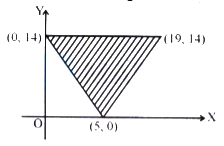
A
$14x + 5y \geq 70; y \leq 14$ and $x - y \leq 5$
B
$14x + 5y \geq 70; y \leq 14$ and $x - y \geq 5$
C
$14x + 5y \leq 70; y \leq 14$ and $x - y \geq 5$
D
$14x + 5y \geq 70; y \geq 14$ and $x - y \geq 5$
Solution
(A) The vertices of the shaded triangular region are $A(0, 14)$,$B(5, 0)$,and $C(19, 14)$.
$1$. The line passing through $A(0, 14)$ and $B(5, 0)$ has the equation $\frac{x}{5} + \frac{y}{14} = 1$,which simplifies to $14x + 5y = 70$. Since the shaded region lies above this line (e.g.,testing point $(5, 14)$ gives $14(5) + 5(14) = 70 + 70 = 140 > 70$),the inequality is $14x + 5y \geq 70$.
$2$. The line passing through $A(0, 14)$ and $C(19, 14)$ is the horizontal line $y = 14$. Since the shaded region lies below this line,the inequality is $y \leq 14$.
$3$. The line passing through $B(5, 0)$ and $C(19, 14)$ has a slope $m = \frac{14 - 0}{19 - 5} = \frac{14}{14} = 1$. Using the point-slope form $y - 0 = 1(x - 5)$,we get $y = x - 5$,or $x - y = 5$. Since the shaded region lies to the left of this line (e.g.,testing point $(5, 14)$ gives $5 - 14 = -9 < 5$),the inequality is $x - y \leq 5$.
Thus,the correct set of inequations is $14x + 5y \geq 70$,$y \leq 14$,and $x - y \leq 5$.
$1$. The line passing through $A(0, 14)$ and $B(5, 0)$ has the equation $\frac{x}{5} + \frac{y}{14} = 1$,which simplifies to $14x + 5y = 70$. Since the shaded region lies above this line (e.g.,testing point $(5, 14)$ gives $14(5) + 5(14) = 70 + 70 = 140 > 70$),the inequality is $14x + 5y \geq 70$.
$2$. The line passing through $A(0, 14)$ and $C(19, 14)$ is the horizontal line $y = 14$. Since the shaded region lies below this line,the inequality is $y \leq 14$.
$3$. The line passing through $B(5, 0)$ and $C(19, 14)$ has a slope $m = \frac{14 - 0}{19 - 5} = \frac{14}{14} = 1$. Using the point-slope form $y - 0 = 1(x - 5)$,we get $y = x - 5$,or $x - y = 5$. Since the shaded region lies to the left of this line (e.g.,testing point $(5, 14)$ gives $5 - 14 = -9 < 5$),the inequality is $x - y \leq 5$.
Thus,the correct set of inequations is $14x + 5y \geq 70$,$y \leq 14$,and $x - y \leq 5$.
0 likes
View Solution49
EasyMCQ
The shaded region is the solution set of the inequalities:
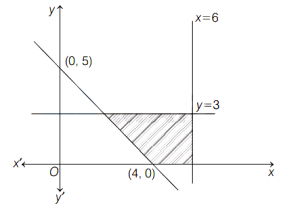
A
$5x + 4y \geq 20, x \leq 6, y \geq 3, x \geq 0, y \geq 0$
B
$5x + 4y \leq 20, x \leq 6, y \leq 3, x \geq 0, y \geq 0$
C
$5x + 4y \geq 20, x \leq 6, y \leq 3, x \geq 0, y \geq 0$
D
$5x + 4y \geq 20, x \geq 6, y \leq 3, x \geq 0, y \geq 0$
Solution
(C) $1$. Analyze the line $l_1$ passing through $(0, 5)$ and $(4, 0)$. The equation of this line in intercept form is $\frac{x}{4} + \frac{y}{5} = 1$,which simplifies to $5x + 4y = 20$. Since the shaded region does not contain the origin $(0, 0)$,the inequality is $5x + 4y \geq 20$.
$2$. Analyze the horizontal line $l_2$. The shaded region lies below the line $y = 3$,so the inequality is $y \leq 3$.
$3$. Analyze the vertical line $l_3$. The shaded region lies to the left of the line $x = 6$,so the inequality is $x \leq 6$.
$4$. The region is in the first quadrant,so $x \geq 0$ and $y \geq 0$.
$5$. Combining these,the system of inequalities is $5x + 4y \geq 20, x \leq 6, y \leq 3, x \geq 0, y \geq 0$. This matches option $C$.
$2$. Analyze the horizontal line $l_2$. The shaded region lies below the line $y = 3$,so the inequality is $y \leq 3$.
$3$. Analyze the vertical line $l_3$. The shaded region lies to the left of the line $x = 6$,so the inequality is $x \leq 6$.
$4$. The region is in the first quadrant,so $x \geq 0$ and $y \geq 0$.
$5$. Combining these,the system of inequalities is $5x + 4y \geq 20, x \leq 6, y \leq 3, x \geq 0, y \geq 0$. This matches option $C$.
0 likes
View Solution50
EasyMCQ
The shaded region in the figure is the solution set of the inequations:
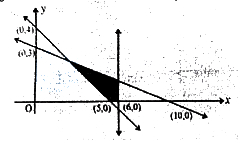
A
$4x + 5y \geq 20, 3x + 10y \leq 30, x \geq 6, x, y \geq 0$
B
$4x + 5y \leq 20, 3x + 10y \leq 30, x \geq 6, x, y \geq 0$
C
$4x + 5y \geq 20, 3x + 10y \leq 30, x \leq 6, x, y \geq 0$
D
$4x + 5y \leq 20, 3x + 10y \leq 30, x \leq 6, x, y \geq 0$
Solution
(C) $1$. Identify the equations of the lines from their intercepts:
- Line passing through $(0, 4)$ and $(5, 0)$: $\frac{x}{5} + \frac{y}{4} = 1 \Rightarrow 4x + 5y = 20$.
- Line passing through $(0, 3)$ and $(10, 0)$: $\frac{x}{10} + \frac{y}{3} = 1 \Rightarrow 3x + 10y = 30$.
- Vertical line passing through $(6, 0)$: $x = 6$.
$2$. Determine the inequalities based on the shaded region:
- The shaded region is above the line $4x + 5y = 20$,so the inequality is $4x + 5y \geq 20$.
- The shaded region is below the line $3x + 10y = 30$,so the inequality is $3x + 10y \leq 30$.
- The shaded region is to the left of the line $x = 6$,so the inequality is $x \leq 6$.
- Since the region is in the first quadrant,$x, y \geq 0$.
Thus,the correct set of inequations is $4x + 5y \geq 20, 3x + 10y \leq 30, x \leq 6, x, y \geq 0$.
- Line passing through $(0, 4)$ and $(5, 0)$: $\frac{x}{5} + \frac{y}{4} = 1 \Rightarrow 4x + 5y = 20$.
- Line passing through $(0, 3)$ and $(10, 0)$: $\frac{x}{10} + \frac{y}{3} = 1 \Rightarrow 3x + 10y = 30$.
- Vertical line passing through $(6, 0)$: $x = 6$.
$2$. Determine the inequalities based on the shaded region:
- The shaded region is above the line $4x + 5y = 20$,so the inequality is $4x + 5y \geq 20$.
- The shaded region is below the line $3x + 10y = 30$,so the inequality is $3x + 10y \leq 30$.
- The shaded region is to the left of the line $x = 6$,so the inequality is $x \leq 6$.
- Since the region is in the first quadrant,$x, y \geq 0$.
Thus,the correct set of inequations is $4x + 5y \geq 20, 3x + 10y \leq 30, x \leq 6, x, y \geq 0$.
0 likes
View SolutionLinear Inequalities — Linear inequalities for Multiple Lines · Frequently Asked Questions
1Are these Linear Inequalities questions useful for JEE and NEET?
Yes. All questions in this section are mapped to JEE Main and NEET exam patterns. Previous year questions from JEE Main, NEET, GUJCET and state-level exams are included with full solutions.
2Can I switch to Hindi or Gujarati for these questions?
Yes. Use the language tabs in the hero section or the sidebar to view the same questions and solutions in English, Hindi or Gujarati.
3How do I generate a question paper from this subtopic?
Use the Vedclass Exam Paper Generator — select the chapter and subtopic, set difficulty, and generate Sets A, B, C, D automatically. First 3 chapters of every subject are free.
Vedclass Products
For Students
Vedclass Test Series
Mock tests in real JEE/NEET style with performance analysis. 5-day free trial.
Start Free TrialFor Teachers
Exam Paper Generator
Generate Set A/B/C/D papers from this chapter in 2 minutes. 3 chapters free.
Try FreeFor Institutes
Online Exam Module
Live online exams with unlimited students, 360° analytics & white-label branding.
See DemoFor Teachers & Institutes
Generate a Linear Inequalities Exam Paper in 2 Minutes
Select subtopic & difficulty — Sets A, B, C, D auto-generated with No Repeat logic.
First 3 chapters of every subject are free — no payment required.