
A English
Ellipse Questions in English
Class 11 Mathematics · 10-2. Parabola, Ellipse, Hyperbola · Ellipse
754+
Questions
English
Language
100%
With Solutions
Showing 50 of 754 questions in English
251
AdvancedMCQ
Let $F_1$ and $F_2$ be the foci of an ellipse $\frac{x^2}{4} + \frac{y^2}{9} = 1$. $A$ ray from $F_1$ strikes the elliptical mirror at point $P$ and is reflected. What is the equation of the angle bisector of the angle between the incident ray and the reflected ray?
A
$y = x + \frac{5}{\sqrt{13}}$
B
$y = 2x - \frac{5}{\sqrt{13}}$
C
$x + y - 5 = 0$
D
$3x - 4y - 5 = 0$
Solution
(A) For an ellipse,the reflected ray from one focus passes through the other focus.
Therefore,the incident ray is $PF_1$ and the reflected ray is $PF_2$.
The angle bisector of the angle between the incident ray $PF_1$ and the reflected ray $PF_2$ is the normal to the ellipse at point $P$.
The equation of the ellipse is $\frac{x^2}{4} + \frac{y^2}{9} = 1$,where $a^2 = 4$ and $b^2 = 9$.
Since $b^2 > a^2$,the major axis is along the $y$-axis.
The equation of the normal to the ellipse $\frac{x^2}{a^2} + \frac{y^2}{b^2} = 1$ with slope $m$ is $y = mx \pm \frac{(a^2 - b^2)m}{\sqrt{a^2 + b^2m^2}}$.
Substituting $a^2 = 4$,$b^2 = 9$,and $m = 1$ (assuming the bisector has slope $1$ as per options):
$y = x \pm \frac{(4 - 9)(1)}{\sqrt{4 + 9(1)^2}} = x \pm \frac{-5}{\sqrt{13}}$.
Thus,the equation is $y = x \pm \frac{5}{\sqrt{13}}$.
Therefore,the incident ray is $PF_1$ and the reflected ray is $PF_2$.
The angle bisector of the angle between the incident ray $PF_1$ and the reflected ray $PF_2$ is the normal to the ellipse at point $P$.
The equation of the ellipse is $\frac{x^2}{4} + \frac{y^2}{9} = 1$,where $a^2 = 4$ and $b^2 = 9$.
Since $b^2 > a^2$,the major axis is along the $y$-axis.
The equation of the normal to the ellipse $\frac{x^2}{a^2} + \frac{y^2}{b^2} = 1$ with slope $m$ is $y = mx \pm \frac{(a^2 - b^2)m}{\sqrt{a^2 + b^2m^2}}$.
Substituting $a^2 = 4$,$b^2 = 9$,and $m = 1$ (assuming the bisector has slope $1$ as per options):
$y = x \pm \frac{(4 - 9)(1)}{\sqrt{4 + 9(1)^2}} = x \pm \frac{-5}{\sqrt{13}}$.
Thus,the equation is $y = x \pm \frac{5}{\sqrt{13}}$.
0 likes
View Solution252
AdvancedMCQ
The number of points which can be expressed in the form $(p_1/q_1, p_2/q_2)$,where $p_i$ and $q_i$ $(i = 1, 2)$ are co-primes,and lie on the ellipse $\frac{x^2}{9} + \frac{y^2}{4} = 1$ is:
A
$4$
B
$8$
C
$12$
D
more than $12$
Solution
(D) The equation of the ellipse is $\frac{x^2}{9} + \frac{y^2}{4} = 1$.
Any point on this ellipse can be represented as $(3 \cos \theta, 2 \sin \theta)$.
Using the rational parameterization of trigonometric functions,we set $t = \tan(\theta/2)$.
Then $\cos \theta = \frac{1-t^2}{1+t^2}$ and $\sin \theta = \frac{2t}{1+t^2}$.
Substituting these,the coordinates are $\left(3 \frac{1-t^2}{1+t^2}, 2 \frac{2t}{1+t^2}\right) = \left(\frac{3(1-t^2)}{1+t^2}, \frac{4t}{1+t^2}\right)$.
If $t$ is a rational number,say $t = p/q$,then both $x$ and $y$ are rational numbers.
Since there are infinitely many rational values for $t$,there are infinitely many such points on the ellipse.
Therefore,the number of such points is more than $12$.
Any point on this ellipse can be represented as $(3 \cos \theta, 2 \sin \theta)$.
Using the rational parameterization of trigonometric functions,we set $t = \tan(\theta/2)$.
Then $\cos \theta = \frac{1-t^2}{1+t^2}$ and $\sin \theta = \frac{2t}{1+t^2}$.
Substituting these,the coordinates are $\left(3 \frac{1-t^2}{1+t^2}, 2 \frac{2t}{1+t^2}\right) = \left(\frac{3(1-t^2)}{1+t^2}, \frac{4t}{1+t^2}\right)$.
If $t$ is a rational number,say $t = p/q$,then both $x$ and $y$ are rational numbers.
Since there are infinitely many rational values for $t$,there are infinitely many such points on the ellipse.
Therefore,the number of such points is more than $12$.
0 likes
View Solution253
AdvancedMCQ
Tangents are drawn from points on the circle $x^2 + y^2 = 49$ to the ellipse $\frac{x^2}{25} + \frac{y^2}{24} = 1$. The angle between the tangents is:
A
$\frac{\pi}{4}$
B
$\frac{\pi}{2}$
C
$\frac{\pi}{3}$
D
$\frac{\pi}{8}$
Solution
(B) The equation of the ellipse is $\frac{x^2}{25} + \frac{y^2}{24} = 1$,where $a^2 = 25$ and $b^2 = 24$.
The director circle of an ellipse $\frac{x^2}{a^2} + \frac{y^2}{b^2} = 1$ is given by $x^2 + y^2 = a^2 + b^2$.
Substituting the values,we get $x^2 + y^2 = 25 + 24 = 49$.
Since the given circle $x^2 + y^2 = 49$ is the director circle of the ellipse,the tangents drawn from any point on this circle to the ellipse are perpendicular to each other.
Therefore,the angle between the tangents is $\frac{\pi}{2}$.
The director circle of an ellipse $\frac{x^2}{a^2} + \frac{y^2}{b^2} = 1$ is given by $x^2 + y^2 = a^2 + b^2$.
Substituting the values,we get $x^2 + y^2 = 25 + 24 = 49$.
Since the given circle $x^2 + y^2 = 49$ is the director circle of the ellipse,the tangents drawn from any point on this circle to the ellipse are perpendicular to each other.
Therefore,the angle between the tangents is $\frac{\pi}{2}$.
0 likes
View Solution254
AdvancedMCQ
The area of the quadrilateral formed by drawing tangents at the ends of the latus recta of the ellipse $\frac{x^2}{4} + \frac{y^2}{1} = 1$ is
A
$\frac{16}{\sqrt{3}}$
B
$\frac{8}{\sqrt{3}}$
C
$\frac{4}{\sqrt{3}}$
D
$4\sqrt{3}$
Solution
(A) For the ellipse $\frac{x^2}{a^2} + \frac{y^2}{b^2} = 1$,the ends of the latus recta are $(\pm ae, \pm \frac{b^2}{a})$.
Given $a^2 = 4$ and $b^2 = 1$,we have $a = 2$ and $b = 1$.
The eccentricity $e = \sqrt{1 - \frac{b^2}{a^2}} = \sqrt{1 - \frac{1}{4}} = \frac{\sqrt{3}}{2}$.
The coordinates of the ends of the latus recta are $(\pm \sqrt{3}, \pm \frac{1}{2})$.
The equation of the tangent at $(x_1, y_1)$ is $\frac{xx_1}{a^2} + \frac{yy_1}{b^2} = 1$.
For $(\sqrt{3}, \frac{1}{2})$,the tangent is $\frac{x\sqrt{3}}{4} + \frac{y(1/2)}{1} = 1 \Rightarrow \frac{\sqrt{3}}{4}x + \frac{1}{2}y = 1$.
The four tangents form a rhombus with vertices at $(\pm \frac{a^2}{ae}, 0) = (\pm \frac{4}{\sqrt{3}}, 0)$ and $(0, \pm \frac{b^2}{b^2/a}) = (0, \pm a) = (0, \pm 2)$.
The area of the rhombus is $2 \times \text{base} \times \text{height} = 2 \times |\frac{4}{\sqrt{3}}| \times |2| = \frac{16}{\sqrt{3}}$.
Given $a^2 = 4$ and $b^2 = 1$,we have $a = 2$ and $b = 1$.
The eccentricity $e = \sqrt{1 - \frac{b^2}{a^2}} = \sqrt{1 - \frac{1}{4}} = \frac{\sqrt{3}}{2}$.
The coordinates of the ends of the latus recta are $(\pm \sqrt{3}, \pm \frac{1}{2})$.
The equation of the tangent at $(x_1, y_1)$ is $\frac{xx_1}{a^2} + \frac{yy_1}{b^2} = 1$.
For $(\sqrt{3}, \frac{1}{2})$,the tangent is $\frac{x\sqrt{3}}{4} + \frac{y(1/2)}{1} = 1 \Rightarrow \frac{\sqrt{3}}{4}x + \frac{1}{2}y = 1$.
The four tangents form a rhombus with vertices at $(\pm \frac{a^2}{ae}, 0) = (\pm \frac{4}{\sqrt{3}}, 0)$ and $(0, \pm \frac{b^2}{b^2/a}) = (0, \pm a) = (0, \pm 2)$.
The area of the rhombus is $2 \times \text{base} \times \text{height} = 2 \times |\frac{4}{\sqrt{3}}| \times |2| = \frac{16}{\sqrt{3}}$.
0 likes
View Solution255
AdvancedMCQ
Let $P(2,2)$ be a point on an ellipse whose foci are $F_{1}(5,2)$ and $F_{2}(2,6)$. Find the eccentricity of the ellipse.
A
$\frac{2}{3}$
B
$\frac{5}{7}$
C
$\frac{1}{3}$
D
$\frac{3}{4}$
Solution
(B) The sum of the focal distances of any point on an ellipse is equal to the length of the major axis,$2a$.
Given $P(2,2)$,$F_{1}(5,2)$,and $F_{2}(2,6)$.
$PF_{1} = \sqrt{(5-2)^2 + (2-2)^2} = \sqrt{3^2 + 0^2} = 3$.
$PF_{2} = \sqrt{(2-2)^2 + (6-2)^2} = \sqrt{0^2 + 4^2} = 4$.
Therefore,$2a = PF_{1} + PF_{2} = 3 + 4 = 7$.
The distance between the foci is $2ae = \sqrt{(5-2)^2 + (2-6)^2} = \sqrt{3^2 + (-4)^2} = \sqrt{9 + 16} = 5$.
Since $2a = 7$ and $2ae = 5$,we have $e = \frac{2ae}{2a} = \frac{5}{7}$.
Given $P(2,2)$,$F_{1}(5,2)$,and $F_{2}(2,6)$.
$PF_{1} = \sqrt{(5-2)^2 + (2-2)^2} = \sqrt{3^2 + 0^2} = 3$.
$PF_{2} = \sqrt{(2-2)^2 + (6-2)^2} = \sqrt{0^2 + 4^2} = 4$.
Therefore,$2a = PF_{1} + PF_{2} = 3 + 4 = 7$.
The distance between the foci is $2ae = \sqrt{(5-2)^2 + (2-6)^2} = \sqrt{3^2 + (-4)^2} = \sqrt{9 + 16} = 5$.
Since $2a = 7$ and $2ae = 5$,we have $e = \frac{2ae}{2a} = \frac{5}{7}$.
0 likes
View Solution256
AdvancedMCQ
$P$ is a variable point on the ellipse $\frac{x^2}{a^2} + \frac{y^2}{b^2} = 1$ with $AA'$ as the major axis. Then the maximum value of the area of $\Delta APA'$ is
A
$|ab|$
B
$|\frac{ab}{2}|$
C
$|2ab|$
D
$|\frac{ab}{4}|$
Solution
(A) Let the ellipse be $\frac{x^2}{a^2} + \frac{y^2}{b^2} = 1$. The major axis $AA'$ lies along the $x$-axis with coordinates $A = (a, 0)$ and $A' = (-a, 0)$.
Let point $P$ be $(a \cos \theta, b \sin \theta)$.
The area of $\Delta APA'$ is given by $\frac{1}{2} \times \text{base} \times \text{height}$.
Base $AA' = 2a$ and height is the absolute value of the $y$-coordinate of $P$,which is $|b \sin \theta|$.
Area $= \frac{1}{2} \times (2a) \times |b \sin \theta| = |ab \sin \theta|$.
Since the maximum value of $|\sin \theta|$ is $1$,the maximum area is $|ab|$.
Let point $P$ be $(a \cos \theta, b \sin \theta)$.
The area of $\Delta APA'$ is given by $\frac{1}{2} \times \text{base} \times \text{height}$.
Base $AA' = 2a$ and height is the absolute value of the $y$-coordinate of $P$,which is $|b \sin \theta|$.
Area $= \frac{1}{2} \times (2a) \times |b \sin \theta| = |ab \sin \theta|$.
Since the maximum value of $|\sin \theta|$ is $1$,the maximum area is $|ab|$.
0 likes
View Solution257
AdvancedMCQ
The product of the lengths of perpendiculars from the foci on any tangent to the ellipse $3x^2 + 5y^2 = 1$ is:
A
$1/5$
B
$3/5$
C
$5/3$
D
$5$
Solution
(A) For an ellipse $\frac{x^2}{a^2} + \frac{y^2}{b^2} = 1$,the product of the lengths of the perpendiculars from the foci to any tangent is equal to $b^2$.
The given equation is $3x^2 + 5y^2 = 1$,which can be rewritten as $\frac{x^2}{1/3} + \frac{y^2}{1/5} = 1$.
Here,$a^2 = 1/3$ and $b^2 = 1/5$.
Since $a^2 > b^2$,the product of the lengths of the perpendiculars is $b^2 = 1/5$.
The given equation is $3x^2 + 5y^2 = 1$,which can be rewritten as $\frac{x^2}{1/3} + \frac{y^2}{1/5} = 1$.
Here,$a^2 = 1/3$ and $b^2 = 1/5$.
Since $a^2 > b^2$,the product of the lengths of the perpendiculars is $b^2 = 1/5$.
0 likes
View Solution258
AdvancedMCQ
The number of values of $c$ such that the line $y = cx + c$,where $c \in R$,touches the ellipse $\frac{x^2}{4} + \frac{y^2}{1} = 1$ is:
A
$0$
B
$1$
C
$2$
D
more than $2$
Solution
(A) The condition for the line $y = mx + k$ to be a tangent to the ellipse $\frac{x^2}{a^2} + \frac{y^2}{b^2} = 1$ is $k^2 = a^2m^2 + b^2$.
Here,the line is $y = cx + c$,so $m = c$ and $k = c$.
The ellipse is $\frac{x^2}{4} + \frac{y^2}{1} = 1$,so $a^2 = 4$ and $b^2 = 1$.
Substituting these values into the condition: $c^2 = 4(c^2) + 1$.
$c^2 = 4c^2 + 1$.
$3c^2 + 1 = 0$.
Since $c^2 = -\frac{1}{3}$,there are no real values of $c$ that satisfy this equation.
Therefore,the number of values of $c$ is $0$.
Here,the line is $y = cx + c$,so $m = c$ and $k = c$.
The ellipse is $\frac{x^2}{4} + \frac{y^2}{1} = 1$,so $a^2 = 4$ and $b^2 = 1$.
Substituting these values into the condition: $c^2 = 4(c^2) + 1$.
$c^2 = 4c^2 + 1$.
$3c^2 + 1 = 0$.
Since $c^2 = -\frac{1}{3}$,there are no real values of $c$ that satisfy this equation.
Therefore,the number of values of $c$ is $0$.
0 likes
View Solution259
AdvancedMCQ
The eccentricity of the ellipse $\left( \frac{x - 3}{y} \right)^2 + \left( 1 - \frac{4}{y} \right)^2 = \frac{1}{9}$ is
A
$\frac{\sqrt{3}}{2}$
B
$\frac{1}{9}$
C
$\frac{1}{\sqrt{3}}$
D
$\frac{1}{3}$
Solution
(D) Given equation: $\left( \frac{x - 3}{y} \right)^2 + \left( \frac{y - 4}{y} \right)^2 = \frac{1}{9}$
$(x - 3)^2 + (y - 4)^2 = \frac{y^2}{9}$
$9(x - 3)^2 + 9(y^2 - 8y + 16) = y^2$
$9(x - 3)^2 + 8y^2 - 72y + 144 = 0$
$9(x - 3)^2 + 8(y^2 - 9y) = -144$
$9(x - 3)^2 + 8(y - 4.5)^2 = -144 + 8(20.25) = 18$
$\frac{(x - 3)^2}{2} + \frac{(y - 4.5)^2}{18/8} = 1$
$\frac{(x - 3)^2}{2} + \frac{(y - 4.5)^2}{2.25} = 1$
Here,$a^2 = 2.25$ and $b^2 = 2$.
Since $a^2 > b^2$,the eccentricity $e$ is given by $e^2 = 1 - \frac{b^2}{a^2} = 1 - \frac{2}{2.25} = 1 - \frac{2}{9/4} = 1 - \frac{8}{9} = \frac{1}{9}$.
Therefore,$e = \frac{1}{3}$.
$(x - 3)^2 + (y - 4)^2 = \frac{y^2}{9}$
$9(x - 3)^2 + 9(y^2 - 8y + 16) = y^2$
$9(x - 3)^2 + 8y^2 - 72y + 144 = 0$
$9(x - 3)^2 + 8(y^2 - 9y) = -144$
$9(x - 3)^2 + 8(y - 4.5)^2 = -144 + 8(20.25) = 18$
$\frac{(x - 3)^2}{2} + \frac{(y - 4.5)^2}{18/8} = 1$
$\frac{(x - 3)^2}{2} + \frac{(y - 4.5)^2}{2.25} = 1$
Here,$a^2 = 2.25$ and $b^2 = 2$.
Since $a^2 > b^2$,the eccentricity $e$ is given by $e^2 = 1 - \frac{b^2}{a^2} = 1 - \frac{2}{2.25} = 1 - \frac{2}{9/4} = 1 - \frac{8}{9} = \frac{1}{9}$.
Therefore,$e = \frac{1}{3}$.
0 likes
View Solution260
AdvancedMCQ
On the ellipse $\frac{x^2}{18} + \frac{y^2}{8} = 1$,the point $M$ nearest to the line $2x - 3y + 25 = 0$ is
A
$(-3, 2)$
B
$(-\sqrt{2}, \frac{8}{3})$
C
$(3, 2)$
D
$(3\sqrt{2}, 0)$
Solution
(A) Let the point $M$ on the ellipse be $(a \cos \theta, b \sin \theta)$,where $a = \sqrt{18} = 3\sqrt{2}$ and $b = \sqrt{8} = 2\sqrt{2}$.
So,$M = (3\sqrt{2} \cos \theta, 2\sqrt{2} \sin \theta)$.
The shortest distance from a point on the ellipse to a line occurs where the tangent at that point is parallel to the given line.
The slope of the given line $2x - 3y + 25 = 0$ is $m = \frac{2}{3}$.
The slope of the tangent at $M$ is given by $-\frac{b^2 x_0}{a^2 y_0} = -\frac{8(3\sqrt{2} \cos \theta)}{18(2\sqrt{2} \sin \theta)} = -\frac{24 \cos \theta}{36 \sin \theta} = -\frac{2}{3} \cot \theta$.
Equating the slopes: $-\frac{2}{3} \cot \theta = \frac{2}{3}$ $\Rightarrow \cot \theta = -1$ $\Rightarrow \tan \theta = -1$.
For the point to be nearest to the line,we choose $\theta = \frac{3\pi}{4}$ (in the second quadrant where $x$ is negative and $y$ is positive).
$x = 3\sqrt{2} \cos(\frac{3\pi}{4}) = 3\sqrt{2} \times (-\frac{1}{\sqrt{2}}) = -3$.
$y = 2\sqrt{2} \sin(\frac{3\pi}{4}) = 2\sqrt{2} \times (\frac{1}{\sqrt{2}}) = 2$.
Thus,the point $M$ is $(-3, 2)$.
So,$M = (3\sqrt{2} \cos \theta, 2\sqrt{2} \sin \theta)$.
The shortest distance from a point on the ellipse to a line occurs where the tangent at that point is parallel to the given line.
The slope of the given line $2x - 3y + 25 = 0$ is $m = \frac{2}{3}$.
The slope of the tangent at $M$ is given by $-\frac{b^2 x_0}{a^2 y_0} = -\frac{8(3\sqrt{2} \cos \theta)}{18(2\sqrt{2} \sin \theta)} = -\frac{24 \cos \theta}{36 \sin \theta} = -\frac{2}{3} \cot \theta$.
Equating the slopes: $-\frac{2}{3} \cot \theta = \frac{2}{3}$ $\Rightarrow \cot \theta = -1$ $\Rightarrow \tan \theta = -1$.
For the point to be nearest to the line,we choose $\theta = \frac{3\pi}{4}$ (in the second quadrant where $x$ is negative and $y$ is positive).
$x = 3\sqrt{2} \cos(\frac{3\pi}{4}) = 3\sqrt{2} \times (-\frac{1}{\sqrt{2}}) = -3$.
$y = 2\sqrt{2} \sin(\frac{3\pi}{4}) = 2\sqrt{2} \times (\frac{1}{\sqrt{2}}) = 2$.
Thus,the point $M$ is $(-3, 2)$.
0 likes
View Solution261
AdvancedMCQ
Let $P$ be any point on the ellipse $\frac{x^2}{a^2} + \frac{y^2}{b^2} = 1$. If $S_1$ and $S_2$ are its foci,then the maximum area of $\Delta PS_1S_2$ is (in square units):
A
$b^2e$
B
$a^2e$
C
$ab$
D
$abe$
Solution
(D) The coordinates of the foci $S_1$ and $S_2$ are $(-ae, 0)$ and $(ae, 0)$ respectively.
The distance between the foci is $S_1S_2 = 2ae$.
Let $P$ be a point on the ellipse given by $(a \cos \theta, b \sin \theta)$.
The area of $\Delta PS_1S_2$ is given by $\text{Area} = \frac{1}{2} \times \text{base} \times \text{height}$.
Here,the base $S_1S_2 = 2ae$ and the height is the absolute value of the $y$-coordinate of $P$,which is $|b \sin \theta|$.
$\text{Area} = \frac{1}{2} \times (2ae) \times |b \sin \theta| = ae |b \sin \theta| = abe |\sin \theta|$.
Since the maximum value of $|\sin \theta|$ is $1$,the maximum area is $abe$ square units.
The distance between the foci is $S_1S_2 = 2ae$.
Let $P$ be a point on the ellipse given by $(a \cos \theta, b \sin \theta)$.
The area of $\Delta PS_1S_2$ is given by $\text{Area} = \frac{1}{2} \times \text{base} \times \text{height}$.
Here,the base $S_1S_2 = 2ae$ and the height is the absolute value of the $y$-coordinate of $P$,which is $|b \sin \theta|$.
$\text{Area} = \frac{1}{2} \times (2ae) \times |b \sin \theta| = ae |b \sin \theta| = abe |\sin \theta|$.
Since the maximum value of $|\sin \theta|$ is $1$,the maximum area is $abe$ square units.
0 likes
View Solution262
AdvancedMCQ
The number of tangents to the circle $x^2 + y^2 = 3$ that are normal to the ellipse $4x^2 + 9y^2 = 36$ is
A
$0$
B
$1$
C
$2$
D
$4$
Solution
(A) The equation of the ellipse is $\frac{x^2}{9} + \frac{y^2}{4} = 1$. Here $a^2 = 9$ and $b^2 = 4$.
The equation of a normal to the ellipse at point $(3 \cos \theta, 2 \sin \theta)$ is given by $\frac{ax}{\cos \theta} - \frac{by}{\sin \theta} = a^2 - b^2$,which becomes $\frac{3x}{\cos \theta} - \frac{2y}{\sin \theta} = 9 - 4 = 5$.
This can be rewritten as $3x \sec \theta - 2y \csc \theta = 5$.
For this line to be a tangent to the circle $x^2 + y^2 = 3$,the perpendicular distance from the center $(0, 0)$ to the line must equal the radius $\sqrt{3}$.
The distance $d = \frac{|-5|}{\sqrt{(3 \sec \theta)^2 + (-2 \csc \theta)^2}} = \frac{5}{\sqrt{9 \sec^2 \theta + 4 \csc^2 \theta}}$.
Setting $d = \sqrt{3}$,we get $\sqrt{9 \sec^2 \theta + 4 \csc^2 \theta} = \frac{5}{\sqrt{3}}$,so $9 \sec^2 \theta + 4 \csc^2 \theta = \frac{25}{3} \approx 8.33$.
Using the inequality $(m \sec^2 \theta + n \csc^2 \theta) \ge (\sqrt{m} + \sqrt{n})^2$,the minimum value of $9 \sec^2 \theta + 4 \csc^2 \theta$ is $(\sqrt{9} + \sqrt{4})^2 = (3 + 2)^2 = 25$.
Since the minimum value $25$ is greater than $\frac{25}{3}$,there is no real value of $\theta$ that satisfies the condition.
Therefore,the number of such tangents is $0$.
The equation of a normal to the ellipse at point $(3 \cos \theta, 2 \sin \theta)$ is given by $\frac{ax}{\cos \theta} - \frac{by}{\sin \theta} = a^2 - b^2$,which becomes $\frac{3x}{\cos \theta} - \frac{2y}{\sin \theta} = 9 - 4 = 5$.
This can be rewritten as $3x \sec \theta - 2y \csc \theta = 5$.
For this line to be a tangent to the circle $x^2 + y^2 = 3$,the perpendicular distance from the center $(0, 0)$ to the line must equal the radius $\sqrt{3}$.
The distance $d = \frac{|-5|}{\sqrt{(3 \sec \theta)^2 + (-2 \csc \theta)^2}} = \frac{5}{\sqrt{9 \sec^2 \theta + 4 \csc^2 \theta}}$.
Setting $d = \sqrt{3}$,we get $\sqrt{9 \sec^2 \theta + 4 \csc^2 \theta} = \frac{5}{\sqrt{3}}$,so $9 \sec^2 \theta + 4 \csc^2 \theta = \frac{25}{3} \approx 8.33$.
Using the inequality $(m \sec^2 \theta + n \csc^2 \theta) \ge (\sqrt{m} + \sqrt{n})^2$,the minimum value of $9 \sec^2 \theta + 4 \csc^2 \theta$ is $(\sqrt{9} + \sqrt{4})^2 = (3 + 2)^2 = 25$.
Since the minimum value $25$ is greater than $\frac{25}{3}$,there is no real value of $\theta$ that satisfies the condition.
Therefore,the number of such tangents is $0$.
0 likes
View Solution263
AdvancedMCQ
Let $A = \{(x, y) : y = mx + 1\}$,$B = \{(x, y) : x^2 + 4y^2 = 1\}$,and $C = \{(\alpha, \beta) : (\alpha, \beta) \in A \text{ and } (\alpha, \beta) \in B \text{ and } \alpha > 0\}$. If set $C$ is a singleton set,then the sum of all possible values of $m$ is:
A
$0$
B
$\frac{\sqrt{3}}{2}$
C
$-\frac{\sqrt{3}}{2}$
D
None of these
Solution
(C) The line $y = mx + 1$ is tangent to the ellipse $x^2 + 4y^2 = 1$ if the condition for tangency $c^2 = a^2m^2 + b^2$ is satisfied.
Here,the equation of the ellipse is $\frac{x^2}{1} + \frac{y^2}{1/4} = 1$,so $a^2 = 1$ and $b^2 = 1/4$.
The line is $y = mx + 1$,so $c = 1$.
Substituting these into the condition $c^2 = a^2m^2 + b^2$ gives $1^2 = (1)m^2 + \frac{1}{4}$.
$1 = m^2 + \frac{1}{4} \implies m^2 = \frac{3}{4} \implies m = \pm \frac{\sqrt{3}}{2}$.
For the point $(\alpha, \beta)$ to be in the first quadrant (where $\alpha > 0$),we analyze the intersection point. The point of tangency is given by $(x, y) = (-\frac{a^2m}{c}, \frac{b^2}{c})$.
Substituting $a^2=1, b^2=1/4, c=1$,we get $x = -m$ and $y = 1/4$.
Since we require $\alpha > 0$,we must have $-m > 0$,which implies $m < 0$.
Thus,$m = -\frac{\sqrt{3}}{2}$ is the only valid value.
The sum of all possible values of $m$ is $-\frac{\sqrt{3}}{2}$.
Here,the equation of the ellipse is $\frac{x^2}{1} + \frac{y^2}{1/4} = 1$,so $a^2 = 1$ and $b^2 = 1/4$.
The line is $y = mx + 1$,so $c = 1$.
Substituting these into the condition $c^2 = a^2m^2 + b^2$ gives $1^2 = (1)m^2 + \frac{1}{4}$.
$1 = m^2 + \frac{1}{4} \implies m^2 = \frac{3}{4} \implies m = \pm \frac{\sqrt{3}}{2}$.
For the point $(\alpha, \beta)$ to be in the first quadrant (where $\alpha > 0$),we analyze the intersection point. The point of tangency is given by $(x, y) = (-\frac{a^2m}{c}, \frac{b^2}{c})$.
Substituting $a^2=1, b^2=1/4, c=1$,we get $x = -m$ and $y = 1/4$.
Since we require $\alpha > 0$,we must have $-m > 0$,which implies $m < 0$.
Thus,$m = -\frac{\sqrt{3}}{2}$ is the only valid value.
The sum of all possible values of $m$ is $-\frac{\sqrt{3}}{2}$.
0 likes
View Solution264
AdvancedMCQ
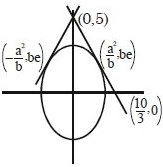
If lines $3x + 2y = 10$ and $-3x + 2y = 10$ are tangents at the extremities of the latus rectum of an ellipse whose centre is the origin,then the length of the latus rectum of the ellipse is:
A
$\frac{16}{3}$
B
$3\sqrt{5}$
C
$4\sqrt{5}$
D
$\frac{100}{27}$
Solution
(D) Let the equation of the ellipse be $\frac{x^2}{a^2} + \frac{y^2}{b^2} = 1$. The extremities of the latus rectum are $(\pm ae, be)$ or $(\pm ae, -be)$. Given the tangents at these points,we consider the tangent at $(ae, be)$,which is $\frac{x(ae)}{a^2} + \frac{y(be)}{b^2} = 1$,simplifying to $\frac{ex}{a} + \frac{ey}{b} = 1$.
Comparing this with the given line $3x + 2y = 10$,we rewrite the line as $\frac{3}{10}x + \frac{2}{10}y = 1$,or $\frac{3}{10}x + \frac{1}{5}y = 1$.
Equating coefficients: $\frac{e}{a} = \frac{3}{10}$ and $\frac{e}{b} = \frac{1}{5}$.
From the second equation,$b = 5e$.
Using $b^2 = a^2(1 - e^2)$,we have $25e^2 = a^2(1 - e^2)$.
From $\frac{e}{a} = \frac{3}{10}$,we get $a = \frac{10e}{3}$.
Substituting $a^2 = \frac{100e^2}{9}$ into the equation: $25e^2 = \frac{100e^2}{9}(1 - e^2)$.
Dividing by $25e^2$ (since $e \neq 0$): $1 = \frac{4}{9}(1 - e^2) \Rightarrow 9 = 4 - 4e^2 \Rightarrow 4e^2 = -5$,which suggests the ellipse is vertical.
Let the ellipse be $\frac{x^2}{a^2} + \frac{y^2}{b^2} = 1$ with $b > a$. The tangent at $(ae, be)$ is $\frac{x(ae)}{a^2} + \frac{y(be)}{b^2} = 1$.
Given the lines $2y = -3x + 10$ and $2y = 3x + 10$,they intersect at $(0, 5)$.
Thus,$be = 5$. The slope of the tangent is $\pm \frac{3}{2}$.
The tangent equation is $y = mx \pm \sqrt{a^2m^2 + b^2}$.
For $y = -\frac{3}{2}x + 5$,$m = -\frac{3}{2}$ and $c = 5$.
$5^2 = a^2(-\frac{3}{2})^2 + b^2 \Rightarrow 25 = \frac{9}{4}a^2 + b^2$.
Also,the point of tangency $(x_1, y_1)$ satisfies $\frac{x_1^2}{a^2} + \frac{y_1^2}{b^2} = 1$ and $y_1 = be$.
Using the condition for the latus rectum,the length of the latus rectum is $\frac{2a^2}{b} = \frac{100}{27}$.
Comparing this with the given line $3x + 2y = 10$,we rewrite the line as $\frac{3}{10}x + \frac{2}{10}y = 1$,or $\frac{3}{10}x + \frac{1}{5}y = 1$.
Equating coefficients: $\frac{e}{a} = \frac{3}{10}$ and $\frac{e}{b} = \frac{1}{5}$.
From the second equation,$b = 5e$.
Using $b^2 = a^2(1 - e^2)$,we have $25e^2 = a^2(1 - e^2)$.
From $\frac{e}{a} = \frac{3}{10}$,we get $a = \frac{10e}{3}$.
Substituting $a^2 = \frac{100e^2}{9}$ into the equation: $25e^2 = \frac{100e^2}{9}(1 - e^2)$.
Dividing by $25e^2$ (since $e \neq 0$): $1 = \frac{4}{9}(1 - e^2) \Rightarrow 9 = 4 - 4e^2 \Rightarrow 4e^2 = -5$,which suggests the ellipse is vertical.
Let the ellipse be $\frac{x^2}{a^2} + \frac{y^2}{b^2} = 1$ with $b > a$. The tangent at $(ae, be)$ is $\frac{x(ae)}{a^2} + \frac{y(be)}{b^2} = 1$.
Given the lines $2y = -3x + 10$ and $2y = 3x + 10$,they intersect at $(0, 5)$.
Thus,$be = 5$. The slope of the tangent is $\pm \frac{3}{2}$.
The tangent equation is $y = mx \pm \sqrt{a^2m^2 + b^2}$.
For $y = -\frac{3}{2}x + 5$,$m = -\frac{3}{2}$ and $c = 5$.
$5^2 = a^2(-\frac{3}{2})^2 + b^2 \Rightarrow 25 = \frac{9}{4}a^2 + b^2$.
Also,the point of tangency $(x_1, y_1)$ satisfies $\frac{x_1^2}{a^2} + \frac{y_1^2}{b^2} = 1$ and $y_1 = be$.
Using the condition for the latus rectum,the length of the latus rectum is $\frac{2a^2}{b} = \frac{100}{27}$.
0 likes
View Solution265
AdvancedMCQ
Let $S = 0$ be an ellipse whose vertices are the extremities of the minor axis of the ellipse $E: \frac{x^2}{a^2} + \frac{y^2}{b^2} = 1$ where $a > b$. If $S = 0$ passes through the foci of $E$,then its eccentricity is (considering the eccentricity of $E$ as $e$).
A
$\sqrt{\frac{1 - 2e^2}{1 - e^2}}$
B
$\frac{1}{\sqrt{1 + e^2}}$
C
$\frac{1 - 2e^2}{1 - e^2}$
D
$\frac{e^2}{1 + e^2}$
Solution
(A) The ellipse $E$ is $\frac{x^2}{a^2} + \frac{y^2}{b^2} = 1$ with $a > b$. The foci are $(\pm ae, 0)$ and the extremities of the minor axis are $(0, \pm b)$.
For the ellipse $S = 0$,the vertices are $(0, \pm b)$,so its minor axis lies on the $x$-axis and its major axis lies on the $y$-axis.
The equation of $S = 0$ is $\frac{x^2}{b_1^2} + \frac{y^2}{b^2} = 1$ where $b_1$ is the semi-minor axis of $S$.
Since $S = 0$ passes through the foci $(\pm ae, 0)$,we have $\frac{(ae)^2}{b_1^2} + \frac{0^2}{b^2} = 1$,which gives $b_1^2 = a^2e^2$.
For an ellipse with major axis $b$ and semi-minor axis $b_1$,the eccentricity $e_1$ satisfies $b_1^2 = b^2(1 - e_1^2)$.
Substituting $b_1^2 = a^2e^2$ and $b^2 = a^2(1 - e^2)$,we get $a^2e^2 = a^2(1 - e^2)(1 - e_1^2)$.
$e^2 = (1 - e^2)(1 - e_1^2) \Rightarrow 1 - e_1^2 = \frac{e^2}{1 - e^2}$.
$e_1^2 = 1 - \frac{e^2}{1 - e^2} = \frac{1 - 2e^2}{1 - e^2}$.
Thus,$e_1 = \sqrt{\frac{1 - 2e^2}{1 - e^2}}$.
For the ellipse $S = 0$,the vertices are $(0, \pm b)$,so its minor axis lies on the $x$-axis and its major axis lies on the $y$-axis.
The equation of $S = 0$ is $\frac{x^2}{b_1^2} + \frac{y^2}{b^2} = 1$ where $b_1$ is the semi-minor axis of $S$.
Since $S = 0$ passes through the foci $(\pm ae, 0)$,we have $\frac{(ae)^2}{b_1^2} + \frac{0^2}{b^2} = 1$,which gives $b_1^2 = a^2e^2$.
For an ellipse with major axis $b$ and semi-minor axis $b_1$,the eccentricity $e_1$ satisfies $b_1^2 = b^2(1 - e_1^2)$.
Substituting $b_1^2 = a^2e^2$ and $b^2 = a^2(1 - e^2)$,we get $a^2e^2 = a^2(1 - e^2)(1 - e_1^2)$.
$e^2 = (1 - e^2)(1 - e_1^2) \Rightarrow 1 - e_1^2 = \frac{e^2}{1 - e^2}$.
$e_1^2 = 1 - \frac{e^2}{1 - e^2} = \frac{1 - 2e^2}{1 - e^2}$.
Thus,$e_1 = \sqrt{\frac{1 - 2e^2}{1 - e^2}}$.
0 likes
View Solution266
AdvancedMCQ
Let $L$ be the distance between two parallel normals of the ellipse $\frac{x^2}{a^2} + \frac{y^2}{b^2} = 1$ where $a > b$. Then the maximum value of $L$ is:
A
$2a$
B
$2b$
C
$a+b$
D
$2(a-b)$
Solution
(D) The equation of a normal to the ellipse $\frac{x^2}{a^2} + \frac{y^2}{b^2} = 1$ is given by $ax \sec \theta - by \csc \theta = a^2 - b^2$.
Two parallel normals correspond to parameters $\theta$ and $\theta + \pi$,which are $ax \sec \theta - by \csc \theta = a^2 - b^2$ and $ax \sec \theta - by \csc \theta = -(a^2 - b^2)$.
The distance $L$ between these parallel lines is given by $L = \frac{|(a^2 - b^2) - (-(a^2 - b^2))|}{\sqrt{a^2 \sec^2 \theta + b^2 \csc^2 \theta}} = \frac{2(a^2 - b^2)}{\sqrt{a^2 \sec^2 \theta + b^2 \csc^2 \theta}}$.
Using the inequality $a^2 \sec^2 \theta + b^2 \csc^2 \theta \ge (a+b)^2$,we get $L \le \frac{2(a^2 - b^2)}{(a+b)} = 2(a-b)$.
Thus,the maximum value of $L$ is $2(a-b)$.
Two parallel normals correspond to parameters $\theta$ and $\theta + \pi$,which are $ax \sec \theta - by \csc \theta = a^2 - b^2$ and $ax \sec \theta - by \csc \theta = -(a^2 - b^2)$.
The distance $L$ between these parallel lines is given by $L = \frac{|(a^2 - b^2) - (-(a^2 - b^2))|}{\sqrt{a^2 \sec^2 \theta + b^2 \csc^2 \theta}} = \frac{2(a^2 - b^2)}{\sqrt{a^2 \sec^2 \theta + b^2 \csc^2 \theta}}$.
Using the inequality $a^2 \sec^2 \theta + b^2 \csc^2 \theta \ge (a+b)^2$,we get $L \le \frac{2(a^2 - b^2)}{(a+b)} = 2(a-b)$.
Thus,the maximum value of $L$ is $2(a-b)$.
0 likes
View Solution267
AdvancedMCQ
Statement $-1$: If two tangents are drawn to an ellipse from a single point and if they are perpendicular to each other,then the locus of that point is always a circle.
Statement $-2$: For an ellipse $\frac{x^2}{a^2} + \frac{y^2}{b^2} = 1$,the locus of the point from which two perpendicular tangents are drawn is $x^2 + y^2 = a^2 + b^2$.
Statement $-2$: For an ellipse $\frac{x^2}{a^2} + \frac{y^2}{b^2} = 1$,the locus of the point from which two perpendicular tangents are drawn is $x^2 + y^2 = a^2 + b^2$.
A
Statement $-1$ is true,statement $-2$ is true,but statement $-1$ is not the correct explanation for statement $-2$.
B
Statement $-1$ is true,statement $-2$ is false.
C
Statement $-1$ is false,statement $-2$ is true.
D
Both statements are true,and statement $-1$ is the correct explanation of statement $-2$.
0 likes
View Solution268
AdvancedMCQ
$A$ tangent is drawn to the ellipse $\frac{x^2}{27} + y^2 = 1$ at the point $(3\sqrt{3} \cos \theta, \sin \theta)$ (where $\theta \in (0, \frac{\pi}{2})$). Then,the value of $\theta$ such that the sum of the intercepts on the axes made by this tangent is minimum,is
A
$\frac{\pi}{3}$
B
$\frac{\pi}{6}$
C
$\frac{\pi}{8}$
D
$\frac{\pi}{4}$
Solution
(B) Given the ellipse $\frac{x^2}{27} + y^2 = 1$,we have $a^2 = 27$ and $b^2 = 1$,so $a = 3\sqrt{3}$ and $b = 1$.
The equation of the tangent at $(a \cos \theta, b \sin \theta)$ is $\frac{x}{a} \cos \theta + \frac{y}{b} \sin \theta = 1$.
Substituting the values,the equation of the tangent is $\frac{x}{3\sqrt{3}} \cos \theta + y \sin \theta = 1$.
The $x$-intercept is $3\sqrt{3} \sec \theta$ and the $y$-intercept is $\csc \theta$.
Let $S$ be the sum of the intercepts: $S = 3\sqrt{3} \sec \theta + \csc \theta$.
To find the minimum,differentiate $S$ with respect to $\theta$: $\frac{dS}{d\theta} = 3\sqrt{3} \sec \theta \tan \theta - \csc \theta \cot \theta$.
Setting $\frac{dS}{d\theta} = 0$,we get $3\sqrt{3} \frac{\sin \theta}{\cos^2 \theta} = \frac{\cos \theta}{\sin^2 \theta}$.
This simplifies to $\tan^3 \theta = \frac{1}{3\sqrt{3}} = (\frac{1}{\sqrt{3}})^3$.
Thus,$\tan \theta = \frac{1}{\sqrt{3}}$,which implies $\theta = \frac{\pi}{6}$.
Since the second derivative is positive at $\theta = \frac{\pi}{6}$,the sum of intercepts is minimum at $\theta = \frac{\pi}{6}$.
The equation of the tangent at $(a \cos \theta, b \sin \theta)$ is $\frac{x}{a} \cos \theta + \frac{y}{b} \sin \theta = 1$.
Substituting the values,the equation of the tangent is $\frac{x}{3\sqrt{3}} \cos \theta + y \sin \theta = 1$.
The $x$-intercept is $3\sqrt{3} \sec \theta$ and the $y$-intercept is $\csc \theta$.
Let $S$ be the sum of the intercepts: $S = 3\sqrt{3} \sec \theta + \csc \theta$.
To find the minimum,differentiate $S$ with respect to $\theta$: $\frac{dS}{d\theta} = 3\sqrt{3} \sec \theta \tan \theta - \csc \theta \cot \theta$.
Setting $\frac{dS}{d\theta} = 0$,we get $3\sqrt{3} \frac{\sin \theta}{\cos^2 \theta} = \frac{\cos \theta}{\sin^2 \theta}$.
This simplifies to $\tan^3 \theta = \frac{1}{3\sqrt{3}} = (\frac{1}{\sqrt{3}})^3$.
Thus,$\tan \theta = \frac{1}{\sqrt{3}}$,which implies $\theta = \frac{\pi}{6}$.
Since the second derivative is positive at $\theta = \frac{\pi}{6}$,the sum of intercepts is minimum at $\theta = \frac{\pi}{6}$.
0 likes
View Solution269
AdvancedMCQ
If $\alpha$ and $\beta$ are the eccentric angles of the extremities of a focal chord of an ellipse,then the eccentricity of the ellipse is
A
$\frac{\cos \alpha + \cos \beta}{\cos (\alpha - \beta)}$
B
$\frac{\sin \alpha - \sin \beta}{\sin (\alpha - \beta)}$
C
$\frac{\cos \alpha - \cos \beta}{\cos (\alpha - \beta)}$
D
$\frac{\sin \alpha + \sin \beta}{\sin (\alpha + \beta)}$
Solution
(D) The equation of a chord joining points having eccentric angles $\alpha$ and $\beta$ on the ellipse $\frac{x^2}{a^2} + \frac{y^2}{b^2} = 1$ is given by $\frac{x}{a} \cos \left(\frac{\alpha+\beta}{2}\right) + \frac{y}{b} \sin \left(\frac{\alpha+\beta}{2}\right) = \cos \left(\frac{\alpha-\beta}{2}\right)$.
Since this is a focal chord,it passes through the focus $(ae, 0)$.
Substituting $(ae, 0)$ into the equation,we get $e \cos \left(\frac{\alpha+\beta}{2}\right) = \cos \left(\frac{\alpha-\beta}{2}\right)$.
Thus,$e = \frac{\cos ((\alpha-\beta)/2)}{\cos ((\alpha+\beta)/2)}$.
Using the product-to-sum identities or simplifying,we note that for a focal chord,$\tan(\alpha/2) \tan(\beta/2) = \frac{e-1}{e+1}$.
Alternatively,using the identity $\frac{\sin \alpha + \sin \beta}{\sin (\alpha + \beta)} = \frac{2 \sin ((\alpha+\beta)/2) \cos ((\alpha-\beta)/2)}{2 \sin ((\alpha+\beta)/2) \cos ((\alpha+\beta)/2)} = \frac{\cos ((\alpha-\beta)/2)}{\cos ((\alpha+\beta)/2)} = e$.
Since this is a focal chord,it passes through the focus $(ae, 0)$.
Substituting $(ae, 0)$ into the equation,we get $e \cos \left(\frac{\alpha+\beta}{2}\right) = \cos \left(\frac{\alpha-\beta}{2}\right)$.
Thus,$e = \frac{\cos ((\alpha-\beta)/2)}{\cos ((\alpha+\beta)/2)}$.
Using the product-to-sum identities or simplifying,we note that for a focal chord,$\tan(\alpha/2) \tan(\beta/2) = \frac{e-1}{e+1}$.
Alternatively,using the identity $\frac{\sin \alpha + \sin \beta}{\sin (\alpha + \beta)} = \frac{2 \sin ((\alpha+\beta)/2) \cos ((\alpha-\beta)/2)}{2 \sin ((\alpha+\beta)/2) \cos ((\alpha+\beta)/2)} = \frac{\cos ((\alpha-\beta)/2)}{\cos ((\alpha+\beta)/2)} = e$.
0 likes
View Solution270
AdvancedMCQ
The number of real tangents that can be drawn to the ellipse $3x^2 + 5y^2 = 32$ passing through $(3, 5)$ is
A
$0$
B
$1$
C
$2$
D
infinite
Solution
(C) The equation of the ellipse is $3x^2 + 5y^2 = 32$,which can be written as $\frac{x^2}{32/3} + \frac{y^2}{32/5} = 1$.
To determine the position of the point $(3, 5)$ with respect to the ellipse,we evaluate the expression $S = 3x^2 + 5y^2 - 32$ at $(3, 5)$.
$S = 3(3)^2 + 5(5)^2 - 32 = 3(9) + 5(25) - 32 = 27 + 125 - 32 = 120$.
Since $S > 0$,the point $(3, 5)$ lies outside the ellipse.
For any point lying outside an ellipse,exactly two real tangents can be drawn to the ellipse.
To determine the position of the point $(3, 5)$ with respect to the ellipse,we evaluate the expression $S = 3x^2 + 5y^2 - 32$ at $(3, 5)$.
$S = 3(3)^2 + 5(5)^2 - 32 = 3(9) + 5(25) - 32 = 27 + 125 - 32 = 120$.
Since $S > 0$,the point $(3, 5)$ lies outside the ellipse.
For any point lying outside an ellipse,exactly two real tangents can be drawn to the ellipse.
0 likes
View Solution271
AdvancedMCQ
If $F_1$ and $F_2$ are the feet of the perpendiculars from the foci $S_1$ and $S_2$ of an ellipse $\frac{x^2}{5} + \frac{y^2}{3} = 1$ on the tangent at any point $P$ on the ellipse,then $(S_1 F_1) (S_2 F_2)$ is equal to
A
$2$
B
$3$
C
$4$
D
$5$
Solution
(B) For an ellipse $\frac{x^2}{a^2} + \frac{y^2}{b^2} = 1$,the product of the lengths of the perpendiculars from the foci $S_1$ and $S_2$ to any tangent is equal to the square of the semi-minor axis,$b^2$.
Given the equation of the ellipse $\frac{x^2}{5} + \frac{y^2}{3} = 1$,we have $a^2 = 5$ and $b^2 = 3$.
Therefore,$(S_1 F_1) (S_2 F_2) = b^2 = 3$.
Given the equation of the ellipse $\frac{x^2}{5} + \frac{y^2}{3} = 1$,we have $a^2 = 5$ and $b^2 = 3$.
Therefore,$(S_1 F_1) (S_2 F_2) = b^2 = 3$.
0 likes
View Solution272
AdvancedMCQ
$A$ chord $PQ$ of the ellipse $\frac{x^2}{9} + \frac{y^2}{4} = 1$ subtends a right angle at its centre. The locus of the point of intersection of tangents drawn at $P$ and $Q$ is-
A
a circle
B
a parabola
C
an ellipse
D
a hyperbola
Solution
(C) Let the point of intersection be $R(x_1, y_1)$. The equation of the chord of contact $PQ$ is $\frac{xx_1}{9} + \frac{yy_1}{4} = 1$.
To find the combined equation of lines $OP$ and $OQ$,we homogenize the ellipse equation $\frac{x^2}{9} + \frac{y^2}{4} = 1$ using the chord of contact:
$\frac{x^2}{9} + \frac{y^2}{4} = (\frac{xx_1}{9} + \frac{yy_1}{4})^2$.
Since $OP \perp OQ$,the sum of the coefficients of $x^2$ and $y^2$ must be zero:
$(\frac{1}{9} - \frac{x_1^2}{81}) + (\frac{1}{4} - \frac{y_1^2}{16}) = 0$.
Rearranging the terms,we get $\frac{x_1^2}{81} + \frac{y_1^2}{16} = \frac{1}{9} + \frac{1}{4} = \frac{13}{36}$.
Thus,the locus of $(x_1, y_1)$ is $\frac{x^2}{81} + \frac{y^2}{16} = \frac{13}{36}$,which represents an ellipse.
To find the combined equation of lines $OP$ and $OQ$,we homogenize the ellipse equation $\frac{x^2}{9} + \frac{y^2}{4} = 1$ using the chord of contact:
$\frac{x^2}{9} + \frac{y^2}{4} = (\frac{xx_1}{9} + \frac{yy_1}{4})^2$.
Since $OP \perp OQ$,the sum of the coefficients of $x^2$ and $y^2$ must be zero:
$(\frac{1}{9} - \frac{x_1^2}{81}) + (\frac{1}{4} - \frac{y_1^2}{16}) = 0$.
Rearranging the terms,we get $\frac{x_1^2}{81} + \frac{y_1^2}{16} = \frac{1}{9} + \frac{1}{4} = \frac{13}{36}$.
Thus,the locus of $(x_1, y_1)$ is $\frac{x^2}{81} + \frac{y^2}{16} = \frac{13}{36}$,which represents an ellipse.
0 likes
View Solution273
AdvancedMCQ
Number of points on the ellipse $\frac{x^2}{50} + \frac{y^2}{20} = 1$ from which a pair of perpendicular tangents are drawn to the ellipse $\frac{x^2}{16} + \frac{y^2}{9} = 1$ is:
A
$0$
B
$2$
C
$1$
D
$4$
Solution
(D) The locus of points from which perpendicular tangents can be drawn to an ellipse $\frac{x^2}{a^2} + \frac{y^2}{b^2} = 1$ is its director circle,given by $x^2 + y^2 = a^2 + b^2$.
For the ellipse $\frac{x^2}{16} + \frac{y^2}{9} = 1$,the director circle is $x^2 + y^2 = 16 + 9 = 25$.
We need to find the number of intersection points of this director circle $x^2 + y^2 = 25$ and the given ellipse $\frac{x^2}{50} + \frac{y^2}{20} = 1$.
From the circle,$y^2 = 25 - x^2$. Substituting this into the ellipse equation:
$\frac{x^2}{50} + \frac{25 - x^2}{20} = 1$
Multiplying by $100$:
$2x^2 + 5(25 - x^2) = 100$
$2x^2 + 125 - 5x^2 = 100$
$-3x^2 = -25$
$x^2 = \frac{25}{3}$,which gives $x = \pm \frac{5}{\sqrt{3}}$.
Since $x^2 = \frac{25}{3} < 25$,$y^2 = 25 - \frac{25}{3} = \frac{50}{3} > 0$,which gives $y = \pm \sqrt{\frac{50}{3}}$.
Thus,there are $4$ distinct points of intersection.
For the ellipse $\frac{x^2}{16} + \frac{y^2}{9} = 1$,the director circle is $x^2 + y^2 = 16 + 9 = 25$.
We need to find the number of intersection points of this director circle $x^2 + y^2 = 25$ and the given ellipse $\frac{x^2}{50} + \frac{y^2}{20} = 1$.
From the circle,$y^2 = 25 - x^2$. Substituting this into the ellipse equation:
$\frac{x^2}{50} + \frac{25 - x^2}{20} = 1$
Multiplying by $100$:
$2x^2 + 5(25 - x^2) = 100$
$2x^2 + 125 - 5x^2 = 100$
$-3x^2 = -25$
$x^2 = \frac{25}{3}$,which gives $x = \pm \frac{5}{\sqrt{3}}$.
Since $x^2 = \frac{25}{3} < 25$,$y^2 = 25 - \frac{25}{3} = \frac{50}{3} > 0$,which gives $y = \pm \sqrt{\frac{50}{3}}$.
Thus,there are $4$ distinct points of intersection.
0 likes
View Solution274
AdvancedMCQ
The eccentricity of an ellipse whose length of latus rectum is equal to the distance between its foci is
A
$2 \sin 18^{\circ}$
B
$2 \cos 36^{\circ}$
C
$\sin 18^{\circ}$
D
$\cos 36^{\circ}$
Solution
(A) The length of the latus rectum of an ellipse is $\frac{2b^2}{a}$ and the distance between its foci is $2ae$.
Given that $\frac{2b^2}{a} = 2ae$,we have $b^2 = a^2e$.
Using the relation $b^2 = a^2(1 - e^2)$,we get $a^2(1 - e^2) = a^2e$.
Dividing by $a^2$,we obtain $1 - e^2 = e$,which simplifies to $e^2 + e - 1 = 0$.
Solving this quadratic equation for $e$ (where $e > 0$),we get $e = \frac{-1 + \sqrt{5}}{2} = \frac{\sqrt{5} - 1}{2}$.
Since $\sin 18^{\circ} = \frac{\sqrt{5} - 1}{4}$,it follows that $e = 2 \sin 18^{\circ}$.
Given that $\frac{2b^2}{a} = 2ae$,we have $b^2 = a^2e$.
Using the relation $b^2 = a^2(1 - e^2)$,we get $a^2(1 - e^2) = a^2e$.
Dividing by $a^2$,we obtain $1 - e^2 = e$,which simplifies to $e^2 + e - 1 = 0$.
Solving this quadratic equation for $e$ (where $e > 0$),we get $e = \frac{-1 + \sqrt{5}}{2} = \frac{\sqrt{5} - 1}{2}$.
Since $\sin 18^{\circ} = \frac{\sqrt{5} - 1}{4}$,it follows that $e = 2 \sin 18^{\circ}$.
0 likes
View Solution275
AdvancedMCQ
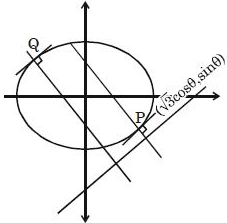
Let $P$ be a variable point on the ellipse $x^2 + 3y^2 = 3$. Then the maximum perpendicular distance of $P$ from the line $x - y = 10$ is (in $\sqrt{2}$)
A
$3$
B
$4$
C
$6$
D
$5$
Solution
(C) The equation of the ellipse is $\frac{x^2}{3} + \frac{y^2}{1} = 1$.
Let the point $P$ be $(\sqrt{3} \cos \theta, \sin \theta)$.
The perpendicular distance of $P$ from the line $x - y - 10 = 0$ is given by $d = \frac{|\sqrt{3} \cos \theta - \sin \theta - 10|}{\sqrt{1^2 + (-1)^2}} = \frac{|\sqrt{3} \cos \theta - \sin \theta - 10|}{\sqrt{2}}$.
To maximize $d$, we need to maximize the expression $f(\theta) = \sqrt{3} \cos \theta - \sin \theta$.
We can write $f(\theta) = 2(\frac{\sqrt{3}}{2} \cos \theta - \frac{1}{2} \sin \theta) = 2 \cos(\theta + 30^{\circ})$.
The maximum value of $f(\theta)$ is $2$ and the minimum value is $-2$.
For maximum distance, we consider the minimum value of $f(\theta)$, which is $-2$.
Thus, $d_{max} = \frac{|-2 - 10|}{\sqrt{2}} = \frac{|-12|}{\sqrt{2}} = \frac{12}{\sqrt{2}} = 6\sqrt{2}$.
Let the point $P$ be $(\sqrt{3} \cos \theta, \sin \theta)$.
The perpendicular distance of $P$ from the line $x - y - 10 = 0$ is given by $d = \frac{|\sqrt{3} \cos \theta - \sin \theta - 10|}{\sqrt{1^2 + (-1)^2}} = \frac{|\sqrt{3} \cos \theta - \sin \theta - 10|}{\sqrt{2}}$.
To maximize $d$, we need to maximize the expression $f(\theta) = \sqrt{3} \cos \theta - \sin \theta$.
We can write $f(\theta) = 2(\frac{\sqrt{3}}{2} \cos \theta - \frac{1}{2} \sin \theta) = 2 \cos(\theta + 30^{\circ})$.
The maximum value of $f(\theta)$ is $2$ and the minimum value is $-2$.
For maximum distance, we consider the minimum value of $f(\theta)$, which is $-2$.
Thus, $d_{max} = \frac{|-2 - 10|}{\sqrt{2}} = \frac{|-12|}{\sqrt{2}} = \frac{12}{\sqrt{2}} = 6\sqrt{2}$.
0 likes
View Solution276
AdvancedMCQ
The minimum distance between two points $P$ and $Q$ on the ellipse $\frac{x^2}{25} + \frac{y^2}{4} = 1$,if the difference between the eccentric angles of $P$ and $Q$ is $\frac{3\pi}{2}$,is
A
$2\sqrt{2}$
B
$2\sqrt{5}$
C
$\sqrt{29}$
D
$\sqrt{62}$
Solution
(A) Let the eccentric angles of $P$ and $Q$ be $\theta_1$ and $\theta_2$ respectively. Given $\theta_1 - \theta_2 = \frac{3\pi}{2}$,so $\theta_1 = \theta_2 + \frac{3\pi}{2}$.
Coordinates are $P(5 \cos \theta_1, 2 \sin \theta_1)$ and $Q(5 \cos \theta_2, 2 \sin \theta_2)$.
Substituting $\theta_1 = \theta_2 + \frac{3\pi}{2}$,we get $P(5 \sin \theta_2, -2 \cos \theta_2)$.
The distance $PQ^2 = (5 \cos \theta_2 - 5 \sin \theta_2)^2 + (2 \sin \theta_2 + 2 \cos \theta_2)^2$.
$PQ^2 = 25(\cos^2 \theta_2 + \sin^2 \theta_2 - 2 \sin \theta_2 \cos \theta_2) + 4(\sin^2 \theta_2 + \cos^2 \theta_2 + 2 \sin \theta_2 \cos \theta_2)$.
$PQ^2 = 25(1 - \sin 2\theta_2) + 4(1 + \sin 2\theta_2) = 29 - 21 \sin 2\theta_2$.
To minimize $PQ$,we maximize $\sin 2\theta_2 = 1$.
$PQ^2_{min} = 29 - 21 = 8$.
$PQ_{min} = \sqrt{8} = 2\sqrt{2}$.
Coordinates are $P(5 \cos \theta_1, 2 \sin \theta_1)$ and $Q(5 \cos \theta_2, 2 \sin \theta_2)$.
Substituting $\theta_1 = \theta_2 + \frac{3\pi}{2}$,we get $P(5 \sin \theta_2, -2 \cos \theta_2)$.
The distance $PQ^2 = (5 \cos \theta_2 - 5 \sin \theta_2)^2 + (2 \sin \theta_2 + 2 \cos \theta_2)^2$.
$PQ^2 = 25(\cos^2 \theta_2 + \sin^2 \theta_2 - 2 \sin \theta_2 \cos \theta_2) + 4(\sin^2 \theta_2 + \cos^2 \theta_2 + 2 \sin \theta_2 \cos \theta_2)$.
$PQ^2 = 25(1 - \sin 2\theta_2) + 4(1 + \sin 2\theta_2) = 29 - 21 \sin 2\theta_2$.
To minimize $PQ$,we maximize $\sin 2\theta_2 = 1$.
$PQ^2_{min} = 29 - 21 = 8$.
$PQ_{min} = \sqrt{8} = 2\sqrt{2}$.
0 likes
View Solution277
AdvancedMCQ
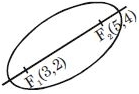
The distance between the directrices of the conic $\sqrt{(x - 5)^2 + (y - 4)^2} + \sqrt{(x - 3)^2 + (y - 2)^2} = 6$ is
A
$9\sqrt{2}$
B
$2\sqrt{2}$
C
$4$
D
$\frac{9}{\sqrt{2}}$
Solution
(A) The given equation represents an ellipse with foci $F_1(3, 2)$ and $F_2(5, 4)$ and major axis length $2a = 6$,so $a = 3$.
The distance between the foci is $2ae = \sqrt{(5-3)^2 + (4-2)^2} = \sqrt{2^2 + 2^2} = \sqrt{8} = 2\sqrt{2}$.
Thus,$ae = \sqrt{2}$,which gives the eccentricity $e = \frac{\sqrt{2}}{3}$.
The distance between the directrices of an ellipse is given by $\frac{2a}{e}$.
Substituting the values,we get $\frac{2(3)}{\frac{\sqrt{2}}{3}} = \frac{6 \times 3}{\sqrt{2}} = \frac{18}{\sqrt{2}} = 9\sqrt{2}$.
The distance between the foci is $2ae = \sqrt{(5-3)^2 + (4-2)^2} = \sqrt{2^2 + 2^2} = \sqrt{8} = 2\sqrt{2}$.
Thus,$ae = \sqrt{2}$,which gives the eccentricity $e = \frac{\sqrt{2}}{3}$.
The distance between the directrices of an ellipse is given by $\frac{2a}{e}$.
Substituting the values,we get $\frac{2(3)}{\frac{\sqrt{2}}{3}} = \frac{6 \times 3}{\sqrt{2}} = \frac{18}{\sqrt{2}} = 9\sqrt{2}$.
0 likes
View Solution278
AdvancedMCQ
The locus of the feet of the perpendiculars from either focus of the ellipse $(x - y + 1)^2 + (2x + 2y - 6)^2 = 20$ onto any tangent is:
A
$x^2 + y^2 + 2x + 4y + 5 = 0$
B
$x^2 + y^2 + 2x + 4y - 5 = 0$
C
$x^2 + y^2 - 2x - 4y - 5 = 0$
D
$x^2 + y^2 - 2x - 4y + 5 = 0$
Solution
(C) The given equation of the ellipse is $(x - y + 1)^2 + (2x + 2y - 6)^2 = 20$.
Dividing by $20$,we get $\frac{(x - y + 1)^2}{20} + \frac{(2x + 2y - 6)^2}{20} = 1$.
This can be rewritten as $\frac{(\frac{x - y + 1}{\sqrt{2}})^2}{10} + \frac{(\frac{x + y - 3}{\sqrt{2}})^2}{5} = 1$.
Here,$a^2 = 10$ and $b^2 = 5$. The center of the ellipse is $(1, 2)$.
The locus of the feet of the perpendiculars from the foci to any tangent of an ellipse is its auxiliary circle.
The auxiliary circle has the same center as the ellipse and radius equal to the semi-major axis $a$.
Here,$a^2 = 10$,so the equation of the auxiliary circle is $(x - 1)^2 + (y - 2)^2 = 10$.
Expanding this,we get $x^2 - 2x + 1 + y^2 - 4y + 4 = 10$,which simplifies to $x^2 + y^2 - 2x - 4y - 5 = 0$.
Dividing by $20$,we get $\frac{(x - y + 1)^2}{20} + \frac{(2x + 2y - 6)^2}{20} = 1$.
This can be rewritten as $\frac{(\frac{x - y + 1}{\sqrt{2}})^2}{10} + \frac{(\frac{x + y - 3}{\sqrt{2}})^2}{5} = 1$.
Here,$a^2 = 10$ and $b^2 = 5$. The center of the ellipse is $(1, 2)$.
The locus of the feet of the perpendiculars from the foci to any tangent of an ellipse is its auxiliary circle.
The auxiliary circle has the same center as the ellipse and radius equal to the semi-major axis $a$.
Here,$a^2 = 10$,so the equation of the auxiliary circle is $(x - 1)^2 + (y - 2)^2 = 10$.
Expanding this,we get $x^2 - 2x + 1 + y^2 - 4y + 4 = 10$,which simplifies to $x^2 + y^2 - 2x - 4y - 5 = 0$.
0 likes
View Solution279
AdvancedMCQ
$A$ man running round a race-course notes that the sum of the distances of two flag-posts from him is always $10 \ m$ and the distance between the flag-posts is $8 \ m$. The area of the path he encloses in square metres is (in $\pi$)
A
$15$
B
$12$
C
$18$
D
$8$
Solution
(A) The path traced by the man is an ellipse because the sum of the distances from two fixed points (foci) is constant.
Let the constant sum be $2a = 10 \ m$, so $a = 5 \ m$.
The distance between the foci is $2ae = 8 \ m$, so $ae = 4 \ m$.
Since $a = 5$, we have $5e = 4$, which gives $e = \frac{4}{5}$.
Using the relation $b^2 = a^2(1 - e^2)$, we get $b^2 = 25(1 - (\frac{4}{5})^2) = 25(1 - \frac{16}{25}) = 25(\frac{9}{25}) = 9$.
Thus, $b = 3 \ m$.
The area of the ellipse is given by $\pi ab = \pi \times 5 \times 3 = 15 \pi \ m^2$.
Let the constant sum be $2a = 10 \ m$, so $a = 5 \ m$.
The distance between the foci is $2ae = 8 \ m$, so $ae = 4 \ m$.
Since $a = 5$, we have $5e = 4$, which gives $e = \frac{4}{5}$.
Using the relation $b^2 = a^2(1 - e^2)$, we get $b^2 = 25(1 - (\frac{4}{5})^2) = 25(1 - \frac{16}{25}) = 25(\frac{9}{25}) = 9$.
Thus, $b = 3 \ m$.
The area of the ellipse is given by $\pi ab = \pi \times 5 \times 3 = 15 \pi \ m^2$.
0 likes
View Solution280
AdvancedMCQ
Find the number of points on the ellipse $\frac{x^{2}}{50} + \frac{y^{2}}{20} = 1$ from which a pair of perpendicular tangents can be drawn to the ellipse $\frac{x^{2}}{16} + \frac{y^{2}}{9} = 1$.
A
$0$
B
$2$
C
$1$
D
$4$
Solution
(D) The locus of points from which perpendicular tangents can be drawn to an ellipse $\frac{x^{2}}{a^{2}} + \frac{y^{2}}{b^{2}} = 1$ is its director circle,given by $x^{2} + y^{2} = a^{2} + b^{2}$.
For the ellipse $\frac{x^{2}}{16} + \frac{y^{2}}{9} = 1$,we have $a^{2} = 16$ and $b^{2} = 9$.
Thus,the equation of the director circle is $x^{2} + y^{2} = 16 + 9 = 25$.
We need to find the number of intersection points of this director circle $x^{2} + y^{2} = 25$ and the given ellipse $\frac{x^{2}}{50} + \frac{y^{2}}{20} = 1$.
From the circle,$y^{2} = 25 - x^{2}$. Substituting this into the ellipse equation:
$\frac{x^{2}}{50} + \frac{25 - x^{2}}{20} = 1$
Multiplying by $100$:
$2x^{2} + 5(25 - x^{2}) = 100$
$2x^{2} + 125 - 5x^{2} = 100$
$-3x^{2} = -25$
$x^{2} = \frac{25}{3}$,which gives $x = \pm \frac{5}{\sqrt{3}}$.
Since $x^{2} = \frac{25}{3} < 25$,$y^{2} = 25 - \frac{25}{3} = \frac{50}{3} > 0$,which gives $y = \pm \sqrt{\frac{50}{3}}$.
Since there are two values for $x$ and for each $x$ there are two values for $y$,there are $4$ points of intersection.
For the ellipse $\frac{x^{2}}{16} + \frac{y^{2}}{9} = 1$,we have $a^{2} = 16$ and $b^{2} = 9$.
Thus,the equation of the director circle is $x^{2} + y^{2} = 16 + 9 = 25$.
We need to find the number of intersection points of this director circle $x^{2} + y^{2} = 25$ and the given ellipse $\frac{x^{2}}{50} + \frac{y^{2}}{20} = 1$.
From the circle,$y^{2} = 25 - x^{2}$. Substituting this into the ellipse equation:
$\frac{x^{2}}{50} + \frac{25 - x^{2}}{20} = 1$
Multiplying by $100$:
$2x^{2} + 5(25 - x^{2}) = 100$
$2x^{2} + 125 - 5x^{2} = 100$
$-3x^{2} = -25$
$x^{2} = \frac{25}{3}$,which gives $x = \pm \frac{5}{\sqrt{3}}$.
Since $x^{2} = \frac{25}{3} < 25$,$y^{2} = 25 - \frac{25}{3} = \frac{50}{3} > 0$,which gives $y = \pm \sqrt{\frac{50}{3}}$.
Since there are two values for $x$ and for each $x$ there are two values for $y$,there are $4$ points of intersection.
0 likes
View Solution281
AdvancedMCQ
The maximum length of a chord of the ellipse $\frac{x^2}{8} + \frac{y^2}{4} = 1$,such that the eccentric angles of its extremities differ by $\frac{\pi}{2}$,is:
A
$4$
B
$2\sqrt{2}$
C
$16$
D
$8$
Solution
(A) For the ellipse $\frac{x^2}{8} + \frac{y^2}{4} = 1$,we have $a^2 = 8$ and $b^2 = 4$,so $a = 2\sqrt{2}$ and $b = 2$.
Let the eccentric angles of the extremities of the chord be $\theta$ and $\theta + \frac{\pi}{2}$.
The coordinates of the points are $P = (2\sqrt{2} \cos \theta, 2 \sin \theta)$ and $Q = (2\sqrt{2} \cos(\theta + \frac{\pi}{2}), 2 \sin(\theta + \frac{\pi}{2})) = (-2\sqrt{2} \sin \theta, 2 \cos \theta)$.
The square of the length of the chord $PQ$ is given by $L^2 = (2\sqrt{2} \cos \theta + 2\sqrt{2} \sin \theta)^2 + (2 \sin \theta - 2 \cos \theta)^2$.
$L^2 = 8(\cos \theta + \sin \theta)^2 + 4(\sin \theta - \cos \theta)^2$.
$L^2 = 8(1 + \sin 2\theta) + 4(1 - \sin 2\theta) = 12 + 4 \sin 2\theta$.
To maximize $L$,we set $\sin 2\theta = 1$,which gives $L^2 = 12 + 4 = 16$.
Thus,the maximum length $L = \sqrt{16} = 4$.
Let the eccentric angles of the extremities of the chord be $\theta$ and $\theta + \frac{\pi}{2}$.
The coordinates of the points are $P = (2\sqrt{2} \cos \theta, 2 \sin \theta)$ and $Q = (2\sqrt{2} \cos(\theta + \frac{\pi}{2}), 2 \sin(\theta + \frac{\pi}{2})) = (-2\sqrt{2} \sin \theta, 2 \cos \theta)$.
The square of the length of the chord $PQ$ is given by $L^2 = (2\sqrt{2} \cos \theta + 2\sqrt{2} \sin \theta)^2 + (2 \sin \theta - 2 \cos \theta)^2$.
$L^2 = 8(\cos \theta + \sin \theta)^2 + 4(\sin \theta - \cos \theta)^2$.
$L^2 = 8(1 + \sin 2\theta) + 4(1 - \sin 2\theta) = 12 + 4 \sin 2\theta$.
To maximize $L$,we set $\sin 2\theta = 1$,which gives $L^2 = 12 + 4 = 16$.
Thus,the maximum length $L = \sqrt{16} = 4$.
0 likes
View Solution282
DifficultMCQ
If $\beta$ is one of the angles between the normals to the ellipse $x^2 + 3y^2 = 9$ at the points $(3\cos \theta, \sqrt{3} \sin \theta)$ and $(-3\sin \theta, \sqrt{3} \cos \theta)$,where $\theta \in (0, \pi/2)$,then $\frac{2 \cot \beta}{\sin 2\theta}$ is equal to
A
$\sqrt{2}$
B
$\frac{2}{\sqrt{3}}$
C
$\frac{1}{\sqrt{3}}$
D
$\frac{\sqrt{3}}{4}$
Solution
(B) The equation of the ellipse is $x^2 + 3y^2 = 9$.
Differentiating with respect to $x$,we get $2x + 6y \frac{dy}{dx} = 0$,which implies $\frac{dy}{dx} = -\frac{x}{3y}$.
The slope of the normal at any point $(x, y)$ is $m = -\frac{dx}{dy} = \frac{3y}{x}$.
For the point $P_1 = (3\cos \theta, \sqrt{3} \sin \theta)$,the slope of the normal $m_1 = \frac{3(\sqrt{3} \sin \theta)}{3 \cos \theta} = \sqrt{3} \tan \theta$.
For the point $P_2 = (-3\sin \theta, \sqrt{3} \cos \theta)$,the slope of the normal $m_2 = \frac{3(\sqrt{3} \cos \theta)}{-3 \sin \theta} = -\sqrt{3} \cot \theta$.
The angle $\beta$ between the normals is given by $\tan \beta = \left| \frac{m_1 - m_2}{1 + m_1 m_2} \right|$.
Substituting the values,$\tan \beta = \left| \frac{\sqrt{3} \tan \theta - (-\sqrt{3} \cot \theta)}{1 + (\sqrt{3} \tan \theta)(-\sqrt{3} \cot \theta)} \right| = \left| \frac{\sqrt{3}(\tan \theta + \cot \theta)}{1 - 3} \right| = \left| \frac{\sqrt{3}(\tan \theta + \cot \theta)}{-2} \right| = \frac{\sqrt{3}}{2} (\tan \theta + \cot \theta)$.
Since $\tan \theta + \cot \theta = \frac{\sin \theta}{\cos \theta} + \frac{\cos \theta}{\sin \theta} = \frac{\sin^2 \theta + \cos^2 \theta}{\sin \theta \cos \theta} = \frac{1}{\frac{1}{2} \sin 2\theta} = \frac{2}{\sin 2\theta}$.
Thus,$\tan \beta = \frac{\sqrt{3}}{2} \cdot \frac{2}{\sin 2\theta} = \frac{\sqrt{3}}{\sin 2\theta}$.
Therefore,$\frac{1}{\cot \beta} = \frac{\sqrt{3}}{\sin 2\theta}$,which implies $\frac{\cot \beta}{\sin 2\theta} = \frac{1}{\sqrt{3}}$.
Hence,$\frac{2 \cot \beta}{\sin 2\theta} = \frac{2}{\sqrt{3}}$.
Differentiating with respect to $x$,we get $2x + 6y \frac{dy}{dx} = 0$,which implies $\frac{dy}{dx} = -\frac{x}{3y}$.
The slope of the normal at any point $(x, y)$ is $m = -\frac{dx}{dy} = \frac{3y}{x}$.
For the point $P_1 = (3\cos \theta, \sqrt{3} \sin \theta)$,the slope of the normal $m_1 = \frac{3(\sqrt{3} \sin \theta)}{3 \cos \theta} = \sqrt{3} \tan \theta$.
For the point $P_2 = (-3\sin \theta, \sqrt{3} \cos \theta)$,the slope of the normal $m_2 = \frac{3(\sqrt{3} \cos \theta)}{-3 \sin \theta} = -\sqrt{3} \cot \theta$.
The angle $\beta$ between the normals is given by $\tan \beta = \left| \frac{m_1 - m_2}{1 + m_1 m_2} \right|$.
Substituting the values,$\tan \beta = \left| \frac{\sqrt{3} \tan \theta - (-\sqrt{3} \cot \theta)}{1 + (\sqrt{3} \tan \theta)(-\sqrt{3} \cot \theta)} \right| = \left| \frac{\sqrt{3}(\tan \theta + \cot \theta)}{1 - 3} \right| = \left| \frac{\sqrt{3}(\tan \theta + \cot \theta)}{-2} \right| = \frac{\sqrt{3}}{2} (\tan \theta + \cot \theta)$.
Since $\tan \theta + \cot \theta = \frac{\sin \theta}{\cos \theta} + \frac{\cos \theta}{\sin \theta} = \frac{\sin^2 \theta + \cos^2 \theta}{\sin \theta \cos \theta} = \frac{1}{\frac{1}{2} \sin 2\theta} = \frac{2}{\sin 2\theta}$.
Thus,$\tan \beta = \frac{\sqrt{3}}{2} \cdot \frac{2}{\sin 2\theta} = \frac{\sqrt{3}}{\sin 2\theta}$.
Therefore,$\frac{1}{\cot \beta} = \frac{\sqrt{3}}{\sin 2\theta}$,which implies $\frac{\cot \beta}{\sin 2\theta} = \frac{1}{\sqrt{3}}$.
Hence,$\frac{2 \cot \beta}{\sin 2\theta} = \frac{2}{\sqrt{3}}$.
0 likes
View Solution283
DifficultMCQ
If the length of the latus rectum of an ellipse is $4 \ units$ and the distance between a focus and its nearest vertex on the major axis is $\frac{3}{2} \ units$,then its eccentricity is?
A
$\frac{1}{2}$
B
$\frac{2}{3}$
C
$\frac{1}{9}$
D
$\frac{1}{3}$
Solution
(D) Let the ellipse be $\frac{x^2}{a^2} + \frac{y^2}{b^2} = 1$ where $a > b$.
The distance between a focus $(ae, 0)$ and its nearest vertex $(a, 0)$ is $a(1 - e) = \frac{3}{2}$.
Thus,$a - ae = \frac{3}{2}$,which implies $ae = a - \frac{3}{2}$.
The length of the latus rectum is $\frac{2b^2}{a} = 4$,so $b^2 = 2a$.
Using the relation $b^2 = a^2(1 - e^2)$,we have $2a = a^2(1 - e^2)$,which simplifies to $1 - e^2 = \frac{2}{a}$,or $e^2 = 1 - \frac{2}{a}$.
From $ae = a - \frac{3}{2}$,squaring both sides gives $a^2e^2 = (a - \frac{3}{2})^2$.
Substituting $e^2 = 1 - \frac{2}{a}$,we get $a^2(1 - \frac{2}{a}) = a^2 - 3a + \frac{9}{4}$.
$a^2 - 2a = a^2 - 3a + \frac{9}{4}$.
$a = \frac{9}{4}$.
Now,$e^2 = 1 - \frac{2}{a} = 1 - \frac{2}{9/4} = 1 - \frac{8}{9} = \frac{1}{9}$.
Therefore,$e = \frac{1}{3}$.
The distance between a focus $(ae, 0)$ and its nearest vertex $(a, 0)$ is $a(1 - e) = \frac{3}{2}$.
Thus,$a - ae = \frac{3}{2}$,which implies $ae = a - \frac{3}{2}$.
The length of the latus rectum is $\frac{2b^2}{a} = 4$,so $b^2 = 2a$.
Using the relation $b^2 = a^2(1 - e^2)$,we have $2a = a^2(1 - e^2)$,which simplifies to $1 - e^2 = \frac{2}{a}$,or $e^2 = 1 - \frac{2}{a}$.
From $ae = a - \frac{3}{2}$,squaring both sides gives $a^2e^2 = (a - \frac{3}{2})^2$.
Substituting $e^2 = 1 - \frac{2}{a}$,we get $a^2(1 - \frac{2}{a}) = a^2 - 3a + \frac{9}{4}$.
$a^2 - 2a = a^2 - 3a + \frac{9}{4}$.
$a = \frac{9}{4}$.
Now,$e^2 = 1 - \frac{2}{a} = 1 - \frac{2}{9/4} = 1 - \frac{8}{9} = \frac{1}{9}$.
Therefore,$e = \frac{1}{3}$.
0 likes
View Solution284
DifficultMCQ
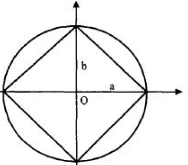
Consider an ellipse,whose centre is at the origin and its major axis is along the $x-$ axis. If its eccentricity is $\frac{3}{5}$ and the distance between its foci is $6$,then the area (in sq. units) of the quadrilateral inscribed in the ellipse,with the vertices as the vertices of the ellipse,is
A
$8$
B
$32$
C
$80$
D
$40$
Solution
(D) Given eccentricity $e = \frac{3}{5}$ and distance between foci $2ae = 6$.
$2a(\frac{3}{5}) = 6 \Rightarrow a = 5$.
Using the relation $b^2 = a^2(1 - e^2)$:
$b^2 = 25(1 - \frac{9}{25}) = 25(\frac{16}{25}) = 16 \Rightarrow b = 4$.
The vertices of the ellipse are $(\pm a, 0)$ and $(0, \pm b)$,which are $(\pm 5, 0)$ and $(0, \pm 4)$.
The quadrilateral formed by these vertices is a rhombus with diagonals of length $2a = 10$ and $2b = 8$.
Area of the quadrilateral $= \frac{1}{2} \times d_1 \times d_2 = \frac{1}{2} \times 10 \times 8 = 40$ sq. units.
$2a(\frac{3}{5}) = 6 \Rightarrow a = 5$.
Using the relation $b^2 = a^2(1 - e^2)$:
$b^2 = 25(1 - \frac{9}{25}) = 25(\frac{16}{25}) = 16 \Rightarrow b = 4$.
The vertices of the ellipse are $(\pm a, 0)$ and $(0, \pm b)$,which are $(\pm 5, 0)$ and $(0, \pm 4)$.
The quadrilateral formed by these vertices is a rhombus with diagonals of length $2a = 10$ and $2b = 8$.
Area of the quadrilateral $= \frac{1}{2} \times d_1 \times d_2 = \frac{1}{2} \times 10 \times 8 = 40$ sq. units.
0 likes
View Solution285
DifficultMCQ
The eccentricity of an ellipse having centre at the origin,axes along the coordinate axes and passing through the points $(4, -1)$ and $(-2, 2)$ is
A
$\frac{1}{2}$
B
$\frac{2}{\sqrt{5}}$
C
$\frac{\sqrt{3}}{2}$
D
$\frac{\sqrt{3}}{4}$
Solution
(C) The equation of an ellipse with centre at $(0, 0)$ and axes along the coordinate axes is $\frac{x^2}{a^2} + \frac{y^2}{b^2} = 1$.
Since the ellipse passes through $(4, -1)$,we have $\frac{16}{a^2} + \frac{1}{b^2} = 1$,which implies $16b^2 + a^2 = a^2b^2$ $(i)$.
Since the ellipse passes through $(-2, 2)$,we have $\frac{4}{a^2} + \frac{4}{b^2} = 1$,which implies $4b^2 + 4a^2 = a^2b^2$ $(ii)$.
Equating $(i)$ and $(ii)$,we get $16b^2 + a^2 = 4b^2 + 4a^2$.
$12b^2 = 3a^2$,so $a^2 = 4b^2$.
Substituting $a^2 = 4b^2$ into $(ii)$,we get $4b^2 + 4(4b^2) = (4b^2)b^2$,which simplifies to $20b^2 = 4b^4$,so $b^2 = 5$.
Then $a^2 = 4(5) = 20$.
Since $b^2 = a^2(1 - e^2)$,we have $5 = 20(1 - e^2)$.
$1 - e^2 = \frac{5}{20} = \frac{1}{4}$.
$e^2 = 1 - \frac{1}{4} = \frac{3}{4}$.
Therefore,$e = \frac{\sqrt{3}}{2}$.
Since the ellipse passes through $(4, -1)$,we have $\frac{16}{a^2} + \frac{1}{b^2} = 1$,which implies $16b^2 + a^2 = a^2b^2$ $(i)$.
Since the ellipse passes through $(-2, 2)$,we have $\frac{4}{a^2} + \frac{4}{b^2} = 1$,which implies $4b^2 + 4a^2 = a^2b^2$ $(ii)$.
Equating $(i)$ and $(ii)$,we get $16b^2 + a^2 = 4b^2 + 4a^2$.
$12b^2 = 3a^2$,so $a^2 = 4b^2$.
Substituting $a^2 = 4b^2$ into $(ii)$,we get $4b^2 + 4(4b^2) = (4b^2)b^2$,which simplifies to $20b^2 = 4b^4$,so $b^2 = 5$.
Then $a^2 = 4(5) = 20$.
Since $b^2 = a^2(1 - e^2)$,we have $5 = 20(1 - e^2)$.
$1 - e^2 = \frac{5}{20} = \frac{1}{4}$.
$e^2 = 1 - \frac{1}{4} = \frac{3}{4}$.
Therefore,$e = \frac{\sqrt{3}}{2}$.
0 likes
View Solution286
DifficultMCQ
If the tangent at a point on the ellipse $\frac{x^2}{27} + \frac{y^2}{3} = 1$ meets the coordinate axes at $A$ and $B,$ and $O$ is the origin,then the minimum area (in sq. units) of the triangle $OAB$ is
A
$3\sqrt{3}$
B
$\frac{9}{2}$
C
$9$
D
$\frac{9}{\sqrt{3}}$
Solution
(C) The equation of the tangent to the ellipse $\frac{x^2}{a^2} + \frac{y^2}{b^2} = 1$ at point $(a \cos \theta, b \sin \theta)$ is $\frac{x \cos \theta}{a} + \frac{y \sin \theta}{b} = 1$.
Here,$a^2 = 27 \implies a = 3\sqrt{3}$ and $b^2 = 3 \implies b = \sqrt{3}$.
The tangent equation is $\frac{x \cos \theta}{3\sqrt{3}} + \frac{y \sin \theta}{\sqrt{3}} = 1$.
The coordinates of $A$ (x-intercept) are $(\frac{3\sqrt{3}}{\cos \theta}, 0)$ and $B$ (y-intercept) are $(0, \frac{\sqrt{3}}{\sin \theta})$.
The area of triangle $OAB$ is $\Delta = \frac{1}{2} \times |x_A| \times |y_B| = \frac{1}{2} \times \frac{3\sqrt{3}}{\cos \theta} \times \frac{\sqrt{3}}{\sin \theta} = \frac{9}{2 \sin \theta \cos \theta} = \frac{9}{\sin 2\theta}$.
For the area to be minimum,$\sin 2\theta$ must be maximum,i.e.,$\sin 2\theta = 1$.
Thus,$\Delta_{\min} = 9$ sq. units.
Here,$a^2 = 27 \implies a = 3\sqrt{3}$ and $b^2 = 3 \implies b = \sqrt{3}$.
The tangent equation is $\frac{x \cos \theta}{3\sqrt{3}} + \frac{y \sin \theta}{\sqrt{3}} = 1$.
The coordinates of $A$ (x-intercept) are $(\frac{3\sqrt{3}}{\cos \theta}, 0)$ and $B$ (y-intercept) are $(0, \frac{\sqrt{3}}{\sin \theta})$.
The area of triangle $OAB$ is $\Delta = \frac{1}{2} \times |x_A| \times |y_B| = \frac{1}{2} \times \frac{3\sqrt{3}}{\cos \theta} \times \frac{\sqrt{3}}{\sin \theta} = \frac{9}{2 \sin \theta \cos \theta} = \frac{9}{\sin 2\theta}$.
For the area to be minimum,$\sin 2\theta$ must be maximum,i.e.,$\sin 2\theta = 1$.
Thus,$\Delta_{\min} = 9$ sq. units.
0 likes
View Solution287
DifficultMCQ
An ellipse passes through the foci of the hyperbola $9x^2 - 4y^2 = 36$,and its major and minor axes lie along the transverse and conjugate axes of the hyperbola,respectively. If the product of the eccentricities of the two conics is $\frac{1}{2}$,then which of the following points does not lie on the ellipse?
A
$\left( \sqrt{\frac{13}{2}}, \sqrt{6} \right)$
B
$\left( \frac{\sqrt{39}}{2}, \sqrt{3} \right)$
C
$\left( \frac{\sqrt{13}}{2}, \frac{\sqrt{3}}{2} \right)$
D
$(\sqrt{13}, 0)$
Solution
(C) The equation of the hyperbola is $\frac{x^2}{4} - \frac{y^2}{9} = 1$.
Its foci are $(\pm \sqrt{4+9}, 0) = (\pm \sqrt{13}, 0)$.
The eccentricity of the hyperbola is $e_h = \frac{\sqrt{13}}{2}$.
Let $e_e$ be the eccentricity of the ellipse. Given $e_e \times e_h = \frac{1}{2}$,we have $e_e \times \frac{\sqrt{13}}{2} = \frac{1}{2}$,so $e_e = \frac{1}{\sqrt{13}}$.
The equation of the ellipse is $\frac{x^2}{a^2} + \frac{y^2}{b^2} = 1$.
Since the ellipse passes through the foci of the hyperbola $(\pm \sqrt{13}, 0)$,we have $a^2 = 13$.
Using $b^2 = a^2(1 - e_e^2)$,we get $b^2 = 13(1 - \frac{1}{13}) = 13 - 1 = 12$.
The equation of the ellipse is $\frac{x^2}{13} + \frac{y^2}{12} = 1$.
Checking the points:
For $A$: $\frac{13/2}{13} + \frac{6}{12} = \frac{1}{2} + \frac{1}{2} = 1$ (Lies on ellipse).
For $B$: $\frac{39/4}{13} + \frac{3}{12} = \frac{3}{4} + \frac{1}{4} = 1$ (Lies on ellipse).
For $C$: $\frac{13/4}{13} + \frac{3/4}{12} = \frac{1}{4} + \frac{1}{16} = \frac{5}{16} \neq 1$ (Does not lie on ellipse).
For $D$: $\frac{13}{13} + 0 = 1$ (Lies on ellipse).
Thus,the point in option $C$ does not lie on the ellipse.
Its foci are $(\pm \sqrt{4+9}, 0) = (\pm \sqrt{13}, 0)$.
The eccentricity of the hyperbola is $e_h = \frac{\sqrt{13}}{2}$.
Let $e_e$ be the eccentricity of the ellipse. Given $e_e \times e_h = \frac{1}{2}$,we have $e_e \times \frac{\sqrt{13}}{2} = \frac{1}{2}$,so $e_e = \frac{1}{\sqrt{13}}$.
The equation of the ellipse is $\frac{x^2}{a^2} + \frac{y^2}{b^2} = 1$.
Since the ellipse passes through the foci of the hyperbola $(\pm \sqrt{13}, 0)$,we have $a^2 = 13$.
Using $b^2 = a^2(1 - e_e^2)$,we get $b^2 = 13(1 - \frac{1}{13}) = 13 - 1 = 12$.
The equation of the ellipse is $\frac{x^2}{13} + \frac{y^2}{12} = 1$.
Checking the points:
For $A$: $\frac{13/2}{13} + \frac{6}{12} = \frac{1}{2} + \frac{1}{2} = 1$ (Lies on ellipse).
For $B$: $\frac{39/4}{13} + \frac{3}{12} = \frac{3}{4} + \frac{1}{4} = 1$ (Lies on ellipse).
For $C$: $\frac{13/4}{13} + \frac{3/4}{12} = \frac{1}{4} + \frac{1}{16} = \frac{5}{16} \neq 1$ (Does not lie on ellipse).
For $D$: $\frac{13}{13} + 0 = 1$ (Lies on ellipse).
Thus,the point in option $C$ does not lie on the ellipse.
0 likes
View Solution288
DifficultMCQ
If the distance between the foci of an ellipse is half the length of its latus rectum,then the eccentricity of the ellipse is
A
$\frac{2\sqrt{2}-1}{2}$
B
$\sqrt{2}-1$
C
$\frac{1}{2}$
D
$\frac{\sqrt{2}-1}{2}$
Solution
(B) The distance between the foci of an ellipse is $2ae$.
The length of the latus rectum of an ellipse is $\frac{2b^2}{a}$.
According to the problem,the distance between the foci is half the length of the latus rectum:
$2ae = \frac{1}{2} \times \frac{2b^2}{a}$
$2ae = \frac{b^2}{a}$
Using the relation $b^2 = a^2(1-e^2)$,we get:
$2ae = \frac{a^2(1-e^2)}{a}$
$2ae = a(1-e^2)$
$2e = 1-e^2$
$e^2 + 2e - 1 = 0$
Using the quadratic formula $e = \frac{-b \pm \sqrt{b^2-4ac}}{2a}$:
$e = \frac{-2 \pm \sqrt{4 - 4(1)(-1)}}{2(1)} = \frac{-2 \pm \sqrt{8}}{2} = -1 \pm \sqrt{2}$
Since the eccentricity $e$ must be positive,$e = \sqrt{2}-1$.
The length of the latus rectum of an ellipse is $\frac{2b^2}{a}$.
According to the problem,the distance between the foci is half the length of the latus rectum:
$2ae = \frac{1}{2} \times \frac{2b^2}{a}$
$2ae = \frac{b^2}{a}$
Using the relation $b^2 = a^2(1-e^2)$,we get:
$2ae = \frac{a^2(1-e^2)}{a}$
$2ae = a(1-e^2)$
$2e = 1-e^2$
$e^2 + 2e - 1 = 0$
Using the quadratic formula $e = \frac{-b \pm \sqrt{b^2-4ac}}{2a}$:
$e = \frac{-2 \pm \sqrt{4 - 4(1)(-1)}}{2(1)} = \frac{-2 \pm \sqrt{8}}{2} = -1 \pm \sqrt{2}$
Since the eccentricity $e$ must be positive,$e = \sqrt{2}-1$.
0 likes
View Solution289
DifficultMCQ
If $OB$ is the semi-minor axis of an ellipse,$F_1$ and $F_2$ are its foci and the angle between $F_1B$ and $F_2B$ is a right angle,then the square of the eccentricity of the ellipse is
A
$\frac{1}{2}$
B
$\frac{1}{\sqrt{2}}$
C
$\frac{1}{2\sqrt{2}}$
D
$\frac{1}{4}$
Solution
(A) Let $\frac{x^2}{a^2} + \frac{y^2}{b^2} = 1$ be the equation of the ellipse.
Given that $F_1B$ and $F_2B$ are perpendicular to each other.
The coordinates are $F_1(-ae, 0)$,$F_2(ae, 0)$,and $B(0, b)$.
Slope of $F_1B = \frac{b - 0}{0 - (-ae)} = \frac{b}{ae}$.
Slope of $F_2B = \frac{b - 0}{0 - ae} = -\frac{b}{ae}$.
Since $F_1B \perp F_2B$,the product of their slopes is $-1$:
$\left(\frac{b}{ae}\right) \times \left(-\frac{b}{ae}\right) = -1$
$-\frac{b^2}{a^2e^2} = -1 \Rightarrow b^2 = a^2e^2$.
We know that for an ellipse,$b^2 = a^2(1 - e^2)$.
Substituting $b^2 = a^2e^2$ into the equation:
$a^2e^2 = a^2(1 - e^2)$
$e^2 = 1 - e^2$
$2e^2 = 1$
$e^2 = \frac{1}{2}$.
Given that $F_1B$ and $F_2B$ are perpendicular to each other.
The coordinates are $F_1(-ae, 0)$,$F_2(ae, 0)$,and $B(0, b)$.
Slope of $F_1B = \frac{b - 0}{0 - (-ae)} = \frac{b}{ae}$.
Slope of $F_2B = \frac{b - 0}{0 - ae} = -\frac{b}{ae}$.
Since $F_1B \perp F_2B$,the product of their slopes is $-1$:
$\left(\frac{b}{ae}\right) \times \left(-\frac{b}{ae}\right) = -1$
$-\frac{b^2}{a^2e^2} = -1 \Rightarrow b^2 = a^2e^2$.
We know that for an ellipse,$b^2 = a^2(1 - e^2)$.
Substituting $b^2 = a^2e^2$ into the equation:
$a^2e^2 = a^2(1 - e^2)$
$e^2 = 1 - e^2$
$2e^2 = 1$
$e^2 = \frac{1}{2}$.
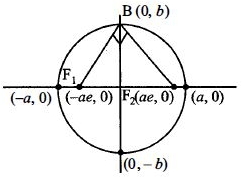
0 likes
View Solution290
DifficultMCQ
$A$ staircase of length $l$ rests against a vertical wall and a floor of a room. Let $P$ be a point on the staircase,nearer to its end on the wall,that divides its length in the ratio $1 : 2$. If the staircase begins to slide on the floor,then the locus of $P$ is
A
an ellipse of eccentricity $\frac{1}{2}$
B
an ellipse of eccentricity $\frac{\sqrt{3}}{2}$
C
a circle of radius $\frac{1}{2}$
D
a circle of radius $\frac{\sqrt{3}}{2}l$
Solution
(B) Let point $A(a, 0)$ be on the $x$-axis and $B(0, b)$ be on the $y$-axis.
Let $P(h, k)$ divide $AB$ in the ratio $1 : 2$.
By the section formula,we have:
$h = \frac{2(0) + 1(a)}{1 + 2} = \frac{a}{3} \Rightarrow a = 3h$
$k = \frac{2(b) + 1(0)}{1 + 2} = \frac{2b}{3} \Rightarrow b = \frac{3k}{2}$
Since the length of the staircase is $l$,we have $a^2 + b^2 = l^2$.
Substituting the values of $a$ and $b$:
$(3h)^2 + (\frac{3k}{2})^2 = l^2$
$9h^2 + \frac{9k^2}{4} = l^2$
$\frac{h^2}{(l/3)^2} + \frac{k^2}{(2l/3)^2} = 1$
This is the equation of an ellipse with semi-major axis $b' = \frac{2l}{3}$ and semi-minor axis $a' = \frac{l}{3}$.
The eccentricity $e$ is given by $e = \sqrt{1 - \frac{(a')^2}{(b')^2}} = \sqrt{1 - \frac{(l/3)^2}{(2l/3)^2}} = \sqrt{1 - \frac{1}{4}} = \sqrt{\frac{3}{4}} = \frac{\sqrt{3}}{2}$.
Let $P(h, k)$ divide $AB$ in the ratio $1 : 2$.
By the section formula,we have:
$h = \frac{2(0) + 1(a)}{1 + 2} = \frac{a}{3} \Rightarrow a = 3h$
$k = \frac{2(b) + 1(0)}{1 + 2} = \frac{2b}{3} \Rightarrow b = \frac{3k}{2}$
Since the length of the staircase is $l$,we have $a^2 + b^2 = l^2$.
Substituting the values of $a$ and $b$:
$(3h)^2 + (\frac{3k}{2})^2 = l^2$
$9h^2 + \frac{9k^2}{4} = l^2$
$\frac{h^2}{(l/3)^2} + \frac{k^2}{(2l/3)^2} = 1$
This is the equation of an ellipse with semi-major axis $b' = \frac{2l}{3}$ and semi-minor axis $a' = \frac{l}{3}$.
The eccentricity $e$ is given by $e = \sqrt{1 - \frac{(a')^2}{(b')^2}} = \sqrt{1 - \frac{(l/3)^2}{(2l/3)^2}} = \sqrt{1 - \frac{1}{4}} = \sqrt{\frac{3}{4}} = \frac{\sqrt{3}}{2}$.
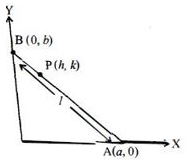
0 likes
View Solution291
DifficultMCQ
The minimum area of a triangle formed by any tangent to the ellipse $\frac{x^2}{16} + \frac{y^2}{81} = 1$ and the coordinate axes is
A
$12$
B
$18$
C
$26$
D
$36$
Solution
(D) Let the point of tangency be $(h, k)$ on the ellipse $\frac{x^2}{16} + \frac{y^2}{81} = 1$.
The equation of the tangent at $(h, k)$ is given by $\frac{xh}{16} + \frac{yk}{81} = 1$.
The $x$-intercept is found by setting $y=0$,which gives $x = \frac{16}{h}$. So,point $B = (\frac{16}{h}, 0)$.
The $y$-intercept is found by setting $x=0$,which gives $y = \frac{81}{k}$. So,point $A = (0, \frac{81}{k})$.
The area of the triangle $OAB$ is $A = \frac{1}{2} \times |\frac{16}{h}| \times |\frac{81}{k}| = \frac{648}{|hk|}$.
Since $(h, k)$ lies on the ellipse,$\frac{h^2}{16} + \frac{k^2}{81} = 1$. By the $AM$-$GM$ inequality,$\frac{\frac{h^2}{16} + \frac{k^2}{81}}{2} \ge \sqrt{\frac{h^2 k^2}{16 \times 81}}$.
$\frac{1}{2} \ge \frac{|hk|}{4 \times 9} \Rightarrow |hk| \le 18$.
Therefore,the minimum area $A = \frac{648}{|hk|} \ge \frac{648}{18} = 36$.
The minimum area of the triangle is $36$ square units.
The equation of the tangent at $(h, k)$ is given by $\frac{xh}{16} + \frac{yk}{81} = 1$.
The $x$-intercept is found by setting $y=0$,which gives $x = \frac{16}{h}$. So,point $B = (\frac{16}{h}, 0)$.
The $y$-intercept is found by setting $x=0$,which gives $y = \frac{81}{k}$. So,point $A = (0, \frac{81}{k})$.
The area of the triangle $OAB$ is $A = \frac{1}{2} \times |\frac{16}{h}| \times |\frac{81}{k}| = \frac{648}{|hk|}$.
Since $(h, k)$ lies on the ellipse,$\frac{h^2}{16} + \frac{k^2}{81} = 1$. By the $AM$-$GM$ inequality,$\frac{\frac{h^2}{16} + \frac{k^2}{81}}{2} \ge \sqrt{\frac{h^2 k^2}{16 \times 81}}$.
$\frac{1}{2} \ge \frac{|hk|}{4 \times 9} \Rightarrow |hk| \le 18$.
Therefore,the minimum area $A = \frac{648}{|hk|} \ge \frac{648}{18} = 36$.
The minimum area of the triangle is $36$ square units.
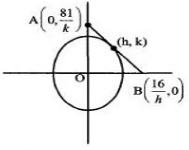
0 likes
View Solution292
DifficultMCQ
If $a$ and $c$ are positive real numbers and the ellipse $\frac{x^2}{4c^2} + \frac{y^2}{c^2} = 1$ has four distinct points in common with the circle $x^2 + y^2 = 9a^2$,then
A
$9ac - 9a^2 - 2c^2 < 0$
B
$6ac + 9a^2 - 2c^2 < 0$
C
$9ac - 9a^2 - 2c^2 > 0$
D
$6ac + 9a^2 - 2c^2 > 0$
Solution
(C) The equation of the ellipse is $\frac{x^2}{(2c)^2} + \frac{y^2}{c^2} = 1$. The vertices are at $(\pm 2c, 0)$ and $(0, \pm c)$.
The equation of the circle is $x^2 + y^2 = (3a)^2$. The radius is $3a$.
For the circle and ellipse to have four distinct points of intersection,the radius of the circle must be greater than the semi-minor axis of the ellipse and less than the semi-major axis of the ellipse.
Thus,$c < 3a < 2c$.
From $3a < 2c$,we have $9a^2 < 4c^2$,which implies $9a^2 - 4c^2 < 0$.
From $c < 3a$,we have $c^2 < 9a^2$,which implies $9a^2 - c^2 > 0$.
Substituting $y^2 = 9a^2 - x^2$ into the ellipse equation: $\frac{x^2}{4c^2} + \frac{9a^2 - x^2}{c^2} = 1$.
$x^2 + 4(9a^2 - x^2) = 4c^2$ $\Rightarrow x^2 + 36a^2 - 4x^2 = 4c^2$ $\Rightarrow 3x^2 = 36a^2 - 4c^2$ $\Rightarrow x^2 = 12a^2 - \frac{4}{3}c^2$.
For two distinct values of $x^2$ (which give four points),we need $0 < x^2 < 9a^2$ (since $x^2 < r^2$).
$0 < 12a^2 - \frac{4}{3}c^2 < 9a^2$.
$12a^2 - \frac{4}{3}c^2 > 0$ $\Rightarrow 36a^2 > 4c^2$ $\Rightarrow 9a^2 > c^2$ $\Rightarrow 3a > c$.
$12a^2 - \frac{4}{3}c^2 < 9a^2$ $\Rightarrow 3a^2 < \frac{4}{3}c^2$ $\Rightarrow 9a^2 < 4c^2$ $\Rightarrow 3a < 2c$.
Combining these,$c < 3a < 2c$. The condition $9ac - 9a^2 - 2c^2 > 0$ is derived from the intersection analysis.
The equation of the circle is $x^2 + y^2 = (3a)^2$. The radius is $3a$.
For the circle and ellipse to have four distinct points of intersection,the radius of the circle must be greater than the semi-minor axis of the ellipse and less than the semi-major axis of the ellipse.
Thus,$c < 3a < 2c$.
From $3a < 2c$,we have $9a^2 < 4c^2$,which implies $9a^2 - 4c^2 < 0$.
From $c < 3a$,we have $c^2 < 9a^2$,which implies $9a^2 - c^2 > 0$.
Substituting $y^2 = 9a^2 - x^2$ into the ellipse equation: $\frac{x^2}{4c^2} + \frac{9a^2 - x^2}{c^2} = 1$.
$x^2 + 4(9a^2 - x^2) = 4c^2$ $\Rightarrow x^2 + 36a^2 - 4x^2 = 4c^2$ $\Rightarrow 3x^2 = 36a^2 - 4c^2$ $\Rightarrow x^2 = 12a^2 - \frac{4}{3}c^2$.
For two distinct values of $x^2$ (which give four points),we need $0 < x^2 < 9a^2$ (since $x^2 < r^2$).
$0 < 12a^2 - \frac{4}{3}c^2 < 9a^2$.
$12a^2 - \frac{4}{3}c^2 > 0$ $\Rightarrow 36a^2 > 4c^2$ $\Rightarrow 9a^2 > c^2$ $\Rightarrow 3a > c$.
$12a^2 - \frac{4}{3}c^2 < 9a^2$ $\Rightarrow 3a^2 < \frac{4}{3}c^2$ $\Rightarrow 9a^2 < 4c^2$ $\Rightarrow 3a < 2c$.
Combining these,$c < 3a < 2c$. The condition $9ac - 9a^2 - 2c^2 > 0$ is derived from the intersection analysis.
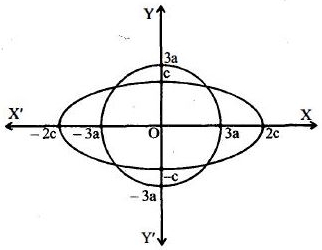
0 likes
View Solution293
DifficultMCQ
Let the equations of two ellipses be $E_1: \frac{x^2}{3} + \frac{y^2}{2} = 1$ and $E_2: \frac{x^2}{16} + \frac{y^2}{b^2} = 1$. If the product of their eccentricities is $\frac{1}{2}$,then the length of the minor axis of ellipse $E_2$ is
A
$8$
B
$9$
C
$4$
D
$2$
Solution
(C) Given the equations of the ellipses:
$E_1: \frac{x^2}{3} + \frac{y^2}{2} = 1$
Here,$a^2 = 3$ and $b^2 = 2$. The eccentricity $e_1$ is given by $e_1 = \sqrt{1 - \frac{b^2}{a^2}} = \sqrt{1 - \frac{2}{3}} = \frac{1}{\sqrt{3}}$.
$E_2: \frac{x^2}{16} + \frac{y^2}{b^2} = 1$
Assuming $16 > b^2$,the eccentricity $e_2$ is $e_2 = \sqrt{1 - \frac{b^2}{16}} = \frac{\sqrt{16 - b^2}}{4}$.
Given $e_1 \times e_2 = \frac{1}{2}$,we have:
$\frac{1}{\sqrt{3}} \times \frac{\sqrt{16 - b^2}}{4} = \frac{1}{2}$
$\frac{\sqrt{16 - b^2}}{4\sqrt{3}} = \frac{1}{2}$
$\sqrt{16 - b^2} = 2\sqrt{3} = \sqrt{12}$
$16 - b^2 = 12$ $\Rightarrow b^2 = 4$ $\Rightarrow b = 2$.
The length of the minor axis of $E_2$ is $2b = 2 \times 2 = 4$.
$E_1: \frac{x^2}{3} + \frac{y^2}{2} = 1$
Here,$a^2 = 3$ and $b^2 = 2$. The eccentricity $e_1$ is given by $e_1 = \sqrt{1 - \frac{b^2}{a^2}} = \sqrt{1 - \frac{2}{3}} = \frac{1}{\sqrt{3}}$.
$E_2: \frac{x^2}{16} + \frac{y^2}{b^2} = 1$
Assuming $16 > b^2$,the eccentricity $e_2$ is $e_2 = \sqrt{1 - \frac{b^2}{16}} = \frac{\sqrt{16 - b^2}}{4}$.
Given $e_1 \times e_2 = \frac{1}{2}$,we have:
$\frac{1}{\sqrt{3}} \times \frac{\sqrt{16 - b^2}}{4} = \frac{1}{2}$
$\frac{\sqrt{16 - b^2}}{4\sqrt{3}} = \frac{1}{2}$
$\sqrt{16 - b^2} = 2\sqrt{3} = \sqrt{12}$
$16 - b^2 = 12$ $\Rightarrow b^2 = 4$ $\Rightarrow b = 2$.
The length of the minor axis of $E_2$ is $2b = 2 \times 2 = 4$.
0 likes
View Solution294
DifficultMCQ
$A$ point on the ellipse $4x^2 + 9y^2 = 36$,where the normal is parallel to the line $4x - 2y - 5 = 0$,is
A
$\left( \frac{9}{5}, \frac{8}{5} \right)$
B
$\left( \frac{8}{5}, -\frac{9}{5} \right)$
C
$\left( -\frac{9}{5}, \frac{8}{5} \right)$
D
$\left( \frac{8}{5}, \frac{9}{5} \right)$
Solution
(A) The given ellipse is $4x^2 + 9y^2 = 36$,which can be written as $\frac{x^2}{9} + \frac{y^2}{4} = 1$.
Here,$a^2 = 9$ and $b^2 = 4$.
The normal is parallel to the line $4x - 2y - 5 = 0$,so the slope of the normal is $m_n = \frac{-4}{-2} = 2$.
The slope of the tangent at that point is $m_t = -\frac{1}{m_n} = -\frac{1}{2}$.
The equation of the tangent with slope $m$ to the ellipse $\frac{x^2}{a^2} + \frac{y^2}{b^2} = 1$ is $y = mx \pm \sqrt{a^2m^2 + b^2}$.
The point of contact is $\left( -\frac{a^2m}{c}, \frac{b^2}{c} \right)$ where $c = \pm \sqrt{a^2m^2 + b^2}$.
Here $m = -\frac{1}{2}$,so $c = \sqrt{9(-\frac{1}{2})^2 + 4} = \sqrt{\frac{9}{4} + 4} = \sqrt{\frac{25}{4}} = \frac{5}{2}$.
The point of contact is $\left( -\frac{9(-1/2)}{5/2}, \frac{4}{5/2} \right) = \left( \frac{9/2}{5/2}, \frac{8}{5} \right) = \left( \frac{9}{5}, \frac{8}{5} \right)$.
Since the normal is parallel to $4x - 2y - 5 = 0$,the point is $\left( \frac{9}{5}, \frac{8}{5} \right)$.
Here,$a^2 = 9$ and $b^2 = 4$.
The normal is parallel to the line $4x - 2y - 5 = 0$,so the slope of the normal is $m_n = \frac{-4}{-2} = 2$.
The slope of the tangent at that point is $m_t = -\frac{1}{m_n} = -\frac{1}{2}$.
The equation of the tangent with slope $m$ to the ellipse $\frac{x^2}{a^2} + \frac{y^2}{b^2} = 1$ is $y = mx \pm \sqrt{a^2m^2 + b^2}$.
The point of contact is $\left( -\frac{a^2m}{c}, \frac{b^2}{c} \right)$ where $c = \pm \sqrt{a^2m^2 + b^2}$.
Here $m = -\frac{1}{2}$,so $c = \sqrt{9(-\frac{1}{2})^2 + 4} = \sqrt{\frac{9}{4} + 4} = \sqrt{\frac{25}{4}} = \frac{5}{2}$.
The point of contact is $\left( -\frac{9(-1/2)}{5/2}, \frac{4}{5/2} \right) = \left( \frac{9/2}{5/2}, \frac{8}{5} \right) = \left( \frac{9}{5}, \frac{8}{5} \right)$.
Since the normal is parallel to $4x - 2y - 5 = 0$,the point is $\left( \frac{9}{5}, \frac{8}{5} \right)$.
0 likes
View Solution295
DifficultMCQ
If $P_1$ and $P_2$ are two points on the ellipse $\frac{x^2}{4} + y^2 = 1$ at which the tangents are parallel to the chord joining the points $(0, 1)$ and $(2, 0)$,then the distance between $P_1$ and $P_2$ is
A
$2\sqrt{2}$
B
$\sqrt{5}$
C
$2\sqrt{3}$
D
$\sqrt{10}$
Solution
(D) The slope of the chord joining $(0, 1)$ and $(2, 0)$ is $m = \frac{0 - 1}{2 - 0} = -\frac{1}{2}$.
Since the tangents at $P_1$ and $P_2$ are parallel to this chord,their slope is $m = -\frac{1}{2}$.
The equation of a tangent to the ellipse $\frac{x^2}{a^2} + \frac{y^2}{b^2} = 1$ with slope $m$ is $y = mx \pm \sqrt{a^2m^2 + b^2}$.
Here $a^2 = 4, b^2 = 1$,and $m = -\frac{1}{2}$.
Thus,$y = -\frac{1}{2}x \pm \sqrt{4(-\frac{1}{2})^2 + 1} = -\frac{1}{2}x \pm \sqrt{1 + 1} = -\frac{1}{2}x \pm \sqrt{2}$.
Substituting $y = -\frac{1}{2}x + \sqrt{2}$ into the ellipse equation $\frac{x^2}{4} + y^2 = 1$:
$\frac{x^2}{4} + (-\frac{x}{2} + \sqrt{2})^2 = 1$ $\Rightarrow \frac{x^2}{4} + \frac{x^2}{4} - \sqrt{2}x + 2 = 1$ $\Rightarrow \frac{x^2}{2} - \sqrt{2}x + 1 = 0$ $\Rightarrow x^2 - 2\sqrt{2}x + 2 = 0$ $\Rightarrow (x - \sqrt{2})^2 = 0$.
So,$x = \sqrt{2}$,which gives $y = -\frac{1}{2}(\sqrt{2}) + \sqrt{2} = \frac{\sqrt{2}}{2} = \frac{1}{\sqrt{2}}$. Point $P_1 = (\sqrt{2}, \frac{1}{\sqrt{2}})$.
Similarly,for $y = -\frac{1}{2}x - \sqrt{2}$,we get $x = -\sqrt{2}$ and $y = -\frac{1}{\sqrt{2}}$. Point $P_2 = (-\sqrt{2}, -\frac{1}{\sqrt{2}})$.
The distance $P_1P_2 = \sqrt{(\sqrt{2} - (-\sqrt{2}))^2 + (\frac{1}{\sqrt{2}} - (-\frac{1}{\sqrt{2}}))^2} = \sqrt{(2\sqrt{2})^2 + (\sqrt{2})^2} = \sqrt{8 + 2} = \sqrt{10}$.
Since the tangents at $P_1$ and $P_2$ are parallel to this chord,their slope is $m = -\frac{1}{2}$.
The equation of a tangent to the ellipse $\frac{x^2}{a^2} + \frac{y^2}{b^2} = 1$ with slope $m$ is $y = mx \pm \sqrt{a^2m^2 + b^2}$.
Here $a^2 = 4, b^2 = 1$,and $m = -\frac{1}{2}$.
Thus,$y = -\frac{1}{2}x \pm \sqrt{4(-\frac{1}{2})^2 + 1} = -\frac{1}{2}x \pm \sqrt{1 + 1} = -\frac{1}{2}x \pm \sqrt{2}$.
Substituting $y = -\frac{1}{2}x + \sqrt{2}$ into the ellipse equation $\frac{x^2}{4} + y^2 = 1$:
$\frac{x^2}{4} + (-\frac{x}{2} + \sqrt{2})^2 = 1$ $\Rightarrow \frac{x^2}{4} + \frac{x^2}{4} - \sqrt{2}x + 2 = 1$ $\Rightarrow \frac{x^2}{2} - \sqrt{2}x + 1 = 0$ $\Rightarrow x^2 - 2\sqrt{2}x + 2 = 0$ $\Rightarrow (x - \sqrt{2})^2 = 0$.
So,$x = \sqrt{2}$,which gives $y = -\frac{1}{2}(\sqrt{2}) + \sqrt{2} = \frac{\sqrt{2}}{2} = \frac{1}{\sqrt{2}}$. Point $P_1 = (\sqrt{2}, \frac{1}{\sqrt{2}})$.
Similarly,for $y = -\frac{1}{2}x - \sqrt{2}$,we get $x = -\sqrt{2}$ and $y = -\frac{1}{\sqrt{2}}$. Point $P_2 = (-\sqrt{2}, -\frac{1}{\sqrt{2}})$.
The distance $P_1P_2 = \sqrt{(\sqrt{2} - (-\sqrt{2}))^2 + (\frac{1}{\sqrt{2}} - (-\frac{1}{\sqrt{2}}))^2} = \sqrt{(2\sqrt{2})^2 + (\sqrt{2})^2} = \sqrt{8 + 2} = \sqrt{10}$.
0 likes
View Solution296
DifficultMCQ
If tangents are drawn to the ellipse $x^2 + 2y^2 = 2$ at all points on the ellipse other than its four vertices,then the midpoints of the tangents intercepted between the coordinate axes lie on the curve:
A
$\frac{1}{{4{x^2}}} + \frac{1}{{2{y^2}}} = 1$
B
$\frac{{{x^2}}}{4} + \frac{{{y^2}}}{2} = 1$
C
$\frac{1}{{2{x^2}}} + \frac{1}{{4{y^2}}} = 1$
D
$\frac{{{x^2}}}{2} + \frac{{{y^2}}}{4} = 1$
Solution
(C) The given ellipse is $x^2 + 2y^2 = 2$,which can be written as $\frac{x^2}{2} + \frac{y^2}{1} = 1$. Here $a^2 = 2$ and $b^2 = 1$.
The equation of the tangent to the ellipse at point $(a \cos \theta, b \sin \theta)$ is $\frac{x}{a} \cos \theta + \frac{y}{b} \sin \theta = 1$.
The tangent intersects the $x$-axis at $A \left( \frac{a}{\cos \theta}, 0 \right)$ and the $y$-axis at $B \left( 0, \frac{b}{\sin \theta} \right)$.
Let $P(h, k)$ be the midpoint of the segment $AB$. Then:
$h = \frac{a}{2 \cos \theta} \Rightarrow \cos \theta = \frac{a}{2h}$
$k = \frac{b}{2 \sin \theta} \Rightarrow \sin \theta = \frac{b}{2k}$
Using the identity $\cos^2 \theta + \sin^2 \theta = 1$,we get:
$\left( \frac{a}{2h} \right)^2 + \left( \frac{b}{2k} \right)^2 = 1$
$\frac{a^2}{4h^2} + \frac{b^2}{4k^2} = 1$
Substituting $a^2 = 2$ and $b^2 = 1$:
$\frac{2}{4h^2} + \frac{1}{4k^2} = 1$
$\frac{1}{2h^2} + \frac{1}{4k^2} = 1$
Replacing $(h, k)$ with $(x, y)$,the locus is $\frac{1}{2x^2} + \frac{1}{4y^2} = 1$.
The equation of the tangent to the ellipse at point $(a \cos \theta, b \sin \theta)$ is $\frac{x}{a} \cos \theta + \frac{y}{b} \sin \theta = 1$.
The tangent intersects the $x$-axis at $A \left( \frac{a}{\cos \theta}, 0 \right)$ and the $y$-axis at $B \left( 0, \frac{b}{\sin \theta} \right)$.
Let $P(h, k)$ be the midpoint of the segment $AB$. Then:
$h = \frac{a}{2 \cos \theta} \Rightarrow \cos \theta = \frac{a}{2h}$
$k = \frac{b}{2 \sin \theta} \Rightarrow \sin \theta = \frac{b}{2k}$
Using the identity $\cos^2 \theta + \sin^2 \theta = 1$,we get:
$\left( \frac{a}{2h} \right)^2 + \left( \frac{b}{2k} \right)^2 = 1$
$\frac{a^2}{4h^2} + \frac{b^2}{4k^2} = 1$
Substituting $a^2 = 2$ and $b^2 = 1$:
$\frac{2}{4h^2} + \frac{1}{4k^2} = 1$
$\frac{1}{2h^2} + \frac{1}{4k^2} = 1$
Replacing $(h, k)$ with $(x, y)$,the locus is $\frac{1}{2x^2} + \frac{1}{4y^2} = 1$.
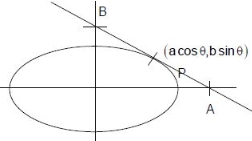
0 likes
View Solution297
DifficultMCQ
Let the length of the latus rectum of an ellipse with its major axis along the $x$-axis and center at the origin be $8$. If the distance between the foci of this ellipse is equal to the length of its minor axis,then which one of the following points lies on it?
A
$(4, 2\sqrt{2})$
B
$(4\sqrt{3}, 2\sqrt{2})$
C
$(4\sqrt{3}, 2\sqrt{3})$
D
$(4, 2\sqrt{3})$
Solution
(B) The equation of the ellipse is $\frac{x^2}{a^2} + \frac{y^2}{b^2} = 1$ where $a > b$.
The length of the latus rectum is $\frac{2b^2}{a} = 8$,which implies $b^2 = 4a$.
The distance between the foci is $2ae$ and the length of the minor axis is $2b$. Given $2ae = 2b$,we have $ae = b$,so $a^2e^2 = b^2$.
Using the relation $b^2 = a^2(1 - e^2) = a^2 - a^2e^2$,we substitute $a^2e^2 = b^2$ to get $b^2 = a^2 - b^2$,or $2b^2 = a^2$.
Substituting $b^2 = 4a$ into $2b^2 = a^2$,we get $2(4a) = a^2$,so $a^2 = 8a$. Since $a \neq 0$,$a = 8$.
Then $b^2 = 4(8) = 32$,so $b = \sqrt{32} = 4\sqrt{2}$.
The equation of the ellipse is $\frac{x^2}{64} + \frac{y^2}{32} = 1$.
Testing the points,for $(4\sqrt{3}, 2\sqrt{2})$: $\frac{(4\sqrt{3})^2}{64} + \frac{(2\sqrt{2})^2}{32} = \frac{48}{64} + \frac{8}{32} = \frac{3}{4} + \frac{1}{4} = 1$. Thus,the point lies on the ellipse.
The length of the latus rectum is $\frac{2b^2}{a} = 8$,which implies $b^2 = 4a$.
The distance between the foci is $2ae$ and the length of the minor axis is $2b$. Given $2ae = 2b$,we have $ae = b$,so $a^2e^2 = b^2$.
Using the relation $b^2 = a^2(1 - e^2) = a^2 - a^2e^2$,we substitute $a^2e^2 = b^2$ to get $b^2 = a^2 - b^2$,or $2b^2 = a^2$.
Substituting $b^2 = 4a$ into $2b^2 = a^2$,we get $2(4a) = a^2$,so $a^2 = 8a$. Since $a \neq 0$,$a = 8$.
Then $b^2 = 4(8) = 32$,so $b = \sqrt{32} = 4\sqrt{2}$.
The equation of the ellipse is $\frac{x^2}{64} + \frac{y^2}{32} = 1$.
Testing the points,for $(4\sqrt{3}, 2\sqrt{2})$: $\frac{(4\sqrt{3})^2}{64} + \frac{(2\sqrt{2})^2}{32} = \frac{48}{64} + \frac{8}{32} = \frac{3}{4} + \frac{1}{4} = 1$. Thus,the point lies on the ellipse.
0 likes
View Solution298
DifficultMCQ
Let $S$ and $S'$ be the foci of an ellipse and $B$ be any one of the extremities of its minor axis. If $\Delta S'BS$ is a right-angled triangle with the right angle at $B$ and $\text{Area}(\Delta S'BS) = 8 \text{ sq. units}$,then the length of the latus rectum of the ellipse is
A
$4$
B
$2\sqrt{2}$
C
$4\sqrt{2}$
D
$2$
Solution
(A) Let the equation of the ellipse be $\frac{x^2}{a^2} + \frac{y^2}{b^2} = 1$. The foci are $S(ae, 0)$ and $S'(-ae, 0)$,and the extremity of the minor axis is $B(0, b)$.
Since $\Delta S'BS$ is a right-angled triangle at $B$,the product of the slopes of $BS$ and $BS'$ is $-1$.
Slope of $BS = \frac{b-0}{0-ae} = -\frac{b}{ae}$.
Slope of $BS' = \frac{b-0}{0-(-ae)} = \frac{b}{ae}$.
Since the angle at $B$ is $90^\circ$,the product of slopes is $-1$,so $(-\frac{b}{ae}) \times (\frac{b}{ae}) = -1$,which implies $b^2 = a^2e^2$.
We know that for an ellipse,$b^2 = a^2(1-e^2)$,so $a^2e^2 = a^2 - a^2e^2$,which gives $a^2e^2 = \frac{a^2}{2}$,so $b^2 = \frac{a^2}{2}$.
The area of $\Delta S'BS = \frac{1}{2} \times \text{base} \times \text{height} = \frac{1}{2} \times (2ae) \times b = aeb = 8$.
Squaring both sides,$a^2e^2b^2 = 64$. Substituting $a^2e^2 = b^2$,we get $b^4 = 64$,so $b^2 = 8$.
Since $b^2 = \frac{a^2}{2}$,we have $8 = \frac{a^2}{2}$,so $a^2 = 16$,which means $a = 4$.
The length of the latus rectum is $\frac{2b^2}{a} = \frac{2(8)}{4} = 4$.
Since $\Delta S'BS$ is a right-angled triangle at $B$,the product of the slopes of $BS$ and $BS'$ is $-1$.
Slope of $BS = \frac{b-0}{0-ae} = -\frac{b}{ae}$.
Slope of $BS' = \frac{b-0}{0-(-ae)} = \frac{b}{ae}$.
Since the angle at $B$ is $90^\circ$,the product of slopes is $-1$,so $(-\frac{b}{ae}) \times (\frac{b}{ae}) = -1$,which implies $b^2 = a^2e^2$.
We know that for an ellipse,$b^2 = a^2(1-e^2)$,so $a^2e^2 = a^2 - a^2e^2$,which gives $a^2e^2 = \frac{a^2}{2}$,so $b^2 = \frac{a^2}{2}$.
The area of $\Delta S'BS = \frac{1}{2} \times \text{base} \times \text{height} = \frac{1}{2} \times (2ae) \times b = aeb = 8$.
Squaring both sides,$a^2e^2b^2 = 64$. Substituting $a^2e^2 = b^2$,we get $b^4 = 64$,so $b^2 = 8$.
Since $b^2 = \frac{a^2}{2}$,we have $8 = \frac{a^2}{2}$,so $a^2 = 16$,which means $a = 4$.
The length of the latus rectum is $\frac{2b^2}{a} = \frac{2(8)}{4} = 4$.
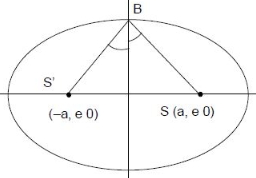
0 likes
View Solution299
DifficultMCQ
Let $O(0, 0)$ and $A(0, 1)$ be two fixed points. Then the locus of a point $P$ such that the perimeter of $\Delta AOP$ is $4$ is:
A
$9x^2 - 8y^2 + 8y = 16$
B
$8x^2 + 9y^2 - 9y = 18$
C
$9x^2 + 8y^2 - 8y = 16$
D
$8x^2 - 9y^2 + 9y = 18$
Solution
(C) Let $P = (h, k)$. The perimeter of $\Delta AOP$ is $AP + OP + AO = 4$.
Given $O(0, 0)$ and $A(0, 1)$,we have $AO = 1$.
So,$AP + OP = 4 - 1 = 3$.
Using the distance formula,$\sqrt{h^2 + (k - 1)^2} + \sqrt{h^2 + k^2} = 3$.
$\sqrt{h^2 + (k - 1)^2} = 3 - \sqrt{h^2 + k^2}$.
Squaring both sides:
$h^2 + k^2 - 2k + 1 = 9 + h^2 + k^2 - 6\sqrt{h^2 + k^2}$.
$-2k - 8 = -6\sqrt{h^2 + k^2}$.
$k + 4 = 3\sqrt{h^2 + k^2}$.
Squaring again:
$k^2 + 8k + 16 = 9(h^2 + k^2)$.
$k^2 + 8k + 16 = 9h^2 + 9k^2$.
$9h^2 + 8k^2 - 8k - 16 = 0$.
Replacing $(h, k)$ with $(x, y)$,the locus is $9x^2 + 8y^2 - 8y = 16$.
Given $O(0, 0)$ and $A(0, 1)$,we have $AO = 1$.
So,$AP + OP = 4 - 1 = 3$.
Using the distance formula,$\sqrt{h^2 + (k - 1)^2} + \sqrt{h^2 + k^2} = 3$.
$\sqrt{h^2 + (k - 1)^2} = 3 - \sqrt{h^2 + k^2}$.
Squaring both sides:
$h^2 + k^2 - 2k + 1 = 9 + h^2 + k^2 - 6\sqrt{h^2 + k^2}$.
$-2k - 8 = -6\sqrt{h^2 + k^2}$.
$k + 4 = 3\sqrt{h^2 + k^2}$.
Squaring again:
$k^2 + 8k + 16 = 9(h^2 + k^2)$.
$k^2 + 8k + 16 = 9h^2 + 9k^2$.
$9h^2 + 8k^2 - 8k - 16 = 0$.
Replacing $(h, k)$ with $(x, y)$,the locus is $9x^2 + 8y^2 - 8y = 16$.
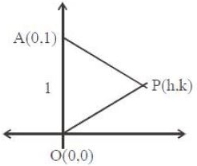
0 likes
View Solution300
DifficultMCQ
If the tangents on the ellipse $4x^2 + y^2 = 8$ at the points $(1, 2)$ and $(a, b)$ are perpendicular to each other,then $a^2$ is equal to
A
$\frac{2}{17}$
B
$\frac{4}{17}$
C
$\frac{64}{17}$
D
$\frac{128}{17}$
Solution
(A) The equation of the ellipse is $4x^2 + y^2 = 8$.
Differentiating with respect to $x$,we get $8x + 2y \frac{dy}{dx} = 0$,which implies $\frac{dy}{dx} = -\frac{4x}{y}$.
The slope of the tangent at $(1, 2)$ is $m_1 = -\frac{4(1)}{2} = -2$.
Let the slope of the tangent at $(a, b)$ be $m_2 = -\frac{4a}{b}$.
Since the tangents are perpendicular,$m_1 \times m_2 = -1$,so $(-2) \times (-\frac{4a}{b}) = -1$,which gives $\frac{8a}{b} = -1$,or $b = -8a$.
Since $(a, b)$ lies on the ellipse,$4a^2 + b^2 = 8$.
Substituting $b = -8a$,we get $4a^2 + (-8a)^2 = 8$,which simplifies to $4a^2 + 64a^2 = 8$.
Thus,$68a^2 = 8$,so $a^2 = \frac{8}{68} = \frac{2}{17}$.
Differentiating with respect to $x$,we get $8x + 2y \frac{dy}{dx} = 0$,which implies $\frac{dy}{dx} = -\frac{4x}{y}$.
The slope of the tangent at $(1, 2)$ is $m_1 = -\frac{4(1)}{2} = -2$.
Let the slope of the tangent at $(a, b)$ be $m_2 = -\frac{4a}{b}$.
Since the tangents are perpendicular,$m_1 \times m_2 = -1$,so $(-2) \times (-\frac{4a}{b}) = -1$,which gives $\frac{8a}{b} = -1$,or $b = -8a$.
Since $(a, b)$ lies on the ellipse,$4a^2 + b^2 = 8$.
Substituting $b = -8a$,we get $4a^2 + (-8a)^2 = 8$,which simplifies to $4a^2 + 64a^2 = 8$.
Thus,$68a^2 = 8$,so $a^2 = \frac{8}{68} = \frac{2}{17}$.
0 likes
View Solution10-2. Parabola, Ellipse, Hyperbola — Ellipse · Frequently Asked Questions
1Are these 10-2. Parabola, Ellipse, Hyperbola questions useful for JEE and NEET?
Yes. All questions in this section are mapped to JEE Main and NEET exam patterns. Previous year questions from JEE Main, NEET, GUJCET and state-level exams are included with full solutions.
2Can I switch to Hindi or Gujarati for these questions?
Yes. Use the language tabs in the hero section or the sidebar to view the same questions and solutions in English, Hindi or Gujarati.
3How do I generate a question paper from this subtopic?
Use the Vedclass Exam Paper Generator — select the chapter and subtopic, set difficulty, and generate Sets A, B, C, D automatically. First 3 chapters of every subject are free.
Vedclass Products
For Students
Vedclass Test Series
Mock tests in real JEE/NEET style with performance analysis. 5-day free trial.
Start Free TrialFor Teachers
Exam Paper Generator
Generate Set A/B/C/D papers from this chapter in 2 minutes. 3 chapters free.
Try FreeFor Institutes
Online Exam Module
Live online exams with unlimited students, 360° analytics & white-label branding.
See DemoFor Teachers & Institutes
Generate a 10-2. Parabola, Ellipse, Hyperbola Exam Paper in 2 Minutes
Select subtopic & difficulty — Sets A, B, C, D auto-generated with No Repeat logic.
First 3 chapters of every subject are free — no payment required.