
A English
Atomic models and Planck's quantum theory Questions in English
Class 11 Chemistry · Structure of Atom · Atomic models and Planck's quantum theory
851+
Questions
English
Language
100%
With Solutions
Showing 50 of 851 questions in English
251
MediumMCQ
Going from $K$-shell to $N$-shell in case of $H$-atom :
A
$K.E.$ decreases
B
Total energy decreases
C
Potential energy decreases
D
None of the above
Solution
(A) For a hydrogen-like atom,the energy of an electron in the $n^{th}$ shell is given by $E_n = -13.6 \times \frac{Z^2}{n^2} \ eV$.
As the shell number $n$ increases from $K$ $(n=1)$ to $N$ $(n=4)$,the value of $n$ increases.
$1$. $K.E. = |E_n| = 13.6 \times \frac{Z^2}{n^2}$. As $n$ increases,$K.E.$ decreases.
$2$. Total energy $E_n = -13.6 \times \frac{Z^2}{n^2}$. As $n$ increases,the magnitude of the negative value decreases,meaning the total energy increases.
$3$. Potential energy $P.E. = 2 \times E_n = -27.2 \times \frac{Z^2}{n^2}$. As $n$ increases,the magnitude of the negative value decreases,meaning the potential energy increases.
Therefore,the kinetic energy decreases as the electron moves to a higher shell.
As the shell number $n$ increases from $K$ $(n=1)$ to $N$ $(n=4)$,the value of $n$ increases.
$1$. $K.E. = |E_n| = 13.6 \times \frac{Z^2}{n^2}$. As $n$ increases,$K.E.$ decreases.
$2$. Total energy $E_n = -13.6 \times \frac{Z^2}{n^2}$. As $n$ increases,the magnitude of the negative value decreases,meaning the total energy increases.
$3$. Potential energy $P.E. = 2 \times E_n = -27.2 \times \frac{Z^2}{n^2}$. As $n$ increases,the magnitude of the negative value decreases,meaning the potential energy increases.
Therefore,the kinetic energy decreases as the electron moves to a higher shell.
0 likes
View Solution252
MediumMCQ
What is the radius ratio for the $2^{nd}$ orbit of $Li^{+2}$ ion to the $3^{rd}$ orbit of $Be^{+3}$ ion?
A
$3 : 1$
B
$16 : 27$
C
$4 : 9$
D
$3 : 4$
Solution
(B) The radius of an orbit in a hydrogen-like species is given by the formula: $r_n = a_0 \times \frac{n^2}{Z}$,where $a_0$ is the Bohr radius,$n$ is the orbit number,and $Z$ is the atomic number.
For $Li^{+2}$ ion $(Z=3)$: $n_1 = 2$,$Z_1 = 3$. So,$r_1 = a_0 \times \frac{2^2}{3} = a_0 \times \frac{4}{3}$.
For $Be^{+3}$ ion $(Z=4)$: $n_2 = 3$,$Z_2 = 4$. So,$r_2 = a_0 \times \frac{3^2}{4} = a_0 \times \frac{9}{4}$.
The ratio is $\frac{r_1}{r_2} = \frac{4/3}{9/4} = \frac{4}{3} \times \frac{4}{9} = \frac{16}{27}$.
For $Li^{+2}$ ion $(Z=3)$: $n_1 = 2$,$Z_1 = 3$. So,$r_1 = a_0 \times \frac{2^2}{3} = a_0 \times \frac{4}{3}$.
For $Be^{+3}$ ion $(Z=4)$: $n_2 = 3$,$Z_2 = 4$. So,$r_2 = a_0 \times \frac{3^2}{4} = a_0 \times \frac{9}{4}$.
The ratio is $\frac{r_1}{r_2} = \frac{4/3}{9/4} = \frac{4}{3} \times \frac{4}{9} = \frac{16}{27}$.
0 likes
View Solution253
MediumMCQ
The ratio of the energy of the electrons in the ground state of hydrogen to the electrons in the first excited state of $Be^{3+}$ is:
A
$1:4$
B
$1:8$
C
$1:16$
D
$16:1$
Solution
(A) The energy of an electron in a hydrogen-like species is given by the formula: $E_n = E_0 \frac{Z^2}{n^2}$,where $E_0$ is the ground state energy of hydrogen,$Z$ is the atomic number,and $n$ is the principal quantum number.
For hydrogen in the ground state $(n=1, Z=1)$:
$E_H = E_0 \frac{1^2}{1^2} = E_0$
For $Be^{3+}$ in the first excited state $(n=2, Z=4)$:
$E_{Be^{3+}} = E_0 \frac{4^2}{2^2} = E_0 \frac{16}{4} = 4E_0$
The ratio of the energy of the electron in the ground state of hydrogen to the energy of the electron in the first excited state of $Be^{3+}$ is:
Ratio $= \frac{E_H}{E_{Be^{3+}}} = \frac{E_0}{4E_0} = \frac{1}{4} = 1:4$
For hydrogen in the ground state $(n=1, Z=1)$:
$E_H = E_0 \frac{1^2}{1^2} = E_0$
For $Be^{3+}$ in the first excited state $(n=2, Z=4)$:
$E_{Be^{3+}} = E_0 \frac{4^2}{2^2} = E_0 \frac{16}{4} = 4E_0$
The ratio of the energy of the electron in the ground state of hydrogen to the energy of the electron in the first excited state of $Be^{3+}$ is:
Ratio $= \frac{E_H}{E_{Be^{3+}}} = \frac{E_0}{4E_0} = \frac{1}{4} = 1:4$
0 likes
View Solution254
MediumMCQ
Normally,the time taken in an electronic transition is approximately:
A
Zero
B
$1 \, sec$
C
$10^{-5} \, sec$
D
$10^{-8} \, sec$
Solution
(D) In an electronic transition,an electron jumps from a higher energy level to a lower energy level.
This process is extremely rapid.
The time taken for such an electronic transition is typically of the order of $10^{-8} \, sec$.
This process is extremely rapid.
The time taken for such an electronic transition is typically of the order of $10^{-8} \, sec$.
0 likes
View Solution255
MediumMCQ
The total energy of an atomic electron is :
A
Zero
B
Less than zero
C
More than zero
D
Sometimes more and sometimes less than zero
Solution
(B) The total energy of an electron in an atom is given by the expression $E_n = -\frac{13.6 \ Z^2}{n^2} \ eV$.
Since the electron is bound to the nucleus by electrostatic forces of attraction,the potential energy is negative and its magnitude is greater than the kinetic energy.
Therefore,the total energy (sum of kinetic and potential energy) is always negative,indicating that the electron is in a bound state.
Since the electron is bound to the nucleus by electrostatic forces of attraction,the potential energy is negative and its magnitude is greater than the kinetic energy.
Therefore,the total energy (sum of kinetic and potential energy) is always negative,indicating that the electron is in a bound state.
0 likes
View Solution256
MediumMCQ
The energy of the electron at infinite distance from the nucleus in Bohr’s model is taken as:
A
Zero
B
Positive
C
Negative
D
Any value
Solution
(A) In the Bohr model,the energy of an electron in the $n^{th}$ orbit is given by the expression $E_{n} = -13.6 \times \frac{Z^{2}}{n^{2}} \text{ eV}$.
As the distance from the nucleus increases,the value of $n$ increases.
When the electron is at an infinite distance from the nucleus,$n = \infty$.
Substituting $n = \infty$ into the formula,we get $E_{\infty} = -13.6 \times \frac{Z^{2}}{\infty^{2}} = 0$.
Therefore,the energy of the electron at infinite distance from the nucleus is taken as zero.
As the distance from the nucleus increases,the value of $n$ increases.
When the electron is at an infinite distance from the nucleus,$n = \infty$.
Substituting $n = \infty$ into the formula,we get $E_{\infty} = -13.6 \times \frac{Z^{2}}{\infty^{2}} = 0$.
Therefore,the energy of the electron at infinite distance from the nucleus is taken as zero.
0 likes
View Solution257
EasyMCQ
As an electron is brought from an infinite distance close to the nucleus of the atom,the energy of the electron-nucleus system :
A
Increases to a greater positive value
B
Decreases to a smaller positive value
C
Decreases to a smaller negative value
D
Increases to a smaller negative value
Solution
(C) The energy of an electron at an infinite distance from the nucleus is defined as $0$.
As the electron approaches the nucleus,it becomes bound to the nucleus,and the system releases energy,resulting in a negative potential energy.
The energy of an electron in a hydrogen-like atom is given by $E_n = -\frac{13.6 \ Z^2}{n^2} \ eV$.
As the distance from the nucleus decreases (i.e.,$n$ decreases),the value of $E_n$ becomes more negative (i.e.,it decreases).
Therefore,the energy decreases to a greater negative value.
As the electron approaches the nucleus,it becomes bound to the nucleus,and the system releases energy,resulting in a negative potential energy.
The energy of an electron in a hydrogen-like atom is given by $E_n = -\frac{13.6 \ Z^2}{n^2} \ eV$.
As the distance from the nucleus decreases (i.e.,$n$ decreases),the value of $E_n$ becomes more negative (i.e.,it decreases).
Therefore,the energy decreases to a greater negative value.
0 likes
View Solution258
MediumMCQ
Which electron transition in a hydrogen atom requires the largest amount of energy?
A
From $n = 1$ to $n = 2$
B
From $n = 2$ to $n = 3$
C
From $n = \infty$ to $n = 1$
D
From $n = 3$ to $n = 5$
Solution
(A) The energy change for an electron transition in a hydrogen atom is given by $\Delta E = 13.6 \ \text{eV} \times Z^2 \left( \frac{1}{n_1^2} - \frac{1}{n_2^2} \right)$.
For a transition from $n_1$ to $n_2$,the energy required is proportional to $\left( \frac{1}{n_1^2} - \frac{1}{n_2^2} \right)$.
Comparing the options:
$A$: $n=1$ to $n=2$,$\Delta E \propto (1 - 0.25) = 0.75$.
$B$: $n=2$ to $n=3$,$\Delta E \propto (0.25 - 0.111) = 0.139$.
$C$: $n=\infty$ to $n=1$ represents an emission (energy release),not absorption.
$D$: $n=3$ to $n=5$,$\Delta E \propto (0.111 - 0.04) = 0.071$.
The transition from $n=1$ to $n=2$ requires the largest amount of energy among the given absorption transitions.
For a transition from $n_1$ to $n_2$,the energy required is proportional to $\left( \frac{1}{n_1^2} - \frac{1}{n_2^2} \right)$.
Comparing the options:
$A$: $n=1$ to $n=2$,$\Delta E \propto (1 - 0.25) = 0.75$.
$B$: $n=2$ to $n=3$,$\Delta E \propto (0.25 - 0.111) = 0.139$.
$C$: $n=\infty$ to $n=1$ represents an emission (energy release),not absorption.
$D$: $n=3$ to $n=5$,$\Delta E \propto (0.111 - 0.04) = 0.071$.
The transition from $n=1$ to $n=2$ requires the largest amount of energy among the given absorption transitions.
0 likes
View Solution259
EasyMCQ
Bohr’s model of atom explains :
A
Zeeman effect
B
Heisenberg’s principle
C
Stark effect
D
None of these
Solution
(D) Bohr’s model of the atom was successful in explaining the stability of the atom and the line spectra of hydrogen-like species.
However,it failed to explain the splitting of spectral lines in the presence of an external magnetic field (Zeeman effect) or an external electric field (Stark effect).
It also contradicts Heisenberg’s uncertainty principle,as it assumes definite paths for electrons.
Therefore,none of the given phenomena are explained by Bohr’s model.
However,it failed to explain the splitting of spectral lines in the presence of an external magnetic field (Zeeman effect) or an external electric field (Stark effect).
It also contradicts Heisenberg’s uncertainty principle,as it assumes definite paths for electrons.
Therefore,none of the given phenomena are explained by Bohr’s model.
0 likes
View Solution260
EasyMCQ
Bohr’s atomic theory gave the idea of :
A
Quantum numbers
B
Shape of sublevels
C
Nucleus
D
Stationary states
Solution
(D) Bohr's atomic theory introduced the concept of stationary states or stable orbits in which electrons revolve around the nucleus without radiating energy. This concept successfully addressed the instability issue present in Rutherford's atomic model.
0 likes
View Solution261
MediumMCQ
The ionization potential of hydrogen atom is $13.6 \ eV$. The energy required to remove an electron from the $n = 2$ state of hydrogen atom is : ............ $eV$
A
$27.2$
B
$13.6$
C
$6.8$
D
$3.4$
Solution
(D) The energy of an electron in the $n^{th}$ orbit of a hydrogen atom is given by the formula $E_n = \frac{-13.6}{n^2} \ eV$.
For the $n = 2$ state,the energy is $E_2 = \frac{-13.6}{2^2} = \frac{-13.6}{4} = -3.4 \ eV$.
To remove an electron from the $n = 2$ state to infinity ($n = \infty$,where $E = 0$),the energy required is $\Delta E = E_{\infty} - E_2 = 0 - (-3.4 \ eV) = 3.4 \ eV$.
For the $n = 2$ state,the energy is $E_2 = \frac{-13.6}{2^2} = \frac{-13.6}{4} = -3.4 \ eV$.
To remove an electron from the $n = 2$ state to infinity ($n = \infty$,where $E = 0$),the energy required is $\Delta E = E_{\infty} - E_2 = 0 - (-3.4 \ eV) = 3.4 \ eV$.
0 likes
View Solution262
MediumMCQ
The total energy of the electron in the hydrogen atom in the ground state is $-13.6 \, eV$. What is the stopping potential in volts required to remove this electron from the ground state?
A
$13.6$
B
$0$
C
$-13.6$
D
$6.8$
Solution
(A) The total energy of an electron in the ground state of a hydrogen atom is $E = -13.6 \, eV$.
To remove the electron from the ground state (ionize it),we must provide energy equal to the binding energy,which is $|E| = 13.6 \, eV$.
This energy is provided as kinetic energy to the emitted electron.
The stopping potential $V_s$ is related to the maximum kinetic energy $K_{max}$ by the equation $K_{max} = e \times V_s$.
Since $K_{max} = 13.6 \, eV$,we have $13.6 \, eV = e \times V_s$.
Therefore,$V_s = 13.6 \, V$.
To remove the electron from the ground state (ionize it),we must provide energy equal to the binding energy,which is $|E| = 13.6 \, eV$.
This energy is provided as kinetic energy to the emitted electron.
The stopping potential $V_s$ is related to the maximum kinetic energy $K_{max}$ by the equation $K_{max} = e \times V_s$.
Since $K_{max} = 13.6 \, eV$,we have $13.6 \, eV = e \times V_s$.
Therefore,$V_s = 13.6 \, V$.
0 likes
View Solution263
EasyMCQ
Bohr's model cannot explain the emission spectrum of
A
$H$
B
$He^{+}$
C
$Li^{2+}$
D
$Na$
Solution
(D) Bohr's model is applicable only to hydrogen-like species,which are systems containing only one electron.
$H$ has $1$ electron,$He^{+}$ has $2-1 = 1$ electron,and $Li^{2+}$ has $3-2 = 1$ electron.
$Na$ (Sodium) has $11$ electrons.
Since $Na$ is a multi-electron system,Bohr's model cannot explain its emission spectrum.
$H$ has $1$ electron,$He^{+}$ has $2-1 = 1$ electron,and $Li^{2+}$ has $3-2 = 1$ electron.
$Na$ (Sodium) has $11$ electrons.
Since $Na$ is a multi-electron system,Bohr's model cannot explain its emission spectrum.
0 likes
View Solution264
EasyMCQ
Angular momentum of an electron in the $n^{th}$ orbit of a hydrogen atom is given by
A
$\frac{2\pi}{nh}$
B
$\frac{\pi}{2nh}$
C
$\frac{nh}{2\pi}$
D
$nh$
Solution
(C) According to Bohr's postulate,the angular momentum $(L)$ of an electron revolving in the $n^{th}$ orbit is quantized.
The formula for angular momentum is given by $L = mvr = \frac{nh}{2\pi}$,where $n$ is the principal quantum number,$h$ is Planck's constant,and $m, v, r$ are the mass,velocity,and radius of the orbit respectively.
Thus,the correct expression is $\frac{nh}{2\pi}$.
The formula for angular momentum is given by $L = mvr = \frac{nh}{2\pi}$,where $n$ is the principal quantum number,$h$ is Planck's constant,and $m, v, r$ are the mass,velocity,and radius of the orbit respectively.
Thus,the correct expression is $\frac{nh}{2\pi}$.
0 likes
View Solution265
EasyMCQ
The maximum energy is possessed by an electron when it is present:
A
in the nucleus
B
in the ground energy state
C
in the first excited state
D
at infinite distance from the nucleus
Solution
(D) The energy of an electron in a hydrogen-like atom is given by the formula $E_n = -\frac{13.6 Z^2}{n^2} \text{ eV}$.
As the principal quantum number $n$ increases,the value of $E_n$ becomes less negative,which means the energy increases.
As $n \to \infty$,the energy $E_n$ approaches $0$,which is the maximum possible energy for a bound electron.
Therefore,an electron possesses maximum energy when it is at an infinite distance from the nucleus.
As the principal quantum number $n$ increases,the value of $E_n$ becomes less negative,which means the energy increases.
As $n \to \infty$,the energy $E_n$ approaches $0$,which is the maximum possible energy for a bound electron.
Therefore,an electron possesses maximum energy when it is at an infinite distance from the nucleus.
0 likes
View Solution266
EasyMCQ
As we move away from the nucleus,the energy of the electron
A
decreases
B
remains the same
C
increases
D
first decreases then increases
Solution
(C) The energy of an electron in the $n^{\text{th}}$ shell is given by the formula:
$E_n = -13.6 \frac{Z^2}{n^2} \ \text{eV}$
As we move away from the nucleus,the principal quantum number $n$ increases.
Since the energy expression has a negative sign,as $n$ increases,the value of $\frac{1}{n^2}$ decreases,making the total energy $E_n$ less negative (i.e.,it becomes more positive).
Therefore,the energy of the electron increases as it moves further from the nucleus.
$E_n = -13.6 \frac{Z^2}{n^2} \ \text{eV}$
As we move away from the nucleus,the principal quantum number $n$ increases.
Since the energy expression has a negative sign,as $n$ increases,the value of $\frac{1}{n^2}$ decreases,making the total energy $E_n$ less negative (i.e.,it becomes more positive).
Therefore,the energy of the electron increases as it moves further from the nucleus.
0 likes
View Solution267
MediumMCQ
Which of the following electronic transitions in a hydrogen atom will require the largest amount of energy?
A
from $n=1$ to $n=2$
B
from $n=2$ to $n=3$
C
from $n=1$ to $n=\infty$
D
from $n=3$ to $n=5$
Solution
(C) The energy difference for an electronic transition in a hydrogen atom is given by $\Delta E = 13.6 \times Z^2 \times (\frac{1}{n_1^2} - \frac{1}{n_2^2}) \text{ eV}$.
For a hydrogen atom,$Z=1$,so $\Delta E = 13.6 \times (\frac{1}{n_1^2} - \frac{1}{n_2^2}) \text{ eV}$.
Calculating the energy for each transition:
$A$: $n=1$ to $n=2$,$\Delta E = 13.6 \times (1 - 1/4) = 13.6 \times 0.75 = 10.2 \text{ eV}$.
$B$: $n=2$ to $n=3$,$\Delta E = 13.6 \times (1/4 - 1/9) = 13.6 \times 0.138 = 1.89 \text{ eV}$.
$C$: $n=1$ to $n=\infty$,$\Delta E = 13.6 \times (1 - 0) = 13.6 \text{ eV}$.
$D$: $n=3$ to $n=5$,$\Delta E = 13.6 \times (1/9 - 1/25) = 13.6 \times 0.071 = 0.97 \text{ eV}$.
Comparing the values,the transition from $n=1$ to $n=\infty$ requires the largest amount of energy.
For a hydrogen atom,$Z=1$,so $\Delta E = 13.6 \times (\frac{1}{n_1^2} - \frac{1}{n_2^2}) \text{ eV}$.
Calculating the energy for each transition:
$A$: $n=1$ to $n=2$,$\Delta E = 13.6 \times (1 - 1/4) = 13.6 \times 0.75 = 10.2 \text{ eV}$.
$B$: $n=2$ to $n=3$,$\Delta E = 13.6 \times (1/4 - 1/9) = 13.6 \times 0.138 = 1.89 \text{ eV}$.
$C$: $n=1$ to $n=\infty$,$\Delta E = 13.6 \times (1 - 0) = 13.6 \text{ eV}$.
$D$: $n=3$ to $n=5$,$\Delta E = 13.6 \times (1/9 - 1/25) = 13.6 \times 0.071 = 0.97 \text{ eV}$.
Comparing the values,the transition from $n=1$ to $n=\infty$ requires the largest amount of energy.
0 likes
View Solution268
MediumMCQ
In Bohr's model of the atom,when an electron jumps from $n=1$ to $n=3$,how much energy will be absorbed?
A
$2.15 \times 10^{-10} \, ergs$
B
$0.1911 \times 10^{-10} \, ergs$
C
$2.389 \times 10^{-10} \, ergs$
D
$0.239 \times 10^{-10} \, ergs$
Solution
(B) The energy of an electron in the $n$-th orbit of a hydrogen atom is given by $E_n = -\frac{2.18 \times 10^{-11}}{n^2} \, ergs$.
For $n=1$,$E_1 = -2.18 \times 10^{-11} \, ergs$.
For $n=3$,$E_3 = -\frac{2.18 \times 10^{-11}}{3^2} = -\frac{2.18 \times 10^{-11}}{9} \approx -0.2422 \times 10^{-11} \, ergs$.
The energy absorbed is $\Delta E = E_3 - E_1 = (-0.2422 \times 10^{-11}) - (-2.18 \times 10^{-11}) = 1.9378 \times 10^{-11} \, ergs = 0.19378 \times 10^{-10} \, ergs$.
Comparing this with the given options,the closest value is $0.1911 \times 10^{-10} \, ergs$.
For $n=1$,$E_1 = -2.18 \times 10^{-11} \, ergs$.
For $n=3$,$E_3 = -\frac{2.18 \times 10^{-11}}{3^2} = -\frac{2.18 \times 10^{-11}}{9} \approx -0.2422 \times 10^{-11} \, ergs$.
The energy absorbed is $\Delta E = E_3 - E_1 = (-0.2422 \times 10^{-11}) - (-2.18 \times 10^{-11}) = 1.9378 \times 10^{-11} \, ergs = 0.19378 \times 10^{-10} \, ergs$.
Comparing this with the given options,the closest value is $0.1911 \times 10^{-10} \, ergs$.
0 likes
View Solution269
MediumMCQ
If the energy of the electron in a hydrogen atom in some excited state is $-3.4 \ eV,$ then what will be its angular momentum?
A
$1.8 \times 10^{-34} \ kg \ m^2 \ s^{-1}$
B
$2.1 \times 10^{-34} \ kg \ m^2 \ s^{-1}$
C
$9.2 \times 10^{-37} \ kg \ m^2 \ s^{-1}$
D
$1.2 \times 10^{-32} \ kg \ m^2 \ s^{-1}$
Solution
(B) Given,$E = -3.4 \ eV$.
The energy of an electron in the $n^{th}$ orbit is given by $E = -\frac{13.6 \ eV}{n^2}$.
Substituting the value: $-3.4 = -\frac{13.6}{n^2} \implies n^2 = \frac{13.6}{3.4} = 4 \implies n = 2$.
According to Bohr's postulate,the angular momentum $L$ is given by $L = \frac{nh}{2\pi}$.
For $n = 2$,$L = \frac{2h}{2\pi} = \frac{h}{\pi}$.
Using $h = 6.626 \times 10^{-34} \ J \ s$ and $\pi \approx 3.14$:
$L = \frac{6.626 \times 10^{-34}}{3.14} \approx 2.11 \times 10^{-34} \ kg \ m^2 \ s^{-1}$.
Thus,the correct option is $B$.
The energy of an electron in the $n^{th}$ orbit is given by $E = -\frac{13.6 \ eV}{n^2}$.
Substituting the value: $-3.4 = -\frac{13.6}{n^2} \implies n^2 = \frac{13.6}{3.4} = 4 \implies n = 2$.
According to Bohr's postulate,the angular momentum $L$ is given by $L = \frac{nh}{2\pi}$.
For $n = 2$,$L = \frac{2h}{2\pi} = \frac{h}{\pi}$.
Using $h = 6.626 \times 10^{-34} \ J \ s$ and $\pi \approx 3.14$:
$L = \frac{6.626 \times 10^{-34}}{3.14} \approx 2.11 \times 10^{-34} \ kg \ m^2 \ s^{-1}$.
Thus,the correct option is $B$.
0 likes
View Solution270
EasyMCQ
The potential energy of an electron in an atom is given by:
A
$Z e^2 / r$
B
$- Z e^2 / r$
C
$Z e^2 / r^2$
D
$- Z e^2 / r^2$
Solution
(B) The potential energy $(PE)$ of an electron at a distance $r$ from the nucleus of charge $Ze$ is given by the electrostatic potential energy formula:
$PE = \frac{k_e q_1 q_2}{r}$
Here,$q_1 = Ze$ (charge of the nucleus) and $q_2 = -e$ (charge of the electron).
Thus,$PE = \frac{k_e (Ze)(-e)}{r} = -\frac{k_e Z e^2}{r}$.
In Gaussian units where $k_e = 1$,the expression simplifies to $PE = -\frac{Z e^2}{r}$.
$PE = \frac{k_e q_1 q_2}{r}$
Here,$q_1 = Ze$ (charge of the nucleus) and $q_2 = -e$ (charge of the electron).
Thus,$PE = \frac{k_e (Ze)(-e)}{r} = -\frac{k_e Z e^2}{r}$.
In Gaussian units where $k_e = 1$,the expression simplifies to $PE = -\frac{Z e^2}{r}$.
0 likes
View Solution271
EasyMCQ
The electrostatic force of attraction between the electron and the nucleus in a hydrogen atom is given by:
A
$\frac{e^2}{r}$
B
$\frac{e^2}{r^2}$
C
$\frac{e^2}{2r^2}$
D
$\frac{Ze^2}{r}$
Solution
(B) According to Coulomb's law,the electrostatic force of attraction $(F)$ between two point charges $q_1$ and $q_2$ separated by a distance $r$ is given by the formula: $F = k \frac{|q_1 q_2|}{r^2}$.
In a hydrogen atom,the nucleus has a charge of $+e$ (where $Z=1$) and the electron has a charge of $-e$.
Substituting these values into the formula,we get: $F = k \frac{|(+e)(-e)|}{r^2} = k \frac{e^2}{r^2}$.
Assuming the constant $k$ is taken as unity in the given options,the expression simplifies to $\frac{e^2}{r^2}$.
In a hydrogen atom,the nucleus has a charge of $+e$ (where $Z=1$) and the electron has a charge of $-e$.
Substituting these values into the formula,we get: $F = k \frac{|(+e)(-e)|}{r^2} = k \frac{e^2}{r^2}$.
Assuming the constant $k$ is taken as unity in the given options,the expression simplifies to $\frac{e^2}{r^2}$.
0 likes
View Solution272
EasyMCQ
Which one of the following is incorrect for the Bohr model of the hydrogen atom?
A
$\frac{Ze^2}{r^2} = \frac{mv^2}{r}$
B
Angular momentum is quantized
C
Mass of proton is ignored
D
None of the above
Solution
(C) According to Bohr's model of the hydrogen atom:
$1$. The centripetal force required for the circular motion of the electron is provided by the electrostatic force of attraction between the nucleus and the electron,given by $\frac{mv^2}{r} = \frac{Ze^2}{r^2}$. Thus,option $A$ is correct.
$2$. Bohr postulated that the angular momentum of an electron in a stationary orbit is quantized,given by $mvr = \frac{nh}{2\pi}$. Thus,option $B$ is correct.
$3$. In the Bohr model,the nucleus is assumed to be stationary,but the mass of the proton (nucleus) is not ignored; rather,the model assumes the nucleus is infinitely heavy compared to the electron. However,stating that the 'mass of the proton is ignored' is technically incorrect as the model relies on the electrostatic interaction between the proton and electron.
Therefore,option $C$ is the incorrect statement.
$1$. The centripetal force required for the circular motion of the electron is provided by the electrostatic force of attraction between the nucleus and the electron,given by $\frac{mv^2}{r} = \frac{Ze^2}{r^2}$. Thus,option $A$ is correct.
$2$. Bohr postulated that the angular momentum of an electron in a stationary orbit is quantized,given by $mvr = \frac{nh}{2\pi}$. Thus,option $B$ is correct.
$3$. In the Bohr model,the nucleus is assumed to be stationary,but the mass of the proton (nucleus) is not ignored; rather,the model assumes the nucleus is infinitely heavy compared to the electron. However,stating that the 'mass of the proton is ignored' is technically incorrect as the model relies on the electrostatic interaction between the proton and electron.
Therefore,option $C$ is the incorrect statement.
0 likes
View Solution273
EasyMCQ
In which orbit of the Bohr model of the hydrogen atom is the speed of the electron maximum?
A
$n = 2$
B
$n = 1$
C
$n = 3$
D
$n = 4$
Solution
(B) The velocity of an electron in the $n^{th}$ orbit of a hydrogen-like atom is given by the formula: $v_n = 2.18 \times 10^8 \times \frac{Z}{n} \ \text{cm s}^{-1}$.
For the hydrogen atom,the atomic number $Z = 1$.
Thus,$v_n = 2.18 \times 10^8 \times \frac{1}{n} \ \text{cm s}^{-1}$.
For the speed $v_n$ to be maximum,the denominator $n$ must be the smallest possible integer.
Since the orbit number $n$ starts from $1$,the speed is maximum at $n = 1$.
For the hydrogen atom,the atomic number $Z = 1$.
Thus,$v_n = 2.18 \times 10^8 \times \frac{1}{n} \ \text{cm s}^{-1}$.
For the speed $v_n$ to be maximum,the denominator $n$ must be the smallest possible integer.
Since the orbit number $n$ starts from $1$,the speed is maximum at $n = 1$.
0 likes
View Solution274
DifficultMCQ
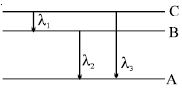
Energy levels $A, B, C$ of a certain atom correspond to increasing values of energy,$i.e.,$ $E_A < E_B < E_C$. If $\lambda_1, \lambda_2$ and $\lambda_3$ are the wavelengths of radiations corresponding to the transitions $C$ to $B$,$B$ to $A$ and $C$ to $A$ respectively,which of the following statements is correct?
A
$\lambda_3 = \lambda_1 + \lambda_2$
B
$\lambda_3 = \frac{\lambda_1 \lambda_2}{\lambda_1 + \lambda_2}$
C
$\lambda_1 + \lambda_2 + \lambda_3 = 0$
D
$\lambda_3^2 = \lambda_1^2 + \lambda_2^2$
Solution
(B) The energy difference for the transition from $C$ to $A$ is the sum of the energy differences for the transitions from $C$ to $B$ and $B$ to $A$.
$E_C - E_A = (E_C - E_B) + (E_B - E_A)$
Since energy $E = \frac{hc}{\lambda}$,we can write:
$\frac{hc}{\lambda_3} = \frac{hc}{\lambda_1} + \frac{hc}{\lambda_2}$
Dividing both sides by $hc$:
$\frac{1}{\lambda_3} = \frac{1}{\lambda_1} + \frac{1}{\lambda_2}$
$\frac{1}{\lambda_3} = \frac{\lambda_2 + \lambda_1}{\lambda_1 \lambda_2}$
Therefore,$\lambda_3 = \frac{\lambda_1 \lambda_2}{\lambda_1 + \lambda_2}$.
$E_C - E_A = (E_C - E_B) + (E_B - E_A)$
Since energy $E = \frac{hc}{\lambda}$,we can write:
$\frac{hc}{\lambda_3} = \frac{hc}{\lambda_1} + \frac{hc}{\lambda_2}$
Dividing both sides by $hc$:
$\frac{1}{\lambda_3} = \frac{1}{\lambda_1} + \frac{1}{\lambda_2}$
$\frac{1}{\lambda_3} = \frac{\lambda_2 + \lambda_1}{\lambda_1 \lambda_2}$
Therefore,$\lambda_3 = \frac{\lambda_1 \lambda_2}{\lambda_1 + \lambda_2}$.
0 likes
View Solution275
MediumMCQ
Binding energy of a hydrogen atom is $13.6 \ eV$. The binding energy of a singly ionized helium atom is : ............ $eV$
A
$13.6$
B
$27.2$
C
$54.4$
D
$3.4$
Solution
(C) The binding energy of a hydrogen-like species is given by the formula $E_n = -13.6 \times \frac{Z^2}{n^2} \ eV$.
For a hydrogen atom,$Z = 1$ and $n = 1$,so $E_H = 13.6 \ eV$.
For a singly ionized helium atom $(He^+)$,$Z = 2$ and $n = 1$.
Therefore,$E_{He^+} = 13.6 \times \frac{2^2}{1^2} \ eV$.
$E_{He^+} = 13.6 \times 4 \ eV = 54.4 \ eV$.
For a hydrogen atom,$Z = 1$ and $n = 1$,so $E_H = 13.6 \ eV$.
For a singly ionized helium atom $(He^+)$,$Z = 2$ and $n = 1$.
Therefore,$E_{He^+} = 13.6 \times \frac{2^2}{1^2} \ eV$.
$E_{He^+} = 13.6 \times 4 \ eV = 54.4 \ eV$.
0 likes
View Solution276
MediumMCQ
What transition in the hydrogen spectrum has the same wavelength as the Balmer transition,$n=4$ to $n=2$,of the $He^{+}$ spectrum?
A
$3 \rightarrow 2$
B
$2 \rightarrow 3$
C
$2 \rightarrow 2$
D
$2 \rightarrow 1$
Solution
(D) The wave number for the transition of $n=4$ to $n=2$ in the $He^{+}$ spectrum is given by the Rydberg formula: $\bar{\nu} = R Z^{2} ( \frac{1}{n_{1}^{2}} - \frac{1}{n_{2}^{2}} )$.
For $He^{+}$,$Z=2$,$n_{1}=2$,and $n_{2}=4$:
$\bar{\nu} = R(2)^{2} ( \frac{1}{2^{2}} - \frac{1}{4^{2}} ) = 4R ( \frac{1}{4} - \frac{1}{16} ) = 4R ( \frac{3}{16} ) = \frac{3R}{4}$.
Thus,the wavelength $\lambda = \frac{4}{3R}$.
For the hydrogen atom $(Z=1)$,we seek a transition $n_{2} \rightarrow n_{1}$ such that $\bar{\nu} = R(1)^{2} ( \frac{1}{n_{1}^{2}} - \frac{1}{n_{2}^{2}} ) = \frac{3R}{4}$.
This simplifies to $( \frac{1}{n_{1}^{2}} - \frac{1}{n_{2}^{2}} ) = \frac{3}{4}$.
Testing values,if $n_{1}=1$ and $n_{2}=2$,then $( \frac{1}{1^{2}} - \frac{1}{2^{2}} ) = 1 - \frac{1}{4} = \frac{3}{4}$.
Therefore,the transition $n=2 \rightarrow n=1$ in hydrogen has the same wavelength.
For $He^{+}$,$Z=2$,$n_{1}=2$,and $n_{2}=4$:
$\bar{\nu} = R(2)^{2} ( \frac{1}{2^{2}} - \frac{1}{4^{2}} ) = 4R ( \frac{1}{4} - \frac{1}{16} ) = 4R ( \frac{3}{16} ) = \frac{3R}{4}$.
Thus,the wavelength $\lambda = \frac{4}{3R}$.
For the hydrogen atom $(Z=1)$,we seek a transition $n_{2} \rightarrow n_{1}$ such that $\bar{\nu} = R(1)^{2} ( \frac{1}{n_{1}^{2}} - \frac{1}{n_{2}^{2}} ) = \frac{3R}{4}$.
This simplifies to $( \frac{1}{n_{1}^{2}} - \frac{1}{n_{2}^{2}} ) = \frac{3}{4}$.
Testing values,if $n_{1}=1$ and $n_{2}=2$,then $( \frac{1}{1^{2}} - \frac{1}{2^{2}} ) = 1 - \frac{1}{4} = \frac{3}{4}$.
Therefore,the transition $n=2 \rightarrow n=1$ in hydrogen has the same wavelength.
0 likes
View Solution277
EasyMCQ
In the case of a hydrogen atom,when an electron falls from a higher energy level to the $M$ shell,the corresponding spectral line will form a part of:
A
Balmer series
B
Lyman series
C
Paschen series
D
Pfund series
Solution
(C) The energy levels in a hydrogen atom are denoted by the principal quantum number $n$.
The $K$ shell corresponds to $n = 1$,the $L$ shell to $n = 2$,and the $M$ shell to $n = 3$.
When an electron transitions from any higher energy level $(n_2 > 3)$ to the $M$ shell $(n_1 = 3)$,the resulting spectral lines belong to the Paschen series.
Therefore,the correct option is $C$.
The $K$ shell corresponds to $n = 1$,the $L$ shell to $n = 2$,and the $M$ shell to $n = 3$.
When an electron transitions from any higher energy level $(n_2 > 3)$ to the $M$ shell $(n_1 = 3)$,the resulting spectral lines belong to the Paschen series.
Therefore,the correct option is $C$.
0 likes
View Solution278
MediumMCQ
Which of the following statements is incorrect?
A
The third quantum shell can hold a maximum of $18$ electrons
B
An electron falling to the same energy level from any higher level always emits the same quantum of energy
C
The Balmer series of lines is in the visible region of the emission spectrum of hydrogen atom
D
The electron of hydrogen atom in its ground state remains in the first quantum shell
Solution
(B) The maximum number of electrons in a shell is given by $2n^2$. For the third shell $(n=3)$,the maximum number of electrons is $2(3)^2 = 18$. Thus,option $A$ is correct.
When an electron falls from a higher energy level $(n_2)$ to a lower energy level $(n_1)$,the energy emitted is given by $\Delta E = E_{n_2} - E_{n_1}$. Since the energy levels are different,the energy emitted depends on the initial level $(n_2)$. Therefore,falling to the same level from different higher levels results in different amounts of energy being emitted. Thus,option $B$ is incorrect.
The Balmer series corresponds to transitions where the electron falls to the $n=2$ level,which lies in the visible region. Thus,option $C$ is correct.
The ground state of a hydrogen atom is the lowest energy state,which corresponds to $n=1$. Thus,option $D$ is correct.
When an electron falls from a higher energy level $(n_2)$ to a lower energy level $(n_1)$,the energy emitted is given by $\Delta E = E_{n_2} - E_{n_1}$. Since the energy levels are different,the energy emitted depends on the initial level $(n_2)$. Therefore,falling to the same level from different higher levels results in different amounts of energy being emitted. Thus,option $B$ is incorrect.
The Balmer series corresponds to transitions where the electron falls to the $n=2$ level,which lies in the visible region. Thus,option $C$ is correct.
The ground state of a hydrogen atom is the lowest energy state,which corresponds to $n=1$. Thus,option $D$ is correct.
0 likes
View Solution279
MediumMCQ
Total number of spectral lines when an electron jumps from the $8^{th}$ orbit to the $2^{nd}$ orbit is:
A
$6$
B
$36$
C
$21$
D
$38$
Solution
(C) Given: $n_2 = 8$ and $n_1 = 2$.
The total number of spectral lines emitted when an electron transitions from a higher energy level $n_2$ to a lower energy level $n_1$ is calculated using the formula:
$N = \frac{(n_2 - n_1)(n_2 - n_1 + 1)}{2}$
Substituting the values:
$N = \frac{(8 - 2)(8 - 2 + 1)}{2}$
$N = \frac{6 \times 7}{2}$
$N = \frac{42}{2}$
$N = 21$
Thus,the total number of spectral lines is $21$.
The total number of spectral lines emitted when an electron transitions from a higher energy level $n_2$ to a lower energy level $n_1$ is calculated using the formula:
$N = \frac{(n_2 - n_1)(n_2 - n_1 + 1)}{2}$
Substituting the values:
$N = \frac{(8 - 2)(8 - 2 + 1)}{2}$
$N = \frac{6 \times 7}{2}$
$N = \frac{42}{2}$
$N = 21$
Thus,the total number of spectral lines is $21$.
0 likes
View Solution280
EasyMCQ
Supposing the electron is present in the $4^{th}$ energy level of $H$ atom. When the electron returns to the ground state,the possible transitions would be:
A
$4 \rightarrow 1$
B
$4$ $\rightarrow 2, 2$ $\rightarrow 1$
C
$4$ $\rightarrow 3, 3$ $\rightarrow 2, 2$ $\rightarrow 1$
D
All the above
Solution
(D) The number of possible spectral lines emitted when an electron transitions from an excited state $n$ to the ground state is given by the formula $\frac{n(n-1)}{2}$.
For $n = 4$,the number of lines is $\frac{4(4-1)}{2} = 6$.
The possible transitions are:
$1$. $4 \rightarrow 3$
$2$. $4 \rightarrow 2$
$3$. $4 \rightarrow 1$
$4$. $3 \rightarrow 2$
$5$. $3 \rightarrow 1$
$6$. $2 \rightarrow 1$
Since all the transitions listed in options $A$,$B$,and $C$ are valid individual steps that can occur during the cascade of an electron from $n=4$ to $n=1$,the correct answer is $D$.
For $n = 4$,the number of lines is $\frac{4(4-1)}{2} = 6$.
The possible transitions are:
$1$. $4 \rightarrow 3$
$2$. $4 \rightarrow 2$
$3$. $4 \rightarrow 1$
$4$. $3 \rightarrow 2$
$5$. $3 \rightarrow 1$
$6$. $2 \rightarrow 1$
Since all the transitions listed in options $A$,$B$,and $C$ are valid individual steps that can occur during the cascade of an electron from $n=4$ to $n=1$,the correct answer is $D$.
0 likes
View Solution281
EasyMCQ
The Ritz combination principle states that:
A
$\bar{\nu} = R_H (Z^2) \left[ \frac{1}{n_1^2} - \frac{1}{n_2^2} \right]$
B
$E_n = \frac{-2 \pi^2 m Z^2 e^4}{n^2 h^2}$
C
$E = \frac{hc}{\lambda}$
D
None of these
Solution
(A) The Ritz combination principle states that the wave number of any spectral line in an atomic spectrum can be expressed as the difference between two spectral terms.
Mathematically,it is represented as $\bar{\nu} = T(n_1) - T(n_2)$,where $T(n) = \frac{R_H Z^2}{n^2}$.
This leads to the Rydberg formula: $\bar{\nu} = R_H Z^2 \left[ \frac{1}{n_1^2} - \frac{1}{n_2^2} \right]$.
Option $A$ represents the Rydberg formula,which is a direct application of the Ritz combination principle.
Therefore,$A$ is the correct answer.
Mathematically,it is represented as $\bar{\nu} = T(n_1) - T(n_2)$,where $T(n) = \frac{R_H Z^2}{n^2}$.
This leads to the Rydberg formula: $\bar{\nu} = R_H Z^2 \left[ \frac{1}{n_1^2} - \frac{1}{n_2^2} \right]$.
Option $A$ represents the Rydberg formula,which is a direct application of the Ritz combination principle.
Therefore,$A$ is the correct answer.
0 likes
View Solution282
EasyMCQ
The wavelength of a spectral line for an electronic transition is inversely related to :
A
the number of orbital undergoing the transition.
B
the difference in energy levels involved in the transition.
C
the nuclear charge of an atom
D
the velocity of the electron undergoing the transition.
Solution
(B) The wavelength of a spectral line for an electronic transition is inversely proportional to the difference in the energy levels involved in the transition.
$\Delta E = E_2 - E_1 = \frac{hc}{\lambda}$
Therefore,$\lambda = \frac{hc}{\Delta E}$,which implies $\lambda \propto \frac{1}{\Delta E}$.
$\Delta E = E_2 - E_1 = \frac{hc}{\lambda}$
Therefore,$\lambda = \frac{hc}{\Delta E}$,which implies $\lambda \propto \frac{1}{\Delta E}$.
0 likes
View Solution283
MediumMCQ
Which statement relating to the spectrum of $H$ atom is false:
A
The lines can be defined by quantum number
B
The lines of longest wavelength in the Balmer series corresponds to the transition between $n=3$ and $n=2$ levels
C
The spectral lines are closer together at longer wavelength
D
$A$ continuum occurs at $n = \infty$
Solution
(C) The Rydberg formula for the wavelength of spectral lines is given by $\frac{1}{\lambda} = R_H Z^2 (\frac{1}{n_1^2} - \frac{1}{n_2^2})$.
As the wavelength $\lambda$ increases,the energy difference $\Delta E = \frac{hc}{\lambda}$ decreases.
In any spectral series,as we move to higher energy levels (higher $n$),the energy gap between successive levels decreases,meaning the spectral lines become closer together at shorter wavelengths (higher energy),not longer wavelengths.
Therefore,the statement that spectral lines are closer together at longer wavelengths is false.
As the wavelength $\lambda$ increases,the energy difference $\Delta E = \frac{hc}{\lambda}$ decreases.
In any spectral series,as we move to higher energy levels (higher $n$),the energy gap between successive levels decreases,meaning the spectral lines become closer together at shorter wavelengths (higher energy),not longer wavelengths.
Therefore,the statement that spectral lines are closer together at longer wavelengths is false.
0 likes
View Solution284
MediumMCQ
The observation of the line spectrum of the hydrogen atom indicates that
A
the electrons do not lose energy when in stationary states
B
there is emission of energy when a sample of hydrogen is heated
C
an electron in an excited state loses energy continuously
D
an electron in an excited state loses energy in the form of bundles or packets of energy
Solution
(D) The line spectrum of the hydrogen atom provides evidence for the quantization of energy levels.
When an electron transitions from a higher energy level $(n_2)$ to a lower energy level $(n_1)$,it emits a photon.
The energy of this emitted photon is given by $\Delta E = E_2 - E_1 = h\nu$.
This indicates that the energy is not lost continuously,but rather in discrete bundles or packets of energy called quanta or photons.
When an electron transitions from a higher energy level $(n_2)$ to a lower energy level $(n_1)$,it emits a photon.
The energy of this emitted photon is given by $\Delta E = E_2 - E_1 = h\nu$.
This indicates that the energy is not lost continuously,but rather in discrete bundles or packets of energy called quanta or photons.
0 likes
View Solution285
EasyMCQ
When the electron of a hydrogen atom returns to the $L$ shell $(n=2)$ from shells of higher energy,we get a series of lines in the spectrum. This series is called:
A
Balmer series
B
Lyman series
C
Brackett series
D
Paschen series
Solution
(A) In the hydrogen spectrum,the series of lines produced when an electron jumps from higher energy levels $(n_2 = 3, 4, 5, ...)$ to the $L$ shell $(n_1 = 2)$ is known as the Balmer series.
This series lies in the visible region of the electromagnetic spectrum.
This series lies in the visible region of the electromagnetic spectrum.
0 likes
View Solution286
EasyMCQ
In a hydrogen atom,electrons are excited to the $5^{th}$ quantum level. How many different spectral lines may appear in the emission spectrum?
A
$4$
B
$12$
C
$8$
D
$10$
Solution
(D) The number of spectral lines produced when an electron transitions from an excited state $n_2$ to a lower energy state $n_1$ is given by the formula: $\frac{(n_2 - n_1)(n_2 - n_1 + 1)}{2}$.
Here,the electron is excited to the $5^{th}$ level $(n_2 = 5)$ and returns to the ground state $(n_1 = 1)$.
Substituting the values: $\frac{(5 - 1)(5 - 1 + 1)}{2} = \frac{4 \times 5}{2} = 10$.
Therefore,a total of $10$ spectral lines are produced.
Here,the electron is excited to the $5^{th}$ level $(n_2 = 5)$ and returns to the ground state $(n_1 = 1)$.
Substituting the values: $\frac{(5 - 1)(5 - 1 + 1)}{2} = \frac{4 \times 5}{2} = 10$.
Therefore,a total of $10$ spectral lines are produced.
0 likes
View Solution287
MediumMCQ
$A$ certain transition in the hydrogen spectrum from an excited state in one or more steps gives rise to a total of $10$ lines. The number of lines lying in the visible spectrum is:
A
$3$
B
$4$
C
$5$
D
$6$
Solution
(A) The total number of spectral lines emitted when an electron transitions from an excited state $n$ to the ground state is given by the formula: $\text{Total lines} = \frac{n(n-1)}{2}$.
Given that the total number of lines is $10$,we have:
$\frac{n(n-1)}{2} = 10$
$n(n-1) = 20$
$n^2 - n - 20 = 0$
$(n-5)(n+4) = 0$
Since $n$ must be positive,$n = 5$.
The visible spectrum corresponds to the Balmer series,where transitions occur to the $n_1 = 2$ energy level.
For an electron falling from $n = 5$ to $n = 2$,the possible transitions are:
$5 \rightarrow 2$,$4 \rightarrow 2$,and $3 \rightarrow 2$.
Thus,there are $3$ lines in the visible region.
Given that the total number of lines is $10$,we have:
$\frac{n(n-1)}{2} = 10$
$n(n-1) = 20$
$n^2 - n - 20 = 0$
$(n-5)(n+4) = 0$
Since $n$ must be positive,$n = 5$.
The visible spectrum corresponds to the Balmer series,where transitions occur to the $n_1 = 2$ energy level.
For an electron falling from $n = 5$ to $n = 2$,the possible transitions are:
$5 \rightarrow 2$,$4 \rightarrow 2$,and $3 \rightarrow 2$.
Thus,there are $3$ lines in the visible region.
0 likes
View Solution288
MediumMCQ
The wave number of the first Lyman transition in $H$ atom spectrum is equal to the wave number of the second Balmer transition in the spectrum of
A
$Li^{2+}$
B
$Be^{3+}$
C
$He^{+}$
D
$B^{4+}$
Solution
(C) The wave number $\bar{\nu}$ is given by the Rydberg formula: $\bar{\nu} = R_H Z^2 \left( \frac{1}{n_1^2} - \frac{1}{n_2^2} \right)$.
For the first Lyman transition in $H$ atom $(Z=1)$: $n_1=1, n_2=2$. So,$\bar{\nu}_1 = R_H (1)^2 \left( \frac{1}{1^2} - \frac{1}{2^2} \right) = R_H \left( 1 - \frac{1}{4} \right) = \frac{3}{4} R_H$.
For the second Balmer transition in a hydrogen-like ion $(Z)$: $n_1=2, n_2=4$. So,$\bar{\nu}_2 = R_H Z^2 \left( \frac{1}{2^2} - \frac{1}{4^2} \right) = R_H Z^2 \left( \frac{1}{4} - \frac{1}{16} \right) = R_H Z^2 \left( \frac{3}{16} \right)$.
Equating the two: $\frac{3}{4} R_H = R_H Z^2 \left( \frac{3}{16} \right)$.
$\frac{3}{4} = Z^2 \left( \frac{3}{16} \right) \implies Z^2 = \frac{3}{4} \times \frac{16}{3} = 4$.
Thus,$Z = 2$. The ion with $Z=2$ is $He^{+}$.
For the first Lyman transition in $H$ atom $(Z=1)$: $n_1=1, n_2=2$. So,$\bar{\nu}_1 = R_H (1)^2 \left( \frac{1}{1^2} - \frac{1}{2^2} \right) = R_H \left( 1 - \frac{1}{4} \right) = \frac{3}{4} R_H$.
For the second Balmer transition in a hydrogen-like ion $(Z)$: $n_1=2, n_2=4$. So,$\bar{\nu}_2 = R_H Z^2 \left( \frac{1}{2^2} - \frac{1}{4^2} \right) = R_H Z^2 \left( \frac{1}{4} - \frac{1}{16} \right) = R_H Z^2 \left( \frac{3}{16} \right)$.
Equating the two: $\frac{3}{4} R_H = R_H Z^2 \left( \frac{3}{16} \right)$.
$\frac{3}{4} = Z^2 \left( \frac{3}{16} \right) \implies Z^2 = \frac{3}{4} \times \frac{16}{3} = 4$.
Thus,$Z = 2$. The ion with $Z=2$ is $He^{+}$.
0 likes
View Solution289
MediumMCQ
The wavelength of the radiation emitted,when in a hydrogen atom an electron falls from infinity to stationary state $n = 1$,would be ........ $nm$ (Rydberg constant $R_H = 1.097 \times 10^7 \ m^{-1}$)
A
$406$
B
$192$
C
$91$
D
$9.1 \times 10^{-8}$
Solution
(C) The Rydberg formula for the wavelength of emitted radiation is given by: $\frac{1}{\lambda} = R_H \times Z^2 \times (\frac{1}{n_1^2} - \frac{1}{n_2^2})$
For a hydrogen atom,$Z = 1$. The electron falls from infinity $(n_2 = \infty)$ to the stationary state $n_1 = 1$.
Substituting the values: $\frac{1}{\lambda} = 1.097 \times 10^7 \ m^{-1} \times (1)^2 \times (\frac{1}{1^2} - \frac{1}{\infty^2})$
$\frac{1}{\lambda} = 1.097 \times 10^7 \times (1 - 0) = 1.097 \times 10^7 \ m^{-1}$
$\lambda = \frac{1}{1.097 \times 10^7} \ m \approx 9.115 \times 10^{-8} \ m$
To convert meters to nanometers $(nm)$,multiply by $10^9$: $\lambda = 9.115 \times 10^{-8} \times 10^9 \ nm = 91.15 \ nm \approx 91 \ nm$.
For a hydrogen atom,$Z = 1$. The electron falls from infinity $(n_2 = \infty)$ to the stationary state $n_1 = 1$.
Substituting the values: $\frac{1}{\lambda} = 1.097 \times 10^7 \ m^{-1} \times (1)^2 \times (\frac{1}{1^2} - \frac{1}{\infty^2})$
$\frac{1}{\lambda} = 1.097 \times 10^7 \times (1 - 0) = 1.097 \times 10^7 \ m^{-1}$
$\lambda = \frac{1}{1.097 \times 10^7} \ m \approx 9.115 \times 10^{-8} \ m$
To convert meters to nanometers $(nm)$,multiply by $10^9$: $\lambda = 9.115 \times 10^{-8} \times 10^9 \ nm = 91.15 \ nm \approx 91 \ nm$.
0 likes
View Solution290
MediumMCQ
$A$ certain atomic transition from an excited state to the ground state of the hydrogen atom in one or more steps gives rise to four lines in the ultraviolet region of the spectrum. How many lines does this transition produce in the infrared region of the spectrum?
A
$1$
B
$2$
C
$3$
D
$6$
Solution
(C) The ultraviolet region of the hydrogen spectrum corresponds to the Lyman series,where transitions occur to the ground state $(n_1 = 1)$.
If there are $4$ lines in the ultraviolet region,the transitions are from $n_2 = 5, 4, 3, 2$ to $n_1 = 1$.
This implies the electron is initially in the $n = 5$ excited state.
For an electron transitioning from $n = 5$ to lower energy levels,the total number of possible spectral lines is given by the formula $\frac{n(n-1)}{2}$,where $n = 5$.
Total lines = $\frac{5(5-1)}{2} = 10$.
The lines in the infrared region correspond to the Paschen series $(n_1 = 3)$ and the Brackett series $(n_1 = 4)$.
Possible transitions in the infrared region from $n = 5$ are:
$5 \rightarrow 4$ (Brackett series)
$5 \rightarrow 3$ (Paschen series)
$4 \rightarrow 3$ (Paschen series)
Thus,there are $3$ lines in the infrared region.
Hence,the correct option is $C$.
If there are $4$ lines in the ultraviolet region,the transitions are from $n_2 = 5, 4, 3, 2$ to $n_1 = 1$.
This implies the electron is initially in the $n = 5$ excited state.
For an electron transitioning from $n = 5$ to lower energy levels,the total number of possible spectral lines is given by the formula $\frac{n(n-1)}{2}$,where $n = 5$.
Total lines = $\frac{5(5-1)}{2} = 10$.
The lines in the infrared region correspond to the Paschen series $(n_1 = 3)$ and the Brackett series $(n_1 = 4)$.
Possible transitions in the infrared region from $n = 5$ are:
$5 \rightarrow 4$ (Brackett series)
$5 \rightarrow 3$ (Paschen series)
$4 \rightarrow 3$ (Paschen series)
Thus,there are $3$ lines in the infrared region.
Hence,the correct option is $C$.
0 likes
View Solution291
MediumMCQ
The masses of photons corresponding to the first lines of Lyman and Balmer series of the spectrum of hydrogen atom are in the ratio of
A
$27 : 5$
B
$3 : 2$
C
$2 : 3$
D
$4 : 9$
Solution
(A) The energy of a photon is given by $E = mc^2 = \frac{hc}{\lambda}$,which implies $m = \frac{h}{\lambda c}$. Thus,$m \propto \frac{1}{\lambda}$.
For the Lyman series,the first line corresponds to the transition from $n_2 = 2$ to $n_1 = 1$:
$\frac{1}{\lambda_1} = R_H \left( \frac{1}{1^2} - \frac{1}{2^2} \right) = R_H \left( 1 - \frac{1}{4} \right) = \frac{3R_H}{4}$.
For the Balmer series,the first line corresponds to the transition from $n_2 = 3$ to $n_1 = 2$:
$\frac{1}{\lambda_2} = R_H \left( \frac{1}{2^2} - \frac{1}{3^2} \right) = R_H \left( \frac{1}{4} - \frac{1}{9} \right) = \frac{5R_H}{36}$.
Since $m \propto \frac{1}{\lambda}$,the ratio of masses is $\frac{m_1}{m_2} = \frac{\lambda_2}{\lambda_1} = \frac{1/\lambda_1}{1/\lambda_2} = \frac{3R_H/4}{5R_H/36} = \frac{3}{4} \times \frac{36}{5} = \frac{27}{5}$.
Therefore,the ratio is $27 : 5$.
For the Lyman series,the first line corresponds to the transition from $n_2 = 2$ to $n_1 = 1$:
$\frac{1}{\lambda_1} = R_H \left( \frac{1}{1^2} - \frac{1}{2^2} \right) = R_H \left( 1 - \frac{1}{4} \right) = \frac{3R_H}{4}$.
For the Balmer series,the first line corresponds to the transition from $n_2 = 3$ to $n_1 = 2$:
$\frac{1}{\lambda_2} = R_H \left( \frac{1}{2^2} - \frac{1}{3^2} \right) = R_H \left( \frac{1}{4} - \frac{1}{9} \right) = \frac{5R_H}{36}$.
Since $m \propto \frac{1}{\lambda}$,the ratio of masses is $\frac{m_1}{m_2} = \frac{\lambda_2}{\lambda_1} = \frac{1/\lambda_1}{1/\lambda_2} = \frac{3R_H/4}{5R_H/36} = \frac{3}{4} \times \frac{36}{5} = \frac{27}{5}$.
Therefore,the ratio is $27 : 5$.
0 likes
View Solution292
MediumMCQ
If the series limit of wavelength of the Lyman series for the hydrogen atom is $912 \ \mathring{A}$,then the series limit of wavelength for the Balmer series of radiation which may be emitted is :
A
$912 \ \mathring{A}$
B
$912 \times 2 \ \mathring{A}$
C
$912 \times 4 \ \mathring{A}$
D
$912 / 2 \ \mathring{A}$
Solution
(C) The Rydberg formula is given by $\frac{1}{\lambda} = R \left[ \frac{1}{n_1^2} - \frac{1}{n_2^2} \right]$.
For the series limit of the Lyman series,$n_1 = 1$ and $n_2 = \infty$.
Thus,$\frac{1}{\lambda_L} = R(1 - 0) = R$,which implies $\lambda_L = \frac{1}{R} = 912 \ \mathring{A}$.
For the series limit of the Balmer series,$n_1 = 2$ and $n_2 = \infty$.
Thus,$\frac{1}{\lambda_B} = R \left( \frac{1}{2^2} - 0 \right) = \frac{R}{4}$.
This gives $\lambda_B = \frac{4}{R} = 4 \lambda_L$.
Substituting the value of $\lambda_L$,we get $\lambda_B = 4 \times 912 \ \mathring{A}$.
For the series limit of the Lyman series,$n_1 = 1$ and $n_2 = \infty$.
Thus,$\frac{1}{\lambda_L} = R(1 - 0) = R$,which implies $\lambda_L = \frac{1}{R} = 912 \ \mathring{A}$.
For the series limit of the Balmer series,$n_1 = 2$ and $n_2 = \infty$.
Thus,$\frac{1}{\lambda_B} = R \left( \frac{1}{2^2} - 0 \right) = \frac{R}{4}$.
This gives $\lambda_B = \frac{4}{R} = 4 \lambda_L$.
Substituting the value of $\lambda_L$,we get $\lambda_B = 4 \times 912 \ \mathring{A}$.
0 likes
View Solution293
MediumMCQ
What transition in $He^{+}$ ion shall have the same wave number as the first line in Balmer series of hydrogen atom?
A
$6 \rightarrow 4$
B
$3 \rightarrow 2$
C
$5 \rightarrow 3$
D
$7 \rightarrow 5$
Solution
(A) The wave number $\bar{\nu}$ for a hydrogen-like species is given by the Rydberg formula: $\bar{\nu} = R Z^2 (\frac{1}{n_1^2} - \frac{1}{n_2^2})$.
For the first line of the Balmer series in the hydrogen atom $(Z=1)$,the transition is from $n_2=3$ to $n_1=2$: $\bar{\nu} = R (1)^2 (\frac{1}{2^2} - \frac{1}{3^2}) = R (\frac{1}{4} - \frac{1}{9}) = R (\frac{5}{36})$.
For the $He^{+}$ ion $(Z=2)$,we need to find the transition $n_2 \rightarrow n_1$ such that $\bar{\nu} = R (2)^2 (\frac{1}{n_1^2} - \frac{1}{n_2^2}) = R \frac{5}{36}$.
Simplifying,$4 (\frac{1}{n_1^2} - \frac{1}{n_2^2}) = \frac{5}{36}$,which gives $(\frac{1}{n_1^2} - \frac{1}{n_2^2}) = \frac{5}{144}$.
Testing the options,for $n_2=4$ and $n_1=2$: $(\frac{1}{4} - \frac{1}{16}) = \frac{4-1}{16} = \frac{3}{16} \neq \frac{5}{144}$.
For $n_2=6$ and $n_1=4$: $(\frac{1}{16} - \frac{1}{36}) = \frac{9-4}{144} = \frac{5}{144}$.
Thus,the transition $6 \rightarrow 4$ in $He^{+}$ matches the wave number.
For the first line of the Balmer series in the hydrogen atom $(Z=1)$,the transition is from $n_2=3$ to $n_1=2$: $\bar{\nu} = R (1)^2 (\frac{1}{2^2} - \frac{1}{3^2}) = R (\frac{1}{4} - \frac{1}{9}) = R (\frac{5}{36})$.
For the $He^{+}$ ion $(Z=2)$,we need to find the transition $n_2 \rightarrow n_1$ such that $\bar{\nu} = R (2)^2 (\frac{1}{n_1^2} - \frac{1}{n_2^2}) = R \frac{5}{36}$.
Simplifying,$4 (\frac{1}{n_1^2} - \frac{1}{n_2^2}) = \frac{5}{36}$,which gives $(\frac{1}{n_1^2} - \frac{1}{n_2^2}) = \frac{5}{144}$.
Testing the options,for $n_2=4$ and $n_1=2$: $(\frac{1}{4} - \frac{1}{16}) = \frac{4-1}{16} = \frac{3}{16} \neq \frac{5}{144}$.
For $n_2=6$ and $n_1=4$: $(\frac{1}{16} - \frac{1}{36}) = \frac{9-4}{144} = \frac{5}{144}$.
Thus,the transition $6 \rightarrow 4$ in $He^{+}$ matches the wave number.
0 likes
View Solution294
EasyMCQ
The photoelectric effect occurs only when the incident light has more than a certain minimum:
A
Frequency
B
Wavelength
C
Speed
D
Charge
Solution
(A) According to Einstein's photoelectric equation,the kinetic energy of the emitted electron is given by:
$K_{max} = hv - hv_0$
Since $K_{max}$ must be positive for photoelectric emission to occur,we must have:
$hv > hv_0$ or $v > v_0$
Here,$v$ is the frequency of incident light and $v_0$ is the threshold frequency. Thus,the photoelectric effect occurs only when the incident light has a frequency greater than a certain minimum value,known as the threshold frequency.
$K_{max} = hv - hv_0$
Since $K_{max}$ must be positive for photoelectric emission to occur,we must have:
$hv > hv_0$ or $v > v_0$
Here,$v$ is the frequency of incident light and $v_0$ is the threshold frequency. Thus,the photoelectric effect occurs only when the incident light has a frequency greater than a certain minimum value,known as the threshold frequency.
0 likes
View Solution295
EasyMCQ
When the frequency of light incident on a metallic plate is doubled,the $KE$ of the emitted photoelectrons will be:
A
Doubled
B
Halved
C
Increased but more than doubled of the previous $KE$
D
Unchanged
Solution
(C) According to Einstein's photoelectric equation: $KE = h\nu - h\nu_0$,where $h\nu_0$ is the work function.
Initially: $KE_1 = h\nu - h\nu_0 \ldots(1)$
When frequency is doubled: $KE_2 = h(2\nu) - h\nu_0 = 2h\nu - h\nu_0 \ldots(2)$
From equation $(1)$,$h\nu = KE_1 + h\nu_0$. Substituting this into equation $(2)$:
$KE_2 = 2(KE_1 + h\nu_0) - h\nu_0$
$KE_2 = 2KE_1 + 2h\nu_0 - h\nu_0$
$KE_2 = 2KE_1 + h\nu_0$
Since $h\nu_0 > 0$,the new kinetic energy $KE_2$ is greater than $2KE_1$.
Initially: $KE_1 = h\nu - h\nu_0 \ldots(1)$
When frequency is doubled: $KE_2 = h(2\nu) - h\nu_0 = 2h\nu - h\nu_0 \ldots(2)$
From equation $(1)$,$h\nu = KE_1 + h\nu_0$. Substituting this into equation $(2)$:
$KE_2 = 2(KE_1 + h\nu_0) - h\nu_0$
$KE_2 = 2KE_1 + 2h\nu_0 - h\nu_0$
$KE_2 = 2KE_1 + h\nu_0$
Since $h\nu_0 > 0$,the new kinetic energy $KE_2$ is greater than $2KE_1$.
0 likes
View Solution296
MediumMCQ
$A$ surface ejects electrons when hit by green light but not when hit by yellow light. Will electrons be ejected if the surface is hit by red light?
A
Yes
B
No
C
Yes,if the red beam is quite intense
D
Yes,if the red beam continues to fall upon the surface for a long time
Solution
(B) The energy of a photon is given by $E = h\nu = \frac{hc}{\lambda}$.
As the wavelength increases,the energy of the photon decreases.
The order of wavelengths for the given colors is $\lambda_{\text{green}} < \lambda_{\text{yellow}} < \lambda_{\text{red}}$.
Therefore,the energy order is $E_{\text{green}} > E_{\text{yellow}} > E_{\text{red}}$.
Since the surface does not eject electrons with yellow light,the energy of yellow light is below the threshold energy (work function) of the surface.
Because the energy of red light is even lower than that of yellow light,it will also be below the threshold energy.
Thus,no electrons will be ejected by red light,regardless of intensity or duration.
As the wavelength increases,the energy of the photon decreases.
The order of wavelengths for the given colors is $\lambda_{\text{green}} < \lambda_{\text{yellow}} < \lambda_{\text{red}}$.
Therefore,the energy order is $E_{\text{green}} > E_{\text{yellow}} > E_{\text{red}}$.
Since the surface does not eject electrons with yellow light,the energy of yellow light is below the threshold energy (work function) of the surface.
Because the energy of red light is even lower than that of yellow light,it will also be below the threshold energy.
Thus,no electrons will be ejected by red light,regardless of intensity or duration.
0 likes
View Solution297
MediumMCQ
The work function for a metal is $4 \, eV$. To emit a photo electron of zero velocity from the surface of the metal,the wavelength of incident light should be : ................ $\mathring{A}$
A
$2700$
B
$1700$
C
$5900$
D
$3100$
Solution
(D) The photoelectric equation is given by $h\nu = \Phi + KE$,where $\Phi$ is the work function and $KE$ is the kinetic energy.
For zero velocity,$KE = 0$,so $h\nu = \Phi$.
Given $\Phi = 4 \, eV$,we have $h\nu = 4 \, eV$.
Using the relation $\lambda = \frac{hc}{\Phi}$,where $hc \approx 12400 \, eV \cdot \mathring{A}$:
$\lambda = \frac{12400 \, eV \cdot \mathring{A}}{4 \, eV} = 3100 \, \mathring{A}$.
Alternatively,using constants: $\lambda = \frac{6.626 \times 10^{-34} \times 3 \times 10^8}{4 \times 1.602 \times 10^{-19}} \approx 3100 \, \mathring{A}$.
Hence,the correct option is $D$.
For zero velocity,$KE = 0$,so $h\nu = \Phi$.
Given $\Phi = 4 \, eV$,we have $h\nu = 4 \, eV$.
Using the relation $\lambda = \frac{hc}{\Phi}$,where $hc \approx 12400 \, eV \cdot \mathring{A}$:
$\lambda = \frac{12400 \, eV \cdot \mathring{A}}{4 \, eV} = 3100 \, \mathring{A}$.
Alternatively,using constants: $\lambda = \frac{6.626 \times 10^{-34} \times 3 \times 10^8}{4 \times 1.602 \times 10^{-19}} \approx 3100 \, \mathring{A}$.
Hence,the correct option is $D$.
0 likes
View Solution298
EasyMCQ
When light is directed at the metal surface,the emitted electrons
A
are called photons
B
have random energies
C
have energies that depend upon the frequency of light
D
have energies that depend upon the intensity of light
Solution
(C) According to the photoelectric effect,the kinetic energy $(KE)$ of the emitted photoelectrons is given by the equation: $KE = h\nu - \Phi$,where $h$ is Planck's constant,$\nu$ is the frequency of the incident light,and $\Phi$ is the work function of the metal.
Since $\Phi$ is constant for a given metal,the kinetic energy of the emitted electrons depends directly on the frequency of the incident light $(\nu)$.
Since $\Phi$ is constant for a given metal,the kinetic energy of the emitted electrons depends directly on the frequency of the incident light $(\nu)$.
0 likes
View Solution299
MediumMCQ
Which electron level would allow the hydrogen atom to absorb a photon but not emit a photon?
A
$3s$
B
$2p$
C
$2s$
D
$1s$
Solution
(D) The $1s$ electronic level allows the hydrogen atom to absorb a photon but not to emit one.
On absorption of radiation,the electron is transferred from the $1s$ level to a higher energy level,such as $2s$ or $3s$.
However,to emit a photon,an electron must transition from a higher energy level to a lower energy level.
Since $1s$ is the ground state (the lowest energy level),the electron cannot transition to a lower energy level.
Therefore,emission is not possible from the $1s$ state.
On absorption of radiation,the electron is transferred from the $1s$ level to a higher energy level,such as $2s$ or $3s$.
However,to emit a photon,an electron must transition from a higher energy level to a lower energy level.
Since $1s$ is the ground state (the lowest energy level),the electron cannot transition to a lower energy level.
Therefore,emission is not possible from the $1s$ state.
0 likes
View Solution300
MediumMCQ
The ionisation energy of a certain element is $1540 \ kJ \ mol^{-1}$. When the atoms of this element are in the first excited state,the ionisation energy is only $300 \ kJ \ mol^{-1}$. Determine the region of the electromagnetic wave spectrum in which the light is emitted during a transition from the first excited state to the ground state.
A
Visible
B
$UV$
C
$IR$
D
$X-Ray$
Solution
(B) The energy difference between the ground state $(GS)$ and the first excited state $(1^{st} ES)$ is given by the difference in their respective ionisation energies: $\Delta E = IE_{GS} - IE_{1^{st} ES} = 1540 \ kJ \ mol^{-1} - 300 \ kJ \ mol^{-1} = 1240 \ kJ \ mol^{-1}$.
To convert this energy into electron volts $(eV)$,we use the conversion factor $1 \ eV \approx 96.5 \ kJ \ mol^{-1}$:
$\Delta E = \frac{1240}{96.5} \approx 12.85 \ eV$.
Using the relation $\lambda (nm) = \frac{1240}{\Delta E (eV)}$:
$\lambda = \frac{1240}{12.85} \approx 96.5 \ nm$.
Since the wavelength is approximately $96.5 \ nm$,which falls in the range of $10 \ nm$ to $400 \ nm$,the emitted light lies in the $UV$ region.
To convert this energy into electron volts $(eV)$,we use the conversion factor $1 \ eV \approx 96.5 \ kJ \ mol^{-1}$:
$\Delta E = \frac{1240}{96.5} \approx 12.85 \ eV$.
Using the relation $\lambda (nm) = \frac{1240}{\Delta E (eV)}$:
$\lambda = \frac{1240}{12.85} \approx 96.5 \ nm$.
Since the wavelength is approximately $96.5 \ nm$,which falls in the range of $10 \ nm$ to $400 \ nm$,the emitted light lies in the $UV$ region.
0 likes
View SolutionStructure of Atom — Atomic models and Planck's quantum theory · Frequently Asked Questions
1Are these Structure of Atom questions useful for JEE and NEET?
Yes. All questions in this section are mapped to JEE Main and NEET exam patterns. Previous year questions from JEE Main, NEET, GUJCET and state-level exams are included with full solutions.
2Can I switch to Hindi or Gujarati for these questions?
Yes. Use the language tabs in the hero section or the sidebar to view the same questions and solutions in English, Hindi or Gujarati.
3How do I generate a question paper from this subtopic?
Use the Vedclass Exam Paper Generator — select the chapter and subtopic, set difficulty, and generate Sets A, B, C, D automatically. First 3 chapters of every subject are free.
Vedclass Products
For Students
Vedclass Test Series
Mock tests in real JEE/NEET style with performance analysis. 5-day free trial.
Start Free TrialFor Teachers
Exam Paper Generator
Generate Set A/B/C/D papers from this chapter in 2 minutes. 3 chapters free.
Try FreeFor Institutes
Online Exam Module
Live online exams with unlimited students, 360° analytics & white-label branding.
See DemoFor Teachers & Institutes
Generate a Structure of Atom Exam Paper in 2 Minutes
Select subtopic & difficulty — Sets A, B, C, D auto-generated with No Repeat logic.
First 3 chapters of every subject are free — no payment required.