
A English
Atomic models and Planck's quantum theory Questions in English
Class 11 Chemistry · Structure of Atom · Atomic models and Planck's quantum theory
851+
Questions
English
Language
100%
With Solutions
Showing 50 of 851 questions in English
151
DifficultMCQ
The wave number of the first line of the Balmer series in the hydrogen spectrum is $15200 \, cm^{-1}$. What will be the wave number of the first line of the Balmer series for the $Li^{2+}$ ion in $cm^{-1}$?
A
$130800$
B
$126000$
C
$136800$
D
$115800$
Solution
(C) The wave number $\bar{\nu}$ for a hydrogen-like species is given by the Rydberg formula: $\bar{\nu} = R Z^2 \left( \frac{1}{n_1^2} - \frac{1}{n_2^2} \right)$.
For the Balmer series,$n_1 = 2$ and for the first line,$n_2 = 3$.
For hydrogen $(H)$,$Z = 1$,so $\bar{\nu}_H = R(1)^2 \left( \frac{1}{2^2} - \frac{1}{3^2} \right) = 15200 \, cm^{-1}$.
For $Li^{2+}$ ion,$Z = 3$. The wave number for the first line of the Balmer series is $\bar{\nu}_{Li^{2+}} = R(3)^2 \left( \frac{1}{2^2} - \frac{1}{3^2} \right)$.
Substituting the value of $R \left( \frac{1}{2^2} - \frac{1}{3^2} \right)$ from the hydrogen equation:
$\bar{\nu}_{Li^{2+}} = 3^2 \times \bar{\nu}_H = 9 \times 15200 = 136800 \, cm^{-1}$.
For the Balmer series,$n_1 = 2$ and for the first line,$n_2 = 3$.
For hydrogen $(H)$,$Z = 1$,so $\bar{\nu}_H = R(1)^2 \left( \frac{1}{2^2} - \frac{1}{3^2} \right) = 15200 \, cm^{-1}$.
For $Li^{2+}$ ion,$Z = 3$. The wave number for the first line of the Balmer series is $\bar{\nu}_{Li^{2+}} = R(3)^2 \left( \frac{1}{2^2} - \frac{1}{3^2} \right)$.
Substituting the value of $R \left( \frac{1}{2^2} - \frac{1}{3^2} \right)$ from the hydrogen equation:
$\bar{\nu}_{Li^{2+}} = 3^2 \times \bar{\nu}_H = 9 \times 15200 = 136800 \, cm^{-1}$.
0 likes
View Solution152
MediumMCQ
When a hydrogen atom (ionization energy $13.6 \ eV$) jumps from the third excited state to the first excited state,the energy of the emitted photon in this process is .............. $eV$.
A
$1.89$
B
$2.55$
C
$12.09$
D
$12.75$
Solution
(B) The energy of an electron in the $n^{th}$ orbit of a hydrogen atom is given by $E_n = -\frac{13.6}{n^2} \ eV$.
For the third excited state,$n_2 = 4$.
For the first excited state,$n_1 = 2$.
The energy of the emitted photon is $\Delta E = E_{n_2} - E_{n_1} = -13.6 \left( \frac{1}{n_2^2} - \frac{1}{n_1^2} \right)$.
Substituting the values: $\Delta E = 13.6 \left( \frac{1}{2^2} - \frac{1}{4^2} \right) = 13.6 \left( \frac{1}{4} - \frac{1}{16} \right)$.
$\Delta E = 13.6 \left( \frac{4-1}{16} \right) = 13.6 \times \frac{3}{16} = 2.55 \ eV$.
For the third excited state,$n_2 = 4$.
For the first excited state,$n_1 = 2$.
The energy of the emitted photon is $\Delta E = E_{n_2} - E_{n_1} = -13.6 \left( \frac{1}{n_2^2} - \frac{1}{n_1^2} \right)$.
Substituting the values: $\Delta E = 13.6 \left( \frac{1}{2^2} - \frac{1}{4^2} \right) = 13.6 \left( \frac{1}{4} - \frac{1}{16} \right)$.
$\Delta E = 13.6 \left( \frac{4-1}{16} \right) = 13.6 \times \frac{3}{16} = 2.55 \ eV$.
0 likes
View Solution153
MediumMCQ
Which of the following electron transitions in a hydrogen atom requires the highest energy?
A
$n = 1$ to $n = 2$
B
$n = 2$ to $n = 3$
C
$n = 2$ to $n = 1$
D
$n = 3$ to $n = 5$
Solution
(A) The energy difference for an electron transition in a hydrogen atom is given by the Rydberg formula: $\Delta E = 13.6 \ eV \times (\frac{1}{n_1^2} - \frac{1}{n_2^2})$.
For option $A$ ($n=1$ to $n=2$): $\Delta E = 13.6 \times (1 - 0.25) = 10.2 \ eV$.
For option $B$ ($n=2$ to $n=3$): $\Delta E = 13.6 \times (0.25 - 0.111) \approx 1.89 \ eV$.
For option $C$ ($n=2$ to $n=1$): This is an emission process (energy released),not absorption.
For option $D$ ($n=3$ to $n=5$): $\Delta E = 13.6 \times (0.111 - 0.04) \approx 0.96 \ eV$.
Comparing the magnitudes of energy required for absorption,the transition from $n=1$ to $n=2$ requires the highest energy.
For option $A$ ($n=1$ to $n=2$): $\Delta E = 13.6 \times (1 - 0.25) = 10.2 \ eV$.
For option $B$ ($n=2$ to $n=3$): $\Delta E = 13.6 \times (0.25 - 0.111) \approx 1.89 \ eV$.
For option $C$ ($n=2$ to $n=1$): This is an emission process (energy released),not absorption.
For option $D$ ($n=3$ to $n=5$): $\Delta E = 13.6 \times (0.111 - 0.04) \approx 0.96 \ eV$.
Comparing the magnitudes of energy required for absorption,the transition from $n=1$ to $n=2$ requires the highest energy.
0 likes
View Solution154
MediumMCQ
If the wavelength of light is $5.89 \times 10^{-5} \ cm$,then the energy of one photon in the given light will be ......
A
$3.37 \times 10^{-12} \ erg$
B
$4.37 \times 10^{-12} \ erg$
C
$5 \times 10^{-15} \ erg$
D
$337 \times 10^{-12} \ erg$
Solution
(A) The energy of a photon is given by the formula: $E = \frac{hc}{\lambda}$
Given:
Planck's constant $h = 6.626 \times 10^{-27} \ erg \cdot s$
Speed of light $c = 3 \times 10^{10} \ cm/s$
Wavelength $\lambda = 5.89 \times 10^{-5} \ cm$
Substituting the values:
$E = \frac{6.626 \times 10^{-27} \times 3 \times 10^{10}}{5.89 \times 10^{-5}}$
$E = \frac{19.878 \times 10^{-17}}{5.89 \times 10^{-5}}$
$E \approx 3.37 \times 10^{-12} \ erg$
Given:
Planck's constant $h = 6.626 \times 10^{-27} \ erg \cdot s$
Speed of light $c = 3 \times 10^{10} \ cm/s$
Wavelength $\lambda = 5.89 \times 10^{-5} \ cm$
Substituting the values:
$E = \frac{6.626 \times 10^{-27} \times 3 \times 10^{10}}{5.89 \times 10^{-5}}$
$E = \frac{19.878 \times 10^{-17}}{5.89 \times 10^{-5}}$
$E \approx 3.37 \times 10^{-12} \ erg$
0 likes
View Solution155
MediumMCQ
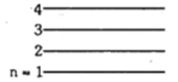
The number of absorption lines in the given figure will be .......
A
$3$
B
$4$
C
$5$
D
$6$
Solution
(A) The number of absorption lines for an electron transitioning from the ground state $(n=1)$ to an excited state $(n=4)$ is given by the formula $n-1$,where $n$ is the final energy level.
Here,$n=4$.
Therefore,the number of absorption lines $= 4 - 1 = 3$.
Here,$n=4$.
Therefore,the number of absorption lines $= 4 - 1 = 3$.
0 likes
View Solution156
MediumMCQ
The frequency of a line in the Pfund series of a hydrogen atom is $2.340 \times 10^{14} \ Hz$. The value of the quantum number $n_2$ for this transition is .....
A
$6$
B
$5$
C
$4$
D
$3$
Solution
(A) For the Pfund series,the lower energy level is $n_1 = 5$.
The frequency $\nu$ is given by $\nu = R_H c [\frac{1}{n_1^2} - \frac{1}{n_2^2}]$.
Given $\nu = 2.340 \times 10^{14} \ Hz$,$R_H = 1.097 \times 10^7 \ m^{-1}$,and $c = 3 \times 10^8 \ m/s$.
$\frac{\nu}{R_H c} = \frac{1}{n_1^2} - \frac{1}{n_2^2} \implies \frac{2.340 \times 10^{14}}{1.097 \times 10^7 \times 3 \times 10^8} = \frac{1}{5^2} - \frac{1}{n_2^2}$.
$0.0711 = 0.04 - \frac{1}{n_2^2}$ (Note: The frequency provided corresponds to $n_2 = 6$ for the Pfund series).
Calculating for $n_2 = 6$: $\nu = 3.29 \times 10^{15} \times (\frac{1}{25} - \frac{1}{36}) \approx 2.340 \times 10^{14} \ Hz$.
Thus,$n_2 = 6$.
The frequency $\nu$ is given by $\nu = R_H c [\frac{1}{n_1^2} - \frac{1}{n_2^2}]$.
Given $\nu = 2.340 \times 10^{14} \ Hz$,$R_H = 1.097 \times 10^7 \ m^{-1}$,and $c = 3 \times 10^8 \ m/s$.
$\frac{\nu}{R_H c} = \frac{1}{n_1^2} - \frac{1}{n_2^2} \implies \frac{2.340 \times 10^{14}}{1.097 \times 10^7 \times 3 \times 10^8} = \frac{1}{5^2} - \frac{1}{n_2^2}$.
$0.0711 = 0.04 - \frac{1}{n_2^2}$ (Note: The frequency provided corresponds to $n_2 = 6$ for the Pfund series).
Calculating for $n_2 = 6$: $\nu = 3.29 \times 10^{15} \times (\frac{1}{25} - \frac{1}{36}) \approx 2.340 \times 10^{14} \ Hz$.
Thus,$n_2 = 6$.
0 likes
View Solution157
MediumMCQ
Suppose the ionization energy of a hydrogen-like species is $960 \ eV$. The value of the principal quantum number for an energy level of $-60 \ eV$ will be $......$.
A
$n = 2$
B
$n = 3$
C
$n = 4$
D
$n = 5$
Solution
(C) The energy of an electron in the $n^{th}$ orbit of a hydrogen-like species is given by $E_n = \frac{E_1}{n^2}$,where $E_1$ is the ground state energy.
Given that the ionization energy $(I.P.)$ is $960 \ eV$,the ground state energy $E_1 = -960 \ eV$.
Substituting the values into the formula: $-60 \ eV = \frac{-960 \ eV}{n^2}$.
Solving for $n^2$: $n^2 = \frac{960}{60} = 16$.
Therefore,$n = \sqrt{16} = 4$.
Given that the ionization energy $(I.P.)$ is $960 \ eV$,the ground state energy $E_1 = -960 \ eV$.
Substituting the values into the formula: $-60 \ eV = \frac{-960 \ eV}{n^2}$.
Solving for $n^2$: $n^2 = \frac{960}{60} = 16$.
Therefore,$n = \sqrt{16} = 4$.
0 likes
View Solution158
MediumMCQ
The value of Planck's constant is $6.63 \times 10^{-34} \, J \cdot s$ and the speed of light is $3.0 \times 10^8 \, m \cdot s^{-1}$. The wavelength of a quantum of light with a frequency of $8 \times 10^{15} \, s^{-1}$ is closest to which of the following values in meters?
A
$3 \times 10^7$
B
$2 \times 10^{-25}$
C
$5 \times 10^{-18}$
D
$3.75 \times 10^{-8}$
Solution
(D) The relationship between frequency $(\nu)$,speed of light $(c)$,and wavelength $(\lambda)$ is given by the formula: $\nu = \frac{c}{\lambda}$.
Rearranging for wavelength: $\lambda = \frac{c}{\nu}$.
Given: $c = 3.0 \times 10^8 \, m \cdot s^{-1}$ and $\nu = 8 \times 10^{15} \, s^{-1}$.
Substituting the values: $\lambda = \frac{3.0 \times 10^8}{8 \times 10^{15}} = 0.375 \times 10^{-7} \, m = 3.75 \times 10^{-8} \, m$.
Rearranging for wavelength: $\lambda = \frac{c}{\nu}$.
Given: $c = 3.0 \times 10^8 \, m \cdot s^{-1}$ and $\nu = 8 \times 10^{15} \, s^{-1}$.
Substituting the values: $\lambda = \frac{3.0 \times 10^8}{8 \times 10^{15}} = 0.375 \times 10^{-7} \, m = 3.75 \times 10^{-8} \, m$.
1 likes
View Solution159
MediumMCQ
The energy of an electron in the first orbit of a hydrogen atom is $-13.6 \ eV$. The possible energy value for an electron in the excited state is ............ $eV$.
A
$-3.4$
B
$-4.2$
C
$-6.8$
D
$+6.8$
Solution
(A) The energy of an electron in the $n^{th}$ orbit of a hydrogen atom is given by the formula $E_n = -\frac{13.6}{n^2} \ eV$.
For the ground state,$n = 1$,so $E_1 = -13.6 \ eV$.
The first excited state corresponds to $n = 2$.
Substituting $n = 2$ into the formula: $E_2 = -\frac{13.6}{2^2} = -\frac{13.6}{4} = -3.4 \ eV$.
Thus,the possible energy value for an electron in the excited state is $-3.4 \ eV$.
For the ground state,$n = 1$,so $E_1 = -13.6 \ eV$.
The first excited state corresponds to $n = 2$.
Substituting $n = 2$ into the formula: $E_2 = -\frac{13.6}{2^2} = -\frac{13.6}{4} = -3.4 \ eV$.
Thus,the possible energy value for an electron in the excited state is $-3.4 \ eV$.
0 likes
View Solution160
MediumMCQ
Rutherford's $\alpha$-particle scattering experiment concluded that:
A
All positively charged particles are concentrated in a very small region of the atom.
B
All negatively charged particles are concentrated in a very small region of the atom.
C
Protons revolve around the electrons.
D
Neutrons are charged particles.
Solution
(A) Rutherford's $\alpha$-particle scattering experiment showed that most of the $\alpha$-particles passed through the gold foil undeflected,while a very small fraction were deflected at large angles.
This led to the conclusion that the entire positive charge and most of the mass of the atom are concentrated in a very small volume at the center,which he called the nucleus.
Therefore,option $A$ is the correct statement.
This led to the conclusion that the entire positive charge and most of the mass of the atom are concentrated in a very small volume at the center,which he called the nucleus.
Therefore,option $A$ is the correct statement.
0 likes
View Solution161
MediumMCQ
The ionization energy of a $H$ atom is $13.6 \, eV$. The energy required to excite the electron from the ground state $(n=1)$ to the first excited state $(n=2)$ is ... $eV$.
A
$3.4$
B
$10.2$
C
$12.1$
D
$1.5$
Solution
(B) The energy of an electron in the $n^{th}$ orbit of a hydrogen atom is given by the formula: $E_n = -13.6 / n^2 \, eV$.
For the ground state $(n=1)$,$E_1 = -13.6 / 1^2 = -13.6 \, eV$.
For the first excited state $(n=2)$,$E_2 = -13.6 / 2^2 = -13.6 / 4 = -3.4 \, eV$.
The energy required for excitation is $\Delta E = E_2 - E_1 = -3.4 - (-13.6) = 10.2 \, eV$.
For the ground state $(n=1)$,$E_1 = -13.6 / 1^2 = -13.6 \, eV$.
For the first excited state $(n=2)$,$E_2 = -13.6 / 2^2 = -13.6 / 4 = -3.4 \, eV$.
The energy required for excitation is $\Delta E = E_2 - E_1 = -3.4 - (-13.6) = 10.2 \, eV$.
0 likes
View Solution162
DifficultMCQ
Which of the following relations is applicable for any $H$-like species?
A
$(E_2 - E_1) > (E_3 - E_2) > (E_4 - E_3)$
B
$(E_2 - E_1) < (E_3 - E_2) < (E_4 - E_3)$
C
$(E_2 - E_1) = (E_3 - E_2) = (E_4 - E_3)$
D
$(E_2 - E_1) = \frac{1}{4} (E_3 - E_2) = \frac{1}{9} (E_4 - E_3)$
Solution
(A) For an $H$-like species,the energy of an orbit $n$ is given by $E_n = -13.6 \times \frac{Z^2}{n^2} \ eV$.
Calculating the energy differences:
$(E_2 - E_1) = -13.6 Z^2 (\frac{1}{4} - 1) = 13.6 Z^2 (\frac{3}{4}) = 10.2 Z^2$.
$(E_3 - E_2) = -13.6 Z^2 (\frac{1}{9} - \frac{1}{4}) = 13.6 Z^2 (\frac{5}{36}) \approx 1.89 Z^2$.
$(E_4 - E_3) = -13.6 Z^2 (\frac{1}{16} - \frac{1}{9}) = 13.6 Z^2 (\frac{7}{144}) \approx 0.66 Z^2$.
Comparing these values,we see that $(E_2 - E_1) > (E_3 - E_2) > (E_4 - E_3)$.
Calculating the energy differences:
$(E_2 - E_1) = -13.6 Z^2 (\frac{1}{4} - 1) = 13.6 Z^2 (\frac{3}{4}) = 10.2 Z^2$.
$(E_3 - E_2) = -13.6 Z^2 (\frac{1}{9} - \frac{1}{4}) = 13.6 Z^2 (\frac{5}{36}) \approx 1.89 Z^2$.
$(E_4 - E_3) = -13.6 Z^2 (\frac{1}{16} - \frac{1}{9}) = 13.6 Z^2 (\frac{7}{144}) \approx 0.66 Z^2$.
Comparing these values,we see that $(E_2 - E_1) > (E_3 - E_2) > (E_4 - E_3)$.
0 likes
View Solution163
MediumMCQ
The energy of a photon is calculated by ......
A
$E = h \nu$
B
$h = E \nu$
C
$h = \frac{\nu}{E}$
D
$E = \frac{h}{\nu}$
Solution
(A) According to Planck's quantum theory,the energy $(E)$ of a photon is directly proportional to the frequency $(\nu)$ of the radiation.
The relationship is given by the equation: $E = h \nu$,where $h$ is Planck's constant.
The relationship is given by the equation: $E = h \nu$,where $h$ is Planck's constant.
0 likes
View Solution164
MediumMCQ
For a hydrogen atom,which of the following electron transitions requires the highest energy?
A
$n = \infty$ to $n = 1$
B
$n = 2$ to $n = 3$
C
$n = 1$ to $n = 2$
D
$n = 3$ to $n = 5$
Solution
(A) The energy change for an electron transition in a hydrogen atom is given by $\Delta E = 13.6 \left( \frac{1}{n_1^2} - \frac{1}{n_2^2} \right) \text{ eV}$.
For option $A$: $\Delta E = 13.6 \left( \frac{1}{1^2} - \frac{1}{\infty^2} \right) = 13.6 \text{ eV}$.
For option $B$: $\Delta E = 13.6 \left( \frac{1}{2^2} - \frac{1}{3^2} \right) = 13.6 \left( \frac{1}{4} - \frac{1}{9} \right) = 13.6 \left( \frac{5}{36} \right) \approx 1.89 \text{ eV}$.
For option $C$: $\Delta E = 13.6 \left( \frac{1}{1^2} - \frac{1}{2^2} \right) = 13.6 \left( 1 - 0.25 \right) = 13.6 \times 0.75 = 10.2 \text{ eV}$.
For option $D$: $\Delta E = 13.6 \left( \frac{1}{3^2} - \frac{1}{5^2} \right) = 13.6 \left( \frac{1}{9} - \frac{1}{25} \right) = 13.6 \left( \frac{16}{225} \right) \approx 0.97 \text{ eV}$.
Comparing the values,the transition from $n = \infty$ to $n = 1$ involves the largest energy change.
For option $A$: $\Delta E = 13.6 \left( \frac{1}{1^2} - \frac{1}{\infty^2} \right) = 13.6 \text{ eV}$.
For option $B$: $\Delta E = 13.6 \left( \frac{1}{2^2} - \frac{1}{3^2} \right) = 13.6 \left( \frac{1}{4} - \frac{1}{9} \right) = 13.6 \left( \frac{5}{36} \right) \approx 1.89 \text{ eV}$.
For option $C$: $\Delta E = 13.6 \left( \frac{1}{1^2} - \frac{1}{2^2} \right) = 13.6 \left( 1 - 0.25 \right) = 13.6 \times 0.75 = 10.2 \text{ eV}$.
For option $D$: $\Delta E = 13.6 \left( \frac{1}{3^2} - \frac{1}{5^2} \right) = 13.6 \left( \frac{1}{9} - \frac{1}{25} \right) = 13.6 \left( \frac{16}{225} \right) \approx 0.97 \text{ eV}$.
Comparing the values,the transition from $n = \infty$ to $n = 1$ involves the largest energy change.
0 likes
View Solution165
MediumMCQ
According to Bohr's theory,the angular momentum of an electron in the $5^{th}$ orbit is ....... (in $h/\pi$)
A
$1.0$
B
$10$
C
$2.5$
D
$25$
Solution
(C) According to Bohr's postulate,the angular momentum $(mvr)$ of an electron in an orbit is given by the formula: $mvr = \frac{nh}{2\pi}$.
Given that the orbit number $n = 5$,we substitute this value into the equation:
$mvr = \frac{5h}{2\pi} = 2.5 \frac{h}{\pi}$.
Given that the orbit number $n = 5$,we substitute this value into the equation:
$mvr = \frac{5h}{2\pi} = 2.5 \frac{h}{\pi}$.
0 likes
View Solution166
MediumMCQ
For a $H$-atom,what is the wavelength in $nm$ associated with the transition of an electron from an infinite energy level to the first energy level? (Rydberg constant = $1.097 \times 10^{7} \ m^{-1}$)
A
$406$
B
$192$
C
$91$
D
$1 \times 10^{-8}$
Solution
(C) The Rydberg formula is given by: $\frac{1}{\lambda} = R_H \left( \frac{1}{n_1^2} - \frac{1}{n_2^2} \right)$
Here,$n_1 = 1$ (first energy level) and $n_2 = \infty$ (infinite energy level).
Substituting the values: $\frac{1}{\lambda} = 1.097 \times 10^7 \ m^{-1} \left( \frac{1}{1^2} - \frac{1}{\infty^2} \right)$
Since $\frac{1}{\infty} = 0$,we have: $\frac{1}{\lambda} = 1.097 \times 10^7 \ m^{-1}$
$\lambda = \frac{1}{1.097 \times 10^7} \ m \approx 0.9116 \times 10^{-7} \ m = 91.16 \times 10^{-9} \ m = 91.16 \ nm$.
Rounding to the nearest integer,the wavelength is $91 \ nm$.
Here,$n_1 = 1$ (first energy level) and $n_2 = \infty$ (infinite energy level).
Substituting the values: $\frac{1}{\lambda} = 1.097 \times 10^7 \ m^{-1} \left( \frac{1}{1^2} - \frac{1}{\infty^2} \right)$
Since $\frac{1}{\infty} = 0$,we have: $\frac{1}{\lambda} = 1.097 \times 10^7 \ m^{-1}$
$\lambda = \frac{1}{1.097 \times 10^7} \ m \approx 0.9116 \times 10^{-7} \ m = 91.16 \times 10^{-9} \ m = 91.16 \ nm$.
Rounding to the nearest integer,the wavelength is $91 \ nm$.
0 likes
View Solution167
MediumMCQ
If the shortest wavelength of the Lyman series of the $H$ atom is $x$,then calculate the total energy of the $H$ atom in the first excited state.
A
$\frac{9x}{5}$
B
$\frac{36x}{5}$
C
$\frac{5x}{9}$
D
$\frac{5x}{36}$
Solution
(B) For the Lyman series,the shortest wavelength corresponds to the transition from $n_2 = \infty$ to $n_1 = 1$.
Using the Rydberg formula: $\frac{1}{x} = R \times Z^2 \times (\frac{1}{n_1^2} - \frac{1}{n_2^2})$.
For $H$ atom $(Z=1)$: $\frac{1}{x} = R \times (\frac{1}{1^2} - \frac{1}{\infty^2}) = R$.
So,$R = \frac{1}{x}$.
The first excited state of the $H$ atom corresponds to $n = 2$.
The total energy $E_n$ is given by $E_n = -13.6 \times \frac{Z^2}{n^2} \text{ eV}$.
For $n = 2$,$E_2 = -13.6 \times \frac{1^2}{2^2} = -3.4 \text{ eV}$.
Note: The question asks for the energy value in terms of $x$. Given the options provided,the question implies a relationship between the wavelength and energy constants. Based on the standard Rydberg constant relation $E = \frac{hc}{\lambda}$,the energy of the first excited state is proportional to the Rydberg constant.
Using the Rydberg formula: $\frac{1}{x} = R \times Z^2 \times (\frac{1}{n_1^2} - \frac{1}{n_2^2})$.
For $H$ atom $(Z=1)$: $\frac{1}{x} = R \times (\frac{1}{1^2} - \frac{1}{\infty^2}) = R$.
So,$R = \frac{1}{x}$.
The first excited state of the $H$ atom corresponds to $n = 2$.
The total energy $E_n$ is given by $E_n = -13.6 \times \frac{Z^2}{n^2} \text{ eV}$.
For $n = 2$,$E_2 = -13.6 \times \frac{1^2}{2^2} = -3.4 \text{ eV}$.
Note: The question asks for the energy value in terms of $x$. Given the options provided,the question implies a relationship between the wavelength and energy constants. Based on the standard Rydberg constant relation $E = \frac{hc}{\lambda}$,the energy of the first excited state is proportional to the Rydberg constant.
0 likes
View Solution168
MediumMCQ
In the Bohr model of the atom,when an electron undergoes a transition from $n = 1$ to $n = 3$,the energy absorbed or emitted is ........
A
$2.15 \times 10^{-11} \ erg$
B
$0.1911 \times 10^{-10} \ erg$
C
$2.389 \times 10^{-12} \ erg$
D
$0.239 \times 10^{-10} \ erg$
Solution
(B) According to the Bohr model,the energy of an electron in the $n^{th}$ orbit is given by $E_n = -\frac{2.179 \times 10^{-11}}{n^2} \ erg$.
The change in energy for a transition from $n_1 = 1$ to $n_2 = 3$ is $\Delta E = E_3 - E_1$.
$\Delta E = -2.179 \times 10^{-11} \left( \frac{1}{3^2} - \frac{1}{1^2} \right) \ erg$.
$\Delta E = -2.179 \times 10^{-11} \left( \frac{1}{9} - 1 \right) \ erg$.
$\Delta E = -2.179 \times 10^{-11} \left( -\frac{8}{9} \right) \ erg$.
$\Delta E = 2.179 \times 10^{-11} \times 0.8888 \ erg \approx 1.936 \times 10^{-11} \ erg$.
Converting to the given format: $1.936 \times 10^{-11} \ erg = 0.1936 \times 10^{-10} \ erg$.
Given the options,$0.1911 \times 10^{-10} \ erg$ is the closest value.
The change in energy for a transition from $n_1 = 1$ to $n_2 = 3$ is $\Delta E = E_3 - E_1$.
$\Delta E = -2.179 \times 10^{-11} \left( \frac{1}{3^2} - \frac{1}{1^2} \right) \ erg$.
$\Delta E = -2.179 \times 10^{-11} \left( \frac{1}{9} - 1 \right) \ erg$.
$\Delta E = -2.179 \times 10^{-11} \left( -\frac{8}{9} \right) \ erg$.
$\Delta E = 2.179 \times 10^{-11} \times 0.8888 \ erg \approx 1.936 \times 10^{-11} \ erg$.
Converting to the given format: $1.936 \times 10^{-11} \ erg = 0.1936 \times 10^{-10} \ erg$.
Given the options,$0.1911 \times 10^{-10} \ erg$ is the closest value.
0 likes
View Solution169
MediumMCQ
The energy of an electron in the first Bohr orbit of the $H$ atom is $-13.6 \, eV$. The energy value of an electron in the first excited state of the $H$ atom is ............ $eV$.
A
$-3.4$
B
$-4.2$
C
$-6.8$
D
$+6.8$
Solution
(A) The energy of an electron in the $n^{th}$ orbit of a hydrogen atom is given by the formula: $E_n = -13.6 / n^2 \, eV$.
For the first orbit $(n = 1)$,$E_1 = -13.6 / 1^2 = -13.6 \, eV$.
The first excited state corresponds to $n = 2$.
Therefore,the energy in the first excited state is $E_2 = -13.6 / 2^2 = -13.6 / 4 = -3.4 \, eV$.
For the first orbit $(n = 1)$,$E_1 = -13.6 / 1^2 = -13.6 \, eV$.
The first excited state corresponds to $n = 2$.
Therefore,the energy in the first excited state is $E_2 = -13.6 / 2^2 = -13.6 / 4 = -3.4 \, eV$.
0 likes
View Solution170
MediumMCQ
The energy of the second excited state of the $Li^{2+}$ ion is ............... $eV$.
A
$-13.6$
B
$-12.6$
C
$-10.6$
D
$-15.2$
Solution
(A) The energy of an electron in a hydrogen-like species is given by the formula: $E_n = -13.6 \times \frac{Z^2}{n^2} \ eV$.
For $Li^{2+}$ ion,the atomic number $Z = 3$.
The second excited state corresponds to the third orbit,so $n = 3$.
Substituting these values into the formula:
$E_3 = -13.6 \times \frac{3^2}{3^2} \ eV = -13.6 \ eV$.
For $Li^{2+}$ ion,the atomic number $Z = 3$.
The second excited state corresponds to the third orbit,so $n = 3$.
Substituting these values into the formula:
$E_3 = -13.6 \times \frac{3^2}{3^2} \ eV = -13.6 \ eV$.
0 likes
View Solution171
MediumMCQ
In an orbital,the value of $K.E.$ is equal to:
A
Half of the potential energy
B
Double the potential energy
C
$1/4$ of the potential energy
D
None of these
Solution
(A) According to the Bohr model for a hydrogen-like atom,the total energy $(E)$,kinetic energy $(K.E.)$,and potential energy $(P.E.)$ are related as follows:
$E = -K.E.$
$P.E. = 2 \times E$
Substituting $E = -K.E.$ into the potential energy equation,we get:
$P.E. = 2 \times (-K.E.)$
$P.E. = -2 \times K.E.$
Therefore,$K.E. = -\frac{1}{2} P.E.$
In terms of magnitude,the kinetic energy is half of the potential energy.
$E = -K.E.$
$P.E. = 2 \times E$
Substituting $E = -K.E.$ into the potential energy equation,we get:
$P.E. = 2 \times (-K.E.)$
$P.E. = -2 \times K.E.$
Therefore,$K.E. = -\frac{1}{2} P.E.$
In terms of magnitude,the kinetic energy is half of the potential energy.
0 likes
View Solution172
MediumMCQ
The ratio of the radii of the $3^{rd}$ and $5^{th}$ orbits of $He^+$ is ..... . (Atomic number of $He = 2$,$r = 0.529 \times \frac{n^2}{Z} \ \mathring{A}$)
A
$9 : 25$
B
$25 : 9$
C
$12 : 24$
D
$25 : 18$
Solution
(A) The radius of an orbit is given by the formula: $r_n = 0.529 \times \frac{n^2}{Z} \ \mathring{A}$.
For $He^+$,the atomic number $Z = 2$.
For the $3^{rd}$ orbit $(n = 3)$: $r_3 = 0.529 \times \frac{3^2}{2} = 0.529 \times \frac{9}{2} \ \mathring{A}$.
For the $5^{th}$ orbit $(n = 5)$: $r_5 = 0.529 \times \frac{5^2}{2} = 0.529 \times \frac{25}{2} \ \mathring{A}$.
The ratio $\frac{r_3}{r_5} = \frac{0.529 \times \frac{9}{2}}{0.529 \times \frac{25}{2}} = \frac{9}{25}$.
Therefore,the ratio is $9 : 25$.
For $He^+$,the atomic number $Z = 2$.
For the $3^{rd}$ orbit $(n = 3)$: $r_3 = 0.529 \times \frac{3^2}{2} = 0.529 \times \frac{9}{2} \ \mathring{A}$.
For the $5^{th}$ orbit $(n = 5)$: $r_5 = 0.529 \times \frac{5^2}{2} = 0.529 \times \frac{25}{2} \ \mathring{A}$.
The ratio $\frac{r_3}{r_5} = \frac{0.529 \times \frac{9}{2}}{0.529 \times \frac{25}{2}} = \frac{9}{25}$.
Therefore,the ratio is $9 : 25$.
0 likes
View Solution173
MediumMCQ
In which hydrogen-like ion is the difference in wavelength between the first line of the Balmer series and the first line of the Lyman series equal to $59.3 \ nm$? $[R_H = 109678 \ cm^{-1}]$
A
$Li^{2+}$
B
$K^{2+}$
C
$Na^{2+}$
D
$He^{+}$
Solution
(A) For the first line of the Balmer series $(n_1 = 2, n_2 = 3)$:
$\frac{1}{\lambda_B} = Z^2 R_H \left( \frac{1}{2^2} - \frac{1}{3^2} \right) = Z^2 R_H \left( \frac{5}{36} \right) \implies \lambda_B = \frac{36}{5 Z^2 R_H}$
For the first line of the Lyman series $(n_1 = 1, n_2 = 2)$:
$\frac{1}{\lambda_L} = Z^2 R_H \left( \frac{1}{1^2} - \frac{1}{2^2} \right) = Z^2 R_H \left( \frac{3}{4} \right) \implies \lambda_L = \frac{4}{3 Z^2 R_H}$
Given the difference $\lambda_B - \lambda_L = 59.3 \ nm = 59.3 \times 10^{-7} \ cm$:
$\frac{36}{5 Z^2 R_H} - \frac{4}{3 Z^2 R_H} = 59.3 \times 10^{-7}$
$\frac{1}{Z^2 R_H} \left( \frac{108 - 20}{15} \right) = 59.3 \times 10^{-7}$
$\frac{88}{15 Z^2 (109678)} = 59.3 \times 10^{-7}$
$Z^2 = \frac{88}{15 \times 109678 \times 59.3 \times 10^{-7}} \approx 9$
$Z = 3$. Thus,the ion is $Li^{2+}$.
$\frac{1}{\lambda_B} = Z^2 R_H \left( \frac{1}{2^2} - \frac{1}{3^2} \right) = Z^2 R_H \left( \frac{5}{36} \right) \implies \lambda_B = \frac{36}{5 Z^2 R_H}$
For the first line of the Lyman series $(n_1 = 1, n_2 = 2)$:
$\frac{1}{\lambda_L} = Z^2 R_H \left( \frac{1}{1^2} - \frac{1}{2^2} \right) = Z^2 R_H \left( \frac{3}{4} \right) \implies \lambda_L = \frac{4}{3 Z^2 R_H}$
Given the difference $\lambda_B - \lambda_L = 59.3 \ nm = 59.3 \times 10^{-7} \ cm$:
$\frac{36}{5 Z^2 R_H} - \frac{4}{3 Z^2 R_H} = 59.3 \times 10^{-7}$
$\frac{1}{Z^2 R_H} \left( \frac{108 - 20}{15} \right) = 59.3 \times 10^{-7}$
$\frac{88}{15 Z^2 (109678)} = 59.3 \times 10^{-7}$
$Z^2 = \frac{88}{15 \times 109678 \times 59.3 \times 10^{-7}} \approx 9$
$Z = 3$. Thus,the ion is $Li^{2+}$.
0 likes
View Solution174
MediumMCQ
The frequency and energy of a photon with a wavelength of $4000 \ \mathring{A}$ are respectively.......
A
$3.65 \times 10^{14} \ s^{-1}, 8.22 \times 10^{-10} \ J$
B
$8.22 \times 10^{-10} \ s^{-1}, 3.38 \times 10^{-10} \ J$
C
$3.38 \times 10^{-10} \ s^{-1}, 5.26 \times 10^{13} \ J$
D
$7.5 \times 10^{14} \ s^{-1}, 4.96 \times 10^{-19} \ J$
Solution
(D) Calculation of frequency:
$\lambda = 4000 \ \mathring{A} = 4000 \times 10^{-10} \ m = 4 \times 10^{-7} \ m$
Since $\nu = \frac{c}{\lambda}$
$\nu = \frac{3 \times 10^8 \ m/s}{4 \times 10^{-7} \ m} = 0.75 \times 10^{15} \ s^{-1} = 7.5 \times 10^{14} \ s^{-1}$
Calculation of energy:
$E = h\nu = 6.626 \times 10^{-34} \ J \cdot s \times 7.5 \times 10^{14} \ s^{-1} = 4.96 \times 10^{-19} \ J$
$\lambda = 4000 \ \mathring{A} = 4000 \times 10^{-10} \ m = 4 \times 10^{-7} \ m$
Since $\nu = \frac{c}{\lambda}$
$\nu = \frac{3 \times 10^8 \ m/s}{4 \times 10^{-7} \ m} = 0.75 \times 10^{15} \ s^{-1} = 7.5 \times 10^{14} \ s^{-1}$
Calculation of energy:
$E = h\nu = 6.626 \times 10^{-34} \ J \cdot s \times 7.5 \times 10^{14} \ s^{-1} = 4.96 \times 10^{-19} \ J$
0 likes
View Solution175
MediumMCQ
The ionization enthalpy of a hydrogen atom is $1.312 \times 10^6 \, J \, mol^{-1}$. The energy required to excite an electron from $n = 1$ to $n = 2$ in the atom is .......
A
$8.51 \times 10^5 \, J \, mol^{-1}$
B
$6.56 \times 10^5 \, J \, mol^{-1}$
C
$7.56 \times 10^5 \, J \, mol^{-1}$
D
$9.84 \times 10^5 \, J \, mol^{-1}$
Solution
(D) The energy of an electron in the $n^{th}$ orbit of a hydrogen atom is given by $E_n = -\frac{1312}{n^2} \, kJ \, mol^{-1} = -\frac{1.312 \times 10^6}{n^2} \, J \, mol^{-1}$.
For $n = 1$,$E_1 = -1.312 \times 10^6 \, J \, mol^{-1}$.
For $n = 2$,$E_2 = -\frac{1.312 \times 10^6}{2^2} = -\frac{1.312 \times 10^6}{4} = -0.328 \times 10^6 \, J \, mol^{-1}$.
The energy required for excitation is $\Delta E = E_2 - E_1$.
$\Delta E = (-0.328 \times 10^6) - (-1.312 \times 10^6) = 0.984 \times 10^6 \, J \, mol^{-1} = 9.84 \times 10^5 \, J \, mol^{-1}$.
For $n = 1$,$E_1 = -1.312 \times 10^6 \, J \, mol^{-1}$.
For $n = 2$,$E_2 = -\frac{1.312 \times 10^6}{2^2} = -\frac{1.312 \times 10^6}{4} = -0.328 \times 10^6 \, J \, mol^{-1}$.
The energy required for excitation is $\Delta E = E_2 - E_1$.
$\Delta E = (-0.328 \times 10^6) - (-1.312 \times 10^6) = 0.984 \times 10^6 \, J \, mol^{-1} = 9.84 \times 10^5 \, J \, mol^{-1}$.
0 likes
View Solution176
MediumMCQ
The energy level for $A^{(+z-1)}$ is given by which of the following expressions?
A
$E_n \text{ for } A^{(+z-1)} = Z^2 \times E_n \text{ for } H$
B
$E_n \text{ for } A^{(+z-1)} = Z \times E_n \text{ for } H$
C
$E_n \text{ for } A^{(+z-1)} = \frac{1}{Z^2} \times E_n \text{ for } H$
D
$E_n \text{ for } A^{(+z-1)} = \frac{1}{Z} \times E_n \text{ for } H$
Solution
(A) The energy of an electron in a hydrogen-like species is given by the formula: $E_n = -13.6 \times \frac{Z^2}{n^2} \text{ eV}$.
For a hydrogen atom,$Z = 1$,so $E_n(H) = -13.6 \times \frac{1^2}{n^2} = -13.6 \times \frac{1}{n^2}$.
For the species $A^{(+z-1)}$,the atomic number is $Z$. Thus,$E_n(A^{(+z-1)}) = -13.6 \times \frac{Z^2}{n^2}$.
Comparing the two,we get $E_n(A^{(+z-1)}) = Z^2 \times E_n(H)$.
For a hydrogen atom,$Z = 1$,so $E_n(H) = -13.6 \times \frac{1^2}{n^2} = -13.6 \times \frac{1}{n^2}$.
For the species $A^{(+z-1)}$,the atomic number is $Z$. Thus,$E_n(A^{(+z-1)}) = -13.6 \times \frac{Z^2}{n^2}$.
Comparing the two,we get $E_n(A^{(+z-1)}) = Z^2 \times E_n(H)$.
0 likes
View Solution177
MediumMCQ
If the potential energy of an electron in a hydrogen atom is $-3.02 \ eV$,then the electron is present in which of the following excited states?
A
$1^{st}$
B
$2^{nd}$
C
$3^{rd}$
D
$4^{th}$
Solution
(B) For a hydrogen atom,the potential energy $(P.E.)$ and total energy $(T.E.)$ are related as $P.E. = 2 \times T.E.$
Given $P.E. = -3.02 \ eV$,so $T.E. = \frac{-3.02}{2} = -1.51 \ eV$.
The total energy of an electron in the $n^{th}$ orbit is given by $E_n = -13.6 / n^2 \ eV$.
Setting $-13.6 / n^2 = -1.51$,we get $n^2 = 13.6 / 1.51 \approx 9$,so $n = 3$.
Since the electron is in the $n = 3$ shell,it corresponds to the $2^{nd}$ excited state (as $n=1$ is ground state,$n=2$ is $1^{st}$ excited state,and $n=3$ is $2^{nd}$ excited state).
Given $P.E. = -3.02 \ eV$,so $T.E. = \frac{-3.02}{2} = -1.51 \ eV$.
The total energy of an electron in the $n^{th}$ orbit is given by $E_n = -13.6 / n^2 \ eV$.
Setting $-13.6 / n^2 = -1.51$,we get $n^2 = 13.6 / 1.51 \approx 9$,so $n = 3$.
Since the electron is in the $n = 3$ shell,it corresponds to the $2^{nd}$ excited state (as $n=1$ is ground state,$n=2$ is $1^{st}$ excited state,and $n=3$ is $2^{nd}$ excited state).
0 likes
View Solution178
MediumMCQ
The deflection of a few $\alpha$-particles when bombarded on a thin gold foil indicates that $.......$
A
The nucleus is heavy.
B
The nucleus is very small.
C
Both $(1)$ and $(2)$.
D
Electrons obstruct the motion of $\alpha$-particles.
Solution
(C) In Rutherford's $\alpha$-particle scattering experiment,the fact that a few $\alpha$-particles undergo large-angle deflection indicates that the positive charge and mass of the atom are concentrated in a very small volume called the nucleus. The large-angle deflection is due to the electrostatic repulsion between the positively charged $\alpha$-particle and the positively charged,dense,and heavy nucleus. Therefore,both the heavy nature and the small size of the nucleus are responsible for this observation. Thus,the correct option is $(C)$.
0 likes
View Solution179
DifficultMCQ
$A$: Thomson's atomic model is known as the plum pudding model.
$R$: The atom is considered as a positively charged sphere in which electrons are embedded.
$R$: The atom is considered as a positively charged sphere in which electrons are embedded.
A
$A$ and $R$ are both true and $R$ is the correct explanation of $A$.
B
$A$ and $R$ are both true,but $R$ is not the correct explanation of $A$.
C
$A$ is true,but $R$ is false.
D
$A$ is false,but $R$ is true.
Solution
(A) Thomson proposed that an atom consists of a positively charged sphere with electrons embedded in it,similar to seeds in a watermelon or plums in a pudding.
Therefore,the statement $A$ is true because it is historically called the plum pudding model.
Statement $R$ correctly describes the structure of this model,which serves as the basis for the name given in statement $A$.
Thus,$A$ and $R$ are both true and $R$ is the correct explanation of $A$.
Therefore,the statement $A$ is true because it is historically called the plum pudding model.
Statement $R$ correctly describes the structure of this model,which serves as the basis for the name given in statement $A$.
Thus,$A$ and $R$ are both true and $R$ is the correct explanation of $A$.
0 likes
View Solution180
MediumMCQ
Find the wavelength of the third line in the Brackett series of the hydrogen spectrum.
A
$\frac{704}{33R}$
B
$\frac{750}{33R}$
C
$\frac{784}{33R}$
D
$\frac{799}{33R}$
Solution
(C) For the Brackett series,the transition is to $n_1 = 4$.
For the third line,the electron jumps from $n_2 = 4 + 3 = 7$.
Using the Rydberg formula: $\frac{1}{\lambda} = R Z^2 \left[ \frac{1}{n_1^2} - \frac{1}{n_2^2} \right]$.
For hydrogen,$Z = 1$,so $\frac{1}{\lambda} = R \left[ \frac{1}{4^2} - \frac{1}{7^2} \right]$.
$\frac{1}{\lambda} = R \left[ \frac{1}{16} - \frac{1}{49} \right] = R \left[ \frac{49 - 16}{16 \times 49} \right]$.
$\frac{1}{\lambda} = R \left[ \frac{33}{784} \right]$.
Therefore,$\lambda = \frac{784}{33R}$.
For the third line,the electron jumps from $n_2 = 4 + 3 = 7$.
Using the Rydberg formula: $\frac{1}{\lambda} = R Z^2 \left[ \frac{1}{n_1^2} - \frac{1}{n_2^2} \right]$.
For hydrogen,$Z = 1$,so $\frac{1}{\lambda} = R \left[ \frac{1}{4^2} - \frac{1}{7^2} \right]$.
$\frac{1}{\lambda} = R \left[ \frac{1}{16} - \frac{1}{49} \right] = R \left[ \frac{49 - 16}{16 \times 49} \right]$.
$\frac{1}{\lambda} = R \left[ \frac{33}{784} \right]$.
Therefore,$\lambda = \frac{784}{33R}$.
0 likes
View Solution181
DifficultMCQ
The wavelength of the first line of the Balmer series in the hydrogen spectrum is ................ $\mathring{A}$.
A
$6566$
B
$4500$
C
$6876$
D
$6006$
Solution
(A) For the first line of the Balmer series,$n_1 = 2$ and $n_2 = 3$.
Using the Rydberg formula: $\frac{1}{\lambda} = R_H \left( \frac{1}{n_1^2} - \frac{1}{n_2^2} \right)$.
$\frac{1}{\lambda} = R_H \left( \frac{1}{2^2} - \frac{1}{3^2} \right) = R_H \left( \frac{1}{4} - \frac{1}{9} \right) = R_H \left( \frac{5}{36} \right)$.
$\lambda = \frac{36}{5R_H}$.
Given $R_H \approx 1.097 \times 10^7 \ m^{-1} = 1.097 \times 10^{-2} \ nm^{-1}$.
$\lambda = \frac{36}{5 \times 1.097 \times 10^{-2} \ nm^{-1}} \approx 656.3 \ nm = 6563 \ \mathring{A}$.
Rounding to the nearest provided option,the correct value is $6566 \ \mathring{A}$.
Using the Rydberg formula: $\frac{1}{\lambda} = R_H \left( \frac{1}{n_1^2} - \frac{1}{n_2^2} \right)$.
$\frac{1}{\lambda} = R_H \left( \frac{1}{2^2} - \frac{1}{3^2} \right) = R_H \left( \frac{1}{4} - \frac{1}{9} \right) = R_H \left( \frac{5}{36} \right)$.
$\lambda = \frac{36}{5R_H}$.
Given $R_H \approx 1.097 \times 10^7 \ m^{-1} = 1.097 \times 10^{-2} \ nm^{-1}$.
$\lambda = \frac{36}{5 \times 1.097 \times 10^{-2} \ nm^{-1}} \approx 656.3 \ nm = 6563 \ \mathring{A}$.
Rounding to the nearest provided option,the correct value is $6566 \ \mathring{A}$.
0 likes
View Solution182
MediumMCQ
The ground state energy of a $H$ atom is given as $-13.6 \, eV$. The energy of the second excited state will be .......... $eV$.
A
$-6.8$
B
$-3.4$
C
$-1.51$
D
$-4.3$
Solution
(C) The energy of an electron in the $n^{th}$ orbit of a hydrogen atom is given by the formula: $E_n = -13.6 / n^2 \, eV$.
For the ground state,$n = 1$.
For the first excited state,$n = 2$.
For the second excited state,$n = 3$.
Substituting $n = 3$ into the formula:
$E_3 = -13.6 / (3)^2 \, eV$
$E_3 = -13.6 / 9 \, eV$
$E_3 \approx -1.51 \, eV$.
For the ground state,$n = 1$.
For the first excited state,$n = 2$.
For the second excited state,$n = 3$.
Substituting $n = 3$ into the formula:
$E_3 = -13.6 / (3)^2 \, eV$
$E_3 = -13.6 / 9 \, eV$
$E_3 \approx -1.51 \, eV$.
0 likes
View Solution183
MediumMCQ
If the potential energy of an electron in the second orbit of $He^+$ is $-27.2 \, eV$,then calculate the double value of the energy of the first excited state of a hydrogen atom in $eV$.
A
$-13.6$
B
$-54.4$
C
$-6.8$
D
$-27.2$
Solution
(C) The potential energy $(PE)$ of an electron in the $n$-th orbit is given by $PE = -27.2 \times \frac{Z^2}{n^2} \, eV$. For $He^+$,$Z = 2$ and $n = 2$,so $PE = -27.2 \times \frac{2^2}{2^2} = -27.2 \, eV$. This matches the given information.
The energy of an electron in the $n$-th orbit of a hydrogen atom $(Z = 1)$ is given by $E_n = -13.6 \times \frac{Z^2}{n^2} \, eV = -13.6 \times \frac{1^2}{n^2} \, eV$.
The first excited state of a hydrogen atom corresponds to $n = 2$. Thus,$E_2 = -13.6 \times \frac{1}{2^2} = -13.6 \times \frac{1}{4} = -3.4 \, eV$.
The question asks for the double value of this energy: $2 \times (-3.4 \, eV) = -6.8 \, eV$.
The energy of an electron in the $n$-th orbit of a hydrogen atom $(Z = 1)$ is given by $E_n = -13.6 \times \frac{Z^2}{n^2} \, eV = -13.6 \times \frac{1^2}{n^2} \, eV$.
The first excited state of a hydrogen atom corresponds to $n = 2$. Thus,$E_2 = -13.6 \times \frac{1}{2^2} = -13.6 \times \frac{1}{4} = -3.4 \, eV$.
The question asks for the double value of this energy: $2 \times (-3.4 \, eV) = -6.8 \, eV$.
0 likes
View Solution184
MediumMCQ
For a lithium atom,what can be said about the angular momentum and energy values for the permitted orbit of its third electron?
A
Angular momentum = $\frac{h}{2\pi}$,Energy = $\frac{-6\pi^2 e^4 m}{3h^2}$
B
Angular momentum = $\frac{h}{\pi}$,Energy = $\frac{-9\pi^2 e^4 m}{2h^2}$
C
Angular momentum = $\frac{h}{2\pi}$,Energy = $\frac{+3\pi^2 m e^4}{2h^2}$
D
Angular momentum = $\frac{3h}{2\pi}$,Energy = $\frac{+3\pi^2 m e^4}{4h^2}$
Solution
(B) The electronic configuration of $Li$ $(Z=3)$ is $1s^2 2s^1$. The third electron enters the $2s$ orbital,so $n = 2$.
Angular momentum is given by $mvr = \frac{nh}{2\pi}$. For $n=2$,Angular momentum = $\frac{2h}{2\pi} = \frac{h}{\pi}$.
The energy of an electron in a hydrogen-like species is given by $E_n = \frac{-2\pi^2 m e^4 Z^2}{n^2 h^2}$.
Substituting $Z=3$ and $n=2$: $E = \frac{-2\pi^2 m e^4 (3)^2}{(2)^2 h^2} = \frac{-2\pi^2 m e^4 (9)}{4 h^2} = \frac{-9\pi^2 m e^4}{2h^2}$.
Angular momentum is given by $mvr = \frac{nh}{2\pi}$. For $n=2$,Angular momentum = $\frac{2h}{2\pi} = \frac{h}{\pi}$.
The energy of an electron in a hydrogen-like species is given by $E_n = \frac{-2\pi^2 m e^4 Z^2}{n^2 h^2}$.
Substituting $Z=3$ and $n=2$: $E = \frac{-2\pi^2 m e^4 (3)^2}{(2)^2 h^2} = \frac{-2\pi^2 m e^4 (9)}{4 h^2} = \frac{-9\pi^2 m e^4}{2h^2}$.
0 likes
View Solution185
MediumMCQ
In a hydrogen atom,if $9 \, eV$ of energy is supplied,how many spectral lines will be emitted?
A
$0$
B
$1$
C
$2$
D
$3$
Solution
(A) The energy levels of a hydrogen atom are given by $E_n = -13.6 / n^2 \, eV$.
For $n=1$,$E_1 = -13.6 \, eV$.
For $n=2$,$E_2 = -3.4 \, eV$.
The energy required to excite an electron from $n=1$ to $n=2$ is $\Delta E = E_2 - E_1 = -3.4 - (-13.6) = 10.2 \, eV$.
Since the supplied energy is $9 \, eV$,which is less than the excitation energy of $10.2 \, eV$,the electron cannot be excited to any higher energy level.
Therefore,no spectral lines will be emitted.
The correct option is $A$.
For $n=1$,$E_1 = -13.6 \, eV$.
For $n=2$,$E_2 = -3.4 \, eV$.
The energy required to excite an electron from $n=1$ to $n=2$ is $\Delta E = E_2 - E_1 = -3.4 - (-13.6) = 10.2 \, eV$.
Since the supplied energy is $9 \, eV$,which is less than the excitation energy of $10.2 \, eV$,the electron cannot be excited to any higher energy level.
Therefore,no spectral lines will be emitted.
The correct option is $A$.
0 likes
View Solution186
MediumMCQ
In the hydrogen spectrum,if an electron transitions from the $6^{th}$ orbit to the $3^{rd}$ orbit through multiple steps,what is the total number of spectral lines in the $U.V.$ region?
A
$0$
B
$6$
C
$11$
D
$21$
Solution
(A) The $U.V.$ region (Lyman series) corresponds to electronic transitions ending at the $n = 1$ energy level.
Since the electron is transitioning from the $6^{th}$ orbit to the $3^{rd}$ orbit,all possible transitions occur between $n = 6$ and $n = 3$.
None of these transitions result in an electron reaching the $n = 1$ level.
Therefore,the number of spectral lines in the $U.V.$ region is $0$.
Since the electron is transitioning from the $6^{th}$ orbit to the $3^{rd}$ orbit,all possible transitions occur between $n = 6$ and $n = 3$.
None of these transitions result in an electron reaching the $n = 1$ level.
Therefore,the number of spectral lines in the $U.V.$ region is $0$.
0 likes
View Solution187
MediumMCQ
If a hydrogen atom is excited by an energy of $8.4 \ eV$,what will be the number of spectral lines emitted?
A
None
B
Two
C
Three
D
Four
Solution
(A) The energy of the $n^{th}$ orbit of a hydrogen atom is given by $E_n = -13.6 / n^2 \ eV$.
For the ground state $(n=1)$,$E_1 = -13.6 \ eV$.
When the atom is excited by $8.4 \ eV$,the new energy level $E_{new} = -13.6 + 8.4 = -5.2 \ eV$.
Since $-5.2 \ eV$ does not correspond to any allowed energy level of the hydrogen atom (e.g.,$E_2 = -3.4 \ eV$,$E_3 = -1.51 \ eV$),the atom cannot be excited to a higher state by this specific energy.
Therefore,no transition occurs,and the number of spectral lines emitted is $0$.
For the ground state $(n=1)$,$E_1 = -13.6 \ eV$.
When the atom is excited by $8.4 \ eV$,the new energy level $E_{new} = -13.6 + 8.4 = -5.2 \ eV$.
Since $-5.2 \ eV$ does not correspond to any allowed energy level of the hydrogen atom (e.g.,$E_2 = -3.4 \ eV$,$E_3 = -1.51 \ eV$),the atom cannot be excited to a higher state by this specific energy.
Therefore,no transition occurs,and the number of spectral lines emitted is $0$.
0 likes
View Solution188
MediumMCQ
The ionization energy of a singly ionized helium ion $(He^+)$ is equal to:
A
Kinetic energy of the first orbit
B
Energy of the final orbit
C
Average energy in the orbit
D
Maximum energy in the orbit
Solution
(A) For a hydrogen-like species,the total energy of an electron in the $n^{th}$ orbit is given by $E_n = -13.6 \times \frac{Z^2}{n^2} \ eV$.
For $He^+$,$Z = 2$ and for the ground state,$n = 1$.
Thus,$E_1 = -13.6 \times \frac{2^2}{1^2} = -54.4 \ eV$.
The ionization energy $(IE)$ is the energy required to remove the electron,which is $-E_1 = 54.4 \ eV$.
According to Bohr's model,the kinetic energy $(KE)$ of an electron in the $n^{th}$ orbit is equal to the magnitude of its total energy $(|E_n|)$.
Therefore,$IE = |E_1| = KE_1$.
For $He^+$,$Z = 2$ and for the ground state,$n = 1$.
Thus,$E_1 = -13.6 \times \frac{2^2}{1^2} = -54.4 \ eV$.
The ionization energy $(IE)$ is the energy required to remove the electron,which is $-E_1 = 54.4 \ eV$.
According to Bohr's model,the kinetic energy $(KE)$ of an electron in the $n^{th}$ orbit is equal to the magnitude of its total energy $(|E_n|)$.
Therefore,$IE = |E_1| = KE_1$.
0 likes
View Solution189
MediumMCQ
If an atom has $x$ energy levels,what will be the total number of spectral lines in its emission spectrum?
A
$1 + 2 + 3 + \dots + (x + 1)$
B
$1 + 2 + 3 + \dots + x^2$
C
$1 + 2 + 3 + \dots + (x - 1)$
D
$(x + 1)(x + 2)(x + 4)$
Solution
(C) When an electron transitions from an excited state $n_2$ to a lower state $n_1$,the number of spectral lines is given by the formula $\frac{n(n-1)}{2}$,where $n$ is the number of energy levels.
For $x$ energy levels,the transitions occur from level $x$ to all lower levels $(x-1, x-2, \dots, 1)$.
The total number of lines is the sum of the first $(x-1)$ integers: $1 + 2 + 3 + \dots + (x - 1)$.
Therefore,the correct option is $C$.
For $x$ energy levels,the transitions occur from level $x$ to all lower levels $(x-1, x-2, \dots, 1)$.
The total number of lines is the sum of the first $(x-1)$ integers: $1 + 2 + 3 + \dots + (x - 1)$.
Therefore,the correct option is $C$.
0 likes
View Solution190
MediumMCQ
For $Li^{2+}$,the ratio of radii $r_2 : r_5$ is:
A
$9 : 25$
B
$4 : 25$
C
$25 : 4$
D
$25 : 9$
Solution
(B) The radius of an orbit in a hydrogen-like species is given by the formula: $r_n = a_0 \times \frac{n^2}{Z}$,where $a_0$ is the Bohr radius,$n$ is the principal quantum number,and $Z$ is the atomic number.
For $Li^{2+}$,$Z = 3$.
The ratio of radii for $n = 2$ and $n = 5$ is:
$\frac{r_2}{r_5} = \frac{n_2^2 / Z}{n_5^2 / Z} = \frac{n_2^2}{n_5^2} = \frac{2^2}{5^2} = \frac{4}{25}$.
Thus,the ratio $r_2 : r_5$ is $4 : 25$.
For $Li^{2+}$,$Z = 3$.
The ratio of radii for $n = 2$ and $n = 5$ is:
$\frac{r_2}{r_5} = \frac{n_2^2 / Z}{n_5^2 / Z} = \frac{n_2^2}{n_5^2} = \frac{2^2}{5^2} = \frac{4}{25}$.
Thus,the ratio $r_2 : r_5$ is $4 : 25$.
0 likes
View Solution191
MediumMCQ
The ratio of the area enclosed by the second orbit to the first orbit is ......
A
$1:2$
B
$1:16$
C
$8:1$
D
$16:1$
Solution
(D) According to Bohr's model,the radius of the $n^{th}$ orbit is given by $r_n \propto n^2$.
The area $A$ of the orbit is given by $A = \pi r^2$.
Therefore,$A_n \propto (n^2)^2 = n^4$.
For the second orbit $(n_2 = 2)$ and the first orbit $(n_1 = 1)$:
$\frac{A_2}{A_1} = \frac{n_2^4}{n_1^4} = \frac{2^4}{1^4} = \frac{16}{1} = 16:1$.
The area $A$ of the orbit is given by $A = \pi r^2$.
Therefore,$A_n \propto (n^2)^2 = n^4$.
For the second orbit $(n_2 = 2)$ and the first orbit $(n_1 = 1)$:
$\frac{A_2}{A_1} = \frac{n_2^4}{n_1^4} = \frac{2^4}{1^4} = \frac{16}{1} = 16:1$.
0 likes
View Solution192
MediumMCQ
The energy of an electron in the first orbit of $He^{+}$ is $-871.6 \times 10^{-20} \ J$. What will be the energy of an electron in the first orbit of hydrogen?
A
$-871.6 \times 10^{-20} \ J$
B
$-435.8 \times 10^{-20} \ J$
C
$-217.9 \times 10^{-20} \ J$
D
$-108.9 \times 10^{-20} \ J$
Solution
(C) The energy of an electron in the $n^{th}$ orbit of a hydrogen-like species is given by $E_n = -13.6 \times \frac{Z^2}{n^2} \ eV$ or $E_n \propto Z^2$.
For $He^{+}$,$Z = 2$ and $n = 1$.
$E_{He^+} = k \times (2)^2 = 4k = -871.6 \times 10^{-20} \ J$.
For $H$,$Z = 1$ and $n = 1$.
$E_H = k \times (1)^2 = k$.
Therefore,$E_H = \frac{E_{He^+}}{4} = \frac{-871.6 \times 10^{-20}}{4} \ J = -217.9 \times 10^{-20} \ J$.
For $He^{+}$,$Z = 2$ and $n = 1$.
$E_{He^+} = k \times (2)^2 = 4k = -871.6 \times 10^{-20} \ J$.
For $H$,$Z = 1$ and $n = 1$.
$E_H = k \times (1)^2 = k$.
Therefore,$E_H = \frac{E_{He^+}}{4} = \frac{-871.6 \times 10^{-20}}{4} \ J = -217.9 \times 10^{-20} \ J$.
0 likes
View Solution193
MediumMCQ
$A$ single-electron species has a nuclear charge of $+Ze$,where $Z$ is a constant. The energy required to excite an electron from the $2^{nd}$ Bohr orbit to the $3^{rd}$ Bohr orbit is $47.2 \ eV$. Calculate the value of $Z$.
A
$1$
B
$3$
C
$5$
D
$4$
Solution
(C) The energy of an electron in the $n^{th}$ orbit of a hydrogen-like species is given by $E_n = -13.6 \times \frac{Z^2}{n^2} \ eV$.
The energy difference between the $3^{rd}$ and $2^{nd}$ orbit is $\Delta E = E_3 - E_2 = -13.6 \times Z^2 \times (\frac{1}{3^2} - \frac{1}{2^2})$.
$\Delta E = -13.6 \times Z^2 \times (\frac{1}{9} - \frac{1}{4}) = -13.6 \times Z^2 \times (\frac{4-9}{36}) = -13.6 \times Z^2 \times (-\frac{5}{36})$.
$\Delta E = 13.6 \times Z^2 \times \frac{5}{36} = 1.888 \times Z^2 \approx 1.89 \times Z^2$.
Given $\Delta E = 47.2 \ eV$,we have $47.2 = 1.89 \times Z^2$.
$Z^2 = \frac{47.2}{1.89} \approx 25$.
Therefore,$Z = 5$.
The energy difference between the $3^{rd}$ and $2^{nd}$ orbit is $\Delta E = E_3 - E_2 = -13.6 \times Z^2 \times (\frac{1}{3^2} - \frac{1}{2^2})$.
$\Delta E = -13.6 \times Z^2 \times (\frac{1}{9} - \frac{1}{4}) = -13.6 \times Z^2 \times (\frac{4-9}{36}) = -13.6 \times Z^2 \times (-\frac{5}{36})$.
$\Delta E = 13.6 \times Z^2 \times \frac{5}{36} = 1.888 \times Z^2 \approx 1.89 \times Z^2$.
Given $\Delta E = 47.2 \ eV$,we have $47.2 = 1.89 \times Z^2$.
$Z^2 = \frac{47.2}{1.89} \approx 25$.
Therefore,$Z = 5$.
0 likes
View Solution194
MediumMCQ
When an electron in a hydrogen atom jumps from an infinite state to the first stationary state,the wavelength of the emitted radiation will be ...... (Rydberg constant = $1.097 \times 10^7 \ m^{-1}$):
A
$9.1 \times 10^{-8} \ m$
B
$192 \ nm$
C
$406 \ nm$
D
$91 \ nm$
Solution
(D) For a hydrogen atom,the Rydberg formula is given by: $\frac{1}{\lambda} = R_H \times Z^2 \times (\frac{1}{n_1^2} - \frac{1}{n_2^2})$.
Here,$n_1 = 1$ (first stationary state),$n_2 = \infty$ (infinite state),$Z = 1$ (for hydrogen),and $R_H = 1.097 \times 10^7 \ m^{-1}$.
Substituting the values: $\frac{1}{\lambda} = 1.097 \times 10^7 \times 1^2 \times (\frac{1}{1^2} - \frac{1}{\infty^2})$.
$\frac{1}{\lambda} = 1.097 \times 10^7 \times (1 - 0) = 1.097 \times 10^7 \ m^{-1}$.
$\lambda = \frac{1}{1.097 \times 10^7} \approx 9.116 \times 10^{-8} \ m = 91.16 \ nm$.
Thus,the wavelength is approximately $91 \ nm$.
Here,$n_1 = 1$ (first stationary state),$n_2 = \infty$ (infinite state),$Z = 1$ (for hydrogen),and $R_H = 1.097 \times 10^7 \ m^{-1}$.
Substituting the values: $\frac{1}{\lambda} = 1.097 \times 10^7 \times 1^2 \times (\frac{1}{1^2} - \frac{1}{\infty^2})$.
$\frac{1}{\lambda} = 1.097 \times 10^7 \times (1 - 0) = 1.097 \times 10^7 \ m^{-1}$.
$\lambda = \frac{1}{1.097 \times 10^7} \approx 9.116 \times 10^{-8} \ m = 91.16 \ nm$.
Thus,the wavelength is approximately $91 \ nm$.
0 likes
View Solution195
MediumMCQ
The wavelength of the first line of the Lyman series for hydrogen is $1216 \ \mathring{A}$. The wavelength of the first line of the same series for a $10$ times ionized sodium atom $(Z = 11)$ will be ......... $\mathring{A}$.
A
$1000$
B
$100$
C
$10$
D
$1$
Solution
(C) The Rydberg formula for the wavelength of a spectral line is given by $\frac{1}{\lambda} = R Z^2 \left( \frac{1}{n_1^2} - \frac{1}{n_2^2} \right)$.
For the first line of the Lyman series,$n_1 = 1$ and $n_2 = 2$,so $\frac{1}{\lambda} = R Z^2 \left( \frac{3}{4} \right)$.
For hydrogen $(Z = 1)$,$\lambda_H = 1216 \ \mathring{A} = \frac{4}{3R}$.
For $10$ times ionized sodium $(Na^{10+})$,$Z = 11$. The wavelength $\lambda_{Na}$ is given by $\frac{1}{\lambda_{Na}} = R (11)^2 \left( \frac{3}{4} \right)$.
Taking the ratio: $\frac{\lambda_{Na}}{\lambda_H} = \frac{R(1)^2(3/4)}{R(11)^2(3/4)} = \frac{1}{121}$.
Therefore,$\lambda_{Na} = \frac{1216}{121} \approx 10 \ \mathring{A}$.
For the first line of the Lyman series,$n_1 = 1$ and $n_2 = 2$,so $\frac{1}{\lambda} = R Z^2 \left( \frac{3}{4} \right)$.
For hydrogen $(Z = 1)$,$\lambda_H = 1216 \ \mathring{A} = \frac{4}{3R}$.
For $10$ times ionized sodium $(Na^{10+})$,$Z = 11$. The wavelength $\lambda_{Na}$ is given by $\frac{1}{\lambda_{Na}} = R (11)^2 \left( \frac{3}{4} \right)$.
Taking the ratio: $\frac{\lambda_{Na}}{\lambda_H} = \frac{R(1)^2(3/4)}{R(11)^2(3/4)} = \frac{1}{121}$.
Therefore,$\lambda_{Na} = \frac{1216}{121} \approx 10 \ \mathring{A}$.
0 likes
View Solution196
MediumMCQ
The ratio of energy of a hydrogen atom for the first and second excited states is ......
A
$4/9$
B
$9/4$
C
$1/4$
D
$4/1$
Solution
(B) The energy of an electron in a hydrogen atom is given by $E_n = -13.6 / n^2 \ eV$.
For the first excited state,$n_1 = 2$.
For the second excited state,$n_2 = 3$.
The energy ratio is $E_1 / E_2 = (1 / n_1^2) / (1 / n_2^2) = n_2^2 / n_1^2$.
Substituting the values: $E_1 / E_2 = 3^2 / 2^2 = 9 / 4$.
For the first excited state,$n_1 = 2$.
For the second excited state,$n_2 = 3$.
The energy ratio is $E_1 / E_2 = (1 / n_1^2) / (1 / n_2^2) = n_2^2 / n_1^2$.
Substituting the values: $E_1 / E_2 = 3^2 / 2^2 = 9 / 4$.
0 likes
View Solution197
MediumMCQ
The wave number of the first emission line in the Balmer series of the $H$ atom spectrum will be .......
A
$\frac{5R}{36} \ cm^{-1}$
B
$\frac{3R}{4} \ cm^{-1}$
C
$\frac{7R}{144} \ cm^{-1}$
D
$\frac{9R}{400} \ cm^{-1}$
Solution
(A) The Rydberg formula for the wave number is given by $\bar{\nu} = RZ^2 \left( \frac{1}{n_1^2} - \frac{1}{n_2^2} \right)$.
For the Balmer series,$n_1 = 2$.
The first emission line corresponds to the transition from $n_2 = 3$ to $n_1 = 2$.
Substituting the values for the $H$ atom $(Z = 1)$:
$\bar{\nu} = R(1)^2 \left( \frac{1}{2^2} - \frac{1}{3^2} \right) = R \left( \frac{1}{4} - \frac{1}{9} \right)$.
$\bar{\nu} = R \left( \frac{9 - 4}{36} \right) = \frac{5R}{36} \ cm^{-1}$.
For the Balmer series,$n_1 = 2$.
The first emission line corresponds to the transition from $n_2 = 3$ to $n_1 = 2$.
Substituting the values for the $H$ atom $(Z = 1)$:
$\bar{\nu} = R(1)^2 \left( \frac{1}{2^2} - \frac{1}{3^2} \right) = R \left( \frac{1}{4} - \frac{1}{9} \right)$.
$\bar{\nu} = R \left( \frac{9 - 4}{36} \right) = \frac{5R}{36} \ cm^{-1}$.
0 likes
View Solution198
MediumMCQ
For a hydrogen atom with $n = 1$,the radius of the Bohr orbit is approximately $0.530 \, \mathring{A}$. What will be the radius for the first excited state $(n = 2)$ in $\mathring{A}$?
A
$0.13$
B
$1.06$
C
$4.77$
D
$2.12$
Solution
(D) The radius of the Bohr orbit is given by the formula $r_n = a_0 \times n^2$,where $a_0 = 0.529 \, \mathring{A}$.
For the first excited state,$n = 2$.
Therefore,$r_2 = 0.529 \times (2)^2 = 0.529 \times 4 = 2.116 \, \mathring{A}$.
Rounding to two decimal places,we get $2.12 \, \mathring{A}$.
For the first excited state,$n = 2$.
Therefore,$r_2 = 0.529 \times (2)^2 = 0.529 \times 4 = 2.116 \, \mathring{A}$.
Rounding to two decimal places,we get $2.12 \, \mathring{A}$.
0 likes
View Solution199
MediumMCQ
Calculate the energy in joule corresponding to light of wavelength $45 \ nm$. (Planck's constant,$h = 6.63 \times 10^{-34} \ J \ s$,speed of light,$c = 3 \times 10^8 \ m \ s^{-1}$)
A
$6.67 \times 10^{15}$
B
$6.67 \times 10^{11}$
C
$4.42 \times 10^{-15}$
D
$4.42 \times 10^{-18}$
Solution
(D) The energy $E$ of a photon is related to its wavelength $\lambda$ by the equation: $E = \frac{hc}{\lambda}$.
Given values are: $h = 6.63 \times 10^{-34} \ J \ s$,$c = 3 \times 10^8 \ m \ s^{-1}$,and $\lambda = 45 \ nm = 45 \times 10^{-9} \ m$.
Substituting these values into the equation:
$E = \frac{(6.63 \times 10^{-34} \ J \ s) \times (3 \times 10^8 \ m \ s^{-1})}{45 \times 10^{-9} \ m}$
$E = \frac{19.89 \times 10^{-26}}{45 \times 10^{-9}} \ J$
$E = 0.442 \times 10^{-17} \ J = 4.42 \times 10^{-18} \ J$.
Given values are: $h = 6.63 \times 10^{-34} \ J \ s$,$c = 3 \times 10^8 \ m \ s^{-1}$,and $\lambda = 45 \ nm = 45 \times 10^{-9} \ m$.
Substituting these values into the equation:
$E = \frac{(6.63 \times 10^{-34} \ J \ s) \times (3 \times 10^8 \ m \ s^{-1})}{45 \times 10^{-9} \ m}$
$E = \frac{19.89 \times 10^{-26}}{45 \times 10^{-9}} \ J$
$E = 0.442 \times 10^{-17} \ J = 4.42 \times 10^{-18} \ J$.
0 likes
View Solution200
AdvancedMCQ
Based on equation $E = - 2.178 \times 10^{-18} \ J \left( \frac{Z^2}{n^2} \right)$,certain conclusions are written. Which of them is not correct?
A
Equation can be used to calculate the change in energy when the electron changes orbit.
B
For $n = 1$,the electron has a more negative energy than it does for $n = 6$,which means that the electron is more loosely bound in the smallest allowed orbit.
C
The negative sign in equation simply means that the energy of electron bound to the nucleus is lower than it would be if the electrons were at the infinite distance from the nucleus.
D
Larger the value of $n$,the larger is the orbit radius.
Solution
(B) The energy of an electron in a hydrogen-like atom is given by $E = - 2.178 \times 10^{-18} \ J \left( \frac{Z^2}{n^2} \right)$.
As $n$ increases,the energy becomes less negative (closer to zero).
For $n = 1$,the energy is $-2.178 \times 10^{-18} \ J$,and for $n = 6$,it is $-2.178 \times 10^{-18} \ J \times (1/36)$,which is a smaller negative value.
More negative energy implies that the electron is more strongly bound to the nucleus.
Therefore,the statement in option $B$ is incorrect because it claims the electron is more loosely bound in the smallest orbit $(n=1)$,whereas it is actually more strongly bound.
As $n$ increases,the energy becomes less negative (closer to zero).
For $n = 1$,the energy is $-2.178 \times 10^{-18} \ J$,and for $n = 6$,it is $-2.178 \times 10^{-18} \ J \times (1/36)$,which is a smaller negative value.
More negative energy implies that the electron is more strongly bound to the nucleus.
Therefore,the statement in option $B$ is incorrect because it claims the electron is more loosely bound in the smallest orbit $(n=1)$,whereas it is actually more strongly bound.
0 likes
View SolutionStructure of Atom — Atomic models and Planck's quantum theory · Frequently Asked Questions
1Are these Structure of Atom questions useful for JEE and NEET?
Yes. All questions in this section are mapped to JEE Main and NEET exam patterns. Previous year questions from JEE Main, NEET, GUJCET and state-level exams are included with full solutions.
2Can I switch to Hindi or Gujarati for these questions?
Yes. Use the language tabs in the hero section or the sidebar to view the same questions and solutions in English, Hindi or Gujarati.
3How do I generate a question paper from this subtopic?
Use the Vedclass Exam Paper Generator — select the chapter and subtopic, set difficulty, and generate Sets A, B, C, D automatically. First 3 chapters of every subject are free.
Vedclass Products
For Students
Vedclass Test Series
Mock tests in real JEE/NEET style with performance analysis. 5-day free trial.
Start Free TrialFor Teachers
Exam Paper Generator
Generate Set A/B/C/D papers from this chapter in 2 minutes. 3 chapters free.
Try FreeFor Institutes
Online Exam Module
Live online exams with unlimited students, 360° analytics & white-label branding.
See DemoFor Teachers & Institutes
Generate a Structure of Atom Exam Paper in 2 Minutes
Select subtopic & difficulty — Sets A, B, C, D auto-generated with No Repeat logic.
First 3 chapters of every subject are free — no payment required.