
A English
Atomic models and Planck's quantum theory Questions in English
Class 11 Chemistry · Structure of Atom · Atomic models and Planck's quantum theory
851+
Questions
English
Language
100%
With Solutions
Showing 50 of 851 questions in English
301
MediumMCQ
$A$ bulb of $40 \ W$ is producing light of wavelength $620 \ nm$ with $80 \%$ efficiency. The number of photons emitted by the bulb in $20 \ s$ is $(1 \ eV = 1.6 \times 10^{-19} \ J, hc = 12400 \ eV \ \mathring{A})$
A
$2 \times 10^{18}$
B
$10^{18}$
C
$10^{21}$
D
$2 \times 10^{21}$
Solution
(D) Energy of one photon $E = \frac{hc}{\lambda} = \frac{12400 \ eV \ \mathring{A}}{6200 \ \mathring{A}} = 2 \ eV$.
Total energy emitted by the bulb in $20 \ s$ with $80 \%$ efficiency is $E_{total} = P \times t \times \text{efficiency} = 40 \ W \times 20 \ s \times 0.8 = 640 \ J$.
Convert total energy to $eV$: $E_{total} = \frac{640}{1.6 \times 10^{-19}} \ eV = 400 \times 10^{19} \ eV = 4 \times 10^{21} \ eV$.
Number of photons $n = \frac{E_{total}}{E_{photon}} = \frac{4 \times 10^{21} \ eV}{2 \ eV} = 2 \times 10^{21}$.
Total energy emitted by the bulb in $20 \ s$ with $80 \%$ efficiency is $E_{total} = P \times t \times \text{efficiency} = 40 \ W \times 20 \ s \times 0.8 = 640 \ J$.
Convert total energy to $eV$: $E_{total} = \frac{640}{1.6 \times 10^{-19}} \ eV = 400 \times 10^{19} \ eV = 4 \times 10^{21} \ eV$.
Number of photons $n = \frac{E_{total}}{E_{photon}} = \frac{4 \times 10^{21} \ eV}{2 \ eV} = 2 \times 10^{21}$.
0 likes
View Solution302
EasyMCQ
Which of the following is correct regarding Bohr's theory?
A
On doubling the mass of electron (hypothetically) moving in stationary orbit its velocity increases.
B
On doubling the mass of electron (hypothetically) moving in stationary orbit its velocity decreases.
C
On doubling the mass of electron (hypothetically) moving in stationary orbit its kinetic energy will increase.
D
On doubling the mass of electron (hypothetically) moving in stationary orbit its kinetic energy will decrease.
Solution
(C) According to Bohr's theory,the velocity of an electron in a stationary orbit is given by $v = \frac{2 \pi Z e^2}{n h}$.
This expression shows that the velocity $v$ is independent of the mass of the electron $(m_e)$. Thus,doubling the mass does not change the velocity.
However,the kinetic energy $(KE)$ of an electron is given by $KE = \frac{1}{2} m_e v^2$.
Since $KE \propto m_e$,if the mass of the electron is doubled,the kinetic energy will also double,meaning it increases.
This expression shows that the velocity $v$ is independent of the mass of the electron $(m_e)$. Thus,doubling the mass does not change the velocity.
However,the kinetic energy $(KE)$ of an electron is given by $KE = \frac{1}{2} m_e v^2$.
Since $KE \propto m_e$,if the mass of the electron is doubled,the kinetic energy will also double,meaning it increases.
0 likes
View Solution303
MediumMCQ
The radii of two of the first four Bohr’s orbits of the hydrogen atom are in the ratio $1 : 4$. The energy difference between them may be
A
Either $12.09 \ eV$ or $10.2 \ eV$
B
Either $2.55 \ eV$ or $10.2 \ eV$
C
Either $13.6 \ eV$ or $3.4 \ eV$
D
Either $3.4 \ eV$ or $0.85 \ eV$
Solution
(B) The radius of the $n^{th}$ Bohr orbit is given by $r_n = a_0 n^2$.
Given the ratio of radii is $\frac{r_{n_1}}{r_{n_2}} = \frac{n_1^2}{n_2^2} = \frac{1}{4}$,which implies $\frac{n_1}{n_2} = \frac{1}{2}$.
Since the orbits are among the first four $(n = 1, 2, 3, 4)$,the possible pairs $(n_1, n_2)$ are $(1, 2)$ or $(2, 4)$.
The energy of the $n^{th}$ orbit is $E_n = -\frac{13.6}{n^2} \ eV$.
For the pair $(1, 2)$,the energy difference is $\Delta E = E_2 - E_1 = -\frac{13.6}{4} - (-13.6) = -3.4 + 13.6 = 10.2 \ eV$.
For the pair $(2, 4)$,the energy difference is $\Delta E = E_4 - E_2 = -\frac{13.6}{16} - (-\frac{13.6}{4}) = -0.85 + 3.4 = 2.55 \ eV$.
Given the ratio of radii is $\frac{r_{n_1}}{r_{n_2}} = \frac{n_1^2}{n_2^2} = \frac{1}{4}$,which implies $\frac{n_1}{n_2} = \frac{1}{2}$.
Since the orbits are among the first four $(n = 1, 2, 3, 4)$,the possible pairs $(n_1, n_2)$ are $(1, 2)$ or $(2, 4)$.
The energy of the $n^{th}$ orbit is $E_n = -\frac{13.6}{n^2} \ eV$.
For the pair $(1, 2)$,the energy difference is $\Delta E = E_2 - E_1 = -\frac{13.6}{4} - (-13.6) = -3.4 + 13.6 = 10.2 \ eV$.
For the pair $(2, 4)$,the energy difference is $\Delta E = E_4 - E_2 = -\frac{13.6}{16} - (-\frac{13.6}{4}) = -0.85 + 3.4 = 2.55 \ eV$.
0 likes
View Solution304
MediumMCQ
Select the incorrect graph for the velocity of an electron $(e^-)$ in an orbit vs. $Z$,$\frac{1}{n}$,and $n$.
A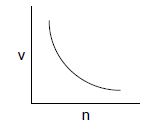
B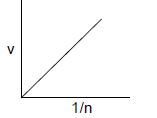
C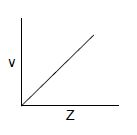
D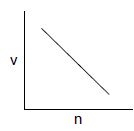
Solution
(D) The velocity of an electron in an orbit is given by the formula $v = v_0 \times \frac{Z}{n}$,where $v_0$ is a constant,$Z$ is the atomic number,and $n$ is the principal quantum number.
From this relation,we can conclude:
$1$. $v \propto Z$ (at constant $n$),which represents a straight line passing through the origin.
$2$. $v \propto \frac{1}{n}$ (at constant $Z$),which represents a straight line passing through the origin when plotted against $\frac{1}{n}$.
$3$. $v \propto \frac{1}{n}$ (at constant $Z$),which represents a rectangular hyperbola when plotted against $n$.
Comparing these with the given options,the graph of $v$ vs. $n$ should be a rectangular hyperbola,not a straight line with a negative slope. Therefore,the linear graph of $v$ vs. $n$ is incorrect.
From this relation,we can conclude:
$1$. $v \propto Z$ (at constant $n$),which represents a straight line passing through the origin.
$2$. $v \propto \frac{1}{n}$ (at constant $Z$),which represents a straight line passing through the origin when plotted against $\frac{1}{n}$.
$3$. $v \propto \frac{1}{n}$ (at constant $Z$),which represents a rectangular hyperbola when plotted against $n$.
Comparing these with the given options,the graph of $v$ vs. $n$ should be a rectangular hyperbola,not a straight line with a negative slope. Therefore,the linear graph of $v$ vs. $n$ is incorrect.
0 likes
View Solution305
EasyMCQ
The energy levels for a hydrogen-like species with atomic number $Z$ can be given by:
A
$E_n$ for species $= Z^2 \times E_n$ for $H$
B
$E_n$ for species $= Z \times E_n$ for $H$
C
$E_n$ for species $= \frac{1}{Z^2} \times E_n$ for $H$
D
$E_n$ for species $= \frac{1}{Z} \times E_n$ for $H$
Solution
(A) According to the Bohr model,the energy of an electron in the $n^{th}$ orbit of a hydrogen-like species with atomic number $Z$ is given by $E_n = -13.6 \frac{Z^2}{n^2} \text{ eV}$.
For hydrogen $(Z=1)$,the energy is $E_n(H) = -13.6 \frac{1^2}{n^2} = -13.6 \frac{1}{n^2} \text{ eV}$.
Comparing these two expressions,we get $E_n = Z^2 \times E_n(H)$.
For hydrogen $(Z=1)$,the energy is $E_n(H) = -13.6 \frac{1^2}{n^2} = -13.6 \frac{1}{n^2} \text{ eV}$.
Comparing these two expressions,we get $E_n = Z^2 \times E_n(H)$.
0 likes
View Solution306
MediumMCQ
In an atom,two electrons move around the nucleus in circular orbits of radii $R$ and $4R$. The ratio of the time taken by them to complete one revolution is
A
$1 : 4$
B
$4 : 1$
C
$1 : 8$
D
$8 : 7$
Solution
(C) According to Bohr's theory,the radius of an orbit is $r \propto n^{2}$ and the velocity of an electron is $v \propto \frac{1}{n}$.
Time period $T$ is given by $T = \frac{2 \pi r}{v}$.
Substituting the proportionality relations,$T \propto \frac{n^{2}}{1/n} = n^{3}$.
Since $r \propto n^{2}$,we have $n \propto r^{1/2}$,so $T \propto (r^{1/2})^{3} = r^{3/2}$.
Therefore,the ratio of time periods is $\frac{T_{1}}{T_{2}} = \left(\frac{R_{1}}{R_{2}}\right)^{3/2}$.
Given $R_{1} = R$ and $R_{2} = 4R$,we get $\frac{T_{1}}{T_{2}} = \left(\frac{R}{4R}\right)^{3/2} = \left(\frac{1}{4}\right)^{3/2} = \frac{1}{8}$.
Time period $T$ is given by $T = \frac{2 \pi r}{v}$.
Substituting the proportionality relations,$T \propto \frac{n^{2}}{1/n} = n^{3}$.
Since $r \propto n^{2}$,we have $n \propto r^{1/2}$,so $T \propto (r^{1/2})^{3} = r^{3/2}$.
Therefore,the ratio of time periods is $\frac{T_{1}}{T_{2}} = \left(\frac{R_{1}}{R_{2}}\right)^{3/2}$.
Given $R_{1} = R$ and $R_{2} = 4R$,we get $\frac{T_{1}}{T_{2}} = \left(\frac{R}{4R}\right)^{3/2} = \left(\frac{1}{4}\right)^{3/2} = \frac{1}{8}$.
0 likes
View Solution307
MediumMCQ
One energy difference between the states $n = 2$ and $n = 3$ is $E \ eV$,in a hydrogen atom. The ionization potential of the $H$ atom is ............. $E$.
A
$3.2$
B
$5.6$
C
$7.2$
D
$13.2$
Solution
(C) The energy of an electron in the $n^{th}$ orbit of a hydrogen atom is given by $E_n = -\frac{E_o}{n^2}$,where $E_o = 13.6 \ eV$.
The energy difference between $n = 2$ and $n = 3$ is given as $E = E_3 - E_2 = -\frac{E_o}{3^2} - (-\frac{E_o}{2^2}) = E_o(\frac{1}{4} - \frac{1}{9}) = \frac{5E_o}{36}$.
Therefore,$E_o = \frac{36E}{5} = 7.2E$.
The ionization potential of the $H$ atom is the energy required to remove an electron from $n = 1$ to $n = \infty$,which is $E' = E_{\infty} - E_1 = 0 - (-\frac{E_o}{1^2}) = E_o$.
Substituting the value of $E_o$,we get $E' = 7.2E$.
The energy difference between $n = 2$ and $n = 3$ is given as $E = E_3 - E_2 = -\frac{E_o}{3^2} - (-\frac{E_o}{2^2}) = E_o(\frac{1}{4} - \frac{1}{9}) = \frac{5E_o}{36}$.
Therefore,$E_o = \frac{36E}{5} = 7.2E$.
The ionization potential of the $H$ atom is the energy required to remove an electron from $n = 1$ to $n = \infty$,which is $E' = E_{\infty} - E_1 = 0 - (-\frac{E_o}{1^2}) = E_o$.
Substituting the value of $E_o$,we get $E' = 7.2E$.
0 likes
View Solution308
MediumMCQ
Based on equation $E = -2.178 \times 10^{-18} \ J \ \frac{Z^2}{n^2}$,certain conclusions are written. Which of them is not correct?
A
For $n = 1$,the electron has a more negative energy than it does for $n = 6$,which means that the electron is more tightly bound in the smallest allowed orbit.
B
The negative sign in the equation simply means that the energy of the electron bound to the nucleus is lower than it would be if the electron were at an infinite distance from the nucleus.
C
Larger the value of $n$,the larger is the orbit radius.
D
The equation can be used to calculate the change in energy when the electron changes its orbit.
Solution
(NONE) The equation $E = -2.178 \times 10^{-18} \ J \ \frac{Z^2}{n^2}$ describes the energy of an electron in a hydrogen-like atom.
Option $A$ is correct because as $n$ increases,energy becomes less negative (closer to zero),meaning the electron is less tightly bound.
Option $B$ is correct as the negative sign indicates a stable bound state relative to the zero-energy state at infinity.
Option $C$ is correct because the radius of the orbit is given by $r_n = a_0 \frac{n^2}{Z}$,so $r \propto n^2$.
Option $D$ is correct as $\Delta E = E_f - E_i$ can be calculated using this formula.
Since all statements $A, B, C,$ and $D$ are scientifically correct based on the Bohr model,there is no incorrect statement provided in the options.
Option $A$ is correct because as $n$ increases,energy becomes less negative (closer to zero),meaning the electron is less tightly bound.
Option $B$ is correct as the negative sign indicates a stable bound state relative to the zero-energy state at infinity.
Option $C$ is correct because the radius of the orbit is given by $r_n = a_0 \frac{n^2}{Z}$,so $r \propto n^2$.
Option $D$ is correct as $\Delta E = E_f - E_i$ can be calculated using this formula.
Since all statements $A, B, C,$ and $D$ are scientifically correct based on the Bohr model,there is no incorrect statement provided in the options.
0 likes
View Solution309
MediumMCQ
$A$ certain electronic transition from an excited state to the ground state of the $H$ atom in one or more steps gives rise to four lines in the ultraviolet region of the spectrum. How many lines does this transition produce in the infrared region of the spectrum?
A
$1$
B
$2$
C
$3$
D
$4$
Solution
(C) The ultraviolet region of the hydrogen spectrum corresponds to the Lyman series,where transitions occur to the ground state $(n_1 = 1)$.
Four lines in the ultraviolet region imply transitions from $n_2 = 2, 3, 4, 5$ to $n_1 = 1$.
This indicates the electron is initially in the $n = 5$ excited state.
The possible transitions from $n = 5$ to lower energy levels are given by the formula $\frac{n(n-1)}{2} = \frac{5(5-1)}{2} = 10$ total lines.
The lines in the infrared region correspond to the Paschen series $(n_1 = 3)$ and Brackett series $(n_1 = 4)$.
For $n = 5$,the possible transitions are:
$5 \rightarrow 4$ (Brackett series,$IR$),
$5 \rightarrow 3$ (Paschen series,$IR$),
$4 \rightarrow 3$ (Paschen series,$IR$).
Thus,there are $3$ lines in the infrared region.
Therefore,the correct option is $C$.
Four lines in the ultraviolet region imply transitions from $n_2 = 2, 3, 4, 5$ to $n_1 = 1$.
This indicates the electron is initially in the $n = 5$ excited state.
The possible transitions from $n = 5$ to lower energy levels are given by the formula $\frac{n(n-1)}{2} = \frac{5(5-1)}{2} = 10$ total lines.
The lines in the infrared region correspond to the Paschen series $(n_1 = 3)$ and Brackett series $(n_1 = 4)$.
For $n = 5$,the possible transitions are:
$5 \rightarrow 4$ (Brackett series,$IR$),
$5 \rightarrow 3$ (Paschen series,$IR$),
$4 \rightarrow 3$ (Paschen series,$IR$).
Thus,there are $3$ lines in the infrared region.
Therefore,the correct option is $C$.
0 likes
View Solution310
MediumMCQ
The number of maximum possible different spectral lines obtained in the Balmer series,when an electron makes a transition to the ground state from the $5^{th}$ excited state in a sample of hydrogen atoms,is:
A
$15$
B
$4$
C
$6$
D
$10$
Solution
(B) The $5^{th}$ excited state of a hydrogen atom corresponds to the principal quantum number $n = 6$.
The ground state corresponds to $n = 1$.
The Balmer series consists of spectral lines produced when an electron transitions from any higher energy level $(n_2 > 2)$ to the $n_1 = 2$ energy level.
Given the electron transitions from $n = 6$ to $n = 1$,the transitions that result in the Balmer series are those ending at $n = 2$.
These transitions are: $6 \to 2$,$5 \to 2$,$4 \to 2$,and $3 \to 2$.
Thus,the total number of different spectral lines in the Balmer series is $4$.
The ground state corresponds to $n = 1$.
The Balmer series consists of spectral lines produced when an electron transitions from any higher energy level $(n_2 > 2)$ to the $n_1 = 2$ energy level.
Given the electron transitions from $n = 6$ to $n = 1$,the transitions that result in the Balmer series are those ending at $n = 2$.
These transitions are: $6 \to 2$,$5 \to 2$,$4 \to 2$,and $3 \to 2$.
Thus,the total number of different spectral lines in the Balmer series is $4$.
0 likes
View Solution311
MediumMCQ
When $Z$ is doubled in an atom,which of the following statements are consistent with Bohr's theory?
A
Energy of a state is doubled
B
Radius of an orbit is doubled
C
Velocity of electron in an orbit is doubled
D
Energy of a state is halved
Solution
(C) According to Bohr's theory,the energy of an electron in a state is given by $E_n = -13.6 \times \frac{Z^2}{n^2} \ \text{eV}$,which implies $E \propto Z^2$. If $Z$ is doubled,$E$ becomes $4$ times the original value.
The radius of an orbit is given by $r_n = 0.529 \times \frac{n^2}{Z} \ \mathring{A}$,which implies $r \propto \frac{1}{Z}$. If $Z$ is doubled,$r$ becomes half of the original value.
The velocity of an electron in an orbit is given by $v_n = 2.18 \times 10^6 \times \frac{Z}{n} \ \text{m/s}$,which implies $v \propto Z$. If $Z$ is doubled,$v$ becomes $2$ times the original value.
Therefore,the statement that the velocity of the electron in an orbit is doubled is consistent with Bohr's theory.
The radius of an orbit is given by $r_n = 0.529 \times \frac{n^2}{Z} \ \mathring{A}$,which implies $r \propto \frac{1}{Z}$. If $Z$ is doubled,$r$ becomes half of the original value.
The velocity of an electron in an orbit is given by $v_n = 2.18 \times 10^6 \times \frac{Z}{n} \ \text{m/s}$,which implies $v \propto Z$. If $Z$ is doubled,$v$ becomes $2$ times the original value.
Therefore,the statement that the velocity of the electron in an orbit is doubled is consistent with Bohr's theory.
0 likes
View Solution312
MediumMCQ
When an electron jumps from $n = 5$ to $n = 2$ with all possible transitions,which of the following statements is correct?
A
Number of lines in the ultraviolet region is equal to $3$
B
Number of lines in the visible region is equal to $2$
C
Number of lines in the infrared region is equal to $3$
D
All of these
Solution
(D) The number of spectral lines emitted when an electron jumps from $n_2$ to $n_1$ is given by the formula $\frac{(n_2 - n_1)(n_2 - n_1 + 1)}{2}$.
For $n_2 = 5$ and $n_1 = 2$,the total number of lines is $\frac{(5 - 2)(5 - 2 + 1)}{2} = \frac{3 \times 4}{2} = 6$.
The possible transitions are:
$5 \to 4, 5 \to 3, 5 \to 2, 4 \to 3, 4 \to 2, 3 \to 2$.
$1$. Ultraviolet region (Lyman series,$n_1 = 1$): None of these transitions end at $n = 1$,so the number of lines is $0$.
$2$. Visible region (Balmer series,$n_1 = 2$): The transitions ending at $n = 2$ are $5 \to 2, 4 \to 2, 3 \to 2$. Total lines = $3$.
$3$. Infrared region (Paschen series,$n_1 = 3$): The transitions ending at $n = 3$ are $5 \to 3, 4 \to 3$. Total lines = $2$.
Since none of the individual statements $A, B, C$ are correct,and option $D$ claims all are correct,there is an error in the provided options. However,based on standard textbook problems of this type,if the question implies transitions ending at $n=2$,the visible lines are $3$. Given the options,the question is flawed.
For $n_2 = 5$ and $n_1 = 2$,the total number of lines is $\frac{(5 - 2)(5 - 2 + 1)}{2} = \frac{3 \times 4}{2} = 6$.
The possible transitions are:
$5 \to 4, 5 \to 3, 5 \to 2, 4 \to 3, 4 \to 2, 3 \to 2$.
$1$. Ultraviolet region (Lyman series,$n_1 = 1$): None of these transitions end at $n = 1$,so the number of lines is $0$.
$2$. Visible region (Balmer series,$n_1 = 2$): The transitions ending at $n = 2$ are $5 \to 2, 4 \to 2, 3 \to 2$. Total lines = $3$.
$3$. Infrared region (Paschen series,$n_1 = 3$): The transitions ending at $n = 3$ are $5 \to 3, 4 \to 3$. Total lines = $2$.
Since none of the individual statements $A, B, C$ are correct,and option $D$ claims all are correct,there is an error in the provided options. However,based on standard textbook problems of this type,if the question implies transitions ending at $n=2$,the visible lines are $3$. Given the options,the question is flawed.
0 likes
View Solution313
MediumMCQ
What is the kinetic energy of an electron in the second excited state of $He^{+}$? (Energy of an electron in the first shell of $H = -13.6 \ eV$)
A
$1.51$
B
$6.04$
C
$13.08$
D
$13.6$
Solution
(B) For a hydrogen-like species,the energy of an electron in the $n^{th}$ shell is given by $E_n = -13.6 \times \frac{Z^2}{n^2} \ eV$.
For $He^{+}$,the atomic number $Z = 2$.
The second excited state corresponds to $n = 3$ (ground state $n=1$,first excited state $n=2$,second excited state $n=3$).
Substituting the values: $E_3 = -13.6 \times \frac{2^2}{3^2} = -13.6 \times \frac{4}{9} \ eV$.
$E_3 = -6.044 \ eV$.
The kinetic energy $(KE)$ of an electron is equal to the magnitude of its total energy,i.e.,$KE = |E_n|$.
Therefore,$KE = 6.044 \ eV \approx 6.04 \ eV$.
For $He^{+}$,the atomic number $Z = 2$.
The second excited state corresponds to $n = 3$ (ground state $n=1$,first excited state $n=2$,second excited state $n=3$).
Substituting the values: $E_3 = -13.6 \times \frac{2^2}{3^2} = -13.6 \times \frac{4}{9} \ eV$.
$E_3 = -6.044 \ eV$.
The kinetic energy $(KE)$ of an electron is equal to the magnitude of its total energy,i.e.,$KE = |E_n|$.
Therefore,$KE = 6.044 \ eV \approx 6.04 \ eV$.
0 likes
View Solution314
MediumMCQ
If the shortest wavelength of $H$ atom in Lyman series is $x$,then the longest wavelength in Balmer series of $He^{+}$ is
A
$\frac{9x}{5}$
B
$\frac{36x}{5}$
C
$\frac{x}{4}$
D
$\frac{5x}{9}$
Solution
(A) The Rydberg formula is given by $\frac{1}{\lambda} = R_{H} Z^2 \left[ \frac{1}{n_1^2} - \frac{1}{n_2^2} \right]$.
For the Lyman series of $H$ atom $(Z=1)$,the shortest wavelength occurs at $n_1 = 1$ and $n_2 = \infty$.
$\frac{1}{x} = R_{H} (1)^2 \left[ \frac{1}{1^2} - \frac{1}{\infty^2} \right] = R_{H} \implies R_{H} = \frac{1}{x}$.
For the Balmer series of $He^{+}$ ion $(Z=2)$,the longest wavelength occurs at $n_1 = 2$ and $n_2 = 3$.
$\frac{1}{\lambda_{\max}} = R_{H} (2)^2 \left[ \frac{1}{2^2} - \frac{1}{3^2} \right]$.
Substituting $R_{H} = \frac{1}{x}$:
$\frac{1}{\lambda_{\max}} = \frac{1}{x} \times 4 \left[ \frac{1}{4} - \frac{1}{9} \right] = \frac{4}{x} \left[ \frac{5}{36} \right] = \frac{5}{9x}$.
Therefore,$\lambda_{\max} = \frac{9x}{5}$.
For the Lyman series of $H$ atom $(Z=1)$,the shortest wavelength occurs at $n_1 = 1$ and $n_2 = \infty$.
$\frac{1}{x} = R_{H} (1)^2 \left[ \frac{1}{1^2} - \frac{1}{\infty^2} \right] = R_{H} \implies R_{H} = \frac{1}{x}$.
For the Balmer series of $He^{+}$ ion $(Z=2)$,the longest wavelength occurs at $n_1 = 2$ and $n_2 = 3$.
$\frac{1}{\lambda_{\max}} = R_{H} (2)^2 \left[ \frac{1}{2^2} - \frac{1}{3^2} \right]$.
Substituting $R_{H} = \frac{1}{x}$:
$\frac{1}{\lambda_{\max}} = \frac{1}{x} \times 4 \left[ \frac{1}{4} - \frac{1}{9} \right] = \frac{4}{x} \left[ \frac{5}{36} \right] = \frac{5}{9x}$.
Therefore,$\lambda_{\max} = \frac{9x}{5}$.
0 likes
View Solution315
DifficultMCQ
The ratio of the velocity of an electron in the ground state of a hydrogen atom to its velocity in the second excited state of a $He^{+}$ ion is:
A
$3.5$
B
$1.5$
C
$2$
D
$2.5$
Solution
(B) The velocity of an electron in a hydrogen-like species is given by the formula: $v = v_0 \times \frac{Z}{n}$,where $v_0$ is the velocity of an electron in the ground state of hydrogen $(2.18 \times 10^6 \ m/s)$,$Z$ is the atomic number,and $n$ is the principal quantum number.
For the ground state of a hydrogen atom $(H)$: $Z_1 = 1$,$n_1 = 1$. So,$v_1 = v_0 \times \frac{1}{1} = v_0$.
For the second excited state of a $He^{+}$ ion: $Z_2 = 2$,and the second excited state corresponds to $n_2 = 3$. So,$v_2 = v_0 \times \frac{2}{3}$.
The ratio of the velocities is $\frac{v_1}{v_2} = \frac{v_0}{v_0 \times (2/3)} = \frac{3}{2} = 1.5$.
For the ground state of a hydrogen atom $(H)$: $Z_1 = 1$,$n_1 = 1$. So,$v_1 = v_0 \times \frac{1}{1} = v_0$.
For the second excited state of a $He^{+}$ ion: $Z_2 = 2$,and the second excited state corresponds to $n_2 = 3$. So,$v_2 = v_0 \times \frac{2}{3}$.
The ratio of the velocities is $\frac{v_1}{v_2} = \frac{v_0}{v_0 \times (2/3)} = \frac{3}{2} = 1.5$.
0 likes
View Solution316
MediumMCQ
The potential energy of an electron in the hydrogen atom is $-6.8 \ eV$. Indicate in which excited state the electron is present.
A
First
B
Second
C
Third
D
Fourth
Solution
(A) The relationship between total energy $(E_n)$ and potential energy $(PE)$ is given by $E_n = \frac{1}{2} PE$.
Substituting the given value: $E_n = \frac{-6.8 \ eV}{2} = -3.4 \ eV$.
The energy of an electron in the $n^{th}$ orbit of a hydrogen atom is $E_n = \frac{-13.6 \ eV}{n^2}$.
Equating the two: $\frac{-13.6}{n^2} = -3.4$,which gives $n^2 = 4$,so $n = 2$.
The state $n = 1$ is the ground state,and $n = 2$ corresponds to the first excited state.
Substituting the given value: $E_n = \frac{-6.8 \ eV}{2} = -3.4 \ eV$.
The energy of an electron in the $n^{th}$ orbit of a hydrogen atom is $E_n = \frac{-13.6 \ eV}{n^2}$.
Equating the two: $\frac{-13.6}{n^2} = -3.4$,which gives $n^2 = 4$,so $n = 2$.
The state $n = 1$ is the ground state,and $n = 2$ corresponds to the first excited state.
0 likes
View Solution317
MediumMCQ
Which orbit of $Be^{+3}$ has the same orbit radius as that of the ground state of hydrogen atom?
A
$3$
B
$2$
C
$4$
D
$5$
Solution
(B) According to Bohr's model,the radius of the $n$-th orbit is given by $r_n = a_0 \frac{n^2}{Z}$,where $a_0$ is the Bohr radius.
For the ground state of hydrogen atom,$n = 1$ and $Z = 1$,so $r_H = a_0 \frac{1^2}{1} = a_0$.
For $Be^{+3}$ ion,$Z = 4$. We need to find the orbit $n$ such that $r_{Be} = r_H$.
$a_0 \frac{n^2}{4} = a_0$.
$n^2 = 4$.
$n = 2$.
For the ground state of hydrogen atom,$n = 1$ and $Z = 1$,so $r_H = a_0 \frac{1^2}{1} = a_0$.
For $Be^{+3}$ ion,$Z = 4$. We need to find the orbit $n$ such that $r_{Be} = r_H$.
$a_0 \frac{n^2}{4} = a_0$.
$n^2 = 4$.
$n = 2$.
0 likes
View Solution318
DifficultMCQ
If the ionization energy of $He^{+}$ is $8.68 \times 10^{-18} \ J$,then the energy of $Be^{3+}$ ion in the second orbit is:- ($Z$ of $Be = 4$)
A
$-4.9 \times 10^{-18} \ J$
B
$-44.1 \times 10^{-18} \ J$
C
$-11.025 \times 10^{-18} \ J$
D
$-8.68 \times 10^{-18} \ J$
Solution
(D) The energy of an electron in the $n^{th}$ orbit of a hydrogen-like species is given by the formula: $E_n = -13.6 \times \frac{Z^2}{n^2} \ eV$ or $E_n = -K \times \frac{Z^2}{n^2} \ J$.
For $He^{+}$ $(Z=2)$,the ionization energy is the energy required to remove the electron from the ground state $(n=1)$ to infinity $(n=\infty)$.
$IE = E_{\infty} - E_1 = 0 - (-K \times \frac{2^2}{1^2}) = 4K = 8.68 \times 10^{-18} \ J$.
Therefore,$K = \frac{8.68 \times 10^{-18}}{4} = 2.17 \times 10^{-18} \ J$.
Now,for $Be^{3+}$ $(Z=4)$ in the second orbit $(n=2)$:
$E_2 = -K \times \frac{Z^2}{n^2} = -(2.17 \times 10^{-18}) \times \frac{4^2}{2^2} = -(2.17 \times 10^{-18}) \times \frac{16}{4} = -(2.17 \times 10^{-18}) \times 4 = -8.68 \times 10^{-18} \ J$.
For $He^{+}$ $(Z=2)$,the ionization energy is the energy required to remove the electron from the ground state $(n=1)$ to infinity $(n=\infty)$.
$IE = E_{\infty} - E_1 = 0 - (-K \times \frac{2^2}{1^2}) = 4K = 8.68 \times 10^{-18} \ J$.
Therefore,$K = \frac{8.68 \times 10^{-18}}{4} = 2.17 \times 10^{-18} \ J$.
Now,for $Be^{3+}$ $(Z=4)$ in the second orbit $(n=2)$:
$E_2 = -K \times \frac{Z^2}{n^2} = -(2.17 \times 10^{-18}) \times \frac{4^2}{2^2} = -(2.17 \times 10^{-18}) \times \frac{16}{4} = -(2.17 \times 10^{-18}) \times 4 = -8.68 \times 10^{-18} \ J$.
0 likes
View Solution319
MediumMCQ
In which of the following transitions is a photon of maximum energy absorbed?
A
$1$ to $2$
B
$2$ to $3$
C
$1$ to $\infty$
D
$\infty$ to $1$
Solution
(C) The energy of a transition in a hydrogen-like atom is given by $\Delta E = 13.6 \ Z^2 (\frac{1}{n_1^2} - \frac{1}{n_2^2}) \ eV$.
For absorption,the electron moves from a lower energy level $(n_1)$ to a higher energy level $(n_2)$.
For $1$ to $2$: $\Delta E = 13.6 (1 - \frac{1}{4}) = 10.2 \ eV$.
For $2$ to $3$: $\Delta E = 13.6 (\frac{1}{4} - \frac{1}{9}) \approx 1.89 \ eV$.
For $1$ to $\infty$: $\Delta E = 13.6 (1 - 0) = 13.6 \ eV$.
$\infty$ to $1$ represents emission,not absorption.
Thus,the transition from $1$ to $\infty$ involves the maximum energy absorption.
For absorption,the electron moves from a lower energy level $(n_1)$ to a higher energy level $(n_2)$.
For $1$ to $2$: $\Delta E = 13.6 (1 - \frac{1}{4}) = 10.2 \ eV$.
For $2$ to $3$: $\Delta E = 13.6 (\frac{1}{4} - \frac{1}{9}) \approx 1.89 \ eV$.
For $1$ to $\infty$: $\Delta E = 13.6 (1 - 0) = 13.6 \ eV$.
$\infty$ to $1$ represents emission,not absorption.
Thus,the transition from $1$ to $\infty$ involves the maximum energy absorption.
0 likes
View Solution320
MediumMCQ
If an electron moves from an excited state to the ground state in multiple steps in the hydrogen spectrum,and the number of lines in the visible region is $4$,then the number of lines in the infrared region is:
A
$4$
B
$6$
C
$5$
D
$7$
Solution
(B) The visible region corresponds to the Balmer series $(n_f = 2)$.
For $n$ transitions resulting in $4$ lines in the Balmer series,the electron must jump from $n_i = 6$ to $n_f = 2$ (since the number of lines $= n_i - n_f = 6 - 2 = 4$).
The infrared $(IR)$ region includes the Paschen $(n_f = 3)$,Brackett $(n_f = 4)$,and Pfund $(n_f = 5)$ series.
For transitions from $n_i = 6$ to lower energy levels:
Paschen series $(n_f = 3)$: $6$ $\rightarrow 3, 5$ $\rightarrow 3, 4$ $\rightarrow 3$ ($3$ lines).
Brackett series $(n_f = 4)$: $6$ $\rightarrow 4, 5$ $\rightarrow 4$ ($2$ lines).
Pfund series $(n_f = 5)$: $6 \rightarrow 5$ ($1$ line).
Total lines in the $IR$ region $= 3 + 2 + 1 = 6$.
For $n$ transitions resulting in $4$ lines in the Balmer series,the electron must jump from $n_i = 6$ to $n_f = 2$ (since the number of lines $= n_i - n_f = 6 - 2 = 4$).
The infrared $(IR)$ region includes the Paschen $(n_f = 3)$,Brackett $(n_f = 4)$,and Pfund $(n_f = 5)$ series.
For transitions from $n_i = 6$ to lower energy levels:
Paschen series $(n_f = 3)$: $6$ $\rightarrow 3, 5$ $\rightarrow 3, 4$ $\rightarrow 3$ ($3$ lines).
Brackett series $(n_f = 4)$: $6$ $\rightarrow 4, 5$ $\rightarrow 4$ ($2$ lines).
Pfund series $(n_f = 5)$: $6 \rightarrow 5$ ($1$ line).
Total lines in the $IR$ region $= 3 + 2 + 1 = 6$.
0 likes
View Solution321
EasyMCQ
The frequency of radiation absorbed or emitted when transition occurs between two stationary states with energies $E_1$ (lower) and $E_2$ (higher) is given by
A
$v = \frac{E_1+E_2}{h}$
B
$v = \frac{E_1 - E_2}{h}$
C
$v = \frac{E_1 \times E_2}{h}$
D
$v = \frac{E_2 - E_1}{h}$
Solution
(D) According to Bohr's postulate,the energy difference between two stationary states is given by $\Delta E = E_2 - E_1$.
This energy difference is equal to the energy of the photon absorbed or emitted,which is given by $E = h v$.
Equating the two,we get $h v = E_2 - E_1$.
Therefore,the frequency $v$ is given by $v = \frac{E_2 - E_1}{h}$.
This energy difference is equal to the energy of the photon absorbed or emitted,which is given by $E = h v$.
Equating the two,we get $h v = E_2 - E_1$.
Therefore,the frequency $v$ is given by $v = \frac{E_2 - E_1}{h}$.
0 likes
View Solution322
EasyMCQ
The distance between the $3^{rd}$ and $2^{nd}$ Bohr's orbits in the hydrogen atom is
A
$2.645 \times 10^{-8} \ cm$
B
$2.116 \times 10^{-8} \ cm$
C
$1.058 \times 10^{-8} \ cm$
D
$0.529 \times 10^{-8} \ cm$
Solution
(A) The radius of the $n^{th}$ Bohr orbit is given by $r_n = 0.529 \times \frac{n^2}{Z} \mathring{A}$.
For a hydrogen atom,$Z = 1$.
Radius of the $3^{rd}$ orbit $(r_3)$ = $0.529 \times 3^2 = 0.529 \times 9 = 4.761 \mathring{A}$.
Radius of the $2^{nd}$ orbit $(r_2)$ = $0.529 \times 2^2 = 0.529 \times 4 = 2.116 \mathring{A}$.
The distance between the $3^{rd}$ and $2^{nd}$ orbits is $r_3 - r_2 = 4.761 \mathring{A} - 2.116 \mathring{A} = 2.645 \mathring{A}$.
Since $1 \mathring{A} = 10^{-8} \ cm$,the distance is $2.645 \times 10^{-8} \ cm$.
For a hydrogen atom,$Z = 1$.
Radius of the $3^{rd}$ orbit $(r_3)$ = $0.529 \times 3^2 = 0.529 \times 9 = 4.761 \mathring{A}$.
Radius of the $2^{nd}$ orbit $(r_2)$ = $0.529 \times 2^2 = 0.529 \times 4 = 2.116 \mathring{A}$.
The distance between the $3^{rd}$ and $2^{nd}$ orbits is $r_3 - r_2 = 4.761 \mathring{A} - 2.116 \mathring{A} = 2.645 \mathring{A}$.
Since $1 \mathring{A} = 10^{-8} \ cm$,the distance is $2.645 \times 10^{-8} \ cm$.
0 likes
View Solution323
EasyMCQ
The wave number of the last line of the Lyman series of the atomic spectrum of the $H$ atom corresponds to :-
A
$n_2 = 4$ to $n_1 = 1$
B
$n_2 = 3$ to $n_1 = 2$
C
$n_2 = 2$ to $n_1 = 1$
D
$n_2 = \infty$ to $n_1 = 1$
Solution
(D) The Lyman series in the atomic spectrum of the $H$ atom corresponds to electronic transitions from higher energy levels $(n_2 = 2, 3, 4, \dots, \infty)$ to the ground state $(n_1 = 1)$.
The wave number $(\bar{\nu})$ is given by the Rydberg formula: $\bar{\nu} = R_H \times Z^2 \times (\frac{1}{n_1^2} - \frac{1}{n_2^2})$.
The 'last line' of a spectral series corresponds to the transition from the highest possible energy level,which is $n_2 = \infty$,to the series limit level,which is $n_1 = 1$.
Therefore,the transition is from $n_2 = \infty$ to $n_1 = 1$.
The wave number $(\bar{\nu})$ is given by the Rydberg formula: $\bar{\nu} = R_H \times Z^2 \times (\frac{1}{n_1^2} - \frac{1}{n_2^2})$.
The 'last line' of a spectral series corresponds to the transition from the highest possible energy level,which is $n_2 = \infty$,to the series limit level,which is $n_1 = 1$.
Therefore,the transition is from $n_2 = \infty$ to $n_1 = 1$.
0 likes
View Solution324
MediumMCQ
In the transition of an electron in an atom,its kinetic energy changes from $y$ to $y/4$. The change in potential energy $(P.E.)$ will be:
A
$\frac{-3}{4}y$
B
$\frac{3}{4}y$
C
$\frac{-3}{8}y$
D
$\frac{3}{2}y$
Solution
(D) For an electron in a hydrogen-like atom,the relationship between kinetic energy $(K.E.)$ and potential energy $(P.E.)$ is given by $P.E. = -2 \times K.E.$
Initially,$K.E._1 = y$,so $P.E._1 = -2y$.
Finally,$K.E._2 = y/4$,so $P.E._2 = -2 \times (y/4) = -y/2$.
The change in potential energy is $\Delta P.E. = P.E._2 - P.E._1 = (-y/2) - (-2y) = (-y/2) + 2y = \frac{3}{2}y$.
Initially,$K.E._1 = y$,so $P.E._1 = -2y$.
Finally,$K.E._2 = y/4$,so $P.E._2 = -2 \times (y/4) = -y/2$.
The change in potential energy is $\Delta P.E. = P.E._2 - P.E._1 = (-y/2) - (-2y) = (-y/2) + 2y = \frac{3}{2}y$.
0 likes
View Solution325
MediumMCQ
What is the maximum wavelength line in the Lyman series of $He^{+}$ ion?
A
$3R$
B
$\frac{4}{3R}$
C
$\frac{1}{3R}$
D
None of these
Solution
(C) The Rydberg formula for the wavelength of a spectral line is given by: $\frac{1}{\lambda} = R Z^{2} \left( \frac{1}{n_1^{2}} - \frac{1}{n_2^{2}} \right)$.
For the Lyman series,$n_1 = 1$. For maximum wavelength,the transition must be from the nearest energy level,so $n_2 = 2$.
For $He^{+}$ ion,the atomic number $Z = 2$.
Substituting these values: $\frac{1}{\lambda_{\max}} = R (2)^{2} \left( \frac{1}{1^{2}} - \frac{1}{2^{2}} \right)$.
$\frac{1}{\lambda_{\max}} = R \times 4 \times \left( 1 - \frac{1}{4} \right) = R \times 4 \times \frac{3}{4} = 3R$.
Therefore,$\lambda_{\max} = \frac{1}{3R}$.
For the Lyman series,$n_1 = 1$. For maximum wavelength,the transition must be from the nearest energy level,so $n_2 = 2$.
For $He^{+}$ ion,the atomic number $Z = 2$.
Substituting these values: $\frac{1}{\lambda_{\max}} = R (2)^{2} \left( \frac{1}{1^{2}} - \frac{1}{2^{2}} \right)$.
$\frac{1}{\lambda_{\max}} = R \times 4 \times \left( 1 - \frac{1}{4} \right) = R \times 4 \times \frac{3}{4} = 3R$.
Therefore,$\lambda_{\max} = \frac{1}{3R}$.
0 likes
View Solution326
EasyMCQ
For which of the following species,Bohr's theory is not applicable?
A
$Be^{3+}$
B
$Li^{2+}$
C
$He^{2+}$
D
$H$
Solution
(C) $Bohr's$ theory is applicable only to single-electron species (hydrogen-like atoms).
$H$ has $1$ electron.
$Li^{2+}$ has $3 - 2 = 1$ electron.
$Be^{3+}$ has $4 - 3 = 1$ electron.
$He^{2+}$ has $2 - 2 = 0$ electrons.
Since $He^{2+}$ has no electrons,$Bohr's$ theory is not applicable to it.
$H$ has $1$ electron.
$Li^{2+}$ has $3 - 2 = 1$ electron.
$Be^{3+}$ has $4 - 3 = 1$ electron.
$He^{2+}$ has $2 - 2 = 0$ electrons.
Since $He^{2+}$ has no electrons,$Bohr's$ theory is not applicable to it.
0 likes
View Solution327
MediumMCQ
In Bohr's atomic model,the radius $(r)$ and energy $(E)$ of an orbit $(n)$ are related as:
A
$E \propto -1/n^2, r \propto n^2$
B
$r \propto 1/n^2, E \propto n^2$
C
$r \propto 1/n, E \propto n$
D
$r \propto n^2, E \propto 1/n^2$
Solution
(A) In Bohr's atomic model,the radius of the $n^{th}$ orbit is given by $r_n = \frac{n^2 h^2 \epsilon_0}{\pi m Z e^2}$,which implies $r \propto n^2$.
The total energy of an electron in the $n^{th}$ orbit is $E_n = -\frac{m Z^2 e^4}{8 \epsilon_0^2 h^2 n^2}$,which implies $E \propto -1/n^2$.
Considering the magnitude of energy,the relationship is $r \propto n^2$ and $E \propto 1/n^2$.
The total energy of an electron in the $n^{th}$ orbit is $E_n = -\frac{m Z^2 e^4}{8 \epsilon_0^2 h^2 n^2}$,which implies $E \propto -1/n^2$.
Considering the magnitude of energy,the relationship is $r \propto n^2$ and $E \propto 1/n^2$.
0 likes
View Solution328
DifficultMCQ
Consider one $He^{+}$ ion is in excited state $(n = 5)$. Which of the following observations hold true as per the Bohr's model?
A
$10$ emission spectral lines will be seen
B
The ionisation energy needed is less than $2 \, eV$
C
The longest emitted wavelength is less than $10/R$ ($R =$ Rydberg constant)
D
The electronic separation from the centre of nucleus is more than $6 \, \mathring{A}$
Solution
(D) For a single $He^{+}$ ion in the $n = 5$ state,the number of emission lines is $n - 1 = 4$. Thus,option $A$ is incorrect.
The ionization energy for $n = 5$ is given by $I.E. = \frac{13.6 \times Z^2}{n^2} = \frac{13.6 \times 2^2}{5^2} = \frac{13.6 \times 4}{25} = 2.176 \, eV$. Thus,option $B$ is incorrect.
The longest wavelength corresponds to the smallest energy transition,which is $n = 5 \to n = 4$. The formula is $\frac{1}{\lambda} = R \times Z^2 \left(\frac{1}{n_1^2} - \frac{1}{n_2^2}\right) = R \times 4 \times \left(\frac{1}{4^2} - \frac{1}{5^2}\right) = 4R \times \left(\frac{25-16}{400}\right) = 4R \times \frac{9}{400} = \frac{9R}{100}$. Therefore,$\lambda = \frac{100}{9R} \approx \frac{11.11}{R}$. Since $11.11/R > 10/R$,option $C$ is incorrect.
The radius of the orbit is given by $r_n = 0.529 \times \frac{n^2}{Z} \, \mathring{A}$. For $n = 5$ and $Z = 2$,$r_5 = 0.529 \times \frac{25}{2} = 0.529 \times 12.5 = 6.6125 \, \mathring{A}$. Since $6.6125 \, \mathring{A} > 6 \, \mathring{A}$,option $D$ is correct.
The ionization energy for $n = 5$ is given by $I.E. = \frac{13.6 \times Z^2}{n^2} = \frac{13.6 \times 2^2}{5^2} = \frac{13.6 \times 4}{25} = 2.176 \, eV$. Thus,option $B$ is incorrect.
The longest wavelength corresponds to the smallest energy transition,which is $n = 5 \to n = 4$. The formula is $\frac{1}{\lambda} = R \times Z^2 \left(\frac{1}{n_1^2} - \frac{1}{n_2^2}\right) = R \times 4 \times \left(\frac{1}{4^2} - \frac{1}{5^2}\right) = 4R \times \left(\frac{25-16}{400}\right) = 4R \times \frac{9}{400} = \frac{9R}{100}$. Therefore,$\lambda = \frac{100}{9R} \approx \frac{11.11}{R}$. Since $11.11/R > 10/R$,option $C$ is incorrect.
The radius of the orbit is given by $r_n = 0.529 \times \frac{n^2}{Z} \, \mathring{A}$. For $n = 5$ and $Z = 2$,$r_5 = 0.529 \times \frac{25}{2} = 0.529 \times 12.5 = 6.6125 \, \mathring{A}$. Since $6.6125 \, \mathring{A} > 6 \, \mathring{A}$,option $D$ is correct.
0 likes
View Solution329
MediumMCQ
$A$ $150 \ W$ bulb emits light of wavelength $6600 \ \mathring{A}$ and only $8 \%$ of the energy is emitted as light. How many light photons are emitted by the bulb per second?
A
$4 \times 10^{19}$
B
$3.24 \times 10^{19}$
C
$4.23 \times 10^{20}$
D
$3 \times 10^{20}$
Solution
(A) The power of the bulb is $P = 150 \ W$.
Only $8 \%$ of the energy is emitted as light,so the power emitted as light is $P_{light} = 150 \times \frac{8}{100} = 12 \ W$.
The energy of one photon is given by $E = \frac{hc}{\lambda}$.
The number of photons emitted per second $(n)$ is given by $n = \frac{P_{light}}{E} = \frac{P_{light} \times \lambda}{hc}$.
Substituting the values: $n = \frac{12 \times 6600 \times 10^{-10}}{6.626 \times 10^{-34} \times 3 \times 10^{8}}$.
Using $h = 6.6 \times 10^{-34} \ J \cdot s$ for simplicity as per the provided solution: $n = \frac{12 \times 6600 \times 10^{-10}}{6.6 \times 10^{-34} \times 3 \times 10^{8}} = \frac{12 \times 6600 \times 10^{-10}}{19.8 \times 10^{-26}} = 4 \times 10^{19}$ photons per second.
Only $8 \%$ of the energy is emitted as light,so the power emitted as light is $P_{light} = 150 \times \frac{8}{100} = 12 \ W$.
The energy of one photon is given by $E = \frac{hc}{\lambda}$.
The number of photons emitted per second $(n)$ is given by $n = \frac{P_{light}}{E} = \frac{P_{light} \times \lambda}{hc}$.
Substituting the values: $n = \frac{12 \times 6600 \times 10^{-10}}{6.626 \times 10^{-34} \times 3 \times 10^{8}}$.
Using $h = 6.6 \times 10^{-34} \ J \cdot s$ for simplicity as per the provided solution: $n = \frac{12 \times 6600 \times 10^{-10}}{6.6 \times 10^{-34} \times 3 \times 10^{8}} = \frac{12 \times 6600 \times 10^{-10}}{19.8 \times 10^{-26}} = 4 \times 10^{19}$ photons per second.
0 likes
View Solution330
MediumMCQ
Angular momentum of an electron in the $M$-shell of a $Li^{+2}$ ion is:
A
$1.054 \times 10^{-27} \ erg \cdot s$
B
$1.99 \times 10^{-19} \ erg \cdot s$
C
$3.162 \times 10^{-27} \ erg \cdot s$
D
$9.486 \times 10^{-27} \ erg \cdot s$
Solution
(C) The angular momentum of an electron in a given shell is given by the formula: $L = n \frac{h}{2\pi}$.
For the $M$-shell,the principal quantum number $n = 3$.
Given Planck's constant $h = 6.626 \times 10^{-34} \ J \cdot s = 6.626 \times 10^{-27} \ erg \cdot s$.
Substituting the values: $L = 3 \times \frac{6.626 \times 10^{-27}}{2 \times 3.14159}$.
$L = 3 \times 1.054 \times 10^{-27} \ erg \cdot s = 3.162 \times 10^{-27} \ erg \cdot s$.
For the $M$-shell,the principal quantum number $n = 3$.
Given Planck's constant $h = 6.626 \times 10^{-34} \ J \cdot s = 6.626 \times 10^{-27} \ erg \cdot s$.
Substituting the values: $L = 3 \times \frac{6.626 \times 10^{-27}}{2 \times 3.14159}$.
$L = 3 \times 1.054 \times 10^{-27} \ erg \cdot s = 3.162 \times 10^{-27} \ erg \cdot s$.
0 likes
View Solution331
MediumMCQ
With increasing principal quantum number,the energy difference between adjacent energy levels in $H$ atom
A
decreases
B
increases
C
remains constant
D
decreases for high value of $Z$ and increases for low value of $Z$
Solution
(A) The energy of an electron in the $n^{th}$ orbit of a hydrogen-like atom is given by $E_n = -13.6 \times \frac{Z^2}{n^2} \text{ eV}$.
The energy difference between adjacent levels $n$ and $n+1$ is $\Delta E = E_{n+1} - E_n = 13.6 \times Z^2 \left( \frac{1}{n^2} - \frac{1}{(n+1)^2} \right) = 13.6 \times Z^2 \left( \frac{2n+1}{n^2(n+1)^2} \right)$.
As $n$ increases,the term $\frac{2n+1}{n^2(n+1)^2}$ decreases rapidly.
For example:
For $n=1$ to $2$,$\Delta E = 13.6 \times (1 - 0.25) = 10.2 \text{ eV}$.
For $n=2$ to $3$,$\Delta E = 13.6 \times (0.25 - 0.111) = 1.89 \text{ eV}$.
Thus,the energy difference decreases as the principal quantum number increases.
The energy difference between adjacent levels $n$ and $n+1$ is $\Delta E = E_{n+1} - E_n = 13.6 \times Z^2 \left( \frac{1}{n^2} - \frac{1}{(n+1)^2} \right) = 13.6 \times Z^2 \left( \frac{2n+1}{n^2(n+1)^2} \right)$.
As $n$ increases,the term $\frac{2n+1}{n^2(n+1)^2}$ decreases rapidly.
For example:
For $n=1$ to $2$,$\Delta E = 13.6 \times (1 - 0.25) = 10.2 \text{ eV}$.
For $n=2$ to $3$,$\Delta E = 13.6 \times (0.25 - 0.111) = 1.89 \text{ eV}$.
Thus,the energy difference decreases as the principal quantum number increases.
0 likes
View Solution332
MediumMCQ
The ratio of the radius of the first three Bohr orbits is
A
$1 : 4 : 9$
B
$1 : 2 : 3$
C
$1 : 4 : 9$
D
$1 : 8 : 27$
Solution
(A) The radius of the $n^{\text{th}}$ Bohr orbit is given by the formula $r_n = 0.529 \frac{n^2}{Z} \, \mathring{A}$.
Since $Z$ is constant for a given atom,the relationship is $r_n \propto n^2$.
For the first three orbits $(n = 1, 2, 3)$,the ratio is $r_1 : r_2 : r_3 = 1^2 : 2^2 : 3^2$.
Therefore,the ratio is $1 : 4 : 9$.
Since $Z$ is constant for a given atom,the relationship is $r_n \propto n^2$.
For the first three orbits $(n = 1, 2, 3)$,the ratio is $r_1 : r_2 : r_3 = 1^2 : 2^2 : 3^2$.
Therefore,the ratio is $1 : 4 : 9$.
0 likes
View Solution333
EasyMCQ
For $Li^{2+}$ ion,the ratio of radii $r_2 : r_5$ will be
A
$9 : 25$
B
$4 : 25$
C
$25 : 4$
D
$25 : 9$
Solution
(B) The radius of an orbit in a hydrogen-like species is given by the formula $r_n = a_0 \frac{n^2}{Z}$.
For a given ion,$Z$ is constant,so $r_n \propto n^2$.
Therefore,the ratio $\frac{r_2}{r_5} = \frac{(2)^2}{(5)^2} = \frac{4}{25}$.
For a given ion,$Z$ is constant,so $r_n \propto n^2$.
Therefore,the ratio $\frac{r_2}{r_5} = \frac{(2)^2}{(5)^2} = \frac{4}{25}$.
0 likes
View Solution334
MediumMCQ
If the shortest wavelength of the $He^{+}$ ion in the Balmer series is $X \ m$,then the longest wavelength in the Paschen series of the $Li^{2+}$ ion is:
A
$\frac{36}{5} \ X$
B
$\frac{16}{7} \ X$
C
$\frac{9}{5} \ X$
D
$\frac{5}{9} \ X$
Solution
(B) The Rydberg formula is given by $\frac{1}{\lambda} = R Z^2 \left(\frac{1}{n_1^2} - \frac{1}{n_2^2}\right)$.
For the shortest wavelength in the Balmer series of $He^{+}$ $(Z=2)$: $n_1 = 2$,$n_2 = \infty$.
$\frac{1}{X} = R \times 2^2 \left(\frac{1}{2^2} - \frac{1}{\infty^2}\right) = R \times 4 \times \frac{1}{4} = R$.
So,$R = \frac{1}{X}$.
For the longest wavelength in the Paschen series of $Li^{2+}$ $(Z=3)$: $n_1 = 3$,$n_2 = 4$.
$\frac{1}{\lambda_{Li^{2+}}} = R \times 3^2 \left(\frac{1}{3^2} - \frac{1}{4^2}\right) = R \times 9 \left(\frac{1}{9} - \frac{1}{16}\right) = R \times 9 \left(\frac{16-9}{144}\right) = R \times 9 \times \frac{7}{144} = R \times \frac{7}{16}$.
Substituting $R = \frac{1}{X}$:
$\frac{1}{\lambda_{Li^{2+}}} = \frac{1}{X} \times \frac{7}{16} \implies \lambda_{Li^{2+}} = \frac{16}{7} \ X$.
For the shortest wavelength in the Balmer series of $He^{+}$ $(Z=2)$: $n_1 = 2$,$n_2 = \infty$.
$\frac{1}{X} = R \times 2^2 \left(\frac{1}{2^2} - \frac{1}{\infty^2}\right) = R \times 4 \times \frac{1}{4} = R$.
So,$R = \frac{1}{X}$.
For the longest wavelength in the Paschen series of $Li^{2+}$ $(Z=3)$: $n_1 = 3$,$n_2 = 4$.
$\frac{1}{\lambda_{Li^{2+}}} = R \times 3^2 \left(\frac{1}{3^2} - \frac{1}{4^2}\right) = R \times 9 \left(\frac{1}{9} - \frac{1}{16}\right) = R \times 9 \left(\frac{16-9}{144}\right) = R \times 9 \times \frac{7}{144} = R \times \frac{7}{16}$.
Substituting $R = \frac{1}{X}$:
$\frac{1}{\lambda_{Li^{2+}}} = \frac{1}{X} \times \frac{7}{16} \implies \lambda_{Li^{2+}} = \frac{16}{7} \ X$.
0 likes
View Solution335
MediumMCQ
Number of waves made by Bohr's electron in one complete revolution in the $3^{rd}$ orbit.
A
$1$
B
$2$
C
$3$
D
$4$
Solution
(C) According to Bohr's postulate,the angular momentum of an electron is quantized as $mvr = \frac{nh}{2\pi}$.
According to De Broglie's hypothesis,$\lambda = \frac{h}{mv}$,which implies $mv = \frac{h}{\lambda}$.
Substituting this into the Bohr's postulate: $(\frac{h}{\lambda})r = \frac{nh}{2\pi}$.
This simplifies to $2\pi r = n\lambda$,where $n$ is the principal quantum number.
For the $3^{rd}$ orbit,$n = 3$,so the number of waves is $3$.
According to De Broglie's hypothesis,$\lambda = \frac{h}{mv}$,which implies $mv = \frac{h}{\lambda}$.
Substituting this into the Bohr's postulate: $(\frac{h}{\lambda})r = \frac{nh}{2\pi}$.
This simplifies to $2\pi r = n\lambda$,where $n$ is the principal quantum number.
For the $3^{rd}$ orbit,$n = 3$,so the number of waves is $3$.
0 likes
View Solution336
MediumMCQ
The radius of the second Bohr orbit is $x$. The de-Broglie wavelength of an electron in the $4^{th}$ orbit is nearly
A
$2 \pi x$
B
$6 \pi x$
C
$9 x$
D
$x / 3$
Solution
(A) For a hydrogen-like atom,the radius of the $n^{th}$ orbit is given by $r_n \propto n^2$.
Given $r_2 = x$,we have $r_n = k \cdot n^2$.
So,$x = k \cdot (2)^2 = 4k$,which implies $k = x/4$.
For the $4^{th}$ orbit,$r_4 = k \cdot (4)^2 = 16k = 16 \cdot (x/4) = 4x$.
According to the Bohr quantization condition,$mvr_n = n \frac{h}{2 \pi}$.
For the $4^{th}$ orbit,$mvr_4 = 4 \frac{h}{2 \pi}$.
The de-Broglie wavelength is given by $\lambda = \frac{h}{mv}$.
Rearranging the quantization condition,$\frac{h}{mv} = \frac{2 \pi r_4}{n}$.
Substituting $n = 4$ and $r_4 = 4x$,we get $\lambda = \frac{2 \pi (4x)}{4} = 2 \pi x$.
Given $r_2 = x$,we have $r_n = k \cdot n^2$.
So,$x = k \cdot (2)^2 = 4k$,which implies $k = x/4$.
For the $4^{th}$ orbit,$r_4 = k \cdot (4)^2 = 16k = 16 \cdot (x/4) = 4x$.
According to the Bohr quantization condition,$mvr_n = n \frac{h}{2 \pi}$.
For the $4^{th}$ orbit,$mvr_4 = 4 \frac{h}{2 \pi}$.
The de-Broglie wavelength is given by $\lambda = \frac{h}{mv}$.
Rearranging the quantization condition,$\frac{h}{mv} = \frac{2 \pi r_4}{n}$.
Substituting $n = 4$ and $r_4 = 4x$,we get $\lambda = \frac{2 \pi (4x)}{4} = 2 \pi x$.
0 likes
View Solution337
MediumMCQ
The ratio of the difference between the $1^{st}$ and $2^{nd}$ Bohr orbits energy to the difference between the $2^{nd}$ and $3^{rd}$ Bohr orbits energy is:
A
$0.5$
B
$\frac{1}{3}$
C
$5.4$
D
$\frac{5}{27}$
Solution
(C) The energy of an electron in the $n^{th}$ Bohr orbit is given by $E_n = -\frac{13.6}{n^2} \ eV$.
For $n=1$,$E_1 = -13.6 \ eV$.
For $n=2$,$E_2 = -\frac{13.6}{4} = -3.4 \ eV$.
For $n=3$,$E_3 = -\frac{13.6}{9} \approx -1.51 \ eV$.
The difference between $1^{st}$ and $2^{nd}$ orbits is $\Delta E_{2-1} = E_2 - E_1 = -3.4 - (-13.6) = 10.2 \ eV$.
The difference between $2^{nd}$ and $3^{rd}$ orbits is $\Delta E_{3-2} = E_3 - E_2 = -1.51 - (-3.4) = 1.89 \ eV$.
The ratio is $\frac{\Delta E_{2-1}}{\Delta E_{3-2}} = \frac{10.2}{1.89} \approx 5.4$.
For $n=1$,$E_1 = -13.6 \ eV$.
For $n=2$,$E_2 = -\frac{13.6}{4} = -3.4 \ eV$.
For $n=3$,$E_3 = -\frac{13.6}{9} \approx -1.51 \ eV$.
The difference between $1^{st}$ and $2^{nd}$ orbits is $\Delta E_{2-1} = E_2 - E_1 = -3.4 - (-13.6) = 10.2 \ eV$.
The difference between $2^{nd}$ and $3^{rd}$ orbits is $\Delta E_{3-2} = E_3 - E_2 = -1.51 - (-3.4) = 1.89 \ eV$.
The ratio is $\frac{\Delta E_{2-1}}{\Delta E_{3-2}} = \frac{10.2}{1.89} \approx 5.4$.
0 likes
View Solution338
MediumMCQ
What is the maximum wavelength line in the Lyman series of $He^{+}$ ion?
A
$3R$
B
$4/(3R)$
C
$9/(5R)$
D
None of these
Solution
(D) For $He^{+}$ ion,the atomic number $Z = 2$.
The Rydberg formula for the wave number is $\bar{\nu} = \frac{1}{\lambda} = R Z^2 \left[ \frac{1}{n_1^2} - \frac{1}{n_2^2} \right]$.
For the Lyman series,the transition occurs to the ground state,so $n_1 = 1$.
For the maximum wavelength $(\lambda_{\max})$,the energy difference must be minimum,which corresponds to the transition from the nearest higher energy level,$n_2 = 2$.
Substituting these values: $\frac{1}{\lambda_{\max}} = R (2)^2 \left[ \frac{1}{1^2} - \frac{1}{2^2} \right] = 4R \left[ 1 - \frac{1}{4} \right] = 4R \left( \frac{3}{4} \right) = 3R$.
Therefore,$\lambda_{\max} = \frac{1}{3R}$.
The Rydberg formula for the wave number is $\bar{\nu} = \frac{1}{\lambda} = R Z^2 \left[ \frac{1}{n_1^2} - \frac{1}{n_2^2} \right]$.
For the Lyman series,the transition occurs to the ground state,so $n_1 = 1$.
For the maximum wavelength $(\lambda_{\max})$,the energy difference must be minimum,which corresponds to the transition from the nearest higher energy level,$n_2 = 2$.
Substituting these values: $\frac{1}{\lambda_{\max}} = R (2)^2 \left[ \frac{1}{1^2} - \frac{1}{2^2} \right] = 4R \left[ 1 - \frac{1}{4} \right] = 4R \left( \frac{3}{4} \right) = 3R$.
Therefore,$\lambda_{\max} = \frac{1}{3R}$.
0 likes
View Solution339
MediumMCQ
Find the value of wave number $(\bar{v})$ in terms of Rydberg's constant,when the transition of an electron takes place between two levels of $He^{+}$ ion whose sum is $4$ and difference is $2$.
A
$\frac{8R}{9}$
B
$\frac{32R}{9}$
C
$\frac{3R}{4}$
D
None of these
Solution
(B) The Rydberg formula is given by $\bar{v} = \frac{1}{\lambda} = R Z^2 \left( \frac{1}{n_1^2} - \frac{1}{n_2^2} \right)$,where $n_2 > n_1$.
Given that the sum of the energy levels is $n_2 + n_1 = 4$ and their difference is $n_2 - n_1 = 2$.
Adding these two equations: $2n_2 = 6 \implies n_2 = 3$.
Subtracting the equations: $2n_1 = 2 \implies n_1 = 1$.
For the $He^{+}$ ion,the atomic number $Z = 2$.
Substituting these values into the Rydberg formula:
$\bar{v} = R \times (2)^2 \left( \frac{1}{1^2} - \frac{1}{3^2} \right)$
$\bar{v} = R \times 4 \left( 1 - \frac{1}{9} \right)$
$\bar{v} = 4R \left( \frac{8}{9} \right) = \frac{32R}{9}$.
Thus,the correct option is $B$.
Given that the sum of the energy levels is $n_2 + n_1 = 4$ and their difference is $n_2 - n_1 = 2$.
Adding these two equations: $2n_2 = 6 \implies n_2 = 3$.
Subtracting the equations: $2n_1 = 2 \implies n_1 = 1$.
For the $He^{+}$ ion,the atomic number $Z = 2$.
Substituting these values into the Rydberg formula:
$\bar{v} = R \times (2)^2 \left( \frac{1}{1^2} - \frac{1}{3^2} \right)$
$\bar{v} = R \times 4 \left( 1 - \frac{1}{9} \right)$
$\bar{v} = 4R \left( \frac{8}{9} \right) = \frac{32R}{9}$.
Thus,the correct option is $B$.
0 likes
View Solution340
DifficultMCQ
In a $He^{+}$ ion,an electronic transition occurs from orbit $n_2$ to $n_1$ such that:
$2n_2 + 3n_1 = 18$
$2n_2 - 3n_1 = 6$
What is the total number of photons emitted when the electron transitions to the $n_1$ orbit?
$2n_2 + 3n_1 = 18$
$2n_2 - 3n_1 = 6$
What is the total number of photons emitted when the electron transitions to the $n_1$ orbit?
A
$21$
B
$15$
C
$20$
D
$10$
Solution
(D) Given equations:
$2n_2 + 3n_1 = 18$ $(I)$
$2n_2 - 3n_1 = 6$ $(II)$
Adding equations $(I)$ and $(II)$:
$4n_2 = 24 \implies n_2 = 6$ $(III)$
Substituting the value of $(III)$ into $(II)$:
$2(6) - 3n_1 = 6 \implies 12 - 3n_1 = 6 \implies 3n_1 = 6 \implies n_1 = 2$
Thus,the transition occurs between orbits $6 \rightarrow 2$.
The formula to find the total number of emitted photons is:
$\text{Total photons} = \frac{(n_2 - n_1)(n_2 - n_1 + 1)}{2}$
$= \frac{(6 - 2)(6 - 2 + 1)}{2} = \frac{4 \times 5}{2} = 10$
Therefore,the correct option is $D$.
$2n_2 + 3n_1 = 18$ $(I)$
$2n_2 - 3n_1 = 6$ $(II)$
Adding equations $(I)$ and $(II)$:
$4n_2 = 24 \implies n_2 = 6$ $(III)$
Substituting the value of $(III)$ into $(II)$:
$2(6) - 3n_1 = 6 \implies 12 - 3n_1 = 6 \implies 3n_1 = 6 \implies n_1 = 2$
Thus,the transition occurs between orbits $6 \rightarrow 2$.
The formula to find the total number of emitted photons is:
$\text{Total photons} = \frac{(n_2 - n_1)(n_2 - n_1 + 1)}{2}$
$= \frac{(6 - 2)(6 - 2 + 1)}{2} = \frac{4 \times 5}{2} = 10$
Therefore,the correct option is $D$.
0 likes
View Solution341
MediumMCQ
What is the separation energy (in $eV$) for $Be^{3+}$ in the first excited state?
A
$13.6$
B
$27.2$
C
$40.8$
D
$54.4$
Solution
(D) For $Be^{3+}$,the atomic number $Z = 4$.
The first excited state corresponds to $n = 2$.
The energy of an electron in the $n^{th}$ orbit is given by $E_n = -13.6 \times \frac{Z^2}{n^2} \ eV$.
For $n = 2$,$E_2 = -13.6 \times \frac{4^2}{2^2} = -13.6 \times \frac{16}{4} = -13.6 \times 4 = -54.4 \ eV$.
The separation energy (or ionization energy from the excited state) is the energy required to move the electron from $n = 2$ to $n = \infty$.
$E_{separation} = E_{\infty} - E_2 = 0 - (-54.4 \ eV) = 54.4 \ eV$.
The first excited state corresponds to $n = 2$.
The energy of an electron in the $n^{th}$ orbit is given by $E_n = -13.6 \times \frac{Z^2}{n^2} \ eV$.
For $n = 2$,$E_2 = -13.6 \times \frac{4^2}{2^2} = -13.6 \times \frac{16}{4} = -13.6 \times 4 = -54.4 \ eV$.
The separation energy (or ionization energy from the excited state) is the energy required to move the electron from $n = 2$ to $n = \infty$.
$E_{separation} = E_{\infty} - E_2 = 0 - (-54.4 \ eV) = 54.4 \ eV$.
0 likes
View Solution342
MediumMCQ
What is the ratio of time periods $(T_1 / T_2)$ in the second orbit of a hydrogen atom to the third orbit of a $He^{+}$ ion?
A
$8/27$
B
$32/27$
C
$27/32$
D
$16/18$
Solution
(B) The time period $(T)$ of an electron in the $n^{th}$ orbit is given by the formula $T \propto \frac{n^3}{Z^2}$.
Therefore,the ratio of time periods for two different species is given by $\frac{T_1}{T_2} = \frac{n_1^3}{Z_1^2} \times \frac{Z_2^2}{n_2^3}$.
For the second orbit of hydrogen atom $(n_1 = 2, Z_1 = 1)$ and the third orbit of $He^{+}$ ion $(n_2 = 3, Z_2 = 2)$:
$\frac{T_1}{T_2} = \frac{2^3}{1^2} \times \frac{2^2}{3^3} = \frac{8}{1} \times \frac{4}{27} = \frac{32}{27}$.
Thus,the ratio is $32/27$.
Therefore,the ratio of time periods for two different species is given by $\frac{T_1}{T_2} = \frac{n_1^3}{Z_1^2} \times \frac{Z_2^2}{n_2^3}$.
For the second orbit of hydrogen atom $(n_1 = 2, Z_1 = 1)$ and the third orbit of $He^{+}$ ion $(n_2 = 3, Z_2 = 2)$:
$\frac{T_1}{T_2} = \frac{2^3}{1^2} \times \frac{2^2}{3^3} = \frac{8}{1} \times \frac{4}{27} = \frac{32}{27}$.
Thus,the ratio is $32/27$.
0 likes
View Solution343
MediumMCQ
In the ground state of $He^{+}$ ion,how much energy must be supplied to the electron so that the second line of the Balmer series is obtained in its spectrum? ................. $eV$
A
$51$
B
$48.36$
C
$10.2$
D
None of these
Solution
(A) The energy required is the difference between the energy level of the $n=4$ state and the ground state $(n=1)$.
The formula for energy difference is: $E = 13.6 \times Z^2 \times (\frac{1}{n_1^2} - \frac{1}{n_2^2}) \ eV$.
For $He^{+}$,$Z = 2$. The ground state is $n_1 = 1$. The second line of the Balmer series corresponds to a transition from $n=4$ to $n=2$,so the electron must be excited to the $n=4$ state.
$E = 13.6 \times 2^2 \times (\frac{1}{1^2} - \frac{1}{4^2}) \ eV$
$E = 13.6 \times 4 \times (1 - \frac{1}{16}) \ eV$
$E = 54.4 \times (\frac{15}{16}) \ eV$
$E = 51 \ eV$.
The formula for energy difference is: $E = 13.6 \times Z^2 \times (\frac{1}{n_1^2} - \frac{1}{n_2^2}) \ eV$.
For $He^{+}$,$Z = 2$. The ground state is $n_1 = 1$. The second line of the Balmer series corresponds to a transition from $n=4$ to $n=2$,so the electron must be excited to the $n=4$ state.
$E = 13.6 \times 2^2 \times (\frac{1}{1^2} - \frac{1}{4^2}) \ eV$
$E = 13.6 \times 4 \times (1 - \frac{1}{16}) \ eV$
$E = 54.4 \times (\frac{15}{16}) \ eV$
$E = 51 \ eV$.
0 likes
View Solution344
MediumMCQ
The total energy of the electron of $H$ atom in the second quantum state is $-E_2$. The total energy of the $He^{+}$ ion in the third quantum state is
A
$-\frac{3}{2}E_2$
B
$-\frac{2}{3}E_2$
C
$-\frac{16}{9}E_2$
D
$-\frac{4}{9}E_2$
Solution
(C) The energy of an electron in a hydrogen-like species is given by the formula: $E_n = -13.6 \times \frac{Z^2}{n^2} \ eV$.
For the $H$ atom $(Z=1)$ in the second quantum state $(n=2)$: $E_2 = -13.6 \times \frac{1^2}{2^2} = -\frac{13.6}{4} \ eV$.
For the $He^{+}$ ion $(Z=2)$ in the third quantum state $(n=3)$: $E_3 = -13.6 \times \frac{2^2}{3^2} = -13.6 \times \frac{4}{9} \ eV$.
Comparing the two expressions: $\frac{E_3}{E_2} = \frac{-13.6 \times (4/9)}{-13.6 \times (1/4)} = \frac{4}{9} \times 4 = \frac{16}{9}$.
Wait,let us re-evaluate: $E_2 = -\frac{13.6}{4}$ and $E_3 = -\frac{13.6 \times 4}{9}$.
Thus,$E_3 = E_2 \times \frac{4/9}{1/4} = E_2 \times \frac{16}{9}$.
Since the question defines the energy as $-E_2$,the magnitude is $E_2$. The correct value is $-\frac{16}{9}E_2$.
For the $H$ atom $(Z=1)$ in the second quantum state $(n=2)$: $E_2 = -13.6 \times \frac{1^2}{2^2} = -\frac{13.6}{4} \ eV$.
For the $He^{+}$ ion $(Z=2)$ in the third quantum state $(n=3)$: $E_3 = -13.6 \times \frac{2^2}{3^2} = -13.6 \times \frac{4}{9} \ eV$.
Comparing the two expressions: $\frac{E_3}{E_2} = \frac{-13.6 \times (4/9)}{-13.6 \times (1/4)} = \frac{4}{9} \times 4 = \frac{16}{9}$.
Wait,let us re-evaluate: $E_2 = -\frac{13.6}{4}$ and $E_3 = -\frac{13.6 \times 4}{9}$.
Thus,$E_3 = E_2 \times \frac{4/9}{1/4} = E_2 \times \frac{16}{9}$.
Since the question defines the energy as $-E_2$,the magnitude is $E_2$. The correct value is $-\frac{16}{9}E_2$.
0 likes
View Solution345
DifficultMCQ
Ejection of the photoelectron from metal in the photoelectric effect experiment can be stopped by applying $0.5\, V$ when the radiation of $250\, nm$ is used. The work function of the metal is ................ $eV$
A
$4$
B
$5.5$
C
$4.5$
D
$5$
Solution
(C) The energy of the incident radiation is given by $E = \frac{hc}{\lambda}$.
Using $hc = 12400\, eV\, \mathring{A}$ and $\lambda = 250\, nm = 2500\, \mathring{A}$,we get $E = \frac{12400}{2500} = 4.96\, eV$.
According to the photoelectric equation,$E = W_0 + K.E._{max}$,where $W_0$ is the work function and $K.E._{max}$ is the maximum kinetic energy.
The stopping potential is $0.5\, V$,so $K.E._{max} = 0.5\, eV$.
Substituting the values: $4.96 = W_0 + 0.5$.
Therefore,$W_0 = 4.96 - 0.5 = 4.46\, eV$,which is approximately $4.5\, eV$.
Using $hc = 12400\, eV\, \mathring{A}$ and $\lambda = 250\, nm = 2500\, \mathring{A}$,we get $E = \frac{12400}{2500} = 4.96\, eV$.
According to the photoelectric equation,$E = W_0 + K.E._{max}$,where $W_0$ is the work function and $K.E._{max}$ is the maximum kinetic energy.
The stopping potential is $0.5\, V$,so $K.E._{max} = 0.5\, eV$.
Substituting the values: $4.96 = W_0 + 0.5$.
Therefore,$W_0 = 4.96 - 0.5 = 4.46\, eV$,which is approximately $4.5\, eV$.
1 likes
View Solution346
MediumMCQ
Which of the following statements is false?
A
Splitting of spectral lines in an electrical field is called the $Stark$ effect.
B
Frequency of emitted radiation from a black body goes from a lower wavelength to a higher wavelength as the temperature increases.
C
$A$ photon has momentum as well as wavelength.
D
The $Rydberg$ constant has the unit of energy.
Solution
(D) The statement in option $B$ is false because as the temperature of a black body increases,the intensity of radiation increases and the peak of the emission curve shifts to shorter wavelengths (higher frequency).
The statement in option $D$ is also false because the $Rydberg$ constant $(R_H)$ has the unit of reciprocal length,i.e.,$cm^{-1}$ or $m^{-1}$.
However,in the context of standard multiple-choice questions,option $D$ is the most fundamentally incorrect regarding physical units.
The statement in option $D$ is also false because the $Rydberg$ constant $(R_H)$ has the unit of reciprocal length,i.e.,$cm^{-1}$ or $m^{-1}$.
However,in the context of standard multiple-choice questions,option $D$ is the most fundamentally incorrect regarding physical units.
0 likes
View Solution347
DifficultMCQ
If the shortest wavelength in the Lyman series of a hydrogen atom is $A$,then the longest wavelength in the Paschen series of $He^{+}$ is:
A
$\frac{5A}{9}$
B
$\frac{9A}{5}$
C
$\frac{36A}{5}$
D
$\frac{36A}{7}$
Solution
(D) For the Lyman series,the shortest wavelength occurs at $n_1 = 1$ and $n_2 = \infty$.
Using the Rydberg formula: $\frac{1}{\lambda} = R Z^2 \left( \frac{1}{n_1^2} - \frac{1}{n_2^2} \right)$.
For hydrogen $(Z=1)$: $\frac{1}{A} = R(1)^2 \left( \frac{1}{1^2} - \frac{1}{\infty^2} \right) = R$,so $R = \frac{1}{A}$.
For the Paschen series,the longest wavelength occurs at the first line,where $n_1 = 3$ and $n_2 = 4$.
For $He^{+}$ $(Z=2)$: $\frac{1}{\lambda} = R(2)^2 \left( \frac{1}{3^2} - \frac{1}{4^2} \right)$.
$\frac{1}{\lambda} = 4R \left( \frac{1}{9} - \frac{1}{16} \right) = 4R \left( \frac{16-9}{144} \right) = 4R \left( \frac{7}{144} \right) = \frac{7R}{36}$.
Substituting $R = \frac{1}{A}$: $\frac{1}{\lambda} = \frac{7}{36A}$.
Therefore,$\lambda = \frac{36A}{7}$.
Using the Rydberg formula: $\frac{1}{\lambda} = R Z^2 \left( \frac{1}{n_1^2} - \frac{1}{n_2^2} \right)$.
For hydrogen $(Z=1)$: $\frac{1}{A} = R(1)^2 \left( \frac{1}{1^2} - \frac{1}{\infty^2} \right) = R$,so $R = \frac{1}{A}$.
For the Paschen series,the longest wavelength occurs at the first line,where $n_1 = 3$ and $n_2 = 4$.
For $He^{+}$ $(Z=2)$: $\frac{1}{\lambda} = R(2)^2 \left( \frac{1}{3^2} - \frac{1}{4^2} \right)$.
$\frac{1}{\lambda} = 4R \left( \frac{1}{9} - \frac{1}{16} \right) = 4R \left( \frac{16-9}{144} \right) = 4R \left( \frac{7}{144} \right) = \frac{7R}{36}$.
Substituting $R = \frac{1}{A}$: $\frac{1}{\lambda} = \frac{7}{36A}$.
Therefore,$\lambda = \frac{36A}{7}$.
0 likes
View Solution348
MediumMCQ
The electron in the hydrogen atom undergoes a transition from higher orbitals to an orbital of radius $211.6 \text{ pm}$. This transition is associated with:
A
Lyman series
B
Balmer series
C
Paschen series
D
Brackett series
Solution
$(B)$ The radius of an orbit in a hydrogen-like atom is given by $r = 0.529 \times \frac{n^2}{Z} \mathring{A}$.
Given $r = 211.6 \text{ pm} = 2.116 \mathring{A}$ and for hydrogen $Z = 1$.
Substituting the values: $2.116 = 0.529 \times n^2$.
$n^2 = \frac{2.116}{0.529} = 4$.
$n = 2$.
Since the electron transitions from higher orbitals to the $n = 2$ orbit, this corresponds to the Balmer series.
Given $r = 211.6 \text{ pm} = 2.116 \mathring{A}$ and for hydrogen $Z = 1$.
Substituting the values: $2.116 = 0.529 \times n^2$.
$n^2 = \frac{2.116}{0.529} = 4$.
$n = 2$.
Since the electron transitions from higher orbitals to the $n = 2$ orbit, this corresponds to the Balmer series.
0 likes
View Solution349
EasyMCQ
The energy of an electron in the first Bohr orbit of $H$ atom is $-13.6 \ eV$. The energy value of an electron in the first excited state of $Li^{2+}$ is ............... $eV$.
A
$-27.2$
B
$30.6$
C
$-30.6$
D
$27.2$
Solution
(C) The energy of an electron in a hydrogen-like species is given by the formula $E_n = -13.6 \times \frac{Z^2}{n^2} \ eV$.
For $Li^{2+}$ ion,the atomic number $Z = 3$.
The first excited state corresponds to $n = 2$.
Substituting these values into the formula:
$E_2 = -13.6 \times \frac{3^2}{2^2} \ eV$
$E_2 = -13.6 \times \frac{9}{4} \ eV$
$E_2 = -13.6 \times 2.25 \ eV = -30.6 \ eV$.
For $Li^{2+}$ ion,the atomic number $Z = 3$.
The first excited state corresponds to $n = 2$.
Substituting these values into the formula:
$E_2 = -13.6 \times \frac{3^2}{2^2} \ eV$
$E_2 = -13.6 \times \frac{9}{4} \ eV$
$E_2 = -13.6 \times 2.25 \ eV = -30.6 \ eV$.
0 likes
View Solution350
MediumMCQ
If $\lambda_0$ and $\lambda$ are the threshold wavelength and the wavelength of incident light,respectively,the velocity of the photoelectron ejected from the metal surface is:
A
$\sqrt{\frac{2h}{m}(\lambda_0 - \lambda)}$
B
$\sqrt{\frac{2hc}{m}(\lambda_0 - \lambda)}$
C
$\sqrt{\frac{2hc}{m} \left(\frac{\lambda_0 - \lambda}{\lambda \lambda_0}\right)}$
D
$\sqrt{\frac{2h}{m} \left(\frac{1}{\lambda_0} - \frac{1}{\lambda}\right)}$
Solution
(C) According to Einstein's photoelectric equation,the kinetic energy of the ejected electron is given by:
$E = W + K.E.$
$\frac{hc}{\lambda} = \frac{hc}{\lambda_0} + \frac{1}{2}mv^2$
Rearranging for the kinetic energy term:
$\frac{1}{2}mv^2 = \frac{hc}{\lambda} - \frac{hc}{\lambda_0}$
$\frac{1}{2}mv^2 = hc \left(\frac{1}{\lambda} - \frac{1}{\lambda_0}\right) = hc \left(\frac{\lambda_0 - \lambda}{\lambda \lambda_0}\right)$
Solving for velocity $v$:
$v^2 = \frac{2hc}{m} \left(\frac{\lambda_0 - \lambda}{\lambda \lambda_0}\right)$
$v = \sqrt{\frac{2hc}{m} \left(\frac{\lambda_0 - \lambda}{\lambda \lambda_0}\right)}$
$E = W + K.E.$
$\frac{hc}{\lambda} = \frac{hc}{\lambda_0} + \frac{1}{2}mv^2$
Rearranging for the kinetic energy term:
$\frac{1}{2}mv^2 = \frac{hc}{\lambda} - \frac{hc}{\lambda_0}$
$\frac{1}{2}mv^2 = hc \left(\frac{1}{\lambda} - \frac{1}{\lambda_0}\right) = hc \left(\frac{\lambda_0 - \lambda}{\lambda \lambda_0}\right)$
Solving for velocity $v$:
$v^2 = \frac{2hc}{m} \left(\frac{\lambda_0 - \lambda}{\lambda \lambda_0}\right)$
$v = \sqrt{\frac{2hc}{m} \left(\frac{\lambda_0 - \lambda}{\lambda \lambda_0}\right)}$
0 likes
View SolutionStructure of Atom — Atomic models and Planck's quantum theory · Frequently Asked Questions
1Are these Structure of Atom questions useful for JEE and NEET?
Yes. All questions in this section are mapped to JEE Main and NEET exam patterns. Previous year questions from JEE Main, NEET, GUJCET and state-level exams are included with full solutions.
2Can I switch to Hindi or Gujarati for these questions?
Yes. Use the language tabs in the hero section or the sidebar to view the same questions and solutions in English, Hindi or Gujarati.
3How do I generate a question paper from this subtopic?
Use the Vedclass Exam Paper Generator — select the chapter and subtopic, set difficulty, and generate Sets A, B, C, D automatically. First 3 chapters of every subject are free.
Vedclass Products
For Students
Vedclass Test Series
Mock tests in real JEE/NEET style with performance analysis. 5-day free trial.
Start Free TrialFor Teachers
Exam Paper Generator
Generate Set A/B/C/D papers from this chapter in 2 minutes. 3 chapters free.
Try FreeFor Institutes
Online Exam Module
Live online exams with unlimited students, 360° analytics & white-label branding.
See DemoFor Teachers & Institutes
Generate a Structure of Atom Exam Paper in 2 Minutes
Select subtopic & difficulty — Sets A, B, C, D auto-generated with No Repeat logic.
First 3 chapters of every subject are free — no payment required.